
Design, Construction, and Field-Testing of an RC Box Culvert Bridge Reinforced with GFRP Bars
|
|
|
- Noreen Chase
- 9 years ago
- Views:
Transcription
1 Design, Construction, and Field-Testing of an RC Box Culvert Bridge Reinforced with GFRP Bars TAREK ALKHRDAJI, Ph. D. Candidate of Civil Engineering, University of Missouri-Rolla and ANTONIO NANNI, Jones Professor of Civil Engineering, University of Missouri-Rolla ABSTRACT This paper presents an overview of the design, construction, and laboratory and field testing of a box culvert bridge reinforced with glass FRP (GFRP) bars. The bridge was constructed to replace a bridge that was built in the early 1980s and consisted of three concrete-incased corrugated steel pipes. Due to excessive corrosion of the steel pipes, the original bridge became unsafe to operate. The new box culvert units were designed for maximum forces determined in accordance with AASHTO design guidelines. A concrete precaster fabricated the box culvert units that were reinforced entirely with GFRP bars pre-bent and cut to size by the manufacturer. Two specimens were tested in the lab to verify their design and performance. The boxes were subjected to quasi-static loading cycles up to failure. Deformations and reinforcement strains were measured throughout the test. Test results compared well with theoretical values. The new bridge was opened to traffic in October The long-term performance of the new bridge is being monitored through periodic in-situ load tests, the first of which was conducted eight months after construction. Deflection measurements taken during the test were small and indicated an elastic bridge behavior. INTRODUCTION Culverts are commonly made from a variety of materials including reinforced concrete, corrugated metal, and stone. Precast reinforced concrete (RC) box culverts are very common and usually constructed as single or multicell culverts. Precast RC box culverts offer advantages such as enhanced quality control, use of higher strength concrete, lower cost due mass production, and shorter installation time. In the 1970s there was a significant boom in culvert bridge construction in many countries. Most of these bridges, made of corrugated metal or reinforced concrete, are now approaching 30 years of age and are deteriorating at a high rate. Culvert bridges are subjected to aggressive environments (e.g., exposure to high moisture and treatment with deicing salts). For these structures, combinations of moisture, temperature, and chlorides accelerate the corrosion of the metal pipes or the internal steel reinforcement leading eventually to loss of serviceability. Reinforcement bars made of fiber reinforced polymers (FRP) are corrosion resistant and therefore are suitable for internal reinforcement of RC box culverts. This paper describes the construction, performance, and long-term monitoring program of a concrete box culvert bridge reinforced entirely with glass FRP (GFRP) bars. The project aimed at investigating the feasibility and effectiveness of FRP internal reinforcement to reduce corrosion-related problems thus increasing the service life of RC culvert bridges. The project consists of design and laboratory verification, field construction, and in-situ load testing for performance monitoring of the new bridge. RC box units were tested in the laboratory to verify the design approach, serviceability conditions, and the ultimate capacity of a box unit. 1

2 BRIDGE DESCRIPTION Walker Bridge is located in the City of Rolla, Missouri. The original bridge was constructed in the 1970s with a roadway width of 4.9 m. The bridge consisted of three 1.1 m diameter corrugated steel pipes encased in concrete. Due to corrosion problems, the bridge was scheduled for demolition and a new RC box culvert was to be installed. DESIGN OF GFRP REINFORCED BOX CULVERT Steel reinforcement for precast box sections is commonly determined using the standard design tables presented in ASTM C 789 for box culverts with more than 0.6 m of cover and ASTM C 850 for box culverts with less than 0.6 m of cover. These standard designs are based on ACI s ultimate strength design method (Heger et al., 1976). Special designs for sizes and conditions other than as presented in the ASTM standards are also possible and should conform to the requirements of the respective specifications (ASTM C850). Based on consideration of hydraulic requirements and site characteristics, the dimensions of the box culvert units were selected to be 1.5 by 1.5 m with a wall thickness of 150 mm. Analysis was achieved using BOXCAR, a software program that was developed for the Federal Highway Administration (FHWA). BOXCAR performs structural analysis and design of buried single cell reinforced concrete box culverts in accordance with AASHTO live load requirements and design requirements (AASHTO, 1996). Based on user-specified box geometry, material properties and loading data, the program computes the maximum design moments, shears and thrust forces at critical locations using the stiffness matrix method and considering the most severe case of 32 load conditions (FHWA, 1989). Using this program the analysis was carried out on the a box unit considering HS15 truck loading and 0.58 m of cover that included the topping soil and asphalt overlay. The maximum positive and negative moments due to factored loads were determined to be 13.1 and 9.7 kn-m/m, respectively. Both maximum moments occurred at midspan of the bottom slab panel of the box unit. The maximum negative moment for the panel ends occurred at the bottom of the panel and was equal to 7.9 kn-m/m. Maximum shear and thrust forces were 18.4 and 10.7 kn, respectively. Maximum forces in the box herein reported correspond to different loading conditions. The internal reinforcement considered for this application consisted of a commercially available φ6 GFRP bar with guaranteed tensile strength f * fu of 758 MPa, a guaranteed modulus E f of 40.7 GPa, and guaranteed rupture strain ε * fu of 1.9%. The design strength of the bar f fu was taken as 0.7f * fu. Two cases were considered for design: at panel mid-span with ultimate moment demand of 13.1 kn-m/m and at panel ends with ultimate moment demand of 7.9 kn-m/m. For negative moments at panel ends, the strength of the FRP bars at the bend was determined using the formula proposed by the Japan Society of Civil Engineers as follows (JSCE, 1997): f fb 0.05 r 0.3 f f b = + fu fu d (1) b For the current design, the specified bend radius r b was equal to four bar diameter 4d b = 4(6 mm) = 24 mm.; therefore the design strength at the bend was f fb = 0.5 f fu. Although the slab section of the box was to be reinforced in a symmetric manner, the contribution of compression reinforcement was disregarded. The design was achieved based on 2

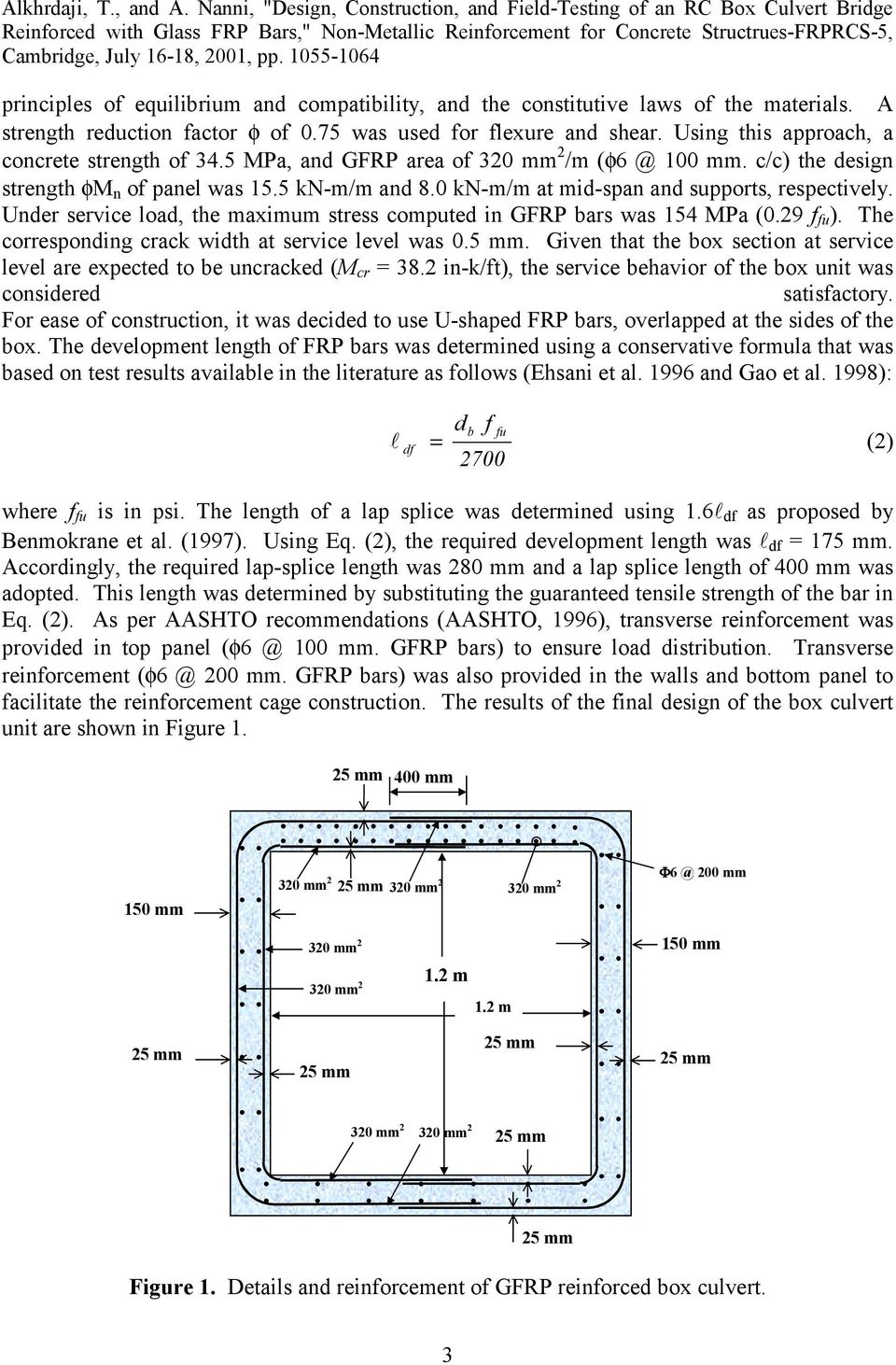
3 principles of equilibrium and compatibility, and the constitutive laws of the materials. A strength reduction factor φ of 0.75 was used for flexure and shear. Using this approach, a concrete strength of 34.5 MPa, and GFRP area of 320 mm 2 /m 100 mm. c/c) the design strength φm n of panel was 15.5 kn-m/m and 8.0 kn-m/m at mid-span and supports, respectively. Under service load, the maximum stress computed in GFRP bars was 154 MPa (0.29 f fu ). The corresponding crack width at service level was 0.5 mm. Given that the box section at service level are expected to be uncracked (M cr = 38.2 in-k/ft), the service behavior of the box unit was considered satisfactory. For ease of construction, it was decided to use U-shaped FRP bars, overlapped at the sides of the box. The development length of FRP bars was determined using a conservative formula that was based on test results available in the literature as follows (Ehsani et al and Gao et al. 1998): db f fu l df = (2) 2700 where f fu is in psi. The length of a lap splice was determined using 1.6l df as proposed by Benmokrane et al. (1997). Using Eq. (2), the required development length was l df = 175 mm. Accordingly, the required lap-splice length was 280 mm and a lap splice length of 400 mm was adopted. This length was determined by substituting the guaranteed tensile strength of the bar in Eq. (2). As per AASHTO recommendations (AASHTO, 1996), transverse reinforcement was provided in top panel 100 mm. GFRP bars) to ensure load distribution. Transverse reinforcement 200 mm. GFRP bars) was also provided in the walls and bottom panel to facilitate the reinforcement cage construction. The results of the final design of the box culvert unit are shown in Figure mm 150 mm 320 mm mm mm mm m 320 mm m 200 mm 150 mm 320 mm mm 2 Figure 1. Details and reinforcement of GFRP reinforced box culvert. 3
4 FABRICATION OF BOX CULVERT UNITS A concrete pipe precaster fabricated the box culvert units. The boxes were entirely reinforced with glass FRP reinforcement. The bar manufacturer pre-bent and cut the reinforcing bars to the required sizes and shapes. The bars were tied together using plastic ties, as shown in Figure 2. Figure 3 shows a completed cage prior to casting. The GFRP reinforcement in two boxes was instrumented with strain gages and fiber optic sensors for long-term monitoring purposes. In addition, two more boxes were instrumented with strain gages for laboratory testing purpose (see Figure 4). The specified concrete strength was 34.5 MPa. Conventional concrete made of portland cement, fly ash, water, and Missouri River aggregate with a maximum aggregate size of 3/8 inch was used to cast the box units. The box units were cast using steel forms consisting of an exterior shell and an interior shell. Plastic wheel spacers were used to maintain a cover thickness of 1 inch, as shown in Figure 5. The concrete boxes were cast using a dry cast process that uses low frequency-high amplitude vibration to distrubute and densely compact the mix in the form. Using this procedure, it was possible to remove the form immediately after casting. The boxes were manufactured with tongue and groove joints. Figure 2. Rig for GFRP cage assembly Figure 3. GFRP cage Figure 4. Strain gage on GFRP bar Figure 5. Plastic wheel spacers 4

5 LABORATORY VERIFICATION In addition to quality control tests by the precaster, eight standard concrete cylinders were acquired from different concrete batches and tested in the lab to determine the compressive strength of the concrete. The average strength of concrete cylinders was 42.7 MPa. Two box culvert units (Box 1 and Box 2) were instrumented and tested in the laboratory. The test setup and instrumentation are shown in Figure 6. The two specimens were identical to the units installed in the field. Each specimen was instrumented with five LVDTs and four inclinometers to measure deformations and rotations, respectively. Load was applied using a hydraulic jack that reacted against a steel beam anchored to the strong floor using two highstrength threaded steel rods. The load was distributed across the top slab at mid-span using a steel beam. Load measurement was obtained using a load cell. Specimens were tested to failure by applying quasi-static load cycles in which the magnitude of the maximum load used in each successive load cycle was incremented until mid-span deflection of the top slab become excessive and failure signs were observed. Hydraulic jack Load cell Spreader beam LVDT inclinometer strain gage Steel rod anchored to floor Figure 6. Test setup and instrumentation TEST RESULTS AND DISCUSSION For the first box, the first crack occurred at mid-span of the top panel at approximately kn. This cracking load was comparable with the theoretical cracking load of kn, computed based on elastic behavior. The following cracking occurred at the negative moment region at the top of the wall panels. Two cracks occurred simultaneously on both walls at approximately kn. Final cracks occurred at the negative moment region of the top slab panel at approximately kn, the maximum load attained during the test. Figure 7 shows location and sequence of cracking. Occurrence of each crack was accompanied by an increase in midspan deflection caused by stiffness degradation. The behavior of the second box was similar to the first one. 5

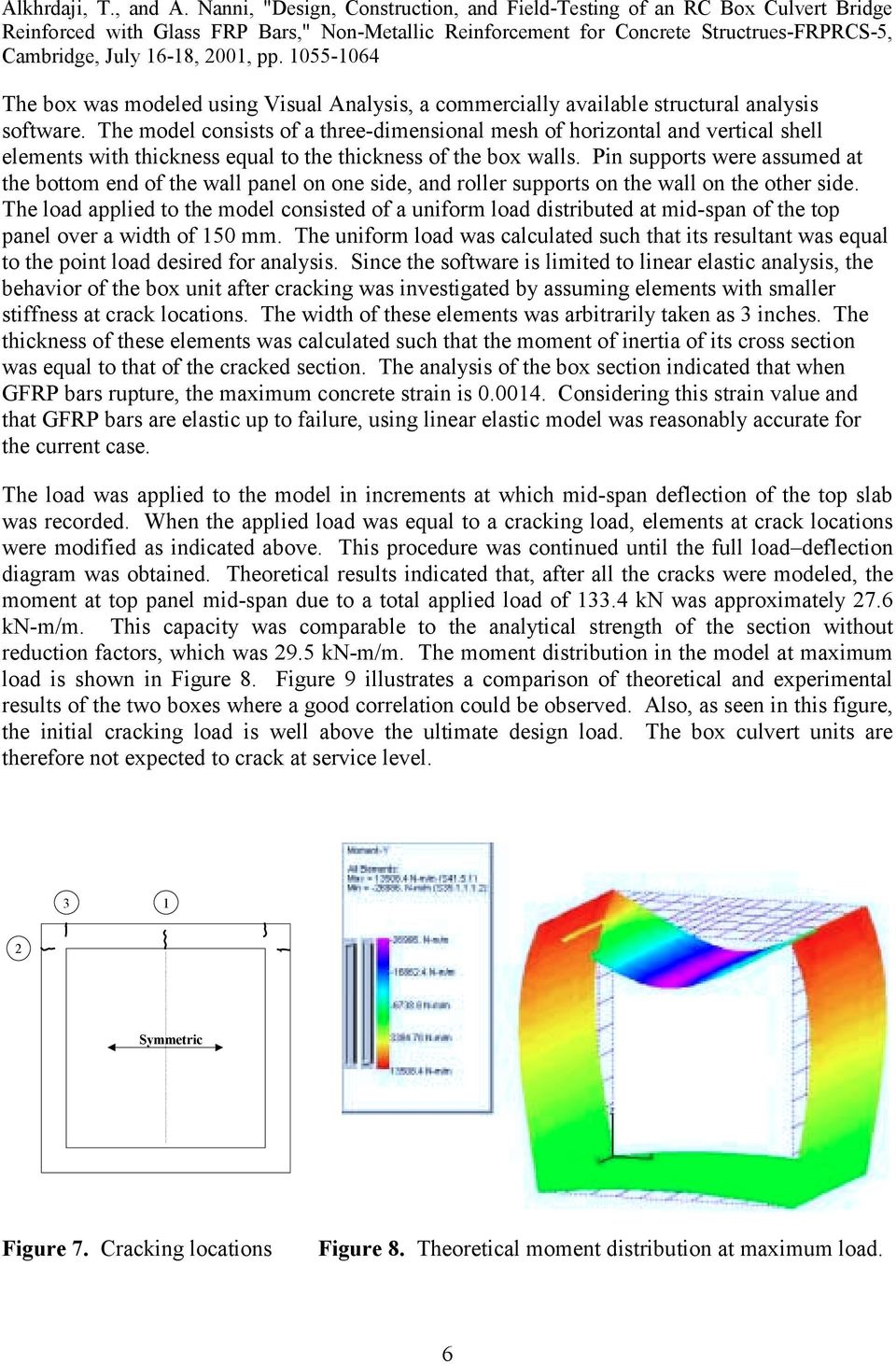
6 The box was modeled using Visual Analysis, a commercially available structural analysis software. The model consists of a three-dimensional mesh of horizontal and vertical shell elements with thickness equal to the thickness of the box walls. Pin supports were assumed at the bottom end of the wall panel on one side, and roller supports on the wall on the other side. The load applied to the model consisted of a uniform load distributed at mid-span of the top panel over a width of 150 mm. The uniform load was calculated such that its resultant was equal to the point load desired for analysis. Since the software is limited to linear elastic analysis, the behavior of the box unit after cracking was investigated by assuming elements with smaller stiffness at crack locations. The width of these elements was arbitrarily taken as 3 inches. The thickness of these elements was calculated such that the moment of inertia of its cross section was equal to that of the cracked section. The analysis of the box section indicated that when GFRP bars rupture, the maximum concrete strain is Considering this strain value and that GFRP bars are elastic up to failure, using linear elastic model was reasonably accurate for the current case. The load was applied to the model in increments at which mid-span deflection of the top slab was recorded. When the applied load was equal to a cracking load, elements at crack locations were modified as indicated above. This procedure was continued until the full load deflection diagram was obtained. Theoretical results indicated that, after all the cracks were modeled, the moment at top panel mid-span due to a total applied load of kn was approximately 27.6 kn-m/m. This capacity was comparable to the analytical strength of the section without reduction factors, which was 29.5 kn-m/m. The moment distribution in the model at maximum load is shown in Figure 8. Figure 9 illustrates a comparison of theoretical and experimental results of the two boxes where a good correlation could be observed. Also, as seen in this figure, the initial cracking load is well above the ultimate design load. The box culvert units are therefore not expected to crack at service level Symmetric Figure 7. Cracking locations Figure 8. Theoretical moment distribution at maximum load. 6
7 Load (KN) Design load 60 Service load ACI Design load Box 1, Exp. Box 2, Exp. Box 1, Theor Deflection (mm) Figure 9. Comparison of experimental and theoretical load-deflection behavior COMPARISON WITH PROPOSED DESIGN APPROACH BY ACI COMMITTEE 440H According to the latest draft of ACI Committee 440H (ACI 440H, 2000), the design tensile strength of GFRP bars f fu for reinforcement of concrete exposed to earth and weather should be taken as 0.7f * fu and the strength at the bend portion f fb is calculated using Eq. (1). The strength of an FRP reinforced flexural member M n in which failure is governed by FRP rupture can be conservatively calculated using the following expressions: M n β1cb = 0.8Af fd ( d ) (3) 2 c b = εcu d εcu + ε fu (4) in which, A f is the area of FRP reinforcement, c b is the depth of neutral axis at balanced strain condition, d is the depth of tensile reinforcement, f d design strength equal to f fu or f b depending on design condition, and ε cu is the ultimate strain of concrete for design taken as For strength controlled by FRP rupture, the committee proposed a conservative strength reduction factor φ of 0.5 to ensure adequate margin of safety against brittle-type failure. Using this approach, the design strength φm n of the box panel was 21.8 in-k/ft and 10.9 in-k/ft at mid-span and supports, respectively. Comparing with the observed behavior of tested box units, these results are very 7
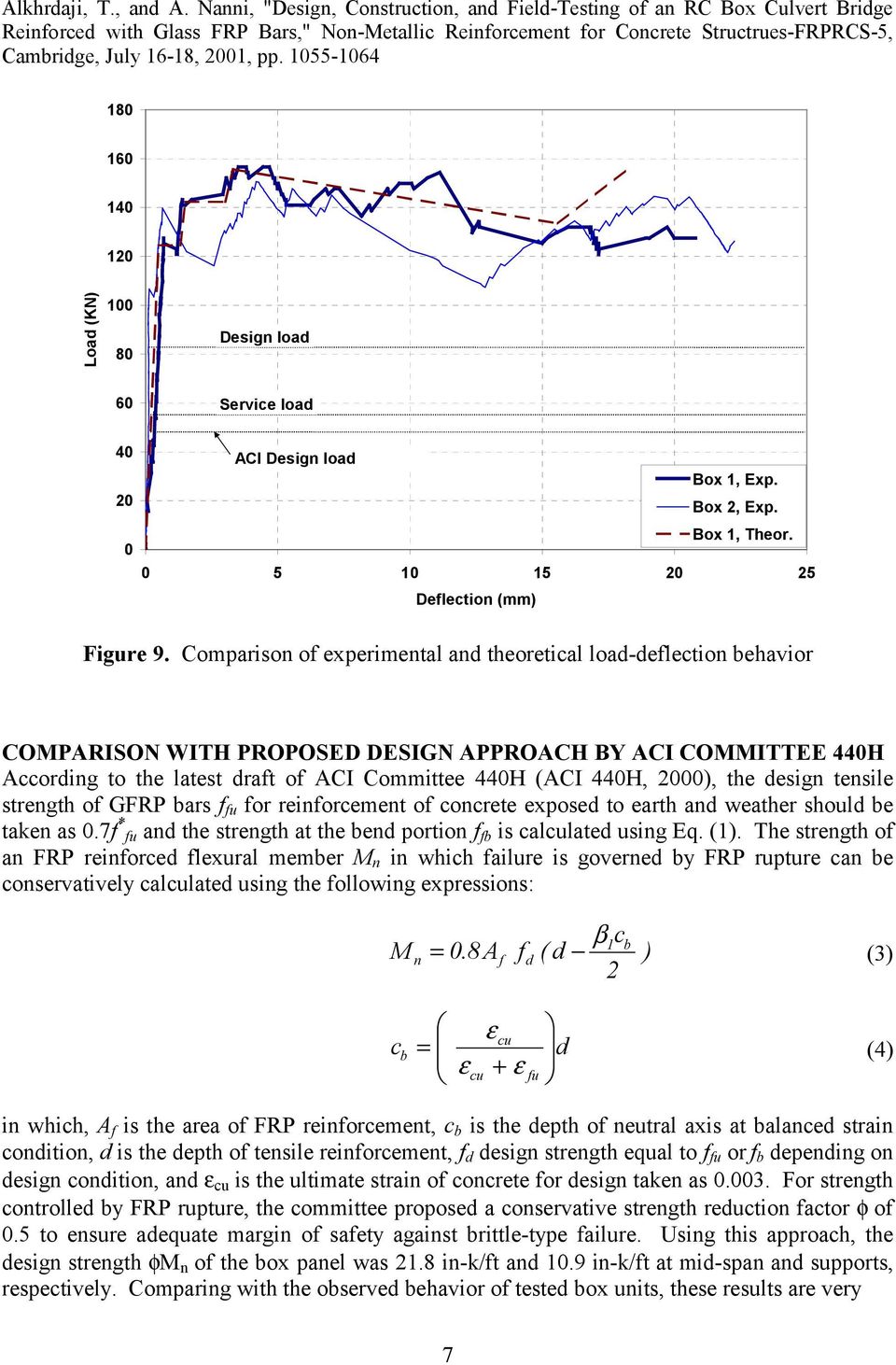
8 conservative (see Figure 9). Design based on the approach proposed by committee 440 would yield a stiffer cracked member with relatively high margin of safety against failure. BRIDGE CONSTRUCTION The new bridge was 36 ft wide and consisted of 18 precast concrete boxes arranged in two rows, nine boxes per row. A crew from Rolla City Public Work Department constructed the new bridge, as shown in Figure 10. The new Walker Avenue Bridge was opened to traffic on October 13, 1999 (see Figure 11). Figure 10. Bridge construction Figure 11. New Walker Avenue Bridge FIELD LOAD TESTING The in-situ load test was the first of a series of tests aimed at monitoring the performance of the bridge over the course of three years. In each test, the elastic response of the bridge is measured under similar loading and weather conditions. The first elastic load test was performed 8 months after the bridge was constructed using a test vehicle with a front axle load of 64.5 MPa. and a rear axle load of 65.4 MPa. Deflection measurements were taken using LVDTs located at the center of three consecutive box units, as shown in Figure 12. The data was collected for five axle locations at quarter points of the clear wall-to-wall distance on the transverse axis of the north and south boxes of the bridge. Axle locations are also shown in Figure 12. For each box row (North and South), the test was performed by stopping the vehicle at the predetermined location and measuring the resulting deflections. The test truck made two passes over the bridge, one for each box (row). The truck was driven forward until the front wheel line coincided with the first mark (location 1). Deflection measurements were then taken and the test vehicle was then slowly moved to the following mark (see Figure 13) and deflection measurements were taken again. This process was continued until all measurements were obtained. The vehicle was then driven until the rear wheel line coincided with the first mark on the box. Deflection measurements were taken in a similar fashion to that of the front wheel line. The test vehicle was then backed up for few minutes until deflection measurements stabilized and the whole process was repeated for the South box. 8

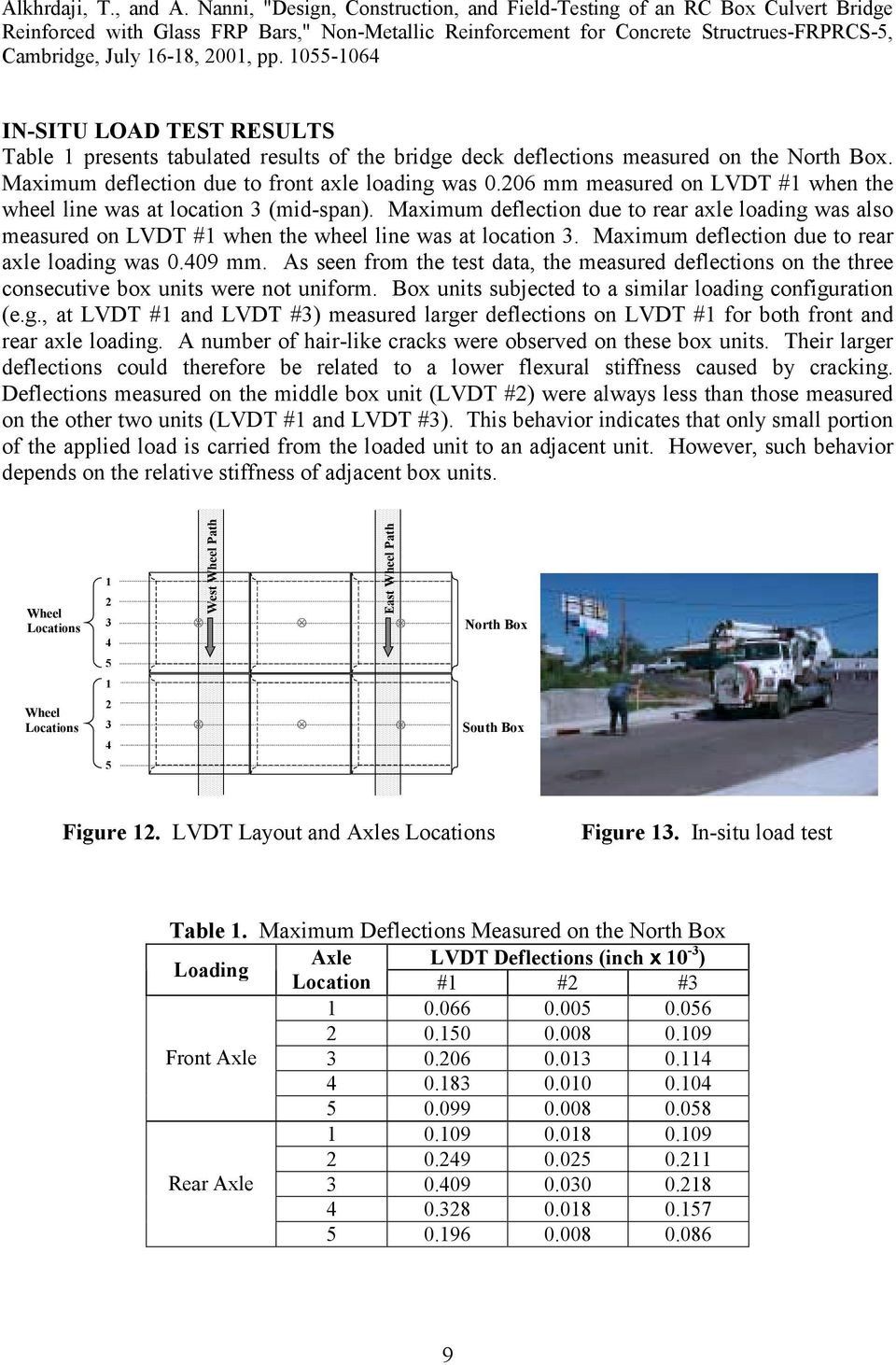
9 IN-SITU LOAD TEST RESULTS Table 1 presents tabulated results of the bridge deck deflections measured on the North Box. Maximum deflection due to front axle loading was mm measured on LVDT #1 when the wheel line was at location 3 (mid-span). Maximum deflection due to rear axle loading was also measured on LVDT #1 when the wheel line was at location 3. Maximum deflection due to rear axle loading was mm. As seen from the test data, the measured deflections on the three consecutive box units were not uniform. Box units subjected to a similar loading configuration (e.g., at LVDT #1 and LVDT #3) measured larger deflections on LVDT #1 for both front and rear axle loading. A number of hair-like cracks were observed on these box units. Their larger deflections could therefore be related to a lower flexural stiffness caused by cracking. Deflections measured on the middle box unit (LVDT #2) were always less than those measured on the other two units (LVDT #1 and LVDT #3). This behavior indicates that only small portion of the applied load is carried from the loaded unit to an adjacent unit. However, such behavior depends on the relative stiffness of adjacent box units. Wheel Locations West Wheel Path East Wheel Path North Box Wheel Locations South Box Figure 12. LVDT Layout and Axles Locations Figure 13. In-situ load test Table 1. Maximum Deflections Measured on the North Box Loading Axle LVDT Deflections (inch x 10-3 ) Location #1 #2 # Front Axle Rear Axle
10 CONCLUSION This paper presents an overview of the design, construction, and laboratory and field testing of a box culvert bridge reinforced with internal glass FRP bars. Box units were designed for failure controlled by GFRP rupture using equilibrium and compatibility equations. Laboratory testing indicated that the design approach is accurate and conservative and the experimental displacement behavior compared well with theoretical values. The design approach proposed by ACI Committee 440H is very conservative and would yield a stiffer member. The in-situ load test of the bridge indicated that bridge deflections were very small. Elastic deflection of the box units located under the west wheel path were higher than those obtained under the east wheel path under similar conditions. Variation in the elastic response of box units under similar loading condition was related to the presence of minor cracks. After load was removed there was no residual deflections. Results obtained from this test will be used as a benchmark. ACKNOWLEDGEMENTS The project was made possible with the financial support received from the Missouri Department of Transportation, University of Missouri-Rolla/University Transportation Center on Advanced Materials and NDT Technologies, and the City of Rolla. Hughes Brothers, Inc., Omaha, Nebraska provided the GFRP bars. Scurlock Industries of Springfield, Missouri, fabricated the box units. REFERENCES AASHTO (1996), Standard Specifications for Highway Bridges, Sixteenth Edition, American Association of State Highway and Transportation Officials, Washington, D.C. ACI Committee 440H (2000), Guide for Design and Construction of Concrete Reinforced with FRP bars, Draft Document, July 2000, American Concrete Institute, Farmington Hills, Michigan. Alkhrdaji, T., Mettemeyer, M., Nanni, A., and Belarbi, A., (1998), Flexural Behavior of FRP Reinforced Concrete Members, Report Number CIES 98/01, University of Missouri- Rolla, Rolla, Missouri. ASTM C , (1998) "Precast Reinforced Concrete Box Sections for Culverts, Storm Drains, and Sewers," American Society of Testing and Materials, ASTM. ASTM C a, (1995), "Precast Reinforced Concrete Box Sections for Culverts, Storm Drains, and Sewers with Less Than 2 ft of Cover Subjected to Highway Loading," American Society of Testing and Materials, ASTM. Benmokrane, B., 1997, Bond Strength of FRP Rebar Splices, Proceedings of the Third International Symposium on Non-Metallic (FRP) Reinforcement for Concrete Structures (FRPRCS-3), Japan Concrete Institute, Sapporo, Japan, V. 2, pp Ehsani, M.R.; Saadatmanesh, H.; and Tao, S., 1996, Design Recommendation for Bond of GFRP Rebars to Concrete, Journal of Structural Engineering, V. 122, No. 3, pp Gao, D.; Benmokrane, B.; and Tighiouart, B., 1998b, Bond Properties of FRP Rebars to Concrete, Technical Report, Department of Civil Engineering, University of Sherbrooke, Sherbrooke (Quebec), Canada, pp

11 Fedral Highway Adminstration, (1989), BOXCAR User and Programmer Manual, Version 1.0, Publication No. FHWA-IP , Turner-Fairbamk Highway Research Center, Mclean, Virginia, 231 pp. Heger, F.J. and Long, K.N., (1976), Structural Design of Precast Concrete Box Sections to Support Surface Highway Wheel Loads with Zero to Deep Earth Cover, presented at ASTM Committee C-12 Symposium on Concrete Pipe, Chicago, IL. Japan Society of Civil Engineers (JSCE), 1997b, Recommendation for Design and Construction of Concrete Structures Using Continuous Fiber Reinforcing Materials, Concrete Engineering Series, No. 23, 325 pp. Yamaguchi, T.; Kato, Y.; Nishimura, T.; and Uomoto, T., 1997, Creep Rupture of FRP Rods Made of Aramid, Carbon and Glass Fibers, Proceedings of the Third International Symposium on Non-Metallic (FRP) Reinforcement for Concrete Structures (FRPRCS-3), Japan Concrete Institute, Sapporo, Japan, V. 2, pp
In-situ Load Testing to Evaluate New Repair Techniques
 In-situ Load Testing to Evaluate New Repair Techniques W.J. Gold 1 and A. Nanni 2 1 Assistant Research Engineer, Univ. of Missouri Rolla, Dept. of Civil Engineering 2 V&M Jones Professor, Univ. of Missouri
Chapter 5 Bridge Deck Slabs. Bridge Engineering 1
 Chapter 5 Bridge Deck Slabs Bridge Engineering 1 Basic types of bridge decks In-situ reinforced concrete deck- (most common type) Pre-cast concrete deck (minimize the use of local labor) Open steel grid
STRENGTHENING AND LOAD TESTING OF THREE BRIDGES IN BOONE COUNTY, MO
 STRENGTHENING AND LOAD TESTING OF THREE BRIDGES IN BOONE COUNTY, MO S. Schiebel 1, R. Parretti 1, A. Nanni 2, and M. Huck 3 ABSTRACT Three bridges in Boone County, Missouri (Brown School Road Bridge, Coats
APE T CFRP Aslan 500
 Carbon Fiber Reinforced Polymer (CFRP) Tape is used for structural strengthening of concrete, masonry or timber elements using the technique known as Near Surface Mount or NSM strengthening. Use of CFRP
Strengthening of a Bridge Using Two FRP Technologies. Paolo Casadei, Nestore Galati, Renato Parretti and Antonio Nanni
 Strengthening of a Bridge Using Two FRP Technologies Paolo Casadei, Nestore Galati, Renato Parretti and Antonio Nanni Synopsis This paper reports on the use of externally bonded fiber reinforced polymers
Detailing of Reinforcment in Concrete Structures
 Chapter 8 Detailing of Reinforcment in Concrete Structures 8.1 Scope Provisions of Sec. 8.1 and 8.2 of Chapter 8 shall apply for detailing of reinforcement in reinforced concrete members, in general. For
Technical Notes 3B - Brick Masonry Section Properties May 1993
 Technical Notes 3B - Brick Masonry Section Properties May 1993 Abstract: This Technical Notes is a design aid for the Building Code Requirements for Masonry Structures (ACI 530/ASCE 5/TMS 402-92) and Specifications
Fiberglass Rebar (GFRP Rebar)
 Concrete Protection Products, Inc. Fiberglass Rebar (GFRP Rebar) Product Guide Specification October, 2013 Specifier Notes: This product specification is written according to the Construction Specifications
SLAB DESIGN. Introduction ACI318 Code provides two design procedures for slab systems:
 Reading Assignment SLAB DESIGN Chapter 9 of Text and, Chapter 13 of ACI318-02 Introduction ACI318 Code provides two design procedures for slab systems: 13.6.1 Direct Design Method (DDM) For slab systems
Basics of Reinforced Concrete Design
 Basics of Reinforced Concrete Design Presented by: Ronald Thornton, P.E. Define several terms related to reinforced concrete design Learn the basic theory behind structural analysis and reinforced concrete
16. Beam-and-Slab Design
 ENDP311 Structural Concrete Design 16. Beam-and-Slab Design Beam-and-Slab System How does the slab work? L- beams and T- beams Holding beam and slab together University of Western Australia School of Civil
SEISMIC UPGRADE OF OAK STREET BRIDGE WITH GFRP
 13 th World Conference on Earthquake Engineering Vancouver, B.C., Canada August 1-6, 2004 Paper No. 3279 SEISMIC UPGRADE OF OAK STREET BRIDGE WITH GFRP Yuming DING 1, Bruce HAMERSLEY 2 SUMMARY Vancouver
MATERIALS AND MECHANICS OF BENDING
 HAPTER Reinforced oncrete Design Fifth Edition MATERIALS AND MEHANIS OF BENDING A. J. lark School of Engineering Department of ivil and Environmental Engineering Part I oncrete Design and Analysis b FALL
DEVELOPMENT OF A NEW TEST FOR DETERMINATION OF TENSILE STRENGTH OF CONCRETE BLOCKS
 1 th Canadian Masonry Symposium Vancouver, British Columbia, June -5, 013 DEVELOPMENT OF A NEW TEST FOR DETERMINATION OF TENSILE STRENGTH OF CONCRETE BLOCKS Vladimir G. Haach 1, Graça Vasconcelos and Paulo
1.054/1.541 Mechanics and Design of Concrete Structures (3-0-9) Outline 1 Introduction / Design Criteria for Reinforced Concrete Structures
 Prof. Oral Buyukozturk Massachusetts Institute of Technology Outline 1 1.054/1.541 Mechanics and Design of Concrete Structures (3-0-9) Outline 1 Introduction / Design Criteria for Reinforced Concrete Structures
METHOD OF STATEMENT FOR STATIC LOADING TEST
 Compression Test, METHOD OF STATEMENT FOR STATIC LOADING TEST Tension Test and Lateral Test According to the American Standards ASTM D1143 07, ASTM D3689 07, ASTM D3966 07 and Euro Codes EC7 Table of Contents
bi directional loading). Prototype ten story
 NEESR SG: Behavior, Analysis and Design of Complex Wall Systems The laboratory testing presented here was conducted as part of a larger effort that employed laboratory testing and numerical simulation
Field Damage Inspection and Static Load Test Analysis of Jiamusi Highway Prestressed Concrete Bridge in China
 Advanced Materials Research Vols. 163-167 (2011) pp 1147-1156 Online available since 2010/Dec/06 at www.scientific.net (2011) Trans Tech Publications, Switzerland doi:10.4028/www.scientific.net/amr.163-167.1147
Numerical modelling of shear connection between concrete slab and sheeting deck
 7th fib International PhD Symposium in Civil Engineering 2008 September 10-13, Universität Stuttgart, Germany Numerical modelling of shear connection between concrete slab and sheeting deck Noémi Seres
A transverse strip of the deck is assumed to support the truck axle loads. Shear and fatigue of the reinforcement need not be investigated.
 Design Step 4 Design Step 4.1 DECK SLAB DESIGN In addition to designing the deck for dead and live loads at the strength limit state, the AASHTO-LRFD specifications require checking the deck for vehicular
Design of reinforced concrete columns. Type of columns. Failure of reinforced concrete columns. Short column. Long column
 Design of reinforced concrete columns Type of columns Failure of reinforced concrete columns Short column Column fails in concrete crushed and bursting. Outward pressure break horizontal ties and bend
Draft Table of Contents. Building Code Requirements for Structural Concrete and Commentary ACI 318-14
 Draft Table of Contents Building Code Requirements for Structural Concrete and Commentary ACI 318-14 BUILDING CODE REQUIREMENTS FOR STRUCTURAL CONCRETE (ACI 318 14) Chapter 1 General 1.1 Scope of ACI 318
SEISMIC DESIGN. Various building codes consider the following categories for the analysis and design for earthquake loading:
 SEISMIC DESIGN Various building codes consider the following categories for the analysis and design for earthquake loading: 1. Seismic Performance Category (SPC), varies from A to E, depending on how the
ABSTRACT 1. INTRODUCTION 2. DESCRIPTION OF THE SEGMENTAL BEAM
 Ninth LACCEI Latin American and Caribbean Conference (LACCEI 11), Engineering for a Smart Planet, Innovation, Information Technology and Computational Tools for Sustainable Development, August 3-, 11,
The Strength of Concrete
 Chapter The Strength of Concrete.1 The Importance of Strength.2 Strength Level Required KINDS OF STRENGTH. Compressive Strength.4 Flexural Strength.5 Tensile Strength.6 Shear, Torsion and Combined Stresses.7
SECTION 33 05 16.13 PRECAST CONCRETE UTILITY STRUCTURES
 SECTION 33 05 16.13 PRECAST CONCRETE PART 1 - GENERAL 1.01 SECTION INCLUDES A. This item shall consist of the construction of both sanitary and storm sewer precast concrete manholes in accordance with
SECTION 3 DESIGN OF POST TENSIONED COMPONENTS FOR FLEXURE
 SECTION 3 DESIGN OF POST TENSIONED COMPONENTS FOR FLEXURE DEVELOPED BY THE PTI EDC-130 EDUCATION COMMITTEE LEAD AUTHOR: TREY HAMILTON, UNIVERSITY OF FLORIDA NOTE: MOMENT DIAGRAM CONVENTION In PT design,
SECTION 02630 STORM DRAINAGE SYSTEM
 SECTION 02630 PART 1 - GENERAL 1.01 DESCRIPTION A. Section includes specifications for storm drainage systems including modifications and connections to existing storm drainage systems. 1.02 REFERENCE
IN-SERVICE PERFORMANCE AND BEHAVIOR CHARACTERIZATION OF THE HYBRID COMPOSITE BRIDGE SYSTEM A CASE STUDY
 IN-SERVICE PERFORMANCE AND BEHAVIOR CHARACTERIZATION OF THE HYBRID COMPOSITE BRIDGE SYSTEM A CASE STUDY John M. Civitillo University of Virginia, USA Devin K. Harris University of Virginia, USA Amir Gheitasi
INTRODUCTION TO BEAMS
 CHAPTER Structural Steel Design LRFD Method INTRODUCTION TO BEAMS Third Edition A. J. Clark School of Engineering Department of Civil and Environmental Engineering Part II Structural Steel Design and Analysis
Assistant Professor of Civil Engineering, University of Texas at Arlington
 FRC Performance Comparison: Direct Tensile Test, Beam Type Bending Test, and Round Panel Test Shih Ho Chao (Presenting Author) Assistant Professor of Civil Engineering, University of Texas at Arlington
Proper use of the Rebound Hammer Updated to reflect the changes to ASTM C805
 CEMEX USA - Technical Bulletin 2.1 Proper use of the Rebound Hammer Updated to reflect the changes to ASTM C805 The Rebound Hammer has been around since the late 1940 s and today is a commonly used method
1997 Uniform Administrative Code Amendment for Earthen Material and Straw Bale Structures Tucson/Pima County, Arizona
 for Earthen Material and Straw Bale Structures SECTION 70 - GENERAL "APPENDIX CHAPTER 7 - EARTHEN MATERIAL STRUCTURES 70. Purpose. The purpose of this chapter is to establish minimum standards of safety
SECTION 3 DESIGN OF POST- TENSIONED COMPONENTS FOR FLEXURE
 SECTION 3 DESIGN OF POST- TENSIONED COMPONENTS FOR FLEXURE DEVELOPED BY THE PTI EDC-130 EDUCATION COMMITTEE LEAD AUTHOR: TREY HAMILTON, UNIVERSITY OF FLORIDA NOTE: MOMENT DIAGRAM CONVENTION In PT design,
DESIGN OF SLABS. 3) Based on support or boundary condition: Simply supported, Cantilever slab,
 DESIGN OF SLABS Dr. G. P. Chandradhara Professor of Civil Engineering S. J. College of Engineering Mysore 1. GENERAL A slab is a flat two dimensional planar structural element having thickness small compared
SECTION 55 PIPE FOR STORM DRAINS AND CULVERTS (FAA D-701)
 SECTION 55 PIPE FOR STORM DRAINS AND CULVERTS (FAA D-701) 55-1 GENERAL The Contractor shall perform all work required by the plans for construction of pipe for storm drains, precast polymer trench drains
Optimising plate girder design
 Optimising plate girder design NSCC29 R. Abspoel 1 1 Division of structural engineering, Delft University of Technology, Delft, The Netherlands ABSTRACT: In the design of steel plate girders a high degree
Reinforced Concrete Design
 FALL 2013 C C Reinforced Concrete Design CIVL 4135 ii 1 Chapter 1. Introduction 1.1. Reading Assignment Chapter 1 Sections 1.1 through 1.8 of text. 1.2. Introduction In the design and analysis of reinforced
Wastewater Capital Projects Management Standard Construction Specification
 CITY AND COUNTY OF DENVER ENGINEERING DIVISION Wastewater Capital Projects Management Standard Construction Specification 10.1 Precast Concrete Pipe 10.1.1 General This section covers material requirements,
CHAPTER 9 LONG TERM MONITORING AT THE ROUTE 351 BRIDGE
 CHAPTER 9 LONG TERM MONITORING AT THE ROUTE 351 BRIDGE 9.1 INTRODUCTION An important reason that composite piles have not gained wide acceptance in the civil engineering practice is the lack of a long
Strain Measurement in Pavements with a Fibre Optics Sensor Enabled Geotextile
 Strain Measurement in Pavements with a Fibre Optics Sensor Enabled Geotextile Olivier Artières 1, Matteo Bacchi 2, Paolo Bianchini 1, Pierre Hornych 3 and Gerrit Dortland 1 1 TenCate Geosynthetics France,
Structural Rehabilitation of Rigid Pipes. George McAlpine 1, Affiliate, ASCE
 Published in Trenchless Pipeline Projects Proceedings of the Conference American Society of Civil Engineers Held June 8-11, 1997, Boston, Massachusetts Structural Rehabilitation of Rigid Pipes George McAlpine
The following sketches show the plans of the two cases of one-way slabs. The spanning direction in each case is shown by the double headed arrow.
 9.2 One-way Slabs This section covers the following topics. Introduction Analysis and Design 9.2.1 Introduction Slabs are an important structural component where prestressing is applied. With increase
Objectives. Experimentally determine the yield strength, tensile strength, and modules of elasticity and ductility of given materials.
 Lab 3 Tension Test Objectives Concepts Background Experimental Procedure Report Requirements Discussion Objectives Experimentally determine the yield strength, tensile strength, and modules of elasticity
ASSESSMENT AND PROPOSED STRUCTURAL REPAIR STRATEGIES FOR BRIDGE PIERS IN TAIWAN DAMAGED BY THE JI-JI EARTHQUAKE ABSTRACT
 ASSESSMENT AND PROPOSED STRUCTURAL REPAIR STRATEGIES FOR BRIDGE PIERS IN TAIWAN DAMAGED BY THE JI-JI EARTHQUAKE Pei-Chang Huang 1, Graduate Research Assistant / MS Candidate Yao T. Hsu 2, Ph.D., PE, Associate
Hardened Concrete. Lecture No. 14
 Hardened Concrete Lecture No. 14 Strength of Concrete Strength of concrete is commonly considered its most valuable property, although in many practical cases, other characteristics, such as durability
EFFECTS ON NUMBER OF CABLES FOR MODAL ANALYSIS OF CABLE-STAYED BRIDGES
 EFFECTS ON NUMBER OF CABLES FOR MODAL ANALYSIS OF CABLE-STAYED BRIDGES Yang-Cheng Wang Associate Professor & Chairman Department of Civil Engineering Chinese Military Academy Feng-Shan 83000,Taiwan Republic
PRESTRESSED CONCRETE. Introduction REINFORCED CONCRETE CHAPTER SPRING 2004. Reinforced Concrete Design. Fifth Edition. By Dr. Ibrahim.
 CHAPTER REINFORCED CONCRETE Reinforced Concrete Design A Fundamental Approach - Fifth Edition Fifth Edition PRESTRESSED CONCRETE A. J. Clark School of Engineering Department of Civil and Environmental
Safe & Sound Bridge Terminology
 Safe & Sound Bridge Terminology Abutment A retaining wall supporting the ends of a bridge, and, in general, retaining or supporting the approach embankment. Approach The part of the bridge that carries
SECTION 5 ANALYSIS OF CONTINUOUS SPANS DEVELOPED BY THE PTI EDC-130 EDUCATION COMMITTEE LEAD AUTHOR: BRYAN ALLRED
 SECTION 5 ANALYSIS OF CONTINUOUS SPANS DEVELOPED BY THE PTI EDC-130 EDUCATION COMMITTEE LEAD AUTHOR: BRYAN ALLRED NOTE: MOMENT DIAGRAM CONVENTION In PT design, it is preferable to draw moment diagrams
PERFORMANCE TEST REPORT. Rendered to: FORMTECH ENTERPRISES, INC. SERIES/MODEL: Truline PRODUCT TYPE: PVC Seawall
 PERFORMANCE TEST REPORT Rendered to: FORMTECH ENTERPRISES, INC. SERIES/MODEL: Truline PRODUCT TYPE: PVC Seawall Report No.: Test Dates: 04/17/12 Through: 04/18/12 Report Date: 06/13/12 130 Derry Court
Evaluation of Bridge Performance and Rating through Nondestructive
 Evaluation of Bridge Performance and Rating through Nondestructive Load Testing Final Report Prepared by: Andrew Jeffrey, Sergio F. Breña, and Scott A.Civjan University of Massachusetts Amherst Department
The Original Carbon Fiber Reinforced Polymer System
 Infrastructure The Original Carbon Fiber Reinforced Polymer System Phone: 52.292.39 Toll Free: 866.38.269 Fax: 52.48.5274 282 E. Fort Lowell Rd. Tucson, AZ 8576 www.dowaksausa.com Test results are supported
1.5 Concrete (Part I)
 1.5 Concrete (Part I) This section covers the following topics. Constituents of Concrete Properties of Hardened Concrete (Part I) 1.5.1 Constituents of Concrete Introduction Concrete is a composite material
The AASHO Road Test site (which eventually became part of I-80) at Ottawa, Illinois, was typical of northern climates (see Table 1).
 Página 1 de 12 AASHO Road Test The AASHO Road Test, a $27 million (1960 dollars) investment and the largest road experiment of its time, was conceived and sponsored by the American Association of State
MECHANICS OF SOLIDS - BEAMS TUTORIAL 1 STRESSES IN BEAMS DUE TO BENDING. On completion of this tutorial you should be able to do the following.
 MECHANICS OF SOLIDS - BEAMS TUTOIAL 1 STESSES IN BEAMS DUE TO BENDING This is the first tutorial on bending of beams designed for anyone wishing to study it at a fairly advanced level. You should judge
Collapse of Underground Storm Water Detention System
 Collapse of Underground Storm Water Detention System No. 16 March 2008 Shopping malls have large roof areas and large paved areas for parking. In many cases, during heavy rainfall, the drainage from these
C. Section 014510 TESTING LABORATORY SERVICE.
 SECTION 014500 QUALITY CONTROL PART 1 GENERAL 1.01 RELATED REQUIREMENTS A. Drawings and General Provisions of Contract, including General and Special Conditions and other Division 1 Specification Sections,
Tension Development and Lap Splice Lengths of Reinforcing Bars under ACI 318-02
 ENGINEERING DATA REPORT NUMBER 51 Tension Development and Lap Splice Lengths of Reinforcing Bars under ACI 318-02 A SERVICE OF THE CONCRETE REINFORCING STEEL INSTITUTE Introduction Section 1.2.1 in the
DIVISION 4300 STORM DRAINAGE
 DIVISION 4300 STORM DRAINAGE SECTION 4305 STORM SEWER PART 1 - GENERAL 1.01 SCOPE This section covers the construction of storm sewers for the collection and transport of stormwater runoff. 1.02 REFERENCES
Compression load testing straw bale walls. Peter Walker Dept. Architecture & Civil Engineering University of Bath Bath BA2 7AY.
 Compression load testing straw bale walls Peter Walker Dept. Architecture & Civil Engineering University of Bath Bath BA2 7AY May 2004 1. Introduction Over the last 10 years a growing number of loadbearing
Acceptance Criteria for Durability Tests
 Acceptance Criteria for Durability Tests Minimizing the risks of accepting defective concrete or rejecting acceptable concrete By Karthik H. Obla and Colin L. Lobo For the industry to shift toward performance-based
Pavement Thickness. esign and RCC-Pave Software. Roller-Compacted Concrete Pavement: Design and Construction. October 24, 2006 Atlanta, Georgia
 Roller-Compacted Concrete Pavement: Design and Construction Pavement Thickness esign and RCC-Pave Software Gregory E. Halsted, P.E. Pavements Engineer Portland Cement Association October 24, 2006 Atlanta,
Fire and Concrete Structures
 Fire and Concrete Structures Authors: David N. Bilow, P.E., S.E., Director, Engineered Structures, Portland Cement Association 5420 Old Orchard Road, Skokie, IL 60077,Phone 847-972-9064, email: [email protected]
Fatigue Performance Evaluation of Forged Steel versus Ductile Cast Iron Crankshaft: A Comparative Study (EXECUTIVE SUMMARY)
 Fatigue Performance Evaluation of Forged Steel versus Ductile Cast Iron Crankshaft: A Comparative Study (EXECUTIVE SUMMARY) Ali Fatemi, Jonathan Williams and Farzin Montazersadgh Professor and Graduate
Chapter 8. Flexural Analysis of T-Beams
 Chapter 8. Flexural Analysis of T-s 8.1. Reading Assignments Text Chapter 3.7; ACI 318, Section 8.10. 8.2. Occurrence and Configuration of T-s Common construction type.- used in conjunction with either
Session 5D: Benefits of Live Load Testing and Finite Element Modeling in Rating Bridges
 Session 5D: Benefits of Live Load Testing and Finite Element Modeling in Rating Bridges Douglas R. Heath P.E., Structural Engineer Corey Richard P.E., Project Manager AECOM Overview Bridge Testing/Rating
Structural Testing of GeoPolymer Pipe/Culvert Lining
 Structural Testing of GeoPolymer Pipe/Culvert Lining Joseph Royer, Ph.D. October 27 th, 2015 What is a GeoPolymer? Not a Plastic Not HDPE/PVC/Epoxy Looks and feels like cement Workability Material Properties
SECTION 02612 NONREINFORCED CONCRETE SEWER PIPE
 SECTION 02612 PART 1 GENERAL 1.1 SUMMARY A. Section Includes: Furnishing and installing nonreinforced concrete sewer pipe. Provide concrete sewer pipe less than 12 inches in diameter, and in other sizes
LOAD TESTING FOR BRIDGE RATING: DEAN S MILL OVER HANNACROIS CREEK
 REPORT FHWA/NY/SR-06/147 LOAD TESTING FOR BRIDGE RATING: DEAN S MILL OVER HANNACROIS CREEK OSMAN HAG-ELSAFI JONATHAN KUNIN SPECIAL REPORT 147 TRANSPORTATION RESEARCH AND DEVELOPMENT BUREAU New York State
SEISMIC RETROFITTING TECHNIQUE USING CARBON FIBERS FOR REINFORCED CONCRETE BUILDINGS
 Fracture Mechanics of Concrete Structures Proceedings FRAMCOS-3 AEDIFICA TIO Publishers, D-79104 Freiburg, Germany SEISMIC RETROFITTING TECHNIQUE USING CARBON FIBERS FOR REINFORCED CONCRETE BUILDINGS H.
A Decade of Performance of FRP-Repaired Concrete Structures
 A Decade of Performance of FRP-Repaired Concrete Structures Shamim A. Sheikh and S. Mukhtar Homam Department of Civil Engineering University of Toronto Toronto, Canada ABSTRACT During the last ten years,
Section 2100-Trenching and Tunneling
 SECTION 5200 - STORM SEWER PART 1 - GENERAL 1.01 SCOPE: This Section covers installation of storm sewer mains and culverts. Topics include permits and fees, trench widths, pipe laying, bedding, initial
Optimum proportions for the design of suspension bridge
 Journal of Civil Engineering (IEB), 34 (1) (26) 1-14 Optimum proportions for the design of suspension bridge Tanvir Manzur and Alamgir Habib Department of Civil Engineering Bangladesh University of Engineering
Section 5A: Guide to Designing with AAC
 Section 5A: Guide to Designing with AAC 5A.1 Introduction... 3 5A.3 Hebel Reinforced AAC Panels... 4 5A.4 Hebel AAC Panel Design Properties... 6 5A.5 Hebel AAC Floor and Roof Panel Spans... 6 5A.6 Deflection...
SECTION 36 - CAST-IN-PLACE CONCRETE PIPE (CIPCP) TABLE OF CONTENTS
 SECTION 36 - CAST-IN-PLACE CONCRETE PIPE (CIPCP) TABLE OF CONTENTS Section Page 36-1 GENERAL... 36.1 36-2 PIPEMAKING EQUIPMENT... 36.1 36-3 TRENCH EXCAVATION... 36.1 36-4 SPECIAL FOUNDATION TREATMENT...
Report on. Wind Resistance of Signs supported by. Glass Fiber Reinforced Concrete (GFRC) Pillars
 Report on Wind Resistance of Signs supported by Glass Fiber Reinforced Concrete (GFRC) Pillars Prepared for US Sign and Fabrication Corporation January, 2006 SUMMARY This study found the attachment of
The elements used in commercial codes can be classified in two basic categories:
 CHAPTER 3 Truss Element 3.1 Introduction The single most important concept in understanding FEA, is the basic understanding of various finite elements that we employ in an analysis. Elements are used for
Micropiles Reduce Costs and Schedule for Merchant RR Bridge Rehabilitation
 Micropiles Reduce Costs and Schedule for Merchant RR Bridge Rehabilitation Jeff R. Hill, P.E. Hayward Baker Inc. 111 W. Port Plaza Drive Suite 600 St. Louis, MO 63146 314-542-3040 [email protected]
SPECIFICATIONS FOR PRECAST MODULAR BLOCK RETAINING WALL SYSTEM (revised 11/5/13)
 Page 1 of 7 STONE STRONG SYSTEMS SPECIFICATIONS FOR PRECAST MODULAR BLOCK RETAINING WALL SYSTEM (revised ) PART 1: GENERAL 1.01 Description A. Work includes furnishing and installing precast modular blocks
Prestressed Concrete Pipe Fitness for Service and Repair
 Prestressed Concrete Pipe Fitness for Service and Repair Rasko Ojdrovic [email protected] 781-907-9231 IAEA - EPRI 15 October 2014 www.sgh.com SGH Pipeline Experience More than 25 years of research, analysis,
SAMPLE GUIDE SPECIFICATIONS FOR OSTERBERG CELL LOAD TESTING OF DEEP FOUNDATIONS
 Page 1 of 9 SAMPLE GUIDE SPECIFICATIONS FOR OSTERBERG CELL LOAD TESTING OF DEEP FOUNDATIONS 1. GENERAL REQUIREMENTS 1. Description of Work: This work consists of furnishing all materials, equipment and
CCU Engineering Specifications. Section 003300 PRECAST CONCRETE PRODUCTS
 CCU Engineering Specifications Section 003300 Effective Date: Nov. 1st, 2011 Page 1 of 5 PRECAST CONCRETE PRODUCTS PART 1 - GENERAL The following specification is intended for use for the design, selection
LARGE SCALE TENSILE TESTS OF HIGH PERFORMANCE FIBER REINFORCED CEMENT COMPOSITES
 LARGE SCALE TENSILE TESTS OF HIGH PERFORMANCE FIBER REINFORCED CEMENT COMPOSITES Shih-Ho Chao (1), Wen-Cheng Liao (2), Thanasak Wongtanakitcharoen (3), and Antoine E. Naaman (4) (1) Post-Doctoral Research
EDEXCEL NATIONAL CERTIFICATE/DIPLOMA MECHANICAL PRINCIPLES OUTCOME 2 ENGINEERING COMPONENTS TUTORIAL 1 STRUCTURAL MEMBERS
 ENGINEERING COMPONENTS EDEXCEL NATIONAL CERTIFICATE/DIPLOMA MECHANICAL PRINCIPLES OUTCOME ENGINEERING COMPONENTS TUTORIAL 1 STRUCTURAL MEMBERS Structural members: struts and ties; direct stress and strain,
Overview of Topics. Stress-Strain Behavior in Concrete. Elastic Behavior. Non-Linear Inelastic Behavior. Stress Distribution.
 Stress-Strain Behavior in Concrete Overview of Topics EARLY AGE CONCRETE Plastic shrinkage shrinkage strain associated with early moisture loss Thermal shrinkage shrinkage strain associated with cooling
Analysis and Repair of an Earthquake-Damaged High-rise Building in Santiago, Chile
 Analysis and Repair of an Earthquake-Damaged High-rise Building in Santiago, Chile J. Sherstobitoff Ausenco Sandwell, Vancouver, Canada P. Cajiao AMEC, Vancouver, Canada P. Adebar University of British
Statics of Structural Supports
 Statics of Structural Supports TYPES OF FORCES External Forces actions of other bodies on the structure under consideration. Internal Forces forces and couples exerted on a member or portion of the structure
MCE380: Measurements and Instrumentation Lab. Chapter 9: Force, Torque and Strain Measurements
 MCE380: Measurements and Instrumentation Lab Chapter 9: Force, Torque and Strain Measurements Topics: Elastic Elements for Force Measurement Dynamometers and Brakes Resistance Strain Gages Holman, Ch.
TABLE OF CONTENTS. Roof Decks 172 B, BA, BV Deck N, NA Deck. Form Decks 174.6 FD,.6 FDV Deck 1.0 FD, 1.0 FDV Deck 1.5 FD Deck 2.0 FD Deck 3.
 Pages identified with the NMBS Logo as shown above, have been produced by NMBS to assist specifiers and consumers in the application of New Millennium Building Systems Deck products. Pages identified with
June 2007 CHAPTER 7 - CULVERTS 7.0 CHAPTER 7 - CULVERTS 7.1 GENERAL
 7.0 7.1 GENERAL For the purpose of this manual, culverts are defined as structures that are completely surrounded by soil and located below the surface of the roadway parallel to the general direction
Formwork for Concrete
 UNIVERSITY OF WASHINGTON DEPARTMENT OF CONSTRUCTION MANAGEMENT CM 420 TEMPORARY STRUCTURES Winter Quarter 2007 Professor Kamran M. Nemati Formwork for Concrete Horizontal Formwork Design and Formwork Design
STRUCTURES. 1.1. Excavation and backfill for structures should conform to the topic EXCAVATION AND BACKFILL.
 STRUCTURES 1. General. Critical structures may impact the integrity of a flood control project in several manners such as the excavation for construction of the structure, the type of foundation, backfill