
AN1445. Antenna design guide for MFRC52x, PN51x and PN53x. Application note PUBLIC. Rev October Document information
|
|
|
- Leonard Shaw
- 9 years ago
- Views:
Transcription
1 Document information Info Content Keywords NFC, MFRC5, MFRC53, PN511, PN51, PN531, PN53, Antenna Design, RF Design, constant current design Abstract This application notes provides guidance on antenna and RF design for NFC devices MFRC5, MFRC53, PN511, PN51, PN531, PN53

2 Revision history Rev Date Description Update with MFRC5 and MFRC /0/ Selection Guide and all topologies added /10/31 Initial Release Contact information For additional information, please visit: For sales office addresses, please send an to: _1 All information provided in this document is subject to legal disclaimers. NXP B.V All rights reserved. of 65

3 1. Introduction 1.1 Purpose and Scope This application note is intended to give a practical guide to design and dimension antennas and RF parts for contactless reader as well as NFC devices. The application note will provide the required understanding to design application specific antennas and dimensioning RF parts to achieve the best performance for a communication according to the different communication schemes of the ICs. The RF part covers the required matching circuit to match an application specific antenna coil to the output driver of the MFRC5/MFRC53/PN51x/PN53x as well as the receiving circuit in order to detect a received RF signal. 1. MFRC5x/PN51x/PN53x features The MFRC5/MFRC53/PN51x/PN53x devices are designed to communicate in three different operation modes: 1. Reader/Writer mode to communicate to an ISO/IEC14443A, MIFARE card up to 100 mm depending on the antenna size and tuning. (MFRC5x /PN51x/PN53x).. Reader/Writer mode to communicate to a ISO/IEC14443 B card up to 100 mm depending on the antenna size and tuning (MFRC53/PN51x/PN53x). 3. Reader/Writer mode to communicate to a FeliCa card up to 100 mm depending on the antenna size and tuning (PN51x, PN53x). 4. NFCIP-1 mode to communicate to another NFC devices up to 100 mm depending on the antenna sizes and tuning (PN51x, PN53x). 5. ISO/IEC14443A, MIFARE card or FeliCa card mode to communicate to ISO/IEC14443A, MIFARE or FeliCa reader up to 100 mm depending on the generated external field strength. (PN51x, PN53x) The MFRC5x/PN51x/PN53x s overall functionality can be separated into three functions: 6. Generate the RF field: The generated magnetic field has to be maximized within the limits of the transmitter supply current and general emission limits. 7. Transmit data: The coded and modulated data signal has to be transmitted in a way, that every card and MFRC5x /PN51x/PN53x device is able to receive it. The signal shape and timing according to relevant standards has to be considered. 8. Receive data: The response of a card or MFRC5x /PN51x/PN53x device has to be transferred to the receive input of the PN51x/PN53x considering various limits, e.g. maximum voltage and receiver sensitivity. The operating distance for the MFRC5x/PN51x/PN53x depends on the matching of the antenna, the sensitivity of the receiving part, the antenna size of the device, the antenna size of the communication partner and external parameters, such as metallic environment and noise. _1 All information provided in this document is subject to legal disclaimers. NXP B.V All rights reserved. 3 of 65

4 . How to use this document Note: MFRC5x devises are Reader/Writer devises only. So these are not able to operate in target mode. The application note is intended to give a practical guide to choose the matching topology, to design antennas and calculate the matching components for the MFRC5x/PN51x/PN53x RF part. It gives a guideline starting with the recommended RF matching circuitry description as well as a dedicated description of the transmitter matching resistance and matching procedure in each chapter. The appendix of this document provides an introduction in the overall antenna design theory for the system. Depending on the target applications, different design decisions can be made in order to optimize the antenna topology. The environmental constraints of a device/antenna are the influencing detuning parameters for the RX-path and have to be investigated. Conditions for a detuning are determined by the type of an application and housing, e.g. peer-to-peer mode, card mode, metal or composite plastic housing. These effects can cause large voltage drops at the RX-site and therefore may affect demodulation of the signal. The user needs to follow the selection guide in chapter 3 to choose the appropriate antenna topology! This application note is outlined as followed 1. Antenna Selection Guide. Antenna Topology I 3. Antenna Topology II 4. Adoptions of Antenna Topology I or II 5. Antenna Topology III 6. Appendix a. The appendix includes information describing the calculation of the inductance of an antenna coil and gives basic hints on symmetry and environmental influences. The calculation of the equivalent circuits and an overview of all relevant formulas are give as well as Tips and hints to check the antenna and RF part design. Each Antenna Topology provides information about a. The RF part block diagram. It shows a recommended circuitry design with all relevant components required to connect an antenna to the PN51x/PN53x. It also ensures the transmission of energy and data to the target device as well as the reception of a target device answer. b. The TX matching resistance R match is explained which is required to calculate the remaining components and to optimize PN51x/PN53x power consumption. _1 All information provided in this document is subject to legal disclaimers. NXP B.V All rights reserved. 4 of 65

5 c. Formulas to calculate the EMC filter and the matching circuit d. Antenna tuning procedure e. Design and calculation of the receiving part f. Example calculations Note: This application note does not replace the relevant datasheets referenced in chapter 9. Card in this document means a contactless smart card according to the ISO/IEC14443A (or MIFARE) or a contactless card according to the FeliCa scheme. Design hints on how to place the components on a PCB are not included. Tuning and measurement of the antenna has always to be performed at the final mounting position to consider all parasitic effects, e.g. metal influence on quality factor, inductance and additional capacitance. All topologies and design methods described in this document assume antenna and tuning components are not accessible to end user. Therefore no additional ESD protection methods are described. In case antenna wiring is accessible from device housing or after user removable parts are detached, additional ESD protection has to be evaluated. Methods described here are then no more generally valid. Increased RF output power and communication distance could be achieved by integrating the RF amplifier for NXP s contactless Reader IC s ([13]). _1 All information provided in this document is subject to legal disclaimers. NXP B.V All rights reserved. 5 of 65
6 3. Selection Guide The following flow chart describes a selection guide for different antenna topologies. The user needs to start from the top rectangle going downwards. Due to different detuning effects on the antenna only one of the following topologies may apply to the type of reader integration. MIFARE, Type-A/B, FeliCa, Peer-to-Peer This is the starting point of the selection guide. This means, all indicated protocols can be supported by the following antenna topologies. Antenna Topology I It is recommended to start with Antenna Topology I since this is the basis for possible further adoptions. Verify detuning at RX-Path according to chapter 4.6 Receiver Circuit Design If communication problems occur, that can not be resolved by adjusting register settings or RX-path dimensioning, Antenna Topology II needs to be applied. Antenna Topology II Antenna Topology II resolves strong detuning effects on the matching circuit. Asymmetric antenna tuning according to chapter 6 If Antenna Topology I and II cannot counteract communication errors in certain distances, the EMC filter and matching circuit has to be adjusted according to chapter 6 Antenna Topology III Antenna Topology III has the same physical constraints as the asymmetric tuning of the recent topologies. Antenna Topology III requires less matching components. _1 All information provided in this document is subject to legal disclaimers. NXP B.V All rights reserved. 6 of 65

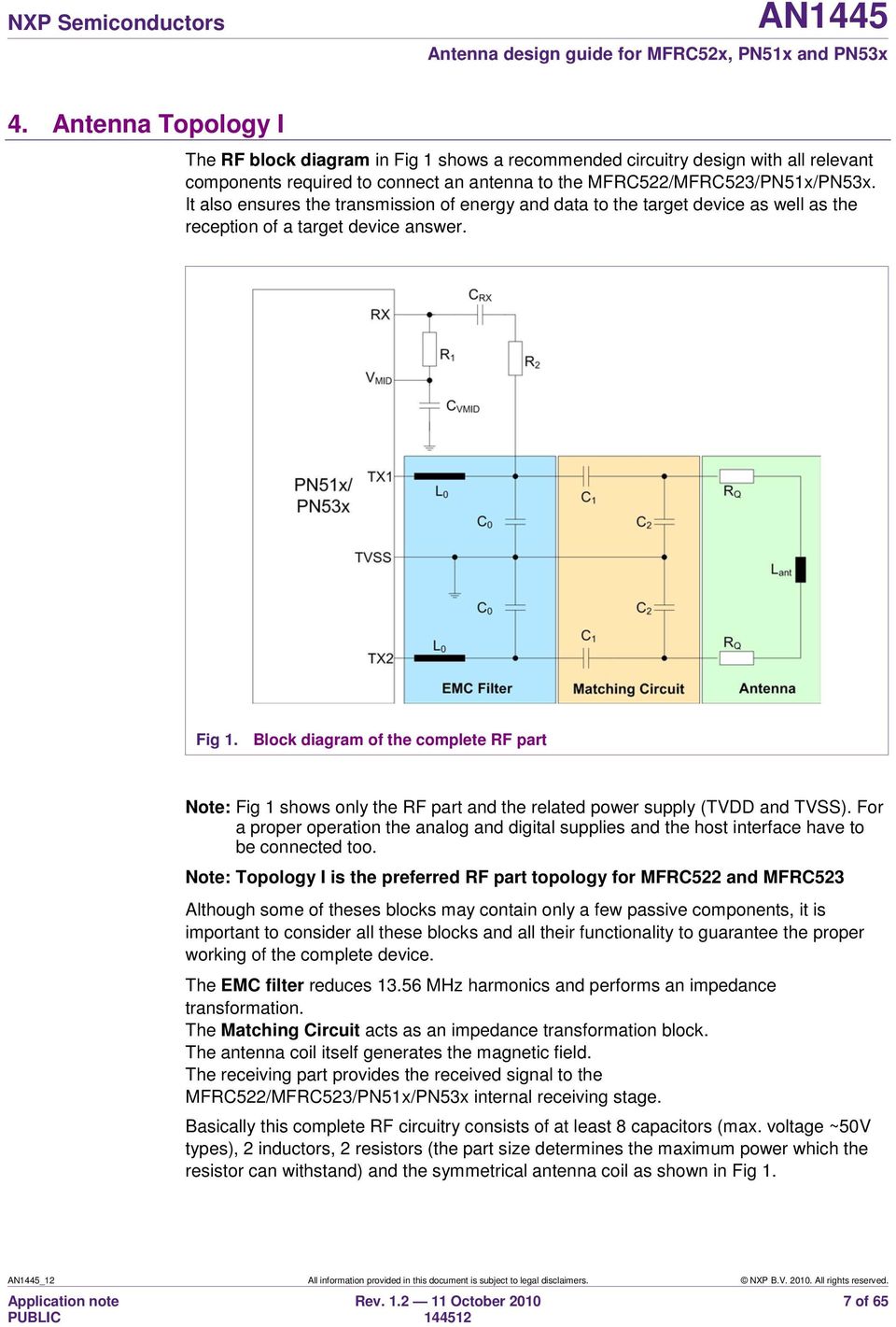
7 4. Antenna Topology I The RF block diagram in Fig 1 shows a recommended circuitry design with all relevant components required to connect an antenna to the MFRC5/MFRC53/PN51x/PN53x. It also ensures the transmission of energy and data to the target device as well as the reception of a target device answer. Fig 1. Block diagram of the complete RF part Note: Fig 1 shows only the RF part and the related power supply (TVDD and TVSS). For a proper operation the analog and digital supplies and the host interface have to be connected too. Note: Topology I is the preferred RF part topology for MFRC5 and MFRC53 Although some of theses blocks may contain only a few passive components, it is important to consider all these blocks and all their functionality to guarantee the proper working of the complete device. The EMC filter reduces MHz harmonics and performs an impedance transformation. The Matching Circuit acts as an impedance transformation block. The antenna coil itself generates the magnetic field. The receiving part provides the received signal to the MFRC5/MFRC53/PN51x/PN53x internal receiving stage. Basically this complete RF circuitry consists of at least 8 capacitors (max. voltage ~50V types), inductors, resistors (the part size determines the maximum power which the resistor can withstand) and the symmetrical antenna coil as shown in Fig 1. _1 All information provided in this document is subject to legal disclaimers. NXP B.V All rights reserved. 7 of 65
8 4.1 Equivalent circuit The following subchapters describe the matching procedure. It starts with the determination of the antenna parameters and ends with a fine tuning of the antenna circuitry Determination of series equivalent circuit The antenna loop has to be connected to an impedance or network analyzer to measure the series equivalent components. Note: The equivalent circuit (see Fig ) must be determined under final environmental conditions especially if the antenna will be operated in metal environment or a ferrite will be used for shielding. R a C a L a Antenna Fig. Series equivalent circuit Typical values: L a = µh C a = pf R a = Ω 4.1. Calculation of antenna quality factor damping resistor R Q The quality factor of the antenna is calculated with Q a L = ω R a a (1) If the calculated value of Q a is higher than the target value of 35, an external damping resistor R Q has to be inserted on each antenna side to reduce the Q-factor to a value of 35 (±10%). The value of R Q (each side of the antenna) calculates as R Q ω La = 0.5 Ra 35 () Determination of parallel equivalent circuit The parallel equivalent circuit of the antenna together with the added external damping resistor R Q has to be measured. The quality factor should be checked again to be sure to achieve the required value of Q=35. _1 All information provided in this document is subject to legal disclaimers. NXP B.V All rights reserved. 8 of 65

9 Note: The equivalent circuit (Fig 3) must be determined under final environmental conditions especially if the antenna will be operated in metal environment or a ferrite will be used for shielding. R Q C pa R pa L pa Antenna R Q Fig 3. Parallel equivalent circuit The following formula applies L C R pa pa pa = ˆ L a = ˆ C a ( ω La ) = ˆ R + R a Q (3) 4. EMC filter design The EMC filter circuit for the MFRC5/;MFRC53/PN51x/PN53x fulfills two functions: the filtering of the signal and impedance transformation block. The main properties of the impedance transformation are: Decreasing the amplitude rise time after a modulation phase Increasing the receiving bandwidth The EMC filter and the matching circuit must transform the antenna impedance to the required TX matching resistance Z match (f) at the operating frequency of f = MHz. Fig 4. Impedance transformation When splitting the circuit between EMC Filter and Matching Circuit the following applies if instead of the IC two resistors with the value R match / would be applied: _1 All information provided in this document is subject to legal disclaimers. NXP B.V All rights reserved. 9 of 65

10 Fig 5. Definition of transformation impedance Z tr Z = R + tr tr jx tr (4) Z * tr = R tr jx tr (5) EMC filter general design rules: L 0 = 390 nh - 1 µh Filter resonance frequency f r0 = 14.1 MHz MHz, => C 0 C 0 = 1 ( π fr0 ) L0 (6) The EMC filter resonance frequency f r0 has to be near the upper sideband frequency determined by the highest data rate (848 khz sub carrier) in the system to achieve a broadband receiving characteristic. Example: L 0 = 560 nh f r0 = 14.3 MHz C 0 = 1. pf => chosen: 0 pf A recommended value of 560 nh for L 0 is chosen to calculate the capacitance C 0. The following formulas apply for Z ant = Re(Z ant )+Im(Z ant ) and are needed to calculate the matching components. R tr = R match Rmatch ω C0 ( ω L C ) (7) _1 All information provided in this document is subject to legal disclaimers. NXP B.V All rights reserved. 10 of 65

11 X tr = L 0 ( 1 ω L C ) ( 1 ω L C ) match R 0 4 R + ω C C 0 0 ω (8) match _1 All information provided in this document is subject to legal disclaimers. NXP B.V All rights reserved. 11 of 65

12 4.3 Matching circuit design Component calculation The following formulas apply for the series and parallel matching capacitances: C 1 ω R tr R 4 1 pa + X tr (9) C 1 1 C L pa Rtr R pa ω ω 4 pa (10) Finally, a fine tuning of the matching circuit is often necessary, since the calculated values are based on simplified equations and the equivalent circuit values can not be determined 100% correct. 4.4 Tuning procedure The matching circuit elements C 1 and C must be tuned to get the required matching resistance R match (X match = 0) at the PN51x/PN53x TX pins. The matching impedance Z match = R match + jx match is measured with an impedance or network analyzer. The Z match point between TX1 and TX as shown in Fig 6 is the probing point for the network analyzer. Fig 6. Measurement of matching impedance The following Fig 7 shows a simulation example for the matching impedance Z match. _1 All information provided in this document is subject to legal disclaimers. NXP B.V All rights reserved. 1 of 65

13 Fig 7. Calculation of matching impedance Fig 8 shows the smith chart simulation for Z match / : Fig 8. Smith chart for matching impedance _1 All information provided in this document is subject to legal disclaimers. NXP B.V All rights reserved. 13 of 65

14 Conditions for the tuning: R match curve symmetric around the operating frequency X match curve conjugate complex symmetric around the operating frequency Note: All tuning and measurement of the antenna always has to be performed at the final mounting position to consider all parasitic effects like metal influence on quality factor, inductance and additional capacitance. _1 All information provided in this document is subject to legal disclaimers. NXP B.V All rights reserved. 14 of 65

15 4.4.1 Tuning of series matching capacitance C 1 The smith charts in Fig 9 show the matching impedance Z match / vs. frequency. a. Optimum C1 b. C 1 too low c. C 1 too high Fig 9. Smith charts for C 1 tuning C 1 changes the magnitude of the matching impedance. After a change of C 1 the imaginary part of Z match must be compensated by adjusting C. _1 All information provided in this document is subject to legal disclaimers. NXP B.V All rights reserved. 15 of 65

16 4.5 Tuning of parallel matching capacitance C The smith charts show the matching impedance Z match / vs. frequency. d. Optimum C e. C too low f. C too high Fig 10. Smith charts for C tuning C changes mainly the imaginary part of Z match. _1 All information provided in this document is subject to legal disclaimers. NXP B.V All rights reserved. 16 of 65

17 4.5.1 Tuning flow chart START f Zmax > MHz NO Yes Decrease C NO Phase = 0 (+/- 10 ) Yes Phase = 0 (+/- 10 ) NO Increase C NO Zmax = Ohm Yes Yes Zmax < Ohm Z(13.56 MHz - f) = Z(13.56 MHz + f) Yes Increase C1 NO NO Decrease C1 TUNING OK Increase C0 Yes Z(13.56 MHz - f) < Z(13.56 MHz + f) Decrease C0 NO Fig 11. Tuning flow chart _1 All information provided in this document is subject to legal disclaimers. NXP B.V All rights reserved. 17 of 65

18 4.6 Receiver circuit design Next step, after matching and tuning the transmitting antenna, is the design and tuning of the receiver circuit. The investigations need to be carried out for initiator and target mode. Fig 1 shows the relevant components for the receiver circuit. R 1 and R form a voltage divider which has to be adjusted according to the incoming voltage levels at U C0. Both, Initiator and target mode of the device have to be investigated, since detuning effects on the RX path behave differently. Fig 1. Receiver Circuit Initiator mode Step 1: Predefined components: C RX = 1 nf: DC blocking capacitor C vmid = 100 nf: V mid decoupling capacitance R1 = 1 kω: Predefined part of the voltage divider Step : The transmitter must be switched on in continuous wave mode and the voltage on the EMC filter capacitance U C0 has to be measured with a low capacitance probe (< pf). Typically low capacitance probes are terminated with 50 Ohm, thus the scope configuration has to be set correctly! Step 3: The voltage divider resistor R can be calculated by: _1 All information provided in this document is subject to legal disclaimers. NXP B.V All rights reserved. 18 of 65

19 R U C0 = R1 1 U RX (11) with the target value of U RX = 1 V pp (antenna not detuned) Step 4: After inserting the determined resistor R the voltage on RX pin U RX must be measured with a low capacitance probe (< pf) for continuous transmitting mode. The voltage U RX must not exceed the maximum value U RXmax even when the antenna is detuned by a target or passive card Target mode Step 5: The device must be placed in the test setup according to NFCIP1 test method standard. The magnetic field has to be increased continuously and the voltage on RX checked against the level U RXmax. U RX < U RXmax for H <= 7.5 A/m If the voltage level on RX gets higher than the maximum value for field strength below 7.5 A/m, the resistor R must be increased to a value that meets the specification. 4.7 Example As an example the antenna of the PN51x/PN53x evaluation board Rev. 1.1 will be matched to the transmitter output. _1 All information provided in this document is subject to legal disclaimers. NXP B.V All rights reserved. Fig 13. PN51x/PN53x evaluation board antenna The external RF components should be tuned to a value, that I TVDD 50mA. Recommended R match 50 Ohm The series equivalent circuit of the antenna results to: R a = 1.9 Ohm C a = 11 pf L a =.9 µh The calculation for the external damping resistor results to R Q =.57 Ohm. The chosen value for R Q is 3.3 Ohm and results in a Q-factor slightly below of 65

20 The parallel equivalent circuit of the antenna including quality factor damping resistors R Q = 3.3 Ohm is determined with the following values: R pa = 7148 Ohm C pa = 11 pf L pa =.9 µh The EMC filter is determined with: L 0 = 560 nh C 0 = 0 pf Calculation of Z tr : R tr = 17 Ohm X tr = -58 Ohm Calculation of the matching parts C 1, C : C 1 = 19.8 pf -> 18 pf C = 54.1 pf ->56 pf For further component calculations please refer to the Excel-Worksheet Antenna Topology I in AN1444xx ([9]). _1 All information provided in this document is subject to legal disclaimers. NXP B.V All rights reserved. 0 of 65

21 Simulation result: Re( Zmatch( f) ) Im( Zmatch( f) ) f Fig 14. Example: Z match simulation Measurement result: Fig 15. Example: Z match measurement _1 All information provided in this document is subject to legal disclaimers. NXP B.V All rights reserved. 1 of 65
22 5. Antenna Topology II This chapter introduces a capacitor split in the matching circuit to improve large voltage drops at the RX-path. The modifications in the antenna topology are show in Fig 17. The capacitor C 1 at the TX1 pin from Antenna Topology I is replaced by two capacitors C S1 and C S. The RX-Path is then connected in the middle of C S1 and C S, which results in a more constant voltage behavior. The fine tuning of the circuit is equivalent to Antenna Topology I. Please refer to chapter 4.4 for fine tuning details. 5.1 Component calculation In order to calculate the values of the two capacitors, all other matching calculations have to be done before. To put it more precisely, the capacitor C1 has to be determined before changing the parts. The number of matching parts will not increase since C RX in Fig 17 can be removed after the performing the split of C1. Fig 16. C1 Split Topology Note: All tuning and measurement of the antenna always has to be performed at the final mounting position to consider all parasitic effects like metal influence on quality factor, inductance and additional capacitance. Please also refer to the Excel-Worksheet Antenna Topology II in AN1444xx ([9]) for further component calculations. To start changing the matching parts, first measure the voltage at V ANT and V EMC of the Antenna Topology I with and without a target load. Place a 1k MIFARE card in the middle _1 All information provided in this document is subject to legal disclaimers. NXP B.V All rights reserved. of 65
23 of the final mounted antenna and use a low capacitance probe for the measurements. Refer also to Fig 17 on where to place the measurement probes. Fig 17. Measurement points for C1 Split Fig 18 shows the visualization of the voltages V ANT and V EMC with and without a target/detuning. The aim of a C 1 split is to reduce the detuning at the RX-path, thus getting smaller voltage drops at the RX-site. Therefore, the intersection point V avg of the two lines has to be calculated. VEMC V ANT V avg = + V ANT D V ANT VEMC D V _ _ _ + EMC with V ANT Voltage at antenna without target V ANT_D Voltage at antenna with target V EMC Voltage at EMC point without target V EMC_D Voltage at EMC point with target ( VEMC D V EMC ) VEMC (1) According to the point V avg, the separation factor S C1 for the capacitor values C 1S and C S will be calculated as: Vavg VEMC S... C1 = SC1 Percentage Seperation of C1 V V ANT EMC (13) _1 All information provided in this document is subject to legal disclaimers. NXP B.V All rights reserved. 3 of 65
24 30,00 5,00 U_ANT; 4,14 0,00 [V] 15,00 10,00 V avg U_EMC; 10,80 U_EMC U_ANT 5,00 U_EMC; 5,10 U_ANT; 4,60 0,00 w ithout detuning w ith detuning (1) The intersection point is calculated with V avg Fig 18. Detuning at V EMC and V ANT The values for the two capacitors derived from the original C1 is: C1 C 1S = S C1 Table 1 gives an example of the above made calculations with a value of 18 pf for C1. (14) C S C1 = (15) 1 S C1 Table 1. Example of C1-Split Measurements U EMC without detuning U EMC with detuning U ANT without detuning U ANT with detuning V avg Values 5,10 V 10,80 V 4,14 V 4,60 V 9,39 V Percentage seperation of C1,58 % C 1S C S 79,71 pf 3,5 pf _1 All information provided in this document is subject to legal disclaimers. NXP B.V All rights reserved. 4 of 65
25 Now choose appropriate values for C 1S and C S, such that the back transformation to a series capacitance gives C1 again. Thus, always check if C1 C C 1S S (16) C1S + CS Otherwise the antenna will be mismatched. Replace only the capacitor C 1 in the TX1-path as shown in Fig 17. As an example, 78 pf for C 1S and 3 pf for C S has been chosen, which gives a total series capacitance of pf for C1. Note that the decoupling capacitor C RX was removed in the C1-split topology. See also Fig 17 on how to setup the C1-split. Fig 19 shows the results by measuring again the voltages V RX and V ANT with and without a load. It can be seen that the voltage swing on V RX with/without target load is much smaller than on a single C1 topology. 30,00 5,00 U_ANT; 4,14 0,00 [V] 15,00 U_RX U_ANT 10,00 5,00 U_RX; 9,50 U_RX; 9,60 U_ANT; 7,00 0,00 w ithout detuning w ith detuning Fig 19. The voltage at RX is more stabilized _1 All information provided in this document is subject to legal disclaimers. NXP B.V All rights reserved. 5 of 65
26 5. Features and hints of using antenna topology II By using the antenna topology II it is possible to counteract very strong voltage level variations on the RX-path in reader mode. Although there is no disadvantage in regard to communication constraints when using antenna topology II, it is trickier to tune it. In the worst case this means when using the antenna topology II, at least one more capacitor has to be reserved for the parallel capacitor C1. Remember, that both paths TX1 and TX have to be equal in component value. Thus, to retrieve full equivalence in the matching circuit, C1S combined with CS needs to be equivalent to C1. The capacitance value of C1S and CS can not always be achieved by a standard value. Mostly, a second capacitor placed in parallel to C1 (see Fig 0) or in parallel to both capacitors C1S and CS has to be considered to get full symmetry. Fig 0. Parallel capacitor to C1 _1 All information provided in this document is subject to legal disclaimers. NXP B.V All rights reserved. 6 of 65
27 6. Asymmetric tuning of antenna topology I or II The antenna topology I and II was tuned to have a matching of around 50 Ohms and an impedance curve symmetric around the operating frequency. When loaded with a target, the MHz point shifts close to the short circuit point of the Smith Chart when strong detuning of the antenna occurs. Detuning effects arise when target(s) are placed above the reader device and load the reader antenna. The symmetric impedance curve of the antenna matching circuit may cause undesired communication failures. One possibility to anticipate the effect of a short circuit at the real part of the impedance network is to tune the antenna matching asymmetric around the operating frequency (see Fig 1). The two resonance points of MHz and 14.1 MHz still needs to be on the real axis of the smith chart but the crossing section moves up to the inductive part. In order to move up the intersection point to the inductive part the capacitance C 0 of the EMC filter has to be increased by about 50 pf when using the values as recommended in the example matching in chapter 4.7. Fig 1 shows the smith chart of Z match vs. frequency of Antenna Topology I or II Fig 1. Asymmetric tuning of antenna topology I and II _1 All information provided in this document is subject to legal disclaimers. NXP B.V All rights reserved. 7 of 65
28 6.1 Tuning of series matching capacitance C 1 The smith charts in Fig shows the tuning effect on the impedance curve by adjusting C1. Optimum C1 C 1 too low C 1 too high Fig. Smith charts for C 1 tuning _1 All information provided in this document is subject to legal disclaimers. NXP B.V All rights reserved. 8 of 65
29 6. Tuning of parallel matching capacitance C The smith charts in Fig 3 shows the tuning effect on the impedance curve by adjusting C. Optimum C C 1 too low C 1 too high Fig 3. Smith charts for C tuning _1 All information provided in this document is subject to legal disclaimers. NXP B.V All rights reserved. 9 of 65
30 7. Antenna Topology III Fig 4. Block diagram of the complete RF part Note: Fig 4 shows only the RF part and the related power supply (TVDD and TVSS). For a proper operation the analog and digital supplies and the host interface have to be connected too. Although some of theses blocks may contain only a few passive components, it is important to consider all these blocks and all their functionality to guarantee the proper working of the complete device. The EMC filter reduces MHz harmonics and performs an impedance transformation. The matching circuit acts as an impedance transformation block. The antenna coil itself generates the magnetic field. The receiving part provides the received signal to the PN51x/PN53x internal receiving stage. The complete RF circuitry consists of at least 6 capacitors (max. voltage ~ 50V types), inductors, 4 resistors (the part size determines the maximum power which the resistor can withstand) and the symmetrical antenna coil. _1 All information provided in this document is subject to legal disclaimers. NXP B.V All rights reserved. 30 of 65
31 Table. Component list for a basic RF Design Abbreviation Explanation R Q C 0, C 1 External damping resistors to adjust the quality factor. The power dissipation has to be considered. Typically 040, 0603 or 0805 SMD parts with low tolerance (< ±%). NP0 dielectric is required for temperature stability reasons. The voltage limits has to be considered as well. C vmid, C RX X7R capacitor (< ±10%) L 0 R 1, R Typically a small inductance with high Q factor for general applications. The frequency range and the maximum allowed current have to be considered. This inductance may be magnetically shielded. 040, 0603 or 0805 SMD parts _1 All information provided in this document is subject to legal disclaimers. NXP B.V All rights reserved. 31 of 65
32 7.1 Features and hints of antenna topology III The antenna topology in this document introduces some major advantages w.r.t. to power consumption, detuning effects on the RX-path and the type and amount of targets in the RF field. The power consumption within the antenna topology described in chapter 4 Antenna Topology I is around 60 ma at TX-path. By changing to antenna topology III and tuning the resonance point around 70 Ω the power consumption becomes lower. The real and imaginary part of Z match change from symmetric to asymmetric around the operating frequency. The asymmetric impedance anticipates the detuning effect such that the magnitude of Z match stays closely constant when tags are in the field. The detuning effect of the antenna topology III is shown in Fig 5. The figure contains the voltage at the RX-path (U_ANT) and the EMC-Filter (U_EMC) with and without a target load. The voltage at the RX-path decreases with the number of targets in the field. This can cause communication errors when the specified voltage limits at the RX-path are exceeded. The antenna topology III introduces a matching circuit to reduce the voltage peaks shown in Fig 5. 3,0E+01,5E+01,0E+01 1,5E+01 U_EMC U_ANT 1,0E+01 5,0E+00 0,0E+00 without detuning with detuning Fig 5. Detuning effects of old antenna topology The presented topology suggests slightly lower field strengths where the performance in short reading distances increases with certain type of cards. Note: The modulation index may be adapted in the register settings of the device. Refer to the data sheet of the device for further information. Please also refer to the excel worksheet Antenna Topology II in ANxxx for further component calculations. _1 All information provided in this document is subject to legal disclaimers. NXP B.V All rights reserved. 3 of 65
33 7. Transmitter matching resistance R match The transmitter (TX) matching resistance R match defines the equivalent resistance at the operating frequency present between the transmitter output pins TX1 and TX of the PN51x/PN53x. Different equivalent resistive loads lead to different transmitter current consumption Test circuit The following schematic in Fig 6 shows a possible configuration to investigate the optimum transmitter matching resistance R match. The setup measures the available RF power P ant and the TX supply current I TVDD at different matching resistance values. U TVDD I TVDD C s,v TVDD PN51x/ PN53x TX1 TVSS R match L 0 C p C p,v C s 00 Ohm Balun 4:1 50 Ohm P ant Spectrum Analyze r TX L 0 C p C p,v C s C s,v Fig 6. Test circuit for R match TX supply current vs. matching resistance Fig 7 shows the TX supply current on the y-axis vs. the matching resistance on the x- axis in dependency on different supply voltages TVDD. An increase in R match results in a lower current flow from TX and thus leads to a lower magnetical field generated by the antenna. 140,00 10,00 100,00 80,00 [ma] TVDD 60,00 40,00 0,00 0,00 0,0 10,0 0,0 30,0 40,0 50,0 60,0 70,0 R match UTVDD =.5 V UTVDD = 3.0 V UTVDD = 3.5 V Fig 7. Transmitter supply current vs. matching resistance RF power vs. matching resistance _1 All information provided in this document is subject to legal disclaimers. NXP B.V All rights reserved. 33 of 65
34 Fig 8 shows antenna power (H-field) dissipation in relation to the matching resistance. 180,00 160,00 140,00 10,00 [mw] 100,00 P ant 80,00 60,00 40,00 0,00 0,00 0,0 10,0 0,0 30,0 40,0 50,0 60,0 70,0 R match UTVDD =.5 V UTVDD = 3.0 V UTVDD = 3.5 V Fig 8. RF power vs. matching resistance Power added 3V Fig 9 shows the power added efficiency curve at different matching resistances of the antenna circuit. P ant =f(r match ) / PAE=f(R match ) / I TVDD =f(r match ) 140,00 10,00 100,00 [mw] / PAE [%] / ITVDD [ma] 80,00 60,00 40,00 P ant 0,00 0,00 0,0 10,0 0,0 30,0 40,0 50,0 60,0 70,0 R match Pant PAE Itvdd Fig 9. Power added 3V _1 All information provided in this document is subject to legal disclaimers. NXP B.V All rights reserved. 34 of 65
35 Conclusion A higher matching resistance results in less power consumption but only slightly less available RF power output compared to the maximum available RF power output. A good compromise between available RF power and TX power consumption can be reached by a matching resistance R match between 60 and 80 Ohm. The example matching circuit in chapter 7.7 has been tuned to 73 Ohm. Optimal R match = Ohm 7.3 Matching circuit design Calculation of matching components The impedance Z match / of the matching network in Fig 9 is given by: Z match / = j ω L 0 + j ω C R p Note: The calculation for the remaining matching components requires only half of the antenna. This means that the series equivalent parameters are obtained by first measuring at both ends of the antenna. These values have then to be divided by two for inductances and resistances and doubled by two for capacitances for equation (17) j ω L A 1 + j ω C A 1 + j ω C 1 (17) Fig 30. Measurement of matching impedance The EMC filter circuit for the PN51x/PN53x fulfills two functions: the filtering of the signal and impedance transformation block. The main properties of the impedance transformation are: _1 All information provided in this document is subject to legal disclaimers. NXP B.V All rights reserved. 35 of 65
36 Decreasing the amplitude rise time after a modulation phase Increasing the receiving bandwidth The EMC filter and the matching circuit must transform the antenna impedance to the required TX matching resistance Z match at the operating frequency of f = MHz. The matching components C 0 and C 1 are determined by first measuring and then calculating the antenna impedance Z ant. The following formulas apply for Z ant = Re(Z ant )+Im(Z ant ): Re( Z Im( Z ant ant ) = 1 Rp 1 R p + ω C A 1 ω L A 1 ω C A ω L A ) = ω C A R p ω L A (18) In order to solve the two unknown variables C 0 and C 1 in equation (17), the real part of the impedance network Z match is set to the matching resistance R match = 73 Ohm and the imaginary part of Z match is set to 0. This is accomplished by extending the fraction in (17) with its complex conjugate, which is due to simplification reasons not carried out in this document. C 0 = ω L ( ω L ) 0 ± Re( Zant ) ( ω L0 ) 73 Re( Zant ) + Re( Z 73 Re( Zant ) ( ω L0 ) 73 Re( Zant ) + 73 ω ant ) (19) C 1 = ω Im( Z ant ) ± ω 73 Re( Z ant 1 Re( Z ) + ant ) ( ω L 73 0 ) Re( Z ant ) (0) _1 All information provided in this document is subject to legal disclaimers. NXP B.V All rights reserved. 36 of 65
37 Note: Due to simplification of the formulas and tolerances of the measured equivalent antenna circuit values, a final tuning of the matching circuit is necessary to achieve the required matching resistance at the transmitter output pins. 7.4 Tuning procedure The matching circuit elements C 0 and C 1 must be tuned to get the required matching resistance R match (X match = 0) at the PN51x/PN53x TX pins. The matching impedance Z match = R match + jx match is measured with an impedance analyzer or network analyzer. The following Fig 31 shows a simulation of the matching impedance Z match. Fig 31. Simulation of matching impedance Note: All tuning and measurement of the antenna has always to be performed at the final mounting position to consider all parasitic effects like metal influence on quality factor, inductance and additional capacitance. _1 All information provided in this document is subject to legal disclaimers. NXP B.V All rights reserved. 37 of 65
38 The smith chart in Fig 3 shows the antenna simulation based on the example values used in chapter 7.7. Fig 3. Smith chart for matching impedance _1 All information provided in this document is subject to legal disclaimers. NXP B.V All rights reserved. 38 of 65
39 7.4.1 Tuning of EMC matching capacitance C 0 The smith charts in Fig 33 show the matching impedance Z match vs. frequency. Optimum C0 C 0 too low C 0 too high Fig 33. Smith charts for C 0 tuning C 0 changes the magnitude of the matching impedance. After a change of C 0 the imaginary part of Z match needs to be compensated by adjusting C 1. _1 All information provided in this document is subject to legal disclaimers. NXP B.V All rights reserved. 39 of 65
40 7.4. Tuning of series matching capacitance C 1 The smith charts in Fig 34 show the matching impedance Z match vs. frequency. Optimum C1 C 1 too low C 1 too high Fig 34. Smith charts for C 1 tuning C 1 changes mainly the imaginary part of Z match. _1 All information provided in this document is subject to legal disclaimers. NXP B.V All rights reserved. 40 of 65
41 7.4.3 Tuning flow chart START f Zmax > MHz NO Yes Decrease C1 NO Phase = 0 (+/- 10 ) Yes Phase = 0 (+/- 10 ) NO Increase C1 NO Zmax = Ohm Yes Yes Zmax < Ohm Phase( Z( MHz ) )=0 Yes Decrease C0 NO NO Increase C0 TUNING OK Increase L0 Yes Phase( Z( MHz ) )<0 Decrease L0 NO Fig 35. Tuning flow chart Note: The initial value of L 0 has been set to 0.33 μh. _1 All information provided in this document is subject to legal disclaimers. NXP B.V All rights reserved. 41 of 65
42 7.5 Receiver circuit design Next step, after matching and tuning the transmitting antenna, is the design and tuning of the receiver circuit. The investigations need to be carried out for initiator and target mode. Fig 36 shows the relevant components for the receiver circuit. R 1 and R form a voltage divider which has to be adjusted according to the incoming voltage levels at U C0. Both, Initiator and Target mode of the device have to be investigated, since detuning effects on the RX path behave differently. Fig 36. Receiver circuit Initiator mode Step 1: Predefined components: C RX = 1 nf: DC blocking capacitor C vmid = 100 nf: V mid decoupling capacitance R1 = 1 kω: Predefined part of the voltage divider Step : The transmitter must be switched on in continuous wave mode and the voltage on the EMC filter capacitance U C0 has to be measured with a low capacitance probe (< pf). _1 All information provided in this document is subject to legal disclaimers. NXP B.V All rights reserved. 4 of 65
43 Typically low capacitance probes are terminated with 50 Ohm, thus the scope configuration has to be set correctly! Step 3: The voltage divider resistor R can be calculated by: R U C0 = R1 1 U RX (1) with the target value of U RX = 1 V pp (antenna not detuned) Step 4: After inserting the determined resistor R the voltage on RX pin U RX must be measured with a low capacitance probe (< pf) for continuous transmitting mode. The voltage U RX must not exceed the maximum value U RXmax even when the antenna is detuned by a target or passive card. 7.6 Target mode Step 5: The device must be placed in the test setup according to NFCIP1 test method standard. The magnetic field has to be increased continuously and the voltage on RX checked against the level U RXmax. U RX < U RXmax for H <= 7.5 A/m If the voltage level on RX gets higher than the maximum value for field strength below 7.5 A/m, the resistor R must be increased to a value that meets the specification. _1 All information provided in this document is subject to legal disclaimers. NXP B.V All rights reserved. 43 of 65
44 7.7 Example As an example the antenna of the MFRC5x/PN51x/PN53x evaluation board Rev. 1.1 will be matched to the transmitter output (see Fig 37). Fig 37. MFRC5x/PN51x/PN53x evaluation board antenna The external RF components should be tuned to a value I TVDD 50mA. The matching resistance has been set around 70 Ohm. R match 70 Ohm The series equivalent circuit of the antenna results to (see chapter 8..1): R a = 1.1 Ohm C a = 9.8 pf L a = 3.1 µh The calculation for the external damping resistor results to R Q = Ohm. The value for R Q is 3.3 Ohm, which results in a Q-factor of approximately 35. The parallel equivalent circuit of the antenna - including quality factor damping resistors R Q = 3.3 Ohm - is determined with the following values: R pa = 9650 Ohm C pa = 9.7 pf L pa = 3.3 µh The EMC coil L 0 is chosen with an initial value of 0.33 μh. Note: The following calculation requires only half the values R pa, C pa, L pa since only Z match / of the matching circuit is calculated. With equation (18) the antenna impedance is given with: Re(Zant) = Ω Im(Zant) = jω The series capacitance C1 calculates from the solution from the quadratic equation (19) and (0) of the EMC capacitance C0. C 1_1 = pf _1 All information provided in this document is subject to legal disclaimers. NXP B.V All rights reserved. 44 of 65
45 C 1_ = pf The EMC capacitances C 0_1 and C 0_ are determined for the values of C 1_1 and C 1_ : C 0_1 = pf C 0_ = pf The correct values for the matching components are C 1_ and C 0_. Refer to Fig 31 for a simulation of the magnitude and phase of the final antenna circuit. The smith chart in Fig 38 was captured with a network analyzer showing a matching at 7 Ohm with the given values above. Fig 38. Z match simulation _1 All information provided in this document is subject to legal disclaimers. NXP B.V All rights reserved. 45 of 65
46 8. Appendix 8.1 Antenna design Antenna inductance The following two sub-chapters 8.1. and show required formulas to estimate the antenna inductance in free air. Note: Sophisticated simulation software is required to calculate the antennas parameters to estimate antenna values in environments containing metal (such as shielding planes or batteries in devices) Circular antennas Fig 39 shows the profile a typical circular antenna. D s Fig 39. Circular antenna The inductance can be estimated using the following formula: D[ cm] [ cm] [ ] 4.6 N a La[ nh ] = s D cm () D Average antenna diameter s Antenna width N a Number of turns _1 All information provided in this document is subject to legal disclaimers. NXP B.V All rights reserved. 46 of 65
47 8.1.3 Rectangular antennas Fig 40 shows a typical rectangular antenna. a avg a 0 b 0 b avg w g Fig 40. Rectangular antenna Variables: a o, b o a avg, b avg t w g N a d Overall dimensions of the coil Average dimensions of the coil Track thickness Track width Gap between tracks Number of turns Equivalent diameter of the track The inductance can be calculated by: L = π µ 1. 8 [ x + x x + x ] 0 a N a (3) With: d a = ( t + w) π = a N ( g w) b = b N ( g w) avg o a + avg o a + x = a 1 avg aavg bavg ln d aavg + aavg + b avg x = b avg aavg bavg ln d bavg + aavg + b avg _1 All information provided in this document is subject to legal disclaimers. NXP B.V All rights reserved. 47 of 65
48 x a + + avg bavg aavg b 3 = avg x 4 = a avg + b avg Number of turns Depending on the antenna size, the number of turns has to be chosen in a way to achieve an antenna inductance between 300 nh and 3 µh. The parasitic capacitance should be kept as low as possible to achieve a self-resonance frequency > 35 MHz. A typical the number of turns will be in the range N a =1 6, which is suitable for various applications and antenna sizes. Due to the coupling coefficient, a low number of turns are preferred. The lower the numbers of turns, the lower is the influence of coupled devices (e.g. nd NFC device, Card, Reader) to the 1 st device. This also means that the detuning effect on the 1 st device is minimized when reducing the distance between the two devices. The overall performance loss due to low number of turns is negligible Antenna symmetry The symmetry in antenna design is absolutely necessary with respect to tuning and EMC behavior (see Fig 41). Otherwise common mode currents are generated due to parasitic capacitances from the antenna to ground. These currents can cause emissions that hurt the EMV regulations Fig 41. Ground current compensation The following Fig 4 shows an example of a symmetric 4-turn antenna design. It can be seen that the center tap of the antenna is connected to ground. Basically, we do not recommend grounding the center tap, but leaving it floating. This has the advantage of a _1 All information provided in this document is subject to legal disclaimers. NXP B.V All rights reserved. 48 of 65
49 virtual ground point which is floating to achieve symmetry of the antenna. Refer also to Fig 41 where center tap is not connected. TVSS Fig 4. Example symmetric 4-turn antenna Ferrite shielding The benefit of a ferrite is to shield an antenna against the influence of metal. A metal plane could be part of the housing of the device or a ground plane of the device PCB itself, which has to be connected very near to the antenna. If metal is placed very near to the antenna the alternating magnetic field generates eddy currents in the metal. These eddy currents absorb power, and lead to detuning of the antenna due to a decreased inductance and quality factor. Therefore, it is necessary to shield the antenna with ferrite for proper operation in close metallic environment. The following examples should give an estimation about the influence of ferrite to the distribution of the magnetic field. A circular antenna has been used to simplify the simulation. A circular antenna is rotational symmetric to the x-axis. Therefore, the simulation can be reduced to a two dimensional mathematical problem. The simulation estimates the field distribution of a non-disturbed antenna. It has been assumed an antenna radius of 7.5 cm with 1 turn and a copper wire of 1mm thickness. Fig 43 shows the two-dimensional magnetic field of the circular antenna. The right part shows the field distribution. The highest field strength is generated in the area of the coil. The left part shows the magnitude of the field strength H over the distance d. The minimal field strength of H MIN = 1.5 A/m defined by ISO/IEC is marked with doted vertical line. Note: The shielding effect of the ferrite strongly depends on the ferrite material and the distance between antenna and influencing material. The shielding effect may be negligible if the antenna is very near to interfering material (metal, battery) and the ferrite has low permeability (foils usually µ R <10). _1 All information provided in this document is subject to legal disclaimers. NXP B.V All rights reserved. 49 of 65
50 d Field strength color map 7.5 cm Minimum field strength Hmin=1.5 A/m 6 4 H [A/m] 0 Fig 43. Non disturbed field distribution of a circular antenna Fig 44 shows the field distribution of the defined antenna but a metal plane near to the antenna. The magnitude of the field strength has decreased compared to the disturbed field which leads to a decreased operating distance. d Field strength color map 5 cm Minimum field strength Hmin=1.5 A/m metal plane 6 4 H [A/m] 0 Fig 44. Field distribution of a circular antenna with a metal plane _1 All information provided in this document is subject to legal disclaimers. NXP B.V All rights reserved. 50 of 65
51 Fig 45 shows a ferrite plane (µ R =40) which is positioned between the metal plane and the antenna coil itself. The field strength very near to the ferrite increases, but the increasing magnitude does not necessarily result in an increase of the operating distance at H MIN value (vertical doted line). d Field strength color map 7.5 cm Minimum field strength Hmin=1.5 A/m ferrite plane metal plane Fig 45. Ferrite shielded field distribution of a circular antenna The simulation shows that the use of a ferrite reduces the generated eddy currents in a metal plane. The ferrite generates an additional field component, which results in a fixed detuning of the antenna itself Antenna quality factor The quality factor is a determining constraint to design and tune an antenna. Fig 46 shows an excerpt of a typical 100% ASK modulation. The maximum timing limit of 3us (as defined in the ISO/IEC14443) for a modulation pause is taken to calculate the quality factor. T = 3 µs Fig 46. Pulse width definition _1 All information provided in this document is subject to legal disclaimers. NXP B.V All rights reserved. 51 of 65
52 The bandwidth B pulse width T product is defined as: B T 1 With the bandwidth definition B = f Q (4) (5) the B-T product results to Q f T Q 13.56MHz 3µ s Q Note: The recommended antenna quality factor is Q a = 35. _1 All information provided in this document is subject to legal disclaimers. NXP B.V All rights reserved. 5 of 65
53 8. Equivalent circuit 8..1 Determination of series equivalent circuit The antenna loop has to be connected to an impedance analyzer to measure the series equivalent components. Note: The equivalent circuit (see Fig 47) must be determined under final environmental conditions especially if the antenna will be operated in metal environment or a ferrite will be used for shielding. R a C a L a Antenna Fig 47. Series equivalent circuit Typical values: L a = µh C a = pf R a = Ω 8.. Calculation of antenna quality factor damping resistor R Q The quality factor of the antenna is Q a L = ω R a a (6) If the calculated value of Q a is higher than the target value of 35, an external damping resistor R Q has to be inserted on each antenna side to reduce the Q-factor to a value of 35 (±10%). The value of R Q calculates as: R Q ω La = 0.5 Ra 35 (7) _1 All information provided in this document is subject to legal disclaimers. NXP B.V All rights reserved. 53 of 65
54 8..3 Determination of parallel equivalent circuit The parallel equivalent circuit of the antenna together with the added external damping resistor R Q has to be measured. The quality factor should be checked again to be sure to achieve the required value of Q=35. Note: The equivalent circuit (Fig 48) must be determined under final environmental conditions especially if the antenna will be operated in metal environment or a ferrite will be used for shielding. R Q C pa R pa L pa Antenna R Q Fig 48. Parallel equivalent circuit The following formula applies: L C R pa pa pa = ˆ L a = ˆ C a ( ω La ) = ˆ R + R a Q (8) _1 All information provided in this document is subject to legal disclaimers. NXP B.V All rights reserved. 54 of 65
55 8.3 Equivalent circuit measurement Impedance analyzer with equivalent circuit calculation Impedance analyzers like Agilent 494A or 4395A can determine directly the series or parallel equivalent circuit by measuring the magnitude and the phase of the impedance of the connected antenna. Note: The antenna has to be at the final mounting position to consider all parasitic effects like metal influence on quality factor, inductance and additional capacitance. The antenna needs to be connected to the analyzer by using an appropriate test fixture that does not influence any antenna parameters. The analyzer has to be calibrated (open, short and load compensation at the calibration plane) and the test fixture needs to be compensated (open, short compensation at the connection points) before each measurement. Please refer to device manual on how to carry out these steps. Settings: Z, Θ Start frequency: 1 MHz Stop frequency: above self-resonance frequency of the antenna Advantage: Fast and simple method Disadvantages: Additional equipment required Low accuracy of the measurement which especially results from the loss resistance for high quality factor coils (Q pc > 60) Network analyzer This section briefly describes the determination of the antenna equivalent circuit using a network analyzer without any equivalent circuit functionality. Note: The antenna has to be at the final mounting position to consider all parasitic effects like metal influence on quality factor, inductance and additional capacitance. The antenna needs to be connected to the analyzer by using an appropriate test fixture that does not influence the antenna parameters. The analyzer has to be calibrated (open, short and load compensation at the calibration plane) and the test fixture needs to be compensated (open, short compensation at the connection points) before each measurement. Please refer to device manual on how to carry out these steps. Settings: S11, Chart: Smith Z Start frequency: 1 MHz _1 All information provided in this document is subject to legal disclaimers. NXP B.V All rights reserved. 55 of 65
56 Stop frequency: above self-resonance frequency of the antenna Series equivalent circuit The following characteristic circuit elements can be determined by measurements at characteristic points (see also Fig 47 for series equivalent circuit). R s Equivalent resistance at f = 1 MHz L a Equivalent inductance at f = 1 MHz R p Equivalent resistance at the self-resonance frequency f ra Self-resonance frequency of the antenna The antenna capacitance C a can be calculated with: 1 Ca = ( π fra ) La (9) The following Fig 49 shows simulation results to determine the characteristic circuit. g. R s = 0.8 Ohm, L a =.99 µh h. R p = 18 kohm, f ra = 9.14 MHz Fig 49. Simulation results for characteristic circuit The series equivalent resistance of the antenna (see Fig 50) at the operating frequency f op = MHz can be calculated out of the characteristic circuit with: _1 All information provided in this document is subject to legal disclaimers. NXP B.V All rights reserved. 56 of 65
57 R s R a C a R p C a L a L a Fig 50. Series equivalent resistance calculation R a = R + s ( π f L ) R op p a (30) The parallel equivalent circuit always has to be calculated by means of the series equivalent circuit using equation (8). _1 All information provided in this document is subject to legal disclaimers. NXP B.V All rights reserved. 57 of 65
58 8.4 Pulse shape check The following pulse shape checks are a quick way for investigating the shaping of the generated RF-field. The figures in 8.5 always relates to the latest ISO/IEC1809 specification. The correct measurement techniques needs to be carried out in ISO/IEC 536 (NFCIP RF Interface Test methods) and/or ISO/IEC (Identification cards Test methods) and ISO/IEC14443! The Q-factor can be checked by using the fact that the Q-factor has a direct influence on the edges of the modulation shape. An oscilloscope with a bandwidth of at least 50 MHz has to be used to carry out the module shape measurements (Fig 51). PHILIPS Antenna Reader Terminal Fig 51. Setup to check the Q-factor CH1: Use a loop with the ground line shortcut at the probe to enable inductive signal coupling. Hold the probe loop closely above the antenna. CH: Used as trigger signal by using Sigout (See [1]-[4] for reference documents) It is recommended to check the pulse shape according to the values given in Fig 5 and Fig 5. Note: The absolute measured voltage in CH1 depends on the coupling (= distance) between the probe loop and the reader antenna. The influence of the coupling on the shape can be neglected. The complete antenna tuning and Q-checking is done without any card. _1 All information provided in this document is subject to legal disclaimers. NXP B.V All rights reserved. 58 of 65
59 8.5 Pulse shape according to ISO/IEC Bit rate 106kbps Envelope of carrier amplitude 110% 100% 90% 60% 5% 5% t 60% 90% 100% 110% t t1 t4 t3 Fig 5. Pulse shape according to ISO/IEC 1809, 106 kbps The time t1-t describes the time span, in which the signal falls from 90% down below 5% of the signal amplitude. As the pulse length of PN51x/PN53x is accurate enough, only the time t has to be checked: the signal has to remain below 5% for the time t. The most critical time concerning rising carrier envelope is t4. It must be checked that the carrier envelope at the end of the pause reaches 60% of the continuous wave amplitude within 0.4 µs. Table 3. Pulse shape definitions according to ISO/IEC1809, 106 kbps Pulse length t1 [µs] t [µs] t3 [µs] t4 [µs] (Condition) (t1 0,5) (t1 >,5) Maximum 3,0 t1 1,5 0,4 Minimum,0 0,7 0,5 0,0 0,0 _1 All information provided in this document is subject to legal disclaimers. NXP B.V All rights reserved. 59 of 65
60 8.5. Bit rate 1 kbps and 44 kbps Fig 53. Pulse shape according to ISO/IEC 1809, 1 and 44 kbps Table 4. Table 8-1: Pulse shape definitions according to ISO/IEC1809, 1 and 44 kbps 1 kbps 44 kbps tf,0 µs max 1,0 µs max tr,0 µs max 1,0 µs max y 0,1 (a-b) 0,1 (a-b) hf, hr 0,1 (a-b) max 0,1 (a-b) max _1 All information provided in this document is subject to legal disclaimers. NXP B.V All rights reserved. 60 of 65
61 9. References [1] Data sheet: PN511 Transmission Module (Doc. No.: 0797xx) [] Data sheet: PN51 Transmission Module (Doc. No.: 1113xx) [3] Data sheet: PN531 Transmission Module (Doc. No.: 1119xx) [4] Data sheet: PN53 Transmission Module (Doc. No.:1154xx) [5] Ecma 340 NFCIP-1 Interface and protocol [6] ISO/IEC 1809: Near Field Communication Interface and Protocol (NFCIP-1) [7] MathCAD 13 [8] RFSim99 [9] NFC Transmission Module Antenna and RF Design Guide - Addon - Excel Calculation (Doc. No.: 1444xx) [10] ISO/IEC [11] ISO/IEC 536 [1] ISO/IEC [13] RF amplifier for NXP s contactless NFC Reader IC s (Doc. No.: 145xx) [14] Datasheet MFRC53, Contactless Reader IC [15] Datasheet MFRC5, Contactless Reader IC 10. Abbreviations EMC IC NFC PCB R match RF RFID RX TX Z match Electromagnetic compatibility Integrated circuit Near field communication Printed circuit board Transmitter matching resistance Radio frequency Radio frequency identification Receiver Transmitter Transmitter matching impedance _1 All information provided in this document is subject to legal disclaimers. NXP B.V All rights reserved. 61 of 65
62 11. Legal information 11.1 Definitions Draft The document is a draft version only. The content is still under internal review and subject to formal approval, which may result in modifications or additions. NXP Semiconductors does not give any representations or warranties as to the accuracy or completeness of information included herein and shall have no liability for the consequences of use of such information. 11. Disclaimers Limited warranty and liability Information in this document is believed to be accurate and reliable. However, NXP Semiconductors does not give any representations or warranties, expressed or implied, as to the accuracy or completeness of such information and shall have no liability for the consequences of use of such information. In no event shall NXP Semiconductors be liable for any indirect, incidental, punitive, special or consequential damages (including - without limitation - lost profits, lost savings, business interruption, costs related to the removal or replacement of any products or rework charges) whether or not such damages are based on tort (including negligence), warranty, breach of contract or any other legal theory. Notwithstanding any damages that customer might incur for any reason whatsoever, NXP Semiconductors aggregate and cumulative liability towards customer for the products described herein shall be limited in accordance with the Terms and conditions of commercial sale of NXP Semiconductors. Right to make changes NXP Semiconductors reserves the right to make changes to information published in this document, including without limitation specifications and product descriptions, at any time and without notice. This document supersedes and replaces all information supplied prior to the publication hereof. Suitability for use NXP Semiconductors products are not designed, authorized or warranted to be suitable for use in life support, life-critical or safety-critical systems or equipment, nor in applications where failure or malfunction of an NXP Semiconductors product can reasonably be expected to result in personal injury, death or severe property or environmental damage. NXP Semiconductors accepts no liability for inclusion and/or use of NXP Semiconductors products in such equipment or applications and therefore such inclusion and/or use is at the customer s own risk. Applications Applications that are described herein for any of these products are for illustrative purposes only. NXP Semiconductors makes no representation or warranty that such applications will be suitable for the specified use without further testing or modification. Customers are responsible for the design and operation of their applications and products using NXP Semiconductors products, and NXP Semiconductors accepts no liability for any assistance with applications or customer product design. It is customer s sole responsibility to determine whether the NXP Semiconductors product is suitable and fit for the customer s applications and products planned, as well as for the planned application and use of customer s third party customer(s). Customers should provide appropriate design and operating safeguards to minimize the risks associated with their applications and products. NXP Semiconductors does not accept any liability related to any default, damage, costs or problem which is based on any weakness or default in the customer s applications or products, or the application or use by customer s third party customer(s). Customer is responsible for doing all necessary testing for the customer s applications and products using NXP Semiconductors products in order to avoid a default of the applications and the products or of the application or use by customer s third party customer(s). NXP does not accept any liability in this respect. Export control This document as well as the item(s) described herein may be subject to export control regulations. Export might require a prior authorization from national authorities. Evaluation products This product is provided on an as is and with all faults basis for evaluation purposes only. NXP Semiconductors, its affiliates and their suppliers expressly disclaim all warranties, whether express, implied or statutory, including but not limited to the implied warranties of noninfringement, merchantability and fitness for a particular purpose. The entire risk as to the quality, or arising out of the use or performance, of this product remains with customer. In no event shall NXP Semiconductors, its affiliates or their suppliers be liable to customer for any special, indirect, consequential, punitive or incidental damages (including without limitation damages for loss of business, business interruption, loss of use, loss of data or information, and the like) arising out the use of or inability to use the product, whether or not based on tort (including negligence), strict liability, breach of contract, breach of warranty or any other theory, even if advised of the possibility of such damages. Notwithstanding any damages that customer might incur for any reason whatsoever (including without limitation, all damages referenced above and all direct or general damages), the entire liability of NXP Semiconductors, its affiliates and their suppliers and customer s exclusive remedy for all of the foregoing shall be limited to actual damages incurred by customer based on reasonable reliance up to the greater of the amount actually paid by customer for the product or five dollars (US$5.00). The foregoing limitations, exclusions and disclaimers shall apply to the maximum extent permitted by applicable law, even if any remedy fails of its essential purpose Licenses Purchase of NXP ICs with ISO/IEC type B functionality RATP/Innovatron Technology 11.4 Trademarks This NXP Semiconductors IC is ISO/IEC Type B software enabled and is licensed under Innovatron s Contactless Card patents license for ISO/IEC B. The license includes the right to use the IC in systems and/or end-user equipment. Notice: All referenced brands, product names, service names and trademarks are property of their respective owners. MIFARE is a trademark of NXP B.V. _1 All information provided in this document is subject to legal disclaimers. NXP B.V All rights reserved. 6 of 65
63 1. List of figures Fig 1. Block diagram of the complete RF part... 7 Fig. Series equivalent circuit... 8 Fig 3. Parallel equivalent circuit... 9 Fig 4. Impedance transformation... 9 Fig 5. Definition of transformation impedance Z tr Fig 6. Measurement of matching impedance... 1 Fig 7. Calculation of matching impedance Fig 8. Smith chart for matching impedance Fig 9. Smith charts for C 1 tuning Fig 10. Smith charts for C tuning Fig 11. Tuning flow chart Fig 1. Receiver Circuit Fig 13. PN51x/PN53x evaluation board antenna Fig 14. Example: Z match simulation... 1 Fig 15. Example: Z match measurement... 1 Fig 16. C1 Split Topology... Fig 17. Measurement points for C1 Split... 3 Fig 18. Detuning at V EMC and V ANT... 4 Fig 19. The voltage at RX is more stabilized... 5 Fig 0. Parallel capacitor to C Fig 1. Asymmetric tuning of antenna topology I and II... 7 Fig. Smith charts for C 1 tuning... 8 Fig 3. Smith charts for C tuning... 9 Fig 4. Block diagram of the complete RF part Fig 5. Detuning effects of old antenna topology... 3 Fig 6. Test circuit for R match Fig 7. Transmitter supply current vs. matching resistance Fig 8. RF power vs. matching resistance Fig 9. Power added 3V Fig 30. Measurement of matching impedance Fig 31. Simulation of matching impedance Fig 3. Smith chart for matching impedance Fig 33. Smith charts for C 0 tuning Fig 34. Smith charts for C 1 tuning Fig 35. Tuning flow chart Fig 36. Receiver circuit... 4 Fig 37. MFRC5x/PN51x/PN53x evaluation board antenna Fig 38. Z match simulation Fig 39. Circular antenna Fig 40. Rectangular antenna Fig 41. Ground current compensation Fig 4. Example symmetric 4-turn antenna Fig 43. Non disturbed field distribution of a circular antenna Fig 44. Field distribution of a circular antenna with a metal plane Fig 45. Ferrite shielded field distribution of a circular antenna Fig 46. Pulse width definition Fig 47. Series equivalent circuit Fig 48. Parallel equivalent circuit Fig 49. Simulation results for characteristic circuit Fig 50. Series equivalent resistance calculation Fig 51. Setup to check the Q-factor Fig 5. Pulse shape according to ISO/IEC 1809, 106 kbps Fig 53. Pulse shape according to ISO/IEC 1809, 1 and 44 kbps _1 All information provided in this document is subject to legal disclaimers. NXP B.V All rights reserved. 63 of 65
64 13. List of tables Table 1. Example of C1-Split... 4 Table. Component list for a basic RF Design Table 3. Pulse shape definitions according to ISO/IEC1809, 106 kbps Table 4. Table 8-1: Pulse shape definitions according to ISO/IEC1809, 1 and 44 kbps _1 All information provided in this document is subject to legal disclaimers. NXP B.V All rights reserved. 64 of 65
65 14. Contents 1. Introduction Purpose and Scope... 3 MFRC5x/PN51x/PN53x features How to use this document Selection Guide Antenna Topology I Equivalent circuit Determination of series equivalent circuit Calculation of antenna quality factor damping resistor R Q Determination of parallel equivalent circuit EMC filter design Matching circuit design Component calculation Tuning procedure Tuning of series matching capacitance C Tuning of parallel matching capacitance C Tuning flow chart Receiver circuit design Initiator mode Target mode Example Antenna Topology II Component calculation Features and hints of using antenna topology II Asymmetric tuning of antenna topology I or II7 6.1 Tuning of series matching capacitance C Tuning of parallel matching capacitance C Antenna Topology III Features and hints of antenna topology III Transmitter matching resistance R match Test circuit Matching circuit design Calculation of matching components Tuning procedure Tuning of EMC matching capacitance C Tuning of series matching capacitance C Tuning flow chart Receiver circuit design Initiator mode Target mode Example Appendix Antenna design Antenna inductance Circular antennas Rectangular antennas Number of turns Antenna symmetry Ferrite shielding Antenna quality factor Equivalent circuit Determination of series equivalent circuit Calculation of antenna quality factor damping resistor R Q Determination of parallel equivalent circuit Equivalent circuit measurement Impedance analyzer with equivalent circuit calculation Network analyzer Series equivalent circuit Pulse shape check Pulse shape according to ISO/IEC Bit rate 106kbps Bit rate 1 kbps and 44 kbps References Abbreviations Legal information Definitions Disclaimers Licenses Trademarks List of figures List of tables Contents Please be aware that important notices concerning this document and the product(s) described herein, have been included in the section 'Legal information'. NXP B.V All rights reserved. For more information, please visit: For sales office addresses, please send an please send an to: [email protected] Date of release: 11 October 010 Document identifier: _1
READER COMPONENTS. mifare (14443A) 13.56 MHz RFID Proximity Antennas. November 2002. Revision 1.0 PUBLIC. Philips Semiconductors
 READER COMPONENTS mifare (14443A) 13.56 MHz RFID Proximity Antennas Revision 1.0 PUBLIC November 00 Philips Semiconductors Philips Semiconductors Rev. 1.0 November 00 CONTENTS 1 INTRODUCTION... 3 1.1 Purpose
Changes PN532_Breakout board
 Changes PN532_Breakout board Document: Changes PN532_Breakout board Department / Faculty : TechnoCentrum - Radboud University Nijmegen Contact: René Habraken Date: 17 May 2011 Doc. Version: 1.0 Contents
NFC Reader Design: Antenna design considerations
 NFC Reader Design: Antenna design considerations Public MobileKnowledge February 2015 Agenda Introduction to RFID and NFC Contactless reader design: Initial considerations and architecture Illustrative
Application Note SAW-Components
 Application Note SAW-Components Principles of SAWR-stabilized oscillators and transmitters. App: Note #1 This application note describes the physical principle of SAW-stabilized oscillator. Oscillator
Impedance Matching and Matching Networks. Valentin Todorow, December, 2009
 Impedance Matching and Matching Networks Valentin Todorow, December, 2009 RF for Plasma Processing - Definition of RF What is RF? The IEEE Standard Dictionary of Electrical and Electronics Terms defines
a leap ahead in analog
 EMV Contactless Payment Systems based on AS3911 Overview and System Simulations Giuliano Manzi, PhD Mannheim, May 23 25, 2012 CST EUROPEAN USER CONFERENCE 2012 a leap ahead in analog OUTLINE AS3911 OVERVIEW
Since any real component also has loss due to the resistive component, the average power dissipated is 2 2R
 Quality factor, Q Reactive components such as capacitors and inductors are often described with a figure of merit called Q. While it can be defined in many ways, it s most fundamental description is: Q
Application Note, Rev.1.0, September 2008 TLE8366. Application Information. Automotive Power
 Application Note, Rev.1.0, September 2008 TLE8366 Automotive Power Table of Contents 1 Abstract...3 2 Introduction...3 3 Dimensioning the Output and Input Filter...4 3.1 Theory...4 3.2 Output Filter Capacitor(s)
Amplifier for Small Magnetic and Electric Wideband Receiving Antennas (model AAA-1B)
 Amplifier for Small Magnetic and Electric Wideband Receiving Antennas (model AAA-1B) 1. Description and Specifications Contents 1.1 Description 1.2 1.2 Specifications 1.3 1.3 Tested parameters in production
Micore Reader IC Family; Directly Matched Antenna Design
 Rev..05 10. May 006 Application note Document information Info Keywords Abstract BL-ID Doc Number Content Mifare, ICode, Micore, RC400, RC500, RC530, RC531, RC63, RFID- Reader, Directly Matched Antenna
MFRD52x. Mifare Contactless Smart Card Reader Reference Design. Document information
 Rev. 2.1 17. April 2007 Preliminary Data Sheet Document information Info Keywords Content MFRC522, MFRC523, MFRC52x, MFRD522, MFRD523, Mifare Contactless Smart Card Reader Reference Design, Mifare Reader
An equivalent circuit of a loop antenna.
 3.2.1. Circuit Modeling: Loop Impedance A loop antenna can be represented by a lumped circuit when its dimension is small with respect to a wavelength. In this representation, the circuit parameters (generally
Output Ripple and Noise Measurement Methods for Ericsson Power Modules
 Output Ripple and Noise Measurement Methods for Ericsson Power Modules Design Note 022 Ericsson Power Modules Ripple and Noise Abstract There is no industry-wide standard for measuring output ripple and
RF data receiver super-reactive ASK modulation, low cost and low consumption ideal for Microchip HCS KEELOQ decoder/encoder family. 0.
 Receiver AC-RX2/CS RF data receiver super-reactive ASK modulation, low cost and low consumption ideal for Microchip HCS KEELOQ decoder/encoder family. Pin-out 38.1 3 Component Side 1 2 3 7 11 13 14 15
Capacitor Self-Resonance
 Capacitor Self-Resonance By: Dr. Mike Blewett University of Surrey United Kingdom Objective This Experiment will demonstrate some of the limitations of capacitors when used in Radio Frequency circuits.
Input and Output Capacitor Selection
 Application Report SLTA055 FEBRUARY 2006 Input and Output Capacitor Selection Jason Arrigo... PMP Plug-In Power ABSTRACT When designing with switching regulators, application requirements determine how
RX-AM4SF Receiver. Pin-out. Connections
 RX-AM4SF Receiver The super-heterodyne receiver RX-AM4SF can provide a RSSI output indicating the amplitude of the received signal: this output can be used to create a field-strength meter capable to indicate
FM Radio Transmitter & Receiver Modules
 FM Radio Transmitter & Receiver Modules T5 / R5 Features MINIATURE SIL PACKAGE FULLY SHIELDED DATA RATES UP TO 128KBITS/S RANGE UPTO 300 METRES SINGLE SUPPLY VOLTAGE INDUSTRY PIN COMPATIBLE QFMT5-434 TEMP
Abracon PTM Introduction to ANFCA Series Flexible Peel & Stick NFC Antennas
 Abracon PTM Introduction to ANFCA Series Flexible Peel & Stick NFC Antennas WWW.ABRACON.COM ANFCA Series Flexible Peel & Stick NFC Antennas Purpose To introduce ANFCA Series, Flexible Peel & Stick NFC
LS RS. Figure 1: Assumed inductor model
 Characterizing Inductors at HF and VHF Inductors are a key component in RF circuits. Their performance makes a great difference in the operation of amplifiers, oscillators, and other circuit blocks --
Adding Heart to Your Technology
 RMCM-01 Heart Rate Receiver Component Product code #: 39025074 KEY FEATURES High Filtering Unit Designed to work well on constant noise fields SMD component: To be installed as a standard component to
UNDERSTANDING AND CONTROLLING COMMON-MODE EMISSIONS IN HIGH-POWER ELECTRONICS
 Page 1 UNDERSTANDING AND CONTROLLING COMMON-MODE EMISSIONS IN HIGH-POWER ELECTRONICS By Henry Ott Consultants Livingston, NJ 07039 (973) 992-1793 www.hottconsultants.com [email protected] Page 2 THE BASIC
AppNote 404 EM MICROELECTRONIC - MARIN SA. EM4095 Application Note RFID. Title: Product Family: TABLE OF CONTENT. Application Note 404
 EM MICROELECTRONIC - MARIN SA AppNote 0 Title: Product Family: Application Note 0 EM095 Application Note RFID Part Number: EM095 Keywords: RFID Transceiver, Reader Chip, EM095 Date: 5 September 00 TABLE
A CW QRP Transceiver for 20 m band. How it works I'll describe individually the three boards and the relative tuning devices.
 A CW QRP Transceiver for 20 m band The little QRP presented in this article may be built in a gradual manner, in fact it is divided in two main modules (plus VFO), you may also complete only a single part
Automatic Impedance Matching for 13.56 MHz NFC Antennas
 Automatic Impedance Matching for 13.56 MHz NFC Antennas Michael Roland 1, Harald Witschnig 2, Erich Merlin 2, Christian Saminger 1 1 Upper Austria University of Applied Sciences, Hagenberg, Austria 2 NXP
Module 11: Conducted Emissions
 Module 11: Conducted Emissions 11.1 Overview The term conducted emissions refers to the mechanism that enables electromagnetic energy to be created in an electronic device and coupled to its AC power cord.
RF Design Guidelines: PCB Layout and Circuit Optimization
 AN 1200.04 Application Note RF Design Guidelines: PCB Layout and Circuit Optimization Copyright Semtech 2006 1 of 22 www.semtech.com 1 Table of Contents 1 Table of Contents...2 1.1 Index of Figures...2
AN2866 Application note
 Application note How to design a 13.56 MHz customized tag antenna Introduction RFID (radio-frequency identification) tags extract all of their power from the reader s field. The tags and reader s antennas
AVX EMI SOLUTIONS Ron Demcko, Fellow of AVX Corporation Chris Mello, Principal Engineer, AVX Corporation Brian Ward, Business Manager, AVX Corporation
 AVX EMI SOLUTIONS Ron Demcko, Fellow of AVX Corporation Chris Mello, Principal Engineer, AVX Corporation Brian Ward, Business Manager, AVX Corporation Abstract EMC compatibility is becoming a key design
0.9V Boost Driver PR4403 for White LEDs in Solar Lamps
 0.9 Boost Driver for White LEDs in Solar Lamps The is a single cell step-up converter for white LEDs operating from a single rechargeable cell of 1.2 supply voltage down to less than 0.9. An adjustable
INTEGRATED CIRCUITS DATA SHEET. TDA7000 FM radio circuit. Product specification File under Integrated Circuits, IC01
 INTEGRATED CIRCUITS DATA SHEET File under Integrated Circuits, IC01 May 1992 GENERAL DESCRIPTION The is a monolithic integrated circuit for mono FM portable radios, where a minimum on peripheral components
Features. Applications. Transmitter. Receiver. General Description MINIATURE MODULE. QM MODULATION OPTIMAL RANGE 1000m
 Features MINIATURE MODULE QM MODULATION OPTIMAL RANGE 1000m 433.05 434.79 ISM BAND 34 CHANNELS AVAILABLE SINGLE SUPPLY VOLTAGE Applications IN VEHICLE TELEMETRY SYSTEMS WIRELESS NETWORKING DOMESTIC AND
Product Datasheet P1110 915 MHz RF Powerharvester Receiver
 DESCRIPTION The Powercast P1110 Powerharvester receiver is an RF energy harvesting device that converts RF to DC. Housed in a compact SMD package, the P1110 receiver provides RF energy harvesting and power
CAN Bus Transceivers Operate from 3.3V or 5V and Withstand ±60V Faults
 CAN Bus Transceivers Operate from 3.3V or 5V and Withstand ±6 Faults Ciaran Brennan design features The LTC2875 is a robust CAN bus transceiver that features ±6 overvoltage and ±25kV ESD tolerance to reduce
This application note is written for a reader that is familiar with Ethernet hardware design.
 AN18.6 SMSC Ethernet Physical Layer Layout Guidelines 1 Introduction 1.1 Audience 1.2 Overview SMSC Ethernet products are highly-integrated devices designed for 10 or 100 Mbps Ethernet systems. They are
PIN CONFIGURATION FEATURES ORDERING INFORMATION ABSOLUTE MAXIMUM RATINGS. D, F, N Packages
 DESCRIPTION The µa71 is a high performance operational amplifier with high open-loop gain, internal compensation, high common mode range and exceptional temperature stability. The µa71 is short-circuit-protected
Title: Low EMI Spread Spectrum Clock Oscillators
 Title: Low EMI oscillators Date: March 3, 24 TN No.: TN-2 Page 1 of 1 Background Title: Low EMI Spread Spectrum Clock Oscillators Traditional ways of dealing with EMI (Electronic Magnetic Interference)
Oscillators. 2.0 RF Sine Wave Oscillators. www.learnabout-electronics.org. Module. RF Oscillators
 Module 2 www.learnabout-electronics.org Oscillators 2.0 RF Sine Wave Oscillators What you ll Learn in Module 2 Section 2.0 High Frequency Sine Wave Oscillators. Frequency Control in RF Oscillators. LC
Kit 106. 50 Watt Audio Amplifier
 Kit 106 50 Watt Audio Amplifier T his kit is based on an amazing IC amplifier module from ST Electronics, the TDA7294 It is intended for use as a high quality audio class AB amplifier in hi-fi applications
APPLICATION NOTE ULTRASONIC CERAMIC TRANSDUCERS
 APPLICATION NOTE ULTRASONIC CERAMIC TRANSDUCERS Selection and use of Ultrasonic Ceramic Transducers The purpose of this application note is to aid the user in the selection and application of the Ultrasonic
APPLICATION NOTE AP050830
 APPLICATION NOTE AP050830 Selection and use of Ultrasonic Ceramic Transducers Pro-Wave Electronics Corp. E-mail: [email protected] URL: http://www.prowave.com.tw The purpose of this application note
Application Note. So You Need to Measure Some Inductors?
 So You Need to Measure Some nductors? Take a look at the 1910 nductance Analyzer. Although specifically designed for production testing of inductors and coils, in addition to measuring inductance (L),
Understanding Power Impedance Supply for Optimum Decoupling
 Introduction Noise in power supplies is not only caused by the power supply itself, but also the load s interaction with the power supply (i.e. dynamic loads, switching, etc.). To lower load induced noise,
Measuring Impedance and Frequency Response of Guitar Pickups
 Measuring Impedance and Frequency Response of Guitar Pickups Peter D. Hiscocks Syscomp Electronic Design Limited [email protected] www.syscompdesign.com April 30, 2011 Introduction The CircuitGear
Application Note AN- 1095
 Application Note AN- 1095 Design of the Inverter Output Filter for Motor Drives with IRAMS Power Modules Cesare Bocchiola Table of Contents Page Section 1: Introduction...2 Section 2 : Output Filter Design
SELECTION GUIDE. Nominal Input
 www.murata-ps.com NKE Series FEATURES RoHS Compliant Sub-Miniature SIP & DIP Styles 3kVDC Isolation UL Recognised Wide Temperature performance at full 1 Watt load, 40 C to 85 C Increased Power Density
Embedded FM/TV Antenna System
 1 Embedded FM/TV Antenna System Final Report Prepared for By January 21, 2011 2 Table of Contents 1 Introduction... 5 2 Technical Specification... 6 3 Prototype Antenna... 7 4 FASTROAD Active module fabrication...
Germanium Diode AM Radio
 Germanium Diode AM Radio LAB 3 3.1 Introduction In this laboratory exercise you will build a germanium diode based AM (Medium Wave) radio. Earliest radios used simple diode detector circuits. The diodes
An octave bandwidth dipole antenna
 An octave bandwidth dipole antenna Abstract: Achieving wideband performance from resonant structures is challenging because their radiation properties and impedance characteristics are usually sensitive
+5 V Powered RS-232/RS-422 Transceiver AD7306
 a FEATURES RS- and RS- on One Chip Single + V Supply. F Capacitors Short Circuit Protection Excellent Noise Immunity Low Power BiCMOS Technology High Speed, Low Skew RS- Operation C to + C Operations APPLICATIONS
MEASUREMENT SET-UP FOR TRAPS
 Completed on 26th of June, 2012 MEASUREMENT SET-UP FOR TRAPS AUTHOR: IW2FND Attolini Lucio Via XXV Aprile, 52/B 26037 San Giovanni in Croce (CR) - Italy [email protected] Trappole_01_EN 1 1 DESCRIPTION...3
RFID Receiver Antenna Project for 13.56 Mhz Band
 RFID Receiver Antenna Project for 13.56 Mhz Band Fatih Eken TE 401 Microwave Course Term Project, Fall 2004 Supervised by Asst. Prof. İbrahim Tekin Telecommunication Program in Faculty of Engineering and
Single Transistor FM Transmitter Design
 Single Transistor FM Transmitter Design In telecommunications, frequency modulation (FM) conveys information over a carrier wave by varying its frequency. FM is commonly used at VHF radio frequencies for
Transistor Amplifiers
 Physics 3330 Experiment #7 Fall 1999 Transistor Amplifiers Purpose The aim of this experiment is to develop a bipolar transistor amplifier with a voltage gain of minus 25. The amplifier must accept input
Iron Powder Cores for Switchmode Power Supply Inductors. by: Jim Cox
 HOME APPLICATION NOTES Iron Powder Cores for Switchmode Power Supply Inductors by: Jim Cox Purpose: The purpose of this application note is to cover the properties of iron powder as a magnetic core material
Kit 27. 1W TDA7052 POWER AMPLIFIER
 Kit 27. 1W TDA7052 POWER AMPLIFIER This is a 1 watt mono amplifier Kit module using the TDA7052 from Philips. (Note, no suffix.) It is designed to be used as a building block in other projects where a
Chapter 6. CMOS Class-E Power Amplifier
 Chapter 6 CMOS Class-E Power Amplifier 6.0 Introduction Last few years have seen an increase in the popularity of the wireless communication systems. As a result, the demand for compact, low-cost, and
45. The peak value of an alternating current in a 1500-W device is 5.4 A. What is the rms voltage across?
 PHYS Practice Problems hapters 8- hapter 8. 45. The peak value of an alternating current in a 5-W device is 5.4 A. What is the rms voltage across? The power and current can be used to find the peak voltage,
Product Name Hexa-Band Cellular SMD Antenna GSM / CDMA / DCS / PCS / WCDMA /UMTS /HSDPA / GPRS / EDGE 800 MHz to 2200 MHz
 Anam PA.25a Specification Part No. PA.25a Product Name Anam Hexa-Band Cellular SMD Antenna GSM / CDMA / DCS / PCS / WCDMA /UMTS /HSDPA / GPRS / EDGE 800 MHz to 2200 MHz Feature High Efficiency Multi-Band
Cable Analysis and Fault Detection using the Bode 100
 Cable Analysis and Fault Detection using the Bode 100 By Stephan Synkule 2014 by OMICRON Lab V1.3 Visit www.omicron-lab.com for more information. Contact [email protected] for technical support.
Consequence for a dualband application
 rel. bandwidth -6dB [%] DESIGN CONSIDERATIONS FOR INTEGRATED MOBILE PHONE ANTENNAS D. Manteuffel, A. Bahr, D. Heberling, I. Wolff IMST GmbH, Germany, e-mail: [email protected] Abstract Based on the investigation
Tire pressure monitoring
 Application Note AN601 Tire pressure monitoring 1 Purpose This document is intended to give hints on how to use the Intersema pressure sensors in a low cost tire pressure monitoring system (TPMS). 2 Introduction
Tag Tuning/RFID. Application Note. Tag Tuning. Introduction. Antenna Equivalent Circuit
 Tag Tuning Introduction RFID tags extract all of their power to both operate and communicate from the reader s magnetic field. Coupling between the tag and reader is via the mutual inductance of the two
MASW-000823-12770T. HMIC TM PIN Diode SP2T 13 Watt Switch for TD-SCDMA Applications. Features. Functional Diagram (TOP VIEW)
 Features Exceptional Loss = 0.35 db Avg @ 2025 MHz, 20mA Exceptional Loss = 0.50 db Avg @ 2025 MHz, 20mA Higher - Isolation = 31dB Avg @ 2025 MHz, 20mA Higher RF C.W. Input Power =13 W C.W.(-Ant Port)
LM1596 LM1496 Balanced Modulator-Demodulator
 LM1596 LM1496 Balanced Modulator-Demodulator General Description The LM1596 LM1496 are doubled balanced modulator-demodulators which produce an output voltage proportional to the product of an input (signal)
Application Note 58 Crystal Considerations with Dallas Real Time Clocks
 www.dalsemi.com Application Note 58 Crystal Considerations with Dallas Real Time Clocks Dallas Semiconductor offers a variety of real time clocks (RTCs). The majority of these are available either as integrated
Design and Certification of ASH Radio Systems for Japan
 Design and Certification of ASH Radio Systems for Japan RFM s second-generation ASH radio hybrids are being used in a wide variety of applications in Japan, operating under the Japanese BIJAKU radio regulations.
Application Note TMA Series
 1W, SIP, Single & Dual Output DC/DC Converters Features SIP Package with Industry Standard Pinout Package Dimension: 19.5 x 10.2 x 6.1 mm (0.77 x 0.4 x 0.24 ) 5V&12V Models 19.5 x 10.2 x 7.1 mm (0.77 x
Wireless Power Transfer System Design. Julius Saitz ANSYS
 Wireless Power Transfer System Design Julius Saitz ANSYS 1 WPT System 2 Wireless Power Transfer (WPT) Near-Field (Inductive coupling, resonant) Do not rely on propagating EM waves Operate at distances
LM 358 Op Amp. If you have small signals and need a more useful reading we could amplify it using the op amp, this is commonly used in sensors.
 LM 358 Op Amp S k i l l L e v e l : I n t e r m e d i a t e OVERVIEW The LM 358 is a duel single supply operational amplifier. As it is a single supply it eliminates the need for a duel power supply, thus
ε: Voltage output of Signal Generator (also called the Source voltage or Applied
 Experiment #10: LR & RC Circuits Frequency Response EQUIPMENT NEEDED Science Workshop Interface Power Amplifier (2) Voltage Sensor graph paper (optional) (3) Patch Cords Decade resistor, capacitor, and
Standex-Meder Electronics. Custom Engineered Solutions for Tomorrow
 Standex-Meder Electronics Custom Engineered Solutions for Tomorrow RF Reed Relays Part II Product Training Copyright 2013 Standex-Meder Electronics. All rights reserved. Introduction Purpose Designing
Positive Feedback and Oscillators
 Physics 3330 Experiment #6 Fall 1999 Positive Feedback and Oscillators Purpose In this experiment we will study how spontaneous oscillations may be caused by positive feedback. You will construct an active
EMC STANDARDS STANDARDS AND STANDARD MAKING BODIES. International. International Electrotechnical Commission (IEC) http://www.iec.
 EMC STANDARDS The EMC standards that a particular electronic product must meet depend on the product application (commercial or military) and the country in which the product is to be used. These EMC regulatory
Impedance Matching. Using transformers Using matching networks
 Impedance Matching The plasma industry uses process power over a wide range of frequencies: from DC to several gigahertz. A variety of methods are used to couple the process power into the plasma load,
Advanced Monolithic Systems
 Advanced Monolithic Systems FEATURES Three Terminal Adjustable or Fixed oltages* 1.5, 1.8, 2.5, 2.85, 3.3 and 5. Output Current of 1A Operates Down to 1 Dropout Line Regulation:.2% Max. Load Regulation:.4%
S-Band Low Noise Amplifier Using the ATF-10136. Application Note G004
 S-Band Low Noise Amplifier Using the ATF-10136 Application Note G004 Introduction This application note documents the results of using the ATF-10136 in low noise amplifier applications at S band. The ATF-10136
Grounding Demystified
 Grounding Demystified 3-1 Importance Of Grounding Techniques 45 40 35 30 25 20 15 10 5 0 Grounding 42% Case 22% Cable 18% Percent Used Filter 12% PCB 6% Grounding 42% Case Shield 22% Cable Shielding 18%
HOW TO SELECT VARISTORS
 HOW TO SELECT VARISTORS We have three alternatives: - selection of the varistors suitable for the operating voltage of the application - calculating the surge current, energy absorption and average power
Precision, Unity-Gain Differential Amplifier AMP03
 a FEATURES High CMRR: db Typ Low Nonlinearity:.% Max Low Distortion:.% Typ Wide Bandwidth: MHz Typ Fast Slew Rate: 9.5 V/ s Typ Fast Settling (.%): s Typ Low Cost APPLICATIONS Summing Amplifiers Instrumentation
Photolink- Fiber Optic Receiver PLR135/T1
 Features High PD sensitivity optimized for red light Data : NRZ signal Low power consumption for extended battery life Built-in threshold control for improved noise Margin The product itself will remain
VJ 6040 Mobile Digital TV UHF Antenna Evaluation Board
 VISHAY VITRAMON Multilayer Chip Capacitors Application Note GENERAL is a multilayer ceramic chip antenna designed for receiving mobile digital TV transmissions in the UHF band. The target application for
Transistor Characteristics and Single Transistor Amplifier Sept. 8, 1997
 Physics 623 Transistor Characteristics and Single Transistor Amplifier Sept. 8, 1997 1 Purpose To measure and understand the common emitter transistor characteristic curves. To use the base current gain
High-Speed, 5 V, 0.1 F CMOS RS-232 Driver/Receivers ADM202/ADM203
 a FEATURES kb Transmission Rate ADM: Small (. F) Charge Pump Capacitors ADM3: No External Capacitors Required Single V Power Supply Meets EIA-3-E and V. Specifications Two Drivers and Two Receivers On-Board
Three Axis TB6560 CNC Driver Users Manual
 Three Axis TB6560 CNC Driver Users Manual Revision 2.0 Oct. 16. 2009 1 Content 1. GENERAL INFORMATION... 3 1.1. Scope... 3 1.2. General Description... 3 2. Descriptions of 3-AXIS CNC Board... 3 2.1. Photo
Radiated Emission and Susceptibility
 Radiated Emission and Susceptibility Tzong-Lin Wu, Ph.D. EMC Lab Department of Electrical Engineering National Taiwan University Differential-Mode v.s. Common-mode Currents 1 Differential-Mode v.s. Common-mode
Simulation and Design of Printed Circuit Boards Utilizing Novel Embedded Capacitance Material
 Simulation and Design of Printed Circuit Boards Utilizing Novel Embedded Capacitance Material Yu Xuequan, Yan Hang, Zhang Gezi, Wang Haisan Huawei Technologies Co., Ltd Lujiazui Subpark, Pudong Software
Rail-to-Rail, High Output Current Amplifier AD8397
 Rail-to-Rail, High Output Current Amplifier AD8397 FEATURES Dual operational amplifier Voltage feedback Wide supply range from 3 V to 24 V Rail-to-rail output Output swing to within.5 V of supply rails
Sinusoidal. Oscillators
 364 4 Principles of Electronics Sinusoidal Oscillators 4. Sinusoidal Oscillator 4.2 Types of Sinusoidal Oscillations 4.3 Oscillatory Circuit 4.4 Undamped Oscillations from Tank Circuit 4.5 Positive Feedback
Push-Pull FET Driver with Integrated Oscillator and Clock Output
 19-3662; Rev 1; 5/7 Push-Pull FET Driver with Integrated Oscillator General Description The is a +4.5V to +15V push-pull, current-fed topology driver subsystem with an integrated oscillator for use in
Read/Write Devices based on the HITAG Read/Write IC HTRC110
 APPLICATION NOTE Read/Write Devices based on the HITAG Revision 1.1 December 1997 Abstract Designing read/write device (RWD) units for industrial RF-Identification applications is strongly facilitated
MEASUREMENT UNCERTAINTY IN VECTOR NETWORK ANALYZER
 MEASUREMENT UNCERTAINTY IN VECTOR NETWORK ANALYZER W. Li, J. Vandewege Department of Information Technology (INTEC) University of Gent, St.Pietersnieuwstaat 41, B-9000, Gent, Belgium Abstract: Precision
Road Vehicles - Diagnostic Systems
 SSF 14230 Road Vehicles - Diagnostic Systems Keyword Protocol 2000 - Part 1 - Physical Layer Swedish Implementation Standard Document: SSF 14230-1 Status: Issue 3 Date: October 22, 1997 This document is
Electronic Communications Committee (ECC) within the European Conference of Postal and Telecommunications Administrations (CEPT)
 Electronic Communications Committee (ECC) within the European Conference of Postal and Telecommunications Administrations (CEPT) COMPATIBILITY BETWEEN INDUCTIVE LF AND HF RFID TRANSPONDER AND OTHER RADIO
Introduction to the Smith Chart for the MSA Sam Wetterlin 10/12/09 Z +
 Introduction to the Smith Chart for the MSA Sam Wetterlin 10/12/09 Quick Review of Reflection Coefficient The Smith chart is a method of graphing reflection coefficients and impedance, and is often useful
TLI4946. Datasheet TLI4946K, TLI4946-2K, TLI4946-2L. Sense and Control. May 2009
 May 2009 TLI4946 High Precision Hall Effect Latches for Industrial and Consumer Applications TLI4946K, TLI4946-2K, TLI4946-2L Datasheet Rev. 1.0 Sense and Control Edition 2009-05-04 Published by Infineon
POWER LINE FILTERS FOR SWITCHING POWER SUPPLIES
 POWER INE FITERS FOR SWITCHING POWER SUPPIES ing. Eugen COCA *, prof. dr. ing. Dimitrie AEXA ** * EECTRICA SA - SD SUCEAVA - ROMANIA ** U.T. Gh. Asachi IASI - ROMANIA * SEM0kV - PRAM str. Stefan cel Mare,
AN11357. BGU8009 Matching Options for 850 MHz / 2400 MHz Jammer Immunity. Document information. Keywords
 BGU89 Matching Options for 85 MHz / 24 MHz Jammer Immunity Rev. 1 27 May 213 Application Note Document information Info Content Keywords LNA, GNSS, GPS, BGU89, WLAN, GSM-85, GSM-9 Abstract This document
Application Note No. 143
 Application Note, Rev. 1.2, February 2008 Application Note No. 143 A Low-Cost Low Noise Amplifier + Bandpass Filter Rx Front End for Improved-Sensitivity / Enhanced Range 315 and 434 MHz RKE Applications