
NFC Reader Design: Antenna design considerations
|
|
|
- Shanon May
- 9 years ago
- Views:
Transcription
1 NFC Reader Design: Antenna design considerations Public MobileKnowledge February 2015


2 Agenda Introduction to RFID and NFC Contactless reader design: Initial considerations and architecture Illustrative contactless reader schematics: RFID Elektor schematic CLRC663 Point of Sales schematic NXP portfolio NFC Reader IC overview LPC microcontrollers overview Previous session NFC Reader Antenna design Antenna principles Antenna matching steps Environmental influences Testing & antenna qualification For an in depth-training, please refer to the webinar series on antenna design of Renke Bienert 2

3 Recap of the previous session Steps to design a contactless reader 3


4 Typical contactless reader architecture DONE Embedded reader module Firmware SAM Backend System Host/ µc Reader IC Conctactless card Generic embedded µcontroller Ex: CLRC663, PN512, Analog matching network 13MHz loop Antenna RFID card, NFC Tag, NFC phone, or any other NFC object 4

5 Steps to design a contactless reader 1 Selection of contactless reader IC Which transponder do we need to interact with? Support of various RF standards Dedicated use case & application may support only ISO/IEC A Open application needs to support various RF standards such as ISO/IEC14443 A&B, ISO/IEC Application specific requirements EMVCo -> payments NFC Forum -> Full NFC support on P2P and R&W Power consumption Handheld contactless reader will require low energy consumption Selection of the host interface SPI, I 2 C, RS232, UART.. Specific features Specific data rates, timing and reading distance 5

6 Steps to design a contactless reader 1 2 Selection of contactless reader IC Which transponder do we need to interact with? Selection of Host The brain and heart of our contactless reader External interfaces Serial, USB, Ethernet RF connectivity (BL, Wifi, Zigbee, ) SW architecture How heavy or light are the processing power requirements? (MCU clock) Host architecture Impact on development environment and source code libraries Memory requirements Flash, RAM, ROM Power requirements Specific requirements Secure EEPROM to store keys? Crypto accelerators? Manufacturer support 6

7 Steps to design a contactless reader 1 2 Selection of contactless reader IC Which transponder do we need to interact with? Selection of Host The brain and heart of our contactless reader Host / MCU Microcontrollers are not designed and developed to securely store and maintain cryptographic keys since they don t offer reliable protection and security mechanisms They do not widely implement HW-based crypto-processors, so the execution of these crypto algorithms is not efficient 3 Selection of security architecture SAM or Host for key storage SAM It is a tamper-resistant chip that provides secure execution and secure key storage functions to the reader side It carries HW based cryptography that allows one to perform complex cryptographic operations efficiently SAM X-interface: It supports the X-mode, which allows a fast and convenient contactless terminal development by connecting the SAM to the microcontroller and reader IC simultaneously. 7

8 Steps to design a contactless reader Selection of contactless reader IC Which transponder do we need to interact with? Selection of Host The brain and heart of our contactless reader Selection of security architecture SAM or Host for key storage 4 5 Antenna design GO! Today s session 8

9 Antenna principles


10 Magnetic field Magnetism is a phenomenon associated with the motion of electric charges. This motion can take many forms: Charged particles moving through space An electric current in a conductor The direction of such a magnetic field can be determined by using the right hand grip rule Magnetic field lines form in concentric circles around a cylindrical currentcarrying conductor such as a wire. Conductor loops are used as magnetic antennas to generate a magnetic alternating field in reader devices The strength of the magnetic field decreases with the distance from the wire. 10

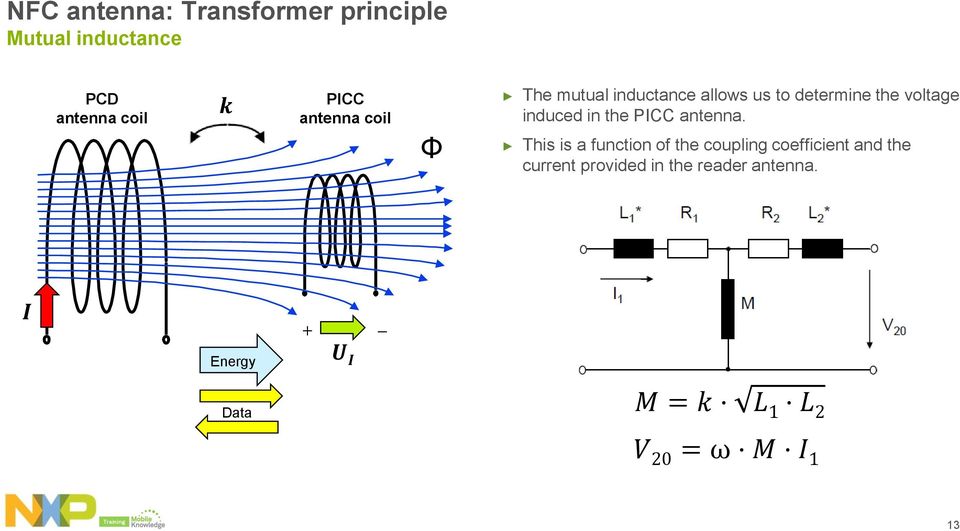
11 NFC antenna: Transformer principle PCD antenna coil PICC antenna coil Φ The vast majority of RFID systems operate according to the principle of inductive coupling. Typical contactless smartcards contain no internal power supply. They need to get all their required energy from the magnetic field in which they operate The PCD transmitter coil generates an electromagnetic field with a frequency of 13,56Mhz. I Energy + U I A small part of the emitted field penetrates the antenna coil of the transponder, which is some distance away from the reader coil. A voltage U I is generated in the transponder s antenna by inductance. This voltage is rectified and serves as the power supply Data A transformers-type coupling is created between the reader coil and the transponder coil. The PCD energy must be available to the PICC during the entire transaction. 11

12 NFC antenna: Transformer principle Coupling coefficient PCD antenna coil k PICC antenna coil Φ The coupling coefficient depends on: The geometric dimensions of both conductor loops. The position of the conductor loops in relation to each other The magnetic properties of the medium (μ 0 ) k 0 < k < 1 k =1 total coupling I Energy Data + U I k = μ 0 r 2 2 r 2 +x 2 3 A 2 L 01 L 02 k =0 full decoupling Permeability constant Geometrical quantity "Fixed" 12

13 NFC antenna: Transformer principle Mutual inductance PCD antenna coil k PICC antenna coil Φ The mutual inductance allows us to determine the voltage induced in the PICC antenna. This is a function of the coupling coefficient and the current provided in the reader antenna. I Energy + U I Data M = k L 1 L 2 V 20 = ω M I 1 13
14 Optimum antenna size For every read range x of an NFC system, there is an optimal antenna radius R. A rough approximation is that : k = μ 0 r 2 2 r 2 +x 2 3 A 2 L 01 L 02 r = x 14

15 Optimum antenna size Card A: PCD r=2 cm x 5.5 cm PCD r=5 cm x 7.2 cm Card C Card B Card B: Card C: PCD r=2 cm x 2.8 cm PCD r=5 cm x 1.8 cm PCD r=2 cm x 2.2 cm PCD r=5 cm x - cm Card A 15

16 Antenna matching steps

17 NFC antenna matching steps Define target impedance To optimize RF output power or battery life EMC filter design Filtering of unwanted harmonics Measure antenna coil Determine LCR values of the antenna coil Adjust Q-factor With damping resistor if needed Calculate matching components Using provided excel sheet Fine tuning Simulation and field measurement Adjust receiver circuit Tuning reader sensitivity Antenna + matching circuit = resonance circuit Contactless Reader IC Receiver Circuit EMC Matching Circuit AN11019: CLRC663, MFRC630, MFRC631, SLRC610 Antenna design AN1445: Antenna design guide for MFRC52x, PN51x, PN53x Antenna 17

18 NFC antenna matching Step 1: Define target impedance We need to adjust the target impedance the NFC reader IC sees according to the performance we want to achieve. Maximum output power Minimum current consumption (battery life) The target impedance is chosen so that the highest possible output power does not exceed the maximum driver current (datasheet). TX 1 NFC Reader IC I TVDD R L = Ω for CLRC663 R L = Ω for PN512 TX 2 Maximum output power (Operating distance) Minimum current Consumption (Battery life) Antenna and Matching circuit 18


19 NFC antenna matching Step 2: EMC filter design The EMC is a low pass filter reducing 2 nd and higher harmonics and performs impedance transformation PVDD PVSS NRSTPD IRQ DVDD DVSS TVDD Contactless Reader IC RX VMID TX1 TGND A convenient cutoff frequency ( f c ) is between: w c = f c = 14.5 MHz 22 MHz We begin specifying L 0, this range of values have proven to be very useful in practice: L 0 = 330 nh 560 nh With f c and L 0, we can easily calculate C 0 : 1 C 0 L 0 C 0 = Example: f = 21 MHz and L c 0 = 470 nh: 1 2 π f c 2 L 0 AVDD AVSS TX2 C 0 = pf C 01 = 68 pf C 02 = 56 pf OSCIN OSCOUT EMC filter 19

20 NFC antenna matching Step 3: Measure antenna coil PVDD PVSS NRSTPD IRQ TVDD RX VMID Receiver Circuit Contactless Reader IC TX1 DVDD DVSS AVDD AVSS TGND TX2 Matching Circuit OSCIN OSCOUT Antenna DONE 20


21 NFC antenna matching Step 3: Measure antenna coil The antenna loop has to be connected to an impedance or network analyzer at MHz to measure the series equivalent components High-end network analyzer (i.e. Rohde & Schwarz ZVL) Powerful, accurate and easy to use Fig. Antenna series equivalent circuit Inductance (L): mainly defined by the number of turns of the antenna Resistance (R): mainly defined by the diameter and length of the antenna wires Capacitance (C): mainly defined by the distance of antenna wires from each other and number of turns Low-end network analyzer (i.e. minivna PRO) Cheap, accurate enough and easy to use 21
22 NFC antenna matching Step 3: Measure antenna coil Practical approach: Measure L a, R a and estimate C a. And imprecise measurement suffices for us, as the measured values are needed only as starting points and the tuning will be done later. Typical values: L a 1.5 μh R a 2.8 Ω C a? L a = 0.3 μh 4μH R a = 0.3 Ω 8 Ω C a = 1 pf 30 pf C a 1 pf 22

23 NFC antenna matching Step 4: Adjust Q-factor A high Q factor leads to high current in the antenna coil and thus improves the power transmission to the transponder B = f Q In contrast, the transmission bandwidth of the antenna is inversely proportional to the Q factor. A low bandwidth, caused by an excessively high Q factor, can therefore significantly reduce the modulation sideband received from the transponder. The quality factor of the antenna is calculated with: Q a = ω La R a If the calculated Q a is higher than the target value, an external damping resistor (R q ) has to be added. The value of (each side of the antenna) is calculated by: R Q = 0.5 ω La Q e.g.: ISO/IEC 106Kbps Q < f T Q < 13.56MHz 3μs Q < 40 23

24 NFC antenna matching Step 5: Calculate matching components Matching condition PVDD PVSS TVDD RX Z tr = R tr + jx tr Z tr = R tr - jx tr NRSTPD IRQ Contactless Reader IC VMID DONE NEXT STEP DONE TX1 DVDD DVSS Z match TGND Z tr Z tr AVDD AVSS TX2 OSCIN OSCOUT 24
25 NFC antenna matching Step 5: Calculate matching components (II) We input the following values into the excel sheet: Antenna coil measured / estimated values (L a, C a, R a ) Q-factor Target impedance (Rmatch). The excel sheet calculates the values for the matching circuit and damping resistor. R Q,, C 1 and C

26 NFC antenna matching Step 6: Fine tuning. Why is it required? Simulation: RFSim99 software tool Reality: matching circuit assembled and measured with minivna 26

27 NFC antenna matching Step 6: Fine tuning. Adapt simulation Reality (minivna) Measured / estimated L a, R a and C a antenna parameters are imprecise Tune R a, C a and L a parameters until the simulation looks like the reality. Simulation (RFSim99) 27
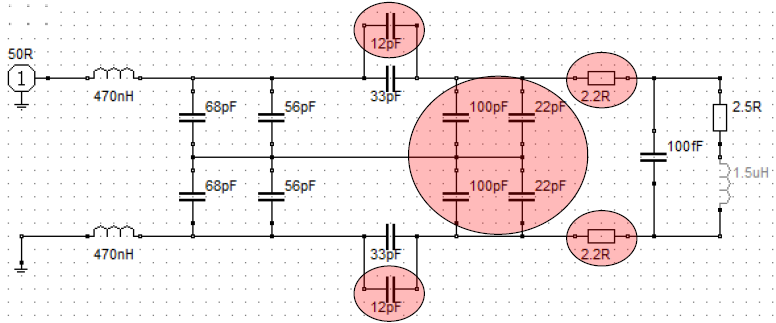
28 NFC antenna matching Step 6: Fine tuning. Correct simulation Simulation (RFSim99) Tune damping resistor (R Q ) and matching circuit capacitors (C 1, C 2 ) until the simulated circuit is matched. Then, assemble the components again and measure reality. The actual adjustment may be reached through a process of iteration. Reality (minivna) 28
29 NFC antenna matching Step 6: Fine tuning (II): Measurements on the Tx pulse I TVDD PVDD PVSS NRSTPD IRQ TVDD RX VMID Receiver Circuit Connected and check I TVDD current does not exceed a certain value Check I TVDD current without card and all loading conditions Reference PICC, phone, different cards, etc DVDD Contactless Reader IC TX1 For CLRC663 reader IC: I TVDD < 200 ma DVSS TGND For PN512 reader IC: AVDD AVSS TX2 I TVDD < 100 ma OSCIN OSCOUT 29
30 NFC antenna matching Step 7: Receiver circuit PVDD PVSS NRSTPD IRQ TVDD RX VMID Typical values: C vmind = 100 nf C rx = 1 nf R 2 = 1 kω R x =? kω Contactless Reader IC TX1 DVDD DVSS TGND AVDD AVSS TX2 OSCIN OSCOUT 30
31 NFC antenna matching Step 7: Receiver circuit. Adjust Rx level PVDD PVSS TVDD RX Steps to determine R x : Switch on the Tx (continuous carrier) Measure voltage at R x pin with a low capacitance probe (<2pF) NRSTPD IRQ VMID Check under all loading conditions Reference PICC, phone, different cards, etc DVDD Contactless Reader IC TX1 For CLRC663 reader IC: U Rx < 1.7 Vpp DVSS AVDD TGND R x = 12 kω 18 kω AVSS TX2 If U Rx > 1,7 Vpp increase R x OSCIN OSCOUT If U Rx < 1 Vpp decrease R x 31
32 Environment effects
33 Metal environment influences Eddy currents Metal surfaces in the immediate vicinity of the reader antenna have several negative effects. Our reader antenna s magnetic field generates eddy currents in metallic surfaces. These eddy currents produce a magnetic flow opposite to that of the reader device Ferrites are basically poor electrical conductors but are very good at propagating magnetic flux (mostly of iron oxide Fe2O3) The ferrite material shields the metal behind it. It significantly reduces the generated eddy currents 33

34 Ferrite shielding With metal Air coil Shielding and environment impact The figures show three different field strength characteristics over reading distance x, for the same antenna coil: Free air coil (7.5 cm) Coil surrounded by a metal plate (5 cm) Coil surrounded by a metal plate shielded by a ferrite plate (7.5 cm) We can achieve almost original operating distance using ferrite shielding. However, the ferrite detunes the antenna and produces: Increase inductance Increase Q-factor Changed magnetic field distribution Conclusion: The antenna must be suited to its environment
35 Ferrite shielding recommendation If the surface of the ferrite material is too small, the shielding effect will be too weak If it is too large, the field lines will become highly concentrated in the plane of the antenna and the ferrite. In practice, favorable dimensions have emerged for medium-sized antennas. Where an overlap is created by having the ferrite material around 5mm larger than the antenna coil. Different ferrite foils have different effects, some foils: Have a better Q. Provide a better field distribution (reader mode). Provide a better LMA (card mode) 35
36 Test and Qualification
37 What must be tested? FIELD Power STRENGTH Transmit WAVE SHAPES Data LOAD Receive MODULATION Data PCD PICC PCD PICC PCD PICC MHz Carrier MILLER coded DATA LOAD modulated DATA PCD: Proximity Coupling Device ( reader ) PICC: Proximity Integrated Circuit Card ( card ) 37
38 Tests for NFC antenna performance ISO/IEC tests: Test standard: ISO/IEC Proximity cards Tests for PICC and PCD Type A and Type B Bit rates: 106, 212, 424, 848 Kbps No certification available Applicable for public transport, access control, epassport & eid etc NFC Forum tests: Test standard: NFC Analog Technical Specification Mandatory for NFC Forum devices NFC-A, NFC-B & NFC-F Defines analog tests for NFC devices (P2P, Reader and Card modes) Bit rates: 106, 212, 424 Kbps Certification process available for NFC compliance Applicable for mobile phones EMVCo tests: Test standard: EMV Contactless Specifications for Payment Systems (Book D). Test for PICC and PCD Type A and Type B Only for 106 Kbps 38

39 ISO/IEC Field strength test Field strength test condition: Measure reader maximum reading distance. Minimum field strength defined by ISO/IEC is 1.5 A/m Tools: Reference PICC Reference PICC are designed specifically to allow complete conformance testing of contactless readers according to ISO/IEC Pick up coil: Allows to measure the PCD pulse shapes. Low coupling between the two coils. Main coil: Represents the real smartcard. Loads the field like a read card and allows to measure field strength and test load modulation ISO/IEC defines 6 reference PICCs : Reference PICC 39


40 ISO/IEC Wave shapes test Type Wave shape test condition: Measure pulse shape in maximum reading distance This is of course the worse possible case Requirements for the wave shapes are fixed in the ISO/IEC14443 standard for the different data rates Pulse length, rise and fall times, overshoots etc Tools: Wave checker tool PC tool that takes shoot from the scope, reads the data, checks the pulse shapes and compares it within the ISO/IEC limits. E.g.: Wavechecker from CETECOM Flexible tool supporting measurements for ISO/IEC, NFC Forum or EMVCo. 40

41 ISO/IEC Load modulation test Load modulation test condition: Check if our reader can decode card responses properly in the maximum reading distance Inject a certain level of load modulation using a sub carrier pattern Tools: Arbitrary Wave Generator (AWG) & PC Tools Creates or generates pattern subcarriers together with a PC tool that allow us to define patterns and timing levels. E.g: Waveplayer from CETECOM as AWG Includes many predefined patterns and flexible tests (ISO/IEC A & B, EMVCo) Control level and timing of the load modulation index amplitude signal. 41
42 NFC Forum and EMVCo tests Reference PICCs NFC Forum major analog NFC reader parameters: Polling Device Power Transfer ( Field strength ) Polling Device Modulation ( Wave shapes ) Polling Device Load Modulation ( Load Modulation ) Many more Listening Device parameters: not part of this webinar. EMVCo major analog PCD parameters: Power Transfer PCD to PICC ( Field strength ) Requirements for Modulation PCD to PICC ( Wave shapes ) Requirements for Modulation PICC to PCD ( Load modulation ) 42
43 NFC antenna design Wrap up NFC antennas are transformers in resonance The size (geometry) of an RFID/NFC antenna defines the operating distance ( performance ) in principle: Small size = small operating distance Large size = large operating distance Metal around or behind the NFC antenna kills the magnetic field. Can be shielded with ferrite. The final design of an RFID/NFC antenna is quite straight forward with the right tools. Different requirements depending on ISO/IEC1443, NFC Forum and EMVCo Use the correct reference tools (ref PICCs, Oscilloscope, PC tools Or use test house services 43
44 Further information NFC Reader Design: Antenna design considerations NFC Everywhere community NFC controller and frontend solutions der_ics/ RFID: MIFARE and Contactless Cards in Application (Co-author: Renke Bienert) Application/dp/ In-depth NFC antenna design recorded webinars (Renke Bienert): Antenna design webinar 1: Which antenna for what purpose? Antenna design webinar 2: Antenna matching Antenna design webinar 3: Metal environment Antenna design webinar 4: Optimization and debugging Antenna design webinar 5: Test & Qualification Antenna design webinar 6: EMC related design 44
45 MobileKnowledge Thank you for your attention We are a global competence team of hardware and software technical experts in all areas related to contactless technologies and applications. Our services include: Application and system Design Engineering support Project Management Technological Consulting Advanced Technical services We address all the exploding identification technologies that include NFC, secure micro-controllers for smart cards and mobile applications, reader ICs, smart tags and labels, MIFARE family and authentication devices. For more information Eric Leroux [email protected]
NFC Reader Design: How to build your own reader
 NFC Reader Design: How to build your own reader Public MobileKnowledge February 2015 Agenda Introduction to RFID and NFC Contactless reader design: Initial considerations and architecture Illustrative
Changes PN532_Breakout board
 Changes PN532_Breakout board Document: Changes PN532_Breakout board Department / Faculty : TechnoCentrum - Radboud University Nijmegen Contact: René Habraken Date: 17 May 2011 Doc. Version: 1.0 Contents
READER COMPONENTS. mifare (14443A) 13.56 MHz RFID Proximity Antennas. November 2002. Revision 1.0 PUBLIC. Philips Semiconductors
 READER COMPONENTS mifare (14443A) 13.56 MHz RFID Proximity Antennas Revision 1.0 PUBLIC November 00 Philips Semiconductors Philips Semiconductors Rev. 1.0 November 00 CONTENTS 1 INTRODUCTION... 3 1.1 Purpose
AN1445. Antenna design guide for MFRC52x, PN51x and PN53x. Application note PUBLIC. Rev. 1.2 11 October 2010 144512. Document information
 Document information Info Content Keywords NFC, MFRC5, MFRC53, PN511, PN51, PN531, PN53, Antenna Design, RF Design, constant current design Abstract This application notes provides guidance on antenna
a leap ahead in analog
 EMV Contactless Payment Systems based on AS3911 Overview and System Simulations Giuliano Manzi, PhD Mannheim, May 23 25, 2012 CST EUROPEAN USER CONFERENCE 2012 a leap ahead in analog OUTLINE AS3911 OVERVIEW
MFRD52x. Mifare Contactless Smart Card Reader Reference Design. Document information
 Rev. 2.1 17. April 2007 Preliminary Data Sheet Document information Info Keywords Content MFRC522, MFRC523, MFRC52x, MFRD522, MFRD523, Mifare Contactless Smart Card Reader Reference Design, Mifare Reader
Using RFID Techniques for a Universal Identification Device
 Using RFID Techniques for a Universal Identification Device Roman Zharinov, Ulia Trifonova, Alexey Gorin Saint-Petersburg State University of Aerospace Instrumentation Saint-Petersburg, Russia {roman,
Micore Reader IC Family; Directly Matched Antenna Design
 Rev..05 10. May 006 Application note Document information Info Keywords Abstract BL-ID Doc Number Content Mifare, ICode, Micore, RC400, RC500, RC530, RC531, RC63, RFID- Reader, Directly Matched Antenna
Secure My-d TM and Mifare TM RFID reader system by using a security access module Erich Englbrecht ([email protected]) V0.1draft
 Application Report Secure My-d TM and Mifare TM RFID reader system by using a security access module Erich Englbrecht ([email protected]) V0.1draft Embedded RF ABSTRACT This application report describes
Abracon PTM Introduction to ANFCA Series Flexible Peel & Stick NFC Antennas
 Abracon PTM Introduction to ANFCA Series Flexible Peel & Stick NFC Antennas WWW.ABRACON.COM ANFCA Series Flexible Peel & Stick NFC Antennas Purpose To introduce ANFCA Series, Flexible Peel & Stick NFC
Application Note SAW-Components
 Application Note SAW-Components Principles of SAWR-stabilized oscillators and transmitters. App: Note #1 This application note describes the physical principle of SAW-stabilized oscillator. Oscillator
Impedance Matching and Matching Networks. Valentin Todorow, December, 2009
 Impedance Matching and Matching Networks Valentin Todorow, December, 2009 RF for Plasma Processing - Definition of RF What is RF? The IEEE Standard Dictionary of Electrical and Electronics Terms defines
Technical Article. NFiC: a new, economical way to make a device NFC-compliant. Prashant Dekate
 Technical NFiC: a new, economical way to make a device NFC-compliant Prashant Dekate NFiC: a new, economical way to make a device NFC-compliant Prashant Dekate The installed base of devices with Near Field
Security & Chip Card ICs SLE 44R35S / Mifare
 Security & Chip Card ICs SLE 44R35S / Mifare Intelligent 1 Kbyte EEPROM with Interface for Contactless Transmission, Security Logic and Anticollision according to the MIFARE -System Short Product Info
Electronic Communications Committee (ECC) within the European Conference of Postal and Telecommunications Administrations (CEPT)
 Electronic Communications Committee (ECC) within the European Conference of Postal and Telecommunications Administrations (CEPT) COMPATIBILITY BETWEEN INDUCTIVE LF AND HF RFID TRANSPONDER AND OTHER RADIO
Germanium Diode AM Radio
 Germanium Diode AM Radio LAB 3 3.1 Introduction In this laboratory exercise you will build a germanium diode based AM (Medium Wave) radio. Earliest radios used simple diode detector circuits. The diodes
ENERGY HARVESTED ELECTRONIC SHELF LABEL
 ENERGY HARVESTED ELECTRONIC SHELF LABEL Ranajay Mallik, Jitendra Jain, Neha Kochhar, STMicroelectronics - IMS Systems Lab and Technical Marketing Abstract: This article explains the concept of electronic
Amplifier for Small Magnetic and Electric Wideband Receiving Antennas (model AAA-1B)
 Amplifier for Small Magnetic and Electric Wideband Receiving Antennas (model AAA-1B) 1. Description and Specifications Contents 1.1 Description 1.2 1.2 Specifications 1.3 1.3 Tested parameters in production
Automatic Impedance Matching for 13.56 MHz NFC Antennas
 Automatic Impedance Matching for 13.56 MHz NFC Antennas Michael Roland 1, Harald Witschnig 2, Erich Merlin 2, Christian Saminger 1 1 Upper Austria University of Applied Sciences, Hagenberg, Austria 2 NXP
PN532/C1. 1. General description. Near Field Communication (NFC) controller. Product short data sheet COMPANY PUBLIC. Rev. 3.0 10 November 2011 120130
 120130 1. General description The is a highly integrated transceiver module for contactless communication at 13.56 MHz based on the 80C51 microcontroller core. It supports 6 different operating modes:
NFC Test Challenges for Mobile Device Developers Presented by: Miguel Angel Guijarro [email protected]
 NFC Test Challenges for Mobile Device Developers Presented by: Miguel Angel Guijarro [email protected] 1 Outlook About NFC Developing a NFC Device Test Challenges Test Solutions Q&A 2 What
An equivalent circuit of a loop antenna.
 3.2.1. Circuit Modeling: Loop Impedance A loop antenna can be represented by a lumped circuit when its dimension is small with respect to a wavelength. In this representation, the circuit parameters (generally
RFID Penetration Tests when the truth is stranger than fiction
 RFID Penetration Tests when the truth is stranger than fiction Dr. Tomáš Rosa, [email protected] Raiffeisenbank, a.s. Agenda Technology overview Physical layer of LF and HF bands The Unique ID phenomenon
Design and development of a RFID reader with carrier frequency of 125 KHz
 Design and development of a RFID reader with carrier frequency of 125 KHz Lucian - Nicolae Cojocariu, Octavian - Modest Manu Ștefan cel Mare University Suceava, Romania [email protected], [email protected]
AppNote 404 EM MICROELECTRONIC - MARIN SA. EM4095 Application Note RFID. Title: Product Family: TABLE OF CONTENT. Application Note 404
 EM MICROELECTRONIC - MARIN SA AppNote 0 Title: Product Family: Application Note 0 EM095 Application Note RFID Part Number: EM095 Keywords: RFID Transceiver, Reader Chip, EM095 Date: 5 September 00 TABLE
Radiated Emission and Susceptibility
 Radiated Emission and Susceptibility Tzong-Lin Wu, Ph.D. EMC Lab Department of Electrical Engineering National Taiwan University Differential-Mode v.s. Common-mode Currents 1 Differential-Mode v.s. Common-mode
RX-AM4SF Receiver. Pin-out. Connections
 RX-AM4SF Receiver The super-heterodyne receiver RX-AM4SF can provide a RSSI output indicating the amplitude of the received signal: this output can be used to create a field-strength meter capable to indicate
Location-Aware and Safer Cards: Enhancing RFID Security and Privacy
 Location-Aware and Safer Cards: Enhancing RFID Security and Privacy 1 K.Anudeep, 2 Mrs. T.V.Anantha Lakshmi 1 Student, 2 Assistant Professor ECE Department, SRM University, Kattankulathur-603203 1 [email protected],
FM Radio Transmitter & Receiver Modules
 FM Radio Transmitter & Receiver Modules T5 / R5 Features MINIATURE SIL PACKAGE FULLY SHIELDED DATA RATES UP TO 128KBITS/S RANGE UPTO 300 METRES SINGLE SUPPLY VOLTAGE INDUSTRY PIN COMPATIBLE QFMT5-434 TEMP
AN2866 Application note
 Application note How to design a 13.56 MHz customized tag antenna Introduction RFID (radio-frequency identification) tags extract all of their power from the reader s field. The tags and reader s antennas
RF data receiver super-reactive ASK modulation, low cost and low consumption ideal for Microchip HCS KEELOQ decoder/encoder family. 0.
 Receiver AC-RX2/CS RF data receiver super-reactive ASK modulation, low cost and low consumption ideal for Microchip HCS KEELOQ decoder/encoder family. Pin-out 38.1 3 Component Side 1 2 3 7 11 13 14 15
PN532/C1 NFC controller
 Rev. 1.2 31 March 2011 Short form data sheet 1. Introduction 2. General description This document describes the. This document is a short form version; for full specification refer to the product data
Using ISO 15693 Compliant RFID Tags in an Inventory Control System
 Using ISO 15693 Compliant RFID Tags in an Inventory Control System University: Louisiana State University, Baton Rouge, Louisiana Course: Undergraduate Capstone Project Student Team Members: Joseph Gates,
MF1 IC S50. 1. General description. Functional specification. 1.1 Contactless Energy and Data Transfer. 1.2 Anticollision. Energy
 Rev. 5.2 15 January 2007 Product data sheet 001052 PUBLIC 1. General description NXP has developed the Mifare to be used in contactess smart cards according to ISO/IEC 14443A. The communication layer (
Handheld measurement equipment for measuring extremely low frequency electromagnetic fields
 Handheld measurement equipment for measuring extremely low frequency electromagnetic fields Intermediate Report S u b m i t t e d b y A s h u t o s h B a h e t i, N e h a B a h e t i, S h i l p a S a r
2/20/2009 3 Transmission Lines and Waveguides.doc 1/3. and Waveguides. Transmission Line A two conductor structure that can support a TEM wave.
 2/20/2009 3 Transmission Lines and Waveguides.doc 1/3 Chapter 3 Transmission Lines and Waveguides First, some definitions: Transmission Line A two conductor structure that can support a TEM wave. Waveguide
Single Transistor FM Transmitter Design
 Single Transistor FM Transmitter Design In telecommunications, frequency modulation (FM) conveys information over a carrier wave by varying its frequency. FM is commonly used at VHF radio frequencies for
A CW QRP Transceiver for 20 m band. How it works I'll describe individually the three boards and the relative tuning devices.
 A CW QRP Transceiver for 20 m band The little QRP presented in this article may be built in a gradual manner, in fact it is divided in two main modules (plus VFO), you may also complete only a single part
Training. NFC in Android. Public. MobileKnowledge October 2015
 NFC in Android Public MobileKnowledge October 2015 Index Android mobile Operating System Market share Brief history Programing in Android NFC in Android Communicating my Android phone with NFC Readers
Wireless Power Transfer System Design. Julius Saitz ANSYS
 Wireless Power Transfer System Design Julius Saitz ANSYS 1 WPT System 2 Wireless Power Transfer (WPT) Near-Field (Inductive coupling, resonant) Do not rely on propagating EM waves Operate at distances
Design And Implementation Of Bank Locker Security System Based On Fingerprint Sensing Circuit And RFID Reader
 Design And Implementation Of Bank Locker Security System Based On Sensing Circuit And RFID Reader Khaing Mar Htwe, Zaw Min Min Htun, Hla Myo Tun Abstract: The main goal of this system is to design a locker
DKWF121 WF121-A 802.11 B/G/N MODULE EVALUATION BOARD
 DKWF121 WF121-A 802.11 B/G/N MODULE EVALUATION BOARD PRELIMINARY DATA SHEET Wednesday, 16 May 2012 Version 0.5 Copyright 2000-2012 Bluegiga Technologies All rights reserved. Bluegiga Technologies assumes
EM4095 EM MICROELECTRONIC - MARIN SA. Read/Write analog front end for 125kHz RFID Basestation SO16
 EM MICROELECTRONIC - MARIN SA EM0 Read/Write analog front end for khz RFID Basestation Description The EM0 (previously named P0) chip is a CMOS integrated transceiver circuit intended for use in an RFID
Oscillators. 2.0 RF Sine Wave Oscillators. www.learnabout-electronics.org. Module. RF Oscillators
 Module 2 www.learnabout-electronics.org Oscillators 2.0 RF Sine Wave Oscillators What you ll Learn in Module 2 Section 2.0 High Frequency Sine Wave Oscillators. Frequency Control in RF Oscillators. LC
CHAPTER 11: Flip Flops
 CHAPTER 11: Flip Flops In this chapter, you will be building the part of the circuit that controls the command sequencing. The required circuit must operate the counter and the memory chip. When the teach
AVX EMI SOLUTIONS Ron Demcko, Fellow of AVX Corporation Chris Mello, Principal Engineer, AVX Corporation Brian Ward, Business Manager, AVX Corporation
 AVX EMI SOLUTIONS Ron Demcko, Fellow of AVX Corporation Chris Mello, Principal Engineer, AVX Corporation Brian Ward, Business Manager, AVX Corporation Abstract EMC compatibility is becoming a key design
Tag Tuning/RFID. Application Note. Tag Tuning. Introduction. Antenna Equivalent Circuit
 Tag Tuning Introduction RFID tags extract all of their power to both operate and communicate from the reader s magnetic field. Coupling between the tag and reader is via the mutual inductance of the two
Gemalto Mifare 1K Datasheet
 Gemalto Mifare 1K Datasheet Contents 1. Overview...3 1.1 User convenience and speed...3 1.2 Security...3 1.3 Anticollision...3 2. Gemalto Mifare Features...4 2.1 Compatibility with norms...4 2.2 Electrical...4
MEASUREMENT SET-UP FOR TRAPS
 Completed on 26th of June, 2012 MEASUREMENT SET-UP FOR TRAPS AUTHOR: IW2FND Attolini Lucio Via XXV Aprile, 52/B 26037 San Giovanni in Croce (CR) - Italy [email protected] Trappole_01_EN 1 1 DESCRIPTION...3
How To Understand The Power Of An Freddi Tag (Rfid) System
 Radio Frequency Identification Done by: Haitham Habli. Table of contents Definition of RFID. Do they need license? RFID vs other identification systems. Classification of RFID systems. Emerge of passive
Chip Card & Security ICs Mifare NRG SLE 66R35
 Chip Card & Security ICs Mifare NRG Intelligent 1 Kbyte Memory Chip with Interface for Contactless Transmission according to the Mifare -System Short Product Information April 2007 Short Product Information
Application Note AN:005. FPA Printed Circuit Board Layout Guidelines. Introduction Contents. The Importance of Board Layout
 FPA Printed Circuit Board Layout Guidelines By Paul Yeaman Principal Product Line Engineer V I Chip Strategic Accounts Introduction Contents Page Introduction 1 The Importance of 1 Board Layout Low DC
Grounding Demystified
 Grounding Demystified 3-1 Importance Of Grounding Techniques 45 40 35 30 25 20 15 10 5 0 Grounding 42% Case 22% Cable 18% Percent Used Filter 12% PCB 6% Grounding 42% Case Shield 22% Cable Shielding 18%
PL-277x Series SuperSpeed USB 3.0 SATA Bridge Controllers PCB Layout Guide
 Application Note PL-277x Series SuperSpeed USB 3.0 SATA Bridge Controllers PCB Layout Guide Introduction This document explains how to design a PCB with Prolific PL-277x SuperSpeed USB 3.0 SATA Bridge
Since any real component also has loss due to the resistive component, the average power dissipated is 2 2R
 Quality factor, Q Reactive components such as capacitors and inductors are often described with a figure of merit called Q. While it can be defined in many ways, it s most fundamental description is: Q
Edmund Li. Where is defined as the mutual inductance between and and has the SI units of Henries (H).
 INDUCTANCE MUTUAL INDUCTANCE If we consider two neighbouring closed loops and with bounding surfaces respectively then a current through will create a magnetic field which will link with as the flux passes
Application Note 58 Crystal Considerations for Dallas Real-Time Clocks
 www.maxim-ic.com Application Note 58 Crystal Considerations for Dallas Real-Time Clocks OVERVIEW This application note describes crystal selection and layout techniques for connecting a 32,768Hz crystal
Side Channel Analysis and Embedded Systems Impact and Countermeasures
 Side Channel Analysis and Embedded Systems Impact and Countermeasures Job de Haas Agenda Advances in Embedded Systems Security From USB stick to game console Current attacks Cryptographic devices Side
DRM compatible RF Tuner Unit DRT1
 FEATURES DRM compatible RF Tuner Unit DRT1 High- Performance RF Tuner Frequency Range: 10 KHz to 30 MHz Input ICP3: +13,5dBm, typ. Noise Figure @ full gain: 14dB, typ. Receiver Factor: -0,5dB, typ. Input
RFID Receiver Antenna Project for 13.56 Mhz Band
 RFID Receiver Antenna Project for 13.56 Mhz Band Fatih Eken TE 401 Microwave Course Term Project, Fall 2004 Supervised by Asst. Prof. İbrahim Tekin Telecommunication Program in Faculty of Engineering and
Near Field Communication (NFC) controller. The PN533 supports four main operating modes:
 158233 1. General description The is a highly integrated transceiver module for contactless communication at 13.56 MHz based on the 80C51 microcontroller core. A dedicated ROM code is implemented to handle
Application Note: PCB Design By: Wei-Lung Ho
 Application Note: PCB Design By: Wei-Lung Ho Introduction: A printed circuit board (PCB) electrically connects circuit components by routing conductive traces to conductive pads designed for specific components
Common Mode Choke Filtering Improves CMRR in Ethernet Transformer Applications. Application Note. June 2011
 Common Mode Choke Filtering Improves CMRR in Ethernet Transformer Applications June 2011 Application Note Common mode chokes provide an effective EMI filtering solution for Ethernet transformer applications.
Constructing a precision SWR meter and antenna analyzer. Mike Brink HNF, Design Technologist.
 Constructing a precision SWR meter and antenna analyzer. Mike Brink HNF, Design Technologist. Abstract. I have been asked to put together a detailed article on a SWR meter. In this article I will deal
Measuring Impedance and Frequency Response of Guitar Pickups
 Measuring Impedance and Frequency Response of Guitar Pickups Peter D. Hiscocks Syscomp Electronic Design Limited [email protected] www.syscompdesign.com April 30, 2011 Introduction The CircuitGear
MIFARE ISO/IEC 14443 PICC
 Rev. 3.0 26 June 2009 130830 Application note PUBLIC Document information Info Keywords Abstract Content Activate Card, MIFARE, Select Card This Application te shows the elementary communication for selecting
The I2C Bus. NXP Semiconductors: UM10204 I2C-bus specification and user manual. 14.10.2010 HAW - Arduino 1
 The I2C Bus Introduction The I2C-bus is a de facto world standard that is now implemented in over 1000 different ICs manufactured by more than 50 companies. Additionally, the versatile I2C-bus is used
Candidate Number. General Certificate of Education Advanced Level Examination June 2012
 entre Number andidate Number Surname Other Names andidate Signature General ertificate of Education dvanced Level Examination June 212 Physics PHY4/1 Unit 4 Fields and Further Mechanics Section Monday
IrDA Transceiver with Encoder/Decoder
 PRELIMINARY IrDA Transceiver with Encoder/Decoder FEATURES Micropower in the Sleep Mode, (2µA) 3V to 5V Operation Wide Dynamic Receiver Range from 200nA to 50mA Typical Direct Interface to IrDA Compatible
Design of Bidirectional Coupling Circuit for Broadband Power-Line Communications
 Journal of Electromagnetic Analysis and Applications, 2012, 4, 162-166 http://dx.doi.org/10.4236/jemaa.2012.44021 Published Online April 2012 (http://www.scirp.org/journal/jemaa) Design of Bidirectional
APPLICATION NOTE ULTRASONIC CERAMIC TRANSDUCERS
 APPLICATION NOTE ULTRASONIC CERAMIC TRANSDUCERS Selection and use of Ultrasonic Ceramic Transducers The purpose of this application note is to aid the user in the selection and application of the Ultrasonic
PN532 NFC RFID Module User Guide
 PN532 NFC RFID Module User Guide Version 3 Introduction NFC is a popular technology in recent years. We often heard this word while smart phone company such as Samsung or HTC introduces their latest high-end
PHYS 222 Spring 2012 Final Exam. Closed books, notes, etc. No electronic device except a calculator.
 PHYS 222 Spring 2012 Final Exam Closed books, notes, etc. No electronic device except a calculator. NAME: (all questions with equal weight) 1. If the distance between two point charges is tripled, the
Experiment 8: Undriven & Driven RLC Circuits
 Experiment 8: Undriven & Driven RLC Circuits Answer these questions on a separate sheet of paper and turn them in before the lab 1. RLC Circuits Consider the circuit at left, consisting of an AC function
Understanding SMD Power Inductors. Application Note. July 2011
 Understanding SMD Power Inductors July 2011 Application Note Power inductors play an important role in voltage conversion applications by yielding lower core losses. They are also used to store energy,
AN11269. Software Design Guide for POS Development Kit OM5597/RD2663. Rev. 1.0 5 August 2014 242510. Application note COMPANY PUBLIC
 Software Design Guide for POS Development Kit OM5597/RD2663 Document information Info Content Keywords RC663, TDA8026, LPC1768, Point of Sale Development Kit design, POS, guide, firmware documentation,
Security in Near Field Communication (NFC)
 Security in Near Field Communication (NFC) Strengths and Weaknesses Ernst Haselsteiner and Klemens Breitfuß Philips Semiconductors Mikronweg 1, 8101 Gratkorn, Austria [email protected] [email protected]
Microcontroller to Sensor Interfacing Techniques
 to Sensor Interfacing Techniques Document Revision: 1.01 Date: 3rd February, 2006 16301 Blue Ridge Road, Missouri City, Texas 77489 Telephone: 1-713-283-9970 Fax: 1-281-416-2806 E-mail: [email protected]
Design and Certification of ASH Radio Systems for Japan
 Design and Certification of ASH Radio Systems for Japan RFM s second-generation ASH radio hybrids are being used in a wide variety of applications in Japan, operating under the Japanese BIJAKU radio regulations.
Adding Heart to Your Technology
 RMCM-01 Heart Rate Receiver Component Product code #: 39025074 KEY FEATURES High Filtering Unit Designed to work well on constant noise fields SMD component: To be installed as a standard component to
Features. Applications. Transmitter. Receiver. General Description MINIATURE MODULE. QM MODULATION OPTIMAL RANGE 1000m
 Features MINIATURE MODULE QM MODULATION OPTIMAL RANGE 1000m 433.05 434.79 ISM BAND 34 CHANNELS AVAILABLE SINGLE SUPPLY VOLTAGE Applications IN VEHICLE TELEMETRY SYSTEMS WIRELESS NETWORKING DOMESTIC AND
Advancements in Lightning Test Services
 Advancements in Lightning Test Services Presentation Overview Basic Lightning Concepts Indirect Effects Testing Waveforms General Test Methods Elite Testing Capability What s in place What s new Lightning
A wave lab inside a coaxial cable
 INSTITUTE OF PHYSICS PUBLISHING Eur. J. Phys. 25 (2004) 581 591 EUROPEAN JOURNAL OF PHYSICS PII: S0143-0807(04)76273-X A wave lab inside a coaxial cable JoãoMSerra,MiguelCBrito,JMaiaAlves and A M Vallera
Surveillance System Using Wireless Sensor Networks
 Surveillance System Using Wireless Sensor Networks Dan Nguyen, Leo Chang Computer Engineering, Santa Clara University Santa Clara, California, USA [email protected] [email protected] Abstract The
Tire pressure monitoring
 Application Note AN601 Tire pressure monitoring 1 Purpose This document is intended to give hints on how to use the Intersema pressure sensors in a low cost tire pressure monitoring system (TPMS). 2 Introduction
Exercise 1: Set up the Environment
 RFID Lab Gildas Avoine, 2014 Contact: [email protected] Objective: Learn how much it is easy to read contactless tags, possibly simulate/clone. Requirement: Hardware: Reader SCL3711 or ACR122, Reader
VJ 6040 Mobile Digital TV UHF Antenna Evaluation Board
 VISHAY VITRAMON Multilayer Chip Capacitors Application Note GENERAL is a multilayer ceramic chip antenna designed for receiving mobile digital TV transmissions in the UHF band. The target application for
Application Note. So You Need to Measure Some Inductors?
 So You Need to Measure Some nductors? Take a look at the 1910 nductance Analyzer. Although specifically designed for production testing of inductors and coils, in addition to measuring inductance (L),
The performance improvement by ferrite loading means - increasing, - increasing of ratio, implicitly related to the input impedance.
 3.2.3. Ferrite Loading Magnetic ferrite loading can enhance a transmitting signal as high as 2 to 10 db for MHz [Devore and Bohley, 1977]. There is an optimum frequency range where ferrite loading is beneficial.
APPLICATION NOTE AP050830
 APPLICATION NOTE AP050830 Selection and use of Ultrasonic Ceramic Transducers Pro-Wave Electronics Corp. E-mail: [email protected] URL: http://www.prowave.com.tw The purpose of this application note
Input and Output Capacitor Selection
 Application Report SLTA055 FEBRUARY 2006 Input and Output Capacitor Selection Jason Arrigo... PMP Plug-In Power ABSTRACT When designing with switching regulators, application requirements determine how
Designing VM2 Application Boards
 Designing VM2 Application Boards This document lists some things to consider when designing a custom application board for the VM2 embedded controller. It is intended to complement the VM2 Datasheet. A
Inductors. AC Theory. Module 3
 Module 3 AC Theory What you ll learn in Module 3. Section 3.1 Electromagnetic Induction. Magnetic Fields around Conductors. The Solenoid. Section 3.2 Inductance & Back e.m.f. The Unit of Inductance. Factors
This application note is written for a reader that is familiar with Ethernet hardware design.
 AN18.6 SMSC Ethernet Physical Layer Layout Guidelines 1 Introduction 1.1 Audience 1.2 Overview SMSC Ethernet products are highly-integrated devices designed for 10 or 100 Mbps Ethernet systems. They are
INTEGRATED CIRCUITS I CODE SLI. Smart Label IC SL2 ICS20. Functional Specification. Product Specification Revision 3.1 Public. Philips Semiconductors
 INTEGRATED CIRCUITS I CODE SLI Smart Label IC SL2 ICS20 Product Specification Revision 3.1 February July 2005 2001 Public Philips Semiconductors CONTENTS 1 FEATURES...4 1.1 I CODE SLI RF Interface (ISO/IEC
ILB, ILBB Ferrite Beads
 ILB, ILBB Ferrite Beads Electro-Magnetic Interference and Electro-Magnetic Compatibility (EMI/EMC) avid B. Fancher Inductive Products ivision INTROUCTION Manufacturers of electrical and electronic equipment
International Journal of Engineering Research & Management Technology
 International Journal of Engineering Research & Management Technology March- 2015 Volume 2, Issue-2 Radio Frequency Identification Security System Mr. Shailendra Kumar Assistant Professor Department of
IC-EMC Simulation of Electromagnetic Compatibility of Integrated Circuits
 IC-EMC Simulation of Electromagnetic Compatibility of Integrated Circuits SUMMARY CONTENTS 1. CONTEXT 2. TECHNOLOGY TRENDS 3. MOTIVATION 4. WHAT IS IC-EMC 5. SUPPORTED STANDARD 6. EXAMPLES CONTEXT - WHY
Charged cable event. 1 Goal of the ongoing investigation. 2 Energy sources for the CDE. Content
 Charged cable event David Pommerenke, [email protected], 916 785 4550 Last update: Feb.23, 2001 Content Goal Energy sources, which may lead to CDE. Complexity of the different discharge modes. Possible