
Mathematics Content: Pie Charts; Area as Probability; Probabilities as Percents, Decimals & Fractions
|
|
|
- Steven Thornton
- 9 years ago
- Views:
Transcription
1 Title: Using the Area on a Pie Chart to Calculate Probabilities Mathematics Content: Pie Charts; Area as Probability; Probabilities as Percents, Decimals & Fractions Objectives: To calculate probability using area. To use graphing technology to compare experimental probabilities. To express probabilities as percents, decimals, and fractions. Time: Approximately 3 4 fifty minute class periods MN Standards: Grade 7; Strand Data Analysis and Probability; Benchmark Use reasoning with proportions to display and interpret data in circle graphs (pie charts) and histograms. Choose the appropriate data display and know how to create the display using a spreadsheet or other graphing technology. Grade 7; Strand Data Analysis and Probability; Benchmark Calculate probability as a fraction of sample space or as a fraction of area. Express probabilities as percents, decimals and fractions. Materials: Graphing technology such as Excel, a fun size bag of M & M s for each student Instructor s Notes: Pre Test: The Pre Test below can be given as a brief way to assess students prior knowledge on how to make a pie chart as well as a calculate probability and write probabilities as fractions and decimals. M &M Activity: Probability as Area Worksheet looks at calculating a probability as an area question. This and M & M Probability Experiment could be worked on in groups or as a class. For the M & M Probability Experiment, the instructor can explain to their students how to create a pie chart using Excel. Students would create a pie chart that represents the percentages of each color their bag of M & M contains.appropriate topics to discuss during this experiment would be theoretical vs. experimental probability, predictions, sample size, and reviewing on interchanging decimals, percents, and fractions. Pie Chart/ Bar Graph Probabilities Activity: The Pie Chart/Bar Graph Probabilities Activity allows students to apply what they ve learned while taking another step with the M & M data. Students will create another pie chart answer to similar questions, while using the class s compiled M&M data. Instructor s may choose to have student s do a few questions of the Post Test/Activity individually, then discuss the end questions (about sample size) in a small group, and later as a class. Post Test: The Post Test is the same quiz as was given as a Pre Test.
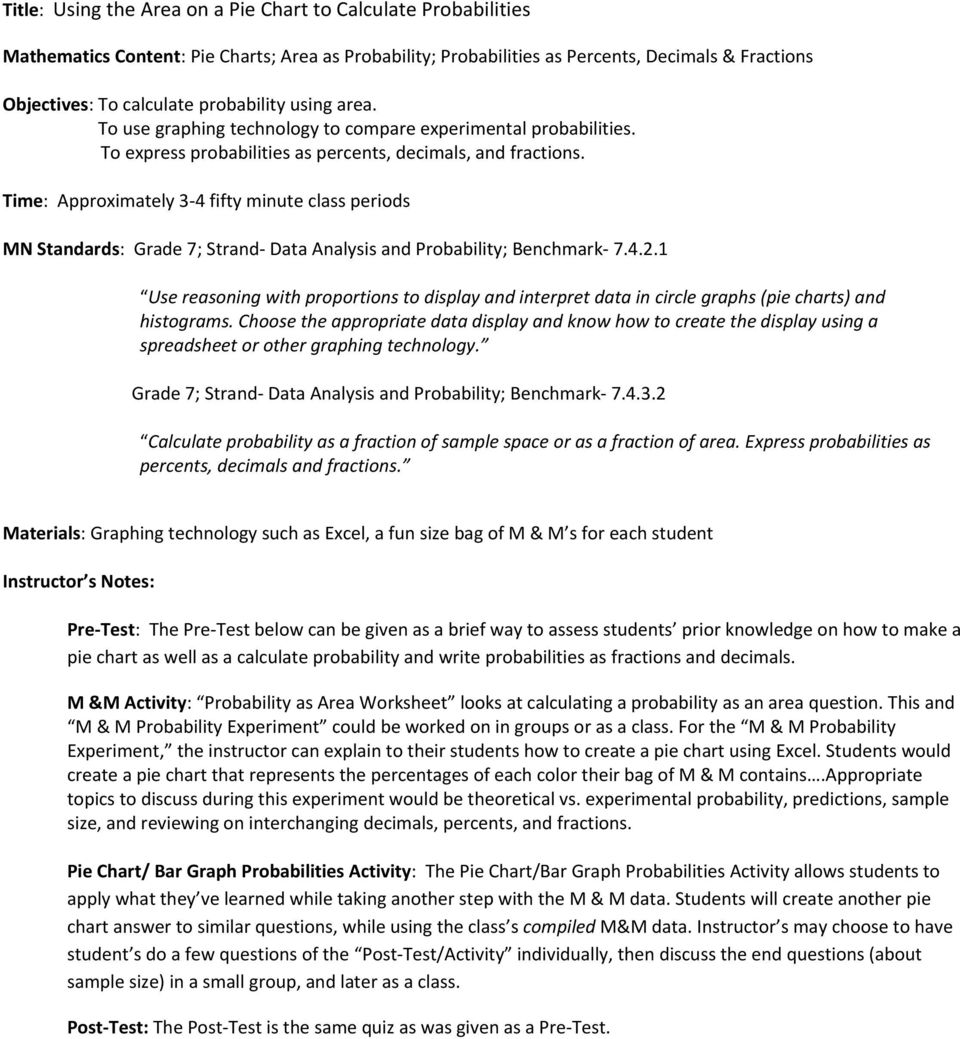
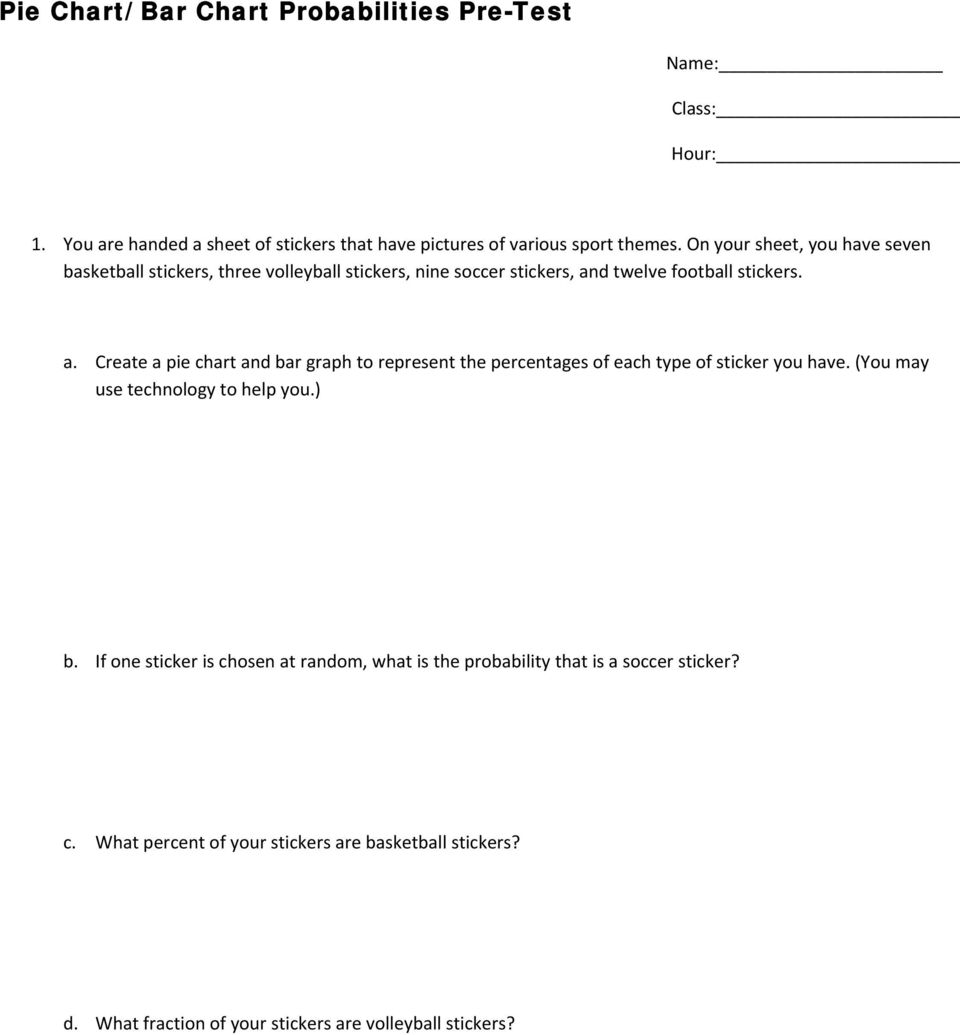
2 Pie Chart/ Bar Chart Probabilities Pre-Test Name: Class: Hour: 1. You are handed a sheet of stickers that have pictures of various sport themes. On your sheet, you have seven basketball stickers, three volleyball stickers, nine soccer stickers, and twelve football stickers. a. Create a pie chart and bar graph to represent the percentages of each type of sticker you have. (You may use technology to help you.) b. If one sticker is chosen at random, what is the probability that is a soccer sticker? c. What percent of your stickers are basketball stickers? d. What fraction of your stickers are volleyball stickers?
3 Probability as Area Worksheet Name: After Farmer Jones passes away, his five children (Bill, Susan, Matthew, Carl, and Julie) are supposed to inherit an equal share of his 100 square acres. This is demonstrated in the Pie Chart below. 1. What is the area of the land they should each inherit? 2. If I am standing somewhere on Farmer Jones land, in terms of area, what is the probability that I am standing on the land that Julie will inherit? 3. What is the probability that I m on the land that Carl will inherit? Write as a fraction, then write as a decimal.

4 M & M Pie Chart Probability Experiment In a Fun Size pack of M & M s, you may have M & M s of the colors brown, red, blue, green, yellow and orange. Assume the same number of each color of M & M is created. Solely statistically speaking, what percent of each color would your bag contain? Write down the expected percent of each color by or on the graph below. Use the scenario and graph above to fill in the following table. (Remember, we are assuming the statistical percentages of each color.) Assume there are 18 M & M s in your bag. COLOR Number of Each Color Area of Particular Total Area Probability of Drawing Color (if one M & M is drawn randomly) Percent Fraction of Area for that 100 Decimal

5 Predictions! If you are handed a fun size bag of M & M s, do you think you will have the same number of each color? Why or why not? Just for fun, how many of each color of M & M do you think will be in your bag? Blue? Red? Green? Yellow? Brown? Orange? After you are finished with your predictions, open your bag, and fill in the actual numbers below. Blue? Red? Green? Yellow? Brown? Orange? Were your predictions close? Could you have made a better guess? Please explain. Sketch those Graphs! Sketch a Pie Graph and Box Plot of your M & M colors! Pie Graph 1. Arrange your M & M s in a circle inside the box to the right. 2. Trace around the outside of your M & M s to create a circle.

6 3. Create tick marks around the edge of your circle to separate each color. (You may then move your M & M s off to the side. But SAVE them so you are able to draw your upcoming box plot.) 4. Draw a dot in the center of your circle. (You do not need to measure this but try to be as accurate as possible.) 5. Use a ruler to carefully connect the center to each of your tick marks. Bar Graph Similarly, line up your M & M s to create a Bar Graph in the box below. Create a pie graph and a bar graph of your data using technology. List three observations about your M & M data that you can make by looking your graphs. 1.

7 2. 3. How is the pie chart of your M & M data different than the pie graph we used when we assumed each color was equally likely? List three differences Create a pie chart using technology to display the distribution of colors for your bag of M & M s. (Be sure to staple a printed copy of your chart to these worksheets.) Then, complete the chart, using your actual values) below. COLOR Number of Each Color Area of Particular Total Area Probability of Drawing Color (if one M & M is drawn randomly) Percent Fraction of Area for that 100 Decimal

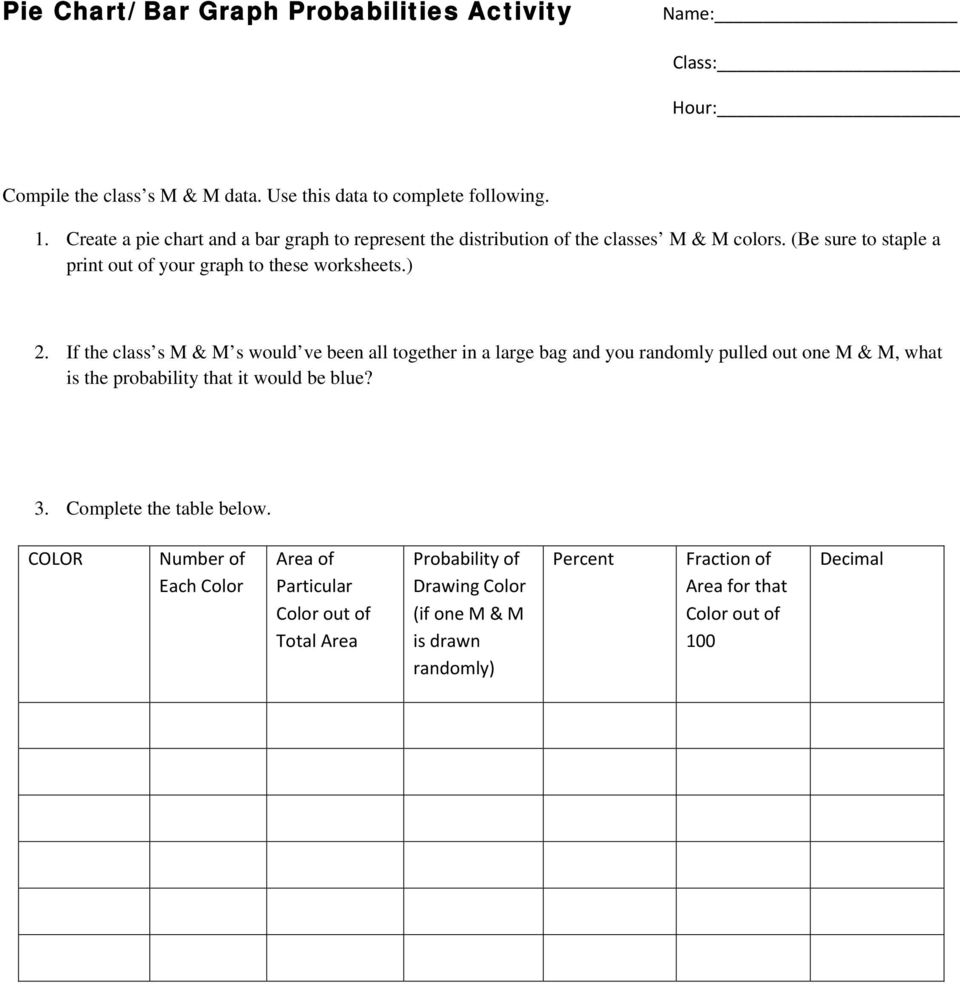
8 Pie Chart/ Bar Graph Probabilities Activity Name: Class: Hour: Compile the class s M & M data. Use this data to complete following. 1. Create a pie chart and a bar graph to represent the distribution of the classes M & M colors. (Be sure to staple a print out of your graph to these worksheets.) 2. If the class s M & M s would ve been all together in a large bag and you randomly pulled out one M & M, what is the probability that it would be blue? 3. Complete the table below. COLOR Number of Each Color Area of Particular Total Area Probability of Drawing Color (if one M & M is drawn randomly) Percent Fraction of Area for that 100 Decimal
9 4. Name three similarities between (just) your M & M data and the classes M & M data Name three differences you ve observed
10 6. Was (just) your data or the class s data more closely related to equal distribution? Why do you think this is? 7. Imagine everyone in the school had a pack of Fun Size M & M s and we combined all of the M & M s together. What do you think the pie chart representing these colors would look like? Explain your thoughts & create a sketch below. 8. How does sample size affect probability? Pie Chart Probabilities Post-Test Name: Class: Hour: 1. You are handed a sheet of stickers that have pictures of various sport themes. On your sheet, you have seven basketball stickers, three volleyball stickers, nine soccer stickers, and twelve football stickers. a. Create a pie chart and bar graph to represent the percentages of each type of sticker you have. (You may use technology to help you.)
11 b. If one sticker is chosen at random, what is the probability that is a soccer sticker? c. What percent of your stickers are basketball stickers? d. What fraction of your stickers are volleyball stickers?
Creating Graphs. Learning Objective-To create graphs that show data.
 Creating Graphs Summary- Key Words- Students will be able to identify graphs, components of graphs, interpret graphs, and construct various types of graphs. Pictograph Bar Graph Circle Graph Background
Computer Skills Microsoft Excel Creating Pie & Column Charts
 Computer Skills Microsoft Excel Creating Pie & Column Charts In this exercise, we will learn how to display data using a pie chart and a column chart, color-code the charts, and label the charts. Part
Modifying Colors and Symbols in ArcMap
 Modifying Colors and Symbols in ArcMap Contents Introduction... 1 Displaying Categorical Data... 3 Creating New Categories... 5 Displaying Numeric Data... 6 Graduated Colors... 6 Graduated Symbols... 9
Lesson 3: Constructing Circle Graphs. Selected Content Standards. Translating Content Standards into Instruction
 Lesson 3: Constructing Circle Graphs Selected Content Standards Benchmarks Addressed: D-1-M Systematically collecting, organizing, describing, and displaying data in charts, tables, plots, graphs, and/or
Paper 1. Calculator not allowed. Mathematics test. First name. Last name. School. Remember KEY STAGE 3 TIER 4 6
 Ma KEY STAGE 3 Mathematics test TIER 4 6 Paper 1 Calculator not allowed First name Last name School 2009 Remember The test is 1 hour long. You must not use a calculator for any question in this test. You
Lesson 17: Margin of Error When Estimating a Population Proportion
 Margin of Error When Estimating a Population Proportion Classwork In this lesson, you will find and interpret the standard deviation of a simulated distribution for a sample proportion and use this information
Activities/ Resources for Unit V: Proportions, Ratios, Probability, Mean and Median
 Activities/ Resources for Unit V: Proportions, Ratios, Probability, Mean and Median 58 What is a Ratio? A ratio is a comparison of two numbers. We generally separate the two numbers in the ratio with a
NASA Explorer Schools Pre-Algebra Unit Lesson 2 Student Workbook. Solar System Math. Comparing Mass, Gravity, Composition, & Density
 National Aeronautics and Space Administration NASA Explorer Schools Pre-Algebra Unit Lesson 2 Student Workbook Solar System Math Comparing Mass, Gravity, Composition, & Density What interval of values
Practice#1(chapter1,2) Name
 Practice#1(chapter1,2) Name Solve the problem. 1) The average age of the students in a statistics class is 22 years. Does this statement describe descriptive or inferential statistics? A) inferential statistics
Washington State K 8 Mathematics Standards April 2008
 Washington State K 8 Mathematics Standards Data Analysis, Statistics, and Probability Strand In kindergarten through grade 5, students learn a variety of ways to display data, and they interpret data to
Discovering Math: Using and Collecting Data Teacher s Guide
 Teacher s Guide Grade Level: 3-5 Curriculum Focus: Mathematics Lesson Duration: Four class periods Program Description Discovering Math: Using and Collecting Data From data points and determining spread
A magician showed a magic trick where he picked one card from a standard deck. Determine what the probability is that the card will be a queen card?
 Topic : Probability Word Problems- Worksheet 1 Jill is playing cards with her friend when she draws a card from a pack of 20 cards numbered from 1 to 20. What is the probability of drawing a number that
Fun with Fractions: A Unit on Developing the Set Model: Unit Overview www.illuminations.nctm.org
 Fun with Fractions: A Unit on Developing the Set Model: Unit Overview www.illuminations.nctm.org Number of Lessons: 7 Grades: 3-5 Number & Operations In this unit plan, students explore relationships among
Creating Charts in Microsoft Excel A supplement to Chapter 5 of Quantitative Approaches in Business Studies
 Creating Charts in Microsoft Excel A supplement to Chapter 5 of Quantitative Approaches in Business Studies Components of a Chart 1 Chart types 2 Data tables 4 The Chart Wizard 5 Column Charts 7 Line charts
7.S.8 Interpret data to provide the basis for predictions and to establish
 7 th Grade Probability Unit 7.S.8 Interpret data to provide the basis for predictions and to establish experimental probabilities. 7.S.10 Predict the outcome of experiment 7.S.11 Design and conduct an
Create a Poster Using Publisher
 Contents 1. Introduction 1. Starting Publisher 2. Create a Poster Template 5. Aligning your images and text 7. Apply a background 12. Add text to your poster 14. Add pictures to your poster 17. Add graphs
The Utah Basic Skills Competency Test Framework Mathematics Content and Sample Questions
 The Utah Basic Skills Competency Test Framework Mathematics Content and Questions Utah law (53A-1-611) requires that all high school students pass The Utah Basic Skills Competency Test in order to receive
CBA Fractions Student Sheet 1
 Student Sheet 1 1. If 3 people share 12 cookies equally, how many cookies does each person get? 2. Four people want to share 5 cakes equally. Show how much each person gets. Student Sheet 2 1. The candy
Grades 7-8 Mathematics Training Test Answer Key
 Grades -8 Mathematics Training Test Answer Key 04 . Factor 6x 9. A (3x 9) B 3(x 3) C 3(3x ) D 6(x 9) Option A is incorrect because the common factor of both terms is not and the expression is not factored
Step 3: Go to Column C. Use the function AVERAGE to calculate the mean values of n = 5. Column C is the column of the means.
 EXAMPLES - SAMPLING DISTRIBUTION EXCEL INSTRUCTIONS This exercise illustrates the process of the sampling distribution as stated in the Central Limit Theorem. Enter the actual data in Column A in MICROSOFT
MATHEMATICS: REPEATING AND GROWING PATTERNS First Grade. Kelsey McMahan. Winter 2012 Creative Learning Experiences
 MATHEMATICS: REPEATING AND GROWING PATTERNS Kelsey McMahan Winter 2012 Creative Learning Experiences Without the arts, education is ineffective. Students learn more and remember it longer when they are
Mathematics Test Book 2
 Mathematics Test Book 2 Grade 6 March 9 13, 2009 Name 21316 Developed and published under contract with the New York State Education Department by CTB/McGraw-Hill LLC, a subsidiary of The McGraw-Hill Companies,
7.4A/7.4B STUDENT ACTIVITY #1
 7.4A/7.4B STUDENT ACTIVITY #1 Write a formula that could be used to find the radius of a circle, r, given the circumference of the circle, C. The formula in the Grade 7 Mathematics Chart that relates the
Paper 1. Calculator not allowed. Mathematics test. First name. Last name. School. Remember KEY STAGE 3 TIER 5 7
 Ma KEY STAGE 3 Mathematics test TIER 5 7 Paper 1 Calculator not allowed First name Last name School 2009 Remember The test is 1 hour long. You must not use a calculator for any question in this test. You
Science Notebooks in the Classroom. Notebook Criteria
 presentapresents Presents Science Notebooks in the Classroom kdkrifr Notebook Criteria This document was developed by Bay Area Schools for Excellence in Education (BASEE) a local systemic change project
You must have: Ruler graduated in centimetres and millimetres, protractor, compasses, pen, HB pencil, eraser, calculator. Tracing paper may be used.
 Write your name here Surname Other names Pearson Edexcel Certificate Pearson Edexcel International GCSE Mathematics A Paper 2F Centre Number Monday 12 January 2015 Afternoon Time: 2 hours Candidate Number
Charts, Tables, and Graphs
 Charts, Tables, and Graphs The Mathematics sections of the SAT also include some questions about charts, tables, and graphs. You should know how to (1) read and understand information that is given; (2)
Year 9 mathematics test
 Ma KEY STAGE 3 Year 9 mathematics test Tier 6 8 Paper 1 Calculator not allowed First name Last name Class Date Please read this page, but do not open your booklet until your teacher tells you to start.
Mathematical goals. Starting points. Materials required. Time needed
 Level S6 of challenge: B/C S6 Interpreting frequency graphs, cumulative cumulative frequency frequency graphs, graphs, box and box whisker and plots whisker plots Mathematical goals Starting points Materials
This document contains Chapter 2: Statistics, Data Analysis, and Probability strand from the 2008 California High School Exit Examination (CAHSEE):
 This document contains Chapter 2:, Data Analysis, and strand from the 28 California High School Exit Examination (CAHSEE): Mathematics Study Guide published by the California Department of Education. The
Paper 1. Calculator not allowed. Mathematics test. First name. Last name. School. Remember KEY STAGE 3 TIER 4 6
 Ma KEY STAGE 3 Mathematics test TIER 4 6 Paper 1 Calculator not allowed First name Last name School 2007 Remember The test is 1 hour long. You must not use a calculator for any question in this test. You
The students will gather, organize, and display data in an appropriate pie (circle) graph.
 Algebra/Geoetry Institute Suer 2005 Lesson Plan 3: Pie Graphs Faculty Nae: Leslie Patten School: Cypress Park Eleentary Grade Level: 5 th grade PIE GRAPHS 1 Teaching objective(s) The students will gather,
MATHEMATICS GRADE 2 Extension Projects
 MATHEMATICS GRADE 2 Extension Projects WITH INVESTIGATIONS 2009 These projects are optional and are meant to be a springboard for ideas to enhance the Investigations curriculum. Use them to help your students
Introduce Decimals with an Art Project Criteria Charts, Rubrics, Standards By Susan Ferdman
 Introduce Decimals with an Art Project Criteria Charts, Rubrics, Standards By Susan Ferdman hundredths tenths ones tens Decimal Art An Introduction to Decimals Directions: Part 1: Coloring Have children
Drawing a histogram using Excel
 Drawing a histogram using Excel STEP 1: Examine the data to decide how many class intervals you need and what the class boundaries should be. (In an assignment you may be told what class boundaries to
Fractions in Grade 1
 Fractions in Grade 1 Understanding of fractions and fractional fluency has been a major concern and hindrance to our students conceptual knowledge of fractions and the relationships among them. This unit
Using Ohm s Law to Build a Voltage Divider
 Using Ohm s Law to Build a Voltage Provided by TryEngineering - Lesson Focus Students will design, build, and characterize one of the basic circuits of electrical engineering, the voltage divider. These
Colour by Numbers Image Representation
 Activity 2 Colour by Numbers Image Representation Summary Computers store drawings, photographs and other pictures using only numbers. The following activity demonstrates how they can do this. Curriculum
Paper 1. Calculator not allowed. Mathematics test. First name. Last name. School. Remember KEY STAGE 3 TIER 3 5
 Ma KEY STAGE 3 Mathematics test TIER 3 5 Paper 1 Calculator not allowed First name Last name School 2008 Remember The test is 1 hour long. You must not use a calculator for any question in this test. You
Using Ratios to Taste the Rainbow. Lesson Plan
 Using Ratios to Taste the Rainbow Lesson Plan Cube Fellow: Amber DeMore Teacher Mentor: Kelly Griggs Goal: At the end of the activity, the students will know that the actual ratio of colored skittles is
CALCULATING THE AREA OF A FLOWER BED AND CALCULATING NUMBER OF PLANTS NEEDED
 This resource has been produced as a result of a grant awarded by LSIS. The grant was made available through the Skills for Life Support Programme in 2010. The resource has been developed by (managers
Bar Charts, Histograms, Line Graphs & Pie Charts
 Bar Charts and Histograms Bar charts and histograms are commonly used to represent data since they allow quick assimilation and immediate comparison of information. Normally the bars are vertical, but
PLANT TECHNICIAN SKILLS AND ABILITIES PRACTICE TEST
 PLANT TECHNICIAN SKILLS AND ABILITIES PRACTICE TEST OVERVIEW Welcome to the Plant Technician Skills and Abilities Practice Test. The purpose of this Practice Test is to help you get used to the questions
Excel -- Creating Charts
 Excel -- Creating Charts The saying goes, A picture is worth a thousand words, and so true. Professional looking charts give visual enhancement to your statistics, fiscal reports or presentation. Excel
Your logbook. Choosing a topic
 This booklet contains information that will be used to complete a science fair project for the César Chávez science fair. It is designed to help participants to successfully complete a project. This booklet
Biodiversity. http://esa.sdsc.edu/biodiv2.htm http://www.ea.gov.au/biodiversity/publications/series/paper1/ http://www.wri.
 Biodiversity In our first session we will be exploring biological diversity. This is an important concept to begin with. As conservation horticulturists we strive to conserve as much diversity as possible
Excel Tutorial. Bio 150B Excel Tutorial 1
 Bio 15B Excel Tutorial 1 Excel Tutorial As part of your laboratory write-ups and reports during this semester you will be required to collect and present data in an appropriate format. To organize and
Mathematics standards
 Mathematics standards Grade 6 Summary of students performance by the end of Grade 6 Reasoning and problem solving Students represent and interpret routine and non-routine mathematical problems in a range
Understand numbers, ways of representing numbers, relationships among numbers, and number systems
 Equivalent Fractions and Comparing Fractions: Are You My Equal? Brief Overview: This four day lesson plan will explore the mathematical concept of identifying equivalent fractions and using this knowledge
(1): 50 minutes None Whole Class N/A 03.SC.TE.04 3-5.TE.2.2 Bar Graph, Graph, Line graph, Pie Graph
 3.G.1 What is a Graph? Creation and interpretation of various graph types Grade Level 3 Sessions Seasonality Instructional Mode(s) Team Size WPS Benchmarks MA Frameworks Key Words (1): 50 minutes Whole
Year 9 mathematics test
 Ma KEY STAGE 3 Year 9 mathematics test Tier 5 7 Paper 1 Calculator not allowed First name Last name Class Date Please read this page, but do not open your booklet until your teacher tells you to start.
Basic Pre Algebra Intervention Program
 Basic Pre Algebra Intervention Program This 9 lesson Intervention Plan is designed to provide extra practice lessons and activities for students in Pre Algebra. The skills covered are basics that must
2. How many ways can the letters in PHOENIX be rearranged? 7! = 5,040 ways.
 Math 142 September 27, 2011 1. How many ways can 9 people be arranged in order? 9! = 362,880 ways 2. How many ways can the letters in PHOENIX be rearranged? 7! = 5,040 ways. 3. The letters in MATH are
Math Games For Skills and Concepts
 Math Games p.1 Math Games For Skills and Concepts Original material 2001-2006, John Golden, GVSU permission granted for educational use Other material copyright: Investigations in Number, Data and Space,
PERMUTATIONS AND COMBINATIONS
 PERMUTATIONS AND COMBINATIONS Mathematics for Elementary Teachers: A Conceptual Approach New Material for the Eighth Edition Albert B. Bennett, Jr., Laurie J. Burton and L. Ted Nelson Math 212 Extra Credit
Probability Using Dice
 Using Dice One Page Overview By Robert B. Brown, The Ohio State University Topics: Levels:, Statistics Grades 5 8 Problem: What are the probabilities of rolling various sums with two dice? How can you
Mathematics A *P44587A0128* Pearson Edexcel GCSE P44587A. Paper 2 (Calculator) Higher Tier. Friday 7 November 2014 Morning Time: 1 hour 45 minutes
 Write your name here Surname Other names Pearson Edexcel GCSE Centre Number Mathematics A Paper 2 (Calculator) Friday 7 November 2014 Morning Time: 1 hour 45 minutes Candidate Number Higher Tier Paper
Microsoft Excel: Exercise 5
 Microsoft Excel: Exercise 5 In this exercise: Using AutoSum Using the fill handle to copy formulas Using AutoFormat Using the Chart Wizard to create a pie and bar graph This is a case study exercise. In
Rational Number Project
 Rational Number Project Initial Fraction Ideas Lesson : Overview Students observe with circles that as the unit is divided into more and more equal parts, the unit parts become smaller. Materials Fraction
GRAPHS/TABLES. (line plots, bar graphs pictographs, line graphs)
 GRAPHS/TABLES (line plots, bar graphs pictographs, line graphs) Standard: 3.D.1.2 Represent data using tables and graphs (e.g., line plots, bar graphs, pictographs, and line graphs). Concept Skill: Graphs
CALCULATIONS & STATISTICS
 CALCULATIONS & STATISTICS CALCULATION OF SCORES Conversion of 1-5 scale to 0-100 scores When you look at your report, you will notice that the scores are reported on a 0-100 scale, even though respondents
Intro to Statistics 8 Curriculum
 Intro to Statistics 8 Curriculum Unit 1 Bar, Line and Circle Graphs Estimated time frame for unit Big Ideas 8 Days... Essential Question Concepts Competencies Lesson Plans and Suggested Resources Bar graphs
Mathematical goals. Starting points. Materials required. Time needed
 Level SS6 of challenge: B SS6 Mathematical goals Starting points Materials required Time needed Representing 3D shapes To enable learners to: interpret 2D representations of 3D shapes; analyse 3D shapes
Kristen Kachurek. Circumference, Perimeter, and Area Grades 7-10 5 Day lesson plan. Technology and Manipulatives used:
 Kristen Kachurek Circumference, Perimeter, and Area Grades 7-10 5 Day lesson plan Technology and Manipulatives used: TI-83 Plus calculator Area Form application (for TI-83 Plus calculator) Login application
Provided by TryEngineering - www.tryengineering.org
 Provided by TryEngineering - Lesson Focus This lesson demonstrates the power of mass production. Students work in teams to design, construct, test, and redesign an assembly line to manufacture a product
Exam Style Questions. Revision for this topic. Name: Ensure you have: Pencil, pen, ruler, protractor, pair of compasses and eraser
 Name: Exam Style Questions Ensure you have: Pencil, pen, ruler, protractor, pair of compasses and eraser You may use tracing paper if needed Guidance 1. Read each question carefully before you begin answering
Grantium guidance for applicants How to create and manage your user account and applicant profile. Version 1 January 2016
 Grantium guidance for applicants How to create and manage your user account and applicant profile Version 1 January 2016 1 Contents Introduction... 3 What is a user? What is an applicant?... 4 User...
Test A. Calculator not allowed. Mathematics test. First name. Last name. School. DfE no. KEY STAGE LEVELS
 Ma KEY STAGE 2 LEVELS 3 5 Mathematics test Test A Calculator not allowed First name Last name School DfE no. 2011 For marker s use only Page 5 7 9 11 13 15 17 19 21 23 TOTAL Marks These three children
Discovering Math: Prediction and Probability Teacher s Guide
 Teacher s Guide Grade Level: K 2 Curriculum Focus: Mathematics Lesson Duration: Two class periods Program Description Discovering Math: Prediction and Probability From likelihood to frequency to prediction,
Fraction Problems. Figure 1: Five Rectangular Plots of Land
 Fraction Problems 1. Anna says that the dark blocks pictured below can t represent 1 because there are 6 dark blocks and 6 is more than 1 but 1 is supposed to be less than 1. What must Anna learn about
The University of the State of New York REGENTS HIGH SCHOOL EXAMINATION MATHEMATICS A. Thursday, January 29, 2009 1:15 to 4:15 p.m.
 MATHEMATICS A The University of the State of New York REGENTS HIGH SCHOOL EXAMINATION MATHEMATICS A Thursday, January 29, 2009 1:15 to 4:15 p.m., only Print Your Name: Print Your School s Name: Print your
2002 Worcester Public Schools (WPS) Benchmarks for Grade 3 1. 03.SC.TE.05 Develop a knowledge and understanding of the metric measurement system.
 3.G.2 What is a Centimeter? An introduction to measuring length in the metric system Grade Level 3 Sessions Seasonality Instructional Mode(s) Team Size WPS Benchmarks MA Frameworks Key Words (1): 1 at
These tests contain questions ranging from Level 3 to Level 4. They get progressively more difficult. Children should have five seconds to
 These tests contain questions ranging from Level to Level. They get progressively more difficult. Children should have five seconds to answer questions in each test and ten seconds to answer questions.
Nevada Department of Education Standards
 Blood-Typing Through an experiment with Kool-Aid, students follow the steps of the scientific method to learn about the experimental procedure of blood typing. Grade Level: 5th Objectives: Students will
Math Journal HMH Mega Math. itools Number
 Lesson 1.1 Algebra Number Patterns CC.3.OA.9 Identify arithmetic patterns (including patterns in the addition table or multiplication table), and explain them using properties of operations. Identify and
6 3 The Standard Normal Distribution
 290 Chapter 6 The Normal Distribution Figure 6 5 Areas Under a Normal Distribution Curve 34.13% 34.13% 2.28% 13.59% 13.59% 2.28% 3 2 1 + 1 + 2 + 3 About 68% About 95% About 99.7% 6 3 The Distribution Since
Applied. Grade 9 Assessment of Mathematics LARGE PRINT RELEASED ASSESSMENT QUESTIONS
 Applied Grade 9 Assessment of Mathematics 2014 RELEASED ASSESSMENT QUESTIONS Record your answers to multiple-choice questions on the Student Answer Sheet (2014, Applied). LARGE PRINT Please note: The format
Title: The Ins and Outs of Functions
 Title: The Ins and Outs of Functions Brief Overview: In these lessons, students will explore what a function is, how to determine if a relation is a function and different ways a function can be represented.
Has difficulty with counting reliably in tens from a multiple of ten
 Has difficulty with counting reliably in tens from a multiple of ten Opportunity for: looking for patterns 5 YR / 100-square Tens cards (Resource sheet 24) Multiples of ten (10 100) written on A5 pieces
Activity 1: Using base ten blocks to model operations on decimals
 Rational Numbers 9: Decimal Form of Rational Numbers Objectives To use base ten blocks to model operations on decimal numbers To review the algorithms for addition, subtraction, multiplication and division
Are You Game? Explorations in Probability. Math
 Are You Game? Explorations in Probability Supplemental Math Materials for Grades 3 6 Math Academy A Thank You to Our Corporate Sponsors The Actuarial Foundation would like to thank the following sponsors
Fraction Five ~ Third Grade. Laying the Foundation for a Conceptual Understanding of Fractions. Third Grade CCSS 3.NF
 Fraction Five ~ Third Grade Laying the Foundation for a Conceptual Understanding of Fractions Third Grade FRACTION FIVE RATIONAL Fractions present a considerable challenge to most kids. The lack of developmental
Lesson 1. Basics of Probability. Principles of Mathematics 12: Explained! www.math12.com 314
 Lesson 1 Basics of Probability www.math12.com 314 Sample Spaces: Probability Lesson 1 Part I: Basic Elements of Probability Consider the following situation: A six sided die is rolled The sample space
Year 6 Mathematics - Student Portfolio Summary
 Year 6 - Student Portfolio Summary WORK SAMPLE PORTFOLIOS These work sample portfolios have been designed to illustrate satisfactory achievement in the relevant aspects of the achievement standard. The
Using Proportions to Solve Percent Problems I
 RP7-1 Using Proportions to Solve Percent Problems I Pages 46 48 Standards: 7.RP.A. Goals: Students will write equivalent statements for proportions by keeping track of the part and the whole, and by solving
Lesson #13 Congruence, Symmetry and Transformations: Translations, Reflections, and Rotations
 Math Buddies -Grade 4 13-1 Lesson #13 Congruence, Symmetry and Transformations: Translations, Reflections, and Rotations Goal: Identify congruent and noncongruent figures Recognize the congruence of plane
What is the Probability of Pigging Out
 What is the Probability of Pigging Out Mary Richardson Susan Haller Grand Valley State University St. Cloud State University [email protected] [email protected] Published: April 2012 Overview of
Statistics and Probability
 Statistics and Probability TABLE OF CONTENTS 1 Posing Questions and Gathering Data. 2 2 Representing Data. 7 3 Interpreting and Evaluating Data 13 4 Exploring Probability..17 5 Games of Chance 20 6 Ideas
Fun ways to group students
 Fun ways to group students Tips for dividing into groups. Picture Cards: Hand out cards with images on such as strawberries, blueberries, blackberries and other such groups of things. Then get them to
Worksheets for Teachers. The Lowry
 Worksheets for Teachers The Lowry Worksheets LS Lowry Worksheets for Primary & Secondary Pupils The following pages contain worksheets for you to use with your class. They can be photocopied for each person
UNIVERSITY OF CAMBRIDGE INTERNATIONAL EXAMINATIONS International General Certificate of Secondary Education
 *8270368766* UNIVERSITY OF CAMBRIDGE INTERNATIONAL EXAMINATIONS International General Certificate of Secondary Education MATHEMATICS 0580/11 Paper 1 (Core) October/November 2012 Candidates answer on the
Practicing for the. TerraNova. Success on Standardized Tests for TerraNova Grade 2 3. McGraw-Hill School Division
 Practicing for the TerraNova Success on Standardized Tests for TerraNova Grade 2 3 How can this booklet help? A note to families In the booklet you hold now, there is a practice version of the TerraNova.
Experiment 2: Conservation of Momentum
 Experiment 2: Conservation of Momentum Learning Goals After you finish this lab, you will be able to: 1. Use Logger Pro to analyze video and calculate position, velocity, and acceleration. 2. Use the equations
Standard 1: Students can understand and apply a variety of math concepts.
 Grade Level: 4th Teacher: Pelzer/Reynolds Math Standard/Benchmark: A. understand and apply number properties and operations. Grade Level Objective: 1.A.4.1: develop an understanding of addition, subtraction,
Graph it! Grade Six. Estimated Duration: Three hours
 Ohio Standards Connection Data Analysis and Probability Benchmark A Read, Create and use line graphs, histograms, circle graphs, box-and whisker plots, stem-and-leaf plots, and other representations when
The Circumference Function
 2 Geometry You have permission to make copies of this document for your classroom use only. You may not distribute, copy or otherwise reproduce any part of this document or the lessons contained herein
Sample Activity: The Least Expensive Cable
 Sample Activity: The Least Expensive Cable from the Pre-AP workshop Pre-AP : Topics for AP Vertical Teams in Mathematics For more information, see apcentral.collegeboard.com/preapworkshops. Copyright 2004
Test B. Calculator allowed. Mathematics test. First name. Last name. School. DCSF no. KEY STAGE LEVELS
 Ma KEY STAGE 2 LEVELS 3 5 Mathematics test Test B Calculator allowed First name Last name School DCSF no. 2010 For marker s use only Page 5 7 9 11 13 15 17 19 21 23 TOTAL Marks These three children appear
Junior Assessment of Mathematics (JAM)
 Junior Assessment of Mathematics (JAM) Student Response record sheet Child s Name: Room: Date of birth: Module One: Number (Additive Strategies) 0-1 - Pre Level 1 2-3 - Early Level 1 4 - At Level 1 Early
Mean, Median, and Mode
 DELTA MATH SCIENCE PARTNERSHIP INITIATIVE M 3 Summer Institutes (Math, Middle School, MS Common Core) Mean, Median, and Mode Hook Problem: To compare two shipments, five packages from each shipment were