
SPECIMEN MATERIAL GCSE BIOLOGY PAPER 1H. Mark scheme. Specimen Version 1.0
|
|
|
- Rodger Fleming
- 9 years ago
- Views:
Transcription
1 SPECIMEN MATERIAL GCSE BIOLOGY PAPER H Mark scheme Specimen 208 Version.0

2 MARK SCHEME GCSE BIOLOGY PAPER H SPECIMEN MATERIAL Mark schemes are prepared by the Lead Assessment Writer and considered, together with the relevant questions, by a panel of subject teachers. This mark scheme includes any amendments made at the standardisation events which all associates participate in and is the scheme which was used by them in this examination. The standardisation process ensures that the mark scheme covers the students responses to questions and that every associate understands and applies it in the same correct way. As preparation for standardisation each associate analyses a number of students scripts. Alternative answers not already covered by the mark scheme are discussed and legislated for. If, after the standardisation process, associates encounter unusual answers which have not been raised they are required to refer these to the Lead Assessment Writer. It must be stressed that a mark scheme is a working document, in many cases further developed and expanded on the basis of students reactions to a particular paper. Assumptions about future mark schemes on the basis of one year s document should be avoided; whilst the guiding principles of assessment remain constant, details will change, depending on the content of a particular examination paper. Further copies of this mark scheme are available from aqa.org.uk 2

3 MARK SCHEME GCSE BIOLOGY PAPER H SPECIMEN MATERIAL Information to Examiners. General The mark scheme for each question shows: the marks available for each part of the question the total marks available for the question the typical answer or answers which are expected extra information to help the Examiner make his or her judgement and help to delineate what is acceptable or not worthy of credit or, in discursive answers, to give an overview of the area in which a mark or marks may be awarded the Assessment Objectives and specification content that each question is intended to cover. The extra information is aligned to the appropriate answer in the left-hand part of the mark scheme and should only be applied to that item in the mark scheme. At the beginning of a part of a question a reminder may be given, for example: where consequential marking needs to be considered in a calculation; or the answer may be on the diagram or at a different place on the script. In general the right-hand side of the mark scheme is there to provide those extra details which confuse the main part of the mark scheme yet may be helpful in ensuring that marking is straightforward and consistent. 2. Emboldening and underlining 2. In a list of acceptable answers where more than one mark is available any two from is used, with the number of marks emboldened. Each of the following bullet points is a potential mark. 2.2 A bold and is used to indicate that both parts of the answer are required to award the mark. 2.3 Alternative answers acceptable for a mark are indicated by the use of or. Different terms in the mark scheme are shown by a / ; eg allow smooth / free movement. 2.4 Any wording that is underlined is essential for the marking point to be awarded. 3. Marking points 3. Marking of lists This applies to questions requiring a set number of responses, but for which students have provided extra responses. The general principle to be followed in such a situation is that right + wrong = wrong. Each error / contradiction negates each correct response So, if the number of error / contradictions equals or exceeds the number of marks available for the question, no marks can be awarded. However, responses considered to be neutral (indicated as * in example ) are not penalised. Example : What is the ph of an acidic solution? ( mark) Student Response Marks awarded green, red*, 5 3 red*, 8 0 3

4 MARK SCHEME GCSE BIOLOGY PAPER H SPECIMEN MATERIAL Example 2: Name two planets in the solar system. (2 marks) 3.2 Use of chemical symbols / formulae Student Response Marks awarded Neptune, Mars, Moon 2 Neptune, Sun, Mars, Moon 0 If a student writes a chemical symbol / formula instead of a required chemical name, full credit can be given if the symbol / formula is correct and if, in the context of the question, such action is appropriate. 3.3 Marking procedure for calculations Marks should be awarded for each stage of the calculation completed correctly, as students are instructed to show their working. Full marks can however be given for a correct numerical answer, without any working shown. 3.4 Interpretation of it Answers using the word it should be given credit only if it is clear that the it refers to the correct subject. 3.5 Errors carried forward Any error in the answers to a structured question should be penalised once only. Papers should be constructed in such a way that the number of times errors can be carried forward is kept to a minimum. Allowances for errors carried forward are most likely to be restricted to calculation questions and should be shown by the abbreviation ecf in the marking scheme. 3.6 Phonetic spelling The phonetic spelling of correct scientific terminology should be credited unless there is a possible confusion with another technical term. 3.7 Brackets (..) are used to indicate information which is not essential for the mark to be awarded but is included to help the examiner identify the sense of the answer required. 3.8 Ignore / Insufficient / Do not allow Ignore or insufficient are used when the information given is irrelevant to the question or not enough to gain the marking point. Any further correct amplification could gain the marking point. Do not allow means that this is a wrong answer which, even if the correct answer is given as well, will still mean that the mark is not awarded. 4

5 MARK SCHEME GCSE BIOLOGY PAPER H SPECIMEN MATERIAL Level of response marking instructions Level of response mark schemes are broken down into levels, each of which has a descriptor. The descriptor for the level shows the average performance for the level. There are marks in each level. Before you apply the mark scheme to a student s answer read through the answer and annotate it (as instructed) to show the qualities that are being looked for. You can then apply the mark scheme. Step Determine a level Start at the lowest level of the mark scheme and use it as a ladder to see whether the answer meets the descriptor for that level. The descriptor for the level indicates the different qualities that might be seen in the student s answer for that level. If it meets the lowest level then go to the next one and decide if it meets this level, and so on, until you have a match between the level descriptor and the answer. With practice and familiarity you will find that for better answers you will be able to quickly skip through the lower levels of the mark scheme. When assigning a level you should look at the overall quality of the answer and not look to pick holes in small and specific parts of the answer where the student has not performed quite as well as the rest. If the answer covers different aspects of different levels of the mark scheme you should use a best fit approach for defining the level and then use the variability of the response to help decide the mark within the level, ie if the response is predominantly level 3 with a small amount of level 4 material it would be placed in level 3 but be awarded a mark near the top of the level because of the level 4 content. Step 2 Determine a mark Once you have assigned a level you need to decide on the mark. The descriptors on how to allocate marks can help with this. The exemplar materials used during standardisation will help. There will be an answer in the standardising materials which will correspond with each level of the mark scheme. This answer will have been awarded a mark by the Lead Examiner. You can compare the student s answer with the example to determine if it is the same standard, better or worse than the example. You can then use this to allocate a mark for the answer based on the Lead Examiner s mark on the example. You may well need to read back through the answer as you apply the mark scheme to clarify points and assure yourself that the level and the mark are appropriate. Indicative content in the mark scheme is provided as a guide for examiners. It is not intended to be exhaustive and you must credit other valid points. Students do not have to cover all of the points mentioned in the Indicative content to reach the highest level of the mark scheme. You should ignore any irrelevant points made. However, full marks can be awarded only if there are no incorrect statements that contradict a correct response. An answer which contains nothing of relevance to the question must be awarded no marks. 5

6 MARK SCHEME GCSE BIOLOGY PAPER H SPECIMEN MATERIAL Question 0. active transport AO/ by transpiration stream / pull in xylem AO/ AO/ any three in the correct order from: mount epidermis on a slide count stomata in one area repeat in four more areas repeat method on other surface of leaf calculate mean allow nail varnish film allow numbers written out in a line with middle number circled ( ) / 5 = allow 4 with no working shown for 2 marks allow 4.2 for mark less water lost so it does not wilt AO3/a AO3/b Total 6

7 MARK SCHEME GCSE BIOLOGY PAPER H SPECIMEN MATERIAL Question to kill virus or to prevent virus spreading take (stem) cells from meristem or tissue culture allow take cuttings AO2/ heat mixture and add a few drops of Benedict s solution glucose turns solution blue to orange AO/ AO/ Level 2: A clear, logical and coherent explanation which links relevant content. Level : Some relevant content but explanation is incomplete or insufficiently linked. 3 4 AO2/ No relevant content 0 Indicative content less photosynthesis because of lack of chlorophyll therefore less glucose made so less energy released for growth because glucose is needed for respiration and /or therefore less amino acids / proteins / cellulose for growth because glucose is needed for making amino acids / proteins / cellulose Total 8 7

8 MARK SCHEME GCSE BIOLOGY PAPER H SPECIMEN MATERIAL Question any two from: acid in stomach kills pathogens in food skin forms a barrier / produces antimicrobial secretions hairs in the nose trap (particles which may contain) pathogens trachea / bronchi has mucus which traps pathogens or bronchi have cilia which waft mucus to throat to be swallowed 2 AO/

9 MARK SCHEME GCSE BIOLOGY PAPER H SPECIMEN MATERIAL Question 3 continued 03.2 Level 3: A clear, logical and coherent answer, with no significant redundancy. The student understands the process and links this to reasons for clinical trials. Level 2: A partial answer with errors and ineffective reasoning or linkage. Level : One or two relevant points but little linkage of points or logical reasoning. 5 6 AO/ No relevant content 0 Indicative content pre-clinical trials of the new drug on cells / tissues / live animals to test toxicity, dosage and efficacy clinical trials / test on healthy volunteers and patients at very low doses so that you can monitor for safety / side effects and only then do trials to find the optimum dosage and test for efficacy double blind trial / use of placebo which does not contain the new drug random allocation of patients to groups so no one knows who has placebo / the new drug peer review of data to help prevent false claims Total 8 9

10 MARK SCHEME GCSE BIOLOGY PAPER H SPECIMEN MATERIAL Question glucose is absorbed by diffusion into the bloodstream then blood delivers glucose to muscles in capillaries AO/ AO/ to stop air getting in yellow collect the CO 2 / gas with a measuring cylinder / gas syringe AO3/3b (volume collected) in a certain time using a timer / watch AO3/3b yeast produces ethanol but muscles produce lactic acid marks can be awarded from correct word or balanced symbol equations AO/ yeast produces CO 2 but muscles do not answers must be comparative AO/ both release small amounts of energy AO/ ignore both occur without oxygen Total 9 0

11 MARK SCHEME GCSE BIOLOGY PAPER H SPECIMEN MATERIAL Question (0.5/.35) 00. (%) allow. (%) with no working shown for 2 marks to allow results to be compared or they had different masses at the start axis correct scale and labelled points correctly plotted allow ecf from 05. allow mark for 4 points correctly plotted line of best fit allow AO3/2a (0.0 to 0.4) water moves into cells (0.6 to 0.8) water leaves cells by osmosis AO2/ AO2/ AO/ Question 5 continues on the next page

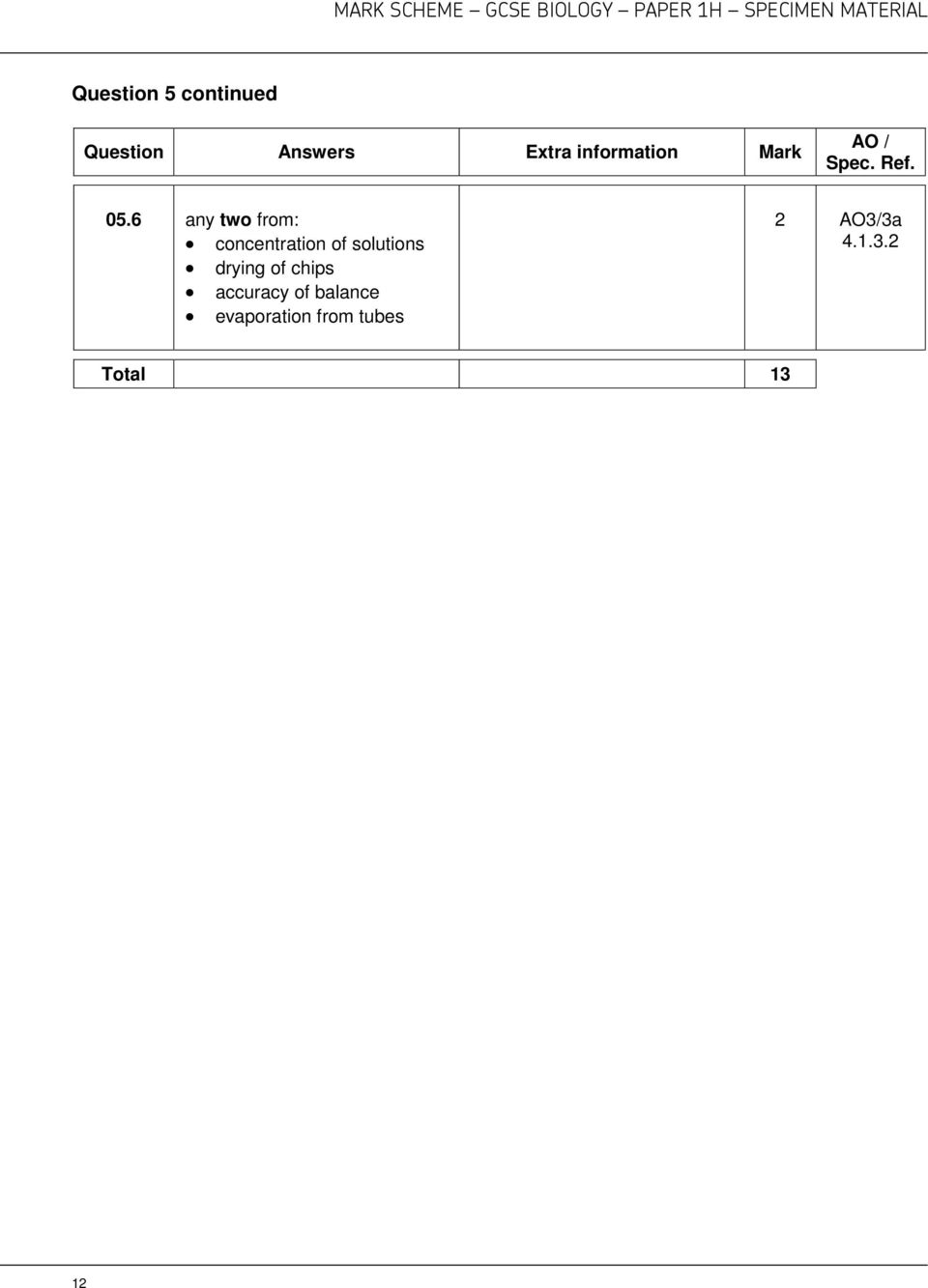
12 MARK SCHEME GCSE BIOLOGY PAPER H SPECIMEN MATERIAL Question 5 continued 05.6 any two from: concentration of solutions drying of chips accuracy of balance evaporation from tubes 2 AO3/3a Total 3 2
13 MARK SCHEME GCSE BIOLOGY PAPER H SPECIMEN MATERIAL Question stomach and pancreas correctly labelled AO/ bacteria not killed (by stomach acid / HCl) and so they damage mucus lining AO2/ so acid / HCl damages stomach tissue / causes an ulcer allow bacteria infect stomach tissue AO3/2b if the cancer is malignant AO/ (cancer) cells can spread to other organs AO/ via the blood forming a secondary tumour do not award marking points 2 or 3 without marking point AO/ add Biuret reagent to food sample allow sodium / potassium hydroxide (solution) + copper sulfate(solution) AO/ mauve / purple colour shows protein present 06.5 damaged villi reduce surface area for absorption (of food molecules) AO3/2b (therefore) fewer amino acids and glucose absorbed AO3/2b with less glucose transfer of energy from respiration is reduced AO3/2b and fewer amino acids available to build new proteins AO3/2b Total 2 3

14 MARK SCHEME GCSE BIOLOGY PAPER H SPECIMEN MATERIAL Question compare them to (pictures in) a gardening manual / website AO/ send to laboratory (for testing) AO/ (nitrate) stunted growth AO/ (magnesium) yellowing of leaves allow chlorosis AO/ (fertiliser S) has most nitrogen for good growth (and) has high(est) potassium content for stronger roots if no other marks awarded allow mark for (fertiliser s) has more minerals than compost AO3/2a AO3/2a (it is also) cheaper than fertiliser T AO3/2a (however) has less phosphate than fertiliser T (although more than compost) so flowers / fruit perhaps less important for the gardener AO3/2a Total 8 4

15 MARK SCHEME GCSE BIOLOGY PAPER H SPECIMEN MATERIAL Question vector AO2/ any three from: destroy the snails isolate infected dogs treat infected dogs educate owners about picking up dog faeces allow vaccination 3 AO2/ stop mosquitoes breeding allow correct description AO/ use mosquito nets allow use of insect repellent AO/ Total 6 5

16 MARK SCHEME GCSE BIOLOGY PAPER H SPECIMEN MATERIAL Question C AO2/ cytoplasm and cell membrane dividing to form two identical daughter cells accept cytokinesis for mark AO2/ AO2/ stage 4 only one cell seen in this stage AO3/a (4/36) / (minutes) allow 0 (minutes) with no working shown for 3 marks binary fission do not accept mitosis AO/ shortage of nutrients / oxygen so cells die or death rate = rate of cell division AO3/a AO3/a Total 6

17 MARK SCHEME GCSE BIOLOGY PAPER H SPECIMEN MATERIAL Question 0 0 Level 3: A detailed and coherent explanation is provided with most of the relevant content, which demonstrates a comprehensive understanding of the human circulatory system. The response makes logical links between content points. Level 2: The response is mostly relevant and with some logical explanation. Gives a broad understanding of the human circulatory system. The response makes some logical links between the content points. Level : Simple descriptions are made of the roles of some of the following: heart function, gas exchange, named blood vessels, named blood cells. The response demonstrates limited logical linking of points. 5 6 AO/ No relevant content. 0 Indicative content dual / double circulatory system which means that it has higher blood pressure and a greater flow of blood to the tissues heart made of specialised (cardiac) muscle cells which have long protein filaments that can slide past each other to shorten the cell to bring about contraction for pumping blood heart pumps blood to lungs in pulmonary artery so that oxygen can diffuse into blood from air in alveoli blood returns to heart via pulmonary vein where muscles pump blood to the body via aorta oxygen carried by specialised cells / RBCs which contain haemoglobin to bind oxygen and have no nucleus so there is more space available to carry oxygen arteries carry oxygenated blood to tissues where capillaries deliver oxygen to cells for respiration and energy release thin walls allow for easy diffusion to cells large surface area of capillaries to maximise exchange waste products removed eg CO 2 diffuse from cells into the blood plasma blood goes back to the heart in veins which have valves to prevent backflow cardiac output can vary according to demand / is affected by adrenaline accept annotated diagrams Total 6 7

18 MARK SCHEME GCSE BIOLOGY PAPER H SPECIMEN MATERIAL Question. A AO3/a any one from: identify / locate specific molecules / other hormones locate blood clots diagnose / treat some cancers AO/ (as) urine passes through reaction zone HCG hormone binds to the mobile HCG antibody (in the reaction zone) (passes up the stick) HCG hormone binds to the immobilised HCG antibodies in the results zone (the other) antibodies which do not attach to HCG bind to antibodies in control zone blue dye appears in both control and results zones (to show positive result) AO2/ Total 8 8

19 MARK SCHEME GCSE BIOLOGY PAPER H SPECIMEN MATERIAL 9

20 aqa.org.uk Copyright 2066 AQA and its licensors. All rights reserved. AQA Education (AQA) is a registered charity (registered charity number ) and a company limited by guarantee registered in England and Wales (company number ). Registered address: AQA, Devas Street, Manchester M5 6EX 25 April 206

GCSE COMBINED SCIENCE: TRILOGY
 SPECIMEN MATERIAL GCSE COMBINED SCIENCE: TRILOGY PAPER 6: PHYSICS 2H Mark scheme Specimen 208 Version.0 Mark schemes are prepared by the Lead Assessment Writer and considered, together with the relevant
A-level PHYSICS (7408/3BC) Paper 3 Section B (Engineering Physics) Mark scheme
 A-level PHYSICS (7408/3BC) Paper 3 Section B (Engineering Physics) Mark scheme Mark schemes are prepared by the Lead Assessment Writer and considered, together with the relevant questions, by a panel of
Final. Mark Scheme. Additional Science / Physics (Specification 4408 / 4403) PH2FP. Unit: Physics 2
 Version.0 General Certificate of Secondary Education January 203 Additional Science / Physics (Specification 4408 / 4403) Unit: Physics 2 Final Mark Scheme Mark schemes are prepared by the Principal Examiner
Final. Mark Scheme. Science A / Biology BL1FP. (Specification 4405 / 4401) Unit 1: Biology 1. General Certificate of Secondary Education June 2013
 Version.0 General Certificate of Secondary Education June 203 Science A / Biology BLFP (Specification 4405 / 440) Unit : Biology Final Mark Scheme Mark schemes are prepared by the Principal Examiner and
AS BIOLOGY (7401/2) Paper 2. Mark scheme v1.1
 AS BIOLOGY (7401/) Paper Mark scheme v1.1 Mark schemes are prepared by the Lead Assessment Writer and considered, together with the relevant questions, by a panel of subject teachers. This mark scheme
Final. Mark Scheme. Additional Science / Physics (Specification 4408 / 4403) PH2HP. Unit: Physics 2
 Version.0 General Certificate of Secondary Education January 03 Additional Science / Physics (Specification 4408 / 4403) Unit: Physics Final Mark Scheme Mark schemes are prepared by the Principal Examiner
AQA CERTIFICATE Science: Double Award
 AQA CERTIFICATE Science: Double Award 8404/C/2H Mark scheme 8404 June 205 Version/Stage:.0 Final Mark schemes are prepared by the Lead Assessment Writer and considered, together with the relevant questions,
Additional Science 4408 / Chemistry 4402
 Version: 0/08/202 General Certificate of Secondary Education Additional Science 4408 / Chemistry 4402 Unit Chemistry 2 Mark Scheme 202 examination June series Mark schemes are prepared by the Principal
Mark Scheme. Additional Science 4408 / Biology 4401. General Certificate of Secondary Education. BL2HP Unit Biology 2. 2012 examination June series
 Version : 0/08/202 General Certificate of Secondary Education Additional Science 4408 / Biology 440 Unit Biology 2 Mark Scheme 202 examination June series Mark schemes are prepared by the Principal Examiner
Final. Mark Scheme. Science A / Biology BL1HP. (Specification 4405 / 4401) Unit 1: Biology 1. General Certificate of Secondary Education June 2013
 Version.0 General Certificate of Secondary Education June 203 Science A / Biology BLHP (Specification 4405 / 440) Unit : Biology Final Mark Scheme Mark schemes are prepared by the Principal Examiner and
Final. Mark Scheme. Additional Science / Biology BL2FP. (Specification 4408 / 4401) Unit: Biology 2
 Version.0 General Certificate of Secondary Education January 203 Additional Science / Biology (Specification 4408 / 440) Unit: Biology 2 Final Mark Scheme Mark schemes are prepared by the Principal Examiner
Version 1.0. General Certificate of Secondary Education June 2013. Physics PH3FP. (Specification 4403) Unit: Physics 3. Final.
 Version.0 General Certificate of Secondary Education June 03 Physics (Specification 4403) Unit: Physics 3 Final Mark Scheme Mark schemes are prepared by the Principal Examiner and considered, together
Version 1.0. General Certificate of Education (A-level) June 2011. Biology BIOL1. (Specification 2410) Unit 1: Biology and Disease. Final.
 Version 1.0 General Certificate of Education (A-level) June 2011 Biology BIOL1 (Specification 2410) Unit 1: Biology and Disease Final Mark Scheme Mark schemes are prepared by the Principal Examiner and
Final. Mark Scheme CH1FP. Science A / Chemistry. (Specification 4405 / 4402) Unit 1: Chemistry 1
 02.3 General Certificate of Secondary Education January 203 Science A / Chemistry CHFP (Specification 4405 / 4402) Unit : Chemistry Final Mark Scheme Mark schemes are prepared by the Principal Examiner
Cells, tissues and organs
 Chapter 8: Cells, tissues and organs Cells: building blocks of life Living things are made of cells. Many of the chemical reactions that keep organisms alive (metabolic functions) take place in cells.
Mark Scheme. Science A 4405 / Biology 4401. General Certificate of Secondary Education. BL1HP Unit Biology 1. 2012 examination June series
 Version : 0/08/202 General Certificate of Secondary Education Science A 4405 / Biology 440 BLHP Unit Biology Mark Scheme 202 examination June series Mark schemes are prepared by the Principal Examiner
Mark Scheme. Science A 4405 / Biology 4401. General Certificate of Secondary Education. BL1FP Unit Biology 1. 2012 examination January series
 Version : 07/03/202 General Certificate of Secondary Education Science A 4405 / Biology 440 BLFP Unit Biology Mark Scheme 202 examination January series Mark schemes are prepared by the Principal Examiner
AQA Level 1/2 Certificate in Physics PAPER 1 SPECIMEN MARK SCHEME. AQA Level 1/2 Certificate in Physics Paper 1 MS
 AQA Level /2 Certificate in Physics PAPER SPECIMEN MARK SCHEME AQA Level /2 Certificate in Physics Paper MS MARK SCHEME Information to Examiners. General The mark scheme for each question shows: the marks
Final. Mark Scheme. Science A / Physics (Specification 4405 / 4403) PH1FP. Unit: Physics 1. General Certificate of Secondary Education January 2013
 Version.0 General Certificate of Secondary Education January 203 Science A / Physics (Specification 4405 / 4403) PHFP Unit: Physics Final Mark Scheme Mark schemes are prepared by the Principal Examiner
A-level BIOLOGY (7402/1) Paper 1. Mark scheme
 A-level BIOLOGY (7402/1) Paper 1 Mark scheme Mark schemes are prepared by the Lead Assessment Writer and considered, together with the relevant questions, by a panel of subject teachers. This mark scheme
hij GCSE Biology 3 Higher Tier Biology 3H SPECIMEN MARK SCHEME Version 1.0
 hij GCSE Biology 3 Higher Tier Biology 3H SPECIMEN MARK SCHEME Version.0 Copyright 20 AQA and its licenss. All rights reserved. The Assessment and Qualifications Alliance (AQA) is a company limited by
GCSE Science A / Chemistry
 GCSE Science A / Chemistry CHHP Mark scheme 4405 / 4402 June 205 Version/Stage:.0 Final Mark schemes are prepared by the Lead Assessment Writer and considered, together with the relevant questions, by
CHAPTER 2: BLOOD CIRCULATION AND TRANSPORT
 CHAPTER 2: BLOOD CIRCULATION AND TRANSPORT BLOOD CIRCULATION AND TRANSPORT HUMAN BEING PLANTS Function of heart Wilting Structure of heart Blood vessels: characteristics and functions Transpiration: function
Respiration occurs in the mitochondria in cells.
 B3 Question Which process occurs in the mitochondria in cells? Why do the liver and muscle cells have large number of mitochondria? What is the function of the ribosomes? Answer Respiration occurs in the
Photosynthesis. Chemical Energy (e.g. glucose) - They are the ultimate source of chemical energy for all living organisms: directly or indirectly.
 Photosynthesis Light Energy transduction Chemical Energy (e.g. glucose) - Only photosynthetic organisms can do this (e.g. plants) - They are the ultimate source of chemical energy for all living organisms:
Final. Mark Scheme. Science A / Biology BL1FP. (Specification 4405 / 4401) Unit: Biology 1. General Certificate of Secondary Education January 2013
 Version.0 General Certificate of Secondary Education January 203 Science A / Biology BLFP (Specification 4405 / 440) Unit: Biology Final Mark Scheme Mark schemes are prepared by the Principal Examiner
AS BUSINESS Paper 2 Specimen Assessment Material. Mark scheme
 AS BUSINESS Paper 2 Specimen Assessment Material Mark scheme Mark schemes are prepared by the Lead Assessment Writer and considered, together with the relevant questions, by a panel of subject teachers.
Final. Mark Scheme. Science A / Biology BL1HP. (Specification 4405 / 4401) Unit: Biology 1. General Certificate of Secondary Education January 2013
 Version.0 General Certificate of Secondary Education January 203 Science A / Biology BLHP (Specification 4405 / 440) Unit: Biology Final Mark Scheme Mark schemes are prepared by the Principal Examiner
Cells & Cell Organelles
 Cells & Cell Organelles The Building Blocks of Life H Biology Types of cells bacteria cells Prokaryote - no organelles Eukaryotes - organelles animal cells plant cells Cell size comparison Animal cell
GCSE Biology. BL3HP Report on the Examination. 4401 June 2014. Version: 1.0
 GCSE Biology BL3HP Report on the Examination 4401 June 2014 Version: 1.0 Further copies of this Report are available from aqa.org.uk Copyright 2014 AQA and its licensors. All rights reserved. AQA retains
hij GCSE Additional Science 2 Foundation Tier Unit 6F SPECIMEN MARK SCHEME Version 1.0
 hij GCSE Additional Science 2 Foundation Tier Unit 6F SPECIMEN MARK SCHEME Version.0 Copyright 20 AQA and its licensors. All rights reserved. The Assessment and Qualifications Alliance (AQA) is a company
B2 1 Cells, Tissues and Organs
 B2 Cells, Tissues and Organs 5 minutes 5 marks Page of 7 Q. The diagram shows a bacterium. On the drawing, name the structures labelled A, B, C and D. (Total 4 marks) Q2. (a) The diagrams show cells containing
A-LEVEL BUSINESS Paper 3 Specimen Assessment Material. Mark scheme
 A-LEVEL BUSINESS Paper 3 Specimen Assessment Material Mark scheme Mark schemes are prepared by the Lead Assessment Writer and considered, together with the relevant questions, by a panel of subject teachers.
Exchange and transport
 Exchange and transport Examples of things which need to be interchanged between an organism and its environment include: Respiratory gases Nutrients Excretory products Heat This exchange can take place
Final. Mark Scheme. Science A / Chemistry CH1HP. (Specification 4405 / 4402) Unit 1: Chemistry 1. General Certificate of Secondary Education June 2013
 Version.0 General Certificate of Secondary Education June 203 Science A / Chemistry CHHP (Specification 4405 / 4402) Unit : Chemistry Final Mark Scheme Mark schemes are prepared by the Principal Examiner
GRADE 7: Life science 1. UNIT 7L.1 7 hours. Specialised cells. Resources. About this unit. Previous learning. Key vocabulary and technical terms
 GRADE 7: Life science 1 Specialised cells UNIT 7L.1 7 hours About this unit This unit is the first of six units on life science for Grade 7. This unit is designed to guide your planning and teaching of
Final. Mark Scheme CH1HP. Science A / Chemistry. (Specification 4405 / 4402) Unit 1: Chemistry 1
 02.3 General Certificate of Secondary Education January 203 Science A / Chemistry CHHP (Specification 4405 / 4402) Unit : Chemistry Final Mark Scheme Mark schemes are prepared by the Principal Examiner
GCSE SCIENCE A / CHEMISTRY
 GCS SCINC A / CHMISTRY CHHP Mark scheme 4405 / 4402 June 204 Version.0 Final Mark schemes are prepared by the Lead Assessment Writer and considered, together with the relevant questions, by a panel of
Unit 5 Photosynthesis and Cellular Respiration
 Unit 5 Photosynthesis and Cellular Respiration Advanced Concepts What is the abbreviated name of this molecule? What is its purpose? What are the three parts of this molecule? Label each part with the
Exemplar for Internal Achievement Standard. Biology Level 2
 Exemplar for internal assessment resource Biology for Achievement Standard 91160 Exemplar for Internal Achievement Standard Biology Level 2 This exemplar supports assessment against: Achievement Standard
Mark Scheme (Results) Summer 2012. GCSE Biology 5BI2H/01
 Mark Scheme (Results) Summer 2012 GCSE Biology 5BI2H/01 Edexcel and BTEC Qualifications Edexcel and BTEC qualifications come from Pearson, the world s leading learning company. We provide a wide range
Version : 1.0: 11.11. General Certificate of Secondary Education November 2011. Foundation Unit 2. Final. Mark Scheme
 Version : 1.0: 11.11 General Certificate of Secondary Education November 2011 Mathematics Foundation Unit 2 43602F Final Mark Scheme Mark schemes are prepared by the Principal Examiner and considered,
AS SOCIOLOGY (7191/1) Paper 1 Education with Methods in Context. Mark scheme
 AS SOCIOLOGY (7191/1) Paper 1 Education with Methods in Context Mark scheme Mark schemes are prepared by the Lead Assessment Writer and considered, together with the relevant questions, by a panel of subject
The Circulatory System. Chapter 17 Lesson 1
 The Circulatory System Chapter 17 Lesson 1 Functions of the Circulatory System Your circulatory system maintains an internal environment in which all the cells in your body are nourished. As your heart
A-level SOCIOLOGY (7192/3) Paper 3 Crime and Deviance with Theory and Methods. Mark scheme
 A-level SOCIOLOGY (7192/3) Paper 3 Crime and Deviance with Theory and Methods Mark scheme Mark schemes are prepared by the Lead Assessment Writer and considered, together with the relevant questions, by
B2 H Mock Exam October 2014
 B2 H Mock Exam October 204 B2. - B2.6 64 minutes 64 marks 5x 4x2 2x3 Page of 34 Q. The diagram shows a cell. (a) (i) Use words from the box to name the structures labelled A and B. cell membrane chloroplast
AS Biology Unit 2 Key Terms and Definitions. Make sure you use these terms when answering exam questions!
 AS Biology Unit 2 Key Terms and Definitions Make sure you use these terms when answering exam questions! Chapter 7 Variation 7.1 Random Sampling Sampling a population to eliminate bias e.g. grid square
B2 Revision. Subject Module Date Biology B2 13 TH May (am)
 B2 Revision Subject Module Date Biology B2 13 TH May (am) Useful websites www.aqa.org.uk This website contains the specifications that we follow and also has a large number of past papers and mark schemes
V1.0. Business. Specimen Assessment Material AS-level Paper 1 7131/1 Mark scheme. June 2014. Version 2.0
 V1.0 AS Business Specimen Assessment Material AS-level Paper 1 7131/1 Mark scheme June 2014 Version 2.0 Mark schemes are prepared by the Principal Examiner and considered, together with the relevant questions,
hij GCSE Additional Science 1 Foundation Tier Unit 5F SPECIMEN MARK SCHEME Version 1.0
 hij GCSE Additional Science Foundation Tier Unit 5F SPECIMEN MARK SCHEME Version.0 Copyright 0 AQA and its licensors. All rights reserved. The Assessment and Qualifications Alliance (AQA) is a company
GCSE SCIENCE A / PHYSICS
 GCSE SCIENCE A / PHYSICS PHHP Mark scheme 4405/4403 June 204 Version:.0 Final Mark schemes are prepared by the Lead Assessment Writer and considered, together with the relevant questions, by a panel of
Get It Right. Answers. Chapter 1: The Science of Life. A biologist studies all living things.
 Discover Biology 'N' Level Science Chapter 1 Chapter 1: The Science of Life A biologist studies all living things. In order to carry out the scientific method, we need to ask questions. Discover Biology
2161-1 - Page 1. Name: 1) Choose the disease that is most closely related to the given phrase. Questions 10 and 11 refer to the following:
 Name: 2161-1 - Page 1 1) Choose the disease that is most closely related to the given phrase. a disease of the bone marrow characterized by uncontrolled production of white blood cells A) meningitis B)
Functions of Blood System. Blood Cells
 Functions of Blood System Transport: to and from tissue cells Nutrients to cells: amino acids, glucose, vitamins, minerals, lipids (as lipoproteins). Oxygen: by red blood corpuscles (oxyhaemoglobin - 4
Chapter 16: Circulation
 Section 1 (The Body s Transport System) Chapter 16: Circulation 7 th Grade Cardiovascular system (the circulatory system) includes the heart, blood vessels, and blood carries needed substances to the cells
hij GCSE Science A 1 Foundation Tier Unit 5F SPECIMEN MARK SCHEME Version 1.0
 hij GCSE Science A Foundation Tier Unit 5F SPECIMEN MARK SCHEME Version.0 Copyright 20 AQA and its licensors. All rights reserved. The Assessment and Qualifications Alliance (AQA) is a company limited
1 The diagram shows blood as seen under a microscope. Which identifies parts P, Q, R and S of the blood?
 1 1 The diagram shows blood as seen under a microscope. Which identifies parts P, Q, R and S of the blood? 2 The plan shows the blood system of a mammal. What does the part labelled X represent? A heart
hij GCSE Additional Science Biology 2 Higher Tier Biology 2H SPECIMEN MARK SCHEME Version 1.0
 hij GCSE Additional Science Biology 2 Higher Tier Biology 2H SPECIMEN MARK SCHEME Version.0 Copyright 20 AQA and its licensors. All rights reserved. The Assessment and Qualifications Alliance (AQA) is
Section A: Organisms and Life Processes
 Section A: Organisms and Life Processes The cells of all living organisms have common features, and the organisms themselves share common processes. In this chapter you will read about these features and
Investigating the Human Body On-site student activities: Years 7-8 Investigating the Human Body On-site student activities Years 7 8
 Investigating the Human Body On-site student activities Years 7 8 Student activity (and record) sheets have been developed with alternative themes for students to use as guides and focus material during
Topic 4: Digestion and Nutrition
 Topic 4: Digestion and Nutrition THE CONTENTS OF FOOD Food contains nutrients: Nutrients include: 1. 2. 3. 4. 5. Nutrients must be small enough to enter our cells. If they are too large they must be digested
Advanced Subsidiary GCE Biology
 Advanced Subsidiary GCE Biology F211 Cells, Exchange and Transport - High banded Candidate style answer Introduction OCR has produced these candidate style answers to support teachers in interpreting the
ANSWERS AND MARK SCHEMES. (a) 5 correct plots;;; (-1 mark each incorrect plot) 3
 QUESTIONSHEET 1 5 correct plots;;; (-1 mark each incorrect plot) 3 (b) 1600/4; = 400 kj; (i mark for correct working if answer incorrect) 2 (c) the more vigorous the activity the more energy used; 1 (d)
By Casey Schmidt and Wendy Ford
 By Casey Schmidt and Wendy Ford Body systems Digestive System Circulatory System Respiratory System Excretory System Immune System Reproductive System Nervous System Muscular System Skeletal System Endocrine
ANSWERS AND MARK SCHEMES. (a) A - liver; 1 B -brain; 1 C - heart; 1 D - lung; 1 E - kidney; 1. (b) (i) E/kidney; 1. (ii) C/heart; 1.
 QUESTIONSHEET 1 A - liver; 1 B -brain; 1 C - heart; 1 D - lung; 1 E - kidney; 1 (b) (i) E/kidney; 1 C/heart; 1 (iii) B/brain; 1 (iv) D/lungs; 1 QUESTIONSHEET 2 (i) artery; 1 eye; 1 (iii) stomach; 1 (iv)
12.1: The Function of Circulation page 478
 12.1: The Function of Circulation page 478 Key Terms: Circulatory system, heart, blood vessel, blood, open circulatory system, closed circulatory system, pulmonary artery, pulmonary vein, aorta, atrioventricular
chemicals > transported from outside to in > waste products created > they need to be removed
 1 Transport systems chemicals > transported from outside to in > waste products created > they need to be removed Simple organisms Diffusion the free movement of particles in a liquid or a gas down a concentration
The chemical reactions inside cells are controlled by enzymes. Cells may be specialised to carry out a particular function.
 12.1 What are animals and plants built from? All living things are made up of cells. The structures of different types of cells are related to their functions. to relate the structure of different types
Draw one line from each structure in List A to the correct information about the structure in List B.
 Q. The drawing shows the cell of a bacterium. (a) List A gives the four structures labelled on the diagram. List B includes information about each structure. Draw one line from each structure in List A
SPECIMEN MATERIAL AS PSYCHOLOGY 7181/2. Paper 2. Mark scheme. Specimen Material. Final Version
 SPECIMEN MATERIAL AS PSYCHOLOGY 7181/2 Paper 2 Mark scheme Specimen Material Final Version Mark schemes are prepared by the Lead Assessment Writer and considered, together with the relevant questions,
Cells and Systems Unit 2 Test
 Cells and Systems Unit 2 Test Student Name Class 1. Characteristics of living organisms include all of the following, EXCEPT... A. they need energy and produce wastes B. they reproduce and grow C. they
PRESTWICK ACADEMY NATIONAL 5 BIOLOGY CELL BIOLOGY SUMMARY
 Name PRESTWICK ACADEMY NATIONAL 5 BIOLOGY CELL BIOLOGY SUMMARY Cell Structure Identify animal, plant, fungal and bacterial cell ultrastructure and know the structures functions. Plant cell Animal cell
Functional Skills English 47202 Writing Level 1
 Functional Skills English 47202 Writing Level 1 Mark Scheme June 2014 Version: 1.0 Final Mark Scheme Mark schemes are prepared by the Lead Assessment Writer and considered, together with the relevant questions,
CHAPTER 1: THE LUNGS AND RESPIRATORY SYSTEM
 CHAPTER 1: THE LUNGS AND RESPIRATORY SYSTEM INTRODUCTION Lung cancer affects a life-sustaining system of the body, the respiratory system. The respiratory system is responsible for one of the essential
AQA GCSE Biology Unit 3 summary notes. AQA GCSE Biology. Unit 3. 13 TH May (am)
 AQA GCSE Biology Unit 3 Subject Module Date Biology B3 13 TH May (am) Useful websites www.aqa.org.uk This website contains the specifications that we follow and also has a large number of past papers and
Chapter 1: Life Processes
 The human body is composed of countless millions of units called cells. In an animal like a human there are many different types of cells, with different structures. They are specialised so that they can
Keystone Review Practice Test Module A Cells and Cell Processes. 1. Which characteristic is shared by all prokaryotes and eukaryotes?
 Keystone Review Practice Test Module A Cells and Cell Processes 1. Which characteristic is shared by all prokaryotes and eukaryotes? a. Ability to store hereditary information b. Use of organelles to control
7. A selectively permeable membrane only allows certain molecules to pass through.
 CHAPTER 2 GETTING IN & OUT OF CELLS PASSIVE TRANSPORT Cell membranes help organisms maintain homeostasis by controlling what substances may enter or leave cells. Some substances can cross the cell membrane
Investigating cells. Cells are the basic units of living things (this means that all living things are made up of one or more cells).
 SG Biology Summary notes Investigating cells Sub-topic a: Investigating living cells Cells are the basic units of living things (this means that all living things are made up of one or more cells). Cells
H.W. 1 Bio 101 Prof. Fournier
 H.W. 1 Bio 101 Prof. Fournier 1. What is a similarity between all bacteria and plants? A) They both have a nucleus B) They are both composed of cells C) They both have chloroplasts D) They both lack a
Digestion, Absorption. How & where?
 Digestion, Absorption How & where? What happens to food? Three processes Digestion Absorption Elimination Where do they occur? GI tract Overview of Digestion GI tract Gastrointestinal (GI) tract: series
Introduction to the Cell: Plant and Animal Cells
 Introduction to the Cell: Plant and Animal Cells Tissues, Organs, and Systems of Living Things Cells, Cell Division, and Animal Systems and Plant Systems Cell Specialization Human Systems All organisms
WHAT ARE THE DIFFERENCES BETWEEN VASCULAR AND NON- VASCULAR PLANTS?
 WHAT ARE THE DIFFERENCES BETWEEN VASCULAR AND NON- VASCULAR PLANTS? Let s take a closer look. What makes them different on the outside and inside? Learning Intentions To understand how vascular plant cells
hij GCSE Additional Science 2 Higher Tier Unit 6H SPECIMEN MARK SCHEME Version 1.0
 hij GCSE Additional Science 2 Higher Tier Unit 6H SPECIMEN MARK SCHEME Version.0 Copyright 20 AQA and its licensors. All rights reserved. The Assessment and Qualifications Alliance (AQA) is a company limited
Transport in Plants Notes AP Biology Mrs. Laux 3 levels of transport occur in plants: 1. Uptake of water and solutes by individual cells
 3 levels of transport occur in plants: 1. Uptake of water and solutes by individual cells -for photosynthesis and respiration -ex: absorption of H 2 O /minerals by root hairs 2. Short distance cell-to-cell
A Fishy Tale. Observing the Circulatory System of a Goldfish with a Compound Light Microscope
 A Fishy Tale Observing the Circulatory System of a Goldfish with a Compound Light Microscope A Fishy Tale About this Lesson In this lesson, students will explore a computer animation of the human body
hij GCSE Additional Science Chemistry 2 Foundation Tier Chemistry 2F SPECIMEN MARK SCHEME Version 1.0
 hij GCSE Additional Science Chemistry 2 Foundation Tier Chemistry 2F SPECIMEN MARK SCHEME Version.0 Copyright 20 AQA and its licensors. All rights reserved. The Assessment and Qualifications Alliance (AQA)
Photo Cell Resp Practice. A. ATP B. oxygen C. DNA D. water. The following equation represents the process of photosynthesis in green plants.
 Name: ate: 1. Which molecule supplies the energy for cellular functions?. TP. oxygen. N. water 2. Photosynthesis The following equation represents the process of photosynthesis in green plants. What happens
Date: Student Name: Teacher Name: Jared George. Score: 1) A cell with 1% solute concentration is placed in a beaker with a 5% solute concentration.
 Biology Keystone (PA Core) Quiz Homeostasis and Transport - (BIO.A.4.1.1 ) Plasma Membrane, (BIO.A.4.1.2 ) Transport Mechanisms, (BIO.A.4.1.3 ) Transport Facilitation Student Name: Teacher Name: Jared
Which of the following can be determined based on this model? The atmosphere is the only reservoir on Earth that can store carbon in any form. A.
 Earth s Cycles 1. Models are often used to explain scientific knowledge or experimental results. A model of the carbon cycle is shown below. Which of the following can be determined based on this model?
The Digestive System. You are what you eat!
 The Digestive System You are what you eat! Try to label the diagram (PENCIL!!) What is Digestion? Digestion: the breakdown of large macromolecules (proteins, fats, carbohydrates) into smaller molecules
Anatomy and Physiology of Leaves
 I. Leaf Structure and Anatomy Anatomy and Physiology of Leaves A. Structural Features of the Leaf Question: How do plants respire? Plants must take in CO 2 from the atmosphere in order to photosynthesize.
General Certificate of Secondary Education November 2012. Mathematics (Linear) B 4365 Paper 2 Higher Tier. Final. Mark Scheme
 General Certificate of Secondary Education November 2012 Mathematics (Linear) B 4365 Paper 2 Higher Tier Final Mark Scheme Mark schemes are prepared by the Principal Examiner and considered, together with
MARK SCHEME for the May/June 2012 question paper for the guidance of teachers 5090 BIOLOGY. 5090/22 Paper 2 (Theory), maximum raw mark 80
 www.xtremepapers.com UNIVERSITY OF CAMBRIDGE INTERNATIONAL EXAMINATIONS GCE Ordinary Level MARK SCHEME for the May/June 2012 question paper for the guidance of teachers 5090 BIOLOGY 5090/22 Paper 2 (Theory),
SPECIMEN MATERIAL GCSE FRENCH 8658/LH. Higher Tier Paper 1 Listening. Specimen mark scheme. June 2018. v1.0
 SPECIMEN MATERIAL GCSE FRENCH 8658/LH Higher Tier Paper 1 Listening H Specimen mark scheme June 018 v1.0 Mark schemes are prepared by the Lead Assessment Writer and considered, together with the relevant
CELERY LAB - Structure and Function of a Plant
 CELERY LAB - Structure and Function of a Plant READ ALL INSTRUCTIONS BEFORE BEGINNING! YOU MAY WORK WITH A PARTNER ON THIS ACTIVITY, BUT YOU MUST COMPLETE YOUR OWN LAB SHEET! Look at the back of this paper
Final. Mark Scheme. Physical Education. (Specification 4891) Unit 1: Knowledge and Understanding for the Active Participant (Short Course)
 Version 2 General Certificate of Secondary Education (Short Course) June 203 Physical Education 4890 (Specification 489) Unit : Knowledge and Understanding for the Active Participant (Short Course) Final
Final. Mark Scheme. Physics A PHYA1. (Specification 2450) Unit 1: Particles, quantum phenomena and electricity
 Version.0 General Certificate of Education (A-level) June 0 Physics A PHYA (Specification 450) Unit : Particles, quantum phenomena and electricity Final Mark Scheme Mark schemes are prepared by the Principal
CLIL lesson for TKT CLIL Chiara Cappa Liceo Scientifico Respighi - Piacenza. CLIL lesson on cells
 CLIL lesson on cells Time: 1 hour Number of students: 20 Age: 14-15 Level: Pre-intermediate (B1) Subject: Biology Learning outcomes: at the end of the lesson students should be able to: o describe the
Mark Scheme. Accounting ACCN2. (Specification 2120) Unit 2: Financial and Management Accounting
 Version 1.0 General Certificate of Education (A-level) January 2013 Accounting ACCN2 (Specification 2120) Unit 2: Financial and Management Accounting Mark Scheme Mark schemes are prepared by the Principal