
Markov random fields and Gibbs measures
|
|
|
- Noah Reeves
- 9 years ago
- Views:
Transcription
1 Chapter Markov random fields and Gibbs measures 1. Conditional independence Suppose X i is a random element of (X i, B i ), for i = 1, 2, 3, with all X i defined on the same probability space (.F, P). The random elements X 1 and X 3 are said to be conditionally independent given X 2 if, at least for all bounded, B i -measuable real functions f i, P ( ) ( ) ( ) f 1 (X 1 ) f 3 (X 3 ) X 2 = P f1 (X 1 ) X 2 P f3 (X 3 ) X 2 almost surely. Equivalently, with F i (X 2 ) = P ( ) f i (X i ) X 2 for i = 1, 3, <1> P f 1 (X 1 ) f 2 (X 2 ) f 3 (X 3 ) = PF 1 (X 2 ) f 2 (X 2 )F 3 (X 2 ) for all f i. Notice that equality <1> involves the random elements only through their joint distribution. We could, with no loss of generality, assume = X 1 X 2 X 3 equipped with its product sigma-field B = B 1 B 2 B 3, with P the joint distribution of (X 1, X 2, X 3 ) and X i (ω) = ω i, the ith coordinate map. Things are greatly simplified if P has a density p(ω) with respect to a sigma finite product measure λ = λ 1 λ 2 λ 3 on B. As in the case of densities with respect to Lebesgue measure, the marginal distributions have densities obtained by integrating out some coordinates. For example, the marginal distribution of ω 2 has density p 2 (ω 2 ) = λ 1 λ 3 p(ω 1,ω 2,ω 3 ) with respect to λ 2. Similarly, the various conditional distributions are given by conditional densities (cf. Pollard 2001, Section 5.4). For example, the conditional distribution of (ω 1,ω 3 ) given ω 2 has density p 13 2 (ω 1,ω 3 ω 2 ) = p(ω 1,ω 2,ω 3 ) {p 2 (ω 2 )>0} with respect to λ 1 λ 3. p 2 (ω 2 ) Remark. It is traditional to use less formal notation, for example, writing p(ω 1,ω 3 ω 2 ) instead of p 13 2 (ω 1,ω 3 ω 2 ). As long as the arguments are specified symbolically there is no ambiguity. But an expression like p(a, b c) could refer to several different conditional densities evaluated at values (a, b, c). The conditional expectations are given by integrals involving conditional densities. For example, P ( ) f 1 (ω 1 ) ω 2 = λ1 f 1 (ω 1 )p 1 2 (ω 1 ω 2 ) almost surely. 6 February 2006 Stat 606, version: 6feb06 c David Pollard 1

2 Equality <1> then becomes λ f 1 (ω 1 ) f 2 (ω 2 ) f 3 (ω 3 )p(ω 1,ω 2,ω 3 ) = λ 2 f 2 (ω 2 )p 2 (ω 2 ) ( λ 1 f 1 (ω 1 )p 1 2 (ω 1 ω 2 ) )( λ 1 f 3 (ω 3 )p 3 2 (ω 3 ω 2 ) ) = λf 1 (ω 1 ) f 2 (ω 2 ) f 3 (ω 3 )p 2 (ω 2 )p 1 2 (ω 1 ω 2 )p 3 2 (ω 3 ω 2 ) A simple generating-class argument then shows that the conditional independence is equivalent to the factorization <2> p(ω 1,ω 2,ω 3 ) = p 2 (ω 2 )p 1 2 (ω 1 ω 2 )p 3 2 (ω 3 ω 2 ) a.e. [λ] Note that the right-hand side of the last display has the form φ(ω 1,ω 2 )ψ(ω 2,ω 3 ). Actually, any factorization <3> p(ω 1,ω 2,ω 3 ) = φ(ω 1,ω 2 )ψ(ω 2,ω 3 ) for nonnegative φ and ψ implies the conditional independence. For, if we define (ω 2 ) = λ 1 φ(ω 1,ω 2 ) and (ω 2 ) = λ 3 ψ(ω 2,ω 3 ), we then have p 2 (ω 2 ) = λ 1 λ 3 p = (ω 2 ) (ω 2 ) p 1,2 (ω 1,ω 2 ) = λ 3 p = φ(ω 1,ω 2 ) (ω 2 ) p 2,3 (ω 2,ω 3 ) = λ 1 p = (ω 2 )ψ(ω 2,ω 3 ) p 1 2 (ω 1 ω 2 ) = φ(ω 1,ω 2 )/ (ω 2 ){p 2 > 0} p 3 2 (ω 3 ω 2 ) = ψ(ω 2,ω 3 )/ (ω 2 ){p 2 > 0} from which <2> follows. Similar arguments apply when P is the joint distribution for more than three random elements. Notation. Let S be a finite index set. (Later the points of S will be called sites at which random variables are defined.) Consider probability densities p(ω i : i S) with respect to a product measure λ = i S λ i on the product sigma-field B = i S B i for a product space = X i S X i.for each A S write ω A for (ω i : i A). Better: The rhs of <4> is a version of p. If A, B, and C are disjoint subsets with union S, then it follows by an argumnet similar to the one leading from <3> that ω A and ω B are conditionally independent given ω C if and only if the density factorizes as <4> p(ω) = φ(ω A,ω C )ψ(ω B,ω C ) In fact, this condition follows directly from the earlier argument if we take X 1 = ω A, X 3 = ω B, and X 2 = ω C. If A, B, and C are disjoint subsets whose union is not the whole of S, the extra variables can complicate the checking of conditional independence. However a sufficient condition for conditional independence of ω A and ω B given ω C is existence of a factorization <5> p(ω) = φ(ω A,ω C,ω D )ψ(ω B,ω C,ω E ) where D and E are disjoint subsets of S\ ( A B C ). The integration over ω D and ω E, which is needed to find the density for ω A B C, preserves the factorization needed for conditional independence. 2. Gibbs distributions There is a particularly easy way to create probability measures with recognizable conditional independence properties. Let F be a collection of subsets of S. For 2 6 February 2006 Stat 606, version: 6feb06 c David Pollard
![1 2 (ω 1 ω 2 )p 3 2 (ω 3 ω 2 ) a.e. [λ] Note that the right-hand side of the last display has the form φ(ω 1,ω 2 )ψ(ω 2,ω 3 ).](/docs-images/47/20918109/images/page_2.jpg "Actually, any factorization <3> p(ω 1,ω 2,ω 3 ) = φ(ω 1,ω 2 )ψ(ω 2,ω 3 ) for nonnegative φ and ψ implies the conditional independence.")
3 each a in F, let a (ω) = a (ω a ) be a nonnegative function that depends on ω only through ω a. Provided the number Z := λ a F a is neither zero nor infinite, we can define a Gibbs measure by means of the density <6> p(ω) = 1 Z a F a(ω a ) with respect to λ. The conditional independence properties are easily seen from the corresponding factor graph, which has vertex set V = S F with edges drawn only between those i S and a F for which i a. For example, if S ={1, 2, 3, 4, 5, 6, 7} and F ={{1, 2, 3}, {2, 3, 4, 5}, {4, 5, 6, 7}}: The same connectivities could be represented, less economically, without the F vertices by joining all sites i, j for which there is some a F with {i, j} a, as shown in the graph on the right of the display. If i and j share a common neighbor a in the factor graph (equivalently, if i and j are neighbors in the representation without F), write i j. Write N i ={j S\{i} : i j}. <7> Theorem. Suppose A, B, andc are disjoint subsets of S with the separation property: each path joining a site in A to a site in B must pass through some site in C. Then ω A and ω B are conditionally independent given ω C under the Gibbs measure given by the density <6>. Proof. Define V A as the set of vertices from V that can be connected to some site in A by a path that passes through no sites from C. By the separation assumption, A V A and B V c A. Sites in C might belong to either V A or V c A. Note that p(ω) = φ(ω)ψ(ω) where φ = a V A a and ψ = a / V A a. The function φ depends on ω only through the sites in V A. Conservatively, we could write it as φ(ω A,ω C,ω D ), where D denotes the set of all sites in V A \ ( A C ). Similarly, ψ(ω) = ψ(ω B,ω C,ω E ) where E S\ ( B C ) consists of all those sites i connected to some a V c A. There can be no path joining i to a point k in A without passing through C, for otherwise there would be a path from k to a via i that would force a to belong to V A.In other words, D and E are disjoint subsets of S\ ( A B C ). That is, we have a factorization of p as in <5>, which implies the asserted conditional independence. <8> Exercise. For each site i, show that the conditional distribution of ω i given ω S\i depends only on (ω j ; j N i ). Specifically, show that p i S\i (ω i ω S\i ) = This fact is called the Markov property for the Gibbs distribution. 6 February 2006 Stat 606, version: 6feb06 c David Pollard 3

4 3. Hammersley-Clifford When P is defined by a strictly positive density p(ω) with respect to λ, there is a representation for P as a Gibbs measure with a factor graph that represents any Markov properties that P might have. The representation will follow from an application of the following Lemma to log p(ω). <9> Lemma. Let g be any real-valued function on = X i S X i. Let ω be any arbitrarily chosen, but fixed, point of. There exists a representation g(ω) = a S a(ω) with the following properties. (i) a (ω) = a (ω a ) depends on ω only through the coordinates ω a.in particular, is a constant. (ii) If a and if ω i = ω i for any i in a then a (ω) = 0. Proof. and For each subset a S define g a (ω a ) = g a (ω) = g(ω a, ω S\a ) a (ω) = b a ( 1)#(a\b) g b (ω b ). Clearly depends on ω only through ω a. To prove (ii), for simplicity suppose 1 a and ω 1 = ω 1. Divide the subsets of a into a set of pairs: those b for which 1 / b and the corresponding b = b {1}. The subsets b and b together contribute ( 1) #(a\b) ( g(ω b, ω 1, ω S\b ) g(ω b,ω 1, ω S\b ) ) = 0 because ω 1 = ω 1. Finally, to establish the representation for g, consider the coefficient of g b in a S a(ω) = {b a a,b S}( 1)#(a\b) g b (ω b ) When b = a = S, we recover ( 1) 0 g S (ω) = g(ω). When b is a proper subset of S, the coefficient of g b equals {b a a S}( 1)#(a\b) = D S\b ( 1)#D, which equals zero because half of the subsets D of S\b have #D even and the other half have #D odd. Applying the Lemma with g(ω) = log p(ω) gives p(ω) = exp a S a(ω a ), which is a trivial sort Gibbs density. We could, of course, immediately discard any terms for which a (ω) = 0 for all ω. The factorizations that follow from any conditional independnce properties of P lead in this way to more interesting representations. The following argument definitely works when is finite and λ is counting measure. I am not so confident for the general case because I haven t thought carefully enough about the role of negligible sets and versions. <10> Lemma. Suppose ω i and ω j are conditionally independent given ω C, where C = S\{i, j}. Then a 0 for every a with {i, j} a S. Proof. Invoke equality <4> with A ={i} and B ={j} to get log p(ω) = f (ω i,ω C ) + h(ω j,ω C ) where f = log φ and h = log ψ. 4 6 February 2006 Stat 606, version: 6feb06 c David Pollard

5 Notice that the representation for a from Lemma <9> is linear in g. Thus a = a f + a h, the sum of the terms by applying the same construction to f then to h. For example, a f (ω a) = b a ( 1)#a\b f (ω b, ω S\b ) If j a, the right-hand side is unaffected if we replace ω j by ω j, because f does not depend on ω j. However, the left-hand side is zero when ω j = ω j. It follows that f a (ω a ) 0 when j a. A similar argument shows that h a (ω a) 0 when i a. References Griffeath, D. (1976), Introduction to Markov Random Fields, Springer. Chapter 12 of Denumerable Markov Chains by Kemeny, Knapp, and Snell (2nd edition). Pollard, D. (2001), A User s Guide to Measure Theoretic Probability, Cambridge University Press. 6 February 2006 Stat 606, version: 6feb06 c David Pollard 5

MASSACHUSETTS INSTITUTE OF TECHNOLOGY 6.436J/15.085J Fall 2008 Lecture 5 9/17/2008 RANDOM VARIABLES
 MASSACHUSETTS INSTITUTE OF TECHNOLOGY 6.436J/15.085J Fall 2008 Lecture 5 9/17/2008 RANDOM VARIABLES Contents 1. Random variables and measurable functions 2. Cumulative distribution functions 3. Discrete
COMBINATORIAL PROPERTIES OF THE HIGMAN-SIMS GRAPH. 1. Introduction
 COMBINATORIAL PROPERTIES OF THE HIGMAN-SIMS GRAPH ZACHARY ABEL 1. Introduction In this survey we discuss properties of the Higman-Sims graph, which has 100 vertices, 1100 edges, and is 22 regular. In fact
CS 598CSC: Combinatorial Optimization Lecture date: 2/4/2010
 CS 598CSC: Combinatorial Optimization Lecture date: /4/010 Instructor: Chandra Chekuri Scribe: David Morrison Gomory-Hu Trees (The work in this section closely follows [3]) Let G = (V, E) be an undirected
Conductance, the Normalized Laplacian, and Cheeger s Inequality
 Spectral Graph Theory Lecture 6 Conductance, the Normalized Laplacian, and Cheeger s Inequality Daniel A. Spielman September 21, 2015 Disclaimer These notes are not necessarily an accurate representation
6.3 Conditional Probability and Independence
 222 CHAPTER 6. PROBABILITY 6.3 Conditional Probability and Independence Conditional Probability Two cubical dice each have a triangle painted on one side, a circle painted on two sides and a square painted
All trees contain a large induced subgraph having all degrees 1 (mod k)
 All trees contain a large induced subgraph having all degrees 1 (mod k) David M. Berman, A.J. Radcliffe, A.D. Scott, Hong Wang, and Larry Wargo *Department of Mathematics University of New Orleans New
DATA ANALYSIS II. Matrix Algorithms
 DATA ANALYSIS II Matrix Algorithms Similarity Matrix Given a dataset D = {x i }, i=1,..,n consisting of n points in R d, let A denote the n n symmetric similarity matrix between the points, given as where
Triangle deletion. Ernie Croot. February 3, 2010
 Triangle deletion Ernie Croot February 3, 2010 1 Introduction The purpose of this note is to give an intuitive outline of the triangle deletion theorem of Ruzsa and Szemerédi, which says that if G = (V,
Math 319 Problem Set #3 Solution 21 February 2002
 Math 319 Problem Set #3 Solution 21 February 2002 1. ( 2.1, problem 15) Find integers a 1, a 2, a 3, a 4, a 5 such that every integer x satisfies at least one of the congruences x a 1 (mod 2), x a 2 (mod
Lecture 4: BK inequality 27th August and 6th September, 2007
 CSL866: Percolation and Random Graphs IIT Delhi Amitabha Bagchi Scribe: Arindam Pal Lecture 4: BK inequality 27th August and 6th September, 2007 4. Preliminaries The FKG inequality allows us to lower bound
1 if 1 x 0 1 if 0 x 1
 Chapter 3 Continuity In this chapter we begin by defining the fundamental notion of continuity for real valued functions of a single real variable. When trying to decide whether a given function is or
k, then n = p2α 1 1 pα k
 Powers of Integers An integer n is a perfect square if n = m for some integer m. Taking into account the prime factorization, if m = p α 1 1 pα k k, then n = pα 1 1 p α k k. That is, n is a perfect square
v w is orthogonal to both v and w. the three vectors v, w and v w form a right-handed set of vectors.
 3. Cross product Definition 3.1. Let v and w be two vectors in R 3. The cross product of v and w, denoted v w, is the vector defined as follows: the length of v w is the area of the parallelogram with
Basic Probability Concepts
 page 1 Chapter 1 Basic Probability Concepts 1.1 Sample and Event Spaces 1.1.1 Sample Space A probabilistic (or statistical) experiment has the following characteristics: (a) the set of all possible outcomes
Continued Fractions and the Euclidean Algorithm
 Continued Fractions and the Euclidean Algorithm Lecture notes prepared for MATH 326, Spring 997 Department of Mathematics and Statistics University at Albany William F Hammond Table of Contents Introduction
RANDOM INTERVAL HOMEOMORPHISMS. MICHA L MISIUREWICZ Indiana University Purdue University Indianapolis
 RANDOM INTERVAL HOMEOMORPHISMS MICHA L MISIUREWICZ Indiana University Purdue University Indianapolis This is a joint work with Lluís Alsedà Motivation: A talk by Yulij Ilyashenko. Two interval maps, applied
The sample space for a pair of die rolls is the set. The sample space for a random number between 0 and 1 is the interval [0, 1].
![The sample space for a pair of die rolls is the set. The sample space for a random number between 0 and 1 is the interval [0, 1].](/thumbs/40/21161256.jpg "The sample space for a pair of die rolls is the set. The sample space for a random number between 0 and 1 is the interval [0, 1].") Probability Theory Probability Spaces and Events Consider a random experiment with several possible outcomes. For example, we might roll a pair of dice, flip a coin three times, or choose a random real
Probability Theory Probability Spaces and Events Consider a random experiment with several possible outcomes. For example, we might roll a pair of dice, flip a coin three times, or choose a random real
Modern Optimization Methods for Big Data Problems MATH11146 The University of Edinburgh
 Modern Optimization Methods for Big Data Problems MATH11146 The University of Edinburgh Peter Richtárik Week 3 Randomized Coordinate Descent With Arbitrary Sampling January 27, 2016 1 / 30 The Problem
MATH10212 Linear Algebra. Systems of Linear Equations. Definition. An n-dimensional vector is a row or a column of n numbers (or letters): a 1.
 MATH10212 Linear Algebra Textbook: D. Poole, Linear Algebra: A Modern Introduction. Thompson, 2006. ISBN 0-534-40596-7. Systems of Linear Equations Definition. An n-dimensional vector is a row or a column
The positive minimum degree game on sparse graphs
 The positive minimum degree game on sparse graphs József Balogh Department of Mathematical Sciences University of Illinois, USA [email protected] András Pluhár Department of Computer Science University
LEARNING OBJECTIVES FOR THIS CHAPTER
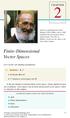 CHAPTER 2 American mathematician Paul Halmos (1916 2006), who in 1942 published the first modern linear algebra book. The title of Halmos s book was the same as the title of this chapter. Finite-Dimensional
Probability Theory. Florian Herzog. A random variable is neither random nor variable. Gian-Carlo Rota, M.I.T..
 Probability Theory A random variable is neither random nor variable. Gian-Carlo Rota, M.I.T.. Florian Herzog 2013 Probability space Probability space A probability space W is a unique triple W = {Ω, F,
5 Directed acyclic graphs
 5 Directed acyclic graphs (5.1) Introduction In many statistical studies we have prior knowledge about a temporal or causal ordering of the variables. In this chapter we will use directed graphs to incorporate
3. The Junction Tree Algorithms
 A Short Course on Graphical Models 3. The Junction Tree Algorithms Mark Paskin [email protected] 1 Review: conditional independence Two random variables X and Y are independent (written X Y ) iff p X ( )
Lemma 5.2. Let S be a set. (1) Let f and g be two permutations of S. Then the composition of f and g is a permutation of S.
 Definition 51 Let S be a set bijection f : S S 5 Permutation groups A permutation of S is simply a Lemma 52 Let S be a set (1) Let f and g be two permutations of S Then the composition of f and g is a
a 11 x 1 + a 12 x 2 + + a 1n x n = b 1 a 21 x 1 + a 22 x 2 + + a 2n x n = b 2.
 Chapter 1 LINEAR EQUATIONS 1.1 Introduction to linear equations A linear equation in n unknowns x 1, x,, x n is an equation of the form a 1 x 1 + a x + + a n x n = b, where a 1, a,..., a n, b are given
6.045: Automata, Computability, and Complexity Or, Great Ideas in Theoretical Computer Science Spring, 2010. Class 4 Nancy Lynch
 6.045: Automata, Computability, and Complexity Or, Great Ideas in Theoretical Computer Science Spring, 2010 Class 4 Nancy Lynch Today Two more models of computation: Nondeterministic Finite Automata (NFAs)
Midterm Practice Problems
 6.042/8.062J Mathematics for Computer Science October 2, 200 Tom Leighton, Marten van Dijk, and Brooke Cowan Midterm Practice Problems Problem. [0 points] In problem set you showed that the nand operator
Every tree contains a large induced subgraph with all degrees odd
 Every tree contains a large induced subgraph with all degrees odd A.J. Radcliffe Carnegie Mellon University, Pittsburgh, PA A.D. Scott Department of Pure Mathematics and Mathematical Statistics University
Math 4310 Handout - Quotient Vector Spaces
 Math 4310 Handout - Quotient Vector Spaces Dan Collins The textbook defines a subspace of a vector space in Chapter 4, but it avoids ever discussing the notion of a quotient space. This is understandable
A simple criterion on degree sequences of graphs
 Discrete Applied Mathematics 156 (2008) 3513 3517 Contents lists available at ScienceDirect Discrete Applied Mathematics journal homepage: www.elsevier.com/locate/dam Note A simple criterion on degree
Regular Languages and Finite Automata
 Regular Languages and Finite Automata 1 Introduction Hing Leung Department of Computer Science New Mexico State University Sep 16, 2010 In 1943, McCulloch and Pitts [4] published a pioneering work on a
No: 10 04. Bilkent University. Monotonic Extension. Farhad Husseinov. Discussion Papers. Department of Economics
 No: 10 04 Bilkent University Monotonic Extension Farhad Husseinov Discussion Papers Department of Economics The Discussion Papers of the Department of Economics are intended to make the initial results
Regular Expressions with Nested Levels of Back Referencing Form a Hierarchy
 Regular Expressions with Nested Levels of Back Referencing Form a Hierarchy Kim S. Larsen Odense University Abstract For many years, regular expressions with back referencing have been used in a variety
Lecture 15 An Arithmetic Circuit Lowerbound and Flows in Graphs
 CSE599s: Extremal Combinatorics November 21, 2011 Lecture 15 An Arithmetic Circuit Lowerbound and Flows in Graphs Lecturer: Anup Rao 1 An Arithmetic Circuit Lower Bound An arithmetic circuit is just like
Lecture 2: Universality
 CS 710: Complexity Theory 1/21/2010 Lecture 2: Universality Instructor: Dieter van Melkebeek Scribe: Tyson Williams In this lecture, we introduce the notion of a universal machine, develop efficient universal
Reading 13 : Finite State Automata and Regular Expressions
 CS/Math 24: Introduction to Discrete Mathematics Fall 25 Reading 3 : Finite State Automata and Regular Expressions Instructors: Beck Hasti, Gautam Prakriya In this reading we study a mathematical model
AN ALGORITHM FOR DETERMINING WHETHER A GIVEN BINARY MATROID IS GRAPHIC
 AN ALGORITHM FOR DETERMINING WHETHER A GIVEN BINARY MATROID IS GRAPHIC W. T. TUTTE. Introduction. In a recent series of papers [l-4] on graphs and matroids I used definitions equivalent to the following.
Lecture 17 : Equivalence and Order Relations DRAFT
 CS/Math 240: Introduction to Discrete Mathematics 3/31/2011 Lecture 17 : Equivalence and Order Relations Instructor: Dieter van Melkebeek Scribe: Dalibor Zelený DRAFT Last lecture we introduced the notion
On Integer Additive Set-Indexers of Graphs
 On Integer Additive Set-Indexers of Graphs arxiv:1312.7672v4 [math.co] 2 Mar 2014 N K Sudev and K A Germina Abstract A set-indexer of a graph G is an injective set-valued function f : V (G) 2 X such that
Connectivity and cuts
 Math 104, Graph Theory February 19, 2013 Measure of connectivity How connected are each of these graphs? > increasing connectivity > I G 1 is a tree, so it is a connected graph w/minimum # of edges. Every
On an anti-ramsey type result
 On an anti-ramsey type result Noga Alon, Hanno Lefmann and Vojtĕch Rödl Abstract We consider anti-ramsey type results. For a given coloring of the k-element subsets of an n-element set X, where two k-element
Information Theory and Coding Prof. S. N. Merchant Department of Electrical Engineering Indian Institute of Technology, Bombay
 Information Theory and Coding Prof. S. N. Merchant Department of Electrical Engineering Indian Institute of Technology, Bombay Lecture - 17 Shannon-Fano-Elias Coding and Introduction to Arithmetic Coding
INDISTINGUISHABILITY OF ABSOLUTELY CONTINUOUS AND SINGULAR DISTRIBUTIONS
 INDISTINGUISHABILITY OF ABSOLUTELY CONTINUOUS AND SINGULAR DISTRIBUTIONS STEVEN P. LALLEY AND ANDREW NOBEL Abstract. It is shown that there are no consistent decision rules for the hypothesis testing problem
Every Positive Integer is the Sum of Four Squares! (and other exciting problems)
 Every Positive Integer is the Sum of Four Squares! (and other exciting problems) Sophex University of Texas at Austin October 18th, 00 Matilde N. Lalín 1. Lagrange s Theorem Theorem 1 Every positive integer
Stationary random graphs on Z with prescribed iid degrees and finite mean connections
 Stationary random graphs on Z with prescribed iid degrees and finite mean connections Maria Deijfen Johan Jonasson February 2006 Abstract Let F be a probability distribution with support on the non-negative
Lecture 22: November 10
 CS271 Randomness & Computation Fall 2011 Lecture 22: November 10 Lecturer: Alistair Sinclair Based on scribe notes by Rafael Frongillo Disclaimer: These notes have not been subjected to the usual scrutiny
Continued Fractions. Darren C. Collins
 Continued Fractions Darren C Collins Abstract In this paper, we discuss continued fractions First, we discuss the definition and notation Second, we discuss the development of the subject throughout history
1 The Line vs Point Test
 6.875 PCP and Hardness of Approximation MIT, Fall 2010 Lecture 5: Low Degree Testing Lecturer: Dana Moshkovitz Scribe: Gregory Minton and Dana Moshkovitz Having seen a probabilistic verifier for linearity
The Goldberg Rao Algorithm for the Maximum Flow Problem
 The Goldberg Rao Algorithm for the Maximum Flow Problem COS 528 class notes October 18, 2006 Scribe: Dávid Papp Main idea: use of the blocking flow paradigm to achieve essentially O(min{m 2/3, n 1/2 }
So let us begin our quest to find the holy grail of real analysis.
 1 Section 5.2 The Complete Ordered Field: Purpose of Section We present an axiomatic description of the real numbers as a complete ordered field. The axioms which describe the arithmetic of the real numbers
On strong fairness in UNITY
 On strong fairness in UNITY H.P.Gumm, D.Zhukov Fachbereich Mathematik und Informatik Philipps Universität Marburg {gumm,shukov}@mathematik.uni-marburg.de Abstract. In [6] Tsay and Bagrodia present a correct
Chapter 17. Orthogonal Matrices and Symmetries of Space
 Chapter 17. Orthogonal Matrices and Symmetries of Space Take a random matrix, say 1 3 A = 4 5 6, 7 8 9 and compare the lengths of e 1 and Ae 1. The vector e 1 has length 1, while Ae 1 = (1, 4, 7) has length
Fundamentele Informatica II
 Fundamentele Informatica II Answer to selected exercises 1 John C Martin: Introduction to Languages and the Theory of Computation M.M. Bonsangue (and J. Kleijn) Fall 2011 Let L be a language. It is clear
I. GROUPS: BASIC DEFINITIONS AND EXAMPLES
 I GROUPS: BASIC DEFINITIONS AND EXAMPLES Definition 1: An operation on a set G is a function : G G G Definition 2: A group is a set G which is equipped with an operation and a special element e G, called
Maximum Likelihood Estimation
 Math 541: Statistical Theory II Lecturer: Songfeng Zheng Maximum Likelihood Estimation 1 Maximum Likelihood Estimation Maximum likelihood is a relatively simple method of constructing an estimator for
Probability and Statistics Prof. Dr. Somesh Kumar Department of Mathematics Indian Institute of Technology, Kharagpur
 Probability and Statistics Prof. Dr. Somesh Kumar Department of Mathematics Indian Institute of Technology, Kharagpur Module No. #01 Lecture No. #15 Special Distributions-VI Today, I am going to introduce
COUNTING SUBSETS OF A SET: COMBINATIONS
 COUNTING SUBSETS OF A SET: COMBINATIONS DEFINITION 1: Let n, r be nonnegative integers with r n. An r-combination of a set of n elements is a subset of r of the n elements. EXAMPLE 1: Let S {a, b, c, d}.
Formal Languages and Automata Theory - Regular Expressions and Finite Automata -
 Formal Languages and Automata Theory - Regular Expressions and Finite Automata - Samarjit Chakraborty Computer Engineering and Networks Laboratory Swiss Federal Institute of Technology (ETH) Zürich March
Spatial Statistics Chapter 3 Basics of areal data and areal data modeling
 Spatial Statistics Chapter 3 Basics of areal data and areal data modeling Recall areal data also known as lattice data are data Y (s), s D where D is a discrete index set. This usually corresponds to data
ALMOST COMMON PRIORS 1. INTRODUCTION
 ALMOST COMMON PRIORS ZIV HELLMAN ABSTRACT. What happens when priors are not common? We introduce a measure for how far a type space is from having a common prior, which we term prior distance. If a type
Handout #1: Mathematical Reasoning
 Math 101 Rumbos Spring 2010 1 Handout #1: Mathematical Reasoning 1 Propositional Logic A proposition is a mathematical statement that it is either true or false; that is, a statement whose certainty or
Special Situations in the Simplex Algorithm
 Special Situations in the Simplex Algorithm Degeneracy Consider the linear program: Maximize 2x 1 +x 2 Subject to: 4x 1 +3x 2 12 (1) 4x 1 +x 2 8 (2) 4x 1 +2x 2 8 (3) x 1, x 2 0. We will first apply the
ON GENERALIZED RELATIVE COMMUTATIVITY DEGREE OF A FINITE GROUP. A. K. Das and R. K. Nath
 International Electronic Journal of Algebra Volume 7 (2010) 140-151 ON GENERALIZED RELATIVE COMMUTATIVITY DEGREE OF A FINITE GROUP A. K. Das and R. K. Nath Received: 12 October 2009; Revised: 15 December
Cycles and clique-minors in expanders
 Cycles and clique-minors in expanders Benny Sudakov UCLA and Princeton University Expanders Definition: The vertex boundary of a subset X of a graph G: X = { all vertices in G\X with at least one neighbor
Finitely Additive Dynamic Programming and Stochastic Games. Bill Sudderth University of Minnesota
 Finitely Additive Dynamic Programming and Stochastic Games Bill Sudderth University of Minnesota 1 Discounted Dynamic Programming Five ingredients: S, A, r, q, β. S - state space A - set of actions q(
Mathematical Induction
 Mathematical Induction (Handout March 8, 01) The Principle of Mathematical Induction provides a means to prove infinitely many statements all at once The principle is logical rather than strictly mathematical,
NOTES ON LINEAR TRANSFORMATIONS
 NOTES ON LINEAR TRANSFORMATIONS Definition 1. Let V and W be vector spaces. A function T : V W is a linear transformation from V to W if the following two properties hold. i T v + v = T v + T v for all
INTRODUCTORY SET THEORY
 M.Sc. program in mathematics INTRODUCTORY SET THEORY Katalin Károlyi Department of Applied Analysis, Eötvös Loránd University H-1088 Budapest, Múzeum krt. 6-8. CONTENTS 1. SETS Set, equal sets, subset,
Automata on Infinite Words and Trees
 Automata on Infinite Words and Trees Course notes for the course Automata on Infinite Words and Trees given by Dr. Meghyn Bienvenu at Universität Bremen in the 2009-2010 winter semester Last modified:
CMSC 858T: Randomized Algorithms Spring 2003 Handout 8: The Local Lemma
 CMSC 858T: Randomized Algorithms Spring 2003 Handout 8: The Local Lemma Please Note: The references at the end are given for extra reading if you are interested in exploring these ideas further. You are
Chapter 20. Vector Spaces and Bases
 Chapter 20. Vector Spaces and Bases In this course, we have proceeded step-by-step through low-dimensional Linear Algebra. We have looked at lines, planes, hyperplanes, and have seen that there is no limit
Geometrical Characterization of RN-operators between Locally Convex Vector Spaces
 Geometrical Characterization of RN-operators between Locally Convex Vector Spaces OLEG REINOV St. Petersburg State University Dept. of Mathematics and Mechanics Universitetskii pr. 28, 198504 St, Petersburg
TOPIC 4: DERIVATIVES
 TOPIC 4: DERIVATIVES 1. The derivative of a function. Differentiation rules 1.1. The slope of a curve. The slope of a curve at a point P is a measure of the steepness of the curve. If Q is a point on the
Extension of measure
 1 Extension of measure Sayan Mukherjee Dynkin s π λ theorem We will soon need to define probability measures on infinite and possible uncountable sets, like the power set of the naturals. This is hard.
Math/Stats 425 Introduction to Probability. 1. Uncertainty and the axioms of probability
 Math/Stats 425 Introduction to Probability 1. Uncertainty and the axioms of probability Processes in the real world are random if outcomes cannot be predicted with certainty. Example: coin tossing, stock
Practical Guide to the Simplex Method of Linear Programming
 Practical Guide to the Simplex Method of Linear Programming Marcel Oliver Revised: April, 0 The basic steps of the simplex algorithm Step : Write the linear programming problem in standard form Linear
The Basics of Graphical Models
 The Basics of Graphical Models David M. Blei Columbia University October 3, 2015 Introduction These notes follow Chapter 2 of An Introduction to Probabilistic Graphical Models by Michael Jordan. Many figures
DEGREES OF ORDERS ON TORSION-FREE ABELIAN GROUPS
 DEGREES OF ORDERS ON TORSION-FREE ABELIAN GROUPS ASHER M. KACH, KAREN LANGE, AND REED SOLOMON Abstract. We construct two computable presentations of computable torsion-free abelian groups, one of isomorphism
Discrete Mathematics and Probability Theory Fall 2009 Satish Rao, David Tse Note 2
 CS 70 Discrete Mathematics and Probability Theory Fall 2009 Satish Rao, David Tse Note 2 Proofs Intuitively, the concept of proof should already be familiar We all like to assert things, and few of us
Linear Algebra I. Ronald van Luijk, 2012
 Linear Algebra I Ronald van Luijk, 2012 With many parts from Linear Algebra I by Michael Stoll, 2007 Contents 1. Vector spaces 3 1.1. Examples 3 1.2. Fields 4 1.3. The field of complex numbers. 6 1.4.
(IALC, Chapters 8 and 9) Introduction to Turing s life, Turing machines, universal machines, unsolvable problems.
 3130CIT: Theory of Computation Turing machines and undecidability (IALC, Chapters 8 and 9) Introduction to Turing s life, Turing machines, universal machines, unsolvable problems. An undecidable problem
Sample Induction Proofs
 Math 3 Worksheet: Induction Proofs III, Sample Proofs A.J. Hildebrand Sample Induction Proofs Below are model solutions to some of the practice problems on the induction worksheets. The solutions given
How Much Can Taxes Help Selfish Routing?
 How Much Can Taxes Help Selfish Routing? Richard Cole Yevgeniy Dodis Tim Roughgarden July 28, 25 Abstract We study economic incentives for influencing selfish behavior in networks. We consider a model
Odd induced subgraphs in graphs of maximum degree three
 Odd induced subgraphs in graphs of maximum degree three David M. Berman, Hong Wang, and Larry Wargo Department of Mathematics University of New Orleans New Orleans, Louisiana, USA 70148 Abstract A long-standing
1 Approximating Set Cover
 CS 05: Algorithms (Grad) Feb 2-24, 2005 Approximating Set Cover. Definition An Instance (X, F ) of the set-covering problem consists of a finite set X and a family F of subset of X, such that every elemennt
What is Linear Programming?
 Chapter 1 What is Linear Programming? An optimization problem usually has three essential ingredients: a variable vector x consisting of a set of unknowns to be determined, an objective function of x to
Computational Geometry Lab: FEM BASIS FUNCTIONS FOR A TETRAHEDRON
 Computational Geometry Lab: FEM BASIS FUNCTIONS FOR A TETRAHEDRON John Burkardt Information Technology Department Virginia Tech http://people.sc.fsu.edu/ jburkardt/presentations/cg lab fem basis tetrahedron.pdf
Lecture Notes on Measure Theory and Functional Analysis
 Lecture Notes on Measure Theory and Functional Analysis P. Cannarsa & T. D Aprile Dipartimento di Matematica Università di Roma Tor Vergata [email protected] [email protected] aa 2006/07 Contents
Message-passing sequential detection of multiple change points in networks
 Message-passing sequential detection of multiple change points in networks Long Nguyen, Arash Amini Ram Rajagopal University of Michigan Stanford University ISIT, Boston, July 2012 Nguyen/Amini/Rajagopal
SOLUTIONS TO EXERCISES FOR. MATHEMATICS 205A Part 3. Spaces with special properties
 SOLUTIONS TO EXERCISES FOR MATHEMATICS 205A Part 3 Fall 2008 III. Spaces with special properties III.1 : Compact spaces I Problems from Munkres, 26, pp. 170 172 3. Show that a finite union of compact subspaces
Elements of probability theory
 2 Elements of probability theory Probability theory provides mathematical models for random phenomena, that is, phenomena which under repeated observations yield di erent outcomes that cannot be predicted
CORRELATED TO THE SOUTH CAROLINA COLLEGE AND CAREER-READY FOUNDATIONS IN ALGEBRA
 We Can Early Learning Curriculum PreK Grades 8 12 INSIDE ALGEBRA, GRADES 8 12 CORRELATED TO THE SOUTH CAROLINA COLLEGE AND CAREER-READY FOUNDATIONS IN ALGEBRA April 2016 www.voyagersopris.com Mathematical
Smooth functions statistics
 Smooth functions statistics V. I. rnold To describe the topological structure of a real smooth function one associates to it the graph, formed by the topological variety, whose points are the connected
The Union-Find Problem Kruskal s algorithm for finding an MST presented us with a problem in data-structure design. As we looked at each edge,
 The Union-Find Problem Kruskal s algorithm for finding an MST presented us with a problem in data-structure design. As we looked at each edge, cheapest first, we had to determine whether its two endpoints