
GEL 113 Historical Geology
|
|
|
- Alan Horn
- 9 years ago
- Views:
Transcription
1 GEL 113 Historical Geology COURSE DESCRIPTION: Prerequisites: GEL 111 Corequisites: None This course covers the geological history of the earth and its life forms. Emphasis is placed on the study of rock strata, fossil groups, and geological time. Upon completion, students should be able to identify major fossil groups and associated rock strata and approximate ages of geological formations. They should also be familiar with important time periods associated with the evolution of the earth and its life forms. This course has been approved to satisfy the Comprehensive Articulation Agreement general education core requirement in natural sciences/mathematics. Course Hours Per Week: Class, 3. Lab, 2. Semester Hours Credit, 4. LEARNING OUTCOMES: Upon completion of this course, the student will demonstrate basic knowledge of the following: a. Demonstrate knowledge of the basic geologic history of the earth. b. Understand the relationship between fossil groups and rock strata. c. Demonstrate the use of geo-physical principles through lab experiments. OUTLINE OF INSTRUCTION: I. Introduction A. Historical geology and the formulation of theories. B. Origin of the universe and the solar system. C. Why the Earth is a dynamic and evolving planet. D. Organic evolution and the history of life. E. Geologic time and uniformitarianism. F. How the study of historical geology benefits us. II. Review of minerals and rocks. A. Matter and its composition. B. Minerals The building blocks of rocks. a.) Silicate b.) Other rocks C. Rock forming minerals and the rock cycle. D. Igneous rocks. a.) Texture and composition. b.) Classification. E. Sedimentary rocks a.) Sediment transport, deposition and lithification.

2 F. Metamorphic rocks. a. Agents of metamorphism. b. Types of metamorphism. c. Classification. III. IV. Continental Drift. A. Evidence for continental drift. a.) Paleomagnetism and polar wandering. b.) Magnetic reversals and seafloor spreading. c.) Plate Tectonics and plate boundaries. d.) Hot spots and mantle plumes. e.) How plate movement and motion is determined. B. The driving mechanism of plate tectonics. C. Plate tectonics and mountain building. D. Plate tectonics and the distribution of life and natural resources. Geologic time: Concepts and principles. A. How the concept of geologic time and Earth s age changed. B. Relative dating. C. Uniformitarianism vs. Neptunism/Catastrophism. D. Lord Kelvin. E. Absolute dating. V. Rocks, fossils and time. A. Stratigraphy. B. Fossilization and fossils. C. Relative geologic time scale. D. Stratigraphic terminology. E. Correlation. F. Absolute dating and the relative geologic time scale. VI. VII. Sedimentary Rocks as Archives. A. Sedimentary rock properties. a.) Composition and texture. b.) Sedimentary structures. c.) Fossils. B. Depositional environments. C. Environmental interpretations and historical geology. D. Paleogeography. Evolution A. Definition of evolution. B. Mendel. C. Modern view of evolution. D. Evidence.

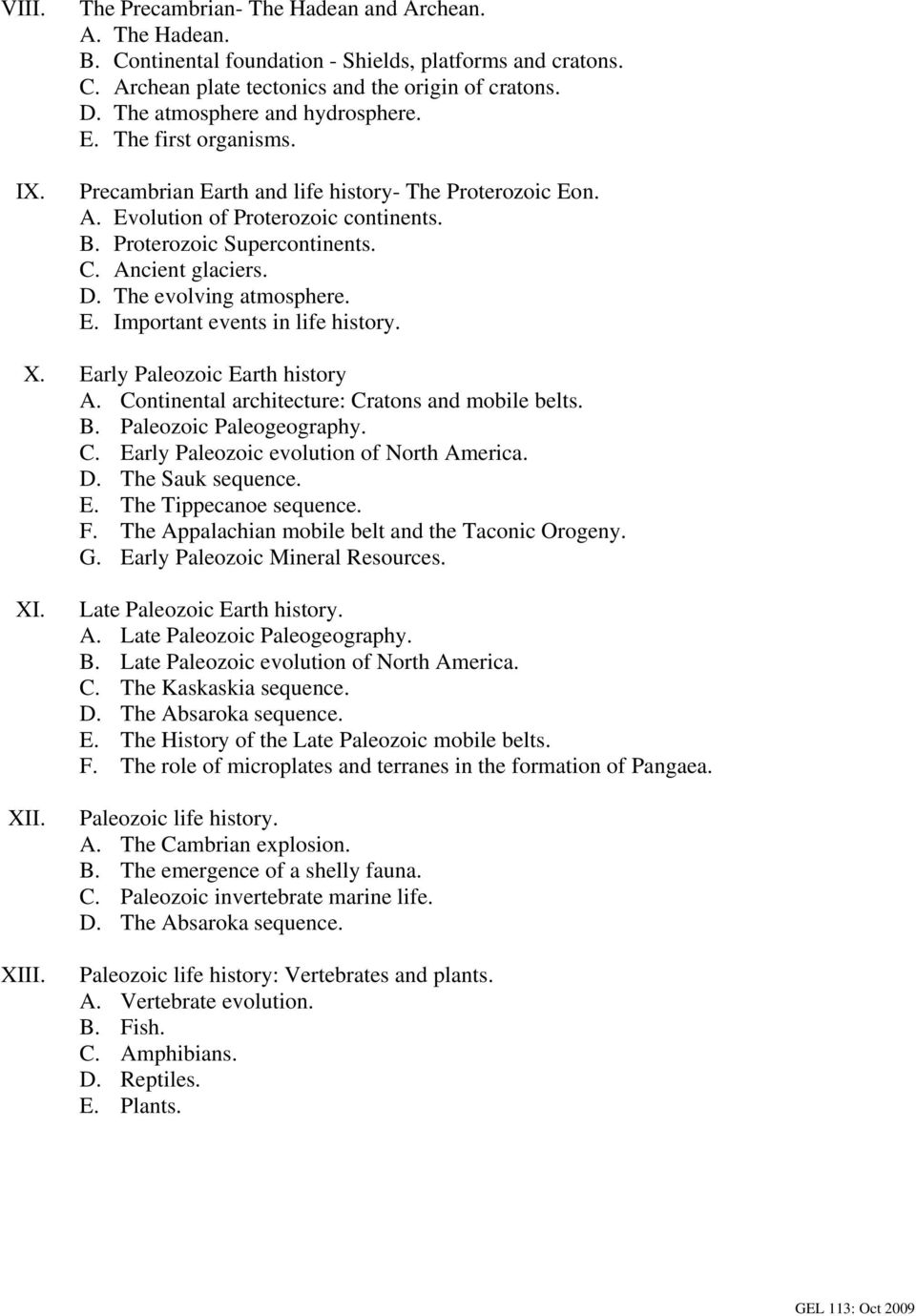
3 VIII. IX. The Precambrian- The Hadean and Archean. A. The Hadean. B. Continental foundation - Shields, platforms and cratons. C. Archean plate tectonics and the origin of cratons. D. The atmosphere and hydrosphere. E. The first organisms. Precambrian Earth and life history- The Proterozoic Eon. A. Evolution of Proterozoic continents. B. Proterozoic Supercontinents. C. Ancient glaciers. D. The evolving atmosphere. E. Important events in life history. X. Early Paleozoic Earth history A. Continental architecture: Cratons and mobile belts. B. Paleozoic Paleogeography. C. Early Paleozoic evolution of North America. D. The Sauk sequence. E. The Tippecanoe sequence. F. The Appalachian mobile belt and the Taconic Orogeny. G. Early Paleozoic Mineral Resources. XI. XII. XIII. Late Paleozoic Earth history. A. Late Paleozoic Paleogeography. B. Late Paleozoic evolution of North America. C. The Kaskaskia sequence. D. The Absaroka sequence. E. The History of the Late Paleozoic mobile belts. F. The role of microplates and terranes in the formation of Pangaea. Paleozoic life history. A. The Cambrian explosion. B. The emergence of a shelly fauna. C. Paleozoic invertebrate marine life. D. The Absaroka sequence. Paleozoic life history: Vertebrates and plants. A. Vertebrate evolution. B. Fish. C. Amphibians. D. Reptiles. E. Plants.
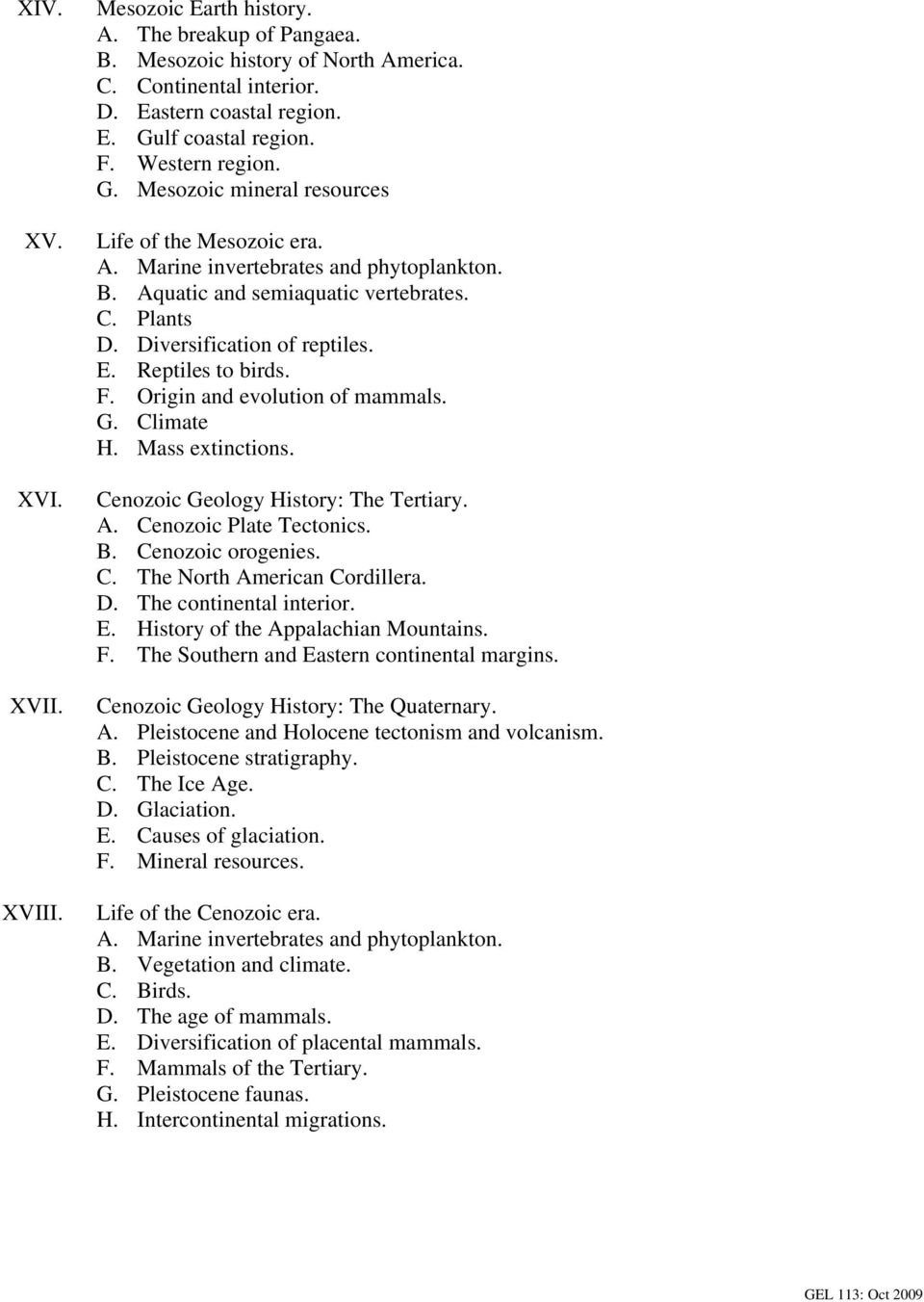
4 XIV. XV. XVI. XVII. XVIII. Mesozoic Earth history. A. The breakup of Pangaea. B. Mesozoic history of North America. C. Continental interior. D. Eastern coastal region. E. Gulf coastal region. F. Western region. G. Mesozoic mineral resources Life of the Mesozoic era. A. Marine invertebrates and phytoplankton. B. Aquatic and semiaquatic vertebrates. C. Plants D. Diversification of reptiles. E. Reptiles to birds. F. Origin and evolution of mammals. G. Climate H. Mass extinctions. Cenozoic Geology History: The Tertiary. A. Cenozoic Plate Tectonics. B. Cenozoic orogenies. C. The North American Cordillera. D. The continental interior. E. History of the Appalachian Mountains. F. The Southern and Eastern continental margins. Cenozoic Geology History: The Quaternary. A. Pleistocene and Holocene tectonism and volcanism. B. Pleistocene stratigraphy. C. The Ice Age. D. Glaciation. E. Causes of glaciation. F. Mineral resources. Life of the Cenozoic era. A. Marine invertebrates and phytoplankton. B. Vegetation and climate. C. Birds. D. The age of mammals. E. Diversification of placental mammals. F. Mammals of the Tertiary. G. Pleistocene faunas. H. Intercontinental migrations.
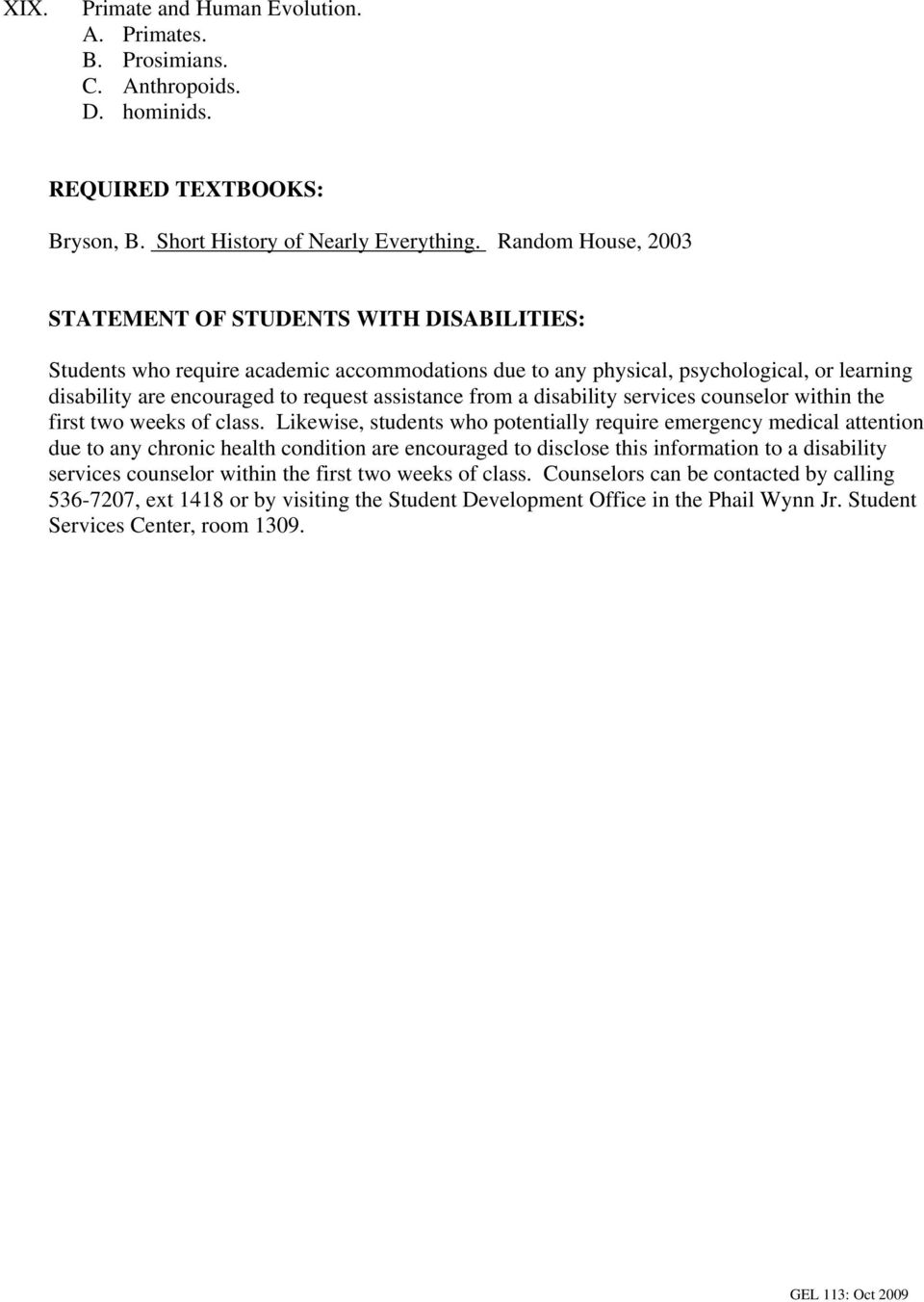
5 XIX. Primate and Human Evolution. A. Primates. B. Prosimians. C. Anthropoids. D. hominids. REQUIRED TEXTBOOKS: Bryson, B. Short History of Nearly Everything. Random House, 2003 STATEMENT OF STUDENTS WITH DISABILITIES: Students who require academic accommodations due to any physical, psychological, or learning disability are encouraged to request assistance from a disability services counselor within the first two weeks of class. Likewise, students who potentially require emergency medical attention due to any chronic health condition are encouraged to disclose this information to a disability services counselor within the first two weeks of class. Counselors can be contacted by calling , ext 1418 or by visiting the Student Development Office in the Phail Wynn Jr. Student Services Center, room 1309.
GLY2100C Historical Geology Course Information Spring 2015. Dr. Rachel Walters
 GLY2100C Historical Geology Course Information Spring 2015 Dr. Rachel Walters Credits: 4 Pre-requisites: Physical Geology GLY2010C, Environmental and Engineering Geology GLY 2030C or instructor permission.
College of Science and Health ENVIRONMENTAL SCIENCE & GEOGRAPHY Course Outline
 College of Science and Health ENVIRONMENTAL SCIENCE & GEOGRAPHY Course Outline 1. TITLE OF COURSE AND COURSE NUMBER: General Geology ENV 115, 4 credits 2. DESCRIPTION OF THE COURSE: Includes the study
Unit 2 Lesson 4 The Geologic Time Scale. Copyright Houghton Mifflin Harcourt Publishing Company
 Once Upon a Time How have geologists described the rate of geologic change? Geology is the scientific study of the origin, history, and structure of Earth and the processes that shape it. Early geologists
Geologic Time Scale Notes
 Name: Date: Period: 1 2 3 4 5 6 7 Notes Essential Question: What is the geologic time scale? Vocabulary: Geology: the scientific study of the origin, history, and structure of Earth and the processes that
Chapter 9: Earth s Past
 Chapter 9: Earth s Past Vocabulary 1. Geologic column 2. Era 3. Period 4. Epoch 5. Evolution 6. Precambrian time 7. Paleozoic era 8. Shield 9. Stromatolite 10. Invertebrate 11. Trilobite 12. Index fossil
Unit 5: Formation of the Earth
 Unit 5: Formation of the Earth Objectives: E5.3B - Explain the process of radioactive decay and explain how radioactive elements are used to date the rocks that contain them. E5.3C - Relate major events
Foundations of Earth Science (Lutgens and Tarbuck, 5 th edition, 2008)
 EAS 100 Study Guide to Textbook Foundations of Earth Science (Lutgens and Tarbuck, 5 th edition, 2008) STUDY GUIDE 1/08 The textbook for EAS 100, Foundations of Earth Science, by Lutgens and Tarbuck is
Foundations of Earth Science (Lutgens and Tarbuck, 6 th edition, 2011)
 EAS 100 Study Guide to Textbook Foundations of Earth Science (Lutgens and Tarbuck, 6 th edition, 2011) STUDY GUIDE 8/2010 The textbook for EAS 100, Foundations of Earth Science, by Lutgens and Tarbuck
The Fossil Record and Geologic Time Scale
 Two Conceptions of Earth History: Catastrophism Assumption: Great Effects Require Great Causes Earth History Dominated by Violent Events Uniformitarianism Assumption: We Can Use Cause And Effect to Determine
1. The diagram below shows a cross section of sedimentary rock layers.
 1. The diagram below shows a cross section of sedimentary rock layers. Which statement about the deposition of the sediments best explains why these layers have the curved shape shown? 1) Sediments were
ES Chapter 10 Review. Name: Class: Date: Multiple Choice Identify the choice that best completes the statement or answers the question.
 Name: Class: Date: ES Chapter 10 Review Multiple Choice Identify the choice that best completes the statement or answers the question. 1. Scientists used the pattern of alternating normal and reversed
Rocks and Plate Tectonics
 Name: Class: _ Date: _ Rocks and Plate Tectonics Multiple Choice Identify the choice that best completes the statement or answers the question. 1. What is a naturally occurring, solid mass of mineral or
Geologic Time Scale Newcomer Academy Visualization Three
 Geologic Time Newcomer Academy Visualization Three Chapter Subtopic/Media Key Points of Discussion Notes/Vocabulary Introduction Title NA NA Various Pictures of Geologic Time It s About Time Personal Timeline
Continental Drift. Alfred Wegener (1880-1930) Proposed that all of the continents were once part of a large supercontinent - Pangaea Based on:
 Plate Tectonics and Continental Drift Continental Drift Alfred Wegener (1880-1930) Proposed that all of the continents were once part of a large supercontinent - Pangaea Based on: Similarities in shorelines
Geologic Time. Relative Dating. Principle of Original Horizontality. Relative Time. Absolute Time. Geologic Column
 Geologic Time Relative Time 5 Principles of Relative Dating Absolute Time Radiometric Dating Geologic Column Relative Dating principle of horizontality principle of superposition principle of cross-cutting
Name Class Date WHAT I KNOW. about how organisms have changed. grown in complexity over time.
 History of Life Evolution Q: How do fossils help biologists understand the history of life on Earth? 19.1 How do scientists use fossils to study Earth s history? WHAT I KNOW SAMPLE ANSWER: Fossils give
Lesson Plan Title. Toilet Paper Tape Measure of Geologic Time
 Lesson Plan Title Toilet Paper Tape Measure of Geologic Time Name (last, first): Serratos, Danielle J. Scientific Theme(s): Life Science *Changes in Life Forms over Time Earth Science *Forces that Shape
Geologic History Review
 1. The climate that existed in an area during the early Paleozoic Era can best be determined by studying (1) the present climate of the area (2) recorded climate data of the area since 1700 (3) present
There are numerous seams on the surface of the Earth
 Plate Tectonics and Continental Drift There are numerous seams on the surface of the Earth Questions and Topics 1. What are the theories of Plate Tectonics and Continental Drift? 2. What is the evidence
II. Earth Science (Geology) Section (9/18/2013)
 EAPS 100 Planet Earth Lecture Topics Brief Outlines II. Earth Science (Geology) Section (9/18/2013) 1. Interior of the Earth Learning objectives: Understand the structure of the Earth s interior crust,
1. Michigan Geological History Presentation (Michigan Natural Resources)
 1. Michigan Geological History Presentation (Michigan Natural Resources) The Michigan Geological History Presentation provides an overview of the approximately 3 billion years of Earth Processes that the
Lecture Outlines PowerPoint. Chapter 11 Earth Science, 12e Tarbuck/Lutgens
 Lecture Outlines PowerPoint Chapter 11 Earth Science, 12e Tarbuck/Lutgens 2009 Pearson Prentice Hall This work is protected by United States copyright laws and is provided solely for the use of instructors
The Next Generation Science Standards (NGSS) Correlation to. EarthComm, Second Edition. Project-Based Space and Earth System Science
 The Next Generation Science Standards (NGSS) Achieve, Inc. on behalf of the twenty-six states and partners that collaborated on the NGSS Copyright 2013 Achieve, Inc. All rights reserved. Correlation to,
Understanding Geologic Time from the Texas Memorial Museum
 Understanding Geologic Time from the Texas Memorial Museum Objective To gain a better understanding of the geologic time scale. Materials Activity 1: Geologic Time Geologic Time Activity Worksheet (included)
Introductory Geosciences I: Historical Geology GEOL 1122, Sec. 01, Spring 2009 M, W 12:30 1:45 Calloway 205 Instructor E mail Office Office hours
 Introductory Geosciences I: Historical Geology GEOL 1122, Sec. 01, Spring 2009 M, W 12:30 1:45 Calloway 205 Instructor: Dr. Phil Novack Gottshall E mail: [email protected] Office: Calloway G1 Office
Geologic Time. This page last updated on 08-Oct-2015
 Page 1 of 16 EENS 1110 Tulane University Physical Geology Prof. Stephen A. Nelson Geologic Time This page last updated on 08-Oct-2015 From the beginning of this course, we have stated that the Earth is
Plate Tectonics. Earth, 9 th edition Chapter 2
 1 Plate Tectonics Earth, 9 th edition Chapter 2 2 3 4 5 6 7 8 9 10 11 12 13 14 15 16 Plate Tectonics: summary in haiku form Alfred Wegener gave us Continental Drift. Fifty years later... Continental Drift
History of the Earth/Geologic Time 5E Unit
 History of the Earth/Geologic Time 5E Unit Description: Students will create a timeline of Earth history in the classroom and learn about major changes to the Earth and life through time. Standards Targeted:
Plate Tectonics: Big Ideas. Plate Tectonics. Plate Tectonics. The unifying concept of the Earth sciences.
 Plate Tectonics: Big Ideas Our understanding of Earth is continuously refined. Earth s systems are dynamic; they continually react to changing influences from geological, hydrological, physical, chemical,
How Did These Ocean Features and Continental Margins Form?
 298 10.14 INVESTIGATION How Did These Ocean Features and Continental Margins Form? The terrain below contains various features on the seafloor, as well as parts of three continents. Some general observations
Name: LAB: The Geologic Time Scale
 Name: LAB: The Geologic Time Scale INTRODUCTION: It is difficult to comprehend the age of the Earth and the time that various geologic events occurred in the past. A model drawn to scale is often useful
The Ice Age By: Sue Peterson
 www.k5learning.com Objective sight words (pulses, intermittent, isotopes, chronicle, methane, tectonic plates, volcanism, configurations, land-locked, erratic); concepts (geological evidence and specific
Scope and Sequence Interactive Science grades 6-8
 Science and Technology Chapter 1. What Is Science? 1. Science and the Natural World 2.Thinking Like a Scientist 3. Scientific Inquiry Scope and Sequence Interactive Science grades 6-8 Chapter 2. Science,
A. CPT Coding System B. CPT Categories, Subcategories, and Headings
 OST 148 MEDICAL CODING, BILLING AND INSURANCE COURSE DESCRIPTION: Prerequisites: None Corequisites: None This course introduces CPT and ICD coding as they apply to medical insurance and billing. Emphasis
Plate Tectonics Chapter 2
 Plate Tectonics Chapter 2 Does not include complete lecture notes. Continental drift: An idea before its time Alfred Wegener First proposed his continental drift hypothesis in 1915 Published The Origin
3 The Mesozoic and Cenozoic Eras
 CHAPTER 9 3 The Mesozoic and Cenozoic Eras SECTION A View of Earth s Past KEY IDEAS As you read this section, keep these questions in mind: What were the periods of the Mesozoic and Cenozoic Eras? What
Curriculum Map Earth Science - High School
 September Science is a format process to use Use instruments to measure Measurement labs - mass, volume, to observe, classify, and analyze the observable properties. density environment. Use lab equipment
6.E.2.2 Plate Tectonics, Earthquakes and Volcanoes
 Name: Date: 1. The road shown below was suddenly broken by a natural event. 3. The convergence of two continental plates would produce Which natural event most likely caused the crack in the road? island
EARTH SYSTEM: HISTORY AND NATURAL VARIABILITY - Vol. IV - Epeiric Seas: A Continental Extension of Shelf Biotas - Harries P.J.
 EPEIRIC SEAS: A CONTINENTAL EXTENSION OF SHELF BIOTAS Harries P.J. University of South Florida, Tampa, Florida USA Keywords: Epeiric seas, climate change, sea-level rise, biodiversity, endemism, sediments,
Plate Tectonics. Hi, I am Zed and I am going to take you on a trip learning about Plate Tectonics. And I am Buddy Zed s mascot
 Plate Tectonics Hi, I am Zed and I am going to take you on a trip learning about Plate Tectonics And I am Buddy Zed s mascot Continental Drift Alfred Wegener proposed that continents were not always where
Name: DUE: May 2, 2013 Ms. Galaydick. Geologic Time Scale Era Period End date (in millions of years) Cenozoic Quaternary present
 Name: DUE: May 2, 2013 Ms. Galaydick Objective: Use the diagrams to answer the questions for each set: USING SCIENCE SKILLS PART #1 Geologic Time Scale Era Period End date (in millions of years) Cenozoic
Evolution (18%) 11 Items Sample Test Prep Questions
 Evolution (18%) 11 Items Sample Test Prep Questions Grade 7 (Evolution) 3.a Students know both genetic variation and environmental factors are causes of evolution and diversity of organisms. (pg. 109 Science
ACC 121 PRINCIPLES OF MANAGERIAL ACCOUNTING
 PRINCIPLES OF MANAGERIAL ACCOUNTING COURSE DESCRIPTION: Prerequisites: ACC 120 Corequisites: None This course includes a greater emphasis on managerial and cost accounting skills. Emphasis is on managerial
Geol 101: Physical Geology PAST EXAM QUESTIONS LECTURE 4: PLATE TECTONICS II
 Geol 101: Physical Geology PAST EXAM QUESTIONS LECTURE 4: PLATE TECTONICS II 4. Which of the following statements about paleomagnetism at spreading ridges is FALSE? A. there is a clear pattern of paleomagnetic
Plate Tectonics. Plate Tectonics The unifying concept of the Earth sciences. Continental Drift
 Plate Tectonics The unifying concept of the Earth sciences. The outer portion of the Earth is made up of about 20 distinct plates (~ 100 km thick), which move relative to each other This motion is what
The Earth System. The geosphere is the solid Earth that includes the continental and oceanic crust as well as the various layers of Earth s interior.
 The Earth System The atmosphere is the gaseous envelope that surrounds Earth. It consists of a mixture of gases composed primarily of nitrogen, oxygen, carbon dioxide, and water vapor. The atmosphere and
Alfred Wegener s Theory of Continental Drift Became Modern Plate Tectonics. Wegener in Greenland about 1912. He froze to death there in 1930.
 Alfred Wegener s Theory of Continental Drift Became Modern Plate Tectonics Wegener in Greenland about 1912. He froze to death there in 1930. Science is self correcting. The Scientific Method The history
Chapter 8: Plate Tectonics -- Multi-format Test
 Name: Class: Date: ID: A Chapter 8: Plate Tectonics -- Multi-format Test Modified True/False Indicate whether the statement is true or false. If false, change the identified word or phrase to make the
89.215 - FORENSIC GEOLOGY GEOLOGIC TIME AND GEOLOGIC MAPS
 NAME 89.215 - FORENSIC GEOLOGY GEOLOGIC TIME AND GEOLOGIC MAPS I. Introduction There are two types of geologic time, relative and absolute. In the case of relative time geologic events are arranged in
Geology. Administered by the Department of Physical Sciences within the College of Arts and Sciences.
 Geology Administered by the Department of Physical Sciences within the College of Arts and Sciences. The Bachelor of Science degree in Geology prepares students for entry-level positions in Earth- Science-related
TECTONICS ASSESSMENT
 Tectonics Assessment / 1 TECTONICS ASSESSMENT 1. Movement along plate boundaries produces A. tides. B. fronts. C. hurricanes. D. earthquakes. 2. Which of the following is TRUE about the movement of continents?
A CONTENT STANDARD IS NOT MET UNLESS APPLICABLE CHARACTERISTICS OF SCIENCE ARE ALSO ADDRESSED AT THE SAME TIME.
 Earth Systems Curriculum The Georgia Performance Standards are designed to provide students with the knowledge and skills for proficiency in science. The Project 2061 s Benchmarks for Science Literacy
principles of stratigraphy: deposition, succession, continuity and correlation
 Relative Age Dating Comparative Records of Time Nature of the rock record principles of stratigraphy: deposition, succession, continuity and correlation Stratigraphic tools biological succession of life:
Plate Tectonics Short Study Guide
 Name: Class: Date: Plate Tectonics Short Study Guide Multiple Choice Identify the letter of the choice that best completes the statement or answers the question. 1. The existence of coal beds in Antarctica
Introduction and Scope
 Introduction and Scope 1 1 Introduction and Scope 1.1 INTRODUCTION TO GEOLOGY Geology (in Greek, Geo means Earth, Logos means Science) is a branch of science dealing with the study of the Earth. It is
4. Plate Tectonics II (p. 46-67)
 4. Plate Tectonics II (p. 46-67) Seafloor Spreading In the early 1960s, samples of basaltic ocean crust were dredged up from various locations across the ocean basins. The samples were then analyzed to
Study Guide Questions Earth Structure and Plate Tectonics
 Study Guide Questions Earth Structure and Plate Tectonics What evidence did Alfred Wegener present in 1912 to support the idea of continental drift? Why did most geologists at the time dismiss Wegener
Chapter 1: Geologic History of the Midwestern US: The Big Picture
 Chapter 1: Geologic History of the Midwestern US: The Big Picture Geologic Time geologic time scale a standard timeline used to describe the age of rocks and fossils, and the events that formed them. Geologic
ACC 120 PRINCIPLES OF FINANCIAL ACCOUNTING
 ACC 120 PRINCIPLES OF FINANCIAL ACCOUNTING COURSE DESCRIPTION: Prerequisites ENG 090, and RED 090 or DRE 098; MAT 070 or DMA 010, 020, 030, 040, or satisfactory score on placement test Corequisites: None
Chapter 2. Plate Tectonics. Plate Tectonics: Learning Goals
 Plate Tectonics Chapter 2 Interactions at depend on the direction of relative plate motion and the type of crust. Which kind of plate boundary is associated with Earthquake activity? A. Divergent Boundary
Required Courses in Geology Major
 Courses Credits Courses Credits 1. University Requirements (24 credits) 319 Geochemistry 3 A. Courses (12 credits) 350 Sedimentary Petrology 3 101 Arabic Language 3 403 Geology of the Arabian Peninsula
Georgia Performance Standards Framework for Science Grade 6. Unit Organizer: Geology: Inside the Earth (Approximate Time: 7 Weeks)
 The following instructional plan is part of a GaDOE collection of Unit Frameworks, Performance Tasks, examples of Student Work, and Teacher Commentary. Many more GaDOE approved instructional plans are
An Introduction to Geology GEOL 105 University Studies Program. Course Outline
 An Introduction to Geology GEOL 105 University Studies Program Course Outline COURSE IMPLEMENTATION DATE: Pre 1998 OUTLINE EFFECTIVE DATE: September 2013 COURSE OUTLINE REVIEW DATE: April 2018 GENERAL
Section 1 Earth s surface undergoes gradual and sudden changes
 Section 1 Earth s surface undergoes gradual and sudden changes Student Class 1. Scientists estimate the age of the Earth to be about 4.6 billion years old, using evidence and theories. Then they construct
Unit 4 Lesson 2 Plate Tectonics. Copyright Houghton Mifflin Harcourt Publishing Company
 Puzzling Evidence What evidence suggests that continents move? In the late 1800s, Alfred Wegener proposed his hypothesis of continental drift. According to this hypothesis, the continents once formed a
Session No. 184. Tuesday, 3 November 2015: 8:00 AM- 12:00 PM.
 FROM NEOPROTEROZOIC PRE-CURSOR CLAMS TO THE KLAMATHS: DOCUMENTING THE PALEOGEOGRAPHIC EVOLUTION OF THE EASTERN KLAMATH TERRANES, AN EDUCATION OUTREACH MODEL ROBERTI, Gina M.1, ROTH, John2 and LEDFORD,
GEOLOGY AND GEOMORPHOLOGY Level. bachelor Semester. winter ECTS 9
 GEOLOGY AND GEOMORPHOLOGY ECTS 9 The subject includes knowledge of the construction of the Earth and the natural processes occurring deeply inside and on the surface of the Earth. It contains characteristics
DLT 123 CROWN AND BRIDGE
 DLT 123 CROWN AND BRIDGE COURSE DESCRIPTION: Prerequisites: DLT 111 and DLT 114 Corequisites: None This course introduces techniques for fabricating cast gold restorations. Topics include infection control,
Master in Earth Sciences
 Master in Earth Sciences DERDW EARTH SCIENCES MASTER IN EARTH SCIENCES The Department of Earth Sciences at ETH Zurich has been repeatedly ranked as one of the world s leading Earth Science schools. The
Chapter 25: The History of Life on Earth
 Overview Name Period 1. In the last chapter, you were asked about macroevolution. To begin this chapter, give some examples of macroevolution. Include at least one novel example not in your text. Concept
PHYSICAL GEOLOGY ONLINE SYLLABUS GLY 1010 Physical Geology Online Spring 2010
 PHYSICAL GEOLOGY ONLINE SYLLABUS GLY 1010 Physical Geology Online Spring 2010 Instructor s Name: Marianne O Neal Caldwell Telephone Number: (813) 253-7251 Email Address: Use my online@hcc (formerly WebCT)
1. Foliation or schistose textures are easily seen in rocks consisting of. 2. Which of these tectonic settings will be hottest at 20km depth?
 2nd Midterm Questions Metamorphic Rocks 1. Foliation or schistose textures are easily seen in rocks consisting of. a. framework silicates (quartz, feldspar) b. platy minerals (micas) c. chain-silicates
Syllabus for Physical Geology 51-102 Lecture: Fall 2015 Section: A09C
 Syllabus for Physical Geology 51-102 Lecture: Fall 2015 Section: A09C Instructor: Dr. Ben Hallett Office: Harrington Hall 310 Email: [email protected] Phone: 920-424-0868 Office Hours: M 3:00 5:00pm,
Unit Plan: Plate Tectonics Shannon B. Carpenter TE 804 1/25/02
 Unit Plan: Plate Tectonics Shannon B. Carpenter TE 804 1/25/02 This unit plan is intended to cover about seven weeks and would be appropriate for a middle school general science class or an introductory
Continental Drift, Sea Floor Spreading and Plate Tectonics
 Page 1 of 13 EENS 1110 Tulane University Physical Geology Prof. Stephen A. Nelson Continental Drift, Sea Floor Spreading and Plate Tectonics This page last updated on 26-Aug-2015 Plate Tectonics is a theory
The Dynamic Crust 2) EVIDENCE FOR CRUSTAL MOVEMENT
 The Dynamic Crust 1) Virtually everything you need to know about the interior of the earth can be found on page 10 of your reference tables. Take the time to become familiar with page 10 and everything
PLATE TECTONICS. Teacher Guide including Lesson Plans, Student Readers, and More Information
 PLATE TECTONICS Teacher Guide including Lesson Plans, Student Readers, and More Information Lesson 1 - Evidence of Plate Tectonics Lesson 2 - Plotting Earthquakes and Volcanoes Lesson 3 - Case History
Teaching the Dynamic Earth Plate Tectonics Interactive Master sheets
 Teaching the Dynamic Earth Plate Tectonics Interactive Master sheets Contents Page Master Sheets for continental jigsaws Gondwanaland continents (blank outlines)...2 Four continents, showing gaps and overlap
Geol 101: Physical Geology Summer 2007 EXAM 2
 Geol 101: Physical Geology Summer 2007 EXAM 2 Write your name out in full on the scantron form and fill in the corresponding ovals to spell out your name. Also fill in your student ID number in the space
PHYSICAL GEOLOGY ONLINE SYLLABUS GLY 1010 Physical Geology Online Fall 2011
 PHYSICAL GEOLOGY ONLINE SYLLABUS GLY 1010 Physical Geology Online Fall 2011 Instructor s Name: Marianne O Neal Caldwell Telephone Number: (813) 253-7251 Email Address: Use classroom email address. Alternative
Rocks & Minerals. 10. Which rock type is most likely to be monomineralic? 1) rock salt 3) basalt 2) rhyolite 4) conglomerate
 1. Of the Earth's more than 2,000 identified minerals, only a small number are commonly found in rocks. This fact indicates that most 1) minerals weather before they can be identified 2) minerals have
archaeologist artifact WC-1
 WC-1 archaeologist artifact A scientist who studies the life and culture of ancient people. An object, such as a tool, made by humans. WC-1 climate climate zone The weather in an area averaged over a long
Igneous Rocks. Geology 200 Geology for Environmental Scientists
 Igneous Rocks Geology 200 Geology for Environmental Scientists Magma Compositions Ultramafic - composition of mantle Mafic - composition of basalt, e.g. oceanic crust. 900-1200 o C, 50% SiO 2 Intermediate
COURSE OUTLINE. Geography 101 (C-ID Number: GEOG 110) Physical Geography (C-ID Title: Introduction to Physical Geography)
 Degree Applicable Glendale Community College March 2013 COURSE OUTLINE Geography 101 (C-ID Number: GEOG 110) Physical Geography (C-ID Title: Introduction to Physical Geography) I. Catalog Statement Geography
Dinosaurs and Fossils
 Dinosaurs and Fossils T ABLE OF CONTENTS ABOUT DELTA SCIENCE MODULES Program Introduction................... iii Teacher s Guide..................... iv Delta Science Readers............... vi Equipment
PHYSICAL GEOLOGY HYBRID SYLLABUS GLY 1010 Physical Geology Fall - 2011
 PHYSICAL GEOLOGY HYBRID SYLLABUS GLY 1010 Physical Geology Fall - 2011 Instructor s Name: Marianne O Neal Caldwell Telephone Number: (813) 253-7251 Email Address: Please use the email in our online classroom.
Chapter 16: Plate Tectonics
 Chapter 16: Plate Tectonics Chapter Summary In the early 1900s Alfred Wegener set forth the continental drift hypothesis. One of its major tenets was that a supercontinent called Pangaea began breaking
GEOLOGICAL AND ENVIRONMENTAL SCIENCES
 Faculty: Mr. Peterson, Chairperson; Mr. Bodenbender, Mr. Hansen, Mr. Peaslee, Staff. ENVIRONMENTAL SCIENCE MINOR: Our ability to modify our environment has increased dramatically over the last several
1. You are about to begin a unit on geology. Can anyone tell me what geology is? The study of the physical earth I.
 PLATE TECTONICS ACTIVITY The purpose of this lab is to introduce the concept of plate tectonics and the formation of mountains. Students will discuss the properties of the earth s crust and plate tectonics.
CRETACEOUS ALBERTA SCIENCE HALL. Changing Earth. What is Palaeontology. Changing Time. 1. This exhibit is based on a discovery made in
 Worksheet Level 2 p. 1 CRETACEOUS ALBERTA 1. This exhibit is based on a discovery made in 2. What type of dinosaur was found at this site and how many individuals were there? 3. What was their age range?
Earth Science Module 21. Plate Tectonics: The Earth in Motion. Plate Tectonics Module Study Notes and Outline. Creationist Model
 Earth Science Module 21 Plate Tectonics: The Earth in Motion Plate Tectonics Module Study Notes and Outline Creationist Model I. Scientists shift their paradigm A. When the data supporting plate tectonics
Prentice Hall Interactive Science Series 2011 Correlated to: Arizona Science Standards, Strands 1-6 (Grade 7)
 Strand 1: Inquiry Process Inquiry Process establishes the basis for students learning in science. Students use scientific processes: questioning, planning and conducting investigations, using appropriate
DLT 219 JURISPRUDENCE AND ETHICS. Prerequisites: Enrollment in the Dental Laboratory Technology program Corequisites: None
 DLT 219 JURISPRUDENCE AND ETHICS COURSE DESCRIPTION: Prerequisites: Enrollment in the Dental Laboratory Technology program Corequisites: None This course covers the history as well as the legal and ethical
Earth Science Grade 4 Minerals
 Earth Science Grade 4 Minerals Standards: Identifies the physical properties of minerals Teacher Background Minerals are pure substances and mix together to make rocks. Rocks have a cycle and different
REGULATIONS FOR THE POSTGRADUATE DIPLOMA IN EARTH SCIENCES (PGDES)
 REGULATIONS FOR THE POSTGRADUATE DIPLOMA IN EARTH SCIENCES (PGDES) (See also General Regulations) The Postgraduate Diploma in Earth Sciences is a postgraduate diploma awarded for the satisfactory completion
ORANGE PUBLIC SCHOOLS OFFICE OF CURRICULUM AND INSTRUCTION OFFICE OF SCIENCE. GRADE 6 SCIENCE Post - Assessment
 ORANGE PUBLIC SCHOOLS OFFICE OF CURRICULUM AND INSTRUCTION OFFICE OF SCIENCE GRADE 6 SCIENCE Post - Assessment School Year 2013-2014 Directions for Grade 6 Post-Assessment The Grade 6 Post-Assessment is
11A Plate Tectonics. What is plate tectonics? Setting up. Materials
 11A Plate Tectonics What is plate tectonics? Earth s crust plus the upper mantle forms the lithosphere. Earth s lithosphere is broken in a number of different pieces. How these pieces move and interact
MINES AND ENERGY MINISTRY OF COLOMBIA. Geological Survey of Colombia National Mineral Agency of Colombia
 MINES AND ENERGY MINISTRY OF COLOMBIA Geological Survey of Colombia National Mineral Agency of Colombia STRATEGIC MINING AREAS AN OPPORTUNITY TO INVEST IN COLOMBIA Toronto, March 2013 AGENDA 1. GEOLOGICAL