
Chapter 10 - MICROBIOLOGICAL ANALYSES
|
|
|
- Sophie Waters
- 9 years ago
- Views:
Transcription
1 Water Quality Monitoring - A Practical Guide to the Design and Implementation of Freshwater Quality Studies and Monitoring Programmes Edited by Jamie Bartram and Richard Ballance Published on behalf of United Nations Environment Programme and the World Health Organization 1996 UNEP/WHO ISBN (Hbk) (Pbk) Chapter 10 - MICROBIOLOGICAL ANALYSES This chapter was prepared by J. Bartram and S. Pedley The discharge of wastes from municipal sewers is one of the most important water quality issues world-wide. It is of particular significance to sources of drinking-water. Municipal sewage contains human faeces and water contaminated with these effluents may contain pathogenic (disease-causing) organisms and, consequently, may be hazardous to human health if used as drinking-water or in food preparation. Faecal contamination of water is routinely detected by microbiological analysis. It is impractical to attempt the routine isolation of pathogens because they are present in relatively small numbers compared with other types of micro-organism. Moreover, there are many types of pathogen and each requires a unique microbiological isolation technique. The approach that has been adopted is to analyse for indicator organisms that inhabit the gut in large numbers and are excreted in human faeces. The presence of these indicator organisms in water is evidence of faecal contamination and, therefore, of a risk that pathogens are present. If indicator organisms are present in large numbers, the contamination is considered to be recent and/or severe. Bacteria in water are, in general, not present individually, but as clumps or in association with particulate matter. When enumerating bacteria in water it is not the number of individual bacteria present which are counted, but the number of clumps of bacteria or the particles and their associated bacteria. Each clump or particle may have many bacteria associated with it Characteristics of indicator organisms Total coliforms The term total coliforms refers to a large group of Gram-negative, rod-shaped bacteria that share several characteristics. The group includes thermotolerant coliforms and bacteria of faecal origin, as well as some bacteria that may be isolated from environmental sources. Thus the presence of total coliforms may or may not indicate faecal contamination. In extreme cases, a high count for the total coliform group may be associated with a low, or even zero, count for thermotolerant coliforms. Such a result would not necessarily indicate the presence of faecal contamination. It might be caused by entry of soil or organic matter into the water or by conditions suitable for the growth of other types of coliform. In the laboratory total coliforms are grown in or on a medium containing lactose, at a temperature of 35 or 37 C. They are provisionally identified by the production of acid and gas from the fermentation of lactose.

2 Thermotolerant (faecal) coliforms The term faecal coliform has been used in water microbiology to denote coliform organisms which grow at 44 or 44.5 C and ferment lactose to produce acid and gas. In practice, some organisms with these characteristics may not be of faecal origin and the term thermotolerant coliform is, therefore, more correct and is becoming more commonly used. Nevertheless, the presence of thermotolerant coliforms nearly always indicates faecal contamination. Usually, more than 95 per cent of thermotolerant coliforms isolated from water are the gut organism Escherichia coli, the presence of which is definitive proof of faecal contamination. As a result, it is often unnecessary to undertake further testing to confirm the specific presence of E. coli. In the laboratory thermotolerant coliforms are grown on media containing lactose, at a temperature of 44 or 44.5 C. They are provisionally identified by the production of acid and gas from the fermentation of lactose. Nutrient-rich environments may encourage the growth or persistence of some species of thermotolerant coliform other than E. coli. This possibility should be considered when, for example, an unusually high result is obtained from water that was thought to be relatively clean. In such a case, the advice of a microbiology laboratory should be sought for the determination of the more specific indicator, E. coli. Faecal streptococci The presence of faecal streptococci is evidence of faecal contamination. Faecal streptococci tend to persist longer in the environment than thermotolerant or total coliforms and are highly resistant to drying. It is, therefore, possible to isolate faecal streptococci from water that contains few or no thermotolerant coliforms as, for example, when the source of contamination is distant in either time or space from the sampling point. Faecal streptococci grow in or on a medium containing sodium azide, at a temperature of C. They are usually detected by the reduction of a dye (generally a tetrazolium-containing compound) or the hydrolysis of aesculin. Routine methods may give false positives and additional confirmatory tests may be required. Table 10.1 Comparison of methods for analysis of coliform bacteria Multiple fermentation tube technique Slower: requires 48 hours for a positive More labour-intensive Requires more culture medium Requires more glassware More sensitive Result obtained indirectly by statistical approximation (low precision) Not readily adaptable for use in the field Applicable to all types of water Consumables readily available in most countries May give better recovery of stressed or damaged organisms in some circumstances Membrane filter technique More rapid: quantitative results in or presumptive positive about 18 hours Less labour-intensive Requires less culture medium Requires less glassware Less sensitive Results obtained directly by colony count (high precision) Readily adapted for use in the field Not applicable to turbid waters Cost of consumables is high in many countries

3 Heterotrophic plate count The heterotrophic plate count includes all of the micro-organisms that are capable of growing in or on a nutrient-rich solid agar medium. Two incubation temperatures and times are used: 37 C for 24 hours to encourage the growth of bacteria of mammalian origin, and 22 C for 72 hours to enumerate bacteria that are derived principally from environmental sources. The main value of colony counts lies in comparing the results of repeated samples from the same source. If levels increase substantially from normal values, there may be cause for concern Selecting a bacteriological analytical technique Two techniques are commonly used to detect the presence of coliforms in water. The first of these is called the multiple fermentation tube or most probable number technique. In this method measured portions of a water sample are placed in test-tubes containing a culture medium. The tubes are then incubated for a standard time at a standard temperature. In the second technique, a measured volume of sample is passed through a fine filter that retains bacteria. The filter is then placed on culture medium and incubated. This is called the membrane filter technique. Features of the two techniques are compared in Table Multiple fermentation tube technique The technique has been used for the analysis of drinking-water for many years with satisfactory results. It is the only procedure that can be used if water samples are very turbid or if semi-solids such as sediments or sludges are to be analysed. The procedure followed is fundamental to bacteriological analyses and the test is used in many countries. It is customary to report the results of the multiple fermentation tube test for coliforms as a most probable number (MPN) index. This is an index of the number of coliform bacteria that, more probably than any other number, would give the results shown by the test. It is not a count of the actual number of indicator bacteria present in the sample. Principle Separate analyses are usually conducted on five portions of each of three serial dilutions of a water sample. The individual portions are used to inoculate tubes of culture medium that are then incubated at a standard temperature for a standard period of time. The presence of coliforms is indicated by turbidity in the culture medium, by a ph change and/or by the presence of gas. The MPN index is determined by comparing the pattern of positive results (the number of tubes showing growth at each dilution) with statistical tables. The tabulated value is reported as MPN per 100 ml of sample. There are a number of variants to the multiple fermentation tube technique. The most common procedure is to process five aliquots of water from each of three consecutive 10-fold dilutions; for example, five aliquots of the sample itself, five of a 1/10 dilution of the sample and five of a 1/100 dilution. Aliquots may be 1-ml volumes, each added to 10 ml of singlestrength culture medium, or 10-ml volumes, each added to 10 ml of double-strength medium. Results are compared with values such as those given in Table 10.5 (see later). The use of one of the following variants of the technique may help to reduce the cost of analysis:

4 A smaller number of tubes is incubated at each dilution, for example three instead of five. A different table must then be used for the MPN determination (see Table 10.6 later). Some precision is lost, but using 9 tubes instead of 15 saves materials, space in the incubator, and the analyst s time. For samples of drinking-water, one tube with 50 ml of sample and five tubes with 10 ml of sample are inoculated and incubated. The results are compared with the values such as those given in Table 10.7 (see later) to obtain the MPN Culture media and buffered dilution water Each part of the test requires a different type of medium. For example, when enumerating coliforms, lauryl tryptose (lactose) broth is used in the first (isolation or presumptive) part of the test. In the second (confirmation) part, brilliant green lactose bile (BGLB) broth is used to confirm total coliforms and E. coli medium to confirm faecal coliforms. Some of the characteristics of these and other media suitable for use in most probable number analyses are described in Table Media can be made from primary ingredients but are also available in the following forms: Dehydrated powder, packaged in bulk (200 g or more), to be weighed out when the medium is prepared and dissolved in an appropriate volume of distilled water, dispensed to culture tubes and sterilised before use. Dehydrated powder, packaged in pre-weighed amounts suitable for making one batch of medium, to be dissolved in an appropriate volume of distilled water, dispensed to culture tubes and sterilised before use. Ampoules of solution, ready to use. The ampoules of ready-to-use media are the most convenient form but are the most expensive and have the shortest shelf-life. Pre-weighed packages are easy to use and reduce the risk of error in making up a batch of medium. Media are inevitably expensive when packaged in small quantities. However, they are not a major component of the cost of bacteriological analysis, and the extra cost may be negligible when compared with the greater convenience and reduced wastage. Large bottles containing dehydrated media must be tightly resealed after use to prevent spoilage; this is especially important in humid environments. Media should be stored in a cool, dark, dry place. After a medium has been prepared by dissolving the powder in distilled water, it should be distributed into culture tubes or bottles and sterilised. Batches of media should be tested before use, using a known positive and negative control organism. If the appropriate reactions are not observed, the media and the control organisms should be investigated and the tests repeated. Media should be used immediately but may be stored for several days provided that there is no risk of their becoming contaminated. A stock solution of buffered dilution water is prepared by dissolving 34.0 g of potassium dihydrogen phosphate, KH 2 PO 4, in 500 ml of distilled water. The ph is checked and, if necessary, adjusted to 7.2 by the addition of small quantities of 1 mol l -1 NaOH solution. Distilled water is added to bring the final volume to 1 litre. The buffered water is stored in a tightly stoppered bottle in the refrigerator.

5 To prepare bottles of dilution water, 1.25 ml of stock solution is added to 1 litre of distilled water, mixed well and dispensed into dilution bottles in quantities that will provide, after sterilisation, 9 or 90 ml. The bottles are loosely capped, placed in the autoclave, and sterilised for 20 minutes at 121 C. After the bottles have been removed from the autoclave, the caps should be tightened and the bottles stored in a clean place until needed. Table 10.2 Culture media for most probable number (MPN) analyses Medium Uses Incubation temperature Remarks Isolation media Lactose broth MacConkey broth Improved formate lactose glutamate medium Lauryl tryptose (lactose) broth Confirmatory media Brilliant green lactose bile broth EC medium Tryptone water Lauryl tryptose mannitol broth with tryptophan Total or thermotolerant coliforms Total or thermotolerant coliforms Total or thermotolerant coliforms Total or thermotolerant coliforms Total or thermotolerant coliforms (gas production) Thermotolerant coliforms (indole production) Thermotolerant coliforms (gas + indole production) Thermotolerant coliforms (gas + indole production) Source: Adapted from ISO, 1990b Procedure 48 hours at 35 ± 0.5 C or 37 ± 0.5 C for total coliforms and 24 hours at 44 ± 0.25 C or 44.5 ± 0.25 C for thermotolerant coliforms 48 hours at 35 ± 0.5 C or 37 ± 0.5 C for total coliforms and 24 hours at 44 ± 0.25 C or 44.5 ± 0.25 C for thermotolerant coliforms 48 hours at 35 ± 0.5 C or 37 ± 0.5 C for total coliforms and 24 hours at 44 ± 0.25 C or 44.5 ± 0.25 C for thermotolerant coliforms 48 hours at 35 ± 0.5 C or 37 ± 0.5 C for total coliforms and 24 hours at 44 ± 0.25 C or 44.5 ± 0.25 C for thermotolerant coliforms 44.5 ± 0.25 C for thermotolerant coliforms 44.5 ± 0.25 C for thermotolerant coliforms 44.5 ± 0.25 C for thermotolerant coliforms 44.5 ± 0.25 C for thermotolerant coliforms Prepare single strength medium by diluting double strength medium with distilled water. Each tube or bottle should contain an inverted fermentation (Durham) tube Available commercially in dehydrated form as Minerals Modified Glutamate Medium Addition of 1 % (m/m) L- or DLtryptophan may improve performance of the medium The procedure described below is for five tubes at each of three sample dilutions and provides for confirmation of both total and thermotolerant (faecal) coliforms. If fewer tubes (e.g. three of each of three sample dilutions or one 50-ml and five 10-ml portions) are inoculated, the MPN index must be determined from tables specific to the combination of tubes and dilutions used.

6 Apparatus Incubator(s) or water-baths capable of maintaining a temperature to within ± 0.5 ºC of 35 and 37 ºC and to within ± 0.25 ºC of 44 and 44.5 ºC. The choice of temperature depends on the indicator bacteria and the medium. Autoclave for sterilising glassware and culture media. The size required depends on the volume of work to be undertaken. A capacity of litres would be required for a medium-size laboratory undertaking work on a routine basis. Distillation apparatus, with storage capacity for at least 20 litres of distilled water. Laboratory balance, accuracy ± 0.05 g, with weighing scoop. This may be omitted if culture media and potassium dihydrogen phosphate are available in pre-weighed packages of the proper size. Racks for tubes and bottles of prepared culture media and dilution water. These must fit into the autoclave. Pipettes, reusable, glass, 10-ml capacity graduated in 0.1-ml divisions, and 1-ml capacity graduated in 0.01-ml divisions. Test-tubes, mm for 10 ml of sample + 10 ml of culture medium, with metal slip-on caps. Bottles, with loose-fitting caps, calibrated at 50 and 100 ml, for 50 ml of sample + 50 ml of culture medium. Measuring cylinders, unbreakable plastic or glass, capacity 100, 250, 500 and 1,000 ml. Test-tube racks to hold tubes in incubator and during storage. Thermometer for checking calibration of incubator or water-bath. Refrigerator for storage of prepared culture media. Hot-air steriliser for sterilising pipettes. Bunsen burner or alcohol lamp. Durham tubes, 6 30 mm. Pipette cans for sterilising pipettes. Flasks for preparation of culture media. Wash-bottle. Pipette bulbs. Wire loops for inoculating media, and spare wire.

7 Spatula. Container for used pipettes. Brushes for cleaning glassware (several sizes). Fire extinguisher and first-aid kit. Miscellaneous tools. Waste bin. Consumables Culture media: for example lauryl tryptose broth, brilliant green lactose bile (BGLB) broth, and E. coli medium. Disinfectant for cleaning laboratory surfaces and the pipette discard container. Detergent for cleaning glassware and equipment. Phosphate-buffered dilution water. Autoclave tape. Table 10.3 Typical sample volumes and number of tubes for multiple fermentation tube analysis Sample type Sample volume (ml) Treated drinking-water 1 5 Partially treated drinking-water Recreational water Protected-source water Surface water Volumes of 0.1 and 0.01 ml of sample are obtained by addition of 1 ml of a 1/10 and 1/100 dilution, respectively, of the sample to 10 ml of single-strength culture medium. Procedure Note: Aseptic technique must be used. 1. Prepare the required number of tubes of culture medium. The volume and strength (single or double) of medium in the tubes will vary depending on the expected bacteriological density in the water and the dilution series planned. For most surface waters, 10 ml volumes of single-strength medium are appropriate. 2. Select and prepare a range of sample dilutions; these will normally be suggested by experience. Recommended dilutions for use when there is no experience with samples from that station are given in Table To prepare a 1/10 dilution series, mix the sample bottle

8 well. Pipette 10 ml of sample into a dilution bottle containing 90 ml of phosphate-buffered dilution water. To prepare a 1/100 dilution, mix the 1/10 dilution bottle well and pipette 10 ml of its contents into a bottle containing 90 ml of dilution water. Subsequent dilutions are made in a similar way. Alternatively, 1 ml of sample may be added to a bottle containing 9 ml of dilution water. 3. Pipette the appropriate volumes of sample and diluted sample into the tubes of medium, as shown in Figure 10.1a. 4. Label the tubes with the sample reference number, the dilution and the volume of sample (or dilution) added to the tube. Shake gently to mix the sample with the medium. Place the rack in an incubator or water-bath for 48 hours at 35 ± 0.5 ºC or 37 ± 0.5 ºC. 5. After 18 or 24 hours, note which tubes show growth. The reactions are listed in Table Tubes that show turbidity and gas production, or a colour change indicating the production of acid (if the medium contains a ph indicator), are regarded as positive. Record the number of positive tubes at each dilution, as shown in Figure 10.1b. Return the tubes to the incubator and re-examine after a total of 48 hours of incubation. Continue with the next step of the procedure. 6. Prepare the required number of tubes of confirmation culture medium (BGLB broth for total coliforms and E. coli medium for faecal coliforms). Using a sterile wire loop, transfer inocula from positive tubes into the confirmation medium, as shown in Figure 10.1c. Sterilise the loop between successive transfers by heating in a flame until it is red hot. Allow it to cool before use. If confirmation of both total and faecal coliforms is required, a BGLB and an E. coli medium tube should be inoculated from each presumptive positive. Label these tubes carefully with the same code used in the presumptive test and incubate them for 48 hours at 35 ± 0.5 C or 37 ± 0.5 C for total coliforms (BGLB broth) or for 24 hours at 44 ± 0.5 C for faecal coliforms (E. coli medium). 7. After the prescribed incubation time, note which tubes show growth with the production of gas, and record the number of positives for each sample dilution as shown in Figure 10.1d. 8. Compare the pattern of positive results with a most probable number table such as one of those given in Tables 10.5, 10.6 and 10.7.

9 Figure 10.1 Steps in the multiple fermentation tube technique a. Pipette sample into fermentation tubes b. Calculate presumptive value after 24 hours incubation c. Inoculate fermentation tube with wire loop for confirmatory test

10 d. Calculate confirmed test result after complete incubation

11 Table 10.4 Reactions following analysis by the MPN method Medium Isolation media Lactose broth MacConkey broth Improved formate lactose glutamate medium Lauryl tryptose (lactose) broth Confirmatory media Brilliant green lactose bile broth EC medium Tryptone water Lauryl tryptose mannitol broth with tryptophan Source: Adapted from ISO, 1990b Reactions Total coliforms at 35 or 37 C Thermotolerant coliforms at 44 or 44.5 C Gas visible in the inverted fermentation (Durham) tube plus turbidity of the medium Gas visible in the inverted fermentation (Durham) tube plus turbidity of the medium Gas visible in the inverted fermentation (Durham) tube plus turbidity of the medium Gas visible in the inverted fermentation (Durham) tube plus turbidity of the medium Gas visible in the inverted fermentation (Durham) tube plus turbidity of the medium Gas visible in the inverted fermentation (Durham) tube plus turbidity of the medium Same as total coliforms at 35 or 37 C Same as total coliforms at 35 or 37 C Same as total coliforms at 35 or 37 C Same as total coliforms at 35 or 37 C Same as total coliforms at 35 or 37 C Same as total coliforms at 35 or 37 C Add KOVACS reagent to tube; a red colour denotes presence of indole Allows detection of gas + indole production in same tube

12 Table 10.5 MPN index and 95 per cent confidence limits for various combinations of positive results when five tubes are used per dilution (10 ml, 1.0 ml, 0.1 ml portions of sample) Combination of positives MPN index per 100 ml 95 % confidence limits Upper Lower Combination of positives MPN index per 100 ml 95 % confidence limits Upper < Lower , , , Source: After APHA, ,600 >1, ,300 -

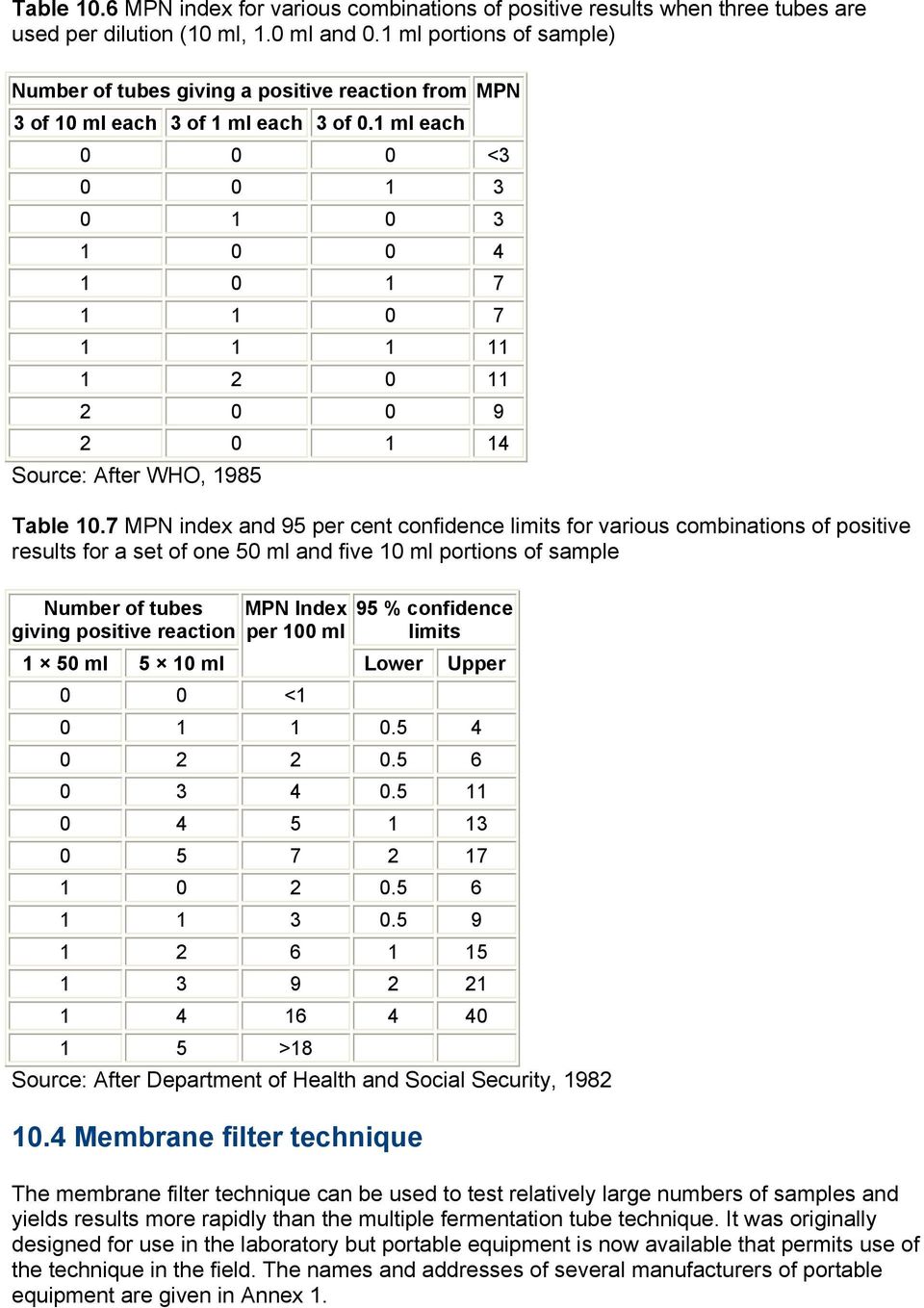
13 Table 10.6 MPN index for various combinations of positive results when three tubes are used per dilution (10 ml, 1.0 ml and 0.1 ml portions of sample) Number of tubes giving a positive reaction from MPN 3 of 10 ml each 3 of 1 ml each 3 of 0.1 ml each < Source: After WHO, 1985 Table 10.7 MPN index and 95 per cent confidence limits for various combinations of positive results for a set of one 50 ml and five 10 ml portions of sample Number of tubes giving positive reaction 1 50 ml 5 10 ml MPN Index per 100 ml 0 0 <1 95 % confidence limits Lower Upper >18 Source: After Department of Health and Social Security, Membrane filter technique The membrane filter technique can be used to test relatively large numbers of samples and yields results more rapidly than the multiple fermentation tube technique. It was originally designed for use in the laboratory but portable equipment is now available that permits use of the technique in the field. The names and addresses of several manufacturers of portable equipment are given in Annex 1.
14 Principle The membrane filter method gives a direct count of total coliforms and faecal coliforms present in a given sample of water. A measured volume of water is filtered, under vacuum, through a cellulose acetate membrane of uniform pore diameter, usually 0.45 µm. Bacteria are retained on the surface of the membrane which is placed on a suitable selective medium in a sterile container and incubated at an appropriate temperature. If coliforms and/or faecal coliforms are present in the water sample, characteristic colonies form that can be counted directly. The technique is unsuitable for natural waters containing very high levels of suspended material, sludges and sediments, all of which could block the filter before an adequate volume of water has passed through. When small quantities of sample (for example, of sewage effluent or of grossly polluted surface water) are to be tested, it is necessary to dilute a portion of the sample in sterile diluent to ensure that there is sufficient volume to filter across the entire surface of the membrane. Suggested volumes to be filtered for water from different sources are listed in Table If the quality of water is totally unknown, or there is doubt concerning the probable bacterial density, it is advisable to test two or more volumes in order to ensure that the number of colonies on the membrane will be in the optimum range for counting (i.e colonies per membrane). If a suitable volume of sample cannot be filtered through a single membrane, the sample may be filtered through two or more and the numbers of colonies on the membranes added to give the total count for the sample. Membrane filtration and colony count techniques assume that each bacterium, clump of bacteria, or particle with bacteria attached, will give rise to a single visible colony. Each of these clumps or particles is, therefore, a colony forming unit (cfu) and the results are expressed as colony forming units per unit volume. In the case of thermotolerant coliform bacteria the result should be reported as thermotolerant coliforms [No.] cfu per 100 ml. Table 10.8 Typical sample volumes for membrane filtration analysis Sample type Treated drinking water Partially treated drinking water x x Recreational water x x Protected source water x x Surface water x x Sample volume (ml) , , ,2 Wastewater x x x Discharge from sewage treatment plant x x x Ponds, rivers, stormwater runoff x x x Raw sewage x x x x 1 Small volumes should be added to the filtration apparatus together with a minimum of 9 ml of sterile diluent to ensure adequate dispersal across the surface of the filter membrane 2 1.0, 0.1, 0.01 and ml volumes are filtered after first preparing serial dilutions of the sample. To filter:

15 1.0 ml of sample, use 10 ml of 1/10 dilution 0.1 ml of sample, use 10 ml of 1/100 dilution 0.01 ml of sample, use 10 ml of 1/1,000 dilution ml of sample, use 10 ml of 1/10,000 dilution Culture media and buffered dilution water The general comments on media in the section devoted to the multiple fermentation tube technique (section ) are also relevant here. The media that may be used are described in Table A stock solution of buffered dilution water is prepared as described in section and stored in a tightly stoppered bottle in the refrigerator. To prepare bottles of dilution water, 1.25 ml of stock solution is added to 1 litre of distilled water, mixed well and dispensed into dilution bottles in quantities that will provide, after sterilisation, 9 ± 0.5 ml. The bottles are loosely capped, placed in the autoclave and sterilised for 20 minutes at 121 C. After the bottles have been removed from the autoclave, the caps should be tightened and the bottles stored in a clean place until they are needed. A supply of good-quality distilled water may not be available if membrane filter equipment is being used in the field. Some alternatives are: Rainwater, which is normally low in dissolved solids and, if filtered through the membrane filter apparatus, should be free of suspended solids and bacteria. In some areas rainwater may be acidic and, therefore, ph should be checked before the water is used for the preparation of culture media. De-ionising packs, which are available from commercial suppliers and, if used in accordance with manufacturers instructions, will supply good-quality water. They may be expensive and are not readily available in some countries. Water for car batteries, which is often available at stations where vehicle fuel is sold. However, it may be of lower purity than desired and should probably be filtered through the membrane filter apparatus. The quality of distilled water should be checked before use. Conductivity should be less than 10 µmhos cm -1 and ph should be close to 10.

16 Table 10.9 Culture media for membrane filtration Medium Uses Incubation temperature Remarks Lactose TTC agar with Tergitol 7 Lactose agar with Tergitol 7 Membrane enrichment with Teepol broth Membrane lauryl sulphate broth Total or thermotolerant coliforms Total or thermotolerant coliforms Total or thermotolerant coliforms Total or thermotolerant coliforms Endo medium Total coliforms only LES Endo medium MFC Total coliforms only Thermotolerant coliforms Source: Adapted from ISO, 1990a hours at 35 ± 0.5 C or 37 ± 0.5 C for total coliforms and hours at 44 ± 0.25 C or 44.5 ± 0.25 C for thermotolerant coliforms hours at 35 ± 0.5 C or 37 ± 0.5 C for total coliforms and hours at 44 ± 0.25 C or 44.5 ± 0.25 C for thermotolerant coliforms hours at 35 ± 0.5 C or 37 ± 0.5 C for total coliforms and hours at 44 ± 0.25 C or 44.5 ± 0.25 C for thermotolerant coliforms hours at 35 ± 0.5 C or 37 ± 0.5 C for total coliforms and hours at 44 ± 0.25 C or 44.5 ± 0.25 C for thermotolerant coliforms Adjust ph before sterilisation. Filter TTC supplement to sterilise. Tergitol supplement sterilised by autoclaving. Supplements of Tergitol and TTC to be added aseptically. Prepared plates have max. shelf-life of 10 days. Store in dark. Prepared plates have max. shelf-life of 10 days. Store prepared plates at 4 C. Check ph before sterilisation Check ph before sterilisation C Basic fuchsin may be a carcinogen. Also requires ethanol. Do not autoclave. Prepared medium has a shelf-life of 4 days. Store prepared medium at 4 C in the dark C Basic fuchsin may be a carcinogen. Also requires ethanol. Do not autoclave. Prepared medium has a shelf-life of 2 weeks. Store prepared medium at 4 C in the dark. 44 C Do not autoclave. Discard unused medium after 96 hours. Rosalic acid stock solution has a maximum shelflife of 2 weeks. Check ph before sterilisation. Store prepared medium at 2-10 C. Culture media and buffered dilution water may be prepared in the field, but this requires the transport of all necessary equipment, which may include measuring cylinders, beakers, distilled water, autoclavable bottles, a large pressure-cooker and a gas burner or other source of heat. Pre-weighed portions of the dehydrated medium should be used. The medium should be mixed with water and dispensed into bottles, each of which should contain enough medium for one day s work. These bottles should be sterilised in the pressure-cooker for 20 minutes. Buffered dilution water should be prepared, dispensed into bottles and sterilised.

17 Note: Whenever a pressure-cooker is used, care must be taken to ensure that the pressure has dropped to atmospheric pressure before the lid is removed Procedure Apparatus Incubator(s) or water-bath(s) capable of maintaining a temperature to within ± 0.5 C of 35 and 37 C and to within ± 0.25 C of 44 and 44.5 C. Choice of temperature depends on the indicator bacteria and the medium. Membrane filtration apparatus, complete with vacuum source (electrically operated pump, hand-pump or aspirator) and suction flask. Autoclave for sterilising prepared culture media. A pressure-cooker, heated on a hot-plate or over a Bunsen burner, may be substituted in some circumstances. Boiling-pan or bath (if filtration apparatus is to be disinfected in boiling water between uses). Laboratory balance, accurate to ± 0.05 g, and with weighing scoop. This may be omitted if media and potassium dihydrogen phosphate are available in pre-weighed packages of the correct size. Racks for bottles of prepared culture media and dilution water. These must fit into the autoclave or pressure-cooker. Distilling apparatus with storage capacity for at least 5 litres of distilled water. Refrigerator for storage of prepared culture media. Hot-air steriliser for sterilising pipettes and glass or metal Petri dishes. Thermometer for checking calibration of incubator or water-bath. Pipette cans for sterilising pipettes. Boxes for Petri dishes for use in hot-air steriliser. Reusable bottles for culture media. Measuring cylinders, capacity 100 ml and 250 ml. Reusable pipettes, glass, capacity 1 ml and 10 ml. Bottles to contain 9-ml volumes of buffered dilution water. Flasks for preparation of culture media. Wash-bottle.

18 Blunt-edged forceps. Pipette bulbs. Spatula. Container for used pipettes. Brushes for cleaning glassware (several sizes). Fire extinguisher and first-aid kit. Miscellaneous tools. Waste bin. Filtration apparatus should be disinfected between analyses of consecutive samples and sterilised at intervals. The choice of method will depend on the type of apparatus, where it is being used, the equipment available and cost considerations. Sterilising is generally achieved by autoclaving but any of the following methods is suitable for disinfection between analyses of consecutive samples: - immersion of components in boiling water for at least 1 minute, - rinsing in methanol followed by rinsing in distilled water, - flaming with methanol, or - exposure to formaldehyde gas generated by burning methanol in the absence of oxygen (generally preferred as a field technique). Consumables Methanol for disinfecting filtration apparatus using formaldehyde gas (unnecessary in the laboratory, but essential if analyses are done in the field). It is essential to use methanol. Ethanol or methylated spirits cannot be substituted. Membrane filters, 0.45 µm pore size and of diameter appropriate for the filtration apparatus being used and complete with absorbent pads. Disinfectant for cleaning laboratory surfaces and a container for discarded pipettes. Culture media (options are listed in the section on media). Phosphate-buffered dilution water. Petri dishes, glass or aluminium (reusable) or plastic (disposable). Polyethylene bags for wrapping Petri dishes if dry incubator is used. Magnifying lens (as an aid to counting colonies after filters are incubated). Wax pencils for labelling Petri dishes.

19 Autoclave tape. Detergent for cleaning glassware and equipment. Figure 10.2 Steps in the membrane filter technique a. Add absorbant pad to Petri dish b. Soak pad in nutrient medium c. Disinfect tips of blunt-ended forceps and cool d. Remove membrane filter from sterile packet e. Place membrane filter in filtration apparatus

20 f. Add sample to filtration apparatus g. Apply vacuum to suction flask h. Remove filter with sterile forceps i. Place filter in prepared Petri dish

21 j. Label Petri dish k. Leave to resuscitate and then incubate l. Count colonies after full incubation Procedure 1. Add absorbent pads to sterile Petri dishes for the number of samples to be processed. Sterile pads may be placed in the Petri dishes with sterile forceps or with an automatic dispenser as shown in Figure 10.2a. 2. Soak the pads with nutrient medium. Nutrient medium may be dispensed with a sterile pipette or by carefully pouring from an ampoule or bottle, as shown in Figure 10.2b. In all cases, a slight excess of medium should be added (e.g. about 2.5 ml). Immediately before processing a sample, drain off most of the excess medium, but always ensure that a slight excess remains to prevent the pad drying during incubation. Note: Absorbent pads soaked in liquid medium may be replaced by medium solidified by agar. In this case, Petri dishes should be prepared in advance and stored in a refrigerator. 3. Sterilise the tips of the blunt-ended forceps in a flame and allow them to cool (Figure 10.2c). 4. Carefully remove a sterile membrane filter from its package, holding it only by its edge as shown in Figure 10.2d.
22 5. Place the membrane filter in the filter apparatus as shown in Figure 10.2e, and clamp it in place. If the apparatus has been disinfected by boiling, ensure that it has cooled down before inserting the membrane filter. 6. Mix the sample by inverting its container several times. Pour or pipette the desired volume of sample into the filter funnel (see Figure 10.2f). This volume should normally be chosen in the light of previous experience, but suggested volumes are given in Table If the volume to be filtered is less than 10 ml, it should be made up to at least 10 ml with sterile diluent so that the sample will be distributed evenly across the filter during filtration. Alternatively, the sample may be diluted as suggested in footnote 2 to Table Apply a vacuum to the suction flask and draw the sample through the filter; disconnect vacuum (Figure 10.2g). 8. Dismantle the filtration apparatus and remove the membrane filter using the sterile forceps, taking care to touch only the edge of the filter (Figure 10.2h). 9. Remove the lid of a previously prepared Petri dish and place the membrane, grid side uppermost, onto the pad (or agar). Lower the membrane, starting at one edge in order to avoid trapping air bubbles. The procedure is shown in Figure 10.2i. 10. Replace the lid of the Petri dish and mark it with the sample number or other identification (see Figure 10.2j). The sample volume should also be recorded. Use a wax pencil or waterproof pen when writing on Petri dishes. 11. If membranes are going to be incubated at 44 or 44.5 C, the bacteria on them may first require time to acclimatise to the nutrient medium. After processing samples from areas of temperate climate, leave each Petri dish at environmental temperature for 2 hours before placing it in the incubator. Samples from areas of tropical climate may be incubated immediately. 12. Maintain the Petri dish in a humid atmosphere (e.g. in a plastic bag or in a small container with a moist pad in the base) and incubate it either in an incubator or in a weighed canister in a water bath. This ensures that the pad does not dry out during the incubation period. 13. The incubation periods and temperatures required for each culture medium are listed in Table Characteristics of total coliform and thermotolerant coliform colonies grown on the various culture media are described in Table After incubation, count the colonies. Express the results as number of colonies per 100 ml of sample. Where smaller volumes have been used, results are calculated from the following formula: No. of colonies per 100 ml = [(No. of colonies)/(volume filtered)] 100 The colonies counted at this stage are presumed to be coliform bacteria (presumptive results).
23 Table Colony characteristics following analysis by the membrane filtration method Medium Lactose TTC agar with Tergitol 7 Lactose agar with Tergitol 7 Membrane enriched Teepol broth Membrane lauryl sulphate broth Endo agar or broth LES Endo agar Colony characteristics Total coliforms at 35 or 37 C Thermotolerant coliforms at 44 or 44.5 C Yellow, orange or brick red coloration with yellow central halo in the medium under the membrane Yellow central halo in the medium under the membrane Yellow colour extending on to the membrane Same as total coliforms at 35 or 37 C Same as total coliforms at 35 or 37 C Same as total coliforms at 35 or 37 C Yellow colour extending on to the membrane Same as total coliforms at 35 or 37 C Dark red colour with golden-green metallic sheen (not applicable) Dark red colour with golden-green metallic sheen (not applicable) MFC medium (not applicable) Blue colonies Source: Adapted from ISO, 1990a Confirmatory tests For the examination of raw or partly treated waters, presumptive results may be adequate but, in certain other circumstances, it is important to carry out confirmatory tests on pure subcultures. To confirm the membrane results for total coliforms, each colony (or a representative number of colonies) is subcultured to tubes of lactose peptone water and incubated at 35 or 37 C for 48 hours. Gas production within this period confirms the presence of total coliforms. To confirm thermotolerant coliforms and E. coli on membranes, whether incubated at 35, 37 or 44 C, each colony (or a representative number of colonies) is subcultured to a tube of lactose peptone water and a tube of tryptone water. Tubes are incubated at 44 C for 24 hours. Growth with the production of gas in the lactose peptone water confirms the presence of thermotolerant coliforms. Confirmation of E. coli requires the addition of ml of Kovac s reagent to each tryptone water culture. Production of a red colour indicates the synthesis of indole from tryptophan and confirms the presence of E. coli. Note: Use of lauryl tryptose mannitol broth with tryptophan allows both gas production and indole synthesis to be demonstrated in a single tube Quality assurance Quality assurance is discussed in detail in Chapter 9, which should be read in conjunction with this section. In this section, guidance is given on those aspects of analytical quality control that apply only to microbiological laboratories, particularly the preparation and control of laboratory consumables (media and dilution solutions, membrane filters and pads, plasticand glassware). The monitoring of laboratory equipment is discussed briefly. Readers who wish to develop more rigorous quality control procedures should refer to the appropriate literature cited in section 10.6, such as the Standard Methods for the Examination of Water and Wastewater, which provides detailed guidelines for microbiological quality control.
24 Laboratory equipment Chapter 9 deals with monitoring and control of laboratory equipment, maintenance of operational records and use of calibrated instruments for taking measurements. The principles discussed there also apply to equipment used in microbiological laboratories. Particular attention should be paid to incubators, water-baths, refrigerators and freezers, since correct operation is vital to the reliability of test results. It is recommended that temperature measurements are made twice daily: first thing in the morning before equipment is used, and again at the end of the working day. Incubators, refrigerators and freezers should be cleaned at least once a month. The manufacturers instructions should include advice on cleaning and may recommend suitable detergents and disinfectants. Water-baths may need more frequent cleaning to control bacterial growth Glassware and plasticware Some detergents and other agents used for the cleaning of laboratory glassware may contain substances that will either inhibit or stimulate the growth of bacteria. Samples of glassware should be checked regularly, for example once a month, if washing procedures and products are always the same. If procedures change, however, or new products are introduced, additional checks should be made. Laboratory plastics may also contain inhibitory residues and each new batch of plasticware should be checked. Procedure 1. Use a type strain of E. coli or a well characterised laboratory isolate. Culture the organism overnight in a nutrient broth at 37 C, and dilute in quarter-strength Ringer s solution to a concentration of colony-forming units per ml. 2. Wash and rinse six glass Petri dishes (glass Petri dishes may also be used to simulate washed glassware) according to usual laboratory practice. Designate these as group A. 3. Wash a further six Petri dishes and rinse 12 times with successive portions of reagentgrade water. Designate these as group B. 4. Wash another six Petri dishes with detergent wash water and dry without further rinsing. Designate these as group C. 5. Sterilise the Petri dishes of groups A, B and C by the usual procedure. 6. To test pre-sterilised plasticware, designate six plastic Petri dishes as group D. 7. Add 1 ml of the E. coli culture from step 1 to each dish and mix thoroughly with 15 ml of molten yeast-extract agar, cooled to 50 C (nutrient agar is acceptable if yeast extract agar is not available). 8. Incubate the dishes at 37 C for 24 hours. Count the number of colonies on each dish and calculate the mean count for each group. 9. The difference in the mean count between the groups should be less than 15 per cent if there are no toxic or inhibitory effects. Differences in mean counts of less than 15 per cent
25 between groups A and B, or of more than 15 per cent between groups A and C show that the detergent has inhibitory properties that are eliminated during routine washing Media Every new batch of media should be tested for sterility and for its ability to support the growth of the test organism with the production of its characteristic biochemical reactions. Sterility should be tested by incubating a sample volume of the medium, at an appropriate temperature, for 48 hours and observing for growth. The ability of a medium to support the growth of a test organism and to differentiate the test organisms from other organisms is tested by inoculating a sample of the medium with positive and negative control organisms. The positive control must include a type strain of E. coli or a well characterised laboratory isolate. The negative control may include one or more of the following: Staphylococcus aureus, Pseudomonas sp., Streptococcus faecalis. Results of the control tests should be entered in a media log-book. If the positive control does not grow or does not give the correct growth characteristics, the purity and the identification of the test culture should be checked and the test repeated with a fresh culture prepared from a frozen stock. If there are no problems with the test culture, a new batch of medium should be prepared and glassware records checked to ensure that no inhibitory substances have been found during quality control checks. The ph of the medium should also be checked, since ph changes can affect the growth characteristics of an organism. Each new batch of media should be tested alongside the media currently in use Evaluation of reagents, media and membranes Before new batches of reagents, media, membranes and membrane pads are released for routine use, they should be compared with those currently in use. Only one variable should be changed with each comparison. Procedure 1. Assemble at least five positive water samples (samples that have been shown to be contaminated). The use of more samples will increase the sensitivity of the test. 2. Process the samples using the test batch of materials and the batch currently in use. 3. Incubate the plates (or tubes). 4. Compare the growth characteristics of the contaminating organism on the two batches of materials. Note any atypical results. 5. Count or calculate the number of colonies per 100 ml, or determine the MPN. 6. Transform the counts to logarithms and enter the results for the two batches of materials in parallel columns. 7. Calculate the difference d between the two transformed results for each sample (include the + or? sign). 8. Calculate the mean of the differences and the standard deviation.
26 9. Perform a Student s t-test, using the number of samples as n. 10. Use a Student s table to determine the critical value of t at the 0.05 significance level (two-tailed test). Some critical values are given below. 11. If the calculated value of t exceeds the critical value, the two batches of materials give significantly different results. No. of samples (n) Degrees of Critical value of t at freedom (n B 1) 0.05 significance level If this test indicates a problem with the new batch of materials, the test conditions and procedure should be carefully reviewed and the batch retested. The batch should be rejected as unsatisfactory only if the problems are confirmed by this second test Precision testing Precision testing is important in the microbiological laboratory because test results can reveal procedural problems and problems with the materials. The principles of precision testing are discussed in detail in Chapter 9. Satisfactory results must be obtained from precision tests before the results of monitoring tests are reported. Procedure 1. At the beginning of each month, or at the earliest convenient time, collect 15 samples that are likely to be positive by the first procedure, with a range of positive results. 2. Make duplicate analyses of each sample. The same analyst should do the tests, but all analysts should be included, on a rota basis. 3. Record the results of the duplicate tests as D 1 and D 2. Calculate the logarithm of each result. If either of a set of duplicate results is zero, add 1 to both values before calculating the logarithms. 4. Calculate the difference R between each pair of transformed duplicates, and the mean of these differences. 5. Calculate the precision criterion as 3.27 R. 6. Thereafter, analyse 10 per cent of routine samples, or a minimum of two samples per day, in duplicate. Calculate the logarithm of each result and the difference between the logarithms. If the difference is greater than the calculated precision criterion, analyst variability is excessive and the analytical procedure should be reviewed. The laboratory
27 manager should decide whether or not to release monitoring test results in the light of past performance and other mitigating factors Source literature and further reading APHA 1992 Standard Methods for the Examination of Water and Wastewater. 18th edition, American Public Health Association (APHA), American Water Works Association (AWWA) and Water Pollution Control Federation (WPCF), Washington, D.C. Department of Health and Social Security 1982 The Bacteriological Examination of Drinking Water Supplies. Her Majesty s Stationery Office (HMSO), London. Environment Canada 1981 Analytical Methods Manual. Water Quality Branch, Environment Canada, Ottawa. ISO 1984 Water Quality C Detection and Enumeration of Faecal Streptococci. Part 1: Method by Enrichment in a Liquid Medium. International Standard ISO , International Organization for Standardization, Geneva. ISO 1984 Water Quality C Detection and Enumeration of Faecal Streptococci. Part 2: Method by Membrane Filtration. International Standard ISO , International Organization for Standardization, Geneva. ISO 1988 Water Quality C General Guide to the Enumeration of Microorganisms by Culture. International Standard ISO 8199, International Organization for Standardization, Geneva. ISO 1988 Water Quality C Enumeration of Viable Microorganisms. Colony Count by Inoculation in or on a Solid Medium. International Standard ISO 6222, International Organization for Standardization, Geneva. ISO 1990a Water Quality C Detection and Enumeration of Coliform Organisms, Thermotolerant Coliform Organisms and Presumptive Escherichia coli. Part 1: Membrane Filtration Method. International Standard ISO , International Organization for Standardization, Geneva. ISO 1990b Water Quality C Detection and Enumeration of Coliform Organisms, Thermotolerant Coliform Organisms and Presumptive Escherichia coli. Part 2: Multiple Tube (Most Probable Number) Method. International Standard ISO , International Organization for Standardization, Geneva. Mara, D. and Cairncross, A Guidelines for the Safe Use of Wastewater and Excreta in Agriculture and Aquaculture. World Health Organization, Geneva. WHO 1985 Guidelines for Drinking-water Quality. Volume 3: Drinking-water Control in Small Community Supplies. World Health Organization, Geneva. WHO 1989 Health Guidelines for the Use of Wastewater in Agriculture and Aquaculture. Report of a WHO Scientific Group. WHO Technical Report Series, No. 778, World Health Organization, Geneva.
Lab Exercise 3: Media, incubation, and aseptic technique
 Lab Exercise 3: Media, incubation, and aseptic technique Objectives 1. Compare the different types of media. 2. Describe the different formats of media, plate, tube etc. 3. Explain how to sterilize it,
Microbiological Testing of the Sawyer Mini Filter. 16 December 2013. Summary
 Microbiological Testing of the Sawyer Mini Filter 16 December 2013 Summary The Sawyer Mini Filter was tested for its ability to remove three microorganisms Raoultella terrigena, Bacillus subtilis, and
LAB 4. Cultivation of Bacteria INTRODUCTION
 LAB 4. Cultivation of Bacteria Protocols for use of cultivation of bacteria, use of general growth, enriched, selective and differential media, plate pouring, determination of temperature range for growth
Transferring a Broth Culture to Fresh Broth
 Sterile Technique It is very important in microbiology to work with pure cultures. Unfortunately this is difficult. The world around us is covered with microorganisms. Microorganisms are even carried on
Coliforms: Membrane Filtration (simultaneous detection), continued
 EPA Approved* Method 10029 Coliforms: Membrane Filtration (simultaneous detection) For detection of: total coliforms, E. coli Media: m-coliblue24 Broth Sample Type: potable water, nonpotable water, wastewater
BACTERIAL ENUMERATION
 BACTERIAL ENUMERATION In the study of microbiology, there are numerous occasions when it is necessary to either estimate or determine the number of bacterial cells in a broth culture or liquid medium.
ENUMERATION OF MICROORGANISMS. To learn the different techniques used to count the number of microorganisms in a sample.
 ENUMERATION OF MICROORGANISMS I. OBJECTIVES To learn the different techniques used to count the number of microorganisms in a sample. To be able to differentiate between different enumeration techniques
National Food Safety Standard Food microbiological examination: Aerobic plate count
 National Food Safety Standard of the People s Republic of China GB4789.2-2010 National Food Safety Standard Food microbiological examination: Aerobic plate count Issued by 2010-03-26 Implemented by 2010-06-01
COMMON LABORATORY APPARATUS
 COMMON LABORATORY APPARATUS Beakers are useful as a reaction container or to hold liquid or solid samples. They are also used to catch liquids from titrations and filtrates from filtering operations. Bunsen
Environmental Water Testing: Surface Water, Groundwater, Hard Water, Wastewater, & Seawater
 Document: AND Sol Env 08 2013 Environmental Water Testing: Surface Water, Groundwater, Hard Water, Wastewater, & Seawater Matrix specific sample preparation and testing methods for environmental waters
Microbiological Analysis
 Microbiological Microbiological 117 Gridded Membrane Filters from Cellulose Nitrate (Cellulose Ester) acc. to ISO Norms, Sterile and Individually Packed, for Colony Counts Membrane Filters Microbiological
experiment5 Understanding and applying the concept of limiting reagents. Learning how to perform a vacuum filtration.
 81 experiment5 LECTURE AND LAB SKILLS EMPHASIZED Synthesizing an organic substance. Understanding and applying the concept of limiting reagents. Determining percent yield. Learning how to perform a vacuum
Phosphorus, Reactive (Orthophosphate)
 Phosphorus, Reactive (Orthophosphate) DOC316.53.01113 Amino Acid Method 1 Method 8178 0.23 to 30.00 mg/l PO 4 Reagent Solution Scope and application: For water, wastewater and seawater. 1 Adapted from
Test Method for the Continuous Reduction of Bacterial Contamination on Copper Alloy Surfaces
 Test Method for the Continuous Reduction of Bacterial Contamination on Copper Alloy Surfaces Test Organisms: Staphylococcus aureus (ATCC 6538) Enterobacter aerogenes (ATCC 13048) Pseudomonas aeruginosa
The Influence of Carbon Dioxide on Algae Growth
 The Influence of Carbon Dioxide on Algae Growth The first objective of this experiment is to show that increased atmospheric concentrations of carbon dioxide, CO 2, can stimulate algae growth. The second
Lab Exercise 2 Media and Culture
 Lab Exercise 2 Media and Culture Lab Exercise #2 Bacterial Media & Culture I. OBJECTIVES: Practice microbial collection techniques Describe colony morphology and the relationship to microbial identification.
In this experiment, we will use three properties to identify a liquid substance: solubility, density and boiling point..
 Identification of a Substance by Physical Properties 2009 by David A. Katz. All rights reserved. Permission for academic use provided the original copyright is included Every substance has a unique set
Biological Sciences Initiative
 Biological Sciences Initiative HHMI Student Activities Measuring Antibiotic Resistance Introduction: You might be aware that antibiotics were once thought of as a magic bullet; a nearly perfect drug for
Aerobic Count. Interpretation Guide. 3M Food Safety 3M Petrifilm Aerobic Count Plate
 3M Food Safety 3M Petrifilm Aerobic Count Plate Aerobic Count Interpretation Guide The 3M Petrifilm Aerobic Count (AC) Plate is a ready-made culture medium system that contains Standard Methods nutrients,
OECD GUIDELINES FOR THE TESTING OF CHEMICALS
 OECD GUIDELINES FOR THE TESTING OF CHEMICALS QUANTITATIVE METHOD FOR EVALUATING ANTIBACTERIAL ACTIVITY OF POROUS AND NON-POROUS ANTIBACTERIAL TREATED MATERIALS Introduction 1. The scope of this test guideline
Color, True and Apparent
 Color, True and Apparent DOC316.53.01037 Platinum-Cobalt Standard Method 1, 2, 3 Method 8025 15 to 500 color units 5 to 500 color units (low range technique) Scope and application: For water, wastewater
Physical and Chemical Properties and Changes
 Physical and Chemical Properties and Changes An understanding of material things requires an understanding of the physical and chemical characteristics of matter. A few planned experiments can help you
Recovery of Elemental Copper from Copper (II) Nitrate
 Recovery of Elemental Copper from Copper (II) Nitrate Objectives: Challenge: Students should be able to - recognize evidence(s) of a chemical change - convert word equations into formula equations - perform
Color, True and Apparent
 Color, True and Apparent DOC316.53.01037 Platinum-Cobalt Standard Method 1, 2, 3 Method 8025 15 to 500 color units Scope and application: For water, wastewater and seawater; equivalent to NCASI method
Private Water Supplies Sampling Manual. A Field Guide
 Private Water Supplies Sampling Manual A Field Guide Foreword This sampling manual details standard procedures for the collection, storage and transportation of samples at private water supplies in accordance
ACID-BASE TITRATIONS: DETERMINATION OF CARBONATE BY TITRATION WITH HYDROCHLORIC ACID BACKGROUND
 #3. Acid - Base Titrations 27 EXPERIMENT 3. ACID-BASE TITRATIONS: DETERMINATION OF CARBONATE BY TITRATION WITH HYDROCHLORIC ACID BACKGROUND Carbonate Equilibria In this experiment a solution of hydrochloric
Quantifying Bacterial Concentration using a Calibrated Growth Curve
 BTEC 4200 Lab 2. Quantifying Bacterial Concentration using a Calibrated Growth Curve Background and References Bacterial concentration can be measured by several methods, all of which you have studied
Cadmium Reduction Method Method 8039 0.3 to 30.0 mg/l NO 3 N (HR) Powder Pillows or AccuVac Ampuls
 Nitrate DOC316.53.01066 Cadmium Reduction Method Method 8039 0.3 to 30.0 mg/l NO 3 N (HR) Powder Pillows or AccuVac Ampuls Scope and application: For water, wastewater and seawater. Test preparation Instrument-specific
Running protein gels and detection of proteins
 Running protein gels and detection of proteins 1. Protein concentration determination using the BIO RAD reagent This assay uses a colour change reaction to give a direct measurement of protein concentration.
1. The Determination of Boiling Point
 1. The Determination of Boiling Point Objective In this experiment, you will first check your thermometer for errors by determining the temperature of two stable equilibrium systems. You will then use
Bacterial Transformation with Green Fluorescent Protein. Table of Contents Fall 2012
 Bacterial Transformation with Green Fluorescent Protein pglo Version Table of Contents Bacterial Transformation Introduction..1 Laboratory Exercise...3 Important Laboratory Practices 3 Protocol...... 4
Contaminant. Publication Order Number. EPA Publication Number. Method. Date. Source of Method. Total Coliforms
 9221 A 9221 A Analytical Approved for Drinking Water Compliance Monitoring under the Total Coliform Rule Analysis for the following contaminants shall be conducted in accordance with the methods in the
UTILIZATION of PLASMA ACTIVATED WATER in Biotechnology, Pharmacology and Medicine. JSC TECHNOSYSTEM-ECO Moscow, Russia April, 2009
 UTILIZATION of PLASMA ACTIVATED WATER in Biotechnology, Pharmacology and Medicine JSC TECHNOSYSTEM-ECO Moscow, Russia April, 2009 METHOD of WATER ACTIVATION with PLASMA of GAS DISCHARGE ANODE VACUUM WATER
Paper Chromatography: Separation and Identification of Five Metal Cations
 Paper Chromatography: Separation and Identification of Five Metal Cations Objectives Known and unknown solutions of the metal ions Ag +, Fe 3+, Co 2+, Cu 2+ and Hg 2+ will be analyzed using paper chromatography.
ENVIRONMENTAL LABORATORY APPROVAL PROGRAM CERTIFICATION MANUAL
 1 of 8 The quality assurance plan as presented in the Quality Manual should assure that constant and consistent test conditions are met and verified and should be tailored to the laboratory s activities.
Inc. Wuhan. Quantity Pre-coated, ready to use 96-well strip plate 1 Plate sealer for 96 wells 4 Standard (liquid) 2
 Uscn Life Science Inc. Wuhan Website: www.uscnk.com Phone: +86 27 84259552 Fax: +86 27 84259551 E-mail: [email protected] ELISA Kit for Human Prostaglandin E1(PG-E1) Instruction manual Cat. No.: E0904Hu
Esterification Method 1 Method 8196 27 to 2800 mg/l (as acetic acid) Reagent Solution
 Volatile Acids DOC316.53.01144 Esterification Method 1 Method 8196 27 to 2800 mg/l (as acetic acid) Reagent Solution Scope and application: For digestor sludges. 1 Adapted from The Analyst, 87, 949 (1962).
How To Test For Water Quality
 4. WATER SAMPLING AND ANALYSIS 4. Water sampling and analysis Ideally, a laboratory infrastructure should be established which will enable all samples to be returned to a central or regional laboratory
EDTA Titrations 1: Standardization of EDTA and Analysis of Zinc in a Supplement Tablet. by Professor David Cash. September, 2008
 CHEMICAL, ENVIRONMENTAL, AND BIOTECHNOLOGY DEPARTMENT EDTA Titrations 1: Standardization of EDTA and Analysis of Zinc in a Supplement Tablet by Professor David Cash September, 2008 Mohawk College is the
Disc Diffusion Susceptibility Methods
 Disc Diffusion Susceptibility Methods Introduction When a filter paper disc impregnated with a chemical is placed on agar the chemical will diffuse from the disc into the agar. This diffusion will place
Chemistry 112 Laboratory Experiment 6: The Reaction of Aluminum and Zinc with Hydrochloric Acid
 Chemistry 112 Laboratory Experiment 6: The Reaction of Aluminum and Zinc with Hydrochloric Acid Introduction Many metals react with acids to form hydrogen gas. In this experiment, you will use the reactions
VIRTUAL EXPERIMENT 5A OXYGEN RELATIONSHIPS (REVISED FROM THE ON-LINE MANUAL)
 VIRTUAL EXPERIMENT 5A OXYGEN RELATIONSHIPS (REVISED FROM THE ON-LINE MANUAL) One often sees an organism described as being a strict aerobe, facultative anaerobe, strict anaerobe or some other such designation.
Odor (Threshold Odor, Consistent Series)
 METHOD #: 140.1 (Issued 1971) TITLE: ANALYTE: INSTRUMENTATION: Odor (Threshold Odor, Consistent Series) Odor N/A STORET No. 60 C: 00086 Room Temp: 00085 1.0 Scope and Application 1.1 This method is applicable
In order to be useful, a smear must have the following qualities:
 Smear Preparation and Simple Stain Objectives: Make bacterial smear slides (usually called smears) Distinguish cells on these slides using a simple stain procedure Unstained microbial cells are nearly
Enteric Unknowns Miramar College Biology 205 Microbiology
 Enteric Unknowns Miramar College Biology 205 Microbiology Enteric (Greek enteron = intestine) bacteria are comprised of several different genera, but all reside in the digestive tract of mammals. Because
Mixtures and Pure Substances
 Unit 2 Mixtures and Pure Substances Matter can be classified into two groups: mixtures and pure substances. Mixtures are the most common form of matter and consist of mixtures of pure substances. They
Aseptic Technique. A GMP/GTP Training Module
 Aseptic Technique A GMP/GTP Training Module Aseptic Technique The GMP Facility manufactures products for clinical use These products must meet a number of requirements, one of which is that they are sterile
Isolation of Caffeine from Tea
 Isolation of Caffeine from Tea Introduction A number of interesting, biologically active compounds have been isolated from plants. Isolating some of these natural products, as they are called, can require
Lab 10: Bacterial Transformation, part 2, DNA plasmid preps, Determining DNA Concentration and Purity
 Lab 10: Bacterial Transformation, part 2, DNA plasmid preps, Determining DNA Concentration and Purity Today you analyze the results of your bacterial transformation from last week and determine the efficiency
CHEM 2423 Recrystallization of Benzoic Acid EXPERIMENT 4 - Purification - Recrystallization of Benzoic acid
 EXPERIMENT 4 - Purification - Recrystallization of Benzoic acid Purpose: a) To purify samples of organic compounds that are solids at room temperature b) To dissociate the impure sample in the minimum
UltraClean Soil DNA Isolation Kit
 PAGE 1 UltraClean Soil DNA Isolation Kit Catalog # 12800-50 50 preps New improved PCR inhibitor removal solution (IRS) included Instruction Manual (New Alternative Protocol maximizes yields) Introduction
5.0 EXPERIMENT ON DETERMINATION OF TOTAL HARDNESS
 5.0 EXPERIMENT ON DETERMINATION OF TOTAL HARDNESS Sl. No. Contents Preamble 5.1 Aim 5.2 Introduction 5.2.1 Environmental Significance 5.3 Principle 5.4 Materials Required 5.4.1 Apparatus Required 5.4.2
Transformation of the bacterium E. coli. using a gene for Green Fluorescent Protein
 Transformation of the bacterium E. coli using a gene for Green Fluorescent Protein Background In molecular biology, transformation refers to a form of genetic exchange in which the genetic material carried
Chem 100 Lab Experiment #9 - ACID/BASE INDICATORS
 Lab #9 Chem 100 Lab Experiment #9 - ACID/BASE INDICATORS Name: Purpose: In this laboratory we will investigate how indicators can be used to test for the presence of acids or bases in a number of common
USEPA 1 FerroVer Method 2 Method 8008 0.02 to 3.00 mg/l Fe Powder Pillows or AccuVac Ampuls
 Iron, Total DOC316.53.01053 USEPA 1 FerroVer Method 2 Method 8008 0.02 to 3.00 mg/l Fe Powder Pillows or AccuVac Ampuls Scope and application: For water, wastewater and seawater; digestion is required
Making Biodiesel from Virgin Vegetable Oil: Teacher Manual
 Making Biodiesel from Virgin Vegetable Oil: Teacher Manual Learning Goals: Students will understand how to produce biodiesel from virgin vegetable oil. Students will understand the effect of an exothermic
Experiment 5 Preparation of Cyclohexene
 Experiment 5 Preparation of yclohexene In this experiment we will prepare cyclohexene from cyclohexanol using an acid catalyzed dehydration reaction. We will use the cyclohexanol that we purified in our
Agarose Gel Electrophoresis with Food Color- Teacher Guide
 Page 1 of 7 Project Home Gateway to the Project Laboratory Activities What the Project can do in the classroom Biotechnology Resources Favorite resources online and in print Agarose Gel Electrophoresis
Experiment 12- Classification of Matter Experiment
 Experiment 12- Classification of Matter Experiment Matter can be classified into two groups: mixtures and pure substances. Mixtures are the most common form of matter and consist of mixtures of pure substances.
105 Adopted: 27.07.95
 105 Adopted: 27.07.95 OECD GUIDELINE FOR THE TESTING OF CHEMICALS Adopted by the Council on 27 th July 1995 Water Solubility INTRODUCTION 1. This guideline is a revised version of the original Guideline
Experiment 7: Titration of an Antacid
 1 Experiment 7: Titration of an Antacid Objective: In this experiment, you will standardize a solution of base using the analytical technique known as titration. Using this standardized solution, you will
Standard Operating Procedure for Total Kjeldahl Nitrogen (Lachat Method)
 Standard Operating Procedure for Total Kjeldahl Nitrogen (Lachat Method) Grace Analytical Lab 536 South Clark Street 10th Floor Chicago, IL 60605 April 15, 1994 Revision 2 Standard Operating Procedure
Physical Properties of a Pure Substance, Water
 Physical Properties of a Pure Substance, Water The chemical and physical properties of a substance characterize it as a unique substance, and the determination of these properties can often allow one to
Apparatus error for each piece of equipment = 100 x margin of error quantity measured
 1) Error Analysis Apparatus Errors (uncertainty) Every time you make a measurement with a piece of apparatus, there is a small margin of error (i.e. uncertainty) in that measurement due to the apparatus
Acetic Acid Content of Vinegar: An Acid-Base Titration E10-1
 Experiment 10 Acetic Acid Content of Vinegar: An Acid-Base Titration E10-1 E10-2 The task The goal of this experiment is to determine accurately the concentration of acetic acid in vinegar via volumetric
Determining the Quantity of Iron in a Vitamin Tablet. Evaluation copy
 Determining the Quantity of Iron in a Vitamin Tablet Computer 34 As biochemical research becomes more sophisticated, we are learning more about the role of metallic elements in the human body. For example,
ISOLATION OF CAFFEINE FROM TEA
 ISLATIN F CAFFEINE FRM TEA Introduction In this experiment, caffeine is isolated from tealeaves. The chief problem with the isolation is that caffeine does not exist alone in the tealeaves, but other natural
Related topics: Application Note 27 Data Analysis of Tube Formation Assays.
 Tube Formation Assays in µ-slide Angiogenesis Related topics: Application Note 27 Data Analysis of Tube Formation Assays. Contents 1. General Information... 1 2. Material... 2 3. Work Flow Overview...
Total Aerobic Bacteria, Yeasts and Molds
 Total Aerobic Bacteria, Yeasts and Molds DOC316.53.01223 Total Aerobic Bacteria (Amber), Yeast and Mold (Red), Total Coliform (Red) and Disinfection Control (Purple) Paddle Testers Scope and application:
Solids, Volatile Dissolved and Fixed Dissolved
 , 8277 Solids, Volatile Dissolved and Fixed Dissolved Gravimetric Method 1 Scope and Application: For wastewater. 1 Adapted from Standard Methods for the Examination of Water and Wastewater DOC316.53.001206
Experiment 1: Colligative Properties
 Experiment 1: Colligative Properties Determination of the Molar Mass of a Compound by Freezing Point Depression. Objective: The objective of this experiment is to determine the molar mass of an unknown
GROWING BACTERIA INTRODUCTION
 GROWING BACTERIA INTRODUCTION E. coli is a normal part of the bacterial flora of the human gut. It is not generally considered pathogenic, although some strains are highly toxic (recent food poisonings
BUGS" THAT PRODUCE DRUGS TO KILL "BUGS Microbes Produce Antibiotics
 BUGS" THAT PRODUCE DRUGS TO KILL "BUGS Microbes Produce Antibiotics Science in the Real World Microbes In Action BUGS" THAT PRODUCE DRUGS TO KILL "BUGS is a curriculum unit developed as part of the Science
4.0 EXPERIMENT ON DETERMINATION OF CHLORIDES
 4.0 EXPERIMENT ON DETERMINATION OF CHLORIDES Sl. No. Contents Preamble 4.1 Aim 4.2 Introduction 4.2.1 Environmental Significance 4.3 Principle 4.4 Materials Required 4.4.1 Apparatus Required 4.4.2 Chemicals
RAPID FIXER FACT SHEET A LIQUID RAPID FIXER FOR BLACK AND WHITE FILMS AND PAPERS. August 2002
 FACT SHEET RAPID FIXER August 2002 A LIQUID RAPID FIXER FOR BLACK AND WHITE FILMS AND PAPERS ILFORD RAPID FIXER is a non-hardening rapid fixer supplied as a liquid concentrate that is diluted with water
Calibration of Volumetric Glassware
 Chemistry 119: Experiment 2 Calibration of Volumetric Glassware For making accurate measurements in analytical procedures, next in importance to the balance is volumetric equipment. In this section volumetric
EXPRESS STILL WARNING It is legal in New Zealand to own and operate a still for the purpose of producing alcohol for your own consumption.
 THE EXPRESS STILL This still represents the next generation in home distillation equipment. It eliminates the problem of having to spend all day processing a 25 litre wash. Taking 1 hour to heat up, then
Solubility Curve of Sugar in Water
 Solubility Curve of Sugar in Water INTRODUCTION Solutions are homogeneous mixtures of solvents (the larger volume of the mixture) and solutes (the smaller volume of the mixture). For example, a hot chocolate
Standard Operating Procedure for the Determination of Total and Total Dissolved Solids CCAL 13A.2
 Standard Operating Procedure for the Determination of Total and Total Dissolved Solids CCAL 13A.2 Cooperative Chemical Analytical Laboratory College of Forestry Oregon State University 321 Richardson Hall
ANALYSIS OF FOOD AND NATURAL PRODUCTS LABORATORY EXERCISE
 ANALYSIS OF FOOD AND NATURAL PRODUCTS LABORATORY EXERCISE Determination of total nitrogen in food and crude protein calculation (Kjeldahl method) Responsible person: Assoc.Prof. Ing.Kateřina Riddellová,
The most common active ingredient used in deodorants is aluminium chlorohydrate. But not all deodorants contain aluminium chlorohydrate:
 Engineeringfragrance make a deodorant practical activity 2 student instructions page 1 of 5 chemical compounds The most common active ingredient used in deodorants is aluminium chlorohydrate. But not all
IgM ELISA. For the quantitative determination of IgM in human serum and plasma. For Research Use Only. Not For Use In Diagnostic Procedures.
 IgM ELISA For the quantitative determination of IgM in human serum and plasma For Research Use Only. Not For Use In Diagnostic Procedures. Please read carefully due to Critical Changes, e.g., Calibrator
EUROTUBO DELTALAB 4. PETRI DISHES AND LOOPS
 77 78 90 x 14 mm Petri Dish Made in polystyrene. Vented. Supplied in groups of 20 units, packaged in heat sealed bags. Code 200200 is ASEPTIC. Code 200209 is sterile by gamma radiation. Suitable for automatic
DYES AND DYEING 2003 by David A. Katz. All rights reserved. Permission for classroom use provided original copyright is included.
 DYES AND DYEING 2003 by David A. Katz. All rights reserved. Permission for classroom use provided original copyright is included. Dyeing of textiles has been practiced for thousands of years with the first
Gel Electrophoresis Teacher Instructions Suggested Grade Level: Grades 7-14 Class Time Required: 1 period (50 minutes)
 Biological Sciences Initiative HHMI Gel Electrophoresis Teacher Instructions Suggested Grade Level: Grades 7-14 Class Time Required: 1 period (50 minutes) EQUIPMENT AND MATERIALS NEEDED (per group) Electrophoresis
Blood Collection and Processing SOP
 Brisbane Breast Bank Blood Collection and Processing SOP Breast Pathology Laboratory University of Queensland Centre for Clinical Research Blood Collection We collect 30ml of blood from patients who have
B&W PAPER DEVELOPERS DEVELOPERS FOR THE DISH/TRAY PROCESSING OF BLACK AND WHITE PHOTOGRAPHIC PAPERS
 TECHNICAL INFORMATION B&W PAPER DEVELOPERS DEVELOPERS FOR THE DISH/TRAY PROCESSING OF BLACK AND WHITE PHOTOGRAPHIC PAPERS ILFORD MULTIGRADE developer MULTIGRADE is a rapid liquid concentrate dimezone-s/hydroquinone
Mouse IgM ELISA. Cat. No. KT-407 K-ASSAY. For the quantitative determination of IgM in mouse biological samples. For Research Use Only. 1 Rev.
 K-ASSAY Mouse IgM ELISA For the quantitative determination of IgM in mouse biological samples Cat. No. KT-407 For Research Use Only. 1 Rev. 072309 K-ASSAY PRODUCT INFORMATION Mouse IgM ELISA Cat. No. KT-407
Heterotrophic Bacteria
 Methods 8241 and 8242 Pour Plate and Membrane Filter Methods Plate Count Agar*, m-hpc, m-tge, m-tge with TTC, and m-tsb/usp Scope and Application: For water and wastewater * This method meets or exceeds
MOISTURE (Karl Fischer, Buffered)
 MOIST.03-1 MOISTURE (Karl Fischer, Buffered) PRINCIPLE SCOPE The sample is dissolved in a mixture of methanol and formamide (50:50 v/v) and then titrated with standardized Karl Fischer reagent. The titration
A Beer s Law Experiment
 A Beer s Law Experiment Introduction There are many ways to determine concentrations of a substance in solution. So far, the only experiences you may have are acid-base titrations or possibly determining
Phosphorus, colorimetry, phosphomolybdate, automated-segmented flow
 Phosphorus, colorimetry, phosphomolybdate, automated-segmented flow Parameter and code: Phosphorus, total-in-bottom-material, dry weight, I-6600-88 (mg/kg as P): 00668 1. Application This method is used
Experiment 8 Preparation of Cyclohexanone by Hypochlorite Oxidation
 Experiment 8 Preparation of Cyclohexanone by ypochlorite xidation In this experiment we will prepare cyclohexanone from cyclohexanol using hypochlorite oxidation. We will use common household bleach that
INSTRUCTIONS 56-1190-98. Edition AC
 Sephacryl S-100 High Resolution Sephacryl S-200 High Resolution Sephacryl S-300 High Resolution Sephacryl S-400 High Resolution Sephacryl S-500 High Resolution INSTRUCTIONS Sephacryl High Resolution chromatography
Metabolism: Cellular Respiration, Fermentation and Photosynthesis
 Metabolism: Cellular Respiration, Fermentation and Photosynthesis Introduction: All organisms require a supply of energy and matter to build themselves and to continue to function. To get that supply of
Microbiology Laboratory Safety and Basic Procedures Safety in a microbiology laboratory is important in the prevention of infection that might be
 Microbiology Laboratory Safety and Basic Procedures Safety in a microbiology laboratory is important in the prevention of infection that might be caused by the microorganisms being studied. This laboratory
SEPARATION OF A MIXTURE OF SUBSTANCES LAB
 SEPARATION OF A MIXTURE OF SUBSTANCES LAB Purpose: Every chemical has a set of defined physical properties, and when combined they present a unique fingerprint for that chemical. When chemicals are present
Microbiology BIOL 275 DILUTIONS
 DILUTIONS Occasionally a solution is too concentrated to be used as is. For example, when one is performing manual blood counts, the blood contains too many cells to be counted as such. Or when performing
Estimation of Alcohol Content in Wine by Dichromate Oxidation followed by Redox Titration
 Sirromet Wines Pty Ltd 850-938 Mount Cotton Rd Mount Cotton Queensland Australia 4165 www.sirromet.com Courtesy of Jessica Ferguson Assistant Winemaker & Chemist Downloaded from seniorchem.com/eei.html