
Lab Exercise 3: Media, incubation, and aseptic technique
|
|
|
- Bryan Crawford
- 10 years ago
- Views:
Transcription
1 Lab Exercise 3: Media, incubation, and aseptic technique Objectives 1. Compare the different types of media. 2. Describe the different formats of media, plate, tube etc. 3. Explain how to sterilize it, and how to distribute it in different formats. 4. Produce Nutrient agar (NA) plates, NA slants, and Nutrient broths (NB)which will be used in subsequent lab periods. 5. Know the laboratory equipment and culture media needed to develop and maintain pure cultures 6. Carry out aseptic technique for the removal and transfer of microorganisms for culturing. 7. Correctly sterilize and flame transfer instruments and tubes. 8. Properly incubate culture media at the appropriate temperature for the organism and the length of incubation. Introduction I. Media Media Containers: Media can come in liquid forms called broths. If a solidifying agent like agar is added the broth, is now a solid media. Solid media is prepared into Petri plates or in tubes as slants or deeps. If a larger tube is filled with a solid media it is called a Pour and is used to pour the media into a plate at a later time. Slants Deeps Petri plate

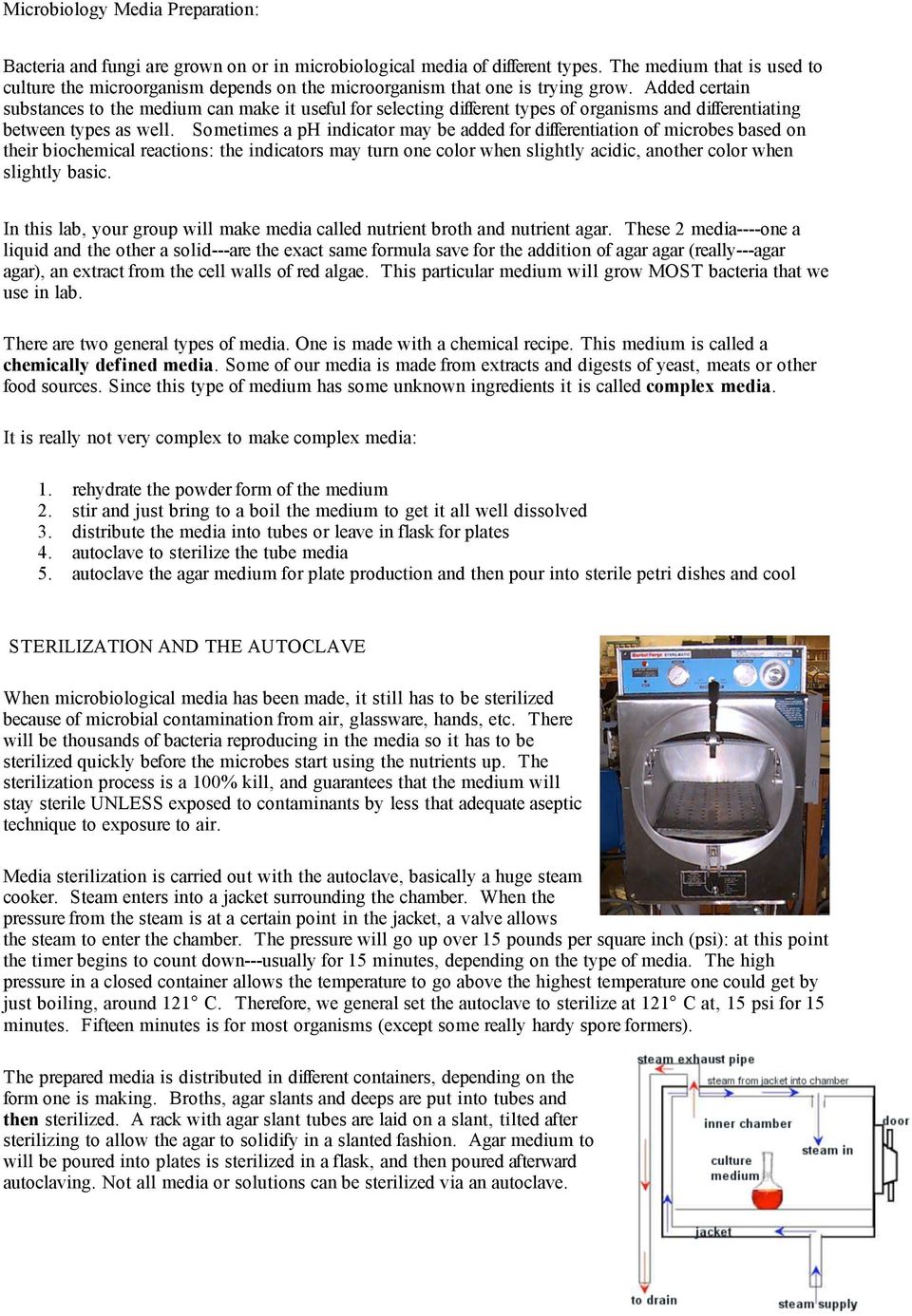
2 Microbiology Media Preparation: Bacteria and fungi are grown on or in microbiological media of different types. The medium that is used to culture the microorganism depends on the microorganism that one is trying grow. Added certain substances to the medium can make it useful for selecting different types of organisms and differentiating between types as well. Sometimes a ph indicator may be added for differentiation of microbes based on their biochemical reactions: the indicators may turn one color when slightly acidic, another color when slightly basic. In this lab, your group will make media called nutrient broth and nutrient agar. These 2 media----one a liquid and the other a solid---are the exact same formula save for the addition of agar agar (really---agar agar), an extract from the cell walls of red algae. This particular medium will grow MOST bacteria that we use in lab. There are two general types of media. One is made with a chemical recipe. This medium is called a chemically defined media. Some of our media is made from extracts and digests of yeast, meats or other food sources. Since this type of medium has some unknown ingredients it is called complex media. It is really not very complex to make complex media: 1. rehydrate the powder form of the medium 2. stir and just bring to a boil the medium to get it all well dissolved 3. distribute the media into tubes or leave in flask for plates 4. autoclave to sterilize the tube media 5. autoclave the agar medium for plate production and then pour into sterile petri dishes and cool STERILIZATION AND THE AUTOCLAVE When microbiological media has been made, it still has to be sterilized because of microbial contamination from air, glassware, hands, etc. There will be thousands of bacteria reproducing in the media so it has to be sterilized quickly before the microbes start using the nutrients up. The sterilization process is a 100% kill, and guarantees that the medium will stay sterile UNLESS exposed to contaminants by less that adequate aseptic technique to exposure to air. Media sterilization is carried out with the autoclave, basically a huge steam cooker. Steam enters into a jacket surrounding the chamber. When the pressure from the steam is at a certain point in the jacket, a valve allows the steam to enter the chamber. The pressure will go up over 15 pounds per square inch (psi): at this point the timer begins to count down---usually for 15 minutes, depending on the type of media. The high pressure in a closed container allows the temperature to go above the highest temperature one could get by just boiling, around 121 C. Therefore, we general set the autoclave to sterilize at 121 C at, 15 psi for 15 minutes. Fifteen minutes is for most organisms (except some really hardy spore formers). The prepared media is distributed in different containers, depending on the form one is making. Broths, agar slants and deeps are put into tubes and then sterilized. A rack with agar slant tubes are laid on a slant, tilted after sterilizing to allow the agar to solidify in a slanted fashion. Agar medium to will be poured into plates is sterilized in a flask, and then poured afterward autoclaving. Not all media or solutions can be sterilized via an autoclave.
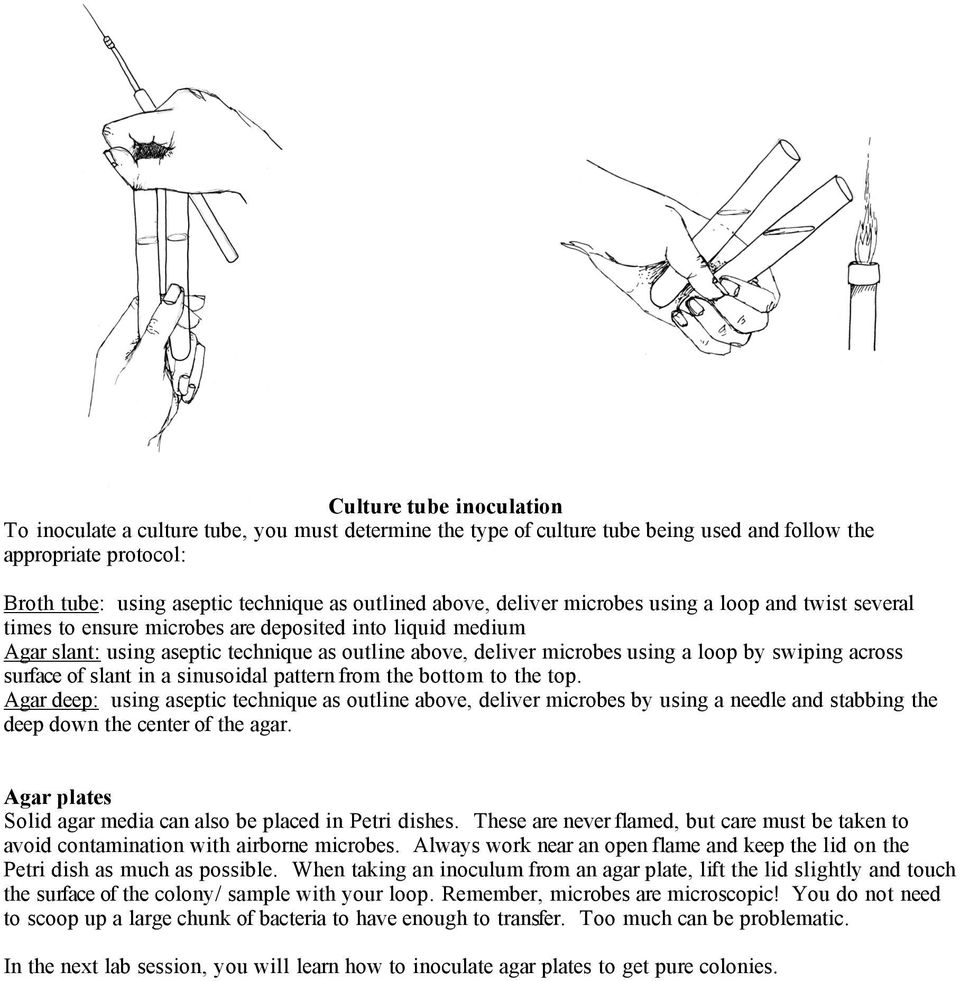
3 II. Incubation Cultivation chambers called incubators are used to grow microbes at a range of temperatures. In this lab, we have set incubators for two temperatures most commonly used as optimum temperatures by the microbes we work with: 25 C and 37 C. We also have an incubator set at 4 C (aka a refrigerator!) that can be used to store cultures that have already grown. Unless otherwise noted in a laboratory exercise, you should use the following guidelines for incubation: 2 day incubations- 37 C 5 day incubations- 25 C III. Aseptic techniques Aseptic technique refers to protocols and procedures you use to insure that no microbes contaminate your experiment and that the microbes you are working with do not contaminate you, your colleagues, or working environment, or your loved ones at home! Because microorganisms are ubiquitous, you need to assume that every environment is replete with them. This laboratory exercise will introduce you to the procedures required to ensure a safe and aseptic laboratory. Before beginning today s laboratory exercise, become acquainted with the terminology and techniques: Work area disinfection Before beginning any laboratory experiment, you must spray down the lab bench with a surface disinfectant, such as Cavicide. Saturate the bench with the solution and rub in to cover the area. Do NOT use paper towels to completely dry the surface, but instead let the disinfectant evaporate. A large portion of the disinfectant s ability to kill microbes is based on contact with the microbe itself. You must repeat this procedure at the end of every laboratory session. Transfer instruments- loops and needles Wire loops and needles are made from inert metals such as platinum. They are extremely durable and can be sterilized by incineration. To do this, place the loop or needle into the flame of a Bunsen burner (the hottest portion is in the blue flame). Allow the loop or needle to get red hot, and then remove. Make sure the transfer instrument is cool before inserting into a culture for inoculation. You will do this prior to any inoculation and after any inoculation. Culture tube flaming Prior to inserting a cooled transfer instrument into a culture tube, you need to remove the cap and flame the lip of the tube. This will help prevent contamination with transient and airborne microbes. You will do this before and after any contact with a transfer instrument. Culture tube inoculation To inoculate a culture tube, you must determine the type of culture tube being used and follow the appropriate protocol: Broth tube: using aseptic technique as outlined above, deliver microbes using a loop and twist several times to ensure microbes are deposited into liquid medium Agar slant: using aseptic technique as outline above, deliver microbes using a loop by swiping across surface of slant in a sinusoidal pattern from the bottom to the top. Agar deep: using aseptic technique as outline above, deliver microbes by using a needle and stabbing the deep down the center of the agar. Agar plates Solid agar media can also be placed in Petri dishes. These are never flamed, but care must be taken to avoid contamination with airborne microbes. Always work near an open flame and keep the lid on the

4 Petri dish as much as possible. When taking an inoculum from an agar plate, lift the lid slightly and touch the surface of the colony/ sample with your loop. Remember, microbes are microscopic! You do not need to scoop up a large chunk of bacteria to have enough to transfer. Too much can be problematic. In the next lab session, you will learn how to inoculate agar plates to get pure colonies. LAB EXERCISES I. Culture Media Group supplies 1 sleeve of plastic petri plates 1 small test tube rack 1 jar nutrient nutrient broth powder 12 blue caps 1 jar agar powder 12 green caps 1-1 liter Erlenmeyer flask 4 yellow caps 1 graduated cylinder 1 pipette pump 1 magnetic stir bar 1 pipette disposal cylinder 1 spatula 10 ml pipettes 28 medium test tubes large and small rack Protocol (see flowchart on board or below): 1. Prepare 500 ml of nutrient broth (read the label for grams of powder and then add 500 ml of di water in a 1 L flask 2. Just barely bring to a boil, all you need to do is completely dissolve the powder in the water. 3. Pipette 3 ml into 12 tubes, cap blue, place in small rack. 4. Add 7 grams of agar to remaining broth 5. Bring just to a boil, set on counter to cool 6. Pipette 4 ml into tubes cap green for slants and place in large rack. 7. Pipette 10 ml into tubes for pours use yellow caps to make pours and place in small rack. 8. Now have all autoclaved, flask, broths, future slants and deeps while autoclaving label plates with date, media and group 8. After autoclaving allow flask to cool for about several minutes before attempting to hold flask 9. Set the Petri dishes out, RIGHT SIDE UP (small side down), tops covering the dishes. 10. When you are ready to pour your plates, obtain your flask of agar and pour the plates. Cover the bottom of each plate approximately 2/3 of the way across, put on the lid and gently rotate the plate to distribute the agar across the entire dish bottom. Plate will be about a third to half full. 11. Allow all plates to stand until they are completely solidified. Once they have solidified, place them on the tray at the back counter. 12. Agar plates are always placed UPSIDE DOWN (bottom dish with agar on top), definitely so when you are incubating your cultures. Why are agar plates incubated upside down? Often you will see a bit of water condensation on the top of the agar plate, particularly when they have been at 37 degrees C. The water molecules are cohesive and tend to run together. If the plate was sitting right side up, the water droplets could then fall onto the agar, creating a kind of little lake on the agar plate and messing up your plates. Upside down plates prevents the condensation from dropping on the agar surface.

5 QUESTIONS: 1. What is a complex medium? 2. Why are ph buffers added to the growth media for microbes? 3. How can the temperature in the autoclave go above boiling temperature of 212 F? 4. Why do you have boil the agar solution BEFORE dispensing it into tubes? 5. At what temperature does agar solidify? II. Incubation Cultivation chambers called incubators are used to grow microbes at a range of temperatures. In this lab, we have set incubators for two temperatures most commonly used as optimum temperatures by the microbes we work with: 25 C and 37 C. We also have an incubator set at 4 C (aka a refrigerator!) that can be used to store cultures that have already grown. Unless otherwise noted in a laboratory exercise, you should use the following guidelines for incubation: 2 day incubations- 37 C 5 day incubations- 25 C III. Aseptic techniques Aseptic technique refers to protocols and procedures you use to insure that no microbes contaminate your experiment and that the microbes you are working with do not contaminate you, your colleagues, or working environment, or your loved ones at home! Because microorganisms are ubiquitous, you need to assume that every environment is replete with them. This laboratory exercise will introduce you to the procedures required to ensure a safe and aseptic laboratory. Before beginning today s laboratory exercise, become acquainted with the terminology and techniques: Work area disinfection Before beginning any laboratory experiment, you must spray down the lab bench with a surface disinfectant, such as Cavicide. Saturate the bench with the solution and rub in to cover the area. Do NOT use paper towels to completely dry the surface, but instead let the disinfectant evaporate. A large portion of the disinfectant s ability to kill microbes is based on contact with the microbe itself. You must repeat this procedure at the end of every laboratory session. Transfer instruments- loops and needles Wire loops and needles are made from inert metals such as platinum. They are extremely durable and can be sterilized by incineration. To do this, place the loop or needle into the flame of a Bunsen burner (the hottest portion is in the blue flame). Allow the loop or needle to get red hot, and then remove. Make sure the transfer instrument is cool before inserting into a culture for inoculation. You will do this prior to any inoculation and after any inoculation. Culture tube flaming Prior to inserting a cooled transfer instrument into a culture tube, you need to remove the cap and flame the lip of the tube. This will help prevent contamination with transient and airborne microbes. You will do this before and after any contact with a transfer instrument.

6 Culture tube inoculation To inoculate a culture tube, you must determine the type of culture tube being used and follow the appropriate protocol: Broth tube: using aseptic technique as outlined above, deliver microbes using a loop and twist several times to ensure microbes are deposited into liquid medium Agar slant: using aseptic technique as outline above, deliver microbes using a loop by swiping across surface of slant in a sinusoidal pattern from the bottom to the top. Agar deep: using aseptic technique as outline above, deliver microbes by using a needle and stabbing the deep down the center of the agar. Agar plates Solid agar media can also be placed in Petri dishes. These are never flamed, but care must be taken to avoid contamination with airborne microbes. Always work near an open flame and keep the lid on the Petri dish as much as possible. When taking an inoculum from an agar plate, lift the lid slightly and touch the surface of the colony/ sample with your loop. Remember, microbes are microscopic! You do not need to scoop up a large chunk of bacteria to have enough to transfer. Too much can be problematic. In the next lab session, you will learn how to inoculate agar plates to get pure colonies.
7 Lab Exercises II. Aseptic transfer Protocol: 1. Prepare lab bench by removing extraneous items and cleaning surface with table disinfectant. 2. Label all sterile tubes using proper technique and paper labels. 3. Sterilize your inoculating loop until it turns bright red. About 5 seconds should be fine. Allow cooling completely before proceeding. 4. With your free hand, obtain the proper E. coli culture. Use the little finger of your hand holding the loop to uncap the tube, and then pass the lip or mouth of the tube through the flame briefly. 5. Insert the cooled loop into the tube and pick up some of the culture (either touch the surface of a solid inoculum or insert into the liquid inoculum) and remove from the tube. 6. Flame the mouth of the tube as before and replace the cap. 7. Obtain proper sterile tubes, and using the same procedure as in step #4, flame the lip of the tube. 8. Insert the loop into the sterile tube and inoculate as per instructions for that particular medium type. (see Introduction to this lab exercise) 9. Flame the mouth of the tube as before and replace the cap. 10. Sterilize the loop by flaming. 11. Incubate tubes at the proper temperature, depending on the number of days before your next laboratory class. Do the following aseptic transfers: Inoculate from To sterile media 1. E. coli slant Agar slant 2. E. coli plate Broth tube 3. E. coli broth Agar slant 4. E. coli broth Broth tube 5. Sterile loop Sterile slant (to check your sterility) Data and observations 1. Did you successfully prepare uncontaminated media? What signs would indicate contamination? 2. Were all the transfers successful? 2. Was there any contamination in the transfer tubes? Discussion 1. What is a complex medium? 2. Why are ph buffers added to the growth media for microbes?

8 3. How can the temperature in the autoclave go above boiling temperature of 212 F? 4. Why do you have boil the agar solution BEFORE dispensing it into tubes? 5. At what temperature does agar solidify? 6. Provide three reasons why the use of aseptic technique is essential when handling microbial cultures in the lab. 7. How is air contamination prevented when an inoculating loop is used to introduce or take a bacterial sample to/from an agar plate? 8. Where and how should a label be written on an agar plate? What about on a test tube? 9. How should agar plates be incubated? Why?

Transferring a Broth Culture to Fresh Broth
 Sterile Technique It is very important in microbiology to work with pure cultures. Unfortunately this is difficult. The world around us is covered with microorganisms. Microorganisms are even carried on
LAB 4. Cultivation of Bacteria INTRODUCTION
 LAB 4. Cultivation of Bacteria Protocols for use of cultivation of bacteria, use of general growth, enriched, selective and differential media, plate pouring, determination of temperature range for growth
Lab Exercise 2 Media and Culture
 Lab Exercise 2 Media and Culture Lab Exercise #2 Bacterial Media & Culture I. OBJECTIVES: Practice microbial collection techniques Describe colony morphology and the relationship to microbial identification.
Bacterial Transformation with Green Fluorescent Protein. Table of Contents Fall 2012
 Bacterial Transformation with Green Fluorescent Protein pglo Version Table of Contents Bacterial Transformation Introduction..1 Laboratory Exercise...3 Important Laboratory Practices 3 Protocol...... 4
Transformation Protocol
 To make Glycerol Stocks of Plasmids ** To be done in the hood and use RNase/DNase free tips** 1. In a 10 ml sterile tube add 3 ml autoclaved LB broth and 1.5 ul antibiotic (@ 100 ug/ul) or 3 ul antibiotic
BUGS" THAT PRODUCE DRUGS TO KILL "BUGS Microbes Produce Antibiotics
 BUGS" THAT PRODUCE DRUGS TO KILL "BUGS Microbes Produce Antibiotics Science in the Real World Microbes In Action BUGS" THAT PRODUCE DRUGS TO KILL "BUGS is a curriculum unit developed as part of the Science
Potato Microbiology. Sarah Follenweider, The English High School 2009 Summer Research Internship Program
 Potato Microbiology Sarah Follenweider, The English High School 2009 Summer Research Internship Program Introduction: A number of microorganisms thrive on the nutrients that can be found in a potato. My
Microbiological Testing of the Sawyer Mini Filter. 16 December 2013. Summary
 Microbiological Testing of the Sawyer Mini Filter 16 December 2013 Summary The Sawyer Mini Filter was tested for its ability to remove three microorganisms Raoultella terrigena, Bacillus subtilis, and
Microbiology Laboratory Safety and Basic Procedures Safety in a microbiology laboratory is important in the prevention of infection that might be
 Microbiology Laboratory Safety and Basic Procedures Safety in a microbiology laboratory is important in the prevention of infection that might be caused by the microorganisms being studied. This laboratory
In order to be useful, a smear must have the following qualities:
 Smear Preparation and Simple Stain Objectives: Make bacterial smear slides (usually called smears) Distinguish cells on these slides using a simple stain procedure Unstained microbial cells are nearly
COMMON LABORATORY APPARATUS
 COMMON LABORATORY APPARATUS Beakers are useful as a reaction container or to hold liquid or solid samples. They are also used to catch liquids from titrations and filtrates from filtering operations. Bunsen
EUROTUBO DELTALAB 4. PETRI DISHES AND LOOPS
 77 78 90 x 14 mm Petri Dish Made in polystyrene. Vented. Supplied in groups of 20 units, packaged in heat sealed bags. Code 200200 is ASEPTIC. Code 200209 is sterile by gamma radiation. Suitable for automatic
BACTERIAL ENUMERATION
 BACTERIAL ENUMERATION In the study of microbiology, there are numerous occasions when it is necessary to either estimate or determine the number of bacterial cells in a broth culture or liquid medium.
Mixtures and Pure Substances
 Unit 2 Mixtures and Pure Substances Matter can be classified into two groups: mixtures and pure substances. Mixtures are the most common form of matter and consist of mixtures of pure substances. They
National Food Safety Standard Food microbiological examination: Aerobic plate count
 National Food Safety Standard of the People s Republic of China GB4789.2-2010 National Food Safety Standard Food microbiological examination: Aerobic plate count Issued by 2010-03-26 Implemented by 2010-06-01
Experiment 12- Classification of Matter Experiment
 Experiment 12- Classification of Matter Experiment Matter can be classified into two groups: mixtures and pure substances. Mixtures are the most common form of matter and consist of mixtures of pure substances.
PURE CULTURE TECHNIQUES. To demonstrate good aseptic technique in culture transfer or inoculation and in handling sterile materials.
 PURE CULTURE TECHNIQUES I. OBJECTIVES To demonstrate good aseptic technique in culture transfer or inoculation and in handling sterile materials. To demonstrate skill in isolation of organisms from a mixed
DETECTION OF BACTERIAL MOTILITY. To demonstrate bacterial motility by microscopic and macroscopic techniques.
 DETECTION OF BACTERIAL MOTILITY I. OBJECTIVES To demonstrate bacterial motility by microscopic and macroscopic techniques. To observe flagella in prepared slides stained by specific flagellar stains. II.
ENUMERATION OF MICROORGANISMS. To learn the different techniques used to count the number of microorganisms in a sample.
 ENUMERATION OF MICROORGANISMS I. OBJECTIVES To learn the different techniques used to count the number of microorganisms in a sample. To be able to differentiate between different enumeration techniques
Culture Media Preparation Review ( Modified from Supplemental Lecture by Stephen T. Abedon)
 Culture Media Preparation Review ( Modified from Supplemental Lecture by Stephen T. Abedon) 1. Culture a. A culture is the microorganisms that grow in a culture medium. b. To culture means to grow microorganisms
EH&S. Sheet. Fact. Safe and Effective Use of Autoclaves. What are autoclaves? Factors for effective sterilization. Dry heat cycle - when to use
 Please post or circulate Fact heet nvironment, ealth and afety Information for the Berkeley Campus No. 33 Revised 04/04/11 afe and ffective Use of Autoclaves Autoclaves are easy to use but can pose a safety
Chem 100 Lab Experiment #9 - ACID/BASE INDICATORS
 Lab #9 Chem 100 Lab Experiment #9 - ACID/BASE INDICATORS Name: Purpose: In this laboratory we will investigate how indicators can be used to test for the presence of acids or bases in a number of common
Laboratory Biosafty In Molecular Biology and its levels
 Laboratory Biosafty In Molecular Biology and its levels Workshop 16-17 Oct..2012 Guidelines Does not mean optional Laboratory Biosafety The Laboratory Biosafety Manual is an important WHO publication
Aerobic Count. Interpretation Guide. 3M Food Safety 3M Petrifilm Aerobic Count Plate
 3M Food Safety 3M Petrifilm Aerobic Count Plate Aerobic Count Interpretation Guide The 3M Petrifilm Aerobic Count (AC) Plate is a ready-made culture medium system that contains Standard Methods nutrients,
Transformation of the bacterium E. coli. using a gene for Green Fluorescent Protein
 Transformation of the bacterium E. coli using a gene for Green Fluorescent Protein Background In molecular biology, transformation refers to a form of genetic exchange in which the genetic material carried
Biological Sciences Initiative
 Biological Sciences Initiative HHMI Student Activities Measuring Antibiotic Resistance Introduction: You might be aware that antibiotics were once thought of as a magic bullet; a nearly perfect drug for
Welcome to Implementing Inquirybased Microbial Project. Veronica Ardi, PhD
 Welcome to Implementing Inquirybased Microbial Project Veronica Ardi, PhD Microbiology Laboratory Courses CourseSmart: ebook resources http://instructors.coursesmart.com/ Microbiology Laboratory Courses
Physical and Chemical Properties and Changes
 Physical and Chemical Properties and Changes An understanding of material things requires an understanding of the physical and chemical characteristics of matter. A few planned experiments can help you
Catalytic Activity of Enzymes
 Catalytic Activity of Enzymes Introduction Enzymes are biological molecules that catalyze (speed up) chemical reactions. You could call enzymes the Builders and Do-ers in the cell; without them, life could
SEPARATION OF A MIXTURE OF SUBSTANCES LAB
 SEPARATION OF A MIXTURE OF SUBSTANCES LAB Purpose: Every chemical has a set of defined physical properties, and when combined they present a unique fingerprint for that chemical. When chemicals are present
Decontamination and Waste Management www.biosecurity.sandia.gov
 Decontamination and Waste Management www.biosecurity.sandia.gov SAND No. 2006-3684C Sandia is a multiprogram laboratory operated by Sandia Corporation, a Lockheed Martin Company, for the United States
MICROSCOPY OF LIVING MICROBES
 EXPERIMENT 1 MICROSCOPY OF LIVING MICROBES Many students taking microbiology for the first time feel that they are going to have a hard time with the microscope. This lab as an experiment is intended to
Experiment 1: Colligative Properties
 Experiment 1: Colligative Properties Determination of the Molar Mass of a Compound by Freezing Point Depression. Objective: The objective of this experiment is to determine the molar mass of an unknown
PREPARATION FOR CHEMISTRY LAB: COMBUSTION
 1 Name: Lab Instructor: PREPARATION FOR CHEMISTRY LAB: COMBUSTION 1. What is a hydrocarbon? 2. What products form in the complete combustion of a hydrocarbon? 3. Combustion is an exothermic reaction. What
Evaluation of Microbial Growth and Survival on Construction materials treated with Anabec NewBuild 30
 Evaluation of Microbial Growth and Survival on Construction materials treated with Anabec NewBuild 30 Absar Alum, Ph.D. Department of Civil and Environmental Engineering Arizona State University Tempe,
Experiment 7: Titration of an Antacid
 1 Experiment 7: Titration of an Antacid Objective: In this experiment, you will standardize a solution of base using the analytical technique known as titration. Using this standardized solution, you will
Agarose Gel Electrophoresis with Food Color- Teacher Guide
 Page 1 of 7 Project Home Gateway to the Project Laboratory Activities What the Project can do in the classroom Biotechnology Resources Favorite resources online and in print Agarose Gel Electrophoresis
Environmental Monitoring
 Chapter 10 Environmental Monitoring By the end of this chapter, you will be able to: l List the types of environmental testing l Name three types of checks that are carried out to ensure the isolator is
Rauserv Steam Sterilizers, Laboratory and Hospital Equipment. Brewery Laboratory Equipment
 Rauserv Steam Sterilizers, Laboratory and Hospital Equipment Brewery Laboratory Equipment Date: 01 September 2015 Table of Contents 1. Anaerobic Jar... 1 2. Autoclave... 2 3. Balance... 3 4. DO (Dissolved
Recovery of Elemental Copper from Copper (II) Nitrate
 Recovery of Elemental Copper from Copper (II) Nitrate Objectives: Challenge: Students should be able to - recognize evidence(s) of a chemical change - convert word equations into formula equations - perform
Autoclave Safety. Autoclaves are sterilizers using high pressure and high temperature steam. The potential safety risks for the operators are:
 Autoclave Safety Purpose: Sterilization refers to the complete killing of all living organisms, including spores. Common sterilization techniques include the application of wet heat, dry heat, chemicals,
Test Method for the Continuous Reduction of Bacterial Contamination on Copper Alloy Surfaces
 Test Method for the Continuous Reduction of Bacterial Contamination on Copper Alloy Surfaces Test Organisms: Staphylococcus aureus (ATCC 6538) Enterobacter aerogenes (ATCC 13048) Pseudomonas aeruginosa
FACT SHEET : Using Autoclaves Safely
 CSULA Environmental Health and Safety Biosafety Office FACT SHEET : Using Autoclaves Safely Most science research laboratories on campus require the use of autoclaves. The primary purpose of the autoclave
Sugar or Salt? Ionic and Covalent Bonds
 Lab 11 Sugar or Salt? Ionic and Covalent Bonds TN Standard 2.1: The student will investigate chemical bonding. Have you ever accidentally used salt instead of sugar? D rinking tea that has been sweetened
Transformation Kit BACTERIAL TRANSFORMATION: GREEN FLUORESCENT PROTEIN. Partnership for Biotechnology and Genomics Education
 Transformation Kit BACTERIAL TRANSFORMATION: GREEN FLUORESCENT PROTEIN Partnership for Biotechnology and Genomics Education Barbara Soots Linda Curro Education Coordinator University of California Davis
SOLUBILITY OF A SALT IN WATER AT VARIOUS TEMPERATURES LAB
 SOLUBILITY OF A SALT IN WATER AT VARIOUS TEMPERATURES LAB Purpose: Most ionic compounds are considered by chemists to be salts and many of these are water soluble. In this lab, you will determine the solubility,
Quantifying Bacterial Concentration using a Calibrated Growth Curve
 BTEC 4200 Lab 2. Quantifying Bacterial Concentration using a Calibrated Growth Curve Background and References Bacterial concentration can be measured by several methods, all of which you have studied
CHM 130LL: ph, Buffers, and Indicators
 CHM 130LL: ph, Buffers, and Indicators Many substances can be classified as acidic or basic. Acidic substances contain hydrogen ions, H +, while basic substances contain hydroxide ions, OH. The relative
Biosafety Level 2 (BSL-2) Safety Guidelines
 BLS-4 Biosafety Level 2 (BSL-2) Safety Guidelines BSL-3 BSL-2 BSL-1 BSL-2 builds upon BSL-1. If you work in a lab that is designated a BSL-2, the microbes used pose moderate hazards to laboratory staff
experiment5 Understanding and applying the concept of limiting reagents. Learning how to perform a vacuum filtration.
 81 experiment5 LECTURE AND LAB SKILLS EMPHASIZED Synthesizing an organic substance. Understanding and applying the concept of limiting reagents. Determining percent yield. Learning how to perform a vacuum
STANDARDIZATION OF A SODIUM HYDROXIDE SOLUTION EXPERIMENT 14
 STANDARDIZATION OF A SODIUM HYDROXIDE SOLUTION EXPERIMENT 14 OBJECTIVE The objective of this experiment will be the standardization of sodium hydroxide using potassium hydrogen phthalate by the titration
Biotechnology. Unit 2: Microbiological Techniques. Student Materials [HIGHER] Margot McKerrell. abc. Learning and Teaching Scotland
![Biotechnology. Unit 2: Microbiological Techniques. Student Materials [HIGHER] Margot McKerrell. abc. Learning and Teaching Scotland](/thumbs/40/20991073.jpg "Biotechnology. Unit 2: Microbiological Techniques. Student Materials [HIGHER] Margot McKerrell. abc. Learning and Teaching Scotland") Biotechnology Unit 2: Microbiological Techniques Student Materials [HIGHER] Margot McKerrell abc The Scottish Qualifications Authority regularly reviews the arrangements for National Qualifications. Users
Biotechnology Unit 2: Microbiological Techniques Student Materials [HIGHER] Margot McKerrell abc The Scottish Qualifications Authority regularly reviews the arrangements for National Qualifications. Users
Agrobacterium tumefaciens-mediated transformation of Colletotrichum graminicola and Colletotrichum sublineolum
 Agrobacterium tumefaciens-mediated transformation of Colletotrichum graminicola and Colletotrichum sublineolum Flowers and Vaillancourt, 2005. Current Genetics 48: 380-388 NOTE added by L. Vaillancourt:
Laboratory Protocols Level 2 Training Course Serotypning of Salmonella enterica O and H antigen.
 Global Salm-Surv A global Salmonella surveillance and laboratory support project of the World Health Organization Laboratory Protocols Level 2 Training Course Serotypning of Salmonella enterica O and H
Science. NZQA Support Material Page 1 of 8. Unit standard 26114 version 1 Perform methods for animal tissue culture Level 6 Credits 5
 NZQA Support Material Page 1 of 8 Science Unit standard 26114 version 1 Perform methods for animal tissue culture Level 6 Credits 5 Assessor guidelines Candidate instructions Assessment task/s Assessment
Experiment 3: Extraction: Separation of an Acidic, a Basic and a Neutral Substance
 1 Experiment 3: Extraction: Separation of an Acidic, a Basic and a Neutral Substance Read pp 142-155, 161-162, Chapter 10 and pp 163-173, Chapter 11, in LTOC. View the videos: 4.2 Extraction (Macroscale);
ENVIRONMENTAL MONITORING
 ENVIRONMENTAL MONITORING Assessment and verification of the adequacy of the aseptic compounding environment is essential. Environmental monitoring programs are designed to promptly identify potential sources
UTILIZATION of PLASMA ACTIVATED WATER in Biotechnology, Pharmacology and Medicine. JSC TECHNOSYSTEM-ECO Moscow, Russia April, 2009
 UTILIZATION of PLASMA ACTIVATED WATER in Biotechnology, Pharmacology and Medicine JSC TECHNOSYSTEM-ECO Moscow, Russia April, 2009 METHOD of WATER ACTIVATION with PLASMA of GAS DISCHARGE ANODE VACUUM WATER
Science in the Real World Microbes In Action
 Science in the Real World Microbes In Action Edited by: Teresa Thiel, Ph.D. University of Missouri-St. Louis Program Director & Microbiologist Slick Oil Lab is a curriculum unit developed as part of the
Gel Electrophoresis Teacher Instructions Suggested Grade Level: Grades 7-14 Class Time Required: 1 period (50 minutes)
 Biological Sciences Initiative HHMI Gel Electrophoresis Teacher Instructions Suggested Grade Level: Grades 7-14 Class Time Required: 1 period (50 minutes) EQUIPMENT AND MATERIALS NEEDED (per group) Electrophoresis
ISOLATION OF CAFFEINE FROM TEA
 ISLATIN F CAFFEINE FRM TEA Introduction In this experiment, caffeine is isolated from tealeaves. The chief problem with the isolation is that caffeine does not exist alone in the tealeaves, but other natural
3039878000or8009926372
 3039878000or8009926372 bi s a l e s @me s a l a bs. c om Regulatory officials and sterilization experts have voiced concerns regarding the appropriateness of using a Biological Indicator (BI) Ampoule interchangeably
Dusted! PROCESS SKILLS SCIENCE TOPICS VOCABULARY
 Dusted! Visitors press their fingertips onto a clean Plexiglas sheet. Their fingerprints are then revealed as visitors dust over the print with fingerprint powder. OBJECTIVES: Visitors will learn that
A Guide to Managing Your Biological Waste at the University at Albany
 A Guide to Managing Your Biological Waste at the University at Albany Section 1 - What you need to know: Definition: "Regulated Medical Waste (RMW) shall mean any of the following waste which is generated
Isolation of Starch degrading bacteria Enzymes in Action
 Isolation of Starch degrading bacteria Enzymes in Action Introduction In this laboratory exercise, you will be playing the role of biotechnologists in search of a new amylase. Since most industrially used
Microbiological Evaluation of the STI Series 2000 Medical Waste Treatment Process
 WNWN International,Inc. WNWN International Phone: 860-675-1217 Fax 860-675-1311 PO Box 1164 Burlington, CT. 06013 USA Microbiological Evaluation of the STI Series 2000 Medical Waste Treatment Process January
Coating and Extraction of Honeycomb Denuders
 QSM Approval: Coating and Extraction of Honeycomb Denuders 1 INTRODUCTION 1.1 The following procedures are used for the coating of honeycomb denuders with citric acid and sodium carbonate solutions, and
Metabolism: Cellular Respiration, Fermentation and Photosynthesis
 Metabolism: Cellular Respiration, Fermentation and Photosynthesis Introduction: All organisms require a supply of energy and matter to build themselves and to continue to function. To get that supply of
Disc Diffusion Susceptibility Methods
 Disc Diffusion Susceptibility Methods Introduction When a filter paper disc impregnated with a chemical is placed on agar the chemical will diffuse from the disc into the agar. This diffusion will place
Microbiology BIOL 275 DILUTIONS
 DILUTIONS Occasionally a solution is too concentrated to be used as is. For example, when one is performing manual blood counts, the blood contains too many cells to be counted as such. Or when performing
Transformation of E.coli with pgal
 The Biotechnology Education Company ATTENTION! This experiment includes either BactoBeads or LyphoCells. If you have received LyphoCells, please refer to the addendum posted on the last page of this literature.
STERILIZATION AND DISINFECTION
 STERILIZATION AND DISINFECTION Importance of hand washing shown by Semmelweis STERILIZATION A physical or chemical process that destroys or eliminates all forms of microbial life, including spores. A satisfactory
Standard Operating Procedure (SOP)
 Standard Operating Procedure (SOP) Title: Direct Fluorescent Antibody Test (DFAT) for the detection of Renibacterium salmoninarum in tissues Number: BACT-3 Version: 02 Created December 14, 2011 Approval:
Total Aerobic Bacteria, Yeasts and Molds
 Total Aerobic Bacteria, Yeasts and Molds DOC316.53.01223 Total Aerobic Bacteria (Amber), Yeast and Mold (Red), Total Coliform (Red) and Disinfection Control (Purple) Paddle Testers Scope and application:
Laboratory Line. Vertical and Bench-Top Life Science Autoclaves
 Laboratory Line Vertical and Bench-Top Life Science Autoclaves The Advanced Laboratory Line The Full Spectrum of Laboratory Sterilizers Sterilization in a laboratory environment has its unique requirements.
Laboratory- and sterilisation equipment HMC EUROPE
 Laboratory- and sterilisation equipment HMC PROFILE HMC Laboratory- and sterilisation equipment Consistent marketing of technologies and the conversion of new ideas create product ranges, that are tailor-made
Effective Use of Autoclaves
 Effective Use of s Overview An autoclave is a commonly used piece of equipment in microbiology laboratories. s (steam sterilizers) are metal pressure vessels that are used for steam sterilization of media,
LABORATORY ORGANIZATION
 LABORATORY ORGANIZATION A laboratory designed for invitro cultures with plant tissues should have sufficient space for performing several functions maintaining sterile conditions. A plant tissue culture
Biotechnology Explorer
 arac ori pglo bla GFP Biotechnology Explorer pglo Bacterial Transformation Kit Catalog Number 166-0003EDU explorer.bio-rad.com Store components of this kit at room temperature. Duplication of any part
Human Physiology Lab (Biol 236L) Digestive Physiology: Amylase hydrolysis of starch
 Human Physiology Lab (Biol 236L) Digestive Physiology: Amylase hydrolysis of starch Introduction Enzymes are proteins composed of amino acid building blocks. Enzymes catalyze or increase the rate of metabolic
STANDARD OPERATING PROCEDURES Safe Autoclave Operations
 Department of Environmental Health & Safety Biosafety & Biosecurity STANDARD OPERATING PROCEDURES Safe Autoclave Operations The purpose of this document is to provide standard operating procedures for
THE ACTIVITY OF LACTASE
 THE ACTIVITY OF LACTASE Lab VIS-8 From Juniata College Science in Motion Enzymes are protein molecules which act to catalyze the chemical reactions in living things. These chemical reactions make up the
Environmental Monitoring of Clean Rooms
 Environmental Monitoring of Raul Duarte President DDK Scientific, Corp. Copyright DDK Scientific, Corp. 2008, 2009, DDK Scientific, Corp. Proprietary A manufacturing facility for pharmaceutical products
Experiment 5 Preparation of Cyclohexene
 Experiment 5 Preparation of yclohexene In this experiment we will prepare cyclohexene from cyclohexanol using an acid catalyzed dehydration reaction. We will use the cyclohexanol that we purified in our
Luminol Test PROCESS SKILLS SCIENCE TOPICS VOCABULARY
 EXPERIMENT: LUMINOL TEST Luminol Test Visitors mix a solution of luminol with fake blood (hydrogen peroxide) to produce a reaction that gives off blue light. OBJECTIVES: Visitors learn that some chemical
EXPERIMENT 15: Ideal Gas Law: Molecular Weight of a Vapor
 EXPERIMENT 15: Ideal Gas Law: Molecular Weight of a Vapor Purpose: In this experiment you will use the ideal gas law to calculate the molecular weight of a volatile liquid compound by measuring the mass,
Fundamental Autoclave Techniques
 Fundamental Autoclave Techniques Version 3, September 2010 Veronika Tatarinoff GSBmE University of NSW Brandy Nelson University of Kentucky The following information is directed at aseptic/sterile surgical,
Green Fluorescent Protein (GFP): Genetic Transformation, Synthesis and Purification of the Recombinant Protein
 Green Fluorescent Protein (GFP): Genetic Transformation, Synthesis and Purification of the Recombinant Protein INTRODUCTION Green Fluorescent Protein (GFP) is a novel protein produced by the bioluminescent
OBJECTIVES: Visitors learn what an antioxidant is and how it behaves. They also learn how to test for the presence of vitamin C..
 Vitamin C Visitors use iodine to compare the reactivity of two starch solutions one with vitamin C added, one without vitamin C. OBJECTIVES: Visitors learn what an antioxidant is and how it behaves. They
PLANT TISSUE CULTURE
 PLANT TISSUE CULTURE Background Plant research often involves growing new plants in a controlled environment. These may be plants that we have genetically altered in some way or may be plants of which
Basic Practical Microbiology
 Basic Practical Microbiology A Manual Society for General Microbiology (SGM) 2006 Society for General Microbiology ISBN 0 95368 383 4 The Society for General Microbiology (SGM) is a learned society with
Jennifer Cosgrove & Julie Ertmann Developer of Curriculum Unit
 Science in the Real World Microbes In Action Spice Up Your Life! is a curriculum unit developed as part of the Science In The Real World: Microbes In Action Program. The curriculum units were developed
KGI MEDICAL WASTE MANAGEMENT PLAN
 1revised 2012 I. Facility Information KGI MEDICAL WASTE MANAGEMENT PLAN a. Contact Person: Barbara Erwin Director Research Operations/Chemical and Biological Laboratory Safety/Chair. 909-607-0160 i. Facility:
Steam Sterilization Cycles for Lab Applications
 Steam Sterilization Cycles for Lab Applications Presented by Gary Butler STERIS Life Sciences August 2009 Early Steam Sterilizers Koch Upright Sterilizer First Pressurized Sterilizer First built by Pasteur-Chamberlain
Experiment 8 Synthesis of Aspirin
 Experiment 8 Synthesis of Aspirin Aspirin is an effective analgesic (pain reliever), antipyretic (fever reducer) and anti-inflammatory agent and is one of the most widely used non-prescription drugs. The
Hazardous Waste Procedures
 Hazardous Waste Procedures Hazardous waste is defined as a waste, or combination of wastes, which because of its quantity, concentration, or physical or chemical characteristics may pose a substantial
Policies. Prep Room Policies
 Introduction INTRODUCTION The Microbiology Prep Room is located in 531A Life Sciences Building. The telephone number is 372-8609. It is open from 7:30 a.m. to 4:30 p.m. during the fall and spring semesters.
RESTRICTION ENZYME ANALYSIS OF DNA
 University of Massachusetts Medical School Regional Science Resource Center SUPPORTING MATHEMATICS, SCIENCE AND TECHNOLOGY EDUCATION 222 Maple Avenue, Stoddard Building Shrewsbury, MA 01545-2732 508.856.5097
1. The Determination of Boiling Point
 1. The Determination of Boiling Point Objective In this experiment, you will first check your thermometer for errors by determining the temperature of two stable equilibrium systems. You will then use