
GCS16 GCS20 WARNING CAUTION
|
|
|
- Chloe Fields
- 9 years ago
- Views:
Transcription
1 Service Literature Corp L6 Revised GCS16/GCS20 SERIES UNITS GCS16 GCS20 2 to 5 Ton GCS16/20 series units in the 2 to 5 ton (7.0 to 17.0 kw) cooling size are packaged combination gas heat / dx cool units designed for commercial applications. Gas heat sections are available with Lennox new tubular heat exchanger in 50,000, 75,000, 90,000 and 120,000 (14.7, 22.0, 26.4, 35.2 kw) Btuh input sizes. Three phase GCS20 units manufatured April 2002 and later have a 12.0 seer rating. Revised specifications, electrical data and blower data are included in this manual. All GCS20 model units and GCS and 048 utilize a scroll compressor. The scroll compressor offers high volumetric efficiency, quiet operation and the ability to start under system load. Continuous flank contact, maintained by centrifugal force, minimizes gas leakage and maximizes efficiency. The motor is internally protected from excessive current and temperature. GCS16 024, 030 and 060 models will be equipped with a reciprocating compressor. The reciprocating compressor is hermetically sealed for trouble free operation and long service life. Like the scroll, the reciprocating compressor has a built in protection device against excessive current and temperatures. The GCS16/20 is designed to accept any of several different thermostat control systems with minimum field wiring. Control options such as economizer, warm up kit, Honeywell T7300 control or Honeywell T8600 control are applicable. When installed, the controls become an integral part of the unit wiring. Units are also equipped with a low voltage pig tails to facilitate thermostat field wiring. Information in this manual is for use by a qualified service technician only. All specifications in this manual are subject to change. Procedures outlined in this manual are represented as a recommendation only and do not supersede or replace state or local codes. WARNING Refrigerant can be harmful if it is inhaled. Refrigerant must be used and recovered responsibly. Failure to follow this warning may result in personal injury or death. GCS16 SHOWN WARNING Electric shock hazard. Can cause injury or death. Before attempting to perform any service or maintenance, turn the electrical power to unit OFF at disconnect switch(es). Unit may have multiple power supplies. ELECTROSTATIC DISCHARGE (ESD) Precautions and Procedures CAUTION Electrostatic discharge can affect electronic components. Take precautions during furnace installation and service to protect the furnace s electronic controls. Precautions will help to avoid control exposure to electrostatic discharge by putting the furnace, the control and the technician at the same electrostatic potential. Neutralize electrostatic charge by touching hand and all tools on an unpainted unit surface, such as the gas valve or blower deck, before performing any service procedure. Page Lennox Industries Inc. Litho U.S.A.

2 Introduction Specifications Optional Accessories Electrical Data High Altitude Blower Data I Application II Unit Components Control Box Heating Cooling Table of Contents III Placement and Installation IV Electrical Connections V Start Up VI Refrgeration System Service Checks 31 VII Heating System Service Checks.. 32 VIII Indoor Blower Operation IX Maintenance X Accessories XI Wiring and Operation Sequence Model No. SPECIFICATIONS GCS16 GCS GCS16X GCS GCS16X GCS GCS16X Nominal Tonnage (kw) 2 (7.0) 2.5 (8.8) 3 (10.6) Heating Input Btuh (kw) 50,000 (14.7) 75,000 (22.0) 90,000 (26.4) Capacity Output Btuh (kw) 40,000 (11.7) 60,000 (17.6) 72,000 (21.1) A.F.U.E. 80.0% Cooling capacity Btuh (kw) 23,200 (6.8) 27,400 (8.0) 35,400 (10.4) ARI Certified Total unit watts Cooling SEER (Btuh/Watts) Ratings EER (Btuh/Watts) *Sound Rating Number (db) 80 Refrigerant Charge (HCFC 22) 3 lbs. 3 oz. (1.45 kg) 4 lbs. 3 oz. (1.90 kg) 4 lbs. 6 oz. (1.94 kg) Evaporator Blower wheel nominal diameter x width in. (mm) 9 x 8 (229 x 203) 10 x 8 (254 x 203) Blower Motor horsepower (W) 1/3 (249) 1/2 (373) Net face area sq. ft. (m 2 ) 3.2 (0.30) 4.10 (0.38) Evaporator Coil Tube diameter in. (mm) & No. of rows 3/8 (9.5) 2 Fins per inch (m) 15 (591) Net face area Outer coil 8.70 (0.81) Condenser sq. ft. (m 2 ) Inner coil 8.40 (0.78) Coil Tube diameter in. (mm) & No. of rows 3/8 (9.5) 1 3/8 (9.5) 2 Fins per inch (m) 20 (787) Diameter in. (mm) & No. of blades 20 (508) 4 Condenser Air volume cfm (L/s) 2450 (1155) 2200 (1040) Fan Motor horsepower (W) 1/6 (124) Motor watts Gas Supply Connections fpt in. (mm) 1/2 (12.7) Recommended Gas Supply Pressure Natural Gas 7 (1.7) in. w.c. (kpa) LPG/Propane 11 (2.7) Condensate drain size mpt in. (mm) 3/4 (19) No. & size of cleanable polyurethane filters in. (mm) (1) 16 x 25 x 1 (406 x 635 x 25) Net weight of basic unit lbs. (kg) 350 (159) 373 (169) 370 (168) Shipping weight of basic unit lbs. (kg) 1 pkg 432 (196) 455 (206) 470 (213) Electrical characteristics (60hz) 208/230v 1 phase 208/230v 1 ph 208/230v, 460v or 575v 3 ph *Sound Rating Number in accordance with test conditions included in ARI Standard 270. Annual Fuel Utilization Efficiency based on DOE test procedures and FTC labeling regulations. Certified in accordance with the USE certification program, which is based on ARI Standard 210/240: 95 F (35 F) outdoor air temperature and 80 F (27 C) db/67 F (19 C) wb entering evaporator coil air. Page 2

3 Model No. SPECIFICATIONS GCS16 CONT. GCS GCS16X GCS GCS16X GCS GCS16X Nominal Tonnage (kw) 4 (10.1) 5 (17.6) GCS GCS16X Heating Capacity Input Btuh (kw) 75,000 (22.0) 120,000 (35.2) 75,000 (22.0) 120,000 (35.2) Output Btuh (kw) 60,000 (17.0) 96,000 (28.1) 60,000 (17.0) 96,000 (28.1) A.F.U.E 80.0% ARI Certified Cooling Ratings Cooling capacity Btuh (kw) 46,500 (13.6) 58,500 (17.1) Total unit watts SEER (Btuh/Watts) EER (Btuh/Watts) *Sound Rating Number (db) 82 Refrigerant Charge (HCFC 22) 5 lbs. 11 oz. (2.58 kg) 7 lbs. 0 oz. (3.18 kg) Evaporator Blower Evaporator Coil Condenser Coil Blower wheel nominal diameter x width in. (mm) 11 1/2 x 9 (292 x 229) Motor horsepower (W) 3/4 (560) Net face area sq. ft. (m 2 ) 5.30 (0.49) 6.20 (0.58) Tube diameter in. (mm) & No. of rows 3/8 (9.5) 2 Fins per inch (m) 15 (591) Net face area Outer coil (1.33) sq. ft. (m 2 ) Inner coil 5.90 (0.55) (1.27) Tube diameter in. (mm) & No. of rows 3/8 (9.5) 1.4 3/8 (9.5) 2 Fins per inch (m) 20 (787) Diameter in. (mm) & No. of blades 24 (610) 4 Condenser Fan Air volume cfm (L/s) 3880 (1830) 3770 (1780) Motor horsepower (W) 1/4 (187) Motor watts Gas Supply Connections fpt in. (mm) 1/2 (12.7) Recommended Gas Supply Pressure in. w.c. (kpa) Natural Gas 7 (1.7) LPG/Propane 11 (2.7) Condensate drain size mpt in. (mm) 3/4 (19) No. & size of cleanable polyurethane filters in. (mm) (1) 20 x 25 x 1 (508 x 635 x 25) Net weight of basic unit lbs. (kg) 496 (225) 526 (239) Shipping weight of basic unit lbs. (kg) 1 package 605 (274) 635 (288) Electrical characteristics (60hz) 208/230v 1 ph, 208/230v or 460v 3 ph 208/230v 1 ph, 208/230v, 460v or 575v 3 ph 208/230v 1 ph, 208/230v or 460v 3 ph 208/230v 1 ph, 208/230v, 460v or 575v 3 ph *Sound Rating Number in accordance with test conditions included in ARI Standard 270. Annual Fuel Utilization Efficiency based on DOE test procedures and FTC labeling regulations. Certified in accordance with the USE certification program, which is based on ARI Standard 210/240: 95 F (35 F) outdoor air temperature and 80 F (27 C) db/67 F (19 C) wb entering evaporator coil air. Page 3

4 Model No. GCS SPECIFICATIONS GCS20 GCS GCS GCS GCS GCS GCS GCS Nominal Tonnage 2 2 1/ /2 4 5 GCS Heating Capacity Input Output Btuh 50,000 75,000 90,000 75, ,000 75, ,000 75, ,000 kw Btuh 40,000 60,000 72,000 60,000 96,000 60,000 96,000 60,000 96,000 kw A.F.U.E. 80.0% *Sound Rating Number (db) ARI Standard 210/240 Ratings Total Cooling Btuh 24,600 30,400 33,600 41,000 48,000 58,000 Capacity kw Total Unit Watts SEER (Btuh/Watts) EER (Btuh/Watts) Refrigerant Charge (HCFC-22) 4 lbs. 5 oz. (2.0 kg) 4 lbs. 10 oz. (2.10 kg) 4 lbs. 6 oz. (3.02 kg) 5 lbs. 2 oz. (2.32 kg) 7 lbs. 3 oz. (3.26 kg) 7 lbs. 5 oz. (3.32 kg) Evaporator Blower Blower wheel nominal in. 9 x 8 10 x /2 x 9 diameter x width mm 229 X X x 228 Motor output hp (W) 1/3 (249) 1/2 (373) 3/4 (560) Net face area sq. ft. (m 2 ) 3.2 (0.30) 4.1 (0.38) 4.1 (0.38) 5.3 (0.49) 6.2 (0.58) Evaporator Coil Tube diameter in. (mm) & No. of rows 3/8 (9.5) 2 Condenser Coil Fins per inch (m) 15 (590) Net face area sq. ft. (m 2 ) Tube diameter in. (mm) & No. of rows Outer Coil 8.7 (0.81) 14.3 (1.33) Inner Coil 8.4 (0.78) 5.9 (0.55) 13.7 (1.27) 3/8 (9.5) 2 3/8 (9.5) 1.4 3/8 (9.5) 2 Fins per inch (m) 20 (787) Diameter in. (mm) & No. of blades 20 (508) 4 24 (610) 4 Condenser Fan Air volume cfm (L/s) 2200 (1040) 3880 (1830) 3770 (1780) Motor output hp (W) 1/6 (124) 1/4 (187) Motor watts Gas Supply Connections fpt in. (mm) 1/2 (13) Recommended Gas Supply Pressure wc. in. (kpa) Natural 7 (1.7) LPG/Propane 11 (2.7) Condensate drain size mpt in. (mm) 3/4 (19) No. & size of cleanable polyurethane filters in. (mm) (1) 16 x 25 x 1 (406 x 635 x 25) (1) 20 x 25 x 1 (508 x 635 x 25) Net weight of basic unit lbs. (kg) (1 Pkg.) 406 (184) 494 (224) 527 (239) 541 (245) Ship weight of basic unit lbs. (kg) (1 Pkg.) 472 (214) 603 (274) 636 (288) 650 (295) Electrical characteristics 60 hertz 208/230v 1 phase 208/230v 1ph 208/203v or 460v 3 ph 208/230v 1 phase 208/230v 1 phase 208/203v or 460v 3phase Annual Fuel Utilization Efficiency based on DOE test procedures and FTC labeling regulations. *Sound Rating Number in accordance with test conditions included in ARI Standard 270. Certified in accordance with the USE certification program, which is based on ARI Standard 210/240: 95 F (35 C) outdoor air temperature and 80 F (27 C) db/67 F (19.5 C) wb entering evaporator air. Page 4

5 SPECIFICATIONS GCS20 (manufactured April 2002 and later) SPECIFICATIONS GCS20 Heating Model No. GCS GCS GCS GCS GCS Performance Input Btuh (kw) 75,000 (22.0) 75,000 (22.0) 120,000 (35.2) 75,000 (22.0) 120,000 (35.2) Cooling Performance Condenser Coil Condenser Fan Evaporator Coil Output Btuh (kw) 60,000 (17.6) 60,000 (17.6) 96,000 (28.1) 60,000 (17.6) 96,000 (28.1) A.F.U.E. 80.0% 80.0% 80.0% 80.0% 80.0% Gas Supply Connections npt in. 1/2 1/2 1/2 1/2 1/2 Recommended Gas Supply Pressure Natural Gas 7 in. w.c. (1.7 kpa) 7 in. w.c. (1.7 kpa) 7 in. w.c. (1.7 kpa) 7 in. w.c. (1.7 kpa) 7 in. w.c. (1.7 kpa) LPG/Propane 11 in. w.c. (2.7 kpa) 11 in. w.c. (2.7 kpa) 11 in. w.c. (2.7 kpa) 11 in. w.c. (2.7 kpa) 11 in. w.c. (2.7 kpa) Nominal Tonnage (kw) 3 (10.6) 4 (14.1) 4 (14.1) 5 (17.6) 5 (17.6) Cooling Capacity Btuh (kw) 35,200 (10.3) 50,000 (14.6) 50,000 (14.6) 59,000 (17.3) 59,000 (17.3) Total Unit Watts SEER (Btuh/Watts) EER (Btuh/Watts) *Sound Rating Number (db) Refrigerant Charge (HCFC-22) Net face area sq. ft. (m 2 ) Outer Coil 5 lbs. 2 oz. (2.34 kg) 7 lbs. 14 oz. (3.57 kg) 7 lbs. 14 oz. (3.57 kg) 8 lbs. 8 oz. (3.86 kg) 8 lbs. 8 oz. (3.86 kg) 14.3 (1.33) 14.3 (1.33) 14.3 (1.33) 14.3 (1.33) 14.3 (1.33) Inner Coil 5.9 (0.55) 13.7 (1.27) 13.7 (1.27) 13.7 (1.27) 13.7 (1.27) Tube diameter in. (mm) 3/8 (9.5) 3/8 (9.5) 3/8 (9.5) 3/8 (9.5) 3/8 (9.5) Number of rows Fins per inch (m) 20 (787) 20 (787) 20 (787) 20 (787) 20 (787) Motor horsepower (W) 1/4 (187) 1/4 (187) 1/4 (187) 1/4 (187) 1/4 (187) Motor watts Diameter in. (mm) 24 (610) 24 (610) 24 (610) 24 (610) 24 (610) Number of blades Air volume cfm (L/s) 3880 (1830) 3770 (1780) 3770 (1780) 3770 (1780) 3770 (1780) Net face area sq. ft. (m 2 ) 5.3 (0.49) 6.2 (0.58) 6.2 (0.58) 6.2 (0.58) 6.2 (0.58) Tube diameter in. (mm) 3/8 (9.5) 3/8 (9.5) 3/8 (9.5) 3/8 (9.5) 3/8 (9.5) Number of rows Fins per inch (m) 15 (590) 14 (552) 14 (552) 14 (552) 14 (552) Condensate drain coupling size npt in. 3/4 3/4 3/4 3/4 3/4 Evaporator Motor horsepower (W) 1/2 (373) 3/4 (560) 3/4 (560) 3/4 (560) 3/4 (560) Blower Wheel nominal diameter x width in. (mm) 10 x 8 (254 X 203) 11 1/2 x 9 (292 x 228) 11 1/2 x 9 (292 x 228) 11 1/2 x 9 (292 x 228) 11 1/2 x 9 (292 x 228) Filters Shipping Data Cleanable, polyurethane No. & size in. (1) 20 x 25 x 1 (1) 20 x 25 x 1 (1) 20 x 25 x 1 (1) 20 x 25 x 1 (1) 20 x 25 x 1 mm 508 x 635 x x 635 x x 635 x x 635 x x 635 x 25 Net weight of basic unit lbs. (kg) 496 (225) 541 (245) 541 (245) 541 (245) 541 (245) Ship. wt. of basic unit lbs. (kg) 1 pkg. 603 (274) 650 (295) 650 (295) 650 (295) 650 (295) Electrical characteristics (60 hz) 208/203v 3 ph 460v 3 ph 208/203v 3 ph 460v 3 ph 208/203v 3 ph 460v 3 ph 208/203v 3 ph 460v 3 ph 208/203v 3 ph 460v 3 ph Annual Fuel Utilization Efficiency based on DOE test procedures and FTC labeling regulations. *Sound Rating Number in accordance with test conditions included in ARI Standard 270. Certified in accordance with the USE certification program, which is based on ARI Standard 210/240: 95 F (35 C) outdoor air temperature and 80 F (27 C) db/67 F (19.5 C) wb entering evaporator air. Page 5

6 OPTIONAL ACCESSORIES GCS16/20 Model No LB 82199CF (47J23) LB 82199CG (47J24) 2 guards per order 3 guards per order Coil Guards PVC coated steel wire guards to protect outdoor coil Standard equipment on GCS20 single phase units. Cold Weather Kit (GCS16 Units Canada Only) Electric heater automatically controls minimum temperature in gas burner compartment when temperature is below 40 F (4 C). CGA certified to allow operation of unit down to 60 F ( 50 C) Control Systems See pages 4 5 for complete listing. Compressor Monitor (GCS16 Units Canada Only) Non-adjustable switch (low ambient cut-out) prevents compressor operation when outdoor temperature is below 32 F (0 C). Diffusers Aluminum grilles, large center grille, insulated Step-Down diffuser box with flanges, hanging rings furnished, interior double deflec- transition (even air flow), internally sealed (prevents recir- tion louvers culation), adapts to T-bar ceiling grids or plaster ceilings Net Weight 65C03 See pages 4 5 T (45F08) RTD lbs. (30 kg) Flush fixed FD lbs.(17 kg) blade louvers 3 Position REMD lbs. (22 kg) REMD lbs. (30 kg) Economizer with Gravity Exhaust Dampers (Down Flow) Installs directly in cabinet, recir- culated air dampers with pressure operated gravi- US Fully Modulating REMD16M lbs. (22 kg) REMD16M lbs. (30 kg) ty exhaust damper, formed, gasketed damper Only Indoor Filter (1) 16 x 25 x 1 (406 x 635 x 25) (1) 20 x 25 x 1 (508 x 635 x 25) blades, nylon bearings, 24v damper motor has adjustable minimum position switch, electronic Outdoor Filter (1) 14 x 25 x 1 (356 x 635 x 25) (1) 18 x 25 x 1 (457 x 635 x 25) discharge air sensor, adjustable outdoor air en- Fully Modulating REMD16M 41S 85 lbs. (39 kg) REMD16M 65S 105 lbs. (48 kg) thalpy control. Utilizes filter furnished with unit, GCS16 filter rack will accept up to 2 in. (51 mm) filter. units Indoor Filter (1) 16 x 25 x 1 (406 x 635 x 25) (1) 20 x 25 x 1 (508 x 635 x 25) Removable exhaust air hood and outdoor air in- Canada take hood with cleanable aluminum mesh filter. (1) 19 7/8 x 22 3/4 x 1 Only Outdoor Filter (1) 19 3/8 x 15 3/4 x 1 Choice of economizer controls. (505 x 578 x 25) Economizer Dampers (Horizontal) Installs di- rectly in cabinet, combination outdoor air and recirculated air damper, formed, gasketed damper blades, nylon bearings, 24v damper motor has adjustable minimum position switch, electronic discharge air sensor, adjustable outdoor air en- thalpy control. 1 in (25 mm) fiberglass filter furnished, filter rack will accept up to 2 in. (51 mm) filter, outdoor air intake hood with aluminum mesh filter. Choice of economizer controls. 3 Position EMDH lbs. (50 kg) EMDH lbs. (59 kg) Fully Modulating EMDH16M lbs. (50 kg) EMDH16M lbs. (59 kg) US Only (1) 16 x 25 x 1 (406 x 635 x 25) Indoor Filter (1) 20 x 24 x 1 (508 x 610 x 25) (1) 14 x 25 x1 (356 x 635 x 1) GCS16 Units Canada Only Outdoor Filter (1) 8 x 24 x 1 (203 x 610 x 25) (1) 8 x 28 x 1 (203 x 711 x 25) Fully Modulating EMDH16M 41S 70 lbs. (32 kg) EMDH16M 65S 86 lbs. (39 kg) Indoor Filter (1) 20 x 20 x 1 (508 x 508 x 25) (1) 20 x 25 x 1 (508 x 635 x 25) Outdoor Filter Enthalpy Control, Differential Used in conjunction with outdoor air enthalpy control. Determines and selects which air has the lowest enthalpy. Return air enthalpy sensor field installs in economizer damper section Gravity Exhaust Dampers For use with EMDH16. Pressure operated assembly field installs in the return air duct adjacent to the economizer assembly. Includes bird screen. Net Weight Horizontal Filter Kit (GCS16 Units Canada Only) For horizontal applications, painted steel cabinet with filter access, disposable, pleated fiber filter furnished, see dimension drawing, No. and size of filter Net Weight Ambient Control Kit Units operate down to 30 F ( 1 C) outdoor air temperature in cooling mode without any additional controls. Kit can be field installed, enables unit to operate properly down to 0 F ( 18 C). (1) 16 1/2 x 21 3/4 x 1 (419 x 552 x 25) HF lbs. (8 kg) (1) 20 x 20 x 2 in. (508 x 508 x 51 mm) 54G44 GEDH lbs. (2 kg) LB 57113BC (24H77) (1) 22 1/2 x 25 1/4 x 1 (571 x 641 x 25) HF lbs. (10 kg) (1) 20 x 25 x 2 in. (508 x 635 x 51 mm) LPG/Propane Kits Conversion from Natural Gas to LPG/Propane 50L K input 50L88 120K input Roof Curb Power Entry Kit Allows power entry through roof mounting frame, knockouts provided in roof frame, kit contains 1/2 in. (13 mm) x 40 in. 18H70 (1016 mm) armored conduit and installation hardware, two kits are required, one for low voltage and one for high voltage. See Dimension Drawing Roof Mounting Frame Nailer strip furnished, mates to unit, U.S. National RMF lbs. (35 kg) Roofing Contractors Approved, shipped knocked down. RMF16 41 may be Plate (ordered separately) RMF lbs. (35 kg) used on all sizes, with a slight unit overhang on GCS20 042, GCS16/ (73H80) Plate (ordered separately) and GCS16/ units Net Weight RMF lbs. (39 kg) (73H80) NOTE (US Only) Sound Reduction Plate must be ordered separately for field Plate (ordered separately) installation. (73H82) Indoor filter is not furnished with economizer. REMD16 utilizes existing filter furnished with CHA16 unit. Page 6

7 OPTIONAL ACCESSORIES GCS16/20 CONT. Model No Outdoor Air Damper Section For down-flow applications, damper assembly replaces blower access panel, manually adjustable, 0 to 25% (fixed) US Only outdoor air, outdoor air hood with cleanable filter in- cluded, number and size of filter Net Weight Minimum mixed air temperature Heat mode 45 F (7 C) GCS16 Units Maximum mixed air temperature Canada Only Cool mode 90 F (32 C), Outdoor Air Damper Section For horizontal applications, installs in return air duct adjacent to unit, manually adjustable (fixed) outdoor air Net Weight Timed Off Control Prevents compressor short-cycling and allows time for suction and discharge pressure to equalize, permitting the compressor to start in an unloaded condition. Automatic reset control provides a time delay between compressor shutoff and start-up. Thermostat Not furnished with unit. See Thermostat bulletin in Thermostats and Controls section and Lennox Price book. For commercial control systems, see pages 4 5. Transitions (Supply and Return) Used with diffusers, installs in roof mounting frame, galvanized steel construction, flanges furnished for round duct connection, fully insulated Net Weight Unit Stand Off mounting Kit For horizontal applications, elevates units above mounting surface. Includes six high impact polystyrene stand-off mounts. See dimension drawings. Line voltage data 60 hz OAD lbs. (5 kg) (1) 5 x 17 x 1 in. (127 x 432 x 25 mm) OAD16 41S 10 lbs. (5 kg) (1) 14 x 6 x 1 in. (356 x 152 x 25 mm) OAD3 46/65 8 lbs. (4 kg) LB 50709BK (47J27) OAD lbs. (5 kg) (1) 8 x 17 x 1 in. (203 x 432 x 25 mm) OAD16 65S 16 lbs. (7 kg) (1) 18 x 6 x 1 in. (457 x 152 x 25 mm) See Thermostat bulletin in Thermostats and Controls section, Lennox Price book and pages 4 5. SRT lbs. (9 kg) 38H18 ELECTRICAL DATA GCS16 Single Phase Model No. GCS GCS GCS GCS GCS /230v 1 phase Recommended maximum fuse size (amps) Minimum Circuit Ampacity Compressor Rated load amps Locked rotor amps Condenser Coil Full load amps Fan Motor Locked rotor amps Evaporator Full load amps Blower Motor Locked rotor amps Induced Draft Blower Motor (1 phase) 0.7 Refer to National or Canadian Electrical Code manual to determine wire, fuse and disconnect size requirements. Where current does not exceed 100 amps, HACR type circuit breaker may be used in place of fuse (U.S. Only). NOTE Extremes of operating range are plus and minus 10% of line voltage. ELECTRICAL DATA GCS16 Three Phase Model No. GCS GCS GCS Line voltage data 60 hz 3 phase 208/230v 460v 575v 208/230v 460v 575v 208/230v 460v 575v Recommended maximum fuse size (amps) Minimum Circuit Ampacity Compressor Rated load amps Locked rotor amps Condenser Coil Full load amps Fan Motor Locked rotor amps Evaporator Full load amps Blower Motor Locked rotor amps Induced Draft Blower Motor (1 phase) 0.7 Unit Power Factor Refer to National or Canadian Electrical Code manual to determine wire, fuse and disconnect size requirements. Where current does not exceed 100 amps, HACR type circuit breaker may be used in place of fuse (U.S. Only). Motor is rated at 230 volts. Full load amps shown are for step down transformer output. Motors are rated at 460 volts. Full load amps shown are for step down transformer output. NOTE Extremes of operating range are plus and minus 10% of line voltage. Page 7

8 ELECTRICAL DATA GCS20 Single Phase Model No. GCS GCS GCS GCS GCS GCS Line voltage data (60 Hz ) 208/230v 1 ph Recommended maximum fuse size (amps) Minimum Circuit Ampacity Compressor Rated load amps Locked rotor amps Condenser Fan Full load amps Motor Locked rotor amps Evaporator Blower Full load amps Motor (1 phase) Locked rotor amps Induced Draft Blower Motor (1 phase) Full load amps (total) 0.7 Where current does not exceed 100 amps, HACR circuit breaker may be used in place of fuse (U.S. only). Refer to National or Canadian Electric Code to determine wire, fuse and disconnect size requirements. NOTE Extremes of operating range are plus and minus 10 % of line voltage. ELECTRICAL DATA GCS20 Three Phase Model No. GCS GCS GCS Line voltage data (60 Hz ) 208/230v 460v 208/230v 460v 208/230v 460v 3 ph Recommended maximum fuse size (amps) Minimum Circuit Ampacity Compressor Rated load amps Locked rotor amps Condenser Fan Full load amps Motor Locked rotor amps Evaporator Blower Full load amps Motor (1 phase) Locked rotor amps Induced Draft Blower Motor (1 phase) Full load amps (total).7 Where current does not exceed 100 amps, HACR circuit breaker may be used in place of fuse (U.S. only). Refer to National or Canadian Electric Code to determine wire, fuse and disconnect size requirements. NOTE Extremes of operating range are plus and minus 10 % of line voltage. ELECTRICAL DATA GCS20 General Data ELECTRICAL DATA GCS20 Three Phase (manufactured April 2002 and later) Model No. GCS GCS GCS Line voltage data 60 hz 208/230v 3ph 460v 3ph 208/230v 3ph 460v 3ph 208/230v 3ph 460v 3ph Recommended maximum fuse size (amps) Minimum Circuit Ampacity Compressor Rated load amps Condenser Coil Fan Motor Evaporator Blower Motor Locked rotor amps Full load amps Locked rotor amps Motor output hp (W) 1/3 (249) 1/3 (249) 3/4 (560) 1/2 (373) 3/4 (560) 3/4 (560) Full load amps Locked rotor amps Combustion Air Inducer Motor (1 phase) full load amps Refer to National or Canadian Electrical Code manual to determine wire, fuse and disconnect size requirements. NOTE Extremes of operating range are plus and minus 10% of line voltage. HIGH ALTITUDE GCS16/20 No gas pressure adjustment is needed when operating from 0 to 7500 ft. (0 to 2248 m). See below for correct manifold pressures for natural gas and LPG/propane. FUEL Natural Gas LPG/Propane Manifold Pressure (outlet) 0 to 7500 ft. (0 to 2248 m) above sea level 3.5 in. w.g. (0.87 kpa) 9.5 in. w.g. (2.36 kpa) Page 8

9 BLOWER DATA GCS16/20 GCS16/ BLOWER 230v (Down Flow Air Openings) External Static Pressure Medium- Medium- High High in. w.g. Pa cfm L/s cfm L/s cfm L/s cfm L/s NOTE All air data is measured external to the unit with dry coil and without air filter. For 208v unit operation, derate air volume by 7%. GCS16/ BLOWER 230v (Horizontal Air Openings) External Static Pressure Medium- Medium- High High in. w.g. Pa cfm L/s cfm L/s cfm L/s cfm L/s NOTE All air data is measured external to the unit with dry coil and without air filter. For 208v unit operation, derate air volume by 7%. GCS BLOWER 230v (Down Flow Air Openings) External Static Pressure Medium- Medium- High High in. w.g. Pa cfm L/s cfm L/s cfm L/s cfm L/s NOTE All air data is measured external to the unit with dry coil and without air filter. For 208v unit operation, derate air volume by 7%. GCS BLOWER 230v (Horizontal Air Openings) External Static Pressure Medium- Medium- High High in. w.g. Pa cfm L/s cfm L/s cfm L/s cfm L/s NOTE All air data is measured external to the unit with dry coil and without air filter. For 208v unit operation, derate air volume by 7%. Page 9

10 BLOWER DATA GCS16/20 Cont. GCS BLOWER 230v (Down Flow Air Openings) External Static Pressure Medium- Medium- High High in. w.g. Pa cfm L/s cfm L/s cfm L/s cfm L/s NOTE All air data is measured external to the unit with dry coil and without air filter. For 208v unit operation, derate air volume by 7%. GCS BLOWER 230v (Horizontal Air Openings) External Static Pressure Medium- Medium- High High in. w.g. Pa cfm L/s cfm L/s cfm L/s cfm L/s NOTE All air data is measured external to the unit with dry coil and without air filter. For 208v unit operation, derate air volume by 7%. GCS16/ BLOWER 230v (Down Flow Air Openings) External Static Pressure Medium- Medium- High High in. w.g. Pa cfm L/s cfm L/s cfm L/s cfm L/s NOTE All air data is measured external to the unit with dry coil and without air filter. For 208v unit operation, derate air volume by 7%. GCS16/ BLOWER 230v (Horizontal Air Openings) External Static Pressure Medium- Medium- High High in. w.g. Pa cfm L/s cfm L/s cfm L/s cfm L/s NOTE All air data is measured external to the unit with dry coil and without air filter. For 208v unit operation, derate air volume by 7%. Page 10

11 BLOWER DATA GCS16/20 Cont. GCS16/ BLOWER 460/575v (Down Flow Air Openings) External Static Pressure High Medium in. w.g. Pa cfm L/s cfm L/s cfm L/s NOTE All air data is measured external to the unit with dry coil and without air filter. GCS16/ BLOWER 460/575v (Horizontal Air Openings) External Static Pressure High Medium in. w.g. Pa cfm L/s cfm L/s cfm L/s NOTE All air data is measured external to the unit with dry coil and without air filter. GCS GCS20 042/ BLOWER 230v (Down Flow Air Openings) External Static Medium- Pressure High High Medium Medium- in. w.g. Pa cfm L/s cfm L/s cfm L/s cfm L/s cfm L/s NOTE All air data is measured external to the unit with dry coil and without air filter. For 208v unit operation, derate air volume by 7%. GCS GCS20 042/ BLOWER 230v (Horizontal Air Openings) External Static Medium- Pressure High High Medium Medium- in. w.g. Pa cfm L/s cfm L/s cfm L/s cfm L/s cfm L/s NOTE All air data is measured external to the unit with dry coil and without air filter. For 208v unit operation, derate air volume by 7%. Page 11

12 BLOWER DATA GCS16/20 Cont. GCS GCS20 042/ BLOWER 230v (Down Flow Air Openings) External Static Medium- Pressure High High Medium Medium- in. w.g. Pa cfm L/s cfm L/s cfm L/s cfm L/s cfm L/s NOTE All air data is measured external to the unit with dry coil and without air filter. For 208v unit operation, derate air volume by 7%. GCS GCS20 042/ BLOWER 230v (Horizontal Air Openings) External Static Medium- Pressure High High Medium Medium- in. w.g. Pa cfm L/s cfm L/s cfm L/s cfm L/s cfm L/s NOTE All air data is measured external to the unit with dry coil and without air filter. For 208v unit operation, derate air volume by 7%. GCS16/ BLOWER 230v (Down Flow Air Openings) External Static Medium- Pressure High High Medium Medium- in. w.g. Pa cfm L/s cfm L/s cfm L/s cfm L/s cfm L/s NOTE All air data is measured external to the unit with dry coil and without air filter. For 208v unit operation, derate air volume by 7%. GCS16/ BLOWER 230v (Horizontal Air Openings) External Static Medium- Pressure High High Medium Medium- in. w.g. Pa cfm L/s cfm L/s cfm L/s cfm L/s cfm L/s NOTE All air data is measured external to the unit with dry coil and without air filter. For 208v unit operation, derate air volume by 7%. Page 12

13 BLOWER DATA GCS16/20 Cont. GCS16/ BLOWER 230v (Down Flow Air Openings) External Static Medium- Pressure High High Medium Medium- in. w.g. Pa cfm L/s cfm L/s cfm L/s cfm L/s cfm L/s NOTE All air data is measured external to the unit with dry coil and without air filter. For 208v unit operation, derate air volume by 7%. GCS16/ BLOWER 230v (Horizontal Air Openings) External Static Medium- Pressure High High Medium Medium- in. w.g. Pa cfm L/s cfm L/s cfm L/s cfm L/s cfm L/s NOTE All air data is measured external to the unit with dry coil and without air filter. For 208v unit operation, derate air volume by 7%. GCS16/20 048/ BLOWER 460/575v (Down Flow Air Openings) External Static Pressure High Medium in. w.g. Pa cfm L/s cfm L/s cfm L/s NOTE All air data is measured external to the unit with dry coil and without air filter. GCS16/20 048/ BLOWER 460/575v (Horizontal Air Openings) External Static Pressure High Medium in. w.g. Pa cfm L/s cfm L/s cfm L/s NOTE All air data is measured external to the unit with dry coil and without air filter. Page 13

14 BLOWER DATA GCSC20 (manufactured April 2002 and later) BLOWER DATA GCS20 All air data is measured external to the unit with dry coil and without air filter. GCS BLOWER PERFORMANCE 230 VOLTS (For 208V unit operation, derate air volume by 7%) EternalStatic External Pressure Down-Flow Air Openings Horizontal Air Openings High Medium-High Medium- High Medium-High Medium- in. w.g. Pa cfm L/s cfm L/s cfm L/s cfm L/s cfm L/s cfm L/s cfm L/s cfm L/s GCS BLOWER PERFORMANCE 460 VOLTS EternalStatic External Pressure Down-Flow Air Openings Horizontal Air Openings High Medium High Medium in. w.g. Pa cfm L/s cfm L/s cfm L/s cfm L/s cfm L/s cfm L/s Page 14

15 BLOWER DATA GCSC20 (manufactured April 2002 and later) BLOWER DATA GCS20 All air data is measured external to the unit with dry coil and without air filter. GCS , GCS GCS and GCS BLOWER PERFORMANCE 230 VOLTS (For 208V unit operation, derate air volume by 7%) Down-Flow Air Openings Horizontal Air Openings External Static Pressure High Medium- High Medium Medium- High Medium- High Medium Medium- in. w.g. Pa cfm L/s cfm L/s cfm L/s cfm L/s cfm L/s cfm L/s cfm L/s cfm L/s cfm L/s cfm L/s GCS , GCS GCS and GCS BLOWER PERFORMANCE 460 VOLTS External Static Pressure Down-Flow Air Openings Horizontal Air Openings High Medium High Medium in. w.g. Pa cfm L/s cfm L/s cfm L/s cfm L/s cfm L/s cfm L/s Page 15

16 ACCESSORY BLOWER DATA GCS16/20 FILTER AND ACCESSORY AIR RESISTANCE Total Air Resistance inches water gauge (Pa) Air Unit Volume REMD16 Down-Flow Economizer EMDH16 Horizontal Model 1 in. (25mm) Economizer No. Filter Furnished Less With Optional With Optional With Furnished cfm L/s Filter Pleated Polyester Fiberglass Filter 1 in. (25mm) Less 2 in. (51mm) Filter 2 in. (51mm) Filter Filter (37).05 (12).27 (67).13 (32).18 (45).10 (25) GCS (45).06 (15).34 (85).18 (45).26 (65).15 (37) GCS GCS (52).09 (22).42 (104).24 (60).35 (87).21 (52) (62).15 (37).51 (127).31 (77).46 (114).29 (72) (37).05 (12).40 (99).27 (67).30 (75).17 (42) GCS (42).06 (15).48 (119).33 (82).35 (87).19 (47) GCS (50).08 (20).56 (139).39 (97).40 (99).22 (55) (57).13 (32).66 (164).46 (114).47 (117).26 (65) DIFFUSER AIR RESISTANCE Total Air Resistance inches water gauge (Pa) Unit Air Model Volume RTD9-65 Diffuser FD9-65 No. cfm L/s 2 Ends Open 1 Side 2 Ends Open All Ends & Sides Open Diffuser (37).13 (32).11 (27).11 (27) GCS (47).16 (40).14 (35).14 (35) GCS (62).20 (50).17 (42).17 (42) GCS (82).26 (65).20 (50).20 (50) (107).32 (80).20 (50).24 (60) GCS (139).40 (90).30 (75).30 (75) GCS (182).50 (124).36 (90).36 (90) (236).63 (157).44 (109).44 (109) CEILING DIFFUSER AIR THROW DATA Model No. RTD9 65 FD9 65 Air Volume Effective Throw Effective Throw cfm L/s ft. m ft. ft. (m) m Effective throw based on terminal velocities of 75 ft. (22.9 m) per minute. WET INDOOR COIL AIR RESISTANCE Air Volume Air Resistance Model Number cfm L/s in. w.g. Pa GCS GCS GCS GCS GCS GCS WET INDOOR COIL AIR RESISTANCE Model Number Air Volume Air Resistance cfm L/s in. w.g. Pa GCS GCS GCS GCS GCS Page 16

17 GCS16/20 PARTS ARRANGEMENT with Scroll Compressor BLOWER ASSEMBLY CONDENSER FAN HEAT EXCHANGER COMPRESSOR COMBUSTION AIR BLOWER GAS VALVE BURNER SECTION FIGURE 1 I APPLICATION GCS16/ ton units are available in two cabinet sizes with GCS20 units built April 2002 and later, utilizing one (refer to the Engineering Handbook for more specific application data). GCS16/20 2 through 5 ton models are applicable for single phase installations and GCS16/20 3 through 5 ton models are applicable for three phase installations. II UNIT COMPONENTS GCS16/20 unit components are shown in figure 1. A Control Box Components GCS16/20 control box is shown in figure 3. The control box is located in the heating compartment behind the heating compartment access panel. Note that the T1 transformer on the 024, 030 and 036 model units is located on the mullion adjacent to the compressor compartment access panel. The condenser fan can be accessed by removing the fan grill located on top of the unit. The indoor blower access panel (all units) is located on the opposite side of the unit from the heating compartment access. DANGER All single phase units use single pole contactors. One leg of compressor, capacitor and condenser fan are connected to line voltage at all times. Remove all power to disconnect before servicing. Electrical shock resulting in death or injury may result if power is not disconnected. Page 17

18 1 Transformer T1 All GCS16/20 series units use a single line voltage to 24VAC transformer mounted in the control box. The transformer supplies power to control circuits in the unit. Transformers are rated at 70VA and use two primary voltage taps as shown in figure / 240 VOLT TRANSFORMER PRIMARY SECONDARY ORANGE BLUE 240 VOLTS RED 208 VOLTS BLACK FIGURE 2 2 Cooling Contactor K1 YELLOW K1 is a line voltage contactor with a 24V coil used to energize the compressor and condenser fan in response to thermostat demand. GCS16/20 single phase units use singlepole double break contactors. Three phase units use three pole double break contactors. 3 Indoor Blower Relay K3 (Cooling Speed) All units use a DPDT relay to energize the indoor blower motor. The relay coil is energized by blower demand from indoor thermostat terminal G" (cooling demand or fan switch in ON" position). When the coil is energized, a set of N.O. contacts closes to energize the blower motor on high speed. When de energized, a set of N.C. contacts allows the fan/limit control relay to energize the blower on heating speed (refer to unit wiring diagram). 4 Combustion Air Inducer Relay K13 Relay K13 is a DPDT relay located inside the control box. K13 is energized by heating demand from the thermostat and is energized throughout the heating demand. When energized, K13 normally open contacts close to energize the combustion air inducer and begin a heating sequence. A differential pressure prove" switch connected to the combustion air inducer in turn energizes the ignition control and gas valve. 5 Indoor Blower Delay Relay K25 Relay K25 is a printed circuit board located in the control box wired in series with the gas valve. K25 is designed to provide an indoor blower delay of 45 seconds on time and 150 seconds off time during a heat demand. When there is a demand for heat, the gas valve will open and the on time delay will begin. When heat demand is satisfied the gas valve will close and the off time will begin. If K25 fails replace the entire control. 6 Indoor Blower Relay K20 Relay K20 is a DPDT relay also located in the control box. Relay K20 is energized after the 45 second on time delay by relay K25. K20 is de energized after the 150 second off time delay by relay K25 after heat demand is satified or when limit S10 resets. When relay K20 is de-energized, contacts K20-1 open to de-energize the blower. A seperate set of contacts (K20 2) close energizing the optional economizer. 7 Transformer T3 460 (G) and 575 (J) voltage units use a line to 230V autotransformer to power the combustion air inducer. The autotransformer is connected directly to line voltage and is powered at all times. It has an output rating of 0.55A. 8 Transformer T4 575 (G) voltage units use a line to 460V autotransformer to power the indoor blower and outdoor motor.this autotransformer is also connected directly to line voltage and is powered at all times. It has a maximum VA rating of 3.4A. 9 Potential Relay K31 & Start Capacitor C7 Relay K31 and capacitor C7 are used on GCS16 024, 030 and 060 single phase units. K31 is a potential relay which controls operation of the starting circuit. The relay is normally closed when the compressor contactor K1 is de energized. C7 is a compressor capacitor connected to a set of N.C. K31 contacts and is used to assist the compressor at start up. When K1 energizes, the compressor immediately begins start up. K31 remains de energized during compressor start up and start capacitor C7 remains in the circuit. As the compressor gains speed K31 is energized by the electromotive forces generated by the compressor. When K31 energizes, its contacts open to take C7 out of the circuit. Page 18

19 IGNITION CONTROL (A3) COOLING SPEED RELAY (K3) GCS16/GCS20 CONTROL PANEL C. A. I PROVE SWITCH (S18) 3.5 through 5 TON UNITS C.A.I. RELAY (K13) INDOOR BLOWER DELAY RELAY (K25) TRANSFOMER (T1) COOLING CONTACTOR (K1) TRANSFORMER (T3) (G, J, VAC) TRANSFOMER (T4) (G,J,VAC) C.A.I.PROVE SWITCH (S18) TRANSFOMER (T1) HARD START RELAY (K31) 2, 2.5, 5 TON P VAC UNITS COOLING CONTACTOR (K1) INDOOR BLOWER RELAY (K20) CAPACITOR (C7) FIGURE 3 GCS16/20 HEAT EXCHANGE ASSEMBLY HEAT EXCHANGER COLLECTOR BOX COMBUSTION AIR INDUCER LIMIT S10 (location) ROLLOUT SWITCH (location) SENSOR (location) GAS VALVE BURNERS (one shown) FLUE BAFFLES (low NOX models only) IGNITOR (location) FIGURE 4 Page 19

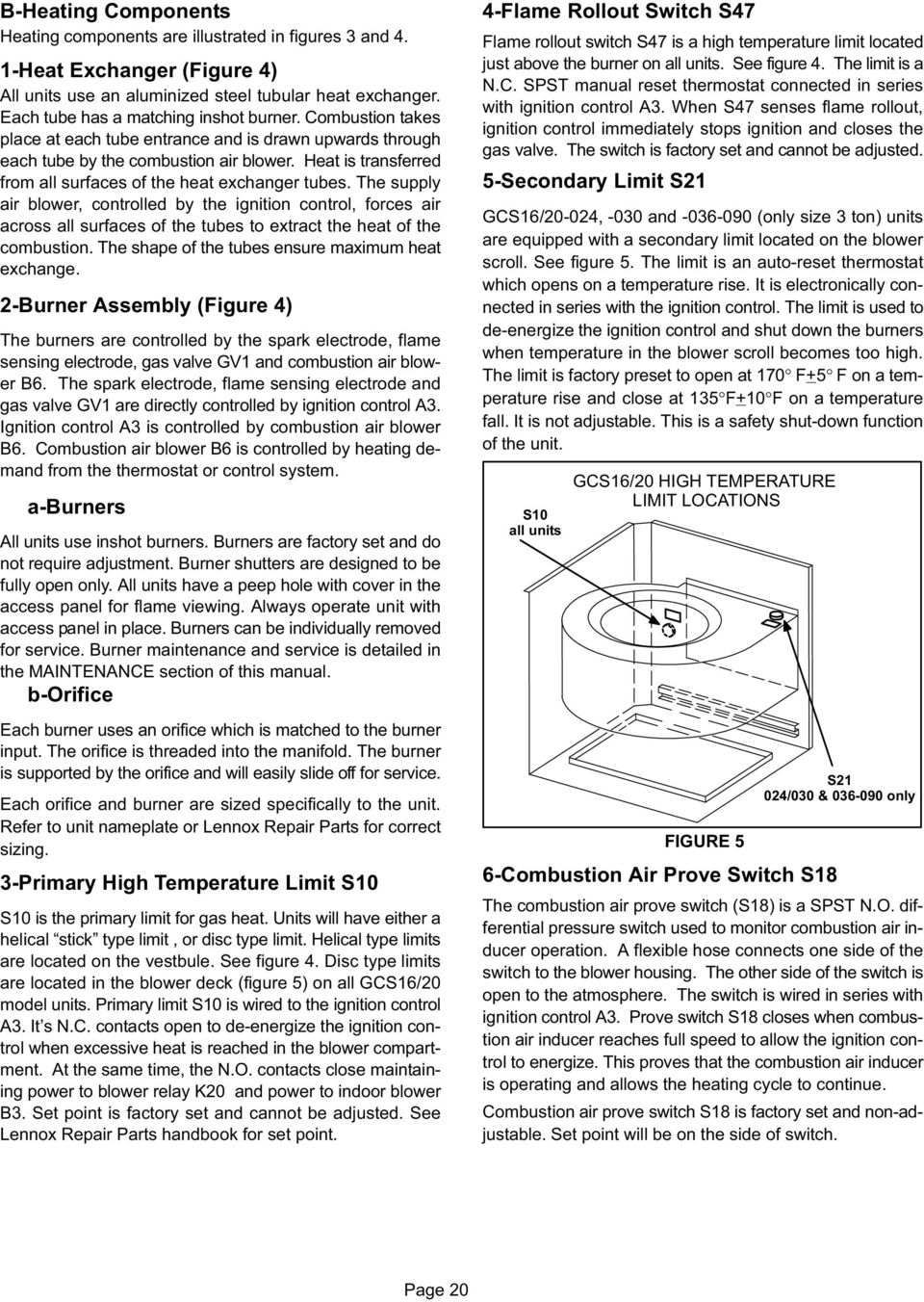
20 B Heating Components Heating components are illustrated in figures 3 and 4. 1 Heat Exchanger (Figure 4) All units use an aluminized steel tubular heat exchanger. Each tube has a matching inshot burner. Combustion takes place at each tube entrance and is drawn upwards through each tube by the combustion air blower. Heat is transferred from all surfaces of the heat exchanger tubes. The supply air blower, controlled by the ignition control, forces air across all surfaces of the tubes to extract the heat of the combustion. The shape of the tubes ensure maximum heat exchange. 2 Burner Assembly (Figure 4) The burners are controlled by the spark electrode, flame sensing electrode, gas valve GV1 and combustion air blower B6. The spark electrode, flame sensing electrode and gas valve GV1 are directly controlled by ignition control A3. Ignition control A3 is controlled by combustion air blower B6. Combustion air blower B6 is controlled by heating demand from the thermostat or control system. a Burners All units use inshot burners. Burners are factory set and do not require adjustment. Burner shutters are designed to be fully open only. All units have a peep hole with cover in the access panel for flame viewing. Always operate unit with access panel in place. Burners can be individually removed for service. Burner maintenance and service is detailed in the MAINTENANCE section of this manual. b Orifice Each burner uses an orifice which is matched to the burner input. The orifice is threaded into the manifold. The burner is supported by the orifice and will easily slide off for service. Each orifice and burner are sized specifically to the unit. Refer to unit nameplate or Lennox Repair Parts for correct sizing. 3 Primary High Temperature Limit S10 S10 is the primary limit for gas heat. Units will have either a helical stick" type limit, or disc type limit. Helical type limits are located on the vestbule. See figure 4. Disc type limits are located in the blower deck (figure 5) on all GCS16/20 model units. Primary limit S10 is wired to the ignition control A3. It s N.C. contacts open to de energize the ignition control when excessive heat is reached in the blower compartment. At the same time, the N.O. contacts close maintaining power to blower relay K20 and power to indoor blower B3. Set point is factory set and cannot be adjusted. See Lennox Repair Parts handbook for set point. 4 Flame Rollout Switch S47 Flame rollout switch S47 is a high temperature limit located just above the burner on all units. See figure 4. The limit is a N.C. SPST manual reset thermostat connected in series with ignition control A3. When S47 senses flame rollout, ignition control immediately stops ignition and closes the gas valve. The switch is factory set and cannot be adjusted. 5 Secondary Limit S21 GCS16/20 024, 030 and (only size 3 ton) units are equipped with a secondary limit located on the blower scroll. See figure 5. The limit is an auto reset thermostat which opens on a temperature rise. It is electronically connected in series with the ignition control. The limit is used to de energize the ignition control and shut down the burners when temperature in the blower scroll becomes too high. The limit is factory preset to open at 170 F+5 F on a temperature rise and close at 135 F+10 F on a temperature fall. It is not adjustable. This is a safety shut down function of the unit. S10 all units GCS16/20 HIGH TEMPERATURE LIMIT LOCATIONS FIGURE 5 S21 024/030 & only 6 Combustion Air Prove Switch S18 The combustion air prove switch (S18) is a SPST N.O. differential pressure switch used to monitor combustion air inducer operation. A flexible hose connects one side of the switch to the blower housing. The other side of the switch is open to the atmosphere. The switch is wired in series with ignition control A3. Prove switch S18 closes when combustion air inducer reaches full speed to allow the ignition control to energize. This proves that the combustion air inducer is operating and allows the heating cycle to continue. Combustion air prove switch S18 is factory set and non-adjustable. Set point will be on the side of switch. Page 20
21 7 Combustion Air Inducer B6 Combustion air inducer B6 provides fresh air to the burner while clearing the combustion chamber of exhaust gases. The inducer uses a shaded pole, 208/230VAC, single phase, 1/25 hp motor. The blower begins operating immediately upon receiving a thermostat demand and is de energized immediately when thermostat demand is satisfied. All combustion air blower motors are sealed and cannot be oiled. The tube connecting the switch to the blower flue box must be sloped in a manner that will prevent condensate from collecting in the tube. It is normal for a small amount of condensate to form in the tube during unit operation. The tube and switch must be allowed to drain accumulated condensate between thermostat demands. If the tube is positioned so that accumulated condensate is trapped in the tube, the unit may run improperly or may lock out. 8 Flue Vent and Rain Shield (Figure 6) IMPORTANT Vent cap assembly must be installed without modification. Any modification to the vent cap assembly or failure to install assembly can result in improper operation and will void the AGA/ CGA certification of the unit. CAUTION Do not start or operate unit unless vent cap is in place. FLUE VENT AND RAIN SHEILD INSTALLATION SLIDE RAIN SHIELD FLANGE UNDER UNIT TOP LIP RAIN SHIELD RAIN SHIELD (some units) BURNER ACCESS PANEL 9 Gas Valve GV1 Gas valve GV1 (figure 7) is a single-stage redundant valve manufactured by Honeywell or White Rodgers. On a call for heat, the valve is energized by the ignition control simultaneously with the spark electrode. The valve opens 1/2 to 2 seconds. When the valve is de energized, it closes in 1/2 to 3 seconds. A manual shut off knob is provided on the valve for shut off. HONEYWELL VR8205 SERIES GAS VALVE MANIFOLD PRESSURE ADJUSTMENT SCREW OFF ON GAS VALVE SHOWN IN OFF POSITION WHITE RODGERS 36E GAS VALVE NO OFF 10 Ignitor GAS VALVE SHOWN IN OFF POSITION FIGURE 7 MANIFOLD PRESSURE OUTLET MANIFOLD PRESSURE ADJUSTMENT SCREW MANIFOLD PRESSURE OUTLET Ignitor tips are located in the path of the right most burner. The spark electrode is connected to the ignition control by a 8mm silicone insulated stranded high voltage wire. The wire uses 1/4" female quick connect on the electrode end and female spark plug type terminal on the ignition control end. See figure 8 for gap dimension. 11 Sensor The sensor tip is located in the left most burner path. Flame is sensed by rectification through the flame sensing electrode. VENT GASKET VENT CAP ASSEMBLY COMBUSTION AIR INDUCER ORIFICE (stationary) COMBUSTION AIR LOUVER COVER FIGURE 6 IMPORTANT In order to maximize spark energy to the electrode, the high voltage wire should not rest on the bottom of unit vestibule panel and should touch unit cabinet as little as possible. Page 21
22 IGNITOR JOHNSON IGNITION CONTROL 1/8 spark gap C L FIGURE 8 12 Ignition Control A3 DANGER Shock Hazard. Spark related components contain high voltage. Disconnect power before servicing unit. The ignition control is not field repairable. Can cause unsafe operation, injury or death. Electronic direct spark ignition with flame rectification sensing is used in GCS16/20 units. Flame strength ranges from 0.5 to 1.0 micro-amps. Ignition controls are manufactured by Johnson. Johnson Control Figure 9 In GCS16/20 units, ignition control A3 is located in the heating compartment. On a heating demand, the ignition control is energized after proving combustion air blower operation. The control allows 30 to 40 seconds for the combustion air blower to vent exhaust gases from the burner. The ignition control then activates gas valve GV1, the spark electrode, the flame sensing electrode and blower relay K25. The ignition control is not adjustable. The Johnson control is illustrated in figure 9. The unit wires plug directly into the side of the control. The spark electrode wire connects to the spark plug-type connector on top of the control. FIGURE 9 a The ignition control provides three main functions: gas valve control, ignition and flame sensing. It is powered only after the combustion air prove switch has closed and as long as other safety switch circuits are closed. The ignition attempt sequence provides three trials for ignition before locking out. The blower control (K25) is energized simultaneously with the gas valve, so the blower will energize 45 seconds after flame has successfully been established. The unit will usually ignite on the first attempt. See figure 10 for a normal ignition sequence with nominal timings for simplicity. b Proper gas/air mixture is required for ignition on the first attempt. If there is any deviation, within tolerance of the unit, a second or third trial may be necessary for ignition. The control will lock out the heating system if ignition is not obtained within three trials and the (indoor) blower will not start. Reset after lockout requires only breaking and remaking thermostat demand. See figure 10 for the ignition attempt sequence with retrials (nominal timings given for simplicity). Loss of flame during a heating cycle is indicated by an absence of flame signal. If this happens, the control will immediately restart the ignition sequence and then lock out if ignition is not gained within three trials. c The specific timings for the Johnson ignition control are shown in figure 10. Page 22
23 ÉÉÉ ON / CLOSED OFF / OPEN THERMOSTAT DEMAND combustion air BLOWER combustion air PROVE SWITCH ÉÉÉ ÉÉÉ ON OFF JOHNSON NORMAL IGNITION SEQUENCE TIMINGS NOMINAL GAS VALVE IGNITION SPARK BLOWER IGNITION TRIAL THERMOSTAT DEMAND combustion air BLOWER combustion air PROVE SWITCH GAS VALVE IGNITION SPARK BLOWER IGNITION TRIAL ÉÉÉ ÉÉÉ UP TO 5 SEC END OF DEMAND ÉÉÉÉÉÉÉÉÉÉÉÉÉ ÉÉÉÉÉÉÉÉÉÉÉÉÉ ÉÉÉÉÉÉÉÉÉÉÉÉÉ ÉÉÉÉÉÉÉÉÉ ÉÉ 1 ÉÉÉÉÉÉÉÉÉÉ ÉÉÉÉÉÉÉÉÉÉ RETRIALS IGNITION ATTEMPT SEQUENCE TIMINGS NOMINAL UP TO 5 SEC ON OFF THERMOSTAT DEMAND combustion air BLOWER GAS VALVE IGNITION SPARK BLOWER IGNITION TRIAL ÉÉÉÉÉÉÉÉÉÉÉÉÉÉÉÉÉÉÉÉ ÉÉÉÉÉÉÉÉÉÉÉÉÉÉÉÉÉÉÉÉ ÉÉÉÉÉÉÉÉÉÉÉÉÉÉÉÉÉÉÉ ÉÉ ÉÉ ÉÉ SECONDS 0 30 United Technologies Control Figure 11 The ignition control provides four main functions: gas valve control, blower control, ignition, and flame sensing. The control has a green LED to show control status (table 1). The control is designed to ignite on the first attempt; however, the ignition attempt sequence provides three trials for ignition before locking out. The lockout time for is 1 hour. A After lockout, the ignition control automatically resets and provides three more attempts at ignition. Manual reset after lockout requires breaking and remaking power to the ignition control. 24 volt thermostat connections (P2) and heating component connections (P1) are made through separate jackplugs. See table 2 for thermostat terminations and table 3 for heating component terminations. IGNITION CONTROL TIMING LOCKOUT 8 SEC. TRIAL END OF THERMOSTAT DEMAND HEATING ÉÉÉÉÉÉÉÉÉÉÉÉÉÉ CYCLE ÉÉÉÉÉÉÉÉÉÉÉÉÉÉ ÉÉÉÉÉÉÉÉÉÉÉÉÉÉ É ÉÉ É ÉÉÉÉÉÉÉ ÉÉÉ ÉÉÉ 42 SEC. 122 SEC. WATCHGUARD FIGURE 10 TABLE 1 LED STATUS Slow Flash Normal operation. No call for heat. Fast Flash Normal operation. Call for heat. 2 Flashes Lockout. Failed to detect or sustain flame. 3 Flashes Prove switch or Rollout Switch open or closed. 4 Flashes Limit switch open. 5 Flashes Flame sensed but gas valve not open. Steady Internal failure in the control. Page 23
24 IGNITION CONTROL A3 (UNITED TECHNOLOGIES SHOWN) LED FIGURE 11 TABLE 2 P2 TERMINAL DESIGNATIONS Pin # Function 1 Y Cool Demand 2 C Common 3 W1 Heat Demand 4 G Indoor Blower 5 R 24 Volts to thermostat TABLE 3 P1 TERMINAL DESIGNATIONS Pin # Function 1 Limit Switch Out 2 Rollout Switch / Prove Switch Out 3 Ground 4 Gas Valve Out 5 Rollout Switch / Prove Switch In 6 Limit Switch In Flame rectification sensing is used on all GCS16/20 units. Loss of flame during a heating cycle is indicated by an absence of flame signal ( 0.5 microamps). If this happens, the control will immediately restart the ignition sequence and then lock out if ignition is not gained after the third trial. See System Service Checks section for flame current measurement. The control shuts off immediately in the event of a power failure. Upon restoration of power, the control will restart the ignition sequence and continue until flame is established or system locks out. Operation On a heating demand, the ignition control checks for a closed limit switch and open prove switch. Once this check is complete and conditions are correct, the ignition control then allows 30 seconds for the combustion air inducer (CAI) to vent exhaust gases from the burners. When the CAI is purging the exhaust gases, the CAI prove switch is closing proving that the CAI is operating before allowing the ignition control to energize. If the prove switch does not close within the 300 seconds, the control de energizes the CAI for another 300 seconds and then re energizes the CAI again. This cycle will continue as long as there is a call for heat and the CAI prove switch is open. Once the CAI switch is proven closed, the control begins a 30 second pre purge period. After the pre purge period the ignition control activates gas valve, the spark electrode and the flame sensing electrode. Once the gas valve is energized the non adjustable 45 second indoor blower delay period begins. Sparking stops immediately after flame is sensed. The control then proceeds to steady state" mode where all inputs are monitored to ensure the limit switch, rollout switch and prove switch are closed as well as flame is present. When the heat call is satisfied the gas valve is de energized and a 150 second blower off delay begins. Page 24
25 PLUMBING COMPONENTS GCS16/20 GCS16 024/030 GCS20 024/030/036, GCS SENSING BULB DISCHARGE LINE SENSING BULB SUCTION LINE TXV VALVE TXV VALVE STRAINER STRAINER HIGH PRESSURE SWITCH S4 SUCTION LINE RECIPROCATING COMPRESSOR HIGH PRESSURE SWITCH S4 SCROLL COMPRESSOR DISCHARGE LINE GCS20 042, GCS16/ GCS SENSING BULB STRAINER SENSING BULB SUCTION LINE STRAINER DISCHARGE LINE TXV VALVE SUCTION LINE TXV VALVE DISCHARGE LINE HIGH PRESSURE SWITCH S4 SCROLL COMPRESSOR HIGH PRESSURE SWITCH S4 RECIPROCATING COMPRESSOR FIGURE 12 Page 25
26 C Cooling Components Figure 12 WARNING Refrigerant can be harmful if it is inhaled. Refrigerant must be used and recovered responsibly. Failure to follow this warning may result in personal injury or death. All units use DX cooling. All units use a single slab type enhanced fin evaporator with rifled tubing and a thermal expansion valve TXV" as the primary expansion device. All models use draw-through type condenser fans. 1 Reciprocating Compressor All GCS16 model units (except the 036 and 048) are equipped with a reciprocating compressor. All compressors are protected by internal pressure releif valves for overload and internal crankcase heaters HR1 for proper lubrication. Compressor B1 operates during cooling demand and is energized by contactor K1 upon receiving thermosatat demand. For compressor specifications see compressor nameplate or ELECTRICAL DATA section in this manual. 2 Scroll Compressor All GCS20 model units and GCS16 036/048 utilize a scroll compressor. SCROLL COMPRESSOR The scroll compressor DISCHARGE design is simple, efficient and requires few moving parts. A cutaway diagram SUCTION of the scroll compressor is shown in figure 13. The scrolls are located in the top of the compressor can and the motor is located in the bottom of the compressor can. The oil level is immediately below the FIGURE 13 motor and oil is pressure fed to the moving parts of the compressor. The lower portion of the compressor shell is exposed to low side pressure while only the very top of the shell is exposed to high side pressure. The scroll is a simple compression concept centered around the unique spiral shape of the scroll and its inherent properties. Figure 14 shows the basic scroll form. Two identical scrolls are mated together forming concentric spiral shapes (figure 15). One scroll remains stationary, while the other is allowed to orbit (figure 16 1). Note that the orbiting scroll does not rotate or turn but merely orbits the stationary scroll. FIGURE 14 The counterclockwise orbiting scroll draws gas into the outer crescent shaped gas pocket created by the two scrolls (figure 16 2). The centrifugal action of the orbiting scroll seals off the flanks of the scrolls (figure 16 3). As the orbiting motion continues, the gas is forced toward the center of the scroll and the gas pocket becomes compressed (figure 16 4). When compressed gas reaches the center, it is discharged vertically into a chamber and discharge port in the top of the compressor (figure13). The discharge pressure forcing down on the top scroll helps seal off the upper and lower edges (tips) of the scrolls (figure 15). During a single orbit, several pockets of gas are compressed simultaneously providing smooth continuous compression. CROSS SECTION OF SCROLLS DISCHARGE DISCHARGE STATIONARY SCROLL PRESSURE TIPS SEALED BY DISCHARGE PRESSURE ORBITING SCROLL FIGURE 15 SUCTION Page 26
27 SUCTION SUCTION ORBITING SCROLL 1 2 INTERMEDIATE PRESSURE GAS CRECENT SHAPED GAS POCKET SUCTION POCKET SUCTION STATIONARY SCROLL FLANKS SEALED BY CENTRIFIGUAL FORCE MOVEMENT OF ORBIT SUCTION 3 4 HIGH PRESURE GAS FIGURE 16 DISCHARGE POCKET The scroll compressor is tolerant to the effects of liquid return. If liquid enters the scrolls, the orbiting scroll is allowed to separate from the stationary scroll. The liquid is worked toward the center of the scroll and is discharged. If the compressor is replaced, conventional Lennox cleanup practices must be used. Due to its efficiency, the scroll compressor is capable of drawing a much deeper vacuum than reciprocating compressors. Deep vacuum operation can cause internal fusite arcing resulting in damaged internal parts and compressor failure. It is permissible to pump-down" the system using the compressor but never use a scroll compressor for drawing a vacuum on the system. This type of damage can be detected and will result in denial of warranty claims. CAUTION The head of a scroll compressor may be hot since it is in constant contact with discharge gas. Contact could result in serious burns. For compressor specifications see compressor nameplate or ELECTRICAL DATA section in this manual. All compressors are protected by internal overload protection circuitry. 3 Run Capacitor C5 (single phase only) GCS single phase units, use run capacitor C5 to maximize compressor efficiency. See side of capacitor for ratings. Three phase models will not use capacitor C5. DANGER Shock hazard. Compressor must be grounded. Do not operate without protective cover over terminals. Capacitors contain high voltage. Disconnect power before removing cover. Discharge capacitors before servicing unit. Disconnect power before servicing unit. Can cause unsafe operation, injury or death. 4 Dual Capacitor C12 (single phase only) GCS16/20 single-phase units (except GCS16 060) use a single dual" capacitor for both the fan motor and the compressor. The fan side of the capacitor and the compressor side of the capacitor have different mfd ratings. The capacitor is located inside the compressor compartment. Ratings will printed on capacitor side. 5 Condenser Fan and Motor B4 The specifications section in this manual shows the specifications of condenser fans used in GCS16/20s. The condenser fan in all units is controlled by cooling contactor K1. 6 Condenser Fan Motor Capacitor C1 All GCS16/20 units use single-phase PSC condenser fan motors. See condenser fan motor nameplate for capacitor ratings. Page 27
28 7 Blower Motor B3 and Run Capacitor C4 All GCS16/20 series units use single-phase PSC blower motors. A single run capacitor is mounted on the blower housing. Ratings for capacitor will be on motor nameplate. All motors use multiple speed taps. Typically, the high speed tap is energized during compressor operation and a lower speed tap is energized during heating operation. See motor nameplate or ELECTRICAL DATA section for motor specifications. 8 Evaporator Coil All GCS16/20s have a single slab evaporator coil. The coil has two rows of rifled copper tubes fitted with ripple edged aluminum fins. A Thermal Expansion Valve (TXV) feeds multiple parallel circuits through the coil. See figure 17. EVAPORATOR PLUMBING GCS16/20 SUCTION LINE SENSING BULB STRAPPED TO SUCTION LINE EVAPORATOR FIGURE 17 FEEDER TUBES LIQUID LINE EQUALIZER LINE COMPRESSOR COMPARTMENT FREEZESTAT 9 High Pressure Switch S4 S4 is a manually reset SPST N.C. high pressure switch which opens on pressure rise. The switch is located on the discharge line and wired in series with compressor contactor K1. The switches on GCS16/20 036, 042, 060 dash 6 units ONLY are set at 450±10 psig (3103 kpa± 69 kpa). For all other GCS16/20 dash number units, when discharge pressure rises above 410 ± 10 psig (2827 ± 69 kpa) the switch opens and the compressor is de energized (the economizer can continue to operate). After the problem has been found and corrected, the switch can be reset by pushing in the switch button. 10 Freezestat Switch S49 All GCS16/20 units are equipped with a low temperature freezestat switch S49 located on the evaporator coil. S49 is wired in series with high pressure switch S4 and compressor contactor K1. S49 is a SPST N.C. auto reset switch which opens at 29 F ± 3 F ( 1.7 C ± 1.7 C) on temperature drop and closes at 58 F ± 4 F (14.4 C ± 2.2 C) on a temperature rise. To prevent coil icing, S49 opens during compressor operation to temporarily disable the compressor until the coil warms sufficiently to melt any accumulate frost. If S49 trips frequently due to coil icing, check the unit charge, air flow and filters before allowing unit back in operation. Make sure to eliminate conditions which might promote ice build up. 11 Condenser Coil All GCS16/20s have a single condenser coil. All models (except the GCS16 024) have two rows of copper filled tubes with ripple edged aluminum fins. The GCS units have one row. Page 28
29 III PLACEMENT AND INSTALLATION Make sure that the unit is installed in accordance with the installation instructions and all applicable codes. See accessories section for conditions requiring use of the optional roof mounting frame (RMF16). IV ELECTRICAL CONNECTIONS A Field Wiring Unit and optional thermostat field wiring is shown in the unit diagram section of this manual. B Power Supply Refer to start-up directions and refer closely to the unit wiring diagram when servicing. Refer to unit nameplate for minimum circuit ampacity and maximum fuse size. 230 volt units are factory wired with orange wire connected to control transformer primary. 208 volt units are field wired with red wire connected to control transformer primary. DANGER All SINGLE PHASE units use single pole contactors. One leg of compressor, capacitor and condenser fan are connected to line voltage at all times. Remove all power to disconnect before servicing. Electrical shock resulting in death or injury may result if power is not disconnected. V START-UP OPERATION A Preliminary Checks 1 Make sure unit is installed in accordance with the installation instructions and applicable codes. Make sure filter is in place, 2 Inspect electrical wiring, both field and factory installed for loose connections. Tighten as required. 3 Check to ensure that refrigerant lines are in good condition and do not rub against the cabinet or other refrigerant lines. 4 Check voltage at the disconnect switch. Voltage must be within range listed on the nameplate. If not, consult the power company and have the voltage condition corrected before starting the unit. 5 Recheck voltage with unit running. If power is not within range listed on unit nameplate, stop unit and consult power company. Check amperage of unit. Refer to nameplate for correct running amps. B Cooling Start-Up IMPORTANT The following is a generalized procedure and does not apply to all thermostat systems. Electronic thermostats may operate differently. Refer to the operation sequence section of this manual for more information. 1 Set fan switch to AUTO or ON and move the system selection switch to COOL. Adjust the thermostat to a setting far enough below room temperature to bring on the compressor. 2 Close unit disconnect switch. Compressor will start and cycle with demand. 3 The cooling circuit is charged with R 22 refrigerant. See rating plate for correct amount of charge. 4 Refer to the Refrigeration System Service Checks section for the proper method of checking charge. C Heating Start-Up: WARNING Shock and burn hazard. This unit is equipped with a direct spark ignition system. Do not attempt to light manually. BEFORE LIGHTING smell all around the appliance area for gas. Be sure to smell next to the floor because some gas is heavier than air and will settle on the floor. Use only your hand to push in or turn the gas control knob. Never use tools. If the knob will not push in or turn by hand, do not try to repair it, call a qualified service technician. Force or attempted repair may result in a fire or explosion. Gas Valve Operation (Figure 18) This unit is equipped with an automatic spark ignition system. There is no pilot. In case of a safety shutdown, move thermostat switch to OFF," then return the thermostat switch to HEAT" position. 1 If using electro-mechanical thermostat, set to the lowest setting. 2 Turn off all electrical power to appliance. 3 This appliance is equipped with an ignition device which automatically lights burner. Do not try to light burner by hand. 4 Remove heat access panel. Page 29
30 INLET PRESSURE PORT HONEYWELL VR8205 SERIES GAS VALVE MANIFOLD PRESSURE ADJUSTMENT SCREW OFF ON GAS VALVE SHOWN IN OFF POSITION WHITE RODGERS 36E GAS VALVE NO OFF MANIFOLD PRESSURE ADJUSTMENT SCREW MANIFOLD PRESSURE OUTLET GAS VALVE SHOWN IN OFF POSITION FIGURE 18 MANIFOLD PRESSURE OUTLET 5 Honeywell VR8205 Turn knob on gas valve clockwise until it stops. Depress knob and turn clockwise to OFF. White Rodgers 36E Turn knob on gas valve 180 either way to OFF. 6 Wait five minutes to clear out any gas. If you then smell gas, STOP! Immediately call your gas supplier from your neighbor s phone. Follow the gas supplier s instructions. If you don t smell gas go to next step. 7 Honeywell VR8205 Turn knob on gas valve counterclockwise until it stops. Allow knob to pop up and continue counterclockwise to ON position. White Rodgers 36E Turn knob on valve 180 either way to ON. 8 Replace heat section access panel. 9 Turn on electrical power to unit. If using electro-mechanical thermostat, set to desired setting. 10 The combustion air inducer will start. The burners will light within 40 seconds. 11 If unit does not light first time (gas line not fully purged) it will attempt up to two more ignitions before locking out. 12 If lockout occurs, repeat steps 1 through If the appliance will not operate, follow the instructions To Turn Off Gas To Unit" and call your service technician or gas supplier. B To Turn Off Gas To Unit 1 Set thermostat to lowest setting. 2 Turn off all electric power to unit if service is to be performed. 3 Remove control access panel. 4 Turn knob on Honeywell gas valve clockwise until it stops. Depress knob and turn clockwise to OFF. Turn knob on White Rodgers 180_ either way to off. Do not force. 5 Replace burner access panel. D Safety or Emergency Shutdown: Turn off power to the unit. Close the manual and/or main gas valves. E Extended Period Shutdown: Turn off the thermostat or set to UNOCCUPIED" mode. Close all gas valves both internal and external to the unit to prevent gas leakage into the combustion chamber. Turn off power to the unit. All access panels, covers and vent caps must be in place and secured. Page 30
31 VI REFRIGERATION SYSTEM SERVICE CHECKS A Cooling Start Up 1 Set thermostat system switch in Cool" position, fan switch in On" or Auto" position and adjust room thermostat to a setting below room temperature. 2 Close unit disconnect switch. 3 Compressor will start and cycle on thermostat demand. B Three Phase Compressor Rotation Three phase scroll compressors must be phased sequentially to ensure correct compressor rotation and operation. At compressor start-up, a rise in discharge and drop in suction pressures indicates proper compressor phasing and operation. If discharge and suction pressures do not function normally, follow these steps: 1 Disconnect power to the compressor and the unit. 2 Reverse any two field power leads to the unit. 3 Reapply power to the compressor and unit. Discharge and suction pressures should operate at their normal start-up ranges. NOTE The compressor noise level will be significantly higher when phasing is incorrect and will not provide cooling when operating backwards. C Charging It is not recommended that the system be charged below 60 F (15 C). If charging below 60 F (15 C) is required or if system is completely void of refrigerant, the recommended and most accurate method of charging is to weigh the refrigerant into the unit according to the amount shown on the unit rating plate. Approach Method If ambient temperature is above 60 F (15 C), read liquid line temperature. Approach temperature is the difference between liquid line temperature and ambient temperature. CAUTION Use the same thermometer for both temperature readings. Approach temperature should be as shown in table 4, 5 or 6. Refrigerant must be added to lower approach temperature. Remove refrigerant from system to increase approach temperature. TABLE 4 GCS16 APPROACH TEMPERATURES UNIT Liquid Line Temperature Minus Ambient Temperature GCS F + 1 (2.7 C + 0.5) GCS F + 1 (5.5 C + 0.5) GCS F+ 1 (6 C + 0.5) GCS F + 1 (5 C + 0.5) GCS F + 1 (5 C + 0.5) TABLE 5 GCS20 APPROACH TEMPERATURES UNIT Liquid Line Temperature Minus Ambient Temperature GCS F + 1 (2.7 C + 0.5) GCS F + 1 (5.5 C + 0.5) GCS F + 1 (5 C + 0.5) GCS F + 1 (3.8 C + 0.5) GCS F+ 1 (2.2 C + 0.5) GCS F + 1 (2.7 C + 0.5) TABLE 6 GCS20 APPROACH TEMPERATURES manufactured April 2002 and later UNIT Liquid Line Temperature Minus Ambient Temperature GCS F + 1 (4.4 C + 0.5) GCS F+ 1 (3.9 C + 0.5) GCS F + 1 (4.4 C + 0.5) Page 31
32 VII HEATING SYSTEM SERVICE CHECKS A C.S.A. Applications and Requirements All GCS16/20s are C.S.A. design certified without modification. Refer to the GCS16/20 Operation and Installation Instruction Manual for more information. B Gas Piping Gas supply piping must not allow more than 0.5"W.C. drop in pressure between gas meter and unit. Supply gas pipe must not be smaller than unit gas connection. Compounds used on threaded joints of gas piping should be resistant to the action of L.P. gas. C Testing Gas Piping Pressure IMPORTANT In case emergency shutdown is required, turn off the main shut-off valve and disconnect the main power to unit. These controls should be properly labeled by the installer. GAS PIPING TEST PROCEDURE MANUAL MAIN SHUT OFF VALVE WILL NOT HOLD TEST PRESSURE IN EXCESS OF 0.5 PSIG (14"W.C.) GAS VALVE CAP FIELD PROVIDED LINE PRESSURE TAP FIGURE 19 When pressure testing gas lines, the gas valve must be disconnected and isolated. Gas valves can be damaged if subjected to more than 0.5 psig (14"W.C.). See Figure 19. If test pressure is equal to or less than 0.5 psig (14"W.C.), use the main manual shut-off valve before testing to isolate unit from gas supply system. When checking piping connection for gas leaks, use a soap solution or other preferred means. Do not use matches, candles, flame, or other source of ignition to check for gas leaks. D Testing Gas Supply Pressure When testing gas supply pressure, connect test gauge to the inlet pressure tap (field provided). Test supply gas pressure with unit firing at maximum rate. Make sure the reading falls within the range of the following values. pressure may result in erratic operation or underfire." High pressure can result in permanent damage to the gas valve or overfire." For natural gas units, operating pressure at the unit gas connection must be between 4.5"W.C. and 10.5"W.C. For L.P. gas units, operating pressure at the unit gas connection must be between 11.0"W.C. and 13.0"W.C. On multiple unit installations, each unit should be checked separately, with and without the other units operating. Supply pressure must fall within the range listed in the previous paragraph. E Check and Adjust Manifold Pressure After line pressure has been checked and adjusted, check manifold pressure. Refer to figure 18 for location of manifold pressure adjustment screw and pressure tap outlet. The gas valve is factory set and should not require adjustment. Manifold pressure for natual gas units is 3.5" 0.3 ( ) and for propane units, ( ). The gas valve should completely and immediately cycle off in the event of gas or power failure. The manual shut-off knob can be used to immediately shut off gas supply. IMPORTANT For safety, connect a shut-off valve between the manometer and the gas tap to permit shut off of gas pressure to the manometer. Page 32
33 1 Connect a test gauge to the outlet pressure tap on the gas valve. Start the unit and allow five minutes for the unit to reach steady state. 2 While waiting for the unit to stabilize, notice the flame. The flame should be stable without flashback and should not lift from the burner head. Natural gas should burn blue. L.P. gas should burn mostly blue with some orange streaks. 3 After allowing the unit to stabilize for five minutes, record the manifold pressure. 4 Disconnect heating demand as soon as an accurate reading has been obtained. F Proper Gas Flow (Approximate) Furnace should operate at least 5 minutes before checking gas flow. Determine time in seconds for two revolutions of gas through the meter. (Two revolutions assures a more accurate time.) Divide by two and compare to time in table 7. Seconds in table 7 are based on a 1 cu.ft. dial and gas value of 1000 btu s for natural and 2500 btu s for LP. Adjust manifold pressure on gas valve to match time needed. TABLE 7 Unit in Btu s Seconds for Natural Seconds for Propane 50, , , , G High Altitude Derate Unit does not need gas pressure adjustment when operating from 0 to 7500 ft. (0 to 2248m.) H Flame Sensing Flame current is an electrical current which passes from the ignition control through the sensor electrode during unit operation. The current passes from the sensor through the flame to ground electrode to complete a safety circuit. The minimum flame current necessary to keep the ignitor from lockout is 0.1 microamps. The electrodes should be located so the tips are at least 1/2" inside the flame envelope. Do not bend electrodes. To measure flame current, follow the procedure below: 1 Disconnect power to unit. 2 Remove lead from sensing electrode and install a microamp meter in series between the sensing electrode and the sensing lead. 3 Reconnect power and adjust thermostat for heating demand. 4 When flame is established, meter reading should be.5 to 1.0 microamps. Do not bend electrodes. 5 If the meter scale reads 0, the leads are reversed. Disconnect power and reconnect leads for proper polarity. 6 When finished, disconnect power to unit before disconnecting meter. Make sure sensor wire is securely reconnected before reconnecting power to unit. VIII INDOOR BLOWER OPERATION / ADJUSTMENT A Blower Operation The following is a generalized procedure and does not apply to all thermostat control systems. 1 Blower operation is dependent on the thermostat option that has been installed in the GCS16/20. 2 Generally, blower operation is set at the thermostat subbase fan switch. With the fan switch in the ON" position, the blower operates continuously. With the fan switch in the AUTO" position, the blower cycles with demand (or, with some control systems, runs continuously while the heating or cooling circuits cycle). 3 In most cases, the blower and entire unit will be off when the system switch is in the OFF" position. The only exception is immediately after a heating demand until blower control switches off. B Determining Unit CFM 1 The following measurements must be made with a dry indoor coil. Run the blower without the cooling demand. Air filters must be in place when measurements are taken. 2 Measure static pressure external to the unit (from supply to return). Page 33
34 To Measure Discharge Static Pressure: a Measure tap locations as shown in figure 20. b Punch a 1/4" diameter hole. Insert manometer hose flush with the inside edge of hole or insulation. Seal around hole with permagum. Connect zero end of manometer to the discharge (supply) side of STATIC PRESSURE TAP LOCATIONS UNIT system. Connect other MANOMETER end of manometer to return FIGURE 20 duct as above. c With only the blower motor running, observe the manometer reading. d Seal around the hole when check is complete. 3 The CFM can be adjusted by changing the motor speed taps. Follow the blower speed change instructions below. C Blower Speed Adjustment V UNITS Blower speed selection is accomplished by changing the taps in the harness connector at the blower motor (see figure 21 ). See wiring diagram for blower speeds. Each motor port in a leadless motor (figure 21) is analogous to speed taps (pigtails) used in previous Lennox units. Each motor is capable of four or five different speeds depending on unit (refer to unit wiring diagram). Each unit is factory wired to provide a single cooling speed and a single heating speed. Speeds can be changed by moving the cooling wire or the heating wire to a different port at the harness connector V UNITS Blower speed selection is accomplished by changing the J38 blower speed jack in the return air section. See unit wiring diagram. PORT TAB BLOWER SPEED TAP SELECTION 208/230V UNITS IMPORTANT USE J38 TO CHANGE BLOWER SPEED ON V UNITS; FAILURE TO DO SO WILL DAMAGE MOTOR. HARNESS CONNECTOR DEPRESS TAB TO RELEASE WIRE TERMINAL. SELECT CONNECTOR LOCATION FOR NEW SPEED (REFER TO UNIT WIRING DIAGRAM). INSERT WIRE UNTIL IT IS SECURELY IN PLACE. FIGURE 21 Heating Speed: Factory blower speeds are listed in a table on the unit wiring diagram. Adjust the blower heating speed for proper air temperature rise (listed on unit rating plate). To measure temperature rise, place thermometers in the supply and return air plenums. Turn up thermostat to start the unit. After plenum thermometers have reached their highest and most steady readings, subtract thermometer readings. The difference should be in the range listed on unit rating plate. If this temperature is high, wire the blower to a higher speed; if resulting temperature is too low, wire the blower to a slower speed. Repeat this procedure until desired temperature rise is obtained. Cooling Speed: Factory blower speeds are listed in a table on the unit wiring diagram. Blower performance tables are listed in the first section of this manual. Section VIII B Determining Unit CFM" shows how to measure discharge static pressure. Once discharge static pressure has been determined, compare the value to the blower performance tables listed in the first section of this manual. If CFM is low, wire the blower to a higher speed; if CFM is high, wire the blower to a lower speed. Repeat this procedure until desired CFM is reached. Page 34
35 IX MAINTENANCE e CAUTION Potential for personal injury. Disconnect power to unit before performing any maintenance or service operation. Avoid contact with sharp metallic edges. Can cause personal injury or death. CAUTION Potential for personal injury. Remember to follow lighting instructions attached to the unit before putting unit back into operation. Can cause property damage, unit damage and personal injury or death. A Lubrication All motor bearings are prelubricated. No further lubrication is required. B Filters Filters are provided with the GCS16/20 units and installed in the return air duct. See Installation Instructions. Filters should be checked monthly (or more frequently in severe use) and cleaned or replaced regularly. Take note of the "AIR FLOW DIRECTION" marking on the filter frame when re installing. IMPORTANT FIlters must be U.L.C certified or equivalent for use in Canada. C Burners Clean burner as follows: 1 Turn off both electrical power and gas supply to unit. 2 Open access panel to burner compartment. 3 Remove burner retaining bracket and gas manifold. Lift burners from orifices. 4 Clean as necessary and replace burners. Refit retaining brackets and gas manifold. Make sure that burner heads line up correctly. Spark gap on ignition electrode must be properly set. Refer to Heating Adjustment section. Close access panel. 5 Restore electrical power and gas supply. Follow lighting instructions attached to unit to restart unit. D Combustion Air Inducer All GCS16/20s use combustion air inducers with pre lubricated sealed stainless steel ball bearings. A differential pressure switch (combustion air prove switch) is used to prove combustion air inducer operation. If the inducer is obstructed, the switch will not close and the ignition control will be locked out. Under normal operating conditions, the combustion air inducer wheel should be inspected prior to the heating season to determine if cleaning is necessary. With the power supply disconnected, the condition of the blower wheel can be determined by looking through the vent opening. Maintenance consists of: 1 Checking prove switch. Prove switch should close at the factory setting shown on side of switch. 2 Check the combustion air pressure switch hose for blockage or deterioration. Replace if necessary. 3 Position hose so accumulated condensate can drain from the switch into blower housing. 4 Clean combustion air inducer assembly. To clean combustion air blower: 1 Shut off power supply and gas to the unit. 2 Remove screws retaining the vent cap and combustion air inducer to the end panel. Clean vent cap as necessary. Check gaskets for deterioration. Replace if necessary. Pay close attention to the order in which flue orifice and gaskets are installed. 3 Remove screws holding blower housing to the flue box cover plate and wires attached to motor. 4 Remove combustion air inducer assembly. 5 Clean with a wire brush as required. 6 Remove burner assembly from unit as described in burner section above. 7 Clean heat exchanger tubes with a wire brush as required. 8 Replace flue box cover and burner assembly. Replace combustion air inducer assembly including gaskets. CAUTION Use care when cleaning combustion air blower wheel. Wheel is made of aluminum and may distort if too much pressure is applied. 9 Reconnect tubing connecting blower to flue box. Arrange tubing so that it can drain accumulated condensate. 10 Clean vestibule panel louvers using a small brush. E Flue Make sure the flue is clean and free of debris. F Evaporator Coil 1 Clean coil, if necessary. 2 Check connecting lines and coil for oil leaks. 3 Check condensate drain pan and line, if necessary. G Condenser Coil 1 Clean and inspect condenser coil. (May be flushed with a water hose.) 2 Visually inspect connecting lines and coils for evidence of oil leaks. H Electrical 1 Check all wiring for loose connections. 2 Check for correct voltage at unit (unit operating). 3 Check amp draw on both condenser fan motor and blower motor. Page 35
36 X ACCESSORIES A RMF16 Mounting Frame When installing a GCS16/20 unit on a combustible surface for downflow discharge applications, RMF16 roof mounting (figure 22) frame is required. Otherwise, the RMF16 is recommended but not required. The GCS16/20, RMF16 MOUNTING FRAME FIGURE 22 if not mounted on a flat (roof) surface, MUST be supported under all edges and under the middle of the unit to prevent sagging. The GCS16/20 MUST be mounted level within 1/16" per linear foot in any direction. The assembled RMF16 mounting frame is shown in figure 22. Refer to the RMF16 installation instructions for details of proper assembly and mounting. Roof mounting frame MUST be squared to roof before mounting. Plenum system MUST be installed before unit is set on mounting frame. Refer to RMF16 installation instructions for proper plenum construction. Many types of roof framing or supports can be used to mount the GCS16/20 unit, depending upon different roof structures. A typical field fabricated roof mounting frame is shown in figure 23. TYPICAL FIELD FABRICATED MOUNTING FRAME UNIT REMD16 DOWNFLOW ECONOMIZER REMD16M DOWNFLOW ECONOMIZER OUTDOOR AIR DAMPERS ENTHALPY CONTROL TYPICAL (REMD16M shown) CONTROL ACCESS COVER DAMPER MOTOR RETURN AIR FILTER RETURN AIR DAMPERS FIGURE 24 OUTDOOR AIR DAMPER HOOD Refer to the REMD16 41/65 Installation Instruction Manual for specific details regarding installation. The physical location of controls in the REMD16M and REMD16 economizers is shown in figures 25 and 26. ENTHALPY CONTROL ACCESS COVER REMOTE MOUNTING BASE REMD16M PARTS ARRANGEMENT CONTROL ACCESS COVER NOTE Mixed air sensor is shown as it is factory installed in a REMD16M 41. REMD16M 65 is similar. MIXED AIR SENSOR DAMPER MOTOR MOUNTING FRAME FIGURE 23 B REMD16 Downflow Economizer REMD16M Downflow Economizer 1 Application The economizer opens a set of dampers to allow 0 to 100 percent outdoor air to be used for cooling when outdoor humidity and temperature are acceptable. Additional (2nd stage) cooling demand is directed to the compressor while the dampers remain open. If outdoor air becomes unacceptable, the outdoor air dampers close to a predetermined minimum position while the compressor cooling circuit cycles as needed. FIGURE 25 Page 36
37 REMD16 PARTS ARRANGEMENT ACCESS COVER ENTHAL- PY CONTROL MIXED AIR SENSOR CON- TROL NOTE Mixed air sensor and sensing bulb are shown as they are factory installed in a REMD CHART CURVE A B C D CONTROL POINT 50% RH F C FIGURE 26 ENTHALPY CHART OUTDOOR AIR DAMP- ERS DAMPER MOTOR MIXED AIR SENSING BULB RETURN AIR DAMPERS 2 Economizer Operation a Enthalpy Control: Setpoint Control The key to economizer operation is the enthalpy control. The enthalpy control senses the total heat content of the outside air (temperature plus humidity) and uses that information to control the amount of outside air brought into the system. When the enthalpy of outside air is below the control setpoint, the control actuates a motor which in turn adjusts the outdoor dampers to meet the cooling demands of the building. When the heat content rises above the control setpoint, the control de-activates and the dampers close to the preset minimum position (not closed) position. Two types of adjustment may be made at the control. The first is the control setpoint. The setpoint determines the temperature and humidity conditions at which the outdoor air dampers will open and close. The recommended setpoint is A." If the economizer is allowing air which is too warm or too humid into the system, the control may be changed to a lower setpoint (B,C or D). Refer to enthalpy chart figure 27. Example: If the enthalpy control is set at setpoint A" as shown in figure 27, the following situation could occur. A cooling demand when the outside air is at 75 and 20 percent humidity would drive the economizer outdoor air dampers open to utilize outdoor air for cooling. The compressor cooling circuit would be disabled. However, if the outdoor air should change to 70 F (a drop in temperature) and 70 percent humidity (a dramatic rise in humidity), the total heat content" of the outdoor air would rise above the enthalpy control setpoint and de activate the damper motor to the preset minimum position. If cooling demand is still present when the total heat of the outside air rises above the control setpoint, cooling demand is routed from the economizer to the compressor cooling circuit. FIGURE 27 Page 37
38 b Minimum Positioner The second type of adjustment which may be made at the control is the minimum position of the outdoor damper blades. Each economizer has a minimum positioner switch (potentiometer) which allows the outdoor dampers to be adjusted to a preset minimum position. This allows a preset amount of air exchange at all times during unit operation. When unit operation stops, the dampers drive fully closed. The potentiometer is located on the enthalpy control face (modulating economizer) or on the damper motor (three position economizer.) c Enthalpy Sensor The enthalpy sensor is located on the outside portion of the outdoor damper blades (as shown in figure 28). The sensor monitors the total heat content of the outdoor air (temperature plus humidity) and sends the information to the enthalpy control. The enthalpy control uses the information to determine if outdoor air can be used for cooling. ENTHALPY SENSOR ALL ECONOMIZERS ENTHALPY SENSOR FIGURE 28 OUTDOOR AIR DAMPERS DAMPER HOOD d Mixed Air Sensor The sensor measures the resultant temperature of the mixed air downstream of the evaporator coil. The mixed air temperature is used by the enthalpy control when outdoor dampers are open to help determine whether outdoor air dampers should close. There are two types of economizers: modulating and threeposition. Modulating economizers are equipped with a single mixed air sensor. Three position economizers are equipped with a separate sensor (switch) and sensing bulb which are connected by a cap tube. The mixed air sensor (bulb) is located in the supply air stream. The sensor (modulating economizer) or sensing bulb (three position economizer) fits through a factory supplied hole in the panel dividing the unit return and supply air. The three position economizer sensor (switch) mounts to pre drilled holes in the unit panel dividing return and supply air. e Wiring, Installation, Maintenance The economizer uses pigtail connectors to connect to the GCS16/20 s harness connector located in the blower compartment. For specific details of economizer wiring and operation, refer to the sequence of operation section of this manual. f Modulating Damper Motor Check Honeywell W7459A 1 Disconnect main power to the unit. 2 Turn thermostat control to OFF position (occupied mode). 3 Install jumper across terminals 6 9 on blower relay K20 in unit control box. 4 Install jumper across enthalpy control terminals T and T1. See figure 29 for location. 5 Restore power to unit. Outdoor damper should drive to fully open position (60 to 90 sec. required for full travel). Observe travel for proper damper operation. 6 Disconnect power to the unit. Outdoor damper should spring return to closed position. 7 Remove T and T1 jumper then restore power to the unit. Outdoor damper should drive to minimum position. Adjust minimum damper position pot located on control. See figure 1. 8 Disconnect power to unit and remove jumper on blower relay terminals 6 9. Replace all panels. Restore power to unit. MODULATING SOLID STATE ENTHALPY CONTROL MINIMUM POSITIONER B A LED TR C D 1 3 T P TR T1 P1 FIGURE 29 Page 38
39 g Three Position Damper Motor Check Honeywell W7459C 1 Disconnect main power to the GCS16/20. 2 Remove the control access cover (see figures 25 and 26). 3 Install jumper across enthalpy control terminals D and TR1. See figure 30 for location. THREE POSITION SOLID STATE ENTHALPY CONTROL B A LED TR C S O D S R TR X D FIGURE 30 4 Restore power to unit. Outdoor damper should drive to fully open position (requires approximately 90 seconds for full travel). Observe travel for proper damper operation. 5 Disconnect power to unit. Damper should spring return to closed position. 6 Remove jumper installed in step 3. Install jumper across enthalpy control terminals X and TR1. See figure 30 for terminal location. 7 Restore power to unit. Outdoor damper should drive to mid (minimum) position (requires approximately 90 seconds for full travel). Adjust minimum position by turning thumb wheel on damper motor. 8 Disconnect power to unit and remove jumper. Replace all panels. Restore power to unit. h Warm Up Kit An optional warm up kit may be added to either REMD16 or EMDH16 economizer. The warm up kit holds the dampers closed during night setback and morning warm up. When the first thermostat demand of the day is satisfied, the warm up kit opens the outdoor dampers to minimum position. The warm up kit mounts to the GCS16/20 in the control mounting area of the blower compartment. The kit plugs into the unit wiring harness inline between the unit and the economizer. For detailed wiring and operation, refer to the sequence of operation section of this manual. i Night Relay Optional night relay must be added to economizer when night setback functions are desired with electromechanical control systems. Kit includes a DPDT relay which is hard wired to the economizer harness. C OAD16 Outdoor Air Damper OAD16 damper section may be installed any place outside of the building in the return air duct. Refer to OAD16 installation instruction manual for specific details regarding installation. The washable filter supplied with the OAD16 can be cleaned with water and mild detergent. It should be sprayed with Filter Handicoater when dry prior to reinstallation. Filter Handicoater is R.P. Products coating no. 418 and is available as Lennox Part No. P D LPG Kit All C.S.A rated GCS16/20s are factory set for use with natural gas. An optional L.P.G. conversion kit allows changeover from natural to L.P.G. supply. The kit includes a gas valve changeover kit and new gas orifices. See OPTION- AL ACCESSORIES" section for kit number. Refer to the L.P.G. conversion kit installation instruction for specific installation procedures. E Condenser Coil Guard Kit Condenser coil guards are standard equipment for GCS20 single phase units only, but a kit for all other models is available. The kit includes PVC coated steel wire coil guard which is field installed. F Ambient Kit The optional low ambient kit (figure 31) allows for mechanical cooling operation at low outdoor temperature. ambient kit field wiring is shown in figure 32. The low ambient pressure switch is wired in series with the condenser fan L1 lead. Refer to the low ambient kit installation instruction manual for detailed installation instructions. Page 39
40 The low ambient pressure switch cycles the condenser fan while allowing normal compressor operation. This intermittent fan operation results in a high evaporating temperature which allows the system to operate without evaporator coil icing and losing capacity. LOW AMBIENT KIT (TYPICAL INSTALLATION) LOW AMBIENT ADJUSTMENT KNOB SECURING SCREW ROTATE COUNTERCLOCKWISE FIXED STOP DISCHARGE LINE LOW AMBIENT PRESSURE SWTICH ADJUSTMENT KNOB SET INDICATOR AT 140 PSIG COMPRESSOR LIQUID LINE SHOCK LOOP VALVE DEPRESSOR TEE SUCTION LINE GAUGE PORT SUCTION LINE FIGURE 31 Adjustment: The low ambient pressure switch is adjustable but the adjustment knob does not adjust CUT IN or CUT OUT points. CUT IN point is fixed and cannot be adjusted. The scale on the switch measures the difference in pressure between preset CUT IN and adjustable CUT OUT points. Adjustment knob changes CUT OUT point by adjusting the DIF- FERENCE between CUT IN and CUT OUT. The low ambient pressure switch is factory set to CUT IN at 285psig with a difference of 145 psig (CUT OUT at 140psig). Adjustment should not be needed. If adjustment is needed, adjust the switch as follows: 1 Loosen knob securing screw to allow knob stop to pass over fixed stop on control (see figure 33). FIGURE 33 DIFFERENCE (set by knob) = CUT IN POINT (fixed) minus CUT OUT POINT To find CUT OUT point, this equation can be re arranged: CUT OUT = CUT IN minus the DIFFERENCE. 2 Rotate the knob as needed to set the difference indicator at 145psig (1000kPa). 3 Tighten the securing screw after adjusting. G SRT 65 Transitions Optional supply/return transitions are available for use with downflow GCS16/20s utilizing the optional RMF16 roof mounting frame. The transition must be installed in the RMF16 mounting frame before mounting the GCS unit to the frame. Refer to the manufacturer s instructions included with the transition for detailed installation procedures. H RTD9 65 and FD9 65 Diffusers Optional flush mount diffuser/return FD9 65 and extended mount diffuser/return RTD9 65 are available for use with the GCS16 unit. Refer to the manufacturer s instructions included with the transition for detailed installation procedures. Page 40
41 XI Wiring Diagrams and Operation Sequence TYPICAL GCS16/GCS20 FIELD WIRING DIAGRAM SINGLE PHASE Page 41
42 TYPICAL GCS16/GCS20 FIELD WIRING DIAGRAM THREE PHASE Page 42
43 TYPICAL GCS16/GCS20 FIELD WIRING DIAGRAM THREE PHASE Page 43
44 Operation Sequence Cooling: 1 Line voltage energizes transformer T1. Transformer T1 provides 24VAC power to all unit controls and thermostat. 2 Cooling demand energizes Y1 and G in the thermostat. K1 compressor contactor and K3 blower relay energizes. 3 K1 1 closes to energize compressor terminal C and condenser fan. Compressor B1 and condenser fan B4 immediately begin operating. Single Phase Reciprocating Compressor Only Potential Relay K31 remains closed during start up and capacitor C7 remains in circuit. As compressor gains speed, K31 is energized and N.C. contacts open taking C7 out of the circuit. 4 K3 1 contacts close to energize the indoor blower on cooling speed. Heating: 5 Heating demand initiates at W1 in the thermostat and energizes relay K13. Heating demand also passes through high temperature limit S10 to combustion air prove switch S18. GCS16/20 SEQUENCE OF OPERATION Johnson Ignition Control P, Y, G, J Voltage 6 Relay K13 terminals close to energize combustion air blower B6. N.O. K20 2 terminals 6 9 close to energize the economizer. When the combustion air blower nears full speed, prove switch S18 closes. Heating demand continues through S18 and through flame rollout switch S47 to energize ignition control A3. 7 Ignition control A3 then waits 30 to 40 seconds to allow combustion air blower B6 time to draw exhaust gas from combustion chamber and to introduce fresh air. Combustion air blower B6 operates throughout the heating cycle. 8 After the ignition control delay, A3 activates gas valve GV1 and the spark electrode. When flame is sensed by the flame sensor,the spark electrode stops. If flame is not sensed after the first trial for ignition, controller A3 repeats steps 7 and 8 up to two more times (depending on controller make) before locking out. If the control locks out, it can be reset by breaking and remaking thermostat demand. 9 Once flame is established, blower delay relay K25 energizes indoor blower relay K20 after a 45 second delay. Indoor blower B3 is then energized. Page 44
45 TYPICAL GCS16/GCS20 FIELD WIRING DIAGRAM SINGLE PHASE Page 45
46 TYPICAL GCS16/GCS20 FIELD WIRING DIAGRAM THREE PHASE Page 46
47 TYPICAL GCS16/GCS20 FIELD WIRING DIAGRAM THREE PHASE Page 47
48 GCS16/20 SEQUENCE OF OPERATION United Technologies Ignition Control P, Y, G, J Voltage Operation Sequence Cooling: 1 Line voltage energizes transformer T1. Transformer T1 provides 24VAC power to all unit controls and thermostat. 2 P and Y voltage Cooling demand energizes Y1 and G in the thermostat. Compressor contactor K1 is energized. G Voltage Compressor contactor K1 and blower relay K3 are energized. 3 K1 1 closes to energize compressor terminal C and condenser fan. Compressor B1 and condenser fan B4 immediately begin operating. Single Phase Reciprocating Compressor Only Potential Relay K31 remains closed during start up and capacitor C7 remains in circuit. As compressor gains speed, K31 is energized and N.C. contacts open taking C7 out of the circuit. 4 P and Y voltage Indoor blower B3 is energized on cooling speed. G voltage K3 1 contacts close to energize indoor blower B3 on cooling speed. Heating: 5 Heating demand initiates at W1 in the thermostat and A3 checks all safety switches for operation. 6 P and Y voltage Combustion air inducer B6 begins operation. K43 1 closes energizing the economizer (if applicable). When the combustion air inducer nears full speed, prove switch S18 closes. G voltage Relay K13 terminals close to energize combustion air inducer B6. K43 1 closes energizing the economizer (if applicable). When the combustion air inducer nears full speed, prove switch S18 closes. 7 Ignition control A3 waits 30 seconds to allow the combustion air inducer to draw exhaust gas from the combustion chamber and to introduce fresh air. 8 After the ignition control delay, A3 activates gas valve GV1 and the spark electrode. When flame is sensed by the flame sensor,the spark electrode stops. If flame is not sensed after the first trial for ignition, controller A3 repeats steps 7 and 8 up to two more times (depending on controller make) before locking out. If the control locks out, it can be reset by breaking and remaking thermostat demand. 9 P and Y voltage After a 45 second delay, indoor blower B3 is energized on heating speed. G voltage After 45 second delay relay K36 closes energizing indoor blower B3 on heating speed. Page 48
49 ELECTROMECHANICAL THERMOSTAT WITH ECONOMIZER Page
50 ELECTROMECHANICAL THERMOSTAT WITH ECONOMIZER Page 50 Operation Sequence: 1 Economizer outdoor air dampers drive full closed anytime blower B3 is not operating (switched by K3 2 in the unit). 2 Damper motor terminal TR is powered by unit contactor K3 when there is a blower demand or a heating demand. When 24VAC is applied between terminals TR and TR1, the damper motor is energized and the outdoor air dampers open to minimum position. 3 Blower B3 is energized (indirectly) by thermostat terminal G. On a cooling demand, thermostat terminal G energizes contactor K3 which in turn energizes the blower (refer to operation sequence on previous page for exact sequence). When K3 energizes, K3 1 closes to energize the blower and K3 2 closes to energize the economizer (see step 2) and open the outdoor air dampers to minimum position. Enthalpy, 1st Stage Cool: 4 Initial cooling demand Y1 is sent to enthalpy control A6 and terminal 1. 5 Enthalpy control A6 has determined that outside air can be used for cooling and has switched internal relays 1K and 2K. 6 Cooling demand is routed through enthalpy control to energize internal relay 1S. Internal contacts 1S1 close to complete a circuit through damper motor terminals T and T1. 7 When a voltage is applied across terminals T and T1 of damper motor, the damper motor energizes and outdoor air dampers open. Supply air sensor R1 varies the voltage across T and T1 and the outdoor air dampers open and adjust accordingly. 1st stage cooling is provided by outdoor air. Enthalpy, 2nd Stage Cool: 8 Economizer outdoor air dampers remain open. 9 Additional cooling demand is routed from thermostat Y2 through enthalpy control terminals 3 and 5 to energize the 1st stage compressors. The 1st stage compressors provide all additional cooling. Enthalpy High, 1st Stage Cool: 10 Enthalpy control internal relays 1K and 2K switch. Internal relay 1S is de energized and 1S1 opens. Outdoor air dampers close to minimum position. 11 Cooling demand is sent from thermostat terminal Y1 through enthalpy control terminals 1 and 2 and through enthalpy control terminal 5 to energize the 1st stage compressors.
GCS16-024-030-036-048-060
 Packaged Unit & Gas Heat 2-5 Ton Capacity 50,000-120,000 Btuh Input Heating Capacity GCS16-024-030-036-048-060 FEATURES Designed for outdoor rooftop or ground level installations Down-flow or horizontal
CHA16-823 thru CHA16-2753 PACKAGED UNITS COOLING & ELECTRIC HEAT
 ENGINEERING DATA CANADIAN EDITION CHA16-823 thru CHA16-2753 PACKAGED UNITS COOLING & ELECTRIC HEAT *73,000 to 240,000 Btuh (21.4 to 70.3 kw) Cooling Capacity 25,600 to 307,100 Btuh (7.5 to 90.0 kw) Optional
Commercial Gas Furnace Upflow
 Commercial Gas Furnace Upflow Model G24-200 80% A.F.U.E. 200,000 Btuh Input Heating Cap. 7.5 or 10 Tons Nominal Add-On Cooling GUK FEATURES Certified by A.G.A./C.G.A. Laboratories. Heavy gauge painted
180, 210, AND 240 MODELS LCA PACKAGED COOLING & ELECTRIC HEAT LGA PACKAGED COOLING & GAS HEAT LHA PACKAGED HEAT PUMP
 ENGINEERING DATA 180, 210, AND 240 MODELS LCA PACKAGED COOLING & ELECTRIC HEAT LGA PACKAGED COOLING & GAS HEAT LHA PACKAGED HEAT PUMP PACKAGED L SERIES 50hz 15, 17.5 & 20 Ton (52.8, 61.5 & 70.3 ) *Net
G26 Corp. 9721-L11 Revised 07-2001 LENNOXOEMPARTS.COM. Service Literature G26 SERIES UNITS
 Service Literature G26 SERIES UNITS G26 series units are high-efficiency upflow gas furnaces manufactured with DuralokPlust aluminized steel clamshell-type heat exchangers. G26 units are available in heating
48/50EJ,EK,EW,EY038, 044, 048 SINGLE-PACKAGE COOLING UNITS VARIABLE VOLUME CONSTANT VOLUME FACTORY-INSTALLED OPTIONAL HEAT
 48/50E-4SB 48/50EJ,EK,EW,EY038, 044, 048 SINGLE-PACKAGE COOLING UNITS VARIABLE VOLUME CONSTANT VOLUME FACTORY-INSTALLED OPTIONAL HEAT GAS HEAT ELECTRIC HEAT PERFORMANCE DATA CERTIFIED DIMENSION PRINT CERTIFIED
SECTION 23 81 03 - PACKAGED ROOFTOP AIR CONDITIONING UNITS NON-CUSTOM
 SECTION 23 81 03 - PACKAGED ROOFTOP AIR CONDITIONING UNITS NON-CUSTOM PART 1 - GENERAL 1.1 SUMMARY A. Section Includes: 1. Packaged rooftop air conditioning unit (5 tons and smaller). 2. Roof curb. 1.2
Gas Unit Heaters Duct Furnaces Horizontal - 60 HZ Form No. LF24-100-400 (10/2011) LF24 Standard
 LF Standard Features Horizontal unit heaters are compact in design and easy to install. Steady State Efficiencies of up to 80.%. Ideal for economical commercial heating systems. Shipped completely assembled
SECTION 23 81 43 HEAT PUMPS
 SECTION 23 81 43 HEAT PUMPS PART 1 GENERAL 1.1 SUMMARY A. Section Includes: 1. Packaged rooftop heat pumps. 1.2 REFERENCES A. American Society of Heating, Refrigerating and Air-Conditioning Engineers:
T CLASS ROOFTOP UNITS 60 HZ Bulletin No. 210392 August 2007 Supersedes May 2007
 E N G I N E E R I N G D A T A P A C K A G E D G A S / E L E C T R I C TG T CLASS ROOFTOP UNITS 60 HZ Bulletin No. 210392 August 2007 Supersedes May 2007 MODEL NUMBER IDENTIFICATION ASHRAE 90.1 COMPLIANT
Cooling Capacity CFM range @.5 in. w.c. (125 Pa)
 N8MXL Product Specifications 80% ECM Single Stage Heating Furnace EASIER TO SELL 80% AFUE Flame roll out sensors standard Category I venting Blocked vent switch 24 VAC humidifier terminal Electronic air
TECHNICAL MANUAL GDS8 & GHS8
 TECHNICAL MANUAL AL GDS8 & GHS8 33-3/8" 80% Gas Furnace Units Refer to Service Manual RS6610004 for installation, operation, and troubleshooting information. All safety information must be followed as
M7RL Series TECHNICAL SPECIFICATIONS. FEATURES and BENEFITS. High Efficiency / Direct Vent Condensing Downflow Gas Furnace
 TECHNICAL SPECIFICATIONS M7RL Series High Efficiency / Direct Vent Condensing Downflow Gas Furnace Induced Draft - 9%+ AFUE Input 4,000 thru 7,000 Btuh The high efficiency downflow gas furnace is especially
ARMSTRONG AIR HEAT PUMPS www.armstrongair.com
 INDEX ELECTRIC FURNACE MODULAR AIR SYSTEM EFC/EFV... 5-10 electric Heat Kits... 5-11 evaporator coils EC1P / EM1P UPFLOW / COUNTERFLOW APPLICATIONS and upflow / horizontal applications (CASED)... 5-6 5-7
Cooling/Heat Pump Convertible Air Handlers
 Cooling/Heat Pump Convertible Air Handlers 2/4TEC3F18-60A1000A 1½ 5 Ton PUB. NO. 22-1774-01-0905 (EN) Features and Benefits 13.0 SEER Ships horizontal converts to vertical by standing unit on end. Six-way
Cooling Capacity CFM range @.5 in. w.c. (125 Pa)
 96% AFUE, Two Stage ECM Gas Furnace EASIER TO SELL 96% AFUE, all models, all positions Two stage heating operation Xtra SEER ECM blower motor Supports two stage cooling units Dehumidification feature in
CB29M Bulletin #490071 February 1996
 ENGINEERING DT MTCHED REMOTE SYSTEMS 50hz S LOWER UNITS 50hz ELITE 10 MULTI POSITION LOWER UNITS 20 100 to 49 00 tuh (5.9 to 14.4 kw) Cooling Capacity 19 700 to 49 100 tuh (5.8 to 14.4 kw) Heat Pump Heating
SECTION 15750 PACKAGED ROOFTOP AIR CONDITIONING UNITS
 SECTION 15750 PART 1 - GENERAL 1.01 DESCRIPTION A. Section includes requirements for roof mounted, self-contained units, with electric cooling, and electric or reverse refrigeration cycle (heat pump) heating
catalog Single Package Vertical Air Conditioners and Heat Pumps
 catalog Single Package Vertical Air Conditioners and Heat Pumps Catalog: SK145.00-EG1 (1008) TABLE OF CONTENTS Single Package Vertical Units Introduction...............................................................................
Installation Manual. Rental Services. Air Handling Units CHS-SVN01A-EN. July 2008
 Installation Manual Rental Services Air Handling Units July 2008 CHS-SVN01A-EN Copyright 2008 Trane All rights reserved This document and the information in it are the property of Trane and may not be
ModPac II 1 to 5-Ton Vertical Wall Mount Air Conditioners Models AVPA12-20-24-30-36-42-48-60
 ModPac II 1 to 5-Ton Vertical Wall Mount Air Conditioners Models AVPA12-20-24-30-36-42-48-60 General Description The Marvair ModPac II air conditioner is a vertical, wall mounted, cost effective air conditioner
MAC-120HE-01 Air-Cooled Chiller
 MAC-120HE-01 Air-Cooled Chiller 10 Ton / 120,000 BTUH Air-Cooled Chiller 208/230-1-50/60 1 HVAC Guide Specifications Air-Cooled Liquid Chiller Nominal Size: 10 Tons Multiaqua Model Number: MAC-120HE-01
AIR HANDLERS AIR HANDLERS AIR HANDLERS. RHLA- High Efficiency. featuring R-22 Refrigerant. RHLL- High Efficiency
 FORM NO. H11-52 REV. 3 Supersedes Form H11-52 Rev. 2 AIR HANDLERS AIR HANDLERS RHLA- Efficiency featuring R-22 Refrigerant RHLL- Efficiency featuring Earth-Friendly R-10A Refrigerant earth friendly refrigerant
Cooling Capacity CFM range @.5 in. w.c. (125 Pa)
 96% AFUE, Single Stage, ECM Gas Furnace EASIER TO SELL 96% AFUE, all models all positions Xtra SEER ECM blower motor Supports two stage cooling units Dehumidification feature in cooling California NOx
PACKAGE COOLING, PACKAGE HEAT PUMP & PACKAGE GAS UNITS
 PACKAGE COOLING, PACKAGE HEAT PUMP & PACKAGE GAS UNITS SERVICE INSTRUCTIONS AMANA REFRIGERATION, INC., AMANA, IOWA 52204 MANUFACTURING NUMBERS COVERED IN THIS MANUAL SEE MODEL AND MANUFACTURING NUMBERS
Split System Cooling Product Data
 Split System Cooling Product XL16i 1½ 5 Tons PUB. NO. 22-1890-01 Features and Benefits Climatuff compressor Efficiency up to 16.0 SEER and 9.0 HSPF All aluminum Spine Fin coil WeatherGuard fasteners Quick-Sess
ECOCIAT. Domestic hot water heat recovery unit
 Heat recovery unit Domestic hot water High energy efficiency with R410A Compact and quiet Scroll compressors Brazed-plate heat exchangers Heating Heat recovery ENVIRONMENTALLY HFC R410A PROTECTION DE FRIENDLY
INDOOR COILS. RCFM- featuring Earth-Friendly R-410A Refrigerant CASED/UNCASED COILS FOR GAS AND OIL FURNACES
 FORM NO. C11-212 REV. 1 Supersedes Form No. C11-212 INDOOR COILS RCFM- featuring Earth-Friendly R-410A Refrigerant earth friendly refrigerant CASED/UNCASED COILS FOR GAS AND OIL FURNACES AIRFLOW CAPACITIES
K-Series Rooftop Units 60 HZ ASHRAE 90.1 COMPLIANT
 PRODUCT SPECIFICATIONS PACKAGED GAS ELECTRIC KG K-Series Rooftop Units 60 HZ Bulletin No. KGA-092-50 (3/206) ASHRAE 90. COMPLIANT 7.5 to 2.5 Tons Net Cooling Capacity 86,000 to 38,000 Btuh Gas Input Heat
INDOOR COILS. RCFN- featuring Industry Standard R-410A Refrigerant CASED/UNCASED COILS FOR GAS AND OIL FURNACES
 FORM NO. C11-213 REV. 4 Supersedes Form No. C11-213 Rev. 3 INDOOR COILS RCFN- featuring Industry Standard R-410A Refrigerant CASED/UNCASED COILS FOR GAS AND OIL FURNACES AIRFLOW CAPACITIES 600-1,900 CFM
Installation Instructions
 05,06 Single Package, Displacement Ventilation or Single Zone Variable Airflow Rooftop Units Electric Cooling with PURONr (R---410A) Refrigerant and COMFORTLinkt Controls Installation Instructions IMPORTANT:
INDOOR COILS. RCFA- featuring R-22 Refrigerant RCFL- featuring Earth-Friendly R-410A Refrigerant CASED/UNCASED COILS FOR GAS AND OIL FURNACES
 FORM NO. C11-211 REV. 3 Supersedes Form No. C11-211 Rev. 2 INDOOR COILS RCFA- featuring R-22 Refrigerant RCFL- featuring Earth-Friendly R-410A Refrigerant earth friendly refrigerant CASED/UNCASED COILS
USER S, MAINTENANCE and SERVICE INFORMATION MANUAL
 CONTENTS SAFETY INFORMATION................ 2 FOR YOUR SAFETY....................... 2 SYSTEM OPERATION.................. 2 THERMOSTATS........................... 2 INTERMITTENT IGNITION DEVICE...........
Cased/Uncased Coils For Gas And Oil Furnaces
 Indoor Coils Cased/Uncased Coils For Gas And Oil Furnaces RCFL- Series featuring Industry Standard R-410A Refrigerant Airflow Capacity 600-1,900 CFM [283-897 L/s] Rheem Indoor Coils are designed for use
INDOOR COILS. RCFL- featuring Industry Standard R-410A Refrigerant CASED/UNCASED COILS FOR GAS AND OIL FURNACES
 FORM NO. C11-211 REV. 7 Supersedes Form No. C11-211 Rev. 6 INDOOR COILS RCFL- featuring Industry Standard R-410A Refrigerant CASED/UNCASED COILS FOR GAS AND OIL FURNACES AIRFLOW CAPACITIES 600-1,900 CFM
SECTION 15732 AIR CONDITIONING UNIT
 SECTION 15732 AIR CONDITIONING UNIT PART 1 GENERAL 1.01 SUMMARY A. Section includes: 1. Packaged, split system air conditioning unit No. 1. 1.02 REFERENCES A. Air-Conditioning, Heating, and Refrigeration
E2 Series Electric Furnaces
 E2 Series Electric Furnaces Service Manual Table of Contents Electrical Requirements... 10 Codes, Specifications Requirements... 10 Connection Supply Service Wires... 10 Furnace Sequence of Operation...
F9MXE. Product Specifications
 96% AFUE, Single Stage, ECM Gas Furnace EASIER TO SELL 96% AFUE, all models all positions Select models earn the ENERGY STAR (See below, indicated with check mark.) Xtra SEER ECM blower motor Supports
Split System Heat Pump Product Data
 Split System Heat Pump Product Silver 14 4A6H4 1 1 /2-5 Tons PUB. NO. 12-1175-07 Contents Features and Benefits 2 Model Nomenclature 3 General 4 Product Specifications 4 A-weighted Sound Power Level [db(a)]
Greensource iseries HY Model Unitary Air Handler/Fan Coil
 Engineering Submittal Sheet Overview Model Nomenclature HY 035 00-1 HY - HYDRONIC AIR HANDLER NOMINAL CAPACITY IN THOUSANDS OF BTUH VOLTAGE DESIGNATION 1 = 208-230/1/60 ELECTRIC HEAT KW 00 - NO ELECTRIC
TWE+TTA TWE+TWA 6.25-20 T.R.
 TWE+TTA TWE+TWA 6.25-20 T.R. Main features : TWE indoor unit : Convertible cabinet, vertical or horizontal. Adjustable speed pulley-belt drive centrifugal fan motor. Aluminium fin coil with copper-tubes.
THE WALL-MOUNT ONE TON AIR CONDITIONER GREEN REFRIGERANT R-410A. 10,800 Btuh 9.00 EER Right Side Control Panel. Engineered Features
 THE WALL-MOUNT ONE TON AIR CONDITIONER W2A,800 Btuh 9.00 EER Right Side Control Panel 60Hz GREEN REFRIGERANT R-A The Bard Wall-Mount One Ton Air Conditioner is a self contained energy efficient heating
G9MXE. Product Specifications
 Up to 96% AFUE, Single Stage, ECM Gas Furnace EASIER TO SELL Up to 96% AFUE, all models all positions California NOx approved Select models earn the ENERGY STAR (See below, indicated with check mark.)
Split System Cooling Product Data
 Split System Cooling Product Data XR17 4TTR7 2, 3, 4 & 5 Tons PUB. NO. 22-1884-01 Features and Benefits CLIMATUFF 2-stage scroll compressor Efficiency up to 18.0 SEER All Aluminum SPINE FIN coil DURATUFF
XV 95. Upflow/ Horizontal Left, Downflow/ Horizontal Right Variable Speed Two Stage Condensing Gas-Fired Furnace PUB. NO.
 Upflow/ Horizontal Left, Downflow/ Horizontal Right Speed Two Stage Condensing Gas-Fired Furnace XV 95 TUH2B060A9V3VB TUH2B080A9V3VB TUH2B080A9V4VB TUH2C100A9V4VB TUH2C100A9V5VB TUH2D120A9V5VB Direct Vent
XV80 UPFLOW/HORIZONTAL 2-STAGE, VARIABLE SPEED GAS-FIRED FURNACE
 UPF/HORIZONTAL 2-, VARIABLE SPEED GAS-FIRED FURNACE XV80 MODELS TUD2B060A9V3VB, TUD2B080A9V3VB TUD2C080A9V4VB, TUD2C080B9V4VB TUD2B00A9V3VB, TUD2C00A9V5VB TUD2C00B9V5VB, TUD2DA9V5VB TUD2DB9V5VB, TUD2DA9V5VB
TECHNICAL GUIDE 95.5% SINGLE STAGE GAS-FIRED RESIDENTIAL MULTI-POSITION GAS FURNACES MODELS: TG9S DESCRIPTION FEATURES
 TECHNICAL GUIDE 95.5% SINGLE STAGE GAS-FIRED RESIDENTIAL MULTI-POSITION GAS FURNACES MODELS: TG9S NATURAL GAS 40-130 MBH INPUT Due to continuous product improvement, specifications are subject to change
Explosion-Proof Electric Unit Heaters
 Type FX4 FX4 Explosion-Proof Electric Air Heaters FX4 heaters are UL listed and/or CSA certified for use in hazardous locations. They are designed for dry indoor industrial applications such as oil refineries,
Glossary of Heating, Ventilation and Air Conditioning Terms
 Glossary of Heating, Ventilation and Air Conditioning Terms Air Change: Unlike re-circulated air, this is the total air required to completely replace the air in a room or building. Air Conditioner: Equipment
SPLIT-SYSTEM CONDENSING UNITS. 10.00 SEER HRA018 thru 060 (1.5 thru 5 Nominal Tons) DESCRIPTION FEATURES
 550.46 -TG1Y (196) SPLIT-SYSTEM CONDENSING S 0 SEER HRA018 thru 060 (1.5 thru 5 Nominal Tons) DESCRIPTION The HRA Series condensing unit is the outdoor part of a versatile system of air conditioning. It
CE6500 Energy Recovery Ventilator
 ADVANCED COMMERCIAL Energy Recovery Ventilator PRODUCT SPECIFICATIONS & TECHNICAL DATA Features NOMINAL CAPACITY 5500-7000 CFM CASING Double-wall cabinet White exterior paint, -gauge galvanized steel -gauge
PRE-ASSEMBLED REMOTE REFRIGERATION SYSTEMS
 NOR-LAKE, INCORPORATED 727 Second Street P.O. Box 248 Hudson, Wisconsin 54016 800-955-5253 715-386-2323 866-961-5253 Parts 800-388-5253 Service 715-386-4291 FAX www.norlake.com Split-Pak Pre-Assembled
SECTION 23 00 01 HEATING, VENTILATION AND AIR CONDITIONING EQUIPMENT
 SECTION 23 00 01 HEATING, VENTILATION AND AIR CONDITIONING EQUIPMENT PART 1 - GENERAL 1.1 DESCRIPTION A. The Work specified in this Section consists of designing, furnishing and installing factory-assembled
Roof Top Air Conditioner INSTALLATION AND OPERATING INSTRUCTIONS
 Roof Top Air Conditioner INSTALLATION AND OPERATING INSTRUCTIONS Ducted System RECORD THIS UNIT INFORMATION FOR FUTURE REFERENCE: Model Number: Serial Number: Date Purchased: This manual must be read and
M SERIES REFRIGERANT COIL MODULE REFRIGERANT COILS for R-22, R-407C, R-410A
 Bulletin 20-20.2 / July 2012 M SERIES REFRIGERANT COIL MODULE REFRIGERANT COILS for R-22, R-407C, R-410A ➀ ➁ ➂ Model Number Key M 2430 C L 1 - A - ➀ Unit Type M=Modular Nominal Capacity 2430=24000 to 30000
10ACC WARNING WARNING. Service Literature 10ACC SERIES UNITS
 Service Literature ACC SERIES UNITS ACC Corp. 0201 L1 Revised 08 2004 The ACC is a residential split-system condensing unit available in sizes ranging from 1 1/2 to 5 tons. Condensing coil size, circuiting
ROOF TOP MOUNTED Air Handler Specification
 ROOF TOP MOUNTED Air Handler Specification PART 1: GENERAL (Model RT) Mechanical Specification 1.01 WORK INCLUDED A. Provide complete air handling unit(s) suitable for outdoor installation. Contractor
hore PRODUCT CATALOGUE nd Offsh arine an ms for Ma & Refrig AUTONOMOUS AIR CONDITIONERS HV VAC &
 hore nd Offsh arine an ms for Ma geration System & Refrig HV VAC & PRODUCT CATALOGUE AUTONOMOUS AIR CONDITIONERS O ! "# $ % & " ' (! ) * +,+( -../01..2 PRODUCT CATALOGUE 72-17 AUTONOMOUS AIR CONDITIONERS
Split System Cooling Product Data
 Split System Cooling Product Data 4TTB3018-060 1½ 5 Tons PUB. NO. 22-1843-14 Features and Benefits Efficiency up to 13.25 SEER All aluminum Spine Fin coil WeatherGuard fasteners Quick-Sess cabinet, easy
Packaged Gas/Electric Rooftop Units
 Packaged Gas/Electric Rooftop Units Voyager 12½ 25 Tons 60 Hz December 2003 Introduction Voyager TM... a proven performer built to provide ultimate indoor comfort. Voyager continues to provide the highest
MODEL IX -WAC/HP AIR CONDITIONERS & HEAT PUMPS FOR HIGHLY CORROSIVE & HAZARDOUS AREAS
 1.5, 2, 2.5, 3, 3.5, 4, 5 & 6 Ton Industrial Grade Wall Mounted Air Conditioners & Heat Pumps Unit Application Bebco Model IX-WAC/HP Industrial Grade Air Conditioners & Heat Pumps are designed as a total
Split System Heat Pump Product Data
 Split System Heat Pump Product Data XL20i 4TWZ0024, 036, 048 & 060 with ComfortLink II and Charge Assist 2, 3, 4 & 5 Tons PUB. NO. 22-1826-01 Features and Benefits Two Climatuff compressors Efficiency
UR...3 URX CF...7 URHE CF...11. Heat recovery unit. Heat recovery unit with refrigerant circuit(442-1947 cfm)
 UR...3 Heat recovery unit URX CF...7 Heat recovery unit with refrigerant circuit(442-1947 cfm) URHE CF...11 High efficiency heat recovery unit with refrigeration circuit(588-1942 cfm) UR Heat recovery
Heating, Ventilation, Air Conditioning and Refrigeration (HVACR)
 Heating, Ventilation, Air Conditioning and Refrigeration (HVACR) I. Demonstrate safety skills in typical HVACR work situations to NATE Core Installer Knowledge Areas for Technician Excellence for Safety
VertiCool Space Saver 2 to 15 tons Water-Cooled and Chilled Water
 2 to 15 tons Water-Cooled and Chilled Water Unique Solutions for Challenging HVAC Projects Your Choice for Limited Space Applications Water-Cooled Chilled Water The VertiCool Space Saver allows installation
RHF High Efficiency Remote Heat Pumps and Matching Blower Coils
 Heating&Air Conditioning RHF High Efficiency Remote Heat Pumps and Matching Blower Coils Amana RHF heat pumps and matching blower coils offer economy, superior heating and cooling comfort, plus installation
MovinCool Office Pro Series. The Portable Spot Cooling Solution
 MovinCool Office Pro Series The Portable Spot Cooling Solution The Office Pro 2002 American Standard Inc. All rights reserved Losing Is Not An Option With The Office Pro Series. The loss of data and equipment
Packaged Cooling with Electric Heat Rooftop Units
 Packaged Cooling with Electric Heat Rooftop Units Voyager 12½ - 25 Tons - 60 Hz December 2003 RT-PRC002-EN Introduction Voyager TM... a proven performer built to provide ultimate indoor comfort. Voyager
INSTALLATION INSTRUCTIONS WALL MOUNTED PACKAGE AIR CONDITIONERS
 INSTALLATION INSTRUCTIONS WALL MOUNTED PACKAGE AIR CONDITIONERS MODEL: WA121 Bard Manufacturing Company Bryan, Ohio 43506 Since 1914...Moving ahead, just as planned. Manual : 2100-234 E Supersedes: 2100-234
BC & BCH SERIES INDOOR / OUTDOOR INSTALLATION
 Air Conditioning Central Heating & Cooling BC & BCH SERIES INDOOR / OUTDOOR INSTALLATION INSTALLATION AND SERVICE MANUAL 2 PROJECT: ADDRESS: MODEL: SERIAL NUMBER: INSTALLER: ADDRESS: PHONE NUMBER: INSTALLATION
Recirculating Roof Fans Models ESRMD, ESRMDF and ERD
 Recirculating Roof Fans Models ESRMD, ESRMDF and ERD Four-Way Fan Exhaust Supply Mix Recirculate BUILDING VALUE IN AIR. October 2005 Recirculating Roof Fans Exhaust/Supply/Recirculation/Mix Model ESRMD
LOBOY 16 AIR CONDITIONERS
 INSTRUCTION MANUAL FOR: LOBOY 16 AIR CONDITIONERS McLean Midwest Corp. dba: McLean Cooling Technology 11611 Business Park Blvd. N Champlin, MN 55316 Tel: 763-323-8200 Fax: 763-576-3200 www.mcleancoolingtech.com
WALL MOUNTED PACKAGED AIR CONDITIONER INSTALLATION INSTRUCTIONS. Models: WA182, WA242. Bard Manufacturing Company, Inc.
 INSTALLATION INSTRUCTIONS WALL MOUNTED PACKAGED AIR CONDITIONER Models: WA82, WA242 Bard Manufacturing Company, Inc. Bryan, Ohio 43506 Since 94...Moving ahead just as planned Manual No.: 200-369E Supersedes:
www.inspection-for-industry.com
 Quality Control Form (TEST RUNNING RECORD FOR AIR HANDLING UNIT) SUB POWER SUPPLY: MAIN POWER V, Hz, CONTROL V, Blower 1 kw, Blower 2 kw, Compressor: (1) kw (2) kw (3) kw (4) kw Heating Element: kw 1.
york air-conditioning products Residential & VRF News 2015
 york air-conditioning products Residential & VRF News 2015 york air-conditioning products Catalogue Content Split Systems Pag. High wall High Efficiency Inverter YWHJZH 09 to 24 K 6 High wall Inverter
ENGINEERING GUIDE. Water-Cooled Self-Contained Units C-Series, Vertical
 ENGINEERING GUIDE Water-Cooled Self-Contained Units C-Series, Vertical TABLE OF CONTENTS Introduction...2 Product Overview...3 Nomenclature...4 General Data...5 Cooling Performance Data....6 Evaporator
Operation and Installation Manual. Max Series
 Operation and Installation Manual Max Series Models 95MAX 155MAX 155ECM 155MAXRX 200MAX 200MAXRX MAXTOP 195DCS 300DCS 200ERV 200ERVD New Auto Dehumidistat Function prevents unwanted use of the dehumidistat
300 Series PA Pump and Cooler Assemblies
 Type 300 Series PA Sizes 300 thru 370 (Page 1 of 9) 300 Series PA Pump and Cooler Assemblies Pump and Cooler Assemblies with Air/Oil Heat Exchanger When compact gear drives require assistance to dissipate
1-Way Chilled Water Cassettes KCO 60, 90 & 120. Technical Brochure. TM KCO-W.1GB Date : November 2005 Supersedes : None
 1-Way Chilled Water Cassettes KCO 60, 90 & 120 Technical Brochure TM KCO-W.1GB Date : November 2005 Supersedes : None General Features Control valve (optional) Air vent In-tube electric heating elements
C26 Bulletin #210061 November 1997 Supersedes January 1997 (Coil/Furnace Match Up Charts)
 NGINRING T loset Installation With Pulse21 Furnace and lectronic ir leaner Typical pplications UNS N FULL S UP- VPORTOR OILS IR-ONITIONING N HT PUMP 2 To 5 Ton (7.0 To 17.6 kw) Nominal Size OILS LOWR OILS
Product Data. Split System Cooling 22-1904-1F-EN. March 2015
 Product Data Split System Cooling 4TTR4018L1000A 4TTR4024L1000A 4TTR4025L1000A 4TTR4030L1000A 4TTR4031L1000A 4TTR4036L1000A 4TTR4037L1000A 4TTR4042L1000A 4TTR4043L1000A 4TTR4048L1000A 4TTR4060L1000A Note:
WON0502-B INSTALLATION INSTRUCTIONS FOR ELECTRIC FURNACES. Bulletin 30-34 / March 2013
 Bulletin 30-34 / March 2013 INSTALLATION INSTRUCTIONS FOR ELECTRIC FURNACES General The information on the following pages is to provide the installer the necessary information to properly install the
Service Facts. WARNING: HAZARDOUS VOLTAGE - DISCONNECT POWER and DISCHARGE 4TTM3-SF-1. Split System Cooling 4TTM3018-4TTM3060
 4TTM3-SF-1 Service Facts Split System Cooling 4TTM3018-4TTM3060! CAUTION UNIT CONTAINS R-410A REFRIGERANT! R-410A OPERATING PRESSURE EXCEEDS THE LIMIT OF R-22. PROPER SERVICE EQUIPMENT IS REQUIRED. FAILURE
LIFTAIRE I ELEVATOR AIR CONDITIONER
 LIFTAIRE I ELEVATOR AIR CONDITIONER THE AIR CONDITIONER/HEATER DESIGNED SPECIFICALLY FOR ELEVATORS. Now Airxcel, the best selling brand in the recreation vehicle industry, has incorporated its unique experience
Split System Cooling Product & Performance Data
 Split System Cooling Product & Performance Data XR 13 4TTR3018-060 1½ 5 Tons PUB. NO. 22-1790-02-2607 (EN) Features and Benefits Climatuff compressor Efficiency up to 14.00 SEER All aluminum Spine Fin
CA SERIES. Available in sizes from 3/4 through 1-1/4 tons the CA Series offers a wide range of features such as:
 CA SERIES T he CA Aquarius Series Console Units offer the answer to providing heating and cooling to areas where space and access is limited. Office buildings, hotel/motels, schools and assisted living
SPACE COOLERS. P.O. Box 956 Paoli, PA 19301 (800) 523-7590 FAX (610) 251-0805 www.coilcompany.com. The leader in packaged Space Cooling.
 SPACE COOLERS P.O. Box 956 Paoli, PA 19301 (800) 523-7590 FAX (610) 251-0805 www.coilcompany.com The leader in packaged Space Cooling. 2 Table of Contents Description Space Cooler from Coil Company. A
NAVIEN AMERICA INC. 17855 FITCH AVENUE
 Navien America Inc. Specification Details for the Navien models: CC-240 CC-240A For Potable Water Heating and Space Heating NAVIEN AMERICA INC. 17855 FITCH AVENUE IRVINE, CALIFORNIA, USA 92614 Toll Free:
Product Data. FV4C Performancet Series Fan Coil Sizes 002 Thru 006 PREMIUM ENVIRONMENTALLY SOUND FAN COIL
 Performancet Series Fan Coil Sizes 002 Thru 006 Product Data PREMIUM ENVIRONMENTALLY SOUND FAN COIL The is the premium air handler combining the proven technology of Carrier fan coils with environmentally
Split System Heat Pump Product Data
 Split System Heat Pump Product Data XR 13 4TWR3018-060 1½ 5 Tons PUB. NO. 22-1795-12 Features and Benefits Climatuff compressor All aluminum Spine Fin coil Quick-Sess cabinet, service access and refrigerant
Innovent LASER Packaged Fresh Air Conditioning Units
 LASER Latent And Sensible Energy Reduction Latent And Sensible Energy Reduction For Outside Air Innovent LASER Packaged Fresh Air Conditioning Units Innovent LASER units provide both sensible and latent
Split System Cooling Product Data
 Split System Cooling Product Data Three Phase 4TTA3 2½ 5 Tons PUB. NO. 22-1791-12 Features and Benefits All aluminum Spine Fin coil WeatherGuard fasteners Quick-Sess cabinet, service access and refrigerant
Packaged Gas/Electric Rooftop Units
 Packaged Gas/Electric Rooftop Units Precedent 3-10 Tons 60 Hz October 2004 Introduction Packaged Rooftop Air Conditioners Through the years, Trane has designed and developed the most complete line of Packaged
Cool Design for Homes and Offices
 AIR BLUE AIR BLUE air conditioning Homes Easy to install and use, quiet, attractive, and designed to fit any space: there are Cool Design for Homes and Offices a lot of reasons why Air Blue air conditioners
Local Dealer: www.cebrands.com
 Local Dealer: C.E. LLC - Miami, FL USA www.cebrands.com Res2012-Rev2 QUALITY YOU CAN FEEL Residential Product Line >TCA7,9 Tempstar SmartComfort TXT + Air Conditioner Featuring The Observer Communication
Installation Manual CLIFC Fan & Coil Variable Speed
 Installation Manual CLIFC Fan & Coil Variable Speed General Description GENERAL DESCRIPTION FANS EQUIPMENT Totally Factory assembled within the unit all piping, wiring, and required controls for operation
SERVICE MANUAL. Domestic Air Conditioner. Model. Feature HW-05LN03
 Domestic Air Conditioner SERVICE MANUAL Model HW-05LN03 Feature Anti-mold filter Mechanical control Easy clean filters Slide chassis 4-way airflow direction 2 cool settings, 2 fan settings Serial Number:
REFRIGERATED TYPE COMPRESSED AIR DRYERS INSTRUCTION MANUAL. For Sales & Service please contact:
 7610.478.16 8/99 INSTRUCTION MANUAL Models 8005, 8010, 8015 For Sales & Service please contact: CENTRAIR Air Systems & Supplies Phone: 705-722-5747 Fax: 705-722-5458 Email: [email protected] Website: www.centrair.ca
Aluminum Cased Cooling Coils 2-5 Ton 4CXC PUB. NO. 22-1839-03
 Aluminum Cased Cooling Coils 2-5 Ton 4CXC PUB. NO. 22-1839-03 Aluminum Cooling Coil Nomenclature 4 C X C B 0 3 6 C C 3 C U A A Refrigerant Type 4 - R410A Product Family T-Premium (Heat Pump or Convertible
HP switch LP switch Discharge thermo Comp. Surface thermo
 1 Specifications Zubadan Model Name PUHZ-SHW80VHA PUHZ-SHW11VHA PUHZ-SHW11YHA Power supply (phase, cycle, voltage) 1φ, V, Hz 1φ, V, Hz 3φ, 0V, Hz Max. current A 9.5 35.0 13.0 Breaker size A 3 16 Outer