
Mobile Economy Latin America 2013
|
|
|
- Joan Daniels
- 9 years ago
- Views:
Transcription
1 Mobile Economy Latin America 2013

2 The GSMA represents the interests of mobile operators worldwide. Spanning more than 220 countries, the GSMA unites nearly 800 of the world s mobile operators with 250 companies in the broader mobile ecosystem, including handset and device makers, software companies, equipment providers and Internet companies, as well as organisations in industry sectors such as financial services, healthcare, media, transport and utilities. The GSMA also produces industryleading events such as Mobile World Congress and Mobile Asia Expo. For more information, please visit the GSMA corporate website at Follow the GSMA on GSMA Latin America is the branch of the GSMA in the region. For more information in English, Spanish and Portuguese, please visit This report is authored by GSMA Intelligence. GSMA Intelligence is the definitive source of global mobile operator data, analysis and forecasts; and a publisher of authoritative industry reports and research. Our data covers every operator group, network and MVNO in every country worldwide from Afghanistan to Zimbabwe. It is the most accurate and complete set of industry metrics available, comprising tens of millions of individual data points, updated daily. GSMA Intelligence is relied on by leading operators, vendors, regulators, financial institutions and thirdparty industry players, to support strategic decision-making and long-term investment planning. The data is used as an industry reference point and is frequently cited by the media and by the industry itself. Our team of analysts and experts produce regular thought-leading research reports across a range of industry topics. For more information, Contact [email protected] The Boston Consulting Group (BCG) provided the economic analysis in sections 2.1 and BCG is a global management consulting firm and the world s leading advisor on business strategy. BCG partners with clients from the private, public, and not-for-profit sectors in all regions to identify their highest-value opportunities, address their most critical challenges, and transform their enterprises. BCG s customized approach combines deep insight into the dynamics of companies and markets with close collaboration at all levels of the client organization. This ensures that BCG s clients achieve sustainable competitive advantage, build more capable organizations, and secure lasting results. Founded in 1963, BCG is a private company with 78 offices in 43 countries.

3 CONTENTS EXECUTIVE SUMMARY 1. LATI n AMERICAn MobILE MARkET: EnTERIng A new phase of development A very diverse region Challenges for operators and regulators will change as the region s markets evolve Market dynamics: revenue and subscriber growth are slowing Future growth from mobile broadband and new services MobILE IS A CoRnER STonE of LATIn AMERICA S SoCIAL And EConoMIC development Economic Contribution of Mobile Mobile plays a pivotal role in addressing the digital divide Socio Economic Impact mhealth meducation mautomotive mcommerce and mobile money Smart City magriculture InVoLVI ng IndUSTRY In policy MAkIng Uncertainty in the 2g licence renewal processes The importance of predictability and the presumption in favour of licence renewal Spectrum Licensing Progress The importance of 700 MHz to drive 4G LTE coverage Impact of delays in releasing the Digital Dividend spectrum Reducing the taxation burden on mobile services in Latin America Taxing mobile services as a luxury item is detrimental to building a digital economy Lowering the taxation burden could benefit consumers, businesses and governments Universal Service Funds are collected but remain mostly unused Infrastructure development and EMf regulations Possible Health Risks National Policy for Antenna Permits Infrastructure Sharing Significant regional attention to Quality of Service issues The unique nature of mobile Quality of Service Sensitive Regulatory approaches to improve Quality of Service privacy and data protection Consumer research on privacy and the risk to market growth Guidelines and privacy principles: Transparency, Clarity and Simplicity of choice Child online safety and protection Security and Mobile device theft The Use of White Lists Mandatory Prepaid SIM Registration Sustainability 107

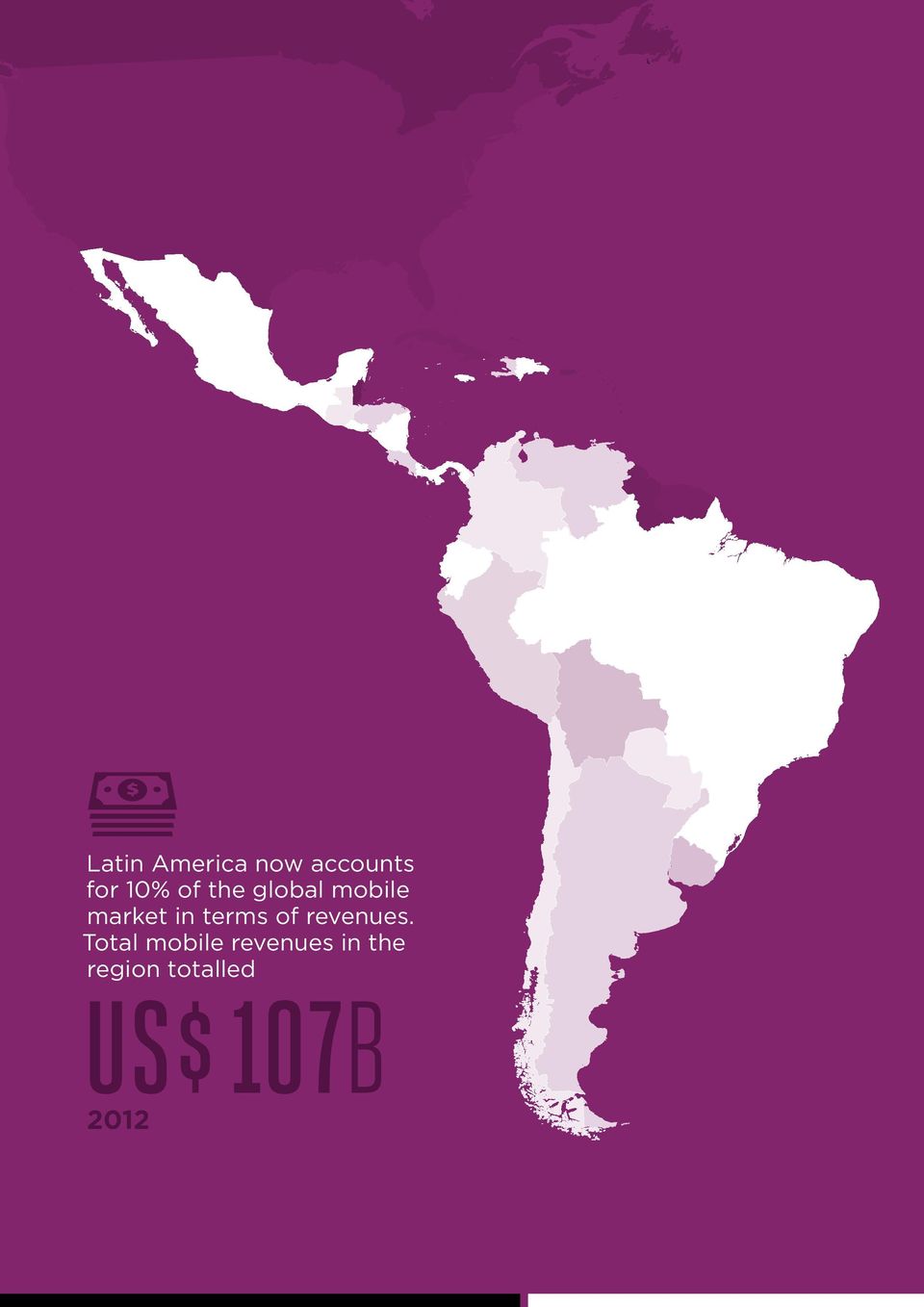
4 Latin America now accounts for 10% of the global mobile market in terms of revenues. Total mobile revenues in the region totalled US$ 107B 2012
5 With 47 countries and territories, 610M people, multiple different cultures, languages and dialects, LatAm is a very diverse region. Including countries that range from the size of Brazil (alone 80% the size of Europe) to tiny Caribbean islands (Bermuda is the 3rd smallest territory in the world) LatAm encompasses huge variety. Referring to LatAm in singular form without considering the intricacies and complexities among and within its countries would ignore its rich diversity. It would not be possible to profile each of the 47 countries and territories in the detail they deserve. In addition, the availability and reliability of data for many of the smaller territories varies enormously. Therefore, this report will focus on the 20 countries shown below. These 20 countries accounted for 98% of mobile connections in 2012 and provide a fair representation of the region from an economic, geographic, political and cultural standpoint. Where LatAm is referenced in the report, we refer to the entire region. SIM ConneCtIonS (M) UnIQUe SUbSCrIberS (M) PoPULAtIon (M) total GDP (US$ b) brazil MexICo ArGentInA CoLoMbIA VenezUeLA PerU ChILe ecuador GUAteMALA DoMInICAn rep bolivia honduras el SALVADor PArAGUAy haiti nicaragua CoStA rica PAnAMA UrUGUAy JAMAICA other Source: GSMA Intelligence

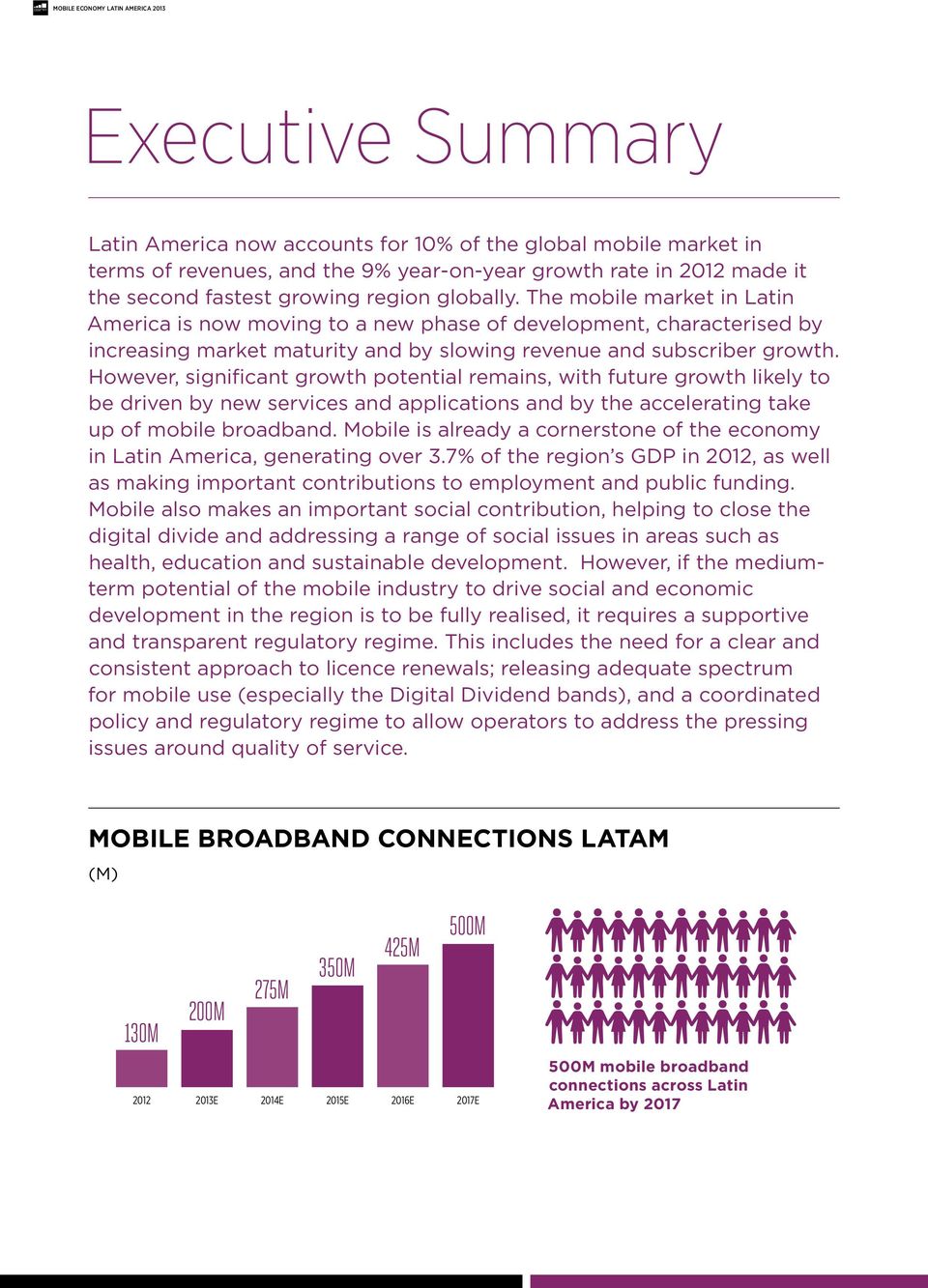
6 Executive Summary Latin America now accounts for 10% of the global mobile market in terms of revenues, and the 9% year-on-year growth rate in 2012 made it the second fastest growing region globally. The mobile market in Latin America is now moving to a new phase of development, characterised by increasing market maturity and by slowing revenue and subscriber growth. However, significant growth potential remains, with future growth likely to be driven by new services and applications and by the accelerating take up of mobile broadband. Mobile is already a cornerstone of the economy in Latin America, generating over 3.7% of the region s GDP in 2012, as well as making important contributions to employment and public funding. Mobile also makes an important social contribution, helping to close the digital divide and addressing a range of social issues in areas such as health, education and sustainable development. However, if the mediumterm potential of the mobile industry to drive social and economic development in the region is to be fully realised, it requires a supportive and transparent regulatory regime. This includes the need for a clear and consistent approach to licence renewals; releasing adequate spectrum for mobile use (especially the Digital Dividend bands), and a coordinated policy and regulatory regime to allow operators to address the pressing issues around quality of service. MobILE broadband ConnECTIonS LATAM (M) 500M 425M 350M 275M 200M 130M E 2014E 2015E 2016E 2017E 500M mobile broadband connections across Latin America by 2017
7 Latin America now accounts for 10% of the global mobile market in terms of revenues, more than double the figure of ten years ago. Total mobile revenues in the region totalled US$ 107 billion in 2012, with the 9% year-onyear growth rate making Latin America the second fastest growing globally. The region had 632 million SIM connections and 319 million unique subscribers at the middle of 2013, equivalent to penetration rates of 104% and 52% respectively. This is well ahead of the global developing market average figures of 79% and 38%. The subscriber penetration figure also highlights the scope to grow the subscriber base in the future. While only just over half of the population in Latin America has subscribed to a mobile service, in developed markets on average four out of five people have done so. The mobile market in the region is now moving to a more mature phase, but still with significant growth potential in the medium term. The mobile market in Latin America is entering a more mature phase of development, characterised by increasing market maturity and higher levels of competition, with revenue and subscriber growth slowing. Most countries in the region now fall into what the GSMA classifies as the Fast Grower segment. With the voice market becoming more saturated (with active SIM penetration in many countries now over 100%), this brings a new strategic focus for the operators on growing new sources of revenues. future growth will come increasingly from mobile broadband and related new applications and services. Smartphone penetration will be close to 20% of the population at the end of 2013, marginally below global averages, and is forecast to rise to 44% by The potential of new third wave mobile applications and the opportunities from machine-to-machine connectivity is still largely untapped in Latin America. Mobile operators have invested significant amounts in building out networks and increasing capacity over recent years, with a total capex figure of almost US$ 50 billion over the last four years. With the need to further increase capacity and build out LTE networks, the industry is expected to invest even more going forward, with total capex forecast to reach US$ 64 billion over the period out to However, operators in Latin America have seen profitability levels decline over recent years, while EBITDA margins remain below the developing market average. Operators need to generate sustainable cash flows if these investment plans are to be realised. The mobile industry is a cornerstone of Latin America s economy. Analysis indicates that in 2012 the mobile industry contributed over 3.7% of the region s GDP, well ahead of the comparable figure for developed regions (for example 2.1% in Europe). Mobile also supported over 350,000 direct jobs and contributed over US$ 39 billion to public funding in Latin America. The contribution of mobile will increase going forward as LTE build-outs continue and a range of news services and applications are deployed, with mobile set to generate 4.5% of the region s GDP (equivalent to US$ 350 billion) by Mobile is already making an important social contribution in Latin America, in a region that faces a unique set of challenges, including high rates of urbanisation and a growing working age population. Mobile has played a key role in addressing the digital divide and bringing voice and more recently broadband services to the wider population in Latin America. With increasing penetration rates and new network deployments there is the potential for much greater impact in the future; allowing local small and medium sized enterprises to integrate in the mobile value chain through the provision of apps and local content. There is the scope for new mobile services and applications that can make important contributions to a number of challenges in the region in areas such as sustainable growth, health, education and access to financial services. For example, forecasts indicate that Latin America mhealth market alone could total US$ 1.6 billion by 2017.

8 Mobile broadband has played a key role in Latin America, both in boosting growth and meeting social targets. The region had 164 million mobile broadband subscribers as of June 2013, a figure that is forecast to grow by 30% per annum over the next five years. With fixed broadband in the region limited in terms of its household coverage, and also relatively expensive, mobile will continue to play a major role in bringing internet access to the mass market. Mobile data plans have seen significant price reductions in the last three years due to the introduction of innovative pre-paid daily plans which are allowing many low income sectors (particularly to households at the Bottom of the Pyramid ) in Latin America to access to the internet for the first time. but there are significant challenges to overcome if the full potential of the mobile industry to drive economic and social development of Latin America is to be realised. A major concern of operators in Latin America is the need for a more transparent, predictable and consultative regulatory regime. Specific issues cited include a lack of transparency and consultation in decision making, unfair practices that favour certain companies or technologies and unclear (or a lack of) industry development plans (e.g. spectrum allocation roadmap or licence renewal prospects). To attract both national and foreign investment, regulatory regimes must be transparent and predictable. There is a pressing need for adequate spectrum to be made available on a timely basis, especially the lower frequency digital dividend band required for cost effective LTE deployments. Spectrum provision across the region is far behind the 1300 MHz per country that was set as a benchmark for 2015 by the ITU, despite pressures from the ongoing strong growth in connections as well as the increased uptake of more data intensive products and services. MobILE CApEX LATAM (B) US$ 48B US$ 64B ESTIMATED Source: Wireless Matrix, A.T. Kearney analysis

9 MobILE ECoSYSTEM future ConTRIbUTIon To gdp (US$ B) % 3.8% 3.9% 4.0% 4.1% 4.2% 4.3% 4.4% 4.5% Source: GSMA Intelligence; EIU; GSMA; BCG analysis There should also be a clear and consistent approach to licence renewals as there will be many 2G licence renewal processes in the upcoming years across Latin America. This would avoid the creation of periods of confusion and uncertainty which tend to promote inefficiencies in the allocation of resources and delay network investment, as we have seen in several countries over the last couple of years. Regulation in Latin America has become more interventionist in recent years, with the trend to regulate termination rates, impose telecom-specific taxes, and implement hard quality of service requirements as well as imposing other regulatory restrictions on the operators. Regulation needs to play a more supportive role if the mobile industry is to maximise its potential growth and social impact. Greater collaboration and coordination between the mobile industry, regulators and other government institutions can unleash the full potential of mobile, with the resultant positive benefits for the wider economy and for social development in the region. Quality of Service considerations have become a key focus area for governments and regulators. However, mobile operators need a coordinated and supportive policy and regulatory regime to address this issue, as operators face a range of challenges including inadequate spectrum provision and obstacles to the installation of new base stations and cell sites on a timely basis (including the need in many countries for local permits for new antennas and differing applications of guidelines on RF exposure). Competition rather than regulatory intervention is the best driver for the continued improvements to quality of service that mobile customers expect. Governments and regulators should focus on providing operators with the right tools to allow them to invest efficiently and to compete in an effective manner.

10 entering a new phase of development Unique Subscribers and SIM Connections 319M UNIQUE Subscribers 632M CONNECTIONS AS OF JUNE % SUBSCRIBER PENETRATION SUBSCRIBERS CONNECTIONS The phenomenon of multiple-sim ownership continues to distort penetration rates Active SIM Penetration LATAM GLOBAL With multiple SIM ownership common in LatAm as in other regions, the number of real subscribers is significantly lower than the number of SIM connections. Multi SIM ownership in LatAm and other developing markets tends to reflect tariff optimisation and the growth of promotional offers. Growth 104% 85% 3.5% Subscriber and revenue growth slowing, but there is significant growth potential in the medium term. CAGR UNIQUE SUBSCRIBERS

11 MBB Connections Latin America 130M 500M Mobile Data Volume 31% CAGR Smartphone Penetration 20% 44% M2M Connections Substantial increase for Latin America k TB PER MONTH 723k TB per month 67% 19M M to 2017 CAGR 50% 34% CAGR Ongoing investments to support growth Mobile operators invested US$48 B over last four years, rising to US$ 64 B for period US$ 48B US$ 64B Note: For detailed sources see rest of section.

12 1 Latin American Mobile Market: entering a new phase of development Latin America now accounts for 10% of the global mobile market in terms of revenues, more than double the figure of ten years ago following several years of strong growth. However, revenue growth in the region is now slowing as the mobile market in Latin America is entering a new phase of development, typically characterised by higher levels of maturity and intensifying competition. The Latin American mobile market has also delivered strong growth in recent years in terms of both unique subscribers and SIM connections. It is now the fourth largest globally, with almost 319 million unique subscribers (and 632 million SIM connections) by the middle of The subscriber base has grown at an average rate of almost 7% over the last four years, and is forecast to grow at a little under 4% for the period out to UnIQUE SUbSCRIbERS And ACTIVE SIM ConnECTIonS (M) 2975 Subscribers connections ASiA PAcific EUroPE AfricA LAtin AMEricA north AMEricA MiddLE EASt Source: GSMA Intelligence 3

13 1.1 A very diverse region Latin America is very diverse in terms of economic and social development, and equally in terms of mobile penetration (both in terms of active SIM cards and unique subscribers). Active SIM penetration ranges in the region from a low of 63% in Haiti to a high of 142% in Chile. Penetration has grown by an average of 6.5 percentage points in the two year period since our last review of the region 1. SIM penetration for the region as a whole stood at 104% as of June 2013, well ahead of the global average figure of 85%. ACTIVE SIM And UnIQUE SUbSCRIbER penetration June 2013 Mexico haiti bolivia Peru Latin America Venezuela nicaragua Colombia Paraguay honduras Costa rica Dominican rep. Guatemala brazil ecuador Uruguay Jamaica Panama el Salvador Argentina Chile Active SIM Penetration Unique Subscriber Penetration Source: GSMA Intelligence

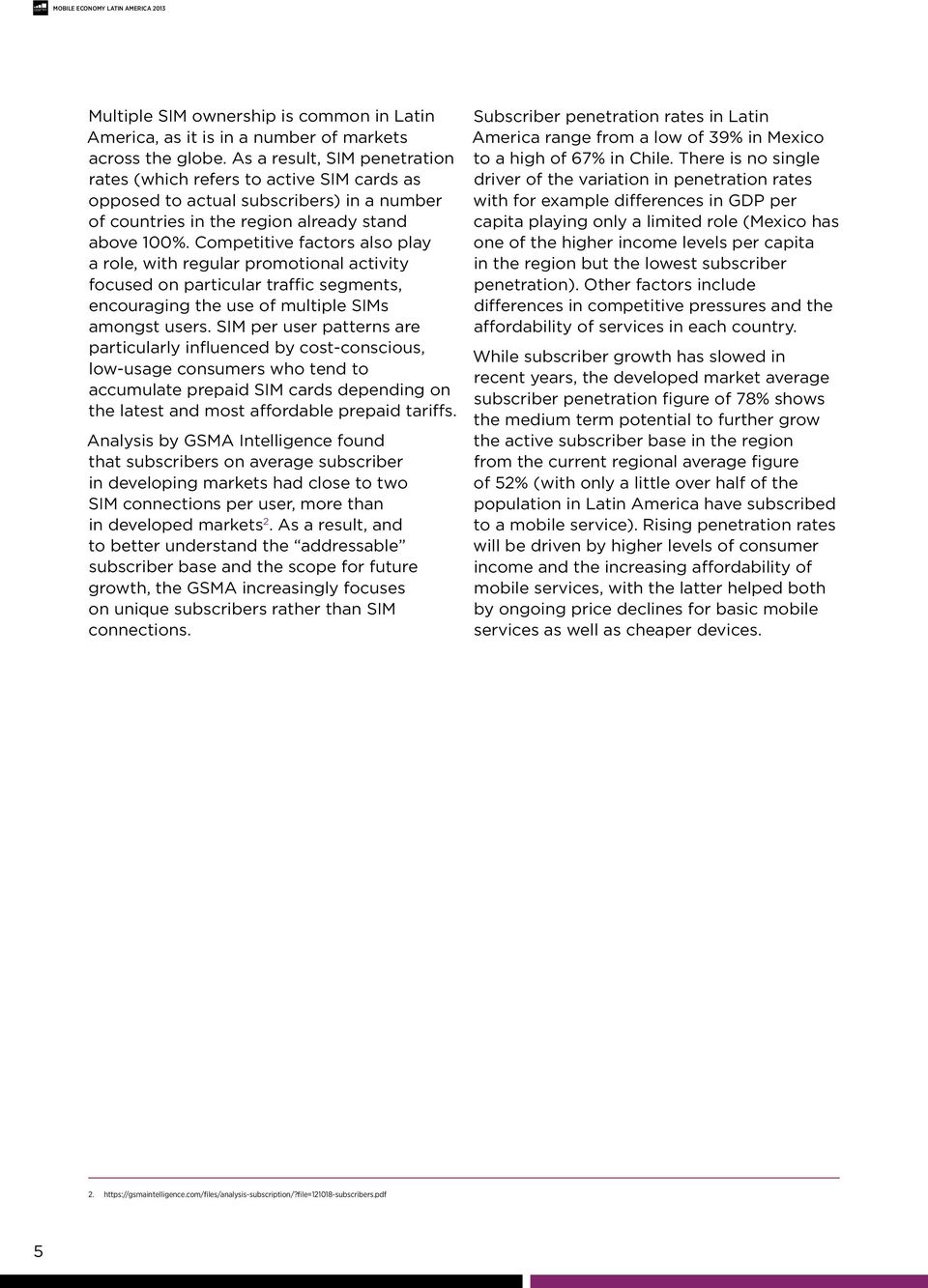
14 Multiple SIM ownership is common in Latin America, as it is in a number of markets across the globe. As a result, SIM penetration rates (which refers to active SIM cards as opposed to actual subscribers) in a number of countries in the region already stand above 100%. Competitive factors also play a role, with regular promotional activity focused on particular traffic segments, encouraging the use of multiple SIMs amongst users. SIM per user patterns are particularly influenced by cost-conscious, low-usage consumers who tend to accumulate prepaid SIM cards depending on the latest and most affordable prepaid tariffs. Analysis by GSMA Intelligence found that subscribers on average subscriber in developing markets had close to two SIM connections per user, more than in developed markets 2. As a result, and to better understand the addressable subscriber base and the scope for future growth, the GSMA increasingly focuses on unique subscribers rather than SIM connections. Subscriber penetration rates in Latin America range from a low of 39% in Mexico to a high of 67% in Chile. There is no single driver of the variation in penetration rates with for example differences in GDP per capita playing only a limited role (Mexico has one of the higher income levels per capita in the region but the lowest subscriber penetration). Other factors include differences in competitive pressures and the affordability of services in each country. While subscriber growth has slowed in recent years, the developed market average subscriber penetration figure of 78% shows the medium term potential to further grow the active subscriber base in the region from the current regional average figure of 52% (with only a little over half of the population in Latin America have subscribed to a mobile service). Rising penetration rates will be driven by higher levels of consumer income and the increasing affordability of mobile services, with the latter helped both by ongoing price declines for basic mobile services as well as cheaper devices
15 The region s mobile market is dominated by Brazil, with million unique subscribers by mid , accounting for over a third of the total subscribers in the region as a whole. The importance of the Brazilian market is underlined by the fact that it currently ranks as the fifth largest market globally in terms of subscribers, and is forecast to overtake Japan and become the fourth largest by the end of The seven largest countries in the region have 254 million subscribers between them, equal to over 80% of the total for Latin America. UnIQUE SUbSCRIbERS by CoUnTRY (M) M Unique subscribers in brazil by mid brazil Mexico Argentina Colombia Venezuela Peru Chile ecuador Guatemala Dominican rep. bolivia haiti honduras el Salvador Paraguay nicaragua Costa rica Panama Uruguay Jamaica Source: GSMA Intelligence 3. GSMA Intelligence s unique subscriber figures are based on a survey that tracked SIM ownership in Brazil. It differs from IBGE s census data which tracks mobile phone ownership within each household. SIM ownership differs from device ownership such that multiple SIM cards can be used or shared in a single device 6

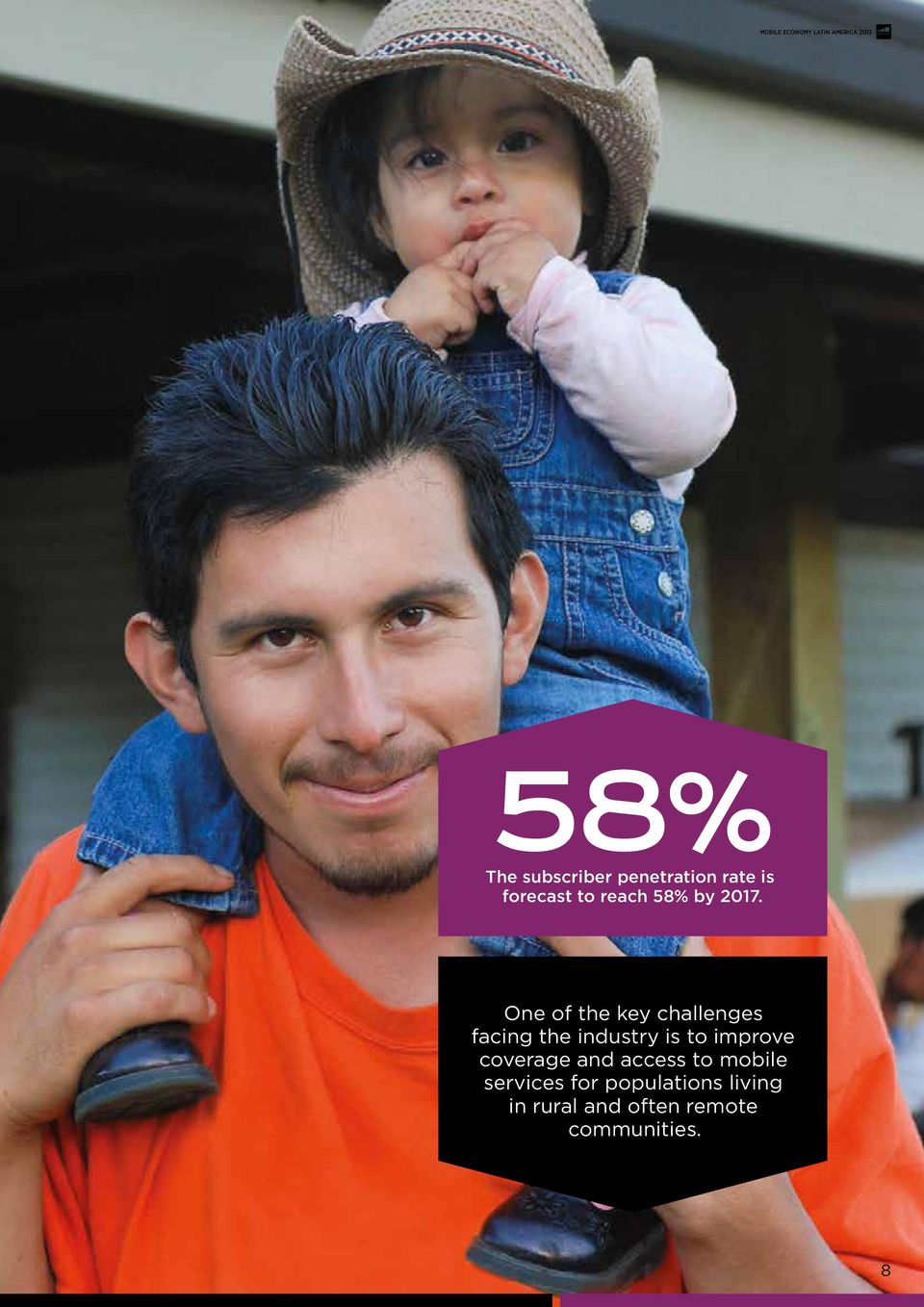
16 One of the key challenges facing the industry is to improve coverage and access to mobile services for populations living in rural and often remote communities, as there are still significant variations in penetration rates within many countries in the region. Issues around income inequality also mean that there are segments of urban populations that still cannot afford mobile services, despite price declines in recent years. The subscriber penetration rate is forecast to reach 58% by 2017, keeping the region ahead of both the global average figure (53%) and the developing market average figure of 48%. UnIQUE SUbSCRIbER forecasts for LATAM (M) 47.3% % SUBScriBEr PEnEtrAtion rate 55.2% 53.5% 52.0% % % % Source: GSMA Intelligence 7

17 58% The subscriber penetration rate is forecast to reach 58% by One of the key challenges facing the industry is to improve coverage and access to mobile services for populations living in rural and often remote communities. 8
18 1.1.1 Prepaid still dominates Prepaid services have been a key enabler of growth in Latin America, as in many other emerging markets. There are a number of advantages of prepaid services. For consumers with low or irregular incomes, prepaid allows them to budget usage levels and use the services only when they can afford to do so. Prepaid also offer low price entry points to the mobile market, usually combined with low cost handsets. In addition, operators do not need to undertake credit and other checks, as well as setting up payment collection, needed for contract services. Mobile services in the region also benefitted from the move to calling party pays, which also entrenched the preference for prepaid services. This allowed subscribers to have a mobile connection and receive calls at no cost, whilst having the flexibility to pay for outgoing calls according to their ability to pay. Prepaid continues to dominate the LatAm market, accounting for 80% of total SIM connections at the end of However, there is evidence of a gradual shift to contract over recent years, with the proportion of contract subscribers rising by three percentage points over the last four years I I % 17% 18% % I 20% % Prepaid Contract 9
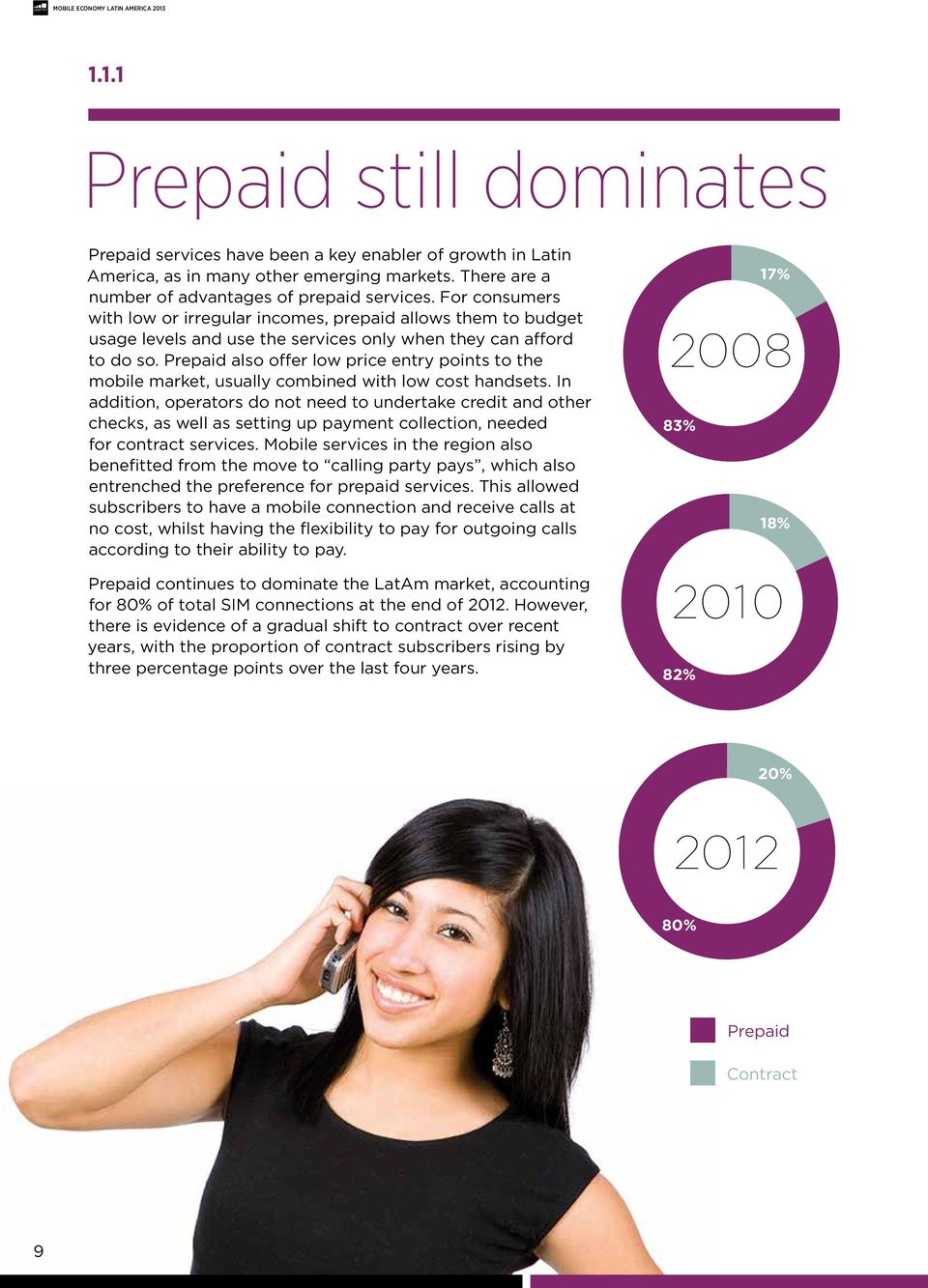
19 There is some variation in the level of prepaid in the total subscriber base across the region, with the Argentinian market being 30% contract, against only 13% in Venezuela. In some of the smaller markets in the region, such as parts of the Caribbean and Costa Rico, contract already counts for a majority of connections. The increasing range of services offered by mobile phones, including mobile banking and other applications, combined with falling price points for smartphones, should further drive the move from prepaid to contract across the region. ConTRACT/ prepay MIX JUnE 2013 (% OF SIM CONNECTIONS) 39% 32% 30% 24% 24% 21% 21% 19% 19% 19% 18% 17% 17% 14% 13% 13% 11% 9% 9% 6% 61% 68% 70% 76% 76% 79% 79% 81% 81% 81% 82% 83% 83% 86% 87% 87% 89% 91% 91% 94% Costa rica Uruguay Argentina Chile Peru brazil haiti nicaragua Paraguay ecuador Colombia Mexico Dominican rep. Jamaica Venezuela el Salvador Panama bolivia Guatemala honduras Prepaid Contract Source: GSMA Intelligence The operators themselves are also pushing contract tariffs in some of the more competitive markets in the region, in an effort to reduce churn rates and boost revenues. The region overall is seeing strong growth in the number of smartphones and connected devices such as laptops and tablets. These devices are often made available on a subsidised basis on contract tariffs, which increases the affordability of such devices to consumers. 10

20 1.2 Challenges for operators and regulators will change as the region s markets evolve The GSMA segments all mobile markets across the world based upon their technological maturity (using smartphone and mobile broadband penetration rates as the basis for classification), with four segments identified. A large proportion of countries in Latin America fall within what the GSMA classifies as the Fast Grower segment, which also includes three of the so called BRIC markets (excluding India), as well as a number of countries in Eastern Europe and South-Eastern Asia. The fast grower segment includes markets that have 3G penetration of 30% or higher, as well as smartphone penetration above 20%. The following chart shows that a number of counties in the region fall into this category, including Mexico, Brazil, Argentina, Uruguay, Venezuela and Chile. A number of other countries currently fall into the developer segment, but will move into the Fast Grower segment over the next couple of years as 3G and smartphone penetration rates increase (for example Peru and Colombia by the end of 2015 and Ecuador by the end of 2014). 3g 43% Average Smartphone Penetration Average Technology Shares 2g ThE fast grower SEgMEnT CoUnTRIES Average Contract Penetration 17% 11

21 SMARTphonE VS. 3g penetration 2013 for SELECTEd MARkETS In LATIn AMERICA 60% 50% BRAzIL 3G penetration % 30% 20% COLOMBIA BOLIVIA URUGUAy ARGENTINA VENEzUELA MExICO PERU ECUADOR CHILE PARAGUAy 10% 0% 5% 10% 15% 20% 25% 30% Smarphone penetration 2013 Source: GSMA Intelligence; Strategy Analytics Increasing competition in the mobile markets, as well as increased regulatory intervention, are common themes across the fast grower segment. By 2015, a number of markets in Latin America (especially the larger markets in Southern America) will move into the next segment as they mature and penetration rates for smartphones and mobile broadband increase further. This segment is referred to as the Connected Players, and includes today for example most of the markets in Western Europe. This stage is characterised by a further slowdown in revenue growth and an increased strategic focus on developing new revenues from innovative new services and applications, especially in adjacent industry areas. Regulators and other policy makers in each market across Latin America should be aware of the changing priorities and challenges that operators face as the markets they operate in evolve, while operators themselves need to be proactive in developing new business models and working with a range of partners in adjacent industries in order to develop innovative new offerings and services. 12
22 1.3 Market dynamics: revenue and subscriber growth are slowing Both subscriber and revenue growth are slowing in the region, due to a combination of factors including relatively high SIM penetration rates in many countries; increasing competition; and increased regulatory action. With the headline active SIM penetration rate standing at 104% at the end of the second quarter of 2013, it is no great surprise that SIM connection growth rates have slowed significantly in recent years, falling from over 20% in 2008 to just under 10% in There was a slight pick-up in growth in as the region recovered from the global economic slowdown in 2009, but it is clear that growth in the region has now peaked, both in terms of absolute new connections and annual growth rates. Going forward, growth rates are forecast to slow further, down to below 5% per annum by 2016, with headline SIM connection penetration expected to reach 120% by The growth in SIM connections has been impacted by moves by operators in some markets to disconnect inactive subscribers. This has been a particular factor in the Brazilian market in recent quarters, as operators have to pay Fistel taxes on all active SIM cards and are therefore incentivised to update their subscriber base. SIM ConnECTIon growth RATES 80 25% % 15% % 30 5% 20 0% Connection Growth (LHS, M) Connection Growth % Source: GSMA Intelligence 13
23 Total mobile revenues in the region amounted to $107 billion in 2012, up 9% year-on-year and making LatAm the second fastest growing region globally (behind Asia-Pacific). As with connection growth, revenue growth has slowed sharply in recent years, with the compound annual growth rate over the last five years only around a third of that achieved in the previous five year period. This trend shows that the mobile market in Latin America is entering a new phase of development, typically characterised by higher levels of maturity and intensifying competition. LATIn AMERICAn MobILE REVEnUE TREndS 120 TOTAL MOBILE REVENUE (US$ BILLION) % 10% ANNUAL % REVENUE GROWTH CAGR VS Source: GSMA Intelligence 14
24 1.3.1 Increased competition As growth has slowed in the region and the market begins to mature, we have seen signs of increasing competition in a number of markets. There have been new entrants in several markets, including two new entrants in Chile, one in Colombia (and with another two forthcoming) and with a new entrant set to launch in Peru. In most of the major markets in the region, we have seen the market share of connections of the leading operator in each country fall over the last five years. The one exception to this trend is Venezuela, perhaps reflecting the presence of a strong state owned incumbent, as well as some of the macroeconomic challenges in the country. SIM MARkET ShARE of LARgEST operator 67,1% 72,3% 69,3% 57,5% 60,1% 49,9% 43,2% 47,1% 42,9% 35,1% 33,5% 38,2% 29,5% 28,3% ArgEntinA PErU chile BrAziL columbia MExico VEnEzUELA Q Q Source: GSMA Intelligence 15
25 There is an inverse correlation in the region between the number of operators in a region and the HHI index. The Herfindahl-Hirschman Index (HHI) can be used to measure levels of competition in national mobile markets (the lower the index figure, the more competitive the market). hhi IndEX And number of operators by MARkET brazil el Salvador Argentina Panama Chile Dominican rep. bolivia Venezuela Uruguay Guatemala Paraguay Peru Colombia nicaragua honduras Mexico ecuador Costa rica haiti Jamaica HHI NO. OF MNO S Source: GSMA Intelligence Brazil is the most competitive market in the region, with seven mobile operators, although the market is dominated by the big four players (Vivo, Tim, Oi and Claro). The acquisition of Brasil Telecom by Oi in 2009 has generally increased competition as the latter has used aggressive pricing to gain share in the market, especially in the prepaid segment. More recently TIM has been more active in offering more aggressive tariffs, as a result of which the company reported the highest number of SIM sales of any operator in Brazil during the first half of There are also clear signs of increasing competition in a number of other markets. This is particularly evident after new spectrum auctions: both as these often facilitate the introduction of new entrants (that take a while to launch services) but also as these may give existing competitors an improved competitive position. For example, second or third players (in terms of market share) in markets like Mexico, Peru and Colombia are the ones leading in the provision of mobile internet services. 16
26 1.3.2 Price declines boost affordability The combination of market growth (and the need to increase affordability of mobile services in order to continue to grow the customer base) and increased competition has led to ongoing price reductions in most markets in the region. These price declines have played a key role in making mobile services affordable to large segments of the population across Latin America (resulting in the strong subscriber and connection growth of recent years), and ongoing price declines will further improve affordability and help bring mobile services to lower income groups that have yet to fully benefit from them. In a region with limited fixed line infrastructure, mobile has played a unique role in bringing voice and internet services to the broader population. EffECTIVE price / MInUTE (US$ ) 0,18-4% Argentina 0,13 0,12 0,11 0,10 0,09-10% -14% -7% -6% Brazil Chile Peru Latin America -7% Ecuador -10% Mexico Source: GSMA Intelligence 17
27 In a number of countries, including Brazil and Colombia, the effective price per minute has halved over the last four years. At the same time, and helped by the impact of positive elasticity (where lower prices lead to increased usage); the introduction of a range of bundled tariff offers (that includes bundles of calls, messaging and data services); and aggressively priced on-net tariffs, the average number of minutes per customer (MOU) has increased significantly. The average monthly MOU for the region at the end of 2012 stood at 168 minutes. MoU TREndS (MAJoR MARkETS) Average number of minutes 168 MInUTES THE AVERAGE MONTHLy MOU FOR THE REGION 224 Mexico 168 Chile Ecuador Brazil Peru Argentina Source: GSMA Intelligence Data from Telebrasil (the trade association of mobile operators in Brazil) indicated that the average price per minute in Brazil fell by 18% in 2012, with MOUs in the country rising on average by 9%. This took the cumulative decline in price per minute in Brazil to 56% over the past five years. This trend can also be seen in mobile broadband pricing. A recent Telecom Advisory Services survey in Argentina, Colombia, Ecuador, Mexico and Brazil found most economic mobile data plans for smartphones in Latin America have experienced a 52% reduction in monthly prices in the last three years. 18
28 Average revenue per user (ARPU) trends have been mixed across the region over recent years. Against a backdrop of falling prices and increased competition, there has been a small but steady decline in ARPU for the region as a whole. It is worth highlighting that overall ARPU levels in the region are still relatively low compared to other markets, especially developed regions such as Europe and North America (where the figures are US$ 18 and US$ 46 respectively). Reported ARPU figures in the region are distorted by high levels of multi-sim ownership (as we discussed earlier). However, the average ARPU for LatAm for 2012 of US$ 12.2 was well ahead of the developing market average of US$ 7.2. These average ARPU figures for the region overall hide more varied trends at the country level. Brazil has seen some of the steepest declines in ARPU over the period, driven by competition and efforts to improve the accessibility of mobile services. Markets such as Peru and Colombia, which started the period with amongst the lowest ARPUs, have tended to see ARPUs increase over recent years, helped by positive elasticity and customer willingness to pay for new services such as data and mobile broadband. ARpU TREnd In SELECTEd MARkETS (US$ /month) Venezuela Chile 15 Argentina 13 Mexico Latin America 11 Brazil Colombia 9 Peru Source: GSMA Intelligence 19
29 Analysis from Telebrasil shows that mobile prices in Brazil have fallen significantly in real terms over the period from January 2000 to February 2013, and have fallen more than any of the other utility and related services monitored by the Brazilian Central Bank. national IndEX of ConSUMER prices ( IpCA ) Jan Feb 2013 Diesel oil Bottled gas Sewerage rates Urban bus fares Intercity bus fares Health plans Tracked prices Gasoline Metro IPCA Total Fixed telephony Electricity Others Mobile telephony Source: Telebrasil 20
30 Competition has also driven down mobile broadband pricing in most markets in the region. The decline in price has been significant, with analysis from TAS showing that the average price of low end smartphone data plans (with a 250MB usage cap) falling from close to US$ 18 in 2010 to US$ 8.3 by 2013 (an annual decline of 52%). For plans with a higher usage cap (1GB of data), there have also been significant pricing declines: from US$ 23 in 2010 to US$ 14.4 in 2013, an annual decline of 37% over the three year period 4. LATIn AMERICA: MoST EConoMIC MobILE broadband plan for CoMpUTERS with AT LEAST 1gb of download VoLUME CAp (US$ ) bolivia Peru Costa rica Panama Uruguay nicaragua Paraguay Argentina el Salvador Latam Colombia Dominican rep. Venezuela Mexico Chile ecuador brazil 2Q Q Q Q 2013 It should be noted that data plans of 1GB are not found in all markets. In some cases, twice the price for a data plan of 500 MB or 600 MB was used, or even a data plan of 2GB, which ever was cheaper at the time. Source: TAS Analysis based on data from Galperin (2012) and TAS research
31 We are also seeing a clear shift in the revenue composition in the region. The contribution from voice services is declining in a number of markets, as pricing declines outpace the growth in usage. While mobile data revenue growth remains strong, mobile voice revenue is under pressure; Telefónica recently noted that voice-only growth models will not be sustainable over the medium term. America Movil recently stated that in Mexico, mobile voice revenues were down 3.8% on account of the sharp economic slowdown observed in the period and the continued price reductions [as] the average price per minute of voice fell 19.7% from the year earlier quarter. Voice revenues are also impacted by the ongoing growth in on net traffic, which operators in most markets price at a large discount to off net traffic. Data revenues accounted for a little under 30% of total recurring revenues at the end of 2012, and the percentage will continue to increase over the coming years. This figure varies significantly across the region. Movistar (Telefónica) and Personal (Telecom Argentina) reported figures as high as 49% and 58% respectively in Argentina at the end of the second quarter of 2013 (due to high revenues from SMS and other value added services revenues, as well as increasingly strong growth in mobile broadband). As a result, Argentina is the first country in LatAm to see data revenue overtake voices revenues in the mobile market. The comparable figures in for example the Mexican market are lower, with Telefónica and AMx reporting figures of 38% and 29% respectively. data AS proportion of RECURRIng REVEnUE % 37% 35% 35% 28% 25% 22% 22% 18% Argentina Mexico Veneuela Ecuador LatAm average Columbia Brazil Chile Peru Source: Merrill Lynch; Telecoms & Media for 4G Americas 22
32 1.3.3 Increased regulatory intervention across the region In recent years there has been an increase in regulatory intervention in the mobile market in a number of countries, particularly in the areas of termination rates and through the introduction of MVNOs and with new entrants entering into a number of markets. The increasing regulation of mobile termination rates ( MTRs ) has had a particular impact on mobile revenue growth rates across Latin America. Termination rates have historically been high in emerging markets, with the benefit of helping subsidise network build outs whilst at the same time boosting the take up of services in lower income groups. Until relatively recently, MTRs in a majority of markets in the region were set voluntarily on the basis of bilateral agreements between the operators. However, in recent years there has been greater regulatory pressure to lower MTR and often direct regulatory intervention in the setting of the rates. For example, we have seen significant cuts in MTRs in Mexico since 2010 following intervention by COFETEL. Similarly in Chile, we are part way through a process that will see termination rates in the country almost halve. In Brazil, ANATEL has proposed a reduction of MTRs for 2014 and 2015 of up to 75% and 50% respectively from their current level, and to move to a cost-based model for setting MTRs from Regulators in several markets have also reserved spectrum in recent auctions specifically for new entrants, often by limiting the amount of spectrum that incumbent operators could bid for through the use of spectrum caps. This for example allowed Nextel to acquire spectrum relatively cheaply (compared to the incumbents) for its 3G launches in Mexico, Brazil and Chile. In Argentina, the regulator cancelled a spectrum auction and instead awarded the spectrum to a satellite and fixed broadband state-owned operator to build a new mobile network. The interventionist trend is also seen in several countries with regulators giving advantages to state-owned operators, for instance, by allocating spectrum to them earlier than the private ones (Ecuador, Bolivia, Paraguay, Uruguay) or allowing them to secure the access to the most suitable spectrum blocks (Uruguay). 23
33 number portability And MVno REgULATIon In SELECTEd MARkETS MoBiLE number PortABiLity MVnos Argentina 2012 December 2012 Brazil 2008 September 2010 Chile 2012 Regulations in 2006, but MVNOs in market since 2012 following court ruling Colombia 2011 No specific regulation for MVNOs Mexico 2008 No specific regulation for MVNOs Peru 2010 Law approved Q Source: Regulatory data; GSMA Intelligence Regulators are also taking action to facilitate the entry of MVNOs in the region, which is likely to further increase competitive pressures. Regulations have been put in place in a number of markets to allow the entry of MVNOs, with both Chile and Brazil having MVNO specific regulation in place, although regulation is not a prerequisite for MVNOs to enter for a market. Virgin Mobile for example has launched services in a number of countries across Latin America. Similarly, regulators have now introduced mobile number portability in a majority of markets, a move that has typically increased churn rates and allowed market share gains for new entrants and smaller players. Peru recently became the latest country to formally approve the entry of MVNOs, with the country s Congress approving the law in the third quarter of This requires any operator with a market share of over 25% to allow MVNOs access to their networks (this will impact the two largest operators, Claro and Movistar). There are a number of ongoing regulatory reforms aimed at increasing competition in the Mexican telecoms market, and also establishing the creation of a wholesale public-private operator to create an open network using the whole 700 MHz band. A new telecoms regulator Instituto Federal de Telecomunicaciones (Ifetel) will be created. The new entity will also be able to limit companies from seeking to stall competition through continued litigation, with special courts expected to deal with regulatory disputes, and prohibit companies from blocking regulatory decisions through legal means while they are being challenged in court. The new regulatory body is expected to be in operation by the end of However, we have already seen significant declines in prices in the Mexican mobile market. For example, in its results for the second quarter of 2013, America Movil reported a decline in revenue per minute of almost 14% compared to the previous year. 24
34 1.3.4 Making roaming more affordable: a particular issue in Latin America Another area that has seen increased regulatory attention has been the roaming market. This is a particular issue in the region given the large number of shared borders and regularity of travel in some areas. It is estimated that roamers will represent 12.3% of the total connections in Latin America in Country bilateral agreements have been signed by Colombia-Ecuador and Ecuador-Peru with the aim of collaborating with initiatives on transparency, and to stimulate the reduction of prices and provide solutions for people living at border zones. The selection of roaming services, particularly voice plans, has been expanding to an even greater extent among prepaid customers. A new GSMA report by BlueNote Management Consulting 5 showed that mobile operators in Latin America and the Caribbean have developed a selection of roaming products with a trend towards flat daily rates and multi-service packages (e.g. voice minutes and/or data Mb and/or SMS messages in a single bag) in the last two years. Products and rate models are being adapted to the consumer s profile and habits producing positive impacts on price reductions. The configuration of the packages (e.g. a fixed number of minutes, megabytes or SMS for a set rate) is constantly being updated, with operators adapting the parameters and technicalretail conditions of the product to simplify the offerings and to make costs clear and predictable for the user. The study also reveals that services are becoming more transparent. The rate structure is being simplified and unified across countries to help users better understand it. This new selection supplements the Data Roaming Transparency Scheme launched by GSMA Latin America in September This initiative, backed by 40 Latin American mobile operators, was geared towards aligning and improving transparency in data roaming in order for users to more easily view their charges for mobile data services used during trips in their region and abroad. The plan has given consumers more control over their usage patterns, significantly reducing cases of bill-shock (i.e. exorbitant bills that take roaming users by surprise when they return from a trip) See more about this initiative at: 25
35 historic EVoLUTIon of AVERAgE RoAMIng prices for VoICE And data data (US$ per Mb) ~55% Average use Average use including promotional bundles ~65% VoICE (US$ per MInUTE) ~35% Average use Average use including promotional bundles ~39% Source: Bluenote MC (2013) 26
36 1.3.5 Growing impact of new online messaging services Skype already has a strong presence in Latin America, where it is estimated to have more than 20 million subscribers. In August 2012, the company launched a physical prepaid card in Mexico, available at local retailers, which allows monthly unlimited calls to fixed and mobile lines in the United States for just 100 pesos (US$ 7.80) 7. The offer addresses the need of Mexican customers who do not own credit cards to purchase Skype credit online. Similarly, the WhatsApp CEO Jan Koum highlighted Latin America as one of the region s where the company was most active, having added a number of new languages to its application in order to boost its presence in the region. Users of social networks in LatAm tend to use mobile devices to access their accounts more than in developed markets. A Spanish language application LINE was launched at the end of 2012, with a number of smaller players also emerging. While the impact of these new offers and services is still relatively limited in the region compared to that in a number of European markets, an impact on messaging volumes and revenues is already evident. Overall messaging volumes in the region continue to rise, helped by the large prepaid base and limited smartphone penetration to date. However, there is the clear risk that rising smartphone penetration and increased data use will begin to pressure revenues from traditional voice and data services. The dominance of the prepaid model in the region (which tends to see higher per SMS and per minute voice pricing compared to contract tariffs) could further increase the vulnerability of operators in LatAm to this issue
37 1.3.6 Profitability falling as competition increases The profitability of mobile operators varies across the region, with for example some of the operators in Brazil showing the lowest margins in what is a highly competitive market (as we discussed previously). However, margins have increased over recent years in Brazil from relatively low levels, as smaller operators have gained scale, connection growth rates have slowed (as subscriber acquisition costs typically weigh on margins) and as some of the larger operators in the market have realised significant operational synergies through merging their fixed and mobile operations. In contrast, mobile margins have fallen in countries such as Chile and Peru as new operators have entered the market, with both markets now having lower margins on average than Brazil. More generally across Latin America there has been a fall in industry profitability over recent years, reflecting the trends that we have already discussed around increasing competition, falling prices and increasing regulatory intervention. It is noteworthy that margins on average in Latin America are well below the average level for developing markets. This makes it more challenging for operators to fund investments at time when there is ongoing pressure to invest in networks to address capacity constraints (and so address quality of service issues) as well as to launch higher speed networks (especially LTE) and in several countries to meet new regulatory obligations (such as around geographic coverage). EbITdA MARgInS LATAM VS developing MARkET AVERAgE 43,4% 43,8% 43,6% 37,4% 39,0% 34,1% 42,0% 37,8% DEvEloping market average 40,2% 36,0% latam average Source: GSMA Intelligence 28
38 1.4 Future growth from mobile broadband and new services Against a backdrop of slowing growth in Latin America, with revenue growth rates that are now well down from the double digit rates of the early 1990s, it is important to highlight the significant growth potential that still exists for the mobile industry in the region into the medium term. There are a number of factors that should drive growth over the coming years, with many markets still at an early stage in their migration to 3G and mobile broadband, while LTE deployments across the region are still in their infancy. This will also allow the development of a broad range of new applications and services, often in partnership with players in adjacent industry segments that will further boost economic growth whilst also bringing a range of social benefits. 29
39 1.4.1 Early stage of technology migration to 3G and smartphones The mobile connection base in Latin America is still dominated by 2G services, which accounted for almost 80% of the total connections in the region in mid With LTE networks still to be deployed in most countries in the region, 4G accounts for less than 0.1% of total connections (compared to over 1% in Asia Pacific and over 13% in the US). The proportion of 3G connections in Latin America is slightly ahead of the developing world average figure of 16%. SIM ConnECTIonS by TEChnoLogY (LATAM) (M) % 4G 20% 3G % 2G cagr Source: GSMA Intelligence 30
40 There is also significant variation in the pace of migration to 3G services across the region. Amongst the major markets, Colombia has the highest proportion of 2G connections, while Venezuela has the highest proportion of 3G at over 30% of total connections. Although subscriber penetration rates in Venezuela are below the regional average, users in the country have shown a strong interest in 3G handsets and smartphones. This appears in part to reflect the popularity of social networks and instant messaging in the country, with Blackberry indicating that Venezuela is their largest market in Latin America. SIM ConnECTIonS by TEChnoLogY 2012 (SELECTEd MARkETS) 12,7% 14,5% 20,0% 20,0% 25,0% 28,0% 30,0% G 2g LATIN AMERICA 3g 87,2% 85,5% 80,0% 80,0% 75,0% 71,5% 70,0% 4G 3G 2G Columbia Peru Argentina Chile brazil Mexio Venezuela Source: GSMA Intelligence The rate of migration to 3G is accelerating in the region, helped by a combination of rising income levels and sharp declines in the price of 3G devices, including both handsets and dongles. The advantage of 3G from both an operator and consumer perspective of 3G is the broader range of services that can be offered, particularly high speed internet access. As a result, 3G is forecast to account for around half of all connections in the region by G migration is benefitting from increasing network coverage across the region. The main operators in Brazil are now covering over 80% of the population in the country, while the average figure for the region overall is just under 80%, with Colombia having the highest coverage levels of the major markets in the region. 31
41 MobILE VS fixed broadband CoVERAgE 2012 (POP) mobile BroaDBanD 96% 93% 95% 96% 92% 94% FiXED BroaDBanD 81% 86% 84% 80% 82% 78% 77% 62% 63% 59% 40% 29% Colombia Costa rica Argentina ecuador brazil Chile Mexico Peru bolivia Source: TAS Consultancy Smartphone 8 penetration is forecast to be close to 20% at the end of 2013, marginally below global averages. Chile will have the highest penetration in the region at 27%. A number of factors are driving the uptake of smartphones in Latin America: Operator promotions and subsidies to encourage smartphone uptake; The natural handset replacement cycle (typically 3-5 years in emerging markets); Declining smartphone prices (the sub US$ 100 smartphone is now a reality, especially those based on the old Android 2.0 operating system) helped by a range of new models and competition between manufacturers; Local manufacturers beginning to enter the market, often in partnership with international players; Development of more bandwidth intensive applications, particularly those involving video sending or receiving video content; Tax incentives to encourage smartphone adoption and local production; LTE deployments and the increasing availability of 4G devices which offer higher data speeds than 4G. 8. Smartphones operate on a mobile operating system and offer mobile broadband connectivity. Not all 3G devices are smartphones 32
42 Smartphone penetration across the region is forecast to rise to 44% of the population by 2017, with growth over the period set to be slightly stronger than the global average. The main growth driver will be the uptake of lower cost models by middle and lower income groups. The ongoing migration to 3G handsets and devices, as well as increasing smartphone penetration in the region, will be key to driving future revenue growth, particularly in terms of data revenues. Telefónica claims that, on average, smartphone customers in the region provide an uplift in ARPU and margin of more than 1.5 and 1.3 times respectively, when compared to feature phone users. In its 2012 fourth quarter report, America Movil, the largest pan-regional player, recorded a mobile data revenue rise of 33.3% year-on-year, with data now accounting for one third of total mobile revenue. The increasing number of smartphones is closely linked to the growing number of mobile broadband connections in Latin America (mobile broadband also includes other devices such as tablets and dongles, and is defined as HSPA, EV-DO and faster devices). The region had 164 million mobile broadband subscribers as of June 2013, a figure that is forecast to grow by 30% per annum over the next five years. MobILE broadband SUbSCRIbERS - MEXICo (M) % DonGLeS % SMArtPhoneS Q1 11 Q211 Q311 Q411 Q112 Q212 Q312 Q412 Source: Cofetel 33
43 MobILE broadband ConnECTIonS LATAM (M) Source: GSMA Intelligence Smartphone penetration across the region is forecast to rise to 44% of the population by
44 1.4.2 LTE deployment still at early stages In global terms the move to LTE has come relatively late in Latin America. At the end of 2012, only eight countries had seen commercial LTE launches. There are a further 16 networks expected to launch during 2013, notably across key markets such as Chile, Ecuador, Peru and Uruguay. America Movil reached their target to cover 60% of the population in Mexico with 4G services by April 2013, with a minimum download speed of 20Mbps. In Brazil the 2.5GHz spectrum auction took place in June 2012 and included coverage obligations for operators to launch LTE services commercially in the six host cities of the Confederations Cup soccer tournament by the end of May 2013 and in the six remaining World Cup cities by the end of this year. By the middle of 2013, there were only 174,000 LTE connections in the country, a figure that is forecast to reach a little over one million by the end of the current year. A major challenge for LTE deployments in Latin America has been the relatively slow allocation of additional spectrum to the appropriate LTE bands. For Latin America as a whole the total number of LTE connections is forecast to reach 77 million by the end of 2017, accounting for 10% of the total connections in the region by that date. The higher data speeds offered by LTE networks, and the tendency for LTE device users to consume substantially more data traffic, should translate both into a clear revenue opportunity for the operators, as well as facilitating the development of a range of new services and applications. 35
45 LTE CoMMERCIAL deployment SChEdULE CoUnTRY operator LAUnCh date band Domican Rep. orange 09-Jul MHz AT&T 20-Nov MHz CLARo 24-Nov MHz Puerto Rico open MobILE 19-Apr MHz SpRInT 18-Dec MHz T-MobILE 18-Jul MHz Antigua and Barbados digicel 06-Nov MHz Brazil SkY 13-Dec MHz CLARo 13-Dec MHz on 01-Mar MHz TIM 30-Apr MHz VIVo 30-Apr MHz oi 25-Jul MHz Colombia UnE 14-Jun MHz Bolivia EnTEL 16-Dec MHz Paraguay VoX 18-Feb-13 AwS personal 08-Feb MHz Uruguay AnTEL 13-Dec-11 AwS Chile CLARo 28-Jun MHz Venezuela digitel 15-Oct MHz Source: GSMA Intelligence 36
46 1.4.3 New services and applications Latin America is on the cusp of a new wave of mobile applications and services, brought about by the near ubiquity of mobile network coverage and with 3G (and soon 4G) networks bringing higher data speeds. Falling mobile device prices will bring smartphones and tablets in range of an increasing proportion of the population. Latin America to date has been relatively slow to adopt the new services and applications compared to some other regions around the world. However, there are signs that this is beginning to change, a trend that is likely to accelerate as 4G deployments gain critical mass. As a result, the traditional network operators are expanding their business models, while new players are rapidly emerging and successfully competing in the battle to attract new consumers. According to Comscore 9, 8.1% of Latin American internet users access through mobile devices, a figure that has doubled over the last year. We have already touched upon the growing adoption of online messaging services such as WhatsApp and LINE, whose popularity is likely to increase along with smartphone penetration rates. Users of social networks in LatAm tend to use mobile devices to access their accounts more than in developed markets. For example, more than half of Facebook users in Argentina, Brazil and Mexico access the service through mobile phones and tablets, according to statistics from the company. Facebook s largest Latin American market is Brazil with 76 million monthly active users as of June 2013; with 57.9% of these connecting through both laptops and mobile devices. Second was Mexico, with 47 million monthly users, of which 74.5% connect through mobile phones and tablets, while in Argentina the country registered 22 million accesses, of which 59.1% use mobile devices. Another example of these trends is the growth of machine-to-machine ( M2M ) connectivity. M2M connectivity is the ability of devices to communicate with each other independent of any human input (also referred to as the Internet of Things ). According to research by Machina, there were 19M M2M connections in LatAm at the end of However, growth is expected to be strong over the coming years, with the total reaching 84M by
47 M2M ConnECTIonS LATAM (M) Source: Machina Forecasts from Machina suggested that the revenue opportunity for mobile operators from connected devices and associated new services in the region could be as high as US$ 92B by There is the additional opportunity for new services and applications in adjacent industries that can also bring meaningful social benefits to the region. The Brazilian mobile market is seeing particularly strong growth in M2M services. The current M2M base in the country has surpassed 6M connections, implying that M2M connections now represent more than 10% of total post-paid connections in the country. Some common examples of M2M services are mobile credit card terminals, invehicle anti-theft systems, and smart utility meters. The M2M segment is expected to experience rapid growth due to expanding applications and also government initiatives to stimulate growth. As part of tax relief provided through the Brasil Maior program, the government in September of 2012 included a tax reduction on M2M lines. Traditionally, these lines have been subject to the same Fistel tax that applies to all other telephony lines, which is collected upon activation and then annually. However, this tax created a disincentive for M2M lines that typically generate significantly lower ARPU than typical post-paid connections. While the exact size of the tax cut has yet to be clarified, this move should provide a further boost to the growth of M2M connections in the country. We explore in more detail later in the report the appropriate regulatory measures that are needed to help encourage the development of new mobile services and applications, as well as the potential of these new services to make meaningful contributions to a number of the pressing social and environmental challenges that the region is facing
48 1.4.4 Mobile broadband to fuel data growth in region Data volumes and revenues are growing strongly across the region. For example, Entel in Chile reported data revenue growth of just under 30% per annum between 2010 and The full commercial launch of LTE services and the increasing adoption of new application and services should see growth rates remain strong in that country. Forecasts from CISCO suggest that data traffic in Latin America will grow at a compound annual rate of 67% out to This is ahead of the growth forecast for more developed markets such as Europe and North America, though slightly below the growth forecast for Asia-Pacific. LATAM data TRAffIC (TB per month) 723 k CAGR k 481 k 67% 55 k 97 k 179 k Source: Cisco VNI Mobile Forecast, 2013 Note: data traffic includes both cellular and other wireless technologies 39
49 Average data speeds will increase in Latin America over the next few years, helped by further build outs of 3G networks and in particular the increasing uptake of 4G services in the region. There is a general connection between higher data speeds and increased data usage, although there can be a time lag before this effect is seen. Data speeds in Latin America will though continue to lag those in other emerging market regions due to the slower rate of 4G adoption in the region. AVERAgE MobILE data SpEEd (kbps) C & E EURoPE 4760 kbps ASIA-PACIFIC 3036 kbps LATIN AMERICA 2207 kbps Source: Cisco VNI Mobile Forecast,
50 US$ 48B Total investments by operators in the region over the last four years have totalled over US$ 48 billion. 41
51 1.4.5 Ongoing investments to support growth Operators in the region are continuing to invest in their networks to improve coverage and network capacity, particularly in regard to quality of service issues. Total investments by operators in the region over the last four years have totalled over US$ 48 billion. Investment levels are likely to increase over the coming years as LTE deployments increase in the region and operators continue to improve coverage and capacity for existing 3G networks, with almost US$ 64B set to be invested over the four year period out to For example, Oi in Brazil announced last year that the company plans to invest R$ 1 billion (US$ 493 million) building out its LTE network in the country over the period out to TIM Brazil plans to invest US$ 5.4 billion over the period in order to further improve network coverage, to accommodate ongoing growth in the company s subscriber base and to further improve service quality. For the region as a whole, America Movil announced in 2011 that it planned to invest US$ 10 billion per annum over the next five years in its telecom operations, the large majority of which would be invested in its mobile networks. In the first half of 2013, Telefónica invested over US$ 2.2 billion across the region, the majority of which was invested in its mobile operations. MobILE CApEX LATAM (B) US$ 48B US$ 64B ESTIMATED Source: Wireless Matrix, A.T. Kearney analysis 42
52 Economic Contribution of Mobile IN LATIN AMERICA MOBILE ECONOMY LATIN AMERICA 2013 Mobile Ecosystem Contribution to GDP in LatAm US$ 211B US$ 350B MOBILE WILL ACCOUNT FOR 4.5% OF GDP BY 2020 Ecosystem Contribution to Public Funding US$ 39B US$ 50B Ecosystem Jobs Created 353k453k US$ 39 B public funding contribution from MNOs alone. Since 2011 operators have paid over US$ 3 B in spectrum fees. Direct employment by the mobile ecosystem increase to 453k by
53 Mobile Addressing the Digital Divide MOBILE ECONOMY LATIN AMERICA 2013 Mobile broadband can provide affordable service to households at the bottom of the pyramid in several ways. EXTENDING ACCESS TO THE INTERNET REDUCED PRICES PRICING FLEXIBILITY Socio Economic Impact mhealth meducation US$ 1.6B US$ 2B Revenue opportunity by 2017 Market value by 2020 mautomotive US$ 15B Smart Cities 23M Revenue opportunity by 2020 CONNECTIONS with over 90M connections Forecast to reach by 2020 Mobile Money 60% of adults in Latin America remain unbanked. Greater financial inclusion would not only yield economic benefits for the region, but also enhance the social welfare of millions of Latin Americans currently unbanked or under-banked. Note: For detailed sources see rest of section. 44
54 2 Mobile is a corner stone of Latin America s social and economic development 2.1 Economic Contribution of Mobile The mobile industry is already a cornerstone of Latin America s economy, contributing 3.7% to the region s Gross Domestic Product (GDP) in 2012, well ahead of the comparable figure for developed regions (for example 2.1% in Europe). This figure includes a direct contribution from the mobile ecosystem of US$ 84 billion (1.5% of GDP), measured on the basis of value add (estimated as gross profit, or revenue less direct cost of sales), as well as indirect contributions to the wider economy and productivity. The mobile ecosystem covers a number of players including the mobile operators, as well as infrastructure providers, handset manufacturers and content providers. The contribution of the mobile industry goes well beyond this direct contribution, due to its impact on other sectors. MobILE ECoSYSTEM REVEnUES (2012, US$ B) INFRASTRUCTURE NETWoRK operators HANdSET devices distributors CoNTENT ANd SERVICES Source: GSMA Intelligence; EIU; GSMA; BCG analysis 45
55 MobILE ECoSYSTEM direct ConTRIbUTIon To gdp (Value add US$ B) INFRASTRUCTURE NETWoRK operators HANdSET devices distributors CoNTENT ANd SERVICES % % % 0.2% 2.1 Suppliers of infrastructure and support services Mobile network operators Wireless handset device manufacturers Distributors and retailers of mobile communications Mobile content and service app providers 1.5% US$ 84B US$ 191B gdp contribution in VALUE Add in EcoSyStEM revenues Source: GSMA Intelligence; EIU; GSMA; BCG analysis 46
56 The mobile industry s economic contribution can be measured in terms of both supply and demand effects. The supply-side effects include the direct contribution from the mobile operators, as well as adjacent industries in the broader mobile ecosystem (as discussed previously). In addition, there is the indirect impact of the mobile industry on the wider economy (referred to as the multiplier effect ). The demand-side impact comes from the productivity gain from workers using mobile technologies for their work. This productivity gain contributes an additional 1.9% in GDP to countries in Latin America. Most of this gain comes from the increased productivity of highly mobile workers (estimated at 30% of the region s workers in 2012), with a much more modest benefit from those in the agricultural and fisheries sector. This impact in total is equivalent to a further US$ 101 billion contribution to GDP. Finally, there is a 20% uplift effect from the mobile ecosystem, which accounts for the broader range of good and services in the economy used by the mobile ecosystem (referred to as the multiplier effect). This translates to a total GDP impact from the mobile industry of nearly US$ 211 billion in 2012, equivalent to 3.7% of Latin American GDP. wider gdp ConTRIbUTIon of MobILE (US$ B, 2012) % 0.3% 1.9% 3.7% 1.0% Mobile operators RelAteD industries GeNeRAl economy PRoDuctivity increase total impact Mobile ecosystem indirect impact Source: GSMA Intelligence; EIU; GSMA; BCG analysis 47
57 MobILE ECoSYSTEM JobS (Thousand, 2012) infrastructure & supp. service NetwoRk operators HANDset MANufActuReRs DistRibutoRs & RetAileRs content & services Mobile ecosystem Source: GSMA Intelligence; annual reports, Factiva, BCG Analysis 353,000 The mobile ecosystem contributed directly about 353,000 jobs across Latin America in The main portion of this comes from the network operators themselves (supporting 232,000 jobs), and with significant contributions also from infrastructure and support services, as well as distributors and retailers. 48
58 The mobile ecosystem also contributes significantly to public funding in Latin America. Payments come from a range of areas including VAT and other indirect taxes on both mobile services and handsets, corporation tax, as well as social security and other employment taxes. The overall contribution in 2012 was around US$ 39 billion. Mobile operators have also contributed substantially to public finances in the region for spectrum fees. Since 2011, operators in the region have paid over US$ 3 billion in spectrum fees, with upcoming Digital Dividend auctions in many countries likely to raise significant additional amounts. direct ConTRIbUTIon To public funding (US$ B) % % % 58% service vat HANDset vat & customs corporate tax employee income & social security total Source: GSMA Intelligence; annual reports, Factiva, BCG Analysis 49
59 With the region s mobile industry still offering significant growth potential, helped by the ongoing uptake of mobile broadband, further LTE build outs and the launch of new services and applications, the economic contribution of the mobile ecosystem in the region will increase in the future. By 2020, analysis by BCG suggests that mobile will contribute over 4.5% to Latin America s GDP. In addition, the sector is forecast to support over 453,000 direct jobs and contribute over US$ 50 billion to public funding in MobILE ECoSYSTEM future ConTRIbUTIon To gdp (US$ B) % 3.8% 3.9% 4.0% 4.1% 4.2% 4.3% 4.4% 4.5% Source: GSMA Intelligence; EIU; GSMA; BCG analysis 50
60 2.2 Mobile plays a pivotal role in addressing the digital divide Mobile has already played a significant role in Latin America in bringing access to voice services to consumers who did not have access to fixed line services, with the mobile subscriber penetration rate of 52% compared to the fixed line penetration rate of under 10% (with penetration defined on a population rather than a household basis). Mobile broadband is now playing a pivotal role in broadening access to the internet in the region and bridging the digital divide, as well as opening the door to a range of innovative new services and applications that can bring real benefits to businesses and consumers. In the majority of countries in the region, mobile broadband penetration rates are now significantly higher than fixed broadband (with penetration rates defined in terms of total population). This highlights the important role that mobile broadband can play in broadening access to the internet, in the same way that mobile has already brought access to voice services. For example, over half the homes in Brazil have mobile phones but not a fixed line for basic voice services. This perception is growing, and mobile broadband is now increasingly seen as essential by a growing number of people across all income and education levels. Mobile broadband and other new services enabled by 3G and 4G network deployments and devices play an important role in driving economic growth, especially through effects on productivity and increased economic activity in a range of adjacent industries. Growth in mobile data and mobile broadband transforms the way consumers and businesses operate and communicate, as well as opening the door to new applications, content generation and customised services that can bring opportunities for local small and medium enterprises to participate in the mobile value chain. 51
61 fixed VS MobILE broadband penetration 2012 MobILe broadband FIxeD broadband Costa rica Brazil Uruguay Chile venezuela argentina mexico Jamaica panama peru Ecuador Colombia nicaragua 21.9% 7.2% 16.1% 6.9% 0.6% 32.8% 27.0% 8.6% 8.8% 36.2% Honduras El Salvador 20.6% 17.0% 14.6% 11.7% 8.9% 8.3% 7.6% 6.2% 6.1% 18.8% 5.0% 2.2% 2.6% 27.7% 26.8% Bolivia guatemala Dominican rep. paraguay Haiti 11.1% 9.2% 17.1% 12.6% 6.8% 11.6% 11.6% 4.4% 8.3% 5.0% 5.8% 1.9% 0.7% 3.1% 0.0% Source: GSMA Intelligence; Telegeography The scope for mobile to address a number of social goals in the region has already been touched on in this report. The GSMA recently commissioned a report 11 to look at the specific role of mobile broadband and its ability to address the demand gap that exists for broadband services for populations at the bottom of the pyramid (households with low incomes). In Latin America, households in the three lowest income deciles have average monthly household incomes below US$ 114. Mobile networks have already made a major contribution to addressing the demand gap for voice telephony in the region amongst these income groups. While a number of public policy initiatives focused on tackling the affordability barrier by, for example, launching social broadband products at lower price points, have been effective, their contribution has been primarily limited to enhancing adoption by the middle classes. In order to tackle the broadband demand gap at the bottom of the pyramid ( BoP ), it is necessary to deploy new strategies that should complement direct policy intervention in fixed broadband
62 The potential of mobile broadband to tackle the affordability barrier at the BoP replicates the experience of wireless in addressing the universalisation challenge of voice telephony. The combination of pre-paid offers and calling party pays has enabled mobile voice telephony penetration rates to reach, on average, 60.7% at the bottom of the socio-demographic pyramid in 2012, up from 42.9% in In this sense, the question is not whether the mobile platform can replicate the massification success achieved in voice telephony to broadband, but how it could be done. Mobile broadband can provide affordable service to households at the bottom of the pyramid in several ways. REdUCEd prices Firstly, driven by competition in the wireless market, mobile broadband prices, both in personal computer connectivity (through USB modems) plans and in data plans for smartphones, have been significantly reduced in recent years. pricing flexibility Secondly, mobile broadband offers pricing flexibility that allows consumers to purchase services based on what they can afford (by day, by download volume, or by type of Internet service being accessed). MobILE ACCESS To ThE InTERnET Thirdly, mobile access to the Internet through smartphones overcomes other barriers to broadband adoption at the bottom of the pyramid (such as, for example, the cost of purchasing a personal computer, limited digital literacy, or lack of access to electricity). 53
63 In general across Latin America, markets with greater competitive intensity have seen the most pronounced price reduction. Due to the competitive intensity in the mobile broadband sector, service tariffs have dropped between 7.3% for dongles and 52% for smartphones in the last three years, which has increased service affordability. For instance the average price for the most economic mobile broadband plan for computers with at least 1 GB of download volume cap (US$ ) in Latin America has consistently fallen over recent years. In 2010, the average price of the least expensive plan was US$ By 2011 it had dropped to US$ and by 2013 it reached US$ (an annual decline of -7.3%). LATIn AMERICA: AVERAgE MobILE broadband plans pricing EVoLUTIon US$ 23.1 Basic Smartphone plan 1gB Cap Dongle plan 1gB Cap Smartphone plan Q2 10 Q2 11 Q2 12 Q2 13 Source: TAS Consultancy,
64 Some of the most economical mobile broadband plans (for USB modems) are in Bolivia and Peru, countries that have amongst the highest prices for fixed broadband. The arrival of a new entrant in Bolivia saw material price declines for mobile broadband in 2011, which as well as driving a sharp increase in mobile broadband penetration, also saw a fall in fixed broadband connections. This suggests that attractively priced mobile broadband packages can play a clear role in substituting for fixed broadband connections. Combined with the relative ease of deployment of mobile broadband coverage in rural areas compared to fixed line (whether via ADSL or cable networks), mobile can play a role in addressing broadband access and the digital divide for some of the most vulnerable social sectors. Capped access plans are popular across Latin America, and allow users to only pay for the access they need. Another tiering mechanism used by operators is to offer pricing based on the type of applications used e.g. some plans only include access or chat applications (MSN, yahoo Messenger etc.). LATIn AMERICA: EXAMpLES of daily ChARgE plans OPERATOR TERMINAL DAILy PRICE Argentina CLARo Dongle A$5.00 US$ 0.96 Smart A$1.00 US$ 0.19 Bolivia TIgo Smart B$2.00 US$ 0.29 Brazil VIVo Dongle R$2.99 US$ 1.48 TIM Smart R$0.50 US$ 0.25 Chile CLARo Dongle C$1, US$ 3.98 EnTEL Smart C$ US$ 0.53 Colombia MoVISTAR Dongle C$2, US$ 1.56 Smart C$2, US$ 1.56 Mexico MoVISTAR Dongle $M US$ 1.24 Smart $M US$ 1.58 Uruguay CLARo Dongle $U US$ 1.57 Smart $U US$ 0.52 Source: Compilation of operators performed by TAS 55
65 There are other advantages from the use of mobile broadband to address issues around the digital divide. It does not require any IT literacy as compared to operating a computer (as required for fixed broadband), while it is not impacted by issues around the local availability of electricity, which can be an issue in some markets (e.g. nearly 8% of homes in Ecuador do not have electricity, nor do 6.4% in Colombia). The graph below shows how some of the existing MBB plans are able to penetrate into the lowest three income deciles in Brazil, Argentina, Colombia, Ecuador and Mexico. LATIn AMERICA: CoMpARATIVE AffoRdAbILITY by InCoME decile Brazil Argentina Colombia Ecuador AFFORDABILITy By INCOME DECILE Mexico BOTTOM OF THE PyRAMID FIXED BROADBAND MEDIUM BASIC MOBILE BROADBAND DONGLE SMART It is clear that mobile broadband can provide a solution to issues around the digital divide and the broadband adoption gap in Latin America. The potential role of mobile broadband in addressing the particular problems at the BoP demonstrates the need for policy makers to provide the right framework for the further build out of these services. In particular, spectrum availability (a topic that we explore in more detail later in the report) will improve the coverage and capacity of mobile broadband services, which should in return see a reduction in prices and increased take up of services by those with the lowest income levels. 56
66 2.3 Socio Economic Impact There is the clear potential in Latin America for the mobile industry to generate a greater socio-economic impact through collaborative platforms and mobile-enabled services than it already does. As the mobile ecosystem evolves, it is also inspiring innovative and socially relevant business models that go far beyond communications and into the provisions of essential services such as energy and healthcare. Mobile and internet platforms are important social tools, with anyone able to create content and instantly disseminate information worldwide via blogs as well as social media sites such as Facebook and Twitter. This has societal implications that go beyond entertainment since social media can help participation in the political process, allowing a far greater number of individuals a voice for their opinions via sites such as Twitter. Many emerging markets face multiple challenges today. Those that have large rural populations in particular face difficulties providing access to basic infrastructure and services such as electricity, education, healthcare and banking. In contrast, urban areas face challenges in terms of dealing with issues around congestion, the efficient provision of public services and the need to manage the environmental impact of rapidly growing urban populations. We look in this section at the potential benefits that this developing new ecosystem and new services can bring to both the economic and social development of the region. 57
67 2.3.1 mhealth As governments around the world struggle to meet the dual challenges of rising demand for health services and increasingly tight budgets, they have an urgent need to find solutions that are both affordable and that can also extend quality care to all citizens. The health challenges faced by governments in Latin America vary from country to country, depending on demographic shifts and levels of development. In the more advanced economies of the region, the key challenges are increasingly around lifestyle diseases and the quality and sustainability of healthcare provision. Diabetes has become a major problem across the region, for example as in Mexico where type II diabetes is now the main cause of death for women and the second cause for men. Mexico and Brazil are officially in the world s top 10 countries reporting highest incidence, though it is estimated that only just over half of the expected diabetes population have been diagnosed 12. Health Ministries across Latin America report that diabetes is now the main cause of death for women and the second cause for men. More than 50% of people with diabetes are under 60 and poor management of the condition affects earning potential of families leading to substantial impacts on quality of life and a country s GDP 13. At the end of June 2013 there were 92 mhealth deployments active in South America, up from 83 in October Forecasts from PWC indicate that Latin America will account for 7% of the world s mhealth market by 2017, with a total market size of US$ 1.6 billion 14. The greatest opportunity for mobile operators is likely to be in areas such as remote monitoring and chronic disease management. mhealth Revenue opportunity by Region 2017 Source: GSMA PwC February 2012 In more developing countries in the region, such as a number of those in Central America, the challenges revolve around increasing access to basic healthcare and disseminating information that can save lives. Even in the more developed economies in the region, there may be issues around providing healthcare in more rural and remote regions. 6.8 Asia Pacific 6.5 North America 1.6 LatAm 1.2 Africa 6.9 Europe 12. International Diabetes Federation 5th Atlas
68 mhealth deployments are now being rolled out across the region, and we highlight a number of examples below: TIM launched a pilot in Brazil of the MyDoctor@Home solution, which allows patients suffering from cardiac, diabetic or lung ailments to measure their clinical parameters from home and transmit this to the e-health Connecting Platform, using any available fixed-line or mobile network. The results can then be accessed by patients and medical staff to view data via their smartphone, PC or television. The system can be configured to other uses, such as providing clinical measurement timings and reminders, alerts to take medication and escalation notifications if any measurements are outside the preconfigured safe range. GlicOnLine is a free system made to help diabetic patients in their day-to-day lives by automating carbohydrate-counting and calculating the right dose of insulin. The application is controlled by physicians, and patients are able to log their sugar levels. The app is free, and patients can use it online or on the mobile phone; it only requires that patients have a data plan in their mobile service. Dulce Wireless Tijuana is a trial set up to examine how the chronic care model together with 3G wireless internet access can be used in diabetes management to improve patient care for marginalized communities. The trial has recruited over 200 patients and has shown some promising preliminary results. The GSMA and PwC have recently published a report looking at the challenges of providing healthcare in Brazil and Mexico, and the scope for mhealth applications to address these 15. Both these countries have a considerable gap in physical and human healthcare resources compared, for example, to OECD countries. This shortage of resources restricts the availability of universal healthcare to only around 50% of the population, leaving 85 million Brazilians 16 and 52 million Mexicans 17 outside the coverage of universal healthcare. Most hospitals are clustered in urban centres, and improving access to healthcare in rural areas is a challenge. The lack of healthcare facilities in rural or low income areas also creates an inequality in access to healthcare The Brazilian health system: history, advances, and challenges The quest for universal health coverage: achieving social protection for all in Mexico 59
69 According to PwC s analysis, by 2017 the potential of mhealth will be significant: mhealth could enable an additional 28.4 million people access to the healthcare system in Brazil, and an additional 15.5 million to the same in Mexico, without having to add a doctor; Equip around 16 million citizens to improve their lifestyle and reduce the impact of chronic diseases, prolonging lives; Total healthcare spend (public and private) could be reduced by US$ 14 billion in Brazil and US$ 3.8 billion in Mexico while providing the same care impact. These savings would be enough to treat an additional 4.3 million patients in Brazil, and an additional 2.3 million in Mexico. Enhanced productivity could add US$ 4.6 billion and US$ 8.4 billion to the GDP of Brazil and Mexico respectively through increased wages and taxes. range of mhealth BEnEFitS in 2017 Unit Brazil mexico 100% adoption (full potential) 10% adoption (if no action taken) 100% adoption (full potential) 10% adoption (if no action taken) Estimated population in 2017 m additional patients reached m total care cost saved US$ B public Care Cost Saved US$ B additional patients accommodated within cost savings m additional economic output generated by healthier patients US$ B Source: GSMA Intelligence; PwC Multiple adoption barriers regulatory, economic, structural and technological stand in the way of delivering these benefits. For this reason the initial focus for driving adoption rests on policy makers, regulators and those that fund healthcare (governments or private providers). The lack of a regulatory framework that establishes the accountability of various stakeholders, the absence of clearly defined business models and the fragmented and performance- agnostic nature of healthcare systems are some of the barriers that aggravate the reluctance to adopt mhealth created by a lack of clear evidence. Unless these issues are addressed, the analysis estimates that Brazil and Mexico would only see around 10% of the potential benefits from mhealth. Although the development of mhealth will be gradual, we do not expect significant increases in uptake in the coming years until there is intervention by policy makers and the bodies that fund healthcare provision. 60
70 2.3.2 meducation Many countries in Latin America face a range of challenges in education. The key issues include high drop-out rates, especially in secondary education; high rates of illiteracy; limited access to education; low educational quality; and insufficient teacher training programmes. These problems are especially pronounced in low income urban and rural populations. Increasing the quality of education and broadening access to schooling and skills based learning is therefore a key policy area for governments. New forms of education delivered through mobile technology can address a number of these issues and help make education available to everybody. The specific concerns of education authorities vary according to the level of development their country has reached. For emerging countries many are still struggling with the task of delivering quality education to their citizens, while for some of the more mature economies and in urban areas the challenge is one of cost. The advantage of mobile technology is that it can address issues of quality as well as access (through cost reduction). Not only can mobile devices give both teachers and students access to academic content remotely, wherever they are, the quality of that content can be consistently high with richly interactive features that are both entertaining and effective learning tools. 61
71 There are a range of meducation initiatives already underway in the region: Connect to Learn is an initiative from Ericsson and Entel that offers education for rural students, in three schools in Chile that previously did not have access to technology. Mobile broadband connectivity has been implemented in one secondary school as well as two primary schools, all located in rural Ninhue, in southern Chile. The program also includes online educational resources, a cloud-computing solution in a low-maintenance and easyto-use model and relevant training for teachers; Claro Brazil has partnered with Velti to drive participation in its Claro Linguas Muda sua Vida ( Change your Life ) language course program that offers users an opportunity to learn English via their mobile phones. A new marketing campaign recruited over 2 million participants into the programme, from an initial base of just over 600,000, in less than a three month period. The message-based English language courses are available to Claro customers from R$1.99 per week. The GSMA published a study with McKinsey & Co in that estimated the LatAm meducation market could be worth US$ 2 billion by 2020, representing a 54% CAGR from 2011 and showing the highest growth potential of any region in the world. The same study suggested that over 90% of this revenue opportunity would lie outside the provision of basic connectivity, in areas such as the provision of content and related software and platforms
72 2.3.3 mautomotive mautomotive applications are fast becoming a reality in Latin America, helped by positive regulatory action in a number of markets. The majority of deployments to date are in the areas of fleet tracking and vehicle security, with the need to improve the efficiency of logistics networks, an important consideration in the region. Brazil has the fourth largest auto industry in the world, and the SIMRAV Project requires that new vehicles are equipped with stolen vehicle tracking systems that enable a car to be located remotely. The regulation includes all modes of motor vehicles, including cars, lorries, coaches and motorcycles. This provides a substantial revenue opportunity, both in the provision of the embedded SIM and related hardware, as well as from ongoing service provision. Telefónica s Vivo subsidiary in Brazil has launched a cloud-based platform for its M2M services named Smart Centre. The new platform will be used by Vivo for a partnership with GM s OnStar telematics services in Brazil. In addition to the OnStar partnership, the Vivo M2M Smart Centre platform has been developed to support the Brazilian SIMRAV Stolen Vehicle Tracking (SVT) programme. mautomotive Connections (M) mautomotive Revenues US$ M OTHER SECURITy & TRACKING Source: Machina 63
73 The Brazilian insurance company Porto Seguro (Sao Paulo, Brazil) launched a service that allows it to track and monitor the driving of its automotive customers. The company began testing the service in February of last year and started installing SIM cards in vehicles in June of It is currently providing the M2M service to about 2,000 vehicles owned by insurance customers and aims to serve around 450,000 vehicles by Forecasts for Machina suggest that the region will see strong growth in the number of mautomotive connections over the coming years, driven primarily by security and tracking applications. However, other applications will also see strong growth, including areas such as pay as you drive insurance and in-car entertainment services. 64
74 2.3.4 mcommerce and Mobile Money Roughly 60% of adults in Latin America remain unbanked, ranging from 86% in Nicaragua and El Salvador, to 44% in Brazil 19. The market has failed to serve low-income segments with formal financial services because the economics of brick and mortar banking do not work for most private players. Leveraging high mobile penetration and existing retail infrastructure, mobile money represents a clear opportunity to expand financial access. Greater financial inclusion would not only yield economic benefits for the region, but also enhance the social welfare of millions of Latin Americans currently unbanked or under-banked. While there are a growing number of mobile money deployments in Latin America today, the rate of adoption has tended to lag that seen in other emerging markets such as Africa and parts of Asia. Many cite the lack of meaningful participation by mobile operators in the mobile money value chain as a hindering factor, often times due to regulatory constraints. However, we have reason to be optimistic about the future prospect of mobile money in the region. Policymakers and regulators are recognizing the critical role mobile network operators play in the provision of mobile money and are shifting towards frameworks which allow competition of business models. Recent regulatory changes are enabling non-banks to issue e-money in key markets, most notably Bolivia, Peru and Brazil. Other markets, like Mexico, have provisions that allow non-banks to acquire limited banking licences to issue payments instruments 20. Enabled by this evolution in regulation, and encouraged by mobile money success stories around the globe, Latin American mobile operators have launched new products and services over the last few years. Two new services launched in Brazil in Q2 2013: Oi Carteira in partnership with Banco do Brasil and Cielo, and zuum, which represents a joint venture between MasterCard and Vivo. Another two services are expected by year end. TIM announced plans to introduce a service in partnership with Caixa Econômica Federal, the state-owned savings bank. Claro and Banco Bradesco formed a joint venture in 2011 with plans to introduce a mobile money service offering in the near-term. Notably, many mobile money services in the market today are tied to companion cards to leverage existing card acceptance infrastructure. Millicom Group (Tigo) has been particularly active deploying and growing mobile money services in Africa and Latin America. As of Q2 2013, mobile financial services contributed 17% of Millicom s recurring revenue growth. In Latin America, Millicom s Tigo Money service is operational across multiple Central and South American markets (Honduras, Guatemala, El Salvador, Bolivia and Paraguay). The service offers an affordable, fast, convenient and safe way to send and receive money, buy airtime credit, and pay for goods and services using a mobile phone. In Paraguay, over a quarter of Tigo s mobile subscribers use mobile money 21. While promising signs are evident, there is more to do for mobile money to take root in Latin American markets. There are new areas to develop the mobile money opportunity, such as in the area of international remittances. Mexico was the third largest country globally for international remittances in 2010, with over US$ 24B being received, with remittances to emerging markets typically growing at 6-8% per annum. International remittances are attractive for mobile money deployments as they can provide a source of funds for mobile wallets, and ideally stimulate greater account usage. Tigo Money in Guatemala, for example, has partnered with Western Union to facilitate international transfers. 19. Global Financial Inclusion (Global Findex) Database Faz, Xavier, A New Wave of E-Money in Latin America, CGAP June 2013: Millicom International Cellular S.A Annual Report and Financial statements 65
75 MobILE MonEY SERVICES México TRANSFER MIFON BOOM El Salvador / Honduras / Bolivia TIGO Guatemala CLARO TIGO Ecuador PORTA Bolivia RED CLOUD Chile ENTEL Haití DIGICEL Dominican Republic TPAGO Nicaragua MPESO Uruguay BIT$ Colombia TRANSFER AVAZ BANCOLOMBIA DD DEDO ILLEGIBLE Paraguay Brasil OI ZUUM TIGO ENVIOS PERSONAL Argentina WANDA MOVISTAR Source: GSMA Intelligence; company data Note: See following for latest data: Regulation has been a key barrier to mobile banking in the region, particularly the need in many markets to introduce specific regulations to allow mobile banking (in contrast to the position in Africa, where in the absence of any specific law to the contrary, it is assumed mobile banking is allowed). There are signs that this position is changing, for example in Brazil there is a proposal from the central Bank to improve the regulation of mobile banking, though this still needs to be approved by the government. One of the key enablers of mcommerce will be Near Field Communications (NFC) - a contactless radio technology that can transmit data between two devices within a few centimetres of each other. NFC chips are now being embedded into mobile phones, enabling an array of new digital services, including in areas such as ticketing, payments and access control (replacing traditional keys). On the NFC front, the GSMA is helping in the planning process for the introduction of a trial on the Rio de Janeiro transport system. Once the project is completed and the trial is underway there will be 250 participants utilising an NFC Phone with a RioCard transportation contactless ticket loaded on the SIM. Similarly in Chile, the GSMA is scoping a project with the government for a pilot project on the Chilean metro. SP Trans, the public transportation system of São Paulo, is also considering including NFC in its bilhete único platform, which integrates metro, train and bus ticket systems 66
76 2.3.5 Smart City Urbanisation rates in a number of Latin America countries are relatively high, averaging 79% for the region as a whole 22 according to the UN, ahead of Europe and only just behind North America. Latin America has 4 out of the 15 largest urban conglomerates in the world: Mexico City (ranked 3rd), Sao Paulo (6th), Buenos Aires (12th) and Rio de Janeiro (14th). The region is expected to have 585 million urban citizens by The issue of managing this rapid urban growth and moving to a more sustainable development path is one of the key challenges of the 21st century. In the developing world context, the primary challenge for cities is typically over-congestion (both urban density and traffic volume) caused by the unprecedented rapidity of urbanisation in the past years. A further challenge is to develop the educational, transport and communication infrastructure to incubate talent and to attract industry and commerce. Smart City services and applications have the potential to allow sustainable growth in urban areas and to reduce the impact of issues such as congestion and pollution. There are a number of early stage deployments already under way in the region: In Chile, Smartcity Santiago was launched in early Technologies that will be implemented include smart metering and an advanced metering infrastructure, smart home automation. The goal is to demonstrate both to local government and the city s residents of the benefits that these new technologies can provide; Curitiba in Brazil has launched a Smart transport system. The solution provides electronic ticketing systems and fleet management of public transportation. The system has been praised by the United Nations Framework Convention on Climate Change for their ability to reduce CO2 emissions, while reducing congestion and improving travelling times. Rio de Janeiro has implemented a system that provides real-time information to the city s 6.2 million users of public transport on the location of buses and average journey times. The city is also using mobile technology to enable the police to levy traffic fines electronically. Rede Ampla in Rio: Ampla is an electric energy distributor, owned by Endesa Brazil, which provides electricity to 73% of the state of Rio de Janeiro, serving over 2 million customers. The rate of urbanisation, the nature of the accommodation (slums) and the high crime rate led to an unsustainable level of energy theft and bad credit risk. In 2003, Ampla began to roll out a pilot for a new mode of smart meter. The pilot proved a great success with losses from theft reduced by more than 50%, the number of supply interruptions reduced by more than 40%, and lower operating costs. A wider roll out followed, providing hundreds of thousands of Ampla s residential and business customers with access to the Rede Ampla service
77 SMART CITY ConnECTIonS (000s) Smart Metering & ev Charging Intelligent buildings environment & Public Safety; Advertising transport Source: Machina Forecasts from Machina suggest that the number of connected devices will grow strongly out to 2020, with the greatest growth in the area of smart metering. Growth in this area will be supported by regulatory action in a number of countries. Energy management supported by mobile technology will be a key area of growth. The National Agency of Electrical Energy (Aneel) published in 2012 a new regulation indicating that energy distributors will have 18 months to offer electronic energy meters to consumers, while there is a medium term goal of replacing over 60 million meters in the country by According to a report by KEMA for the GSMA, Brazil, along with China, India, Japan and South Korea has one of the most ambitious smart meter deployment plans until Why Mobile for Smart Utilities? KEMA/GSMA, ( 68
78 2.3.6 magriculture Across the world, agriculture faces four key challenges today. These range from inefficiencies in the supply chain to weak market mechanisms and lack of access to relevant financial services. Without access to timely information, farmers are vulnerable to factors such as weather, pests and disease, which can destroy their crops, harm their livestock, and keep them stuck in the cycle of poverty. magri programmes have the potential to improve the productivity and incomes of smallholder farmers in emerging markets through commercial mobile services. The uptake of such programmes in Latin America has been relatively limited to date. However, there are a number of active programmes at present: Pescando com Redes 3G project ( Fishing with 3G nets ) was created in 2010 to promote sustainable social and economic development in fishing communities in the city of Santa Cruz Cabrália, in southern Bahia 24. The project had three stages: starting with providing 3G coverage for the community and mobile devices with customized applications were provided to fishermen. The apps give real-time weather information and navigation assistance, as well as live price feeds that allowed fishermen to calculate their profit relative to the type and quality of fish caught. The project was then expanded to cover an oyster farm with applications to monitor the water quality and growing conditions. More recently, in March 2013, a Centre for Innovation and Education was created to act as an incubator for local ideas on new applications. The DatAgro project in Chile offers an SMS service to farmers providing information on weather, crops and other usual information. The service is designed to operate over lower speed (i.e. non GPRS) networks. After its set up 2009, the DatAgro service proved popular with local farmers. OneCoopeumo member, Hugo Tobar, reported that his entire crop for 2009 was saved by an SMS message that urged him to delay planting because of impending bad weather 25. In Mexico a significant investment has been made in the MasAgro programme, which was established to increase maize production by 85% and wheat production by 10% over the next ten years. The programme includes a mobile component that allows farmers to access advice on agricultural management techniques using mobile phones. In Argentina, Telefónica are working with Fedea (a major Argentinian grain and farm products producer) to provide a machine to machine sensor which monitors the temperate in silo bags which allows the customer to monitor the grains inside the silos online and configure alarms if humidity levels get too high
79 magri magri programmes have the potential to improve the productivity and incomes of smallholder farmers in emerging markets through commercial mobile services. 70
80 Creating the right investment climate Licensing for Longevity Uncertainty leads to reduction or delay in network rollout and the associated benefits to consumers. 60 MONTHS 0% 63% POTENTIAL LOSS OF INVESTMENT BY AN OPERATOR INCREASES 24 MONTHS POLICIES NEED TO CONSIDER REALISTIC SPECTRUM VALUATIONS CLEAR AND OBJECTIVE LICENCE RENEWALS SPECTRUM CAPS IN LINE WITH MARKET CONDITIONS LICENCE DURATION TO ENSURE CONTINUOUS INVESTMENT Reducing the Tax Burden Lowering the taxation burden benefits consumers, business and governments. Policy needs to change recognition of the potential of the mobile industry and the harmful impact of excessive taxes. Taxing mobile services as a luxury item is detrimental to building a digital economy. LOWERING THE TAXATION BURDEN INCREASES MINUTES OF USE PER USER PER MONTH
81 Aligning EMF Regulations Infrastructure rollout to support coverage and capacity hindered by non-evidence based concerns. National governments can support through: Clear guidelines on visual integration requirements Mandatory decision period for site applications, harmonisation of municipal requirements Simplify procedures for small antenna, low power sites and modifications Helping operators to communicate WHO definitions to local communities Understanding Quality of Service Quality of service is important to all consumers and mobile operators. Adoption of stringent QoS policies can be counterproductive and should be rational and technically feasible in conjunction with aligning to consumer s needs. Mobile operators need to deal with continually changing traffic patterns, number of users, time of day, weather, movement, obstacles and distance. Note: For detailed sources see rest of section.
82 3 Involving Industry In Policy Making The right investment climate A major concern amongst operators across Latin America is the need for a more transparent, predictable and consultative regulatory regime. Specific issues cited include a lack of transparency and consultation in decision making; unfair practices that favour certain companies or technologies; opaque foreign ownership rules; unclear (or a lack of) industry development plans; and the inability to enact or enforce contracts. To attract both national and foreign investment, regulatory regimes must be transparent and predictable. Decisions made by regulatory bodies can change the business case for long-term investment at short notice. The increasingly interventionist attitude of regulators in Latin America means that new policies often result in inefficiencies and the misallocation of scarce resources, which in turn can disincentivise investment by operators. This can affect the scope and scale of the mobile offer as well as the quality of services offered to end users. 73
83 Mobile operators in Latin America are planning to invest significant funds for LTE licences and related infrastructure deployments. In deciding where and how much to invest, the level of transparency and predictability in the regulatory regime are clearly important criteria. There needs to be great care and attention paid to designing regional and national policies for mobile markets in Latin America. Most Latin American countries have set their own digital agendas and national broadband plans, although in some cases the potential role of mobile operators to help to achieve these goals is undermined. Certain policies are not conducive to a successful mobile market that supports investment and innovation: these include overregulation; inefficient political frameworks; poor educational and research systems; and a misalignment between State agencies concerning national ICT agendas. For example, a number of countries have introduced mobile-specific taxes (through their finance authorities) that affect adoption of new services (which is the remit of the telecom authorities). Addressing these kinds of issues would help improve the operating environment for mobile companies and allow a more productive collaboration between the industry and government. This in turn would have positive implications for achieving national ICT goals, particularly in bridging the digital divide and bringing internet access and a range of new services and applications to lower income and disadvantaged groups across the region. The quality of mobile services is increasingly a focus for national governments and regulators. However, regulatory measures only focused on consumer perception will not necessarily improve the situation, but have the potential to create unexpected outcomes and to defer investment and innovation. Without a positive top-down infrastructure development policy that eliminates the scope for discretion and impediments at the local and municipal level, any quality standards will be very hard to meet. Central and Federal governments have a key role to play in harmonising municipal regulations and ensuring sufficient spectrum is provided to operators on a timely basis. Improving coverage, investing in new more efficient technologies and providing sufficient capacity to cope the with the increasing demand for data traffic cannot be achieved in a short time frame or with a focus on just one key regulatory measure. A sensible and coordinated regulatory framework in which collaboration and consultation are at the centre of ICT policymaking is a key requirement for the mobile sector to thrive and to maximise its social and economic impact. The stability and consultative nature of the political and regulatory environment is very important for the mobile industry; and particularly in Latin America where there have been significant shifts in government strategy in a number of key areas. Firstly, the lack of transparency and industry inclusion in regulatory decisions can reduce the level of trust and confidence among stakeholders. Secondly, uncertainty in the regulatory regime and the lack of a clear long-term path for the industry s development increases the risk profile and worsens the overall investment climate with the risk ultimately being transferred to consumers. All of these factors reduce industry investment, stifle competition and constrain the provision of affordable services for consumers. 74
84 3.1 Uncertainty in the 2g licence renewal processes Many of the original 2G licences acquired in the 1990s are coming up for renewal in the next few years across Latin America. This includes for example Colombia, Chile, Panama, the Dominican Republic, Costa Rica, Bolivia and Uruguay. We are increasingly seeing that new approaches and new criteria are being introduced by regulators as compared to the conditions that were associated with the initial licence awards. UpCoMIng REnEwALS In LATIn AMERICA bolivia (2015) MEXICo (2015) brasil (2017) panama (2017) bolivia (2019) CoLoMbIA (2019) VEnEzUELA (2023) Entel (850 / 1900) telcel (800 / 1800) Claro and oi (1800) C&W (900) nuevatel (1900) tigo (1900) 850 mhz, 1900 mhz and 900 mhz CoLoMbIA (2014) bolivia (2016) panama (2016) brasil (2016) MEXICo (2018) CoLoMbIA (2018) ECUAdoR (2018) ECUAdoR (2023) peru (from 2025) Claro (850 /1900) movistar (850 / 1900) tigo (850) telefónica (900) tim and oi (1800) telcel, movistar and iuscacell (1800 mhz) tigo (1900) Cnt (850 / 1900) 850 mhz and 1900 mhz URUgUAY ( ) telefónica and Claro (850 mhz and 1900 mhz) ChILE (2026/2042) 1900 mhz in 2026 and 2042 MEXICo ( ) movistar and iusacell (850 mhz) CoSTA RICA (2026) all the licences MEXICo 1900 mhz guatemala (2033) 850 mhz and 1900 mhz * Paraguay is not included because they have 5 years licences. Source: Bluenote MC 75
85 Some recent renewal processes have proved particularly challenging for the mobile operators involved. For example, Telefónica in Peru only completed its licence renewal in January of 2013, even though some of its licences expired in mid The operator initially negotiated the terms of renewal with the then government, but following national elections it then had to repeat the negotiation process with the incoming administration. The new licence is valid for a period of 18 years, but brought a range of new conditions. These include the requirement to offer social tariffs ; to offer free services to certain State administrations (such as those in education, health and security); and the obligation to provide mobile coverage in all town and villages above 400 people as well as satellite internet coverage in 600 districts. This has meant approximately US$ 1.2 billion in new investment commitments for the operator over the period of the licence term, which is equivalent to around US$ 2 per head of population per year. The prospect of licence expiry creates significant uncertainty for mobile operators. Uncertainty about future rights to spectrum can lead to operators reducing or delaying investment in upgrading their networks and deploying new services. The loss of rights to spectrum currently being used for the supply of services also carries risks to customers in relation to the loss of service, a prospective price increase or the loss of quality they have been receiving. This situation also creates risks for the national government as it could impact the achievement of its own ICT goals, create an unbalanced market structure and in turn reduce the level of tax income from the mobile operators and indeed the broader mobile ecosystem. UnCERTAInTY RISkS And EffICIEnT USE of A SCARCE RESoURCE Efficient use of resources Uncertainty Lack of certainty around licence renewal process Uncertainty regarding the continuing right to use spectrum Clarity in the renewal conditions and processes Valuation of the spectrum in line with future business reality Licence terms that allow operators to recover investments in new technology deployments Uncertain spectrum valuation Uncertainty around conditions (coverage/ quality) of spectrum use Source: Bluenote MC (2013) 76
86 The renewal process for mobile licences across Latin America is creating a climate of uncertainty for operators due to the lack of clarity in a number of key areas: Spectrum Valuation: estimations of the price for licence renewal should take into account the changing scenario that the industry is facing: namely one of increasing market saturation, commoditisation of basic services and resultant pressure on margins and industry profitability. High prices for licence fees could then produce inefficiencies in how operators allocate their scarce capital resources; Renewal Method: the need to have a clear, anticipated, objective and transparent process defined well ahead of time with clarity as to whether there is likely to be a renewal or some form of reassignment of the allocated spectrum; Conditions: any new conditions imposed upon the operators as part of the renewal process should be feasible and have a clear economic valuation so all sides can understand the real level of obligations that these conditions involve. Coverage and quality of services issues should be addressed in a flexible manner so as to avoid having unintended consequences on overall investment levels in the industry. payment: the formulae used for setting licence payments and fees need to be updated to reflect current realities. For example in Brazil, licence fees are calculated as a percentage of operator income per spectrum band, but this is now very difficult to measure as most areas of the country are served with different bands; Licence duration: longer licences stimulate continuous investment in new technology and upgrades to existing network infrastructure. Shorter licence terms can discourage new investment and reduce the likelihood of operators launching new and innovative services; Spectrum Caps: spectrum holding limitations should be updated accordingly to the increased demand and availability of other spectrum bands. 77
87 Best practices for the determination and inclusion of new conditions when renewing spectrum licences need a collaborative and consultative approach between operators and the public sector. Any potential new conditions should be carefully reviewed in order to determine their economic cost and this should be factored into the overall spectrum valuation at the time of the licence renewal. Spectrum re-planning must be timely and carried out in consultation with the industry and in an open and transparent way. The cost of renewing spectrum usage rights should be based on achieving the best outcome for society (one which maximises the economic and social benefits of the mobile industry), rather than on maximising short-term revenue for government. UnCERTAInTY And ASSET REVERSIon: The Colombian Case Significant controversy has surrounded the issue of Colombia s third licence renewal renegotiation involving America Movil s Claro and Telefonica s subsidiary Movistar. The issue was whether the operators should hand over their entire telecoms infrastructure in the country to the state once their concessions expire in March Six companies were originally licensed to begin operating in Colombia in 1994 using equipment inherited from the former public monopoly. These six have subsequently been reduced to just two firms, Claro and Movistar, via a series of mergers and acquisitions. It is estimated that the pair have invested over US$ 3.6 billion in their Colombian operations to date. Under the 1994 licence terms it was established that a concessionaire should return their assets to the state once the concession period had ended; the original ten-year permits were renewed for a further ten years in However, legislation stipulating that licenceholders must return only spectrum to the state upon finalizing their contract came into effect in Colombia in 1998 (and was confirmed in 2009 under the new telecommunications law 1341), effectively abolishing the previous asset reversion clause. Claro and Movistar were awarded contracts before that year, while Millicom's Tigo, which was awarded a licence in 2003, is under no obligation to return infrastructure to the state upon the termination of its licence. Seven months before the licences expiration, the two operators are facing not only significant uncertainty about the third term renewal but also on the ownership of their network asset in the country. Such a situation does not incentivise long-term investment by the operators in a country where they only recently acquired 4G spectrum. 78
88 3.1.2 The importance of predictability and the presumption in favour of licence renewal The award of spectrum usage rights should be completed well before an existing licence expires ideally upon initial issuance of a licence along with a renewal expectancy or at minimum of three to five years in advance to ensure continued investment in networks. Governments and regulators should provide a clear and open spectrum road map to allow operators to plan their investments with a clear understanding of spectrum availability, costs and obligations. The authorities should publish the criteria that they will use to assess the renewal as well as the terms and conditions that will apply to the renewed licence. Licence terms should be longer than 10 years, with a range of between 15 and 20 years the most frequent and seemingly optimal term internationally. Latin American countries licence terms are typically established for similar lengths but with a few notable exceptions: Colombia (10 years) and Paraguay (5 years with continuous renewal). Venezuela, Brazil, Guatemala and Ecuador have 15 years terms while Chile has a 30 year term (Argentina has no time limitation on its licences). There should be an overall presumption in favour of licence renewal across the region, minimising the risk of service disruption to customers. Reasons for not renewing licences should be limited to spectrum replanning or where there has been a serious breach of licence conditions. Exceptionally, a licence may not be renewed in relation to the whole or part of the relevant spectrum. However, before not renewing a licence for this reason, regulators should first assess whether competition is already effective in the market; secondly identify whether competition can be promoted by other means such as the release of alternative spectrum; and thirdly assess whether the expected competition benefits will exceed the potential costs such as in relation to customer migration and the risk of deterring investment Recommendations taken from CEG report for GSMA: Licensing to support the mobile broadband revolution, May 2012 available at 79
89 SIMULATIon of UnCERTAInTY IMpACT over InVESTMEnT on A MIddLE SIzEd MARkET of 3 operators +1% +3% +7% % % 87% % 63% 65% 37% Total Potential loss of investments Investments at risk Months Until Renew Date Uncertainty Source: Bluenote MC (2013) A recent study by Bluenote MC for the GSMA looked at the relationship between high levels of uncertainty arising from uncertain licence renewal processes and their impact on the investment levels of the incumbent mobile operators 27. Their estimations show that a period of uncertainty in the two years before expiration could potentially reduce capex by as much as 67% in a competitive market. Availability of information or even informal industry insights about the renewal could reduce the potential investment loss to only 35%. This provides some estimate of the magnitude of the negative impact that a lack of information or the absence of a presumption in favour of renewal can have on an operators investment levels. 27. Based on the elasticity analysis over risk and investment Bluenote estimated a 1 % increase in the WACC could reduce investment between 20-25%. 80
90 3.1.3 Spectrum Licensing Progress predominance of AwS and 2.6ghz allocations Until relatively recently, Latin America had seen a limited number of new spectrum allocations, which meant that 3G services were typically deployed based on the flexible regulation around the use of the existing 2G bands (the 850 MHz and 1900 MHz bands that have been allocated in almost every country across the Americas). However, there have been some signs of change in the last two years with the allocation of the AWS band ( MHz, a regional band for the Americas), and the IMT extension band ( MHz, that has a more global adoption). In addition, there have been a number of announcements concerning plans to allocate the Digital Dividend band (700 MHz). Despite these positive signs, the region is still lagging behind the 1300 MHz per that was set as a benchmark for 2015 by the ITU 28 to allow the proper deployment of IMT-2000 and IMT-Advanced technologies. Mexico 60 MHz (AWS, 30 MHz unsold) Ecuador 30 MHz (AWS) Peru 80 MHz (AWS) Bolivia 30 MHz (AWS) Honduras 80 MHz (AWS) Colombia 90 MHz (AWS) 150 MHz (2.6 GHz) Brazil 120 MHz (2.6 GHz) Paraguay 40 MHz (AWS) Total Spectrum Allocated in AWS and 2.6 GHz (MHz) Chile 90 MHz (AWS) 120 MHz (2.6 GHz) Uruguay 60 MHz (AWS, 30 MHz unsold) AWS 2.6GHz 28. Recommendation ITU-R M
91 A total of 480 MHz of AWS spectrum has been assigned to date across several countries including Chile, Mexico, Ecuador, Uruguay, Colombia, and Paraguay; and most recently in both Peru and Bolivia. This frequency band is also on the agenda for regulators in Argentina, Venezuela, El Salvador and Honduras. In addition, since January MHz in the MHz band have been allocated to eight operators across Brazil, Chile and Colombia that jointly represent just over 40% of total connections in Latin America. Prices paid in the recent Colombian auction indicate the value in terms of MHz/POP of AWS spectrum is almost twice that of the GHz band. This is mainly due to better coverage and indoor penetration, as well as the relatively good experience of North America operators deploying LTE using this band. The AWS band is building momentum and this is likely to continue until the 700 MHz band becomes widely available, with the only exception of Brazil as it is following the European 2007 band plan in deploying LTE in the 1900 MHz and 2100 MHz bands. A recent report by Signals Telecom and 4G Americas 29 highlighted the fact that only five countries in the region have allocated more than 300 MHz of spectrum; nine are in the range between 200 MHz and 300 MHz, while the rest of the countries vary between 130 MHz and 200 MHz. Using the percentage of the ITU s benchmark as a comparison, only three markets (Brazil, Chile and Colombia) approached 30% of the recommended level, five reached 20% (Costa Rica, Nicaragua, Puerto Rico, Peru and Uruguay) and the rest are at between 10% and 20%. This lack of appropriate spectrum goes a long way to explain the fact that LTE deployments in Latin America are still lagging behind other regions of the world (as we discussed earlier in the report). Over the past three years, only 41% of countries across Latin America (excluding the Caribbean) have been allocated additional frequencies for LTE in a variety of bands, with only nine markets witnessing LTE commercial launches to date. Mobile operators in 13 regional markets are still awaiting the allocation of additional bandwidth, indicating that there is a need for further spectrum capacity so as to foster mobile broadband adoption. SpECTRUM LICEnSEd To MobILE SERVICES In LATIn AMERICA (MHz) Brazil Colombia Chile Uruguay peru nicaragua paraguay Bolivia Honduras Costa rica venezuela mexico guaremala El Salvador Ecuador argentina Dominican rep. average Source: GSMA 29. Analysis of ITU Spectrum Recommendations in the Latin America Region (August 2013): August% pdf 82
92 3.1.4 The importance of 700Mhz to drive 4g LTE coverage Operators have a pressing need for low frequency spectrum such as the 700 MHz band ( MHz) in order to enhance their existing geographic coverage in a costefficient manner, so allowing both better indoor penetration and greater rural access. Regional coordination to ensure harmonised allocations of this band will be key if end users are to enjoy the greater availability and affordability of new services and devices; as well as to allow roaming across national borders and to avoid interference problems. While the Caribbean (due to tourism links with the USA) seems to be leaning towards the US channel arrangement in the 700MHz band (as used by AT&T and Verizon for LTE), continental Latin America is aligning behind the Asia Pacific Telecommunity ( APT ) that uses a 2x45 MHz band plan. Ecuador made an early allocation in 2012 of this band under APT to state-owned operator CNT and it is expected that Brazil and Chile will license this spectrum in the first half of Other countries that have committed to APT700 include Mexico, Colombia, Venezuela, Panama and Costa Rica, while Argentina, Uruguay and Peru are reportedly likely to follow. Only Bolivia and Nicaragua have gone against this continental trend. Bolivia has allocated 700 MHz spectrum to Entel in 2012 and to Tigo in 2013 under the US band plan. Nicaragua s direct allocation to Claro and Movistar might eventually shift to APT700 to align with its neighbours committed to this band plan and also to provide the two largest regional operators greater compatibility with other deployments. band plan decisions In LATIn AMERICA for ThE 700Mhz band Mexico Sep Costa Rica Mar Panama Oct Ecuador Oct Nicaragua Dominican Rep Apr Venezuela Apr Colombia May Adopted APT Band Plan Leaning towards APT Band Plan Adopted US Band Plan Bolivia Dec Brazil Feb Chile Feb Uruguay Dec Argentina Dec Source: GSMA 83
93 The allocation of the 700 MHz band in Brazil would help to stimulate economies of scale and APT700 compatible equipment affordability for other regional rollouts. The Minister of Brazil as well as the President of ANATEL are keen on stimulating a drive towards massive 4G LTE coverage, today limited to a very high frequency band at MHz (auctioned in June 2012), which is initially set to cover the 2014 FIFA World Cup key cities 30. The use of a lower frequency band such as that at 700 MHz would be needed in the future to complement current service offerings and in order to deliver greater coverage. The widespread adoption of the APT700 band plan across Latin America would further help to ensure global economies of scale of the 700 MHz, bringing down the cost of mobile devices and network equipment production, while reducing interference issues along borders and promoting international roaming. A study conducted by the Mexican regulator, Cofetel, also shows that adopting the APT700 band plan would result in the faster expansion of network coverage than the US 700 band plan. Under the latter, it would take a minimum of 2.5 years to deploy a network covering the entire population of Mexico City, against only 1.5 years under the APT700 band plan. Broadcasters make only limited use of the MHz spectrum band in Latin America, with a few exceptions in Brazil, Colombia and the north of Mexico. This is a positive factor when it comes to clearing the upper part of the UHF band and allocating it for mobile broadband service provision. Many of the regional analogue switch off dates have been placed after the expected allocation of the 700 MHz band, though in some specific cases, the effective assignment of the frequencies could take longer. For instance, in Brazil, the 700 MHz allocation may happen in 2014, while the digital terrestrial TV analogue switch off process is expected to take place gradually over a period of three years starting in In Mexico, as stipulated by the nation's telecoms reform, the regulator aims to transfer all of Mexico to digital TV by the end of December 2015, while also looking to allocate the Digital Dividend to an open access wholesale operator in A number of other bands have also been assigned for LTE use in the region, including 450 MHz (only in Brazil for rural coverage), 1800 MHz (launched in Dominican Republic and Venezuela), and 1900 MHz (in Uruguay, Venezuela and Paraguay). In addition, the 900 MHz and 800 MHz may be selected for LTE use in the near future. This shows a fragmented LTE spectrum scenario in Latin America at present with almost ten different bands required to be supported by device and chipset makers. LTE network LAUnChES In LATAM And CARIbbEAn by SpECTRUM band 850&1900MHz 1800MHz 1900MHz GHz Source: GSMA Intelligence 700MHz / 2.1GHz 30. The goal of the Brazilian Government is to achieve 80% of area coverage of cities of more than 500,000 inhabitants by May
94 3.1.5 Impact of delays in releasing the digital dividend spectrum We have already highlighted the importance of the 700 MHz Digital Dividend band in bringing affordable mobile broadband services to Latin America. However, to date there have been numerous delays in allocating this spectrum and there is still a lack regional harmonisation around the APT700 band plan across Latin America. Analysis from BCG has highlighted that rolling out the 700 MHz band could have a major impact on economic growth across Latin America. This would add US$ 370 billion to GDP over the period , as well as create an additional 112 thousand new jobs, while contributing a further US$ 56 billion to government tax revenues. potential IMpACT of RELEASIng 700 Mhz band for MobILE over period Additional real GDP [US$ B] Cumulative new business activities [000] Cumulative new jobs [000] Additional tax [US$ B] Source: BCG However, the analysis also shows that these benefits will be substantially reduced if the deployment of this spectrum were to be delayed by two years. This would reduce the GDP uplift by US$ 126 billion (a 33% reduction), generate US$ 22 billion less in tax revenues (a 40% reduction), whilst also reducing the number of new jobs by 53k (almost a 50% reduction). 85
95 700 Mhz Rolling out the 700 MHz band could have a major impact on economic growth across Latin America. This would add US$ 370 billion to GDP over the period , as well as create an additional 112 thousand new jobs, while contributing a further US$ 56 billion to government tax revenues. 86
96 3.2 Reducing the taxation burden on mobile services in Latin America We have a very high taxation for the sector.we are working to improve the tax load for the industry... I think, if we lower taxes, the market will not grow over 130% as in the past 15 months, will grow 250%. - Mr paulo bernardo, the Communications Minister of Brazil (as quoted in newspapers in May 2012) High sector-specific taxation on mobile consumers and operators has a damaging impact on the potential benefits arising from a vibrant mobile telecoms sector. Lowering the taxation levels could benefit consumers, businesses and government by encouraging take-up and use of new services (e.g. mobile broadband and M2M), improving productivity and boosting GDP and tax revenues. high sector-specific taxation is hindering the mobile telecoms potential The take-up and usage of mobile services has increased rapidly in the last ten years across Latin America. The ongoing take up of 3G and 4G services will generate significant economic and social benefits as we highlighted earlier in the report. Further economic benefits are also created through productivity gains and intangible benefits. Despite these widely acknowledged advantages, in some Latin American countries mobile consumers face special communication taxes and operators are also burdened by numerous taxes and fees. These punitive sector-specific taxes are distortionary and are counterproductive to the digital economy and growth agenda. Policymakers and governments are beginning to recognise the potential of the mobile industry and the harmful impact of excessive taxes. 87
97 3.2.2 Taxing mobile services as a luxury item is detrimental to building a digital economy The GSMA and Deloitte conducted an analysis of the economic contribution of mobile telecoms and the impact of taxation on mobile growth across nine Latin American countries 31. There are a number of cases where mobile services are taxed more heavily than other sectors of the economy. Among the countries surveyed, mobile consumers in Brazil face the highest levels of consumption tax, accounting for more than a third of mobile service charges. Mobile telecoms services in Brazil are subject to a sales tax (ICMS) rate that is higher than those levied on most consumption goods. AddITIonAL TAXATIon RATES on ConSUMpTIon of MobILE SERVICES 10% 5% 4.17% 4% 3% 0% 0% 0% 0% Brazil panama argentina Colombia mexico Uruguay Chile peru Ecuador Source: deloitte This rate varies from 25% to 35% across the states and is considerably higher than the standard ICMS rate levied on other goods, which averages 17%. This is also the case in Colombia where the VAT on mobile services is 20%, 4% higher than the standard rate. Mobile specific taxes such as higher VAT, Mexico s IEPS, Argentina s excise tax ( impuestos internos ) and Panama s ISC discourage usage and raise the entry barriers for low income segments. Handsets are also subject to hefty import duties, in addition to sales taxes. In Argentina this can represent up to 60% of the price of an imported handset. Operators also face other sector-specific taxes and fees, including turnover taxes, licence fees, universal service fund levies and other regulatory fees. Sector-specific taxes are discriminatory and distortionary, which crowds out private spending and end-up diminishing overall welfare. Mobile-specific taxes send negative signals on consumption as demonstrated by the lower use of mobile services in countries with relatively high taxation. Higher taxes on handsets risks disconnecting citizens from the connected economy. 31. Source: GSMA/Deloitte (2012), Mobile telephony and taxation in Latin America 88
98 3.2.3 Lowering the taxation burden could benefit consumers, businesses and governments Investment in next generation mobile networks is paramount to the region s economic development. However, high sector-specific taxation in Latin America, including uncertainty in fiscal policy, can act as a barrier to investment. Some countries across the region are beginning to recognise the benefits of lowering taxes and are starting to reduce the taxation burden. Lowering sector specific tax has the potential to provide numerous positive benefits through the greater take-up and usage of mobile services. In addition to the increased GDP contribution and the generation of socio-economic benefits, such measures could also add to the government s tax receipts. Governments are now recognising the benefits of supportive taxation policies. Until 2008, Ecuadorian mobile consumers were subject to a 15% telecommunications excise tax that applied to mobile usage and subscriptions in addition to a 12% VAT. This luxury tax, at the time, was amongst the highest in the world. Mobile phone take-up and use, and the supply side s share of GDP have increased since the tax was abolished. Conversely, in Mexico and Panama, mobile take-up and use has been negatively impacted where mobilespecific taxation has recently increased. IMpACT on MInUTES of USE (MoU) per USER per MonTh of TAX REdUCTIonS In URUgUAY And ECUAdoR Ecuador (usage tax abolished in 2008) Minutes Of Use Uruguay (usage tax abolished in 2007) Minutes Of Use 89
99 In countries such as Brazil where mobile taxation has been characterised as excessive, lowering the taxes has the potential to provide numerous benefits. For example, if an ICMS tax rate reduction to 17%, (matching the rate that applies to standard services) led to mobile voice usage in Brazil increasing to the average level of Ecuador and Uruguay (138 MOU), the government would have gained an extra BRL 1.4 billion in 2011 from widening the usage base alone 32. There will be further tax receipts from the economic activities created in the wider economy. Brazil is recognising this positive impact of lower taxes and has recently reduced the taxation burden on M2M services. Given Latin America s need to invest and develop mobile services, taxation policies that create barriers to consumption and discourage investment in the sector are inconsistent with the digital agenda goals of the region s governments. Reducing the taxation burden on mobile services will benefit countries in the long-term through increased economic activity and social development Universal Service funds are collected but remain mostly unused According to GSMA research 33, there have been significant amounts collected by Universal Service Funds (USFs) that in most of cases remain unused and/or are not meeting their targets. Brazil, Argentina, Paraguay and Peru are among the top five countries in terms of the amount held in USF funds when expressed in terms of US$ per rural population. This is acting like a tax that becomes counterproductive to promote rural investments. Only in a handful of cases (e.g. Colombia and Chile) has the USF fund been used transparently and with concrete results. The GSMA called in April 2013 for a re-evaluation and reduction of these levies Source: GSMA/Deloitte (2012), Mobile telephony and taxation in Latin America
100 3.3 Infrastructure development and EMF regulations As we have discussed elsewhere in the report, the increasing adoption of smartphones, tablets and other new devices is driving data growth across the world. With similar usage trends evident across Latin America, this highlights the need both for additional capacity on existing 3G networks, as well as further 4G deployments, in order to meet the ongoing demand for network capacity. These network deployments in turn will require more antenna deployments in both rural and urban areas. In July 2013 the Deputy Minister of Communications for Peru 35, Raul Perez-Reyes, stated that 4G mobile broadband would require four-times as many antennas as currently exist and he highlighted the necessity of convincing mayors to support deployments. In some countries of Latin America it is becoming increasingly difficult to obtain the necessary approvals due a range of concerns including possible health risks, visual intrusion and costly or time-consuming permit procedures possible health Risks The World Health Organization (WHO) has concluded that there are no established health risks from living near mobile communication antenna sites, provided these comply with international exposure limits for radiofrequency (RF) fields. Measurements of these signals 36 typically find exposure levels thousands of times below the safety levels recommended by the WHO and the International Telecommunications Union (ITU)
101 Most countries in Latin America have adopted the international recommendations on RF exposure, or similar values from the USA (See map). However, some individuals are concerned by reports on the Internet claiming possible health risks and calling for exposure standards to be made more restrictive. The WHO 37 warns against arbitrary changes to the limit values and this has been accepted by the majority of Latin American governments, with the notable exception of Chile which has adopted restrictions both in regard to allowable exposures and on the siting of antennas. As implementation of the Chilean rules is still underway the full impacts of these restrictions have yet to be seen. Nevertheless, the experience from Brussels and Paris, where city councils adopted politically motivated restrictions, is that it becomes more difficult to obtain the necessary antenna permits, which means that service quality suffers and that it can become a barrier to 4G deployments. A similar issue has arisen in Colombia where the Constitutional Court in March 2013 ordered the Ministry of Information Technologies and Communications to develop rules to limit the siting of antennas near schools, hospitals and homes for the elderly. The Ministry has already adopted the WHO recommended exposure limits, which implicitly define safety distances. Choosing an arbitrary distance will not significantly influence exposure, as there are many radio sources in the environment, and will negatively impact the ability to provide services. MAp of AdopTEd EMf EXpoSURE LIMITS International USA other Voluntary / Unknown Source: Latin American Science Review, WHo, GSMA
102 3.3.2 national policy for Antenna permits Mobile network operators and tower companies generally need to obtain local approvals from mayors or municipalities for each antenna or tower site. In the absence of a clear national direction, each municipality is free to adopt its own policy and procedures that are sometimes in conflict with the technical requirements of deploying mobile networks. The governments of Latin America should adopt national policies that support mobile network antenna deployments. The policy should be based on the WHO recommendations to protect the public with clear criteria for the assessment of a site s compliance with safety limits. The Brazilian administration is promoting an Antenna Law that will unify the different norms of the thousands of municipalities across the country and will also provide for a maximum of 60 days to issue the permits for antenna siting. The objective of the law is to give a new legal framework for the issue without changing the constitutional responsibility of municipalities. As a result, Brazil should see a faster and more efficient deployment of 4G networks in time for the 2014 World Cup and the Rio 2016 Olympic Games. national governments can support municipalities with a policy that: specifies clear information, consultation and visual integration requirements; provides for mandatory decision period for site applications; and allows for simplified procedures for small antennas, low power sites and modifications. Importantly, both national and local governments should grant access to government buildings and land to locate antennas. In Latin America, the Mexican telecom regulator -Comisión Federal de Telecomunicaciones (COFETEL) - said that there is a shortage of 77,000 base stations in the country and in March 28, 2012 the Secretary of Communications and Transport published an agreement between secretaries that aims to promote the optimal use of federal property in the installation of the infrastructure for public telecommunications networks for the benefit of the population. This agreement authorises the Federal Government to grant leases so that equipment can be installed on public buildings. 93
103 3.3.3 Infrastructure Sharing There is an increasing trend for mobile network operators in Latin America to adopt a variety of infrastructure models. This is being driven mainly by commercial and efficiency considerations, rather than regulatory mandates. Sharing part, or all, of the radio access network (RAN) produces substantial savings for operators. Analysts have estimated that cost savings could increase free cash flow by up to 20% for a typical operator. Mobile operators are investigating infrastructure sharing to optimise the utilisation of the assets, reduce costs and avoid duplication of infrastructure (in line with town and country planning objectives). It may also reduce the time needed to acquire a site. Another commercial model is the presence of specialist tower companies in several markets which develop the physical sites that may be available to several operators. There are technical limitations to network sharing in respect of factors such as adequate tower height, ability to support the extra wind loads of additional antennas and differing operator coverage objectives. The GSMA believes that any infrastructure sharing -when it s technically possibleshould be permitted and driven by market economics and through commercial negotiations, not mandated and not subject to regulatory constraints or additional fees. This will encourage investments, competition and technological innovation in a field where these elements are needed to close the digital gap allowing broadband access to everyone. Infrastructure sharing agreements should be governed under commercial law and, as such, subject to assessment under general competition law. In some cases, site sharing increases competition by giving operators access to key sites necessary to compete on quality of service and coverage. Governments may also consider positive incentives to roll out networks into underserved areas. 94
104 3.4 Significant regional attention to Quality of Service issues The significant growth of the mobile industry in Latin America in scope and scale is allowing greater democratisation of voice and Internet access. However, this brings increasing pressure on networks as an increasing proportion of users are connecting to mobile networks with smartphones and other heavy traffic devices. Latin American mobile operators are making ongoing efforts to address capacity issues, including investing in raising network capacity through the installation of new cell sites; base stations upgrading or swapping ; and spectrum acquisition (when possible). However, with the challenges previously discussed such as those around base station siting and the lack adequate spectrum, mobile operators are placed in a difficult situation in terms of attempting to manage traffic and at the same time to satisfy the demands of users for a high quality of service. This highlights the contradictory situation that mobile operators find themselves in, whilst also showing the misalignment between the different levels of government (municipal versus state and national/ federal) in many countries. In Colombia, for instance, the regulator launched a new smartphone app in order to measure the rate of dropped calls, and then in 2013 published the regulation that set automatic compensation payments to users when service problems were identified. However, the country has more than 30 key urban centres where there are severe restrictions on the deployment of mobile infrastructure. In several cities including for example Cali, Cúcuta and Bucaramanga there have been no new permissions for cell sites in residential areas since 2006, 2008 and 2010 respectively. 95
105 3.4.1 The unique nature of mobile Quality of Service Quality of service (QoS) is a priority for mobile network operators for several reasons: it allows them to differentiate the Internet access service they provide from that of the competitors; to adapt their service to client needs; and to be successful in the market. Poor quality translates into a poor user experience, which is bad for users, for the entities that safeguard people s wellbeing and for companies themselves, as a poor user experience has a negative effect on their ability to compete. The QoS experienced by mobile consumers is affected by many factors, not all of which are under the control of operators. Factors beyond the control of operators include the device type, the application in use and the propagation environment. Mobile throughput can vary dramatically over time, and throughput is not the only product attribute that influences consumer choice. The variable concentration of users per cell and their use pattern affect the QoS of the mobile network: The number of users varies significantly from cell to cell. People move, traffic varies, there are accidents, traffic jams, marches, meetings, groups, events, etc. Within a cell, the number of users varies according to the day and time. The use pattern in each cell varies greatly over the course of the day. Mobile networks are technically different from fixed networks; they make use of shared resources to a greater extent and are more traffic-sensitive. Unlike fixed networks, there are three other factors which affect quality but cannot be controlled in the planning and construction of the network: The weather, especially rain. Obstacles between the terminal and the antennas, both fixed (buildings) and moving (vehicles). The distance between the terminal and the antenna, which varies for users on the move. Mobile operators need to deal with continually changing traffic patterns and congestion, within the limits imposed by finite network capacity, where one user s traffic can have a significant effect on overall network performance. 96
106 3.4.2 Sensitive Regulatory approaches to improve Quality of Service Connection throughput is an important attribute of QoS. However, it is also the most difficult to define and communicate to mobile service users. Intrusive or disproportionate regulation of the QoS of mobile Internet can be counterproductive to the Internet s development and can even delay the process of adopting the service. Such regulations can also exclude the groups least able to pay, which would go against some of the key objectives of public policy. Regulations that do not consider the nature of mobile networks and the competitive workings of these services can be obstacles to their development. Regulations of this kind can actually exacerbate the digital gap and promote an inefficient use of the capital invested in networks, which represents an obstacle to increasing social wellbeing. Regulatory actions should be based on four basic tenets: 1. Rationality: traffic management actions should respond to a QoS management objective and rationality, using technical and economic measures proportionate to the benefit they will create. 2. Technical feasibility: they should be able to be implemented from a technical viewpoint, with measures proportionate to the global benefit they will provide users. 3. Alignment with customer needs: regulations should lead to a visible, confirmable improvement in the quality of the user s experience. 4. Minimal impact on cost structure: regulations should not cause a significant rise in the cost structure of the final service i.e. they should not lead to an increase in retail prices. Competitive markets with differentiated commercial offers and information that allows consumers to make informed choices, deliver the best outcomes. A competitive environment is the best and most effective mechanism for offering a quality service that meets the expectations of users. Defining specific quality targets is neither proportional nor practical. The commercial, operational and technological environment in which mobile services are offered is continuing to develop. Mobile operators must have the freedom to manage and prioritise traffic on their networks. Regulation which rigidly defines a particular service quality level is unnecessary and is likely to impact the development of these services. If regulatory authorities are concerned about QoS, they should engage in dialogue with the industry to find solutions that strike the right balance on the transparency of the quality of service issue. Seeking transparency improvements should be first measure when looking at QoS problems. For example, identifying performance indicators at the network level that can be benchmarked would allow users to compare the different options they have available in the market, thus allowing users to make more informed decisions. 97
107 3.5 Privacy and Data Protection Policymakers and regulators across Latin America are reviewing existing laws or planning to adopt new comprehensive (and more prescriptive) laws over concerns to protect privacy in a digitally connected world. There is a desire to strengthen the trust of citizens and consumers in the online world, and in Latin America as a place to do business. One only has to look at Brazil, Mexico and Colombia for evidence of policy action. In Brazil, efforts are underway to introduce a Data Protection Act and an Internet Bill of Rights that will significantly strengthen the privacy rights of individuals and impose considerable obligations on business, especially in the communications sector. Mexico introduced a law on Personal Data Protection in 2010, and in February 2013 Mexico became the second APEC member to join the new Cross Border Privacy Rules System to facilitate the free flow of data between countries. In October 2012 Colombia enacted a Data Protection Act, and in June 2013 adopted secondary regulations to set conditions over privacy notices, consent and international transfers. The Colombian data protection regulator supports self-regulation as a means of ensuring technology and service neutrality, and permitting the industry to practice privacy by design and accountability in order to address risks in the context of data use. Colombia is also active in international forums such as the OECD and the Ibero-American Data Protection Network (a grouping of data protection regulators). In June 2013 Colombia hosted the first Latin American Data Protection Congress that attracted over 300 delegates and included privacy experts from across the Americas and Europe 38. The congress debated many key issues including consent, the definition of personal data in a technology driven world, and accountability in a converged mobile world. It highlighted the need for consistency between regulators and for a better understanding of how consumers feel about privacy. The Congress has set the pace for the ongoing debate in Latin America on the appropriate balance between respecting consumer privacy and driving economic growth and access to technology and information society services
108 3.5.1 Consumer research on privacy and the risk to market growth The GSMA this year published new research exploring the impact of privacy concerns on the adoption of mobile apps and services in Latin America. The study of 4,500 mobile users across Brazil, Colombia and Mexico shows that a lack of trust in how personal data is collected and shared is acting as a barrier to the widespread take-up of mobile apps in Latin America, a market that globally is worth US$ 29 billion and growing at 36% per annum 39. The study 40 shows that consumers want better privacy safeguards to be put in place and believe that mobile operators are the natural guardians of their privacy on mobile devices: The study 40 shows that consumers want better privacy safeguards to be put in place and believe that mobile operators are the natural guardians of their privacy on mobile devices: 88% of mobile app users are concerned that apps might collect personal information without their consent; Half of those consumers with concerns would limit their use of apps unless better safeguards are put in place; 60% of respondents would turn to their mobile operator if they suffered a serious invasion of privacy while using an app, regardless of who was responsible. Whereas only 31% would turn to their app store and 34% would go direct to the app developer; and 92% of respondents want to be asked permission to share their location with a service or an app Without taking action to protect consumer privacy, Latin America risks falling behind other parts of the world in the adoption of new mobile services. Mobile operators recognise the need to work closely with governments and the wider industry to address these issues. They are calling on policymakers to increase their level of engagement with the mobile ecosystem as new consumer protection laws are being drafted U 92% 39. Source: Strategy Analytics, See PR: GSMA reveals fears over mobile privacy are holding back the growth of mobile apps in Latin America - April 24, 2013 at 99
109 3.5.2 guidelines and privacy principles: Transparency, Clarity and Simplicity of choice While GSMA Latin American members understand that privacy is important to mobile consumers, data protection and privacy laws may differ according to who provides the service, what technology or data is involved, and from country to country. In some cases, rules may not apply at all. We believe policy and practice should create consistency for consumers and for business, which addresses risks and balances rights, and that drives trust, innovation and growth. The GSMA has worked with members in different regions to develop and adopt a set of universal mobile privacy principles. These Principles reflect international legal instruments and set a flexible foundation on which to build good privacy practices. The GSMA has also developed a set of Privacy Design Guidelines for Mobile Application Development. These guidelines build on the privacy principles and provide guidance on how privacy can be designed into apps and mobile experiences. A number of mobile operators have publicly announced their commitment to the Principles and Guidelines for their own branded apps. This has strengthened trust in those operators both among policy makers and regulators, and is influencing policy thinking. The GSMA s work is referenced by the US Federal Trade Commission, the California Attorney General, the Canadian Federal Privacy Commissioners and the Australian government in their proposals for app privacy guidelines. Being transparent about the use of personal data, and providing users with notice and choices are key obligations in existing and proposed data protection laws in Latin America. Transparency, notice and choice are also crucial to gaining and keeping the trust of customers. But what do they mean? Transparency - means being open and honest about what you will use data for and providing this information in ways that help users make decisions that affect their privacy. This doesn t mean long legalistic notices that users cannot understand. Clarity means using clear and simple language that is easily interpretable by the average customer and that is appropriate to the target audience (young people for example). Simplicity of choice means providing obvious and easy ways for users to express choice during the process of making decisions (for example, when ordering online, before downloading an app). A cross operator and regional approach would support efforts to encourage trust from consumers and other key stakeholders such as policy makers and regulators. It would help mitigate the tendency to prescribe in law the mechanisms by which business must provide transparency and obtain consent. 100
110 3.6 Child Online safety and protection There is growing awareness across all Latin America of the potential risks posed to children by the internet, including via mobile communications. Mobile operators are taking a number of steps and supporting a range of different initiatives in order to minimise potential risks to children online. In a growing number of countries, mobile operators sometimes in collaboration with other industry players e.g. ISPs, handset manufacturers have agreed codes of conduct outlining a series of measures which will provide children and young people with safer mobile experiences. Codes of conduct and the corresponding actions have been well received by external stakeholders including regulators, government, media and customers pre-empting formal regulation and demonstrating a responsible approach. Codes of conduct seek to agree high level principles on several areas like content, parental controls, child abuse, privacy, education and awareness. 101
111 3.7 Security and Mobile Device theft Crime related to handset theft is growing at high pace in the region and is an issue which tends to generate extensive media coverage. This has prompted many Latin American governments to act against handset theft in their respective countries. There is also a regional approach, with a pledge under the Inter-American Commission of Telecoms (CITEL) to create a Regional Front to Fight against the Theft of Mobile Terminal Devices (CITEL- PCC.I/RES. 189). Among the proposals of this resolution, it recommended: regulating at the regional level the exchange of blacklisting databases and blocking their unique identification codes (IMEI) to prevent the activation and use of cell phones stolen in other markets and helping to control illegal trafficking of devices among the region s countries. handsets blacklisted by operators In LATIn AMERICA (SToLEn/ LoST) Monthly Average Handsets blacklisted per month (000) % 0.50% 0.22% 0.17% 0.27% 0.20% 0.06% 0.18% 0.18% argentina Colombia venezuela Chile nicaragua El Salvador guatemala Costa rica Uruguay % of monthly handset blacklisted / subscribers base Source: GSMA based on operators information. 102
112 The GSMA maintains a unique system known as the IMEI Database (IMEI DB), which is a global central database containing basic information on the serial number (IMEI) ranges of millions of mobile devices (e.g. mobile phones, laptop data cards, etc.) that are in use across the world s mobile networks. The IMEI is a 15-digit number that is used to identify a device when it is used on a mobile phone network. The IMEI must be unique for each device, so there needs to be a way of managing the allocation of IMEIs to handset manufacturers to ensure that no two devices use the same IMEI. The GSMA performs this role, and records all of the IMEIs that are allocated to mobile device manufacturers in the IMEI DB. When reserving IMEIs for a device manufacturer, the GSMA stores some basic information associated with the IMEI. 41 As a result of the unique position of the GSMA, in July 2012 thirteen Latin American mobile operator groups committed to work together across the region to block the use of stolen devices by exchanging stolen device information via the GSMA s IMEI Database 42. If lost or stolen mobile phones can be rendered useless, they will have no value on the black market, removing all incentive for thieves. This agreement covers more than 500 million mobile connections throughout the region. The information shared between MNOs will be used to identify devices reported as stolen from users to ensure they are recognised and eventually blocked subject to local regulations. Since this original commitment, the GSMA has been working with its Latin American members to help them connect to its database and facilitate the information exchange in order to collaborate with the efforts of national regulators. IMEI blocking has had a positive impact in many countries, but for a truly effective antitheft campaign, a range of measures must be put in place, not all of which are within the control of the mobile operators. National authorities have a significant role to play in combatting this criminal activity. It is critical that they engage constructively with the industry to ensure the distribution of mobile devices through unauthorised channels is monitored and that action is taken against those involved in the theft or distribution of stolen devices. Some Latin American countries have also taken a more local or sub-regional approaches and signed bilateral agreements to share stolen IMEI information e.g. Peru- Ecuador, Colombia-Ecuador among many others. However, these local solutions have usually been costly for the mobile industry and in many cases not as effective as the use of GSMA IMEI Database. This reflects the lack of interoperability with other nationallybased solutions. IMEI blocking has had a positive impact in many countries This information includes the manufacturer name and the model identifier of the associated handset and some of its technical capabilities (e.g. frequency bands supported by the handset, the handset power class, etc.). This initiative protects mobile phone users and ensures no details of a personal nature such as telephone numbers, addresses is exchanged. More information can be found here: GSMA member operators that committed to connect to the stolen handset database and to implement measures to block stolen terminals in all countries where they operate in Latin America are: América Móvil, Antel, Cable & Wireless Panama, Corporacion Digitel, Entel Bolivia, Entel Chile, ICE, Tigo Colombia, Nextel/NII Holdings, Nuevatel PCS Bolivia, Orange Dominican Republic, Telecom Italia and Telefónica. See more at: gsma.com/latinamerica/latin-american-mobile-operators-commit-to-combat-mobile-device-theft
113 3.7.1 The Use of white Lists In some cases, national authorities have proposed and promoted the use of white lists to combat handset theft. The GSMA opposes this approach, which could impede the free movement of mobile devices around the world and would be considered illegal in some countries. The GSMA considers that whitelisting is not designed for the issue of stolen handsets, as that is exclusively the function of the blacklist. The GSMA has worked with industry and government stakeholders in over 100 countries on handset theft issues. In the very few countries where whitelists have been created, there is no evidence that they have had any positive impact on theft levels simply because they are not intended to flag or deal with stolen devices. The GSMA considers that whitelisting is not the best instrument to combat terminal theft for the following reasons: The creation of national whitelists impedes the free movement of mobile devices that are produced for use around the world. This would be considered illegal in some regions of the world as it could restrict the provision of goods and services across those regions. Tying specific customer IMSIs to IMEIs goes against everything that GSM stands for (the first cellular technology to separate the subscription from the device allowing users to change devices easily). It can also raise possible data privacy and protections issues, and impede portability. EIRs do not have the ability to check and carry out an IMEI and IMSI comparison as only the IMEI is checked by EIRs, so linking the two is of no benefit. To do that will impact call setup times to the detriment of the user experience and satisfaction with local mobile services. The investment required for operators to maintain this whitelists is very high and goes against all logic of the efficiency of both operators and citizens and the state. 104
114 3.7.2 Mandatory prepaid SIM Registration A number of Latin American countries like Colombia, Peru and Mexico have introduced the mandatory registration of prepaid SIM cards in an attempt to counter terrorism and improve the efficiency of law enforcement. To date, there has been no evidence to suggest that a prepaid SIM registration policy leads to a reduction in mobile communications-based crime. A few countries have examined the merits of such regulation, but concluded against it, mainly because the potential loopholes and implementation challenges were considered excessive. These challenges include: Customers failing to understand the consequences of not registering and having their SIM deactivated without warning; Social and economic exclusion of people and groups who previously relied on prepaid SIMs; The creation of more criminality, including black markets for illegally registered or stolen SIM cards. While the GSMA takes a neutral stance on mandatory registration of prepaid SIM cards, governments considering such regulation should first conduct impact assessments and examine local market conditions. The GSMA believes the successful adoption and implementation of prepaid SIM registration regulation depends on careful consideration of a number of factors including the following: Identity requirements (Does the country hold good ID records? Registration depends on available forms of identification that are robust against counterfeiting.) Points of sale (Where can consumers buy prepaid SIMs?) Public awareness (Do consumers know what to do?) Availability and means of registration (Are they straightforward, including in rural and isolated areas?) Implementation timescales (Are they practical and realistic?) Consequences of non-registration (Is regulation flexible?) Retention of registration (How will this be done, and is it proportionate?) Reserve powers of the National Regulatory Authority Administrative sanctions for noncompliance (Need to be clear) The technological capabilities/flexibilities of the market (e.g., ability to use secure electronic databases, as opposed to paper copies, etc.) 105
115 3.8 Sustainability Illegal logging is a huge problem in the Amazon rainforest. While deforestation in general in the region is in decline, environmental charity Greenpeace believes illegal timber accounts for between 60-80% of all logging in the area. The Gemalto-powered Invisible Track solution was deployed to detect unauthorized logging activities missed by traditional satellite surveillance and radio monitoring. The discreet device combines Gemalto s tiny Cinterion BGS2 module with localisation algorithms and new Radiation Exchange Data (RED) technology that extends the range of wireless communications in low signal areas. The solution is covertly installed in trees located in active harvesting areas and sends alarm notifications and exact location information to officials as soon as trees pass within 20 miles of a cellular network. This enables law enforcement and the Brazilian environmental protection agency IBAMA agents to respond in real time, trace the loggers to sawmills and prevent the sale and profit from illegally harvested lumber. The device can operate reliably in the field for over a year without recharging its batteries. Environmental sustainability: in Panama, Mas Móvil and Digicel have base stations powered by sun and wind energy in remote areas, providing mobile connectivity to areas lacking infrastructure. 106
116 For the full report please visit
Sub-Saharan Africa Mobile Economy 2013
 Sub-Saharan Africa Mobile Economy 2013 About the GSMA The GSMA represents the interests of mobile operators worldwide. Spanning more than 220 countries, the GSMA unites nearly 800 of the world s mobile
The Mobile Economy 2014
 The Mobile Economy 2014 The GSMA represents the interests of mobile operators worldwide. Spanning more than 220 countries, the GSMA unites nearly 800 of the world s mobile operators with more than 230
MOBILE BROADBAND GROWTH IN LATIN AMERICA
 11-12 Nov, 2014 MOBILE BROADBAND GROWTH IN LATIN AMERICA JOSE F. OTERO DIRECTOR LATIN AMERICA & CARIBBEAN 4G Americas 4G AMERICAS 4G Americas will advocate for and foster the advancement and full capabilities
LATIN AMERICA AND THE CARIBBEAN ERICSSON MOBILITY REPORT APPENDIX NOVEMBER
 LATIN AMERICA AND THE CARIBBEAN ERICSSON MOBILITY REPORT APPENDIX NOVEMBER MARKET OVERVIEW Key figures: Latin America and the Caribbean M Mobile subscriptions (million) Smartphone subscriptions (million)
Telecom Argentina Plan 2011-13 FRANCO BERTONE
 Telecom Argentina Plan 2011-13 Safe Harbour These presentations contain statements that constitute forward-looking statements within the meaning of the Private Securities Litigation Reform Act of 1995.
The Mobile Economy Latin America 2014
 The Mobile Economy Latin America 2014 Copyright 2014 GSM Association The GSMA represents the interests of mobile operators worldwide. Spanning more than 220 countries, the GSMA unites nearly 800 of the
International roaming explained
 International roaming explained Latin America Contents 1. Mobile roaming explained... 1 2. Mobile roaming in Latin America... 5 3. Price trends... 11 4. Impact of regulation... 13 5. Best practice... 15
Overview of the Telecommunication Sector in Mexico: Fixed and Mobile Lines
 http://www.pwc.com/mx/es/knowledge-center Selected information about the Telecommunication Sector in Mexico Overview of the Telecommunication Sector in Mexico: Fixed and Mobile Lines February 2015 Footer
O2 Czech Republic January to September 2014 Financial Results
 Interim report O2 Czech Republic January to September 2014 Financial Results November 12, 2014 O2 Czech Republic a. s. announces its unaudited financial results for January to September 2014. These results
WHAT S NEXT FOR MOBILE PAYMENTS?
 WHAT S NEXT FOR MOBILE PAYMENTS? ? INSIGHT FROM LATIN AMERICA: WHAT S NEXT FOR MOBILE PAYMENTS? Mobile technology opens new opportunities for both financial institutions and merchants in Latin America.
Excerpt Sudan Fixed Telecommunications: Low Penetration Rates Get a Boost from Broadband Internet and VoIP Services
 Excerpt Sudan Fixed Telecommunications: Low Penetration Rates Get a Boost from Broadband Internet and VoIP Services This report is part of Pyramid Research s series of Africa & Middle East Country Intelligence
How To Know If A Country Is Ready For E Commerce
 A report into regional conditions for e-commerce E-Readiness in Latin America Conditions in the region for the development of e-commerce improved by 47.6% over the last four years. The gap with developed
Sub-Saharan Africa Mobile Economy 2013
 Sub-Saharan Africa Mobile Economy 2013 About the GSMA The GSMA represents the interests of mobile operators worldwide. Spanning more than 220 countries, the GSMA unites nearly 800 of the world s mobile
SOUTH EAST ASIA AND OCEANIA ERICSSON MOBILITY REPORT JUNE
 SOUTH EAST ASIA AND OCEANIA ERICSSON MOBILITY REPORT JUNE Market Overview Key figures: South East Asia and Oceania 2021 CAGR 2021 Mobile subscriptions (million) 990 1,250 4% Smartphone subscriptions (million)
The Mobile Economy Asia Pacific 2015
 The Mobile Economy Asia Pacific 2015 Copyright 2015 GSM Association The GSMA represents the interests of mobile operators worldwide, uniting nearly 800 operators with more than 250 companies in the broader
Grupo PRISA Overview An integrated media and education company
 October, 2013 Disclaimer In addition to figures prepared in accordance with IFRS, PRISA presents non-gaap financial performance measures, e.g., EBITDA, EBITDA margin, adjusted EBITDA, adjusted EBITDA margin,
Mobile Broadband at the Bottom of the Pyramid In Latin America
 Mobile Broadband at the Bottom of the Pyramid In Latin America June 2013 1 The GSMA represents the interests of mobile operators worldwide. Spanning more than 220 countries, the GSMA unites nearly 800
The Future of Mobile Networks
 The Future of Mobile Networks by Ernesto Piedras CEO November 2009 San Diego, CA Opportunities and Challenges Value-Added Services (VAS) Supply Low ARPUs and diminishing Increase in mobile penetration
Mobile Infrastructure Sharing:
 Mobile Infrastructure Sharing: Trends in Latin America ITU Regional Economic and Financial Forum of Telecommunications/ICTs for Latin America and the Caribbean San Jose, Costa Rica 12 March 2014 Daniel
Mobile Youth Around the World
 Mobile Youth Around the World December 2010 Overview From texting to video to social networking, mobile phones are taking an ever-expanding role in our daily lives. And young people around the world are
Orange Polska reports strong commercial performance in mobile post-paid and satisfactory financial results in 2Q 2015 2Q 2015 highlights:
 Current Report (38/) Orange Polska S.A., Warsaw, Poland July 27, Pursuant to art. 56, clause 1, item 1 of the Law of July 29, 2005 on public offering and the conditions for introducing financial instruments
net income 110 140-21.4% 407 505-19.4% organic cash flow 2 (guidance definition) 302 369-18.2% 833 851-2.1%
 Current Report (53/) Orange Polska S.A., Warsaw, Poland October 21, Pursuant to art. 56, clause 1, item 1 of the Law of July 29, 2005 on public offering and the conditions for introducing financial instruments
The International Communications Market 2014. 6 Telecoms and networks
 The International Communications Market 24 6 Telecoms and networks 227 Contents 6. Key market developments in telecoms and networks 23 6.. Overview 23 6..2 Introduction 23 6..3 Next generation access
Latin America - Digital Media and Pay TV Market
 Brochure More information from http://www.researchandmarkets.com/reports/1937256/ Latin America - Digital Media and Pay TV Market Description: This market report provides a comprehensive overview of convergence,
The Bangladesh Telecoms Sector: Challenges And Opportunities
 The Bangladesh Telecoms Sector: Challenges And Opportunities Ifty Islam, Asian Tiger Capital Partners November 2010 www.at-capital.com Key themes Bangladesh Telecoms Overview Rapid Growth: The Bangladesh
Point Topic s Broadband Operators and Tariffs
 1 Point Topic s Broadband Operators and Tariffs Broadband tariff benchmarks: Q2 2013 July 2013 Point Topic Ltd 73 Farringdon Road London EC1M 3JQ, UK Tel. +44 (0) 20 3301 3303 Email [email protected]
SUB-SAHARAN AFRICA ERICSSON MOBILITY REPORT
 SUB-SAHARAN AFRICA ERICSSON MOBILITY REPORT NOVEMBER 2015 Market Overview Key figures: Sub-Saharan Africa 2015 2021 CAGR 2015 2021 Mobile subscriptions (million) 690 1,020 7% Smartphone subscriptions (million)
The Mobile Economy 2015
 The Mobile Economy 2015 Copyright 2015 GSM Association About the GSMA The GSMA represents the interests of mobile operators worldwide, uniting nearly 800 operators with more than 250 companies in the broader
Creating Value in Russia
 Creating Value in Russia Mikhail Slobodin Group Executive Vice President and Head of Russia London, January 28-29, 2014 Strong free cash flow generation Good quality mobile network Strong mobile data revenue
International roaming explained
 International roaming explained Africa Contents 1. Mobile roaming explained 1. Mobile roaming explained... 1 2. Mobile roaming in Africa... 5 3. Price trends... 10 4. Impact of regulation... 11 5. Best
Executive Summary: Digital Entrepreneurship in Kenya 2014
 Executive Summary: Digital Entrepreneurship in Kenya 2014 GSMA Mobile for Development GSMA Intelligence The GSMA represents the interests of mobile operators worldwide. Spanning more than 220 countries,
EUROPE ERICSSON MOBILITY REPORT
 EUROPE ERICSSON MOBILITY REPORT NOVEMBER 2015 Market Overview Key figures: Europe 2015 2021 CAGR 2015 2021 Mobile subscriptions (million) 1,140 1,250 1% Smartphone subscriptions (million) 550 880 10% Data
Cantv Overview. Presentation to the Investor Community. February, 2006
 Cantv Overview Presentation to the Investor Community February, 2006 1 Compañía Anónima Nacional Teléfonos de Venezuela (CANTV) The leading telecommunications services provider in Venezuela and the country
Insurance market outlook
 Munich Re Economic Research 2 May 2013 Global economic recovery provides stimulus to the insurance industry long-term perspective positive as well Once a year, MR Economic Research produces long-term forecasts
Q4 2012 Results Conference Call
 Q4 2012 Results Conference Call February 28, 2013 at 16:00 CET Good afternoon, everybody, and welcome to Magyar Telekom s fourth quarter 2012 results conference call. I am Chris Mattheisen, Magyar Telekom
3G, 4G. Donde está la región americana?
 3G, 4G Donde está la región americana? FORO REGIONAL PARA LAS AMÉRICAS: SISTEMAS IMT TECNOLOGÍA, EVOLUCIÓN E IMPLEMENTACIÓN CIUDAD DE PANAMÁ, 18 a19 de AGOSTO, 2014 4G Americas Board of Governors www.4gamericas.org
France Telecom Orange investor day conquests 2015
 France Telecom Orange investor day conquests 2015 France Delphine Ernotte Senior Executive Vice-President, France May 31 st, 2011 1 investor day Conquests 2015 cautionary statement This presentation contains
Latin America - Mobile Operators
 Brochure More information from http://www.researchandmarkets.com/reports/2417568/ Latin America - Mobile Operators Description: he report provides key information about the mobile operators in Latin America
Mobile Voice ~ Whispers of Change?
 WHITEPAPER Mobile Voice ~ Whispers of Change? This whitepaper is an extract from: Mobile Voice Strategies mvoip Opportunities & Business Models, 2010-2015... information you can do business with Mobile
Understanding the Unified Communications Market in Latin America
 Understanding the Unified Communications Market in Latin America Introduction Market Definition and Evolution Stage in Latin America Latin America is a reality. Seemed unstable and unreliable in the past,
US WIRELESS & WIRELINE VOICE: THREATS AND OPPORTUNITIES
 US WIRELESS & WIRELINE VOICE: THREATS AND OPPORTUNITIES 2013-2018 FEBRUARY 2014 PO Box 34 Mountain Lakes, New Jersey 07046 USA 973-541-9600 phone [email protected] http://www.insight-corp.com What
Obtaining Finance in Latin America and the Caribbean 1
 Obtaining Finance in Latin America and the Caribbean 1 World Bank Group latin America and the Caribbean Series Note No. REV. 8/14 Basic Definitions Countries surveyed in and how they are grouped for analysis:
The Mobile Economy. Arab States 2015. Copyright 2015 GSM Association
 The Mobile Economy Arab States 2015 Copyright 2015 GSM Association The GSMA represents the interests of mobile operators worldwide, uniting nearly 800 operators with more than 250 companies in the broader
2016 Q1 results. Mauricio Ramos, CEO Tim Pennington, CFO 26 th April 2016
 2016 Q1 results Mauricio Ramos, CEO Tim Pennington, CFO 26 th April 2016 Disclaimer This presentation may contain certain forward-looking statements with respect to Millicom s expectations and plans, strategy,
Investors Day. 14th September 2010 Roger Alm - President. AB Volvo Volvo do Brasil, Investor s Day September, 2010 1
 Investors Day 14th September 2010 Roger Alm - President September, 2010 1 ROGER ALM President / Trucks ROSANA POLLIS Legal YOSHIO KAWAKAMI Construction Equipment MONICA BECKERT CFO CARLOS MORASSUTTI Human
Mobile in-market consolidation in Western Europe: impact of recent mergers on margins and market share
 About Analysys Mason 1 Mobile in-market consolidation in Western Europe: impact of recent mergers on margins and market share August 2013 Pablo Iacopino Executive summary Mobile in-market consolidation
Orange Spain: the alternative
 Orange Spain: the alternative Belarmino Garcia Spain CEO agenda 1 2 3 4 5 market background our integrated strategy our strengths focus on value conclusion 2 the Spanish telecom market a buoyant market
MOBILE ADS. HUNT Mobile Ads Traffic Q2-2011
 HUNT Mobile Ads Traffic Q2-2011 Report #2-2011 Intro Continuing with the quarterly reports from HUNT Mobile Ads, the leading mobile advertising network in Latin America and the Spanish speaking markets,
American Tower Corporation: An Overview. June 2014
 American Tower Corporation: An Overview June 2014 Solid Business Model Fundamentals 2 Company Overview American Tower is a leading independent owner and operator of telecommunications real estate and approximately
Point Topic s Broadband Operators and Tariffs
 1 Point Topic s Broadband Operators and Tariffs Broadband tariff benchmarks: Q1 2013 May 2013 Point Topic Ltd 73 Farringdon Road London EC1M 3JQ, UK Tel. +44 (0) 20 3301 3305 Email [email protected]
2015 Pyramid Research Latin America Telecom Insider
 SAMPLE PAGES Carrier Enterprise Services in Latin America: Creating the Cloud Telco Daniel Ramos Senior Analyst Enterprise Cloud Practice Leader Guillermo Hurtado Senior Analyst This report is part of
Telefónica South America Feasibility Studies
 1 Telefónica South America Feasibility Studies The GSMA conducted a six country study for Telefónica in South America. The countries covered by this study were Argentina, Chile, Colombia, Mexico, Nicaragua,
Measuring mobile broadband performance in the UK 4G and 3G network performance
 Measuring mobile broadband performance in the UK 4G and 3G network performance Research Document Publication date: 2 April 2015 About this document This document outlines the results of Ofcom s research
research brief A Profile of the Middle Class in Latin American Countries 2001 2011 by Leopoldo Tornarolli
 research brief The International Policy Centre for Inclusive Growth is jointly supported by the United Nations Development Programme and the Government of Brazil. August/2014no. 47 A Profile of the Middle
Receivables Management Solutions
 Receivables Management Solutions Unlock trapped liquidity, reduce costs and make collections more predictable Citi Transaction Services Latin America and Mexico Citi Transaction Services Latin America
AmericasBarometer Insights: 2009(No.22) * Municipal Corruption Victimization 1
 This is the third paper (I0803, I0813) in the AmericasBarometer Insight Series to analyze the sources of corruption victimization, focusing on another question included in the 2008 round of the Latin American
Considerations about the ICT price data methodology
 Considerations about the ICT price data methodology Considerations about the ICT price data methodology, input of the Measuring the Information Society Report National Agency of Telecommunications SAUS
Open access policies: What can we learn from Latin America? Roxana Barrantes Instituto de Estudios Peruanos
 Open access policies: What can we learn from Latin America? Roxana Barrantes Instituto de Estudios Peruanos 8.00 GDP growth 1999 2009 (percetual variation) 6.00 4.00 2.00 0.00-2.00-4.00-6.00 1999 2000
Telecommunications Industry Forecasts 2015
 Telecommunications Industry Forecasts 2015 Executive Summary CMR Market Research February 2015 Reproduction without permission 1 The contents of this report represent CMR s analysis of the information
Deutsche Bank Research. The Pacific Alliance. A bright spot in Latin America May 2014. Deutsche Bank Research
 The Pacific Alliance A bright spot in Latin America May 2014 Agenda 1 2 3 What is it about? Combined strengths Challenges ahead 1 What is it about? A next generation free trade agreement Mexico Colombia
ECON 4311: The Economy of Latin America. Debt Relief. Part 1: Early Initiatives
 ECON 4311: The Economy of Latin America Debt Relief Part 1: Early Initiatives The Debt Crisis of 1982 severely hit the Latin American economies for many years to come. Balance of payments deficits and
Key Performance Indicators
 Vodafone Performance Key Performance Indicators The Board and the Executive Committee monitor Group and regional performance against budgets and forecasts using financial and non-financial metrics. In
2015 Growth in data center employment continues but the workforce is changing
 Published in Conjunction with MARKET BRIEFING GLOBAL DATA CENTER EMPLOYMENT 2015 2015 Growth in data center employment continues but the workforce is changing Globally, the number of people working in
International roaming explained
 International roaming explained Asia Pacific Contents 1. Mobile roaming explained... 1 2. Mobile roaming in the Asia Pacific... 5 3. Price trends... 11 4. Impact of regulation... 12 5. Best practice...
SFR SFR Presentation
 SFR SFR Presentation March 2011 1 AGENDA 1 Introducing SFR, an integrated operator with strong assets 2 2010 performance review 3 Capturing future opportunities 2 AGENDA 1 Introducing SFR, an integrated
Executive summary. Global Wage Report 2014 / 15 Wages and income inequality
 Executive summary Global Wage Report 2014 / 15 Wages and income inequality Global Wage Report 2014/15 Wages and income inequality Executive summary INTERNATIONAL LABOUR OFFICE GENEVA Copyright International
Mobile Broadband, DSL, & International Bandwidth Prices
 Mobile Broadband, DSL, & International Bandwidth Prices Market and Competition Unit TELECOMMUNICATIONS REGULATORY AUTHORITY (TRA), LEBANON November 2011 Table of Contents I. Mobile Broadband Pricing in
The Connected Consumer Survey 2015: mobile customer retention
 Research Report The Connected Consumer Survey 2015: mobile customer retention March 2015 Patrick Rusby and Stephen Sale 2 About this report This report focuses on aspects of Analysys Mason s annual Connected
Santander Asset Management Focus on LATAM. Sao Paulo, May 2011
 Santander Asset Management Focus on LATAM Sao Paulo, May 2011 2 Santander Asset Management advise that this presentation contains representations regarding forecasts and estimates. Said forecasts and estimates
World Broadband Statistics
 World Broadband Statistics Q2 2012 October 2012 Point Topic Ltd 73 Farringdon Road London EC1M 3JQ, UK Tel. +44 (0) 20 3301 3305 Email [email protected] 2 Contents 1 Introduction 3 2 Global and
Speech at the annual press conference on the 2010 financial year Bonn, February 25, 2011
 The spoken word shall prevail Speech at the annual press conference on the 2010 financial year Bonn, February 25, 2011 Timotheus Höttges Chief Financial Officer Deutsche Telekom AG Thank you, René Obermann!
Enabling basic internet services for the masses in India. Ruza Sabanovic COO Uninor
 Enabling basic internet services for the masses in India Ruza Sabanovic COO Uninor India - A crowded and fragmented telecom market Country overview Population: 1.2 billion 50% of population below 25 years
VoIP Statistics Market Analysis
 VoIP Statistics Market Analysis Q1 2013 June 2013 Point Topic Ltd 73 Farringdon Road London EC1M 3JQ, UK Tel. +44 (0) 20 3301 3303 Email [email protected] 2 Contents 1 Introduction 3 2 Global
Strategic Focus Report Enterprise Mobility
 Strategic Focus Report Enterprise Mobility Technology and market trends July 2014 1 Introduction 1.1 Summary This Strategic Focus report analyses the current trends, drivers, and inhibitors impacting the
SOUTH EAST ASIA AND OCEANIA ERICSSON MOBILITY REPORT APPENDIX NOVEMBER
 SOUTH EAST ASIA AND OCEANIA ERICSSON MOBILITY REPORT APPENDIX NOVEMBER 214 Market overview Key figures: South East Asia and Oceania M 214 995 224 35 22 1,33 81 2,7 CAGR 214 22 5% 25% 4% Mobile subscriptions
STATS WINDOW. Retail industry
 Volume 8, Issue 4, October 2015 STATS WINDOW The Pacific Business Review International has taken an initiative to start a section which will provide a snapshot of major Global & Indian economic indicators
On a transformation journey
 On a transformation journey Eva Castillo CEO Telefonica Europe Madrid, 19 th June 2013 XX Santander Global Banking & Markets TMT Conference 1 The world has changed 1990s 2012s Long ago people danced at
Studies on Market and Technologies for IMT in the Next Decade CJK-IMT Working Group
 Studies on Market and Technologies for IMT in the Next Decade CJK-IMT Working Group Dr. LEE, HyeonWoo ([email protected]) ITU-R Working Party 5D Workshop IMT for the Next Decade March 21 st 2011, Bangkok
European Mobile Market: Beyond Price-based Strategies. Laura Allen Phillips, Research Analyst, Parks Associates
 European Mobile Market: Beyond Price-based Strategies Laura Allen Phillips, Research Analyst, Parks Associates A Paradigm Shift Italy The European Mobile Industry European Mobile Market: Beyond Price-based
TELEGEOGRAPHY REPORT EXECUTIVE SUMMARY. Executive Summary
 Executive Summary Over the past two decades, the international long-distance industry has experienced wrenching changes. Service providers have weathered market liberalization, the enormous telecom market
Wireless Technologies for the 450 MHz band
 Wireless Technologies for the 450 MHz band By CDG 450 Connectivity Special Interest Group (450 SIG) September 2013 1. Introduction Fast uptake of Machine- to Machine (M2M) applications and an installed
From private banking to wealth management Challenges and opportunities
 From private banking to wealth management Challenges and opportunities Pascal Martino Partner Advisory & Consulting Strategy, Regulatory & Corporate Finance Deloitte Catherine Maréchal Consultant Advisory