
International roaming explained
|
|
|
- Rosamund Daniel
- 9 years ago
- Views:
Transcription
1 International roaming explained Asia Pacific
2 Contents 1. Mobile roaming explained Mobile roaming in the Asia Pacific Price trends Impact of regulation Best practice
3 1. Mobile roaming explained International mobile roaming is a service that allows mobile users to continue to use their mobile phone or other mobile device to make and receive voice calls and text messages, browse the internet, and send and receive s, while visiting another country. Roaming extends the coverage of the home operator s retail voice and SMS services, allowing the mobile user to continue using their home operator phone number and data services within another country. The seamless extension of coverage is enabled by a wholesale roaming agreement between a mobile user s home operator and the visited mobile operator network. The roaming agreement addresses the technical and commercial components required to enable the service. The most common international roaming services are: Voice: Making and receiving calls to or from home country, visited country or a third country, while abroad SMS: Sending and receiving text messages to or from home country, visited country or a third country, while abroad Reading and replying to s while abroad Mobile broadband: Using mobile devices or dongles to access the internet, including to download images, MP3s, films and software, while abroad Applications: Using mobile applications while abroad that require mobile data, such as location-based services and language translators. International mobile roaming is one of a wider range of communications services offered to mobile users while travelling abroad. Other services include hotel services, Wi-Fi, national global SIMs cards, multiple SIM card mobile handsets, and local pre-paid SIMs cards. 1

4 How mobile roaming works When a mobile user is abroad and turns their mobile device on, the mobile device attempts to communicate with a visited mobile network. The visited network picks up the connection from the user s mobile, recognises whether Initiated call Received call Visited operator International transit services Home operator Receiver s home operator Figure 1.1 Overview of international roaming technology and operations To explain roaming in more detail, Figure 1.2 the shows commercial and technical details for international mobile roaming. The diagram focuses on the international roaming wholesale and retail arrangements, for simplicity. The mobile user (Mobile User A) has an international roaming service with their home operator (Home Operator) and is automatically connected to a visited network (Visited Operator A) while roaming. Mobile User A is automatically granted access to Visited Operator A s network when arriving in the visited country by an exchange of a data between Home Operator and Visited Operator A, where Visited Operator A confirms Mobile User A is a roaming customer with Home Operator. As such, the wholesale roaming agreement between Visited Operator A and Home Operator specifies how this data is to be provided to the visited operator. Home Operator usually has wholesale roaming agreements with more than one operator in the same visited country, which in this case is Visited Operator A and a second network, Visited Operator B. As a result, Mobile User A can call home using either visited operator networks, both of which use international transit services to carry the call back to Mobile User A s home country. Mobile User A pays a retail price to Home Operator for the roaming service and does not pay Visited Operator A. Provided Mobile User B is not also roaming, they will not incur any extra charges to receive a call from, or to make calls to Mobile User A. Visited Operator A sends transferred account procedure (TAP) files to a clearing house which forwards them to the Home Operator. TAP files are used for billing of calls while roaming. Home Operator can then pay Visited Operator A the wholesale charges as per 2
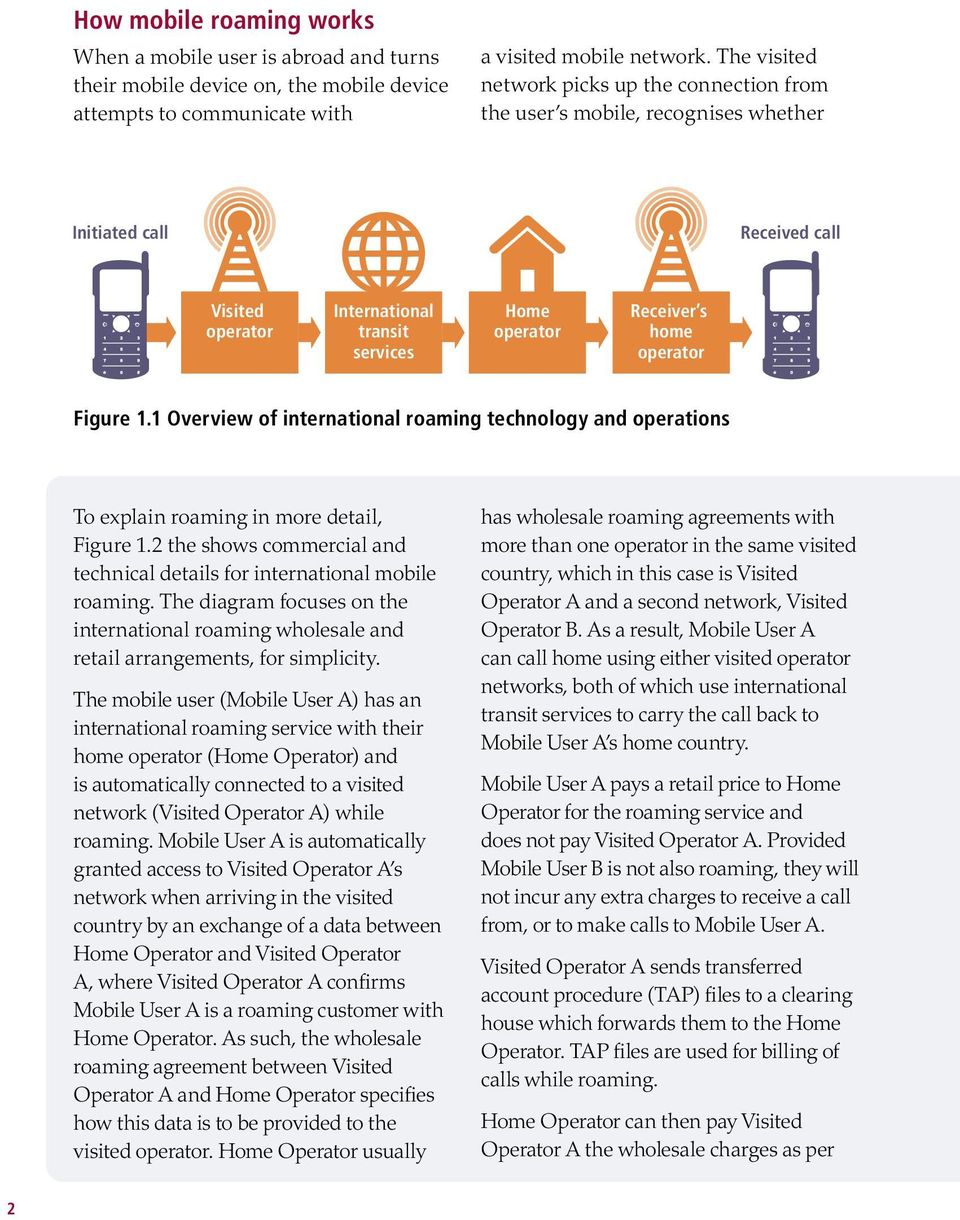
5 Mobile User B Mobile User A it is registered Home with its system, and The visited Visited network also requests Visited service attempts operator identify the user s home information operator from Athe home operator network B network. If there is a roaming agreement about the user, such as whether the between the home network Clearing and one house phone being used is lost or stolen, and of the mobile networks in the visited whether the mobile device is authorised Roaming country, the call is routed by the agreement visited for international use. If the phone is network towards an international transit authorised for use, the visited network International network (Figure 1.1). The international carrier creates a temporary subscriber record transit network carrier is responsible for the device and the home network for the Roaming call delivery services to the destination Traffic flow Revenue updates flow its subscriber Data exchange record on where network. Once this is done, the the device is located so if a call is made to destination network will connect the call. the phone it can be appropriately routed. RETAIL WHOLESALE Mobile User B Home operator Clearing house Roaming agreement International carrier Visited operator A Mobile User A Visited operator B RETAIL WHOLESALE Roaming services Traffic flow Revenue flow Data exchange Figure 1.2 Commercial links required for international mobile roaming call volumes in the TAP file and rates in the wholesale roaming agreement. Visited Operator A pays an international carrier (International Carrier) for carrying the call and handing over the call to Home Operator. International Carrier pays Home Operator a termination rate for terminating the call in the home country. 3
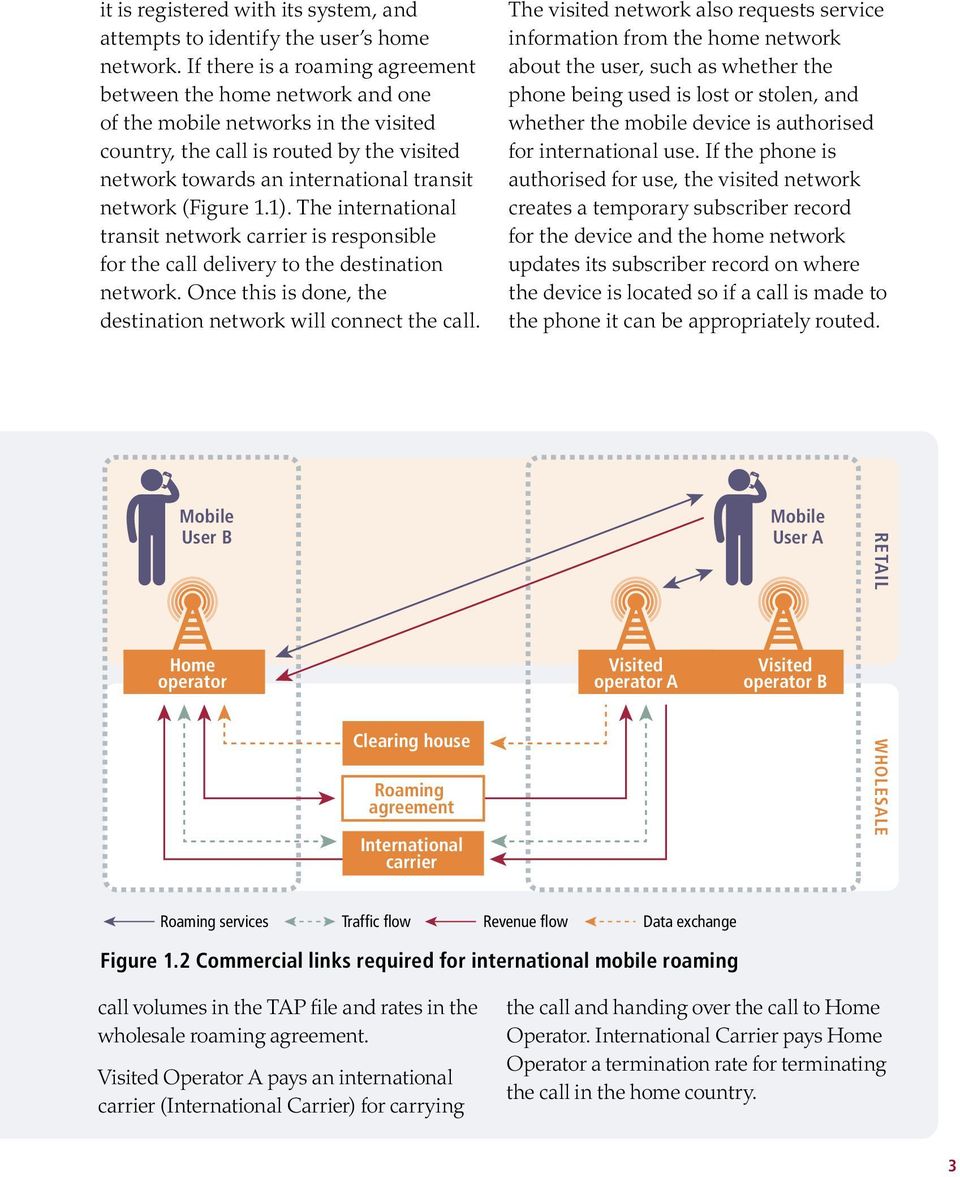
6 Data roaming With the increasing popularity of feature phones and smartphones, the use of mobile data services while roaming is set to continue to grow exponentially. Mobile data services are typically measured in kilobytes (KB) or megabytes (MB), which refers to the volume of data transmitted for the service used. Data traffic volumes can vary significantly depending on the type and use of different data services. Activity One hour of instant messaging One hour of web browsing Download 100 s Data traffic use MB MB 1 10 MB 100 minutes talk on VoIP video calling Around 50 MB Download one photo Download one MP3 One software download Download one film Streaming one hour of video Streaming one hour of audio MB 3 8 MB MB MB MB MB Figure 1.3: Mobile data traffic volumes 1 There are significant differences in the size estimates, as file size depends on the type of data, quality, and file length. For example, high definition and DVD quality streaming consumes greater amounts of mobile data than standard video or audio streaming. 4

7 2. Mobile roaming in the Asia Pacific The mobile environment is growing in the Asia Pacific region, both in subscribers and data traffic. Roaming services, however, are still being established. Countries within the region are in different stages of economic development, with significant differences in inflation rates, currency exchanges, labour costs and GDP per capita. GDP per capita in some Asia Pacific countries can be up to 56 times higher than others in the region. 2 Overall, the average GDP per capita for the region is lower than in the developed world and four times lower than in Europe. 3 There is varying market maturity across the region, with penetration ranging from four per cent in North Korea to 226 per cent in Macau. 4 On average, mobile penetration is one and a half times less than the European average, with 83 per cent of mobile users using prepaid subscriptions. 5 Asia Pacific s roaming services will continue to develop, as the region hosts just 25 per cent of the world s global roaming market with 42 per cent of the world s population. 6 Roaming use and its relevance as a service for mobile users varies significantly across the region. Only 10 per cent of the region s population travelled abroad in 2011 (Figure 2.1), with factors such as greater distances between countries and less affordable travel contributing to this low rate. Research has shown up to 80 per cent of roaming traffic from the region is international calls to mobile user s home country. 8 65% 35% 10% 7% Europe North America Asia Pacific Latin America Figure 2.1 Ratio of international trips to population %,

8 Roaming alternatives The Asia Pacific mobile market is evolving in different ways to other parts of the world, with new lower-income subscribers and multi-sim ownership driving the trend. It is also common to see Asia Pacific mobile users using roaming substitutes, such as call back services and international call forwarding services. Certain substitutes may be more appropriate than others depending on national market conditions. For data roaming, Wi-Fi is generally regarded as the most common substitute in Asia Pacific. Although Wi-Fi coverage in some areas might be limited, it is considered that the main reasons for Wi-Fi being unavailable is low market demand or regulatory concerns. 9 In general, countries within the Asia Pacific region believe substitutes provide benefits to budget-conscious consumers rather than all mobile users. 10 Regional challenges As the Asia Pacific market develops, structural and technical barriers must be addressed. Introducing roaming regulation while these obstacles remain could result in unintended and unforeseen consequences that negatively impact the industry, mobile users and government revenue. There are active and engaged regional groups working within the region to manage and improve roaming services for users. An intergovernmental organisation, the Asia Pacific Telecommunity (APT), serves as the focal organisation for ICT in the region, covering 38 member countries, four associate members and 130 affiliate members. Its roaming working group has been working with regulators and mobile operators to review the roaming environment for mobile users, resulting in the recent adoption of guidelines, as part of its working group report. 6
9 Technical and structural barriers Legal and technical developments are required to combat fraud and liberalise international gateways. Combating these barriers is vital prior to any implementation of roaming regulation, as they artificially inflate roaming charges in individual countries. Fraud remains a major financial concern for operators despite increased efforts and requires further investment in technology and negotiation of roaming agreements for minimisation. Some countries in the region regard particular types of telecommunications as illegal and bypass, for example traffic concealment by licensed carriers to avoid taxes or contribution to universal service; termination of traffic by unlicensed operators using technologies like VoIP and SIM boxes; flow of international voice traffic from PSTN to PC-to-PC calls through service provided by VoIP providers. In many countries, however, VoIP services are permitted. There is currently no specific investigation method for detecting heavy mobile callers in relation to bypass through VoIP and SIM boxes. International gateways are the facilities through which international calls are sent and received. Where international gateways are not liberalised, their costs make up a significant proportion of the total roaming costs. Even with volume growth, there is no bargaining power for operators working across monopolised gateways. This means inter-operator tariffs are likely to continue to be high. International long distance termination charges are another cost that inflates enduser prices. Although there has been much improvement in the level of competition, international gateway monopolies remain in at least eight per cent of Asia Pacific. 11 International roaming call prices between countries with liberalised gateways are typically 25 per cent lower than between those with gateway monopolies. 12 Asia Pacific countries have worked hard to remove issues of double taxation in the case of international roaming, which is a key issue in other regions. This is where sales or other indirect taxation is applied at a wholesale level on roaming or on international inbound services, and produces a situation of double taxation. It is important that governments focus on removing and reducing these structural barriers to help to reduce roaming costs for mobile users. 7

10 Technical barriers In addition to structural burdens, the industry continues to heavily invest in meeting the technical challenges of international roaming. This level of investment is in addition to the investment in new technologies to achieve roll outs of mobile broadband across the region. Regulatory intervention on roaming services will affect the ability of operators to invest in meeting the challenges of national mobile broadband roll outs. Technology challenges requiring investment: Interoperability: CDMA technology is in use in some parts of the region which prevents seamless roaming. Additionally, use of different GSM/3G spectrum can prevent many low-cost handsets from roaming. Enforcement of particular technologies and monitoring costs will disproportionately burden operators in less developed countries. Additional investment is required by operators to provide consistent quality of service across roaming networks. Coverage: Network coverage, particularly 3G, remains inconsistent as operators continue to roll out and upgrade their networks. Operators are investing in consumer communication and marketing to promote roaming and ensure transparency. Quality of service: Further investment is required in the Asia Pacific region to ensure consistent performance of the link connections for international roaming. This is so links have the adequate capacity, reliability, redundancy and diversity available in more developed mobile markets. Additional investment is also required to constantly monitor the loading and performance of the links to prevent congestion and ensure that the requirements are met. Inadvertent and border roaming In addition to structural and technical barriers, incidences of inadvertent and border roaming can also affect mobile users. As a region, the Asia Pacific has low travel traffic around borders in comparison to Europe. In many cases, differences in frequencies used for mobile devices or existing geographical barriers eliminate the occurrence of accidental roaming. Where a border is divided by a street or river, for example, this is much harder. Operators offer competitive roaming packages for mobile users in these zones and are continuing to invest in technical measures to eliminate inadvertent roaming in narrow border zones. 8
11 Case study: Singapore and Malaysia In May 2011, governments of Singapore and Malaysia announced bilateral price controls on international mobile roaming. The regulation required roaming price reductions of up to 30 per cent for voice calls and 50 per cent for SMS for all mobile operators in Singapore and Malaysia. The regulators adopted a European Union-style model of imposing wholesale and retail price caps on voice and SMS. However, the regulation did not address evidence of competitive activity in route pricing, where evidence is different to the European Union example. By not reviewing the evidence of competition on high-volume routes, a crucial stage of assessing the positive impact of competition was missed. Regulators in both countries identified benefits of the regulation to be for business users, rather than general mass market mobile users. On considering income levels between Singapore and Malaysia, and in the greater Asia Pacific region, low-end mobile users on pre-pay subscriptions are more likely to see travel SIMs as attractive while post-pay roaming customers will most likely be business users or high-end mobile users. In the case of Malaysia and Singapore, the numbers of Singaporean mobile users that benefit from regulated retail price reductions is three times greater than the number of Malaysian users. Singapore retail revenues 350 mins x 1 Before regulation Malaysian retail revenues 100 mins x 1 Singapore retail revenues 350 mins x 0.7 After regulation Malaysian retail revenues 100 mins x 0.7 Singapore revenues = 200 Wholesale flow 100 mins x mins x 0.6 Malaysian revenues = 250 Wholesale flow 100 mins x % 350 mins x % Singapore revenues = 170 Malaysian revenues = 145 Assumes: Initial retail price = 1, Initial IOT = 0.6. Roaming traffic is inelastic. Figure 2.2 Macro-financial effects of roaming regulation on voice roaming revenues, Singapore and Malaysia 9

12 gapore retail revenues 350 mins x 1 Before regulation Malaysian retail revenues 100 mins x 1 Singapore retail revenues 350 mins x 0.7 After regulation Malaysian retail revenues 100 mins x 0.7 It has also reduced Singaporean Rather, it has created a welfare operators Wholesale out-payments flow to Malaysian transfer from Wholesale the flow regulated operators, 100 mins and x 0.6total national roaming communications 100 mins x sector 0.3 to businesses payments from the wealthier, more 350 mins x in other % economic sectors. 350 mins x This % developed and densely populated case-study has not provided evidence Singapore revenues Singapore to the Malaysian less wealthy, revenues developed Singapore that revenues regulatory action Malaysian on roaming revenues = = = = 145 and densely populated Malaysia. will improve Asia Pacific regional communications linkages in the Despite Assumes: regulated Initial retail price price reductions, = 1, Initial IOT = 0.6. Roaming traffic is inelastic. longer term. intervention does not appear to have increased international roaming traffic volumes (Figure 2.3). There has been no elasticity-linked increase in short-term economic welfare or strengthening of overall market performance Singapore to Malaysia Malaysia to Singapore Q Q Q Figure 2.3 Bilateral minute traffic volumes in 2011 (Q1-3) 13 10

13 3. Price trends Regionally, market trends are positive and the industry is committed to taking the lead in developing innovative tariffs that suit mobile users. Roaming prices are declining and operators continue to develop innovative offers, including to accommodate inadvertent and border roaming, as described in Chapter 2, and to cater for regional tourism. Additionally, operators are investing heavily to address technical challenges such as interoperability and quality of service. Mobile operators offer users a menu of tariffs where they can choose tariffs depending on their preferences. With different needs and uses, mobile users can choose the most appropriate tariff to suit them. If regulation determines one price over another, this would mean regulation effectively favours one group of mobile users over another. As a result of the trend towards higher volumes of data downloaded, operators have introduced innovative data tariff packages, including flat rate daily, multi-day, weekly and monthly bundles, which deliver transparency and often significantly lower prices per megabyte than were previously available. Examples of different tariffs available in the region include: Fixed or flat fee Similar charges for using the same network provider abroad Alliance partnerships (SIMs that works in specific countries at same rate) Flat-rate data-only SIMs that work in multiple countries Call home rates equivalent to local rates. It should be noted that the structure of these roaming tariffs varies widely, from opt-in regional rates and monthly bundles for post-paid customers, to prepaid roaming tariffs and credits. 11
14 4. Impact of regulation Regulators have expressed concerns about the level of roaming charges and consumer bill-shock. However, this concern should not necessarily translate to a single global or regional solution. Differences in market conditions between countries may determine certain higher roaming charges in some countries and the reasons for higher charges. As such, regulators should first address concerns at the local level. Uniform regulatory measures may fail to address the source of any problem, and are likely to be detrimental to market performance. Global regulation cannot take into account all the different local market conditions and, as a consequence, may fail to address policy makers concerns. Additionally, the imposition of uniform regulatory measures may introduce new problems that could have unintended consequences on mobile users and the industry. Impact on developing countries The development stages of telecommunications industry and the levels of use of roaming services vary significantly among economies in the Asia Pacific region. The adoption of a single framework to regulate roaming prices across all Asia Pacific countries may create unintended or unforeseen adverse impacts to some economies. Due to the large variations in GDP, economic growth rates, cost structures and inflation rates in Asia Pacific countries, it is neither reasonable nor practical to adopt uniform pricing for international roaming services across all Asia Pacific economies. In addition, volatility in foreign exchange rates may reduce tariff transparency if the uniform price caps across all Asia Pacific economies are priced in US dollars. This could place a greater financial burden on developing countries to meet regulatory requirements, impacting on funds available for other greater needs for the local population, such as subsidised handsets, or it may result in removing roaming services all together. 12
15 Impact on tourist destinations Roaming prices in the Asia Pacific are substantially lower on high volume, bilateral routes and the highest discounts are found on the highest volume, and most travelled routes. Regulation is unlikely to acknowledge the difference between on-net and off-net 14 visited networks, and as such reduces the competitive impact of such offers. The economic cost of providing roaming in tourist destinations may also be significantly greater than the economic cost of providing mobile services to the local population. Any shortfall might need to be met through increasing prices for the local population, which means they may end up subsidising the network capacity used by affluent tourists. Economic impact The macro-financial implication of roaming regulation is an overall reduction of financial transfers from developed markets like Singapore to other Asia Pacific economies (Figure 2.2). In addition, mobile operators in less developed markets are subject to greater percentage revenue reductions as inter-operator tariff revenue falls in addition to retail revenue, leaving less revenue to invest in innovative services and extended broadband coverage in the future. Within the more developed markets, there appears to be a wealth transfer from the regulated communications sector to businesses in other economic sector, with no overall increase in economic performance. Competitive market dynamics are already strong in the Asia Pacific and are the best frameworks from which to determine the price for international mobile roaming services. Mobile users choose a mobile tariff based on the full value it provides across a number of services and operators optimise the pricing and value of the bundled tariff to address the needs of their local market. Regulating on the roaming elements of the tariffs reduces operators flexibility to tailor its services for the mass market of end-users. The Asia Pacific region should aim for a more competitive long term landscape than has resulted from the adoption of price regulation in to the European Union. 15 The mobile sector is a major contributor to Asian economic growth and accounts for an estimated US$485 billion, or 2.7 per cent of GDP, across the 17 major AP17 countries. It also accounts for 11.4 million jobs and for each job created by a mobile operator, there are eight more generated in the mobile ecosystem and wider economy. Additionally, in 2010 almost US$300 billion was generated 13

16 14 through various taxes and fees. This positive contribution of the mobile sector to employment, public funding and productivity is important for the region to sustain and grow. A global or regional regulation that decreases coverage, penetration and mobile phone use may in turn reduce the region s economic prosperity. 16
17 5. Best practice The industry recognises the concern of regulators regarding international mobile roaming prices. However, regulators need to also recognise that international mobile roaming is a complex service, involving many different factors that can influence price, as described in this brochure. This complexity creates a significant risk that regulatory measures will result in unintended, detrimental consequences for mobile users, governments and the industry, particularly in the long term. Regulating price may result in short-term benefits for mobile users; however, these are more than likely to be offset in the long-term by a reduction in the level of competition and innovation, as evidenced by the European Union experience. It is for this reason that the industry supports a measured approach to regulation, where regulators: Encourage operators to take measures that enhance mobile user awareness (transparency and bill shock) of tariffs when they travel Address structural barriers that increase costs for service providers and mobile users, such as double taxation and international gateway monopolies, as well as those barriers that hold back the development of market based substitutes Only consider price regulation after: Other measures have been given sufficient time to conclude there is a persistent problem Clear evidence shows that operators offering roaming services have market power that is, competition in the market for roaming services is limited Clear evidence shows that the operator company derives its market power from owning a natural monopoly Clear evidence shows the benefit exceeds the cost of regulation. Regional guidelines The Asia Pacific Economic Cooperation (APEC) Telecommunications and Information Working Group (TEL) developed the Guidelines for the Provision of Consumer Information on International Mobile Roaming 17 following a workshop on international roaming. The APT further developed the guidelines into two best practice versions, for mobile operators and regulators. 18 These documents provide guidance on how to address international roaming and raise mobile user awareness for using mobile services while travelling abroad. 15
18 Industry self-regulation In June 2012, the GSMA announced an initiative that will provide mobile users with greater visibility of their roaming charges and usage of mobile data services when travelling abroad. At a meeting held in July, 24 operator groups agreed to undertake a number of measures which will help mobile subscribers better understand their data roaming charges and more effectively manage their use of data services. The measures include: These are consistent with the APEC TEC guidelines and the APT international roaming working group report. The measures which already cover more than a billion mobile users will offer a more transparent and uniform experience for all travellers. These operators groups agreed to implement these data roaming transparency measures by the end of 2012, extending the coverage to more than four billion connections across 120 countries. Sending text messages to remind mobile users of their data roaming tariffs when they arrive in another country and turn on their mobile device Implementing a monthly data roaming spending limit to help consumers manage their roaming bill and sending alerts when their data usage approaches the limit Temporarily suspending data service when use exceeds the spending limit. 16

19 Endnotes 1 co.uk/mobilebroadband/help/ mobilebroadbandusage-guide-what-can-youget-foryourgigabyte, accessed 25 June A.T. Kearney Ibid 4 Source: EIU, Wireless Intelligence, Merrill Lynch Wireless Matrix, A.T. Kearney analysis 5 Wireless Intelligence Q1, A.T. Kearney analysis. Based on detailed bottom-up data for Europe. Asia Pacific is based on high-level estimate and includes wholesale and retail revenues for intra- and inter- region roaming 7 A.T. Kearney Based on number of trips divided by population so overestimates percentage of unique roamers. Regions based on UNWTO definitions. 8 A.T. Kearney analysis, Asia Pacific Telecommunity, International Mobile Roaming Working Group, Working Group Report, 15 May Ibid 11 A.T. Kearney, Sample for Asia Pacific based on 24 countries data not available for Source: Celcom Axiata 14 On-Net is when a call or message originates on the mobile user s home operator s network and terminates to another mobile number that resides with the operator. It does not matter if the receiver is using the home network or is off Island roaming with a different provider. Off- Net applies when the call or message is made on a different network, such as while roaming, or when a mobile user uses their home network to make a call or send a message to a number that resides with a different network provider. 15 Commissioner Kroes makes the observation that, in the case of the European Union, price competition has not emerged in the EU roaming services markets following the introduction of price regulation, http: europea.eu/rapid/pressreleasesaction. do?reference=speech/10/ GSMA, Asia Pacific Observatory Steering-Committee-on-Economic-and- Technical-Cooperation/Working-Groups/ Telecommunications-and-Information 18 APT_IMR_Working_Group_Report_Final.pdf 12 Source: Gateway Liberalization Stimulating Economic Growth, GSMA, February 2007

20 For further questions on roaming, please contact: Isabelle Mauro Head of International Affairs Vikram Raval International Roaming Regulation Manager 3 GSMA Head Office Level 7, 5 New Street Square New Fetter Lane London EC4A 3BF United Kingdom July 2012
International roaming explained
 International roaming explained Africa Contents 1. Mobile roaming explained 1. Mobile roaming explained... 1 2. Mobile roaming in Africa... 5 3. Price trends... 10 4. Impact of regulation... 11 5. Best
International roaming explained
 International roaming explained Latin America Contents 1. Mobile roaming explained... 1 2. Mobile roaming in Latin America... 5 3. Price trends... 11 4. Impact of regulation... 13 5. Best practice... 15
INTERNATIONAL MOBILE ROAMING
 INTERNATIONAL MOBILE ROAMING Vikram Raval Public Policy and Regulation ITU/BDT Arab Regional Workshop on Mobile Roaming: National & International Practices Khartoum-Sudan, 27-29 October 205 Commercial
Mobile SMS and Data Roaming Explained
 Mobile SMS and Data Roaming Explained Mobile SMS and data roaming explained Roaming is the ability of customers to use their mobile phones or other mobile devices outside the geographical coverage area
International Mobile Roaming
 International Mobile Roaming Dr. Antony Srzich A presentation to the WTO Symposium on International Mobile Roaming 22 March 202 What is International Mobile Roaming? Customers can seamlessly continue to
Roaming Hubs - Enabling Operator Agility in an Evolving Mobile Landscape
 Roaming Hubs - Enabling Operator Agility in an Evolving Mobile Landscape Mobile users are getting smarter by the day. It is generally accepted that a better quality service can be found elsewhere if their
Executive Summary. Page 2 of 12
 Vodafone s comments to the BEREC Machine to Machine Expert Working Group on an appropriate regulatory framework for Machine to Machine communications and the Internet of Things 1 31 st July 2014 1 Vodafone
The International Communications Market 2014. 6 Telecoms and networks
 The International Communications Market 24 6 Telecoms and networks 227 Contents 6. Key market developments in telecoms and networks 23 6.. Overview 23 6..2 Introduction 23 6..3 Next generation access
International Dialing and Roaming: Preventing Fraud and Revenue Leakage
 page 1 of 7 International Dialing and Roaming: Preventing Fraud and Revenue Leakage Abstract By enhancing global dialing code information management, mobile and fixed operators can reduce unforeseen fraud-related
Best Practices: Mobile Roaming
 Best Practices: Mobile Roaming Mobile roaming enables consumers to use their mobile phones when travelling abroad or outside of their current network carrier calling area by connecting to partnered provider
WiMAX technology. An opportunity that can lead African Countries to the NET Economy. Annamaria Raviola SVP - Marketing and Business Development
 WiMAX technology An opportunity that can lead African Countries to the NET Economy Annamaria Raviola SVP - Marketing and Business Development Agenda Telecommunications in Africa: the present picture Wi-MAX:
Mobile Gateway usage clarification of the regulatory environment
 Information Notice Mobile Gateway usage clarification of the regulatory environment Document No: 03/15 Date: 05, February 2003 An Coimisiún um Rialáil Cumarsáide Commission for Communications Regulation
BoR (13) 185. BEREC Report on Transparency and Comparability of International Roaming Tariffs
 BEREC Report on Transparency and Comparability of International Roaming Tariffs December 2013 Contents I. EXECUTIVE SUMMARY AND MAIN FINDINGS... 3 II. INTRODUCTION AND OBJECTIVES OF THE DOCUMENT... 5 III.
LEGACY PRICE GUIDE FOR BUSINESS
 LEGACY PRICE GUIDE FOR BUSINESS Our home for retired EE and Orange business service plans 1 Table of contents Table of contents 2 Voice Service Plans 3 Custom and Corporate Group 3 Corporate Service Plan
List of Figures Analysis Executive Summary 1. International Call Volumes and Growth Rates, 1994-2014 2. Compounded Annual Traffic Growth Rate by
 TeleGeography Report Analysis Executive Summary Traffic Analysis Supplementary Figures Traffic by Region Traffic by Country Prices and Revenues Supplementary Figures Retail Rates Wholesale Rates Interconnection
Telecommunications Statistical Review
 Telecommunications Statistical Review 27 INTRODUCTION...3 OVERALL INTERNET USAGE...3 Internet Penetration...4 Broadband Services...5 Mobile Internet Access...5 Pricing...7 Comparison with Other Jurisdictions...7
TELEGEOGRAPHY REPORT EXECUTIVE SUMMARY. Executive Summary
 Executive Summary Over the past two decades, the international long-distance industry has experienced wrenching changes. Service providers have weathered market liberalization, the enormous telecom market
AT&T International Roaming When you are traveling outside the U.S.
 Cell Phone Packages 1 Passport Passport Silver Passport Gold AT&T International Roaming When you are traveling outside the U.S. For Cell Phones AT&T Passport SM Packages Get everything you need for international
SOUTH EAST ASIA AND OCEANIA ERICSSON MOBILITY REPORT JUNE
 SOUTH EAST ASIA AND OCEANIA ERICSSON MOBILITY REPORT JUNE Market Overview Key figures: South East Asia and Oceania 2021 CAGR 2021 Mobile subscriptions (million) 990 1,250 4% Smartphone subscriptions (million)
Flat Rate versus Per Minute Charges for Telephone Service: The Relationship between Internet Access and Telephone Tariffs.
 Flat Rate versus Per Minute Charges for Telephone Service: The Relationship between Internet Access and Telephone Tariffs December 4, 2001 The vast majority of residential Internet users and many business
Executive Summary. Traffic Trends
 Executive Summary Few industries have experienced more wrenching changes than the international longdistance telecommunications market. Over the past 20 years, service providers have weathered market liberalization,
Business Solutions with MTN.
 Business Solutions with MTN. 1 Contents Introduction 3 Private APN s 4 MTN Dedicated Access 6 MTN Direct Connect 7 Least Cost Routing (LCR) 12 Y ello SMS 14 2 2 Introduction At MTN, we understand that
LTE: Technology and Health. 4G and Mobile Broadband
 LTE: Technology and Health 4G and Mobile Broadband LTE Technology and Health Mobile Broadband typically refers to providing customers with high speed data while on the move. There are several technologies
Smart VoIP Enabling Mobile Operators to Deliver OTT VoIP
 Enabling Mobile Operators to Deliver OTT Kineto Wireless, Inc. 1601 McCarthy Blvd. Milpitas, CA 95035 Tel: +1 408 546 0660 2012 Kineto Wireless, Inc. All rights reserved. www.kineto.com Introduction Today
NUMBERING FOR VoIP SERVICES
 Electronic Communications Committee (ECC) within the European Conference of Postal and Telecommunications Administrations (CEPT) NUMBERING FOR VoIP SERVICES Oxford, December 2004 Page 2 EXECUTIVE SUMMARY
Business Review. Customer-oriented High Quality Customer Service Better Returns to Shareholders. China Mobile (Hong Kong) Limited
 18 Customer-oriented High Quality Customer Service Better Returns to Shareholders China Mobile (Hong Kong) Limited 19 The table below summarizes selected operating data of the Group for the period from
CONSULTATION. National Numbering Plan Review. A short Consultation issued by the Telecommunications Regulatory Authority 28 August 2007
 National Numbering Plan Review A short Consultation issued by the Telecommunications Regulatory Authority 28 August 2007 The address for responses to this document is: The General Director, Telecommunications
Gibtelecom response to Public Consultation 01/07
 Gibtelecom response to Public Consultation 01/07 Retail Fixed Markets 8 June 2007 Gibtelecom Limited Suite 942 Europort Gibraltar Gibtelecom Response to GRA Market Review for Retail Fixed Markets In response
OPEN SKIES POLICY - MARKET ACCESS PRINCIPLES FOR SATELLITE COMMUNICATIONS
 OPEN SKIES POLICY - MARKET ACCESS PRINCIPLES FOR SATELLITE COMMUNICATIONS Executive Summary The need for Open Skies approach for satellite services stems from the reach and nature of satellite signals,
OECD Policy Guidance on Convergence and Next Generation Networks
 2 OECD POLICY GUIDANCE ON CONVERGENCE AND NEXT GENERATION NETWORKS OECD Policy Guidance on Convergence and Next Generation Networks Introduction The digitalisation of content, the emergence of IP, and
Wi-Fi calling for business: ROGERS WHITE PAPER. An Executive Overview
 1 ROGERS WHITE PAPER Wi-fi calling for business An Executive Overview page 2 2 TABLE OF CONTENTS Introduction 3 What Is Wi-Fi Calling? 4 How Does It Work? 5 What Are the Business Benefits? 7 What Are the
Submission by the Asia Pacific Carriers Coalition
 Submission by the Asia Pacific Carriers Coalition In Response to Consultation Paper issued by TRAI on Relaxing Restrictive Provision of Internet Telephony (IPT) (Consultation Paper No. 11/08 issued on
The BT Business Big Giveaway.
 BT Business The BT Business Big Giveaway. Set your business free with our best ever offer on calls, lines and broadband. There s never been a better time to sign up to BT. We understand how tough the climate
DATA RETENTION. Guidelines for Service Providers
 DATA RETENTION Guidelines for Service Providers The Attorney-General s Department has prepared this guide to assist industry participants to understand the obligations arising from the Telecommunications
The European Commission s Approach to Voice over IP: Frequently Asked Questions
 MEMO/05/46 Brussels, 11 February 2005 The European Commission s Approach to Voice over IP: Frequently Asked Questions How does VoIP work? The technology called Voice over Internet Protocol (VoIP) allows
LATIN AMERICA AND THE CARIBBEAN ERICSSON MOBILITY REPORT APPENDIX NOVEMBER
 LATIN AMERICA AND THE CARIBBEAN ERICSSON MOBILITY REPORT APPENDIX NOVEMBER MARKET OVERVIEW Key figures: Latin America and the Caribbean M Mobile subscriptions (million) Smartphone subscriptions (million)
OVERVIEW OF THE TELECOMMUNICATIONS INDUSTRY
 Certain facts, statistics and data presented in this section and elsewhere in this document have been derived, in part, from various government or official sources. Whilst the Directors have taken all
VoIP Regulation Klaus Nieminen Helsinki University of Technology [email protected]
 VoIP Regulation Klaus Nieminen Helsinki University of Technology [email protected] Abstract Voice over IP (VoIP) is currently the uppermost telecommunication regulatory question globally. The purpose
The Connected Consumer Survey 2015: OTT communication services
 Research Report The Connected Consumer Survey 2015: OTT communication services April 2015 Patrick Rusby and Stephen Sale 2 About this report This report focuses on aspects of Analysys Mason s annual Connected
CHAPTER 13 TELECOMMUNICATIONS. commercial mobile services means public telecommunications services supplied through mobile wireless means;
 CHAPTER 13 TELECOMMUNICATIONS Article 13.1: Definitions For the purposes of this Chapter: commercial mobile services means public telecommunications services supplied through mobile wireless means; cost-oriented
Substitutes for Mobile Voice Roaming Services ( MVRS )
 Substitutes for Mobile Voice Roaming Services ( MVRS ) In order to stay connected, consumers these days will more often than not bring along their mobile phones when travelling outside Hong Kong, whether
International Mobile Roaming:
 ITU/BDT Regional Economic and Financial Forum of Telecommunications/ICTs for Latin America and the Caribbean UIT/BDT Foro Regional sobre Economía y Finanzas de las Telecomunicaciones/TICs para América
BEREC DRAFT REPORT ON OTT SERVICES
 The Consumer Voice in Europe BEREC DRAFT REPORT ON OTT SERVICES BEUC response to the public consultation Contact: Guillermo Beltrà [email protected] BUREAU EUROPÉEN DES UNIONS DE CONSOMMATEURS AISBL DER
The Status of Telecommunications in Grenada
 The Status of Telecommunications in Grenada 1 Overview The telecommunications sector was estimated to have contributed EC $94.9 million to GDP, Telecommunications Investment and Revenue in Grenada representing
A Framework for Freephone Services in the 800 range
 A Framework for Freephone Services in the 800 range Report on further Consultation and Decision August 2008 (Updated February 2012) Malta Communications Authority Valletta Water Front, Pinto Wharf, Valletta
Mobile Voice ~ Whispers of Change?
 WHITEPAPER Mobile Voice ~ Whispers of Change? This whitepaper is an extract from: Mobile Voice Strategies mvoip Opportunities & Business Models, 2010-2015... information you can do business with Mobile
The ipass Wi-Fi Cost Index
 The ipass Wi-Fi Cost Index The High Cost of Data Roaming and What You Can Do About It Corporate Headquarters ipass Inc. 3800 Bridge Parkway Redwood Shores, CA 94065 +1 650-232-4100 +1 650-232-4111 fx www.ipass.com
2014 TELECOMMUNICATIONS MARKET SURVEY REPORT RESIDENTIAL RESULTS 18 NOVEMBER 2014
 2014 TELECOMMUNICATIONS MARKET SURVEY REPORT RESIDENTIAL RESULTS 18 NOVEMBER 2014 DISCLAIMER TRA does not make any representations or warranties, either express or implied, that: the information is free
The European Electronic Communications Regulation and Markets 11 th Report Frequently Asked Questions
 MEMO/06/84 Brussels, 20 February 2006 The European Electronic Communications Regulation and Markets 11 th Report Frequently Asked Questions What is the EU regulatory framework for electronic communications?
December 2013 Copyright 2013 GSM Association
 The Embedded SIM Whitepaper December 2013 Copyright 2013 GSM Association Abstract In the future, everyone and everything around us that might benefit from a wireless connection will, in fact, have one.
VoIP Service Schedule Terms of Service Voice over IP
 VoIP Terms of Service Use of VoIP Services is subject to Planet Ozi s Terms and Conditions or Master Services Agreement (as applicable) and this Service Schedule. The terms and conditions in this Service
Older O2 Business Tariffs for up to 10 people
 Older O2 Business Tariffs for up to 10 people Older O 2 business tariffs Older O 2 business tariffs for one person - index 1. BlackBerry Large Business 2. BlackBerry Large Business 3. BlackBerry Medium
Definition of Mobile Instant Messaging (MIM) Systems
 J son & Partners Consulting Company presents the results of the research Mobile instant messaging systems as a direct threat to SMS. Definition of Mobile Instant Messaging (MIM) Systems MIM (Mobile Instant
International Carriers
 International Carriers combatting by-pass fraud with Orange expertise and services Pierre Paufique December 2014 Anti-Fraud Interconnect Roaming & Supervision of Transactions 2014 why we should fight by-pass
European Mobile Market: Beyond Price-based Strategies. Laura Allen Phillips, Research Analyst, Parks Associates
 European Mobile Market: Beyond Price-based Strategies Laura Allen Phillips, Research Analyst, Parks Associates A Paradigm Shift Italy The European Mobile Industry European Mobile Market: Beyond Price-based
SOUTH EAST ASIA AND OCEANIA ERICSSON MOBILITY REPORT APPENDIX NOVEMBER
 SOUTH EAST ASIA AND OCEANIA ERICSSON MOBILITY REPORT APPENDIX NOVEMBER 214 Market overview Key figures: South East Asia and Oceania M 214 995 224 35 22 1,33 81 2,7 CAGR 214 22 5% 25% 4% Mobile subscriptions
Europe s Video Game Industry and the Telecom Single Market
 Executive Summary The internet is a key driver of growth in the video game industry and facilitates distribution of content, engagement with customers, multiplayer gameplay and provision of crucial software
Post Paid. Vodafone Pty Limited ABN 76 062 954 554 MARTIN DAWES SFOA NOVEMBER 2004 - WHAT IS A CONNECTED CALL 30/11/04 8:54
 Post Paid Standard agreement for the supply of the Digital Mobile Telecommunications Service Post Paid (Martin Dawes Telecommunications Pty Limited) Pty Limited ABN 76 062 954 554 MARTIN DAWES SFOA NOVEMBER
Mobile Voice Off-Load
 Mobile Voice Off-Load An AdvOSS Solution White Paper Latest version of this white paper can always be found at: http://advoss.com/resources/whitepapers/mobile-voice-offload.pdf For more information, contact
BT Business Complete. It s all organised to save you money.
 BT Business BT Business Complete. It s all organised to save you money. Combine your business lines, calls, mobile and broadband for bigger savings. Plus with one bill, one supplier and the reassurance
Definitions of the Telecommunication indicators used in the EUROSTAT telecommunications inquiry
 Definitions of the Telecommunication indicators used in the EUROSTAT telecommunications inquiry Table 1 Operators (Unit: number (NBR)) Number of active operators (only active) offering publicly available
Why VoIP Peer to Peer and Social Networking providers cannot ignore Legacy Telecoms! Or why Peer to Peer VoIP needs Voip-Pal IP to succeed!
 Why VoIP Peer to Peer and Social Networking providers cannot ignore Legacy Telecoms! Or why Peer to Peer VoIP needs Voip-Pal IP to succeed! Professor Ed Candy Senior Life Member IEEE, Fellow of the IET
WHITE PAPER. Reduce Cellular Spend With ShoreTel Mobility
 WHITE PAPER Reduce Cellular Spend With ShoreTel Mobility Table of Contents 1. Executive summary...3 2. Objective...3 3. Situation...3 International cellular direct dial and roaming...3 Domestic cellular
Quarterly Key Data Report
 Irish Communications Market Quarterly Key Data Report Data as of Q1 2014 Document No: 14/61 Date: 20 June 2014 Table of Contents SUMMARY... 6 Notes to data:... 8 1. OVERALL MARKET DATA... 10 1.1 Number
4G (LTE) Roaming Experience_. Mobile World Congress 2014
 4G (LTE) Roaming Experience_ Mobile World Congress 2014 Telefonica offers to customers of multiple partner operators in more than 15 different countries and during MWC in Barcelona in anticipation of the
TELEGEOGRAPHY REPORT EXECUTIVE SUMMARY. Executive Summary
 Executive Summary Few industries have experienced more wrenching changes than the international longdistance business. Over the past two decades, service providers have weathered market liberalization,
Point Topic s Broadband Operators and Tariffs
 1 Point Topic s Broadband Operators and Tariffs Broadband tariff benchmarks: Q2 2013 July 2013 Point Topic Ltd 73 Farringdon Road London EC1M 3JQ, UK Tel. +44 (0) 20 3301 3303 Email [email protected]
Syrian Arab Republic. There is inadequate competition between both companies; all prices and special offers are always identical.
 Syrian Arab Republic The Syrian Arab Republic has the lowest level of mobile penetration in the region, and among the lowest number of phones in use at 11.9 million subscribers. There are only two mobile
WHITE PAPER. Solutions for the Broadband User Enigma *"%+,$ !"#$ %"&$ '()($ Consolidating Subscriptions through Unprecedented Business Intelligence
 WHITE PAPER *"%+,$!"#$ %"&$ '()($ Solutions for the Broadband User Enigma Consolidating Subscriptions through Unprecedented Business Intelligence vennetics.com Removing the Mystery from Broadband Users
US WIRELESS & WIRELINE VOICE: THREATS AND OPPORTUNITIES
 US WIRELESS & WIRELINE VOICE: THREATS AND OPPORTUNITIES 2013-2018 FEBRUARY 2014 PO Box 34 Mountain Lakes, New Jersey 07046 USA 973-541-9600 phone [email protected] http://www.insight-corp.com What
ITU-T STUDY GROUP 3 Mini-Workshop GENEVA, 26 MAY 2014
 Committed to Connecting the World ITU-T STUDY GROUP 3 Mini-Workshop GENEVA, 26 MAY 2014 Towards an ITU cost model for international mobile roaming for NRAs Simon Forge Simon Forge All rights reserved 2014
Prepaid and Postpaid Pay As You Go Plus, Month to Month, 12 and 24 Month Standard Mobile Broadband Products
 Vodafone Mobile Broadband Prepaid and Postpaid Pay As You Go Plus, Month to Month, 12 and 24 Month Standard Mobile Broadband Products 1. What Terms and Conditions apply to my Vodafone Prepaid or Postpaid
Special Conditions and Service Description for amaysim Mobile Broadband
 Special Conditions and Service Description for amaysim Mobile Broadband amaysim Australia Pty Ltd, PO Box R567, Royal Exchange NSW 1225, Australia, ABN 65 143 613 478, ACN 143 613 478 Table of Contents