
Key Performance Indicators
|
|
|
- Clemence Stokes
- 10 years ago
- Views:
Transcription
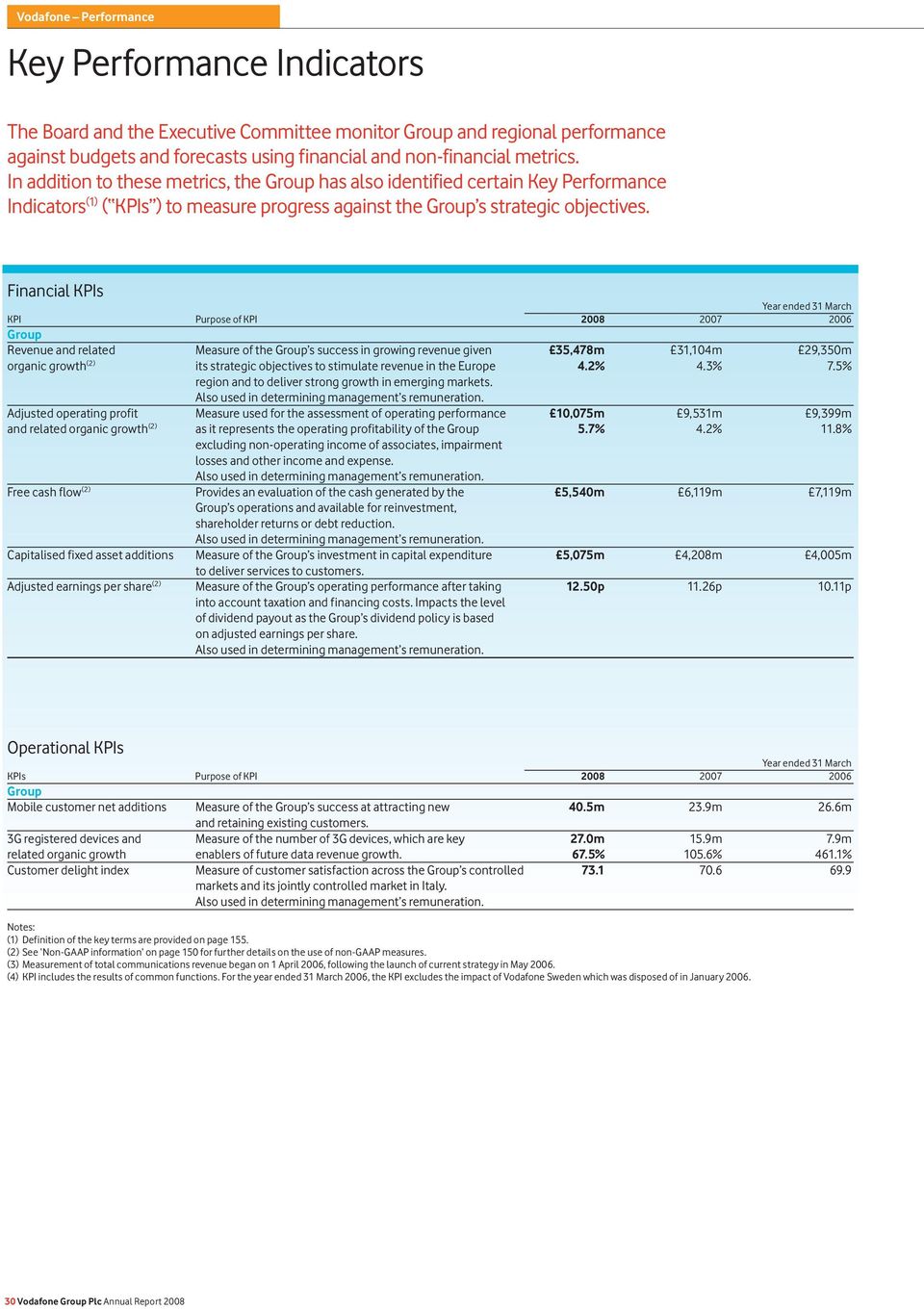
1 Vodafone Performance Key Performance Indicators The Board and the Executive Committee monitor Group and regional performance against budgets and forecasts using financial and non-financial metrics. In addition to these metrics, the Group has also identified certain Key Performance Indicators (1) ( KPIs ) to measure progress against the Group s strategic objectives. Financial KPIs Year ended 31 March KPI Purpose of KPI Group Revenue and related Measure of the Group s success in growing revenue given 35,478m 31,104m 29,350m organic growth (2) its strategic objectives to stimulate revenue in the Europe 4.2% 4.3% 7.5% region and to deliver strong growth in emerging markets. Also used in determining management s remuneration. Adjusted operating profit Measure used for the assessment of operating performance 10,075m 9,531m 9,399m and related organic growth (2) as it represents the operating profitability of the Group 5.7% 4.2% 11.8% excluding non-operating income of associates, impairment losses and other income and expense. Also used in determining management s remuneration. Free cash flow (2) Provides an evaluation of the cash generated by the 5,540m 6,119m 7,119m Group s operations and available for reinvestment, shareholder returns or debt reduction. Also used in determining management s remuneration. Capitalised fixed asset additions Measure of the Group s investment in capital expenditure 5,075m 4,208m 4,005m to deliver services to customers. Adjusted earnings per share (2) Measure of the Group s operating performance after taking 12.50p 11.26p 10.11p into account taxation and financing costs. Impacts the level of dividend payout as the Group s dividend policy is based on adjusted earnings per share. Also used in determining management s remuneration. Operational KPIs Year ended 31 March KPIs Purpose of KPI Group Mobile customer net additions Measure of the Group s success at attracting new 40.5m 23.9m 26.6m and retaining existing customers. 3G registered devices and Measure of the number of 3G devices, which are key 27.0m 15.9m 7.9m related organic growth enablers of future data revenue growth. 67.5% 105.6% 461.1% Customer delight index Measure of customer satisfaction across the Group s controlled markets and its jointly controlled market in Italy. Also used in determining management s remuneration. Notes: (1) Definition of the key terms are provided on page 155. (2) See Non-GAAP information on page 150 for further details on the use of non-gaap measures. (3) Measurement of total communications revenue began on 1 April 2006, following the launch of current strategy in May (4) KPI includes the results of common functions. For the year ended 31 March 2006, the KPI excludes the impact of Vodafone Sweden which was disposed of in January Vodafone Group Plc Annual Report 2008
2 Strategic KPIs Year ended 31 March KPI Purpose of KPI Group Innovate and deliver on our customers total communications needs Total communications revenue Measures the Group s growth in total communications 4,565m 3,310m See note 3 revenue, a key driver in the growth of the business for the future. Also used in determining management s remuneration. Total communications revenue Measures progress against the Group s target to increase total 12.9% 10.6% See note 3 as a percentage of Group revenue communications revenue to 20% of total Group revenue by the 2010 financial year. Data revenue and related Data revenue growth is expected to be a key driver of 2,180m 1,428m 1,098m organic growth (2) the future growth of the business. 40.6% 30.7% 51.8% Europe Revenue stimulation and cost reduction in Europe Revenue and related Revenue and revenue growth is an indicator of the 26,081m 24,592m 24,733m organic growth (2) success of the revenue stimulation strategy. 2.0% 1.4% 5.6% Adjusted operating profit Measure of profitability and also used to track success 6,206m 6,159m 6,425m and related organic growth (2) in stimulating revenue and reducing costs. (1.5)% (3.7)% 5.2% Operating expenses as a Measure of how operating expenses are being controlled 23.4% 23.8% 22.8% percentage of service revenue and is an indicator of the success of the cost reduction measures within the Europe region. Voice usage (millions of minutes) Voice usage is an important driver of revenue growth 182, , ,933 especially in light of continuing price reductions due to the competitive and regulatory environment. Mobile capital intensity (4) Measures the Group s performance against its target 9.9% 11.8% 12.4% to reduce European mobile capital expenditure to revenue ratio to 10% for the 2008 financial year. EMAPA Deliver strong growth in emerging markets Revenue and related Revenue growth is an indicator of the success of the 9,345m 6,441m 4,554m organic growth (2) strategy to deliver growth in emerging markets. 14.5% 21.1% 19.4% Adjusted operating profit and Measure of profitability and also used to ensure 3,729m 3,244m 2,763m related organic growth (2) EMAPA is delivering strong profitable growth. 20.9% 27.4% 16.0% Operating expenses as a Measure of how operating expenses are being 25.9% 24.7% 25.1% percentage of service revenue controlled in an environment of strong growth. Mobile customers and The number of closing mobile customers in the customer 119.1m 61.9m 39.8m related organic growth base and the related growth is an indicator of the success 21.2% 26.7% 38.3% of the strategy to deliver growth in emerging markets. Vodafone Group Plc Annual Report

3 Vodafone Performance Operating Results This section presents the Group s operating performance for the 2008 financial year compared to the 2007 financial year and for the 2007 financial year compared to the 2006 financial year, providing commentary on how the revenue and the adjusted operating profit performance of the Group and its operating segments within the Europe and EMAPA regions have developed in the last three years Financial Year Compared to the 2007 Financial Year Group Common Group Group Europe EMAPA functions (2) Eliminations % Change m m m m m m organic Voice revenue (1) 17,485 7,486 (92) 24,879 22,268 Messaging revenue 3, (7) 4,079 3,587 Data revenue 1, (6) 2,180 1,428 Fixed line revenue (1) 1, (1) 1,874 1,580 Other service revenue Service revenue 24,430 8,718 (106) 33,042 28, Acquisition revenue 1, (1) 1,488 1,385 Retention revenue Other revenue (11) Revenue 26,081 9, (118) 35,478 31, Interconnect costs (3,980) (1,391) 106 (5,265) (4,628) Other direct costs (2,064) (1,354) 76 (3,342) (2,761) Acquisition costs (2,872) (939) 1 (3,810) (3,281) Retention costs (1,756) (259) (2,015) (1,755) Operating expenses (5,719) (2,257) (7,868) (6,719) Acquired intangibles amortisation (78) (648) (726) (414) Purchased licence amortisation (846) (63) (909) (892) Depreciation and other amortisation (2,985) (1,154) (205) (4,344) (3,848) Share of result in associates (3) 425 2, ,876 2,725 Adjusted operating profit 6,206 3, ,075 9, Adjustments for: Impairment losses (11,600) Other income and expense (28) 502 Non-operating income of associates 3 Operating profit/(loss) 10,047 (1,564) Non-operating income and expense Investment income Financing costs (2,014) (1,612) Profit/(loss) before taxation 9,001 (2,383) Income tax expense (2,245) (2,423) Profit/(loss) for the financial year from continuing operations 6,756 (4,806) Loss for the financial year from discontinued operations (491) Profit/(loss) for the financial year 6,756 (5,297) Notes: (1) Revenue relating to fixed line activities provided by mobile operators, previously classified within voice revenue, is now presented as fixed line revenue, together with revenue from fixed line operators and fixed broadband. All prior periods have been adjusted accordingly. (2) Common functions represents the results of the partner markets and the net result of unallocated central Group costs and recharges to the Group s operations, including royalty fees for use of the Vodafone brand. (3) During the year ended 31 March 2008, the Group changed its organisational structure and the Group s associated undertaking in France, SFR, is now managed within the Europe region and reported within Other Europe. The results are presented in accordance with the new organisational structure. Revenue Revenue increased by 14.1% to 35,478 million for the year ended 31 March 2008, with organic growth of 4.2%. The impact of acquisitions and disposals was 6.5 percentage points, primarily from acquisitions of subsidiaries in India in May 2007 and Turkey in May 2006 as well as the acquisition of Tele2 s fixed line communication and broadband operations in Italy and Spain in December Favourable exchange rate movements increased revenue by 3.4 percentage points, principally due to the 4.2% change in the average euro/ exchange rate, as 60% of the Group s revenue for the 2008 financial year was denominated in euro. Revenue grew in the Europe and EMAPA regions by 6.1% and 45.1%, respectively, with growth in the EMAPA region benefiting from a 27.5 percentage point impact from acquisitions and disposals. On an organic basis, Europe recorded growth of 2.0%, while EMAPA delivered an increase of 14.5%. EMAPA accounted for 62.1% of the organic growth for the Group. Organic revenue growth was driven by the higher customer base and successful usage stimulation initiatives, partially offset by ongoing price reductions and the impact of regulatory driven reductions. Growth in data revenue was particularly strong, up 40.6% on an organic basis to 2,180 million, reflecting an increasing penetration of mobile PC connectivity devices and improved service offerings. Operating result Operating profit increased to 10,047 million for the year ended 31 March 2008 from a loss of 1,564 million for the year ended 31 March The loss in the 2007 financial year was mainly the result of the 11,600 million of impairment charges that occurred in the year, compared with none in the 2008 financial year. 32 Vodafone Group Plc Annual Report 2008
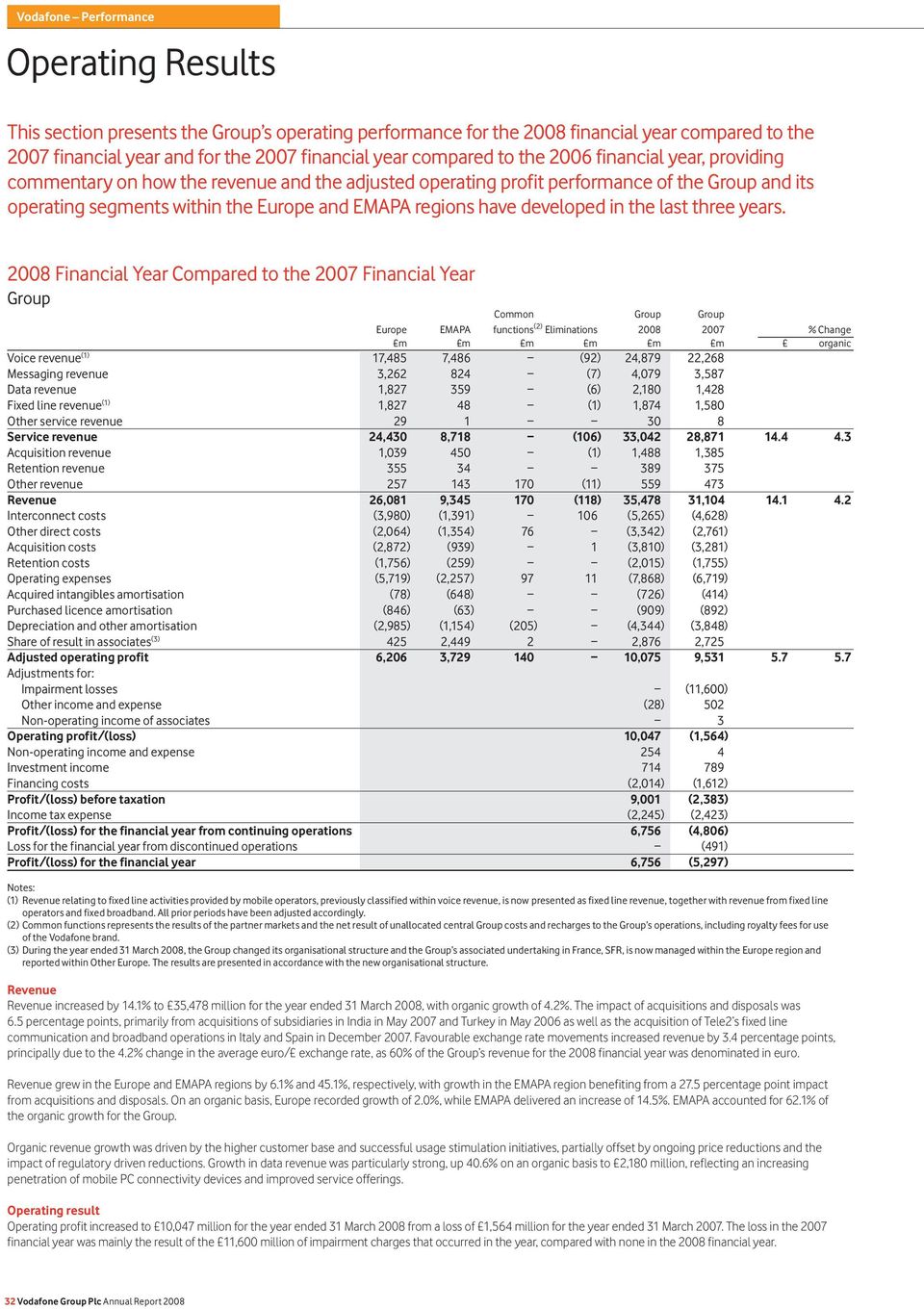
4 Adjusted operating profit increased to 10,075 million, with 5.7% growth on both a reported and organic basis. The net impact of acquisitions and disposals reduced reported growth by 0.8 percentage points. The net impact of foreign exchange rates was to increase adjusted operating profit by 0.8 percentage points, as the impact of the 4.2% increase in the average euro/ exchange rate was partially offset by 5.7% and 7.2% decreases in the average US$/ and ZAR/ exchange rates, respectively. 59%, 25% and 4% of the Group s adjusted operating profit for the 2008 financial year was denominated in euro, US$ and ZAR, respectively. On an organic basis, the EMAPA region generated all of the Group s growth in adjusted operating profit, with the 20.9% increase in the region driven by a higher customer base and the resulting increase in service revenue. Europe s adjusted operating profit declined by 1.5% on an organic basis compared to the 2007 financial year, resulting from the continuing challenges of highly penetrated markets, regulatory activity and continued price reductions. In Europe, adjusted operating profit was stated after a 115 million benefit from the release of a provision following a revised agreement in Italy relating to the use of the Vodafone brand and related trademarks, which is offset in common functions, and was also impacted by higher interconnect, acquisition and retention costs and the impact of the Group s increasing focus on fixed line services, including the acquisition of Tele2 in Italy and Spain. In the EMAPA region, adjusted operating profit was impacted by the investment in growing the customer base and the impact of the acquisition in India during the year and the inclusion of Turkey for a whole year. Both Vodafone Essar and Turkey generated lower operating profits than the regional average, partially as a result of the investment in rebranding the businesses to Vodafone, increasing the customer base and improving network quality in Turkey. Business acquisitions led to the increase in acquired intangible asset amortisation and these acquisitions, combined with the continued investment in network infrastructure, resulted in higher depreciation charges. The Group s share of results from associates grew by 5.5%, or 15.1% on an organic basis. The organic growth was partially offset by a 5.5 percentage point impact from the disposal of the Group s interests in Belgacom Mobile S.A. and Swisscom Mobile A.G. during the 2007 financial year and a 4.1 percentage point impact from unfavourable exchange rate movements. The organic growth was driven by 24.8% growth in Verizon Wireless. Other income and expense for the year ended 31 March 2007 included the gains on disposal of Belgacom S.A. and Swisscom Mobile A.G., amounting to 441 million and 68 million, respectively. Investment income and financing costs m m Investment income Financing costs (2,014) (1,612) (1,300) (823) Analysed as: Net financing costs before dividends from investments (823) (435) Potential interest charges arising on settlement of outstanding tax issues (399) (406) Dividends from investments Foreign exchange (1) (7) (41) Changes in fair value of equity put rights and similar arrangements (2) (143) 2 (1,300) (823) Net financing costs before dividends from investments increased by 89.2% to 823 million due to increased financing costs, reflecting higher average debt and effective interest rates. After taking account of hedging activities, the net financing costs before dividends from investments are substantially denominated in euro. At 31 March 2008, the provision for potential interest charges arising on settlement of outstanding tax issues was 1,577 million (2007: 1,213 million). Taxation The effective tax rate is 24.9% (2007: 26.3% exclusive of impairment losses). The rate is lower than the Group s weighted average statutory tax rate due to the structural benefit from the ongoing enhancement of the Group s internal capital structure and the resolution of historic issues with tax authorities. The 2008 financial year tax rate benefits from the cessation of provisioning for UK Controlled Foreign Company ( CFC ) risk as highlighted in the 2007 financial year. The 2007 financial year additionally benefited from one-off additional tax deductions in Italy and favourable tax settlements in that year. The 2007 effective tax rate including impairment losses was (101.7)%. The negative tax rate arose from no tax benefit being recorded for the impairment losses of 11,600 million. Earnings/(loss) per share Adjusted earnings per share increased by 11.0% from pence to pence for the year to 31 March 2008, primarily due to increased adjusted operating profit and the lower weighted average number of shares following the share consolidation which occurred in July Basic earnings per share from continuing operations were pence compared to a basic loss per share from continuing operations of 8.94 pence for the year to 31 March m m Profit/(loss) from continuing operations attributable to equity shareholders 6,660 (4,932) Adjustments: Impairment losses 11,600 Other income and expense (1) 28 (502) Share of associated undertakings non-operating income and expense (3) Non-operating income and expense (2) (254) (4) Investment income and financing costs (3) Taxation Adjusted profit from continuing operations attributable to equity shareholders 6,628 6,211 Weighted average number of shares outstanding Basic 53,019 55,144 Diluted (4) 53,287 55,144 Notes: (1) The amount for the 2008 financial year represents a pretax charge offsetting the tax benefit arising on recognition of a pre-acquisition deferred tax asset. (2) The amount for the 2008 financial year includes 250 million representing the profit on disposal of the Group s 5.60% direct investment in Bharti Airtel Limited ( Bharti Airtel ). (3) See notes 1 and 2 in investment income and financing costs. (4) In the year ended 31 March 2007, 215 million shares have been excluded from the calculation of diluted loss per share as they are not dilutive. Notes: (1) Comprises foreign exchange differences reflected in the Consolidated Income Statement in relation to certain intercompany balances and the foreign exchange differences on financial instruments received as consideration in the disposal of Vodafone Japan to SoftBank. (2) Includes the fair value movement in relation to put rights and similar arrangements held by minority interest holders in certain of the Group s subsidiaries. The valuation of these financial liabilities is inherently unpredictable and changes in the fair value could have a material impact on the future results and financial position of Vodafone. Also includes a charge of 333 million representing the initial fair value of the put options granted over the Essar Group s interest in Vodafone Essar, which has been recorded as an expense. Further details of these options are provided on page 58. Vodafone Group Plc Annual Report

5 Vodafone Performance Operating Results continued Europe Germany Italy Spain UK Arcor Other Eliminations Europe % change m m m m m m m m Organic Year ended 31 March 2008 Voice revenue (1) 3,791 3,169 3,792 3, ,408 (286) 17,485 Messaging revenue (33) 3,262 Data revenue (45) 1,827 Fixed line revenue (1) , (86) 1,827 Other service revenue Service revenue 5,107 4,273 4,646 4,952 1,607 4,295 (450) 24, Acquisition revenue (3) 1,039 Retention revenue Other revenue Revenue 5,397 4,435 5,063 5,424 1,632 4,583 (453) 26, Interconnect costs (593) (725) (719) (1,121) (382) (854) 414 (3,980) Other direct costs (312) (238) (418) (484) (353) (283) 24 (2,064) Acquisition costs (627) (325) (620) (766) (166) (378) 10 (2,872) Retention costs (384) (106) (536) (389) (341) (1,756) Operating expenses (1,139) (883) (964) (1,233) (406) (1,099) 5 (5,719) Acquired intangibles amortisation (31) (14) (22) (11) (78) Purchased licence amortisation (354) (80) (6) (333) (73) (846) Depreciation and other amortisation (723) (474) (504) (645) (100) (539) (2,985) Share of result in associates (2) Adjusted operating profit 1,265 1,573 1, ,430 6, (1.5) Year ended 31 March 2007 Voice revenue (1) 3,981 3,307 3,415 3,604 3,297 (343) 17,261 Messaging revenue (25) 2,925 Data revenue (38) 1,300 Fixed line revenue (1) , (26) 1,493 Other service revenue Service revenue 5,156 4,083 4,062 4,681 1,419 4,018 (432) 22,987 Acquisition revenue (3) 1,004 Retention revenue Other revenue (1) 247 Revenue 5,443 4,245 4,500 5,124 1,441 4,275 (436) 24,592 Interconnect costs (645) (628) (675) (1,001) (338) (813) 432 (3,668) Other direct costs (332) (242) (352) (452) (262) (275) 1 (1,914) Acquisition costs (560) (249) (642) (677) (178) (301) 3 (2,604) Retention costs (351) (107) (398) (372) (315) (1,543) Operating expenses (1,126) (870) (866) (1,163) (396) (1,041) (5,462) Acquired intangibles amortisation (11) (11) (22) Purchased licence amortisation (340) (75) (37) (333) (64) (849) Depreciation and other amortisation (735) (499) (430) (604) (96) (524) (2,888) Share of result in associates (2) Adjusted operating profit 1,354 1,575 1, ,448 6,159 Change at constant exchange rates % % % % % % Voice revenue (1) (8.3) (7.9) 6.6 (0.1) (0.6) Messaging revenue (8.7) Data revenue Fixed line revenue (1) Other service revenue Service revenue (4.8) Acquisition revenue (0.4) (0.5) (15.5) Retention revenue 0.9 (27.0) 10.9 (11.5) (9.0) Other revenue (10.2) (22.7) Revenue (4.7) Interconnect costs (11.2) Other direct costs (10.1) (6.1) (2.2) Acquisition costs (7.1) 13.1 (10.0) 21.0 Retention costs 5.1 (3.4) Operating expenses (2.7) (2.6) (1.1) 1.3 Acquired intangibles amortisation Purchased licence amortisation 2.6 (88.9) 9.0 Depreciation and other amortisation (6.0) (8.8) (1.0) (0.7) Share of result in associates (2) (20.7) Adjusted operating profit (10.1) (3.8) 12.2 (15.7) 25.5 (4.7) Notes: (1) Revenue relating to fixed line activities provided by mobile operators, previously classified within voice revenue, is now presented as fixed line revenue, together with revenue from fixed line operators and fixed broadband. All prior periods have been adjusted accordingly. (2) During the year ended 31 March 2008, the Group changed its organisational structure and the Group s associated undertaking in France, SFR, is now managed within the Europe region and reported within Other Europe. The results are presented in accordance with the new organisational structure. 34 Vodafone Group Plc Annual Report 2008

6 Mobile telecommunications KPIs Germany Italy Spain UK Other Europe Closing customers ( 000) ,412 23,068 16,039 18,537 18, , ,818 21,034 14,893 17,411 17, ,163 Closing 3G devices ( 000) ,836 5,905 5,264 3,632 3,555 24, ,720 3,762 2,890 1,938 2,353 14,663 Voice usage (millions of minutes) ,010 37,447 35,031 37,017 31, , ,473 32,432 30,414 31,736 28, ,546 See page 155 for definition of terms The Group s strategy in the Europe region is to drive additional usage and revenue from core mobile voice and messaging services and to reduce the cost base in an intensely competitive environment where unit price declines are typical each year. The 2008 financial year saw a strong focus on stimulating additional usage by offering innovative tariffs, larger minute bundles, targeted promotions and focusing on prepaid to contract migration. Data revenue growth was strong throughout the region, mainly due to the higher take up of mobile PC connectivity devices. The Group s ability to provide total communications services was enhanced through the acquisition of Tele2 s fixed line communication and broadband services in Italy and Spain in the second half of the year. Revenue Revenue growth of 6.1% was achieved for the year ended 31 March 2008, comprising 2.0% organic growth, a 0.7 percentage point benefit from the inclusion of acquired businesses, primarily Tele2, and 3.4 percentage points from favourable movements in exchange rates, largely due to the strengthening of the euro against sterling. The impact of acquisitions and exchange rate movements on service revenue and revenue growth in Europe are shown below: Impact of exchange Impact of Organic rates acquisitions Reported growth Percentage Percentage growth % points points % Service revenue Germany (4.8) 3.8 (1.0) Italy (2.0) Spain UK Arcor Other Europe Europe Revenue Europe Service revenue grew by 6.3%, or by 2.1% on an organic basis, with strong growth in data revenue being the main driver of organic growth. Revenue was also positively impacted by the 9.3% rise in the total registered mobile customer base to million at 31 March These factors more than offset the negative effects of termination rate cuts, the cancellation of top up fees on prepaid cards in Italy resulting from new regulation issued in March 2007 and the Group s ongoing reduction of European roaming rates. Business segment service revenue, which represents 28% of European service revenue, grew by approximately 5% on an organic basis, driven by a 21% growth in the average business customer base, including strong growth in closing handheld business devices and mobile PC connectivity devices. Voice revenue increased by 1.3%, but declined by 1.8% on an organic basis, with the difference being due to the effect of favourable movements in exchange rates. The organic decrease was primarily due to the effect of lower prices resulting from Group initiatives and regulation-driven reductions. Outgoing voice revenue remained stable on an organic basis, as the 20.1% increase in outgoing call minutes, driven by the 9.0% higher outgoing usage per customer and the higher customer base, was offset by the fall in the effective rate per minute reflecting continued price reductions and the effect of the cancellation of top up fees in Italy. Incoming voice revenue fell by 4.6% on an organic basis as a result of ongoing termination rate reductions throughout the region. The effective annual rate of decline of 12%, driven by termination rate cuts in Germany, Italy and Spain, was partially mitigated by the 8.3% growth in incoming voice minutes. Roaming and international visitor revenue declined by 8.0% on an organic basis, as expected, principally from the impact of the Group s initiatives on retail and wholesale roaming and regulatory-driven price reductions, which more than offset growth of 13.3% in voice minute volumes. Messaging revenue grew by 11.5%, or by 8.1% on an organic basis, driven by good growth in usage, up 28.1%, particularly in Italy and the UK, resulting from the success of a number of promotions and the higher take up of tariff bundles and options. Strong growth of 40.5%, or 35.7% on an organic basis, was achieved in data revenue, primarily from a 61.5% rise in the number of mobile PC connectivity devices, including the successful launch of the Vodafone Mobile Connect USB modem in the business and consumer segments, coupled with the strong promotion of data tariffs across many European markets. Fixed line revenue increased by 22.4%, or by 4.7% on an organic basis, with 12.5 percentage points of this reported growth being contributed by the acquisition of Tele2 s operations in Italy and Spain in December Organic growth was mainly due to the increase in Arcor s service revenue. At 31 March 2008, Europe had 3.5 million fixed broadband customers. Germany At constant exchange rates, service revenue declined by 4.8%, mainly due to an 8.3% decrease in voice revenue resulting from a reduction in termination rates, the full year impact of significant tariff cuts introduced in the second half of the 2007 financial year and reduced roaming rates. This was partially offset by 32.1% growth in outgoing voice minutes, driven by a 9.1% increase in the average customer base and higher usage per customer. Messaging revenue fell 8.7% at constant exchange rates due to lower usage by prepaid customers and new tariffs with inclusive messages sent within the Vodafone network, which stimulated an 8.8% growth in volumes but was more than offset by the resulting lower rate per message. These falls were partially offset by 34.7% growth in data revenue at constant exchange rates, largely due to a 71.9% increase in the combined number of registered mobile PC connectivity devices and handheld business devices, particularly in the business segment, as well as increased Vodafone HappyLive! bundle penetration in the consumer segment. Vodafone Group Plc Annual Report
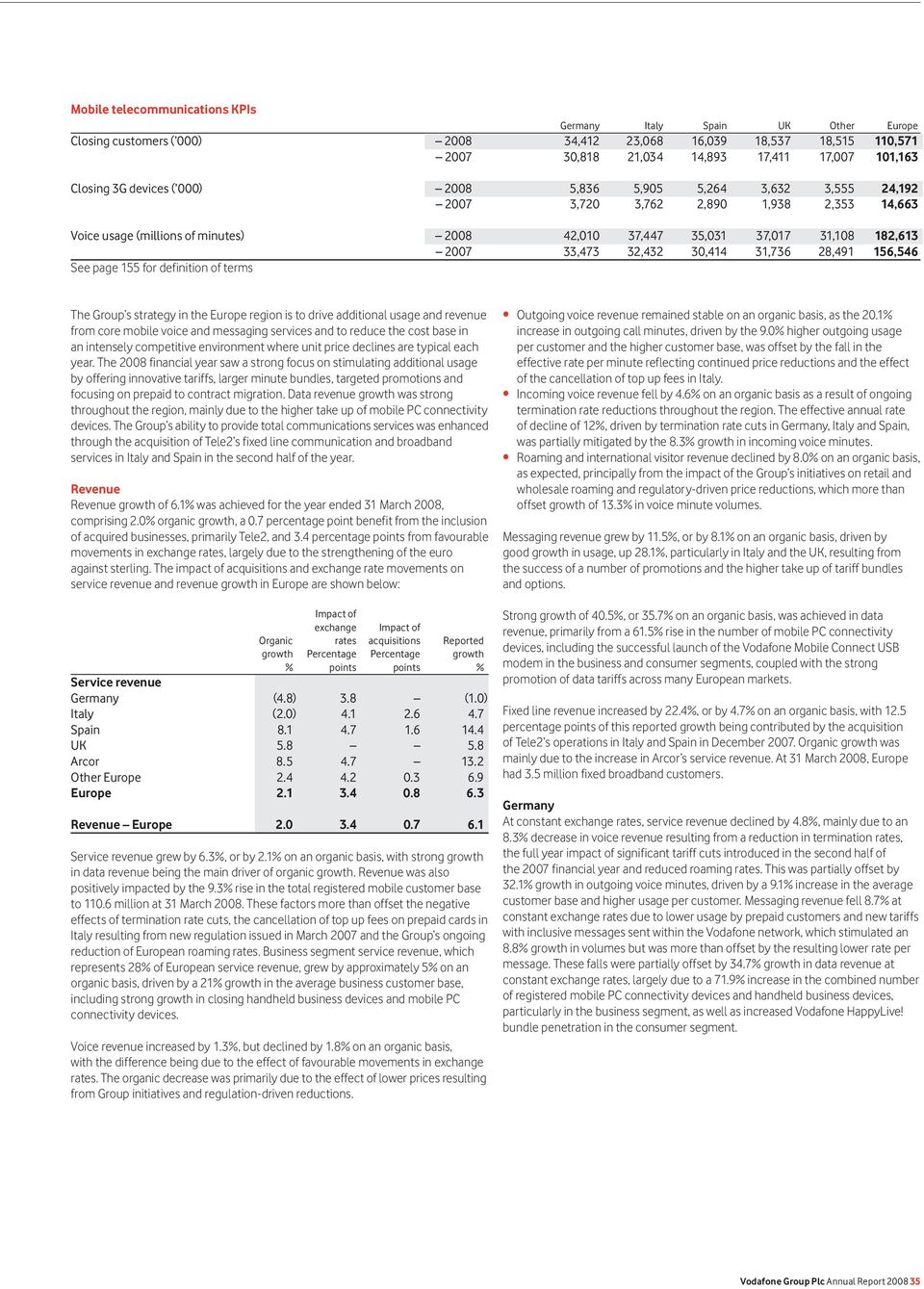
7 Vodafone Performance Operating Results continued Italy Service revenue increased by 0.6%, as a 7.9% fall in voice revenue was offset by 17.2% and 38.8% increases in messaging and data revenue, respectively, all at constant exchange rates, as well as the contribution from the Tele2 acquisition in the second half of the year. On an organic basis, service revenue fell by 2.0%. The regulatory cancellation of top up fees and reduction in termination rates led to the fall in voice revenue but were partially mitigated by a 20.1% rise in outgoing voice usage, benefiting from a 23.2% increase in average consumer and business contract customers, successful promotions and initiatives driving usage within the Vodafone network, and elasticity arising from the top up fee removal. The success of targeted promotions and tariff options contributed to the 31.8% growth in messaging volumes, while the increase in data revenue was driven by a 108.0% growth in registered mobile PC connectivity devices. Spain Spain delivered service revenue growth of 9.7%, with 6.6% growth in voice revenue and 32.2% growth in data revenue, all at constant exchange rates, as well as the contribution from the Tele2 acquisition in the second half of the year. Organic growth in service revenue was 8.1%, with lower organic growth of 5.8% in the second half of the year resulting from a slowing average customer base in an increasingly competitive market. Outgoing voice and messaging revenue benefited from the 9.1% growth in the average customer base and an increase in usage volumes of 13.8% and 12.7%, respectively, driven by various usage stimulation initiatives. A 101.1% increase in registered mobile PC connectivity devices led to the increase in data revenue. UK The UK recorded service revenue growth of 5.8%, with an 8.9% increase in the average customer base, following the success of the new tariff initiatives introduced in September Sustained market performance and increased penetration of 18 month contracts, leading to lower contract churn for the year, contributed to the growth in the customer base. Voice revenue remained stable as the lower prices were offset by a 16.6% increase in total usage. Messaging revenue increased by 21.4% following a 36.7% rise in usage, driven by the higher take up of messaging bundles. Growth of 29.8% was achieved in data revenue due to improved service offerings for business customers and the benefit of higher registered mobile PC connectivity devices. Arcor Arcor generated an 8.5% increase in service revenue at constant exchange rates, principally driven by the growth in fixed broadband customers. Arcor s own customers increased from 2.1 million to 2.4 million in the financial year and an additional 0.2 million customers were acquired through Vodafone Germany, bringing the closing German fixed broadband customer base to 2.6 million. The volume increase more than offset pricing pressure in the market. Revenue also benefited from strong growth in Arcor s carrier business, including that with Vodafone Germany, which lowered overall Group costs. Other Europe Other Europe had service revenue growth of 6.9%, or 2.4% on an organic basis, with strong organic growth in data revenue of 44.0%. Portugal and the Netherlands delivered service revenue growth of 7.2% and 9.0%, respectively, at constant exchange rates, both benefiting from strong customer growth. These were mostly offset by a 6.2% decline in service revenue in Greece at constant exchange rates, which arose from the impact of termination rate cuts in June 2007 and the cessation of a national roaming agreement in April Adjusted operating profit The impact of acquisitions and exchange rate movements on Europe s adjusted operating profit is shown below: Impact of exchange Impact of Organic rates acquisitions Reported growth Percentage Percentage growth % points points % Adjusted operating profit Germany (10.1) 3.5 (6.6) Italy (1.4) 3.7 (2.4) (0.1) Spain (2.2) 16.5 UK (15.7) (15.7) Arcor Other Europe (4.2) 3.5 (0.5) (1.2) Europe (1.5) 3.4 (1.1) 0.8 Adjusted operating profit increased by 0.8% for the year ended 31 March 2008, with a decline of 1.5% on an organic basis, with the difference primarily due to favourable exchange rate movements. Adjusted operating profit included the benefit from the release of a provision following a revised agreement in Italy related to the use of the Vodafone brand and related trademarks, which is offset in common functions. Adjusted operating profit was also impacted by higher interconnect, acquisition and retention costs and the impact of the Group s increasing focus on fixed line services, including the acquisition of Tele2 in Italy and Spain. Interconnect costs rose by 8.5%, or by 4.1% on an organic basis, as the higher volume of outgoing calls to other networks more than offset the cost benefit obtained from termination rate cuts throughout the region. The main increases were recorded in the UK and Italy, partially offset by a decline in Germany. Other direct costs grew by 7.8%, although only 1.3% on an organic basis, as increases in the UK and Arcor were partially offset by a reduction in Germany. A 10.3%, or 6.0% organic, rise in acquisition costs resulted from increases across most of the region, reflecting the continued focus on attracting higher value contract and business customers, particularly in the UK and Italy. Acquisition costs per customer increased across the region, with the exception being Germany due to a higher proportion of wholesale and prepaid connections. Retention costs increased by 13.8%, or by 10.1% on an organic basis, largely driven by higher costs in Spain, with smaller increases occurring across the rest of the region. Operating expenses were flat on an organic basis, as a result of the successful control of costs and the benefit from the release of the brand royalty provision. Various initiatives were implemented at both central and local levels. Central initiatives included the consolidation and optimisation of data centres, restructuring within central functions, continued migration from leased lines to owned transmission and further renegotiation of contracts relating to various network operating expenses. Locally there were restructuring programmes in Germany and Italy and, more recently, in the UK. Depreciation and other amortisation was 3.4% higher, or broadly stable on an organic basis, as the additional charges resulting from the acquisition of Tele2 operations in Italy and Spain and unfavourable exchange rate movements were partially offset by savings from lower capital expenditure and the consolidation and optimisation of data centres. 36 Vodafone Group Plc Annual Report 2008
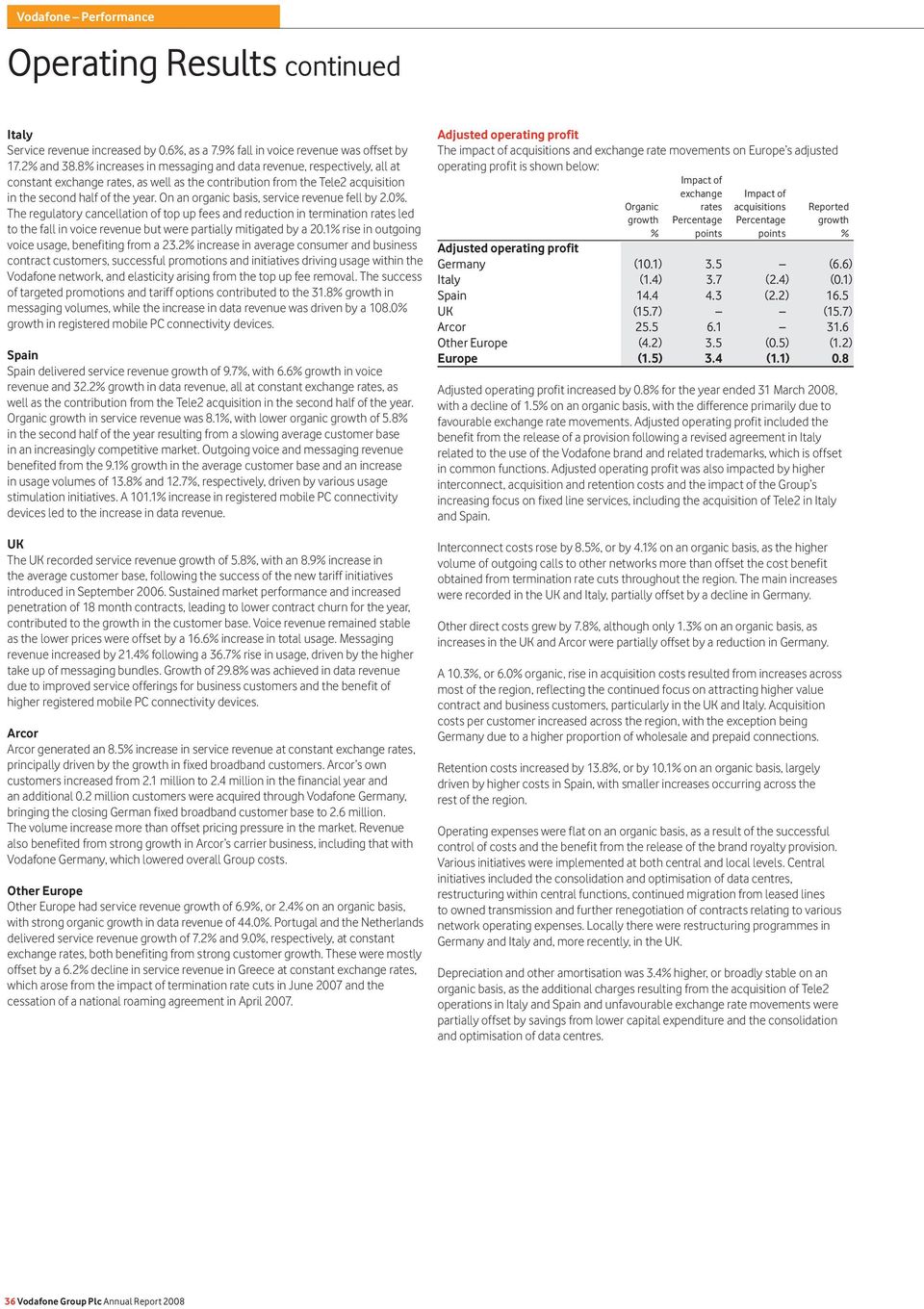
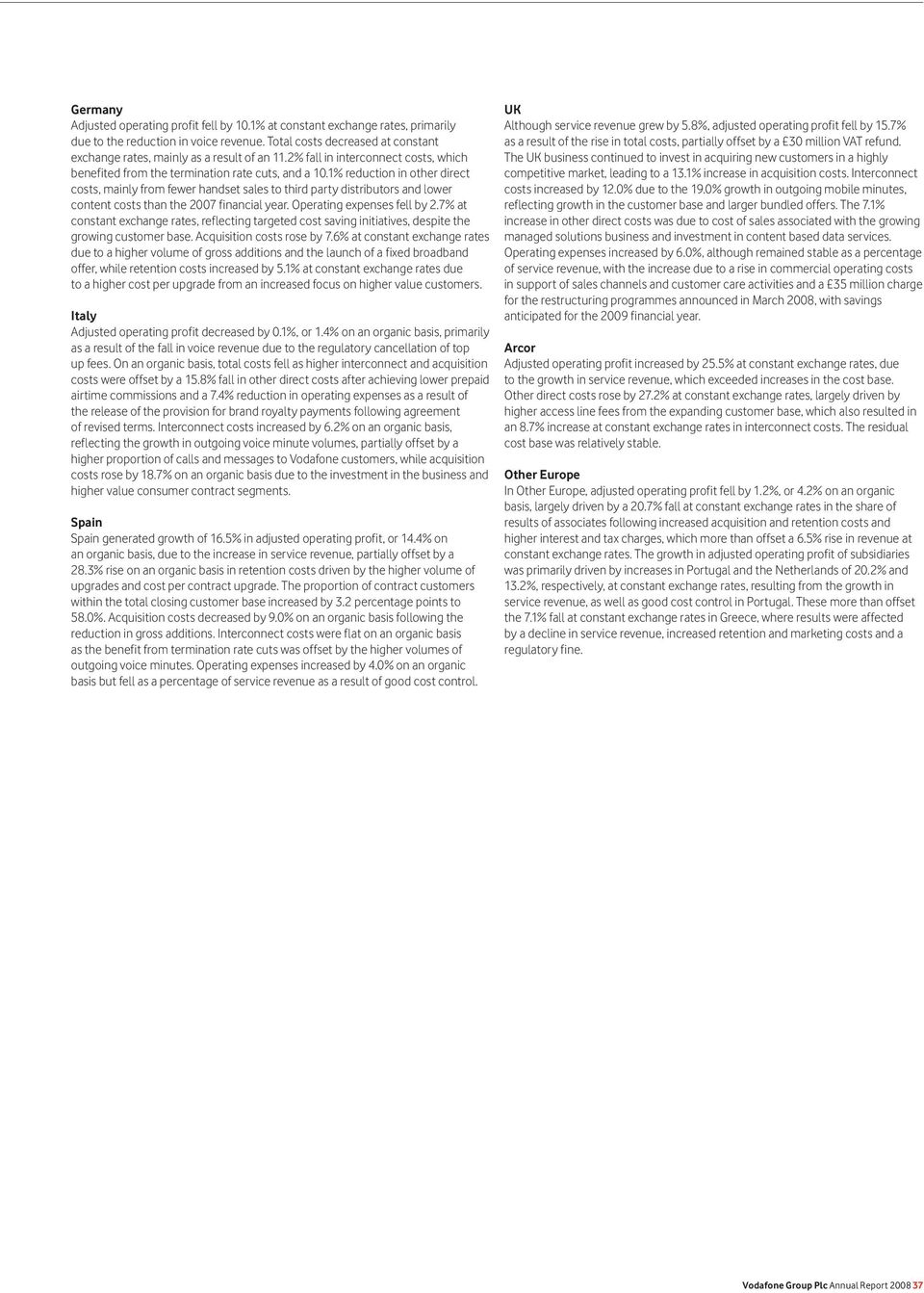
8 Germany Adjusted operating profit fell by 10.1% at constant exchange rates, primarily due to the reduction in voice revenue. Total costs decreased at constant exchange rates, mainly as a result of an 11.2% fall in interconnect costs, which benefited from the termination rate cuts, and a 10.1% reduction in other direct costs, mainly from fewer handset sales to third party distributors and lower content costs than the 2007 financial year. Operating expenses fell by 2.7% at constant exchange rates, reflecting targeted cost saving initiatives, despite the growing customer base. Acquisition costs rose by 7.6% at constant exchange rates due to a higher volume of gross additions and the launch of a fixed broadband offer, while retention costs increased by 5.1% at constant exchange rates due to a higher cost per upgrade from an increased focus on higher value customers. Italy Adjusted operating profit decreased by 0.1%, or 1.4% on an organic basis, primarily as a result of the fall in voice revenue due to the regulatory cancellation of top up fees. On an organic basis, total costs fell as higher interconnect and acquisition costs were offset by a 15.8% fall in other direct costs after achieving lower prepaid airtime commissions and a 7.4% reduction in operating expenses as a result of the release of the provision for brand royalty payments following agreement of revised terms. Interconnect costs increased by 6.2% on an organic basis, reflecting the growth in outgoing voice minute volumes, partially offset by a higher proportion of calls and messages to Vodafone customers, while acquisition costs rose by 18.7% on an organic basis due to the investment in the business and higher value consumer contract segments. Spain Spain generated growth of 16.5% in adjusted operating profit, or 14.4% on an organic basis, due to the increase in service revenue, partially offset by a 28.3% rise on an organic basis in retention costs driven by the higher volume of upgrades and cost per contract upgrade. The proportion of contract customers within the total closing customer base increased by 3.2 percentage points to 58.0%. Acquisition costs decreased by 9.0% on an organic basis following the reduction in gross additions. Interconnect costs were flat on an organic basis as the benefit from termination rate cuts was offset by the higher volumes of outgoing voice minutes. Operating expenses increased by 4.0% on an organic basis but fell as a percentage of service revenue as a result of good cost control. UK Although service revenue grew by 5.8%, adjusted operating profit fell by 15.7% as a result of the rise in total costs, partially offset by a 30 million VAT refund. The UK business continued to invest in acquiring new customers in a highly competitive market, leading to a 13.1% increase in acquisition costs. Interconnect costs increased by 12.0% due to the 19.0% growth in outgoing mobile minutes, reflecting growth in the customer base and larger bundled offers. The 7.1% increase in other direct costs was due to cost of sales associated with the growing managed solutions business and investment in content based data services. Operating expenses increased by 6.0%, although remained stable as a percentage of service revenue, with the increase due to a rise in commercial operating costs in support of sales channels and customer care activities and a 35 million charge for the restructuring programmes announced in March 2008, with savings anticipated for the 2009 financial year. Arcor Adjusted operating profit increased by 25.5% at constant exchange rates, due to the growth in service revenue, which exceeded increases in the cost base. Other direct costs rose by 27.2% at constant exchange rates, largely driven by higher access line fees from the expanding customer base, which also resulted in an 8.7% increase at constant exchange rates in interconnect costs. The residual cost base was relatively stable. Other Europe In Other Europe, adjusted operating profit fell by 1.2%, or 4.2% on an organic basis, largely driven by a 20.7% fall at constant exchange rates in the share of results of associates following increased acquisition and retention costs and higher interest and tax charges, which more than offset a 6.5% rise in revenue at constant exchange rates. The growth in adjusted operating profit of subsidiaries was primarily driven by increases in Portugal and the Netherlands of 20.2% and 13.2%, respectively, at constant exchange rates, resulting from the growth in service revenue, as well as good cost control in Portugal. These more than offset the 7.1% fall at constant exchange rates in Greece, where results were affected by a decline in service revenue, increased retention and marketing costs and a regulatory fine. Vodafone Group Plc Annual Report
9 Vodafone Performance Vodafone Performance Operating Results continued EMAPA Eastern Middle East, Associates Europe (2) Africa & Asia Pacific US Other Eliminations EMAPA % change m m m m m m m Organic (2) Year ended 31 March 2008 Voice revenue (1) 2,584 3,818 1,085 (1) 7,486 Messaging revenue Data revenue Fixed line revenue (1) Other service revenue 1 1 Service revenue 3,041 4,222 1,456 (1) 8, Acquisition revenue Retention revenue Other revenue Revenue 3,154 4,547 1,645 (1) 9, Interconnect costs (522) (623) (247) 1 (1,391) Other direct costs (445) (625) (284) (1,354) Acquisition costs (322) (395) (222) (939) Retention costs (97) (103) (59) (259) Operating expenses (769) (1,078) (410) (2,257) Acquired intangibles amortisation (223) (425) (648) Purchased licence amortisation (19) (28) (16) (63) Depreciation and other amortisation (425) (503) (226) (1,154) Share of result in associates (3) 2 2,447 2,449 Adjusted operating profit ,447 3, Year ended 31 March 2007 Voice revenue (1) 2,037 2, ,077 Messaging revenue Data revenue Fixed line revenue (1) Service revenue 2,392 2,332 1,245 5,969 Acquisition revenue Retention revenue Other revenue Revenue 2,477 2,565 1,399 6,441 Interconnect costs (433) (364) (248) (1,045) Other direct costs (314) (246) (224) (784) Acquisition costs (219) (291) (167) (677) Retention costs (78) (84) (50) (212) Operating expenses (614) (509) (349) (1,472) Acquired intangibles amortisation (285) (105) (2) (392) Purchased licence amortisation (19) (17) (7) (43) Depreciation and other amortisation (331) (255) (193) (779) Share of result in associates (3) 2, ,207 Adjusted operating profit , ,244 Change at constant exchange rates % % % % % Voice revenue (1) Messaging revenue Data revenue Fixed line revenue (1) 16.4 (89.9) Service revenue Acquisition revenue Retention revenue Other revenue Revenue Interconnect costs (7.4) Other direct costs Acquisition costs Retention costs Operating expenses Acquired intangibles amortisation (26.4) (100.0) Purchased licence amortisation (5.0) Depreciation and other amortisation Share of result in associates (3) 24.8 (100.0) Adjusted operating profit (100.0) Notes: (1) Revenue relating to fixed line activities provided by mobile operators, previously classified within voice revenue, is now presented as fixed line revenue, together with revenue from fixed line operators and fixed broadband. All prior periods have been adjusted accordingly. (2) On 1 October 2007, Romania rebased all of its tariffs and changed its functional currency from US dollars to euros. In calculating all constant exchange rate and organic metrics which include Romania, previous US dollar amounts have been translated into euros at the 1 October 2007 US$/euro exchange rate. (3) During the year ended 31 March 2008, the Group changed its organisational structure and the Group s associated undertaking in France, SFR, is now managed within the Europe region and reported within Other Europe. The results are presented in accordance with the new organisational structure. 38 Vodafone Group Plc Annual Report 2008
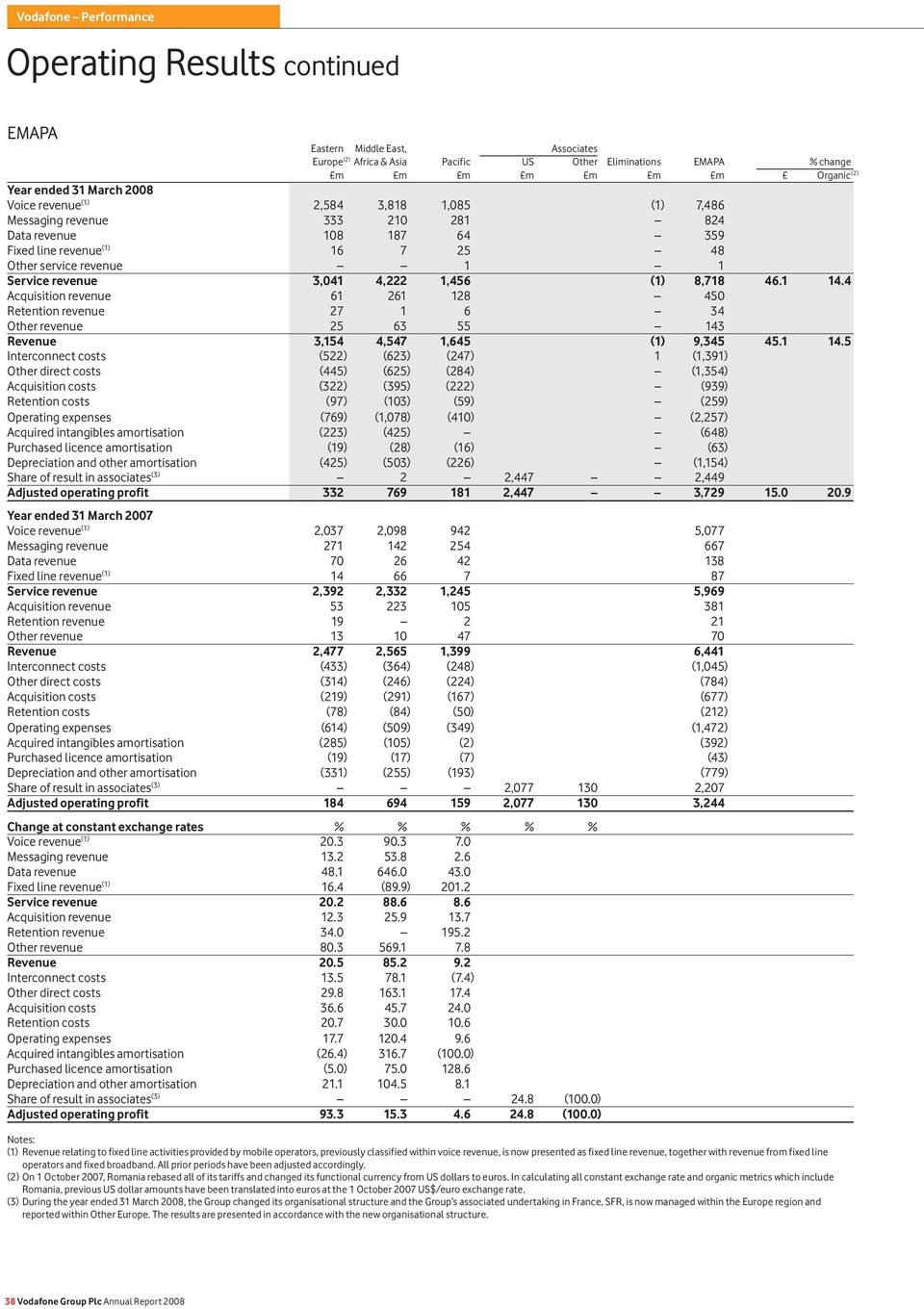
10 Mobile telecommunications KPIs Eastern Middle East, Eastern Middle East, Europe Africa & Asia Pacific EMAPA Europe Africa & Asia Pacific EMAPA Closing customers ( 000) 33,547 79,289 6, ,115 28,975 27,160 5,750 61,885 Closing 3G devices ( 000) ,297 2, ,492 Voice usage (millions of minutes) 48, ,747 12, ,023 39,658 37,449 11,371 88,478 See page 155 for definition of terms Vodafone has continued to execute on its strategy to deliver strong growth in emerging markets during the 2008 financial year, with the acquisition of Vodafone Essar (formerly Hutchison Essar) in India and with strong performances in Turkey, acquired in May 2006, Romania and Egypt. The Group is beginning to differentiate itself in its emerging markets, with initiatives such as the introduction of Vodafone branded handsets and the Vodafone M-PESA/Vodafone Money Transfer service. On 8 May 2007, the Group continued to successfully increase its portfolio in emerging markets by acquiring companies with interests in Vodafone Essar, a leading operator in the fast growing Indian mobile market, following which the Group controls Vodafone Essar. The business was rebranded to Vodafone in September In conjunction with the Vodafone Essar acquisition, the Group signed a memorandum of understanding with Bharti Airtel, the Group s former joint venture in India, on infrastructure sharing and granted an option to a Bharti group company to buy its 5.60% direct interest in Bharti Airtel, which was exercised on 9 May An initial public offering of 25% of Safaricom shares held by the Government of Kenya closed to applicants on 23 April Share allocations are expected to be announced on, or around, 30 May 2008, following which Safaricom will be accounted for as an associate, rather than as a joint venture. The Group s effective equity interest will remain unchanged. Revenue Revenue growth for the year ended 31 March 2008 was 45.1% for the region, or 14.5% on an organic basis, with the key driver for organic growth being the increase in service revenue of 46.1%, or 14.4% on an organic basis. The impact of acquisitions, disposal and foreign exchange movements on service revenue and revenue growth are shown below: Impact of Impact of exchange acquisitions Organic rates and disposal (1) Reported growth Percentage Percentage growth % points points % Service revenue Eastern Europe Middle East, Africa and Asia 22.3 (7.6) Pacific EMAPA Revenue EMAPA Note: (1) Impact of acquisitions and disposal includes the impact of the change in consolidation status of Bharti Airtel from a joint venture to an investment in February On an organic basis, voice revenue grew by 12.8% and messaging revenue and data revenue rose by 6.5% and 87.9%, respectively, as a result of the 26.2% organic increase in the average customer base, driven primarily by increasing penetration in emerging markets. Strong performances in Turkey, Egypt, Romania and India contributed to the growth in service revenue. Eastern Europe In Eastern Europe, service revenue increased by 27.1%, or 9.7% on an organic basis, driven by the acquisition of Turkey in the 2007 financial year and a good performance in Romania. At constant exchange rates, Turkey delivered revenue growth of 24%, assuming the Group owned the business for the whole of both periods, with 25.2% growth in the average customer base compared to the 2007 financial year. While growth rates remained high, they slowed in the last quarter of the year, but remained consistent with the overall growth rate for the market. In order to maintain momentum in an increasingly competitive environment, the business is concentrating on targeted promotional offers and focusing on developing distribution, as well as continued investment in the brand and completing the planned improvements to network coverage. The revenue performance year on year was principally as a result of the increase in voice revenue driven by the rise in average customers, but also benefited from the growth in messaging revenue, resulting from higher volumes. In Romania, service revenue increased by 15.0%, or 19.6% at constant exchange rates, driven by an 18.3% rise in the average customer base following the impact of initiatives focusing on business and contract customers, as well as growth in roaming revenue and a strong performance in data revenue, which grew by 92.6%, or 97.7% at constant exchange rates, to 41 million following successful promotions and a growing base of mobile data customers. However, service revenue growth slowed in the last quarter, when compared to the same quarter in the 2007 financial year, in line with lower average customer growth, which is in turn driven by increased competition in the market, with five mobile operators now competing for market share. Middle East, Africa and Asia Service revenue growth in Middle East, Africa and Asia increased by 81.0%, or 22.3% on an organic basis, with the acquisition of Vodafone Essar being the main reason for the difference between reported and organic growth. The growth in organic service revenue was as a result of strong performances in Egypt, Vodacom and Safaricom, the Group s joint venture in Kenya. At constant exchange rates, Vodafone Essar has performed well since acquisition, with growth in revenue of 55% assuming the Group owned the business for the whole of both periods. Since acquisition, there have been 16.4 million net customer additions, bringing the total customer base to 44.1 million at 31 March Penetration in mobile telephony increased following falling prices of both handsets and tariffs and network coverage increases. The market remains competitive with prepaid offerings moving to lifetime validity products, which allow the customer to stay connected to the network without requiring any top ups, following price reductions in the market. Revenue continues to grow as the customer base increases, particularly in outgoing voice as service offerings drive greater usage. In Egypt, service revenue growth was 27.1%, or 31.2% at constant exchange rates, benefiting from a 52.7% increase in the average customer base and an increase in voice revenue, with the fall in the effective rate per minute being offset by a 60.1% increase in usage. The success of recent prepaid customer offerings, such as the Vodafone Family tariff, contributed to the 45.8% growth in closing customers compared to the 2007 financial year. Vodafone Group Plc Annual Report

11 Vodafone Performance Operating Results continued Vodacom s service revenue increased by 8.6%, or 16.5% at constant exchange rates, which was achieved largely through average customer growth of 23.1%. The customer base was impacted by a change in the prepaid disconnection policy, which resulted in 1.45 million disconnections in September 2007 and a higher ongoing disconnection rate. Vodacom s data revenue growth remained very strong, driven by a rapid rise in mobile PC connectivity devices. Pacific In the Pacific, service revenue increased by 16.9%, or 8.6% at constant exchange rates. Australia was a key driver of the increase, with service revenue growth of 15.1%, or 7.5% at constant exchange rates, which was achieved despite the sharp regulatory driven decline in termination rates during the year. Revenue growth in Australia reflected an 8.0% increase in the average customer base and the mix of higher value contract customers. New Zealand also saw strong growth in service revenue, which increased by 20.0%, or by 10.1% at constant exchange rates, driven primarily by a 16.7% increase in the average contract customer base and strong growth in data and fixed line revenue. Adjusted operating profit Adjusted operating profit increased by 15.0% for the year ended 31 March 2008, or 20.9% on an organic basis, due to strong performances in Romania, Vodacom, Egypt and Verizon Wireless. The table below sets out the reconciliation between reported and organic growth, showing the effect of acquisitions, disposals and exchange rate movements on adjusted operating profit: Impact of Impact of exchange acquisitions Organic rates and disposals (1) Reported growth Percentage Percentage growth % points points % Adjusted operating profit Eastern Europe 21.2 (12.9) Middle East, Africa and Asia 13.3 (4.5) Pacific EMAPA 20.9 (5.4) (0.5) 15.0 Note: (1) Impact of acquisitions and disposals includes the impact of the change in consolidation status of Bharti Airtel from a joint venture to an investment in February The acquisitions in Turkey and India led to a rise in acquired intangible asset amortisation, which reduced the reported growth in adjusted operating profit, while the continued investment in network infrastructure in the region resulted in higher depreciation charges. Reported growth in adjusted operating profit was also impacted by the disposals of Belgacom Mobile S.A. and Swisscom Mobile A.G. in the 2007 financial year. Eastern Europe Adjusted operating profit increased by 80.4%, or by 21.2% on an organic basis, with the main contributors being Turkey and Romania. The organic increase in adjusted operating profit was driven by growth in service revenue, offsetting the impact of the higher cost base, particularly an organic increase in interconnect costs and operating expenses of 7.5% and 5.7%, respectively. Depreciation and amortisation increased by 16.0% on an organic basis, primarily due to continued investment in network infrastructure, as well as network expansion into rural areas and increased 3G capacity to support data offerings in Romania. Turkey generated strong growth in adjusted operating profit, assuming the Group owned the business for the whole of both periods, driven by the increase in revenue. The closing customer base grew by 21.8% following additional investment in customer acquisition activities, with the new connections in the year driving the higher acquisition costs. Other direct costs were up, mainly due to ongoing regulatory fees which equate to 15% of revenue. Operating expenses remained constant as a percentage of service revenue but increased following continued investment in the brand and network in line with the acquisition plan. There was also a decrease in acquired intangible asset amortisation, following full amortisation of the acquired brand by March 2007 as a result of the rebranding to Vodafone. Romania s adjusted operating profit grew by 31.4%, or 37.7% at constant exchange rates, with increases in costs being mitigated by service revenue performance. Interconnect costs grew by 24.7%, or 29.4% at constant exchange rates, reflecting the 18.3% rise in the average customer base. As a percentage of service revenue, acquisition and retention costs increased by 0.7% to 13.3% as a result of the increased competition for customers. Increases in the number of direct sales and distribution employees, following the market trend towards direct distribution channels, led to a 6.6% increase in operating expenses, or 11.0% at constant exchange rates, while depreciation charges rose by 23.0%, or 27.6% at constant exchange rates, due to network development to support 3G data offerings and to increase network coverage in the rural areas. Middle East, Africa and Asia Adjusted operating profit rose by 10.8%, or 13.3% on an organic basis, with the acquisition of Vodafone Essar and strong performances in Egypt and Vodacom being the main factors for the reported increase. The main organic movements in the cost base were in relation to other direct costs and operating expenses, which increased by 38.0% and 23.4%, respectively. Depreciation and amortisation increased by 36.3% on an organic basis, primarily due to enhancements in the network in Egypt in order to increase capacity and support 3G offerings. In addition, the expansion of the network in India, where approximately 1,950 base stations have been constructed per month since acquisition, increased reported depreciation. The Indian mobile market continued to grow, with penetration reaching 23% by the end of March Vodafone Essar, which successfully adopted the Vodafone brand in September 2007, continued to perform well, with adjusted operating profit slightly ahead of the expectations held at the time of the completion of the acquisition. This was partially due to the Group s rapid network expansion in this market together with improvements in operating expense efficiency, particularly in customer care. The outsourcing of the IT function was implemented during January 2008 and is expected to lead to the faster roll out of more varied services to customers, while delivering greater cost efficiencies. In December 2007, the Group announced, alongside Bharti Airtel and Idea Cellular Limited, the creation of an independent tower company, Indus Towers Limited, to accelerate the expansion of network infrastructure in India, to reduce overall costs and generate revenue from third party tenants. In Egypt, adjusted operating profit increased by 6.3%, or 10.1% at constant exchange rates. Interconnect costs grew by 41.8%, or 46.2% at constant exchange rates, in line with the growth in outgoing revenue, with other direct costs rising by 48.1%, or 52.4% at constant exchange rates, due to prepaid airtime commission increases and 3G licence costs, both of which were offset by the rise in revenue. Within operating expenses, staff investment programmes, higher publicity costs and leased line costs increased during the year, although operating expenses remained stable as a percentage of service revenue. Vodacom s adjusted operating profit rose by 11.8%, or 19.1% at constant exchange rates. The main cost drivers were operating expenses, which increased by 10.8%, or 19.2% at constant exchange rates, and other direct costs which grew by 13.9%, or 22.3% at constant exchange rates, primarily as a result of increased prepaid airtime commission following the growth of the business. Growth at constant exchange rates was in excess of reported growth as Vodacom s reported performance in the 2008 financial year was impacted by the negative effect of exchange rates arising on the translation of its results into sterling. Pacific Adjusted operating profit in the Pacific rose by 13.8%, or 4.6% at constant exchange rates. A favourable performance in Australia was a result of the higher contract customer base, achieved through expansion of retail distribution, with higher contract revenue offsetting the increase in customer acquisition costs of 36.8%, or 27.6% at constant exchange rates. 40 Vodafone Group Plc Annual Report 2008

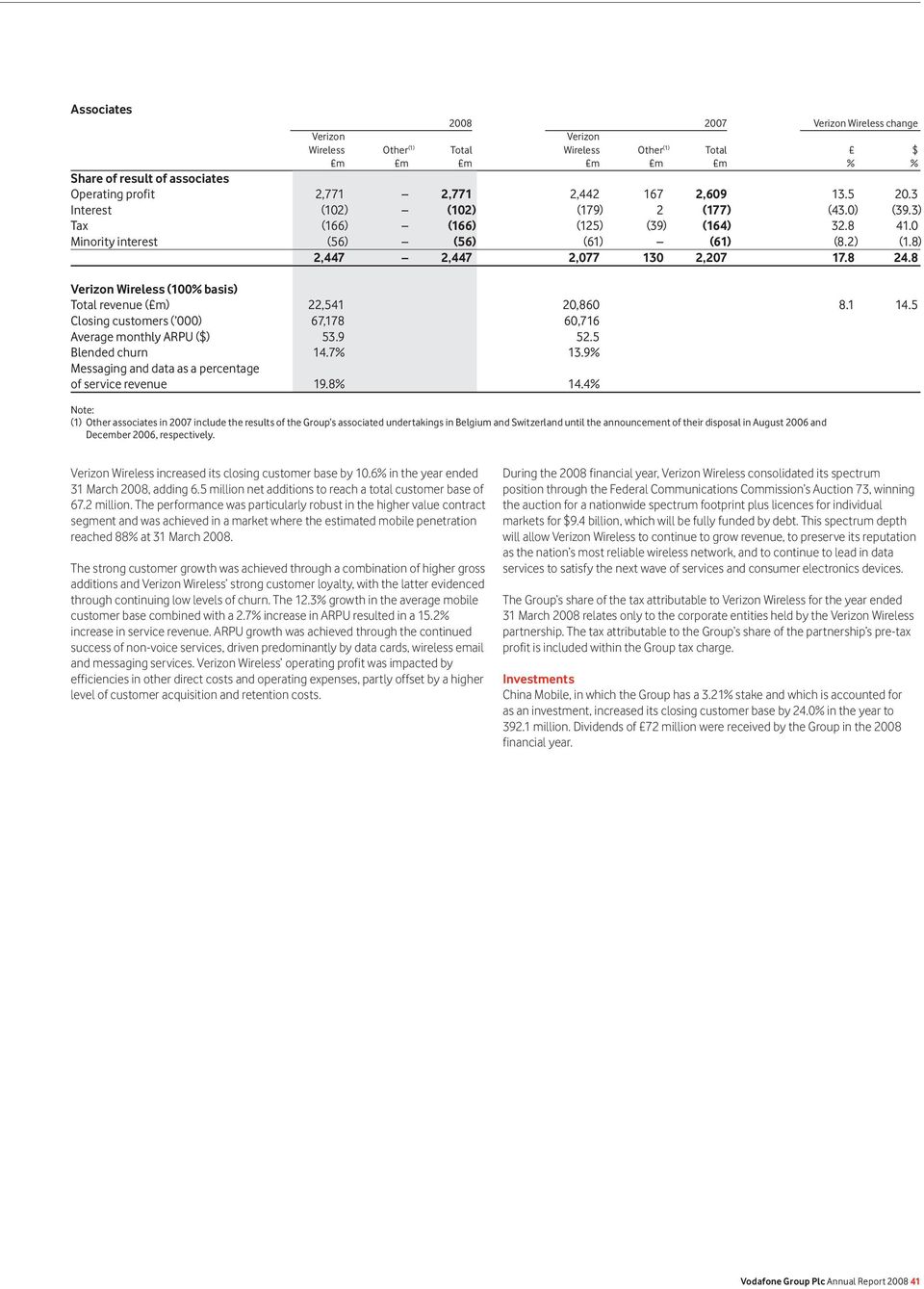
12 Associates Verizon Wireless change Verizon Verizon Wireless Other (1) Total Wireless Other (1) Total $ m m m m m m % % Share of result of associates Operating profit 2,771 2,771 2, , Interest (102) (102) (179) 2 (177) (43.0) (39.3) Tax (166) (166) (125) (39) (164) Minority interest (56) (56) (61) (61) (8.2) (1.8) 2,447 2,447 2, , Verizon Wireless (100% basis) Total revenue ( m) 22,541 20, Closing customers ( 000) 67,178 60,716 Average monthly ARPU ($) Blended churn 14.7% 13.9% Messaging and data as a percentage of service revenue 19.8% 14.4% Note: (1) Other associates in 2007 include the results of the Group s associated undertakings in Belgium and Switzerland until the announcement of their disposal in August 2006 and December 2006, respectively. Verizon Wireless increased its closing customer base by 10.6% in the year ended 31 March 2008, adding 6.5 million net additions to reach a total customer base of 67.2 million. The performance was particularly robust in the higher value contract segment and was achieved in a market where the estimated mobile penetration reached 88% at 31 March The strong customer growth was achieved through a combination of higher gross additions and Verizon Wireless strong customer loyalty, with the latter evidenced through continuing low levels of churn. The 12.3% growth in the average mobile customer base combined with a 2.7% increase in ARPU resulted in a 15.2% increase in service revenue. ARPU growth was achieved through the continued success of non-voice services, driven predominantly by data cards, wireless and messaging services. Verizon Wireless operating profit was impacted by efficiencies in other direct costs and operating expenses, partly offset by a higher level of customer acquisition and retention costs. During the 2008 financial year, Verizon Wireless consolidated its spectrum position through the Federal Communications Commission s Auction 73, winning the auction for a nationwide spectrum footprint plus licences for individual markets for $9.4 billion, which will be fully funded by debt. This spectrum depth will allow Verizon Wireless to continue to grow revenue, to preserve its reputation as the nation s most reliable wireless network, and to continue to lead in data services to satisfy the next wave of services and consumer electronics devices. The Group s share of the tax attributable to Verizon Wireless for the year ended 31 March 2008 relates only to the corporate entities held by the Verizon Wireless partnership. The tax attributable to the Group s share of the partnership s pre-tax profit is included within the Group tax charge. Investments China Mobile, in which the Group has a 3.21% stake and which is accounted for as an investment, increased its closing customer base by 24.0% in the year to million. Dividends of 72 million were received by the Group in the 2008 financial year. Vodafone Group Plc Annual Report
13 Vodafone Performance Operating Results continued 2007 Financial Year Compared to the 2006 Financial Year Group Common Group Group Europe EMAPA Functions (2) Eliminations % change m m m m m m Organic Voice revenue (1) 17,261 5,077 (70) 22,268 21,304 Messaging revenue 2, (5) 3,587 3,289 Data revenue 1, (10) 1,428 1,098 Fixed line revenue (1) 1, ,580 1,391 Other service revenue 8 8 Service revenue 22,987 5,969 (85) 28,871 27, Acquisition revenue 1, ,385 1,295 Retention revenue Other revenue (12) Revenue 24,592 6, (97) 31,104 29, Interconnect costs (3,668) (1,045) 85 (4,628) (4,463) Other direct costs (1,914) (784) (66) 3 (2,761) (2,096) Acquisition costs (2,604) (677) (3,281) (2,968) Retention costs (1,543) (212) (1,755) (1,891) Operating expenses (5,462) (1,472) (6,719) (6,166) Acquired intangibles amortisation (22) (392) (414) (157) Purchased licence amortisation (849) (43) (892) (947) Depreciation and other amortisation (2,888) (779) (181) (3,848) (3,674) Share of result in associates (3) 517 2, ,725 2,411 Adjusted operating profit 6,159 3, ,531 9, Adjustments for: Impairment losses (11,600) (23,515) Other income and expense Non-operating income of associates 3 17 Operating loss (1,564) (14,084) Non-operating income and expense 4 (2) Investment income Financing costs (1,612) (1,120) Loss before taxation (2,383) (14,853) Income tax expense (2,423) (2,380) Loss for the financial year from continuing operations (4,806) (17,233) Loss for the financial year from discontinued operations (491) (4,588) Loss for the financial year (5,297) (21,821) Notes: (1) Revenue relating to fixed line activities provided by mobile operators, previously classified within voice revenue, is now presented as fixed line revenue, together with revenue from fixed line operators and fixed broadband. All prior periods have been adjusted accordingly. (2) Common functions represents the results of partner markets and the net result of unallocated central Group costs and recharges to the Group s operations, including royalty fees for use of the Vodafone brand. (3) During the year ended 31 March 2008, the Group changed its organisational structure and the Group s associated undertaking in France, SFR, is now managed within the Europe region and reported within Other Europe. The results for all periods are presented in accordance with the new organisational structure. Revenue Revenue increased by 6.0% to 31,104 million in the year to 31 March 2007, with organic growth of 4.3%. The net impact of acquisitions and disposals contributed 3.3 percentage points to revenue growth, offset by unfavourable movements in exchange rates of 1.6 percentage points, with both effects arising principally in the EMAPA region. The Europe region recorded organic revenue growth of 1.4%, while the EMAPA region delivered organic revenue growth of 21.1%. As a result, the EMAPA region accounted for more than 70% of the organic growth in Group revenue. Strong performances were recorded in Spain and a number of the Group s emerging markets. An increase in the average mobile customer base and usage stimulation initiatives resulted in organic revenue growth of 2.5% and 7.0% in voice and messaging revenue, respectively. Data revenue is an increasingly important component of Group revenue, with organic growth of 30.7%, driven by increasing penetration from 3G devices and growth in revenue from business services. The Europe region and common functions contributed 79% of Group revenue, of which approximately 63% was euro denominated, with the remaining 16% being denominated in sterling. The remaining 21% was generated in the EMAPA region where no single currency was individually significant. Operating result Adjusted operating profit increased by 1.4% to 9,531 million, with organic growth of 4.2%. The net impact of acquisitions and disposals and unfavourable exchange rate movements reduced reported growth by 0.3 percentage points and 2.5 percentage points, respectively, with both effects arising principally in the EMAPA region. The Europe region declined 3.7% on an organic basis, while the EMAPA region recorded organic growth of 27.4%. Strong performances were delivered in Spain, the US and a number of emerging markets. Adjusted operating profit is stated after charges in relation to regulatory fines in Greece of 53 million and restructuring costs within common functions, Vodafone Germany, Vodafone UK and Other Europe of 79 million. The EMAPA region accounted for all of the Group s reported and organic growth in adjusted operating profit. Adjusted operating profit for the 2007 financial year was principally denominated in euro (55%), US dollar (22%) and sterling (5%), with the remaining 18% being denominated in other currencies. The acquisitions and stake increases led to the rise in acquired intangible asset amortisation, and these acquisitions, combined with the continued expansion of network infrastructure in the EMAPA region, resulted in higher depreciation charges. 42 Vodafone Group Plc Annual Report 2008

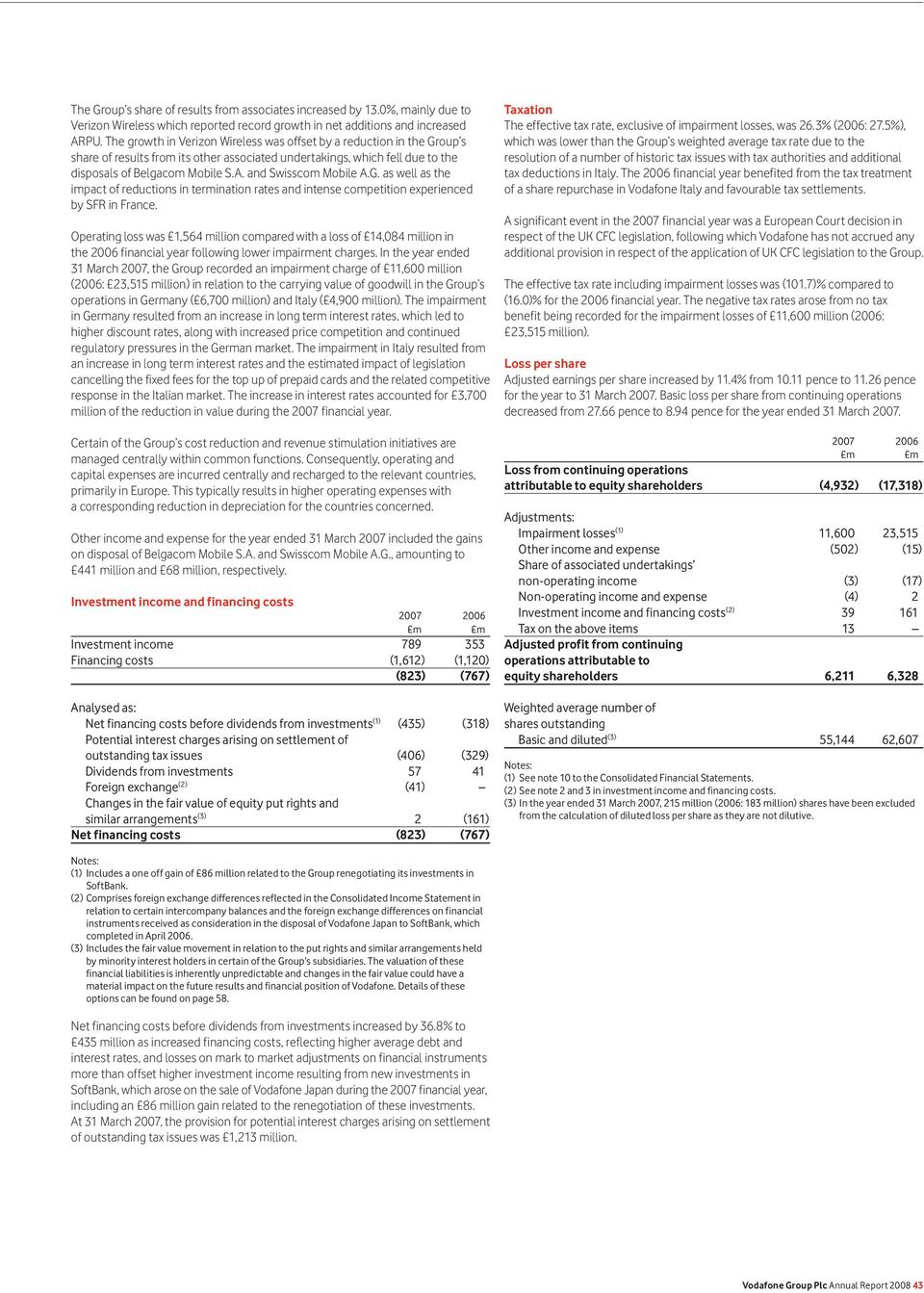
14 The Group s share of results from associates increased by 13.0%, mainly due to Verizon Wireless which reported record growth in net additions and increased ARPU. The growth in Verizon Wireless was offset by a reduction in the Group s share of results from its other associated undertakings, which fell due to the disposals of Belgacom Mobile S.A. and Swisscom Mobile A.G. as well as the impact of reductions in termination rates and intense competition experienced by SFR in France. Operating loss was 1,564 million compared with a loss of 14,084 million in the 2006 financial year following lower impairment charges. In the year ended 31 March 2007, the Group recorded an impairment charge of 11,600 million (2006: 23,515 million) in relation to the carrying value of goodwill in the Group s operations in Germany ( 6,700 million) and Italy ( 4,900 million). The impairment in Germany resulted from an increase in long term interest rates, which led to higher discount rates, along with increased price competition and continued regulatory pressures in the German market. The impairment in Italy resulted from an increase in long term interest rates and the estimated impact of legislation cancelling the fixed fees for the top up of prepaid cards and the related competitive response in the Italian market. The increase in interest rates accounted for 3,700 million of the reduction in value during the 2007 financial year. Certain of the Group s cost reduction and revenue stimulation initiatives are managed centrally within common functions. Consequently, operating and capital expenses are incurred centrally and recharged to the relevant countries, primarily in Europe. This typically results in higher operating expenses with a corresponding reduction in depreciation for the countries concerned. Other income and expense for the year ended 31 March 2007 included the gains on disposal of Belgacom Mobile S.A. and Swisscom Mobile A.G., amounting to 441 million and 68 million, respectively. Investment income and financing costs m m Investment income Financing costs (1,612) (1,120) (823) (767) Analysed as: Net financing costs before dividends from investments (1) (435) (318) Potential interest charges arising on settlement of outstanding tax issues (406) (329) Dividends from investments Foreign exchange (2) (41) Changes in the fair value of equity put rights and similar arrangements (3) 2 (161) Net financing costs (823) (767) Taxation The effective tax rate, exclusive of impairment losses, was 26.3% (2006: 27.5%), which was lower than the Group s weighted average tax rate due to the resolution of a number of historic tax issues with tax authorities and additional tax deductions in Italy. The 2006 financial year benefited from the tax treatment of a share repurchase in Vodafone Italy and favourable tax settlements. A significant event in the 2007 financial year was a European Court decision in respect of the UK CFC legislation, following which Vodafone has not accrued any additional provision in respect of the application of UK CFC legislation to the Group. The effective tax rate including impairment losses was (101.7)% compared to (16.0)% for the 2006 financial year. The negative tax rates arose from no tax benefit being recorded for the impairment losses of 11,600 million (2006: 23,515 million). Loss per share Adjusted earnings per share increased by 11.4% from pence to pence for the year to 31 March Basic loss per share from continuing operations decreased from pence to 8.94 pence for the year ended 31 March m m Loss from continuing operations attributable to equity shareholders (4,932) (17,318) Adjustments: Impairment losses (1) 11,600 23,515 Other income and expense (502) (15) Share of associated undertakings non-operating income (3) (17) Non-operating income and expense (4) 2 Investment income and financing costs (2) Tax on the above items 13 Adjusted profit from continuing operations attributable to equity shareholders 6,211 6,328 Weighted average number of shares outstanding Basic and diluted (3) 55,144 62,607 Notes: (1) See note 10 to the Consolidated Financial Statements. (2) See note 2 and 3 in investment income and financing costs. (3) In the year ended 31 March 2007, 215 million (2006: 183 million) shares have been excluded from the calculation of diluted loss per share as they are not dilutive. Notes: (1) Includes a one off gain of 86 million related to the Group renegotiating its investments in SoftBank. (2) Comprises foreign exchange differences reflected in the Consolidated Income Statement in relation to certain intercompany balances and the foreign exchange differences on financial instruments received as consideration in the disposal of Vodafone Japan to SoftBank, which completed in April (3) Includes the fair value movement in relation to the put rights and similar arrangements held by minority interest holders in certain of the Group s subsidiaries. The valuation of these financial liabilities is inherently unpredictable and changes in the fair value could have a material impact on the future results and financial position of Vodafone. Details of these options can be found on page 58. Net financing costs before dividends from investments increased by 36.8% to 435 million as increased financing costs, reflecting higher average debt and interest rates, and losses on mark to market adjustments on financial instruments more than offset higher investment income resulting from new investments in SoftBank, which arose on the sale of Vodafone Japan during the 2007 financial year, including an 86 million gain related to the renegotiation of these investments. At 31 March 2007, the provision for potential interest charges arising on settlement of outstanding tax issues was 1,213 million. Vodafone Group Plc Annual Report
15 Vodafone Performance Operating Results continued Europe Germany Italy Spain UK Arcor Other Elimination Europe % change m m m m m m m m Organic Year ended 31 March 2007 Voice revenue (1) 3,981 3,307 3,415 3,604 3,297 (343) 17,261 Messaging revenue (25) 2,925 Data revenue (38) 1,300 Fixed line revenue (1) , (26) 1,493 Other service revenue Service revenue 5,156 4,083 4,062 4,681 1,419 4,018 (432) 22, Acquisition revenue (3) 1,004 Retention revenue Other revenue (1) 247 Revenue 5,443 4,245 4,500 5,124 1,441 4,275 (436) 24,592 (0.6) 1.4 Interconnect costs (645) (628) (675) (1,001) (338) (813) 432 (3,668) Other direct costs (332) (242) (352) (452) (262) (275) 1 (1,914) Acquisition costs (560) (249) (642) (677) (178) (301) 3 (2,604) Retention costs (351) (107) (398) (372) (315) (1,543) Operating expenses (1,126) (870) (866) (1,163) (396) (1,041) (5,462) Acquired intangibles amortisation (11) (11) (22) Purchased licence amortisation (340) (75) (37) (333) (64) (849) Depreciation and other amortisation (735) (499) (430) (604) (96) (524) (2,888) Share of result in associates (2) Adjusted operating profit 1,354 1,575 1, ,448 6,159 (4.1) (3.7) Year ended 31 March 2006 Voice revenue (1) 4,282 3,448 3,076 3,626 3,650 (356) 17,726 Messaging revenue (14) 2,836 Data revenue (40) 1,023 Fixed line revenue (1) , (34) 1,372 Service revenue 5,394 4,170 3,615 4,568 1,305 4,349 (444) 22,957 Acquisition revenue ,018 Retention revenue Other revenue Revenue 5,754 4,363 3,995 5,048 1,320 4,697 (444) 24,733 Interconnect costs (732) (681) (634) (862) (368) (906) 444 (3,739) Other direct costs (281) (241) (329) (355) (187) (273) (1,666) Acquisition costs (551) (172) (543) (665) (147) (423) (2,501) Retention costs (410) (177) (354) (455) (356) (1,752) Operating expenses (1,077) (822) (762) (1,088) (390) (1,104) (5,243) Acquired intangibles amortisation (2) (2) Purchased licence amortisation (342) (74) (69) (333) (66) (884) Depreciation and other amortisation (865) (524) (336) (592) (89) (594) (3,000) Share of result in associates (2) Adjusted operating profit 1,496 1, ,452 6,425 Change at constant exchange rates % % % % % % Voice revenue (1) (6.5) (3.6) 11.7 (0.6) (9.3) Messaging revenue (7.8) (0.6) Data revenue Fixed line revenue (1) (33.3) (6.9) Service revenue (3.9) (1.5) (7.2) Acquisition revenue (6.4) (3.9) 46.1 (35.7) Retention revenue (34.1) (57.0) 18.9 (13.3) (17.2) Other revenue (33.5) (89.6) 22.8 (13.3) (15.7) Revenue (4.8) (2.2) (8.6) Interconnect costs (11.4) (7.2) (7.6) (9.7) Other direct costs Acquisition costs (28.6) Retention costs (13.8) (39.0) 13.1 (18.2) (11.2) Operating expenses (5.5) Acquired intangibles amortisation Purchased licence amortisation 1.5 (45.4) (3.5) Depreciation and other amortisation (14.0) (4.5) (11.2) Share of result in associates (2) 9.6 Adjusted operating profit (9.0) (5.4) 14.3 (26.8) Notes: (1) Revenue relating to fixed line activities provided by mobile operators, previously classified within voice revenue, is now presented as fixed line revenue, together with revenue from fixed line operators and fixed broadband. All prior periods have been adjusted accordingly. (2) During the year ended 31 March 2008, the Group changed its organisational structure and the Group s associated undertaking in France, SFR, is now managed within the Europe region and reported within Other Europe. The results for all periods are presented in accordance with the new organisational structure. 44 Vodafone Group Plc Annual Report 2008

16 Mobile telecommunications KPIs Germany Italy Spain UK Other Europe Closing customers ( 000) ,818 21,034 14,893 17,411 17, , ,191 18,490 13,521 16,304 15,692 93,198 Closing 3G devices ( 000) ,720 3,762 2,890 1,938 2,353 14, ,025 2, ,033 1,230 7,440 Voice usage (millions of minutes) ,473 32,432 30,414 31,736 28, , ,787 29,604 23,835 28,059 27, ,933 See page 155 for definition of terms The Europe region, where market penetration exceeds 100%, experienced intense competition from established mobile operators and new market entrants as well as ongoing regulator imposed rate reductions on incoming calls. As part of the implementation of the Group s strategy, the 2007 financial year s performance saw a strong focus on stimulating additional usage in a way that enhances value to the customer and revenue, including significant tariff repositioning to maintain competitiveness in the UK and Germany. On the cost side, the centralisation of global service platform operations was completed in the 2007 financial year, with good progress made in the consolidation and harmonisation of the data centres, and a number of new initiatives to reduce the cost structure were implemented. Revenue Revenue decreased slightly by 0.6% for the year ended 31 March 2007, consisting of a 1.4% organic increase in revenue, offset by a 0.5 percentage point adverse impact from exchange rate movements and a 1.5 percentage point decrease resulting from the disposal of the Group s operations in Sweden in January The organic revenue growth was mainly due to the increase in organic service revenue. Service revenue growth was 0.1% for the Europe region. Organic growth of 2.0% was driven by a 7.7% increase in the average mobile customer base, together with a 17.0% increase in total voice usage and 27.1% reported growth in data revenue, driven by innovative products and services, successful promotions and competitive tariffs in the marketplace, although in turn organic growth was largely offset by the downward pressure on voice pricing and termination rate cuts in certain markets. The estimated impact of termination rate cuts and other adjustments on the growth in service revenue and revenue is shown below. Estimated impact of termination rate cuts Impact of and other Growth exchange Impact of adjustments (1) excluding Reported rates disposal Organic on revenue these growth Percentage Percentage growth growth items % points points % % % Service revenue Germany (4.4) 0.5 (3.9) 3.4 (0.5) Italy (2.1) 0.6 (1.5) Spain UK Arcor Other Europe (7.6) Europe Customer growth in the region was strong in most markets, including 21.7% and 16.9% growth in the closing contract customer base in Spain and Italy, respectively. The UK reported a 7.7% growth in the closing contract base following a much improved performance in the second half of the 2007 financial year. Contract churn across the region was stable or falling in most markets due to the continued focus on retention and longer contract terms being offered, while prepaid churn rose due to intensified competition and customer self-upgrades. Prepaid markets remained vibrant, with prepaid net additions accounting for around 65% of the total net additions reported for the region. Within the Europe region, Spain and Arcor contributed strong service revenue growth, partly offset by declines in Germany, Italy and Other Europe. In Spain, despite the increasing challenge in the marketplace from existing competitors, the launch of a fourth operator and branded resellers, service revenue growth of 13.1% at constant exchange rates was achieved. This growth was mainly due to a 14.2% increase in the average mobile customer base in the period following successful promotions and competitive tariffs, particularly in relation to contract customers, which at 31 March 2007 account for 54.8% of the customer base, compared to 49.6% at 31 March Arcor also achieved strong growth in service revenue compared to the 2006 financial year, driven primarily by a 60.0% increase in fixed broadband customers to 2,081,000 customers, with the launch of new competitive tariffs leading to particularly good growth since January Despite high competition and structural price declines, service revenue growth in the UK accelerated throughout the 2007 financial year, driven by a higher contract customer base and increased usage resulting from refreshed tariff offerings. In Other Europe, reported service revenue decreased by 7.6%, while underlying service revenue increased by 4.8% following an increase in the average mobile customer base, and particularly strong growth in messaging and data revenue in the Netherlands and Portugal where new tariffs and Vodafone Mobile Connect data card initiatives proved particularly successful. Germany and Italy reported declines in service revenue at constant exchange rates of 3.9% and 1.5%, respectively, largely as a result of termination rate cuts. Underlying service revenue in Italy grew by 3.6%, with acceleration in the second half of the year due in particular to increasing messaging and voice volumes, achieved through new tariffs and offers targeted to specific segments, and despite the revenue loss incurred in March 2007 following the Italian Government s decision to eliminate the top up fee on prepaid cards. In Germany, underlying service revenue declined slightly as a result of the intensely competitive market in Germany and the launch of new tariffs in October Revenue Europe (0.6) Note: (1) Revenue for certain arrangements is presented net of associated direct costs. Vodafone Group Plc Annual Report

17 Vodafone Performance Operating Results continued Voice revenue Voice revenue decreased by 2.6%, or by 0.6% on an organic basis, with strong growth in voice usage offset by pressures on pricing resulting from competition and from termination rate cuts. Across the Europe region, outgoing voice minutes increased by 20.7%, or by 22.3% on an organic basis, driven by the increased customer base and various usage stimulation initiatives and competitive tariff ranges. In Germany, outgoing voice usage increased by 35.7%, with continued success from the Vodafone Zuhause product, which promotes fixed to mobile substitution in the home and which achieved 2.4 million registered customers at 31 March Additionally, new tariffs were launched in Germany in October 2006, which provided improved value bundles for customers allowing unlimited calls to other Vodafone customers and fixed line customers, all of which significantly contributed to increasing outgoing voice usage. In Italy, the increase in outgoing voice usage of 12.1% was mainly driven by demand stimulation initiatives such as fixed price per call offers and focus on high value customers and business customers. In Spain, the improved customer mix and success of both consumer and business offerings assisted in increasing outgoing voice usage by 34.2%. New and more competitive tariffs launched in the UK in July 2006 and September 2006 and various promotions specifically aimed at encouraging usage contributed to the 16.7% increase in Vodafone UK s outgoing voice usage. Offsetting the organic growth in outgoing voice usage was the impact of pricing pressures in all markets due to increased competition, which led to outgoing voice revenue per minute decreasing by 16.8% in the year ended 31 March Termination rate cuts were the main factor in the 7.4% decline in organic incoming voice revenue, with all markets except the UK experiencing termination rate cuts during the year. Announced termination rate cuts after 30 September 2006 included a cut of 7% to eurocents per minute in Spain effective from October 2006 and a 20% cut to 8.8 eurocents per minute in Germany effective from November The impact of the termination rate cuts in the Europe region was to reduce the average effective incoming price per minute by around 13% to approximately 7 pence. Further termination rate cuts of 0.87 eurocents every six months occurred in Spain with effect from April 2007, reducing the rate to 7.0 eurocents by April 2009, while in Italy reductions in July 2007 and July 2008 of 13% below the retail price index have also been announced. The success of Vodafone Passport, a competitively priced roaming proposition with over 11 million customers at 31 March 2007, contributed to increasing the volume of organic roaming minutes by 15.8%. Around 50% of the Group s roaming minutes within Europe were on Vodafone Passport by 31 March Organic roaming revenue increased by 1.2% as the higher usage was largely offset by price reductions, due to increasing adoption of Vodafone Passport and also the Group s commitment to reduce the average cost of roaming in the EU by 40% by April 2007 when compared to summer Non-voice revenue Messaging revenue increased by 3.1%, or by 4.6% on an organic basis, mainly due to growth in Italy, Other Europe and particularly Spain and the UK, partly offset by declines in Germany. In Spain, the increase was driven by the larger customer base, while in the UK, SMS volumes increased by 25.0% following higher usage per customer. The growth in Italy was driven by an increase in SMS usage of 9.5%, with sharp acceleration in the second half of the 2007 financial year following successful demand stimulation initiatives. In Germany, messaging volumes declined, resulting from the attraction of bigger voice bundles and the fact that promotional activity that had occurred relating to messaging in the 2006 financial year was not repeated in the 2007 financial year. Data revenue grew by 27.1%, or by 29.5% on an organic basis, with the growth being stimulated by the 97.1% increase in registered 3G enabled devices on the Group s networks at 31 March 2007, encouraged by an expanded portfolio and competitively priced offerings. Strong growth was experienced in all Europe s segments, though Germany demonstrated particularly strong growth of 50% as a result of attractive tariff offerings, including flat rate tariff options, and the benefit of improved coverage of the HSDPA technology enabled network, facilitating superior download speeds for data services. Growth in Italy, Spain and the UK was assisted by the expansion of HSDPA network coverage and increased penetration of Vodafone Mobile Connect data cards, of which 74%, 64% and 53% were sold during the 2007 financial year as HSDPA enabled devices in each of these markets respectively. The launch of a modem which provides wireless internet access for personal computers also made a positive contribution to data revenue. In Other Europe, successful Vodafone Mobile Connect data cards initiatives in the Netherlands and Portugal were the primary cause of growth in data revenue. Fixed line revenue increased by 8.8%, mainly due to Arcor s increased customer base. Adjusted operating profit Adjusted operating profit fell by 4.1%, or by 3.7% on an organic basis, with the disposal of the Group s operations in Sweden being the main cause of the decline. The growth in operating expenses and other direct costs, including the charge in relation to a regulatory fine in Greece of 53 million, also had an adverse effect on adjusted operating profit. Interconnect costs remained stable for the 2007 financial year, once the effect of the disposal of Sweden was excluded, with the increased outgoing call volumes to other networks offset by the cost benefit from the impact of the termination rate cuts. Reported acquisition and retention costs for the region decreased by 2.5%, but remained stable on an organic basis, when compared to the 2006 financial year. In Spain, the main drivers of the increased costs were the higher volumes of gross additions and upgrades, especially with regard to the higher proportion of contract gross additions, which were achieved with higher costs per customer as competition intensified. In Italy, costs increased slightly due to an increased focus on acquiring high value contract customers and an increased volume of prepaid customers. In Germany, retention costs declined as the cost per upgrade was reduced and volumes slightly decreased. The UK saw a reduction in retention costs resulting from a change in the underlying commercial model with indirect distribution partners, where a portion of commissions are now recognised in other direct costs. Acquisition costs in Other Europe decreased, primarily as a result of lower gross contract additions in Greece and a reduction in cost per gross addition in the Netherlands. Other direct costs increased by 14.9%, or by 16.7% on an organic basis, primarily caused by the regulatory fine in Greece and commissions in the UK discussed above. Arcor saw an increase in direct access charges primarily as a result of having a higher customer base. Operating expenses increased by 4.2%, or by 7.4% on an organic basis, primarily caused by increased intercompany recharges, a result of the centralisation of data centre and service platform operations, which were offset by a corresponding reduction in depreciation expense, and a 14.3% increase in Spain s operating expenses at constant exchange rates as a result of the growth in this operating company, but which only slightly increased as a percentage of service revenue. Increased publicity spend in the UK, Italy and Greece, and restructuring costs in Germany, the UK and Ireland, also adversely affected operating expenses during the 2007 financial year. 46 Vodafone Group Plc Annual Report 2008

18 As many of the cost reduction initiatives are centralised in common functions, as described earlier, the Group s target in respect of operating expenses for the total of the Europe region (excluding Arcor) includes common functions but excludes the developing and delivering of new services and business restructuring costs. On this basis, these costs grew by 3.5% in the 2007 financial year for the reasons outlined in the preceding paragraph. Associates SFR, the Group s associated undertaking in France, achieved an increase of 3.5% in its customer base, higher voice usage and strong growth in data services. However, service revenue was stable at constant exchange rates as the impact of these items was offset by a 5.7% decline in ARPU due to the increase in competition and significant termination rate cuts imposed by the regulator. The voice termination rate was cut by 24% to 9.5 eurocents per minute with effect from 1 January 2006 and by a further 21% to 7.5 eurocents per minute with effect from 1 January France is the first European Union country to impose regulation on SMS termination rates, which were cut by 19% with effect from 1 January 2006 and a further 30% with effect from mid September 2006 to 3 eurocents per SMS. Cost reduction initiatives The Group has set targets in respect of operating expenses and capitalised fixed asset additions. The operating expense and capitalised fixed asset additions targets relate to the Europe region (excluding Arcor) and common functions in aggregate. During the 2007 financial year, the implementation of a range of Group wide initiatives and cost saving programmes commenced, designed to deliver savings in the 2008 financial year and beyond. The key initiatives were as follows: The supply chain management initiative focused on centralising supply chain management activities and leveraging Vodafone s scale in purchasing activities. Through the standardisation of designs and driving scale strategies in material categories, the Group aimed to increase the proportion of purchasing performed globally. The alignment of all objectives and targets across the entire supply chain management was completed during the 2007 financial year. The IT operations initiative created a shared service organisation to support the business with innovative and customer focused IT services. This organisation consolidated localised data centres into regionalised northern and southern European centres and consolidated hardware, software, maintenance and system integration suppliers to provide high quality IT infrastructure, services and solutions. The Group commenced a three year business transformation programme to implement a single integrated operating model, supported by a single enterprise resource planning ( ERP ) system covering human resources, finance and supply chain functions. The network team focused on network sharing deals in a number of operating companies, with the principal objectives of cost saving and faster network rollout. Many of the Group s operating companies participated in external cost benchmarking studies and used the results to target local cost reductions. Initiatives implemented in the 2007 financial year included reductions to planned network rollout, outsourcing and off-shoring of customer services operations, property rationalisation, replacing leased lines with owned transmission, network site sharing and renegotiation of supplier contracts and service agreements. The application development and maintenance initiative focused on driving cost and productivity efficiencies through outsourcing the application development and maintenance for key IT systems. In October 2006, the Group announced that EDS and IBM had been selected to provide application development and maintenance services to separate groupings of operating companies within the Group. The initiative was in the execution phase in the 2007 financial year and was progressing ahead of plan, with a number of operating companies having commenced service with their respective vendors. Vodafone Group Plc Annual Report

19 Vodafone Performance Operating Results continued EMAPA Eastern Middle East, Associates Associates Europe Africa & Asia Pacific US Other EMAPA % change m m m m m m Organic Year ended 31 March 2007 Voice revenue (1) 2,037 2, ,077 Messaging revenue Data revenue Fixed line revenue (1) Service revenue 2,392 2,332 1,245 5, Acquisition revenue Retention revenue Other revenue Revenue 2,477 2,565 1,399 6, Interconnect costs (433) (364) (248) (1,045) Other direct costs (314) (246) (224) (784) Acquisition costs (219) (291) (167) (677) Retention costs (78) (84) (50) (212) Operating expenses (614) (509) (349) (1,472) Acquired intangibles amortisation (285) (105) (2) (392) Purchased licence amortisation (19) (17) (7) (43) Depreciation and other amortisation (331) (255) (193) (779) Share of result in associates (2) 2, ,207 Adjusted operating profit , , Year ended 31 March 2006 Voice revenue (1) 1,176 1, ,636 Messaging revenue Data revenue Fixed line revenue (1) Service revenue 1,358 1,625 1,212 4,195 Acquisition revenue Retention revenue Other revenue Total revenue 1,435 1,784 1,335 4,554 Interconnect costs (296) (251) (247) (794) Other direct costs (77) (159) (206) (442) Acquisition costs (148) (198) (121) (467) Retention costs (51) (48) (40) (139) Operating expenses (335) (359) (359) (1,053) Acquired intangibles amortisation (121) (33) (1) (155) Purchased licence amortisation (13) (34) (16) (63) Depreciation and other amortisation (218) (179) (205) (602) Share of result in associates (2) 1, ,924 Adjusted operating profit , ,763 Change at constant exchange rates % % % % % Voice revenue (1) Messaging revenue Data revenue Fixed line revenue (1) Service revenue Acquisition revenue Retention revenue Other revenue 15.4 (7.8) 12.8 Revenue Interconnect costs Other direct costs Acquisition costs Retention costs Operating expenses Acquired intangibles amortisation Purchased licence amortisation 48.0 (47.1) (49.8) Depreciation and other amortisation Share of result in associates (2) 27.6 (31.2) Adjusted operating profit (31.2) Notes: (1) Revenue relating to fixed line activities provided by mobile operators, previously classified within voice revenue, is now presented as fixed line revenue, together with revenue from fixed line operators and fixed broadband. All prior periods have been adjusted accordingly. (2) During the year ended 31 March 2008, the Group changed its organisational structure and the Group s associated undertaking in France, SFR, is now managed within the Europe region and reported within Other Europe. The results for all periods are presented in accordance with the new organisational structure. 48 Vodafone Group Plc Annual Report 2008
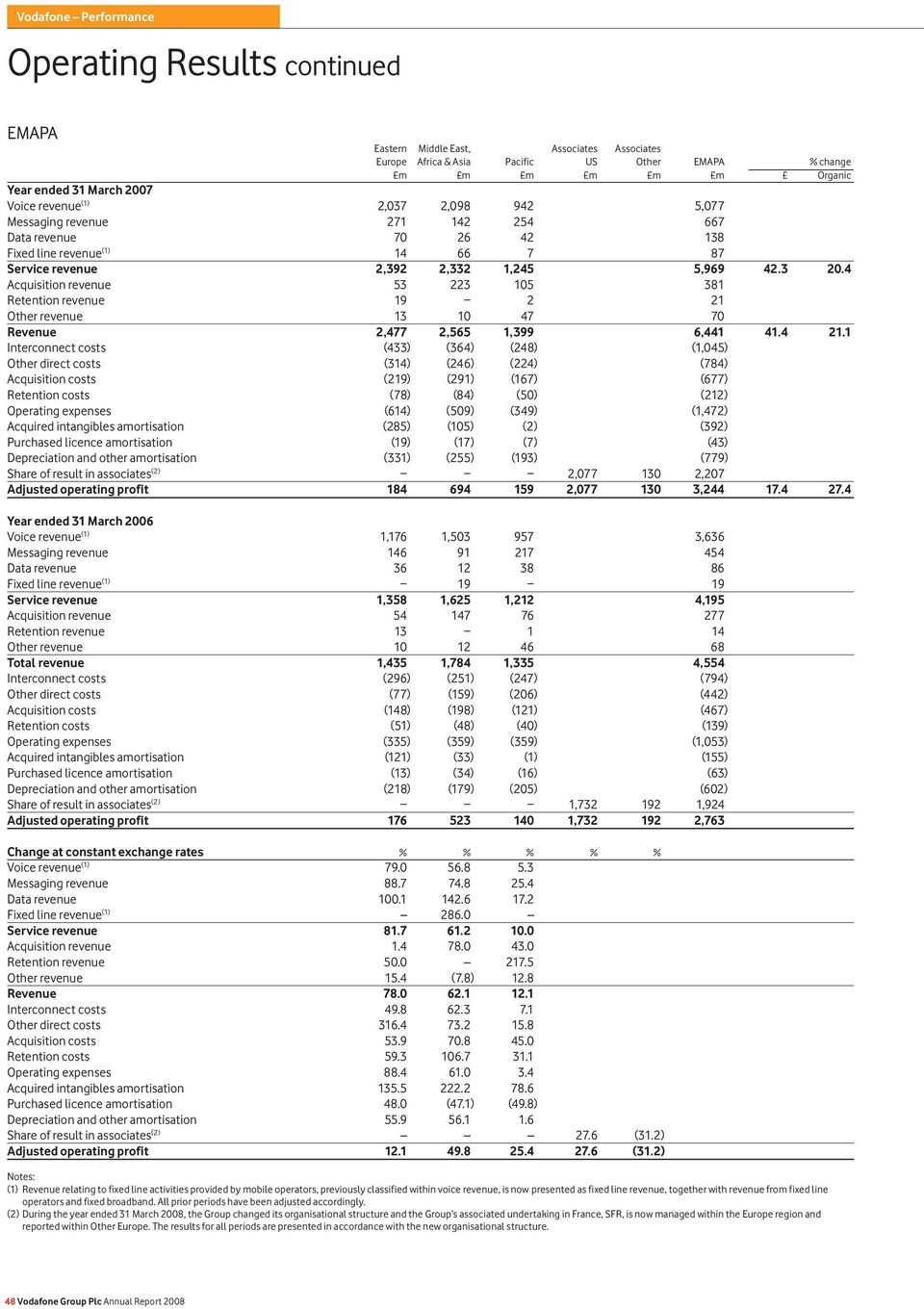
20 Mobile telecommunications KPIs Eastern Middle East, Eastern Middle East, Europe Africa & Asia Pacific EMAPA Europe Africa & Asia Pacific EMAPA Closing customers ( 000) 28,975 27,160 5,750 61,885 12,579 21,884 5,346 39,809 Closing 3G devices ( 000) , Voice usage (millions of minutes) 39,658 37,449 11,371 88,478 13,302 18,300 9,811 41,413 See page 155 for definition of terms A part of Vodafone s strategy is to build on the Group s track record of creating value in emerging markets. Vodafone continued to execute on this strategy, with strong performances in the Czech Republic, Egypt, Romania and South Africa. The Group continued to successfully build its emerging markets portfolio through acquisitions in Turkey and, subsequent to 31 March 2007, India. Since its acquisition on 24 May 2006, Vodafone Turkey has shown a performance in excess of the acquisition plan. In December 2006, the Group increased its equity interest in Vodafone Egypt from 50.1% to 54.9%, positioning the Group to capture further growth in this lower penetrated market. The Group also entered into a new strategic partnership with Telecom Egypt, the minority shareholder in Vodafone Egypt, to increase cooperation between both parties and jointly develop a range of products and services for the Egyptian market. EMAPA s growth has benefited from the 2006 financial year acquisitions in the Czech Republic and the stake in Bharti Airtel in India, as well as the stake increases in Romania and South Africa and the 2007 financial year acquisition in Turkey. Bharti Airtel was accounted for as a joint venture until 11 February 2007, following which the Group s interest has been accounted for as an investment. Revenue Revenue increased by 41.4%, or 21.1% on an organic basis, driven by organic service revenue growth of 20.4%. The impact of acquisitions, disposal and exchange rates on service revenue and revenue growth is shown below. Impact of Impact of exchange acquisitions Organic rates and disposal (1) Reported growth Percentage Percentage growth % points points % Service revenue Eastern Europe 20.0 (5.6) Middle East, Africa and Asia 27.7 (17.7) Pacific 10.0 (7.3) 2.7 EMAPA 20.4 (10.9) Revenue EMAPA 21.1 (11.2) Note: (1) Impact of acquisitions and disposal includes the impact of the change in consolidation status of Bharti Airtel from a joint venture to an investment. Organic service revenue growth was driven by the 30.2% organic increase in the average mobile customer base and the success of usage stimulation initiatives, partially offset by declining ARPU in a number of markets due to the higher proportion of lower usage prepaid customer additions. Particularly strong customer growth was achieved in Eastern Europe and the Middle East, Africa and Asia, where markets are typically less penetrated than in Western Europe or the Pacific area. Non-service revenue increased by 31.5%, or 28.9% on an organic basis, primarily due to an increase in the level of gross additions in a number of countries. Eastern Europe In Eastern Europe, service revenue grew by 76.1%, with the key driver of growth being the acquisitions in the Czech Republic and Turkey, as well as the stake increase in Romania. Good customer growth in all Eastern European markets contributed to the organic service revenue growth. Organic service revenue growth in Eastern Europe was principally driven by Romania. As a result of the growth in the customer base and a promotional offer of lower tariffs, which led to higher voice usage, constant currency service revenue in Romania grew by 29.4%, calculated by applying the Group s equity interest at 31 March 2007 to the whole of the 2006 financial year. The continued expansion of 3G network coverage, the successful launch of 3G broadband, together with introductory promotional offers, and increased sales of Vodafone Mobile Connect data cards, resulted in data revenue growth of 66.7% at constant exchange rates. In the Czech Republic, a focus on existing customers, including a Christmas campaign of free weekend text messages available to all existing as well as new customers, and the success of a business offering allowing unlimited on and off net calls within a customers virtual private network for a fixed monthly fee, had a positive impact on gross additions and drove the increase in average mobile customers. This led to growth of 11.1% in service revenue at constant exchange rates, calculated by applying the Group s equity interest at 31 March 2007 to the whole of the 2006 financial year. Vodafone Turkey performed ahead of the expectations the Group had at the time of the completion of the acquisition, with customer numbers, usage and adjusted operating profit ahead of plan. Improvements in network reliability and coverage have contributed to strong customer growth and allowed an increase in prepaid tariffs, resulting in service revenue growth. Telsim was rebranded to Vodafone in March 2007, with the launch of a new tariff with inclusive on and off net calls, a first for the Turkish market. Middle East, Africa and Asia The service revenue growth of 43.5% in the Middle East, Africa and Asia resulted primarily from the stake increases in South Africa in February 2006 and Egypt in December 2006, together with the acquisition of the Group s interest in Bharti Airtel in India in December 2005, offset by an adverse movement in exchange rates. Strong organic growth was achieved in all markets, particularly in Egypt and South Africa, driven by the 40.2% increase in the average mobile customer base compared to the 2006 financial year. Strong customer growth, driven by prepaid tariff reductions, the availability of lower cost handsets and high customer satisfaction with the Vodafone service, contributed to the 39.5% constant currency service revenue growth in Egypt. Innovative new products and services, including a new hybrid tariff offering guaranteed airtime credit every month with the ability to top up as required, and successful promotions, led to an increase in the average mobile customer base and 21.6% constant currency organic service revenue growth in South Africa, while the continued rollout of the 3G network led to strong growth in data revenue. Bharti Airtel continued to perform well with strong growth in customers and revenue, demonstrating the growth potential in the Indian market. Pacific Service revenue increased by 2.7%, with the impact of adverse foreign exchange movements reducing reported growth by 7.3 percentage points. In Australia, a continued focus on higher value customers delivered constant currency service revenue growth of 13.7%, with improvements in both prepaid and contract ARPU. The performance in Australia more than offset the reduced growth in constant currency service revenue in New Zealand, where constant currency service revenue growth was 2.7% following a cut in termination rates, which reduced reported service revenue growth by 4.1%. After the negative impact of foreign exchange movements, reported service revenue in New Zealand declined by 7.9%. Vodafone Group Plc Annual Report
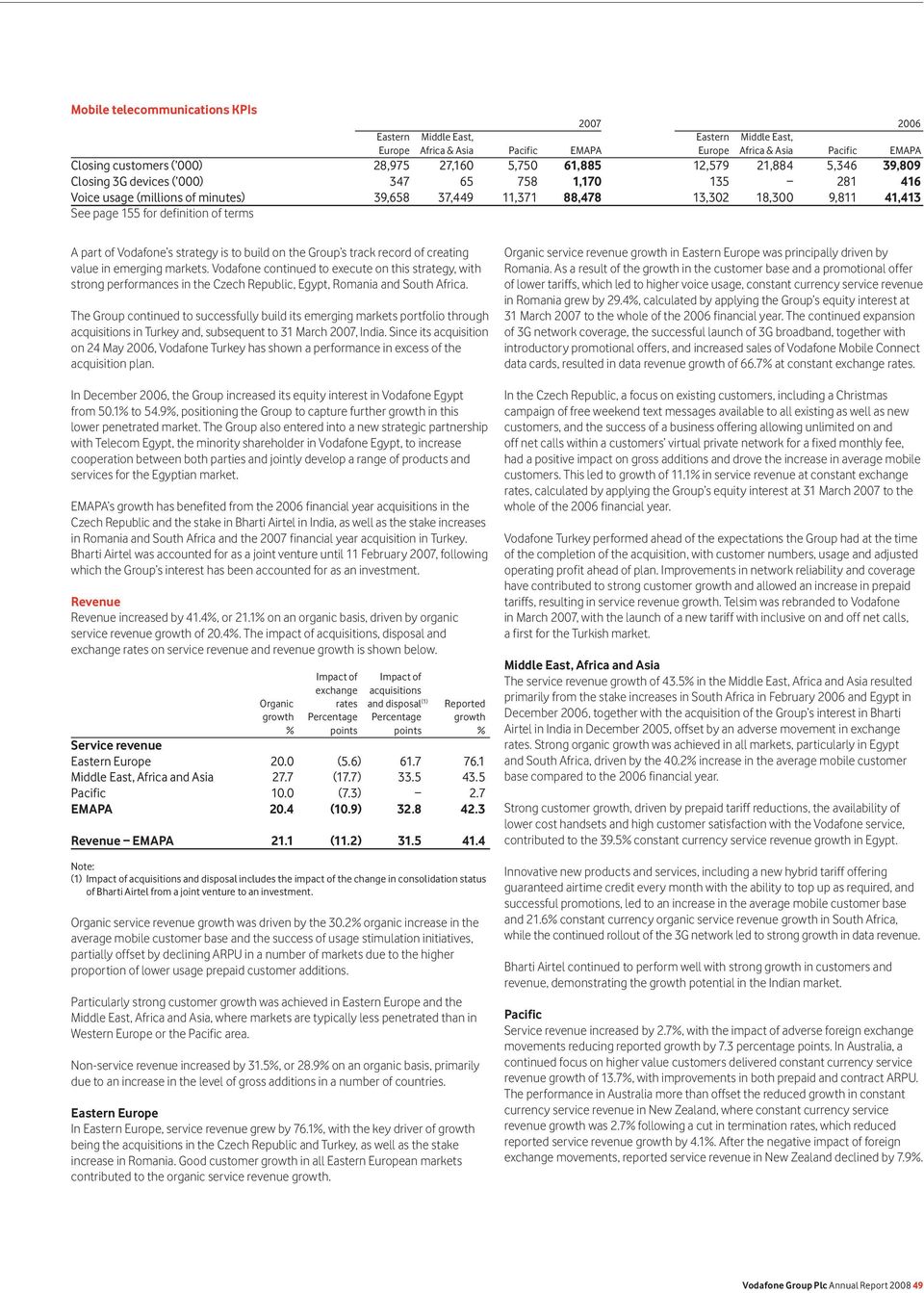
21 Vodafone Performance Operating Results continued Adjusted operating profit The impact of acquisitions, disposal and exchange rates on adjusted operating profit is shown below. Impact of Impact of exchange acquisitions Organic rates and disposal (1) Reported growth Percentage Percentage growth % points points % Adjusted operating profit Eastern Europe 49.2 (7.6) (37.1) 4.5 Middle East, Africa and Asia 18.5 (16.9) Pacific 25.4 (11.8) 13.6 EMAPA 27.4 (8.7) (1.3) 17.4 Note: (1) Impact of acquisitions and disposal includes the impact of the change in consolidation status of Bharti Airtel from a joint venture to an investment. Adjusted operating profit increased by 17.4%. On an organic basis, growth was 27.4%, as the acquisitions and stake increases led to the rise in acquired intangible asset amortisation reducing reported growth in operating profit. These acquisitions, combined with the continued expansion of network infrastructure in the region, including 3G and HSDPA upgrades, resulted in higher depreciation charges. Organic growth in adjusted operating profit was driven by a strong performance in Romania, Egypt, South Africa and the Group s associated undertaking in the US. Eastern Europe Interconnect costs increased by 46.3%, or 23.8% on an organic basis, principally as a result of the higher usage in Romania. An ongoing regulatory fee in Turkey amounting to 15% of revenue increased other direct costs compared to the 2006 financial year. Acquisition costs fell as a percentage of service revenue throughout most of Eastern Europe, with increased investment in the direct distribution channel in Romania resulting in lower subsidies on handsets. Retention costs decreased as a percentage of service revenue, but increased on an organic basis due to a focus on retaining customers through loyalty programmes in response to the increasing competition in Romania, which had a positive impact on contract and prepaid churn. Operating expenses increased by 1.0 percentage point as a percentage of service revenue, primarily as a result of inflationary pressures in Romania and investment in Turkey. Middle East, Africa and Asia Interconnect costs increased by 45.0%, or 26.8% on an organic basis, due to the usage stimulation initiatives throughout the region. Acquisition costs remained stable as a percentage of service revenue, while retention costs increased, principally due to increased investment in retaining customers in Egypt ahead of the launch of services by a new operator after 31 March 2007 and in South Africa in response to the introduction of mobile number portability during the 2007 financial year, with the provision of 3G and data enabled device upgrades for contract customers and a loyalty point scheme. Operating expenses remained stable as a percentage of service revenue. Pacific The improved profitability in Australia was more than offset by the lower profitability in New Zealand resulting from the increased cost of telecommunications service obligation regulation, the impact of the acquisition of ihug and adverse foreign exchange rates. Acquisition and retention costs increased as a percentage of service revenue due to the investment in higher value customers in Australia, which also had a favourable impact on contract churn and were partially offset by savings in network costs and operating expenses. Associates 2007 % change Verizon Verizon Wireless Other Total Wireless Share of result of associates m m m $ Operating profit 2, , Interest (179) 2 (177) (12.3) (7.0) Tax (125) (39) (164) Minority interest (61) (61) , , Verizon Wireless Other Total Share of result of associates m m m Operating profit 2, ,375 Interest (204) 1 (203) Tax (116) (72) (188) Minority interest (60) (60) 1, ,924 % change Verizon Wireless (100% basis) $ Total revenue ( m) 20,860 18, Closing customers ( 000) 60,716 53,020 Average monthly ARPU ($) Blended churn 13.9% 14.7% Mobile non-voice service revenue as a percentage of mobile service revenue 14.4% 8.9% Verizon Wireless produced another year of record growth in organic net additions, increasing its customer base by 7.7 million in the year ended 31 March The performance was particularly robust in the higher value contract segment and was achieved in a market where the estimated closing mobile penetration reached 80%. The strong customer growth was achieved through a combination of higher gross additions and improvements in Verizon Wireless customer loyalty, with the latter evidenced through lower levels of churn. The 15.4% growth in the average mobile customer base combined with a 2.1% increase in ARPU resulted in a 17.8% increase in service revenue. ARPU growth was achieved through the continued success of data services, driven predominantly by data cards, wireless and messaging services. Verizon Wireless operating profit also improved due to efficiencies in other direct costs and operating expenses, partly offset by a higher level of customer acquisition and retention activity. Verizon Wireless continued to lay the foundations for future data revenue growth through the launch of both CDMA EV-DO Rev A, an enhanced wireless broadband service, and broadcast mobile TV services during the first calendar quarter of In addition, Verizon Wireless consolidated its spectrum position during the year with the acquisition of spectrum through the Federal Communications Commission s Advanced Wireless Services auction for $2.8 billion. The Group s share of the tax attributable to Verizon Wireless for the year ended 31 March 2007 relates only to the corporate entities held by the Verizon Wireless partnership. The tax attributable to the Group s share of the partnership s pre-tax profit is included within the Group tax charge. The Group s other associated undertakings in EMAPA have been impacted by intense competition and reduction in termination rates, similar to the experiences of the Group s controlled businesses in the Europe region, which have had a negative impact on revenue. The Group disposed of its associated undertakings in Belgium and Switzerland on 3 November 2006 and 20 December 2006, respectively, for a total cash consideration of 3.1 billion. Results are included until the respective dates of the announcement of disposal. 50 Vodafone Group Plc Annual Report 2008
22 Outlook 2009 financial year Adjusted Capitalised operating fixed asset Free Revenue profit additions cash flow bn bn bn bn 2008 performance (1) 2009 outlook (2)(3) 39.8 to to to to 5.6 (4) Notes: (1) The amount for the 2008 financial year includes 0.4 billion benefit from deferred payments for capital expenditure but is stated after 0.7 billion of tax payments, including associated interest, in respect of a number of long standing tax issues. (2) Includes assumption of average foreign exchange rates for the 2009 financial year of approximately 1: 1.30 (2008: 1.42) and 1:US$1.96 (2008: 2.01). A substantial majority of the Group s revenue, adjusted operating profit, capitalised fixed asset additions and free cash flow is denominated in currencies other than sterling, the Group s reporting currency. A 1% change in the euro to sterling exchange rate would impact revenue by approximately 250 million and adjusted operating profit by approximately 70 million. (3) The outlook does not include the impact of a change in the Group s effective interest in Neuf Cegetel. (4) Excludes spectrum and licence payments, but includes estimated payments in respect of long standing tax issues. The outlook ranges reflect the Group s assumptions for average foreign exchange rates for the 2009 financial year. In respect of the euro to sterling exchange rate, this represents an approximate 10% change to the 2008 financial year, resulting in favourable year on year increases in revenue, adjusted operating profit and free cash flow and adverse changes in capitalised fixed asset additions. Operating conditions are expected to continue to be challenging in Europe given the current economic environment and ongoing pricing and regulatory pressures but with continued positive trends in messaging and data revenue and voice usage growth. Increasing market penetration is expected to continue to result in overall strong growth for the EMAPA region. The Group considers that its geographically diverse portfolio should provide some resilience in the current economic environment. Revenue is expected to be in the range of 39.8 billion to 40.7 billion. The Group continues to drive revenue growth, particularly in respect of its total communications strategy for data and fixed broadband services and in emerging markets. Revenue includes the first full year post acquisition of Vodafone Essar in India and the Tele2 businesses in Italy and Spain. Adjusted operating profit is expected to be in the range of 11.0 billion to 11.5 billion. The Group margin is expected to decline by a similar amount as in the 2008 financial year but with a greater impact from lower margin fixed broadband services. Verizon Wireless, the Group s US associate, is expected to continue to perform strongly. Total depreciation and amortisation charges are anticipated to be around 6.5 billion to 6.6 billion, higher than the 2008 financial year, primarily as a result of the ongoing investment in capital expenditure in India and the impact of changes in foreign exchange rates. The Group expects capitalised fixed asset additions to be in the range of 5.3 billion to 5.8 billion, including an increase in investment in India. Capitalised fixed asset additions are anticipated to be around 10% of revenue for the total of the Europe region and common functions, with continued investment in growth. Free cash flow is expected to be in the range of 5.1 billion to 5.6 billion, excluding spectrum and licence payments. This is after taking into account 0.3 billion from payments for capital expenditure deferred from the 2008 financial year. The Group will invest 0.2 billion in Qatar in respect of the second mobile licence won in December During the 2009 financial year, Vodafone Qatar is expected to pay 1.0 billion for the licence with the balance of the funding being provided by the other shareholders in Vodafone Qatar. The Group continues to make significant cash payments for tax and associated interest in respect of long standing tax issues. The Group does not expect resolution of the application of the UK Controlled Foreign Company legislation to the Group in the near term. The adjusted effective tax rate percentage is expected to be in the high 20s for the 2009 financial year, with the Group targeting the high 20s in the medium term financial year Capitalised Adjusted fixed operating asset Free Revenue profit additions cash flow (1) bn bn bn bn Outlook May 2007 (2) 33.3 to to to to 4.5 Outlook November 2007 (3) 34.5 to to to to 4.9 Foreign exchange (4) Adjusted outlook (5) 35.2 to to to to performance Notes: (1) The amount for the 2008 financial year includes 0.4 billion benefit from deferred payments for capital expenditure but is stated after 0.7 billion of tax payments, including associated interest, in respect of a number of long standing tax issues. (2) The Group s outlook from May 2007 reflected expectations for average foreign exchange rates for the 2008 financial year of approximately 1: 1.47 and 1:US$1.98. (3) The Group s outlook, as updated in November 2007, reflected improvements in operational performance, the impact of the Tele2 acquisition and updated expectations for average foreign exchange rates for the 2008 financial year of approximately 1: 1.45 and 1:US$2.04. (4) These amounts represent the difference between the forecast exchange rates used in the November 2007 update and rates used to translate actual results including 1: 1.42 and 1:US$2.01. (5) Outlook from November 2007 adjusted solely for exchange rate differences as discussed in note 4 above. Vodafone Group Plc Annual Report
23 Vodafone Performance Principal Risk Factors and Uncertainties Regulatory decisions and changes in the regulatory environment could adversely affect the Group s business. Because the Group has ventures in a large number of geographic areas, it must comply with an extensive range of requirements that regulate and supervise the licensing, construction and operation of its telecommunications networks and services. In particular, there are agencies which regulate and supervise the allocation of frequency spectrum and which monitor and enforce regulation and competition laws which apply to the mobile telecommunications industry. Decisions by regulators regarding the granting, amendment or renewal of licences, to the Group or to third parties, could adversely affect the Group s future operations in these geographic areas. The Group cannot provide any assurances that governments in the countries in which it operates will not issue telecommunications licences to new operators whose services will compete with it. In addition, other changes in the regulatory environment concerning the use of mobile phones may lead to a reduction in the usage of mobile phones or otherwise adversely affect the Group. Additionally, decisions by regulators and new legislation, such as those relating to international roaming charges and call termination rates, could affect the pricing for, or adversely affect the revenue from, the services the Group offers. Further details on the regulatory framework in certain countries and regions in which the Group operates, and on regulatory proceedings can be found in Regulation on page 147. Increased competition may reduce market share or revenue. The Group faces intensifying competition. Competition could lead to a reduction in the rate at which the Group adds new customers and to a decrease in the size of the Group s market share as customers choose to receive telecommunications services, or other competing services, from other providers. Examples include, but are not limited to, competition from internet based services and MVNOs. The focus of competition in many of the Group s markets continues to shift from customer acquisition to customer retention as the market for mobile telecommunications has become increasingly penetrated. Customer deactivations are measured by the Group s churn rate. There can be no assurance that the Group will not experience increases in churn rates, particularly as competition intensifies. An increase in churn rates could adversely affect profitability because the Group would experience lower revenue and additional selling costs to replace customers. Increased competition has also led to declines in the prices the Group charges for its mobile services and is expected to lead to further price declines in the future. Competition could also lead to an increase in the level at which the Group must provide subsidies for handsets. Additionally, the Group could face increased competition should there be an award of additional licences in jurisdictions in which a member of the Group already has a licence. Delays in the development of handsets and network compatibility and components may hinder the deployment of new technologies. The Group s operations depend in part upon the successful deployment of continuously evolving telecommunications technologies. The Group uses technologies from a number of vendors and makes significant capital expenditures in connection with the deployment of such technologies. There can be no assurance that common standards and specifications will be achieved, that there will be inter-operability across Group and other networks, that technologies will be developed according to anticipated schedules, that they will perform according to expectations or that they will achieve commercial acceptance. The introduction of software and other network components may also be delayed. The failure of vendor performance or technology performance to meet the Group s expectations or the failure of a technology to achieve commercial acceptance could result in additional capital expenditures by the Group or a reduction in profitability. Expected benefits from cost reduction initiatives may not be realised. The Group has entered into several cost reduction initiatives principally relating to the outsourcing of IT application development and maintenance, data centre consolidation, supply chain management and a business transformation programme to implement a single, integrated operating model using one ERP system. However, there is no assurance that the full extent of the anticipated benefits will be realised. Changes in assumptions underlying the carrying value of certain Group assets could result in impairment. Vodafone completes a review of the carrying value of its assets annually, or more frequently where the circumstances require, to assess whether those carrying values can be supported by the net present value of future cash flows derived from such assets. This review examines the continued appropriateness of the assumptions in respect of highly uncertain matters upon which the carrying values of certain of the Group s assets are based. This includes an assessment of discount rates and long term growth rates, future technological developments and timing and quantum of future capital expenditure, as well as several factors which may affect revenue and profitability identified within other risk factors in this section such as intensifying competition, pricing pressures, regulatory changes and the timing for introducing new products or services. Due to the Group s substantial carrying value of goodwill under IFRS, the revision of any of these assumptions to reflect current or anticipated changes in operations or the financial condition of the Group could lead to an impairment in the carrying value of certain assets in the Group. While impairment does not impact reported cash flows, it does result in a non-cash charge in the Consolidated Income Statement and thus no assurance can be given that any future impairments would not affect the Company s reported distributable reserves and therefore its ability to make distributions to its shareholders or repurchase its shares. See Critical Accounting Estimates on page 85. The Group s geographic expansion may increase exposure to unpredictable economic, political and legal risks. Political, economic and legal systems in emerging markets historically are less predictable than in countries with more developed institutional structures. As the Group increasingly enters into emerging markets, the value of the Group s investments may be adversely affected by political, economic and legal developments which are beyond the Group s control. Expected benefits from acquisitions may not be realised. The Group has made significant acquisitions, which are expected to deliver benefits resulting from the anticipated growth potential of the relevant markets. However, there is no assurance as to the successful integration of companies acquired by the Group or the extent to which the anticipated benefits resulting from the acquisitions will be achieved. The Company s strategic objectives may be impeded by the fact that it does not have a controlling interest in some of its ventures. Some of the Group s interests in mobile licences are held through entities in which it is a significant but not controlling owner. Under the governing documents for some of these partnerships and corporations, certain key matters such as the approval of business plans and decisions as to the timing and amount of cash distributions require the consent of the partners. In others, these matters may be approved without the Company s consent. The Company may enter into similar arrangements as it participates in ventures formed to pursue additional opportunities. Although the Group has not been materially constrained by the nature of its mobile ownership interests, no assurance can be given that its partners will not exercise their power of veto or their controlling influence in any of the Group s ventures in a way that will hinder the Group s corporate objectives and reduce any anticipated cost savings or revenue enhancement resulting from these ventures. 52 Vodafone Group Plc Annual Report 2008
24 Expected benefits from investment in networks, licences and new technology may not be realised. The Group has made substantial investments in the acquisition of licences and in its mobile networks, including the roll out of 3G networks. The Group expects to continue to make significant investments in its mobile networks due to increased usage and the need to offer new services and greater functionality afforded by new or evolving telecommunications technologies. Accordingly, the rate of the Group s capital expenditures in future years could remain high or exceed that which it has experienced to date. There can be no assurance that the introduction of new services will proceed according to anticipated schedules or that the level of demand for new services will justify the cost of setting up and providing new services. Failure or a delay in the completion of networks and the launch of new services, or increases in the associated costs, could have a material adverse effect on the Group s operations. The Group may experience a decline in revenue or profitability notwithstanding its efforts to increase revenue from the introduction of new services. As part of its strategy, the Group will continue to offer new services to its existing customers and seek to increase non-voice service revenue as a percentage of total service revenue. However, the Group may not be able to introduce these new services commercially, or may experience significant delays due to problems such as the availability of new mobile handsets, higher than anticipated prices of new handsets or availability of new content services. In addition, even if these services are introduced in accordance with expected time schedules, there is no assurance that revenue from such services will increase ARPU or maintain profit margins. The Group s business and its ability to retain customers and attract new customers may be impaired by actual or perceived health risks associated with the transmission of radio waves from mobile telephones, transmitters and associated equipment. Concerns have been expressed in some countries where the Group operates that the electromagnetic signals emitted by mobile telephone handsets and base stations may pose health risks at exposure levels below existing guideline levels and may interfere with the operation of electronic equipment. In addition, as described under the heading Legal proceedings in note 32 to the Consolidated Financial Statements, several mobile industry participants, including the Company and Verizon Wireless, have had lawsuits filed against them alleging various health consequences as a result of mobile phone usage, including brain cancer. While the Company is not aware that such health risks have been substantiated, there can be no assurance that the actual, or perceived, risks associated with radio wave transmission will not impair its ability to retain customers and attract new customers, reduce mobile telecommunications usage or result in further litigation. In such event, because of the Group s strategic focus on mobile telecommunications, its business and results of operations may be more adversely affected than those of other companies in the telecommunications sector. The Group s business would be adversely affected by the non-supply of equipment and support services by a major supplier. Companies within the Group source network infrastructure and other equipment, as well as network-related and other significant support services, from third party suppliers. The withdrawal or removal from the market of one or more of these major third party suppliers would adversely affect the Group s operations and could result in additional capital or operational expenditures by the Group. Vodafone Group Plc Annual Report
25 Vodafone Performance Financial Position and Resources Consolidated Balance Sheet m m Non-current assets Intangible assets 70,331 56,272 Property, plant and equipment 16,735 13,444 Investments in associated undertakings 22,545 20,227 Other non-current assets 8,935 6, ,546 96,804 Current assets 8,724 12,813 Total assets 127, ,617 Total equity shareholders funds 78,043 67,067 Total minority interests (1,572) 226 Total equity 76,471 67,293 Liabilities Borrowings Long term 22,662 17,798 Short term 4,532 4,817 Taxation liabilities Deferred tax liabilities 5,109 4,626 Current taxation liabilities 5,123 5,088 Other non-current liabilities 1, Other current liabilities (2) 12,318 9,041 50,799 42,324 Total equity and liabilities 127, ,617 Non-current assets Intangible assets At 31 March 2008, the Group s intangible assets were 70.3 billion, with goodwill comprising the largest element at 51.3 billion (2007: 40.6 billion). The increase in intangible assets was primarily as a result of 7.9 billion of favourable exchange rate movements and 7.6 billion arising on the acquisitions of Vodafone Essar and Tele2, partially offset by amortisation of 2.5 billion. Refer to note 28 to the Consolidated Financial Statements for further information on the business acquisitions. Property, plant and equipment Property, plant and equipment increased from 13.4 billion at 31 March 2007 to 16.7 billion at 31 March 2008, predominantly as a result of 4.1 billion of additions, a 1.2 billion increase due to acquisitions during the year and 1.6 billion of favourable foreign exchange movements, which more than offset the 3.4 billion of depreciation charges and 0.1 billion reduction due to disposals. Investments in associated undertakings The Group s investments in associated undertakings increased from 20.2 billion at 31 March 2007 to 22.5 billion at 31 March 2008, as a result of a 2.9 billion increase from the Group s share of the results of its associates, after the deductions of interest, tax and minority interest, mainly arising from the Group s investment in Verizon Wireless and favourable foreign exchange movements of 0.3 billion, partially offset by 0.9 billion of dividends received. Other non-current assets Other non-current assets mainly relates to other investments held by the Group, which totalled 7.4 billion at 31 March 2008 compared to 5.9 billion at 31 March The movement primarily represents an increase of 1.8 billion in the investment in China Mobile as a result of the increase in the listed share price, partially offset by the disposal of the Group s 5.60% stake in Bharti Airtel. Current assets Current assets decreased to 8.7 billion at 31 March 2008 from 12.8 billion at 31 March 2007, mainly as a result of decreased cash holdings following the completion of the Vodafone Essar acquisition. Total equity shareholders funds Total equity shareholders funds increased from 67.1 billion at 31 March 2007 to 78.0 billion at 31 March The increase comprises primarily of the profit for the year of 6.8 billion less equity dividends of 3.7 billion, a 5.8 billion benefit from the impact of favourable exchange rate movements and the unrealised holding gains on other investments discussed above. Borrowings Long term borrowings and short term borrowings increased to 27.2 billion at 31 March 2008 from 22.6 billion at 31 March 2007, mainly as a result of foreign exchange movements and written put option liabilities assumed on the completion of the Vodafone Essar acquisition. Taxation liabilities The deferred tax liability increased from 4.6 billion at 31 March 2007 to 5.1 billion at 31 March 2008, which arose mainly from 0.5 billion in relation to the acquisition of Vodafone Essar. Other current liabilities The increase in other current liabilities from 9.0 billion to 12.3 billion is primarily to due foreign exchange differences arising on translation and other current liabilities in the newly acquired Vodafone Essar. Contractual obligations A summary of the Group s principal contractual financial obligations is shown below. Further details on the items included can be found in the notes to the Consolidated Financial Statements. Payments due by period m Contractual obligations (1) Total <1year years years >5 years Borrowings (2) 34,537 5,492 10,150 4,728 14,167 Operating lease commitments (3) 4, , ,752 Capital commitments (3)(4) 1,620 1, Purchase commitments 2,347 1, Total contractual cash obligations (1) 42,945 9,139 11,883 5,866 16,057 Notes: (1) The above table of contractual obligations excludes commitments in respect of options over interests in Group businesses held by minority shareholders (see Option agreements and similar arrangements ) and obligations to pay dividends to minority shareholders (see Dividends from associated undertakings and to minority shareholders ). The table excludes current and deferred tax liabilities and obligations under post employment benefit schemes, details of which are provided in notes 6 and 25 to the Consolidated Financial Statements, respectively. (2) See note 24 to the Consolidated Financial Statements. (3) See note 31 to the Consolidated Financial Statements. (4) Primarily related to network infrastructure. Contingencies Details of the Group s contingent liabilities are included in note 32 to the Consolidated Financial Statements. 54 Vodafone Group Plc Annual Report 2008
26 Equity dividends The table below sets out the amounts of interim, final and total cash dividends paid or, in the case of the final dividend for the 2008 financial year, proposed, in respect of each financial year, indicated in pence per ordinary share. Pence per ordinary share Year ended 31 March Interim Final Total (1) 7.51 Note: (1) The final dividend for the year ended 31 March 2008 was proposed on 27 May 2008 and is payable on 1 August 2008 to holders of record as of 6 June For American Depositary Share ( ADS ) holders, the dividend will be payable in US dollars under the terms of the ADS depositary agreement. The Company has historically paid dividends semi-annually, with a regular interim dividend in respect of the first six months of the financial year payable in February and a final dividend payable in August. The Board expects that the Company will continue to pay dividends semi-annually. In November 2007, the directors announced an interim dividend of 2.49 pence per share, representing a 6.0% increase over last year s interim dividend. In considering the level of dividends, the Board takes account of the outlook for earnings growth, operating cash flow generation, capital expenditure requirements, acquisitions and divestments, together with the amount of debt and share purchases. The Board remains committed to its existing policy of distributing 60% of adjusted earnings per share by way of dividend. The Group targets a low single A rating in line with the policy established by the Board in The Group has no current plans for share purchases or one-time returns. Accordingly, the directors announced a proposed final dividend of 5.02 pence per share, representing a 13.8% increase on last year s final dividend. Cash dividends, if any, will be paid by the Company in respect of ordinary shares in pounds sterling or, to holders of ordinary shares with a registered address in a country which has adopted the euro as its national currency, in euro, unless shareholders wish to elect to continue to receive dividends in sterling, are participating in the Company s Dividend Reinvestment Plan, or have mandated their dividend payment to be paid directly into a bank or building society account in the UK. In accordance with the Company s Articles of Association, the sterling: euro exchange rate will be determined by the Company shortly before the payment date. The Company will pay the ADS Depositary, The Bank of New York, its dividend in US dollars. The sterling: US dollar exchange rate for this purpose will be determined by the Company up to ten New York and London business days prior to the payment date. Cash dividends to ADS holders will be paid by the ADS Depositary in US dollars. Liquidity and capital resources The major sources of Group liquidity for the 2008 and 2007 financial years were cash generated from operations, dividends from associated undertakings, borrowings through short term and long term issuances in the capital markets and, particularly in the 2007 financial year, investment and business disposals. The Group does not use off-balance sheet special purpose entities as a source of liquidity or for other financing purposes. The Group s key sources of liquidity for the foreseeable future are likely to be cash generated from operations and borrowings through long term and short term issuances in the capital markets, as well as committed bank facilities. The Group s liquidity and working capital may be affected by a material decrease in cash flow due to factors such as reduced operating cash flow resulting from further possible business disposals, increased competition, litigation, timing of tax payments and the resolution of outstanding tax issues, regulatory rulings, delays in the development of new services and networks, licences and spectrum payments, inability to receive expected revenue from the introduction of new services, reduced dividends from associates and investments or increased dividend payments to minority shareholders. Please see the section titled Principal Risk Factors and Uncertainties, on pages 52 and 53. In particular, the Group continues to anticipate significant cash tax payments and associated interest payments due to the resolution of long standing tax issues. The Group is also party to a number of agreements that may result in a cash outflow in future periods. These agreements are discussed further in Option agreements and similar arrangements at the end of this section. Wherever possible, surplus funds in the Group (except in Egypt and India) are transferred to the centralised treasury department through repayment of borrowings, deposits, investments, share purchases and dividends. These are then on-lent or contributed as equity to fund Group operations, used to retire external debt or invested externally. Cash flows During the 2008 financial year, the Group increased its net cash inflow from operating activities by 1.4% to 10,474 million. The Group generated 5,540 million of free cash flow from continuing operations, a reduction of 9.6% on the 2007 financial year, primarily as a result of higher payments for taxation and interest and an increase in capital expenditure m m Net cash flows from operating activities 10,474 10,328 Discontinued operations 135 Continuing operations 10,474 10,193 Taxation 2,815 2,243 Purchase of intangible fixed assets (846) (899) Purchase of property, plant and equipment (3,852) (3,633) Disposal of property, plant and equipment Operating free cash flow 8,630 8,073 Discontinued operations (8) Continuing operations 8,630 8,081 Taxation (2,815) (2,243) Dividends from associated undertakings Dividends paid to minority shareholders in subsidiary undertakings (113) (34) Dividends from investments Interest received Interest paid (1,545) (1,051) Free cash flow 5,540 6,119 Discontinued operations (8) Continuing operations 5,540 6,127 Net cash (outflow)/inflow from acquisitions and disposals (5,957) 7,081 Other cash flows from investing activities 689 (92) Equity dividends paid (3,658) (3,555) Other cash flows from financing activities (2,549) (4,712) Net cash flows in the year (5,935) 4,841 Dividends from associated undertakings and to minority shareholders Dividends from the Group s associated undertakings are generally paid at the discretion of the Board of directors or shareholders of the individual operating and holding companies and Vodafone has no rights to receive dividends, except where specified within certain of the companies shareholders agreements, such as with SFR, the Group s associated undertaking in France. Similarly, the Group does not have existing obligations under shareholders agreements to pay dividends to minority interest partners of Group subsidiaries or joint ventures, except as specified overleaf. Vodafone Group Plc Annual Report
27 Vodafone Performance Financial Position and Resources continued Included in the dividends received from associated undertakings and investments is an amount of 414 million (2007: 328 million) received from Verizon Wireless. Until April 2005, Verizon Wireless distributions were determined by the terms of the partnership agreement distribution policy and comprised income distributions and tax distributions. Since April 2005, tax distributions have continued. Current projections forecast that tax distributions will not be sufficient to cover the US tax liabilities arising from the Group s partnership interest in Verizon Wireless until 2015 and, in the absence of additional distributions above the level of tax distributions during this period, will result in a net cash outflow for the Group. Under the terms of the partnership agreement, the Board has no obligation to provide for additional distributions above the level of the tax distributions. It is the current expectation that Verizon Wireless will continue to re-invest free cash flow in the business and reduce indebtedness. During the year ended 31 March 2008, cash dividends totalling 450 million (2007: 450 million) were received from SFR in accordance with the shareholders agreement. It is currently expected that future dividends from SFR will reduce, but by no more than 50%, between 2009 and 2011 inclusive, should SFR increase debt levels following completion of the purchase of an additional stake in Neuf Cegetel. Verizon Communications Inc. ( Verizon ) has an indirect 23.1% shareholding in Vodafone Italy and, under the shareholders agreement, the shareholders have agreed to take steps to cause Vodafone Italy to pay dividends at least annually, provided that such dividends will not impair the financial condition or prospects of Vodafone Italy including, without limitation, its credit rating. During the 2008 financial year, Vodafone Italy declared and paid a gross dividend of 8.9 billion, of which 2.1 billion was received by Verizon net of withholding tax. The Vodafone Essar shareholders agreement provides for the payment of dividends to minority partners under certain circumstances but not before May Acquisitions and disposals The Group paid a net 5,268 million cash and cash equivalents from acquisition and disposal activities, including investments, in the year to 31 March An analysis of the main transactions in the 2008 financial year, including the changes in the Group s effective shareholding, are shown in the table below. Further details of the acquisitions are provided in note 28 to the Consolidated Financial Statements. m Acquisitions (1) : Acquisition of 100% of CGP Investments (Holdings) Limited ( CGP ), a company with indirect interests in Vodafone Essar Limited (formerly Hutchison Essar Limited) (5,429) Tele2 Spain and Italy (from nil to 100%) (451) Disposals: Partial disposal of Bharti Airtel (from 9.99% to 5.00%) (1) 654 Other net acquisitions and disposals, including investments (1) (42) Total (5,268) Note: (1) Amounts are shown net of cash and cash equivalents acquired or disposed. On 8 May 2007, the Group completed the acquisition of 100% of CGP Investments (Holdings) Limited ( CGP ), a company with indirect interests in Vodafone Essar, from Hutchison Telecommunications International Limited for cash consideration of 5,438 million, net of 51 million cash and cash equivalents acquired, of which 5,429 million was paid during the 2008 financial year. Following this transaction, the Group has a controlling financial interest in Vodafone Essar. As part of this transaction, the Group also assumed gross debt of 1,483 million, including 217 million related to written put options over minority interests, and issued a written put to the Essar group for which the present value of the redemption price at the date of grant was 2,154 million. See page 58 for further details on these options. The Group also entered into a shareholders agreement with the Essar Group in relation to Vodafone Essar. On 9 May 2007, in conjunction with the acquisition of Vodafone Essar, the Group entered into a share sale and purchase agreement in which a Bharti group company irrevocably agreed to purchase the Group s 5.60% direct shareholding in Bharti Airtel. During the year ended 31 March 2008, the Group received 654 million in cash consideration for 4.99% of such shareholding. The Group s remaining 0.61% direct shareholding was transferred in April 2008 for cash consideration of 87 million. The Group retains a 4.36% indirect stake in Bharti Airtel. On 3 December 2007, the Group completed the acquisition of Tele2 Italia SpA ( Tele2 Italy ) and Tele2 Telecommunication Services SLU ( Tele2 Spain ) from Tele2 AB Group for a cash consideration of 452 million, of which 451 million was paid during the 2008 financial year. Other returns The Board will periodically review the free cash flow, anticipated cash requirements, dividends, credit profile and gearing of the Group and consider additional shareholder returns. Treasury shares The Companies Act 1985 permits companies to purchase their own shares out of distributable reserves and to hold shares with a nominal value not to exceed 10% of the nominal value of their issued share capital in treasury. If shares in excess of this limit are purchased they must be cancelled. While held in treasury, no voting rights or pre-emption rights accrue and no dividends are paid in respect of treasury shares. Treasury shares may be sold for cash, transferred (in certain circumstances) for the purposes of an employee share scheme, or cancelled. If treasury shares are sold, such sales are deemed to be a new issue of shares and will accordingly count towards the 5% of share capital which the Company is permitted to issue on a non pre-emptive basis in any one year as approved by its shareholders at the AGM. The proceeds of any sale of treasury shares up to the amount of the original purchase price, calculated on a weighted average price method, is attributed to distributable profits which would not occur in the case of the sale of non-treasury shares. Any excess above the original purchase price must be transferred to the share premium account. The Company did not repurchase any of its own shares between 1 April 2007 and 31 March Shares purchased are held in treasury in accordance with section 162 of the Companies Act The movement in treasury shares during the financial year is shown below: Number Million m 1 April ,251 8,047 Re-issue of shares (118) (191) 31 March ,133 7, Vodafone Group Plc Annual Report 2008
28 Funding The Group s consolidated net debt position at 31 March was as follows: m m Cash and cash equivalents (as presented in the Consolidated Balance Sheet) 1,699 7,481 Trade and other receivables (1) Trade and other payables (1) (544) (219) Short term borrowings (4,532) (4,817) Long term borrowings (22,662) (17,798) (26,846) (22,530) Net debt shown in the Consolidated Balance Sheet (25,147) (15,049) Note: (1) Trade and other receivables and payables included in net debt represent certain derivative financial instruments (see notes 17 and 27 to the Consolidated Financial Statements). (2) The amount for the 2008 financial year includes 2,625 million related to put options over minority interests, including those in Vodafone Essar and Acror, which are reported as financial liabilities. At 31 March 2008, the Group had 1,699 million of cash and cash equivalents, with the decrease since 31 March 2007 being due to the holding of funds at 31 March 2007 prior to the completion of the Vodafone Essar transaction, which occurred on 8 May Cash and cash equivalents are held in accordance with the Group treasury policy. The Group holds its cash and liquid investments in accordance with the counterparty and settlement risk limits of the Board approved treasury policy. The main forms of liquid investments at 31 March 2008 were money market funds, commercial paper and bank deposits. Net debt increased to 25,147 million, from 15,049 million at 31 March 2007, as the impact of business acquisitions and disposals, movements in the liability related to written put options and equity dividend payments were partially offset by free cash flow. The impact of foreign exchange rates increased net debt by 3,238 million, primarily as approximately 80% of net debt is denominated in euro and the euro/ exchange rate increased by 17.2% during the 2008 financial year. Net debt represented approximately 31% of the Group s market capitalisation at 31 March 2008 compared with 16% at 31 March Average net debt at month end accounting dates over the 12 month period ended 31 March 2008 was 22,194 million and ranged between 14,876 million and 25,147 million during the year. Consistent with the development of its strategy, the Group targets low single A long term credit ratings, with its current credit ratings being P-2/F2/A-2 short term and Baa1 stable/a- stable/a- stable long term from Moody s, Fitch Ratings and Standard & Poor s, respectively. Credit ratings are not a recommendation to purchase, hold or sell securities, in as much as ratings do not comment on market price or suitability for a particular investor, and are subject to revision or withdrawal at any time by the assigning rating organisation. Each rating should be evaluated independently. The Group s credit ratings enable it to have access to a wide range of debt finance, including commercial paper, bonds and committed bank facilities. Commercial paper programmes The Group currently has US and euro commercial paper programmes of $15 billion and 5 billion, respectively, which are available to be used to meet short term liquidity requirements. At 31 March 2008, 1,686 million ( 1,342 million), 81 million and 33 million equivalent of other currencies were drawn under the euro commercial paper programme, with such funds being provided by counterparties external to the Group. There were no drawings under the US commercial paper programme. At 31 March 2007, $26 million ( 13 million) was drawn under the US commercial paper programme and 1,531 million ( 1,040 million) and 50 million were drawn under the euro commercial paper programme. The commercial paper facilities were supported by $11.3 billion ( 5.7 billion) of committed bank facilities (see Committed facilities below), comprised of a $6.1 billion Revolving Credit Facility that matures on 24 June 2009 and a $5.2 billion Revolving Credit Facility that matures on 22 June At 31 March 2008 and 31 March 2007, no amounts had been drawn under either bank facility. On 8 May 2007, these facilities were increased from $5.9 billion and $5.0 billion, respectively. Bonds The Group has a 25 billion Euro Medium Term Note programme and a US shelf programme, which are used to meet medium to long term funding requirements. At 31 March 2008, the total amounts in issue under these programmes split by currency were $13.0 billion, 1.5 billion, 10.3 billion and AUD$ 0.3 billion. In the year to 31 March 2008, bonds with a nominal value of 1.6 billion were issued under the US shelf and the Euro Medium Term Note programme. The bonds issued during the year were: US shelf/ Euro Medium Term Note Amount ( EMTN ) Date of bond issue Maturity of bond Currency Million programme 6 June June 2014 EUR 1,250 EMTN 6 June June 2022 EUR 500 EMTN 24 October February 2037 USD 500 US shelf At 31 March 2008, the Group had bonds outstanding with a nominal value of 17,143 million. On 13 May 2008, the Group issued 250 million of 3.625% bonds maturing on 29 November Committed facilities The following table summarises the committed bank facilities available to the Group at 31 March Committed bank facilities Amounts drawn 24 June 2004 $6.1 billion Revolving Credit No drawings have been made against this Facility, maturing 24 June facility. The facility supports the Group s commercial paper programmes and may be used for general corporate purposes, including acquisitions. 24 June 2005 $5.2 billion Revolving Credit No drawings have been made against this Facility, maturing 22 June facility. The facility supports the Group s commercial paper programmes and may be used for general corporate purposes, including acquisitions. 21 December billion Term Credit The facility was drawn down in full on Facility, maturing 16 March 2011, 21 December The facility is available entered into by Vodafone for general corporate purposes, although Finance K.K. and guaranteed amounts drawn must be on-lent to the by the Company. Company. 16 November billion Loan Facility, The facility was drawn down in full on maturing 14 February February The facility is available for financing capital expenditure in the Group s Turkish operating company. Under the terms and conditions of the $11.3 billion committed bank facilities, lenders have the right, but not the obligation, to cancel their commitments and have outstanding advances repaid no sooner than 30 days after notification of a change of control of the Company. This is in addition to the rights of lenders to cancel their commitment if the Company has committed an event of default. The facility agreements provide for certain structural changes that do not affect the obligations of the Company to be specifically excluded from the definition of a change of control. Substantially the same terms and conditions apply in the case of Vodafone Finance K.K. s billion term credit facility, although the change of control provision is applicable to any guarantor of borrowings under the term credit facility. Additionally, the facility agreement requires Vodafone Finance K.K. to maintain a positive tangible net worth at the end of each financial year. As of 31 March 2008, the Company was the sole guarantor. Vodafone Group Plc Annual Report
29 Vodafone Performance Financial Position and Resources continued The terms and conditions of the 0.4 billion loan facility are similar to those of the $11.3 billion committed bank facilities, with the addition that, should the Group s Turkish operating company spend less than the equivalent of $0.8 billion on capital expenditure, the Group will be required to repay the drawn amount of the facility that exceeds 50% of the capital expenditure. Furthermore, two of the Group s subsidiary undertakings are funded by external facilities which are non-recourse to any member of the Group other than the borrower, due to the level of country risk involved. These facilities may only be used to fund their operations. At 31 March 2008, Vodafone India had facilities of INR 138 billion ( 1.7 billion), of which INR 118 billion ( 1.5 billion) is drawn. Since 31 March 2008, Vodafone India has entered into additional facilities amounting to INR 71.5 billion ( 898 million). Vodafone Egypt has a partly drawn EGP 1.7 billion ( 156 million) syndicated bank facility of EGP 4.0 billion ( 369 million) that matures in March In aggregate, the Group has committed facilities of approximately 9,870 million, of which 6,174 million was undrawn and 3,696 million was drawn at 31 March The Group believes that it has sufficient funding for its expected working capital requirements. Further details regarding the maturity, currency and interest rates of the Group s gross borrowings at 31 March 2008 are included in note 24 to the Consolidated Financial Statements. Financial assets and liabilities Analyses of financial assets and liabilities, including the maturity profile of debt, currency and interest rate structure, are included in notes 18 and 24 to the Consolidated Financial Statements. Details of the Group s treasury management and policies are included within note 24 to the Consolidated Financial Statements. Option agreements and similar arrangements Potential cash inflows On 8 August 2007, the Group announced that it had decided not to exercise its rights under its agreement with Verizon Communications ( Verizon ) to sell to Verizon up to $10 billion of the Group s interest in Verizon Wireless. There are no other agreements, which allow Vodafone to put its interest in Verizon Wireless to Verizon. Potential cash outflows In respect of the Group s interest in the Verizon Wireless partnership, an option granted to Price Communications, Inc. by Verizon Communications Inc. was exercised on 15 August Under the option agreement, Price Communications, Inc. exchanged its preferred limited partnership interest in Verizon Wireless of the East LP for 29.5 million shares of common stock in Verizon Communications Inc. Verizon Communications Inc. has the right, but not the obligation, to contribute the preferred interest to the Verizon Wireless partnership, diluting the Group s interest. However, the Group also has the right to contribute further capital to the Verizon Wireless partnership in order to maintain its percentage partnership interest. Such amount, if contributed, would be $0.9 billion. In respect of Arcor, the Group s non-mobile operation in Germany, the capital structure provides all partners, including the Group, the right to withdraw capital from 31 December 2026 onwards and this right in relation to the minority partners has been recognised as a financial liability. The Group acquired the outstanding minority interests on 19 May As part of the Vodafone Essar acquisition, the Group acquired less than 50% equity interests in Telecom Investments India Private Limited ( TII ) and in Omega Telecom Holdings Private Limited ( Omega ), which in turn have a 19.54% and 5.11% indirect shareholding in Vodafone Essar. The Group was granted call options to acquire 100% of the shares in two companies which together indirectly own the remaining shares of TII for, if the market equity of Vodafone Essar at the time of exercise is less than US$25 billion, an aggregate price of US$431 million plus interest or, if the market equity value of Vodafone Essar at the time of exercise is greater than US$25 billion, the fair market value of the shares as agreed between the parties. The Group also has an option to acquire 100% of the shares in a third company which owns the remaining shares in Omega. In conjunction with the receipt of these options, the Group also granted a put option to each of the shareholders of these companies with identical pricing which, if exercised, would require Vodafone to purchase 100% of the equity in the respective company. These options can only be exercised in accordance with Indian law prevailing at the time of exercise. The Group granted put options exercisable between 8 May 2010 and 8 May 2011 to members of the Essar group of companies that, if exercised, would allow the Essar group to sell its 33% shareholding in Vodafone Essar to the Group for US$5 billion or to sell between US$1 billion and US$5 billion worth of Vodafone Essar shares to the Group at an independently appraised fair market value. Off-balance sheet arrangements The Group does not have any material off-balance sheet arrangements, as defined in item 5.E.2. of the SEC s Form 20-F. Please refer to notes 31 and 32 to the Consolidated Financial Statements for a discussion of the Group s commitments and contingent liabilities. Quantitative and qualitative disclosures about market risk A discussion of the Group s financial risk management objectives and policies and the exposure of the Group to liquidity, market and credit risk is included within note 24 to the Consolidated Financial Statements. 58 Vodafone Group Plc Annual Report 2008
30 Corporate Responsibility The Board regards responsible behaviour in all Vodafone s operations as underpinning the value of the brand and has established being a responsible business as one of the Group s long term goals. The Group s approach to corporate responsibility ( CR ) enables it to understand the expectations of stakeholders, forecast trends in social, environmental and ethical requirements and to manage the Group s performance in an appropriate manner. More detail will be available in the online CR report with the full CR performance for the year ended 31 March 2008 at Business impact CR issues present both risks and opportunities for Vodafone and a broad range of stakeholders are increasingly interested in how Vodafone manages these issues. For example, the Group s licences to operate are granted by governments that frequently seek evidence of responsible business practices and in many markets consumers are becoming more concerned about CR issues, such as climate change, content standards and mobile phones, masts and health. The range of stakeholders and the breadth of the issues involved indicate that CR is relevant across all aspects of Vodafone s activities and therefore the Group seeks to integrate its CR approach into all key business processes. Strategy The CR strategy, which addresses CR issues material to the Group, has the following main strands: to capture the potential of mobile to bring socio-economic value in both emerging economies and developed markets, through broadening access to communications to all sections of society; to deliver against stakeholder expectations on the key areas of climate change, a safe and responsible internet experience and sustainable products and services; and to ensure Vodafone s operating standards are of a consistent and appropriate level across the Group. Key CR strategic objectives Safe and responsible internet experience Core initiative: Access to communications Climate change Supported by responsible business practices Underpinned by values, principles and behaviours Sustainable products and services CR governance Vodafone s approach to CR is underpinned by its business principles which cover, amongst other things, the environment, employees, individual conduct and community and society. The business principles are available on com/responsibility/businessprinciples and are communicated to employees in a number of ways, including induction processes, websites and face to face meetings. The Executive Committee receives regular information on CR and, for the last five years, the Board has had an annual presentation on CR. A CR management structure is established in each local operating company, with each one having a representative on its management board with responsibility for CR. For the purposes of this section of the Annual Report, operating companies refers to the Group s operating subsidiaries and the Group s joint venture in Italy. It includes information for the first time for Turkey and Arcor, Vodafone s fixed-line business in Germany, but excludes the newly acquired operations in India and Tele2 in Spain and Italy. These newly acquired operations will be included in the 2009 financial year. CR performance is closely monitored and reported at most local operating company boards on a regular basis. CR is also integrated into Vodafone s risk management processes such as the formal annual confirmation provided by each local operating company detailing the operation of their controls system. These processes are supported by stakeholder engagement, which helps to ensure Vodafone is aware of the issues relevant to the business and to provide a clear understanding of expectations of performance. Stakeholder consultations take place with customers, investors, employees, suppliers, the communities where the Group operates and where networks are based, governments and regulators and non-governmental organisations. In addition, the Group has continued the Vodafone CR Dialogues programme of in-depth discussions on specific, emerging issues. CR Dialogues this year focused on privacy, climate change, safe internet and emerging markets. More information on this can be found at Vodafone s CR programme and performance as reported on the Group s online CR report has been independently assured using the AccountAbility 1000 Assurance Standard (AA1000 AS) by the Group s auditors, Deloitte & Touche LLP. The AA1000 AS requires Vodafone to report its responses and performance on material issues. Deloitte s assurance statement outlining the specific assurance scope, procedures and reasonable assurance opinion is published in the Group s online CR report. The Group s CR reporting comprises an online report and a printed CR summary focusing on strategy and trends, while 12 operating companies also produce their own CR reports. During the year, Vodafone s 2007 CR report won the main accolade of the Corporate Register Reporting Awards for the best report and was commended by the Association of Chartered Certified Accountants ( ACCA ) for the best disclosure in Tax and Public Policy. Vodafone is included in the FTSE4Good and Dow Jones Sustainability Index and rated fifth in the Global AccountAbility Rating, published by Fortune. Vodafone Group Plc Annual Report
31 Vodafone Performance Corporate Responsibility continued Performance in the 2008 financial year Access to communications Access to communications offers the single greatest opportunity for Vodafone to make a strong contribution to society, with a considerable body of research showing that telecommunications and mobile communications in particular has the potential to change people s lives for the better, by promoting economic and social development. During the 2008 financial year, Vodafone continued its focus on mobile payment services and own brand handsets for emerging markets as follows: Vodafone has continued with the ambition of extending access to communications in emerging markets by increasing the portfolio of own branded handsets that introduce higher levels of technological development and affordability so that more people are able to use more services. The Group has shipped more than 10 million of these new handsets to more than 30 markets during the 2008 financial year. Over two million people in Kenya have used the Vodafone M-PESA/Vodafone Money Transfer mobile transaction service since its launch in February 2007, with an average of 200,000 more signing up each month. Customers can pay in and withdraw cash at local agents, transfer money to other mobile users via SMS and buy prepaid airtime credit. Vodafone M-PESA/Vodafone Money Transfer is being used by customers for a wide range of money transfer transactions, with the majority of transaction values being below 20. Partnering with local mobile operator Roshan, Vodafone is piloting a similar scheme in Afghanistan and plans further launches in India and in other African countries. The Group is also finding ways to make mobile phones easier to use, particularly for customers who are elderly, deaf, hard of hearing, blind, visually impaired or have other disabilities. Examples include a speaking phone for the visually impaired and special data tariffs for deaf customers. The Group is currently conducting a strategic review of how best to address those issues and will announce the development of a centre of excellence during the 2009 financial year. Safe and trusted internet experience Vodafone s reputation depends on earning and maintaining the trust of its customers. The way the Group deals with certain key consumer issues directly impacts trust in Vodafone. These include responsible marketing, clear pricing, protecting customers privacy and developing a mobile advertising proposition that customers find acceptable. During the year, Vodafone has re-drafted its responsible marketing guidelines to ensure that customers can continue to trust the Group s services in new areas such as mobile advertising, social networking and digital marketing. Age-restricted content During the 2008 financial year, the Group s research has shown that parents are increasingly concerned about what their children see on the internet and it is anticipated that those concerns will be transferred to children s use of mobile devices as parents become more aware of mobile internet. Vodafone s initiatives in these areas include: All mobile operating companies that offer age-restricted content have implemented parental controls. These block access to age-restricted content on the Vodafone live! domain to those under 18 years of age. Internet filters are offered by eight operating companies, which also enable parents to prevent their children accessing inappropriate age-restricted content on the internet via their mobile phones. The mobile operating companies that have not implemented the filter will remove individual access to the internet completely on request. Vodafone is leading a pan-european ICT Education Initiative in partnership with other ICT companies and European Schoolnet, to develop online education resources. These will help teachers understand new mobile and internet technology and encourage their students to use it responsibly. Vodafone is a founding member of the Mobile Alliance against Child Sexual Abuse Content, launched by the GSMA in February 2008 to prevent users from accessing websites identified as hosting child sexual abuse content. A representative from Vodafone chaired the UK Home Office taskforce to develop industry guidelines on social networking. Vodafone will develop its own social networking guidelines for operating companies based on the industry guidelines to inform the way access is offered to services like Bebo, Facebook, Flickr, MySpace and YouTube. Privacy and freedom of expression In response to concerns raised about privacy and freedom of expression on the internet, Vodafone continued to participate in a multi-stakeholder engagement initiative to agree principles for companies on these issues. More than 20 academics, investors, companies and non-governmental organisations are now involved in this process. The Group launched mobile advertising activities in 11 markets, adopting a conservative approach to content and privacy issues. Vodafone has begun to monitor conformance with the Group s global guidance on advertising and is reviewing feedback on areas where the guidance should be clarified, adapted or modified. Climate change Vodafone recognises that climate change is likely to result in profound consequences for the environment, society and the economy. Limiting the Group s contribution is a priority and during the year the Group announced that by 2020 it will reduce its CO 2 emissions by 50% against the 2007 financial year baseline of 1.23 million tonnes. The Group is currently gathering data about the carbon footprint of its newly acquired businesses in India and Turkey, and climate change targets for these businesses will be announced in due course. The Group reviewed the options for achieving this target, including carbon offsetting as a last resort, and concluded that the most effective strategy is to cut CO 2 emissions directly. The target is expected to be achieved principally through operational changes and technological innovation to improve energy efficiency in the networks. Renewable energy will be used when and where possible. In addition, as part of the climate strategy, the Group announced that it will also be focusing on developing products and services which will help customers limit their own emissions. This is expected to include exploring consumer related solutions such as solar-powered or universal chargers as well as improving understanding of how mobile technology can enable lower emissions through more efficient traffic management, logistic planning and scheduling and the remote monitoring of utility meters. Energy use associated with the operation of the network accounts for around 80% of the Group s carbon dioxide emissions. In 2006, the Group set a target to reduce CO 2 emissions per unit of data transmitted by 40% by This target has been achieved in 2008, three years in advance, with network carbon dioxide emissions per unit of data transmitted decreasing by 50% from Kg/Mb to 0.17 Kg/Mb. In the 2008 financial year, Vodafone s energy use was 2,996 GWh, equating to 1.45 million tonnes of carbon dioxide. Sustainable products and services Vodafone is developing programmes aimed at making delivery of its products and services more sustainable. The key focus during the 2008 financial year was on the reuse and recycling of handsets and accessories, and network equipment. Mobile phones, accessories and the networks on which they operate require upgrading, replacement and decommissioning. The Group complies with the EU s Waste Electronic and Electrical Equipment directive through its handset recycling programmes in all operating companies where it applies. The Group has also worked with suppliers to ensure substances prohibited by the Restriction of the use of certain Hazardous Substances directive are phased out. During the 2008 financial year, 1.33 million phones were collected for reuse and recycling through collection programmes in 16 mobile operating companies, achieving the Group s target. 11,849 tonnes of network equipment waste was generated, with 96% of this sent for reuse or recycling, exceeding the target of 95%. Mobile phones, masts and health Vodafone recognises that there is public concern about the safety of Radio Frequency ( RF ) fields from mobile phones and base stations. The Group contributes to funding of independent scientific research to resolve scientific uncertainty in areas identified by the World Health Organisation ( WHO ). The WHO established an International EMF Project in 1996, which records global research into mobile phones, masts and health and prioritises research needs. In 2006, they identified the following three main areas for additional research: long term (more than 10 years) exposure to low-level RF fields, possible health effects of mobile use in children and dosimetry (the way levels of RF absorbed are calculated). 60 Vodafone Group Plc Annual Report 2008
32 Vodafone requires manufacturers of the mobile devices it sells to test for Specific Absorption Rate compliance when used both against the ear and against, or near, the body, using the US FCC Test procedure. Vodafone is actively engaged with the IEC Standards Organisation in developing a new global protocol for body worn phones and expects a new standard, which better reflects customers use of mobile devices, to be adopted later this year. The Group s long term programme of engagement, with a range of stakeholders, aims to reduce levels of concern amongst the public and to demonstrate that Vodafone is acting responsibly. Responsible network deployment Vodafone s mobile services rely on a network of radio base stations that transmit and receive calls. The Group recognises that network deployment can cause concern to communities, usually about the visual impact of base stations or health issues concerning RF fields. During the year, the Group reviewed and updated its policy on responsible network deployment. In addition, nine mobile operating companies have signed up to national industry codes of best practice on network deployment. By cooperating with other mobile operators to share sites, the Group is reducing the total number of base stations required. This lowers costs, enables faster network deployment and reduces the environmental footprint of the network without loss of quality or coverage. Vodafone has active or passive network sharing agreements in 17 countries. In India, in partnership with Bharti Airtel and Idea Cellular Limited, the Group announced the creation of Indus Towers, an independent mobile infrastructure company that will provide infrastructure services to all telecommunications operators on a non-discriminatory basis. The Group has conducted audits of network deployment contractors in all its local operating companies to verify adherence to the global responsible network deployment policy. As an example, more than 1,000 site audits took place in Turkey, one of the newest operating companies and the focus of significant network deployment during the year. Vodafone aims to comply with local planning regulations but is sometimes found to be in breach. This is normally related to conflicting local, regional or national planning regulations. During the 2008 financial year, Vodafone was found in breach of planning regulations relating to 423 mast sitings. Fines levied by regulatory bodies or courts in relation to offences under environmental law or regulations were approximately 61,000. Supply chain The Group continues to implement Vodafone s Code of Ethical Purchasing, which sets out environmental and labour standards for suppliers. The Group increased its CR capability in China by training all supply chain employees, establishing two CR qualified auditors within the Group s offices in Beijing and Hong Kong and embedding CR in supplier selection and management using the Group s global qualification process. A project with two strategic Chinese suppliers was implemented to manage CR risk within sub-tier suppliers. A total of 488 suppliers, including 63 strategic global suppliers, have been assessed using the Group s supplier evaluation scorecard in which CR accounts for 10% of the total. The scorecard evaluates the supplier s CR management systems, public reporting and approach to managing their suppliers. Seven site evaluations of high risk suppliers have been completed. The duty to report programme provides suppliers with a means to report any ethical concerns. Twelve incidents were reported in relation to managing the global supply chain in the 2008 financial year. All have been investigated and resolved satisfactorily. Social investment The Vodafone Group Foundation and its network of 21 local operating company and associate foundations have continued to implement a global social investment programme. During the 2008 financial year, the Company made a charitable grant of 24.0 million to the Vodafone Group Foundation. The majority of foundation funds are distributed in grants through operating company foundations to a variety of local charitable organisations meeting the needs of the communities in which they operate. The Vodafone Group Foundation made additional grants to charitable partners engaged in a variety of global projects. Its areas of focus are: sport and music as a means of benefiting some of the most disadvantaged young people and their communities, and disaster relief and preparedness. In addition, operating companies donated a further 12.9 million to their foundations and a further 4.2 million directly to a variety of causes. Total donations for the year ended 31 March 2008 were 44.9 million and included donations of 3.8 million towards foundation operating costs. Key performance indicators (1) KPI 2008 (2) 2007 (3) 2006 (4) Number of mobile operating subsidiaries undertaking independent RF field monitoring Total energy use (GWh) (direct and indirect) (5) 2,996 2,690 2,900 Total carbon dioxide emissions (millions of tonnes) (5) Percentage of energy sourced from renewables Number of phones collected for reuse and recycling (millions) Network equipment waste generated (tonnes) 12,096 9,960 2,950 Percentage of network equipment waste sent for reuse or recycling Notes: (1) These performance indicators were calculated using actual or estimated data collected by the Group s mobile operating companies. The data is sourced from invoices, purchasing requisitions, direct data measurement and estimations where required. The carbon dioxide emissions figure is calculated using the kwh/co2 conversion factor for the electricity provided by the national grid and for other energy sources in each operating company. The Group s joint venture in Italy is included in all years. (2) The data for the 2008 financial year excludes the newly acquired Vodafone Essar in India and Tele2 in Italy and Spain. (3) The data for the 2007 financial year excludes the newly acquired operations in Turkey and the operations in Japan that were sold during the 2007 financial year. (4) The data for the 2006 financial year excludes the acquired businesses in Czech Republic and Romania and the business in Sweden that was sold during the 2006 financial year, but does include the business in Japan that was disposed of during the 2007 financial year. (5) The 2007 figure includes Arcor. Vodafone Group Plc Annual Report
1. Half-yearly highlights Arun Sarin, Chief Executive. 2. Financial review Andy Halford, Chief Financial Officer
 Vodafone Group Plc Half-Yearly Results Arun Sarin, Chief Executive 13 November 2007 Disclaimer The following presentations are being made only to, and are only directed at, persons to whom such presentations
news release Interim management statement for the quarter ended 31 December 2014 5 February 2015
 news release Interim management statement for the quarter ended 31 December 2014 5 February 2015 Highlights Q3 Group organic service revenue declined 0.4%*; Europe -2.7%*, AMAP 5.9%* Steady recovery in
Vodafone announces results for the year ended 31 March 2015 19 May 2015
 news release Vodafone announces results for the year ended 31 March 2015 19 May 2015 Highlights Group revenue up 10.1% to 42.2 billion; full year organic service revenue declined 1.6%* Return to growth
Halma has a very long record of growing its dividend, increasing it by 5% or more for every one of the last 35 years.
 Financial Review Long-term model delivering widespread growth This is another set of record results with widespread growth in all sectors and all regions. High returns were maintained and good cash generation
CLINICAL COMPUTING PLC 2009 PRELIMINARY RESULTS
 CLINICAL COMPUTING PLC 2009 PRELIMINARY RESULTS Clinical Computing Plc (the Company or the Group ), the international developer of clinical information systems and project and resource management software,
O2 Czech Republic January to September 2014 Financial Results
 Interim report O2 Czech Republic January to September 2014 Financial Results November 12, 2014 O2 Czech Republic a. s. announces its unaudited financial results for January to September 2014. These results
VODAFONE AGREES TO ACQUIRE CONTROL OF HUTCH ESSAR IN INDIA
 11 February 2007 VODAFONE AGREES TO ACQUIRE CONTROL OF HUTCH ESSAR IN INDIA Vodafone announces today that it has agreed to acquire a controlling interest in Hutchison Essar Limited ( Hutch Essar ), a leading
FOSSIL GROUP, INC. REPORTS FOURTH QUARTER AND FISCAL YEAR 2014 RESULTS; Fourth Quarter Net Sales of $1.065 Billion; Diluted EPS Increases 12% to $3.
 FOSSIL GROUP, INC. REPORTS FOURTH QUARTER AND FISCAL YEAR 2014 RESULTS; Fourth Quarter Net Sales of $1.065 Billion; Diluted EPS Increases 12% to $3.00 Fiscal Year 2014 Net Sales Increase 8% to $3.510 Billion;
Q4 2012 Results Conference Call
 Q4 2012 Results Conference Call February 28, 2013 at 16:00 CET Good afternoon, everybody, and welcome to Magyar Telekom s fourth quarter 2012 results conference call. I am Chris Mattheisen, Magyar Telekom
Reed Elsevier Results 2013 Erik Engstrom, CEO Duncan Palmer, CFO
 Reed Elsevier Results Erik Engstrom, CEO Duncan Palmer, CFO FORWARD-LOOKING STATEMENTS This presentation contains forward-looking statements within the meaning of Section 27A of the US Securities Act of
Fourth Quarter and Annual Results 2014
 Fourth Quarter and Annual Results 2014 KPN ends transformational year 2014 with another quarter of good progress. Strong customer base growth in The Netherlands in Q4 2014 Good uptake Consumer fixed-mobile
Report of the Executive Board. In millions of EUR 2014 2013
 Review Results from operating activities Revenue 19,257 19,203 income 93 226 Raw materials, consumables and services (12,053) (12,186) Personnel expenses (3,080) (3,108) Amortisation, depreciation and
NN Group N.V. 30 June 2015 Condensed consolidated interim financial information
 Interim financial information 5 August NN Group N.V. Condensed consolidated interim financial information Condensed consolidated interim financial information contents Condensed consolidated interim
Sportingbet Plc. Unaudited results for the first quarter ended 31 October 2010
 Unaudited results for the first quarter ended 31 October 2010 Sportingbet Plc, a leading online sports betting and gaming group, announces its results for the quarter ended 31 October 2010. Key Highlights
N Brown Group plc Interim Report 2013
 N Brown Group plc Interim Report 2013 2013 4CUSTOMER CENTRIC SEGMENTS FINANCIAL SUMMARY Financial Highlights 2013 2012 Revenue 409.6m 379.3m Operating profit 48.4m 45.7m Adjusted profit before taxation*
Interim report April-June 2003
 Interim report April-June 2003 Pre-tax profit for the second quarter amounted to SEK -34m, which is a SEK 30m improvement compared to last year (SEK -64m). Software revenue grew by 5% during the second
net income 110 140-21.4% 407 505-19.4% organic cash flow 2 (guidance definition) 302 369-18.2% 833 851-2.1%
 Current Report (53/) Orange Polska S.A., Warsaw, Poland October 21, Pursuant to art. 56, clause 1, item 1 of the Law of July 29, 2005 on public offering and the conditions for introducing financial instruments
Contents. Directors Statement of Responsibility 83. Audit Report on the Consolidated Financial Statements 132. Audit Report on Internal Controls 84
 Vodafone Financials Contents Directors Statement of Responsibility 83 Audit Report on the Consolidated Financial Statements 132 Audit Report on Internal Controls 84 Audit Report on the Company Financial
COMPUTERSHARE LIMITED (ASX:CPU) FINANCIAL RESULTS FOR THE FULL YEAR ENDED 30 JUNE 2014. 13 August 2014
 COMPUTERSHARE LIMITED (ASX:CPU) FINANCIAL RESULTS FOR THE FULL YEAR ENDED 30 JUNE 2014 13 August 2014 NOTE: All figures (including comparatives) are presented in US Dollars (unless otherwise stated). The
Group sales stable on a currency-neutral basis Results significantly impacted by negative currency effects adidas Group confirms full year guidance
 For immediate release Herzogenaurach, May 6, 2014 First Quarter 2014 Results: Group sales stable on a currency-neutral basis Results significantly impacted by negative currency effects adidas Group confirms
Results PostNL Q3 2014
 Results PostNL Q3 2014 The Hague, 3 November 2014 PostNL reports solid Q3 2014 results Financial highlights Q3 2014 Revenue increased to 988 million (Q3 2013: 969 million) Underlying cash operating income
Notes to the 2008 Full financial statements continued
 30 CHANGES IN EQUITY, SHARE PREMIUM AND RESERVES Year ended 31 December 2008 Year ended 31 December 2007 Attributable Outside Total Attributable Outside Total to interests to interests shareholders shareholders
Chairman s statement. Sir John Bond Chairman
 Chairman s statement Your company is driven by strong cash generation, a sound liquidity position and a diverse and geographically spread customer base. Sir John Bond Chairman This year your Company has
I know it s a busy day as HSBC are also reporting. and we re doing the same again today. with the equivalent period in 2008
 Barclays Interim Management Statement 10 November 2009 Chris Lucas Good morning and thanks for joining us I know it s a busy day as HSBC are also reporting so I m going to talk for about fifteen minutes
Sportingbet Plc. Sportingbet Plc, a leading online sports betting and gaming group, announces its results for the half year ended 31 January 2012.
 Unaudited results for the half year ended 31 January 2012 Sportingbet Plc, a leading online sports betting and gaming group, announces its results for the half year ended 31 January 2012. Group Financial
EMPRESARIA GROUP PLC
 5 September EMPRESARIA GROUP PLC Half Yearly Results for the six months ended Empresaria Group plc ( Empresaria or the Group, AIM: EMR), the international specialist staffing group announces its unaudited
Significant reduction in net loss
 press release 12 May 2015 Royal Imtech publishes first quarter 2015 results Significant reduction in net loss Order intake in Q1 at a satisfactorily level of 912 million Revenue 3% down excluding Germany
FOR IMMEDIATE RELEASE 17 September 2013 BOND INTERNATIONAL SOFTWARE PLC UNAUDITED INTERIM RESULTS
 FOR IMMEDIATE RELEASE 17 September 2013 BOND INTERNATIONAL SOFTWARE PLC UNAUDITED INTERIM RESULTS Bond International Software Plc ( the Group ), the specialist provider of software for the international
FOR IMMEDIATE RELEASE 23 September 2010 UNAUDITED INTERIM RESULTS. Commenting on the results, Group Chief Executive Steve Russell said:
 FOR IMMEDIATE RELEASE 23 September 2010 UNAUDITED INTERIM RESULTS Bond International Software plc ( the Group ), the specialist provider of software for the international recruitment and human resources
FOSSIL GROUP, INC. REPORTS THIRD QUARTER 2014 RESULTS. Third Quarter Net Sales Increase 10% to $894 Million; Diluted EPS Increases 24% to $1.
 FOSSIL GROUP, INC. REPORTS THIRD QUARTER RESULTS Third Quarter Net Sales Increase 10% to $894 Million; Diluted EPS Increases 24% to $1.96 Updates Full Year Guidance and Provides Fourth Quarter Guidance
Telefónica O2 Czech Republic 2010 First Half Financial Results
 Telefónica O2 Czech Republic 2010 First Half Financial Results July 28, 2010 Telefónica O2 Czech Republic, a.s. announces its unaudited financial results for the first half of 2010. These results are consolidated
Orange Polska reports strong commercial performance in mobile post-paid and satisfactory financial results in 2Q 2015 2Q 2015 highlights:
 Current Report (38/) Orange Polska S.A., Warsaw, Poland July 27, Pursuant to art. 56, clause 1, item 1 of the Law of July 29, 2005 on public offering and the conditions for introducing financial instruments
Forward-Looking Statements
 MANAGEMENT S DISCUSSION AND ANALYSIS For the three months ended March 31, 2010 Dated May 21, 2010 Management's Discussion and Analysis ( MD&A ) is intended to help shareholders, analysts and other readers
The ReThink Group plc ( ReThink Group or the Group ) Unaudited Interim Results. Profits double as strategy delivers continued improved performance
 The ReThink Group plc ( ReThink Group or the Group ) Unaudited Interim Results Profits double as strategy delivers continued improved performance The Group (AIM: RTG), one of the UK s leading recruitment
Altus Group Reports First Quarter Financial Results for 2015
 Street Smart. World Wise. Altus Group Reports First Quarter Financial Results for 2015 Altus Group Delivers 14% Revenue Growth, Including 43% Increase in Recurring Revenues from GAIM Businesses TORONTO,
Empowering everybody to be confidently connected
 Registered Office: Vodafone House The Connection Newbury Berkshire RG14 2FN England Registered in England No. 1833679 Telephone: +44 (0) 1635 33251 Fax: +44 (0) 1635 238080 vodafone.com Contact details:
HSBC BANK CANADA FIRST QUARTER 2014 RESULTS
 7 May 2014 HSBC BANK CANADA FIRST QUARTER 2014 RESULTS Profit before income tax expense for the quarter ended 2014 was C$233m, a decrease of 13.4% compared with the same period in and broadly unchanged
FOR IMMEDIATE RELEASE 28 September 2015 BOND INTERNATIONAL SOFTWARE PLC UNAUDITED INTERIM RESULTS
 FOR IMMEDIATE RELEASE 28 September 2015 BOND INTERNATIONAL SOFTWARE PLC UNAUDITED INTERIM RESULTS Bond International Software Plc ( the Group ), the specialist provider of software for the international
Sonic Healthcare Limited ABN 24 004 196 909. PRELIMINARY FINAL REPORT FOR YEAR ENDED 30 JUNE 2007 Lodged with the ASX under Listing Rule 4.
 ABN 24 004 196 909 PRELIMINARY FINAL REPORT FOR YEAR ENDED 30 JUNE Lodged with the ASX under Listing Rule 4.3A RESULTS FOR ANNOUNCEMENT TO THE MARKET For the year ended Financial Results Revenue from ordinary
CONSOLIDATED STATEMENT OF INCOME
 CONSOLIDATED STATEMENT OF INCOME Notes Sales 1) 5,429,574 5,169,545 Cost of Goods Sold 2) 3,041,622 2,824,771 Gross Profit 2,387,952 2,344,774 Selling Expenses 3) 1,437,010 1,381,132 General and Administrative
Interim Report 201. Celesio AG. report as of 30 September 2015
 Interim Report 201 Celesio AG H1 Half-year financial report as of 30 September 2015 The Celesio Group Celesio is a leading international wholesale and retail company and provider of logistics and services
Financial Information
 Financial Information Solid results with in all key financial metrics of 23.6 bn, up 0.4% like-for like Adjusted EBITA margin up 0.3 pt on organic basis Net profit up +4% to 1.9 bn Record Free Cash Flow
Review of business 2014
 Review of business The review of business presented in this annual report includes highlights on page 1 of the full annual report, the Chairman s statement and the Chief Executive s review. PayPoint processes
Notes to the consolidated financial statements continued
 195 plc 4 Segmental information The Group s results can be segmented, either by activity or by geography. Our primary reporting format is on regional reporting lines, with supplementary information given
Key performance indicators and financial highlights
 28 Key performance indicators and financial highlights International Power Annual Report 2008 Key performance indicators and financial highlights We use a range of performance indicators, both financial
Earnings Conference Call Fiscal 3Q14
 Earnings Conference Call Fiscal 3Q14 February 5, 2015 Cautionary Statement This release includes forward-looking statements within the meaning of the securities laws. The words may, could, should, estimate,
TeliaSonera Interim Report January September 2015
 January September January September Solid core business THIRD QUARTER SUMMARY Net sales increased 6.3 percent to SEK 27,029 million (25,417). Net sales in local currencies, excluding acquisitions and disposals,
Kingfisher plc, Europe and Asia s leading home improvement retail group, today announces its Q3 trading update for the 13 weeks ended 1 November 2008
 Thursday 27 November 2008 Kingfisher plc, Europe and Asia s leading home improvement retail group, today announces its Q3 trading update for the 13 weeks ended 1 November 2008 Group Financial Summary (Continuing
Standard Chartered today releases its Interim Management Statement for the third quarter of 2015.
 Standard Chartered PLC Interim Management Statement 3 November 2015 Standard Chartered today releases its Interim Management Statement for the third quarter of 2015. Bill Winters, Group Chief Executive,
Financial information for the 9 days to 30 June 2007 and proforma financial information for the 6 months to 30 June 2007
 Financial information for the 9 days to 30 June 2007 and proforma financial information for the 6 months to 30 June 2007 Highlights Moneysupermarket.com Group PLC ( Moneysupermarket.com ), the UK s leading
Herzogenaurach, Germany, July 27, 2004 PUMA AG announces its consolidated nd
 P Quarter P Half-Year For immediate release MEDIA CONTACT: INVESTOR CONTACT: U.S.A.: Lisa Beachy, Tel. +1 617 488 2945 Europe: Ulf Santjer, Tel. +49 9132 81 2489 Dieter Bock, Tel. +49 9132 81 2261 Herzogenaurach,
FY2015 demonstrated solid profit growth from continuing operations despite currency headwinds
 FOR IMMEDIATE RELEASE Tokyo, February 4, 2016 JT s Consolidated Financial Results for FY2015 FY2015 demonstrated solid profit growth from continuing operations despite currency headwinds Results for January
2014 CONSOLIDATED RESULTS
 PRESS RELEASE Rabat, February 23, 2015 2014 CONSOLIDATED RESULTS Highlights: - Increase in the Group consolidated revenues (+2.1% at constant exchange rates over 2014) ; - Continued growth in customer
Consolidated Profit and Loss Account for the year ended 31 December 2002
 Consolidated Profit and Loss Account for the year ended 31 December 2002 -------------------2002------------------ -------------------2001------------------ Note Results from Other items Total Results
Consolidated financial statements
 Rexam Annual Report 83 Consolidated financial statements Consolidated financial statements: Independent auditors report to the members of Rexam PLC 84 Consolidated income statement 87 Consolidated statement
ARM Holdings plc Consolidated balance sheet - IFRS
 ARM Holdings plc Consolidated balance sheet - IFRS 30 June 31 December 2010 2009 Unaudited Audited 000 000 Assets Current assets: Financial assets: Cash and cash equivalents 53,746 34,489 Short-term investments
Fairpoint Group plc. Interim Results for the six months ended 30 June 2011
 Fairpoint Group plc Interim Results for the six months ended 30 June 2011 13 September 2011 Fairpoint Group plc ( Fairpoint or the Group ) today announces its interim results for the six months ended 30
Financial Results. siemens.com
 s Financial Results Fourth Quarter and Fiscal 2015 siemens.com Key figures (in millions of, except where otherwise stated) Volume Q4 % Change Fiscal Year % Change FY 2015 FY 2014 Actual Comp. 1 2015 2014
Consolidated Settlement of Accounts for the First 3 Quarters Ended December 31, 2011 [Japanese Standards]
![Consolidated Settlement of Accounts for the First 3 Quarters Ended December 31, 2011 [Japanese Standards]](/thumbs/37/17704792.jpg "Consolidated Settlement of Accounts for the First 3 Quarters Ended December 31, 2011 [Japanese Standards]") The figures for these Financial Statements are prepared in accordance with the accounting principles based on Japanese law. Accordingly, they do not necessarily match the figures in the Annual Report issued
The figures for these Financial Statements are prepared in accordance with the accounting principles based on Japanese law. Accordingly, they do not necessarily match the figures in the Annual Report issued
METRO GROUP increases sales 2012 in a challenging consumer environment
 METRO GROUP increases sales in a challenging consumer environment Sales rose by 1.2% to 66.7 billion (adjusted for portfolio measures: +2.3%); EBIT before special items reached around 2.0 billion Operating
INTERIM RESULTS. For the six months ended 31 December 2014
 INTERIM RESULTS For the six months ended 31 December 1 CONTENTS Page Six Month Key Highlights 3 Overview 4-6 Consolidated Income Statement 7 Consolidated Statement of Comprehensive Income 8 Consolidated
Results PostNL Q1 2015
 Results PostNL Q1 2015 On track to achieve full year 2015 outlook Financial highlights Q1 2015 Revenue at 1,058 million (Q1 2014: 1,033 million) Underlying cash operating income at 68 million (Q1 2014:
Poste Italiane: growth in revenue and operating profit. Board of Directors approves Half Year results
 Poste Italiane: growth in revenue and operating profit Board of Directors approves Half Year results Approves filing of regulatory files for a listing and the adoption of a new governance code Total revenues:
Big Yellow Group PLC Interim 2003
 Big Yellow Group PLC Interim 2003 CONTENTS ifc Financial Highlights 01 Trading Summary 02 Chairman s Statement 04 Consolidated Profit and Loss Account 05 Consolidated Balance Sheet 06 Reconciliation of
Contents. Audit report on the Company financial statements 120. Directors statement of responsibility 69
 Contents Directors statement of responsibility 69 Audit report on internal controls 70 Critical accounting estimates 71 Audit report on the consolidated financial statements 73 Consolidated financial statements
G8 Education Limited ABN: 95 123 828 553. Accounting Policies
 G8 Education Limited ABN: 95 123 828 553 Accounting Policies Table of Contents Note 1: Summary of significant accounting policies... 3 (a) Basis of preparation... 3 (b) Principles of consolidation... 3
APPENDIX 4E ANNUAL REPORT THORN GROUP LIMITED ACN 072 507 147 YEAR ENDED 31 MARCH 2015. Page 1 of 7
 APPENDIX 4E ANNUAL REPORT THORN GROUP LIMITED ACN 072 507 147 YEAR ENDED 31 MARCH 2015 1 Details of the reporting period and the previous corresponding period Current period: 1 April 2014 to 31 March 2015
GrandVision reports 2.8 billion Revenue and 449 million EBITDA for 2014
 GrandVision reports 2.8 billion Revenue and 449 million EBITDA for 2014 Schiphol, the Netherlands 18 March 2015. GrandVision N.V. publishes Full Year and Quarter 2014 results. 2014 Highlights Revenue grew
Opening doors to new ideas. Interim Report 2007/08
 Opening doors to new ideas Interim Report 2007/08 SPG Media Group Plc Interim Report 2007/08 Contents 2 Chairman s Statement 4 Consolidated Interim Income Statement 5 Consolidated Interim Balance Sheet
T-Mobile USA Reports Third Quarter 2012 Financial Results Net Customer Growth in the Third Quarter; Continued Year-on-Year Churn Improvements
 Reports Third Quarter Financial Results Net Customer Growth in the Third Quarter; Continued Year-on-Year Churn Improvements BELLEVUE, Wash., November 8, --, Inc. ( T-Mobile ) today reported its third quarter
Vodafone differentiation. Paolo Bertoluzzo Group Chief Commercial and Operations Officer
 Vodafone differentiation Paolo Bertoluzzo Group Chief Commercial and Operations Officer Disclaimer Information in the following presentation relating to the price at which relevant investments have been
Third Quarter 2015 Financial Highlights:
 DISCOVERY COMMUNICATIONS REPORTS THIRD QUARTER 2015 RESULTS, INCREASES BUYBACK AUTHORIZATION BY $2 BILLION AND ANNOUNCES RESUMPTION OF SHARE REPURCHASES BEGINNING IN FOURTH QUARTER 2015 Third Quarter 2015
Vehicles on hire growth of 2,600 (8.1%) in Spain (2013 reduction of 1,900);
 25 June 2014 NORTHGATE PLC PRELIMINARY RESULTS FOR THE YEAR ENDED 30 APRIL 2014 Results in line with Board s expectations, return to growth in both countries, significant increase in dividend Northgate
10 th March 2015 Embargoed until 7.00 a.m. InterQuest Group plc ( InterQuest or Group )
 10 th March 2015 Embargoed until 7.00 a.m. InterQuest Group plc ( InterQuest or Group ) The InterQuest Group is a specialist recruitment business operating in high growth areas in the new digital economy
Q3 2014 SHAREHOLDERS REPORT. A leading provider of independent commercial real estate consulting and advisory services, software and data solutions.
 A leading provider of independent commercial real estate consulting and advisory services, software and data solutions. Q3 2014 SHAREHOLDERS REPORT THIRD QUARTER REPORT 2014 FOR THE NINE MONTHS ENDED SEPTEMBER
Sustainable delivery. Q4 & FY 2014 Results Update 2015. 23 February 2015. 23 February 2015
 Sustainable delivery 23 February 2015 Q4 & FY 2014 Results Update 2015 23 February 2015 Market leadership shown in continuous innovation Foodbox Next generation sorting machine Sunday delivery City logistics
Standard Life plc Half year results 2015 4 August 2015
 Standard Life plc Half year results 2015 4 August 2015 Focus on fee business driving growth and performance Fee based revenue, including Ignis, up 17% to 761m with 95% of income now fee based Assets under
MMS Group FY15 Results Presentation. August 2015
 August 2015 Group Overview 2 Overview MMS generated a record financial result in FY15 o EBITDA up 20%, NPAT up 23%, EPS up 18% MMS has entered a new stage in its evolution o Step change in scale, competitiveness
Summary of Consolidated Financial Statements for the Second Quarter of Fiscal Year Ending March 31, 2012 (Japanese GAAP)
 This document is a translation of the Japanese financial statements and is not in conformity with accounting principles of the United States. Summary of Consolidated Financial Statements for the Second
Disclaimer. This document has been prepared by Tele Columbus AG (the "Company") solely for informational purposes.
 Disclaimer This document has been prepared by Tele Columbus AG (the "Company") solely for informational purposes. This presentation may contain forward-looking statements. These statements are based on
adidas Group records stellar financial performance in Q3 2015 and raises full year guidance
 FOR IMMEDIATE RELEASE Herzogenaurach, November 5, 2015 Nine Months 2015 Results: adidas Group records stellar financial performance in Q3 2015 and raises full year guidance Major developments in Q3 2015
First Quarter Results for the three months ended 31 December 2014 Thomas Cook reports further progress in line with expectations
 11 February 2015 Financial highlights First Quarter Results for the three months ended 31 December 2014 Thomas Cook reports further progress in line with expectations Like-for-like Revenue increased by
INTERACTIVE DATA CORPORATION REPORTS SECOND-QUARTER RESULTS AND REAFFIRMS 2004 OUTLOOK
 INTERACTIVE DATA CORPORATION REPORTS SECOND-QUARTER RESULTS AND REAFFIRMS 2004 OUTLOOK Second-quarter Revenue Increases 6.7%; Net Income Increases by 7.5% BEDFORD, Mass July 22, 2004 Interactive Data Corporation
Mobile business: 15% market share just three years after launch
 2014 RESULTS Paris, March 12, 2015 16 million subscribers (landline and mobile) Mobile business: 15% market share just three years after launch Revenues of 4.2 billion, topping the 4 billion mark for the