
Factors Galore C: Prime Factorization
|
|
|
- Jayson Rodgers
- 9 years ago
- Views:
Transcription
1 Concept Number sense Activity 4 Factors Galore C: Prime Factorization Students will use the TI-73 calculator s ability to simplify fractions to find the prime factorization of a number. Skills Simplifying fractions Using prime and composite numbers Using factors Prime factorization Calculator skills:., =, B Materials Student Activity sheets (page 18) TI-73 calculators Activity Note: Before you begin, make sure the calculator is set to Mansimp to manually simplify fractions and to b/c to input fractions. 1. Press., use the arrows to move to b/c, and press b. 2. Move to Mansimp and press b. 3. Press - l to return to the Home screen. To find the prime factorization of a number, enter the number as the numerator and the denominator of a fraction. (You are entering the number as a fraction to take advantage of the B key on the TI-73. The B key simplifies the fraction one factor at a time.) For example, to find the prime factorization of 24: Type 24, press =, type 24, and press b. Tip: Remind students that any number divided by itself is equivalent to 1. You may want to prove this to them by dividing 24 by 24.

2 16 Discovering Mathematics with the TI-73: Activities for Grades 5 and 6 The arrow next to the fraction means that the fraction can be simplified. Press B b. The calculator will display the new fraction simplified by the lowest prime factor. Record this factor on the Student Activity sheet. Repeat the B, b, record process until the fraction has been simplified completely. Tip: For the first two numbers or so, it would be beneficial for the students to do the mathematics on notebook paper to show what the calculator is doing here. 24/24 divided by 2/2 equals 12/12. 12/12 divided by 2/2 equals 6/6 and so on. Discuss with students why the calculator is choosing the factor it is choosing. (It is choosing the lowest common prime factor of numerator and denominator). Ask students these questions: Will the calculator always display 1 as the last factor? Why or why not? Why don't we record 1 as a prime factor? Tip: The last common factor will be 1. Do not allow students to record this factor because it is not a prime number. The product of the common factors is the prime factorization of the number. The factors for 24 will be 2, 2, 2, 3. Students can write this as 2 x 2 x 2 x 3. Ask students if there is a shorter way to write this. (Using powers, 2 x 2 x 2 is 2 3. The prime factorization using powers would be 2 3 x 3.) Wrap-Up Discuss the process the calculator is using to get the factors. (It is simplifying the fractions by reducing the fraction by the lowest prime factor each time until the fraction is completely simplified.) Assessment Explain how you would show that this is the prime factorization of a number. (Make sure students understand the meaning of a prime number and can explain that the product of the prime factors is equal to the number.) Extension Show students an alternate way to find the prime factorization of a number by using a factor tree. First, choose any two numbers that you could multiply to get the number. For example, for 24, you could choose 6 and 4. Then do the same for those numbers (the 6 and 4 in this example) until you have all prime numbers.

3 Activity 4: Factors Galore C: Prime Factorization 17 Example: 24 / \ 6 4 / \ / \ The prime factorization is 2 x 3 x 2 x 2. Prime Factorization Teacher Key NUMBER PRIME FACTORS PRIME PRIME (use powers) 24 2,2,2,3 2 x 2 x 2 x x ,3,5 2 x 3 x x 3 1 x ,2,3,3 2 x 2 x 3 x x ,2,2,2,3 2 x 2 x 2 x 2 x x ,2,31 2 x 2 x x ,2,2,2,2,2,2 2x2x2x2x2x2x ,2,53 2 x 2 x x ,2,2,2,2,2 2x2x2x2x2x ,5,7 5 x 5 x x ,2,3,5,7 2 x 2 x 3 x 5 x x 3 1 x 5 1 x ,2,211 2 x 2 x x ,7,7 7 x 7 x ,3,3,37 3 x 3 x 3 x x 37 1

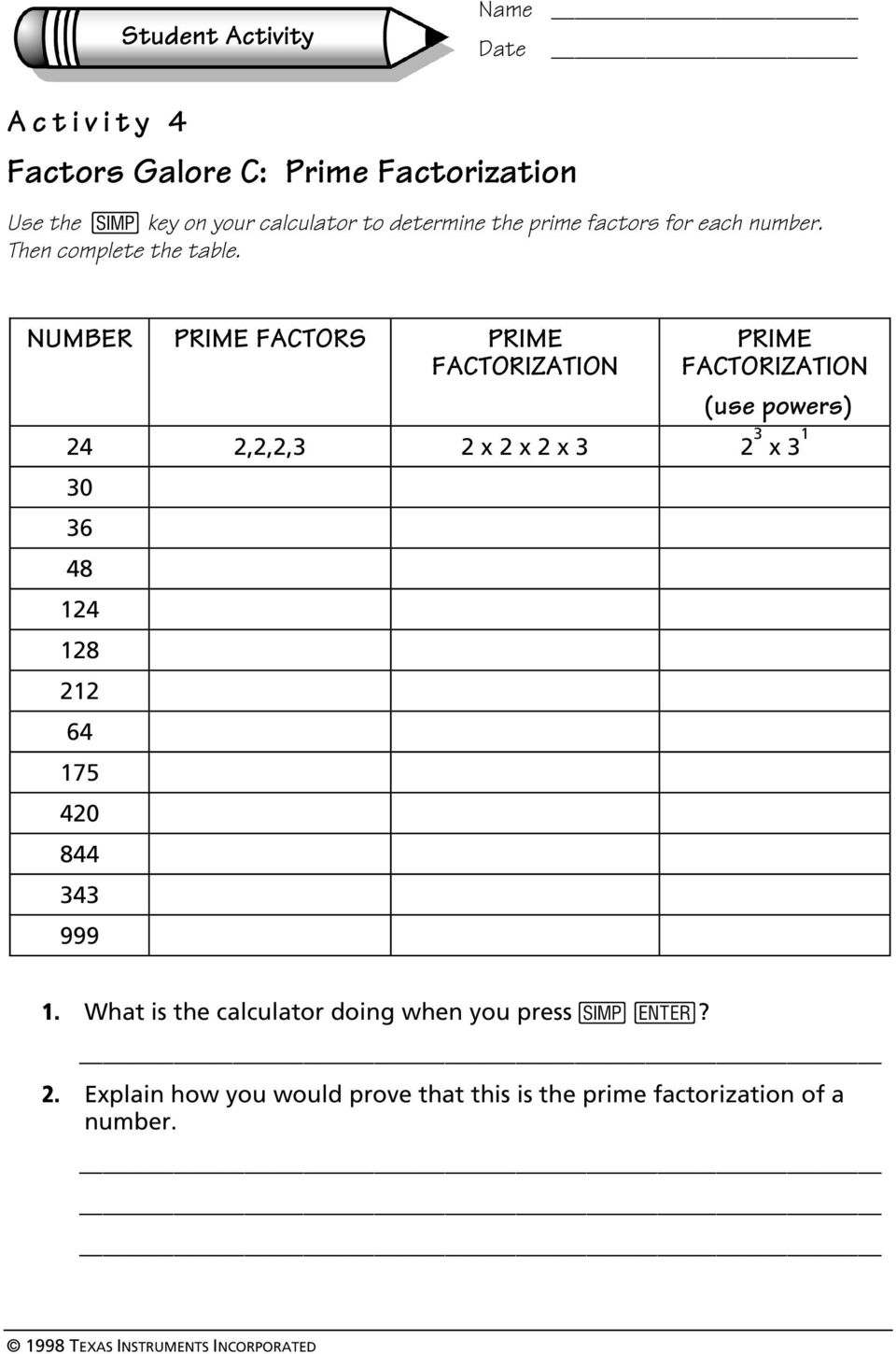
4 Student Activity Name Date Activity 4 Factors Galore C: Prime Factorization Use the B key on your calculator to determine the prime factors for each number. Then complete the table. NUMBER PRIME FACTORS PRIME PRIME (use powers) 24 2,2,2,3 2 x 2 x 2 x x What is the calculator doing when you press B b? 2. Explain how you would prove that this is the prime factorization of a number.
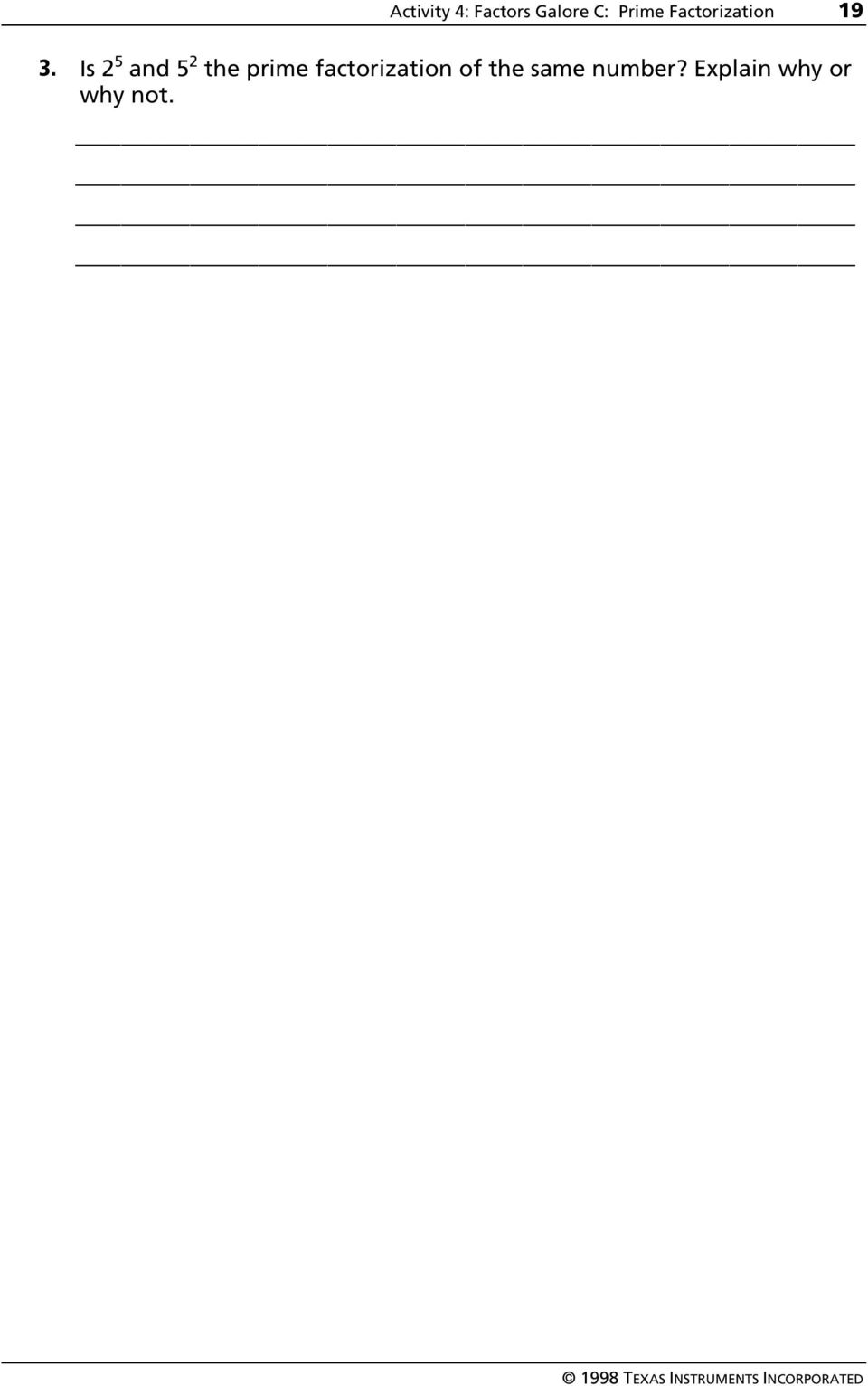
5 Activity 4: Factors Galore C: Prime Factorization Is 2 5 and 5 2 the prime factorization of the same number? Explain why or why not.
6 20 Discovering Mathematics with the TI-73: Activities for Grades 5 and 6

Multiplying Fractions
 . Multiplying Fractions. OBJECTIVES 1. Multiply two fractions. Multiply two mixed numbers. Simplify before multiplying fractions 4. Estimate products by rounding Multiplication is the easiest of the four
Numerator Denominator
 Fractions A fraction is any part of a group, number or whole. Fractions are always written as Numerator Denominator A unitary fraction is one where the numerator is always 1 e.g 1 1 1 1 1...etc... 2 3
Day One: Least Common Multiple
 Grade Level/Course: 5 th /6 th Grade Math Lesson/Unit Plan Name: Using Prime Factors to find LCM and GCF. Rationale/Lesson Abstract: The objective of this two- part lesson is to give students a clear understanding
A Prime Investigation with 7, 11, and 13
 . Objective To investigate the divisibility of 7, 11, and 13, and discover the divisibility characteristics of certain six-digit numbers A c t i v i t y 3 Materials TI-73 calculator A Prime Investigation
Building Concepts: Dividing a Fraction by a Whole Number
 Lesson Overview This TI-Nspire lesson uses a unit square to explore division of a unit fraction and a fraction in general by a whole number. The concept of dividing a quantity by a whole number, n, can
FRACTIONS MODULE Part I
 FRACTIONS MODULE Part I I. Basics of Fractions II. Rewriting Fractions in the Lowest Terms III. Change an Improper Fraction into a Mixed Number IV. Change a Mixed Number into an Improper Fraction BMR.Fractions
Multiplying and Dividing Fractions
 Multiplying and Dividing Fractions 1 Overview Fractions and Mixed Numbers Factors and Prime Factorization Simplest Form of a Fraction Multiplying Fractions and Mixed Numbers Dividing Fractions and Mixed
Radicals - Multiply and Divide Radicals
 8. Radicals - Multiply and Divide Radicals Objective: Multiply and divide radicals using the product and quotient rules of radicals. Multiplying radicals is very simple if the index on all the radicals
Lesson 3.1 Factors and Multiples of Whole Numbers Exercises (pages 140 141)
 Lesson 3.1 Factors and Multiples of Whole Numbers Exercises (pages 140 141) A 3. Multiply each number by 1, 2, 3, 4, 5, and 6. a) 6 1 = 6 6 2 = 12 6 3 = 18 6 4 = 24 6 5 = 30 6 6 = 36 So, the first 6 multiples
1.6 The Order of Operations
 1.6 The Order of Operations Contents: Operations Grouping Symbols The Order of Operations Exponents and Negative Numbers Negative Square Roots Square Root of a Negative Number Order of Operations and Negative
3.1. RATIONAL EXPRESSIONS
 3.1. RATIONAL EXPRESSIONS RATIONAL NUMBERS In previous courses you have learned how to operate (do addition, subtraction, multiplication, and division) on rational numbers (fractions). Rational numbers
Maths Workshop for Parents 2. Fractions and Algebra
 Maths Workshop for Parents 2 Fractions and Algebra What is a fraction? A fraction is a part of a whole. There are two numbers to every fraction: 2 7 Numerator Denominator 2 7 This is a proper (or common)
Simplifying Algebraic Fractions
 5. Simplifying Algebraic Fractions 5. OBJECTIVES. Find the GCF for two monomials and simplify a fraction 2. Find the GCF for two polynomials and simplify a fraction Much of our work with algebraic fractions
3 cups ¾ ½ ¼ 2 cups ¾ ½ ¼. 1 cup ¾ ½ ¼. 1 cup. 1 cup ¾ ½ ¼ ¾ ½ ¼. 1 cup. 1 cup ¾ ½ ¼ ¾ ½ ¼
 cups cups cup Fractions are a form of division. When I ask what is / I am asking How big will each part be if I break into equal parts? The answer is. This a fraction. A fraction is part of a whole. The
Math Circle Beginners Group October 18, 2015
 Math Circle Beginners Group October 18, 2015 Warm-up problem 1. Let n be a (positive) integer. Prove that if n 2 is odd, then n is also odd. (Hint: Use a proof by contradiction.) Suppose that n 2 is odd
Prime Time: Homework Examples from ACE
 Prime Time: Homework Examples from ACE Investigation 1: Building on Factors and Multiples, ACE #8, 28 Investigation 2: Common Multiples and Common Factors, ACE #11, 16, 17, 28 Investigation 3: Factorizations:
Using a Scientific Calculator
 1 Using a Scientific Calculator In this course, we will be using a scientific calculator to do all of our computations. So, in this section, we want to get use to some of the features of a scientific calculator.
Solutions of Linear Equations in One Variable
 2. Solutions of Linear Equations in One Variable 2. OBJECTIVES. Identify a linear equation 2. Combine like terms to solve an equation We begin this chapter by considering one of the most important tools
Factoring Whole Numbers
 2.2 Factoring Whole Numbers 2.2 OBJECTIVES 1. Find the factors of a whole number 2. Find the prime factorization for any number 3. Find the greatest common factor (GCF) of two numbers 4. Find the GCF for
Number of Divisors. Terms. Factors, prime factorization, exponents, Materials. Transparencies Activity Sheets Calculators
 of Divisors Purpose: Participants will investigate the relationship between the prime-factored form of a number and its total number of factors. Overview: In small groups, participants will generate the
HFCC Math Lab Arithmetic - 4. Addition, Subtraction, Multiplication and Division of Mixed Numbers
 HFCC Math Lab Arithmetic - Addition, Subtraction, Multiplication and Division of Mixed Numbers Part I: Addition and Subtraction of Mixed Numbers There are two ways of adding and subtracting mixed numbers.
An Introduction to Number Theory Prime Numbers and Their Applications.
 East Tennessee State University Digital Commons @ East Tennessee State University Electronic Theses and Dissertations 8-2006 An Introduction to Number Theory Prime Numbers and Their Applications. Crystal
Section 4.1 Rules of Exponents
 Section 4.1 Rules of Exponents THE MEANING OF THE EXPONENT The exponent is an abbreviation for repeated multiplication. The repeated number is called a factor. x n means n factors of x. The exponent tells
Grade 8 Proportional Reasoning Lesson and Resources
 Grade 8 Proportional Reasoning Lesson and Resources VSC Standard 6.0: Knowledge of Number Relationships and Computation/Arithmetic: Students will describe, represent, or apply numbers or their relationships
Grade 6 Math Circles March 10/11, 2015 Prime Time Solutions
 Faculty of Mathematics Waterloo, Ontario N2L 3G1 Centre for Education in Mathematics and Computing Lights, Camera, Primes! Grade 6 Math Circles March 10/11, 2015 Prime Time Solutions Today, we re going
Name of Lesson: Properties of Equality A Review. Mathematical Topic: The Four Properties of Equality. Course: Algebra I
 Name of Lesson: Properties of Equality A Review Mathematical Topic: The Four Properties of Equality Course: Algebra I Time Allocation: One (1) 56 minute period Pre-requisite Knowledge: The students will
Prime and Composite Numbers
 Prime and Composite Numbers Student Probe Is 27 a prime number or a composite number? Is 17 a prime number or a composite number? Answer: 27 is a composite number, because it has factors other than 1 and
Welcome! 8 th Grade Honors Algebra Informational Meeting
 Welcome! 8 th Grade Honors Algebra Informational Meeting Agenda Why Honors Algebra In Middle School? Placement Process Specifics of the Class Student Responsibilities Parent Responsibilities Math Program
Unit 1 Number Sense. In this unit, students will study repeating decimals, percents, fractions, decimals, and proportions.
 Unit 1 Number Sense In this unit, students will study repeating decimals, percents, fractions, decimals, and proportions. BLM Three Types of Percent Problems (p L-34) is a summary BLM for the material
Fun with Fractions: A Unit on Developing the Set Model: Unit Overview www.illuminations.nctm.org
 Fun with Fractions: A Unit on Developing the Set Model: Unit Overview www.illuminations.nctm.org Number of Lessons: 7 Grades: 3-5 Number & Operations In this unit plan, students explore relationships among
Fractions and Linear Equations
 Fractions and Linear Equations Fraction Operations While you can perform operations on fractions using the calculator, for this worksheet you must perform the operations by hand. You must show all steps
PERCENTS. Percent means per hundred. Writing a number as a percent is a way of comparing the number with 100. For example: 42% =
 PERCENTS Percent means per hundred. Writing a number as a percent is a way of comparing the number with 100. For example: 42% = Percents are really fractions (or ratios) with a denominator of 100. Any
2) Based on the information in the table which choice BEST shows the answer to 1 906? 906 899 904 909
 0 0 0 0 0 0 0 0 0 0 0 0 0 0 0 ) Multiplying a number by results in what type of. even. 0. even.,0. odd..,0. even ) Based on the information in the table which choice BEST shows the answer to 0? 0 0 0 )
Fractions. If the top and bottom numbers of a fraction are the same then you have a whole one.
 What do fractions mean? Fractions Academic Skills Advice Look at the bottom of the fraction first this tells you how many pieces the shape (or number) has been cut into. Then look at the top of the fraction
CISC - Curriculum & Instruction Steering Committee. California County Superintendents Educational Services Association
 CISC - Curriculum & Instruction Steering Committee California County Superintendents Educational Services Association Primary Content Module IV The Winning EQUATION NUMBER SENSE: Factors of Whole Numbers
Introduction to Fractions
 Section 0.6 Contents: Vocabulary of Fractions A Fraction as division Undefined Values First Rules of Fractions Equivalent Fractions Building Up Fractions VOCABULARY OF FRACTIONS Simplifying Fractions Multiplying
Calculator Worksheet--page 1
 Calculator Worksheet--page 1 Name On this worksheet, I will be referencing keys that are on the TI30Xa. If you re using a different calculator, similar keys should be there; you just need to fi them! Positive/Negative
Lesson on Repeating and Terminating Decimals. Dana T. Johnson 6/03 College of William and Mary [email protected]
 Lesson on Repeating and Terminating Decimals Dana T. Johnson 6/03 College of William and Mary [email protected] Background: This lesson would be embedded in a unit on the real number system. The set of real
Exponents and Radicals
 Exponents and Radicals (a + b) 10 Exponents are a very important part of algebra. An exponent is just a convenient way of writing repeated multiplications of the same number. Radicals involve the use of
JobTestPrep's Numeracy Review Decimals & Percentages
 JobTestPrep's Numeracy Review Decimals & Percentages 1 Table of contents What is decimal? 3 Converting fractions to decimals 4 Converting decimals to fractions 6 Percentages 6 Adding and subtracting decimals
LESSON PLANS FOR PERCENTAGES, FRACTIONS, DECIMALS, AND ORDERING Lesson Purpose: The students will be able to:
 LESSON PLANS FOR PERCENTAGES, FRACTIONS, DECIMALS, AND ORDERING Lesson Purpose: The students will be able to: 1. Change fractions to decimals. 2. Change decimals to fractions. 3. Change percents to decimals.
Section 1.1 Linear Equations: Slope and Equations of Lines
 Section. Linear Equations: Slope and Equations of Lines Slope The measure of the steepness of a line is called the slope of the line. It is the amount of change in y, the rise, divided by the amount of
Simplifying Improper Fractions Poster
 Simplifying Improper Fractions Poster Congratulations on your purchase of this Really Good Stuff Simplifying Improper Fractions Poster a reference tool showing students how to change improper fractions
Math Workshop October 2010 Fractions and Repeating Decimals
 Math Workshop October 2010 Fractions and Repeating Decimals This evening we will investigate the patterns that arise when converting fractions to decimals. As an example of what we will be looking at,
north seattle community college
 INTRODUCTION TO FRACTIONS If we divide a whole number into equal parts we get a fraction: For example, this circle is divided into quarters. Three quarters, or, of the circle is shaded. DEFINITIONS: The
Grade 4 - Module 5: Fraction Equivalence, Ordering, and Operations
 Grade 4 - Module 5: Fraction Equivalence, Ordering, and Operations Benchmark (standard or reference point by which something is measured) Common denominator (when two or more fractions have the same denominator)
Session 7 Fractions and Decimals
 Key Terms in This Session Session 7 Fractions and Decimals Previously Introduced prime number rational numbers New in This Session period repeating decimal terminating decimal Introduction In this session,
Sample Fraction Addition and Subtraction Concepts Activities 1 3
 Sample Fraction Addition and Subtraction Concepts Activities 1 3 College- and Career-Ready Standard Addressed: Build fractions from unit fractions by applying and extending previous understandings of operations
REVIEW SHEETS BASIC MATHEMATICS MATH 010
 REVIEW SHEETS BASIC MATHEMATICS MATH 010 A Summary of Concepts Needed to be Successful in Mathematics The following sheets list the key concepts that are taught in the specified math course. The sheets
Order of Operations More Essential Practice
 Order of Operations More Essential Practice We will be simplifying expressions using the order of operations in this section. Automatic Skill: Order of operations needs to become an automatic skill. Failure
FRACTIONS OPERATIONS
 FRACTIONS OPERATIONS Summary 1. Elements of a fraction... 1. Equivalent fractions... 1. Simplification of a fraction... 4. Rules for adding and subtracting fractions... 5. Multiplication rule for two fractions...
ALASKA DISCOVERY LESSON
 GK-12 Program ALASKA DISCOVERY LESSON Adaptations and Ecology in the Arctic Lesson 4 - Arctic Food Chains What are food chains and food webs and how do they apply to arctic ecology? Developer s Name: Corinne
SIMPLIFYING ALGEBRAIC FRACTIONS
 Tallahassee Community College 5 SIMPLIFYING ALGEBRAIC FRACTIONS In arithmetic, you learned that a fraction is in simplest form if the Greatest Common Factor (GCF) of the numerator and the denominator is
Adding and Subtracting Fractions. 1. The denominator of a fraction names the fraction. It tells you how many equal parts something is divided into.
 Tallahassee Community College Adding and Subtracting Fractions Important Ideas:. The denominator of a fraction names the fraction. It tells you how many equal parts something is divided into.. The numerator
1.4. Arithmetic of Algebraic Fractions. Introduction. Prerequisites. Learning Outcomes
 Arithmetic of Algebraic Fractions 1.4 Introduction Just as one whole number divided by another is called a numerical fraction, so one algebraic expression divided by another is known as an algebraic fraction.
Radicals - Multiply and Divide Radicals
 8. Radicals - Multiply and Divide Radicals Objective: Multiply and divide radicals using the product and quotient rules of radicals. Multiplying radicals is very simple if the index on all the radicals
Factor Trees. Objective To provide experiences with finding the greatest common factor and the least common multiple of two numbers.
 Factor Trees Objective To provide experiences with finding the greatest common factor and the least common multiple of two numbers. www.everydaymathonline.com epresentations etoolkit Algorithms Practice
Unit 6 Number and Operations in Base Ten: Decimals
 Unit 6 Number and Operations in Base Ten: Decimals Introduction Students will extend the place value system to decimals. They will apply their understanding of models for decimals and decimal notation,
GRADE 5 SUPPLEMENT. Set A2 Number & Operations: Primes, Composites & Common Factors. Includes. Skills & Concepts
 GRADE 5 SUPPLEMENT Set A Number & Operations: Primes, Composites & Common Factors Includes Activity 1: Primes & Common Factors A.1 Activity : Factor Riddles A.5 Independent Worksheet 1: Prime or Composite?
Calculate Highest Common Factors(HCFs) & Least Common Multiples(LCMs) NA1
 Calculate Highest Common Factors(HCFs) & Least Common Multiples(LCMs) NA1 What are the multiples of 5? The multiples are in the five times table What are the factors of 90? Each of these is a pair of factors.
Lyman Memorial High School. Pre-Calculus Prerequisite Packet. Name:
 Lyman Memorial High School Pre-Calculus Prerequisite Packet Name: Dear Pre-Calculus Students, Within this packet you will find mathematical concepts and skills covered in Algebra I, II and Geometry. These
High Flying Factors of Production LESSON 3 HIGH FLYING FACTORS OF PRODUCTION
 High Flying Factors of Production LESSON 3 FACTORS OF PRODUCTION HIGH FLYING FACTORS OF PRODUCTION Overview This simulation of an airplane factory provides groups of students, as competing airplane manufacturers,
Student Worksheet 1 TI-15 Explorer : Finding Patterns
 Student Worksheet 1 W1 3 and the remainder is always 0 Use a trail and error approach and 3 to make the TI-15 present the following output displays. When you get it to work, write down the dividends (starting
Basic Graphing Functions for the TI-83 and TI-84
 Basic Graphing Functions for the TI-83 and TI-84 The primary benefits of the TI-83 and TI-84 are the abilities to graph functions and to identify properties those functions possess. The purpose of this
PAYCHEX, INC. BASIC BUSINESS MATH TRAINING MODULE
 PAYCHEX, INC. BASIC BUSINESS MATH TRAINING MODULE 1 Property of Paychex, Inc. Basic Business Math Table of Contents Overview...3 Objectives...3 Calculator...4 Basic Calculations...6 Order of Operation...9
Teaching Pre-Algebra in PowerPoint
 Key Vocabulary: Numerator, Denominator, Ratio Title Key Skills: Convert Fractions to Decimals Long Division Convert Decimals to Percents Rounding Percents Slide #1: Start the lesson in Presentation Mode
for the Bill Hanlon [email protected]
 Strategies for Learning the Math Facts Bill Hanlon [email protected] The more sophisticated mental operations in mathematics of analysis, synthesis, and evaluation are impossible without rapid and accurate
Session 6 Number Theory
 Key Terms in This Session Session 6 Number Theory Previously Introduced counting numbers factor factor tree prime number New in This Session composite number greatest common factor least common multiple
Greatest Common Factor and Least Common Multiple
 Greatest Common Factor and Least Common Multiple Intro In order to understand the concepts of Greatest Common Factor (GCF) and Least Common Multiple (LCM), we need to define two key terms: Multiple: Multiples
Introduction to Fractions, Equivalent and Simplifying (1-2 days)
 Introduction to Fractions, Equivalent and Simplifying (1-2 days) 1. Fraction 2. Numerator 3. Denominator 4. Equivalent 5. Simplest form Real World Examples: 1. Fractions in general, why and where we use
Lesson Plan. N.RN.3: Use properties of rational and irrational numbers.
 N.RN.3: Use properties of rational irrational numbers. N.RN.3: Use Properties of Rational Irrational Numbers Use properties of rational irrational numbers. 3. Explain why the sum or product of two rational
PREPARATION FOR MATH TESTING at CityLab Academy
 PREPARATION FOR MATH TESTING at CityLab Academy compiled by Gloria Vachino, M.S. Refresh your math skills with a MATH REVIEW and find out if you are ready for the math entrance test by taking a PRE-TEST
Solving Rational Equations
 Lesson M Lesson : Student Outcomes Students solve rational equations, monitoring for the creation of extraneous solutions. Lesson Notes In the preceding lessons, students learned to add, subtract, multiply,
Radicals - Rationalize Denominators
 8. Radicals - Rationalize Denominators Objective: Rationalize the denominators of radical expressions. It is considered bad practice to have a radical in the denominator of a fraction. When this happens
Bar Charts, Histograms, Line Graphs & Pie Charts
 Bar Charts and Histograms Bar charts and histograms are commonly used to represent data since they allow quick assimilation and immediate comparison of information. Normally the bars are vertical, but
Dimension: Data Handling Module: Organization and Representation of data Unit: Construction and Interpretation of Simple Diagrams and Graphs
 Topic: Stem and Leaf Diagrams S1 Topic 13 Level: Key Stage 3 Dimension: Data Handling Module: Organization and Representation of data Unit: Construction and Interpretation of Simple Diagrams and Graphs
5.1 Introduction to Decimals, Place Value, and Rounding
 5.1 Introduction to Decimals, Place Value, and Rounding 5.1 OBJECTIVES 1. Identify place value in a decimal fraction 2. Write a decimal in words 3. Write a decimal as a fraction or mixed number 4. Compare
5.1 Radical Notation and Rational Exponents
 Section 5.1 Radical Notation and Rational Exponents 1 5.1 Radical Notation and Rational Exponents We now review how exponents can be used to describe not only powers (such as 5 2 and 2 3 ), but also roots
Metric Rules. Activity 7. In this activity you will: Introduction. The Problem. Math Concepts Measurement. Science Concepts Data collection
 . Math Concepts Measurement Geometry Activity 7 Science Concepts Data collection Metric Rules Materials TI-73 calculator Yardstick Meter stick In this activity you will: Collect data by measuring different
1.2 Linear Equations and Rational Equations
 Linear Equations and Rational Equations Section Notes Page In this section, you will learn how to solve various linear and rational equations A linear equation will have an variable raised to a power of
The Euclidean Algorithm
 The Euclidean Algorithm A METHOD FOR FINDING THE GREATEST COMMON DIVISOR FOR TWO LARGE NUMBERS To be successful using this method you have got to know how to divide. If this is something that you have
INTRODUCTION TO FRACTIONS
 Tallahassee Community College 16 INTRODUCTION TO FRACTIONS Figure A (Use for 1 5) 1. How many parts are there in this circle?. How many parts of the circle are shaded?. What fractional part of the circle
Multiplying and Dividing Signed Numbers. Finding the Product of Two Signed Numbers. (a) (3)( 4) ( 4) ( 4) ( 4) 12 (b) (4)( 5) ( 5) ( 5) ( 5) ( 5) 20
 SECTION.4 Multiplying and Dividing Signed Numbers.4 OBJECTIVES 1. Multiply signed numbers 2. Use the commutative property of multiplication 3. Use the associative property of multiplication 4. Divide signed
Planning Guide. Grade 6 Factors and Multiples. Number Specific Outcome 3
 Mathematics Planning Guide Grade 6 Factors and Multiples Number Specific Outcome 3 This Planning Guide can be accessed online at: http://www.learnalberta.ca/content/mepg6/html/pg6_factorsmultiples/index.html
Warm-Up. Today s Objective/Standards: Students will use the correct order of operations to evaluate algebraic expressions/ Gr. 6 AF 1.
 Warm-Up CST/CAHSEE: Gr. 6 AF 1.4 Simplify: 8 + 8 2 + 2 A) 4 B) 8 C) 10 D) 14 Review: Gr. 7 NS 1.2 Complete the statement using ,. Explain. 2 5 5 2 How did students get the other answers? Other: Gr.
7.S.8 Interpret data to provide the basis for predictions and to establish
 7 th Grade Probability Unit 7.S.8 Interpret data to provide the basis for predictions and to establish experimental probabilities. 7.S.10 Predict the outcome of experiment 7.S.11 Design and conduct an
6.3. section. Building Up the Denominator. To convert the fraction 2 3 factor 21 as 21 3 7. Because 2 3
 0 (6-18) Chapter 6 Rational Epressions GETTING MORE INVOLVED 7. Discussion. Evaluate each epression. a) One-half of 1 b) One-third of c) One-half of d) One-half of 1 a) b) c) d) 8 7. Eploration. Let R
Solution Guide Chapter 14 Mixing Fractions, Decimals, and Percents Together
 Solution Guide Chapter 4 Mixing Fractions, Decimals, and Percents Together Doing the Math from p. 80 2. 0.72 9 =? 0.08 To change it to decimal, we can tip it over and divide: 9 0.72 To make 0.72 into a
Exponents, Radicals, and Scientific Notation
 General Exponent Rules: Exponents, Radicals, and Scientific Notation x m x n = x m+n Example 1: x 5 x = x 5+ = x 7 (x m ) n = x mn Example : (x 5 ) = x 5 = x 10 (x m y n ) p = x mp y np Example : (x) =
Factorizations: Searching for Factor Strings
 " 1 Factorizations: Searching for Factor Strings Some numbers can be written as the product of several different pairs of factors. For example, can be written as 1, 0,, 0, and. It is also possible to write
MATHEMATICS. Y5 Multiplication and Division 5330 Square numbers, prime numbers, factors and multiples. Equipment. MathSphere
 MATHEMATICS Y5 Multiplication and Division 5330 Square numbers, prime numbers, factors and multiples Paper, pencil, ruler. Equipment MathSphere 5330 Square numbers, prime numbers, factors and multiples
Handout #1: Mathematical Reasoning
 Math 101 Rumbos Spring 2010 1 Handout #1: Mathematical Reasoning 1 Propositional Logic A proposition is a mathematical statement that it is either true or false; that is, a statement whose certainty or
called and explain why it cannot be factored with algebra tiles? and explain why it cannot be factored with algebra tiles?
 Factoring Reporting Category Topic Expressions and Operations Factoring polynomials Primary SOL A.2c The student will perform operations on polynomials, including factoring completely first- and second-degree
FIDDLIN WITH FRACTIONS
 FIDDLIN WITH FRACTIONS Special Area: Connections (Fourth and Fifth Grade) Written by: (Dawn Ramos, Joan Johnson, Mindy Wilshusen, St. Mary s School) Length of Unit: (6 Lessons) I. ABSTRACT The purpose
Investigating Investment Formulas Using Recursion Grade 11
 Ohio Standards Connection Patterns, Functions and Algebra Benchmark C Use recursive functions to model and solve problems; e.g., home mortgages, annuities. Indicator 1 Identify and describe problem situations
3.3 Addition and Subtraction of Rational Numbers
 3.3 Addition and Subtraction of Rational Numbers In this section we consider addition and subtraction of both fractions and decimals. We start with addition and subtraction of fractions with the same denominator.
Personal Financial Literacy
 Personal Financial Literacy 7 Unit Overview Being financially literate means taking responsibility for learning how to manage your money. In this unit, you will learn about banking services that can help
Overview. Observations. Activities. Chapter 3: Linear Functions Linear Functions: Slope-Intercept Form
 Name Date Linear Functions: Slope-Intercept Form Student Worksheet Overview The Overview introduces the topics covered in Observations and Activities. Scroll through the Overview using " (! to review,
Math 728 Lesson Plan
 Math 728 Lesson Plan Tatsiana Maskalevich January 27, 2011 Topic: Probability involving sampling without replacement and dependent trials. Grade Level: 8-12 Objective: Compute the probability of winning
Oral and mental starter
 Lesson Objectives Order fractions and position them on a number line (Y6) Vocabulary gauge, litre numerator, denominator order Resources OHT. individual whiteboards (optional) Using fractions Oral and