
Proportions and Percent
|
|
|
- Norman Simpson
- 9 years ago
- Views:
Transcription
1 Proportions and Percent MODULE 5? ESSENTIAL QUESTION How can you use proportions and percent to solve real-world problems? You can use percent and proportions to find the amount by which real-world quantities have increased or decreased. LESSON 5.1 Percent Increase and Decrease 7.RP.3 LESSON 5.2 Rewriting Percent Expressions 7.RP.3, 7.EE.2, 7.EE.3 LESSON 5.3 Applications of Percent 7.RP.3, 7.EE.3 Real-World Video Sam Dudgeon/Houghton Mifflin Harcourt A store may have a sale with deep discounts on some items. They can still make a profit because they first markup the wholesale price by as much as 400%, then markdown the retail price. Math On the Spot Animated Math 137 Module 5 Go digital with your write-in student edition, accessible on any device. Scan with your smart phone to jump directly to the online edition, video tutor, and more. Interactively explore key concepts to see how math works. Get immediate feedback and help as you work through practice sets. 137

2 Are You Ready? Are YOU Ready? Assess Readiness Complete these exercises to review skills you will need for this module. Use the assessment on this page to determine if students need intensive or strategic intervention for the module s prerequisite skills. Percents and Decimals 2 1 EXAMPLE Enrichment Online Assessment and Intervention Online Practice and Help = Write the percent as the sum of 1 whole and a percent remainder. Write the percents as fractions. = Write the fractions as decimals. = 1.47 Simplify. Write each percent as a decimal. Access Are You Ready? assessment online, and receive instant scoring, feedback, and customized intervention or enrichment. 147% = 100% + 47% Response to Intervention Intervention 1. 22% % % 98% % 1.89 Write each decimal as a percent. Online and Print Resources Skills Intervention worksheets Differentiated Instruction Skill 30 Percents and Decimals Challenge worksheets Skill 46 Find the Percent of a Number 59% % % Find the Percent of a Number PRE-AP EXAMPLE PRE-AP Extend the Math Lesson Activities in TE Real-World Video Viewing Guide 30% of 45 =? 30% = _ 13.5 Write the percent as a decimal. Multiply. 3 Find the percent of each number. After students have watched the video, discuss the following: What is a discount? How is the amount of the discount calculated? Multiply the original price by the discount expressed as a fraction or a decimal % of % of % of % of % of % of 1, Unit 2 PROFESSIONAL DEVELOPMENT VIDEO Author Juli Dixon models successful teaching practices as she explores percent problems in an actual seventh-grade classroom. Online Teacher Edition Access a full suite of teaching resources online plan, present, and manage classes and assignments. Professional Development eplanner Easily plan your classes and access all your resources online. Interactive Answers and Solutions Customize answer keys to print or display in the classroom. Choose to include answers only or full solutions to all lesson exercises. Interactive Whiteboards Engage students with interactive whiteboard-ready lessons and activities. : Online Assessment and Intervention Assign automatically graded homework, quizzes, tests, and intervention activities. Prepare your students with updated practice tests aligned with Common Core. Proportions and Percent 138

3 Reading Start-Up EL Have students complete the activities on this page by working alone or with others. Strategies for English Learners Each lesson in the TE contains specific strategies to help English Learners of all levels succeed. Emerging: Students at this level typically progress very quickly, learning to use English for immediate needs as well as beginning to understand and use academic vocabulary and other features of academic language. Expanding: Students at this level are challenged to increase their English skills in more contexts, and learn a greater variety of vocabulary and linguistic structures, applying their growing language skills in more sophisticated ways appropriate to their age and grade level. Bridging: Students at this level continue to learn and apply a range of high-level English language skills in a wide variety of contexts, including comprehension and production of highly technical texts. Active Reading Integrating Language Arts Students can use these reading and note-taking strategies to help them organize and understand new concepts and vocabulary. Additional Resources Differentiated Instruction Reading Strategies EL Reading Start-Up Visualize Vocabulary Use the words to complete the triangle. Write the review word that fits the description in each section of the triangle. Understand Vocabulary Complete the sentences using the preview words. 1. A fixed percent of the principal is simple interest. 2. The original amount of money deposited or borrowed is the principal. 3. A percent increase is the amount of increase divided by the original amount. Active Reading proportion compares a number to 100 percent a comparison of two numbers by division ratio Tri-Fold Before beginning the module, create a tri-fold to help you learn the concepts and vocabulary in this module. Fold the paper into three sections. Label the columns What I Know, What I Need to Know, and What I Learned. Complete the first two columns before you read. After studying the module, complete the third. a statement that two ratios are equivalent Vocabulary Review Words proportion (proporción) percent (porcentaje) rate (tasa) ratio (razón) unit rate (tasa unitaria) Preview Words percent decrease (porcentaje de disminución) percent increase (porcentaje de aumento) principal (capital) simple interest (interés simple) Module Focus Coherence Rigor Tracking Your Learning Progression Before Students understand proportional relationships: convert units within a measurement system solve real-world problems involving percent In this module Students represent and solve problems involving proportional relationships: solve problems involving percent increase, percent decrease, and percent of change solve markup and markdown problems use percents to find sales tax, tips, total cost, simple interest After Students will: solve real-world problems using percent 139 Module 5

4 GETTING READY FOR Proportions and Percent GETTING READY FOR Proportions and Percent Understanding the Standards and the vocabulary terms in the Standards will help you know exactly what you are expected to learn in this module. Use the examples on the page to help students know exactly what they are expected to learn in this module. Content Areas CA Common Core Standards Ratios and Proportional Relationships 7.RP Analyze proportional relationships and use them to solve real-world and mathematical problems. 7.RP.3 Use proportional relationships to solve multistep ratio and percent problems. Key Vocabulary proportion (proporción) An equation that states that two ratios are equivalent. ratio (razón) A comparison of two quantities by division. percent (porcentaje) A ratio that compares a part to the whole using 100. What It Means to You You will use proportions to solve problems involving ratio and percent. EXAMPLE 7.RP.3 Find the amount of sales tax if the sales tax rate is 5% and the cost of the item is $ % = 100 = 1 20 Multiply 1 times the cost to find the sales tax = 2 The sales tax is $2. Expressions and Equations 7.EE Cluster Use properties of operations to generate equivalent expressions. Go online to see a complete unpacking of the CA Common Core Standards. 7.EE.2 Understand that rewriting an expression in different forms in a problem context can shed light on the problem and how the quantities in it are related. Key Vocabulary expression (expresión) A mathematical phrase containing variables, constants and operation symbols. What It Means to You You will find helpful ways to rewrite an expression in an equivalent form. EXAMPLE 7.EE.2 A store advertises that all bicycle helmets will be sold at 10% off the regular price. Find two expressions that represent the value of the sale price p for the helmets that are on sale. Sale price = original price minus 10% of the price = p p Equivalently, p p = p(1-0.10) = 0.90p Image Credits: Hemera Technologies/Alamy Images Visit to see all CA Common Core Standards explained. 140 Unit 2 California Common Core Standards Lesson 5.1 Lesson 5.2 Lesson RP.3 Recognize and represent proportional relationships between quantities. 7.EE.2 Understand that rewriting an expression in different forms in a problem context can shed light on the problem and how the quantities in it are related. 7.EE.3 Solve multi-step real-life and mathematical problems posed with positive and negative rational numbers in any form (whole numbers, fractions, and decimals), using tools strategically. Apply properties of operations to calculate with numbers in any form; convert between forms as appropriate; and assess the reasonableness of answers using mental computation and estimation strategies. Proportions and Percent 140

5 LESSON 5.1 Percent Increase and Decrease Lesson Support Content Objective Language Objective Students will learn to use percents to describe change. Students will show how to use percents to describe change. California Common Core Standards 7.RP.3 Use proportional relationships to solve multistep ratio and percent problems. MP.2 Reason abstractly and quantitatively. Focus Coherence Rigor Building Background Visualize Math Have students work with a partner to shade in two decimal squares each representing a different percent. Then have them compare the percents. 80% 50% The first decimal square shows 30% more than the second decimal square. Learning Progressions In this lesson, students continue to build their understanding of percents. They will use percent to describe change as percent increase and percent decrease. Some key understandings for students are the following: Percent change (increase or decrease) is always the amount of change divided by the original amount. Percent increase describes how much a quantity increases in comparison to the original amount. Percent decrease describes how much a quantity decreases in comparison to the original amount. The original amount and the percent of change can be used to determine the new amount. The concepts of percent increase and percent decrease will be used to solve a variety of real-world problems, such as problems involving price markups and markdowns. Cluster Connections This lesson provides an excellent opportunity to connect ideas in this cluster: Analyze proportional relationships and use them to solve real-world and mathematical problems. Give students the following prompt: One week a store decreased the price of potatoes by 25%. The next week the price was increased by 25%. The original price of 5 pounds of potatoes was $4.00. How does the final price compare with the original price? Have students justify their answer. The final price was less = 1.00, 4-1 = 3. The first week the price was $3. Then = 0.75, = The final price was $3.75, which is less than the original price, $ A

6 Language Support EL PROFESSIONAL DEVELOPMENT California ELD Standards Emerging 2.I.6c. Reading/viewing closely Use knowledge of morphology, context, reference materials, and visual cues to determine the meaning of unknown and multiple-meaning words on familiar topics. Expanding 2.I.6c. Reading/viewing closely Use knowledge of morphology, context, reference materials, and visual cues to determine the meaning of unknown and multiple-meaning words on familiar and new topics. Bridging 2.I.6c. Reading/viewing closely Use knowledge of morphology, context, reference materials, and visual cues to determine the meaning, including figurative and connotative meanings, of unknown and multiple-meaning words on a variety of new topics. Linguistic Support EL Academic/Content Vocabulary percent The word percent may be familiar to speakers of Spanish and other Latin-based languages. The root word percent means one part out of each hundred. Point out that one cent is another word for one penny and that there are 100 pennies in a US dollar. In Spanish the meaning of the word for percent porciento is much more evident because the word ciento is also the word for hundred. Multiple Meaning Words change Explain to students that the word change can have different meanings in mathematics. When working with money, change can indicate an amount of money returned from a transaction, or it can indicate the coins. In this lesson, percent change describes the percent of increase or decrease in an amount compared to the original amount. Review with students the words increase and decrease. Leveled Strategies for English Learners EL Emerging Have students select a problem from this lesson and demonstrate how to find the percentage increase or the percentage decrease. Expanding Pair students and have them select a problem from the lesson and explain it to each other. Provide a sentence frame: This problem is an example of percentage increase/decrease because. Bridging Have students write in their journal when they think showing a percent increase, rather than an actual amount of increase, can be more useful. Math Talk Model for English learners how to begin their responses with a sentence frame. Finding percent increase and finding percent decrease are alike because. Finding percent increase and finding percent decrease are not alike because. Percent Increase and Decrease 141B

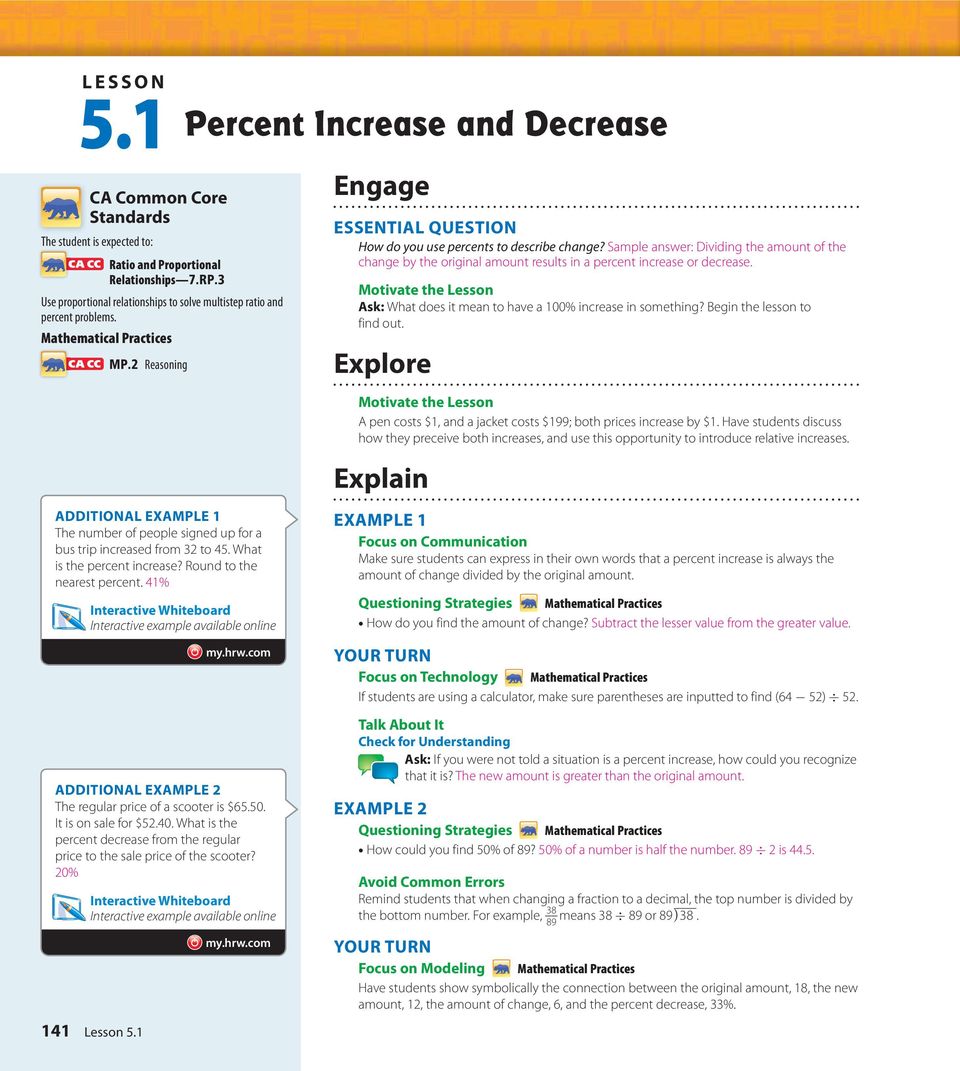
7 LESSON 5.1 CA Common Core Standards The student is expected to: Ratio and Proportional Relationships 7.RP.3 Use proportional relationships to solve multistep ratio and percent problems. Mathematical Practices MP.2 Reasoning Percent Increase and Decrease Engage ESSENTIAL QUESTION How do you use percents to describe change? Sample answer: Dividing the amount of the change by the original amount results in a percent increase or decrease. Motivate the Lesson Ask: What does it mean to have a 100% increase in something? Begin the lesson to find out. Explore Motivate the Lesson A pen costs $1, and a jacket costs $199; both prices increase by $1. Have students discuss how they preceive both increases, and use this opportunity to introduce relative increases. Explain ADDITIONAL EXAMPLE 1 The number of people signed up for a bus trip increased from 32 to 45. What is the percent increase? Round to the nearest percent. 41% Interactive Whiteboard Interactive example available online ADDITIONAL EXAMPLE 2 The regular price of a scooter is $ It is on sale for $ What is the percent decrease from the regular price to the sale price of the scooter? 20% Interactive Whiteboard Interactive example available online EXAMPLE 1 Focus on Communication Make sure students can express in their own words that a percent increase is always the amount of change divided by the original amount. Questioning Strategies Mathematical Practices How do you find the amount of change? Subtract the lesser value from the greater value. YOUR TURN Focus on Technology Mathematical Practices If students are using a calculator, make sure parentheses are inputted to find (64-52) 52. Talk About It Check for Understanding Ask: If you were not told a situation is a percent increase, how could you recognize that it is? The new amount is greater than the original amount. EXAMPLE 2 Questioning Strategies Mathematical Practices How could you find 50% of 89? 50% of a number is half the number is Avoid Common Errors Remind students that when changing a fraction to a decimal, the top number is divided by the bottom number. For example, means or YOUR TURN Focus on Modeling Mathematical Practices Have students show symbolically the connection between the original amount, 18, the new amount, 12, the amount of change, 6, and the percent decrease, 33%. 141 Lesson 5.1
8 ? LESSON 5.1 How do you use percents to describe change? Finding Percent Increase Percents can be used to describe how an amount changes. Amount of Change Percent Change = Original Amount The change may be an increase or a decrease. Percent increase describes how much a quantity increases in comparison to the original amount. EXAMPLE 1 Percent Increase and Decrease ESSENTIAL QUESTION Amber got a raise, and her hourly wage increased from $8 to $9.50. What is the percent increase? STEP 1 Find the amount of change. Amount of Change = Greater Value - Lesser Value = Substitute values. = 1.50 Subtract. STEP 2 Find the percent increase. Round to the nearest percent. Amount of Change Percent Change = Original Amount = = % Reflect 1. What does a 100% increase mean? The amount of change is equal to the original amount; the value doubles. YOUR TURN Substitute values. Divide. Write as a percent and round. 2. The price of a pair of shoes increases from $52 to $64. What is the percent increase to the nearest percent? 23% 7.RP.3 7.RP.3 Use proportional relationships to solve multistep ratio and percent problems. Math On the Spot Online Practice and Help Math On the Spot My Notes Its the same because you subtract the lesser value from the greater value to find the amount of change and then divide the amount of change by the original amount to find percent change. Its different because the original amount is greater than the new quantity. Math Talk Mathematical Practices How is finding percent decrease the same as finding percent increase? How is it different? Online Practice and Help Finding Percent Decrease When the change in the amount decreases, you can use a similar approach to find percent decrease. Percent decrease describes how much a quantity decreases in comparison to the original amount. EXAMPLE 2 David moved from a house that is 89 miles away from his workplace to a house that is 51 miles away from his workplace. What is the percent decrease in the distance from his home to his workplace? STEP 1 STEP 2 Find the amount of change. Amount of Change = Greater Value - Lesser Value = Substitute values. = 38 Subtract. Find the percent decrease. Round to the nearest percent. Amount of Change Percent Change = Original Amount = Substitute values Divide. = 43% Write as a percent and round. Reflect 3. Critique Reasoning David considered moving even closer to his workplace. He claims that if he had done so, the percent of decrease would have been more than 100%. Is David correct? Explain your reasoning. No; The least distance David could live from his YOUR TURN 7.RP.3 workplace is 0 miles, which corresponds to a 100% decrease. A decrease greater than this is impossible. 4. The number of students in a chess club decreased from 18 to 12. What is the percent decrease? Round to the nearest percent. 33% 5. Officer Brimberry wrote 16 tickets for traffic violations last week, but only 10 tickets this week. What is the percent decrease? 37.5% Lesson Unit 2 PROFESSIONAL DEVELOPMENT Integrate Mathematical Practices MP.2 This lesson provides an opportunity to address this Mathematical Practice standard. It calls for students to create and use representations to organize, record, and communicate mathematical ideas. Students use verbal equations to model a relationship among the percent increase or decrease, the amount of change, and the original amount. Students use these equations to then write numerical equations to find the percent of change. Math Background The percent of change compares the amount of change to the original amount. When there is a series of percent changes, the original amount changes with each additional percent increase or decrease. For example, the percent increase from 10 to 15, where 10 is the original amount, is a 50% increase ( = 5 = 50% ), but the percent decrease of 15 back to 10 is a 33.3% decrease ( = = 33. _ 3 % ) because 15 is now the original amount. Percent Increase and Decrease 142

9 ADDITIONAL EXAMPLE 3 A shoe sales associate earned $300 in August. In September she earned 8% more than she did in August. How much did she earn in September? $324 Interactive Whiteboard Interactive example available online EXAMPLE 3 Engage with the Whiteboard Cover up the solution and have students read the Example a couple of times. Then invite a student to circle all the information needed to solve the problem and to draw a line through any extraneous information. Questioning Strategies Mathematical Practices Why is 1.15 used as a factor for 115%? 1.15 is the decimal equivalent for 115%. To multiply by a percent, the percent must be represented by either a decimal or a fraction. How do you know whether to add or subtract the amount of change? Since the population increased, the amount of change is added to the original amount. Focus on Critical Thinking Mathematical Practices Be sure students understand how to change any percent to a decimal. Remind them that percents less than 100% will equal decimals less than 1. YOUR TURN Avoid Common Errors When solving Exercises 8 and 9, students may skip Step 2 as shown in Example 3. Remind them that the new amount for a percent increase is found by adding the original amount to the amount of change. The new amount for a percent decrease is found by subtracting the amount of change from the original amount. Elaborate Talk About It Summarize the Lesson Ask: How would you explain percent increase and percent decrease? Percent increase is a ratio of the amount of the increase to the original amount expressed as a percent. Percent decrease is a ratio of the amount of the decrease to the original amount expressed as a percent. GUIDED PRACTICE Engage with the Whiteboard In the space under each of Exercises 1 6, invite volunteers to write the original amount (OM), the amount of change (AC), and the ratio they will simplify to find the percent increase or decrease (PI or PD). So, for Exercise 1 students would write OM = 5; AC = 8-5 or 3; PI = 3 5. Avoid Common Errors Exercise 6 Remind students to use number sense to check their answers for reasonableness. 16 is more than 3 5, so the percent will be more than 200%. Exercise 14 Students might question whether the 3 hours be changed to minutes or the half hour be treated as a fraction or a decimal. Either approach will yield the correct answer. However, the math is much easier if the calculation is performed using hours as the unit of measure. 143 Lesson 5.1

10 DO NOT EDIT--Changes must be made through File info CorrectionKey=B DO NOT EDIT--Changes must be made through File info CorrectionKey=A Using Percent of Change Given an original amount and a percent increase or decrease, you can use the percent of change to find the new amount. EXAMPLE 3 7.RP.3 Math On the Spot Guided Practice Find each percent increase. Round to the nearest percent. (Example 1) 1. From $5 to $8 60% 2. From 20 students to 30 students 3. From 86 books to 150 books 74% 4. From $3.49 to $ % 50% Image Credits: Corbis The grizzly bear population in Yellowstone National Park in 1970 was about 270. Over the next 35 years, it increased by about 115%. What was the population in 2005? STEP 1 STEP 2 Find the amount of change = Find 115% of 270. Write 115% as a decimal. 311 Round to the nearest whole number. Find the new amount. New Amount = Original Amount + Amount of Change = Substitute values. = 581 Add. The population in 2005 was about 581 grizzly bears. Reflect 6. Why will the percent of change always be represented by a positive number? Sample answer: The amount of change is equal to the greater value minus the lesser value, which is always positive. 7. Draw Conclusions If an amount of $100 in a savings account increases by 10%, then increases by 10% again, is that the same as increasing by 20%? Explain. No. An increase of 10% gives a balance of $110. Another 10% increase would give a balance of $121. One increase of 20% would give a balance of $120. YOUR TURN A TV has an original price of $499. Find the new price after the given percent of change % increase $ % decrease $ Add the amount of change because the population increased. Online Practice and Help 5. From 13 friends to 14 friends 8% 6. From 5 miles to 16 miles 7. Nathan usually drinks 36 ounces of water per day. He read that he should drink 64 ounces of water per day. If he starts drinking 64 ounces, what is the percent increase? Round to the nearest percent. (Example 1) Find each percent decrease. Round to the nearest percent. (Example 2) 8. From $80 to $64 20% 9. From 95 F to 68 F 10. From 90 points to 45 points 50% 11. From 145 pounds to 132 pounds 12. From 64 photos to 21 photos 67% 13. From 16 bagels to 0 bagels 14. Over the summer, Jackie played video games 3 hours per day. When school began in the fall, she was only allowed to play video games for half an hour per day. What is the percent decrease? Round to the nearest percent. (Example 2) Find the new amount given the original amount and the percent of change. (Example 3) 15. $9; 10% increase $ cookies; 25% decrease pages; 20% decrease 272 pages members; 50% increase 42 members 21. Adam currently runs about 20 miles per week, and he wants to increase his weekly mileage by 30%. How many miles will Adam run per week? (Example 3)? ESSENTIAL QUESTION CHECK-IN 22. What process do you use to find the percent change of a quantity? Divide the amount of change in the quantity by the original amount, then express the answer as a percent. 220% 78% 28% 83% 36 cookies 19. $29,000; 4% decrease $27, songs; 130% increase 1,863 songs 26 miles 9% 100% Lesson Unit 2 7_MCABESE202610_U2M05L1.indd /10/13 2:42 AM 7_MCAAESE202610_U2M05L1.indd 144 4/23/13 12:39 PM DIFFERENTIATE INSTRUCTION Cooperative Learning Have students work in pairs to solve percent increase and decrease problems. Start with a problem, and have each person complete one step in the process. Have students exchange roles so each person has a chance to complete each step at least once. This helps emphasize that finding percent increase or decrease is a multi-step process. Critical Thinking Ask students to think about percent increase and decrease in the context of integers. For example, if a bank account increases from -$100 to $100, can you use the formula to calculate percent increase? Does the answer make sense? The formula gives a percent increase of -200% in this context. This percent doesn t make much intuitive sense, so percent increase may not be a useful tool for understanding increases from negative to positive. Additional Resources Differentiated Instruction includes: Reading Strategies Success for English Learners EL Reteach Challenge PRE-AP Percent Increase and Decrease 144

11 5.1 LESSON QUIZ Online Assessment and Intervention Online homework assignment available 7.RP.3 Lesson Quiz available online Find each percent increase or decrease to the nearest percent. 1. from 14 books to 40 books 2. from 72 points to 50 points Find the new amount given the original amount and the percent of change. 3. $12; 20% increase grams; 45% decrease 5. If 48 eggs are used in the cafeteria today but the number expected to be used tomorrow is 30% less than that, how many eggs are expected to be used tomorrow? 6. Priscilla currently reads 10 pages in her book each night. She wants to increase the number of pages by 30%. How many pages will Priscilla read each night after the increase? Evaluate GUIDED AND INDEPENDENT PRACTICE 7.RP.3 Concepts & Skills Example 1 Finding Percent Increase Example 2 Finding Percent Decrease Example 3 Using Percent of Change Additional Resources Differentiated Instruction includes: Leveled Practice Worksheets Practice Exercises 1 7, 23, 25 Exercises 8 14, 24, 25 Exercises 15 21, 26 Focus Coherence Rigor Exercise Depth of Knowledge (D.O.K.) Mathematical Practices 23 2 Skills/Concepts MP.2 Reasoning 24 2 Skills/Concepts MP.2 Reasoning 25 2 Skills/Concepts MP.4 Modeling 26 4 Extended Thinking MP.7 Using Structure 27 3 Strategic Thinking MP.7 Using Structure 28 3 Strategic Thinking MP.3 Logic 29 3 Strategic Thinking MP.4 Modeling Answers % increase 2. 31% decrease 3. $ g Lesson 5.1

12 DO NOT EDIT--Changes must be made through File info CorrectionKey=A DO NOT EDIT--Changes must be made through File info CorrectionKey=B Name Class Date 5.1 Independent Practice 23. Complete the table. Item 7.RP.3 Original Price New Price Bike $110 $96 Percent Change Increase or Decrease Scooter $45 $56 Tennis Racket $79 $ % Increase Skis $580 25% Decrease $435 13% 24% 24. Multiple Representations The bar graph shows the number of hurricanes in the Atlantic Basin from a. Find the amount of change and the percent of decrease in the number of hurricanes from 2008 to 2009 and from 2010 to Compare the amounts of change and percents of decrease. 5; 5; 62.5%; 41.7%; the amount of change is the same, but the percent of change is less from 2010 to b. Between which two years was the percent of change the greatest? What was the percent of change during that period? 2009 and 2010; 300% increase Decrease Increase Hurricanes Online Practice and Help Atlantic Basin Hurricanes Year 26. Percent error calculations are used to determine how close to the true values, or how accurate, experimental values really are. The formula is similar to finding percent of change. Experimental Value - Actual Value Percent Error = 100 Actual Value In chemistry class, Charlie records the volume of a liquid as 13.3 milliliters. The actual volume is 13.6 milliliters. What is his percent error? Round to the nearest percent. 2% FOCUS ON HIGHER ORDER THINKING 27. Look for a Pattern Leroi and Sylvia both put $100 in a savings account. Leroi decides he will put in an additional $10 each week. Sylvia decides to put in an additional 10% of the amount in the account each week. a. Who has more money after the first additional deposit? Explain. They have the same. $100 + $10 = $110 and $ %($100) = $110. b. Who has more money after the second additional deposit? Explain. Sylvia has more. Leroi has $110 + $10 = $120 and Sylvia has $ %($110) = $121. c. How do you think the amounts in the two accounts will compare after a month? A year? Because Sylvia will have more after the second additional deposit and she will be depositing increasing amounts, she will always have more in her account. Work Area 25. Represent Real-World Problems Cheese sticks that were previously priced at 5 for $1 are now 4 for $1. Find each percent of change and show your work. a. Find the percent decrease in the number of cheese sticks you can buy for $1. Amount of change = 1; percent decrease = 1_ 5 = 20% b. Find the percent increase in the price per cheese stick. $1.00 = $0.20 each; $1.00 = $0.25 each. Amount of 5 4 change = $0.05; percent increase = = 25% 28. Critical Thinking Suppose an amount increases by 100%, then decreases by 100%. Find the final amount. Would the situation change if the original increase was 150%? Explain your reasoning. The final amount is always 0. A 100% decrease of any amount would leave Look for a Pattern Ariel deposited $100 into a bank account. Each Friday she will withdraw 10% of the money in the account to spend. Ariel thinks her account will be empty after 10 withdrawals. Do you agree? Explain. No. Only the first withdrawal is $10. Each withdrawal after that is less than $10 because it is 10% of the remaining balance. There will be money left after 10 withdrawals. Lesson Unit 2 7_MCAAESE202610_U2M05L1.indd 145 4/23/13 12:39 PM 7_MCABESE202610_U2M05L1.indd /11/13 4:45 PM EXTEND THE MATH PRE-AP Activity available online Activity On a grid draw a 4 4 square. Use the square and what you have learned about percent increase and percent decrease to determine what happens to the area of the square when the sides are increased by 50%. State by what percent the area increases. Then make a third square by decreasing the sides of the second square by 50%. State by what percent the area decreases. By what percent would you have had to change the sides of the 4 4 square to get the third square? The area of the 4 4 square is 16 units 2. Increasing the sides by 50% makes a 6 6 square with an area of 36 units 2. The area of the first square is increased by 125%. Decreasing the second square s sides by 50% makes a 3 3 square with an area of 9 units 2. The area of the second square is decreased by 75%. The sides of the original square could have been decreased by 25% to get the third square. Percent Increase and Decrease 146

13 LESSON 5.2 Rewriting Percent Expressions Lesson Support Content Objective Language Objective Students will learn to rewrite percent expressions to solve markup and markdown problems. Students will demonstrate and explain how to rewrite expressions to help you solve markup and markdown problems. California Common Core Standards 7.EE.2 Understand that rewriting an expression in different forms in a problem context can shed light on the problem and how the quantities in it are related. 7.RP.3 Use proportional relationships to solve multistep ratio and percent problems. MP.5 Use appropriate tools strategically. Focus Coherence Rigor Building Background Visualize Math Knowledge Draw the bar model on the board. Discuss with students what the model shows and how they could use the model to find the missing information. For example, the model shows that the amount 300 is equal to 100%. Four equal parts of the second bar are equal to 100%. So, each part is = 75. The fifth 25% is another 75. So, the total length of the top bar is 375, which is 125% of % % 25% 25% 25% 25% Learning Progressions In this lesson, students extend their skill at using percents to solve problems by rewriting expressions for easier computation. Some key understandings for students are the following: A percent can be written as a decimal or as a fraction. Depending on the problem, one of the two forms may provide a more efficient solution than the other. A markup is an example of a percent increase. The term markup sometimes refers to a percent increase and sometimes to the amount of the increase. A markup of 20% on $150 is a markup of $30. A markdown is an example of a percent decrease. Concepts related to percent and the use of equivalent expressions will continue to be applied in everyday life and in the study of algebra. Cluster Connections This lesson provides an excellent opportunity to connect ideas in this cluster: Analyze proportional relationships and use them to solve real-world and mathematical problems. Give students the following prompt: Elisa and Dan each are calculating the sale prices of a tablet device at two different stores. What is the sale price at each store? Have students complete the table and ask them show a one-step calculation to find each sale price. Store Computer Deals Today s Computers Original Price Percent Discount Sale Price $280 15% $238 $315 25% $ = 238; = A

14 Language Support EL PROFESSIONAL DEVELOPMENT California ELD Standards Emerging 2.I.6c. Reading/viewing closely Use knowledge of morphology, context, reference materials, and visual cues to determine the meaning of unknown and multiple-meaning words on familiar topics. Expanding 2.I.6c. Reading/viewing closely Use knowledge of morphology, context, reference materials, and visual cues to determine the meaning of unknown and multiple-meaning words on familiar and new topics. Bridging 2.I.6c. Reading/viewing closely Use knowledge of morphology, context, reference materials, and visual cues to determine the meaning, including figurative and connotative meanings, of unknown and multiple-meaning words on a variety of new topics. Linguistic Support EL Academic/Content Vocabulary increase or decrease In this lesson, percents are used to solve markup and markdown problems. Point out to English learners the words that cue them to whether the change is increase or decrease. Words that cue an increase: markup (noun), mark up (verb), profit Words that cue a decrease: markdown (noun), mark down (verb), loss, discount Word that cues neither an increase nor a decrease: break even Rules and Patterns co- Point out to English learners any prefixes, suffixes, etc. to help them figure out the meanings of words in word problems. The prefix co-, meaning with, appears in the word coefficient in this lesson. Common words with the prefix co- include coworker, co-author, co-star, co-exist, coed. Notice that some words have a hyphen after the prefix co- and while others do not. Leveled Strategies for English Learners EL Emerging Visual cues, like bar models, can help students at this level of English proficiency understand an abstract idea or concept. Have students draw and label a bar model to demonstrate how to solve a markup problem. Expanding Have pairs of students review and discuss the steps in Example 1 of the lesson before solving one of the word problems in Independent Practice. Bridging Pair students at this level of English proficiency to discuss and review the steps in Example 1 of the lesson. Then have them explain the difference between how to solve a markup vs. markdown problem. Math Talk To help English learners answer the question posed in Example 1 Math Talk, give them a model to begin their answer with: It makes sense to write the retail price as the sum of because. A good reason for writing the retail price as the sum of is. Rewriting Percent Expressions 147B

15 LESSON 5.2 CA Common Core Standards The student is expected to: Expressions and Equations 7.EE.2 Understand that rewriting an expression in different forms in a problem context can shed light on the problem and how the quantities in it are related. Ratio and Proportional Relationships 7.RP.3 Use proportional relationships to solve multistep ratio and percent problems. Also 7.EE.3 Mathematical Practices MP.5 Using Tools Rewriting Percent Expressions Engage ESSENTIAL QUESTION How can you rewrite expressions to help you solve markup and markdown problems? Sample answer: Markups are 1 plus a percent of the cost, and markdowns are 1 minus a percent of a price. Either can be rewritten as a single term. Motivate the Lesson Ask: Did you ever want to figure out the sale price of an item before you got to the check-out counter? Begin the lesson to find out how to do this. Explore Multiple Representations Mathematical Practices Explain that a certain pack of gum costs $1 and that you have 100% of what it costs to buy that gum. Show students four quarters. Explain that you plan to sell the pack of gum to make a profit. You plan a markup of 50%. Ask how much 50% of $1 is. Show the original cost, four quarters, in one hand and the markup, two quarters, in your other hand. Explain that the retail price is now $1.50. Explain ADDITIONAL EXAMPLE 1 A shoe store buys a pair of boots from a supplier for b dollars. The store s manager decides on a markup of 35%. Write an expression for the retail price of a pair of boots. 1.35b Interactive Whiteboard Interactive example available online EXAMPLE 1 Focus on Modeling Mathematical Practices Point out to students that the part of the model in Step 1 labeled as s is equivalent to 1s and represents 100% of the original cost. The part labeled 0.42s shows 42% of the original cost, the amount being added to the original cost, while the entire model represents 142% of the original cost. Questioning Strategies Mathematical Practices How could you use a mathematical property to add 1s s? Use the Distributive Property to write 1s s as ( )s. How could you use the expression to help you determine the retail price of a skateboard that cost the store $50? Substitute $50 for s in 1.42s $50 = $71 YOUR TURN Avoid Common Errors Students may think that tripling a cost means a 300% markup. A cost x tripled is 3x. Breaking apart 3x into the cost plus the markup yields x + 2x. So, you must add 200% of x or 2x to x to get triple the cost, 3x. 147 Lesson 5.2 Talk About It Check for Understanding Ask: Why will 1.1c work as an expression for a 10% markup, no matter what is being sold? c is a variable that can stand for any original cost. 1.1 is a constant that represents 100% plus 10%.

16 DO NOT EDIT--Changes must be made through File info CorrectionKey=A DO NOT EDIT--Changes must be made through File info CorrectionKey=B? L E S S O N 5.2 Rewriting Percent Expressions ESSENTIAL QUESTION Calculating Markups A markup is one kind of percent increase. You can use a bar model to represent the retail price of an item, that is, the total price including the markup. EXAMPLE 1 How can you rewrite expressions to help you solve markup and markdown problems? 7.EE.2, 7.RP.3, 7.EE.3 To make a profit, stores mark up the prices on the items they sell. A sports store buys skateboards from a supplier for s dollars. What is the retail price for skateboards that the manager buys for $35 and $56 after a 42% markup? 7.EE.2 Understand that rewriting an expression in different forms in a problem context can shed light on the problem and how the quantities in it are related. Also 7.RP.3, 7.EE.3 Math On the Spot Online Practice and Help YOUR TURN 2. Rick buys remote control cars to resell. He applies a markup of 10%. a. Write two expressions that represent the retail price of the cars. 1c + 0.1c, 1.1c b. If Rick buys a remote control car for $28.00, what is his selling price? $ An exclusive clothing boutique triples the price of the items it purchases for resale. a. What is the boutique s markup percent? 200% b. Write two expressions that represent the retail price of the clothes. 1c + 2c; 3c STEP 1 STEP 2 STEP 3 Use a bar model. Draw a bar for the cost of the skateboard s. Then draw a bar that shows the markup: 42% of s, or 0.42s. s 0.42s s s These bars together represent the cost plus the markup, s s. Retail price = Original cost + Markup = s s = 1s s = 1.42s Use the expression to find the retail price of each skateboard. s = $35 Retail price = 1.42($35) = $49.70 s = $56 Retail price = 1.42($56) = $79.52 Sample answer: Two terms shows the original cost and the markup. One term allows for quicker calculation. Math Talk Mathematical Practices Why write the retail price as the sum of two terms? as one term? Math On the Spot Animated Math Calculating Markdowns An example of a percent decrease is a discount, or markdown. A price after a markdown may be called a sale price. You can also use a bar model to represent the price of an item including the markdown. EXAMPLE 2 A discount store marks down all of its holiday merchandise by 20% off the regular selling price. Find the discounted price of decorations that regularly sell for $16 and $23. STEP 1 Use a bar model. Draw a bar for the regular price p. Then draw a bar that shows the discount: 20% of p, or 0.2p. 0.2p p p - 0.2p 7.EE.2, 7.RP.3, 7.EE.3 Reflect 1. What If? The markup is changed to 34%; how does the expression for the retail price change? The expression would change to 1s s or 1.34s. Lesson Unit 2 The difference between these two bars represents the price minus the discount, p - 0.2p. 7_MCAAESE202610_U2M05L2.indd /04/13 6:44 PM 7_MCABESE202610_U2M05L2.indd /11/13 8:33 PM PROFESSIONAL DEVELOPMENT Integrate Mathematical Practices MP.5 This lesson provides an opportunity to address this Mathematical Practice standard. It calls for students to use bar models to model the relationship between a mathematical expression and a real-world context regarding either a markup or a markdown. This gives students the opportunity to read a real-world situation and use that information to write an algebraic expression to represent retail and sale prices. Finally, the students use the expression they write to solve problems regarding markups and markdowns. Math Background Not explored in this lesson is a not-so-subtle distinction between the amount used as the basis for a markup and the amount used as the basis for a markdown. As presented in the lesson, a markup is generally based on the cost of an item to the retailer. However, not covered in this lesson, a markdown is generally based on the retail price of an item after a markup has been applied. This means that if an item costing $100 is marked up 20%, it will retail for $120. If this item is later placed on sale at a 20% markdown, the sale price is not $120 - $20, but $120 - (20% of $120) or $120 - $24, which is $96. Rewriting Percent Expressions 148

17 ADDITIONAL EXAMPLE 2 A pet store marks down all of its grooming products by 15% off the regular selling price of p. Write an expression for the sale price. 0.85p Interactive Whiteboard Interactive example available online Animated Math Explore Markups and Markdowns Students discover how markups and markdowns relate to the original cost using virtual manipulatives. EXAMPLE 2 Questioning Strategies Mathematical Practices In Step 1, how do you know how much of the 1p bar to shade to show 0.2p? The amount shaded does not need to be a specific amount, just a portion of the bar to represent 0.2p. How does the bar model for a markdown differ from the bar model for a markup? For a markup, the bar model for the expression is longer than the original cost. For a markdown, the bar model for the expression is shorter than the retail price. Connect Vocabulary EL Remind students that both percents in Example 2 are rational numbers. 20% is equivalent to 0.2 or 2 8, and 80% is equivalent to 0.8 or 10 YOUR TURN Engage with the Whiteboard Have a student volunteer draw the model in part a. Discuss whether the model needs to be drawn to scale for it to be helpful in solving the problem. Focus on Math Connections Mathematical Practices Point out that the Distributive Property also works for subtraction. So, 1b b = (1-0.24)b = 0.76b. 10. Elaborate Talk About It Summarize the Lesson Ask: How does a bar model showing the expression for a sale price compare to one showing the expression for a retail price? Both show the original price and the percent markup or markdown. The bar model for the retail price shows the percent markup added to the bar model, while the sale price shows the percent markdown subtracted from the bar model. GUIDED PRACTICE Engage with the Whiteboard To the right of each row, have students volunteer to write the expression that could be used to find the retail price in Exercises 2 7 and write the expression that could be used to find the sale price for Exercises 8 11 on the write-on lines. Avoid Common Errors Exercise 1c Remind students that once $32 has been substituted for s in the expression 1.35s, they do not need to add $32 to the value of the expression again. Exercises 2 7 Remind students that the markup is an amount found by multiplying the cost by the percent markup. The retail price is the cost plus the markup. Integrating Language Arts EL Encourage English learners to ask for clarification on any terms or phrases that they don t understand. 149 Lesson 5.2

18 STEP 2 Sale price = Original price - Markdown Guided Practice STEP 3 = p - 0.2p = 1p - 0.2p = 0.8p Use the expression to find the sale price of each decoration. p = $16 Sale price = 0.8($16) = $12.80 p = $23 Sale price = 0.8($23) = $18.40 Reflect 4. Conjecture Compare the single term expression for retail price after a markup from Example 1 and the single term expression for sale price after a markdown from Example 2. What do you notice about the coefficients in the two expressions? A markup includes a coefficient greater than 1 and a markdown includes a coefficient less than 1. YOUR TURN 5. A bicycle shop marks down each bicycle s selling price b by 24% for a holiday sale. The amount of a 20% markup and a 20% discount are the same, but one is added and the other is subtracted. Math Talk Mathematical Practices Is a 20% markup equal to a 20% markdown? Explain. 1. Dana buys dress shirts from a clothing manufacturer for s dollars each, and then sells the dress shirts in her retail clothing store at a 35% markup. (Example 1) a. Write the markup as a decimal. 0.35s b. Write two expressions for the retail price of the dress shirt. 1s s, 1.35s c. What is the retail price of a dress shirt that Dana purchased for $32.00? $43.20 d. How much was added to the original price of the dress shirt? $11.20 List the markup and retail price of each item. Round to two decimal places when necessary. (Example 1) Item Price Markup % Markup Retail Price 2. Hat $18 15% 3. Book $ % 4. Shirt $ % 5. Shoes $ % 6. Clock $ % 7. Painting $ % $2.70 $9.45 $25.31 $24.75 $48.60 $ $20.70 $31.95 $59.06 $99.74 $97.20 $ a. Draw a bar model to represent the problem. 0.24b 1b Find the sale price of each item. Round to two decimal places when necessary. (Example 2) 8. Original price: $45.00; Markdown: 22% 9. Original price: $89.00; Markdown: 33% $35.10 $ b b b. What is a single term expression for the sale price? 0.76b 6. Jane sells pillows. For a sale, she marks them down 5%. a. Write two expressions that represent the sale price of the pillows. 1p 0.05p, 0.95p b. If the original price of a pillow is $15.00, what is the sale price? $14.25 Online Practice and Help 10. Original price: $23.99; Markdown: 44% 11. Original price: $279.99, Markdown: 75%? $13.43 ESSENTIAL QUESTION CHECK-IN $ How can you determine the sale price if you are given the regular price and the percent of markdown? Write the percent of markdown as a decimal, subtract the product of this decimal and the regular price from the regular price. Lesson Unit 2 DIFFERENTIATE INSTRUCTION Kinesthetic Experience Have students write expressions that could be used to calculate a 10% increase and a 10% decrease in a distance. Then have each student stand on a start line, toss his/her uniquely decorated cotton ball, measure the distance to the nearest centimeter, and record the data in a table like the one shown below. Then have students use their expressions to calculate a distance that would be 10% more and 10% less than their original distance. Next, have each Original Distance 10% more 10% less Second Distance % more or less student throw his/her cotton ball a second time, trying to throw exactly 10% more or less than their original distance. Finally, have students calculate the percent more or less the cotton ball actually went than their original distance. Cooperative Learning Have each student secretly think of a percent markup or markdown for a hat. Then on an index card, have each student write a one-term expression that could be used to find the retail price or sale price for the hat. Have students exchange cards and decide if the expression they were just given is a markup or a markdown. Then on the reverse side of the card students should draw a bar model verifying that their decision is correct. Students then trade the completed cards with a third person who will determine if the bar model and conclusion about the expression are correct. Additional Resources Differentiated Instruction includes: Reading Strategies Success for English Learners EL Reteach Challenge PRE-AP Rewriting Percent Expressions 150

19 5.2 LESSON QUIZ Online Assessment and Intervention Online homework assignment available Lesson Quiz available online Fred buys flags from a manufacturer for f dollars each and then sells the flags in his store for a 26% markup. 1. Write the markup as a decimal. 2. Write an expression for the retail price of a flag. 3. What is the retail price of a flag for which Fred paid $40? 4. How much was added to the cost of the flag? List the sale price of each item. Round to two decimal places when necessary. 5. Original price: $25; Markdown: 12% 6. Original price: $16.45; Markdown: 33% Answers f f or 1.26f 3. $ $ $22 6. $ RP.3, 7.EE.2, 7.EE.3 Evaluate GUIDED AND INDEPENDENT PRACTICE 7.RP.3, 7.EE.2, 7.EE.3 Concepts & Skills Example 1 Calculating Markups Example 2 Calculating Markdowns Additional Resources Differentiated Instruction includes: Leveled Practice Worksheets Practice Exercises 1 7, 15, 16 Exercises 8 11, Focus Coherence Rigor Exercise Depth of Knowledge (D.O.K.) Mathematical Practices 13 2 Skills/Concepts MP.4 Modeling 14 2 Skills/Concepts MP.2 Reasoning 15 3 Strategic Thinking MP.7 Using Structure 16 2 Skills/Concepts MP.4 Modeling 17 3 Strategic Thinking MP.6 Precision 18 3 Strategic Thinking MP.8 Patterns 19 2 Skills/Concepts MP.7 Using Structure 20 3 Strategic Thinking MP.4 Modeling Exercise 18 combines concepts from the California Common Core cluster Analyze proportional relationships and use them to solve real-world and mathematical problems. 151 Lesson 5.2

20 Name Class Date 5.2 Independent Practice 7.RP.3, 7.EE.2, 7.EE A bookstore manager marks down the price of older hardcover books, which originally sell for b dollars, by 46%. a. Write the markdown as a decimal. 0.46b b. Write two expressions for the sale price of the hardcover book. 1b 0.46b, 0.54b c. What is the sale price of a hardcover book for which the original retail price was $29.00? $15.66 d. If you buy the book in part c, how much do you save by paying the sale price? $ Raquela s coworker made price tags for several items that are to be marked down by 35%. Match each Regular Price to the correct Sale Price, if possible. Not all sales tags match an item. Regular Price $3.29 Regular Price $4.19 Regular Price $2.79 Regular Price $3.09 Regular Price $3.77 Online Practice and Help 16. Represent Real-World Problems Harold works at a men s clothing store, which marks up its retail clothing by 27%. The store purchases pants for $74.00, suit jackets for $325.00, and dress shirts for $ How much will Harold charge a customer for two pairs of pants, three dress shirts, and a suit jacket? $ Analyze Relationships Your family needs a set of 4 tires. Which of the following deals would you prefer? Explain. (I) Buy 3, get one free (II) 20% off (III) 1 4 off Either buy 3, get one free or 1_ off. Either case would 4 result in a discount of 25%, which is better than 20%. FOCUS ON HIGHER ORDER THINKING 18. Critique Reasoning Margo purchases bulk teas from a warehouse and marks up those prices by 20% for retail sale. When teas go unsold for more than two months, Margo marks down the retail price by 20%. She says that she is breaking even, that is, she is getting the same price for the tea that she paid for it. Is she correct? Explain. No; she is taking a loss. Her cost for the tea is t, so the retail price is 1.2t. The discounted price is t, or 0.96t, which is less than t. Work Area Sale Price $2.01 Sale Price $2.45 Sale Price $1.15 Sale Price $ Communicate Mathematical Ideas For each situation, give an example that includes the original price and final price after markup or markdown. a. A markdown that is greater than 99% but less than 100% Sample answer: original price: $100; final price: $0.50 b. A markdown that is less than 1% Sample answer: original price: $100; final price: $99.50 c. A markup that is more than 200% Sample answer: original price: $100; final price: $350 Sale Price $ Problem Solving Grady marks down some $2.49 pens to $1.99 for a week and then marks them back up to $2.49. Find the percent of increase and the percent of decrease to the nearest tenth. Are the percents of change the same for both price changes? If not, which is a greater change? No; first change: 20.1% decrease; second change: 25.1% increase. The second percent change is greater. 20. Persevere in Problem Solving At Danielle s clothing boutique, if an item does not sell for eight weeks, she marks it down by 15%. If it remains unsold after that, she marks it down an additional 5% each week until she can no longer make a profit. Then she donates it to charity. Rafael wants to buy a coat originally priced $150, but he can t afford more than $110. If Danielle paid $100 for the coat, during which week(s) could Rafael buy the coat within his budget? Justify your answer. 11 or 12 weeks; after 11 weeks, the price is $109.32, after 12 weeks, the price is $103.85, and after that Danielle donates the coat. Lesson Unit 2 EXTEND THE MATH PRE-AP Activity available online Activity A shirt is on sale now for $20. Starting today, a morning sales clerk decreases the price by 30%, and then an afternoon sales clerk increases the price by 20%. This pattern continues for several days. Provided the shirt is never purchased, on which day is the shirt marked down to about 75% off the price it is now? 75% off the current price would make the shirt s sale price $5. On the morning of Day 6, the shirt will be priced at $4.90. Rewriting Percent Expressions 152

21 LESSON 5.3 Applications of Percent Lesson Support Content Objective Language Objective Students will learn to use percents to solve problems. Students will write about using percents to solve problems. California Common Core Standards 7.RP.3 Use proportional relationships to solve multistep ratio and percent problems. 7.EE.3 Solve multistep real-life and mathematical problems posed with positive and negative rational numbers in any form (whole numbers, fractions, and decimals), using tools strategically. Apply properties of operations to calculate with numbers in any form; convert between forms as appropriate; and assess the reasonableness of answers using mental computation and estimation strategies. MP.4 Model with mathematics. Focus Coherence Rigor Building Background Eliciting Prior Knowledge Have each student copy and complete the table. Then invite volunteers to complete the table on the board, explaining how they converted among percents, fractions, and decimals. Percent Fraction Decimal 50% 1_ % 1_ % % % Learning Progressions In this lesson, students continue to extend their skills with percents. They learn to solve problems involving sales tax, simple interest, and tipping. Sales tax is a percent of the purchase price and is added to the purchase price. To find simple interest on the principle (the original amount), the interest rate (a percent), and the number of years are needed. To write a percent as a decimal move the decimal point two places to the left. To find the total cost of an item, add the amount of the tax to the purchase price. In their future study of mathematics, students will apply percents in increasingly complex situations, including those involving probability, statistics and finance. Cluster Connections This lesson provides an excellent opportunity to connect ideas in this cluster: Analyze proportional relationships and use them to solve real-world and mathematical problems. Give students the following prompt: Franklin and Jose each have a plan to save money. Complete the table to determine whose plan will earn the most interest. Franklin s Plan Jose s Plan Amount deposited $200 $225 Rate 3% 2.5% Time (in years) 3 4 Simple Interest Earned Jose s plan will earn the most interest. $18 $ A
22 Language Support EL PROFESSIONAL DEVELOPMENT California ELD Standards Emerging 2.I.6c. Reading/viewing closely Use knowledge of morphology, context, reference materials, and visual cues to determine the meaning of unknown and multiple-meaning words on familiar topics. Expanding 2.I.6c. Reading/viewing closely Use knowledge of morphology, context, reference materials, and visual cues to determine the meaning of unknown and multiple-meaning words on familiar and new topics. Bridging 2.I.6c. Reading/viewing closely Use knowledge of morphology, context, reference materials, and visual cues to determine the meaning, including figurative and connotative meanings, of unknown and multiple-meaning words on a variety of new topics. Linguistic Support EL Academic/Content Vocabulary banking words Students need to understand that percents are used to solve many kinds of problems, including interest earned or interest paid. There are several words in the lesson that relate to banking. Discuss the terms listed below for English learners. Bank-related words in this lesson include savings account, earn, deposit, borrow, simple interest, fixed percent, principal, and loan. Money-related words include commission, coupon, discount, and promotion. Building Background tips In this lesson, the price of a meal plus a tip are mentioned. Explain to students that waiters and waitresses make most of their income from tips. Discuss briefly what tipping means and where and when tipping is expected or not expected. Leveled Strategies for English Learners EL Emerging Visual cues can help students at this level of English proficiency understand an abstract idea or concept. Have students use visual cues to demonstrate how to solve percent problems. Expanding Have pairs of students review and discuss the steps in Example 3 of the lesson before solving one of the word problems in Independent Practice. Bridging Pair students at this level of English proficiency to discuss and review the steps in Example 3 of the lesson. Math Talk To help students answer the question posed in the Math Talk, give students the following model to help them form their answer: You could find the tax without drawing a model by. Applications of Percent 153B
23 LESSON 5.3 CA Common Core Standards The student is expected to: Ratio and Proportional Relationships 7.RP.3 Use proportional relationships to solve multistep ratio and percent problems. Also 7.EE.3 Mathematical Practices MP.4 Modeling Applications of Percent Engage ESSENTIAL QUESTION How do you use percents to solve problems? Sample answer: You can convert percents to decimals and multiply by that decimal to find the amount of sales tax, a tip, or simple interest. You can calculate the percent of increase or decrease by dividing the amount of change by the original amount. Motivate the Lesson Ask: Is sales tax added to or subtracted from the total bill? Begin the lesson to find out. Explore Connect to Daily Life Mathematical Practices Discuss a receipt for an item you recently purchased. Discuss the sales tax rate in your area. Are any types of purchases exempt from sales tax? Explain ADDITIONAL EXAMPLE 1 Ariana buys an ant farm from a store near her home. The ant farm s price is $12, and the sales tax is 7%. What is the total price of the ant farm? $12.84 Interactive Whiteboard Interactive example available online EXAMPLE 1 Avoid Common Errors Students sometimes just find the amount of the tax. Be sure students provide an answer for the total price, the price plus the sales tax. Questioning Strategies Mathematical Practices How could you find the total price using what you learned about markup in Lesson 3.3? Since adding a tax to a price is like a markup, 1.08($80) = $ Why would a percent off be determined before the tax has been added to the price? The amount of the percent off would be greater if calculated on a total that includes the tax. YOUR TURN Focus on Critical Thinking Mathematical Practices Point out that since the tax rate is less than 1 the amount of the tax is less than the price. ADDITIONAL EXAMPLE 2 Quincy deposits $400 in a new bank account that earns 4% simple interest per year. What is the total amount in the account after 3 years? $448 Interactive Whiteboard Interactive example available online 153 Lesson 5.3 EXAMPLE 2 Questioning Strategies Mathematical Practices To find the simple interest on an original amount, what two pieces of information do you need? the interest rate and the number of years Can you write an expression that will allow you to find the total amount in Terry s account in one step, rather than two? ( ) Focus on Reasoning Mathematical Practices In Example 2, emphasize that regardless of how many years the interest is being calculated, the interest rate is multiplied by the initial deposit, provided that initial amount does not change.
24 ? LESSON 5.3 Applications of Percent ESSENTIAL QUESTION Finding Total Cost Sales tax, which is the tax on the sale of an item or service, is a percent of the purchase price that is collected by the seller. EXAMPLE 1 How do you use percents to solve problems? $80 7.RP.3, 7.EE.3 Marcus buys a varsity jacket from a clothing store in Anaheim. The price of the jacket is $80 and the sales tax is 8%. What is the total cost of the jacket? STEP 1 Use a bar model to find the amount of the tax. Draw a bar for the price of the jacket, $80. Divide it into 10 equal parts. Each part represents 10% of $80, or $8. Then draw a bar that shows the sales tax: 8% of $80. 7.RP.3 Use proportional relationships to solve multistep ratio and percent problems. Also 7.EE.3 Math On the Spot Online Practice and Help Math On the Spot My Notes YOUR TURN 1. Sharon wants to buy a shirt that costs $20. The sales tax is 5%. How much is the sales tax? What is her total cost for the shirt? $1; $21 Finding Simple Interest When you deposit money in a savings account, your money usually earns interest. When you borrow money, you must pay back the original amount of the loan plus interest. Simple interest is a fixed percent of the principal. The principal is the original amount of money deposited or borrowed. EXAMPLE 2 Terry deposits $200 into a bank account that earns 3% simple interest per year. What is the total amount in the account after 2 years? STEP 1 Find the amount of interest earned in one year. Then calculate the amount of interest for 2 years. Write 3% as a decimal: 0.03 Interest Rate Initial Deposit = Interest for 1 year 0.03 $200 = $6 Interest for 1 year 2 years = Interest for 2 years 7.RP.3, 7.EE.3 Tax = 8% $6 2 = $12 STEP 2 Add the interest for 2 years to the initial deposit to find the total amount in his account after 2 years. Total Cost Initial deposit + Interest for 2 years = Total STEP 2 Because 8% is 4_ 5 of 10%, the tax is 4_ of one part of the whole bar. 5 Each part of the whole bar is $8. So, the sales tax is 4_ of $8. 5 4_ $8 = $ The sales tax is $6.40. To find the total cost of the jacket, add the price of the jacket and the sales tax. Jacket price + Sales tax = Total cost $80 $6.40 = $86.40 Math Talk Mathematical Practices How could you find the tax without drawing a model of the situation? Multiply the cost of the jacket by the percent of the tax written as a decimal, Online Practice and Help $200 + $12 = $212 The total amount in the account after 2 years is $212. Reflect 2. Write an expression you can use to find the total amount in Terry s account ( ) YOUR TURN 3. Ariane borrows $400 on a 4-year loan. She is charged 5% simple interest per year. How much interest is she charged for 4 years? What is the total amount she has to pay back? $80; $480 Lesson Unit 2 PROFESSIONAL DEVELOPMENT Integrate Mathematical Practices MP.4 This lesson provides an opportunity to address this Mathematical Practice standard. It calls for students to use bar models to model a relationship between total price, price, and tax. Then students use a table to help them write equations to find the total amount after simple interest has been earned. Finally, students apply the 4-step problem-solving plan to calculate the tip, sales tax, and total price of a meal. Math Background Simple interest is money paid only on the principal. There is a formula for finding simple interest, I = P r t. It is based on the interest (I), the principal (P), the rate of interest (r), and the amount of time (t) in years that the money is borrowed or invested. When time is not given in years it must be converted to years. So, if the time given were 3 months, then t = 3 12 or 1 4. The formula can be used to solve for any of the four variables. The amount paid back on a loan is I + P. Note that doubling the time while halving the interest rate results in the same amount of simple interest. Applications of Percent 154
25 YOUR TURN Talk About It Check for Understanding Ask: Why does Ariane have to pay back more than the amount she borrowed? When you borrow money, you must pay back the amount you borrow plus a fee imposed for the privilege of borrowing the money. The fee is determined by the interest rate and the length of time the money is borrowed. ADDITIONAL EXAMPLE 3 Cabrini goes out for dinner, and the price of her meal is $18. The sales tax on the meal is 6%, and she also wants to leave a 20% tip. What is the total price of the meal? $22.68 Interactive Whiteboard Interactive example available online EXAMPLE 3 Engage with the Whiteboard Invite a student volunteer to draw a bar model next to the Analyze the Problem. Invite another student to label the diagram with the information given in the problem. Avoid Common Errors Students sometimes calculate the tax based on the sum of the tip and the price of the meal. Only the price of the meal is taxed. Only the price of the meal determines the tip. Questioning Strategies Mathematical Practices How could you justify adding the tax rate and the tip rate before multiplying by the price of the meal in order to determine the amount needing to be added to $60? The Distributive Property applies. That is, ( ) $60 = (0.07 $60) + (0.15 $60). How could you mentally calculate the amount of the tip? 15% is the same as 10% + 5%. 10% of $60 is $6; 5% is half of 10%, so half of $6 is $3. The tip is $6 + $3 or $9. YOUR TURN Focus on Communication Tell students that sales people are sometimes paid a salary plus a commission, which is a percentage of their total sales. Elaborate Talk About It Summarize the Lesson Ask: How are sales tax, simple interest, tip, and markups related? All are percents. Sales tax, tip, and a markup are all calculated by changing the percent to a decimal and then multiplying that decimal by the original amount. Simple interest is found by multiplying the percent, written as a decimal, times the original amount times the time in years. Once calculated, the amount of the sales tax, simple interest, tip, or markup can be added to the original amount to find the total amount owed or saved. GUIDED PRACTICE Engage with the Whiteboard Change the tax rate for Exercises 7, 11, and 12 to your local sales tax rate. Have students solve the new problems and compare the answers with the answers to the original problems. 155 Lesson 5.3 Avoid Common Errors Exercises 3, 11, 12 Remind students that to write a percent as a decimal number move the decimal point left two places. So, 0.4% = 0.004, 8.5% = 0.085, and 6.25% = Exercise 9 Remind students to read the question carefully and answer only what is asked for. In this exercise, only the amount of the interest is needed, not the amount Joe owes when he pays back the loan.
26 Using Multiple Percents Some situations require applying more than one percent to a problem. For example, when you dine at a restaurant, you might pay a tax on the meal, and pay a tip to the wait staff. The tip is usually paid on the amount before tax. When you pay tax on a sale item, you pay tax only on the discounted price. EXAMPLE 3 Problem Solving 7.EE.3, 7.RP.3 The Sanchez family goes out for dinner, and the price of the meal is $60. The sales tax on the meal is 7%, and they also want to leave a 15% tip. What is the total cost of the meal? Math On the Spot Guided Practice 1. 5% of $30 = $ % of $70 = $ % of $100 = $ % of $22 = $ % of $80 = $ % of $5 = $10 7. Brandon buys a radio for $43.99 in a state where the sales tax is 7%. (Example 1) a. How much does he pay in taxes? $3.08 b. What is the total Brandon pays for the radio? $ Luisa s restaurant bill comes to $75.50, and she leaves a 15% tip. What is Luisa s total restaurant bill? (Example 1) $86.83 Image Credits: Blend Images/SuperStock Analyze Information Identify the important information. The bill for the meal is $60. The sales tax is 7%, or The tip is 15%, or The total cost will be the sum of the bill for the meal, the sales tax, and the tip. Formulate a Plan Calculate the sales tax separately, then calculate the tip, and then add the products to the bill for the meal to find the total. Justify Solve and Evaluate Sales tax: 0.07 $60 = $4.20 Tip: 0.15 $60 = $9.00 Meal + Sales tax + Tip = Total cost $60 + $ $9 = $73.20 The total cost is $ Justify and Evaluate Estimate the sales tax and tip. Sales tax is about 10% plus 15% for tip gives 25%. Find 25% of the bill: 0.25 $60 = $15. Add this to the bill: $60 + $15 = $75. The total cost should be about $75. YOUR TURN 4. Kedar earns a monthly salary of $2,200 plus a 3.75% commission on the amount of his sales at a men s clothing store. One month he sold $4,500 in clothing. What was his commission that month? How much did he earn in all? Show your work. Commission: $4, = $168.75; total: $2,200 + $ = $2, Online Practice and Help? 9. Joe borrowed $2,000 from the bank at a rate of 7% simple interest per year. How much interest did he pay in 5 years? (Example 2) $ You have $550 in a savings account that earns 3% simple interest each year. How much will be in your account in 10 years? (Example 2) $ Martin finds a shirt on sale for 10% off at a department store. The original price was $20. Martin must also pay 8.5% sales tax. (Example 3) a. How much is the shirt before taxes are applied? $18 b. How much is the shirt after taxes are applied? $ Teresa s restaurant bill comes to $29.99 before tax. If the sales tax is 6.25% and she tips the waiter 20%, what is the total cost of the meal? (Example 3) $37.86 ESSENTIAL QUESTION CHECK-IN 13. How can you determine the total cost of an item including tax if you know the price of the item and the tax rate? Write the tax rate as a decimal. Then multiply the decimal by the price of the item, and add the result to the price. Lesson Unit 2 DIFFERENTIATE INSTRUCTION Cooperative Learning Have students work in pairs. Tell students they just won a lump sum of money. The plan is to put that money in a bank that pays simple interest. Give each pair the amount of their lump sum and a number cube. Tell students to roll the number cube to determine the number of years they will leave the money in the bank and to roll again to determine the interest rate the bank is paying. Have students calculate the amount of money their lump sum is worth given the values determined by the rolls of their number cube. Then have students calculate the amount if they leave the money in for twice the time but earn half the interest rate. Modeling Provide students with a menu from a popular restaurant. Tell students the amount of cash they have to spend. Then have students write down each item they would order from this menu, total the cost of their meal, determine the tip they should give, and determine the sales tax. Tell students the goal is to try to spend as much of their cash as possible without spending more than they have. Additional Resources Differentiated Instruction includes: Reading Strategies Success for English Learners EL Reteach Challenge PRE-AP Applications of Percent 156
27 5.3 LESSON QUIZ Online Assessment and Intervention Online homework assignment available Find the indicated percent. 1. 6% of $ % of $44 3. Jonah s restaurant bill comes to $25.65, and he leaves a 15% tip. What is Jonah s total restaurant bill? 4. Alicia borrowed $3,000 from the bank at a rate of 12% simple interest per year. How much interest did she pay in 4 years? 5. Nikos finds a toy train set on sale for 20% off at a toy store. The original price was $35. Nikos must also pay 6.5% sales tax. What is the total amount Nikos must pay for the train set? Lesson Quiz available online Answers 1. $ $ $ $1, $ RP.3, 7.EE.3 Evaluate GUIDED AND INDEPENDENT PRACTICE 7.RP.3, 7.EE.3 Concepts & Skills Example 1 Finding Total Cost Example 2 Finding Simple Interest Example 3 Using Multiple Percents Additional Resources Differentiated Instruction includes: Leveled Practice Worksheets Practice Exercises 1 8, 14, 18 20, 24 Exercises 9, 10 Exercises 11, 12, 15 17, Focus Coherence Rigor Exercise Depth of Knowledge (D.O.K.) Mathematical Practices 14 2 Skills/Concepts MP.4 Modeling Skills/Concepts MP.1 Problem Solving Skills/Concepts MP.4 Modeling 21 3 Strategic Thinking MP.7 Using Structure 22 2 Skills/Concepts MP.4 Modeling 23 3 Strategic Thinking MP.8 Patterns 24 3 Strategic Thinking MP.4 Modeling 25 3 Strategic Thinking MP.3 Logic 26 3 Strategic Thinking MP.7 Using Structure 157 Lesson 5.3
28 Name Class Date 5.3 Independent Practice 7.RP.3, 7.EE Emily s meal costs $32.75 and Darren s meal costs $ Emily treats Darren by paying for both meals, and leaves a 14% tip. Find the total cost. $ The Jayden family eats at a restaurant that is having a 15% discount promotion. Their meal costs $78.65, and they leave a 20% tip. If the tip applies to the cost of the meal before the discount, what is the total cost of the meal? $ A jeweler buys a ring from a jewelry maker for $125. He marks up the price by 135% for sale in his store. What is the selling price of the ring with 7.5% sales tax? $ Luis wants to buy a skateboard that usually sells for $ All merchandise is discounted by 12%. What is the total cost of the skateboard if Luis has to pay a state sales tax of 6.75%? $ Samuel orders four DVDs from an online music store. Each DVD costs $9.99. He has a 20% discount code, and sales tax is 6.75%. What is the total cost of his order? $ Danielle earns a 7.25% commission on everything she sells at the electronics store where she works. She also earns a base salary of $750 per week. How much did she earn last week if she sold $4,500 in electronics merchandise? Round to the nearest cent. $1, Online Practice and Help 20. Francois earns a weekly salary of $475 plus a 5.5% commission on sales at a gift shop. How much would he earn in a week if he sold $700 in goods? Round to the nearest cent. $ Sandra is 4 feet tall. Pablo is 10% taller than Sandra, and Michaela is 8% taller than Pablo. a. Explain how to find Michaela s height with the given information. Multiply Sandra s height by 0.10 and add the product to 4 to get Pablo s height. Then multiply Pablo s height by 0.08 and add the product to Pablo s height to get Michaela s height. b. What is Michaela s approximate height in feet and inches? about 4 feet 9 inches 22. Eugene wants to buy jeans at a store that is giving $10 off everything. The tag on the jeans is marked 50% off. The original price is $ a. Find the total cost if the 50% discount is applied before the $10 discount. $14.99 b. Find the total cost if the $10 discount is applied before the 50% discount. $ Multistep Eric downloads the coupon shown and goes shopping at Gadgets Galore, where he buys a digital camera for $95 and an extra battery for $ a. What is the total cost if the coupon is applied to the digital camera? $ b. What is the total cost if the coupon is applied to the extra battery? $ c. To which item should Eric apply the discount? Explain. digital camera; he can save $8. d. Eric has to pay 8% sales tax after the coupon is applied. How much is his total bill? $ Two stores are having sales on the same shirts. The sale at Store 1 is 2 shirts for $22 and the sale at Store 2 is Each $12.99 shirt is 10% off. a. Explain how much will you save by buying at Store 1. Store 1 charges $11 per shirt, and Store 2 charges $ I would save $0.69 per shirt at Store 1. b. If Store 3 has shirts originally priced at $20.98 on sale for 55% off, does it have a better deal than the other stores? Justify your answer. Yes; It is selling shirts at $9.44. FOCUS ON HIGHER ORDER THINKING 25. Analyze Relationships Marcus can choose between a monthly salary of $1,500 plus 5.5% of sales or $2,400 plus 3% of sales. He expects sales between $5,000 and $10,000 a month. Which salary option should he choose? Explain. the option that pays $2,400 plus 3% of sales; He would make $2,550 to $2,700 per month. The other option would pay only $1,775 to $2,050 per month. 26. Multistep In chemistry class, Bob recorded the volume of a liquid as 13.2 ml. The actual volume was 13.7 ml. Use the formula to find percent error of Bob s measurement to the nearest tenth of a percent. Experimental Value - Actual Value Percent Error = 100 Actual Value % 13.7 Gadgets Galore It's Our Birthday 10% Discount on any 1 item Work Area Lesson Unit 2 EXTEND THE MATH PRE-AP Activity available online Activity There is another type of interest called compound interest. Compound interest is interest paid not only on the principal but also on any interest that has already accrued. So, for example, if you borrowed $1,000 for 2 years at 15% interest compounded annually, you would owe $1,000(1.15) or $1,150 after the first year. After the second year you would owe $1,150(1.15) or $1, Paying simple interest you would have owed $1,000 plus $150 after the first year and an additional $150 after the second year, for a total of $1,300. Compare what would be owed on a 10-year loan of $5,000 at 12% interest compounded annually to the same loan with simple interest owed. Simple interest: $5,000(0.12)(10) = $6,000; so $11,000 would be owed after 10 years. Compound interest: Year 1: $5,000(1.12) = $5,600 Year 2: $5,600(1.12) = $6,272 Year 3: $6,272(1.12) = $7, Year 4: $7,024.64(1.12) = $7, Year 5: $7,867.60(1.12) = $8, Year 6: $8,811.71(1.12) = $9, Year 7: $9,869.12(1.12) = $11, Year 8: $11,053.41(1.12) = $12, Year 9: $12,379.82(1.12) = $13, Year 10: $13,865.40(1.12) = $15, The difference is $4, Applications of Percent 158
29 Ready to Go On? Assess Mastery Use the assessment on this page to determine if students have mastered the concepts and standards covered in this module Online Assessment and Intervention Additional Resources Assessment Resources Leveled Module Quizzes Response to Intervention Intervention Enrichment Access Ready to Go On? assessment online, and receive instant scoring, feedback, and customized intervention or enrichment. Differentiated Instruction Reteach worksheets Reading Strategies EL Success for English Learners EL Online and Print Resources Differentiated Instruction Challenge worksheets PRE-AP Extend the Math PRE-AP Lesson Activities in TE MODULE QUIZ Ready 5.1 Percent Increase and Decrease Find the percent change from the first value to the second ; 63 75% increase 2. 50; ; 72 80% increase 4. 92; Rewriting Percent Expressions Use the original price and the markdown or markup to find the retail price. 5. Original price: $60; Markup: 15%; Retail price: 6. Original price: $32; Markup: 12.5%; Retail price: 7. Original price: $50; Markdown: 22%; Retail price: 8. Original price: $125; Markdown: 30%; Retail price: 5.3 Applications of Percent 9. Mae Ling earns a weekly salary of $325 plus a 6.5% commission on sales at a gift shop. How much would she make in a work week if she sold $4,800 worth of merchandise? 10. Ramon earns $1,735 each month and pays $53.10 for electricity. To the nearest tenth of a percent, what percent of Ramon s earnings are spent on electricity each month? 11. James, Priya, and Siobhan work in a grocery store. James makes $7.00 per hour. Priya makes 20% more than James, and Siobhan makes 5% less than Priya. How much does Siobhan make per hour? 12. The Hu family goes out for lunch, and the price of the meal is $45. The sales tax on the meal is 6%, and the family also leaves a 20% tip on the pre-tax amount. What is the total cost of the meal? ESSENTIAL QUESTION 30% decrease 25% decrease $69 $36 $39 $87.50 $ % Online Practice and Help $7.98 per hour $ Give three examples of how percents are used in the real-world. Tell whether each situation represents a percent increase or a percent decrease. Sample answer: sales tax: increase; discount: decrease; tip: increase Module California Common Core Standards Lesson Exercises Common Core Standards RP RP.3, 7.EE RP.3, 7.EE Unit 2 Module 5
30 Assessment Readiness Scoring Guide Item 3 Award the student 1 point for determining that Marla has enough money to buy the bed and 1 point for correctly explaining how to determine the cost of the bed including sales tax. Item 4 Award the student 1 point for finding the sale price of the burritos and 1 point for explaining how to use the markup and the discount to find the sale price. Additional Resources Online Assessment and Intervention To assign this assessment online, login to your Assignment Manager at. MODULE 5 MIXED REVIEW Assessment Readiness 1. All winter coats in a store are marked down 15% off the regular selling price. Which model(s) below could represent the sale price in dollars of a winter coat with a regular selling price of r dollars? Select Yes or No for models A D. A. Yes No B. 0.15r r sale price sale price 0.15r Online Practice and Help C. r r Yes No D. 1.15r Yes No 2. The table shows a proportional relationship between the number of festival tickets purchased and the cost of the tickets. Choose True or False for each statement. Number of tickets, x Cost of tickets ($), y A. The constant of proportionality is 17. True False B. The equation y = 8.5x describes the relationship. True False C. Three tickets will cost $ True False r Yes No 3. Marla has $20 to spend on a bed for her dog. The bed she likes is priced at $18.50, and the sales tax is 6%. Does Marla have enough money for the total cost of the bed? Explain your reasoning. Yes; Sample answer: The sales tax on the bed is 0.06 $18.50 = $1.11. The total cost is $ $1.11 = $19.61, which is less than $ A store buys frozen burritos from a supplier for $1.40 each. The store adds a markup of 80% to determine the retail price. This month the store is putting the burritos on sale for 25% off the retail price. What is the sale price of the burritos? Explain how you solved this problem. $1.89; Sample answer: The markup is 0.8 $1.40 = $1.12. The retail price is the original cost plus the markup: $ $1.12 = $2.52. The discount on the retail price is 0.25 $2.52 = $0.63. The sale price is retail price minus the discount: $ $0.63 = $ Unit 2 California Common Core Standards Items Grade 7 Standards Mathematical Practices 1 7.EE.2 MP.2, MP RP.2, 7.RP.2b, 7.RP.2c MP RP.3, 7.EE.3 MP RP.3, 7.EE.3 MP.1 * Item integrates mixed review concepts from previous modules or a previous course. Proportions and Percent 160
Using Proportions to Solve Percent Problems I
 RP7-1 Using Proportions to Solve Percent Problems I Pages 46 48 Standards: 7.RP.A. Goals: Students will write equivalent statements for proportions by keeping track of the part and the whole, and by solving
7 th Grade Math Foundations for Teaching Unit One: Numbers & Operations Module One: Rational Number s
 Unit One: Numbers & Operations Module One: s Day/Date TEKS Activities and Resources Essential Question Aug 25 Aug 26 Aug 27 Aug 28 Aug 29 (SS) (SS) (SS) (SS) - First Day Procedures - Math Class Student
PAYCHEX, INC. BASIC BUSINESS MATH TRAINING MODULE
 PAYCHEX, INC. BASIC BUSINESS MATH TRAINING MODULE 1 Property of Paychex, Inc. Basic Business Math Table of Contents Overview...3 Objectives...3 Calculator...4 Basic Calculations...6 Order of Operation...9
Objective To introduce the concept of square roots and the use of the square-root key on a calculator. Assessment Management
 Unsquaring Numbers Objective To introduce the concept of square roots and the use of the square-root key on a calculator. www.everydaymathonline.com epresentations etoolkit Algorithms Practice EM Facts
Scope and Sequence KA KB 1A 1B 2A 2B 3A 3B 4A 4B 5A 5B 6A 6B
 Scope and Sequence Earlybird Kindergarten, Standards Edition Primary Mathematics, Standards Edition Copyright 2008 [SingaporeMath.com Inc.] The check mark indicates where the topic is first introduced
4 Mathematics Curriculum
 New York State Common Core 4 Mathematics Curriculum G R A D E GRADE 4 MODULE 1 Topic F Addition and Subtraction Word Problems 4.OA.3, 4.NBT.1, 4.NBT.2, 4.NBT.4 Focus Standard: 4.OA.3 Solve multistep word
Problem of the Month: Perfect Pair
 Problem of the Month: The Problems of the Month (POM) are used in a variety of ways to promote problem solving and to foster the first standard of mathematical practice from the Common Core State Standards:
Measurement with Ratios
 Grade 6 Mathematics, Quarter 2, Unit 2.1 Measurement with Ratios Overview Number of instructional days: 15 (1 day = 45 minutes) Content to be learned Use ratio reasoning to solve real-world and mathematical
Algebra Word Problems
 WORKPLACE LINK: Nancy works at a clothing store. A customer wants to know the original price of a pair of slacks that are now on sale for 40% off. The sale price is $6.50. Nancy knows that 40% of the original
1 ENGAGE. 2 TEACH and TALK GO. Round to the Nearest Ten or Hundred
 Lesson 1.2 c Round to the Nearest Ten or Hundred Common Core Standard CC.3.NBT.1 Use place value understanding to round whole numbers to the nearest 10 or 100. Lesson Objective Round 2- and 3-digit numbers
Math and FUNDRAISING. Ex. 73, p. 111 1.3 0. 7
 Standards Preparation Connect 2.7 KEY VOCABULARY leading digit compatible numbers For an interactive example of multiplying decimals go to classzone.com. Multiplying and Dividing Decimals Gr. 5 NS 2.1
Welcome to Harcourt Mega Math: The Number Games
 Welcome to Harcourt Mega Math: The Number Games Harcourt Mega Math In The Number Games, students take on a math challenge in a lively insect stadium. Introduced by our host Penny and a number of sporting
4 Percentages Chapter notes
 4 Percentages Chapter notes GCSE Specification concepts and skills Find a percentage of a quantity (N o): 4. Use percentages to solve problems (N m): 4., 4.2, 4., 4.4 Use percentages in real-life situations:
Unit 1 Number Sense. In this unit, students will study repeating decimals, percents, fractions, decimals, and proportions.
 Unit 1 Number Sense In this unit, students will study repeating decimals, percents, fractions, decimals, and proportions. BLM Three Types of Percent Problems (p L-34) is a summary BLM for the material
Mathematics Common Core Sample Questions
 New York State Testing Program Mathematics Common Core Sample Questions Grade7 The materials contained herein are intended for use by New York State teachers. Permission is hereby granted to teachers and
Minnesota Academic Standards
 A Correlation of to the Minnesota Academic Standards Grades K-6 G/M-204 Introduction This document demonstrates the high degree of success students will achieve when using Scott Foresman Addison Wesley
Lesson 1: Fractions, Decimals and Percents
 Lesson 1: Fractions, Decimals and Percents Selected Content Standards Benchmarks Addressed: N-2-H Demonstrating that a number can be expressed in many forms, and selecting an appropriate form for a given
Acquisition Lesson Plan for the Concept, Topic or Skill---Not for the Day
 Acquisition Lesson Plan Concept: Linear Systems Author Name(s): High-School Delaware Math Cadre Committee Grade: Ninth Grade Time Frame: Two 45 minute periods Pre-requisite(s): Write algebraic expressions
Numeracy and mathematics Experiences and outcomes
 Numeracy and mathematics Experiences and outcomes My learning in mathematics enables me to: develop a secure understanding of the concepts, principles and processes of mathematics and apply these in different
Lesson 4: Convert Fractions, Review Order of Operations
 Lesson 4: Convert Fractions, Review Order of Operations LESSON 4: Convert Fractions, Do Order of Operations Weekly Focus: fractions, decimals, percent, order of operations Weekly Skill: convert, compute
Decimals and Percentages
 Decimals and Percentages Specimen Worksheets for Selected Aspects Paul Harling b recognise the number relationship between coordinates in the first quadrant of related points Key Stage 2 (AT2) on a line
Performance Assessment Task Bikes and Trikes Grade 4. Common Core State Standards Math - Content Standards
 Performance Assessment Task Bikes and Trikes Grade 4 The task challenges a student to demonstrate understanding of concepts involved in multiplication. A student must make sense of equal sized groups of
Curriculum Alignment Project
 Curriculum Alignment Project Math Unit Date: Unit Details Title: Solving Linear Equations Level: Developmental Algebra Team Members: Michael Guy Mathematics, Queensborough Community College, CUNY Jonathan
Math Journal HMH Mega Math. itools Number
 Lesson 1.1 Algebra Number Patterns CC.3.OA.9 Identify arithmetic patterns (including patterns in the addition table or multiplication table), and explain them using properties of operations. Identify and
Unit 13 Handling data. Year 4. Five daily lessons. Autumn term. Unit Objectives. Link Objectives
 Unit 13 Handling data Five daily lessons Year 4 Autumn term (Key objectives in bold) Unit Objectives Year 4 Solve a problem by collecting quickly, organising, Pages 114-117 representing and interpreting
Investigating Investment Formulas Using Recursion Grade 11
 Ohio Standards Connection Patterns, Functions and Algebra Benchmark C Use recursive functions to model and solve problems; e.g., home mortgages, annuities. Indicator 1 Identify and describe problem situations
Accommodated Lesson Plan on Solving Systems of Equations by Elimination for Diego
 Accommodated Lesson Plan on Solving Systems of Equations by Elimination for Diego Courtney O Donovan Class: Algebra 1 Day #: 6-7 Grade: 8th Number of Students: 25 Date: May 12-13, 2011 Goal: Students will
Solving Rational Equations
 Lesson M Lesson : Student Outcomes Students solve rational equations, monitoring for the creation of extraneous solutions. Lesson Notes In the preceding lessons, students learned to add, subtract, multiply,
Lesson Description. Texas Essential Knowledge and Skills (Target standards) Skills (Prerequisite standards) National Standards (Supporting standards)
 Lesson Description The students are presented with real life situations in which young people have to make important decisions about their future. Students use an online tool to examine how the cost of
Part 1 Expressions, Equations, and Inequalities: Simplifying and Solving
 Section 7 Algebraic Manipulations and Solving Part 1 Expressions, Equations, and Inequalities: Simplifying and Solving Before launching into the mathematics, let s take a moment to talk about the words
Problem of the Month The Wheel Shop
 Problem of the Month The Wheel Shop The Problems of the Month (POM) are used in a variety of ways to promote problem solving and to foster the first standard of mathematical practice from the Common Core
GRADE 6 MATH: RATIOS AND PROPORTIONAL RELATIONSHIPS
 GRADE 6 MATH: RATIOS AND PROPORTIONAL RELATIONSHIPS UNIT OVERVIEW This 4-5 week unit focuses on developing an understanding of ratio concepts and using ratio reasoning to solve problems. TASK DETAILS Task
7 Literal Equations and
 CHAPTER 7 Literal Equations and Inequalities Chapter Outline 7.1 LITERAL EQUATIONS 7.2 INEQUALITIES 7.3 INEQUALITIES USING MULTIPLICATION AND DIVISION 7.4 MULTI-STEP INEQUALITIES 113 7.1. Literal Equations
Unit 6 Number and Operations in Base Ten: Decimals
 Unit 6 Number and Operations in Base Ten: Decimals Introduction Students will extend the place value system to decimals. They will apply their understanding of models for decimals and decimal notation,
1 st Grade Math Do-Anytime Activities
 1 st Grade Have your child help create a number line (0-15) outside with sidewalk chalk. Call out a number and have your child jump on that number. Make up directions such as Hop to the number that is
Change Number Stories Objective To guide children as they use change diagrams to help solve change number stories.
 Number Stories Objective To guide children as they use change diagrams to help solve change number stories. www.everydaymathonline.com epresentations etoolkit Algorithms Practice EM Facts Workshop Game
The Distributive Property
 The Distributive Property Objectives To recognize the general patterns used to write the distributive property; and to mentally compute products using distributive strategies. www.everydaymathonline.com
From the Webisode: Math Meets Fashion
 lesson CCSS CONNECTIONS Percent Markups From the Webisode: Math Meets Fashion In this lesson, s solve a multi-step problem by identifying percent markups of a whole and calculating a final sale price.
Algebra I. In this technological age, mathematics is more important than ever. When students
 In this technological age, mathematics is more important than ever. When students leave school, they are more and more likely to use mathematics in their work and everyday lives operating computer equipment,
Using Percents in the Real-World Grade Six
 Ohio Standards Connection Number, Number Sense and Operations Benchmark I Use a variety of strategies including proportional reasoning to estimate, compute, solve and explain solutions to problems involving
Unit 7 The Number System: Multiplying and Dividing Integers
 Unit 7 The Number System: Multiplying and Dividing Integers Introduction In this unit, students will multiply and divide integers, and multiply positive and negative fractions by integers. Students will
Session 7 Fractions and Decimals
 Key Terms in This Session Session 7 Fractions and Decimals Previously Introduced prime number rational numbers New in This Session period repeating decimal terminating decimal Introduction In this session,
CORE Assessment Module Module Overview
 CORE Assessment Module Module Overview Content Area Mathematics Title Speedy Texting Grade Level Grade 7 Problem Type Performance Task Learning Goal Students will solve real-life and mathematical problems
OA3-10 Patterns in Addition Tables
 OA3-10 Patterns in Addition Tables Pages 60 63 Standards: 3.OA.D.9 Goals: Students will identify and describe various patterns in addition tables. Prior Knowledge Required: Can add two numbers within 20
Unit 11 Fractions and decimals
 Unit 11 Fractions and decimals Five daily lessons Year 4 Spring term (Key objectives in bold) Unit Objectives Year 4 Use fraction notation. Recognise simple fractions that are Page several parts of a whole;
1 ST GRADE COMMON CORE STANDARDS FOR SAXON MATH
 1 ST GRADE COMMON CORE STANDARDS FOR SAXON MATH Calendar The following tables show the CCSS focus of The Meeting activities, which appear at the beginning of each numbered lesson and are taught daily,
Lesson 3: Using Inequalities to Problem Solve
 Lesson 3: Using Inequalities to Problem Solve Selected Content Standards Benchmarks Addressed: N-1-M Demonstrating that a rational number can be expressed in many forms, and selecting an appropriate form
Lesson 18: Introduction to Algebra: Expressions and Variables
 LESSON 18: Algebra Expressions and Variables Weekly Focus: expressions Weekly Skill: write and evaluate Lesson Summary: For the Warm Up, students will solve a problem about movie tickets sold. In Activity
5 Mathematics Curriculum
 New York State Common Core 5 Mathematics Curriculum G R A D E GRADE 5 MODULE 1 Topic C Place Value and Rounding Decimal Fractions 5.NBT.4 Focus Standard: 5.NBT.4 Use place value understanding to round
Chapter 3 Review Math 1030
 Section A.1: Three Ways of Using Percentages Using percentages We can use percentages in three different ways: To express a fraction of something. For example, A total of 10, 000 newspaper employees, 2.6%
Understanding Ratios Grade Five
 Ohio Standards Connection: Number, Number Sense and Operations Standard Benchmark B Use models and pictures to relate concepts of ratio, proportion and percent. Indicator 1 Use models and visual representation
DRAFT. New York State Testing Program Grade 7 Common Core Mathematics Test. Released Questions with Annotations
 DRAFT New York State Testing Program Grade 7 Common Core Mathematics Test Released Questions with Annotations August 2014 Developed and published under contract with the New York State Education Department
GRADE 8 MATH: TALK AND TEXT PLANS
 GRADE 8 MATH: TALK AND TEXT PLANS UNIT OVERVIEW This packet contains a curriculum-embedded Common Core standards aligned task and instructional supports. The task is embedded in a three week unit on systems
Algebra 1. Practice Workbook with Examples. McDougal Littell. Concepts and Skills
 McDougal Littell Algebra 1 Concepts and Skills Larson Boswell Kanold Stiff Practice Workbook with Examples The Practice Workbook provides additional practice with worked-out examples for every lesson.
Open-Ended Problem-Solving Projections
 MATHEMATICS Open-Ended Problem-Solving Projections Organized by TEKS Categories TEKSING TOWARD STAAR 2014 GRADE 7 PROJECTION MASTERS for PROBLEM-SOLVING OVERVIEW The Projection Masters for Problem-Solving
Florida Math 0018. Correlation of the ALEKS course Florida Math 0018 to the Florida Mathematics Competencies - Lower
 Florida Math 0018 Correlation of the ALEKS course Florida Math 0018 to the Florida Mathematics Competencies - Lower Whole Numbers MDECL1: Perform operations on whole numbers (with applications, including
Math 0980 Chapter Objectives. Chapter 1: Introduction to Algebra: The Integers.
 Math 0980 Chapter Objectives Chapter 1: Introduction to Algebra: The Integers. 1. Identify the place value of a digit. 2. Write a number in words or digits. 3. Write positive and negative numbers used
Addition of Multidigit Numbers
 Addition of Multidigit Numbers Objectives To review the partial-sums algorithm used to solve multidigit addition problems; and to introduce a column-addition method similar to the traditional addition
MACMILLAN/McGRAW-HILL. MATH CONNECTS and IMPACT MATHEMATICS WASHINGTON STATE MATHEMATICS STANDARDS. ESSENTIAL ACADEMIC LEARNING REQUIREMENTS (EALRs)
 MACMILLAN/McGRAW-HILL MATH CONNECTS and IMPACT MATHEMATICS TO WASHINGTON STATE MATHEMATICS STANDARDS ESSENTIAL ACADEMIC LEARNING REQUIREMENTS (EALRs) And GRADE LEVEL EXPECTATIONS (GLEs) / Edition, Copyright
Unit 1 Equations, Inequalities, Functions
 Unit 1 Equations, Inequalities, Functions Algebra 2, Pages 1-100 Overview: This unit models real-world situations by using one- and two-variable linear equations. This unit will further expand upon pervious
Counting Money and Making Change Grade Two
 Ohio Standards Connection Number, Number Sense and Operations Benchmark D Determine the value of a collection of coins and dollar bills. Indicator 4 Represent and write the value of money using the sign
Grade 6 Mathematics Performance Level Descriptors
 Limited Grade 6 Mathematics Performance Level Descriptors A student performing at the Limited Level demonstrates a minimal command of Ohio s Learning Standards for Grade 6 Mathematics. A student at this
Progress Check 6. Objective To assess students progress on mathematical content through the end of Unit 6. Looking Back: Cumulative Assessment
 Progress Check 6 Objective To assess students progress on mathematical content through the end of Unit 6. Looking Back: Cumulative Assessment The Mid-Year Assessment in the Assessment Handbook is a written
Kindergarten Math Curriculum Course Description and Philosophy Text Reference:
 Kindergarten Math Curriculum Course Description and Philosophy How do numbers and math affect our daily lives? What types of problems can be solved by understanding numbers and math concepts? Through inquiry,
Five daily lessons. Page 23. Page 25. Page 29. Pages 31
 Unit 4 Fractions and decimals Five daily lessons Year 5 Spring term Unit Objectives Year 5 Order a set of fractions, such as 2, 2¾, 1¾, 1½, and position them on a number line. Relate fractions to division
Mathematics Task Arcs
 Overview of Mathematics Task Arcs: Mathematics Task Arcs A task arc is a set of related lessons which consists of eight tasks and their associated lesson guides. The lessons are focused on a small number
The Crescent Primary School Calculation Policy
 The Crescent Primary School Calculation Policy Examples of calculation methods for each year group and the progression between each method. January 2015 Our Calculation Policy This calculation policy has
Grade 7 Mathematics. Unit 2. Integers. Estimated Time: 15 Hours
 Grade 7 Mathematics Integers Estimated Time: 15 Hours [C] Communication [CN] Connections [ME] Mental Mathematics and Estimation [PS] Problem Solving [R] Reasoning [T] Technology [V] Visualization Grade
Baseball Multiplication Objective To practice multiplication facts.
 Baseball Multiplication Objective To practice multiplication facts. www.everydaymathonline.com epresentations etoolkit Algorithms Practice EM Facts Workshop Game Family Letters Assessment Management Common
Commutative Property Grade One
 Ohio Standards Connection Patterns, Functions and Algebra Benchmark E Solve open sentences and explain strategies. Indicator 4 Solve open sentences by representing an expression in more than one way using
Math Questions & Answers
 What five coins add up to a nickel? five pennies (1 + 1 + 1 + 1 + 1 = 5) Which is longest: a foot, a yard or an inch? a yard (3 feet = 1 yard; 12 inches = 1 foot) What do you call the answer to a multiplication
PUBLIC SCHOOLS OF EDISON TOWNSHIP DIVISION OF CURRICULUM AND INSTRUCTION ELEMENTARY MATH GRADE 2 MATH IN FOCUS
 PUBLIC SCHOOLS OF EDISON TOWNSHIP DIVISION OF CURRICULUM AND INSTRUCTION ELEMENTARY MATH GRADE 2 MATH IN FOCUS Length of Course: Term Elective / Required: Required Schools: Elementary Student Eligibility:
Lesson 4: Solving and Graphing Linear Equations
 Lesson 4: Solving and Graphing Linear Equations Selected Content Standards Benchmarks Addressed: A-2-M Modeling and developing methods for solving equations and inequalities (e.g., using charts, graphs,
Consultant: Lynn T. Havens. Director of Project CRISS Kalispell, Montana
 Teacher Annotated Edition Study Notebook Consultant: Lynn T. Havens SM Director of Project CRISS Kalispell, Montana i_sn_c1fmtwe_893629.indd i 3/16/09 9:17:03 PM Copyright by The McGraw-Hill Companies,
Common Core State Standards for Mathematics Accelerated 7th Grade
 A Correlation of 2013 To the to the Introduction This document demonstrates how Mathematics Accelerated Grade 7, 2013, meets the. Correlation references are to the pages within the Student Edition. Meeting
Click on the links below to jump directly to the relevant section
 Click on the links below to jump directly to the relevant section What is algebra? Operations with algebraic terms Mathematical properties of real numbers Order of operations What is Algebra? Algebra is
Understanding Income and Expenses EPISODE # 123
 Understanding Income and Expenses EPISODE # 123 LESSON LEVEL Grades 4-6 KEY TOPICS Entrepreneurship Income and expenses Cash flow LEARNING OBJECTIVES 1. Understand what your income and expenses are. 2.
Scarcity and Choices Grade One
 Ohio Standards Connection: Economics Benchmark A Explain how the scarcity of resources requires people to make choices to satisfy their wants. Indicator 1 Explain that wants are unlimited and resources
Bar Graphs with Intervals Grade Three
 Bar Graphs with Intervals Grade Three Ohio Standards Connection Data Analysis and Probability Benchmark D Read, interpret and construct graphs in which icons represent more than a single unit or intervals
Prentice Hall: Middle School Math, Course 1 2002 Correlated to: New York Mathematics Learning Standards (Intermediate)
 New York Mathematics Learning Standards (Intermediate) Mathematical Reasoning Key Idea: Students use MATHEMATICAL REASONING to analyze mathematical situations, make conjectures, gather evidence, and construct
Lesson 1: Review of Decimals: Addition, Subtraction, Multiplication
 LESSON 1: REVIEW OF DECIMALS: ADDITION AND SUBTRACTION Weekly Focus: whole numbers and decimals Weekly Skill: place value, add, subtract, multiply Lesson Summary: In the warm up, students will solve a
Math Review. for the Quantitative Reasoning Measure of the GRE revised General Test
 Math Review for the Quantitative Reasoning Measure of the GRE revised General Test www.ets.org Overview This Math Review will familiarize you with the mathematical skills and concepts that are important
The Utah Basic Skills Competency Test Framework Mathematics Content and Sample Questions
 The Utah Basic Skills Competency Test Framework Mathematics Content and Questions Utah law (53A-1-611) requires that all high school students pass The Utah Basic Skills Competency Test in order to receive
Assessment For The California Mathematics Standards Grade 6
 Introduction: Summary of Goals GRADE SIX By the end of grade six, students have mastered the four arithmetic operations with whole numbers, positive fractions, positive decimals, and positive and negative
Modeling in Geometry
 Modeling in Geometry Overview Number of instruction days: 8-10 (1 day = 53 minutes) Content to Be Learned Mathematical Practices to Be Integrated Use geometric shapes and their components to represent
Algebra Unit Plans. Grade 7. April 2012. Created By: Danielle Brown; Rosanna Gaudio; Lori Marano; Melissa Pino; Beth Orlando & Sherri Viotto
 Algebra Unit Plans Grade 7 April 2012 Created By: Danielle Brown; Rosanna Gaudio; Lori Marano; Melissa Pino; Beth Orlando & Sherri Viotto Unit Planning Sheet for Algebra Big Ideas for Algebra (Dr. Small)
North Carolina Community College System Diagnostic and Placement Test Sample Questions
 North Carolina Community College System Diagnostic and Placement Test Sample Questions 01 The College Board. College Board, ACCUPLACER, WritePlacer and the acorn logo are registered trademarks of the College
Prentice Hall Mathematics Courses 1-3 Common Core Edition 2013
 A Correlation of Prentice Hall Mathematics Courses 1-3 Common Core Edition 2013 to the Topics & Lessons of Pearson A Correlation of Courses 1, 2 and 3, Common Core Introduction This document demonstrates
BPS Math Year at a Glance (Adapted from A Story Of Units Curriculum Maps in Mathematics K-5) 1
 Grade 4 Key Areas of Focus for Grades 3-5: Multiplication and division of whole numbers and fractions-concepts, skills and problem solving Expected Fluency: Add and subtract within 1,000,000 Module M1:
Summer Assignment for incoming Fairhope Middle School 7 th grade Advanced Math Students
 Summer Assignment for incoming Fairhope Middle School 7 th grade Advanced Math Students Studies show that most students lose about two months of math abilities over the summer when they do not engage in
LESSON 5 - DECIMALS INTRODUCTION
 LESSON 5 - DECIMALS INTRODUCTION Now that we know something about whole numbers and fractions, we will begin working with types of numbers that are extensions of whole numbers and related to fractions.
MATHEMATICS GRADE 2 Extension Projects
 MATHEMATICS GRADE 2 Extension Projects WITH INVESTIGATIONS 2009 These projects are optional and are meant to be a springboard for ideas to enhance the Investigations curriculum. Use them to help your students
Problem of the Month: Double Down
 Problem of the Month: Double Down The Problems of the Month (POM) are used in a variety of ways to promote problem solving and to foster the first standard of mathematical practice from the Common Core
Unit 5: Analyze, Solve, and Graph Linear Inequalities
 Unit 5 Table of Contents Unit 5: Analyze, Solve, and Graph Linear Inequalities Video Overview Learning Objectives 5.2 Media Run Times 5.3 Instructor Notes 5.4 The Mathematics of Linear Inequalities Writing,
Pre-Algebra Lecture 6
 Pre-Algebra Lecture 6 Today we will discuss Decimals and Percentages. Outline: 1. Decimals 2. Ordering Decimals 3. Rounding Decimals 4. Adding and subtracting Decimals 5. Multiplying and Dividing Decimals
Personal Financial Literacy
 Personal Financial Literacy 7 Unit Overview Being financially literate means taking responsibility for learning how to manage your money. In this unit, you will learn about banking services that can help
Mathematics Scope and Sequence, K-8
 Standard 1: Number and Operation Goal 1.1: Understands and uses numbers (number sense) Mathematics Scope and Sequence, K-8 Grade Counting Read, Write, Order, Compare Place Value Money Number Theory K Count
5 th Grade Common Core State Standards. Flip Book
 5 th Grade Common Core State Standards Flip Book This document is intended to show the connections to the Standards of Mathematical Practices for the content standards and to get detailed information at
Number, Operation, and Quantitative Reasoning
 Number, Operation, and Quantitative Reasoning Activity: TEKS: Problem Solving with Fractions (6.2) Number, operation, and quantitative reasoning. The student adds, subtracts, multiplies, and divides to
Grade 4 Unit 3: Multiplication and Division; Number Sentences and Algebra
 Grade 4 Unit 3: Multiplication and Division; Number Sentences and Algebra Activity Lesson 3-1 What s My Rule? page 159) Everyday Mathematics Goal for Mathematical Practice GMP 2.2 Explain the meanings