
GLENCOE LANGUAGE ARTS. Sentence Diagraming
|
|
|
- Brent Gardner
- 9 years ago
- Views:
Transcription
1 GLENCOE LANGUAGE ARTS Sentence Diagraming

2 To Teacher Sentence Diagraming is a blackline master workbook that offers samples, exercises, step-by-step instructions to exp students knowledge of grammar sentence structure. Each lesson teaches a part of a sentence n illustrates a way to diagram it. Designed for students at all levels, Sentence Diagraming provides students with a tool for understing written spoken English. Glencoe/McGraw-Hill Copyright The McGraw-Hill Companies, Inc. All rights reserved. Permission is granted to reproduce material contained herein on condition that such material be reproduced only for classroom use; be provided to students, teachers, families without charge; be used solely in conjunction with Glencoe Language Arts products. Any or reproduction, for use or sale, is prohibited without written permission of publisher. Send all inquiries to: Glencoe/McGraw-Hill 8787 Orion Place Columbus, Ohio ISBN Printed in United States of America

3 PART I Simple Sentences Lesson 1 Simple Subjects Simple Predicates I Simple subject simple predicate Understood subject Lesson 2 Simple Subjects Simple Predicates II Simple subject or simple predicate having more than one word Simple subject simple predicate in inverted order Lesson 3 Compound Subjects Compound Predicates I Compound subject Lesson 4 Compound Subjects Compound Predicates II Compound predicate Lesson 5 Compound Subjects Compound Predicates III Compound subject compound predicate Lesson 6 Direct Objects Indirect Objects I Direct object Lesson 7 Direct Objects Indirect Objects II Compound direct object Lesson 8 Direct Objects Indirect Objects III Indirect object Lesson 9 Direct Objects Indirect Objects IV Compound verb with direct indirect objects Lesson 10 Adjectives Adverbs I Adjectives Lesson 11 Adjectives Adverbs II Adverbs Adverbs modifying verbs Lesson 12 Adjectives Adverbs III Adverbs that modify or modifiers Lesson 13 Adjectives Adverbs IV Modifiers with compound subjects, verbs, objects Lesson 14 Subject Complements I Predicate noun Lesson 15 Subject Complements II Predicate adjective Lesson 16 Subject Complements III Compound subject complements PART II Simple Sentences with Phrases Lesson 17 Appositives Appositive Phrases Appositives appositive phrases Lesson 18 Prepositional Phrases I Used as adjectives Lesson 19 Prepositional Phrases II Used as adverbs Lesson 20 Prepositional Phrases III Used to modify or prepositional phrases Lesson 21 Participles Participial Phrases I Participles Lesson 22 Participles Participial Phrases II Participial phrases iii

4 Lesson 23 Gerunds Gerund Phrases I Used as subjects Lesson 24 Gerunds Gerund Phrases II Used as direct objects Lesson 25 Gerunds Gerund Phrases III Used as predicate nouns Lesson 26 Gerunds Gerund Phrases IV Used as objects of prepositions Lesson 27 Infinitives Infinitive Phrases I Used as adjectives Lesson 28 Infinitives Infinitive Phrases II Used as adverbs Lesson 29 Infinitives Infinitive Phrases III Used as subjects Lesson 30 Infinitives Infinitive Phrases IV Used as direct objects Lesson 31 Infinitives Infinitive Phrases V Used as predicate nouns PART III Compound Complex Sentences Lesson 32 Compound Sentences I Clauses connected by a semicolon Lesson 33 Compound Sentences II Clauses connected by a conjunction Lesson 34 Complex Sentences with Adjective or Adverb Clauses I Adjective clauses introduced by relative pronouns Lesson 35 Complex Sentences with Adjective or Adverb Clauses II Adverb clauses that modify verbs Lesson 36 Complex Sentences with Noun Clauses I Used as subjects Lesson 37 Complex Sentences with Noun Clauses II Used as direct objects Lesson 38 Complex Sentences with Noun Clauses III Introduced by that Lesson 39 Complex Sentences with Noun Clauses IV Used as objects of prepositions Lesson 40 Complex Sentences with Noun Clauses V Used as predicate nouns ANSWER KEY iv

5 Simple Sentences Lesson 1 Simple Subjects Simple Predicates I Simple subject simple predicate Understood subject Lesson 2 Simple Subjects Simple Predicates II Simple subject or simple predicate having more than one word Simple subject simple predicate in inverted order Lesson 3 Compound Subjects Compound Predicates I Compound subject Lesson 4 Compound Subjects Compound Predicates II Compound predicate Lesson 5 Compound Subjects Compound Predicates III Compound subject compound predicate Lesson 6 Direct Objects Indirect Objects I Direct object Lesson 7 Direct Objects Indirect Objects II Compound direct object Lesson 8 Direct Objects Indirect Objects III Indirect object Lesson 9 Direct Objects Indirect Objects IV Compound verb with direct indirect objects Lesson 10 Adjectives Adverbs I Adjectives Lesson 11 Adjectives Adverbs II Adverbs Adverbs modifying verbs Lesson 12 Adjectives Adverbs III Adverbs that modify or modifiers Lesson 13 Adjectives Adverbs IV Modifiers with compound subjects, verbs, objects Lesson 14 Subject Complements I Predicate noun Lesson 15 Subject Complements II Predicate adjective Lesson 16 Subject Complements III Compound subject complements Sentence Diagraming 1

6 1 Simple Subjects Simple Predicates I A sentence diagram is a chart of a sentence. It shows how words parts of a sentence relate to each or to sentence as a whole. To diagram any sentence, begin with a diagram frame, like one shown here. Make vertical line that cuts through baseline baseline equally long above below baseline. vertical line Simple Subject Simple Predicate Every sentence has two parts: a subject a predicate. The subject tells what a sentence is about. The predicate says something about subject. The subject of sentence appears on left side of diagram frame. The predicate appears on right. The simple subject of a sentence is key noun or pronoun in subject. The simple predicate is verb or verb phrase that expresses essential thought about subject. To diagram a sentence with a simple subject simple predicate, write simple subject on baseline to left of vertical line. Write simple predicate on baseline to right of vertical line. Example Robins fly. Robins fly simple subject simple predicate In a diagram, keep capitalization as it is in sentence. However, leave out any punctuation. Understood Subject In some sentences, subject you is not stated, but it is understood. Place understood subject in parenses to left of vertical line. Example Sit. (you) Sit (understood simple subject) simple predicate EXERCISE Diagram each sentence. 1. Dolphins swim. 3. Turn. 2. Wait! 4. Tiffany jogs. 2 Sentence Diagraming

7 2 Simple Subjects Simple Predicates II Simple Subject or Simple Predicate Having More than One Word A simple subject may have more than one word. For example, it may be a compound noun, such as White House, or a person s full name, such as President William Henry Harrison. A simple predicate, or verb, may also have more than one word. A main verb with its helping, or auxiliary, verbs is called a verb phrase. An example is have been voting, in which main verb is voting helping verbs are have been. In a diagram, place all words of a simple subject or simple predicate on baseline on correct side of vertical rule. Example Sojourner Truth was speaking. Sojourner Truth was speaking simple subject simple predicate Simple Subject Simple Predicate in Inverted Order In some questions, simple subject appears between a helping verb main verb. An example is Was she crying? The simple subject, she, comes between words of verb phrase, was crying. In a diagram, however, locations of simple subject simple predicate always stay same subject at left of vertical line predicate at right. Study example below. Remember that capitalization stays same as in original sentence but that punctuation is not used. Example Is anyone listening? anyone Is listening simple subject simple predicate EXERCISE 1 Diagram each sentence. 1. Hector has been exercising. 4. Hurry! 2. Did you forget? 5. Dr. Lee has been calling. 3. Ms. Alice Cummins interrupted. 6. Have guests been invited? Sentence Diagraming 3

8 2 Continued 7. Work! 9. Who called? 8. Senator Adams will have retired. 10. Did Aunt Emily go? EXERCISE 2 In each of se sentences, simple subject verb are shown in boldface type. Diagram only boldfaced simple subject verb of each sentence. 1. Sleet is falling on 4. At end of race, drink sidewalks roads. some water. 2. Were you planning to fix 5. Plants of many kinds are sold broken window? at garden center. 3. All year long, Doans have been 6. One of se statements is false. remodeling ir old house near seashore. 4 Sentence Diagraming

9 3 Compound Subjects Compound Predicates I A simple sentence has only one main clause. That is, it has a single subject a single predicate. Its diagram uses only one baseline. However, subject or predicate may have more than one part. If a simple sentence has a compound subject or predicate, its diagram still uses only one baseline. However, baseline is forked at appropriate side to make space for more than one part. Compound Subject A compound subject is made up of two or more simple subjects that are joined by a conjunction such as, but, or or have same verb. The diagram for a sentence with a compound subject has a fork in baseline at left (subject) side of vertical line. Draw parallel horizontal lines, one for each part of subject. Connect lines with a dotted vertical line at ir right, write conjunction along that dotted line. Draw angled lines from both top bottom subject lines to join stack to baseline, as this example shows: Example Trucks tractors raced. Trucks part 1 of compound subject tractors raced part 2 of compound subject conj. verb If a correlative conjunction such as both... or eir... or is used, write one word of conjunction on each side of dotted line. Study this example: Example Both trucks tractors raced. trucks tractors Both part 1 of compound subject raced part 2 of compound subject conj. conj. EXERCISE Diagram each sentence. 1. Both Emma Becky laughed. 3. Boaters swimmers were rescued. verb 2. Was Phillip or Annette returning? 4. Eir Jeremy or Mark was whispering. Sentence Diagraming 5

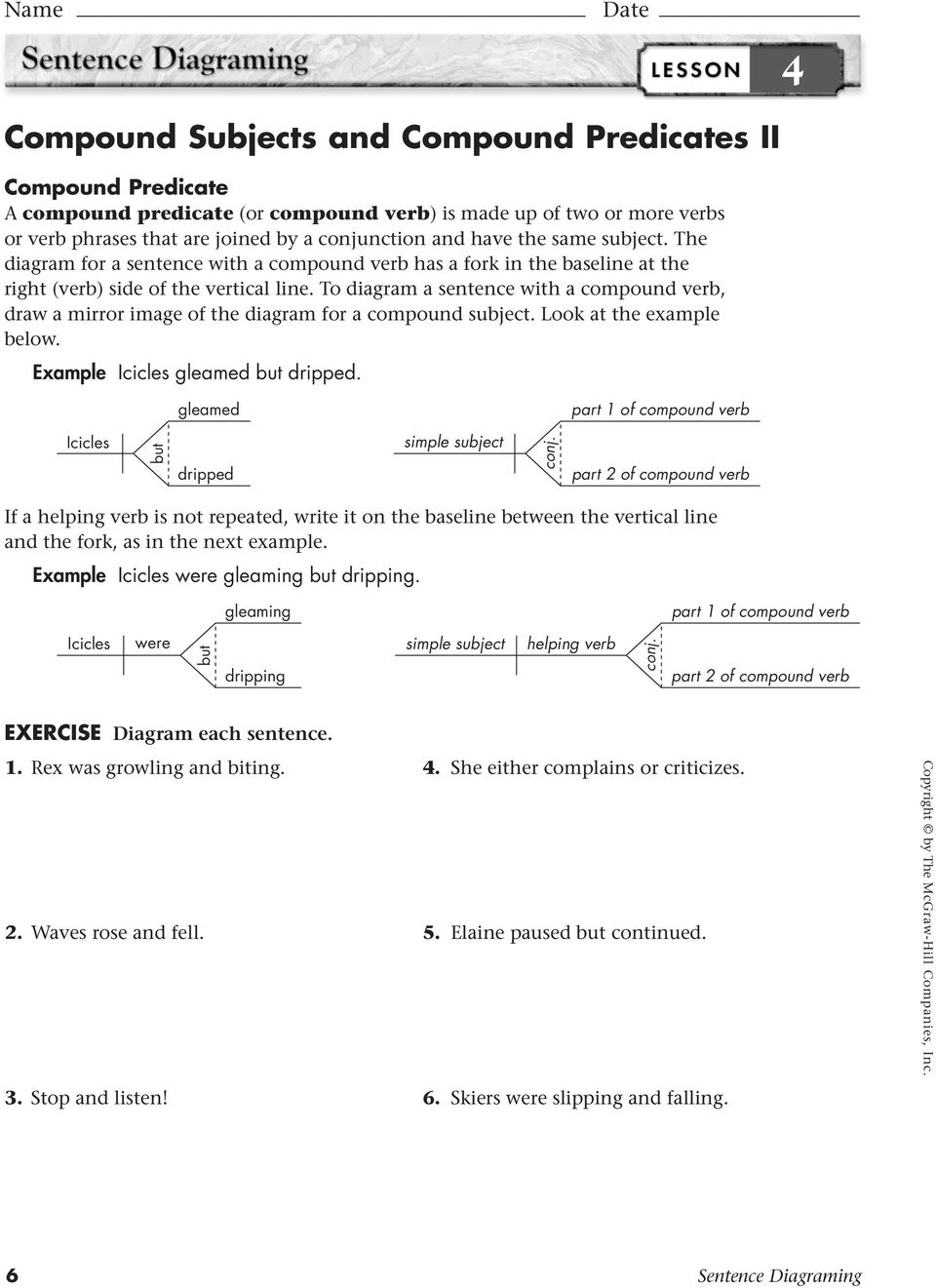
10 4 Compound Subjects Compound Predicates II Compound Predicate A compound predicate (or compound verb) is made up of two or more verbs or verb phrases that are joined by a conjunction have same subject. The diagram for a sentence with a compound verb has a fork in baseline at right (verb) side of vertical line. To diagram a sentence with a compound verb, draw a mirror image of diagram for a compound subject. Look at example below. Example Icicles gleamed but dripped. gleamed part 1 of compound verb Icicles but dripped simple subject conj. part 2 of compound verb If a helping verb is not repeated, write it on baseline between vertical line fork, as in next example. Example Icicles were gleaming but dripping. gleaming part 1 of compound verb Icicles were but dripping simple subject helping verb conj. part 2 of compound verb EXERCISE Diagram each sentence. 1. Rex was growling biting. 4. She eir complains or criticizes. 2. Waves rose fell. 5. Elaine paused but continued. 3. Stop listen! 6. Skiers were slipping falling. 6 Sentence Diagraming
11 conj. Name 5 Compound Subjects Compound Predicates III Compound Subject Compound Predicate Some sentences have both compound subjects compound verbs. The diagram for any of those sentences has a baseline that is forked on both ends, as in this example. Example Tracey Donna strolled shopped. Tracey strolled part 1 of compound subject part 1 of compound verb Donna shopped part 2 of compound subject conj. part 2 of compound verb EXERCISE Diagram each sentence. 1. Nick Lawanna swept dusted. 5. Letters packages were delivered opened. 2. Tina Mr. Lopez fished talked. 6. Was Diane or Joan singing? 3. Did Ernie you stop look? 7. Mayor Axon visited spoke. 4. Neir Midnight nor Belle Cat 8. Both Angela Rudy have been scratches or bites. traveling but will return. Sentence Diagraming 7

12 6 Direct Objects Indirect Objects I Verbs that express physical or mental action are called action verbs. Some action verbs are complete in mselves, but ors pass ir action on to or elements in sentence. These elements are called objects of action verbs. Direct Object A transitive verb is an action verb that is followed by a word or words that answer question what? or whom? Such words are called direct objects. Nouns, pronouns, or words acting as nouns may be direct objects. To diagram a sentence with a direct object, place direct object on baseline to right of its verb. Separate object from verb with a vertical line above baseline only. Example I like picnics. I like picnics subject action verb direct object EXERCISE Diagram each sentence. 1. Everyone brought food. 5. Ants were boring us. 2. Fran packed cookies. 6. Boys girls played baseball. 3. Tony cooked hamburgers. 7. Both Max I hit homers. 4. Did anyone bring napkins? 8. Has everyone had fun? 8 Sentence Diagraming

13 7 Direct Objects Indirect Objects II Compound Direct Object If a verb has a compound direct object, right end of baseline, where direct object belongs, is forked. To right of vertical line after verb, draw parallel horizontal lines, one for each part of compound object. Connect lines with a dotted vertical line at ir left. Write conjunction along that line. Draw angled lines from both top bottom lines to join stack to baseline. Study this example. Example Herbert roasted both corn potatoes. corn part 1 of direct object Herbert roasted both potatoes subject action verb conj. conj. part 2 of direct object EXERCISE Diagram each sentence. 1. Parks have tables benches. 5. We saw neir rain nor clouds. 2. You use eir grills or campfires. 6. Danelle Gina had prepared salads rolls. 3. Did you drink juice or cola? 7. Mike ate both food bugs. 4. Chang was swatting houseflies 8. Campers should bring bedrolls tents. mosquitoes. Sentence Diagraming 9

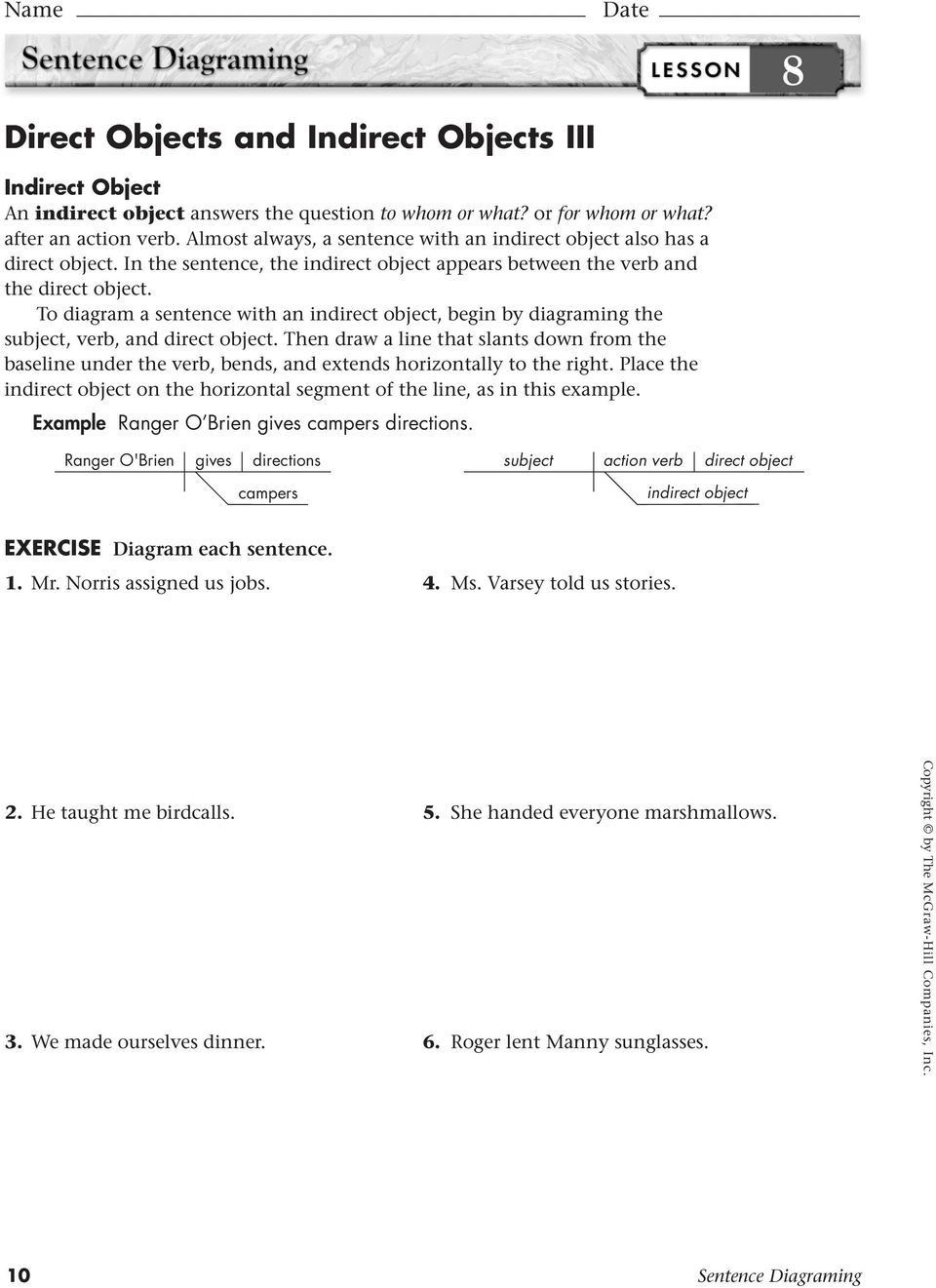
14 8 Direct Objects Indirect Objects III Indirect Object An indirect object answers question to whom or what? or for whom or what? after an action verb. Almost always, a sentence with an indirect object also has a direct object. In sentence, indirect object appears between verb direct object. To diagram a sentence with an indirect object, begin by diagraming subject, verb, direct object. Then draw a line that slants down from baseline under verb, bends, extends horizontally to right. Place indirect object on horizontal segment of line, as in this example. Example Ranger O Brien gives campers directions. Ranger O'Brien gives directions subject action verb direct object campers indirect object EXERCISE Diagram each sentence. 1. Mr. Norris assigned us jobs. 4. Ms. Varsey told us stories. 2. He taught me birdcalls. 5. She hed everyone marshmallows. 3. We made ourselves dinner. 6. Roger lent Manny sunglasses. 10 Sentence Diagraming
15 9 Direct Objects Indirect Objects IV Compound Verb with Direct Indirect Objects In some sentences with a compound verb, all parts of verb share a single direct object. To diagram such a sentence, connect horizontal lines holding verb parts to baseline at both left right, as shown below. Then extend baseline at right to hold shared direct object. Example Campers examined compared maps. examined part 1 of compound verb Campers compared maps subject conj. part 2 of compound verb direct object The diagram shows that campers both examined maps compared maps. In or sentences with a compound verb, a direct or an indirect object completes only one part of verb. To diagram that type of sentence, connect object(s) with only one verb part, as in this example. Example Steve drew maps made us copies. drew maps part 1 of compound verb direct object Steve made copies subject conj. part 2 of compound verb direct object us indirect object EXERCISE Diagram each sentence. Make sure that each direct or indirect object is related to correct verb or verb part. 1. Rangers led hikes gave hikers advice. 2. Campers collected buried leftovers. Sentence Diagraming 11

16 9 Continued 3. Food can attract bears bring campers problems. 4. Wear can help or hurt vacationers. 5. Rain gives plants nourishment but can dampen spirits. 6. Have you camped or visited parks? 12 Sentence Diagraming

17 10 Adjectives Adverbs I In addition to nouns, pronouns, verbs, many sentences use modifiers. The two types of modifiers are adjectives adverbs. Adjectives An adjective is a word that modifies, or describes, a noun or pronoun. An adjective can tell what kind, which one, how many, or how much. Examples include strong, this, three, less. The articles a, an, are also adjectives. In addition, possessive nouns pronouns can be considered adjectives because y describe nouns. Examples of possessive nouns are children s, adults, Mrs. Dean s. Possessive pronouns include our, your, his, her. In example below, every adjective is underlined. Any noun or pronoun in a sentence may be modified by one or more adjectives. To diagram a sentence with adjectives, place each adjective on a slant line below word it modifies. If more than one adjective modifies same word, place modifiers from left to right in order in which y appear in sentence. Example Lucy s older bror oiled her squeaky bicycle wheel. bror oiled wheel subject verb direct object older Lucy s her bicycle squeaky adjective 2 adjective 1 adjective 2 adjective 1 adjective 3 EXERCISE Diagram each sentence. 1. Those happy fans watched a great race. 2. Did famous cyclist win first prize? Sentence Diagraming 13

18 10 Continued 3. Many enthusiastic people attended that recent event. 4. My cousin enjoys extreme sports. 5. That adventurous teenager climbs steep mountains. 6. Tough triathlons attract him. 7. Dangerous activities give him memorable thrills. 14 Sentence Diagraming
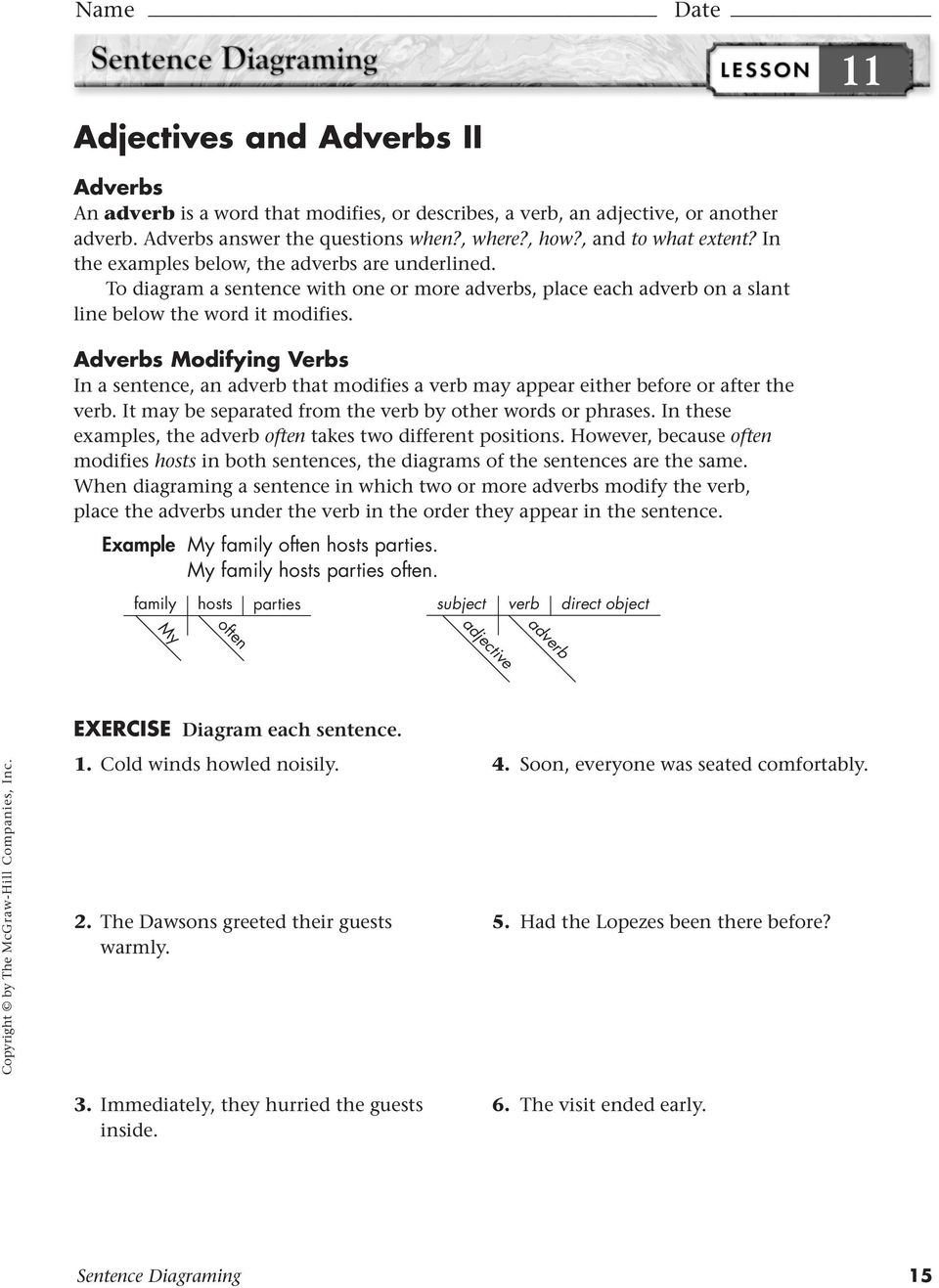
19 11 Adjectives Adverbs II Adverbs An adverb is a word that modifies, or describes, a verb, an adjective, or anor adverb. Adverbs answer questions when?, where?, how?, to what extent? In examples below, adverbs are underlined. To diagram a sentence with one or more adverbs, place each adverb on a slant line below word it modifies. Adverbs Modifying Verbs In a sentence, an adverb that modifies a verb may appear eir before or after verb. It may be separated from verb by or words or phrases. In se examples, adverb often takes two different positions. However, because often modifies hosts in both sentences, diagrams of sentences are same. When diagraming a sentence in which two or more adverbs modify verb, place adverbs under verb in order y appear in sentence. Example My family often hosts parties. My family hosts parties often. family hosts parties subject verb direct object My often adjective adverb EXERCISE Diagram each sentence. 1. Cold winds howled noisily. 4. Soon, everyone was seated comfortably. 2. The Dawsons greeted ir guests 5. Had Lopezes been re before? warmly. 3. Immediately, y hurried guests 6. The visit ended early. inside. Sentence Diagraming 15
20 ir Very ir Name 12 Adjectives Adverbs III Adverbs That Modify Or Modifiers A single sentence may have both kinds of modifiers, with adjectives modifying nouns pronouns, adverbs modifying verbs. Example Watchful explorers choose ir paths carefully. explorers choose paths subject verb direct object Watchful carefully adjective adverb adjective Also, sentence may have or adverbs modifying se modifiers. To diagram an adverb that modifies an adjective or anor adverb shown on a slant line, write additional adverb on a slant line parallel to but slightly lower than slant line of word modified. Connect two lines with a short horizontal line at top of lower slant line. In this example, adverbs very extremely modify adjective watchful adverb carefully. Example Very watchful explorers choose ir paths extremely carefully. explorers choose paths subject verb direct object watchful carefully adjective adverb adjective extremely adverb adverb EXERCISE Diagram each sentence. 1. Alarmingly thick bushes blocked path almost everywhere. 2. The travelers looked about rar wearily. 16 Sentence Diagraming
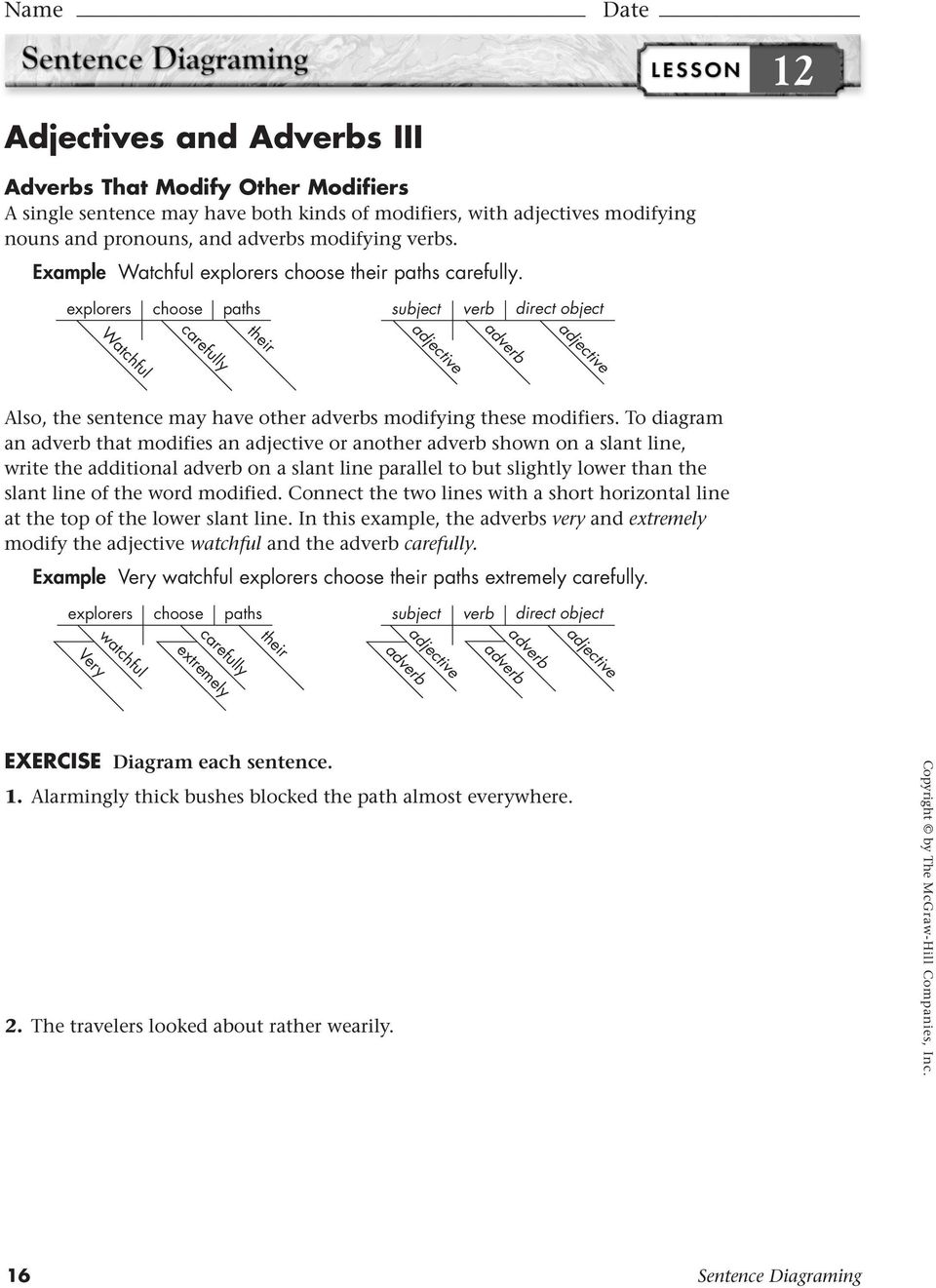
21 12 Continued 3. Extremely sharp hatchets cleared a path remarkably fast. 4. The usually energetic leader walked exceedingly slowly. 5. The group was entering a particularly dangerous area. 6. Suddenly, least courageous member yelled shockingly loudly. Sentence Diagraming 17
22 13 Adjectives Adverbs IV Modifiers with Compound Subjects, Verbs, Objects In a sentence with a compound subject, verb, or object, a modifier may describe one part of compound element or all parts. What modifier describes affects where it is placed in diagram. In first example below, immediately modifies blew. In second example, immediately modifies both verb parts. See how diagrams differ. Examples The leader turned immediately blew a whistle. The leader immediately turned blew a whistle. turned part 1 of compound verb leader The blew whistle subject adjective conj. part 2 of compound verb direct object a immediately adverb adjective turned part 1 of compound verb leader The immediately blew whistle subject adjective adverb conj. part 2 of compound verb direct object a adjective If a modifier modifies only one part of compound element, place it under that part of fork. If modifier modifies all parts, place it under shared baseline. EXERCISE Diagram each sentence. 1. The cowardly explorer shivered 3. Both book its sequel suddenly fainted. sold well. 2. Scary stories always frighten 4. The story fascinated adventurous delight me. teens adults. 18 Sentence Diagraming
23 14 Subject Complements I A linking verb links, or joins, subject of sentence with a word or phrase describing or identifying subject. The most common linking verb is to be. Or linking verbs are appear, sound, feel. The word or phrase linked to subject is called a subject complement. There are two kinds of subject complements: predicate nouns predicate adjectives. They are diagramed same way. Predicate Noun A predicate noun is a noun or pronoun that follows a linking verb renames or furr identifies subject. It may be modified by adjectives. To diagram a sentence with a predicate noun, place noun or pronoun on baseline to right of linking verb. Draw a slant line between verb predicate noun that ends at baseline. Example A parrot can be a good pet. parrot A can be pet a subject good adjective linking verb adjective adjective predicate noun EXERCISE Diagram each sentence. 1. Kiwi is a yellow cockatiel. 3. Parrots are popular pets. 2. Cockatiels are parrots. 4. How long has Kiwi been Frank s pet? Sentence Diagraming 19
24 15 Subject Complements II Predicate Adjective A predicate adjective is an adjective that follows a linking verb furr describes subject. It may be modified by adverbs. To diagram a sentence with a predicate adjective, place adjective on baseline to right of linking verb. Draw a slant line between verb predicate adjective that ends at baseline. Example Many parrots are quite clever. parrots are clever subject linking verb predicate adjective adjective Many quite adverb EXERCISE Diagram each sentence. 1. Frank s cockatiel is very friendly. 4. Kiwi seems smart. 2. Kiwi appears happy. 5. Are her tricks difficult? 3. Her birdcage is rar large. 6. Kiwi s owner feels extremely fortunate. 20 Sentence Diagraming
25 16 Subject Complements III Compound Subject Complements Both predicate nouns predicate adjectives may have compound parts. The diagram of a sentence with a compound subject complement has a baseline that is forked at right of slant line. Study se examples. Examples Today, our major parties are Republicans Democrats. The parties history is quite long colorful. Republicans part 1 of comp. predicate noun parties are major our Today Democrats subject adjective linking verb adverb conj. part 2 of comp. predicate noun adjective long part 1 of comp. predicate adj. history The is quite colorful subject adjective linking verb adverb conj. part 2 of comp. predicate adj. parties adjective In second example, note how adverb quite, which modifies both parts of compound predicate adjective, is connected to baseline before fork. EXERCISE Diagram each sentence. Decide first wher sentence has a subject complement or a direct object, use a slant or straight line, as appropriate, to separate that word from verb. 1. Political cartoons can be both funny meaningful. 2. Their messages may be timely but durable. Sentence Diagraming 21
26 16 Continued 3. Teddy Roosevelt was both a strong president a memorable public figure. 4. One cartoon showed Teddy a cute bear. 5. The teddy bear is still popular lovable. 6. Wartime political cartoons are often critical or inspirational. 22 Sentence Diagraming
27 Simple Sentences with Phrases Lesson 17 Appositives Appositive Phrases Appositives appositive phrases Lesson 18 Prepositional Phrases I Used as adjectives Lesson 19 Prepositional Phrases II Used as adverbs Lesson 20 Prepositional Phrases III Used to modify or prepositional phrases Lesson 21 Participles Participial Phrases I Participles Lesson 22 Participles Participial Phrases II Participial phrases Lesson 23 Gerunds Gerund Phrases I Used as subjects Lesson 24 Gerunds Gerund Phrases II Used as direct objects Lesson 25 Gerunds Gerund Phrases III Used as predicate nouns Lesson 26 Gerunds Gerund Phrases IV Used as objects of prepositions Lesson 27 Infinitives Infinitive Phrases I Used as adjectives Lesson 28 Infinitives Infinitive Phrases II Used as adverbs Lesson 29 Infinitives Infinitive Phrases III Used as subjects Lesson 30 Infinitives Infinitive Phrases IV Used as direct objects Lesson 31 Infinitives Infinitive Phrases V Used as predicate nouns Sentence Diagraming 23
28 that Name 17 Appositives Appositive Phrases An appositive is a noun or pronoun that identifies anor noun or pronoun in sentence. Any noun or pronoun may have an appositive. To diagram a sentence with an appositive, place appositive immediately after word it identifies, set it off in parenses. Example A California stagecoach driver, Charley Parkhurst, had a secret. driver (Charley Parkhurst) had secret subject (appos.) verb dir. object A stagecoach California a adjective adjective adjective adjective Example Legends describe that colorful character, Charley Parkhurst. Legends describe character (Charley Parkhurst) adjective adjective subj. verb dir. object (appos.) colorful An appositive phrase is composed of an appositive all words that modify it. To diagram a sentence with an appositive phrase, write appositive within parenses immediately after word identified, place modifiers on slant lines under appositive rar than under word identified. Example Parkhurst, a fearless driver, could hle almost any horse. adjective adjective Parkhurst (driver) could hle horse subj. (appositive) verb dir. obj. a fearless any almost EXERCISE Diagram each sentence. 1. Charley Parkhurst was really Charlotte Parkhurst, an orphan. 2. Fifteen-year-old Charlotte, a tall, strong girl, left an unfriendly orphanage. adverb adjective 24 Sentence Diagraming
29 17 Continued 3. She took a man s job, stable h. 4. She also took a man s name, Charley. 5. Charley, pretend man, became first woman voter. 6. Her one vice, tobacco, gave Charley cancer. 7. Death finally revealed her secret, her womanhood. Sentence Diagraming 25
30 18 Prepositional Phrases I A preposition is a word that indicates how a noun or pronoun relates to some or word in its sentence. Examples include before, throughout, with. Some prepositions are made up of more than one word, such as in front of except for. A prepositional phrase is made up of a preposition, its object, any modifiers of object. Examples of prepositional phrases are before storm, during heavy rain, in front of an old barn. Prepositional phrases may act as adjectives or as adverbs. Used as Adjectives To diagram a prepositional phrase used as an adjective, place preposition on a slant line below noun or pronoun modified. Place object of preposition on a horizontal line connected to slant line lying at its right. The slant line should extend slightly beyond horizontal line. If object of preposition has modifiers, write m on slant lines below object. Example Most people in Emma s class like rock music. people like music subject adjective verb direct object adjective Most rock in class preposition Emma s object of preposition adjective EXERCISE Diagram each sentence. 1. Posters throughout city announced rock concert. 2. Holders of particular tickets would also receive passes to backstage areas. 26 Sentence Diagraming
31 18 Continued 3. Will you get tickets for show? 4. Spotlights in many different colors lit stage. 5. The loudspeakers behind my ears blared announcements about souvenirs. 6. Could you see drummer with long blond hair? Sentence Diagraming 27
32 19 Prepositional Phrases II Used as Adverbs A prepositional phrase used as an adverb is diagramed same way as one used as an adjective. Study this model of a prepositional phrase used to modify a verb. The preposition is placed on slant line its object is placed on adjoining horizontal line. Note that phrase is placed beneath verb modified. Example The science lab was displayed on Parents Night. lab was displayed The science on Parents Night subject adjective verb adjective preposition If prepositional phrase modifies only one part of a compound element, place it under that part only. Orwise, slant line begins beneath shared baseline. Example On that night, my mor came saw school. object of preposition came part 1 of compound verb mor my On saw school subject adj. prep. conj. part 2 of compound verb direct object night obj. of prep. adj. that As shown above, a prepositional phrase used as an adverb does not always immediately follow verb. You can identify a phrase used as an adverb if it answers this question: When, where, or how does or did action occur? EXERCISE Diagram each sentence. 1. Before Parents Night, we practiced our experiments. adj. 2. Mrs. Sanchez wrote precise instructions on chalkboard. 28 Sentence Diagraming
33 19 Continued 3. Turtles frogs crawled over aquarium rocks. 4. A gray mouse slept quietly inside a cardboard tube. 5. The teams performed experiments with great care. 6. We recorded data observations in our lab notebooks. Sentence Diagraming 29
34 adj. Name 20 Prepositional Phrases III Used to Modify Or Prepositional Phrases A prepositional phrase that modifies anor prepositional phrase is diagramed like any or prepositional phrase. Simply place phrase beneath object of prepositional phrase that is modified. Study this example. Example Boaters in canoes raced down river through Scout camp. Boaters raced subject verb down prep. prep. in canoes river obj. of prep. obj. of prep. through prep. camp obj. of prep. adj. adj. Scout In this example, prepositional phrase down river tells where boaters raced, so it is placed under verb raced. The prepositional phrase through Scout camp tells which river, so it is placed under object of first phrase, river. Any sentence may contain a series of prepositional phrases. Be sure to determine which word is modified by each phrase, place each phrase under word it modifies. EXERCISE Diagram each sentence. 1. The race was held on a day with threats of rain. 2. Danny rowed with a winner of previous race. 30 Sentence Diagraming
35 20 Continued 3. Near end of race, dark clouds filled sky. 4. Danny his partner sped to goal at fork in river. 5. Immediately, rowers in all of or boats stopped. Sentence Diagraming 31
36 21 Participles Participial Phrases I Not all verb forms function in sentences as verbs. A participle is a verb form that functions in a sentence as an adjective. Participles may be eir present or past. Present participles end in ing. Most past participles end in ed, but some have irregular forms. Participles To diagram a sentence that includes a participle, first identify word that participle modifies. Draw a line that slants down from that word, bends, extends horizontally to right. Write participle on line, curving it in angle of line, as shown in this example. Example Growling, monster charged wounded hero. monster charged hero subject verb direct object G rowling w ounded p articiple adj. adj. p articiple Irregular participles such as risen or caught may not be recognized easily. Remember that any verb form used as an adjective is a participle. EXERCISE Diagram each sentence. 1. The hero swung a broken branch at creature. 2. Defeated, monster fled from relieved fighter. 3. The satisfied crowd soon left crowded ater. 32 Sentence Diagraming
37 22 Participles Participial Phrases II Participial Phrases As a form of verbs, participles may take direct objects, indirect objects, predicate nouns, predicate adjectives. They may also be modified by adverbs prepositional phrases. A participial phrase is made up of a participle, any complements it may have, all words phrases that modify participle its complements. To diagram a participial phrase, first diagram participle on its bent line. Then diagram any objects, complements, modifiers in phrase, adding m to bent line of participle. Be sure to place every modifier under correct element of participial phrase. Example Cheerfully whistling a tune, Jacob walked to store. Jacob walked subject verb whistling tune to store p articiple dir. obj. of participle prep. obj. of preposition adj. a Cheerfully adv. adj. Participial phrases can occur almost anywhere in a sentence. Be sure to identify which word is modified by each participial phrase, diagram phrase so that participle extends below that word. EXERCISE Diagram each sentence. 1. Looking over his shoulder, Jacob spotted a large dog. 2. The dog, barking furiously, chased frightened boy. Sentence Diagraming 33
38 22 Continued 3. Thinking quickly, Jacob jumped over a fence. 4. The confused dog stopped, giving exhausted boy a rest. 5. Surprised, he noticed dog s wagging tail. 6. Jacob, holding his breath, opened gate. 34 Sentence Diagraming
39 23 Gerunds Gerund Phrases I A gerund is a verb form that ends in -ing is used in a sentence as a noun. A gerund phrase is made up of a gerund, its complements, all modifiers of gerund its complements. Gerunds gerund phrases may be used in sentences wherever nouns may be used. In a diagram, a gerund is written in a curved shape over a line with a step. The stepped line lies at top of a stilt, stilt is placed where you would put a noun or pronoun used as gerund is used. Used as Subjects To diagram a gerund or a gerund phrase used as a subject, place a stilt on baseline where subject usually lies. Draw a stepped line above stilt curve gerund itself over step. Then diagram any objects, complements, modifiers of gerund phrase, adding se elements to stepped line. Example Giving speeches frightens some people. Giving speeches gerun d direct object of gerund frightens people verb direct object some adj. EXERCISE Diagram each sentence. 1. Jogging tires me quickly. 2. Hearing that joke reminds me of a funny story. Sentence Diagraming 35
40 24 Gerunds Gerund Phrases II Used as Direct Objects To diagram a sentence with a gerund or gerund phrase as a direct object, draw a stilt on baseline where direct object is usually placed. Draw a stepped line, as shown here, above stilt. Curve gerund over step. Add any complements or modifiers in gerund phrase to stepped line. Example Armo enjoys solving difficult riddles. solving riddles gerun d direct object of gerund difficult adj. Armo enjoys subject verb Both gerunds present participles end in ing. However, gerunds act as nouns, while participles act as adjectives. Test for gerunds by asking this question: Can verb form be replaced with pronoun it? If so, that verb form is a gerund. EXERCISE Diagram each sentence. 1. My whole family enjoyed watching fireworks display. 2. I remember being lifted by my far for a better view. 36 Sentence Diagraming
41 adj. Name 25 Gerunds Gerund Phrases III Used as Predicate Nouns To diagram a sentence with a gerund or gerund phrase as a predicate noun, place a stilt on baseline where predicate noun belongs, following a slant line. Draw a stepped line above stilt. Curve gerund over step, add any or words of gerund phrase to stepped line. Study this example. Example My least favorite chore has always been washing windows. washing windows gerun d dir. obj. of gerund My chore has been subject linking verb least favorite always adj. adv. adv. EXERCISE Diagram each sentence. Use correct line before each gerund straight or slanted to indicate wher it is used as a direct object or as a predicate noun. 1. The first step of any job is finding right tools. 2. The tired workers stopped doing ir best. 3. Elena s hobby was repairing dolls. Sentence Diagraming 37
42 26 Gerunds Gerund Phrases IV Used as Objects of Prepositions To diagram a sentence with a gerund or gerund phrase as object of a preposition, prepare space for gerund by drawing a long slant line for that preposition. Then place a stilt on horizontal line where object of preposition belongs, draw a stepped line above stilt. Curve gerund over step itself. Add any complements modifiers of gerund phrase to stepped line. Study this example. Example The people cheered us for entertaining m. people cheered us subject verb dir. obj. The for entertaining m adj. prep. gerun d dir. obj. of gerund Whenever you find a gerund in a sentence to be diagramed, mentally replace it with pronoun it decide where you would place that pronoun in a diagram. Then place gerund or gerund phrase on a stilt in that position. EXERCISE Diagram each sentence. Decide first how each gerund is used, place stilt for gerund in correct place. 1. You win this game by popping five balloons. 2. The library has a policy against talking loudly. 3. Marsha dreams of competing in Olympics. 38 Sentence Diagraming
43 26 Continued 4. I found instructions for assembling unit. 5. Skiing in Colorado has been extremely enjoyable. 6. Maynard s habit of finding lost coins is uncanny. 7. Tutoring younger children prepares you for becoming a teacher. Sentence Diagraming 39
44 27 Infinitives Infinitive Phrases I An infinitive is a verb form that matches base form of a verb is usually preceded by word to. An example is to tell. An infinitive phrase is made up of an infinitive, its complements, any modifiers of infinitive its complements. An example is to tell a friend news. Infinitives infinitive phrases can be used in sentences as adjectives, adverbs, or nouns. Used as Adjectives Infinitives or infinitive phrases used as adjectives are diagramed in same way as prepositional phrases are. Write word to on a slant line below noun or pronoun modified by infinitive. Write base form of verb on a horizontal line drawn to right of slant line, near its lower end. Study this example. Examples B members announced ir decision to tour again. members announced decision subject verb dir. obj. B to ir tour again adj. to adj. infinitive (base form) adv. The infinitive phrase to tour again tells what kind of decision. It acts as an adjective modifying decision. EXERCISE Diagram each sentence. 1. The audience shouted dems to play favorite songs. 2. On tour, musicians need ability to sleep at odd hours. 3. An overnight bag to hold essential items is a necessity. 40 Sentence Diagraming
45 28 Infinitives Infinitive Phrases II Used as Adverbs Infinitives or infinitive phrases used as adjectives those used as adverbs are diagramed in same way. Write word to on a slant line below word modified by infinitive. Write base form of verb on a horizontal line drawn to right of slant line, near its lower end. Here is an example. Examples Eager fans competed to buy tickets to show. fans competed subject verb Eager to buy tickets to show adj. to infinitive dir. obj. of infinitive prep. obj. of prep. adj. In example, infinitive phrase to buy tickets tells how or why fans competed. It acts as an adverb, modifying competed. EXERCISE Diagram each sentence. 1. To get closer to stage, some audience members pushed ors. 2. Guards at auditorium worked to prevent injuries. 3. The b played two encores to show ir appreciation. Sentence Diagraming 41
46 29 Infinitives Infinitive Phrases III Used as Subjects To diagram a sentence with an infinitive or infinitive phrase used as a noun, first identify its role in sentence. If phrase is used as a subject, draw a stilt on baseline where subject belongs. Next, draw a horizontal line above stilt, a short slant line at left of that horizontal line, as in example below. Write word to on slant line, base form of verb on horizontal line. (Make sure verb form is directly above stilt.) Add complements modifiers in infinitive phrase to horizontal line. Study this example. Examples To build largest ship was engineer s goal. "To" To build ship infinitive dir. obj. of infinitive adj. adj. largest was goal verb pred. noun engineer s EXERCISE Diagram each sentence. 1. In good wear, to ride a bike to school saves time. 2. To buy a secondh bike was a wise decision. 3. To change this tire will take twenty minutes. 42 Sentence Diagraming
47 30 Infinitives Infinitive Phrases IV Used as Direct Objects To diagram a sentence with an infinitive or infinitive phrase used as a direct object, draw a stilt on baseline where direct object belongs. Next, draw a horizontal line above stilt, a short slant line at left of that horizontal line. See example below. Write word to on slant line, base form of verb on horizontal line. (Place verb form directly above stilt.) Add complements modifiers in infinitive phrase to horizontal line. In this example, infinitive phrase is direct object of sentence. Examples Jean asked me to go with her. to go to infinitive Jean asked me with her subject verb prep. indirect object object of prep. EXERCISE Diagram each sentence. 1. Callers to station asked to hear your song. 2. The child refused to eat broccoli. 3. None of my friends can afford to buy every new video game. Sentence Diagraming 43
48 31 Infinitives Infinitive Phrases V Used as Predicate Nouns An infinitive or infinitive phrase used as a predicate noun is diagramed same way as one used as a direct object, except that it follows a slant line after verb rar than a vertical line. Study this example. Note where word to base form of verb are placed. Examples Dean s long-range plan is to run his own business. to run business to infinitive dir. obj. of inf. plan Dean s subject verb adj. adj. long-range is his own EXERCISE Identify role of infinitive or infinitive phrase in each sentence, n diagram sentence. 1. Alicia s hobby is to ride trail horses. 2. The purpose of this booklet is to explain pet licenses. 3. To stick to exact truth took courage. 44 Sentence Diagraming
49 31 Continued 4. Everybody wanted to see parade. 5. One aim of campaign is to raise awareness of this disease. 6. To increase sales at store will not be easy. 7. Your first step is to notify police of ft. Sentence Diagraming 45
50
51 Compound Complex Sentences Lesson 32 Compound Sentences I Clauses connected by a semicolon Lesson 33 Compound Sentences II Clauses connected by a conjunction Lesson 34 Complex Sentences with Adjective or Adverb Clauses I Adjective clauses introduced by relative pronouns Lesson 35 Complex Sentences with Adjective or Adverb Clauses II Adverb clauses that modify verbs Lesson 36 Complex Sentences with Noun Clauses I Used as subjects Lesson 37 Complex Sentences with Noun Clauses II Used as direct objects Lesson 38 Complex Sentences with Noun Clauses III Introduced by that Lesson 39 Complex Sentences with Noun Clauses IV Used as objects of prepositions Lesson 40 Complex Sentences with Noun Clauses V Used as predicate nouns Sentence Diagraming 47
52 32 Compound Sentences I A clause is a group of words that has a subject a predicate is used as a part of a sentence. A main, or independent, clause can also st alone in a simple sentence. A subordinate, or dependent, clause cannot st alone. A compound sentence has two or more main clauses no subordinate clauses. The clauses are joined by a semicolon or by a comma a conjunction. In a diagram of a compound sentence, each independent clause is diagramed separately; n clauses are connected. The type of connection used depends on wher clauses are joined by a semicolon or a conjunction. Clauses Connected by a Semicolon When two main clauses in a compound sentence are joined by a semicolon, first diagram clauses separately in order in which y appear in sentence. Then draw a vertical dotted line between verbs of clauses, as shown here. Example Folktales are always popular; you have probably heard many of m. Folktales are popular MAIN CLAUSE #1 verb always you have heard many probably of m MAIN CLAUSE #2 verb EXERCISE Diagram each compound sentence. 1. Some folktales have been told for generations; many different versions exist. 2. In many tales, animals talk; y st for humans. 48 Sentence Diagraming
53 32 Continued 3. In some tales, animals are wise; in ors, y are foolish or selfish. 4. Writers in various countries have made collections of folktales; Grimm brors are among se writers. Sentence Diagraming 49
54 33 Compound Sentences II Clauses Connected by a Conjunction When main clauses in a compound sentence are connected by a conjunction such as, but, or or, first diagram each clause separately. Next, write conjunction on a solid horizontal line between two main clauses. Last, draw vertical dotted lines to connect that solid line to verb of each clause, as shown in this example. Example Do you like scary stories, or do y give you nightmares? you Do like stories MAIN CLAUSE #1 verb or scary conj. y do give nightmares you MAIN CLAUSE #2 verb EXERCISE Diagram each compound sentence. 1. In very old English tales, Grendel was a terrible monster, his mor was equally horrible. 2. Grendel terrorized countryside, but finally hero Beowulf stopped him. 50 Sentence Diagraming
55 33 Continued 3. In Odyssey, Scylla Charybdis were monstrous neighbors, sailors feared m. 4. Scylla tore ships apart, or Charybdis pulled m ir crews underwater. Sentence Diagraming 51
56 34 Complex Sentences with Adjective or Adverb Clauses I A clause is a group of words that has a subject a predicate is used as part of a sentence. A main, or independent, clause can st alone in a simple sentence. A subordinate, or dependent, clause cannot st alone. There are three types of subordinate clauses: adjective, adverb, noun clauses. A complex sentence has one main clause one or more subordinate clauses. The diagram of a complex sentence depends on type of subordinate clause it includes. Adjective Clauses Introduced by Relative Pronouns An adjective clause is a subordinate clause that modifies a noun or pronoun in main clause. Most adjective clauses are introduced by relative pronouns (who, whom, whose, that, which). Always begin diagram of a complex sentence by diagraming independent clause, even if it comes second in sentence. Then diagram subordinate clause separately, placing it below main clause. Finally, connect two clauses. To connect a main clause an adjective clause that begins with a relative pronoun, draw a dotted line between introductory pronoun word in main clause that adjective clause modifies. Study this example. Example Geologists are scientists who study rocks. Geologists are scientists MAIN CLAUSE modified noun who study rocks ADJECTIVE CLAUSE relative pronoun EXERCISE Diagram each complex sentence. 1. Evidence that is found in rocks shows changes in earth. 2. Information about center of earth is found in lava, which is rock from volcanoes. 52 Sentence Diagraming
57 34 Continued 3. Valerie, who is daughter of a geologist, shares his love of rocks. 4. She also learns about field from or geologists who work with her far. Sentence Diagraming 53
58 35 Complex Sentences with Adjective or Adverb Clauses II Adverb Clauses That Modify Verbs An adverb clause is a subordinate clause that modifies a verb, an adjective, or an adverb in main clause. Adverb clauses are introduced by subordinating conjunctions such as se: after, before, because, as, as if, as soon as, in order that, until, although, when, where, whenever. An adverb clause that modifies a main clause verb usually tells when, where, how, or why. To diagram a complex sentence with an adverb clause modifying a verb, first diagram main clause, even if it comes second in sentence. Next, diagram adverb clause, placing it below main clause. Connect clauses with a dotted line that begins under modified verb in main clause slants down to verb in adverb clause. Last, write conjunction on dotted line. Study this example. Example Although l on Earth looks solid, continents are actually moving. continents are moving MAIN CLAUSE modified verb actually Although conj. on l looks solid ADVERB CLAUSE verb Earth Notice that sentence begins with adverb clause, but diagram begins with main clause. The adverb clause Although l on Earth looks solid modifies are moving. EXERCISE Diagram each complex sentence. 1. Continents move because massive plates under m shift. 2. Where two plates collide, l on one plate may push over or. 54 Sentence Diagraming
59 35 Continued 3. If you could watch collision for millions of years, you would see growth of a mountain. 4. When two plates pull away from each or suddenly, an earthquake results. Sentence Diagraming 55
60 36 Complex Sentences with Noun Clauses I A noun clause is a subordinate clause used as a noun. Noun clauses may be used wherever nouns are used. Some noun clauses are introduced by pronouns such as who, whom, whatever. Ors are introduced by adverbs such as how, where, why. Unlike adjective adverb clauses, a noun clause is a part of main clause. It is diagramed within main clause. How this is done depends on how noun clause is used in sentence. Used as Subjects To diagram a complex sentence with a noun clause used as subject, first draw a diagram frame for main clause. Draw a stilt on baseline where subject belongs. On top of stilt, draw a second baseline. Diagram noun clause on that baseline, placing verb of noun clause immediately above stilt. Study se examples. Example Whatever you decide is fine. you decide Whatever is fine MAIN CLAUSE NOUN CLAUSE Example How we get re is your problem. we get NOUN CLAUSE re How MAIN CLAUSE is problem your EXERCISE Diagram each complex sentence. 1. Whoever made this pottery did a good job. 2. When plane will actually depart has not yet been announced. 56 Sentence Diagraming
61 36 Continued 3. How a room is furnished affects its noise level. 4. What detective discovered about her client raised new questions. 5. Why rust forms on metal is easily explained. Sentence Diagraming 57
62 37 Complex Sentences with Noun Clauses II Used as Direct Objects To diagram a complex sentence with a noun clause used as direct object, begin with a diagram frame for main clause. Fill in subject, verb, a vertical line to separate verb from object. Then draw a stilt on main clause baseline where object belongs. On top of stilt, draw a second baseline. Use that baseline to diagram noun clause, placing verb of noun clause immediately above stilt, as shown in following example. Example Mr. Denton taught us how plants make sugar. plants make sugar NOUN CLAUSE NOUN CLAUSE how MAIN CLAUSE Mr. Denton taught us EXERCISE Diagram each complex sentence. 1. The engineers finally discovered who caused oil spill. 2. At buffet, take whatever you want. 3. That dog licks whomever it meets. 58 Sentence Diagraming
63 38 Complex Sentences with Noun Clauses III Introduced by That The word that is a special introductory word. It often appears before a noun clause, but it doesn t always have to. In this example, noun clause has no introductory word. Example Everyone says time travel is impossible. travel is impossible NOUN CLAUSE time MAIN CLAUSE Everyone says A noun clause may begin with word that. Usually, however, that introduces a noun clause without being part of it as in example below. To diagram a complex sentence in which that only introduces a noun clause, write that on its own solid line above verb of noun clause. Draw a vertical dotted line from that to verb of noun clause. Example Everyone says that time travel is impossible. that that travel is impossible NOUN CLAUSE time MAIN CLAUSE Everyone says EXERCISE Diagram each sentence. 1. The police officer claimed car had been speeding. 2. That I could even surf was incredible. Sentence Diagraming 59
64 38 Continued 3. The reporter noted that Rocky fouled fourteen pitches in a row. 4. We regret that we arrived late. 5. That club has powerful members gives it influence. 6. We hope you will get well soon. 60 Sentence Diagraming
65 39 Complex Sentences with Noun Clauses IV Used as Objects of Prepositions To diagram a complex sentence with a noun clause used as object of a preposition, first diagram or elements of main clause. Under word modified by prepositional phrase involving noun clause, draw a long slant line for preposition. Place a stilt on horizontal line where object of preposition belongs, draw a second baseline on top of stilt. Finally, diagram noun phrase on second baseline. Study this example. Example Terry made a list of whatever supplies we needed. Terry made list a of we needed supplies whatever MAIN CLAUSE NOUN CLAUSE NOUN CLAUSE EXERCISE Diagram each complex sentence. 1. Give this fruit to whoever wants it. 2. Researchers were puzzled by how cave dwellers had made paintings on cave wall. Sentence Diagraming 61
66 39 Continued 3. I read a book about how organic food is grown. 4. Your school work is affected by how late you stay up at night. 5. The kitten ran to whoever rang bell. 6. Despite what her stepmor told her, Cinderella had hope. 62 Sentence Diagraming
67 40 Complex Sentences with Noun Clauses V Used as Predicate Nouns To diagram a complex sentence with a noun clause used as a predicate noun, first diagram subject verb of main clause. Then draw a slant line after verb to separate it from predicate noun. Place a stilt on main clause baseline where predicate noun belongs. On top of stilt, draw a second baseline. Diagram noun clause on that baseline. Study this example. Example A long vacation is what you need. you need what NOUN CLAUSE vacation is MAIN CLAUSE A long EXERCISE Diagram each complex sentence. 1. Tomorrow is when we leave. 2. This hammer is what I need for my construction project. 3. My wish is that I can visit a kelp forest someday. Sentence Diagraming 63
68
69 PART I 9. Who called Lesson 1 Simple Subjects Simple Predicates I 10. Aunt Emily Did go 1. Dolphins swim Exercise 2 2. (you) Wait 1. Sleet is falling 3. (you) Turn 2. you Were planning 4. Tiffany jogs 3. Doans have been remodeling Lesson 2 Simple Subjects Simple Predicates II Exercise (you) Plants drink are sold 1. Hector has been exercising 6. One is you Did forget Ms. Alice Cummins interrupted Lesson 3 Compound Subjects Compound Predicates I Emma (you) Hurry Dr. Lee has been calling guests Have been invited (you) Work Senator Adams will have retired Becky Phillip Annette Boaters swimmers Jeremy Both or laughed Was returning were rescued 4. was whispering Mark Eir or Sentence Diagraming 65
70 but or Lesson 4 Compound Subjects Compound Predicates II growling 3. Ernie you Did stop look 1. Rex was rose biting 4. Midnight Belle Cat Neir nor scratches bites 2. Waves fell Stop 5. Letters packages were delivered opened 3. (you) listen complains 6. Diane Joan or Was singing 4. She eir or criticizes paused 7. Mayor Axon visited spoke 5. Elaine but continued slipping 8. Angela Rudy Both have been traveling will return 6. Lesson 5 Compound Subjects Compound Predicates III Skiers Nick Lawanna Tina Mr. Lopez were falling swept dusted fished talked Lesson 6 Direct Objects Indirect Objects I Everyone brought food Fran packed cookies Tony cooked hamburgers anyone Did bring napkins Ants were boring us 66 Sentence Diagraming
71 Boys food 6. girls played baseball 7. Mike ate both bugs Max bedrolls 7. I Both hit homers 8. Campers should bring tents 8. everyone Has had fun Lesson 8 Direct Objects Indirect Objects III Lesson 7 Direct Objects Indirect Objects II tables Parks have You use you Did drink eir or benches grills campfires or juice cola Mr. Norris assigned jobs us He taught birdcalls me We made dinner ourselves Ms. Varsey told stories us She hed marshmallows everyone Chang was swatting We saw Danelle Gina neir nor rain clouds had prepared houseflies mosquitoes salads rolls 6. Roger lent sunglasses Manny Sentence Diagraming 67
72 Lesson 9 Direct Objects Indirect Objects IV 3. people Many attended event that cousin My enthusiastic recent led hikes Rangers gave advice hikers enjoys sports extreme collected 2. Campers buried leftovers 5. teenager That climbs mountains steep attract bears adventurous 3. Food can bring problems 6. triathlons attract him campers Tough 4. Wear can or help hurt vacationers 7. activities Dangerous give him thrills memorable gives nourishment 5. Rain but plants Lesson 11 Adjectives Adverbs II you Have 6. Lesson 10 Adjectives Adverbs I fans watched race happy Those cyclist Did win prize famous can dampen spirits or camped visited parks a first great winds Cold Dawsons y The howled hurried noisily greeted inside Immediately warmly 4. everyone was seated Soon guests guests ir comfortably 68 Sentence Diagraming
73 5. Lopezes Had been Lesson 13 Adjectives Adverbs IV before re shivered suddenly 6. visit The ended early 1. explorer The cowardly fainted Lesson 12 Adjectives Adverbs III frighten 1. bushes blocked path thick Alarmingly everywhere almost 2. stories Scary always delight me book 2. travelers The looked 3. sequel Both sold well about wearily rar its 3. hatchets sharp Extremely cleared fast remarkably path a 4. story The fascinated adventurous teens adults The group was entering area The leader walked a energetic usually member yelled courageous slowly exceedingly Suddenly dangerous particularly least loudly shockingly Sentence Diagraming 69
74 Lesson 14 Subject Complements I Lesson 16 Subject Complements III 1. Kiwi is cockatiel a yellow 1. cartoons Political can be both funny meaningful 2. Cockatiels are parrots timely 3. Parrots are pets popular 2. messages Their may be but durable 4. Kiwi has been pet president a strong long How Frank s 3. Teddy Roosevelt was both Lesson 15 Subject Complements II figure a public memorable 1. cockatiel is friendly Frank s very Teddy 2. Kiwi appears happy 4. cartoon One showed bear a cute birdcage is large Kiwi seems smart tricks Are difficult her Her owner feels fortunate Kiwi s rar extremely bear is teddy The cartoons are political Wartime still often or popular lovable critical inspirational 70 Sentence Diagraming
75 PART II Lesson 18 Prepositional Phrases I Lesson 17 Appositives Appositive Phrases 1. Posters announced concert rock 1. Charley Parkhurst was really Charlotte Parkhurst (orphan) an throughout city 2. Charlotte ( g i r l ) left a Fifteen-year-old strong tall orphanage unfriendly an 2. Holders of would receive tickets also passes to areas backstage particular 3. She took job a stable man s (h) 3. you Will get tickets 4. She took also name (Charley) a man s for show 5. Charley (m a n) became voter pretend 4. Spotlights in colors different many lit stage first woman vice (tobacco) gave cancer one Her Death revealed secret (womanhood) finally her Charley her loudspeakers you behind The Could see blared ears my announcements drummer with about hair blond long souvenirs Sentence Diagraming 71
76 Lesson 19 Prepositional Phrases II Lesson 20 Prepositional Phrases III 1. we practiced experiments 1. race was held Before our The on day a with Parents' Night threats 2. Mrs. Sanchez wrote instructions of rain on precise 2. Danny rowed with chalkboard winner a of race previous Turtles 3. frogs crawled over rocks 3. clouds dark filled sky end Near aquarium of race 4. mouse A gray inside quietly slept Danny teams performed experiments The with We recorded in care great notebooks our tube cardboard a data observations partner his rowers in all of sped to stopped boats goal at or Immediately fork in river lab 72 Sentence Diagraming
77 Lesson 21 Participles Participal Phrases I 5. he noticed tail Surprised wagging hero The swung branch at creature a b roken Jacob opened dog's gate holding breath 2. monster D efeated fled from his fighter r elieved Lesson 23 Gerunds Gerund Phrases I 3. The crowd s atisfied left ater soon c rowded 1. Jogging tires quickly me Lesson 22 Participles Participal Phrases II 1. Jacob Looking spotted dog a Hearing joke that large over shoulder his 2. reminds me of story 2. dog chased boy a funny barking The Jacob jumped Thinking The furiously over quickly dog confused fence a giving stopped rest a frightened Lesson 24 Gerunds Gerund Phrases II I family enjoyed whole My remember being lifted by watching far my display for view a fireworks better boy exhausted Sentence Diagraming 73
78 Lesson 25 Gerunds Gerund Phrases III 4. I found instructions finding tools for assembling unit 1. of first The step is right jobany Skiing in Colorado doing best 5. has been enjoyable ir 2. workers The tired stopped 6. habit is uncanny extremely repairing dolls Maynard's of finding coins 3. hobby Elena s was lost Tutoring children Lesson 26 Gerunds Gerund Phrases IV You win game library has policy The Marsha dreams of this by a popping against competing talking in balloons five loudly Olympics 7. Lesson 27 Infinitives Infinitives Phrases I audience shouted dems The younger prepares you for musicians need ability On tour becoming to play to teacher songs favorite sleep at a hours odd 3. An bag to is necessity a overnight hold items essential 74 Sentence Diagraming
79 Lesson 28 Infinitives Infinitives Phrases II Lesson 30 Infinitives Infinitives Phrases IV 1. members pushed ors to hear song audience some To to closer get stage 1. to Callers station asked your 2. at Guards auditorium worked to prevent injuries to eat broccoli 2. child refused 3. b The played encores two The to to buy game video new every show appreciation ir 3. of None friends can afford my Lesson 29 Infinitives Infinitives Phrases III to ride to bike school a To To saves time In buy bike a was decision change tire wear good this a secondh wise 3. will take minutes twenty Sentence Diagraming 75
80 Lesson 31 Infinitives Infinitive Phrases V to raise awareness to ride horses 5. aim is of disease this 1. hobby Alicia s is trail of campaign One to explain licenses To increase sales 2. of The purpose is pet at store booklet this 6. will be not easy To stick to truth exact 7. step first Your is to notify of police ft 3. took courage to see parade 4. Everybody wanted 76 Sentence Diagraming
81 PART III Lesson 33 Compound Sentences II Lesson 32 Compound Sentences I 1. folktales have been told Some for generations 1. Grendel was monster In English old very tales a terrible versions exist mor was horrible different many his equally 2. animals talk 2. Grendel terrorized countryside y st In tales many but for humans hero (Beowulf) stopped him finally 3. animals are In wise tales Scylla y are in ors some or foolish selfish 3. Charybdis were neighbors In sailors feared Odyssey m monstrous 4. in Writers have made collections countries various brors are Grimm among of writers se folktales 4. Scylla tore ships or apart Charybdis pulled underwater m crews ir Sentence Diagraming 77
82 Lesson 34 Complex Sentences with Adjective or Adverb Clauses I 1. Evidence shows that is found in rocks changes in earth 2. Information is found about center of in earth lava which is rock from volcanoes 3. Valerie shares love of his rocks who is daughter of geologist a 4. She about also learns field from geologists who work with far her or 78 Sentence Diagraming
83 two Lesson 35 Complex Sentences with Adjective or Adverb Clauses II Lesson 36 Complex Sentences with Noun Clauses I 1. Continents move Whoever made pottery this because plates shift 1. did job a massive under good m 2. plane will depart When actually on l may push plate over or one plates Where collide 2. has been announced yet not 3. you would see If growth of mountain a 3. room a is furnished affects level How its you could watch collision noise 4. earthquake results an When plates pull two for away millions of from years or each suddenly detective rust forms discovered on Why is explained easily raised metal What about questions new client her Sentence Diagraming 79
84 Lesson 37 Complex Sentences with Noun Clauses II Rocky that fouled pitches who caused spill oil 3. reporter noted in row a fourteen 1. engineers The discovered finally The that you want whatever we arrived late 2. (you) take At buffet 4. We regret That it meets whomever club has members powerful 3. dog That licks Lesson 38 Complex Sentences with Noun Clauses III 5. gives influence it you will get well soon I officer claimed police The That could surf even was incredible car had been speeding 6. We hope 80 Sentence Diagraming
85 Lesson 39 Complex Sentences with Noun Clauses IV 1. (you) Give fruit this to whoever wants it 2. Researchers were puzzled dwellers had made paintings by cave how on wall I read book a food is grown about organic how cave work school Your is affected you stay by late how up at night kitten ran The to Cinderella had hope stepmor told what Despite whoever rang bell her her Sentence Diagraming 81
86 kelp Lesson 40 Complex Sentences with Noun Clauses V we leave when 1. Tomorrow is I need what 2. hammer This is for project my construction I that can visit forest a someday 3. wish My is 82 Sentence Diagraming
5.7 Nominative Case and Objective Case Pronouns
 Chapter 5 Usage of Verbs, Pronouns, & Modifiers 171 5.7 Nominative Case and Objective Case Pronouns Personal pronouns have three cases: nominative, objective, and possessive (See lesson 1.4). The way a
Year 3 Grammar Guide. For Children and Parents MARCHWOOD JUNIOR SCHOOL
 MARCHWOOD JUNIOR SCHOOL Year 3 Grammar Guide For Children and Parents A guide to the key grammar skills and understanding that your child will be learning this year with examples and practice questions
Online Tutoring System For Essay Writing
 Online Tutoring System For Essay Writing 2 Online Tutoring System for Essay Writing Unit 4 Infinitive Phrases Review Units 1 and 2 introduced some of the building blocks of sentences, including noun phrases
Las Vegas High School 2010-11 Writing Workshop. Combining Sentences
 Las Vegas High School 2010-11 Writing Workshop Combining Sentences If you continually use short sentences in your writing, your paragraphs will sound very choppy. Read this paragraph and notice how it
Grammar Boot Camp. Building Muscle: Phrases and Clauses. (click mouse to proceed)
 Grammar Boot Camp Building Muscle: Phrases and Clauses (click mouse to proceed) Your Mission: To Study Phrases To Study Clauses To Exercise your Writing Muscles This presentation is enhanced with Question
The Book of Grammar Lesson Six. Mr. McBride AP Language and Composition
 The Book of Grammar Lesson Six Mr. McBride AP Language and Composition Table of Contents Lesson One: Prepositions and Prepositional Phrases Lesson Two: The Function of Nouns in a Sentence Lesson Three:
Fry Phrases Set 1. TeacherHelpForParents.com help for all areas of your child s education
 Set 1 The people Write it down By the water Who will make it? You and I What will they do? He called me. We had their dog. What did they say? When would you go? No way A number of people One or two How
1 Grammar in the Real World
 U NIT 31 Adjectives and Adverbs Making a Good Impression 1 Grammar in the Real World A Do you know how to give a presentation? What do you do to prepare? Read the article How many of your ideas are in
Part 1 LISTENING. Task 1
 Part 1 LISTENING Task 1 Listen to Joel telling his elder sister about his friends. Where would they like to work one day? For questions 1-5, write a letter -H next to each person. You will hear the conversation
Chapter 3 Growing with Verbs 77
 Chapter 3 Growing with Verbs 77 3.2 Direct Objects A direct object is the noun or pronoun that receives the direct action of a verb. The verb used with a direct object is always an action verb and is called
Gerunds, Participles, and Infinitives
 5 7 3 4 All About Gerunds, Participles, and Infinitives ] The words of the world want to make sentences. Gaston Bachelard Introduction Gerunds, participles, and infinitives are formed from verbs, but each
Subject Pronouns. Memorize the subject pronouns. Say them from memory to someone. Write a subject pronoun to replace the underlined words.
 Lesson 2 Subject Pronouns You know that pronouns take the place of nouns. Subject pronouns replace nouns that are used as subjects in a sentence. They usually come before the verb. Susan climbed the tree.
California Treasures High-Frequency Words Scope and Sequence K-3
 California Treasures High-Frequency Words Scope and Sequence K-3 Words were selected using the following established frequency lists: (1) Dolch 220 (2) Fry 100 (3) American Heritage Top 150 Words in English
Grammar & Style Worksheet Clauses/ Sentence Variety
 I. MAIN CLAUSES, SUBORDINATE CLAUSES AND FRAGMENTS A Clause is a group of words that contains at least one subject and one verb. Clauses: Harvey(subject) cares(verb) about Beatrice The Train(subject) was(verb)
Grammar Unit: Pronouns
 Name: Miss Phillips Period: Grammar Unit: Pronouns Unit Objectives: 1. Students will identify personal, indefinite, and possessive pronouns and recognize antecedents of pronouns. 2. Students will demonstrate
What I Need to Know for the Grammar Quiz
 What I Need to Know for the Grammar Quiz CLAUSES subject + predicate (complete thought) = sentence/independent clause subject + predicate (incomplete thought) = not a sentence/ dependent clause SUBJECTS
SENTENCE STRUCTURE. An independent clause can be a complete sentence on its own. It has a subject and a verb.
 SENTENCE STRUCTURE An independent clause can be a complete sentence on its own. It has a subject and a verb. A dependent clause cannot be a complete sentence on its own. It depends on the independent clause
Lesson: Adjectives Length 50-55 minutes Age or Grade Intended 6 th grade special education (direct instruction)
 LESSON PLAN by Lauren McCoy Lesson: Adjectives Length 50-55 minutes Age or Grade Intended 6 th grade special education (direct instruction) Academic Standard(s):. 6.6.2 Grammar Identify and properly use
TERMS. Parts of Speech
 TERMS Parts of Speech Noun: a word that names a person, place, thing, quality, or idea (examples: Maggie, Alabama, clarinet, satisfaction, socialism). Pronoun: a word used in place of a noun (examples:
Infinitive or ing-form?
 Infinitive or ing-form? Stefan M. Moser 7 May 2012 Version 1.6 In English, when one verb follows another, the second verb can either be the -ing form or the to infinitive. It depends on the first verb.
A Note to Parents. 1. As you study the list, vary the order of the words.
 A Note to Parents This Wordbook contains all the sight words we will be studying throughout the year plus some additional enrichment words. Your child should spend some time each week studying this Wordbook
DIAGRAMMING SENTENCES
 Diagramming sentences provides a way of picturing the structure of a sentence. By placing the various parts of a sentence in relation to the basic subject-verb relationship, we can see how the parts fit
Phonics. High Frequency Words P.008. Objective The student will read high frequency words.
 P.008 Jumping Words Objective The student will read high frequency words. Materials High frequency words (P.HFW.005 - P.HFW.064) Choose target words. Checkerboard and checkers (Activity Master P.008.AM1a
GMAT.cz www.gmat.cz [email protected]. GMAT.cz KET (Key English Test) Preparating Course Syllabus
 Lesson Overview of Lesson Plan Numbers 1&2 Introduction to Cambridge KET Handing Over of GMAT.cz KET General Preparation Package Introduce Methodology for Vocabulary Log Introduce Methodology for Grammar
Fry s Sight Word Phrases
 The people Write it down By the water Who will make it? You and I What will they do? He called me. We had their dog. What did they say? When would you go? No way A number of people One or two How long
PUSD High Frequency Word List
 PUSD High Frequency Word List For Reading and Spelling Grades K-5 High Frequency or instant words are important because: 1. You can t read a sentence or a paragraph without knowing at least the most common.
SAMPLE. Grammar, punctuation and spelling. Paper 2: short answer questions. English tests KEY STAGE LEVEL. Downloaded from satspapers.org.
 En KEY STAGE 2 English tests *SAMPLE* LEVEL 6 SAMPLE Grammar, punctuation and spelling Paper 2: short answer questions First name Middle name Last name Date of birth Day Month Year School name DfE number
Learning the Question & Answer Flows
 Learning the Question & Answer Flows These exercises are designed to help you learn how the Question and Answer Flows are constructed in the Parent Help Booklet. In the Question and Answer Flow, a series
7.5 Emphatic Verb Tense
 Chapter 7 Verb Usage 211 7.5 Emphatic Verb Tense The emphatic tenses of a verb are used to add emphasis. In addition, the emphatic tense can be used with the word not in negative sentences and to form
Learning the Question & Answer Flows
 Learning the Question & Answer Flows These exercises are designed to help you learn how the Question and Answer Flows are constructed in the Parent Help Booklet. In the Question and Answer Flow, a series
Gerunds, Infinitives, and Participles
 43a GERUNDS, INFINITIVES, AND PARTICIPLES CHAPTER 43 Gerunds, Infinitives, and Participles PARTICIPLES are verb forms (see 8b). A verb s -ing form is its PRESENT PARTICIPLE. The -ed form of a regular verb
Story by Ryan Baron Illustrations by Kate Flanagan. Final
 Story by Ryan Baron Illustrations by Kate Flanagan High-Frequency Words watch grow because night animal both hear city group move closer family through hard really here it s light world might never point
REPORTED SPEECH. Reported speech is used to retell or report what other person has actually said. It is a very usual function in everyday language.
 REPORTED SPEECH USE Reported speech is used to retell or report what other person has actually said. It is a very usual function in everyday language. STRUCTURE Formal aspects We can find different ways
Lesson Plan #2. Performance Objective(s): Given a worksheet of 12 sentences, the 2 nd grade students will identify the action verb 9 out of 12 times.
 Lesson Plan #2 Lesson: Action Verb Lesson with Book, Game, and Video Length: 45 minutes Age or Grade Level Intended: 2 nd Grade Source: Taken from www.lessonsnips.com and Emily Gallmeyer Academic Standard(s):
Ninth Grade - Grammar Pretest
 Ninth Grade - Grammar Pretest Multiple Choice Identify the choice that best completes the statement or answers the question. A. Identify the Parts of Speech Choose the answer option that identifies the
1) The subject. The man walked down the street. 2) A participle (word ending in ing or ed) Walking up the street, he tripped.
 1) The subject The man walked down the street. 2) A participle (word ending in ing or ed) Walking up the street, he tripped. Worried about tripping, he bumped into his wife. 3) A connective As she walked,
Compound- Complex Sentences
 Compound- Complex Sentences 40 Task Cards Plus Grammar Posters By Classroom Core Grades 6 8 Aligned to CCSS 40 Task Cards Storage Case Template 3 Grammar Posters Student Recording Sheet Instructions &
Clauses and phrases are the building blocks of sentences. A phrase is a
 6393-9 Ch06.F 4/24/01 9:31 AM Page 55 Chapter 6 PHRASES, CLAUSES, AND SENTENCES Chapter Check-In Recognizing phrases Identifying independent and subordinate clauses Understanding sentences Clauses and
THERE ARE SEVERAL KINDS OF PRONOUNS:
 PRONOUNS WHAT IS A PRONOUN? A Pronoun is a word used in place of a noun or of more than one noun. Example: The high school graduate accepted the diploma proudly. She had worked hard for it. The pronoun
An adverb clause is a dependent clause that modifies a verb, adjective or another adverb. It usually modifies the verb.
 Lesson 276 - Adjective, Adverb, and Noun Clauses Example: They arrived before the game had ended. ("before the game had ended" is the object, or object of Some of the words that introduce noun clauses
The Relationship Game from LifeLearningToday.com
 The Game The Relationship Game from LifeLearningToday.com Take turns asking and answering the questions below. There are no exact rules. The idea is to have fun mostly with just the conversation. You can
Parts of Speech. Skills Team, University of Hull
 Parts of Speech Skills Team, University of Hull Language comes before grammar, which is only an attempt to describe a language. Knowing the grammar of a language does not mean you can speak or write it
Verbs - Transitive and Intransitive
 Verbs - Transitive and In Verbs can be classified as or in. A verb always has a direct object a noun or pronoun that receives the action of the verb. The object shows who or what completes the action expressed
Ling 201 Syntax 1. Jirka Hana April 10, 2006
 Overview of topics What is Syntax? Word Classes What to remember and understand: Ling 201 Syntax 1 Jirka Hana April 10, 2006 Syntax, difference between syntax and semantics, open/closed class words, all
Understanding Verbs: Gerunds, Participles, and Infinitives
 Understanding Verbs: Gerunds, Participles, and Infinitives A verbal is a verb that functions as some other part of speech in a sentence. In the English language, there are three basic types of verbals:
Chapter 2 Phrases and Clauses
 Chapter 2 Phrases and Clauses In this chapter, you will learn to identify phrases and clauses. You will also learn about independent and dependent clauses. 1 R oyer Grammar and Punctuation We combine the
Prepositions. off. down. beneath. around. above. during
 Prepositions In the above sentences, the words in bold print are prepositions; arrows indicate the words each preposition connects. The noun or pronoun that comes after each preposition is called the object
Index. 344 Grammar and Language Workbook, Grade 8
 Index Index 343 Index A A, an (usage), 8, 123 A, an, the (articles), 8, 123 diagraming, 205 Abbreviations, correct use of, 18 19, 273 Abstract nouns, defined, 4, 63 Accept, except, 12, 227 Action verbs,
Sentence Lesson 2: Picture Sentences Sentence Structure Nouns/Subjects, Descriptive Verbs (participles) Poetry: Concrete Nouns/Verbs
 Sentence Lesson 2: Picture Sentences Sentence Structure Nouns/Subjects, Descriptive Verbs (participles) Poetry: Concrete Nouns/Verbs Sentence to Paragraph Lesson 2: Page 1 1. Previous work: Lesson 1 2.
ONLINE SAFETY TEACHER S GUIDE:
 TEACHER S GUIDE: ONLINE SAFETY LEARNING OBJECTIVES Students will learn how to use the Internet safely and effectively. Students will understand that people online are not always who they say they are.
U.S. CONSUMER PRODUCT SAFETY COMMISSION WASHINGTON, D.C. 20207
 U.S. CONSUMER PRODUCT SAFETY COMMISSION WASHINGTON, D.C. 20207 PREFACE This book was written by children, for children. Except for minor editorial changes, the stories and poems remain essentially as the
Year 7. Grammar booklet 3 and tasks Sentences, phrases and clauses
 Year 7 Grammar booklet 3 and tasks Sentences, phrases and clauses Types of Sentence There are 4 main types of sentences. A question asks something and needs a question mark. What s the matter? A statement
Adjective, Adverb, Noun Clauses. Gerund,Participial and Infinitive Phrases. English Department
 Adjective, Adverb, Noun Clauses Gerund,Participial and Infinitive Phrases Jafar Asgari English Department Kashan University of Medical Sciences Structure of Complex Sentences Every Complex sentence is
Stage 9: Survival Adventure Story ladder. Is there a problem of some sort?
 Teaching notes You will need an A3 copy of the story ladder per child or per group of children; cut-out story pictures; a set of the story prompt cards and a set of cut-out story prompt symbols. Read the
Learning Centre PARALLELISM
 Learning Centre PARALLELISM Using parallelism helps to reduce repetition in writing, so it is very useful for writers. However, it is easy to have faulty (bad) parallelism. In this handout, you will learn
BEFORE THE ROOSTER CROWS
 BOOK 3, PART I, LESSON 5 BEFORE THE ROOSTER CROWS THE BIBLE: Luke 22:54-62 THEME: We remember that Jesus taught about love and showed love in everything he did. During Lent and Easter we remember and celebrate
Parent Help Booklet. Level 3
 Parent Help Booklet Level 3 If you would like additional information, please feel free to contact us. SHURLEY INSTRUCTIONAL MATERIALS, INC. 366 SIM Drive, Cabot, AR 72023 Toll Free: 800-566-2966 www.shurley.com
Sentences Part 2 Phrases
 Sentences Part 2 Phrases Phrase: a group of related words that function as a single part of speech. A phrase lacks a subject, predicate, or both. Types of Phrases There are several types of phrases: verb,
Chapter. The Weekend
 Chapter 3 The Weekend T he weekend begins on Friday night and ends on Sunday night. Our weekend lives are usually different from our weekday lives. We may relax and have fun. We may also work at weekend
Here are a few examples of fragments (or, dependent clauses with subordinators) at the beginning
 FRAGMENTS AND S This module will cover run on sentences, comma splices and fragments. It will enable the student to identify potential run-ons and fragments as well as determine the appropriate way to
S. No. WHAT KIDS WANTS THEIR PARENTS TO KNOW. 1 Encourage me when I do a good job ! " #$ % & "
 1 Encourage me when I do a good job 2 Let me teach you some things. Don't always be the teacher! " #$ % & " '()&% 3 Don't show too much affection in public ( # &% 4 Let me take some risks; you did when
Lecture Notes: Sentences
 1 English 60 and English 50 Lecture Notes: Sentences Contents: Verbs Subjects Prepositions Compound Sentences Avoiding Run-on Sentences and Comma Splices Complex Sentences Avoiding Fragments 2 VERBS A
Get Ready for IELTS Writing. About Get Ready for IELTS Writing. Part 1: Language development. Part 2: Skills development. Part 3: Exam practice
 About Collins Get Ready for IELTS series has been designed to help learners at a pre-intermediate level (equivalent to band 3 or 4) to acquire the skills they need to achieve a higher score. It is easy
LESSON 2: JESUS, THE LIGHT OF THE WORLD, IS BORN
 LESSON 2: JESUS, THE LIGHT OF THE WORLD, IS BORN Leader Guide for One Room Classroom: M y Classroom Luke 2:1-20 06/06/2016 Teachers Dig In Dig In to the Bible Read: Luke 2:1-20 In This Passage: Mary and
1. 2. 3. 4. 5. 6. 7. 8.
 arm horn core oar Pick a word from the box to match each picture. Write the word on the line. artist bark garden roar score short start store stork storm 1. 2. 3. 4. 5. 6. 7. 8. Pick a word that is the
2nd Grade Language Arts Practice Test
 2nd Grade Language Arts Practice Name: Instructions: Copyright 2000-2002 Measured Progress, All Rights Reserved : 1. Which word in the paragraph below is used too much? My music teacher is nice. He plays
Fragments, Comma Splices, Run-ons: How to make them go away!
 Fragments, Comma Splices, Run-ons: How to make them go away! Sentence fragments, comma splices and run-on sentences are some of the most common writing errors. In order to avoid these three common problems,
Tommy Tales. the Jungle BOOK 28
 E W E B O O K S Tommy Tales are downloadable and printable books only available on the Internet from the following Web sites: www.learningpage.com www.readinga-z.com BOOK 28 Tommy in the Jungle E W E B
GESE Initial steps. Guide for teachers, Grades 1 3. GESE Grade 1 Introduction
 GESE Initial steps Guide for teachers, Grades 1 3 GESE Grade 1 Introduction cover photos: left and right Martin Dalton, middle Speak! Learning Centre Contents Contents What is Trinity College London?...3
Monday Simple Sentence
 Monday Simple Sentence Definition: A simple sentence is exactly what it sounds like, simple. It has a tensed verb (past or present), a subject, and expresses a complete thought. A simple sentence is also
English. Universidad Virtual. Curso de sensibilización a la PAEP (Prueba de Admisión a Estudios de Posgrado) Parts of Speech. Nouns.
 English Parts of speech Parts of Speech There are eight parts of speech. Here are some of their highlights. Nouns Pronouns Adjectives Articles Verbs Adverbs Prepositions Conjunctions Click on any of the
Year 7. Grammar booklet 2 and tasks Adverbs, adjectives, pronouns and revision of spellings
 Year 7 Grammar booklet 2 and tasks Adverbs, adjectives, pronouns and revision of spellings Adverbs An adverb tells us more about a verb. It describes or modifies the verb in some way. Most (but not all)
Christmas Theme: The Light of the World
 Christmas Theme: The Light of the World (NOTE: Some of the activities in this lesson are also used in Jesus, Our Lord: Lesson 2 Jesus is the Light. ) OVERVIEW Key Point: Jesus is the Light who Guides Repeat
1. Listen to your teacher read the vocabulary words.
 Lesson 6 Literature Link 1. Listen to your teacher read the vocabulary words. Vocabulary Tilda Tennessee troublemaker chicken visitors special invited outwit enough bridle saddle reins different comfortable
1. Read the sentence 2. Identify the Verb(s) 3. Identify the Subject Noun(s) 4. Draw a line between the Subject and the Verb.
 Diagramming Sentences #1 Nouns & Verbs Name Class Period Date / SN AV John searched. Nouns and Action Verbs 1. Aaron worked. 2. They played. 3. She watched. 4. You raked. 5. Jeff yelled. Nouns, Helping
Making Inferences Picture #1
 Making Inferences Picture #1 Casey and Josie are standing in front of East Moore Middle School. Making Inferences Picture #2 Sue surprised her friend with a gift. Making Inferences Picture #3 Angela isn
PEER PRESSURE TEACHER S GUIDE:
 TEACHER S GUIDE: PEER PRESSURE LEARNING OBJECTIVES Students will be able to identify peer pressure as both a positive and negative force. Students will understand how peer pressure impacts everyone. Students
WWW.MRSCARRION.WEBS.COM. First Grade High Frequency /Spelling Words
 WWW.MRSCARRION.WEBS.COM Name: First Grade High Frequency /Spelling Words Indicate Words that become decodable and are included in blending lines and word work for that week. 1. can 2. I 3. we 4. like 5.
Kino, Juana and Coyotito
 1 Kino, Juana and Coyotito K ino woke up early in the morning. The stars were still shining in the sky. The cockerels were beginning to crow 1 and the pigs were looking for something to eat. Outside the
Sentence Skills Review
 Sentence Skills Review The CPT sentence skills test measures students editing skills. The minimum required score for this exam is 86%. This booklet gives students the opportunity to review some basic grammar
Writing Grammatical Sentences Workshop. This packets contains handouts on the following topics:
 Illinois Valley Community College Writing Center Writing Grammatical Sentences Workshop This packets contains handouts on the following topics: Types of sentences (p. 2) Fixing sentence fragments (p. 3)
Chapter 12: Adverb Clauses and Adverb Phrases
 Chapter 12: Adverb Clauses and Adverb Phrases TRUE/FALSE The two sentences have the same meaning. Mark T or F. 1. After taking questions, we're going to begin the slide presentation. Before beginning the
Sentence Types. Simple Compound Complex Compound-Complex
 Sentence Types Simple Compound Complex Compound-Complex Simple Sentence - has one independent clause consisting of one subject and one predicate, either of which may be compound. Compound Sentence has
FORM 5 ENGLISH TIME: 15 minutes Listening Comprehension. Instructions for the conduct of the Listening Comprehension Examination
 DIRECTORATE FOR QUALITY AND STANDARDS IN EDUCATION Department for Curriculum Management and elearning Educational Assessment Unit Annual Examinations for Secondary Schools 2011 Track 1 FORM 5 ENGLISH TIME:
Questions: practice paper 1 English grammar, punctuation and spelling
 Questions: practice paper English grammar, punctuation and spelling First name Last name School [BLANK PAGE] Please do not write on this page. 2 Instructions Questions and answers You have 45 minutes to
David s Heart: David Praises God
 Teacher s Guide: Ages 4-5 Kings & Kingdoms Part 2: Judges through Esther Unit 8, Lesson 41 David s Heart: David Praises God Lesson Aim: To explore ways to praise the Lord. THE WORSHIP Who God is: The King
The information in this booklet is divided into the sections explained below.
 Dear Parents, Welcome to the Shurley Method English truly made easy! It is with much excitement that we share some of the unique features that make the Shurley Method so successful. Because of your concern
THEME: We need to completely trust in Jesus.
 Devotion NT238 CHILDREN S DEVOTIONS FOR THE WEEK OF: LESSON TITLE: Jesus Walks on Water THEME: We need to completely trust in Jesus. SCRIPTURE: Mark 6:45-52 Dear Parents Welcome to Bible Time for Kids!
AR State PIRC/ Center for Effective Parenting
 Helping Young Children Learn to Read What Parents Can Do Reading is one of the basic building blocks for your child s learning and school success. It is a skill on which most other learning is built. Children
GRADE 4 English Language Arts Proofreading: Lesson 5
 GRADE 4 English Language Arts Proofreading: Lesson 5 Read aloud to the students the material that is printed in boldface type inside the boxes. Information in regular type inside the boxes and all information
LESSON THREE: THE PREPOSITION
 LESSON THREE: THE PREPOSITION Prepositions are words used to show relationships between other words in a sentence. A preposition is never used alone in a sentence; it is used to introduce a prepositional
English Language Arts Test Book 2
 English Language Arts Test Book 2 Grade 3 April 26 28, 2010 Name 21610 Tips for taking the test Here are some suggestions to help you do your best: Be sure to read carefully all the directions in the test
RELATIVE CLAUSES PRACTICE
 RELATIVE CLAUSES PRACTICE I. INTRODUCTION CLAUSE: A clause is a group of words containing a subject and a verb. INDEPENDENT CLAUSE: An independent clause is a complete sentence. It contains the main subject
Sentence Lesson 1: Silly Sentences Sentence Structure: Writing Checklist 1 5 Poetry: Alliteration
 Sentence to Paragraph Lesson 1: Page 1 Sentence Lesson 1: Silly Sentences Sentence Structure: Writing Checklist 1 5 Poetry: Alliteration 1. Organize Notebooks WS 1 (TP 1) 2. Mind Bender WS 2 (TP 2) 3.
Table of Contents. Glossary... 459. Index... 467 - 1 -
 - 1 - Table of Contents Section 1: Parts of Speech... 3 Chapter 1: Verbs... 5 Chapter 2: Nouns... 17 Chapter 3: Pronouns... 21 Chapter 4: Adjectives... 31 Chapter 5: Adverbs... 45 Chapter 6: Prepositions,
Grammar and Mechanics Test 3
 Grammar and Mechanics 3 Name: Instructions: Copyright 2000-2002 Measured Progress, All Rights Reserved : Grammar and Mechanics 3 1. Which sentence is missing punctuation? A. My best friend was born on
Rethinking the relationship between transitive and intransitive verbs
 Rethinking the relationship between transitive and intransitive verbs Students with whom I have studied grammar will remember my frustration at the idea that linking verbs can be intransitive. Nonsense!
UNIT 7 WORD GROUPS THAT BUILD UP SENTENCES. Adverb Clauses
 UNIT 7 WORD GROUPS THAT BUILD UP SENTENCES Adverb Clauses An adverb clause is used as an adverb. It answers the questions how? when? where? why? and modifies a verb. Since adverb clause signals are : as,
Florida Comprehensive Assessment Test. 4 th Grade Reading. Sample Test: The Crow. Reading Book
 Florida Comprehensive Assessment Test 4 th Grade Reading Sample Test: The Crow Reading Book Helpful Tips This symbol is next to questions that require a short written answer. A full and complete answer