
Rainforest Photo Sort Information Gap
|
|
|
- Gervase Booth
- 9 years ago
- Views:
Transcription
1 Rainforest Photo Sort Information Gap These activities form part of a sequence that can be used in a variety of ways and are very suitable for adaption to suit the children you are working with. The texts are quite dense and you might want to only use a few paragraphs. There is a notetaking grid to complete from the text. Once children have done this they will be equipped to sort the photographs.the sister activity is the same texts used with question sheets. There is also a Connect 4 game as a separate activity. There is also a grid you can use as an adult prompt sheet or cut up and/or get the children to reassemble it as a revision activity. Like all information gaps you can either give different groups the same text to work on together and then jigsaw so that the new groups have all the texts, or you can give groups of three the different texts to start with. Developed with Rachel Owen, Ray Capper and the lovely Year 6 children at Camelot Primary School Southwark. The webaddress for this activity is Last updated 19th June 2014 COLLABORATIVE LEARNING PROJECT Project Director: Stuart Scott We support a network of teaching professionals to develop and disseminate accessible talk-for-learning activities in all subject areas and for all ages. 17, Barford Street, Islington, London N1 0QB UK Phone: 0044 (0) Website: BRIEF SUMMARY OF BASIC PRINCIPLES BEHIND OUR TEACHING ACTIVITIES: The project is a teacher network, and a non-profit making educational trust. Our main aim is to develop and disseminate classroom tested examples of effective group strategies that promote talk across all phases and subjects. We hope they will inspire you to develop and use similar strategies in other topics and curriculum areas. We want to encourage you to change them and adapt them to your classroom and students. We run teacher workshops, swapshops and conferences throughout the European Union. The project posts online many activities in all subject areas. An online newsletter is also updated regularly. *These activities are influenced by current thinking about the role of language in learning. They are designed to help children learn through talk and active learning in small groups. They work best in non selective classes where children in need of language or learning support are integrated. They are well suited for the development of oracy. They provide teachers opportunities for assessment of talk. *They support differentiation by placing a high value on what children can offer to each other on a particular topic, and also give children the chance to respect each other s views and formulate shared opinions which they can disseminate to peers. By helping them to take ideas and abstract concepts, discuss, paraphrase and move them about physically, they help to develop thinking skills. *They give children the opportunity to participate in their own words and language in their own time without pressure. Many activities can be tried out in pupils first languages and afterwards in English. A growing number of activities are available in more than one language, not translated, but mixed, so that you may need more than one language to complete the activity. *They encourage study skills in context, and should therefore be used with a range of appropriate information books which are preferably within reach in the classroom. *They are generally adaptable over a wide age range because children can bring their own knowledge to an activity and refer to books at an appropriate level. The activities work like catalysts. *All project activities were planned and developed by teachers working together, and the main reason they are disseminated is to encourage teachers to work more effectively with each other inside and outside the classroom. They have made it possible for mainstream and language and learning support teachers to share an equal role in curriculum delivery. They should be adapted to local conditions. In order to help us keep pace with curriculum changes, please send any new or revised activities back to the project, so that we can add them to our lists of materials.

2 Rainforests Text A Rainforests are found in Africa, South America, Australia, Malaysia and Indonesia. Rainforests are all similar with hot weather and daily rain. Many plants and animals living in the rainforest have adapted to this unique environment and could not survive anywhere else. The trees grow very tall, and have dense leaves all year round. This means the forest floor is dark. Although the air is damp the soil is poor and quite dry. Plants have adapted to the low light levels. For example, Fittonia has red colouring on its green leaves to trap light. The lack of light means there are not many fruits and flowers low down, so many animals living on the floor are carnivores. These often have extremely good eyesight so they can spot food. The Banded Pitta is a bird with excellent eyesight. Camouflage is essential both for predators and prey. Many insects look like leaves so that they cannot be seen easily. The Gabon Viper is a snake which looks just like a pile of leaves on the floor, while it waits to catch its prey. In the mid layer at night it is very dark indeed, so the nocturnal animals have had to adapt. These animals often have enormous eyes so they can see in the dark. The only nocturnal monkey is the Night Monkey. Other animals have adapted to use other senses. The bats cannot see. They avoid the tree trunks using sound radar. The Lancehead Snake finds food by sensing warm blood with heat sensors between its eyes. The forest floor is a difficult place to survive, so many plants and animals have adapted to live at the tops of trees instead. Plants need light, but some cannot grow tall enough. Instead they hang from the canopy branches and their roots dangle and take water from the damp air, or they have tiny roots and grow in round cup shapes to trap water. All these plants are called epiphytes. They include beautiful orchids and bromeliads.

3 Rainforests Alternative Text A Rainforests are found in Africa, South America, Australia, Malaysia and Indonesia. Rainforests are all similar with hot weather and daily rain. Many plants and animals living in the rainforest have adapted. They could not survive anywhere else. The trees grow very tall, and have leaves all year round. This means the forest floor is dark. Although the air is damp the soil is poor and quite dry. Plants have adapted to the low light levels. For example, Fittonia has red colouring on its green leaves to trap light. The lack of light means there are not many fruits and flowers down on the forest floor, Many animals living on the floor are carnivores. They often have extremely good eyesight so they can spot food. The Banded Pitta is a bird with excellent eyesight. Camouflage is essential both for predators and prey. Many insects look like leaves so that they cannot be seen easily The Gabon Viper is a snake which looks just like a pile of leaves on the floor, while it waits to catch its prey. In the mid layer at night it is very dark indeed, so the nocturnal animals have had to adapt. These animals often have enormous eyes so they can see in the dark. The only nocturnal monkey is the Night Monkey. Other animals have adapted to use other senses. The bats flying around between the trees cannot see, and avoid the tree trunks through radar. The Lancehead Snake has heat sensors between its eyes to track down warm animals. The forest floor is a difficult place to survive, so many plants and animals have adapted to live at the tops of trees instead. Plants need light, but some cannot grow tall enough. Instead they hang from the canopy branches and their roots dangle and take water from the damp air. Some have tiny roots and grow in round cup shapes to trap water. All these plants are called epiphytes. They include beautiful orchids and bromeliads.

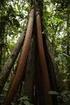
4 Rainforests Text B Rainforests are found on or near the Equator. This means there are no changing seasons, and all year round there are 12 hours of hot sunshine and 12 hours of night. Because of this the trees grow very tall, and have dense leaves all year round. The wood from these tall trees is very beautiful and very strong. If the timber is sold it can get a high price. The trees do not have many lower branches so the mid layer of the forest is full of long straight bare trunks. The leaves that can be seen come from creepers and climbers, which use the trees for support as they grow up to find the light. The tree tops stand out from the main forest canopy and this emergent layer is metres above the ground. The sun is very hot. The heavy rain makes the branches slippery and the trees sway in the strong winds. This is home to birds with strong talons and wide wing spans. These birds can fly long distances in search of food. Some birds are carnivores. For example, Harpy Eagles catch small monkeys for food. The enormously tall trees growing in shallow soil have adapted by developing surface roots at the bottom. These roots stick out a long way and make a triangular shaped support,like the ones you see on old buildings, so they are called buttress roots. In the gloom trying to move amongst these roots and the trailing plants (lianas) is very difficult. The rainforests have been left undisturbed until recently, because it is difficult for people to move around. Living metres above the ground in the canopy presents many challenges. The animals living here have had to adapt in very special ways to take advantage of this unique environment. The huge supply of fruits, nuts and seeds, and the fact that there are not so many predators, make it worth the effort. Rainforests are under threat from people. The huge trees provide valuable wood like mahogany, and in many areas trees are cut down to provide an income. As more people need homes, forests are being cleared to make room for new towns. Once they have been destroyed, these huge, fascinating and valuable environments will be lost for ever. If you want to find out more visit :

5 Rainforests Alternative Text B Rainforests are found on or near the Equator. This means there are no changing seasons. All year round there are 12 hours of hot sunshine and 12 hours of night. This means that the trees grow very tall, and have leaves all year round. The wood from these tall trees is very beautiful and very strong. If the timber is sold it can get a high price. The trees do not have many lower branches so the mid layer of the forest is full of long straight bare trunks. The leaves that can be seen come from creepers and climbers, which use the trees for support as they grow up to find the light. The tree tops stand out from the main forest canopy and this emergent layer is metres above the ground. The sun is very hot. The heavy rain makes the branches slippery and the trees sway in the strong winds. This is home to birds with strong talons and wide wing spans. These birds can fly long distances in search of food. Some birds are carnivores. For example, Harpy Eagles catch small monkeys for food. The tall trees grow in shallow soil. They have adapted by developing surface roots at the bottom. These roots stick out a long way and make a triangular shaped support so they are called buttress roots. In the gloom it is difficult to move amongst these roots and the trailing plants called lianas.. The rainforests have been left undisturbed until recently, because it is difficult for people to move around. Living metres above the ground in the canopy presents many challenges. The animals living here have had to adapt in very special ways. The good news is that there is a huge supply of fruits, nuts and seeds. There are not many predators so it is a safe place to live. Rainforests are under threat from people. The huge trees provide valuable wood like mahogany, and in many areas trees are being cut down. As more people need homes, forests are being cleared to make room for new towns. Once they have been destroyed, these huge, fascinating and valuable environments will be lost for ever.

6 Rainforests Text C Rainforests are in low lying areas near to the equator. Some forests extend higher up the hill sides and are called cloud forests. The true rain forests are sometimes called jungles. When you think of a jungle you think of many plants growing around and into each other.the giant leafy trees absorb some of the carbon dioxide which we produce when we drive cars, fly in planes, or use electricity. Many species of plants living in the rainforest cannot grow anywhere else, and many plants contain useful chemicals which we use as medicines. The hot wet climate is also good for growing plants that can raise a lot of money. If the trees are cut down coffee and cocoa can be grown. Some coffee and cocoa companies try to make sure that they do not harm the rainforest - if you look on the labels you will sometimes see Rainforest Alliance or other information about how the crops are grown. The trees are so tall that going up and down to the floor would use huge amounts of energy. Instead many animals have adapted with ways of moving from tree to tree in the canopy without ever needing to go down to the floor. Gibbons have flexible shoulders, long arms and a very good grip so they can swing from tree to tree. Flying snakes can flatten out their ribs to enable them to glide short distances. It is not easy for birds because of all the trees and branches; Macaws have short wings to enable them to fly amongst the dense foliage. Below the canopy the air is damp, and little light gets though. For those who cannot swing or fly, the tall straight trunks are the pathways from top to bottom. These animals have adapted to climb easily. The tree frogs have sticky pads on their feet to give them a good grip. Silky Anteaters have long curly tails which wrap around the trunks and keep them safe while they sleep on the tree trunks.the Three Toed Sloth has long claws and can sleep hanging from a branch. They also move slowly to save energy and so they do not have to find much food. In the dark of the mid-layer the animals are often brightly coloured. They are also very noisy as they call to each other. Howler Monkeys are one of the noisiest creatures in the rain forest. This is not a place to visit for a quiet rest.

7 Rainforests or jungles are near to the equator in low lying areas. When you think of a jungle you think of many plants growing around and into each other.the giant leafy trees use some of the carbon dioxide which we produce when we drive cars or fly in planes. Many plants living in the rainforest cannot grow anywhere else. These plants contain useful chemicals which we use as medicines. The hot wet climate is also good for growing plants like coffee and cocoa can be grown but the big trees have to be cut down. Some coffee and cocoa companies try to make sure that they do not harm the rainforest. The trees are so tall that going up and down from the top to bottom would use huge amounts of energy. Instead many animals have adapted with ways of moving from tree to tree in the canopy without ever needing to go down to the forest floor. Gibbons have flexible shoulders, long arms and a very good grip so they can swing from tree to tree. Flying snakes can flatten out their ribs to enable them to glide short distances. It is not easy for birds because of all the trees and branches; Macaws have short wings to enable them to fly amongst the dense foliage. Toucans don t fly at all but they hop. Below the canopy the air is damp, and little light gets though. For those who cannot swing or fly, the tall straight trunks are pathways from top to bottom. Some animals have adapted to climb easily. The tree frogs have sticky pads on their feet to give them a good grip. Silky Anteaters have long curly tails which wrap around the trunks and keep them safe while they sleep on the tree trunks.the Three Toed Sloth has long claws and can sleep hanging from a branch. They also move slowly to save energy and so they do not have to find much food. In the dark of the mid-layer the animals are often brightly coloured. They are also very noisy as they call to each other. Howler Monkeys are one of the noisiest creatures in the rain forest. This is not a place to visit for a quiet rest. AlternativeText C

8 Rainforest Grid - write notes from the text you have read then compare notes with the rest of your group. Layer conditions animals plants adaptations emergent layer tree tops canopy mid layer forest floor

9 Fold the labels in half and with a partner sort the photographs to match. Emergent layer Canopy Mid layer Forest Floor (the tree tops) (under the canopy) Fold the labels in half and with a partner sort the photographs to match. Emergent layer Canopy Mid layer Forest Floor (the tree tops) (under the canopy)

10 Macaw night monkey Sugar glider Sloth Silky Anteater Poison Frog Lancehead snake Bromeliad (Epiphyte) Gibbon

11 Hoatzin Bird Gabon viper Harpy Eagle Fittonia Flying frog Banded Pitta Tarsier Buttress roots Liana

12 Layer conditions animals plants adaptations emergent layer tree tops metres above the gound Hot and sunny Windy Eagles, large birds Harpy Eagle Monkeys The tops of the forest trees Huge wing span Sharp talons canopy metres above the gound Thick green leaves Branches full of plants Wet Dark Macaws Gibbons Flying Frogs Flyng snakes Monkeys The main leaf covered branches of the forest trees. Epiphytes including orchids Short wingspan A ribcage that flattens to enable flight Flexible shoulders and long arms and good grip mid layer Underneath the main canopy Straight tree trunks, lots of creepers Very dark - especially at night Silky Anteaters Bats Sloths Tree frogs The trunks of the forest trees Epiphytes including Bromeliads Lianas (creepers) Sticky pads on feet Strong claws Huge eyes Radar Fast growing to get to light Slow moving to save energy forest floor Ground level. Very dark especially at night Damp air Poor soil Huge tree roots Banded Pitta Bird Gabon Viper Lancehead Snake The roots of the forest trees Fittonia Good eyesight. Good camouflage Huge triangular roots Red colouring on leaves Heat sensors to sense prey

The Parts of a Flower
 The Parts of a Flower Developed by Steve Cooke. The webaddress for this activity is: Last updated 7th November 2008 Teacher notes You might need to enlarge the diagram and the labels to A3 to make them
Cells Connect Four Game
 Cells Connect Four Game Developed by Liz Haslam with help from her science colleagues in Tameside. You need to enlarge the board to A3. We have provided two sets of cards with different coloured writing
Developed by Mike Roy at Morpeth School in LB of Tower Hamlets
 The Periodic Table Developed by Mike Roy at Morpeth School in LB of Tower Hamlets The webaddress for this activity is: http:// COLLABORATIVE LEARNING PROJECT Project Director: Stuart Scott Supporting a
Who Eats What in the Woods?
 Who Eats What in the Woods? Developed with teachers at Tolworth Junior School in Kingston upon Thames in 2000. The webaddress for this activity is; Last updated 26th February 2008 This activity has now
If you would like more biome reading comprehensions like this, check out my Biome Bundle. It is on sale for 50% off for 3 days only!
 If you would like more biome reading comprehensions like this, check out my Biome Bundle. It is on sale for 50% off for 3 days only! Includes: Coral Reefs Deserts Grasslands Arctic Tundra Wetlands Rainforest
Harry and the Robots Ian Whybrow and Adrian Reynolds Picture Puffin ISBN 0-140-56982-0
 Ian Whybrow and Adrian Reynolds Picture Puffin ISBN 0-140-56982-0 I ran a workshop in Leicester with Sharman Bailey (G and T consultant) and Kirstie Randle (Foundation Stage consultant) on 9th May 2008.
Emerald Tree Boa: Emerald Tree Boas are bright green to blend in with their habitat. They are part of the boa family and are constrictors.
 Anaconda: The anaconda lives in the swamps and rivers. Anacondas can also climb trees. Adults can get as big as 20 feet long. Anacondas are good swimmers. They have scales and can swim quickly. They kill
Tropical rainforests grow in areas of high rainfall, they are found between the Tropic of Cancer and the Tropic of Capricorn.
 Tracking KS3 the Tropics In our Tropical Rainforest Biome you will discover how plants, animals and people of the Tropical Rainforest fit together. Let s Start! Look point 1 (Map on Left as you enter the
Go through the instructions with the class, and give each group of pupils a copy of these instructions.
 Punctuation Games These games were the brainchildren of Rhona Dwyer, English Teacher and Wendy Robinson (confirming our belief that teachers working together are more than twice as creative!) when at The
Wombat Diaries. Practising diary entry speaking and listening, with big and little voices, as a prequel to animal diary writing.
 Wombat Diaries I laid an egg. Practising diary entry speaking and listening, with big and little voices, as a prequel to animal diary writing. Wombat Diaries Designed for Year 2 at St Francis Catholic
Tropical Tracks. Tropical rainforests are located along the Equator. Look at the map in the Biome. Draw the Equator on your map and label it.
 Tropical Tracks KS2 In Eden s Rainforest Biome you will discover how plants, animals and people of the Tropical Rainforest fit together. Let s Start! Look Point 1 (The Map, grid reference 175 482) Tropical
Clovis? Finn? Maia? The Professor? selfish collects things. greedy. loves money. tells lies to get what they want. very clever. is good at pretending
 Journey to the River Sea Characters Connect Four? greedy selfish collects things? loves money very clever is good at pretending likes dressing up likes learning The Professor?? Journey to the River Sea
Exhibit Inquiry. Rainforest. Aug 11
 Exhibit Inquiry Exhibit Inquiry Have students look for the following exhibits related to living things during their visit to the Ontario Science Centre: Where to go: (Level 6) What it's about: Tropical
KS2 Rainforest Activities
 KS2 Rainforest Activities Pack Contents Teachers notes 3 Rainforest plants activity (Tropical World) 4 Rainforest plants answer sheet 6 Rainforest animals activity 8 Rainforest animals answer sheet 9 Map
What Are Rainforests?
 What Are Rainforests? Where are tropical rainforests located? Tropical rainforests are located close to the Equator between the Tropic of Cancer and the Tropic of Capricorn. This means that it is always
Friction Sorting Activity
 Friction Sorting Activity Not much friction? A lot of friction? a tight ring stuck on your finger Useful? skidding on a wet road striking a match oil on a bicycle chain a landslide of wet mud and rocks
Simple to Complex Sentences
 Simple to Complex Sentences Devised by Liz Taylor, Advisory Teacher in Suffolk and Stuart Scott in January 2002. Every player has the same list of six simple sentences. Players take turns to pick a card.
WEATHER, CLIMATE AND ADAPTATIONS OF ANIMALS TO CLIMATE
 7 WEATHER, CLIMATE AND ADAPTATIONS OF ANIMALS TO CLIMATE TEXTBOOK QUESTIONS AND ANSWERS Q.1. Why weather changes so frequently? Ans. All changes in the weather are caused by the sun. The movement of the
Ranger Report About Tropical Rainforest (in Costa Rica)
 1. Ranger Report About Tropical Rainforest (in Costa Rica) www. Therainforestrangers.com About Rainforest Images by Jan Dwire A rainforest is an environment that receives high rainfall and is dominated
Layers of the Rain Forest Distance Learning
 Layers of the Rain Forest Distance Learning Summary and Goals Students will be able to identify the layers of the rain forest and animal species that live in each layer. Grade Levels Grades 3-5 Engage
THE TROPICAL HOUSE RAINFOREST TEACHER'S NOTES
 THE TROPICAL HOUSE RAINFOREST TEACHER'S NOTES TEACHER'S NOTES THE TROPICAL HOUSE (Area 3 on map) INTRODUCTION to the RAINFOREST. There are three main rainforest areas: - 1. Central and South America 2.
Key Idea 2: Ecosystems
 Key Idea 2: Ecosystems Ecosystems An ecosystem is a living community of plants and animals sharing an environment with non-living elements such as climate and soil. An example of a small scale ecosystem
Structures of animals
 Structures of animals Name: All animals have been designed with different parts, which we call structures, that make up their bodies. Each of these structures is important as it is used to perform a specific
Aztec Religion. Reading for Meaning and Sequencing Activity. http://www.collaborativelearning.org/aztecreligion.pdf
 Aztec Religion. Reading for Meaning and Sequencing Activity Aztec Religion. Developed in the 1990s by Judith Evans, Steve Ridgewell and Steve Cooke to support Leicester schools. Webaddress: www.collaborativelearning.org/aztecreligion.pdf
The Tropical Rainforest Rainforest Series, Part 1 - by Mikki Sadil
 Rainforest Series, Part 1 - Tropical rainforests are among the most mysterious of all geographical biomes in the world. A biome is an area with very distinctive plants and animals that have adapted to
ANIMALS AND THEIR HABITATS: KS1 STUDENT RESOURCES
 ANIMALS AND THEIR HABITATS: KS1 STUDENT RESOURCES PLANT OR ANIMAL? (Lesson 1:1) Card sort task: print out and get the students to sort them into: Plants or Animals. Get the students to explain why they
Blood Circulation Game
 Blood Circulation Game Developed by June Agar at Rushey Mead School in Leicester. All the bits are here to make a board game, but some work by you and/or your children is needed. You might want to consider
AWESOME ADAPTATIONS WORKSHEETS. for. Rainforest Desert Mediterranean
 AWESOME ADAPTATIONS WORKSHEETS for Rainforest Desert Mediterranean IN THE RAINFOREST Write a sentence to record your experience in the Tropical House IT FEELS. IT SMELLS. THE TEMPERATURE is IT MAKES ME
Verbs or Nouns? Adverbial or Adjectival Functions?
 Verbs or Nouns? Adverbial or Adjectival Functions? This is an attempt to focus more on the functions of portions of written sentences and examine how they relate to each other rather than just classifying
Layers. Forest floor, canopy, and more!
 Layers Forest floor, canopy, and more! Introduction When I was nine, I went to a museum about wildlife and there was part of the museum that was about rain forests and it had some plants that lived in
Fry Phrases Set 1. TeacherHelpForParents.com help for all areas of your child s education
 Set 1 The people Write it down By the water Who will make it? You and I What will they do? He called me. We had their dog. What did they say? When would you go? No way A number of people One or two How
ELEMENTARY-LEVEL SCIENCE TEST
 4THE UNIVERSITY OF THE STATE OF NEW YORK SPRING 2008 GRADE 4 ELEMENTARY-LEVEL SCIENCE TEST WRITTEN TEST Student Name School Name Print your name and the name of your school on the lines above. The test
Kindergarten Science Unit B: Life Science Chapter 4: Plant and Animal Parts Lesson 1: What do plant parts do?
 Insert Photo or Graphic for Unit or Lesson Theme Kindergarten Science Unit B: Life Science Chapter 4: Plant and Animal Parts Lesson 1: What do plant parts do? Insert Photo/Graphic parts Insert Photo/Graphic
Silent, Nighttime Hunters By Guy Belleranti
 By Guy Belleranti Owls are raptors, or birds of prey. They are carnivores who quickly and silently swoop down on their prey from above. Most raptors such as eagles, hawks and falcons are day hunters. They
Animal Adaptations Investigation (K-3)
 Animal Adaptations Investigation (K-3) At a glance Students explore the Zoo in search of animals that fit certain categories and discover their adaptations. Time requirement One Zoo visit of at least 60
Unit 6 - Habitats. Kinds of habitats
 Unit 6 - Habitats A habitat is a place where certain organisms (plant and animal species) naturally live and grow. Like your home, habitats support life by providing the food, water and shelter that its
Rain Forests. America's. Web of Life. Rain Forest Ecology. Prince William Network's OVERVIEW OBJECTIVES SUBJECTS
 Rain Forest Ecology National Science Education Standards Standard C: Life Sciences Populations and ecosystems. Standard C: Life Sciences Diversity and adaptation of organisms. Standard F: Science in Personal
Tropical Rainforest. Abiotic Factors Amount of Water, Sunlight, Soil, Precipitation
 World Biomes A biome is an area of land that shares similar temperatures and precipitation. The observation of the temperature and precipitation over a period time make up a biome s climate. Each biome
ADAPTATION: A WAY OF LIFE
 PLANT AND ANIMAL DESERT ADAPTATIONS Activities that show how desert plants and animals are welladapted to life in the desert and thrive with little moisture and high temperatures. ARIZONA SCIENCE STANDARDS
How the Indus Valley sites were discovered.
 How the Indus Valley sites were discovered. Devised by Judith Evans at Rosebery School in Loughborough. The Commonwealth Institute in London has produced some excellent source material for the Indus Valley
totally Tropical Rainforest Outreach Guide Sponsored By
 totally Tropical Rainforest Outreach Guide Sponsored By Pre-Visit Checklist Review the Background Information with your students before the Zoo s visit. Review the enclosed Lesson Plans which compliment
Name That Adaptation. Background: Link to the Plan Read Section 5 (Whooping Crane Ecology and Biology) in the Management Plan
 Summary Students will explore structural, physiological, and behavioral adaptations of whooping cranes. Objectives: Students will be able to: Define an adaptation Describe several whooping crane adaptations
By Gerald Urquhart, Walter Chomentowski, David Skole, and Chris Barber http://earthobservatory.nasa.gov/library/deforestation/
 By Gerald Urquhart, Walter Chomentowski, David Skole, and Chris Barber http://earthobservatory.nasa.gov/library/deforestation/ The clearing of tropical forests across the Earth has been occurring on a
Unit 4 - Shelter. Plants
 Unit 4 - Shelter Shelter is one of the elements of survival, along with food and water. Shelter offers people safety and security. Often a person s shelter is a reflection of their personal habitat. Outside
Arachne versus Athene Introduce Me and Drama Activities
 Arachne versus Athene Introduce Me and Drama Activities I live in a small horrible village in Greece. My father is poor and silly. I think I should live in a palace. I love to weave cloth. I am the best
Tropical Forest Ecosystems
 Unit 2 TROPICAL FOREST ECOSYSTEMS Focus questions What is a tropical rainforest? What roles do arthropods play in the rainforest ecosystem? What are green and brown food webs and how are they connected?
Curriculum links. Learning objective. Introduction
 enses Curriculum links cience c2:1b Life processes, animals (including humans) use their senses to understand the world. nglish 1b peaking, to choose words with precision Learning objective To explore
4THE UNIVERSITY OF THE STATE OF NEW YORK
 4THE UNIVERSITY OF THE STATE OF NEW YORK GRADE 4 ELEMENTARY-LEVEL SCIENCE TEST WRITTEN TEST JUNE 6, 2011 Student Name School Name Print your name and the name of your school on the lines above. The test
PUSD High Frequency Word List
 PUSD High Frequency Word List For Reading and Spelling Grades K-5 High Frequency or instant words are important because: 1. You can t read a sentence or a paragraph without knowing at least the most common.
Humidity the story for teachers
 Humidity the story for teachers As we have learned earlier, water may exist as a gas (water vapour). Even in the driest desert there is some water vapour in the air. Water vapour is the most important
Rainforest Concern Module 2 Why do we need rainforests?
 Rainforest Concern Module 2 Why do we need rainforests? Rainforest Concern Module 2: Why do we need Rainforest? Before we go any further, there are some words you may not understand, and these words and
Wetlands by Leslie Cargile
 Name: by Leslie Cargile What do the bogs in Ireland, the marshes in South Carolina, and the swamps of Louisiana have in common? If you said they re all wetlands, you d be right! are any land that is flooded
10B Plant Systems Guided Practice
 10B Plant Systems Guided Practice Reproduction Station 1 1. Observe Plant A. Locate the following parts of the flower: stamen, stigma, style, ovary. 2. Draw and label the parts of a flower (listed above)
The Plural Machine and One or more than One Spelling Game.
 The Plural Machine and One or more than One Spelling Game. Produced by Liz Taylor, Advisory Teacher in Suffolk and Stuart Scott. For those of you who have tried out the ing and ed tree the plural machine
Consider How can you collect solar energy for use in your school? What are other alternatives?
 5 a 5 Energy Sources a - Energy from the sun Purpose To explore sourcing our energy from the sun Key concepts Solar energy is a natural and renewable resource Heat energy from the sun can be used to heat
Wild About... Frogs and Frogspawn
 a Wild About... Rutland County Council Nature notes Frogs belong to a group of animals called amphibians, which also includes newts and toads. Amphibians live both on land and in water. Water is needed
Worksheet A Environmental Problems
 Worksheet A Environmental Problems Vocabulary Can you talk about Environmental issues in English? With a partner, try to explain the terms in the diagram below. Why are the words divided into two groups
Originally devised by Melanie Hart and Nancy Lycett when at Rokeby School in London Borough of Newham in 1995.
 Love Poetry Originally devised by Melanie Hart and Nancy Lycett when at Rokeby School in London Borough of Newham in 1995. COLLABORATIVE LEARNING PROJECT Project Director: Stuart Scott We support a network
2. Identify each using the letters below using BD for the Bald Eagle, G for the Golden Eagle, H for the Harpy Eagle, and BT for the Bateleur Eagle.
 Eagle Quest Name SITE: American Eagle Foundation 1. How many species of eagles are found on Earth? 2. Identify each using the letters below using BD for the Bald Eagle, G for the Golden Eagle, H for the
Plants Scavenger Hunt Activity
 Name: Plants Activity Materials: Question worksheet (pages 2-3) 16 Fact Cards (pages 4-8) Tape, Scissors, Classroom Preparation: Print the fact cards on card stock or brightly-colored paper and cut them
Animal Adaptations -- Vocabulary
 Section 1 Objectives o Children will understand what animal adaptations are. o Children will be able to explain why animal adaptations are important. o Children will be able to explain different types
Lesson _1_ of _1_ Topic: Vocabulary Acquisition Teaching Date: TBD. Subject/Course: Language Arts Grade Level: 2 Time Frame: 1:00pm 1:25pm
 Unit: Guided Reading Designer: Sarah Williams Lesson _1_ of _1_ Topic: Vocabulary Acquisition Teaching Date: TBD Subject/Course: Language Arts Grade Level: 2 Time Frame: 1:00pm 1:25pm Context: The intervention
5.1 Ecosystems, Energy, and Nutrients
 CHAPTER 5 ECOSYSTEMS 5.1 Ecosystems, Energy, and Nutrients Did anyone ever ask you the question: Where do you get your energy? Energy enters our world from the Sun but how does the Sun s energy become
4th GRADE MINIMUM CONTENTS-NATURAL SCIENCE UNIT 11: PLANTS
 PLANT BITS 4th GRADE MINIMUM CONTENTS-NATURAL SCIENCE UNIT 11: PLANTS There are four main parts to a plant. They are the root, stem, leaf and flower. Each part has an important task to do in the life of
Plants, like all other living organisms have basic needs: a source of nutrition (food),
 LEARNING FROM LEAVES: A LOOK AT LEAF SIZE Grades 3 6 I. Introduction Plants, like all other living organisms have basic needs: a source of nutrition (food), water, space in which to live, air, and optimal
What is a food chain?
 3 What is a food chain? Learning Intention Understand that plants and animals in a habitat are dependent on each other. National Curriculum Skills Science Interdependence of living organisms in those 2
Water from the Air: Cloud Forests
 Water from the Air: Cloud Forests Alden Wicker Water from the Air: Cloud Forests In the Americas, Asia, and Africa, there s a special kind of forest. It s rare, beautiful, and incredibly important to the
Zoo Connections Curriculum
 Zoo Connections Curriculum We Like to Move It, Move It: Classifying animals by features 1 st grade Curriculum is aligned with the Mississippi Academic Framework. Lessons and support material are provided
Plants, like all living organisms have basic needs: a source of nutrition (food), water,
 WHAT PLANTS NEED IN ORDER TO SURVIVE AND GROW: LIGHT Grades 3 6 I. Introduction Plants, like all living organisms have basic needs: a source of nutrition (food), water, space in which to live, air, and
These pages build on Units 2B & C and introduce predator-prey relationships and food chains.
 Unit 4B Habitats Teaching Notes These pages build on Units 2B & C and introduce predator-prey relationships and food chains. Curriculum, resource and other links Sc1 & Sc2 Resources Associated with this
Unit: Plants & Animals (Grade 2)
 Unit: Plants & Animals (Grade 2) Content Area: Science Course(s): Science Time Period: 8 weeks Length: Weeks Status: Published Unit Overview Students will determine the life cycles of plants and animals
Today, we re going to tackle your GUM U7, L2 & L3 Cause and Effect Essay! Chat me your best sentence using the word conscientious.
 Good Morning Conscientious 7 th Graders! Today, we re going to tackle your GUM U7, L2 & L3 Cause and Effect Essay! Chat me your best sentence using the word conscientious. Rainforest Destruction: Causes
Would you rather Game
 rather Game This activity was originally developed by Gillian Blatherwick at Rushey Mead Primary School in the City of Leicester. It is designed to be used with John Burningham s book of the same name.
Owls. Choose words from the list at the end of the page to fill in the blank spaces.
 Owls Choose words from the list at the end of the page to fill in the blank spaces. Owls are _ of prey. A bird of prey is one that catches its food in its Owls hunt for their at night. A bird that hunts
Smithsonian Books, 2001. 1 Groves, Colin P. Primate Taxonomy. Smithsonian Series in Comparative Evolutionary Biology. Washington, D.C.
 Primates at Woodland Park Zoo Pre-visit Information for Teachers If you are planning a field trip to the zoo and wish to have your students focus on or study primates during their zoo visit, this pre-visit
Tropical Rainforest Food Web Game
 Tropical Rainforest Food Web Game Teacher Background This is an interactive, role-playing game, using the plants and animals of the Amazon rainforest. In this Game there are no winners or losers. Instead,
Regional Parks Botanic Garden Plant Adaptations to Habitat Tour: Selected Plant Adaptations by Garden Section
 INTRO Regional Parks Botanic Garden Plant Adaptations to Habitat Tour: Selected Plant Adaptations by Garden Section Tools (optional, but nice to use): -Discovery Scope -Spray bottle of water--from the
Plant Parts. Background Information
 Purpose The purpose of this lesson is for students to learn the six basic plant parts and their functions. Time Teacher Preparation: 30 minutes Student Activity: 60 minutes Materials For the teacher demonstration:
Growing Cocoa Beans. Growing Region
 Growing Cocoa Beans All chocolate begins with cocoa beans, the fruit of the cacao tree (also called a cocoa tree). Scientists know that the cacao tree originated somewhere in South or Central America.
Alike and Different... 1. Layers of the Rainforests... 4. Animals of Tropical Rainforests... 7. Animals of Temperate Rainforests...
 Chapter one Alike and Different................. 1 Chapter two Layers of the Rainforests............ 4 Chapter three Animals of Tropical Rainforests....... 7 Chapter four Animals of Temperate Rainforests.....
Sunflowers. Name. Level and grade. PrimaryTools.co.uk
 Sunflowers Name Score Level and grade 2012 Contents Billy s Sunflower... 3 A story by Nicola Moon So Many Sunflowers!... 14 Vincent Van Gogh... 15 Information about the artist Making a Paper Sunflower...
1 SEEDLING QUALITY. Seedling quality
 Seedling quality Quality versus quantity A nursery manager s most important goal is to produce quality trees. Quality is more important than quantity. It is a common mistake in nurseries to concentrate
First Grade Reading Street Unit 2.1: A Big Fish for Max - Taken from www.freidalewis.com
 1. Max Ruby s little brother 2. Ruby - Max s big sister who is sometimes a bit bossy 3. Grandma helps Max and Ruby solve their problems Segment and Count Phonemes Digraphs sh, th, and Vowel Sound in ball
Animals that move slowly, animals that move quickly
 Unit Three Time 74 Animals that move slowly, animals that move quickly Unit 3: Time Image courtesy of: Microsoft clipart Focus: Animals that move slowly and quickly linked with time Whole class activity
Rainforest Alliance Learning Site Third Grade-Lesson 2 1 www.rainforest-alliance.org/education
 Third Grade Ecuadorian Rainforest National Standards for Grade 3 Lessons Language Arts Writing Standard 4 Level 2 Grade 3-5 2. 3. 4. Gathers and uses information for research purposes (encyclopedias, dictionaries,
Roots and Stems and Leaves, Oh My!
 Roots and Stems and Leaves, Oh My! Objectives 1. The student will be able to identify parts of a plant. 2. The student will understand the function of plant parts. Grade Level 1-3 4-6 TEKS: 1.6B, 2.6C;
Let s Learn About Plants and Animals!
 Grade Two Pre-Visit Activities Let s Learn About Plants and Animals! i. Teacher Introduction ii. Standards Addressed iii. Pre-Visit Activities 1. Identifying Parts of a Plant 2. Plant a Seed 3. Life Cycles
2 nd Grade Science Unit B: Life Sciences Chapter 3: Plants and Animals in Their Environment Lesson 1: How are plants and animals like their parents?
 2 nd Grade Science Unit B: Life Sciences Chapter 3: Plants and Animals in Their Environment Lesson 1: How are plants and animals like their parents? offspring Offspring are young plants and animals. Offspring
My favourite animal is the cheetah. It lives in Africa in the savannah, It eats and gazel es. It is big and yel ow with black spots.
 The crocodile is big and green. It has got a long tail, a long body and a big mouth with big teeth. It has got four short legs. The crocodile eats fish and other animals. He lives in Africa and America,
KS2 Habitats Tropical Rainforests Information and guidance for teachers
 One of our young Sumatran Orangutans born in 2004 KS2 Habitats Tropical Rainforests Information and guidance for teachers Contents Learning objectives Lesson plan Curriculum links Suggested activities
Granite. A Rocky Journey and Talking Rocks Role play and sorting clues.
 A Rocky Journey and Talking Rocks Role play and sorting clues. Granite I am grey or sometimes pink in colour. I am made up of big coarse particles. I have big crystals in me. People use me for buildings
Use this diagram of a food web to answer questions 1 through 5.
 North arolina Testing Program EO iology Sample Items Goal 4 Use this diagram of a food web to answer questions 1 through 5. coyotes 3. If these organisms were arranged in a food pyramid, which organism
English Language Arts Book 3
 English Language Arts Grade 6 Sample Test 2005 Name TIPS FOR TAKING THE SAMPLE TEST Here are some suggestions to help you do your best: Be sure to read carefully all the directions in the test book. Plan
Overview. Suggested Lesson Please see the Greenlinks Module description.
 Overview Plants interact with their environment in many ways that we cannot see. Children often enjoy learning about these hidden secrets of plant life. In this lesson, children will learn about role of
Butterfly Lion - Michael Morpurgo
 Butterfly Lion - Michael Morpurgo This activity was developed as a prequel to reading or as an encouragement to reading this transition text. The webadress for this activity is: This activity was last
Producers, Consumers, and Food Webs
 reflect Think about the last meal you ate. Where did the food come from? Maybe it came from the grocery store or a restaurant. Maybe it even came from your backyard. Now think of a lion living on the plains
Grassland Food Webs: Teacher Notes
 Grassland Food Webs: Teacher Notes Alan Henderson ecosystem Objectives After completing this activity students will be able to: Create a food web and identify producers and consumers. Assign organisms