
SuperTracker Nutrition Lesson Plans for High School Students.
|
|
|
- Tamsyn O’Brien’
- 10 years ago
- Views:
Transcription
1 United States Department of Agriculture SuperTracker Nutrition Lesson Plans for High School Students October 2014 USDA is an equal opportunity provider and employer.

2 Contents Background... 5 About SuperTracker... 5 Lesson Plan Overview... 6 Audience... 6 Purpose... 6 Subject Focus... 6 Standards... 6 Nutrition Overview... 7 Using SuperTracker in a Classroom Setting... 7 Special Considerations for Teenagers... 8 Helpful Resources... 9 SuperTracker Nutrition Lesson Plans Lesson 1: Track Your Snack Time Required: Audience: Lesson Overview Lesson Preparation Lesson Objectives Teaching Instructions Reflection, Evaluation, and Discussion Additional Resources Notes Handout Lesson 2: What s Your Plan? Time Required: Audience: Lesson Overview SuperTracker Nutrition Lesson Plans for High School Students Page 2

3 Lesson Preparation Lesson Objectives Teaching Instructions Reflection, Evaluation, and Discussion Additional Resources Notes Handout Lesson 3: Three-Day Food Record Time Required: Audience: Lesson Overview Lesson Preparation Lesson Objectives Teaching Instructions Reflection, Evaluation, and Discussion Notes Handout Lesson 4: Build Healthy Meals Time Required: Audience: Lesson Overview Lesson Preparation Lesson Objectives Teaching Instructions Reflection, Evaluation, and Discussion Notes Handout Nutrition Glossary Added Sugars SuperTracker Nutrition Lesson Plans for High School Students Page 3

4 Calories Calorie Balance Dairy Empty Calories Food Groups Fruits Grains MyPlate Nutrient Oils Physical Activity Protein Foods Sodium Solid Fats Vegetables Printable Materials SuperTracker Nutrition Lesson Plans for High School Students Page 4

5 Background High school students are increasingly in control over the decisions that influence their health and wellness, and the behaviors they learn throughout childhood and young adulthood will carry on into their adult lives. Teens who are overweight or obese are more likely to be overweight and obese as adults, putting them at risk for chronic diseases such as hypertension, heart disease, and diabetes. While the decision to choose a healthy lifestyle is ultimately up to the individual, teachers have the opportunity to influence their students by providing them with the information they need to make knowledgeable and responsible choices. Teachers are a key resource for disseminating healthy messages, as they play a large role in shaping the views and behaviors that students will use in the future. The, in conjunction with Team Nutrition, developed lesson plans for high school students using the engaging, interactive SuperTracker tool to help students think critically about their food and physical activity choices. We hope that you find these lesson plans to be a useful resource for educating your students about the importance of good nutrition and physical activity! About SuperTracker SuperTracker is a visually appealing, comprehensive, state-of-the-art diet and physical activity tracking tool available at Based on the Dietary Guidelines for Americans, this tool is designed to assist individuals as they make lifestyle changes to reduce the risk of chronic disease and maintain a healthy weight. Using this free, online tool, students can choose a variety of features to support nutrition and physical activity goals, including: 1. Get personalized recommendations for what and how much to eat and optimal amounts of physical activity. 2. Track foods and physical activity from a database of about 8,000 foods and 900 physical activities. 3. Edit nutrition information for SuperTracker foods to better match personal food choices. 4. Build, track, and analyze personal recipes. 5. Track weight over time. SuperTracker Nutrition Lesson Plans for High School Students Page 5

6 6. Set personal goals, sign up for tips and support, and share successes with friends and family using social media. 7. Journal about personal factors and health behaviors. 8. Measure progress with comprehensive reports ranging from a simple meal summary to indepth analysis of food groups and nutrient intake over time. Lesson Plan Overview Audience High school students grades 9-12 Purpose To encourage high school students to build a healthier diet and increase physical activity using the SuperTracker interactive tool. Subject Focus These lesson plans are designed for high school Health, Physical Education, and Family and Consumer Science teachers; however, the resources provided allow any teacher to promote health and wellness in their classrooms, with or without experience in nutrition education. Standards SuperTracker Nutrition Lesson Plans for High School Students are intended to enable students to achieve the following healthy behavior outcomes: Eat the appropriate amounts from each food group every day. Eat a variety of foods within each food group every day. Eat fruits and vegetables every day. Choose to eat whole-grain products and fat-free or low-fat milk or milk products. Eat a variety of foods from the Protein Foods group each week. Limit foods and beverages high in added sugars, solid fat, and sodium. Eat healthy snacks. Prepare food in healthful ways. Balance caloric intake with caloric expenditure. Follow an eating plan for healthy growth and development. Support others to eat healthfully. SuperTracker Nutrition Lesson Plans for High School Students Page 6

7 Nutrition Overview The information provided in these lesson plans covers basic nutrition topics, including: Calories Empty Calories Solid Fats Added Sugars Sodium MyPlate Food Groups o Grains o Vegetables o Fruits o Dairy o Protein Foods Nutrients Detailed definitions and information about each topic listed above can be found in the Nutrition Glossary section starting on page 53 of this document. Using SuperTracker in a Classroom Setting It is important to create a safe, judgment free learning environment for students when using SuperTracker in a classroom setting. Keep in mind that some students may not be comfortable entering sensitive information such as their weight or food choices in front of their peers. The following best practices can help ensure a successful learning experience for students: Do not require students to share their results unless they volunteer to do so. Do not make comments about good foods or bad foods. SuperTracker is designed to provide information about the nutrition content of foods and beverages that allows students to identify healthier options on their own. SuperTracker Nutrition Lesson Plans for High School Students Page 7

8 If desired, instruct students not to enter their height and weight when they create their profile. The system will calculate a plan based on a standard height weight for someone of their age and gender. If desired, skip the personalization step when instructing students to create a profile. All non-personalized profiles will receive a general 2,000 calorie plan. Please note that if students age 18 and under do enter their height and weight, SuperTracker identifies overweight and underweight teens using backend calculations and adjusts their plan recommendations appropriately. This information is handled solely on the backend and is not communicated to users to avoid situations of stigma in the classroom. Special Considerations for Teenagers To encourage students to make healthier food and physical activity choices, it can be helpful to discuss their perceived motivators and barriers. Discussing barriers that are preventing students from making healthy choices can lead to the identification of strategies to overcome these barriers. In the same way, recognizing motivators can help students develop healthy eating strategies that they can stick with over time. Studies show that teenagers commonly report the following motivators and barriers to healthy eating. Ask students about their own motivators and barriers when implementing these lesson plans. Motivators support from family wider availability of healthy foods improving or maintaining appearance Barriers lack of time limited availability of healthy foods lack of concern regarding healthy eating taste preferences SuperTracker Nutrition Lesson Plans for High School Students Page 8

9 Helpful Resources The following resources are available to help introduce your students to SuperTracker. SuperTracker Scavenger Hunt The SuperTracker scavenger hunt (found in the Printable Materials section at the end of this toolkit) is a quick, fun activity that will help students learn the features SuperTracker offers. Link: SuperTracker 10 Tips The SuperTracker 10 Tips handout (found in the Printable Materials section at the end of this toolkit) includes tips and ideas for getting started with SuperTracker. Link: SuperTracker Flyer Post the SuperTracker flyer (found in the Printable Materials section at the end of this toolkit) in common areas such as lunchrooms, bulletin boards, and stairwells to get students excited about the application. SuperTracker Site Tour Videos These short YouTube videos offer step-by-step demonstrations on how to use each SuperTracker feature. Link: SuperTracker User Guide This indepth guide includes instructions for using SuperTracker and details on how it works. Link: SuperTracker Button Click the link below to download a SuperTracker button. Instructions are provided on how to add it to your website, so students can access the site quickly and easily from a webpage they regularly visit. Link: SuperTracker Nutrition Lesson Plans for High School Students Page 9

10 Best Practices for Conducting SuperTracker Trainings Refer to these best practices when conducting SuperTracker trainings for a group. The recommendations are lessons learned from others who have conducted SuperTracker trainings. Link: Best_Practices_for_SuperTracker_Training.pdf SuperTracker Nutrition Lesson Plans The following lesson plans provide exciting and engaging hands-on opportunities for your students to analyze their food intake and to discuss ways to make healthier choices. The lesson plans are stand-alone topics, meaning they can be used out of sequence and individually. You may also use them as a starting point for customizing lesson plans that specifically meet the needs of your students. Each lesson includes preparation steps, learning objectives, teaching instructions, and a handout that students can complete to reflect on the information they have learned. The questions in the handouts typically do not have right or wrong answers. Rather, they are meant to inspire students to reflect on their individual dietary choices and identify areas for personal improvement. SuperTracker Nutrition Lesson Plans for High School Students Page 10

11 Lesson 1: Track Your Snack SuperTracker Nutrition Lesson Plans for High School Students Page 11

12 Lesson 1: Track Your Snack Time Required: 40 minutes Audience: High school students grades 9-12 Lesson Overview In this lesson, the teacher will provide information about what makes a healthy snack, including information about total calories, empty calories, and sodium. The students will use SuperTracker s Food-A-Pedia feature to compare the total calories, empty calories, and sodium content of various snack foods. Students will complete the Track Your Snack handout to reflect on what they ve learned and discover the nutrition content of their favorite snack foods. Lesson Preparation SuperTracker Watch the Food-A-Pedia site tour video, Getting Started: How to Use Food-A-Pedia, on YouTube (2 min. 8 sec.) Link: Review navigation of the SuperTracker website Link: Familiarize yourself with the Food-A-Pedia feature Link: Materials Track Your Snack handout (found at the end of this lesson), copies made for each student Setup Computer with Internet access Screen Lesson Objectives Following this lesson, students will be able to: 1. Summarize why healthy snacking is important. 2. Choose healthier snack options based on their nutritional content (calories, empty calories, and sodium). 3. Explain the importance of monitoring total calorie, empty calorie, and sodium intake in their diet. SuperTracker Nutrition Lesson Plans for High School Students Page 12

13 Teaching Instructions 1. Review the learning objectives. 2. Provide information about healthy snacking. o Snacks can help you get the nutrients you need to grow and maintain a healthy weight. o Choose a variety of snacks from each of the five food groups over the course of a week. Examples from each food group include: Grains Vegetables Fruits Dairy Protein Foods whole grain crackers, cereal, rice cakes, sliced bread, mini bagels, graham crackers, whole wheat tortillas carrots, celery, bell pepper, cherry tomatoes, broccoli, green beans, sugar peas, avocados apple, tangerine, strawberry, banana, pineapple, kiwi, peach, mango, nectarine, melon, grapes, berries, dried apricots low-fat cheese slices or string cheese, yogurt, fat-free or low-fat milk, lowfat cottage cheese boiled egg, peanut butter, bean dip, hummus, slices of lean turkey or chicken, pumpkin seeds o Choose snacks that are lower in calories. Calories are the measure of energy a food or beverage provides from the carbohydrate, fat, and protein it contains. Calories are the fuel you need to work and play. Foods and beverages vary in how many calories and nutrients they contain. When choosing what to eat and drink, it's important to get the right mix enough nutrients, but not too many calories. You will gain weight when the calories you eat and drink are greater than the calories you burn. The current high rates of overweight and obesity in the United States mean that many people are taking in more calories than they burn. o Choose snacks that have little to no empty calories. Empty calories add calories to a food but few or no nutrients. Empty calories come from solid fats and added sugars. Solid fats are fats that are solid at room temperature, like butter and shortening. Most solid fats are high in saturated fats and/or trans fats, which can increase the risk for heart disease. SuperTracker Nutrition Lesson Plans for High School Students Page 13

14 Added sugars are sugars and syrups that are added to foods or beverages when they are processed or prepared. This does not include naturally occurring sugars such as those in milk and fruits. In some foods, like most candies and sodas, all the calories are empty calories. Empty calories can also be found in some other foods that contain important nutrients. For example, a fruit cup packed in syrup has empty calories (from added sugars), whereas a fruit cup packed in water does not, and whole milk has empty calories (from solid fats), whereas skim milk does not. o Choose snacks that are lower in sodium. Try to choose snacks with less than 200 milligrams (mg) of sodium per serving. Sodium is found in salt. Too much sodium is bad for your health. It can increase your blood pressure and your risk for a heart attack and stroke. Heart disease and stroke are the leading causes of death in the United States. Eating less sodium can reduce risk for high blood pressure. 3. Demonstrate the Food-A-Pedia feature by showing the Getting Started: How to Use Food-A- Pedia SuperTracker site tour video available on YouTube (2 min. 8 sec.). Link: 4. Go to the SuperTracker website. Link: 5. Show students how to navigate to the Food-A-Pedia feature. 6. Demonstrate how to search for a food using Food-A-Pedia. For example, search for the food nachos and select Nachos, with beef and cheese. SuperTracker Nutrition Lesson Plans for High School Students Page 14

15 7. Show students where to find the (1) total calories, (2) food groups, (3) empty calories, and (4) sodium content. SuperTracker Nutrition Lesson Plans for High School Students Page 15

16 8. Show students how to compare two foods. For example, compare 1 cup of Milk, fat free (skim) to 1 cup of Milk, whole. 9. Point out the differences in total calories, empty calories, and sodium between the two foods. 1 cup of skim milk 1 cup of whole milk Total Calories 83 calories 149 calories Empty Calories 0 calories 63 calories Sodium 103 mg 105 mg 10. Show students how to compare 1 bottle (12 fl oz) of Powerade sports drink to 1 bottle (12 fl oz) of Water, bottled unsweetened. SuperTracker Nutrition Lesson Plans for High School Students Page 16

17 11. Point out the differences in total calories, empty calories, and sodium between these two beverages. 12 fluid ounce bottle of sports drink 12 fluid ounce bottle of water Total Calories 117 calories 0 calories Empty Calories 85 calories 0 calories Sodium 80 mg 7 mg 12. Ask students to make a list of snack foods that have less than 200 calories per portion, contribute to at least one food group, and have less than 200 mg sodium per portion. Use Food-A-Pedia to determine whether the snacks suggested meet these criteria. 13. Distribute the Track Your Snack handout to students. 14. Assign homework: Students will analyze, review, and compare their favorite snack items using Food-A- Pedia. Students will complete the Track Your Snack handout, which requires them to use Food-A-Pedia to learn about the healthfulness of snack choices. SuperTracker Nutrition Lesson Plans for High School Students Page 17

18 Reflection, Evaluation, and Discussion The teacher will summarize what the students were taught. The teacher will restate and summarize the learning objectives. The teacher will encourage students to reflect on the topics learned by asking discussion questions such as: Why do we need foods from all five food groups? Why is it important to make healthy snack choices? What prevents you from making healthy snack choices? How can you overcome these barriers? The teacher will check for understanding and encourage the students to ask questions if they need further clarification of the lesson. Additional Resources The USDA Smart Snacks in School nutrition standards provide practical, science-based standards for all foods sold in school outside the school meals programs. You can find more information about the Smart Snacks in School nutrition standards at To determine whether a particular snack item meets the USDA Smart Snacks in School nutrition standards, check out the Alliance Product Calculator for Smart Snacks available at alliance_product_calculator/. SuperTracker Nutrition Lesson Plans for High School Students Page 18

19 Notes Record any notes about this lesson. For example, did students understand the material? Are there any changes to the lesson you would like to make for next time? Handout The Track Your Snack handout can be found on the next page. SuperTracker Nutrition Lesson Plans for High School Students Page 19

20 United States Department of Agriculture Name: Date: Instructions: Track Your Snack Use SuperTracker s Food-A-Pedia feature to answer the questions below. You can access Food-A-Pedia here: 1. Search for your favorite snack using Food-A-Pedia and select the amount you typically eat. a. What is your favorite snack? b. How many food groups are in it? food groups c. What are the food groups? d. How many total calories does it have? total calories e. How many empty calories does it have? empty calories f. How much sodium does it have? mg g. Based on this information, will you be choosing this snack: (check one) More often Less often The same Why? October 2014 USDA is an equal opportunity provider and employer.

21 2. What is another snack you like to eat? a. Compare this snack to your favorite snack in Food-A-Pedia. Is one of the snacks a better choice? If yes, why? 5. Compare 1 cup of Apple juice and 1 cup of Fruit drink. a. Which option contributes to the Fruit food group? b. Which option has more empty calories? c. Which option is the better choice? Why? 6. Use Food-A-Pedia to find a snack that (1) has less than 200 calories per portion, (2) contributes to at least one food group, and (3) has less than 200 mg sodium per portion. a. What snack did you find? b. Choose an amount you typically eat. What amount did you choose? c. What food group(s) does it contribute to? d. How many total calories does it have? total calories e. How many empty calories does it have? empty calories f. How much sodium does it have per portion? mg SuperTracker Nutrition Lesson Plans for High School Students Page 21
22 7. List one snack food that you see advertised on television and one snack food that you see sold in your school. Look up the nutrition content of both snacks using Food-A-Pedia and compare (1) the number of food groups, (2) the number of calories, (3) the number of empty calories, and (4) the amount of sodium. Name of Snack Snack Portion Size (e.g., 1 cup) Number of Food Groups (Per Portion) Number of Calories (Per Portion) Number of Empty Calories (Per Portion) Amount of Sodium (Per Portion) Snack Advertised on TV Snack Sold at School 8. Why is healthy snacking important? 9. Identify one barrier that prevents you from making healthy snack choices. How can you overcome this barrier? SuperTracker Nutrition Lesson Plans for High School Students Page 22
23 Lesson 2: What s Your Plan? SuperTracker Nutrition Lesson Plans for High School Students Page 23
24 Lesson 2: What s Your Plan? Time Required: 40 minutes Audience: High school students grades 9-12 Lesson Overview In this lesson, students will learn about the five food groups and their role in building a healthy meal. They will also discover how many calories they need and how much of each food group they should eat in a day. The students will create a SuperTracker profile to get a personalized food plan. Students will complete the What s Your Plan handout to reflect on their personalized food plan. Lesson Preparation SuperTracker Watch the My Plan site tour video, Getting Started: How To Get My Plan, on YouTube (2 min. 59 sec.) Link: Review navigation of the SuperTracker website Link: Familiarize yourself with the Create Profile process Link: Familiarize yourself with My Plan Link: Materials What s On Your Plate? handout, copies made for each student Link: What s Your Plan? handout (found at the end of this lesson), copies made for each student Setup Computer with Internet access Screen SuperTracker Nutrition Lesson Plans for High School Students Page 24
25 Lesson Objectives Following this lesson, students will be able to: 1. Identify how many calories they need in a day. 2. Understand the five food groups and devise strategies for meeting their daily food group targets. 3. Describe the importance of eating a variety of foods to meet daily nutrient and caloric needs. Teaching Instructions 1. Review the learning objectives. 2. Distribute the What s On Your Plate? handout and discuss the importance of eating a variety of foods: o Over the day, include foods from all food groups: vegetables, fruits, whole grains, lowfat dairy products, and lean protein foods. o The five food groups are the building blocks for a healthy diet. o Each food group provides important nutrients that your body needs. For example: Many foods in the Grains group are important sources of B vitamins (thiamin, riboflavin, niacin, and folate). B vitamins play a key role in metabolism (helping your body get energy from foods) and are also essential for a healthy nervous system. Foods in the Vegetables group are important sources of nutrients like dietary fiber. Fiber is important for your digestive system and may help lower risk of heart disease and type 2 diabetes. Many foods in the Fruit group are important sources of nutrients such as vitamin C, which is important for growth and repair of all body tissues and keeps teeth and gums healthy. Foods in the Dairy group provide calcium and vitamin D, which are good for your bones. Foods in the Protein Foods group provide protein in addition to many other important nutrients. Proteins function as building blocks for bones, muscles, skin, and blood. SuperTracker Nutrition Lesson Plans for High School Students Page 25
26 3. Review key healthy eating messages with students. Briefly discuss each message or choose one or more that you would like to highlight with your students. Additional details can be found in the What s On Your Plate? handout and at o Make half your plate fruits and vegetables. o Switch to fat-free or low-fat (1%) milk. o Make at least half your grains whole. o Compare sodium, sugars, and saturated fats in foods and choose the foods with lower numbers. o Enjoy your food, but eat less. o Avoid oversized portions. o Be active your way. o Drink water instead of sugary drinks. 4. Demonstrate the Create Profile feature by showing the Getting Started: How To Get My Plan SuperTracker site tour video available on YouTube (2 min. 59 sec.) Link: 5. Go to the SuperTracker website. Link: 6. Show students how to create a profile. Please Note: If you would like students to be able to save data and access their account on an ongoing basis, they should complete the registration section in addition to the personalization section on the Create Profile page. SuperTracker Nutrition Lesson Plans for High School Students Page 26
27 SuperTracker Nutrition Lesson Plans for High School Students Page 27
28 7. After creating a profile, My Plan will open in new window. Or, if popup blockers are on, navigate to the My Plan page. Link: 8. Point out where to find the (1) total calorie allowance, (2) empty calorie allowance, and (3) food group targets in the plan. 9. Tell students why it is important to know their daily allowance for calories and empty calories. Calories o Calories are the measure of energy a food or beverage provides from the carbohydrate, fat, and protein it contains. Calories are the fuel you need to work and play. Foods and beverages vary in how many calories and nutrients they contain. o You will gain weight when the calories you eat and drink are greater than the calories you burn. The current high rates of overweight and obesity in the United States mean that many people are taking in more calories than they burn. SuperTracker Nutrition Lesson Plans for High School Students Page 28
29 Empty Calories o You should limit your empty calorie intake because empty calories add calories to a food or beverage but few or no nutrients. o Empty calories come from solid fats and added sugars. Solid fats are fats that are solid at room temperature, like butter and shortening. Most solid fats are high in saturated fats and/or trans fats, which can increase the risk for heart disease. Added sugars are sugars and syrups that are added to foods or beverages when they are processed or prepared. This does not include naturally occurring sugars such as those in milk and fruits. 10. Guide students through the process to create their own profile and get a personalized My Plan. 11. Distribute the What s Your Plan? handout to students. 12. Assign homework: Students will review their SuperTracker plan. Students will complete the What s Your Plan? handout to reflect on the recommendations in their personalized food plan. Reflection, Evaluation, and Discussion The teacher will summarize what the students were taught. The teacher will restate and summarize the learning objectives. The teacher will encourage students to discuss strategies for meeting daily food group targets. Discussion questions could include: On a typical day, do you eat foods from all five food groups? Can you think of a lunch menu that includes all five food groups? What are some strategies for including all five food groups in your daily diet? What motivates you to make healthy food choices? The teacher will check for understanding and encourage the students to ask questions if they need further clarification of the lesson. SuperTracker Nutrition Lesson Plans for High School Students Page 29
30 Additional Resources The USDA Food and Nutrition Service administers several programs that provide healthy food to children, including the National School Lunch Program, the School Breakfast Program, the Child and Adult Care Food Program, the Summer Food Service Program, the Fresh Fruit and Vegetable Program, and the Special Milk Program. Administered by State agencies, each of these programs helps fight hunger and obesity by reimbursing organizations such as schools, child care centers, and after-school programs for providing healthy meals to children. You can find more information about school meals, including nutrition standards, at Notes Record any notes about this lesson. For example, did students understand the material? Are there any changes to the lesson you would like to make for next time? Handout The What s Your Plan? handout can be found on the next page. SuperTracker Nutrition Lesson Plans for High School Students Page 30
31 United States Department of Agriculture Name: Date: What s Your Plan? Instructions: Personalize a SuperTracker profile and review your personalized plan (My Plan). You can create a profile here: You can access your plan here: 1. According to your plan, how many calories should you eat in a day? calories 2. Are you surprised by your daily calorie allowance? Check one: I thought it would be higher I thought it would be lower I got the calorie allowance I expected 3. What is your daily limit for empty calories? calories 4. What are empty calories and why should you limit them? 5. What are the five food groups? 6. List three foods that are in the Grains group and the amount of each that counts as 1 ounce of Grains. October 2014 USDA is an equal opportunity provider and employer.
32 7. Take a look at your daily food group targets. a. How many ounces of Grains do you need in a day? ounces b. How many cups of Vegetables do you need in a day? cups c. How many cups of Fruits do you need in a day? cups d. How many cups of Dairy do you need in a day? cups e. How many ounces of Protein Foods do you need in a day? ounces f. Do you think you meet your daily food group targets on a typical day? Check one: Yes No g. If you answered no, which food group(s) could you improve on? 8. According to your plan, how much seafood should you eat per week? 9. Why is it important to eat from each food group every day? 10. Are there any changes you would like to make to your diet based on your plan? If yes, what are they? SuperTracker Nutrition Lesson Plans for High School Students Page 32
33 Lesson 3: Three-Day Food Record SuperTracker Nutrition Lesson Plans for High School Students Page 33
34 Lesson 3: Three-Day Food Record Time Required: 40 minutes Audience: High school students grades 9-12 Lesson Overview In this lesson, students will learn how to track and analyze their dietary intake. They will enter their daily food selections for 3 days using SuperTracker s Food Tracker feature and analyze their average intake of food groups and calories using SuperTracker s Food Groups & Calories Report. Students will complete the Three-Day Food Record handout to reflect on their experience tracking and analyzing their foods. Lesson Preparation SuperTracker Watch the Food Tracker site tour video, How to use Food Tracker: Tracking foods, on YouTube (3 min. 8 sec.) Link: Review navigation of the SuperTracker website Link: Familiarize yourself with the Food Tracker feature Link: Familiarize yourself with the Food Groups & Calories Report Link: Materials Three-Day Food Record handout (found at the end of this lesson), copies made for each student Setup Computers with Internet access for teacher and students Screen SuperTracker Nutrition Lesson Plans for High School Students Page 34
35 Lesson Objectives Following this lesson, students will be able to: 1. Track their daily foods. 2. Determine whether their meal selections meet their daily food group targets, on average. 3. Determine whether their meal selections fall within their daily calorie allowance, on average. Teaching Instructions 1. Review the learning objectives. 2. If students do not already have a SuperTracker account, demonstrate how to create one by showing the Getting Started: How to create a profile SuperTracker site tour video available on YouTube (2 min. 15 sec.) Link: 3. Go to the SuperTracker website. Link: 4. Show students how to create a profile. Please Note: If you would like students to be able to save data and access their account on an ongoing basis, they should complete the registration section in addition to the personalization section on the Create Profile page. SuperTracker Nutrition Lesson Plans for High School Students Page 35
36 5. Demonstrate the Food Tracker feature by showing the How to use Food Tracker: Tracking foods SuperTracker site tour video available on YouTube (3 min. 8 sec.) Link: 6. Show students how to navigate to the Food Tracker feature. 7. Demonstrate how to search for a food using Food Tracker. For example, search for the food bread and select bread, 100% whole wheat. SuperTracker Nutrition Lesson Plans for High School Students Page 36
37 8. Show students how to add the food to their day by (1) choosing the amount, (2) selecting a meal, and (3) clicking the blue Add button. For example, add 1 regular slice of 100% whole wheat bread to breakfast. 9. Continue adding foods to the day and show students where to see their progress toward their (1) daily food group targets and (2) daily calorie limit. SuperTracker Nutrition Lesson Plans for High School Students Page 37
38 10. Assist students as they practice adding foods to meals using their own SuperTracker accounts. 11. Show students how to access the Food Groups & Calories Report. 12. Show students how to run a Food Groups & Calories Report by (1) selecting the date range and (2) clicking the Create Report button. SuperTracker Nutrition Lesson Plans for High School Students Page 38
39 13. Show students where to find their (1) Target, (2) Average Eaten, and (3) Status for each item in the Food Groups & Calories Report. 14. Demonstrate how to drill down on an individual item by clicking the plus sign icon to the left of the name. For example, click the plus sign next to empty calories to find the top sources of empty calories eaten during the report timeframe. SuperTracker Nutrition Lesson Plans for High School Students Page 39
40 15. Distribute the Three-Day Food Record handout to students. 16. Assign homework: Students will use SuperTracker s Food Tracker to track all foods they eat for 3 days. Students will run a Food Groups & Calories Report for the 3 days they tracked foods. Students will complete the Three-Day Food Record handout to answer questions about their Food Groups & Calories Report. Reflection, Evaluation, and Discussion The teacher will summarize what the students were taught. The teacher will restate and summarize the learning objectives. The teacher will encourage students to reflect on the topics learned by asking discussion questions such as: How can SuperTracker help you determine whether you are eating the right amount of calories and food groups? Will you continue to use SuperTracker to help you track your foods and beverages? Why or why not? The teacher will check for understanding and encourage the students to ask questions if they need further clarification of the lesson. SuperTracker Nutrition Lesson Plans for High School Students Page 40
41 Notes Record any notes about this lesson. For example, did students understand the material? Are there any changes to the lesson you would like to make for next time? Handout The Three-Day Food Record handout can be found on the next page. SuperTracker Nutrition Lesson Plans for High School Students Page 41
42 United States Department of Agriculture Name: Date: Instructions: Three-Day Food Record Track your foods and beverages for 3 days in a row using SuperTracker s Food Tracker feature. Run a Food Groups & Calories Report for those 3 days, and use your report to answer the questions below. You can access Food Tracker here: You can access the Food Groups & Calories Report here: 1. Which food groups did you eat the right amount of (Status = OK)? Check all that apply: Grains Vegetables Fruits Dairy Protein Foods 2. Which food groups did you not eat enough of (Status = Under)? Check all that apply: Grains Vegetables Fruits Dairy Protein Foods October 2014 USDA is an equal opportunity provider and employer.
43 3. Choose one of the food groups that you did not eat enough of (Status = Under), and list three foods in that food group you like to eat and one food from that food group have you never tried. a. I did not eat enough of the food group b. Three foods I enjoy from this food group are: c. A food I have never tried before from this food group is: 4. Which food groups did you eat too much of (Status = Over)? Check all that apply: Grains Vegetables Fruits Dairy Protein Foods 5. What was your average calorie intake for the 3 days? calories 6. What was your average empty calorie intake for the 3 days? calories 7. Of the foods and beverages you consumed over the 3 days, which three were the top contributors to your empty calorie intake? Click the plus sign icon next to empty calories to find the food sources you ate. 10. Are there any changes you would like to make to your diet based on the results of your Food Groups & Calories Report? If yes, what are they? SuperTracker Nutrition Lesson Plans for High School Students Page 43
44 Lesson 4: Build Healthy Meals SuperTracker Nutrition Lesson Plans for High School Students Page 44
45 Lesson 4: Build Healthy Meals Time Required: 40 minutes Audience: High school students grades 9-12 Lesson Overview In this lesson, students will learn how to plan a daily menu that meets all of their food group targets within their daily calorie allowance. Students will create a daily meal plan using SuperTracker s Food Tracker feature and will complete the Build Healthy Meals handout to reflect on what they ve learned. Lesson Preparation SuperTracker Watch the Food Tracker site tour video, How to use Food Tracker: Tracking foods, on YouTube (3 min. 8 sec.) Link: Review navigation of the SuperTracker website Link: Familiarize yourself with the Food Tracker feature Link: Materials 10 Tips for Healthy Meals handout, copies made for each student Link: Build Healthy Meals handout (found at the end of this lesson plan), copies made for each student Measuring cups and cereal to demonstrate portion sizes Setup Computer with Internet access Screen SuperTracker Nutrition Lesson Plans for High School Students Page 45
46 Lesson Objectives Following this lesson, students will be able to: 1. Build a healthy meal. 2. Create a sample menu that meets daily food group targets. 3. Create a sample menu within a given calorie allowance. Teaching Instructions 1. Review the learning objectives. 2. Distribute the 10 Tips for Healthy Meals handout and review the tips provided for how to build a healthy meal: o Make half your plate veggies and fruits: Vegetables and fruits are full of nutrients and help to promote good health. Choose red, orange, and dark-green vegetables such as tomatoes, sweet potatoes, and broccoli. o Add lean protein: Choose protein foods, such as lean beef and pork, or chicken, turkey, beans, or tofu. Twice a week, make seafood the protein on your plate. o Include whole grains: Aim to make at least half your grains whole grains. Look for the words 100% whole grain or 100% whole wheat on the food label. Whole grains provide more nutrients, like fiber, than refined grains. o Don t forget the dairy: Pair your meal with a cup of fat-free or low-fat milk. They provide the same amount of calcium and other essential nutrients as whole milk, but less fat and calories. Don t drink milk? Try soymilk (soy beverage) as your beverage or include fat-free or low-fat yogurt in your meal. o Avoid extra fat: Using heavy gravies or sauces will add fat and calories to otherwise healthy choices. For example, steamed broccoli is great but avoid topping it with cheese sauce. Try other options, like a sprinkling of low-fat parmesan cheese or a squeeze of lemon. o Take your time: Savor your food. Eat slowly, enjoy the taste and textures, and pay attention to how you feel. Be mindful. Eating very quickly may cause you to eat too much. o Use a smaller plate: Use a smaller plate at meals to help with portion control. That way you can finish your entire plate and feel satisfied without overeating. o Take control of your food: Eat at home more often so you know exactly what you are eating. If you eat out, check and compare the nutrition information. Choose healthier options such as baked instead of fried. SuperTracker Nutrition Lesson Plans for High School Students Page 46
47 o Try new foods: Keep it interesting by picking out new foods you ve never tried before, like mango, lentils, or kale. You may find a new favorite! Trade fun and tasty recipes with friends or find recipes online. o Satisfy your sweet tooth in a healthy way: Indulge in a naturally sweet dessert dish fruit! Serve a fresh fruit cocktail or a fruit parfait made with yogurt. For a hot dessert, bake apples and top with cinnamon. 3. When using Food Tracker, students will need to estimate approximate portions for foods. Using measuring cups and cereal, measure out various amounts to show students what a ¼- cup, ½-cup, and 1-cup portion looks like. 4. Demonstrate the Food Tracker feature by showing the How to use Food Tracker: Tracking foods SuperTracker site tour video available on YouTube (3 min. 8 sec.). Link: 5. Go to the SuperTracker website. Link: 6. If you would like for students to plan a meal based on their personalized calorie allowance and food group targets, instruct students to create a profile in order to get a personalized SuperTracker plan. Instructions for creating a profile are provided in Lesson Plan 2: What s Your Plan. Or, if you would like students to plan a menu based on a default 2,000 calorie allowance and food group plan, move forward to step 7 below. 7. Show students how to navigate to the Food Tracker feature. 8. Demonstrate how to search for a food using Food Tracker. For example, search for the food bread and select Bread, 100% whole wheat. SuperTracker Nutrition Lesson Plans for High School Students Page 47
48 9. Show students how to add the food to their day by (1) choosing the amount, (2) selecting a meal, and (3) clicking the blue Add button. For example, add 1 slice of 100% whole wheat bread to breakfast. 10. Continue adding foods to the day and show students where to see their progress toward their (1) daily food group targets and (2) daily calorie allowance. SuperTracker Nutrition Lesson Plans for High School Students Page 48
49 11. Distribute the Build Healthy Meals handout to students. 12. Assign homework: Students will use SuperTracker s Food Tracker to build a daily menu (including breakfast, lunch, dinner, and snacks) that meets their daily food group targets within their calorie allowance. Students will complete the Build Healthy Meals handout to answer questions about the sample menu they created. Reflection, Evaluation, and Discussion The teacher will summarize what the students were taught. The teacher will restate and summarize the learning objectives. The teacher will encourage students to reflect on the topics learned by asking discussion questions such as: What are some strategies for building a healthy meal? What steps will you take to eat healthier meals? Do you have any barriers preventing you from eating healthier meals? If so, how might you overcome them? SuperTracker Nutrition Lesson Plans for High School Students Page 49
50 The teacher will check for understanding and encourage the students to ask questions if they need further clarification of the lesson. Notes Record any notes about this lesson. For example, did students understand the material? Are there any changes to the lesson you would like to make for next time? Handout The Build Healthy Meals handout can be found on the next page. SuperTracker Nutrition Lesson Plans for High School Students Page 50
51 United States Department of Agriculture Name: Date: Build Healthy Meals Instructions: Use SuperTracker s Food Tracker feature to build a 1-day menu that meets your daily food group targets and stays within your daily calorie allowance. You can access Food Tracker here: 1. What did you plan for breakfast in your menu? 2. How many total calories are in the daily menu you created? calories 3. How many empty calories are in the daily menu you created? calories 4. How much of each food group does your menu include? a. Grains ounces b. Vegetables cups c. Fruits cups d. Dairy cups e. Protein Foods ounces October 2014 USDA is an equal opportunity provider and employer.
52 5. How difficult was it to plan a daily menu that meets all five food group targets within your calorie allowance? Check one: It was easy It was difficult It was neither easy nor difficult 6. Would you eat the foods you selected for your menu? Why or why not? Yes No 7. Did you include any foods that you do not typically eat that you would like to try? If yes, please list them. 8. Describe similarities and differences between the daily menu you created and what you typically eat. Similarities (for example, I drink low-fat milk, which was included in my menu): Differences (for example, I typically eat less fruits and vegetables than the menu I created): SuperTracker Nutrition Lesson Plans for High School Students Page 52
53 Nutrition Glossary Added Sugars Added sugars are sugars and syrups that are added when foods or beverages are processed or prepared. This does not include naturally occurring sugars such as those in milk and fruits. Calories Calories are a measurement tool, like inches or ounces. They measure the energy a food or beverage provides. Calories are the fuel you need to work and play. Foods and beverages vary in how many calories and nutrients they contain. When choosing what to eat and drink, it's important to get the right mix enough nutrients, but not too many calories. Keep your calorie limit in mind when deciding what to eat and drink. For example, if your calorie limit is 1,800 calories per day, think about how those calories can be divided among meals, snacks, and beverages over the course of a day. Calorie Balance Everyone has a personal calorie limit. Staying within yours can help you get to or maintain a healthy weight. Reaching a healthier weight is a balancing act. The secret is learning how to balance your "energy in" and "energy out" over the long run. "Energy in" is the calories from foods and beverages you have each day. "Energy out" is the calories you burn for basic body functions and physical activity. A balancing act: Maintaining weight Your weight will stay the same when the calories you eat and drink equal the calories you burn. Losing weight You will lose weight when the calories you eat and drink are less than the calories you burn. Gaining weight You will gain weight when the calories you eat and drink are greater than the calories you burn. Dairy All fluid milk products and many foods made from milk are considered part of this food group. Most Dairy Group choices should be fat-free or low-fat. Foods made from milk that retain their calcium content are part of the group. Foods made from milk that have little to no calcium, such as cream cheese, cream, and butter, are not part of the group. Calcium-fortified soymilk (soy beverage) is also part of the Dairy Group. SuperTracker Nutrition Lesson Plans for High School Students Page 53
54 Consuming dairy products provides health benefits especially improved bone health. Foods in the Dairy Group provide nutrients that are vital for health and maintenance of your body. These nutrients include calcium, potassium, vitamin D, and protein. Health Benefits Intake of dairy products is linked to improved bone health and may reduce the risk of osteoporosis. The intake of dairy products is especially important to bone health during childhood and adolescence, when bone mass is being built. Intake of dairy products is also associated with a reduced risk of cardiovascular disease and type 2 diabetes, and with lower blood pressure in adults. Nutrients Calcium is used for building bones and teeth and maintaining bone mass. Diets that provide 3 cups or the equivalent of dairy products per day can improve bone mass. Diets rich in potassium may help to maintain healthy blood pressure. Dairy products, especially yogurt, fluid milk, and soymilk (soy beverage), provide potassium. Vitamin D functions in the body to maintain proper levels of calcium and phosphorous, thereby helping to build and maintain bones. Milk and soymilk (soy beverage) that are fortified with vitamin D are good sources of this nutrient. Other sources include vitamin D- fortified yogurt and vitamin D-fortified ready-to-eat breakfast cereals. Milk products that are consumed in their low-fat or fat-free forms provide little or no solid fat. Empty Calories Empty calories (part of total calories) are calories from food components, such as solid fats and added sugars, that add calories to the food but few or no nutrients. In some foods, like most candies and sodas, all the Calories come from ingredients with little nutritional value. These foods are often called Empty Calorie foods. Empty Calories from solid fats or added sugars can also be found in some other foods that contain important nutrients. For example, chocolate milk contains the nutrients of milk, but also some Empty Calories from the chocolate syrup, and fried chicken contains the nutrients of chicken, plus some Empty Calories from the skin and frying fat. Limit the amount of solid fats and added sugars when cooking or eating (e.g., trimming fat from meat, using less butter and stick margarine, using less table sugar). Choose fewer and smaller portions of foods and drinks that contain solid fats and/or added sugars, such as grain-based desserts, sodas and other sugar-sweetened beverages, cheese, pizza, sausages, and hot dogs. Many of these foods can be found in forms with less or no solid fat or added sugars. SuperTracker Nutrition Lesson Plans for High School Students Page 54
55 A small amount of empty calories is okay, but most people eat far more than is healthy. It is important to limit empty calories to the amount that fits your calorie and nutrient needs. You can lower your intake by eating and drinking foods and beverages containing empty calories less often or by decreasing the amount you eat or drink. Food Groups The five food groups are Fruits, Vegetables, Grains, Protein Foods, and Dairy. For more information about each food group, visit Fruits Any fruit or 100% fruit juice counts as part of the Fruit Group. Fruits may be fresh, canned, frozen, or dried, and may be whole, cut-up, or pureed. In general, 1 cup of fruit or 100% fruit juice, or ½ cup of dried fruit can be considered as 1 cup from the Fruit Group. Eating fruit provides health benefits people who eat more fruits and vegetables as part of an overall healthy diet are likely to have a reduced risk of some chronic diseases. Fruits provide nutrients vital for health and maintenance of your body. Health Benefits Eating a diet rich in fruits and vegetables as part of an overall healthy diet may reduce risk for heart disease, including heart attack and stroke. Eating a diet rich in some fruits and vegetables as part of an overall healthy diet may protect against certain types of cancers. Diets rich in foods containing fiber, such as some fruits, may reduce the risk of heart disease, obesity, and type 2 diabetes. Eating fruits rich in potassium as part of an overall healthy diet may lower blood pressure, and may also reduce the risk of developing kidney stones and help to decrease bone loss. Eating foods such as fruits that are lower in calories per cup instead of some other higher calorie food may be useful in helping to lower calorie intake. Nutrients Most fruits are naturally low in fat, sodium, and calories. None have cholesterol. Fruits are sources of many essential nutrients that are underconsumed, including potassium, dietary fiber, vitamin C, and folate (folic acid). Diets rich in potassium may help to maintain healthy blood pressure. Fruit sources of potassium include bananas, prunes and prune juice, dried peaches and apricots, cantaloupe, honeydew melon, and orange juice. SuperTracker Nutrition Lesson Plans for High School Students Page 55
56 Dietary fiber from fruits, as part of an overall healthy diet, helps reduce blood cholesterol levels and may lower risk of heart disease. Fiber is important for proper bowel function. It helps reduce constipation and diverticulosis. Fiber-containing foods such as fruits help provide a feeling of fullness with fewer calories. Whole or cut-up fruits are sources of dietary fiber; fruit juices contain little or no fiber. Vitamin C is important for growth and repair of all body tissues, helps heal cuts and wounds, and keeps teeth and gums healthy. Folate (folic acid) helps the body form red blood cells. Women of childbearing age who may become pregnant should consume adequate folate from foods, and in addition 400 micrograms of synthetic folic acid from fortified foods or supplements. This reduces the risk of neural tube defects, spina bifida, and anencephaly during fetal development. Grains Any food made from wheat, rice, oats, cornmeal, barley, or another cereal grain is a grain product. Bread, pasta, oatmeal, breakfast cereals, tortillas, and grits are examples of grain products. Grains are divided into two subgroups, whole grains and refined grains. Whole grains contain the entire grain kernel the bran, germ, and endosperm. Refined grains have been milled, a process that removes the bran and germ. This is done to give grains a finer texture and improve their shelf life, but it also removes dietary fiber, iron, and many B vitamins. Most refined grains are enriched. This means certain B vitamins (thiamin, riboflavin, niacin, folic acid) and iron are added back after processing. Fiber is not added back to enriched grains. Check the ingredient list on refined grain products to make sure that the word "enriched" is included in the grain name. Some food products are made from mixtures of whole grains and refined grains. Eating grains, especially whole grains, provides health benefits. People who eat whole grains as part of a healthy diet have a reduced risk of some chronic diseases. Grains provide many nutrients that are vital for the health and maintenance of our bodies. Health Benefits Consuming whole grains as part of a healthy diet may reduce the risk of heart disease. Consuming foods containing fiber, such as whole grains, as part of a healthy diet, may reduce constipation. Eating whole grains may help with weight management. Eating grain products fortified with folate before and during pregnancy helps prevent neural tube defects during fetal development. SuperTracker Nutrition Lesson Plans for High School Students Page 56
57 Nutrients Grains are important sources of many nutrients, including dietary fiber, several B vitamins (thiamin, riboflavin, niacin, and folate), and minerals (iron, magnesium, and selenium). Dietary fiber from whole grains or other foods may help reduce blood cholesterol levels and may lower risk of heart disease, obesity, and type 2 diabetes. Fiber is important for proper bowel function. It helps reduce constipation and diverticulosis. Fiber-containing foods such as whole grains help provide a feeling of fullness with fewer calories. The B vitamins thiamin, riboflavin, and niacin play a key role in metabolism they help the body release energy from protein, fat, and carbohydrates. B vitamins are also essential for a healthy nervous system. Many refined grains are enriched with these B vitamins. Folate (folic acid), another B vitamin, helps the body form red blood cells. Women of childbearing age who may become pregnant should consume adequate folate from foods and, in addition, 400 micrograms of synthetic folic acid from fortified foods or supplements. This reduces the risk of neural tube defects, spina bifida, and anencephaly during fetal development. Iron is used to carry oxygen in the blood. Many teenage girls and women in their childbearing years have iron-deficiency anemia. They should eat foods high in heme-iron (meats) or eat other iron-containing foods along with foods rich in vitamin C, which can improve absorption of non-heme iron. Whole and enriched refined grain products are major sources of non-heme iron in American diets. Whole grains are sources of magnesium and selenium. Magnesium is a mineral used in building bones and releasing energy from muscles. Selenium protects cells from oxidation. It is also important for a healthy immune system. MyPlate MyPlate is a food guidance icon designed to prompt consumers to think about building a healthy plate at meal times and to seek more information to help them do that by going to The MyPlate icon emphasizes the fruit, vegetable, grains, protein and dairy food groups, from which consumers can choose healthy foods to build a healthy plate. SuperTracker Nutrition Lesson Plans for High School Students Page 57
58 Nutrients Nutrients are vitamins, minerals, and other substances within food that promote health and wellbeing. Oils Oils are fats that are liquid at room temperature, like the vegetable oils used in cooking. Oils come from many different plants and from fish. Oils are not a food group, but they provide essential nutrients. Therefore, oils are included in USDA food patterns. Some commonly eaten oils include: canola oil corn oil cottonseed oil olive oil safflower oil soybean oil sunflower oil A number of foods are naturally high in oils, like: nuts olives some fish avocados Foods that are mainly oil include mayonnaise, certain salad dressings, and soft (tub or squeeze) margarine with no trans fats. Check the Nutrition Facts label to find margarines with 0 grams of trans fat. Amounts of trans fat are required to be listed on labels. Physical Activity Physical activity is any form of exercise or movement of the body that uses energy. Physical activity increases calorie needs, so those who are more physically active need more total calories and have a larger limit for empty calories. To get the health benefits of physical activity, include activities that make you breathe harder and make your heart beat faster. These aerobic activities include things like brisk walking, running, dancing, swimming, and playing basketball. Also, include strengthening activities to make your muscles stronger, like push-ups and lifting weights. Some activity is better than none. The more you do, the greater the health benefits and the better you ll feel! SuperTracker Nutrition Lesson Plans for High School Students Page 58
59 Ages 2-5: Play actively every day. Ages 6-17: Be physically active for at least 60 minutes each day. Ages 18 & up: Be physically active for at least 150 minutes each week. Protein Foods All foods made from meat, poultry, seafood, beans and peas, eggs, processed soy products, and nuts and seeds are considered part of the Protein Foods Group. Select a variety of protein foods to improve nutrient intake and health benefits, including at least 8 ounces of cooked seafood per week. Young children need less seafood, depending on their age and calorie needs. The advice to consume seafood does not apply to vegetarians. Vegetarian options in the Protein Foods Group include beans and peas, processed soy products, and nuts and seeds. Meat and poultry choices should be lean or low-fat. Health Benefits Meat, poultry, fish, dry beans and peas, eggs, and nuts and seeds supply many nutrients. These include protein, B vitamins (niacin, thiamin, riboflavin, and B6), vitamin E, iron, zinc, and magnesium. Proteins function as building blocks for bones, muscles, cartilage, skin, and blood. They are also building blocks for enzymes, hormones, and vitamins. Proteins are one of three nutrients that provide calories (the others are fat and carbohydrates). B vitamins found in this food group serve a variety of functions in the body. They help the body release energy, play a vital role in the function of the nervous system, aid in the formation of red blood cells, and help build tissues. Iron is used to carry oxygen in the blood. Many teenage girls and women in their childbearing years have iron-deficiency anemia. They should eat foods high in heme-iron (meats) or eat other non-heme iron-containing foods along with a food rich in vitamin C, which can improve absorption of non-heme iron. Magnesium is used in building bones and in releasing energy from muscles. Zinc is necessary for biochemical reactions and helps the immune system function properly. EPA and DHA are omega-3 fatty acids found in varying amounts in seafood. Eating 8 ounces per week of seafood may help reduce the risk for heart disease. Nutrients Diets that are high in saturated fats raise bad cholesterol levels in the blood. The bad cholesterol is called LDL (low-density lipoprotein) cholesterol. High LDL cholesterol, in turn, increases the risk for coronary heart disease. Some food choices in this group are high in saturated fat. These include fatty cuts of beef, pork, and lamb; regular (75% to 85% lean) ground beef; regular sausages, hot dogs, and bacon; some luncheon meats such as regular SuperTracker Nutrition Lesson Plans for High School Students Page 59
60 bologna and salami; and some poultry such as duck. To help keep blood cholesterol levels healthy, limit the amount of these foods you eat. Diets that are high in cholesterol can raise LDL cholesterol levels in the blood. Cholesterol is only found in foods from animal sources. Some foods from this group are high in cholesterol. These include egg yolks (egg whites are cholesterol-free) and organ meats such as liver and giblets. To help keep blood cholesterol levels healthy, limit the amount of these foods you eat. A high intake of fats makes it difficult to avoid consuming more calories than are needed. Why Is It Important To Eat Seafood Each Week? Seafood contains a range of nutrients, notably the omega-3 fatty acids, EPA and DHA. Eating about 8 ounces per week of a variety of seafood contributes to the prevention of heart disease. Smaller amounts of seafood are recommended for young children. Seafood varieties that are commonly consumed in the United States that are higher in EPA and DHA and lower in mercury include salmon, anchovies, herring, sardines, Pacific oysters, trout, and Atlantic and Pacific mackerel (not king mackerel, which is high in mercury). The health benefits from consuming seafood outweigh the health risk associated with mercury, a heavy metal found in seafood in varying levels. Sodium Sodium is found in salt. Sodium is an essential nutrient but is needed by the body in relatively small quantities. Virtually all Americans eat too much and should reduce the amount they eat. On average, the higher your sodium intake, the higher your blood pressure. And as sodium intake decreases, so does blood pressure. Keeping blood pressure in the normal range reduces risk of cardiovascular disease, congestive heart failure, and kidney disease. Most sodium in the diet comes from salt added during food processing. The problem of excess sodium is due to both highsodium foods and frequent consumption of foods that contain lower amounts of sodium such as yeast breads. Please note that for many grain, bean, vegetable, and meat products in the SuperTracker database, sodium is assumed to be added during cooking. As a result, the sodium values listed for these foods may be higher than the amount in the version you prepare if you do not add salt. If you do not add salt when preparing these food items, choose the no salt added version when available, or use SuperTracker's My Foods feature to create your own version with a modified level of sodium. Solid Fats Solid fats are fats that are solid at room temperature, like butter and shortening. Some solid fats are found naturally in foods. They can also be added when foods are processed by food companies or when they are prepared. SuperTracker Nutrition Lesson Plans for High School Students Page 60
61 Eat fewer foods high in solid fats, such as cakes, cookies, pizza, regular cheese, processed meats, and ice cream. When cooking, replace solid fats such as butter, lard, and shortening with oils. Also, to limit your solid fat intake, select lean meat and poultry, and fat-free or low-fat milk and milk products. Vegetables Any vegetable or 100% vegetable juice counts as a member of the Vegetable Group. Vegetables may be raw or cooked; fresh, frozen, canned, or dried/dehydrated; and may be whole, cut-up, or mashed. Based on their nutrient content, vegetables are organized into five subgroups: dark-green vegetables, starchy vegetables, red and orange vegetables, beans and peas, and other vegetables. In general, 1 cup of raw or cooked vegetables or vegetable juice, or 2 cups of raw leafy greens can be considered as 1 cup from the Vegetable Group. Eating vegetables provides health benefits people who eat more vegetables and fruits as part of an overall healthy diet are likely to have a reduced risk of some chronic diseases. Vegetables provide nutrients vital for health and maintenance of your body. Health Benefits of Vegetables Eating a diet rich in vegetables and fruits as part of an overall healthy diet may reduce risk for heart disease, including heart attack and stroke. Eating a diet rich in some vegetables and fruits as part of an overall healthy diet may protect against certain types of cancers. Diets rich in foods containing fiber, such as some vegetables and fruits, may reduce the risk of heart disease, obesity, and type 2 diabetes. Eating vegetables and fruits rich in potassium as part of an overall healthy diet may lower blood pressure, and may also reduce the risk of developing kidney stones and help to decrease bone loss. Eating foods such as vegetables that are lower in calories per cup instead of some other higher calorie food may be useful in helping to lower calorie intake. Nutrients of Vegetables Most vegetables are naturally low in fat and calories. None have cholesterol. (Sauces or seasonings may add fat, calories, or cholesterol.) Vegetables are important sources of many nutrients, including potassium, dietary fiber, folate (folic acid), vitamin A, and vitamin C. SuperTracker Nutrition Lesson Plans for High School Students Page 61
62 Diets rich in potassium may help to maintain healthy blood pressure. Vegetable sources of potassium include sweet potatoes, white potatoes, white beans, tomato products (paste, sauce, and juice), beet greens, soybeans, lima beans, spinach, lentils, and kidney beans. Dietary fiber from vegetables, as part of an overall healthy diet, helps reduce blood cholesterol levels and may lower risk of heart disease. Fiber is important for proper bowel function. It helps reduce constipation and diverticulosis. Fiber-containing foods such as vegetables help provide a feeling of fullness with fewer calories. Folate (folic acid) helps the body form red blood cells. Women of childbearing age who may become pregnant should consume adequate folate from foods, and in addition 400 micrograms of synthetic folic acid from fortified foods or supplements. This reduces the risk of neural tube defects, spina bifida, and anencephaly during fetal development. Vitamin A keeps eyes and skin healthy and helps to protect against infections. Vitamin C helps heal cuts and wounds and keeps teeth and gums healthy. Vitamin C aids in iron absorption. SuperTracker Nutrition Lesson Plans for High School Students Page 62
63 Printable Materials On the following pages you will find additional resources that you can print and/or copy for students, including: SuperTracker Scavenger Hunt Use SuperTracker Your Way 10 tips to get started SuperTracker Flyer SuperTracker Participation Certificate SuperTracker Nutrition Lesson Plans for High School Students Page 63
64 United States Department of Agriculture October 2014 USDA is an equal opportunity provider and employer.
65 SuperTracker Nutrition Lesson Plans for High School Students Page 65
66 SuperTracker Nutrition Lesson Plans for High School Students Page 66
67 United States Department of Agriculture United States Department of Agriculture SuperTracker Nutrition Lesson Plans for High School Students Page 67
Nutrition Information from My Plate Guidelines
 Nutrition Information from My Plate Guidelines Note: This information was compiled from the website: http://www.choosemyplate.gov/ for participants in the 4-H Food Prep Contest 1/12/16. The information
Making Healthy Food Choices. Section 2: Module 5
 Making Healthy Food Choices Section 2: Module 5 1 Nutrition For Health What is healthy Tips on planning meals Making a shopping list/ Bulk orders Using WIC foods Cook and freeze What foods to choose How
My Diabetic Meal Plan during Pregnancy
 My Diabetic Meal Plan during Pregnancy When you have diabetes and are pregnant, you need to eat small meals and snacks throughout the day to help control your blood sugar. This also helps you get in enough
Participant Group Nutrition Education outline: Get the Skinny on Milk
 Participant Group Nutrition Education outline: Get the Skinny on Milk Lesson Plan adapted from California WIC This group NE outline uses a facilitated discussion format, including a tasting activity. Select
Ready, Set, Start Counting!
 Ready, Set, Start Counting! Carbohydrate Counting a Tool to Help Manage Your Blood Glucose When you have diabetes, keeping your blood glucose in a healthy range will help you feel your best today and in
LARGE GROUP PRESENTATION: PRESENTER S NOTES
 LARGE GROUP PRESENTATION: PRESENTER S NOTES Introduce yourself. Welcome! We are so glad you are here to learn about fruits and vegetables. Icebreaker Handout: Fruit or Vegetable: Parts of Many Words Read
Eat More, Weigh Less?
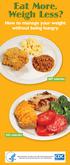 Eat More, Weigh Less? How to manage your weight without being hungry 607 calories 293 calories Department of Health and Human Services Centers for Disease Control and Prevention Can you weigh less without
The Five Food Groups and Nutrition Facts
 session 4 The Five Food Groups and Nutrition Facts (Note to the presenter: Comments in parentheses are instructions to follow while giving the presentation. Do not read the comments to participants. This
Canada s Food Guide Jeopardy
 Canada s Food Guide Jeopardy Drafted: July 2008 Revised: December 2012 Eating Well with Canada s Food Guide Veg & Fruit Grain Products Milk & Alternatives Meat & Alternatives Physical Activity Miscellaneous
A GUIDE TO HELP PLAN, PURCHASE & PREPARE YOUR OWN HEALTHY FOOD. FOOD SENSE HEALTHY MEALS ON A BUDGET
 A GUIDE TO HELP PLAN, PURCHASE & PREPARE YOUR OWN HEALTHY FOOD. FOOD SENSE HEALTHY MEALS ON A BUDGET You ll be surprised at how affordable, delicious & convenient your own meals can be! the Great Plate:
Take Control Nutrition Tools for Diabetes. 50/50 plate Portions Servings
 Take Control Nutrition Tools for Diabetes 50/50 plate Portions Servings Eat more Vegetables Especially non starchy vegetables Choosing Foods to manage blood glucose Select a variety of colors and types
Nutritional Glossary. Index of Contents
 Nutritional Glossary This glossary provides nutrition information about the nutrients commonly found in fruits, vegetables, and other plant foods Each glossary definition has a long and a short version.
Healthy Eating During Pregnancy
 Healthy Eating During Pregnancy Pregnancy is a time of great change. Your body is changing to allow your baby to grow and develop. Good nutrition will help you meet the extra demands of pregnancy while
Lesson 3 Assessing My Eating Habits
 Lesson 3 Assessing My Eating Habits Overview This lesson introduces the federal guidelines for healthy eating. Students assess their eating habits against these guidelines and make suggestions for improvement.
Carbohydrate Counting for Patients with Diabetes. Lauren Dorman, MS RD CDE Registered Dietitian & Certified Diabetes Educator
 Carbohydrate Counting for Patients with Diabetes Lauren Dorman, MS RD CDE Registered Dietitian & Certified Diabetes Educator Program Purpose To increase knowledge of carbohydrate counting skills for nurses
It is important to know that some types of fats, like saturated and trans fat, can raise blood cholesterol levels.
 Healthy Eating You are what you eat! So before you even shop for food, it is important to become a well informed, smart food consumer and have a basic understanding of what a heart healthy diet looks like.
Nutrition Recommendations and Interventions for Diabetes
 Nutrition Recommendations and Interventions for Diabetes S U P P L E M E N T Medical nutrition therapy (MNT) is important in preventing diabetes, managing existing diabetes, and preventing, or at least
February 2006. 23 Best Foods for Athletes
 23 Best Foods for Athletes February 2006 1. Beans Legumes a. Excellent source of fiber (important for keeping blood sugar and cholesterol levels under control). b. High in protein and a good source of
DIABETES & HEALTHY EATING
 DIABETES & HEALTHY EATING Food gives you the energy you need for healthy living. Your body changes most of the food you eat into a sugar called glucose. (glucose) Insulin helps your cells get the sugar
Eating Well with Diabetes. Cassie Vanderwall UW Health Nutrition Registered Dietitian Certified Personal Trainer Certified Diabetes Educator
 Eating Well with Diabetes Cassie Vanderwall UW Health Nutrition Registered Dietitian Certified Personal Trainer Certified Diabetes Educator Outline What is Diabetes? Diabetes Self-Management Eating Well
Carbohydrate Counting (Quiz Number: Manatee3032009)
 Page 1 The goal of Carbohydrate Counting is to make clear to you which foods affect your blood glucose and then to spread these foods evenly throughout the day (or to match insulin peaks and durations).
Mealtime Memo. Timesaving Tips for Mealtime
 Mealtime Memo National Food Service Management Institute The University of Mississippi for Child Care No. 6, 2009 Timesaving Tips for Mealtime Family day care home providers have a busy day. It starts
DAIRY NUTRITION. Health Basics Start with. Lesson 3 time. overview of Lesson. objectives. colorado academic standards. MateRiaLs needed.
 Health Basics Start with DAIRY NUTRITION time 50 minutes overview of Lesson This lesson introduces students to the dairy food group. Students will discover the nutrient contribution of dairy foods and
A Guide to Reducing Dietary Sodium Intake
 Salt and High Blood Pressure A Guide to Reducing Dietary Sodium Intake A Look at the DASH eating plan My Plate Basics Sodium is a mineral element most commonly found in salt (sodium chloride) Sodium occurs
Healthy Foods for my School
 yum, yum, yum, yum, yum, yum, yum, yum, yum, yum, yum, yum, yum, yum, yum, yum, yum, yum, yum, yum, yum, Healthy Foods for my School Nutrition Standards for Saskatchewan Schools Schools are an ideal place
chocolate milk Tasty Nutrition
 chocolate milk Tasty Nutrition Nutrition is everything. Good nutrition is vital to our children. Moms want it. Schools want it. Everyone agrees. But are they getting it? Many kids are still falling short
The Basics of Nutrition: Understanding Nutrition Facts, Servings Sizes, & Adequate Portions
 The Basics of Nutrition: Understanding Nutrition Facts, Servings Sizes, & Adequate Portions K AT I E L. H O W E H E A LT H E D U C AT O R D I V I S I O N O F S T U D E N T A F FA I R S U S C U P S TAT
Save Time and Money at the Grocery Store
 Save Time and Money at the Grocery Store Plan a Grocery List Making a list helps you recall items you need and also saves you time. Organize your list according to the layout of the grocery store. For
Appendix A Food Sources of Vitamins and Minerals
 Appendix A Food Sources of Vitamins and Minerals Appendix A 229 Appendix A Food Sources of Vitamins and Minerals Vitamin A (Retinol) Food Amount IU* Liver 3 oz 45,400 Crab 2 cup,680 Egg medium 590 Fats
Let s Talk Oils and Fats!
 Lesson Overview Lesson Participants: School Nutrition Assistants/Technicians, School Nutrition Managers, Child and Adult Care Food Program Staff, Teachers Type of Lesson: Short, face-to-face training session
Fibe. Fiber and water work together in bowel regulation. Be sure to drink eight to ten (8 ounce) glasses of
 r Fibe An important part of a healthy diet is eating a variety of fiber-rich foods, including whole-grain breads and cereals, fruits and vegetables, beans and nuts. Fiber is an important part of your diet.
Fertile Food Can you eat your way to pregnancy? Tracy Cherry, RD, CDN University of Rochester Women s Lifestyle Center
 Fertile Food Can you eat your way to pregnancy? Tracy Cherry, RD, CDN University of Rochester Women s Lifestyle Center Fertility Food Folklore Almonds a fertility symbol throughout the ages. The aroma
Maintaining Nutrition as We Age
 SS-207-06 For more information, visit the Ohio Department of Aging web site at: http://www.goldenbuckeye.com and Ohio State University Extension s Aging in Ohio web site at: http://www.hec.ohio-state.edu/famlife/aging
Provider Guide Many families may find it difficult to pay for or get
 introduction Hello! Provider Guide Many families may find it difficult to pay for or get access to nutritious foods. In such situations, they may find it especially hard to make healthy choices. As a provider
Food Groups To Encourage. chapter OVERVIEW
 23 chapter 5 Food Groups To Encourage OVERVIEW Increased intakes of fruits, vegetables, whole grains, and fat free or low fat milk and milk products are likely to have important health benefits for most
Carbohydrate Counting for Pediatric Patients With Type 1 Diabetes. Review Date 4/08 K-0591
 Carbohydrate Counting for Pediatric Patients With Type 1 Diabetes Review Date 4/08 K-0591 Program Purpose To increase knowledge of carbohydrate counting and insulin management skills for those caring for
Fiber. What is fiber? Fiber is a part of plant food. There are two types of fiber:
 Fiber An important part of a healthy diet is eating fiber-rich foods. This handout will explain what fiber is, where it s found, and how to increase the amount of fiber in your diet. What is fiber? Fiber
Nutritional Guidelines for Roux-en-Y, Sleeve Gastrectomy and Duodenal Switch. Gastric Restrictive Procedures. Phase III Regular Consistency
 Nutritional Guidelines for Roux-en-Y, Sleeve Gastrectomy and Duodenal Switch Gastric Restrictive Procedures Phase III Regular Consistency The University of Chicago Hospitals Center for the Surgical Treatment
Snack Foods and Beverages In South Carolina Schools A comparison of state policy with USDA s nutrition standards
 A data table from The Pew Charitable Trusts and the Robert Wood Johnson Foundation Jan 2015 Snack Foods and Beverages In South Carolina Schools A comparison of state policy with USDA s nutrition standards
Contact Us. Best Food Forward: Plan, Shop, Cook, Enjoy!
 For more information about the Northern Nutrition Association, please contact us at [email protected] Contact Us Email us at [email protected] Bringing home healthy foods is the first step in healthy eating!
Do children with diabetes need a special diet?
 Do children with diabetes need a special diet? No! The basic nutritional needs of a child or adolescent with diabetes is the same as their peers Healthy eating is important for all children Children with
Using the Nutrition Facts Label
 Using the Nutrition Facts Label A How-To Guide for Older Adults Inside Why Nutrition Matters For You...1 At-A-Glance: The Nutrition Facts Label...2 3 Key Areas of Importance...4 Your Guide To a Healthy
Gaining Weight for Athletes
 Gaining Weight for Athletes Prepared by Jenn Van Ness, ATC June 2008 Gain Weight the Healthy Way To gain one pound, you need to eat approximately 500 more calories a day. Approximately one pound of fat
ChildcareNashville.com
 ChildcareNashville.com childcare nashville/cooks academy We started with 12 child care centers... We have grown to 27 Cooks Academy participants and over 90 Childcare Nashville providers. The following
Healthy Eating for Diabetes
 Healthy Eating for Diabetes What is diabetes? Diabetes is when your blood sugar (glucose) levels are higher than normal. For some people, this is because the insulin in their body doesn t work as well
Healthy Eating for College Students on a Budget
 University of Michigan Health System s Healthy Eating Tip of the Month for August: Healthy Eating for College Students on a Budget Times are tough and money can be tight, especially for the starving college
Diabetes 101. Lifestyle Recommendations to Manage Diabetes. Cassie Vanderwall. Licensed, Registered Dietitian Certified Personal Trainer
 Diabetes 101 Lifestyle Recommendations to Manage Diabetes Cassie Vanderwall Licensed, Registered Dietitian Certified Personal Trainer Diabetes 101- Outline What is Diabetes? What can I do to control Diabetes?
Maximizing Nutrition at Minimal Cost
 Maximizing Nutrition at Minimal Cost Outline: Get down to the nutrition basics Identify health issues at hand Understand the challenges & barriers Practical application & solutions Rate Your Plate What
Will the cholesterol in my diet raise my blood cholesterol?
 Healthy eating for your heart What does heart healthy eating mean to me? Heart healthy eating is an important part of a healthy lifestyle. Heart healthy eating, along with regular physical activity and
Diabetes: Carbohydrate Counting
 COLLEGE OF AGRICULTURE AND LIFE SCIENCES COOPERATIVE EXTENSION AZ1617 February 2014 Diabetes: Carbohydrate Counting Nicole A. Greene, Natalia N. Billias, Nobuko Hongu Figure: Diabetes, hyperglycemia What
When you have diabetes be careful about what you eat to help you control your blood sugar.
 PART 5 INTRO TO EATING WITH DIABETES When you have diabetes be careful about what you eat to help you control your blood sugar. Foods are in three main groups: Carbohydrates (Carbs) Higher Carbohydrates
Ready, Set, Start Counting!
 Ready, Set, Start Counting! Carbohydrate Counting a Tool to Help Manage Your Blood Glucose When you have diabetes, keeping your blood glucose in a healthy range can help you feel your best today and in
Healthy Menu Planning
 Healthy Menu Planning Please save paper and print the pages of this resource back-to-back! Table of Contents Considerations for Planning Menus... 4 Menu Planning Principles... 4 Menu Cycling...5 Guidelines
Presentation Prepared By: Jessica Rivers, BASc., PTS
 Presentation Prepared By: Jessica Rivers, BASc., PTS Presentation Outline Why should we care about our eating habits? Why is nutrition so important as we age? How do we know if we are eating healthy? What
Healthy Eating After 50
 National Institute on Aging AgePage Healthy Eating After 50 Food just doesn t taste the same anymore. I can t get out to go shopping. I m just not that hungry. Sound familiar? These are a few common reasons
Eat Well, Live Well Lesson 9: The Lowdown on Cholesterol
 Getting Started 1. Review lesson plan before each session 2. Copy handouts. 3. Gather supplies Eat Well, Live Well Lesson 9: The Lowdown on Cholesterol Supplies Needed 1. Handouts 2. Supplies for activity:
MEAL PLANNING FOR MECHANICAL SOFT DIET
 MEAL PLANNING FOR MECHANICAL SOFT DIET Definition of Terms Calories Protein Blenderized Pureed Units of energy. A nutrient used by your body for growth and repair. The best sources are milk, meats, fish,
gestational diabetes my pregnancy, my baby, and me
 gestational diabetes my pregnancy, my baby, and me What is Gestational Diabetes? Gestational diabetes occurs when your body cannot make adequate use of sugar in the blood. It is first found during pregnancy.
Fad Diets vs Healthy Weight Management: A Guide for Teens
 Center for Young Women s Health www.youngwomenshealth.org Fad Diets vs Healthy Weight Management: A Guide for Teens Fad diets are marketed as quick ways to lose weight. The most popular fads tend to change
Nutrition Guidelines for Diabetes
 Nutrition Guidelines for Diabetes Eating healthy foods and keeping a healthy body weight are very important parts of a diabetes treatment plan. A healthy diet and weight helps to keep your blood sugar
Meal Planning for a Mushy Soft Diet After Nissen Fundoplication
 Meal Planning for a Mushy Soft Diet After Nissen Fundoplication Name: Date: Dietitian: Telephone: Questions? CALL YOUR DIETITIAN! Patient Food and Nutrition Services University of Michigan Hospital 1500
How to Increase Volume in Your Meals
 How to Increase Volume in Your Meals By adding certain types of food to your diet and drinking more water, you can actually increase the amount of food you eat, while staying within your fat gram and calorie
Carbohydrate Counting for Patients With Diabetes. Review Date 4/08 D-0503
 Carbohydrate Counting for Patients With Diabetes Review Date 4/08 D-0503 Program Objectives At the end of the session you will know how to: Define carbohydrate counting Identify the relationship between
Nutrition and Chronic Kidney Disease
 Nutrition and Chronic Kidney Disease I have been told I have early kidney failure. What does this mean? What can I expect? This means that your kidneys are not doing as good a job as they should to help
Nutrition Pointers: Fruits and Veggies
 Nutrition Pointers: Fruits and Veggies Eat as many as possible try filling half your plate with fruits and veggies. Fruits and veggies are good for you whether they are fresh or frozen. Go for a wide variety
You may continue to use your old manuals by writing in the detailed changes below:
 STANFORD PATIENT EDUCATION RESEARCH CENTER: CHANGES TO THE DSMP LEADER MANUAL (2012 version to the 2015 version) Stanford has corrected the DSMP manuals with the new ADA guidelines. Call- out icons and
What impacts blood glucose levels?
 What you eat and how much you eat has an impact on your blood glucose levels. Your blood glucose level reflects how well your diabetes is controlled. There are many aspects to eating for target BG (Blood
Meal Planning for a Mushy Soft Diet After Laparoscopic Myotomy
 Meal Planning for a Mushy Soft Diet After Laparoscopic Myotomy Name: Date: Dietitian: Telephone: Why is it necessary to follow this diet? This diet is necessary for individuals who have had some types
CARBS, FATS, FIBER & FADS FAD DIETS
 CARBS, FATS, FIBER & FADS FAD DIETS Carbohydrates The national recommendation for carbohydrate intake is 40% to 65% of our daily intake. Our requirements change depending on how active we are, our current
Carbohydrate Counting
 COOPERATIVE EXTENSION SERVICE UNIVERSITY OF KENTUCKY COLLEGE OF AGRICULTURE, FOOD AND ENVIRONMENT, LEXINGTON, KY, 40546 FCS3-546 Carbohydrate Counting Ingrid Adams, Dietetics and Human Nutrition What is
NUTRITION AND HEMODIALYSIS
 NUTRITION AND HEMODIALYSIS www.kidney.org National Kidney Foundation's Kidney Disease Outcomes Quality Initiative Did you know that the National Kidney Foundation's Kidney Disease Outcomes Quality Initiative
Nutrition Requirements for Foods and Beverages Sold During the Regular School Day throughout the School Campus
 Nutrition s for Foods and Beverages Sold During the Regular School Day throughout the School Campus THIS RULE PERTAINS TO ALL SCHOOLS THAT PARTICIPATE IN THE NATIONAL SCHOOL LUNCH PROGRAM (NSLP) In June
SOLID FATS AND ADDED SUGARS (SoFAS) Know the Limits
 COOPERATIVE EXTENSION SERVICE UNIVERSITY OF KENTUCKY COLLEGE OF AGRICULTURE, LEXINGTON, KY, 40546 NEP-207B SOLID FATS AND ADDED SUGARS (SoFAS) Know the Limits The U.S. Department of Agriculture s Dietary
WEIGHT GAINER S NUTRITION GUIDE
 WEIGHT GAINER S NUTRITION GUIDE Gaining weight takes dedication! You must eat these meals everyday to stay on track. Included in this pack are the meal plan, supplement guide, fast food guide, and NCAA
Eating Well with. Canada s Food Guide
 Eating Well with Canada s Food Guide Recommended Number of Food Guide Servings per Day Children Teens Adults Age in Years Sex 2-3 4-8 9-13 14-18 19-50 51+ Girls and Boys Females Males Females Males Females
Heart Healthy Diet: Tips for Lowering Cholesterol and Fat in Your Diet
 Heart Healthy Diet: Tips for Lowering Cholesterol and Fat in Your Diet Cholesterol Saturated Fats Polyunsaturated and Mono-unsaturated Fats This fat-like substance is needed for good health. However, high
Maintenance Sample Meal Plans
 Maintenance Sample Meal Plans In Maintenance, some people prefer to work with general guidelines for success while others prefer more structure and a specific meal pattern to follow. In this document,
Bariatric Surgery: Step III Diet
 Bariatric Surgery: Step III Diet This diet is blended foods with one new solid food added daily. The portions are very small to help prevent vomiting. Warning: This diet does not have enough calories,
Healthy Eating for Diabetes
 Healthy Eating for Diabetes What is diabetes and why is it important to manage it? Diabetes occurs when there is too much glucose in the blood. Learning how to manage your diabetes will help you feel better
Calories-something, what. Dietician: mgr Maria Salicka
 Calories-something, what we shouldn t be afraid of Dietician: mgr Maria Salicka When people talk about the calorieswhat do they mean? A calorie is a unit of measurement -a unit of energy. Are Calories
Diet for Oral Surgery/Wired Jaw
 Diet for Oral Surgery/Wired Jaw After oral surgery no chewing is allowed for a period of 4-8 weeks. During this time you will need a blenderized or liquid diet. This pamphlet will help you to get adequate
EMBRACE Your Journey Nutrition During Treatment
 Nutrition is an important part of your cancer treatment. As you prepare for treatment, it is important to focus on eating a well-balanced diet so that your body is as healthy as it can be. When your body
We want you to have the best results possible while doing our detox. If your goal is weight loss, then eating the right foods and exercising
 Detox Menu Guide We want you to have the best results possible while doing our detox. If your goal is weight loss, then eating the right foods and exercising moderately will help boost your results and
TRACKS Lesson Plan. Fiber Fill Up On Fiber! Grade: 9-12
 TRACKS Lesson Plan Fiber Fill Up On Fiber! Grade: 9-12 I. Nutrition Education Objective: Goal 1: Students will comprehend concepts consistent with USDA guidance related to eating and physical activity
Low Fat Diet after Cardiac Surgery With or Without Chyle Leak
 Low Fat Diet after Cardiac Surgery With or Without Chyle Leak What is chyle? Chyle (sounds like kyle) is a milky white fluid that contains protein, fat, cholesterol, lymphocytes, and electrolytes. It is
# Starch # Fat # Fruit # Free Foods. # Other Carbohydrates # Fast Foods # Vegetable. # Meat and Meat Substitutes
 FCS8750 Healthy Meal lans 1 Linda B. Bobroff 2 What Is a Meal lan? A meal plan is a guide to help you plan daily meals and snacks. It allows you to eat foods that you enjoy and that provide a good balance
Snack Time: Providing Healthy Snacks in Your After School Program
 Snack Time: Providing Healthy Snacks in Your After School Program California After School Resource Center (CASRC) Administered for the California Department of Education (C.D.E.) Hello, welcome to the
DAY 1 DAY 2 DAY 3 DAY 4. Cereal with Fruit: 1 cup toasted oat cereal 1 medium banana ¼ cup lowfat milk 1 hard-cooked egg Beverage: Water, coffee, tea
 DAY 1 DAY 2 DAY 3 DAY 4 Peanut Butter Raisin Oatmeal: 1 cup cooked oatmeal ¼ cup raisins Tuna-Cucumber Wrap: 1 8 flour tortilla 3 oz tuna (canned in water) 2 Tbsp mayonnaise 5 cucumber sticks ¼ cup lowfat
Heart healthy diet: 8 steps to prevent heart disease
 Heart healthy diet: 8 steps to prevent heart disease Changing your eating habits can be tough. Start with these eight strategies to kick start your way toward a heart healthy diet. By Mayo Clinic Staff
Eating Right for Kidney Health: Tips for People with Chronic Kidney Disease
 Eating Right for Kidney Health: Tips for People with Chronic Kidney Disease What you eat and drink can help slow down the progression of chronic kidney disease (also known as CKD ) and help prevent complications.
Duke Center for Metabolic and Weight Loss Surgery Pre-op Nutrition Questionnaire
 Duke Center for Metabolic and Weight Loss Surgery Pre-op Nutrition Questionnaire Name Date How long have you been considering weight loss surgery? Which procedure are you interested in having? Gastric
Where do I begin? Shopping at the. Start with a Plan. Find the Deals
 Shopping at the Grocery by Sarah Muntel, RD Where do I begin? S hopping for groceries can be a daunting task. Many people feel overwhelmed the minute they pull up to the store. For some, the goal is to
21-Day Sample Cycle Menu Child and Adult Care Food Program
 The abbreviation to the left of each menu item indicates the meal pattern component supplied. The following abbreviations are used: G/B = Grains/Breads; M/MA = Meat/Meat Alternate; F/V = Fruit/Vegetable;
1800 Calorie Meal Plan. Jessica Iannotta Department of Nutritional Sciences UMDNJ School of Health Related Professions
 1800 Calorie Meal Plan Meal Portion Food Calories DAY 1 Breakfast 1 cup Hot Oatmeal, cooked, unsweetened 150 1 banana 120 1 Amy s Bean & Rice Burrito 280 (in the frozen foods section of your grocery store
American Cancer Society. Nutritional Guidelines for Reducing Your Risk of Cancer
 American Cancer Society Nutritional Guidelines for Reducing Your Risk of Cancer Cancer Impact More than one million Americans will be diagnosed with cancer this year. Scientific evidence suggests that
FITTEAM 5. Overview. Keys to Success
 Overview The is an approximately 1,200-calorie-a-day eating plan that incorporates our energy and fat loss beverage FITTEAM FIT. This 5-day program designed to provide you a jumpstart toward reaching your