
A GLOBAL OVERVIEW OF VEGETABLE OILS, WITH REFERENCE TO BIODIESEL
|
|
|
- Emmeline Cox
- 9 years ago
- Views:
Transcription
1 A GLOBAL OVERVIEW OF VEGETABLE OILS, WITH REFERENCE TO BIODIESEL A Report for the IEA Bioenergy Task 40 By Frank Rosillo-Calle, CEP/Imperial College London, UK Luc Pelkmans, VITO, Belgium Arnaldo Walter, FEM, UNICAMP, Brazil June 2009

2 Table of Contents Executive summary...3 Introduction Global production and consumption of vegetable oils Vegetable oil production Global consumption of vegetable oils Vegetable oil prices Major international players of main edible oils: export and import markets Palm oil Soybean oil Rapeseed oil World production and potential of biodiesel World biodiesel production and potential Analysis of Major Regions/Countries European Union Vegetable oil trade Germany Conclusions for the European market The Americas United States Brazil Argentina Colombia Canada Asian countries China India Indonesia Malaysia Thailand Emerging markets for vegetable oils Palm oil Jatropha Comments Policy development The EU EU member states policies European agricultural policy Future European policy The Americas Asia Sustainability & environmental issues of vegetable oils - Implications for biodiesel Conclusions...81 References
3 EXECUTIVE SUMMARY The main objectives of this study are: i) to present a global overview of the main vegetable oils (palm, soybean, rapeseed, sunflower), ii) identify the main market trends; iii) identify the major players of the vegetable oil markets (exporters and importers), iv) assess the role of biodiesel in the vegetable oil markets; v) identify major policy developments and possible future trends. This study is not intended as a detailed analysis; its aim is to present an overall view of the main vegetable oil issues. Social, economic, environmental and sustainability issues are not covered in the first phase of this report. Environmental and sustainability issues are mentioned in passing. The demand for vegetable oils has increased rapidly in the past decade, catapulted by a combination of factors, including: i) increasing demand sparked off by higher consumption for edible oils, particularly in emerging countries such China and India caused by, among other things, population growth, improving living standards and changing diets; ii) the development of the biofuels industry (and more specifically biodiesel) around the world, particularly in the EU, USA, Brazil, Argentina, China and India, iii) price increases which have been due to varying factors e.g. increase in oil prices, low stock worldwide, droughts, and speculation, iv) changing weather patterns which can have major geographical impacts and can be, potentially, quite large. There are two major markets for vegetable oils: i) food which represents over 80%, and ii) industrial uses including biodiesel. The main driver for expansion is still the growing demand for edible oils for the food market, although an important part of this demand comes from the biodiesel sector. In recent years important new actors and trends in supply and demand have began to emerge e.g. i) China is rapidly emerging as the world leading importer of vegetable oils, ii) Indonesia, Malaysia and Argentina dominate the exports market, representing approximately 75%, iii) Brazil is also becoming 3

4 one the world s largest exporters of soybeans 1, next to the USA, iv) Argentina, whose share of this market is growing rapidly, is rapidly becoming one of the world s top producer and exporter of soybean (meat and oil). Biofuels have largely been blamed for most of the increases in food prices. The reasons, however, are many and complex, with the major impact coming from the increases in oil costs and speculation on agricultural commodities. It has been shown that the cost of the raw material plays a comparatively small role in the retail of food in developed countries since price increases are largely determined by commercial and other issues rather than by raw material. The vegetables oil market is bound for major changes, and will face substantial challenges and opportunities. Improving living standards in emerging economies, population growth together with changing diets and the expansion of biodiesel, are new trends that will have a major impact in the future development of this sector. This market has very different features e.g. the Chinese market is characterised primarily by large imports, where in India it has been a rapid increase in production and demand of the domestic market. Indonesia and Malaysia, the traditional palm oil producers and exporters, have major expansion plans as they face increasing competition from other countries, such as Thailand and possibly from Colombia. Traditional producers of soybean like the USA and Canada, face even greater competition from countries such as Argentina and Brazil. Finally, this report concentrates in countries as major producers, consumers and exporters of vegetable oils. The authors are fully aware that the vegetable oils market is dominated by a handful of multinational agricultural and trade companies such as Monsanto, Cargill, ADM, Nidera, among others, rather than by countries. An analysis of this nature, however, will require considerable additional work given the economic, social, environmental and political issues involved, and therefore would be beyond the scope of this study. 1 Most importing countries of soybean from Brazil process it primarily for animal feed (soybean meal) and soybean oil. In fact, Brazilian exports of vegetable oils have been declining since
5 5

6 INTRODUCTION There are various factors that affect the feedstock and market for vegetable oils, such as: i) Increasing demand sparked off by higher consumption of edible oils, particularly in emerging countries. For example, according to USDA, between 2004 and 2008 the annual global growth rate of domestic consumption of vegetable oils was 3.9%; for China and India this was 3.4% and 2.4%, respectively 2. Although this percentage may appear low, given the size of the Chinese and Indian market, the impact in the international market is very large; ii) iii) The development of the biofuels industry (and more specifically biodiesel) around the world, particularly in the EU, USA, Argentina, Brazil, China and India, Price increases which have been due to varying factors e.g. increase in oil prices, low stock worldwide, droughts, and speculation. Until demand and supply reach some kind of equilibrium, ups-and-downs in this market will continue. A fourth factor seems to be changing weather patterns that will have different geographical impacts, but which can be potentially quite large e.g. 2007/2008 adverse weather conditions resulted in approximately 14 Mt reduction in production 3. The combination of all these factors, and in particular the accelerated demand since 2005/06, are bound to cause major changes to this industry though such changes are still difficult to foresee. The first section of this study summarises the global production and consumption of the main vegetable oils; section two looks at the global production including biodiesel; section three assesses the major international players of the vegetable oil market, grouped under palm oil, soybean and 2 See Pakistan and Bangladesh have average growth rates of 8.3% and 7.4% per year in the period. 3 See for example 6
7 rapeseed; the following section concentrates on the main producing countries/regions (i.e. Argentina, Brazil, Canada, China, EU, India, Indonesia, Malaysia and Thailand); section five pays particular attention to merging markets and new vegetable oil crops such as Jatropha, and other major vegetable oils; section six assesses some policy issues; section seven examines some environmental and sustainability issues (very briefly, since this was not originally an integral part of this study). Finally, section eight highlights the major conclusions and findings of the report. 7

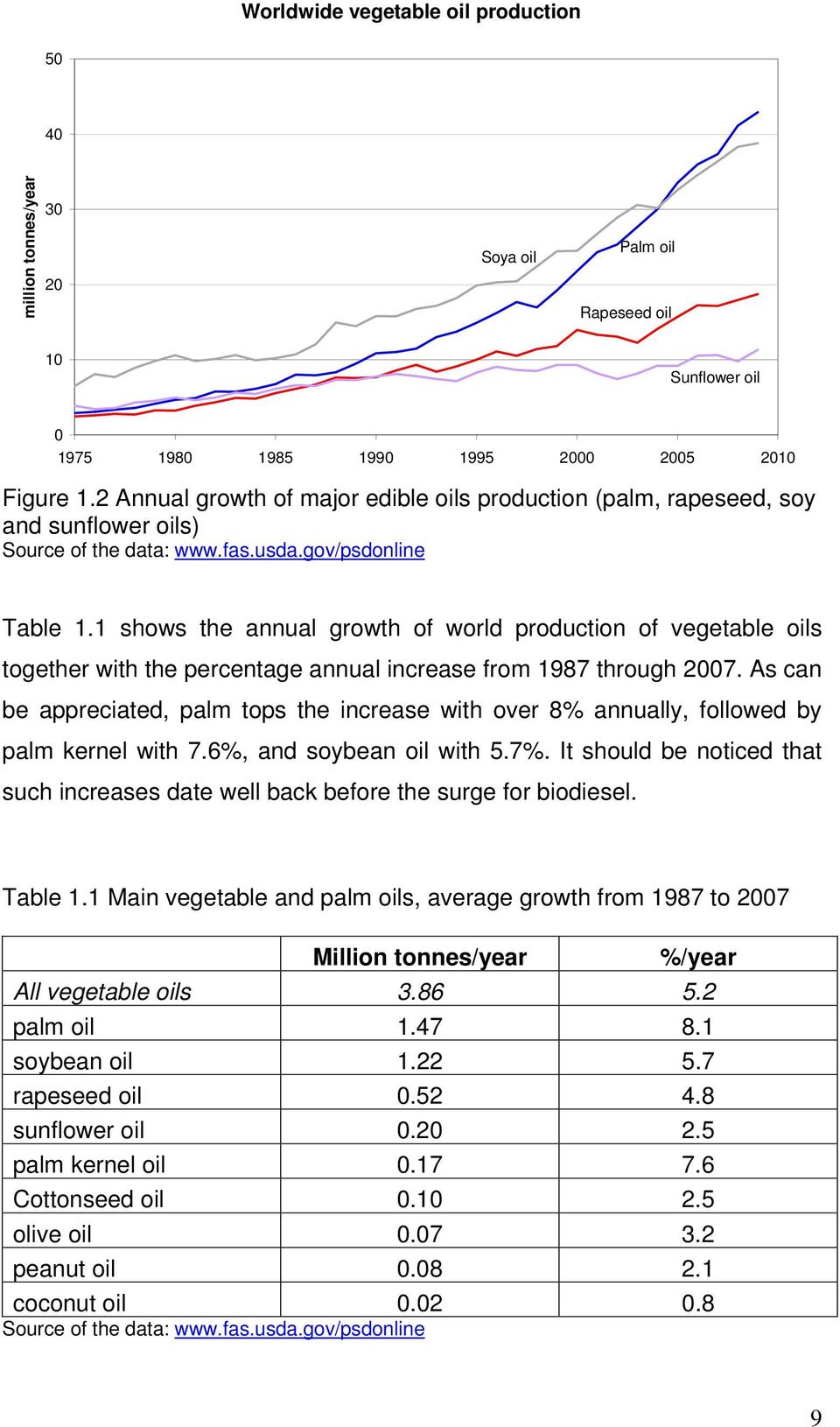
8 1 GLOBAL PRODUCTION AND CONSUMPTION OF VEGETABLE OILS 1.1 Vegetable oil production World vegetable oil production has increased continuously in the past decades, although unevenly, as illustrated in Figure 1.1. The main growth has been in palm oil (representing more than 30% of vegetable oil production in 2007), soybean oil (28%), rapeseed oil (15%) and sunflower oil (9%). The remaining share accounts for less than 20% of the market. Worldwide vegetable oil production 1000 tonnes/year olive oil Coconut oil palm kernel oil cottonseed oil peanut oil sunflower oil rapeseed oil soybean oil palm oil Figure 1.1 World s vegetables oil production, Source of the data: This growth is more clearly shown in Figure 1.2. While production of sunflower oil and other lower share oils was fairly stable, rapeseed oil, soybean oil and especially palm oil production increased remarkably over the same period. 8

9 Worldwide vegetable oil production million tonnes/year Soya oil Palm oil Rapeseed oil 10 Sunflower oil Figure 1.2 Annual growth of major edible oils production (palm, rapeseed, soy and sunflower oils) Source of the data: Table 1.1 shows the annual growth of world production of vegetable oils together with the percentage annual increase from 1987 through As can be appreciated, palm tops the increase with over 8% annually, followed by palm kernel with 7.6%, and soybean oil with 5.7%. It should be noticed that such increases date well back before the surge for biodiesel. Table 1.1 Main vegetable and palm oils, average growth from 1987 to 2007 Million tonnes/year %/year All vegetable oils palm oil soybean oil rapeseed oil sunflower oil palm kernel oil Cottonseed oil olive oil peanut oil coconut oil Source of the data: 9
10 1.2 Global consumption of vegetable oils The consumption of vegetable oils falls into two major applications: i) food industry, and ii) industrial uses, including biodiesel, which is a more recent trend. As Figure 1.3 shows, the predominant use is for food with over 80% of the market, with the industrial and biodiesel markets far behind. Thus, the rapid demand for vegetable oils has been sparked off by the food market rather than the industrial or biodiesel sectors, contrary to general belief. Although there is a growing role for industrial uses, the food industry is expected to be the dominant factor in the future for reasons already stated above. Vegetable oil use (worldwide) Biofuel use Industrial use (excl biofuels) Food Use tonnes/year Figure 1.3 Global consumption of vegetables oils by major applications Source of the data: It is worth pointing out some particular differences and trends in world consumption of the most important vegetable oils (i.e. rapeseed, palm and soybean): The use of rapeseed oil for food applications is rather stable with the main growth being in industrial applications since 2003 (specifically biodiesel in Europe). 10

11 The use of palm oil for food has actually doubled in the past 8 years. Since 2003, industrial applications are also growing and this may be partly related to biodiesel production (see Figure 2.1), besides other applications in the chemical industry. The use of soybean oil for food is still increasing. Prior to 2005, industrial uses of soybean oil were marginal and since then they have been growing, mainly for biodiesel production in the USA and South America (primarily Argentina and Brazil). These trends are further illustrated in Figures 1.4a, 1.4b and 1.4c. Worldwide use of rapeseed oil Industrial use Food Use tonnes/year Figure 1.4a Trends on use of rapeseed oil, from 1995 to 2007 Source of the data: 11

12 Worldwide use of palm oil Industrial use Food Use tonnes/year Figure 1.4b Trends on use of palm oil, from 1995 to Source of the data: Worldwide use of soybean oil tonnes/year Industrial use Food Use Figure 1.4c Trends on use of soybean oil, from 1995 to 2007 Source of the data: 12
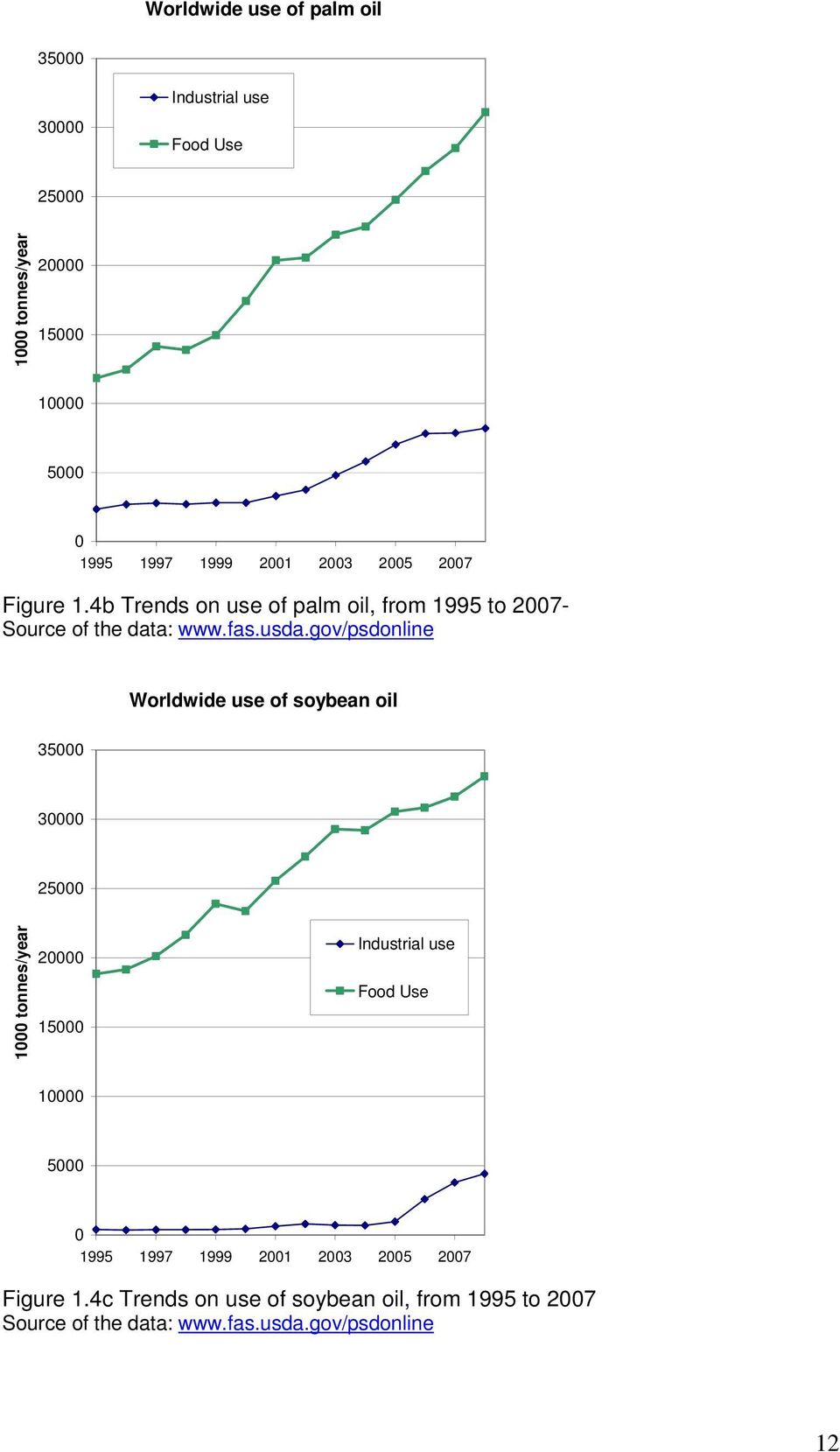
13 The figures above demonstrate that the market for vegetable oils has been transformed in recent years, catapulted by growing demand for edible oils and new industrial applications, more recently biodiesel. Therefore, until this sector achieves some kind readjustment of supply and demand, fluctuations are bound to continue. There are also important new actors and trends in supply and demand to be taken into account. For example, China is rapidly becoming the world-leading importer of vegetable oils; Argentina s share of the export market is growing rapidly and is becoming one of the largest producer and major exporter of vegetables oils, primarily soybean, due to its favourable conditions. As elsewhere, the rapid expansion of soybean in Argentina is causing alarm due to the many potential ecological and environmental impacts, as explained later. 1.3 Vegetable oil prices Demand and supply of vegetable oils have been more or less keeping up with world situation and consequently prices have been rather stable until end of 2006, except in some specific circumstances (e.g. fluctuations due to weather conditions). However, from March 2007 to February 2008, vegetable oil prices have more than doubled for a combination of factors; this is further illustrated in Figure 1.5. However, by early 2009 prices declined to about the 2006 level. 13

14 Evolution of vegetable oil prices (US$/tonne) Palm oil Rapeseed oil Soya oil Sunflower oil 1500 US$/tonne jan/03 jul/03 jan/04 jul/04 jan/05 jul/05 jan/06 jul/06 jan/07 jul/07 jan/08 jul/08 jan/09 jul/09 Figure 1.5 Evolution of prices for world major vegetable oils from January 2003 through July 2009 Source of the data: Although biofuels have generally been blamed for most of these price increases, the reasons are many and complex. More than a year after the peak of food prices, we can deduct the following factors behind the global price increases 4 : Increase of crude oil prices from 50 to over 140 $US per barrel Decrease of the value of the US dollar, as most markets are traded on this currency Speculation by the financial sector in agricultural commodities ( selffulfilling prophecy of increasing prices). This also seems to be linked to the low value of the US dollar Export restrictions in certain countries as a response to expected global shortages e.g. some countries banned exports Growing economies in Asia, with increasing demand for energy and food, and changing diets (e.g. increased consumption to meat) 4 Alessandro Flammini (2008) Biofuels and the underlying causes of high food prices, Food and Agriculture Organization of the United Nations (FAO), October
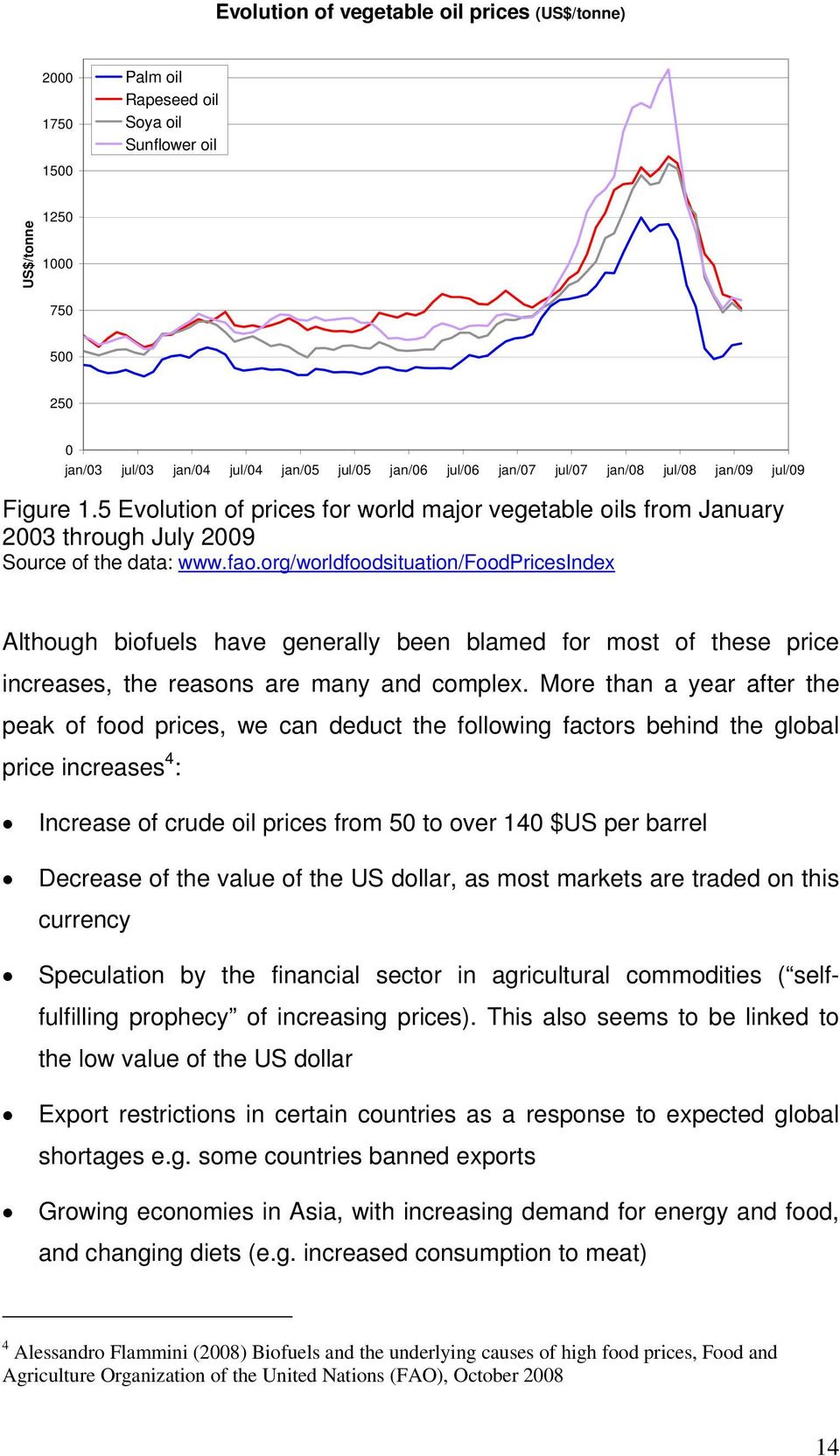
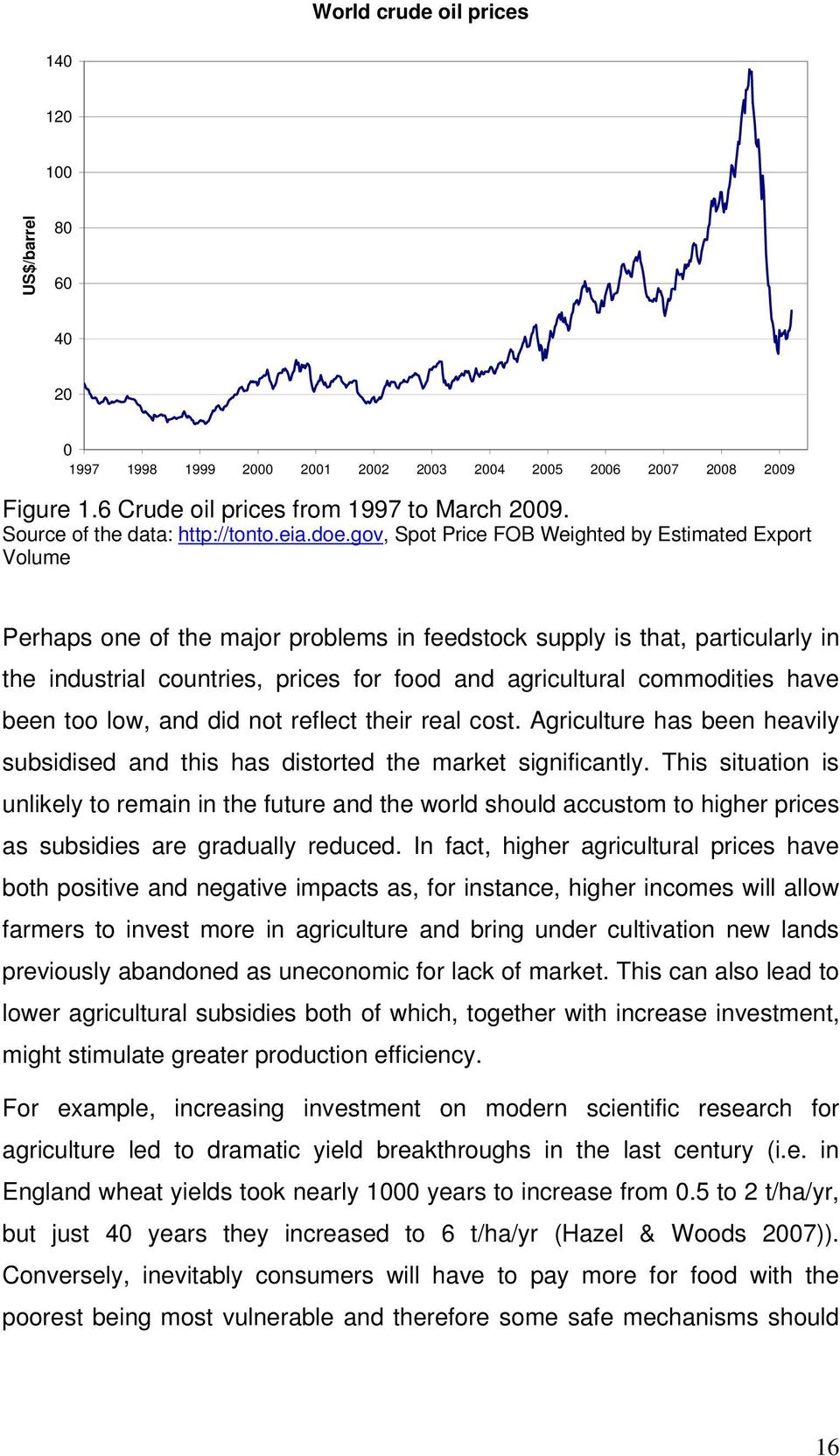
15 Decrease of stocks in the past years (not controlled by governments anymore, but by commercial parties who have interest in increasing prices) Low crop yields in certain regions due to bad weather circumstances (e.g. Australia in 2006/07 whose grain harvest fell more than 50%) Growing demand for biofuels, mainly biodiesel. As stated above, the cost of the raw material plays a comparatively small role in the retail of food in developed countries since price increases are largely determined by commercial and other issues rather than by the raw material itself. For example, a 50% increase in the cost of raw materials in the US leads approximately to 5% increase in the commercial price of bread and breakfast cereals, while other processes (processing, packaging and distribution) account for 90% 5. This is further reinforced by the fact that since July 2007 the price of corn has almost halved, while ethanol production has increased significantly. This trend has continued, at least until early Too much emphasis is being placed on short-term issues (e.g. short-term grain price increases) giving insufficient time for market forces to adjust. Figure 1.6 shows oil price evolution from 1997 through to February As can be appreciated, the sharp rise commenced in 2007 until mid 2008 when they experimented a large decline, though recently (May 2009), oil prices are beginning to pick up again. 5 See also (Biofuel thematic paper: Food versus Fuel). 15

16 World crude oil prices US$/barrel Figure 1.6 Crude oil prices from 1997 to March Source of the data: Spot Price FOB Weighted by Estimated Export Volume Perhaps one of the major problems in feedstock supply is that, particularly in the industrial countries, prices for food and agricultural commodities have been too low, and did not reflect their real cost. Agriculture has been heavily subsidised and this has distorted the market significantly. This situation is unlikely to remain in the future and the world should accustom to higher prices as subsidies are gradually reduced. In fact, higher agricultural prices have both positive and negative impacts as, for instance, higher incomes will allow farmers to invest more in agriculture and bring under cultivation new lands previously abandoned as uneconomic for lack of market. This can also lead to lower agricultural subsidies both of which, together with increase investment, might stimulate greater production efficiency. For example, increasing investment on modern scientific research for agriculture led to dramatic yield breakthroughs in the last century (i.e. in England wheat yields took nearly 1000 years to increase from 0.5 to 2 t/ha/yr, but just 40 years they increased to 6 t/ha/yr (Hazel & Woods 2007)). Conversely, inevitably consumers will have to pay more for food with the poorest being most vulnerable and therefore some safe mechanisms should 16
17 be put in place to avoid the worst effects on the poor; this requires primarily political rather than technical solutions. 17

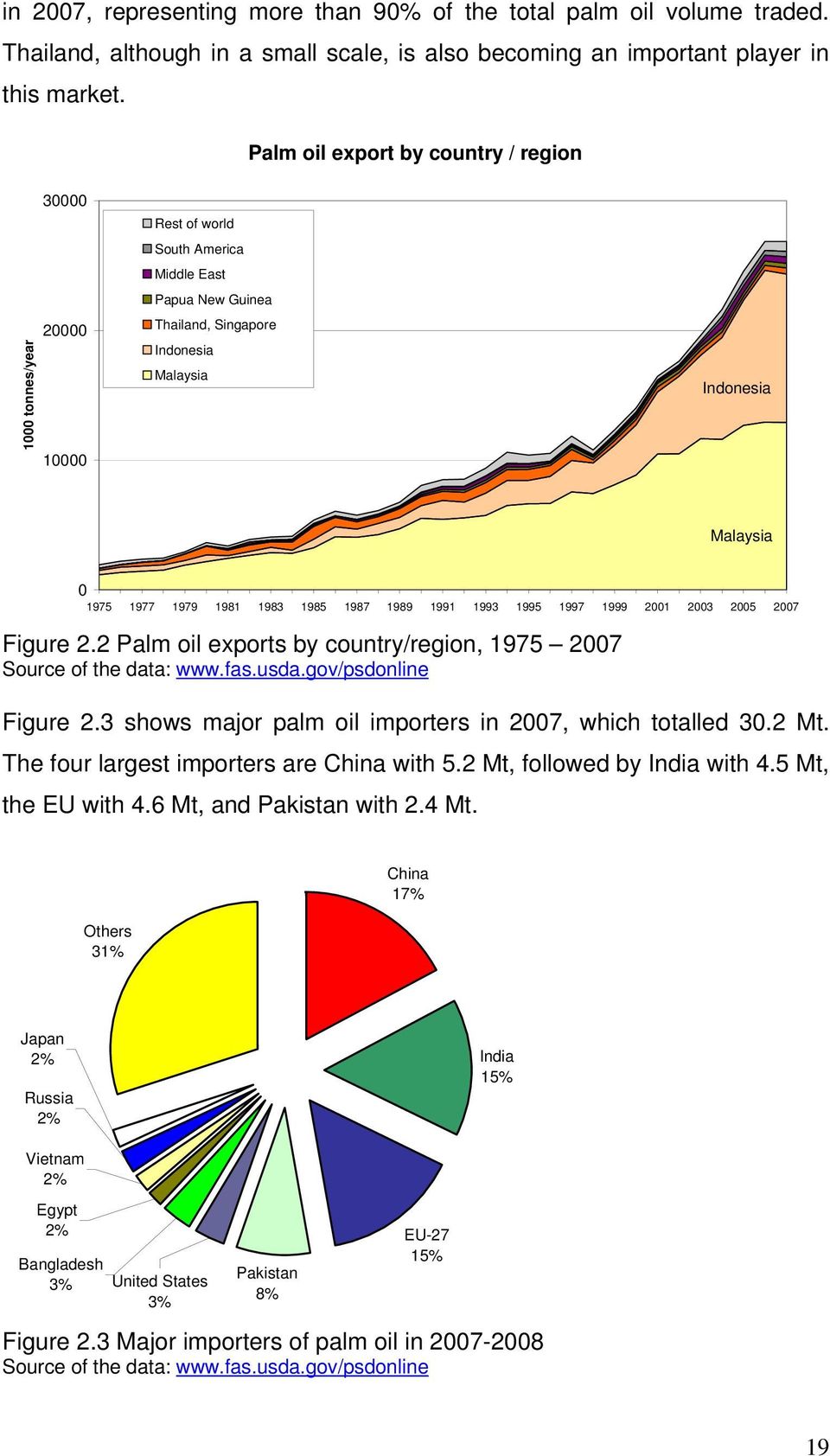
18 2 MAJOR INTERNATIONAL PLAYERS OF MAIN EDIBLE OILS: EXPORT AND IMPORT MARKETS As previously shown, the three main edible oils are palm, soybean and rapeseed, which altogether represent about 75% of the total production in recent years. This report refers to countries rather than private companies for reasons stated in the Summary. 2.1 Palm oil Palm oil is one of the world s largest commodities, which production is dominated by Malaysia and Indonesia that account for between 80-85% of world s production, as illustrated in Figure 2.1. Smaller fractions are produced in Sub-Saharan Africa and South America. As discussed in Section 4, South America could become the leading vegetable oils producer and exporter (primarily soybean but increasingly also palm oil), as countries such as Argentina, Brazil, Colombia and Peru are expanding their production capacity rapidly. Palm oil production by country / region 1000 tonnes/year Rest of world Oceania (Papua New Guinea) Central America South America Sub-Saharan Africa Thailand Indonesia Malaysia Indonesia Malaysia Figure 2.1 Major palm oil producers by country and region, Source of the data: Malaysia and Indonesia also dominate the export market, as illustrated in Figure 2.2. These countries were exporting more than 70% of their production 18
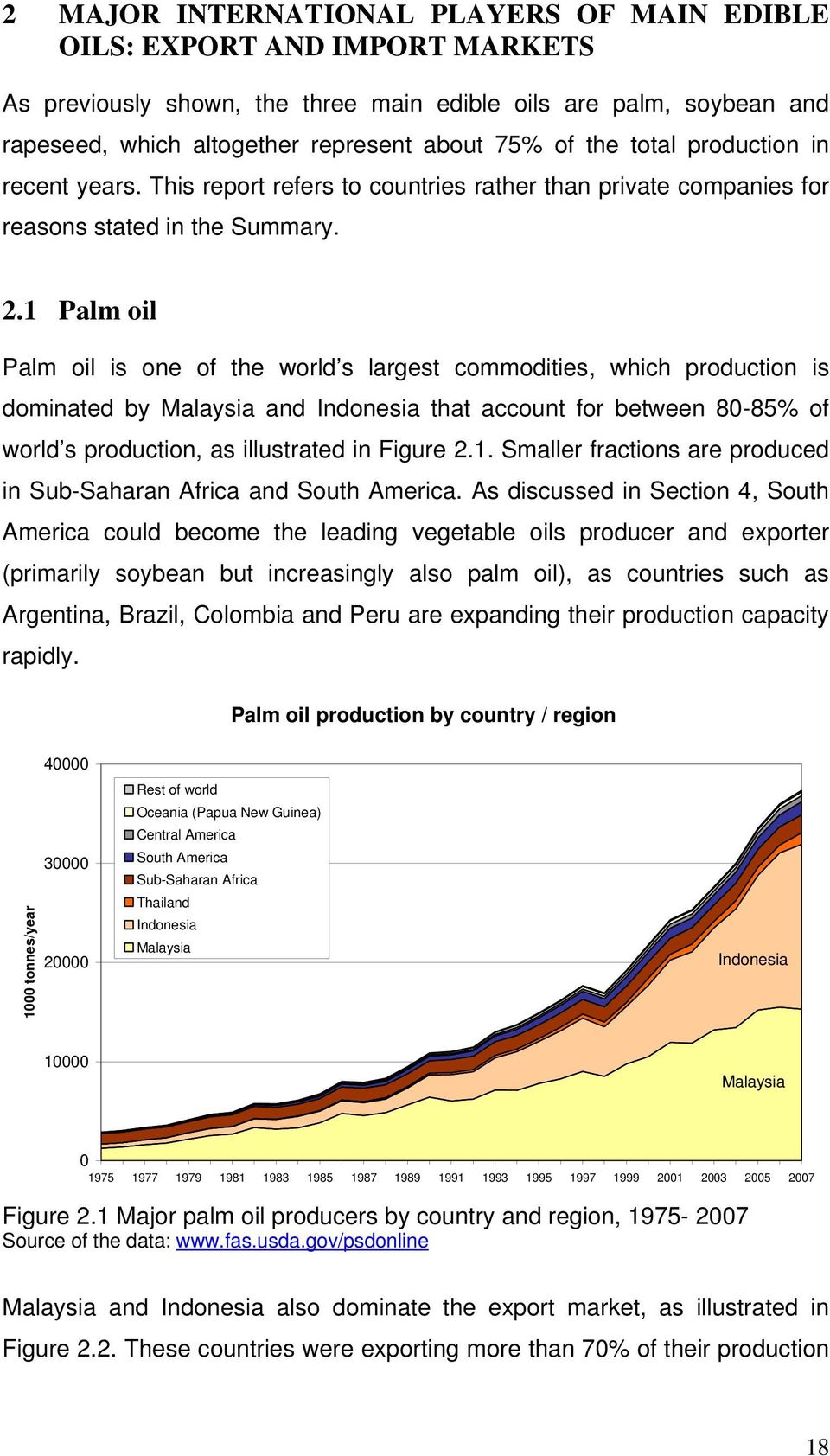
19 in 2007, representing more than 90% of the total palm oil volume traded. Thailand, although in a small scale, is also becoming an important player in this market. Palm oil export by country / region 1000 tonnes/year Rest of world South America Middle East Papua New Guinea Thailand, Singapore Indonesia Malaysia Indonesia Malaysia Figure 2.2 Palm oil exports by country/region, Source of the data: Figure 2.3 shows major palm oil importers in 2007, which totalled 30.2 Mt. The four largest importers are China with 5.2 Mt, followed by India with 4.5 Mt, the EU with 4.6 Mt, and Pakistan with 2.4 Mt. Others 31% China 17% Japan 2% Russia 2% India 15% Vietnam 2% Egypt 2% Bangladesh 3% United States 3% Pakistan 8% EU-27 15% Figure 2.3 Major importers of palm oil in Source of the data: 19
20 Figure 2.4 shows the evolution of palm oil imports since Major increases began around the mid 1990s, particularly by China and India; European Union is also a major importer of palm oil. Evolution palm oil imports in main importing countries 1000 tonnes/year China India Pakistan European Union Middle East Figure 2.4 Evolution of palm oil imports by major importers, Source of the data: Soybean oil Soybean oil is produced in many countries but it is important to distinguish between producers and importers. Many countries import raw soybean (oil seeds) and then process it to soybean oil. As illustrated in Figure 2.5, the largest producers of soybeans are the USA, Brazil, Argentina and China. While the USA was the largest producer, Argentina and Brazil are catching up. In 2007 the US saw a serious decline of soybean production, because of the conversion of land area to corn for ethanol production which was more profitable at that time. Nevertheless, in 2008 soybean production in the US was again at the level of previous years, so it seemed to be a temporary effect 6. About 30% of soybean production has been exported worldwide. The USA exports 30-40%, Brazil 20-40% and Argentina 15-25%; in most other producing countries production is essentially for domestic consumption as is 6 USDA Long-term Agricultural Projections to 2018, February

21 the case of China which is also a major importer, as shown in Figure 2.7. A major use of soybean is for animal feed. Soybean production by country / region tonnes/year Rest of World Canada India China Paraguay Argentina Brazil United States Argentina Brazil USA Figure 2.5 Major soybean producers, Source of the data: Figure 2.6 summarises the major soybean exporters over the period The first place is taken by the USA, secondly by Brazil and thirdly by Argentina, the world s largest producers. About 60% of the world soybean exports go to Asia, with China being the main importer, as shown in Figure
22 Soybean export by country / region Rest of World Paraguay Argentina Brazil 1000 tonnes/year United States Arg. Brazil USA Figure 2.6 Major soybean exporters (USA, Brazil and Argentina), Source of the data: From 1975 up to 2000 the EU was the most importing region when was overtaken by China as imports increased sharply due to increasing demand and lower domestic production e.g. in 2007 China imported 38 Mt. Although there are some statistical differences, worldwide imports of soybean in 2007 totalled 76 to c.78 Mt (see Figure 2.7 further illustrates the main soybean importers from 1975 through
23 Soybean import by main importing countries China Japan Southeast Asia 1000 tonnes/year European Union Mexico Figure 2.7 Main soybean importers, Source of the data: Soybean oil Soybean (meal) has been used primarily for animal feed while soybean oil has been mostly a by-product. The main soybean oil producers are USA, China, Argentina, Brazil, EU and India (see Figure 2.8). About 30% of soybean oil production is exported, but with large differences among exporting countries. For example, Argentina exports around 90% of its soybean oil production compared to 35-45% in Brazil and 10% in the USA. Up to 1990 the EU exported 50% of its soybean oil production, but recently this figure has dropped to about 10%. Figure 2.9 shows the main soybean oil exporters from 1975 to The largest exporters are Argentina, Brazil and USA which altogether accounted for almost 90% of the total traded. 23
24 Soya oil production by country / region 1000 tonnes/year Rest of world Middle East European Union India East & SE Asia (excl China) China South America (excl BR, AR) Brazil Argentina Mexico Canada United States China Brazil Argentina USA Figure 2.8 Main soybean oil producers, Source of the data: ; mind no figures for Brazil and Argentina before Soya oil export by country / region Rest of World European Union United States Paraguay 8000 Brazil 1000 tonnes/year 6000 Argentina Brazil Argentina Figure 2.9 Major soybean oil exporters, period Source of the data: mind different scale from production graph; no figures for Brazil and Argentina before Figure 2.10 shows the main importing countries of soybean oil covering the period 1975 to In the first place is China, followed by India (which has reduced its imports from significantly), and then by Northern Africa 24
25 (e.g., Morocco and Algeria) and the EU. As can be appreciated, there have been considerable fluctuations since early 1990s. In 2007 approximately 10.4 Mt of soybean oil were imported of which China was responsible for 2.7 Mt, India 0.7 Mt and the EU 1 Mt (see Soya oil import by main importing countries 1000 tonnes/year China India North Africa Middle East South America European Union Figure 2.10 Major soybean oil importing countries, Source of the data: Rapeseed oil It is important to distinguish between production of rapeseed and rapeseed oil as they have different applications. Further, one should also be aware that some countries do not produce rapeseed but do produce a substantial amount of rapeseed oil, which is imported as demonstrated in the following pages. Figure 2.11 shows rapeseed producing countries; as can be appreciated the four largest producers, by order of importance, are the EU, China, Canada and India. 25
26 Rapeseed production by country / region 1000 tonnes/year Rest of World Australia Former Soviet Union United States Canada India China European Union Canada India China EU Figure 2.11 World production of rapeseed from Source of the data: An important feature is the rapid increase in the overall production, from less than 10 Mt in 1975 to about 45 Mt in Approximately 15% of rapeseed is exported; Canada is the world-leading player, which exports 50-60% of its production. The bulk of the rapeseed production is consumed domestically by producing countries. 60% of exported rapeseed goes to Asia, with Japan being the prime importer. Figure 2.12 illustrates further this point. Canada has dominated the export market for decades, increasing its share since The EU was also a significant exporter until 2004, but currently exports very little; in fact, in 2008 EU tripled its imports of rapeseed oil and surpassed China. Australia started exporting around 1995 and has kept its share more or less constant. A new comer is Ukraine, which began exporting in The largest importers in 2007 were Japan with 2.16 Mt, Mexico with about 1 Mt, followed by China with 0.9 Mt and Pakistan with 0.8 Mt. For 2008/2009 the total imports are estimated at 9.8Mt, 2.4Mt correspond to Japan, 1.85 Mt to EU and 1.1 Mt to China (see 26
27 Rapeseed export by country / region 1000 tonnes/year Rest of World Australia Ukraine European Union United States Canada Figure 2.12 World rapeseed exports, Source of the data: ; mind the different scale from production graph. The export-import market has been rather erratic over the years. For example, the EU was a major importer up to 2003/2004 when imports started to decline dramatically with considerable ups and downs, although imports are currently growing. China did not become a major importer until 1996 with a huge jump in 2000 (at the same time they reduced soybean oil import, so this seemed to be a replacement effect), while Japan has remained a steady growing market since Imports have been erratic for both China and the EU, as illustrated in Figure
28 Evolution rapeseed import in main importing countries tonnes/year Japan China Mexico Pakistan European Union United States Figure 2.13 Evolution of rapeseed imports by major countries, Source of the data: Rapeseed oil Rapeseed oil production is dominated by the EU and China, with India and Canada playing a much smaller role, as shown in Figure Rapeseed oil production by country / region 1000 tonnes/year Rest of World Middle East Former Soviet Union Mexico United States Canada Pakistan India Japan China European Union China CND India EU Figure 2.14 Rapeseed oil production by country, Source of the data: 28
29 Only 10% of rapeseed oil production is exported to the world market. Europe was the dominant player until 1997 when was overtaken by Canada which currently exports about 80% of its production. However, in Canada exports are falling (proportionally) with regard to total production e.g. in harvest, about 60% was exported, while for the this could be less than 50%, in response to increasing domestic consumption (see Figure 2.15). Rapeseed oil export by country / region 3000 Rest of World European Union 1000 tonnes/year Canada Figure 2.15 Rapeseed oil exports by major countries, Source of the data: ; mind the different scale from production graph. Most rapeseed oil is exported to the EU that in 2007 accounted to 0.73 Mt, followed by the USA with 0.71 Mt and China with 0.33 Mt. However, for 2008/2009 harvest the total imports was estimated at 2.1 Mt of which 0.33 Mt corresponds to China and 0.21 Mt to EU (see The rest of the markets are far smaller by comparison. As illustrated in Figure 2.16 the rapeseed oil is a very volatile market, with huge fluctuations by major importing countries. 29
30 Evolution rapeseed oil import in main importing countries United States European Union China 1000 tonnes/year Figure 2.16 Evolution of rapeseed oil by major importing countries (EU, USA and China), from Source of the data: 30
31 3 WORLD PRODUCTION AND POTENTIAL OF BIODIESEL 3.1 World biodiesel production and potential Given the potential impacts of biodiesel production on the edible oils market, Section 3 and 4 assess the potential implications in some detail. The utilization of biodiesel is not new, since it has been used as a substitute for mineral diesel since early 20 th century, but in small quantities. What is new is that from 2005 onwards biodiesel production and use has increased significantly, spearheaded by the EU (mostly in Germany and France), currently responsible for about 80% of the world production. Despite this European dominance, biodiesel production is expected to stabilize in the coming years in the EU, with substantial growth expected in South America (Brazil, Argentina and Colombia) and Asia, as explained in this study. Figure 3.1 shows regional world production of biodiesel from 1992 to 2008, and estimates for Worldwide biodiesel production 1000 tonnes/year Rest of World Asia South- & Central America North-America Europe Figure 3.1 World production of biodiesel from 1992 to 2008, and estimates for Source of the data: F.O.Licht s, 2009 There have been various attempts to estimate the global biodiesel potential, but with considerable differences. Some studies have shown the potential to 31
32 vary from 40 to 85 billion litres (Bl) (35 to 75 million tonnes) worldwide. Johnston & Holloway (2007) have estimated the upper limit of worldwide potential at 51 Bl, from 119 countries. Although this study is rather theoretical, what it does illustrate is that under the right conditions (primarily by better management of tropical oilseed varieties such as Jatropha, new investment, and long-term clear policies), biodiesel production can be increased considerably. One of the most serious obstacles to the expansion of the biodiesel industry is the cost of the raw material which can easily represents 60 to over 80% of the total costs, though there are considerable geographical variations depending on the feedstock and local conditions. Therefore, availability of feedstock, cheaply and in large scale, is fundamental to the expansion of this industry. There are two major factors to take into consideration when dealing with feedstocks for biodiesel production. Firstly, is the source, and secondly is composition. In the first case it is important to know if the oil is derived from food on non-food crops; the second consideration is to know the composition of the oil and how appropriate it is as a feedstock (e.g., see Karman, Rowland & Smith, 2008). Despite the considerable potential of biodiesel, given the growing demand for edible oils and the high cost of the feedstock, this potential may be rather limited in the future unless biodiesel can be extracted from other raw material. Other important constraint is its sustainability, as the extension of land required for biodiesel production is considerable larger than in the case of bioethanol. The extent to which biodiesel may become eventually a global commodity remains uncertain, but it is highly unlikely that it will reach the same level as bioethanol. 32
33 4 ANALYSIS OF MAJOR REGIONS/COUNTRIES Sections 1 and 2 looked at vegetable oils from a global perspective, while Section 3 presented a brief overview of the potential of biodiesel on a global scale. Section 4 looks in greater detail at the biodiesel market from a regional point of view e.g. Europe, Americas and Asia. 4.1 European Union As previously stated, the EU is the world s main biodiesel producing region and has witnessed strong growth rates in between 1999 and 2008 (see Figure 3.1). The bulk of biofuels demand is met by biodiesel produced from domestically grown rapeseed. The reason for this dominant role a relatively high priced feedstock is to be found in the tradition of producing rapeseed, and the high level of public support provided in EU countries. The EU has recently accepted a mandate for renewable fuels (mostly biofuels) that will account for 10% of transportation fuel by As can be seen in Figure 3.1 there seems to be a stabilisation of the production of biodiesel in Europe between 2008 and Some countries are still increasing their production and use towards the European targets (5.75% biofuels by 2010), while other countries like Germany (see 4.1.2) experience various setbacks in biodiesel production. Reasons are (1) decrease crude oil prices, making the case of biodiesel less profitable; (2) competition with subsidized imported biodiesel; (3) reduction of policy support, mainly to the pure biodiesel market (B100); (4) sustainability discussions, reducing political backing and also reducing the support of the public. In some countries the debate was really detrimental for the image of biofuels in general Vegetable oil trade If we look at the worldwide use of rapeseed oil (see Figure 1.4a), it can be seen that the use for food applications is rather stable, although strong global growth in average income, combined with rising population, has increased the Met opmaak: Engels (Groot-Brittannië) 33
34 demand quite significantly. Since 2003 the main growth has been for industrial applications, and particularly biodiesel in Europe. While soybean oil production in the EU has been decreasing since 1970, rapeseed oil production has been increasingly over the same period and particularly from 2004 onward, as illustrated in Figure 4.1. This trend is further illustrated in Figure 4.2 which shows rapeseed production (minus exports) and imports in the EU from 1999 to 2008; these amounts are both processed and consumed within the EU. A significant feature is the small role of imports, although there is a noticeable increase from 2007 and Vegetable oil production in the European Union 1000 tonnes/year Rapeseed oil Soybean oil Palm oil Figure 4.1: Production of rapeseed oil and soybean oil in the European Union Source of the data:
35 Rapeseed production and imports in the European Union Import Production minus export 1000 tonnes/yr Figure 4.2 Rapeseed production (minus export) and imports in the European Union, Source of the data: Figure 4.3 shows vegetable oils (palm oil, soybean oil, rapeseed oil) export by the EU from 1970 throughout 2008, which, as can be seen, are very small for rapeseed and soybean, while in the case of palm oil is almost non-existent. The exports of vegetable oils have been declining for decades, particularly since mid 1990s, as most of the production is used domestically. Vegetable oil export from the European Union 1000 tonnes/year Rapeseed oil Soybean oil Palm oil Figure 4.3: Export of rapeseed oil, soybean oil and palm oil from the EU, Source of the data:
36 In contrast, the import has been increasing, especially of palm oil. However, this trend started in the 1980s, before the boom in biodiesel production, driven by the food market. Nevertheless, in recent years, the increased use of rapeseed oil for biodiesel may have contributed to a switch to palm oil for food or other industrial applications, as illustrated in Figure 4.4. Vegetable oil import into the European Union 1000 tonnes/year Rapeseed oil Soybean oil Palm oil Figure 4.4 Import of rapeseed oil, soybean oil and palm oil into the EU, Source of the data: Germany As Germany is the leading country in Europe for biodiesel production and consumption, it is studied in greater detail. This country has witnessed an enormous increase of biodiesel consumption between 2000 and 2007, mainly for use as pure fuel ( B100 ). Although there was some stabilisation between 2003 and 2004, when blended biodiesel was introduced, since then B100 use has kept growing. This trend is being reversed as tax levels on B100 were increased from 2007 onwards e.g. already in 2008 there is a decreasing trend in the use of B100; since 2009 B100 can hardly competitive with mineral diesel and market share of B100 is declining fast. Figure 4.5 shows the evolution of biodiesel consumption in Germany from 1998 to
37 4 PPO 0,7 3 pure biodiesel 0,7 0,4 million tonnes/yr 2 blended biodiesel 0,2 1,5 1,7 1,1 0,2 0, ,2 2,1 0,8 1,4 1,6 1,0 0,8 0,6 0,6 0,3 0,1 0,1 0,3 0, * 2009** Figure 4.5 Biodiesel and PPO (pure plant oil) consumption in Germany Source: PREMIA (2007), UFOP (2009); 2008 figures are estimation, 2009 figures are projection. Since there has been a strong increase of biodiesel imports. This was partly linked to the high increase in American biodiesel exports to Europe, which went from about 80,000 tonnes in 2006 to more than 1 million tonnes in 2007, according to European Biodiesel Board (EBB). This trend can be partly explained by the level of American subsidies e.g. US government subsidies $300 per ton ( 200 per ton) for any biodiesel blended with mineral diesel, be it in very small proportion. The current legislation makes it possible for the USA to export a subsidised fuel composed of 99% biodiesel (B99) that is eligible for the incentive systems of the countries of the EU; this has affected biodiesel production, particularly in Germany 7. However, this loose hole has now been closed and USA biodiesel imports cannot benefit from this double subsidy e.g. EU and USA. To get a better idea of the share of imported feedstock, the amount of biofuel (biodiesel and pure plant oil PPO) produced from German rapeseed is assessed in more detail. When comparing these figures (0.8 to 1 Mt) with the consumption of biodiesel and PPO, only 25 to 30% of German biodiesel and PPO consumption comes from 7 For example, the EBB lodged a complaint ( a joint anti-subsidy and anti-dumping complaint ) in the name of European industrialists on 25 April 2008 with the European Commission. 37
38 domestic feedstock. Most of the imported feedstock comes from neighbouring countries. Domestic consumption of German rapeseed oil 2000 fuel 1500 technical oil food 1000 tonnes Season Figure 4.6: Domestic consumption of rapeseed oil produced from German rapeseed Source: [UFOP, 2007) Note: Technical oil refers to industrial uses other than for biofuel Conclusions for the European market Two specific observations in European trends can be made that are of particular relevance for global trade in vegetable oil: Increasing consumption of domestically produced rapeseed oil for biodiesel uses may have lead to a considerable gap in EU food oil demand (which continues to increase), resulting in an increase on imports for other types of oil (mostly edible palm oil). Various projections indicate that in the future EU biofuel consumption would have to rely heavily on imports of feedstocks rather than on domestic sources because of their higher costs. 38
39 4.2 The Americas The countries covered in this group are Argentina, Brazil, Canada, Colombia and the US. Except for Colombia, which is an important producer of palm oil, all other countries are, in the main, major producers of soybean United States Production of vegetable oils United States is one of the top producers and consumers of vegetable oils in the world, representing 6 to 7% of the world production in recent years (10.5 Mt in 2007); its domestic consumption accounted to about 10% of the world consumption in the period (12.2 Mt in 2007). Due to the size of its domestic market, exports represent only 7-12% and between 2 and 3% of the world trade (1.7 Mt exported in 2007) (FAS-USDA, 2008). Soybean oil represents the bulk of US production, as can be seen in Table 4.1. Table 4.1 Production of vegetable oils in US and the share of soybean oil, local and world production, Vegetable oils/data Vegetable oils (1,000 t) 9,760 10,390 10,410 10,510 10,030 % of world production Soy oil (1,000 tonnes) 8,780 9,250 9,290 9,330 8,870 % of world production % of US production of VO Note: VO = vegetable oils. Source: USDA Foreign Agricultural Series (FAS-USDA, 2008) Figure 4.7 shows the evolution of soybean oil production in US from 1995 to On average, production grew along the period but its share of world production has declined sharply since 1996, largely due to the growing production in Argentina and Brazil as explained in the following pages. From 2004 to 2008 the production of soybean seeds decreased 7%, while the world production grew almost 9%. Over the same period the US production of soybean oil remained constant, while world production grew 15%. The share of US production of seeds that is locally crushed, however, has been fairly constant (about 60%) since
40 % Oil soybean production (1000 t) 35% 30% 25% 20% Share of world production 15% Figure 4.7 Soy oil production in US and its share in the world, 995 to Source/ FAS-USDA (2008) Production and consumption of biodiesel in the US Biodiesel production has grown remarkably since 2005 reaching 1.9 billion litres (Bl) in According to the National Biodiesel Board (NBB), from biodiesel production grew 20-fold; Figure 4.8 shows this growth from 1999 to Despite this remarkable growth, considering that diesel consumption in US is about 230 Bl/year, biodiesel consumption still represents less than 1% of the conventional diesel (NBB, 2008a). 40
41 10000 Biodiesel production [million litres] Figure 4.8 Biodiesel production in United States, 1999 to 2007 Source: NBB (2008b) Note: According to REN21 (2006 and 2007), the production in 2005 was 250 M litres and 850 M litres in 2006, i.e., about 90% of the production declared by NBB. The estimated installed capacity in mid 2008 was 8.5 Bl, distributed in 171 industrial plants. It is estimated that the production capacity could reach 12.8 Bl in short-term, due to 60 new plants that are under construction or being expanded. Figure 4.9 shows the location of all biodiesel plants (existing and under construction) in mid 2008; main feedstocks are also indicated. The bulk of the mills produce biodiesel from different vegetable oils, particularly soybean oil. According to the data provided by NBB (2008c) less than 1% of the installed capacity use recycled oil and about 2.5% of the existing capacity use animal fats. The database of NBB (2008c) seems to be very representative, as it lists 162 plants with declared production capacity of 9.6 Bl, vis-à-vis about 10 Bl existing in mid plants have a production capacity of less than 40 M/l/year and 144 plants have capacity of less than 120 Ml/year. The 10 top largest biodiesel plants represent 30% of the installed capacity; while the top 20 largest units concentrated 46% of the existing capacity; the largest biodiesel plant has a production capacity of 400 Ml/yr. 41
42 According to NBB (2008b), in 2007 only 12% of US soybean production was used for biodiesel (i.e., 1.7 Mt of soybean oil, or almost 18% of US soybean oil production) 8. As for the overall biodiesel production, refined soy oil accounted for 62.7%, crude soybean oil 16.6%, animal fats and oils 16.2%; inedible tallow and grease 4.4% and cottonseed oil just 0.02% (NBB, 2008b). As mentioned, about 60% of biodiesel feedstock is soy oil, and the remaining 40% consists of other vegetable oils and animal fats. A study by the National Renewable Energy Laboratory (NREL) in 2006 indicated that it was possible to produce 7.6 Bl of biodiesel (2.0 billion gallons) using available feedstocks (vegetable oils, greases and animal fats). Considering the natural growth and expansion of existing feedstocks (soy, canola, and sunflowers) it was estimated an additional production of 6.8 Bl by 2016 (1.8 billion gallons) (NBB, 2008b). Figure 4.9 Biodiesel plants by mid 2008 (existing and under construction) Source: NREL (2008), from data of NBB and Biodiesel Magazine. 8 According to FAS-USDA (2008), the US production of soybean seed was 72.8 Mt. As 12% was used for biodiesel production (8.7 Mt), for an oil yield of 19% (NBB, 2008b) that means 1.7 Mt of soybean oil was used (the US soybean oil production in 2007 was 9.3 Mt; imports of soybean oil were irrelevant). According to NBB, the biodiesel production in 2007 was 1.9 Mt (see Figure 4.8). 42
43 In the US biodiesel is marketed as a blended product with mineral diesel, in concentrations up to 20%. Until 2007, the use of biodiesel was mostly limited to fleets of vehicles that have their own fuelling stations (DOE, 2008). Since 2008 Minnesota requires biodiesel to be used at a 2% blend and the state of Illinois encourages an 11% blend of biodiesel by way of a tax incentive. Other states and local governments require biodiesel at minimal levels. REN21 lists three US states as having biodiesel blending mandates at the end of 2007: New Mexico (B5), Louisiana and Washington (B2). The Energy Independence and Security Act of 2007 (EISA) established that 7.2 Bl (1.9 billion gallons) of biomass-based diesel (includes biodiesel) should be in the market in 2009, reaching at least 14.3 Bl (3.8 billion gallons) in 2012 (DOE, 2008). Figure 4.10 shows biodiesel feedstock prices in the US from 2003 to July As can be appreciated, there is considerable price volatility, particularly in the case of sunflower and corn crude oil. United States Biodiesel Feedstock Prices to 2008 $1.200 $1.000 $ per pound $0.800 $0.600 $0.400 $0.200 $ /2004 4/2004 7/ /2004 1/2005 4/2005 7/ /2005 1/2006 4/2006 7/ /2006 1/2007 4/2007 7/ /2007 1/2008 4/2008 7/2008 RBD Soybean Oil Canola Sunflower Corn Oil (crude) Palm Month-Year Figure 4.10 Biodiesel feedstock prices in the USA, (Jan-July) Source: Nelson, R (Head Dept. Engineering Extension, Kansas State University, Personal Communication. Met opmaak: Engels (Groot-Brittannië) 43
44 4.2.2 Brazil Production of vegetable oils in Brazil Despite its favourable conditions and large agricultural tradition, Brazil is not among the major producers of vegetable oils, except soy oil (and to a lesser extent cottonseed). Table 4.2 shows production data of different vegetable oils from 2002 to 2007 and their share of Brazilian and world production. As can be seen, soybean oil represents almost 90% of the total domestic production. Table 4.2 Production of vegetable oils in Brazil and their share, and world production (of vegetable oils) Vegetable oils/data Soybeans (1,000 tonnes) 1 5,105 5,636 5,630 5,430 5,970 6,110 (% of world production of this oil) (% of Brazilian production of VO) n.a. Cottonseed (1,000 tonnes) n.a. (% of world production of this oil) n.a. (% of Brazilian production of VO) n.a. Palm-oil (1,000 tonnes) n.a. (% of world production of this oil) n.a. (% of Brazilian production of VO) n.a. Sunflower (1,000 tonnes) n.a. (% of world production of this oil) n.a. (% of Brazilian production of VO) n.a. Rapeseed (1,000 tonnes) n.a. (% of world production of this oil) n.a. (% of Brazilian production of VO) n.a. Sources: 1 production data from USDA Foreign Agricultural Series (FAS-USDA, 2008) 2 calculated regarding world production taken from USDA Foreign Agricultural Series 3 calculated regarding data Oil World, apud ABIOVE (2008), considering soy oil production from USDA 4 Oil World, apud ABIOVE (2008) Notes: na = data not available. VO = vegetable oils. Brazil has a long tradition with soybeans production; Figure 4.11 shows this evolution from 1995 to Despite continuous growth over this period, the share of Brazilian production worldwide has remained roughly constant, as production from China and Argentina are growing faster. In recent years the production of soybeans grew faster than the production of soy oil (1.7% globally from 2004 to 2008 and 2.2% for Brazil). Soy oil grew 2.9% and 1.4% worldwide and Brazil, respectively (see Figure 4.11). 44
45 % Oil soybean production (1000 t) % 18% 16% 14% 12% Share of world production 0 10% Figure Soy oil production in Brazil and its share in the world, 1995 to Source: FAS-USDA (2008) Figure 4.12 shows that the share of Brazilian production of soy seeds that is locally crushed declined along the years as has stabilized in less than 60% in recent years. 100% 90% Locally crush/production 80% 70% 60% 50% 40% 30% 20% 10% 0% Figure 4.12 Share of soybean crushed in Brazil and overall production from 1995 to 2008 Source: FAS-USDA (2008) 45
46 The Brazilian biodiesel program At the end of 2004, Brazilian government decided to implement the so-called National Program of Biodiesel Production and Use (PNPB). The main targets of the program are to generate jobs and income in rural areas and reducing regional inequalities. According to the government, two additional targets are the potential contribution to foreign-exchange savings and the improvement of environment. A law made B2 blends mandatory countrywide from January 2008, but this target was increased to B3 blends in July Starting July 2009 the mandate will be B4. In January 2013 the mandatory mix will increase to 5% of biodiesel (B5), but this target will be brought forward to Higher biodiesel blends or even B100 can be used, but only if authorized by the Petroleum, Natural Gas and Biofuels National Agency (ANP). From 2005 to 2007 the use of B2 blends was not mandatory. The program was conceived in order to foster the production of biodiesel from different raw materials, such as palm oil and babussu in the North region, castor oil and cottonseed in Northeast region, sunflower and peanuts in the South and soybeans, residual oil and fats in the Southeast and Centre regions. However, the bulk of biodiesel production has been based on soy oil. The production of biodiesel has been encouraged through purchase auctions organized by ANP. Thirteen auctions took place since 2007 and the total amount of biodiesel sold almost reached 2.6 Bl. The amount of biodiesel required in 2008 to fulfil the B2-B3 mandate is estimated at 1Bl while the production almost reached 1.2 Bl. Figure 4.13 shows the volume of biodiesel sold in auctions and the accumulated production since mid
47 mar/05 jul/05 nov/05 mar/06 jul/06 nov/06 mar/07 Biodiesel sold in auctions [1000 m3] jul/07 nov/07 mar/08 jul/08 nov/08 Auctions Production Accumulated production [1000 m3] Figure 4.13 Biodiesel sold and accumulated production, onwards Source: ANP (2009) It is estimated that more than 80% of the biodiesel production is from soy oil (USDA, 2008) 9 ; about 10% from sunflower, 7% from residual oil and fats (Amaral et al., 2008), and only 3-4% based on other raw materials such as castor, palm and babassu). Soybeans production in Brazil comes from plantations, mostly in the Central and in the South regions (47% and 36% of the total production, respectively). The two states with higher production are Mato Grosso (29%), in the Central region, and Paraná (21%), in the South (CONAB, 2008). PETROBRAS, the stated-controlled oil company, is responsible for biodiesel blends and hence the only buyer of biodiesel. The company has also been engaged in programs aiming at induce the production of raw materials in 9 There is uncertainties regarding this number; the Brazilian government states that the share of soybean oil is close to 70% while critics of the biodiesel program state that the share of soybeans could be as high as 90%. In a survey done in 2008, from all the biodiesel plants in production only 35% responded the requested information on the percentage of raw materials used (Amaral et al, 2008). 47
48 poorest regions, development of technology and also the enlargement of the production capacity 10. The existing capacity of biodiesel production is estimated as almost 3.7 Bl distributed in 62 industrial units. According to the Brazilian regulatory agency (ANP) there are 23 additional plants in the process of being authorized plus a further eight existing plants for increasing production. Table 4.3 shows the production and distribution of the existing production capacity in Brazil. The bulk of production capacity (70%) is concentrated in just 15 industrial plants, in eight states. The five top largest biodiesel plants represent 32% of the installed capacity (the largest plan has a capacity of 274 Ml/yr) (ANP, 2009). Also, 24 out of 62 plants have production capacity lower that 12 Ml/yr and 36 plants have capacity up to 36 Ml/yr. According to ANP (2009), only 3.6% of the installed capacity would allow the production of biodiesel from tallow. Most of the plants can use different vegetable oils. The concentration of biodiesel plants in the Central region is explained by the concentration of soybean production in that part of the country. For example, Mato Grosso, the main producer of soybeans in Brazil, has almost 25% of the installed capacity. This is followed by the States of Rio Grande do Sul and Sao Paulo. A relatively new comer is the State of Goiás, which has increased production rapidly in recent years stimulated by good infrastructure and closeness to the market (see Table 4.4). Biodiesel production in São Paulo is explained by the large existing capacity of refining vegetable oils and by the size of the local market. The state of Rio Grande do Sul, with long historical production of soybean, became the most important biodiesel producer of biodiesel in 2008, covering about 30% of the production (CONAB, 2008). 10 The company has three industrial units with total capacity of production of 170 Ml of biodiesel per year and in 2008 it was noticed that more ten units could be build up to 2012, with additional capacity of 850 Ml. 48
49 Table 4.3 Existing capacity of biodiesel production at the end of 2008 and accumulated production from March 2005 to October 2008 Region Industrial units Capacity (1000 m 3 /year) Share of total capacity (%) Accumulated production (1000 m 3 ) Share of accumulated production (%) North Northeast Central 27 1, Southeast South Total 62 3,760 1,390 Source: ANP (2009) Table 4.4 Biodiesel production (since March 2005) and capacities of biodiesel and vegetable oils production (2008) State Biodiesel 1 Share of Vegetable oils (1,000 t/day) 3 # of units Capacity (1000 m 3 /year) Accumulated production (1000 m 3 ) soybeans production (%) 2 Processing capacity Refinery capacity Mato Grosso RG Sul São Paulo Goiás Bahia Maranhão Piauí Paraná Brazil 62 3,760 1, Sources: 1 ANP (2009) 2 CONAB (2008) estimated production 3 ABIOVE (2008) installed capacities Figure 4.14 shows the evolution of the average prices paid in 13 auctions so far carried out in Brazil 11. The total volume sold is almost 2.3 Bl, in accordance with the estimated production in 2008 and Average prices dropped continuously until mid-2007 and then began to recover significantly toward the end of the year due to the high prices of soybeans in the international market (see Section 7). 11 The auctions are coordinated by the ANP. 49
50 Average price [Euro/m3] Accumulated volume sold [m3] 2009 Figure 4.14 Average prices paid to biodiesel in Brazil (using the exchange rate at the time of the auction) Source: ANP (2009) Argentina Production of vegetable oils in Argentina As stated above, Argentina is one of the world s largest producers of vegetable oils e.g. 6-7% of world production, with 6.6 Mt in 2007 (FAS-USDA, 2008), due primarily to soybean and sunflower. For example, the country is the third largest producer and the largest exporter of soy oil (about 18% of the world production - 90% of its production). Argentina is also among the top producers of sunflower seed and sunflower oil (15-18% of the world production in , with approximately 1.8 Mt), (FAS-USDA 2008; Hilbert, 2008). The harvested area with soybeans in Argentina reached 18 Mha in 2008, a threefold increase since Three main reasons can be identified: (i) the devaluation of local currency with higher incomes received by local producers, (ii) reduction of soybeans cycle due to advances of biotechnology which led double-cropping (genetically modified soy was introduced in the season), and (iii) expansion to new areas and improved agricultural practices that have allowed for areas to be planted which were previously unsuitable for 50
51 agriculture 12 (USDA, 2006; Lamers et al., 2008). In 2005 the estimated planted area was 27Mha. Argentina s success with vegetable oils export has also been due to a combination of reasons including tax incentives, which led a reduction in the internal price of soybeans (USDA, 2006). Figure 4.15 shows the share of soybeans production crushed in Argentina that has been almost constant to around 75% since the mid 1990s. Unlike Brazil, the bulk of the production of soybean, including oil, is exported (see Figure 4.16) primarily to Asian countries (USDA, 2006). The reduction of exports in was partially due to the lower demand from India. 100% 90% 80% Locally crush/production 70% 60% 50% 40% 30% 20% 10% 0% Figure 4.15 Share of soybean crushed in Argentina regarding overall production Source: FAS-USDA (2008) 12 In Argentina, no-tillage farming with residual coverage has been extensively used. It was estimated that in the season % of the planted area was no-tillage swon, reaching 85% in case of soybeans (Hilbert, 2008). 51
52 % Soybean oil exports [1000 t] % 100% 90% 80% 70% 60% 50% 40% 30% 20% 10% Share exported 0% Figure 4.16 Soybean oil exports from Argentina and the share of exports with regard to total production Source: FAS-USDA (2008) Most of the soybean production is concentrated in the central region of the country, with the Santa Fe province responsible for more than 80% of the crushing capacity (Hilbert, 2008). An important advantage of Argentina is that the majority of its plants are located at the ports or along a major transportation line to the ports, at the Parana River. Port facilities have improved storage capacity considerably with more planned e.g. recently the Parana River was dredged to allow ships to be fully loaded in Rosario, in the interior of the country. However, few of the ports are deep enough to allow for large ocean-ships e.g. there are only two ocean ports (Bahia Blanca and Necochea) with grain facilities capable of fully loading such ships. A further constraint is that trucks account for 75% of the grains and oilseeds transported to port facilities, while the countryside roads are in poor conditions (USDA, 2007). Biodiesel production in Argentina Argentina is rapidly becoming one of the world's top producers of biodiesel and so far the bulk of its production is exported. This figure could change from 2010 onwards as biodiesel blending will be compulsory there, starting with B5 52
53 (USDA, 2008a). Other reason is that the country would try to export the end product (biodiesel) rather than feedstock as more plants are built. Biodiesel production began few years ago as a cottage industry, promoted by farmers because the high price and shortages of mineral diesel. Small amounts of biodiesel were exported to Europe in 2005 and 2006, but in 2007 Argentina exported almost 180 million litres of biodiesel mostly to US (more than 70%) and the remaining to EU. In 2008 exports were projected to reach one billion litres, being the US market the prime target. In 2007 the installed biodiesel capacity was less than 0.6 Mt distributed in nine industrial units; in 2008 this capacity surpassed 1.4 Mt. If all planned biodiesel projects come on line, production could exceed 3.7 Mt by 2010 and about 4 Mt by 2011 (St James, 2008). It is estimated that 85% of the production capacity is located in Santa Fe province (St James, 2008). By 2010 the consumption of diesel oil is estimated as 14.5 Mt; a 5% blend would require about 720 thousand m 3 (630,000 t) of biodiesel in 2010, although other estimates are much higher (Lamers et al., 2008). Argentina supports biodiesel exports through various tax schemes and this tax regime guarantees a low cost supply of feedstock for biodiesel production and gives greater competitiveness in the international market. In 2007 the government published regulations providing the framework for investment, production and marketing of biofuels. The main objectives of the regulatory framework are i) to diversify the energy supply (diesel represents more than 50% of the consumption of oil derivatives), ii) to have a more environmentally friendly energy matrix, and iii) to promote the development of rural areas, particularly small and medium agricultural producers. Almost all biodiesel production is based on soy oil as feedstock and no major changes are envisaged in the near future. Currently there are just few small plants using recycled vegetable oil, sunflower and rapeseed oil. The government is encouraging the diversification to feedstocks such as Jatropha, algae, and castor oil plants. 53
54 4.2.4 Colombia As discussed in Section 5, there are new emerging vegetable oil producers and Colombia could be a leading player. For example, the country is already among the top five big producers of palm oil, which covers more than 85% of the local production of vegetable oils (FEDEPALMA, 2009). In March 2008 the Colombian government agreed on a policy framework for biofuels (biodiesel and ethanol). The first biodiesel blends commenced that year are expected to cover a mandatory 5% mix in 2009 and the minimum blend requirement of biodiesel could increase to 10% by 2010 (USDA, 2008b). The consumption of mineral diesel has increased steadily since 1999 and in 2006 surpassed the consumption of gasoline on a volume basis. It is expected that by 2020 diesel consumption could be 50% higher than gasoline. This would require importing about 10% of the estimated diesel consumption (Mesa-Dishington, 2007). Biodiesel production reached 146 Ml in 2008, requiring about 25% of palm oil production. The first plant with a capacity of 50,000 l/yr belongs to palm oil producer Oleoflores. A new plant entered production in April 2008 and six plants are expected to be in operation by early 2009 (USDA, 2008b). It is estimated that the total capacity could reach 0.83 Ml by the end of 2009 (Mesa-Dishington, 2007). In 2008 palm oil production was estimated at 0.83 Mt. Since 2004 annual average growth has been 6.4%; there are about 0.32 Mha of palm (FEDEPALMA, 2009). Colombia could produce 550 Ml of biodiesel from palm oil by the end of The biodiesel producers believe that the country would be in a position even to export by the year 2010 (USDA, 2008b). Figure 4.17 shows the development of the palm oil industry in Colombia 54
55 La agroindustria de la palma de aceite en Colombia 35 Miles de hectáreas Siembras anuales de palma de aceite Área total sembrada acumulada Miles de hectáreas Fuente: Cálculos Fedepalma Figure 4.17 Historical development of the palm oil industry in Colombia, Source: Federacion de Biocombustibles de Colombia Canada Canada is among the top vegetable oil exporters (sixth place in the harvest season , exporting 1.34 Mt, or about 2.5% of the amount traded). Canada was also at that period the fourth largest exporter of oil seeds (after US, Argentina and Brazil), with 7.7 Mt exported (about 8% of the total traded) (FSA-USDA, 2009). This position is essentially due to its canola (rapeseed) production, as Canada is the third largest producer (9.5 Mt, about 20% of the world production); and the fourth largest producer of canola oil (after EU-27, China and India), with 1.6 Mt produced in (9% of world production). The canola cropping conditions are considered ideal in Western Canada (Biofuel Canada, 2009). Canada currently exports about 85% of canola, either as seed, oil or meal. Japan is the largest seed customer and the US the largest oil customer (Canola Council, 2009). Regarding canola oil, Canada is by far the largest exporter, with circa 1.3 Mt exported in , or 67% of the amount traded (FSA-USDA, 2009). 55
56 In December 2006, the federal government announced support of a national renewable fuel strategy calling for a 5% Renewable Fuel Standard in all Canadian fuel, including a 2% mandate for biodiesel by 2012 (Canola Council, 2009). More recently, it was announced that the national on-road biodiesel mandate will be introduced as soon as 2010 and no later than 2012, as long as all practical and technical issues involving biodiesel are addressed 13 (IICA, 2009). Compared to EU and US, biodiesel in Canada is in early stages of development and commercialisation. Efforts have been supported through direct and indirect incentives, regulations and legislation. In November 2002, the Canadian Government established a biodiesel production target of 500 Ml/year by In 2003, the federal government exempted biodiesel from the $0.04/litre federal excise tax. Provincial jurisdictions have acted singularly to implement biodiesel initiatives to stimulate biodiesel production and investment; British Columbia, Ontario and Manitoba offer tax exemption (Biofuel Canada, 2009). The requirement of B2 blends by 2012 would correspond to the consumption of 600 M litres of biodiesel. If all of the biodiesel were produced using canola, this would require about 1.3 Mt of canola seed, i.e., less than 15% of the domestic production in The unsold amount of canola seed was 1.7 Mt in 2006/07. The canola industry has set a production target of 15 Mt by the year 2015 (Canola Council, 2009). Besides rapeseed, Canada can take advantage of other feedstocks, mainly soybean (about 1% of the world production in ), waste greases and animal fats. For instance, the Canadian rendering industry produces about 400,000 tonnes of animal and yellow grease annually for the oleo-chemical and animal feed industry (Biofuel Canada, 2009). The targets of RFS regarding biodiesel match perfectly well with the interests of canola producers and its industry, as long-term support will be provided for 13 Test conducted in were successful, but the Canadian Trucking Association (CTA) believes another round of tests involving 2010 model-year truck engines is warranted to determine if there are any potential issues involving the use of biodiesel and urea on the performance of the new emission control systems. Tests must also include blends from B2 to B5, or higher, during all seasonal conditions (IICA, 2009). 56
57 Canadian farmers by creating inelastic demand. Canola is vulnerable to borders shutting because of tariffs and non-tariff trade barriers (Canola Council, 2009) 4.3 Asian countries Asia is the world s largest producer of edible oils, particularly palm oil, and has a well developed industry, primarily in Malaysia and Indonesia. The same cannot be said when it comes to biodiesel which is still in its infancy. A large proportion of edible oils are destined to the export market, excluding China which is a major importer. This section will look in some detail at the countries included in this study e.g. China, India, Indonesia, Malaysia and Thailand China Due to its rapid socio-economic development of the past few decades, the Chinese market is being transformed socially and economically. Currently many energy and foodstuff are imported e.g. China is on the way to become the world s largest importer of edible oils, as illustrated in the previous sections of this report. The current use of biofuels in China is part of a mechanism to decrease oil imports, foster agricultural and social development, and promote environmental sustainability. Contrary to ethanol, the biodiesel industry is not well developed since this is a more recent policy development. It was not until the 11 th National Development and Reform Commission (NDRC) when an ambitious renewable energy (RE) target was launched. When the new 11 th Plan came into force, China was importing 75% of its palm oil needs from Malaysia for biodiesel use, though biodiesel production started on an exploratory scale in the 8 th Plan ( ). For the 11 th Plan, the objective is to have a production capacity of 2 Mt/year. There are various schemes to produce 1.1 Mt/year of biodiesel from Jatropha and rapeseed oil and also to build 18 new plants with capacity of 0.74 Mt/year (Chavez, 2008). Although there are various feedstocks under consideration, Jatropha curcas seems to be one of the most attractive crops and consequently has received 57
58 the most attention so far, both from government and private stakeholders. Guizho, Sichuan and Yunnan are the three provinces where there are more Jatropha plantations e.g. there are over 71,000 ha in marginal lands alone. The NDRC has targets for these three provinces to increase the cultivated area to 1.03 Mha. If these targets were to be met, it is estimated that between 0.3 Mt and 2 Mt of biodiesel could be produced, representing 0.3 to 1.8% of Chinese diesel consumption in 2005 (Chavez (2008). Table 4.4 provides a summary of the main biodiesel feedstock and land use in China for biodiesel production. Table 4.4 Summary of main current and future feedstock for biodiesel production and land area, in China Feedstock Geographical Present and future Comments distribution land use Jatropha South-Southwest 2006, ha , 1Mha (tree provinces) Reaching commercial Chinese pistachio Centre, Northcentre, Henan, Hubei mainly 2006, 50,000 ha , 0.3Mha development. R&D Could be an important biodiesel feedstock in future Rapeseed/soybean South provinces 2006, 2.34 Mha High demand for edible oils; less demand for biodiesel Source: See Woods and Black (2008) India India s increasing oil dependency has led to specific policies aiming at lessening import of crude oil. India is the world s sixth largest energy consumer and oil dependency is expected to increase from 73% (2008) to 91% in 2030 (Das & Priess, 2009). India was one of the first countries to create a Ministry of Renewable Energy (MNRE) and this say something about the importance that this country gives to alternative energy. India's concern with energy dependency has led to specific policies in support of bioethanol and biodiesel; currently the government in formulating a national biofuel policy which will outline new policy, strategies, fiscal incentives, R&D, etc. The Indian government has already set up a National Mission on 58
59 Biodiesel (NMD) whose aim is to meet 20% of the country diesel requirement by from Jatropha. This mission was conceived in two phases: Phase I, , under the Ministries of Agriculture and Rural Development, started demonstration Jatropha projects, targeting some 0.4Mha, in forest, non-forest, marginal lands, edges, alongside roads, etc. Phase 2, , aiming at 11 Mha of Jatropha plantations in marginal lands, including the establishment of transesterification plants, to meet biodiesel demand, as illustrated in Table 4.5 Table 4.5 Diesel and biodiesel demand, and land requirement for different blending Year Diesel demand (Mt) B5 (Mt*) Area for B5 (Mha) B10 (Mt) Area for B10 (Mha) B20 (Mt) NA 3.98 NA 7.96 NA Area for B20 (Mha) *Million tonnes Sources: Das & Priees (2009), Woods & Black (2008) However, these figures seem unrealistic for various reasons: i) there is little commercial experience with large scale Jatropha plantations and there many questions marks, ii) use of marginal lands raises serious questions as to the productivity and hence costs, iii) it is not that clear with regard to the total investment required; iv) relying so much on a few feedstocks poses also real questions of vulnerability. The National Oilseeds and Vegetable Oil Development Board (NOVOD), under the Ministry of Agriculture, is the main implementation agency for the Tree Borne Oilseeds (TBOs) program, which includes various types of vegetables oils, but with Jatropha playing the key role. India has embarked in the largest scale Jatropha plantations in the world, despite many uncertainties involved, particularly lack of commercial experience, low productivity, land quality, etc., as stated above. 59
60 India is a highly populated country and therefore land availability for no-food purposes is a high premium. About 55 Mha are classified as wastelands of which over 32 Mha has been identified as suitable for Jatropha cultivation. Most of the wastelands in India are Common Property Resources (CPRs), comprising mostly community forests, pastures, pachayat lands 14. The extent to which India will be able to allocate so much land for fuel rather than food production is not without controversy. However, India has compounded many critics by its ability to produce food and even generate surpluses despite its large population size. India has been able to stabilise the cultivated area due to growth in crop yields which have kept up with population growth and income. Therefore its population does not increase rapidly, in the immediate future this scenario would not probably change much and it may be possible to allocate more land to biofuels production. Nonetheless, in the longer term, this trend is unlikely to continue as increases in productivity may not be possible to sustain. However, Ravindranth (2006) has suggested that even with modest increases in crops productivity, India could free up one-third to one-half of the country s current cropland for production of bioenergy Indonesia As with Malaysia, Indonesia is a world leader in the production of edible palm oil. It is only recently when the government has made a firm political commitment to biofuels, particularly biodiesel under the National Energy Mix Presidential Instruction 10/2006 led to the establishment of the National Team on Biofuel Development (TinNas BBN), whose main targets for 2010 are: To create 3.5 million jobs; To develop biofuel plantations on 5.25 Mha of unused land; To create 1000 self-sufficient energy villages and 12 special biofuel zones; To improve biofuel local demand and exports; 14 Land belonging to a group of people responsible for village administration 15 Under Presidential Degree No. 5 of 2006 (see Woods & Black, 2008). 60
61 Biofuels to account for 2% of the national energy mix by 2010 (approx. 3.5 Bl); 3% biofuels by 2015 (9.8 Bl); 5% biofuels by 2025 (c.33.3 Bl). Tables 4.6 and 4.7 summarise current and planned palm oil plantations in Indonesia. Table 4.6 Major palm oil plantations in Indonesia; areas in Mha Indonesia 6.05 Sumatra - Sumatera Utara Sumatera Barat Riau Jambi Sumatera Selatan 0.41 Kalimantan - Kalimantan Barat - Kalimantan Tengah - Kalimantan Timur Source: Colchester et al. (2006), Woods & Black (2008) Table 4.7 Indonesian provincial government plans for expanding palm oil plantations; areas in Mha Indonesia (grand total) Sumatra - Sumatra Selatan - Lampung - Jambi - Bengkulu - Sumatra Utara - Aceh - Riau - Sumatra Barat Kalimantan - Kalimantan Barat Kalimantan Seletan Kalimantan Tengah Kalimantan Timur 1.00 Sulawesi - Sulawesi Tengah Sulawesi Seletan Sulawesi Tenggara 0.50 Papua - Papua 3.00 Source: Colchester et al. (2006); Woods and Black (2008) Met opmaak: Engels (Groot-Brittannië) 61
62 The planned expansion of palm oil plantation in Indonesia is a serious cause of concern because the indiscriminate destruction of natural forests. In Borneo, for example, the rapid expansion of palm oil plantations is destroying natural forests with the consequent destruction of the ecosystems. Although the prime market is edible oils, this poses serious questions with regard to the sustainable development of agricultural activities and hence biodiesel. An alternative to this rapid expansion and destruction of native forests would be imposing a stricter environmental and sustainability criteria, together with greater emphasis on productivity improvements Malaysia Malaysia is the world s largest producer and exporter of palm oil, primarily edible oil. Production of palm oil also generates several by-products, often considered as waste in the past, which offer a significant potential for biodiesel production. Edible oil is of course the main priority for two fundamental reasons: i) it fetches a higher price as demand for food products continue to grow, and ii) there is not a direct competition with food while at the same time taking advantage of better utilization of by-products. The National Biofuel Policy (NBP) was the set up by the Malaysian government in August 2005, whose main aims include: Greater utilization of local resources and technologies for biofuels; Support the export of biofuels; Help the palm oil industry by creating better and stable prices; Blend 5% biodiesel with diesel. Given the extensive experience of Malaysia in edible palm oil this places the country in an excellent position to expand, be it for edible oil or biodiesel. Malaysia has expanded palm oil plantations considerably in the past decade by converting large areas of tropical rainforest. This has caused considerable concern because the damage caused to the eco-system, environment, monoculture, etc. 62
63 Malaysia has announced that a further 0.6 Mha of palm will be planted, taking the maximum to 20 Mt/year 16.In 2005 palm oil cultivation accounted for just over 4 Mha (60% of the country agricultural land), producing close to 15 Mt of crude oil. Further expansion is expected to come primarily from existing agricultural land and increase in crop yields, according to government sources. There is a question mark, however, since the temptation to expand to natural rainforests has been historically very strong Thailand Unlike ethanol, Thailand experience with biodiesel is quite recent. For example, the National Biofuels Development Committee (NBDC), responsible for the development of alternative biofuels, has been set up only recently, while the Biodiesel Strategy Plan (NSP), responsible for biodiesel development, is still in a development stage 17. The main proposed objectives are to replace 10% diesel consumption by 2012 which, based on current consumption, will amount to about 8.5 Ml/day or 3.1 Bl in The main crops will be palm oil and Jatropha. By 2009 there will be an estimated 0.8 Mha of additional palm oil plantations. Currently the main producing areas are located in the Central Region and the South regions, see Table 4.8. Table 4.8 Palm oil plantations in Thailand, (Mha)¹ Year Countrywide (Mha) Central Region (1000 ha) South Region (Mha) ¹ Rounded to the nearest There are other regions that produce Palm oil but in insignificant quantities. Source: Woods and Black (2008) 16 See for example- Malaysia Palm Oil: Green gold or green wash?- Report by Friends of the Earth + others, Fungtammasan, B Renewable Energy Policies and Programs in Thailand - Focus on Bioenergy and Biofuels, Lecture at CEP, Imperial College London, 17 July
64 64
65 5 EMERGING MARKETS FOR VEGETABLE OILS This market faces major challenges and opportunities. Improving living standards in emerging economies, population growth, and changing diets and the expansion of biodiesel, are new trends that will have a major impact in the future development of this sector. The market for edible and industrial oils is expanding rapidly for reasons already stated above. This market will take some time to stabilise itself and until this happens there will large fluctuations. It is, quite simply, very difficult to predict how this market will develop given the many and diverse factors involved. But one thing seems to be rather clear, this market in bound for considerable expansion based on current trends. The extent to which biodiesel production will affect this market is not clear; what seems is that potential impacts will be more localised and small in comparison to the edible oil market. 5.1 Palm oil As demand expands, new players are emerging while the traditional producers such as Indonesia and Malaysia are also planning to expand quickly. The established palm oil producers could face a greater challenge from Colombia, Thailand and some countries from Western Africa. Colombia, an emerging producer and consumer, has already a major ongoing program, which could have important international repercussions. As can be appreciated from Section 4.2.4, Figure 4.17, palm oil plantations are growing rapidly e.g. from almost zero in 1990 to close to 35,000 ha/year in 2005, to 326,000 ha in 2007 of which 205,000 ha were already in production, plus an additional 121,000 ha of new young plantations. In addition, the estimated area suitable for various types of Jatropha has been estimated at approximately 2.2 Mha, according to the Federacion Nacional de Biocombustibles de Colombia (FEDEPALMA, 2009). 65
66 West Africa is also quite promising as major palm oil producing region e.g. Johnston and Holloway (2007) put Ghana at the top 10 producers and 5 th largest as profitable biodiesel exporter among developing countries. 5.2 Jatropha There is considerable interest in Jatropha (various genotypes), of which India has the largest programme, as discussed above. Many other countries commercialise Jatropha already e.g. Colombia, and Peru with estimates around 104,500 and 184,300 ha, respectively (5% of arable land in both countries). There are also various African countries e.g. Mali and Malawi, where Jatropha has been used for many years in small scale to produce oil, soup and various other products. There are many other countries with ambitious programs or projects e.g. Philippines, Saudi Arabia, South Africa, Tanzania and Zambia. There are still considerable uncertainties surrounding this crop and it is quite possible that many of the projects will never reach maturity, mainly because high costs and low productivity. 5.3 Comments The vegetable oils market is witnessing major changes. As market expands, new players are emerging outside the traditional areas particularly when it comes to the biodiesel sector. Although edible oils will continue to play a key role, the growing demand for biodiesel could have a major impact in shaping the future development of this industry. How the biodiesel market will develop is still unclear but unlike ethanol, this market will face many limitations e.g. the growing demand for edible oils, high cost of the feedstock, and social impacts (i.e. perceived impacts on food production). 66
67 6 POLICY DEVELOPMENT There are two major considerations to take into account: i) development of edible oils market and ii) biodiesel market spearheaded by government supporting instruments of differing nature, rather than by genuine market forces. With regards to biodiesel, there are a wide range of policy instruments which can vary quite considerably from country to country. There are some general trends, briefly summarised bellow (see also Karman et al., 2008). General global trends. Energy dependency, and in particular oil, global warming and agricultural policies have been the major pillars in favour of biofuels development. Governments have responded to these challenges with a range of measures e.g. financial incentives, regulatory practices, indicative targets, etc. However, there is a growing body of opinion that is increasingly questioning the large scale use of biofuels and in particular biodiesel. Industrial countries. For these countries major justifications have been support for the agricultural establishment, greater energy independency (e.g. EU and USA), climate change and environmental sustainability. But many of the attributed benefits of biofuels are being re-examined. Developing countries. Developing countries with potential for biofuels production have put greater emphasis on socio-economic (e.g. income generation and distribution and rural development), and development of export potential. In the case of biodiesel, the most noticeable social program is in Northeast Brazil, but with uncertain results so far. The following sections look in more detail to some specific policies and measures of regions/countries covered in this study. 6.1 The EU Biofuels are supported and regulated both at EU and Member State (MS) levels with the instruments closely interlinked. While support for agricultural 67
68 production is regulated at EU-level (as the Common Agricultural Policy CAP is a common policy under sole EU responsibility), in most other areas the EU provides the framework (e.g. allowing for tax exemptions of biofuels) and leave the decision on concrete policy measures to the MS. The introduction of biofuels in Europe started at the beginning of the 1990s. The following phases can be identified: Up to 1992: first initiatives and demonstration actions of biodiesel and bioethanol, 1993 to 1997: first steady increase in market introduction, dominated by France, 1997 to 1999: stagnation due to low crude oil prices, and lower setaside area, From 2000 to 2005: steady increase in biofuel market introduction, dominated by Germany 2006 onwards other countries started to follow, driven by the EU biofuels directive. Figure 6.1 shows biofuels in the EU from 1992 to Around 80% of biofuels in the EU is biodiesel and the rest is bio-ethanol; more recently pure plant oil and biogas (Biofuels Barometer). Mind that PPO was categorised as biodiesel in Germany until mid Biofuel distribution in the EU other 8000 bio-ethanol biodiesel ktoe/yr Figure 6.1: Distribution of biofuels consumption (biodiesel, bio-ethanol, others in the EU Source: Biofuels Barometer,
69 6.1.1 EU member states policies There are two main instruments which are the basis of biofuels support schemes in the EU (and also worldwide): i) subsidies to compensate the extra costs of biofuels compared to fossil fuels, ii) market mandates. The first option is being implemented in the EU by tax exemption schemes, which have proved successful, although it caused important revenue losses for governments. In the second option, fuel suppliers are obliged to achieve a certain biofuel share in their total sales. Here, fuel suppliers and ultimately the transport users will carry the additional costs. Both instruments can be complemented by a number of other incentives, such as support to dedicated vehicles. Past experience shows that partial or total exemptions from fuel taxes for biofuels were vital in promoting biofuels in the EU. All Member States with a high penetration of biofuels have, or have had, a favourable tax regime in place, e.g. Germany (until the end of 2006), Sweden, Austria, France and Spain. A switch towards obligation schemes have recently be observed as a consequence of the high revenue losses resulting from tax exemption schemes. Since 2005, 12 EU MS accounting for almost 90% of the total EU biofuels consumption in 2006 have switched from a tax exemption to an obligation scheme. In many EU MS some mixed schemes are in place in which quota, either limiting the amount of biofuels that will benefit from a tax exemption (or tax exemptions only apply to certain biofuels, often high blends), while all large volume biofuels fall under an obligation scheme European agricultural policy The agricultural policy is mainly driven from European level, or CAP. There have been two major milestones, namely the CAP reforms of 1992 and The CAP reform of 1992 created the possibility to grow non-food crops on setaside land, without loosing the set-aside premium (around 300 /ha, depending on average yields). However, the amount of oilseed grown for biofuels on set-aside is limited by the Blair House Agreement which restricts 69
70 the maximum EU oilseed area for food use to somewhat less than 5 Mha, and the annual output of oil meal from oilseeds planted on set-aside land for industrial use to 1 Mt of soybean meal equivalent. In the 1990s most energy crops (mainly rapeseed) were produced on setaside land. In the period this changed because of the lower setaside obligations in the EU (see Figure 6.2). Total non-food rapeseed production declined and part had to be grown on basic non-supported land. From 1999 the set-aside obligation stabilized at higher level (10%) up to 2007, and more set-aside land was used for non-food rapeseed. EU set-aside policy 20% 15% 15% 15% % of arable land 10% 12% 10% 10% 10% 10% 10% 10% 10% 10% 10% 10% 5% 5% 5% 0% % Figure 6.2: EU set-aside obligation (% of arable land) Source: EC DG AGRI (2008) After 2000 the demand for biodiesel rose very rapidly, especially in Germany, and it became attractive to grow rapeseed on basic area (without support) for biodiesel production. From 2004 energy crop support of 45 /ha was available in the EU15 for the production of energy crops on basic land (with a maximum of 1.5 Mha). The system was extended to the extension countries in 2007, with an increase of the maximum area to 2 Mha. Initially the response for this premium from agriculture was lower than expected, probably due to the fairly low premium, and the administration needed to receive it. After a few years the energy crop premium started to get more success in the agricultural world; 70
71 in 2007 the maximum area was reached, and practically no energy crops were grown without this support (see Table 6.1). Table 6.1: EU arable land with energy crops, by type of support Million ha Total non-food land use on set-aside area oilseeds of which rapeseed cereals Total land use on land with crop premium oilseeds of which rapeseed cereals Total land use on land without support oilseeds (rapeseed) cereals Total Source: EC DG AGRI (2008) The total area for energy crops compares to a total use of arable land of 109 Mha in the EU27 (Eurostat) In its recent proposals for a Health Check of the CAP, the European Commission proposed to abolish the energy crop premium and compulsory set-aside (EC DG AGRI, 2008). In this case no specific support for bioenergy production will be left in the first pillar of the CAP. It is assumed that biomass production for energy will be stimulated by strong demand due to the policy targets for biofuels. Apart from the measures in the first pillars of the CAP, which aim at increasing the supply of energy crops, there is a variety of instruments in the second pillar of the CAP, the rural development policy, which address both the supply and use of bioenergy. Examples are support for biogas production facilities, perennial energy crops, processing of biomass towards energy, installations and infrastructure for renewable energy from biomass Future European policy Current EU biofuel support policy is embedded in the wider aims to have by 2020: 20% improvement in energy efficiency 20% reduction on GHG emissions 71
72 20% renewable energy This was presented in the Energy Policy Package on 23 January 2008 and was accepted by the European Parliament in December Specifically for renewable fuels for transport there is a binding target of 10% by The Renewable Energy Directive (RED) on the promotion of the use of renewable energy sources is directly related to standards for sustainable biomass. Biofuels should deliver a minimum level of greenhouse gas savings; should not be produced from raw material cultivated on land converted from high-carbon-stock or high-biodiversity uses; and should comply with EU environmental requirements for agriculture where applicable. In the short term inclusion of indirect effects in the calculation of greenhouse gases is also announced. The EC considers it necessary to encourage the diversification of the raw materials used for biofuel production. For this reason, it foresees extra incentives for biofuels made from wastes, residues, grasses, straw and lignocelluloses material. The case for biodiesel from vegetable oils in Europe, and certainly its growth, will be rather difficult in the future e.g. greenhouse gas reduction for biodiesel from rapeseed is estimated around 40% (without indirect effects); from 2017 there will be a minimum limit of 60% greenhouse gas reduction. Although there are still questions around second generation technology, there will probably be a strong drive to push cellulose or waste/residue based biofuels instead of current 1 st generation biofuels. 6.2 The Americas Both North and South America are major traditional producers of vegetable oils, primarily soybean. However, in these regions biodiesel production is a more recent phenomenon. The main producers in the Americas are the US, Brazil, Argentina, Canada and Colombia. 72
73 The bulk of biodiesel production has been from soy oil in Argentina and Brazil, and in a lower extent in the US. On the other hand, the future production is expected to be based on rapeseed in Canada and on palm oil in Colombia. So far, the production of biodiesel in Argentina aims at exports and the same happens in Canada, but to a lower extent. Conversely, the production in the US and in Brazil aims at their domestic markets. Biodiesel production in Colombia is a more insipient stage. In Brazil, socio-economic improvements in poorest areas of the country have been presented as the main priority for biodiesel production. However, as previously shown, so far the production has been mostly conducted according to the interests of the soybean supply chain. The soybean industry is also very interested on biodiesel production in Argentina and in the US, and the same happens in Canada (rapeseed) and Colombia (palm oil). The domestic market has been defined by mandates in Brazil, Argentina, Canada and Colombia, and in some states of the US. Subsidies and/or tax exemptions have been applied in all these countries. Argentina, given its favourable conditions (e.g. availability of land, low population density, policy support), has witnessed a rapid expansion in vegetable oils production, particularly soybean, as discussed in Section The main driver for this expansion has been the external market, stimulated by demand for edible oil, animal feed and biodiesel. For example, biodiesel production, which started only a few years as a cottage industry, reached 1.4 Mt installed capacity in 2008 and is predicted to reach 4 Mt in There is a strong industrial lobby that favours large-scale biodiesel production, whose main pillars are the vegetable oil and the petrol companies. The vegetable oil producers fetch much higher prices while the oil companies are more concerned with reducing dependency on diesel imports. Brazil. Despite its enormous vegetable oils potential, soybean production is prominent e.g. it has about 25 Mha and this makes Brazil currently the world largest producer. The traditional market has been edible oil and animal feed, 73
74 both for internal consumption and exports. Contrary, biodiesel production (at least 70% from soybean) goes back only to 2004 with the creation of the PNPB (see Section 4.2.1). Biodiesel production reached 1.2 Bl in 2008, up from just 0.69 Ml in In future it is expected a much greater diversification of bio-oils e.g. palm, castor, etc., which could be at the expense of soybean given the growing concern with this crop. Canada. This country is a traditional producer, consumer and exporter of rapeseed (canola), primarily for edible oil, and animal feed (see Section 4.2.5). The biodiesel program that is beginning in Canada is justified by environmental and energy-security reasons, but it attends by a large extent the interests of rapeseed producers. Most probably, the bulk of the production in Canada will be consumed internally but exports, mainly for US, is also a possibility that producers aims at exploring. Colombia is a relatively new comer in bio-oils production but can play a significant role, primarily in the case of palm oil e.g. in 2008 it produced 2% of global palm oil (see Section 4.2.4). Palm oil plantations have grown from a mere 35,000 ha in 2005 to 330,000 ha in The estimated land suitable for palm oil is about 2.2 Mha. Biodiesel production has also increased remarkably from just 9 Ml in 2007 to 147 Ml in Although the domestic market will absolve most of the production, the country is well positioned to increase exports significantly if the circumstances are right. USA has been the main world player on vegetable oils, primarily soybean, at least until quite recently when it was overtaken by Brazil, with an average world production of 30% from (see Section 2.2.1). The greatest change has been the decline of soybean production partly replaced by corn for bioethanol production. Contrary, biodiesel production has seen a remarkable growth in the past few years, growing a 20 fold from , from 100 Ml to 1.9 Bl, respectively. In mid 2008 the installed capacity was 8.5 Bl. Biodiesel production is aimed primarily at the internal market, although exports to the EU have been the main driver in the past few years. 74
75 6.3 Asia Asia is the largest producer and consumer of edible oils, primarily palm oil. The major producing countries, Malaysia and Indonesia, have a policy that favours palm oil exports, historically a major foreign exchange earner. Within this expanding market some countries, primarily China and to a lesser extend India, are becoming large importers of edible oils. In China, the policy toward biofuels is part of a mechanism to decrease oil imports, foster agricultural modernisation and social rural development, and promote environmental sustainability. Indian concern with energy dependency has led to specific policies in support of bioethanol and biodiesel. Contrary to Indonesia and Malaysia, India is putting considerable reliance on non-food crops primarily Jatropha, from which it hopes to meet 20% of the country diesel requirement (more than 11 Mha) by Indonesia is the world largest producer of edible palm oil. Government support for biodiesel is very recent (biodiesel contribution is expected to meet only 2% of demand in 2010 and 5% in 2025). Although biodiesel is important, the main driving force is palm oil for the domestic and export markets. Malaysia is currently the world s largest producer and exporter of palm oil and there is a strong commitment to protect and expand this industry. Again, biodiesel production is not the key driving force but rather edible oils. Large areas of land have already been converted to palm oil plantations and thus the scope for further expansion is more limited. Thailand has a more diversified economy and although palm oil is expanding, albeit in a smaller scale in comparison to Indonesia and Malaysia, this sector has less weight. As for the biodiesel industry, the policy is still being formulated and thus it is difficult to foresee if this market will consolidate or not. 75
76 7. SUSTAINABILITY & ENVIRONMENTAL ISSUES OF VEGETABLE OILS - IMPLICATIONS FOR BIODIESEL This section will look briefly at sustainability and environmental issues. Despite being fundamental in assessing the biodiesel market, this is a complex issue that goes beyond the scope of this paper. The growing interest in biofuels 18 has led to increasing concern with their wider implications. Such concerns include net emissions of greenhouse gases (GHG), land use changes, conservation of biodiversity, impacts on food supply and socio-economic impacts. To counterbalance the possible negative effects, a series of measures are being put in place to ensure their sustainability e.g. certification, accreditation, and traceability - that will have a major impact, either positive or negative, in the development of the biofuels industry. Since the EU Directive on Biofuels (EC, 2003) came into force, there has been a growing concern over the availability of resources and the increasing demand for energy crops to produce them. There has also been a concern for the increasing demand for biofuels imports from developing countries. This increment is expected to come mainly from sugarcane, soy, palm oil, rapeseed, wood products and other biofuel feedstock. Of the many schemes being developed or implemented, two are of particular interest to biodiesel: 1) Roundtable for Sustainable Palm Oil (RSPO) system. This is a global multistakeholder initiative, originally produced for the palm oil production with focus on cosmetic and food industry. It also added a principle on greenhouse gas accountability. It has eight principles with respective criterion (39) and indicators. The RSPO has already produced several pilot studies (see Diaz- Chavez & Rosillo-Calle2008). 2) Roundtable for Responsible Soya (RTRS). This is also a multi-stakeholder organisation created in 2004 including producers, industry, trade & financial and civil society organizations. The RTRS is developing a set of standards for 18 In this reports it means basically biodiesel and bioethanol. 76
77 the production and sourcing of responsible soy and a verification mechanism to reinforce these standards. A fundamental principle regarding the sustainability of biofuels is its potential on saving GHG emissions vis-à-vis the substitute fossil fuels. Figure 7.1 shows the range of results available at the literature for bioethanol and biodiesel produced from different biomass and through different conversion processes. Considering the so-called first generation biodiesel, mainly produced from vegetable oils (that are the focus of this report), the best results are for biodiesel from soybeans and from palm. Biodiesel from soybeans also presents the worst results among the alternatives considered. Figure 7.1 Range of GHG savings for bioethanol and biodiesel, from different biomass and different technologies; first generation is shown in yellow bars and second generation in orange bars. Results do not consider emissions due to land use changes (LUC). Source: RFA (2008) For these three alternatives of biodiesel production from oil seeds the best values in each range indicate good results regarding avoided GHG emissions 45 to 65%. Conversely, the worst results known do not allow much optimism 77
78 concerned to biodiesel as an option for GHG savings (avoided emissions less than 10% for biodiesel from soy oil and about 25-30% for biodiesel from rapeseed and palm). The range of results indicates a large heterogeneity of production conditions, and a significant room for improvements. A joint study by USDA and USDOE (1998) shows better results regarding avoided GEE emissions due to biodiesel use (produced from soy oil) regarding mineral diesel: 78% reductions of carbon dioxide emissions and 3% of methane. The results regarding the GHG balance of biofuels (not considering land use change) are deeply impacted by the energy ratio between the product and the set of inputs (as fossil energy). Table 7.1 presents a summary of values available at the literature. Table 7.1 Energy ratio (output as biodiesel/fossil energy inputs) for some conventional biodiesel Biodiesel/raw material Average energy ratio Range of values Palm oil Soybeans Rapeseed Recycled vegetable oil Source: Worldwatch Institute (2006) The balance of GHG emissions can be deeply impacted if the production of the raw material induces land use change, mainly in case of deforestation and destruction of sensible biomes. The production of biodiesel from palm oil in Malaysia and Indonesia has been blamed for deforestation and this is also the case with soybeans production in the Cerrado region, in Brazil. Another aspect frequently highlighted is the land requirement for biodiesel production that varies considerably from different oilseeds due to different yields and to the oil content. Table 7.2 summarises typical values of oil productivity (l/ha) for the most frequently mentioned crops. It can be seen that palm oil is by far the feedstock with the best biodiesel productivity; contrary, soybeans for biodiesel production is relatively very low. 78
79 Table 7.2 Typical values of oil productivities for different crops (litres of biodiesel/hectare) values were rounded after unit conversions Feedstock Oil productivity ATTRA¹ IEA² Palm oil 5,780 Jatropha 1,840 Babassu palm 1,780 Castor bean 1,370 Rapeseed 1,150 1,200 Sunflower seed 970 Soybean Cottonseed 310 Source: ¹ ATTRA (2006) ² IEA (2008); nominal values regarding biodiesel production from rapeseed in Europe and from soy in Brazil Figure 7.2 also indicates potential biofuels contribution and land required for their production considering different raw materials and producing technologies. The results correspond to a prospective study developed by IEA (2008) in which options for the mitigation of GEE emissions are analysed 19. The study is sceptic regarding the future contribution of biofuels that have relatively low potential for the reduction of GEE emissions and which production can contribute on food supply pressures (e.g., biodiesel). As consequence, biodiesel from oil seeds and ethanol from grains are expected to phased-out by The results for 2020 are such that for the production of about 7.2 EJ of biofuels it would be required almost 83 Mha (on average 86 GJ/ha), while for the production of 0.75 EJ of biodiesel from oil seeds 25 Mha would be required (i.e., 30 GJ/ha). 19 IEA International Energy Agency Energy Technology Perspectives 2008 Scenario & Strategies to Paris. Results presented correspond to the so-called BLUE Map Scenario. 79
80 Figure 7.2 Demand for biofuels production and land requirements, BLUE Map Scenario up to 2050 Source: IEA (2008) It is also worth mentioning that mainly in developing countries the large-scale production of oil seeds has been closely related with monoculture practices, as it is the case of soybeans in Brazil and Argentina. The impacts on biodiversity are the most obvious consequences of such practices. Sustainability of biofuels can be a controversial because of the many issues involved, The definition of basic principles has helped to setting the focus, but a lot of controversy still remains. On the other hand, a sustainability agenda can only be implemented with coordinated and cooperative actions between different stakeholders and countries, between producers and consumers. It is obvious that biofuels would, eventually, consolidate as an option in the transport sector. But there must be a fair plying field with fossil fuels, including the basic principles on sustainability. Biodiesel production and the potential impacts on food supply needs serious attention to avoid serious conflict. Although the rapid expansion of vegetable oils market has been due mostly do to edible oils, biodiesel has largely been blamed for most of the negative impacts. This requires a serious analysis in which science rather than ethics or policies is the driving force. 80
81 8 CONCLUSIONS The demand for vegetable oils has increased rapidly in the past decade, spearheaded by a combination of factors, including: i) increasing demand sparked off by higher consumption for edible oils, particularly in emerging countries such as Brazil, China and, ii) the demand for biodiesel around the world, particularly in the EU, USA, Brazil, Argentina, China and India, iii) price increases which have been due to varying factors e.g. oil prices, low stock worldwide, droughts, and speculation, iv) changing weather patterns with varying, but often with potentially serious geographical impacts. There are two major markets for vegetable oils: i) food which represents over 80%, and ii) industrial uses including biodiesel. The main driver for expansion has been the demand for edible oils for the food market, although the biodiesel sector represents an increasing part in the growth. Recently important new actors and trends have began to emerge in supply and demand e.g.: i) China, as the world leading importer of vegetable oils, ii) Argentina, Brazil, Indonesia and Malaysia as major exporters, both for edible oil and/or biodiesel. The vegetables oil market is bound for major changes, challenges and opportunities. Improving living standards in emerging economies together with changing diets and population growth, and the expansion of biodiesel, are new trends that will have a major impact in the future development of this sector. However, this market is far from uniform e.g. the Chinese is characterised primarily by large imports, where in India the major feature has been a rapid increase in production and demand of the domestic market. Indonesia and Malaysia, the traditional palm oil producers and exporters, have major expansion plans as they face increasing competition from other countries such as Thailand and possibly Colombia. Traditional producers of soybean like the US and Canada, face even greater competition from countries such as Argentina and Brazil which are major producers and have lower production costs. The most important vegetable oils, by world standards, are palm oil, soybean, rapeseed and sunflower. The greatest concern with the rapid expansion of 81
82 vegetable oils is with palm oil in Asian countries and soybean in the Americas, because the potential land use connotations and social and environmental implications. Such impacts can partly be mitigated by greater environmental control, together with expansion to other areas e.g. Colombia and West Africa for palm oil, and the introduction of new oil-bearing plants such as Jatropha. Rapeseed expansion is, perhaps, less problematic because it is largely confined to Europe where there is greater control. Soybean expansion in Argentina and Brazil is of particular concern for reasons already mentioned above. The diversification of oil-bearing plants should be encouraged. For example, considerable attention is being paid to Jatropha plantations, particularly in India, various African countries and China, although it remains to be seen if many of these initiatives will ultimately succeed. It remains an open question the extent to which biodiesel production will influence the development of edible oils market. Despite the considerable theoretical potential for expanding biodiesel production, in practice this option may be far more limited due to social, economic and political considerations. This study has not included an analysis of the role played by the agricultural multinationals in the vegetable oils market such as Monsanto, ADM, Cargill, Nidera, etc. The nature of these companies and the way they operate and control this market is extremely important. However, this would require an analysis of the wider social, economic, and political issues which are beyond the scope of this study, as this will require considerable additional work. 82
83 9. BIBLIOGRAPHY AND REFERENCES A number of references listed are not cited in the text, and are marked with an * for further reading.. ABIOVE ( Brazilian Association of Vegetable Oil Industries) Information available at Amaral, WAN et al A Sustainability Analysis of the Brazilian Biodiesel. Report to the UK Embassy in Brasília and to UK Department for Environment, Food and Rural Affairs (DEFRA). ANP (Brazilian) Agency of Oil, Natural Gas and Biofuels) Information available at *Asal, S., Marcus, R Analysis of the obstacles to the development of a sustainable biodiesel industry in Argentina. Université Paris-Dauphine, December. *Asal, S., Marcus, R., Hilbert, J.A., Opportunities for and obstacles to sustainable biodiesel production in Argentina. Energy for Sustainable Development X (2), June ATTRA (National Sustainable Agriculture Information Service) Biodiesel: The Sustainability Dimensions. Available Biofuels Barometer, see EurObserv ER ( ), BioFuel Canada Ltd Information available at *Bockey, D The actual legislation in Germany the consequences for the perspectives for the use of vegetable oil and biodiesel, presented at the 6th European Motor Biofuels Forum 2008, Rotterdam, 9-10 January *Bole, T. et al, The changing dynamics between biofuels and commodity markets, Energy Research Centre of the Netherlands, 2008 Canola Council of Canada Information available at Chavez, E, China Case Study in: Woods and Black (2008). 83
84 Diaz-Chavez R, Rosillo-Calle F (2008) Biofuels for transport- sustainability and certification: Where we are now and where are we going- A short review, Report for the UK Department for Transport Report, December 2008 Colchester, M.; Tiwan, N.; Andiko,; Sirait, M.; Firdaus, A. y.; Surambo, A and Pane, H. (2006) Palm oil and land acquisition in Indonesia: Implications for Local Communities and Indigenous Peoples Forest Peoples Programme, Penkampulan Sawit Watch, HuMA and the World Agroforestry Centre CONAB National Company of Food Supply Brazilian Crop Assessment Grain: Crop 2008/2009, December. Available at Das S, Priess J (2009) Bioenergy Options for India- Perspectives n Land Availability, Land Management and Land Use Change, Centre for Environmental Systems Rsearch, Kassel, Germany (Draft Report) EBB (European Biodiesel Board), EC (2003a): Directive 2003/30/EC of the European Parliament and of the Council of 8 May 2003 on the promotion of the use of biofuels or other renewable fuels for transport, May EC (2008): Proposal for a directive of the European Parliament and of the Council on the promotion of the use of energy from renewable sources, COM(2008) 19 final, January EC DG AGRI (2008), Presentation by Ms. Hilkka Summa, DG AGRI,, Summa-DGAgri.pdf *EC DG Agriculture and Rural development (2007), The Impact of a minimum 10% obligation for biofuel use in the EU-27 in 2020 on Agricultural Markets, 2007 *EurObserv ER (2004), Biofuels Barometer TOE produced in 2003, June
85 *EurObserv ER (2005), Biofuels Barometer tons produced in 2004 in Europe, June *EurObserv ER (2006), Biofuels Barometer 3.9 million tons produced in 2005, May *EurObserv ER (2007), Biofuels Barometer 5.38 MTOE consumed in 2006 in the EU, May *EurObserv ER (2008), Biofuels Barometer 7.7 consumed in 2006 in the EU, June FAS-USDA Foreign Agricultural Service United States Department of Agriculture Data available at FEDEPALMA Federación Nacional de Cultivadores de Palma de Aceite (Colombia) Available at Flammini, A, Biofuels and the underlying causes of high food prices Food and Agriculture Organization of the United Nations (FAO) October *Garofalo, R EU-27 Biodiesel Report, Deliverable 7 within the project Biodiesel Chains: Promoting favourable conditions to establish biodiesel market actions. *Greenpeace La expansión de la soja para exportación de biodiesel será una catástrofe ambiental. Available at Hazell, P and Wood, S Drivers of change in global agriculture. Phil. Trans. R. Soc. B (2008) 363, Hilbert, J Critérios de Sustentabilidade e Necessidade de Pesquisa na Argentina. Presentation at the International Latin America European Cooperation Workshop on Sustainability in Biofuel Production, São Paulo, September. Available at IEA International Energy Agency Energy Technology Perspectives 2008 Scenario & Strategies to Paris. 85
86 IILA Instituto Interamericano de Cooperación para la Agricultura Information available at *INTA Instituto Nacional de Tecnologia Agropecuaria Sustentabilidad de la producción de biocombustibles La certificación de la producción. Document number BC-INF August. *INTeA Innovaciones Tecnológicas Agropecuarias S.A Insumos para la Producción de Biocombustibles Estudio Exploratorio. Marzo. Johnston M & Holloway T, A Global Comparison of National Biodiesel Production Potential, Environmental Science and Technology, Vol. 41 (23) pp: Karman D, Rowlands M, Smith M, Technical and policy implications of transportation biofuel regulatory approaches, Carleton University, Canada. Lamers, P, McCormick, K, Hilbert, JA The emerging liquid biofuel market in Argentina: Implications for domestic demand and international trade. Energy Policy, Vol 36, *Lamers, P Emerging liquid biofuel markets A donde va la Argentina?. MSc Thesis. IIIEE, Lund University, October. Lichts, F.O. ( ) World Ethanol & Biofuels Report, various editions. Mesa-Dishington, J, Biodiésel de palma, una realidad en Colombia. Biofuels Americas Conference & Expo III. Available at *Mittelbach, M, Remschmidt C Biodiesel the comprehensive handbook, Graz, NBB National Biodiesel Board,, 2008a. Notice of Receipt of a Request from the State of Texas for a Waiver of a Portion of the Renewable Fuel Standard. Available at NBB National Biodiesel Board,. 2008b. Estimated US biodiesel production by fiscal year. Available at 86
87 NBB National Biodiesel Board. 2008c. Commercial Biodiesel Production Plants. Available at NBB National Biodiesel Board. 2008d. Commercial Biodiesel Production Plants. Available at NREL National Renewable Energy Laboratory Data available at *Pelkmans, L Portouli L, Papageorgiou A, Georgopoulos P (2006). Impact assessment of measures towards the introduction of biofuels in the European Union, PREMIA report, VITO, Belgium, September 2006 PREMIA (2007). *Rabobank (2007), World map grains & oilseeds, Utrecht (NL), June 2007 Ravindranath H,. (2006), Land for Food or Fuel? In D. Ahuja, J. Alcamo,Joint Indo-German Research Workshop Will Competition for Land and Water Hinder Energy Development in India? 7-8 March, REN21 Renewable Energy Policy Network for the 21 st Century Renewables 2006 Global Status Report. Available at REN21 Renewable Energy Policy Network for the 21 st Century Renewables 2007 Global Status Report. Available at RFA Renewable Fuel Agency, The Gallagher Review of the indirect effects of biofuels production. London, July *Rosillo-Calle, F and Walter, A. (2006). Global market for bioethanol: historical trends and future prospects, Energy for Sustainable Development. Volume X No. 1 March 2006, pp *SAGPyA Secretaría de Agricultura, Ganadería, Pesca y Alimentos Biodiesel en Argentina. Available at St James, C. 2008,. Environmental Sustainability in Argentina from the Industry Perspective. Presentation at the International Latin America European Cooperation Workshop on Sustainability in Biofuel Production. São Paulo, September. Available at
88 UFOP (2005), Status Report Biodiesel Production and Marketing in Germany 2005, by Dieter Bockey, Wienke von Schenck, June 2005 UFOP ( ), UFOP-Marktinformation, Ölsaaten und Biokraftstoffe. USDA (United States Department of Agriculture), Argentina Bio-Fuels Argentine Biofuels Report GAIN Report Number: AR7016, June. USDA (2008a). Argentina Bio-Fuels Annual 2008; GAIN Report Number: AR8027. June. USDA (2008b). Colombia Bio-Fuels Argentine Biofuels Report 2008; GAIN Report Number: CO8014, August. USDA and USDOE. Life Cycle Inventory of Biodiesel and Petroleum Diesel for Use in an Urban Bus. Final Report of a joint study, May. USDOE (US Department of Energy), Energy Information Administration database. Available at USDOE-AFDC US Department of Energy Alternative Fuels and Advanced Vehicles Data Center Biodiesel production. Available at Woods J, Black M (2008) Local land use change impacts and opportunities- Contribution to the Gallagher Report, Themba Technology, London. Worldwatch Institute Biofuels for transportation- Global potential and implications for sustainable agriculture and energy in the 21st Century, Washington,
89 WEB sites (main sites consulted)
Soybean Supply and Demand Forecast
 Soybean Supply and Demand Forecast U.S. soybean planted acreage is expected to increase 11.5 million acres over the forecast period. U.S. soybean yields are expected to increase 7 bushels per acre or an
OILSEEDS AND OILSEED PRODUCTS
 3. COMMODITY SNAPSHOTS OILSEEDS AND OILSEED PRODUCTS Market situation Global oilseeds production in the 214 marketing year (see glossary for a definition of marketing year) reached record levels for the
Supply & demand outlook for the canola industry
 Supply & demand outlook for the canola industry J.P. Gervais Chief Ag Economist March 2015 @jpgervais Canola Canola is one component of the environment for oil producing crops Growth in demand has supported
Liquid Biofuels for Transport
 page 1/11 Scientific Facts on Liquid Biofuels for Transport Prospects, risks and opportunities Source document: FAO (2008) Summary & Details: GreenFacts Context - Serious questions are being raised about
BIOFUELS. Market situation. Projection highlights
 3. COMMODITY SNAPSHOTS BIOFUELS Market situation Cereals, oilseeds and vegetable oil prices in 2014 continued their decrease in nominal terms. This, coupled with the strong decline in crude oil prices
GLOBAL BIOFUELS OUTLOOK 2010-2020 MAELLE SOARES PINTO DIRECTOR BIOFUELS EUROPE & AFRICA WORLD BIOFUELS MARKETS, ROTTERDAM MARCH 23, 2011
 GLOBAL BIOFUELS OUTLOOK 2010-2020 MAELLE SOARES PINTO DIRECTOR BIOFUELS EUROPE & AFRICA WORLD BIOFUELS MARKETS, ROTTERDAM MARCH 23, 2011 Presentation Overview Global Outlook Biofuels Mandates in 2010 Total
U.S. Agriculture and International Trade
 Curriculum Guide I. Goals and Objectives A. Understand the importance of exports and imports to agriculture and how risk management is affected. B. Understand factors causing exports to change. C. Understand
Overview on milk prices and production costs world wide
 Overview on milk prices and production costs world wide This article summarises the key findings of the IFCN work in 2013 and the recently published IFCN Dairy Report 2013 Authors: Torsten Hemme and dairy
Presentation by Dr James Fry, Chairman, LMC International, Oxford, UK to the Canola Council of Canada Vancouver, B.C., March 2013 www.lmc.co.
 Key global trends in agriculture and in oils in particular Presentation by Dr James Fry, Chairman, LMC International, Oxford, UK to the Canola Council of Canada Vancouver, B.C., March 2013 www.lmc.co.uk
THE ASSOCIATION OF ANIMAL FEED PRODUCERS IN THE UK INDUSTRY REPORT FOR 2014 AND BEYOND
 THE ASSOCIATION OF ANIMAL FEED PRODUCERS IN THE UK INDUSTRY REPORT FOR 2014 AND BEYOND Introductory Message from the Chief Executive: Welcome to this, the 20 th annual report from The Association of Animal
Market Monitor Number 3 November 2012
 Market Monitor Number 3 November 2012 AMIS Crops: World Supply-Demand Balances in 2012/13 World supply and demand situation continues to tighten for wheat and maize but rice and soybeans have eased. In
Have Recent Increases in International Cereal Prices Been Transmitted to Domestic Economies? The experience in seven large Asian countries
 Have Recent Increases in International Cereal Prices Been Transmitted to Domestic Economies? The experience in seven large Asian countries David Dawe ESA Working Paper No. 08-03 April 2008 Agricultural
FAO price indices for oilseeds, oils and meals (monthly values, 2002-2004=100)
 OILSEEDS, OILS & MEALS MONTHLY PRICE AND POLICY UPDATE * No. 28, September 2011 a) Global price review In August, the FAO price indices for oilseeds, oils/fats and meals all fell by 2-3 percent compared
Biofuels and Commodity Markets Palm Oil Focus 1. P. Thoenes 2,3 FAO, Commodities and Trade Division
 Biofuels and Commodity Markets Focus 1 P. Thoenes 2,3 FAO, Commodities and Trade Division Abstract: In the last few years, demand for ethanol and biodiesel derived from grains, vegetable oils, sugar and
INTRODUCTION TO THE ETHANOL SUPPLEMENT
 INTRODUCTION TO THE Program planning for export market development must take into account the diversity of market development programs, geographic realities, economic conditions, the nature of constraints
OECD-FAO Agricultural Outlook 2012-2021
 OECD-FAO Agricultural Outlook 2012-2021 FOOD AND AGRICULTURE ORGANIZATION OF THE UNITED NATIONS OECD-FAO Agricultural Outlook 2012 OECD/FAO 2012 Chapter 5 Oilseeds and Oilseed Products 133 5. OILSEEDS
Fifty years of Australia s trade
 Fifty years of Australia s trade Introduction This edition of Australia s Composition of Trade marks the publication s 50th anniversary. In recognition of this milestone, this article analyses changes
Short-Term Fertilizer Outlook 2014 2015
 A/14/140b November 2014 IFA Strategic Forum Marrakech (Morocco), 19-20 November 2014 Short-Term Fertilizer Outlook 2014 2015 Patrick Heffer and Michel Prud homme International Fertilizer Industry Association
www.pwc.co.uk/economics Global wage projections to 2030 September 2013
 www.pwc.co.uk/economics Global wage projections to 2030 Summary: Wage gap between emerging and advanced economies will shrink significantly by 2030 By 2030, our projections in this report suggest that
NATIONAL UNIVERSITY OF LIFE AND ENVIRONMENTAL SCIENCES OF UKRAINE
 NATIONAL UNIVERSITY OF LIFE AND ENVIRONMENTAL SCIENCES OF UKRAINE Ukrainian agricultural products competitiveness on European market in time of financial challenges Sergey Grygoryev Contents: Part 1. Trade
July 2010. Chart 1: World Edible Oil Production
 Agricultural Products An Overview of the Edible Oil Markets: Crude Palm Oil vs Soybean Oil July 2010 Edible vegetable oils are some of the most crucial cooking ingredients in the world. In addition, edible
An Analysis of Global Trade in Terephthalic Acid and its Salts
 Page 1 12/22/2014 An Analysis of Global Trade in Terephthalic Acid and its Salts The paper summarises the results of an analysis of global trade in Terephthalic Acid. Global trade is obtained by collating
II. Merchandise trade
 II. Merchandise trade World merchandise trade grew by 2 per cent in volume terms in 2012 against a backdrop of weak global demand and declining prices. This is significantly less than the 5 per cent increase
Table 1: Resource Exports Per cent of total nominal exports; selected years
 Australia and the Global market for Bulk Commodities Introduction The share of Australia s export earnings derived from bulk commodities coking coal, thermal coal and iron ore has increased over recent
A Note on Rising Food Prices
 Public Disclosure Authorized Public Disclosure Authorized Public Disclosure Authorized Public Disclosure Authorized POLICY RESEARCH WORKING PAPER 4682 A Note on Rising Food Prices The World Bank Development
Grains and Oilseeds Outlook
 United States Department of Agriculture Grains and Oilseeds Outlook Friday, February 26, 2016 www.usda.gov/oce/forum Agricultural Outlook Forum 2016 Released: Friday, February 26, 2016 GRAINS AND OILSEEDS
The 2024 prospects for EU agricultural markets: drivers and uncertainties. Tassos Haniotis
 1. Introduction The 2024 prospects for EU agricultural markets: drivers and uncertainties Tassos Haniotis Director of Economic Analysis, Perspectives and Evaluations; Communication DG Agriculture and Rural
Key global markets and suppliers impacting U.S. grain exports BRICs
 Key global markets and suppliers impacting U.S. grain exports BRICs Levin Flake Senior Agricultural Economist, Global Policy Analysis Division, OGA/FAS/USDA TEGMA Annual Meeting January 23 rd, 2015 U.S.
World Manufacturing Production
 Quarterly Report World Manufacturing Production Statistics for Quarter IV, 2013 Statistics Unit www.unido.org/statistics Report on world manufacturing production, Quarter IV, 2013 UNIDO Statistics presents
II. Merchandise trade
 II. Merchandise trade Merchandise trade increased by 5 per cent in volume in 211. The strongest momentum was achieved by trade in manufactured goods, which grew by.5 per cent. Key developments in 211:
DAIRY AND DAIRY PRODUCTS
 3. COMMODITY SNAPSHOTS DAIRY AND DAIRY PRODUCTS Market situation International prices of all dairy products continued to decline from their 2013 peak, in particular for skim milk powder (SMP) and whole
Wheat Import Projections Towards 2050. Chad Weigand Market Analyst
 Wheat Import Projections Towards 2050 Chad Weigand Market Analyst January 2011 Wheat Import Projections Towards 2050 Analysis Prepared by Chad Weigand, Market Analyst January 2011 Purpose The United Nations
Risk Management Tools in Europe: Agricultural Insurance, Futures, and Options
 Risk Management Tools in Europe: Agricultural Insurance, Futures, and Options Robert Dismukes, John L. Bird, Jr., and Fred Linse 1 As Europe reviews recent changes in agricultural policies and markets
Fertilizer is a world market commodity, which means that supply
 Supply & demand, Energy Drive Global fertilizer prices The Fertilizer Institute Nourish, Replenish, Grow Fertilizer is a world market commodity necessary for the production of food, feed, fuel fiber. &
Annex 5A Trends in international carbon dioxide emissions
 Annex 5A Trends in international carbon dioxide emissions 5A.1 A global effort will be needed to reduce greenhouse gas emissions and to arrest climate change. The Intergovernmental Panel on Climate Change
Building a Sustainable Biofuels Business: an Overview of the Market and BP Biofuels
 Building a Sustainable Biofuels Business: an Overview of the Market and BP Biofuels BP Biofuels a growing alternative Presentation title second line if required Kristen Kurczak, BP Biofuels Johannesburg,
Global Cashew Nut Industry Report
 Brochure More information from http://www.researchandmarkets.com/reports/310379/ Global Cashew Nut Industry Report Description: Cashew a native of Eastern Brazil was introduced to India by the Portuguese
Research Commodities El Niño returns grains and soft commodities at risk
 Investment Research General Market Conditions 20 May 2015 Research Commodities El Niño returns grains and soft commodities at risk Meteorologists now agree that El Niño has arrived and project that it
Global trends in production and trade of major grain legumes
 International Conference on Grain Legumes: Quality Improvement, Value Addition and Trade, February 14-16, 2009, Indian Society of Pulses Research and Development, Indian Institute of Pulses Research, Kanpur,
Grains and Oilseeds Outlook
 United States Department of Agriculture Grains and Oilseeds Outlook Friday, February 20, 2015 www.usda.gov/oce/forum Agricultural Outlook Forum 2015 Released: Friday, February 20, 2015 GRAINS AND OILSEEDS
The wine market: evolution and trends
 The wine market: evolution and trends May 2014 1 Table of contents 1. WINE CONSUMPTION 3 2. TRENDS IN WORLD WINE TRADE IN 20 6 3. TOP WINE EXPORTERS IN 20 7 4. TOP WINE IMPORTERS IN 20 9 5. THE FIVE LARGEST
Opportunities and Challenges in Global Pork and Beef Markets
 Opportunities and Challenges in Global Pork and Beef Markets Derrell S. Peel Breedlove Professor of Agribusiness Department of Agricultural Economics Oklahoma State University Growing Global Demand for
World Fuel Ethanol. Analysis and Outlook. Prepared for METI. Dr. Christoph Berg, F.O. Licht
 Analysis and Outlook Prepared for METI By Dr. Christoph Berg, F.O. Licht 1 Some basic concepts By production route: Fermentation vs. Synthetic By composition: Anhydrous vs. Hydrous By end-use: Beverage,
Consumer Credit Worldwide at year end 2012
 Consumer Credit Worldwide at year end 2012 Introduction For the fifth consecutive year, Crédit Agricole Consumer Finance has published the Consumer Credit Overview, its yearly report on the international
Milk and milk products market summary
 Milk and milk products market summary Food Outlook Prices of dairy products began to decline in mid-2011, as supplies to the international market improved. In April, after a favourable outcome of the milk-producing
82 nd IFA Annual Conference Sydney (Australia), 26-28 May 2014
 A/14/65b June 2014 Final Version 82 nd IFA Annual Conference Sydney (Australia), 26-28 May 2014 Fertilizer Outlook 2014-2018 Patrick Heffer and Michel Prud homme International Fertilizer Industry Association
Global growth rates Macroeconomic indicators CEDIGAZ Reference Scenario
 Medium and Long Term Natural Gas Outlook CEDIGAZ February 215 Global growth rates Macroeconomic indicators CEDIGAZ Reference Scenario 4 3 %/year 199-213 213-235 6 Main consuming markets - %/year (213-235)
Meat and Meat products: price and trade update Issue 1 May 2014. Meat and Meat products. Price and Trade Update: April 2014 1
 Issue 1 May 2014 Weekly Newsletter Meat and Meat products Price and Trade Update April export prices stable Meat and Meat products Price and Trade Update: April 2014 1 The FAO Meat Price Index averaged
Working Paper Research Unit Global Issues Stiftung Wissenschaft und Politik German Institute for International and Security Affairs.
 Working Paper Research Unit Global Issues Stiftung Wissenschaft und Politik German Institute for International and Security Affairs Friedemann Müller Paper presented at KAS CFIE CFISAE AHK International
WILMAR INTERNATIONAL LIMITED Investor Day Presentation
 WILMAR INTERNATIONAL LIMITED Investor Day Presentation April 25, 2014 BY THOMAS LIM GENERAL MANAGER - TRADING IMPORTANT NOTICE Information in this presentation may contain projections and forward looking
Speech at the High-Level Conference on World Food Security
 Speech at the High-Level Conference on World Food Security SUN Zhengcai Minister of Agriculture People s Republic of China Rome, June 2008 Distinguished Chairperson, Excellencies, Ladies and Gentlemen,
NEWS RELEASE. Highlights
 NEWS RELEASE WILMAR REPORTS 4Q2015 CORE EARNINGS OF US$350 MILLION AND FY2015 CORE EARNINGS OF US$1.17 BILLION - FY2015 core net profit down marginally by 4% due mainly to translation losses of regional
The State of Canada s Processed Food Sector: Trade Balance
 Understanding the Processed Food Trade Balance The State of Canada s Processed Food Sector: Trade Balance November 2012 Report prepared by Douglas Hedley, PhD, and the Canadian Agri-Food Policy Institute
World Manufacturing Production
 Quarterly Report World Manufacturing Production Statistics for Quarter III, 2013 Statistics Unit www.unido.org/statistics Report on world manufacturing production, Quarter III, 2013 UNIDO Statistics presents
ANALYSIS OF LEBANON S FOOD MARKET
 ANALYSIS OF LEBANON S FOOD MARKET Table of Contents World Food Market 3 Lebanon s Food Production 8 Lebanon s Food Imports and Exports 11 Evolution of Food Imports 11 Food Imports by Type 12 Food Imports
Missouri Soybean Economic Impact Report
 Missouri Soybean Economic Report State Analysis March 2014 The following soybean economic impact values were estimated by Value Ag, LLC, as part of a Missouri Soybean Merchandising Council funded project.
The Global Chemical Industry: US, China and Global Status and Opportunities, 2015
 The Global Chemical Industry: US, China and Global Status and Opportunities, 2015 August 28, 2005 American Chemical Society Martha Gilchrist Moore Moore Economics [email protected] Opportunities
AGRICULTURE FOR FOOD AND FOR BIOENEGY: IS IT POSSIBLE?
 GLOBAL SUSTAINABLE BIOENERGY PROJECT AGRICULTURE FOR FOOD AND FOR BIOENEGY: IS IT POSSIBLE? Dr. Rodolfo Quintero-Ramírez March 24 th, 2010 Sao Paulo, Brazil ? FOOD ANIMAL FEED AGRICULTURE BIOENERGY BIOPRODUCTS
Global Demographic Trends and their Implications for Employment
 Global Demographic Trends and their Implications for Employment BACKGROUND RESEARCH PAPER David Lam and Murray Leibbrandt Submitted to the High Level Panel on the Post-2015 Development Agenda This paper
List of tables. I. World Trade Developments
 List of tables I. World Trade Developments 1. Overview Table I.1 Growth in the volume of world merchandise exports and production, 2010-2014 39 Table I.2 Growth in the volume of world merchandise trade
ETBE - back in fashion? Trends and opportunities in the ETBE & Ethanol markets
 ETBE - back in fashion? Trends and opportunities in the ETBE & Ethanol markets Presentation to World Biofuels Markets, Amsterdam Geraldine Gilmartin 16 th March, 21 Outline ETBE: Global markets overview
Biomass Pellet Prices Drivers and Outlook What is the worst that can happen?
 Biomass Pellet Prices Drivers and Outlook What is the worst that can happen? European Biomass Power Generation 1st October 2012 Cormac O Carroll Director, London Office Pöyry Management Consulting (UK)
Kazan Federal University
 Kazan Federal University The Russian agricultural sector and WTO: advantages and disadvantages Doctor of Economic Sciences, Head of the Banking Chair Vagizova Venera Doctor of Economic Sciences Labedeva
Innovative Technology Solutions for Sustainability ABENGOA. Industrial Production Market Outlook. Analyst & Investor Day. Javier Salgado Javier Molina
 Innovative Technology Solutions for Sustainability ABENGOA Industrial Production Market Outlook Javier Salgado Javier Molina Analyst & Investor Day May 2012 Agenda 1 Bioenergy Market Outlook & Growth Strategy
HEDGING IN THEORY AND PRACTICE
 HEDGING IN THEORY AND PRACTICE Ann Berg Senior Commodity Markets Development Expert USAID/FINREP-ІІ Kyiv, 2013 July 11 Maize contract (CME) 320 310 307.58 $ 11 April 308.07 $ 13 June 300 291.44 $ 1 March
LONDON NUSANTARA PLANTATIONS PLC ( London Nusantara or the Company ) Audited Results for the Year Ended 31 December 2014
 CHIEF EXECUTIVE S STATEMENT LONDON NUSANTARA PLANTATIONS PLC ( London Nusantara or the Company ) Audited Results for the Year Ended 31 December 2014 I am pleased to present the Company s audited financial
MILK AND MILK PRODUCTS
 Market summaries MILK AND MILK PRODUCTS World milk production in is forecast to grow by 1.9 percent to 780 million tonnes a similar rate to that in previous years. Asia and Latin America and the Caribbean
Global payments trends: Challenges amid rebounding revenues
 34 McKinsey on Payments September 2013 Global payments trends: Challenges amid rebounding revenues Global payments revenue rebounded to $1.34 trillion in 2011, a steep increase from 2009 s $1.1 trillion.
Global Biofuels Outlook to 2020. Alternative Aviation Fuel In Asia Singapore February 15-16, 2012
 Global Biofuels Outlook to 2020 Alternative Aviation Fuel In Asia Singapore February 15-16, 2012 Overview 1. Global Product Demand 2. Global Biofuels Mandate 3. Biofuels Penetration in the Global On-road
Insurance Market Outlook
 Munich Re Economic Research May 2014 Premium growth is again slowly gathering momentum After a rather restrained 2013 (according to partly preliminary data), we expect growth in global primary insurance
The Global Market for Oilseeds and Vegetable Oils
 The Global Market for Oilseeds and Vegetable Oils Presentation there on 28 somebody Nov at Oils to pick & Fats me Seminar up tomorrow of Olenex at in Hamburg the airport Thomas Mielke, Executive Director
Strawberry Industry Overview and Outlook. Feng Wu Research Associate Gulf Coast Research and Education Center University of Florida fengwu@ufl.
 Strawberry Industry Overview and Outlook Feng Wu Research Associate Gulf Coast Research and Education Center University of Florida [email protected] Zhengfei Guan Assistant Professor Gulf Coast Research and
South African Reserve Bank. Statement of the Monetary Policy Committee. Issued by Lesetja Kganyago, Governor of the South African Reserve Bank
 South African Reserve Bank Press Statement Embargo Delivery 21 July 2016 Statement of the Monetary Policy Committee Issued by Lesetja Kganyago, Governor of the South African Reserve Bank The UK vote to
BIODIESEL THE NEW FUEL FROM BRAZIL NATIONAL BIODIESEL PRODUCTION & USE PROGRAM
 BIODIESEL THE NEW FUEL FROM BRAZIL NATIONAL BIODIESEL PRODUCTION & USE PROGRAM BIODIESEL: THE NEW FUEL FROM BRAZIL The Brazilian Government has just authorized the commercial use of a new fuel. Brazil
Technical/Business Planning: For Small-Scale Oilseed Processing and Biodiesel Production
 Agricultural Marketing Resource Center Value-added Agriculture Profile Iowa State University November 2008 Technical/Business Planning: For Small-Scale Oilseed Processing and Biodiesel Production By Gary
THE FINANCIAL CRISIS: Is This a REPEAT OF THE 80 S FOR AGRICULTURE? Mike Boehlje and Chris Hurt, Department of Agricultural Economics
 THE FINANCIAL CRISIS: Is This a REPEAT OF THE 80 S FOR AGRICULTURE? Mike Boehlje and Chris Hurt, Department of Agricultural Economics The current financial crisis in the capital markets combined with recession
Canadian Agricultural Outlook
 2015 Canadian Agricultural Outlook Information contained in this report is current as of February 11, 2015. Her Majesty the Queen in Right of Canada, represented by the Minister of Agriculture and Agri-Food,
Comparative Analysis of Shanghai and Hong Kong s Financial Service Trade Competitiveness
 Comparative Analysis of Shanghai and Hong Kong s Financial Service Trade Competitiveness Ying Li Longfei Liu Lijun Liang Management School Shanghai University of Engineering and Science China Abstract
2015 Growth in data center employment continues but the workforce is changing
 Published in Conjunction with MARKET BRIEFING GLOBAL DATA CENTER EMPLOYMENT 2015 2015 Growth in data center employment continues but the workforce is changing Globally, the number of people working in
The Commodity Price Roller Coaster
 The Commodity Price Roller Coaster Jayati Ghosh For most of the past year, as global prices in oil and other commodity markets zoomed to stratospheric levels, we were told that it had nothing to do with
Chart 1: Zambia's Major Trading Partners (Exports + Imports) Q4 2008 - Q4 2009. Switzernd RSA Congo DR China UAE Kuwait UK Zimbabwe India Egypt Other
 Bank of Zambia us $ Million 1. INTRODUCTION This report shows Zambia s direction of merchandise trade for the fourth quarter of 2009 compared with the corresponding quarter in 2008. Revised 1 statistics,
WORLD ENERGY OUTLOOK 2012 FACTSHEET How will global energy markets evolve to 2035?
 How will global energy markets evolve to 2035? Taking all new developments and policies into account, the world is still failing to put the global energy system onto a more sustainable path. The New Policies
Main trends in industry in 2014 and thoughts on future developments. (April 2015)
 Main trends in industry in 2014 and thoughts on future developments (April 2015) Development of the industrial sector in 2014 After two years of recession, industrial production returned to growth in 2014.
IV. DEMOGRAPHIC PROFILE OF THE OLDER POPULATION
 World Population Ageing 195-25 IV. DEMOGRAPHIC PROFILE OF THE OLDER POPULATION A. AGE COMPOSITION Older populations themselves are ageing A notable aspect of the global ageing process is the progressive
ANALYSIS OF NZ MERCHANDISE TRADE DATA YEAR ENDED JUNE 2013
 Page 1 of 14 ANALYSIS OF NZ MERCHANDISE TRADE DATA YEAR ENDED JUNE 2013 SUMMARY Provisional merchandise trade data for the June 2013 month was released in July. The June 2013 data provides us with our
HIGH-LEVEL SYMPOSIUM Excess Capacity and Structural Adjustment in the Steel Sector
 HIGH-LEVEL SYMPOSIUM Excess Capacity and Structural Adjustment in the Steel Sector 18 April 216, Brussels, Belgium BACKGROUND NOTE NO. 1 LATEST GLOBAL STEEL MARKET DEVELOPMENTS This background document
PROFITABILITY ANALYSIS OF SELECTED COMPANIES IN SUGAR INDUSTRY BASED ON THEIR MARGIN ON SALES
 Volume 3, Issue 6 (June, 2014) Online ISSN-2277-1166 Published by: Abhinav Publication Abhinav National Monthly Refereed Journal of Research in PROFITABILITY ANALYSIS OF SELECTED COMPANIES IN SUGAR INDUSTRY
Trends in Australia s Exports 1
 April 2 Trends in Australia s Exports 1 The reduction of trade barriers, and cheaper transportation and communication costs have contributed to Australia becoming more open and more closely integrated
Chuck Neece Director Research and Development FUMPA BioFuels
 Chuck Neece Director Research and Development FUMPA BioFuels What is Biodiesel? Just give me the Facts! Biodiesel is Not! Just filtered grease or oil in your tank This would not be chemically changed to
Analysis of Lebanon s Food Market (2009-2013)
 Analysis of Lebanon s Food Market (2009-2013) Table of Contents: World Food Market:... 2 Lebanon s Food Production:... 7 Food Imports and Exports:... 9 Evolution of Food Imports:... 9 Value of Food Imports
MARKET NEWSLETTER No 102 February 2016
 TRENDS IN WORLD OLIVE OIL CONSUMPTION World consumption of olive oil increased 1.8 fold in volume between 1990/00 and 2015/16. As can be seen from Chart 1, this upward movement has been located primarily
- 1 - The Canadian flax industry has a strong visual grading system designed to ensure uniform quality.
 - 1 - OVERVIEW OF THE FLAXSEED SECTOR IN MANITOBA Manitoba has been growing flax since the late 18s but it was not until World War II that it emerged as an alternative cash crop to wheat and other cereals.