
Fifty years of Australia s trade
|
|
|
- Megan Harmon
- 9 years ago
- Views:
Transcription
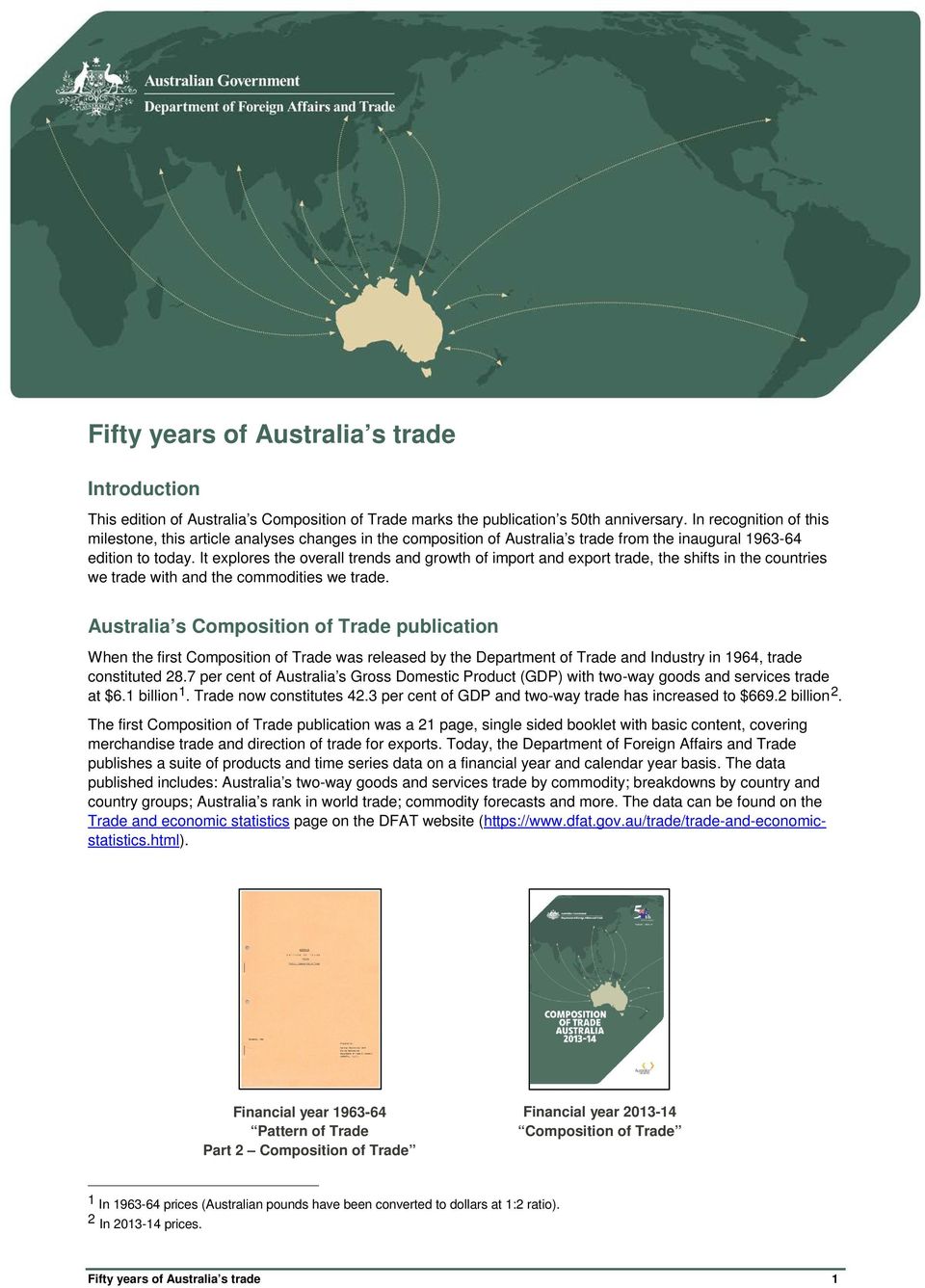
1 Fifty years of Australia s trade Introduction This edition of Australia s Composition of Trade marks the publication s 50th anniversary. In recognition of this milestone, this article analyses changes in the composition of Australia s trade from the inaugural edition to today. It explores the overall trends and growth of import and export trade, the shifts in the countries we trade with and the commodities we trade. Australia s Composition of Trade publication When the first Composition of Trade was released by the Department of Trade and Industry in 1964, trade constituted 28.7 per cent of Australia s Gross Domestic Product (GDP) with two-way goods and services trade at $6.1 billion 1. Trade now constitutes 42.3 per cent of GDP and two-way trade has increased to $669.2 billion 2. The first Composition of Trade publication was a 21 page, single sided booklet with basic content, covering merchandise trade and direction of trade for exports. Today, the Department of Foreign Affairs and Trade publishes a suite of products and time series data on a financial year and calendar year basis. The data published includes: Australia s two-way goods and services trade by commodity; breakdowns by country and country groups; Australia s rank in world trade; commodity forecasts and more. The data can be found on the Trade and economic statistics page on the DFAT website ( Financial year Pattern of Trade Part 2 Composition of Trade Financial year Composition of Trade 1 In prices (Australian pounds have been converted to dollars at 1:2 ratio). 2 In prices. Fifty years of Australia s trade 1
2 Overall export trends In the fifty years from to , Australia s exports of goods and services grew from $3.2 billion to $331.2 billion in value terms, representing an annual average growth of 10.5 per cent (5.5 per cent in volume terms). Through the 1960s, export growth was driven by the post war commodities boom and a reduction of trade barriers following four post-war General Agreement on Tariffs and Trade 3 negotiating rounds. Export growth averaged 7.6 per cent per annum in value terms (6.4 per cent in volume terms). In the 1970s, export growth was particularly strong in value terms (averaging 16.6 per cent per annum) due to high global inflation brought on, in part, by the 1973 oil crisis. At the same time, competition in Australia s traditional export markets (as the Kingdom increased trade ties with Europe) slowed volume growth to an average of 4.3 per cent per annum. A$b Chart 1: Australia's goods & services exports to Deregulation of the Aust. economy Post war boom Values Volumes A$b Chart 2: Australia's goods & services exports to Global financial crisis Olympics / AUD depreciation Resources commodity boom Values Volumes 3 General Agreement on Tariffs and Trade members became the founders of the World Trade Organization in Fifty years of Australia s trade 2

3 Economic deregulation during the 1980s and 1990s opened Australia s economy to the world and combined with new investment and global demand, contributed to strong export growth that continued over the next two decades. Growth through the period averaged 9.8 per cent per annum in value terms and volume growth recovered to 7.1 per cent per annum. Export growth spiked in the early 2000s due to depreciation of the Australian dollar and the 2000 Sydney Olympic Games. From increased commodity prices with the resource commodity boom resulted in average annual value growth of 8.1 per cent in the ten years since (3.4 per cent in volume terms), a strong growth rate even through the global financial crisis. The direction of merchandise exports In , the Kingdom was Australia s largest merchandise export destination 4. At the time however, the Kingdom was enhancing their trade relationships with their neighbours in Europe (having joined the European Free Trade Association in 1960), whilst Australia was enhancing ties with Asia. In , Japan became our leading merchandise export destination and remained so until overtaken by China in By , Asia accounted for 83.0 per cent of Australia s merchandise exports, up from just 32.8 per cent in (see Chart 3). Chart 3: Direction of merchandise exports by country/region Oceania & Antarctica 8.7% Europe 12.4% Kingdom 23.5% (incl. Africa) 8.1% States 12.9% Americas 1.6% China 7.7% Asia 2.7% Japan 22.4% Europe 4.1% Kingdom 1.4% Asia 28.3% Oceania & Antarctica 4.1% (incl. Africa) 2.4% Japan 18.0% States 3.9% Americas 1.2% China 36.7% Based on ABS Overseas Trade, Based on ABS trade data on DFAT STARS database and unpublished ABS data. The composition of exports The commodities Australia exports have also changed significantly. In and through to the early 1980s, rural commodities such as Wool and Wheat dominated Australian exports (see Table 1). The shift toward mineral and fuel exports began in the 1970s and was driven by Iron ore and Coal. Services exports increased in significance in the late 1980s. Personal travel became a major export with short term visitor arrivals into Australia increasing from around 137,000 in to over 2.5 million in The growing contribution of both resources and services created a diverse composition of exports from the late 1980s to the early 2000s (see Chart 4), reducing Australia s reliance on rural exports. 4 Services trade by country is not available prior to DFAT estimates. Fifty years of Australia s trade 3

4 Table 1: Australia's top 5 exports of goods and services (a) and comparison A$m % share A$m % share Total (b) 2,786 Total (b) 331,184 Wool Iron ores & concentrates 74, Wheat Coal 39, Transport services (c) Natural gas 16, Education-related travel services Beef and veal (d) 15, Sugar, raw Personal travel (excl education) services 13, (a) Goods trade are on a recorded trade basis, Services trade are on a balance of payments basis. (b) Balance of payments basis. (c) Transport services exports includes freight, passenger and other transport services. (d) Includes student expenditure on tuition fees and living expenses. Based on ABS Overseas Trade, and ABS Balance of Payments and International Investment Position, September Chart 4: Australian exports by sector * 42.4% 16.9% 19.6% 5.1% 16.0% % 25.9% 21.4% 10.3% 21.2% % 50.1% 12.7% 7.9% 17.4% Rural Minerals & Fuels Manufactures goods (incl gold) Services * Earliest period for which sector data is available. The past decade s export success has been led by minerals and fuels. Export values of minerals and fuels have grown at an average rate of 16.3 per cent per annum over the past ten years, more than double the rate of exports overall. From 23.7 per cent ten years ago, minerals and fuels now makes up 50.1 per cent of our total exports, more than rural exports did in the 1960s. The change in sectoral share is apparent when comparing the top five export commodities in with (see Table 1). Iron ore and Coal are currently Australia s top two export commodities and drivers of export growth. Iron ore and Coal s share of goods and services exports rose from 11.1 per cent to 34.7 per cent over the past decade and Australia is now the world s largest exporter of iron ore (accounting for around 48 per cent of world exports 6 ) and metallurgical coal. Exports of Natural gas have also grown significantly in the past decade. Australia has become the world s third largest Liquefied natural gas exporter, with over 90 per cent exported to Japan in A DFAT article on Australia s Liquefied Natural Gas (LNG) exports to and beyond will provide further analysis of LNG exports. 6 In 2013, in value terms. Source: UN Comtrade database. Fifty years of Australia s trade 4
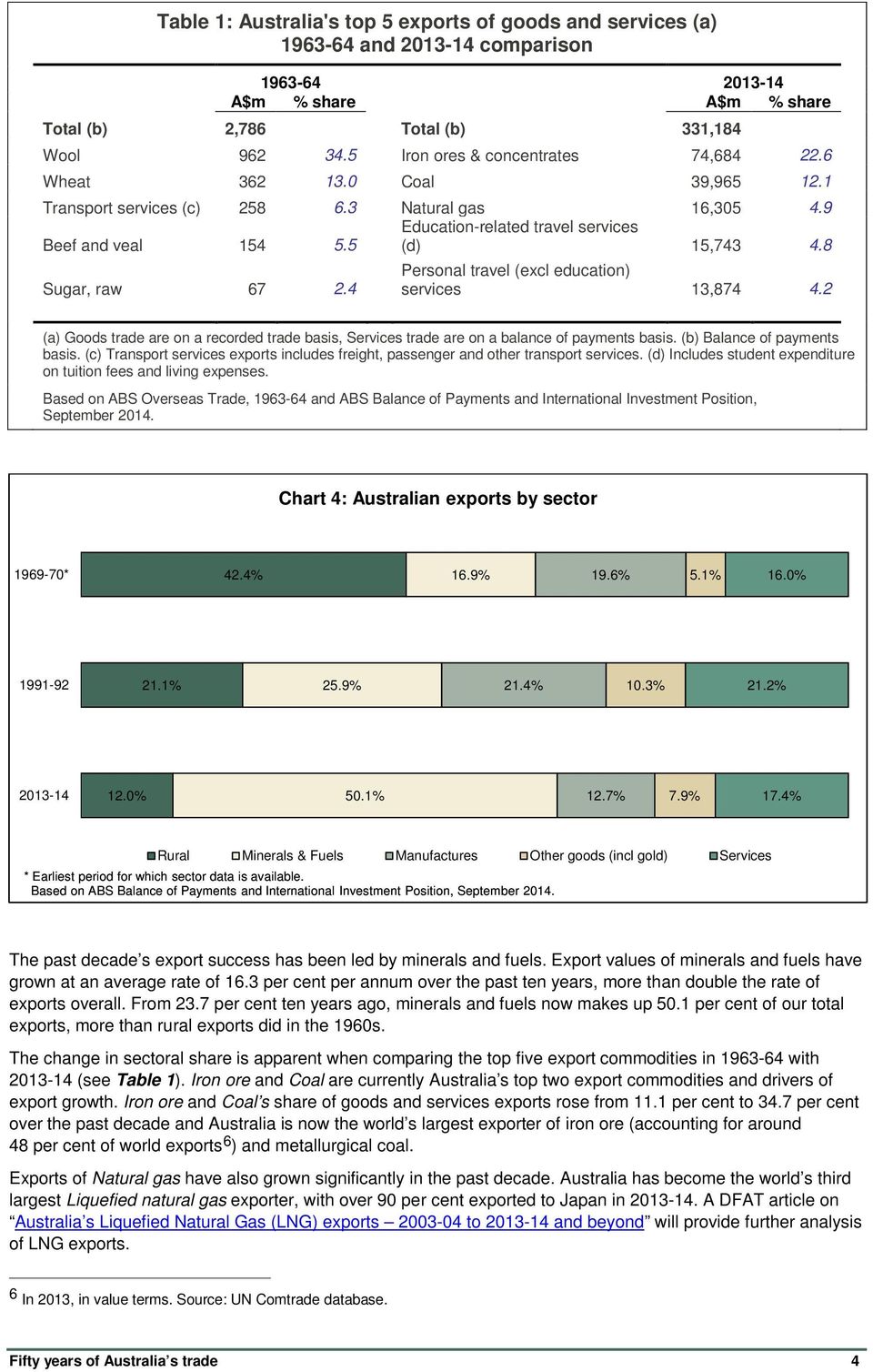
5 The position of Education-related and Personal travel services as the fourth and fifth largest export commodities signifies the rising importance of services exports in the Australian economy. They also demonstrate the increased diversity of exports from the services sector compared to , when transport services dominated. In 2013, over 410,000 international students studied in Australia 7, and 6.4 million foreigners visited Australia (compared to around 12,000 and 125,000 respectively in 1963). Overall import trends In the fifty years from to , Australia s imports of goods and services grew from $2.9 billion to $338.0 billion in value terms, representing an annual average growth of 10.5 per cent (6.1 per cent in volume terms). In Australian imports, like exports, were still benefiting from the post-war global trade expansion. 1960s import growth averaged 8.1 per cent per annum in value terms (with volume growth averaging 7.3 per cent). A$b Chart 5: Australia's goods & services imports to Import tariff reduction Economic recession Deregulation of the Aust. economy Global commodity boom Value Volume A$b Chart 6: Australia's goods & services imports to Peak gold prices Deregulation of the Aust. economy Global financial crisis Values Volumes 7 Source: Australian Education International, Research Snapshot International student numbers 2013, April Fifty years of Australia s trade 5
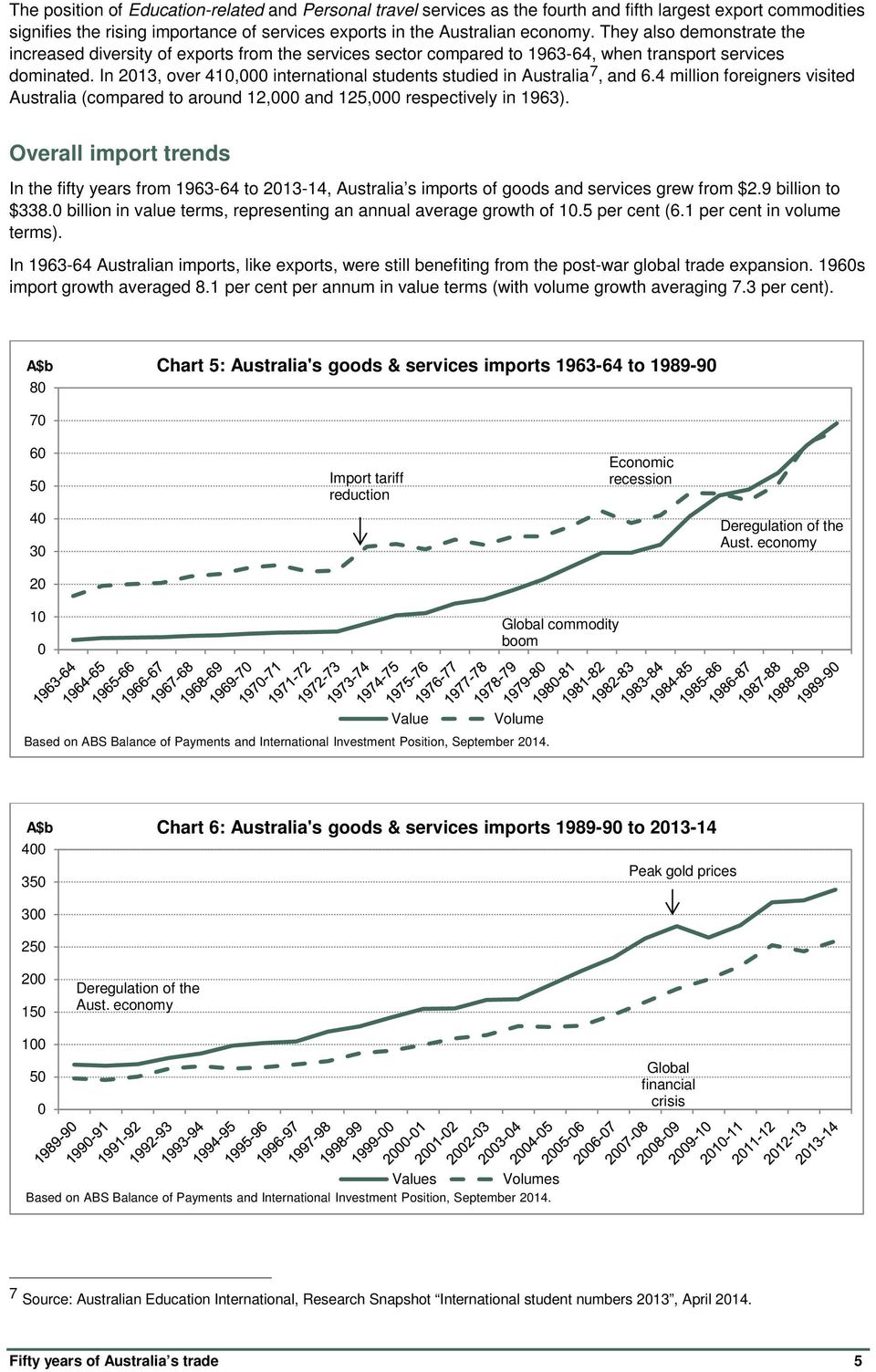
6 Import growth started off slowly in the 1970s, before Australia cut tariffs by 25 per cent in resulting in an upward shift of volumes. At the same time, increasing oil prices resulted in rapid growth in value terms which lasted almost a decade. Between and import growth averaged 18.8 per cent per annum in value terms. In the early 1980s, falling oil prices and contracting economic growth in the industrialised world, including Australia, slowed import growth until when economic reforms (including further reduction of import tariffs and quota protection) restored growth. Between and imports grew an average of 12.9 per cent per annum in value terms (7.5 per cent in volume terms). Imports grew steadily from the 1990s until the early 2000s, averaging 7.7 per cent annual growth in value terms (7.2 per cent in volume terms) between and Australia s strong economic conditions from led to high import growth at an average annual rate of 11.4 per cent in value terms (10.8 per cent in volumes) until the global financial crisis took effect in Over the past five years, import growth has averaged 4.7 per cent per annum in value terms (6.0 per cent in volume terms). The direction of merchandise imports Over the past fifty years, the dominant source of Australia s merchandise imports 8 has transitioned from Europe and North America to Asia. The Kingdom was the main merchandise import source in and remained so until when overtaken by the States. Aside from three years in the mid-1980s, when replaced by Japan, the States remained Australia s number one source of merchandise imports for almost forty years and is still our largest source of services imports today. Since our largest merchandise import source has been China. Merchandise imports from China increased significantly from the mid 2000 s onward and consist predominately of manufactures such as clothing, telecommunications equipment and computers. Chart 7: Direction of merchandise imports by country/region Oceania & Antarctica 3.1% Europe 15.6% Kingdom 27.8% (incl. Africa) 4.5% States 22.9% Americas 4.5% China 0.7% Japan 6.8% Asia 14.0% Europe 18.0% Kingdom 2.5% Oceania & Antarctica 4.7% (incl. Africa) 3.9% Asia 29.6% States 11.1% Americas 3.0% Japan 7.3% China 19.9% Based on ABS Overseas Trade, Based on ABS trade data on DFAT STARS database and unpublished ABS data. The composition of imports The import of Capital and Intermediate goods has been critical for Australian development over the past fifty years. In Capital and Intermediate goods accounted for over 50 per cent of Australia s total imports. With lower tariffs and Australia s integration with the world economy, the share of Consumption goods has 8 Services trade by country is not available prior to Fifty years of Australia s trade 6

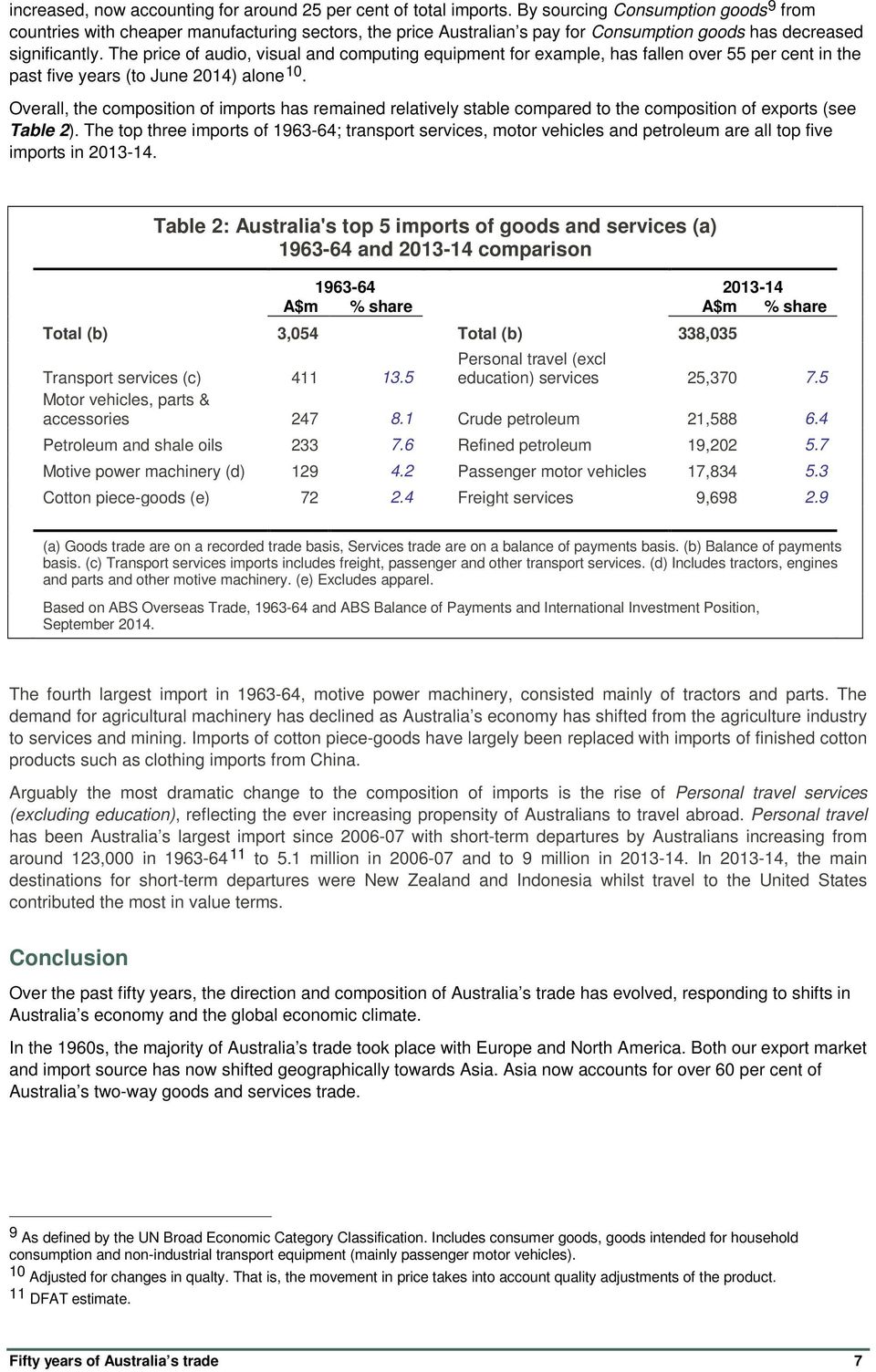
7 increased, now accounting for around 25 per cent of total imports. By sourcing Consumption goods 9 from countries with cheaper manufacturing sectors, the price Australian s pay for Consumption goods has decreased significantly. The price of audio, visual and computing equipment for example, has fallen over 55 per cent in the past five years (to June 2014) alone 10. Overall, the composition of imports has remained relatively stable compared to the composition of exports (see Table 2). The top three imports of ; transport services, motor vehicles and petroleum are all top five imports in Table 2: Australia's top 5 imports of goods and services (a) and comparison A$m % share A$m % share Total (b) 3,054 Total (b) 338,035 Transport services (c) Personal travel (excl education) services 25, Motor vehicles, parts & accessories Crude petroleum 21, Petroleum and shale oils Refined petroleum 19, Motive power machinery (d) Passenger motor vehicles 17, Cotton piece-goods (e) Freight services 9, (a) Goods trade are on a recorded trade basis, Services trade are on a balance of payments basis. (b) Balance of payments basis. (c) Transport services imports includes freight, passenger and other transport services. (d) Includes tractors, engines and parts and other motive machinery. (e) Excludes apparel. Based on ABS Overseas Trade, and ABS Balance of Payments and International Investment Position, September The fourth largest import in , motive power machinery, consisted mainly of tractors and parts. The demand for agricultural machinery has declined as Australia s economy has shifted from the agriculture industry to services and mining. Imports of cotton piece-goods have largely been replaced with imports of finished cotton products such as clothing imports from China. Arguably the most dramatic change to the composition of imports is the rise of Personal travel services (excluding education), reflecting the ever increasing propensity of Australians to travel abroad. Personal travel has been Australia s largest import since with short-term departures by Australians increasing from around 123,000 in to 5.1 million in and to 9 million in In , the main destinations for short-term departures were New Zealand and Indonesia whilst travel to the States contributed the most in value terms. Conclusion Over the past fifty years, the direction and composition of Australia s trade has evolved, responding to shifts in Australia s economy and the global economic climate. In the 1960s, the majority of Australia s trade took place with Europe and North America. Both our export market and import source has now shifted geographically towards Asia. Asia now accounts for over 60 per cent of Australia s two-way goods and services trade. 9 As defined by the UN Broad Economic Category Classification. Includes consumer goods, goods intended for household consumption and non-industrial transport equipment (mainly passenger motor vehicles). 10 Adjusted for changes in qualty. That is, the movement in price takes into account quality adjustments of the product. 11 DFAT estimate. Fifty years of Australia s trade 7
8 As Australia s export markets have shifted, so too have the commodities we export. At the beginning of the fifty year period, rural commodities dominated Australia s exports. After a period during which the four major export sectors shared a roughly even split of the export market, the minerals and fuels sector now dominates. One thing has remained constant though: trade remains a critical contributor to Australia s economic prosperity. Author: Danielle Anderson Economic Advocacy & Analysis Branch [email protected] This article has also benefited from comments and input from Frank Bingham, Economic Advocacy & Analysis Branch DFAT website: Trade and economic statistics: Released: December 2014 Fifty years of Australia s trade 8

anniversary 1963-64 2013-14 composition of trade Australia 2013-14
 th anniversary 1963-64 2013-14 composition of trade Australia 2013-14 Composition of Trade Australia 2013-14 Economic Diplomacy, Trade Advocacy & Statistics Section Department of Foreign Affairs & Trade
Australia s Liquefied Natural Gas (LNG) exports, 2003-04 to 2013-14 and beyond
 s Liquefied Natural Gas (LNG) exports, 23-4 to 213-14 and beyond LNG has been an increasingly important export for in the last decade 1. In 23-4, exported $2.2 billion worth of LNG (representing 1.5 per
Economic Change in India
 Adam Cagliarini and Mark Baker* India has become an increasingly important part of the global economic landscape over the past decade. Its economy has become more open to international trade, its workforce
AUSTRALIA S EXPORTS OF EDUCATION SERVICES 1
 AUSTRALIA S EXPORTS OF EDUCATION SERVICES 1 Introduction Australia s education services exports have continued to grow in importance this decade. Since 1982, education services exports have grown at an
Trends in Australia s Exports 1
 April 2 Trends in Australia s Exports 1 The reduction of trade barriers, and cheaper transportation and communication costs have contributed to Australia becoming more open and more closely integrated
Factors affecting the inbound tourism sector. - the impact and implications of the Australian dollar
 Factors affecting the inbound tourism sector - the impact and implications of the Australian dollar 1 Factors affecting the inbound tourism sector - the impact and implications of the Australian dollar
II. Merchandise trade
 II. Merchandise trade World merchandise trade grew by 2 per cent in volume terms in 2012 against a backdrop of weak global demand and declining prices. This is significantly less than the 5 per cent increase
Best Essay from a First Year Student
 RBA ECONOMICS COMPETITION 2010 Appreciation of Australia s real exchange rate: causes and effects Best Essay from a First Year Student ASHVINI RAVIMOHAN The University of New South Wales Appreciation of
ANALYSIS OF NZ MERCHANDISE TRADE DATA YEAR ENDED JUNE 2013
 Page 1 of 14 ANALYSIS OF NZ MERCHANDISE TRADE DATA YEAR ENDED JUNE 2013 SUMMARY Provisional merchandise trade data for the June 2013 month was released in July. The June 2013 data provides us with our
India s Services Exports
 Markus Hyvonen and Hao Wang* Exports of services are an important source of demand for the Indian economy and account for a larger share of output than in most major economies. The importance of India
Table 1: Resource Exports Per cent of total nominal exports; selected years
 Australia and the Global market for Bulk Commodities Introduction The share of Australia s export earnings derived from bulk commodities coking coal, thermal coal and iron ore has increased over recent
What is driving Australians' travel choices?
 What is driving Australians' travel choices? What is driving Australians' travel choices? ISBN 978-1-921812-45-3 Tourism Research Australia Department of Resources, Energy and Tourism GPO Box 1564 Canberra
Energy White Paper at a glance
 and Science Energy White Paper at a glance WWW. i Energy White Paper at a glance The Australian Government made an election commitment to deliver an Energy White Paper to give industry and consumers certainty
Main trends in industry in 2014 and thoughts on future developments. (April 2015)
 Main trends in industry in 2014 and thoughts on future developments (April 2015) Development of the industrial sector in 2014 After two years of recession, industrial production returned to growth in 2014.
Trinidad and Tobago. Table 1: GDP Value Added by Industry (Million Dollars, Constant Prices) & % Share in Total Value Added
 TRINIDAD AND TOBAGO 600 Fig. 1: Employment by Major Economic Activity ('000s), 2000-2008 Agriculture, Hunting, Forestry and Fishing Community, Social & Personal 500 400 300 200 100 100,000 90,000 80,000
TRADE AND INVESTMENT NOTE
 TRADE AND INVESTMENT NOTE AUSTRALIA S EVOLVING EXPORT STORY: HOW AUSTRALIA S EXPORT PROFILE AND EXPORT ENVIRONMENT HAVE CHANGED SINCE THE MORTIMER REVIEW MARCH 2015 Austrade has made reasonable efforts
X. INTERNATIONAL ECONOMIC DEVELOPMENT 1/
 1/ X. INTERNATIONAL ECONOMIC DEVELOPMENT 1/ 10.1 Overview of World Economy Latest indicators are increasingly suggesting that the significant contraction in economic activity has come to an end, notably
Project LINK Meeting New York, 20-22 October 2010. Country Report: Australia
 Project LINK Meeting New York, - October 1 Country Report: Australia Prepared by Peter Brain: National Institute of Economic and Industry Research, and Duncan Ironmonger: Department of Economics, University
II. Merchandise trade
 II. Merchandise trade Merchandise trade increased by 5 per cent in volume in 211. The strongest momentum was achieved by trade in manufactured goods, which grew by.5 per cent. Key developments in 211:
Ireland and the EU 1973-2003 Economic and Social Change
 Ireland and the EU 1973-2003 Economic and Social Change Table 1 Population, 1971-2002 viii Table 2 Population of the provinces ix Table 3 Births, deaths and life expectancy ix Table 4 Numbers in education
Chart 1: Zambia's Major Trading Partners (Exports + Imports) Q4 2008 - Q4 2009. Switzernd RSA Congo DR China UAE Kuwait UK Zimbabwe India Egypt Other
 Bank of Zambia us $ Million 1. INTRODUCTION This report shows Zambia s direction of merchandise trade for the fourth quarter of 2009 compared with the corresponding quarter in 2008. Revised 1 statistics,
Issue. September 2012
 September 2012 Issue In a future world of 8.5 billion people in 2035, the Energy Information Administration s (EIA) projected 50% increase in energy consumption will require true all of the above energy
Structural Change in the Australian Economy
 Structural Change in the Australian Economy Ellis Connolly and Christine Lewis* Over time, the structure of the Australian economy has gradually shifted away from agriculture and manufacturing towards
Maritime Trade and Transportation by the Numbers
 By Matthew Chambers and Mindy Liu The nation will observe Maritime Day on May 22, which was designated by Congress in 1933 to honor U.S. merchant mariners and the maritime industry. 1 Water transportation
education. In contrast, workers engaged in fishing worked an average of 61.7 hours per
 THAILAND 40,000 Fig. 1: Employment by Major Economic Activity ('000s), 2002-2008 Agriculture, Forestry, Agriculture, Forestry & 35,000 30,000 25,000 20,000 15,000 10,000 5,000 0 2002 2004 2006 2008 Mining
Australia s 2030 Emission Reduction Target
 Australia s 2030 Emission Reduction Target Strong, credible, responsible The Australian Government will reduce greenhouse gas emissions to 26 28 per cent below 2005 levels by 2030. Our target is a step
Analysis of Australia s Education exports
 - 1 - Analysis of Australia s Education exports Australia s exports of Education services are an important part of Australia s services exports to the world, accounting for around 36 per cent of total
Chapter 12: Gross Domestic Product and Growth Section 1
 Chapter 12: Gross Domestic Product and Growth Section 1 Key Terms national income accounting: a system economists use to collect and organize macroeconomic statistics on production, income, investment,
U.S. Agriculture and International Trade
 Curriculum Guide I. Goals and Objectives A. Understand the importance of exports and imports to agriculture and how risk management is affected. B. Understand factors causing exports to change. C. Understand
Strategic Roadmap Development for international education in the PTE sector
 Strategic Roadmap Development for international education in the PTE sector What are Strategic Roadmaps? Strategic Roadmaps are planning tools that identify strategic goals and pathways for growth in international
Main Street. Economic information. By Jason P. Brown, Economist, and Andres Kodaka, Research Associate
 THE Main Street ECONOMIST: ECONOMIST Economic information Agricultural for the and Cornhusker Rural Analysis State S e Issue p t e m b2, e r 214 2 1 Feed de er ra al l RR e es se er rv ve e BBa an nk k
I. World trade developments
 I. World trade developments World merchandise exports grew by 2 per cent in value terms in 2013 while exports of commercial services increased by per cent. Key developments in 2013: a snapshot Trade data
The Evolving External Orientation of Manufacturing: A Profile of Four Countries
 The Evolving External Orientation of Manufacturing: A Profile of Four Countries José Campa and Linda S. Goldberg Changes in exchange rates, shifts in trade policy, and other international developments
The impact of the falling yen on U.S. import prices
 APRIL 2014 VOLUME 3 / NUMBER 7 GLOBAL ECONOMY The impact of the falling yen on U.S. import prices By David Mead and Sharon Royales In the fall of 2012, Japan set forth economic policies aimed at turning
5. Price and Wage Developments
 . Price and Wage Developments Recent Developments in Inflation Inflation rose in the December quarter, following a low September quarter outcome (Table.; Graph.). Indicators of underlying inflation increased
1. TOURIST ARRIVALS AND EARNINGS. Higher arrivals and tourism earnings in June 2013.
 This report is a monthly release of the latest available indicators on the tourism sector and private remittances, with information sourced from the Central Bank, Samoa Bureau of Statistics and the Ministry
ENGINEERING LABOUR MARKET
 ENGINEERING LABOUR MARKET in Canada Projections to 2025 JUNE 2015 ENGINEERING LABOUR MARKET in Canada Projections to 2025 Prepared by: MESSAGE FROM THE CHIEF EXECUTIVE OFFICER Dear colleagues: Engineers
5 Taxes on consumption
 5 Taxes on consumption The federal government applies a number of different indirect taxes, primarily targeted at consumers, including sales taxes, excise duties and import tariffs. 35 Taxes on consumption
Current account deficit -10. Private sector Other public* Official reserve assets
 Australian Capital Flows and the financial Crisis Introduction For many years, Australia s high level of investment relative to savings has been supported by net foreign capital inflow. This net capital
UK EXPORTS TO CHINA NOW AND IN THE FUTURE
 UK EXPORTS TO CHINA NOW AND IN THE FUTURE FCO ECONOMICS UNIT January 213 1 STRUCTURE SECTION 1: GETTING PERSPECTIVE WHERE ARE WE NOW? Assessing the size of China s import market and the UK s position within
Falling Oil Prices and US Economic Activity: Implications for the Future
 Date Issue Brief # I S S U E B R I E F Falling Oil Prices and US Economic Activity: Implications for the Future Stephen P.A. Brown December 2014 Issue Brief 14-06 Resources for the Future Resources for
I. World trade developments
 I. World trade developments World merchandise exports stagnated in value terms in 2012 while exports of commercial services increased by 2 per cent. Key developments in 2012: a snapshot Trade data List
STRONG AND SUSTAINABLE ECONOMIC GROWTH
 STRONG AND SUSTAINABLE ECONOMIC GROWTH DEFINITION OF ECONOMIC GROWTH The government aims for a rapid but steady rise in the volume of goods and services produced from year to year. The aim is to achieve
Globalization and International Trade
 12 Globalization and International Trade Globalization refers to the growing interdependence of countries resulting from the increasing integration of trade, finance, people, and ideas in one global marketplace.
Effects of the Global Economic Crisis on Health: Ghana's Experience
 Effects of the Global Economic Crisis on Health: Ghana's Experience Felix Ankomah Asante Ama Pokuaa Fenny November 16-19, 2009 OUTLINE Introduction Economic Situation and Global Crisis Ghana- Background
AN AUGMENTED TRADE-WEIGHTED INDEX OF THE AUSTRALIAN DOLLAR 1
 AN AUGMENTED TRADE-WEIGHTED INDEX OF THE AUSTRALIAN DOLLAR 1 Introduction Trade-weighted exchange rate indices provide a guide to a country s exchange rate against the currencies of its trading partners,
U.S.-Chile Bilateral Trade Analysis
 U.S.-Chile Bilateral Trade Analysis Bilateral Trade in Goods 1 Since the U.S.-Chile Free Trade Agreement (FTA) took effect on January 1, 2004, total merchandise trade between the United States and Chile
TRADE DYNAMICS IN ZIMBABWE: 1980-2012
 TRADE DYNAMICS IN ZIMBABWE: 1980-2012 Talknice Saungweme Great Zimbabwe University Box 1235 Masvingo, Zimbabwe E-mail: [email protected] ABSTRACT Zimbabwe in 1980, when it became independent from
Recent trends of dynamically growing and developing life insurance markets in Asia
 Recent trends of dynamically growing and developing life insurance markets in Asia Tomikazu HIRAGA, Ph.D. and LL.M. General Manager for Asia, NLI Research Institute Asia is a growth market where foreign
Benchmarking Travel & Tourism Global Summary
 Benchmarking Travel & Tourism Global Summary How does Travel & Tourism compare to other sectors? Sponsored by: Summary of Findings, November 2013 Outline Introduction... 3 Summary of research structure..
U.S. Trade Overview, 2013
 U.S. Trade Overview, 213 Stephanie Han & Natalie Soroka Trade and Economic Analysis Industry and Analysis Department of Commerce International Trade Administration October 214 Trade: A Vital Part of the
World Manufacturing Production
 Quarterly Report World Manufacturing Production Statistics for Quarter IV, 2013 Statistics Unit www.unido.org/statistics Report on world manufacturing production, Quarter IV, 2013 UNIDO Statistics presents
The Performance of Australian Industrial Projects
 The Performance of Australian Industrial Projects Prepared for the Business Council of Australia by Rob Young, Independent Project Analysis, Inc May 2012 Executive Summary Independent Project Analysis,
a) Aggregate Demand (AD) and Aggregate Supply (AS) analysis
 a) Aggregate Demand (AD) and Aggregate Supply (AS) analysis Determinants of AD: Aggregate demand is the total demand in the economy. It measures spending on goods and services by consumers, firms, the
The global economy in 2007
 Introduction The global economy in 27 Global output grew 3.8 percent in 27, receding slightly from 4 percent in 26. The downturn was greatest in high-income economies, where growth fell from 3 percent
Section 2 Evaluation of current account balance fluctuations
 Section 2 Evaluation of current account balance fluctuations Key points 1. The Japanese economy and IS balance trends From a macroeconomic perspective, the current account balance weighs the Japanese economy
Lecture 10-1. The Twin Deficits
 Lecture 10-1 The Twin Deficits The IS-LM model of the previous lectures endogenised the interest rate while assuming that the portion (NX 0 ) of net exports not dependent on income was exogenously fixed.
World Manufacturing Production
 Quarterly Report World Manufacturing Production Statistics for Quarter III, 2013 Statistics Unit www.unido.org/statistics Report on world manufacturing production, Quarter III, 2013 UNIDO Statistics presents
Queensland Tourism - Industry Outlook and Potential to 2020 Department of Tourism, Major Events, Small Business and Commonwealth Games
 Queensland Tourism - Industry Outlook and Potential to 2020 Department of Tourism, Major Events, Small Business and Commonwealth Games August 2012 Contents Glossary... i Executive Summary... i 1 Background...
COMMODITY PRICES AND THE TERMS OF TRADE
 COMMODITY PRICES AND THE TERMS OF TRADE Introduction The global economic upswing since 2003 has spurred a sharp increase in world prices for resource commodities. Higher prices from recent contract negotiations
The Economic Contribution of Copyright-Based Industries in Australia
 The Economic Contribution of Copyright-Based Industries in Australia 3 Prepared for the Australian Copyright Council by Price Waterhouse Coopers Contents Key findings 3 Introduction 7 1 Value added by
Oil price scenarios and the global economy
 Issue 9 Oil price scenarios and the global economy Key points Relative to base, in 2005 a permanent doubling of oil prices causes: OECD real GDP to fall 1.6 per cent; OECD inflation to be 0.4 percentage
KEY STATISTICS AND TRENDS. in International Trade 2014
 UNITED NATIONS CONFERENCE ON TRADE AND DEVELOPMENT KEY STATISTICS AND TRENDS in International Trade 2014 UNITED NATIONS CONFERENCE ON TRADE AND DEVELOPMENT KEY STATISTICS AND TRENDS in International Trade
Comparison Analysis of the Australian Dollar with BFI Production, Commodity Exports and Mining Industry
 Comparison Analysis of the Australian Dollar with BFI Production, Commodity Exports and Mining Industry Hee Joong Kim (James) [email protected] September 10, 2015 ABSTRACT Australia is the largest iron
An analysis of the drivers behind the fall in direct investment earnings and their impact on the UK's current account deficit
 Article An analysis of the drivers behind the fall in direct investment earnings and their impact on the UK's current account deficit The UK current account deficit continued to widen in 2015, marking
Australia s inbound tourism statistics
 What is inbound tourism? Scope of inbound tourism: Short-term visitor arrivals are defined as overseas visitors who intend to stay in Australia for less than 12 months Statistics relate to the number of
The UK Tourism Satellite Account (UK- TSA) for 2012. Tourism Direct Gross Value Added (GVA) was 57.3 billion in 2012.
 Statistical Bulletin The UK Tourism Satellite Account (UK- TSA) for 2012 Coverage: UK Date: 26 June 2015 Geographical Area: UK Theme: People and Places Theme: Economy Main Figures Tourism Direct Gross
MBA Forecast Commentary Joel Kan, [email protected]
 MBA Forecast Commentary Joel Kan, [email protected] Weak First Quarter, But Growth Expected to Recover MBA Economic and Mortgage Finance Commentary: May 2015 Broad economic growth in the US got off to a slow
Assessing China s Merchandise Trade Data Using Mirror Statistics
 Assessing China s Merchandise Trade Data Using Mirror Statistics Iris Day* Given their timeliness, Chinese trade data have the potential to provide a useful early read on conditions in the Australian and
How To Understand Current Account Balance In Armenia
 CURRENT ACCOUNT: THE REGIONAL DEVELOPMENTS AND TRENDS Prepared by Armenuhi Burnazyan and Arevik Aleksanyan In our project we tried to analyze Current Account (CA) balance trends for Armenia, Georgia and
STRATEGIC SCIENCE AND RESEARCH PRIORITIES
 STRATEGIC SCIENCE AND RESEARCH PRIORITIES At the inaugural meeting of the Commonwealth Science Council, members strongly supported the need and value of establishing science and research priorities, at
International Investment. Australia. Economic Diplomacy, Trade Advocacy and Statistics Section Department of Foreign Affairs and Trade September 2015
 International Investment Australia 214 International Investment Australia 214 Economic Diplomacy, Trade Advocacy and Statistics Section Department of Foreign Affairs and Trade September 215 ISSN 223-6571
Reference: Gregory Mankiw s Principles of Macroeconomics, 2 nd edition, Chapters 10 and 11. Gross Domestic Product
 Macroeconomics Topic 1: Define and calculate GDP. Understand the difference between real and nominal variables (e.g., GDP, wages, interest rates) and know how to construct a price index. Reference: Gregory
NATIONAL ASSOCIATION OF AUTOMOBILE MANUFACTURERS OF SOUTH AFRICA
 NATIONAL ASSOCIATION OF AUTOMOBILE MANUFACTURERS OF SOUTH AFRICA PO BOX 40611, ARCADIA 0007 TELEPHONES: (012) 323 2980/1 323 2003 TELEFAX: (012) 326 3232 WEB ADDRESS: www.naamsa.co.za E MAIL ADDRESS: [email protected]
Appendix SM1: Sources of Modal Data and Calculation of Modal Shares
 Online Appendix for Trade and the Greenhouse Gas Emissions from International Freight Transport, Cristea Anca, David Hummels, Laura Puzzello and Avetisyan Misak: Supplementary Materials The supplementary
Australia and the Millennium Mining Boom
 Remarks made by Professor Quentin Grafton Executive Director/Chief Economist of the Bureau of Resources and Energy Economics (BREE) made at the Australian National Conference on Resources and Energy (ANCRE)
Annex 5A Trends in international carbon dioxide emissions
 Annex 5A Trends in international carbon dioxide emissions 5A.1 A global effort will be needed to reduce greenhouse gas emissions and to arrest climate change. The Intergovernmental Panel on Climate Change
Economic Review, April 2012
 Economic Review, April 2012 Author Name(s): Malindi Myers, Office for National Statistics Abstract This note provides some wider economic analysis to support the Statistical Bulletin relating to the latest
Explanation beyond exchange rates: trends in UK trade since 2007
 Explanation beyond exchange rates: trends in UK trade since 2007 Author Name(s): Michael Hardie, Andrew Jowett, Tim Marshall & Philip Wales, Office for National Statistics Abstract The UK s trade performance
WORLD BANK CHINA RESEARCH PAPER NO. 8
 WORLD BANK CHINA RESEARCH PAPER NO. 8 RAW MATERIAL PRICES, WAGES, AND PROFITABILITY IN CHINA S INDUSTRY HOW WAS PROFITABILITY MAINTAINED WHEN INPUT PRICES AND WAGES INCREASED SO FAST? Song-Yi Kim * / and
Total Income from Farming in the United Kingdom. First estimate for 2015
 28 April 2016 Total Income from Farming in the United Kingdom First estimate for 2015 This release presents the first estimate of Total Income from Farming for the United Kingdom for 2015. Total Income
6. Economic Outlook. The International Economy. Graph 6.2 Terms of Trade Log scale, 2012/13 average = 100
 6. Economic Outlook The International Economy Growth of Australia s major trading partners is expected to be around its long-run average in 015 and 016 (Graph 6.1). Forecasts for 015 have been revised
Procurement Outsourcing Services¹
 Procurement Outsourcing Services¹ The following overview of the procurement outsourcing services in Australia is mainly based on the information provided by IBISWorld and consists of additional information
RESEARCH REPORT 138. bitre. Maritime Containerised and non-containerised trade through Australian ports to 2032 33
 RESEARCH REPORT 138 bitre Maritime Containerised and non-containerised trade through Australian ports to 2032 33 Bureau of Infrastructure, Transport and Regional Economics Containerised and non-containerised
India's Foreign Trade Statistics
 India's Foreign Trade Statistics Each country tries to increase the availability of goods and services to its people through purchase from other countries. Similarly it tries to sell its surplus production
Foreign Direct Investors Outlays to Acquire or Establish U.S. Businesses Rose in 2004
 EMBARGOED UNTIL RELEASE AT 8:30 A.M. EDT, WEDNESDAY JUNE 1, 2005 Thomas Anderson: (202) 606-9879 BEA 05-23 Foreign Direct Investors Outlays to Acquire or Establish U.S. Businesses Rose in 2004 In 2004,
ECONOMIC OUTLOOK INFORMATION PAPER. National Electricity Forecasting
 ECONOMIC OUTLOOK INFORMATION PAPER National Electricity Forecasting 2012 ECONOMIC OUTLOOK INFORMATION PAPER Published by AEMO Australian Energy Market Operator ABN 94 072 010 327 Copyright 2012 AEMO ii
Country trade view Italy. Trends in global trade
 Country trade view Italy Trends in global trade Summary Italy is a significant player in world trade. In 2014, it was the eleventh-largest importer and the ninth-largest exporter in the world. Italy comprises
Increasing farm debt amid decreasing interest rates: An explanation
 Increasing farm debt amid decreasing interest rates: An explanation Compiled by Economic Research Division DIRECTORATE: ECONOMIC SERVICES December 2010 agriculture, forestry & fisheries Department: Agriculture,