
Image Splitting Optics. Technical Note
|
|
|
- William Barrett
- 9 years ago
- Views:
Transcription
1 Image Splitting Optics Technical Note June 2014

2 The W-VIEW GEMINI is comprised of image splitting optics which outputs a pair of images that have been separated by wavelength using a dichroic mirror. These side-by-side images are projected onto a single camera, thereby avoiding many of the complexities that are encountered when doing dual wavelength imaging with two cameras. The W-VIEW GEMINI is a powerful tool for simultaneous two-wavelength imaging, and the purpose of this technical note is to introduce you to its features and capabilities. Detailed procedures for alignment and use are available in the instruction manual. The W-VIEW GEMINI principle Multistained cell Excitation light Microscope objective lens Camera head Fluorescence 2

3 Table of contents 1 Image splitting optics 1-1. Image splitting optics 1-2. Simultaneous dual wavelength imaging by one camera 2 W-VIEW GEMINI features 2-1. Field of view 2-2. Transmittance characteristics 2-3. Chromatic aberration mechanism 2-4. Dichroic mirrors 2-5. Linear form factor 2-6. Compact size 2-7. Effective field of view (area) 2-8. Bypass mode 2-9. Stability (1) Temperature stability (2) Time stability Ambient light conditions 3 Dichroic mirror and filter specifications 1 Image splitting optics 1-1. Image splitting optics The W-VIEW GEMINI is the newest and most advanced product from Hamamatsu for dual wavelength imaging. Its unique optical design allows for precise axial and lateral chromatic aberration correction. User selectable filters and a linear form factor with a bypass mode make it a flexible tool in the imaging laboratory. The W-VIEW optics was developed by Dr. Kazuhiko Kinosita (then of Keio University) and Hamamatsu employees. (Kinosita et al., Dual-View Microscopy. The Journal of Cell Biology, Volume 115, 1991) 1-2. Simultaneous dual wavelength imaging by one camera There are a myriad of reasons that doing simultaneous dual wavelength imaging with a single camera is simpler and more cost effective than using two cameras. In particular there s no need for complex synchronization between cameras, and there is exceptionally precise positional registration of the two images captured. And, of course, with a single camera the temporal synchronization of the image pairs is inherently perfect. Features of W-VIEW GEMINI Ordinary simultaneous dual wavelength imaging 3-1. Characteristics of dichroic mirrors 3-2. Characteristics of bandpass filters Bifurcated optics Camera Synchronous unit PC 3-3. Characteristics of neutral density filters 4 Adjustment software Microscope Simultaneous dual wavelength imaging using W-VIEW GEMINI 5 Glossary 6 Specifications Microscope W-VIEW GEMINI Camera PC 7 System configuration 8 Dimensional outlines Low cost Doesn't need two cameras and two PCs Doesn't need bifurcated optics Doesn't need a synchronous unit Easy operation Doesn't need camera synchronization Doesn't need data transfer between PCs Easy position alignment Stable and flexible installation Good unit balance ensures stable installation Usable with upright microscope Small installation footprint 3

4 2 W-VIEW GEMINI features 2-1. Field of view W-VIEW GEMINI was designed to take advantage of the large field of view found in modern scmos cameras. When using a 4.2 megapixel camera (like the ORCA-Flash4.0), each of the two wavelengths occupies 13 mm 6.4 mm or about pixels on the sensor. An appropriate mask for a pixel camera (a common EM-CCD format) is also supplied. To help visualize the relative fields of view take a look at the image below. The solid lines represent the ORCA-Flash4.0, and the dotted lines represent an EM-CCD Chromatic aberration mechanism Lenses are designed by combining several different optical glasses, each of which has a unique refractive index that varies by wavelength. While ever so slight, these differences in refractive index combine to cause small and unavoidable chromatic aberrations which can become problematic in demanding microscopy applications. The W-VIEW GEMINI is designed to help the user easily correct for these aberrations both in terms of wavelength dependent focus shift and zoom matching. Detailed procedures are available in the instruction manual Dichroic mirrors To allow for flexible configuration commercially produced dichroic mirrors can be used in the W-VIEW GEMINI. It is important that the mirror be as flat as possible to minimize distortion, and we recommend using an imaging grade dichroic, which are available from several filter manufacturers. Please see section three of this document for additional details. ImagEM X2 ORCA-Flash4.0 ImagEM X2 ORCA-Flash Linear form factor The W-VIEW GEMINI has the input and the output C-mounts located on the same axis. This allows for stable mounting on both upright and inverted microscopes. Field of view comparison between ORCA-Flash4.0 and EM-CCD 2-2. Transmittance characteristics By using innovative lens designs and the minimum number of optical components, the W-VIEW GEMINI has high native transmittance across a wide range of wavelengths used in fluorescence microscopy Transmittance (%) CFP GFP YFP Cy3 DsRed Cy5 W-VIEW GEMINI and ORCA-Flash4.0 on an upright microscope Wavelength (nm) Spectral transmittance (in bypass mode) 4

5 2-6. Compact size The W-VIEW GEMINI's 259 mm length allows it to easily fit into the tight spaces often found in microscopy laboratories. using the supplied software. It is possible that you may need to adjust the mirror by a pixel or two for optimal alignment. As a last step check to make sure that the MODE knob is in the right position for the mask and camera you are currently using. Further details are available in the instruction manual. Height 93 mm 259 mm Field of view in the bypass mode 110 mm W-VIEW GEMINI (A ) dimensions 2-7. Effective field of view (area) The optical design of the W-VIEW GEMINI projects the two wavelengths of interest (side by side) onto a single sensor in a camera. This means that the effective size of the field of view is effectively about half the sensor size. As mentioned previously, masks for a GenII scmos and a pixel EM-CCD are provided (6.4 mm and 3.9 mm wide respectively). The table below shows the effective fields of view with different combinations of the two masks and some common Hamamatsu cameras. Mask unit (mm) Camera type scmos EM-CCD EM-CCD Cooled CCD Camera name ORCA-Flash4.0 V2 ImagEM 1K ImagEM X2 ORCA-R2 Effective field of view (mm) Bypass mode (patent pending) Nobody likes to install and uninstall microscope parts and accessories. The W-VIEW GEMINI s bypass mode makes this unnecessary when changing from a dual to a single wavelength experiment. The steps are easy, and all of them are done without removing the W-VIEW GEMINI from the microscope. To switch to bypass mode the dichroic mirror holder, bandpass filter and correction lenses are removed and replaced with the supplied blanks. The mask unit is removed, and finally the MODE knob is pushed in, which invokes bypass mode. Switching back to W-VIEW mode is the reverse of the steps described above followed by a quick check of the alignment Field of view in the W-VIEW mode 2-9. Stability For dual wavelength imaging to be effective it is important that the alignment of the images be consistent over the duration of the experiment. The precise mechanical properties and linear design of the W-VIEW GEMINI facilitate this. Once aligned you should expect no change unless there is a very significant variation in the ambient temperature of the microscope s environment. (1) Temperature stability To test for temperature stability the W-VIEW GEMINI was mounted to an upright microscope with an ORCA-Flash4.0. This setup was placed in an environmental testing chamber to measure pixel misalignment as the ambient temperature changed. We varied the temperature from 22.5 C to 27.5 C, which was assumed to be the room temperature at which W- VIEW GEMINI would likely be used. We were unable to detect any changes down to the single pixel level. (2) Time stability The W-VIEW GEMINI / ORCA-Flash4.0 combination was installed on an upright microscope and then on an inverted microscope. In each case the setup was placed in a room with a constant ambient temperature of 25 C for 7 hours. Again, we were unable to detect any changes down to the single pixel level. 5

6 2-10. Ambient light conditions The W-VIEW GEMINI and ORCA-Flash4.0 combination was placed under a strong fluorescent light to check for light leaks. About one photon per second was detected. For most weak fluorescent imaging this would be less than typical background. Even so, we recommend turning the lights off when doing fluorescent imaging as a matter of good practice. 3 Dichroic mirror and filter specifications 3-1. Characteristics of dichroic mirrors We recommend an imaging grade dichroic mirror for use with the W-VIEW GEMINI. As mentioned before, these are very flat and therefore have less potential to introduce distortions into the optical system. This is not an issue in typical fluorescence microscopy, but because the W-VIEW GEMINI forms an image with both the light that passes through and the light that is reflected, flatness comes into play. Poor flatness on the reflection side of the dichroic mirror distorts the wavefront, generating aberrations. Commercial dichroic mirrors that have been designed with flatness as a priority are available. As an example, Imaging Flatness dichroic mirrors are available from Semrock Company. Please check with your preferred filter supplier to see if they have appropriate filters. CFP/YFP FRET Imaging Bandpass Emitter 1 FF01-483/32-25 Bandpass Emitter 2 FF01-542/27-25 Dichroic mirror FF509-FDi GFP/DsRED Dual Band Imaging Bandpass Emitter 1 FF01-512/25-25 Bandpass Emitter 2 FF01-630/92-25 Dichroic mirror FF560-FDi Cy3/Cy5 FRET Imaging Bandpass Emitter 1 FF01-593/40-25 Bandpass Emitter 2 FF01-676/29-25 Dichroic mirror FF640-FDi Examples of filter sets recommended by Semrock Characteristics of bandpass filters The bandpass filter allows only light of specific wavelengths through. Everything else is either reflected or absorbed. Unless the bandpass filter is precisely oriented in the vertical plane relative to the axis of the impinging light, it is possible to see a ghosting artifact. The W-VIEW GEMINI bandpass filter holders are manufactured with great care to prevent generation of such ghosting. For available bandpass filter sizes, see Size of dichroic mirror and filters under Specifications on page 8 of this document Characteristics of neutral density filters In some dual wavelength experiments the signal from one channel is much brighter than the other. When using the W- VIEW, neutral density (ND) filters can be used to lower the amount of light of one of the wavelengths so as to match the two intensities to the exposure of the camera. Just like the bandpass filter mentioned above, the ND filter may generate ghosting if not properly oriented. As for the bandpass filter, the ND filter holder is designed to prevent ghosting. For available ND filter sizes, see Size of dichroic mirror and filters under Specifications on page 8 of this document. 4 Adjustment software In the W-VIEW GEMINI, images from two discrete wavelengths are projected onto the sensor of a single camera. In order for analysis of these two images to be accurate, it is important that the alignment of the optics that produces these two images is as accurate as possible. To facilitate and check this alignment the W-VIEW GEMINI comes with software that superimposes the two images and at the same time magnifies and displays the center and eight additional points towards the edges of the image. This gives the user great feedback as alignment is accomplished. You can find the software called W-VIEW Adjustment in the DCAM directory of your computer. If you need to download DCAM, please go to Typical view during alignment 6 Comparison example of imaging grade dichroic mirror with non-imaging grade dichroic mirror

7 5 Glossary Axial chromatic aberration Because lenses vary the refractive index according to colors (wavelengths), focal point distance and image magnification vary according to colors. This is called chromatic aberration. Of the chromatic aberrations, those involving varying the focal point distance are called axial chromatic aberration. The axial chromatic aberration, if present, affects the image focus and image resolution. Bandpass filter An optical element that allows only light of a specific range of wavelengths to pass. All others are reflected or absorbed. Bandpass filters sometimes transmit light that has twice the wavelength of the target wavelength. It is therefore recommended to choose a bandpass filter having transmission characteristics with wavelengths of this band completely blocked. Bypass mode A mode in which the dichroic mirror, bandpass filter, etc. are detached from the light path and the input light image from the microscope is formed, as it is, in the camera is called the bypass mode. Field curvature In taking an image using lenses, it sometimes occurs that focusing on the image center position results in the periphery slightly out of focus, and focusing on the periphery results in the center slightly out of focus. This is caused by the imaging plane not being flat due to aberration, causing the image to be formed on a curved surface. This is called the field curvature. Dichroic mirror An optical element that separates light into two signals by wavelength. One wavelength is reflected, and the other is transmitted. Dichroic mirrors are made by applying a special coating to a glass plate. They are available in either plates or prisms. Distortion Lateral chromatic aberration in which difference in lens colors give rise to differences in image magnification (size) has been already explained. Distortion means the difference in image magnification that occurs according to the image location on the imaging plane. For example, barrel distortion occurs when the periphery magnification is smaller compared to the center, whereas pincushion distortion occurs when the periphery magnification is larger compared to the center. In the image splitting optics, the light flux is allowed to pass by an axis not parallel to the light axis of the imaging lens right before the camera, and therefore, asymmetric shape distortion occurs. Distortion correction Distortion is a change in the shape of an image that is a function of the geometry of an optical system. Unlike lateral chromatic aberration, it is not corrected for using the ZOOM lens of the W-VIEW GEMINI. If measurement of the image is affected by distortion, it can be corrected in post processing in many commercially available imaging software packages. Effective field of view (area) The W-VIEW optics projects two light images on one imaging area. The effective area is restricted by the Mask unit size so that two imaging areas do not overlap. The Mask unit size is chosen from the image format sizes of the camera. Imaging grade Term used to describe dichroic mirrors that are manufactured to the highest flatness tolerance. Lateral chromatic aberration Of chromatic aberrations, those involving varying magnifications (sizes) are called lateral chromatic aberration. The lateral chromatic aberration, if present, generates deviations when images of two colors are superimposed and therefore affects analysis results. Relay lens magnification The ratio of the output image size to the input image size incident to the optics. The W-VIEW GEMINI is designed to have a relay lens magnification of 1.0. Resolution One characteristic that describes the optics. The higher the resolution is, the finer the image obtained. Shading An unevenness of brightness that is dependent on location. Many factors can cause shading in images including illumination and lenses. Spectral transmittance The ratio of the radiating light to the light incident to the optics, which is measured by each wavelength. The larger this value is, the more effectively the light is utilized. This value is determined by the transmittance, reflectance, light collection efficiency, etc. 7

8 6 Specifications 7 System configuration Product number A (W-VIEW GEMINI) Structure C-mount to C-mount linear structure Input mount C-mount (female) Output mount C-mount (male) Relay lens magnification 1.0 Field of view*1 13 mm 6.4 mm (W-VIEW mode) 13 mm 13 mm (Bypass mode) Mode W-VIEW mode / Bypass mode*2 Wavelength range*3 400 nm to 800 nm Maximum transmittance*4 97 % Dichroic mirror*5*6 Commercially available dichroic mirror can be used. Bandpass filter*5*6 Commercially available filter can be used. ND filter*5*6 Commercially available ND film can be used. Chromatic aberration correcting mechanism Depends on aberration correcting lens unit*7*8*9 Ambient operating temperature 0 C to +40 C Ambient storage temperature -10 C to +50 C Ambient operating humidity 70 % max. (With no condensation) *1 Vignetting or poor shading or poor image focusing such as image plane curvature may occur if used with a relay lens or variable magnification lens. *2 Mode in which dichroic mirror, etc. are detached from the light path and an input optical imaging from the microscope is directly provided as it is. *3 All are values in the bypass mode. *4 Typical value at peak wavelength in the bypass mode. *5 Because the dichroic mirror, bandpass filter and ND filter are not attached to the main body, they must be purchased separately. Use a dichroic mirror with high flatness on the reflection side which is called imaging grade with good imaging characteristics. One set of a Dichroic holder (empty) and Filter holder (empty) is attached. The set can be separately purchased under the model name of A *6 For the usable size, see Size of dichroic mirror and filters. *7 This improves the magnification difference caused by chromatic aberration, but does not improve the position difference between two wavelengths caused by the distortion aberration. *8 Since the FOCUS knob is designed to improve only the internal axial chromatic aberration within this unit, its effect is very limited. Accessories Mask unit (6.4 mm), Mask unit (3.9 mm), Correction lens unit, Dichroic holder (empty), Filter holder (empty), Mask unit cover, Correction lens cover, Dichroic cover, Filter cover, C-mount cap (male), C-mount cap (female), Hex driver (2.5 mm), Hex driver (1.5 mm), Concentric chart, Filter jig, Format adjustment jig, Accessory storage case, Instruction manual (CD), User guide Read before use *No dichroic mirror, no bandpass filter and no ND filter are attached to W- VIEW GEMINI, and users are requested to procure them by themselves. Microscope Options Standard Product number Product name A Holder set for A *1 A Adjuster for A *2 *1 A includes a combination of dichroic holder (empty) and filter holder. *2 A is a height adjuster. This can be used in cases where the clearance between the W-VIEW GEMINI bottom and the floor surface meets the following conditions (lower right photo shows an example of vertical installation). Vertical installation: 10 mm to 36 mm, Horizontal installation: 32 mm to 59 mm 8 Dimensional outlines W-VIEW GEMINI (Approx. 2.4 kg) W-VIEW GEMINI Image Splitting Optics A C-mount TV camera adapter (Unit: mm) 110±1 21±5 259±1 93±1 66±1 110±1 21±5 Commercially available software Camera HCImage* HSR* * HCImage/HSR software provides standard image measurement functions. PC Size of dichroic mirror and filters Size (mm) / Tolerances (mm) Thickness (mm) Dichroic mirror ± max. Bandpass filter ND filter φ / max. * Value indicates sum of the bandpass filter thickness and ND filter thickness. ORCA is registered trademark of Hamamatsu Photonics K.K. (France, Germany, Japan, U.K., U.S.A.) HCIMAGE is registered trademark of PHOTONICS MANAGEMENT CORP. (Australia, China, EU, Japan, Norway, Singapore, Switzerland, U.S.A.) Product and software package names noted in this documentation are trademarks or registered trademarks of their respective manufacturers. Subject to local technical requirements and regulations, availability of products included in this promotional material may vary. Please consult your local sales representative. Information furnished by HAMAMATSU is believed to be reliable. However, no responsibility is assumed for possible inaccuracies or omissions. Specifications and external appearance are subject to change without notice Hamamatsu Photonics K.K. HAMAMATSU PHOTONICS K.K. HAMAMATSU PHOTONICS K.K., Systems Division 812 Joko-cho, Higashi-ku, Hamamatsu City, , Japan, Telephone: (81) , Fax: (81) , [email protected] U.S.A.: Hamamatsu Corporation: 360 Foothill Road, Bridgewater, N.J 08807, U.S.A., Telephone: (1) , Fax: (1) [email protected] Germany: Hamamatsu Photonics Deutschland GmbH.: Arzbergerstr. 10, D Herrsching am Ammersee, Germany, Telephone: (49) , Fax: (49) [email protected] France: Hamamatsu Photonics France S.A.R.L.: 19, Rue du Saule Trapu, Parc du Moulin de Massy, Massy Cedex, France, Telephone: (33) , Fax: (33) [email protected] United Kingdom: Hamamatsu Photonics UK Limited: 2 Howard Court,10 Tewin Road, Welwyn Garden City, Hertfordshire AL7 1BW, UK, Telephone: (44) , Fax: (44) [email protected] North Europe: Hamamatsu Photonics Norden AB: Torshamnsgatan Kista, Sweden, Telephone: (46) , Fax: (46) [email protected] Italy: Hamamatsu Photonics Italia S.r.l.: Strada della Moia, 1 int Arese (Milano), Italy, Telephone: (39) , Fax: (39) [email protected] China: Hamamatsu Photonics (China) Co., Ltd.: B1201 Jiaming Center, No.27 Dongsanhuan Beilu, Chaoyang District, Beijing , China, Telephone: (86) , Fax: (86) [email protected] Cat. No. SBIS0101E01 JUN/2014 HPK Created in Japan

Wide range of applications from Real time imaging of low light fluorescence to Ultra low light detection
 Electron Multiplying CCD Camera C100-13, -14 Wide range of applications from Real time imaging of low light fluorescence to Ultra low light detection Great Stability High Sensitivity Low Noise High Resolution
Multiply faster. series. 70 frames/s. 1076 frames/s. EM-CCD camera
 EM-CCD camera series Multiply faster The ImagEM X2 is an extremely versatile camera that quietly delivers 70 frames/s at full frame and up to 1076 frames/s with analog binning and regions of interest.
Multiply faster R. 70 frames/s. 1076 frames/s. Electron Multiplying CCD Camera
 Electron Multiplying CCD Camera Multiply faster R The ImagEM X2 is an extremely versatile camera that quietly delivers 70 frames/s at full frame and up to 1076 frames/s with analog binning and regions
HAMAMATSU PHOTONICS K.K.
 Selection guide - March 2015 IC Sophisticated sensors integrated with photosensitive element and signal processing circuit HAMAMATSU PHOTONICS K.K. IC The photo IC is a light receiver element with various
Chapter 12 Filters for FISH Imaging
 Chapter 12 Filters for FISH Imaging Dan Osborn The application of in situ hybridization (ISH) has advanced from short lived, non-specific isotopic methods, to very specific, long lived, multiple color
AxioCam MR The All-round Camera for Biology, Medicine and Materials Analysis Digital Documentation in Microscopy
 Microscopy from Carl Zeiss AxioCam MR The All-round Camera for Biology, Medicine and Materials Analysis Digital Documentation in Microscopy New Dimensions in Performance AxioCam MR from Carl Zeiss Both
LBS-300 Beam Sampler for C-mount Cameras. YAG Focal Spot Analysis Adapter. User Notes
 LBS-300 Beam Sampler for C-mount Cameras P/N SP90183, SP90184, SP90185 and SP90186 YAG Focal Spot Analysis Adapter P/N SP90187, SP90188, SP90189, SP90190, SP90191 User Notes Ophir-Spiricon Inc. 60 West
1051-232 Imaging Systems Laboratory II. Laboratory 4: Basic Lens Design in OSLO April 2 & 4, 2002
 05-232 Imaging Systems Laboratory II Laboratory 4: Basic Lens Design in OSLO April 2 & 4, 2002 Abstract: For designing the optics of an imaging system, one of the main types of tools used today is optical
We bring quality to light. MAS 40 Mini-Array Spectrometer. light measurement
 MAS 40 Mini-Array Spectrometer light measurement Features at a glance Cost-effective and robust CCD spectrometer technology Standard USB interface Compatible with all Instrument Systems measuring adapters
Cross-beam scanning system to detect slim objects. 100 mm 3.937 in
 891 Object Area Sensor General terms and conditions... F-17 Related Information Glossary of terms... P.1359~ Sensor selection guide...p.831~ General precautions... P.1405 PHOTO PHOTO Conforming to EMC
Scanners and How to Use Them
 Written by Jonathan Sachs Copyright 1996-1999 Digital Light & Color Introduction A scanner is a device that converts images to a digital file you can use with your computer. There are many different types
Geometric Optics Converging Lenses and Mirrors Physics Lab IV
 Objective Geometric Optics Converging Lenses and Mirrors Physics Lab IV In this set of lab exercises, the basic properties geometric optics concerning converging lenses and mirrors will be explored. The
Infrared Viewers. Manual
 Infrared Viewers Manual Contents Introduction 3 How it works 3 IR viewer in comparison with a CCD camera 4 Visualization of infrared laser beam in mid-air 4 Power Density 5 Spectral sensitivity 6 Operation
Chapter 1 Parts C. Robert Bagnell, Jr., Ph.D., 2012
 Chapter 1 Parts C. Robert Bagnell, Jr., Ph.D., 2012 Figure 1.1 illustrates the parts of an upright compound microscope and indicates the terminology that I use in these notes. Figure 1.1. Parts of a Compound
waves rays Consider rays of light from an object being reflected by a plane mirror (the rays are diverging): mirror object
 PHYS1000 Optics 1 Optics Light and its interaction with lenses and mirrors. We assume that we can ignore the wave properties of light. waves rays We represent the light as rays, and ignore diffraction.
product overview pco.edge family the most versatile scmos camera portfolio on the market pioneer in scmos image sensor technology
 product overview family the most versatile scmos camera portfolio on the market pioneer in scmos image sensor technology scmos knowledge base scmos General Information PCO scmos cameras are a breakthrough
Understanding astigmatism Spring 2003
 MAS450/854 Understanding astigmatism Spring 2003 March 9th 2003 Introduction Spherical lens with no astigmatism Crossed cylindrical lenses with astigmatism Horizontal focus Vertical focus Plane of sharpest
http://dx.doi.org/10.1117/12.906346
 Stephanie Fullerton ; Keith Bennett ; Eiji Toda and Teruo Takahashi "Camera simulation engine enables efficient system optimization for super-resolution imaging", Proc. SPIE 8228, Single Molecule Spectroscopy
Optical laser beam scanner lens relay system
 1. Introduction Optical laser beam scanner lens relay system Laser beam scanning is used most often by far in confocal microscopes. There are many ways by which a laser beam can be scanned across the back
PDF Created with deskpdf PDF Writer - Trial :: http://www.docudesk.com
 CCTV Lens Calculator For a quick 1/3" CCD Camera you can work out the lens required using this simple method: Distance from object multiplied by 4.8, divided by horizontal or vertical area equals the lens
2) A convex lens is known as a diverging lens and a concave lens is known as a converging lens. Answer: FALSE Diff: 1 Var: 1 Page Ref: Sec.
 Physics for Scientists and Engineers, 4e (Giancoli) Chapter 33 Lenses and Optical Instruments 33.1 Conceptual Questions 1) State how to draw the three rays for finding the image position due to a thin
Science In Action 8 Unit C - Light and Optical Systems. 1.1 The Challenge of light
 1.1 The Challenge of light 1. Pythagoras' thoughts about light were proven wrong because it was impossible to see A. the light beams B. dark objects C. in the dark D. shiny objects 2. Sir Isaac Newton
AF 70~300 mm F/4-5.6 Di LD Macro 1:2 (Model A17)
 AF 70~300 mm F/4-5.6 Di LD Macro 1:2 (Model A17) Thank you for purchasing the Tamron lens as the latest addition to your photographic equipment. Di II lens (Digitally Integrated) series are designed for
WOOD WEAR TESTING USING TRIBOMETER
 WOOD WEAR TESTING USING TRIBOMETER Prepared by Duanjie Li, PhD 6 Morgan, Ste156, Irvine CA 92618 P: 949.461.9292 F: 949.461.9232 nanovea.com Today's standard for tomorrow's materials. 2015 NANOVEA INTRO
Rodenstock Photo Optics
 Rogonar Rogonar-S Rodagon Apo-Rodagon N Rodagon-WA Apo-Rodagon-D Accessories: Modular-Focus Lenses for Enlarging, CCD Photos and Video To reproduce analog photographs as pictures on paper requires two
LEICA TRI-ELMAR-M 28 35 50 mm f/4 ASPH. 1
 LEICA TRI-ELMAR-M 28 35 5 mm f/4 ASPH. 1 This lens combines three of the focal lengths that are most popular among Leica M photographers. The appropriate bright-line frame appears in the viewfinder when
TS-E24mm f/3.5l TS-E45mm f/2.8 TS-E90mm f/2.8 Instructions
 TS-E24mm f/3.5l TS-E45mm f/2.8 TS-E90mm f/2.8 ENG Instructions Thank you for purchasing a Canon product. Canon s TS-E lenses are tilt-shift lenses designed for EOS cameras. The tilt-shift mechanism enables
Understanding Line Scan Camera Applications
 Understanding Line Scan Camera Applications Discover the benefits of line scan cameras, including perfect, high resolution images, and the ability to image large objects. A line scan camera has a single
AP Physics B Ch. 23 and Ch. 24 Geometric Optics and Wave Nature of Light
 AP Physics B Ch. 23 and Ch. 24 Geometric Optics and Wave Nature of Light Name: Period: Date: MULTIPLE CHOICE. Choose the one alternative that best completes the statement or answers the question. 1) Reflection,
Choosing a digital camera for your microscope John C. Russ, Materials Science and Engineering Dept., North Carolina State Univ.
 Choosing a digital camera for your microscope John C. Russ, Materials Science and Engineering Dept., North Carolina State Univ., Raleigh, NC One vital step is to choose a transfer lens matched to your
Automatic and Objective Measurement of Residual Stress and Cord in Glass
 Automatic and Objective Measurement of Residual Stress and Cord in Glass GlassTrend - ICG TC15/21 Seminar SENSORS AND PROCESS CONTROL 13-14 October 2015, Eindhoven Henning Katte, ilis gmbh copyright ilis
NyONE - Cell imaging in a bird s eye view 4. NyONE...resolution matters! 8. Features & benefits 10. Fluorescence excitation channels 12
 Envisions confirmed Content NyONE - Cell imaging in a bird s eye view 4 From cells to numbers 6 NyONE...resolution matters! 8 Features & benefits 10 Fluorescence excitation channels 12 Technical specifications
Rodenstock Photo Optics
 Apo-Sironar-S Apo-Macro-Sironar Apo-Grandagon Grandagon-N Accessories: Center filters Accessories: Focus-Mount Lenses for Analog Professional Photography Even in the age of digital photography, the professional
Measuring the Point Spread Function of a Fluorescence Microscope
 Frederick National Laboratory Measuring the Point Spread Function of a Fluorescence Microscope Stephen J Lockett, PhD Principal Scientist, Optical Microscopy and Analysis Laboratory Frederick National
Reflection and Refraction
 Equipment Reflection and Refraction Acrylic block set, plane-concave-convex universal mirror, cork board, cork board stand, pins, flashlight, protractor, ruler, mirror worksheet, rectangular block worksheet,
Micro-CT for SEM Non-destructive Measurement and Volume Visualization of Specimens Internal Microstructure in SEM Micro-CT Innovation with Integrity
 Micro-CT for SEM Non-destructive Measurement and Volume Visualization of Specimens Internal Microstructure in SEM Innovation with Integrity Micro-CT 3D Microscopy Using Micro-CT for SEM Micro-CT for SEM
Efficiency, Dispersion and Straylight Performance Tests of Immersed Gratings for High Resolution Spectroscopy in the Near Infra-red
 Changing the economics of space Efficiency, Dispersion and Straylight Performance Tests of Immersed Gratings for High Resolution Spectroscopy in the Near Infra-red J. Fernandez-Saldivar 1, F. Culfaz 1,
KS732 Family. Rev. 1.01 KS732. 1/3 CCD Color USB Camera
 KS732 Family 1/3 CCD Color USB Camera The KS732 is a product line of 1/3" compact cameras which is available as an USB version. It is designed to be used in a wide variety of professional industrial, security
A new advance in routine inspections INVERTED MICROSCOPE CKX41/CKX31
 A new advance in routine inspections INVERTED MICROSCOPE CKX41/CKX31 Phase contrast Relief contrast Incorporation of advanced UIS2 optics ensures the highest level of clarity for cell checking applications.
Laserlyte-Flex Alignment System
 Laserlyte-Flex Alignment System LaserLyte-Flex The LaserLyte-Flex Alignment System is a unique, interchangeable, low cost plug and play laser system. Designed specifically for aligning and positioning
Profile Projector PH-3500
 Optical Measuring Profile Projector PH-3500 Catalog No. E4155-172 Mitutoyo introduces the PH-3515F a series of profile projectors that will meet any optical measuring or inspection challenge your shop
1. You stand two feet away from a plane mirror. How far is it from you to your image? a. 2.0 ft c. 4.0 ft b. 3.0 ft d. 5.0 ft
 Lenses and Mirrors 1. You stand two feet away from a plane mirror. How far is it from you to your image? a. 2.0 ft c. 4.0 ft b. 3.0 ft d. 5.0 ft 2. Which of the following best describes the image from
Thin Lenses Drawing Ray Diagrams
 Drawing Ray Diagrams Fig. 1a Fig. 1b In this activity we explore how light refracts as it passes through a thin lens. Eyeglasses have been in use since the 13 th century. In 1610 Galileo used two lenses
Be careful not to scratch or hit front edge of the side viewing micro prisms onto hard objects!
 Instructions Manual Flexia BGA Inspection Systems This manual describes how to use Flexia BGA Inspection System Optilia Instruments 1 AB Contents 1. Safety and maintenance Instructions 3 2. About Flexia
Convex Mirrors. Ray Diagram for Convex Mirror
 Convex Mirrors Center of curvature and focal point both located behind mirror The image for a convex mirror is always virtual and upright compared to the object A convex mirror will reflect a set of parallel
Fig.1. The DAWN spacecraft
 Introduction Optical calibration of the DAWN framing cameras G. Abraham,G. Kovacs, B. Nagy Department of Mechatronics, Optics and Engineering Informatics Budapest University of Technology and Economics
ZEISS Axiocam 506 color Your Microscope Camera for Imaging of Large Sample Areas Fast, in True Color, and High Resolution
 Product Information Version 1.0 ZEISS Axiocam 506 color Your Microscope Camera for Imaging of Large Sample Areas Fast, in True Color, and High Resolution ZEISS Axiocam 506 color Sensor Model Sensor Pixel
Flat-Field IR Mega-Pixel Lens
 Flat-Field Mega-Pixel Lens Series Flat-Field Mega-Pixel Lens Flat-Field Mega-Pixel Lens 20.ver.02 E Specifications and Lineup Full MP Image Model Imager Size Mount Focal Length Aperture Range Zoom Ratio
18-270mm F/3.5-6.3 Di II VC PZD for Canon, Nikon (Model B008) 18-270mm F/3.5-6.3 Di II PZD for Sony (Model B008)
 R 18-270mm F/3.5-6.3 Di II VC PZD for Canon, Nikon (Model B008) 18-270mm F/3.5-6.3 Di II PZD for Sony (Model B008) Thank you for purchasing the Tamron lens as the latest addition to your photographic equipment.
APPLICATION NOTE. Basler racer Migration Guide. Mechanics. www.baslerweb.com. Flexible Mount Concept. Housing
 62 62 APPLICATION NOTE www.baslerweb.com Basler racer Migration Guide This paper describes what to consider when replacing the Basler L100 Camera Link or the Basler runner Gigabit Ethernet (GigE) line
Lecture 17. Image formation Ray tracing Calculation. Lenses Convex Concave. Mirrors Convex Concave. Optical instruments
 Lecture 17. Image formation Ray tracing Calculation Lenses Convex Concave Mirrors Convex Concave Optical instruments Image formation Laws of refraction and reflection can be used to explain how lenses
AxioCam HR The Camera that Challenges your Microscope
 Microscopy from Carl Zeiss AxioCam HR The Camera that Challenges your Microscope Documentation at the edge of the visible The Camera for Maximum Success: AxioCam HR Low light fluorescence, live cell imaging,
pco.edge 4.2 LT 0.8 electrons 2048 x 2048 pixel 40 fps 37 500:1 > 70 % pco. low noise high resolution high speed high dynamic range
 edge 4.2 LT scientific CMOS camera high resolution 2048 x 2048 pixel low noise 0.8 electrons USB 3.0 small form factor high dynamic range 37 500:1 high speed 40 fps high quantum efficiency > 70 % edge
WAVELENGTH OF LIGHT - DIFFRACTION GRATING
 PURPOSE In this experiment we will use the diffraction grating and the spectrometer to measure wavelengths in the mercury spectrum. THEORY A diffraction grating is essentially a series of parallel equidistant
2 Absorbing Solar Energy
 2 Absorbing Solar Energy 2.1 Air Mass and the Solar Spectrum Now that we have introduced the solar cell, it is time to introduce the source of the energy the sun. The sun has many properties that could
Filters for Digital Photography
 Filters for Digital Photography LICHTFILTER Whether for analog or Digital Photography: The best results are achieved by using correction filters - not by digitally enhancing in a software program as once
CONFOCAL LASER SCANNING MICROSCOPY TUTORIAL
 CONFOCAL LASER SCANNING MICROSCOPY TUTORIAL Robert Bagnell 2006 This tutorial covers the following CLSM topics: 1) What is the optical principal behind CLSM? 2) What is the spatial resolution in X, Y,
PUMPED Nd:YAG LASER. Last Revision: August 21, 2007
 PUMPED Nd:YAG LASER Last Revision: August 21, 2007 QUESTION TO BE INVESTIGATED: How can an efficient atomic transition laser be constructed and characterized? INTRODUCTION: This lab exercise will allow
Camera Technology Guide. Factors to consider when selecting your video surveillance cameras
 Camera Technology Guide Factors to consider when selecting your video surveillance cameras Introduction Investing in a video surveillance system is a smart move. You have many assets to protect so you
Untangling the megapixel lens myth! Which is the best lens to buy? And how to make that decision!
 Untangling the megapixel lens myth! Which is the best lens to buy? And how to make that decision! 1 In this presentation We are going to go over lens basics Explain figures of merit of lenses Show how
Endoscope Optics. Chapter 8. 8.1 Introduction
 Chapter 8 Endoscope Optics Endoscopes are used to observe otherwise inaccessible areas within the human body either noninvasively or minimally invasively. Endoscopes have unparalleled ability to visualize
MICROSCOPY. To demonstrate skill in the proper utilization of a light microscope.
 MICROSCOPY I. OBJECTIVES To demonstrate skill in the proper utilization of a light microscope. To demonstrate skill in the use of ocular and stage micrometers for measurements of cell size. To recognize
C) D) As object AB is moved from its present position toward the left, the size of the image produced A) decreases B) increases C) remains the same
 1. For a plane mirror, compared to the object distance, the image distance is always A) less B) greater C) the same 2. Which graph best represents the relationship between image distance (di) and object
TRIMBLE TX5 3D LASER SCANNER QUICK START GUIDE
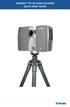 TRIMBLE TX5 3D LASER SCANNER QUICK START GUIDE Equipment 1 8 9 5 6 7 4 3 2 The TX5 laser scanner ships with the following equipment: 1 Scanner transport and carry case 6 USB memory card reader 2 AC power
WHITE PAPER. Are More Pixels Better? www.basler-ipcam.com. Resolution Does it Really Matter?
 WHITE PAPER www.basler-ipcam.com Are More Pixels Better? The most frequently asked question when buying a new digital security camera is, What resolution does the camera provide? The resolution is indeed
Product Information. QUADRA-CHEK 3000 Evaluation Electronics For Metrological Applications
 Product Information QUADRA-CHEK 3000 Evaluation Electronics For Metrological Applications April 2016 QUADRA-CHEK 3000 The evaluation electronics for intuitive 2-D measurement The QUADRA-CHEK 3000 evaluation
How To Use An Edge 3.1 Scientific Cmmos Camera
 edge 3.1 scientific CMOS camera high resolution 2048 x 1536 pixel low noise 1.1 electrons global shutter USB 3.0 small form factor high dynamic range 27 000:1 high speed 50 fps high quantum efficiency
1 of 9 2/9/2010 3:38 PM
 1 of 9 2/9/2010 3:38 PM Chapter 23 Homework Due: 8:00am on Monday, February 8, 2010 Note: To understand how points are awarded, read your instructor's Grading Policy. [Return to Standard Assignment View]
Laboratory #3 Guide: Optical and Electrical Properties of Transparent Conductors -- September 23, 2014
 Laboratory #3 Guide: Optical and Electrical Properties of Transparent Conductors -- September 23, 2014 Introduction Following our previous lab exercises, you now have the skills and understanding to control
EYE-10 and EYE-12. Advanced Live Image Cameras
 EN EYE-10 and EYE-12 Advanced Live Image Cameras High Quality Live Imaging EYE-10 and EYE-12 Live Image Cameras WolfVision is a globally successful family owned company based in Austria/Europe. As technology
Melting Point. Electrothermal PRODUCT SPECIFICATIONS OPERATION
 M A N U A L M E L - T E M P THE LOWEST COST MELTING POINT APPARATUS FOUND ANYWHERE! Low cost unit Temperature range to 500 C Aluminum casting conducts and radiates heat uniformly to capillaries and thermometer.
Analysis of Chlorine, Bromine and Iodine in Water using ICP-AES
 ICP OPTICAL ATOMIC EMISSION SPECTROSCOPY Analysis of Chlorine, Bromine and Iodine in Water using ICP-AES HORIBA Scientific Longjumeau, France Keywords: metallurgy, non-ferrous, halogens 1 Introduction
9/16 Optics 1 /11 GEOMETRIC OPTICS
 9/6 Optics / GEOMETRIC OPTICS PURPOSE: To review the basics of geometric optics and to observe the function of some simple and compound optical devices. APPARATUS: Optical bench, lenses, mirror, target
WHITE PAPER. Source Modeling for Illumination Design. Zemax A Radiant Zemax Company
 Source Modeling for Illumination Design Source Modeling for Illumination Design Authored by: Ronald F. Rykowski and C. Benjamin Wooley Abstract As computation speeds have increased dramatically over the
Chapter 17: Light and Image Formation
 Chapter 17: Light and Image Formation 1. When light enters a medium with a higher index of refraction it is A. absorbed. B. bent away from the normal. C. bent towards from the normal. D. continues in the
RL HW / RL HW+ / RL HGW / RL HV / RL HVPW/RL HVPW-G
 Auto-Levelling Rotary Laser Level RL HW / RL HW+ / RL HGW / RL HV / RL HVPW/RL HVPW-G 77-496 / 77-429 / 77-439 / 77-497 / 77-427/ 77-441 Please read these instructions before operating the product Auto-Levelling
e-4 AWT07MLED 7 Q TFT LCD MONITOR (LED Backlighted) USER MANUAL
 Thank you for purchasing our product. Please read this User s Manual before using the product. Change without Notice AWT07MLED 7 Q TFT LCD MONITOR (LED Backlighted) USER MANUAL e-4 SAFETY PRECAUTIONS Federal
Optical Design Tools for Backlight Displays
 Optical Design Tools for Backlight Displays Introduction Backlights are used for compact, portable, electronic devices with flat panel Liquid Crystal Displays (LCDs) that require illumination from behind.
Revision problem. Chapter 18 problem 37 page 612. Suppose you point a pinhole camera at a 15m tall tree that is 75m away.
 Revision problem Chapter 18 problem 37 page 612 Suppose you point a pinhole camera at a 15m tall tree that is 75m away. 1 Optical Instruments Thin lens equation Refractive power Cameras The human eye Combining
Digitization of Old Maps Using Deskan Express 5.0
 Dražen Tutić *, Miljenko Lapaine ** Digitization of Old Maps Using Deskan Express 5.0 Keywords: digitization; scanner; scanning; old maps; Deskan Express 5.0. Summary The Faculty of Geodesy, University
CISPR 17 Measurements
 CISPR 17 Measurements 50W / 50W versus 0.1W / 100W The truth or Everything you wanted to know about attenuation curves validity but were afraid to ask A practical study using the FN 9675-3-06 power line
5.3 Cell Phone Camera
 164 Chapter 5 5.3 Cell Phone Camera The next design example we discuss is a cell phone camera. These systems have become quite popular, to the point that it is often more difficult to purchase a cell phone
The Basics of Scanning Electron Microscopy
 The Basics of Scanning Electron Microscopy The small scanning electron microscope is easy to use because almost every variable is pre-set: the acceleration voltage is always 15kV, it has only a single
haze-gard i The objective standard for a clear view Global communication Reliable and Precise
 haze-gard i The objective standard for a clear view Transparent products can have a milky or fuzzy appearance dependent on its light scattering behaviour. The haze-gard i quantifies the visual perception
LIGHT SECTION 6-REFRACTION-BENDING LIGHT From Hands on Science by Linda Poore, 2003.
 LIGHT SECTION 6-REFRACTION-BENDING LIGHT From Hands on Science by Linda Poore, 2003. STANDARDS: Students know an object is seen when light traveling from an object enters our eye. Students will differentiate
How To Use The Dc350 Document Camera
 www.optoma.com DC350 Document Camera / Visualiser 1.4kg 5mp Camera XGA,720P support Power on via USB or Power Supply Micro SD Full SD CARD Support for both Images and Video saving Built-in speaker Built-in
Lenses and Apertures of A TEM
 Instructor: Dr. C.Wang EMA 6518 Course Presentation Lenses and Apertures of A TEM Group Member: Anup Kr. Keshri Srikanth Korla Sushma Amruthaluri Venkata Pasumarthi Xudong Chen Outline Electron Optics
Full Waveform Digitizing, Dual Channel Airborne LiDAR Scanning System for Ultra Wide Area Mapping
 Full Waveform Digitizing, Dual Channel Airborne LiDAR Scanning System for Ultra Wide Area Mapping RIEGL LMS-Q56 high laser pulse repetition rate up to 8 khz digitization electronics for full waveform data
Industrial vision cameras CAMERA LINK DVI-D FULL HD CAMERA LINE
 Industrial vision cameras CAMERA LINK DVI-D FULL HD CAMERA LINE CAMERA LINK DVI-D FULL HD CAMERA LINE 12.000.000 PIXEL WITH 25 FRAMES PER SECOND Since 1996 NET distributes teli cameras. High-speed output
Tube Control Measurement, Sorting Modular System for Glass Tube
 Tube Control Measurement, Sorting Modular System for Glass Tube Tube Control is a modular designed system of settled instruments and modules. It comprises measuring instruments for the tube dimensions,
Experiment 3 Lenses and Images
 Experiment 3 Lenses and Images Who shall teach thee, unless it be thine own eyes? Euripides (480?-406? BC) OBJECTIVES To examine the nature and location of images formed by es. THEORY Lenses are frequently
User Guide LUXXOR VIDEO MICROSCOPE. 2 Luxxor Video Microscope Set Up
 2 Luxxor Video Microscope Set Up User Guide LUXXOR VIDEO MICROSCOPE Column When removed from its packaging, the Luxxor Video Microscope will be configured as shown, with the Vertical Slide and Slide Stop
hsfc pro 12 bit ultra speed intensified imaging
 hsfc pro 12 bit ultra speed intensified imaging four MCP-image intensifier camera modules ultra fast shutter down to 3 ns in single mode excellent sensitivity of the system allows single photon detection
D/N VARI-FOCAL IR CAMERA
 D/N VARI-FOCAL IR CAMERA PIH-0364X/0368X/0384X/0388X W/S INSTRUCTION MANUAL IMPORTANT SAFEGUARDS 1. Read Instructions All the safety and operating instructions should be read before the unit is operated.
PRODUCT NO.: PT-P1SD PRODUCT NAME: Digital SD Slide Projector
 PRODUCT NO.: PRODUCT NME: Digital SD Slide Projector MJOR FETURES The one and only digital SD slide projector* - Built-in digital photo slide shows: direct SD card projection - Slide show features: transition
EPSON SCANNING TIPS AND TROUBLESHOOTING GUIDE Epson Perfection 3170 Scanner
 EPSON SCANNING TIPS AND TROUBLESHOOTING GUIDE Epson Perfection 3170 Scanner SELECT A SUITABLE RESOLUTION The best scanning resolution depends on the purpose of the scan. When you specify a high resolution,
Advances in scmos Camera Technology Benefit Bio Research
 Advances in scmos Camera Technology Benefit Bio Research scmos camera technology is gaining in popularity - Why? In recent years, cell biology has emphasized live cell dynamics, mechanisms and electrochemical
3D TOPOGRAPHY & IMAGE OVERLAY OF PRINTED CIRCUIT BOARD ASSEMBLY
 3D TOPOGRAPHY & IMAGE OVERLAY OF PRINTED CIRCUIT BOARD ASSEMBLY Prepared by Duanjie Li, PhD & Andrea Novitsky 6 Morgan, Ste156, Irvine CA 92618 P: 949.461.9292 F: 949.461.9232 nanovea.com Today's standard