
FAO and the 17 Sustainable Development Goals
|
|
|
- May Hardy
- 9 years ago
- Views:
Transcription
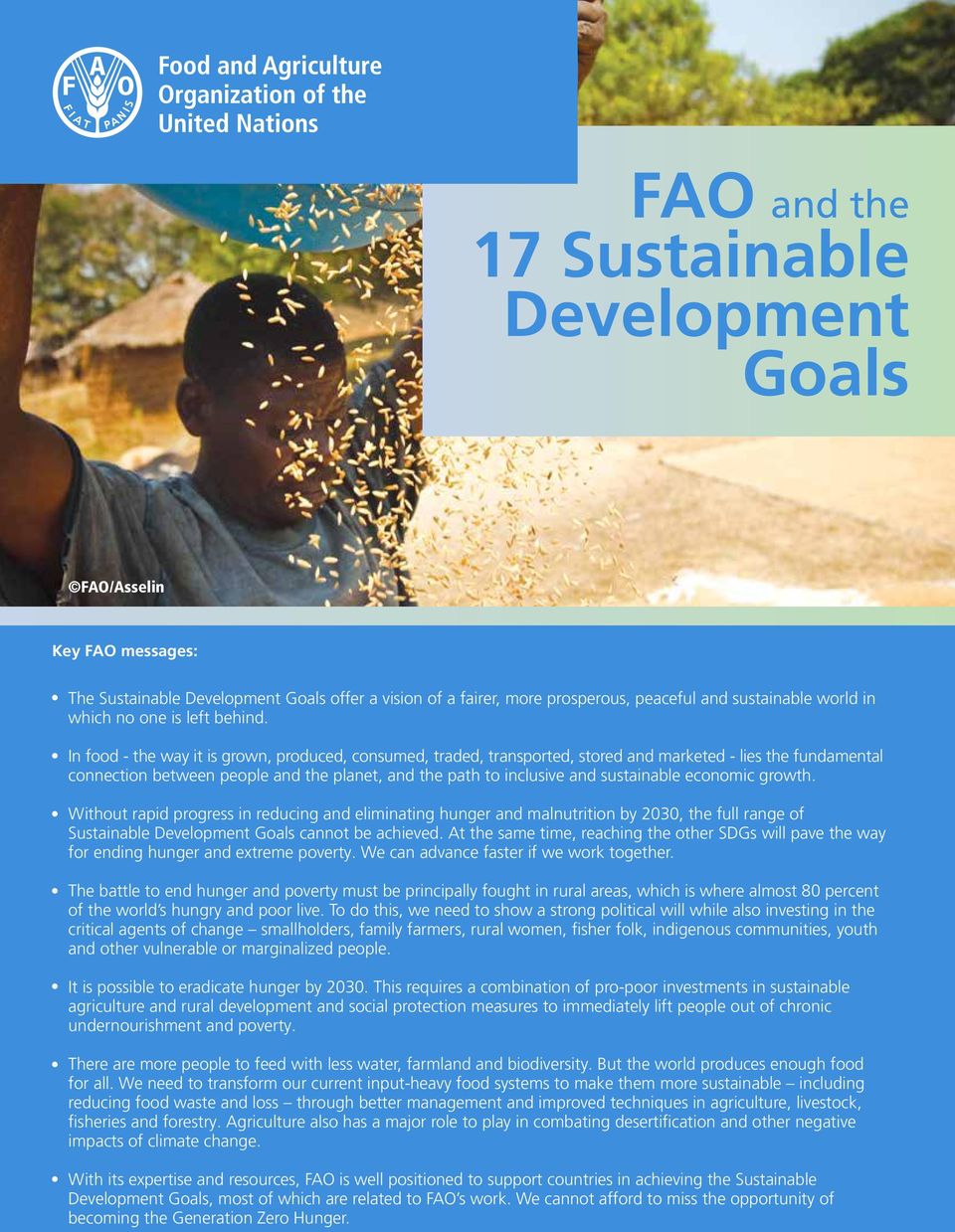
1 FAO and the 17 Sustainable Development Goals FAO/Asselin Key FAO messages: The Sustainable Development Goals offer a vision of a fairer, more prosperous, peaceful and sustainable world in which no one is left behind. In food - the way it is grown, produced, consumed, traded, transported, stored and marketed - lies the fundamental connection between people and the planet, and the path to inclusive and sustainable economic growth. Without rapid progress in reducing and eliminating hunger and malnutrition by 2030, the full range of Sustainable Development Goals cannot be achieved. At the same time, reaching the other SDGs will pave the way for ending hunger and extreme poverty. We can advance faster if we work together. The battle to end hunger and poverty must be principally fought in rural areas, which is where almost 80 percent of the world s hungry and poor live. To do this, we need to show a strong political will while also investing in the critical agents of change smallholders, family farmers, rural women, fisher folk, indigenous communities, youth and other vulnerable or marginalized people. It is possible to eradicate hunger by This requires a combination of pro-poor investments in sustainable agriculture and rural development and social protection measures to immediately lift people out of chronic undernourishment and poverty. There are more people to feed with less water, farmland and biodiversity. But the world produces enough food for all. We need to transform our current input-heavy food systems to make them more sustainable including reducing food waste and loss through better management and improved techniques in agriculture, livestock, fisheries and forestry. Agriculture also has a major role to play in combating desertification and other negative impacts of climate change. With its expertise and resources, FAO is well positioned to support countries in achieving the Sustainable Development Goals, most of which are related to FAO s work. We cannot afford to miss the opportunity of becoming the Generation Zero Hunger. 1
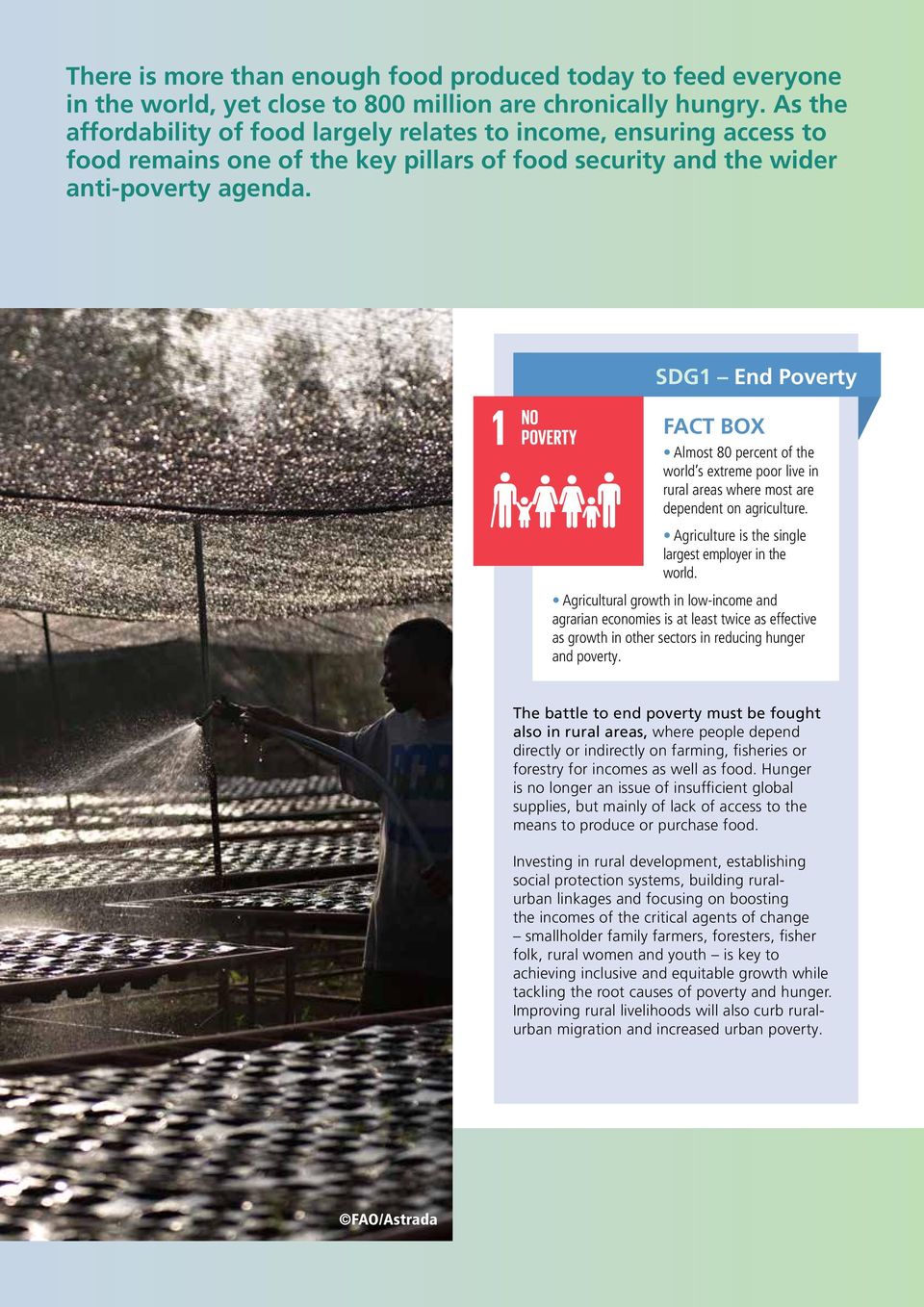
2 There is more than enough food produced today to feed everyone in the world, yet close to 800 million are chronically hungry. As the affordability of food largely relates to income, ensuring access to food remains one of the key pillars of food security and the wider anti poverty agenda. SDG1 End Poverty FACT BOX Almost 80 percent of the world s extreme poor live in rural areas where most are dependent on agriculture. Agriculture is the single largest employer in the world. Agricultural growth in low-income and agrarian economies is at least twice as effective as growth in other sectors in reducing hunger and poverty. The battle to end poverty must be fought also in rural areas, where people depend directly or indirectly on farming, fisheries or forestry for incomes as well as food. Hunger is no longer an issue of insufficient global supplies, but mainly of lack of access to the means to produce or purchase food. Investing in rural development, establishing social protection systems, building ruralurban linkages and focusing on boosting the incomes of the critical agents of change smallholder family farmers, foresters, fisher folk, rural women and youth is key to achieving inclusive and equitable growth while tackling the root causes of poverty and hunger. Improving rural livelihoods will also curb ruralurban migration and increased urban poverty. 2 FAO/Astrada
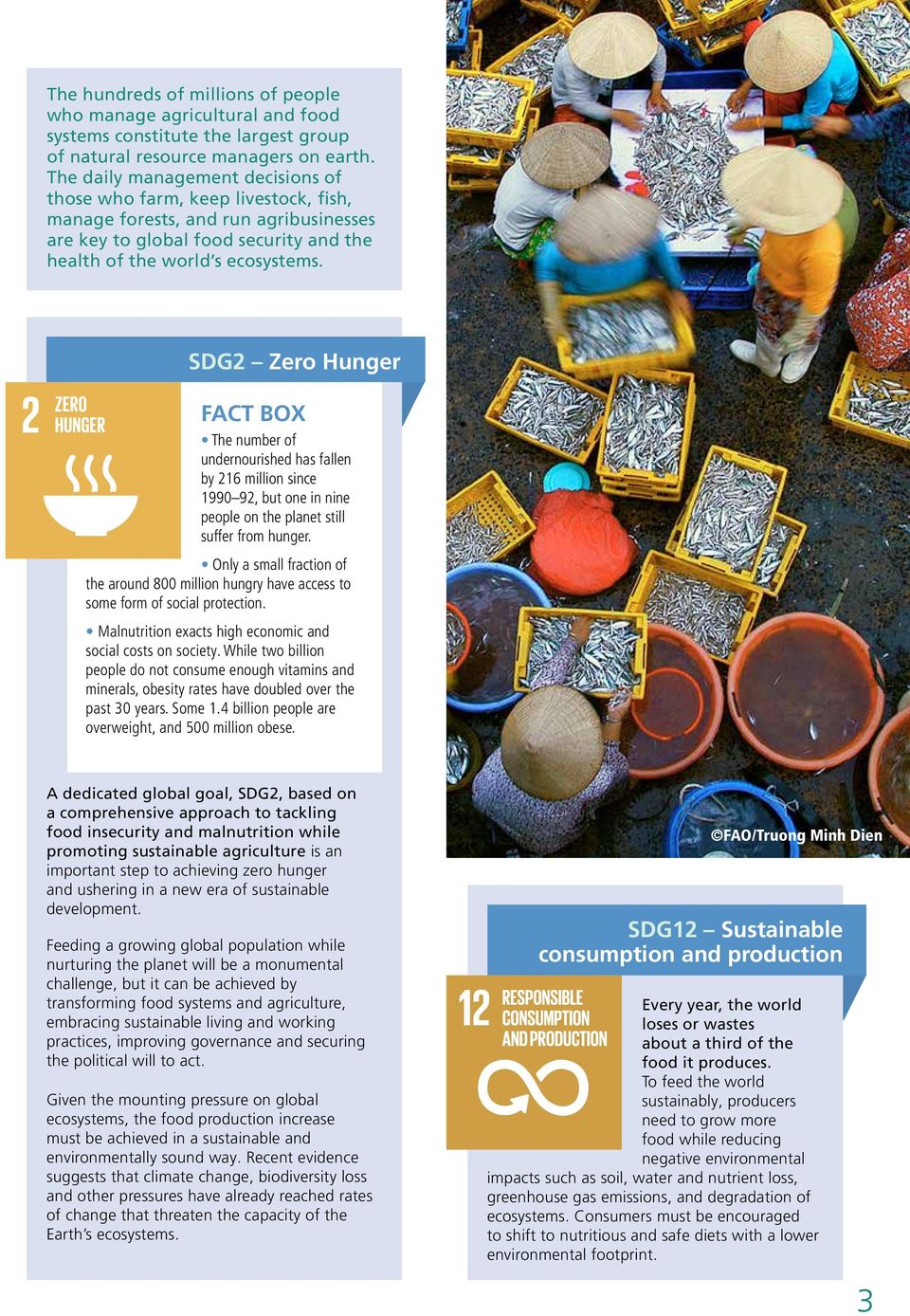
3 The hundreds of millions of people who manage agricultural and food systems constitute the largest group of natural resource managers on earth. The daily management decisions of those who farm, keep livestock, fish, manage forests, and run agribusinesses are key to global food security and the health of the world s ecosystems. SDG2 Zero Hunger FACT BOX The number of undernourished has fallen by 216 million since , but one in nine people on the planet still suffer from hunger. Only a small fraction of the around 800 million hungry have access to some form of social protection. Malnutrition exacts high economic and social costs on society. While two billion people do not consume enough vitamins and minerals, obesity rates have doubled over the past 30 years. Some 1.4 billion people are overweight, and 500 million obese. A dedicated global goal, SDG2, based on a comprehensive approach to tackling food insecurity and malnutrition while promoting sustainable agriculture is an important step to achieving zero hunger and ushering in a new era of sustainable development. Feeding a growing global population while nurturing the planet will be a monumental challenge, but it can be achieved by transforming food systems and agriculture, embracing sustainable living and working practices, improving governance and securing the political will to act. Given the mounting pressure on global ecosystems, the food production increase must be achieved in a sustainable and environmentally sound way. Recent evidence suggests that climate change, biodiversity loss and other pressures have already reached rates of change that threaten the capacity of the Earth s ecosystems. FAO/Truong Minh Dien SDG12 Sustainable consumption and production Every year, the world loses or wastes about a third of the food it produces. To feed the world sustainably, producers need to grow more food while reducing negative environmental impacts such as soil, water and nutrient loss, greenhouse gas emissions, and degradation of ecosystems. Consumers must be encouraged to shift to nutritious and safe diets with a lower environmental footprint. 3
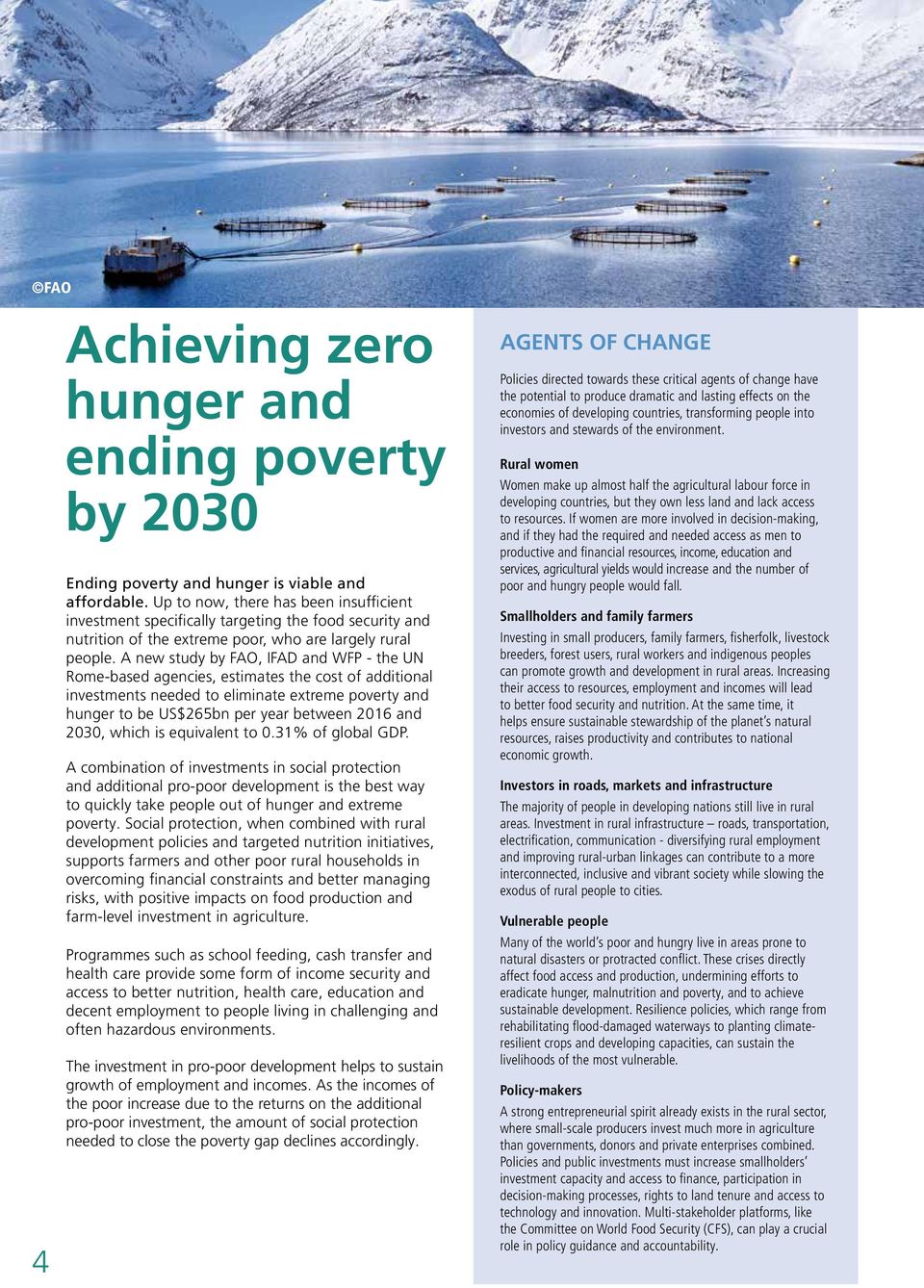
4 FAO 4 Achieving zero hunger and ending poverty by 2030 Ending poverty and hunger is viable and affordable. Up to now, there has been insufficient investment specifically targeting the food security and nutrition of the extreme poor, who are largely rural people. A new study by FAO, IFAD and WFP - the UN Rome-based agencies, estimates the cost of additional investments needed to eliminate extreme poverty and hunger to be US$265bn per year between 2016 and 2030, which is equivalent to 0.31% of global GDP. A combination of investments in social protection and additional pro-poor development is the best way to quickly take people out of hunger and extreme poverty. Social protection, when combined with rural development policies and targeted nutrition initiatives, supports farmers and other poor rural households in overcoming financial constraints and better managing risks, with positive impacts on food production and farm-level investment in agriculture. Programmes such as school feeding, cash transfer and health care provide some form of income security and access to better nutrition, health care, education and decent employment to people living in challenging and often hazardous environments. The investment in pro-poor development helps to sustain growth of employment and incomes. As the incomes of the poor increase due to the returns on the additional pro-poor investment, the amount of social protection needed to close the poverty gap declines accordingly. AGENTS OF CHANGE Policies directed towards these critical agents of change have the potential to produce dramatic and lasting effects on the economies of developing countries, transforming people into investors and stewards of the environment. Rural women Women make up almost half the agricultural labour force in developing countries, but they own less land and lack access to resources. If women are more involved in decision-making, and if they had the required and needed access as men to productive and financial resources, income, education and services, agricultural yields would increase and the number of poor and hungry people would fall. Smallholders and family farmers Investing in small producers, family farmers, fisherfolk, livestock breeders, forest users, rural workers and indigenous peoples can promote growth and development in rural areas. Increasing their access to resources, employment and incomes will lead to better food security and nutrition. At the same time, it helps ensure sustainable stewardship of the planet s natural resources, raises productivity and contributes to national economic growth. Investors in roads, markets and infrastructure The majority of people in developing nations still live in rural areas. Investment in rural infrastructure roads, transportation, electrification, communication - diversifying rural employment and improving rural-urban linkages can contribute to a more interconnected, inclusive and vibrant society while slowing the exodus of rural people to cities. Vulnerable people Many of the world s poor and hungry live in areas prone to natural disasters or protracted conflict. These crises directly affect food access and production, undermining efforts to eradicate hunger, malnutrition and poverty, and to achieve sustainable development. Resilience policies, which range from rehabilitating flood-damaged waterways to planting climateresilient crops and developing capacities, can sustain the livelihoods of the most vulnerable. Policy-makers A strong entrepreneurial spirit already exists in the rural sector, where small-scale producers invest much more in agriculture than governments, donors and private enterprises combined. Policies and public investments must increase smallholders investment capacity and access to finance, participation in decision-making processes, rights to land tenure and access to technology and innovation. Multi-stakeholder platforms, like the Committee on World Food Security (CFS), can play a crucial role in policy guidance and accountability.
5 Moving beyond pure conservation to sustainable use of natural resources is essential to ensure the long-term survival of our planet and its people. LIFE BELOW WATER SDG14 Oceans, Seas and Marine resources FACT BOX Worldwide nearly three billion people receive 20 percent of their daily animal protein intake from fish. About 29 percent of commercially important assessed marine fish stocks are overfished and 61 percent fully fished. A comprehensive approach to fisheries and aquaculture targeting small-scale artisanal fishers is well captured in SDG14. Sustainable management of ocean ecosystems is imperative for ensuring sustainable fisheries. Stewardship must balance priorities between growth and conservation, and between industrial and artisanal fisheries and aquaculture, ensuring equitable benefits for communities. Aquaculture is the fastest-growing food sector. If it is developed in a regulated and environmentally and socially responsible way, aquaculture intensification has the potential to produce the fish needed to meet the demand for safe and highly nutritious food by a growing population. SDG15 Life on land FACT BOX Forests make vital contributions to biodiversity; they act as a source of food, medicine and fuel for more than a billion people. Mountains supply more than half of humankind with water. A third of farmland is degraded, up to 75 percent of crop genetic diversity has been lost and 22 percent of animal breeds are at risk. Soil is non-renewable its loss is not recoverable within a human lifespan. The sustainable use and management of terrestrial ecosystems, forests, mountains, land and soils and biodiversity is well articulated in the composition of SDG15. Forests contribute to decent livelihoods for millions while providing clean air and water, conserving biodiversity and mitigating climate change. Forests have the potential to absorb significant amounts of carbon emissions in their biomass, soils and products. In principle, they can store them in perpetuity. While modern food systems are heavily dependent on fossil fuels, sustainable forests provide a renewable way to build, heat and furnish. Wood grows back and well-managed forests grow forever. Natural, recyclable, reusable and biodegradable, wood is a vital part of any sustainable future, a solution for infrastructure and energy needs. FAO/Celis 5
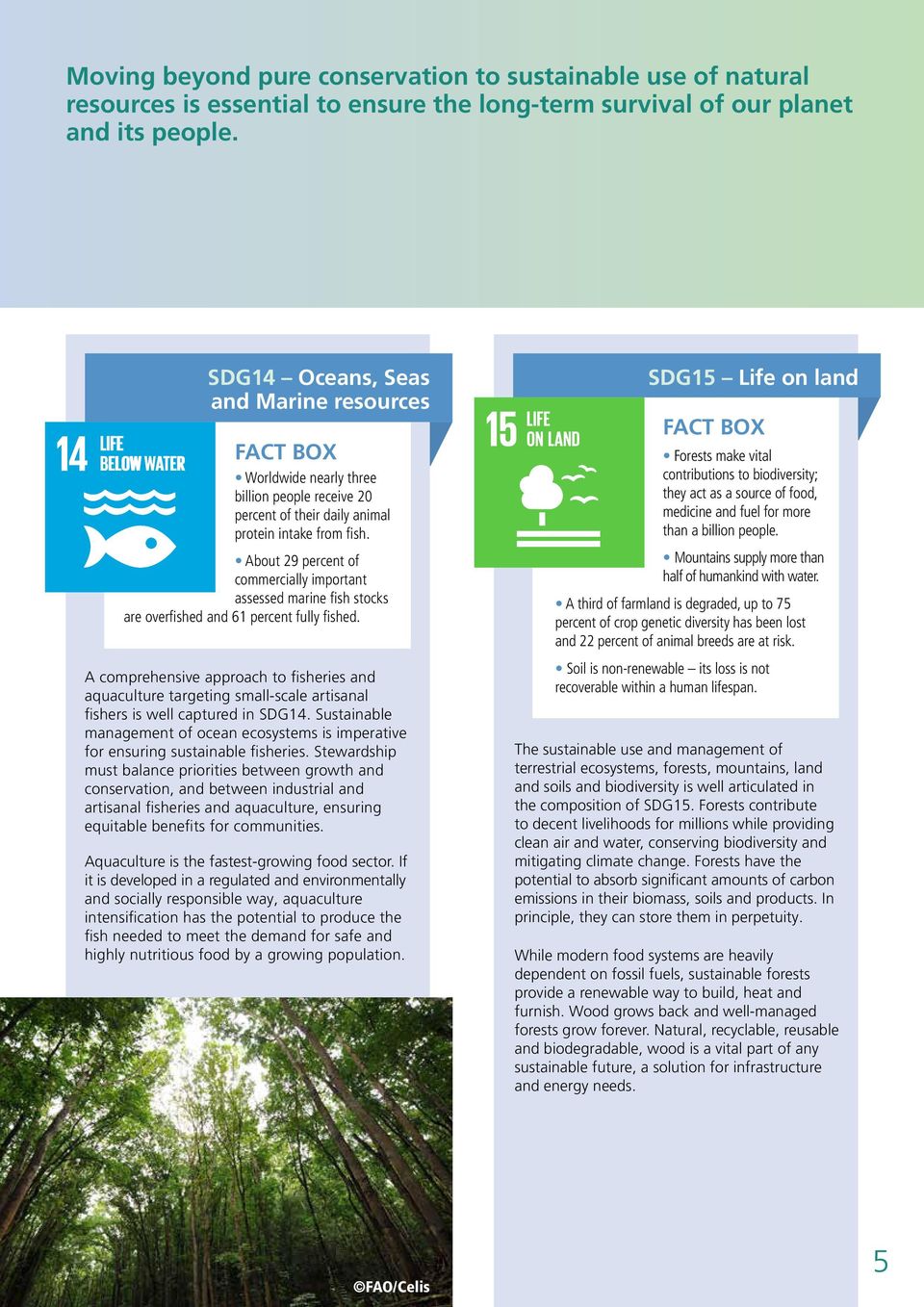
6 Food-Water-Energy nexus A growing global population with accelerating urbanization and a deteriorating natural resource base means more people to feed with less water, farmland and rural labour. Satisfying expected increases in water, energy and food needs requires a shift to more sustainable consumption and production approaches, with agriculture and food systems made more efficient and sustainable. SDG6 Water How to increase food production using less water is one of the great challenges of the future. Crops and livestock use 70 percent of all water withdrawals and up to 95 percent is some developing countries. By 2025, 1.8 billion people are projected to be living in countries or regions with absolute water scarcity. SDG7 Energy Energy has a key enabling role in achieving food security and better nutrition. Energy prices influence food prices. Food systems, which currently consume 30 percent of the world s energy, will gradually need to decouple from fossil fuel dependence to deliver more food with less and cleaner energy. SDG13 Combat Climate change Agriculture has a major role to play in responding to climate change. While temperature rises pose a real threat to global food production, investments in all sectors of agriculture can simultaneously support climate change adaptation and mitigation while improving rural people s livelihoods. FAO 6 FAO
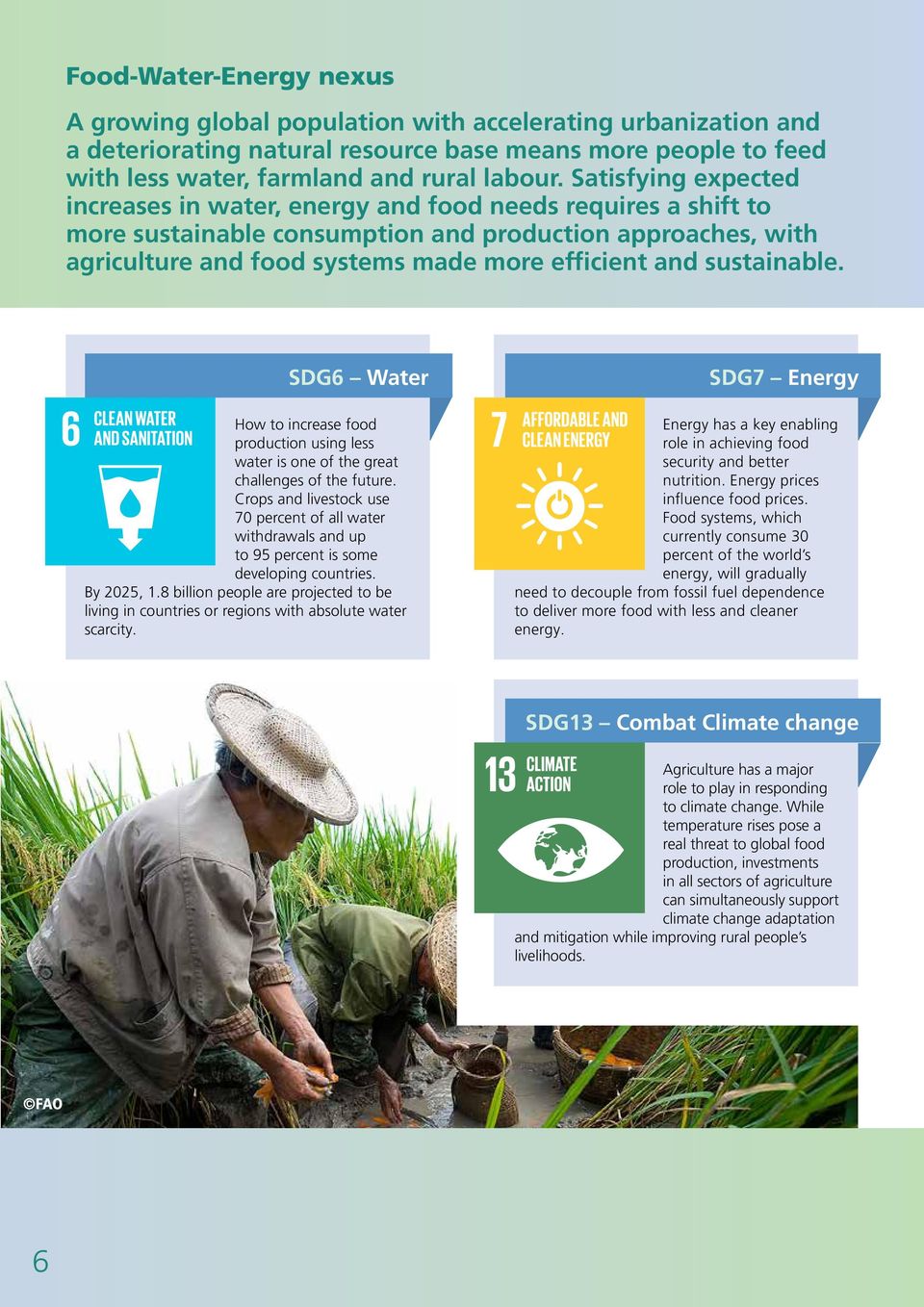
7 FAO is a specialized UN agency with unique expertise in the three dimensions of sustainable development. FAO can support the implementation of a transformative 2030 Agenda for Sustainable Development that will see people interact harmoniously with the planet s ecosystems and benefit from their services, maintaining and sustainably using biodiversity and all natural resources for present and future generations. What FAO is doing We support governments and development partners to design the right policies, programmes and legal frameworks that promote food security and nutrition. We also assist countries seeking to access public and private funding for agriculture and rural development. FAO has identified five Strategic Objectives to sharpen its focus on fighting hunger and to create more sustainable food systems. This puts FAO in a strong position to support countries that are taking the lead in implementing the Sustainable Development Goals. Through its international expertise FAO is also well positioned to assist broad regional and international partnerships, including South-South cooperation, required to achieve zero hunger by FAO s Strategic Objectives are: 1. Help eliminate hunger, food insecurity and malnutrition 2. Make agriculture, forestry and fisheries more productive and sustainable 3. Reduce rural poverty 4. Enable inclusive and efficient agricultural and food systems 5. Increase the resilience of livelihoods to threats and crises List FAO flagship publications (related to monitoring) The State of Food Insecurity in the World: The State of the World s Forests: The State of Food and Agriculture: The State of World Fisheries and Aquaculture: The State of Agricultural Commodity Markets: 7
8 The achievement of the Millennium Development Goals hunger targets by many countries shows that we can indeed eliminate the scourge of hunger in our lifetime. This is at the very heart of the new sustainable development agenda: freeing the world of poverty and hunger, and leaving no one behind. We can do it. We can be the Zero Hunger generation. José Graziano da Silva - FAO Director-General FAO/Longari FAO has been actively engaged in the post-2015 development agenda process, supporting Member States and all stakeholders by contributing expert technical knowledge based on the Organization s vision of a world free of hunger and malnutrition where food and agriculture contribute to improving the living standards of all, especially the poorest, in an economically, socially and environmentally sustainable manner. FAO will continue to work with all Member States and relevant actors towards implementing and monitoring the 2030 Agenda for Sustainable Development. 8 Food and Agriculture Organization of the United Nations Viale delle Terme di Caracalla Rome, Italy [email protected] web: Twitter: twitter.com/faopost2015 FAO 2015 I4997E/1/09.15

GLOBAL ALLIANCE FOR CLIMATE-SMART AGRICULTURE (GACSA)
 GLOBAL ALLIANCE FOR CLIMATE-SMART AGRICULTURE (GACSA) FRAMEWORK DOCUMENT Version 01 :: 1 September 2014 I Vision 1. In today s world there is enough food produced for all to be well-fed, but one person
FAO COMMITTEE ON FISHERIES (COFI) - 30th SESSION OPENING STATEMENT BY THE FAO DIRECTOR-GENERAL. 9 July 2012
 FAO COMMITTEE ON FISHERIES (COFI) - 30th SESSION OPENING STATEMENT BY THE FAO DIRECTOR-GENERAL 9 July 2012 SALUTATIONS TO BE CONFIRMED Mr Chairperson, Excellencies, Distinguished Delegates, Observers,
Research to improve the use and conservation of agricultural biodiversity for smallholder farmers
 Research to improve the use and conservation of agricultural biodiversity for smallholder farmers Agricultural biodiversity the variability of crops and their wild relatives, trees, animals, arthropods,
Seeing the Forest for the Trees Making the Most of Synergies to Achieve SDGs in a Constrained Environment By Mahmoud Mohieldin and Paula Caballero
 Goal 15 Protect, restore and promote sustainable use of terrestrial ecosystems, sustainably manage forests, combat desertification, and halt and reverse land degradation and halt biodiversity loss Seeing
18.01.2014 Final Communiqué of the GFFA 2014
 18.01.2014 Final Communiqué of the GFFA 2014 "Empowering Agriculture: Fostering Resilience Securing Food and Nutrition" We, the Agriculture Ministers of 65 states of the world, assembled here in Berlin
HLPE report on Nutrition and Food Systems
 HLPE report on Nutrition and Food Systems e-consultation on an Issues Note proposed by the HLPE Steering Committee From 9 December 2015 to 15 February 2016 Short Summary by the HLPE Secretariat 1 There
*Principles for Responsible Investment in Agriculture and Food Systems*
 Updated 11/08/14 *Principles for Responsible Investment in Agriculture and Food Systems* *INTRODUCTION*... 2 *BACKGROUND AND RATIONALE*... 2 *OBJECTIVE*... 4 *PURPOSE*... 4 *NATURE AND SCOPE*... 4 *INTENDED
CLIMATE-SMART AGRICULTURE. Executive Summary
 CLIMATE-SMART AGRICULTURE Sourcebook Executive Summary Why is climate-smart agriculture needed? Between now and 2050, the world s population will increase by one-third. Most of these additional 2 billion
G20 Agriculture Ministers Meeting Communiqué
 G20 Agriculture Ministers Meeting Communiqué Xi an, 3 June 2016 1. We, the G20 Agriculture Ministers, met today in Xi an to discuss how G20 members can promote food security, nutrition, sustainable agricultural
MINISTERIAL MEETING OF THE BLUE WEEK 2015
 5 JUNE 2015 MINISTERIAL MEETING OF THE BLUE WEEK 2015 We, Ministers responsible for Ocean/ Fisheries/ Maritime Affairs, having met in Lisbon on June the 5 th, 2015, at the invitation of the Minister of
FOOD AND AGRICULTURE ORGANIZATION OF THE UNITED NATIONS
 FOOD AND AGRICULTURE ORGANIZATION OF THE UNITED NATIONS Contribution to the 2014 United Nations Economic and Social Council (ECOSOC) Integration Segment Food security for sustainable development and urbanization:
Milan Urban Food Policy Pact
 Milan Urban Food Policy Pact 15 October 2015 Acknowledging that cities which host over half the world s population have a strategic role to play in developing sustainable food systems and promoting healthy
Global water resources under increasing pressure from rapidly growing demands and climate change, according to new UN World Water Development Report
 WWDR4 Background Information Brief Global water resources under increasing pressure from rapidly growing demands and climate change, according to new UN World Water Development Report As demand for water
FAO-Adapt. Framework Programme on Climate Change Adaptation
 FAO-Adapt Framework Programme on Climate Change Adaptation Food security and climate change FAO s vision for the future is a world free of hunger and malnutrition where food and agriculture contribute
G20 FOOD SECURITY AND NUTRITION FRAMEWORK
 G20 FOOD SECURITY AND NUTRITION FRAMEWORK G20 Food Security a nd Nutrition Framework 2 G20 Food Security and Nutrition Framework INTRODUCTION Food security and nutrition requires an inclusive economic
Intervention on behalf of Denmark, Norway and Ireland on the occasion of the Open Working Group on Sustainable Development Goals meeting on
 Intervention on behalf of Denmark, Norway and Ireland on the occasion of the Open Working Group on Sustainable Development Goals meeting on Sustainable Consumption and Production, including Chemicals and
VOLUNTARY GUIDELINES ON THE GOVERNANCE OF TENURE. At a glance
 VOLUNTARY GUIDELINES ON THE GOVERNANCE OF TENURE At a glance VOLUNTARY GUIDELINES ON THE GOVERNANCE OF TENURE At a glance FOOD AND AGRICULTURE ORGANIZATION OF THE UNITED NATIONS Rome, 2012 The designations
How To Treat Malnutrition
 Friedensreich Hundertwasser, 738 Grass for those who cry, 1975, 2013 NAMIDA AG, Glarus/Switzerland Healthy people depend on healthy food systems Sustainable Food Systems for Food Security and Nutrition
World Summit on Food Security. Rome, 16-18 November 2009 DECLARATION OF THE WORLD SUMMIT ON FOOD SECURITY
 November 2009 E World Summit on Food Security Rome, 16-18 November 2009 DECLARATION OF THE WORLD SUMMIT ON FOOD SECURITY We, the Heads of State and Government, or our Representatives and the Representative
AG R I C U LT U R E GREEN ECONOMY
 THIS IS THE STORY OF AG R I C U LT U R E GREEN ECONOMY We need to make the global economy green. provides significant opportunities for growth, investment and jobs to help make this happen. $ Everyone
Ref.: SCBD/MPO/AF/CR/84948 31 August 2015 N O T I F I C A T I O N. Preparation for the United Nations Sustainable Development Summit 2015
 Ref.: SCBD/MPO/AF/CR/84948 31 August 2015 Dear Madam/Sir, N O T I F I C A T I O N Preparation for the United Nations Sustainable Development Summit 2015 I am pleased to inform you that the President of
Driving Sustainable Development: the role of Science, Technology and Innovation
 G-SCIENCE ACADEMIES STATEMENTS 2013 Driving Sustainable Development: the role of Science, Technology and Innovation 1. Introduction The framework of Millennium Development Goals has led to several in-depth
Nurture Our Planet. Nourish Our People. Recommendations from the High Level Roundtable on Food and Nutrition Security and Sustainable Agriculture
 Recommendations from the High Level Roundtable on Food and Nutrition Security and Sustainable Agriculture 15 16 March 2012, New York Nourish Our People Nurture Our Planet Women in Ethiopia showing cabbage
Speech at the High-Level Conference on World Food Security
 Speech at the High-Level Conference on World Food Security SUN Zhengcai Minister of Agriculture People s Republic of China Rome, June 2008 Distinguished Chairperson, Excellencies, Ladies and Gentlemen,
Recognizing that women smallholder farmers constitute the majority of food producers, but remain vulnerable and require targeted support;
 DECLARATION OF THE HIGH-LEVEL MEETING Toward African Renaissance: Renewed Partnership for a Unified Approach to End Hunger in Africa by 2025 under the Framework the Comprehensive Africa Agriculture Development
Web Annex 6: Output indicators and targets 2016-17
 CL 153/3 Web Annex 6 1 Web Annex 6: Output indicators and targets 2016-17 SO1: Contribute to the eradication of hunger, food insecurity and malnutrition 1.1 Member countries and their 1.1.1 Improving capacities
DRYLAND SYSTEMS Science for better food security and livelihoods in the dry areas
 DRYLAND SYSTEMS Science for better food security and livelihoods in the dry areas CGIAR Research Program on Dryland Agricultural Production Systems The global research partnership to improve agricultural
Perspective. The Hanoi Communiqué
 The Hanoi Communiqué The Ministers, representatives of countries, practitioners, scientists, civil society, private sector, and all other participants present at the 2 nd Global Conference on Agriculture,
Second International Conference on Nutrition. Rome, 19-21 November 2014. Conference Outcome Document: Rome Declaration on Nutrition
 October 2014 ICN2 2014/2 Second International Conference on Nutrition Rome, 19-21 November 2014 Conference Outcome Document: Rome Declaration on Nutrition Welcoming the participation of Heads of State
How can an Ecological Footprint Contribute to Green Economy in Africa?
 RIO+20 AFRICAN DEVELOPMENT BANK How can an Ecological Footprint Contribute to Green Economy in Africa? Introduction Fundamentally we all depend on nature, the ecological infrastructure of the planet that
TST Issues Brief: Food Security and Nutrition 1
 TST Issues Brief: Food Security and Nutrition 1 I. Stocktaking Food security and nutrition are essential dimensions of sustainable development. Inadequate food security and nutrition take an enormous toll
Global Environment Facility GEF OPERATIONAL PROGRAM #13 ON CONSERVATION AND SUSTAINABLE USE OF BIOLOGICAL DIVERSITY IMPORTANT TO AGRICULTURE
 Global Environment Facility GEF OPERATIONAL PROGRAM #13 ON CONSERVATION AND SUSTAINABLE USE OF BIOLOGICAL DIVERSITY IMPORTANT TO AGRICULTURE CONTENTS Introduction..1 Convention Guidance... 2 Agricultural
Climate-Smart Agriculture - Science for Action 24-26 October 2011 - Ede / Wageningen - The Netherlands
 The Wageningen Statement: Climate-Smart Agriculture - Science for Action 24-26 October 2011 - Ede / Wageningen - The Netherlands The Wageningen Statement: Climate-Smart Agriculture Science for Action The
The relationship of pastoralism to the SDGs. The land people livestock nexus
 1 The relationship of pastoralism to the SDGs. The land people livestock nexus Irene Hoffmann, FAO 16th Annual Mee-ng of the Inter-Agency Donor Group 18-20 November, GIZ, Berlin, Germany Global Land Cover-SHARE,
Creating Green Jobs within the Environment and Culture sector.
 Creating Green Jobs within the Environment and Culture sector. Matilda Skosana Environmental Programmes (ILO Definition): 1. DEFINITION OF GREEN JOB. Jobs are green when they help reduce negative environmental
Food Security in a Volatile World
 Issues in Brief Food Security in a Volatile World Developments in agriculture over the last fifty years have increased yields sufficiently to provide on average more than enough food for every person on
EIGHTH SESSION OF THE OPEN WORKING GROUP ON SUSTAINABLE DEVELOPMENT GOALS
 EIGHTH SESSION OF THE OPEN WORKING GROUP ON SUSTAINABLE DEVELOPMENT GOALS New Zealand intervention in segment on Oceans and Seas Stephanie Lee, Chargé d'affaires a.i. 4 February 2014 Check against delivery
COMMITTEE ON FISHERIES
 May 2016 COFI/2016/Inf.15 E COMMITTEE ON FISHERIES Thirty-second Session Rome, 11-15 July 2016 ADVANCING KNOWLEDGE ON RIGHTS-BASED APPROACHES FOR FISHERIES: A GLOBAL WORK PROGRAMME FOR ENHANCING FOOD SECURITY
The United Nations Environment Programme and the 2030 Agenda. Global Action for People and the Planet
 The United Nations Environment Programme and the 2030 Agenda Global Action for People and the Planet Unemployment, resource scarcity, climate change, food insecurity and inequity all signal the need for
Sustainability 2015 and beyond - Global processes and the disruptive power of Smart Cities. Andreas Gyllenhammar Chief Sustainability Officer
 Sustainability 2015 and beyond - Global processes and the disruptive power of Smart Cities Andreas Gyllenhammar Chief Sustainability Officer Sustainability 2015 and beyond - Global processes and the disruptive
Conclusions. Towards a green economy
 Conclusions Towards a green economy Conclusions Moving towards a green economy has the potential to achieve sustainable development and eradicate poverty on an unprecedented scale, with speed and effectiveness.
Investing in rural people in Indonesia
 IFAD/Roger Arnold Investing in rural people in Indonesia Rural poverty in Indonesia Indonesia is the largest economy in South-East Asia and has progressed rapidly over the past decade into a dynamic, highly
April 2015 C 2015/31 E. Thirty-ninth Session. Rome, 6-13 June 2015. Global Soil Partnership - World Soil Charter
 April 2015 C 2015/31 E CONFERENCE Thirty-ninth Session Rome, 6-13 June 2015 Global Soil Partnership - World Soil Charter Executive Summary The FAO Conference adopted the World Soil Charter (WSC) at its
Status of the World s Soil Resources
 5 December 2015 Status of the World s Soil Resources The Intergovernmental Technical Panel on Soils (ITPS), the main scientific advisory body to the Global Soil Partnership (GSP) hosted by the Food and
Focus area 1. Poverty eradication
 Focus area 1. Poverty eradication Eradication of poverty in all its forms remains the overriding priority and a necessary condition for sustainable development. The pursuit of this would provide a strong
A/HRC/31/L.14. General Assembly. United Nations
 United Nations General Assembly Distr.: Limited 21 March 2016 Original: English A/HRC/31/L.14 Human Rights Council Thirty-first session Agenda item 3 Promotion and protection of all human rights, civil,
Communiqué Global Bioeconomy Summit 2015
 Communiqué Global Bioeconomy Summit 2015 Making Bioeconomy Work for Sustainable Development Communiqué of the Global Bioeconomy Summit 2015 Making Bioeconomy Work for Sustainable Development The first
FOOD AVAILABILITY AND NATURAL RESOURCE USE
 FOOD AVAILABILITY AND NATURAL RESOURCE USE Nadia El-Hage Scialabba Natural Resources Management and Environment Department, FAO FAO/OECD Expert Meeting on Greening the Economy with Agriculture Paris, 5
Facts on biodiversity
 Facts on biodiversity What is biodiversity? Biological diversity (biodiversity) comprises diversity of species and habitats as well as the genetic diversity within the individual species of fauna and flora.
Open Meeting of the Club of Bologna Farm Machinery to Feed the World. 21 September 2015 Teatro della Terra, Biodiversity Park, EXPO Milano 2015
 Open Meeting of the Club of Bologna 21 September 2015 Teatro della Terra, Biodiversity Park, EXPO Milano 2015 Farm of the Future Giuseppe Gavioli [email protected] Challenges Child and maternal
Water in the SDG s - in a European context. Continued challenges, tasks, responsibilities and opportunities
 Water in the SDG s - in a European context Continued challenges, tasks, responsibilities and opportunities Dept. of Climate adaptation, Water sector and Ground water The SDG process following Rio +20 Danish
Enabling poor rural people to overcome poverty in Honduras
 IFAD/F. Mattioli Enabling poor rural people to overcome poverty in Honduras Rural poverty in Honduras The Republic of Honduras is the second-poorest country in Central America. It is a lower middle-income
Annex 8: SDG Indicator Mapping
 Annex 8 SDG Indicator Mapping 1. Annex 8 responds to Executive Board decision below, regarding the refinement of indicators and targets of the Strategic Plan Integrated Results and Resources Framework
Eliminating child labour in agriculture
 Eliminating child labour in agriculture Gender, Equity and Rural Employment Division Economic and Social Development Department Food and Agriculture Organization of the United Nations May 2010 The following
PRESENTATION 2 MAJOR ENVIRONMENTAL PROBLEMS
 UNEP GLOBAL JUDGES PROGRAMME APPLICATION OF ENVIRONMENTAL LAW BY NATIONAL COURTS AND TRIBUNALS PRESENTATION 2 MAJOR ENVIRONMENTAL PROBLEMS OUTLINE OF PRESENTATION A) Major environmental issues B) Responses
Ecosystem Services and Rural Poverty Reduction
 Ecosystem Services and Rural Poverty Reduction Issues, Challenges and Opportunities Balakrishna Pisupati United Nations Environment Programme (UNEP) Focus Poverty Poverty-Environment Linkages Poverty Biodiversity
FOOD 2030: How we get there
 FOOD 2030: How we get there FOREWord Food sustains us. Producing it provides jobs, supports our economy, and helps shape the character of our landscape and our countryside. A vibrant food culture has developed
Agricultural and Rural Development / Fisheries
 Agricultural and Rural Development / Fisheries Addressing Global Food Security and Poverty Of the eight Millennium Development Goals (MDGs), relevant goals are shown in color. Since rising sharply in 2008,
Biodiversity Concepts
 Biodiversity Concepts WHAT IS BIODIVERSITY? Biodiversity is the variety of life on Earth. For any kind of animal or plant each individual is not exactly the same as any other; nor are species or ecosystems.
Resource efficiency. United Nations Environment Programme
 Resource efficiency United Nations Environment Programme An overview Economic growth and social development cannot be sustained with our current consumption and production patterns. Globally, we are extracting
How To Help Oceans
 The World Bank & the Ocean A Healthy & Productive Ocean to Help Reduce Poverty Why oceans matter to the World Bank NUTRITION Seafood provides 16% of the world s animal protein 1 billion people in developing
Targets in the proposed SDGs framework
 Targets in the proposed SDGs framework Goal 3. Ensure healthy lives and promote well-being for all at all ages 3.2 By 2030, end preventable deaths of newborns and children under 5 years of age 3.6 By 2020,
Council conclusions on a transformative post-2015 agenda. General Affairs Council meeting Brussels, 16 December 2014
 Council of the European Union PRESS EN COUNCIL CONCLUSIONS Brussels, 16 December 2014 Council conclusions on a transformative post-2015 agenda General Affairs Council meeting Brussels, 16 December 2014
Sundsvall Statement on Supportive Environments for Health
 Sundsvall Statement on Supportive Environments for Health Third International Conference on Health Promotion, Sundsvall, Sweden, 9-15 June 1991 The Third International Conference on Health Promotion: Supportive
High-level Panel on Global Sustainability Third Meeting of the Panel Helsinki, 16-17 May 2011. Meeting Report
 I. Introduction High-level Panel on Global Sustainability Third Meeting of the Panel Helsinki, 16-17 May 2011 Meeting Report Prepared by the Panel secretariat with guidance from the Co-Chairs 1. The third
Hong Kong Declaration on Sustainable Development for Cities
 Hong Kong Declaration on Sustainable Development for Cities 1. We, the representatives of national and local governments, community groups, the scientific community, professional institutions, business,
INTENDED NATIONALLY DETERMINED CONTRIBUTIONS (INDCs)
 UNITED REPUBLIC OF TANZANIA INTENDED NATIONALLY DETERMINED CONTRIBUTIONS (INDCs) 1. Introduction The United Republic of Tanzania, which comprises of Tanzania Mainland and Zanzibar, brings forth her Intended
SUSTAINABLE DEVELOPMENT GOALS AND INTEGRATION:
 Photo: Bac Ha, Viet Nam. UN Photo/Kibae Park. www.unmultimedia.org/photo/ SUSTAINABLE DEVELOPMENT GOALS AND INTEGRATION: Achieving a better balance between the economic, social and environmental dimensions
Business as Usual is Not an Option: Trade and Markets
 Issues in Brief Business as Usual is Not an Option: Trade and Markets Underinvestment in developing country agriculture including in local and regional market infrastructure, information and services has
CUBA CONFRONTING CLIMATE CHANGE
 CUBA CONFRONTING CLIMATE CHANGE CUBA: Main Characteristics Total population: 11.2 millions Length of the Island of Cuba: 1,200 Km. Maximum Width: 191 Km. Minimum Width: 31 Km. More than 4,000 islands and
An indicator framework for monitoring the SDGs: The role of FAO
 An indicator framework for monitoring the SDGs: The role of FAO PIETRO GENNARI FAO CHIEF STATISTICIAN AND DIRECTOR, ESS CARLO CAFIERO SENIOR STATISTICIAN, ESS Transforming our world: the 2030 Agenda for
OVERVIEW of the ETHIOPIA S CLIMATE RESILENT GREEN ECONOMY STRATEGY
 FEDERAL DEMOCRATIC REPUBLIC OF ETHIOPIA OVERVIEW of the ETHIOPIA S CLIMATE RESILENT GREEN ECONOMY STRATEGY Wondwossen Tadesse 1. Introduction Like most countries,ethiopia is experiencing the effects of
of bioenergy and actions
 SustainabILITY of bioenergy Fortum s POSITION and actions The key opinions and actions in the sustainable utilisation of bioenergy at Fortum are presented below. The guidelines contribute to Fortum s Sustainability
Poverty in Central America and Mexico
 Courtney Taglauer, Student Participant Fairfield High School, Iowa Poverty in Central America and Mexico According to the World Food Bank, Food security exists when all people, at all times, have physical
Climate and Environment Advisers Competency Framework
 Climate and Environment Advisers Competency Framework Climate Change and Environment issues are fundamentally linked. Climate change causes and exacerbates the loss of biodiversity. The loss of biodiversity
When little becomes much! Jimma and Cornell Universities join hands in developing climate smart Programs in Ethiopia using US Embassy s seed grant
 When little becomes much! Jimma and Cornell Universities join hands in developing climate smart Programs in Ethiopia using US Embassy s seed grant Figure 1: Degraded and restored landscapes Global climate
ARIMNet 2 Call 2014-15
 Coordination of the Agricultural Research In the Mediterranean Area Call i text ARIMNet 2 Call 2014-15 SUBMISSION Pre-proposal by December 1 st, 2014 Full Proposal by May 11 th 2015 on http://arimnet-call.eu/
Revista Relaciones Internacionales Nº 42 (Segmento Digital) Instituto de Relaciones Internacionales (IRI) Segundo semestre de 2012
 APEC Kazan, Russia, 30-31 May 2012 2012 APEC Ministerial Meeting on Food Security Kazan Declaration on APEC Food Security Preamble 1. We, the APEC Ministers responsible for food security, met in Kazan,
SUSTAINABLE DEVELOPMENT, POVERTY AND THE ENVIRONMENT: A CHALLENGE TO THE GLOBAL COMMUNITY
 SUSTAINABLE DEVELOPMENT, POVERTY AND THE ENVIRONMENT: A CHALLENGE TO THE GLOBAL COMMUNITY 1. BACKGROUND The World Summit on Sustainable Development is an important occasion for the world community to assess
SPEECH BY MINISTER OF WATER AND ENVIRONMENTAL AFFAIRS, MS EDNA MOLEWA, AT THE DBSA KNOWLEDGE WEEK SESSION, MIDRAND
 SPEECH BY MINISTER OF WATER AND ENVIRONMENTAL AFFAIRS, MS EDNA MOLEWA, AT THE DBSA KNOWLEDGE WEEK SESSION, MIDRAND 14 October 2011 Programme Director Chairperson of the DBSA Board Distinguished guests
National Environment Awareness Campaign(NEAC) 2014-2015. Theme
 National Environment Awareness Campaign(NEAC) 2014-2015. Theme COMBATING DESERTIFICATION, LAND DEGRADATION AND DROUGHT Background Note Desertification is about land degradation: the loss of the land s
Joint Knowledge Event on Managing Natural Capital to Ensure Food, Energy, and Water Security Nay Pyi Taw, Myanmar 25 March 2014
 Joint Knowledge Event on Managing Natural Capital to Ensure Food, Energy, and Water Security Nay Pyi Taw, Myanmar 25 March 2014 Opening remarks by Javed H. Mir, Director of Environment, Natural Resources,
The People s Report Card: A Note On Methodology
 The People s Report Card: A Note On Methodology www.socialprogressimperative.org THE CONCEPT We need to help people understand what the Global Goals mean in a way that is relevant for their own lives.
Sustainable Land Management in the Global Environment Facility. GEF Role as Financial Mechanism of the UNCCD
 Sustainable Land Management in the Global Environment Facility GEF Role as Financial Mechanism of the UNCCD GEF as Financial Mechanism of the UNCCD Land Degradation Focal Area as main GEF financing window
Fisheries and Aquaculture in our Changing Climate
 Fisheries and Aquaculture in our Changing Climate Coastal communities, fishers and fish farmers are already profoundly affected by climate change. Rising sea levels, acid oceans, droughts and floods are
Soil. The Substance of Transformation. EKTA PARISHAD India
 Soil. The Substance of Transformation EKTA PARISHAD India Soil Supports Decent Living Standards The Global Soil Week is a collective process and a knowledge platform for sustainable soil management and
1. RURAL DEVELOPMENT IN THE CAP. CURRENT REGIME
 THE SECOND PILLAR OF THE CAP TOWARDS 2020. MISSION, OBJECTIVES AND PRIORITIES OF RURAL DEVELOPMENT Dr. Pablo Amat Llombart Prof. of Civil Law. Universidad Politécnica de Valencia (Spain) 1. RURAL DEVELOPMENT
NATIONAL ACCOUNTS VS BIG DATA
 NATIONAL ACCOUNTS VS BIG DATA Enrico Giovannini, University of Rome Tor Vergata Department of Economics and Finance [email protected] Big Data (Wikipedia) Big data is a blanket term for any
Sub-Saharan Africa. Strategy for Sweden s regional development cooperation in 2016 2021 MFA
 MINISTRY FOR FOREIGN AFFAIRS, SWEDEN UTRIKESDEPARTEMENTET Strategy for Sweden s regional development cooperation in Sub-Saharan Africa 2016 2021 MFA 103 39 Stockholm Telephone: +46 8 405 10 00, Web: www.gov.se
Liquid Biofuels for Transport
 page 1/11 Scientific Facts on Liquid Biofuels for Transport Prospects, risks and opportunities Source document: FAO (2008) Summary & Details: GreenFacts Context - Serious questions are being raised about
Environmental governance
 Environmental governance United Nations Environment Programme An overview Governing our planet s rich and diverse natural resources is an increasingly complex challenge. In our globalised world of interconnected
ASEAN INTEGRATED FOOD SECURITY (AIFS) FRAMEWORK AND STRATEGIC PLAN OF ACTION ON FOOD SECURITY IN THE ASEAN REGION (SPA-FS) 2009-2013
 ASEAN INTEGRATED FOOD SECURITY (AIFS) FRAMEWORK AND STRATEGIC PLAN OF ACTION ON FOOD SECURITY IN THE ASEAN REGION (SPA-FS) 2009-2013 BACKGROUND The sharp increase in international food prices in 2007/2008
Corporate Social Responsibility (CSR) for Responsible Agricultural Investments (RAI)
 Corporate Social Responsibility (CSR) for Responsible Agricultural Investments (RAI) Background note for consultation meeting - Dar es Salaam, Tanzania, 9 10 October 2012 Francesca Dalla Valle For info
Second International Conference on Health Promotion, Adelaide, South Australia, 5-9 April 1998
 Second International Conference on Health Promotion, Adelaide, South Australia, 5-9 April 1998 Adelaide Recommendations on Healthy Public Policy (WHO/HPR/HEP/95.2) The adoption of the Declaration of Alma-Ata