
Multi-scale modelling of plasma-material interactions
|
|
|
- Andra Beasley
- 9 years ago
- Views:
Transcription
1 Multi-scale modelling of plasma-material interactions T. Ahlgren, C. Björkas, K. Heinola, K. O. E. Henriksson, N. Juslin, Ane Lasa, A. Meinander, K. E. Salonen, K. Vörtler of Physics and Helsinki Institute of Physics University of Helsinki, Finland

2 Aim No time (no point) to go through all the results of the last year(s) It's published We are a Molecular Dynamics group, but... Today we present our (successful) strategy to study the PWI: the multi-scale approach Different codes Link them Main results 2

3 A long trip... where are we? collaboration Euratom & Tekes Future Real plasmas Fusion in FI road map JET, ITER, DEMO... Plasma facing materials Fusion physics & diagnostics Remote handling & fusion engineering Edge Modelling Figs: efda.org and rworldpub.org

4 The rich materials science of plasma-wall interactions Crater Sputtered atom Adatom Amorphization Vacancy Just for a single ion all of the below may be result Interstitial? 1+1 = 2 3D extended defects For multiple ions (prolonged irradiation) many more things can happen, for instance: Interstitial-like dislocation loop Vacancy-like dislocation loop Implanted ion Spontaneous roughening or ripple formation [Norris et al, Nature communications 2, 276 (2011) T. K. Chini, F. Okuyama, M. Tanemura, and K. Phys. Rev. B 67, (2003)] Precipitate/nanocluster, bubble, void or blister formation [Bubbles e.g: K. O. E. Henriksson, K. J. Keinonen, D, Physica Scripta T108, 95 (2004); Nanocrystals e.g. 75S. Dhara, Crit. Rev. Solid State Mater. Sci. 32, 1 [2007)] 4

5 Consequences of plasma-wall interactions for fusion How are all these relevant for fusion? Implantation => T retention => VERY BAD Sputtering => erosion => BAD Sputter heavy impurities into edge plasma => cooling => GOOD Sputter heavy impurities into main plasma => cooling => BAD Sputtered molecules can migrate => redeposition => BAD Damage the material => worse heat conduction => BAD Damage the material => material becomes brittle, may crack=> BAD Produce gas bubbles => blisters => flaking => dust => BAD So it is very problematic from many points of view, and improved understanding is needed to understand and avoid harmful effects! 5

6 What happens physically in the materials? Multiscale picture m Relevant region for DEMO Swelling Most relevant region for ITERChanges of macroscopic mechanical properties Length mm Dislocation mobility and reactions μm nm Sputtering; Bubble formation; Point defect mobility and recombination Primary damage production (cascades) ps ns μs ms s hours years Time 6

7 What is needed to model all this? m Rate equations μm nm Discrete dislocation dynamics BCA Length mm DFT Classical Molecular dynamics ps ns Kinetic Monte Carlo μs ms s hours years Time 7

8 ITER first wall materials The ITER design involved 3 elements: Be, C, W After operation commences, also mixtures of these materials will form plasma-wall interaction studies must include the Be-C-W system with all its mixtures Plus H and He arriving from the plasma [Image from G. Federici, PSIF 2005 at ORNL, www-cfadc.phy.ornl.gov/psif/federici.pdf] 8

9 A small trip... Projects 1- H and He in W 1.1- Differences between H and He (DFT-MD-KMC) 1.2- W fuzz formation under He irradiation (MD-KMC) 2- Physico-chemistry of plasma-wall interactions: 2.1- Swift chemical sputtering of C and Be 2.2- Role of bond conjugation in BeC 9

10 1.1- Physics of H and He effects in W Difference of H and He bubble formation Both H and He bombard the W divertor in a fusion reactor Difference: depth of blisters vastly different. H: at micrometer depths He: close to projected range (<100 Å) Wh y? Options: We considered many possibilities: Damage: no, (also non-damaging irr. produces bubbles!!) Diffusivity: no, about the same Thermal gradients: no Different kinds of W samples in experiments: no Trapping behavior? The simplest: self-trap: Becomes immobile, seed for further bubble growth Our study: classical MD simulations and quantum-mechanical DFT calculations to examine the energy of two H or He atoms (dimers) at different distances Fusion Seminar

11 1.1- Physics of H and He effects in W H vs. He self-trapping: energetics results MD energetics of H-H or He-He pair: (and confirmed by DFT) H-H He-He strong binding for He-He Almost no binding for H-H self-trapping & bubble formation The strain in W makes a noble gas bind! (~anti-chemistry effect!) [K. O. E. Henriksson, K. A. Krasheninnikov, and J. Keinonen, Appl. Phys. Lett. 87, (2005)] 11

12 1.1- Physics of H and He effects in W He bubbles: depths and evolution (animation) He bubble formation: mobile atoms red, immobile He in clusters orange, large clusters green, turning blue [K. O. E. Henriksson, K. A. Krasheninnikov, and J. Keinonen, Appl. Phys. Lett. 87, (2005); K. O. E. Henriksson, K. A. Krasheninnikov, and J. Keinonen, Fusion Science & Technology 50, 43 (2006)] He bubble depths by KMC with with self-trapping ~ experiments T(K) Our KMC Expt. Reference Å 62 Å Nicholson and Walls Å Å Fusion Seminar 2013 Chernikov and Zakharov

13 1.2- He in W Near-surface blistering of W by He Cumulative MD simulation of 100 ev He W Surface growth by loop punching & blistering surface W He? loop punching Fusion Seminar

14 1.2- He in W What happened after impact 2580? Fusion Seminar


15 1.2- W fuzz formation W under high He fluence Under very high fluence (105 He impacts, by MD), this leads to the formation of a swiss-cheese like structure Also: bubble coalescence, effect of C and temperature, surface growth, Implemented all of this in a new KMC code. [ S. K. Tähtinen and K. Nordlund (2013) submitted] 15

16 1.2- W fuzz formation W fuzz formation Fuzz growth with the same (time) dependence as in experiments! After discarding other effects: the W fuzz formation can be explained by a balance of loop punching surface growth and bubble rupture leading to a surface roughening that scales as (time) Fig: Jyrki Hokkanen, CSC [ S. K. Tähtinen and K. Nordlund (2013) submitted] 16

17 1.2- W fuzz formation W fuzz growth animation 17

18 2.1- Physico-chemistry of plasma-wall interactions The swift chemical sputtering mechanism for carbon In we showed that sputtering of C can occur when incoming ~ ev H The H ion hits the middle of a C-C bond. This raises the energy enough to break the chemical bond Process is energetically unfavorable (endothermal) [Salonen et al, Europhys. Lett. 52 (2000) 504; Phys. Rev. B 63 (2001) ; Krasheninnikov et al, Comput. Mater. Sci. 25 (2004) 427] 18

19 2.1- Physico-chemistry of plasma-wall interactions The carbon sputtering mechanism A model system of a single H atom colliding with a C dimer gives insight to the basic mechanism Momentum transfer (in y) dependent: H does not penetrate (reflected) H penetrates slowly => large τ => large py => bond breaking occurs H penetrates rapidly => small τ => small py => no bond breaking The sputtering is in decent agreement with experiments! [Krasheninnikov et al, Contrib. Plasma Phys. 42 (2002) 451; Comput. Mater. Sci 25, 427 (2002)] [Salonen, Physica Scripta T111 (2004) 133; Krasheninnikov et al, Comput. Mater. Sci. 25 (2004) 427; Nordlund et al, Pure and Appl. Chem. 78 (2005) 1203] Fusion Seminar

20 2.1- Physico-chemistry of plasma-wall interactions: D irradiation of Be Be, a metal, is eroded as BeD molecules at low energies Chemical sputtering! This fraction decreases with ion energy The same trend is seen in the experiments (by R. Doerner, San Diego) Physics,ofUH University Helsinki 20

21 2.1- Physico-chemistry of plasma-wall interactions A comprehensive view We compared systematically the SCS mechanism for all the dimers Be-Be, C-C, W-W, Be-C, Be-W and C-W [K. Nordlund et al, Nucl. Instr. Meth. Phys. Res. B, 269 (2011) 1257] W: high mass, high bond-strength: lateral energy transfer not enough to cause bond breaking in practice (in theory always possible) Conclusion: Physics,ofUH University Helsinki Be, C, Si, Be-C, Be-W and C-W can sputter by SCS W not good news for once! 21
22 2.2- Chemistry of plasma-wall interactions Role of bond conjugation Bond energy We also found that the conjugation of chemical bonds is very important for the sputtering of Be-C at low H energies! 3-body energy Bond conjugation [A. Meinander et al, NIMB (2013) accepted]. Physics,ofUH University Helsinki 22
23 Conclusions Plasma-wall interactions in fusion reactors involve a complex and rich interplay of physics and chemistry, at very different scales Multi-scaling allows a more complete description of the PWI DFT MD KMC RE Pure W behaves according to physics, but everything else (C, Be, D) show also chemical effects (simulated in MD) Swift chemical sputtering Molecular sputtering Physics,ofUH University Helsinki 23
Chemical Sputtering. von Kohlenstoff durch Wasserstoff. W. Jacob
 Chemical Sputtering von Kohlenstoff durch Wasserstoff W. Jacob Centre for Interdisciplinary Plasma Science Max-Planck-Institut für Plasmaphysik, 85748 Garching Content: Definitions: Chemical erosion, physical
Vacuum Evaporation Recap
 Sputtering Vacuum Evaporation Recap Use high temperatures at high vacuum to evaporate (eject) atoms or molecules off a material surface. Use ballistic flow to transport them to a substrate and deposit.
Chapter 5: Diffusion. 5.1 Steady-State Diffusion
 : Diffusion Diffusion: the movement of particles in a solid from an area of high concentration to an area of low concentration, resulting in the uniform distribution of the substance Diffusion is process
Database and Knowledge Base developments at IAEA A+M Unit
 Database and Knowledge Base developments at A+M Unit B. J. Braams, H.-K. Chung, K. Sheikh Atomic and Molecular Data Unit Nuclear Data Section Division of Physical and Chemical Sciences May 2011 International
8. Kinetic Monte Carlo
 8. Kinetic Monte Carlo [Duane Johnsons notes in web; Per Stoltze: Simulation methods in atomic-scale physics; Fichthorn, Weinberg: J. Chem. Phys. 95 (1991) 1090; Bortz, Kalos, Lebowitz, J. Computational
Defects Introduction. Bonding + Structure + Defects. Properties
 Defects Introduction Bonding + Structure + Defects Properties The processing determines the defects Composition Bonding type Structure of Crystalline Processing factors Defects Microstructure Types of
Solid State Detectors = Semi-Conductor based Detectors
 Solid State Detectors = Semi-Conductor based Detectors Materials and their properties Energy bands and electronic structure Charge transport and conductivity Boundaries: the p-n junction Charge collection
KINETIC MOLECULAR THEORY OF MATTER
 KINETIC MOLECULAR THEORY OF MATTER The kinetic-molecular theory is based on the idea that particles of matter are always in motion. The theory can be used to explain the properties of solids, liquids,
Chapter Outline Dislocations and Strengthening Mechanisms
 Chapter Outline Dislocations and Strengthening Mechanisms What is happening in material during plastic deformation? Dislocations and Plastic Deformation Motion of dislocations in response to stress Slip
Composition of the Atmosphere. Outline Atmospheric Composition Nitrogen and Oxygen Lightning Homework
 Molecules of the Atmosphere The present atmosphere consists mainly of molecular nitrogen (N2) and molecular oxygen (O2) but it has dramatically changed in composition from the beginning of the solar system.
DIFFUSION IN SOLIDS. Materials often heat treated to improve properties. Atomic diffusion occurs during heat treatment
 DIFFUSION IN SOLIDS WHY STUDY DIFFUSION? Materials often heat treated to improve properties Atomic diffusion occurs during heat treatment Depending on situation higher or lower diffusion rates desired
Chapter Outline. Diffusion - how do atoms move through solids?
 Chapter Outline iffusion - how do atoms move through solids? iffusion mechanisms Vacancy diffusion Interstitial diffusion Impurities The mathematics of diffusion Steady-state diffusion (Fick s first law)
Chapter Outline Dislocations and Strengthening Mechanisms
 Chapter Outline Dislocations and Strengthening Mechanisms What is happening in material during plastic deformation? Dislocations and Plastic Deformation Motion of dislocations in response to stress Slip
CHEMISTRY STANDARDS BASED RUBRIC ATOMIC STRUCTURE AND BONDING
 CHEMISTRY STANDARDS BASED RUBRIC ATOMIC STRUCTURE AND BONDING Essential Standard: STUDENTS WILL UNDERSTAND THAT THE PROPERTIES OF MATTER AND THEIR INTERACTIONS ARE A CONSEQUENCE OF THE STRUCTURE OF MATTER,
Name Class Date. In the space provided, write the letter of the term or phrase that best completes each statement or best answers each question.
 Assessment Chapter Test A Chapter: States of Matter In the space provided, write the letter of the term or phrase that best completes each statement or best answers each question. 1. The kinetic-molecular
Lecture 12. Physical Vapor Deposition: Evaporation and Sputtering Reading: Chapter 12. ECE 6450 - Dr. Alan Doolittle
 Lecture 12 Physical Vapor Deposition: Evaporation and Sputtering Reading: Chapter 12 Evaporation and Sputtering (Metalization) Evaporation For all devices, there is a need to go from semiconductor to metal.
Excitation transfer and energy exchange processes for modeling the Fleischmann-Pons excess heat effect
 Hagelstein, P.L. and I. Chaudhary. Excitation transfer and energy exchange processes for modeling the Fleischmann-Pons excess heat effect. in ICCF-14 International Conference on Condensed Matter Nuclear
Size effects. Lecture 6 OUTLINE
 Size effects 1 MTX9100 Nanomaterials Lecture 6 OUTLINE -Why does size influence the material s properties? -How does size influence the material s performance? -Why are properties of nanoscale objects
The Empirical Formula of a Compound
 The Empirical Formula of a Compound Lab #5 Introduction A look at the mass relationships in chemistry reveals little order or sense. The ratio of the masses of the elements in a compound, while constant,
Secondary Ion Mass Spectrometry
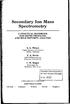 Secondary Ion Mass Spectrometry A PRACTICAL HANDBOOK FOR DEPTH PROFILING AND BULK IMPURITY ANALYSIS R. G. Wilson Hughes Research Laboratories Malibu, California F. A. Stevie AT&T Bell Laboratories Allentown,
1. Photon Beam Damage and Charging at Solid Surfaces John H. Thomas III
 1. Photon Beam Damage and Charging at Solid Surfaces John H. Thomas III 1. Introduction............................. 2. Electrostatic Charging of Samples in Photoemission Experiments............................
Introduction To Materials Science FOR ENGINEERS, Ch. 5. Diffusion. MSE 201 Callister Chapter 5
 Diffusion MSE 21 Callister Chapter 5 1 Goals: Diffusion - how do atoms move through solids? Fundamental concepts and language Diffusion mechanisms Vacancy diffusion Interstitial diffusion Impurities Diffusion
States of Matter CHAPTER 10 REVIEW SECTION 1. Name Date Class. Answer the following questions in the space provided.
 CHAPTER 10 REVIEW States of Matter SECTION 1 SHORT ANSWER Answer the following questions in the space provided. 1. Identify whether the descriptions below describe an ideal gas or a real gas. ideal gas
Coating Technology: Evaporation Vs Sputtering
 Satisloh Italy S.r.l. Coating Technology: Evaporation Vs Sputtering Gianni Monaco, PhD R&D project manager, Satisloh Italy 04.04.2016 V1 The aim of this document is to provide basic technical information
1. The Kinetic Theory of Matter states that all matter is composed of atoms and molecules that are in a constant state of constant random motion
 Physical Science Period: Name: ANSWER KEY Date: Practice Test for Unit 3: Ch. 3, and some of 15 and 16: Kinetic Theory of Matter, States of matter, and and thermodynamics, and gas laws. 1. The Kinetic
Lecture 9, Thermal Notes, 3.054
 Lecture 9, Thermal Notes, 3.054 Thermal Properties of Foams Closed cell foams widely used for thermal insulation Only materials with lower conductivity are aerogels (tend to be brittle and weak) and vacuum
VALIDATION, MODELING, AND SCALE-UP OF CHEMICAL LOOPING COMBUSTION WITH OXYGEN UNCOUPLING
 VALIDATION, MODELING, AND SCALE-UP OF CHEMICAL LOOPING COMBUSTION WITH OXYGEN UNCOUPLING A research program funded by the University of Wyoming School of Energy Resources Executive Summary Principal Investigator:
Chem 1A Exam 2 Review Problems
 Chem 1A Exam 2 Review Problems 1. At 0.967 atm, the height of mercury in a barometer is 0.735 m. If the mercury were replaced with water, what height of water (in meters) would be supported at this pressure?
AAHS-CHEMISTRY FINAL EXAM PREP-REVIEW GUIDE MAY-JUNE 2014 DR. GRAY CLASS OF 2016
 AAHS-CHEMISTRY FINAL EXAM PREP-REVIEW GUIDE MAY-JUNE 2014 DR. GRAY CLASS OF 2016 UNIT I: (CHAPTER 1-Zumdahl text) The Nature of Science and Chemistry 1. Explain why knowledge of chemistry is central to
Chapter 6, Lesson 4: Temperature and the Rate of a Chemical Reaction
 Chapter 6, Lesson 4: Temperature and the Rate of a Chemical Reaction Key Concepts Reactants must be moving fast enough and hit each other hard enough for a chemical reaction to take place. Increasing the
Kinetics of Phase Transformations: Nucleation & Growth
 Kinetics of Phase Transformations: Nucleation & Growth Radhika Barua Department of Chemical Engineering Northeastern University Boston, MA USA Thermodynamics of Phase Transformation Northeastern University
Photons. ConcepTest 27.1. 1) red light 2) yellow light 3) green light 4) blue light 5) all have the same energy. Which has more energy, a photon of:
 ConcepTest 27.1 Photons Which has more energy, a photon of: 1) red light 2) yellow light 3) green light 4) blue light 5) all have the same energy 400 nm 500 nm 600 nm 700 nm ConcepTest 27.1 Photons Which
Chapter 1: Chemistry: Measurements and Methods
 Chapter 1: Chemistry: Measurements and Methods 1.1 The Discovery Process o Chemistry - The study of matter o Matter - Anything that has mass and occupies space, the stuff that things are made of. This
HEAT UNIT 1.1 KINETIC THEORY OF GASES. 1.1.1 Introduction. 1.1.2 Postulates of Kinetic Theory of Gases
 UNIT HEAT. KINETIC THEORY OF GASES.. Introduction Molecules have a diameter of the order of Å and the distance between them in a gas is 0 Å while the interaction distance in solids is very small. R. Clausius
CHAPTER 12. Gases and the Kinetic-Molecular Theory
 CHAPTER 12 Gases and the Kinetic-Molecular Theory 1 Gases vs. Liquids & Solids Gases Weak interactions between molecules Molecules move rapidly Fast diffusion rates Low densities Easy to compress Liquids
The influence of graphene curvature on hydrogen adsorption. Sarah Goler
 The influence of graphene curvature on hydrogen adsorption Sarah Goler Laboratorio NEST, Istituto Nanoscienze CNR and Scuola Normale Superiore, Piazza San Silvestro 12, 56127 Pisa, Italy Center for Nanotechnology
SAM Teachers Guide Heat and Temperature
 SAM Teachers Guide Heat and Temperature Overview Students learn that temperature measures average kinetic energy, and heat is the transfer of energy from hot systems to cold systems. They consider what
Calculating particle properties of a wave
 Calculating particle properties of a wave A light wave consists of particles (photons): The energy E of the particle is calculated from the frequency f of the wave via Planck: E = h f (1) A particle can
Fluids Confined in Carbon Nanotubes
 Fluids Confined in Carbon Nanotubes Constantine M. Megaridis Micro/Nanoscale Fluid Transport Laboratory Mechanical and Industrial Engineering University of Illinois at Chicago 1 Background and Societal
Chemistry 13: States of Matter
 Chemistry 13: States of Matter Name: Period: Date: Chemistry Content Standard: Gases and Their Properties The kinetic molecular theory describes the motion of atoms and molecules and explains the properties
(1) The size of a gas particle is negligible as compared to the volume of the container in which the gas is placed.
 Gas Laws and Kinetic Molecular Theory The Gas Laws are based on experiments, and they describe how a gas behaves under certain conditions. However, Gas Laws do not attempt to explain the behavior of gases.
Topic 2: Energy in Biological Systems
 Topic 2: Energy in Biological Systems Outline: Types of energy inside cells Heat & Free Energy Energy and Equilibrium An Introduction to Entropy Types of energy in cells and the cost to build the parts
ENTROPY AND THE SECOND LAW OF THERMODYNAMICS
 ENTROPY AND THE SECOND LAW OF THERMODYNAMICS Energy Reservoir The system consists of the red circles in the blue box. Energy and entropy fl ow out of the system. TIME Additional Energy is added to the
Finnish Contributions to Euratom Fusion Programme and ITER
 Finnish Contributions to Euratom Fusion Programme and ITER VTT PROCESSES Seppo Karttunen, VTT Association Euratom-Tekes OUTLINE: - Fusion in Europe (FP7) - Euratom-Tekes Fusion Programme in FP7 - Tekes
THE DEVELOPMENT LINES OF PROGEO
 THE DEVELOPMENT LINES OF PROGEO ANTONIO LAGANA, University of Perugia ANDREA CAPRICCIOLI, ENEA Frascati PREAMBLE The ICSA (Innovative Computational Science Applications) Association has started several
[Image removed due to copyright concerns]
![[Image removed due to copyright concerns]](/thumbs/40/21531271.jpg "[Image removed due to copyright concerns]") Radiation Chemistry Ionizing radiation produces abundant secondary electrons that rapidly slow down (thermalize) to energies below 7.4 ev, the threshold to produce electronic transitions in liquid water.
Radiation Chemistry Ionizing radiation produces abundant secondary electrons that rapidly slow down (thermalize) to energies below 7.4 ev, the threshold to produce electronic transitions in liquid water.
pencil. Vocabulary: 1. Reactant 2. Product 3. Activation energy 4. Catalyst 5. substrate 6. Chemical reaction Keep your textbooks when you are done
 Objectives Students will explore the importance of chemical reactions in biology Students will discuss the role of enzymes as catalysts in biological reactions. Students will analyze graphs showing how
Thermodynamics. Thermodynamics 1
 Thermodynamics 1 Thermodynamics Some Important Topics First Law of Thermodynamics Internal Energy U ( or E) Enthalpy H Second Law of Thermodynamics Entropy S Third law of Thermodynamics Absolute Entropy
. Tutorial #3 Building Complex Targets
 . Tutorial #3 Building Complex Targets. Mixed Gas/Solid Targets Gas Ionization Chamber Previous Tutorials have covered how to setup TRIM, determine which ion and energy to specify for a semiconductor n-well
Study the following diagrams of the States of Matter. Label the names of the Changes of State between the different states.
 Describe the strength of attractive forces between particles. Describe the amount of space between particles. Can the particles in this state be compressed? Do the particles in this state have a definite
General Chemistry I (FC, 09-10) Lab #3: The Empirical Formula of a Compound. Introduction
 General Chemistry I (FC, 09-10) Introduction A look at the mass relationships in chemistry reveals little order or sense. The ratio of the masses of the elements in a compound, while constant, does not
Austin Peay State University Department of Chemistry CHEM 1111. Empirical Formula of a Compound
 Cautions Magnesium ribbon is flammable. Nitric acid (HNO 3 ) is toxic, corrosive and contact with eyes or skin may cause severe burns. Ammonia gas (NH 3 ) is toxic and harmful. Hot ceramic crucibles and
What is molecular dynamics (MD) simulation and how does it work?
 What is molecular dynamics (MD) simulation and how does it work? A lecture for CHM425/525 Fall 2011 The underlying physical laws necessary for the mathematical theory of a large part of physics and the
Energy Transport. Focus on heat transfer. Heat Transfer Mechanisms: Conduction Radiation Convection (mass movement of fluids)
 Energy Transport Focus on heat transfer Heat Transfer Mechanisms: Conduction Radiation Convection (mass movement of fluids) Conduction Conduction heat transfer occurs only when there is physical contact
13.1 The Nature of Gases. What is Kinetic Theory? Kinetic Theory and a Model for Gases. Chapter 13: States of Matter. Principles of Kinetic Theory
 Chapter 13: States of Matter The Nature of Gases The Nature of Gases kinetic molecular theory (KMT), gas pressure (pascal, atmosphere, mm Hg), kinetic energy The Nature of Liquids vaporization, evaporation,
Experiment 12E LIQUID-VAPOR EQUILIBRIUM OF WATER 1
 Experiment 12E LIQUID-VAPOR EQUILIBRIUM OF WATER 1 FV 6/26/13 MATERIALS: PURPOSE: 1000 ml tall-form beaker, 10 ml graduated cylinder, -10 to 110 o C thermometer, thermometer clamp, plastic pipet, long
Preview of Period 5: Thermal Energy, the Microscopic Picture
 Preview of Period 5: Thermal Energy, the Microscopic Picture 5.1 Temperature and Molecular Motion What is evaporative cooling? 5.2 Temperature and Phase Changes How much energy is required for a phase
Kinetic Molecular Theory of Matter
 Kinetic Molecular Theor of Matter Heat capacit of gases and metals Pressure of gas Average speed of electrons in semiconductors Electron noise in resistors Positive metal ion cores Free valence electrons
Prentice Hall. Chemistry (Wilbraham) 2008, National Student Edition - South Carolina Teacher s Edition. High School. High School
 Prentice Hall Chemistry (Wilbraham) 2008, National Student Edition - South Carolina Teacher s Edition High School C O R R E L A T E D T O High School C-1.1 Apply established rules for significant digits,
Phase diagram of water. Note: for H 2 O melting point decreases with increasing pressure, for CO 2 melting point increases with increasing pressure.
 Phase diagram of water Note: for H 2 O melting point decreases with increasing pressure, for CO 2 melting point increases with increasing pressure. WATER Covers ~ 70% of the earth s surface Life on earth
Tritium Gas Processing for Magnetic Fusion
 Tritium Gas Processing for Magnetic Fusion SRNL-STI-2014-00168 The views and opinions expressed herein do not necessarily reflect those of any international organization, the US Government Bernice Rogers
PERIODIC TABLE OF GROUPS OF ELEMENTS Elements can be classified using two different schemes.
 1 PERIODIC TABLE OF GROUPS OF ELEMENTS Elements can be classified using two different schemes. Metal Nonmetal Scheme (based on physical properties) Metals - most elements are metals - elements on left
Chemical reactions allow living things to grow, develop, reproduce, and adapt.
 Section 2: Chemical reactions allow living things to grow, develop, reproduce, and adapt. K What I Know W What I Want to Find Out L What I Learned Essential Questions What are the parts of a chemical reaction?
Ion Beam Sputtering: Practical Applications to Electron Microscopy
 Ion Beam Sputtering: Practical Applications to Electron Microscopy Applications Laboratory Report Introduction Electron microscope specimens, both scanning (SEM) and transmission (TEM), often require a
Chem101: General Chemistry Lecture 9 Acids and Bases
 : General Chemistry Lecture 9 Acids and Bases I. Introduction A. In chemistry, and particularly biochemistry, water is the most common solvent 1. In studying acids and bases we are going to see that water
Section 3: Crystal Binding
 Physics 97 Interatomic forces Section 3: rystal Binding Solids are stable structures, and therefore there exist interactions holding atoms in a crystal together. For example a crystal of sodium chloride
Indiana's Academic Standards 2010 ICP Indiana's Academic Standards 2016 ICP. map) that describe the relationship acceleration, velocity and distance.
 .1.1 Measure the motion of objects to understand.1.1 Develop graphical, the relationships among distance, velocity and mathematical, and pictorial acceleration. Develop deeper understanding through representations
Review and apply Investigation 5. Let s review Pages 311-312
 Review and apply Investigation 5 Let s review Pages 311-312 1. After you tested all the known powders with all the test liquids, describe what you did to identify the unknown powder. Students should have
Lecture 11. Etching Techniques Reading: Chapter 11. ECE 6450 - Dr. Alan Doolittle
 Lecture 11 Etching Techniques Reading: Chapter 11 Etching Techniques Characterized by: 1.) Etch rate (A/minute) 2.) Selectivity: S=etch rate material 1 / etch rate material 2 is said to have a selectivity
Chapter 1 Student Reading
 Chapter 1 Student Reading Chemistry is the study of matter You could say that chemistry is the science that studies all the stuff in the entire world. A more scientific term for stuff is matter. So chemistry
Ch. 4: Imperfections in Solids Part 1. Dr. Feras Fraige
 Ch. 4: Imperfections in Solids Part 1 Dr. Feras Fraige Outline Defects in Solids 0D, Point defects vacancies Interstitials impurities, weight and atomic composition 1D, Dislocations edge screw 2D, Grain
10.7 Kinetic Molecular Theory. 10.7 Kinetic Molecular Theory. Kinetic Molecular Theory. Kinetic Molecular Theory. Kinetic Molecular Theory
 The first scheduled quiz will be given next Tuesday during Lecture. It will last 5 minutes. Bring pencil, calculator, and your book. The coverage will be pp 364-44, i.e. Sections 0.0 through.4. 0.7 Theory
Surface Tension. the surface tension of a liquid is the energy required to increase the surface area a given amount
 Tro, Chemistry: A Molecular Approach 1 Surface Tension surface tension is a property of liquids that results from the tendency of liquids to minimize their surface area in order to minimize their surface
Lesson 4. Temperature change
 54 Lesson 4 Temperature change T E A C H E R G U I D E Lesson summary Students meet scientist Jason Williams, an industrial chemist who designs the materials and processes for making solar cells. He explains
Modification of Graphene Films by Laser-Generated High Energy Particles
 Modification of Graphene Films by Laser-Generated High Energy Particles Elena Stolyarova (Polyakova), Ph.D. ATF Program Advisory and ATF Users Meeting April 2-3, 2009, Berkner Hall, Room B, BNL Department
Computational Fluid Dynamics (CFD) and Multiphase Flow Modelling. Associate Professor Britt M. Halvorsen (Dr. Ing) Amaranath S.
 Computational Fluid Dynamics (CFD) and Multiphase Flow Modelling Associate Professor Britt M. Halvorsen (Dr. Ing) Amaranath S. Kumara (PhD Student), PO. Box 203, N-3901, N Porsgrunn, Norway What is CFD?
Temperature. Number of moles. Constant Terms. Pressure. Answers Additional Questions 12.1
 Answers Additional Questions 12.1 1. A gas collected over water has a total pressure equal to the pressure of the dry gas plus the pressure of the water vapor. If the partial pressure of water at 25.0
Thomas Grehl. Improvement in TOF-SIMS Instrumentation for Analytical Application and Fundamental Research
 Thomas Grehl Improvement in TOF-SIMS Instrumentation for Analytical Application and Fundamental Research 2003 Experimentelle Physik Improvements in TOF-SIMS Instrumentation for Analytical Application
Study of tungsten oxidation in O 2 /H 2 /N 2 downstream plasma
 Study of tungsten oxidation in O 2 /H 2 /N 2 downstream plasma Songlin Xu a and Li Diao Mattson Technology, Inc., Fremont, California 94538 Received 17 September 2007; accepted 21 February 2008; published
Sputtering by Particle Bombardment I
 Sputtering by Particle Bombardment I Physical Sputtering of Single-Element Solids Edited by R. Behrisch With Contributions by H. H. Andersen H. L. Bay R. Behrisch M. T. Robinson H. E. Roosendaal P. Sigmund
Nuclear ZPE Tapping. Horace Heffner May 2007
 ENERGY FROM UNCERTAINTY The uncertainty of momentum for a particle constrained by distance Δx is given, according to Heisenberg, by: Δmv = h/(2 π Δx) but since KE = (1/2) m v 2 = (1/(2 m) ) (Δmv) 2 ΔKE
III. Wet and Dry Etching
 III. Wet and Dry Etching Method Environment and Equipment Advantage Disadvantage Directionality Wet Chemical Solutions Atmosphere, Bath 1) Low cost, easy to implement 2) High etching rate 3) Good selectivity
Contamination. Cleanroom. Cleanroom for micro and nano fabrication. Particle Contamination and Yield in Semiconductors.
 Fe Particles Metallic contaminants Organic contaminants Surface roughness Au Particles SiO 2 or other thin films Contamination Na Cu Photoresist Interconnect Metal N, P Damages: Oxide breakdown, metal
Nuclear Physics. Nuclear Physics comprises the study of:
 Nuclear Physics Nuclear Physics comprises the study of: The general properties of nuclei The particles contained in the nucleus The interaction between these particles Radioactivity and nuclear reactions
Data Visualization for Atomistic/Molecular Simulations. Douglas E. Spearot University of Arkansas
 Data Visualization for Atomistic/Molecular Simulations Douglas E. Spearot University of Arkansas What is Atomistic Simulation? Molecular dynamics (MD) involves the explicit simulation of atomic scale particles
 Chapter 6 Atmospheric Aerosol and Cloud Processes Spring 2015 Cloud Physics Initiation and development of cloud droplets Special interest: Explain how droplet formation results in rain in approximately
Master's Programs. Applied Chemisty. Subject
 Master's Programs Applied Chemisty Optional Advanced Seminar in Materials Science and Engineering I Advanced Seminar in Materials Science and Engineering II Special Project in Materials Science and Engineering
CLASSICAL CONCEPT REVIEW 8
 CLASSICAL CONCEPT REVIEW 8 Kinetic Theory Information concerning the initial motions of each of the atoms of macroscopic systems is not accessible, nor do we have the computational capability even with
Gases. States of Matter. Molecular Arrangement Solid Small Small Ordered Liquid Unity Unity Local Order Gas High Large Chaotic (random)
 Gases States of Matter States of Matter Kinetic E (motion) Potential E(interaction) Distance Between (size) Molecular Arrangement Solid Small Small Ordered Liquid Unity Unity Local Order Gas High Large
Warm-Up 9/9. 1. Define the term matter. 2. Name something in this room that is not matter.
 Warm-Up 9/9 1. Define the term matter. 2. Name something in this room that is not matter. Warm-Up 9/16 1. List the three most important rules of lab safety. 2. Would you classify jello as a solid or a
A. Kinetic Molecular Theory (KMT) = the idea that particles of matter are always in motion and that this motion has consequences.
 I. MOLECULES IN MOTION: A. Kinetic Molecular Theory (KMT) = the idea that particles of matter are always in motion and that this motion has consequences. 1) theory developed in the late 19 th century to
Optical Hyperdoping: Transforming Semiconductor Band Structure for Solar Energy Harvesting
 Optical Hyperdoping: Transforming Semiconductor Band Structure for Solar Energy Harvesting 3G Solar Technologies Multidisciplinary Workshop MRS Spring Meeting San Francisco, CA, 5 April 2010 Michael P.
Plasma activation from roll to roll
 The manufacture of composite materials for packaging Plasma activation from roll to roll Figure 1: The wettability of the surfaces can be optimised thanks to different nozzle models (from left to right: