
GIPS List of Composite Descriptions. Perkins Composites Fixed Income Composites Global Macro Composites Alternative Composites...
|
|
|
- Irene Horn
- 9 years ago
- Views:
Transcription
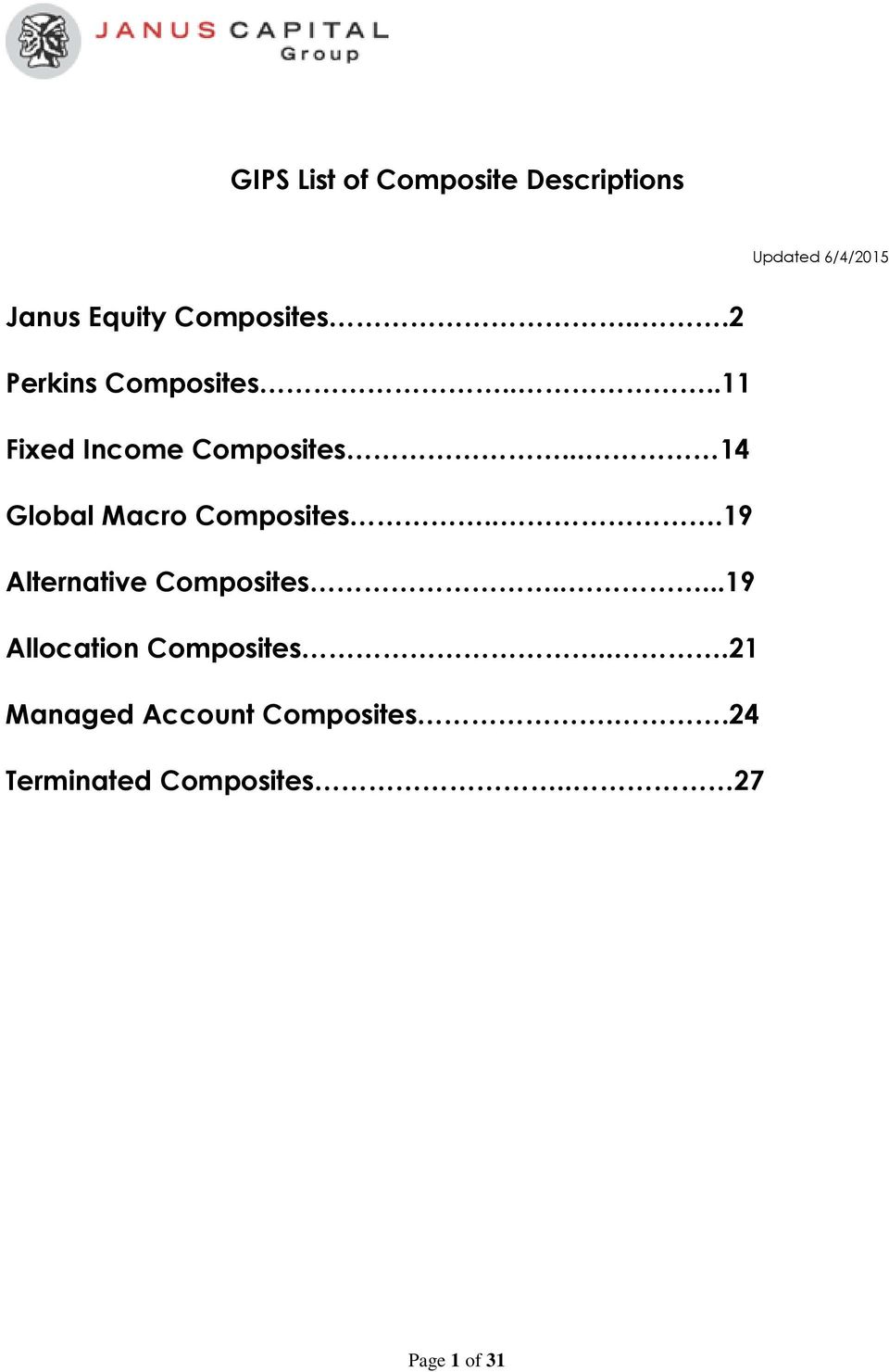
1 GIPS List of Composite Descriptions Updated 6/4/2015 Janus Equity Composites...2 Perkins Composites Fixed Income Composites Global Macro Composites...19 Alternative Composites Allocation Composites...21 Managed Account Composites..24 Terminated Composites.. 27 Page 1 of 31
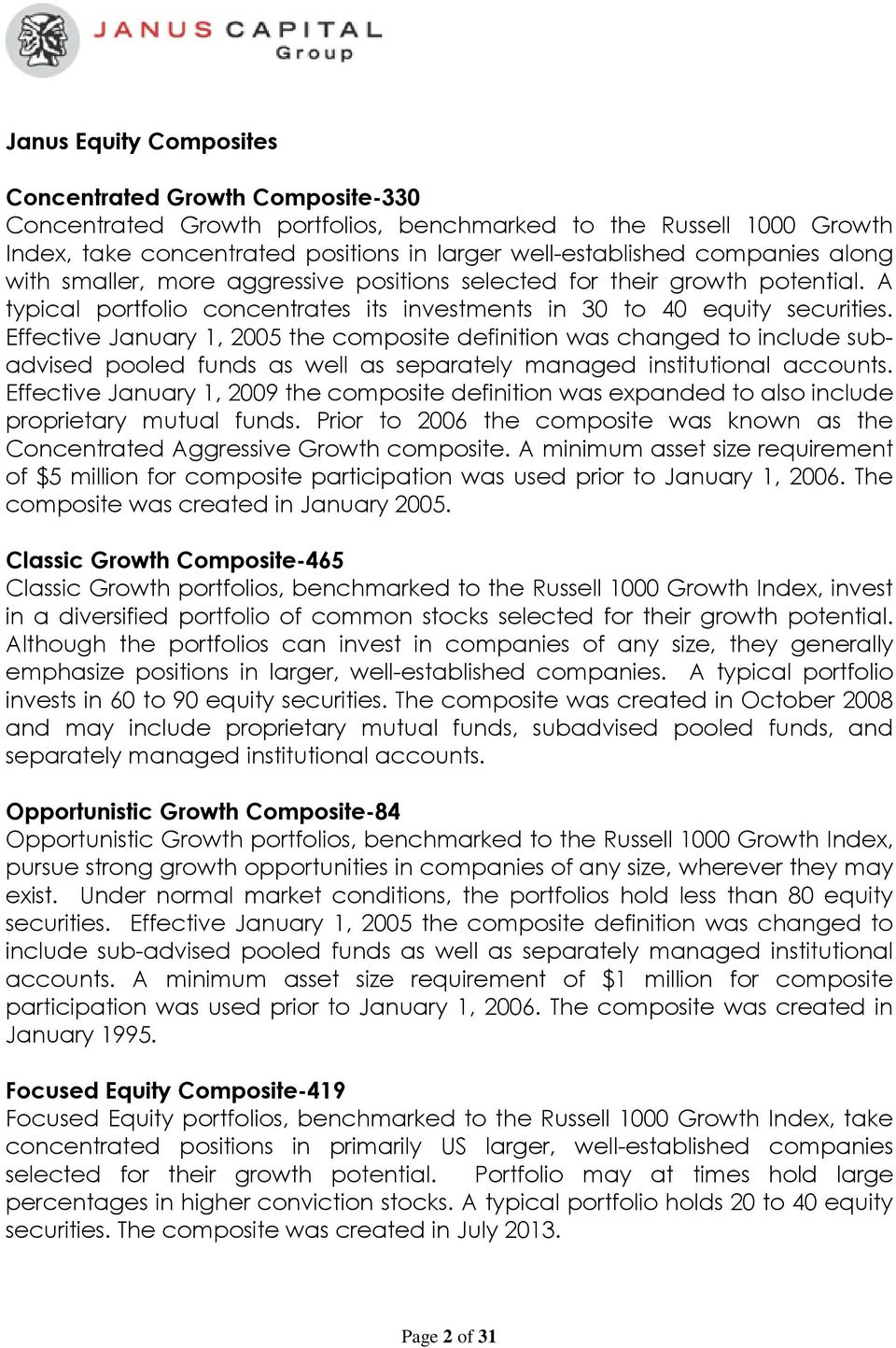
2 Janus Equity Composites Concentrated Growth Composite-330 Concentrated Growth portfolios, benchmarked to the Russell 1000 Growth Index, take concentrated positions in larger well-established companies along with smaller, more aggressive positions selected for their growth potential. A typical portfolio concentrates its investments in 30 to 40 equity securities. Effective January 1, 2005 the composite definition was changed to include subadvised pooled funds as well as separately managed institutional accounts. Effective January 1, 2009 the composite definition was expanded to also include proprietary mutual funds. Prior to 2006 the composite was known as the Concentrated Aggressive Growth composite. A minimum asset size requirement of $5 million for composite participation was used prior to January 1, The composite was created in January Classic Growth Composite-465 Classic Growth portfolios, benchmarked to the Russell 1000 Growth Index, invest in a diversified portfolio of common stocks selected for their growth potential. Although the portfolios can invest in companies of any size, they generally emphasize positions in larger, well-established companies. A typical portfolio invests in 60 to 90 equity securities. The composite was created in October 2008 and may include proprietary mutual funds, subadvised pooled funds, and separately managed institutional accounts. Opportunistic Growth Composite-84 Opportunistic Growth portfolios, benchmarked to the Russell 1000 Growth Index, pursue strong growth opportunities in companies of any size, wherever they may exist. Under normal market conditions, the portfolios hold less than 80 equity securities. Effective January 1, 2005 the composite definition was changed to include sub-advised pooled funds as well as separately managed institutional accounts. A minimum asset size requirement of $1 million for composite participation was used prior to January 1, The composite was created in January Focused Equity Composite-419 Focused Equity portfolios, benchmarked to the Russell 1000 Growth Index, take concentrated positions in primarily US larger, well-established companies selected for their growth potential. Portfolio may at times hold large percentages in higher conviction stocks. A typical portfolio holds 20 to 40 equity securities. The composite was created in July Page 2 of 31
3 Large Cap Growth Composite-82 Large Cap Growth portfolios, benchmarked to the Russell 1000 Growth Index, take concentrated positions in larger, well-established companies. The portfolios may have exposure to foreign securities when our research uncovers international companies with sound fundamentals and compelling earnings growth potential. A typical portfolio holds 35 to 55 growth equity securities. Effective January 1, 2005 the composite definition was changed to include subadvised pooled funds as well as separately managed institutional accounts. A minimum asset size requirement of $5 million for composite participation was used prior to January 1, The composite was created in January Mid Cap Growth Composite-83 Mid Cap Growth portfolios, benchmarked to the Russell Midcap Growth Index, invest in a diversified group of stocks with market capitalizations from $2 billion to $20 billion at the time of purchase. The portfolio stock selection process emphasizes predictability and sustainability of growth. Effective January 1, 2005 the composite definition was changed to include sub-advised pooled funds as well as separately managed institutional accounts. Effective January 1, 2009 the composite definition was expanded to also include proprietary mutual funds. A minimum asset size requirement of $5 million for composite participation was used prior to January 1, The composite was created in January Small-Mid Cap Growth Composite-863 Small-Mid Cap Growth portfolios, benchmarked to the Russell 2500 Growth Index and secondarily to the Russell 2000 Growth Index, invest primarily in small-sized and medium-sized companies selected for their growth potential. Small- and medium-sized companies have market capitalizations less than $10 billion. Effective January 1, 2009 the composite definition was expanded to also include sub-advised pooled funds and separately managed institutional accounts. The composite was created in March Small Company Growth Composite-488 Small Company Growth portfolios, benchmarked to the Russell 2000 Growth Index, invest primarily in small-sized companies selected for their growth potential. Small sized companies are generally those who have market capitalizations less the $4 billion. A typical portfolio invests in 80 to 120 equity securities. Effective January 1, 2005 the composite definition was changed to include only proprietary mutual funds and exclude sub-advised pooled funds. Effective January 1, 2009 the composite definition was expanded to also include sub-advised pooled funds and separately managed institutional accounts. The composite was created in January Page 3 of 31

4 US Research Growth Equity Composite-411 US Research Growth Equity portfolios, benchmarked to the Russell 1000 Growth Index, invest in high conviction investment ideas selected by the Janus research team, based on rigorous fundamental research. A typical portfolio holds 90 to 120 equity securities of primarily large and mid-size companies and maintains portfolio sector weightings, based upon how Janus aligns sector research teams, that closely follow the Russell 1000 Growth Index. The composite was created in August US Research Concentrated Growth Equity Composite-412 US Research Concentrated Growth Equity portfolios, benchmarked to the Russell 1000 Growth Index, invest in the highest conviction investment ideas selected by the Janus research team, based on rigorous fundamental research. The portfolios maintain sector weightings, based upon how Janus aligns sector research teams, that closely follow the Russell 1000 Growth Index. A typical portfolio invests in 30 to 50 equity securities. The composite was created in August Concentrated All Cap Growth Composite-453 Concentrated All Cap Growth portfolios, benchmarked to the Russell 3000 Growth Index, are concentrated, non-diversified portfolios that pursue strong growth opportunities in companies of any size, wherever they may exist. A typical portfolio concentrates its investments in 25 to 45 equity securities. Effective January 1, 2005 the composite definition was changed to include subadvised pooled funds as well as separately managed institutional accounts. The composite was created in January US Research Core Equity Composite-410 US Research Core Equity portfolios, benchmarked to the Russell 1000 Index, invest in high conviction investment ideas selected by the Janus research team, based on rigorous fundamental research. A typical portfolio holds 90 to 120 equity securities of primarily large and mid-size companies and maintains sector weightings, based upon how Janus aligns sector research teams, that closely follow the Russell 1000 Index. Effective January 1, 2009 the composite definition was expanded to also include proprietary mutual funds. The composite was created in August Page 4 of 31

5 Opportunistic Alpha Composite-85 Opportunistic Alpha portfolios, benchmarked to the S&P 500 Index, seek to invest in under-valued companies with improving return on invested capital and an asymmetrical risk/reward profile. A typical portfolio invests in 35 to 55 securities. Effective January 1, 2005 the composite definition was changed to include sub-advised pooled funds as well as separately managed institutional accounts. Effective January 1, 2009 the composite definition was expanded to also include proprietary mutual funds. A minimum asset size requirement of $5 million for composite participation was used prior to January 1, Prior to January 1, 2005 the minimum account size for composite inclusion was $10 million. The composite was created in April Growth and Income Composite-478 Growth and Income portfolios, benchmarked to the S&P 500 Index, invest primarily in larger, well-established companies. The portfolios may also invest up to 15% in income-generating securities. A typical portfolio will contain equity and income-generating securities. Effective January 1, 2005 the composite definition was changed to include only proprietary mutual funds and exclude sub-advised pooled funds. Effective January 1, 2009 the composite definition was expanded to also include sub-advised pooled funds and separately managed institutional accounts. The composite was created in January Balanced Composite-451 Balanced portfolios, benchmarked to the Balanced Index*, generally have between 40%- 60% invested in equity securities selected for their growth potential. The remainder of the portfolio is invested in income-producing securities. A typical portfolio will contain equity and incomegenerating securities. Effective January 1, 2005 the composite definition was changed to include sub-advised pooled funds as well as separately managed institutional accounts. Effective January 1, 2009 the composite definition was expanded to also include proprietary mutual funds. A minimum asset size requirement of $5 million for composite participation was used prior to January 1, The composite was created in January *Balanced Index is an internally calculated, hypothetical monthly rebalanced blend of 55% S&P 500 and 45% Barclays US Aggregate Bond Indices Indices. Prior to July 1, 2009 the index blend was 55% S&P 500 and 45% Barclays US Government/Credit Indices Page 5 of 31

6 Balanced Income Composite-550 Balanced Income portfolios, benchmarked to the Balanced Income Index*, seeks maximum income balanced with a growth component. Portfolios generally have between 50% - 70% invested in income-producing securities, including up to 25% in high yield bonds. The remainder of the portfolio is invested in equity securities. A typical portfolio will contain equity and income-generating securities. The composite was created in December *Balanced Income Index is an internally calculated, hypothetical monthly rebalanced blend of 40% S&P 500 and 60% Barclays US Aggregate Bond Indices. Global Alpha Equity Composite Global Alpha Equity portfolios, benchmarked to the MSCI All Country World Index, invest primarily in a core group of domestic and foreign common stocks based on a fundamental bottom up approach and seek to generate alpha mainly from stock selection. Portfolios may invest in companies of any size located anywhere in the world, and may invest up to 30% in emerging market countries. Portfolios may invest in derivatives, primarily for the purpose of hedging certain risks but are not a significant component of the strategy. The composite was created in September Global Opportunistic Equity Composite- 555 Global Opportunistic Equity portfolios, benchmarked to the MSCI All Country World Index, seek to invest globally in companies with improving business or industry fundamentals and whose value may be underestimated by the market. A typical portfolio invests in 45 to 65 securities of companies of any size located anywhere in the world, including emerging markets. The composite was created in April Global Research Growth Equity Composite-414 Global Research Growth Equity portfolios, benchmarked to the MSCI AC World Growth Index, invest in high conviction investment ideas selected by the Janus research team, based on rigorous fundamental research. Investments will primarily be in large and mid size companies from around the world. The portfolios generally contain 100 to 150 securities and maintain sector weightings, based upon how Janus aligns sector research teams, that closely follow the MSCI AC World Growth Index. Effective January 1, 2009 the composite definition was expanded to also include proprietary mutual funds. The composite was created in April Page 6 of 31

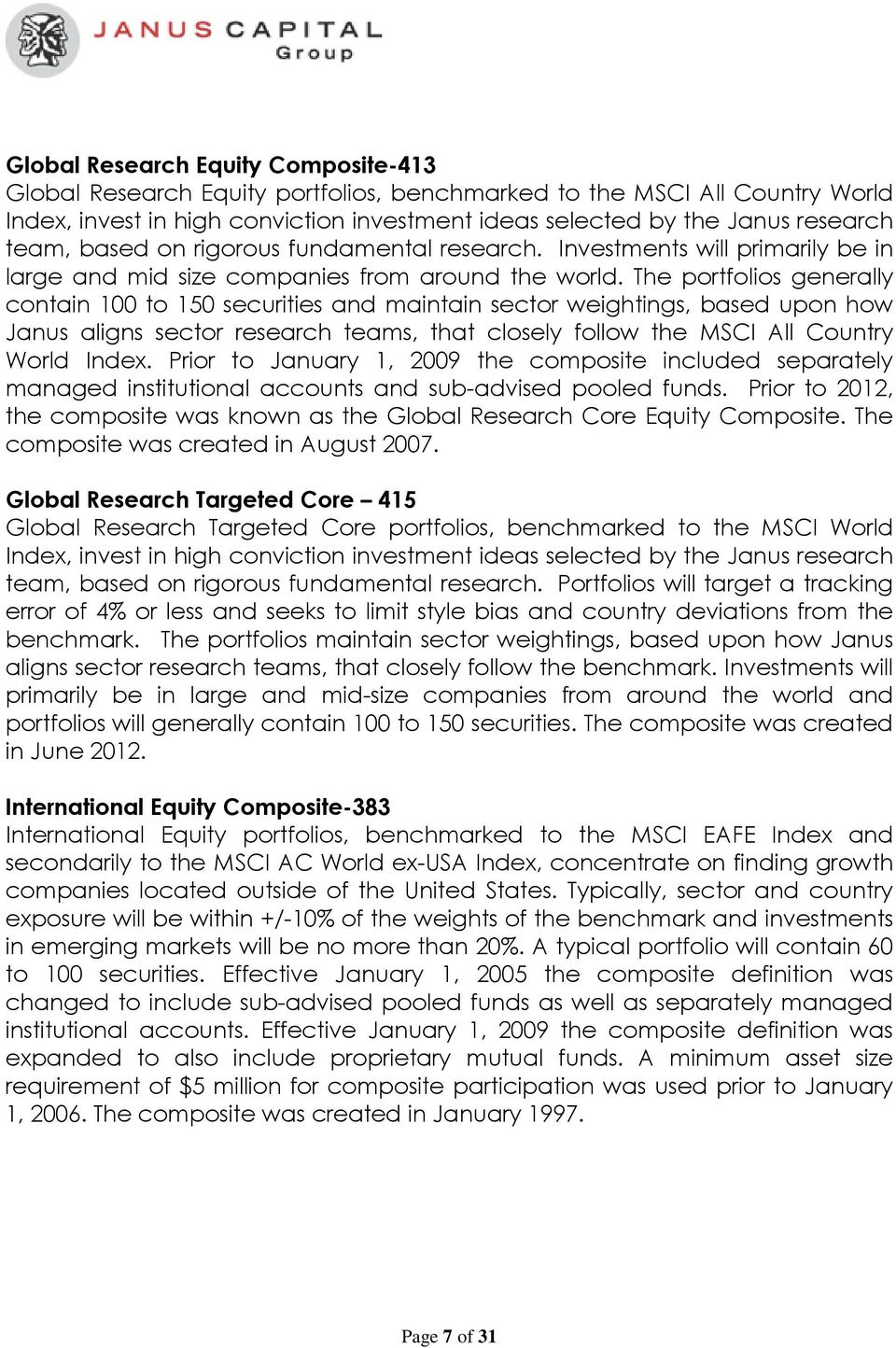
7 Global Research Equity Composite-413 Global Research Equity portfolios, benchmarked to the MSCI All Country World Index, invest in high conviction investment ideas selected by the Janus research team, based on rigorous fundamental research. Investments will primarily be in large and mid size companies from around the world. The portfolios generally contain 100 to 150 securities and maintain sector weightings, based upon how Janus aligns sector research teams, that closely follow the MSCI All Country World Index. Prior to January 1, 2009 the composite included separately managed institutional accounts and sub-advised pooled funds. Prior to 2012, the composite was known as the Global Research Core Equity Composite. The composite was created in August Global Research Targeted Core 415 Global Research Targeted Core portfolios, benchmarked to the MSCI World Index, invest in high conviction investment ideas selected by the Janus research team, based on rigorous fundamental research. Portfolios will target a tracking error of 4% or less and seeks to limit style bias and country deviations from the benchmark. The portfolios maintain sector weightings, based upon how Janus aligns sector research teams, that closely follow the benchmark. Investments will primarily be in large and mid-size companies from around the world and portfolios will generally contain 100 to 150 securities. The composite was created in June International Equity Composite-383 International Equity portfolios, benchmarked to the MSCI EAFE Index and secondarily to the MSCI AC World ex-usa Index, concentrate on finding growth companies located outside of the United States. Typically, sector and country exposure will be within +/-10% of the weights of the benchmark and investments in emerging markets will be no more than 20%. A typical portfolio will contain 60 to 100 securities. Effective January 1, 2005 the composite definition was changed to include sub-advised pooled funds as well as separately managed institutional accounts. Effective January 1, 2009 the composite definition was expanded to also include proprietary mutual funds. A minimum asset size requirement of $5 million for composite participation was used prior to January 1, The composite was created in January Page 7 of 31
8 International Research Equity Composite-534 International Research Equity portfolios, benchmarked to the MSCI AC World ex USA Index, invest primarily in equity securities selected by the Janus research team based on rigorous fundamental research. The portfolios normally invest in 60 to 100 equity securities of issuers from different countries around the world, including emerging market countries. The portfolios seek to maintain sector weightings, based upon how Janus aligns sector research teams, that closely follow the MSCI AC World ex USA Index. The composite was created in July Overseas Equity Composite-481 Overseas Equity portfolios, benchmarked to the MSCI AC World ex-usa Index, concentrate on finding growth companies located outside of the United States. The portfolios, under normal circumstances, will invest substantially all of their assets in issuers located outside the United States, and may have significant exposure to emerging markets. A typical portfolio will contain 50 to 80 equity securities. Effective January 1, 2005 the composite definition was changed to include only proprietary mutual funds and exclude sub-advised pooled funds. Effective January 1, 2009 the composite definition was expanded to also include sub-advised pooled funds and separately managed institutional accounts. The composite was created in January European Equity Composite-527 European Equity portfolios, benchmarked to the MSCI Europe Index, invest in high conviction investment ideas located in Europe based on rigorous fundamental research. The portfolios generally maintain investments in all the sectors represented in the MSCI Europe Index. A typical portfolio will contain 60 to 90 securities. The composite was created in October 2008 and may include proprietary mutual funds, subadvised pooled funds, and separately managed institutional accounts. Prior to October 2010 the composite was known as the European Research Equity composite. Emerging Markets Equity Composite-859 Emerging Markets Equity portfolios, benchmarked to the MSCI Emerging Markets Index, invest in a diversified portfolio of emerging market companies based on a fundamental bottom up approach. The portfolio managers seek to own quality growth emerging market companies trading at significant discounts to our estimated long term value. The composite was created in October Page 8 of 31

9 Asia Equity Composite Asia Equity portfolios, benchmarked to the MSCI All Country Asia ex-japan Index, invest primarily in a diversified portfolio of stocks domiciled in Asia, excluding Japan, based on a fundamental bottom up approach. Portfolios may invest in companies of any size, from larger, well-established companies to smaller, emerging growth companies. Portfolios may invest in derivatives for the purpose of hedging certain risks, enhancing returns or to earn income. The composite was created in May Global Life Sciences Composite-474 Global Life Sciences portfolios, benchmarked to the MSCI World Healthcare Index, concentrate on finding growth companies located both inside and outside of the United States that the portfolio manager believes have a life science orientation. Life sciences industries may include the following industry groups: health care; pharmaceuticals; agriculture; cosmetics/personal care; and biotechnology. A typical portfolio invests in 60 to 90 equity securities. Effective January 1, 2005 the composite definition was changed to include only proprietary mutual funds and exclude sub-advised pooled funds. Effective January 1, 2009 the composite definition was expanded to also include subadvised pooled funds and separately managed institutional accounts. The composite was created in January Global Technology Composite-477 Global Technology portfolios, benchmarked to the MSCI AC World Information Technology Index, concentrate on finding growth companies located both inside and outside of the United States that the portfolio manager believes will benefit significantly from advances or improvements in technology. A typical portfolio invests in 65 to 95 equity securities. Effective January 1, 2005 the composite definition was changed to include only proprietary mutual funds and exclude sub-advised pooled funds. Effective January 1, 2009 the composite definition was expanded to also include sub-advised pooled funds and separately managed institutional accounts. The composite was created in January Global Real Estate Composite-475 Global Real Estate portfolios, benchmarked to the FTSE EPRA/NAREIT Global Index, seek total return through a combination of capital appreciation and current income by investing in the equity and debt securities of real estaterelated companies of any size located throughout the world. A typical portfolio will contain securities. Effective January 1, 2009 the composite definition was expanded to also include sub-advised pooled funds and separately managed institutional accounts. The composite was created in June Page 9 of 31

10 Real Estate Income Composite-454 Real Estate Income portfolios, benchmarked to the FTSE NAREIT All REITs Index, generally hold between REIT securities, selected primarily for their potential to produce current income. Capital appreciation is a secondary objective. Prior to 2011, the composite was known as the Equity REIT Composite and held between 30 and 40 securities. The composite excludes all broker-referred REIT accounts. Effective January 1, 2005 the composite definition was changed to include sub-advised pooled funds as well as separately managed institutional accounts. The composite was created in December Page 10 of 31

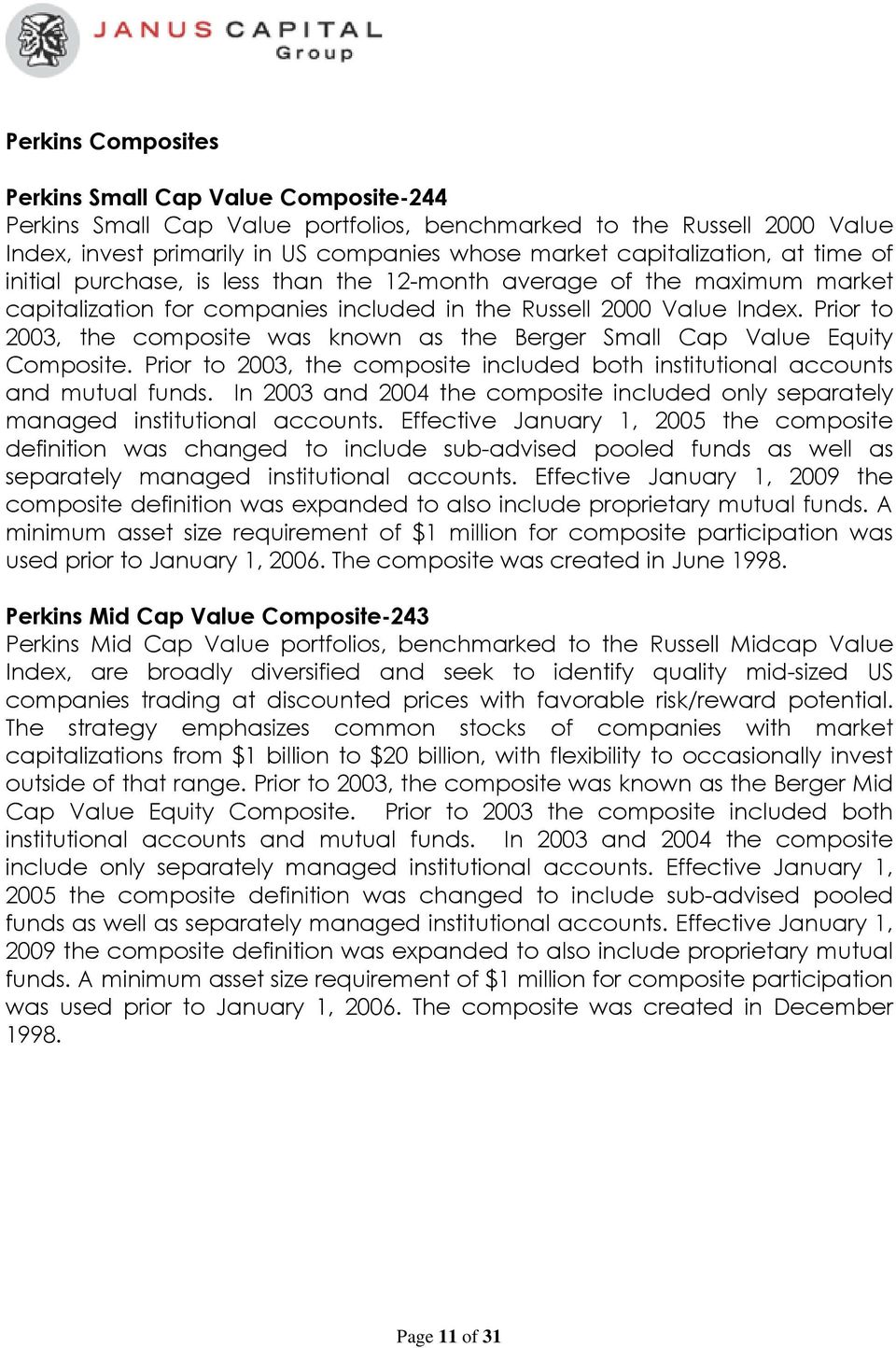
11 Perkins Composites Perkins Small Cap Value Composite-244 Perkins Small Cap Value portfolios, benchmarked to the Russell 2000 Value Index, invest primarily in US companies whose market capitalization, at time of initial purchase, is less than the 12-month average of the maximum market capitalization for companies included in the Russell 2000 Value Index. Prior to 2003, the composite was known as the Berger Small Cap Value Equity Composite. Prior to 2003, the composite included both institutional accounts and mutual funds. In 2003 and 2004 the composite included only separately managed institutional accounts. Effective January 1, 2005 the composite definition was changed to include sub-advised pooled funds as well as separately managed institutional accounts. Effective January 1, 2009 the composite definition was expanded to also include proprietary mutual funds. A minimum asset size requirement of $1 million for composite participation was used prior to January 1, The composite was created in June Perkins Mid Cap Value Composite-243 Perkins Mid Cap Value portfolios, benchmarked to the Russell Midcap Value Index, are broadly diversified and seek to identify quality mid-sized US companies trading at discounted prices with favorable risk/reward potential. The strategy emphasizes common stocks of companies with market capitalizations from $1 billion to $20 billion, with flexibility to occasionally invest outside of that range. Prior to 2003, the composite was known as the Berger Mid Cap Value Equity Composite. Prior to 2003 the composite included both institutional accounts and mutual funds. In 2003 and 2004 the composite include only separately managed institutional accounts. Effective January 1, 2005 the composite definition was changed to include sub-advised pooled funds as well as separately managed institutional accounts. Effective January 1, 2009 the composite definition was expanded to also include proprietary mutual funds. A minimum asset size requirement of $1 million for composite participation was used prior to January 1, The composite was created in December Page 11 of 31
12 Perkins Large Cap Value Composite-429 Perkins Large Cap Value portfolios, benchmarked to the Russell 1000 Value Index, are broadly diversified and seek to identify quality large sized US companies trading at discounted prices with favorable risk reward potential. The strategy emphasizes common stocks of companies with market capitalizations above $10 billion. A typical portfolio will contain securities. The composite was created in July 2008 and may include proprietary mutual funds, subadvised pooled funds, and separately managed institutional accounts. Prior to January 1, 2009, the composite included separately managed institutional accounts and sub-advised pooled funds. In December 2009 Janus acquired the Large Cap Value (LCV) strategy of PWMCO, LLC. Accounts included in the PWMCO LLC LCV strategy are managed in a substantially similar fashion to the Perkins Large Cap Value Composite; as such Composite performance has been restated back to October 1, 2006, the inception of the PWMCO LLC Large Cap Value strategy. Perkins All Cap Value Composite-532 Perkins All Cap Value portfolios, benchmarked to the Russell 3000 Value Index and secondarily to the S&P500 Index, are broadly diversified and seek to identify quality US companies trading at discounted prices with favorable risk reward potential. A typical portfolio will contain 70 to 100 securities and will invest no less than 10% of assets in small, mid and large cap stocks and no more than 50% in small cap stocks. The composite was created in January Perkins All Cap Value Select Composite-549 Perkins All Cap Value Select portfolios, benchmarked to the Russell 3000 Value Index, seek to identify quality US companies of any size trading at discounted prices with favorable risk reward potential. Portfolios may also selectively invest in foreign securities. A typical portfolio will contain 50 to 75 securities. The composite was created in January Page 12 of 31
13 Perkins Global Value Composite-331 Perkins Global Value portfolios, benchmarked to the MSCI World Index and secondarily to the MSCI All Country World Index, seek to invest in attractively valued companies of any size throughout the world that are trading at discounted prices with favorable risk-reward potential. A typical portfolio will be invested in 70 to 100 companies from at least 5 different countries, including the United States. Previously, portfolios were invested in a substantially similar style in 25 to 45 securities. In July 2010 the portfolio manager became an employee of Perkins Investment Management. Effective January 1, 2005 the composite definition was changed to include only proprietary mutual funds and exclude sub-advised pooled funds. Effective January 1, 2009 the composite definition was expanded to also include sub-advised pooled funds and separately managed institutional accounts. The composite was created in January Perkins International Value Composite-418 Perkins International Value portfolios, benchmarked to the MSCI EAFE Index and secondarily to the MSCI AC World ex-usa Index, seek to invest in attractively valued companies of any size located outside the United States, including Emerging Markets. Portfolios seek companies that are trading at discounted prices with favorable risk-reward potential. A typical portfolio will be invested in 70 to 100 companies from at least 5 different countries. The composite was created in May Perkins Value Plus Income Composite-535 Perkins Value Plus Income portfolios, benchmarked to the Value Income Index*, generally invest between 40%- 60% in equity securities selected for their capital appreciation potential and the remainder of the portfolio in credit-oriented fixed income, including high yield and preferred securities. The equity portion will be invested primarily in large- and mid-sized companies whose stock prices the portfolio managers believe to be undervalued or have the potential for high relative dividend yields, or both. The fixed-income investments generate total return from a combination of current income and capital appreciation and will maintain at least 50% of the fixed-income portion in investment grade debt securities. A typical portfolio will be invested in equity and fixed income securities. The composite was created in August *Value Income Index is an internally calculated, hypothetical monthly rebalanced blend of 50% Russell 1000 Value and 50% Barclays US Aggregate Bond Indices. Page 13 of 31
14 Fixed Income Composites Core Bond Composite-551 Core Bond portfolios, benchmarked to the Barclays US Aggregate Bond Index, pursue maximum total return by investing in various income-producing securities. The portfolios will normally maintain an average-weighted effective maturity of five to ten years and will limit their investments in high yield/high risk bonds to less than 5%. Total return is expected to result from a combination of current income and capital appreciation, with income normally being the dominant component of total return. The composite was created in February Core Plus Bond Composite-469 Core Plus Bond portfolios, benchmarked to the Barclays US Aggregate Bond Index, pursue maximum total return by investing in various income-producing securities. The portfolios will, under normal market conditions, maintain an average-weighted effective maturity of five to ten years and may invest up to 35% in high yield/high risk bonds. Total return is expected to result from a combination of current income and capital appreciation, with income normally being the dominant component of total return. Effective January 1, 2005 the composite definition was changed to include only proprietary mutual funds and exclude sub-advised pooled funds. Effective January 1, 2009 the composite definition was expanded to also include sub-advised pooled funds and separately managed institutional accounts. The composite was created in January High Yield Bond Composite-479 High Yield Bond portfolios, benchmarked to the Barclays US Corporate High- Yield Index, seek to obtain high current income by investing primarily in highyield/high-risk fixed income securities rated BB or lower by Standard & Poor s Ratings Services or Ba or lower by Moody s Investors Service, Inc. Capital appreciation is a secondary objective when consistent with the primary objective. Effective January 1, 2005 the composite definition was changed to include only proprietary mutual funds and exclude sub-advised pooled funds. Effective January 1, 2009 the composite definition was expanded to also include sub-advised pooled funds and separately managed institutional accounts. The composite was created in January Page 14 of 31
15 Short Duration Bond Composite-487 Short Duration Bond portfolios, benchmarked to the Barclays US 1-3 Yr Government/Credit Index, seek as high a level of current income as is consistent with preservation of capital. The portfolios will maintain an average-weighted effective maturity of three years or less under normal circumstances and may invest in high yield/high risk bonds up to 35%. Effective January 1, 2005 the composite definition was changed to include only proprietary mutual funds and exclude sub-advised pooled funds. Effective January 1, 2009 the composite definition was expanded to also include sub-advised pooled funds and separately managed institutional accounts. The composite was created in January Short Duration High Yield Composite-547 Short Duration High Yield portfolios seek a high a level of current income and preservation of capital. The portfolios will investing primarily in high-yield/high-risk fixed income securities rated BB or lower by Standard & Poor s Ratings Services or Ba or lower by Moody s Investors Service, Inc. and, under normal circumstances, maintain an average-weighted effective maturity of five years or less. The composite was created in May Intermediate Fixed Income Composite 546 Intermediate Fixed Income portfolios, benchmarked to the Barclays US Intermediate Bond Index, pursue maximum total return by investing in various income-producing securities. The portfolios will maintain an average-weighted effective maturity of three to ten years and, under normal market conditions, will limit their investments in high yield/high risk bonds to less than 5%. Total return is expected to result from a combination of current income and capital appreciation, with income normally being the dominant component of total return. The composite was created in September Long Duration Composite 545 Long Duration portfolios, benchmarked to the Barclays Long Government/Credit Index, pursue maximum total return by investing in various income-producing securities. The portfolios will maintain an average-weighted effective maturity of ten years or greater and, under normal market conditions, will limit their investments in high yield/high risk bonds to less than 10%. Total return is expected to result from a combination of current income and capital appreciation, with income normally being the dominant component of total return. The composite was created in September 2011 Page 15 of 31

16 US Corporate Credit Composite-533 US Corporate Credit portfolios, benchmarked to the Barclays US Credit Index, pursue maximum total return by investing primarily in US corporate incomeproducing securities. The portfolios will limit their investments in high yield/high risk bonds to less than 25% and convertible and preferred securities to less than 10%. Cash and US Treasuries will generally be limited to less than 10% each. The composite was created in January Multi-Sector Fixed Income Composite-553 Multi-Sector Fixed Income portfolios, benchmarked to the Barclays US Aggregate Bond Index, pursue high current income with a secondary focus on capital appreciation by investing in multi-sector portfolio of U.S. and non-u.s. debt securities, including high yield/high risk bonds. The portfolios will normally maintain a weighted-average effective duration between 2.5 and 7 years and investments in high yield/high risk bonds will typically range from 35% to 65%. Emerging market debt exposure may range from 0% to 30%. Portfolios may also utilize derivative instruments for various investment purposes, such as to manage or hedge portfolio risk, enhance return, or manage duration. The composite was created in April Real Return Composite Real Return portfolios, benchmarked to the Barclays US Treasury TIPS 1-5 Year Index and secondarily to CPI +2%, seek real return, or rate of return above the rate of inflation over a market cycle, consistent with preservation of capital and inflation protection. Portfolios invest across a broad range of fixed income and inflation-related securities including short duration high yield. Portfolios may also invest in investment grade debt, equities and use derivative instruments for hedging various risks or gaining certain market exposures. The composite was created in December Global Investment Grade Bond Composite-540 Global Investment Grade Bond portfolios, benchmarked to the Barclays Global Aggregate Corporate Index, pursue maximum total return by investing primarily in debt securities of issuers located anywhere in the world. The portfolios will limit their investments in high yield/high risk bonds and convertible bonds to less than 25% and preferred securities to less than 10%. The portfolios will limit investments in all emerging markets to 20% and any one emerging market to 10%. The composite was created in December Page 16 of 31
17 Global High Yield Bond Composite-541 Global High Yield Bond portfolios, benchmarked to the Barclays Global High- Yield Index, seek to obtain high current income by investing primarily in debt securities or preferred stock of issuers located anywhere in the world which are either rated below investment grade or if unrated are of a similar quality to below investment grade. Capital appreciation is a secondary objective when consistent with the primary objective. The portfolios will limit their investments in equities to 20% and MBS/ABS to 30%. The composite was created in December Global Multi-Sector Bond Composite-542 Global Multi-Sector Bond portfolios, benchmarked to the Barclays Global Aggregate Bond Index, pursue maximum total return through current income and capital appreciation by investing in intermediate-term global fixed income securities. The portfolios invest in US and non-us securities issued in both foreign currency and US dollars. Under normal market conditions, emerging market debt is permitted up to 30% and high yield debt to 35%. Total return is expected to result from a combination of current income and capital appreciation, with income normally being the dominant component of total return. Prior to September 2013 the composite was known as the Global Core Plus Bond Composite. The composite was created in February Core Plus - Custom Composite 543 Core Plus portfolios, benchmarked to the Barclays US Aggregate Bond Index, pursue maximum total return by investing in various income-producing securities. The portfolios will maintain an average-weighted effective maturity of five to ten years under normal market conditions and will customize its level of investments in high yield/high risk bonds and other fixed income security types to client preferences. Total return is expected to result from a combination of current income and capital appreciation, with income normally being the dominant component of total return. The composite was created in December Short Duration - Custom Composite 539 Short Duration - Custom portfolios, benchmarked to the Barclays US 1-3 Yr Government/Credit Index, seek as high a level of current income as is consistent with preservation of capital. The portfolios will maintain an average-weighted effective maturity of three years or less under normal conditions and will customize their investments in high yield/high risk bonds to client preferences. The composite was created in December Page 17 of 31
18 Intermediate Fixed Income Custom Composite 538 Intermediate Fixed Income - Custom portfolios, benchmarked to the Barclays US Intermediate Bond Index, pursue maximum total return by investing in various income-producing securities. The portfolios will maintain an average-weighted effective maturity of three to ten years under normal market conditions, and will limit their investments in high yield/high risk bonds to less than 5%. Total return is expected to result from a combination of current income and capital appreciation, with income normally being the dominant component of total return. The composite was created in July Core Bond Custom Composite-552 Core Bond custom portfolios, benchmarked to the Barclays US Aggregate Bond Index, pursue maximum total return by investing in various incomeproducing securities. The portfolios will customize its level of average-weighted effective maturity or average-weighted quality rating to client preferences and will limit their investments in high yield/high risk bonds to less than 5%. Total return is expected to result from a combination of current income and capital appreciation, with income normally being the dominant component of total return. The composite was created in February Global High Yield - Custom Composite-548 Global High Yield Bond portfolios, benchmarked to the Barclays Global High- Yield Bond Index, seek to obtain high current income by investing primarily in debt securities or preferred stock of issuers located anywhere in the world which are either rated below investment grade or if unrated are of a similar quality to below investment grade. Capital appreciation is a secondary objective when consistent with the primary objective. The portfolios will limit their investments in equities to 20% and MBS/ABS to 30%. The composite was created in October Money Market Composite-485 Money Market portfolios, benchmarked to the Citigroup 3 Month Treasury Bill Index, seek maximum current income to the extent consistent with stability of capital. The portfolios invest only in high quality short-term money market instruments that present minimal credit risk, as determined by Janus Capital. Effective January 1, 2005 the composite definition was changed to include only proprietary mutual funds and exclude sub-advised pooled funds. The composite was created in January Page 18 of 31

19 Global Macro Composites Global Unconstrained Bond Composite-556 Global Unconstrained Bond portfolios, benchmarked to the 3 Month USD LIBOR, seek to provide long-term positive returns and to preserve capital through various market environments by managing portfolio duration, credit risk, and volatility. The portfolios have the flexibility to invest across all fixed-income asset classes and will normally maintain a weighted-average effective duration between -4 and +6 years. Portfolios may utilize derivative instruments for various investment and hedging purposes and may invest in high yield/high risk bonds without limit, in emerging market debt up to 50%, and in preferred stock and equities. The composite was created in December Alternative Composites Global Long Short Composite-909 Global Long Short portfolios seek capital appreciation by investing primarily in both long and short positions in US and foreign equity securities. Securities are selected based on a fundamental bottom up approach and portfolios may at any time be concentrated in a small number of positions. Portfolios may at any time be net long, net short or market neutral and are normally expected to range from -25% net short to 55% net long. Portfolios may utilize options, futures, swaps and other derivative instruments for hedging or speculative purposes; portfolios may also employ leverage as well. The Composite contains the Plaisance Fund, LP. The composite was created in August Asia Long Short Equity Composite-910 Asia Long Short Equity portfolios, benchmarked to the MSCI All Country Asia ex- Japan Index, invest primarily in long and short equity securities domiciled in Asia, excluding Japan, based on a fundamental bottom up approach. Portfolio net exposure will normally range from 100% long to 50% short. Portfolios may invest in companies of any size, from larger, well-established companies to smaller, emerging growth companies and may invest up to 100% in emerging market countries. Portfolios may utilize derivatives, ETFs and other financial instruments for the purpose of hedging certain risks, gaining exposure to certain markets, enhancing returns or to earn income; portfolios may also employ leverage up to 20% of net assets. The composite was created in February Page 19 of 31

20 Diversified Alternatives Composite Diversified Alternatives portfolios, benchmarked to the Barclays US Aggregate Bond Index and secondarily to LIBOR +3%, seek absolute return with low correlation to stocks and bonds while targeting annualized volatility of 5-7%. Portfolios seek to generate returns by identifying and isolating diverse sources of potential return drivers, or risk premia, and combining these into a liquid portfolio. The Portfolio managers allocate according to risk across various premia that exist within traditional equity, fixed income, commodity, and currency asset classes. The composite was created in January Global Diversified Risk Premia 8% Composite 913 Global Diversified Risk Premia 8% portfolios, benchmarked to LIBOR + 4%, seek absolute return with low correlation to stocks and bonds while targeting annualized volatility of 7-9%. Portfolios seek to generate returns by identifying and isolating diverse sources of potential return drivers, or risk premia, and combining these into a liquid portfolio. The Portfolio managers allocate according to risk across various premia that exist within traditional equity, fixed income, commodity, and currency asset classes. The composite was created in July Global Momentum Risk Premia Composite 915 Global Momentum Risk Premia portfolios, benchmarked to 3 Month USD LIBOR, seek absolute return with low correlation to stocks and bonds by identifying and isolating diverse sources of potential momentum return drivers, or momentum risk premia, and combining these into a liquid portfolio. The Portfolio managers allocate according to risk across various momentum premia that exist within traditional equity, fixed income, commodity, and currency asset classes. The composite was created in February Velocity Long/Short Volatility Composite 916 Velocity Long/Short Volatility portfolios, benchmarked to the S&P 500 VIX Short- Term Futures Index, seek to generate long term positive returns by trading and investing in volatility strategies, primarily through VIX futures contracts. The portfolios may hold a combination of leveraged long and inverse daily exposures to VIX futures which may result in a net long or net short exposure at any given time. While the portfolios almost exclusively hold futures positions, they may also trade and invest in options and derivatives on VIX futures and exchange-traded products ( ETPs ) linked to VIX futures. Portfolios are expected to hold a significant portion of their assets in cash reserves in connection with their futures trading activity. The composite was created in May Page 20 of 31

21 Allocation Composites Global Allocation - Conservative Composite Global Allocation-Conservative Funds, benchmarked to the Global Conservative Allocation Index,* seek total returns through a primary emphasis on income with a secondary emphasis on growth of capital. The Funds invest in a diversified portfolio of Janus mutual funds normally consisting of approximately 40% stocks and 60% bonds and money market securities. The composite was created in October * Global Conservative Allocation Index is an internally-calculated, hypothetical combination of total returns from the Barclays Global Aggregate Bond Index (60%) and the MSCI All Country World Index SM (40%). Global Allocation - Moderate Composite Global Allocation-Moderate Funds, benchmarked to the Global Moderate Allocation Index,* seek total returns with an emphasis on growth of capital and income. The Funds invest in a diversified portfolio of Janus mutual funds normally consisting of approximately 60% stocks and 40% bonds and money market securities. The composite was created in October * Global Moderate Allocation Index is an internally-calculated, hypothetical combination of total returns from the MSCI All Country World Index SM (60%) and the Barclays Global Aggregate Bond Index (40%). Global Allocation - Growth Composite Global Allocation-Growth Funds, benchmarked to the Global Growth Allocation Index,* seek total returns through a primary emphasis on growth of capital with a secondary emphasis on income. The Funds invest in a diversified portfolio of Janus mutual funds normally consisting of approximately 80% stocks and 20% bonds and money market securities. The composite was created in October * Global Growth Allocation Index is an internally-calculated, hypothetical combination of total returns from the MSCI All Country World Index SM (80%) and the Barclays Global Aggregate Bond Index (20%). Page 21 of 31
22 JIF Preservation Series Growth Composite JIF Preservation Series - Growth portfolio, benchmarked to the Russell 1000 Growth Index and secondarily to the Preservation Series Growth Blended Index*, invests in a diversified portfolio of common stocks selected for their growth potential. The portfolio includes a Protection Component that seeks to cap downside losses at 20%. The Portfolio will continually reallocate between the Equity Component and Protection Component in order to manage the risk of a 20% decline from its highest net asset value. Should such a 20% decline take place, the portfolio would liquidate. Although the Equity Component of the portfolio can invest in companies of any size, it generally emphasizes positions in larger, well-established companies. A typical portfolio invests in 70 to 90 equity securities. The Composite only contains the JIF Preservation Series Growth Fund. The composite was created in June * Preservation Series Growth Blended Index is an internally-calculated, hypothetical combination of total returns from the Russell 1000 Growth Index (60%) and the Citigroup 3 Month US Treasury Bill Index (40%). JAS Preservation Series - Growth Composite JAS Preservation Series - Growth portfolio, benchmarked to the Russell 1000 Growth Index and secondarily to the Preservation Series Growth Blended Index*, invests in a diversified portfolio of common stocks selected for their growth potential. The portfolio includes a Protection Component that seeks to cap downside losses at 20%. The portfolio will continually reallocate between the Equity Component and Protection Component in order to manage the risk of a 20% decline from its highest net asset value. Should such a 20% decline take place, the portfolio would liquidate. Although the Equity Component of the portfolio can invest in companies of any size, it generally emphasizes positions in larger, well-established companies. A typical portfolio invests in 70 to 90 equity securities. The Composite only contains the JAS Preservation Series Growth Fund. The composite was created in February * Preservation Series Growth Blended Index is an internally-calculated, hypothetical combination of total returns from the Russell 1000 Growth Index (60%) and the Citigroup 3 Month US Treasury Bill Index (40%). Page 22 of 31
23 JIF Preservation Series - Global Composite JIF Preservation Series - Global portfolio, benchmarked to the MSCI World Index and secondarily to the Preservation Series Global Blended Index*, invests in a diversified portfolio of common stocks selected for their growth potential. The portfolio includes a Protection Component that seeks to cap downside losses at 20%. The portfolio will continually reallocate between the Equity Component and Protection Component in order to manage the risk of a 20% decline from its highest net asset value. Should such a 20% decline take place, the portfolio would liquidate. The Equity Component of the portfolio can invest in companies of any size located anywhere in the world. A typical portfolio invests in 100 to 150 equity securities. The Composite only contains the JIF Preservation Series Global Fund. The composite was created in January * Preservation Series Global Blended Index is an internally-calculated, hypothetical combination of total returns from the MSCI World Index (60%) and the Citigroup 3 Month US Treasury Bill Index (40%). Flexible Income Allocation Composite Flexible Income Allocation portfolios, benchmarked to the Barclays Global Aggregate Bond Index, seek total return through a primary emphasis on income with a secondary emphasis on growth of capital. The portfolios allocate their investments among the JCF Janus Flexible Income fund and JCF Global Bond Fund. The composite was created in May Page 23 of 31
24 Managed Account Composites Large Cap Growth Managed Account Composite MA1 Large Cap Growth managed accounts, benchmarked to the Russell 1000 Growth Index, generally take positions in larger, well-established companies. Accounts will own a diverse blend of securities with core growth and opportunistic growth prospects relative to their current valuation. The portfolios are optimized to maintain a tracking error vs. the Russell 1000 Growth Index between 2-4% and will typically hold 40 to 60 equity securities. The composite was created in December Concentrated Growth Managed Account Composite MA3 Concentrated Growth managed accounts, benchmarked to the Russell 1000 Growth Index, take concentrated positions in larger well-established companies along with smaller, more aggressive companies selected for their growth potential. A typical portfolio concentrates its investments in 30 to 40 equity securities. Prior to September 1, 2006 return for the composite are for the Institutional Concentrated Growth Composite, which consists of separately managed institutional accounts as well as sub-advised pooled funds. The composite was created in September US Research Growth Managed Account Composite MA13 US Research Growth managed accounts, benchmarked to the Russell 1000 Growth Index, invest in the highest conviction investment ideas selected by the Janus research team, based on rigorous fundamental research. The portfolios maintain sector weightings, based upon how Janus aligns sector research teams, that closely follow the Russell 1000 Growth Index. A typical portfolio invests in 30 to 50 equity securities. The composite was created in August Mid Cap Growth Managed Account Composite MA8 Mid Cap Growth managed accounts, benchmarked to the Russell Mid Cap Growth Index, invest in a diversified group of stocks with market capitalizations from $2 billion to $13 billion at the time of purchase. The portfolio stock selection process emphasizes predictability and sustainability of growth. The portfolios are optimized to the Russell MidCap Growth Index and typically hold 45 to 55 equity securities. The composite was created in January Page 24 of 31
25 Opportunistic Alpha Managed Account Composite MA5 Opportunistic Alpha managed accounts, benchmarked to the S&P 500 Index, seek to invest in under-valued companies with improving return on invested capital and an asymmetrical risk/reward profile. The portfolios may have significant exposure to foreign securities through ADRs. A typical portfolio invests in 35 to 55 securities. Prior to June 1, 2007 returns for the composite are for the Institutional Opportunistic Alpha Composite, which consists of separately managed institutional accounts as well as sub-advised pooled funds. The composite was created in June Perkins Mid Cap Value Managed Account Composite MA7 Perkins Mid Cap Value managed accounts, benchmarked to the Russell Mid Cap Value Index, are broadly diversified and seek to identify quality mid-sized US companies trading at discounted prices with favorable risk/reward potential. The strategy emphasizes common stocks of companies with market capitalizations from $1 billion to $20 billion, with flexibility to occasionally invest outside of that range. Prior to January 1, 2005 returns for the composite are for the Institutional Perkins Mid Cap Value Composite. Prior to January 1, 2003 that composite included both institutional accounts and mutual funds. The composite was created in January Perkins Large Cap Value Managed Account Composite-MA14 Perkins Large Cap Value managed accounts, benchmarked to the Russell 1000 Value Index, are broadly diversified and seek to identify quality large sized US companies trading at discounted prices with favorable risk reward potential. The strategy emphasizes common stocks of companies with market capitalizations above $9 billion. A typical portfolio will contain no more than 75 securities. Prior to January 1, 2010 returns for the composite are for the Perkins Large Cap Value Composite, which consists of separately managed institutional accounts, proprietary mutual funds as well as sub-advised pooled funds and normally invests in securities. The composite was created in January Page 25 of 31
26 International Equity ADR Managed Account Composite - MA15D International Equity ADR managed accounts, benchmarked to the MSCI EAFE Index and secondarily to the MSCI AC World ex-usa Index, invest in the ADR shares of companies located outside of the United States, selected for their riskadjusted return potential. Under normal circumstances, the portfolios intend to keep sector and country exposures within +/- 10 percentage points of the weighting in the MSCI EAFE Index. A typical portfolio will contain 50 to 100 securities. Prior to April 1, 2012 returns for the composite are for the International Equity Composite, which consists of institutional accounts as well as mutual funds and is not limited to only ADR shares of non-us companies. The composite was created in February Global Life Sciences ADR Managed Account Composite-MA22 Global Life Sciences ADR managed accounts, benchmarked to the MSCI World Healthcare Index, concentrate on finding growth companies located both inside and, through ADR shares, outside of the United States that the portfolio manager believes have a life science orientation. Life sciences industries may include the following industry groups: health care; pharmaceuticals; agriculture; cosmetics/personal care; and biotechnology. A typical portfolio invests in 60 equity securities. Prior to November 1, 2014, returns for the composite are for the Global Life Sciences Composite, which consists of separately managed institutional accounts, proprietary mutual funds as well as sub-advised pooled funds. The composite was created in November Real Estate Income Managed Account Composite MA9 Real Estate Income managed accounts, benchmarked to the FTSE NAREIT All REITs Index, generally hold between REIT securities selected primarily for their potential to produce current income. Capital appreciation is a secondary objective. Prior to 2011, the composite was known as the Equity REIT Managed Account Composite. Prior to April 1, 2005 returns for the composite are for the Institutional Equity REIT Composite, which consisted of separately managed institutional accounts as well as sub-advised pooled funds. The composite was created in April Page 26 of 31
27 Terminated Composites Unconstrained Bond Composite-554 Unconstrained Bond portfolios, benchmarked to the 3 Month USD LIBOR, pursue maximum total return as is consistent with preservation of capital. The portfolios invest in various sectors and geographical regions with a focus on duration and credit management to reduce volatility. The portfolios will normally maintain a weighted-average effective duration between -3 and 8 years and investments in high yield/high risk bonds will typically range from 0% to 50%. Emerging market debt exposure may range from 0% to 30%. Portfolios may also utilize derivative instruments for various investment purposes, such as to manage or hedge portfolio risk, enhance return, or manage duration. The composite was created in July 2014 and terminated in September US All Cap Growth Composite-466 US All Cap Growth portfolios, benchmarked to the Russell 3000 Growth Index, invest primarily in a core group of mostly US common stocks of any market capitalization, based on a fundamental bottom up approach. Effective January 1, 2005 the composite definition was changed to include only proprietary mutual funds and exclude sub-advised pooled funds. Effective January 1, 2009 the composite definition was expanded to also include subadvised pooled funds and separately managed institutional accounts. Prior to 2011 the composite was known as the Opportunistic All Cap Growth Composite. The composite was created in January The composite was terminated in Global Diversified Risk Premia Composite 912 Global Diversified Risk Premia portfolios, benchmarked to LIBOR + 4%, seek absolute return with low correlation to stocks and bonds while targeting annualized volatility of 5-7%. Portfolios seek to generate returns by identifying and isolating diverse sources of potential return drivers, or risk premia, and combining these into a liquid portfolio. The Portfolio managers allocate according to risk across various premia that exist within traditional equity, fixed income, commodity, and currency asset classes. The composite was created in March 2013 and terminated in June Page 27 of 31
28 Worldwide Equity Composite-531 Worldwide Equity portfolios, benchmarked to MSCI World Index, invest in core growth companies located both inside and outside of the United States. Typically, the portfolios will be invested in 70 to 100 companies from at least 5 different countries, including the United States. The portfolios will normally keep sector and country weights within approximately 8 percentage points of the sector and country weights of the MSCI World Index and will typically limit emerging markets exposure to approximately 20 percent. The composite was created in May 2009 and terminated in April World Allocation Composite World Allocation Funds, benchmarked to the MSCI All Country World index and the World Allocation Index,* seek total returns through a primary emphasis on growth of capital with a secondary emphasis on income. The Funds invest in a diversified portfolio of Janus mutual funds utilizing Janus Capital s proprietary optimization process to allocate assets across the Janus-defined asset classes of Core, Alpha and Alternative. The Funds will normally allocate approximately 90% of its assets to Janus managed mutual funds and 10% to unaffiliated ETFs, ETNs and derivatives. The composite was created in October The composite was terminated in *World Allocation Index is an internally calculated, hypothetical monthly rebalanced blend consisting of 65% MSCI All Country World Index and 35% Barclays Global Aggregate Bond Index. Global Research 130/30 Equity Composite-526 Global Research 130/30 Equity portfolios, benchmarked to the MSCI World Index, seek strong absolute risk-adjusted returns over a full market cycle by investing in high conviction investment ideas selected by the Janus research team, based on rigorous fundamental research. Investments will primarily be in large and mid size companies from around the world. Portfolios will normally employ leverage with a target 130/30 ratio of aggregate long positions to aggregate short positions and will generally maintain sector weightings, based upon how Janus aligns sector research teams, that closely follow the MSCI World Index. A typical portfolio will contain 100 to 200 securities. The composite was created in August The composite was terminated in Page 28 of 31
29 Consumer Sector Composite-529 Consumer Sector portfolios, benchmarked to the MSCI USA Retailing Index, seek growth of capital and invest primarily in equity securities classified in the GICS consumer cyclical and consumer staples sectors. As retail sales comprise the primary component of consumer spending, the portfolios will typically emphasize retail and retail-related investment themes. Prior to 2011, the composite was known as the US Retail Equity Composite. The composite was created in November The composite was terminated in Small Cap Growth Composite-365 Small Cap Growth portfolios, benchmarked to the Russell 2000 Growth Index, invest primarily in small-sized companies selected for their growth potential. Small sized companies are those who have market capitalizations less than $4 billion. Investment decisions are driven primarily by the small capitalization research team, who each submit their highest conviction ideas. A typical portfolio invests in 60 to 80 securities. The composite was created in January The composite was terminated in Global Unconstrained Equity Composite Global Unconstrained Equity portfolios, benchmarked to the MSCI All Country World Index, invest primarily in a core group of domestic and foreign common stocks based on a fundamental bottom up approach. Portfolios may invest in companies of any size located anywhere in the world, from larger, wellestablished companies to smaller, emerging growth companies and will typically be invested in companies from at least 5 different countries, including the United States. Portfolios may invest in derivatives for the purpose of hedging certain risks, enhancing returns or to earn income. The composite was created in October The composite was terminated in Global Market Neutral Composite-375 Global Market Neutral portfolios, benchmarked to the Citigroup 3 Month US Treasury Bill Index, seek positive returns independent of stock market direction, through a complete market cycle. Portfolios invest primarily in both long and short positions in US and foreign equity securities, including those in emerging markets and ETFs. Securities are selected based on a fundamental bottom up approach and portfolios will typically not exceed 20% net long. Portfolios generally target short positions in ETFs and may employ a covered call option strategy and utilize other derivatives for the purpose of hedging certain risks, enhancing returns or to earn income. Portfolios may also employ leverage as well. The composite currently includes only proprietary mutual funds. Prior to 2011, the composite was known as the Long/Short Composite. The composite was created in September The composite was terminated in Page 29 of 31
30 Real Return Allocation Composite Real Return Allocation Funds, benchmarked to the Barclays TIPS index, seek real consistent with preservation of capital. Under normal market conditions, the Fund seeks to allocate its assets among the following inflation-related investment categories: global inflation-linked securities, commodity-linked investments, emerging market debt, emerging market equity, global real estate, and shortduration debt. Inflation-related investment categories are those which may provide what is known as real return, or a rate of return above the rate of inflation over a market cycle. The composite was created in October The composite was terminated in Research Composite-486 Research portfolios, benchmarked to the Russell 1000 Growth Index, invest in high conviction investment ideas selected by the Janus research team. Investments are based on rigorous fundamental research and may be of any market capitalization or style and are generally invested 20-25% outside the United States. The portfolios generally maintain sector weightings, based upon how Janus aligns sector research teams, that closely follow the Russell 1000 Growth Index. A typical portfolio will contain securities. The composite was created in March The composite was terminated in Classic Growth 130/30 Composite-530 Classic Growth 130/30 portfolios, benchmarked to the Russell 1000 Growth Index, invest in a diversified portfolio of common stocks selected for their growth potential. Although the portfolios can invest in companies of any size, they generally emphasize positions in larger, well-established companies. Portfolios will normally employ leverage with a target 130/30 ratio of aggregate long positions to aggregate short positions. A typical portfolio invests in 80 to 120 equity securities. The composite was created in February The composite was terminated in Research Core Composite-528 Research Core portfolios, benchmarked to the S&P 500 Index, invest in high conviction investment ideas selected by the Janus research team. Investments are based on rigorous fundamental research and then optimized to maintain market capitalization and sector weightings, based upon how Janus aligns sector research teams, that closely follow the S&P 500 Index. A typical portfolio will contain securities and invest approximately 20-25% outside the United States. The composite was created in March Composite was terminated in Page 30 of 31
31 Concentrated International Equity Composite-427 Concentrated International Equity portfolios, benchmarked to the MSCI All Country World ex-us Index, invest primarily in foreign companies selected for their growth potential. Securities are selected based on a fundamental bottom up approach; a typical portfolio concentrates its investments in 30 to 50 equity securities. The composite was created in February 2008 and may include proprietary mutual funds, subadvised pooled funds, and separately managed institutional accounts. Composite was terminated in Page 31 of 31
Janus Capital Group Overview
 Janus Capital Group Overview INTRODUCED BY JANUS CAPITAL INTERNATIONAL LIMITED Janus Capital Group Overview Third Quarter 2010 TABLE OF CONTENTS Janus Capital Group Overview Janus Overview INTECH Overview
Extended Strategy Descriptions for The Boeing Company Voluntary Investment Plan (VIP)
 Extended Strategy Descriptions for The Boeing Company Voluntary Investment Plan (VIP) Strategy descriptions are effective December 12, 2014, unless otherwise noted. U.S. Large Companies Fund The fund invests
Deutsche Alternative Asset Allocation VIP
 Alternative Deutsche Alternative Asset Allocation VIP All-in-one exposure to alternative asset classes : a key piece in asset allocation Building a portfolio of stocks, bonds and cash has long been recognized
Economic & Market Outlook
 Monthly Portfolio Commentary December 31, 2015 Economic & Market Outlook Stocks rebounded in 2015 s fourth quarter, but provided little reward for the year as a whole. The S&P 500 Index recovered from
Statement of Investment Policy. Alabama College Education Savings Program (ACES) Trust Fund. The CollegeCounts 529 Fund
 Statement of Investment Policy Alabama College Education Savings Program (ACES) Trust Fund The CollegeCounts 529 Fund Approved by the Board of Directors November 19, 2014 1 Authority and Purpose The Alabama
Changes to the OklahomaDream 529 Plan
 Supplement dated December 31, 2015 to Oklahoma Dream Advisor Sold 529 Program Plan Disclosure Statement for Investors Using a Financial Advisor (Classes A and C) Dated November 3, 2014 This Supplement
COMMUNITY FOUNDATION OF GREATER MEMPHIS, INC. INVESTMENT GUIDELINES FOR MONEY MARKET POOL
 INVESTMENT GUIDELINES FOR MONEY MARKET POOL discretionary Money Market Pool is expected to pursue their stated investment strategy and follow the investment guidelines and objectives set forth herein.
Category Definitions
 Category Definitions Thailand Morningstar Methodology Paper October 2014 Introduction The Morningstar Categories for funds in the Thailand universe were first established in the year 2009 to help investors
The Morningstar Category TM Classifications for 529 Investment Options
 The Morningstar Category TM Classifications for 529 Investment Options (for 529 portfolios available for sale in the United States) Morningstar Methodology Paper October 31, 2013 2013 Morningstar, Inc.
PowerShares Smart Beta Income Portfolio 2016-1 PowerShares Smart Beta Growth & Income Portfolio 2016-1 PowerShares Smart Beta Growth Portfolio 2016-1
 PowerShares Smart Beta Income Portfolio 2016-1 PowerShares Smart Beta Growth & Income Portfolio 2016-1 PowerShares Smart Beta Growth Portfolio 2016-1 The unit investment trusts named above (the Portfolios
Average Annualized Return as of 11/30/2015 1. YTD 1 Year 3 Years 5 Years
 Investment Options at a glance Current performance may be lower or higher than performance data shown. Performance data quoted represents past performance and is not a guarantee or prediction of future
State Street Target Retirement Funds - Class K
 The State Street Target Retirement Funds - Class K (the "Funds") represent units of ownership in the State Street Target Retirement Non-Lending Series Funds. The Funds seek to offer complete, low cost
Insurance Dedicated Funds: Variable Insurance Trusts
 At a Glance September 2015 Insurance Dedicated Funds: Variable Insurance Trusts Our goal at GSAM is to meet the financial goals of investors worldwide, now and in the future, with innovative investment
2015 MUTUAL FUND DISTRIBUTIONS CALENDAR
 2015 MUTUAL FUND DISTRIBUTIONS CALENDAR Columbia Absolute Return Currency and Income Fund 19763P689 Monthly 01/23/15 02/25/15 03/25/15 04/24/15 05/26/15 06/25/15 07/24/15 08/25/15 09/25/15 10/23/15 11/23/15
The Master Statement of Investment Policies and Objectives of The Lower Colorado River Authority Retirement Plan and Trust. Amended June 16, 2015
 The Master Statement of Investment Policies and Objectives of The Lower Colorado River Authority Retirement Plan and Trust Amended June 16, 2015 Introduction The Lower Colorado River Authority ( LCRA )
ANNUITIES VARIABLE. MetLife Retirement Perspectives. Underlying Funds Summary WHERE ARE YOU. headed? L-18063-3 7/05
 ANNUITIES VARIABLE MetLife Retirement Perspectives Underlying Funds Summary WHERE ARE YOU headed? L-18063-3 7/05 MetLife Retirement Perspectives Funding Options ASSET CLASS FUNDING OPTIONS Fixed Account
MML SERIES INVESTMENT FUND
 This Prospectus describes the following Funds. MML SERIES INVESTMENT FUND MML Money Market Fund seeks to maximize current income, preserve capital and maintain liquidity by investing in money market instruments.
An Attractive Income Option for a Strategic Allocation
 An Attractive Income Option for a Strategic Allocation Voya Senior Loans Suite A strategic allocation provides potential for high and relatively steady income through most credit and rate cycles Improves
Morningstar Highlights
 Morningstar Highlights Second quarter Data as of June 30, 2015 Invesco offers funds that have competitive performance relative to their peers across most style boxes. Below are Invesco funds with four-
Category Definitions. Korea Morningstar Methodology Paper October 2015. Ver1.0
 Category Definitions Korea Morningstar Methodology Paper October 2015 Ver1.0 Equity Africa & Middle East Equity Africa & Middle East Equity funds invest primarily in African & Middle Eastern companies.
III to I Equity Fund QP
 III to I Equity Fund QP The fund s investment objective is long-term capital appreciation. It may invest the majority of its net assets in common stocks of companies of any size. The selected investment
STATEMENT OF POLICY AND INVESTMENT OBJECTIVES. The University of North Carolina at Pembroke Endowment Board. and
 STATEMENT OF POLICY AND INVESTMENT OBJECTIVES The University of North Carolina at Pembroke Endowment Board and The University of North Carolina at Pembroke Foundation, Inc. December 1, 2010 TABLE OF CONTENTS
Investment Options Guide
 Allianz Life Insurance Company of North America Investment Options Guide A variety of options for today s retirement USA-1448 Page 1 of 16 Solutions for RETIREMENT REALITIES This brochure must be preceded
Asset Allocation Model Portfolios
 February 2014 Asset Allocation Model Portfolios Christopher Eckert Portfolio Management Director Senior Vice President/Financial Advisor 320 Post Road West Westport, CT 06880 PHONE: 203-222-4057 TOLL-FREE:
Overview of Your TIAA-CREF Investment Solutions SM Accounts
 Overview of Your TIAA-CREF Investment Solutions SM Accounts TIAA-CREF Investment Solutions SM now offers you nine mutual funds in addition to our fixed and variable annuity accounts. TIAA-CREF Investment
MetLife Resources Gold Track Select. Portfolio Summary
 MetLife Resources Gold Track Select Portfolio Summary Read below and learn more about the underlying funding choices available in the Gold Track Select variable annuity. (Within each asset class, funding
Fund commentary. John Hancock Lifestyle Portfolios Q1 2016
 Fund commentary John Hancock Lifestyle Portfolios Seek: Long-term growth of capital or a balance between a high level of current income and growth of capital Use for: Broadly diversified, risk-targeted
TD Mutual Funds Fund Profiles
 TD Mutual Funds Fund Profiles U.S. Equity Funds TD North American Dividend Fund TD U.S. Blue Chip Equity Fund TD U. S. Quantitative Equity Fund TD U.S. Large-Cap Value Fund TD U.S. Large-Cap Value Currency
CFA Institute Contingency Reserves Investment Policy Effective 8 February 2012
 CFA Institute Contingency Reserves Investment Policy Effective 8 February 2012 Purpose This policy statement provides guidance to CFA Institute management and Board regarding the CFA Institute Reserves
INVESTING MADE SIMPLE
 Investing Fundamentals INVESTING MADE SIMPLE AN EDUCATIONAL GUIDE FOR EVERY INVESTOR. INVEST WITH CONFIDENCE. HuntingtonFunds.com 1 1 Your Guide to the Basics of Investing Through Mutual Funds Mutual funds
QS Asset Allocation Funds A SIMPLE, BALANCED APPROACH TO GROWTH
 QS Asset Allocation Funds A SIMPLE, BALANCED APPROACH TO GROWTH For investors who prefer a simple and accessible approach to growth-oriented investing, QS Asset Allocation Funds are a smart option. Each
JPMorgan SmartRetirement: Q2 2014 Views Strategic Asset Allocation, Manager Selection, and Tactical Asset Allocation
 JPMorgan SmartRetirement: Q2 2014 Views Strategic Asset Allocation, Manager Selection, and Tactical Asset Allocation SmartRetirement Blend Mutual Contents Strategic Allocation Changes: 2 (No changes for
Statement of Investment Policies and Procedures
 Effective July 1, 2015 Canadian Cancer Society Statement of Investment Policies and Procedures Background The Society wishes to invest funds in a prudent manner, with appropriate consideration given to
Morningstar Highlights
 Morningstar Highlights Third quarter Data as of September 30, 2015 Invesco offers funds that have competitive performance relative to their peers across most style boxes. Below are Invesco funds with four-
Dimensional vs. ETF After-Tax Comparison
 Dimensional vs. ETF After-Tax Comparison Data as of March 31, 2014 This information is provided for institutional investors and registered investment advisors, and is not intended for public use. Dimensional
VIP Benchmark Glossary
 VIP Benchmark Glossary Benchmark descriptions in this document are effective as of December 12, 2014. A benchmark is an industry-standard method to measure the overall performance of specific types of
Capital Markets Review Q3 2010
 Capital Markets Review Q3 2010 Reviewing the quarter ended June 30, 2010 Ross Marino, CFP, ChFC 210-4 Avondale Ave. Wilmington, NC 28403 www.rossmarino.com Material prepared by Raymond James for use by
TOMORROW S SCHOLAR. Wisconsin s 529 Plan. ... connecting to the future. Program Description and Participation Agreement.
 TOMORROW S SCHOLAR Wisconsin s 529 Plan... connecting to the future Program Description and Participation Agreement May 1, 2014 Administrator: The Wisconsin College Savings Program Board Tomorrow s Scholar
ADVISOR PROGRAM PORTFOLIO CONSTRUCTION
 FUTURE SCHOLAR 529 COLLEGE SAVINGS PLAN ADVISOR PROGRAM PORTFOLIO CONSTRUCTION Age-based option Your financial advisor can help you select an age-based target allocation track, or Aggressive that fits
Prospectus Socially Responsible Funds
 Prospectus Socially Responsible Funds Calvert Social Investment Fund (CSIF) Balanced Portfolio Equity Portfolio Enhanced Equity Portfolio Bond Portfolio Money Market Portfolio Calvert Social Index Fund
MERCER PORTFOLIO SERVICE MONTHLY REPORT
 MERCER PORTFOLIO SERVICE MONTHLY REPORT MAY 206 Mercer Superannuation (Australia) Limited ABN 79 004 77 533 Australian Financial Services Licence # 235906 is the trustee of the Mercer Portfolio Service
THE PHILADELPHIA FOUNDATION, INC. INVESTMENT POLICY. APPROVED November, 2009
 THE PHILADELPHIA FOUNDATION, INC. INVESTMENT POLICY APPROVED November, 2009 I. MISSION The mission of The Philadelphia Foundation s (the Foundation) investment funds is to support current operations through
INDEPENDENT SCHOOL DISTRICT #877 POLICY. Buffalo-Hanover-Montrose. POLICY TITLE Investments OPEB CODE NO. 705.1
 INDEPENDENT SCHOOL DISTRICT #877 POLICY Buffalo-Hanover-Montrose INDEX TITLE Noninstructional Operations and Business Services SERIES NO. 700 POLICY TITLE Investments OPEB CODE NO. 705.1 I. Purpose The
IU Retirement Plan (57524) Start investing in yourself today, with help from IU Retirement Plan and Fidelity.
 IU Retirement Plan (57524) Start investing in yourself today, with help from IU Retirement Plan and Fidelity. Invest some of what you earn today for what you plan to accomplish tomorrow. Dear Indiana University
The Bright Start College Savings Program Direct-Sold Plan. Supplement dated January 30, 2015 to Program Disclosure Statement dated November 12, 2012
 The Bright Start College Savings Program Direct-Sold Plan Supplement dated January 30, 2015 to Program Disclosure Statement dated November 12, 2012 This supplement amends the Program Disclosure Statement
About Hedge Funds. What is a Hedge Fund?
 About Hedge Funds What is a Hedge Fund? A hedge fund is a fund that can take both long and short positions, use arbitrage, buy and sell undervalued securities, trade options or bonds, and invest in almost
I.A.M. National 401(k) Plan. Investment Options Summary
 I.A.M. National 401(k) Plan Investment Options Summary The I.A.M. National 401(k) Plan offers a diverse investment lineup to meet the varied needs of our participants. The lineup includes 12 Retirement
Morningstar Category Definitions
 Morningstar Category Definitions Morningstar Australasia Pty Ltd Disclaimer: 2015 Morningstar, Inc. All rights reserved. The information in this document is the property of Morningstar, Inc. Reproduction
Retirement Balanced Fund
 SUMMARY PROSPECTUS TRRIX October 1, 2015 T. Rowe Price Retirement Balanced Fund A fund designed for retired investors seeking capital growth and income through investments in a combination of T. Rowe Price
Virginia College Savings Plan Statement of Investment Policy and Guidelines For. Virginia529 prepaid SM
 Virginia College Savings Plan Statement of Investment Policy and Guidelines For Virginia529 prepaid SM TABLE OF CONTENTS I. Purpose & Responsibilities... 1 II. Asset Allocation and Rebalancing... 2 III.
Diversify your global asset allocation approach by focusing on income and income growth.
 Diversify your global asset allocation approach by focusing on income and income growth. Institutional investors have embraced global asset allocation (GAA) strategies as a way to pursue returns with low
Market Linked Certificates of Deposit
 Market Linked Certificates of Deposit This material was prepared by Wells Fargo Securities, LLC, a registered brokerdealer and separate non-bank affiliate of Wells Fargo & Company. This material is not
BlackRock Diversified Income Portfolio. A portfolio from Fidelity Investments designed to seek income while managing risk
 BlackRock Diversified Income Portfolio A portfolio from Fidelity Investments designed to seek income while managing risk Fidelity Investments has formed a strategic alliance with BlackRock Investment Management,
Spectrum of Investment Options
 Kentucky Deferred Comp Spectrum of Investment Options Your guide to available investment options. Tier 1 Target Date Funds, Balanced Fund Target Date Funds Vanguard Target Retirement Funds (in five-year
IU Tax Deferred Annuity Plan (51913) IU TDA Plan. Start investing in yourself today, with help from IU TDA Plan and Fidelity.
 IU Tax Deferred Annuity Plan (51913) IU TDA Plan Start investing in yourself today, with help from IU TDA Plan and Fidelity. Invest some of what you earn today for what you plan to accomplish tomorrow.
New York's 529 Advisor-Guided College Savings Program
 New York's 529 Advisor-Guided College Savings Program yr AVERAGE TOTAL Expense ratio AGE-BASED PORTFOLIOS JPMorgan 529 Aggressive Age-Based Portfolio (Age 0-5) 2,3,4,5,6,7,8,9,37 Class A - 5/4/202, 5705,
PNC Target Date Funds. Making Saving for Retirement Simpler for You
 PNC Target Date Funds Making Saving for Retirement Simpler for You Walking With You on the Path to Retirement We understand that with the number and variety of retirement savings options available to you,
INVESTMENT POLICY. Wharton County Junior College Endowment Fund PURPOSE
 Endowment Fund INVESTMENT POLICY PURPOSE This document is the official policy governing the investment practices of the Wharton County Junior College Endowment Fund (the WCJCEF or Endowment ). The policies
Hillswick Asset Management, LLC Core Fixed Income Composite
 Year End (Millions) USD (Millions) Assets Number of Accounts Hillswick Asset Management, LLC Core Fixed Income Gross Aggregate Gov't/Credit Dispersion Barclays Capital Aggregate Gov't/Credit 2014 1,372
Stable Value Option. New York Life Insurance Company Anchor Account III As of 9/30/2011 INVESTMENT OBJECTIVE SECTOR DIVERSIFICATION. Cash --- 5.
 Stable Value Option The Stable Value Option seeks to provide a low-risk stable investment, offering competitive yields and limited volatility, with guarantee of principal and accumulated interest. Until
Helios2 Contract. Changes to the Fund selection FOR REPRESENTATIVES USE ONLY OCTOBER 2015. What s new! As of October 19, 2015.
 FOR REPRESENTATIVES USE ONLY OCTOBER 2015 Helios2 Contract Changes to the Fund selection What s new! As of October 19, 2015 New Funds Canadian Bond U.S. Monthly Income Fidelity Balanced Desjardins SocieTerra
FI360 TOOLKIT. fi360 Fiduciary Score methodology Updated August 13, 2014. Table of Contents
 FI360 TOOLKIT fi360 Fiduciary Score methodology Updated August 13, 2014 Table of Contents 2 2 3 3 4 5 7 8 What is the fi360 Fiduciary Score? Calculating the fi360 Fiduciary Score Calculation timeline Calculating
Your Guide to Getting Started
 The Scripps Research Institute Faculty and Management Retirement Plan Invest in your retirement and yourself today, with help from TSRI Faculty and Management Retirement Plan and Fidelity. Your Guide to
SUMMARY PROSPECTUS SIPT VP Conservative Strategy Fund (SVPTX) Class II
 April 30, 2016 SUMMARY PROSPECTUS SIPT VP Conservative Strategy Fund (SVPTX) Class II Before you invest, you may want to review the Fund s Prospectus, which contains information about the Fund and its
Changes to the MI 529 Advisor Plan 00169121 CAPDNMI_STKBKLT_063016
 Supplement dated June 30, 2016 to MI 529 Advisor Plan Disclosure Statement and Participation Agreement for Investors Using a Financial Advisor (Classes A and C) Dated March 14, 2013 This Supplement amends
FREE MARKET U.S. EQUITY FUND FREE MARKET INTERNATIONAL EQUITY FUND FREE MARKET FIXED INCOME FUND of THE RBB FUND, INC. PROSPECTUS.
 FREE MARKET U.S. EQUITY FUND FREE MARKET INTERNATIONAL EQUITY FUND FREE MARKET FIXED INCOME FUND of THE RBB FUND, INC. PROSPECTUS December 31, 2014 Investment Adviser: MATSON MONEY, INC. 5955 Deerfield
ALLOCATION STRATEGIES A, C, & I SHARES PROSPECTUS August 1, 2015
 ALLOCATION STRATEGIES A, C, & I SHARES PROSPECTUS August 1, 2015 Investment Adviser: RidgeWorth Investments A Shares C Shares I Shares Aggressive Growth Allocation Strategy SLAAX CLVLX CVMGX Conservative
Fund commentary. John Hancock Retirement Living Portfolios Q1 2016
 John Hancock Retirement Living Portfolios Fund commentary Seek: Long-term growth of capital or a balance between a high level of current income and growth of capital Use for: Broadly diversified, risk-targeted
Janus Investment Fund
 February 27, 2009 Growth & Core Janus Balanced Fund Janus Contrarian Fund Janus Enterprise Fund Janus Fund Janus Growth and Income Fund Janus Orion Fund Janus Research Core Fund (formerly named Janus Fundamental
Investment Policy Statement
 Investment Policy Statement Prepared on: February 04, 2013 Prepared for: Sample Individual Client 432 Elm St Chicago IL 60630 Executive Summary Client Name: Sample Individual Client Client Type: Individual
Spectrum Growth Fund Spectrum Income Fund Spectrum International Fund
 PROSPECTUS PRSGX RPSIX PSILX T. Rowe Price Spectrum Growth Fund Spectrum Income Fund Spectrum International Fund May 1, 2016 Three broadly diversified growth, income, and international funds that invest
Peralta Community College District Retiree Health Care Plan Investment Policy Statement and Investment Guidelines
 Peralta Community College District Retiree Health Care Plan Investment Policy Statement and Investment Guidelines Table of Contents I. Purpose of Investment Policy Statement II. Definition and Function
T. Rowe Price Target Retirement 2030 Fund Advisor Class
 T. Rowe Price Target Retirement 2030 Fund Advisor Class Supplement to Summary Prospectus Dated October 1, 2015 Effective February 1, 2016, the T. Rowe Price Mid-Cap Index Fund and the T. Rowe Price Small-Cap
Interest Rates and Inflation: How They Might Affect Managed Futures
 Faced with the prospect of potential declines in both bonds and equities, an allocation to managed futures may serve as an appealing diversifier to traditional strategies. HIGHLIGHTS Managed Futures have
Quarterly Asset Class Report Institutional Fixed Income
 Quarterly Asset Class Report Institutional Presentation To: Presented By: canterburyconsulting.com September 30, 015 Role in the Canterbury Consulting recommends and communicates asset-class strategy with
Premier Multi-Series VIT Prospectus NFJ Dividend Value Portfolio*
 April 25, 2016 Premier Multi-Series VIT Prospectus NFJ Dividend Value Portfolio* RCM Dynamic Multi-Asset Plus VIT Portfolio* * Shares of the Portfolios currently are available to be purchased by segregated
SmartRetirement Mutual Fund Commentary
 SmartRetirement Mutual Fund Commentary J.P.Morgan Asset Management 3 rd Quarter 2014 Performance Highlights SmartRetirement s Performance Objectives The JPMorgan SmartRetirement Mutual Funds are designed
With interest rates at historically low levels, and the U.S. economy showing continued strength,
 Managing Interest Rate Risk in Your Bond Holdings THE RIGHT STRATEGY MAY HELP FIXED INCOME PORTFOLIOS DURING PERIODS OF RISING INTEREST RATES. With interest rates at historically low levels, and the U.S.
Glossary of Investment Terms
 online report consulting group Glossary of Investment Terms glossary of terms actively managed investment Relies on the expertise of a portfolio manager to choose the investment s holdings in an attempt
Investment options insights A look at Investment Choices for VUL III Variable Universal Life Insurance
 An Educational Guide for Consumers Investment options insights A look at Investment Choices for VUL III Variable Universal Life Insurance Investment Strategies This brochure must be preceded or accompanied
How To Invest In American Funds Insurance Series Portfolio Series
 American Funds Insurance Series Portfolio Series Prospectus May 1, 2015 Class 4 shares American Funds Global Growth Portfolio American Funds Growth and Income Portfolio Class P2 shares American Funds Managed
A strategic, multisector approach to fixed-income investing
 Alternative Solutions Forward Credit Analysis Long/Short Fund A strategic, multisector approach to fixed-income investing Is it time to adapt your fixed-income approach? Today s fixed-income investors
Building an Investment Strategy
 Building an Investment Strategy Building an investment strategy that meets your risk tolerance and investment objectives is critical to successfully preparing for retirement. There are three key steps
3 Years Annualized. Annualized 11.68 11.97 9.06 9.77. 3 Years. 5 Years Annualized. Annualized 14.78 14.74 4.76 4.72-6.80-6.30
 Equity Pool As of 12/31/2015 Equity Pool & Blended Benchmark YTD Equity Pool TR Blended Equity Benchmark -0.62 5.50-0.62-0.70 5.68-0.70 Equity Pool Holdings & Benchmarks YTD Vanguard Instl Ttl Stk Mkt