
Janus Capital Group Overview
|
|
|
- Buck Robinson
- 10 years ago
- Views:
Transcription
1 Janus Capital Group Overview INTRODUCED BY JANUS CAPITAL INTERNATIONAL LIMITED Janus Capital Group Overview Third Quarter 2010

2 TABLE OF CONTENTS Janus Capital Group Overview Janus Overview INTECH Overview Perkins Overview Appendix 2 JANUS CAPITAL GROUP OVERVIEW

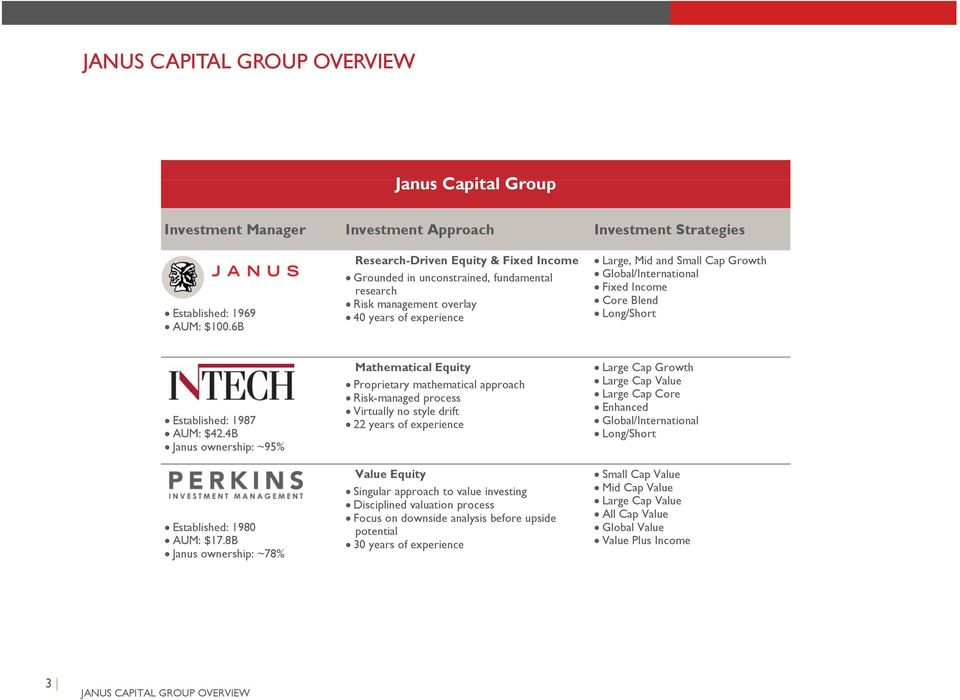
3 JANUS CAPITAL GROUP OVERVIEW Janus Capital Group Investment Manager Investment Approach Investment Strategies Established: 1969 AUM: $100.6B Research-Driven Equity & Fixed Income Grounded in unconstrained, fundamental research Risk management overlay 40 years of experience Large, Mid and Small Cap Growth Global/International l/i l Fixed Income Core Blend Long/Short Established: 1987 AUM: $42.4B Janus ownership: ~95% Established: 1980 AUM: $17.8B Janus ownership: ~78% Mathematical Equity Proprietary mathematical approach Risk-managed process Virtually no style drift 22 years of experience Value Equity Singular approach to value investing Disciplined valuation process Focus on downside analysis before upside potential 30 years of experience Large Cap Growth Large Cap Value Large Cap Core Enhanced Global/International Long/Short Small Cap Value Mid Cap Value Large Cap Value All Cap Value Global Value Vl Value Plus Income 3 JANUS CAPITAL GROUP OVERVIEW
4 JANUS OVERVIEW FOR INSTITUTIONAL INVESTOR USE ONLY / NOT FOR PUBLIC VIEWING OR DISTRIBUTION

5 JANUS OVERVIEW Janus Capital Group Investment Manager Investment Approach Investment Strategies Key Benefits: Established: 1969 AUM: $100.6B Research-Driven Equity & Fixed Income Grounded in unconstrained, fundamental research Risk management overlay 40 years of experience Large, Mid and Small Cap Growth Global/International Fixed Income Core Blend Long/Short We believe unconstrained research drives alpha for our clients. Research-driven approach designed to seek alpha Strive for outperformance irrespective of market cycles Collaborative culture promotes idea generation Guiding principles: Start with research, not the benchmark Invest with conviction where we believe we have research insight Uncover different or potentially better information Interpret information differently Employ a disciplined approach to portfolio construction Foster a culture of collaboration and debate As of 30 September, JANUS CAPITAL GROUP OVERVIEW

6 SECTOR PERFORMANCE HIGHLIGHTS STRENGTH OF RESEARCH Performance of Janus Global Research Growth Equity Portfolio Holdings, as of Q10 Period (30/6/10 30/9/10) 1 Year Period (30/9/09 30/9/10) 25% 30% Total Returns (% %) 20% 15% 10% 5% 13.1% 21.2% 15.3% 15.1% 14.2% 13.6% 17.1% 16.8% 13.3% 8.6% 20.9% 18.2% 17.1% 11.3% Total Returns (% %) 25% 20% 15% 10% 5% 13.4% 16.5% 16.2% 19.1% 10.0% 6.6% 6.1% 3.8% 3.8% 25.5% 15.7% 22.6% 9.0% 0% 0% Communications Communications Consumer Energy & Utilities Financials Healthcare Industrials & Materials Technology -5% Consumer Energy & Utilities -2.8% Financials Healthcare Industrials & Materials Technology 3 Year Period (30/9/07 30/9/10) 5 Year Period (30/9/05 30/9/10) Total Returns (% %) 5% 0% -5% -10% -15% -20% -9.0% -5.0% -0.3% 0.6% Consumer -8.7% -11.2% Energy & Utilities -12.6% -15.3% -6.1% -3.5% 3.2% -7.2% Financials Healthcare Industrials & Materials 0.6% -5.4% Technology Total Returns (% %) 16% 14% 12% 10% 8% 6% 4% 2% 0% -2% -4% -6% 2.5% 2.4% Communications Communications 9.6% 6.2% Consumer 8.0% 0.1% Energy & Utilities -0.1% -4.0% 1.1% 1.3% 14.2% 5.7% Financials Healthcare Industrials & Materials 6.9% 2.5% Technology Janus Global Research Growth Equity Representative Account MSCI World Growth Index 6 Total returns are gross of advisory fees and may differ from actual return as it is based only on end-of-day equity holdings in the portfolio. Total returns represent the time a stock or group was held within the portfolio. Sector allocation source: Janus internal research sectors. Please see page 8 for standardized performance as of the most recent calendar quarter-end. Source: Janus JANUS CAPITAL GROUP OVERVIEW

7 JANUS INSTITUTIONAL STRATEGIES RANKINGS Since inception Period ended Equity Strategies Global Research Growth Equity International Equity Mid Cap Growth Small-Mid Cap Growth Percentile Rank king Benchmark(s) () MSCI World Growth Index MSCI EAFE Index Russell Midcap Growth Index Russell 2500 TM Growth Index Inception Date 4/05 1/97 4/89 3/05 Composite Benchmark Member Count Past performance cannot guarantee future results. Top quartile performance percentile rankings are versus each strategy s primary benchmark. Not all Janus strategies have ranked in the top quartile for all time periods. Please see pages 8-10 for standardized performance as of the most recent calendar quarter-end. end evestment Alliance software was used by Janus Capital Group to create the exhibits. A fee was paid to the firm for the use of the software. Rankings are based on results that are gross of fees and annualized since inception. Janus Capital Management LLC serves as investment adviser Source: Janus JANUS CAPITAL GROUP OVERVIEW

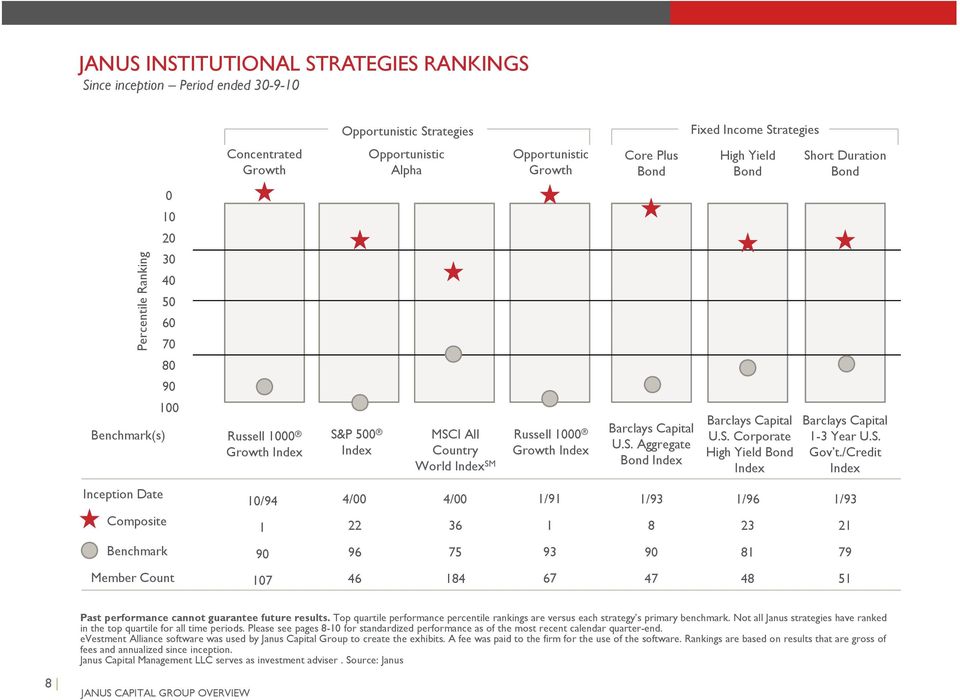
8 JANUS INSTITUTIONAL STRATEGIES RANKINGS Since inception Period ended Opportunistic Strategies Fixed Income Strategies Concentrated Growth Opportunistic Alpha Opportunistic Growth Core Plus Bond High Yield Bond Short Duration Bond Percentile Rank king Benchmark(s) Russell 1000 Growth Index S&P 500 Index MSCI All Country World Index SM Barclays Capital Barclays Capital Russell 1000 Barclays Capital U.S. Corporate 1-3 Year U.S. Growth Index U.S. Aggregate High Yield Bond Gov t./credit Bond Index Index Index Inception Date 10/94 4/00 4/00 1/91 1/93 Composite Benchmark Member Count / / Past performance cannot guarantee future results. Top quartile performance percentile rankings are versus each strategy s primary benchmark. Not all Janus strategies have ranked in the top quartile for all time periods. Please see pages 8-10 for standardized performance as of the most recent calendar quarter-end. end evestment Alliance software was used by Janus Capital Group to create the exhibits. A fee was paid to the firm for the use of the software. Rankings are based on results that are gross of fees and annualized since inception. Janus Capital Management LLC serves as investment adviser. Source: Janus JANUS CAPITAL GROUP OVERVIEW
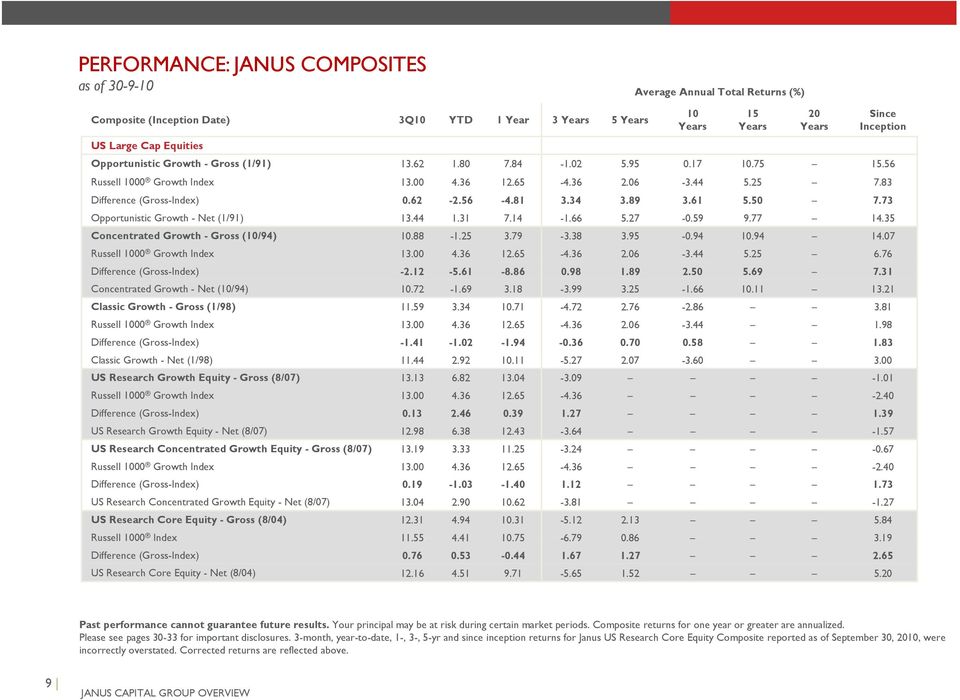
9 PERFORMANCE: JANUS COMPOSITES as of Average Annual Total Returns (%) Composite (Inception Date) 3Q10 YTD 1 Year 3 Years 5 Years 10 Years 15 Years 20 Years Since Inception US Large Cap Equities Opportunistic Growth - Gross (1/91) Russell 1000 Growth Index Difference (Gross-Index) Opportunistic Growth - Net (1/91) Concentrated Growth - Gross (10/94) Russell 1000 Growth Index Difference (Gross-Index) Concentrated Growth - Net (10/94) Classic Growth - Gross (1/98) Russell 1000 Growth Index Difference (Gross-Index) Classic Growth - Net (1/98) US Research Growth Equity - Gross (8/07) Russell 1000 Growth Index Difference (Gross-Index) US Research Growth Equity - Net (8/07) US Research Concentrated Growth Equity - Gross (8/07) Russell 1000 Growth Index Difference (Gross-Index) US Research Concentrated Growth Equity - Net (8/07) US Research Core Equity - Gross (8/04) Russell 1000 Index Difference (Gross-Index) US Research Core Equity - Net (8/04) Past performance cannot guarantee future results. Your principal may be at risk during certain market periods. Composite returns for one year or greater are annualized. Please see pages for important disclosures. 3-month, year-to-date, 1-, 3-, 5-yr and since inception returns for Janus US Research Core Equity Composite reported as of September 30, 2010, were incorrectly overstated. Corrected returns are reflected above. 9 JANUS CAPITAL GROUP OVERVIEW
10 PERFORMANCE: JANUS COMPOSITES as of Average Annual Total Returns (%) Composite (Inception Date) 3Q10 YTD 1 Year 3 Years 5 Years 10 Years 15 Years 20 Years Since Inception US Small and Mid Cap Equities Small Company Growth - Gross (1/93) Russell 2000 Growth Index Difference (Gross-Index) Small Company Growth - Net (1/93) Small-Mid Cap Growth - Gross (3/05) Russell 2500 TM Growth Index Difference (Gross-Index) Small-Mid Cap Growth - Net (3/05) Mid Cap Growth - Gross (4/89) Russell Midcap Growth Index Difference (Gross-Index) Mid Cap Growth - Net (4/89) Global/International International Equity - Gross (1/97) MSCI EAFE Index MSCI All Country World ex-us Index SM Difference (Gross-Index) International Equity - Net (1/97) Global Research Growth Equity - Gross (4/05) MSCI World Growth Index MSCI All Country World Index SM Difference (Gross-Index) Global Research Growth Equity - Net (4/05) Global Research Core Equity - Gross (8/07) MSCI World Index SM MSCI All Country World Index SM Difference (Gross-Index) Global l Research Core Equity - Net (8/07) European Equity - Gross (10/08) MSCI Europe Index SM Difference (Gross-Index) European Equity Net of Fees (10/08) Past performance cannot guarantee future results. Your principal may be at risk during certain market periods. Composite returns for one year or greater are annualized. Please see pages for important disclosures. 3-month, year-to-date, 1-year, and since inception returns for Janus European Equity Composite reported as of September 30, 2010, were incorrectly overstated. Corrected returns are reflected above. JANUS CAPITAL GROUP OVERVIEW

11 PERFORMANCE: JANUS COMPOSITES as of Composite (Inception Date) 3Q10 YTD 1 Year 3 Years 5 Years Average Annual Total Returns (%) Fixed Income Core Plus Bond - Gross (1/93) Barclays Capital U.S. Aggregate Bond Index Difference (Gross-Index) Core Plus Bond - Net (1/93) Short Duration Bond - Gross (1/93) Barclays Capital 1-3 Year U.S. Government/Credit Index Difference (Gross-Index) Short Duration Bond Net Years 15 Years 20 Years Since Inception High Yield Bond - Gross (1/96) Barclays Capital U.S. Corporate High-Yield Bond Index Difference (Gross-Index) High Yield Bond - Net (1/96) Asset Allocation Balanced - Gross (1/88) Balanced Index Difference (Gross-Index) Balanced - Net (1/88) Alternative Global Life Science Gross (1/99) MSCI World Health Care Difference (Gross-Index) Net of Fees Global Technology Gross (1/99) MSCI World IT Index Difference (Gross-Index) Net of Fees Global Real Estate Gross (6/07) FTSE EPRA/NAREIT Global Index Difference (Gross-Index) Nt Net of Fees The year-to-date,1-, 3-, 5-, 10-, 15- year, since inception returns for Janus Short Duration Bond Composite reported as of September 30, 2010 were incorrectly understated. Corrected returns are reflected above. The 3- month, year-to-date, 1-, 3-, 5-, 10-, 15-year, since inception returns for Janus Core Plus Bond Composite reported as of September 30, 2010, were incorrectly understated. Corrected returns are reflected above. 3-month, year-to-date, 1-, 3-, 5-, 10-year, since inception returns for Janus High Yield Composite reported as of September 30, 2010, were incorrectly understated. Corrected returns are reflected above. 3-month, year-to-date, 1-, 3-year and since inception returns for Janus Global Real Estate Composite reported as of September 30, 2010, were incorrectly overstated. Corrected returns are reflected above. JANUS CAPITAL GROUP OVERVIEW

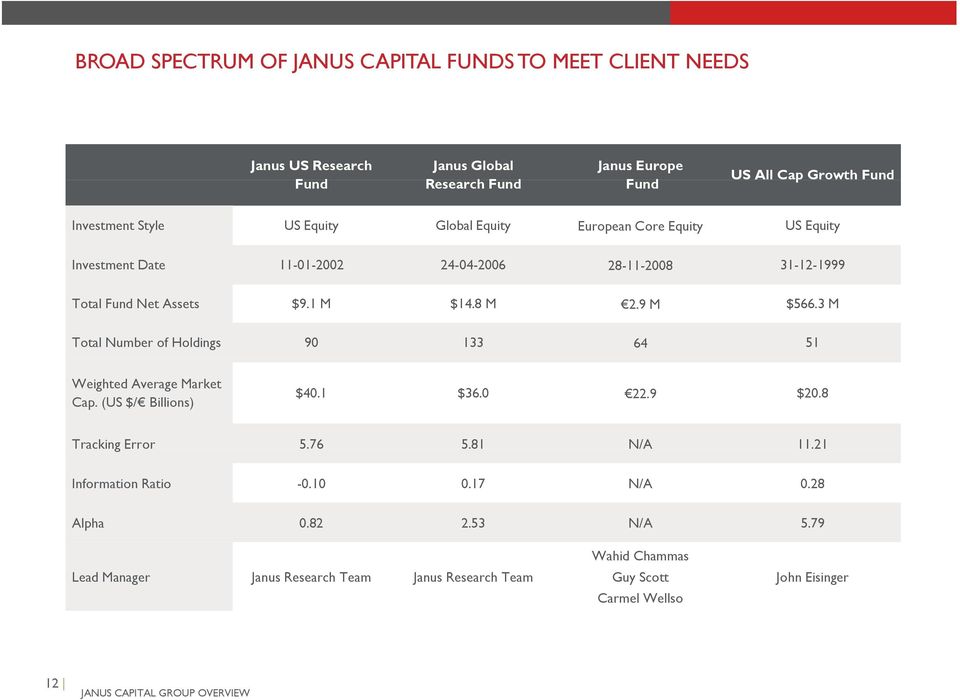
12 BROAD SPECTRUM OF JANUS CAPITAL FUNDS TO MEET CLIENT NEEDS Janus US Research Janus Global Janus Europe Fund Research Fund Fund US All Cap Growth Fund Investment Style US Equity Global Equity European Core Equity US Equity Investment Date Total Fund Net Assets $9.1 M $14.8 M 2.9 M $566.3 M Total Number of Holdings Weighted Average Market Cap. (US $/ Billions) $40.1 $ $20.8 Tracking Error N/A Information Ratio N/A 0.28 Alpha N/A 5.79 Lead Manager Janus Research Team Janus Research Team Wahid Chammas Guy Scott Carmel Wellso John Eisinger 12 JANUS CAPITAL GROUP OVERVIEW
13 BROAD SPECTRUM OF JANUS CAPITAL FUNDS TO MEET CLIENT NEEDS Janus US Twenty Fund Janus US Flexible Janus US High Yield Perkins US Strategic Income Fund Value Fund Value Fund Investment Style US Equity US Fixed Income US Fixed Income US Value Investment Date Total Fund Net Assets $859.4 M $742.7 M $988.0 M $1.1 B Total Number of Holdings Weighted Average Market Cap. (US $ Billions) $83.9 N/A N/A $29.5 Tracking Error Information Ratio Alpha Lead Manager Ron Sachs Gibson Smith/ Darrell Watters Gibson Smith/ Darrell Watters Perkins Investment Management LLC 13 JANUS CAPITAL GROUP OVERVIEW

14 INTECH Overview

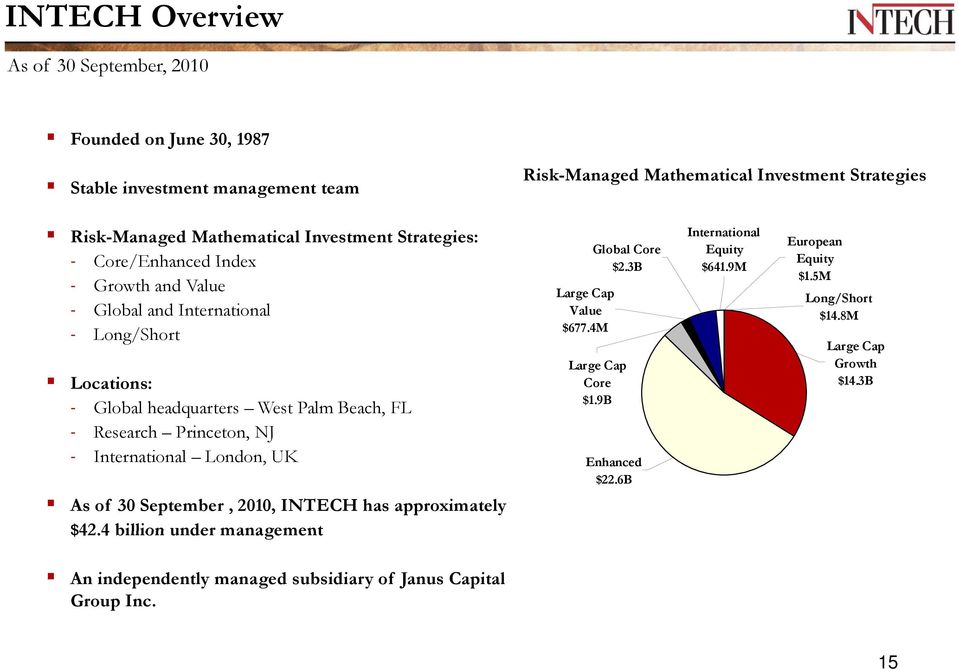
15 INTECH Overview As of 30 September, 2010 Founded on June 30, 1987 Stable investment management team Risk-Managed Mathematical Investment Strategies Risk-Managed Mathematical Investment Strategies: - Core/Enhanced Index - Growth and Value - Global and International - Long/Short Locations: - Global headquarters West Palm Beach, FL - Research Princeton, NJ - International London, UK As of 30 September, 2010, INTECH has approximately $ billion under management Large Cap Value $677.4M Global Core $2.3B Large Cap Core $1.9B Enhanced $22.6B International Equity $641.9M European Equity $1.5M Long/Short $14.8M Large Cap Growth $14.3B An independently managed subsidiary of Janus Capital Group Inc. 15
16 Investment Process Step #1: Initial Investment Universe Benchmark Index Step #2: Stock kscreen Stocks less than 1 basis point in the index are excluded Step #3: Mathematical Process Analyzing relative volatility and correlation, INTECH attempts to build a more efficient portfolio. Robust and resistant statistical techniques are employed using proprietary models. Risk Controls Enhanced dindex Enhanced dplus Large Cap Core Large Cap pgrowth Large Cap Value Global Core International Equity 1% or 8x maximum differential vs. benchmark* Portfolio capitalization constraint 1% or 8x maximum differential vs. benchmark* 2.5% or 10x maximum differential vs. benchmark* 2.5% or 10x maximum differential vs. benchmark* 2% or 8x maximum differential vs. benchmark* 2.5% or 20x maximum differential vs. benchmark* 2.5% or 10x maximum differential vs. benchmark* Beta constraint Beta constraint Beta constraint Beta constraint Beta constraint Beta constraint Market capitalization constraint for non-u.s. portion of portfolio Maximize information ratio Maximize information ratio Maximize information ratio Maximize information ratio Maximize information ratio Maximize information ratio Maximize information ratio U.S. vs. non-u.s. correlation and weight constraint Step #4: More Efficient Portfolio Re-weight the index to a potentially more efficient combination Rebalance and re-optimize periodically * Trading system allows a slightly greater maximum distance around benchmark weights. Portfolio weights may slightly exceed the maximum differential over time due to market action. Risk controls do not promise any level of performance or guarantee against loss of principal. 16

17 How INTECH s Process Captures Relative Volatility PASSIVE PORTFOLIO Passive portfolio produces no net gain. Stocks have volatility, but opportunity to generate excess return has not been captured. 240 $ $ $ % -28.6% INTECH PORTFOLIO INTECH applies its mathematical formula to establish potentially more efficient weights. Dynamic process of maintaining and re-establishing those weights produces the potential excess return. Compound Return = 0%/Period $ $ the potential excess return. $ % Rebalance +25% Compound Return = 25%/Period Criteria for hypothetical illustration: two-stock portfolio, perfect negative correlation, move by a factor of two. Mathematically, a 50%/50% target weighting for a two-stock portfolio with equal growth rates maximizes long-term return. The hypothetical illustrations shown are provided to demonstrate INTECH s trading process and how relative volatility can be captured. Trading costs and other expenses have not been considered. 17

18 How INTECH s Investment Process is Implemented Target weights are determined at optimization. Trading bands around target weights may vary by strategy, stock and through time. Rebalance to target weights regularly only if stock weights move outside designated bands. STOCK WEIGHT Sell Sell Sell Target Weight Stock weight at optimization No trade necessary Buy Begin Rebalance Cycle Trading Day Hypothetical illustration. See Presentation Notes for additional information. Trading Trading Trading Trading Day Day Day Day 18

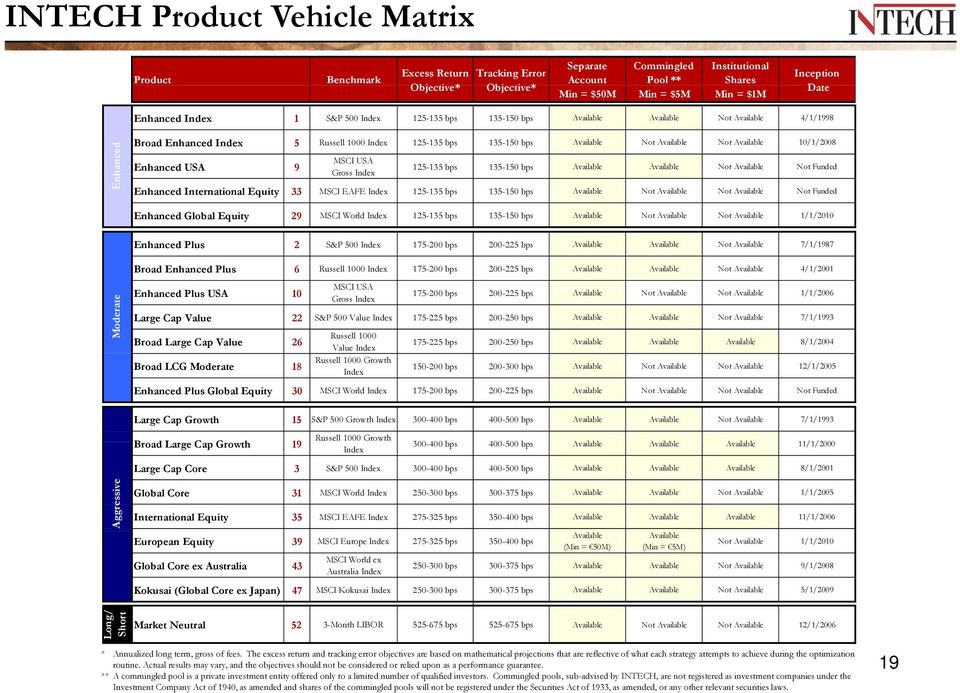
19 INTECH Product Vehicle Matrix Product Benchmark Excess Return Objective* Tracking Error Objective* Separate Commingled Institutional Account Pool ** Shares Min = $50M Min = $5M Min = $1M Inception Date Enhanced Index 1 S&P 500 Index bps bps Available Available Not Available 4/1/1998 Enh hanced Broad Enhanced Index 5 Russell 1000 Index bps bps Available Not Available Not Available 10/1/2008 Enhanced USA 9 MSCI USA Gross Index bps bps Available Available Not Available Not Funded Enhanced International Equity 33 MSCI EAFE Index bps bps Available Not Available Not Available Not Funded Enhanced Global Equity 29 MSCI World Index bps bps Available Not Available Not Available 1/1/2010 Enhanced Plus 2 S&P 500 Index bps bps Available Available Not Available 7/1/1987 Moderate Broad Enhanced Plus 6 Russell 1000 Index bps bps Available Available Not Available 4/1/2001 Enhanced Plus USA 10 MSCI USA Gross Index bps bps Available Not Available Not Available 1/1/2006 Large Cap Value 22 S&P 500 Value Index bps bps Available Available Not Available 7/1/1993 Broad Large Cap Value 26 Broad LCG Moderate 18 Russell 1000 Value Index Russell 1000 Growth Index bps bps Available Available Available 8/1/ bps bps Available Not Available Not Available 12/1/2005 Enhanced Plus Global Equity 30 MSCI World Index bps bps Available Not Available Not Available Not Funded Large Cap Growth 15 S&P 500 Growth Index bps bps Available Available Not Available 7/1/1993 Broad Large Cap Growth 19 Russell 1000 Growth Index bps bps Available Available Available 11/1/2000 Large Cap Core 3 S&P 500 Index bps bps Available Available Available 8/1/2001 Aggressive Global Core 31 MSCI World Index bps bps Available Available Not Available 1/1/2005 International Equity 35 MSCI EAFE Index bps bps Available Available Available 11/1/2006 European Equity 39 MSCI Europe Index bps bps Global Core ex Australia 43 MSCI World ex Australia Index Available (Min = 50M) Available (Min = 5M) Not Available 1/1/ bps bps Available Available Not Available 9/1/2008 Kokusai (Global Core ex Japan) 47 MSCI Kokusai Index bps bps Available Available Not Available 5/1/2009 g/ ort Lon Sho Market Neutral 52 3-Month LIBOR bps bps Available Not Available Not Available 12/1/2006 * Annualized long term, gross of fees. The excess return and tracking error objectives are based on mathematical projections that are reflective of what each strategy attempts to achieve during the optimization routine. Actual results may vary, and the objectives should not be considered or relied upon as a performance guarantee. ** A commingled pool is a private investment entity offered only to a limited number of qualified investors. Commingled pools, sub-advised by INTECH, are not registered as investment companies under the Investment Company Act of 1940, as amended and shares of the commingled pools will not be registered under the Securities Act of 1933, as amended, or any other relevant securities laws. 19
20 Risk Control is Important As of 30 September, Month Rolling Tracking Er rror INTECH Enhanced Plus Strategy 5% Enhanced Plus - Inception: 7/1/1987 4% 3% 2% 1% 0% Long-term tracking error target * : 2.00% % 1/1988 1/1989 1/1990 1/1991 1/1992 1/1993 1/1994 1/1995 1/1996 1/1997 1/1998 1/1999 1/2000 1/2001 1/2002 1/2003 1/2004 1/2005 1/2006 1/2007 1/2008 1/2009 1/2010 Because extreme adverse events Black Swans occur more frequently than most people think, INTECH has embedded tight risk controls in its investment process. Relative downside protection is equally if not more important than upside potential. Tracking error is a measure of how closely a portfolio tracks its index. It is realized in the form of above-average or below-average relative returns. * Gross of fees, annualized long term. Enhanced Plus tracking error is relative to the S&P 500 Index. Data presented reflects past performance, which is no guarantee of future results. Rolling periods calculated monthly since inception. See Composite Performance and Presentation Notes for additional information. 20

21 Skill vs. Luck? As of 30 September, 2010 INTECH Strategies Inception Date Annualized Excess Return Annualized Tracking Error Information Ratio* t Statistic One Tail Significance Enhanced Plus 7/1/ % 1.53% 1.99% % 0.01% Large Cap Growth 7/1/ % 4.40% % Large Cap Value 7/1/ % 4.09% % Enhanced Index 4/1/ % 1.29% 1.62% % 0.28% Broad Large Cap Growth 11/1/ % 4.90% % Broad Enhanced Plus 4/1/ % 1.82% % Large Cap Core 8/1/ % 2.27% 290% 2.90% % 0.98% Broad Large Cap Value 8/1/ % 1.59% % Global Core 1/1/ % 2.91% % Enhanced Plus USA 1/1/2006 // -0.19% 2.86% % International Equity 11/1/ % 4.09% % The one tail significance is the estimated probability that pure luck would produce the portfolio s observed alpha or better. A good a priori reason for thinking an investment process should work combined with a low one tail significance should provide a high degree of confidence to investors. *Source: FactSet. Information Ratio = Excess Return Tracking Error Data presented reflects past performance, which is no guarantee of future results. Data presented is gross of fees. Chart includes strategies with at least a three-year track record that do not involve the use of leverage. See Composite Performance and Presentation Notes for additional information. 21
22 INTECH Strategies: Composite Performance As of 30 September, 2010 Active Risk-Managed Annualized Returns Inception U.S. Strategies 3 Mos YTD 1 Yr 3 Yrs 5 Yrs 7 Yrs 10 Yrs 15 Yrs 20 Yrs ITD Date Enhanced Plus Gross 11.42% 5.04% 11.68% -5.96% 1.15% 5.56% 1.71% 8.14% 10.75% 9.82% 7/1/1987 S&P 500 Index 11.29% 3.89% 10.16% -7.16% 0.64% 4.04% -0.43% 6.45% 9.05% 8.30% Difference (Gross-Index) 0.12% 1.15% 1.52% 1.20% 0.51% 1.52% 2.14% 1.69% 1.70% 1.53% Enhanced Plus Net 11.33% 4.80% 11.34% -6.25% 0.84% 5.22% 1.36% 7.75% 10.35% 9.42% Large Cap Growth Gross 13.09% 646% 6.46% 14.72% -3.07% 176% 1.76% 561% 5.61% 258% 2.58% 11.04% 11.94% 7/1/1993 S&P 500 Growth Index* 12.63% 3.63% 11.67% -4.32% 1.72% 3.77% -1.93% 6.32% 7.59% Difference (Gross-Index) 0.46% 2.83% 3.05% 1.25% 0.03% 1.84% 4.51% 4.71% 4.35% Large Cap Growth Net 12.96% 6.09% 14.18% -3.51% 1.29% 5.11% 2.07% 10.47% 11.36% Large Cap Value Gross 10.87% 6.03% 10.77% -8.57% 0.34% 5.90% 3.50% 8.58% 9.34% 7/1/1993 S&P 500 Value Index** 9.98% 4.15% 8.54% % -0.59% 4.17% 0.85% 6.24% 7.26% Difference (Gross-Index) 0.89% 1.88% 2.23% 1.56% 0.94% 1.73% 2.65% 2.34% 2.09% Large Cap Value Net 10.76% 5.72% 10.34% -8.93% -0.05% 5.49% 3.10% 8.16% 8.92% Enhanced Index Gross 11.59% 4.72% 11.30% -6.01% 1.32% 5.02% 0.77% 3.35% 4/1/1998 S&P 500 Index 11.29% 3.89% 10.16% -7.16% 0.64% 4.04% -0.43% 2.06% Difference (Gross-Index) 0.29% 0.83% 1.14% 1.16% 0.68% 0.99% 1.20% 1.29% Enhanced Index Net 11.49% 4.46% 46% 10.94% -6.31% 100% 1.00% 4.69% 0.44% 3.01% Broad Large Cap Growth Gross 12.19% 6.85% 15.31% -5.45% 0.87% 4.56% -0.27% 11/1/2000 Russell 1000 Growth Index 13.00% 4.36% 12.65% -4.36% 2.06% 4.14% -2.99% Difference (Gross-Index) -0.81% 2.49% 2.66% -1.09% -1.19% 0.42% 2.72% Broad Large Cap Growth Net 12.05% 6.44% 14.72% -5.93% 0.36% 4.03% -0.79% Broad Enhanced Plus Gross 11.78% 6.22% 12.80% -6.20% 0.82% 5.21% 3.73% 4/1/2001 Russell 1000 Index 11.55% 4.42% 10.76% -6.79% 0.86% 4.47% 2.23% Difference (Gross-Index) 0.22% 1.80% 2.04% 0.59% -0.04% 0.74% 1.51% Broad Enhanced Plus Net 11.70% 5.99% 12.47% -6.47% 0.53% 4.90% 3.40% Large Cap Core Gross 11.01% 5.08% 11.75% -5.87% 0.63% 6.12% 3.56% 8/1/2001 S&P 500 Index 11.29% 3.89% 10.16% -7.16% 0.64% 4.04% 1.29% Difference (Gross-Index) -0.29% 029% 119% 1.19% 159% 1.59% 129% 1.29% -0.01% 001% 208% 2.08% 227% 2.27% Large Cap Core Net 10.87% 4.68% 11.20% -6.33% 0.17% 5.63% 3.09% Broad Large Cap Value Gross 11.04% 5.84% 10.59% -7.67% 0.18% 3.77% 8/1/2004 Russell 1000 Value Index 10.13% 4.49% 8.90% -9.38% -0.49% 2.62% Difference (Gross-Index) 0.91% 1.35% 1.69% 1.72% 0.67% 1.15% Broad Large Cap Value Net 10.93% 5.53% 10.16% -8.01% -0.20% 3.38% * For Large Cap Growth from inception to 12/31/05, the composite s benchmark was the S&P 500/Barra Growth Index ( Barra Growth Index ). In 2005, S&P announced index name and methodology changes affecting the Barra Growth Index, which later became the S&P 500/Citigroup Growth Index ( Citigroup Growth Index ). During the transitional period, from 1/1/06 to 3/31/06, the benchmark return consisted partially of the return of the Barra Growth Index and the Citigroup Growth Index. On 4/1/06 the composite s benchmark was changed to the Citigroup Growth Index. Effective 12/9/2009, the Citigroup Growth Index s name was changed to S&P 500 Growth Index. ** For Large Cap Value from inception to 12/31/05, the composite s benchmark was the S&P 500/Barra Value Index ( Barra Value Index ). In 2005, S&P announced index name and methodology changes affecting the Barra Value Index, which later became the S&P 500/Citigroup Value Index ( Citigroup Value Index ). During the transitional period, from 1/1/06 to 3/31/06, the benchmark return consisted partially of the return of the Barra Value Index and the Citigroup Value Index. On 4/1/06, the composite s benchmark was changed to the Citigroup Value Index. Effective 12/9/2009, the Citigroup Value Index s name was changed to S&P 500 Value Index. Past performance does not guarantee future results. Past performance does not guarantee future results. Performance includes the reinvestment of dividends and other earnings. Difference may not agree with input data due to rounding. See Presentation Notes for additional information. 22
23 INTECH Strategies: Composite Performance (cont d) As of 30 September, 2010 Active Risk-Managed Annualized Returns Inception U.S. Strategies 3 Mos YTD 1 Yr 3 Yrs 5 Yrs 7 Yrs 10 Yrs 15 Yrs 20 Yrs ITD Date Broad Large Cap Growth Moderate Gross 11.98% 6.29% 14.76% -4.73% 0.88% 12/1/2005 Russell 1000 Growth Index 13.00% 4.36% 12.65% -4.36% 1.45% Difference (Gross-Index) -1.03% 1.93% 2.11% -0.37% -0.57% Broad Large Cap Growth Moderate Net 11.90% 6.09% 14.47% -4.97% 0.61% Enhanced Plus USA Gross 11.50% 5.29% 12.20% -6.60% 0.15% 1/1/2006 MSCI USA Gross Index 11.53% 3.99% 10.27% -6.98% 0.34% Difference (Gross-Index) -0.03% 1.30% 1.93% 0.38% -0.19% Enhanced Plus USA Net 11.40% 5.02% 11.82% -6.90% -0.17% Broad Enhanced Index Gross 11.43% 4.93% 11.55% 1.50% 10/1/2008 Russell 1000 Index 11.55% 442% 4.42% 10.76% 196% 1.96% Difference (Gross-Index) -0.12% 0.51% 0.79% -0.46% Broad Enhanced Index Net 11.36% 4.70% 11.21% 1.17% Active Risk-Managed Global/International Strategies Global Core Gross 14.35% 4.37% 9.04% -6.70% 2.86% 4.43% 1/1/2005 MSCI World Index 13.89% 3.01% 7.31% -7.75% 1.85% 2.75% Difference (Gross-Index) 0.46% 1.36% 1.73% 1.04% 1.01% 1.68% Global Core Net 14.20% 3.95% 8.46% -7.21% 2.30% 3.87% International Equity Gross 17.08% 3.80% 5.97% -8.32% 0.20% 11/1/2006 MSCI EAFE Index 16.53% 1.46% 3.71% -9.06% -2.44% Difference (Gross-Index) 0.55% 2.34% 2.25%.5% 0.73% 2.64% International Equity Net 16.95% 3.47% 5.52% -8.71% -0.22% Global Core ex Australia Gross 13.87% 4.47% 9.31% -4.12% 9/1/2008 MSCI World ex Australia Index 13.52% 2.95% 7.22% -3.74% Difference (Gross-Index) 0.35% 1.52% 2.10% -0.38% Global Core ex Australia Net 13.73% 4.09% 8.78% -4.59% Kokusai (Global Core ex Japan) Gross 14.66% 4.64% 10.21% 24.84% 5/1/2009 MSCI Kokusai Index 14.83% 3.00% 8.12% 26.37% Difference (Gross-Index) -0.17% 1.64% 2.08% -1.53% Kokusai (Global Core ex Japan) Net 14.51% 4.22% 9.61% 24.17% Active Risk-Managed Long/Short Strategy Market Neutral Gross 0.31% 2.32% 3.34% 3.00% 2.82% 12/1/2006 LIBOR 3-Month Rate 0.09% 0.27% 0.34% 1.63% 2.43% Difference (Gross-Index) 0.23% 2.05% 3.01% 1.37% 0.38% 23 Market Neutral Net 0.09% 1.63% 2.42% 2.08% 1.90% Past performance does not guarantee future results. Performance includes the reinvestment of dividends and other earnings. Difference may not agree with input data due to rounding. See Presentation Notes for additional information.
24 PERKINS OVERVIEW
25 30-YEAR HISTORY OF MANAGING CLIENT ASSETS Perkins is founded Small Cap Value strategy launches Mid Cap Value strategy launches Janus Capital Group takes 30% ownership stake in Perkins Perkins assumed management of Perkins US Strategic Value Fund Large Cap Value strategy launches Janus acquires additional 50% ownership stake Value Plus Income strategy launches Management of Global Value transitions to Perkins Perkins Today (as of 30/9/10) $17.8 billion in total AUM ~40% of AUM from institutional clients Independent subsidiary of Janus Capital Group ~78% owned by Janus Capital Group Perkins Investment Management singular focus on value investing Janus Capital Group: Core business functions (global distribution and marketing; risk management and trading; operations; human resources; legal) l) 25
26 PERKINS INVESTMENT PROCESS OVERVIEW Identify undervalued companies Determine what we believe to be high quality companies Determine conservative downside price target Determine conservative upside price target Determine reward to risk ratio Reward/risk ratio drives portfolio management decisions Start small and build positions gradually Up and down quarters are determined by the performance of the composite s primary benchmark. 26
27 INVESTMENT DECISION AND PORTFOLIO CONSTRUCTION Portfolio managers make final investment decision Analysts write up recommendation and discuss with portfolio manager Tracker portfolios reflect real-time analyst conviction Portfolio managers build diversified portfolios Initial positions bps, build position gradually Maximum position size at firm of 4% Typically no more than 20% in any sector with exception of financials which is limited to 35% Reward/risk ratio drives portfolio management decisions 1.0 : 1.0 Reward/Risk ratio Position on watch 0.5 : 1.0 Reward/Risk ratio Exiting position 1.5 : 1.0 Reward/Risk ratio Initiate t or add to existing position LOW TRADE-OFF HIGH TRADE-OFF 27
28 PERFORMANCE AND REWARD/RISK STATISTICS Composite vs. benchmark as of 30/9/10 PERKINS SMALL CAP VALUE COMPOSITE (vs. Russell 2000 Value Index) Since Inception Average Up and Down Quarterly Returns 1/7/88 30/9/10 uarterly Return (%) Average Qu Perkins Small Cap Value Composite - Gross Perkins Small Cap Value Composite - Net Russell 2000 Value Index Down Quarters 63 Up Quarters REWARD & RISK STATISTICS (vs. Russell 2000 Value Index) Three-Year Percentile Rankings (30/9/07 30/9/10) Excess Return 5 th 6 th 6 th Information Ratio 76th Sharpe Ratio 68 th Tracking Error 46 th 85 th 79 th Standard Deviation Beta Perkins Small Cap Value Composite Russell 2000 Value Index ea Small Cap Value Equity Peer Group Median Member Count Performance figures represent a composite of fully discretionary portfolios and include reinvestment of dividends and other earnings. Please see standardized performance on page 28. Up and down calendar quarters are determined by the returns of the index shown. 28
29 PERFORMANCE AND REWARD/RISK STATISTICS Composite vs. benchmark as of 30/9/10 PERKINS MID CAP VALUE COMPOSITE (vs. Russell Midcap Value Index) Since Inception Average Up and Down Quarterly Returns 1/10/98 30/9/10 uarterly Return (%) Average Qu Perkins Mid Cap Value Composite - Gross Perkins Mid Cap Value Composite - Net Russell Midcap Value Index Down Quarters 32 Up Quarters REWARD & RISK STATISTICS (vs. Russell Midcap Value Index) Three-Year Percentile Rankings (30/9/07 30/9/10) th 25 th 30 th 28th Excess Return Information Ratio 58 th Sharpe Ratio 38 th Tracking Error 95 th 91 st Standard Beta Deviation Perkins Mid Cap Value Composite Russell Midcap Value Index ea Mid Cap Value Equity Peer Group Median Member Count Performance figures represent a composite of fully discretionary portfolios and include reinvestment of dividends and other earnings. Please see standardized performance on page 28. Up and down calendar quarters are determined by the returns of the index shown. 29
30 PERFORMANCE AND REWARD/RISK STATISTICS Composite vs. benchmark as of 30/9/10 PERKINS LARGE CAP VALUE COMPOSITE (vs. Russell 1000 Value Index) Since Inception Average Up and Down Quarterly Returns 1/10/06 30/9/10 e Quarterly Return (%) Perkins Large Cap Value Composite - Gross Perkins Large Cap Value Composite - Net Russell 1000 Value Index 8.78 Averag Down Quarters 8 Up Quarters REWARD & RISK STATISTICS (vs. Russell 1000 Value Index) Three-Year Percentile Rankings (30/9/07 30/9/10) th 32nd Excess Return Information Ratio 32 nd 39 th 79 th Sharpe Ratio 70 th 81 st 77 th Tracking Error Standard Deviation Beta Perkins Large Cap Value Composite Russell 1000 Value Index ea Large Cap Value Equity Peer Group Median Member Count Performance figures represent a composite of fully discretionary portfolios and include reinvestment of dividends and other earnings. Please see standardized performance on page 28. Up and down calendar quarters are determined by the returns of the index shown. 30
31 PERFORMANCE AND REWARD/RISK STATISTICS Composite vs. benchmark as of 30/9/10 PERKINS GLOBAL VALUE COMPOSITE (vs. MSCI World Index) Since Inception Average Up and Down Quarterly Returns 7/1/01 30/9/10 PERKINS GLOBAL VALUE COMPOSITE (vs. MSCI World Index) Since PM Inception Average Up and Down Quarterly Returns 7/1/05 30/9/10 uarterly Return (%) Average Qu Perkins Global l Value Composite - Gross Perkins Global l Value Composite - Gross Perkins Global Value Composite - Net Perkins Global Value Composite - Net 7.72 MSCI World Index SM 7.45 MSCI World Index SM Average Qu uarterly Return (%) Down Quarters 23 Up Quarters Down Quarters 13 Up Quarters REWARD & RISK STATISTICS (vs. MSCI World Index) Three-Year Percentile Rankings (30/9/07 30/9/10) th 43 rd 48 th 39 th Excess Return Information Ratio 70 th 59 th Sharpe Ratio Tracking Error 80 th 84 th Standard Deviation Beta Perkins Global Value Composite MSCI World Index SM ea Global Equity Peer Group Median Member Count Performance figures represent a composite of fully discretionary portfolios and include reinvestment of dividends and other earnings. Please see standardized performance on page 15. Up and down calendar quarters are determined by the returns of the index shown. 31
32 PERFORMANCE as of 30/9/10 Average Annual Total Returns (%) 3Q 2010 Year-to-Date 1 Year 3 Years 5 Years 10 Years Since Inception (1/7/88) Perkins Small Cap Value Composite Gross Perkins Small Cap Value Composite Net Russell 2000 Value Index Difference (Gross Returns vs. Index) Q 2010 Year-to-Date 1 Year 3 Years 5 Years 10 Years Since Inception (1/10/98) Perkins Mid Cap Value Composite Gross Perkins Mid Cap Value Composite Net Russell Midcap Value Index Difference (Gross Returns vs. Index) Q 2010 Year-to-Date 1 Year 3 Years Since Inception (1/10/06) Perkins Large Cap Value Composite Gross Perkins Large Cap Value Composite Net Russell 1000 Value Index Difference (Gross Returns vs. Index) Q 2010 Year-to-Date 1 Year 3 Years 5 Years Since PM Since Inception Inception (1/5/05) (1/6/01) Perkins Global Value Composite Gross Perkins Global Value Composite Net MSCI World Index Difference (Gross Returns vs. Index) Past performance cannot guarantee future results. Your principal may be at risk during certain market periods. Composite returns for one year or greater are annualized. 32
33 APPENDIX
34 For Janus and Perkins Composites: Returns are expressed in U.S. dollars. Returns reflect the reinvestment of dividends and other earnings. Janus returns are net of transaction costs and gross of non-reclaimable withholding taxes, if any. The gross performance results presented do not reflect the deduction of investment advisory fees and returns will be reduced by such advisory fees and other contractual expenses as described in the individual contract and Form ADV Part II. Net performance results do not reflect the deduction of investment advisory fees actually charged to the accounts in the composite but they do reflect the deduction of model investment advisory fees based on the maximum fixed fee rate in effect for the respective time period. Actual advisory fees may vary among clients invested in the strategy shown and may be higher or lower than model advisory fees. Composites may include accounts with performance-based fees. Returns for each client will be reduced by such fees and expenses as negotiated in any client contract as discussed in Form ADV Part II. The index returns are provided to represent the investment environment existing during the time periods shown. For comparison purposes, the index is fully invested, which includes the reinvestment of dividends and capital gains. The returns for the index do not include any transaction costs, management fees or other costs. Composition of each individual portfolio may differ from securities in the corresponding benchmark index. The index is used as a performance benchmark only, as Janus does not attempt to replicate an index. Because Janus sector weightings are a residual of portfolio construction, significant differences between sector weightings in client portfolios and the index are common. Mid Cap Growth portfolios, benchmarked to the Russell Midcap Growth Index, invest in a diversified group of stocks with market capitalizations from $2 billion to $13 billion at the time of purchase. The portfolio stock selection process emphasizes predictability and sustainability of growth. Effective January 1, 2005 the composite definition was changed to include sub-advised pooled funds as well as separately managed institutional accounts. Effective January 1, 2009 the composite definition was expanded to also include proprietary mutual funds. A minimum asset size requirement of $5 million for composite participation was used prior to January 1, The composite was created in January Opportunistic Growth portfolios, benchmarked to the Russell 1000 Growth Index, pursue strong growth opportunities in companies of any size, wherever they may exist. Under normal market conditions, the portfolios hold less than 80 equity securities. Effective January 1, 2005 the composite definition was changed to include sub-advised pooled funds as well as separately managed Institutional accounts. From January 1, 2007 through December 31, 2008, the composite was known as the Select Growth composite. Prior to 2007 the composite was known as the Diversified Growth composite. A minimum asset size requirement of $1 million for composite participation was used prior to January 1, The composite was created in January Small Company Growth portfolios, benchmarked to the Russell 2000 Growth Index, invest primarily in small-sized companies selected for their growth potential. Small sized companies are generally those who have market capitalizations less the $4 billion. A typical portfolio invests in approximately 90 to 140 equity securities. Effective January 1, 2005 the composite definition was changed to include only proprietary mutual funds and exclude sub-advised pooled funds. Effective January 1, 2009 the composite definition was expanded to also include sub-advised pooled funds and separately managed institutional accounts. Prior to 2009, the composite was known as the Small Cap Growth-retail Composite. The composite was created in January Concentrated Growth portfolios, benchmarked to the Russell 1000 Growth Index, take concentrated positions in larger well-established companies along with smaller, more aggressive positions selected for their growth potential. A typical portfolio concentrates its investments in 20 to 40 equity securities. Effective January 1, 2005 the composite definition was changed to include sub-advised pooled funds as well as separately managed institutional accounts. Effective January 1, 2009 the composite definition was expanded to also include proprietary mutual funds. Prior to 2006 the composite was known as the Concentrated Aggressive Growth composite. A minimum asset size requirement of $5 million for composite participation was used prior to January 1, The composite was created in January Classic Growth portfolios, benchmarked to the Russell 1000 Growth Index, invest in a diversified portfolio of common stocks selected for their growth potential. Although the portfolios can invest in companies of any size, they generally emphasize positions in larger, well established companies. Generally, a typical portfolio invests in 70 to 90 equity securities. The composite was created in October 2008 and may include proprietary mutual funds, subadvised pooled funds, and separately managed institutional accounts. The composite was created in December Small-Mid Cap Growth portfolios, benchmarked to the Russell 2500 Growth Index, invest primarily in small-sized and medium-sized companies selected for their growth potential. Smalland medium-sized companies have market capitalizations less than $10 billion. Effective January 1, 2005 the composite definition was changed to include only proprietary mutual funds and exclude sub-advised pooled funds. Prior to 2009, the composite was known as the Small-Mid Growth-retail Composite. The composite was created in March US Research Growth Equity portfolios, benchmarked to the Russell 1000 Growth Index, invest in high conviction investment ideas selected by the Janus research team, based on rigorous fundamental research. The portfolios generally contain 75 to 100 large and mid size companies and maintain sector weightings that closely follow the Russell 1000 Growth Index. The composite was created in August JANUS CAPITAL GROUP OVERVIEW
35 US Research Concentrated Growth Equity portfolios, benchmarked to the Russell 1000 Growth Index, invest in high conviction investment ideas selected by the Janus research team, based on rigorous fundamental research. The portfolios are optimized to maintain market capitalization and sector weightings that closely follow the Russell 1000 Growth Index. A typical portfolio invests in 30 to 50 equity securities. The composite was created in August Balanced portfolios, benchmarked to the Balanced Index, generally have between 40%-60% invested in equity securities selected for their growth potential. The remainder of the portfolio is invested in income-producing securities. A typical portfolio will contain equity and income-generating securities. Effective January 1, 2005 the composite definition was changed to include sub-advised pooled funds as well as separately managed institutional accounts. Effective January 1, 2009 the composite definition was expanded to also include proprietary mutual funds. A minimum asset size requirement of $5 million for composite participation was used prior to January 1, The composite was created in January Opportunistic Alpha portfolios, benchmarked to the S&P 500 Index and the MSCI All Country World Index SM, seek to invest in under-valued companies with improving return on invested capital and an asymetrical risk/reward profile. Effective January 1, 2005 the composite definition was changed to include sub-advised pooled funds as well as separately managed institutional accounts. A typical portfolio invests in 50 to 75 securities. i Effective January 1, 2005 the composite definition i i was changed to include sub-advised d pooled funds as well as separately managed institutional accounts. Effective January 1, 2009 the composite definition was expanded to also include proprietary mutual funds. The strategy is closed to new separate accounts. Prior to 2005 the composite was known as the Strategic Value composite. A minimum asset size requirement of $5 million for composite participation was used prior to January 1, The composite was created in April US Research Core Equity portfolios, benchmarked to the Russell 1000 Index, invest in high conviction investment ideas selected by the Janus research team, based on rigorous fundamental research. Investments will primarily be in large and mid size companies. The portfolios generally contain securities and maintain sector weightings that closely follow the Russell 1000 Index. Effective January 1, 2009 the composite definition was expanded to also include proprietary mutual funds. Prior to October 2007 the composite was known as the US Equity Research composite. The composite was created in August International Equity portfolios, benchmarked to the MSCI EAFE Index, concentrate on finding growth companies located outside of the United States. Typically, no more than 10% is invested in companies based in the United States and no more than 20% in emerging markets. A typical portfolio will contain 60 to 100 securities. Effective January 1, 2005 the composite definition was changed to include sub-advised pooled funds as well as separately managed institutional accounts. Effective January 1, 2009 the composite definition was expanded to include proprietary mutual funds. Prior to July 1, 2006 the composite was known as the International Growth composite. A minimum asset size requirement of $5 million for composite participation was used prior to January 1, The composite was created in January Global Research Growth Equity portfolios, benchmarked to the MSCI World Growth Index, invest in high conviction investment ideas selected by the Janus research team, based on rigorous fundamental research. Investments will primarily be in large and mid size companies from around the world. The portfolios generally contain 100 to 150 securities and maintain sector weightings, based upon how Janus aligns sector research teams, that closely follow the MSCI World Growth Index. Effective January 1, 2009 the composite definition was expanded to also include proprietary mutual funds. Prior to October 2007 the composite was known as the Global Equity Research composite. The composite was created in April Global Research Core Equity portfolios, benchmarked to the MSCI World Index SM, invest in high conviction investment ideas selected by the Janus research team, based on rigorous fundamental research. Investments will primarily be in large and mid size companies from around the world. The portfolios generally contain 100 to 150 securities and maintain sector weightings, based upon how Janus aligns sector research teams, that closely follow the MSCI World Index SM. The composite was created in August Long/Short portfolios, benchmarked to the S&P 500 Index, seek strong absolute risk-adjusted returns over a full market cycle by investing primarily in both long and short positions in US and foreign equity securities. Securities are selected based on a fundamental bottom up approach and portfolios will normally hold more assets in long positions than in short positions. Portfolios may also employ leverage as well. Portfolios may invest in derivatives for the purpose of hedging certain risks, enhancing returns or to earn income. The composite currently includes only proprietary mutual funds. Effective January 1, 2009 the composite definition was expanded to also include sub-advised pooled funds and separately managed institutional accounts. Prior to 2009, the composite was known as the Long/Short-retail retail Composite. The composite was created in September Global Real Estate portfolios, benchmarked to the FTSE EPRA/NAREIT Global Index, seek total return through a combination of capital appreciation and current income by investing in the equity and debt securities of real estate-related companies of any size located throughout the world. A typical portfolio will contain securities. Effective January 1, 2009 the composite definition was expanded to also include sub-advised pooled funds and separately managed institutional accounts. Prior to 2009, the composite was known as the Global Real Estate-retail Composite. The composite was created in June Core Plus Bond portfolios, benchmarked to the Barclays Capital U.S. Aggregate Bond Index, pursue maximum total return by investing in various income-producing securities. The portfolios will maintain i an average-weighted effective maturity of five to ten years and, under normal market conditions, will limit it their investments t in high h yield/high h risk bonds to less than 35%. Total return is expected to result from a combination of current income and capital appreciation, with income normally being the dominant component of total return. Effective January 1, 2005 the composite definition was changed to include only proprietary mutual funds and exclude sub-advised pooled funds. Prior to 2009, the composite was known as the Flexible Income-retail Composite. The composite was created in January JANUS CAPITAL GROUP OVERVIEW
36 High Yield portfolios, benchmarked to the Barclays Capital US Corporate High Yield Bond Index, seek to obtain high current income by investing primarily in high-yield/high-risk fixed income securities rated BB or lower by Standard & Poor s Ratings Services or Ba or lower by Moody s Investors Service, Inc. Capital appreciation is a secondary objective when consistent with the primary objective. Effective January 1, 2005 the composite definition was changed to include only proprietary mutual funds and exclude sub-advised pooled funds. Prior to 2009, the composite was known as the High Yield-retail Composite. The composite was created in January Short Duration Bond portfolios, benchmarked to the Barclays Capital 1-3 Yr US Government/Credit Index, seek as high a level of current income as is consistent with preservation of capital. The portfolios will maintain an average-weighted effective maturity of three years or less under normal circumstances and will limit their investments in high yield/high risk bonds to less than 35%. Effective January 1, 2005 the composite definition was changed to include only proprietary mutual funds and exclude sub-advised pooled funds. Effective January 1, 2009 the composite definition was expanded to also include sub-advised pooled funds and separately managed institutional accounts. Prior to 2009, the composite was known as the Short Term Bond-retail Composite. The composite was created in January Perkins Small Cap Value portfolios, benchmarked to the Russell 2000 Value Index, invest primarily in US companies whose market capitalization, at time of initial purchase, is less than the 12-month average of the maximum market capitalization for companies included in the Russell 2000 Index. Prior to 2003, the composite was known as the Berger Small Cap Value Equity Composite. Prior to 2003, the composite included both institutional accounts and mutual funds. In 2003 and 2004 the composite included only separately managed institutional accounts. Effective January 1, 2005 the composite definition was changed to include sub-advised pooled funds as well as separately managed institutional accounts. Effective January 1, 2009 the composite definition was expanded to also include proprietary mutual funds. A minimum asset size requirement of $1 million for composite participation was used prior to January 1, The composite was created in June Perkins Mid Cap Value portfolios, benchmarked to the Russell Midcap Value Index, are broadly diversified ifi d and seek to identify if quality mid-sized i d US companies trading at discounted d prices with favorable risk/reward potential. The strategy emphasizes common stocks of companies with market capitalizations from $1 billion to $20 billion, with flexibility to occasionally invest outside of that range. Prior to 2003, the composite was known as the Berger Mid Cap Value Equity Composite. Prior to 2003 the composite included both institutional accounts and mutual funds. In 2003 and 2004 the composite include only separately managed institutional accounts. Effective January 1, 2005 the composite definition was changed to include sub-advised pooled funds as well as separately managed institutional accounts. Effective January 1, 2009 the composite definition was expanded to also include proprietary mutual funds. A minimum asset size requirement of $1 million for composite participation was used prior to January 1, The composite was created in December Perkins Large Cap Value portfolios, benchmarked to the Russell 1000 Value Index, are broadly diversified and seek to identify quality large sized US companies trading at discounted prices with favorable risk reward potential. The strategy emphasizes common stocks of companies with market capitalizations above $10 billion. A typical portfolio will contain securities. The composite was created in July 2008 and may include proprietary mutual funds, subadvised pooled funds, and separately managed institutional accounts. In December 2009 Janus acquired the Large Cap Value (LCV) strategy of PWMCO, LLC. Accounts included in the PWMCO LLC LCV strategy are managed in a substantially similar fashion to the Perkins Large Cap Value Composite; as such Composite performance has been restated back to October 1, 2006, the inception of the PWMCO LLC LCV strategy. Perkins Global Value portfolios, benchmarked to the MSCI World Index, seek to invest in attractively valued companies of any size throughout the world that are trading at discounted prices with favorable risk-reward potential. A typical portfolio will be invested in 70 to 100 companies from at least 5 different countries, including the United States. Previously, portfolios were invested in a substantially similar style in 25 to 45 securities. In July 2010 the portfolio manager became an employee of Perkins Investment Management. Effective January 1, 2005 the composite definition was changed to include only proprietary mutual funds and exclude sub-advised pooled funds. Effective January 1, 2009 the composite definition was expanded to also include sub-advised pooled funds and separately managed institutional accounts. Prior to 2007, the composite was known as the Global Equity-retail Composite. In 2007 and 2008, the composite was known as the Global Concentrated Equity-retail Composite. In 2009 the Composite was known as Global Concentrated Equity. The composite was created in January The Russell Midcap Growth Index measures the performance of those Russell Midcap companies with higher price-to-book ratios and higher forecasted growth values. The Russell 1000 Growth Index measures the performance of those Russell 1000 companies with higher price-to-book ratios and higher forecasted growth values. The Russell 2500 Growth Index measures the performance of those Russell 2500 companies with higher price-to-book ratios and higher forecasted growth values. The Russell 2000 Growth Index measures the performance of those Russell 2000 companies with higher price-to-book ratios and higher forecasted growth values. The Russell 2000 Index is an index that measures the performance of the 2,000 smallest companies in the Russell 3000 Index. The Balanced Index is a hypothetical combination of unmanaged indices. This internally calculated index combines the total returns from the S&P 500 Index (55%) and the Barclays Capital U.S. Aggregate Bond Index (45%). Prior to 7/2/09, the index was calculated using the Barclays Capital U.S. Government/Credit Bond Index instead of the Barclays Capital U.S. Aggregate Bond Index. 36 The S&P 500 Index is a commonly recognized, market capitalization weighted index of 500 widely held equity securities, designed to measure broad U.S. equity performance. JANUS CAPITAL GROUP OVERVIEW
37 The MSCI All Country World Index SM is an unmanaged, free float-adjusted market capitalization weighted index composed of stocks of companies located in countries throughout the world. It is designed to measure equity market performance in global developed and emerging markets. The index includes reinvestment of dividends, net of foreign withholding taxes. The Russell 1000 Index measures the performance of the 1,000 largest companies in the Russell 3000 Index. The MSCI EAFE (Europe, Australasia, Far East) Index is a free float-adjusted market capitalization weighted index designed to measure developed market equity performance. The MSCI EAFE Index is composed of companies representative of the market structure of Developed Market countries. The index includes reinvestment of dividends, net of foreign withholding taxes. The MSCI World Index SM is a market capitalization weighted index composed of companies representative of the market structure of Developed Market countries in North America, Europe and the Asia/Pacific Region. The index includes reinvestment of dividends, net of foreign withholding taxes. The MSCI World Growth Index measures the performance of growth stocks in developed countries throughout the world. The index includes reinvestment of dividends, net of foreign withholding taxes. The MSCI All Country World ex-u.s. Index SM is an unmanaged, free float-adjusted, market capitalization weighted index composed of stocks of companies located in countries throughout the world, excluding the United States. It is designed to measure equity market performance in global developed and emerging markets outside the United States. The index includes reinvestment of dividends, net of foreign withholding taxes. The FTSE EPRA/NAREIT Global Index is a global market capitalization weighted index composed of listed real estate securities in the North American, European, Asian and South American real estate markets including both developed and emerging markets. Barclays Capital U.S. Aggregate Bond Index is made up of the Barclays Capital U.S. Government/Corporate Bond Index, Mortgage-Backed Securities Index, and Asset-Based Securities Index, including securities that are of investment grade quality or better, have at least one year to maturity, and have an outstanding par value of at least $100 million. Barclays Capital 1-3 Year U.S. Government/Credit Index is composed of all bonds of investment grade with a maturity between one and three years. Barclays Capital U.S. Corporate High-Yield Bond Index is composed of fixed-rate, publicly issued, non-investment grade debt. The Index returns are provided to represent the investment environment existing during the time periods shown. For comparison purposes, the index is fully invested, which includes the reinvestment of dividends and capital gains. The returns for the index do not include any transaction costs, management fees or other costs. Composition of each separately managed account portfolio may differ from securities in the corresponding benchmark index. The index is used as a performance benchmark only, as Janus does not attempt to replicate an index. Because Janus sector weightings are a residual of portfolio construction, significant differences between sector weightings in client portfolios and the index are common. The Russell 2000 Value Index measures the performance of those Russell 2000 companies with lower price-to-book ratios and lower forecasted growth values. The Russell Midcap Value Index measures the performance of those Russell Midcap companies with lower price-to-book ratios and lower forecasted growth rates. The Russell 1000 Value Index measures the performance of those Russell 1000 companies with lower price-to-book ratios and lower forecasted growth values. The index returns are provided to represent the investment environment existing during the time periods shown. For comparison purposes, the index is fully invested, which includes the reinvestment of dividends id d and capital gains. The returns for the index do not include any transaction costs, management fees or other costs. Composition i of each individual id portfolio may differ from securities in the corresponding benchmark index. The index is used as a performance benchmark only, as Janus and Perkins do not attempt to replicate an index. Because Janus and Perkins sector weightings are a residual of portfolio construction, significant differences between sector weightings in client portfolios and the index are common. Janus Capital Management LLC ( Janus ), an independent investment advisor registered under the Investment Advisers Act of 1940, claims compliance with the Global Investment Performance Standards (GIPS ). For the purpose of complying with the GIPS standards Perkins Investment Management LLC, an indirect subsidiary of Janus Capital Group Inc., is included within Janus. To receive a complete list and description of composites and/or a presentation that complies with the requirements of the GIPS standards, please contact Janus at Janus Capital Group Institutional is the institutional business arm of Janus Capital Group; Janus Capital Management LLC serves as investment adviser. 37 JANUS CAPITAL GROUP OVERVIEW
38 Presentation Notes INTECH, an indirect subsidiary of Janus Capital Group Inc., is an investment adviser registered under the Investment Advisers Act of 1940 utilizing a mathematically-based, risk managed investment process that attempts to capitalize on volatility in stock price movements. INTECH is affiliated with Janus Capital Group Inc. and its subsidiaries and affiliates. These subsidiaries and/or affiliates include Janus Capital Management LLC and Perkins Investment Management LLC. Past performance cannot guarantee future results. Investing involves risk, including the possible loss of principal. p Performance results reflect the reinvestment of dividends and other earnings. Portfolio performance results shown are time-weighted rates of return using daily valuation, include the effect of transaction costs (commissions, exchange fees, etc.), and are gross of non-reclaimable withholding taxes, if any. The composite(s) include all actual feepaying accounts managed on a fully discretionary basis according to the investment strategy from inception date, including those no longer under management. Accounts meeting such criteria enter the composite upon the full first month under management. For periods of less than one year, performance is not annualized. Reporting currency is USD. Differences may not agree with input data due to rounding. INTECH claims compliance with the Global Investment Performance Standards (GIPS ). To receive a complete list and description of INTECH s composites and/or presentations that adheres to the GIPS standards, please contact INTECH at [email protected]. The gross performance results presented do not reflect the deduction of investment advisory fees and returns will be reduced by such advisory fees and other contractual expenses as described in the individual contract and INTECH s Form ADV Part II. The net performance results do not reflect the deduction of investment advisory fees actually charged to the accounts in the composite. However, the net performance results do reflect the deduction of model investment advisory fees. Through December 31, 2004, net returns were derived using the maximum fixed fee in effect for each strategy. As of January 1, 2005 net returns are calculated by applying the standard fee schedule in effect for the respective period to each account in the composite on a monthly basis. Actual advisory fees may vary among clients invested in this strategy. Actual advisory fees paid may be higher or lower than model advisory fees. Some clients may utilize a performancebased fee. The Enhanced Plus strategy pursues a risk-managed approach to construct a diversified portfolio of large-capitalization securities. Under normal market conditions, effective October 26, 2007, the portfolio will typically include from 30% to 90% of the names in the S&P 500 Index. Previously, portfolios typically included from 50% to 90% of the names in the S&P 500 Index. The long term target return objective over the benchmark (annualized gross of fees) range is basis points. The Large Cap Growth strategy pursues a risk-managed approach to construct a diversified portfolio of large-capitalization securities. Under normal market conditions, effective October 26, 2007, the portfolio will typically y include from 30% to 90% of the names in the S&P 500 Growth Index. Previously, portfolios typically included from 50% to 90% of the names in the Index. The long term target return objective over the benchmark (annualized gross of fees) range is basis points. The Large Cap Value strategy pursues a risk-managed approach to construct a diversified portfolio of large-capitalization securities. Under normal market conditions, effective October 26, 2007, the portfolio will typically include from 30% to 90% of the names in the S&P 500 Value Index. Previously, portfolios typically included from 50% to 90% of the names in the Index. The long term target return objective over the benchmark (annualized gross of fees) range is basis points. The Enhanced Index strategy pursues a risk-managed approach to construct a diversified portfolio of large-capitalization securities. Under normal market conditions, effective October 26, 2007, the portfolio will typically include from 30% to 90% of the names in the S&P 500 Index. Previously, portfolios typically y included from 50% to 90% of the names in the S&P 500 Index. The long term target return objective over the benchmark (annualized gross of fees) range is basis points. The Broad Large Cap Growth strategy pursues a risk-managed approach to construct a diversified portfolio of large-capitalization securities. Under normal market conditions, effective October 26, 2007, the portfolio will typically include from 30% to 90% of the names in the Russell 1000 Growth Index. Previously, portfolios typically included from 50% to 90% of the names in the Russell 1000 Growth Index. The long term target return objective over the benchmark (annualized gross of fees) range is basis points. The Broad Enhanced Plus strategy pursues a risk-managed approach to construct a diversified portfolio of large-capitalization securities. Under normal market conditions, effective October 26, 2007, the portfolio will typically include from 30% to 90% of the names in the Russell 1000 Index. Previously, portfolios typically included from 50% to 90% of the names in the Russell 1000 Index. The long term objective over the benchmark (annualized gross of fees) range is basis points. The Large Cap Core strategy pursues a risk-managed approach to construct a diversified portfolio of large-capitalization securities. Under normal market conditions, effective October 26, 2007, the portfolio will typically include from 30% to 90% of the names in the S&P 500 Index. Previously, portfolios typically included from 50% to 90% of the names in the S&P 500 Index. The long term target return objective over the benchmark (annualized gross of fees) range is basis points. The Broad Large Cap Value strategy pursues a risk-managed approach to construct a diversified portfolio of large-capitalization securities. Under normal market conditions, effective October 26, 2007, the portfolio will typically include from 30% to 90% of the names in the Russell 1000 Value Index. Previously, portfolios typically included from 50% to 90% of the names in the Russell 1000 Value Index. The long term target return objective over the benchmark (annualized gross of fees) range is basis points. The Global Core strategy pursues a risk-managed approach to construct a diversified portfolio of large capitalization securities. Under normal market conditions, effective October 26, 2007, the portfolio will typically include from 20% to 70% of the names in the MSCI World Index. Previously, portfolios typically included from 20% to 60% of the names in the MSCI World Index. The long term target return objective over the benchmark (annualized gross of fees) range is basis points. The Broad Large Cap Growth - Moderate Funds Composite is composed of registered pooled accounts. This strategy pursues a risk-managed approach to construct a diversified portfolio of large-capitalization securities. Under normal market conditions, effective October 26, 2007, the portfolio will typically include from 30% to 90% of the names in the Russell 1000 Growth Index. Previously, portfolios typically included from 50% to 90% of the names in the Russell 1000 Growth Index. The long term target return objective over the benchmark (annualized gross of fees) range is basis points. The Enhanced Plus USA strategy pursues a risk-managed approach to construct a diversified portfolio of large-capitalization securities. Under normal market conditions, effective October 26, 2007, the portfolio will typically include from 30% to 90% of the names in the MSCI USA Gross Index. Previously, portfolios typically included from 50% to 90% of the names in the MSCI USA Gross Index. The long term target return objective over the benchmark (annualized gross of fees) range is basis points. The International Equity Composite is composed of both separately managed accounts and registered pooled accounts. This strategy pursues a risk-managed approach to construct a diversified portfolio of large-capitalization securities. Under normal market conditions, the portfolio will typically include from 20% to 70% of the names in the MSCI EAFE Index. The long term target return objective over the benchmark (annualized gross of fees) range is basis points. 38 FOR INSTITUTIONAL INVESTOR USE ONLY / NOT FOR PUBLIC VIEWING OR DISTRIBUTION
39 Presentation Notes The Market Neutral strategy, is an absolute return strategy, that seeks to produce returns above the 3-Month LIBOR (London Interbank Offered Rate). This strategy pursues a risk-managed approach invested equally in long and short positions of a large number of stocks, primarily constituents of the S&P 500 Index universe, but may include other large-cap U.S. equities. The long term target return objective over the benchmark (annualized gross of fees) range is basis points. The Broad Large Cap Core 130/30 strategy pursues a risk-managed approach with a target net exposure of 100% long; effective 6/30/2008 tactical leverage can range from 115/15 to 145/45 over the short term. Previously, tactical leverage ranged from 115/15 to 125/25. The portfolio will typically hold positions of a large number of stocks, primarily constituents of the Russell 1000 Index universe, but may include other large-cap U.S. equities. The long term target return objective over the benchmark (annualized gross of fees) range is basis points. The Global Core ex Australia strategy pursues a risk-managed approach to construct a diversified portfolio of large-capitalization securities. Under normal market conditions, the portfolio will typically include from 20% to 70% of the names in the MSCI World ex Australia Index. The long term target return objective over the benchmark (annualized gross of fees) range is basis points. The Broad Enhanced Index strategy pursues a risk-managed approach to construct a diversified portfolio of large-capitalization securities. Under normal market conditions, effective October 26, 2007, the portfolio will typically include from 30% to 90% of the names in the Russell 1000 Index. Previously, portfolios typically included d from 50% to 90% of the names in the Russell 1000 Index. The long term target return objective over the benchmark (annualized gross of fees) range is basis points. The Kokusai (Global Core ex Japan) strategy pursues a risk-managed approach to construct a diversified portfolio of securities. Under normal market conditions, the portfolio will typically include from 20% to 70% of the names in the MSCI Kokusai Index. The long term target return objective over the benchmark (annualized gross of fees) range is basis points. The S&P 500 Index is an unmanaged index of 500 stocks that is generally representative of the performance of larger companies in the U.S. For Large Cap Growth from inception to 12/31/05, the portfolio s benchmark was the S&P 500/Barra Growth Index ( Barra Growth Index ). In 2005, S&P announced index name and methodology changes affecting the Barra Growth Index, which later became the S&P 500/Citigroup Growth Index ( Citigroup Growth Index ) ). During the transitional period, from 1/1/06 to 3/31/06, the benchmark return consisted partially of the return of the Barra Growth Index and the Citigroup Growth Index. On 4/1/06 the portfolio s benchmark was changed to the Citigroup Growth Index. Effective 12/9/2009, the Citigroup Growth Index's name was changed to S&P 500 Growth Index. The S&P 500 Growth Index is a market-capitalization-weighted index developed by Standard and Poor's consisting of those stocks within the S&P 500 Index that exhibit strong growth characteristics. The index measures the performance of the growth style of investing in large cap U.S. stocks. The S&P 500 Growth Index uses a numerical ranking system based on growth factors and value factors to determine the constituents and their weightings. For Large Cap Value from inception to 12/31/05, the portfolio s benchmark was the S&P 500/Barra Value Index ( Barra Value Index ). In 2005, S&P announced index name and methodology changes affecting the Barra Value Index, which later became the S&P 500/Citigroup Value Index ( Citigroup Value Index ). During the transitional period, from 1/1/06 to 3/31/06, the benchmark return consisted partially of the return of the Barra Value Index and the Citigroup Value Index. On 4/1/06, the portfolio s benchmark was changed to the Citigroup Value Index. Effective 12/9/2009, the Citigroup Value Index's name was changed to S&P 500 Value Index. The S&P 500 Value Index is a market-capitalization-weighted index developed by Standard and Poor's consisting of those stocks within the S&P 500 Index that exhibit strong value characteristics. The index measures the performance of the value style of investing in large cap U.S. stocks. The S&P 500 Value Index uses a numerical ranking system based on value factors and growth factors to determine the constituents and their weightings. The Russell 1000 Growth Index measures the performance of those Russell 1000 companies with higher price-to-book ratios and higher forecasted growth values. The Russell 1000 Index measures performance of the 1,000 largest companies in the Russell 3000 Index. The Russell 1000 Value Index measures the performance of those Russell 1000 companies with lower price-to-book ratios and lower forecasted growth values. The MSCI World Index is a free float-adjusted d market capitalization i index that is designed d to measure global l developed d market equity performance. The MSCI World ex Australia Index is a free float-adjusted market capitalization weighted index that is designed to measure the equity market performance of developed markets excluding Australia. The MSCI Kokusai Index is a free float-adjusted market capitalization weighted index that is designed to measure the equity market performance of developed markets excluding Japan. The MSCI USA Gross Index is representative of 85% of the free float adjusted market capitalization, in each industry group, across the US equity market. The MSCI EAFE Index is a Morgan Stanley Capital International Index that is designed to measure the performance of the developed stock markets of Europe, Australasia and the Far East. LIBOR is an interest rate at which banks can borrow funds from other banks in the London interbank market and is fixed on a daily basis by the British Bankers Association. LIBOR is derived from a filtered average of the world s most creditworthy banks interbank deposit rates for larger loans with maturities between overnight and one full year. All Indices returns are provided to represent the investment environment existing during the time periods shown and are not covered by the report of independent verifiers. For comparison purposes, the indices are fully invested, which includes the reinvestment of dividends and capital gains. The returns for the indices do not include any transaction costs, management fees or other costs. Composition of each separately managed account portfolio may differ from securities in the corresponding benchmark index. The indices are used as a performance benchmark only, as INTECH does not attempt to replicate any indices. Because INTECH s sector weightings are a residual of portfolio construction, significant differences between sector weightings in client portfolios and the index are common. Prior to May 21, 2010, with respect to non-u.s. securities traded on non-u.s. exchanges, INTECH used fair value prices that reflected current market conditions at the end of regular trading hours of the NYSE, normally 4:00 PM ET, rather than unadjusted closing prices in local markets. Therefore, the prices as well as foreign exchange rates used to calculate the U.S. dollar market values of securities may have differed from those used by an index. Indices typically use the unadjusted closing price in local markets instead of fair value pricing. As of May 21, 2010, prices for non-u.s. securities traded on non-u.s. exchanges are valued as of the close of their respective local markets. Non-U.S. securities are translated into U.S. dollars using the 4:00 PM London spot rate. 39
40 Disclaimers Issued by yjanus Capital International Limited, authorised and regulated in the UK by the Financial Services Authority. This document does not constitute investment advice or an offer to sell, buy or a recommendation for securities, other than pursuant to an agreement in compliance with applicable laws, rules and regulations. Janus Capital Group and its subsidiaries are not responsible for any unlawful distribution of this document to any third parties, in whole or in part, or for information reconstructed from this presentation and do not guarantee that the information supplied is accurate, complete, or timely, or make any warranties with regards to the results obtained from its use. As with all investments, there are inherent risks that each individual should address. The distribution of this document or the information contained in it may be restricted by law and may not be used in any jurisdiction or any circumstances in which its use would be unlawful. Should the intermediary wish to pass on this document or the information contained in it to any third party, it is the responsibility of the intermediary to investigate the extent to which this is permissible under relevant law, and to comply py with all such law. Janus Capital Funds Plc is a UCITS established under Irish law, with segregated liability between funds. Investors are warned that they should only make their investments based on the most recent Prospectus which contains information about fees, expenses and risks, which is available from all distributors and paying agents, it should be read carefully. An investment in the fund may not be suitable for all investors and is not available to all investors in all jurisdictions; it is not available to US persons. Past performance is no guarantee of future results. The rate of return may vary and the principal value of an investment will fluctuate due to market and foreign exchange movements. Shares, if redeemed, may be worth more or less than their original cost. This is not a solicitation for the sale of shares and nothing herein is intended to amount to investment advice. Janus Capital Management, INTECH Investment Management LLC & Perkins Investment Management LLC will act as sub-adviser to Janus Capital International Limited. This information does not constitute or form part of an offer to provide discretionary or non-discretionary investment management of advisory services, other than pursuant to an agreement in compliance with applicable laws, rules and regulations. Past performance is not a guarantee of future results. There is no assurance that the investment process will consistently lead to successful investing. The gross performance results presented do not reflect the deduction of investment advisory fees, and returns will be reduced by such advisory fees, and other contractual expenses as described in the individual contract and Form ADV Part II. Net performance results do not reflect the deduction of investment advisory fees actually charged to the accounts in the composite but they do reflect the deduction of model investment advisory fees based on the maximum fixed fee rate in effect for the respective time period. Actual advisory fees may vary among clients invested in the strategy shown and may be higher or lower than model advisory fees. Composites may include accounts with performance-based fees. Returns for each client will be reduced by such fees and expenses as negotiated in any client contract as discussed in Form ADV Part II. No account has been taken for taxation as the impact of taxation depends upon individual circumstances. To obtain a complete list and description of composites and/or a presentation prepared in compliance with the GIPS standards, please contact [email protected]. Effective 22 October 2010, B Accumulation shares in Euros ( ) and all British Sterling ( ) share classes will be closed in all funds with final compulsory redemption scheduled for November The Contingent Deferred Sales Charge (CDSC) will be waived for any redemption of B accumulation shares in Euros ( ). Janus Global Real Estate Fund s investment objective changed as at , please see the updated September Prospectus for details, the fund s management remains the same. The Janus Global Technology Fund is closed to all investors, effective 21st June The fund s investment objective and policy will remain unchanged. Effective 22 October 2010, the I share class in the Janus Global Risk Managed Core Fund will be closed with final compulsory redemption scheduled for November Due to its exposure to below investment grade securities and emerging g markets an investment in the Janus High Yield Bond fund should not constitute a substantial proportion p of an investment portfolio and may not be appropriate for all investors. Funds that invest primarily in securities of real estate related companies may be subject to a higher degree of market risk than diversified funds because of concentration in a specific industry, sector or geographic sector. Risks also include declines in the value of real estate, general and economic conditions, change in the value of the underlying property and defaults by borrowers. Also, small company stocks may be subject to a higher degree of market risk that the securities of more established companies because they tend to be more volatile and less liquid. The Real estate fund may invest in securities that produce income that is subject to US withholding and/or income tax. Simulated returns provided by Janus are hypothetical and do not reflect the results or risks associated with actual trading. The simulated performance results have inherent limitations, including, among other things: 1) simulated performance results are prepared p with the benefit of hindsight; 2) all trading done on the last day of the month using end of day pricing- in practice, trading will occur on an intra- month and intra day basis; 3)trading volume will dictate how quickly positions will be traded - simulated performance assumes trading could be done in 1 day; 4) performance results do not capture the dividend purification process - this would have an additional impact upon performance; 5) transaction costs were incorporated into the model as a turnover restraint. The transactions costs in practice would vary from that in the model; 6) all performance for the fund and the index is based upon holdings derived attribution analysis. Any portfolio risk management process discussed includes an effort to monitor and manage risk which should not be confused with and does not imply low risk or the ability to control risk. For authorised persons only. For Institutional use Only. AS-1110(24)0211EM Inst 40
GIPS List of Composite Descriptions. Perkins Composites...11. Fixed Income Composites... 14. Global Macro Composites...19. Alternative Composites...
 GIPS List of Composite Descriptions Updated 6/4/2015 Janus Equity Composites...2 Perkins Composites....11 Fixed Income Composites... 14 Global Macro Composites...19 Alternative Composites.....19 Allocation
Diversify your global asset allocation approach by focusing on income and income growth.
 Diversify your global asset allocation approach by focusing on income and income growth. Institutional investors have embraced global asset allocation (GAA) strategies as a way to pursue returns with low
De-Risking Solutions: Low and Managed Volatility
 De-Risking Solutions: Low and Managed Volatility NCPERS May 17, 2016 Richard Yasenchak, CFA Senior Vice President, Client Portfolio Manager, INTECH FOR INSTITUTIONAL INVESTOR USE C-0416-1610 12-30-16 AGENDA
Modernizing Portfolio Theory & The Liquid Endowment UMA
 Modernizing Portfolio Theory & The Liquid Endowment UMA Michael Featherman, CFA Director of Portfolio Strategies November 2012 Modern Portfolio Theory Definition and Key Concept Modern Portfolio Theory
The Master Statement of Investment Policies and Objectives of The Lower Colorado River Authority Retirement Plan and Trust. Amended June 16, 2015
 The Master Statement of Investment Policies and Objectives of The Lower Colorado River Authority Retirement Plan and Trust Amended June 16, 2015 Introduction The Lower Colorado River Authority ( LCRA )
Optional Asset Allocation program for participants
 Richard Gagne Retirement Security Education 0207662 What is GoalMaker? Optional Asset Allocation program for participants Uses professional asset allocation modeling based on portfolios created by Morningstar
Public Equity Portfolio Overview May 29, 2013
 Public Equity Portfolio Overview May 29, 2013 Agenda Equity Markets Overview Portfolio Profile Portfolio Structure Activities/Accomplishments Global Equity Initiatives Hedged Equity Portfolio 2 General
Montag & Caldwell Fixed Income Strategy
 Montag & Caldwell Fixed Income Strategy Montag & Caldwell utilizes a total return approach to fixed income portfolio management. Both sector weightings and weighted average duration targets are actively
University of Saskatchewan Academic Money Purchase Pension Plan
 University of Saskatchewan Academic Money Purchase Pension Plan Investment Review Annual General Meeting Presentation February 2015 Prepared by Agenda Plan Objectives & Guiding Risk Philosophy Investment
SmartRetirement Mutual Fund Commentary
 SmartRetirement Mutual Fund Commentary J.P.Morgan Asset Management 3 rd Quarter 2014 Performance Highlights SmartRetirement s Performance Objectives The JPMorgan SmartRetirement Mutual Funds are designed
INTERNATIONAL SMALL CAP STOCK INVESTING
 INTERNATIONAL SMALL CAP STOCK INVESTING J U N E 3 0, 2 0 1 4 Copyright 2014 by Lord, Abbett & Co. LLC. All rights reserved. Lord Abbett mutual fund shares are distributed by Lord Abbett Distributor LLC.
Manager Structure Presentation
 Presentation to the Tobacco Settlement Investment Board May 18, 2009 Millie Viqueira Senior Vice President Jay Kloepfer Executive Vice President Callan Associates Inc. 200 Park Avenue, Suite 230 Florham
Dimensional Fund Advisors
 Dimensional Fund Advisors Putting Financial Science to Work for You Dimensional Fund Advisors LP is an investment advisor registered with the Securities and Exchange Commission. Consider the investment
Investment Policy Statement
 Investment Policy Statement Prepared on: February 04, 2013 Prepared for: Sample Individual Client 432 Elm St Chicago IL 60630 Executive Summary Client Name: Sample Individual Client Client Type: Individual
Average Annualized Return as of 11/30/2015 1. YTD 1 Year 3 Years 5 Years
 Investment Options at a glance Current performance may be lower or higher than performance data shown. Performance data quoted represents past performance and is not a guarantee or prediction of future
The Case for Active Management in the Large Cap Growth Equity Universe
 The Case for Active Management in the Large Cap Growth Equity Universe Pioneer US Concentrated Growth Strategy This case for active management examines risk-adjusted returns among large cap growth managers
County of Orange - 98984-01/02 Investment Performance as of 04/29/2016
 County of Orange - 98984-01/02 Investment Performance as of 04/29/2016 Current performance may be lower or higher than performance data shown. Performance data quoted represents past performance and is
FI360 TOOLKIT. fi360 Fiduciary Score methodology Updated August 13, 2014. Table of Contents
 FI360 TOOLKIT fi360 Fiduciary Score methodology Updated August 13, 2014 Table of Contents 2 2 3 3 4 5 7 8 What is the fi360 Fiduciary Score? Calculating the fi360 Fiduciary Score Calculation timeline Calculating
McKinley Capital U.S. Equity Income Prospects for Performance in a Changing Interest Rate Environment
 March 25, 2014 McKinley Capital U.S. Equity Income Prospects for Performance in a Changing Interest Rate Environment This paper analyzes the historic performance of the McKinley Capital Management, LLC
Insurance Dedicated Funds: Variable Insurance Trusts
 At a Glance September 2015 Insurance Dedicated Funds: Variable Insurance Trusts Our goal at GSAM is to meet the financial goals of investors worldwide, now and in the future, with innovative investment
Changes to the OklahomaDream 529 Plan
 Supplement dated December 31, 2015 to Oklahoma Dream Advisor Sold 529 Program Plan Disclosure Statement for Investors Using a Financial Advisor (Classes A and C) Dated November 3, 2014 This Supplement
VONTOBEL ASSET MANAGEMENT, INC. HIGH QUALITY GROWTH AT SENSIBLE PRICES
 VONTOBEL ASSET MANAGEMENT, INC. HIGH QUALITY GROWTH AT SENSIBLE PRICES Look beyond the U.S. for great companies After years of a sluggish economy, investors are challenged to find sufficient growth to
The Morningstar Category TM Classifications for 529 Investment Options
 The Morningstar Category TM Classifications for 529 Investment Options (for 529 portfolios available for sale in the United States) Morningstar Methodology Paper October 31, 2013 2013 Morningstar, Inc.
Global Equity Portfolio Construction. Fall 2012
 Global Equity Portfolio Construction Fall 2012 INTRODUCTION Investors should thoughtfully construct an equity portfolio by: Identifying the objective Taking a global approach Expanding away from long only
decidedly different Catalyst Mutual Funds Brochure
 decidedly different Catalyst Mutual Funds Brochure Our Mission We strive to provide innovative strategies to support financial advisors and their clients in meeting the investment challenges of an ever
Janus Investment Fund
 February 27, 2009 Growth & Core Janus Balanced Fund Janus Contrarian Fund Janus Enterprise Fund Janus Fund Janus Growth and Income Fund Janus Orion Fund Janus Research Core Fund (formerly named Janus Fundamental
Delaware Investments Global Real Estate Securities. Citywire Wealth Management Forum. Presented by:
 Delaware Investments Global Real Estate Securities Citywire Wealth Management Forum Presented by: Bob Zenouzi Senior Vice President Senior Portfolio Manager July 1, 2009 Delaware Investments is the marketing
Navigator Fixed Income Total Return
 CCM-15-12-1 As of 12/31/2015 Navigator Fixed Income Navigate Fixed Income with a Tactical Approach With yields hovering at historic lows, bond portfolios could decline if interest rates rise. But income
INVESTMENT POLICY STATEMENT. Creighton University 403(b) Retirement Plan
 INVESTMENT POLICY STATEMENT For Creighton University 403(b) Retirement Plan November 2008 Cornerstone Advisors Asset Management, Inc. 74 West Broad Street, Suite 340 Bethlehem, PA 18018 TABLE OF CONTENTS
Navigator Fixed Income Total Return
 CCM-15-08-1 As of 8/31/2015 Navigator Fixed Income Total Return Navigate Fixed Income with a Tactical Approach With yields hovering at historic lows, bond portfolios could decline if interest rates rise.
COMMUNITY FOUNDATION OF GREATER MEMPHIS, INC. INVESTMENT GUIDELINES FOR MONEY MARKET POOL
 INVESTMENT GUIDELINES FOR MONEY MARKET POOL discretionary Money Market Pool is expected to pursue their stated investment strategy and follow the investment guidelines and objectives set forth herein.
2015 Mid-Year Market Review
 2015 Mid-Year Market Review Cedar Hill Associates, LLC www.cedhill.com 6111 North River Road, Suite 1100, Rosemont, Illinois 60018 Phone: 312/445-2900 An Affiliate of MB Financial Bank 2015 Major Investment
State Street Target Retirement Funds - Class K
 The State Street Target Retirement Funds - Class K (the "Funds") represent units of ownership in the State Street Target Retirement Non-Lending Series Funds. The Funds seek to offer complete, low cost
Navigating Rising Rates with Active, Multi-Sector Fixed Income Management
 Navigating Rising Rates with Active, Multi-Sector Fixed Income Management With bond yields near 6-year lows and expected to rise, U.S. core bond investors are increasingly questioning how to mitigate interest
Madison Investment Advisors LLC
 Madison Investment Advisors LLC Intermediate Fixed Income SELECT ROSTER Firm Information: Location: Year Founded: Total Employees: Assets ($mil): Accounts: Key Personnel: Matt Hayner, CFA Vice President
MML SERIES INVESTMENT FUND
 This Prospectus describes the following Funds. MML SERIES INVESTMENT FUND MML Money Market Fund seeks to maximize current income, preserve capital and maintain liquidity by investing in money market instruments.
BRINKER CAPITAL OVERVIEW. Helping You Invest with Confidence
 BRINKER CAPITAL OVERVIEW Helping You Invest with Confidence PARTIALLY INVESTED PERIODIC INVESTMENT FULLY INVESTED Unwavering Focus on Investment Excellence For more than 25 years, Brinker Capital has been
Diversified Alternatives Index
 The Morningstar October 2014 SM Diversified Alternatives Index For Financial Professional Use Only 1 5 Learn More [email protected] +1 12 84-75 Contents Executive Summary The Morningstar Diversified
LVIP Dimensional Non-U.S. Equity RPM Fund. Summary Prospectus April 30, 2013
 LVIP Dimensional Non-U.S. Equity RPM Fund (formerly LVIP Dimensional Non-U.S. Equity Fund) (Standard and Service Class) Summary Prospectus April 30, 2013 Before you invest, you may want to review the Fund
S&P 500 Low Volatility Index
 S&P 500 Low Volatility Index Craig J. Lazzara, CFA S&P Indices December 2011 For Financial Professional/Not for Public Distribution There s nothing passive about how you invest. PROPRIETARY. Permission
STATEMENT OF POLICY AND INVESTMENT OBJECTIVES. The University of North Carolina at Pembroke Endowment Board. and
 STATEMENT OF POLICY AND INVESTMENT OBJECTIVES The University of North Carolina at Pembroke Endowment Board and The University of North Carolina at Pembroke Foundation, Inc. December 1, 2010 TABLE OF CONTENTS
FREQUENTLY ASKED QUESTIONS March 2015
 FREQUENTLY ASKED QUESTIONS March 2015 Table of Contents I. Offering a Hedge Fund Strategy in a Mutual Fund Structure... 3 II. Fundamental Research... 4 III. Portfolio Construction... 6 IV. Fund Expenses
Why Are Institutional Investors Missing the International Small Cap Opportunity?
 Why Are Institutional Investors Missing the International Small Cap Opportunity? October 2011 Chris Tessin, CFA [email protected] Dennis Jensen, CFA [email protected] Brian Stoner,
BASKET A collection of securities. The underlying securities within an ETF are often collectively referred to as a basket
 Glossary: The ETF Portfolio Challenge Glossary is designed to help familiarize our participants with concepts and terminology closely associated with Exchange- Traded Products. For more educational offerings,
PowerShares Smart Beta Income Portfolio 2016-1 PowerShares Smart Beta Growth & Income Portfolio 2016-1 PowerShares Smart Beta Growth Portfolio 2016-1
 PowerShares Smart Beta Income Portfolio 2016-1 PowerShares Smart Beta Growth & Income Portfolio 2016-1 PowerShares Smart Beta Growth Portfolio 2016-1 The unit investment trusts named above (the Portfolios
The Bright Start College Savings Program Direct-Sold Plan. Supplement dated January 30, 2015 to Program Disclosure Statement dated November 12, 2012
 The Bright Start College Savings Program Direct-Sold Plan Supplement dated January 30, 2015 to Program Disclosure Statement dated November 12, 2012 This supplement amends the Program Disclosure Statement
JPMorgan SmartRetirement: Q2 2014 Views Strategic Asset Allocation, Manager Selection, and Tactical Asset Allocation
 JPMorgan SmartRetirement: Q2 2014 Views Strategic Asset Allocation, Manager Selection, and Tactical Asset Allocation SmartRetirement Blend Mutual Contents Strategic Allocation Changes: 2 (No changes for
Target Retirement Funds
 Prospectus March 1, 2015 Target Retirement Funds Institutional Class Administrative Class Investor Class Harbor Target Retirement Income Fund HARAX HARBX HARCX Harbor Target Retirement 2015 Fund HARGX
Non-FDIC Insured May Lose Value No Bank Guarantee. Time-Tested Investment Strategies for the Long Term
 Time-Tested Investment Strategies for the Long Term Invest for the Long-Term Stay the Course Through Ups and Downs History shows that the market goes up and the market goes down. While there may be short-term
Your gateway to a world of investments
 World Selection Portfolio Your gateway to a world of investments Access to local and global investment managers The World Selection Portfolio service leverages the expert capabilities and guidance of portfolio
Morningstar Highlights
 Morningstar Highlights Second quarter Data as of June 30, 2015 Invesco offers funds that have competitive performance relative to their peers across most style boxes. Below are Invesco funds with four-
ishares MINIMUM VOLATILITY SUITE SEEKING TO WEATHER THE MARKET S UP AND DOWNS
 ishares MINIMUM VOLATILITY SUITE SEEKING TO WEATHER THE MARKET S UP AND DOWNS Table of Contents 1 Introducing the ishares Minimum Volatility Suite... 02 2 Why Consider the ishares Minimum Volatility Suite?...
Non-FDIC Insured May Lose Value No Bank Guarantee. Time-Tested Investment Strategies for the Long Term
 Non-FDIC Insured May Lose Value No Bank Guarantee Time-Tested Investment Strategies for the Long Term Rely on These Four Time-Tested Strategies to Keep You on Course. Buy Right and Sit Tight Keep Your
Assessing the Risks of a Yield-Tilted Equity Portfolio
 Engineered Portfolio Solutions RESEARCH BRIEF Summer 2011 Update 2014: This Parametric study from 2011 is intended to illustrate common risks and characteristics associated with dividendtilted equity portfolios,
Economic & Market Outlook
 Monthly Portfolio Commentary December 31, 2015 Economic & Market Outlook Stocks rebounded in 2015 s fourth quarter, but provided little reward for the year as a whole. The S&P 500 Index recovered from
Evaluating Managers on an After-Tax Basis
 Evaluating Managers on an After-Tax Basis Brian La Bore Senior Manager Research Analyst Head of Traditional Research Greycourt & Co., Inc. March 25 th, 2009 Is Your Alpha Big Enough to Cover Its Taxes?
Equity and Fixed Income Funds The London & Capital Managed Series of UCITS IV Funds
 Equity and Fixed Income Funds The London & Capital Managed Series of UCITS IV Funds 1 Equity and Fixed Income Funds London & Capital Equity and Fixed Income Funds London & Capital 2 We are an independently-owned
Rules-Based Investing
 Rules-Based Investing Disciplined Approaches to Providing Income and Capital Appreciation Potential Focused Dividend Strategy International Dividend Strategic Value Portfolio (A: FDSAX) Strategy Fund (A:
CMG Managed High Yield Bond Program. 2015 CMG Capital Management Group, Inc.
 CMG Managed High Yield Bond Program About CMG CMG is a Registered Investment Advisor located in King of Prussia, Pennsylvania founded in 1992 by Stephen Blumenthal. Since our inception, CMG has embraced
Global Buyout & Growth Equity Index and Selected Benchmark Statistics. December 31, 2014
 Global Buyout & Growth Equity and Selected Benchmark Statistics Disclaimer Our goal is to provide you with the most accurate and relevant performance information possible; as a result, Cambridge Associates
Deutsche Alternative Asset Allocation VIP
 Alternative Deutsche Alternative Asset Allocation VIP All-in-one exposure to alternative asset classes : a key piece in asset allocation Building a portfolio of stocks, bonds and cash has long been recognized
SAVINGS GROWTH PLAN. Looking forward to new horizons. investment options
 SAVINGS GROWTH PLAN SAVINGS GROWTH PLAN SAVINGS GROWTH PLAN Looking forward to new horizons. investment options 4 2020-2060 Portfolios BlackRock Table of Contents 6 Retirement Portfolio BlackRock 8 Short-Term
Manning & Napier Earnings Release Supplement. For the period ended September 30, 2015
 Manning & Napier Earnings Release Supplement For the period ended September 30, 2015 Forward Looking Statements This presentation contains forward-looking statements. Such statements can be identified
Morningstar Highlights
 Morningstar Highlights Third quarter Data as of September 30, 2015 Invesco offers funds that have competitive performance relative to their peers across most style boxes. Below are Invesco funds with four-
AMERICAN REGISTRY OF INTERNET NUMBERS INVESTMENT POLICY STATEMENT January 2014
 AMERICAN REGISTRY OF INTERNET NUMBERS INVESTMENT POLICY STATEMENT January 2014 Introduction This statement of investment policy has been adopted by the Board of Trustees of the American Registry of Internet
High Yield Fixed Income Investment Manager Questionnaire
 3011 High Yield Fixed Income Investment Manager Questionnaire Section 1: Specific Issues 1. Please provide the following information for your firm: a. name b. headquarters address c. headquarters telephone
Brandes Corporate Focus Fixed Income
 Fact Sheet / Through 31 December 2015 (currency reported in USD) Brandes Corporate Focus Fixed Income FIRM OVERVIEW Founded: 1974 Staff Total: 325 Investment Professionals: 53 Ownership: 100% Employee
Small to Mid Cap Stock Funds
 Wells Fargo Advantage Funds August 1, 2014 Small to Mid Cap Stock Funds Prospectus Institutional Class Intrinsic Small Cap Value Fund WFSSX Small Cap Value Fund WFSVX Small/Mid Cap Value Fund WWMSX Special
Hillswick Asset Management, LLC Core Fixed Income Composite
 Year End (Millions) USD (Millions) Assets Number of Accounts Hillswick Asset Management, LLC Core Fixed Income Gross Aggregate Gov't/Credit Dispersion Barclays Capital Aggregate Gov't/Credit 2014 1,372
Sankaty Advisors, LLC
 Leveraged Loans: A Primer December 2012 In today s market environment of low rates and slow growth, we believe that leveraged loans offer a unique diversification option for fixed income portfolios due
Benchmarking Real Estate Performance Considerations and Implications
 Benchmarking Real Estate Performance Considerations and Implications By Frank L. Blaschka Principal, The Townsend Group The real estate asset class has difficulties in developing and applying benchmarks
Glossary of Investment Terms
 online report consulting group Glossary of Investment Terms glossary of terms actively managed investment Relies on the expertise of a portfolio manager to choose the investment s holdings in an attempt
Risk Control and Equity Upside: The Merits of Convertible Bonds for an Insurance Portfolio
 Risk Control and Equity Upside: The Merits of Convertible Bonds for an Insurance Portfolio In a survey of insurance company Chief Investment Officers conducted by Eager, Davis & Holmes 1 in May 2009, 43%
Prospectus Socially Responsible Funds
 Prospectus Socially Responsible Funds Calvert Social Investment Fund (CSIF) Balanced Portfolio Equity Portfolio Enhanced Equity Portfolio Bond Portfolio Money Market Portfolio Calvert Social Index Fund
Defined Contribution Plans Investment Policy Statement
 Defined Contribution Plans Investment Policy Statement Adopted April 29, 2003 Amended June 8, 2004 Amended July 19, 2005 Amended June 17, 2008 Amended September 22, 2009 Amended April 23, 2013 Amended
Global bond investing
 Global bond investing Todd Schlanger, CFA Investment Strategy Group Vanguard Asset Management, Limited This document is directed at professional investors and should not be distributed to, or relied upon
Navigator International Equity/ADR
 CCM-16-06-637 As of 6/30/2016 Navigator International Navigate Global Equities with a Disciplined, Research-Backed Approach to Security Selection With heightened volatility and increased correlations across
Wyoming State Treasurer's Office
 STATE OF WYOMING'S INVESTMENT PORTFOLIO: AN OVERVIEW OF STRATEGIES Wyoming State Treasurer's Office & RV Kuhns & Associates consultant to the Wyoming State Loan and Investment Board December 2007 STATE
GLOSSARY OF INVESTMENT-RELATED TERMS FOR NATIONAL ELECTRICAL ANNUITY PLAN PARTICIPANTS
 GLOSSARY OF INVESTMENT-RELATED TERMS FOR NATIONAL ELECTRICAL ANNUITY PLAN PARTICIPANTS General Information This Glossary of Investment-Related Terms for National Electrical Annuity Plan Participants (the
Covered Call Investing and its Benefits in Today s Market Environment
 ZIEGLER CAPITAL MANAGEMENT: MARKET INSIGHT & RESEARCH Covered Call Investing and its Benefits in Today s Market Environment Covered Call investing has attracted a great deal of attention from investors
Active vs. Passive Money Management
 Active vs. Passive Money Management Exploring the costs and benefits of two alternative investment approaches By Baird s Advisory Services Research Synopsis Proponents of active and passive investment
L2: Alternative Asset Management and Performance Evaluation
 L2: Alternative Asset Management and Performance Evaluation Overview of asset management from ch 6 (ST) Performance Evaluation of Investment Portfolios from ch24 (BKM) 1 Asset Management Asset Management
In Search of Yield. Actively Managed High Yield Bond Funds May Offer Long-Term Value
 In Search of Yield Actively Managed High Yield Bond Funds May Offer Long-Term Value In Search of Yield The Case for Actively Managed High Yield Bond Funds CONTENTS 2 Losing Ground to Inflation: The Impact
Changes to the Product Disclosure Statement for:
 Changes to the Product Disclosure Statement for: FirstChoice Investments FirstChoice Personal Super FirstChoice Pension New Product Disclosure Statement: Issue No. 2013/1, dated 11 June 2013 Old Product
decidedly different Catalyst Mutual Funds Investor Overview
 decidedly different Catalyst Mutual Funds Investor Overview Our Mission We strive to provide innovative strategies to support financial advisors and their clients in meeting the investment challenges of
LifePath Index 2060 Fund Q
 Release Date: 9-3-215 LifePath Index 26 Fund Q Standard & Poor's 5 Index LifePath Index 26 Custom Target Date 251+... Allocation of Stocks and Bonds 1 8 6 4 2 45 4 35 3 25 2 15 1 5 Years Until Retirement