
Configuration and Maintenance of FactoryTalk View Site Edition Applications Lab
|
|
|
- Douglas Lawson
- 9 years ago
- Views:
Transcription
1 Configuration and Maintenance of FactoryTalk View Site Edition Applications Lab Publication Number -- Date Copyright 2010 Rockwell Automation, Inc.

2

3 Configuration and Maintenance of FactoryTalk View Site Edition Applications Lab Contents Contents... 3 Before you begin... 6 About this lab... 6 Completing Sections of the Lab... 6 Premise... 8 What you will accomplish in this lab... 8 Lab Architecture... 8 Tools & prerequisites Using VMware Logging In Section 1: Before Installing Manually configure Network Interface Cards (NICs) and switch ports Set up Data Execution Prevention (DEP) Remove unnecessary DCOM networking protocols Set up Internet Explorer for optimal access to components Remove Internet Explorer Enhanced Security Configuration Install Microsoft Internet Information Services End of Section Section 2: Installing FactoryTalk View Site Edition Install the FactoryTalk Services Platform of 201

4 Install FactoryTalk View Site Edition Install RSLinx Enterprise End of Section About Product Updates (Informational Only) Activating FactoryTalk View software (Informational Only) Section 3: Create a Simple Application Creating a network HMI project in FactoryTalk View Studio Specify the FactoryTalk Directory location Create a new FactoryTalk View SE (Network) application Create an Area Add an HMI Server Add a Data Server Create a Simple Display End of Section Section 4: Deployment Backup FactoryTalk Directory Application Backup FactoryTalk View SE Preparing for the Restore Restore FactoryTalk Network Application Restore FactoryTalk View SE Project Configure the Servers Configure and Run a Client End of Section Section 5: Configuring Redundancy About Redundancy Specify FactoryTalk Network Directory Location Data Server Redundancy FactoryTalk Alarms and Events Redundancy HMI Server Redundancy of 201

5 End of Section Section 6: Maintenance Online Edits Diagnostics Logs Patching End of Lab End of Section of 201
6 Before you begin This lab is intended to give you an opportunity to step through a guided tour of effectively installing and configuring a FactoryTalk View Site Edition system. This lab is meant for those new to FactoryTalk View Site Edition as well as experienced users that want to review these steps. About this lab This hands-on lab focuses on basic FactoryTalk View Site Edition concepts, including the setup, configuration and maintenance of a FactoryTalk View SE application. Other topics covered will include backup and restore, patching, application optimization, documenting an application and log file configuration and investigation. This lab takes approximately 165 minutes to complete. Completing Sections of the Lab This lab is divided into 6 sections that are designed to be completed sequentially. Although it is designed to be completed sequentially, the estimated time it will take to complete the entire lab exceeds the time allotted for this session. Thus, it is likely that you will not be able to complete the entire lab during a single session. We highly recommend that you focus on the sections that are of interest to you, and skip sections that are of less interest to you. There are no required sections in this lab, but if you choose to skip a section make sure you follow the instructions for loading the VMWare Workstation snapshot of the starting point for the next section. 6 of 201

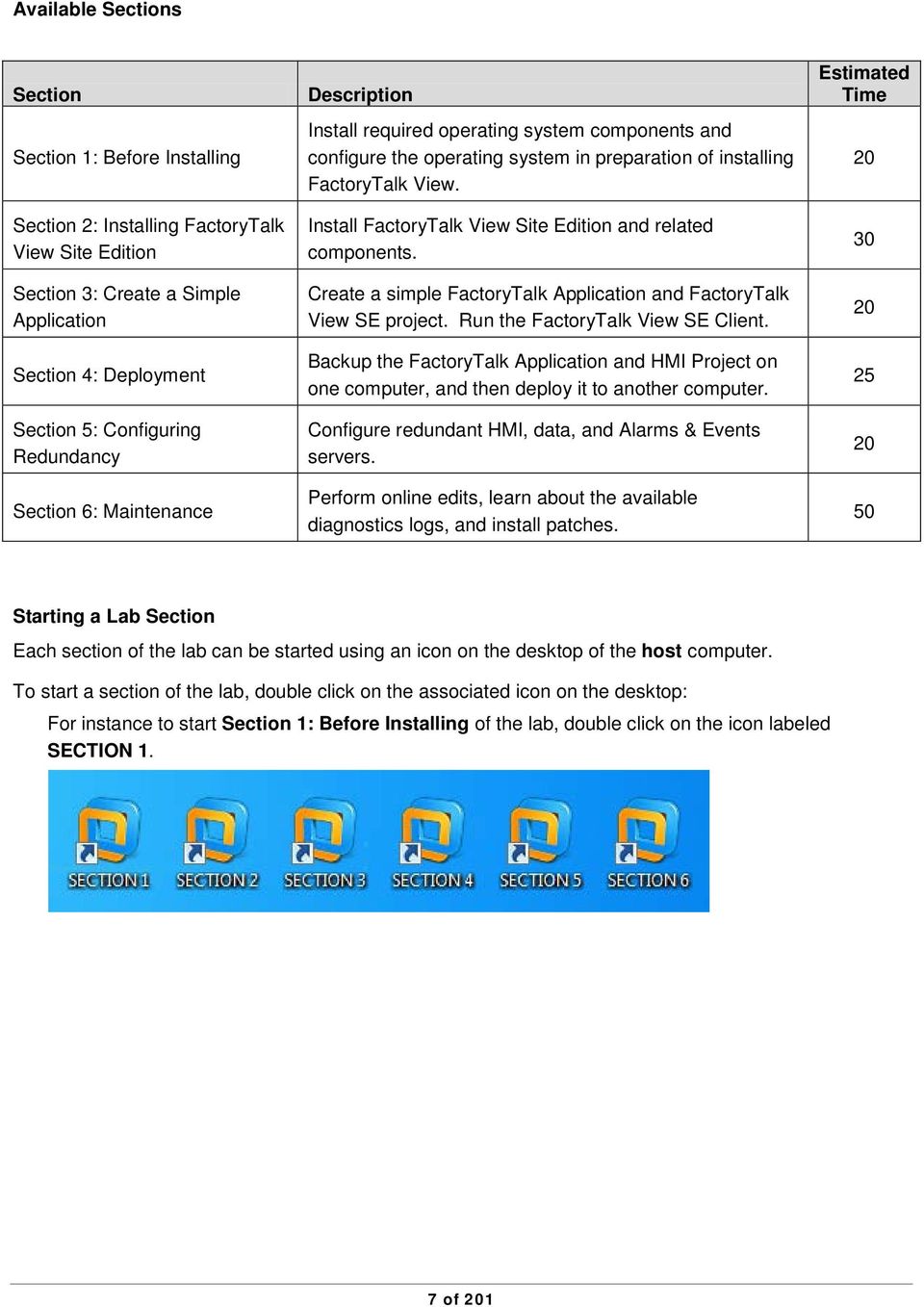
7 Available Sections Section Section 1: Before Installing Section 2: Installing FactoryTalk View Site Edition Section 3: Create a Simple Application Section 4: Deployment Section 5: Configuring Redundancy Section 6: Maintenance Description Install required operating system components and configure the operating system in preparation of installing FactoryTalk View. Install FactoryTalk View Site Edition and related components. Create a simple FactoryTalk Application and FactoryTalk View SE project. Run the FactoryTalk View SE Client. Backup the FactoryTalk Application and HMI Project on one computer, and then deploy it to another computer. Configure redundant HMI, data, and Alarms & Events servers. Perform online edits, learn about the available diagnostics logs, and install patches. Estimated Time Starting a Lab Section Each section of the lab can be started using an icon on the desktop of the host computer. To start a section of the lab, double click on the associated icon on the desktop: For instance to start Section 1: Before Installing of the lab, double click on the icon labeled SECTION 1. 7 of 201
8 Ending a Lab Section If you are continuing from one section to the next (for example from Section 1 to Section 2) without skipping a Section, there is no need to end the section, just follow the End of Section steps and continue on to the next section. If skipping one or more sections (for example completing Section 1, skipping Sections 2 and 3, and then executing Section 4, you will need to end the lab and use the shortcuts on the desktop to start the desired section. To end the current session, reduce the VMWare Workstation window and double-click on the shortcut for the next lab section. This will terminate the current lab section and start the new one. Premise You are a Project Engineer working for an SI who has a customer that is installing a new Redundant HMI System in their plant. The customer has acquired the required hardware and software for the project, including two server class computers. Both servers have been shipped to your office for initial setup, but one server will be used as a development server and the other will be configured as the primary server for the production system. What you will accomplish in this lab You will gain a thorough understanding of installation, configuration, and maintenance of a FactoryTalk View Site Edition system. Lab Architecture There are 2 VMWare Workstation sessions used in this lab. These VMWare Workstation sessions are intended to represent a networked computing environment in a manufacturing application. As stated in the premise, the two virtual machines will play different roles throughout the lab. Initially Server 1 will be used as a base OS system ready for installation and configuration. Server 2 will be used as a development machine. Eventually they will be joined together into a single system with redundancy. 8 of 201

9 The following are the roles each server will play throughout this lab: Section 1 SERVER01 Base OS image for the Primary Server. SERVER02 Not used. Section 2 SERVER01 Base OS image for the Primary Server. SERVER02 Not used. Section 3 SERVER01 Primary Server. SERVER02 Not used. Section 4 SERVER01 Primary Server in production environment SERVER02 Development Server user for developing project in the development lab. Section 5 SERVER01 Primary Server. SERVER02 Secondary Server. Section 6 SERVER01 Primary Server. SERVER02 Secondary Server. 9 of 201

10 Throughout this lab you will be working to setup and configure the servers so that by the end of the lab you will have created the following architecture: Tools & prerequisites Software programs required The following software is required to complete in this lab. 10 of 201

11 VMware Workstation v8.0.2 (Images using W2K8 R2 x64) FactoryTalk Diagnostics v2.50 (CPR9 SR 5) FactoryTalk Services Platform v2.40 (CPR 9 SR 4) FactoryTalk Activation Manager v3.40 (CPR 9 SR 4) FactoryTalk Alarms and Events v (CPR 9 SR 4) FactoryTalk View Site Edition v (CPR 9 SR 4) RSLinx Enterprise v (CPR 9 SR 4) RSLinx Classic v (CPR 9 SR 5) RSLogix 5000 v (CPR 9 SR 5) SoftLogix v Microsoft Office 2010 Hardware devices required The following hardware is required to for this lab. (none) Files required The following files are required to complete this lab. VMWare Workstation Image Files for SERVER01 (x64), and SERVER02 (x64) InstantFizz.acd project file for RSLogix5000 InstantFizz project files for FactoryTalk View SE FactoryTalk View SE v 6.1 (CPR 9 SR 4) Install CD (or files) Patch File Validation Utility and related PFV files. FactoryTalk View 6.1 Patch Rollup (Dated 2-APR-2012) Log Reader Utility v Using VMware Switching Between Images Since we are using two images in this lab you will occasionally be instructed to switch to one image or the other. To switch between images: 1. Move the mouse to the top of the screen. 2. In the VMWare Workstation toolbar, click the blue arrows to move between the computer images. 3. Choose the desired image using the Right or Left arrows on the VMWare Workstation menu bar. Full Screen Mode OR This lab is designed to run in full screen mode on a monitor with a resolution of 1280 x If for 11 of 201

12 some reason VMware Workstation is not running in full screen mode, use the following steps to return it to full screen mode: 1. Use the mouse to move the cursor over the VMware Workstation window and click inside of the VMWare Workstation image that is running. 2. Press [Ctrl] + [Alt] + [Enter] on the keyboard. Logging In The individual VMWare Workstation sessions you will be working in have been configured to automatically log in. If for some reason you are required to manually log into an individual VMWare Workstation session, the User Name is Labuser and the password is rockwell. To login: 1. Click on the Labuser icon 2. Enter rockwell as the password and press Enter key. User name is Labuser and password is rockwell. 12 of 201

13 Section 1: Before Installing You have been assigned to install the required software and complete the initial configuration for the Primary Production Server. At this point you have already installed the Windows 2008 Server Standard Edition operating system and are ready to install the required software on the server but first you must install prerequisites and configure the operating system to prepare it for installation. About this section In this section of the lab you will: Prepare the computer for the installation of FactoryTalk View SE and related software. Install Internet Information Services (IIS) Optimize Network Interface Card settings for use with FactoryTalk View SE Optimize DCOM Settings for use with FactoryTalk View SE Optimize Internet Explorer Settings for use with FactoryTalk View SE Disable Data Execution Prevention (DEP) The following are the roles each server will play in this section: Server 1 Base OS image for the Primary Server. Server 2 Not used. This section takes approximately 20 minutes to complete. Use SERVER01 (x64) Use the SERVER01 (x64) VMWare Workstation image for the Before Installing steps below. To go to the SERVER01 (x64) image: 1. Move the mouse to the top of the screen. 2. In the VMWare Workstation toolbar, click the blue arrows to move between the computer images. 3. Choose SERVER01 (x64) from the VMWare Workstation menu. 13 of 201

14 Manually configure Network Interface Cards (NICs) and switch ports The Network Interface Card (NIC) is the hardware in a computer that lets it connect to other devices on the network. A switch manages traffic on the Ethernet network. Some switches allow ports (physical connections) to be configured individually. The link speed and duplex settings for network connections can be auto-negotiated, which means that the device determines the best way to communicate, or manually configured, which means that the settings are hard coded. Many Network Interface Cards also offer a power-saving feature that turns off the network card if it is not being used. This setting sometimes interferes with the ability of the computer to receive data, causing errors such as wireframes, stale data and other failures. To prevent these errors, disable power saving for your computer s network interface cards. For details, see To disable power saving for the NIC. For FactoryTalk View SE applications, it is recommended that you use managed switches across the control system network and that you manually configure the same link speed and duplex setting for all network connections into the managed switches. It is also recommended that you manually configure the managed switch ports, using the same settings. To learn how to configure switch ports, see the product documentation provided with the switches you are using. For an overview of best practices for connecting devices over a network, see the Ethernet Design Considerations for Control System Networks document in the Rockwell Automation Literature Library. (Search for Publication Number ENET-SO001A-EN-E.) To set up the NIC link speed and duplex and disable power saving on Windows 2008 The steps for configuring a NIC vary slightly for some of the Windows operating systems. See the FactoryTalk View SE Installation guide for steps to complete this process on other operating systems. 1. Click Start, then click Control Panel. 14 of 201

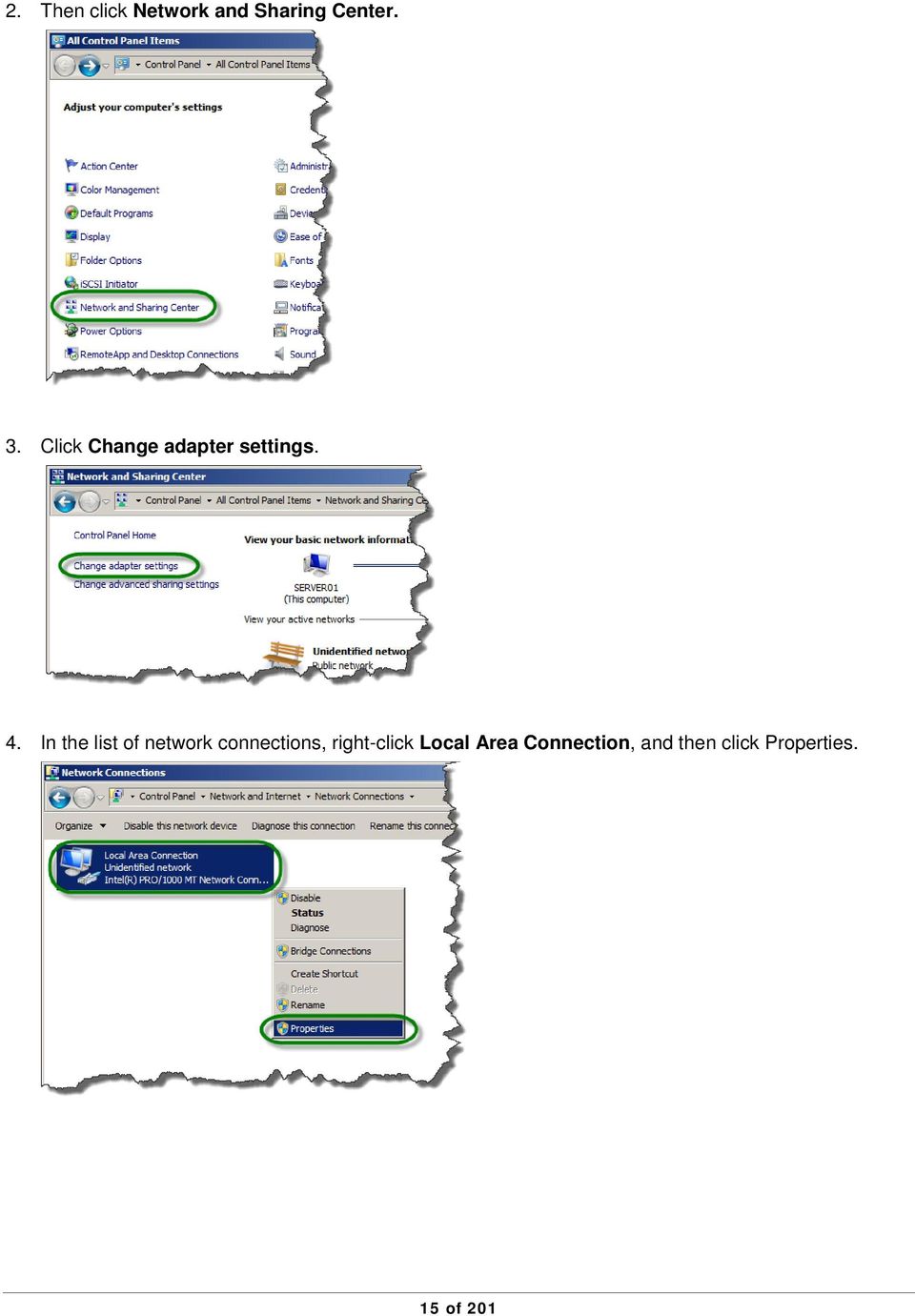
15 2. Then click Network and Sharing Center. 3. Click Change adapter settings. 4. In the list of network connections, right-click Local Area Connection, and then click Properties. 15 of 201
16 5. On the Networking tab, click the Configure button. 6. In the Properties dialog box for the device, click the Advanced tab. 16 of 201

17 7. In the list of properties for the device, click Link Speed & Duplex. 8. Select the value from the dropdown list that matches the Speed and Duplex that are configured for the associated port in the switch. For the lab, choose 1000 Mbps Full Duplex. 9. In the Properties dialog box for the device, click the Power Management tab. 10. Clear the Allow the computer to turn off this device to save power check box. 17 of 201

18 11. Click OK. 12. Close ( ) the Network Connections window. 13. Back in the Network and Sharing Center page, click on the Control Panel cookie crumb in the address bar. 18 of 201

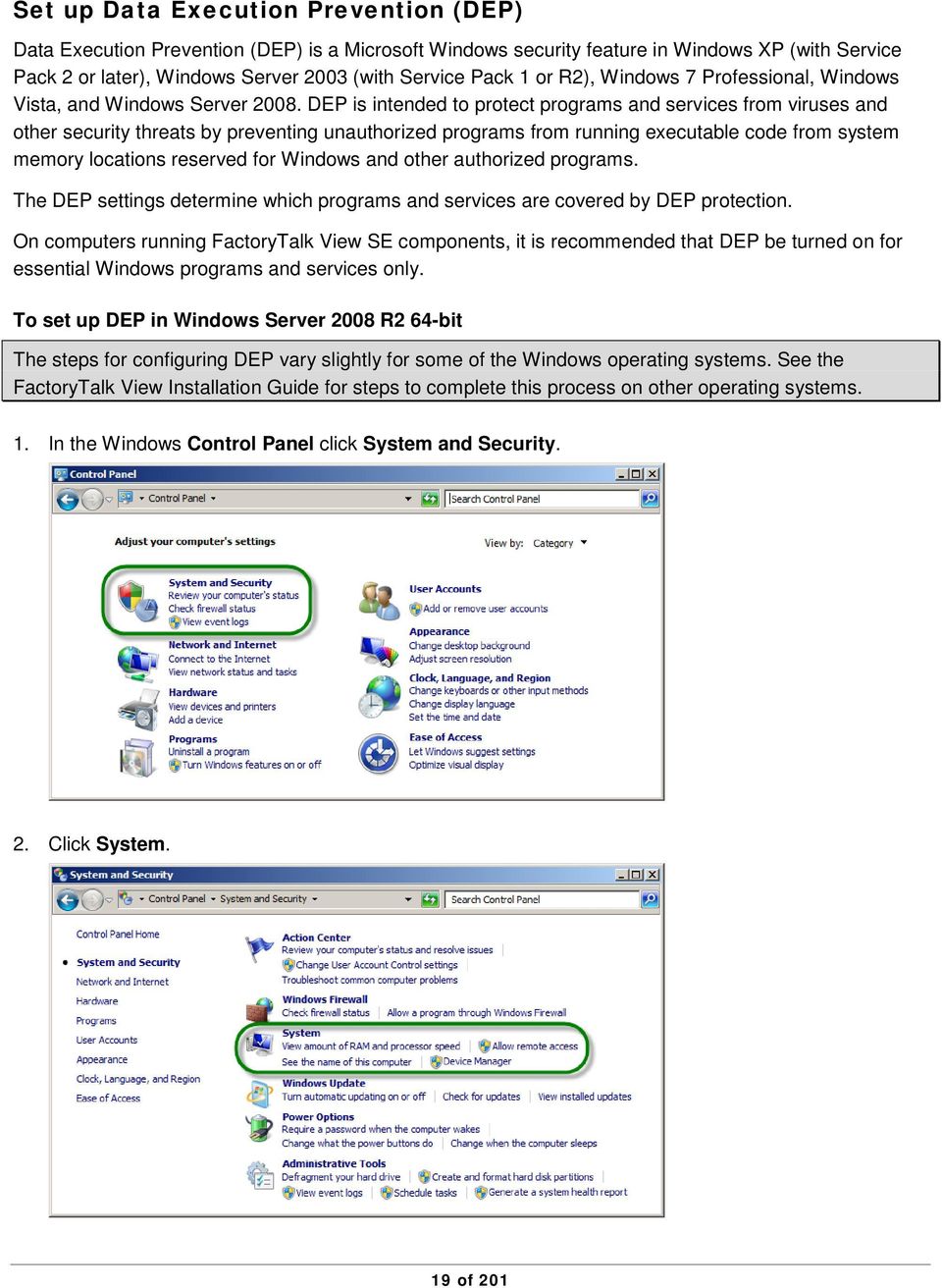
19 Set up Data Execution Prevention (DEP) Data Execution Prevention (DEP) is a Microsoft Windows security feature in Windows XP (with Service Pack 2 or later), Windows Server 2003 (with Service Pack 1 or R2), Windows 7 Professional, Windows Vista, and Windows Server DEP is intended to protect programs and services from viruses and other security threats by preventing unauthorized programs from running executable code from system memory locations reserved for Windows and other authorized programs. The DEP settings determine which programs and services are covered by DEP protection. On computers running FactoryTalk View SE components, it is recommended that DEP be turned on for essential Windows programs and services only. To set up DEP in Windows Server 2008 R2 64-bit The steps for configuring DEP vary slightly for some of the Windows operating systems. See the FactoryTalk View Installation Guide for steps to complete this process on other operating systems. 1. In the Windows Control Panel click System and Security. 2. Click System. 19 of 201
20 3. In the list of tasks on the left, click Advanced system settings. 4. In the System Properties dialog box, if not already selected, click the Advanced tab. 5. On the Advanced tab, under Performance, click Settings. 6. In the Performance Options dialog box, click the Data Execution Prevention tab. 20 of 201
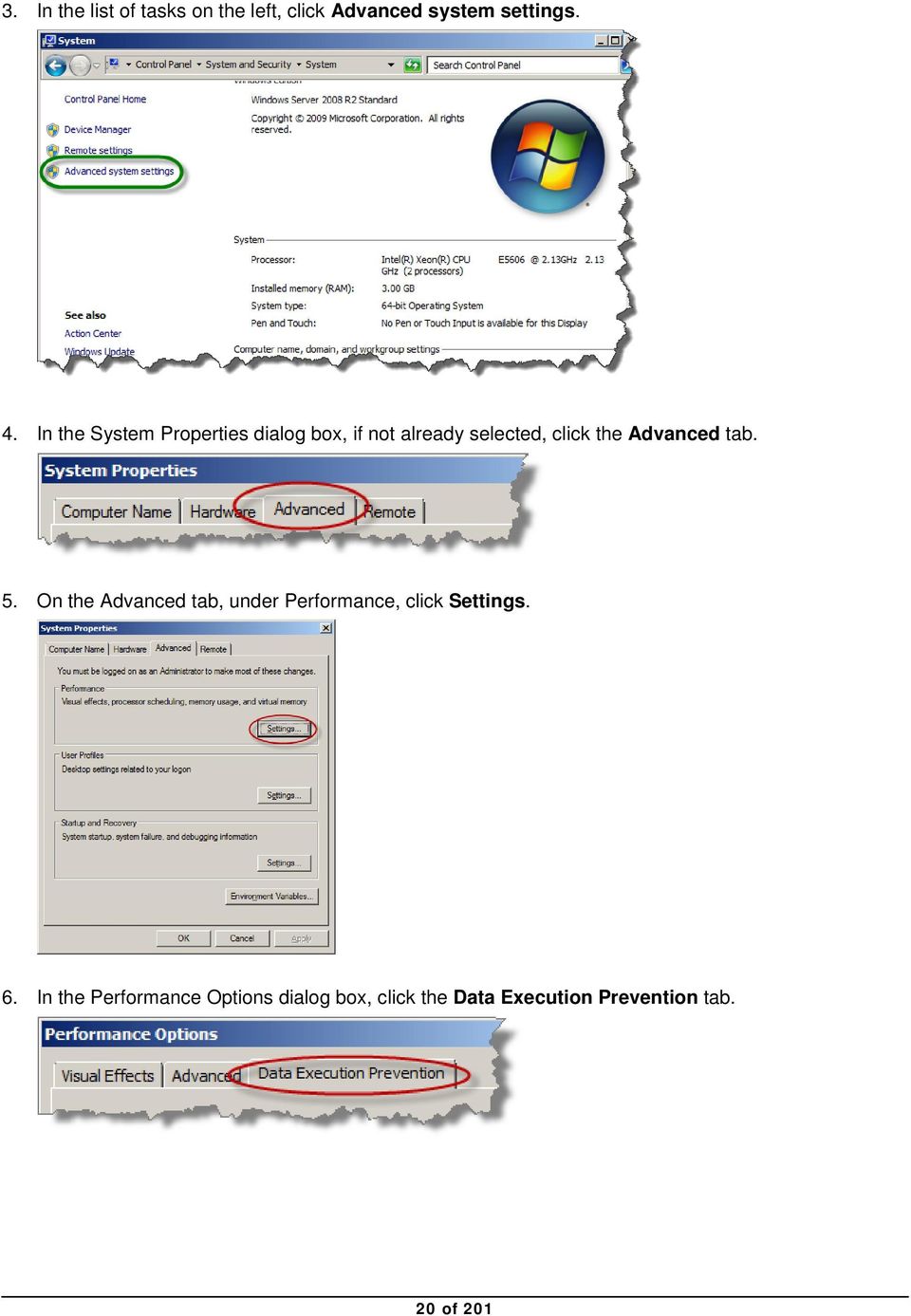
21 7. Select the option Turn on DEP for essential Windows programs and services only, and then click OK. 8. Click OK. Changes to DEP will only take effect after the computer is rebooted. Do not reboot now, you will reboot at the end of Section In the System Properties window, click OK. 21 of 201
22 10. Close ( ) the Control Panel window. 22 of 201
23 Remove unnecessary DCOM networking protocols To ensure that DCOM communications function most efficiently, remove all protocols other than TCP/IP. To remove unnecessary DCOM protocols in Windows Server 2008 R2 64-bit The steps for removing DCOM protocols vary slightly for some of the Windows operating systems. See the FactoryTalk View SE Installation guide for steps to complete this process on other operating systems. 1. On the desktop, click Start, and then click Run. 2. In the Run dialog box, type dcomcnfg, and then click OK. 3. In the Component Services tool, expand Component Services, open the Computers folder, right-click My Computer, and then click Properties. 4. Click the Default Protocols tab. 23 of 201
24 5. If the DCOM Protocols list displays protocols in addition to TCP/IP, remove those unnecessary protocols. For example, if it existed you would remove the protocol Connection-oriented SPX. In most cases it is not necessary to remove any protocols, because on a fresh install of Windows Server 2008, the only protocol installed is Connection-oriented TCP/IP. Although this is the default it is always a good idea to verify the settings before proceeding with the install of FactoryTalk Service Platform and FactoryTalk View SE. If other protocols do exist, you may want to contact the department and/or person who installed the operating system and ask why the additional protocols are there, and discuss the consequences of removing those protocols. 6. Click OK. 7. Close ( ) the Component Services window. 24 of 201
25 Set up Internet Explorer for optimal access to components FactoryTalk View stores cached copies of graphic displays and other HMI server components in the Temporary Internet Files folder, so that the components load faster when application clients request them. To optimize access to HMI server components, certain Internet Explorer settings are recommended for all application client and server computers. FactoryTalk View SE supports Internet Explorer 6.0, 7.0 and 8.0. Turn off the Work Offline setting To ensure that Internet Explorer detects updates to cached HMI server components, and that FactoryTalk View SE Clients can load components that aren t already in the cache, make sure the Work Offline setting is turned off. 1. Open Internet Explorer. Click Start Internet Explorer. (IE8 - Click Ask me later) 2. In Internet Explorer, click on the Tools menu, if there is a check mark beside Work Offline, clear the check mark by clicking on Work Offline. 25 of 201
26 Check for newer versions with every visit to a page To ensure that FactoryTalk View SE Clients can always download and use the latest versions of HMI server components, set Internet Explorer to check for newer versions of stored pages with every visit to a page. To check for newer versions in Internet Explorer 7 or later 1. In Internet Explorer, on the Tools menu, click Internet Options. 2. In the General tab, under Browsing history, click Settings. 3. In the Temporary Internet Files and History Settings dialog box, select Every time I visit the webpage. By checking Every time I visit the webpage, you ensure that the FactoryTalk View SE clients will always get the latest version of graphic (*.gfx) and other files that are downloaded from the server. 26 of 201
27 Specifying enough usable disk space To ensure that FactoryTalk View Studio can open previous versions of HMI projects, and that FactoryTalk View SE Clients can open HMI server components, set the amount of usable disk space to twice the size of the HMI project folder. If the application contains multiple HMI servers, add up the size of the HMI Projects folder from each server, and multiply that number by two. How Do I Find the Size (in MB) of the HMI Project s folder? HMI project files are stored in the following location, on computers hosting HMI servers in a network application: For Windows 7 Professional, Windows Vista and Windows Server 2008:...\Users\Public\Documents\RSView Enterprise\SE\HMI Projects For Windows XP and Windows Server 2003:...\Documents and Settings\All Users\Shared Documents\RSView Enterprise\SE\HMI Projects The folders in these locations have the same name as the names of the corresponding HMI servers in FactoryTalk View Studio. Note: When installing on an HMI Server for the first time, the HMI Projects folder will not exist until FactoryTalk View SE Is installed. In that case, either calculate the value based on the size of the project(s) that will be imported/restored onto the server, or estimate the value and update it later as necessary. To find the size: On each computer hosting an HMI Server: 1. Open Windows Explorer. 2. Navigate to the project folder specified above. 3. Right click on the HMI Projects folder and select Properies from the context menu. If the system contains multiple HMI Servers, add the size of the HMI Projects folder from each server, and then double it. If using redundancy, then only get the size of the HMI Projects folder from each of the Primary Servers. 27 of 201
28 To specify enough disk space with Internet Explorer 7 or later 1. In the Temporary Internet Files and History Settings dialog box, under Disk space to use, type a number that is at least twice the size, in MB, of the HMI project s folder. For this lab use the value of at least 136MB. 2. Click OK in the Temporary Internet Files and History Settings window. 3. Click OK again in the Internet Options window. 4. Close Internet Explorer 28 of 201
29 Remove Internet Explorer Enhanced Security Configuration Internet Explorer Enhanced Security Configuration (ESC) is a group of default security settings for Windows Server 2003 and Windows Server 2008, which protects servers by limiting the ways users can browse Internet and Intranet Web sites on the computer. If installed on a computer with FactoryTalk View SE software components, the Internet Explorer Enhanced Security Configuration can interfere with the ability of FactoryTalk View SE Clients to connect to application servers. To avoid unexpected behavior, it is recommended that you remove the Enhanced Security Configuration from Windows Server 2008 computers running FactoryTalk View SE. To remove Internet Explorer Enhanced Security Configuration in Windows Server 2008 R2 64-bit 1. Click Start, point to Administrative Tools and then click Server Manager. 29 of 201
30 2. In the Server Manager window, under Security Information, click Configure IE ESC. 3. In the Internet Explorer Enhanced Security Configuration dialog, click Off to turn off IE Enhanced Security for Administrators and for users. 4. Click OK. 30 of 201
31 Install Microsoft Internet Information Services When you install FactoryTalk View SE, the program detects whether Microsoft Internet Information Services (IIS) is installed on the computer. You must install IIS for FactoryTalk View SE network applications: On all computers that will run FactoryTalk View SE Servers (also called HMI servers). On engineering workstations that will run all the FactoryTalk View SE software components. If IIS is not installed, you are notified and asked to install the software. However, you must cancel the FactoryTalk View SE Setup program and then restart it after you have installed IIS, otherwise you will need to repair the FactoryTalk View SE installation to make FactoryTalk View SE work with IIS. Failing to do so can prevent clients from being able to communicate with servers. You can use Windows Vista only to run the FactoryTalk View SE Client, develop stand-alone or distributed applications on a single computer, or to run FactoryTalk View Studio and connect to remote HMI servers. You cannot use Windows Vista to host HMI servers that other clients connect to. To host HMI servers, use Windows 7 Professional, Windows XP, Windows Server 2003, or Windows Server 2008 instead. You do not have to install IIS if you plan to develop and run only FactoryTalk View SE local applications. To install IIS on Windows Server Return to the Server Manager window. If Server Manager is not already open, click Start, point to Administrative Tools and then click Server Manager. 31 of 201
32 2. In the Server Manager window, click Roles in the explorer pane on the left. Then under Roles Summary, click Add Roles. Use the Add Roles Wizard to add the Web Server (IIS) role. 3. In the Add Roles Wizard, click Next. 32 of 201
33 4. Check Web Server (IIS). To install the Web Server, some additional Windows features might need to be installed. If you see this pop-up dialog, click Add Required Features. 5. Click Next. 6. In the Introduction to Web Server (IIS) window, click Next. 33 of 201
34 7. In the Add Role Services dialog box, expand Common HTTP Features, and then check WebDav Publishing. 8. In the Add Role Services dialog box, expand Application Development, and then check ASP and ISAPI Extensions. If prompted to add additional services, click Add Required Role Services for each service. 34 of 201
35 9. Under Security, check Windows Authentication and URL Authorization. 10. Expand Management Tools and then expand IIS 6 Management Compatibility. 11. Under IIS 6 Management Compatibility, select IIS 6 Metabase Compatibility. 12. Click Next. 35 of 201
36 13. In the Confirm Installation Selections window, click Install. 14. The Add Roles Wizard will now install IIS. Please wait for the installation to finish, it may take a few minutes. 36 of 201
37 15. When the installation is complete it will display a summary of the installation result. Click Close. 16. Close ( ) the Server Manager window. About uninstalling IIS If for some reason you need to uninstall and then reinstall Microsoft Internet Information Services, after reinstalling you need to re-create the virtual directories in IIS. To do this, run the RSViewWebManager program installed with FactoryTalk View SE. To recreate the virtual directories in IIS: Windows 64-bit: In Windows Explorer, open c:\program files (x86)\rockwell Software\RSView Enterprise, and then double-click RSViewWebManager.exe. 37 of 201
38 Establish network connections (Informational Only) When you know which computers your network application will use, and you have provided names for them, confirm that the computers are connected to the network before you install any FactoryTalk View SE software. A network connection is required to install FactoryTalk View SE, even if you plan to develop and run a local application. To test the connection to the Network Directory computer 1. On the desktop click Start, and then click Run. 2. In the Open list box, type ping [ComputerName], where ComputerName is the name of the FactoryTalk Network Directory server computer, or the name of another computer on the network, such as the domain controller, and press the Enter key. 3. If the computer you are pinging from is connected, you should receive a reply from the IP Address of the server computer. Disable or uninstall third-party firewalls (Informational Only) FactoryTalk View SE is compatible only with the built-in Windows firewall and should not be used with third-party firewalls because this can cause unexpected results. Before installing FactoryTalk View SE, disable or uninstall all third-party firewalls on the computer. For details, see the documentation supplied with your firewall product. 38 of 201
39 End of Section This is the end of Section 1. If you are continuing on to Section 2, you would need to reboot SERVER01 (x64) before continuing. For this lab it will be easier to do the following to continue: To End the Current Section To end the current session, reduce the VMWare Workstation window and double-click on the shortcut for the next lab section. This will terminate the current lab section and start the new one. If you are skipping Section 2, you can just start any of the sessions using the icons on the desktop. IMPORTANT: You must wait for the SERVER01 and/or SERVER02 virtual computers to complete with all of the system process start up proceedures before continuing with the lab sections. 39 of 201
40 Section 2: Installing FactoryTalk View Site Edition You have been assigned to install the required software and complete the initial configuration for the Primary Production Server. You have now installed the Windows 2008 Server Standard Edition operating system and the prerequisites, and are ready to install the required software on the server. About this section In this section of the lab you will: Install FactoryTalk Services Platform Install FactoryTalk View SE Install FactoryTalk Activation Install RSLinx Enterprise The following are the roles each server will play in this section: Server 1 Base OS image for the Primary Server. Server 2 Not used. This section takes approximately 30 minutes to complete. About Installing FactoryTalk View SE and related Software The FactoryTalk View Site Edition DVD provides all the software you need to develop and run complex distributed systems involving multiple computers on a network, or local applications confined to a single computer. This section describes how to install FactoryTalk View Site Edition and supporting software, such as the FactoryTalk Services Platform and RSLinx Enterprise for the first time. To learn about upgrading an existing version of RSView Enterprise or FactoryTalk View SE, get the FactoryTalk View Installation Guide and look at Chapter 7, Upgrading FactoryTalk View Site Edition. 40 of 201
41 About the Installation Assistant (Informational Only) The Installation Assistant is a Help file that you can run alongside the FactoryTalk View SE installation program, to get additional help with installing FactoryTalk View SE. The Installation Assistant guides you through the installation process by asking questions about the type of application you plan to run, and whether you are installing the software for the first time. As a result of your answers, the Installation Assistant provides information about which software programs to install and in what order. To open the Installation Assistant 1. If necessary, close all open Windows programs, and then place the FactoryTalk View Site Edition DVD in the computer s DVD drive. 2. If the DVD does not start automatically, run D:\setup.exe, where D is the drive containing the DVD. 3. Click Open Installation Instructions (the first option). 4. Click Open FactoryTalk View Installation Assistant. FactoryTalk View Site Edition Installation Guide (Informational Only) The FactoryTalk View Site Edition Installation Guide is a manual that provides instructions on how to install FactoryTalk View SE and related components. It also includes instructions for deploying applications and upgrading existing system. Much of the content for this lab was based on the information in the Installation Guide. The Installation Guide is available in PDF format, from the Installation Instructions page on the FactoryTalk View Site Edition DVD. To open the online manual, first ensure that Adobe Reader is installed on the computer, and then open FactoryTalk View Installation Guide. Ensure that the logged-on user is a Windows administrator (Informational Only) As part of the installation process, FactoryTalk View SE creates program folders and modifies registry entries. For this part of the process to succeed, the user installing the software must have administrative rights in Windows, on the computer where the software is being installed. For example, the Windows domain Administrator account has these rights and will be able to install FactoryTalk View SE. You need administrative rights to Install FactoryTalk View. You do not need administrative rights to run FactoryTalk View. 41 of 201
42 Check for earlier versions of FactoryTalk View Site Edition (Informational Only) Before you can install FactoryTalk View SE or any supporting software, you must remove earlier versions of the software that are installed on the computer. Even if you are installing the software for the first time, check to make sure that there are no earlier versions of FactoryTalk View or any supporting software on the computer. In the FactoryTalk View Site Edition DVD, when you select Uninstall FactoryTalk View Site Edition, the uninstall program automatically detects software that must be removed. Use SERVER01 (x64) Use the SERVER01 (x64) VMWare Workstation image for the steps below. To go to the SERVER01 (x64) image: 1. Move the mouse to the top of the screen. 2. In the VMWare Workstation toolbar, click the blue arrows to move between the computer images. 3. Choose SERVER01 (x64) from the VMWare Workstation menu. 42 of 201
43 Install the FactoryTalk Services Platform The FactoryTalk Services Platform (formerly known as the FactoryTalk Automation Platform) provides essential services to all FactoryTalk products running on a computer. You must install the FactoryTalk Services Platform first, before you can install FactoryTalk View SE or any other FactoryTalk product on the computer. You must install the FactoryTalk Services Platform first, whether you install all or only some of the FactoryTalk View SE software on a computer. For details, see page 43 of the FactoryTalk View Installation Guide. To install the FactoryTalk Services Platform 1. Double-click on the Lab Files shortcut on the desktop and then navigate to the Installs Rockwell Software > FTView_SE_6.10 > folder (or navigate to C:\Lab Files\Installs Rockwell Software\FTView_SE_6.10\ in Windows Explorer.) 43 of 201
44 2. Right click on the Setup.exe file and choose Run as administrator (the second option). 3. Click Install FactoryTalk View Site Edition (the second option). When you point at an option on the FactoryTalk View Site Edition DVD, a description of the option is displayed on the right side of the page. 4. Click step 2, Install FactoryTalk Services Platform. 44 of 201
45 Even if you are using third-party data communications software (Kepware, for example), you must still install the FactoryTalk Services Platform on the computer running the data server. If Microsoft.NET Framework 3.5 SP1 is not installed on the computer,.net setup program will run automatically before FactoryTalk Services Platform. Note: If prompted with a dialog box to stop running applications that are using files that need to be updated, select Automatically, and then click OK In a typical installation (on a fresh install of the operating system) you would not see this dialog box because there would not be other Rockwell software :components already installed. In this case, we do have some additional software installed for the lab that was pre-installed on the system. 45 of 201
46 5. In the Welcome screen click Next. 6. Select I accept the terms in the license agreement and click Next. 7. Select the option for a Standard install option and then click Next. 46 of 201
47 8. Click Install. Note: If prompted to update services, click OK to continue. In a typical installation (on a fresh install of the operating system) you would not see this dialog box because there would not be other Rockwell software components already installed. In this case, we do have some additional software installed for the lab that was pre-installed on the system. 47 of 201
48 9. Setup will now install and configure the FactoryTalk Services Platform. 10. When setup has finish installing and configuring the FactoryTalk Services Platform, click Finish. 48 of 201
49 Install FactoryTalk View Site Edition 1. Click step 3, Install SQL Express Prerequisites. When you put mouse focus on Step 3, the message shown here describes what SQL prerequisites are required. In this case the operating system already has the necessary requirements. 2. Click step 4, Install FactoryTalk View Site Edition. 49 of 201
50 3. To continue installing FactoryTalk View SE, click Yes in the warning message box that tells about stopping Rockwell Automation software processes. The FactoryTalk View Site Edition installation wizard starts running. 4. In the Welcome window, click Next. 50 of 201
51 5. Select I Accept the terms in the License Agreement, and then click Next. 6. In the Customer Information window, type a user and organization name, type the product s Serial Number For this lab enter Windows User as the User Name, Lab User as the Organization, and as the serial number. Click Next to continue. If you are installing FactoryTalk View for the first time, you will find the Serial Number on the Activation Certificate enclosed with the FactoryTalk View Site Edition DVD. 51 of 201
52 7. In the Setup Type window, select Complete, and then click Next. Deciding which FactoryTalk View SE components to install The FactoryTalk View Site Edition setup program offers two options for installing the FactoryTalk View SE software. You can select: Complete, to install all FactoryTalk View SE components on the computer. Selected components, to select which FactoryTalk View SE components will be installed. The option you choose depends on the type of FactoryTalk View application or software component you plan to run on the computer and on the design of your control system. When to install all FactoryTalk View SE components You must install all of the FactoryTalk View SE software on a computer where you plan to develop, test, and run a FactoryTalk View local application (also called SE Station). OPC data servers are the only components that can run on separate computers in a local application. You might also install all the software on a computer that will function as an engineering workstation for a network application. Later, when you deploy the application, you can select which components are appropriate to install on each production computer. You may also want to choose the Complete install for any HMI Server, even if you don t plan on using the FactoryTalk View Studio or Client components. Having the Studio and Client components installed may be useful for troubleshooting and also allows you to modify screens and/or the tag database when in a pinch. When to install selected FactoryTalk View SE components Installing selected FactoryTalk View SE components is an efficient way to deploy a network application for production. You decide what s necessary for client and server computers, and then install only that software. For example, to deploy a simple network application consisting of one HMI server, one Rockwell Automation Device Server (RSLinx Enterprise), and one HMI run-time client, you only need to install the FactoryTalk View SE Client software on the client computer. 52 of 201
53 8. In the Destination Drive window, accept the default destination, and then click Next. 9. Click Install. NOTE: FactoryTalk View SE and RSLinx Enterprise both install FactoryTalk Alarms and Events. Even if you don t plan to use FactoryTalk Alarms and Events services, do not uninstall the FactoryTalk Alarms and Events software, or you will not be able to run FactoryTalk View SE. 53 of 201
54 10. The install wizard will now install SQL Server 2008 Express. This is required for the FactoryTalk View SE 6.1 installation. Enter password Rockwell1 and press OK. Various windows will appear and disappear during the install. 54 of 201
55 11. The install wizard will now install FactoryTalk View SE. WARNING: If during the installation you are presented with a window indicating that IIS is not installed, click Cancel and then quit the installation. This is a critical issue and will likely prevent essential components of FactoryTalk View SE from being installed property. Please verify that you have installed IIS and all of the required components. The following IIS components are required: ASP ISAPI Extensions Windows Authentication URL Authorization IIS 6 Metabase Compatibility Also verify that Internet Explorer is NOT offline. 12. After the FactoryTalk View SE software finishes installing, the Wizard Completed window opens. If IIS is installed correctly, you should be able to open the HMI server status page after the FactoryTalk View SE server components are installed. Try localhost first, then from another computer. To test this, open Internet Explorer, in the address field, type or then the Enter key. 55 of 201
56 13. Select all of the following options, and then click Finish: Install FactoryTalk Activation Select this check box, if you want to set up FactoryTalk Activation Manager on the computer. After you click Finish, the FactoryTalk Activation software will be installed. The computer will need to be restarted. If you meant to install FactoryTalk Activation, but you cleared the check box or selected the wrong option, you must install the software manually before activating the software. Launch Release Notes Select this check box if you want the FactoryTalk View Site Edition Release Notes to open after you click Finish. Specify FactoryTalk Directory server location Select this check box if you want to specify the location of FactoryTalk Network Directory on the computer. After you click Finish, the FactoryTalk Directory Server Location Utility will run. For information about using the utility, see About specifying the FactoryTalk Network Directory server, next. 56 of 201
57 Specifying the Network Directory server location Use the FactoryTalk Directory Server Location Utility to specify the computer that will host the FactoryTalk Network Directory, and to indicate the location of the Network Directory server, on application client and server computers. 1. Verify that the FactoryTalk Directory Server Location Utility shows localhost as the directory server. 2. Click OK. Release Notes 1. Review and then close ( ) the Release Notes. Install FactoryTalk Activation For continuous use of FactoryTalk View Site Edition and other Rockwell Software products, computers running the software must have access to activation files. To manage and provide activations for FactoryTalk View Site Edition software components, use the FactoryTalk Activation software installed with FactoryTalk View. About FactoryTalk Activation FactoryTalk Activation provides a secure, software-based system for activating Rockwell Software products and managing software activation files. With FactoryTalk Activation, there is no need for a physical master disk or any physical media; instead, activation files are generated and distributed electronically. 57 of 201
58 What happens if FactoryTalk View SE is not activated? If the FactoryTalk View SE components you have installed cannot be activated, for example, because the activation server is unavailable or because borrowed activations have expired, then the software will continue to run for up to seven days. The seven-day grace period allows time to correct the problem with acquiring activations, without disrupting critical applications. If activation is restored within seven days, normal operations will resume. If activation is not restored, the grace period will expire. After the grace period expires, if you restart FactoryTalk View SE and activation remains unavailable, the software will run for two hours in demo mode. With a FactoryTalk View SE network application running in demo mode, you can: create or load up to five HMI servers locally, in FactoryTalk View Studio. create or load up to five graphic displays per HMI server. run a local FactoryTalk View SE Client for up to two hours. In demo mode, remote SE Clients cannot connect to a FactoryTalk View SE application. import from Symbol Factory only the first graphic in each category. Install the activation software 1. Click Continue to install the prerequisites for the FactoryTalk Activation Manager. 58 of 201
59 2. Click Yes to install the HASP USB dongle drivers. Although not required, we recommend that you install the HASP USB dongle drivers. Although the HASP USB dongle drivers are optional, installing them can facilitate development, maintenance, and troubleshooting of the FactoryTalk View applications. Many of our engineers, system integrators, and partners use the HASP USB dongles for convenience and portability of activations. If you ever have an engineer or technician on site who needs to run FactoryTalk View Studio of the FactoryTalk View Client on the server, they can use their USB dongle to license the product while they are on site. 3. Click Next. 4. Select I accept the license agreement, and then click Install. 5. The setup wizard will now install the HASP USB dongle drivers. 59 of 201
60 6. When you are notified that the driver installed successfully, click Finish. 7. Wait for the installation wizard to initialize. 8. When the installation wizard has completed initialization and the Welcome screen is displayed, click Next. 60 of 201
61 9. Select I accept the terms of the license agreement and then click Next. 10. Click Install. 11. The install wizard will now install FactoryTalk Activation Manager. 61 of 201
62 12. When you are notified that the FactoryTalk Activation Manager setup completed successfully, click Finish. 13. You will be notified that you need to restart the computer to complete the installation of FactoryTalk View. Although you can restart now, we will be installing additional software so we will defer the restart until after all of the software is installed. Click No to defer the restart until after all of the software is installed. If you want to install RSLinx Enterprise or RSLinx Classic before restarting, you can wait to restart the computer; however, you must restart the computer before running FactoryTalk View SE. 62 of 201
63 Install RSLinx Enterprise The FactoryTalk View Site Edition DVD includes programs for installing RSLinx Enterprise and RSLinx Classic communications software. RSLinx Enterprise is a FactoryTalk Live Data server that can run on multiple platforms, from PanelView Plus dedicated terminals to desktop computers. For communications with Allen-Bradley local and remote devices particularly with Logix5000 controllers RSLinx Enterprise is the recommended data communications software for FactoryTalk View applications. However, RSLinx Enterprise does not allow you to create alias topic shortcuts, or to perform online tasks such as uploading and downloading RSLogix 5000 files. If you need these capabilities, use RSLinx Classic as your data communications server. When to use RSLinx Classic RSLinx Classic provides some functionality that RSLinx Enterprise does not. For example, install and use RSLinx Classic to serve data through DH+ (Data Highway +) networks, to support complex bridging and routing, and to support unsolicited messaging from a controller to RSLinx. RSLinx Classic also allows you to create alias topic shortcuts, and to perform online tasks such as uploading and downloading RSLogix 5000 files. To use an RSLinx Enterprise data server (also called a Rockwell Automation Device Server) in a local application, you must install and run the RSLinx Enterprise software on the same computer where FactoryTalk View SE is installed. To use RSLinx Enterprise data servers in a network application, you must install and run the RSLinx Enterprise software on each computer that will run a data server, and on engineering workstations that will run FactoryTalk View Studio. You must install RSLinx Enterprise on engineering workstations running FactoryTalk View Studio, even if the data servers in the application will run on remote computers. 63 of 201
64 To install RSLinx Enterprise 1. Click step 6. Install RSLinx Enterprise (optional). 2. In the Welcome window, click Next. 64 of 201
65 3. Select I accept the terms of the license agreement and then click Next. 4. Select Standard Feature Set Installation, and then click Next. 5. Click Install, to install RSLinx Enterprise. 65 of 201
66 6. Wait for the installation wizard to install RSLinx Enterprise. 7. If prompted to install any devices or devices drivers during the install, verify that the Publisher is Rockwell Automation, check Always trust software from Rockwell Automation, and then click Install. Be sure to verify that the Publisher is Rockwell Automation. 8. Click Finish to complete the install. 66 of 201
67 9. Review and then close ( ) the Release Notes. 67 of 201
68 End of Section This is the end of Section 2. If you are continuing on to Section 3, you would need to reboot SERVER01 (x64) before continuing because we didn t restart the computer after installing FactoryTalk View SE. For this lab it will be easier to do the following to continue: To End the Current Section To end the current session, reduce the VMWare Workstation window and double-click on the shortcut for the next lab section. This will terminate the current lab section and start the new one. If you are skipping Section 3, you can just start any of the sessions using the icons on the desktop. IMPORTANT: You must wait for the SERVER01 and/or SERVER02 virtual computers to complete with all of the system process start up proceedures before continuing with the lab sections. About Product Updates (Informational Only) Although we highly recommend that you install the latest product updates and patches after completing an install of the product, in order to demonstrate proper updating procedure of a redundant system, we will not be installing updates until later in this lab. After installing FactoryTalk View SE, search for Answers in the Rockwell Automation Knowledgebase that contain information about Patch TOCs for software products on the FactoryTalk View Site Edition DVD. A Patch TOC describes updates released for a particular product and version, and provides instructions for downloading and installing the updates on computers where the software is installed Each product you installed, including FactoryTalk View SE, FactoryTalk Services Platform, FactoryTalk Alarms and Events, RSLinx Enterprise, and RSLinx Classic, will have its own, version-specific Patch TOC. 68 of 201
69 To find Patch TOCs in the Rockwell Automation Knowledgebase (Informational Only) 1. In your Web browser s Address bar, type and then press <Enter>. 2. On the right side of the Rockwell Automation home page, under Resources, click Knowledgebase. 3. Under Online Support tab, click Knowledgebase link. 4. In the Knowledgebase Home page, click Log In in the upper right hand corner. 5. Enter your address and password NOTE: You are required to login in order to access the Knowledgebase. If you do not have an account, click the Create Account link and follow the instructions to create an account. 6. In the Search Answers box on the upper-left of the page, enter FactoryTalk View Patch TOC and then click the magnifying glass. 7. In the search results, look for Patch TOCs related to all the products you installed from the FactoryTalk View Site Edition DVD. If necessary, conduct a subsequent search for additional product names. Activating FactoryTalk View software (Informational Only) Typically this would be a good opportunity for you to activate your software and install licenses. Because the licenses for the products we are using in this lab have been pre-installed in the image, we will be skipping this step. For more information about activating the software see the FactoryTalk View SE Installation Guide. 69 of 201
70 Section 3: Create a Simple Application Now that you have the software installed and configured it is time to create your initial application structure. About this section In this section of the lab you will: Create a Network Application called InstantFizz Add areas called HMI_Area and Data_Area Add an HMI Server within HMI_Area called InstantFizz_HMI Add Process Faceplate Displays into your HMI Project Add a data server within Data_Area called RSLinx Enterprise Configure a Communications path called shortcut that will point to the SoftLogix controller Verify communications Create a display, add a numeric display object Test the display The following are the roles each server will play in this section: Server 1 Primary Server. Server 2 Not used. This section takes approximately 20 minutes to complete. 70 of 201
71 About Distributed Applications FactoryTalk View Site Edition (SE) can be used to develop and run applications that involve single or multiple users and servers and can be distributed over a network or can be local to a single computer. The two types of SE applications are explained below: 1. FactoryTalk View SE Local (Station) - A local application is similar to an RSView32 project; all application components and the FactoryTalk View SE client are located on a single computer. There is only one HMI server that is created for you in the root area when the application is created. You may use local applications for parts of the plant or process that are self-contained and are not related to other parts of the process. 2. FactoryTalk View SE Network (Distributed) - A network application can contain several servers, running on multiple computers on a network, with multiple client users connecting to the application simultaneously, from anywhere on the network. For example, you may use separate servers for different functional areas or locations within your enterprise, and allow clients to interface to any of the servers. Network applications have one or more areas, one HMI server per area, and one or more data servers. An area may contain another area within it. You can use FactoryTalk View Studio to create application components such as graphics displays, global objects, alarms and data log models. In this lab we will create and run a network FactoryTalk View SE application. Use SERVER01 (x64) Use the SERVER01 (x64) VMWare Workstation image for the steps below. To go to the SERVER01 (x64) image: 1. Move the mouse to the top of the screen. 2. In the VMWare Workstation toolbar, click the blue arrows to move between the computer images. 3. Choose SERVER01 (x64) from the VMWare Workstation menu. 71 of 201
72 Creating a network HMI project in FactoryTalk View Studio You will be creating a network application, which supports multiple HMI, Data servers and clients distributed across a network. As explained in detail in the Overview section, a network application requires a Network FactoryTalk Directory to be configured. The configuration of the FactoryTalk Directory is generally done during the install, but it can be configured subsequently using the FactoryTalk Directory Configuration Wizard from Start > All Programs > Rockwell Software > FactoryTalk Tools > FactoryTalk Directory Configuration Wizard. Once the FactoryTalk Directory has been configured you can specify what computer will be hosting the Directory. The default location of the FactoryTalk Directory is the local computer, but it can be any computer on your network. Note: For a FactoryTalk View Local application, the Local FactoryTalk Directory must be used. Specify the FactoryTalk Directory location 1. Go to Start > All Programs > Rockwell Software > FactoryTalk Tools > Specify FactoryTalk Directory Location. Note: In order to specify the FactoryTalk Directory Location you must have administrator rights. During the install of the FactoryTalk Services Platform, the Windows Administrator and Administrator groups are automatically added to the Network FactoryTalk Directory. Hence, you can login with any user belonging to either of these groups. 2. The Specify FactoryTalk Directory Server Location Utility will open. In this lab we will set the FactoryTalk Directory Location to the local computer (localhost). In a FactoryTalk View SE Network application, the FactoryTalk Directory can be located on any computer on the network that has the FactoryTalk Services Platform installed. Use this utility to modify the location of your FactoryTalk Directory. 72 of 201
73 3. Verify that the FactoryTalk Directory Server Location is set to localhost. Click OK. Ensure the FactoryTalk Directory Server Location is set to localhost. Click OK to close. Create a new FactoryTalk View SE (Network) application Create a Network application called InstantFizz by following steps below 1. Run FactoryTalk View Studio. Select the Start >All Programs > Rockwell Software > FactoryTalk View > FactoryTalk View Studio menu item. Select FactoryTalk View Studio 73 of 201
74 2. When FactoryTalk View Studio is initially started, the below is shown. 3. Select Site Edition (Network) and then click Continue. Select Site Edition (Network) Select Continue 4. Click on the New tab, type in InstantFizz as the application name, and ensure English is selected as the language. Click Create. Click the New tab. Type InstantFizz Verify English is selected. Click Create. Wait for several seconds to allow FactoryTalk View Studio to create the application. 74 of 201
75 Create an Area Follow the steps below to add an Area called HMI_Area into the application. 1. Right-click on InstantFizz and select New Area. Note: the first line in the Explorer Window: Network (LOCALHOST) indicates that we are creating a Network (Distributed) application and the FactoryTalk Directory is located on the local computer (LOCALHOST). Right-click on InstantFizz and select New Area. 2. Type HMI_Area into the Name field. Click OK. Type area name: HMI_Area. Click OK to complete. 75 of 201
76 Add an HMI Server Follow steps below to add an HMI Server to the application. 1. Expand InstantFizz, then right-click on HMI_Area. From the context menu, hover the mouse pointer over Add New Server and then select HMI Server from the sub menu. Expand InstantFizz to see the HMI_Area icon. Right-click on HMI_Area, go to Add New Server, and then select HMI Server. 2. Choose Create a new HMI Server and click Next. Select Create a new HMI Server. Click Next. 76 of 201
77 3. Type InstantFizz_HMI in the Name field. Select the name of the computer where the HMI server should be hosted, for this lab it should be SERVER01. When done, click Finish. Type the HMI Server name: Instantfizz_HMI. Choose which computer will host the HMI Server. It can be any computer on your network. For this lab, leave this as the default value of SERVER01 (which is the local computer). Click Finish to complete. The system will take a few moments to load the new HMI Server. 77 of 201
78 Add Process Faceplates into the HMI Server When you add an HMI server to a network application, or when you create a new local application, you have the option to add the process faceplate displays that are installed with FactoryTalk View SE. By default, after you click the Finish button, the Add Process Faceplates Dialog box will open. 4. Select the Clear All button. 5. Check the boxes for these display types: Discrete 2-State Device D2SD Help Help Browser Your dialog window should look like this: 6. Click the OK button. 7. Observe that a network application, InstantFizz has been created. The HMI Server called InstantFizz_HMI has been created under the area HMI_Area. 8. Maximize or resize your FactoryTalk View Studio window to the desired size for working with your application. 78 of 201
79 Add a Data Server In order to get data from and /or monitor and control values in a controller, you will need to add a data server to the application. To allow our application to monitor and control the values within the SoftLogix Controller that is running the control program for this lab, you will be adding a Rockwell Automation Device Server (RSLinx Enterprise) to the application. The RSLinx Enterprise service provides the best performance when communicating with Logix5000 controllers. Create a new area Prior to adding the Data Server, you need to create a separate area for it. As per the best practice outlined in AID 29663, each data server should be contained in its own area. This is done in order to improve performance. For more information please refer to the following knowledgebase article, where it is described in greater detail: RSView SE Area Best Practices - Guidelines for structuring Areas in an RSView SE Application 1. Following the same steps you did earlier when you created an area for the HMI server, create another area named Data_Area. When done, the area structure should now look as follows: 79 of 201
80 Add a new Data Server 2. Right-click on the area Data_Area, select the Add New Server > Rockwell Automation Device Server (RSLinx Enterprise) context menu item. 80 of 201
81 3. The RSLinx Enterprise Server Properties will appear. The General tab is where you can specify the name of the Data Server (as it appears in the FactoryTalk View Studio Explorer tree) and select the name of the computer where the HMI server should be hosted. For this lab we will just accept the defaults. This is the name of the server as it appears in the FactoryTalk View Studio explorer tree. Choose which computer will host the HMI Server. It can be any computer in that is in the FactoryTalk Network Directory. For this lab, leave this as the default value of SERVER01 (which is the local computer). Note: The RSLinx Enterprise Server Properties window is also used to configure Data Server redundancy and FactoryTalk Alarms and Events. 81 of 201
82 4. To enable Alarms and Events follow steps a-d below. The FactoryTalk Alarms and Events will be discussed in more detail during the Alarming section. a. Select the Alarms and Events tab b. Check the Enable alarm and event support option c. Un-check the Enable history button. d. Click the OK button. 5. Verify that the RSLinx Enterprise device server has been successfully added into your application. 82 of 201
83 6. If the server was created correctly the project structure shown in the Explorer tree should like the following: You should now have a data server named RSLinx Enterprise in the Data_Area folder. Configure Communications In order for the RSLinx Enterprise service to communicate with processors on the network, it needs to know which processors it should attempt to connect to. This is done by creating device shortcuts within the commutations setup for the RSLinx Enterprise data server. Device Shortcuts: A Device Shortcut allows you to create a pointer to a device that you can refer to throughout the application while developing displays. This enables the user to change the location of a processor or other such device in one place, which then propagates throughout the rest of the project, without having to change all tag references to that processor. A device shortcut is similar to a Windows shortcut on your computer s desktop that provides easy access to an application. To configure a device shortcut: 7. Expand the RSLinx Enterprise device server. Double-click on Communication Setup. 8. This will launch the Communication Setup window, which will appear to the right of the Explorer tree. 9. Maximize ( ) the Communications Setup window. 83 of 201
84 10. Click the Add button. 11. Rename New_Shortcut to Shortcut. 84 of 201
85 12. Expand the RSWho tree until you can see the InstantFizz_Controller. Select the InstantFizz_Controller. You may need to forcibly start browsing on the SoftLogix Backplane. To do so, right-click on the 1789-A17, Backplane and choose Start Browsing from the context menu. 85 of 201
86 13. Click the Browse button.to browse for the backup file. Offline Tag Browsing The offline tag file will enable you to browse a ControlLogix controller's tags when that controller is not online. The file must be located on the local PC, not on a networked location. 14. Use the Browse for Folder dialog to browse to the path: C:\Lab files\installs Rockwell Software\RSLogix 5000 ACD file\instantfizz_controller.acd 86 of 201
87 Because it s possible to have many application shortcuts configured to different controllers, you must also enable Alarm and Events on your application shortcut to enable which controller you would like to receive alarming information from. 15. Enable Alarm and Events by selecting Yes from the pull-down menu. Set Enable Alarms & Events to Yes. 16. When complete you should have the following. 87 of 201
88 17. Click OK. The following RSLinx Enterprise prompt will appear. The prompt lists all the changes made to the shortcut. Make sure your shortcut is set to Shortcut as we will be using pre-configured displays referencing that shortcut name. Compare your prompt to the one below. If it matches select Yes to apply the changes. Select Yes to complete. 18. To verify communications at any time, select the Verify button at the bottom of the Communications Setup window. 19. The Verify dialog will appear. Review your changes. Click the Close button. 88 of 201
89 20. Click OK on the Communications Setup dialog to close. Your device shortcut has been created. Create a Simple Display Let s take a minute to verify that communications is setup correctly. Verify that you are communicating by adding a Numeric Display Object to a display and then test that display in FactoryTalk View Studio. Verify that you can access controller tags from the online SoftLogix Controller and the offline tags file by performing tag browses. 1. In the Explorer, right-click on the Displays folder, select the New context menu item. The Displays folder can be found in the Explorer tree under HMI_Area Graphics. An untitled display will be opened. 2. Single-click to select the Numeric Input object from Objects > Numeric and String > Numeric Input. 89 of 201
90 3. On the empty display, single-click and hold down the mouse button, drag the cursor to draw the numeric input and release the mouse button. As you are dragging the mouse you will see a rectangle to show the size of the object that will be created. 4. When you release, the Numeric Input Properties dialog will appear. Numeric Input Min and Max Numeric input object allows for user-assigned minimum and maximum values that are validated prior to download. This means that FactoryTalk View will validate that the data is between the minimum and maximum before it attempts to write the values to the controller. 5. Click on the Connections tab. 90 of 201
91 6. Click on the Tag button next to the Value field. 7. The Tag Browser will open. If you don t see a folder for Shortcut, right-click on InstantFizz, select the Refresh All Folders context menu item. 91 of 201
92 8. Expand the Shortcut folder, then notice two sub-folders - Online and Offline. The Online folder references the tags of the online controller that the shortcut is pointing to (such as our SoftLogix controller). The Offline folder references the tags in the ControlLogix controller file (.ACD). Use the Offline tag browsing and Offline Tag File in the RSLinx Enterprise Communications Setup when the online controller is not available, and you only have access to the controller file (.ACD). 9. Select the Online folder, and then select the tag named MixSteps. When done click OK. Select the Online folder. Select the MixSteps tag. 92 of 201
93 10. The tag will appear in the Tag/Expression field next to the Value. Your selected tag should look like this: 11. Click the OK button on the Numeric Input Properties dialog. 12. After adding an object to our display, we can verify the communications to our controller and Test the display. Single-click on the Test Display button from the tool menu. 13. A value (ex. 7) should appear on the display. This actually verifies that you got the tag from the online tag file and you are online with the controller. If you were not online with the controller, it would appear as what is called a wireframe, because the data is not available at this time. It would look something like this instead: 14. Click the Edit Display button to get back to edit mode. 15. Close the display, and when prompted to save your changes select No. 16. Close ( ) FactoryTalk View Studio 93 of 201
94 End of Section This is the end of Section 3. If you are continuing on to Section 4, you would need to start up SERVER02 (x64) before continuing. For this lab it will be easier to do the following to continue: To End the Current Section To end the current session, reduce the VMWare Workstation window and double-click on the shortcut for the next lab section. This will terminate the current lab section and start the new one. If you are skipping Section 4, you can just start any of the sessions using the icons on the desktop. IMPORTANT: You must wait for the SERVER01 and/or SERVER02 virtual computers to complete with all of the system process start up proceedures before continuing with the lab sections. 94 of 201
95 Section 4: Deployment 3 months later: You and the other project engineers have now been working on developing the solution for several months and are ready to complete the first deployment on site. You will create a backup of the project/application that is on the development server and deploy it onto the production server. About this section In this section of the lab you will: Backup the network application Backup the HMI project files Ensure that the FactoryTalk Network Directory is set up Restore the network application Restore the HMI project files Specify the Network Directory location on application computers Move the application s data server files Specify data server host computer names Renew data server shortcuts, topics, and device paths Specify HMI server host computer names Set up additional HMI server properties Set up the FactoryTalk View SE Clients Run the FactoryTalk View SE Clients to test the application The following are the roles each server will play in this section: Server 1 Primary Server in production environment Server 2 Development Server user for developing project in the for development lab. This section takes approximately 25 minutes to complete. About Deploying network applications After developing and testing a FactoryTalk View Site Edition network application, you can deploy it to run in a live setting, such as the plant floor. Deploying a network application often involves installing FactoryTalk View SE software components on multiple client and server computers. For details about installing the software, see Chapter 3, Installing FactoryTalk View Site Edition. For information about upgrading a network application that is already deployed, see Chapter 7, Upgrading FactoryTalk View Site Edition. For details about the structure and content of network applications, see Chapter 6, Working with network applications in the FactoryTalk View Site Edition User s Guide. 95 of 201
96 Overview of tasks: deploying network applications The checklist in this section summarizes the basic tasks involved in deploying a FactoryTalk View SE network application. Each task is described in detail in the rest of this chapter. Add or remove steps as necessary to create a customized procedure that reflects the design and content of your FactoryTalk View application. For example, your application might include additional communications or database servers. For details about deploying FactoryTalk Alarms and Events servers, see the FactoryTalk Security System Configuration Guide. On the Windows Start menu, click Start > All Programs > Rockwell Software > FactoryTalk Tools > FactoryTalk Security System Configuration Guide. 96 of 201
97 Backup FactoryTalk Directory Application About Backing up the network application Use the FactoryTalk Administration Console to back up a FactoryTalk View SE network application. The back-up operation creates an application archive that includes area names, server names, server properties, and application languages. If you include System information in the back-up operation, user and computer accounts are also archived, along with other FactoryTalk system-level settings. IMPORTANT: Application files such as HMI project files, product activation, and logged historical data (trends, alarms, and diagnostic messages) must be backed up and restored separately. Backing up System information with a network application The FactoryTalk Network Directory (also called the Network Directory) is represented at the top of application hierarchy. One level down, the System folder stores settings that are used by all the applications that belong to the same Network Directory. For example, FactoryTalk user and computer accounts set up for each application are stored in the System folder. When you back up a network application, System information for the application is not archived automatically. To save the System information, for example, in order to preserve user and computer accounts, you must select the check box, Backup System in archive. If you back up System information with a network application, when you restore the application, you can also choose whether to restore the archived System information. If you do, keep in mind that restored System information does not merge with existing FactoryTalk System settings held at the current FactoryTalk Network Directory, it overwrites all existing data. For example, if you restore System information, and if the Network Directory on the local computer is active, you will replace user and computer accounts set up for any other application using the active directory. Switch to SERVER02 (x64) Use the SERVER02 (x64) VMWare Workstation image for Backup Network Application steps. To go to the SERVER02 (x64) image: 1. Move the mouse to the top of the screen. 2. In the VMWare Workstation toolbar, click the blue arrows to move between the computer images. 97 of 201
98 3. Choose SERVER02 (x64) from the VMWare Workstation menu. To back up a network application 1. On SERVER02 (x64), Click Start > All Programs > Rockwell Software, and then click FactoryTalk Administration Console. 2. In the Select FactoryTalk Directory dialog box, select Network, and then click OK. 3. In the Explorer window, right-click the InstantFizz application and then click Backup. 98 of 201
99 4. Specify an archive name and location. To specify a location other than the default, type the path or click the Browse button to find and select a location. For this lab choose C:\Backups. Before backing up an application, record the user names and passwords of administrative users set up for the application, in case you need this information after restoring the application. To back up a network application, the logged on user must have FactoryTalk administrative rights. If you receive a prompt to log on, check with your System Administrator. 5. Select the check box, Backup System in archive, and then click OK. The back-up operation saves an application archive file with a.bak extension to the specified location. The default locations are: For Windows XP, and Windows Server C:\Documents and Settings\All Users\Documents For Windows 7 Professional, Windows Vista and Windows Server C:\Users\Public\Documents RSLinx Enterprise device paths are also saved with System information, and might not be correct for the computer where the application will be restored. For information about checking device paths after restoring an application, see Verify RSLinx Enterprise shortcuts. 6. A dialog box will be displayed when the backup is complete. Click OK. 7. Close FactoryTalk Administration Console. 99 of 201
100 Backup FactoryTalk View SE Use the HMI Server Backup and Restore utility to back up HMI project files that belong to HMI servers in the application you are deploying. About the HMI Backup and Restore Utility The HMI Backup and Restore Utility provides a means to backup and/or restore any HMI server run in a distributed SE application. The utility provides a simple graphic user interface that follows a step-by-step process to backup or restore a server. This utility also supports Command Line operation when used with user configurable (CFG) parameter files to allow for automated backup operation. The HMI Backup and Restore Utility was developed to provide the ability to backup a running HMI server's project components. The backup copy can be targeted to a destination path local (on same machine) to the utility or to a mapped drive (to a remote machine). 100 of 201
101 Keep the following in mind: The HMI Backup and Restore Utility should be run on the same machine as the intended HMI server. To backup a project, the utility must run on the same machine as the running HMI server (the source project). To restore a project, the utility should be run on the intended machine that will host the HMI server (the target project). Be aware that the restore procedure can only be used when the HMI Server is not running. When an HMI server is running, the HMI tag database files are locked and cannot to be copied by other backup utilities. The HMIBackupRestore utility uses the process DbUnload.exe to unload data from the locked database files, and process rtsql.exe to reload this data to the database backup files. These supporting processes (DbUnload.exe and rtsql.exe) are installed as part of the RSView SE HMI server installation. To run, this utility requires, as a minimum, that the RSView SE HMI server component be installed on the same machine. This utility can also be run from the DOS command prompt (or from a BAT file) when run with a parameter configuration (CFG) file. You can include or exclude data log filesets should these files be stored to a path within the HMI project. A checkbox to exclude these files is provided on the main HMIBackup dialog. When running the utility from the CMD prompt, the HMIBackup.CFG file can also be configured to exclude the data log files. To support remote backup functionality, the utility uses a server component that must be run as a service. Running as a service, no user login is required. This allows the utility to run headless. The utility also provides a restore functionality that can be used to restore an HMI server, provided the server is not running. If the HMI server is running, the database is locked and cannot overwritten by this utility. This utility can be installed to any path location (pathname can include spaces). However, all executable files for this utility (HMIBackupRestore.exe, Rockwell HMI Backup Server.exe and ReloadMain.sql) must be co-located. The configuration parameter CFG files can be located at any path location. When running, this utility will look for and copy the following files: o Alarm.tpl o Tags.tpl o DbUnload.exe o Rtsql.exe The above should all have been installed by SE. 101 of 201
102 Installing the HMI Backup and Restore Utility The latest version of the Backup and Restore Utility for HMI Servers is included as part of the overall FactoryTalk View SE HMI product installation since version 5.1 CPR9 SR2 and later. For earlier versions of FactoryTalk View SE, the HMI Backup and Restore Utility is available for download and install from the Rockwell Automation Knowledgebase: Backup and Restore Utility for HMI Server 102 of 201
103 To backup an HMI Server Continuing with SERVER02 (x64) 1. On SERVER02 (x64), click Start > All Programs > Rockwell Software > FactoryTalk View > Tools > HMI Server Backup and Restore. 2. Click on the Backup HMI Server button 103 of 201
104 3. Browse for the Source HMI Server to backup, and the location the backup should be saved to. If you wish to exclude the datalog filesets then select the checkbox. For this lab choose the InstantFizz_HMI server as the source: C:\Documents and Settings\All Users\Documents\RSView Enterprise\SE\HMI Projects\InstantFizz_HMI\InstantFizz_HMI.sed, and C:\Backups as the destination. 4. Then click the Start Backup button. Wait a few minutes for the backup to complete. 5. When complete you should see the following: Click OK. 6. Click the Cancel button. 104 of 201
105 7. Click the Close button: Preparing for the Restore On the computer that will host the FactoryTalk Network Directory, ensure that the FactoryTalk Services Platform is installed, and that localhost is specified as the Network Directory location. Switch to SERVER01 (x64) Use the SERVER01 (x64) VMWare Workstation image for the Preparing to Restore steps below. To go to the SERVER01 (x64) image: 8. Move the mouse to the top of the screen. 9. In the VMWare Workstation toolbar, click the blue arrows to move between the computer images. 10. Choose SERVER01 (x64) from the VMWare Workstation menu. Ensure that the FactoryTalk Network Directory is set up 1. On SERVER01 (x64), click Start > All Programs > Rockwell Software > FactoryTalk Tools, and then click Specify FactoryTalk Directory Location. 105 of 201
106 To use the utility, you have to log on as an administrator on the local machine. 2. If localhost is displayed in the field, Computer hosting directory server, the computer is already specified as the Network Directory host. You can close the utility. If localhost is not displayed, click the Browse button. 3. In the FactoryTalk Directory Server Configuration dialog box, click This computer, and then click OK. 4. Click OK again, to close the FactoryTalk Directory Server Location Utility. 106 of 201
107 Copy the backup files to the local server. 1. On the SERVER01 (x64), Open Windows Explorer. 2. Type \\SERVER02\Backups into the address bar and hit the Enter key. 3. Copy all of the files/folders in the directory. Select all files and folder, right click on them, and select Copy from the context menu. 107 of 201
108 4. Type C:\Lab Files\ into the address bar and hit the enter key. 5. Paste the files from SERVER02 into the C:\Lab Files\ directory overwrite any existing files. Rightclick on the white space, choose Paste from the context menu. 108 of 201
109 Restore FactoryTalk Network Application About Restoring the network application After moving the application s HMI project files to production computers on the Network Directory server computer, use the FactoryTalk Administration Console to restore the backed-up FactoryTalk View SE network application. Note: If the HMI/RSView SE Server has already been configured in the FactoryTalk Directory, then it is best to deploy the HMI Project files to the server before restoring the directory. If you are deploying an application that includes redundant HMI servers, for each redundant pair, you must copy the HMI project files to both the primary and the secondary production computer. To restore a network application Continuing with SERVER01 (x64) 1. On SERVER01 (x64), click Start > All Programs > Rockwell Software, and then click FactoryTalk Administration Console. 2. In the Select FactoryTalk Directory dialog box, select Network, and then click OK of 201
110 In order to restore a directory over the top of the existing one, we first need to disable FactoryTalk Alarms & Events on the RSLinx Data Server. If this step is skipped, the restore will fail. 3. Right-click on the RSLinx Enterprise data server, and click on Properties from the context menu. 4. Click on the Alarms and Events tab. 5. Uncheck the Enable alarm and event support option. 6. Click OK. 110 of 201
111 7. Collapse all projects, so that the explore tree shows a plus (+) sign next to each of them. 8. In the Explorer window, right-click the Network icon at the top of the tree, and then click Restore. 9. Click the browse ( ) button.to browse for the backup file. 111 of 201
112 10. Navigate to C:\LabFiles and select the InstantFizz.bak file. Click Open. 11. Click Next. This is the InstantFizz.bak file that was previously copied from \\SERVER02\Backups 12. Uncheck Restore System and click Finish. To restore the application without archived System information, clear the Restore System check box. The restore operation will add the application to the FactoryTalk Network Directory on the computer without adding any of the system information included in the backup, and without overwriting any of the existing data in the current FactoryTalk Directory. Restore System 112 of 201
113 Restoring archived System information replaces existing FactoryTalk System settings on the computer. System settings include configured Users and User Groups, Computers, and Computer Groups, System Policies, Product Policies, etc This will remove existing computer accounts and could prevent users from logging on to the Network Directory. Depending on your situation overwriting system information may or may not be desirable. When deploying a FactoryTalk View SE network application, it is recommended that you backup the existing FactoryTalk Directory before restoring archived system information. 13. If prompted to overwrite the existing InstantFizz application, click Yes. Application In Use Error If you get an error indicating that the application cannot be restored because it is in use, please verify the following: Alarms and Events support is not enabled on any of the RSLinx Enterprise Data servers. (Steps 3 to 6) The application folder is collapsed (step 7) You are right clicking on the directory root, not the application root (step 8) 113 of 201
114 Restore FactoryTalk View SE Project To Restore FactoryTalk View SE Project Files Use the HMI Server Backup and Restore utility to restore the HMI project files that belong to HMI server in the application you are deploying. Continuing with SERVER01 (x64) 1. On SERVER01 (x64), click Start > All Programs > Rockwell Software > FactoryTalk View > Tools > HMI Server Backup and Restore, to run the HMI Server Backup and Restore utility Note: When importing or restoring an HMI Project, it is important to make sure that enough disk space has been allocated for the Temporary Internet files. The value should be set to at least twice the size of project that is being imported/restored. 2. Click on the Restore HMI Server button 3. Browse for the Source HMI Server to backup, and the location the backup should be saved to. If you wish to exclude the datalog filesets then select the checkbox. 114 of 201
115 For this lab use C:\Lab Files\InstantFizz_HMI\InstantFizz_HMI.sed as the source, and C:\Users\Public\Public Documents\RSView Enterprise\SE\HMI Projects\InstantFizz_HMI as the destination. 4. Click the Start Restore button. If you see the following warning, indicating that the HMI Server is running, you will need to stop the HMI services before continuing the restore process. Click OK to close the warning message. To stop the HMI Services, run the SE Service Manager, click Start > All Programs > Rockwell Software > FactoryTalk View > Tools > SE Service Manager 115 of 201
116 Click on the Stop button and wait until the service status is Stopped. Click Close. Return to the HMI Backup\Restore Utility and click Start Restore again. 5. If you see a pop-up message informing you that The HMI Server already exists in this directory. Do you want to overwrite it? Click YES. 6. Wait a few minutes for the restore to complete. When complete you should see the following. Click OK. 7. Click Cancel to close the HMI Server Restore dialog. 116 of 201
117 8. Click the Close button to close the Select Operation dialog: Configure the Servers The application that we backed up was configured to run on SERVER02, thus each of the servers in the project (HMI, Data, A&E) specify SERVER02 as the host computer for the server. In order for the application to run property we need to configure each of those servers to use SERVER01 as the host. Open FactoryTalk View Studio Continuing with SERVER01 (x64) 1. On SERVER01 (x64), click Start > All Programs > Rockwell Software > FactoryTalk View > FactoryTalk View Studio. 117 of 201
118 2. Select Site Edition (Network) and then click Continue. 3. Select the InstantFizz application, verify that the language is English (United States), en-us, and click Open. Select the InstantFizz application. Verify the language is English (United States), en-us. Click Open. Unable to Open HMI Server If you see the following warning, click OK. Why do I see this warning? The application that we backed up, and are now restoring was configured to run on Server02. Thus FactoryTalk View Studio is trying to open the HMI Project files from that computer, but is not able to. 118 of 201
119 Specify Computer hosting HMI Server 1. Right click on InstantFizz_HMI and select Properties from the context menu. This will open the HMI Server properties window. 2. Click on the browse ( ) button and then select SERVER01 from the list of computers. 119 of 201
120 3. Verify that SERVER01 is the name of the computer hosting the server and then click OK. Verify that this is SERVER Wait while the system loads the project and services required. 120 of 201
121 5. When complete you will see that the InstantFizz_HMI project components are visible in the project tree. 6. Right click on InstantFizz_HMI and select Properties from the context menu. This will open the HMI Server properties window. 121 of 201
122 7. Select the Load and run startup components when operating system initializes option. 8. Click on the Components tab. 9. Check Alarming (if not already checked). 10. Click OK. 122 of 201
123 Specify Computer hosting Data Server 1. Right click on RSLinx Enterprise and select Properties from the context menu. This will open the Data Server properties window. 2. Click on the Browse button and then select SERVER01 from the list of computers. 3. Click on the Alarms and Events tab. 123 of 201
124 4. Check Enable alarm and event support. Uncheck Enable history, if it is not already done. Click OK. 5. Click OK, we will update our shortcut paths in following steps. 124 of 201
125 Update Shortcuts for Data Server As the previous popup indicated we must now re-configure the shortcut paths within RSLinx Enterprise before they will work correctly. 1. Expand RSLinx Enterprise and then right-click on Communication Setup. Click Open on the context menu. 2. Maximize ( ) the Communications Setup window. 3. Click the Add button. 125 of 201
126 4. Rename New_Shortcut to Shortcut. 5. Expand the RSWho tree until you can see the InstantFizz_Controller. Select the InstantFizz_Controller. 126 of 201
127 6. Click the Browse button to browse for the offline project file. Offline Tag Browsing The offline tag file will enable you to browse a ControlLogix controller's tags when that controller is not online. The file must be located on the local PC, not on a networked location. 7. Use the select file dialog box to select the following file: C:\Lab files\installs Rockwell Software\RSLogix 5000 ACD file\instantfizz_controller.acd You may need to forcibly start browsing on the SoftLogix Backplane. To do so, right click on the 1789-A17, Backplane and choose Start Browsing from the context menu. 127 of 201
128 8. Enable Alarm and Events by selecting Yes from the pull-down menu. Set Enable Alarms & Events to Yes. 9. When complete you should have the following. 10. Click OK. The following RSLinx Enterprise prompt will appear. The prompt lists all the changes made to the shortcut. Make sure your shortcut is set to Shortcut as we will be using pre-configured displays 128 of 201
129 referencing that shortcut name. Compare your prompt to the one below. If it matches select Yes to apply the changes. Select Yes to complete. 11. To verify communications at any time, reopen the Communications Setup and select the Verify button at the bottom of the Communications Setup window. 12. The Verify dialog will appear. Review your changes. Click the Close button. 13. Click OK on the Communications Setup dialog to close. Your device shortcut has been updated. 129 of 201
130 Specify Computer hosting A&E Server 1. Right-click on FTAETag_Server and select Properties from the context menu. This will open the FactoryTalk Alarms and Events Server properties window. 2. Select SERVER01 from the drop down list. Verify that the Load when operating system initializes option is selected. 3. Click on the Priorities and History tab. 130 of 201
131 4. Uncheck Enable history, if not already done. 5. Click OK 6. Exit FactoryTalk View Studio. Click on the File menu, and select Exit. 7. Restart the server. Click the Start button, expand the Power ( ) menu, and click Restart. The application and related project files have now been restored. Wait for the server to restart and then continue on with testing the system using the FactoryTalk View SE Client. 131 of 201
132 Configure and Run a Client To Configure and Run a FactoryTalk View SE Client Now that we have the servers, deployed and reconfigured, you will configure a client file and test the operation of the server. Continuing with SERVER01 (x64) 1. On SERVER01 (x64), click Start > All Programs > Rockwell Software > FactoryTalk View > FactoryTalk View Site Edition Client. 132 of 201
133 2. Click the New button. 3. Type InstantFizz Client as the name of the new configuration file. Click Next. 133 of 201
134 4. Select Network for the type of application. Click Next. 5. Select InstantFizz from the drop down list of applications. Click Next. 134 of 201
135 6. Click on the browse button ( ). In the Area Browser select HMI_Area, and then click OK. 7. Select ClientKeys as the Initial Client key file, and startup as the Startup macro. Click Next. 135 of 201
136 8. Accept the defaults and click Next. 9. Accept the defaults, and click Next. 136 of 201
137 10. Accept the default selection of Save configuration and open FactoryTalk View SE Client now. Click Finish. 11. Wait for the client to load. 12. Navigate to several screens and then close the client. 137 of 201
138 End of Section This is the end of Section 4. If you are continuing on to Section 5, you can just continue to the next section in the manual or do the following to continue: To End the Current Section To end the current session, reduce the VMWare Workstation window and double-click on the shortcut for the next lab section. This will terminate the current lab section and start the new one. If you are skipping Section 5, you can just start any of the sessions using the icons on the desktop. IMPORTANT: You must wait for the SERVER01 and/or SERVER02 virtual computers to complete with all of the system process start up proceedures before continuing with the lab sections. 138 of 201
139 Section 5: Configuring Redundancy The initial development phase is over and the development lab at your home office has been dismantled. You are now on-site for commissioning and as part of that you are now enabling redundancy. You have already completed the install of the operating system, software and the initial configuration of the secondary server, and it is now time to enable redundancy. About this section In this Section you will: Explore how HMI Server and Data Server redundancy is configured The following are the roles each server will play in this section: SERVER01 Primary Server. SERVER02 Secondary Server. This section takes approximately 20 minutes to complete. About Redundancy The ideal redundant solution involves having at least two instances of everything hardware, software, and networks. In practice, this is seldom necessary. Redundant FactoryTalk server components duplicate server information on a secondary computer that is used if a primary server computer fails. Server redundancy is typically used to maximize system availability in case of: Computer hardware failure Software failure on one server computer Power failure on one server computer 139 of 201
140 For each redundant server, a switchover option must be selected: Continue using the secondary server, even when the primary server becomes available again. When a redundant server pair is set to this option, the system does not automatically switch from an active secondary server when the primary becomes ready. Instead, clients remain connected to the Active server until the server is manually switched or until the Active server fails. o Choose this option to minimize server switches if you expect frequent network interruptions or when you want to manually control the switch from Active and Standby server. For example, choose this option to perform troubleshooting or maintenance tasks on a primary server before it becomes active. Switch over (switchback) to the primary server when it becomes available. When a redundant server pair is set to this option, clients switch over from a secondary server to the primary server as soon as the primary becomes available again. The primary server is always considered to be the preferred server and always becomes active as soon as it is ready. Manual control over switches between Active and Standby servers is not available with this option. o Choose this option if you expect your system will have few network interruptions, if you do not need to manually control when a primary server becomes active, and you want to use the secondary server as a backup only in case of emergencies. Specify FactoryTalk Network Directory Location In order for multiple computers to share the configuration and system information that is stored in the FactoryTalk Directory, they must all use the same directory. This is accomplished by configuring each computer in the system to connect to the same FactoryTalk Directory Server. Switch to SERVER02 (x64) Use the SERVER02 (x64) VMWare Workstation image for the Specify FactoryTalk Directory Location steps below. To go to the SERVER02 (x64) image: 1. Move the mouse to the top of the screen. 2. In the VMWare Workstation toolbar, click the blue arrows to move between the computer images. 3. Choose SERVER02 (x64) from the VMWare Workstation menu. 140 of 201
141 To Specify FactoryTalk Directory Location on Server 2 1. On SERVER02 (x64), click Start > All Programs > Rockwell Software > FactoryTalk Tools, and then click Specify FactoryTalk Directory Location. 2. Notice that localhost is displayed in the field, this indicates that SERVER02 is acting as its own directory server. In order for it to participate in the application as a secondary server, it must be a part of the same Network directory as the primary server. In this case it must use the Network Directory hosted by SERVER01. To specify a different network Directory, click the Browse ( ) button. 3. Log on as a local FactoryTalk Directory administrator. Enter Labuser as the user name and rockwell as the password and click OK. 4. Select the Remote Computer option and then click the browse ( ) button. 141 of 201
142 5. Select SERVER01 from the list and click OK. If you don t see any computer names listed under Network it is because Network Discovery is turned off on the Windows Server 2008 operating system. If this is the case just type the name of the Remote computer into the GUI: SERVER01 Reference information only. Do not turn on network discovery. 142 of 201
143 Reference information only. Do not turn on network discovery. 6. With SERVER01 entered as the Remote computer name Click OK. 7. Verify that the host computer is SERVER01 and then click OK again, to close the FactoryTalk Directory Server Location Utility. 8. When warned to reboot after changing the Network Directory Server click OK. 9. You will need to provide administrator credentials that allow you to connect to the FactoryTalk Directory on computer SERVER01. Enter LabUser as the user name and rockwell as the password. 143 of 201
144 10. Restart the server. Click the Start button, expand the Power ( ) menu, and click Restart. 11. Wait for SERVER02 to complete the reboot. IMPORTANT: You must wait for SERVER02 to complete the reboot and login to the system before continuing the rest of the lab. 144 of 201
145 Data Server Redundancy Switch to SERVER01 (x64) Use the SERVER01 (x64) VMWare Workstation image for the Preparing to Restore steps below. To go to the SERVER01 (x64) image: 1. Move the mouse to the top of the screen. 2. In the VMWare Workstation toolbar, click the blue arrows to move between the computer images. 3. Choose SERVER01 (x64) from the VMWare Workstation menu. The steps that need be performed to implement redundancy when using a Data Server are as follows: To Configure Data Server Redundancy 1. On SERVER01 (x64), click Start > All Programs > Rockwell Software > FactoryTalk View > FactoryTalk View Studio. 145 of 201
146 2. Select Site Edition (Network) and then click Continue. 3. Select the InstantFizz application, verify that the language is English (United States), en-us, and click Open. Select the InstantFizz application. Verify the language is English (United States), en-us. Click Open. 4. In the Application Explorer window of FactoryTalk View Studio, expand the Data_Area folder by clicking the expander once. 5. Right-click on the RSLinx Enterprise data server and select Properties to open the Properties page. 146 of 201
147 6. Select the Redundancy tab to configure a secondary RSLinx Enterprise data server. 7. Check the Provide redundancy using a secondary server checkbox to enable redundancy. 8. In the Computer running secondary server: field, click the Browse button to select the Secondary server computer. 147 of 201
148 9. Highlight SERVER02 and click OK. 10. Verify that the Switchover options setting is set to Continue using the secondary server even when the primary server becomes available again. Your properties should now look like the following: 148 of 201
149 The default Switchover option for RSLinx Enterprise servers is Continue using the secondary server... which means that when your primary server fails or is shutdown, the secondary server will become the active server. When your primary server comes back online, the secondary RSLinx Enterprise Server will continue to function as your active Data server and clients will remain connected to the secondary. The secondary server must fail, be manually switched (from the Server Status dialog) or be shutdown to switch the active server back to the primary. 11. Click OK to save the changes you have made to the RSLinx Enterprise Server properties and close the properties dialog. Note the diagnostic message displayed indicating when the secondary server is available. 12. In the Application Explorer window of FactoryTalk View Studio, expand the RSLinx Enterprise server once more. Double-click on Communication Setup to launch the Communication Setup dialog. 13. Before the Communication Setup dialog box appears, an information dialog box appears verifying that we have made changes to the RSLinx Enterprise server configuration. To save the changes, click OK. 149 of 201
150 14. On the Primary tab, the RSLinx Enterprise device shortcuts have been pre-configured for your Primary server. Click the Secondary tab to configure the same device shortcut for your secondary computer. 15. Right-click on the EtherNet, Ethernet driver and choose Start Browsing of 201
151 16. Click the expander once, to open the , SoftLogix 5800 EtherNet/IP, SoftLogix 5800 EtherNet/IP item. 17. Click the expander to open the 1789-A17/A, 1789-A17/A Virtual Chassis item. 18. Select 2, 1789-L60/A, InstantFizz_Controller by clicking on it once. The dialog should now look like this after completing the last few steps. Note that you are able to configure different communication paths on the Primary and Secondary tabs. 19. Click Apply to save the new shortcut. 20. An information dialog will appear to indicate the changes that have just been made. Click Yes to accept these changes. 21. Click OK to save the changes and update the RSLinx Enterprise configuration. Note the diagnostic message displayed indicating when the updates are complete. 151 of 201
152 FactoryTalk Alarms and Events Redundancy To Configure FactoryTalk Alarms and Events Redundancy The steps that need be performed to implement redundancy when using an HMI Server are as follows: Continuing with SERVER01 (x64) 1. In the Application Explorer window of FactoryTalk View Studio, expand the FTAETag_Area folder by clicking the expander once. 2. Right click on the FTAETag_Server and select Properties to open the Properties page. 152 of 201
153 3. Select the Redundancy tab to configure a secondary Alarms and Events tag server Check the Provide redundancy using a secondary alarm server checkbox to enable redundancy. 153 of 201
154 6. Using the drop-down box under Computer hosting the server, choose SERVER02 and click OK of 201
155 HMI Server Redundancy To Configure HMI Server Redundancy The steps that need be performed to implement redundancy when using an HMI Server are as follows: Continuing with SERVER01 (x64) 1. In the Application Explorer window of FactoryTalk View Studio, expand the HMI_Area folder by clicking the expander once. 2. Right click on the HMI Server and select Properties to open the Properties page. 155 of 201
156 3. Select the Redundancy tab to configure a secondary RSLinx Enterprise data server. 4. Check the Provide redundancy using a secondary server checkbox to enable redundancy. 5. In the Computer hosting the server: field, click the Browse button to select the Secondary server computer. 156 of 201
157 6. Highlight SERVER02 and click OK. 157 of 201
158 7. Verify that the Switchover options setting is set to Continue using the secondary server even when the primary server becomes available again. Your properties should now look like the following: The default Switchover option for HMI servers is Continue using the secondary server... which means that when your primary server fails or is shutdown, the secondary server will become the active server. When your primary server comes back online, the secondary HMI Server will continue to function as your active Data server and clients will remain connected to the secondary. The secondary server must fail, be manually switched (from the Server Status dialog) or be shutdown to switch the active server back to the primary. 8. Click OK to save the changes you have made to the HMI Server properties and close the properties dialog. Note the diagnostic messages displayed indicating when the secondary server is available and on standby. Also note the other messages which server is the active server and when alarming has synchronized. 158 of 201
159 9. There will be a delay while the servers are getting synchronized and into the active or standby state. Once this is complete, you can check the server status by right clicking on the HMI server and selecting Server Status. 159 of 201
160 10. The following Server status dialog will appear: The identity and status of the primary and secondary HMI servers is displayed. options can be modified here, if desired. The switchover Server switchover: To switch the Active server, click the Switchover button. The system checks whether the Standby server is ready to become active. If the Standby server is not ready, the system sends an error message to FactoryTalk Diagnostics. The Switchover button is available only if a redundant server pair is configured to continue using the secondary server, even when the primary server becomes available again. If the redundant server pair is configured to switch back to the primary server as soon as it becomes available again, the Switchover button is not available. 11. Click OK to close the Server Status window. 12. You would need to restart SERVER01, then reboot SERVER02. As SERVER02 completes boot up, redundancy will synchronize between SERVER01 and SERVER02 for the servers in each of the HMI applications areas with the Primary as Active server and Secondary as Standby server. 160 of 201
161 End of Section This is the end of Section 5. If you are continuing on to Section 6, you would need to reboot SERVER01 (x64), then SERVER02 (x64) before continuing. For this lab it will be easier to do the following to continue: To End the Current Section To end the current session, reduce the VMWare Workstation window and double-click on the shortcut for the next lab section. This will terminate the current lab section and start the new one. If you are skipping Section 6, you can just start any of the sessions using the icons on the desktop. IMPORTANT: You must wait for the SERVER01 and/or SERVER02 virtual computers to complete with all of the system process start up proceedures before continuing with the lab sections. 161 of 201
162 Section 6: Maintenance About this section In this section of the lab you will: Make online edits, save those edits, and replicate them from the primary HMI server to the secondary HMI server. Monitor the status of a server using the Server Status dialog box. Learn about the various diagnostics logs Collect diagnostic information to send to Rockwell for support and troubleshooting. Apply patches to a running system. The following are the roles each server will play in this section: Server 1 Primary Server. Server 2 Secondary Server. This section takes approximately 50 minutes to complete. Use SERVER01 (x64) Verify that you are using the SERVER01 (x64) VMWare Workstation image for the Section 6: Maintenance steps below. To verify that you are using the SERVER01 (x64) image: 1. Move the mouse to the top of the screen. 2. In the VMWare Workstation toolbar, click the blue arrows to move between the computer images. 3. Choose SERVER01 (x64) from the VMWare Workstation menu. 162 of 201
163 Online Edits In FactoryTalk View Studio you can make changes to the HMI project components in an application while it is running. For example, you can add, modify, or delete HMI tags, graphic displays, and HMI tag alarm properties. About this section In this section of the lab you will: Check the current status of your HMI server (primary and secondary). Modify an HMI Graphic Display. Modify an HMI Tag Database Alarm and run the AlarmAcceptEdits command. Replicate the changes made in HMI server application from the primary to secondary HMI server. To complete this section you must have your Primary and Secondary HMI server images running. Also an HMI client should be started and running on the Primary computer. Open the FactoryTalk View SE Client 1. Launch the InstantFizz application. 2. Choose the InstantFizz Client.cli and click Run. 163 of 201
164 3. You should see the following screen HMI Client window showing the Overview display. 164 of 201
165 Check the current status of your HMI server (primary and secondary). The HMI server status utility allows you view and manage the status of your HMI server. Follow the steps below to check the current status of your HMI server. 1. In FactoryTalk View Studio on your primary computer (SERVER01), right-click on the HMI server InstantFizz_HMI and choose Server Status 2. Confirm that the Primary server status is Active. IMPORTANT: Changes made using FactoryTalk View Studio will always occur on the Active server. If the Primary HMI server computer is or was down, then the Secondary could be the Active server. You do not want your HMI server project edits to occur on the Secondary HMI server computer because the replication operation works only in one direction, from the Primary HMI server to the Secondary HMI server. If you accidently do your editing on the Secondary HMI project, when you eventually replicate the Primary HMI server project it will overwrite the Secondary HMI server project and all the editing that was done will be overwritten and lost. You need to confirm that the Primary server status is the Active server. 3. Click OK to close the Server Status window. 165 of 201
166 Modify an HMI Graphic Display using FactoryTalk View Studio. 1. On HMI Client go to the Legacy Alarms display. HMI Client Legacy Alarms display. 2. In FactoryTalk View Studio open the alarms_legacy display. 3. Double-click on the Text object that says Simulate HMI Tag Database Legacy Alarms 166 of 201
167 4. Edit the text field adding the lines shown below: Edit the text and add the following: Push the buttons to your right > 5. Click OK. 6. Your display should now look like this: 7. Close ( ) the alarms_legacy display. 8. Click Yes to save the changes. Click Yes to Save the changes. 167 of 201
168 9. Now go back to viewing the HMI Client. Notice the display still appears the same. No change to the text yet. 10. Navigate away from the current page by clicking on the A&E Alarms button, and then navigate back, by clicking on the Legacy Alarms button. This will refresh the Legacy Alarms display and your changes will be visible. c. Changes now appear. a. Navigate to the A & E Alarms display. b. Navigate back to Legacy Alarms display. Changes will appear once you refresh the graphic display in the HMI Client. The edit that was just completed on this graphic display will not exist on the Secondary HMI server project. We will take care of this later on in the lab using the Replicate procedure. 168 of 201
169 Modify an HMI Tag Database Alarm at runtime Modify an HMI Tag Database Alarm 1. On the HMI Client look at the Legacy Alarms display and turn on the three digital alarms by clicking the buttons for the 03 Alarm, 04 Alarm and 05 Alarm to change the value to Notice that the 04 Alarm has no Tag description. We will modify this HMI Tag alarm so it will have a description. 3. In FactoryTalk View Studio open the Tag Database. 4. Double-click on the Alarms_HMI folder in the folder pane (left) and then click on the 04_HMI_Tag_Alarm in the tag list (right). 169 of 201
170 5. In the Description field enter the text Digital Alarm 04 for Legacy Alarm demonstration. 6. When editing is completed, click the Accept button. When editing is completed, click the Accept button. 7. Go back to the HMI Client and view the Legacy Alarms display. Notice that the 04 Alarm still has no Tag description, signifying that your change has not been updated. 8. In FactoryTalk View Studio, open the Command Line window. 170 of 201
171 9. Double-click anywhere in the white space in the command line windows. 10. The Command Wizard popup appears. 11. Browse the Command Wizard to find and highlight the AlarmAcceptEdits command. Click Next. 12. There is only one Area with an HMI server, so the Area choice can remain blank as default. Click Finish. 13. Once you see the AlarmAcceptsEdits in the Command Line window, press Enter. 14. When the command launches, watch the messages displayed at the bottom of FactoryTalk View Studio in the Diagnostics window. 171 of 201
172 About AlarmAcceptEdits The AlarmAcceptEdits [area] command issued at run time applies any changes made to HMI tag alarm information since the last AlarmOn command was issued. [area] is a relative or absolute reference to the area in which the alarm changes will be applied. When this command is given without the area parameter, the alarm changes will be applied to the HMI server in the home area. This command can be issued from the FactoryTalk View SE Client, FactoryTalk View Studio, FactoryTalk View Administration Console, or HMI server, but is always run on the HMI server. When the AlarmAcceptEdits command has completed running, any HMI Alarm Summary object on any connected FactoryTalk View SE Client will be updated with the new alarm information. If redundancy has been set up for an HMI server, when the AlarmAcceptEdits command is run, alarm synchronization between the primary and secondary server stops. This happens because when the change is made on the primary server, it is processing a different set of alarms than the secondary, and the two cannot be synchronized. A diagnostics warning message is logged when this happens. 15. Go back to the HMI Client and view the Legacy Alarms display. Notice that the 04 Alarm now has the Tag description that you edited previously. The AlarmAcceptEdits command has updated and refreshed the Alarm server. 172 of 201
173 Replicate the changes to the secondary HMI server. The previous graphic display and HMI Tag Alarm edit will need to be replicated from the Primary HMI server to the Secondary HMI server. Especially since there is no longer any alarm synchronization or Alarm backup functionality until the Secondary until replicated. 1. Right-click on the InstantFizz_HMI server and choose Properties. 2. Click on the Redundancy tab 3. Click the Replicate Primary to Secondary button. This copies the changes made to the primary HMI server over to the secondary server. The secondary server is automatically restarted after the copying is complete. After this, if the HMI alarm system is running, alarm synchronization between the primary and secondary server will operate again. Click the Replicate Primary to Secondary button. 173 of 201
174 4. Click Yes when warned that the data on the secondary will be lost, and that redundancy will be temporarily unavailable during the reboot. Click Yes. 5. Be patient as the replication process will take several minutes. The HMI server project is copied, compressed and moved over to the Secondary HMI server computer to replace the existing HMI project. The Secondary HMI server computer is then rebooted. 6. Watch the diagnostics window at the bottom of FactoryTalk View Studio. Look for the message that ends with Rebooting [SERVER02] now. 7. Click OK in the HMI Server properties window. 8. When you see the Rebooting [SERVER02] now. Message, Right-click on the InstantFizz_HMI server and choose Server Status 174 of 201
175 9. Using the Server Status window watch the Secondary status field as the Secondary HMI server reboots. 10. Also review the diagnostics window at the bottom of FactoryTalk View Studio after the Secondary HMI server has completed the reboot and is back in service. 175 of 201
176 11. Click OK to close the Server Status dialog box. Diagnostics Logs Software activity on your computer system is logged in various locations and this information can be instrumental in diagnosing and solving issues. About this section In this section of the lab you will: Learn about various log files and their locations: Application Event Log Security Event Log System Event Log FactoryTalk Diagnostic Event Log IIS Log RSLinx (Classic) Log DrWatson Log and DrWatson User Dump Files (Windows Error Reporting) Learn about the LogReader log collection utility. To complete this section you must have your Primary and Secondary HMI server images running. 176 of 201
177 Windows Event Logs Continuing with SERVER01 (x64) 1. Open the Event Viewer by going to the Start menu > Administrative Tools. Open the Event Viewer. 2. The Event Viewer will open. Take some time to browse through the various logs, especially the System, Application, and FactoryTalk Diagnostics logs. Review some entries in each log. Browse the various Event Logs and associated entries within the logs. If issues are experienced in an individual computer or multiple computers in a system, then the following logs are typically collected and reviewed together with the log entries sorted by their time 177 of 201
178 stamp. These logs tell a step-by-step history of events and will report both good and bad events on the system. Application Event Log Security Event Log System Event Log FactoryTalk Diagnostic Event Log The FactoryTalk Diagnostics event log is created automatically when the FactoryTalk Services Platform software is initially installed. 3. Close ( ) the Windows Event Viewer window, Internet Information Services (IIS) Logs 1. Open the Internet Information Server Manager by going to the Start menu > Administrative Tools. Open the IIS Manager. 178 of 201
179 2. Click to select SERVER01, then double-click on Logging. Select SERVER01 Open Logging. 3. Copy the name of the directory where the IIS logs are being stored: These are the default settings for Logging. Copy the text from the Directory field: %SystemDrive%\inetpub\logs\LogFiles 4. Right-click on the start menu and click Explore to open the Windows Explorer. Right-Click on the Start button and then Left-Click on Open Windows Explorer 179 of 201
180 5. Highlight the existing path in the Address bar and then paste the IIS log directory into the address bar and hit the Enter key. Highlight the directory path and Right-click and Paste the directory path %SystemDrive%\inetpub\logs\LogFiles 6. Open the W3SVC1 folder The W3SVC1 folder contains all the IIS logs that have been created so far. Right-Click and open the folder. 7. The files list in the right pane is all of the IIS logs that are currently available. 8. Open and review the most recent IIS log file in the folder. If the symptoms of an issue appear to be related to a possible problem with internet security settings, the IIS logs are a great tool for diagnostics. NOTE: The FactoryTalk View SE HMI Server uses IIS to deliver Graphic Displays and other file-based components to the FactoryTalk View SE clients using WebDAV. When FactoryTalk View SE clients issue commands that must be run on the HMI Server, these are sent using HTTP to an ISAPI extension running under IIS. Certain other functions between FactoryTalk View SE clients and the FactoryTalk View SE HMI Server also use ISAPI extensions. 180 of 201
181 For more information about IIS and FactoryTalk View SE, see the following Knowledgebase article in the Rockwell Automation Knowledgebase: Answer ID FactoryTalk View Site Edition IIS Handbook RSLinx (Classic) DDE/OPC Communication Event Logging RSLinx Classic, by default, logs DDE/OPC error events in an internal log file which is deleted and recreated each time RSLinx is exited and launched. RSLinx Classic can be configured to permanently write log errors to a file at specific intervals. However, logging information to files indefinitely can use up valuable hard drive space. In most cases logging to permanent files should only be configured to do so when you suspect a problem in that area need the logs for review. For this lab we do not have RSLinx Classic configured to log to permanent files. For more information on RSLinx Classic logging go to the Rockwell Automation Knowledgebase: Answer ID RSLinx Classic DDE/OPC Communication Event Logging DrWatson Log and DrWatson User Dump Files (Windows Error Reporting). Dr. Watson for Windows is a program error debugger that gathers information about your computer when an error (or user-mode fault) occurs with a program. Technical support groups can use the information that Dr. Watson obtains and logs to diagnose a program error. When an error is detected, Dr. Watson creates a text file (Drwtsn32.log) that can be delivered to support personnel by the method they prefer. You also have the option of creating a crash dump file, which is a binary file that a programmer can load into a debugger. IMPORTANT: The drwtsn32.exe was removed by Microsoft in Vista, Windows 7 and Windows Server 2008 because a more reliable unhandled exception solution was introduced. This lab is using Server 2008, so the focus will be on the new Windows Error Reporting (WER). For older Windows versions refer to Rockwell Automation Knowledgebase: Answer ID How to Configure Dr. Watson to gather Crash dump files on Windows XP/2000/2003. In Windows Server 2008, Windows Error Reporting (WER) can be configured so that Full user-mode dumps are collected and stored locally after a user-mode application crash. Some applications that do their own custom crash reporting, including.net applications, and are not supported by this feature. 181 of 201
182 The Mini user mode dump feature is enabled by default. Enabling the Full user-mode dump feature requires administrator privileges. To enable and configure the feature, use the following registry values under the HKEY_LOCAL_MACHINE\SOFTWARE\Microsoft\Windows\Windows Error Reporting\LocalDumps key. For more information see the following Microsoft Knowledgebase Article: Also see Rockwell Automation Knowledgebase Answer ID Configuring Windows Error Reporting for Vista SP1 and Later. 182 of 201
183 Batch file script to collect all Windows operating system event logs The Batch file script can be downloaded from the Rockwell Automation Knowledgebase. Look for: Answer ID Batch file script to collect all event logs on computers that are using Windows Server 2008 / Windows 7 (32 or 64 bit) operating systems.. The Batch file script utility provides a means of collecting all of the log files from the local machine. The information recorded on a system is extremely valuable when trying to diagnose unexpected issues. However, most of the file information collected is not easily reviewed by someone who is not familiar with the inner workings of the software system. Also, any software crashes that result in the creation binary dump files will need to be reviewed by an experienced software developer who has the proper software resources and tools. The typical user will only be collecting the various log files so they can send them off to Technical Support to be reviewed. This script will not work on computers using Windows 2000, XP or 2003 operating systems. For older Windows operating systems refer to AID31073 The Windows Server / Windows 7 operating system versions have a rewritten event tracing and logging architecture. It has been rewritten around a structured XML log-format and a designated log type to allow applications to more precisely log events and to help make it easier for support technicians and developers to interpret the events. The XML representation of the event can be viewed on the Details tab in an event's properties. It is also possible to view all potential events, their structures, registered event publishers and their configuration using a powerful new command line utility. The command is called the 'Windows Events Command Line Utility' (wevtutil). There are a large number of different types of event logs including Administrative, Operational, Analytic, and Debug log types. Selecting the Application Logs node in the Scope pane reveals numerous new subcategorized event logs, including many labeled as diagnostic logs. Events are published asynchronously to reduce the performance impact on the event publishing application. Event attributes are also much more detailed and show EventID, Level, Task, Opcode, and Keywords properties. The Event log file extension has changed from '*.EVT' in older operating systems to '*.EVTX'. If you want to review an EVTX log (that is, a log generated by Windows Server 2008 / Windows 7) you are going to have to open these log files on a Windows Server 2008 or Windows 7 machine. Why? Because the new Windows Event Log API functions are only available on a computer with Windows Vista or later operating systems. Legacy Windows operating systems like XP and 2003 do not have the required newer Event Log API functions and are unable to read saved '*.EVTX' files. 183 of 201
184 To collect logs for the Local Machine 1. Double-click on the Lab Files shortcut on the desktop (or navigate to C:\Lab Files in Windows Explorer.) 2. Right-click on the file W2K8_W7_GetEventLogs.zip and choose Extract All from the context menu. Extract the files from the ZIP file into the default directory (same). 3. Accept the defaults and click Extract. 4. When the extraction is complete a new window will open showing the extracted files. 5. Run the GetEventLogs.cmd command file. Right-Click the GetEventLogs.cmd file and choose Run a administrator. 6. Do not type anything in the command window. Just press Enter for the local computer. 184 of 201
185 Press any key to close the command window. 7. The GetEventLogs.cmd command file will create a directory called Logs on the desktop. Inside the Logs folder you will see another folder with the name of the local computer. In this case it will be a folder named SERVER01. Open the SERVER01 folder. You will see many Windows Event Log file names. Many are new in Windows 2008 Server / Windows 7. This is the end of the Diagnostics Logs section of this lab. 185 of 201
186 Patching About this section In this section of the lab you will: Check the current software patch status on the HMI Primary server computer. Install a Patch File Roll-up on the HMI Primary server computer. This entire section must be completed after doing any other sections in this lab. Patch File Validation About The Patch File Validator When you need to apply multiple patch files to a software program, it can be difficult to determine exactly which patch files have already been installed. The Patch File Validator utility can be used to compare the files already installed on a computer to a list of patch files currently available. A Patch List File (*.pfv) is a text file containing a list of patches available for one or more products. These files are used by the Patch File Validator Utility to compare the existing files on a computer to the files that are available as patches. The Patch List file (PFV) is: A listed created and provided by Rockwell to compare against installed files. Plain text Comma delimited format The Patch File Validator checks for the following file properties in the following order: String Version Number Binary Version Number UTC Modified Date File Checksum (Optional) The Patch File Validator utility and supporting. Patch List Files (*.pfv) are available for download from the Rockwell Automation Knowledgebase. For more information about the Patch File Validator utility and Patch List Files, see the following Answer in the Rockwell Automation Knowledgebase: Answer ID Patch File Validation Utility Although you would normally download the Patch File Validation utility and related Patch List Files, for the purposes of this lab, these files have already been downloaded and placed on the image for the lab. 186 of 201
187 For this lab section we will be using the Patch File Validation utility and related files located in the following directory: C:\Lab Files\Patch File Validation Check the current patch status on the HMI Primary server computer 1. Double-click on the Lab Files shortcut on the desktop and then double click on the Patch File Validation folder (or navigate to C:\Lab Files\Patch File Validation in Windows Explorer.) 2. Right-click on the Patch File Validator executable file and choose Run as administrator.. 3. The Rockwell Automation Patch File Validator utility will open. Click Select.PFV Files. Click to Select.PFV Files 4. The Select PFV Input Files dialog will open. 5. The top pane allows you to select the drive and folder containing the.pfv files. In the top pane verify that the Patch File Validation folder is selected. If the Patch List Files (*.PFV) are placed in the same directory as the PathFileValidator.exe, then they will automatically be displayed in the bottom pane. 187 of 201
188 6. The bottom pane allows you to select which Patch Input Files to use in comparison with what is already installed. You can select files individually, or use the Select All, Clear All and Invert Selection buttons to make your choices. In the bottom pane, leave the Display only *.PFV files check box checked and verify that all of the files are selected. Click OK. Verify the PFV Files folder is selected. Ensure all PFV Files Check boxes are selected. Click OK. 188 of 201
189 7. Configure and run the Patch File Validator utility. If a patched file does not contain a version number, the Patch File Validator will attempt to validate the file based on date and time. Due to limitations of the Operating System, the File Date and Time reported on a patch file may be different across time zones (the hours may be incorrect). Also, certain file copy or move operations on the computer can change the File Date and Time of the patch file (updated to time of operation). If a patch file cannot be validated by the date and time, it will be CRC checked. A valid Cyclic Redundancy Check indicates that the patch file is the correct and latest version. There is a check box option to check every file, bit it is typically not necessary. a. Keep the default. b. Keep the default. c. Click Validate. 189 of 201
190 8. Click the Validate button. After the validation is complete, you will see a short summary in the lower output window indicating the results. Hover the mouse over the bottom of the Validator GUI until you see a double ended arrow, then click and drag downward to expand the window to see all of the information as shown in the view below. Red X = Newer Patches Available Yellow! = Newer files found. PFV reference files may out of date. Green = Patch files up-to-date. Output window also indicates Knowledgebase Answer ID numbers where patch files can be located. 9. Click Close. In addition to displaying the results of the validation in the window, the Patch File Validator utility also generates a results/log file. Follow the steps below to review the results files. 10. Back in windows explorer navigate to C:\Lab Files\Patch File Validation\PFV Files 11. There will be a new file named FileValidation_SERVER01C$.csv Newly created output log file in CSV format. 190 of 201
191 12. Double-click on FileValidation_SERVER01C$.csv to open it in Microsoft Excel. 13. Take a moment to familiarize yourself with the results file: The Version Conflict column indicates whether there was a difference between the version currently installed on the computer and version detailed in the PFV file. The System Version column shows the version of the file that is currently installed on the computer. The CRC Check column indicates whether a CRC check was done and the results. The file is divided into sections, one for each of the PFV files. The files validated using a PFV file are listed under the PFV Files. The Latest Patch Version column shows the version of the file that was detailed in the PFV file. The Patch Details column shows the patch in which the updated file is available. The Version Conflict column indicates whether there was a difference between the version currently installed on the computer and version detailed in the PFV file. The following table lists the possible values for the Version Conflict column. Version Indicates Conflict Older File Installed The computer file version is older than the version specified in the patch list. Go to the Answer ID list and follow the installation instructions to install any missing patches. Newer File Installed Missing The computer file version is newer than the version specified in the patch list. Newer files are considered validated and up to date. This may mean that the.pfv file you have selected (Step 1) is not the most recent one. Files found in the patch but not on the computer. Missing files do not cause the validation to fail. They are files that were not needed for the current installation. For example, SE Client-only installations do not use all the files included for a Complete install. 191 of 201
192 Product Not Installed The software product is not installed on the computer. These files do not cause validation to fail. 14. Notice that the contents of the output log CSV file indicating older non-patched files. Notice that the contents of the output log CSV file indicating older non-patched files. 15. Close ( ) Microsoft Excel. If prompted to save the file click Don t Save. 192 of 201
193 Install a Patch File Roll-up on the HMI Primary server computer. 1. Back in windows explorer navigate to C:\Lab Files. 2. Open the folder named FTView-Patches-Apr and select. The Patch Roll-up contains several folders and files RA_Only - These contain original product files. If you choose the RemoveAllPatches.bat it will use these files to replace the patched files. Only required if installing patched files introduces an excepted issue on your system. RAidxxxxxx - These folder numbers contain patched files and represent a RA Knowledgebase Answer ID document number where you can find specific information about the patch. Utils - This contains many utilities that are necessary for the Roll-up utility to automatically install the patched files. Example: Stopping and starting programs and services, registering on the system. Bat - Command line batch files used to execute the installation of patched files. 3. Right-Click InstallAllPatches.bat and choose Run as administrator. 193 of 201
194 4. You will get a warning that the install will stop services and may affect production. Press the Y key ( ) on the keyboard to continue. Press Y 5. The install will now begin. It starts by temporarily disabling and stopping services in order to release files that are in use, so that they can be patched. Temporarily disables services and stops processes to release system files so they can be replaced by patched files. 194 of 201
195 6. Please be patient and wait a few minutes for the patch file installation to complete. Do not close this Command window yet. The patches have finished installing when you see the Validating installed patches message in the command window, but the process it not yet complete. The Patch File Validator utility will automatically pop up and run a patch file validation. The Patch Roll-up includes the necessary PFV files required to run the patch check. 195 of 201
196 7. Patch File Validator that appears automatically after running the patch file validation. Verify that the patches are up to date (a green checkmark) and then click Close. If the patch installs completed successfully, this should be a green checkmark. If this is any other icon, that means the patches did not install properly. If there are issues with the install, review the install log and Patch File Validator log for more information 196 of 201
197 8. After you close the Patch File Validator, put focus back on the Command window and press any key this will close the Command window. It is important to restart the computer before running any of the software again. But, for the purposes of the lab, do not reboot the computer at this time, we will do so later in the lab. 9. Back in Windows Explorer navigate to the following location: C:\Lab Files\ FTView-Patches-Apr The Patch Roll-up utility completed and then opened and ran the File Validation utility to create a new validation log. Locate the newly created File Validation log (CSV file). Right click the file FileValidation_SERVER01.CSV and choose Open from the context menu. This will open the file in Microsoft Excel. 197 of 201
198 10. Notice that the log file indicates that all of the patches are up-to-date. 11. Close ( ) Microsoft Excel. If prompted to save the file click Don t Save. 12. Close ( ) any open Windows Explorer windows 198 of 201
199 End of Lab This is the end of the lab. If you would like to continue working the lab in its current state, you will need to reboot SERVER01 (x64) before continuing. If you would like to end the lab or complete a different section of the lab, you will need to end the current section, and then (if desired) start your next session using the icons on the desktop. To Restart the SERVER01 virtual machine 1. Click Start and then the right arrow ( ). From the menu pick Restart. 2. Wait for the system to reboot. IMPORTANT: You must wait for SERVER01 to complete the reboot and login to the system before continuing to work with the images. 199 of 201
200 End of Section This is the end of Section 6. To End the Current Section To end the current session, reduce the VMWare Workstation window and double-click on the shortcut for the next lab section. This will terminate the current lab section and start the new one. If you are changing to a different Section, you can just start any of the sessions using the icons on the desktop. IMPORTANT: You must wait for the SERVER01 and/or SERVER02 virtual computers to complete with all of the system process start up proceedures before continuing with the lab sections. 200 of 201
201 Notes 201 of 201
View Site Edition INSTALLATION GUIDE. PUBLICATION VIEWSE-IN003L-EN-E August 2014 Supersedes Publication VIEWSE-IN003K-EN-E
 View Site Edition INSTALLATION GUIDE PUBLICATION VIEWSE-IN003L-EN-E August 2014 Supersedes Publication VIEWSE-IN003K-EN-E February 7, 1997 Contacting Rockwell Customer Support Telephone 1-440-646-3434
FactoryTalk Gateway Getting Results Guide
 Performance and Visibility FactoryTalk Gateway Getting Results Guide Getting Results Guide Table of contents Chapter 1 Introduction Intended audience... 7 Where to find additional information... 7 Help...
Table of Contents. FleetSoft Installation Guide
 FleetSoft Installation Guide Table of Contents FleetSoft Installation Guide... 1 Minimum System Requirements... 2 Installation Notes... 3 Frequently Asked Questions... 4 Deployment Overview... 6 Automating
RSView 32 ACTIVE DISPLAY SYSTEM GETTING RESULTS GUIDE. PUBLICATION VW32AD-GR001E-EN-E July 2011 Supersedes Publication VW32AD-GR001D-EN-E
 RSView 32 ACTIVE DISPLAY SYSTEM GETTING RESULTS GUIDE PUBLICATION VW32AD-GR001E-EN-E July 2011 Supersedes Publication VW32AD-GR001D-EN-E Contact Rockwell Copyright Notice Trademark Notices Customer Support
Portions of this product were created using LEADTOOLS 1991-2009 LEAD Technologies, Inc. ALL RIGHTS RESERVED.
 Installation Guide Lenel OnGuard 2009 Installation Guide, product version 6.3. This guide is item number DOC-110, revision 1.038, May 2009 Copyright 1992-2009 Lenel Systems International, Inc. Information
User Manual. Onsight Management Suite Version 5.1. Another Innovation by Librestream
 User Manual Onsight Management Suite Version 5.1 Another Innovation by Librestream Doc #: 400075-06 May 2012 Information in this document is subject to change without notice. Reproduction in any manner
STATISTICA VERSION 10 STATISTICA ENTERPRISE SERVER INSTALLATION INSTRUCTIONS
 Notes: STATISTICA VERSION 10 STATISTICA ENTERPRISE SERVER INSTALLATION INSTRUCTIONS 1. The installation of the STATISTICA Enterprise Server entails two parts: a) a server installation, and b) workstation
Batch. Production Management INSTALLATION GUIDE INTEGRATED PRODUCTION & PERFORMANCE SUITE
 INTEGRATED PRODUCTION & PERFORMANCE SUITE Production Management Batch INSTALLATION GUIDE P UBLICATION BATCH-IN011C-EN-P November 2014 Supersedes Publication BATCH-IN011B-EN-E Contact Rockwell Customer
Table of Contents. CHAPTER 1 About This Guide... 9. CHAPTER 2 Introduction... 11. CHAPTER 3 Database Backup and Restoration... 15
 Table of Contents CHAPTER 1 About This Guide......................... 9 The Installation Guides....................................... 10 CHAPTER 2 Introduction............................ 11 Required
Portions of this product were created using LEADTOOLS 1991-2010 LEAD Technologies, Inc. ALL RIGHTS RESERVED.
 Installation Guide Lenel OnGuard 2010 Installation Guide, product version 6.4. This guide is item number DOC-110, revision 1.045, May 2010 Copyright 1995-2010 Lenel Systems International, Inc. Information
Bosch ReadykeyPRO Unlimited Installation Guide, product version 6.5. This guide is item number DOC-110-2-029, revision 2.029, May 2012.
 Bosch ReadykeyPRO Unlimited Installation Guide, product version 6.5. This guide is item number DOC-110-2-029, revision 2.029, May 2012. Copyright 1995-2012 Lenel Systems International, Inc. Information
Desktop Surveillance Help
 Desktop Surveillance Help Table of Contents About... 9 What s New... 10 System Requirements... 11 Updating from Desktop Surveillance 2.6 to Desktop Surveillance 3.2... 13 Program Structure... 14 Getting
FactoryTalk ViewPoint Quick Start Guide
 FactoryTalk ViewPoint Quick Start Guide Publication FTVP-QS002F-EN-E - September 2015 Supersedes Publication FTVP-QS002E-EN-E Important user information Read this document and the documents listed in the
BIGPOND ONLINE STORAGE USER GUIDE Issue 1.1.0-18 August 2005
 BIGPOND ONLINE STORAGE USER GUIDE Issue 1.1.0-18 August 2005 PLEASE NOTE: The contents of this publication, and any associated documentation provided to you, must not be disclosed to any third party without
GE Healthcare Life Sciences UNICORN 5.31. Administration and Technical Manual
 GE Healthcare Life Sciences UNICORN 5.31 Administration and Technical Manual Table of Contents Table of Contents 1 Network setup... 1.1 Network terms and concepts... 1.2 Network environment... 1.3 UNICORN
Sharp Remote Device Manager (SRDM) Server Software Setup Guide
 Sharp Remote Device Manager (SRDM) Server Software Setup Guide This Guide explains how to install the software which is required in order to use Sharp Remote Device Manager (SRDM). SRDM is a web-based
Diamond II v2.3 Service Pack 4 Installation Manual
 Diamond II v2.3 Service Pack 4 Installation Manual P/N 460987001B ISS 26APR11 Copyright Disclaimer Trademarks and patents Intended use Software license agreement FCC compliance Certification and compliance
Windows Server Update Services 3.0 SP2 Step By Step Guide
 Windows Server Update Services 3.0 SP2 Step By Step Guide Microsoft Corporation Author: Anita Taylor Editor: Theresa Haynie Abstract This guide provides detailed instructions for installing Windows Server
L06 - FactoryTalk View Site Edition - Building Applications Lab. For Classroom Use Only!
 L06 - FactoryTalk View Site Edition - Building Applications Lab For Classroom Use Only! Important User Information This documentation, whether, illustrative, printed, online or electronic (hereinafter
Installation & Licensing Guide. AquiferTest Pro. An Easy-to-Use Pumping Test and Slug Test Data Analysis Package
 Installation & Licensing Guide AquiferTest Pro An Easy-to-Use Pumping Test and Slug Test Data Analysis Package Table of Contents Software Maintenance and Support... 3 How to Contact SWS... 3 System Requirements...
Topaz Installation Sheet
 Topaz Installation Sheet P/N 460924001E ISS 08FEB12 Content Introduction... 3 Recommended minimum requirements... 3 Setup for Internet Explorer:... 4 Topaz installation... 10 Technical support... 14 Copyright
Getting Started with Vision 6
 Getting Started with Vision 6 Version 6.9 Notice Copyright 1981-2009 Netop Business Solutions A/S. All Rights Reserved. Portions used under license from third parties. Please send any comments to: Netop
USER GUIDE. Ethernet Configuration Guide (Lantronix) P/N: 2900-300321 Rev 6
 KRAMER ELECTRONICS LTD. USER GUIDE Ethernet Configuration Guide (Lantronix) P/N: 2900-300321 Rev 6 Contents 1 Connecting to the Kramer Device via the Ethernet Port 1 1.1 Connecting the Ethernet Port Directly
Installation Instruction STATISTICA Enterprise Server
 Installation Instruction STATISTICA Enterprise Server Notes: ❶ The installation of STATISTICA Enterprise Server entails two parts: a) a server installation, and b) workstation installations on each of
Reporting for Contact Center Setup and Operations Guide. BCM Contact Center
 Reporting for Contact Center Setup and Operations Guide BCM Contact Center Document Number: NN40040-302 Document Status: Standard Document Version: 04.00 Part Code: N0060637 Date: June 2006 Copyright 2005
RSLinx Classic Getting Results Guide
 Performance and Visibility RSLinx Classic Getting Results Guide Getting Results Guide Table of contents Chapter 1 Introduction Purpose of the document... 7 Intended audience... 7 How does the getting
RSLinx Enterprise GETTING RESULTS GUIDE. PUBLICATION LNXENT-GR001K-EN-E August 2014 Supersedes Publication LNXENT-GR001J-EN-E
 RSLinx Enterprise GETTING RESULTS GUIDE PUBLICATION LNXENT-GR001K-EN-E August 2014 Supersedes Publication LNXENT-GR001J-EN-E Contact Rockwell Customer Support Telephone 1.440.646.3434 Online Support http://www.rockwellautomation.com/support/
Emonitor INSTALLATION MANUAL INSTALLING EMONITOR SOFTWARE WITH A GUPTA SINGLE USER DATABASE
 Emonitor INSTALLATION MANUAL INSTALLING EMONITOR SOFTWARE WITH A GUPTA SINGLE USER DATABASE PUBLICATION EMONTR-IN001G-EN-E December, 2013 Supersedes Publication EMONTR-IN001F-EN-E Contact Rockwell Customer
Migrating MSDE to Microsoft SQL 2008 R2 Express
 How To Updated: 11/11/2011 2011 Shelby Systems, Inc. All Rights Reserved Other brand and product names are trademarks or registered trademarks of the respective holders. If you are still on MSDE 2000,
PigCHAMP Knowledge Software. Enterprise Edition Installation Guide
 PigCHAMP Knowledge Software Enterprise Edition Installation Guide Enterprise Edition Installation Guide MARCH 2012 EDITION PigCHAMP Knowledge Software 1531 Airport Rd Suite 101 Ames, IA 50010 Phone (515)
VMware Horizon FLEX User Guide
 Horizon FLEX 1.5 This document supports the version of each product listed and supports all subsequent versions until the document is replaced by a new edition. To check for more recent editions of this
StrikeRisk v6.0 IEC/EN 62305-2 Risk Management Software Getting Started
 StrikeRisk v6.0 IEC/EN 62305-2 Risk Management Software Getting Started Contents StrikeRisk v6.0 Introduction 1/1 1 Installing StrikeRisk System requirements Installing StrikeRisk Installation troubleshooting
Migrating TimeForce To A New Server
 Rev. 4/28/14 Migrating TimeForce To A New Server Table of Contents 1. Installation Prerequisites... 2 Required... 2 Recommended... 3 2. Update to a Migration Compatible Version... 3 Determine the Database
WhatsUp Gold v16.3 Installation and Configuration Guide
 WhatsUp Gold v16.3 Installation and Configuration Guide Contents Installing and Configuring WhatsUp Gold using WhatsUp Setup Installation Overview... 1 Overview... 1 Security considerations... 2 Standard
Nexio Connectus with Nexio G-Scribe
 Nexio Connectus with Nexio G-Scribe 2.1.2 3/20/2014 Edition: A 2.1.2 Publication Information 2014 Imagine Communications. Proprietary and Confidential. Imagine Communications considers this document and
Stellar Phoenix Exchange Server Backup
 Stellar Phoenix Exchange Server Backup Version 1.0 Installation Guide Introduction This is the first release of Stellar Phoenix Exchange Server Backup tool documentation. The contents will be updated periodically
Network Installation Guide
 Network Installation Guide 2011-2013 by Xactware. All rights reserved. Xactware, Xactimate, Xactimate Online, XactNet, and/or other Xactware products referenced herein are either trademarks or registered
INSTALLATION AND CONFIGURATION GUIDE. Rockwell Automation Publication HSE-IN025A-EN-E September 2013
 INSTALLATION AND CONFIGURATION GUIDE Rockwell Automation Publication HSE-IN025A-EN-E September 2013 Supersedes Publication HSE-IN024A-EN-E December 2012 Contacting Rockwell Copyright Notice Trademark Notices
CODESOFT Installation Scenarios
 CODESOFT Installation Scenarios NOTES: CODESOFT is a separate install from existing versions of CODESOFT. You will need to make note of your current settings (default directories, etc.) so you can duplicate
FactoryTalk View Site Edition V5.0 (CPR9) Server Redundancy Guidelines
 FactoryTalk View Site Edition V5.0 (CPR9) Server Redundancy Guidelines This page left intentionally blank. FTView SE 5.0 (CPR9) Server Redundancy Guidelines.doc 8/19/2008 Page 2 of 27 Table of Contents
Fiery E100 Color Server. Welcome
 Fiery E100 Color Server Welcome 2011 Electronics For Imaging, Inc. The information in this publication is covered under Legal Notices for this product. 45098226 27 June 2011 WELCOME 3 WELCOME This Welcome
intertrax Suite resource MGR Web
 intertrax Suite resource MGR Web Resource Management Installation Guide Version 4 2012 Copyright 2003-2012 by Salamander Technologies, Inc. Protected by US Patents 5,573,278; 5,596,652; 5,793,882; 6,761,312;
Premier Installation 2013.1 Guide for SQL Server Administrators
 for Depreciation, Tracking, Planning, and Reporting Premier Installation 2013.1 Guide for SQL Server Administrators Premier Installation Guide Version 2013.1 Contents Chapter 1. Introduction Supported
4.0 SP1 (4.0.1.0) November 2014 702P03296. Xerox FreeFlow Core Installation Guide: Windows Server 2008 R2
 4.0 SP1 (4.0.1.0) November 2014 702P03296 Installation Guide: Windows Server 2008 R2 2014 Xerox Corporation. All rights reserved. Xerox, Xerox and Design, FreeFlow, and VIPP are trademarks of Xerox Corporation
Introduction 1-1 Installing FAS 500 Asset Accounting the First Time 2-1 Installing FAS 500 Asset Accounting: Upgrading from a Prior Version 3-1
 Contents 1. Introduction 1-1 Supported Operating Environments................ 1-1 System Requirements............................. 1-2 Security Requirements........................ 1-3 Installing Server
Core Protection for Virtual Machines 1
 Core Protection for Virtual Machines 1 Comprehensive Threat Protection for Virtual Environments. Installation Guide e Endpoint Security Trend Micro Incorporated reserves the right to make changes to this
MGC WebCommander Web Server Manager
 MGC WebCommander Web Server Manager Installation and Configuration Guide Version 8.0 Copyright 2006 Polycom, Inc. All Rights Reserved Catalog No. DOC2138B Version 8.0 Proprietary and Confidential The information
4.0 SP2 (4.0.2.0) May 2015 702P03296. Xerox FreeFlow Core Installation Guide: Windows Server 2008 R2
 4.0 SP2 (4.0.2.0) May 2015 702P03296 Installation Guide: Windows Server 2008 R2 2015 Xerox Corporation. All rights reserved. Xerox, Xerox and Design, and FreeFlow are trademarks of Xerox Corporation in
Install SQL Server 2014 Express Edition
 How To Install SQL Server 2014 Express Edition Updated: 2/4/2016 2016 Shelby Systems, Inc. All Rights Reserved Other brand and product names are trademarks or registered trademarks of the respective holders.
StruxureWare Power Monitoring 7.0.1
 StruxureWare Power Monitoring 7.0.1 Installation Guide 7EN02-0308-01 07/2012 Contents Safety information 5 Introduction 7 Summary of topics in this guide 7 Supported operating systems and SQL Server editions
enicq 5 System Administrator s Guide
 Vermont Oxford Network enicq 5 Documentation enicq 5 System Administrator s Guide Release 2.0 Published November 2014 2014 Vermont Oxford Network. All Rights Reserved. enicq 5 System Administrator s Guide
Pearl Echo Installation Checklist
 Pearl Echo Installation Checklist Use this checklist to enter critical installation and setup information that will be required to install Pearl Echo in your network. For detailed deployment instructions
Upgrading from Call Center Reporting to Reporting for Contact Center. BCM Contact Center
 Upgrading from Call Center Reporting to Reporting for Contact Center BCM Contact Center Document Number: NN40010-400 Document Status: Standard Document Version: 02.00 Date: June 2006 Copyright Nortel Networks
Secret Server Installation Windows Server 2008 R2
 Table of Contents Introduction... 2 ASP.NET Website... 2 SQL Server Database... 2 Administrative Access... 2 Prerequisites... 2 System Requirements Overview... 2 Additional Recommendations... 3 Beginning
Upgrading to Document Manager 2.7
 Upgrading to Document Manager 2.7 22 July 2013 Trademarks Document Manager and Document Manager Administration are trademarks of Document Logistix Ltd. TokOpen, TokAdmin, TokImport and TokExRef are registered
Vodafone PC SMS 2010. (Software version 4.7.1) User Manual
 Vodafone PC SMS 2010 (Software version 4.7.1) User Manual July 19, 2010 Table of contents 1. Introduction...4 1.1 System Requirements... 4 1.2 Reply-to-Inbox... 4 1.3 What s new?... 4 2. Installation...6
Xerox EX Print Server, Powered by Fiery, for the Xerox 700 Digital Color Press. Printing from Windows
 Xerox EX Print Server, Powered by Fiery, for the Xerox 700 Digital Color Press Printing from Windows 2008 Electronics for Imaging, Inc. The information in this publication is covered under Legal Notices
Microsoft Dynamics GP Release
 Microsoft Dynamics GP Release Workflow Installation and Upgrade Guide February 17, 2011 Copyright Copyright 2011 Microsoft. All rights reserved. Limitation of liability This document is provided as-is.
Colligo Email Manager 6.2. Offline Mode - User Guide
 6.2 Offline Mode - User Guide Contents Colligo Email Manager 1 Benefits 1 Key Features 1 Platforms Supported 1 Installing and Activating Colligo Email Manager 3 Checking for Updates 4 Updating Your License
UNICORN 7.0. Administration and Technical Manual
 UNICORN 7.0 Administration and Technical Manual Page intentionally left blank Table of Contents Table of Contents 1 Introduction... 1.1 Administrator functions overview... 1.2 Network terms and concepts...
InventoryControl for use with QuoteWerks Quick Start Guide
 InventoryControl for use with QuoteWerks Quick Start Guide Copyright 2013 Wasp Barcode Technologies 1400 10 th St. Plano, TX 75074 All Rights Reserved STATEMENTS IN THIS DOCUMENT REGARDING THIRD PARTY
QUANTIFY INSTALLATION GUIDE
 QUANTIFY INSTALLATION GUIDE Thank you for putting your trust in Avontus! This guide reviews the process of installing Quantify software. For Quantify system requirement information, please refer to the
VERITAS Backup Exec TM 10.0 for Windows Servers
 VERITAS Backup Exec TM 10.0 for Windows Servers Quick Installation Guide N134418 July 2004 Disclaimer The information contained in this publication is subject to change without notice. VERITAS Software
Reconfiguring VMware vsphere Update Manager
 Reconfiguring VMware vsphere Update Manager vsphere Update Manager 5.5 This document supports the version of each product listed and supports all subsequent versions until the document is replaced by a
Preparing Your Server for an MDsuite Installation
 Preparing Your Server for an MDsuite Installation Introduction This document is intended for those clients who have purchased the MDsuite Application Server software and will be scheduled for an MDsuite
System Administration Training Guide. S100 Installation and Site Management
 System Administration Training Guide S100 Installation and Site Management Table of contents System Requirements for Acumatica ERP 4.2... 5 Learning Objects:... 5 Web Browser... 5 Server Software... 5
ilaw Installation Procedure
 ilaw Installation Procedure This guide will provide a reference for a full installation of ilaw Case Management Software. Contents ilaw Overview How ilaw works Installing ilaw Server on a PC Installing
Emonitor INSTALLATION MANUAL INSTALLING EMONITOR SOFTWARE WITH AN MS SQL MULTI-USER DATABASE
 Emonitor INSTALLATION MANUAL INSTALLING EMONITOR SOFTWARE WITH AN MS SQL MULTI-USER DATABASE PUBLICATION EMONTR-IN004G-EN-E December, 2013 Supersedes Publication EMONTR-IN004F-EN-E Contact Rockwell Customer
Install Pocket Inventory in a Windows Server 2008 Standard Environment
 One Blue Hill Plaza, 16th Floor, PO Box 1546 Pearl River, NY 10965 1-800-PC-AMERICA, 1-800-722-6374 (Voice) 845-920-0800 (Fax) 845-920-0880 Install Pocket Inventory in a Windows Server 2008 Standard Environment
4cast Client Specification and Installation
 4cast Client Specification and Installation Version 2015.00 10 November 2014 Innovative Solutions for Education Management www.drakelane.co.uk System requirements The client requires Administrative rights
Installation Instruction STATISTICA Enterprise Small Business
 Installation Instruction STATISTICA Enterprise Small Business Notes: ❶ The installation of STATISTICA Enterprise Small Business entails two parts: a) a server installation, and b) workstation installations
Installation and Program Essentials
 CS PROFESSIONAL SUITE ACCOUNTING PRODUCTS Installation and Program Essentials version 2010.x.x TL 22538 (5/25/10) Copyright Information Text copyright 1998 2010 by Thomson Reuters/Tax & Accounting. All
Ekran System Help File
 Ekran System Help File Table of Contents About... 9 What s New... 10 System Requirements... 11 Updating Ekran to version 4.1... 13 Program Structure... 14 Getting Started... 15 Deployment Process... 15
Mobility Services Platform 3.1.1 Software Installation Guide
 Mobility Services Platform 3.1.1 Software Installation Guide Mobility Services Platform 3.1.1 Software Installation Guide 72E-100159-04 Revision D January 2008 2007 by Motorola, Inc. All rights reserved.
Fiery EX4112/4127. Printing from Windows
 Fiery EX4112/4127 Printing from Windows 2008 Electronics for Imaging, Inc. The information in this publication is covered under Legal Notices for this product. 45083884 01 April 2009 CONTENTS 3 CONTENTS
How do I EVOLVE to Best Practice Software?
 How do I EVOLVE to Best Practice Software? This FAQ is intended to answer common questions about installing Best Practice Software on a new system when using the disc marked New installations. (Evolution
Virtual CD v10. Network Management Server Manual. H+H Software GmbH
 Virtual CD v10 Network Management Server Manual H+H Software GmbH Table of Contents Table of Contents Introduction 1 Legal Notices... 2 What Virtual CD NMS can do for you... 3 New Features in Virtual
TOSHIBA GA-1310. Printing from Windows
 TOSHIBA GA-1310 Printing from Windows 2009 Electronics for Imaging, Inc. The information in this publication is covered under Legal Notices for this product. 45081979 04 February 2009 CONTENTS 3 CONTENTS
Xactimate v.27 Network Installation
 Xactimate v.27 Network Installation Requirements Like all networked software applications, Xactimate Version 27 must be installed on a workstation connected to a network that has been properly set up and
@ptitude Observer. Installation Manual. Part No. 32170700 Revision G
 Part No. 32170700 Revision G Installation Manual Copyright 2012 by SKF Reliability Systems All rights reserved. Aurorum 30, 977 75 Lulea Sweden Telephone: +46 (0) 31 337 10 00, Fax: +46 (0) 920 134 40
ION EEM 3.8 Server Preparation
 PREREQUISITE GUIDE JUNE 21, 2006 ION EEM 3.8 Server Preparation This document details the server configuration required for an ION EEM installation. This document can and should be used by the your company
Installation Guide for Pulse on Windows Server 2008R2
 MadCap Software Installation Guide for Pulse on Windows Server 2008R2 Pulse Copyright 2014 MadCap Software. All rights reserved. Information in this document is subject to change without notice. The software
Installation and Program Essentials
 CS PROFESSIONAL SUITE ACCOUNTING PRODUCTS Installation and Program Essentials version 2015.x.x TL 28970 3/26/2015 Copyright Information Text copyright 1998 2015 by Thomson Reuters. All rights reserved.
Team Foundation Server 2010, Visual Studio Ultimate 2010, Team Build 2010, & Lab Management Beta 2 Installation Guide
 Page 1 of 243 Team Foundation Server 2010, Visual Studio Ultimate 2010, Team Build 2010, & Lab Management Beta 2 Installation Guide (This is an alpha version of Benjamin Day Consulting, Inc. s installation
Reporting for Call Center Set Up and Operations Guide
 Reporting for Call Center Set Up and Operations Guide www.nortelnetworks.com 2004 Nortel Networks P1012912 Issue 02 (05) Table of Contents Change History...1 How to Use This Guide...2 Introduction...2
Contents. Hardware Configuration... 27 Uninstalling Shortcuts Black...29
 Contents Getting Started...1 Check your Computer meets the Minimum Requirements... 1 Ensure your Computer is Running in Normal Sized Fonts... 7 Ensure your Regional Settings are Correct... 9 Reboot your
WhatsUp Gold v16.1 Installation and Configuration Guide
 WhatsUp Gold v16.1 Installation and Configuration Guide Contents Installing and Configuring Ipswitch WhatsUp Gold v16.1 using WhatsUp Setup Installing WhatsUp Gold using WhatsUp Setup... 1 Security guidelines
Symantec Backup Exec 12.5 for Windows Servers. Quick Installation Guide
 Symantec Backup Exec 12.5 for Windows Servers Quick Installation Guide 13897290 Installing Backup Exec This document includes the following topics: System requirements Before you install About the Backup
FactoryTalk View Site Edition IIS Handbook. Rev. 1.1, May 2007
 FactoryTalk View Site Edition IIS Handbook Rev. 1.1, May 2007 This page left intentionally blank. ii Introduction This document will refer to the product as FactoryTalk View Site Edition; however, RSView
SQL Server 2005: Report Builder
 SQL Server 2005: Report Builder Table of Contents SQL Server 2005: Report Builder...3 Lab Setup...4 Exercise 1 Report Model Projects...5 Exercise 2 Create a Report using Report Builder...9 SQL Server 2005:
Forcepoint Sidewinder, Virtual Appliance Evaluation for Desktop. Installation Guide 8.x. Revision A
 Forcepoint Sidewinder, Virtual Appliance Evaluation for Desktop Installation Guide 8.x Revision A Table of contents 1 Overview...3 2 Verify system requirements...4 Virtualization requirements...4 Admin
GUARD1 PLUS SE Administrator's Manual
 GUARD1 PLUS SE Administrator's Manual Version 4.4 30700 Bainbridge Road Solon, Ohio 44139 Phone 216-595-0890 Fax 216-595-0991 [email protected] www.guard1.com i 2010 TimeKeeping Systems, Inc. GUARD1 PLUS
EntroWatch - Software Installation Troubleshooting Guide
 EntroWatch - Software Installation Troubleshooting Guide ENTROWATCH SOFTWARE INSTALLATION TROUBLESHOOTING GUIDE INTRODUCTION This guide is intended for users who have attempted to install the EntroWatch
Manuals for This Product
 Installation Guide Manuals for This Product Manuals for this product have the following structure. Read the manual according to your purpose for using this product. Disc Guides with this symbol are PDF
Secret Server Installation Windows 8 / 8.1 and Windows Server 2012 / R2
 Secret Server Installation Windows 8 / 8.1 and Windows Server 2012 / R2 Table of Contents Table of Contents... 1 I. Introduction... 3 A. ASP.NET Website... 3 B. SQL Server Database... 3 C. Administrative
Setting Up a Unisphere Management Station for the VNX Series P/N 300-011-796 Revision A01 January 5, 2010
 Setting Up a Unisphere Management Station for the VNX Series P/N 300-011-796 Revision A01 January 5, 2010 This document describes the different types of Unisphere management stations and tells how to install
Load Bulletin ADP, Inc. Dealer Services 1950 Hassell Road Hoffman Estates, IL 60169-6308
 Load Bulletin ADP, Inc. Dealer Services 1950 Hassell Road Hoffman Estates, IL 60169-6308 Make sure the media label contains this number: NP-ASP-AE1.0 ADP Network Phone ASP Assistant Enterprise Loading
Installation Guide for Pulse on Windows Server 2012
 MadCap Software Installation Guide for Pulse on Windows Server 2012 Pulse Copyright 2014 MadCap Software. All rights reserved. Information in this document is subject to change without notice. The software
INSTALL AND CONFIGURATION GUIDE. Atlas 5.1 for Microsoft Dynamics AX
 INSTALL AND CONFIGURATION GUIDE Atlas 5.1 for Microsoft Dynamics AX COPYRIGHT NOTICE Copyright 2012, Globe Software Pty Ltd, All rights reserved. Trademarks Dynamics AX, IntelliMorph, and X++ have been
Metalogix SharePoint Backup. Advanced Installation Guide. Publication Date: August 24, 2015
 Metalogix SharePoint Backup Publication Date: August 24, 2015 All Rights Reserved. This software is protected by copyright law and international treaties. Unauthorized reproduction or distribution of this