
Instrument Transformers Buyer s Guide
|
|
|
- Jeffrey Booker
- 9 years ago
- Views:
Transcription
1 GE Meter Instrument Transformers Buyer s Guide $10.00 GE Electrical Distribution & Control
2 2 GE Meter 130 Main St., Somersworth, NH USA & Canada: (800) Fax: (518) ; GE Worldwide: (518)

3 Table of Contents General Information Table of Contents... 3 Product Data Sheets By Type Designation... 4 Product Data Sheets By Catalog Number Series... 6 Instrument Transformer Model Number Breakdown... 8 Instrument Transformer Catalog Number Breakdown... 9 Product Selection Guide - Voltage Transformers Product Selection Guide - Current Transformers General Product Information Construction and Insulation Core Materials Primary and Secondary Coils/Windings Terminals Baseplate and Mounting Nameplate Polarity Bushings Tests Maintenance Maximum Lead Length for Metering Accuracy Secondary Conduit Box Rating Identification...23 Instructions for Molded and Other Dry Transformer Types...24 Accuracy Standards Information...28 AccuBute Transformer Characteristics and Benefits...37 Transformer Test Information Dry Type SuperBute...40 Wiring Diagrams...41 Product Data Sheets Section 1 - Indoor Voltage Section 2 - Outdoor Voltage Section 3 - Indoor Current Section 4 - Outdoor Current Applications Information Using Window-Type, 600 Volt, Current Transformers at Higher Voltages Maximum Secondary Lead Length Transformer Mounting Methods Type JAB Type JCK , JKW-3, -4, -5, -6, -6A Type JKW-7, JVW-4, -5, -6, -7, Mounting Bracket Asembly; JCH-0, JCH-0C Using the Current Transformer as A Variable Ratio Current Transformer (JCH-0) Primary Fuses for Voltage Transformers Canadian Approvals GE Meter 130 Main St., Somersworth, NH USA & Canada: (800) Fax: (518) ; GE Worldwide: (518)

4 Product Data Sheets By Type Designation Type Catalog Designation # Series Description Page JAB X036XXX A - 3,000 A; 600 V/10 kv BIL; Indoor Current JAD X020XXX A - 4,000 A; 600 V/10 kv BIL; Indoor Current JAD X020XXX A - 4,000 A; 600 V/10 kv BIL; Outdoor Current JAF X010XXX A - 3,000 A; 600 V/10 kv BIL; Indoor Current JAG X010XXX A - 3,000 A; 600 V/10 kv BIL; Indoor Current JAG-0C X110XXX... High Relay; 50 A - 5,000 A; 600 V/10 kv BIL; Indoor Current JAG-0C X110XXX... Standard Relay; 50 A - 4,000 A; 600 V/10 kv BIL; Indoor Current JAH X014XXX A - 4,000 A; 600 V/10 kv BIL; Indoor Current JAI X093XXX... Low Burden; 600 V; Indoor Current JAK X033XXX A A; 600 V/10 kv BIL; Indoor Current JAK X033XXX A A; 600 V/10 kv BIL; Outdoor Current JAM X021XXX A A; 600 V/10 kv BIL; Indoor Current JAR X001XXX... Auxiliary; 600 V; Indoor Current JAS X014XXX A - 2,000 A; 600 V/10 kv BIL; Indoor Current JAU X091XXX... Low Burden; 600 V; Indoor Current JCB X011XXX A- 6,000 A; 600 V/10 kv BIL; Indoor Current JCB-0C X111XXX A- 6,000 A; 600 V/10 kv BIL; Indoor Current JCB X021XXX A - 4,000 A; 5,000 V/60 kv BIL; Indoor Current JCB X021XXX A - 4,000 A; 8,700 V/75 kv BIL; Indoor Current JCB X021XXX A - 4,000 A; 15,000 V/110 kv BIL; Indoor Current JCD X031XXX... 1,500 A - 8,000 A; 600 V/10 kv BIL; Indoor Current JCD X031XXX... 1,500 A - 8,000 A; 600 V/10 kv BIL; Outdoor Current JCD X031XXX... 1,200 A - 4,000 A; 5,000 V/60 kv BIL; Outdoor Current JCD X031XXX... 1,200 A - 4,000 A; 8,700 V/75 kv BIL; Outdoor Current JCD X031XXX... 1,200 A - 4,000 A; 15,000 V/110 kv BIL; Outdoor Current JCG X061XXX A - 10,000 A; 600 V/10 kv BIL; Indoor Current JCH X012XXX A A; 600 V/10 kv BIL; Indoor Current JCH-0C X112XXX A - 2,000 A; 600 V/10 kv BIL; Indoor Current JCK X051XXX... 5 A A; 5,000 V/60 kv BIL; Outdoor Current JCK X051XXX... 5 A A; 5,000 V/75 kv BIL; Outdoor Current JCK X052XXX... 5 A A; 15,000 V/110 kv BIL; Outdoor Current JCL X028XXX... 1,200 A- 4,000 A; 600 V/10 kv BIL; Indoor Current JCM X025XXX A A; 600 V/10 kv BIL; Indoor Current JCM X020XXX... 1,200 A - 4,000 A; 2,500 V/45 kv BIL; Indoor Current JCM X020XXX A - 4,000 A; 5,000 V/60 kv BIL; Indoor Current JCM X020XXX A - 4,000 A; 8,700 V/75 kv BIL; Indoor Current JCM X020XXX A - 4,000 A; 15,000 V/110 kv BIL; Indoor Current JCP X0150XX A - 4,000 A; 600 V/10 kv BIL; Indoor Current JCP X0150XX A - 4,000 A; 600 V/10 kv BIL; Outdoor Current JCR X034XXX A A; 600 V/10 kv BIL; Indoor Current JCR X034XXX A A; 600 V/10 kv BIL; Outdoor Current JCS X010XXX A - 4,000 A; 600 V/10 kv BIL; Indoor Current JCT X023XXX A A; 600 V/10 kv BIL; Indoor Current JCW X032XXX A A; 600 V/10 kv BIL; Indoor Current JCW X032XXX A A; 600 V/10 kv BIL; Outdoor Current JCW X030XXX A - 4,000 A; 5,000 V/60 kv BIL; Outdoor Current JCW X030XXX A - 4,000 A; 8,700 V/75 kv BIL; Outdoor Current JCW X030XXX A - 4,000 A; 15,000 V/110 kv BIL; Outdoor Current GE Meter 130 Main St., Somersworth, NH USA & Canada: (800) Fax: (518) ; GE Worldwide: (518)

5 Product Data Sheets By Type Designation Type Catalog Designation # Series Description Page JE X090XXX... Dry-Type; 69.4 V V; Indoor Voltage JEP-0C X135XXX V/10 kv BIL; Indoor Voltage JKC X002XXX A - 1,200 A; 5,000 V/60 kv BIL; Indoor Current JKM X041XXX A - 1,200 A; 600 V/10 kv BIL; Indoor Current JKM X040XXX A - 1,200 A; 2,500 V/45 kv BIL; Indoor Current JKM X040XXX... 5 A A; 5,000 V/60 kv BIL; Indoor Current JKM X040XXX A A; 8,700 V/75 kv BIL; Indoor Current JKM X042XXX... 5 A A; 15,000 V/110 kv BIL; Indoor Current JKM-5A X045XXX... 5 A A; 15,000 V/110 kv BIL; Indoor Current JKM X044XXX... 15,000 V/95 kv BIL; Indoor Current JKS X001XXX A A; 5,000 V/60 kv BIL; Indoor Current JKS X001XXX A A; 15,000 V/95 kv BIL; Indoor Current JKW X050XXX... 5 A A; 5,000 V/60 kv BIL; Outdoor Current JKW X050XXX... 5 A A; 8,700 V/75 kv BIL; Outdoor Current JKW X053XXX... 5 A - 1,200 A; 15,000 V/110 kv BIL; Outdoor Current JKW-5A X053XXX... 5 A - 1,200 A; 15,000 V/110 kv BIL; Outdoor Current JKW X050XXX... 5 A - 1,200 A; 25,000 V/150 kv BIL; Outdoor Current JKW-6A X051XXX A - 1,200 A; 25,000 V/150 kv BIL; Outdoor Current JKW X050XXX A A; 34,500 V/200 kv BIL; Outdoor Current JKW X030XXX A - 3,000 A; 25,000 V/150 kv BIL; Outdoor Current, Dry JKW X030XXX A - 3,000 A; 34,500 V/200 kv BIL; Outdoor Current, Dry JKW X030XXX A - 3,000 A; 46,000 V/250 kv BIL; Outdoor Current, Dry JKW X030XXX A - 3,000 A; 69,000 V/350 kv BIL; Outdoor Current, Dry JVA X034XXX V- 600 V/10kV BIL; Indoor Voltage JVA X034XXX V- 600 V/10kV BIL; Outdoor Voltage JVM X022XXX... 2,400 V/45 kv BIL; Indoor Voltage JVM X021XXX... 2,400 V - 4,800 V/60 kv BIL; Indoor Voltage JVM X020XXX... 4,200 V - 7,200 V/75 kv BIL; Indoor Voltage JVM-4A X021XXX... 4,200 V - 7,200 V/75kV BIL; Indoor Voltage JVM X021XXX... 7,200 V - 14,400 V/110 kv BIL; Indoor Voltage JVM-5A X023XXX... 7,200 V - 14,400 V/110 kv BIL; Indoor Voltage JVM X021XXX... 12,000 V - 24,000 V/125 kv BIL; Indoor Voltage JVM X022XXX... 7,200 V - 14,400 V/95 kv BIL; Indoor Voltage JVP X020XXX V V/30kV BIL; Indoor/Outdoor Voltage JVP X020XXX V V/30kV BIL; Indoor/Outdoor Voltage JVS... 76XX030XXX... 24,000 V - 69,000 V/ kv BIL; Outdoor Voltage, Dry JVT... 76XX030XXX... 24,000 V - 69,000 V/ kv BIL; Outdoor Voltage, Dry JVW X030XXX... 2,400 V - 4,800 V/60 kv BIL; Outdoor Voltage JVW X030XXX... 2,400 V - 7,200 V/75 kv BIL; Outdoor Voltage JVW X030XXX... 7,200 V - 14,400 V/110 kv BIL; Outdoor Voltage JVW-4A X031XXX... 2,400 V - 7,200 V/75 kv BIL; Outdoor Voltage JVW-5A X031XXX... 7,200 V - 14,400 V/110 kv BIL; Outdoor Voltage JVW X031XXX... 12,000 V - 24,000 V/125 kv BIL; Outdoor Voltage JVW X031XXX... 20,125 V - 34,500 V/ kv BIL; Outdoor Voltage JVW X031XXX... 7,200 V - 14,400 V/110 kv BIL; Outdoor Voltage JVW X034XXX... 12,000 V - 24,000 V/150 kv BIL; Outdoor Voltage YT X Three Phase, Auxiliary; Indoor Voltage GE Meter 130 Main St., Somersworth, NH USA & Canada: (800) Fax: (518) ; GE Worldwide: (518)

6 Product Data Sheets By Catalog Nunber Series Catalog Type # Series Designation Description Page 750X001XXX... JAR-0... Auxiliary; 600 V; Indoor Current X010XXX... JAF A - 3,000 A; 600 V/10 kv BIL; Indoor Current X010XXX... JAG A - 3,000 A; 600 V/10 kv BIL; Indoor Current X010XXX... JCS A - 4,000 A; 600 V/10 kv BIL; Indoor Current X011XXX... JCB A- 6,000 A; 600 V/10 kv BIL; Indoor Current X012XXX... JCH A A; 600 V/10 kv BIL; Indoor Current X014XXX... JAH A - 4,000 A; 600 V/10 kv BIL; Indoor Current X014XXX... JAS A - 2,000 A; 600 V/10 kv BIL; Indoor Current X015XXX... JCP A - 4,000 A; 600 V/10 kv BIL; Indoor Current X015XXX... JCP A - 4,000 A; 600 V/10 kv BIL; Outdoor Current X020XXX... JAD A - 4,000 A; 600 V/10 kv BIL; Indoor Current X020XXX... JAD A - 4,000 A; 600 V/10 kv BIL; Outdoor Current X021XXX... JAM A A; 600 V/10 kv BIL; Indoor Current X023XXX... JCT A A; 600 V/10 kv BIL; Indoor Current X025XXX... JCM A A; 600 V/10 kv BIL; Indoor Current X028XXX... JCL ,200 A- 4,000 A; 600 V/10 kv BIL; Indoor Current X031XXX... JCD ,500 A - 8,000 A; 600 V/10 kv BIL; Indoor Current X031XXX... JCD ,500 A - 8,000 A; 600 V/10 kv BIL; Outdoor Current X032XXX... JCW A A; 600 V/10 kv BIL; Indoor Current X032XXX... JCW A A; 600 V/10 kv BIL; Outdoor Current X033XXX... JAK A A; 600 V/10 kv BIL; Indoor Current X033XXX... JAK A A; 600 V/10 kv BIL; Outdoor Current X034XXX... JCR A A; 600 V/10 kv BIL; Indoor Current X034XXX... JCR A A; 600 V/10 kv BIL; Outdoor Current X036XXX... JAB A - 3,000 A; 600 V/10 kv BIL; Indoor Current X041XXX... JKM A - 1,200 A; 600 V/10 kv BIL; Indoor Current X061XXX... JCG A - 10,000 A; 600 V/10 kv BIL; Indoor Current X091XXX... JAU-0... Low Burden; 600 V; Indoor Current X093XXX... JAI-0... Low Burden; 600 V; Indoor Current X110XXX... JAG-0C... High Relay; 50 A - 5,000 A; 600 V/10 kv BIL; Indoor Current X110XXX... JAG-0C... Standard Relay; 50 A - 4,000 A; 600 V/10 kv BIL; Indoor Current X111XXX... JCB-0C A- 6,000 A; 600 V/10 kv BIL; Indoor Current X112XXX... JCH-0C A - 2,000 A; 600 V/10 kv BIL; Indoor Current X020XXX... JCM ,200 A - 4,000 A; 2,500 V/45 kv BIL; Indoor Current X040XXX... JKM A - 1,200 A; 2,500 V/45 kv BIL; Indoor Current X001XXX... JKS A A; 5,000 V/60 kv BIL; Indoor Current X002XXX... JKC A - 1,200 A; 5,000 V/60 kv BIL; Indoor Current X020XXX... JCM A - 4,000 A; 5,000 V/60 kv BIL; Indoor Current X021XXX... JCB A - 4,000 A; 5,000 V/60 kv BIL; Indoor Current X030XXX... JCW A - 4,000 A; 5,000 V/60 kv BIL; Outdoor Current X031XXX... JCD ,200 A - 4,000 A; 5,000 V/60 kv BIL; Outdoor Current X040XXX... JKM A A; 5,000 V/60 kv BIL; Indoor Current X050XXX... JKW A A; 5,000 V/60 kv BIL; Outdoor Current X051XXX... JCK A A; 5,000 V/60 kv BIL; Outdoor Current X020XXX... JCM A - 4,000 A; 8,700 V/75 kv BIL; Indoor Current X021XXX... JCB A - 4,000 A; 8,700 V/75 kv BIL; Indoor Current X030XXX... JCW A - 4,000 A; 8,700 V/75 kv BIL; Outdoor Current X031XXX... JCD ,200 A - 4,000 A; 8,700 V/75 kv BIL; Outdoor Current X040XXX... JKM A A; 8,700 V/75 kv BIL; Indoor Current X050XXX... JKW A A; 8,700 V/75 kv BIL; Outdoor Current X051XXX... JCK A A; 5,000 V/75 kv BIL; Outdoor Current GE Meter 130 Main St., Somersworth, NH USA & Canada: (800) Fax: (518) ; GE Worldwide: (518)

7 Product Data Sheets By Catalog Number Series Catalog Type # Series Designation Description Page 755X001XXX... JKS A A; 15,000 V/95 kv BIL; Indoor Current X020XXX... JCM A - 4,000 A; 15,000 V/110 kv BIL; Indoor Current X021XXX... JCB A - 4,000 A; 15,000 V/110 kv BIL; Indoor Current X030XXX... JCW A - 4,000 A; 15,000 V/110 kv BIL; Outdoor Current X031XXX... JCD ,200 A - 4,000 A; 15,000 V/110 kv BIL; Outdoor Current X042XXX... JKM A A; 15,000 V/110 kv BIL; Indoor Current X044XXX... JKM ,000 V/95 kv BIL; Indoor Current X045XXX... JKM-5A... 5 A A; 15,000 V/110 kv BIL; Indoor Current X052XXX... JCK A A; 15,000 V/110 kv BIL; Outdoor Current X053XXX... JKW A - 1,200 A; 15,000 V/110 kv BIL; Outdoor Current X053XXX... JKW-5A... 5 A - 1,200 A; 15,000 V/110 kv BIL; Outdoor Current X030XXX... JKW A - 3,000 A; 25,000 V/150 kv BIL; Outdoor Current, Dry X050XXX... JKW A - 1,200 A; 25,000 V/150 kv BIL; Outdoor Current X051XXX... JKW-6A A - 1,200 A; 25,000 V/150 kv BIL; Outdoor Current X030XXX... JKW A - 3,000 A; 34,500 V/200 kv BIL; Outdoor Current, Dry X050XXX... JKW A A; 34,500 V/200 kv BIL; Outdoor Current X030XXX... JKW A - 3,000 A; 46,000 V/250 kv BIL; Outdoor Current, Dry X030XXX... JKW A - 3,000 A; 69,000 V/350 kv BIL; Outdoor Current, Dry X034XXX... JVA V V/10 kv BIL; Indoor Voltage X034XXX... JVA V V/10 kv BIL; Outdoor Voltage X YT Three Phase, Auxiliary; Indoor Voltage X090XXX... JE Dry-Type; 69.4 V V; Indoor Voltage X135XXX... JEP-0C V/10 kv BIL; Indoor Voltage X020XXX... JVP V V/30 kv BIL; Indoor/Outdoor Voltage X020XXX... JVP V V/30 kv BIL; Indoor/Outdoor Voltage X022XXX... JVM ,400 V/45 kv BIL; Indoor Voltage X021XXX... JVM ,400 V - 4,800 V/60 kv BIL; Indoor Voltage X030XXX... JVW ,400 V - 4,800 V/60 kv BIL; Outdoor Voltage X020XXX... JVM ,200 V - 7,200 V/75 kv BIL; Indoor Voltage X021XXX... JVM-4A... 4,200 V - 7,200 V/75 kv BIL; Indoor Voltage X030XXX... JVW ,400 V - 7,200 V/75 kv BIL; Outdoor Voltage X031XXX... JVW-4A... 2,400 V - 7,200 V/75 kv BIL; Outdoor Voltage X021XXX... JVM ,200 V - 14,400 V/110 kv BIL; Indoor Voltage X022XXX... JVM ,200 V - 14,400 V/95 kv BIL; Indoor Voltage X023XXX... JVM-5A... 7,200 V - 14,400 V/110 kv BIL; Indoor Voltage X030XXX... JVW ,200 V - 14,400 V/110 kv BIL; Outdoor Voltage X031XXX... JVW-5A... 7,200 V - 14,400 V/110 kv BIL; Outdoor Voltage X031XXX... JVW ,200 V - 14,400 V/110 kv BIL; Outdoor Voltage X021XXX... JVM ,000 V - 24,000 V/125 kv BIL; Indoor Voltage X031XXX... JVW ,000 V - 24,000 V/125 kv BIL; Outdoor Voltage X034XXX... JVW ,000 V - 24,000 V/150 kv BIL; Outdoor Voltage X031XXX... JVW ,125 V - 34,500 V/ kv BIL; Outdoor Voltage XX030XXX... JVT... 24,000 V - 69,000 V/ kv BIL; Outdoor Voltage, Dry XX030XXX... JVS... 24,000 V - 69,000 V/ kv BIL; Outdoor Voltage, Dry GE Meter 130 Main St., Somersworth, NH USA & Canada: (800) Fax: (518) ; GE Worldwide: (518)

8 Instrument Transformer Model Type Designation Breakdown The figure at right illustrates the breakdown of an Instrument Transformer model number, and the information contained therein. Assigned type numbers are described below. JAB... Current, Indoor/Outdoor, molded, window JAD... Current, Indoor/Outdoor, molded, window JAH... Current, Indoor, molded, window JAI... Current, Indoor, window JAK... Current, Indoor/Outdoor, molded, bar/window JAL... Current, Underground, molded, window JAM... Current, Indoor, molded, three-wire JAN... Current, Indoor, molded, window, US Navy JAR... Current, Indoor, molded, auxiliary JAU... Current, Indoor, window JCA.. Current, Indoor/Outdoor, miniature molded, bar/window JCB... Current, Indoor, molded, window JCC... Current, Indoor/Outdoor, molded, custom JCD... Current, Indoor/Outdoor, molded, window JCF...Current, Indoor, molded, window, for switchgear JCG... Current, Indoor, window JCH... Current, Indoor, molded, window JCL... Current, Indoor, molded, bar JCM... Current, Indoor, molded, bar/window JCP... Current, Indoor/Outdoor, molded, window JCR...Current, Indoor/Outdoor, with molded window JCS...Current, Indoor, molded, window, for switchgear JCT... Current, Indoor, molded, bar/window JCU... Current, Indoor, window JCW... Current, Indoor/Outdoor, molded, bar/window JCX... Current, Indoor, molded, bar/window JCZ... Current, Indoor, portable, clamp-on window JKA... Current, Outdoor, top connected JKB... Current, Outdoor, bottom connected JKC... Current, Indoor, molded, wound primary JKD... Current, Outdoor, side connected JKG... Current, Indoor, window for switchgear JKM... Current, Outdoor, window JKL... Current, Indoor, bar, no case JKM... Current, Indoor, molded, wound primary JKP... Current, Indoor/Outdoor, molded, bar/window JKR... Current, Indoor, wound primary JKS... Current, Indoor, molded, wound primary, for switchgear JKU... Current, Indoor, window JKW... Current, Outdoor, molded, wound primary JKX... Current, for oil immersion JKY... Current, Indoor, molded, window JNB... Current, Indoor, molded, window, US Navy JNH... Current, Indoor, molded, window, US Navy JNM... Current, Indoor, molded, bar/window, US Navy Dominant Features; dependent on second character M = Indoor W = Outdoor S = Single-bushing Voltage Transformer T = Two-bushing Voltage Transformer Current Transformer: = A = C = K = N = US Navy = F, X = Non-US Specification Voltage Transformer: = E = V Instrument Transformer: = J Voltage Class; Correspond to ANSI Insulation Classes as follows: Voltage Class, in kv 0 = = = = 5 4 = = 15 6 = 25 7 = = BIL, in kv 200 = BIL, in kv 250 = BIL, in kv 350 = BIL, in kv JNP... Voltage, Indoor/Outdoor, molded, US Navy JNR... Current, Indoor, molded, auxiliary, US Navy JNS...Current, Indoor, molded, window, US Navy JVA... Voltage, Indoor/Outdoor, molded JVM... Voltage, Indoor, molded JVP... Voltage, Indoor/Outdoor, molded JVS... Voltage, Outdoor, molded, single bushing JVT...Voltage, Outdoor, molded, two bushing JVV... Voltage, Indoor/Outdoor, molded, custom JVW... Voltage, Outdoor, molded JVX... Voltage, for oil immersion JVZ... Voltage, portable 8 GE Meter 130 Main St., Somersworth, NH USA & Canada: (800) Fax: (518) ; GE Worldwide: (518)

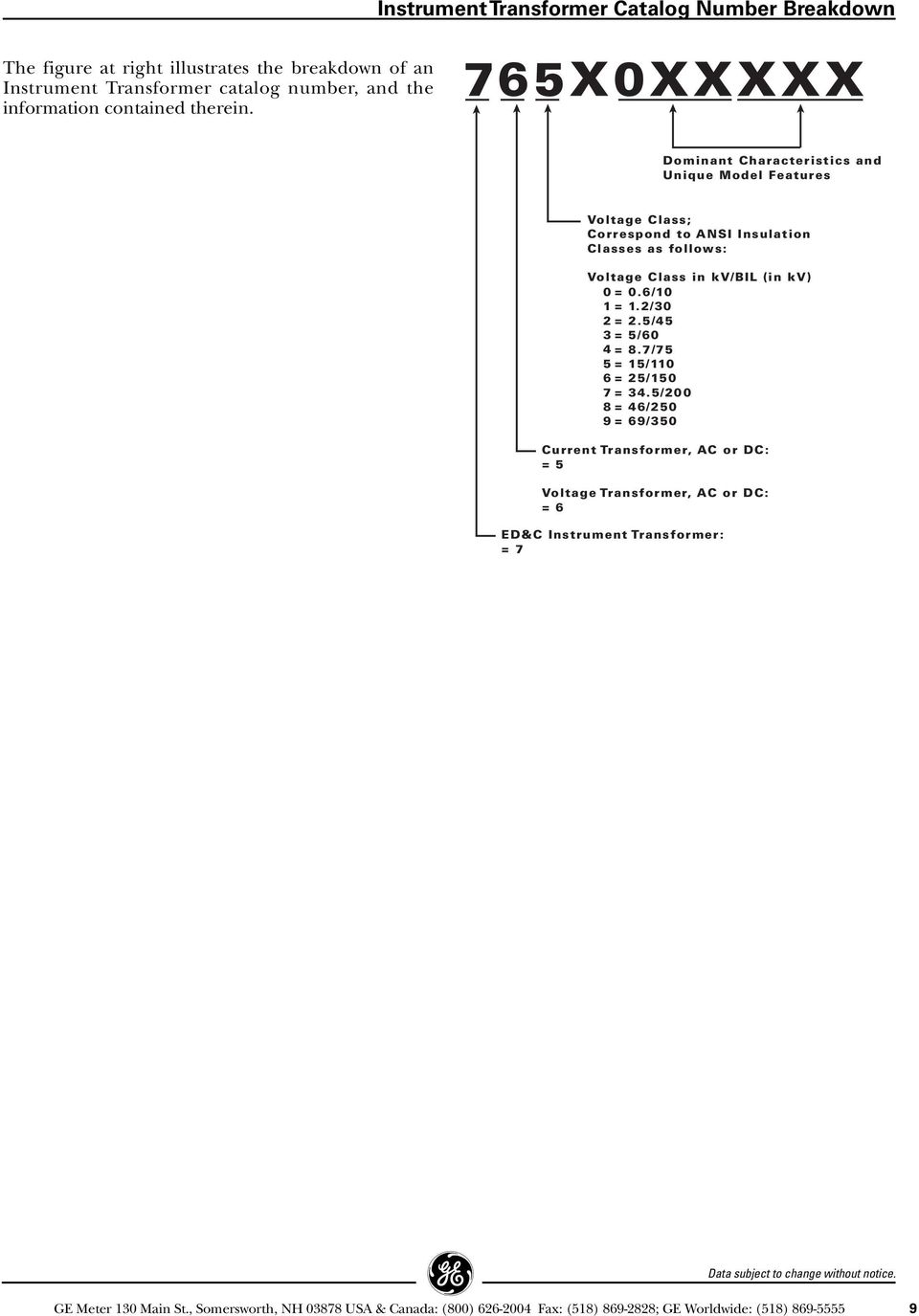
9 Instrument Transformer Catalog Number Breakdown The figure at right illustrates the breakdown of an Instrument Transformer catalog number, and the information contained therein. Dominant Characteristics and Unique Model Features Voltage Class; Correspond to ANSI Insulation Classes as follows: Voltage Class in kv/bil (in kv) 0 = 0.6/10 1 = 1.2/30 2 = 2.5/45 3 = 5/60 4 = 8.7/75 5 = 15/110 6 = 25/150 7 = 34.5/200 8 = 46/250 9 = 69/350 Current Transformer, AC or DC: = 5 Voltage Transformer, AC or DC: = 6 ED&C Instrument Transformer: = 7 GE Meter 130 Main St., Somersworth, NH USA & Canada: (800) Fax: (518) ; GE Worldwide: (518)
10 Voltage Transformer Type Selection Guide 0.3 Accuracy GE Catalog Rated Volts Thermal Rating Type # Series Volts (kv) through C Lbs. Fuse Option Page Accuracy Class 0.3 JVA-0 760X034XXX M(35VA) 500VA 16 Yes 1-4; 2-4 JVP-1 761X020XXX Y 750VA 30 Yes 1-8; 2-6 YT X VA 50 No 1-22 JEP-0C 760X135XXX W 300VA 12 No 1-6 JE X090XXX X 150VA 9 No Acc. GE Catalog Meter Thermal Primary Ave. Creep Type # Series Design Volts (kv) Burden VA Min. Max. Lbs. Inches Other/Options Page Indoor JVM-2 762X022XXX --- 2, Y , Fuse Option 1-10 JVM-3 763X021XXX --- 4, Y 750 2,400 4, Fuse Option 1-12 JVM-4 764X020XXX --- 7, Z 1,500 4,200 7, Fuse Option 1-14 JVM-4A 764X021XXX --- 7, Z 1,500 4,200 7, Fuse Option 1-16 JVM-5 760X021XXX ,400 95/110 Z 1,500 7,200 14, Fuse Option 1-14 JVM-5A 765X023XXX ,400 95/110 Z 1,500 7,200 14, Fuse Option 1-16 JVM-6 766X021XXX , Y ,000 24, No 1-20 Outdoor JVW-3 763X030XXX --- 4, Y 750 2,400 4, Bushing 2-6 JVW-4 764X030XXX --- 7, Z 1,500 2,400 7, Bushing 2-8 JVW-4A 764X031XXX --- 7, Z 1,500 2,400 7, Bushing 2-10 JVW-5 765X030XXX , Z 1,500 7,200 14, Bushing 2-8 JVW-5A 765X031XXX , Z 1,500 7,200 14, Bushing 2-10 JVW X031XXX , Y 1,000 7,200 14, Bushing 2-12 JVW-6 766X031XXX , Y , Bushing 2-14 JVW-6 766X031XXX , Y ,000 24, Bushing 2-14 JVW X031XXX , Y 3,000 12,000 24, Bushing 2-16 JVS X Super-Bute 14, ZZ 3, , Bushing 2-20 JVT X Super-Bute 24, ZZ , Bushing 2-20 JVW-7 767X031XXX , Y ,000 34, Bushing 2-18 JVW-7 767X031XXX , Y , Bushing 2-18 JVS X Super-Bute 20, ZZ 3, , Bushing 2-20 JVT X Super-Bute 34, ZZ 3,000 27,600 34, Bushing 2-20 JVT X Super-Bute 27, ZZ 3,000 27,600 34, Bushing 2-20 JVS X Super-Bute 27, ZZ 5, , Bushing 2-20 JVT X Super-Bute 46, ZZ 4, , Bushing 2-20 JVS X Super-Bute 40, ZZ 5, , Bushing 2-20 JVT X Super-Bute 69, ZZ 4, , Bushing 2-20 Notes: 1. Multiply primary amps by rating factor to get maximum amp rating at 30 C. 2. Rating factor can vary with ratio. 10 GE Meter 130 Main St., Somersworth, NH USA & Canada: (800) Fax: (518) ; GE Worldwide: (518)

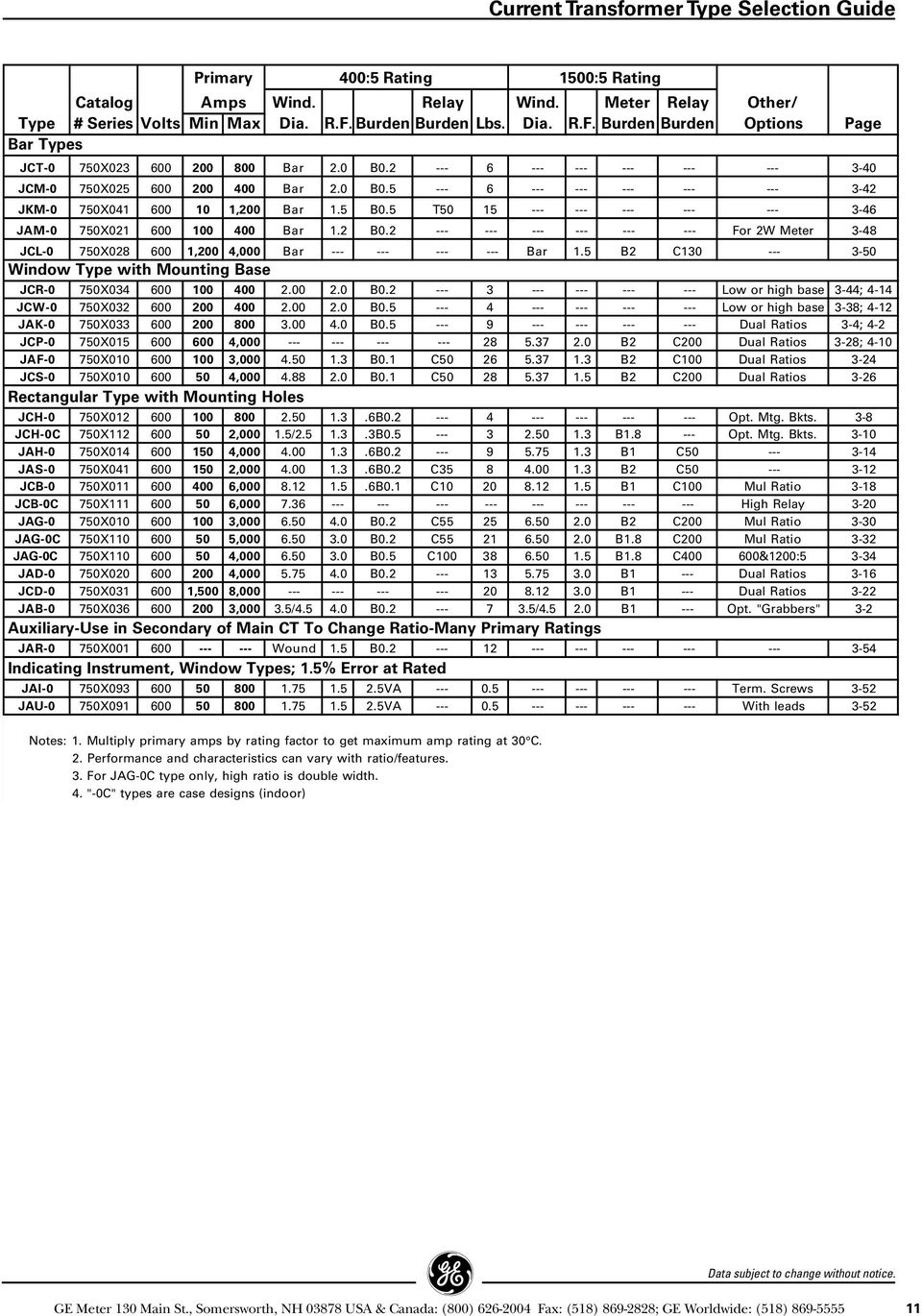
11 Current Transformer Type Selection Guide Primary 400:5 Rating 1500:5 Rating Catalog Amps Wind. Relay Wind. Meter Relay Other/ Type # Series Volts Min Max Dia. R.F. Burden Burden Lbs. Dia. R.F. Burden Burden Options Page Bar Types JCT-0 750X Bar 2.0 B JCM-0 750X Bar 2.0 B JKM-0 750X ,200 Bar 1.5 B0.5 T JAM-0 750X Bar 1.2 B For 2W Meter 3-48 JCL-0 750X ,200 4,000 Bar Bar 1.5 B2 C Window Type with Mounting Base JCR-0 750X B Low or high base 3-44; 4-14 JCW-0 750X B Low or high base 3-38; 4-12 JAK-0 750X B Dual Ratios 3-4; 4-2 JCP-0 750X , B2 C200 Dual Ratios 3-28; 4-10 JAF-0 750X , B0.1 C B2 C100 Dual Ratios 3-24 JCS-0 750X , B0.1 C B2 C200 Dual Ratios 3-26 Rectangular Type with Mounting Holes JCH-0 750X B Opt. Mtg. Bkts. 3-8 JCH-0C 750X , / B B Opt. Mtg. Bkts JAH-0 750X , B B1 C JAS-0 750X , B0.2 C B2 C JCB-0 750X , B0.1 C B1 C100 Mul Ratio 3-18 JCB-0C 750X , High Relay 3-20 JAG-0 750X , B0.2 C B2 C200 Mul Ratio 3-30 JAG-0C 750X , B0.2 C B1.8 C200 Mul Ratio 3-32 JAG-0C 750X , B0.5 C B1.8 C &1200: JAD-0 750X , B B1 --- Dual Ratios 3-16 JCD-0 750X ,500 8, B1 --- Dual Ratios 3-22 JAB-0 750X , / B / B1 --- Opt. "Grabbers" 3-2 Auxiliary-Use in Secondary of Main CT To Change Ratio-Many Primary Ratings JAR-0 750X Wound 1.5 B Indicating Instrument, Window Types; 1.5% Error at Rated JAI-0 750X VA Term. Screws 3-52 JAU-0 750X VA With leads 3-52 Notes: 1. Multiply primary amps by rating factor to get maximum amp rating at 30 C. 2. Performance and characteristics can vary with ratio/features. 3. For JAG-0C type only, high ratio is double width. 4. "-0C" types are case designs (indoor) GE Meter 130 Main St., Somersworth, NH USA & Canada: (800) Fax: (518) ; GE Worldwide: (518)
12 Current Transformer Type Selection Guide Most Single Ratio Primary 0.3 Acc. Max. Amps Typical GE Catalog Meter Relay Amps 30 C Ave. Creep Other/ Type # Series Design Volts (kv) Burden Class at R.F. Min. Max. R. F. Lbs. Inches Options Page Indoor JKM-2 752X040XXX Wound 2, B0.5 T , JCM-2 752X020XXX Wound 2, B2 C200 4, , JKC-3 753X002XXX Wound 5, B0.5 T50 1, , JKM-3 753X040XXX Wound 5, B2 T100 1, Tap, Dual Sec JKS-3 753X001XXX Wound 5, B0.1/2 T10/100 1, Tap, Dual Sec JCM-3 753X020XXX Bar 5, B2 C200 4,000 1,200 4, Tap Sec JCB-3 753X021XXX 5.5" Window 5, B2 C200/400 5,300 1,200 4, Tap Sec JCM-4 754X020XXX Bar 8, B2 C200 4,000 1,200 4, Tap Sec JKM-4 754X040XXX Wound 8, B2 T100 1, JCB-4 754X021XXX 5.5" Window 8, B2 C200/400 5,300 1,200 4, Tap Sec JKS-5 755X001XXX Wound 15, B0.1/2 T10/200 1, Tap, Dual Sec JKM-5 755X042XXX Wound 15, B2 T200 1, Tap, Dual Sec JCM-5 755X020XXX Bar 15, B2 C200 4,000 1,200 4, Tap Sec JCB-5 755X021XXX 5.5" Window 15, B2 C200/400 5,300 1,200 4, Tap Sec Outdoor JKW-3 753X050XXX Wound 5, B2 T100 1, JCD-3 753X031XXX 5.5" Window 5, B2 C200/400 5,300 1,200 4, Tap Sec JCW-3 753X030XXX Bar 5, B2 C200 4,000 1,200 4, Tap Sec JCW-4 754X030XXX Bar 8, B2 C200 4,000 1,200 4, Tap Sec JKW-4 754X050XXX Wound 8, B2 T100 1, JCD-4 754X031XXX 5.5" Window 8, B2 C200/400 5,300 1,200 4, Tap Sec JKW-5 755X053XXX Wound 15, B2 T100/200 1, , Tap Sec JCD-5 755X031XXX 5.5" Window 15, B2 C200/400 5,300 1,200 4, Tap Sec JCK-5 755X052XXX Wound 15, B0.5 C20 1, / JCW-5 755X030XXX Bar 15, B2 C200 4,000 1,200 4, Tap Sec JKW-6 756X050XXX Wound 25, B2 T100/200 1, , / Tap Sec JKW X030XXX Super-Bute 25, B2 T200/800 4, , / Tap, Dual Sec JKW-7 757X050XXX Wound 34, B , Tap Sec JKW X030XXX Super-Bute 34, B2 T200/800 4, , Tap, Dual Sec JKW X030XXX Super-Bute 46, B2 T200/800 4, , Tap, Dual Sec JKW X030XXX Super-Bute 69, B2 T200/800 4, , Tap, Dual Sec Notes: 1. Multiply primary amps by rating factor to get maximum amp rating at 30 C. 2. Rating factor can vary with ratio. 12 GE Meter 130 Main St., Somersworth, NH USA & Canada: (800) Fax: (518) ; GE Worldwide: (518)

13 General Product Information This section provides the descriptive information referenced in each product data sheet in sections 1-4 of this volume. Where references are not made to specific item numbers on a product data sheet, please refer to the general item for that category, Models: All Not Specifically Referenced Otherwise. 1. Construction and Insulation 1.1 Models: JAB-0, JAD-0, JAH-0, JAM-0, JCH-0, JCM-0, JCR-0, JCT-0, JCW-0 These transformers are molded with an electrical grade EPDM that is filled with hydrated alumina for exceptional arc tracking resistance. 1.2 Models: JCB-3, JCB-4, JCB-5, JCD-0, JCD-3, JCD-4, JCD-5, JCK-3, JCK-4, JCK-5, JCL-0, JCM-0, JCM-2, JCM-3, JCM-4, JCM-5, JCP-0, JCW-0, JCW-3, JCW-4, JCW-5, JKC-3, JKM-0, JKM-2, JKM-3, JKM-4, JKM-5, JKM-5A, JKS-3, JKS-5, JKW-3, JKW-4, JKW-5, JKW-5A, JKW-6, JKW-6A, JKW-7, JVM-2, JVP-1 Primary coils for voltage transformers and secondary coils for current transformers with wound primaries are cast in epoxy resin prior to being molded in HY-BUTEI60 insulation. 1.3 Models: JKW-150, JKW-200, JKW-250, JKW-350, JVS-150, JVS-200, JVS-250, JVS-350, JVT-150, JVT-200, JVT-250, JVT-350 SUPER-BUTEI60 transformers use both butyl and epoxy resin to obtain the highest level of quality and performance. The epoxy resin is used for the internal insulation system for winding impregnation and strong mechanical support. HY-BUTEI60 insulation is used for the outside shell of the high voltage bushings and as an encasement for the core and winding components. Dry-type insulation also permits indoor installation when required. 1.4 Models: JVM-3, JVM-4, JVM-4A, JVM-5, JVM-5A, JVM-6, JVW-3, JVW-4, JVW-4A, JVW-5, JVW-5A, JVW-6, JVW-7, JVW-110, JVW-150 The transformer design is constructed using molded HY-BUTEI60 insulation for the transformer body. The primary coil is precast in epoxy resin prior to being molded in HY-BUTEI60 insulation. 1.5 Models: JAF-0, JAG-0, JAS-0, JCB-0, JCS-0 The transformer is a window-type, and has no primary winding; the line conductor which is passed through the window serves as the transformer primary. A nylon tube is used for the window, and HY-BUTEI60 insluation for the transformer body. The HY-BUTEI60 insulation serves both as support and casing. The transformer is offered either with or without a base plate. Model JAF-0 Only The transformer is designed to meet the test requirement of the 0.6 kv standard insulation class. The ANSI Standards specify these requirements to be a 4 kv test at 60 Hz and a fullwave impulse test at 10 kv. 1.6 Models: JKM-95, JVM-95 The transformer is of butyl-molded construction with HY-BUTEI60 insulation. The complete external surface of the potential transformer, with the exception of the secondary terminal compartment, is coated with a semi-conducting material. This coating provides a ground shield that interfaces with the cables and connectors to provide a continuous ground path to the entire system. The secondary compartment is internally ground-shielded. The insulation class of the transformer meets the test requirements of the 15L-kV standard insulation class. The ANSI standards specify these requirements to be: full-wave impulse test at 95 kv; one-minute dielectric test, primary to secondary and ground, at 34 kv, 60 Hz; and a one-minute dielectric test, secondary to primary and ground, at 2.5 kv, 60 Hz. 1.7 Models: JVA-0 The transformer design is constructed using molded HY-BUTEI60 insulation for the transformer body. The primary and secondary coils are precast in epoxy resin prior to being molded in HY-BUTEI60 insulation. 1.8 Models: JAK-0, JAR-0, JCB-3, JCB-4, JCB-5, JCD-0, JCD-3, JCD-4, JCD-5, JCK-3, JCK-4, JCK-5, JCL-0, JCM-2, JCM-3, JCM-4, JCM-5, JCP-0, JCW-0, JCW-3, JCW-4, JCW-5, JKC-3, JKM-2, JKM-3, JKM-4, JKM-5, JKM-5A, JKS-3, JKS-5, JKW-3, JKW-4, JKW-5,JKW-5A, JKW-6, JKW-6A, JKW-7, JVP-1 The transformer design is constructed using HY- BUTEI60 insulation for the transformer body as well as the major portion of the transformer s insulation system. The HY-BUTEI60 insulation also serves both as support, bushing, and casing. GE Meter 130 Main St., Somersworth, NH USA & Canada: (800) Fax: (518) ; GE Worldwide: (518)
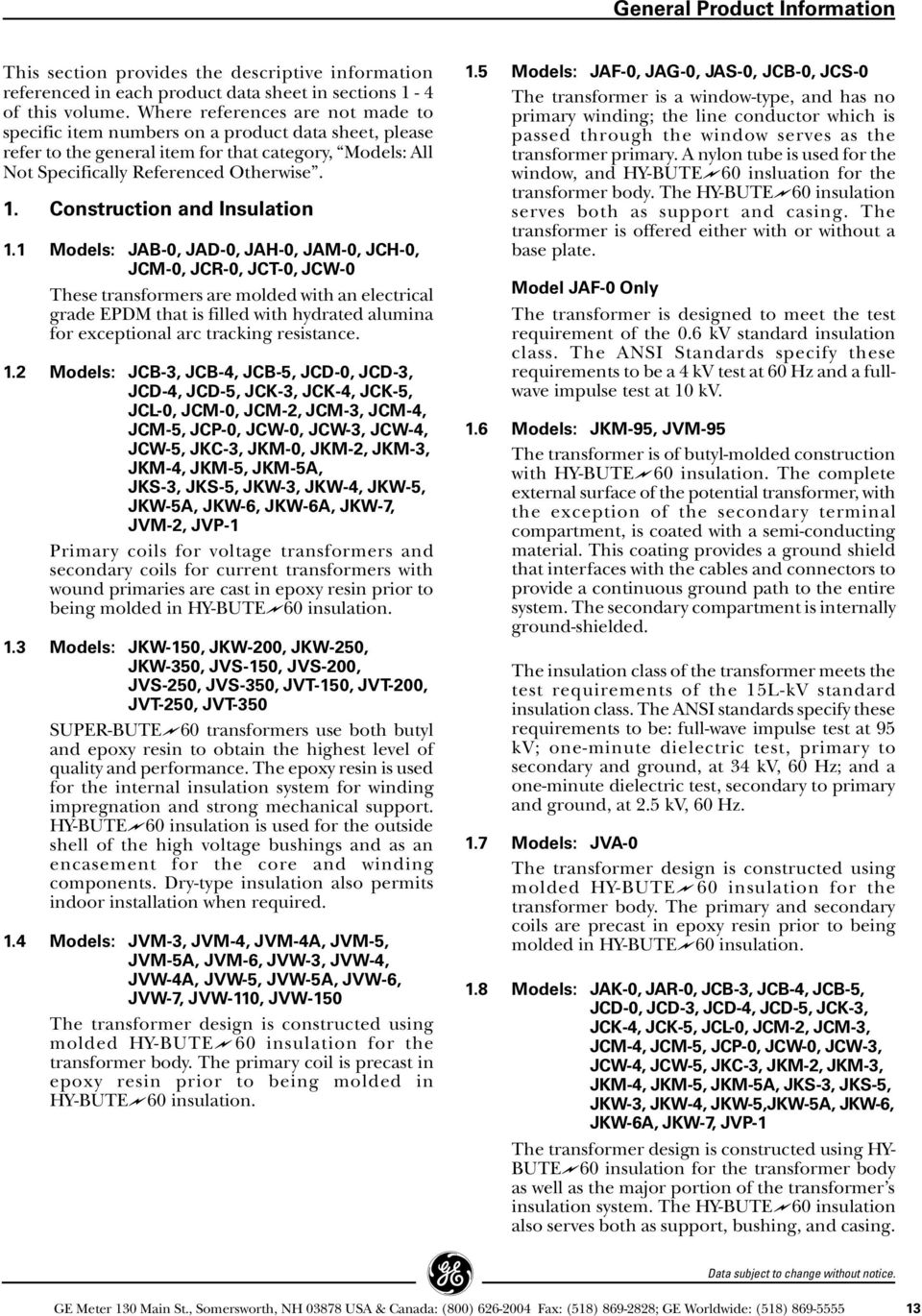
14 General Product Information 1.9 Models: JAG-0C, JCB-0C, JCH-0C The transformer is a window-type, and has no primary winding; the line conductor which is passed through the window serves as the transformer primary. The case is constructed using Noryl plastic. 2. Core Material 2.1 Models: JVS-150, JVS-200, JVS-250, JVS-350, JVT-150, JVT-200, JVT-250, JVT-350 The cores are made from high quality silicon steel which is carefully selected, tested, and annealed under rigidly controlled factory conditions. Each core is a shell type of laced construction. They are assembled and supported on flanges that form part of the base structure. The cores are tightly banded in place and protected from weathering by the transformer casing. 2.2 Models: JAB-0, JAD-0, JAH-0, JAK-0, JCB-3, JCB-4, JCB-5, JCD-0, JCD-3, JCD-4, JCD-5, JCG-0, JCH-0, JCH-0C, JCL-0, JCM-0, JCM-2, JCM-3, JCM-4, JCM-5, JCP-0, JCT-0, JCW-3, JCW-4, JCW-5, JKW-7, JKW-150, JKW-200, JKW-250, JKW-350 The core is made from high-quality, grainoriented, low-loss, high permeability silicon steel which is carefully selected and tested under rigidly controlled factory conditions. The core is wound in the direction of the grain to take advantage of the high permeability. 2.3 Models: JCK-3, JCK-4, JCK-5, JVM-3, JVM-4, JVM-4A, JVM-5, JVM-5A The cores are made from high quality silicon steel which is carefully selected, tested, and annealed under rigidly controlled factory conditions. The core is a shell type. 2.4 Models: JKC-3, JKM-0, JKM-2, JKM-3, JKM-4, JKM-5, JKM-5A, JKS-3, JKS-5, JKW-3, JKW-4, JKW-5, JKW-5A, JKW-6, JKW-6A, JVW-7, JVW-150 The core is made of high-permeability, formed, silicon steel strip. The steel is characterized by having highly directional properties, that is, low core losses and high permeability in the direction of rolling. Full advantage is taken of this property of the steel by the shape and construction of the core. The core has a dispersed-gap construction with interleaved laminations. This type of core provides a construction that will not shift to cause any change in the transformer characteristics. After being assembled into the coils, the core is securely clamped and permanently fastened to the base plate by a heavy steel strap which encircles the core and is welded to the base. 2.5 Models: JAF-0, JAG-0, JAG-0C, JAS-0, JCB-0, JCB-0C, JCS-0 The core is made of high quality silicon steel which is carefully selected, tested, and annealed under rigidly controlled factory conditions. The steel used is characterized by having highly directional properties; that is, low core losses and high permeability in the direction of rolling. Full advantage is taken of this property of the steel. The core is annealed after being wound in its final shape, thus relieving any stresses that are set up in the winding operation. 2.6 Models: JVM-6, JVW-6 The core is made of high-quality silicon steel which is carefully selected, tested and annealed under rigidly controlled factory conditions. The design is of the dispersed-gap Spirakore construction. 3. Primary and Secondary Coils/Windings 3.1 Models: JVS-150, JVS-200, JVS-250, JVS-350, JVT-150, JVT-200, JVT-250, JVT-350 The primary winding consists of the lattice wound construction. The construction is divided into either two- or four- coil sections. Each turn within the section is precisely controlled to provide a uniform distribution of turn-to-turn or layer-to-layer stress within the coil. The first turn of the primary winding is a contoured, expanded, metal electrostatic stress shield which, along with the coil configuration, linearly distributes any impulse surges across the complete primary coil rather than allow them to build on the first few turns. The secondary coils are wound using either insulated wire or copper foil. They have layer-tolayer insulation. Two- bushing Types JVT-150 and JVT-200 have two low voltage windings that can either be used separately or connected in parallel for full thermal capability. The JVT-250 and JVT- 350 have one low-voltage winding, while the JVS types have two low-voltage secondaries with taps at approximately 58% of the turns. 3.2 Models: JVM-4, JVM-4A, JVM-5, JVM-5A, JVW-7, JVW-150 The primary winding consists of the lattice wound construction. This construction is divided into either two- or four- coil sections. Each turn within the section is precisely controlled to provide a uniform distribution of turn-to-turn or layer-to-layer stress within a coil. The first turn of 14 GE Meter 130 Main St., Somersworth, NH USA & Canada: (800) Fax: (518) ; GE Worldwide: (518)

15 General Product Information the primary winding is a contoured, expanded, metal electrostatic stress shield which, along with the coil configuration, linearly distributes any impulse surges across the complete primary coil rather than allow them to build on the first few The secondary coils are wound using insulated wire. 3.3 Models: JKM-3, JKM-4, JKM-5, JKM-5A, JKS-3, JKS-5, JKW-3, JKW-4, JKW-5, JKW-5A, JKW-6, JKW-6A The primary winding consists of two coils connected in series. Each coil surrounds one leg of the core. This design reduces leakage losses, thus improving the accuracy of the transformer. It also provides a higher mechanical strength than a single coil construction. The secondary winding consists of two coils connected in parallel. Each coil is located inside the corresponding primary coil and surrounds one leg of the core. 3.4 Models: JCB-3, JCB-4, JCB-5, JCD-3, JCD-4, JCD-5, JCW-3, JCW-4, JCW-5 The primary winding consists of a hollow copper tube (for cable) or a straight-through bar passing through the transformer. The secondary winding is toroidally wound and is made of enamel-covered copper wire. 3.5 Models: All Not Specifically Referenced Otherwise The secondary winding is made of heavy enamelinsulated copper wire. It is evenly distributed around the core which reduces the leakage flux and provides the best possible accuracy. 3.6 Models: JKC-3, JKM-0, JKM-2 The primary is wound with heavy copper conductors in a single coil enclosing one side of the core. The secondary coil is positioned inside the primary coil for maximum accuracy. All connections in both windings are brazed for strength and low resistance. 3.7 Models: JCL-0, JCM-2, JCM-3, JCM-4, JCM-5 The primary consists of a ventilated hollow copper tube passing straight through the transformer. The secondary winding is toroidally wound, and is made of heavy enamel-insulated copper wire. 3.8 Models: JVM-3, JVW-3, JVW-4, JVW-4A, JVW-5, JVW-5A A formed core of the shell type is used. Enamel insulated wire is used in the primary and secondary coils. The primary is wound and cast in epoxy resin. The secondary is inside the primary next to the core. 3.9 Models: JAF-0, JAG-0, JAG-0C, JAH-0, JAI-0, JAL-0, JAS-0, JAU-0, JCB-0, JCB-0C, JCG-0, JCH-0, JCH-0C, JCS-0 Primary Winding - This transformer is of the window-type construction, which means that the user can place the cable or bus through the insulated opening in the face of the transformer. This conductor then becomes the primary of the transformer, and no other primary connections are necessary Models: JVS-150, JVS-200, JVS-250, JVS-350 The neutral end of the primary winding is terminated on the butyl head shell with a solid brass threaded sleeve. A grounding strap is used to connect this neutral terminal to the transformer ground pad for normal operation Models: JCK-3, JCK-4, JCK-5, JKW-7 The primary winding consists of strip wound copper in a circular pattern for the lower ratings, and a single-turn configuration for the higher ratings. This type of construction provides good accuracy, along with the highest fault current withstand characteristics Models: JKW-150, JKW-200, JKW-250, JKW-350 Primary Winding - The primary winding is mounted in the high-voltage bushing head shell, which results in a more efficient use of the core properties by permitting a symmetrical distribution of the winding turns. It keeps leakage to a minimum, and makes possible a high level of accuracy with fewer ampere-turns and corresponding improvement in thermal rating. In transformers rated 300/600:5 A and lower, a multi-turn primary winding is used, consisting of equally distributed copper conductors which encircle the core and secondary winding. In transformers rated 400/800:5 A and above, a single-turn, copper primary bar is used Models: JCB-3, JCB-4, JCB-5, JCD-3, JCD-4, JCD-5 Primary Pig Tail Connection - The lead that is connected to the metallic tube in the window is designed for connection to the primary conductor. This connection ensures that the tube is at the same voltage level as the primary conductor. This prevents corona discharges (caused by capacitive voltage distributed between two points) from occurring between an insulated primary conductor and the metallic tube. GE Meter 130 Main St., Somersworth, NH USA & Canada: (800) Fax: (518) ; GE Worldwide: (518)

16 General Product Information Continuous corona discharge could cause deterioration of the primary conductor insulation or be a source of radio interference, but would have no effect on the primary insulation of the instrument transformer. The connection is not needed when a bare conductor is in direct contact with the through metallic tube, or when a shielded cable is used Models: JAH-0, JAK-0, JCH-0, JCH-0C, JCM-0, JCT-0 Secondary Winding - The secondary winding is made of heavy enamel-insulated copper wire, evenly distributed around the core, reducing leakage flux and providing the best possible accuracy Models: JAD-0, JAF-0, JAG-0, JAG-0C, JCD-0 Secondary Winding - The secondary winding is made of heavy enamel-insulated copper wire, evenly distributed around the core. The doubleratio transformers have a tap in the secondary winding Models: JCB-0, JCB-0C, JCP-0, JCS-0 Secondary Winding - The secondary winding is made of heavy enamel-insulated copper wire, evenly distributed around the core. This construction reduces leakage flux, minimizes the effect of stray fields from adjacent buses, and gives the best possible accuracy. The multi-ratio transformers have multiple taps in the secondary winding Models: JAB-0, JAS-0, JCG-0 Secondary Winding - The secondary winding is made of heavy enamel-insulated copper wire, evenly distributed around the core. This construction reduces leakage flux, minimizes the effect of stray fields from adjacent buses, and gives the best possible accuracy Models: JCK-3, JCK-4, JCK-5, JKW-7 Secondary Winding - The secondary winding is made of enamel-insulated copper wire, evenly distributed around the core. This construction reduces leakage flux and provides the best possible accuracy Models: JKW-150, JKW-200, JKW-250, JKW-350 Secondary Winding - The secondary winding is mounted in the high-voltage bushing head shell, which results in a more efficient use of the core properties by permitting a symmetrical distribution of the winding turns. It keeps leakage to a minimum, and makes possible a high level of accuracy with fewer Ampere-turns and corresponding improvement in thermal rating. The secondary winding is wound with enamelinsulated copper conductor. All turns are evenly distributted around the core, and suitable compensation is used to obtain very high accuracy performance. This winding is center-tapped to obtain the dual-primary Ampere rating. The secondary leads extend downward through the bushing tube to the secondary terminal block in the transformer base Models: JVM-6, JVW-6 Enamel-insulated wire is used in the primary and secondary coils. The primary is lattice-wound, and cast in epoxy resin. The secondary is inside the primary next to the core. 4. Terminals 4.1 Models: JCM-0, JCT-0 Primary Bars - The primary bars are nonremovable. In the 200 A and 400 A ratings, they consist of round copper tubes with the ends formed into flat terminal pads after insertion into the transformer. In the 600 A and 800 A ratings, they consist of round, solid copper bars, with flat terminal pads formed on each end. All terminal pads have a hole and a slot to accommodate different sizes of cable lugs. The pads are tinplated. The primary bars conform to American National Standard ANSI C A solderless, pressure-type potential connector is supplied. It is fastened by a screw through the terminal pad. The connector has a square base which fits into a square hole of similar size in the terminal pad. When tightened, the connector is prevended from turning. The connector can be mounted either above or belwo the terminal pad or chaged from one terminal pad to the other. 4.2 Models: JVM-3, JVM-4, JVM-4A, JVM-5, JVM-5A Primary Terminals - The primary terminals on the unfused models consist of tapped holes in the center of a flat boss with lock washer and screw. On two fuse models, both terminals are bolts attached directly to the fuse supports, and are provided with lock washers and nuts. On the single fuse models, the line terminal is on the fuse support, and the neutral terminal is a stud protruding from the back, a short distance above the base plate. This stud is insulated from the base plate to permit primary insulation-resistance testing at voltages up to 10,000 volts. 4.3 Models: JKC-3, JKM-0, JKM-2, JKM-3, JKM-4, JKM-5, JKM-5A Primary Terminals - The primary terminals are flat copper bars, each with one bolt hole and a slot, which facilitates connections to various size 16 GE Meter 130 Main St., Somersworth, NH USA & Canada: (800) Fax: (518) ; GE Worldwide: (518)

17 General Product Information cable lugs. The shape of the insulation next to the primary terminals allows easy and smooth taping of the primary connections. The terminal surfaces are tin-plated to reduce contact resistance. 4.4 Models: JKS-3, JKS-5 Primary Terminals - The primary terminals are flat copper bars, each with two bolt holes. The terminal surfaces are tin-plated to reduce contact resistance. 4.5 Models: JCM-2, JCM-3, JCM-4, JCM-5, JCL-0 Primary Terminals - Flat copper pads welded to the ends of the hollow, ventilated primary tube serve as primary terminals. The terminals are drilled for bolting to a bus. All current ratings in each voltage classs have the same distance between bolt holes, facilitating replacement of one transformer with another of a different rating. 4.6 Models: JVW-3, JVW-4, JVW-4A, JVW-5, JVW-5A, JVW-6, JVW-7, JVW-110, JVW-150 Primary Terminals - The primary terminals are of the solderless type. Made of hardened bronze, the terminal is fitted with a hard-copper collar and bronze pressure screw. The collar is semicaptive and may be turned 90-degrees in either direction for vertical or horizontal connection. With the collar in the vertical position, the maximum conductor sizes for copper is 250MCM and aluminum is 4/0. With the collar in the horizontal position, the maximum conductor sizes for copper is 3/0 and aluminum is 2/0. In either position, the minimum conductor size is AWG 10. A clearance hole for a 3 / 8 inch bolt is provided in the top of the terminal for additional flexibility in making connections. The complete terminal and collar assembly is heavily electroplated with tin so that it is suitable for outdoor use. Models: JVW-4, JVW-4A, JVW-5, JVW-5A, JVW-6, JVW-7, JVW-110, JVW-150 Only: On single-bushing designs, the H 2 side of the primary winding is insulated for only a 19 kv hipot level, and is connected to an L bracket on the baseplate through a removable ground strap. A clamp-type terminal accommodating No. 12 to No. 2 AWG, copper or aluminum, is provided for making the ground connection. 4.7 Models: JVS-150, JVS-200, JVS-250, JVS-350, JVT-150, JVT-200, JVT-250, JVT-350 Primary Terminals - The primary terminal consists of a copper or cast bronze, NEMA-approved, flat, two-hole pad. The complete terminals are heavily tin-electroplated for use with either copper or aluminum conductors. This construction can be easily adapted to any type of line termination by use of any of a variety of commercially available connectors. 4.8 Models: JCK-3, JCK-4, JCK-5, JKW-3, JKW-4, JKW-5, JKW-5A, JKW-6, JKW-6A, JKW-7 Primary Terminals - The primary terminals are flat copper bars, each with one bolt hole and a slot, which facilitates connections to various size cable lugs. The terminal surfaces are tin-plated to reduce contact resistance, and to allow connection to either copper or aluminum conductors. 4.9 Models: JCW-3, JCW-4, JCW-5 Primary Terminals - Flat copper pads welded to the ends of the hollow, ventilated primary tube serve as primary terminals. The terminals are drilled for bolting to a bus. All current ratings in each voltage class have the same distance between bolt holes, facilitating replacement of one transformer with another of a different rating. The terminal surfaces are tin-plated to reduce contact resistance Models: JKW-150, JKW-200, JKW-250, JKW-350 Primary Terminals - Transformers rated 300/ 600:5 Amperes and below have a U-shaped pad for the primary terminals. Transformers rated 400/800:5 Amperes and above use a verticallyoriented, flat copper bar for the primary terminal pads. In both cases, the terminal pads contain four mounting holes with industry standard hole sizes and spacing Models: JAB-0, JCM-0, JCR-0, JCT-0, JCW-0 Secondary Terminals - The secondary terminals are clamp-type, with a inch diameter hole, simplifying the connection of large or multiple secondary wires. The terminals are made of bronze for excellent durability and corrosion resistance. An external secondary terminal block secures a stud in between the two terminals, which is used as a short circuit device, and as a means to attach and secure the secondary cover. GE Meter 130 Main St., Somersworth, NH USA & Canada: (800) Fax: (518) ; GE Worldwide: (518)

18 General Product Information 4.12 Models: JVM-3, JVM-4, JVM-4A, JVM-5, JVM-5A Secondary Terminals - The secondary terminals are solderless clamp type. The terminal cover is made of transparent plastic. Provision is made for sealing the cover Models: JKC-3, JKM-0, JKM-2, JKM-3, JKM-4, JKM-5, JKM-5A, JKS-3, JKS-5 Secondary Terminals - The secondary terminals are solderless clamp type. A positive-action, manually operated, short-circuiting switch is provided. The terminal cover is made of transparent plastic. It is reversible and constructed so that it cannot be put in place with meters connected and the short-circuit switch closed. Provision is made for sealing the secondary cover with either a wire or 1 / 4 inch strip seal Models: JAF-0, JAG-0, JAG-0C, JAS-0, JCB-0, JCB-0C, JCG-0, JCS-0 Secondary Terminals - The terminals are fixed, threaded, bronze sleeves that project approximately 1 / 8 inch above the casing. Connections to the terminals can be made by means of two 1 / 4-20 binding head screws, which are supplied. Because this transformer is used primarily in enclosed switchgear compartments which cannot be opened while the transformer is energized, a secondary protective short-circuiting device is not provided Models: JAH-0, JCH-0, JCH-0C Secondary Terminals - The secondary terminals are of the screw-type construction. Each end of the secondary winding is brazed to a threaded sleeve which projects up through the top surface of the transformer. The two 3 / 8 inch long, NF-3, slotted, round-head screws furnished with the transformer, are ideally suited for making connections to spade-type terminals or bare conductors Models: JCB-3, JCB-4, JCB-5, JCD-3, JCD-4, JCD-5, JCM-3, JCM-4, JCM-5, JCW-3, JCW-4, JCW-5 Secondary Terminals - The secondary terminals are fixed brass studs with 1 / 4 inch-28 threads, located on the top of the transformer. Each terminal is supplied with cup washer, lock washer, and nuts. A fiber piece between the two terminals serves as a mounting block for the short-circuiting device, and as a base for the terminal cover. It also supports the brass sealing stud. The shortcircuiting device is manually operated to give a positive action. The entire secondary terminal structure is designed so that it can be easily removed and reassembled in a reverse position. Each pair of secondary terminals on the dual-ratio transformers is equipped with a separate cover. The covers are detented to provide ease and accuracy in making secondary wiring connections Models: JCL-0, JCM-2 Secondary Terminals - The secondary terminals are fixed brass studs with 1 / 4-28 threads, located on the top of the transformer. Each terminal is supplied with cup washer, lock washer, and nuts. A fiber piece between the two terminals serves as a mounting block for the short-circuiting device, and as a base for the terminal cover. It also supports the brass sealing stud Models: JVW-4, JVW-4A, JVW-5, JVW-5A, JVW-6, JVW-7, JVW-110, JVW-150 Secondary Terminals - The secondary terminals are located on the insulated surface adjacent to the baseplate. These terminals are clamp-type in fixed, round bronze posts, with excellent durability and corroson resistance. They have a inch diameter cross hole to accommodate large or multiple secondary wires. The secondary terminals are molded in the insulation and held in place internally by a terminal block that prevents their rotation Models: JVS-150, JVS-200, JVS-250, JVS-350, JVT-150, JVT-200, JVT-250, JVT-350 Secondary Terminals - The secondary terminals are of the screw-type construction ( 1 / 4-20 UNC) with binding heads for making connection to spade-type or bare conductors. Each end of the secondary winding is brazed to a threaded sleeve which projects through the resin to provide a solid brass surface to which a spade-type connection can be made. The secondary terminals are enclosed in a conduit box, secured to the base of the transformer with four 1 / 4-20 screws Models: JCK-3, JCK-4, JCK-5, JKW-7 Secondary Terminals - The secondary terminals are clamp-type, with a inch diameter hole, simplifying the connection of large or multiple secondary wires. The terminals are located on the front of the transformer on the flat butyl surface adjacent to the baseplate. The terminals are made of bronze for excellent durability and corrosion resistance. 18 GE Meter 130 Main St., Somersworth, NH USA & Canada: (800) Fax: (518) ; GE Worldwide: (518)

19 General Product Information An internal secondary terminal block secures the secondary terminals, as well as a stud in between the two terminals, which is used as a short-circuit device pivot. The short-circuit device is simple, easy to operate, and is made of sturdy bronze parts to give the highest reliability. It features a large contact area, with the short-circuit device and a slot in the terminal having parallel faces to make and extremely good electrical contact. The contact with the terminal is direct, thus eliminating additional joints or connections Models: JKW-3, JKW-4, JKW-5, JKW-5A, JKW-6, JKW-6A, JVW-3 Secondary Terminals - The secondary terminals are in a compartment molded in the side of the transformer. The compartment has a molded phenolic cover held by four brass, nickel-plated, captive thumbscrews, which engage a metal insert molded in the rubber. The thumbscrews are drilled to accommodate a seal wire. The compartment also has two openings for 1 inch conduit connection. The secondary terminals are the threaded type, each with cup washer, lock washer and nut. A manually operated, secondary short-circuiting switch is located between the secondary terminal studs Models: JKW-150, JKW-200, JKW-250, JKW-350 Secondary Terminals - The secondary terminals are enclosed in a box secured to the base of the transformer with four, 1 / 4-20 screws. Both the box and terminal block can be relocated to any of three sides of the base to fit the particular installation. The terminal box has 1 1 / 2 inch threaded conduit openings at each end, and a 1 1 / 2 inch knockout at the bottom. It is also provided with a grounding terminal for the secondary circuit, when required Models: JCK-3, JCK-4, JCK-5, JKW-6, JKW-6A, JKW-7, JVW-4, JVW-4A, JVW-5, JVW-5A, JVW-6, JVW-7, JVW-110, JVW-150 Ground Terminal - A ground terminal is provided in the secondary compartment for making an optional connection to one of the secondary terminals. The 1 / 4-20 round-head ground terminal is welded in the baseplate bracket, and is furnished with a nut, cup washer, flat washer, and lock washer Models: JKW-3, JKW-4, JKW-5, JKW-5A, JVW-3 Ground Terminal - A ground terminal is provided in the secondary compartment for making an optional connection to one of the secondary terminals. The 1 / 4-28 round-head ground terminal is welded in the baseplate bracket, and is furnished with a nut, cup washer, flat washer, and lock washer Models: JVS-150, JVS-200, JVS-250, JVS-350, JVT-150, JVT-200, JVT-250, JVT-350 Ground Pad - The clamp-type ground connector is for use with No. 2 solid to 500 MCM copper or aluminum grounding cable. 5. Baseplate and Mounting 5.1 Models: JVM-2, JVP-1 The base is made of heavy stainless-steel plate and is provided with holes and slots adapting it for mounting by either bolts or pipe clamps. 5.2 Models: JKW-150, JKW-200, JKW-250, JKW-350, JVS-150, JVS-200, JVS-250, JVS-350, JVT-150, JVT-200, JVT-250, JVT-350 SUPER-BUTEI60 voltage transformers and current transformers can be mounted in any position from upright to inverted, providing the centerline of current transformers through the primary terminals is parallel with the ground surface. Loading by lines or busswork on either VT s or CT s should be kept to a maximum to avoid placing appreciable strain upon the transformer bushings and terminals. For CT s, the maximum recommended loading from all sources should not be greater than the equivalent of a 200-pound external force applied at the axis of the primary terminals. 5.3 Models: JCK-3, JCK-4, JCK-5, JKW-3, JKW-4, JKW-5, JKW-5A, JKW-6, JKW-6A, JKW-7, JVW-3, JVW-4, JVW-4A, JVW-5, JVW-5A, JVW-6, JVW-7, JVW-110, JVW-150 The base is made of stainless-steel. A stainless-steel grounding lug is welded to the baseplate and provides a hole for attaching the grounding connector. Mounting holes or slots are located in each corner of the baseplate. Mounting hardware is supplied with the transformer. GE Meter 130 Main St., Somersworth, NH USA & Canada: (800) Fax: (518) ; GE Worldwide: (518)

20 General Product Information The transformer can be mounted with the primary terminals in any position up, down, or horizontal. It can be bolted directly to a crossarm attached by U bolts or suspension hooks, or mounted on double crossarms, using channel brackets. Refer to the Accessories Listing on the transformer data sheet for Catalog Numbers. 5.4 Models: All Not Specifically Referenced Otherwise Versatile mounting is a feature of these transformers. The transformers are furnished with mounting feet assembled to the bottom edge. These mounting feet may be reassembled in 90 degree steps around the edge as needed. The transformers may also be supported on the primary bar, and the bodies of the transformers may be rotated and locked in two positions separated 90 degrees to insure easy access to the secondary terminals. 5.5 Models: JKC-3, JKM-0, JKM-2, JKM-3, JKM-4, JKM-5, JKM-5A, JKS-3, JKS-5, JVM-3 The base is made of heavy steel plate and is provided with holes and slots adapting it for mounting by either bolts or pipe clamps. 5.6 Models: JVM-4, JVM-4A, JVM-5, JVM-5A The base is made of heavy steel plate and is provided with holes and slots adapting it for mounting by either bolts or pipe clamps. All exposed metallic surfaces are protected with two coats of baked enamel. 5.7 Models: JCR-0, JCW-0 This transformer can be mounted in any position. When used indoors, it can be mounted on any flat surface or suspended on the primary bus or cable. It is especially suitable for use in small boxes, and transformers can be mounted close together because the nameplate and secondary terminals are on top. When used outdoors, it can be installed either with our without any base. It can be mounted on a pole without the use of crossarms or enclosing boxes. The transformer has four mounting holes arranged on a 1 1 / 2 inch square so that the transformer can be attached to corresponding holes in transformer mounting brackets. Three optional bases are available for mounting the transformers. The mounting dimensions of the transformers conform to ANSI C The low base is made of stainless steel. The high base is made of formed mild steel. Both are removable and are held in place by four stainless steel screws. Removing the screws permits the transformer to be rotated with respect to the base in 90 increments. The high base increases the transformer height by 1 13 / 16 inches. An extra wide base of stainless steel is available to match the mounting dimensions of the intermediate size JAK-0 current transformer. 5.8 Models: JCM-0, JCT-0 The transformer can be mounted in any position. It can be mounted on any flat surface or suspended by the primary bar from the bus or cable. It is especially suitable for use in small boxes. Transformers can be mounted close together because the terminals are on top. Two base constructions are available for the transformer. Both bases are made from heavy steel, finished with a coat of black paint. The bases are removable and are held in place by four No machine screws. The low base is furnished with a 7 / 16 inch wide mounting slot in each corner of the base. The high base increases the transformer height by 2 inches, and meets the required dimensions of Specification ANSI C A large mounting slot is furnished in each corner of the high base. 5.9 Models: JKW-150, JKW-200, JKW-250, JKW-350 A fabricated metal base is the supporting structure for the transformer. It is provided with four 13 / 16 inch mounting holes and two lifting eyebolts. Adjacent to the nameplate is a standard twobolt ground connector Models: JCL-0, JCM-2, JCM-3, JCM-4, JCM-5 The transformer is furnished with mounting feet assembled to the bottom edge. These mounting feet may be reassembled in 90-degree steps arount the edge as needed. The transformers may also be supported on the primary bar, and the bodies of the transformers may be rotated and locked in two positions separated by 90 degrees to insure easy access to the secondary terminals Models: JCB-3, JCB-4, JCB-5, JCD-3, JCD-4, JCD-5 The transformer is furnished with stainless steel mounting feet assembled to the bottom edge. These mounting feet may be reassembled in 90- degree steps arount the edge as needed. The transformer may be mounted in any position. 20 GE Meter 130 Main St., Somersworth, NH USA & Canada: (800) Fax: (518) ; GE Worldwide: (518)

21 General Product Information 5.12 Models: JAF-0, JCS-0 The base plate is made of heavy steel plate. It is attached by two bolts to the body of the transformer. The transformer may be easily mounted on any flat surface by means of the open-end slots on each of the four corners of the base plate. If the base plate is not used, mounting is by means of two 3 / 8 inch-16 tapped holes in the transformer s bottom surface Models: JCW-3, JCW-4, JCW-5 The transformer is furnished with stainless steel mounting feet assembled to the bottom edge. These mounting feet may be reassembled in 90- degree steps arount the edge as needed. The transformers may also be supported on the primary bar, and the bodies of the transformers may be rotated and locked in two positions separated by 90 degrees to insure easy access to the secondary terminals Models: JVS-150, JVS-200, JVS-250, JVS-350, JVT-150, JVT-200, JVT-250, JVT-350 The base assembly for the 25 kv and 34.5 kv models is made of fabricated steel, and is coppertin plated. In the higher voltages, the assembly is cast aluminum. All exposed metallic surfaces are protected with two coats of baked enamel. The base framework supports the core and windings, and contains a grounding pad and provision for mounting the detachable secondary terminal box Model: JCK-3, JCK-4, JKW-3, JKW-4, JVW-3, JVW-4, JVW-5, JVW-110 The transformer can be mounted with the primary terminals in any position up, down, or horizontal. It can be bolted directly to a crossarm, attached by U bolts or suspension hooks, or mounted on double crossarms using channel brackets. Please refer to the Accessories Listing for Catalog Numbers, and to the Applications Information Section of this volume Model: JCB-0, JCB-0C Stainless steel mounting brackets are available for mounting. Refer to the Accessories Listing on the transformer data sheet for Catalog Numbers. The bracket for the 50:5 ratio transformer is 6" wide to match the 50:5 ratio transformer. The bracket for all other ratios is 3" wide to match the other transformers. 6. Nameplates 6.1 Models: JCD-3, JCD-4, JCD-5, JCW-3, JCW-4, JCW-5, JKW-3, JKW-4, JKW-5, JKW-5A, JKW-6, JKW-6A, JVA-0, JVS-150, JVS-200, JVS-250, JVS-350, JVT-150, JVT-200, JVT-250, JVT-350 The nameplate is made of stainless-steel. It carries all the information prescribed by the ANSI Standards in easy-to- read form. The information contained on the plate is either etched or stamped into the metal to provide a permanent record that is not easy obliterated. Provision and space are provided on the nameplate for attaching the user s identifying tag. 6.2 Models: JCK-3, JCK-4, JCK-5, JKW-7, JKW-150, JKW-200, JKW-250, JKW-350, JVW-6, JVW-7, JVW-150 The nameplate is made of stainless-steel and located on the base of the transformer. It contains all the information designated by the ANSI Standards in easy-to-read form. 6.3 Models: JAB-0, JAM-0, JAR-0, JCB-3, JCB-4, JCB-5, JCL-0, JCM-0, JCM-2, JCM-3, JCM-4, JCM-5, JCT-0, JKC-3, JKM-0, JKM-2, JKM-3, JKM-4, JKM-5, JKM-5A, JKS-3, JKS-5 The nameplate is of lithographed aluminum. It is mounted on the top of the transformer. Provision is made for attaching the user s identifying tag. 6.4 Models: JAD-0, JAK-0, JCD-0, JCP-0, JCR-0, JCW-0, JVW-3, JVW-4, JVW-4A, JVW-5, JVW-5A, JVW-110 The nameplate is made of etched corrosive-free aluminum alloy. Provision is made for attaching the customer s identifying tag. This material meets all the environmental requirements for outdoor use. 6.5 Models: JVM-3, JVM-4, JVM-4A, JVM-5, JVM-5A The nameplate is of lithographed aluminum. It is mounted on the base of the transformer. Provision is made for attaching the user s identifying tag. 6.6 Models: JAF-0, JAG-0, JAG-0C, JAS-0, JCB-0, JCB-0C, JCS-0, The nameplate is molded in the top surface of the transformer, and is a permanent, integral part of the transformer. GE Meter 130 Main St., Somersworth, NH USA & Canada: (800) Fax: (518) ; GE Worldwide: (518)
22 General Product Information 6.7 Models: JAH-0, JCH-0, JCH-0C The nameplate is molded in a recessed section on the face of the transformer, and is a permanent, integral part of the transformer. 6.8 Models: JKM-95, JVM-95 The nameplate is made of anodized aluminum. It is located just above the secondary terminal compartment and carries all the information prescribed by the ANSI standards in easy-to-read form. Provision is made for attaching a customer s number tag. 6.9 Models: JVP-1, JVM-2 An aluminum nameplate with slotted tabs for attaching user's serial number is located on the front of the transformer. The nameplate has the ratio printed on it in large numerals Models: JE-27 The nameplate is mounted on the top of the transformer. 7. Polarity 7.1 Models: JAB-0, JAD-0, JAH-0, JAI-0, JAK-0, JAM-0, JAR-0, JAU-0, JCD-0, JCH-0, JCH-0C, JCK-3, JCK-4, JCK-5, JCM-0, JCR-0, JCT-0, JCW-0, JKW-6, JKW-6A, JKW-7, JKW-150, JKW-200, JKW-250, JKW-350, JVA-0, JVM-2, JVM-6, JVP-1, JVS-150, JVS-200, JVS-250, JVS-350, JVT-150, JVT-200, JVT-250, JVT-350, JVW-6, JVW-7, JVW-150 The permanently molded primary polarity markings and H 2 and the secondary polarity markings X 1 and X 2 are situated adjacent to their respective terminals. The polarity terminal is designated by use of the subscript 1, and the mark is painted white for better visibility. 7.2 Models: JCB-3, JCB-4, JCB-5, JCD-3, JCD-4, JCD-5, JCL-0, JCM-2, JCM-3, JCM-4, JCM-5, JCW-3, JCW-4, JCW-5, JKC-3, JKM-0, JKM-2, JKM-3, JKM-4, JKM-5, JKM-5A, JKS-3, JKS-5, JKW-3, JKW-4, JKW-5, JKW-5A, JVM-3, JVM-4, JVM-4A, JVM-5, JVM-5A, JVW-3, JVW-4, JVW-4A, JVW-5, JVW-5A, JVW-110 The primary and secondary polarity markers are molded in the insulation. They are thus permanent and integral parts of the transformer and cannot readily be obliterated. The polarity is subtractive. 7.3 Models: JAF-0, JAG-0, JAG-0C, JAS-0, JCB-0, JCB-0C, JCG-0, JCP-0, JCS-0 The primary and secondary polarity markers are molded in the casing. They are permanent, integral parts of the transformer, and cannot be obliterated. 7.4 Models: JKM-95, JVM-95 Primary and secondary terminals are marked, H 2, and X 1, X 2, respectively. These markings are permanently molded into the butyl rubber in recessed letters, directly adjacent to the terminal location. The and X 1 markings are filled with weather-resistant white paint. The polarity is subtractive. 8. Bushings 8.1 Models: JKW-150, JKW-200, JKW-250, JKW-350, JVS-150, JVS-200, JVS-250, JVS-350, JVT-150, JVT-200, JVT-250, JVT-350 Since the bushings are an integral part of the transformer, standards normally pertaining to porcelain bushing tests do not apply. However, characteristics equal to, or better than, those required for porcelain are provided. 9. Tests 9.1 Models: JKW-150, JKW-200, JKW-250, JKW-350 Each transformer is tested in accordance with the ANSI Standards. Refer to the section entitled Tests on Molded and Other Dry-Type Instrument Transformers, page 39, for specific information. 10. Maintenance (also see pages 24 through 27) 10.1 Models: All not Specifically Referenced Otherwise These transformers require no maintenance other than an occasional cleaning if installed in an area where air contamination is severe. 11. Maximum Lead Length for Metering Accuracy 11.1 Models: JAK-0, JCK-3, JCK-4, JCK-5, JCR-0, JKW-6, JKW-6A, JKW-7 Maximum distance in feet between CT and meter to meet 0.3 ANSI accuracy classification, for the more common metering applications using one or two General Electric meters and where the line power factor is 0.8 or higher. 22 GE Meter 130 Main St., Somersworth, NH USA & Canada: (800) Fax: (518) ; GE Worldwide: (518)
23 General Product Information Maximum Secondary Lead Length AWG Copper Wire Size Maximum Distance (Feet) Table corresponds to all CT s rated 0.3 B Models: JAK-0, JKW-7 Maximum Secondary Lead Length 0.3 ANSI Accuracy Classification; 0.8 PF AWG Copper Wire Size Maximum Distance (Feet) Table corresponds to all CT s rated 0.3 B Models: JCK-3, JCK-4, JCK-5, JKW-6, JKW-6A Maximum Secondary Lead Length 0.3 ANSI Accuracy Classification; 0.8 PF AWG Copper Wire Size Maximum Distance (Feet) , ,900 Table corresponds to CT s rated 0.3 B Secondary Conduit Box 12.1 Models: JKW-5, JKW-5A, JKW-6, JKW-6A, JKW-7, JVW-3, JVW-4, JVW-4A, JVW-5, JVW-5A, JVW-6, JVW-7, JVW-110, JVW-150 A detachable secondary conduit box, Catalog Number , is provided with the transformer. This die-cast aluminum conduit box is furnished attached to the transformer. Its use permits easy changeout of transformers without dismantling rigid conduit structures. The box is provided with two 1 inch threaded conduit hubs on the sides and a 1 inch conduit knockout in the bottom. Each box is furnished complete with aluminum cover, gasket, four sealable cover screws, seal wire, four mounting screws with lock washers, and plastic pipe plugs Models: JCD-3, JCD-4, JCD-5, JCW-3, JCW-4, JCW-5 The secondary conduit box is made from black anodized aluminum. Two 1 inch conduit hubs are provided. The aluminum cover is gasketed and secured to the conduit box with four sealable thumb screws. The conduit box is attached to the body of the transformer with four screws, and its position may be rotated in 90-degree steps for wiring convenience Models: JVS-150, JVS-200, JVS-250, JVS-350, JVT-150, JVT-200, JVT-250, JVT-350 The terminal box has 1 1 / 2 inch threaded conduit openings at each end, and a 1 1 / 2 inch knockout at the bottom. It is also provided with a secondarycircuit grounding terminal Models: JAD-0, JCD-0 A secondary conduit box is available for both single-ratio and dual-ratio transformers. The box is not furnished assembled to the transformer. It is designed to be easily assembled on the transformer in place of the secondary terminal block. Two boxes are required for dual-ratio transformers. The conduit box, including cover, is made of aluminum with a black painted finish. It is furnished with the necessary gasket, four wing screws and two pipe plugs. To accommodate the conduit box, transformers having provisions for conduit box must be specified on the order. 13. Rating Identification 13.1 Models: JVW-4, JVW-4A, JVW-5, JVW-5A, JVW-6, JVW-7, JVW-110, JVW-150 The high-voltage rating is identified by large orange digits located on the insulation surface near the top of the transformer. This provides permanent identification that is clearly visible from a distance, and is resistant to fading and abrasion Models: JCK-3, JCK-4, JCK-5, JKW-5, JKW-6, JKW-6A, JKW-7 The primary current rating is identified by large orange digits located on two sides of the transformer. This provides permanent identification that is clearly visible from a distance, and is resistant to fading and abrasion. GE Meter 130 Main St., Somersworth, NH USA & Canada: (800) Fax: (518) ; GE Worldwide: (518)
24 Instructions for Molded and Other Dry Transformer Types INTRODUCTION These instructions apply to indoor and outdoor instrument transformers of molded and other dry-type constructions. For information on the installation and care of transformers with unusual ratings of frequency, voltage or current, or on installations where unusual conditions exist (refer to Requirements for Instrument Transformers, IEEE Standard C , Section 4), consult the nearest sales office of the General Electric Company. When special information is requested, give the complete nameplate data to identify the transformer. BEFORE INSTALLATION INSPECTION Before installation, transformers should be inspected for physical damage that may have occurred during shipment or handling. During shipping, transformers usually are supported only by the base or mounting supports, except that certain molded types may be shipped from the factory supported by insulation surfaces. Transformers should be dry and the surface of the bushings should be clean. All insulation surfaces should be considered the same as the surface of a porcelain bushing in regard to cleanliness and dryness. DRYING OUT Molded transformers, particularly designs for outdoor use, are relatively impervious to moisture. If, due to unusual circumstances, insulation tests indicate the possibility of the entrance of moisture into a molded transformer, refer to the nearest GE Sales Office for detailed information on proper procedure. Wet asphalt-impregnated or varnish-impregnated transformers may be dried by self-heating. Refer to the nearest GE Sales Office for detailed information on proper procedure. TESTING General Tests should be made in accordance with C , Section 8, NOT Section 4.5 (table 2). Note that states, in part: It is recommended that field tests of insulation should not be in excess of 75 percent of the factory test voltage; that for old apparatus rebuilt in the field, tests should not be in excess of 75 percent of the factory test voltage; and that periodic insulation tests in the field should not be in excess of 65 percent of the factory test voltage. Tests made by the user for design approval may be made at 100 percent. These recommendations relate to dielectric tests applied between windings and ground and to induced voltage tests. All other test methods are described in ANSI C57.13 and the Handbook for Electricity Metering. Demagnetizing Current transformer cores may become magnetized as a result of the application of direct current to a winding (for example, while measuring winding resistance or checking continuity) or in other ways. If a current transformer becomes magnetized, it should be demagnetized before being used for precision work. Current transformers should always be demagnetized before accuracy test. One method of demagnetizing is shown in Figure 1. Connect the transformer in the test circuit as shown, with a low resistance across the high-turn winding. Pass rated current through the low-turn winding (usually - H 2 ). Increase the resistance (R) in the high-turn winding (usually X 1 - X 2 ) circuit until the transformer core is saturated; then, slowly reduce resistance to zero and disconnect the current source. Saturation of the core is indicated by a reduction of current in the highturn winding circuit. WARNING: A CONTINUOUSLY VARIABLE RESISTANCE MUST BE USED TO AVOID OPENING THE HIGH-TURN WINDING CIRCUIT WHEN RESISTANCE VALUES ARE CHANGED. AS THE RESISTANCE IS IN- CREASED, THE VOLTAGE ACROSS THE RESISTANCE WILL APPROACH OPEN-CIRCUIT VALUE. Current Source (60 Hz) Current Transformer To Be Demagnitized Low-Turn Winding *Note: The high-turn winding of a CT is the winding with the lower rated current. A High-Turn Winding* Figure 1. Circuit for Demagnitizing Current Transformers Demagnetizing JAR-0 Auxiliary Transformers Due to the wide range of current ratios available in the Type JAR-0 current transformer, the following method is necessary to prevent voltages which are damaging to the transformer. See Figure 2. R 24 GE Meter 130 Main St., Somersworth, NH USA & Canada: (800) Fax: (518) ; GE Worldwide: (518)
25 Instructions for Molded and Other Dry Transformer Types Variable Voltage Source (60 Hz) I d V d JAR-0 Current Transformer To Be Demagnitized High-Turn Winding* Low-Turn Winding *Note: The high-turn winding of a CT is the winding with the lower rated current. R INSTALLATION SAFETY PRECAUTIONS 1. Always consider an instrument transformer as part of the circuit to which it is connected, and do not touch the leads and terminals or other parts of the transformer unless they are known to be adequately grounded. 2. The insulation surface of molded transformers should be considered the same as the surface of a porcelain bushing, since a voltage stress exists across the entire insulation surface from terminals to grounded metal parts. I d = ammeter for reading demagnitizing current V d = voltmeter for reading demagnitizing voltage I d reading must not exceed: Rated current of the winding energized 50 V d reading must not exceed: 160 Rated current of the winding energized Figure 2. Circuit for Demagnitizing JAR-0 Current Transformers For example, for demagnetizing by energizing any 5-Ampere JAR-0 winding, do not exceed 32 volts and 0.1 ampere. The core will be adequately demagnetized when either the voltage or the current is increased to over 80 percent of the maximum value shown in the applicable formula (see above), and then gradually reduced to zero. WARNING: ONE OR MORE WINDINGS ARE OPEN-CIRCUITED DURING THIS OPERATION. THESE WINDINGS MAY DEVELOP VOLTAGES WHICH ARE HAZARDOUS TO PERSONNEL. OBSERVE SAFETY PRECAUTIONS. Insulated-neutral and Grounded-neutral Terminaltype Voltage Transformers Certain voltage transformers are designed with one fully insulated primary terminal, with the neutral end of the primary winding insulated for a lower level or connected to the case, frame, or base. In some designs, this connection to the case, etc., can be removed for primary-applied potential testing. In such General Electric designs, the customer should consider the required factory primary-applied potential test level to be 19 kv on outdoor types and 10 kv on indoor types. These levels correspond to C requirements for insulated-neutral terminal types. 3. Always ground the metallic cases, frames, bases, etc., of instrument transformers. The secondaries should be grounded close to the transformers. However, when secondaries of transformers are interconnected, there should be only one grounded point in this circuit to prevent accidental paralleling with system grounding wires. 4. Do not open the secondary circuit of a current transformer while the transformer is energized and do not energize while the secondary circuit is open. Current transformers may develop open-circuit secondary voltages which may be hazardous to personnel or damaging to the transformer or equipment connected in the secondary circuit. 5. The applications of power fuses in the primary circuits of voltage transformers is recognized and recommended operating practice on power systems. To provide the maximum protection practical against damage to other equipment or injury to personnel in the event of a voltage transformer failure, it is usually necessary to use the smallest fuse ampere rating which will not result in nuisance blowing. Increasing the fuse ampere rating to reduce nuisance blowing is usually accompanied by slower clearing and increased possibility of damage to other equipment or injury to personnel. 6. Never short-circuit the secondary terminals of a voltage transformer. A secondary short circuit will cause the unit to overheat and fail in a very short period of time. MOUNTING Instrument transformers should be mounted so that connections can be made to the power or distribution lines in such a manner as to avoid placing appreciable strains upon the terminals of the transformers. For high-current transformer ratings, 2000 amperes and above, there may be some interference from the electric field of the return bus unless the bus centers are kept at a minimum distance of 15 inches apart; for ratings above 5000 amperes, this distance should be not less GE Meter 130 Main St., Somersworth, NH USA & Canada: (800) Fax: (518) ; GE Worldwide: (518)
26 Instructions for Molded and Other Dry Transformer Types than 24 inches. If this type transformer is used with more than one primary turn, the loop should be at least 24 inches in diameter. Make sure that the secondary leads are twisted closely together and carried out without passing through the field of the primary conductors. It is not necessary that the bus exactly fill the window, but the bus or buses should be centralized. For ratings of 1000 amperes or less, these precautions are generally unnecessary. CONNECTIONS SECONDARY CONNECTIONS The resistance of all primary and secondary connections should be kept as low as possible to prevent overheating at the terminals, and to prevent an increase in the secondary burden. The resistance of the secondary leads should be included in calculating the secondary burden carried by current transformers. The total burden should be kept within limits suited to the transformers used. The voltage drop in the primary and secondary leads of voltage transformers will reduce the voltage at the measuring device. Short-Circuiting of Current Transformers Many current transformers are provided with a device for short-circuiting the secondary terminals, and are normally shipped from the factory with this device in the short-circuiting position. Check the position of the shorting device. The secondary terminals should be short-circuited by the shorting device, or equivalent, until a suitable burden (such as an ammeter, wattmeter, watthour meter, relay, etc.) has been connected to the secondary terminals. Tapped-secondary current transformers, including multi-ratio current transformers with more than one secondary tap, are adequately short-circuited when the short is across at least 50 percent of the secondary turns. When a suitable secondary burden has been connected to two terminals of a tapped-secondary current transformer, and normal operation is desired, all unused terminals must be left open to avoid shortcircuiting a portion of the secondary winding and producing large errors. Only one ratio can be used at a time. On double-secondary or multiple-secondary current transformers, that is, transformers with two or more separate secondary windings (each having an independent core), all secondary windings not connected to a suitable burden must be shorted. Before a burden is disconnected from a current transformer, the secondary terminals should be shortcircuited. POLARITY When wiring instrument transformer circuits, it is necessary to maintain the correct polarity relationship between the line and the devices connected to the secondaries. For this reason, the relative instantaneous polarity of each winding of a transformer is indicated by a marker (or a white spot) on or near one primary terminal, and a marker X 1 (or a white spot) near one secondary terminal. Refer to Figure 3. Where taps are present, all terminals are marked in order. The primary terminals are, H 2, H 3, etc.; the secondary terminals X 1, X 2, X 3, etc. (and Y 1, Y 2, Y 3, etc., if another secondary is used). The marker always indicates the same instantaneous polarity as X 1 and Y 1. When connection is made to secondary terminal having a polarity marking similar to a given primary terminal, the polarity will be the same as if the primary service conductor itself were detached from the transformer and connected directly to the secondary conductor. In other words, at the instant when the current is flowing toward the transformer in a primary lead of a certain polarity, current will flow away from the transformer in the secondary lead of similar polarity during most of each half cycle. Voltage Transformer Current Transformer X 1 H 2 Primary Current Primary Voltage Secondary Voltage V X 1 Secondary Current X 2 H 2 X 2 A Figure 3. Elementary Connections of Instrument Transformers 26 GE Meter 130 Main St., Somersworth, NH USA & Canada: (800) Fax: (518) ; GE Worldwide: (518)
27 Instructions for Molded and Other Dry Transformer Types When connecting instrument transformers with meters or instruments, refer to the instructions furnished with the meters or instruments involved. When the secondary of an instrument transformer is connected to an instrument (such as a voltmeter or ammeter) which measures only the magnitude of the primary voltage or current, polarity is not significant. PRIMARY FUSES FOR VT S The function of voltage transformer primary fuses is to protect the power system by de-energizing failed voltage transformers. (Although the function of the fuses is not to protect the voltage transformer, the fuses selected will often protect the voltage transformer promptly in the event of a short in the external secondary circuitry, if the short is electrically close to the secondary terminals.) To provide the maximum protection practical against damage to other equipment or injury to personnel in event of a voltage transformer failure, it is usually necessary to use the smallest fuse current rating which will not result in nuisance blowing. Fuses are rarely available which will fully protect voltage transformer from overloads, or immediately clear the system of a failed voltage transformer. Increasing the fuse ampere rating to reduce nuisance blowing is usually accompanied by slower clearing and increased possibility of other damage. The use of a fuse in the connection of a voltage transformer terminal to ground is not recommended. For grounded wye connections, it is preferred practice to connect one primary lead from each voltage transformer directly to the grounded neutral, using a fuse only in the line side of the primary. With this connection, a transformer can never be alive from the line side with a blown fuse on the grounded side. The fuses on certain molded transformers for system voltages of 2400 volts or less are provided with molded fuse holders. The fuses and holders are secured to the transformer by the spring action of the fuse clips. When replacing the fuse and holder, be sure that the plastic insulating piece, which is fastened under the transformer fuse clip, is inserted between the end of the fuse and the open end of the fuse holder. Then press the holder firmly onto the transformer to seat the fuse in both clips. WARNING: THE HOLDERS SHOULD NOT BE USED TO CON- NECT OR DISCONNECT FUSES WHILE THE PRI- MARY CIRCUIT IS ENERGIZED. The fuses of some older dry-type transformers for system voltages of 2400 volts or less, are supported by a hinged ceramic cover. If it is necessary to replace a fuse while the transformer is connected to an operating circuit, the cover should be opened by use of an insulating hook of sufficient length to prevent the operator from being injured in case and abnormality exists in the transformer or the connected circuits. In testing fuses for continuity of circuit, not more than 0.25 ampere should be used. APPLICATION OF GE TYPE EJ FUSES System maximum operating line-to-line voltage should be in the range 70 to 100 percent of the rated voltage of the fuse. This range of application voltage is recommended because the current-limiting action of the fuse is characterized by the generation of transient recovery voltages above normal circuit voltages values. The magnitude of these over-voltages increases nonlinearly as available short-circuit current increases. The maximum voltage permitted at rated interrupting current is specified in ANSI C Therefore, it is important that the voltage rating of highvoltage fuses be coordinated with the voltage levels of the associated system equipment to avoid inducing destructive voltages during fuse operation. One permissible exception to the general rules above is the use of the 2400-volt, Size A, Type EJ-1 fuse, on 2400/4160-volt solidly grounded wye systems. In selecting primary-fuse ampere ratings for use with voltage transformers, the objective is to use the smallest ampere rating that will not result in nuisance blowing during normal energization of the voltage transformer. When delayed clearing of a failed voltage transformer may result in damage to other equipment or injury to personnel, Class II connection (where a fuse must pass the magnetizing inrush current of two transformers) should be avoided if this connection requires a higher fuse ampere rating than the Class I connection (where a fuse passes the inrush current of one transformer). MAINTENANCE After instrument transformers for indoor use have been installed, they should need no care other than keeping them clean and dry. Transformers for outdoor installations should receive the same care in operation as power transformers of similar design and of similar voltage rating. CLEANING Molded transformers may be cleaned by scrubbing the insulation surface with detergent and a stiff brush to remove accumulated dirt or oil film. Remove the detergent by washing with clean water. Then, apply a light grade of silicone oil to the surface if restoration of original surface appearance is desired. GE Meter 130 Main St., Somersworth, NH USA & Canada: (800) Fax: (518) ; GE Worldwide: (518)
28 Accuracy Standards Information Terminology Extracts from American National Standards Institute (ANSI) for Instrument Transformers, IEEE C All definitions, except as specifically covered in this standard, shall be in accordance with IEEE Standard , Dictionary of Electrical and Electronics Terms. Bar-type current transformer One that has a fixed, insulated straight conductor in the form of a bar, rod, or tube that is a single primary turn passing through the magnetic circuit and that is assembled to the secondary core and winding. Burden of an instrument transformer That property of the circuit connected to the secondary winding that determines the active and reactive power at the secondary terminals. The burden is expressed either as total ohms impedance with the effective resistance and reactance components, or as the total volt-amperes and power factor at the specified value of current or voltage, and frequency. Bushing-type current transformer One that has an annular core and a secondary winding insulated from, and permanently assembled on the core but has no primary winding or insulation for a primary winding. This type of current transformer is for use with a fully insulated conductor as the primary winding. A bushing-type current transformer usually is used in equipment where the primary conductor is a component part of other apparatus. Continuous-thermal-current rating factor (RF) The number by which the rated primary current of a current transformer can be multiplied to obtain the maximum primary current that can be carried continuously without exceeding the limiting temperature rise from 30 C ambient air temperature. The RF of tapped-secondary or multi-ratio transformers applies to the highest ratio, unless otherwise stated. (When current transformers are incorporated internally as parts of larger transformers or power circuit breakers, they shall meet allowable average winding and hot spot temperatures under the specific conditions and requirements of the large apparatus). Current transformer (CT) An instrument transformer intended to have its primary winding connected in series with the conductor carrying the current to be measured or controlled. (In window type current transformers, the primary winding is provided by the line conductor and is not an integral part of the transformer.) Double-secondary current transformer One that has two secondary windings each on a separate magnetic circuit with both magnetic circuits excited by the same primary winding. Double-secondary voltage transformer One that has two secondary windings on the same magnetic circuit with the secondary windings insulated from each other and the primary. Excitation losses for an instrument transformer The power (usually expressed in watts) required to supply the energy necessary to excite the transformer, which include the dielectric watts, the core watts, and the watts in the excited winding due to this excitation current. Fused-type voltage transformer One that is provided with means for mounting one or more fuses as integral parts of the transformer in series with the primary winding. Grounded-neutral terminal type voltage transformer A voltage transformer that has the neutral end of the high-voltage winding connected to the case or mounting base in a manner not intended to facilitate disconnection. Instrument transformer One that is intended to reproduce in its secondary circuit, in a definite and known proportion, the current or voltage of its primary circuit with the phase relations substantially preserved. Insulated-neutral terminal type voltage transformer One that has the neutral end of the high-voltage winding insulated from the case or base and connected to a terminal that provides insulation for a lower voltage than required for the line terminal. (The neutral may be connected to the case or mounting base in a manner intended to facilitate temporary disconnection for dielectric testing.) Marked ratio The ratio of the rated primary value to the rated secondary value as stated on the nameplate. Multiple-secondary current transformer One that has three or more secondary coils each on a separate magnetic circuit with all magnetic circuits excited by the same primary winding. Percent ratio The true ratio expressed in percent of the marked ratio. 28 GE Meter 130 Main St., Somersworth, NH USA & Canada: (800) Fax: (518) ; GE Worldwide: (518)
29 Accuracy Standards Information Percent ratio correction of an instrument transformer The difference between the ratio correction factor and unity expressed in percent. NOTE: The percent ratio correction is positive if the ratio correction factor is greater than unity. If the percent ratio correction is positive, the measured secondary current or voltage will be less than the primary value divided by the marked ratio. Phase angle correction factor (PACF) The ratio of the true power factor to the measured power factor. It is a function of both the phase angles of the instrument transformer and the power factor of the primary circuit being measured. NOTE: The phase angle correction factor is the factor that corrects for the phase displacement of the secondary current or voltage, or both, due to the instrument transformer phase angles. The measured watts or watthours in the secondary circuits of instrument transformers must be multiplied by the phase angle correction factor and the true ratio to obtain the true primary watts or watthours. Phase angle of an instrument transformer (PA) The phase displacement, in minutes, between the primary and secondary values. The phase angle of a current transformer is designated by the Greek letter beta (β) and is positive when the current leaving the identified secondary terminal leads the current entering the identified primary terminal. The phase angle of a voltage transformer is designated by the Greek letter gamma (γ) and is positive when the secondary voltage from the identified to the unidentified terminals leads the corresponding primary voltage. Polarity The relative instantaneous directions of the currents entering the primary terminals and leaving the secondary terminals during most of each half cycle. NOTE: Primary and secondary terminals are said to have the same polarity when, at a given instant during most of each half cycle, the current enters the identified, similarly marked primary lead and leaves the identified, similarly marked secondary terminal in the same direction as though the two terminals formed a continuous circuit. Rated current The primary current upon which the basis of performance specifications are based. Rated secondary current The rated current divided by the marked ratio. Rated secondary voltage The rated voltage divided by the marked ratio. Rated voltage of a voltage transformer The primary voltage upon which the performance specifications of a voltage transformer are based. Ratio correction factor (RCF) The ratio of the true ratio to the marked ratio. The primary current or voltage is equal to the secondary current or voltage multiplied by the marked ratio times the ratio correction factor. Secondary winding The winding intended for connection to the measuring, protection or control devices. Thermal burden rating of a voltage transformer The volt-ampere output that the transformer will supply continuously at rated secondary voltage without exceeding the specified temperature limitations. Three-wire type current transformer One that has two primary windings, each completely insulated for the rated insulation level of the transformer. This type of current transformer is for use on a three wire, single-phase service. NOTE: The primary windings and secondary windings are permanently assembled on the core as an integral structure. The secondary current is proportional to the phasor sum of the primary currents. Transformer correction factor (TCF) The ratio of true watts or watthours to the measured watts or watthours, divided by the marked ratio. NOTE: The transformer correction factor for a current or voltage transformer is the ratio correction factor multiplied by the phase angle correction factor for a specified primary circuit power factor. The true primary watts or watthours are equal to the watts or watthours measured, multiplied by the transformer correction factor and the marked ratio. The true primary watts or watthours, when measured using both current and voltage transformers, are equal to the current transformer correction factor times the voltage transformer correction factor multiplied by the product of the marked ratios of the current and voltage transformers multiplied by the observed watts or watthours. GE Meter 130 Main St., Somersworth, NH USA & Canada: (800) Fax: (518) ; GE Worldwide: (518)
30 Accuracy Standards Information True ratio The ratio of the root-mean-square (rms) primary value to the rms secondary value under specified conditions. Turns ratio of a current transformer The ratio of the secondary winding turns to the primary winding turns. Turns ratio of a voltage transformer The ratio of the primary winding turns to the secondary winding turns. Voltage transformer (VT) An instrument transformer intended to have its primary winding connected in shunt with the voltage to be measured or controlled. Window-type current transformer One that has a secondary winding insulated from and permanently assembled on the core, but has no primary winding as an integral part of the structure. Complete insulation is provided for a primary winding in the window through which one turn of the line conductor can be passed to provide the primary winding. Wound-type current transformer One that has a primary winding consisting of one or more turns mechanically encircling the core or cores. The primary and secondary windings are insulated from each other and from the core(s) and are assembled as an integral structure. Accuracy In the application of voltage transformers and current transformers for the operation of metering and control devices, it is necessary that the characteristics of the transformers be given careful consideration. Different applications often require different characteristics in the transformers. For example, a straight metering application will require the highest possible accuracy at normal current conditions; that is, up to the continuous thermal rating of the transformers; a relay application may be such that the characteristics of the transformer with normal current are not important, but the characteristics at some over-current condition, such as 20 times normal current, must be considered. It is, therefore, desirable to have some convenient means of classifying instrument transformer performance in order to facilitate the selection of proper transformers for any particular application. The use of high-grade materials and superior methods of manufacture have reduced the errors in moderndesign instrument transformers to a negligible value for many conditions. However, all transformers have some errors, and in order to classify these errors a system of instrument transformer accuracy classification has been devised. The IEEE Standard C57.13, issued in 1993, contains a system for classifying the performance of voltage and current transformers. This IEEE accuracy classification system makes use of a set of standard secondary burdens and a set of accuracy classes. Each accuracy class has definite limits of Ratio Correction Factor, Transformer Correction Factor, and Line Power Factor. For voltage transformers a set of burdens is used covering the usual range of metering and relay applications. One set of accuracy classes is used. For current transformers a set of burdens is used covering the usual range of metering and relay applications. Two sets of accuracy classes are used, one for metering applications covering a current range up to the continuous thermal rating and one for relay applications covering a range up to 2000 percent of rated secondary current. IEEE Accuracy Standards for Voltage Transformers The method of classifying voltage transformers as to accuracy is as follows: Since the accuracy is dependent on the burden, standard burdens have been designated, and these are the burdens at which the accuracy is to be classified. The standard burdens have been chosen to cover the range normally encountered in service and are identified by the letters W, X, M, Y, Z, and ZZ as given in Table 1. ANSI Standard Burdens for Voltage Transformers at 60 Hz Burden Volt-Amperes at 120 or 69.3 Secondary Volts Burden Power Factor W X M Y Z ZZ Table 1. ANSI Standard Burdens for Voltage Transformers at 60 Hz It should be pointed out that the burden of any specific meter or instrument may approximate, but seldom is the same as, any one of the standard burdens. The 30 GE Meter 130 Main St., Somersworth, NH USA & Canada: (800) Fax: (518) ; GE Worldwide: (518)
31 Accuracy Standards Information standard burden serves merely as a standardized reference point at which the accuracy of the transformer may be stated. It should also be noted that each standard burden has the same VA at 120 or 69.3 secondary volts, and therefore has different impedances at the two voltages. The accuracy classes with their limits of ratio correction factor and transformer correction factor are given in Table 2. Accuracy Class ANSI Accuracy Classes for Voltage Transformers Limits of Ratio Correction Factor and Transformer Correction Factor Limits of Power Factor (Lagging) of Metered Power Load ➀ The limits given for each accuracy class apply from 10 percent above rated voltage to 10 percent below rated voltage, at rated frequency, and from no burden on the potential transformer to the specified burden, maintaining the power factor of the specified burden. Table 2. ANSI Accuracy Classes for Voltage Transformers The Ratio Correction Factor (RCF) has been defined as the factor by which the marked ratio must be multiplied in order to obtain the true ratio. The Transformer Correction Factor (TCF) represents a method of setting down in one number, the combined effect of the ratio error and the phase-angle error on wattmeter or similar measurements where the change in power factor from primary to secondary circuits enters the measurement. TCF is designed as the factor by which a wattmeter reading must be multiplied to correct for the combined effect of the instrument transformer ratio correction factor and phase angle. The limits of TCF, as indicated in Table 2, have been set up by ANSI for the range of load power factor set forth in the table. If the power factor of the primary circuit is outside this range, the TCF of the transformer also may be outside the limits specified, even though the transformer is correctly listed as one which will meet a certain accuracy class. Since published data on voltage transformer characteristics, as well as the data given on transformer calibration certificates, are usually given in the form of ratio correction factor and phase-angle error, it is necessary to have a means of interpreting these data in terms of the accuracy classification given in the table. This is done as follows: For any known RCF of a given voltage transformer, the positive and negative limiting values of the phase-angle error (γ) in minutes may be adequately expressed as follows: Ratio Correction Factor γ = 2600(TCF RCF)* *The formula above and the parallelograms of Figure 1 below derived from it are approximate only. The correct formula is: RCF Cos( γ) = 0. 6 TCF However, the approximate formula introduces very little error into the calculation and is entirely adequate for normal purposes. In using this formula, TCF is taken in turn as the maximum and minimum values of transformer correction factor specified in the table, and RCF is the ratio correction factor of the voltage transformer under the conditions that are being checked. These limits of RCF, together with the corresponding limits of phase angle, keep the TCF within the specified limits for all values of power factor (lagging) of the metered load between 0.6 and 1.0. If the values of γ in minutes are determined by the above formula for each maximum and minimum value of RCF and these values of γ and RCF are plotted, a series of parallelograms will be obtained such as are shown in Figure 1. The characteristics of any voltage transformer, given as RCF and phase angle, can then be located on this graph, and the accuracy classification will be the smallest parallelogram within which the transformer characteristics lie Phase Angle, Lagging (minutes) 1.2 Accuracy Class 0.6 Accuracy Class 0.3 Accuracy Class Phase Angle, Leading (minutes) Figure 1. Parallelograms for ANSI Accuracy Classes 0.3, 0.6, and 1.2 for Voltage Transformers GE Meter 130 Main St., Somersworth, NH USA & Canada: (800) Fax: (518) ; GE Worldwide: (518)
32 Accuracy Standards Information By means of this ANSI system, the accuracy of a voltage transformer may be described by listing the best accuracy class which it meets for each burden. Thus, a voltage transformer may be accurate enough to be rated: 0.3 W, 0.3 X, 0.3 Y and 0.3 Z while another may be: 0.3 W, 0.3 X, 0.6 Y and l.2 Z or still another: 0.3 W, 0.6 X and 1.2 Y. In the last example, the omission of any reference to accuracy at the Z burden indicates that the error is greater than that specified for the poorest accuracy class at this high burden and, thus, no figure can be given. It should be noted that the foregoing system provides a method of classifying transformers as to accuracy, but it does not give the specified error for any given transformer beyond the fact that it is within a certain range. Thus, for accurate measurements, the actual error of the transformer must be known and taken into account in the measurement. For high accuracy measurements, this information may be obtained from a calibration certificate or other calibration result on the particular transformer in question. A reasonable approximation of the accuracy may be obtained also from the characteristic accuracy curves listed in the descriptive literature for most types of voltage transformers. ANSI Accuracy Standards for Metering Current Transformers at 60 Hz The method of classifying current transformers as to accuracy is as follows: Since the accuracy is dependent upon the burden, standard burdens have been designated. These are the burdens at which the accuracies are to be classified. The standard burdens have been chosen to cover the range normally encountered in service and are designated as B0.1, B- 0.2, etc. as given in Table 3. It should be pointed out that the burden of any specific meter or instrument may approximate, but seldom is the same as, any one of the standard burdens. The standard burden serves merely as a standardized reference point at which the accuracy of the transformer may be stated. Standard Burdens for Current Transformers with 5A Secondaries ➀ Burden Designation ➁ Resistance (Ω) Inductance (Ω) Impedance (Ω) Volt- Amperes (at 5A) Power Factor Metering Burdens B B B B B Relaying Burdens B B B B ➀ If a current transformer is rated at other than 5A, Ohmic burdens for specification and rating may be derived by multiplying the resistance and inductance of the table by [5/(ampere rating)], the VA at rated current and the power factor remaining the same. ➁ These standard burden designations have no significance at frequencies other than 60 Hz. Table 3. Standard Burdens for Current Transformers with 5A Secondaries. The accuracy classes with their limits of ratio correction factor and transformer correction factor are given in Table 4. ANSI Accuracy Classes for Metering Current Transformers Accuracy Class Limits of Ratio Correction Factor and Transformer Correction Factor 100% Rated 10% Rated Current Current ➀ Min. Max. Min. Max. Limits of Power Factor (Lagging) of Metered Power Load ➀ These limits also apply at the maximum continuous-thermal current, which is the product of rated current and the continuous-thermalcurrent rating factor. Table 4. ANSI Accuracy Classes for Metering Current Transformers. The Ratio Correction Factor (RCF) has been defined as the factor by which the marked ratio must be multiplied in order to obtain the true ratio. The Transformer Correction Factor (TCF) takes into account the combined effect of the ratio error and phase-angle error on watthour meters or similar measurement devices. It is defined as the factor by 32 GE Meter 130 Main St., Somersworth, NH USA & Canada: (800) Fax: (518) ; GE Worldwide: (518)
33 Accuracy Standards Information which a wattmeter reading must be multiplied to correct for the effect of instrument transformer RCF and phaseangle. The limits of TCF, as indicated in Table 4, have been established by ANSI with the requirement that the power factor of the load being measured must be within the limits set forth in this table. If the power factor of the primary circuit is outside this range, the TCF of the transformer also may be outside the range specified, even though the transformer is correctly listed as one which will meet a certain accuracy class. Since published data on current-transformer characteristics, as well as the data given on transformercalibration certificates, are usually given in the form of RCF and phase-angle β, it is necessary to have a means of interpreting these data in terms of the accuracy classes given in Table 4. This is done as follows: For any known RCF of a specific current transformer, the positive and negative limiting values of the phaseangle error (β) in minutes may be adequately expressed as follows: β = 2600(RCF TCF) * TCF is taken in turn as the maximum and minimum values of transformer correction factor specified in the table, and RCF is the ratio correction factor of the current transformer under the conditions being checked. *The formula above and the parallelograms of figures 2 and 3 which are derived from it are approximate only. The correct formula is: RCF Cos( β) = 0. 6 TCF However, the approximate formula introduces very little error into the calculation, and it is entirely adequate for normal purposes. These limits of RCF, together with the corresponding limits of phase angle, keep the TCF within the specified limits for all values of power factor (lagging) of the metered load between 0.6 and 1.0. If the values of ß in minutes are determined by the above formula for each maximum and minimum value of RCF and these values of ß and RCF are plotted, a series of parallelograms will be obtained such as are shown in Figures 2 and 3. Each accuracy class has two parallelograms, one for 100 percent rated current and one for 10 percent rated current. Ratio Correction Factor Figure 2. Parallelograms for ANSI Accuracy Classes 0.3 and 0.6 for Current Transformers for Metering Service The characteristics of any current transformer given as RCF and phase angle can then be located on these graphs, and the accuracy classification of the current transformer will be the smallest pair of parallelograms within which the transformer characteristics lie. By means of this ANSI system, the accuracy of a current transformer may be described by listing the best accuracy class which it meets for each burden. Thus, a current transformer may be accurate enough to be rated: 0.3 B-0.1, 0.3 B-0.2, 0.3 B-0.5, and 0.3 B-1.8. For another transformer the error may be such that it can only be classified as: 0.3 B-0.1, 0.3 B-0.2, 0.6 B-0.5, and 1.2 B-1.8. or even B-0.1, 0.6 B-0.2, and 1.2 B-0.3. Ratio Correction Factor Accuracy Class 10% Rated Current 100% Rated Current 0.3 Accuracy Class 10% Rated Current 100% Rated Current Phase Angle, Lagging (minutes) 1.2 Accuracy Class 10% Rated Current 100% Rated Current Phase Angle, Leading (minutes) Phase Angle, Lagging (minutes) Phase Angle, Leading (minutes) Figure 3. Parallelograms for ANSI Accuracy Class 1.2 for Current Transformers for Metering Service GE Meter 130 Main St., Somersworth, NH USA & Canada: (800) Fax: (518) ; GE Worldwide: (518)
34 Accuracy Standards Information In the third example, the omission of any reference to accuracy of B-1.8 indicates that the error is greater than that specified for the poorest accuracy class at this high burden, hence no figure can be given. It should be noted that the foregoing system provides a method of classifying transformers as to accuracy, but it does not give the specific error for any given transformer beyond the fact that it is within a certain range. Thus, for accurate measurements, the actual error of the transformer must be known and taken into account in the measurement. For high accuracy measurements, this information may be obtained from a calibration certificate or other calibration result on the particular transformer in question. A reasonable approximation of the accuracy may be obtained also from the characteristic accuracy curves listed in the description literature for most types of current transformers. ANSI Accuracy Standards for Relaying Current Transformers at 60 Hz Current transformers that are used to operate relays must have a certain accuracy under overcurrent conditions where relay operation is expected to occur. The transformer must be able not only to withstand the high currents involved, but it must also transform the current to a lower value suitable for application to the relay terminals, and do this with a measurable accuracy. The Institute of Electrical and Electronic Engineers has standardized on the accuracy classes and the conditions under which the standard accuracy will apply. These ratings are on the basis of the standard secondary terminal voltage a transformer will deliver at 20 times rated secondary amperes without exceeding 10 percent ratio error. Thus, transformers may be classified as (for example) C100 or T200. In these classifications, C indicates that the relay accuracy can be calculated with adequate accuracy, a condition which typically occurs when leakage flux in the transformer core is negligible. The letter T indicates that there is appreciable leakage flux and the relay accuracy must be determined by test. Letters C and T define the manner in which the rating is established and do not define different performance requirements to be met. The performance requirements for C200 and T200 are identical. The number following the C or T is the secondary terminal voltage which the transformer will deliver to a standard burden (see Table 3, page 32) at 20 times rated secondary current without exceeding 10 percent ratio error. The standard output voltage ratings (at 20 times rated secondary current), for transformers with a rated secondary current of five amperes are thus: 10, 20, 50, 100, 200, 400, and 800. Furthermore, the ratio error must not exceed 10 percent at any current from 1 to 20 times rated current (5 to 100 secondary amperes) at any lesser burden ohms. Figure 4 illustrates the performance requirements of the various relay accuracy classes. The ratio error shall not exceed 10 percent whenever the secondary terminal voltage falls within the designated class area defined by the sloped line, two vertical lines, and base. The sloped lines also indicate the limiting burden impedances for the current range of 5 to 100 amperes. Accuracy classes shown cover only the 50, 100, 200, 400, and 800 classes. Secondary Terminal Voltage (For CT's with Rated Secondary Current of 5 Amperes) 8 OHMS 4 OHMS C200 T200 C100 T100 C50 T Secondary Amperes 2 OHMS 0.5 OHM 1 OHM Figure 4. Standard Relay Accuracy Limits C800 T800 C400 T400 Accuracy Class 34 GE Meter 130 Main St., Somersworth, NH USA & Canada: (800) Fax: (518) ; GE Worldwide: (518)
35 Accuracy Standards Information Table 5 Transformer Correction Factors for Voltage Transformers The following table provides a ready means of determining the transformer correction factor (TCF) of a voltage transformer when the ratio correction factor (RCF) and phase angle of the transformer and also the line power factor are known. The range covered in these tables is sufficient to meet the requirements of most high-accuracy metering applications. Interpolation between the points, shown in this table, can be made for intermediate values of RCF, phase angle, or line power factor. RCF γ Transformer Correction Factor (TFC) RCF γ Transformer Correction Factor (TFC) Power factor of Metered Load Lagging Power factor of Metered Load Lagging ' ' ' con't +10' ' ' ' ' ' ' ' ' ' ' ' ' ' ' ' ' ' ' ' ' ' ' ' ' ' ' ' ' ' ' ' ' ' ' ' ' ' ' ' ' ' ' ' ' ' ' ' ' ' ' ' ' ' ' ' ' ' ' ' ' ' ' ' ' ' ' ' ' ' ' ' ' ' ' ' ' ' ' ' ' ' ' ' ' ' ' ' ' ' ' ' ' ' ' ' ' ' ' ' ' ' ' ' ' ' ' ' ' ' ' ' ' ' ' ' ' ' GE Meter 130 Main St., Somersworth, NH USA & Canada: (800) Fax: (518) ; GE Worldwide: (518)
36 Accuracy Standards Information TABLE 6 Transformer Correction Factors for Current Transformers The following table provides a ready means of determining the transformer correction factor (TCF) of a current transformer when the ratio correction factor (RCF) and phase angle of the transformer and also the line power factor are known. The range covered in these tables is sufficient to meet the requirements of most high-accuracy metering applications. Interpolation between the points, shown in this table, can be made for intermediate values of RCF, phase angle, or line power factor. RCF γ Transformer Correction Factor (TFC) RCF γ Transformer Correction Factor (TFC) Power factor of Metered Load Lagging Power factor of Metered Load Lagging ' ' ' con't +10' ' ' ' ' ' ' ' ' ' ' ' ' ' ' ' ' ' ' ' ' ' ' ' ' ' ' ' ' ' ' ' ' ' ' ' ' ' ' ' ' ' ' ' ' ' ' ' ' ' ' ' ' ' ' ' ' ' ' ' ' ' ' ' ' ' ' ' ' ' ' ' ' ' ' ' ' ' ' ' ' ' ' ' ' ' ' ' ' ' ' ' ' ' ' ' ' ' ' ' ' ' ' ' ' ' ' ' ' ' ' ' ' ' ' ' ' ' GE Meter 130 Main St., Somersworth, NH USA & Canada: (800) Fax: (518) ; GE Worldwide: (518)
37 Accubute Transformers A Step Up in System Performance! Get the Best Accuracy Available in the Industry With GE s Certified 0.15% Performance A New Standard in Performance GE s enhanced Accubute accuracy standard specifies that the ratio and phase error of each Accubute instrument transformer will be no greater than ±0.15% of rated current and voltage, even down to 5% of its rated range, which is better than the best ANSI standard accuracy class in existence today! This state-of-the-art performance improves energy measurement accuracy, translating directly into more equitable revenue metering. Figure 1 compares the conventional ANSI C57.13 accuracy classes to the new 0.15 class for GE Accubute instrument transformers. As you can see, GE s new Accubute instrument transformer accuracy class offers a two-fold performance improvement over the best ANSI accuracy class, and a four-fold improvement versus the ANSI 0.6 class! For current transformers in particular, this 4:1 improvement provides a significant improvement in your overall energy metering resolution. Why? Because GE s Accubute transformers not only maintain their certified ±0.15% accuracy at reduced load currents where the ANSI specification allows accuracy performance of 0.6, but continue to maintain their ±0.15% accuracy all the way down to 5% of rated load, where there are no ANSI performance requirements at all. Figure 2 depicts the Accubute current transformer accuracy over the extended load current range. Extended Operating Range Building Blocks for the Future Accubute instrument transformers are the ideal match for today s electronic energy meters. Solid-state energy meters feature significantly better long-term accuracy over a wider dynamic operating range than their electromechanical counterparts. This increased meter accuracy creates a need for current transformers with improved accuracy over wider dynamic operating ranges. That need is met with GE s Accubute instrument transformers. Pays for Itself, And Then Some Each 0.1% improvement in metering accuracy can have a significant impact on revenues. Consider the following example of a typical metering installation, where the resulting increase in revenue is over $700 per year. CT Load: System: Energy Price: $0.07/kwhr % of rated current for 16 hours per day, 5 days per week 5% of rated current for the balance of the time 4-wire, 3-phase, 15 kv 200:5 Amperes CT rating 0.9 line power factor CT Performance Typical Range of Actual Load Currents Ratio Correction Factor ANSI 0.6 Class ANSI 0.3 Class 0.15 Class Percent Error Extended Range To 5% Of Rated Current New Performance Standard Limits for 0.3 Accuracy class per IEEE Phase Angle, Lagging (minutes) Phase Angle, Leading (minutes) RF % Rated Current Figure 1. Accuracy Class Comparison Figure 2. Accubute Extended Operating Range GE Meter 130 Main St., Somersworth, NH USA & Canada: (800) Fax: (518) ; GE Worldwide: (518)
38 Accubute Transformers A Step Up in System Performance! Ratio Correction Factor Phase Angle (Minutes) B-1.8 B-0.9 B-0.5 ANSI Burdens B VA 0.9PF B VA 0.9PF B VA 0.9PF B VA 0.5PF B VA 0.5PF B-1.0, B-2.0 B-0.1, B-0.2 B-1.0, B-2.0 B-1.8 B-0.9 B-0.5 B-0.1, B Percent Rated Primary Current Ratio Correction Factor PF 0.85PF 0.85PF 0.20PF 0.70PF 0.1PF Phase Angle, Lagging (minutes) Phase Angle, Leading (minutes) Figure 3. Accubute Characteristic Ratio and Phase Angle Curve Figure 4. Accubute Characteristic Fan Curve The difference in energy metered for ±0.1% CT error: kwhr/month; 10,473,708 kwhr/year. Energy cost for ±0.1% improvement in resolution is $61.09/month, $ per year. If the CT rating were 800:5 instead of 200:5, the increased revenue would have $2, per year. Typical Accubute Instrument Transformer Performance Figure 3 depicts the typical Accuracy curves, for the Accubute instrument transformers. Figure 4 depicts the Characteristic Fan Curve for the Accubute instrument transformers. With similar revenue increases across an entire system, it is easy to see that using Accubute instrument transformers can more than justify their cost in no time at all. GE Instrument Transformers with Accubute Performance Voltage Transformers Current Transformers Indoor Outdoor Indoor Outdoor BIL (kv) NSV (kv) Type Page BIL (kv) NSV (kv) Type Page BIL (kv) NSV (kv) Type Page BIL (kv) NSV (kv) Type Page JVM-4A JVW-4A JAB-0A 3-2* 60 5 JCW-3A 4-16* JVM-5A JVW-5A JCB-3A 3-68* 60 5 JCD-3A 4-22* to 25 JVW-6A 2-14* 60 5 JCM-3A 3-64* 60 5 JKM-3A 3-66* JVW-7A 2-18* JCB-4A 3-68* 60 5 JKW-3A 4-18* JCM-4A 3-64* JCW-4A 4-16* JKM-5A JCD-4A 4-22* JCB-5A 3-68* JKM-4A 3-70* JCM-5A 3-64* JKW-4A 4-18* JKW-5A JCW-5A 4-16* JCD-5A 4-22* JKW-6A JKW * * Similar to this type number except with Accubute performance. Many ratios are available. Table 1. Accubute Instrument Transformers 38 GE Meter 130 Main St., Somersworth, NH USA & Canada: (800) Fax: (518) ; GE Worldwide: (518)
39 Transformer Test Information TESTS ON MOLDED AND OTHER DRY-TYPE INSTRUMENT TRANSFORMERS Instrument Transformers Tests Tests Performed at Factory... BIL kv A certificate of factory test is supplied with each transformer. This attached certificate (a 3 x 5 in. tag) is a true record of the actual test data obtained on the transformer at 60 Hz with stated conditions. Certified copies of this test data will be supplied at no charge when requested on the requisition. Additional ratio and phase-angle test (which supplement the test data normally furnished) can be made on any instrument transformer and a test certificate supplied, showing the accuracy of the transformer at the burdens specified. The measurements will be correct within one tenth of one percent in ratio and three minutes in phase angle. VOLTAGE TRANSFORMERS Standard Accuracy Tests Ratio and phase-angle tests are made at three test points: (1) zero VA at rated voltage, (2) zero VA at 10% above rated voltage, and (3) with one standard burden, typically the maximum standard burden for which the transformer is rated at its best accuracy. The accuracy of a voltage transformer at other burdens can be readily established from the data provided. The method of calculation is covered in IEEE C Special Ratio and Phase-angle Tests All special ratio and phase-angle tests on voltage transformers are made with three secondary voltages: (1) at rated voltage, (2) at approximately 10 percent above rated voltage, and (3) at approximately 10 percent below rated voltage. Therefore, if the rated secondary voltage is 115 volts, tests are made at 105, 115, and 125 volts; if the rated secondary voltage is 120 volts, tests are made at 108, 120, and 132 volts. CURRENT TRANSFORMERS Standard Accuracy Tests Ratio and phase-angle tests are made at 10% and 100% rated current with one IEEE standard burden. Special Ratio and Phase-angle Tests All special ratio and phase-angle tests on current transformers will be made at secondary points 0.5, 1, 2, 3, and 5 amperes. For transformers with tapped secondaries, tests will be made on both connections. For double-secondary transformers, tests will be made on each secondary. VOLTAGE-TRANSFORMER STANDARD BURDENS Some users require ratio and phase angle data at burdens different from that provided on test tag. The table below lists the standard burdens at which data can be provided at extra cost. Contact the factory for special burdens and prices. 1. Zero burden. 2. Burden W (12.5 VA at 10% PF). 3. Burden X (25 VA at 70% PF). 4. Burden M (35 VA at 20% PF). 5. Burden Y (75 VA at 85% PF). 6. Burden Z (200 VA at 85% PF). 7. Burden ZZ (400 VA at 85% PF). 8. Burden of Leeds and Northrup voltage transformer test set and voltmeter. DIELECTRIC TESTS Each voltage transformer receives both an applied voltage test and an induced voltage test at the factory. No charge is made for these tests. A certified report of either test can be supplied. IMPULSE TESTS Impulse tests of voltage transformers are made only when requested. CURRENT-TRANSFORMER STANDARD BURDENS Some users require ratio and phase angle data at burdens different from that provided on test tag. The table below lists the standard burdens at which data can be provided at extra cost. Contact the factory for special burdens and prices. 1. Burden B-0.1 (2.5 VA at 90% PF). 2. Burden B-0.2 (5.0 VA at 90% PF). 3. Burden B-0.5 (12.5 VA at 90% PF). 4. Burden B-0.9 (22.5 VA at 90% PF). 5. Burden B-1.0 (25.0 VA at 50% PF). 6. Burden B-1.8 (45.0 VA at 90% PF). 7. Burden B-2.0 (50.0 VA at 50% PF). 8. Burden B-4.0 (100.0 VA at 50% PF). 9. Burden B-8.0 (200.0 VA at 50% PF). 10. Burden of Silsbee current transformer test set and ammeter. DIELECTRIC TESTS Each current transformer receives applied voltage tests and (where required by IEEE C57.13) an induced voltage test at the factory. No charge is made for these tests. A certified report of either test can be supplied. IMPULSE TESTS Impulse tests of current transformers are made only when requested. GE Meter 130 Main St., Somersworth, NH USA & Canada: (800) Fax: (518) ; GE Worldwide: (518)
40 Transformer Test Information TESTS ON SUPERIBUTE INSTRUMENT TRANSFORMERS Instrument Transformers Tests Tests Performed at Factory... BIL kv, Dry-type A certificate of factory test is supplied with each transformer. Current transformers designed for OEM or Relay applications do not have Certified Test Data Tags. Multi Ratio transformers are tested at 10% and 100% at rated burden on each tap winding. Certified Test Tags not normally provided. This attached certificate (a 3" x 5" tag) is a true record of the actual test data obtained on the transformer at 60 Hz with stated conditions. Certified copies of this test data will be supplied at no charge when requested on the requisition. Additional ratio and phase-angle tests (which supplement the test data normally furnished) can be made on any instrument transformer and a test certificate supplied, showing the accuracy of the transformer at the burdens specified. The measurements will be correct within one tenth of one percent in ratio and three minutes in phase angle. VOLTAGE TRANSFORMERS Standard Accuracy Tests Ratio and phase-angle tests are made at three test points: (1) zero VA at rated voltage, (2) zero VA at 10% above rated voltage, and (3) with one standard burden, typically the maximum standard burden for which the transformer is rated at its best accuracy. The accuracy of a voltage transformer at other burdens can be readily established from the data provided. The method of calculation is covered in IEEE C Special Ratio and Phase-angle Tests All special ratio and phase-angle tests on voltage transformers are made with three secondary voltages: (1) at rated voltage, (2) at approximately 10 percent above rated voltage, and (3) at approximately 10 percent below rated voltage. Therefore, if the rated secondary voltage is 115 volts, tests are made at 105, 115, and 125 volts; if the rated secondary voltage is 120 volts, tests are made at 108, 120, and 132 volts. CURRENT TRANSFORMERS Standard Accuracy Tests Ratio and phase-angle tests are made at 10% and 100% rated current with one IEEE standard burden, typically the maximum standard burden for which the transformer is rated at its best accuracy. Special Ratio and Phase-angle Tests All special ratio and phase-angle tests on current transformers will be made at secondary points 0.5, 1, 2, 3, and 5 amperes. For transformers with tapped secondaries, tests will be made on both connections. For double-secondary transformers, tests will be made on each secondary. VOLTAGE TRANSFORMER STANDARD BURDENS Some users require ratio and phase angle data at burdens different from that provided on test tag. The table below lists the standard burdens at which data can be provided at extra cost. Contact the factory for special burdens and prices. 1. Zero burden. 2. Burden W (12.5 VA at 10% PF). 3. Burden X (25 VA at 70% PF). 4. Burden M (35 VA at 20% PF). 5. Burden Y (75 VA at 85% PF). 6. Burden Z (200 VA at 85% PF). 7. Burden ZZ (400 VA at 85% PF). 8. Burden of Leeds and Northrup voltage transformer test set and voltmeter. DIELECTRIC TESTS Each voltage transformer receives either an applied voltage test or induced voltage test at the factory. No charge is made for these tests. A certified report of either test can be supplied. IMPULSE TESTS Impulse tests of voltage transformers are performed at the factory. No charge is made for these tests. A certified report of this test can be supplied. CURRENT TRANSFORMER STANDARD BURDENS Some users require ratio and phase angle data at burdens different from that provided on test tag. The table below lists the standard burdens at which data can be provided at extra cost. Contact the factory for special burdens and prices. 1. Burden B-0.1 (2.5 VA at 90% PF). 2. Burden B-0.2 (5.0 VA at 90% PF). 3. Burden B-0.5 (12.5 VA at 90% PF). 4. Burden B-0.9 (22.5 VA at 90% PF). 5. Burden B-1.0 (25.0 VA at 50% PF). 6. Burden B-1.8 (45.0 VA at 90% PF). 7. Burden B-2.0 (50.0 VA at 50% PF). 8. Burden B-4.0 (100.0 VA at 50% PF). 9. Burden B-8.0 (200.0 VA at 50% PF). 10. Burden of Silsbee current transformer test set and ammeter. DIELECTRIC TESTS Each current transformer receives applied voltage tests and (where required by IEEE C57.13) an induced voltage test at the factory. No charge is made for these tests. A certified report of either test can be supplied. IMPULSE TESTS Impulse tests of current transformers are performed at the factory. No charge is made for these tests. A certified report of this test can be supplied. 40 GE Meter 130 Main St., Somersworth, NH USA & Canada: (800) Fax: (518) ; GE Worldwide: (518)
41 Wiring Diagrams Voltage Transformer Current Transformer X 1 H 2 Primary Current Primary Voltage Secondary Voltage V X 1 Secondary Current X 2 H 2 X 2 A Figure 1. Elementary Connections of Voltage Transformers Figure 2. Elementary Connections of Current Transformers Current Transformers X 1 Marked Ratio Primary Conductor X 2 Secondary Winding Figure 3. Typical Window or Bar Type Current Transformer with Two Secondary Terminals X 1 X 2 Low Ratio High Ratio Primary Conductor X 3 Secondary Winding Figure 3a. Typical Window or Bar-type Current Transformer with Tapped Secondary and Three Secondary Terminals X 1 X 2 Primary Conductor High Ratio Low Ratio 400:5 X 1 800:5 X 3 Polarity Side Figure 3b. Typical Window or Bar Type Current Transformer with Four Secondary Terminals Figure 3b1. Secondary Terminal Connection for Dual Ratio Current Transformers GE Meter 130 Main St., Somersworth, NH USA & Canada: (800) Fax: (518) ; GE Worldwide: (518)
42 Wiring Diagrams Current Transformers X 1 X 2 Figure 4. Typical Wound Type Primary Current Transformer with a Single Secondary and Two Secondary Terminals X 1 X 2 X 3 Figure 4a. Typical Wound or Bar-Type Current Transformer with Tapped Secondary and Three Secondary Terminals H 2 H 2 H 2 X 1 X 2 Y 1 Y 2 Figure 4b. Typical Wound Type Primary Current Transformer with Two Independent Secondaries X 1 X 2 Figure 4c. Typical Wound Primary Type or Bar-Type Current Transformer with Two Independent Primaries and Two Secondaries connected in series for 3-Wire Applications Voltage Transformers 4800 Volts 4800 Volts Primary Winding Primary Winding X 1 Secondary Winding X 2 X 1 Secondary Winding X 2 Tertiary Y 1 Winding Y Volts Figure 5. Typical Voltage Transformer with Single Secondary 120 Volts 120 Volts Figure 6. Typical Voltage Transformer with Two Secondaries 42 GE Meter 130 Main St., Somersworth, NH USA & Canada: (800) Fax: (518) ; GE Worldwide: (518)
43 Wiring Diagrams Voltage Transformers Rated Volts Primary Winding Rated Primary Volts Primary Winding Secondary Winding X 1 X Volts (at Rated Primary Voltage) 240 Volts (at Rated Primary Voltage) X 3 Figure 7. Typical Voltage Transformer with Mid-Tapped Secondary X 1 X 2 Secondary Winding X 3 Y 1 Y 2 Y 3 Tertiary Winding FIgure 8. Typical Voltage Transformer with Two Secondaries, Both Tapped Nominal 3-Phase Systems 2400V system neutral grounded or ungrounded Voltage Transformers 2400:120V X V 2400V 2400V X 1 The transformers are connected line-to-line on a 2400V system Figure 9. Typical Voltage Transformer with Two High Voltage Terminals Connected in a Delta Circuit 69,000V system neutral grounded or ungrounded Voltage Transformer 40,205:115V (For 69,000 Grd Y) X 1 69,000V 69,000V 69,000V 39,800V 39,800V X 2 X 3 X 1 X 2 X 3 X 1 One primary terminal of each transformer is not fully insulated and must be connected to ground 39,800V X 2 X 3 Figure 10. Typical Voltage Transformer with One High Voltage Terminal Connected in a Wye Circuit GE Meter 130 Main St., Somersworth, NH USA & Canada: (800) Fax: (518) ; GE Worldwide: (518)
44 Wiring Diagrams Current Transformers Current Transformer No. 1 A R 1 X 1 1 Z 1 B Current H Transformer No. 2 1 R 2 C X 1 2 Current Transformer No. 3 R 3 Z 2 Burden X 1 3 Z 3 N Figure 11. Typical Wye Interconnection of Current Transformer Secondaries Current Transformer No. 1 A X 1 R 1 1 Z 1 B Burden Current Transformer No. 3 C X1 R 3 Z 3 3 Figure 12. Typical Open-Delta Interconnection of Current Transformer Secondaries 44 GE Meter 130 Main St., Somersworth, NH USA & Canada: (800) Fax: (518) ; GE Worldwide: (518)
45 Wiring Diagrams Current Transformer Voltage Transformer Polarity Primary Conductor Secondary Winding 600:5A Turns X 5 X 4 X 3 X 2 X 1 H 4 H 2 H 5 Polarity X 1 X :5A 2000:5A 3000:5A 4000:5A Turns X 5 X 4 X 3 X 2 X Turns X 5 X 4 X 3 X 2 X Turns X 5 X 4 X 3 X 2 X Turns X 5 X 4 X 3 X 2 X 1 H 3 H 6 N H 2 H 5 Polarity X 1 X 3 X X 2 Figure 13. Typical JAG-0C Multiple-Ratio Transformers H 4 N H 6 H 3 X X 3 Figure 14. YT-1557 Transformer GE Meter 130 Main St., Somersworth, NH USA & Canada: (800) Fax: (518) ; GE Worldwide: (518)
Meters and Instrument Transformers. Section 23. www.geindustrial.com BuyLog Catalog 23-1
 Three-Phase Metering...23-2 Instrument Transformers, 600 Volt...23-4 Instrument Transformers, 2.5-69 kv...23-5 Reference Publications V-60 Polyphase Meters GEH-2758 Polyphase Switchboard Meters GEH-2762
25-kV Apparatus Bushings B Series (bolt-in) for Elbow to Air-Insulated Service 200 Amp, 600 Amp and 1250 Amp
 Page 1 2015 Grounded Metal Equipment Plate Equipment Connection Bus Bar or Other Component 15 kv or 25 kv Separable Insulated Connector (elbow) Equipment Connection Power Cable Power Cable Grounded Metal
Digital Energy ITI. Instrument Transformer Basic Technical Information and Application
 g Digital Energy ITI Instrument Transformer Basic Technical Information and Application Table of Contents DEFINITIONS AND FUNCTIONS CONSTRUCTION FEATURES MAGNETIC CIRCUITS RATING AND RATIO CURRENT TRANSFORMER
Submit shop drawings for equipment provided under this section Shop drawings shall indicate:
 Section 16435 - SWITCHBOARDS Introduction Part 1 - General Reference The work under this section is subject to requirements of the Contract Documents including the General Conditions, Supplementary Conditions,
Kuhlman Electric Corporation. 25000 Volt Instrument Transformers
 Kuhlman Electric Corporation 25000 Volt Instrument Transformers 25000 Volt Table of Contents Description Model Page Wound, Dry-Type VT Y Burden (High Accuracy available) PTT-150-9710(H) 3-4 Wound, Oil-Filled
SECTION 16461 DRY-TYPE TRANSFORMERS
 SECTION 16461 PART 1 - GENERAL 1.1 SECTION INCLUDES A. Furnishing and installation of and testing of cast resin dry type MV/LV distribution transformer in accordance with specifications and drawings. Any
Secondary Unit Substations
 14 SWITCHGEAR Secondary Unit Substations Overview Siemens offers a wide variety of unit substation designs to meet customer requirements. A unit substation consists of one or more transformers mechanically
MiCAFIL. 1 RIP Technology. Bushings. Z. Zic 09/2003
 MiCAFIL 1 RIP Technology Z. Zic 09/2003 )XQFWLRQRI+LJK9ROWDJH%XVKLQJ Uncontrolled (natural) electrical field Capacity-controlled electrical field %XVKLQJV0DLQ,QVXODWLRQ6\VWHPV 7\SH 0DLQ,QVXODWLRQ +RXVLQJFRYHU
Pressure monitoring equipment for oil-sf 6. bushings, type GOEK
 Pressure monitoring equipment for oil-sf 6 bushings, type GOEK Installation and maintenance guide 5693 827-6 en, Rev. 3, 2002-01-30 This document must not be copied without our written permission, and
Transformer Bushings for GIS
 Transformer Bushings for GIS Oil to SF6 Connections GARIP RTKG 725-55 kv SQS certified ISO 91 / ISO 141 Bushings RIP - Technology for SF6 / Oil - Bushings In modern metal enclosed switchgear SF6 -gas is
2a. IEM Indoor Metal Clad Medium Voltage Switchgear 15KV 16346-1. 2a. Section 16346 INDOOR METAL CLAD MEDIUM VOLTAGE SWTICHGEAR (Std.
 2a. IEM Indoor Metal Clad Medium Voltage Switchgear 15KV 16346-1 2a. Section 16346 INDOOR METAL CLAD MEDIUM VOLTAGE SWTICHGEAR (Std. Relays) Part 1 General 1.1 CONDITIONS AND REQUIREMENTS: A. Refer to
ELECTRIC METERING COMMERCIAL & INDUSTRIAL
 ELECTRIC METERING COMMERCIAL & 1.0 INDEX 1.0 INDEX 2.0 SCOPE 3.0 GENERAL REQUIREMENTS 4.0 METER LOCATIONS 5.0 UNDERGROUND TERMINATIONS 6.0 METERING TRANSFORMER ENCLOSURES 7.0 SINGLE CUSTOMER METER INSTALLATIONS
PPS-PPQ-BT-PIAS RESIN INSULATORS FOR OIL INSULATED ELECTRICAL MACHINES
 PPS-PPQ-BT-PIAS RESIN INSULATORS FOR OIL INSULATED ELECTRICAL MACHINES BUSHING WITH PLUG CONNECTION WITH OUTER CONE PPS CHARACTERISTICS The PPS bushing can be used as a fixed section for the entry of medium
3.1.1 Full Type Tests & Routine Tests according to Clause 8 2 & 8 3. 4.0 Instructions For Installation, Operation & Maintenance
 SPECIFICATION FOR LOW VOLTAGE SWITCHBOARD SEN I N D E X Description 10 STANDARD TECHNICAL REQUIREMENTS 11 Standards 12 General Operating Conditions 13 General Description Of Switchboard 131 Structure 132
This section applies to the design and installation of transformers.
 ELECTRICAL: TRANSFORMERS BASIS OF DESIGN This section applies to the design and installation of transformers. Design Criteria 13.8-kV equipment shall be 15-kV class. Coordinate with short-circuit studies
1ZSC000563-AAC en, Rev. 7. Resin impregnated paper bushing, oil to air, type GSB Technical guide
 1ZSC000563-AAC en, Rev. 7 Resin impregnated paper bushing, oil to air, type GSB Technical guide Original instruction The information provided in this document is intended to be general and does not cover
CURRENT TRANSFORMER MODEL 546 UL1015 #16 AWG LEAD WIRE, STANDARD LENGTH IS 24" 1 X
 CURRENT TRANSFORMER MODEL 546 1.10" I.D. PAGE No 1-38 REV 15DEC00 TERMINAL OPTION LEAD WIRE OPTION 1.10 0 1.20 2.55 3.00 3.47 0.18 x 0.31 SLOT ( 2 PLACES) 8-32 BRASS STUD (2 PLACES) UL1015 #16 AWG LEAD
Selecting Current Transformers Part 1 By Darrell G. Broussard, P.E.
 By Darrell G. Broussard, P.E. Introduction: As engineers, we are aware that electrical power systems have grown. How much have they grown? When was the last time you specified a 2400-volt system, a 4160-volt
All work must conform to the National Electric Code, latest edition, and all other applicable codes and regulations.
 DIVISION 16 ELECTRICAL SECTION 16100 - ELECTRICAL PART 1 - GENERAL SCOPE All electrical work as shown on the drawings and as necessary to provide a complete electrical system. Include primary service,
Distribution Dry Type Transformers
 8 TRASFORMERS Distribution Dry Type Transformers Table (Contact Sales office for List Price) (commonly used) 1a. 115 C Rise F 1b. 80 C Rise B 4. Wall Brackets1 W 6. Low noise XdB below std. LX Type bg
SECTION 26 09 13 - POWER MONITOR FOR ELECTRICAL, STEAM CONDENSATE, AND WATER PART I - GENERAL
 SECTION 26 09 13 - POWER MONITOR FOR ELECTRICAL, STEAM CONDENSATE, AND WATER PART I - GENERAL 1.1 SUMMARY A. This section describes the requirements for the installation of Power Monitors and associated
S. C. Electric Cooperative s Specification for a Three-Phase, Padmounted URD Transformer (Revised 12/2014)
 1.0 GENERAL S. C. Electric Cooperative s Specification for a Three-Phase, Padmounted URD Transformer (Revised 12/2014) 1.1 This specification covers the electrical and mechanical characteristics of Three-Phase,
HPS Universal. Single and Three Phase Potted. Buck-Boost Transformers. Buck-Boost Applications & Standard Specification... 80
 Buck-Boost Transformers Single and Three Phase Potted Buck-Boost Transformers Buck-Boost Applications & Standard Specification... 80 Selecting Buck-Boost Transformers... 81 Single Phase Selection Tables...
1ZSE 2750-105 en, Rev. 8. Transformer bushings, type GOE and GOE(2) Technical guide
 1ZSE 2750-105 en, Rev. 8 Transformer bushings, type GOE and GOE(2) Technical guide Original instruction The information provided in this document is intended to be general and does not cover all possible
Lightning Arresters P30027 18 KVA P30038 10 KVA. Description & Installation
 Lightning Arresters P30027 18 KVA P30038 10 KVA Description & Installation Printed in USA 09/11 TO330 Rev. B Table of Contents Page 1.0 SCOPE 2 2.0 PRODUCT OVERVIEW 2 2.1 Intended Uses 2 2.2 Lightning
Vertical Break Parallel (VBP) / Vertical Break Slant (VBS)
 August, 2009 Vertical Break Parallel (VBP) / Vertical Break Slant (VBS) Type VBPA (Aluminum) / Type VBPC (Copper) Type VBSA (Aluminum) / Type VBSC (Copper) PASCOR Air Break Switch Technology PASCOR offers
ELECTRIC UTILITY SERVICE EQUIPMENT REQUIREMENTS COMMITTEE, EUSERC
 ELECTRICAL SERVICE REQUIREMENTS ELECTRIC UTILITY SERVICE EQUIPMENT REQUIREMENTS COMMITTEE, EUSERC TABLE OF CONTENTS TITLE SECTION NO. List of Approved Electric Utility Service Equipment Requirements Committee
SMA Connectors. RF Coax Connectors. Product Facts
 SMA Connectors Product Facts Performance to 12.4 GHz and beyond Available in various base metal options, including stainless steel, brass and zinc diecast Uses industry standard crimp tools and processes
18 AWG thru 8 AWG Not greater than 100/30 100/30. 6 AWG thru 1/0 AWG Not greater than 200/60 100/30
 Commercial Products COMMERCIAL PRODUCTS: RIGID AND IMC FITTINGS s Used to support cables in vertical raceways or risers. Relieves the strain that would be placed on terminations, the interior of panels,
3.0 CHARACTERISTICS. AR Auxiliary Relay High Speed, High Threshold 41-759.3C
 41-759.3C the magnetic core upon energizing of the switch. When the switch closes, the moving contacts bridge two stationary contacts, completing the trip circuit. Also during this operation two fingers
Fuseology. Medium Voltage Fuses. Continuous Current-Carrying Capacity. General. Interrupting Rating. Additional Rules.
 Fuseology Medium Voltage Fuses General Fuses above are classified under one of three classifications as defined in ANSI/IEEE C37.40. 1. General Purpose Current-Limiting Fuse: A fuse capable of interrupting
Z-TRAUQ INC. Tel.: (450)226-6997 Fax: (450)226-5837 [email protected]
 CURRENT TRANSFORMER MODEL J " x 7" PAGE No 2-2 REV 8DEC00 TERMINAL OPTION LEAD WIRE OPTION 8-2 BRASS SCREW TERMINALS (2 PLACES) SEE NOTE 9 6 9 8 6 Ø 2 9 (4 PLACES) UL 05 #6 AWG LEAD WIRE, STANDARD LENGTH
Power Plant Electrical Distribution Systems
 PDH Course E184 Power Plant Electrical Distribution Systems Gary W Castleberry, PE 2008 PDH Center 2410 Dakota Lakes Drive Herndon, VA 20171-2995 Phone: 703-478-6833 Fax: 703-481-9535 www.pdhcenter.com
NORTH ORANGE COUNTY COMMUNITY COLLEGE DISTRICT SECTION 27 05 26 GROUNDING AND BONDING FOR COMMUNICATION SYSTEMS
 SECTION GROUNDING AND BONDING FOR COMMUNICATION SYSTEMS RELATED SECTIONS: Section 27 00 00 General Requirements Section 27 02 00 Communication General Requirements Section 27 05 28 Pathways for Communications
Section 10 Electric Switchboards: 0 Through 600 Volts
 Section 10 Electric Switchboards: 0 Through 600 Volts 10.1. Scope This section provides specific dimensions and details for service and meter equipment that is assembled by the manufacturer in freestanding,
Current & Instrument Transformers
 Reliable & Accurate Inputs for Measuring & Protection Equipment Current & Instrument Transformers Type MKE11 Inside the Catalogue Range Specifications Ordering Code Delivering Value to You M-Kris Electric
An Overview of Lapp Insulator High Voltage Bushing Design
 An Overview of Lapp Insulator High Voltage Bushing Design W.A. Young Lapp Insulator Company LeRoy, NY 14482 USA INTRODUCTION High voltage bushings are devices designed to transmit electric energy through
Primary and Secondary Electrical Distribution Systems
 Primary and Secondary Electrical Distribution Systems Critical Facilities Round Table 12th Quarterly Membership Meeting June 2, 2006 David D. Roybal. P.E. Eaton Electrical Cutler-Hammer Products Utility
MEDIUM AND HIGH VOLTAGE CAPACITORS, CAPACITOR BANKS AND SYSTEMS
 MEDIUM AND HIGH VOLTAGE CAPACITORS, CAPACITOR BANKS AND SYSTEMS Meher Capacitors offers reliable and innovative products and solutions in the fields of Reactive Power Compensation, Power Quality and Energy
C O N V E Y O R C O M P O N E N T S C H A I N S B E L T S B E A R I N G S
 C O N V E Y O R C O M P O N E N T S C H A I N S B E L T S B E A R I N G S January 2009 Issue 6 Valu Guide Brackets The Ultimate in Adjustability and Cost Savings Valu Guide brackets are part of a family
KOLMA and IHDA Indoor type Cable Current Transformers Catalogue ABB Power Distribution ABB Transmit 1 KKOLMA 1 GB
 KOLMA and IHDA Indoor type Cable Current Transformers Catalogue ABB Power Distribution ABB Transmit 1 KKOLMA 1 GB KOLMA and IHDA Indoor Type Cable Current Transformers Index Description... 3 Technical
Current Transformers Ratio / Polarity / Types
 CT1 Current Ratio / Polarity / Types Application Current (CT s) are instrument transformers that are used to supply a reduced value of current to meters, protective relays, and other instruments. CT s
TYPICAL WIRING OF METER SOCKET FOR SINGLE PHASE, THREE WIRE OVERHEAD SERVICE
 TYPICAL WIRING OF METER SOCKET FOR SINGLE PHASE, THREE WIRE OVERHEAD SERVICE A. GENERAL NOTES: Service entrance line and load conductors, conduit straps, weatherhead, lock nuts, bushings, connectors, and
CDGRD-10. Grounding. Solutions For Comm/Data Applications
 CDGRD-10 Grounding Solutions For Comm/Data Applications Overview & Table of Contents Cooper B-Line s Grounding products for rack & runway provide a complete solution for grounding metal supports. The offering
Hyperlinks are Inactive
 Prepared by: NIB/EOB PLANNING GUIDE FOR SINGLE CUSTOMER SUBSTATIONS SERVED FROM TRANSMISSION LINES 05503 Department: Electric T&D Section: T&D Engineering and Technical Support Approved by: G.O. Duru (GOD)
SPECIFICATIONS FOR 220KV CAPACITOR VOLTAGE TRANSFORMER. The equipment is required for 220KV system. The system data is given as under:
 REQUIREMENT : The equipment offered shall be highly reliable suitable to operate satisfactorily in hot humid and polluted climate. The equipments offered shall work satisfactorily within temperature range
Section 21. Telecommunication Hardware. www.geindustrial.com BuyLog Catalog 21-1
 Introduction...21-1 Fiber Closure Hardware...21-2 Cable Location Surge Protectors...21-4 Introduction GE has been manufacturing Telecommunication Hardware products for over 20 years and has become a leader
SF 6 Gas Insulated Switchgear Type SDF for 170 kv
 Three Phase Encapsulated Type SF 6 Gas Insulated Switchgear Type SDF for 170 kv 06B1-E-0001 With Trustworthy Technology, Structure Fuji Electric as a manufacturer of comprehensive substation equipment
Acceptability of Printed Circuit Board Assemblies
 Section No.: 12I.2.3, Sheet 1 of 9 Rev Level: 16 Additional Distribution: PCB Assembly Subcontractors 1.0 Purpose 2.0 Scope Acceptability of Printed Circuit Board Assemblies 1.1 The purpose of this standard
Masterclad Medium Voltage Passive Arc-Resistant Switchgear
 Masterclad Medium Voltage Passive Arc-Resistant Switchgear Square D Masterclad medium voltage passive arc-resistant (AR) switchgear is designed with utilities and industrial customers in mind who demand
SPECIFICATIONS FOR BOON EDAM TOMSED MODEL TUT-65TMB
 SPECIFICATIONS FOR BOON EDAM TOMSED MODEL TUT-65TMB PRODUCT DESCRIPTION: BOON EDAM TOMSED MODEL TUT-65TMB STAINLESS STEEL BARCODE SCANNING ELECTRONIC REGISTERING TURNSTILE SCOPE OF OPERATION: A. The TUT-65TMB
Outdoor Use Waterproof I/O Connectors (Optical / Modular / Electrical) FO-BH, FO-BC, NT5, JN2 / W Series
 COMPONENTS PRODUCT INFORMATION RoHS Compliant NEW Outdoor Use Waterproof I/O Connectors (Optical / Modular / Electrical) FO-BH, FO-BC, NT5, JN2 / W Series Optical FO-BH Series (Compact Type) CONNECTOR
SECTION 16322 SUBSTATION TRANSFORMERS
 SUBSTATION TRANSFORMERS PART 1 GENERAL 1.01 1.02 1.03 1.04 SCOPE The Contractor shall furnish and install the primary and/or secondary substation transformers as specified herein and as shown on the contract
BERTHOLD ELECTRIC GENERATOR CONNECTION CABINET
 BERTHOLD ELECTRIC GENERATOR CONNECTION CABINET Berthold Electric Company s Generator Connection Cabinet provides a quick and convenient station to connect a portable generator to a facility s main service
Installation Guidelines: Resistance Thermometers and Temptran Thermometers for Building Automation Systems
 APPLICATION AID SAA20 Installation Guidelines: Resistance Thermometers and Temptran Thermometers for Building Automation Systems Duct Air page 4 Thermal-Ribbon pages 6-7 Room Air Compact Room Air page
Low Voltage Transformers Sealed, General Purpose, Dry Type
 Low Voltage Transformers Sealed, General Purpose, Dry Type Catalog 7400CT9601R4/08 08 Class 7400 CONTENTS Description..............................................Page Introduction.................................................
Unified requirements for systems with voltages above 1 kv up to 15 kv
 (1991) (Rev.1 May 2001) (Rev.2 July 2003) (Rev.3 Feb 2015) Unified requirements for systems with voltages above 1 kv up to 15 kv 1. General 1.1 Field of application The following requirements apply to
SWITCHGEAR SOLUTIONS FOR MISSION CRITICAL APPLICATIONS. Presented by SAI Advanced Power Solutions
 SWITCHGEAR SOLUTIONS FOR MISSION CRITICAL APPLICATIONS POWER DISTRIBUTION RACKS IN A MISSION CRITICAL SYSTEM MODULES IN A MISSION CRITICAL SYSTEM UPS Convertor Main Inverter Load Battery BPC UPS & BATTERY
Cable Supports. Requirements for Cable Supports in the National Electrical Code reads as follows:
 QA1 General Information are used to support cables in vertical raceways or risers. Cable supports relieve the strain that would be placed on terminations, the interior of panels, or other devices to which
3) What is the difference between "Insulating", "Isolating", and "Shielded Winding" transformers?
 Tyco Electronics Corporation Crompton Instruments 1610 Cobb International Parkway, Unit #4 Kennesaw, GA 30152 Tel. 770-425-8903 Fax. 770-423-7194 1) What is a transformer and how does it work? A transformer
WIRE, TERMINAL AND CONNECTOR REPAIR CONDUCTORS
 CONDUCTORS Conductors are needed to complete the path for electrical current to flow from the power source to the working devices and back to the power source. Special wiring is needed for battery cables
Outdoor 33.6W Dual Port Passive Power-over-Ethernet Midspan For External Security Cameras and Wireless Access Points
 Outdoor 33.6W Dual Port Passive Power-over-Ethernet Midspan For External Security Cameras and Wireless Access Points Features SELV Compliant No Detection Passive Injector Gigabit Compatible Full Protection
Metallic and Non-Metallic Air Conditioning Disconnects. A Complete Family of. Disconnects with Exclusive Time Saving Features
 Metallic and Non-Metallic Air Conditioning Disconnects A Complete Family of Disconnects with Exclusive Time Saving Features Enclosed Molded Case Disconnect Switch Not-Fusible The preferred molded case
Current Limiting Protector For Systems rated 2.8-38kV and continuous currents through 5000A.
 Current Limiting Protector For Systems rated 2.8-38kV and continuous currents through 5000A. Arc Flash and Arc Blast reduction Network protection SCADA adaptable Indoor/outdoor application Professional
Mueller. Pipe Repair Products. Saddles Tapping Sleeves Pipe Repair Clamps A complete selection for all types of pipe... all from a single source.
 Mueller Pipe Repair Products Saddles Tapping Sleeves Pipe Repair Clamps A complete selection for all types of pipe... all from a single source. SERVICE SADDLES Mueller service saddles, available in bronze,
Safetran TYPE ST1 AND ST2 VITAL PLUG-IN RELAYS I-1-1. Relays SIZE 1 AND SIZE 2 READILY MOUNTS TO EXISTING SOCKETS
 Safetran I-1-1 TYPE ST1 AND ST2 VITAL PLUG-IN RELAYS SIZE 1 AND SIZE 2 READILY MOUNTS TO EXISTING SOCKETS ALL FERROUS METAL PARTS ARE NICKEL PLATED MEETS OR EXCEEDS APPLICABLE AREMA RECOMMENDED PRACTICES
INSTALLATION AND OPERATING INSTRUCTIONS For Model GL1 Gate Locks
 Securitron Magnalock Corp. www.securitron.com ASSA ABLOY, the global leader Tel 800.624.5625 [email protected] in door opening solutions INSTALLATION AND OPERATING INSTRUCTIONS For Model GL1 Gate
Direction of current flow through conductor. Fig. 1 Magnetic field generated by current flow
 ingle Conductor Cable Copper heathed Cable heath Currents ingle conductor cables present certain application considerations that do not arise in multiconductor cable installations. These considerations
SERIES ASM NEOPRENE/EPMD FLANGED SINGLE SPHERE CONNECTOR CONNECTORS. Pressures to 225 PSIG (15.51 barg) Temperatures to 230ºF (110ºC)
 APPLICATIONS Process Industry Weak Acids Alkalies Compressed Air Pulp & Paper MODELS ASM - Flanged Connection OPTIONS Control Rods Oil & Gas Water & Waste Pump suction & discharge Sea water Chemical lines
Installation Guide of Sunrise Solartech PV Modules. Term 2013. Contents. Purpose of this guide. General. Safety precaution for installing a solar
 Installation Guide of Sunrise Solartech PV Modules Term 2013 Contents Purpose of this guide General Safety precaution for installing a solar Photovoltaic system Product Identification Mechanical Installation
Medium-voltage transformers
 Medium-voltage transformers We make energy measurable and take care of your future www.mbs-ag.com Page 2 E-Mail: [email protected] Web: www.mbs-ag.com Contents Current transformers Technical characteristics
LOW VOLTAGE RING TYPE MEASURING CURRENT TRANSFORMERS
 Specification for LOW VOLTAGE RING TYPE MEASURING CURRENT TRANSFORMERS CEYLON ELECTRICITY BOARD SRI LANKA Specification for LOW VOLTAGE RING TYPE MEASURING CURRENT TRANSFORMERS CEB Standard 027: 1998 CEYLON
Cable Accessories. for Extruded Dielectric Cable 69kV - 230kV Rated. Catalog Python13
 Cable Accessories for Extruded Dielectric Cable 69kV - 230kV Rated Components used in cable systems 100% Tested Factory Molded For outdoor applications through 230kV For gas insulated substations and transformers
EARTHING AND BONDING AT SECONDARY SUBSTATIONS
 DISTRIBUTION CONSTRUCTION MANUAL SECTION 4 - SUBSTATIONS ISSUE B SEPT 1996 4.4.4 EARTHING AND BONDING AT SECONDARY SUBSTATIONS 1 SCOPE This section of the Distribution Construction Manual lays down the
MEDIUM VOLTAGE CE-BF SWITCHBOARDS. UP TO 40.5 kv. CE - BF - C - en - REV.00 2012.4
 CE - BF - C - en - REV.00 2012.4 APPLICATION CE-BF Switchbords up to 40.5 kv are designed for use in public and industrial distribution system up to 40,5KV for the operation and protection of lines, transformers,
CABLE ACCESSORIES 110-220 kv
 CABLE ACCESSORIES 110-220 kv Termination 110 kv Technical description Termination MKB 126 / 145 with composite type insulator uses for cable line joints with other elements of power-supply systems. Termination
INSTRUCTIONS AND PARTS LIST SINGLE GIRDER UNDERHUNG CRANE BRIDGE KITS 1/2 THRU 10 TON HAND GEARED AND MOTOR DRIVEN
 INSTRUCTIONS AND PARTS LIST SINGLE GIRDER UNDERHUNG CRANE BRIDGE KITS 1/2 THRU 10 TON HAND GEARED AND MOTOR DRIVEN JUNE, 1999 COPYRIGHT 1999, Columbus Mckinnon Corporation PART NO. 113533-71 Page 1 COLUMBUS
SYSTEM 1850-SE SERVICE ENTRANCE CABLE SYSTEM
 Pyrotenax SYSTEM 1850-SE SERVICE ENTRANCE CABLE SYSTEM Contents Introduction This section provides an overview of general circuit design considerations and installation guidelines for a Pyrotenax System
08. SEK IDC CONNECTORS
 . IDC CONNECTORS connectors for flat cables enable simple and, cost-optimized device configuration. connectors are preferably used for connection within the device. HARTING offers a broad range of these
IRRIGATION PUMPING Table of Contents - Section 900
 IRRIGATION PUMPING Table of Contents - Section 900 PARAGRAPH 900.1 GENERAL 1 900.2 METERING REQUIREMENTS 1 900.3 CUSTOMER S CONTROL EQUIPMENT 2 900.4 SERVICE CONDUCTOR REQUIREMENTS 2 900.5 RECOMMENDATIONS
James M. Pleasants Company
 James M. Pleasants Company SUBMITTAL DATA GAINESVILLE MECHANICAL DECEMBER 20, 2013 PROJECT: GSU: J-183 HUMANITIES LAW BLDG. QUOTE NO:12116 ENGINEER: STEVENS & WILKINSON GASKETED PLATE HEAT EXCHANGER Tag:
Two most common lock nut groups: 1-Prevailing Torque Type Lock Nuts:
 Two most common lock nut groups: 1. PREVAILING TORQUE a design feature of the lock nut produces friction between threads of mated components thereby increasing the force needed to tighten as well as loosen
Unit substation solutions with type SIMOSEC primary switches quick reference guide E50001-F710-A389-X-4A00. Answers for energy.
 Unit substation solutions with type SIMOSEC primary switches quick reference guide E50001-F710-A389-X-4A00 Answers for energy. Unit substation solution with type SIMOSEC primary switches, dry-type transformer
LOW-VOLTAGE CURRENT TRANSFORMERS
 LOWVOLTAGE CURRENT TRANSFORMERS 5 A Power network meters ND0 and ND type. N4Z and N5Z Tel: (+48 68) 45 75 39; 45 75 305; 45 75 3; 45 75 368; email: [email protected] ul. Słubicka 657 Zielona Góra CONTENTS
AutoLink Three-Phase Sectionalizer Specifications. Scope. General. Applicable Standards. Operating principle
 Scope This specification stipulates the minimum requirements for mechanically linked three-phase electronic sectionalizers, for use on outdoor medium voltage overhead lines of 15, 27, and 38 kv. Electronic
CURRENT TRANSFORMERS INSTALLATION GUIDE
 CURRENT TRANSFORMERS INSTALLATION GUIDE Information contained within this document is subject to change without notice and does not represent a commitment on the part of PRI Ltd or its agents. E&OE. Copyright
12S, 14S, 15S Series. Time Delay Relays and Sequencers. Time Delay Relays and Sequencers. Features and Benefits. Switch Actions and Configurations
 12S, 14S, 15S Series Time Delay Relays and Sequencers Time Delay Relays and Sequencers The Therm-O-Disc type 12S, 14S and 15S series time delay relays and sequencers are field-proven devices for controlling
0.84" x 2.00" Z-TRAUQ INC. Tel.: (450)226-6997 Fax: (450)226-5837 [email protected] SPLIT CORE CURRENT TRANSFORMER MODEL 1SP.
 SPLIT CORE CURRENT MODEL 1SP 0.84" x 2.00" PAGE No 3-2 REV 18DEC00 UL 1015 LEAD WIRE, STANDARD LENGTH IS 36 E DIMENSIONS A = 0.84 MIN B = 2.00 MIN C = 3.31 MAX D = 3.09 MAX E = 0.61 MAX F = 0 MAX F C B
Check for deteriorated, shifting or missing tie-down pads. Replace if needed.
 C C 0 5 C H A S S I S F R A M E Chassis Frame Overview The Blue Bird Vision s chassis frame consists of two main C-channel rails which run the entire length of the bus, and several different kinds of cross
SMA Interface Mating Dimensions (Per MIL-STD-348)
 SMA Series SMA 6 SMA Interface Mating Dimensions (Per MIL-STD-348) SMA Interface Dimensions MALE Inches/Millimeters 3 Minimum Nominal Maximum LTR in. mm in. mm in. mm A.250 6.35.263 6.68.. B.1790 4.55.1808
Universal MATE-N-LOK Connectors
 Product Facts Pins and sockets can be intermixed in the same housing Positive polarization Rear cavity identification completely enclosed in housings Positive locking housings Insulation capability to.00
A COMPARISON OF ALUMINUM VS. COPPER AS USED IN ELECTRICAL EQUIPMENT
 Larry Pryor, P.E. Sr. Specification Engineer, GE Consumer & Industrial Rick Schlobohm, P.E. Sr. Specification Engineer, GE Consumer & Industrial Bill Brownell, P.E Specification Engineer, GE Consumer &
Screw Plug Immersion Heaters
 Immersion Heaters Overview Immersion Heaters consist of hairpin bent tubular elements brazed or welded into a screw plug and provided with terminal enclosures for electrical connections. Immersion Heaters
POWERS Controls No. 4 Pneumatic Damper Actuator
 POWERS Controls No. 4 Pneumatic Damper Actuator Technical Instructions Document No. 155-032P25 AP 331-2 Actuator Assembly 331-2929 Typical Actuator Assembly 331-2904 Typical Actuator Assembly 331-3000
TRANSFORMER DICTIONARY
 TRANSFORMER DICTIONARY AUTOTRANSFORMER A transformer that has only one winding per phase; part of the winding is shared between the primary and secondary CONDITION New - All materials and components are
Generator DoCKInG StatIonS
 Generator DOCKING STATIONS TRYSTAR Portable Power Cable Cam to cam cable extensions 2000V, 100A-400A rated to NEC table 400.5 (B) All portable power cable sold is highly flexible and UL & C-UL or CSA Listed
Trade of Electrician. Three-phase Distribution Boards And Socket Circuits
 Trade of Electrician Standards Based Apprenticeship Three-phase Distribution Boards And Socket Circuits Phase 2 Module No. 2.3 Unit No. 2.3.2 COURSE NOTES Created by Charlie Walsh - Athlone TC Revision
Type MG-6 Multi-Contact Auxiliary Relay
 Type MG-6 Multi-Contact Auxiliary Relay Instruction Leaflet: 41-753.1 N Effective: August 2008 Supersedes 41-753.1 M, Dated December 1999 ( ) Denotes Change Since Previous Issue Device Number: 94X, Y,
Clear Glass Sensor. Ordering Information E3S-CR67/62. Optimum Sensor for Detecting Transparent Glass and Plastic Bottles
 Clear Glass Sensor Optimum Sensor for Detecting Transparent Glass and Plastic Bottles E3S-CR67/62 Retroreflective Sensor smoothly detects 5-mm gaps. Detects transparent bottles that have a lens effect.
Enhanced Quality with a Touch of Style
 Rudolf Current Transformer Enhanced Quality with a Touch of Style Current Transformer Enhanced Quality with a Touch of Style New Products Rudolf launched our new encapsulated current transformer. Portraying