
Writing Mathematical Papers a Few Tips
|
|
|
- Norah Patterson
- 9 years ago
- Views:
Transcription
1 Writing Mathematical Papers a Few Tips Jerzy Trzeciak Publications Department of IMPAN [email protected] 1 Some generalities It is very easy to publish a paper these days you can just put it on the internet. This has led to a huge rise in the number of publications. An author, especially a novice, cannot be sure that anybody will read his/her paper. Some indirect advertising is therefore necessary, the main selling points of a paper being the abstract and the introduction. The dramatically increasing production scale has forced publishers to seek cost reductions, mainly by outsourcing. This has resulted in a deterioration in the quality of much published work. As a consequence, authors are now often required to undertake tasks previously performed by publishers: files must be prepared with extreme care and submitted in absolutely final form (as regards mathematical content, notation, language and sometimes even TEX typesetting). One must not forget that the page proofs prepared by the publisher also require a very thorough check. The electronic version of an article has become increasingly more important; it is not impossible that in the near future it will become the only published form of a mathematical article. Already today, it is unreasonable to submit a paper to a journal that does not publish electronic versions of articles. The publication process itself is more computerized than ever before for some journals, authors can only contact the editorial office via an internet website, without ever contacting a person. In this case, papers must be prepared meticulously, because automated procedures cannot handle exceptional situations, like additional corrections or the withdrawal of a paper at a late stage of production. 2 Your reader Everybody wants their paper to be read by someone but who is going to read it? Mathematical papers are read by specialists in a given domain. Tip: think of a (specific) reader someone whom you d like to see reading your paper. This should be a mathematician who can understand your text completely, but does not work on exactly the same subject (and is not necessarily a Fields medallist; your choice should be realistic!). When writing your paper, try to interest your reader; give Thanks to Daniel Davies for his corrections. 1

2 2 Writing mathematical papers the definitions he/she does not (or may not) know; explain why the next fragment is important or worth reading your reader has no time to waste; leave out all that the reader considers trivial. Finally, prepare your paper carefully, so that your reader does not become bored or irritated. 3 Language Mathematical papers ought to be written in grammatical (but not necessarily idiomatical) English. You should not think that a text without articles or with many language mistakes is still understandable there are many examples to the contrary. Caring about the language of your paper is also a form of respecting your reader. Tips: Gather a collection of books and articles by British and American mathematical writers in your area of mathematics; look them up as often as possible when writing your paper; they should be your main source of information on what is and what is not correct mathematical English. When writing, if at all possible, do not translate from your native tongue, but write in English at once, borrowing phrases and sentences from English-speaking authors. It is much better to copy a definition or theorem from a text by a native speaker than write it in your own words, with your own mistakes. Do not copy fragments of your previous papers with each consecutive article, your command of English improves (with high probability). Also, do not follow the style of your thesis adviser (if he is not a native speaker of English) or other non-native speakers. If you find a new expression or word in some text, and you d like to use it, do not rely on your intuition: first check its meaning in a (thick) dictionary. Do not use fancy and/or witty words, complicated expressions, inverted commas etc. It is best to use simple and direct language, otherwise you can open yourself up to ridicule. 4 How to write and how not to write in L A TEX A file for yourself and a file for the publisher The (source) file you send to the publisher must by definition be prepared in the form required by the publisher (and not for yourself). Tip: for each article, you should have two source files: one for your archive and another one, a final one, for the publisher. When starting your work, do not adopt the style of any specific journal (you may well end up publishing the paper in another one); instead, use one of the standard styles (amsart or article), and reformat the article only at the very last stage, when all the mathematical and language changes have been implemented. The advantage of amsart is that it contains the \address, \keywords and \subjclass commands. If you prefer article, add \usepackage{amsmath,amssymb}. Your archival file may (and even should) contain comments, omitted fragments of proofs, etc. in lines marked %; it may also have any number of macros. The file for the publisher should be cleaned up : leave only the macros needed in the article, and remove all the commented-out fragments.

3 Writing mathematical papers 3 Simplest is best Do not re-invent L A TEX; before using your own construction or creating a new symbol look up Grätzer [G] most probably, your intended construction or symbol is already there, and in a better version. A simple formula should have a simple code: if you want to write ab(x + y) 2, typeset a(x+y)^2, and not e.g. a\,b\,{\left(x+y\right)}^{2}; code a fraction as \frac 12; only when writing 2p, you need braces: \frac 1{2p}; etc. Add small spaces \, only exceptionally, e.g. before differentials. For the same reason, use standard L A TEX constructions, defined in the preamble, instead of your own ones. If you want, for example, all your theorems, definitions etc. to be numbered together and separately in each section (this makes them easy to find for the reader), write: \newtheorem{thm}{theorem}[section] \newtheorem{cor}[thm]{corollary} \newtheorem{lem}[thm]{lemma} \newtheorem{prob}[thm]{problem} All these objects will be set in italics, i.e., in theorem style. Definitions, remarks, examples etc. should not be italicized, because this leads to emphasizing large parts of text ( if everything is emphasized, nothing is emphasized ). Instead, declare these objects like this: \theoremstyle{definition} \newtheorem{defin}[thm]{definition} \newtheorem{rem}[thm]{remark} \newtheorem{exa}[thm]{example} Thanks to these preparations you will not have to bother about typefaces, vertical spacing etc. If you want your equations to be also numbered by section, typeset (in the preamble) \numberwithin{equation}{section} Objects that are not referred to in the paper need not be numbered; declare e.g. \newtheorem*{xrem}{remark} Similarly, do not number displayed formulas unless they are referred to later; for nonnumbered formulas, typeset \[... \] The principle write it simple also concerns typesetting complicated multiline formulas. Use spacing and line breaks to make your code as clear as possible. The eqnarray construction leads to well-known mistakes if you have learnt it, just forget it.

4 4 Writing mathematical papers If you want e.g. to write just typeset \begin{align*} A &= B\\ &\quad + C\\ &= D \end{align*} A = B + C = D (lots of other variants can be found in the files available at Macros If a complicated symbol, e.g. \widetilde\mathcal{s}, appears often in your paper, invent an abbreviation for it, say \tcs, and add its definition to the preamble: \newcommand{\tcs}{\widetilde\mathcal{s}} Introducing an abbreviation is even more advisable if you often use formulas built according to some scheme that depends on parameters, e.g. i 1,..., i n, k 1,..., k m ; these depend on two parameters and you could write them briefly, say, \row in and \row km, provided you set \newcommand{\row}[2]{#1_1,\ldots,#1_{#2}} Using a macro is almost mandatory if you introduce a new piece of notation, which may be changed later in the writing process for various reasons. For example, if you define new spaces depending on three parameters and at first the notation of the type Hr p,q seems suitable, introduce the macro \newcommand{\msp}[3]{h^{#1,#2}_{#3}} ( msp for my space ). If, at some later date, you wish to change H to some other letter or rearrange the indices, it will require modifying a single line in the whole file. The so-called delimited macros are often useful. For example, if you use many scalar products and do not want to write \langle a,b\rangle all the time, you can write e.g. \<a,b>, provided you set \def\<#1>{\langle#1\rangle} This is the only case where you have to use the TEX command \def, and not\newcommand. Note that \< is the name of the operator, while > limits its range. (It follows, in particular, that if you have nested scalar products, the macro will not work.) In the file for the publisher, do not use macros for L A TEX commands, e.g. do not abbreviate \begin{equation} to \be the former is instantly understandable to every L A TEX user, while the latter is not. Labels For obvious reasons never write in the file

5 Writing mathematical papers 5 By (5), (12) and Theorem 3.1 we have these numbers may change with every new version of the manuscript; instead, use labels. But how to choose them without getting lost? Tip: objects of different kinds should have different types of labels, e.g. theorems: \label{t:pythagoras} lemmas: \label{l:kurat-zorn} propositions: \label{p:compact} equations: \label{e:tr.ineq.} etc. If you follow this convention, it will be more difficult to make the (often encountered) mistake of writing Theorem 2.3 instead of e.g. Proposition 2.3. It is often difficult to find satisfactory names for equations; you can then just take numbers as labels, e.g. \label{e:5}. In the course of writing, you can use the showkeys package, preferably in the form \usepackage[nocite]{showkeys} Then you will see the labels on your screen and on the printout. The optional parameter nocite prevents the labels of reference items from showing up for these, everybody can easily invent a system of abbreviations of their own. Mathematics and all the rest A page of mathematical text consists of displayed formulas and undisplayed text, which also in general contains formulas. Long passages without displayed formulas are hard to read; on the other hand, not every formula ought to be displayed. What should be displayed? a formula longer than 3/4 of text width; a formula with high elements, like fractions, matrices, sums, integrals (unless they are very simple); a formula containing a definition that will be used after a few pages; two analogous formulas in the proof. What should not be displayed? short formulas, to which the reader will not have to return later; twice the same formula, especially not far apart. In undisplayed text, put only mathematics within the $ signs; leave (non-mathematical) punctuation marks and spaces outside. Instead of writing the polynomials $x+1, x^2+1, x^3-2$ typeset the polynomials $x+1$, $x^2+1$, $x^3-2$ In the former case, TEX views the commas as mathematical symbols, like the commas in f(x, y, z); hence they are followed by thin spaces (thinner than those between words). Also, line breaks after these commas are not allowed.

6 6 Writing mathematical papers In undisplayed text, formulas should not touch other formulas too often: put words in between, wherever appropriate. Here are a few (formally correct) sentences, which, however, do not look nice: Since x = 2, x 2 = 4. Since x = 2, y = 3, z = 1, (x + y + z) 2 = 36. Then for all f X, f(0) = 0. Then for all f X, f(0) = 0, A f is compact. These sentences are easily improved: Since x = 2, it follows that x 2 = 4. Since x = 2 and y = 3, and since z = 1, we have (x + y + z) 2 = 36. Then for all f X, we have f(0) = 0. Or: Then f(0) = 0 for all f X. Then for all f X with f(0) = 0, the set A f is compact. Note that by adding words between dollar signs, the reader is spared from having to frequently pause and wonder whether a given formula is a premise, a conclusion or something else. Consequently, a slightly longer sentence can make your text easier to understand and faster to read. Items For lists of statements of various kinds, you can use \begin{itemize} \item... \item... \end{itemize} or, if the items have to be labelled, \begin{enumerate} \end{enumerate}. Numbering style (1), (2) etc. may conflict with formula numbers. Numbering style 1., 2. is inconvenient to cite ( by 1 ). You can force a numbering style e.g. by writing \item[\textrm{(a)}] You can also use the enumerate package, which enables you to write e.g. \begin{enumerate}[\upshape (i)] to get Roman numbering automatically. Using itemized structures may help you write sentences having a complicated logical structure, e.g. Since either A or B(x) for some x, or C(x) for all x, and D, it follows that E, F. A sentence like this, written continuously, may be unintelligible.

7 Writing mathematical papers 7 Cut and paste Copying a large fragment of text and repeating it somewhere else with minor modifications may be convenient for the author, but not always for the reader, who apart from an unpleasant déjà vu feeling may overlook the differences. If two very similar formulations appear close to each other, you can write e.g.: The statement of (i) remains true with bounded replaced by unbounded, and convex by concave. If you feel you must repeat a very similar proof, it is advisable to warn the reader beforehand: We now mimic the proof of Lemma 2.3 with appropriate adjustments in the constants. Assigning (proper) names When writing names in different languages, always add all the appropriate accents (see [G] for details and tables). For example, to code characters of the Polish alphabet, use \usepackage[t1]{fontenc} Then e.g. Żołądź is coded as \.Zo{\l}\k{a}d\ z. 5 How to entice your reader to your text Title Your typical reader will find out your text by browsing the internet. Here the role of the title cannot be overestimated. Here are some conditions a good title has to satisfy: Should indicate the branch of mathematics ( On a theorem of Kuratowski is no good). Should not be too long. Should not be too general. Should not contain abbreviations or complicated symbols, especially in special typefaces (such titles are often misquoted); when typesetting a title, do not use macros: the title is often extracted from the paper by the publisher for various purposes. Stylistic devices in titles: Question: Can B(L p ) ever be amenable? Complete sentence, statement of the main result: Every weak L p space has the Radon Nikodym property Verbal element (gerund or participle): Computing the eigenvalues of M-matrices, The complemented subspace problem revisited Instead of decorating the author s name or the title with asterisks, it is preferable to place all thanks, grant acknowledgements etc. at the end of the paper, just before References, and put them into \subsection*{acknowledgements}. This also saves space on the first and second pages of the paper and these pages will decide whether the reader will want to read more.

8 8 Writing mathematical papers Abstract Unfortunately, too many abstracts contain sentences like We prove some properties of some objects. Such an abstract can hardly encourage anybody to read further, and nobody will remember it (as a matter of fact, there is no point in trying, due to lack of information). The principal aim of the abstract is to present the main results of the paper, that is, theorems (use the word Theorem sparingly). Hence the key to writing a good abstract is in formulating your theorems. An ideal formulation of a theorem does not need a blackboard or a piece of paper; in particular, it contains only simple symbols and everything has been put into words. If your theorem is formulated like that, you can just repeat it in the abstract. If this ideal situation is unattainable, at least try to present your theorems in the abstract in the least obscure way possible. Moreover, your abstract can contain advertising elements, e.g. We improve a result of Kowalski [Studia Math. 187 (2006)] and in principle nothing else. Other conditions your abstract ought to satisfy: Should be short (as a rule, one paragraph). Should not contain empty phrases; instead of In this article we prove, among other results, that just write We prove that. Should be as independent of the paper as possible, e.g. without references to theorem numbers, because it will also be used separately: on web pages and in data bases (Math- SciNet, Zentralblatt). In particular, it should be possible to process it independently of the article, so it should not contain macros and \cite s. Should not contain complicated formulas (it may be represented in the html language or as a TEX code). Introduction Amusingly, this is the LAST part of the paper that your typical reader will read (statistically speaking); the rest will be read by very few individuals. So what you write here will determine the impression the paper will make on most readers. What are the criteria for including something in (or omitting something from) the introduction? Write only what you consider INTERESTING. Two elements should always appear: your theorems and discussion of the relevant literature. All the main results of the paper should be transportable to the introduction, after possibly adding a few (but not many!) definitions (for obvious reasons, this does not concern minor, local results). The theorems presented in the introduction may be (but do not have to be) repeated later literally or with some modifications; with the same numbering (e.g. as Theorems 1, 2, 3) or with other labels (e.g. Theorem 5.1 etc.). You have to convince your reader that you know what other people have written on similar subjects; the reader is interested in comparisons of your results with other results in the literature. Here you can (and should) advertise your achievements. References to the literature should be closely connected with your work do not start where the world began. If you cannot comment on the results of some paper, then maybe it should not

9 Writing mathematical papers 9 be cited in the introduction (sentences like For other related results see plus a long list of numbers in square brackets are only appropriate in survey papers). How to begin? One possibility is to formulate the fundamental problem your paper is concerned with. Alternatively, you might provide some historical information. First target: interest your reader with the first paragraph. How not to begin? Whatever else you do, do not start by giving a long and precise list of definitions and notations. There will be time for precision later; first, arrest the reader s attention. Besides your results and historical comments, you can put into the introduction any other INTERESTING elements, like: comments about proofs, or even sketches and/or heuristical proofs; schemes of logical dependence of sections; suggestions for further research, etc. In most cases, it is of no interest to the reader what appears in which section; besides, that is easy to find out by looking at section titles. Describing the contents of each section is not necessary. In a very long paper you can give a table of contents instead (generated by an appropriate L A TEX command). The information that in Section 2 we shall give some preliminaries is a useless statement, in any paper. 6 Details References Many people will look into this part to see what literature the paper is related to, but also e.g. to find their name. It is therefore of importance to present all data involving other people s names (and achievements) with extreme care. Extract information about papers and books from those items themselves; if they are not directly available, use MathSciNet and Zentralblatt (in Zentralblatt, accents in names are often missing). Copying data from other articles is risky. Do not rely on your memory when citing your own articles copy data from an offprint instead. Information about each reference item should be complete (e.g. including the page numbers of an article and the publisher of a book) and up-to-date before qualifying an item as preprint, check whether it has appeared. Papers in contributed volumes are especially difficult to locate; for such papers, give the exact title of the volume (which, in most cases, is NOT Proceedings of the Conference etc.), the place and the date of the conference, publisher, and possibly the editors names. Note that the publication date is, in general, different from the date of the conference; both should be given. As a rule, list a paper only if it is cited in the text (in some journals, this is mandatory). If your own papers outnumber all the others in the reference list, the reader may not be impressed (maybe no one else is interested in the subject...) Theorem Here are some examples of theorem formulations: Every finite group is...

10 10 Writing mathematical papers If... then... Let... Suppose that... Moreover, suppose that... Then... Using the last style, you do not have to repeat the assumptions of the theorem at the beginning of the proof. Note the imperative mood. By convention, do not put fragments of the proof into the formulation ( by [15] ). A theorem is a sentence without free variables it is either true, or not a theorem. So instead of writing: we shall prove that the theorem holds for k = 1, write: we shall prove that the conclusion of the theorem holds for k = 1. Definition In definitions, emphasize the term being defined, using \emph{...}: We define the convex hull of E to be the smallest convex set containing E. The word order is different if call is used: We call the smallest convex set containing E the convex hull of E. When defining symbols, the notation := or =: is useful, as it shows which side of the equality is being defined (the one next to the colon): Then F = abcde + fghi =: A + B. Proof When writing a proof, do think about your (intended) reader. A person who is reading a proof has to be 1) competent and 2) concentrated; quite a lot of things are obvious to him/her, and not every argument has to be given. Long lists of arguments ( by (1), (3), (5), (6) and (19) ) may obscure the situation. Do not give arguments that are obvious to every mathematician. Instead of Then, by the triangle inequality, we have a a b + b c just write Then a a b + b c. If the proof requires analysing several cases, maybe some of them can be omitted: The analysis of case (b) is similar and left to the reader. You can also refer the reader to your web page: The complete details of the calculations are available on the author s web site ( Make sure that, for each statement you write, the reader knows whether it has already been proved, will be proved, or whether the reader is supposed to supply the proof. Writing By (12), we have A = B suggests that the given equality is (considered to be) proved; the combination By (12), we have A = B. To see this,... may be misleading. It is then preferable to announce the proof before the statement: We now prove that (12) implies A = B. To see this,...
![By convention, do not put fragments of the proof into the formulation ( by [15] ). A theorem is a sentence without free variables it is either true, or not a theorem.](/docs-images/47/19910354/images/page_10.jpg "So instead of writing: we shall prove that the theorem holds for k = 1, write: we shall prove that the conclusion of the theorem holds for k = 1.")
11 Writing mathematical papers 11 References [G] G. Grätzer, More Math into L A TEX, 4th ed., Springer, [H] N. Higham, Handbook of Writing for the Mathematical Sciences, 2nd ed., SIAM, [T] J. Trzeciak, Writing Mathematical Papers in English. A Practical Guide, 2nd ed., Eur. Math. Soc., 2005.

CHECKLIST FOR THE DEGREE PROJECT REPORT
 Kerstin Frenckner, [email protected] Copyright CSC 25 mars 2009 CHECKLIST FOR THE DEGREE PROJECT REPORT This checklist has been written to help you check that your report matches the demands that are
Discrete Mathematics and Probability Theory Fall 2009 Satish Rao, David Tse Note 2
 CS 70 Discrete Mathematics and Probability Theory Fall 2009 Satish Rao, David Tse Note 2 Proofs Intuitively, the concept of proof should already be familiar We all like to assert things, and few of us
3. Mathematical Induction
 3. MATHEMATICAL INDUCTION 83 3. Mathematical Induction 3.1. First Principle of Mathematical Induction. Let P (n) be a predicate with domain of discourse (over) the natural numbers N = {0, 1,,...}. If (1)
Sudoku puzzles and how to solve them
 Sudoku puzzles and how to solve them Andries E. Brouwer 2006-05-31 1 Sudoku Figure 1: Two puzzles the second one is difficult A Sudoku puzzle (of classical type ) consists of a 9-by-9 matrix partitioned
Focus on Essay Writing
 Focus on Essay Writing Essay writing is a process and a product. You need to focus on the process in order to achieve a high quality product. What is an essay? The word essay originally meant to test or
Name: Class: Date: 9. The compiler ignores all comments they are there strictly for the convenience of anyone reading the program.
 Name: Class: Date: Exam #1 - Prep True/False Indicate whether the statement is true or false. 1. Programming is the process of writing a computer program in a language that the computer can respond to
Lectures 5-6: Taylor Series
 Math 1d Instructor: Padraic Bartlett Lectures 5-: Taylor Series Weeks 5- Caltech 213 1 Taylor Polynomials and Series As we saw in week 4, power series are remarkably nice objects to work with. In particular,
Mathematical Induction
 Mathematical Induction (Handout March 8, 01) The Principle of Mathematical Induction provides a means to prove infinitely many statements all at once The principle is logical rather than strictly mathematical,
INCIDENCE-BETWEENNESS GEOMETRY
 INCIDENCE-BETWEENNESS GEOMETRY MATH 410, CSUSM. SPRING 2008. PROFESSOR AITKEN This document covers the geometry that can be developed with just the axioms related to incidence and betweenness. The full
What to Expect on the Compass
 What to Expect on the Compass What is the Compass? COMPASS is a set of untimed computer adaptive tests created by the American College Test (ACT) Program. Because COMPASS tests are "computer adaptive,"
CHAPTER 5 Round-off errors
 CHAPTER 5 Round-off errors In the two previous chapters we have seen how numbers can be represented in the binary numeral system and how this is the basis for representing numbers in computers. Since any
Writing and presenting degree projects in Mathematical statistics
 Writing and presenting degree projects in Mathematical statistics Tom Britton, [email protected] Stockholm University October, 2010 General remarks Unlike mathematics there is no exact right or wrong
A Brief Introduction to Mathematical Writing
 A Brief Introduction to Mathematical Writing William J. Turner August 26, 2009 1 Introduction Mathematics is not just about computation. It is about ideas, knowledge, learning, understanding, and perception.
CHAPTER 3. Methods of Proofs. 1. Logical Arguments and Formal Proofs
 CHAPTER 3 Methods of Proofs 1. Logical Arguments and Formal Proofs 1.1. Basic Terminology. An axiom is a statement that is given to be true. A rule of inference is a logical rule that is used to deduce
Handout #1: Mathematical Reasoning
 Math 101 Rumbos Spring 2010 1 Handout #1: Mathematical Reasoning 1 Propositional Logic A proposition is a mathematical statement that it is either true or false; that is, a statement whose certainty or
Ask your teacher about any which you aren t sure of, especially any differences.
 Punctuation in Academic Writing Academic punctuation presentation/ Defining your terms practice Choose one of the things below and work together to describe its form and uses in as much detail as possible,
Math 4310 Handout - Quotient Vector Spaces
 Math 4310 Handout - Quotient Vector Spaces Dan Collins The textbook defines a subspace of a vector space in Chapter 4, but it avoids ever discussing the notion of a quotient space. This is understandable
HOW TO WRITE MATHEMATICAL PAPERS
 HOW TO WRITE MATHEMATICAL PAPERS BRUCE C. BERNDT 1. THE TITLE The title of your paper should be informative. A title such as On a conjecture of Daisy Dud conveys no information, unless the reader knows
Why are thesis proposals necessary? The Purpose of having thesis proposals is threefold. First, it is to ensure that you are prepared to undertake the
 Guidelines for writing a successful MSc Thesis Proposal Prof. Dr. Afaf El-Ansary Biochemistry department King Saud University Why are thesis proposals necessary? The Purpose of having thesis proposals
MATH10212 Linear Algebra. Systems of Linear Equations. Definition. An n-dimensional vector is a row or a column of n numbers (or letters): a 1.
 MATH10212 Linear Algebra Textbook: D. Poole, Linear Algebra: A Modern Introduction. Thompson, 2006. ISBN 0-534-40596-7. Systems of Linear Equations Definition. An n-dimensional vector is a row or a column
Computational Geometry Lab: FEM BASIS FUNCTIONS FOR A TETRAHEDRON
 Computational Geometry Lab: FEM BASIS FUNCTIONS FOR A TETRAHEDRON John Burkardt Information Technology Department Virginia Tech http://people.sc.fsu.edu/ jburkardt/presentations/cg lab fem basis tetrahedron.pdf
LEARNING OBJECTIVES FOR THIS CHAPTER
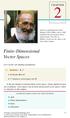 CHAPTER 2 American mathematician Paul Halmos (1916 2006), who in 1942 published the first modern linear algebra book. The title of Halmos s book was the same as the title of this chapter. Finite-Dimensional
Outline. Written Communication Conveying Scientific Information Effectively. Objective of (Scientific) Writing
 Written Communication Conveying Scientific Information Effectively Marie Davidian [email protected] http://www.stat.ncsu.edu/ davidian. Outline Objectives of (scientific) writing Important issues
Math 3000 Section 003 Intro to Abstract Math Homework 2
 Math 3000 Section 003 Intro to Abstract Math Homework 2 Department of Mathematical and Statistical Sciences University of Colorado Denver, Spring 2012 Solutions (February 13, 2012) Please note that these
SYSTEMS OF EQUATIONS AND MATRICES WITH THE TI-89. by Joseph Collison
 SYSTEMS OF EQUATIONS AND MATRICES WITH THE TI-89 by Joseph Collison Copyright 2000 by Joseph Collison All rights reserved Reproduction or translation of any part of this work beyond that permitted by Sections
WRITING PROOFS. Christopher Heil Georgia Institute of Technology
 WRITING PROOFS Christopher Heil Georgia Institute of Technology A theorem is just a statement of fact A proof of the theorem is a logical explanation of why the theorem is true Many theorems have this
FACTORING POLYNOMIALS IN THE RING OF FORMAL POWER SERIES OVER Z
 FACTORING POLYNOMIALS IN THE RING OF FORMAL POWER SERIES OVER Z DANIEL BIRMAJER, JUAN B GIL, AND MICHAEL WEINER Abstract We consider polynomials with integer coefficients and discuss their factorization
WRITING EFFECTIVE REPORTS AND ESSAYS
 WRITING EFFECTIVE REPORTS AND ESSAYS A. What are Reports? Writing Effective Reports Reports are documents which both give a reader information and ask the reader to do something with that information.
https://williamshartunionca.springboardonline.org/ebook/book/27e8f1b87a1c4555a1212b...
 of 19 9/2/2014 12:09 PM Answers Teacher Copy Plan Pacing: 1 class period Chunking the Lesson Example A #1 Example B Example C #2 Check Your Understanding Lesson Practice Teach Bell-Ringer Activity Students
TOPIC 4: DERIVATIVES
 TOPIC 4: DERIVATIVES 1. The derivative of a function. Differentiation rules 1.1. The slope of a curve. The slope of a curve at a point P is a measure of the steepness of the curve. If Q is a point on the
The last three chapters introduced three major proof techniques: direct,
 CHAPTER 7 Proving Non-Conditional Statements The last three chapters introduced three major proof techniques: direct, contrapositive and contradiction. These three techniques are used to prove statements
Planning and Writing Essays
 Planning and Writing Essays Many of your coursework assignments will take the form of an essay. This leaflet will give you an overview of the basic stages of planning and writing an academic essay but
WHAT ARE MATHEMATICAL PROOFS AND WHY THEY ARE IMPORTANT?
 WHAT ARE MATHEMATICAL PROOFS AND WHY THEY ARE IMPORTANT? introduction Many students seem to have trouble with the notion of a mathematical proof. People that come to a course like Math 216, who certainly
Student Outcomes. Lesson Notes. Classwork. Discussion (10 minutes)
 NYS COMMON CORE MATHEMATICS CURRICULUM Lesson 5 8 Student Outcomes Students know the definition of a number raised to a negative exponent. Students simplify and write equivalent expressions that contain
PYTHAGOREAN TRIPLES KEITH CONRAD
 PYTHAGOREAN TRIPLES KEITH CONRAD 1. Introduction A Pythagorean triple is a triple of positive integers (a, b, c) where a + b = c. Examples include (3, 4, 5), (5, 1, 13), and (8, 15, 17). Below is an ancient
3. INNER PRODUCT SPACES
 . INNER PRODUCT SPACES.. Definition So far we have studied abstract vector spaces. These are a generalisation of the geometric spaces R and R. But these have more structure than just that of a vector space.
A Guide to Cover Letter Writing
 A Guide to Cover Letter Writing Contents What is a Cover Letter?... 2 Before you get started - Do your Research... 3 Formatting the letter... 4 Cover letter content... 5 Section 1 - Opening... 5 Section
The Fundamental Theorem of Arithmetic
 The Fundamental Theorem of Arithmetic 1 Introduction: Why this theorem? Why this proof? One of the purposes of this course 1 is to train you in the methods mathematicians use to prove mathematical statements,
Basic numerical skills: FRACTIONS, DECIMALS, PROPORTIONS, RATIOS AND PERCENTAGES
 Basic numerical skills: FRACTIONS, DECIMALS, PROPORTIONS, RATIOS AND PERCENTAGES. Introduction (simple) This helpsheet is concerned with the ways that we express quantities that are not whole numbers,
Polynomial and Rational Functions
 Polynomial and Rational Functions Quadratic Functions Overview of Objectives, students should be able to: 1. Recognize the characteristics of parabolas. 2. Find the intercepts a. x intercepts by solving
6 EXTENDING ALGEBRA. 6.0 Introduction. 6.1 The cubic equation. Objectives
 6 EXTENDING ALGEBRA Chapter 6 Extending Algebra Objectives After studying this chapter you should understand techniques whereby equations of cubic degree and higher can be solved; be able to factorise
Office of Research and Graduate Studies
 Office of Research and Graduate Studies Duncan Hayse, MA, MFA Coordinator Theses, Doctoral Projects, and Dissertations CONTACT: http://www.uiw.edu/orgs/writing/index.html [email protected] APA review for
Regular Languages and Finite Automata
 Regular Languages and Finite Automata 1 Introduction Hing Leung Department of Computer Science New Mexico State University Sep 16, 2010 In 1943, McCulloch and Pitts [4] published a pioneering work on a
Chapter 3. Cartesian Products and Relations. 3.1 Cartesian Products
 Chapter 3 Cartesian Products and Relations The material in this chapter is the first real encounter with abstraction. Relations are very general thing they are a special type of subset. After introducing
Chapter 11 Number Theory
 Chapter 11 Number Theory Number theory is one of the oldest branches of mathematics. For many years people who studied number theory delighted in its pure nature because there were few practical applications
HOW TO SUCCEED WITH NEWSPAPER ADVERTISING
 HOW TO SUCCEED WITH NEWSPAPER ADVERTISING With newspaper advertising, Consistent Advertising = Familiarity = Trust = Customers. People won t buy from you until they trust you! That trust and confidence
Writing a Project Report: Style Matters
 Writing a Project Report: Style Matters Prof. Alan F. Smeaton Centre for Digital Video Processing and School of Computing Writing for Computing Why ask me to do this? I write a lot papers, chapters, project
Mathematical Induction
 Mathematical Induction In logic, we often want to prove that every member of an infinite set has some feature. E.g., we would like to show: N 1 : is a number 1 : has the feature Φ ( x)(n 1 x! 1 x) How
Duality of linear conic problems
 Duality of linear conic problems Alexander Shapiro and Arkadi Nemirovski Abstract It is well known that the optimal values of a linear programming problem and its dual are equal to each other if at least
Writing Guide for Five Paragraph Essays. Grace-St. Luke s Episcopal School
 1 Writing Guide for Five Paragraph Essays Grace-St. Luke s Episcopal School 2 Five Paragraph Essays Every five paragraph essay has one thing in common five paragraphs. What a revelation! Even writing them
CHAPTER 2. Logic. 1. Logic Definitions. Notation: Variables are used to represent propositions. The most common variables used are p, q, and r.
 CHAPTER 2 Logic 1. Logic Definitions 1.1. Propositions. Definition 1.1.1. A proposition is a declarative sentence that is either true (denoted either T or 1) or false (denoted either F or 0). Notation:
Writing an essay. This seems obvious - but it is surprising how many people don't really do this.
 Writing an essay Look back If this is not your first essay, take a look at your previous one. Did your tutor make any suggestions that you need to bear in mind for this essay? Did you learn anything else
RuleSpeak R Sentence Forms Specifying Natural-Language Business Rules in English
 Business Rule Solutions, LLC RuleSpeak R Sentence Forms Specifying Natural-Language Business Rules in English This original English version developed by Ronald G. Ross Co-Founder & Principal, Business
Mathematical Induction. Mary Barnes Sue Gordon
 Mathematics Learning Centre Mathematical Induction Mary Barnes Sue Gordon c 1987 University of Sydney Contents 1 Mathematical Induction 1 1.1 Why do we need proof by induction?.... 1 1. What is proof by
Five High Order Thinking Skills
 Five High Order Introduction The high technology like computers and calculators has profoundly changed the world of mathematics education. It is not only what aspects of mathematics are essential for learning,
Chapter Two. THE TIME VALUE OF MONEY Conventions & Definitions
 Chapter Two THE TIME VALUE OF MONEY Conventions & Definitions Introduction Now, we are going to learn one of the most important topics in finance, that is, the time value of money. Note that almost every
Critical Analysis So what does that REALLY mean?
 Critical Analysis So what does that REALLY mean? 1 The words critically analyse can cause panic in students when they first turn over their examination paper or are handed their assignment questions. Why?
Lesson: Editing Guidelines and Response Writing: Essay Exam (Part 1)
 Put That In Writing - Level Two 113 UNIT 9 Lesson: Editing Guidelines and Response Writing: Essay Exam (Part 1) 9.1 Learning Objectives A. To know the guidelines for editing an essay. B. To edit and improve
Solving Quadratic Equations
 9.3 Solving Quadratic Equations by Using the Quadratic Formula 9.3 OBJECTIVES 1. Solve a quadratic equation by using the quadratic formula 2. Determine the nature of the solutions of a quadratic equation
The Prime Numbers. Definition. A prime number is a positive integer with exactly two positive divisors.
 The Prime Numbers Before starting our study of primes, we record the following important lemma. Recall that integers a, b are said to be relatively prime if gcd(a, b) = 1. Lemma (Euclid s Lemma). If gcd(a,
How to write a good (maths) Ph.D. thesis
 How to write a good (maths) Ph.D. thesis Melina A Freitag Department of Mathematical Sciences University of Bath Postgraduate Away Day 3rd February 2012 1 of 30 The purpose of a thesis University regulations
3 Some Integer Functions
 3 Some Integer Functions A Pair of Fundamental Integer Functions The integer function that is the heart of this section is the modulo function. However, before getting to it, let us look at some very simple
Regions in a circle. 7 points 57 regions
 Regions in a circle 1 point 1 region points regions 3 points 4 regions 4 points 8 regions 5 points 16 regions The question is, what is the next picture? How many regions will 6 points give? There's an
So let us begin our quest to find the holy grail of real analysis.
 1 Section 5.2 The Complete Ordered Field: Purpose of Section We present an axiomatic description of the real numbers as a complete ordered field. The axioms which describe the arithmetic of the real numbers
WRITING A CRITICAL ARTICLE REVIEW
 WRITING A CRITICAL ARTICLE REVIEW A critical article review briefly describes the content of an article and, more importantly, provides an in-depth analysis and evaluation of its ideas and purpose. The
Chapter 21: The Discounted Utility Model
 Chapter 21: The Discounted Utility Model 21.1: Introduction This is an important chapter in that it introduces, and explores the implications of, an empirically relevant utility function representing intertemporal
MATH 10034 Fundamental Mathematics IV
 MATH 0034 Fundamental Mathematics IV http://www.math.kent.edu/ebooks/0034/funmath4.pdf Department of Mathematical Sciences Kent State University January 2, 2009 ii Contents To the Instructor v Polynomials.
Metric Spaces. Chapter 7. 7.1. Metrics
 Chapter 7 Metric Spaces A metric space is a set X that has a notion of the distance d(x, y) between every pair of points x, y X. The purpose of this chapter is to introduce metric spaces and give some
Decision Making under Uncertainty
 6.825 Techniques in Artificial Intelligence Decision Making under Uncertainty How to make one decision in the face of uncertainty Lecture 19 1 In the next two lectures, we ll look at the question of how
Mathematics. What to expect Resources Study Strategies Helpful Preparation Tips Problem Solving Strategies and Hints Test taking strategies
 Mathematics Before reading this section, make sure you have read the appropriate description of the mathematics section test (computerized or paper) to understand what is expected of you in the mathematics
Linear Algebra I. Ronald van Luijk, 2012
 Linear Algebra I Ronald van Luijk, 2012 With many parts from Linear Algebra I by Michael Stoll, 2007 Contents 1. Vector spaces 3 1.1. Examples 3 1.2. Fields 4 1.3. The field of complex numbers. 6 1.4.
Math: Study Skills, Note Taking Skills, And Test Taking Strategies
 Math: Study Skills, Note Taking Skills, And Test Taking Strategies Math Study Skill Active Study vs. Passive Study Be actively involved in managing the learning process, the mathematics and your study
3.2. Solving quadratic equations. Introduction. Prerequisites. Learning Outcomes. Learning Style
 Solving quadratic equations 3.2 Introduction A quadratic equation is one which can be written in the form ax 2 + bx + c = 0 where a, b and c are numbers and x is the unknown whose value(s) we wish to find.
Inner Product Spaces
 Math 571 Inner Product Spaces 1. Preliminaries An inner product space is a vector space V along with a function, called an inner product which associates each pair of vectors u, v with a scalar u, v, and
C H A P T E R Regular Expressions regular expression
 7 CHAPTER Regular Expressions Most programmers and other power-users of computer systems have used tools that match text patterns. You may have used a Web search engine with a pattern like travel cancun
OTTO VON GUERICKE UNIVERSITY MAGDEBURG
 OTTO VON GUERICKE UNIVERSITY MAGDEBURG Faculty for Process and Systems Engineering INSTRUCTIONS to Design and defend Master Theses Magdeburg, 09 th January 2012 Rules for Master Thesis 2 Contents Page
Kenken For Teachers. Tom Davis [email protected] http://www.geometer.org/mathcircles June 27, 2010. Abstract
 Kenken For Teachers Tom Davis [email protected] http://www.geometer.org/mathcircles June 7, 00 Abstract Kenken is a puzzle whose solution requires a combination of logic and simple arithmetic skills.
Quotient Rings and Field Extensions
 Chapter 5 Quotient Rings and Field Extensions In this chapter we describe a method for producing field extension of a given field. If F is a field, then a field extension is a field K that contains F.
A Little Set Theory (Never Hurt Anybody)
 A Little Set Theory (Never Hurt Anybody) Matthew Saltzman Department of Mathematical Sciences Clemson University Draft: August 21, 2013 1 Introduction The fundamental ideas of set theory and the algebra
each college c i C has a capacity q i - the maximum number of students it will admit
 n colleges in a set C, m applicants in a set A, where m is much larger than n. each college c i C has a capacity q i - the maximum number of students it will admit each college c i has a strict order i
Editing and Proofreading. University Learning Centre Writing Help Ron Cooley, Professor of English [email protected]
 Editing and Proofreading University Learning Centre Writing Help Ron Cooley, Professor of English [email protected] 3-stage writing process (conventional view) 1. Pre-writing Literature review Data
The Mean Value Theorem
 The Mean Value Theorem THEOREM (The Extreme Value Theorem): If f is continuous on a closed interval [a, b], then f attains an absolute maximum value f(c) and an absolute minimum value f(d) at some numbers
c 2008 Je rey A. Miron We have described the constraints that a consumer faces, i.e., discussed the budget constraint.
 Lecture 2b: Utility c 2008 Je rey A. Miron Outline: 1. Introduction 2. Utility: A De nition 3. Monotonic Transformations 4. Cardinal Utility 5. Constructing a Utility Function 6. Examples of Utility Functions
Example 1. Consider the following two portfolios: 2. Buy one c(s(t), 20, τ, r) and sell one c(s(t), 10, τ, r).
 Chapter 4 Put-Call Parity 1 Bull and Bear Financial analysts use words such as bull and bear to describe the trend in stock markets. Generally speaking, a bull market is characterized by rising prices.
Comparative Analysis on the Armenian and Korean Languages
 Comparative Analysis on the Armenian and Korean Languages Syuzanna Mejlumyan Yerevan State Linguistic University Abstract It has been five years since the Korean language has been taught at Yerevan State
A Guide for Writing a Technical Research Paper
 A Guide for Writing a Technical Research Paper Libby Shoop Macalester College, Mathematics and Computer Science Department 1 Introduction This document provides you with some tips and some resources to
Metric Spaces. Chapter 1
 Chapter 1 Metric Spaces Many of the arguments you have seen in several variable calculus are almost identical to the corresponding arguments in one variable calculus, especially arguments concerning convergence
6.4 Normal Distribution
 Contents 6.4 Normal Distribution....................... 381 6.4.1 Characteristics of the Normal Distribution....... 381 6.4.2 The Standardized Normal Distribution......... 385 6.4.3 Meaning of Areas under
8 Primes and Modular Arithmetic
 8 Primes and Modular Arithmetic 8.1 Primes and Factors Over two millennia ago already, people all over the world were considering the properties of numbers. One of the simplest concepts is prime numbers.
26 Integers: Multiplication, Division, and Order
 26 Integers: Multiplication, Division, and Order Integer multiplication and division are extensions of whole number multiplication and division. In multiplying and dividing integers, the one new issue
Linear Algebra: Vectors
 A Linear Algebra: Vectors A Appendix A: LINEAR ALGEBRA: VECTORS TABLE OF CONTENTS Page A Motivation A 3 A2 Vectors A 3 A2 Notational Conventions A 4 A22 Visualization A 5 A23 Special Vectors A 5 A3 Vector
Basic Proof Techniques
 Basic Proof Techniques David Ferry [email protected] September 13, 010 1 Four Fundamental Proof Techniques When one wishes to prove the statement P Q there are four fundamental approaches. This document
The theory of the six stages of learning with integers (Published in Mathematics in Schools, Volume 29, Number 2, March 2000) Stage 1
 The theory of the six stages of learning with integers (Published in Mathematics in Schools, Volume 29, Number 2, March 2000) Stage 1 Free interaction In the case of the study of integers, this first stage
REPORT WRITING GUIDE
 Report Writing Guide F2009 1 REPORT WRITING GUIDE Introduction The importance of good report writing and data presentation cannot be overemphasized. No matter how good an experiment, or how brilliant a
36 CHAPTER 1. LIMITS AND CONTINUITY. Figure 1.17: At which points is f not continuous?
 36 CHAPTER 1. LIMITS AND CONTINUITY 1.3 Continuity Before Calculus became clearly de ned, continuity meant that one could draw the graph of a function without having to lift the pen and pencil. While this
Teaching Writing to Students with Learning Disabilities by Bruce Johnson
 Teaching Writing to Students with Learning Disabilities by Bruce Johnson In order to meet the needs of students with learning disabilities, I have made some changes in the way I teach writing to composition
Cubic Functions: Global Analysis
 Chapter 14 Cubic Functions: Global Analysis The Essential Question, 231 Concavity-sign, 232 Slope-sign, 234 Extremum, 235 Height-sign, 236 0-Concavity Location, 237 0-Slope Location, 239 Extremum Location,
How to become a successful language learner
 How to become a successful language learner By Alison Fenner English and German Co-ordinator, Institution Wide Language Programme Introduction Your success in learning a language depends on you! You may
Set Theory Basic Concepts and Definitions
 Set Theory Basic Concepts and Definitions The Importance of Set Theory One striking feature of humans is their inherent need and ability to group objects according to specific criteria. Our prehistoric
Ummmm! Definitely interested. She took the pen and pad out of my hand and constructed a third one for herself:
 Sum of Cubes Jo was supposed to be studying for her grade 12 physics test, but her soul was wandering. Show me something fun, she said. Well I wasn t sure just what she had in mind, but it happened that