
CARL HANSER VERLAG. Herbert Rees. Mold Engineering 2nd edition
|
|
|
- Anna Henderson
- 9 years ago
- Views:
Transcription
1 CARL HANSER VERLAG Herbert Rees Mold Engineering 2nd edition

2 45 4 General Mold Design Guidelines 4.1 Before Starting to Design a Mold he mold designer starts with the design of a new mold when he receives a part drawing, a sample or, rarely today, a model of the product. Additional information includes the machine (or machines) the mold will be run in, the number of cavities required, and, if it is not shown on the drawing, the type of plastic that will be used for this product. While the above information is important, it may be incomplete. here are other concerns which should be addressed before starting the mold design: Molding characteristics of the specified plastic? How many parts will be molded? (approximately annually, and over the life of the mold) Anticipated molding cycle? Where and how is the product used? Must the product fit with other parts? (tolerances) Shrinkage? Draft angles? What type of runner system is required?: Cold runner (2-plate, 3-plate)? Hot runner? Combination of both? Gate location, flow and weld lines, ejector marks? Permissible gate (vestige) size or shape Finish? Engraving? Cavity numbering? Spares required with mold? Are the indicated machines suitable: onnage? Shot size? Plasticizing capacity? Is mechanical (automatic) product removal planned? iming of project? (How soon is the mold required?) Some of these questions and concerns may have been answered with the accompanying mold order; there may be other questions which will have to be answered by dialogue with the customer. After a mold order has been received, it is important to find out how the quoted price for this mold has been arrived at. Mold prices are usually estimated by an experienced mold designer or estimator, often by the owner of the mold making business. At the time when the estimator receives a request for a quotation, he or she may sketch a mold design which is believed to be appropriate for the product, based on experience and/or from records of similar molds. he estimator then bases all cost figures on this sketch. he estimator may also, according to the complexity or novelty of the product, add a safety factor or fudge factor before arriving at an estimated mold price for quoting to the customers.

3 46 4 General Mold Design Guidelines here is a risk that the quoted mold price is lower than it might have been if all the parameters had been considered at the time of the quoting. he quoted mold price must be competitive with that quoted by other mold makers; there is an added risk in times when mold orders are scarce and prices are very competitive in that, just to get the order, the quoted mold price is lower than would normally be quoted. It seems to be impossible to find a better system unless the estimator completely designs each mold; this would take much more time than normally allotted for estimating. An exception to this is when the customer is willing to purchase some preliminary mold design time before the mold will be quoted. Another problem is that many more molds are estimated than will eventually result in orders. It is common practice in all industries to send out requests for at least three quotations from different mold makers before a mold order is placed. Also, occasionally, a mold estimate is requested by a manufacturer for pricing purposes only, simply to find out whether a product is economically interesting, without any intention of soon or ever placing an order. It is important to understand that the mold designer must know the type of mold that the estimator had in mind when quoting a price. If not, he or she may design a mold that greatly exceeds the quoted price. Note that the purpose of any industry is to make money with their product. (he product of the molder is the plastic product; the product of the mold maker is the mold.) he foregoing does not imply that one should design and build a bad mold just to stay within the budget of the quoted price. In mold estimating, it is impossible for the estimator to be always right; however, it is important that when averaging many molds the financial results of the good and the bad molds balance out or are in favor of the mold maker if the business is to prosper. Also, the mold envisaged by the estimator is not necessarily the best design. here is a good chance that in the course of the design process a better design will be found. But it is necessary that the mold designer is aware of the quoted mold price at the start of a mold design project. It is quite possible that the estimator has erred, has underestimated some difficulties in molding the product, or was missing some important information which was subsequently supplied with the mold order. If, after a preliminary study by the mold designer of the product and the final specifications, it becomes apparent that some parameters have been either inadvertently or deliberately changed, the customer must be immediately advised of any increase in the mold cost caused by such changes before more time is spent on the project. In this way, much aggravation can be avoided, and the customer may revise or eliminate some of the new or previously unspecified parameters. he customer may not have been aware that such changes between the time of the quote and the order would affect the mold price. On the other hand, if the error was due to poor estimating, there is nothing that can be done by the designer but to try to stay within budget and to design whatever is necessary to build the mold as quoted; under no circumstances must the quality or the performance of the mold be compromised. Since the reputation of the mold maker is at stake, any loss suffered due to

4 4.2 Molding Characteristics of the Specified Plastic 47 poor estimating must be written off as learning experience and good will. here is a possibility that the customer may agree to carry some or all of the extra costs involved, but it is a policy decision of the mold maker whether to approach the customer for an increase of the contracted mold price. Occasionally, a mold price may be deliberately quoted low as the result of a sales policy; for example, to win a new customer or to enter a new field of products in which the molder has little or no experience. Regardless of the low price, the designer must still design the best possible mold to perform as specified, at a reasonable cost. 4.2 Molding Characteristics of the Specified Plastic We will here consider only characteristics which directly affect the mold design: 1. Flow characteristics. Easy flowing materials usually present no problems, but stiff materials require higher injection pressure and, therefore, heavier construction of the mold. his will also affect the need for more accuracy and strength of the alignment elements. 2. Melt (processing) temperature. he higher this temperature, the more important becomes the cooling design and, sometimes, the method of heat insulation between hot and cooled portions of the mold. 3. Material degradation. Every thermoplastic is to some degree heat-sensitive (or subject to degradation) when exposed to high temperatures over a length of time. Figure 4.1 shows schematically a typical curve: 1 represents the highest temperature at which the material could be injected safely; 2 is the lowest temperature required to keep the plastic injectable. he difference between 1 and 2 is the operating (molding) temperature range (OR) of the plastic; t 1 and t 2 show the elapsed time before degradation starts at the temperatures 1 or 2. Melt temperature 1 Operating range OR Degrading Maximum temperature at which product can be used 0 t t 1 2 Figure 4.1 Material degradation curve. Elapsed time t

5 48 4 General Mold Design Guidelines OR A OR 2 B OR C t 0 t 0 t t t t t t t Low operating temperature narrow OR t t short 1 2 High operating temperature narrow OR t t short 1 2 Wide OR t t long 1 2 Figure 4.2 Degradation curves for various types of plastics: A. Highly heat-sensitive, B. Heatsensitive, and C. Not very heat-sensitive. Some materials, such as PVC, are molded at low temperatures and have a narrow OR and a short time span (t 1 t 2 ) (Fig. 4.2A); they are very heat-sensitive. Some plastics are molded at much higher temperatures and may have a wider OR but also a fairly short time span (t 1 t 2 ) (Fig. 4.2B); they are also heat-sensitive. Such materials include PE, acetates, and others. Figure 4.2C represents low heat-sensitive materials, such as PE, PP, PS, etc. he graphs shown are schematics only; curves with the appropriate values for each plastic are available from the plastic materials suppliers. he mold designer must understand this relation between time and temperature because it affects the design of the runner system and the design and construction of the hot runners, provided that hot runners can be used at all. It will also affect the mold material (steel) selection, for example, in the presence of corrosive agents in the plastic. Some materials, typically acetal, give off poisonous gases when heated for even a short time above their upper permissible temperature and corresponding safe time, even though the material does not have visible signs of degradation. Other materials give off highly corrosive gases and will require specially selected mold materials and/or finishes. All materials show degradation by changing color to yellow or brown; the ultimate form of degradation is when the plastic becomes charred (carbonized) and black. All products containing even small portions of degraded material should be discarded, not only because of poor appearance of the product (streaks, etc.) but because physical properties may have been lost and the product may not perform as expected.

6 4.4 Studying the Product Anticipated Molding Cycle here are several reasons why the estimator and the designer should know the anticipated molding cycle. It is always desirable to build a mold with the shortest possible molding cycle, but this can only be achieved at a cost. Special cooling methods, added ejection features, special mold materials, lubrication, etc., will certainly add to the cost of the mold. he designer (and estimator) should always question the molding cycle demanded or suggested. While the customer (molder) probably has experience on which the expected cycle time is based, there is no harm in double-checking it against the experience of the mold maker and the mold designer. Seldom are two parts so similar that cycle times can be extrapolated from one to the other. Differences in the plastic, wall thicknesses, draft angles, methods of gating, the machine used, and other factors may have a significant impact on the molding cycle. his is one of the areas where the mold designer can prevent a financial disaster right at the beginning of a project by questioning the molding cycle specified with the order, particularly if there is a performance guarantee involved. 4.4 Studying the Product he first task for the mold designer is to become familiar with the intended product. Steps for studying the product are outlined below Check the Product Drawing Clarity Are all necessary views, sections, and section lines shown? At this point of the job it is almost impossible to make sure that all dimensions are given and are correct. Frequently, a product designer who is very familiar with the product forgets that the mold designer may not be and, hence, may take shortcuts which can lead to errors in the interpretation of the drawing Projection Is the drawing in 1st angle (European) or 3rd angle (American) projection? his is a common source of error and may not be discovered until some time into the project; it could result in production of the mirror image of the desired shape. Some draftsmen, to save time, rather than redraw a view or section which was drawn incorrectly in relation to the main view, or to save space on the paper, will mark the direction of a view with an arrow, regardless of the system of projection used. Views indicated by such arrows should be carefully checked to avoid subsequent machining errors.

7 50 4 General Mold Design Guidelines olerances his is probably the most important area to be checked before the mold design should be started. he estimator should check and question the tolerances at the time when the job is quoted. he final drawing received with the order must be compared with the product drawing used for the quotation to make sure that there were no changes made. Quite often, the drawings used for quotations are only preliminary and incomplete, and tolerances may not have been shown. Since a large portion of the machining cost of the mold components is directly related to the tightness of the tolerances, it is important to ascertain that critical tolerances have not been made tighter since the quotation. If this should be the case, and if the new tolerances will affect the mold cost, the mold designer must immediately approach the customer to bring the tolerances back to what was quoted or to have the contract requoted. Often, the product designer assigns close tolerances to the product that are not necessary for the function of the product. While in some places the tight tolerances are probably justified, many are not. Also, the general tolerance may have been specified unnecessarily tight. Although it may require a bit more work and understanding by the product designer, the proper method is to give a relatively large general tolerance and tighten up dimensions only where it is necessary for the function of the product or where it is required in the assembly with matching products. Note that, often, tight tolerances are impossible to hold by simply molding because of the wide range of the shrinkage of plastic. If such close tolerances are absolutely necessary, it may require selection of the proper size pieces and disposal of the molded products that are outside of the tolerances; this is an extremely expensive way of producing anything. For more information regarding plastic shrinkage and tolerances, see Chapter 8, Plastic Shrinkage, and Chapter 9, Mold Surface olerances. It is usually easy enough to make the mold steel to close tolerances, but this does not mean that every product will be within tolerance. Various methods are used to show that the tolerances will increase as the sizes increase. he product tolerances can be given as percentage of the size; for example, a general tolerance may be ±0.05 mm per 10 mm (or ±0.005 in. per 1 in.), which reduces the tolerance for smaller sizes and increases the tolerance for larger sizes. But there must also be a reasonable minimum tolerance set for very small dimensions to prevent them from being overly restricted and difficult to produce. Whichever method is specified, the designer must make sure that the tolerances shown on the product drawing make sense. he mold designer must not forget that the sizes also depend on the operating temperatures; in some cases, the product keeps shrinking hours and even days after molding. With some critical dimensions and certain materials, it must be established beforehand when, and under what conditions, the product will be measured. his study of the tolerances at the beginning of the job will prevent arguments later on. If the tolerances specified are unreasonable, the mold designer must discuss them with the customer and get a release in writing so that the mold maker will not be held responsible for sizes of the molded product which are outside the (unreasonably) specified ones.

8 4.4 Studying the Product Product Use Where and how is the product to be used? his question must be asked not just out of idle curiosity; it will give the mold designer some idea of the importance of certain aspects and critical areas of the product such as required fits with other products, finish, physical strength, location of gate, ejectors, etc. he designer may then suggest changes, especially in the areas of fragile mold cores or thin ribs, not only to make the mold easier to build but also to extend the life of the mold and to improve its serviceability. Understanding the product may save on unnecessary polishing; it may indicate to the designer where looser tolerances could be in order and where to request sharp edges instead of the round edges specified, or round edges where sharp edges are shown (see typical examples in Fig. 4.3). Some suggestions that can be pointed out right at the beginning of the project refer to improvements of the filling path of the plastic which may need only small changes in the product shape to give faster filling (and molding) speeds. One such example is shown in Fig Such requests for changes will benefit not only the mold maker but also the molder, and it is the duty of the mold designer, after understanding the purpose of the product, to discuss such proposed changes in the product design with the customer, who would be the ultimate beneficiary of such changes. Inside corner Outside edge Bad Good Difficult Easier Figure 4.3 ypical examples of product wall design improvements. Bad Good Figure 4.4 ypical improvement of flow path of plastic.

9 52 4 General Mold Design Guidelines he customer must also be made aware of the fact that the mold maker (and designer) often has had specific experiences in the areas of discussion and does not request such changes solely to save some money for the mold maker but in a desire to give the customer some advice gained from molding similar products, with earlier molds they have built. Other typical but highly undesirable features (for molding rather than for mold making) are severe changes in wall thicknesses and heavy sections at the end of long, thin passages. he product designer may not be aware of the fact that this is bad for molding. It affects the filling of the cavity space and may cause sink marks in the product. o overcome such poor flow conditions, higher injection temperatures and/or pressures and longer holding times will be required, resulting in longer cycles. Heavy walls and bosses can sometimes be redesigned by coring out or by relocating them so that more uniform wall thicknesses can be created, and cooling can be provided inside heavy sections to permit faster cooling. Usually, it is the heaviest section of a product and its cooling which determines the molding cycle and the productivity of the mold. In summary, there are many areas in which an experienced mold designer can pinpoint possible improvements which may have a bearing on the quality, productivity, longevity, and serviceability of the mold, and which should be discussed with the product designer (or customer) Notes on the Drawing Scrutinize all notes on the product drawing(s). It is a good practice to show with notes on a drawing all information which cannot be easily shown by conventional drawing techniques or which, if shown, would clutter the view(s) on the drawing. hese notes may add information regarding tolerances, draft angles, finishes, concentricity, fits, material selection, etc. Make sure the notes are clear and make sense. o overlook or misinterpret a note is as serious a mistake as to overlook or misinterpret a dimension. Notes may show changes from earlier designs of the product; they may point out which areas of the product demanded changes by the product designer. his could have significance for the mold design by indicating that future changes are possible. It may suggest provision of inserts where they otherwise would not be necessary from the mold maker s point of view Draft Angles Check the drawing for draft angles. Generally, a draft angle greater than 1 per side presents no problem for pulling the molded part out of the cavity, or for the ejection of internal ribs, provided the finish is adequate. Draft angles smaller than 1 should be carefully considered, and if they appear to be unreasonable, the customer should be approached with a request to increase the angles. While it may be possible to mold sides and ribs without any draft angle (or even with negative draft) by using side cores, two-stage ejection, or collapsible cores, such features could add considerably to the complexity and cost of the mold.

10 4.4 Studying the Product 53 hin-walled products are usually more delicate and more affected by small draft angles. hey will require better finish, draw polishing (polishing in the direction of the mold motion), and/or the use of inserts where otherwise no inserts would be required. Increase in the use of inserts, however, reduces the possibility of using maximum cooling and, therefore, may affect the molding cycle, which is of prime interest to the molder. In many cases, this argument alone will convince the customer to increase insufficient draft angles. he stiffness and the condition of the molding machine used for the planned mold also has a bearing on the minimum draft angles. If the clamp opening motion is not perfectly straight and in line with the center line of the product, it will permit the moving mold half or the cavity plate to sag as the clamp opens; the molded product will show drag marks where the plastic (between the core and the cavity) supported the mold halves during the opening stroke. If the machine is not solid enough to ensure that the mold will stay on its center line, additional supports as part of the mold will be required, thereby adding to the mold cost. If thin, deep ribs are specified, with small draft angles per side, they will require special ejection features. Ejector pins should always be at the bottom of the ribs to ensure that the ribs will not break and remain in the core. o be effective, such ejectors pins ( blades ) have a narrow, flat cross section where they contact the rib, which is very expensive to produce and to maintain. Round pins (with a diameter equal to the width of the rib) are usually too small and fragile. o use a pin diameter larger than the width of the rib, the mold designer needs a concession from the product designer because the path of the ejector pin will create a circular thickening in the rib (Fig. 4.5). For more in-depth discussion of ejection factors in draft angles for mold design, see Chapter 12, Ejection. Note that the preceding is just a sample of the kind of requests by the mold designer from the product designer or customer. Each design feature of the product must be studied before starting to design. as designed hickening in product Rectangular ejector (too expensive) Ejector Round ejector pin (too small) Larger pin suggested Original design Changes suggested Figure 4.5 wo drawings show an original design (left) in which an ejector pin is too small and a revised design (right) depicting corrections to improve the mold.

11 54 4 General Mold Design Guidelines he designer must well understand the product before making any suggestions and must not suggest anything that may affect the performance, strength, or safety of the product even if it will mean more difficulty or higher cost in mold making or in molding. Agreement on any changes must be in writing; at the very least, any marked-up changes on the issued product drawing should be signed and dated. he study of drawings can usually be done very rapidly. In many cases, it may not even take an hour to scrutinize a drawing, but as in all endeavors, it is better to first spend some time to look where you are going before starting to run Responsibility for Shrinkage When only a product drawing and the molding material are specified, it must be clearly defined who will assume the responsibility for selecting the proper shrinkage values. Sometimes, the customer assumes the responsibility and specifies the suggested shrinkage, or supplies in addition to the product sizes all critical mold (steel) sizes. his is usually the case if the customer has had similar cavities in use in an experimental or earlier production mold. Another point to ascertain at this time is whether the mold will also be used with different materials, which may have different shrinkage factors. If a mold is built to use polystyrene (PS) with 0.6% shrinkage, it probably could also be used for other materials such as polypropylene (PP) with 1.5% shrinkage, but because of the higher shrinkage factors, the products will be smaller. o know the materials expected to be molded in the mold is also useful because it may affect the selected finishes of the molding surfaces. It is important that all uncertain areas of the drawing and the specifications are clarified before starting any mold layout. Few things are as frustrating as to arrive at a beautiful mold design, only to find out that it would be very difficult or even impossible to change some critical dimensions or features, should that become necessary as a result of wrong shrinkage allowances. For a more in-depth discussion, see Section 3.1, Accuracy and Finish, and also Chapter 8, Shrinkage, and Chapter 9, Product olerances Working from a Sample or Model It is generally not possible to work from a sample or model. However, since in some cases the customer has no facilities to make proper drawings, it may be necessary for the mold designer to become involved with the product design drawing. he designer will study the product and, with all necessary information supplied by the customer, will make a product drawing. he advantage is that the mold designer can specify all the points discussed in Section to give the mold all advantages both for molding and for mold making. But it is absolutely necessary that the customer agrees with all these points and accepts the product drawing by signing it before work on the mold design is started.

12 4.5 ypical Check List for Estimators and Designers 55 It is also necessary that the customer holds the mold designer and mold maker free from any liability resulting from infringing on the rights of others due to the product so designed. 4.5 ypical Check List for Estimators and Designers he following is a summary of the questions and considerations explained earlier in this chapter. It is the basis of any formal check list used by a mold maker and may vary according to individual requirements and priorities: Machine Specifications Mold mounting data: ie bar spacing: vertical horizontal ie bar size: Can tie bars be pulled? Platen specs: Locating ring diameter Hole patterns: SPI? Euromap? Special mountings: Special ejectors: Machine nozzle data: Shape: Flat Round Radius Nozzle opening: Nozzle length: Controlled flow: Open Pin Other Injection unit: Shot capacity: Injection speed: Recovery rate: Profiling of speed possible? Profiling of pressure possible? Carriage travel: Clamp: Clamping force: Shut height: Minimum Maximum Bolster thickness:

Solid shape molding is not desired in injection molding due to following reasons.
 PLASTICS PART DESIGN and MOULDABILITY Injection molding is popular manufacturing method because of its high-speed production capability. Performance of plastics part is limited by its properties which
3D Printed Injection Molding Tool ("PIMT") Guide. Objet Ltd.
 3D Printed Injection Molding Tool ("PIMT") Guide Objet Ltd. 2 Injection molding is a high speed, automated and versatile process that can produce high precision complex three dimensional parts from a fraction
Part and tooling design. Eastman Tritan copolyester
 Part and tooling design Eastman Tritan copolyester Part and tooling design Process Part design Tooling design High cavitation considerations Process Process Project development flow chart Concept OEM generates
Die casting Figure M2.3.1
 Die casting Die casting is a moulding process in which the molten metal is injected under high pressure and velocity into a split mould die. It is also called pressure die casting. The split mould used
Plastic Injection Molds
 Training Objective After watching the program and reviewing this printed material, the viewer will become familiar with the variety, design, and productive use of plastic injection molds. Mold components
Effects of the MuCell Molding Process
 Effects of the MuCell Molding Process Molding MuCell versus Solid Shot size is reduced Final mold fill is completed with cell growth Little or no Hold Time or Pressure Reduced molded-in stress Less warp
INJECTION MOULD DESIGN: MARPLEX PVC RESINS
 MACHINE RECCOMENDATIONS PVC requires reciprocating screw injection moulding machine with a plasticising screw to produce homogeneous melt. It is recommended that a shot weight of the part should take two
What is a mold? Casting. Die casting. Injection Molding Machine. Injection Molding. 2.008 Design & Manufacturing II. Spring 2004
 2.008 Design & Manufacturing II What is a mold? From Webster: a cavity in which a substance is shaped: as (1) : a matrix for casting metal (2) : a form in which food is given a decorative shape Spring
p l a s t i c i n j e c t i o n m o l d i n g p a r t 1 p r o c e s s, m o l d a n d m a c h i n e e r i k d e l a n g e
 p l a s t i c i n j e c t i o n m o l d i n g p a r t 1 p r o c e s s, m o l d a n d m a c h i n e e r i k d e l a n g e H R O R o t t e r d a m B r n o U T j o i n t p r o j e c t 1 plastic injection
6 Design of Gates. 6.1 The Sprue Gate
 6 Design of Gates 6.1 The Sprue Gate The sprue gate is the simplest and oldest kind of gate. It has a circular cross-section, is slightly tapered, and merges with its largest cross-section into the part.
CHAPTER 2 INJECTION MOULDING PROCESS
 CHAPTER 2 INJECTION MOULDING PROCESS Injection moulding is the most widely used polymeric fabrication process. It evolved from metal die casting, however, unlike molten metals, polymer melts have a high
Mould and Die Standard Parts
 Mould and Die Standard Parts Tampere University of technology - Tuula Höök Mould standard parts can be divided into the following groups: Standard mould set with guide bars, guide sleeves and other guiding
Plastic Injection Molding
 Training Objective After watching this video and reviewing the printed material, the student/trainee will understand the principles and physical operations of the plastic injection molding process. An
General Guidelines for Building Aluminum Production Injection Molds
 General Guidelines for Building Aluminum Production Injection Molds Using 7000 series Aluminum Mold Plate By David Bank Aluminum Injection Mold Company Rochester, New York 1 Introduction This high strength
Injection Molding Design Guide. Table of Contents
 Injection Molding Design Guide 400 Injection Molding Design Guide Table of Contents Injection Mold Tooling Process Comparison...2 Size Limitations...3 Straight Pull Design...4 Other Geometric Considerations...5
DIESEL EFFECT PROBLEM SOLVING DURING INJECTION MOULDING
 RESEARCH PAPERS FACULTY OF MATERIALS SCIENCE AND TECHNOLOGY IN TRNAVA SLOVAK UNIVERSITY OF TECHNOLOGY IN BRATISLAVA 2014 Volume 22, Special Number DIESEL EFFECT PROBLEM SOLVING DURING INJECTION MOULDING
A Guide to Thermoform Processing of Polypropylene. Introduction
 A Guide to Thermoform Processing of Polypropylene Introduction Thermoforming is the process of heating plastic sheet to a pliable state and forming it into shape. Thermoforming offers processing advantages
Injection molding overview
 Injection molding overview This injection molding overview is designed to help our customers understand the process of injection molding and mold-making. Please read it fully as it helps to define what
SOLUTIONS FOR MOLD DESIGNERS
 SOLUTIONS FOR MOLD DESIGNERS White Paper Abstract For CAE analysis tools to be truly useful, they must provide practical information that drives design decisions. Moldflow Plastics Advisers (MPA ) solutions
INJECTION MOLDING PROCESSING GUIDE Polymer
 FOAMAZOL Chemical Foaming Agents INJECTION MOLDING PROCESSING GUIDE Polymer Foaming Agent INJECTION MOLDING WITH CHEMICAL FOAMING AGENTS Introduction The injection molding of structural foam molded parts
Single Cavity Mould. Basic Mould Construction. Ejection System. Multi Cavity Mould
 Basic Mould Construction Basic mould construction: Core plate and Core (moving) Cavity plate and cavity (fixed) Other features include Guide pillars / guide bush Sprue bush Locating ring Single Cavity
Two-Shot Silico e Thermoplastic Medical Molding
 Two-Shot Silico e Thermoplastic Medical Molding Author: Sarah J. Voss, Product Specialist, Medical Co-Authors: Mark Simon, Ph. D. Research & Development Manager Danny Ou, Ph D. Research & Development,
Metal Injection Molded Parts
 Metal Injection Molded Parts Metal Injection Molding (MIM) is a powder metallurgy process. he difference between MIM and conventional powder metallurgy is that in MIM, metal powder along with binders is
A Systematic Approach to Diagnosing Mold Filling and Part Quality Variations
 VOL. 3 NO. 2 A Systematic Approach to Diagnosing Mold Filling and Part Quality Variations www.beaumontinc.com A Systematic Approach to Diagnosing Mold Filling and Part Quality Variations Applying Fundamental
NetShape - MIM. Metal Injection Molding Design Guide. NetShape Technologies - MIM Phone: 440-248-5456 31005 Solon Road FAX: 440-248-5807
 Metal Injection Molding Design Guide NetShape Technologies - MIM Phone: 440-248-5456 31005 Solon Road FAX: 440-248-5807 Solon, OH 44139 [email protected] 1 Frequently Asked Questions Page What
Troubleshooting Guide. PS Injection moulding. Splay marks. Burning (Black streaks) Cool feed zone. Dry material, check source of moisture.
 Troubleshooting Guide PS Injection moulding Splay marks Trapped air that contains moisture Raise nozzle and front zone temperature. Cool feed zone. Wet feed Dry material, check source of moisture. Irregular
How to reduce the cure time without damaging the rubber compound during injection molding?
 How to reduce the cure time without damaging the rubber compound during injection molding? 0Introduction This article aims at analyzing the rubber injection process and highlighting the limits that prevent
Casting. Training Objective
 Training Objective After watching the program and reviewing this printed material, the viewer will learn the essentials of the various metal casting processes used in industry today. The basic principles
Injection molding equipment
 Injection Molding Process Injection molding equipment Classification of injection molding machines 1. The injection molding machine processing ability style clamping force(kn) theoretical injection volume(cm3)
Session 13 Design for Injection Moulding
 Session 13 Design for Injection Moulding Lecture delivered by Prof. M. N. Sudhindra Kumar Professor MSRSAS-Bangalore 1 Session Objectives At the end of this session the delegate would have understood Applying
NYLON 6 RESINS CORRECTING MOLDING PROBLEMS A TROUBLE SHOOTING GUIDE
 NYLON 6 RESINS CORRECTING MOLDING PROBLEMS A TROUBLE SHOOTING GUIDE A. TROUBLESHOOTING GUIDE FOR INJECTION MOLDERS. I. INTRODUCTION The source of problems in injection molding of nylon resins can depend
Sample Feasibility Study XYZ Company Widget Part Design
 Sample Feasibility Study XYZ Company Widget Part Design Prepared For: XYZ Company 1234 Anywhere Street Any Town, State 12345-6789 Prepared By: Some Engineer Plastics Technology Center Penn State Erie,
CLASSIFICATIONS OF INJECTION MOLDS
 CLASSIFICATIONS OF INJECTION MOLDS General Notes The following classifications are guidelines to be used in obtaining quotations and placing orders for uniform types of molds. It is our desire, through
AN OVERVIEW OF GAS ASSIST
 GAS ASSIST INJECTION MOLDING AN OVERVIEW OF GAS ASSIST April 2010 www.bauerptg.com GAS ASSIST INJECTION MOLDING TECHNOLOGY It is a fact that packing force must be applied and maintained to an injection
Fundamentals of Design for Plastic Injection Molding. Kelly Bramble
 Fundamentals of Design for Plastic Injection Molding Kelly Bramble 1 Fundamentals of Design for Plastic Injection Molding Copyright, Engineers Edge, LLC www.engineersedge.com All rights reserved. No part
Removing chips is a method for producing plastic threads of small diameters and high batches, which cause frequent failures of thread punches.
 Plastic Threads Technical University of Gabrovo Yordanka Atanasova Threads in plastic products can be produced in three ways: a) by direct moulding with thread punch or die; b) by placing a threaded metal
Why Plastic Flows Better in Aluminum Injection Molds
 Why Plastic Flows Better in Aluminum Injection Molds An investigative study directly comparing melt flow characteristics of general purpose resins in QC-10 aluminum molds and P20 steel molds. By: David
DUPONT PERFORMANCE POLYMERS Joint Design: A Critical Factor in Strong Bonds GENERAL GUIDELINES FOR ULTRASONIC, VIBRATION AND SPIN WELDING
 DUPONT PERFORMANCE POLYMERS Joint Design: A Critical Factor in Strong Bonds GENERAL GUIDELINES FOR ULTRASONIC, VIBRATION AND SPIN WELDING Introduction Welding techniques for assembling parts molded with
General Injection Mould Specifications KONGSBERG AUTOMOTIVE GROUP
 KONGSBERG AUTOMOTIVE GROUP Edition 3 19.06.2013 A: GENERAL STATEMENT B: STEEL/COLUMN/STANDARD ELEMENTS STEEL COLUMN STANDARD ELEMENTS C: TECHNICAL CHARACTERISTICS I- MOULD BASE GENERAL CONTENT II- MOULD
TECHNICAL DATA SHEET GRILON BG-15 S
 TECHNICAL DATA SHEET GRILON BG-1 S Grilon BG-1 S is a heat stabilised PA6 injection moulding grade with 1% glass fibres. Grilon BG-1 S has the following important properties: Excellent surface finish Easy
AISI CHEMICAL COMPOSITION LIMITS: Nonresulphurized Carbon Steels
 AISI CHEMICAL COMPOSITION LIMITS: Nonresulphurized Carbon Steels AISI No. 1008 1010 1012 1015 1016 1017 1018 1019 1020 1021 1022 1023 1024 10 1026 1027 1029 10 1035 1036 1037 1038 1039 10 1041 1042 1043
Injection Molding. Materials. Plastics 2.008. Outline. Polymer. Equipment and process steps. Considerations for process parameters
 Outline 2.008 Polymer Equipment and process steps Injection Molding Considerations for process parameters Design for manufacturing, tooling and defects 1 2.008 spring 2004 S. Kim 2 Materials Solid materials
Pole Lathe and Shave Horse Design
 Pole Lathe and Shave Horse Design These pictures and accompanying words are Copyright Michael Hughes February 2002. They are not to be re-produced, in part or whole, without permission from the author.
Top 5 Ways to Cut Machining Costs
 Top 5 Ways to Cut Machining Costs Finding ways to cut your company s costs improves overall profits. If your company requires machining services, learning how to cut machining costs may offer significant
Kursus i Produktions- og materialeteknologi
 Kursus i Produktions- og materialeteknologi Plastsprøjtestøbning / Injection Molding Basics Short history of plastics 1862 first synthetic plastic 1866 Celluloid 1891 Rayon 1907 Bakelite 1913 Cellophane
Screen Melts. Introduction. Selecting Screen Material. Prefire Before Using. Spalling. Kiln Shelf
 Introduction There are two terrific reasons for melting glass through screens. First because screen melts produce uniquely intricate patterns not possible any other way and second because it does it using
1) Cut-in Place Thermoforming Process
 Standard Thermoforming Equipment Overview There are three standard configurations for thermoforming equipment: 1. Heat and Cut-in-Place Forming 2. In-Line Forming with Steel Rule or Forged Steel Trim wand
SHAFT VERSUS FOOT ALIGNMENT TOLERANCES A Critique of the Various Approaches by Alan Luedeking, Ludeca, Inc.
 SHAFT VERSUS FOOT ALIGNMENT TOLERANCES A Critique of the Various Approaches by Alan Luedeking, Ludeca, Inc. The only correct way to express shaft alignment tolerances is in terms of alignment conditions
Craft and Design Application of Injection Moulding (Mobile Phone)
 Craft and Design Application of Injection Moulding (Mobile Phone) 5700 Summer 1999 HIGHER STILL Craft and Design Application of Injection Moulding (Mobile Phone) Support Materials This Support Material
MIT 2.810 Manufacturing Processes and Systems. Homework 6 Solutions. Casting. October 15, 2015. Figure 1: Casting defects
 MIT 2.810 Manufacturing Processes and Systems Casting October 15, 2015 Problem 1. Casting defects. (a) Figure 1 shows various defects and discontinuities in cast products. Review each one and offer solutions
Gas-Assist Injection Molding: An Innovative Medical Technology
 COVER STORY >> MOLDING Gas-Assist Injection Molding: An Innovative Medical Technology In certain medical device applications, gas-assist molding can provide solutions that conventional injection molding
Machine nozzle with needle shut-off type HP pneumatically or hydraulically controlled
 Machine nozzle with needle shut-off type HP pneumatically or hydraulically controlled Applications: Thermoplastics (not applicable for PVC) Shut-off mechanism: Needle shut-off with integrated 2-way actuator
Quick Guide to Injection Molding
 Quick Guide to Injection Molding Amodel polyphthalamide (PPA) Equipment Amodel PPA resins can be processed on conventional injection molding equipment. Estimated clamp tonnage of 5.5 kn/cm 2 (4 T/in 2
Freehand Sketching. Sections
 3 Freehand Sketching Sections 3.1 Why Freehand Sketches? 3.2 Freehand Sketching Fundamentals 3.3 Basic Freehand Sketching 3.4 Advanced Freehand Sketching Key Terms Objectives Explain why freehand sketching
The tablesaw may be your shop s most valuable cutting. Crosscut Sleds. Foolproof. Innovative approach guarantees perfect results
 Foolproof Crosscut Sleds Innovative approach guarantees perfect results B Y A L A N T U R N E R The tablesaw may be your shop s most valuable cutting tool, but for precise, repeatable crosscuts it needs
Lathe Milling Attachment
 Lathe Milling Attachment By L C. MASON BY CLEVERLY stacking cold-rolled flat stock together, T-slots and slide for this lathe milling attachment are made without costly machinery. In fact, only two tools,
DRAWING INSTRUMENTS AND THEIR USES
 Chapter - A DRAWING INSTRUMENTS AND THEIR USES Drawing Instruments are used to prepare neat and accurate Drawings. To a greater extent, the accuracy of the Drawings depend on the quality of instruments
Odyssey of the Mind Technology Fair. Simple Electronics
 Simple Electronics 1. Terms volts, amps, ohms, watts, positive, negative, AC, DC 2. Matching voltages a. Series vs. parallel 3. Battery capacity 4. Simple electronic circuit light bulb 5. Chose the right
Wren Kitchens Installation Tips... 3. Carefully check your kitchen delivery... 4. Measuring out and marking up... 5. Fitting the base cabinets...
 tra 1 Index Wren Kitchens Installation Tips... 3 Carefully check your kitchen delivery... 4 Measuring out and marking up... 5 Fitting the base cabinets... 6 Fitting the corner cabinets... 7 The 972mm or
Technical handbook Panel Anchoring System
 1 Basic principles of sandwich panels 3 Design conditions 4 Basic placement of anchors and pins 9 Large elements (muliple rows) 10 Small elements (two rows) 10 Turned elements 10 Slender elements 10 Cantilevering
Verification Experiment on Cooling and Deformation Effects of Automatically Designed Cooling Channels for Block Laminated Molds
 International Journal of Engineering and Advanced Technology (IJEAT ISSN: 2249 8958 Volume-4 Issue-5 June 2015 Verification Experiment on Cooling and Deformation Effects of Automatically Designed Cooling
Technical Brief. Thermoforming Processes. Vacuum Forming and Methods
 Processes The process of forming a thermoplastic sheet into a three dimensional shape by clamping the sheet in a frame, heating it to render it soft, then applying differential pressure to make the sheet
Field Application Note
 Field Application Note Reverse Dial Indicator Alignment RDIA Mis-alignment can be the most usual cause for unacceptable operation and high vibration levels. New facilities or new equipment installations
Sheet Metal Stamping Dies & Processes
 Training Objectives After watching the program and reviewing this printed material, the viewer will gain knowledge and understanding of the stamping process and the die systems used to form sheet metal.
STEADYfast Stabilizer Installation Notes Fifth Wheel and Travel Trailers 11/23/13
 STEADYfast Stabilizer Installation Notes Fifth Wheel and Travel Trailers 11/23/13 (See Supplemental Instructions for trailers with heavy duty round footplates and/or Power Leveling Systems) PHONE SUPPORT
The Fallacies of Injection Molding as compared to MicroMolding. by Scott Herbert Rapidwerks Inc.
 The Fallacies of Injection Molding as compared to MicroMolding. by Scott Herbert Rapidwerks Inc. Over the years MicroMolding has become a hot bed for solutions to problems that have been plaguing companies
APPLYING RAPID TOOLING FOR INJECTION MOLDING & DIE CASTING From a RT users perspective
 APPLYING RAPID TOOLING FOR INJECTION MOLDING & DIE CASTING From a RT users perspective Glenn Anderson Senior Engineer, Research and Development Southco, Inc. RPA/SME Technical Forum on Rapid Tooling 20
INJECTION MOLDING COOLING TIME REDUCTION AND THERMAL STRESS ANALYSIS
 INJECTION MOLDING COOLING TIME REDUCTION AND THERMAL STRESS ANALYSIS Tom Kimerling University of Massachusetts, Amherst MIE 605 Finite Element Analysis Spring 2002 ABSTRACT A FEA transient thermal structural
How to build a Pizza Oven in 4 days
 How to build a Pizza Oven in 4 days Preparation day (slab) 1. Foundation 1500 deep x 1300 wide x 75mm deep Required 20 bags cement pre mix. If you already have a concrete base, you save this prep day DAY
DIE CASTING. This process if for high volume, high detail, and value added economically priced cast parts. HOW IT WORKS
 DIE CASTING PROCESS This process if for high volume, high detail, and value added economically priced cast parts. HOW IT WORKS A metal tool is built and attached to a furnace of molten metal Then molten
4 Understanding the Basics of the Injection Mold
 9 4 Understanding the Basics of the Injection Mold 4.1 Design Rules There are many rules for designing molds. These rules and standard practices are based on logic, past experience, convenience, and economy.
Glossary of Terms Used in Plastic Injection Mold Manufacturing
 Acceptable Runner/Cavity Ratio: Runner systems designed for high pressure drops to minimize material usage and increase frictional heating in the runner. Annealing: The process of relieving internal stresses
Introduction to JIGS AND FIXTURES
 Introduction to JIGS AND FIXTURES Introduction The successful running of any mass production depends upon the interchangeability to facilitate easy assembly and reduction of unit cost. Mass production
Building an Off-Center Fixture for Turning Pendants
 Building an Off-Center Fixture for Turning Pendants Turning a pendant off-center with most available metal pendant chucks means that you will have a significant amount of mass off center, which will limit
CATIA Tubing and Piping TABLE OF CONTENTS
 TABLE OF CONTENTS Introduction...1 Manual Format...2 Tubing and Piping design...3 Log on/off procedures for Windows...4 To log on...4 To logoff...8 Pull-down Menus...9 Edit...9 Insert...12 Tools...13 Analyze...16
Gate Leg Drop Leaf Table Plans
 Preparing the table top blanks: Cut and glue enough 3/4 stock to make three panels 40 long by 24 wide (they will be cut to final size at a later time). While the glue dries we will work on the legs. Preparing
MOLD STANDARDS. Auburn Hills, Michigan, USA. 421 Page 1 6/28/11 Rev: 11/20/02
 MOLD STANDARDS Auburn Hills, Michigan, USA 421 Page 1 6/28/11 Rev: 11/20/02 REVISION RECORD Original Release Date 10/17/99 Revised Release Date 08/19/02 Revised Release Date 11/20/02 Revised Release Date
LiftAlloy Chain Slings
 CHAIN SLING BASICS Slings Lift-All chain slings meet or exceed all OSHA, ASME B30.9 and NACM standards and regulations. chain slings, available in 80 for 7/32" and 7/8"- /4" and 00 for 9/32"-3/4", are
Sheet metal operations - Bending and related processes
 Sheet metal operations - Bending and related processes R. Chandramouli Associate Dean-Research SASTRA University, Thanjavur-613 401 Table of Contents 1.Quiz-Key... Error! Bookmark not defined. 1.Bending
Investigation of process parameters for an Injection molding component for warpage and Shrinkage
 Investigation of process parameters for an Injection molding component for warpage and Shrinkage Mohammad Aashiq M 1, Arun A.P 1, Parthiban M 2 1 PGD IN TOOL & DIE DESIGN ENGINEERING-PSG IAS 2 ASST.PROFESSOR
INSTRUCTIONS FOR CHAIN LINK INSTALLATION Chain Link fence & Posts Meshdirect.co.uk
 INSTRUCTIONS FOR CHAIN LINK INSTALLATION Chain Link fence & Posts Meshdirect.co.uk This guide explains how to correctly install our chain link fencing and post system. The guide provides details of the
Understanding Plastics Engineering Calculations
 Natti S. Rao Nick R. Schott Understanding Plastics Engineering Calculations Hands-on Examples and Case Studies Sample Pages from Chapters 4 and 6 ISBNs 978--56990-509-8-56990-509-6 HANSER Hanser Publishers,
HALE PET DOOR INSTALLATION INSTRUCTIONS HALE STANDARD PANEL MODEL
 HALE PET DOOR INSTALLATION INSTRUCTIONS HALE STANDARD PANEL MODEL Please read these instructions carefully and completely before attempting to install Hale Pet Doors; they will guide you through the steps
SolidWorks Tutorial 3 MAGNETIC BLOCK
 SolidWorks Tutorial 3 MAGNETIC BLOCK Magnetic Block In this exercise you will make a magnetic block. To do so, you will create a few parts, which you will assemble. You will learn the following new applications
COMPACT ELITE MAT CUTTER
 INSTRUCTION MANUAL MODEL 350-1 COMPACT ELITE MAT CUTTER INSTRUCTIONS AND OPERATION MANUAL 32in (81cm) mat cutting system with bevel & straight cutters, production stops and 20 in (51 cm) squaring bar.
Scepter PVC Molded Junction Boxes
 Scepter PVC Molded Junction Boxes ELECTRICAL SYSTEMS PVC MOLDED JUNCTION BOXES 4" to 12" We build tough products for tough environments Standing Still is Not an Option. We re proud to introduce the NEW
Lunette 2 Series. Curved Fixed Frame Projection Screen. User s Guide
 Lunette 2 Series Curved Fixed Frame Projection Screen User s Guide Important Safety and Warning Precautions Please follow these instructions carefully to ensure proper maintenance and safety with your
Dave s Sheet Metal Bending Brake
 Dave s Sheet Metal Bending Brake I started building a Zenith CH601XL from plans in mid January 2006. After several failed attempts to bend the rudder spar I ended up going to a local sheet metal shop for
ALUMINUM CASTING PROCESS COMPARISON CHARTS. Copyright 2002 Austin Group, LLC. All rights reserved.
 ALUMINUM CASTING COMPARISON CHARTS A Qualitative Comparison of Several Competing Processes for the Production of Aluminum Castings The following charts are intended to provide a relative guide to compare
Unit 6: EXTRUSION. Difficult to form metals like stainless steels, nickel based alloys and high temperature metals can also be extruded.
 1 Unit 6: EXTRUSION Introduction: Extrusion is a metal working process in which cross section of metal is reduced by forcing the metal through a die orifice under high pressure. It is used to produce cylindrical
Electric Field Mapping Lab 3. Precautions
 HB 09-25-07 Electric Field Mapping Lab 3 1 Electric Field Mapping Lab 3 Equipment mapping board, U-probe, resistive boards, templates, dc voltmeter (431B), 4 long leads, 16 V dc for wall strip Reading
Philosophy of Troubleshooting Injection Molding Problems
 PLASTICS ENGINEERING COMPANY SHEBOYGAN, WISCONSIN 53082-0758 U.S.A 3518 LAKESHORE ROAD POST OFFICE BOX 758 PHONE 920-458 - 2121 F A X 920-458 - 1923 Philosophy of Troubleshooting Injection Molding Problems
It's large enough to handle most welding job shop projects, yet small enough to make it a worth while home-workshop tool
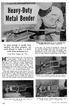 It's large enough to handle most welding job shop projects, yet small enough to make it a worth while home-workshop tool H Craft Print Project No. 272 ERE'S a metal bender that will enable you to bend
Lecture slides on rolling By: Dr H N Dhakal Lecturer in Mechanical and Marine Engineering, School of Engineering, University of Plymouth
 Lecture slides on rolling By: Dr H N Dhakal Lecturer in Mechanical and Marine Engineering, School of Engineering, University of Plymouth Bulk deformation forming (rolling) Rolling is the process of reducing
HOW TO MAKE A MOTOR BRACKET
 HOW TO MAKE A MOUNTING BRACKET FOR AN ELECTRIC MOTOR Often, brackets supplied with purchased items (e.g. electric motors or servos) are not ideally suited for fitting into our models or they are not supplied
COMPLIMENTARY WOODWORKING PLAN
 COMPLIMENTARY WOODWORKING PLAN Adirondack Chair This downloadable plan is copyrighted. Please do not share or redistribute this plan in any way. It has been created for Wilton Tools, a division of WMH
Lightweight, Heavy Duty
 Lightweight, Heavy Duty Trench Covers System Reliability The light weight combined with the tremendous strength of Comcore Trench Covers translates into speed, productivity and increased system reliability.
DuPont Surfaces DUPONT TM CORIAN SOLID SURFACE 12mm GAUGE STANDARDIZATION
 DuPont Surfaces DUPONT TM CORIAN SOLID SURFACE PRODUCT ADVISORY TABLE OF CONTENTS PAGE SECTION 1 A. Introduction 2 B. Bull-nose edge treatment 3 C. Ogee edge treatment on stacked edges 4 D. Coved Backsplashes
Fundamentals of Extrusion
 CHAPTER1 Fundamentals of Extrusion The first chapter of this book discusses the fundamentals of extrusion technology, including extrusion principles, processes, mechanics, and variables and their effects
ECONOMIC DESIGN OF INJECTION MOLDED PARTS USING DFM GUIDELINES - A REVIEW OF TWO METHODS FOR TOOLING COST ESTIMATION
 ECONOMIC DESIGN OF INJECTION MOLDED PARTS USING DFM GUIDELINES - A REVIEW OF TWO METHODS FOR TOOLING COST ESTIMATION Adekunle Fagade, University of Massachusetts Amherst David Kazmer, University of Massachusetts