
Deer Exclusion Effects on Understory Development Following Partial Cutting in a Pennsylvania Oak Stand
|
|
|
- Alice Powers
- 9 years ago
- Views:
Transcription
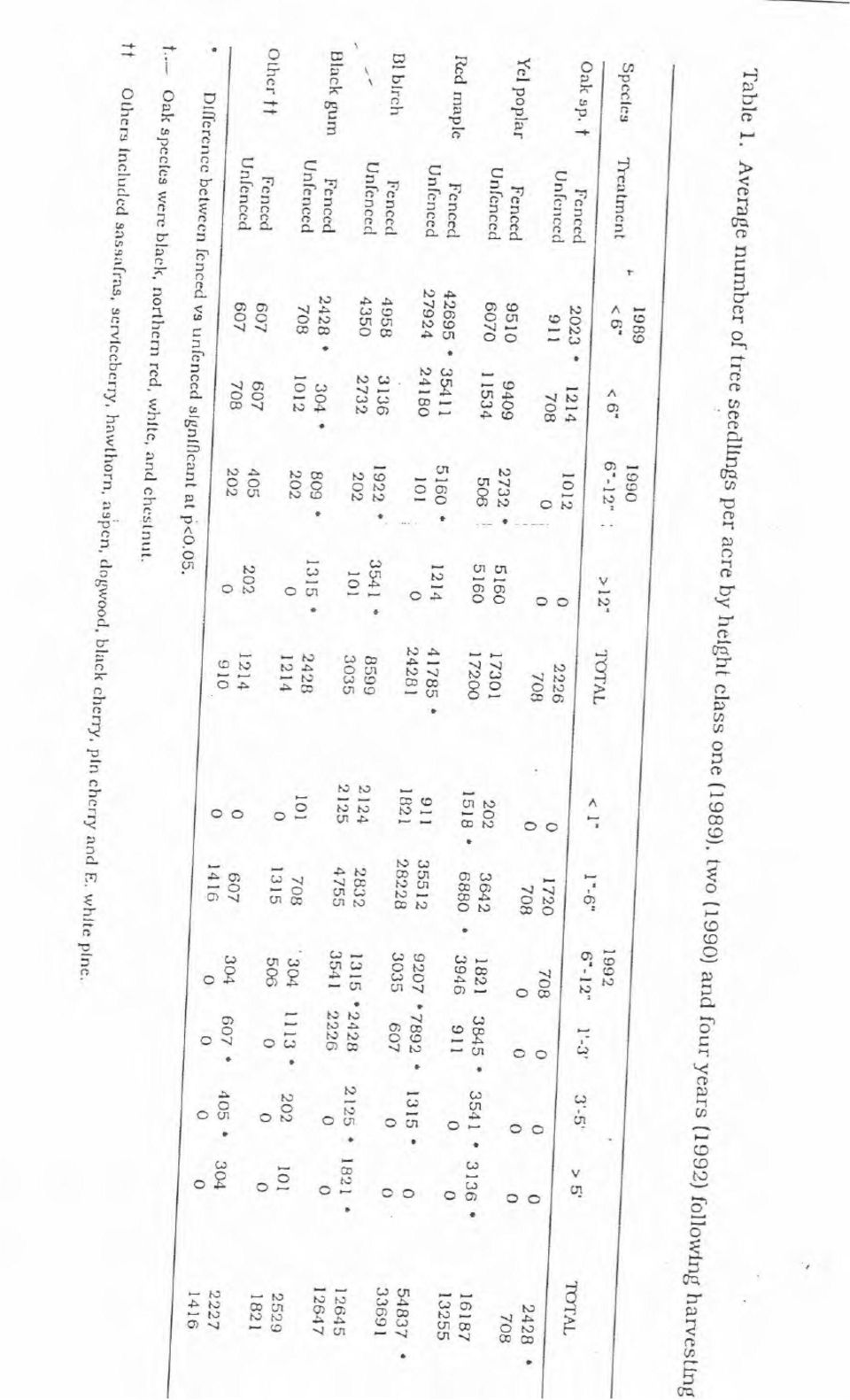
1 Deer Exclusion Effects on Understory Development Following Partial Cutting in a Pennsylvania Oak Stand Larry H. McCormick 1/, John W. Groninger 2/, Kathy A. Penrod 1/, and Todd E. Ristau 1/ Abstract: Forty fenced and unfenced paired plots were established in a central Pennsylvania mixed oak stand following an improvement shelterwood cut to assess the influence of deer exclusion on the establishment and development of understory vegetation during the first four years following cutting. Exclusion of deer increased the abundance and height growth of woody regeneration which consisted primarily of yellow-poplar, red maple, black birch and black gum. Few oak seedlings became established during the study in either the fenced or unfenced plots. Deer exclusion affected herbaceous composition and enhanced the abundance of woody vines and shrubs. Possible implications of deer exclusion following partial cutting on stand development and plant diversity following further overstory removal are discussed. INTRODUCTION Overpopulation of white-tailed deer has long been acknowledged as a problem in Pennsylvania (Frantz 1930, Leopold 1947, Marquis 1974). Protective laws and extensive clearcutting in the early 1900s led to a deer population explosion in the 1930s and 1940s (Marquis 1973). While efforts are being made to reduce the deer herd in Pennsylvania, deer densities remain high in many forested areas of the state (Pennsylvania Game Commission 1992). Studies on the impact of deer browsing on forest regeneration following clearcutting show that height, abundance and composition of regenerating species are significantly affected (Shafer et al. 1961, Marquis and Brenneman 1981, Tilghman 1989, Trumbull et al. 1989). In northern Pennsylvania, browsing of unprotected clearcuts has led to regeneration failures characterized by inadequate stocking and dense communities of grasses, ferns, goldenrods and asters. Selective browsing in unprotected northern hardwood clearcuts has resulted in a reduction of sugar maple, pin cherry and blackberry while increasing the proportion-of beech, birch, and striped maple (Marquis 1974). Despite heavy deer browsing, most northern harwood stands in Pennsylvania can be successfully regenerated provided there is sufficient advance regeneration of adequate size prior to the final harvest cut (Grisez and Peace 1973, Marquis 1982, Marquis and Bjorkbom 1982). In stands without adequate advanced regeneration, a series of partial cuts are recommended to establish the necessary advanced regeneration prior to final overstory removal (Marquis et al. 1991). In addition electric fencing is being used increasingly to protect regeneration from browsing in Pennsylvania (Brenneman 1988, George et al. 1991). 1 / Associate Professor and Research Graduate Assistants, School of Forest Resources, The Pennsylvania State University, University Park, PA Graduate Research Assistant, Department of Forestry, Virginia Tech, Blacksburg, VA

2 long. Inside each fenced area, vinyl stake flags were used to permanently mark two square grids (2.3 x 2.3 ft.) containing 5.3 ft 2 each. Two identical grids were established outside and adjacent to the fenced area to allow for paired comparisons of plots. Based on surrounding stand density and extent of soil disturbance resulting from harvesting activities, the plots were classified as open, closed, or skidded. The open plots had basal areas less than 80 ft 2 /ac. with no soil disturbance, the closed plots had greater than 80 ft 2 /ac. basal area with no soil disturbance and the skidded plots generally had less than 80 ft 2 /ac. and exposed mineral soil following the harvest cut. There were 9 open, 20 closed, and 11 skidded plots. Regeneration data were recorded annually in 1989, 1990 and 1992 at the end of the first, second and fourth growing season following the harvest cut. The number of tree seedlings present in each grid was recorded by species and height class. Height classes for woody species in 1989 and 1990 were <1 inch, 1-6 inch, 6-12 inch and >12 inch, and in 1992 were <1 inch, 1-6 inch, 6-12 inch, 1-3 ft., 3-5 ft., and > 5 ft. Seedlings were not permanently identified for repeated measurement: instead, independent counts were taken each year. An estimate of percent cover for herbaceous species groups and woody shrub and vine species was also made. The herbaceous vegetation categories were grasses, tall herbaceous, herbaceous, ferns, and mosses and lichens. Blackberry, grape, blueberry,.and mountain laurel were recorded by species. The height and species of the tallest tree (dominant tree) on each plot were recorded in The fenced and unfenced data for all variables were obtained by averaging the recorded values for the two grids in each fenced and unfenced plot. Paired t test comparisons of mean differences were used to test the effects of fencing on seedling abundance for each species using data for all plots combined. Similar comparisons were conducted by plot type.(closed, open, and skidded). Analysis of variance procedures were used to test the effect of plot type on seedling abundance. In 1992, data were co l lected to quantify the effects of deer exclusion after four years of regeneration on tree, woody shrub and vine, and herbaceous species diversity. Species richness and abundance were recorded for each of the two fenced grids and the two unfenced grids used for regeneration data collection. Species richness was defined as the number of different species present. Species abundance was recorded for each species as number of stems for tree species and by visual estimates of percent cover for shrubs, vines and herbaceous species. Species richness (number of species present) and the Shannon index (H'= -Ep i in p i, where p i = number of individuals for species i divided by the total number of individuals for all species) were used to assess species diversity. Shannon's index was calculated for each plot using trees only and using all vegetation categories. A paired t test of mean differences was used to compare the Shannon index and species richness for the fenced and unfenced treatments by plot type (closed, open or skidded) and for all plot types combined. RESULTS At the end of the fourth growing season following harvesting, the most frequently occuring tree species comprising the regeneration on the fenced and unfenced plots were red maple, yellowpoplar, black birch, black gum, and oak species (northern red, black, white and chestnut). Red maple was found on all fenced and unfenced plots. Birch was found on 70% of the fenced and 65% of the unfenced plots. Yellow-poplar was found on 60% of fenced and 62% of unfenced plots. Black gum was present on 35% of fenced and 20% of unfenced plots. Oak species were found on 28% of fenced and 20% of unfenced plots. Other tree species occuring on the plots included sassafras, serviceberry, hawthorn, big-toothed aspen, alternate-leaved and flowering dogwoods, black cherry, pin cherry and eastern white pine. 420

3
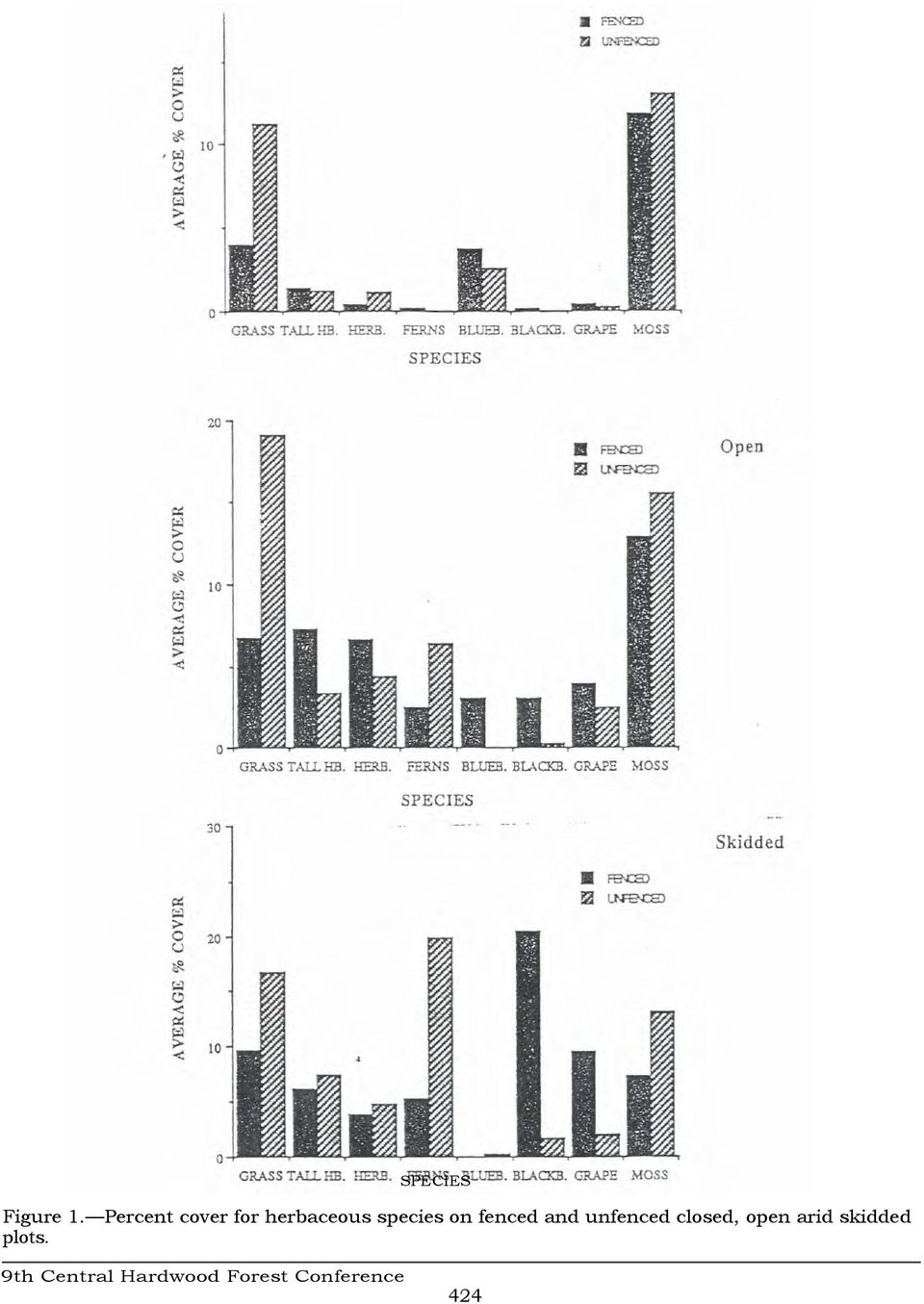
4 SPECIES Figure 1. Percent cover for herbaceous species on fenced and unfenced closed, open arid skidded plots. 424
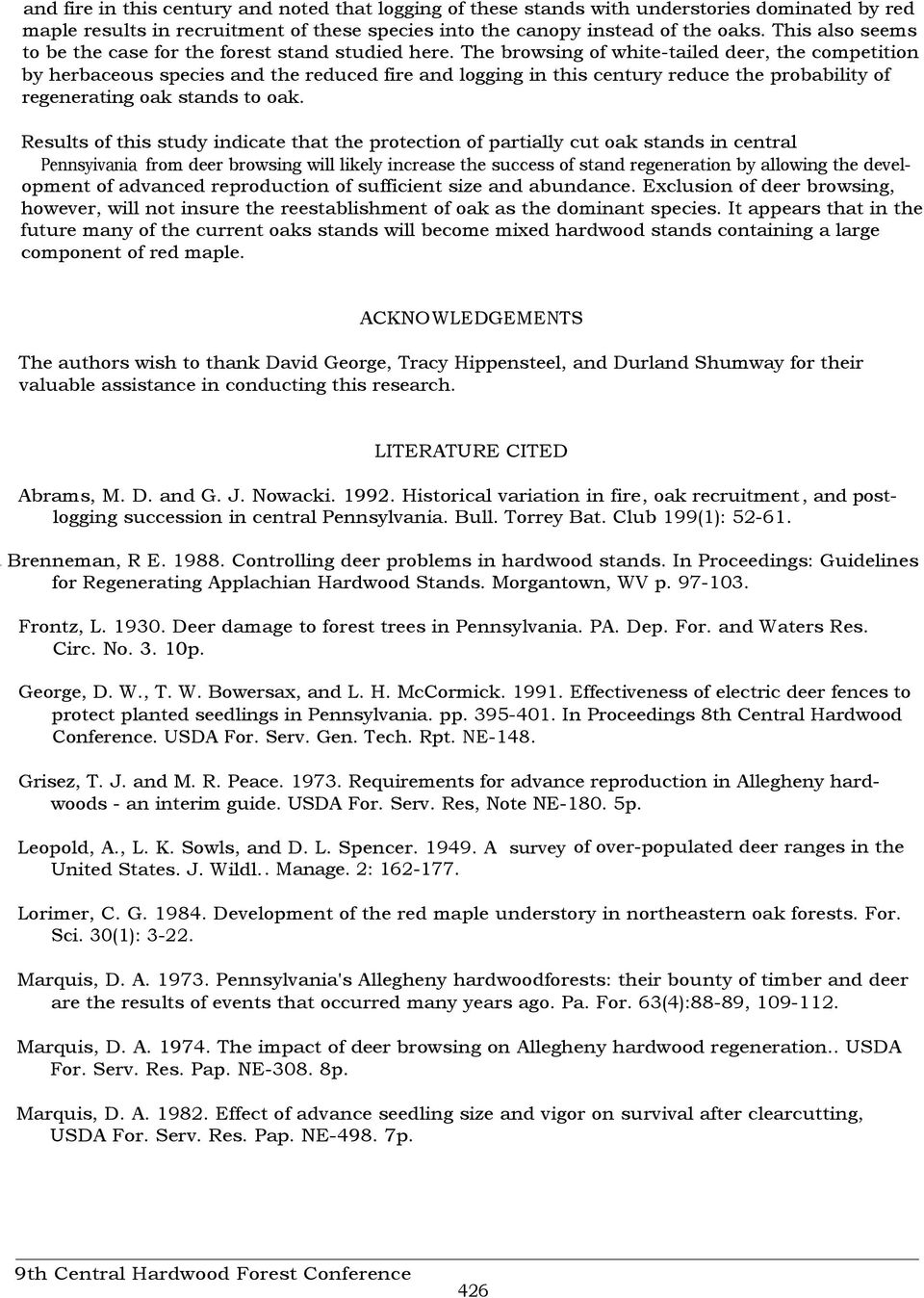
5 and fire in this century and noted that logging of these stands with understories dominated by red maple results in recruitment of these species into the canopy instead of the oaks. This also seems to be the case for the forest stand studied here. The browsing of white-tailed deer, the competition by herbaceous species and the reduced fire and logging in this century reduce the probability of regenerating oak stands to oak. Results of this study indicate that the protection of partially cut oak stands in central Pennsyivania from deer browsing will likely increase the success of stand regeneration by allowing the development of advanced reproduction of sufficient size and abundance. Exclusion of deer browsing, however, will not insure the reestablishment of oak as the dominant species. It appears that in the future many of the current oaks stands will become mixed hardwood stands containing a large component of red maple. ACKNOWLEDGEMENTS The authors wish to thank David George, Tracy Hippensteel, and Durland Shumway for their valuable assistance in conducting this research. LITERATURE CITED Abrams, M. D. and G. J. Nowacki Historical variation in fire, oak recruitment, and postlogging succession in central Pennsylvania. Bull. Torrey Bat. Club 199(1): Brenneman, R E Controlling deer problems in hardwood stands. In Proceedings: Guidelines for Regenerating Applachian Hardwood Stands. Morgantown, WV p Frontz, L Deer damage to forest trees in Pennsylvania. PA. Dep. For. and Waters Res. Circ. No p. George, D. W., T. W. Bowersax, and L. H. McCormick Effectiveness of electric deer fences to protect planted seedlings in Pennsylvania. pp In Proceedings 8th Central Hardwood Conference. USDA For. Serv. Gen. Tech. Rpt. NE-148. Grisez, T. J. and M. R. Peace Requirements for advance reproduction in Allegheny hardwoods - an interim guide. USDA For. Serv. Res, Note NE p. Leopold, A., L. K. Sowls, and D. L. Spencer A survey of over-populated deer ranges in the United States. J. Wildl.. Manage. 2: Lorimer, C. G Development of the red maple understory in northeastern oak forests. For. Sci. 30(1): Marquis, D. A Pennsylvania's Allegheny hardwoodforests: their bounty of timber and deer are the results of events that occurred many years ago. Pa. For. 63(4):88-89, Marquis, D. A The impact of deer browsing on Allegheny hardwood regeneration.. USDA For. Serv. Res. Pap. NE p. Marquis, D. A Effect of advance seedling size and vigor on survival after clearcutting, USDA For. Serv. Res. Pap. NE p. 426
4.0 Discuss some effects of disturbances on the forest.
 4.0 Discuss some effects of disturbances on the forest. 4.1 Describe common disturbances that occur in the Boreal forest. Disturbances are normal to the life of the forest. Forests are very resilient (able
Assume you have 40 acres of forestland that was
 A l a b a m a A & M a n d A u b u r n U n i v e r s i t i e s ANR-1371 Basal Area: A Measure Made for Management Assume you have 40 acres of forestland that was recently assessed by a natural resource
Fire, Forest History, and Ecological Restoration of Ponderosa Pine Forests at Mount Rushmore, South Dakota
 Fire, Forest History, and Ecological Restoration of Ponderosa Pine Forests at Mount Rushmore, South Dakota Restoration uses the past not as a goal but as a reference point for the future...it is not to
Division of Forestry
 Guidelines for Managing Sites with Ash To Address the Threat of Emerald Ash Borer On Forestry-Administered Lands BACKGROUND The ash genus (Fraxinus) in Minnesota comprises some 900 million trees and is
A Long-Term Analysis of Hardwood Lumber Prices by William G. Luppold Jeffrey P. Prestemon and John E. Baumgras 1
 A Long-Term Analysis of Hardwood Lumber Prices by William G. Luppold Jeffrey P. Prestemon and John E. Baumgras 1 ABSTRACT This study examined the interrelationship in prices of eight hardwood species using
Life Cycle Of A Plant Population
 Life Cycle Of A Plant Population Seed Rain n=3 Growth And Mortality n=7 Seedling Cohort n=22 Environmental Sieve Seed Bank n=5 Copyright G. Bonan 22 Suvivorship Of Seedlings In A Northern Hardwood Forest
Post-Wildfire Clean-Up and Response in Houston Toad Habitat Best Management Practices
 Post-Wildfire Clean-Up and Response in Houston Toad Habitat Best Management Practices Purpose The purpose of this document is to provide guidance and recommendations for minimizing potential impacts to
Restoration of Fire-adapted Ecosystems in the Central and Southern Appalachians
 Restoration of Fire-adapted Ecosystems in the Central and Southern Appalachians Marek Smith The Nature Conservancy 12181-A Courthouse Hill Road Warm Springs, VA 24484 [email protected] Sam Lindblom The
APPLICATION FOR CLASSIFICATION OF FOREST LAND
 To the Chief, Division of Forestry: APPLICATION FOR CLASSIFICATION OF FOREST LAND In accordance with sections 5713.22-.26 of the Ohio Revised Code, I hereby apply for the classification of certain lands
Summary of Pre- and Post-Project Vegetation Survey Results
 3921 East Bayshore Road Palo Alto CA 94303-4326 tel 650.962.9876 fax 650.962.8234 www.acterra.org [email protected] Introduction Summary of Pre- and Post-Project Vegetation Survey Results Acterra Stewardship
Wildlifer 2013 Managing Wildlife on Private Lands
 Master Wildlifer 2013 Managing Wildlife on Private Lands Greg Yarrow, Chair and Professor Natural Resources School of Agricultural, Forest, & Environmental Sciences Clemson University Clemson, South Carolina,
GROWTH POTENTIAL OF LOBLOLLY PINE PLANTATIONS IN THE GEORGIA PIEDMONT: A SPACING STUDY EXAMPLE
 GROWTH POTENTIAL OF LOBLOLLY PINE PLANTATIONS IN THE GEORGIA PIEDMONT: A SPACING STUDY EXAMPLE Plantation Management Research Cooperative Daniel B. Warnell School of Forest Resources University of Georgia
THE OFFERING MANAGEMENT OVERVIEW
 LOGAN TIMBERLANDS LOGAN TIMBERLANDS THE OFFERING AFM Land Sales (AFMLS) invites interested parties to submit offers to purchase an investment grade, Appalachian hardwood property totaling 88,333± acres
FREQUENTLY ASKED QUESTIONS Biomass Harvest Guidelines
 FREQUENTLY ASKED QUESTIONS Biomass Harvest Guidelines What do Biomass Harvest Guidelines offer? They offer recommendations to manage forest-, brush- and open- land with the intent to protect water, timber,
Maine Forest Service Interpretations of the Maine Forest Practices Act Statute and Rules (12 MRSA 8867-A to 8888 & MFS Rules Chapter 20)
 Maine Forest Service Interpretations of the Maine Forest Practices Act Statute and Rules (12 MRSA 8867-A to 8888 & MFS Rules Chapter 20) These interpretations take into account the full context, meaning,
Student Handout 1: Dichotomous Key Introduction
 Assignment 2: Big 6 Lesson Plan Roberta T. Jordan EDU566: Media Utilization and Curriculum Dr. Jane McGinn, Professor Student Handout 1: Dichotomous Key Introduction What is a Dichotomous Key? Instructions:
UNITED STATES DEPARTMENT OF THE INTERIOR BUREAU OF LAND MANAGEMENT
 Form 1221-2 (June 1969) UNITED STATES DEPARTMENT OF THE INTERIOR BUREAU OF LAND MANAGEMENT MANUAL TRANSMITTAL SHEET Subject: BLM Manual 5716 Protective Measures Release 5-161 Date 7/7/15 1. Explanation
Deciduous Forest. Courtesy of Wayne Herron and Cindy Brady, U.S. Department of Agriculture Forest Service
 Deciduous Forest INTRODUCTION Temperate deciduous forests are found in middle latitudes with temperate climates. Deciduous means that the trees in this forest change with the seasons. In fall, the leaves
Managing Black Walnut
 Managing Black Walnut Mel Baughman Professor Emeritus University of Minnesota Lenny Farlee Extension Forester Purdue University Why Grow Black Walnut? Wood Products Rich, brown color Novelty items Lumber
Wildfire Damage Assessment for the 2011 Southeast Complex Fires
 Wildfire Damage Assessment for the 2011 Southeast Complex Fires Chip Bates & Mark McClure, Forest Health Management Background: On March 24, 2011, multiple wildfires began across southeast Georgia. Strong,
Communities and Biomes
 Name Date Class Communities and Biomes Section 3.1 Communities n your textbook, read about living in a community. Determine if the statement is true. f it is not, rewrite the italicized part to make it
Table A1. To assess functional connectivity of Pacific marten (Martes caurina) we identified three stand types of interest (open,
 Supplemental Online Appendix Table A1. To assess functional connectivity of Pacific marten (Martes caurina) we identified three stand types of interest (open, simple, complex) but divided these into subclasses
FWRC. Cooperators: Delta Wildlife, Inc. Forest and Wildlife Research Center, Mississippi State University
 Cooperators: Delta Wildlife, Inc. Forest and Wildlife Research Center, Mississippi State University Mississippi Department of Wildlife, Fisheries and Parks Mississippi Fish and Wildlife Foundation Mississippi
Angora Fire Restoration Activities June 24, 2007. Presented by: Judy Clot Forest Health Enhancement Program
 Angora Fire Restoration Activities June 24, 2007 Presented by: Judy Clot Forest Health Enhancement Program California Tahoe Conservancy Independent California State Agency within the Resources Agency Governed
Identifying Pennsylvania Trees. Pennsylvania Forest Stewardship Program
 Identifying Pennsylvania Trees Pennsylvania Forest Stewardship Program Tree Identification In this presentation you will learn to identify trees using the Summer Key to Pennsylvania Trees. Trees can be
Forests of the Mountain State
 United States Department of Agriculture Forest Service Northern Research Station Resource Bulletin NRS-17 Forests of the Mountain State Richard H. Widmann Charles R. Dye Gregory W. Cook The Authors RICHARD
, ~ The ResourcesAgency. Dave McNamara
 ,a! California State of California Department of Forestry, ~ The ResourcesAgency - ~A' ~;::~Af;// ~/ ~~/1Y~~,\~'(.~~~~~ ~,~ F1rl WES7:RY ~~~~_.~~- note 1416 Ninth Street Sacramento, CA 95814 Phone 916-445-5571
Lesson 9: Introduction to the Landscape Management System (LMS)
 Lesson 9: Introduction to the Landscape Management System (LMS) Review and Introduction In earlier lessons, you learned how to establish and take measurements in sample inventory plots. In Lesson 8, you
King Fire Restoration Project, Eldorado National Forest, Placer and El Dorado Counties, Notice of intent to prepare an environmental impact statement.
 This document is scheduled to be published in the Federal Register on 12/24/2014 and available online at http://federalregister.gov/a/2014-30158, and on FDsys.gov [3410-11- P] DEPARTMENT OF AGRICULTURE
Are My. Pine Trees. Ready To Thin?
 Are My Pine Trees Ready To Thin? ARE MY PINE TREES READY TO THIN? One question private forest landowners ask most frequently is, Are my pine trees ready to thin? There is no definite answer to this question,
Reference: Remediation Plan for Areas of Vegetation Removal at the Cedar Point Wind Farm
 Stantec Consulting Ltd. 1-7 Southgate Drive, Guelph ON N1G 4P5 June 4, 215 File: 169679 Attention: St. Clair Region Conservation Authority 25 Mill Pond Crescent, Strathroy, ON N7G 3P9 Dear, In early 215,
Units of Measure and Conversion Factors for Forest Products
 Units of Measure and Conversion Factors for Forest Products Bulletin #7103 Knowledge of the common units of wood measurement is important to people who are involved in marketing forest products. These
The UK Timber Resource and Future Supply Chain. Ben Ditchburn Forest Research
 The UK Timber Resource and Future Supply Chain Ben Ditchburn Forest Research Timber availability The landscape of timber availability in Great Britain and the United Kingdom is moving through a period
Chapter 5. Managing Regenerating and Young Forest Habitat
 Chapter 5. Managing Regenerating and Young Forest Habitat John W. Lanier, New Hampshire Fish & Game Department, 11 Hazen Dr., Concord, NH 03301 If you are a landowner and are reading this chapter for the
Integrated Weed Management in Portland Parks
 Urban Pest Management Course February 6, 2013 Integrated Weed Management in Portland Parks Commissioner Nick Fish www.portlandparks.org Director Mike Abbaté Commissioner www.portlandparks.org Jim Francecsconi
High Conservation Value Forests 3.1. Old Growth Forests. Management & Monitoring Framework
 High Conservation Value Forests 3.1 Old Growth Forests Management & Monitoring Framework HCV 3: Forest areas that are in or contain rare, threatened or endangered ecosystems. HCVF 3.1 Old Growth Areas
Heartwood Forestland Fund IV, LP Highlands Property Executive Summary of the 10-Year Management Plan The Forestland Group, LLC
 I Heartwood Forestland Fund IV, LP Highlands Property Executive Summary of the 10-Year Management Plan The Forestland Group, LLC Description of Property i) 130,973 acres in western Virginia in Buchanan,
Site Preparation for Natural Regeneration of Hardwoods
 PB1799 Site Preparation for Natural Regeneration of Hardwoods Wayne K. Clatterbuck, Professor, Department of Forestry, Wildlife & Fisheries, University of Tennessee Greg R. Armel, Assistant Professor,
Wildlife Management Notes
 Wildlife Management Notes No 5. GRAY AND FOX SQUIRRELS The gray squirrel (Sciurus carolinensis) and the fox squirrel (Sciurus niger) are members of the order Rodentia and family Sciuridae. Both are arboreal
Tree Removal. City of Bunker Hill Village
 Tree Removal City of Bunker Hill Village Important Permit Considerations... 2 Tree Ordinance... 3 Zoning Map... 12 Types of Allowable Tree Protection... 13 Working Hours (English)... 14 Working Hours (Spanish)...
The Ohio State University. Environment and Natural Resources 3333 Spring 2015 SILVICULTURE. Syllabus
 The Ohio State University 1 Environment and Natural Resources 3333 Spring 2015 Description and Objectives SILVICULTURE Syllabus Silviculture is essentially applied forest ecology. It has been defined as
Forest Fire Research in Finland
 International Forest Fire News (IFFN) No. 30 (January June 2004, 22-28) Forest Fire Research in Finland Effective wildfire suppression and diminished use of prescribed burning in forestry has clearly eliminated
Appendix C. Municipal Planning and Site Restoration Considerations
 Appendix C Municipal Planning and Site Restoration Considerations 67 68 Appendix C - Municipal Planning and Site Restoration Considerations This appendix contains best practice standards for site planning
Determining the Age and Benefits of a Tree
 Grades: 6-8 Illinois State Science Standards: Determining the Age and Benefits of a Tree 11.A.3a Formulate hypotheses that can be tested by collecting data. 11.A.3c Collect and record data accurately using
Communities, Biomes, and Ecosystems
 Communities, Biomes, and Ecosystems Before You Read Before you read the chapter, respond to these statements. 1. Write an A if you agree with the statement. 2. Write a D if you disagree with the statement.
Mobilising Vegetation Plot Data: the National Vegetation Survey Databank. Susan Wiser April 2016 http://nvs.landcareresearch.co.nz
 Mobilising Vegetation Plot Data: the National Vegetation Survey Databank Susan Wiser April 2016 http://nvs.landcareresearch.co.nz Nationally Significant Databases and Collections http://natsigdc.landcareresearch.co.nz/natsigdc_list.html
FORESTED VEGETATION. forests by restoring forests at lower. Prevent invasive plants from establishing after disturbances
 FORESTED VEGETATION Type of strategy Protect General cold adaptation upland and approach subalpine forests by restoring forests at lower Specific adaptation action Thin dry forests to densities low enough
18 voting members 44 stakeholders 114 email list. Senators: Wyden & Merkley Representative DeFazio
 18 voting members 44 stakeholders 114 email list Senators: Wyden & Merkley Representative DeFazio State Representative Krieger State Senators: Roblan, Johnson, and Kruse Governor Brown s office County
By Gerald Urquhart, Walter Chomentowski, David Skole, and Chris Barber http://earthobservatory.nasa.gov/library/deforestation/
 By Gerald Urquhart, Walter Chomentowski, David Skole, and Chris Barber http://earthobservatory.nasa.gov/library/deforestation/ The clearing of tropical forests across the Earth has been occurring on a
SANTA BARBARA COUNTY COMPREHENSIVE PLAN LOMPOC AREA
 SANTA BARBARA COUNTY COMPREHENSIVE PLAN LOMPOC AREA A. LAND USE ELEMENT INTERPRETIVE GUIDELINES B. COMMUNITY BENEFITS C. COUNTY ACTION ITEMS Adopted by the Board of Supervisors November 9, 1999 A. Santa
6. NATURAL AREAS FIRE MANAGEMENT
 6. NATURAL AREAS FIRE MANAGEMENT 6-1 Wildfire management is an important component of managing and maintaining County natural areas. The natural areas are woven into the community fabric and are a part
Forest Watershed Tree Thinning Restoration Effectiveness Monitoring in the Manzano Mountains of New Mexico
 Forest Watershed Tree Thinning Restoration Effectiveness Monitoring in the Manzano Mountains of New Mexico By David Lightfoot 1,2, Cody Stropki 1, Victoria Amato 1 and Anne Russell 1 1 SWCA Environmental
Sagebrush steppe post-fire rehabilitation projects: Using the past to guide the future
 Forest and Rangeland Ecosystem Science Center Sagebrush steppe post-fire rehabilitation projects: Using the past to guide the future David A. Pyke, U.S. Department of the Interior U.S. Geological Survey
Integration of Forestry & Wildlife Management
 Integration of Forestry & Wildlife Management By Ken Negray Regional Certification Manager, NewPage Corp & member of the KY SIC Committee Abstract: Kentucky SIC (Sustainable Forestry Initiative Implementation
Objectives. Raster Data Discrete Classes. Spatial Information in Natural Resources FANR 3800. Review the raster data model
 Spatial Information in Natural Resources FANR 3800 Raster Analysis Objectives Review the raster data model Understand how raster analysis fundamentally differs from vector analysis Become familiar with
Forest Resources of the Manti-La Sal National Forest
 United States Department of Agriculture Forest Service Rocky Mountain Research Station December 1998 Forest Resources of the Manti-La Sal National Forest Renee A. O Brien Sharon W. Woudenberg Manti-La
Managing Fire Dependent Wildlife Habitat without Fire. A Land Management Practice That: 100 Years of Fire Suppression in Ponderosa pine ecosystems
 Managing Fire Dependent Wildlife Habitat without Fire Dale Swedberg Chairman North Central Washington Prescribed Fire Council Land Management Practices used to Manage Wildlife Habitat A Land Management
How To Manage A Forest Service Plant Data On A Safari
 FIREMON Database User Manual John F. Caratti SUMMARY The FIREMON database software allows users to enter data, store, analyze, and summarize plot data, photos, and related documents. The FIREMON database
Forest Management Plan Templates
 Forest Management Plan Templates The following templates as described in the Forestry Schemes Manual 2011 can be used in support of all scheme applications as described in the scheme documents 2014-2020
Protecting Your Forest Asset
 Multiage forests offer many options for improving forest health and reducing risk. Protecting Your Forest Asset MANAGING RISKS IN CHANGING TIMES REGIONAL PEER-REVIEWED PUBLICATION SREF-FM-0018 Private
Formalized approaches to Central European phytosociology
 Formalized approaches to Central European phytosociology David Zelený Masaryk University Brno, Czech Republic Formalized approaches to Central European phytosociology Standard methods of field sampling
Buffer Strip Design, Establishment, and Maintenance
 Buffer Strip Design, Establishment, and Maintenance M aintaining a forested or prairie buffer along creeks, streams, and rivers provides more than just a beautiful landscape. The right combination of trees,
EVALUATING STAND DENSITY MANAGEMENT ALTERNATIVES USING THE FOREST VEGETATION SIMULATOR. Abstract
 EVALUATING STAND DENSITY MANAGEMENT ALTERNATIVES USING THE FOREST VEGETATION SIMULATOR Gary Dixon USDA Forest Service Forest Management Service Center Fort Collins, Colorado USA Abstract The Forest Vegetation
WILDFLOWER RESTORATION PROJECT. Experimental Design and Data Collection Guide
 1 Experimental Design and Data Collection Guide 2 INTRODUCTION This citizen science wildflower restoration project requires you to set up a study site, gather and plant seeds, and monitor changes in the
Appendix C. Re-vegetation and Rehabilitation Sub-Plan
 Appendix C Re-vegetation and Rehabilitation Sub-Plan DRENNAN SOLAR ENERGY FACILITY REVEGETATION & REHABILITATION PLAN PRODUCED FOR ERM ON BEHALF OF SOLAIREDIRECT BY [email protected] JUNE 2013 BACKGROUND
Financial maturity is when the rate of value
 Cutting at Financial Maturity: Maximizing the economic return of your woodland Woodland owners harvest trees for financial and personal reasons. Deciding when is the optimal time to harvest is difficult
2,000 FREE TREE SEEDLINGS for your Community
 Apply by March 13, 2015 to receive up to 2,000 FREE TREE SEEDLINGS for your Community 2 4 high bare root tree seedlings Available for pick-up between April 2 and April 17 Help to replace trees lost in
2002 URBAN FOREST CANOPY & LAND USE IN PORTLAND S HOLLYWOOD DISTRICT. Final Report. Michael Lackner, B.A. Geography, 2003
 2002 URBAN FOREST CANOPY & LAND USE IN PORTLAND S HOLLYWOOD DISTRICT Final Report by Michael Lackner, B.A. Geography, 2003 February 2004 - page 1 of 17 - TABLE OF CONTENTS Abstract 3 Introduction 4 Study
LAB #12 Introduction to Forest Inventory Software
 SUBJECT: LAB #12 Introduction to Forest Inventory Software Forest Inventory software programs simplify field data entry and data management, as well as allow users to efficiently derive summary volume
Evergreen Carbon Capture - 2
 Motivated by our mission to conserve and restore the lands in our region, Forterra s Evergreen Carbon Capture program (ECC) helps companies, organizations and individuals do their part to improve the long-term
Comparison of Satellite Imagery and Conventional Aerial Photography in Evaluating a Large Forest Fire
 Purdue University Purdue e-pubs LARS Symposia Laboratory for Applications of Remote Sensing --98 Comparison of Satellite Imagery and Conventional Aerial Photography in Evaluating a Large Forest Fire G.
Interim report of survey on soil degradation in National Forest Inventory by monitoring forest floor cover, through FAO Japan Fund Project.
 Interim report of survey on soil degradation in National Forest Inventory by monitoring forest floor cover, through FAO Japan Fund Project. Jacinto Samuel García Carreón Ramón Cardoza Vázquez Soil Forest
304 CMR: DIVISION OF FORESTS AND PARKS
 304 CMR 11.00: FOREST CUTTING PRACTICES Section 11.01: Authority and Purpose 11.02: Statement of Jurisdiction 11.03: Definitions 11.04: Procedures 11.05: Standards 11.06: Rare and Endangered Species 11.07:
Determining Return on Investment for Forests for Tomorrow. Forests For Tomorrow February 2013 (supersedes earlier FFT ROI documents)
 Determining Return on Investment for Forests for Tomorrow Forests For Tomorrow February 2013 (supersedes earlier FFT ROI documents) 1 Table of Contents Introduction... 3 1. ROI field cards... 3 2. ROI
Arbor Day Tree Trivia
 Arbor Day Tree Trivia What day is Arbor Day? The last Friday of April. (April 30, 2010) Who is the father of Arbor Day? J. Sterling Morton When was the first Arbor Day? 1872 Name Idaho's state tree. Western