
CONSTRUCTION WITH HOLLOW STEEL SECTIONS DESIGN GUIDE FOR CIRCULAR HOLLOW SECTION (CHS) JOINTS UNDER PREDOMINANTLY STATIC LOADING
|
|
|
- Kevin Cameron
- 9 years ago
- Views:
Transcription
1 CONSTRUCTION WITH HOLLOW STEEL SECTIONS DESIGN GUIDE FOR CIRCULAR HOLLOW SECTION (CHS) JOINTS UNDER PREDOMINANTLY STATIC LOADING J. Wardenier, Y. Kurobane, J.A. Packer, G.J. van der Vegte and X.-L. Zhao Second Edition LSS Verlag

2 CONSTRUCTION WITH HOLLOW STEEL SECTIONS DESIGN GUIDE FOR CIRCULAR HOLLOW SECTION (CHS) JOINTS UNDER PREDOMINANTLY STATIC LOADING J. Wardenier, Y. Kurobane, J.A. Packer, G.J. van der Vegte and X.-L. Zhao Second Edition

3

4 DESIGN GUIDE FOR CIRCULAR HOLLOW SECTION (CHS) JOINTS UNDER PREDOMINANTLY STATIC LOADING

5 CONSTRUCTION WITH HOLLOW STEEL SECTIONS Edited by: Comité International pour Ie Développement et l Étude de la Construction Tubulaire Authors: Jaap Wardenier, Delft University of Technology, The Netherlands and National University of Singapore, Singapore Yoshiaki Kurobane, Kumamoto University, Japan Jeffrey A. Packer, University of Toronto, Canada Addie van der Vegte, Delft University of Technology, The Netherlands Xiao-Ling Zhao, Monash University, Australia

6 DESIGN GUIDE FOR CIRCULAR HOLLOW SECTION (CHS) JOINTS UNDER PREDOMINANTLY STATIC LOADING Jaap Wardenier, Yoshiaki Kurobane, Jeffrey A. Packer, Addie van der Vegte and Xiao-Ling Zhao

7 Design guide for circular hollow section (CHS) joints under predominantly static loading / [ed. by: Comité International pour le Développement et l Étude de la Construction Tubulaire] Jaap Wardenier, 28 (Construction with hollow steel sections) ISBN NE: Wardenier, Jaap; Comité International pour le Développement et l Étude de la Construction Tubulaire; Design guide for circular hollow section (CHS) joints under predominantly static loading ISBN by CIDECT, 28

8 Preface The objective of this 2 nd edition of the Design Guide No. for circular hollow section (CHS) joints under predominantly static loading is to present the most up-to-date information to designers, teachers and researchers. Since the first publication of this Design Guide in 99 additional research results became available and, based on these and additional analyses, the design strength formulae in the recommendations of the International Institute of Welding (IIW) have recently been modified. These recommendations are the basis for the new ISO standard in this field and also for this Design Guide. However, these new IIW recommendations have not yet been implemented in the various national and international codes, which are still based on the previous 989 edition of the IIW rules. Therefore, the recommendations in the previous version of (this Design Guide and) the IIW 989 rules, which are moreover incorporated in Eurocode 3, are also given. Further, the new IIW formulae, the previous IIW (989) recommended formulae and those in the API (27) are compared with each other. Under the general series heading Construction with Hollow Steel Sections, CIDECT has published the following nine Design Guides, all of which are available in English, French, German and Spanish:. Design guide for circular hollow section (CHS) joints under predominantly static loading ( st edition 99, 2 nd edition 28) 2. Structural stability of hollow sections (992, reprinted 996) 3. Design guide for rectangular hollow section (RHS) joints under predominantly static loading ( st edition 992, 2 nd edition 29) 4. Design guide for structural hollow section columns exposed to fire (995, reprinted 996) 5. Design guide for concrete filled hollow section columns under static and seismic loading (995) 6. Design guide for structural hollow sections in mechanical applications (995) 7. Design guide for fabrication, assembly and erection of hollow section structures (998) 8. Design guide for circular and rectangular hollow section welded joints under fatigue loading (2) 9. Design guide for structural hollow section column connections (24) Further, the following books have been published: Tubular Structures in Architecture by Prof. Mick Eekhout (996) and Hollow Sections in Structural Applications by Prof. Jaap Wardenier (22). CIDECT wishes to express its sincere thanks to the internationally well-known authors of this Design Guide, Prof. Jaap Wardenier of Delft University of Technology, The Netherlands and National University of Singapore, Singapore, the late Prof. Yoshiaki Kurobane of Kumamoto University, Japan, Prof. Jeffrey Packer of University of Toronto, Canada, Dr. Addie van der Vegte of Delft University of Technology, The Netherlands and Prof. Xiao-Ling Zhao of Monash University, Australia for their willingness to write the 2 nd edition of this Design Guide. CIDECT, 28 5

9 Airport hall with roof structure and columns of CHS Halls for the Athens Olympic Games (24) with CHS arches and plate to CHS joints for the cables 6

10 CONTENTS Introduction Design philosophy and limit states...2 Scope and range of applicability...2. Limitations on materials.2.2 Limitations on geometric parameters Section class limitations 3.3 Terminology and notation Effect of geometric and mechanical tolerances on joint design strength Determination of the design strength Delivery standards Applications of circular hollow sections Design of tubular trusses Truss configurations Truss analysis Effective lengths for compression members Simplified rules Long, laterally unsupported compression chords Truss deflections General joint considerations Truss design procedure Arched trusses Guidelines for earthquake design Design of welds Welded uniplanar truss joints between CHS chords and CHS brace members Joint classification Joint capacity equations T, Y and X joints K and N joints K and N joints with gap K and N joints with overlap Special types of joints Joints with cans Graphical design charts with examples Welded CHS to CHS joints under moment loading Joints with brace(s) subjected to in-plane or out-of-plane bending moment T and X joints with brace(s) subjected to combinations of axial load, in-plane bending and out-of-plane bending moment Knee joints Multiplanar welded joints TT and XX joints KK joints Design recommendations. 5 7 Welded plate, I, H or RHS to CHS chord joints Plate, I, H or RHS to CHS joints Longitudinal plate joints under shear loading Gusset plate to slotted CHS joints Tee joints to the ends of CHS members

11 8 Bolted joints Flange-plate joints Nailed joints Other welded joints Reinforced joints Joints with ring stiffeners Joints with collar or doubler plates Grouted joints Flattened and cropped-end CHS brace members to CHS chords. 68 Design strengths according to the st edition of Design Guide No. and also incorporated in Eurocode Previous design recommendations for axially loaded uniplanar joints Previous design recommendations for joints under moment loading Previous design recommendations for axially loaded multiplanar joints Previous design recommendations for joints between plate, I, H or RHS braces and CHS chords Graphical design charts for axially loaded joints Design chart for axially loaded T and Y joints Design chart for axially loaded X joints Design charts for axially loaded K and N gap joints Design chart for axially loaded K and N overlap joints Graphical design charts for joints loaded under brace bending moment Design chart for joints loaded by brace in-plane bending moment Design chart for joints loaded by brace out-of-plane bending moment. 87 Truss design examples based on the design strengths of the new IIW (28) recommendations Uniplanar truss Vierendeel truss Multiplanar truss (triangular girder)..4 Truss with semi-flattened end braces. 4 2 List of symbols and abbreviations Abbreviations of organisations Other abbreviations General symbols Subscripts Superscripts References... 9 Appendix A Comparison between the new IIW (28) design equations and the previous recommendations of IIW (989) and/or CIDECT Design Guide No. (99).. 5 Appendix B Comparison between the new IIW (28) design equations and those of the API (27) CIDECT

12 Introduction Many examples in nature demonstrate the excellent properties of the circular hollow section as a structural element in resisting compression, tension, bending and torsion. Further, the circular hollow section has proved to be the best shape for elements subjected to wind-, water- or waveloading. The circular hollow section combines these characteristics with an architecturally attractive shape. Structures made of hollow sections have a smaller surface area than comparable structures of open sections. This, in combination with the absence of sharp corners, results in better corrosion protection. These excellent properties should result in light open designs with a small number of simple joints in which gussets or stiffening plates can often be eliminated. Since the joint strength is influenced by the geometric properties of the members, optimum design can only be obtained if the designer understands the joint behaviour and takes it into account in the conceptual design. Although the unit material cost of hollow sections is higher than that of open sections, this can be compensated by the lower weight of the construction, smaller painting area for corrosion protection and reduction of fabrication cost by the application of simple joints without stiffening elements. Many examples of structural applications of hollow sections show that tubular structures can economically compete with designs in open sections, see chapter 2. Over the last thirty five years CIDECT has initiated many research programmes in the field of tubular structures: e.g. in the field of stability, fire protection, wind loading, composite construction, and the static and fatigue behaviour of joints. The results of these investigations are available in extensive reports and have been incorporated into many national and international design recommendations with background information in CIDECT Monographs. Initially, many of these research programmes were a combination of experimental and analytical research. Nowadays, many problems can be solved in a numerical way and the use of the computer opens up new possibilities for developing the understanding of structural behaviour. It is important that the designer understands this behaviour and is aware of the influence of various parameters on structural performance. This practical Design Guide shows how tubular structures under predominantly static loading should be designed in an optimum way, taking account of the various influencing factors. This Design Guide concentrates on the ultimate limit states design of lattice girders or trusses. Joint resistance formulae are given and also presented in a graphical format, to give the designer a quick insight during conceptual design. The graphical format also allows a quick check of computer calculations afterwards. The design rules for the uniplanar joints satisfy the safety procedures used in the European Community, North America, Australia, Japan and China. This Design Guide is a 2 nd edition and supersedes the st edition, with the same title, published by CIDECT in 99. Where there is overlap in scope, the design recommendations presented herein are in accord with the most recent procedures recommended by the International Institute of Welding (IIW) Sub-commission XV-E (IIW, 28). Since the first publication of this Design Guide in 99 (Wardenier et al., 99), additional research results became available and, based on these and additional analyses, the design strength formulae in the IIW recommendations (28) have been modified. These modifications have not yet been included in the various national and international codes, e.g. Eurocode 3. The design strength formulae in these national and international codes are still based on the previous, 989 edition of the IIW rules. Generally, the designers have to meet the design rules in the codes. On the other hand, researchers and teachers like to follow the latest developments. In this CIDECT Design Guide No., the formulae and examples given in chapters to 9 are in agreement with the newest formulae of the IIW (28) rules. However, those of the previous version of (this Design Guide and) the IIW 989 rules are given in chapter. The differences with the previous formulae, as used in the st 9

13 edition of this Design Guide and adopted in Eurocode 3 and many other codes, are described by Zhao et al. (28). Further, in Appendix A, a comparison is given between the new IIW recommended formulae and the previous IIW (989) design rules, and in Appendix B with the API (27) design equations.. Design philosophy and limit states In designing tubular structures, it is important that the designer considers the joint behaviour right from the beginning. Designing members, e.g. of a girder, based on member loads only may result in undesirable stiffening of joints afterwards. This does not mean that the joints have to be designed in detail at the conceptual design phase. It only means that chord and brace members have to be chosen in such a way that the main governing joint parameters provide an adequate joint strength and an economical fabrication. Since the design is always a compromise between various requirements, such as static strength, stability, economy in material use, fabrication and maintenance, which are sometimes in conflict with each other, the designer should be aware of the implications of a particular choice. In common lattice structures (e.g. trusses), about 5% of the material weight is used for the chords in compression, roughly 3% for the chord in tension and about 2% for the web members or braces. This means that with respect to material weight, the chords in compression should likely be optimised to result in thin-walled sections. However, for corrosion protection (painting), the outer surface area should be minimized. Furthermore, joint strength increases with decreasing chord diameter to thickness ratio d /t and increasing chord thickness to brace thickness ratio t /t i. As a result, the final diameter to thickness ratio d /t for the chord in compression will be a compromise between joint strength and buckling strength of the member and relatively stocky sections will usually be chosen. For the chord in tension, the diameter to thickness ratio d /t should be chosen to be as small as possible. In designing tubular structures the designer should keep in mind that the costs of the structure are significantly influenced by the fabrication costs. This means that cutting, end preparation and welding costs should be minimized. The end profile cutting of tubular members which have to fit other tubular members, is normally done by automatic flame cutting. However, if such equipment is not available, especially for small sized tubular members, other methods do exist, such as single, double or triple plane cuttings as described in the CIDECT Design Guide No. 7 (Dutta et al., 998). This Design Guide is written in a limit states design format (also known as LRFD or Load and Resistance Factor Design in the USA). This means that the effect of the factored loads (the specified or unfactored loads multiplied by the appropriate load factors) should not exceed the factored resistance of the joint, which is termed N or M in this Design Guide. The joint factored resistance expressions, in general, already include appropriate material and joint partial safety factors (γ M) or joint resistance (or capacity) factors (). This has been done to avoid interpretation errors, since some international structural steelwork specifications use γ M values. as dividers (e.g. Eurocode 3 (CEN, 25a, 25b)), whereas others use values. as multipliers (e.g. in North America, Australasia and Southern Africa). In general, the value of /γ M is almost equal to. Some connection elements which arise in this Design Guide, which are not specific to hollow sections, such as plate material, bolts and welds, need to be designed in accordance with local or regional structural steel specifications. Thus, additional safety or resistance factors should only be used where indicated. If allowable stress design (ASD) or working stress design is used, the joint factored resistance expressions provided herein should, in addition, be divided by an appropriate load factor. A value of.5 is recommended by the American Institute of Steel Construction (AISC, 25).

14 Joint design in this Design Guide is based on the ultimate limit state (or states), corresponding to the maximum load carrying capacity. The latter is defined by criteria adopted by the IIW Subcommission XV-E, namely the lower of: (a) the ultimate strength of the joint, and (b) the load corresponding to an ultimate deformation limit. An out-of-plane deformation of the connecting CHS face, equal to 3% of the CHS connecting face diameter (.3d ), is generally used as the ultimate deformation limit (Lu et al., 994) in (b) above. This serves to control joint deformations at both the factored and service load levels, which is often necessary because of the high flexibility of some CHS joints. In general, this ultimate deformation limit also restricts joint service load deformations to.d. Some design provisions for CHS joints in this Design Guide are based on experiments undertaken in the 97s, prior to the introduction of this deformation limit and where ultimate deformations may have exceeded.3d, although such design formulae have proved to be satisfactory in practice..2 Scope and range of applicability.2. Limitations on materials This Design Guide is applicable to both hot-finished and cold-formed steel hollow sections, as well as cold-formed stress-relieved hollow sections. The nominal specified yield strength of hollow sections should not exceed 46 N/mm 2 (MPa). This nominal yield strength refers to the finished tube product and should not be taken larger than.8f u. The joint resistances given in this Design Guide are for hollow sections with a nominal yield strength up to 355 N/mm 2. For nominal yield strengths greater than this value, the joint resistances given in this Design Guide should be multiplied by.9. On one hand, this provision considers the relatively larger deformations that take place in joints with nominal yield strengths around 45 to 46 N/mm 2, when plastification of the CHS cross section occurs (for large β ratios, it may be conservative); on the other hand, for other joints the deformation/rotation capacity may be lower with yield strengths exceeding 355 N/mm 2. Furthermore, for any formula, the design yield stress used for computations should not be taken higher than.8 of the nominal ultimate tensile strength. This provision allows for ample connection ductility in cases where punching shear failure or local yielding of brace or plate failure govern, since strength formulae for these failure modes are based on the yield stress. For S46 steel hollow sections, the reduction factor of.9, combined with the limitation on f y to.8f u, results in a total reduction in joint resistance of about 5%, relative to just directly using a yield stress of 46 N/mm 2 (Liu and Wardenier, 24). Some codes, e.g. Eurocode 3 (CEN, 25b) give additional rules for the use of steel S69. These rules prescribe an elastic global analysis for structures with partial-strength joints. Further, a reduction factor of.8 to the joint capacity equations has to be used instead of the.9 factor which is used for S46. Hot-dip galvanising of tubes or welded parts of tubular structures provides partial but sudden stress relief of the member or fabricated part. Besides potentially causing deformation of the element, which must be considered and compensated for before galvanising, the selected steel should be suitable for galvanizing (only steels with limited Si contents).

15 .2.2 Limitations on geometric parameters Most of the joint resistance formulae in this Design Guide are subject to a particular range of validity. This often represents the range of the parameters or variables for which the formulae have been validated, by either experimental or numerical research. In some cases, it represents the bounds within which a particular failure mode will control, thereby making the design process simpler. These restricted ranges are given for each joint type where appropriate in this Design Guide, and several geometric constraints are discussed further in this section. Joints with parameters outside these specified ranges of validity are allowed, but they may result in lower joint efficiencies and generally require considerable engineering judgement and verification. The minimum nominal wall thickness of hollow sections is 2.5 mm. Designers should be aware that some tube manufacturing specifications allow such a liberal tolerance on wall thickness (e.g. ASTM A5 (ASTM, 27a)) that a special design thickness is advocated for use in structural design calculations. For CHS with nominal chord wall thicknesses exceeding 25 mm, special measures have to be taken to ensure that the through-thickness properties of the material are adequate. Where CHS brace (web) members are welded to a CHS chord member, the included angle between a brace and chord (θ) should be 3. This is to ensure that proper welds can be made. In some circumstances, this requirement can be waived but only in consultation with the fabricator and the design strength should not be taken larger than that for 3. In gapped K joints, to ensure that there is adequate clearance to form satisfactory welds, the gap between adjacent brace members should be at least equal to the sum of the brace member thicknesses (i.e. g t + t 2). In overlapped K joints, the in-plane overlap should be large enough to ensure that the interconnection of the brace members is sufficient for adequate shear transfer from one brace to the other. This can be achieved by ensuring that the overlap, which is defined in figure., is at least 25%. Where overlapping brace members are of different widths, the narrower member should overlap the wider one. Where overlapping brace members with the same diameter have different thicknesses and/or different strength grades, the member with the lowest t i f yi value should overlap the other member. i j -e i = or 2 (overlapping member) j = overlapped member p q q Overlap = x % p Figure. Definition of overlap In gapped and overlapped K joints, restrictions are placed on the noding eccentricity e, shown in figures. and.2, with a positive value of e representing an offset from the chord centreline towards the outside of the truss. This noding eccentricity restriction in the new IIW (28) recommendations is e.25d. The effect of the eccentricity is taken into account in the chord stress function. If the eccentricity exceeds.25d, the effect of bending moments on the joint capacity should also be considered for the brace members. The previous IIW (989) recommendations used in the st edition of this Design Guide and discussed in chapter give an eccentricity restriction of -.55d e.25d for which the effect of the joint eccentricity can be ignored for joint design, since the effect on joint capacity had already been included in empirical or semi-empirical formulae given in chapter. The bending moment 2

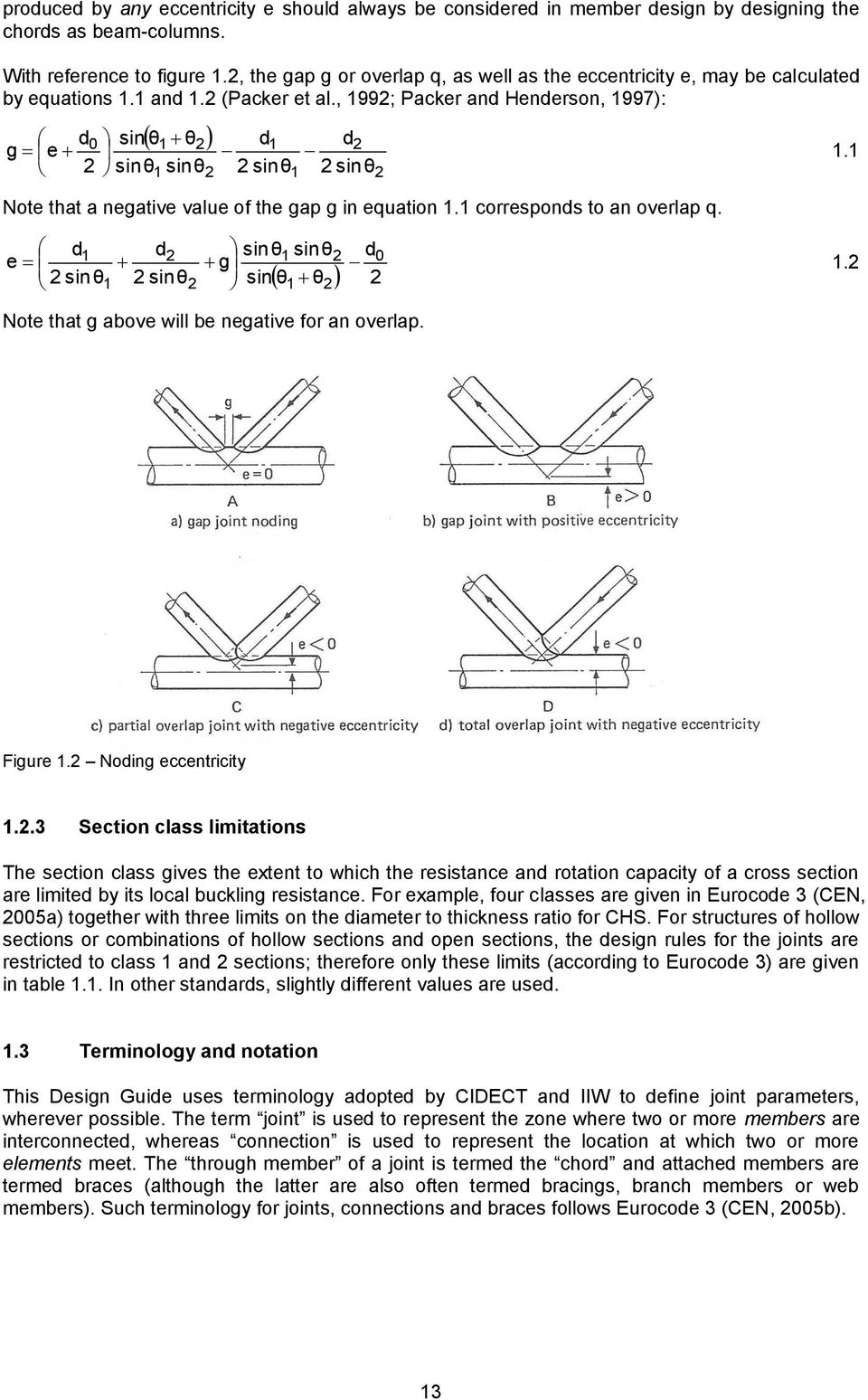
16 produced by any eccentricity e should always be considered in member design by designing the chords as beam-columns. With reference to figure.2, the gap g or overlap q, as well as the eccentricity e, may be calculated by equations. and.2 (Packer et al., 992; Packer and Henderson, 997): g d sin θ θ d d 2 2 e. 2 sinθ sinθ2 2 sinθ 2 sinθ2 Note that a negative value of the gap g in equation. corresponds to an overlap q. d d2 sinθ sinθ d g 2 2 sinθ 2 sinθ.2 2 sinθ θ2 2 e Note that g above will be negative for an overlap. Figure.2 Noding eccentricity.2.3 Section class limitations The section class gives the extent to which the resistance and rotation capacity of a cross section are limited by its local buckling resistance. For example, four classes are given in Eurocode 3 (CEN, 25a) together with three limits on the diameter to thickness ratio for CHS. For structures of hollow sections or combinations of hollow sections and open sections, the design rules for the joints are restricted to class and 2 sections; therefore only these limits (according to Eurocode 3) are given in table.. In other standards, slightly different values are used..3 Terminology and notation This Design Guide uses terminology adopted by CIDECT and IIW to define joint parameters, wherever possible. The term joint is used to represent the zone where two or more members are interconnected, whereas connection is used to represent the location at which two or more elements meet. The through member of a joint is termed the chord and attached members are termed braces (although the latter are also often termed bracings, branch members or web members). Such terminology for joints, connections and braces follows Eurocode 3 (CEN, 25b). 3
17 Table. Section class limitations according to Eurocode 3 (CEN, 25a) 235/f y and f y in N/mm 2 Limits CHS in compression: d i/t i RHS in compression (hot-finished and cold-formed): (b i - 2r o)/t i () I sections in compression Flange: (b i - t w -2r)/t i Web: (h i -2t i -2r)/t w Class Class Reduction factor for various steel grades f y (N/mm 2 ) () For all hot-finished and cold-formed RHS, it is conservative to assume (b i - 2r o)/t i = (b i /t i ) - 3 (as done by AISC (25) and Sedlacek et al. (26)). Figure.3 shows some of the common joint notation for gapped and overlapped uniplanar K joints. Definitions of all symbols and abbreviations are given in chapter 2. The numerical subscripts (i =,, 2) to symbols shown in figure.3 are used to denote the member of a hollow section joint. The subscript i = designates the chord (or through member ); i = refers in general to the brace for T, Y and X joints, or it refers to the compression brace member for K and N joints; i = 2 refers to the tension brace member for K and N joints. For K and N overlap joints, the subscript i is used to denote the overlapping brace member (see figure.). N b b 2 N 2 h h 2 d t t 2 2 d 2 g t 2 d N +e Figure.3 Common notation for hollow structural section joints.4 Effect of geometric and mechanical tolerances on joint design strength.4. Determination of the design strength In the analyses for the determination of the design strengths, the mean values and coefficients of variation as shown in table.2 have been assumed for the dimensional, geometric and mechanical properties (IIW, 28). In case hollow sections are used with mean values or tolerances significantly different from these values, it is important to note that the resulting design value may be affected. 4

18 Table.2 Effect of geometric and mechanical tolerances on joint design strength Parameter Mean value CoV Effect CHS or RHS thickness t i..5 Important CHS diameter d i or RHS width b i or depth h i..5 Negligible Angle θ i. Negligible Relative gap g = g/t..6 Important Relative chord stress parameter n..5 Important Yield stress f y.8.75 Important.4.2 Delivery standards The delivery standards in various countries deviate considerably with respect to the thickness and mass tolerances (Packer, 27). In most countries besides the thickness tolerance, a mass tolerance is given, which limits extreme deviations. However, in some production standards the thickness tolerance is not compensated by a mass tolerance see ASTM A5 (ASTM, 27a). This has resulted in associated design specifications which account for this by designating a design wall thickness of.93 times the nominal thickness t (AISC, 25) and in Canada even a design wall thickness of.9t is used for ASTM A5 hollow sections. However, the ASTM A5 (ASTM, 27b) for hot-formed hollow sections has tightened its mass tolerance up to -3.5% with no thickness tolerance, resulting in small minus deviations from the nominal thickness. The Canadian cold-formed product standard, CAN/CSA G4.2/G4.2 (CSA, 24) has a -5% thickness tolerance throughout the thickness range and a -3.5% mass tolerance. In Australia, the AS 63 (Standards Australia, 99) gives a thickness tolerance of +/- % and a lower mass tolerance of -4%. In Europe, where nominal thicknesses are used in design, see EN (CEN, 25a), the thickness tolerances are (partly) compensated by the mass tolerance. For example, table.3 shows the tolerances for hot-finished hollow sections according to EN 2 (CEN, 26a) and for cold-formed hollow sections according to EN 29 (CEN, 26b). Thickness (mm) Table.3 Tolerances for hot-finished and cold-formed hollow sections Thickness tolerance Cold-formed (EN 29) Thickness tolerance Hot-finished (EN 2) Mass tolerance (EN 2) (EN 29) t 5 +/- % -6% 5 < t % +/- 6% +/-.5 mm 8.33 < t -.5 mm Governing (minimum) (EN 29) (EN 2) These thickness tolerances have not only an effect on the capacity of the sections but also on the joint capacity. Considering that the joint capacity criteria are a function of t with 2, a large tolerance (as for example according to ASTM A5) can have a considerable effect on the joint capacity. Thus, in these cases a lower design thickness or an additional γ M factor may have to be taken into account, for example as used in the USA. In case the thickness tolerance is limited by a mass tolerance, the actual limits determine whether the nominal thickness can be used as the design thickness. Furthermore, if these tolerances are similar or smaller than those for other comparable steel sections, the same procedure can be used. -6% 5

19 Test / prediction In Australia and Canada (for CSA) the tolerances on thickness and mass are such that the nominal thickness can be assumed as the design thickness. The same applies to hot-formed hollow sections according to ASTM A5. The tolerances in Europe could, especially for the lower thicknesses, result in an effect on the joint capacity. On the other hand, the joints with a smaller thickness generally have a larger mean value for the yield strength and relatively larger welds, resulting in larger capacities for small size specimens as shown in figure.4 (van der Vegte et al., 28b), which (partly) compensates the effect of the minus thickness tolerance Wardenier / de Koning de Koning / Wardenier Ochi / Makino van der Vegte d [mm] Figure.4 Size effect in tubular joints due to relatively larger welds in small sized specimens (van der Vegte et al., 28b) Model of the roof of a football stadium with an arch support 6

20 2 Applications of circular hollow sections As already stated in the introduction, the circular hollow section combines excellent structural properties with an architecturally attractive shape. This has resulted in many applications in buildings, halls, bridges, barriers, masts, towers, offshore and special applications, such as glass houses, radio telescopes, sign gantries, parapets, cranes, jibs, sculptures, etc. (Eekhout, 996; Wardenier, 22). For indication, some examples are given in figures 2. to 2.4. Figure 2. Circular hollow sections used in halls Figure 2.2 Circular hollow sections used in a bridge 7

21 Figure 2.3 Circular hollow sections used in a barrier Figure 2.4 Circular hollow sections used in offshore structures 8
22 3 Design of tubular trusses 3. Truss configurations Some of the common truss types are shown in figure 3.. Warren trusses will generally provide the most economical solution since their long compression brace members can take advantage of the fact that CHS are very efficient in compression. They have about half the number of brace members and half the number of joints compared to Pratt trusses, resulting in considerable labour and cost savings. The panel points of a Warren truss can be located at the load application points on the chord, if necessary with an irregular truss geometry, or even away from the panel points (thereby loading the chord in bending). If support is required at all load points to a chord (for example, to reduce the unbraced length), a modified Warren truss could be used rather than a Pratt truss by adding vertical members as shown in figure 3.(a). Warren trusses provide greater opportunities to use gap joints, the preferred arrangement at panel points. Also, when possible, a regular Warren truss achieves a more open truss suitable for practical placement of mechanical, electrical and other services. Truss depth is determined in relation to the span, loads, maximum deflection, etc., with increased truss depth reducing the loads in the chord members and increasing the lengths of the brace members. The ideal span to depth ratio is usually found to be between and 5. If the total costs of the building are considered, a ratio nearer 5 will represent optimum value. (a) CL CL (c) (b) CL (d) Figure 3. Common CHS uniplanar trusses (a) Warren trusses (modified Warren with verticals) (b) Pratt truss (shown with a sloped roof, but may have parallel chords) (c) Fink truss (d) U-framed truss 3.2 Truss analysis Elastic analysis of CHS trusses is frequently performed by assuming that all members are pin connected. Nodal eccentricities between the centre lines of intersecting members at panel points should preferably be kept to e.25d. These eccentricities produce primary bending moments which, for a pinned joint analysis, need to be taken into account in chord member design e.g. by treating it as a beam-column. This is done by distributing the panel point moment (sum of the horizontal components of the brace member forces multiplied by the nodal eccentricity) to the chord on the basis of relative chord stiffness on either side of the joint (i.e. in proportion to the values of moment of inertia divided by chord length to the next panel point, on either side of the joint). For the capacity formulae of chapter (the formulae of the previous, st edition of this Design Guide), the eccentricity moments can be ignored for the design of the joints provided that the eccentricities are within the limits -.55d e.25d. 9
23 If these eccentricity limits are violated, the eccentricity moment may have a detrimental effect on joint strength and the eccentricity moment must be distributed between the members of a joint. If moments are distributed to the brace members, the joint capacity must then be checked for the interaction between axial load and bending moment, for each brace member. For most overlap joints Extremely stiff members Pin Extremely stiff members For most gap joints Figure 3.2 Plane frame joint modelling assumptions to obtain realistic forces for member design A rigid joint frame analysis is not recommended for most planar, triangulated, single-chord, directlywelded trusses, as it generally tends to exaggerate brace member moments, and the axial force distribution will still be similar to that for a pin-jointed analysis. Transverse loads applied to either chord away from the panel points produce primary moments which must always be taken into account when designing the chords. Computer plane frame programs are regularly used for truss analysis. In this case, the truss can be modelled by considering a continuous chord with brace members pin connected to it at distances of +e or -e from it (e being the distance from the chord centreline to the intersection of the brace member centrelines). The links to the pins are treated as being extremely stiff as indicated in figure 3.2. The advantage of this model is that a sensible distribution of bending moments is automatically generated throughout the truss, for cases in which bending moments need to be taken into account in the design of the chords. Table 3. Moments to be considered for CHS truss design Type of moment Primary Primary Secondary Moments due to Nodal eccentricity (e.25d ) Transverse member loading Secondary effects such as local deformations Chord design Yes Yes No Design of other members No Yes No Design of joints Yes, for Q f only; for formulae of chapter only if the eccentricity limits are exceeded Yes, influences Q f No, provided parametric limits of validity are met Secondary moments, resulting from end fixity of the brace members to a flexible chord wall, can generally be ignored for both members and joints, provided that there is deformation and rotation capacity adequate to redistribute stresses after some local yielding at the connections. This is the case when the prescribed geometric limits of validity for design formulae given in chapter 4 are followed. Welds in particular need to have potential for adequate stress redistribution without premature failure, and this will be achieved with the recommendations given in section 3.9. Table 3. summarizes when moments need to be considered for designing a CHS truss. 2
24 Plastic design could be used to proportion the chords of a truss by considering them as continuous beams with pin supports from the brace members. In such a design, the plastically designed members must be plastic design sections and the welds must be sized to develop the capacity of the connected brace members. 3.3 Effective lengths for compression members To determine the effective length KL for a compression member in a truss, the effective length factor K can always be conservatively taken as.. However, considerable end restraint is generally present for compression members in a CHS truss, and it has been shown that K is generally appreciably less than. (Mouty, 98; Rondal et al., 996). This restraint offered by members framing into a joint could disappear, or be greatly reduced, if all members were designed optimally for minimum mass, thereby achieving ultimate capacity simultaneously under static loading (Galambos, 998). In practice, design for optimal or minimum mass will rarely coincide with minimum cost; the brace members are usually standardized to a few selected dimensions (perhaps even two) to minimize the number of section sizes for the truss. In the unlikely situation that all compression brace members are proportioned on the basis of a single load combination, and all reach their compressive resistances at approximately the same truss loading, an effective length factor of. is recommended. CIDECT has sponsored and coordinated extensive research work to specifically address the determination of effective lengths in hollow section trusses, resulting in reports from CIDECT Programmes 3E-3G and Monograph No. 4 (Mouty, 98). A re-evaluation of all test results has been undertaken to produce recommendations for Eurocode 3. This has resulted in the following effective length recommendations Simplified rules For CHS chord members: In the plane of the truss: KL =.9 L where L is the distance between chord panel points 3. In the plane perpendicular to the truss: KL =.9 L where L is the distance between points of lateral support for the chord 3.2 For CHS brace members: In either plane: KL =.75 L where L is the panel point to panel point length of the member 3.3 These values of K are only valid for CHS members which are connected around the full perimeter of the member, without cropping or flattening of the members. Compliance with the joint design requirements of chapter 4 will likely place even more restrictive control on the member dimensions. More detailed recommendations, resulting in lower K values are given in CIDECT Design Guide No. 2 (Rondal et al., 996). 2
25 3.3.2 Long, laterally unsupported compression chords Long, laterally unsupported compression chords can exist in pedestrian bridges such as U-framed trusses and in roof trusses subjected to large wind uplift. The effective length of such laterally unsupported truss chords can be considerably less than the unsupported length. For example, the actual effective length of a bottom chord, loaded in compression by uplift, depends on the loading in the chord, the stiffness of the brace members, the torsional rigidity of the chords, the purlin to truss joints and the bending stiffness of the purlins. The brace members act as local elastic supports at each panel point. When the stiffness of these elastic supports is known, the effective length of the compression chord can be calculated. A detailed method for effective length factor calculation has been given by CIDECT Monograph No. 4 (Mouty, 98). 3.4 Truss deflections For the purpose of checking the serviceability condition of overall truss deflection under specified (unfactored) loads, an analysis with all members being pin-jointed will provide a conservative (over)estimate of truss deflections when all the joints are overlapped. A better assumption for overlap conditions is to assume continuous chord members and pin-jointed brace members. However, for gap-connected trusses, a pin-jointed analysis still generally underestimates overall truss deflections, because of the flexibility of the joints. At the service load level, gap-connected CHS truss deflections are underestimated by around 5-%. Thus, a conservative approach for gap-connected CHS trusses is to estimate the maximum truss deflection by. times that calculated from a pin-jointed analysis. 3.5 General joint considerations It is essential that the designer has an appreciation of factors which make it possible for CHS members to be connected together at truss panel points without extensive (and expensive) reinforcement. Apparent economies from minimum-mass member selection will quickly vanish at the joints if a designer does not have knowledge of the critical considerations which influence joint efficiency.. Chords should generally have thick walls rather than thin walls. The stiffer walls resist loads from the brace members more effectively, and the joint resistance thereby increases as the diameter to thickness ratios decrease. For the compression chord, however, a large thin section is more efficient in providing buckling resistance, so for this member the final CHS wall slenderness will be a compromise between joint strength and buckling strength, and relatively stocky sections will usually be chosen. 2. Brace members should have thin walls rather than thick walls (except overlap joints), as joint efficiency increases as the ratio of chord wall thickness to brace wall thickness increases. In addition, thin brace member walls will require smaller fillet welds for a pre-qualified joint (weld volume is proportional to t 2 ). 3. Ideally, CHS brace members should have a smaller width than CHS chord members, as this gives an easier weld situation for the joint at the saddle of the chord section. 4. Gap joints (K and N) are preferred to overlap joints because the members are easier to prepare, fit and to weld. In good designs, a minimum gap g t + t 2 should be provided such that the welds do not overlap each other. 5. When overlap joints are used, at least a quarter of the diameter (in the plane of the truss) of the overlapping member needs to be engaged in the overlap; however 5% is preferable. 6. An angle of less than 3 between a brace member and a chord creates serious welding difficulties at the crown heel location and is not covered by the scope of these recommendations 22
26 (see section 3.9). However, angles less than 3 may be possible if the design is based on an angle of 3 and it is shown by the fabricator that a satisfactory weld can be made. 3.6 Truss design procedure In summary, the design of a CHS truss should be approached in the following way to obtain an efficient and economical structure. I. Determine the truss layout, span, depth, panel lengths, truss and lateral bracing by the usual methods, but keep the number of joints to a minimum. II. Determine loads at joints and on members; simplify these to equivalent loads at the panel points if performing manual analysis. Ill. Determine axial forces in all members by assuming that joints are either: (a) pinned and that all member centre lines are noding, or (b) that the chord is continuous with pin-connected braces. IV. Determine chord member sizes by considering axial loading, corrosion protection and tube wall slenderness. (Usual diameter to thickness ratios are 2 to 3.) An effective length factor of K =.9 can be used for the design of the compression chord. Taking account of the standard mill lengths in design may reduce the end-to-end joints within chords. For large projects, it may be agreed that special lengths are delivered. Since the joint strength depends on the yield stress of the chord, the use of higher strength steel for chords (when available and practical) may offer economical possibilities. The delivery time of the required sections has to be checked. V. Determine brace member sizes based on axial loading, preferably with thicknesses smaller than the chord thickness. The effective length factor for the compression brace members can initially be assumed to be.75 (see section 3.3.). VI. Standardize the brace members to a few selected dimensions (perhaps even two), to minimize the number of section sizes for the structure. Consider availability of all sections when making member selections. For aesthetic reasons, a constant outside member width may be preferred for all brace members, with wall thicknesses varying; but this will require special quality control procedures in the fabrication shop. VII. Layout the joints; from a fabrication point of view, try gap joints first. Check that the joint geometry and member dimensions satisfy the validity ranges for the dimensional parameters given in chapter 4, with particular attention to the eccentricity limit. Consider the fabrication procedure when deciding on a joint layout. VIII. If the joint resistances (efficiencies) are not adequate, modify the joint layout (for example, overlap rather than gap) or modify the brace or chord members as appropriate, and recheck the joint capacities. Generally, only a few joints will need checking. IX. Check the effect of primary moments on the design of the chords. For example, use the proper load positions (rather than equivalent panel point loading that may have been assumed if performing manual analysis); determine the bending moments in the chords by assuming either: (a) pinned joints everywhere or (b) continuous chords with pin ended brace members. For the compression chord, also determine the bending moments produced by any noding eccentricities, by using either of the above analysis assumptions. Then check that the factored resistance of all chord members is still adequate, under the influence of both axial loads and primary bending moments. X. Check truss deflections (see section 3.4) at the specified (unfactored) load level, using the proper load positions. XI. Design welds. 23
27 3.7 Arched trusses The joints of arched trusses can be designed in a similar way to those of straight chord trusses. If the arched chords are made by bending at the joint location only, as shown in figure 3.3(a), the chord members can also be treated in a similar way to those of straight chord trusses provided that the bending radius remains within the limits to avoid distortion of the cross section (Dutta, 22). If the arched chords are made by continuous bending, the chord members have a curved shape between the joint locations, as shown in figure 3.3(b). In this case, the curvature should be taken into account in the member design by treating the chord as a beam-column. (Moment = axial force x eccentricity.) e a b c Figure 3.3 Arched truss 3.8 Guidelines for earthquake design In seismic design, the joints should meet additional requirements with regard to overstrength resulting in members being critical. For sufficient rotation capacity, the members should meet at least the class requirements of table.. For detailed information, reference is given to the CIDECT Design Guide No. 9 (Kurobane et al., 24). 3.9 Design of welds Except for certain K and N joints with partially overlapped brace members (as noted below), a welded connection should be established around the entire perimeter of a brace member by means of a butt weld, a fillet weld, or a combination of the two. Fillet welds which are automatically prequalified for any brace member loads should be designed to give a resistance that is not less than the brace member capacity. According to Eurocode 3 (CEN, 25b), this results in the following minimum throat thickness a for fillet welds around brace members, assuming matched electrodes and ISO steel grades (IIW, 28): a.92 t, for S235 (f yi = 235 N/mm 2 ) a.96 t, for S275 (f yi = 275 N/mm 2 ) a. t, for S355 (f yi = 355 N/mm 2 ) a.42 t, for S42 (f yi = 42 N/mm 2 ) a.48 t, for S46 (f yi = 46 N/mm 2 ) 24
28 Figure 3.4 Weld details With overlapped K and N joints, welding of the toe of the overlapped member to the chord is particularly important for % overlap situations. For partial overlaps, the toe of the overlapped member need not be welded, providing the components, normal to the chord, of the bracing member forces do not differ by more than about 2%. The larger diameter brace member should be the through member. If both braces are of the same diameter then the thicker brace should be the overlapped (through) brace and pass uninterrupted through to the chord. If both braces are of the same size (outside dimension and thickness) then the more heavily loaded brace member should be the through member. When the brace member force components normal to the chord member differ by more than 2%, the full circumference of the through brace should be welded to the chord. Generally, the weaker member (defined by wall thickness times yield strength) should be attached to the stronger member, regardless of the load type, and smaller members sit on larger members. It is more economical to use fillet welds than butt (groove) welds. However, the upper limit on throat or leg size for fillet welds will depend on the fabricator. Most welding specifications only allow fillet welding at the toe of a brace member if θ i 6. Because of the difficulty of welding at the heel of a brace member at low θ values, a lower limit for the applicability of the joint design rules given herein has been set at θ i = 3. Some recommended weld details (IIW, 28) are illustrated in figure
29 4 Welded uniplanar truss joints between CHS chords and CHS brace members 4. Joint classification d t t N d = 9 N t t d d N (a) T joint (b) X joint d t t 2 t d N g N 2 2 d 2 t = 9 N N 2 t 2 d 2 2 t e d e d (c) K gap joint (d) N overlap joint Figure 4. Basic joint configurations i.e. T, X and K joints Figure 4. shows the basic types of joint configurations i.e. T, X and K or N joints. However, the classification of hollow section truss-type joints as T (which includes Y), X, or K (which includes N) is based on the method of force transfer in the joint, not on the physical appearance of the joint. Examples of such classification are shown in figure 4.2, and definitions follow. (a) When the normal component of a brace member force is equilibrated by beam shear (and bending) in the chord member, the joint is classified as a T joint when the brace is perpendicular to the chord, and a Y joint otherwise. (b) When the normal component of a brace member force is essentially equilibrated (within 2%) by the normal force component of another brace member (or members), on the same side of the joint, the joint is classified as a K joint. The relevant gap is between the primary brace members whose loads equilibrate. An N joint can be considered as a special type of K joint. (c) When the normal force component is transmitted through the chord member and is equilibrated by a brace member (or members) on the opposite side, the joint is classified as an X joint. (d) When a joint has brace members in more than one plane, the joint is classified as a multiplanar joint (see chapter 6). 26
30 N % K N.2N within tolerance for: % K N gap.2n sin (a) (b).5n sin % K 5% K 5% X N N % Y.5N sin +e (c) (d).5 N/sin % X.5 N/sin N % K % K N N gap +e (e) (f) N % X N (g) Figure 4.2 Examples of hollow section joint classification 27
31 When brace members transmit part of their load as K joints and part of their load as T, Y, or X joints, the adequacy of each brace needs to be determined by linear interaction of the proportion of the brace load involved in each type of load transfer. However, the effect of the chord preloading should be added to the joint type with the most unfavourable chord load function. One K joint, in figure 4.2(b), illustrates that the brace force components normal to the chord member may differ by as much as 2% and still be deemed to exhibit K joint behaviour. This is to accommodate slight variations in brace member forces along a typical truss, caused by a series of panel point loads. The N joint in figure 4.2(c), however, has a ratio of brace force components normal to the chord member of 2:. In this case, that particular joint needs to be analysed as both a pure K joint (with balanced brace forces) and an X joint (because the remainder of the diagonal brace load is being transferred through the joint), as shown in figure 4.3. For the diagonal tension brace in that particular joint, one would need to check that:.5n K joint resistance.5n. X joint resistance If the gap size in a gapped K (or N) joint (e.g. figure 4.2(a)) becomes large and exceeds the value permitted by the gap/eccentricity limit, then the K joint should also be checked as two independent Y joints. In X joints such as figure 4.2(e) where the braces are close or overlapping, the joint should be checked as an X joint, considering both brace load components perpendicular to the chord. In K joints such as figure 4.2(d), where a brace has very little or no loading, the joint can be treated as a Y joint, as shown..5n sin.5n sin N.5N.5N = N cos +.5N sin.5n cos.5n sin.5n cos Figure 4.3 Checking of a K joint with imbalanced brace loads Some special uniplanar joints with braces on both sides of the chord where the brace forces act in various ways, are dealt with in table Joint capacity equations The joint strength is generally governed by two criteria, i.e. plastification of the chord cross section or punching shear, shown in figure 4.4. For T, Y and X joints, the resistance is based on the strength under brace compression loading, although this can also be used for brace tensile loading. The ultimate resistance under tensile loading is usually higher than that under compressive loading. However, it is not always possible to take advantage of this additional strength due to larger deformations or premature cracking. 28
32 (a) Chord plastification (b) Chord punching shear Figure 4.4 Chord plastification and punching shear failure modes Recently, Sub-commission XV-E of the International Institute of Welding has reanalysed all joint strength formulae. Based on rigorous examinations in combination with multiple additional finite element (FE) studies, new design strength functions have been established (IIW, 28). Nowadays, with well calibrated FE models, reliable parameter studies can be performed, especially for chord plastification failures. In these reanalyses, it is shown that the experimental databases have to be used with care. The new joint strength equations for chord plastification are, in principle, based on the ring model approach (Togo, 967). However, the influence functions for β, γ, expressed by Q u, and n, expressed by Q f, have been determined using multi-regression analyses of the FE results. After simplifications, the formulae have been compared with the experimental database compiled by Makino et al. (996) and the FE database of Qian et al. (28). Finally, design strength formulae have been developed (van der Vegte et al., 28a, 28b). For distinction with the formulae in the previous edition, which are incorporated in many national and international codes, a slightly different presentation is used, shown in table 4.. This format is similar to that in the API recommendations (API, 27): 2 y t f Ni Qu Qf 4. sinθ i The parameter Q u gives the influence function for the parameters β and γ, while the parameter Q f accounts for the influence of the chord stress on the joint capacity. For chord punching shear, the formula is similar to that in previous editions, although the presentation is slightly different. k N a i =.58 fy di t 4.2 sinθ i where k a is a parameter for the connection perimeter in relation to the brace perimeter as function of θ i: k a sinθ i sinθ i For indication, the Q u functions for X, T and K gap joints with 2γ = 25 are illustrated in figure 4.5. For each of the three joint types, the capacity increases with increasing β ratio. Further, Q u is lowest for X joints and highest for K gap joints with a small gap. The Q u for T joints is the same as that for K joints with a large gap. These relations are in good agreement with the expected physical behaviour. 29
33 Qu Comparison Q u for T, X and K gap joints for 2=25 (IIW, 28) K gap joints g'=2 K gap joints g'=infinite T joints X joints Figure 4.5 Comparison of Q u for T, X and K gap joints (2γ = 25) g' = g/t One of the main differences with the joint strength formulae given in the previous edition of the Design Guide, here also recorded in chapter, is that the chord stress function Q f is now related to the maximum chord stress, whereas previously, the chord stress function f(n ) was based on the so-called prestress. Further, the reanalyses also showed that for large tensile chord load, a reduction of the joint resistance has to be taken into account. In table 4., the total (normal) stress ratio, n, in the chord connecting face, due to axial load plus bending moment, is computed and its effect on joint resistance determined. It should be noted that the most punitive stress effect, Q f, in the chord on either side of the joint is to be used. The Q f functions are graphically presented in figures 4.6 to 4.8 for the individual effects of chord axial loading on T, Y, and X joints, chord moment loading on T, Y, and X joints, and chord axial loading on K gap joints. As shown in figures 4.6 and 4.7, the chord bending compression stress effect for T, Y and X joints is the same as that for chord axial compression loading. The range of validity of the formulae, given in table 4., is about the same as in the previous edition of the Design Guide, recorded in table. of chapter. Although for particular cases the γ validity range could be larger, Sub-commission IIW-XV-E has limited the 2γ ratio to 5 (or class 2) because for ratios exceeding this limit, the deformations may govern, while in other cases the deformation capacity may not be sufficient to redistribute secondary bending moments. 4.3 T, Y and X joints In the new joint strength formulae for T and Y joints, summarized in table 4., the effect of chord bending due to the brace load is now fully included in the chord stress function Q f, giving a better presentation of the capacity (van der Vegte et al., 26). The previous chord plastification formula (chapter ) was only based on experimental results which were, due to the test set up, influenced by chord bending. The previous formula for X joints gave, for very low β values, a higher capacity than for T joints, which is not correct. The new formulae give for low γ ratios, slightly lower values than the previous strength equations, which agrees with the work on thick-walled joints by Qian (25). It was further shown by Qian (25) that for X joints with small angles θ, chord shear failure could occur when cos > β. 3
34 4.4 K and N joints In the previous edition of the Design Guide, one formula was given for gap and overlap K joints (chapter ). However, overlap and gap joints behave differently, with other influencing parameters. Therefore, rigorous reanalyses have been carried out on K gap joints (van der Vegte et al., 27) and overlap joints. For overlap joints, it was found that these could be approached in the same way as overlap joints between RHS sections (Wardenier, 27) K and N joints with gap The new equation for chord plastification is significantly simpler with respect to the gap function. The new design equation gives for low γ values, lower strengths than the previous equations (chapter ), which agrees with the work of Qian (25) on joints with thick-walled sections. Further, for low β values, the new functions give lower results. The database used previously included many small scale specimens with low β ratios and relatively large welds, which increased the mean ultimate strength value of joints with low β values with small gaps. The new strength equations are based on sections with larger dimensions and smaller welds. Triangular girders with CHS members and bolted joints with plates 3
35 Table 4. Limit states criteria for axially loaded CHS joints Criterion to be checked Design strength: chord plastification Design strength: chord punching shear (only for d i d 2t ) Axially loaded joints with CHS braces and chord 2 y t f Ni Qu Qf eq. 4. sinθ i k N a i =.58 fy di t eq. 4.2 sinθ k a i i sinθ i eq sinθ X joints () Function Q u t d t N d Q β -.7β.5 u 2.6 eq. 4.4 N N T and Y joints t d t N d 2.2 Q u β eq. 4.5 M N K gap joints t t 2 d d N g N 2 d 2 +e 2 N Q u ( 8β ) [ ] eq. 4.6 g.8.2 ( ) t () For X joints with cos > β, check also for chord shear failure (see equation 6.2 in table 6.). Function Q f C n Qf with eq. 4.7 N n N pl, M M pl, in connecting face Chord compression stress (n < ) Chord tension stress (n ) T, Y, X joints C =.45.25β K gap joints C =.25 C =.2 32
36 General Chord Braces Table 4. Limit states criteria for axially loaded CHS joints (continued) Range of validity d.2 i e. t d i t.25 d θ i 3 g t +t 2 f yi f y f y.8f u f y 46 N/mm 2 () Compression class or 2 () and 2γ 5 (for X joints: 2γ 4) Tension 2γ 5 (for X joints: 2γ 4) Compression class or 2 () and d i /t i 5 Tension d i /t i 5 () For f y > 355 N/mm 2, see section.2. () Limits for d i/t i are given in table 4.2 Table 4.2 Maximum d i/t i ratios for CHS in compression (CEN, 25a) Maximum d i/t i ratios Steel grade S235 S275 S355 S46 Yield stress f y 235 N/mm N/mm N/mm 2 46 N/mm 2 Class Class Complex multiplanar welded joint 33
37 Q f X and T joints: chord axial stress functions T joints: chord bending stress function n T, X joints; β=.3 T, X joints; β=.6 T, X joints; β=.9 Qf Q f tension Figure 4.6 Chord axial stress function Q f for T and X joints and chord bending stress function Q f for T joints X joints: chord bending stress function Q f n X joints; β=.3 X joints; β=.6 X joints; β=.9 Figure 4.7 Chord bending stress function Q f for X joints K gap joints: chord stress function.2.8 K gap joints Qf f tension Q f n Figure 4.8 Chord axial stress function Q f for K gap joints 34
38 4.4.2 K and N joints with overlap As stated before, for overlap joints the same approach is now adopted for all types of overlap joints, regardless whether circular or rectangular braces are used in combination with a circular, rectangular or an open section chord (Wardenier, 27). Only the effective width parameters depend on the type of section. The resistance of overlap joints between circular hollow sections with 25% Ov % overlap is based on the following criteria: () Local yielding of the overlapping brace, equations 4.8 and 4.9 (2) Local chord member yielding at the joint location based on interaction between axial load and bending moment, equation 4. (3) Shear of the connection between the brace(s) and the chord, equation 4. Figure 4.9 shows the overlap joint configuration with the cross sections to be examined for these criteria. For K and N overlap joints, the subscript i is used to denote the overlapping brace member, while the subscript j refers to the overlapped brace member. Local yielding of the overlapping brace (criterion ) should always be verified, although shear between the braces and the chord (criterion 3) may only become critical for larger overlaps, i.e. larger than 6% or 8%, respectively, depending on whether the hidden toe location of the overlapped brace is welded to the chord. The check for local chord member yielding (criterion 2) is, in principle, a member check and may become critical for larger overlaps and/or larger β ratios. For % overlap joints, similar criteria (equations 4.9, 4. and 4.2) have to be verified. Only here, as shown by Qian et al. (27), overlapping brace shear (equation 4.2) and chord member yielding (equation 4.) will generally be the governing criteria. Although an overlap of % is given in the recommendations, the overlap will generally be slightly larger to allow proper welding of the overlapping brace to the overlapped brace. d j d i t j t i N j N i 4.8 j 4. i 4. t N op N o d brace i = overlapping member; brace j = overlapped member Figure 4.9 Overlap joint configuration with cross sections to be checked Joints with overlaps between % and 25% should be avoided because in those cases, the stiffness of the connection between the overlapping brace and the overlapped brace is much larger than that of the overlapping brace to chord connection, which may lead to premature cracking and lower capacities (Wardenier, 27). 35
39 Table 4.3 K overlap joints q Ov ov erlap % p Local yielding of overlapping brace 25% Ov < % N 4 Ov = % Ni f yi t i 2d i 2d e,ov 4t i eq i f yi t i 2d i d ei d e,ov 4t i eq. 4.8 Local chord member yielding.7 N N pl, Brace shear (only to be checked for Ov > Ov limit) Ov limit < Ov < % () M Mpl,. () eq. 4. Ov 2di dei ti (2dj cs dej) t j Ni cos θi Nj cosθj [.58f ui.58fuj ] eq sinθ sinθ Ov = % N cosθ i (3d d ) t i j ej j i Nj cos θj.58fuj eq sinθj () Where N and M are to be selected at a common location (left or right from the joint) that produces the greatest summation; M includes the moment due to noding eccentricity. () If hidden toe of overlapped brace is not welded: Ov limit = 6% and c s = If hidden toe of overlapped brace is welded: Ov limit = 8% and c s = 2 d f t Effective width factors f 2 y 2 y 2 fyj tj ei di but di dej dj but dj de, ov di but di d/t fyi ti d/t fyj tj d j/tj fyi ti t j General note The efficiency (i.e. design resistance divided by brace squash load) of the overlapped brace j shall not exceed that of the overlapping brace i. General Chord Braces Range of validity d d i j di and.2.75 t i and t j t t i t j d d d θ i and θ j 3 Ov 25% j Compression class or 2 () and 2γ 5 Tension 2γ 5 Compression class or 2 () and d /t 5 Tension d 2/t 2 5 () For f y > 355 N/mm 2, see section.2. () Limits for d /t and d /t are given in table 4.2 f yi and f yj f y f y.8f u f y 46 N/mm 2 () 36
40 4.5 Special types of joints In tubular structures, various other joint configurations exist which have not been dealt with in the previous chapters. However, the strength of several types of joints can be directly related to the basic types presented in sections 4.3 and 4.4. Table 4.4 shows some special types of CHS uniplanar joints with braces directly welded to the chord. Table 4.4 Special types of uniplanar joints Type of joint Relationship to the formulae of tables 4. and 4.3 N N eq. 4.3 with N f romx joint N sinθ N2 sinθ2 Ni sinθi eq. 4.4 with Ni (i or 2) f romx joint where Ni sinθi is thelarger of N sinθ and N2 sinθ2 Ni Ni (i or 2) with Ni (i or 2) f romk joint,but with the actualchord f orce Ni Ni (i or 2) with Ni (i or 2) f romk joint N N N2 2 N Note: Check cross section - for shear failure in the gap: 2 2 Ngap, Vgap, N pl, V pl, where:. N gap, = axial force in gap N pl, = A f y 2A V gap, = shear force in gap V pl, =.58fy eq
41 4.6 Joints with cans Large diameter CHS sections are built up from cans with a maximum length equal to the maximum plate width from which they are made. In structures with these large size tubular sections, it is easy to use a larger can thickness at the joint locations. This is, for example, commonly used in offshore structures. However, it can also be used for other heavily loaded structures, for example bridges and large span structures. X Joints with short can lengths have been numerically investigated by van der Vegte (995). For X joints, it was shown that the can should have a minimum length of 2.5d in order to obtain a joint capacity based on the can thickness. For smaller can lengths, a linear interpolation can be used between the resistance of the joint with and without a can. For this case, API (27) gives the following equation: N t = r +( r) ( ) Ncan tcan with r lcan. and tcan t 2.5d 4.7 Because of the dominant load transfer through membrane action, API allows for X joints with β >.9, a smaller can length down to.5d for β =.. However, compared to the numerical data, this recommendation is somewhat too optimistic in the opinion of the authors of this Design Guide. The interpolation function for can lengths (equation 4.6) can also be used for T and Y joints. For balanced K joints, a lower can length can be used due to the compensating ovalizing effects of the two braces. No experimental or numerical data are available for K joints, but API (27) recommends an extension of.25d with a minimum of 3 mm from the footprint of the braces at both sides of the joint to obtain a capacity based on the can thickness. 4.7 Graphical design charts with examples In the diagrams in tables 4.5 to 4.8, the joint design strength is expressed in terms of the efficiency of the connected braces, i.e. the joint design strength for axially loaded joints N is divided by the yield load A i f yi of the connected brace. This results in efficiency formulae of the following type: N fy t i Q C f e 4.8 i fyi fyi ti sinθi A For each type of joint, the efficiency parameter C e given in the diagrams, is a function of the diameter ratio β and the chord diameter to thickness ratio 2γ = d /t. d d2 In case d d2 for K joints, equation 4.8 has to be multiplied by, in which d i is the 2d diameter of the considered brace. The value of the parameter C e in equation 4.8 gives the efficiency for the brace of a joint with Q f =., a brace angle θ i = 9 and the same wall thickness and design yield stress for chord and brace. From the efficiency equation, it can be easily observed that yield stress and thickness ratio between chord and brace are extremely important for an efficient material use of the brace. Decreasing the angle θ i increases the efficiency. The function Q f depends on the chord stress. The efficiency formula shows directly that the following measures are favourable for the joint efficiency: - brace wall thickness as small as possible (t i < t ), but limits for local buckling are to be satisfied - higher strength steel for chords than for braces (f y > f yi) - angle θ i << 9; hence, prefer K joints to N joints i i 38
42 Table 4.5 Efficiency design chart for CHS T and Y joints T and Y joints of circular hollow sections Symbols Geometric range of validity d β d 2 d t.2 β. t compression chord: class or 2 and 2γ 5 tension chord: 2γ 5 d t N d compression brace: class or 2 and d /t 5 tension brace: d /t 5 N M t t θ 3 Design chart effciency C T T joint efficiency N A f y C T f y y f t t Qf sin Calculation example chord: Φ 29. x. d /t = 2.9 f y = f y brace: Φ 68.3 x 4.5 d /t = 37.4 θ = 9 sin θ =. S355 d d 29. C T =.4 and for n = -.48 due to bending: Q f =.83 (see figure 4.7) N A f y
43 Table 4.6 Efficiency design chart for CHS X joints X joints of circular hollow sections d t Symbols d β d N t 2 d t d Geometric range of validity.2 β. compression chord: class or 2 and 2γ 4 tension chord: 2γ 4 compression brace: class or 2 and d /t 5 tension brace: d /t 5 N N t t θ 3 Design chart effciency C X X joint efficiency N fy t Q C f X A fy fy t sin Calculation example chord: Φ 29. x. d /t = 2.9 f y = f y brace: Φ 68.3 x 5.6 d /t = 3. θ = 9 sin θ =. S355 d d 29. C X =.29 and for n = -.5 due to axial compression: Q f =.82 (see figure 4.6) N A fy 5.6 4
44 Table 4.7 Efficiency design charts for CHS K gap joints K and N gap joints of circular hollow sections Symbols Geometric range of validity d d β 2d t 2 2 d t t 2 g' g t.2 β. compression chord: class or 2 and 2γ 5 tension chord: 2γ 5 d d N g N 2 d 2 compression brace: class or 2 and d /t 5 tension brace: d 2/t 2 5 +e 2 N t i t g t t 2 e θ i d Design chart effciency C K K gap joint efficiency g'=5 N A f y C K f y f t t y Q f sin Calculation example chord : Φ 29. x. d /t = 2.9 f y = f y = f y2 brace : Φ 39.7 x 6.3 d /t = 22.2 e = g = 63 mm brace 2: Φ 4.5 x 5. d 2/t 2 = 22.9 n = -.7 θ = θ 2 = 4 sin θ = sin θ 2 =.643 n = -.7 Q f =.75 (see figure 4.8) 63 g = 63 mm, thus g' d d2 β =.58 with di.9for brace, and. for brace 2 C K =.46 N N A fy A2 fy
45 Table 4.7 Efficiency design charts for CHS K gap joints (continued) K and N gap joints of circular hollow sections effciency C K K gap joint efficiency g'= N A f y C K f y f t t y Q f sin effciency C K K gap joint efficiency g'=2 N A f y C K f y f t t y Q f sin
46 Table 4.7 Efficiency design charts for CHS K gap joints (continued) K and N gap joints of circular hollow sections effciency C K K gap joint efficiency g'=5 N A f y C K f y f t t y Q f sin K gap joint efficiency g'= effciency C K N A f y C K f y f t t y Q f sin
47 Table 4.8 Efficiency design chart for CHS K overlap joints (25% Ov Ov limit = 6% or 8%) K and N overlap joints of circular hollow sections Symbols 2 d t Geometric range of validity d d i j di and.2.75 d d d t t i j t and. i. t t t compression chord: class or 2 and 2γ 5 tension chord: 2γ 5 compression brace: class or 2 and d /t 5 tension brace: d 2/t 2 5 j j For the configuration shown: compression brace = overlapped member j tension brace 2 = overlapping member i θ i and θ j 3 25% Ov Ov limit = 6% or 8% Design chart.3 eff= d ei /d i +.25d e,ov /d i.25dei/di or.25de,ov/di fy.t f y ratio =. fy.t f y ratio = 2. fy.t f y ratio = d /t or d j /t j 44
48 Table 4.8 Efficiency design chart for CHS K overlap joints (25% Ov Ov limit = 6% or 8%) (continued) Calculation example chord : Φ 29. x. d /t = 2.9 f y = f y = f y2 brace : Φ 39.7 x 6.3 d j/t j = 22.2 brace 2: Φ 4.5 x 5. d i/t i = 22.9 Ov = 5% For Ov = 5%, besides member checks, only local yielding of the overlapping brace needs to be checked: f f f y f yj yi yi t t i 2. thus, with d /t = 2.9:.25d ei/d i = t j thus, with d j/t j = 22.2:.25d e,ov/d i =.6 t 5. i Hence, the brace efficiency for both braces is: Eff. = d ei/d i +.25d e,ov/d i = =.9 Eye shaped curved CHS roof structure 45
49 5 Welded CHS to CHS joints under moment loading 5. Joints with brace(s) subjected to in-plane or out-of-plane bending moment One should distinguish between primary bending moments due to noding eccentricities (figure.2) needed for the equilibrium with the external loading and secondary bending moments due to end fixities of the joint members as a result of induced deformations in the structural system. In principle, the secondary moments are not needed for the equilibrium with the external loading e.g. the secondary moments in members of lattice girders. As already mentioned in chapter, these secondary moments do not influence the load bearing capacity of lattice girders if the joints have sufficient deformation capacity, i.e. within the parameter limits given in tables 4. and 4.3. The moments due to noding eccentricity in lattice girders may be assumed to be taken by the chord members. Joints predominantly loaded by in-plane bending moments are generally of the T-type and called Vierendeel joints (figure 5.(a)). These joints also exist in framed structures. (a) (b) Figure 5. Uniplanar Vierendeel joints Out-of-plane bending moments (figure 5.(b)) are not very common in uniplanar structures; this type of loading generally appears more frequently in multiplanar structures. The formulae in table 5. for chord plastification and chord punching shear can be used within the range of validity given in table 4., except all braces must be class or 2. These formulae have been based on the reanalyses by IIW-XV-E (van der Vegte et al., 28a, 28b; Qian et al., 28). In a similar manner to axially loaded joints, the joint moment capacity formulae are also presented in efficiency design charts (figures 5.2 and 5.3). The joint efficiencies C ip or C op give the joint moment design strength divided by the plastic moment capacity W pl, f y of the brace. The efficiency is limited by the punching shear moment capacity which, for θ = 9, results in an efficiency factor of.58. These diagrams show that in most cases the in-plane bending moment resistance is significantly larger than that for out-of-plane bending. It should be noted that the joint rotational stiffness C (moment per radian) may considerably influence the moment distribution in statically indeterminate structural systems, e.g. portal frames and Vierendeel trusses. If rigid joints are required, it is recommended to choose a β ratio near. or low d /t ratios in combination with high t /t ratios. Figures 5.4 and 5.5 give, based on the work of Efthymiou (985), a graphical presentation of the rotational joint stiffness C of T joints for in-plane and out-of-plane bending moments. More detailed information about the joint flexibility for axial loading and bending moments can be found in Buitrago et al. (993) and in Dier and Lalani (995). This information may be especially helpful in case of fatigue design for an exact determination of the bending moments in the members. 46
50 Table 5. Limit states criteria for CHS joints loaded by brace bending moments Criterion to be checked Joints with CHS braces and chord loaded by brace bending moments () 2 Design strength: fy t M chord plastification Qu Qf d eq. 5. sinθ Design strength: chord punching shear (only for d d 2t ) 2 k.58 f b y d t sinθ M eq. 5.2 Brace in-plane bending: 3 sinθ k b eq sinθ Brace out-of-plane bending: 3 sinθ k b eq sinθ () The equations in table 5. may also be used for K gap joints (if brace moments have to be considered, see section.2.2), by checking that the brace utilization due to bending plus the brace utilization due to axial load.8. For K overlap joints, no evidence exists. Function Q u T, Y, X joints Brace in-plane bending Brace out-of-plane bending d M ip, d t t.5 Qu 4.3 eq. 5.5 d M op, d t t Q u eq. 5.6 Function Q f Qf N n N C n with eq. 4.7 pl, M M Chord compression stress (n < ) T, Y, X joints C =.45.25β C =.2 pl, in connecting face Chord tension stress (n ) Range of validity Same as table 4. 47
51 effciency C ip Efficiency for brace in-plane bending (limit for puching shear.58) N A f y C f t y KMip fy t Mpl, Q Csin fy t ip fy t Qf sin All β Figure 5.2 Efficiency design chart for joints loaded by brace in-plane bending moment effciency C op Efficiency for brace out-of-plane bending op MN AM f pl, y C op K f y f t t y Q f sin Figure 5.3 Efficiency design chart for joints loaded by brace out-of-plane bending moment 48
52 C E d x 3 4 C E d x 3 5 Figure 5.4 Joint stiffness for brace in-plane bending moments of T joints Figure 5.5 Joint stiffness for brace out-of-plane bending moments of T joints 5.2 T and X joints with brace(s) subjected to combinations of axial load, in-plane bending and out-of-plane bending moment Especially in three dimensional structures, the joints may be loaded by combinations of axial loading and bending moments. Investigations have shown that in-plane bending is less severe than out-of-plane bending and a reasonable simplified lower bound interaction function is based on the work of Hoadley and Yura (985): 2 N M M ip, op,. 5.7 N M ip, Mop, in which N, M ip, and M op, are the (brace) loads acting, and N, M ip, and M op, are the design strengths. It should be noted that the joint stiffnesses given in figures 5.4 and 5.5 can be affected considerably by the presence of axial loading (Stol et al., 985). However, insufficient test evidence is available for a more precise recommendation. 5.3 Knee joints Some special types of joints are illustrated in figure 5.6 for frame corners. These knee joints have been investigated at the University of Karlsruhe by Karcher and Puthli (2), who recommend these joints to be designed based on the following requirements for both members: N M α 5.8 Npl, Mpl, = (.5 d /t +.77) -.2 (235/f y) The term is a stress reduction factor, which can be taken as. for mitred joints with stiffening plates. For the mitred joints without stiffening plates, is a function of the cross sectional parameters as shown in figure 5.7 and equation 5.9. The steel grade with S in figure 5.7 refers to the nominal yield stress. Based on previous work of Mang et al. (997), it is recommended that for joints without stiffening plates, the shear force V and the axial force N in the members should not exceed: 49
53 Reduction factor V N.5 and.2 5. Vpl, Npl, For mitred knee joints with angles 9, the same recommendations as for = 9 can be adopted (Karcher and Puthli, 2). plate 2t t d Figure 5.6 CHS knee joints Although the unstiffened joints have been investigated for d /t, it is recommended that for structural applications, d /t is restricted to class sections..6.4 stiffened unstiffened S235 S355 S46 S69 S Parameter d /t Figure 5.7 Stress reduction factor, for unstiffened mitred CHS knee joints The joints with a stiffening plate can be considered to be rigid, whereas the stiffness behaviour of the unstiffened joints depends on the d /t ratio. The unstiffened joints can only be assumed to be rigid for very low d /t ratios. No formulae for the joint stiffness are available. For those structural applications where a reasonable strength, stiffness and rotational capacity are required, it is recommended that a stiffened joint with class sections is used. For other structural applications, it is recommended to use unstiffened joints only if the sections satisfy at least the plastic design requirements. The stiffening plate thickness should satisfy t p 2t and not be taken smaller than mm. 5
54 6 Multiplanar welded joints 6. TT and XX joints Multiplanar joints are frequently used in tubular structures, e.g. in towers, offshore jacket structures, triangular or quadrangular girders, etc. Tests have been carried out on double T joints (TT joints) with a 9 included angle between both braces loaded in compression (table 6.). Compared to the strength of uniplanar joints, the multiplanar joint strength did not vary substantially, although the stiffness increased considerably (Mitri et al., 987). Further work in this field has been carried out by Paul et al. (989, 992) and van der Vegte (995). Based on the results of these studies, simple guidelines can be given. One can imagine that the multiplanar effects are most substantial for double X joints as shown in figure 6.. Finite element calculations have shown that multiplanar loading has a substantial influence on the strength and stiffness as compared to a uniplanar X joint. In the case where the loads acting in one plane have the same magnitude as those in the other plane, but with an opposite sense (e.g. compression vs. tension), the joint strength may drop by about /3 compared to the uniplanar joint (see figure 6.). On the other hand, for loadings with the same sense, the joint strength increases considerably. However, this increase in strength may be accompanied by a reduction in deformation and rotation capacity. A conservative assumption will be to adopt the same percentage increase in strength for loads in the same sense as the percentage reduction for opposite loads. 6.2 KK joints For K joints in triangular girders, shown in figure 6.2, various tests have been carried out by Makino et al. (984) and Paul (992). The proposed interaction equation can simply be replaced by a constant of.9, to be applied to the strength of uniplanar joints and adopted in the previous recommendations, see table.3. However, the proposals were based on analyses taking account of the chord prestress. The reanalyses showed that the reduction is due to the larger chord force. Hence, in the new recommendations in table 6., the correction factor to be applied to the formulae in table 4. is. and the reduction effect is included in the Q f function. 6.3 Design recommendations Design rules covering multiplanar effects are given only by AWS (26). However, the formulation is developed on elastic considerations and, depending on the configuration and loading of the joints, may be unreliable for strength predictions. Based on the existing evidence, it is recommended to design multiplanar joints using the range of validity and formulae for uniplanar joints given in tables 4. and 4.3 with the correction factors in table 6.. Similar recommendations (table.3) with exception of the factor for KK joints, have also been adopted by Eurocode 3, but are related to the formulae summarized in table.. 5
55 brace Φ 399 x chord Φ 6 x 25 brace Φ 599 x chord Φ 6 x 25 β =.4 β = Figure 6. Multiplanar X joints 52
56 Figure 6.2 Multiplanar K joints Table 6. Correction factors for multiplanar joints Type of joint Correction factor μ to uniplanar joint strength TT joints μ =. XX joints N.35 2 eq. 6. N KK gap joints μ =. Notes: - Take account of the sign of N 2 and N, with N N 2 - N 2/N is negative if the members in one plane are in tension and in the other plane in compression. Range of validity Note: In a gap joint, the cross section in the gap has to be checked for shear failure: 2 2 Ngap, Vgap,. eq. 6.2 N pl, V pl, where: N gap, = axial force in gap N pl, = A f y 2A V gap, = shear force in gap V pl, =.58fy Same as table
57 7 Welded plate, I, H or RHS to CHS chord joints 7. Plate, I, H or RHS to CHS chord joints The capacity of joints between plates, I sections and RHS sections as braces and a CHS chord, as illustrated in figure 7., is directly related to that of joints between CHS braces and chords. The database is mainly based on tests carried out in Japan (Kurobane, 98; Wardenier, 982; Makino et al., 99). Initially in the reanalysis by IIW-XV-E, the functions Q u were directly related to the joints with CHS braces and chords in such a way that the resulting formulae in table 7. give for medium β and γ ratios, about the same capacity as the previous IIW (989) formulae, summarized in table.4. However, a more detailed analysis (Wardenier et al., 28b) revealed that large discrepancies exist between the various data sets. Therefore, the constant is reduced from 2.6 to 2.2. Further, compared to the recommendations in the st edition of this Design Guide, the η function has been marginally changed from (+.25η) to (+.4η), and a factor.8 is included in the Q u function for inplane bending of the joints with a longitudinal plate. The Q f factors for chord compression loading are based on the work of de Winkel (998) while for chord tensile loading, the functions for CHS joints are adopted. The range of validity of the formulae given in table 7., is similar to that for CHS joints, except that the width of transverse plates is limited to β.4 and the length of longitudinal plates to η 4. For a plate to CHS joint, for punching shear, the chord at both sides of a plate is effective, resulting in equation 7.2. However, for an RHS or I section brace (subjected to axial loading or out-of-plane bending), the part between the flanges cannot contribute to the capacity, giving equation 7.. For transverse plates, the line of action of the force is in line with the plate. Hence, the angle θ is equal to the angle of the force acting on the plate. For longitudinal plates, even though the plate can be at 9 to the chord, the axial force can be pulling at a different angle on the plate. Apparently this is a common situation with tension cables connected to hollow sections via plates. As a result, for longitudinal plates, the angle θ should also be taken to the line of action of the force. b h d t d t (a) Transverse plate to CHS chord (b) Longitudinal plate to CHS chord h b h b d t d t (c) I section to CHS chord (d) RHS section to CHS chord Figure 7. Plate, I and RHS to CHS chord joints 54
58 Table 7. Limit states criteria for joints with plate, I or RHS braces to CHS chord Joints with plate, I or RHS braces to CHS chord Criterion to be checked Brace axial load Brace bending moment Design strength: chord plastification Design strength: chord punching shear (only for b d - 2t ) 2 y t f 2 N Qu Qf eq. 4. M Qub Qf fy t h eq. 5.a sinθ For I section with η 2 (for axial loading and brace out-of-plane bending) and RHS section: N M M ip, op, t.58fy eq. 7. A Wel,ip, Wel,op, t All other cases: N M M ip, op, t.6fy eq. 7.2 A Wel,ip, Wel,op, t Type of joint CHS chord with: Transverse plate () () N b t X Q Function Q u Brace axial load.7.5 u 2.2 eq. 7.3 Q ub Function Q ub in terms of Q u Brace inplane bending plane Brace out-of- bending Q.5Q ub u b h t d 2.2 T Q eq. 7.4 Q ub u Q.5Q ub u b h N Longitudinal plate () h d N t t X Q u 5.4η eq. 7.5 Qub.8Qu Q ub T N I or RHS () h N d t X Q u η.5 eq. 7.6 Q ub Q u.4η Q.5Q ub u b h N h b d t Q η Q Q u ub eq η T u Q.5Q ub u b h () The chord should also be checked for shear failure for: X joints with transverse plates and angles θ < 9 X joints with RHS or I section brace members and cos θ > h /d () For transverse and longitudinal plates: θ = angle of the force acting on the plate 55
59 Table 7. Limit states criteria for joints with plate, I or RHS braces to CHS chord (continued) Qf Function Q f N n N C n with eq. 7.8 pl, M M pl, in connecting face Brace axial load Brace in-plane bending and out-of-plane bending Chord compression stress (n < ) Chord tension stress (n ) All joints C =.25 C =.2 Range of validity b General.2. θ d 3 () f y f y f y.8f u f y 46 N/mm 2 () CHS chord RHS braces I section braces Compression class or 2 () and 2γ 5 (for X joints: 2γ 4) Tension 2γ 5 (for X joints: 2γ 4) Compression class or 2 () and b /t 4 and h /t 4 Tension b /t 4 and h /t 4 Compression class or 2 () Tension Transverse plate b. 4 d h Longitudinal plate 4 d none () For f y > 355 N/mm 2, see section.2. () Section class limitations for CHS in compression are given in table 4.2 Section class limitations for RHS and I sections in compression are defined in table. CHS arches 56
60 7.2 Longitudinal plate joints under shear loading This type of joint is primarily found in simple shear joints for example to hollow section columns, where the plate is typically referred to as a shear tab or fin plate. A simple criterion to avoid a punching shear failure is to ensure that the tensile resistance of the tab (per unit plate length) is less than the shear resistance of the CHS wall along two planes (per unit plate length). This is, based on CHS columns, achieved if: fy tp.6 t 7.9 f yp This design check is valid for CHS members that do not have slender cross-sections (i.e. which are not thin-walled; i.e. are not class 4 according to Eurocode 3 (CEN, 25a)). Further information regarding this detail is provided in CIDECT Design Guide No. 9 (Kurobane et al., 24). 7.3 Gusset plate to slotted CHS joints Single gusset plates, slotted into the ends of hollow section members and concentrically aligned with the axis of the member, as shown in figures 7.2 and 7.3, are commonly found in diagonal brace members of steel framed buildings and also in roof web-to-chord member joints. Slotted CHS joints are noted by the presence (or lack) of an open slot at the end of the slotted CHS. An open slot allows for liberal construction and fabrication tolerances, if the longitudinal welds are performed on site. If the gusset plate bears against the end of the slot (common for shop fabrication) the ends of the gusset plate are typically welded with end return welds. Two possible failure modes have been identified for gusset plate-to-slotted CHS joints loaded in tension: circumferential failure (CF) of the CHS (see figure 7.2) and tear out (TO) or block shear failure of the CHS (see figure 7.3). As a consequence of only part of the CHS cross-section being connected, an uneven stress distribution around the CHS perimeter always occurs during load transfer at the connection. This phenomenon, known as shear lag, is illustrated in figure 7.2 and is principally influenced by the weld length, L w, or the stick-in length. For long weld lengths shear lag effects become negligible, while for short weld lengths (L w / w <.7) with w =.5πd i t p tear out governs over circumferential fracture of the CHS. These connection types have been studied by a number of researchers, including Ling et al. (27a, 27b), Packer (26) and Martinez Saucedo and Packer (26). For both cases illustrated in figure 7.2, Martinez Saucedo and Packer (26) have shown that the CHS circumferential failure limit state design resistance in tension can be determined by equation 7.. N i.9 Anfui for L 5.7 w / w L w w For the CHS tear out limit state (see figure 7.3), the design resistance in tension can be determined by summing the fracture resistance of the net area in tension and the resistance of the gross area in shear (Martinez Saucedo and Packer, 26), see equation 7.. f yi fui N i.9 A ntfui.58agv for L w / w < Depending on the weld length, L w, only one of these two limit states (failure modes) needs to be checked. The.9 factor in these equations represents a /γ M = term. As indicated in figure 7.2(a) 57
61 and figure 7.3(a), when there is an opening at the end of the slot, cracking starts at the end of the weld. Thus, under static loading, the cutting of the slot end does not need to be smooth, drilled or machined, and some roughness is tolerable. a) A n crack slot Gusset Plate b) L w A n =A g CHS crack L w CHS Figure 7.2 Gusset plate-to-slotted CHS joints: Circumferential failure (CF) with a) longitudinal welds only and b) with longitudinal welds plus a weld return a) CHS crack A nt Gusset Plate b) A gv crack A nt A nt CHS A gv Figure 7.3 Gusset plate-to-slotted CHS joints: Tear out (TO) failure with a) longitudinal welds only and b) with longitudinal welds plus a weld return For the CHS circumferential failure limit state design resistance in compression, separate equations are given but for simplicity equations 7. and 7. can conservatively be used. In the case of a typical long compression member, member failure will govern. An easy way to design these joints, for tension and compression, is to ensure that L w.3d i which will ensure that a capacity equal to or larger than the yield capacity of the CHS member is provided. In Martinez Saucedo and Packer (26), equations are also given for slotted plate to CHS joints, but these joints behave worse compared to the plate-to-slotted CHS joint. 58
62 7.4 Tee joints to the ends of CHS members When an axial force is applied to the end of a CHS member, via a welded Tee joint as shown in figure 7.4, the possible limit state for the CHS is yielding of the walls or the Tee web (due to applied tension or compression loads). Also, the resistance of the CHS needs to be computed with consideration for shear lag. A conservative distribution slope can be assumed as 2.5: from each face of the Tee web (stem), which is based on Kitipornchai and Traves (989). This produces a dispersed effective load width of (t w + 5t p), which has also been adopted by Packer and Henderson (997). It is proposed to use conservatively this effective width around the perimeter of the CHS member. Thus the resistance of the CHS can be computed by summing the contributions of the parts of the tube cross-sectional area into which the load is distributed. Hence: N t w 5tp A y 2fy t f 7.2 A similar load dispersion can be assumed for the capacity of the Tee web. If the web has the same width as the diameter of the cap plate, i.e. (d + 2s), the capacity of the Tee web is: t t yw w p N 2f t 2.5t s 7.3a 2fyw tw 5tp 7.3b N t w t p 2.5 5t p + t w t s d s Figure 7.4 Load dispersion for a Tee joint on the end of a CHS member In equation 7.2, the size of any weld leg to the Tee web (stem) has been conservatively ignored. If the weld leg size is known, it is acceptable to assume load dispersion from the toes of the welds. If the applied load N (figure 7.4) is compressive, then the CHS should not have a slender crosssection (i.e. not class 4). Tee joints to the ends of CHS members usually have the web (stem) centred on the CHS member axis, but connection is then frequently made to a single gusset plate, usually by bolting. In such situations a bending moment is induced in the joint by the eccentricity between the plates which must be considered. Under compression loads, the gusset plate and the Tee web (stem) should be proportioned as beam-columns, assuming that both ends of the connection can sway laterally relative to each other. These comments also apply to the proportioning of other plates covered in chapter 7, when the plate is loaded in compression but connected by a lap splice eccentrically to another single gusset plate. 59
63 8 Bolted joints For bolted joints, use is made of plates, forks, T sections or cut-outs of I sections welded to the CHS member as shown in figures 8. and 8.2. For these joints, general recommendations are not given in the codes but the bolts and the plates have to be checked in the normal way for shear, contact pressure and failure of the net cross sectional area. All national and international codes give these criteria. Furthermore, requirements regarding minimum and maximum bolt distances have to be satisfied. For high strength friction grip bolted joints, special requirements are given for pre-tensioning of the bolts and the condition of the contact surfaces. The calculation methods used for many types of bolted joints between or to hollow sections are not basically different from those used for any other type of joint in conventional steel construction. (Some calculation examples are given in chapter ). Bolted joints are especially desirable on site between prefabricated sub-assemblies. Various examples of bolted joints are given in figures 8. to 8.4. Figure 8. Bolted end joints Figure 8.2 Bolted truss support joints 6
64 Figure 8.3 Bolted purlin joints Figure 8.4 Some other examples of bolted end joints 6
65 8. Flange-plate joints For flange joints, various investigations have been carried out, e.g. by Kato and Hirose (984) and Igarashi et al. (985). Based on the work of Igarashi et al. (985), recommendations are included in the Japanese Recommendations for the Design and Fabrication of Tubular Truss Structures in Steel (AIJ, 22) which are given here in table 8.. Implicit in these joint details is an allowance for prying forces amounting to /3 of the total bolt force at the ultimate limit state and the assumption that the tube yield strength must be developed. The modes of failure assumed in determining these details are those due to plastification of flange plates and not due to tensile failure of high strength bolts. The standard details shown in table 8. are for STK4 tubes (specified minimum f y = 235 N/mm 2 and minimum ultimate tensile strength of 42 N/mm 2 ), SS4 plates (specified minimum yield strength = 245 N/mm 2 ) and FT bolts (about equal to Grade.9 bolts with a specified minimum ultimate tensile strength of 98 N/mm 2 ). Table 8. Standard details for flange full strength joints Maximum tube dimensions d i x t i (mm) Thickness of flange plate t f (mm) Nominal diameter of bolt (mm) Minimum number of bolts Edge distance e (mm) Edge distance e 2 (mm) 6.5 x 3.2 through x x 4.2 through x x x x x x x x 5.3 through x x x x x x x x x x x x x x x x
66 According to Igarashi et al. (985), the flange plate thickness t f can be determined from: 2Ni M tf 8. fyp f3 where: N i = tensile member force f yp = yield strength of plate γ M =. (partial safety factor) f 3 = dimensionless factor to be obtained from figure 8.5 t f = thickness of flange plate Figure 8.5 Parameter f 3 for use in equations 8. and 8.2 for the design of CHS flange plate joints The dimension e (see table 8.) should be kept as low as possible to minimize prying action (around.5d to 2d with d = bolt diameter), but the clearance between the nut and the weld should be at least 5 mm. The number of bolts n can be determined from: n Ni f3 f3 lnr /r2.67 Tu M 8.2 where f 3 = dimensionless factor to be obtained from figure 8.5 T u = ultimate tensile resistance of a bolt r =.5d i + 2e r 2 =.5d i + e For other variables, see equation
67 8.2 Nailed joints As an alternative to bolting or welding, steel circular hollow sections can be nailed together to form reliable structural joints. Up to now, this method of connection has only been verified for splice joints between two co-axial tubes (see figure 8.6). In such a joint, one tube can fit snugly inside the other, in such a way that the outside diameter of the smaller equals the inside diameter of the larger. Nails are then shot fired and driven through the two wall thicknesses and arranged symmetrically around the tube perimeter. As an alternative, two tubes of the same outside diameter can be joined to each other by means of a tubular collar over both tube ends; in this case nails are again inserted by driving them through the two tube walls. Research at the University of Toronto by Packer (996) has covered a range of tube sizes with various diameter to thickness ratios, tube wall thickness and lack of fit. The observed failure modes were nail shear failure, tube bearing failure, and net section fracture of the tube. These failure modes have been identified for both static and fatigue loading. Simple design formulae, derived from bolted and riveted joints, have been verified for both these load cases. Figure 8.6 Nailed joint 64
68 9 Other welded joints 9. Reinforced joints Especially for the enhancement of under-dimensioned joints, various reinforcing methods exist, such as ring stiffeners, doubler or collar plates and grouting of the chord. 9.. Joints with ring stiffeners Although in the past several analytical, experimental and numerical investigations (e.g. Marshall, 986) have been carried out, with the recent and improved numerical methods of the last decennium, more evidence is becoming available for the design of these joints (e.g. Lee and Llewelyn-Parry, 998; Willibald, 2). Ring stiffeners can be placed internally or externally and they can consist just of a ring plate perpendicular to the chord or with a flange welded on top of it. Depending on the type of brace loading, they can be located at the brace saddle location for brace axial and out-of-plane bending loading or at the brace crown locations for brace in-plane bending. The formulae available are generally restricted to the investigated type of joint with a defined loading and parameter range. In principle they are based on a summation of the capacity of the unstiffened joint and the plastic capacity of the ring stiffener(s) for which a part of the chord can be assumed as an effective flange. Depending on whether the ring stiffener has a flange, the effective cross section of the ring stiffener with the effective chord flange forms a T or I section. Especially at the crossing of the stiffeners and the brace wall, hard points exist and the chord material should have a good lamellar tearing resistance. Since the strength enhancement depends on the β and γ ratios, the type of joint, the loading and the type and location of the stiffeners, reference is given to the existing literature. Generally, these stiffeners are expensive and where possible they should be avoided if other strengthening methods are feasible Joints with collar or doubler plates For the enhancement of the strength of joints with thin-walled chords, reinforcement by collar or doubler plates (figure 9.) may be used, as discussed by Choo et al. (24, 25). Doubler plates are welded to the chord with the brace welded to the doubler plate. These joints are also used for installation on site of auxiliary structures. In case of collar plates, the brace is welded to the chord and the collar, consisting of two or four parts, is welded to the chord and the brace around the brace to chord connection, as shown in figures 9. and 9.2. d d d d doubler plate t t t brace t d chord l d collar plate t t t brace t c chord l c d l d d d l c d (a) Doubler plate (b) Collar plate Figure 9. Doubler and collar plate stiffened joints 65
69 d = 2l c /d = t /t d t t t c = d /d c = t c /t t l c 2 d l c d collar plate brace chord C A D Figure 9.2 Collar plate stiffened joints with possible weld arrangement B 4 parts 2 parts (parallel) 2 parts (perpendicular) Collar plates provide a suitable efficient reinforcement and give generally a better enhancement than a doubler plate. For joints predominantly loaded by in-plane bending, the two parts parallel to the chord may be the preferred option whereas for out-of-plane bending, the parts perpendicular to the chord axis are preferred. If welding has to be minimised, the latter option can also be used for axial loading. These reinforced joints have been extensively investigated at the National University of Singapore under brace axial loading and under in-plane bending moments. In all the investigations it was shown that for collar and doubler plates with a thickness equal or larger than that of the chord, the strength could be enhanced by 3% or more, depending on the dimensions of the collar and doubler plates and geometric parameters and the loading. As an example, for X joints with 2 = 5.8 and =.25, figure 9.3 shows the ratio of the strength (F u,c, M i,u,c, M o,u,c) of the collar plate reinforced joint with respect to the strength (F u,u, M i,u,u, M o,u,u) of referenced un-reinforced joints, as a function of the relative plate-to-chord wall thickness ratio c (= t c/t ) and the relative plate length to brace diameter ratio l c/d. As shown in figure 9.3 the strengthening effect further depends on the loading, i.e. compression, tension, in-plane bending or out-of-plane bending. For detailed information, reference is given to the publications by Choo et al. (24, 25). 2 =5.8 =.25 2 =5.8 =.25 2 =5.8 = Fu,c /Fu,u c l c /d Mi,u,c /Mi,u,u c l c /d Mo,u,c/Mo,u,u c l c /d (a) (b) (c) Figure 9.3 Normalised strengths of X joints with collar plate reinforcement for (a) brace axial load, (b) in-plane bending, and (c) out-of-plane bending 66
70 9..3 Grouted joints Grouting of joints was initially used for increasing the static capacity of existing joints or to reduce the stress concentration factors and thus to enhance the fatigue life. Grouting technology has been considerably improved since the first investigations in the seventies and nowadays it is also used for new designs. As shown in figure 9.4, grouting can be used in two ways, i.e. the chord can be fully grouted or the annulus between the chord and an internal member (e.g. a pile in a jacket) can be grouted. In the last case, a double-skin joint occurs. Figure 9.4 Grouted chords In the case of brace compression loading, in most cases the brace capacity will be governing, but for double-skin joints with thin-walled members, chord plastification may occur. API (27) recommends the joint capacity to be calculated using an effective chord thickness t e according to equation 9., where t is the chord thickness and t in is the thickness of the inner tube. 2 2 te = t tin 9. In the case of brace tension loading, in most cases punching shear, based on the chord thickness t is the governing failure mode (Dier and Lalani, 998; Morahan and Lalani, 22) but the capacity is considerably lower than that according to equation 4.2 due to the fact that the full cross section is not effective. The recommended design capacity, including a γ M =. to the defined characteristic capacity in API (27), is given in equation 9.2: k N a i =.36 fy di t 9.2 sinθ with k a according to equation 4.3 i For bending in-plane and bending out-of-plane loading, API (27) also follows the recommendation of the MSL study (Morahan and Lalani, 22). Using again a γ M =. to the defined characteristic (lower bound) capacity in API, the design capacity is about 8% higher than that according to equation 5.2. This may be caused due to the fact that punching shear occurs at the tension side and bearing occurs at the compression side which results in a shifted neutral axis at failure. Thus: 2 k M b i.68 fy d t 9.3 sinθ with k b according to equations 5.3 and 5.4. i Grouting of joints results in a considerable increase in joint rigidity and sometimes in a reduction of the rotation capacity. Therefore, it is recommended to design preferably in such a manner that the brace capacity is governing or that secondary moments are considered in the design. Although brace grouting is not usual, if applied, consideration should be taken with regard to a possible shift of the neutral axis at the connection and the effect on the capacity equations. 67
71 9.2 Flattened and cropped-end CHS brace members to CHS chords Especially for small sized and temporary tubular structures, or in those cases where the fabricator does not have proper equipment for end profile cutting, (partial) flattening of the ends of members can be used. As illustrated in figure 9.5, various types of flattening can be provided. In the case of full or partial flattening, the maximum taper from the tube to the flat should remain within 25% (or :4), as shown in figures 9.5(b) and 9.5(c). More detailed information regarding fabrication is given in Rondal (99) and the CIDECT Design Guide No. 7 (Dutta et al., 998). Figure 9.5 Various types of flattening For welded joints, the length of the flat part should be minimized for compression members to avoid local buckling. Especially for d /t ratios exceeding 25, the flattening will reduce the compressive strength of the braces. Recommended design strength formulae for cropped-web N joints with overlap (Ciwko and Morris, 98) are given in figure 9.6 with the range of validity in table 9.. Table 9. Investigated dimensions and parameters (Ciwko and Morris, 98) Dimensions tested (mm) Parameters tested 4 d 69 4 d /t 5 42 d 9.35 d /d.8 3 t 8 d /d 2 =. 3 t 4.6 t /t 2 =. % Ov 75% f yi 4 N/mm 2 θ = 9; θ 2 = 45 68
72 Figure 9.6 Design diagram for cropped-end brace joints Compared to the ultimate joint strength given in Ciwko and Morris (98), for the vertical brace loaded in compression, a factor of.8 has been adopted to account for the transformation from ultimate strength to design strength. Since the behaviour of this type of joint may be influenced by size effects, care should be taken in using these empirical formulae, and that is why the validity is restricted to the dimensional range tested, shown in table 9.. It is recommended that for chord compression and tension, the same Q f functions are used as for profiled CHS gap joints (see table 4.). For trusses with flattened and cropped-end braces, an effective buckling length of. times the system length is recommended. The flattened part should be as short as possible to avoid a negative effect on the buckling behaviour. Joints with partially-flattened end braces, as shown in figure 9.7 have been investigated in CIDECT program 5AP (Rondal, 99). These joints can be designed with the same joint strength formulae as for normal CHS joints provided that the following modifications are adopted: 69
73 T, Y and X joints: K joints with gap: Replace in the f ormulaf orn : d by d,min. Replace in the f ormulaf orn : d by (d +d,min.)/2 As a result, the joint strength of T and X joints is reduced since d has to be replaced by d,min in the joint strength formula. For K joints, the joint strength is decreased due to the replacement of d by (d +d,min.)/2. However, because of the flattening, the gap size is decreased resulting in an increase in joint strength. Since these effects partly compensate each other, the actual joint strength may not deviate considerably from that of a joint with profiled braces. Figure 9.7 K joint with partially-flattened end braces 7
74 Design strengths according to the st edition of Design Guide No. and also incorporated in Eurocode 3 The recommendations in this chapter are those given in the st edition of this Design Guide (Wardenier et al., 99) which are based on the 989 version of the IIW-XV-E recommendations (IIW, 989) and incorporated in various national and international codes, e.g. Eurocode 3 (CEN, 25a, 25b). Therefore, these recommendations are still included here, because designers may have to meet the requirements in these codes. The previous design recommendations, in limit state terms, are given in tables. to.4 with a brief explanation about the background, since the general philosophy for design is given in the previous chapters. For designers, efficiency diagrams with examples are given in sections.5,.6 and in chapter, all based on the design strength formulae of sections. to.4 (Reusink and Wardenier, 989).. Previous design recommendations for axially loaded uniplanar joints The design strength formulae for uniplanar T, X and K joints are originally based on the formulae of Kurobane (98) and, after simplification and evaluation to design rules (Wardenier, 982), incorporated in the IIW (989) recommendations. In principle, two criteria have to be checked: a chord plastification criterion and a punching shear criterion. In the previous design recommendations, one chord plastification criterion is given for K joints, covering both gap and overlap joints although the behaviour is different. Hence, in the new recommended design formulae presented in chapter 4, separate criteria are given. A further important difference with the new formulae in chapter 4 is that here in chapter, the chord stress function is still based on the prestress of the chord (see figures. and.2) instead of the maximum chord stress; thus excluding the stress due to the horizontal brace load components. Since this approach differs from the procedure for RHS joints, for which the maximum chord stress is used, it caused misinterpretation in practice. Hence, in the new recommendations in chapter 4, the chord stress function is related to the maximum chord stress. The previous gap function used for K joints, shown in figure.3, also differs from the newly proposed, simplified expression in chapter 4. In the previous design recommendations, the strength of special types of uniplanar joints shown in table 4.4, is also related to the capacity of the basic types of joints, i.e. the equations given in table.. In section.5, the joint capacity equations are given in efficiency diagrams in which the joint capacity is divided by the brace yield load, as described in section 4.7, but here for the capacity equations of tables. and.2. In the previous version of this Design Guide, the validity of the joint design equations was limited to steel with a design yield stress of 355 N/mm 2. In the Eurocode 3, this is also extended to steel with a design yield stress of 46 N/mm 2, also under the conditions mentioned in section.2.. 7
75 Table. Previous design recommendations for axially loaded uniplanar joints Type of joint T and Y joints Design strength Chord plastification t 2 N fy t 2.2 d d N f (n') t sinθ eq.. X joints Chord plastification t N d 2 d t fy t 5.2 N f (n') sinθ.8 eq..2 N K and N gap and overlap joints Chord plastification d d t N g N 2 t 2 d 2 2 fy t d N.8.2 f sinθ d,g' f (n') eq..3 N 2 +e sinθ N eq..4 2 N sinθ2 General for T, Y, X, K and N gap joints Punching shear check for d i d - 2t Punching shear failure sinθ N i i.58fy t di eq sin θ i Functions f(n ) =. for n (tension) f(n ) = +.3n -.3n 2 for n < (compression) n = f op/f y eq..6 f,g' exp.5g'.33 eq..7 Range of validity di.2 d. Braces: class or 2 and di 5 t i 3 θ i 9 e d Chords: class or 2 and 2γ 5 2γ 4 (X joints) Ov 25% g t + t 2 72
76 Figure. Chord prestress function f(n ) Nop n' A fy Figure.2 Chord preload N op Figure.3 Gap function 73
77 .2 Previous design recommendations for joints under moment loading The design recommendations for joints under in-plane bending moment loading are based on a modified function of Gibstein (976) and for out-of-plane bending moments on a relation with axially loaded X joints, see Wardenier (982). A correction to the constant in the formula for out-of-plane bending is applied based on a reanalysis for Eurocode 3 (Sedlacek et al., 99). Table.2 Previous design recommendations for joints loaded by primary bending moments Type of joint Design capacity T, Y, X joints Chord plastification Mip 2.5 f (n') 4.85 fy t d sinθ eq..8 T, Y, X joints Chord plastification Mop f (n') fy t d.8 sinθ eq..9 General Punching shear check for d d - 2t M M 3 sinθ Punching shear failure 2 ip.58fy t d eq sin θ 3 sinθ 2 op.58fy t d eq sin θ Functions d.2. d Braces: class or 2 d and 5 t f(n ) =. for n f(n ) = +.3n -.3n 2 for n < n = f op/f y eq..6 Range of validity 3 θ 9 Chords: class or 2 and 2γ 5 2γ 4 (X joints) 74
78 .3 Previous design recommendations for axially loaded multiplanar joints The correction factors for T and X joints are based on the work of Mitri et al. (987), Paul et al. (989) and initial work by van der Vegte (995). The recommended reduction factor for multiplanar K joints is based on a simplification of the recommended function by Makino et al. (984). Since for large β ratios, the shear in the gap may result in a chord shear failure, an additional shear criterion is added for the gap location in gapped K joints. In principle, the previous correction factors to the uniplanar design strength functions are the same as those given in chapter 6, only the reduction factor for K gap joints is here.9. In chapter 6, a factor of. is used, because the reduction due to the higher maximum chord loads in multiplanar joints is automatically included in the new chord stress function. Table.3 Previous correction factors for multiplanar joints Type of joint Correction factor μ to uniplanar joint strength TT joints μ =. XX joints N.33 2 N eq..2 Note: Take account of the sign of N 2 and N (N N 2) KK gap joints Range of validity μ =.9 Note: In a gap joint, the cross section in the gap has to be checked for shear failure: 2 2 Ngap, Vgap,. eq. 6.2 N pl, V pl, where: N gap, = axial force in gap N pl, = A f y 2A V gap, = shear force in gap V pl, =.58fy Limits according to table
79 .4 Previous design recommendations for joints between plate, I, H or RHS braces and CHS chords The design recommendations given in the st edition of this Design Guide for plate, I, H or RHS section to CHS joints are presented in table.4. A distinction is made between TP joints (plate to CHS T joints) and XP joints (plate to CHS X joints), with the former having a plate on one side of the tube and the latter having plates on both sides of the tube. In the st edition of the Design Guide, for simplicity, the same design strength is given for TP and XP joints. However, it was mentioned that for TP joints the function: f(β) = 4+2β 2.3 provides a better fit with the test results than the (lower) function: β f β which is based on the X joint test results. In Eurocode 3, separate functions for TP and XP joints are adopted. The XP-3/TP-3 joint is a combination of XP-/XP-2 or TP-/TP-2 and is not given in table.4. Since the stiffness of a longitudinal plate parallel to the chord axis is considerably smaller than that perpendicular to the chord axis, the capacity of such a joint is equal to that of the XP- or TP- joint. Jib with CHS quadrangular boom 76
80 Table.4 Previous design recommendations for joints between plate, I, H or RHS braces and CHS chord Design strength for XP and TP joints (in Eurocode 3, different functions for TP joints; see text) Type of joint XP-/TP- Brace axial loading 2 β fη fn' f y f t N f(β) f(η) f(n ) 2 f y t Brace in-plane bending M ip, Brace out-of-plane bending M op, 5..8 f(n ) 2 f y t --.5 b N (XP ) XP-2/TP η η 4 f(n ) 2 f y t N (XP 2) h -- XP-4/TP η.8 η 4 f(n ) 2 f y t h N (XP ).5 b N (XP 4) XP-5/TP η.8 η 2 f(n ) 2 f y t h N (XP 5) η 2.5 b N (XP 5) General Punching shear check for b d - 2t Punching shear check For XP-/TP-, XP-2/TP-2 (general) and for XP-4/TP-4 (in-plane bending only): For other cases: N M M ip, op, t.6fy A Wel,ip, Wel,op, t N Mip, M op, t.58fy A Wel,ip, Wel,op, t Functions f(n ) =. for n fop f(n ) = +.3n -.3n 2 n' for n < fy Range of validity β.4 θ = 9 2γ 4 class or 2 77
81 .5 Graphical design charts for axially loaded joints.5. Design chart for axially loaded T and Y joints Table.5 Efficiency design chart for CHS T and Y joints T and Y joints of circular hollow sections Symbols Geometric range of validity d d 2 d t f n' f op y.2 β. 2γ 5 d /t 5 3 θ 9 f op = chord stress as a result of additional axial force or bending moment Design chart 78
82 Table.5 Efficiency design chart for CHS T and Y joints (continued) Calculation example for T and Y joints chord: Φ 29. x. d /t = 2.9 f y = f y brace: Φ 68.3 x 4.5 d /t = 37.4 d C T =.35 d 29. θ = 9 sin θ =. f op = -.48f y f(n ) =.79 (see figure.) N A fy 4.5 The London Eye Wheel 79
83 .5.2 Design chart for axially loaded X joints Table.6 Efficiency design chart for CHS X joints X joints of circular hollow sections Symbols Geometric range of validity d d 2 d t f n' f op y.2 β. 2γ 4 d /t 5 3 θ 9 f op = chord stress as a result of additional axial force or bending moment Design chart 8
84 Table.6 Efficiency design chart for CHS X joints (continued) Calculation example for X joints chord: Φ 29. x. d /t = 2.9 f y = f y brace: Φ 68.3 x 5.6 d /t = 3. d C X =.26 d 29. θ = 9 sin θ =. f op = -.48f y f(n ) =.79 (see figure.) N A fy 5.6 Building with CHS members and bolted joints 8
85 .5.3 Design charts for axially loaded K and N gap joints Table.7 Efficiency design charts for CHS K and N gap joints K and N gap joints of circular hollow sections 2 Symbols d t f n' f op y g' g t Geometric range of validity.2 di. d 2γ 5 d i/t i 5 g t + t 2 3 θ i 9 f op = chord stress as a result of additional axial force or bending moment.55 e d.25 Design charts for g = 2 82
86 Table.7 Efficiency design charts for CHS K and N gap joints (continued) Design charts for g = 6 for g = 83
87 Table.7 Efficiency design charts for CHS K and N gap joints (continued) Calculation example chord : Φ 29. x. d /t = 2.9 f y = f y = f y2 brace : Φ 39.7 x 6.3 d /t = 22.2 brace 2: Φ 4.5 x 5. d 2/t 2 = g = 85 mm, thus g' 8.5 d d 29. C K =.33 θ = θ 2 = 4 sin θ =.643 f op = -.3f y f(n ) =.88 (see figure.) N A fy N 2 N A fy sinθ.. A2 fy2 A fy A2 fy2 sinθ 2 Tubular roof structure with arch for railway hall 84
88 .5.4 Design chart for axially loaded K and N overlap joints Table.8 Efficiency design chart for CHS K and N overlap joints K and N overlap joints of circular hollow sections Symbols 2 d t f n' f op y Geometric range of validity.2 di d. 2γ 5 d i/t i 5 3 θ i 9.55 e d.25 f op = chord stress as a result of additional axial force or bending moment Design chart 85
89 Table.8 Efficiency design chart for CHS K and N overlap joints (continued) Calculation example chord : Φ 29. x. d /t = 2.9 f y = f y = f y2 brace : Φ 39.7 x 6.3 d /t = 22.2 brace 2: Φ 4.5 x 5. d 2/t 2 = 22.9 Ov > 25% d C K =.44 d 29. θ = θ 2 = 4 sin θ =.643 f op = -.3f y f(n ) =.88 (see figure.) N A fy N 2 N A fy sinθ.46. A2 fy2 A fy A2 fy2 sinθ 2 Roof structure for a football stadium 86
90 .6 Graphical design charts for joints loaded under brace bending moment.6. Design chart for joints loaded by brace in-plane bending moment efficiency Cip Mip fyt Cip Mpl, fyt f (n') sin(θ ) d /t Figure.4 Efficiency design chart for joints loaded by brace in-plane bending moment.6.2 Design chart for joints loaded by brace out-of-plane bending moment efficiency Cop Mop fyt Cop Mpl, fyt f(n' ) sin(θ) Figure.5 Efficiency design chart for joints loaded by brace out-of-plane bending moment 87
91 Truss design examples based on the design strengths of the new IIW (28) recommendations In this section, design examples are presented which are based on the new IIW (28) design equations for CHS to CHS joints, described in this 2 nd edition of Design Guide No... Uniplanar truss Truss Iay-out: The following dimensions are assumed: Trusses with span = 36 m and centre-to-centre = 2 m; purlins with centre-to-centre = 6 m Truss depth (/5) x span = 2.4 m (considering overall costs, e.g. costs of all cladding of the building, deflections, etc. /5 l is generally an economical depth) Figure. Truss Iay-out A Warren type truss with K joints is chosen to limit the number of joints. The factored design load P from the purlins including the weight of the truss have been calculated as P = 8 kn. Member loads (kn) A pin-jointed analysis of the truss gives the following member forces: Figure.2 Truss member axial loads Design of members In this example, the chords will be made from steel with a yield stress of 355 N/mm 2 and the braces from steel with a yield stress of 275 N/mm 2. For member selection, use either member resistance tables for the applicable effective length or the applicable buckling curve. Check the availability of the member sizes selected. Since the joints at the truss ends are generally decisive, the chords should not be too thin-walled. As a consequence, a continuous chord with the same wall thickness over the whole truss length is often the best choice. 88
92 Top chord Use a continuous chord with an effective in-plane and out-of-plane length of: l e =.9 x 6 = 54 mm, see chapter 3.3; N = -48 kn Table. Possible sections for top chord f y (N/mm 2 ) N (kn) l e (mm) Possible sections (mm) Ø 93.7 x. Ø 29. x 7. Ø 29. x 8. Ø x 5.6 Ø x 6.3 () Buckling curve a of Eurocode 3 (CEN, 25a) A (mm 2 ) d /t () χ () χ f y A (kn) From a material point of view, the sections Ø x 5.6 and Ø 29. x 7. are most efficient; however, these two dimensions are, for the supplier considered in this example, not available from stock (only to be delivered from factory). These dimensions can only be used if a large quantity is required, which is assumed in this example. Initially, Ø 29. x 7. is selected because the d /t is lower, resulting in a higher joint strength. Bottom chord Table.2 Possible sections for bottom chord f y (N/mm 2 ) N (kn) Possible sections (mm) Ø 68.3 x 7. Ø 77.8 x 7. Ø 93.7 x 6.3 A (mm 2 ) d /t f y A (kn) Diagonals fy t Try to select members which satisfy 2. ; i.e. f t or t i 4.5 mm 275 ti Use for the braces loaded in compression an initial effective length of.75 l 2 2 = m, see chapter 3.3. Compression diagonals Table.3 Possible sections for compression diagonals yi i f yi (N/mm 2 ) 275 N i (kn) l e (m) Possible sections (mm) A i (mm 2 ) () χ () χ f yi A i (kn) Ø 68.3 x Ø 39.7 x Ø 4.6 x Ø 88.9 x 2. () () Buckling curve a of Eurocode 3 (CEN, 25a) () The wall thickness is rather small for welding 89
93 Tension diagonals Table.4 Possible sections for tension diagonals f yi (N/mm 2 ) 275 N i (kn) Possible sections (mm) A i (mm 2 ) f yi A i (kn) 432 Ø 33.3 x Ø 88.9 x Ø 48.3 x Member selection The number of sectional dimensions depends on the total tonnage to be ordered. In this example, for the braces only two different dimensions will be selected. Comparison of the members suitable for the tension members and those suitable for the compression members shows that the following sections are most convenient: - braces: Ø 39.7 x 4.5 Ø 88.9 x top chord: Ø 29. x 7. - bottom chord: Ø 93.7 x 6.3 These chord sizes allow gap joints; no eccentricities are required. It is recognized that the d /t ratios of the chords selected are high. This may give joint strength problems in joints 2 and 5. Figure.3 Member dimensions Joint strength checks, commentary and revision General In table.5, all joints are treated as K joints, initially neglecting the additional X joint action in the joints 2, 3 and 4. In this case, there should be a larger margin between the design and the acting efficiency as will be shown in the more detailed accurate evaluation given below. 9
94 Joint If in joint, a gap not exceeding g = 2t is chosen between the cap plate and the brace, nearly no eccentricity exists for the bolted joint of the cap plate. This joint is checked as a K(N) joint (see table.5) because the load transfer is similar as in an N joint (the reaction in the cap plate is upwards and the diagonal loading is downwards). In the example, β is conservatively based on the diameter of the brace. Figure.4 Joint Joint knm M = 7.56 knm M Figure.5 Joint 2 Table.5 shows that the strength of joint 2 with g = 2.8t (and eccentricity e = mm) is not sufficient. The easiest way to obtain adequate joint strength will be to decrease the gap from 2.8t to 3t, resulting in a larger C K =.39 and a slightly lower Q f. However, this means that a (negative) eccentricity of e = 28 mm is introduced resulting in an eccentricity moment of: M = ( ) x 28 x -3 = 5.2 knm. Since the length and the stiffness El of the top chord members between joints -2 and 2-3 are the same (see figure.3), this moment can be equally distributed over both members, i.e. both members have to be designed additionally for M = 7.56 knm. Including the chord bending moment effect gives the following values for the chord stress parameter n in the connecting face at the left and right side of the joint: N M Left side: n A fy Mpl, N M Right side: n A fy Mpl,
95 d/t g/t A N f yi CK f y f yi t t Qf sin d d 2d 2 N A i f yi N i N i Joint Member sizes Chord (mm) Ø 29. x 7. Ø 29. x 7. Braces (mm) plate Ø 39.7 x 4.5 Ø 39.7 x 4.5 Ø 88.9 x 3.6 Additional analysis of joint 2 with g/t = 3. and e = -28 mm Ø 29. x 7. Ø 29. x 7. Ø 93.7 x 6.3 Ø 93.7 x 6.3 Ø 93.7 x 6.3 Ø 39.7 x 4.5 Ø 88.9 x 3.6 Ø 88.9 x 3.6 Ø 88.9 x 3.6 Ø 39.7 x 4.5 Ø 39.7 x 4.5 Ø 88.9 x 3.6 Ø 39.7 x 4.5 Ø 88.9 x 3.6 Ø 88.9 x 3.6 Note: Joints -4 discussed in detail in text Table.5 Joint strength check, assuming K joint action only Joint parameters β n Actual efficiency i i Joint strength efficiency i i > i i >..76 >..84 >..68 >. >. >. >. >. > Check o.k. not o.k. o.k. o.k. o.k. o.k. o.k. o.k. o.k. o.k. o.k. o.k. o.k. o.k. o.k. 92
96 The right side with n = -.59 is decisive, resulting in Q f =.8. In combination with C K, this gives a joint strength efficiency (see table.5): N N A fy A f y o.k. The chord members between joints -2 and 2-3, which are in compression, should also be checked as a beam-column for buckling. From these, the chord member 2-3 is most critical. This check depends on the national code to be used. In general, the criterion to be verified has the following format: N A f M k M y pl,. where: χ = reduction factor for column buckling (see table. for the values of χ for the possible chord sections) k = amplification factor for second order effects depending on slenderness, section classification and moment diagram (in this case use triangle) M pl, = plastic resistance (W pl, f y) of the chord (class or 2 sections) N M k k.74.67k. A f M y pl, Independent of the code used, this will not be critical. More accurate calculation based on combined K and X joint actions. As already mentioned, actually this joint has a combination of K joint and X joint actions and can be substituted by a K joint and an X joint, see chapter = Joint 2 K joint action: N 44 n.24 compression; thus Q f =.93 (see figure 4.8) A f y For the modified configuration with g = 3t, β =.52 and 2γ = 3.9: C K =.39 (see table 4.7) N For brace : A f.625 y N 259 Due to acting load:. 49 A fy N.49 Hence, the utilization ratio for K joint action is. 5 N.97 N For brace 2: A f y2 N thus the actual efficiency o.k. A f 2 y2 93
97 Joint 2 X joint action: N 474 n.28 compression; including the above mentioned chord bending A f y moment M gives: n = = -.35, thus Q f =.88 (see figure 4.6) d 39.7 For.64 and 2γ = 3.9: C X =.2 (see table 4.6) d 29. N A f y N 73 Due to acting load:. 33 A fy N.33 Hence, the utilization ratio for X joint action is. 58 N.57 The combined acting efficiencies for brace due to K joint and X joint action are: =.8 >., thus the joint is still not o.k. Note: Based on the check as a K joint only (see table.5 for the evaluation of joint 2 with g/t = N.82 3.), this utilization ratio was. 98, which would have been about % overoptimistic. N.84 Further decreasing the gap will not help because the design efficiency as a K joint is already close to.. Hence, the effect of the X joint action should be decreased. This can be done as follows: - By using a section for brace with about the same cross sectional area but a lower thickness (e.g. Ø 68.3 x 3.6), which increases the design efficiency. However, this increases the number of section types for the braces to three. - By increasing the thickness of the top chord and choosing Ø 29. x 8. An additional type of section can increase the costs, but increasing the chord thickness also increases material costs. The choice will be made after checking the other joints. Joint = Joint 3 K joint action: N 34 n.8 compression; thus Q f =.98 (see figure 4.8) A f y For g = 2.8t with β =.52 and 2γ = 3.9: C K =.34 (see table 4.7) N A fy
98 N 86 Due to acting load:. 6 A fy N.6 Hence, the utilization ratio for K joint action is. 8 N.89 N For brace 2: A f y2 N thus the actual efficiency o.k. A f Joint 3 X joint action: 2 y2 N 4 n.6 compression; thus Q f =.77 (see figure 4.6) A f y d For and 2γ = 3.9: C X =.2 (see table 4.6) d 29. N A f y N 73 Due to acting load:. 33 A fy N.33 Hence, the utilization ratio for X joint action is. 66 N.5 The combined acting efficiencies due to K joint and X joint action are =.84 <. and the criteria are satisfied. Note: Based on the check as a K joint only (see table.5 for the evaluation of joint 3), this N utilization ratio was , which would have been about 4% over-optimistic. N.68 Joint = At joint 4, a site joint will be made consisting of two plates which also transfer the purlin load to the chord. This means that joint 4 behaves as two N joints. Assuming no eccentricity at the bolted joint and cap plates of 5 mm, the gap between the toe of the brace and the cap plate will be (see equation.): 29. sin(2 38.7) g sin sin38.7 The check in table.5 shows that the joint is o.k mm 7.t 95
99 Evaluation The joint checks showed that joint 2 is not o.k. Considering the options mentioned, in this example, the chord section will be changed from Ø 29. x 7. into Ø 29. x 8.. Recalculating the joint for e = (with g = 2.8t ), gives a utilization ratio of.49 for K joint action and.45 for X joint action, thus combined.94 <.. Compared to the selected members in figure.3, only the top chord is changed into Ø 29. x 8. and all joints can be made without any eccentricity. Purlin joints Depending on the type of purlins, various purlin joints are possible. If corrosion will not occur, a cutout of a channel section welded on top of the chord at the purlin support location and provided with bolt stubs gives an easy support, see figure.7. Table 7. provides evidence for the design of plate to tube joints. The joints in table 7. are not exactly similar to that between the open U section and a CHS chord but the capacity may be based on equation 7.6 for an RHS to CHS joint. Since no cross plates are present, only the sides are effective; therefore a very conservative reduction factor to be applied is h /(h +b ). Figure.6 Purlin load Figure.7 Purlin joint For the purlin joint at the centre, in figure.8 another alternative is given to allow the site bolted joint of the truss. Figure.8 Purlin support at the site joint of the truss The top chord can also be provided with cap plates only. In that case, a T stub for purlin support has to be fitted in between the cap plates. Bolted site flange joints Bottom tensile chord joint According to table 8., 8 bolts Ø are required for a full strength connection (i.e. A f y) of Ø 9.7 x 5.3 with f y = 235 N/mm 2. In this example, the cross section area and the yield stresses of the chord section Ø 93.7 x 6.3 are different from those in table 8., whereas the bolt strength is the same. This means that the number of bolts has to be determined taking account of these effects. Therefore, a slightly larger section Ø 26.3 x 8.2 with about the same capacity is taken as reference. For the chord section Ø 93.7 x 6.3 with f y = 355 N/mm 2 and the same bolt strength, the number of bolts can be estimated to be: 96
100 ( ) bolts ( ) As a first estimate, the cap plate thickness for 3 bolts Ø can be taken slightly smaller than 25 mm (due to f yp = 355 N/mm 2 ) and the edge distances e = 4 mm and e 2 = 35 mm. Based on equation 8. and rounded off, a plate thickness of 2 mm can be used. Considering the centre-to-centre distance of the bolts, this option is possible. Top compression chord joint For the top chord joint, the compression loading is transferred through contact pressure. The number of bolts required depends on the erection loads which can be in tension, and the national code requirements with regard to the minimum strength related to the member tensile strength. In order to determine the number of bolts for the compression flange joint, one could design for the design force in the member, being 48 kn, which results in: 48 2 bolts Ø ( ) Then, bolts Ø are needed with a practical cap plate thickness of 6 mm (f y = 355 N/mm 2 ) and edge distances e = 4 mm and e 2 = 35 mm. The end support joint can be made as shown in figure 8.2. Note: Using the IIW (989) design recommendations gives the same brace and bottom chord dimensions as presented in this example; however the top chord in this example will be marginally thicker, i.e. 8 mm instead of 7. mm..2 Vierendeel truss Truss lay-out and design of members P/2 P P P P P P/2 B C E A D F G H I J K L M N 25 Assume P = 4 kn 3P 6 x 3 3P Figure.9 Vierendeel truss For Vierendeel trusses with top and bottom chords having the same bending stiffness EI, initially a simplified design calculation can be used, if: - the loads act at the joints - the joints are rigid - the longitudinal displacements of the chords can be disregarded Under these conditions, the moments will be zero at the centres of the chord members between the joints and the load and moment distribution can be determined easily, see figures. and.. 97
101 Figure. Simplified modelling.5p -.5P P -3.9P P -5.P P -.75P.25P.75P.25P.25P.5P 2.4P.2P -.5P -.5P -.5P.5P 3.9P 5.P 3P.25P.75P.25P CL.25P (a) Member axial forces and shear forces.875p CL.875P.25P.25P.375P.375P.375P.875P.875P 3P 3P.5P.5P.875P.875P.25P.25P.375P.375P.375P (b) Bending moments Figure. Forces and moments within Vierendeel truss (shown applied at the nodes) Chord members As shown in figure., the chord member loaded in compression has to be designed as a beamcolumn (for buckling) for the following conditions (P in kn): N = -.5 P kn and M =.875 P knm (.25 P kn shear) N = -3.9 P kn and M =.25 P knm (.75 P kn shear) N = -5. P kn and M =.375 P knm (.25 P kn shear) The first case with the highest moment will be decisive. In this example, no further member checks are given. Braces The braces have to be checked (not given in this example) for the moments, axial and shear loads. As shown, the second brace (member C-D) is decisive with: M = 3. P knm, N = -.5 P kn and 2.4 P kn shear load. 98
102 Joint loads The joints of the second brace (C-D) have the largest moment loading. The moments in the chords are in equilibrium with the moment in the brace. Since the bottom chord is loaded in tension, in general, the joints with the top chords are decisive if the top and bottom chords have the same dimensions. For the chord sections, the moments are most critical. For Vierendeel trusses the rotational stiffness of the joints is very important. This requires joints with diameter ratios β close to., see chapter 5. Evaluation As mentioned above, the second brace is the heaviest loaded member in the Vierendeel truss. The diameter is limited by the chord members and an increase in brace wall thickness does not increase the joint strength, see figure 5.2. Consequently, if all truss members are made from the same dimension, this results in over-design of the other braces and chord members if lateral buckling is prevented. Joint strength check In this example, it is assumed that all members are made from the same circular hollow sections Ø 93.7 x 6.3 with f y = 355 N/mm 2, A = 379 mm 2, W pl = 22.3 x 3 mm 3, N pl = 37 kn and M pl = 78.6 knm. According to table 5. the design resistance (punching shear not applicable) is given by: M M ip, ip, 4.3 f 2 y t.5 Q d f sinθ Mip, 46. Qf knm Wpl, fy Q 78.6 knm For 2γ = 3.7 and β =. (see efficiency diagram in table 4.5): N.38A fy Qf 5 Qf kn Note: The shear force of 2.4 P need not be considered for the joint strength. f Figure.2 Brace loading In the braces, the largest moment occurs in member C-D. For Q f the decisive combination of chord loading has to be considered, which is the most punitive of the chord stresses at either side of the joint in the connecting face. For P = 4 kn, table.6 lists the values of Q f obtained for joints C and D. 99
103 Joint Axial compression (kn) Table.6 Determination of Q f Bending moment () N M n Q (knm) Npl, M f pl, Top chord C left C right Bottom chord D left D right () Bending moments giving tensile stress in the chord connecting face are taken as positive From table.6 follows that the chord section at the left side of joint D is critical (i.e. lowest Q f) with Q f =.93, thus: M Mip, 46. Q f = 42.8 knm M 42.8 N.54 N 5 Q f = 465 kn.2 N 465 With the interaction equation 5.7: 2 N M 2.2 N M ip, ip, o.k. This calculation confirms that axial forces have a minor effect in Vierendeel trusses. As shown in figure.3, the joints at the end of the girder can be made in various ways. The use of type (a) is in accordance with the previous calculations. The end cap compensates for the fact that the chord is not continuous. Type (b) can only be used for very low loads since the diagonal reaction forces in the corner cannot be transferred satisfactorily. Type (c) with a fill-in plate provides an adequate load transfer. (a) (b) (c) Figure.3 Vierendeel end corner joints Remarks Especially if thin-walled sections are used or if the joint stiffness has to be taken into account (β <.), a more precise semi-rigid frame analysis by computer has to be carried out to determine the moment distribution and the deflections.
104 Plastic design of Vierendeel trusses If all of the sections selected are class (plastic design) sections, and also meet the criteria for rigid joint behaviour, such as β =. in the foregoing example, a more favourable distribution of bending moments may be obtained in the truss by the use of Plastic Moment Distribution (i.e. a set of moments which is in equilibrium with the applied loads, by the Lower Bound Theorem). Note: Using the IIW (989) design recommendations gives for the same chord and brace dimensions a larger capacity, i.e. P = 7 kn instead of P = 4 kn..3 Multiplanar truss (triangular girder) Truss lay-out = 6 P = 87 kn Figure.4 Triangular truss Member loads The member loads will be determined in a similar way as for the uniplanar truss, assuming pin ended members. The load in the bottom chord follows by dividing the relevant moment by the girder depth. Since two top chords are used, the load at the top has to be divided by 2. The loads in the braces follow from the shear forces V in the girder, see figure.5. The top chords should be connected in the top plane for equilibrium of loading, see figure.6. This can be achieved by a bracing system which connects the loading points. Connection of the loading points only, results in a triangular truss which has no torsional rigidity. Combination with diagonals gives torsional resistance. Now the loads in one plane are known, and the design can be treated in a similar way as for uniplanar trusses. Figure.5 Figure.6
105 Joints The joints can also be treated in a similar way as for uniplanar joints, however, taking account of the larger chord loads. This means a larger Q f reduction factor for the joints with the bottom chord. From a fabrication point of view, it is better to avoid overlaps of the intersecting braces from both planes. Sometimes this may result in an eccentricity in the two planes, also called offset. Figure.7 Gap and offset The offset has to be incorporated in member design and joint capacity verification. For the chords, the moments due to this offset have to be distributed over the chord members, affecting the chord stress function Q f and hence, the joint capacity. Design calculation Figure.8 Cross section of the triangular truss Assume P = 87 kn (limit state) This means that the loads acting in the side planes of the triangular truss are: P 8 kn 2 cos3 This is equal to the purlin loads used in the design example for the uniplanar truss in chapter.. As a consequence, the top chord and the diagonals can be the same to those for the uniplanar truss provided the same steel grades are used. Only for the bottom chord, the required cross section should be twice that required for the uniplanar truss, i.e. Ø 29. x. with A = 79 mm 2 and W pl, = x 3 mm 3. (This section may have a longer delivery time.) 29. x x chords: f y, = 355 N/mm 2 diagonals: f y,i = 275 N/mm x x Figure.9 Member dimensions and steel grades The detailed check of the members is already given in section. and is the same here. However, the eccentricity moment should be taken into account both for member design and joint strength verification (i.e. effect of the chord moment on the chord stress factor Q f). 2
106 The braces between the top chords are determined by the horizontal loads of 54 kn at each purlin support or by loads resulting from not equally distributed loading of the roof. Since transport is simpler for V-trusses than for triangular trusses, it is also possible to use the purlins as connection between the top chords. A simple bolted joint as given in figure.7 can easily transfer the shear load of 54 kn. However, in this way the truss has no torsional rigidity and cannot act as horizontal wind bracing of the roof. If this is required, braces between the top chords should be used. Joint strength check As mentioned, the initial difference with the joint strength checks for the uniplanar truss in section. is that the effect of noding eccentricity has to be incorporated. A joint without any eccentricity would result in an overlap of the braces in the two planes, see figure.2(a). To allow welding, an out-of-plane gap of 22.5 mm is chosen which results in an eccentricity of 5 mm (in-plane 43 mm). As a consequence, the in-plane gap increases, resulting in slightly lower C K values. Figure.2 Joint between diagonals and bottom chord Besides the joint capacity checks carried out in section., the multiplanar joint has to be checked for chord shear, see table 6.. The joint with maximum shear in the gap is joint 5 with: V gap, = 2.5 P = 2.5 x 87 = kn Further: N gap, =.5 x (2 x 675) = 675 kn (see figure.2) and M gap, = 675 x.5 = knm N V pl, pl, Ngap, 675 A fy kn.26 N A f Vgap, y kn.5 Vpl, 943 pl, M pl, W f pl, y knm M M gap, pl, A conservative, linear interaction gives: N gap, N pl, V V gap, pl, M M gap, pl,
107 The exact interaction is more complicated (Wardenier, 982), because for a CHS, the interaction between M and N is different from the (quadratic) interaction between N and V (see equation 6.2). Note: In general, this chord shear check becomes critical for larger β ratios. The end support joint can be dealt with in a similar way as described in chapter.. If only horizontal braces are used between the top chords to transfer the relatively small 54 kn tension forces, then the effect on the capacity of the joints in the side planes will be marginal and the T joints in the horizontal plane (with no chord bending but with high chord loads) can be calculated independently from the K joints in the side planes. If a K bracing system is used, the joints can be dealt with as multiplanar joints (see chapter 6.2), considering the effects indicated in table 4.4. Detailed theoretical background information about multiplanar effects is given in van der Vegte (995)..4 Truss with semi-flattened end braces To avoid overlaps in triangular trusses, it is also possible to use semi-flattened end bracings, as shown in figure 9.7. The design of members is similar to that discussed in chapter., with the exception of the braces loaded in compression, for which an out-of-plane effective length factor of. instead of.75 has to be taken into account. As shown in chapter 9.2, the joint strength is decreased due to the reduction in β but increased due to the reduction in gap size. The above mentioned effects may partly compensate each other and the actual joint strength may not deviate considerably from that of a joint with profiled braces. Full flattening, for which design information is given in figure 9.6, is only recommended for small sized secondary structures. Girder with flattened-end braces 4
108 2 List of symbols and abbreviations 2. Abbreviations of organisations AIJ AISC API ASTM AWS CEN IIW ISO Architectural Institute of Japan American Institute of Steel Construction American Petroleum Institute American Society for Testing and Materials American Welding Society European Committee for Standardization International Institute of Welding International Organization for Standardization 2.2 Other abbreviations CHS FE RHS circular hollow section finite element rectangular or square hollow section 2.3 General symbols A cross-sectional area; chord stress parameter in API function A g gross cross-sectional area of CHS A gv gross area in shear for block failure A i cross-sectional area of member i A n net cross-sectional area of CHS A nt net area in tension for block failure C e, C T, C X, C K efficiency coefficients C, C ip, C op rotational stiffness coefficients for in-plane and out-of-plane bending C, C 2, C 3 coefficients in chord stress functions E modulus of elasticity F u,c ultimate axial load capacity of a collar plate reinforced joint F u,u ultimate axial load capacity of a comparable unreinforced joint I moment of inertia K effective length factor L distance between chord panel points L w weld length M moment or flexural resistance of a joint, expressed as a moment in the brace M c resulting chord bending moment M el,i elastic moment capacity of member i M gap, chord bending moment in gap M i bending moment applied to member i (i =,, 2) M i,u,c ultimate in-plane bending moment capacity of a collar plate reinforced joint M i,u,u ultimate in-plane bending moment capacity of comparable unreinforced joint M ip,i in-plane bending moment applied to member i M o,u,c ultimate out-of-plane bending moment capacity of a collar plate reinforced joint M o,u,u ultimate out-of-plane bending moment capacity of a comparable unreinforced joint M op,i out-of-plane bending moment applied to member i M pl,i plastic moment capacity of member i N axial force N can joint resistance based on can thickness N gap, chord axial force in gap N i axial force applied to member i (i =,, 2) N i joint resistance, expressed as an axial force in member i 5
109 N op chord load excluding the effect of the horizontal brace load components N pl,i axial yield capacity of member i Ov overlap Ov = q/p x % P factored design load Q f chord stress function (in the new formulae of chapters 4 and 5) Q u, Q ub functions in design strength equations accounting for the effect of geometric parameters Q uk characteristic Q u value; equal to Q u in API (27) equations and equal to.q u in IIW (28) equations T u ultimate tensile resistance of a bolt V shear force V gap, chord shear force in gap V pl, shear yield capacity of the chord W el,i elastic section modulus of member i plastic section modulus of member i W pl,i a throat thickness b i external width of an RHS brace or plate branch or I section member i (9º to plane of truss) b external width of an RHS chord or I section chord c s variable used in strength equations for K and N overlap joints (see table 4.3) d diameter; bolt diameter d ei, d ej, d e,ov functions used to describe the strength of K and N overlap joints (see table 4.3) d i, d j external diameter of a CHS member i (i =,, 2) or j (overlapped brace) d i,min. minimum diameter at flattened or cropped-end of brace i (see figure 9.7) d i,max. maximum diameter at flattened or cropped-end of brace i (see figure 9.7) e noding eccentricity for a joint positive being towards the outside of the truss (see figures. and.2); edge distance f op prestress in chord f u ultimate tensile stress f ui, f uj ultimate tensile stress of overlapping brace i or overlapped brace j in an overlap joint f y yield stress f yi, f yj yield stress of member i (i =,, 2) or j f yp yield stress of a plate f(n ) chord prestress function in IIW (989) recommendations f, f 2, f 3 functions; parameters for a bolted flange joint g gap between the brace members (ignoring welds) of a K or N joint, at the face of the chord (see figure.2) g gap divided by chord wall thickness h i external depth of an RHS brace or plate branch or I section member i (in plane of truss) h external depth of an RHS chord or I section chord k factor in beam-column equation k a, k b functions in punching shear equation I (member) length l c length of a collar plate l can can length l d length of a doubler plate l e effective length n stress ratio in CHS chord; number of bolts n prestress ratio in CHS chord, i.e. based on the chord load excluding the effect of the horizontal brace load components p length of projected contact area between the overlapping brace member and the chord, without the presence of the overlapped member (see figure.) q length of overlap between brace members of a K or N joint at chord face (see figure.) r ratio between actual can length and the can length at which the joint resistance can be based on the can thickness; radius between flange and web in an I section r o external corner radius of an RHS r, r 2 parameters for a bolted flange joint s edge distance of a cap plate (diameter cap plate minus diameter connected CHS) 6
110 t, t i, t j thickness of hollow section member i or flange thickness of I section member i (i =,, 2) or j (overlapped brace) t c thickness of a collar plate t can thickness of a joint can t d thickness of a doubler plate t f thickness of flange plate t in thickness of inner tube t p thickness of plate t w thickness of web w distance between the welds, measured from plate face-to-plate face, around the perimeter of the CHS; w =.5πd i t p chord length parameter ( = 2l /d ); stress reduction factor for Knee joints β width ratio between brace/branch member(s) and the chord = d /d, b /d (for T, Y, X) = (d + d 2)/2d (for K, N) χ reduction factor for (column) buckling parameter used to define section class limitations joint resistance (or capacity) factor (approximate inverse of γ M ); angle between two planes γ half diameter to thickness ratio of the chord (γ = d /2t ) γ M partial safety factor for joint resistance (approximate inverse of ) η brace depth h to chord diameter d ratio non-dimensional slenderness μ correction factor accounting for multiplanar effect to be applied to uniplanar joint strength θ i included angle between brace/branch member i (i =, 2) and the chord brace wall-to-chord wall thickness ratio ( = t /t ) 2.4 Subscripts M c d e el i in ip j op p pl u w y material collar plate doubler plate effective elastic subscript used to denote the member of a hollow section joint. Subscript i = designates the chord (or through member ); i = refers in general to the brace for T, Y and X joints, or it refers to the compression brace member for K and N joints; i = 2 refers to the tension brace member for K and N joints. For K and N overlap joints, the subscript i is used to denote the overlapping brace member (see figure.) inner tube in-plane bending subscript used to denote the overlapped brace member for K and N overlap joints out-of-plane bending; prestress plate plastic ultimate web yield 2.5 Superscripts resistance or capacity Symbols not shown here are specifically defined at the location where they are used. In all calculations, the nominal (guaranteed minimum) mechanical properties should be used. 7
111 Vierendeel trusses for a curved roof 8
112 3 References AlJ, 22: Recommendations for the design and fabrication of tubular truss structures in steel. Architectural Institute of Japan, (in Japanese). AISC, 25: Specification for structural steel buildings. ANSI/AISC 36-5, American Institute of Steel Construction, Chicago, Ill., USA. API, 27: Recommended practice for planning, designing and constructing fixed offshore platforms Working stress design. API RP 2A, 2 st Edition, Suppl. 3, American Petroleum Institute, Dallas, USA. ASTM, 27a: Standard specification for cold-formed welded and seamless carbon steel structural tubing in rounds and shapes. ASTM A5/A5M-7, ASTM International, West Conshohocken, PA, USA. ASTM, 27b: Standard specification for hot-formed welded and seamless carbon steel structural tubing. ASTM A5-7, ASTM International, West Conshohocken, PA, USA. AWS D., 26: Structural welding code Steel. American Welding Society, Miami, USA. Buitrago, J., Healy, B.E., and Chang, T.Y., 993: Local joint flexibility of tubular joints. Proceedings 2 th International Conference on Offshore Mechanics and Arctic Engineering, Glasgow, UK, Vol. I. Canadian Standards Association, 24: General requirements for rolled or welded structural quality steel/structural quality steel. CAN/CSA G4.2-4/G4.2-4, Toronto, ON, Canada. CEN, 25a: Eurocode 3: Design of steel structures Part -: General rules and rules for buildings. EN 993--:25, European Committee for Standardization, Brussels, Belgium. CEN, 25b: Eurocode 3: Design of steel structures Part -8: Design of joints. EN :25, European Committee for Standardization, Brussels, Belgium. CEN, 26a: Hot-finished structural hollow sections of non-alloy and fine grain steels Part 2: Tolerances, dimensions and sectional properties. EN 2-2:26(E), European Committee for Standardization, Brussels, Belgium. CEN, 26b: Cold-formed welded structural hollow sections of non-alloy and fine grain steels Part 2: Tolerances, dimensions and sectional properties. EN 29-2:26(E), European Committee for Standardization, Brussels, Belgium. Choo, Y.S., Liang, J.X., and Vegte, G.J. van der, 24: An effective external reinforcement scheme for circular hollow section joints. Proceedings ECCS-AISC Workshop Connections in Steel Structures V, Bouwen met Staal, Zoetermeer, The Netherlands, pp Choo, Y.S., Vegte, G.J. van der, Zettlemoyer, N., Li, B.H., and Liew, J.Y.R., 25: Static strength of T joints reinforced with doubler or collar plates I: Experimental investigations. Journal of Structural Engineering, American Society of Civil Engineers, USA, Vol. 3, No., pp Ciwko, J.B., and Morris, C.A., 98: Static behaviour of cropped web joints for trusses with round tubular members. CIDECT Report 5K-8/9. Dexter, E.M., and Lee, M.M.K., 996: Effects of can length and overlap on the strength of K-joints in CHS tubular members. Proceedings 7 th International Symposium on Tubular Structures, Miskolc, Hungary, Tubular Structures VII, Balkema, Rotterdam, The Netherlands, pp
113 Dexter, E.M., and Lee, M.M.K., 998: Effect of overlap on the behaviour of axially loaded CHS K- joints. Proceedings 8 th International Symposium on Tubular Structures, Singapore, Tubular Structures VIII, Balkema, Rotterdam, The Netherlands, pp Dier, A.F., and Lalani, M., 995: Strength and stiffness of tubular joints for assessment/design purposes. Proceedings Offshore Technology Conference, OTC 7799, Houston, USA. Dier, A.F., and Lalani, M., 998: Guidelines on strengthening and repair of offshore structures. Proceedings 8 th International Conference on Behaviour of Offshore Structures, Delft, The Netherlands. Dier, A.F., 25: Tubular joint technology for offshore structures. Steel Structures 5, UK. Dutta, D., Wardenier, J., Yeomans, N., Sakae, K., Bucak, Ö., and Packer, J.A., 998: Design guide for fabrication, assembly and erection of hollow section structures. CIDECT series Construction with hollow sections No. 7, TÜV-Verlag, Köln, Germany. Dutta, D., 22: Structures with hollow sections. Ernst & Sohn, Berlin, Germany. Eekhout, M., 996: Tubular structures in architecture. CIDECT. Efthymiou, M., 985: Local rotational stiffness of unstiffened tubular joints. Report RKER 85.99, KSEPL, Shell, The Netherlands. Galambos, T.V., (Ed.) 998: Guide to stability design criteria for metal structures. 5 th Structural Stability Research Council, John Wiley & Sons, New York. Edition, Gibstein, M.B., 976: The static strength of T joints subjected to in-plane bending. Det Norske Veritas, Report No. 76/37, Oslo, Norway. Hoadley, P.W., and Yura, J.A., 985: Ultimate strength of tubular joints subjected to combined loads. Proceedings Offshore Technology Conference, OTC 4854, Houston, USA. Igarashi, S., Wakiyama, K., lnoue, K., Matsumoto, T., and Murase, Y., 985: Limit design of high strength bolted tube flange joint, Part and 2. Journal of Structural and Construction Engineering, Transactions of AIJ, Department of Architecture Reports, Osaka University, Japan. IIW, 989: Design recommendations for hollow section joints - Predominantly statically loaded. 2 nd Edition, International Institute of Welding, Commission XV, IIW Doc. XV IIW, 28: Static design procedure for welded hollow section joints - Recommendations. 3 rd Edition, International Institute of Welding, Commission XV, IIW Doc. XV-28r-8 and IIW Doc. XV-E ISO 992, 2: Offshore structures, Part 2: Fixed steel structures. ISO/CD 992 (Draft E), International Organization for Standardization. Karcher, D., and Puthli, R.S., 2: The static design of stiffened and unstiffened CHS L-joints. Proceedings 9 th lnternational Symposium on Tubular Structures, Düsseldorf, Germany, Swets & Zeitlinger, Lisse, The Netherlands, pp Kato, B., and Hirose, A., 984: Bolted tension flanges joining circular hollow section members. CIDECT Report 8C-84/24-E. Kitipornchai, S., and Traves, W.H., 989: Welded tee end connections for circular hollow tubes. Journal of Structural Engineering, American Society of Civil Engineers, USA, Vol. 5, No. 2, pp
114 Kurobane, Y., 98: New developments and practices in tubular joint design (+ Addendum). International Institute of Welding, Annual Assembly, Oporto, IIW Doc. XV Kurobane, Y., Packer, J.A., Wardenier, J., and Yeomans, N., 24: Design guide for structural hollow section column connections. CIDECT series Construction with hollow sections No. 9, TÜV- Verlag, Köln, Germany. Lee, M.M.K., and Llewelyn-Parry, A., 998: Ultimate strength of ring stiffened T-joints A theoretical model. Proceedings 8 th International Symposium on Tubular Structures, Singapore, Tubular Structures VIII, Balkema, Rotterdam, The Netherlands, pp Ling, T.W., Zhao, X.-L., Al-Mahaidi, R., and Packer, J.A., 27a: Investigation of shear lag failure in gusset-plate welded structural steel hollow section connections. Journal of Constructional Steel Research, Vol. 63, No. 3, pp Ling, T.W., Zhao, X.-L., Al-Mahaidi, R., and Packer, J.A., 27b: Investigation of block shear tearout failure in gusset-plate welded connections in structural steel hollow sections and very high strength tubes. Engineering Structures, Vol. 29, No. 4, pp Liu, D.K., and Wardenier, J., 24: Effect of the yield strength on the static strength of uniplanar K- joints in RHS (steel grades S46, S355 and S235). IIW Doc. XV-E Lu, L.H., Winkel, G.D. de, Yu, Y., and Wardenier, J., 994: Deformation limit for the ultimate strength of hollow section joints. Proceedings 6 th International Symposium on Tubular Structures, Melbourne, Australia, Tubular Structures VI, Balkema, Rotterdam, The Netherlands, pp Makino, Y., Kurobane, Y., and Ochi, K., 984: Ultimate capacity of tubular double K-joints. Proceedings IIW Conference on Welding of Tubular Structures, Boston, USA, Pergamon Press, pp Makino, Y., Kurobane, Y., Paul, J.C., Orita, Y., and Hiraishi, K., 99: Ultimate capacity of gusset plate-to-tube joints under axial and in plane bending loads. Proceedings 4 th International Symposium on Tubular Structures, Delft, The Netherlands, Delft University Press, Delft, The Netherlands, pp Makino, Y., Kurobane, Y., Ochi, K., Vegte, G.J. van der, and Wilmshurst, S.R., 996: Database of test and numerical analysis results for unstiffened tubular joints. IIW Doc. XV-E Mang, F., Herion, S., and Karcher, D., 997: L-joints made of circular hollow sections. Revised Final Report of CIDECT Project 5BE, University of Karlsruhe, Karlsruhe, Germany. Marshall, P.W., 986: Design of internally stiffened tubular joints. Proceedings International Meeting on Safety Criteria in Design of Tubular Structures, Tokyo, Japan, pp Marshall, P.W., 992: Design of welded tubular connections. Elsevier, Amsterdam, The Netherlands. Marshall, P.W., 24: Review of tubular joint criteria. Proceedings ECCS-AISC Workshop Connections in Steel Structures V, Bouwen met Staal, Zoetermeer, The Netherlands, pp Marshall, P.W., 26: Punching shear and hot spot stress - Back to the future? Kurobane Lecture, Proceedings th International Symposium on Tubular Structures, Quebec City, Canada, Tubular Structures XI, Taylor & Francis Group, London, UK, pp Martinez Saucedo, G., and Packer, J.A., 26: Slotted end connections to hollow sections. CIDECT Final Report 8G-/4, University of Toronto, Toronto, Canada.
115 Mitri, H.S., Scola, S., and Redwood, R.G., 987: Experimental investigation into the behaviour of axially loaded tubular V-joints. Proceedings CSCE Centennial Conference, Montreal, Canada, pp Morahan, D., and Lalani, M., 22: Fatigue and ultimate limit state of grouted tubular joints. Proceedings 2 st Offshore Mechanics and Arctic Engineering Conference, Oslo, Norway. Mouty, J., (Ed.) 98: Effective lengths of lattice girder members. CIDECT Monograph No. 4, CIDECT. Packer, J.A., Wardenier, J., Kurobane, Y., Dutta, D., and Yeomans, N., 992: Design guide for rectangular hollow section (RHS) joints under predominantly static loading. st Edition, CIDECT series Construction with hollow sections No. 3, TÜV-Verlag, Köln, Germany. Packer, J.A., 996: Nailed tubular connections under axial loading. Journal of Structural Engineering, American Society of Civil Engineers, Vol. 22. No. 8, pp Packer, J.A., and Henderson, J.E., 997: Hollow structural section connections and trusses A design guide. 2 nd Edition, Canadian Institute of Steel Construction, Toronto, Canada. Packer, J.A., 26: Tubular brace member connections in braced steel frames. Houdremont Lecture, Proceedings th International Symposium on Tubular Structures, Quebec City, Canada, Tubular Structures XI, Taylor & Francis Group, London, UK, pp Packer, J.A., 27: Design with hollow structural sections A report on recent developments in the USA. Proceedings 5 th International Conference on Advances in Steel Structures, Singapore, Vol. II, pp Paul, J.C., Valk, C.A.C. van der, and Wardenier, J., 989: The static strength of circular multiplanar X joints. Proceedings 3 rd International Symposium on Tubular Structures, Lappeenranta, Finland, Elsevier, Amsterdam, The Netherlands, pp Paul, J.C., 992: The ultimate behaviour of multiplanar TT and KK joints made of circular hollow sections. Ph.D. Thesis, Kumamoto University, Japan. Pecknold, D.A., Ha, C.C., and Mohr, W.C., 2: Ultimate strength of DT tubular joints with chord preloads. Proceedings 9 th International Conference on Offshore Mechanics and Arctic Engineering, New Orleans, USA. Pecknold, D.A., Park, J.B., and Koppenhoefer, K.C., 2: Ultimate strength of gap K tubular joints with chord preloads. Proceedings 2 th International Conference on Offshore Mechanics and Arctic Engineering, Rio de Janeiro, Brazil. Pecknold, D.A., Marshall, P.W., and Bucknell, J., 27: New API RP2A tubular joint strength design provisions. Journal of Energy Resources Technology, American Society of Mechanical Engineers, USA, Vol. 29, No. 3, pp Puthli, R.S., 998: Hohlprofilkonstruktionen aus Stahl nach DIN V ENV 993 (EC3) und DIN 88 (.9). Werner Verlag GmbH & Co. KG., Düsseldorf, Germany. Qian, X.D., 25: Static strength of thick-walled CHS joints and global frame behaviour. Ph.D. Thesis, National University of Singapore, Singapore. Qian, X.D., Wardenier, J., and Choo, Y.S., 27: A uniform approach for the design of CHS % overlap joints. Proceedings 5 th International Conference on Advances in Steel Structures, Singapore, Vol. II, pp
116 Qian, X.D., Choo, Y.S., Vegte, G.J. van der, and Wardenier, J., 28: Evaluation of the new IIW CHS strength formulae for thick-walled joints. Proceedings 2 th International Symposium on Tubular Structures, Shanghai, China, Tubular Structures XII, Taylor & Francis Group, London, UK, pp Rautaruukki, 998: Design handbook for structural hollow sections. Hämeenlinna, Finland. Reusink, J.H., and Wardenier, J., 989: Simplified design charts for axially loaded joints of circular hollow sections. Proceedings 3 rd International Symposium on Tubular Structures, Lappeenranta, Finland, Elsevier, Amsterdam, The Netherlands, pp Rondal, J., 99: Study of maximum permissible weld gaps in connections with plane end cuttings (5AH2); Simplification of circular hollow section welded joints (5AP). CIDECT Report 5AH2/5AP- 9/2. Rondal, J., Würker, K.-G., Dutta, D., Wardenier, J., and Yeomans, N., 996: Structural stability of hollow sections. 2 nd Printing, CIDECT series Construction with hollow sections No. 2, TÜV-Verlag, Köln, Germany. Sedlacek, G., Wardenier, J., Dutta, D., and Grotmann, D., 99: Evaluation of test results on hollow section lattice girder connections. Background Report to Eurocode 3 Common unified rules for steel structures, Document 5.7, Eurocode 3 Editorial Group. Sedlacek, G., Völling, B., Pak, D., and Feldmann, M., 26: Local buckling behaviour of coldformed RHS made from S. Proceedings th International Symposium on Tubular Structures, Quebec City, Canada, Tubular Structures XI, Taylor & Francis Group, London, UK, pp Sherman, D.R., 996: Designing with structural tubing. Engineering Journal, American Institute of Steel Construction, USA, Vol. 33, No. 3, pp. -9. Standards Australia, 99: Structural steel hollow sections. Australian Standard AS 63, Standards Australia, Sydney. Stol, H.G.A., Puthli, R.S., and Bijlaard, F.S.K., 985: Experimental research on tubular T joints under proportionally applied combined static loading. Proceedings 4 th International Conference on Behaviour of Offshore Structures, Delft, The Netherlands, Elsevier, Amsterdam, The Netherlands, pp Syam, A.A., and Chapman, B.G., 996: Design of structural steel hollow section connections. st Edition, Australian Institute of Steel Construction, Sydney, Australia. Togo, T., 967: Experimental study on mechanical behaviour of tubular joints. Ph.D. Thesis, Osaka University, Japan, (in Japanese). Vegte, G.J. van der, 995: The static strength of uniplanar and multiplanar tubular T and X joints. Ph.D. Thesis, Delft University of Technology, Delft, The Netherlands. Vegte, G.J. van der, and Makino, Y., 26: Ultimate strength formulation for axially loaded CHS uniplanar T-joints. International Journal of Offshore and Polar Engineering, ISOPE, Vol. 6, No. 4, pp Vegte, G.J. van der, Makino, Y., and Wardenier, J., 27: New ultimate strength formulation for axially loaded CHS K-joints. Proceedings 5 th International Conference on Advances in Steel Structures, Singapore, Vol. II, pp Vegte, G.J. van der, Wardenier, J., Qian, X.D., and Choo, Y.S., 28a: Reanalysis of the moment capacity of CHS joints. Proceedings 2 th International Symposium on Tubular Structures, Shanghai, China, Tubular Structures XII, Taylor & Francis Group, London, UK, pp
117 Vegte, G.J. van der, Wardenier, J., Zhao, X.-L., and Packer, J.A., 28b: Evaluation of new CHS strength formulae to design strengths. Proceedings 2 th International Symposium on Tubular Structures, Shanghai, China, Tubular Structures XII, Taylor & Francis Group, London, UK, pp Wardenier, J., 982: Hollow section joints. Delft University Press, Delft, The Netherlands. Wardenier, J., Kurobane, Y., Packer, J.A., Dutta, D., and Yeomans, N., 99: Design guide for circular hollow section (CHS) joints under predominantly static loading. st Edition, CIDECT series Construction with hollow sections No., TÜV-Verlag, Köln, Germany. Wardenier, J., 22: Hollow sections in structural applications. Bouwen met Staal, Zoetermeer, The Netherlands. Wardenier, J., 27: A uniform effective width approach for the design of CHS overlap joints. Proceedings 5 th International Conference on Advances in Steel Structures, Singapore, Vol. II, pp Wardenier, J., Vegte, G.J. van der, Makino, Y., and Marshall, P.W., 28a: Comparison of the new IIW (28) CHS joint strength formulae with those of the previous IIW (989) and the new API (27). Proceedings 2 th International Symposium on Tubular Structures, Shanghai, China, Tubular Structures XII, Taylor & Francis Group, London, UK, pp Wardenier, J., Vegte, G.J. van der, and Makino, Y., 28b: Joints between plates or I sections and a circular hollow section chord. Proceedings 8 th International Offshore and Polar Engineering Conference, Vancouver, Canada, Vol. IV, pp Willibald, S., 2: The static strength of ring-stiffened tubular T- and Y-joints. CIDECT Student Prize Paper, Proceedings 9 th lnternational Symposium on Tubular Structures, Düsseldorf, Germany, Swets & Zeitlinger, Lisse, The Netherlands, pp Winkel, G.D. de, 998: The static strength of I-beam to circular hollow section column connections. Ph.D. Thesis, Delft University of Technology, Delft, The Netherlands. Yura, J.A., Zettlemoyer, N., and Edwards, I.E., 98: Ultimate capacity equations for tubular joints. Proceedings Offshore Technology Conference, OTC 369, USA. Zhao, X.-L., Wardenier, J., Packer, J.A., and Vegte, G.J. van der, 28: New IIW (28) static design recommendations for hollow section joints. Proceedings 2 th International Symposium on Tubular Structures, Shanghai, China, Tubular Structures XII, Taylor & Francis Group, London, UK, pp
118 Appendix A: Comparison between the new IIW (28) design equations and the previous recommendations of IIW (989) and/or CIDECT Design Guide No. (99) In this Appendix, the new IIW (28) design equations for CHS to CHS joints, presented in chapters 4 and 5 of this 2 nd edition of Design Guide No., are compared with the previous IIW (989) equations incorporated in the st edition of this Design Guide (Wardenier et al., 99). The latter were also implemented in Eurocode 3 and other national and international codes (see Wardenier et al., 28a). The previous formulations are summarized in chapter of this 2 nd edition of the Design Guide. A Q u factors for CHS to CHS joints The Q u functions for CHS to CHS joints included in the new equations (chapters 4 and 5) and those (indirectly) included in the equations of the previous recommendations (chapter ) are summarised in table A. For K gap joints, the expressions are further worked out in table A2 for four relative gap values g/t. Considering complexity, the new formula for X joints is marginally more complicated than the previous one whereas for T joints the format is comparable. The new K gap joint formula is significantly simpler than the previous expression due to the simpler gap function. Q u X joints New IIW (28) formulae (chapters 4 and 5) i y 2 f Table A Comparison of Q u functions for CHS joints N sinθi Qu and f t Q.5 Qu Previous IIW (989) and CIDECT (99) formulae (chapter ) Qu f Mi 2 y t 5.2 Q u.8 sinθ T joints Qu Qu d Q.65 8 [ ] Q K gap joints Brace in-plane bending Brace out-ofplane bending d i Q () u u g.8 [ ].2 ( ) d g exp.5.33 t t.5 Qu 4.3 Q u.3.7 () chord bending effect included.5.5 Qu Q u.8 The equations for brace in-plane bending and out-of-plane bending moments in the new IIW (28) design recommendations are based on the same principles as in the previous edition of CIDECT Design Guide No.. For brace in-plane bending, only the constant has been changed resulting in about % lower strength. This reduction is a result of newly derived data with larger dimensions and relatively smaller welds. f 5
119 For brace out-of-plane bending, the capacity is similar to the previous recommendations, and again related to the axial load capacity of X joints using a factor of.5d. In general, the capacity of the new equation gives slightly lower strengths than the previous formulation. K gap joints New IIW (28) (chapters 4 and 5) Table A2 Comparison of Q u functions for CHS K gap joints.6 8 Previous IIW (989) formulae (chapter ).3.2 d.24 Qu.65 [ ] Q u [ ] g.8.2 ( ) d g exp.5.33 t t.6.3 d g = Q u 3 8 Q u [.9 ] d.3 d u Q u [.4 ] d.6 g = 2t Q d u Q u [.6 ] d.6 g = t Q d u.2 Q u d.6 g = Q.65 8 A2 Q f factors The expressions for Q f of chapter 4 and the f(n ) functions of chapter are recorded in table A3. Table A3 Comparison of functions for Q f and f(n ) (chapter 4) Function Q f Qf N n N C n pl, M M with in connecting face pl, Chord compression stress (n < ) Chord tension stress (n ) T, Y, X joints C =.45.25β K gap joints C =.25 C =.2 (chapter ) T, Y, X and K gap joints Function f(n ) Chord compression prestress (n < ) Nop M n' A fy Wel, fy f(n ) = +.3n -.3n 2 f(n ) =. Chord tension prestress (n ) 6
120 In the previous formulae, the effect of the brace load components in the chord was included in the joint capacity, while only the so-called compression preload N op had to be considered in the chord stress function f(n ). In the new recommendations, for both compression loading and tension loading, the maximum chord load has to be included in the chord load function Q f. This means that for a proper comparison, the combined effect of the functions Q u and Q f should be taken into account. For X joints, the new and previous chord stress functions are directly comparable. For a fair comparison for K gap joints, however, the curve for f(n ) should be shifted to the left due to the effect of the brace load components. For T joints, the effect of chord in-plane bending as a result of the brace load was already included in the previous joint strength equation. The function f(n ) only had to take into account the additional loading. In practice, it is usual that designers consider the full chord loading. In the new equations, the chord stress function is based on the maximum chord load including chord bending due to brace load. Figure A shows comparisons between the Q f and f(n ) functions respectively as a function of n and n on the horizontal axis. Qf resp. f(n') X T and and T joints: X joints: comparison comparison new new IIW IIW (28) (28) chord chord stress stress functions functions vs IIW vs (989) IIW (989).2 T, T, X X joints; joint; beta=.3 β=.3 T, T, X joints; joint; beta=.6 β=.6.8 T, T, X joints; joint; beta=.9 β=.9.6 Qf f tension.4 Qf Q f tension n or n' IIW (989) IIW (989) 2 +.3n'-.3n'^2 f(n')=+.3n'-.3n' 2 Figure A(a) CHS T and X joints: comparison of the Q f and f(n ) functions for chord axial loading K gap joints: comparison new IIW (28) chord stress functions vs IIW (989).2 K gap joints Qf resp. f(n') Qf Q f tension 2 IIW (989).3n'.3n' f(n')=+.3n'-.3n' n or n' Figure A(b) CHS K gap joints: comparison of the Q f and f(n ) functions 7
121 IIW (989) / new IIW (28) This figure shows that the new formulae give for very high chord compression stress and chord tensile stress, a larger reduction in joint capacity. For chord compression stress up to.8 times the chord yield load, the reduction is now less for T and X joints. For K gap joints, the factors are about the same. However, considering the effect of the brace load components, for joints with a large β ratio, the new chord load function may result in a larger reduction. A3 Axially loaded T and Y joints The new and the previous Q u equations for T and Y joints are compared in figure A2. For larger β ratios, the new Q u function gives larger capacities than the previous equation, since in the previous equations, the effect of chord bending due to brace axial loading was included in the Q u. Considering both effects, the difference in capacity is small for compression loaded chords, but for tension loaded chords, the new formula gives lower capacities than the previous equation..4.2 T joint Q u previous IIW (989) / new IIW (28) All Figure A2 CHS T joints: comparison of the previous (989) with the new (28) IIW equations, excluding Q f and f(n ) A4 Axially loaded X joints The new and the previous Q u equations for X joints are compared in figure A3. The new design equations (chapter 4) give for low and large β ratios, a lower capacity if only Q u is considered. A similar observation is made for X joints with low γ ratios. It was known that the previous equation for X joints gave too high strength values for very low β values and had to be corrected. However, in general it can be concluded that the ratios are in reasonable agreement for medium β and γ values. 8
122 IIW (989) / new IIW (28) IIW (989) / new IIW (28) X joint: Q u previous IIW (989) / new IIW (28) Figure A3 CHS X joints: comparison of the previous (989) with the new (28) IIW equations A5 Axially loaded K gap joints The new and the previous combined Q u Q f capacities for K gap joints (with θ i = 45 and f yi = f y) are compared in figure A4. The new design equations (chapter 4) give for low γ values, lower strengths than the previous equations (chapter ), which agrees with the work by Qian et al. (28) on joints with thick-walled sections. Further, for low β values, the new functions give lower capacities. The database used previously included many small scale specimens with low β ratios and relatively large welds, which increased the mean ultimate strength value of joints with low β values with small gaps. The new strength equations are based on sections with larger dimensions. K gap joint g'=2: N previous IIW (989) / new IIW (28) Figure A4(a) CHS K gap joints (g = g/t = 2): comparison of the previous (989) with the new (28) IIW equations 9
123 IIW (989) / new IIW (28) K gap joint g'=2: N previous IIW (989) / new IIW (28) Figure A4(b) CHS K gap joints (g = g/t = 2): comparison of the previous (989) with the new (28) IIW equations For large gaps with a medium to high γ value, the new Q u Q f functions give larger capacities than the previous recommendations. Due to the strong influence of the gap function for this case, the strength was slightly under-predicted by the previous equations. In general, considering the Q u with the Q f functions, the new IIW formulae for K gap joints (chapter 4) will give slightly smaller or equal strength values as compared to the capacities of the current IIW recommendations (chapter ). Only in selected cases (large gaps with medium to high γ ratios), the new recommendations will predict slightly larger capacities than the current IIW equations. Especially for K gap joints with tension loaded chords, the new recommendations give a considerably lower capacity due to the chord stress function. A6 Joints loaded by brace in-plane bending moments The new and the previous ( st edition of this Design Guide) Q u equations for brace in-plane bending are compared in figure A5. For all β and γ ratios, the previous recommendations give a 3% larger capacity than the new IIW recommendation, since the new equation is based on FE data of specimens with relatively smaller welds. However, as shown in Appendix B, the new equations give considerably larger capacities than those of API (27). A7 Joints loaded by brace out-of-plane bending moments The new and the previous Q u equations for brace out-of-plane bending are compared in figure A6. It is observed that for medium β and γ ratios, the new equation gives about the same capacity, while for high and low β values and for low γ values, it gives slightly lower results. A8 Welded plate, I, H or RHS to CHS chord joints For welded plate, I, H, or RHS to CHS chord joints, the same remarks apply as for T and X joints with CHS braces and chords. 2
124 DG (99) / IIW (28) DG (99) / IIW (28) Brace in-plane bending: Q u previous DG edition (99) / new IIW (28) Figure A5 CHS joints loaded by brace in-plane bending moments: comparison of the previous (99) Design Guide No. recommendations with the new (28) IIW equations, excluding Q f and f(n ) Brace out-of-plane bending: Q u previous DG edition (99) / new IIW (28) Figure A6 CHS joints loaded by brace out-of-plane bending moments: comparison of the previous (99) Design Guide No. recommendations with the new (28) IIW equations A9 Further remarks For joints with CHS chords, the validity range in the (28) IIW recommendations and in the previous (989) version differs. Previously the recommendations were given for steel grades with yield stresses up to 355 N/mm 2 whereas in the IIW (28) version, steels with a nominal yield stress up to 46 N/mm 2 are included. This also affected the range of validity for the diameter to thickness ratio for compression members and flexural members, and their section classification. The equations for K overlap joints have been changed completely. Although the current Eurocode 3 recommendations are based on the IIW (989) and the previous version of this CIDECT Design Guide (99), in the Corrigendum 29 to Eurocode 3 (CEN, 25b) it is mentioned that shear between the braces and the chord has to be checked for larger overlaps; i.e. larger than 6% or 8%, respectively (see section 4.4.2), depending on whether the hidden toe location of the overlapped brace is un-welded or welded to the chord. 2
125 Appendix B: Comparison between the new IIW (28) design equations and those of the API (27) Recently the equations for the capacity of CHS joints in the API (27), which are generally used for offshore structures, have been revised (Marshall, 24). These new API equations are mainly based on numerical work carried out by Pecknold et al. (2, 2, 27). In this Appendix, the new IIW (28) design equations for CHS to CHS joints, presented in chapters 4 and 5, are compared with the new API (27) equations (see Wardenier et al., 28a). Dier (25) states that the equations in the updated API 2 st edition provide more accurate guidance than the equations in the ISO Draft (2) for offshore structures. Hence, the API equations are here considered in the comparisons. Since IIW and CIDECT give design values, while the API provides characteristic values, for comparison, all Q u functions in the figures are changed to characteristic, i.e. the equations of chapters 4 and 5 are multiplied by γ M =.. B Q u factors The Q u functions included in the new IIW (28) equations (chapters 4 and 5) and those included in the new API (27) are summarised in table B. For K gap joints, the expressions are further worked out in table B2 for three relative gap values g/t. Considering complexity, the IIW (28) formulae included in chapters 4 and 5 are considerably simpler than those included in the API (27); this especially applies to the equations for X and K gap joints. Bridge with triangular CHS girders 22
126 Table B Comparison of Q u functions for CHS joints New IIW (28) (chapters 4 and 5) design strength API (27) characteristic strength Q u X joints Ni sinθ Q i u and 2 fy t Qf Qu T joints 2.2 Q u K gap joints Brace in-plane bending Brace out-ofplane bending () () Q Qu Q u Qu Qu f Mi 2 y t sinθ Qu Qβ ( 8 ) [ ] g.8.2 ( ) t d i Q f ().6 Q u but u g.5 Q Q () but 4.2 Q g 4.3 Q Q β for β >.6 and Q β =. for β g g g g d for.5, but Q g.; For.5 d d u Qu other functions apply K gap joints Table B2 Comparison of Q u functions for CHS K gap joints New IIW (28) (chapters 4 and 5) design strength.6.3 Qu.65 ( 8 ) [ ] g.8.2 ( ) t.6 g = 2t Q u.3 API (27) characteristic strength Qu Qg Q g. g = t.6 Qu g = Q.65 8 u.3 u ) Q 6.2.2( Q 6.2.2(-.3 u ) Q u 23
127 B2 Q f factors The Q f functions are recorded in table B3. Table B3 Comparison of Q f functions Function Q f in the new IIW (28) recommendations (chapter 4) Qf N n N C n pl, M M with in connecting face pl, Chord compression stress (n < ) Chord tension stress (n ) T, Y, X joints C =.45.25β K gap joints C =.25 C =.2 Function Q f in the API (27) N M ip 2 Q f C C 2 C 3 A Npl, Mpl, A Mc 2 2 N M c N pl, M pl, 2 2 Mip Mop C C 2 C 3 T, Y joints.3.8 X joints () β.9 β = K gap joints All brace moment loaded joints () Linearly interpolated values for.9 < β < The Q u and Q f functions of the IIW (28) and API (27) are substantially different. Hence, for a proper comparison, the combined effect of the functions Q u and Q f has to be considered. Figure B shows a comparison between the IIW (28) Q f functions of chapter 4 and the API (27) functions for chord axial loading only, for which the API equations can be simplified to: 2 N N Q f.2.5 for X joints with β.9 B N pl, N pl, 2 N N Q f.3.8 for T joints B2 N pl, N pl, 2 N N Q f.2.3 for K gap joints B3 N pl, N pl, 24
128 Qf X joints: comparison IIW (28) chord stress function vs API (27) n X joints; β=.3 X joints; β=.6 X joints; β=.9 Qf Q f tension API (27) - X joints x Q f = +.2n -.5n 2 Figure B(a) Comparison of the IIW (28) Q f function for chord axial loading in X joints with that of the API (27) T joints: comparison IIW (28) chord bending stress function vs API (27).2 T joints; β=.3 T joints; β=.6.8 Qf.6.4 T joints; β=.9 Qf Q f tension n API-T (27) - T joints xq f = -.8n 2 Figure B(b) Comparison of the IIW (28) Q f function for chord in-plane bending in axially loaded T joints with that of the API (27) 25
129 K gap joints: comparison IIW (28) chord stress function vs API (27).2 K gap joints Qf n Qf Q f tension API-K (27) - K joints xq f = +.2n -.3n 2 Figure B(c) Comparison of the IIW (28) Q f function for K gap joints with that of the API (27) Figure B(a) shows that for X joints with compression loaded chords, the API (27) gives a lower bound for the IIW (28) Q f function, whereas for tension loaded chords, the reduction in capacity is considerably less severe than that given by the new IIW equation. This is mainly caused by the limitation of 2γ 2 in the API recommendations; for lower 2γ values the effect is larger. As shown in figure B(b), the API chord bending stress function for T joints gives a considerably larger reduction than the IIW (28) chord bending stress function. For chord axial compression loading, the API (27) chord stress function is generally also more severe than that according to the IIW (28). For K gap joints, the Q f function gives for compression loaded chords up to 9% of the chord yield load about the same reduction, whereas for tension loaded chords, the IIW (28) function gives a considerably larger reduction than that according to the API (27) which is, as mentioned, caused by the validity range of 2γ. B3 Axially loaded T and Y joints The new IIW (28) equations (characteristic value) and the API (27) Q u equations for T and Y joints are compared in figure B2. The Q u function in the API (27) provides for low and high β ratios, a slightly lower capacity than the new IIW function. For medium β ratios, the capacity is equal to that of the IIW (28) function. Considering the combined Q u and Q f functions for T joints, the capacity of the IIW (28) equations is about the same as that according to the API (27). 26
130 API (27) / IIW (28) API (27) / IIW (28) T joint: Q uk API (27) / new IIW (28) Figure B2 Comparison of the IIW (28) equation for T joints with that of the API (27), excluding Q f B4 Axially loaded X joints The new IIW (28) equation (characteristic value) and the API (27) Q u equation for X joints are compared in figure B3. The Q u function in the IIW (28) design equation provides about the same values as that of the API. The Q f of the IIW (28) equation gives for compression loaded chords, a slightly smaller reduction than the API (27), and for tension loaded chords a larger reduction. In general, it can be concluded that the capacities of the IIW (28) equation and those of the API (27) are in reasonable agreement X joint: Q uk API (27) / new IIW (28) Figure B3 Comparison of the IIW (28) equation for X joints with that of the API (27) 27
131 API (27) / IIW (28) API (27) / IIW (28) B5 Axially loaded K gap joints The new IIW (28) equation (characteristic value) and the API (27) Q u equation for K gap joints are compared in figures B4(a) and B4(b). Considering the combined Q u and Q f functions, the IIW (28) strength functions (chapter 4) give for joints with medium β ratios, and for joints with a compression loaded chord, about the same capacity as the API (27). For joints with low β ratios, the capacity according to the IIW (28) equation is higher than that according to the API (27). For large β ratios, the capacity according to the IIW (28) equation is equal or slightly lower than the values obtained with the API (27). As explained before, for joints with tension loaded chords, the IIW (28) equation gives lower strengths than the values obtained with the API (27) K gap joint g'=2: Q uk.q f API (27) / new IIW (28) Figure B4(a) Comparison of the IIW (28) equation for K gap joints (g = g/t = 2, θ i = 45 and f yi = f y) with that of the API (27) K gap joint g'=2: Q uk.q f API (27) / new IIW (28) Figure B4(b) Comparison of the IIW (28) equation for K gap joints (g = g/t = 2, θ i = 45, f yi = f y) with that of the API (27) 28
132 API (27) / IIW (28) API (27) / IIW (28) B6 Joints loaded by brace in-plane bending moments The new IIW (28) equation (characteristic value) and the API (27) Q u equation for brace inplane bending moments are compared in figure B5. The Q uk function in the API (27) gives a considerably lower capacity than the IIW (28) equation (chapter 5), especially for moderate to low β. The API strength function for in-plane bending was forced to be the same for all joint types, and was driven down by finite element results for symmetrical K joint bending, a common case for offshore jacket braces loaded by wave action. The resulting conservatism for other joint types is partially offset by a lesser penalty in Q f, because the API chord stress function for brace(s) loaded in bending is less severe Brace in-plane bending: Q uk API (27) / new IIW (28) Figure B5 Comparison of the IIW (28) equation for brace in-plane bending with that of the API (27), excluding Q f Brace out-of-plane bending: Q uk API (27) / new IIW (28) Figure B6 Comparison of the IIW (28) equation for brace out-of-plane bending with that of the API (27) B7 Joints loaded by brace out-of-plane bending moments Comparing the IIW (28) characteristic value (. x M) with the API (27) equation for brace out-of-plane bending moments as illustrated in figure B6, shows that the API gives about 2% lower capacities. The new API equation also provides very low capacities compared to the previous API and to the experimental results. 29
133 Similar to the brace in-plane bending case (section B6), this is influenced by the symmetrical K joint loading case in offshore jackets. (Note: 2γ = is outside the validity range of the API). B8 Summary In figures B7 to B, the new IIW (28) equations for axially loaded T, X, K gap joints, brace inplane bending and brace out-of-plane bending are compared with those of the API (27). In each of the figures, Q uk or Q ukq f for K gap joints is plotted as a function of β. Quk T joint: Q uk new IIW (28) vs API (27) IIW (28); 2γ=25 2=25 API (27); 2γ=25 2=25 IIW (28); 2γ=4 2=4 API (27); 2γ=4 2=4 Figure B7 Comparison of the IIW (28) Q u equation for T joints with that of the API (27) Quk X joint: Q uk new IIW (28) vs API (27) IIW (28); 2γ=25 2=25 API (27); 2γ=25 2=25 IIW (28); 2γ=4 2=4 API (27); 2γ=4 2=4 Figure B8 Comparison of the IIW (28) Q u equation for X joints with that of the API (27) 3
134 5 4 K gap joint g'=2: Q uk.q f new IIW (28) vs API (27) IIW (28); 2γ=25 Quk.Qf 3 2 API (27); 2γ=25 IIW (28); 2γ=4 API (27); 2γ= Figure B9(a) Comparison of the IIW (28) combined Q u Q f equations for K gap joints (g = 2) with those of the API (27) 5 K gap joint g'=2: Q uk.q f new IIW (28) vs API (27) Quk.Qf IIW (28); 2γ=25 API (27); 2γ=25 IIW (28); 2γ= API (27); 2γ=4 Figure B9(b) Comparison of the IIW (28) combined Q u Q f equations for K gap joints (g = 2) with those of the API (27) 3
135 6 2 Brace in-plane bending: Q uk new IIW (28) vs API (27) IIW (28); 2=25 2γ=25 API (27); 2=25 2γ=25 Quk 8 4 IIW (28); 2=4 2γ=4 API (27); 2=4 2γ= Figure B Comparison of the IIW (28) equation for brace in-plane bending with that of the API (27) 6 2 Brace out-of-plane bending: Q uk new IIW (28) vs API (27) IIW (28); 2=25 2γ=25 API (27); 2=25 2γ=25 Quk 8 4 IIW (28); 2=4 2γ=4 API (27); 2=4 2γ= Figure B Comparison of the IIW (28) equation for brace out-of-plane bending with that of the API (27) 32

136 Comité International pour le Développement et I Etude de la Construction Tubulaire International Committee for the Development and Study of Tubular Structures CIDECT, founded in 962 as an international association, joins together the research resources of the principal hollow steel section manufacturers to create a major force in the research and application of hollow steel sections world-wide. The CIDECT website is The objectives of CIDECT are: to increase the knowledge of hollow steel sections and their potential application by initiating and participating in appropriate research and studies. to establish and maintain contacts and exchanges between producers of hollow steel sections and the ever increasing number of architects and engineers using hollow steel sections throughout the world. to promote hollow steel section usage wherever this makes good engineering practice and suitable architecture, in general by disseminating information, organising congresses, etc. to co-operate with organisations concerned with specifications, practical design recommendations, regulations or standards at national and international levels. Technical activities The technical activities of CIDECT have centred on the following research aspects of hollow steel section design: Buckling behavlour of empty and concrete filled columns Effective buckling lengths of members in trusses Fire resistance of concrete filled columns Static strength of welded and bolted joints Fatigue resistance of welded joints Aerodynamic properties Bending strength of hollow steel section beams Corrosion resistance Workshop fabrication, including section bending Material properties The results of CIDECT research form the basis of many national and international design requirements for hollow steel sections. 33
137 CIDECT Publications The current situation relating to CIDECT publications reflects the ever increasing emphasis on the dissemination of research results. The list of CIDECT Design Guides, in the series Construction with Hollow Steel Sections, already published, is given below. These Design Guides are available in English, French, German and Spanish.. Design guide for circular hollow section (CHS) joints under predominantly static loading ( st edition 99, 2 nd edition 28) 2. Structural stability of hollow sections (992, reprinted 996) 3. Design guide for rectangular hollow section (RHS) joints under predominantly static loading ( st edition 992, 2 nd edition 29) 4. Design guide for structural hollow section columns exposed to fire (995, reprinted 996) 5. Design guide for concrete filled hollow section columns under static and seismic loading (995) 6. Design guide for structural hollow sections in mechanical applications (995) 7. Design guide for fabrication, assembly and erection of hollow section structures (998) 8. Design guide for circular and rectangular hollow section welded joints under fatigue loading (2) 9. Design guide for structural hollow section column connections (24) In addition, as a result of the ever increasing interest in steel hollow sections in internationally acclaimed structures, two books Tubular Structures in Architecture by Prof. Mick Eekhout (996), sponsored by the European Community, and Hollow Sections in Structural Applications by Prof. Jaap Wardenier (22) have been published. Copies of the Design Guides, the architectural book and research papers may be obtained through the CIDECT website: Hollow Sections in Structural Applications by Prof. Jaap Wardenier (22) is available from the publisher: Bouwen met Staal Boerhaavelaan HX Zoetermeer, The Netherlands P.O. Box 9 27 AD Zoetermeer, The Netherlands Tel. +3() Fax +3() [email protected] 34
138 CIDECT Organisation (28) President: H-J. Westendorf, Vallourec & Mannesmann Tubes, Germany Treasurer/Secretary: R. Murmann, CIDECT, United Kingdom A General Assembly of all members meeting once a year and appointing an Executive Committee responsible for administration and execution of established policy. A Technical Commission and a Promotion Committee meeting at least once a year and directly responsible for the research work and technical promotion work. Present members of CIDECT are: Atlas Tube, Canada Australian Tube Mills, Australia Borusan Mannesmann Boru, Turkey Corus Tubes, United Kingdom Grupo Condesa, Spain Industrias Unicon, Venezuela Rautaruukki Oyj, Finland Sidenor SA, Greece Tata Iron & Steel, India Vallourec & Mannesmann Tubes, Germany Voest-Alpine Krems, Austria Acknowledgements for photographs: The authors express their appreciation to the following additional persons and firms for making available some photographs used in this Design Guide: Bouwdienst, Rijkswaterstaat, The Netherlands Prof. Y.S. Choo, Singapore CORUS Tubes, UK Mr. D. Dutta, Germany Mr. Félix Escrig, Spain Mr. Juan Carlos Gómez de Cózar, Spain Instituto para la Construcción Tubular (ICT), Spain Prof. Y. Makino, Japan Mr. José Sánchez, Spain V & M, Germany Disclaimer Care has been taken to ensure that all data and information herein is factual and that numerical values are accurate. To the best of our knowledge, all information in this book is accurate at the time of publication. CIDECT, its members and the authors assume no responsibility for errors or misinterpretations of information contained in this Design Guide or in its use. 35
139
140
141 This Design Guide is a revision and update of the st Design Guide in a series that CIDECT has published under the general series heading Construction with Hollow Steel Sections. The previously published Design Guides in the series, which are all available in English, French, German and Spanish, are:. Design guide for circular hollow section (CHS) joints under predominantly static loading ( st edition 99, 2 nd edition 28) 2. Structural stability of hollow sections (992, reprinted 996) 3. Design guide for rectangular hollow section (RHS) joints under predominantly static loading ( st edition 992, 2 nd edition 29) 4. Design guide for structural hollow section columns exposed to fire (995, reprinted 996) 5. Design guide for concrete filled hollow section columns under static and seismic loading (995) 6. Design guide for structural hollow sections in mechanical applications (995) 7. Design guide for fabrication, assembly and erection of hollow section structures (998) 8. Design guide for circular and rectangular hollow section welded joints under fatigue loading (2) 9. Design guide for structural hollow section column connections (24) ISBN
142 This Design Guide is a revision and update of the st Design Guide in a series that CIDECT has published under the general series heading Construction with Hollow Steel Sections. The previously published Design Guides in the series, which are all available in English, French, German and Spanish, are:. Design guide for circular hollow section (CHS) joints under predominantly static loading ( st edition 99, 2 nd edition 28) 2. Structural stability of hollow sections (992, reprinted 996) 3. Design guide for rectangular hollow section (RHS) joints under predominantly static loading ( st edition 992, 2 nd edition 29) 4. Design guide for structural hollow section columns exposed to fire (995, reprinted 996) 5. Design guide for concrete filled hollow section columns under static and seismic loading (995) 6. Design guide for structural hollow sections in mechanical applications (995) 7. Design guide for fabrication, assembly and erection of hollow section structures (998) 8. Design guide for circular and rectangular hollow section welded joints under fatigue loading (2) 9. Design guide for structural hollow section column connections (24) ISBN
Design of Steel Structures Prof. S.R.Satish Kumar and Prof. A.R.Santha Kumar. Fig. 7.21 some of the trusses that are used in steel bridges
 7.7 Truss bridges Fig. 7.21 some of the trusses that are used in steel bridges Truss Girders, lattice girders or open web girders are efficient and economical structural systems, since the members experience
Optimum proportions for the design of suspension bridge
 Journal of Civil Engineering (IEB), 34 (1) (26) 1-14 Optimum proportions for the design of suspension bridge Tanvir Manzur and Alamgir Habib Department of Civil Engineering Bangladesh University of Engineering
SEISMIC DESIGN. Various building codes consider the following categories for the analysis and design for earthquake loading:
 SEISMIC DESIGN Various building codes consider the following categories for the analysis and design for earthquake loading: 1. Seismic Performance Category (SPC), varies from A to E, depending on how the
STEEL BUILDINGS IN EUROPE. Single-Storey Steel Buildings Part 5: Detailed Design of Trusses
 STEEL BUILDIGS I EUROPE Single-Storey Steel Buildings Part 5: Detailed Design of Trusses Single-Storey Steel Buildings Part 5: Detailed Design of Trusses 5 - ii Part 5: Detailed Design of Trusses FOREWORD
APPENDIX H DESIGN CRITERIA FOR NCHRP 12-79 PROJECT NEW BRIDGE DESIGNS
 APPENDIX H DESIGN CRITERIA FOR NCHRP 12-79 PROJECT NEW BRIDGE DESIGNS This appendix summarizes the criteria applied for the design of new hypothetical bridges considered in NCHRP 12-79 s Task 7 parametric
Optimising plate girder design
 Optimising plate girder design NSCC29 R. Abspoel 1 1 Division of structural engineering, Delft University of Technology, Delft, The Netherlands ABSTRACT: In the design of steel plate girders a high degree
4B-2. 2. The stiffness of the floor and roof diaphragms. 3. The relative flexural and shear stiffness of the shear walls and of connections.
 Shear Walls Buildings that use shear walls as the lateral force-resisting system can be designed to provide a safe, serviceable, and economical solution for wind and earthquake resistance. Shear walls
INTRODUCTION TO BEAMS
 CHAPTER Structural Steel Design LRFD Method INTRODUCTION TO BEAMS Third Edition A. J. Clark School of Engineering Department of Civil and Environmental Engineering Part II Structural Steel Design and Analysis
Detailing of Reinforcment in Concrete Structures
 Chapter 8 Detailing of Reinforcment in Concrete Structures 8.1 Scope Provisions of Sec. 8.1 and 8.2 of Chapter 8 shall apply for detailing of reinforcement in reinforced concrete members, in general. For
CSA S16-09 Design of Steel Structures Canada
 CSA S16-09 Design of Steel Structures Canada Ed Whalen, P.Eng CISC President CSA S16-09 1 CSA Standard S16-09 Standard, Design of Steel Structures. Sets out minimum requirements used by engineers in the
ARCH 331 Structural Glossary S2014abn. Structural Glossary
 Structural Glossary Allowable strength: Nominal strength divided by the safety factor. Allowable stress: Allowable strength divided by the appropriate section property, such as section modulus or cross
SLAB DESIGN. Introduction ACI318 Code provides two design procedures for slab systems:
 Reading Assignment SLAB DESIGN Chapter 9 of Text and, Chapter 13 of ACI318-02 Introduction ACI318 Code provides two design procedures for slab systems: 13.6.1 Direct Design Method (DDM) For slab systems
DESIGN OF SLABS. 3) Based on support or boundary condition: Simply supported, Cantilever slab,
 DESIGN OF SLABS Dr. G. P. Chandradhara Professor of Civil Engineering S. J. College of Engineering Mysore 1. GENERAL A slab is a flat two dimensional planar structural element having thickness small compared
New approaches in Eurocode 3 efficient global structural design
 New approaches in Eurocode 3 efficient global structural design Part 1: 3D model based analysis using general beam-column FEM Ferenc Papp* and József Szalai ** * Associate Professor, Department of Structural
EDEXCEL NATIONAL CERTIFICATE/DIPLOMA MECHANICAL PRINCIPLES AND APPLICATIONS NQF LEVEL 3 OUTCOME 1 - LOADING SYSTEMS TUTORIAL 3 LOADED COMPONENTS
 EDEXCEL NATIONAL CERTIICATE/DIPLOMA MECHANICAL PRINCIPLES AND APPLICATIONS NQ LEVEL 3 OUTCOME 1 - LOADING SYSTEMS TUTORIAL 3 LOADED COMPONENTS 1. Be able to determine the effects of loading in static engineering
TECHNICAL NOTE. Design of Diagonal Strap Bracing Lateral Force Resisting Systems for the 2006 IBC. On Cold-Formed Steel Construction INTRODUCTION
 TECHNICAL NOTE On Cold-Formed Steel Construction 1201 15th Street, NW, Suite 320 W ashington, DC 20005 (202) 785-2022 $5.00 Design of Diagonal Strap Bracing Lateral Force Resisting Systems for the 2006
The elements used in commercial codes can be classified in two basic categories:
 CHAPTER 3 Truss Element 3.1 Introduction The single most important concept in understanding FEA, is the basic understanding of various finite elements that we employ in an analysis. Elements are used for
Chapter 3 - Structural Design
 Chapter 3 - Structural Design 3.0 General 3.0.1 Design Overview Greenhouse buildings are a complete structure including the structural support and enclosure elements. The primary structural system includes:
2. Design of Welded Connections
 AWS D1.1:2 2. Design of Welded Connections 2. Scope This section covers the requirements for the design of welded connections. It is divided into four Parts, described as follows: Part A Common Requirements
Technical Notes 3B - Brick Masonry Section Properties May 1993
 Technical Notes 3B - Brick Masonry Section Properties May 1993 Abstract: This Technical Notes is a design aid for the Building Code Requirements for Masonry Structures (ACI 530/ASCE 5/TMS 402-92) and Specifications
III. Compression Members. Design of Steel Structures. Introduction. Compression Members (cont.)
 ENCE 455 Design of Steel Structures III. Compression Members C. C. Fu, Ph.D., P.E. Civil and Environmental Engineering Department University it of Maryland Compression Members Following subjects are covered:
Draft Table of Contents. Building Code Requirements for Structural Concrete and Commentary ACI 318-14
 Draft Table of Contents Building Code Requirements for Structural Concrete and Commentary ACI 318-14 BUILDING CODE REQUIREMENTS FOR STRUCTURAL CONCRETE (ACI 318 14) Chapter 1 General 1.1 Scope of ACI 318
Basic principles of steel structures. Dr. Xianzhong ZHAO [email protected]
 Basic principles of steel structures Dr. Xianzhong ZHAO [email protected] 1 Lecture Questionnaire (1) Language preferred ( C = in Chinese, E = in English) NO. Oral Presentation Writing on the blackboard
Joist. Reinforcement. Draft 12/7/02
 Joist Reinforcement Draft 12/7/02 1 JOIST REINFORCING The purpose of this CSD Design Aid is to provide procedures and suggested details for the reinforcement of open web steel joists. There are three basic
Local buckling of plates made of high strength steel
 Local buckling of plates made of high strength steel Tapani Halmea, Lauri Huusko b,a, Gary Marquis a, Timo Björk a a Lappeenranta University of Technology, Faculty of Technology Engineering, Lappeenranta,
Loads Tools Checks Reports
 Loads Tools Checks Reports SDC Verifier or the Structural Design Code Verifier is a powerful postprocessor program with an advanced calculation core which works seamlessly with Siemens multi-solver, FEA
Page 1 of 18 28.4.2008 Sven Alexander Last revised 1.3.2010. SB-Produksjon STATICAL CALCULATIONS FOR BCC 250
 Page 1 of 18 CONTENT PART 1 BASIC ASSUMPTIONS PAGE 1.1 General 1. Standards 1.3 Loads 1. Qualities PART ANCHORAGE OF THE UNITS.1 Beam unit equilibrium 3. Beam unit anchorage in front..1 Check of capacity..
STRUCTURAL CONCEPT FOR LIGHT GAUGE STEEL FRAME SYSTEM
 Chapter 9 STRUCTURAL CONCEPT FOR LIGHT GAUGE STEEL FRAME SYSTEM 9.1 BACKGROUND Steel is widely used in the construction of multi-storey buildings. However, steel construction is seldom used and is traditionally
Chapter 6 ROOF-CEILING SYSTEMS
 Chapter 6 ROOF-CEILING SYSTEMS Woodframe roof-ceiling systems are the focus of this chapter. Cold-formed steel framing for a roof-ceiling system also is permitted by the IRC but will not be discussed;
Design of reinforced concrete columns. Type of columns. Failure of reinforced concrete columns. Short column. Long column
 Design of reinforced concrete columns Type of columns Failure of reinforced concrete columns Short column Column fails in concrete crushed and bursting. Outward pressure break horizontal ties and bend
TECHNICAL SPECIFICATION SERIES 8000 PRECAST CONCRETE
 TECHNICAL SPECIFICATION SERIES 8000 PRECAST CONCRETE TECHNICAL SPECIFICATION PART 8000 - PRECAST CONCRETE TABLE OF CONTENTS Item Number Page 8100 PRECAST CONCRETE CONSTRUCTION - GENERAL 8-3 8101 General
16. Beam-and-Slab Design
 ENDP311 Structural Concrete Design 16. Beam-and-Slab Design Beam-and-Slab System How does the slab work? L- beams and T- beams Holding beam and slab together University of Western Australia School of Civil
Chapter 5 Bridge Deck Slabs. Bridge Engineering 1
 Chapter 5 Bridge Deck Slabs Bridge Engineering 1 Basic types of bridge decks In-situ reinforced concrete deck- (most common type) Pre-cast concrete deck (minimize the use of local labor) Open steel grid
Building Construction. Lightweight construction. Conventional Construction
 Ventilation 53 Building Construction The firefighter s ability to safely and efficiently ventilate a building through its roof will depend to some degree on the firefighter s understanding of roof construction.
The Analysis of Open Web Steel Joists in Existing Buildings
 PDHonline Course S117 (1 PDH) The Analysis of Open Web Steel Joists in Existing Buildings Instructor: D. Matthew Stuart, P.E., S.E., F.ASCE, F.SEI, SECB, MgtEng 2013 PDH Online PDH Center 5272 Meadow Estates
INTRODUCTION TO LIMIT STATES
 4 INTRODUCTION TO LIMIT STATES 1.0 INTRODUCTION A Civil Engineering Designer has to ensure that the structures and facilities he designs are (i) fit for their purpose (ii) safe and (iii) economical and
Structural Axial, Shear and Bending Moments
 Structural Axial, Shear and Bending Moments Positive Internal Forces Acting Recall from mechanics of materials that the internal forces P (generic axial), V (shear) and M (moment) represent resultants
CE591 Lecture 8: Shear Walls
 CE591 Lecture 8: Shear Walls Introduction History, examples Benefits Disadvantages Plate Girder Analogy Behavior of Special Plate Shear Walls (SPSW) Design of SPSW Important considerations Special Plate
Statics of Structural Supports
 Statics of Structural Supports TYPES OF FORCES External Forces actions of other bodies on the structure under consideration. Internal Forces forces and couples exerted on a member or portion of the structure
DS/EN 1993-1-1 DK NA:2014
 National Annex to Eurocode 3: Design of steel structures - Part 1-1: General rules and rules for buildings Foreword This national annex (NA) is a revision of DS/EN 1993-1-1 DK NA:2013 and replaces the
Force measurement. Forces VECTORIAL ISSUES ACTION ET RÉACTION ISOSTATISM
 Force measurement Forces VECTORIAL ISSUES In classical mechanics, a force is defined as "an action capable of modifying the quantity of movement of a material point". Therefore, a force has the attributes
National Council of Examiners for Engineering and Surveying. Principles and Practice of Engineering Structural Examination
 Structural Effective Beginning with the April 2011 The structural engineering exam is a breadth and exam examination offered in two components on successive days. The 8-hour Vertical Forces (Gravity/Other)
Eurocode 2: Design of concrete structures
 Eurocode 2: Design of concrete structures Owen Brooker, The Concrete Centre Introduction The transition to using the Eurocodes is a daunting prospect for engineers, but this needn t be the case. Industry
Forensic engineering of a bored pile wall
 NGM 2016 Reykjavik Proceedings of the 17 th Nordic Geotechnical Meeting Challenges in Nordic Geotechnic 25 th 28 th of May Forensic engineering of a bored pile wall Willem Robert de Bruin Geovita AS, Norway,
EFFECTS ON NUMBER OF CABLES FOR MODAL ANALYSIS OF CABLE-STAYED BRIDGES
 EFFECTS ON NUMBER OF CABLES FOR MODAL ANALYSIS OF CABLE-STAYED BRIDGES Yang-Cheng Wang Associate Professor & Chairman Department of Civil Engineering Chinese Military Academy Feng-Shan 83000,Taiwan Republic
Structural Integrity Analysis
 Structural Integrity Analysis 1. STRESS CONCENTRATION Igor Kokcharov 1.1 STRESSES AND CONCENTRATORS 1.1.1 Stress An applied external force F causes inner forces in the carrying structure. Inner forces
AISI CHEMICAL COMPOSITION LIMITS: Nonresulphurized Carbon Steels
 AISI CHEMICAL COMPOSITION LIMITS: Nonresulphurized Carbon Steels AISI No. 1008 1010 1012 1015 1016 1017 1018 1019 1020 1021 1022 1023 1024 10 1026 1027 1029 10 1035 1036 1037 1038 1039 10 1041 1042 1043
Design rules for bridges in Eurocode 3
 Design rules for bridges in Eurocode 3 Gerhard Sedlacek Christian üller Survey of the Eurocodes EN 1991 EN 1990 Eurocode: Basis of Design EN 1992 to EN 1996 Eurocode 1: Actions on Structures Eurocode 2:
EDEXCEL NATIONAL CERTIFICATE/DIPLOMA MECHANICAL PRINCIPLES OUTCOME 2 ENGINEERING COMPONENTS TUTORIAL 1 STRUCTURAL MEMBERS
 ENGINEERING COMPONENTS EDEXCEL NATIONAL CERTIFICATE/DIPLOMA MECHANICAL PRINCIPLES OUTCOME ENGINEERING COMPONENTS TUTORIAL 1 STRUCTURAL MEMBERS Structural members: struts and ties; direct stress and strain,
Overhang Bracket Loading. Deck Issues: Design Perspective
 Deck Issues: Design Perspective Overhang Bracket Loading Deck overhangs and screed rails are generally supported on cantilever brackets during the deck pour These brackets produce an overturning couple
Nueva Edición del libro clásico para estudiantes de grado.
 Nueva Edición del libro clásico para estudiantes de grado. Ha aparecido la quinta edición del que ya se ha convertido en uno de los libros más vendidos de Diseño de estructuras de Acero para su uso en
SPECIFICATIONS, LOADS, AND METHODS OF DESIGN
 CHAPTER Structural Steel Design LRFD Method Third Edition SPECIFICATIONS, LOADS, AND METHODS OF DESIGN A. J. Clark School of Engineering Department of Civil and Environmental Engineering Part II Structural
Solid Mechanics. Stress. What you ll learn: Motivation
 Solid Mechanics Stress What you ll learn: What is stress? Why stress is important? What are normal and shear stresses? What is strain? Hooke s law (relationship between stress and strain) Stress strain
DESIGN OF SLABS. Department of Structures and Materials Engineering Faculty of Civil and Environmental Engineering University Tun Hussein Onn Malaysia
 DESIGN OF SLABS Department of Structures and Materials Engineering Faculty of Civil and Environmental Engineering University Tun Hussein Onn Malaysia Introduction Types of Slab Slabs are plate elements
WELDS- STATIC AND FATIGUE STRENGTH II
 31 WELDS- STATIC AND FATIGUE STRENGTH II 1.0 INTRODUCTION In the previous chapter, a detailed account of various welding processes, types of welds, advantages of welded connections etc. were presented.
Preliminary steel concrete composite bridge design charts for Eurocodes
 Preliminary steel concrete composite bridge 90 Rachel Jones Senior Engineer Highways & Transportation Atkins David A Smith Regional Head of Bridge Engineering Highways & Transportation Atkins Abstract
Steel joists and joist girders are
 THE STEEL CONFERENCE Hints on Using Joists Efficiently By Tim Holtermann, S.E., P.E.; Drew Potts, P.E.; Bob Sellers, P.E.; and Walt Worthley, P.E. Proper coordination between structural engineers and joist
METHOD OF STATEMENT FOR STATIC LOADING TEST
 Compression Test, METHOD OF STATEMENT FOR STATIC LOADING TEST Tension Test and Lateral Test According to the American Standards ASTM D1143 07, ASTM D3689 07, ASTM D3966 07 and Euro Codes EC7 Table of Contents
5 Steel elements. 5.1 Structural design At present there are two British Standards devoted to the design of strucof tural steel elements:
 5 Steel elements 5.1 Structural design At present there are two British Standards devoted to the design of strucof steelwork tural steel elements: BS 449 The use of structural steel in building. BS 5950
Sheet metal operations - Bending and related processes
 Sheet metal operations - Bending and related processes R. Chandramouli Associate Dean-Research SASTRA University, Thanjavur-613 401 Table of Contents 1.Quiz-Key... Error! Bookmark not defined. 1.Bending
Objectives. Experimentally determine the yield strength, tensile strength, and modules of elasticity and ductility of given materials.
 Lab 3 Tension Test Objectives Concepts Background Experimental Procedure Report Requirements Discussion Objectives Experimentally determine the yield strength, tensile strength, and modules of elasticity
Numerical Analysis of the Moving Formwork Bracket Stress during Construction of a Curved Continuous Box Girder Bridge with Variable Width
 Modern Applied Science; Vol. 9, No. 6; 2015 ISSN 1913-1844 E-ISSN 1913-1852 Published by Canadian Center of Science and Education Numerical Analysis of the Moving Formwork Bracket Stress during Construction
REHABILITATION OF THE FIGUEIRA DA FOZ BRIDGE
 REHABILITATION OF THE FIGUEIRA DA FOZ BRIDGE A.Rito Proponte, Lda, Lisbon, Portugal J. Appleton A2P Consult, Lda, Lisbon, Portugal ABSTRACT: The Figueira da Foz Bridge includes a 405 m long cable stayed
BEHAVIOR OF WELDED T-STUBS SUBJECTED TO TENSILE LOADS
 BEHAVIOR OF WELDED T-STUBS SUBJECTED TO TENSILE LOADS R.A. Herrera 1, G. Desjouis 2, G. Gomez 2, M. Sarrazin 3 1 Assistant Professor, Dept. of Civil Engineering, University of Chile, Santiago, Chile 2
ANALYSIS OF A LAP JOINT FRICTION CONNECTION USING HIGH STRENGTH BOLTS
 Nordic Steel Construction Conference 212 Hotel Bristol, Oslo, Norway 5-7 September 212 ANALYSIS OF A LAP JOINT FRICTION CONNECTION USING HIGH STRENGTH BOLTS Marouene Limam a, Christine Heistermann a and
MODULE E: BEAM-COLUMNS
 MODULE E: BEAM-COLUMNS This module of CIE 428 covers the following subjects P-M interaction formulas Moment amplification Web local buckling Braced and unbraced frames Members in braced frames Members
CH 6: Fatigue Failure Resulting from Variable Loading
 CH 6: Fatigue Failure Resulting from Variable Loading Some machine elements are subjected to static loads and for such elements static failure theories are used to predict failure (yielding or fracture).
Alternative Steel Materials to BS 5950
 BC 1: 2008 Design Guide on Use of Alternative Steel Materials to BS 5950 BCA Sustainable Construction Series 3 The education and research arm of the Building and Construction Authority 200 Braddell Road
Design Parameters for Steel Special Moment Frame Connections
 SEAOC 2011 CONVENTION PROCEEDINGS Design Parameters for Steel Special Moment Frame Connections Scott M. Adan, Ph.D., S.E., SECB, Chair SEAONC Structural Steel Subcommittee Principal Adan Engineering Oakland,
Tutorial for Assignment #2 Gantry Crane Analysis By ANSYS (Mechanical APDL) V.13.0
 Tutorial for Assignment #2 Gantry Crane Analysis By ANSYS (Mechanical APDL) V.13.0 1 Problem Description Design a gantry crane meeting the geometry presented in Figure 1 on page #325 of the course textbook
Design of Steel Structures Prof. S.R.Satish Kumar and Prof. A.R.Santha Kumar
 Problem 1 Design a hand operated overhead crane, which is provided in a shed, whose details are: Capacity of crane = 50 kn Longitudinal spacing of column = 6m Center to center distance of gantry girder
Stresses in Beam (Basic Topics)
 Chapter 5 Stresses in Beam (Basic Topics) 5.1 Introduction Beam : loads acting transversely to the longitudinal axis the loads create shear forces and bending moments, stresses and strains due to V and
Section 16: Neutral Axis and Parallel Axis Theorem 16-1
 Section 16: Neutral Axis and Parallel Axis Theorem 16-1 Geometry of deformation We will consider the deformation of an ideal, isotropic prismatic beam the cross section is symmetric about y-axis All parts
The Basics of FEA Procedure
 CHAPTER 2 The Basics of FEA Procedure 2.1 Introduction This chapter discusses the spring element, especially for the purpose of introducing various concepts involved in use of the FEA technique. A spring
Design Manual to BS8110
 Design Manual to BS8110 February 2010 195 195 195 280 280 195 195 195 195 195 195 280 280 195 195 195 The specialist team at LinkStudPSR Limited have created this comprehensive Design Manual, to assist
Concrete Frame Design Manual
 Concrete Frame Design Manual Turkish TS 500-2000 with Turkish Seismic Code 2007 For SAP2000 ISO SAP093011M26 Rev. 0 Version 15 Berkeley, California, USA October 2011 COPYRIGHT Copyright Computers and Structures,
TO BASE PLATES OF HOLLOW SECTIONS COLUMNS
 TO BASE PLATES OF HOLLOW SECTIONS COLUMNS Kamila Horová, Jan Tomšů, František Wald Department of Steel and Civil Structures, Czech Technical University in Prague [email protected]; [email protected];
Structural welding is a process by which the parts that are to be connected are heated and
 CHAPTER 6. WELDED CONNECTIONS 6.1 INTRODUCTORY CONCEPTS Structural welding is a process by which the parts that are to be connected are heated and fused, with supplementary molten metal at the joint. A
Introduction to Beam. Area Moments of Inertia, Deflection, and Volumes of Beams
 Introduction to Beam Theory Area Moments of Inertia, Deflection, and Volumes of Beams Horizontal structural member used to support horizontal loads such as floors, roofs, and decks. Types of beam loads
PART 1 GENERAL 1.1 SECTION INCLUDES
 J-1 Section 09110 Long Form Specification INTERIOR METAL STUD FRAMING This section includes lightweight, usually 0.036 inch (0.9 mm) thick or lighter, non-axial load bearing metal stud framing including
Approximate Analysis of Statically Indeterminate Structures
 Approximate Analysis of Statically Indeterminate Structures Every successful structure must be capable of reaching stable equilibrium under its applied loads, regardless of structural behavior. Exact analysis
CE591 Fall 2013 Lecture 26: Moment Connections
 CE591 Fall 2013 Lecture 26: Moment Connections Explain basic design procedure for moment (FR) connections Explain considerations for connections in momentresisting frames for seismic demands Describe problems
EVALUATION OF SEISMIC RESPONSE - FACULTY OF LAND RECLAMATION AND ENVIRONMENTAL ENGINEERING -BUCHAREST
 EVALUATION OF SEISMIC RESPONSE - FACULTY OF LAND RECLAMATION AND ENVIRONMENTAL ENGINEERING -BUCHAREST Abstract Camelia SLAVE University of Agronomic Sciences and Veterinary Medicine of Bucharest, 59 Marasti
MECHANICS OF SOLIDS - BEAMS TUTORIAL 1 STRESSES IN BEAMS DUE TO BENDING. On completion of this tutorial you should be able to do the following.
 MECHANICS OF SOLIDS - BEAMS TUTOIAL 1 STESSES IN BEAMS DUE TO BENDING This is the first tutorial on bending of beams designed for anyone wishing to study it at a fairly advanced level. You should judge
INSTALLATION. General. Important Note. Design. Transport
 General The roof trusses you are about to install have been manufactured to precise engineering standards. To ensure that the trusses perform as designed, it is essential that they be handled, erected
POST AND FRAME STRUCTURES (Pole Barns)
 POST AND FRAME STRUCTURES (Pole Barns) Post and frame structures. The following requirements serve as minimum standards for post and frame structures within all of the following structural limitations:
9.3 Two-way Slabs (Part I)
 9.3 Two-way Slabs (Part I) This section covers the following topics. Introduction Analysis and Design Features in Modeling and Analysis Distribution of Moments to Strips 9.3.1 Introduction The slabs are
ETABS. Integrated Building Design Software. Concrete Shear Wall Design Manual. Computers and Structures, Inc. Berkeley, California, USA
 ETABS Integrated Building Design Software Concrete Shear Wall Design Manual Computers and Structures, Inc. Berkeley, California, USA Version 8 January 2002 Copyright The computer program ETABS and all
Structural fire design Eurocode 5-1.2 Timber structures
 Background and Applications Brussels, 18-20 February 2008 Dissemination of information workshop 1 Structural fire design Eurocode 5-1.2 Timber structures Jochen Fornather Austrian Standards Institute [email protected]
Comparative Study of Steel Structures Design Using IS 800:1984 & IS 800:2007
 International Journal of Scientific & Engineering Research, Volume 4, Issue 4, April-2013 810 Comparative Study of Steel Structures Design Using IS 800:1984 & IS 800:2007 Prof. S.S.Patil, L.A.Pasnur Abstract
The Impact of Market Demands on Residential Post-Tensioned Foundation Design: An Ethical Dilemma
 The Impact of Market Demands on Residential Post-Tensioned Foundation Design: An Ethical Dilemma Bart B. Barrett, B.S., P.E.1 Kerry S. Lee, M.B.A., P.E., M. ASCE2 Erik L. Nelson, Ph.D., P.E., M. ASCE3
Introduction. Background
 Introduction Welcome to CFS, the comprehensive cold-formed steel component design software. The endless variety of shapes and sizes of cold-formed steel members, combined with the complex failure modes
Design of Cold-Formed Steel Shear Walls
 DESIGN GUIDE 2 Design of Cold-Formed Steel Shear Walls March 1998 The following publication was developed by R.L. Brockenbrough & Associates for the American Iron and Steel Institute (AISI), In the production
Bracing Webs in Trusses that have Dissimilar Configurations
 Bracing Webs in Trusses that have Dissimilar Configurations Released April 25, 2006 Issue: Truss Design Drawings (TDD) that are prepared in accordance with ANSI/TPI 1, National Design Standard for Metal
Uniaxial Compressive Strength of Cold-formed Steel Tubular Sections with Recycled Aggregate Concrete Infill
 Uniaxial Compressive Strength of Cold-formed Steel Tubular Sections with Recycled Aggregate Concrete Infill N.Umamaheswari 1, S. Arul Jayachandran 2 1 Associate Professor/Civil, SRM University, Kattankulathur,
research report Residential Hip Roof Framing Using Cold-Formed Steel Members RESEARCH REPORT RP06-2 American Iron and Steel Institute
 research report Residential Hip Roof Framing Using Cold-Formed Steel Members RESEARCH REPORT RP06-2 2006 American Iron and Steel Institute Residential Hip Roof Framing Using Cold-Formed Steel Members i
EUROPEAN ORGANISATION FOR TECHNICAL APPROVALS
 E TA TECHNICAL REPORT Design of Bonded Anchors TR 29 Edition June 27 EUROPEAN ORGANISATION FOR TECHNICAL APPROVALS TABLE OF CONTENTS Design method for bonded anchors Introduction..4 1 Scope...2 1.1 Type
Connection Solutions
 Connection Solutions DESIGN BUILD SYSTEM Connection Solutions for Cold formed Steel Construction Complies with; AS/NZS 4600:2005 AISI S100:2007 AS/NZ 1397 ASTM A653 DESIGN & BUILD SYSTEM FRAMECAD Construction
IS THAT LINER THICK ENOUGH?
 IS THAT LINER THICK ENOUGH? Philip McFarlane, Opus International Consultants Ltd ABSTRACT The amount of pipeline rehabilitation being undertaken in New Zealand is increasing each year. Larger diameter