
Magnetic survey at Nesodden survey and interpretation report
|
|
|
- Bethanie Bond
- 9 years ago
- Views:
Transcription


1 Client Date Nordic Mining 25/ Project GeoVista ID Magnetic survey, Nesodden GVR12035 Author Client ID Hans Thunehed Magnetic survey at Nesodden survey and interpretation report October 2012 GeoVista AB - - GVR12035
2 i Summary A magnetic survey has been carried out on the Nesodden quartz vein, Hordaland county around 53 km south-east of Bergen. The purpose of the survey was to map the limits of the quartz vein and to estimate a minimum depth extent of the vein. The assumption was that the vein is more or less non-magnetic whereas the host gneiss rock carries some magnetization. The survey area is located on a rather steep hill-slope and some stations were not possible ta access and some stations had to be moved sideways. A good coverage of the quartz vein was still achieved. A total of 1502 survey stations were measured, corresponding to approximately 7.35 line-km. Magnetic variations in the survey area turned out to be quite weak. A negative magnetic anomaly, corresponding to lower than normal magnetization, could still be recognized. This magnetic anomaly is more or less at the same position as the previously mapped quartz vein. The magnetic data have been modelled with both prismatic bodies and with voxel based inversion. Potential field data cannot be uniquely modelled and it is therefore not possible to unambiguously estimate the depth extent of the quartz vein. However, if realistic petrophysical parameters and geological structures are considered in the modelling, it seems likely that the vein continues to at least an elevation of 100 to 150 m above sea level. Such a level would be around 60 to 110 m below the present lowest exposed elevation of the vein. There is nothing in the data that says that the vein cannot continue even deeper. The dip of the body is not well constrained from the magnetic data, but a steep dip towards north-west fits the data well. This is also consistent with field observations.
3 ii Contents 1 Background Scope of study Disclaimer Survey Location Topography, geology and magnetic properties Navigation Equipment Work plan and survey procedure Non-conformities Results Modelling Software Uncertainties Prismatic bodies Profile Profile Profile Profile Profile Estimated depth extent Voxel based inversion Qualitative interpretation Conclusions and recommendations Data delivery Reference... 20
4 1 1 Background 1.1 Scope of study A magnetometry survey has been carried out at the Nesodden quartz vein on behalf of Nordic Mining. The measurements were carried out during the period 11/10 to 13/ The purpose of the study was to investigate if the quartz vein has magnetic properties (presumably non-magnetic) that are in contrast to the Proterozoic host rocks. In such a case it might be possible to map the vein by magnetic surveys and also to verify if it has a depth extent that is significant enough for mining. The acquired magnetic data have been modelled with prismatic bodies and with voxel based inversion. 1.2 Disclaimer The type of work conducted and presented in this report, is by nature strictly an interpretation. There are always ambiguities in both quantitative and qualitative geophysical interpretation. Also, the estimated petrophysical parameters of rock volumes have no direct relation to the possible economic value of a mineralization. Thus, any decision made based on the outcome of this work is solely on the client s responsibility. It is incumbent upon the client to check and approve the data and results delivered and as soon as possible notify GeoVista AB of any complaints or remarks.
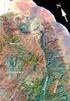
5 2 2 Survey 2.1 Location The survey was carried out at the Nesodden quartz vein in Hordaland County in western Norway (Figures 2-1 and 2-2). Figure 2-1. Location of the survey area in western Norway (red symbol). 2.2 Topography, geology and magnetic properties The survey area is located at a rather steep, north-west facing slope around 850 m from the Kvinnherad fiord (Figure 2-2). A stream flows across the survey area and the vein is exposed at a waterfall along this stream. The bedrock geology is marked as granite to granodiorite in the 1: geological map of NGU (Figure 2-3), but the host rock is gneissic in nature according to the mapping presented by Drivenes and Kleppe (2011). The vein has been mapped in detail by Drivenes and Kleppe (2011) and the ~50% quartz border is shown in Figure 2-4. The magnetic susceptibility of the quartz vein can safely be assumed to be very low. Little was known about the magnetic properties of the gneissic host rock before the survey. Granite-gneisses commonly carry small amounts of magnetite and dark minerals like e.g. biotite and hornblende are paramagnetic. It was therefore reasonable to assume that the host rock is more magnetic than the quartz vein and that the vein would show up in the magnetic data as a negative anomaly.
6 3 Figure 2-2. Map of the surroundings to the survey area. The Nesodden quartz vein is located in the central part of the map (red symbol), south-east of the Kvinnherad fiord (Statens Kartverk, Figure 2-3. Geological map of the surroundings to the survey area. The Nesodden vein is located in the central part of the map (NGU 1:250000, The surrounding rocks to the vein are marked as granite to granodiorite in this map.
7 4 2.3 Navigation Survey stations were located in the terrain with handheld GPS receivers with external antennas. The absolute horizontal accuracy is estimated to around ±2 to 5 m. Relative accuracy within the survey grid is however better. Coordinates are given in UTM zone 32N (WGS84). 2.4 Equipment The survey was carried out with three GEM-systems GSM19 Overhauser magnetometers, of which one was used a diurnal base. 2.5 Work plan and survey procedure The survey was carried out in a regular grid with 20 m nominal line spacing and 5 m nominal station spacing (see also under Non-conformities section below). The coordinates for the local 0E/0N point was E/ N (UTM zone 32 WGS84). The azimuth of the local coordinate system was 35. The diurnal base magnetometer was placed at E / N. All magnetic anomalies are relative this base. No IGRF correction has been applied. The base magnetometer readings were quite stable 11/10 and 12/10 with an average value of nt (standard deviation 10.2 nt). Variations were larger 13/10, but not so large as to have caused quality problems with the acquired data. The levels of the two rover magnetometers were checked against each other by repeated readings at the base point. Level differences are expected to be below 1 nt based on the test readings. A total of 1502 stations were measured or approximately 7.35 line-km. 2.6 Non-conformities The terrain around the quartz vein is quite steep and some locations were inaccessible due to steep cliffs. Some stations were therefore moved sideways from their nominal position and one area in the northern part of the area could not be covered (Figure 2-4). Actual coordinates for the moved stations are given in the digital data. The deviations from the nominal survey positions are not considered to have affected the final results in any significant way.
8 5 Figure 2-4. Survey lines (red) and mapped quartz vein, >50% quartz (Drivenes and Kleppe 2011, black polygon). Topographic map (Statens Kartverk) in the background. 2.7 Results The magnetic variations within the survey area were, with a few exceptions, quite weak. The magnetic susceptibility of the host rock is obviously low, except for the northernmost part of the area. Still, there is a linear magnetic minimum along the mapped quartz vein. The magnetic level along this linear anomaly does however show a trend. A linear trend was therefore subtracted from the data before map preparation and modelling. The linear trend was set to 11 nt from 0N (local) to 260N. Such a trend can e.g. be due to a deep magnetic source or a lithological contact outside the survey area. The actual reason is however not important in this work. Both the original data and the trend removed data are included in the digital delivery. A contour map of the trend corrected data can be seen in Figure 2-5. The survey lines are shown and labelled with their corresponding nominal local northing coordinate. A few very distinct negative magnetic bulls-eye anomalies with a magnitude of around minus 100 nt can be seen (e.g. along line 200). Such anomalies have been checked against strong time variations in the base station readings but no correlation was found. The negative anomalies can either be due to extreme topography at the survey station (magnetic source above sensor) or reversed remanent magnetization. The strong negative anomalies are considered to have nothing to do with the quartz vein.
9 6 Figure 2-5. Contour map of linear trend levelled total magnetic field anomaly (nt). The contour interval is 2 nt. Survey lines with nominal local northing coordinates are overlain. Contour map of elevation (10 m contour interval) in the background. The mapped 90% and 50% quartz borders are overlain on the magnetic map in Figure 2-6. The north-west border of the quartz vein corresponds well with the transition from light blue to green colour in the magnetic contour map. The south-east border is less obvious. Several magnetic lows are seen outside the mapped vein in this part. This is further commented in section 4 of this report.
10 7 Figure 2-6. Contour map of total magnetic field anomaly (nt, 2 nt contour interval). Mapped 50% quartz border (white polygon) and 90% quartz border (orange polygon). Contour map of elevation (10 m contour interval) in the background.
11 8 3 Modelling 3.1 Software Profile based modelling with prismatic bodies has been carried out with Encom ModelVision version 12. Voxel based inversion has been carried out with Mag3D from UBC-GIF. 3.2 Uncertainties Geophysical modelling will never result in unique models. There are a number of uncertainties involved in the modelling of magnetic data: Modelling of geophysical data is basically an ambiguous process. There are always a large number of models that will fit the measured data within error limits. Magnetic measurements do not hold any explicit depth information. Any magnetic anomaly can e.g. theoretically be explained by sources at the ground surface. Realistic petrophysical parameters, geological context and geologically reasonable geometry will however narrow down the ambiguity in modelling. The modelling of data from Nesodden was not supported by any parameter data. The used parameter values for different model bodies are therefore uncertain. Full inverse 3D modelling of magnetic data is processor intensive. It is therefore not practically possible to fully explore all possible parameter settings in the software. Modelling of geophysical anomalies will result in a geometrical model of petrophysical parameters. It is not possible to transform e.g. magnetic susceptibility to a percentage grade of an economic mineral (pure quartz in this case), at least not without better knowledge about the mineralogy of both the mineralized body and the host rock. 3.3 Prismatic bodies A few selected profiles have been modelled with prism-shaped bodies (Figures 3-1 to 3-5). This modelling is basically 2-dimensional, i.e. the model bodies have constant cross-sectional area perpendicular to the respective profile. A separate model has thus been constructed for each profile. The modelling has focussed on the broad features of magnetic variations along the profiles. Very local variations are of no real interest and they have been ignored. The bodies that would correspond to the quartz vein (or lithology with similar magnetic properties) are shown in blue colour and these bodies have zero susceptibility or (in some case) very low susceptibility. Bodies with higher magnetic susceptibility than the background value are shown in red. The magnetic susceptibility for these bodies is still quite low. Short comments for each profile are given below.
12 Profile 100 A low-magnetic body has been modelled approximately between length coordinates 75 and 145 m (Figure 3-1). The first number fits fairly well with the mapped quartz vein whereas the second number (the south-east boundary) is outside the quartz vein. The low-magnetic structure is obviously a bit wider than the mapped vein at this position. The reason is either very low-magnetic host rock at the south-eastern contact to the vein or possibly that the vein is thicker than previously known. Figure 3-1. Modelled section for profile 100 (cf. Figure 2-5). The blue body has zero magnetic susceptibility. The mapped 50% quartz border for the vein is between length coordinates 80 and 125 m along this section. Red bodies have magnetic susceptibility values ranging from to SI units. Background (white) is at SI units. Profile length coordinate 110 m is at E/ N Profile 260 A low-magnetic body has been modelled between length coordinates 100 and 165 m (figure 3-2). This is a bit wider than the mapped quartz vein at this position. A similar pattern as for profile 100 above is therefore seen.
13 10 Figure 3-2. Modelled section for profile 260 (cf. Figure 2-5). The blue body has zero magnetic susceptibility. The mapped 50% quartz border for the vein is between length coordinates 90 and 125 m along this section. Red bodies have magnetic susceptibility values ranging from to SI units. Background (white) is at SI units. Profile length coordinate 110 m is at E/ N Profile 360 A low-magnetic body has been modelled between length coordinates 100 and 140 m (Figure 3-3). This is in very good agreement with the mapped quartz vein. The dip of the body is steep towards north-west, but even if such a dip is compatible with the data it must be stated that it is not well constrained by the data.
14 11 Figure 3-3. Modelled section for profile 360 (cf. Figure 2-5). The blue body has zero magnetic susceptibility. The mapped 50% quartz border for the vein is between length coordinates 100 and 146 m along this section. Red bodies have magnetic susceptibility values ranging from to SI units. Background (white) is at SI units. Profile length coordinate 110 m is at E/ N Profile 460 Two low-magnetic bodies have been modelled for profile 460 (Figure 3-4). The left (north-western) body is between length coordinates 100 to 145 m, which is in very good agreement with the mapped quartz vein. It is separated by a thin more magnetic body to a second low-magnetic body between 150 and 170 m. The nature of this second body is not known. It might be a very low-magnetic part of the host gneiss, or it might be unmapped vein quartz.
15 12 Figure 3-4. Modelled section for profile 460 (cf. Figure 2-5). The left blue body has a magnetic susceptibility of SI and the right blue body has zero susceptibility. The mapped 50% quartz border for the vein is between length coordinates 107 and 145 m along this section. Red bodies have magnetic susceptibility values ranging from to SI units. Background (white) is at SI units. Profile length coordinate 110 m is at E/ N Profile 520 Two low-magnetic bodies have been modelled for profile 520 (Figure 3-5) in a similar manner as for profile 460 above. The left (north-western) body is between length coordinates 120 to 135 m, which is in reasonable agreement with the mapped quartz vein. It is separated by a thin more magnetic body to a second low-magnetic body between 140 and 175 m Estimated depth extent The down-dip extent of the low-magnetic bodies in Figures 3-1 to 3-5 goes to 0 m asl. The depth extent can however be reduced without significantly changing the fit to the data. However, the fit becomes rather poor when the depth extent is reduced to around 80 to 100 m below ground surface. It is theoretically possible to construct a model with a low-magnetic body corresponding to the quartz vein with even smaller down-dip extent, but the geometry of the body would be a bit peculiar and such a solution does not seem plausible.
16 13 Figure 3-5. Modelled section for profile 520 (cf. Figure 2-5). The left blue body has zero magnetic susceptibility and the right blue body to SI (divided into two parts). The mapped 50% quartz border for the vein is between length coordinates 109 and 129 m along this section. Red bodies have magnetic susceptibility values ranging from to SI units. Background (white) is at SI units. Profile length coordinate 110 m is at E/ N. 3.4 Voxel based inversion A voxel model represents the subsurface with rectangular blocks where physical parameters are constant within each cell. The parameter values (magnetic susceptibility in this case) are then iteratively adjusted until the calculated model response fits the measured data within a specified error tolerance. An elevation model is applied so that blocks above the terrain surface are defined as inactive. The process is basically underdetermined since the number of model parameters (active blocks) is greater than the number of data. Smoothness constraints are therefore applied to the solution, i.e. the parameter value is forced to vary gently from one model block to the next. No sharp boundaries are therefore seen in the solution. The voxel model that was used for the Nesodden data had blocks with a size of 5x5x5 m under the survey area. Gradually larger blocks were used for padding outwards and towards depth. Different error limits and base values for the magnetic field were tested and also different inversion parameter settings for the software. The modelling was not

17 14 altogether successful, most likely due to the very weak magnetic variations in the survey area. However, reasonable results were seen for the central-southern part of the investigated area (Figure 3-6). Figure 3-6. Vertical section through voxel inversion model at line 200 (Figure 2-5). Blue colour corresponds to low magnetic susceptibility. See text for explanations. A reference magnetic susceptibility value is specified for the inversion algorithm. Cell blocks that are completely unconstrained by the available data will get this value (or close to) in the final model. The reference value corresponds to red colour in Figure 3-6 and it is a bit higher than the magnetic susceptibility that has been assigned to cell blocks at the survey area. Volumes with a magnetic susceptibility below around SI are shown with bluish colours in Figure 3-6. Three blue volumes are marked in the figure. The left shallow volume is just at the border of the area that actually is covered by magnetic data. This volume is thus not really constrained by data and is an artefact from the inversion and should be disregarded. The shallow blue volume in the central part corresponds in position to the mapped quartz vein. It shows continuity to an elevation of around 100 to 150 m asl and this can be regarded as a reasonable estimate of the minimum depth extent of the low-magnetic structure corresponding to the vein. The inversion algorithm indicates a steep dip towards north-west for the vein. The inversion algorithm has also
18 15 assigned low magnetic susceptibility to a deep-seated volume in the down-dip continuation of the inferred vein. This can be regarded as a speculative but still possible continuation of the low-magnetic structure towards depth. Such a continuation is however poorly constrained by the magnetic data. It should be pointed out that voxel based inversion, in the manner that is has been carried out in this work not involves any human intervention during the modelling process. The process can therefore be regarded as un-biased or objective and not influenced by foregone conclusion on the operators behalf.
19 16 4 Qualitative interpretation The major linear low-magnetic structure that can be seen in Figure 2-5 corresponds well with the mapped quartz vein, even if especially the south-east border is a bit fuzzy in the magnetic pattern. What can be noted in the map is that the magnetic minimum corresponding to the vein is most pronounced between survey profiles 200 and 540. This is also the part of the exposed vein that is at lowest elevation. This magnetic pattern indicates that that there is no reason to assume that the exposed vein is just a shallow feature at the lowest exposed elevations due to a deep erosional cut. Contrary, the pattern suggests a significant depth extent in the central part since no magnetic material underneath seem to influence the negative magnetic anomaly. There are a number of other negative magnetic anomalies beside the main linear trend. Some of these can probably be ruled out as possibly being caused by vein quartz, based on the anomaly shape and context. However, some negative anomalies are elongated in shape and almost look like off-shoots to the main quartz vein. Such anomalies are marked with red dashed polygons in Figure 4-1. The character and context of these negative magnetic anomalies does of course not necessarily mean that they correspond to vein quartz. It is quite possible that some parts of the surrounding gneiss have low magnetic susceptibility similar to the quartz vein. Follow-up work in the field is however motivated and the magnetic susceptibility should be measured on outcrops in these areas.
20 17 Figure 4-1. Contour map of total magnetic field anomaly (nt, 2 nt contour interval). Mapped 50% quartz border (white polygon). Magnetic lows that possibly can be due to parallel veins or off-shoots are marked with dashed red polygons.
21 18 5 Conclusions and recommendations Even though magnetic measurements carry no explicit depth information it can be inferred from this study that the mapped quartz vein at Nesodden is not just a shallow feature. The depth extent of the vein is estimated to at least around 100 to 150 m above sea level in the central part of the area. Such an estimate should however be confirmed by e.g. drilling before any mining is planned. There is nothing in the data that says that the depth extent cannot be even larger. A few low-magnetic areas to the south-east of the mapped quartz vein are seen in the data. It is of course possible that these low-magnetic areas correspond to unusually lowmagnetic gneissic rock. There is however also a possibility that off-shoots to the vein or parallel veins exist towards south-east. These low-magnetic areas should be checked in the field. Future field work in the area should include measurements of magnetic susceptibility on outcrops. Such measurements would enable comparisons between field observations and the magnetic models. Field susceptimeters are not expensive and they are quick and easy to operate.
22 19 6 Data delivery The magnetometry data from the presented survey are delivered with this report in ASCII text format and as instrument dump files (ASCII). The magnetic contour map (Figure 2-5) is delivered in GeoTIFF format.
23 20 7 Reference Drivenes, K., Kleppe, S., 2011: Nesodden hydrothermal quartz vein - Report from fieldwork 14th 21st July. Work carried out on behalf of Nordic Mining ASA.
REPORT OF WORK GUIDELINES
 REPORT OF WORK GUIDELINES The following guidelines apply to a report of work submitted under section 56(1) of the Mining Act (http://laws.gnb.ca/en/showdoc/cs/m-14.1). 1 (1) A report of work shall be submitted
Map Patterns and Finding the Strike and Dip from a Mapped Outcrop of a Planar Surface
 Map Patterns and Finding the Strike and Dip from a Mapped Outcrop of a Planar Surface Topographic maps represent the complex curves of earth s surface with contour lines that represent the intersection
ROME RESOURCES LTD. 205 16055 Fraser Highway Surrey, B.C. V4N 0G2
 Page 1 of 6 ROME RESOURCES LTD. 205 16055 Fraser Highway Surrey, B.C. V4N 0G2 FAX# (604) 507-2187 TSX-VEN Symbol RMR; Frankfurt: 33R WEB: www.romeresources.com CH Valoren No 699 171 Email: [email protected]
INTERPRETATION ADDENDUM CANADIAN MINING COMPANY INC. SUITE 2300-1066 WEST HASTINGS STREET VANCOUVER, BC V6E 3X2 3D INDUCED POLARIZATION
 INTERPRETATION ADDENDUM FOR CANADIAN MINING COMPANY INC. SUITE 2300-1066 WEST HASTINGS STREET VANCOUVER, BC V6E 3X2 3D INDUCED POLARIZATION ON THE SAN BERNARDO PROJECT EL GOCHICO GRID Approximate Location:
3D MAGNETIC INVERSION OF A VTEM SURVEY. (Nicol Block) Submitted to: NORTHSTAR GOLD CORP. PRESENTED BY
 3D MAGNETIC INVERSION OF A VTEM SURVEY (Nicol Block) Submitted to: NORTHSTAR GOLD CORP. PRESENTED BY OLIVIER BOULANGER, PHD, P.GEO. MARC BOIVIN, P.Geo NOVEMBER 2009 Created by jbrouillard TABLE OF CONTENTS
Topographic Survey. Topographic Survey. Topographic Survey. Topographic Survey. CIVL 1101 Surveying - Introduction to Topographic Modeling 1/8
 IVL 1 Surveying - Introduction to Topographic Modeling 1/8 Introduction Topography - defined as the shape or configuration or relief or three dimensional quality of a surface Topography maps are very useful
How can we make the most of magnetic data in building regional geological models?
 How can we make the most of magnetic data in building regional geological models? Clive Foss, Tony Meixner (Geoscience Australia) and James Austin MINERALS DOWN UNDER FLAGSHIP Excellent national magnetic
How Did These Ocean Features and Continental Margins Form?
 298 10.14 INVESTIGATION How Did These Ocean Features and Continental Margins Form? The terrain below contains various features on the seafloor, as well as parts of three continents. Some general observations
FUNDAMENTALS OF LANDSCAPE TECHNOLOGY GSD Harvard University Graduate School of Design Department of Landscape Architecture Fall 2006
 FUNDAMENTALS OF LANDSCAPE TECHNOLOGY GSD Harvard University Graduate School of Design Department of Landscape Architecture Fall 2006 6106/ M2 BASICS OF GRADING AND SURVEYING Laura Solano, Lecturer Name
Description of Simandou Archaeological Potential Model. 13A.1 Overview
 13A Description of Simandou Archaeological Potential Model 13A.1 Overview The most accurate and reliable way of establishing archaeological baseline conditions in an area is by conventional methods of
Principles of groundwater flow
 Principles of groundwater flow Hydraulic head is the elevation to which water will naturally rise in a well (a.k.a. static level). Any well that is not being pumped will do for this, but a well that is
COURSE OUTLINE GEOL 204 MINING COMPUTING 45 HOURS 1.5 CREDITS
 APPLIED SCIENCE AND MANAGEMENT DIVISION School of Science Fall, 2014 COURSE OUTLINE GEOL 204 MINING COMPUTING 45 HOURS 1.5 CREDITS PREPARED BY: Joel Cubley, Instructor DATE: APPROVED BY: Margaret Dumkee,
3D Visualization of Seismic Activity Associated with the Nazca and South American Plate Subduction Zone (Along Southwestern Chile) Using RockWorks
 3D Visualization of Seismic Activity Associated with the Nazca and South American Plate Subduction Zone (Along Southwestern Chile) Using RockWorks Table of Contents Figure 1: Top of Nazca plate relative
Introduction to Structural Geology
 Introduction to Structural Geology Workbook 3 Geological Maps BGS Introduction to geological maps 4 1. Outcrop patterns on geological maps 7 2. Cross sections 16 3. Structure contours 22 cknowledgements
Using LIDAR to monitor beach changes: Goochs Beach, Kennebunk, Maine
 Geologic Site of the Month February, 2010 Using LIDAR to monitor beach changes: Goochs Beach, Kennebunk, Maine 43 o 20 51.31 N, 70 o 28 54.18 W Text by Peter Slovinsky, Department of Agriculture, Conservation
Descriptive Statistics and Measurement Scales
 Descriptive Statistics 1 Descriptive Statistics and Measurement Scales Descriptive statistics are used to describe the basic features of the data in a study. They provide simple summaries about the sample
RIDDARHYTTAN RESOURCES PRESS RELEASE August 11, 2003
 1 RIDDARHYTTAN RESOURCES PRESS RELEASE August 11, 2003 New drill holes in the Suurikuusikko area, Finland, have further intersected high gold grades over considerable widths, increasing the depth extent
Leapfrog : new software for faster and better 3D geological modelling
 Leapfrog : new software for faster and better 3D geological modelling Paul Hodkiewicz, Principal Consultant (Geology), SRK Consulting, 10 Richardson Street, West Perth WA 6005, Australia, [email protected]
LABORATORY TWO GEOLOGIC STRUCTURES
 EARTH AND ENVIRONMENT THROUGH TIME LABORATORY- EES 1005 LABORATORY TWO GEOLOGIC STRUCTURES Introduction Structural geology is the study of the ways in which rocks or sediments are arranged and deformed
GEOLOGIC MAPS. PURPOSE: To be able to understand, visualize, and analyze geologic maps
 GEOLOGIC MAPS PURPOSE: To be able to understand, visualize, and analyze geologic maps Geologic maps show the distribution of the various igneous, sedimentary, and metamorphic rocks at Earth s surface in
Shape and depth solutions form third moving average residual gravity anomalies using the window curves method
 Kuwait J. Sci. Eng. 30 2) pp. 95-108, 2003 Shape and depth solutions form third moving average residual gravity anomalies using the window curves method EL-SAYED M. ABDELRAHMAN, TAREK M. EL-ARABY AND KHALID
Plate Tectonics: Ridges, Transform Faults and Subduction Zones
 Plate Tectonics: Ridges, Transform Faults and Subduction Zones Goals of this exercise: 1. review the major physiographic features of the ocean basins 2. investigate the creation of oceanic crust at mid-ocean
How To Map A Lake In The North Of The Holland (Fiji)
 1. Hydrogelogical mapping Jiri Sima Aim of HG map Groundwater and rocks qualitative permeability and quantitative potential of rock units aquifers / aquitards / aquiclides Water points (spatial distribution
DESCRIPTIVE STATISTICS. The purpose of statistics is to condense raw data to make it easier to answer specific questions; test hypotheses.
 DESCRIPTIVE STATISTICS The purpose of statistics is to condense raw data to make it easier to answer specific questions; test hypotheses. DESCRIPTIVE VS. INFERENTIAL STATISTICS Descriptive To organize,
Measurement with Ratios
 Grade 6 Mathematics, Quarter 2, Unit 2.1 Measurement with Ratios Overview Number of instructional days: 15 (1 day = 45 minutes) Content to be learned Use ratio reasoning to solve real-world and mathematical
SEG Las Vegas 2008 Annual Meeting. Summary
 Antony PRICE*, Patrick TURPIN, Michel ERBETTA, Total E&P with Don WATTS and Graeme CAIRNS, WesternGeco ElectroMagnetics. Summary Discussed here are the results of a 1D and 3D forward with 1D and 2D inverse
Satellite Derived Bathymetry
 11 th CSPWG MEETING 28 April, 2015 CSPCWG10-08.7A Submitted by: Executive Summary: Related Documents: Related Projects: Paper for Consideration by CSPCWG Satellite Derived Bathymetry UK CSPCWG is invited
Linear Programming Problems
 Linear Programming Problems Linear programming problems come up in many applications. In a linear programming problem, we have a function, called the objective function, which depends linearly on a number
Software Workflows for 3D Quantitative Data Integration
 Advances in 3D Visualization and Data Integration Software Workflows for 3D Quantitative Data Integration 1. Mira Geoscience Ltd. Paper 36 Perron, G. [1] ABSTRACT During the last decade, breakthroughs
Principles. Proton Precession Magnetometers
 Proton Precession Magnetometers Sometimes called the grandfather of magnetometers, proton precession units serve an important function for earth science professionals seeking inexpensive solutions for
The successful integration of 3D seismic into the mining process: Practical examples from Bowen Basin underground coal mines
 Geophysics 165 Troy Peters The successful integration of 3D seismic into the mining process: Practical examples from Bowen Basin underground coal mines This paper discusses how mine staff from a number
SENSITIVITY ANALYSIS AND INFERENCE. Lecture 12
 This work is licensed under a Creative Commons Attribution-NonCommercial-ShareAlike License. Your use of this material constitutes acceptance of that license and the conditions of use of materials on this
Simple Regression Theory II 2010 Samuel L. Baker
 SIMPLE REGRESSION THEORY II 1 Simple Regression Theory II 2010 Samuel L. Baker Assessing how good the regression equation is likely to be Assignment 1A gets into drawing inferences about how close the
Data source, type, and file naming convention
 Exercise 1: Basic visualization of LiDAR Digital Elevation Models using ArcGIS Introduction This exercise covers activities associated with basic visualization of LiDAR Digital Elevation Models using ArcGIS.
Resistance, Ohm s Law, and the Temperature of a Light Bulb Filament
 Resistance, Ohm s Law, and the Temperature of a Light Bulb Filament Name Partner Date Introduction Carbon resistors are the kind typically used in wiring circuits. They are made from a small cylinder of
By Gene Kitts, Senior Vice President-Mining Services, International Coal Group, Inc.
 Why Surface Mine? By Gene Kitts, Senior Vice President-Mining Services, International Coal Group, Inc. Why do we surface mine in Central Appalachia? It s certainly not because we like the public attention
Dip is the vertical angle perpendicular to strike between the imaginary horizontal plane and the inclined planar geological feature.
 Geological Visualization Tools and Structural Geology Geologists use several visualization tools to understand rock outcrop relationships, regional patterns and subsurface geology in 3D and 4D. Geological
For personal use only
 January, 202 Silver Swan Group Limited December 20 Quarterly Activities Report HIGHLIGHTS STAKEWELL Gold Project: Drilling intersected high and low grade gold mineralisation at Kohinoor, including surface
Exploration. Exploration methods
 Exploration Activities related to establishing a mineral deposit through geological, geophysical and geochemical methods. It is preceded by Prospecting and followed by Planning & Development. Geological
DATA VISUALIZATION GABRIEL PARODI STUDY MATERIAL: PRINCIPLES OF GEOGRAPHIC INFORMATION SYSTEMS AN INTRODUCTORY TEXTBOOK CHAPTER 7
 DATA VISUALIZATION GABRIEL PARODI STUDY MATERIAL: PRINCIPLES OF GEOGRAPHIC INFORMATION SYSTEMS AN INTRODUCTORY TEXTBOOK CHAPTER 7 Contents GIS and maps The visualization process Visualization and strategies
Lecture 2. Marginal Functions, Average Functions, Elasticity, the Marginal Principle, and Constrained Optimization
 Lecture 2. Marginal Functions, Average Functions, Elasticity, the Marginal Principle, and Constrained Optimization 2.1. Introduction Suppose that an economic relationship can be described by a real-valued
GEOENGINE MSc in Geomatics Engineering (Master Thesis) Anamelechi, Falasy Ebere
 Master s Thesis: ANAMELECHI, FALASY EBERE Analysis of a Raster DEM Creation for a Farm Management Information System based on GNSS and Total Station Coordinates Duration of the Thesis: 6 Months Completion
Using Google Earth to Explore Plate Tectonics
 Using Google Earth to Explore Plate Tectonics Laurel Goodell, Department of Geosciences, Princeton University, Princeton, NJ 08544 [email protected] Inspired by, and borrows from, the GIS-based Exploring
Chapter 5: Working with contours
 Introduction Contoured topographic maps contain a vast amount of information about the three-dimensional geometry of the land surface and the purpose of this chapter is to consider some of the ways in
NEWS RELEASE NOT FOR DISSEMINATION IN THE UNITED STATES OR FOR DISTRIBUTION TO U.S. WIRE SERVICES
 Suite 250, 1075 West Georgia Street Vancouver, BC, Canada V6E 3C9 Tel: 1.778.373.0102 Fax: 1.604.434.1487 NEWS RELEASE NOT FOR DISSEMINATION IN THE UNITED STATES OR FOR DISTRIBUTION TO U.S. WIRE SERVICES
PICTOU PROPERTY : ATLIN GOLD CAMP
 PICTOU PROPERTY : ATLIN GOLD CAMP EXECUTIVE SUMMARY The Pictou Property in the Atlin Gold Camp ( AGC ) is an example of a Motherlode- Bonanza, lode gold, quartz vein exploration target in the northern
Matt Harris, Golder Associates (NZ) Ltd. The value of geophysics as a non-intrusive method for site characterisation
 Matt Harris, Golder Associates (NZ) Ltd. The value of geophysics as a non-intrusive method for site characterisation Presentation Outline What is geophysics and how can it help me? Electrical Resistivity
Chapter 5. Rules and Policies
 Chapter 5 Rules and Policies 5.1.1 NI 43-101 Standards of Disclosure for Mineral Projects, Form 43-101F1 Technical Report and Related Consequential Amendments NATIONAL INSTRUMENT 43-101 STANDARDS OF DISCLOSURE
Watershed Delineation
 ooooo Appendix D: Watershed Delineation Department of Environmental Protection Stream Survey Manual 113 Appendix D: Watershed Delineation Imagine a watershed as an enormous bowl. As water falls onto the
Experiment 3 Lenses and Images
 Experiment 3 Lenses and Images Who shall teach thee, unless it be thine own eyes? Euripides (480?-406? BC) OBJECTIVES To examine the nature and location of images formed by es. THEORY Lenses are frequently
Hot tpot tproject A Demonstration of How Groundwater Chemistry is being Used to Discover a Gravel Covered Gold Deposit
 Hot tpot tproject A Demonstration of How Groundwater Chemistry is being Used to Discover a Gravel Covered Gold Deposit April 2, 2009 General Cautionary Statement Warning! The business of Gold Exploration
Magnetic Surveying. Dr. Laurent Marescot. [email protected]
 Magnetic Surveying Dr. Laurent Marescot [email protected] 1 Introduction Magnetic surveying Investigation on the basis of anomalies in the Earth s magnetic field resulting from the magnetic properties
CHAPTER 7 TRAVERSE Section I. SELECTION OF TRAVERSE DEFINITION
 CHAPTER 7 TRAVERSE Section I. SELECTION OF TRAVERSE DEFINITION A traverse is a series of straight lines called traverse legs. The surveyor uses them to connect a series of selected points called traverse
Bellhaven Expands the La Garrucha Discovery at the La Mina Project, Colombia
 Bellhaven Expands the La Garrucha Discovery at the La Mina Project, Colombia Denver, Colorado February 28, 2013. Bellhaven Copper & Gold Inc. (TSX-Venture: BHV) ( Bellhaven or the Company ) is pleased
SURVEYING WITH GPS. GPS has become a standard surveying technique in most surveying practices
 SURVEYING WITH GPS Key Words: Static, Fast-static, Kinematic, Pseudo- Kinematic, Real-time kinematic, Receiver Initialization, On The Fly (OTF), Baselines, Redundant baselines, Base Receiver, Rover GPS
Permafrost monitoring at Mölltaler Glacier and Magnetköpfl
 Permafrost monitoring at Mölltaler Glacier and Magnetköpfl DAVID OTTOWITZ 1, BIRGIT JOCHUM 1, ROBERT SUPPER 1, ALEXANDER RÖMER 1, STEFAN PFEILER 1 and MARKUS KEUSCHNIG 2, 3 1 Department of Geophysics,
WILLOCHRA BASIN GROUNDWATER STATUS REPORT 2009-10
 WILLOCHRA BASIN GROUNDWATER STATUS REPORT 2009-10 SUMMARY 2009-10 The Willochra Basin is situated in the southern Flinders Ranges in the Mid-North of South Australia, approximately 50 km east of Port Augusta
A Guide to Using the Core Orientation Program
 A Guide to Using the Core Orientation Program Robert Scott: Centre for Ore Deposit Research, University of Tasmania, Hobart 7001, Australia The core orientation program can be used as a calculator, with
Highlights of selected high-grade mineralized zones exposed in drift tunnels include:
 NEWS RELEASE Trading Symbol: TSX: SVM SILVERCORP REPORTS NEWLY EXPOSED MINERALIZATION AT THE TLP MINE FROM ITS 2015 EXPLORATION TUNNELING PROGRAM - 1,414 METERS IN TOTAL LENGTH AND 0.70 METERS IN AVERAGE
Investigation 6: What happens when plates collide?
 Tectonics Investigation 6: Teacher Guide Investigation 6: What happens when plates collide? In this activity, students will use the distribution of earthquakes and volcanoes in a Web GIS to learn about
Plotting Earthquake Epicenters an activity for seismic discovery
 Plotting Earthquake Epicenters an activity for seismic discovery Tammy K Bravo Anne M Ortiz Plotting Activity adapted from: Larry Braile and Sheryl Braile Department of Earth and Atmospheric Sciences Purdue
Integration of Geological, Geophysical, and Historical Production Data in Geostatistical Reservoir Modelling
 Integration of Geological, Geophysical, and Historical Production Data in Geostatistical Reservoir Modelling Clayton V. Deutsch (The University of Alberta) Department of Civil & Environmental Engineering
CHAPTER 4 EARTHWORK. Section I. PLANNING OF EARTHWORK OPERATIONS
 CHAPTER 4 EARTHWORK Section I. PLANNING OF EARTHWORK OPERATIONS IMPORTANCE In road, railroad, and airfield construction, the movement of large volumes of earth (earthwork) is one of the most important
AN EXPLANATION OF JOINT DIAGRAMS
 AN EXPLANATION OF JOINT DIAGRAMS When bolted joints are subjected to external tensile loads, what forces and elastic deformation really exist? The majority of engineers in both the fastener manufacturing
SILVERCORP INTERCEPTS 18.8 METRES TRUE WIDTH GRADING 368 G/T SILVER AND 1.78 PERCENT LEAD AT THE LM MINE WEST, YING MINING DISTRICT, CHINA
 NEWS RELEASE Trading Symbol: TSX: SVM NYSE: SVM SILVERCORP INTERCEPTS 18.8 METRES TRUE WIDTH GRADING 368 G/T SILVER AND 1.78 PERCENT LEAD AT THE LM MINE WEST, YING MINING DISTRICT, CHINA VANCOUVER, British
Groundwater Potential of Basement Aquifers in Part of Southwestern Nigeria
 American International Journal of Contemporary Research Vol. 3 No. 3; March 2013 Groundwater Potential of Basement Aquifers in Part of Southwestern Nigeria Yinusa Ayodele Asiwaju-Bello Department of Marine
For personal use only
 Korab Resources Limited Gold Operations Update November 2012 Andrej K. Karpinski Executive Chairman Korab Projects BOBRIKOVO MELROSE 1 Korab Gold Projects Other Korab Projects Robust Undervalued Gold Portfolio
CONTENTS. Page 3 What is orienteering? Page 4 Activity: orienteering map bingo. Page 5 Activity: know your colours. Page 6 Choosing your compass
 THE RIGHT DIRECTION SCOUT ORIENTEER ACTIVITY BADGE CONTENTS Page What is orienteering? Page 4 Activity: orienteering map bingo Page 5 Activity: know your colours Page 6 Choosing your compass Page 7 Activity:
A comparison of radio direction-finding technologies. Paul Denisowski, Applications Engineer Rohde & Schwarz
 A comparison of radio direction-finding technologies Paul Denisowski, Applications Engineer Rohde & Schwarz Topics General introduction to radiolocation Manual DF techniques Doppler DF Time difference
Integer Operations. Overview. Grade 7 Mathematics, Quarter 1, Unit 1.1. Number of Instructional Days: 15 (1 day = 45 minutes) Essential Questions
 Grade 7 Mathematics, Quarter 1, Unit 1.1 Integer Operations Overview Number of Instructional Days: 15 (1 day = 45 minutes) Content to Be Learned Describe situations in which opposites combine to make zero.
Slope Density. Appendix F F-1 STATEMENT OF PURPOSE DISCUSSION OF SLOPE
 Appendix F Slope Density F-1 STATEMENT OF PURPOSE This document has been prepared with the intent of acquainting the general reader with the slope-density approach to determining the intensity of residential
This unit will lay the groundwork for later units where the students will extend this knowledge to quadratic and exponential functions.
 Algebra I Overview View unit yearlong overview here Many of the concepts presented in Algebra I are progressions of concepts that were introduced in grades 6 through 8. The content presented in this course
Maps A Primer for Content & Production of Topographic Base Maps For Design Presented by SurvBase, LLC
 Maps A Primer for Content & Production of Topographic Base Maps For Design Presented by Definition and Purpose of, Map: a representation of the whole or a part of an area. Maps serve a wide range of purposes.
Modelling, Extraction and Description of Intrinsic Cues of High Resolution Satellite Images: Independent Component Analysis based approaches
 Modelling, Extraction and Description of Intrinsic Cues of High Resolution Satellite Images: Independent Component Analysis based approaches PhD Thesis by Payam Birjandi Director: Prof. Mihai Datcu Problematic
Aurvista Gold Plans Significant Exploration Program at Douay
 NEWS RELEASE For Immediate Issue June 14, 2016 Aurvista Gold Plans Significant Exploration Program at Douay Ø The main gold target is the largely untested northwestern section of the Porphyry Zone; the
Subsalt Interferometric Imaging using Walkaway VSP and Offset Free Cable geometry: A Modeling Study
 Subsalt Interferometric Imaging using Walkaway VSP and Offset Free Cable geometry: A Modeling Study Cemal Erdemir *, Ashwani Dev, Ion Geophysical Corporation, Houston, TX. Summary This study suggests that
For personal use only
 Investigator Resources Limited Date: 7 th February 2012 up to 2.25% Ag at the new Paris prospect in South Australia First assays received for new drilling on Paris Line 7 with all three holes assayed returning
Reflection and Refraction
 Equipment Reflection and Refraction Acrylic block set, plane-concave-convex universal mirror, cork board, cork board stand, pins, flashlight, protractor, ruler, mirror worksheet, rectangular block worksheet,
Metamorphic rocks are rocks changed from one form to another by intense heat, intense pressure, and/or the action of hot fluids.
 Metamorphic Rocks, Processes, and Resources Metamorphic rocks are rocks changed from one form to another by intense heat, intense pressure, and/or the action of hot fluids. Protolith or parent rock is
When the fluid velocity is zero, called the hydrostatic condition, the pressure variation is due only to the weight of the fluid.
 Fluid Statics When the fluid velocity is zero, called the hydrostatic condition, the pressure variation is due only to the weight of the fluid. Consider a small wedge of fluid at rest of size Δx, Δz, Δs
The Map Grid of Australia 1994 A Simplified Computational Manual
 The Map Grid of Australia 1994 A Simplified Computational Manual The Map Grid of Australia 1994 A Simplified Computational Manual 'What's the good of Mercator's North Poles and Equators, Tropics, Zones
Create a New Profile Model in GM-SYS Profile Modelling
 Create a New Profile Model in GM-SYS Profile Modelling Forward modelling involves creating a hypothetical geologic model and calculating the geophysical response to that earth model. GM-SYS is a modelling
Chapter 4: Representation of relief
 Introduction To this point in our discussion of maps we have been concerned only with their planimetric properties, those relating to the location of features in two-dimensional space. But of course we
Minnesota Academic Standards
 A Correlation of to the Minnesota Academic Standards Grades K-6 G/M-204 Introduction This document demonstrates the high degree of success students will achieve when using Scott Foresman Addison Wesley
Association Between Variables
 Contents 11 Association Between Variables 767 11.1 Introduction............................ 767 11.1.1 Measure of Association................. 768 11.1.2 Chapter Summary.................... 769 11.2 Chi
Experimental Uncertainties (Errors)
 Experimental Uncertainties (Errors) Sources of Experimental Uncertainties (Experimental Errors): All measurements are subject to some uncertainty as a wide range of errors and inaccuracies can and do happen.
Map reading made easy
 Map reading made easy What is a map? A map is simply a plan of the ground on paper. The plan is usually drawn as the land would be seen from directly above. A map will normally have the following features:
ebb current, the velocity alternately increasing and decreasing without coming to
 Slack water (slack tide): The state of a tidal current when its velocity is near zero, especially the moment when a reversing current changes its direction and its velocity is zero. The term is also applied
Glencoe. correlated to SOUTH CAROLINA MATH CURRICULUM STANDARDS GRADE 6 3-3, 5-8 8-4, 8-7 1-6, 4-9
 Glencoe correlated to SOUTH CAROLINA MATH CURRICULUM STANDARDS GRADE 6 STANDARDS 6-8 Number and Operations (NO) Standard I. Understand numbers, ways of representing numbers, relationships among numbers,
RAINBOW AURORA INDIAN PROPERTIES Goodpaster Mining District, Alaska
 RAINBOW AURORA INDIAN PROPERTIES Goodpaster Mining District, Alaska Prepared by: Carl Schaefer CPG# 10834 Northern Associates, Inc. February, 2006 Tonogold Resources, Inc. 5771 La Jolla Boulevard La Jolla,
Carbonate Rock Formation
 Limestone, dolomite (or dolostone), and marble are often collectively referred to as carbonate rocks because the main mineral is calcite. The chemical name of calcite is calcium carbonate. Limestone, dolomite,
Remote Sensing, GPS and GIS Technique to Produce a Bathymetric Map
 Remote Sensing, GPS and GIS Technique to Produce a Bathymetric Map Mark Schnur EES 5053 Remote Sensing Fall 2007 University of Texas at San Antonio, Department of Earth and Environmental Science, San Antonio,
Introduction to GIS (Basics, Data, Analysis) & Case Studies. 13 th May 2004. Content. What is GIS?
 Introduction to GIS (Basics, Data, Analysis) & Case Studies 13 th May 2004 Content Introduction to GIS Data concepts Data input Analysis Applications selected examples What is GIS? Geographic Information
Duration and Bond Price Volatility: Some Further Results
 JOURNAL OF ECONOMICS AND FINANCE EDUCATION Volume 4 Summer 2005 Number 1 Duration and Bond Price Volatility: Some Further Results Hassan Shirvani 1 and Barry Wilbratte 2 Abstract This paper evaluates the
6.4 Normal Distribution
 Contents 6.4 Normal Distribution....................... 381 6.4.1 Characteristics of the Normal Distribution....... 381 6.4.2 The Standardized Normal Distribution......... 385 6.4.3 Meaning of Areas under
Introduction to Petroleum Geology and Geophysics
 GEO4210 Introduction to Petroleum Geology and Geophysics Geophysical Methods in Hydrocarbon Exploration About this part of the course Purpose: to give an overview of the basic geophysical methods used
How To Create A 3D Model Of The Phanerozoic Succession In Southern Manitoba
 3D GEOLOGICAL MAPPING IN MANITOBA MOVING FORWARD Greg Keller ([email protected]), Gaywood Matile, Manitoba Geological Survey (RET), Canada Harvey Thorleifson, Minnesota Geological Survey, United States
Total Indicated Runout, Version 2
 Total Indicated Runout, Version 2 By R.G. Sparber 1/21/2009 Copyleft protects this article Maybe I'm just looking in the wrong place, but a quick search of the web did not turn up a clear explanation of
Earth Coordinates & Grid Coordinate Systems
 Earth Coordinates & Grid Coordinate Systems How do we model the earth? Datums Datums mathematically describe the surface of the Earth. Accounts for mean sea level, topography, and gravity models. Projections