
Dip is the vertical angle perpendicular to strike between the imaginary horizontal plane and the inclined planar geological feature.
|
|
|
- Irma Dennis
- 9 years ago
- Views:
Transcription
1 Geological Visualization Tools and Structural Geology Geologists use several visualization tools to understand rock outcrop relationships, regional patterns and subsurface geology in 3D and 4D. Geological maps are topographic maps on which different rock types are represented. An upcoming lab will be entirely devoted to studying geologic maps. Cross sections are vertical slices into the earth that are used to interpret the geology at depth. The geological data (contacts, dips of formations, etc.) are projected from the surface into the cross section to predict what might be down there. Often, data from drilling projects or seismic surveys are used to construct cross sections. Block diagrams are a combination of geologic maps and cross sections. They are three-dimensional representations of a block of the earth that can aid in the exploration for mineral resources and the interpretation of the cause or meaning of geological features. Structural geology is the study of how geologic units (bodies of rock or sediments) are deformed relative to their original orientations or positions. Uniformitarian principles such as superposition and original horizontality help a geologist keep track of the geometry of a structure in space (3D). Knowing the different ages of rock bodies keeps track of the fourth dimension, time. Attitude is the geometric orientation of a geological feature. Planar Features Strike is the compass bearing of a line formed by the intersection of an imaginary horizontal plane (e.g. a map) and an inclined planar geological feature (e.g. sedimentary beds, metamorphic fabrics). Dip is the vertical angle perpendicular to strike between the imaginary horizontal plane and the inclined planar geological feature. The attitude of a planar feature is shown on the map with a strike line and dip tick: The longer line is the strike, measured in degrees from geographic north. The dip is perpendicular to strike, and is a vertical angle quantified with its measurement in degrees

2 Linear Features Plunge is the vertical angle between the inclined linear feature and an imaginary horizontal plane. Trend is compass bearing in the direction of the plunge of the linear geological feature. Some Types of Structures Faults are fractures or breaks in rocks on which movement has occurred Offset is the amount of movement or displacement that has occurred on a fault. The fault block above the fault is the hanging wall. The fault block below the fault is the footwall. Normal faults: the hanging wall moves down relative to the other side of the fault, while the footwall moves up relative to the other side of the fault. Rule of thumb puts younger rocks against older rocks. Reverse and Thrust faults: the hanging wall moves up relative to the other side of the fault, while the footwall moves down relative to the other side of the fault. Rule of thumb puts older rocks on top of younger rocks. Strike-slip faults are vertical faults and there are two main types: Right lateral means that as you look across the fault, things on the other side have moved to the right relative to your position. Left lateral means that as you look across the fault, things on the other side have moved to the left relative to your position. Folds are ductiley deformed rock layers. Antiform folds are convex towards the top, and synform folds are concave towards the top. An anticline is an antiform with the oldest rocks are in the middle. A syncline is a synform with the youngest rocks in the middle. A dome is a regional scale antiform structure, and a basin is a regional scale synform structure. Parts of a Fold 1. Hingeline or axis is a line running along the fold apex, the most deformed part of a fold. The axial plane is made up of all the axes of the different deformed layers in a fold. 2. Limbs are the relatively less deformed parts of the fold on either side of the apex.

3 Using geological structures to interpret deformational conditions: STRESS AND STRAIN STRESS is defined as the force applied to something per unit area: Stress = F/A Stress is the cause of deformation. STRAIN is the amount of deformation something has gone through relative to its original shape. Strain is the result of stress. Geologic structures are strain markers that with careful observation and interpretation can tell a geologist what kind, how much and for how long an area was under stress during its geologic history. They also provide clues as to how the different processes of earth deformation work Geological Structures Normal Fault Reverse Fault Strike-Slip Fold Simplest Interpretation of Stress Mechanisms Tension Compression Shear Compression perpendicular to axial plane Plate Tectonics is the large scale process that is the ultimate cause of most of the deformation seen in rocks on Earth. Through careful observing, mapping and measuring of geologic structures, the geologic history, including plate tectonic history, of a given region may be worked out.

4 EES DYNAMIC EARTH LABORATORY Lab 7 Structural Geology Name: Sec. Creating and Drawing Faults 1. You have four (4) different clays. Take each one out of the container and make four rectangular sheets. 2. Designate a Period for each clay sheet and put them in the proper order according to the principle of superposition. 3. Draw a legend below, showing color designations for each time period. 4. With your clay block, slice an inclined (not vertical) fault plane. With this fault plane, create either a normal or reverse fault scenario. Draw and color a block diagram (not a cross-section) of the faulted clay block below, and label the hanging wall and the footwall. Be sure to use the colors you defined in your legend above, indicate the sense of movement with arrows, and title your creation normal fault or reverse fault.

5 USING AND INTERPRETING BLOCK DIAGRAMS For this exercise you will use photocopies of Cardboard Models 1, 2, 3, 5 and 6 from your lab book. You may fold the models into blocks if it helps you solve the three-dimensional aspects of the questions. Please fold the sheets into blocks, do not cut them, and when you are finished, staple them back to your lab. Follow the instructions and answer only the specific questions from the lab book about each model below. Cardboard Model 1 This model shows a pale yellow sandstone formation striking due north and dipping 25 O to the west. A second formation (gray shale) strikes due north and is vertical (dip angle = 90 O ). Provided are a complete geologic map (the top of the diagram) and three of the four vertical cross sections (the south, east, and west sides of the block diagram). 4a. Note that both the yellow sandstone and gray shale formations have the same thickness, but the yellow sandstone makes a much wider band on the geologic map (top of block). Why? 4b.What kind of unconformity is present in this block diagram, and how can you tell? Cardboard Model 2 This model is slightly more complicate than the previous one. The geologic map is complete, but only two of the cross section are available. 5. Finalize Cardboard Model 2 as follows. First, complete the north and east sides of the block. Notice that the rock units define a fold. This fold is an antiform, because the strata are convex upward. It is nonplunging, because its axis is horizontal. On the geologic map, draw strike and dip symbols to indicate the attitudes of formation E (grey formation) at points I, II, III, and IV. Also draw the proper symbol on the map (top of model) along the axis of the fold (refer to Figure 10.3). 6. How do the strikes at all four locations compare with each other? 7. How does the dip direction at points I and II compare with the dip direction at points III and IV? In your answer, include the dip direction at all four points.

6 Cardboard Model 3 This cardboard model has a complete geologic map. However, only one side and part of another are complete. 8. Finalize Cardboard Model 3 as follows. Complete the remaining two-and-a-half sides of this model, using as guides the geologic map on top of the block and the oneand-a half completed sides. On the map, draw strike and dip symbols showing the orientation of formation C at points I, II, III, and IV. Also draw the proper symbol along the axis of the fold (refer to Figure 10.3) 9. How do the strikes of all four locations compare with each other? 10. How does the dip direction (of formation C) at points I and II compare with the dip direction at points III and IV? Include the dip direction at all four points in your answer. Cardboard Model 5 This model shows a plunging synform. Two of the sides are complete and two remain incomplete. 16. Finalize Cardboard Model 5 as follows. Complete the north and east sides of the diagram. Draw strike and dip symbols on the map at points I, II, III, IV and V to show the orientation of layer G. Synforms plunge in the direction in which the fold opens (refer to rules, Figure 10.11). Draw the proper symbol along the axis of the fold to indicate its location and direction of plunge. 17. What is the trend and plunge of the fold axis? Trend: Plunge: If H is the oldest formation, what type of fold is it? If H is the youngest formation, what type of fold is it?

7 Cardboard Model 6 This model shows a fault that strikes due west and dips 45 O to the north. Three sides of the diagram are complete, but the east side is incomplete. 18. Finalize Cardboard Model 6 as follows. At point I, draw a strike and dip symbol showing the orientation of the fault. On the west edge of the block, draw arrows parallel to the fault, indicating relative motion. Label the hanging wall and the footwall. Complete the east side of the block. Draw arrows parallel to the fault, indication relative motion. Now look at the geologic map at points II and III. Write U on the side that went up and D on the side that went down. At points IV and V, draw strike and dip symbols for formation B. 19. Is the fault in this model a normal fault or a reverse fault? Why? 20. On the geologic map, what happens to the contact between units A and B where it crosses the fault? 21. There is a general rule that, as erosion of the land proceeds, contacts migrate downdip. Is this true in this example? Why? 22. Could the same offset along this fault have been produced by strike-slip motion?

8

9

10

11

12

Laboratory #8: Structural Geology Thinking in 3D
 Name: Lab day: Tuesday Wednesday Thursday ENVG /SC 10110-20110L Planet Earth Laboratory Laboratory #8: Structural Geology Thinking in 3D http://www.nd.edu/~cneal/physicalgeo/lab-structural/index.html Readings:
LABORATORY TWO GEOLOGIC STRUCTURES
 EARTH AND ENVIRONMENT THROUGH TIME LABORATORY- EES 1005 LABORATORY TWO GEOLOGIC STRUCTURES Introduction Structural geology is the study of the ways in which rocks or sediments are arranged and deformed
Structural Geology Laboratory 9 (Name)
 Structural Geology Laboratory 9 (Name) Geologic maps show the distribution of different types of structures and rock stratigraphic units generally on a topographic base such as a quadrangle map. Key structures
GEOLOGIC MAPS. PURPOSE: To be able to understand, visualize, and analyze geologic maps
 GEOLOGIC MAPS PURPOSE: To be able to understand, visualize, and analyze geologic maps Geologic maps show the distribution of the various igneous, sedimentary, and metamorphic rocks at Earth s surface in
Introduction to Structural Geology
 Introduction to Structural Geology Workbook 3 Geological Maps BGS Introduction to geological maps 4 1. Outcrop patterns on geological maps 7 2. Cross sections 16 3. Structure contours 22 cknowledgements
STRUCTURAL GEOLOGY LABORATORY MANUAL
 STRUCTURAL GEOLOGY LABORATORY MANUAL Fourth Edition by David T. Allison Copyright 2015 Associate Professor of Geology Department of Earth Sciences University of South Alabama TABLE OF CONTENTS LABORATORY
USING RELATIVE DATING AND UNCONFORMITIES TO DETERMINE SEQUENCES OF EVENTS
 EARTH AND ENVIRONMENT THROUGH TIME LABORATORY- EES 1005 LABORATORY THREE USING RELATIVE DATING AND UNCONFORMITIES TO DETERMINE SEQUENCES OF EVENTS Introduction In order to interpret Earth history from
Map Patterns and Finding the Strike and Dip from a Mapped Outcrop of a Planar Surface
 Map Patterns and Finding the Strike and Dip from a Mapped Outcrop of a Planar Surface Topographic maps represent the complex curves of earth s surface with contour lines that represent the intersection
Location and Distance on Earth (Chapter 22 part 1)
 GEOLOGY 306 Laboratory Instructor: TERRY J. BOROUGHS NAME: Location and Distance on Earth (Chapter 22 part 1) For this assignment you will require: a calculator, protractor, and a metric ruler, and an
Geological Maps 1: Horizontal and Inclined Strata
 Geological Maps 1: Horizontal and Inclined Strata A well-rounded geologist must be familiar with the processes that shape the Earth as well as the rocks and minerals that comprise it. These processes cover
STRUCTURAL GEOLOGY LABORATORY MANUAL
 STRUCTURAL GEOLOGY LABORATORY MANUAL Fourth Edition by David T. Allison Copyright 2013 Associate Professor of Geology Department of Earth Sciences University of South Alabama TABLE OF CONTENTS LABORATORY
Geology and Landscapes 2014 Maps and cross-sections
 Geology and Landscapes 2014 Maps and cross-sections Practicals 2 to 9 will be dedicated to the study of geological maps and the production of geological cross-section. Below is a summary of the different
Geological Maps 3: Faulted Strata
 Geological Maps 3: Faulted Strata Brittle deformation in rocks is characterized by fractures, joints and faults. Fractures and joints can be of any size, orientation or pattern. Some joints form regular
Yasuhiro Yamada a, *, Ken McClay b
 Journal of Structural Geology 25 (2003) 1331 1336 www.elsevier.com/locate/jsg Application of geometric models to inverted listric fault systems in sandbox experiments. Paper 2: insights for possible along
Stratigraphic Cross Sections Why study old rocks?
 rom IRIS collection: Animations of eologic Processes www.iris.edu/educate/animations Stratigraphic ross Sections Why study old rocks? The earthquake potential of an area can be determined by studying the
Questions & Answers Proposed for Exam #3
 Questions & Answers Proposed for Exam #3 GE50 Introduction to Physical Geology (Geology for Engineers) Missouri University of Science and Technology Fall Semester 2007, Leslie Gertsch ([email protected])
12.510 Introduction to Seismology Spring 2008
 MIT OpenCourseWare http://ocw.mit.edu 12.510 Introduction to Seismology Spring 2008 For information about citing these materials or our Terms of Use, visit: http://ocw.mit.edu/terms. 04/30/2008 Today s
Geologic time and dating. Geologic time refers to the ages relevant to Earth s history
 Geologic time and dating Most figures and tables contained here are from course text: Understanding Earth Fourth Edition by Frank Press, Raymond Siever, John Grotzinger, and Thomas H. Jordan Geologic time
Geologic History Review
 1. The climate that existed in an area during the early Paleozoic Era can best be determined by studying (1) the present climate of the area (2) recorded climate data of the area since 1700 (3) present
How Did These Ocean Features and Continental Margins Form?
 298 10.14 INVESTIGATION How Did These Ocean Features and Continental Margins Form? The terrain below contains various features on the seafloor, as well as parts of three continents. Some general observations
Plate Tectonics: Ridges, Transform Faults and Subduction Zones
 Plate Tectonics: Ridges, Transform Faults and Subduction Zones Goals of this exercise: 1. review the major physiographic features of the ocean basins 2. investigate the creation of oceanic crust at mid-ocean
Structural Origin of the Claremont Anticline, Nova Scotia: Has new seismic solved an old problem?
 Structural Origin of the Claremont Anticline, Nova Scotia: Has new seismic solved an old problem? J.P.(Paddy) Chesterman Devon Canada Corporation, 301 400-3rd Avenue SW, Calgary, AB, T2P 4H2 [email protected]
Pore pressure. Ordinary space
 Fault Mechanics Laboratory Pore pressure scale Lowers normal stress, moves stress circle to left Doesn Doesn t change shear Deviatoric stress not affected This example: failure will be by tensile cracks
89.215 - FORENSIC GEOLOGY GEOLOGIC TIME AND GEOLOGIC MAPS
 NAME 89.215 - FORENSIC GEOLOGY GEOLOGIC TIME AND GEOLOGIC MAPS I. Introduction There are two types of geologic time, relative and absolute. In the case of relative time geologic events are arranged in
Solving Simultaneous Equations and Matrices
 Solving Simultaneous Equations and Matrices The following represents a systematic investigation for the steps used to solve two simultaneous linear equations in two unknowns. The motivation for considering
Structural Integrity Analysis
 Structural Integrity Analysis 1. STRESS CONCENTRATION Igor Kokcharov 1.1 STRESSES AND CONCENTRATORS 1.1.1 Stress An applied external force F causes inner forces in the carrying structure. Inner forces
Suggested Activities Processes that Shape the Earth: Earth s Structure and Plate Tectonics
 Suggested Activities Processes that Shape the Earth: Earth s Structure and Plate Tectonics From Harcourt Science Teacher Ed. Source (Grade Level) Title Pages Concept Harcourt Science (4) The Layers of
Structural Axial, Shear and Bending Moments
 Structural Axial, Shear and Bending Moments Positive Internal Forces Acting Recall from mechanics of materials that the internal forces P (generic axial), V (shear) and M (moment) represent resultants
METU DEPARTMENT OF METALLURGICAL AND MATERIALS ENGINEERING
 METU DEPARTMENT OF METALLURGICAL AND MATERIALS ENGINEERING Met E 206 MATERIALS LABORATORY EXPERIMENT 1 Prof. Dr. Rıza GÜRBÜZ Res. Assist. Gül ÇEVİK (Room: B-306) INTRODUCTION TENSION TEST Mechanical testing
Data Mining and Exploratory Statistics to Visualize Fractures and Migration Paths in the WCBS*
 Data Mining and Exploratory Statistics to Visualize Fractures and Migration Paths in the WCBS* Jean-Yves Chatellier 1 and Michael Chatellier 2 Search and Discovery Article #41582 (2015) Posted February
principles of stratigraphy: deposition, succession, continuity and correlation
 Relative Age Dating Comparative Records of Time Nature of the rock record principles of stratigraphy: deposition, succession, continuity and correlation Stratigraphic tools biological succession of life:
FOURTH GRADE PLATE TECTONICS 1 WEEK LESSON PLANS AND ACTIVITIES
 FOURTH GRADE PLATE TECTONICS 1 WEEK LESSON PLANS AND ACTIVITIES PLATE TECTONIC CYCLE OVERVIEW OF FOURTH GRADE VOLCANOES WEEK 1. PRE: Comparing different structures of volcanoes. LAB: Modeling three types
Introduction to Structural Geology. Patrice F. Rey
 Introduction to Structural Geology Patrice F. Rey CHAPTER 1 Introduction The Place of Structural Geology in Sciences Science is the search for knowledge about the Universe, its origin, its evolution, and
DYNAMIC CRUST: Unit 4 Exam Plate Tectonics and Earthquakes
 DYNAMIC CRUST: Unit 4 Exam Plate Tectonics and Earthquakes NAME: BLOCK: DATE: 1. Base your answer to the following question on The block diagram below shows the boundary between two tectonic plates. Which
Geology 2 Physical Geology Lab Lab #9 Point Lobos Fieldtrip - Preparation
 Geology 2 Physical Geology Lab Fieldtrip - Preparation What: We will be going to Point Lobos State Reserve for our Wednesday October 18 class lecture and lab session Why: We will look at some of our local
Technical Notes 3B - Brick Masonry Section Properties May 1993
 Technical Notes 3B - Brick Masonry Section Properties May 1993 Abstract: This Technical Notes is a design aid for the Building Code Requirements for Masonry Structures (ACI 530/ASCE 5/TMS 402-92) and Specifications
TECTONICS ASSESSMENT
 Tectonics Assessment / 1 TECTONICS ASSESSMENT 1. Movement along plate boundaries produces A. tides. B. fronts. C. hurricanes. D. earthquakes. 2. Which of the following is TRUE about the movement of continents?
Plate Tectonics. Introduction. Boundaries between crustal plates
 Plate Tectonics KEY WORDS: continental drift, seafloor spreading, plate tectonics, mid ocean ridge (MOR) system, spreading center, rise, divergent plate boundary, subduction zone, convergent plate boundary,
Design of Steel Structures Prof. S.R.Satish Kumar and Prof. A.R.Santha Kumar. Fig. 7.21 some of the trusses that are used in steel bridges
 7.7 Truss bridges Fig. 7.21 some of the trusses that are used in steel bridges Truss Girders, lattice girders or open web girders are efficient and economical structural systems, since the members experience
Stability Assessment of Chamshir Dam Based on DEM, South West Zagros
 2015 2nd International Conference on Geological and Civil Engineering IPCBEE vol. 80 (2015) (2015) IACSIT Press, Singapore DOI: 10.7763/IPCBEE. 2015. V80. 13 Stability Assessment of Chamshir Dam Based
Tectonic plates push together at convergent boundaries.
 KEY CONCEPT Plates converge or scrape past each other. BEFORE, you learned Plates move apart at divergent boundaries In the oceans, divergent boundaries mark where the sea floor spreads apart On land,
Step 2: Learn where the nearest divergent boundaries are located.
 What happens when plates diverge? Plates spread apart, or diverge, from each other at divergent boundaries. At these boundaries new ocean crust is added to the Earth s surface and ocean basins are created.
Lesson 5: The Rock Cycle: Making the Connection
 Target Grade or Age Level Sixth grade science Lesson 5: The Rock Cycle: Making the Connection Scientific Processes Addressed Defining operationally, formulating and testing hypotheses, constructing models
Ride the Rock Cycle. Suggested Goals: Students will gain an understanding of how a rock can move through the different stages of the rock cycle.
 Illinois State Museum Geology Online http://geologyonline.museum.state.il.us Ride the Rock Cycle Grade Level: 5 6 Purpose: To teach students that the rock cycle, like the water cycle, has various stages
Bedford, Fowler: Statics. Chapter 4: System of Forces and Moments, Examples via TK Solver
 System of Forces and Moments Introduction The moment vector of a force vector,, with respect to a point has a magnitude equal to the product of the force magnitude, F, and the perpendicular distance from
FIFTH GRADE PLATE TECTONICS 1 WEEK LESSON PLANS AND ACTIVITIES
 FIFTH GRADE PLATE TECTONICS 1 WEEK LESSON PLANS AND ACTIVITIES PLATE TECTONIC CYCLE OVERVIEW OF FIFTH GRADE VOLCANOES WEEK 1. PRE: Exploring the rocks produced by volcanoes. LAB: Comparing igneous rocks.
Sectional drawings cutting plane
 Section Views Section Views The technique called section views is used to improve the visualization of new designs, clarify multiview drawings and facilitate the dimensioning of drawings. For mechanical
1. Foliation or schistose textures are easily seen in rocks consisting of. 2. Which of these tectonic settings will be hottest at 20km depth?
 2nd Midterm Questions Metamorphic Rocks 1. Foliation or schistose textures are easily seen in rocks consisting of. a. framework silicates (quartz, feldspar) b. platy minerals (micas) c. chain-silicates
Assessment Plan for Geology 101 Lab (Online)
 Plan for Geology 101 Lab (Online) John Turbeville, Earth Sciences MiraCosta College Description of course: This is an optional companion laboratory course for Geology 101, which is a survey level class.
Freehand Sketching. Sections
 3 Freehand Sketching Sections 3.1 Why Freehand Sketches? 3.2 Freehand Sketching Fundamentals 3.3 Basic Freehand Sketching 3.4 Advanced Freehand Sketching Key Terms Objectives Explain why freehand sketching
720 Contour Grading. General. References. Resources. Definitions
 720 Contour Grading General Contour grading directs water to a desired point, prevents erosion, provides noise deflection, provides visual fit of the facility into the landscape, and protects desirable
Earthquakes. Earthquakes: Big Ideas. Earthquakes
 Earthquakes Earthquakes: Big Ideas Humans cannot eliminate natural hazards but can engage in activities that reduce their impacts by identifying high-risk locations, improving construction methods, and
Material Deformations. Academic Resource Center
 Material Deformations Academic Resource Center Agenda Origin of deformations Deformations & dislocations Dislocation motion Slip systems Stresses involved with deformation Deformation by twinning Origin
REPORT OF WORK GUIDELINES
 REPORT OF WORK GUIDELINES The following guidelines apply to a report of work submitted under section 56(1) of the Mining Act (http://laws.gnb.ca/en/showdoc/cs/m-14.1). 1 (1) A report of work shall be submitted
FROM DRAWING ANTICLINE AXES TO 3D MODELLING OF SEISMOGENIC SOURCES: EVOLUTION OF SEISMOTECTONIC MAPPING IN THE PO PLAIN
 FROM DRAWING ANTICLINE AXES TO 3D MODELLING OF SEISMOGENIC SOURCES: EVOLUTION OF SEISMOTECTONIC MAPPING IN THE PO PLAIN Burrato P.*, Maesano F. E. *, D Ambrogi C.**, Toscani G., Valensise G.* (*) INGV,
FIRST GRADE PLATE TECTONICS 1 WEEK LESSON PLANS AND ACTIVITIES
 FIRST GRADE PLATE TECTONICS 1 WEEK LESSON PLANS AND ACTIVITIES PLATE TECTONIC CYCLE OVERVIEW OF FIRST GRADE VOLCANOES WEEK 1. PRE: Learning the shapes of volcanoes. LAB: Experimenting with "lava." POST:
Introduction to Autodesk Inventor for F1 in Schools
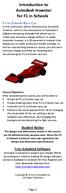 Introduction to Autodesk Inventor for F1 in Schools F1 in Schools Race Car In this course you will be introduced to Autodesk Inventor, which is the centerpiece of Autodesk s digital prototyping strategy
bi directional loading). Prototype ten story
 NEESR SG: Behavior, Analysis and Design of Complex Wall Systems The laboratory testing presented here was conducted as part of a larger effort that employed laboratory testing and numerical simulation
Stop Treating Diffractions as Noise Use them for Imaging of Fractures and Karst*
 Stop Treating Diffractions as Noise Use them for Imaging of Fractures and Karst* Mark Grasmueck 1, Tijmen Jan Moser 2, and Michael A. Pelissier 3 Search and Discovery Article #120057 (2012) Posted December
Safe & Sound Bridge Terminology
 Safe & Sound Bridge Terminology Abutment A retaining wall supporting the ends of a bridge, and, in general, retaining or supporting the approach embankment. Approach The part of the bridge that carries
Metamorphic rocks are rocks changed from one form to another by intense heat, intense pressure, and/or the action of hot fluids.
 Metamorphic Rocks, Processes, and Resources Metamorphic rocks are rocks changed from one form to another by intense heat, intense pressure, and/or the action of hot fluids. Protolith or parent rock is
Understand the Sketcher workbench of CATIA V5.
 Chapter 1 Drawing Sketches in Learning Objectives the Sketcher Workbench-I After completing this chapter you will be able to: Understand the Sketcher workbench of CATIA V5. Start a new file in the Part
FIELD GEOLOGY GUIDEBOOK AND NOTES ILLINOIS STATE UNIVERSITY. 2013 Version
 FIELD GEOLOGY GUIDEBOOK AND NOTES ILLINOIS STATE UNIVERSITY 2013 Version 2 TABLE OF CONTENTS COURSE PURPOSE AND OBJECTIVES...5 Purpose and Description of Course...5 Course Objectives and Expected Outcomes...5
What you can do:...3 Data Entry:...3 Drillhole Sample Data:...5 Cross Sections and Level Plans...8 3D Visualization...11
 What you can do:...3 Data Entry:...3 Drillhole Sample Data:...5 Cross Sections and Level Plans...8 3D Visualization...11 W elcome to North Face Software s software. With this software, you can accomplish
Why measure in-situ stress?
 C. Derek Martin University of Alberta, Edmonton, Canada Why measure in-situ stress? Engineering analyses require boundary conditions One of the most important boundary conditions for the analysis of underground
Geologic Time. Relative Dating. Principle of Original Horizontality. Relative Time. Absolute Time. Geologic Column
 Geologic Time Relative Time 5 Principles of Relative Dating Absolute Time Radiometric Dating Geologic Column Relative Dating principle of horizontality principle of superposition principle of cross-cutting
The Dynamic Crust 2) EVIDENCE FOR CRUSTAL MOVEMENT
 The Dynamic Crust 1) Virtually everything you need to know about the interior of the earth can be found on page 10 of your reference tables. Take the time to become familiar with page 10 and everything
Copyright 2011 Casa Software Ltd. www.casaxps.com. Centre of Mass
 Centre of Mass A central theme in mathematical modelling is that of reducing complex problems to simpler, and hopefully, equivalent problems for which mathematical analysis is possible. The concept of
Deflections. Question: What are Structural Deflections?
 Question: What are Structural Deflections? Answer: The deformations or movements of a structure and its components, such as beams and trusses, from their original positions. It is as important for the
Solid Mechanics. Stress. What you ll learn: Motivation
 Solid Mechanics Stress What you ll learn: What is stress? Why stress is important? What are normal and shear stresses? What is strain? Hooke s law (relationship between stress and strain) Stress strain
Thin Lenses Drawing Ray Diagrams
 Drawing Ray Diagrams Fig. 1a Fig. 1b In this activity we explore how light refracts as it passes through a thin lens. Eyeglasses have been in use since the 13 th century. In 1610 Galileo used two lenses
3D MODELLING OF GEOLOGICAL STRUCTURES FOR UNDERGROUND CAVERNS : A NEW AND SIMPLE METHODOLOGY
 N 250 3D MODELLING OF GEOLOGICAL STRUCTURES FOR UNDERGROUND CAVERNS : A NEW AND SIMPLE METHODOLOGY P. VASKOU (Géostock) J. MORRUZZI (Géostock) 6 th ARMS (Asian Rock Mechanic Symposium) 23-27 October 2010
Technical Drawing. MEC1000 Spring 2006 Instructor: David Anderson
 Technical Drawing MEC1000 Spring 2006 Instructor: David Anderson Topics Drawing Views Drawing Standards Best Practices Creating Drawings in SolidWorks Spring 2006 MEC1000 Technical Drawing - D. Anderson
Dynamic development of the thin-skinned thrust faulting
 Dynamic development of the thin-skinned thrust faulting The dynamic development of the thin-skinned thrust faulting in the Rubjerg Knude Glaciotectonic Complex is presented as a sequence of restoration
Carbonate Rock Formation
 Limestone, dolomite (or dolostone), and marble are often collectively referred to as carbonate rocks because the main mineral is calcite. The chemical name of calcite is calcium carbonate. Limestone, dolomite,
GEOL 104 Dinosaurs: A Natural History Geology Assignment. DUE: Mon. Sept. 18
 GEOL 104 Dinosaurs: A Natural History Geology Assignment DUE: Mon. Sept. 18 Part I: Environments of Deposition Geologists can use various clues in sedimentary rocks to interpret their environment of deposition:
Geometry and Measurement
 The student will be able to: Geometry and Measurement 1. Demonstrate an understanding of the principles of geometry and measurement and operations using measurements Use the US system of measurement for
SYDNEY SANDSTONE AND SHALE PARAMETERS FOR TUNNEL DESIGN
 Robert Bertuzzi Pells Sullivan Meynink, Unit G3 56 Delhi Road, North Ryde NSW 2113, Australia 1 BACKGROUND Inherent in any set of rock mass parameters are various assumptions regarding, amongst other things
Projectile Motion 1:Horizontally Launched Projectiles
 A cannon shoots a clown directly upward with a speed of 20 m/s. What height will the clown reach? How much time will the clown spend in the air? Projectile Motion 1:Horizontally Launched Projectiles Two
The Basics of Navigation
 The Basics of Navigation Knowledge of map reading and the use of the compass is an indispensable skill of bushcraft. Without this skill, a walker is a passenger and mere follower on a trip. To become a
Introduction to Autodesk Inventor for F1 in Schools
 F1 in Schools race car Introduction to Autodesk Inventor for F1 in Schools In this course you will be introduced to Autodesk Inventor, which is the centerpiece of Autodesk s Digital Prototyping strategy
6.E.2.2 Plate Tectonics, Earthquakes and Volcanoes
 Name: Date: 1. The road shown below was suddenly broken by a natural event. 3. The convergence of two continental plates would produce Which natural event most likely caused the crack in the road? island
SAMPLE TEST PAPER - I
 SCHEME E SAMPLE TEST PAPER - I Course Name : Mechanical Engineering Group Course Code : AE/PG/PT/ME/MH/FE Semester : Third Subject : Mechanical Engineering Drawing 12042 Time : 90 Minutes Marks: 25 Instruction:
Experiment 5: Magnetic Fields of a Bar Magnet and of the Earth
 MASSACHUSETTS INSTITUTE OF TECHNOLOGY Department of Physics 8.02 Spring 2005 Experiment 5: Magnetic Fields of a Bar Magnet and of the Earth OBJECTIVES 1. To examine the magnetic field associated with a
Layers of the Earth and Plate Tectonics
 Layers of the Earth and Plate Tectonics Objectives: explain various ways the earth can be changed by natural forces define the term Geology define the terms Crust, Mantle, Outer Core and Inner Core classify
Applying a circular load. Immediate and consolidation settlement. Deformed contours. Query points and query lines. Graph query.
 Quick Start Tutorial 1-1 Quick Start Tutorial This quick start tutorial will cover some of the basic features of Settle3D. A circular load is applied to a single soil layer and settlements are examined.
SECOND GRADE 1 WEEK LESSON PLANS AND ACTIVITIES
 SECOND GRADE 1 WEEK LESSON PLANS AND ACTIVITIES UNIVERSE CYCLE OVERVIEW OF SECOND GRADE UNIVERSE WEEK 1. PRE: Discovering stars. LAB: Analyzing the geometric pattern of constellations. POST: Exploring
Pro/ENGINEER Wildfire 4.0 Basic Design
 Introduction Datum features are non-solid features used during the construction of other features. The most common datum features include planes, axes, coordinate systems, and curves. Datum features do
2. Fault mechanics: some basic aspects
 15 2. Fault mechanics: some basic aspects The behavior of rocks in the shallow crust (fig. 7) has been extensively investigated with rock mechanics laboratory experiments. The results of experiments on
Detailing of Reinforcment in Concrete Structures
 Chapter 8 Detailing of Reinforcment in Concrete Structures 8.1 Scope Provisions of Sec. 8.1 and 8.2 of Chapter 8 shall apply for detailing of reinforcement in reinforced concrete members, in general. For
How To Design A 3D Print In Metal
 DMLS / SLM Metal 3D Printing. An introductory design guide for our 3d printing in metal service. v2.2-8th July 2015 Pricing considerations. Part Volume. One of the biggest factors in the price for DMLS
Number Sense and Operations
 Number Sense and Operations representing as they: 6.N.1 6.N.2 6.N.3 6.N.4 6.N.5 6.N.6 6.N.7 6.N.8 6.N.9 6.N.10 6.N.11 6.N.12 6.N.13. 6.N.14 6.N.15 Demonstrate an understanding of positive integer exponents
Imaging the earth using seismic diffractions
 Imaging the earth using seismic diffractions Rongfeng Zhang Abstract Diffractions in seismic data indicate discontinuities of the subsurface, although they are often obscured by and difficult to separate
System. Stability. Security. Integrity. 150 Helical Anchor
 Model 150 HELICAL ANCHOR System PN #MBHAT Stability. Security. Integrity. 150 Helical Anchor System About Foundation Supportworks is a network of the most experienced and knowledgeable foundation repair
Technical Drawing Specifications Resource A guide to support VCE Visual Communication Design study design 2013-17
 A guide to support VCE Visual Communication Design study design 2013-17 1 Contents INTRODUCTION The Australian Standards (AS) Key knowledge and skills THREE-DIMENSIONAL DRAWING PARALINE DRAWING Isometric
Discovering Math: Exploring Geometry Teacher s Guide
 Teacher s Guide Grade Level: 6 8 Curriculum Focus: Mathematics Lesson Duration: Three class periods Program Description Discovering Math: Exploring Geometry From methods of geometric construction and threedimensional
ANNEX D1 BASIC CONSIDERATIONS FOR REVIEWING STUDIES IN THE DETAILED RISK ASSESSMENT FOR SAFETY
 ANNEX D1 BASIC CONSIDERATIONS FOR REVIEWING STUDIES IN THE DETAILED RISK ASSESSMENT FOR SAFETY ANNEX D1: BASIC CONSIDERATIONS FOR REVIEWING STUDIES IN DRA FOR SAFETY D1-1 ANNEX D1 BASIC CONSIDERATIONS