
Developer Guide: Unwired Server Management API. Sybase Unwired Platform 2.1
|
|
|
- Reginald Alexander
- 9 years ago
- Views:
Transcription
1 Developer Guide: Unwired Server Management API Sybase Unwired Platform 2.1

2 DOCUMENT ID: DC LAST REVISED: October 2011 Copyright 2011 by Sybase, Inc. All rights reserved. This publication pertains to Sybase software and to any subsequent release until otherwise indicated in new editions or technical notes. Information in this document is subject to change without notice. The software described herein is furnished under a license agreement, and it may be used or copied only in accordance with the terms of that agreement. To order additional documents, U.S. and Canadian customers should call Customer Fulfillment at (800) , fax (617) Customers in other countries with a U.S. license agreement may contact Customer Fulfillment via the above fax number. All other international customers should contact their Sybase subsidiary or local distributor. Upgrades are provided only at regularly scheduled software release dates. part of this publication may be reproduced, transmitted, or translated in any form or by any means, electronic, mechanical, manual, optical, or otherwise, without the prior written permission of Sybase, Inc. Sybase trademarks can be viewed at the Sybase trademarks page at Sybase and the marks listed are trademarks of Sybase, Inc. indicates registration in the United States of America. SAP and other SAP products and services mentioned herein as well as their respective logos are trademarks or registered trademarks of SAP AG in Germany and in several other countries all over the world. Java and all Java-based marks are trademarks or registered trademarks of Sun Microsystems, Inc. in the U.S. and other countries. Unicode and the Unicode Logo are registered trademarks of Unicode, Inc. All other company and product names mentioned may be trademarks of the respective companies with which they are associated. Use, duplication, or disclosure by the government is subject to the restrictions set forth in subparagraph (c)(1)(ii) of DFARS for the DOD and as set forth in FAR (a)-(d) for civilian agencies. Sybase, Inc., One Sybase Drive, Dublin, CA

3 Contents Introducing Developer Guide for Unwired Server Management API...1 Administration Client API Features...1 Companion Docs...1 Javadocs...2 Documentation Roadmap for Unwired Platform...2 Administration Client API...3 Contexts...3 Administration Interfaces...4 SUPObjectFactory...6 Metadata...6 Exceptions and Error Codes...6 Getting Started with Client Development...7 Prerequisites...7 Required Files...7 Starting Required Services...8 Connecting to an Unwired Server Instance...8 Developing Client Contexts, Objects, and Operations...9 Code Samples...11 Controlling Unwired Server (SUPServer Interface)...11 Session Start-up...11 Server Properties Retrieval...11 Status Verification...12 Server Start-up...12 Server Shutdown...13 Server Restart...13 Managing Clusters...13 Start Cluster Management...14 Unwired Servers Retrieval...14 Resume an Unwired Server...15 Developer Guide: Unwired Server Management API iii

4 Contents Suspend an Unwired Server...15 Retrieval of Domains...15 Creation of Domains...16 Deletion of Domains...16 Retrieval of Security Configurations...17 Creation of a Security Configuration...17 Deletion of a Security Configuration...17 Retrieval of Domain Administrators...18 Creation of a Domain Administrator...18 Update of a Domain Administrator...19 Deletion of a Domain Administrator...19 Retrieval and Setting of Authentication Cache Timeout...20 Retrieval and Setting of Cluster Properties...20 Retrieval and Setting of Maximum Allowed Authentication Failures...21 Retrieval and Setting of Authentication Lock Duration...21 Retrieval of Relay Servers...22 Licensing Information Retrieval...23 Managing Domains...23 Start Domain Management...24 Enable a Domain...24 Disable a Domain...25 Package Retrieval...25 Package Deployment...25 Package Deletion...26 Package Import...26 Package Export...27 Endpoint Retrieval...28 Endpoint Creation...28 Endpoint Deletion...29 Endpoint Update...30 Endpoint Template Retrieval...30 Endpoint Template Creation...31 iv Sybase Unwired Platform
5 Contents Endpoint Template Deletion...32 Endpoint Template Update Retrieval of Security Configurations Update of Security Configurations...33 Retrieve Scheduled Purge Task Status Enable or Disable Scheduled Purge Tasks...34 Get Purge Task Schedule...35 Set Purge Task Schedule Purge Synchronization Cache...36 Purge Client Log...36 Purge Error History...38 Purge Subscription...39 Managing Packages Start Package Management...41 Enable a Package...42 Disable a Package...42 Enable Synchronization Tracing Disable Synchronization Tracing...43 Retrieval of Security Configurations Set Security Configuration...44 Retrieval of Synchronization Group Properties...44 Set Synchronization Group Properties...44 Retrieval of Messaging Package Subscriptions...45 Deletion of Messaging Package Subscriptions...45 Suspend Package Subscriptions...46 Resume Package Subscriptions...46 Reset Messaging Package Subscriptions...46 Retrieval of Replication Package Subscriptions.. 47 Update of Replication Package Subscriptions...47 Removal of Replication Package Subscriptions.. 48 Purge RBS and MBS Subscriptions Create Subscription Templates...49 Retrieval of Role Mappings...49 Set Role Mappings Cache Groups...51 Developer Guide: Unwired Server Management API v

6 Contents Mobile Business Objects Personalization Keys...54 Client Logs...55 Purge Synchronization Cache...57 Purge Error History...58 Purge Subscription...58 Add Applications to the Package...59 Remove Applications from the Package...59 Retrieval of a List of Applications...59 Retrieval of a List of Package Users...60 Managing Mobile Business Objects...60 Start Mobile Business Object Management...60 Properties Retrieval...61 Endpoints...62 Retrieval of Data Refresh Error History...62 Deletion of Data Refresh Error History...63 Operations Retrieval...63 Managing Operations...64 Start Operations Management...64 Operation Properties Retrieval...64 Endpoint Properties Retrieval...65 Retrieval of Playback Error History...65 Managing Applications and Application Connections and Templates...66 Start Application Management...66 Managing Applications...67 Managing Application Connections...73 Managing Application Connection Templates...78 Monitoring Unwired Platform Components...80 Start Monitoring Management...80 Retrieval of Monitoring Profiles Using SUPCluster...81 Creation of a Monitoring Profile Using SUPCluster...81 vi Sybase Unwired Platform

7 Contents Update of a Monitoring Profile Using SUPCluster...82 Deletion of a Monitoring Profile Using SUPCluster...83 Deletion of Monitoring Data Using SUPCluster...83 Construct a Path to the Monitored Object...84 Retrieval of a Large Volume of Monitoring Data...84 Specify Result Sorting...85 Retrieval of Security Log History...87 Retrieval of Current Messaging Requests...89 Retrieval of Detailed Messaging History...90 Retrieval of Summary Messaging History...90 Messaging Performance Retrieval...91 Messaging Statistics Retrieval...92 Retrieval of Current Replication Requests...93 Retrieval of Detailed Replication History...94 Retrieval of Summary Replication History...94 Replication Performance Retrieval...95 Replication Statistics Retrieval...96 Retrieval of Data Change tification History...97 Retrieval of Data Change tification Performance...97 Retrieval of Device tification History...98 Retrieval of Device tification Performance...98 Retrieval of Cache Group Performance...99 Retrieval of Cache Group Statistics Retrieval of Queue Monitoring Data and Statistics Monitoring Data Export Managing Unwired Server Logs Start Log Management Log Filter Construction Log Entry Retrieval Developer Guide: Unwired Server Management API vii

8 Contents Log Deletion Managing Log Settings Managing Domain Logs Start Managing Domain Logs Retrieval of a List of Log Profiles Creation of a Log Profile Update of a Log Profile Deletion of a Log Profile Retrieval of a List of Log Filters Creation or Update of a Correlation Log Filter Deletion of a Log Filter Retrieval of a List of Log Entries Deletion of Domain Log Entries Retrieval of Log Store Policy Update of Log Store Policy Configuring Unwired Servers ServerComponentVO Start Management of Unwired Server Configuration Populate Server Configuration Commit Local Changes to Unwired Server Retrieval of Replication Sync Server Configuration Update of Replication Sync Server Configuration Retrieval of Replication Push tification Configuration Update of Replication Push tification Configuration Retrieval of Replication Push tification Gateway Configuration Update of Replication tification Gateway Configuration Retrieval of Messaging Sync Server Configuration viii Sybase Unwired Platform
9 Contents Update of Messaging Sync Server Configuration Retrieval of Consolidated Database Configuration Retrieval of Administration Listener Configuration Update of Administration Listener Configuration Retrieval of HTTP Listener Configuration Addition of HTTP Listener Configuration Deletion of HTTP Listener Configuration Update of HTTP Listener Configuration Retrieval of HTTPS Listener Configuration Addition of HTTPS Listener Configuration Deletion of HTTPS Listener Configuration Update of HTTPS Listener Configuration Retrieval of SSL Security Profile Configuration. 131 Addition of SSL Security Profile Configuration..131 Deletion of SSL Security Profile Configuration..132 Update of SSL Security Profile Configuration Key Store Configuration Retrieval Key Store Configuration Update Trust Store Configuration Retrieval Trust Store Configuration Update Retrieval of Apple Push tification Configurations Addition of an Apple Push tification Configuration Deletion of an Apple Push tification Configuration Update of an Apple Push tification Configuration Retrieval of Certificate Names Set Apple tification Values Developer Guide: Unwired Server Management API ix
10 Contents Retrieval of Replication Pull tification Configuration Update of Replication Pull tification Configuration Update Server Configuration for Relay Server..140 Retrieval of Relay Server Outbound Enablers Configuring Security Configurations Start Security Configuration Management SecurityProviderVO Populate Security Configuration Commit Local Changes to the Unwired Server..143 Active Security Providers Security Configuration Validation Adjustment of the Sequence of Active Security Providers Retrieval of Installed Security Providers Managing Mobile Workflows Start Management of Mobile Workflow Packages Mobile Workflow Package Retrieval Installation of a Mobile Workflow Package Deletion of a Mobile Workflow Package Retrieval of Matching Rules Retrieval of Context Variables Retrieval of an Error List Retrieval and Management of Queue Items Update of Properties Update of Matching Rules Update of Context Variables Retrieval of Mobile Workflow Device Status Assignment of a Workflow Package Unassignment of a Workflow Package Retrieval of Device Workflow Assignments Settings Configuration Unblock Mobile Workflow Queue x Sybase Unwired Platform
11 Contents Replace Mobile Workflow Certificate Client Application Shutdown Client Metadata Security Configuration Audit Provider Authentication Provider Authorization Provider Server Configuration ReplicationSyncServer Replicationtifier_Push Replicationtifier_Pull MessagingSyncServer ConsolidatedDB AdministrationListener SecureAdministrationListener HTTPListener SecureHTTPListener SSLSecurityProfile KeyStore TrustStore JVM OCSP Server Log Configuration LocalFileAppender Property Reference Application Connection Properties Apple Push tification Properties Application Settings Properties BlackBerry Push tification Properties Connection Properties Custom Settings Properties Device Information Properties Advanced Device Properties Proxy Properties Security Settings Properties Developer Guide: Unwired Server Management API xi
12 Contents User Registration Properties EIS Data Source Connection Properties Reference..231 JDBC Properties SAP Java Connector Properties SAP DOE-C Properties Web Services Properties Proxy Endpoint Properties Error Code Reference Backward Compatibility Index xii Sybase Unwired Platform

13 Introducing Developer Guide for Unwired Server Management API Introducing Developer Guide for Unwired Server Management API This guide provides information about using the Sybase Unwired Platform Administration APIs to custom code an administration client. The audience is advanced developers who are familiar working with APIs, but who may be new to Sybase Unwired Platform. This guide describes the features and usage of the Administration API, how to get started with client development, and how to program a custom administration client. Also included is information on how to configure Unwired Platform properties using client metadata, how to use properties, and a listing of error codes. Administration Client API Features Sybase Unwired Platform includes a Java API that opens the administration and configuration of Sybase Unwired Platform to Java client applications you create. By building a custom client with the administration client API, you can build custom application to support Sybase Unwired Platform administration features and functionality within an existing IT management infrastructure. When creating a custom Unwired Platform administration client, the entry point is the SUPObjectFactory class. By calling methods of SUPObjectFactory, which require different context objects, you can retrieve administration interfaces to perform administration activities. Should errors occur, they are reported through a SUPAdminException, which provides the error code and error message. For details of each administration interface, you can refer to the Javadoc shipped with the administration client API. Companion Docs Companion guides include: System Administration Sybase Control Center for Sybase Unwired Platform Sybase Unwired WorkSpace Mobile Business Object Troubleshooting for Sybase Unwired Platform See Fundamentals for high-level mobile computing concepts, and a description of how Sybase Unwired Platform implements the concepts in your enterprise. Developer Guide: Unwired Server Management API 1
14 Introducing Developer Guide for Unwired Server Management API Javadocs The administration client API installation includes Javadocs. Use the Sybase Javadocs for your complete API reference. As you review the contents of this document, ensure you review the reference details documented in the Javadoc delivered with this API. By default, Javadocs are installed to <UnwiredPlatform_InstallDir>\Servers\UnwiredServer \AdminClientAPI\com.sybase.sup.adminapi\docs\api\index.html. The top left navigation pane lists all packages installed with Unwired Platform. The applicable documentation is available with com.sybase.sup.admin.client package. Click this link and navigate through the Javadoc as required. Documentation Roadmap for Unwired Platform Learn more about Sybase Unwired Platform documentation. See Documentation Roadmap in Fundamentals for document descriptions by user role. Fundamentals is available on Production Documentation. Check the Sybase Product Documentation Web site regularly for updates: access sybooks.sybase.com/nav/summary.do?prod=1289, then navigate to the most current version. 2 Sybase Unwired Platform

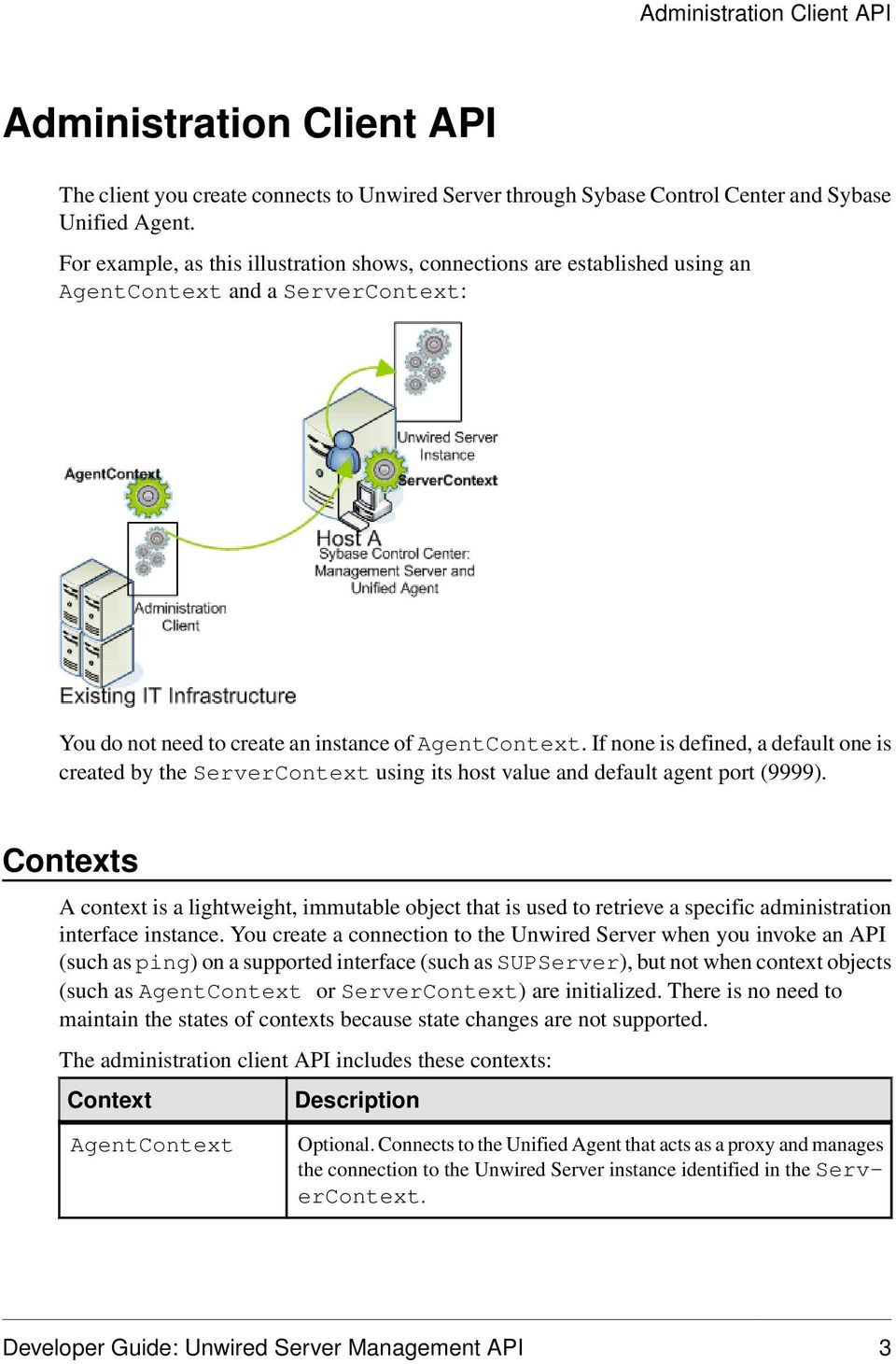
15 Administration Client API Administration Client API The client you create connects to Unwired Server through Sybase Control Center and Sybase Unified Agent. For example, as this illustration shows, connections are established using an AgentContext and a ServerContext: You do not need to create an instance of AgentContext. If none is defined, a default one is created by the ServerContext using its host value and default agent port (9999). Contexts A context is a lightweight, immutable object that is used to retrieve a specific administration interface instance. You create a connection to the Unwired Server when you invoke an API (such as ping) on a supported interface (such as SUPServer), but not when context objects (such as AgentContext or ServerContext) are initialized. There is no need to maintain the states of contexts because state changes are not supported. The administration client API includes these contexts: Context AgentContext Description Optional. Connects to the Unified Agent that acts as a proxy and manages the connection to the Unwired Server instance identified in the ServerContext. Developer Guide: Unwired Server Management API 3
16 Administration Client API Context Admin- Context AdminContext ServerContext ClusterContext DomainContext PackageContext MBOContext The AdminContext is an interface that all context classes implement. OperationContext SecurityContext Description The super class of other concrete context classes. Required to connect to the Unwired Server instance. If you don't specify an AgentContext, the ServerContext creates one for you using default values. See Connecting to an Unwired Server Instance. Use this context to retrieve the ClusterContext. Required to manage a specific cluster. Use this context to retrieve the DomainContext. Required to manage a specific domain. Use this context to retrieve the PackageContext Required to deploy and manage a package. Use this context to retrieve the MBOContext Required to manage a mobile business object. Use this context to retrieve the OperationContext Required to manage an operation. Required to manage the security for the platform For details on these classes, and the methods that implement them, see the Javadocs for com.sybase.sup.admin.client. See also Connecting to an Unwired Server Instance on page 8 Administration Interfaces The administration client API uses several interfaces that contain operations which can be invoked by custom code to perform management of the Unwired Server. The administration client API includes these administration interfaces: Interface SUPServer Includes methods that Command and control operations for an Unwired Server instance, for example start, stop, and ping. 4 Sybase Unwired Platform

17 Administration Client API Interface SUPCluster SUPDomain SUPPackage SUPMobileBusinessObject SUPOperations SUPApplication SUPMonitor SUPServerLog SUPDomainLog SUPServerConfiguration SUPSecurityConfiguration SUPMobileWorkflow Includes methods that Manage cluster security, monitoring configuration and domain creation for a cluster instance, and so on. Manage domains, deploy packages to a domain, set security configurations for a domain, and so on. Configure packages by setting up subscriptions, configuring cache groups, configuring endpoint properties, and so on. View mobile business object properties, operations, errors, endpoints, and so on. View operation properties, errors, endpoints, and so on. Manage applications, application connections, and application connection templates Perform monitoring functions like viewing histories, summaries, details, and performance data for various platform components, and export data as required. View, filter, delete and refresh logs, configure appenders, and so on, for Unwired Server and its embedded services like replication and messaging synchronization. Configure domain log settings and view, filter, delete domain logs entries, and so on. Configure an Unwired Server instance, as well as its listeners. All methods of this interface, except the apple push notification-related properties are metadata-based. Create, manage, and configure a security configuration with at least one authentication provider. You can add other providers (authentication, authorization, attribution, and audit) as required. Manage and configure deployed mobile workflow packages. For details on these classes, and the methods that implement them, see the Javadocs for com.sybase.sup.admin.client. See also Client Metadata on page 165 Developer Guide: Unwired Server Management API 5

18 Administration Client API SUPObjectFactory Once a context has been instantiated, pass it to a specific method of SUPObjectFactory to retrieve an administration interface. You can then start administration by calling methods of the interface. The methods in the SUPObjectFactory class can accept an instance of AdminContext as a parameter. For example, to get an administration interface of SUPServer, you must create an instance of ServerContext with the correct information and pass it to SUPObjectFactory.getSUPServer(). SUPObjectFactory provides a shutdown() method to cleanly shut down an application that uses the API. See the Javadocs for details. Metadata Metadata-based configuration is used by these administration components: Unwired Server configuration properties Unwired Server log configuration properties Security configurations and the providers used in those configurations Endpoint connection properties See also Client Metadata on page 165 Exceptions and Error Codes The administration client API throws only one checked exception, SUPAdminException. An error code is associated with each thrown SUPAdminException, so that developers can easily diagnose what happened when the exception is thrown. te: See Developer Guide for Unwired Server Management API > Error Code Reference for a list of predefined error codes. 6 Sybase Unwired Platform
19 Getting Started with Client Development Getting Started with Client Development An Unwired Platform development cycle includes several steps. 1. Required Files The following files are required in your class path. 2. Starting Required Services Before beginning development, you must start required Unwired Platform services so you can connect to them. 3. Connecting to an Unwired Server Instance AgentContext and ServerContext are lightweight, immutable Java objects. 4. Developing Client Contexts, Objects, and Operations Once you have an instance of ServerContext, you can create other contexts from it. Prerequisites Review this list to understand what prerequisites to consider before starting the development of a custom administration tool within an existing enterprise-level adminstration framework. A development environment that supports Java development, for example, Eclipse. Optionally, if you want to install Sybase Control Center, it must be installed on the same host as Unwired Server. Required Files The following files are required in your class path. sup-admin-pub-client.jar sup-admin-pub-common.jar castor-1.2.jar commons-beanutils-core jar commons-lang-2.2.jar commons-logging jar commons-pool-1.4.jar sup-at-lite.jar sup-mms-admin-api-lite.jar uaf-client.jar Developer Guide: Unwired Server Management API 7

20 Getting Started with Client Development log4j jar commons-codec-1.3.jar log4j.properties (the file residing in the sample folder can be a template) By default, the sup-admin-pub-client.jar, and sup-admin-pub-common.jar files are installed to the <UnwiredPlatform_InstallDir>\Servers\UnwiredServer \AdminClientAPI\com.sybase.sup.adminapi folder. All other jar files can be found in the <UnwiredPlatform_InstallDir>\Servers\UnwiredServer \AdminClientAPI\com.sybase.sup.adminapi\lib folder. te: If you have Xerces J-Parser installed and have xerces.jar (the parser class files) in your class path, the xerces.jar library may cause a class conflict with Sybase Unwired Platform. This problem only occurs in certain circumstances when JDK 6 is used with Xerces. If this problem occurs, you must remove this jar from your class path. Starting Required Services Before beginning development, you must start required Unwired Platform services so you can connect to them. Prerequisites Ensure the required service are all installed on the same host. Task By starting required services, you start the servers and dependent services. For a complete list of Unwired Platform Services, see System Administration > System Reference > Unwired Platform Windows Services. 1. Click the Start Unwired Platform Services desktop shortcut to start Unwired Server and the dependent services that the custom tool you develop will manage. 2. Use the Services Control Panel to verify that the Windows service named Sybase Control Center X.X is started. If it has not, start it by selecting the service and clicking Start. Connecting to an Unwired Server Instance AgentContext and ServerContext are lightweight, immutable Java objects. Creating either of these objects does not immediately establish a connection to either Sybase Control Center or the Unwired Server. 1. (Optional) Create an AgentContext object. 8 Sybase Unwired Platform
21 Getting Started with Client Development The default constructor creates an instance with host="localhost", port="9999", user="" and password="". The constructor in this sample creates an instance with host="<host name>", port="9999", user="supadmin" and password="s3padmin": AgentContext agentcontext = new AgentContext(); agentcontext = new AgentContext("<host name>", 9999, "supadmin", "s3padmin"); 2. Create a ServerContext object. Every ServerContext instance has an AgentContext instance. When you instantiate ServerContext, you can pass an instance of AgentContext to the constructor. If you do not specify an AgentContext, the constructor automatically creates an AgentContext with the same host, user name, and password values as those defined in the ServerContext. It also assigns 9999 as the port number for AgentContext, for these reasons: Unwired Server and Sybase Control Center are installed on the same host, and they share the same security provider. By default, Sybase Control Center listens on port The administration API connects to Sybase Control Center using this port. This sample creates a ServerContext that uses values of supadmin and s3padmin for the user name and password, and uses secure port (2001) by specifying "true" in the last parameter: ServerContext servercontext = new ServerContext(); servercontext = new ServerContext("<host name>", 2001, "supadmin", "s3padmin", true); The usage of secure port does not require server certificate installation on the client-side. It is assumed that server is configured with a valid and secure certificate for transport level security, and client authentication is done via the security provider assigned to the 'admin' security configuration. See also Contexts on page 3 Developing Client Contexts, Objects, and Operations Once you have an instance of ServerContext, you can create other contexts from it. 1. Create required client artifacts. Create the context objects you require. The following diagram illustrates the subclasses of AdminContext and their logical hierarchy. Developer Guide: Unwired Server Management API 9
22 Getting Started with Client Development The following code fragment creates multiple contexts for cluster, security, domain, package, mobile business objects, and operations: ClusterContext clustercontext = servercontext.getclustercontext("<cluster name>"); SecurityContext securitycontext = clustercontext.getsecuritycontext("<security configuration name>"); DomainContext domaincontext = clustercontext.getdomaincontext("<domain name>"); PackageContext packagecontext = domaincontext.getpackagecontext("<package name>"); MBOContext mbocontext = packagecontext.getmbocontext("<mbo name>"); OperationContext operationcontext = mbocontext.getoperationcontext("<operation name>"); Call methods of SUPObjectFactory to create the administration interface required. For example, to create an object of SUPServer, pass an instance of ServerContext to SUPObjectFactory by calling: SUPObjectFactory.getSUPServer(serverContext); 2. Once the administration session ends, clean the resources held by the API by calling SUPObjectFactory.shutdown(). This method is provided only to help your administration application exit cleanly, and is not designed to be called after each administration operation. For example: SUPObjectFactory.shutdown(); 3. Build the client application. 10 Sybase Unwired Platform
23 Code Samples Use the Javadocs for the administration client API package with the interface code samples to understand how to program a custom administration client. Code samples are organized by the interface used. Controlling Unwired Server (SUPServer Interface) The SUPServer interface allows you to manage the Unwired Server. Operations you can perform with this interface include: Starting an administration session for an Unwired Server instance. Retrieving Unwired Server properties and status. Performing command and control actions like starting and stopping. Session Start-up Starts the management of an Unwired Server instance. public static SUPServer getsupserver(servercontext servercontext) throws SUPAdminException; If successful, returns silently. If unsuccessful, returns SUPAdminException. Session Start-up SUPServer supserver = SUPObjectFactory.getSUPServer(serverContext); Usage When an instance of SUPServer is returned from the SUPObjectFactory, call its method. The state of the connection to the Unwired Server is automatically managed; an explicit connection to the Unwired Server is not required. Server Properties Retrieval Retrieves the general properties of the Unwired Server instance. Developer Guide: Unwired Server Management API 11
24 ServerVO getproperties() throws SUPAdminException; If successful, returns an object of the specified type (can be null). If unsuccessful, returns SUPAdminException. Getting properties gets the properties for a server instance named ServerVO: ServerVO svo = supserver.getproperties(); Status Verification Checks if the Unwired Server instance is available. void ping() throws SUPAdminException; If successful, returns silently. If unsuccessful, returns SUPAdminException. Ping pings an Unwired Server to see if it is available: supserver.ping(); Server Start-up Starts an Unwired Server instance. void start() throws SUPAdminException; If successful, returns silently. If unsuccessful, returns SUPAdminException. Startup supserver.start(); 12 Sybase Unwired Platform
25 Server Shutdown Stops an Unwired Server instance. void stop() throws SUPAdminException; If successful, returns silently. If unsuccessful, returns SUPAdminException. Shutdown supserver.stop(); Server Restart Restarts an Unwired Server instance. void restart() throws SUPAdminException; If successful, returns silently. If unsuccessful, returns SUPAdminException. Restart supserver.restart(); Managing Clusters The SUPCluster interface allows you manage the cluster to which the Unwired Server instance belongs. Operations you can perform with this interface include: Listing member servers, suspending/resuming member servers Listing, creating, and deleting domains Listing, creating, and deleting security configurations Developer Guide: Unwired Server Management API 13
26 Listing, creating, updating, and deleting monitoring configurations, deleting monitoring data Listing, creating, updating, and deleting domain administrators Listing, updating, and deleting administration users Retrieving licensing information. te: The SUPCluster interface also contains methods for managing monitoring profiles in a cluster, and monitoring data store policies and domain log data store policies. These methods are described in Developer Guide for Unwired Server Management API > Code Samples > Monitoring Unwired Platform Components. Start Cluster Management Starts the management of an Unwired Server cluster. public static SUPCluster getsupcluster(clustercontext clustercontext) throws SUPAdminException; Cluster startup starts the management of the specified cluster. clustercontext = servercontext.getclustercontext("<cluster name>"); SUPCluster supcluster = SUPObjectFactory.getSUPCluster(clusterContext); Usage When an instance of SUPCluster is returned from the SUPObjectFactory, call its method. Unwired Servers Retrieval Retrieves a list of servers that are members in a cluster. Collection<ServerVO> getservers() throws SUPAdminException; If successful, returns an object of the specified type (can be null). If unsuccessful, returns SUPAdminException. 14 Sybase Unwired Platform
27 Getting member servers lists the servers that are members of a cluster: Collection<ServerVO> svos = supcluster.getservers(); Resume an Unwired Server Resumes an Unwired Server in a cluster. void resume(string name) throws SUPAdminException; If successful, returns silently. If unsuccessful, returns SUPAdminException. Resume a server resumes an Unwired Server in a cluster: supcluster.resume("<member server name>"); Suspend an Unwired Server Suspends a member server in a cluster. void suspend(string name) throws SUPAdminException; If successful, returns silently. If unsuccessful, returns SUPAdminException. Suspend a server suspends an Unwired Server in a cluster: supcluster.suspend("<member server name>"); Retrieval of Domains Retrieves the domains in a cluster. Collection<String> getdomains() throws SUPAdminException; Developer Guide: Unwired Server Management API 15
28 If successful, returns an object of the specified type (can be null). If unsuccessful, returns SUPAdminException. Retrieval of domains retrieves the domains in a cluster. Collection<String> domains = supcluster.getdomains(); Creation of Domains Creates domains in a cluster. void createdomain(string name) throws SUPAdminException; If successful, returns silently. If unsuccessful, returns SUPAdminException. Creation of domains creates,in the cluster, the domain specified by "<domain name>". supcluster.createdomain("<domain name>"); Deletion of Domains Deletes domains from a cluster. void deletedomains(collection<string> names) throws SUPAdminException; If successful, returns silently. If unsuccessful, returns SUPAdminException. Deletion of domains deletes, from the cluster, the domains in the specified array. supcluster.deletedomains(arrays.aslist(new String[] { "<domain name 1>", "<domain name 2>" })); 16 Sybase Unwired Platform
29 Retrieval of Security Configurations Retrieves a list of security configurations in a cluster. Collection<String> getsecurityconfigurations() throws SUPAdminException; If successful, returns an object of the specified type (can be null). If unsuccessful, returns SUPAdminException. Retrieval of security configurations lists the security configurations in a cluster. Collection<String> securityconfigurations= supcluster.getsecurityconfigurations(); Creation of a Security Configuration Creates a security configuration in a cluster. void createsecurityconfiguration(string name) throws SUPAdminException; If successful, returns silently. If unsuccessful, returns SUPAdminException. Creation of a security configuration creates a security configuration of the specified name in the cluster: supcluster.createsecurityconfiguration("<security configuration name>"); Deletion of a Security Configuration Deletes a security configuration from the cluster. void deletesecurityconfigurations(collection<string> names) throws SUPAdminException; Developer Guide: Unwired Server Management API 17
30 If successful, returns silently. If unsuccessful, returns SUPAdminException. Deletion of a security configuration deletes a security configuration from the cluster. supcluster.deletesecurityconfigurations(securityconfigurations); Retrieval of Domain Administrators Retrieves a list of domain adminstrators in a cluster. Collection<DomainAdministratorVO> getdomainadministrators() throws SUPAdminException; If successful, returns an object of the specified type (can be null). If unsuccessful, returns SUPAdminException. Retrieval of domain administrators retrieves a list of domain administrators in a cluster: //List domain administrators for (DomainAdministratorVO davo : supcluster.getdomainadministrators()) { System.out.println(davo.getLoginName()); } Creation of a Domain Administrator Creates a domain adminstrator in the cluster. void createdomainadministrator(domainadministratorvo domainadministrator) throws SUPAdminException; If successful, returns silently. If unsuccessful, returns SUPAdminException. 18 Sybase Unwired Platform
31 Creation of a domain administrator creates a domain adminstrator in the cluster: //Create a domain administrator DomainAdministratorVO davo = new DomainAdministratorVO(); davo.setloginname("<new domain administrator login name>"); supcluster.createdomainadministrator(davo); Update of a Domain Administrator Updates a domain administrator in the cluster. void updatedomainadministrator(domainadministratorvo domainadministrator) throws SUPAdminException; If successful, returns silently. If unsuccessful, returns SUPAdminException. Update of a domain adminstrator updates a domain administrator in the cluster by setting the login name and company name: //Update a domain administrator davo = new DomainAdministratorVO(); davo.setloginname("<domain administrator login name>"); davo.setcompanyname("sybase"); supcluster.updatedomainadministrator(davo); Deletion of a Domain Administrator Deletes a domain administrator from the cluster. void deletedomainadministrator(domainadministratorvo domainadministrator) throws SUPAdminException; If successful, returns silently. If unsuccessful, returns SUPAdminException. Deletion of a domain administrator deletes the specified domain administrator from the cluster: //Delete a domain administrator davo = new DomainAdministratorVO(); Developer Guide: Unwired Server Management API 19
32 davo.setloginname("<domain administrator login name>"); supcluster.deletedomainadministrator(davo); Retrieval and Setting of Authentication Cache Timeout Retrieves and sets the authentication cache timeout from a cluster. Long timeout getauthenticationcachetimeout () throws SUPAdminException; void setauthenticationcachetimeout(user, timeout); If successful, returns an object of the specified type (can be null). If unsuccessful, returns SUPAdminException. Retrieve and set authentication cache timeout retrieves and sets the specified authentication cache timeout from a cluster: Long timeout = supcluster.getauthenticationcachetimeout("admin"); supcluster.setauthenticationcachetimeout("admin", 200L); timeout = supcluster.getauthenticationcachetimeout("admin"); assertequals(new Long(200), timeout); Retrieval and Setting of Cluster Properties Retrieves and sets the properties of a cluster. ClusterPropertiesVO getclusterproperties() throws SUPAdminException; void setclustersyncdatasharedpathenabled(boolean) throws SUPAdminException; void setclustersyncdatasharedpath(path) throws SUPAdminException void setclusterproperties(vo) If successful, returns an object of the specified type (can be null). If unsuccessful, returns SUPAdminException. 20 Sybase Unwired Platform
33 Retrieve or set cluster properties //Get cluster properties ClusterPropertiesVO vo = supcluster.getclusterproperties(); //change cluster properties vo.setclustersyncdatasharedpathenabled(true); vo.setclustersyncdatasharedpath("\\\\myhost\\newsharedpath"); //Set cluster properties supcluster.setclusterproperties(vo); Retrieval and Setting of Maximum Allowed Authentication Failures Retrieves and sets the maximum number of allowed authentication failures. Integer getmaximumallowedauthenticationfailure(string securityconfiguration) throws SUPAdminException; void setmaximumallowedauthenticationfailure(string securityconfiguration, Integer maximumallowed) throws SUPAdminException; If successful, returns an object of the specified type (can be null). If unsuccessful, returns SUPAdminException. Retrieve or set cluster properties //Get maximum allowed authentication failures Integer threshold= supcluster.getmaximumallowedauthenticationfailure("admin"); //Set maximum allowed authentication failures supcluster.setmaximumallowedauthenticationfailure("admin", 20); Retrieval and Setting of Authentication Lock Duration Retrieves and sets the duration for authentication lock. Integer getauthenticationlockduration(string securityconfiguration) throws SUPAdminException; void setauthenticationlockduration(string securityconfiguration, Integer duration) throws SUPAdminException; Developer Guide: Unwired Server Management API 21
34 If successful, returns an object of the specified type (can be null). If unsuccessful, returns SUPAdminException. Retrieve or set authentication lock duration Integer duration = supcluster.getauthenticationlockduration("admin"); supcluster.setauthenticationlockduration("admin", 3000); Retrieval of Relay Servers Retrieves a list of Relay Servers configured for an Unwired Server cluster. List<RelayServerVO> getrelayservers() throws SUPAdminException; If successful, returns an object of the specified type (can be null). If unsuccessful, returns SUPAdminException. Retrieval of Relay Servers retrieves a list of relay servers in a cluster: // Get all relay servers configured for the Unwired Server cluster. List<RelayServerVO> relayservers = supcluster.getrelayservers(); for (RelayServerVO relayserver : relayservers) { // Print relay server info System.out.println("=========Begin Relay Server Info========="); System.out.println("Host: " + relayserver.gethost()); System.out.println("HTTP port: " + relayserver.getport()); System.out.println("HTTPS port: " + relayserver.getsecureport()); System.out.println("URL suffix: " + relayserver.geturlsuffix()); // Print farm info of this relay server System.out.println("======Farms within this relays server======"); for (FarmVO farm : relayserver.getfarms()) { System.out.println(" " + farm); // print server node info of this farm System.out.println("===Server nodes within this farm==="); for (ServerdeVO serverde : farm.getserverdes()) { System.out.println(" Server node: " + serverde); // print Outbound Enabler info of this server node System.out.println(" Outbound enabler: " 22 Sybase Unwired Platform
35 } + serverde.getoutboundenabler()); } } System.out.println("=========End Relay Server Info========="); Licensing Information Retrieval Retrieves information about software and device licensing on Unwired Server. LicensingInfoVO getlicensinginfo() throws SUPAdminException; If successful, returns an object of the specified type (can be null). If unsuccessful, returns SUPAdminException. Retrieval retrieves licensing information for the Unwired Server. // Get Licensing info. LicensingInfoVO infovo = supcluster.getlicensinginfo(); System.out.println(infoVO.getAvailableDeviceLicenseCount()); System.out.println(infoVO.getLicenseType()); System.out.println(infoVO.getProductionEdition()); System.out.println(infoVO.getUsedDeviceLicenseCount()); System.out.println(infoVO.getDevicelicenseExpireDate()); System.out.println(infoVO.getServerlicenseExpireDate()); te: For more information on Sybase Unwired Platform licensing, see System Administration for Sybase Unwired Platform > Systems Maintenance and Monitoring > Platform Licenses. Managing Domains You can manage domains of Unwired Servers through the SUPDomain interface. Operations you can perform with this interface include: Enabling or disabling a Sybase Unwired Platform domain. Packages: listing, creating, deleting, importing, exporting packages. Endpoints: listing, creating, deleting, updating endpoints. Security configuration: getting/setting associated security configurations. Domain administrators: listing administrators. Data maintenance: cleaning up accumulated data artifacts. Applications: viewing applications and application connections at the domain level. Developer Guide: Unwired Server Management API 23
36 Start Domain Management Starts the management of a domain. public static SUPDomain getsupdomain(domaincontext domaincontext) throws SUPAdminException; If successful, returns silently. If unsuccessful, returns SUPAdminException. Start domain management starts the management of the specified domain: DomainContext domaincontext = servercontext.getdomaincontext("<domain name>"); SUPDomain supdomain = SUPObjectFactory.getSUPDomain(domainContext); Usage To manage Unwired Server domains, you must first create an instance of SUPDomain. To perform SUP domain administration operations, you must be assigned an SUP Administrator or SUP Domain Administrator role. Enable a Domain Enables a domain. void enable(boolean flag) throws SUPAdminException; If successful, returns silently. If unsuccessful, returns SUPAdminException. Enable a domain supdomain.enable(true); //Enable domain 24 Sybase Unwired Platform
37 Disable a Domain Disables a domain. void enable(boolean flag) throws SUPAdminException; If successful, returns silently. If unsuccessful, returns SUPAdminException. Disable a domain supdomain.enable(false); //Disable domain Package Retrieval Retrieves a list of packages in a domain. Collection<String> getpackages() throws SUPAdminException; If successful, returns an object of the specified type (can be null). If unsuccessful, returns SUPAdminException. Package retrieval retrieves a list of packages in a domain: for(string packagename : supdomain.getpackages()){ System.out.println(packageName); } Package Deployment Deploys a package to a domain. void deploypackage(string filename, DEPLOY_MODE deploymode, String securityconfiguration, Collection<RoleMappingVO> rolemappings, Map<String, String> endpointmappings) throws SUPAdminException; If successful, returns silently. If unsuccessful, returns SUPAdminException. Developer Guide: Unwired Server Management API 25
38 Package deployment deploys a package to a domain: Collection<RoleMappingVO> rolemappingvos = new ArrayList<RoleMappingVO>(); RoleMappingVO rmvo1 = new RoleMappingVO(); rmvo1.setsourcerole("role1"); rmvo1.setrolemappingtype(role_mapping_type.auto); RoleMappingVO rmvo2 = new RoleMappingVO(); rmvo2.setsourcerole("role2"); rmvo2.setrolemappingtype(role_mapping_type.auto); RoleMappingVO rmvo3 = new RoleMappingVO(); rmvo3.setsourcerole("role3"); rmvo3.setrolemappingtype(role_mapping_type.auto); rolemappingvos.add(rmvo1); rolemappingvos.add(rmvo2); rolemappingvos.add(rmvo3); Map<String, String> endpointmappings = new HashMap<String, String>(); endpointmappings.put("sampledb", "sampledb2"); supdomain.deploypackage("<deployment unit file name>", DEPLOY_MODE.UPDATE, "<security configuration name>", rolemappingvos, endpointmappings); Package Deletion Deletes a package from a domain. void deletepackage(string name) throws SUPAdminException; If successful, returns silently. If unsuccessful, returns SUPAdminException. Package deletion deletes the specified package from the domain: supdomain.deletepackage("<package name>"); Package Import Imports a package to a domain. void importpackage(string filename, Boolean overwrite) throws SUPAdminException; 26 Sybase Unwired Platform
39 If successful, returns silently. If unsuccessful, returns SUPAdminException. Package import imports a package with the specified package file name to the domain: supdomain.importpackage("<exported package file name>", true); Usage You can only import package into the same domain as the one you exported from. The API requires that the domain where the package was exported from exists on the server when the import is done. Also, you are required to create domains in the same order in both the export and import server environments, which ensures that an internal ID assigned to the domain in both environment matches. You can verify the internal ID assigned to a domain by looking at the prefix used in the package folder in the zip. Package Export Exports a package from a domain. void exportpackage(string filename, String name, EnumSet<PACKAGE_EXPORT_OPTION> exportoptions) throws SUPAdminException; If successful, returns silently. If unsuccessful, returns SUPAdminException. Package Export exports a package with the specified file name, package name, and options from a domain: EnumSet<PACKAGE_EXPORT_OPTION> options = EnumSet.noneOf(PACKAGE_EXPORT_OPTION.class); options.add(package_export_option.log_level); options.add(package_export_option.role_mapping); options.add(package_export_option.replication_subscription_templa TE); options.add(package_export_option.package_logging ); supdomain.exportpackage("<file name>", "<package name>", options); Developer Guide: Unwired Server Management API 27
40 Endpoint Retrieval Retrieves a list of server connection endpoints in the domain. The supported endpoint types are JDBC, SAP, and WEBSERVICE. Collection<EndpointVO> getendpoints(endpoint_type type) throws SUPAdminException; If successful, returns an object of the specified type (can be null). If unsuccessful, returns SUPAdminException. Endpoint retrieval retrieves a list of endpoints for each endpoint type: for(endpointvo evo : supdomain.getendpoints(endpoint_type.jdbc)){ System.out.println(evo.getName()); System.out.println(evo.getExtraProps()); } for(endpointvo evo : supdomain.getendpoints(endpoint_type.sap)){ System.out.println(evo.getName()); System.out.println(evo.getExtraProps()); } for(endpointvo evo : supdomain.getendpoints(endpoint_type.webservice)){ System.out.println(evo.getName()); System.out.println(evo.getExtraProps()); } te: For detailed information on each of these endpoint types, see Developer Guide for Unwired Server Management API > Property Reference > EIS Data Source Connection Properties Reference. Endpoint Creation Creates a server connection endpoint of the specified endpoint type. void createendpoint(endpoint_type type, String name, String template, Map<String, String> properties) throws SUPAdminException; If successful, returns silently. If unsuccessful, returns SUPAdminException. 28 Sybase Unwired Platform
41 Endpoint creation creates an endpoint for each endpoint type, and sets its properties: Map<String, String> properties = new HashMap<String, String>(); // For Sybase ASA properties.put("commitprotocol", "<commit protocol>"); properties.put("datasourceclass", "<data source class>"); properties.put("databaseurl", "<database URL>"); properties.put("user", "<user name>"); properties.put("password", "<password>"); supdomain.createendpoint(endpoint_type.jdbc, "<endpoint name>", "<template name>", properties); properties.clear(); properties.put("jco.client.user", "<jco client user>"); properties.put("jco.client.passwd", "<jco client password>"); properties.put("jco.client.ashost", "<jco client AS host>"); properties.put("jco.client.client", "<jco client>"); supdomain.createendpoint(endpoint_type.sap, "<endpoint name>", "<template name>", properties); properties.clear(); properties.put("address", "<address>"); properties.put("user", "<user name>"); properties.put("password", "<password>"); supdomain.createendpoint(endpoint_type.webservice, "<endpoint name>", "<template name>", properties); Endpoint Deletion Deletes a specific server connection endpoint of the specified type. void deleteendpoint(endpoint_type type, String name) throws SUPAdminException; If successful, returns silently. If unsuccessful, returns SUPAdminException. Endpoint deletion deletes an endpoint of each endpoint type: supdomain.deleteendpoint(endpoint_type.jdbc, "<endpoint name>"); supdomain.deleteendpoint(endpoint_type.sap, "<endpoint name>"); supdomain.deleteendpoint(endpoint_type.webservice, "<endpoint name>"); Developer Guide: Unwired Server Management API 29
42 Endpoint Update Updates the properties of a specific server connection endpoint. void updateendpoint(endpointvo endpoint) throws SUPAdminException; If successful, returns silently. If unsuccessful, returns SUPAdminException. Endpoint update EndpointVO evo = new EndpointVO(); evo.setname("sampledb2"); evo.settype(endpoint_type.jdbc); Map<String, String> properties = new HashMap<String, String>(); properties.put("commitprotocol", "pessimistic"); properties.put("datasourceclass", "com.sybase.jdbc3.jdbc.sybdatasource"); properties.put("databaseurl", "jdbc:sybase:tds:localhost:5500/ sampledb2?servicename=sampledb2"); evo.setextraprops(properties); supdomain.updateendpoint(evo); Endpoint Template Retrieval Retrieves a list of endpoint templates in the domain. The supported endpoint template types are JDBC, SAP, and WEBSERVICE. Collection<EndpointVO> getendpointtemplates(endpoint_type type) throws SUPAdminException; If successful, returns an object of the specified type (can be null). If unsuccessful, returns SUPAdminException. Endpoint template retrieval retrieves a list of endpoint templates for each endpoint type: for (EndpointVO evo : supdomain.getendpointtemplates(endpoint_type.jdbc)) { System.out.println(evo.getName()); System.out.println(evo.getExtraProps()); 30 Sybase Unwired Platform
43 } for (EndpointVO evo : supdomain.getendpointtemplates(endpoint_type.sap)) { System.out.println(evo.getName()); System.out.println(evo.getExtraProps()); } for (EndpointVO evo : supdomain.getendpointtemplates(endpoint_type.webservice)) { System.out.println(evo.getName()); System.out.println(evo.getExtraProps()); } te: For detailed information on each of these endpoint types, see Developer Guide for Unwired Server Management API > Property Reference > EIS Data Source Connection Properties Reference. Endpoint Template Creation Creates a server connection endpoint template for the specified endpoint type. void createendpointtemplate(endpoint_type type, String name, String template, Map<String, String> properties) throws SUPAdminException; If successful, returns silently. If unsuccessful, returns SUPAdminException. Endpoint creation creates an endpoint for each endpoint type, and sets its properties: Map<String, String> properties = new HashMap<String, String>(); properties.put("commitprotocol", "<commit protocol>"); properties.put("datasourceclass", "<data source class>"); properties.put("databaseurl", "<database URL>"); properties.put("user", "<user name>"); properties.put("password", "<password>"); supdomain.createendpointtemplate(endpoint_type.jdbc, "myjdbc_template", "Sybase_ASA_template", properties); properties.clear(); properties.put("jco.client.user", "<jco client user>"); properties.put("jco.client.passwd", "<jco client password>"); properties.put("jco.client.ashost", "<jco client AS host>"); properties.put("jco.client.client", "<jco client>"); supdomain.createendpointtemplate(endpoint_type.sap, "mysap_template", "sap_template", properties); properties.clear(); Developer Guide: Unwired Server Management API 31
44 properties.put("address", "<address>"); properties.put("user", "<user name>"); properties.put("password", "<password>"); supdomain.createendpointtemplate(endpoint_type.webservice, "myws_template", "webservice_template", properties); Endpoint Template Deletion Deletes a specific server connection endpoint template of the specified type. void deleteendpointtemplate(endpoint_type type, String name) throws SUPAdminException; If successful, returns silently. If unsuccessful, returns SUPAdminException. Endpoint template deletion deletes an endpoint template of each endpoint type: supdomain.deleteendpointtemplate(endpoint_type.jdbc, "<endpoint template name>"); supdomain.deleteendpointtemplate(endpoint_type.sap, "<endpoint template name>"); supdomain.deleteendpointtemplate(endpoint_type.webservice, "<endpoint template name>"); Endpoint Template Update Updates the properties of a specific server connection endpoint template. void updateendpointtemplate(endpointvo endpoint) throws SUPAdminException; If successful, returns silently. If unsuccessful, returns SUPAdminException. Endpoint update EndpointVO evo = new EndpointVO(); evo.setname("<endpoint template name>"); evo.settype(endpoint_type.jdbc); Map<String, String> properties = new HashMap<String, String>(); properties.put("commitprotocol", "pessimistic"); properties.put("datasourceclass", "com.sybase.jdbc3.jdbc.sybdatasource"); 32 Sybase Unwired Platform
45 properties.put("databaseurl", "jdbc:sybase:tds:localhost:5500/ sampledb2?servicename=sampledb2"); evo.setextraprops(properties); supdomain.updateendpointtemplate(evo); Retrieval of Security Configurations Retrieves a list of security configurations for a domain. Collection<String> getsecurityconfigurations() throws SUPAdminException; If successful, returns an object of the specified type (can be null). If unsuccessful, returns SUPAdminException. Retrieval of security configurations retrieves a list of security configurations for a domain: for (String securityconfiguration : supdomain.getsecurityconfigurations()) { System.out.println(securityConfiguration); } Update of Security Configurations Updates security configurations in the domain. You must be assigned an SUP Administrator role to perform this operation. void setsecurityconfigurations(collection<string> names) throws SUPAdminException; If successful, returns silently. If unsuccessful, returns SUPAdminException. Update of security configurations updates the security configurations specified in an array: supdomain.setsecurityconfigurations(arrays.aslist(new String[] { "<security configuration 1>", "<security configuration 2>" })); Developer Guide: Unwired Server Management API 33
46 Retrieve Scheduled Purge Task Status Checks to see whether domain-level cleanup is scheduled for the specified purge task type. Boolean isscheduledpurgetaskenable(schedule_purge_task task) throws SUPAdminException; If successful, returns true or false. If unsuccessful, returns SUPAdminException. Purge task status retrieves the scheduled data purge task status for synchronization cache, subscription, client log, and error history purge tasks. supdomain.isscheduledpurgetaskenable(schedule_purge_task.client_l OG); supdomain.isscheduledpurgetaskenable(schedule_purge_task.error_hi STORY); supdomain.isscheduledpurgetaskenable(schedule_purge_task.subscrip TION); supdomain.isscheduledpurgetaskenable(schedule_purge_task.sync_cac HE_GROUP); Enable or Disable Scheduled Purge Tasks Enables or disables domain-level cleanup using the current scheduled purge task values. void enablescheduledpurgetask(schedule_purge_task task, Boolean enabled) throws SUPAdminException; If successful, enables or disables cleanup. If unsuccessful, returns SUPAdminException. Enables or disables purge tasks enables or disables the scheduled data purge tasks for synchronization cache, subscription, client log, or error history. supdomain.enablescheduledpurgetask(schedule_purge_task.client_log, true); supdomain.enablescheduledpurgetask(schedule_purge_task.error_hist ORY, false); supdomain.enablescheduledpurgetask(schedule_purge_task.subscripti ON, false); 34 Sybase Unwired Platform
47 supdomain.enablescheduledpurgetask(schedule_purge_task.sync_cache _GROUP, true); Get Purge Task Schedule Gets the cleanup schedule for the selected purge task type. Getting the purge task schedule is typically used with setting the purge task schedule. ScheduleVO getpurgetaskschedule(schedule_purge_task task) throws SUPAdminException; If successful, returns true or false. If unsuccessful, returns SUPAdminException. Get purge task schedule gets and sets the purge task schedule for synchronization cache, subscription, client log, or error history. ScheduleVO reschedule = supdomain.getpurgetaskschedule(schedule_purge_task.client_log); reschedule = supdomain.getpurgetaskschedule(schedule_purge_task.error_history) ; reschedule = supdomain.getpurgetaskschedule(schedule_purge_task.subscription); reschedule = supdomain.getpurgetaskschedule(schedule_purge_task.sync_cache_gro UP); Set Purge Task Schedule Sets the domain-level cleanup schedule for the selected purge task. Setting the purge task schedule is typically used with getting the purge task schedule. void setpurgetaskschedule(schedule_purge_task task, ScheduleVO schedule) throws SUPAdminException; If successful, returns the schedule for the selected type. If unsuccessful, returns SUPAdminException. Developer Guide: Unwired Server Management API 35
48 Set purge task schedule gets and sets the purge task schedule for synchronization cache, subscription, client log, or error history. ScheduleVO schedule = new ScheduleVO(); schedule.setdaysofweek(enumset.of(day_of_week.monday,day_of_week. FRIDAY)); schedule.setstartdate(new Date()); schedule.setstarttime(new Date()); schedule.setenddate(new Date()); schedule.setendtime(new Date()); schedule.setfreq(schedule_freq.interval); schedule.setinterval(50); supdomain.setpurgetaskschedule(schedule_purge_task.client_log, schedule); supdomain.setpurgetaskschedule(schedule_purge_task.error_history, schedule); supdomain.setpurgetaskschedule(schedule_purge_task.subscription, schedule); supdomain.setpurgetaskschedule(schedule_purge_task.sync_cache_gro UP, schedule); Purge Synchronization Cache Purges synchronization cache at the domain level. The purge can be done synchronously or asynchronously. void purgesynccachegroup(boolean synchronous) throws SUPAdminException; If successful, purges synchronization cache using the schedule. If unsuccessful, returns SUPAdminException. Purge sync cache purges the synchronization cache using defined settings. supdomain.purgesynccachegroup(false); Purge Client Log Purges the client log at the domain level. The purge can be done synchronously or asynchronously. void purgeclientlog(clientlogpurgeoptionvo purgeoption, Boolean synchronous) throws SUPAdminException; 36 Sybase Unwired Platform
49 If successful, purges the client log using the schedule. If unsuccessful, returns SUPAdminException. Purge client log purges the client log using current settings. ClientLogPurgeOptionVO purgeoption = new ClientLogPurgeOptionVO(); purgeoption.setdaystopreserve(10); supdomain.purgeclientlog(purgeoption, false); Get Client Log Purge Options Obtains the current client log purge settings at the domain level. ClientLogPurgeOptionVO getclientlogpurgeoption() throws SUPAdminException; If successful, gets the current client log purge settings. If unsuccessful, returns SUPAdminException. Gets client log options gets the current client log purge options. ClientLogPurgeOptionVO roption = supdomain.getclientlogpurgeoption(); Set Client Log Purge Options Sets the client log purge options at the domain level using the current settings. void setclientlogpurgeoption(clientlogpurgeoptionvo option) throws SUPAdminException; If successful, sets the current client log purge settings. If unsuccessful, returns SUPAdminException. Developer Guide: Unwired Server Management API 37
50 Sets client log options sets the current client log purge settings, which includes preserving data for the last 15 days. ClientLogPurgeOptionVO option = new ClientLogPurgeOptionVO(); option.setdaystopreserve(15); supdomain.setclientlogpurgeoption(option); Purge Error History Purges the error history at the domain level. The purge can be done synchronously or asynchronously. void purgeerrorhistory(errorhistorypurgeoptionvo purgeoption, Boolean synchronous) throws SUPAdminException; If successful, purges the error history using the schedule. If unsuccessful, returns SUPAdminException. Purge error history purges the error history using defined settings. ErrorHistoryPurgeOptionVO purgeoption = new ErrorHistoryPurgeOptionVO(); purgeoption.setdaystopreserve(10); supdomain.purgeerrorhistory(purgeoption, false); Get Error History Purge Options Gets the current error history purge option settings at the domain level. ErrorHistoryPurgeOptionVO geterrorhistorypurgeoption() throws SUPAdminException; If successful, gets the current error history purge settings. If unsuccessful, returns SUPAdminException. Gets error history purge options gets the current error history purge settings. 38 Sybase Unwired Platform
51 ErrorHistoryPurgeOptionVO roption = supdomain.geterrorhistorypurgeoption(); Set Error History Purge Options Sets the error history purge options at the domain level using current settings. void seterrorhistorypurgeoption(errorhistorypurgeoptionvo option) throws SUPAdminException; If successful, sets the current error history purge settings. If unsuccessful, returns SUPAdminException. Set error history purge options sets the current error history purge settings. ErrorHistoryPurgeOptionVO option = new ErrorHistoryPurgeOptionVO(); option.setdaystopreserve(15); supdomain.seterrorhistorypurgeoption(option); Purge Subscription Purges subscriptions at the domain level. The purge can be done synchronously or asynchronously. void purgesubscription(subscriptionpurgeoptionvo purgeoption, Boolean synchronous) throws SUPAdminException; If successful, purges subscriptions using the schedule. If unsuccessful, returns SUPAdminException. Purge subscription purges subscriptions using defined settings. SubscriptionPurgeOptionVO purgeoption = new SubscriptionPurgeOptionVO(); purgeoption.setdaysinactive(10); supdomain.purgesubscription(purgeoption, false); Developer Guide: Unwired Server Management API 39
52 Get Subscription Purge Options Obtains the current subscription purge options at the domain level. SubscriptionPurgeOptionVO getsubscriptionpurgeoption() throws SUPAdminException; If successful, gets the subscription purge settings. If unsuccessful, returns SUPAdminException. Gets subscription purge options gets the current subscription purge settings. SubscriptionPurgeOptionVO roption = supdomain.getsubscriptionpurgeoption(); Set Subscription Purge Options Sets the subscription purge options at the domain level. void setsubscriptionpurgeoption(subscriptionpurgeoptionvo option) throws SUPAdminException; If successful, sets the current subscription purge settings. If unsuccessful, returns SUPAdminException. Sets subscription purge options sets the subscription purge options, including setting 15 as the number of inactive days. SubscriptionPurgeOptionVO option = new SubscriptionPurgeOptionVO(); option.setdaysinactive(15); supdomain.setsubscriptionpurgeoption(option); 40 Sybase Unwired Platform
53 Managing Packages You can manage MBO packages and their properties through the SUPPackage interface. Operations you can perform with this interface include: Security configuration getting or setting security configuration. Synchronization group getting or setting synchronization group properties. Synchronization tracing enabling or disabling synchronization tracing. Message-based sync subscription management these subscriptions determine what synchronization messages mobile device users receive on messaging-based devices. Replication-based sync subscription and template management these subscriptions determine what synchronization messages mobile device users receive on replicationbased devices. Package role mapping getting/setting package level role mappings. You can define role mapping for the package to map logical roles in the package to physical roles on the Unwired Server. Applications viewing applications, adding or removing application to/from a package, viewing application users. Uncategorized enabling and disabling packages, listing MBOs, managing cache groups, listing personalization keys, and retrieving endpoint properties. Start Package Management Starts the management of an Unwired Server package. public static SUPPackage getsuppackage(packagecontext packagecontext) throws SUPAdminException; If successful, returns silently. If unsuccessful, returns SUPAdminException. Start package management domaincontext = servercontext.getdomaincontext("<domain name>"); packagecontext = domaincontext.getpackagecontext("<package name>"); SUPPackage suppkg = SUPObjectFactory.getSUPPackage(packageContext); Usage To manage Unwired Server packages, you must first create an instance of SUPPackage. Developer Guide: Unwired Server Management API 41
54 Enable a Package Enables a package. void enable(boolean flag) throws SUPAdminException; If successful, returns silently. If unsuccessful, returns SUPAdminException. Enable a package enables a package and retrieves a list of mobile business objects and personalization keys in the package. //Enable a package. suppkg.enable(true); //Enable package //Retrieve a list of MBOs for (String mboname : suppkg.getmobilebusinessobjects()) { System.out.println(mboName); } //Retrieve a list of personalization keys for(personalizationkeyvo pvo : suppkg.getpersonalizationkeys()){ System.out.println(pvo.getKey()); Disable a Package Disables a package. void enable(boolean flag) throws SUPAdminException; If successful, returns silently. If unsuccessful, returns SUPAdminException. Disable a package //Disable a package. suppkg.enable(false); //Disable package 42 Sybase Unwired Platform
55 Enable Synchronization Tracing Enables synchronization tracing. void setsynctracingstatus(boolean flag) throws SUPAdminException; If successful, returns silently. If unsuccessful, returns SUPAdminException. Enable synchronization tracing suppkg.setsynctracingstatus(true); //Enable synchronization tracing Disable Synchronization Tracing Disables synchronization tracing. void setsynctracingstatus(boolean flag) throws SUPAdminException; If successful, returns silently. If unsuccessful, returns SUPAdminException. Disable synchronization tracing suppkg.setsynctracingstatus(false); //Disable synchronization tracing Retrieval of Security Configurations Retrieves a list of security configurations for a package. String getsecurityconfiguration() throws SUPAdminException; If successful, returns an object of the specified type (can be null). If unsuccessful, returns SUPAdminException. Developer Guide: Unwired Server Management API 43
56 Retrieval of security configurations String securityconfiguration = suppkg.getsecurityconfiguration(); Set Security Configuration Sets the security configuration for a package. void setsecurityconfiguration(string name) throws SUPAdminException; If successful, returns silently. If unsuccessful, returns SUPAdminException. Set security configuration suppkg.setsecurityconfiguration("<security configuration name>"); Retrieval of Synchronization Group Properties Retrieves a list of synchronization group properties for a package. Collection<SyncGroupVO> getsyncgroups() throws SUPAdminException; If successful, returns an object of the specified type (can be null). If unsuccessful, returns SUPAdminException. Retrieval of synchronization group properties for(syncgroupvo sgvo : suppkg.getsyncgroups()){ System.out.println(sgvo.getName()); } Set Synchronization Group Properties Sets properties for a synchronization group in a package. void setsyncgroupchangedetectioninterval(string syncgroup, Integer checkinterval) throws SUPAdminException; 44 Sybase Unwired Platform
57 If successful, returns silently. If unsuccessful, returns SUPAdminException. Set synchronization group properties updates the check interval for the specified synchronization group: suppkg.setsyncgroupchangedetectioninterval("<sync group name>", 1000); Retrieval of Messaging Package Subscriptions Retrieves messaging package subscriptions. Collection<MBSSubscriptionVO> getmbssubscriptions() throws SUPAdminException; If successful, returns silently. If unsuccessful, returns SUPAdminException. Retrieval of messaging package subscriptions Collection<MBSSubscriptionVO> mbssubs = suppkg.getmbssubscriptions(); MBSSubscriptionVO mbssub = suppkg.getmbssubscription("<client id>"); te: For more information on managing messaging package subscriptions, seesybase Unwired Platform Systems Administration Guide > System Administration > Package Administration > Managing Deployed Package Subscriptions. Deletion of Messaging Package Subscriptions Deletes messaging package subscriptions. void removembssubscriptions(collection<string> clientids) throws SUPAdminException; If successful, returns silently. If unsuccessful, returns SUPAdminException. Developer Guide: Unwired Server Management API 45
58 Deletion of messaging package subscriptions suppkg.removembssubscriptions(clientids); Suspend Package Subscriptions Suspends messaging package subscriptions, or DOE-C package subscriptions. void suspendmbssubscriptions(collection<string> clientids) throws SUPAdminException; If successful, returns silently. If unsuccessful, returns SUPAdminException. Suspend messaging (or DOE-C) package subscriptions suppkg.suspendmbssubscriptions(clientids); Resume Package Subscriptions Resumes messaging package subscriptions, or DOE-C package subscriptions. void resumembssubscriptions(collection<string> clientids) throws SUPAdminException; If successful, returns silently. If unsuccessful, returns SUPAdminException. Resume messaging (or DOE-C) package subscriptions suppkg.resumembssubscriptions(clientids); Reset Messaging Package Subscriptions Resets messaging package subscriptions. void resetmbssubscriptions(collection<string> clientids) throws SUPAdminException; 46 Sybase Unwired Platform
59 If successful, returns silently. If unsuccessful, returns SUPAdminException. Reset messaging package subscriptions suppkg.resetmbssubscriptions(clientids); Retrieval of Replication Package Subscriptions Retrieves replication package subscriptions. Collection<RBSSubscriptionVO> getrbssubscriptions(string syncgroup, String user) throws SUPAdminException; If successful, returns an object of the specified type (can be null). If unsuccessful, returns SUPAdminException. Retrieval of replication package subscriptions for (RBSSubscriptionVO rbssub : suppkg.getrbssubscriptions("<sync group name>")) { System.out.println(rbsSub.getSyncGroup() + ":" + rbssub.getclientid()); } for (RBSSubscriptionVO rbssub : suppkg.getrbssubscriptionvos( "<sync group name>", "<user name>")) { System.out.println(rbsSub.getSyncGroup() + ":" + rbssub.getclientid()); } te: For more information on managing messaging package subscriptions, seesybase Unwired Platform Systems Administration Guide > System Administration > Package Administration > Managing Deployed Package Subscriptions. Update of Replication Package Subscriptions Updates replication package subscriptions. void updaterbssubscription(rbssubscriptionvo rbssub) throws SUPAdminException; Developer Guide: Unwired Server Management API 47
60 If successful, returns silently. If unsuccessful, returns SUPAdminException. Update of replication package subscriptions updates subscriptions of replication packages and sets the properties: RBSSubscriptionVO rbssub = new RBSSubscriptionVO(); //Client id, sync group, package and domain can uniquely //identify a RBS subscription rbssub.setclientid("<client id>"); rbssub.setsyncgroup("<sync group>"); //Bellow are the modifiable properties of a RBS subscription //Please refer to Java doc for detailed information. rbssub.setadminlocked(false); rbssub.setpushenabled(true); rbssub.setsyncintervalminutes(5); suppkg.updaterbssubscription(rbssub); Removal of Replication Package Subscriptions Removes a subscription or a list of subscriptions for a package. void removerbssubscription(string syncgroup, String clientid) throws SUPAdminException; void removerbssubscriptions(string syncgroup) throws SUPAdminException; If successful, returns silently. If unsuccessful, returns SUPAdminException. Removal of replication package subscriptions shows how to remove a list of subscriptions, or a single subscription, for a replication package: //Remove one subscription suppkg.removerbssubscription("<sync group name>", "<client id>" //Remove a list of subscriptions suppkg.removerbssubscriptions(arrays.aslist(new String[] { "<client id 1>", "<client id 2>" })); suppkg.removerbssubscriptions("<sync group>"); suppkg.removerbssubscriptions("<sync group>", "<user name>"); 48 Sybase Unwired Platform
61 Purge RBS and MBS Subscriptions Purges replication-based and message-based synchronization (RBS and MBS) subscriptions at the package level using the number of inactive days. The purge can be done synchronously or asynchronously. void purgesubscription(subscriptionpurgeoptionvo purgeoption, Boolean synchronous) throws SUPAdminException; If successful, purges RBS and MBS subscriptions based on the number of inactive days specified. If unsuccessful, returns SUPAdminException. Purge subscriptions purges RBS and MBS subscriptions. SubscriptionPurgeOptionVO purgeoption = new SubscriptionPurgeOptionVO(); purgeoption.setdaysinactive(10); suppkg.purgesubscription(purgeoption, false); Create Subscription Templates Creates a subscription template for replication packages. RBSSubscriptionVO createrbssubscriptiontemplate(string syncgroup, Boolean ispushenabled, Boolean isadminlocked, Integer minimumsyncminutes) throws SUPAdminException; If successful, returns silently. If unsuccessful, returns SUPAdminException. Creation of a subscription template creates a subscription template for replication packages: suppkg.createrbssubscriptiontemplate("<sync group name>", false, false, 5); Retrieval of Role Mappings Retrieves role mappings for a package. Role mappings map logical roles in the package to physical roles on the Unwired Server. Developer Guide: Unwired Server Management API 49
62 Collection<RoleMappingVO> getrolemappings() throws SUPAdminException; If successful, returns an object of the specified type (can be null). If unsuccessful, returns SUPAdminException. Retrieval of role mappings Collection<RoleMappingVO> rolemappingvos = suppkg.getrolemappings(); te: See the Sybase Unwired Platform Systems Administration Guide > Security Administration > Security Layers > Roles and Mappings. Set Role Mappings Sets role mappings for a package. void setrolemappings(collection<rolemappingvo> rmvos) throws SUPAdminException; If successful, returns silently. If unsuccessful, returns SUPAdminException. Set role mappings rolemappingvos = new ArrayList<RoleMappingVO>(); RoleMappingVO rmvo1 = new RoleMappingVO(); rmvo1.setsourcerole("role1"); rmvo1.setrolemappingtype(role_mapping_type.auto); RoleMappingVO rmvo2 = new RoleMappingVO(); rmvo2.setsourcerole("role2"); rmvo2.setrolemappingtype(role_mapping_type.auto); RoleMappingVO rmvo3 = new RoleMappingVO(); rmvo3.setsourcerole("role3"); rmvo3.setrolemappingtype(role_mapping_type.auto); rolemappingvos.add(rmvo1); rolemappingvos.add(rmvo2); rolemappingvos.add(rmvo3); suppkg.setrolemappings(rolemappingvos); 50 Sybase Unwired Platform
63 Cache Groups A cache group specifies the data refresh behavior for every mobile business object (MBO) within that group. You can perform these management tasks for cache groups: Retrieving a list of cache groups Managing schedule properties of a cache group Listing the MBOs associated with a cache group Purging or clearing a cache group Cache Groups Retrieval Retrieves a list of cache groups for a package. Collection<CacheGroupVO> getcachegroups() throws SUPAdminException; If successful, returns an object of the specified type (can be null). If unsuccessful, returns SUPAdminException. Retrieval of cache groups for(cachegroupvo cgvo : suppkg.getcachegroups()){ System.out.println(cgvo.getName()); } Schedule Properties Retrieval Retrieves the schedule properties of a cache group for a package. CacheGroupScheduleVO getcachegroupschedule(string cachegroupname) throws SUPAdminException; If successful, returns an object of the specified type (can be null). If unsuccessful, returns SUPAdminException. Retrieval of schedule properties retrieves a list of cache groups for a package: Developer Guide: Unwired Server Management API 51
64 CacheGroupScheduleVO cgsvo = suppkg.getcachegroupschedule("<cache group name>"); Set Schedule Properties Sets the schedule properties of a cache group for a package. void setcachegroupschedule(string cachegroupname, CacheGroupScheduleVO cachegroupschedule) throws SUPAdminException; If successful, returns silently. If unsuccessful, returns SUPAdminException. Set schedule properties retrieves a list of cache groups for a package: CacheGroupScheduleVO cgsvo = new CacheGroupScheduleVO(); cgsvo.setfrequency(schedule_freq.daily); EnumSet<DAY_OF_WEEK> daysofweek = EnumSet.noneOf(DAY_OF_WEEK.class); daysofweek.add(day_of_week.monday); daysofweek.add(day_of_week.thursday); cgsvo.setdayofweek(daysofweek); //start date: //start time: 18:31:45 //end date: //end time: 21:34:47 Calendar cal = Calendar.getInstance(); cal.set(calendar.year, 2009); cal.set(calendar.month, 11); cal.set(calendar.day_of_month, 3); Date startdate = cal.gettime(); cgsvo.setstartdate(startdate); cal.set(calendar.year, 2009); cal.set(calendar.month, 11); cal.set(calendar.day_of_month, 23); Date enddate = cal.gettime(); cgsvo.setenddate(enddate); cal.set(calendar.hour_of_day, 18); cal.set(calendar.minute, 31); cal.set(calendar.second, 45); Date starttime = cal.gettime(); cgsvo.setstarttime(starttime); cal.set(calendar.hour_of_day, 21); cal.set(calendar.minute, 34); cal.set(calendar.second, 47); Date endtime = cal.gettime(); 52 Sybase Unwired Platform
65 cgsvo.setendtime(endtime); suppkg.setcachegroupschedule("<cache group name>", cgsvo); Set cache group interval CacheGroupScheduleVO cgsvo = new CacheGroupScheduleVO(); cgsvo.setfrequency(schedule_freq.interval); cgsvo.setinterval(cachegroupschedulevo.never_expire); suppkg.setcachegroupschedule("<cache group name>", cgsvo); Associated Mobile Business Objects Retrieves a list of the mobile business objects associated with a cache group. Collection<String> getcachegroupmbos(string cachegroupname) throws SUPAdminException; If successful, returns an object of the specified type (can be null). If unsuccessful, returns SUPAdminException. Getting associated mobile business objects for(string mboname : suppkg.getcachegroupmbos("<cache group name>")){ System.out.println(mboName); } Cache Group Purge Physically deletes rows in the cache group that are marked as logically deleted and are older than the specified date. void purgecachegroup(string cachegroupname, Date date) throws SUPAdminException; If successful, returns silently. If unsuccessful, returns SUPAdminException. Cache group purge physically deletes data that is marked as deleted and older than the datethreshold: Calendar cal = Calendar.getInstance(); cal.clear(); Developer Guide: Unwired Server Management API 53
66 cal.set(calendar.year, 2009); cal.set(calendar.month, 11); cal.set(calendar.day_of_month, 3); Date datethreshold = cal.gettime(); // Physically delete data that is marked as deleted and older than the // datethreshold suppkg.purgecachegroup("<cache group name>", datethreshold); Usage Ensure that all devices have synchronized at least once before the specified purge date. Mobile Business Objects Packages contain mobile business objects that are deployed to Unwired Server to facilitate access to back-end data and transactions from mobile devices. te: See the Sybase Unwired Platform Systems Administration Guide > System Administration > Package Administration > MBO Package Management Overview. Mobile Business Object Retrieval Retrieves a list of mobile business objects for a package. Collection<String> getmobilebusinessobjects() throws SUPAdminException; If successful, returns an object of the specified type (can be null). If unsuccessful, returns SUPAdminException. Mobile business object retrieval //Retrieve a list of MBOs for (String mboname : suppkg.getmobilebusinessobjects()) { System.out.println(mboName); } Personalization Keys Personalization keys are created by the MBO developer for use as client parameters (user data, such as user name and password), to be validated by the EIS. 54 Sybase Unwired Platform
67 Personalization Key Retrieval Retrieves a list of personalization keys for a package. Collection<PersonalizationKeyVO> getpersonalizationkeys() throws SUPAdminException; If successful, returns an object of the specified type (can be null). If unsuccessful, returns SUPAdminException. Personalization key retrieval //Retrieve a list of personalization keys for(personalizationkeyvo pvo : suppkg.getpersonalizationkeys()){ System.out.println(pvo.getKey()); } Client Logs Client logs record errors, history, and informational messages for mobile clients. Logs include data change notification logs, device notification logs, error logs, messaging logs, replication logs, and subscription logs. You can perform these management tasks for client logs: Retrieving client logs Deleting client logs Exporting client logs Retrieval of Client Logs Retrieves the client logs specified in the search and sort criteria. PaginationResult<LogEntryVO> getclientlogs(clientlogsearchcriteriavo searchcriteria, Integer skip, Integer take, ClientLogSortVO sortinfo) throws SUPAdminException; If successful, returns an object of the specified type (can be null). If unsuccessful, returns SUPAdminException. Developer Guide: Unwired Server Management API 55
68 Client log retrieval //Prepare the search and sort criteria ClientLogSearchCriteriaVO searchcriteria = new ClientLogSearchCriteriaVO(); searchcriteria.setusername("*sup*"); searchcriteria.setlevel("*n?o"); searchcriteria.setoperation("*up*"); ClientLogSortVO sortinfo = new ClientLogSortVO(); sortinfo.setascending(false); sortinfo.setsortfield(clientlogsortvo.sortfield.device); //Get client Log PaginationResult<LogEntryVO> result = suppkg.getclientlogs( searchcriteria, 0, 5, sortinfo); Deletion of Client Logs Deletes client logs. void deleteclientlogs(list<long> messageids) throws SUPAdminException; If successful, returns silently. If unsuccessful, returns SUPAdminException. Client log deletion //Delete Client Log List<Long> messageids = new ArrayList<Long>(); messageids.add(310004l); suppkg.deleteclientlogs(messageids); Map<CLIENT_LOG_FIELD, String> map = new HashMap<CLIENT_LOG_FIELD, String>(); map.put(client_log_field.user, "supadmin"); map.put(client_log_field.start_time, " "); map.put(client_log_field.end_time, " "); suppkg.deleteclientlogs(map); Export of Client Logs Exports client logs. void exportclientlogs(file file, ClientLogSearchCriteriaVO searchcriteria, Integer skip, Integer take, ClientLogSortVO sortinfo) throws SUPAdminException; 56 Sybase Unwired Platform
69 If successful, returns silently. If unsuccessful, returns SUPAdminException. Client log export //Export client Log suppkg.exportclientlogs(new File("F:/tmp/out.txt"), searchcriteria, 0, 3, sortinfo); Purge Client Log Purges the client log at the package level. The purge can be done synchronously or asynchronously. void purgeclientlog(clientlogpurgeoptionvo purgeoption, Boolean synchronous) throws SUPAdminException; If successful, purges the client log using current settings. If unsuccessful, returns SUPAdminException. Purge client log purges the client log, except for data from the last 10 days. ClientLogPurgeOptionVO purgeoption = new ClientLogPurgeOptionVO(); purgeoption.setdaystopreserve(10); suppkg.purgeclientlog(purgeoption, false); Purge Synchronization Cache Purges synchronization cache at the package level. The purge can be done synchronously or asynchronously. void purgesynccachegroup(boolean synchronous) throws SUPAdminException; If successful, purges synchronization cache using current settings. If unsuccessful, returns SUPAdminException. Developer Guide: Unwired Server Management API 57
70 Purge sync cache purges the synchronization cache using defined settings. suppkg.purgesynccachegroup(false); Purge Error History Purges the error history at the package level. The purge can be done synchronously or asynchronously. void purgeerrorhistory(errorhistorypurgeoptionvo purgeoption, Boolean synchronous) throws SUPAdminException; If successful, purges the error history using current settings. If unsuccessful, returns SUPAdminException. Purge error history purges the error history, except for data from the last 10 days. ErrorHistoryPurgeOptionVO purgeoption = new ErrorHistoryPurgeOptionVO(); purgeoption.setdaystopreserve(10); suppkg.purgeerrorhistory(purgeoption, false); Purge Subscription Purges subscriptions at the package level. The purge can be done synchronously or asynchronously. void purgesubscription(subscriptionpurgeoptionvo purgeoption, Boolean synchronous) throws SUPAdminException; If successful, purges subscriptions using current settings. If unsuccessful, returns SUPAdminException. Purge subscription purges subscriptions, except for data from the last 10 days. SubscriptionPurgeOptionVO purgeoption = new SubscriptionPurgeOptionVO(); 58 Sybase Unwired Platform
71 purgeoption.setdaysinactive(10); suppkg.purgesubscription(purgeoption, false); Add Applications to the Package Adds existing applications to the package. void addapplications(collection<string> appids) throws SUPAdminException; If successful, returns silently. If unsuccessful, returns SUPAdminException. Addition of applications to the package Collection<String> apps = new ArrayList<String>(); apps.add("app1"); suppkg.addapplications(apps); Remove Applications from the Package Removes existing applications from the package. void removeapplications (Collection<String> appids) throws SUPAdminException; If successful, returns silently. If unsuccessful, returns SUPAdminException. Remove applications from the package Collection<String> apps = new ArrayList<String>(); apps.add("app1"); suppkg.removeapplications(apps); Retrieval of a List of Applications Retrieves a list of applications for a package. Collection<ApplicationVO> getapplications() throws SUPAdminException; Developer Guide: Unwired Server Management API 59
72 If successful, returns an object of the specified type (can be null). If unsuccessful, returns SUPAdminException. Retrieval of role mappings Collection<ApplicationVO> apps = suppkg.getapplications(); Retrieval of a List of Package Users Retrieves a list of package users for a package. PaginationResult<PackageUserVO> getpackageusers(packageuser_sortvo filter, Long offset, Integer length) throws SUPAdminException; If successful, returns an object of the specified type (can be null). If unsuccessful, returns SUPAdminException. Retrieval of role mappings PackageUser_SortVO filter = new PackageUser_SortVO(); filter.setsortfield(package_user.registration_time); filter.setsortorder(sort_order.ascending); PaginationResult<PackageUserVO> apps = suppkg.getpackageusers(filter, 0L, 100); Managing Mobile Business Objects You can manage mobile business objects and their properties through the SUPMobileBusinessObject interface. Operations you can perform with this interface include: Mobile business objects retrieving properties and data refresh history, and listing operations. Endpoints retrieving properties. Start Mobile Business Object Management Starts the management of a mobile business object. 60 Sybase Unwired Platform
73 public static SUPMobileBusinessObject getsupmobilebusinessobject(mbocontext mbocontext) throws SUPAdminException; If successful, returns silently. If unsuccessful, returns SUPAdminException. Start mobile business object management domaincontext = clustercontext.getdomaincontext("<domain name>"); packagecontext = domaincontext.getpackagecontext("<package name>"); mbocontext = packagecontext.getmbocontext("<mbo name>"); SUPMobileBusinessObject supmbo = SUPObjectFactory.getSUPMobileBusinessObject(mboContext); Usage To manage Unwired Server mobile business objects, you must first create an instance of SUPMobileBusinessObject. Properties Retrieval Retrieves properties for a mobile business object. MobileBusinessObjectVO getproperties() throws SUPAdminException; If successful, returns an object of the specified type (can be null). If unsuccessful, returns SUPAdminException. Properties retrieval retrieves properties for a mobile business object, including name, package, creation date, and roles used: MobileBusinessObjectVO mbovo = supmbo.getproperties(); System.out.println(mbovo.getName()); System.out.println(mbovo.getPackage()); System.out.println(mbovo.getCreationDate()); System.out.println(mbovo.getUsedRoles()); Developer Guide: Unwired Server Management API 61
74 Endpoints Endpoint connection information allows applications to retrieve data from back-end production systems. te: For more information, see Sybase Unwired Platform Systems Administration Guide > Environment Setup > EIS Connections > Changing Connections to Production Data Sources. Endpoint Properties Retrieval Retrieves the properties of an endpoint used by a mobile business object. EndpointVO getendpoint() throws SUPAdminException; If successful, returns an object of the specified type (can be null). If unsuccessful, returns SUPAdminException. Endpoint properties retrieval EndpointVO evo = supmbo.getendpoint(); System.out.println(evo.getName()); System.out.println(evo.getType()); for(map.entry<string, String> entry : evo.getextraprops().entryset()){ System.out.println(entry.getKey() + " --> " + entry.getvalue()); } Retrieval of Data Refresh Error History Retrieves the data refresh error history for a mobile business object. Collection<DataRefreshErrorVO> getdatarefresherrors(date startdate, Date enddate) throws SUPAdminException; If successful, returns an object of the specified type (can be null). If unsuccessful, returns SUPAdminException. 62 Sybase Unwired Platform
75 History retrieval for(datarefresherrorvo drevo : supmbo.getdatarefresherrors(null, null)){ System.out.println(drevo.getErrorMessage()); } Deletion of Data Refresh Error History Deletes the data refresh error history for a mobile business object. void deletedatarefresherrors(date startdate, Date enddate) throws SUPAdminException; If successful, returns silently. If unsuccessful, returns SUPAdminException. History deletion supmbo.deletedatarefresherrors(null, null); Operations Retrieval Retrieves a list of the operations of a mobile business object. Collection<String> getoperations() throws SUPAdminException; If successful, returns an object of the specified type (can be null). If unsuccessful, returns SUPAdminException. Operations retrieval for (String op : supmbo.getoperations()) { System.out.println(op); } Developer Guide: Unwired Server Management API 63
76 Managing Operations You can manage operations and endpoints used by those operations through the SUPOperation interface. Operations you can perform with this interface include: Operations retrieving properties. Endpoints retrieving properties. Start Operations Management Starts the management of an Unwired Server operation. public static SUPOperation getsupoperation(operationcontext operationcontext) throws SUPAdminException If successful, returns silently. If unsuccessful, returns SUPAdminException. Start operation management domaincontext = servercontext.getdomaincontext("<domain name>"); packagecontext = domaincontext.getpackagecontext("<package name>"); mbocontext = packagecontext.getmbocontext("<mbo name>"); operationcontext = mbocontext.getoperationcontext("<operation name>"); SUPOperation supoperation = SUPObjectFactory.getSUPOperation(operationContext); Usage To manage Unwired Server operations, you must first create an instance of SUPOperation. Operation Properties Retrieval Retrieves the properties of an operation. OperationVO getproperties() throws SUPAdminException; 64 Sybase Unwired Platform
77 If successful, returns an object of the specified type (can be null). If unsuccessful, returns SUPAdminException. Operation properties retrieval OperationVO ovo = supoperation.getproperties(); Endpoint Properties Retrieval Retrieves the properties of an endpoint used by an operation. EndpointVO getendpoint() throws SUPAdminException; If successful, returns an object of the specified type (can be null). If unsuccessful, returns SUPAdminException. Endpoint properties retrieval EndpointVO evo = supoperation.getendpointvo(); System.out.println(evo.getExtraProps()); Retrieval of Playback Error History Retrieves the playback error history of an operation. Collection<PlaybackErrorVO> getplaybackerrors(date startdate, Date enddate) throws SUPAdminException; If successful, returns an object of the specified type (can be null). If unsuccessful, returns SUPAdminException. Playback history retrieval for(playbackerrorvo pbevo : supoperation.getplaybackerrors(null, null)){ Developer Guide: Unwired Server Management API 65
78 } System.out.println(pbevo.getErrorMessage()); Managing Applications and Application Connections and Templates You can manage applications, application connections, and application connection templates through the SUPApplication method. Operations you can perform with this interface include: Managing applications creating, deleting, and updating applications. Retrieving a list of applications or application users. Deleting application users. Assigning or unassigning domains to an application. Adding or removing packages from an application, or retrieving a list of packages from an application. Managing application connections retrieving, cloning, registering, updating, locking, unlocking, and deleting application connections. Managing application connection templates managing, listing, and updating application connection templates. Start Application Management Starts the management of Unwired Server applications, application connections, and application connection templates. public static SUPApplication getsupapplication(clustercontext clustercontext) throws SUPAdminException; If successful, returns silently. If unsuccessful, returns SUPAdminException. Start applicatio management app = SUPObjectFactory.getSUPApplication(clusterContext); Usage To manage Unwired Server applications, you must first create an instance of SUPApplication. 66 Sybase Unwired Platform
79 Managing Applications Use the SUPApplication interface to manage applications. Operations you can perform with this interface include: Creating an application Deleting an application Updating an application Retrieving a list of applications Retrieving a list of application users Deleting application users Assigning or unassigning domains from an application Retrieving domains assigned to an application Adding packages to or removing packages from an application Retrieving a list of packages from an application Application Creation Creates an application. void createapplication(string appid, String displayname, String description) throws SUPAdminException; If successful, returns silently. If unsuccessful, returns SUPAdminException. Create application supapplication.createapplication("app1", "app1display", "app1 description"); Application Deletion Deletes applications. void deleteapplications(collection<string> appids) throws SUPAdminException; If successful, returns silently. If unsuccessful, returns SUPAdminException. Developer Guide: Unwired Server Management API 67
80 Delete application Collection<String> appids = new ArrayList<String>(); appids.add("app1"); supapplication.deleteapplications(appids); Application Update Updates the application's display name and description. void updateapplication(string appid, String displayname, String description) throws SUPAdminException; If successful, returns silently. If unsuccessful, returns SUPAdminException. Update supapplication.updateapplication("app1", "updated desc"); Retrieval of a List of Applications Retrieves a list of applications that satisfy the filter. The return result is paginated. PaginationResult<ApplicationVO> getapplications(applicationfiltersortvo filter, Long offset, Integer length) throws SUPAdminException; If successful, returns an object of the specified type (can be null). If unsuccessful, returns SUPAdminException. Retrieval ApplicationFilterSortVO filter = new ApplicationFilterSortVO(); FilterExpression<APPLICATION> resultexpression = new FilterExpression<APPLICATION>(); FilterExpression<APPLICATION> expression1 = new FilterExpression<APPLICATION>(); FilterExpression<APPLICATION> expression2 = new FilterExpression<APPLICATION>(); expression1 = expression1.eq(application.application_user, 68 Sybase Unwired Platform
81 expression2 = expression2.eq(application.application_user, "abc@admin"); resultexpression = expression1.or(expression2); filter.setfilterexpression(resultexpression); filter.setsortfield(application.application_id); filter.setsortorder(sort_order.ascending); PaginationResult<ApplicationVO> apps = supapplication.getapplications(filter, 0l, 100); Retrieval of a List of Application Users Retrieves a list of application users. PaginationResult<ApplicationVO> getapplicationusers(applicationuser_filtersortvo filter, Long offset, Integer length) throws SUPAdminException; If successful, returns an object of the specified type (can be null). If unsuccessful, returns SUPAdminException. Retrieval ApplicationUserFilterSortVO filter = new ApplicationUserFilterSortVO(); filter.setfilterexpression(null); filter.setsortfield(application_user.application_id); filter.setsortorder(sort_order.ascending); PaginationResult<ApplicationUserVO> apps = supapplication.getapplicationusers(filter, 0l, 100); Application Users Deletion Deletes a list of application users. void deleteapplicationusers(collection<applicationuservo> users) throws SUPAdminException; If successful, returns silently. If unsuccessful, returns SUPAdminException. Developer Guide: Unwired Server Management API 69
82 Deletion Collection<ApplicationUserVO> users = new ArrayList<ApplicationUserVO>(); ApplicationUserVO user1 = new ApplicationUserVO(); user1.setapplicationid("app1"); user1.setsecurityconfiguration("admin"); user1.setusername("user1"); users.add(user1); supapplication.deleteapplicationusers(users); Assign Domains to an Application Assigns domains to the specified application. void assigndomainstoapplication(string appid, Collection<String> domains) throws SUPAdminException; If successful, returns silently. If unsuccessful, returns SUPAdminException. Assign Domains Collection<String> domains = new ArrayList<String>(); domains.add("default"); domains.add("domain1"); supapplication.assigndomainstoapplication("app1", domains); Unassign Domains from an Application Unassigns domains from the specified application. void unassigndomainstoapplication(string appid, Collection<String> domains) throws SUPAdminException; If successful, returns silently. If unsuccessful, returns SUPAdminException. Unassign domains Collection<String> domains = new ArrayList<String>(); domains.add("default"); 70 Sybase Unwired Platform
83 domains.add("domain1"); supapplication.unassigndomainsfromapplication("app1", domains); Retrieval of Assigned Domains Retrieves the domains assigned to an application. Collection<String> getapplicationdomainassignments(string appid) throws SUPAdminException; If successful, returns an object of the specified type (can be null). If unsuccessful, returns SUPAdminException. Retrieval Collection<String> domains = supapplication.getapplicationdomainassignments("app1"); Add Packages to an Application Adds packages to the specified application. void addapplicationpackages(string appid, String domain, Collection<String> pkgs) throws SUPAdminException; If successful, returns silently. If unsuccessful, returns SUPAdminException. Add packages String domain = "default"; Collection<String> pkgs = new ArrayList<String>(); pkgs.add("pkg1"); supapplication.addapplicationpackages("app1", domain, pkgs); Developer Guide: Unwired Server Management API 71
84 Remove Packages from an Application Removes packages from the specified application. void removeapplicationpackages(string appid, String domain, Collection<String> pkgs) throws SUPAdminException; If successful, returns silently. If unsuccessful, returns SUPAdminException. Removal String domain = "default"; Collection<String> pkgs = new ArrayList<String>(); pkgs.add("pkg1"); supapplication.removeaddapplicationpackages("app1", domain, pkgs); Retrieval of a List of Packages from an Application Retrieves a list of packages from an application that satisfy the filter. The return result is paginated PaginationResult<ApplicationPackageVO> getapplicationpackages(application_filtersortvo filter, Long offset, Integer length) throws SUPAdminException; If successful, returns an object of the specified type (can be null). If unsuccessful, returns SUPAdminException. Retrieval Package_FilterSortVO filter = new Package_FilterSortVO(); FilterExpression<APPLICATION_PACKAGE> expression1 = new FilterExpression<APPLICATION_PACKAGE>(); expression1 = expression1.eq(application_package.application_id, "app1"); filter.setfilterexpression(expression1); filter.setsortfield(application_package.domain); filter.setsortorder(sort_order.ascending); 72 Sybase Unwired Platform
85 PaginationResult<ApplicationPackageVO> apps = supapplication.getapplicationpackages(filter, 0l, 100); Managing Application Connections Use the SUPApplication interface to manage registration of application connections. Operations you can perform with this interface include: Retrieving a list of application connections Cloning application connections Registering or re-registering an application connection Updating application connection settings Deleting an application connection Locking or unlocking an application connection Retrieve Application Connections Retrieves a list of application connections that satisfy the given filter. The return result is paginated. PaginationResult<ApplicationConnectionVO> getapplicationconnections(appconnection_filtersoftvo filter, Long offset, Integer length) throws SUPAdminException; If successful, returns an object of the specified type (can be null). If unsuccessful, returns SUPAdminException. Retrieval AppConnectionFilterSortVO filter = new AppConnectionFilterSortVO(); FilterExpression<APPCONNECTION> fe = new FilterExpression< APPCONNECTION >(); FilterExpression< APPCONNECTION > fe1 = fe.eq(appconnection.domain, "default"); filter.setfilterexpression(fe1); filter.setsortfield(appconnection.application_id); PaginationResult<ApplicationConnectionVO> result = app.getapplicationconnections(filter, 0L, 10); for (ApplicationConnectionVO appconn : result.getitems()) { System.out.println(appConn.getId()); } Developer Guide: Unwired Server Management API 73
86 Cloning Application Connections Registers an application connection by cloning an existing application connection. Collection<Integer> cloneapplicationconnections(collection<map> clonerequests, Map settings) throws SUPAdminException; If successful, returns silently. If unsuccessful, returns SUPAdminException. Clone application connection AppConnectionCloneRequestVO accrvo = new AppConnectionCloneRequestVO(); Map<APPCONNECTION_CLONE, Object> req1 = new HashMap<APPCONNECTION_CLONE, Object>(); req1.put(appconnection_clone.existing_numeric_id, "8"); req1.put(appconnection_clone.activation_code, "345"); req1.put(appconnection_clone.expiration_hour, "3"); req1.put(appconnection_clone.user_id, "river"); accrvo.setrequest(req1); Collection<AppConnectionCloneRequestVO> reqs = new ArrayList<AppConnectionCloneRequestVO>(); reqs.add(accrvo); AppConnectionSettingVO acsvo = new AppConnectionSettingVO(); Map<APPCONNECTION_SETTING_FIELD, Object> setting = new HashMap<APPCONNECTION_SETTING_FIELD, Object>(); setting.put(appconnection_setting_field.security_conf, "admin2"); setting.put(appconnection_setting_field.allow_roaming, "true"); acsvo.setsetting(setting); app.cloneapplicationconnections(reqs, acsvo); Register an Application Connection Registers a batch of application connections. Collection<Integer> registerapplicationconnections(templatename, registrationrequests, Map settings) throws SUPAdminException; If successful, returns silently. If unsuccessful, returns SUPAdminException. 74 Sybase Unwired Platform
87 Register application connection AppConnectionRegistrationRequestVO acrrvo1 = new AppConnectionRegistrationRequestVO(); AppConnectionRegistrationRequestVO acrrvo2 = new AppConnectionRegistrationRequestVO(); Map<APPCONNECTION_REGISTRATION, Object> req1 = new HashMap<APPCONNECTION_REGISTRATION, Object>(); req1.put(appconnection_registration.user_id, contextfactory.getproperty("sup.app.user.1")); req1.put(appconnection_registration.activation_code, "1234"); req1.put(appconnection_registration.expiration_hour, "1"); acrrvo1.setrequest(req1); Map<APPCONNECTION_REGISTRATION, Object> req2 = new HashMap<APPCONNECTION_REGISTRATION, Object>(); req2.put(appconnection_registration.user_id, contextfactory.getproperty("sup.app.user.2")); req2.put(appconnection_registration.activation_code, "5678"); req2.put(appconnection_registration.expiration_hour, "1"); acrrvo2.setrequest(req2); Collection<AppConnectionRegistrationRequestVO> reqs = new ArrayList<AppConnectionRegistrationRequestVO>(); reqs.add(acrrvo1); reqs.add(acrrvo2); AppConnectionSettingVO settings = new AppConnectionSettingVO(); Map<APPCONNECTION_SETTING_FIELD, Object> setting = new HashMap<APPCONNECTION_SETTING_FIELD, Object>(); setting.put(appconnection_setting_field.security_conf, contextfactory.getproperty("sup.secconf.1")); setting.put(appconnection_setting_field.allow_roaming, "true"); setting.put(appconnection_setting_field.server_name, "localhost"); settings.setsetting(setting); app.registerapplicationconnections(templatename, reqs, settings); Re-register an Application Connection Re-registers an application connection. Collection<Integer> reregisterapplicationconnections(collection<map> reregistrationrequests, Map settings) throws SUPAdminException; If successful, returns silently. If unsuccessful, returns SUPAdminException. Developer Guide: Unwired Server Management API 75
88 Re-registration AppConnectionReregistrationRequestVO acrrvo1 = new AppConnectionReregistrationRequestVO(); Map<APPCONNECTION_REREGISTRATION, Object> req1 = new HashMap<APPCONNECTION_REREGISTRATION, Object>(); req1.put(appconnection_reregistration.existing_numeric_id, "5"); req1.put(appconnection_reregistration.activation_code, "15"); req1.put(appconnection_reregistration.expiration_hour, "2"); req1.put(appconnection_reregistration.user_id, "hel"); acrrvo1.setrequest(req1); Collection<AppConnectionReregistrationRequestVO> reqs = new ArrayList<AppConnectionReregistrationRequestVO>(); reqs.add(acrrvo1); AppConnectionSettingVO settings = new AppConnectionSettingVO(); Map<APPCONNECTION_SETTING_FIELD, Object> setting = new HashMap<APPCONNECTION_SETTING_FIELD, Object>(); setting.put(appconnection_setting_field.server_name, "helxpvm1"); setting.put(appconnection_setting_field.server_port, "8888"); setting.put(appconnection_setting_field.farm_id, "1"); setting.put(appconnection_setting_field.domain, "default"); setting.put(appconnection_setting_field.security_conf, "admin1"); settings.setsetting(setting); app.reregisterapplicationconnections(reqs, settings); Application Connection Settings Update Updates the settings of a list of application connections. void updateapplicationconnectionsettings(collection<integer> numericids, Map settings) throws SUPAdminException; If successful, returns silently. If unsuccessful, returns SUPAdminException. Update PaginationResult<ApplicationConnectionVO> result = app.getapplicationconnections(filter, 0L, NULL); Collection<Integer> appconnids = new ArrayList<Integer>(); for (ApplicationConnectionVO appconn : result.getitems()) { appconnids.add(appconn.getnumericid()); } 76 Sybase Unwired Platform
89 AppConnectionSettingVO settings = new AppConnectionSettingVO(); Map<APPCONNECTION_SETTING_FIELD, Object> setting = new HashMap<APPCONNECTION_SETTING_FIELD, Object>(); setting.put(appconnection_setting_field.security_conf, "admin"); settings.setsetting(setting); app.updateapplicationconnectionsettings(appconnids, settings); Application Connection Deletion Deletes a list of application connections. void deleteapplicationconnections(collection<integer> numericids) throws SUPAdminException; If successful, returns silently. If unsuccessful, returns SUPAdminException. Create registration template deletes the specified registration templates ("" and "testtemplate2"): Collection<Integer> appconnids = new ArrayList<Integer>(); appconnids.add(7); appconnids.add(8); app.deleteapplicationconnections(appconnids); Lock or Unlock Application Connection Locks or unlocks a list of application connections. void lockapplicationconnections(collection<string> applicationconnectionids) throws SUPAdminException; void unlockapplicationconnections(collection<string> applicationconnectionids) throws SUPAdminException; If successful, returns silently. If unsuccessful, returns SUPAdminException. Lock or Unlock Application Connection PaginationResult<ApplicationConnectionVO> result = app.getapplicationconnections(filter, 0L, NULL); Collection<String> appconnids = new ArrayList<String>(); Developer Guide: Unwired Server Management API 77
90 for (ApplicationConnectionVO appconn : result.getitems()) { appconnids.add(appconn.getid()); } app.lockapplicationconnection(appconnids); app.unlockapplicationconnection(appconnids); Usage This API requires the application connection ID of the application connection (and not the numeric ID of the application connection). Managing Application Connection Templates Use the SUPApplication interface to manage application connection templates. Operations you can perform with this interface include: Retrieving a list of application connection templates Creating an application connection template Updating application connection template settings Deleting an application connection template Application Connection Template Retrieval Retrieves a list of application connection templates. PaginationResult<ApplicationConnectionTemplateVO> getapplicationconnectiontemplates(appconnectiontemplatefiltersortvo filter, Long offset, Integer length) throws SUPAdminException; If successful, returns an object of the specified type (can be null). If unsuccessful, returns SUPAdminException. Retrieval AppConnectionTemplateFilterSortVO filter = new AppConnectionTemplateFilterSortVO(); FilterExpression<APPCONNECTION_TEMPLATE> fe = new FilterExpression<APPCONNECTION_TEMPLATE>(); FilterExpression<APPCONNECTION_TEMPLATE> fe1 = fe.eq(appconnection_template.domain, "default"); FilterExpression<APPCONNECTION_TEMPLATE> fe2 = fe.eq(appconnection_template.security_conf, "admin"); 78 Sybase Unwired Platform
91 fe = fe1.and(fe2); filter.setfilterexpression(fe); PaginationResult<ApplicationConnectionTemplateVO> result = app.getapplicationconnectiontemplates(filter, 0L, 10); for (ApplicationConnectionTemplateVO appconnt : result.getitems()) { System.out.println(appConnT.getName()); } Application Connection Template Creation Creates an application connection templates with the specified settings. void createapplicationconnectiontemplate(applicationconnectiontemplatevo applicationconnectiontemplate, Map settings) throws SUPAdminException; If successful, returns silently. If unsuccessful, returns SUPAdminException. Creation AppConnectionSettingVO acsvo = new AppConnectionSettingVO(); Map<APPCONNECTION_SETTING_FIELD, Object> setting = new HashMap<APPCONNECTION_SETTING_FIELD, Object>(); setting.put(appconnection_setting_field.security_conf, "admin"); acsvo.setsetting(setting); app.createapplicationconnectiontemplate("mytemplate", "Short description", acsvo); Update of Application Connection Template Settings Updates application connection template settings. void updateapplicationconnectiontemplatesettings(templatename, Map settings) throws SUPAdminException; If successful, returns silently. If unsuccessful, returns SUPAdminException. Update AppConnectionSettingVO settings = new AppConnectionSettingVO(); Map<APPCONNECTION_SETTING_FIELD, Object> setting = new Developer Guide: Unwired Server Management API 79
92 HashMap<APPCONNECTION_SETTING_FIELD, Object>(); setting.put(appconnection_setting_field.security_conf, "admin"); setting.put(appconnection_setting_field.activation_code_length, "9"); setting.put(appconnection_setting_field.allow_roaming, "true"); settings.setsetting(setting); app.updateapplicationconnectiontemplatesettings("template 1", settings); Application Connection Template Deletion Deletes a list of application connection templates. void deleteapplicationconnectiontemplates(list<string> templatenames) throws SUPAdminException; If successful, returns silently. If unsuccessful, returns SUPAdminException. Deletion Collection<String> names = new ArrayList<String>(); names.add("mytemplate"); app.deleteapplicationconnectiontemplates(names); Monitoring Unwired Platform Components SUPMonitor provides most of the operations related to monitoring of Sybase Unwired Platform components. SUPCluster provides additional operations. Start Monitoring Management Starts the management of an Unwired Server monitoring operations. public static SUPMonitor getsupmonitor(clustercontext clustercontext) throws SUPAdminException; If successful, returns silently. If unsuccessful, returns SUPAdminException. 80 Sybase Unwired Platform
93 Start monitoring management clustercontext = servercontext.getclustercontext("<cluster name>"); SUPMonitor supmonitor = SUPObjectFactory.getSUPMonitor(clusterContext); Usage To manage Unwired Server monitoring operations, you must create an instance of SUPMonitor. Retrieval of Monitoring Profiles Using SUPCluster Retrieves the monitoring profiles in a cluster. Collection<MonitoringProfileVO> getmonitoringprofiles() throws SUPAdminException; MonitoringProfileVO getmonitoringprofile(string name) throws SUPAdminException; If successful, returns an object of the specified type (can be null). If unsuccessful, returns SUPAdminException. Retrieval Collection<MonitoringProfileVO> mpvos = supcluster.getmonitoringprofiles(); MonitoringProfileVO mpvo = supcluster.getmonitoringprofile("<monitoring configuration name>"); System.out.println(mpvo.getName()); Creation of a Monitoring Profile Using SUPCluster Creates a monitoring profile in a cluster. void createmonitoringprofile(monitoringprofilevo mpvo) throws SUPAdminException; If successful, returns silently. If unsuccessful, returns SUPAdminException. Developer Guide: Unwired Server Management API 81
94 Create monitoring profile //Create a monitoring profile MonitoringProfileVO mpvo_new = new MonitoringProfileVO(); mpvo_new.setname("<monitoring configuration new name>"); mpvo_new.setdurationtype(monitoring_duration_type.scheduled); mpvo_new.setenabled(true); MonitoredDomain md = new MonitoredDomain("<domain name>"); md.setname("<domain name>"); MonitoredPackage mp1 = new MonitoredPackage("<package name 1>"); MonitoredPackage mp2 = new MonitoredPackage("<package name 2>"); md.setmonitoredpackages(arrays.aslist(new MonitoredPackage[] { mp1, mp2 })); mpvo_new.setmonitoreddomains(arrays.aslist(new MonitoredDomain[] { md })); ScheduleVO svo = new ScheduleVO(); svo.setenddate(new Date()); svo.setendtime(new Date()); svo.setstartdate(new Date(0)); svo.setstarttime(new Date(0)); svo.setinterval(1234); svo.setfreq(schedule_freq.interval); EnumSet<DAY_OF_WEEK> dayofweeks = EnumSet.noneOf(DAY_OF_WEEK.class); svo.setdaysofweek(dayofweeks); dayofweeks.add(day_of_week.monday); mpvo_new.setschedule(svo); supcluster.createmonitoringprofile(mpvo_new); Update of a Monitoring Profile Using SUPCluster Updates a monitoring profile in a cluster. void updatemonitoringprofile(monitoringprofilevo monitoringprofile) throws SUPAdminException; If successful, returns silently. If unsuccessful, returns SUPAdminException. Update monitoring profile // Update monitoring profile MonitoringProfileVO mpvo = supcluster.getmonitoringprofile("<monitoring configuration name>"); mpvo.getschedule().setfreq(schedule_freq.interval); 82 Sybase Unwired Platform
95 mpvo.getschedule().setinterval(200000); supcluster.updatemonitoringprofile(mpvo); Usage A monitoring profile you create with this method replaces a profile with the same name on the Unwired Server. Deletion of a Monitoring Profile Using SUPCluster Deletes a monitoring profiles from a cluster. void deletemonitoringprofile(string name) throws SUPAdminException; If successful, returns silently. If unsuccessful, returns SUPAdminException. Delete monitoring profile // Delete monitoring profile supcluster.deletemonitoringprofile("<monitoring configuration name>"); Deletion of Monitoring Data Using SUPCluster Deletes monitoring data. void deletemonitoringdata(date starttime, Date endtime) throws SUPAdminException; If successful, returns an object of the specified type (can be null). If unsuccessful, returns SUPAdminException. Delete monitoring data deletes monitoring data for the specified time period (between the starttime and the endtime): Date starttime = new Date(0); Date endtime = new Date(); supcluster.deletemonitoringdata(starttime, endtime); Developer Guide: Unwired Server Management API 83
96 Construct a Path to the Monitored Object To retrieve monitoring data, you must provide an instance or collection of MonitoredObject to specify the data that gets returned. MonitoredObject contains subclasses in this logical hierarchy: With this hierarchy, an object can be identified using a path-like structure. Such a path acts as a context against which monitoring data is searched and returned. Follow these rules when constructing a path: Start with MonitoredCluster. Except for MonitoredCluster, if Monitored* appears in a path, then the class logically above it is in the path. MonitoredSyncGroup and MonitoredCache are mutual exclusive in a path. Retrieval of a Large Volume of Monitoring Data Retrieves a specified portion of a large volume of monitoring data (for example, user access histories). Long getsecurityloghistorycount(collection<monitoredobject> monitoredobjects, Boolean accessresult, Date starttime, Date endtime) throws SUPAdminException; Collection<SecurityLogHistoryVO> getsecurityloghistory(collection<monitoredobject> monitoredobjects, Boolean accessresult, Date starttime, Date endtime, Long offset, Integer length, SortedField<? extends Enum> sortedfield) throws SUPAdminException; 84 Sybase Unwired Platform
97 If successful, returns an object of the specified type (can be null). If unsuccessful, returns SUPAdminException. Retrieval MonitoredCluster mc = new MonitoredCluster(); mc.addmonitoreddomain(new MonitoredDomain("default")); Collection<MonitoredObject> mos = Arrays.asList(new MonitoredObject[] { mc }); long count = supmonitor.getsecurityloghistorycount(mos, null, null, null); Collection<SecurityLogHistoryVO> slhvos = supmonitor.getsecurityloghistory(mos, null, null, null, null, null, null); for (SecurityLogHistoryVO slhvo : slhvos) { System.out.println(slhvo.getUserName()); } long offset = slhvos.size(); while(offset<count){ slhvos = supmonitor.getsecurityloghistory(mos, null, null, null, offset, null, null); for (SecurityLogHistoryVO slhvo : slhvos) { System.out.println(slhvo.getUserName()); } offset += slhvos.size(); Usage When monitoring a large volume of data, a paginated API allows you to get a total row count for retrieving the data in chunks. Offset specifies where the returned data starts for this call. Length specifies the maximum number of records returned for this call. Specify Result Sorting You can specify an instance of SortedField to sort the returned result on the given field in the given order (ascending or descending). Each type of monitoring data has a different set of sortable fields. Data change notification DOMAIN NOTIFICATION_TIME PACKAGE PROCESS_TIME PUBLICATION Device notification Developer Guide: Unwired Server Management API 85
98 DEVICE_ID DOMAIN NOTIFICATION_TIME PACKAGE PUBLICATION SUBSCRIPTION_ID USER_NAME Messaging summary DOMAIN_NAME LAST_TIME_IN LAST_TIME_OUT PACKAGE SUBSCRIPTION_COMMAND_COUNT TOTAL_ERRORS TOTAL_MESSAGES_RECEIVED TOTAL_MESSAGES_SENT TOTAL_OPERATION_REPLAYS TOTAL_PAYLOAD_RECEIVED TOTAL_PAYLOAD_SENT Messaging details DEVICE DOMAIN_NAME ERROR FINISH_TIME MBO MESSAGE_TYPE OPERATION_NAME PACKAGE PAYLOAD_SIZE PROCESS_TIME START_TIME USER Replication summary DOMAIN_NAME PACKAGE START_TIME SYNC_TIME TOTAL_BYTES_RECEIVED TOTAL_BYTES_SENT 86 Sybase Unwired Platform
99 TOTAL_ERRORS TOTAL_OPERATION_REPLAYS TOTAL_ROWS_SENT Replication details BYTES_TRANSFERRED DEVICE DOMAIN_NAME ERROR FINISH_TIME OPERATION_NAME OPERATION_NAME PACKAGE START_TIME SYNC_PHASE TOTAL_BYTES_SENT TOTAL_ROWS_SENT USER Security access DEVICE_ID DOMAIN OUTCOME PACKAGE SECURITY_CONFIGURATION TIME USER Retrieval of Security Log History Retrieves a security log history for specified monitored objects, determines how many records are available, and specifies how to retrieve and sort the data. Long getsecurityloghistorycount(collection<monitoredobject> monitoredobjects, Boolean accessresult, Date starttime, Date endtime) throws SUPAdminException; Collection<SecurityLogHistoryVO> getsecurityloghistory(collection<monitoredobject> monitoredobjects, Boolean accessresult, Date starttime, Date endtime, Long offset, Integer length, SortedField<? extends Enum> sortedfield) throws SUPAdminException; Developer Guide: Unwired Server Management API 87
100 If successful, returns an object of the specified type (can be null). If unsuccessful, returns SUPAdminException. Retrieval // Prepare monitored objects MonitoredCluster mc = new MonitoredCluster(); mc.addmonitoreddomain(new MonitoredDomain("default")); mc.addmonitoreddomain(new MonitoredDomain("test")); Collection<MonitoredObject> mos = Arrays.asList(new MonitoredObject[] { mc }); // Prepare time range Date starttime = new Date(0); Date endtime = new Date(); // Should only return successful access Boolean accessresult = true; // Starting from 10th record Long offset = 10L; // Try to retrieve records Integer target = 10000; // Specify sorting field and sorting order SortedField<SortedField.SECURITY_ACCESS> sf = new SortedField<SortedField.SECURITY_ACCESS>( SECURITY_ACCESS.DOMAIN, SORT_ORDER.ASCENDING); // See how many records are available long count = supmonitor.getsecurityloghistorycount(mos, accessresult, starttime, endtime); long available = Math.min(count - offset, target); if (available < 1) { System.out.println(" monitoring data found at offset " + offset); return; } else { System.out.println("There " + available + " records monitoring data at offset " + offset); } // Specify the preferred record number to be fetched from server in one // call. // Management server has imposed a upper limit of 500 for sake of // performance. Integer length = new Integer(new Long(Math.min(500, available)).intvalue()); Collection<SecurityLogHistoryVO> slhvos = supmonitor.getsecurityloghistory(mos, 88 Sybase Unwired Platform
101 accessresult, starttime, endtime, offset, length, sf); // All the available records can be fetched at one call. if (slhvos.size() == available) { System.out.println("Fetched " + available + " of " + available + " records of monitoring data."); return; } long read = slhvos.size(); offset += read; while (read < available) { slhvos = supmonitor.getsecurityloghistory(mos, accessresult, starttime, endtime, offset, length, sf); System.out.println("Fetched " + slhvos.size() + " of " + available + " records of monitoring data."); read += slhvos.size(); offset += read; } Retrieval of Current Messaging Requests Retrieves current messaging requests for the specified domains and packages. Collection<MessagingRequestVO> getmessagingrequests(collection<monitoredobject> monitoredobjects) throws SUPAdminException; If successful, returns an object of the specified type (can be null). If unsuccessful, returns SUPAdminException. Retrieval MonitoredCluster mc = new MonitoredCluster(); MonitoredDomain md_def = new MonitoredDomain("default"); MonitoredDomain md_tst = new MonitoredDomain("test"); md_def.addmonitoredpackage(new MonitoredPackage("test_mbs:1.0")); md_def.addmonitoredpackage(new MonitoredPackage("test_mbs:2.0")); md_tst.addmonitoredpackage(new MonitoredPackage("test_mbs:3.0")); md_tst.addmonitoredpackage(new MonitoredPackage("test_mbs:4.0")); mc.addmonitoreddomain(md_def); mc.addmonitoreddomain(md_tst); Collection<MonitoredObject> mos = Arrays.asList(new MonitoredObject[] { mc }); for (MessagingRequestVO mrvo : supmonitor.getmessagingrequests(mos)) { System.out.println(mrvo.getPackageName()); } Developer Guide: Unwired Server Management API 89
102 Retrieval of Detailed Messaging History Retrieves a detailed messaging history for the specified domains and packages. Collection<MessagingHistoryDetailVO> getmessaginghistorydetail(collection<monitoredobject> monitoredobjects, Date starttime, Date endtime, Long offset, Integer length, SortedField<? extends Enum> sortedfield) throws SUPAdminException; If successful, returns an object of the specified type (can be null). If unsuccessful, returns SUPAdminException. Retrieval retrieves a detailed messaging history for the specified domains and packages (the "test_mbs:1.0" and "test_mbs:2.0" packages from the "default" domain, and the "test_mbs:3.0" and "test_mbs:4.0" packages from the "test" domain): MonitoredCluster mc = new MonitoredCluster(); MonitoredDomain md_def = new MonitoredDomain("default"); MonitoredDomain md_tst = new MonitoredDomain("test"); md_def.addmonitoredpackage(new MonitoredPackage("test_mbs:1.0")); md_def.addmonitoredpackage(new MonitoredPackage("test_mbs:2.0")); md_tst.addmonitoredpackage(new MonitoredPackage("test_mbs:3.0")); md_tst.addmonitoredpackage(new MonitoredPackage("test_mbs:4.0")); mc.addmonitoreddomain(md_def); mc.addmonitoreddomain(md_tst); Collection<MonitoredObject> mos = Arrays.asList(new MonitoredObject[] { mc }); System.out.println(supMonitor.getMessagingHistoryDetail(mos, null, null, null, null, null)); te: See Developer Guide for Unwired Server Management API > Code Samples > Monitoring Unwired Platform Components > Retrieval of a Large Volume of Monitoring Data for handling the large volume of data that this method may retrieve. Retrieval of Summary Messaging History Retrieves a summary of the messaging history for the specified domains and packages. Collection<MessagingHistorySummaryVO> getmessaginghistorysummary(collection<monitoredobject> monitoredobjects, Date starttime, Date endtime, Long offset, Integer length, SortedField<? extends Enum> sortedfield) throws SUPAdminException; 90 Sybase Unwired Platform
103 If successful, returns an object of the specified type (can be null). If unsuccessful, returns SUPAdminException. Retrieval retrieves a summary of the messaging history for the specified domains and packages (the "test_mbs:1.0" and "test_mbs:2.0" packages from the "default" domain, and the "test_mbs:3.0" and "test_mbs:4.0" packages from the "test" domain): MonitoredCluster mc = new MonitoredCluster(); MonitoredDomain md_def = new MonitoredDomain("default"); MonitoredDomain md_tst = new MonitoredDomain("test"); md_def.addmonitoredpackage(new MonitoredPackage("test_mbs:1.0")); md_def.addmonitoredpackage(new MonitoredPackage("test_mbs:2.0")); md_tst.addmonitoredpackage(new MonitoredPackage("test_mbs:3.0")); md_tst.addmonitoredpackage(new MonitoredPackage("test_mbs:4.0")); mc.addmonitoreddomain(md_def); mc.addmonitoreddomain(md_tst); Collection<MonitoredObject> mos = Arrays.asList(new MonitoredObject[] { mc }); System.out.println(supMonitor.getMessagingHistorySummary(mos, null, null, null, null, null)); te: See Developer Guide for Unwired Server Management API > Code Samples > Monitoring Unwired Platform Components > Retrieval of a Large Volume of Monitoring Data for handling the large volume of data that this method may retrieve. Messaging Performance Retrieval Retrieves the messaging performance data for the specified domains and packages. MessagingPerformanceVO getmessagingperformance(collection<monitoredobject> monitoredobjects, Date starttime, Date endtime) throws SUPAdminException; If successful, returns an object of the specified type (can be null). If unsuccessful, returns SUPAdminException. Retrieval retrieves the messaging performance data for the specified domains and packages (the "test_mbs:1.0" and "test_mbs:2.0" packages from the "default" domain, and the "test_mbs:3.0" and "test_mbs:4.0" packages from the "test" domain): MonitoredCluster mc = new MonitoredCluster(); MonitoredDomain md_def = new MonitoredDomain("default"); Developer Guide: Unwired Server Management API 91
104 MonitoredDomain md_tst = new MonitoredDomain("test"); md_def.addmonitoredpackage(new MonitoredPackage("test_mbs:1.0")); md_def.addmonitoredpackage(new MonitoredPackage("test_mbs:2.0")); md_tst.addmonitoredpackage(new MonitoredPackage("test_mbs:3.0")); md_tst.addmonitoredpackage(new MonitoredPackage("test_mbs:4.0")); mc.addmonitoreddomain(md_def); mc.addmonitoreddomain(md_tst); Collection<MonitoredObject> mos = Arrays.asList(new MonitoredObject[] { mc }); MessagingPerformanceVO mpvo = supmonitor.getmessagingperformance(mos, null, null); System.out.println(mpvo.getMboForMaxProcessTime()); Messaging Statistics Retrieval Retrieves the messaging statistics for a cluster, a domain, a package, or a specific mobile business object. MessagingStatisticsVO getmessagingstatistics(monitoredobject monitoredobject, Date starttime, Date endtime) throws SUPAdminException; If successful, returns an object of the specified type (can be null). If unsuccessful, returns SUPAdminException. Cluster-level messaging statistics retrieves the messaging statistics for all domains in a cluster: MonitoredCluster mc = new MonitoredCluster(); // Retrieve cluster-level messaging statistics (statistics for all domains). supmonitor.getmessagingstatistics(mc, null, null); Domain-level messaging statistics retrieves the messaging statistics for all packages in a domain: MonitoredCluster mc = new MonitoredCluster(); MonitoredDomain md = new MonitoredDomain("default"); // Retrieve domain-level messaging statistics (statistics for all packages). mc.addmonitoreddomain(md); supmonitor.getmessagingstatistics(mc, null, null); Package-level messaging statistics retrieves the messaging statistics for all MBOs in a package: MonitoredCluster mc = new MonitoredCluster(); MonitoredDomain md = new MonitoredDomain("default"); 92 Sybase Unwired Platform
105 MonitoredPackage mp = new MonitoredPackage("test_mbs:1.0"); // Retrieve package-level messaging statistics (statistics for all MBOs). md.addmonitoredpackage(mp); supmonitor.getmessagingstatistics(mc, null, null); MBO messaging statistics retrieves the messaging statistics for a specific mobile business object: MonitoredCluster mc = new MonitoredCluster(); MonitoredDomain md = new MonitoredDomain("default"); MonitoredPackage mp = new MonitoredPackage("test_mbs:1.0"); // Monitored cache does not contribute to messaging statistics, but in // order to retain the validity of the monitored object path, it should be // part of the path. MonitoredCacheGroup mcg = new MonitoredCacheGroup(""); MonitoredMBO mmbo = new MonitoredMBO("Customer"); // Retrieve messaging statistics for a specific MBO. mcg.addmonitoredmbo(mmbo); supmonitor.getmessagingstatistics(mc, null, null); Retrieval of Current Replication Requests Retrieves current replication requests for the specified domains and packages. Collection<ReplicationRequestVO> getreplicationrequests(collection<monitoredobject> monitoredobjects) throws SUPAdminException; If successful, returns an object of the specified type (can be null). If unsuccessful, returns SUPAdminException. Retrieval MonitoredCluster mc = new MonitoredCluster(); MonitoredDomain md_def = new MonitoredDomain("default"); MonitoredDomain md_tst = new MonitoredDomain("test"); md_def.addmonitoredpackage(new MonitoredPackage("test_mbs:1.0")); md_def.addmonitoredpackage(new MonitoredPackage("test_mbs:2.0")); md_tst.addmonitoredpackage(new MonitoredPackage("test_mbs:3.0")); md_tst.addmonitoredpackage(new MonitoredPackage("test_mbs:4.0")); mc.addmonitoreddomain(md_def); mc.addmonitoreddomain(md_tst); Collection<MonitoredObject> mos = Arrays Developer Guide: Unwired Server Management API 93
106 .aslist(new MonitoredObject[] { mc }); System.out.println(supMonitor.getReplicationRequests(mos)); Retrieval of Detailed Replication History Retrieves a detailed replication history for the specified domains and packages. Collection<ReplicationHistoryDetailVO> getreplicationhistorydetail(collection<monitoredobject> monitoredobjects, Date starttime, Date endtime, Long offset, Integer length, SortedField<? extends Enum> sortedfield) throws SUPAdminException; If successful, returns an object of the specified type (can be null). If unsuccessful, returns SUPAdminException. Retrieval MonitoredCluster mc = new MonitoredCluster(); MonitoredDomain md_def = new MonitoredDomain("default"); MonitoredDomain md_tst = new MonitoredDomain("test"); md_def.addmonitoredpackage(new MonitoredPackage("test_mbs:1.0")); md_def.addmonitoredpackage(new MonitoredPackage("test_mbs:2.0")); md_tst.addmonitoredpackage(new MonitoredPackage("test_mbs:3.0")); md_tst.addmonitoredpackage(new MonitoredPackage("test_mbs:4.0")); mc.addmonitoreddomain(md_def); mc.addmonitoreddomain(md_tst); Collection<MonitoredObject> mos = Arrays.asList(new MonitoredObject[] { mc }); System.out.println(supMonitor.getReplicationHistoryDetail(mos, null, null, null, null, null)); Retrieval of Summary Replication History Retrieves a summary of replication history for the specified domains and packages. Collection<ReplicationHistorySummaryVO> getreplicationhistorysummary(collection<monitoredobject> monitoredobjects, Date starttime, Date endtime, Long offset, Integer length, SortedField<? extends Enum> sortedfield) throws SUPAdminException; If successful, returns an object of the specified type (can be null). If unsuccessful, returns SUPAdminException. 94 Sybase Unwired Platform
107 Retrieval MonitoredCluster mc = new MonitoredCluster(); MonitoredDomain md_def = new MonitoredDomain("default"); MonitoredDomain md_tst = new MonitoredDomain("test"); md_def.addmonitoredpackage(new MonitoredPackage("test_mbs:1.0")); md_def.addmonitoredpackage(new MonitoredPackage("test_mbs:2.0")); md_tst.addmonitoredpackage(new MonitoredPackage("test_mbs:3.0")); md_tst.addmonitoredpackage(new MonitoredPackage("test_mbs:4.0")); mc.addmonitoreddomain(md_def); mc.addmonitoreddomain(md_tst); Collection<MonitoredObject> mos = Arrays.asList(new MonitoredObject[] { mc }); System.out.println(supMonitor.getReplicationHistorySummary(mos, null, null, null, null, null)); Replication Performance Retrieval Retrieves replication performance data for the specified domains and packages. ReplicationPerformanceVO getreplicationperformance(collection<monitoredobject> monitoredobjects, Date starttime, Date endtime) throws SUPAdminException; If successful, returns an object of the specified type (can be null). If unsuccessful, returns SUPAdminException. Retrieval MonitoredCluster mc = new MonitoredCluster(); MonitoredDomain md_def = new MonitoredDomain("default"); MonitoredDomain md_tst = new MonitoredDomain("test"); md_def.addmonitoredpackage(new MonitoredPackage("test_mbs:1.0")); md_def.addmonitoredpackage(new MonitoredPackage("test_mbs:2.0")); md_tst.addmonitoredpackage(new MonitoredPackage("test_mbs:3.0")); md_tst.addmonitoredpackage(new MonitoredPackage("test_mbs:4.0")); mc.addmonitoreddomain(md_def); mc.addmonitoreddomain(md_tst); Collection<MonitoredObject> mos = Arrays.asList(new MonitoredObject[] { mc }); ReplicationPerformanceVO rpvo = supmonitor.getreplicationperformance(mos, null, null); System.out.println(rpvo.getMaxSyncTime()); Developer Guide: Unwired Server Management API 95
108 Replication Statistics Retrieval Retrieves the replication statistics for a cluster, a domain, a package, or a specific mobile business object. ReplicationStatisticsVO getreplicationstatistics(monitoredobject monitoredobject, Date starttime, Date endtime) throws SUPAdminException; If successful, returns an object of the specified type (can be null). If unsuccessful, returns SUPAdminException. Cluster-level replication statistics retrieves the replication statistics for all domains in a cluster: MonitoredCluster mc = new MonitoredCluster(); //Retrieve cluster-level replication statistics (for all domains). supmonitor.getreplicationstatistics(mc, null, null); Domain-level replication statistics retrieves the replication statistics for all packages in a domain: MonitoredCluster mc = new MonitoredCluster(); MonitoredDomain md = new MonitoredDomain("default"); //Retrieve domain-level replication statistics (for all packages). mc.addmonitoreddomain(md); supmonitor.getreplicationstatistics(mc, null, null); Package-level replication statistics retrieves the replication statistics for all MBOs in a package: MonitoredCluster mc = new MonitoredCluster(); MonitoredDomain md = new MonitoredDomain("default"); MonitoredPackage mp = new MonitoredPackage("test_mbs:1.0"); //Retrieve package-level replication statistics (for all MBOs). md.addmonitoredpackage(mp); supmonitor.getreplicationstatistics(mc, null, null); MBO replication statistics retrieves the replication statistics for a specific mobile business object: MonitoredCluster mc = new MonitoredCluster(); MonitoredDomain md = new MonitoredDomain("default"); MonitoredPackage mp = new MonitoredPackage("test_mbs:1.0"); // Monitored cache does not contribute to replication statistics, however // to retain the validity of the monitored object path, it should 96 Sybase Unwired Platform
109 be part of the path. MonitoredCacheGroup mcg = new MonitoredCacheGroup(""); MonitoredMBO mmbo = new MonitoredMBO("Customer"); //Retrieve replication statistics for a specific MBO. mcg.addmonitoredmbo(mmbo); supmonitor.getreplicationstatistics(mc, null, null); Retrieval of Data Change tification History Retrieves data change notification history for a monitored cluster. Collection<DataChangetificationHistoryVO> getdatachangetificationhistory(collection<monitoredobject> monitoredobjects, Date starttime, Date endtime, Long offset, Integer length, SortedField<? extends Enum> sortedfield) throws SUPAdminException; If successful, returns an object of the specified type (can be null). If unsuccessful, returns SUPAdminException. Retrieval MonitoredCluster mc = new MonitoredCluster(); mc.addmonitoreddomain(new MonitoredDomain("default")); Collection<MonitoredObject> mos = Arrays.asList(new MonitoredObject[] { mc }); System.out.println(supMonitor.getDataChangetificationHistory(mo s, null, null, null, null, null)); Retrieval of Data Change tification Performance Retrieves data change notification performance for monitored objects in a cluster. DataChangetificationPerformanceVO getdatachangetificationperformance(collection<monitoredobject> monitoredobjects, Date starttime, Date endtime) throws SUPAdminException; If successful, returns an object of the specified type (can be null). If unsuccessful, returns SUPAdminException. Developer Guide: Unwired Server Management API 97
110 Retrieval MonitoredCluster mc = new MonitoredCluster(); mc.addmonitoreddomain(new MonitoredDomain("default")); Collection<MonitoredObject> mos = Arrays.asList(new MonitoredObject[] { mc }); DataChangetificationPerformanceVO npvo = supmonitor.getdatachangetificationperformance(mos, null, null); System.out.println(npvo.getMinProcessingTime()); Retrieval of Device tification History Retrieves device notification history for the monitored objects in a cluster. Collection<DevicetificationHistoryVO> getdevicetificationhistory(collection<monitoredobject> monitoredobjects, Date starttime, Date endtime, Long offset, Integer length, SortedField<? extends Enum> sortedfield) throws SUPAdminException; If successful, returns an object of the specified type (can be null). If unsuccessful, returns SUPAdminException. Retrieval retrieves device notification history for the "default" domain in a cluster: MonitoredCluster mc = new MonitoredCluster(); mc.addmonitoreddomain(new MonitoredDomain("default")); Collection<MonitoredObject> mos = Arrays.asList(new MonitoredObject[] { mc }); System.out.println(supMonitor.getDevicetificationHistory(mos, null, null, null, null, null)); Retrieval of Device tification Performance Retrieves device notification performance for the monitored objects in a cluster. DevicetificationPerformanceVO getdevicetificationperformance(collection<monitoredobject> monitoredobjects, Date starttime, Date endtime) throws SUPAdminException; 98 Sybase Unwired Platform
111 If successful, returns an object of the specified type (can be null). If unsuccessful, returns SUPAdminException. Retrieval retrieves device notification performance for the monitored "default" domain in a cluster: MonitoredCluster mc = new MonitoredCluster(); mc.addmonitoreddomain(new MonitoredDomain("default")); Collection<MonitoredObject> mos = Arrays.asList(new MonitoredObject[] { mc }); DevicetificationPerformanceVO dnpvo = supmonitor.getdevicetificationperformance(mos, null, null); System.out.println(dnpvo.getDistinctDevices()); Retrieval of Cache Group Performance Retrieves cache group perfomance data of the monitored objects within a specified time range. Collection<CacheGroupPerformanceVO> getcachegroupperformance(collection<monitoredobject> monitoredobjects, Date starttime, Date endtime) throws SUPAdminException; If successful, returns an object of the specified type (can be null). If unsuccessful, returns SUPAdminException. Retrieval retrieves cache group perfomance data for the specified domains and packages: MonitoredCluster mc = new MonitoredCluster(); MonitoredDomain md_def = new MonitoredDomain("default"); MonitoredDomain md_tst = new MonitoredDomain("test"); md_def.addmonitoredpackage(new MonitoredPackage("test_mbs:1.0")); md_def.addmonitoredpackage(new MonitoredPackage("test_mbs:2.0")); md_tst.addmonitoredpackage(new MonitoredPackage("test_mbs:3.0")); md_tst.addmonitoredpackage(new MonitoredPackage("test_mbs:4.0")); mc.addmonitoreddomain(md_def); mc.addmonitoreddomain(md_tst); Collection<MonitoredObject> mos = Arrays.asList(new MonitoredObject[] { mc }); for (CacheGroupPerformanceVO cpvo : supmonitor.getcachegroupperformance(mos, null, null)) { Developer Guide: Unwired Server Management API 99
112 } System.out.println(cpvo.getMaxCacheHits()); Retrieval of Cache Group Statistics Retrieves cache group statistics for a package or for an MBO within the specified time range. Collection<CacheGroupPackageStatisticsVO> getcachegrouppackagestatistics(monitoredobject monitoredobject, Date starttime, Date endtime) throws SUPAdminException; Collection<CacheGroupMBOStatisticsVO> getcachegroupmbostatistics(monitoredobject monitoredobject, Date starttime, Date endtime) throws SUPAdminException; If successful, returns an object of the specified type (can be null). If unsuccessful, returns SUPAdminException. Package retrieves cache group statistics for the specified package in a domain: MonitoredCluster mc = new MonitoredCluster(); MonitoredDomain md_def = new MonitoredDomain("default"); MonitoredPackage mp = new MonitoredPackage("jdbc:1.0"); md_def.addmonitoredpackage(mp); mc.addmonitoreddomain(md_def); for (CacheGroupPackageStatisticsVO cgpsvo : supmonitor.getcachegrouppackagestatistics(mc, null, null)) { System.out.println(cgpsvo.getRowCount()); } mp.addmonitoredcachegroup(new MonitoredCacheGroup("default")); for (CacheGroupPackageStatisticsVO cgpsvo : supmonitor.getcachegrouppackagestatistics(mc, null, null)) { System.out.println(cgpsvo.getRowCount()); } MBO retrieves cache group statistics for the specified package, cache group, and MBO: MonitoredCluster mc = new MonitoredCluster(); MonitoredDomain md_def = new MonitoredDomain("default"); mc.addmonitoreddomain(md_def); for (CacheGroupMBOStatisticsVO cgmsvo : supmonitor.getcachegroupmbostatistics(mc, null, null)) { System.out.println(cgmsvo.getAccessCount()); } MonitoredPackage mp = new MonitoredPackage("jdbc:1.0"); md_def.addmonitoredpackage(mp); for (CacheGroupMBOStatisticsVO cgmsvo : supmonitor.getcachegroupmbostatistics(mc, null, null)) { 100 Sybase Unwired Platform
113 } System.out.println(cgmsvo.getAccessCount()); MonitoredCacheGroup mcg = new MonitoredCacheGroup("default"); mp.addmonitoredcachegroup(mcg); for (CacheGroupMBOStatisticsVO cgmsvo : supmonitor.getcachegroupmbostatistics(mc, null, null)) { System.out.println(cgmsvo.getAccessCount()); } MonitoredMBO mmbo = new MonitoredMBO("Customer"); mcg.addmonitoredmbo(mmbo); for (CacheGroupMBOStatisticsVO cgmsvo : supmonitor.getcachegroupmbostatistics(mc, null, null)) { System.out.println(cgmsvo.getAccessCount()); } Retrieval of Queue Monitoring Data and Statistics Retrieves a list of the monitoring statistics of Java Message Service (JMS) queues of the Unwired Server within the specified time range. Collection<MessagingQueueStatisticsVO> getmessagingqueuestatistics(date starttime, Date endtime) throws SUPAdminException; If successful, returns an object of the specified type (can be null). If unsuccessful, returns SUPAdminException. Retrieval for (MessagingQueueStatisticsVO mqsvo : supmonitor.getmessagingqueuestatistics(null, null)) { System.out.println(mqsvo.getQueueName()); } Monitoring Data Export Export access history of the monitored objects during the specified time range. Exporting monitoring data is similar to retrieving monitoring data, with these differences: Exporting monitoring data requries an instance of java.io.file. You specify length to set the number of rows of records to be exported to a specified file. There is no server-side limitation on length. Developer Guide: Unwired Server Management API 101
114 void exportsecurityloghistory(file file, Collection<MonitoredObject> monitoredobjects, Boolean accessresult, Date starttime, Date endtime, Long offset, Integer length, SortedField<? extends Enum> sortedfield) throws SUPAdminException; void exportmessagingqueuestatistics(file file, Date starttime, Date endtime) throws SUPAdminException; void exportmessagingrequests(file file, Collection<MonitoredObject> monitoredobjects) throws SUPAdminException; void exportmessaginghistorysummary(file file, Collection<MonitoredObject> monitoredobjects, Date starttime, Date endtime, Long offset, Integer length, SortedField<? extends Enum> sortedfield) throws SUPAdminException; void exportmessaginghistorydetail(file file, Collection<MonitoredObject> monitoredobjects, Date starttime, Date endtime, Long offset, Integer length, SortedField<? extends Enum> sortedfield) throws SUPAdminException; void exportmessagingperformance(file file, Collection<MonitoredObject> monitoredobjects, Date starttime, Date endtime) throws SUPAdminException; void exportmessagingstatistics(file file, String user, Date starttime, Date endtime) throws SUPAdminException; void exportreplicationrequests(file file, Collection<MonitoredObject> monitoredobjects) throws SUPAdminException; void exportreplicationhistorysummary(file file, Collection<MonitoredObject> monitoredobjects, Date starttime, Date endtime, Long offset, Integer length, SortedField<? extends Enum> sortedfield) throws SUPAdminException; void exportreplicationhistorydetail(file file, Collection<MonitoredObject> monitoredobjects, Date starttime, Date endtime, Long offset, Integer length, SortedField<? extends Enum> sortedfield) throws SUPAdminException; void exportreplicationperformance(file file, Collection<MonitoredObject> monitoredobjects, Date starttime, Date endtime) throws SUPAdminException; void exportreplicationstatistics(file file, MonitoredObject monitoredobject, Date starttime, Date endtime) throws SUPAdminException; void exportoperationstatistics(file file, MonitoredObject monitoredobject, Date starttime, Date endtime) throws SUPAdminException; 102 Sybase Unwired Platform
115 void exportdatachangetificationhistory(file file, Collection<MonitoredObject> monitoredobjects, Date starttime, Date endtime, Long offset, Integer length, SortedField<? extends Enum> sortedfield) throws SUPAdminException; void exportdatachangetificationperformance(file file, Collection<MonitoredObject> monitoredobjects, Date starttime, Date endtime) throws SUPAdminException; void exportdevicetificationhistory(file file, Collection<MonitoredObject> monitoredobjects, Date starttime, Date endtime, Long offset, Integer length, SortedField<? extends Enum> sortedfield) throws SUPAdminException; void exportdevicetificationperformance(file file, Collection<MonitoredObject> monitoredobjects, Date starttime, Date endtime) throws SUPAdminException; void exportcachegroupperformance(file file, Collection<MonitoredObject> monitoredobjects, Date starttime, Date endtime) throws SUPAdminException; void exportcachegrouppackagestatistics(file file, MonitoredObject monitoredobject, Date starttime, Date endtime) throws SUPAdminException; void exportcachegroupmbostatistics(file file, MonitoredObject monitoredobject, Date starttime, Date endtime) throws SUPAdminException; If successful, returns an object of the specified type (can be null). If unsuccessful, returns SUPAdminException. Export Security Log History exports records for a monitored domain to access.log: File file = new File("D:\\tmp\\access.log"); MonitoredCluster mc = new MonitoredCluster(); mc.addmonitoreddomain(new MonitoredDomain("default")); Collection<MonitoredObject> mos = Arrays.asList(new MonitoredObject[] { mc }); // when the method returns, the access.log contains the exported records. supmonitor.exportsecurityloghistory(file, mos, null, null, null, null, null, null); Developer Guide: Unwired Server Management API 103
116 Managing Unwired Server Logs You can enable logging and change log settings through the SUPServerLog interface. Operations you can perform with this interface include: Starting administration of logging. Constructing filters for a log. Filtering and retrieving log entries. Deleting a log. Managing log settings. Start Log Management Starts the management of logging for an Unwired Server. public static SUPServerLog getsupserverlog(servercontext servercontext); If successful, returns silently. If unsuccessful, returns SUPAdminException. Start log management SUPServerLog supserverlog = SUPObjectFactory.getSUPServerLog(serverContext); Usage When an instance of SUPServerLog is returned from the SUPObjectFactory, call its method. Log Filter Construction You can define and compose filters to form a log fetching pattern. All the filters are subclasses of FieldFilter. There are two types of filters: those that act directly on log fields, and those that connect other filters. These are the supported filters in FieldFilter for server logging: Direct Field Filters FieldEqualityFilter 104 Sybase Unwired Platform
117 FieldRangeFilter FieldRegexpFilter FieldSetFilter FieldWildcardFilter Connecting Filters LogicalAndFilter LogicaltFilter LogicalOrFilter You cannot directly instantiate filters through a new operator. You must acquire them by calling methods of SUPServerLog. FieldEqualityFilter bucket_eq = supserverlog.getfieldequalityfilter( SERVER_LOG_FIELD.BUCKET, "MMS"); FieldSetFilter thread_set = supserverlog.getfieldsetfilter( SERVER_LOG_FIELD.THREAD_NAME, Arrays.asList(new String[] { "main", "dispatcher" })); FieldWildcardFilter logger_wild = supserverlog.getfieldwildcardfilter( SERVER_LOG_FIELD.LOGGER_NAME, "com.sybase.sup*"); FieldRangeFilter time_range = supserverlog.getfieldrangefilter( SERVER_LOG_FIELD.TIMESTAMP, new Date(0), new Date()); FieldRegexpFilter regexp = supserverlog.getfieldregexpfilter( SERVER_LOG_FIELD.THREAD_NAME, "^RMI"); LogicaltFilter notfilter = supserverlog.getlogicaltfilter(bucket_eq); LogicalOrFilter orfilter = supserverlog.getlogicalorfilter(arrays.aslist(new FieldFilter[] { time_range, regexp })); LogicalAndFilter andfilter = supserverlog.getlogicalandfilter(arrays.aslist(new FieldFilter[] { thread_set, logger_wild })); FieldFilter filter = supserverlog.getlogicalandfilter(arrays.aslist(new FieldFilter[] { notfilter, orfilter, andfilter })); supserverlog.setlogfilter(filter); Log Entry Retrieval Filters and retrieves entries from an Unwired Server log. void setlogposition(logpositionvo logposition) throws SUPAdminException; Collection<LogEntryVO> getlogentries(integer start, Integer end) throws SUPAdminException; Developer Guide: Unwired Server Management API 105
118 Collection<LogEntryVO> getlogentries(integer start, Integer end, Boolean includingbackup) throws SUPAdminException; If successful, returns an object of the specified type (can be null). If unsuccessful, returns SUPAdminException. Filter from the start of a log returns log entries from the start of the log (the 100th through 250th entries after the start of the log): supserverlog.setlogposition(logpositionvo.start); for (LogEntryVO levo : supserverlog.getlogentries(100, 250)) { System.out.println(levo.getBucket()); } for (LogEntryVO levo : supserverlog.getlogentries(100, 250, true)) { System.out.println(levo.getBucket()); } Filter from the end of a log returns log entries from the end of the log (the 100th to 250th entries before the end of the log): supserverlog.setlogposition(logpositionvo.end); for (LogEntryVO levo : supserverlog.getlogentries(-100, -250)) { System.out.println(levo.getBucket()); } for (LogEntryVO levo : supserverlog.getlogentries(-100, -250, true)) { System.out.println(levo.getBucket()); } Log Deletion Truncates a server log. void deletelog() throws SUPAdminException; If successful, returns silently. If unsuccessful, returns SUPAdminException. Deletion supserverlog.deletelog(); 106 Sybase Unwired Platform
119 Managing Log Settings Sybase Unwired Platform server log settings are managed through metadata-based configuration and consist of one or more log appenders. Each log appender has one or more log buckets. They are represented by LogAppenderVO and LogBucketVO respectively. These rules apply when managing server log settings: Each instance of SUPServerLog is a local object that holds values for all metadata based configuration. All of its methods perform against those values. The values are refreshed when commit() and refresh() are called. After getting an instance of SUPServerLog, call refresh() to populate the values, before calling any other methods. Changes made through these methods are cached locally unless you call the commit() method. Commit() sends all cached values (changed or not) to Unwired Server. Populate Server Log Configuration Populates the server log configuration values to Unwired Server. ConfigurationValidationStatus refresh() throws SUPAdminException; If successful, returns an object of the specified type (can be null). If unsuccessful, returns SUPAdminException. Populate server log configuration supserverlog.refresh(); LogAppenderVO and LogBucketVO The LogAppenderVO and LogBucketVO classes have two read-only properties that you must initialize at construction time. ID a unique ID within the locally cached log configuration. Type specifies the type of appender or bucket. The types of appenders and buckets are described in Developer Guide for Unwired Server Management API > Client Metadata > Server Log Configuration. Retrieval of a List of Active Log Appenders Retrieves a list of active log appenders. Developer Guide: Unwired Server Management API 107
120 Collection<LogAppenderVO> getactivelogappenders() throws SUPAdminException; If successful, returns an object of the specified type (can be null). If unsuccessful, returns SUPAdminException. Deletion supserverlog.refresh(); for(logappendervo lavo: supserverlog.getactivelogappenders()){ System.out.println(lavo.getType()); System.out.println(lavo.getProperties()); } Update of an Active Log Appender Updates an active log appender. void updateactivelogappender(string logappenderid, LogAppenderVO logappender) throws SUPAdminException; If successful, returns silently. If unsuccessful, returns SUPAdminException. Update supserverlog.refresh(); LogAppenderVO lavo = supserverlog.getactivelogappenders().iterator().next(); LogAppenderVO lavo_new = new LogAppenderVO(lavo.getID(), lavo.gettype()); Map<String, String> properties = new HashMap<String, String>(); properties.put("async", "true"); lavo_new.setproperties(properties); supserverlog.updateactivelogappender(lavo_new.getid(), lavo_new); supserverlog.commit(); Retrieval of a List of Active Log Buckets Retrieves a list of active log buckets. 108 Sybase Unwired Platform
121 Collection<LogAppenderVO> getactivelogappenders() throws SUPAdminException; If successful, returns an object of the specified type (can be null). If unsuccessful, returns SUPAdminException. Retrieve Active Log Buckets supserverlog.refresh(); LogAppenderVO lavo = supserverlog.getactivelogappenders().iterator().next(); for(logbucketvo lbvo : lavo.getchildren()){ System.out.println(lbvo.getType()); System.out.println(lbvo.getProperties()); } Update of an Active Log Bucket Updates an active log bucket of an active log appender with the specified properties. void updateactivelogbucket(string logappenderid, String logbucketid, LogBucketVO logbucket) throws SUPAdminException; If successful, returns silently. If unsuccessful, returns SUPAdminException. Update supserverlog.refresh(); LogAppenderVO lavo = supserverlog.getactivelogappenders().iterator().next(); LogBucketVO lbvo = lavo.getchildren().iterator().next(); LogBucketVO lbvo_new = new LogBucketVO(lbvo.getID(), lbvo.gettype()); Map<String, String> properties = new HashMap<String, String>(); properties.put("loglevel", "INFO"); lbvo_new.setproperties(properties); supserverlog.updateactivelogbucket (lavo.getid(), lbvo_new.getid(), lbvo_new); supserverlog.commit(); Developer Guide: Unwired Server Management API 109
122 Managing Domain Logs You can define log filtering and fetching behavior and change log settings for a domain through the SUPDomainLog interface. Start Managing Domain Logs Starts the management of logging for a domain. public static SUPDomainLog getsupdomainlog(domaincontext domaincontext); If successful, returns silently. If unsuccessful, returns SUPAdminException. Security configuration SUPDomainLog domainlog = SUPObjectFactory.getSUPDomainLog(domainContext); Usage When an instance of SUPDomainLog is returned from the SUPObjectFactory, call its method. Retrieval of a List of Log Profiles Retrieves a list of log profiles. Collection<DomainLogProfileVO> getdomainlogprofiles() throws SUPAdminException; If successful, returns an object of the specified type (can be null). If unsuccessful, returns SUPAdminException. 110 Sybase Unwired Platform
123 Retrieval for (DomainLogProfileVO dlpvo : domainlog.getdomainlogprofiles()) { System.out.println(dlpvo.getName()); } Creation of a Log Profile Creates a log profile. void createdomainlogprofile(string profilename, String description, Collection<DomainLogTrapVO> traps, Boolean enable) throws SUPAdminException; If successful, returns silently. If unsuccessful, returns SUPAdminException. String profilename = profile1 ; Collection<DomainLogTrapVO<? extends Enum>> traps = new ArrayList<DomainLogTrapVO<? extends Enum>>(); DomainLogTrapVO<DOMAIN_LOG_PROFILE_PACKAGE_TRAP> trap1 = new DomainLogTrapVO<DOMAIN_LOG_PROFILE_PACKAGE_TRAP>( DOMAIN_LOG_PROFILE_PACKAGE_TRAP.APPLICATION_ID); DomainLogTrapVO<DOMAIN_LOG_PROFILE_SECURITY_TRAP> trap2 = new DomainLogTrapVO<DOMAIN_LOG_PROFILE_SECURITY_TRAP>( DOMAIN_LOG_PROFILE_SECURITY_TRAP.SECURITY_CONF); DomainLogTrapVO<DOMAIN_LOG_PROFILE_ENDPOINT_TRAP> trap3 = new DomainLogTrapVO<DOMAIN_LOG_PROFILE_ENDPOINT_TRAP>( DOMAIN_LOG_PROFILE_ENDPOINT_TRAP.ENDPOINT); DomainLogTrapVO<DOMAIN_LOG_PROFILE_APPCONNECTION_TRAP> trap4 = new DomainLogTrapVO<DOMAIN_LOG_PROFILE_APPCONNECTION_TRAP>( DOMAIN_LOG_PROFILE_APPCONNECTION_TRAP.APPLICATION_CONNECTION_ID); DomainLogTrapVO<DOMAIN_LOG_PROFILE_PAYLOAD_TRAP> trap5 = new DomainLogTrapVO<DOMAIN_LOG_PROFILE_PAYLOAD_TRAP>( DOMAIN_LOG_PROFILE_PAYLOAD_TRAP.PAY_LOAD); trap1.setenabled(true); trap1.setvalues(arrays.aslist(new String[] { "app1:1.0", "app2:2.0" })); trap2.setenabled(true); Developer Guide: Unwired Server Management API 111
124 trap2.setvalues(arrays.aslist(new String[] { "admin", "test" })); trap3.setenabled(true); EndpointTrapVO etvo1 = new EndpointTrapVO(); etvo1.setname("sampledb"); etvo1.settype(endpoint_type.jdbc); EndpointTrapVO etvo2 = new EndpointTrapVO(); etvo2.setname("sap_crm:1.0"); etvo2.settype(endpoint_type.doec); trap3.setvalues(arrays.aslist(new EndpointTrapVO[] { etvo1, etvo2 })); trap4.setenabled(true); trap4.setvalues(arrays.aslist(new String[] { "emulator1", "bb2" })); trap5.setenabled(true); trap5.setvalues(arrays.aslist(new DOMAIN_LOG_CATEGORY[] { DOMAIN_LOG_CATEGORY.DATA_SYNC, DOMAIN_LOG_CATEGORY.GENERAL_DCN })); traps.add(trap1); traps.add(trap2); traps.add(trap3); traps.add(trap4); traps.add(trap5); domainlog.createdomainlogprofile(profilename, description, traps, false); Update of a Log Profile Updates a log profile. void updatedomainlogprofile(string profilename, String description, Collection<DomainLogTrapVO> traps) throws SUPAdminException; If successful, returns silently. If unsuccessful, returns SUPAdminException. String profilename = profile1 ; String description = "domain log profile description updated"; Collection<DomainLogTrapVO<? extends Enum>> traps = new ArrayList<DomainLogTrapVO<? extends Enum>>(); DomainLogTrapVO<DOMAIN_LOG_PROFILE_PACKAGE_TRAP> trap1 = new 112 Sybase Unwired Platform
125 DomainLogTrapVO<DOMAIN_LOG_PROFILE_PACKAGE_TRAP>( DOMAIN_LOG_PROFILE_PACKAGE_TRAP.APPLICATION_ID); DomainLogTrapVO<DOMAIN_LOG_PROFILE_SECURITY_TRAP> trap2 = new DomainLogTrapVO<DOMAIN_LOG_PROFILE_SECURITY_TRAP>( DOMAIN_LOG_PROFILE_SECURITY_TRAP.SECURITY_CONF); DomainLogTrapVO<DOMAIN_LOG_PROFILE_ENDPOINT_TRAP> trap3 = new DomainLogTrapVO<DOMAIN_LOG_PROFILE_ENDPOINT_TRAP>( DOMAIN_LOG_PROFILE_ENDPOINT_TRAP.ENDPOINT); DomainLogTrapVO<DOMAIN_LOG_PROFILE_APPCONNECTION_TRAP> trap4 = new DomainLogTrapVO<DOMAIN_LOG_PROFILE_APPCONNECTION_TRAP>( DOMAIN_LOG_PROFILE_APPCONNECTION_TRAP.APPLICATION_CONNECTION_ID); trap1.setenabled(true); trap2.setenabled(true); trap3.setenabled(true); trap4.setenabled(true); traps.add(trap1); traps.add(trap2); traps.add(trap3); traps.add(trap4); domainlog.updatedomainlogprofile(profilename, description, traps); Deletion of a Log Profile Deletes a log profile. void deletedomainlogprofiles(collection<string> profilenames) throws SUPAdminException; If successful, returns silently. If unsuccessful, returns SUPAdminException. String profilename = profile1 ; domainlog.deletedomainlogprofiles(arrays.aslist(new String[] { profilename })); Retrieval of a List of Log Filters Retrieves a list of domain log filters. Developer Guide: Unwired Server Management API 113
126 Collection<DomainLogFilterVO> getdomainlogfilters() throws SUPAdminException; If successful, returns an object of the specified type (can be null). If unsuccessful, returns SUPAdminException. Retrieval for (DomainLogFilterVO dlfvo : domainlog.getdomainlogfilters()) { System.out.println (dlfvo.getname()); } Creation or Update of a Correlation Log Filter Persists the domain log filters for later usage. void savedomainlogfilters(collection<domainlogfiltervo> filters) throws SUPAdminException; If successful, returns silently. If unsuccessful, returns SUPAdminException. DomainLogFilterVO dlfvo = new DomainLogFilterVO(DOMAIN_LOG_CATEGORY.ALL); FilterExpression<DOMAIN_LOG_FILTER> fe = new FilterExpression< DOMAIN_LOG_FILTER >(); FilterExpression< DOMAIN_LOG_FILTER > fe1 = new FilterExpression< DOMAIN_LOG_FILTER >(); fe1 = fe.eq(domain_log_filter.application_connection_id, "emulator1").and( fe.eq(domain_log_filter.domain, "default")).or(fe.eq(domain_log_filter.package, "sap_crm:1.0")); dlfvo.setfilterexpression(fe1); domainlog.savedomainlogfilters(arrays.aslist(new DomainLogFilterVO[]{dlfvo})); Deletion of a Log Filter Deletes a log filter. 114 Sybase Unwired Platform
127 void deletedomainlogfilters(collection<string> filternames) throws SUPAdminException; If successful, returns silently. If unsuccessful, returns SUPAdminException. domainlog.deletedomainlogfilters(arrays.aslist(new String[] { "filter1" })); Retrieval of a List of Log Entries Retrieves the domain log entries with the given filters, time range, offset and length. List<DomainLogEntryVO> getdomainlogentry(collection<domainlogfiltervo> filters, Date StartTime, Date EndTime, Long offset, Integer length) throws SUPAdminException; If successful, returns an object of the specified type (can be null). If unsuccessful, returns SUPAdminException. Retrieval DomainLogFilterVO dlfvo = domainlog.getdomainlogfilter("filter1"); List<DomainLogEntryVO> logentries = domainlog.getdomainlogentry( Arrays.asList(new DomainLogFilterVO[] { dlfvo }), null, null, null, null); for(domainlogentryvo dlevo : logentries){ for(map.entry<string, Object> entry : dlevo.getentry().entryset()){ System.out.println(entry.getKey() + ":" + entry.getvalue()); } } Deletion of Domain Log Entries Deletes the domain log entries within the specified time range. Developer Guide: Unwired Server Management API 115
128 void deletelog(date starttime, Date endtime) throws SUPAdminException; If successful, returns silently. If unsuccessful, returns SUPAdminException. Deletion domainlog.deletelog(new Date(0), new Date()); Retrieval of Log Store Policy Retrieves the properties of the domain log store policy. DomainLogStorePolicyVO getdomainlogstorepolicy() throws SUPAdminException; If successful, returns an object of the specified type (can be null). If unsuccessful, returns SUPAdminException. Retrieval DomainLogStorePolicyVO dlspvo = supcluster.getdomainlogstorepolicy(); System.out.println(dlspvo.getCurrentDomainLogDataSource()); System.out.println(dlspvo.getAvailableDomainLogDataSource()); System.out.println(dlspvo.getDomainLogFlushBatchSize()); System.out.println(dlspvo.getLazyWriteEnabled()); System.out.println(dlspvo.getLazyWriteRowThreshold()); System.out.println(dlspvo.getLazyWriteTimeThreshold()); System.out.println(dlspvo.getPurgeTimeThreshold()); Usage These methods are only accessible to the Platform Administrator. Update of Log Store Policy Updates the properties of the domain log store policy. 116 Sybase Unwired Platform
129 void setdomainlogautopurgetimethreshold(integer days) throws SUPAdminException; void setdomainlogdatasource(string datasource) throws SUPAdminException; void setdomainlogflushbatchsize(integer rows) throws SUPAdminException; void setdomainloglazywriterowthreshold(integer rowcount) throws SUPAdminException; void setdomainloglazywritestatus(boolean flag) throws SUPAdminException; void setdomainloglazywritetimethreshold(integer minutes) throws SUPAdminException; If successful, returns silently. If unsuccessful, returns SUPAdminException. Update supcluster.setdomainlogautopurgetimethreshold(7); supcluster.setdomainlogdatasource("newdomainlogdb"); supcluster.setdomainlogflushbatchsize(100); supcluster.setdomainloglazywriterowthreshold(200); supcluster.setdomainloglazywritestatus(true); supcluster.setdomainloglazywritetimethreshold(100); Usage These methods are only accessible to the Platform Administrator. Configuring Unwired Servers Administration of the Unwired Server configuration is provided through the SUPServerConfiguration interface. The Unwired Server configuration consists of the following components, which are all metadata-based configurations, except for Apple Push tification Service: Communication Administration Listener HTTP / HTTPS Listener Developer Guide: Unwired Server Management API 117
130 SSL Security Profile Key Store Trust Store Messaging Server Apple Push tification Replication Server Push tification Push tification Gateway Pull tification Consolidated DB Java Virtual Machine (JVM) startup options Apple Push tification Service The SUPServerConfiguration interface provides different methods for these components. The metadata-based configurations have these characteristics: Each of these components is represented by ServerComponentVO. The properties of ServerComponentVO differentiate these components. See Developer Guide for Unwired Server Management API > Client Metadata. Each instance of SUPServerConfiguration is a local object which holds values of all metadata-based configurations. All of its methods perform against those values. The values are refreshed when you call the commit()and refresh() methods. After you receive an instance of SUPServerConfiguration, call the refresh() method to populate the values, before calling any other methods. Changes made through these methods are cached locally unless the commit() method is called. Commit() sends all the cached values (whether changed or not) to the Unwired Server. A server restart may be required for some changes to take effect. ServerComponentVO The ServerComponentVO class has a read-only property that you must initialize at construction time. The type property specifies the server component type. The server component types are described in Developer Guide for Unwired Server Management API > Client Metadata > Server Configuration. Start Management of Unwired Server Configuration Starts the management of Unwired Server configuration information. 118 Sybase Unwired Platform
131 public static SUPServerConfiguration getsupserverconfiguration(servercontext servercontext) throws SUPAdminException; If successful, returns silently. If unsuccessful, returns SUPAdminException. Unwired Server configuration SUPServerConfiguration supserverconf = SUPObjectFactory.getSUPServerConfiguration(serverContext); Usage When an instance of SUPServerConfiguration is returned from the SUPObjectFactory, call its method. Populate Server Configuration Retrieves the server configuration from the Unwired Server and caches it locally. This method refreshes all metadata-based configuration. The returned ConfigurationValidationStatus contains the validation status of the security configuration on the server. ConfigurationValidationStatus refresh() throws SUPAdminException; If successful, returns an object of the specified type (can be null). If unsuccessful, returns SUPAdminException. Populate server configuration supserverconf.refresh(); Usage When you call SUPServerConfiguration.refresh(), any data in the local cache is overwritten. Each call to commit() and refresh() expire all previous ServerComponentVOs, because all the IDs are regenerated. Developer Guide: Unwired Server Management API 119
132 Commit Local Changes to Unwired Server Commits local changes to the Unwired Server. The returned ConfigurationValidationStatus contains the validation status of the delivered security configuration on the Unwired Server. ConfigurationValidationStatus commit() throws SUPAdminException; If successful, returns an object of the specified type (can be null). If unsuccessful, returns SUPAdminException. Update ConfigurationValidationStatus cvs = supserverconf.commit(); if(cvs.isvalid()){ //succeed. } else{ //fail. } Retrieval of Replication Sync Server Configuration Retrieves the properties of the replication synchronization server configuration. ServerComponentVO getreplicationsyncserverconfiguration() throws SUPAdminException; If successful, returns an object of the specified type (can be null). If unsuccessful, returns SUPAdminException. Retrieval supserverconf.refresh(); ServerComponentVO scvo = supserverconf.getreplicationsyncserverconfiguration(); System.out.println(scvo.getID()); 120 Sybase Unwired Platform
133 System.out.println(scvo.getType()); System.out.println(scvo.getProperties()); Update of Replication Sync Server Configuration Updates the properties of the replication synchronization server configuration. void updatereplicationsyncserverconfiguration(servercomponentvo servercomponent) throws SUPAdminException; If successful, returns silently. If unsuccessful, returns SUPAdminException. Update supserverconf.refresh(); ServerComponentVO scvo = supserverconf.getreplicationsyncserverconfiguration(); ServerComponentVO scvo_new = new ServerComponentVO(scvo.getID(), scvo.gettype()); Map<String, String> properties = scvo.getproperties(); properties.put("sup.sync.protocol", "http"); properties.put("ml.threadcount", "50"); scvo_new.setproperties(properties); supserverconf.updatereplicationsyncserverconfiguration(scvo_new); supserverconf.commit(); Retrieval of Replication Push tification Configuration Retrieves the properties of the replication notifier configuration of the specified type. ServerComponentVO getreplicationtifierconfiguration(replication_notifier_type replicationtifiertype) throws SUPAdminException; If successful, returns an object of the specified type (can be null). If unsuccessful, returns SUPAdminException. Retrieval retrieves the configuration of the replication push notification: supserverconf.refresh(); ServerComponentVO scvo = Developer Guide: Unwired Server Management API 121
134 supserverconf.getreplicationtifierconfiguration (REPLICATION_NOTIFIER_TYPE.PUSH); System.out.println(scvo.getID()); System.out.println(scvo.getType()); System.out.println(scvo.getProperties()); Update of Replication Push tification Configuration Updates the configuration of the replication push notification. void updatereplicationtifierconfiguration(replication_notifier_type replicationtifiertype, ServerComponentVO servercomponent) throws SUPAdminException; void enablereplicationpushtificationgatewayconfiguration(string servercomponentid, Boolean flag) throws SUPAdminException; If successful, returns silently. If unsuccessful, returns SUPAdminException. Update enables and updates the replication push notification configuration: ServerComponentVO scvo = supserverconf.getreplicationtifierconfiguration(replication_notifier _TYPE.PUSH); ServerComponentVO scvo_new = new ServerComponentVO(scvo.getID(), scvo.gettype()); Map<String, String> properties = scvo.getproperties(); properties.put("poll_every", "10"); scvo_new.setproperties(properties); supserverconf.updatereplicationtifierconfiguration( REPLICATION_NOTIFIER_TYPE.PUSH, scvo_new); supserverconf.enablereplicationtifierconfiguration( REPLICATION_NOTIFIER_TYPE.PUSH, true); supserverconf.commit(); Retrieval of Replication Push tification Gateway Configuration Retrieves the configuration of the replication push gateway. ServerComponentVO getreplicationpushtificationgatewayconfiguration() throws SUPAdminException; 122 Sybase Unwired Platform
135 If successful, returns an object of the specified type (can be null). If unsuccessful, returns SUPAdminException. Retrieval supserverconf.refresh(); ServerComponentVO scvo = supserverconf.getreplicationpushtificationgatewayconfiguration( ); System.out.println(scvo.getID()); System.out.println(scvo.getType()); System.out.println(scvo.getProperties()); Update of Replication tification Gateway Configuration Updates the properties of the replication push gateway configuration. void updatereplicationpushtificationgatewayconfiguration(string servercomponentid, ServerComponentVO servercomponent) throws SUPAdminException; void enablereplicationpushtificationgatewayconfiguration(string servercomponentid, Boolean flag) throws SUPAdminException; If successful, returns silently. If unsuccessful, returns SUPAdminException. Update enables and updates the properties of the replication push gateway configuration: supserverconf.refresh(); ServerComponentVO scvo = supserverconf.getreplicationpushtificationgatewayconfiguration(); ServerComponentVO scvo_new = new ServerComponentVO(scvo.getID(), scvo.gettype()); Map<String, String> properties = scvo.getproperties(); properties.put("confirm_action", "true"); scvo_new.setproperties(properties); supserverconf.updatereplicationpushtificationgatewayconfigurati on(scvo_new.getid(), scvo_new); supserverconf.enablereplicationpushtificationgatewayconfigurati on(scvo_new.getid(), true); supserverconf.commit(); Developer Guide: Unwired Server Management API 123
136 Retrieval of Messaging Sync Server Configuration Retrieves the properties of the messaging synchronization configuration from the Unwired Server. ServerComponentVO getmessagingsyncserverconfiguration() throws SUPAdminException; If successful, returns an object of the specified type (can be null). If unsuccessful, returns SUPAdminException. Retrieval supserverconf.refresh(); ServerComponentVO scvo = supserverconf.getmessagingsyncserverconfiguration(); System.out.println(scvo.getID()); System.out.println(scvo.getType()); System.out.println(scvo.getProperties()); Update of Messaging Sync Server Configuration Updates the properties of the messaging synchronization configuration on the Unwired Server. void updatemessagingsyncserverconfiguration(servercomponentvo servercomponent) throws SUPAdminException; If successful, returns silently. If unsuccessful, returns SUPAdminException. Update updates the messaging synchronization configuration on the Unwired Server by specifying the ID, Type, and Properties: supserverconf.refresh(); ServerComponentVO scvo = supserverconf.getmessagingsyncserverconfiguration(); ServerComponentVO scvo_new = new ServerComponentVO(scvo.getID(), scvo.gettype()); 124 Sybase Unwired Platform
137 Map<String, String> properties = scvo.getproperties(); properties.put("msg.admin.webservices.port", "5100"); properties.put("msg.http.server.ports", "5001,80"); scvo_new.setproperties(properties); supserverconf.updatemessagingsyncserverconfiguration(scvo_new); supserverconf.commit(); Retrieval of Consolidated Database Configuration Retrieves the properties of the consolidated database configuration. ServerComponentVO getconsolidateddatabaseconfiguration() throws SUPAdminException; If successful, returns an object of the specified type (can be null). If unsuccessful, returns SUPAdminException. Retrieval supserverconf.refresh(); ServerComponentVO scvo = supserverconf.getconsolidateddatabaseconfiguration(); System.out.println(scvo.getID()); System.out.println(scvo.getType()); System.out.println(scvo.getProperties()); Retrieval of Administration Listener Configuration Retrieves the configuration of the administration listener. ServerComponentVO getadministrationlistenerconfiguration() throws SUPAdminException; If successful, returns an object of the specified type (can be null). If unsuccessful, returns SUPAdminException. Retrieval supserverconf.refresh(); ServerComponentVO scvo = Developer Guide: Unwired Server Management API 125
138 supserverconf.getadministrationlistenerconfiguration(); System.out.println(scvo.getID()); System.out.println(scvo.getType()); System.out.println(scvo.getProperties()); Update of Administration Listener Configuration Updates the properties of the administration listener configuration. void updateadministrationlistenerconfiguration(string servercomponentid, ServerComponentVO servercomponent) throws SUPAdminException; If successful, returns silently. If unsuccessful, returns SUPAdminException. Update supserverconf.refresh(); ServerComponentVO scvo = supserverconf.getadministrationlistenerconfiguration(); ServerComponentVO scvo_new = new ServerComponentVO(scvo.getID(), scvo.gettype()); Map<String, String> properties = scvo.getproperties(); properties.put("sup.socket.listener.port", "2000"); properties.put("sup.socket.listener.enabled", "true"); scvo_new.setproperties(properties); supserverconf.updateadministrationlistenerconfiguration(scvo_new. getid(), scvo_new); supserverconf.commit(); Retrieval of HTTP Listener Configuration Retrieves a list of HTTP listener configurations. Collection<ServerComponentVO> gethttplistenerconfigurations() throws SUPAdminException; If successful, returns an object of the specified type (can be null). If unsuccessful, returns SUPAdminException. 126 Sybase Unwired Platform
139 Retrieval supserverconf.refresh(); for(servercomponentvo scvo : supserverconf.gethttplistenerconfigurations()){ System.out.println(scvo.getID()); System.out.println(scvo.getType()); System.out.println(scvo.getProperties()); } Addition of HTTP Listener Configuration Adds a new HTTP listener configuration. void addhttplistenerconfiguration(servercomponentvo servercomponent) throws SUPAdminException; If successful, returns silently. If unsuccessful, returns SUPAdminException. Add configuration supserverconf.refresh(); ServerComponentVO scvo = supserverconf.gethttplistenerconfigurations().iterator().next(); ServerComponentVO scvo_new = new ServerComponentVO(scvo.getID(), scvo.gettype()); Map<String, String> properties = scvo.getproperties(); properties.put("sup.socket.listener.port", "8000"); properties.put("sup.socket.listener.enabled", "true"); scvo_new.setproperties(properties); supserverconf.addhttplistenerconfiguration(scvo_new); supserverconf.commit(); Deletion of HTTP Listener Configuration Deletes the configuration for an HTTP listener. void deletehttplistenerconfiguration(string servercomponentid) throws SUPAdminException; Developer Guide: Unwired Server Management API 127
140 If successful, returns silently. If unsuccessful, returns SUPAdminException. Deletion supserverconf.refresh(); ServerComponentVO scvo = supserverconf.gethttplistenerconfigurations().iterator().next(); supserverconf.deletehttplistenerconfiguration(scvo.getid()); supserverconf.commit(); Update of HTTP Listener Configuration Updates the configuration of an HTTP listener. void updatehttplistenerconfiguration(string servercomponentid, ServerComponentVO servercomponent) throws SUPAdminException; If successful, returns silently. If unsuccessful, returns SUPAdminException. Update supserverconf.refresh(); ServerComponentVO scvo = supserverconf.gethttplistenerconfigurations().iterator().next(); ServerComponentVO scvo_new = new ServerComponentVO(scvo.getID(), scvo.gettype()); Map<String, String> properties = scvo.getproperties(); properties.put("sup.socket.listener.port", "8000"); properties.put("sup.socket.listener.enabled", "true"); scvo_new.setproperties(properties); supserverconf.updatehttplistenerconfiguration(scvo_new.getid(), scvo_new); supserverconf.commit(); Retrieval of HTTPS Listener Configuration Retrieves a list of HTTPS listener configurations. 128 Sybase Unwired Platform
141 Collection<ServerComponentVO> getsecurehttplistenerconfigurations() throws SUPAdminException; If successful, returns an object of the specified type (can be null). If unsuccessful, returns SUPAdminException. Retrieval supserverconf.refresh(); for(servercomponentvo scvo : supserverconf.getsecurehttplistenerconfigurations()){ System.out.println(scvo.getID()); System.out.println(scvo.getType()); System.out.println(scvo.getProperties()); } Addition of HTTPS Listener Configuration Adds a new HTTPS listener configuration. void addsecurehttplistenerconfiguration(servercomponentvo servercomponent) throws SUPAdminException; If successful, returns silently. If unsuccessful, returns SUPAdminException. Add configuration supserverconf.refresh(); ServerComponentVO scvo = supserverconf.getsecurehttplistenerconfigurations().iterator().next(); ServerComponentVO scvo_new = new ServerComponentVO(scvo.getID(), scvo.gettype()); Map<String, String> properties = scvo.getproperties(); properties.put("sup.socket.listener.port", "8001"); properties.put("sup.socket.listener.enabled", "true"); scvo_new.setproperties(properties); supserverconf.addsecurehttplistenerconfiguration(scvo_new); supserverconf.commit(); Developer Guide: Unwired Server Management API 129
142 Deletion of HTTPS Listener Configuration Deletes the configuration for a secure HTTP (HTTPS) listener. void deletesecurehttplistenerconfiguration(string servercomponentid) throws SUPAdminException; If successful, returns silently. If unsuccessful, returns SUPAdminException. Deletion supserverconf.refresh(); ServerComponentVO scvo = supserverconf.getsecurehttplistenerconfigurations ().iterator().next(); supserverconf.deletesecurehttplistenerconfiguration(scvo.getid()) ; supserverconf.commit(); Update of HTTPS Listener Configuration Updates the configuration of an HTTP listener. void updatesecurehttplistenerconfiguration(string servercomponentid, ServerComponentVO servercomponent) throws SUPAdminException; If successful, returns silently. If unsuccessful, returns SUPAdminException. Update supserverconf.refresh(); ServerComponentVO scvo = supserverconf.gethttplistenerconfigurations().iterator().next(); ServerComponentVO scvo_new = new ServerComponentVO(scvo.getID(), scvo.gettype()); Map<String, String> properties = scvo.getproperties(); properties.put("sup.socket.listener.port", "8000"); properties.put("sup.socket.listener.enabled", "true"); 130 Sybase Unwired Platform
143 scvo_new.setproperties(properties); supserverconf.updatehttplistenerconfiguration(scvo_new.getid(), scvo_new); supserverconf.commit(); Retrieval of SSL Security Profile Configuration Retrieves the list of all the SSL security profiles and their properties. Collection<ServerComponentVO> getsslsecurityprofileconfigurations() throws SUPAdminException; If successful, returns an object of the specified type (can be null). If unsuccessful, returns SUPAdminException. Retrieval supserverconf.refresh(); for(servercomponentvo scvo : supserverconf.getsslsecurityprofileconfigurations()){ System.out.println(scvo.getID()); System.out.println(scvo.getType()); System.out.println(scvo.getProperties()); } Addition of SSL Security Profile Configuration Adds configuration for an SSL security profile. void addsslsecurityprofileconfiguration(servercomponentvo servercomponent) throws SUPAdminException; If successful, returns silently. If unsuccessful, returns SUPAdminException. Add configuration adds configuration for an SSL security profile, including the authentication profile, profile name, and key alias: supserverconf.refresh(); ServerComponentVO scvo = supserverconf.getsslsecurityprofileconfigurations().iterator().next(); Developer Guide: Unwired Server Management API 131
144 ServerComponentVO scvo_new = new ServerComponentVO(scvo.getID(), scvo.gettype()); Map<String, String> properties = scvo.getproperties(); properties.put("sup.security.profile.auth", "domestic"); properties.put("sup.security.profile.name", "<SSL security profile name>"); properties.put("sup.security.profile.key.alias", "<SSL security key alias>"); scvo_new.setproperties(properties); supserverconf.addsslsecurityprofileconfiguration(scvo_new); supserverconf.commit(); Deletion of SSL Security Profile Configuration Deletes the configuration for an SSL security profile. void deletesslsecurityprofileconfiguration(string servercomponentid) throws SUPAdminException; If successful, returns silently. If unsuccessful, returns SUPAdminException. Deletion supserverconf.refresh(); ServerComponentVO scvo = supserverconf.getsslsecurityprofileconfigurations().iterator().next(); supserverconf.deletesslsecurityprofileconfiguration(scvo.getid()) ; supserverconf.commit(); Update of SSL Security Profile Configuration Updates the configuration of an SSL security profile. void updatesslsecurityprofileconfiguration(string servercomponentid, ServerComponentVO servercomponent) throws SUPAdminException; If successful, returns silently. If unsuccessful, returns SUPAdminException. 132 Sybase Unwired Platform
145 Update updates the configuration of an SSL security profile, including the authentication profile, profile name, and key alias: supserverconf.refresh(); ServerComponentVO scvo = supserverconf.getsslsecurityprofileconfigurations().iterator().next(); ServerComponentVO scvo_new = new ServerComponentVO(scvo.getID(), scvo.gettype()); Map<String, String> properties = scvo.getproperties(); properties.put("sup.security.profile.auth", "domestic"); properties.put("sup.security.profile.name", "<SSL security profile name>"); properties.put("sup.security.profile.key.alias", "<SSL security key alias>"); scvo_new.setproperties(properties); supserverconf.updatesslsecurityprofileconfiguration(scvo_new.geti D(), scvo_new); supserverconf.commit(); Key Store Configuration Retrieval Retrieves the properties of the key store configuration. ServerComponentVO getkeystoreconfiguration() throws SUPAdminException; If successful, returns an object of the specified type (can be null). If unsuccessful, returns SUPAdminException. Retrieval supserverconf.refresh(); ServerComponentVO scvo = supserverconf.getkeystoreconfiguration(); System.out.println(scvo.getID()); System.out.println(scvo.getType()); System.out.println(scvo.getProperties()); Key Store Configuration Update Updates the configuration of the key store. Developer Guide: Unwired Server Management API 133
146 void updatekeystoreconfiguration(servercomponentvo servercomponent) throws SUPAdminException; If successful, returns silently. If unsuccessful, returns SUPAdminException. Update updates the configuration of the key store, including the key store file path, and key store password: supserverconf.refresh(); ServerComponentVO scvo = supserverconf.getkeystoreconfiguration(); ServerComponentVO scvo_new = new ServerComponentVO(scvo.getID(), scvo.gettype()); Map<String, String> properties = scvo.getproperties(); properties.put("sup.sync.sslkeystore", "<key store file path>"); properties.put("sup.sync.sslkeystore_password", "<key store password>"); scvo_new.setproperties(properties); supserverconf.updatekeystoreconfiguration(scvo_new); supserverconf.commit(); Trust Store Configuration Retrieval Retrieves the properties of the trust store configuration. ServerComponentVO gettruststoreconfiguration() throws SUPAdminException; If successful, returns an object of the specified type (can be null). If unsuccessful, returns SUPAdminException. Retrieval supserverconf.refresh(); ServerComponentVO scvo = supserverconf.gettruststoreconfiguration(); System.out.println(scvo.getID()); System.out.println(scvo.getType()); System.out.println(scvo.getProperties()); 134 Sybase Unwired Platform
147 Trust Store Configuration Update Updates the configuration of the trust store. void updatetruststoreconfiguration(servercomponentvo servercomponent) throws SUPAdminException; If successful, returns silently. If unsuccessful, returns SUPAdminException. Update updates the configuration of the trust store, including the trust store file path and trust store password: supserverconf.refresh(); ServerComponentVO scvo = supserverconf.gettruststoreconfiguration(); ServerComponentVO scvo_new = new ServerComponentVO(scvo.getID(), scvo.gettype()); Map<String, String> properties = scvo.getproperties(); properties.put("sup.sync.ssltruststore", "<trust store file path>"); properties.put("sup.sync.ssltruststore_password", "<trust store password>"); scvo_new.setproperties(properties); supserverconf.updatetruststoreconfiguration(scvo_new); supserverconf.commit(); Retrieval of Apple Push tification Configurations Retrieves Apple Push tification configurations. List<APNSApplicationSettingsVO> getapplepushtificationconfigurations(boolean getpendingconfig) throws SUPAdminException; If successful, returns an object of the specified type (can be null). If unsuccessful, returns SUPAdminException. Developer Guide: Unwired Server Management API 135
148 Retrieval: getpendingconfig is true retrieves Apple Push tification application settings that are applied to the Unwired Server the next time the Unwired Server starts: // List Apple push configuration List<APNSAppSettingsVO> list = supserverconf.getapplepushtificationconfigurations(true); Retrieval: getpendingconfig is false retrieves current Apple Push tification application settings: // List Apple push configuration List<APNSAppSettingsVO> list = supserverconf.getapplepushtificationconfigurations(false); Addition of an Apple Push tification Configuration Adds a configuration for Apple Push tification. void addapplepushtificationconfiguration(apnsapplicationsettingsvo settings, byte[] p12certificate, boolean overwrite, boolean restart) throws SUPAdminException; If successful, returns silently. If unsuccessful (for example, if a certificate of the same name exists and overwrite is false), returns SUPAdminException. Add configuration // Add Apple push configuration APNSAppSettingsVO settings = buildapnssettings(); byte[] certificate = getcertificate(); supserverconf.addapplepushtificationconfiguration(settings, certificate, false, false); Deletion of an Apple Push tification Configuration Deletes an Apple Push tification configuration. Boolean deleteapplepushtificationconfiguration(string apnsconfigname, boolean restart) throws SUPAdminException; 136 Sybase Unwired Platform
149 If successful, returns true if the specified APNS configuration has been removed, or false if the specified APNS configuration does not exist. If unsuccessful, returns SUPAdminException. Removal // Delete Apple push configuration supserverconf.deleteapplepushtificationconfiguration("smithj_ap NS_configuration1", false); Update of an Apple Push tification Configuration Updates an Apple Push tification configuration. void updateapplepushtificationconfiguration(apnsapplicationsettingsvo settings, byte[] p12certificate, boolean overwrite, boolean restart) throws SUPAdminException; If successful, returns silently. If unsuccessful, returns SUPAdminException. Update updates an Apple Push tification configuration including the feedback gateway and the Apple Push tification settings: // Update Apple push configuration APNSAppSettingsVO settings = buildapnssettings(); settings.setfeedbackgateway("testfeedback.push2.example.com "); byte[] certificate = getcertificate(); supserverconf.updateapplepushtificationconfiguration(settings, certificate, true, false); Retrieval of Certificate Names Retrieves a list of file names for the.p12 certificates on the Unwired Server. List<String> getapplepushtificationcertificatenames() throws SUPAdminException; Developer Guide: Unwired Server Management API 137
150 If successful, returns an object of the specified type (can be null). If unsuccessful, returns SUPAdminException. Retrieval // List APNS certificate names List<String> list = supserverconf.getapplepushtificationcertificatenames(); Set Apple tification Values Constructs a value object, APNSAppSettingsVO, which sets values for Apple Push tification Service settings used for iphone push notifications. public java.lang.string getcertificatefilename() public void setcertificatefilename(java.lang.string value) public java.lang.string getcertificatepassword() public void setcertificatepassword(java.lang.string value) public java.lang.string getpushgateway() public void setpushgateway(java.lang.string value) public int getpushgatewayport() public void setpushgatewayport(int value) public int getnumberofchannels() public void setnumberofchannels(int value) public java.lang.string getfeedbackgateway() public void setfeedbackgateway(java.lang.string value) public int getfeedbackgatewayport() public void setfeedbackgatewayport(int value) If successful, returns silently. If unsuccessful, returns SUPAdminException. Update // construct an APNSAppSettingsVO private APNSAppSettingsVO buildapnssettings() { APNSAppSettingsVO settings = new APNSAppSettingsVO(); settings.setcertificatefilename("c:/ PushDevCertificate_smithj.p12"); settings.setcertificatepassword("im0;apns"); settings.setfeedbackgateway("testfeedback.push.example.com"); settings.setfeedbackgatewayport(123); settings.setname("smithj_apns_configuration1"); settings.setnumberofchannels(3); 138 Sybase Unwired Platform
151 } settings.setpushgateway("testgateway.push.example.com "); settings.setpushgatewayport(456); return settings; Retrieval of Replication Pull tification Configuration Retrieves the configuration of the replication pull notification. ServerComponentVO getreplicationtifierconfiguration(replication_notifier_type replicationtifertype) throws SUPAdminException; If successful, returns an object of the specified type (can be null). If unsuccessful, returns SUPAdminException. Retrieval retrieves the configuration of the replication pull notification, including the ID, type, and properties: supserverconf.refresh(); ServerComponentVO scvo = supserverconf.getreplicationtifierconfiguration(replication_notifier _TYPE.PULL); System.out.println(scvo.getID()); System.out.println(scvo.getType()); System.out.println(scvo.getProperties()); Update of Replication Pull tification Configuration Updates the configuration of the replication pull notification. void updatereplicationtifierconfiguration(replication_notifier_type replicationtifiertype, ServerComponentVO servercomponent) throws SUPAdminException; void enablereplicationtifierconfiguration(replication_notifier_type replicationtifertype, Boolean flag) throws SUPAdminException; If successful, returns silently. If unsuccessful, returns SUPAdminException. Developer Guide: Unwired Server Management API 139
152 Update updates the configuration of the replication pull notification, including the ID, type, and properties: supserverconf.refresh(); ServerComponentVO scvo = supserverconf.getreplicationtifierconfiguration(replication_not IFIER_TYPE.PULL); ServerComponentVO scvo_new = new ServerComponentVO(scvo.getID(), scvo.gettype()); Map<String, String> properties = scvo.getproperties(); properties.put("poll_every", "10"); scvo_new.setproperties(properties); supserverconf.updatereplicationtifierconfiguration(replication_ NOTIFIER_TYPE.PULL, scvo_new); supserverconf.enablereplicationtifierconfiguration(replication_ NOTIFIER_TYPE.PULL, true); supserverconf.commit(); Update Server Configuration for Relay Server Updates the server configuration for Relay Server. void updateserverconfigurationforrelayserver(servercomponentvo servercomponent) throws SUPAdminException; If successful, returns silently. If unsuccessful, returns SUPAdminException. Update // get supserverconf.refresh(); ServerComponentVO componentvo = supserverconf.getserverconfigurationforrelayserver(); System.out.println(componentVO.getProperties()); // update componentvo.getproperties().put("relayserver.trusted_certs", "Repository/Security/myRelayServerTrustedCert.cert"); supserverconf.updateserverconfigurationforrelayserver(componentvo ); supserverconf.commit(); Retrieval of Relay Server Outbound Enablers Retrieves the Relay Server Outbound Enablers for the Unwired Server. 140 Sybase Unwired Platform
153 List<OutboundEnablerVO> getoutboundenablers() throws SUPAdminException; If successful, returns an object of the specified type (can be null). If unsuccessful, returns SUPAdminException. Retrieval // Get Outbound Enablers of the target Unwired Server. List<OutboundEnablerVO> outboundenablers = supserverconf.getoutboundenablers(); for (OutboundEnablerVO enabler : outboundenablers) { // Print out the Outbound Enabler Info System.out.println("=======Begin Outbound Enabler Info======"); System.out.println("Unwired Server Host: " + enabler.getunwiredserverhost()); System.out.println("Unwired Server Port: " + enabler.getunwiredserverport()); System.out.println("Unwired Server Name: " + enabler.getunwiredservername()); System.out.println("Outbound Enabler connect relay server via HTTPS port: " + enabler.isusesecurerelayserverport()); ServerdeVO serverde = enabler.getserverde(); System.out.println("The server node name: " + serverde.getname()); FarmVO farm = serverde.getfarm(); System.out.println("The farm name: " + farm.getname()); RelayServerVO relayserver = farm.getrelayserver(); System.out.println("The relay server host: " + relayserver.gethost()); System.out.println("The relay server HTTP prot: " + relayserver.getport()); System.out.println("The relay server HTTPS port: " + relayserver.getsecureport()); System.out.println("=======End Outbound Enabler Info======"); } Configuring Security Configurations The Sybase Unwired Platform security configuration is a metadata-based configuration that includes several components. Authentication provider Developer Guide: Unwired Server Management API 141
154 Authorization provider Audit provider Each of these components is a security provider, and is represented by SecurityProviderVO. The properties of SecurityProviderVO differentiate the components. See Developer Guide for Unwired Server Management API > Client Metadata. Manage the Sybase Unwired Platform security configuration using the SUPSecurityConfiguration interface. This interface provides different methods for the components. The changes made through these methods are cached locally unless the commit() method is called to send the cached configuration of all the components to the Unwired Server. Start Security Configuration Management Starts the management of an Unwired Server security configuration. public static SUPSecurityConfiguration getsupsecurityconfiguration(securitycontext securitycontext) throws SUPAdminException; If successful, returns silently. If unsuccessful, returns SUPAdminException. Security configuration //Retrieve a list of security configuration names currently defined Collection<String> securityconfigurations= supcluster.getsecurityconfigurations(); //Start administration on one of the security configurations securitycontext = servercontext.getsecuritycontext("<security configuration name>"); SUPSecurityConfiguration supsecconf = SUPObjectFactory.getSUPSecurityConfiguration(securityContext); Usage When an instance of SUPSecurityConfiguration is returned from the SUPObjectFactory, call its method. 142 Sybase Unwired Platform
155 SecurityProviderVO The ServerProviderVO class has a read-only property that you must initialize at construction time. The type property specifies the provider type, as described in Developer Guide for Unwired Server Management API > Client Metadata > Security Configuration. Populate Security Configuration Populates an Unwired Server security configuration with the currently effective configuration. The returned ConfigurationValidationStatus contains the validation status of the security configuration on the Unwired Server. ConfigurationValidationStatus refresh() throws SUPAdminException; If successful, returns an object of the specified type (can be null). If unsuccessful, returns SUPAdminException. Populate security configuration supsecconf.refresh(); Usage Each call to commit() and refresh() expires all the previous ServerProviderVO, because all the IDs are regenerated. supsecconf.refresh() retrieves from the Unwired Server the current configuration, which does not include any committed changes that are pending a server restart, and caches it locally. Commit Local Changes to the Unwired Server Commits local changes to the Unwired Server. The returned ConfigurationValidationStatus contains the validation status of the security configuration on the Unwired Server. ConfigurationValidationStatus commit() throws SUPAdminException; Developer Guide: Unwired Server Management API 143
156 If successful, returns an object of the specified type (can be null). If unsuccessful, returns SUPAdminException. Commit local changes ConfigurationValidationStatus cvs = supserverconf.commit(); if(cvs.isvalid()){ //succeed. } else{ //fail. } Active Security Providers Active security providers are those that are currently effective on the Unwired Server. Each active security provider has a location in the respective active security provider stack. These locations are reflected in the sequence when iterating through the returned collection. You can retrieve, update, add, or delete active security providers. Retrieval of Active Security Providers Retrieves the active security providers. public SecurityProviderVO getactiveauditprovider(string auditproviderid) throws SUPAdminException; public SecurityProviderVO getactiveauthenticationprovider(string authenticationproviderid) throws SUPAdminException; public SecurityProviderVO getactiveauthorizationprovider(string authorizationproviderid) throws SUPAdminException; If successful, returns an object of the specified type (can be null). If unsuccessful, returns SUPAdminException. Retrieval supsecconf.refresh(); Collection<SecurityProviderVO> spvos_audit = supsecconf.getactiveauditproviders(); 144 Sybase Unwired Platform
157 SecurityProviderVO spvo_audit = supsecconf.getactiveauditprovider("<security provider id>"); Collection<SecurityProviderVO> spvos_authentication = supsecconf.getactiveauthenticationproviders(); SecurityProviderVO spvo_authentication = supsecconf.getactiveauthenticationprovider("<security provider id>"); Collection<SecurityProviderVO> spvos_authorization = supsecconf.getactiveauthorizationproviders(); SecurityProviderVO spvo_authorization = supsecconf.getactiveauthorizationprovider("<security provider id>"); Update of Active Security Providers Updates the active security providers, including the active attribution provider, audit provider, authentication provider, or authorization provider. public void updateactiveauditprovider(string auditproviderid, SecurityProviderVO securityprovider) throws SUPAdminException; public void updateactiveauthenticationprovider(string authenticationproviderid, SecurityProviderVO securityprovider) throws SUPAdminException; public void updateactiveauthorizationprovider(string authorizationproviderid, SecurityProviderVO securityprovider) throws SUPAdminException; If successful, returns silently. If unsuccessful, returns SUPAdminException. Update supsecconf.refresh(); SecurityProviderVO spvo_audit = supsecconf.getactiveauditproviders().iterator().next(); SecurityProviderVO spvo_authentication = supsecconf.getactiveauthenticationproviders().iterator().next(); SecurityProviderVO spvo_authorization = supsecconf.getactiveauthorizationproviders().iterator().next(); supsecconf.updateactiveauditprovider("<security provider id>", spvo_audit); supsecconf.updateactiveauthenticationprovider("<security provider id>", spvo_authentication); supsecconf.updateactiveauthorizationprovider("<security provider Developer Guide: Unwired Server Management API 145
158 id>", spvo_authorization); supsecconf.commit(); Addition of an Active Authentication Provider Adds an active authentication provider. public void addactiveauthenticationprovider(securityprovidervo securityprovider) throws SUPAdminException; If successful, returns silently. If unsuccessful, returns SUPAdminException. Add active authentication provider supsecconf.refresh(); SecurityProviderVO spvo = new SecurityProviderVO( "com.sybase.security.ldap.ldaploginmodule"); Map<String, String> properties = new HashMap<String, String>(); spvo.setproperties(properties); //Mandatory properties. properties.put("implementationclass", "com.sybase.security.ldap.ldaploginmodule"); properties.put("providertype", "LoginModule"); properties.put("providerurl", "ldap://localhost:389"); properties.put("controlflag", "optional"); //Optional properties. properties.put("servertype", "sunone5"); spvo.setproperties(properties); supsecconf.addactiveauthenticationprovider(spvo); supsecconf.commit(); Addition of an Active Authorization Provider Adds an active authorization provider. public void addactiveauthorizationprovider(securityprovidervo securityprovider) throws SUPAdminException; If successful, returns silently. If unsuccessful, returns SUPAdminException. 146 Sybase Unwired Platform
159 Add active authorization provider supsecconf.refresh(); SecurityProviderVO spvo = new SecurityProviderVO( "com.sybase.security.ldap.ldapauthorizer"); Map<String, String> properties = new HashMap<String, String>(); spvo.setproperties(properties); // Mandatory properties. properties.put("implementationclass", "com.sybase.security.ldap.ldapauthorizer"); properties.put("providertype", "Authorizer"); // Optional properties. properties.put("providerurl", "ldap://localhost:389"); properties.put("servertype", "sunone5"); spvo.setproperties(properties); supsecconf.addactiveauthorizationprovider(spvo); supsecconf.commit(); Addition of an Active Audit Provider Adds an active audit provider. public void addactiveauditprovider(securityprovidervo securityprovider) throws SUPAdminException; If successful, returns silently. If unsuccessful, returns SUPAdminException. Add active audit provider supsecconf.refresh(); SecurityProviderVO spvo = new SecurityProviderVO("auditor"); SecurityProviderVO spvo_dest = new SecurityProviderVO( "auditdestination"); SecurityProviderVO spvo_filter = new SecurityProviderVO("auditFilter"); SecurityProviderVO spvo_formatter = new SecurityProviderVO( "auditformatter"); Map<String, String> properties_dest = new HashMap<String, String>(); Map<String, String> properties_filter = new HashMap<String, String>(); Map<String, String> properties_formatter = new HashMap<String, Developer Guide: Unwired Server Management API 147
160 String>(); properties_dest.put("controlflag", "optional"); properties_dest.put("implementationclass", ""); properties_dest.put("providertype", "AuditDestination"); properties_filter.put("implementationclass", ""); properties_filter.put("providertype", "AuditFilter"); properties_formatter.put("implementationclass", ""); properties_formatter.put("providertype", "AuditFormatter"); spvo_dest.setproperties(properties_dest); spvo_filter.setproperties(properties_filter); spvo_formatter.setproperties(properties_formatter); spvo.setchildren(arrays.aslist(new SecurityProviderVO[] { spvo_dest, spvo_filter, spvo_formatter })); supsecconf.addactiveauditprovider(spvo); supsecconf.commit(); Deletion of an Active Security Provider Deletes an active security provider. public void deleteactiveauditprovider(string auditproviderid) throws SUPAdminException; public void deleteactiveauthenticationprovider(string authenticationproviderid) throws SUPAdminException; public void deleteactiveauthorizationprovider(string authorizationproviderid) throws SUPAdminException; If successful, returns silently. If unsuccessful, returns SUPAdminException. Delete supsecconf.refresh(); supsecconf.deleteactiveauditprovider("<security provider id>"); supsecconf.deleteactiveauthenticationprovider("<security provider id>"); supsecconf.deleteactiveauthorizationprovider("<security provider id>"); supsecconf.commit(); 148 Sybase Unwired Platform
161 Security Configuration Validation Delivers modified Sybase Unwired Platform security configuration to the Unwired Server for validation. The current Unwired Server security configuration is not affected. ConfigurationValidationStatus validate() throws SUPAdminException; If successful, returns an object of the specified type (can be null). If unsuccessful, returns SUPAdminException. Validation ConfigurationValidationStatus cvs = supsecconf.validate(); if(cvs.isvalid()){ //valid. } else{ //invalid. } Adjustment of the Sequence of Active Security Providers Security provider instances are grouped together by their provider types (attribution provider, audit provider, authentication provider, and authorization provider) and ordered in a sequence. The following methods adjust the sequence of security providers in each group. public void movedownactiveauditprovider(string auditproviderid) throws SUPAdminException; public void movedownactiveauthenticationprovider(string authenticationproviderid) throws SUPAdminException; public void movedownactiveauthorizationprovider(string authorizationproviderid) throws SUPAdminException; public void moveupactiveauditprovider(string auditproviderid) throws SUPAdminException; public void moveupactiveauthenticationprovider(string authenticationproviderid) throws SUPAdminException; Developer Guide: Unwired Server Management API 149
162 public void moveupactiveauthorizationprovider(string authorizationproviderid) throws SUPAdminException; If successful, returns silently. If unsuccessful, returns SUPAdminException. Adjust sequence supsecconf.refresh(); supsecconf.movedownactiveauditprovider("<security provider id>"); supsecconf.movedownactiveauthenticationprovider("<security provider id>"); supsecconf.movedownactiveauthorizationprovider("<security provider id>"); supsecconf.commit(); supsecconf.moveupactiveauditprovider("<security provider id>"); supsecconf.moveupactiveauthenticationprovider("<security provider id>"); supsecconf.moveupactiveauthorizationprovider("<security provider id>"); supsecconf.commit(); Retrieval of Installed Security Providers Retrieves a list of the security providers installed in the Unwired Server. public Collection<String> getinstalledauditdestinationproviders() throws SUPAdminException; public Collection<String> getinstalledauditfilterproviders() throws SUPAdminException; public Collection<String> getinstalledauditformatterproviders() throws SUPAdminException; public Collection<String> getinstalledauthenticationproviders() throws SUPAdminException; public Collection<String> getinstalledauthorizationproviders() throws SUPAdminException; If successful, returns an object of the specified type (can be null). If unsuccessful, returns SUPAdminException. 150 Sybase Unwired Platform
163 Retrieval of installed security providers supsecconf.refresh(); Collection<String> spvos_audit_dest = supsecconf.getinstalledauditdestinationproviders(); Collection<String> spvos_audit_filter = supsecconf.getinstalledauditfilterproviders(); Collection<String> spvos_audit_formatter = supsecconf.getinstalledauditformatterproviders(); Collection<String> spvos_authentication = supsecconf.getinstalledauthenticationproviders(); Collection<String> spvos_authorization = supsecconf.getinstalledauthorizationproviders(); Managing Mobile Workflows Mobile workflow packages, typically created through the Mobile Workflow Application Designer, allow a developer to design mobile workflow screens that can call on the create, update, and delete operations, as well as object queries, of a mobile business object. You can manage mobile workflow packages through the SUPWorkflow interface. Operations you can perform with this interface include: Starting administration of mobile workflow packages Package management and installation: listing packages, installing packages, and deleting packages Retrieving matching rules, context variables, error lists, and queue items Updating properties, matching rules, and context variables Managing mobile workflow device assignment Managing settings Start Management of Mobile Workflow Packages Starts the management of mobile workflow packages. public static SUPMobileWorkflow getsupmobileworkflow(clustercontext clustercontext) throws SUPAdminException; If successful, returns silently. If unsuccessful, returns SUPAdminException. Developer Guide: Unwired Server Management API 151
164 Start mobile workflow package management... private SUPMobileWorkflow workflow;... ServerContext servercontext = new ServerContext("wangf-dell", 2000, "supadmin", "s3padmin", false); clustercontext = servercontext.getclustercontext("wangf's cluster"); workflow = SUPObjectFactory.getSUPMobileWorkflow(clusterContext); Usage To manage Unwired Server mobile workflow packages, you must create an instance of ServerContext with the correct information, and pass it to SUPObjectFactory.getSUPMobileWorkflow(). When an instance of SUPMobileWorkflow is returned, you can call its method as a typical Java method call. Mobile Workflow Package Retrieval Retrieves a list of mobile workflow packages. List<MobileWorkflowVO> getmobileworkflowlist() throws SUPAdminException; If successful, returns an object of the specified type (can be null). If unsuccessful, returns SUPAdminException. Mobile workflow package retrieval // List workflows List<WorkflowVO> workflows = workflow.getmobileworkflowlist(); Installation of a Mobile Workflow Package Installs a mobile workflow package. MobileWorkflowIDVO installmobileworkflow(byte[] zippedworkflowpackage) throws SUPAdminException; 152 Sybase Unwired Platform
165 If successful, returns an object of the specified type (can be null). If unsuccessful, returns SUPAdminException. Mobile workflow package installation This code fragment installs a mobile workflow package named ActivitiesPackage.zip, and returns the package name once it is successfully installed: // Install workflow byte[] workflowbytes= getworkflowbytes(); MobileWorkflowIDVO workflowid = workflow.installmobileworkflow(zippedworkflowpackage); private byte[] getworkflowbytes() throws URIException, IOException { String ZIP_NAME = "C:/ActivitiesPackage.zip"; File zipfile = new File(ZIP_NAME); byte[] zippedworkflowpackage = new byte[(int) zipfile.length()]; DataInputStream inputstream = new DataInputStream(new FileInputStream( zipfile)); inputstream.readfully(zippedworkflowpackage); return zippedworkflowpackage; } Deletion of a Mobile Workflow Package Deletes the specified mobile workflow package. void deletemobileworkflow(mobileworkflowidvo workflowid) throws SUPAdminException; If successful, returns silently. If unsuccessful, returns SUPAdminException. Mobile workflow package deletion This code fragment deletes a mobile workflow package with the specified workflow ID: // delete workflow workflow.deletemobileworkflow(workflowid); Developer Guide: Unwired Server Management API 153
166 Retrieval of Matching Rules Retrieves matching rules for the specified mobile workflow package. Matching rules are used by the listener to identify s that match the rules specified by the administrator. When an message matches the rule, Unwired Server sends the message as a workflow to the device that matches the rule. MobileWorkflowMatchingRulesVO getmobileworkflowmatchingrule(mobileworkflowidvo workflowid) throws SUPAdminException; If successful, returns an object of the specified type (can be null). If unsuccessful, returns SUPAdminException. Mobile workflow matching rules // Get workflow Matching rule MobileWorkflowIDVO workflowid = new MobileWorkflowIDVO(); workflowid.setversion(1); workflowid.setwid(6); MobileWorkflowMatchingRulesVO vo = workflow.getmobileworkflowmatchingrule(workflowid); Retrieval of Context Variables Retrieves context variables for the specified mobile workflow package. Context variables customize how data is loaded into the Unwired Server cache. You can use context variables to create a smaller, more focused data set that may yield improved performance. List<MobileWorkflowContextVariableVO> getmobileworkflowcontextvariables(mobileworkflowidvo workflowid) throws SUPAdminException; If successful, returns an object of the specified type (can be null). If unsuccessful, returns SUPAdminException. 154 Sybase Unwired Platform
167 Mobile workflow context variables This code fragment retrieves context variables for the specified mobile workflow package: // Get workflow context variables MobileWorkflowIDVO workflowid = new MobileWorkflowIDVO(); workflowid.setversion(1); workflowid.setwid(6); List<WorkflowContextVariableVO> list = workflow.getmobileworkflowcontextvariables(workflowid); Retrieval of an Error List Retrieves an error list for the specified mobile workflow package for the specified time period, and paginates the results. PaginationResult<MobileWorkflowErrorVO> getmobileworkflowerrorlist(int startindex, int maxrecordstoreturn, MobileWorkflowIDVO id, String username, Calendar startdate, Calendar enddate, String orderbyfield, boolean bascending) throws SUPAdminException; If successful, returns an object of the specified type (can be null). If unsuccessful, returns SUPAdminException. Mobile workflow error list retrieves an error list for the mobile workflow package starting from the date September 30, 2009: // Get workflow error list MobileWorkflowIDVO workflowid = new MobileWorkflowIDVO(); workflowid.setversion(1); workflowid.setwid(7); Calendar startdate = Calendar.getInstance(); startdate.set(2009, 9, 30); Calendar enddate = Calendar.getInstance(); PaginationResult<WorkflowErrorVO> list = workflow.getmobileworkflowerrorlist(0, 1, workflowid, "TEST4", startdate, enddate, null, true); Developer Guide: Unwired Server Management API 155
168 Retrieval and Management of Queue Items Retrieves a list of queue items for the specified Mobile Workflow package, and deletes the specified queue items. PaginationResult<MobileWorkflowQueueItemVO> getmobileworkflowqueueitems(int startindex, int maxrecordstoreturn, MobileWorkflowIDVO id, List<Integer> deviceids, List<String> usernames, String orderbyfield, boolean ascending) throws SUPAdminException; void deletemobileworkflowqueueitem(integer queueitemid, Boolean fortransformqueue) throws SUPAdminException; If successful, returns an object of the specified type (can be null). If unsuccessful, returns SUPAdminException. Mobile workflow queue items // Get workflow queue items MobileWorkflowIDVO workflowid = new MobileWorkflowIDVO(); workflowid.setversion(1); workflowid.setwid(1); List<Integer> deviceids = new ArrayList<Integer>(); deviceids.add(4); PaginationResult<MobileWorkflowQueueItemVO> list = workflow.fetchworkflowqueueitems(0, 2, workflowid, null, null, null, false); //Delete MobileWorkflow queue items. workflow.deletemobileworkflowqueueitem(1, true); Update of Properties Updates the properties for the specified Mobile Workflow package. void updatemobileworkflowdisplayname(mobileworkflowidvo workflowid, String displayname) throws SUPAdminException; void updatemobileworkflowiconindex(mobileworkflowidvo workflowid, int iconindex) throws SUPAdminException; If successful, returns silently. If unsuccessful, returns SUPAdminException. 156 Sybase Unwired Platform
169 Mobile workflow properties updates the display name and icon index for the specified Mobile Workflow package: MobileWorkflowIDVO workflowid = new MobileWorkflowIDVO(); workflowid.setversion(1); workflowid.setwid(6); // Update workflow display name workflow.updatemobileworkflowdisplayname(workflowid, ":)"); // Update workflow icon index workflow.updatemobileworkflowiconindex(workflowid, 100); Update of Matching Rules Updates a matching rule for the specified Mobile Workflow package. void updatemobileworkflowmatchingrule(mobileworkflowidvo workflowid, MobileWorkflowMatchingRulesVO matchrule) throws SUPAdminException; If successful, returns silently. If unsuccessful, returns SUPAdminException. Mobile workflow matching rules // Update workflow matching rule MobileWorkflowIDVO workflowid = new MobileWorkflowIDVO(); workflowid.setversion(1); workflowid.setwid(6); MobileWorkflowMatchingRulesVO matchrule = workflow.getworkflowmatchingrule(workflowid); matchrule.setbodyexpressiontype(mobileworkflowmatchingrulesvo.exp RESSION_TYPE_REGULAREXPRESSION); matchrule.setbodyexpression(".*wang.*"); workflow.updatemobileworkflowmatchingrule(workflowid, matchrule); Update of Context Variables Updates context variables for the specified Mobile Workflow package. void updatemobileworkflowcontextvariables(mobileworkflowidvo workflowid, List<MobileWorkflowContextVariableVO> contextvariables) throws SUPAdminException; Developer Guide: Unwired Server Management API 157
170 If successful, returns silently. If unsuccessful, returns SUPAdminException. Mobile workflow context variables updates context variables for an existing mobile workflow package with workflow ID 2: // Update MobileWorkflow context variables MobileWorkflowIDVO workflowid = new MobileWorkflowIDVO(); // ID 2 version 1 is a existing Mobile Workflow on the server workflowid.setversion(1); workflowid.setwid(2); List<MobileWorkflowContextVariableVO> contextvariables = workflow.getmobileworkflowcontextvariables(workflowid); contextvariables.get(0).setvalue("string value updated"); workflow.updatemobileworkflowcontextvariables(workflowid,contextv ariables); Usage For mobile workflow packages that do not support certificate-based authentication, use the following context variables to specify credentials: SupUser SupPassword For mobile workflow packages that support certificate-based authentication, use the above variables and the following additional context variables: SupCertificateIssuer SupCertificateSubject SupCertificatetAfter SupCertificatetBefore te: In this case, all the context variables are read-only. Retrieval of Mobile Workflow Device Status Retrieves mobile workflow status for a device from the value object DeviceMobileWorkflowStatusVO. List<DeviceMobileWorkflowStatusVO> getdevicemobileworkflowstatus(mobileworkflowidvo workflowid) throws SUPAdminException; 158 Sybase Unwired Platform
171 If successful, returns an object of the specified type (can be null). If unsuccessful, returns SUPAdminException. Mobile workflow device assignments // get MobileWorkflow assignment info List<DeviceMobileWorkflowStatusVO> list = workflow.getdevicemobileworkflowstatus(workflowid); Assignment of a Workflow Package Defines a mobile workflow package and devices, and assigns the package to the devices. void assignmobileworkflowtodevices(mobileworkflowidvo workflowid, List<Integer> deviceids) throws SUPAdminException; If successful, returns silently. If unsuccessful, returns SUPAdminException. Package assignment MobileWorkflowIDVO workflowid = new MobileWorkflowIDVO(); workflowid.setversion(1); workflowid.setwid(2); List<Integer> deviceids = new ArrayList<Integer>(); deviceids.add(64); // assign MobileWorkflow to devices workflow.assignmobileworkflowtodevices(workflowid, deviceids); Unassignment of a Workflow Package Unassigns a Mobile Workflow package from devices. void unassignmobileworkflowfromdevices(mobileworkflowidvo workflowid, List<Integer> deviceids) throws SUPAdminException; If successful, returns silently. If unsuccessful, returns SUPAdminException. Developer Guide: Unwired Server Management API 159
172 Package unassignment // unassign MobileWorkflow to devices workflow.unassignmobileworkflowfromdevices(workflowid, deviceids); Retrieval of Device Workflow Assignments Retrieves all mobile workflow packages that are assigned to the specified device. List<MobileWorkflowAssignmentVO> getdeviceworkflowassignments(integer devicelogicalid) throws SUPAdminException; If successful, returns an object of the specified type (can be null). If unsuccessful, returns SUPAdminException. Retrieve mobile workflow device assignments // get all MobileWorkflows that assign to the device. Where 3 is a // existing device ID. List<MobileWorkflowAssignmentVO> assignments = workflow.getdeviceworkflowassignments(3); Settings Configuration Updates or retrieves the settings for a mobile workflow package. settings allow the administrator to configure a listener to scan all incoming messages delivered to an inbox that the administrator indicates during configuration. Boolean test connection(string configxml) throws SUPAdminException; void configure (string configurationxml) throws SUPAdminException; void enable (boolean enable) throws SUPAdminException; String get configuration() throws SUPAdminException; Boolean is enabled() throws SUPAdminException; 160 Sybase Unwired Platform
173 If successful, returns an object of the specified type (can be null). If unsuccessful, returns SUPAdminException. Mobile workflow settings String configxmlstring = read config(); // Test Multicast connection Boolean test = workflow.test connection(config); // Config Multicast workflow.configure (config); // Enable Multicast workflow.enable (true); // Get Multicast configuration String config = workflow.get configuration(); // Check if Multicast enabled boolean enable = workflow.is enabled(); // Read Multicast config XML string from file private String read config() throws IOException { StringBuffer sb = new StringBuffer(); InputStream in = getclass().getresourceasstream( "/com/sybase/sup/example/ / multicastconfig.xml"); BufferedReader reader = new BufferedReader(new InputStreamReader(in)); String line; while ((line = reader.readline())!= null) { sb.append(line); System.out.println(line); } reader.close(); return sb.tostring(); } Unblock Mobile Workflow Queue Unblocks the mobile workflow queue for the selected workflows and devices. void unblockworkflowqueuefordevices(mobileworkflowidvo workflowid, List<Integer> deviceids, Boolean fortransformqueue) throws SUPAdminException; If successful, returns silently. If unsuccessful, returns SUPAdminException. Developer Guide: Unwired Server Management API 161
174 Mobile workflow queue // prepare mobile workflow ID MobileWorkflowIDVO workflowid = new MobileWorkflowIDVO(); workflowid.setversion(100); workflowid.setwid(2); // prepare device ids List<Integer> deviceids = new ArrayList<Integer>(); deviceids.add(1); deviceids.add(2); // Unblock mobile workflow queue for devices workflow.unblockworkflowqueuefordevices(workflowid, deviceids, true); Replace Mobile Workflow Certificate Replaces the certificate for a mobile workflow package. void replacemobileworkflowcertificate(workflowid, baos.tobytearray(), "password"); If successful, returns silently. If unsuccessful, returns SUPAdminException. Replace certificate InputStream is = workflowrl.getresourceasstream("sybase101.p12"); ByteArrayOutputStream baos = new ByteArrayOutputStream(); byte[] buf = new byte[512]; int count; while ((count = is.read(buf))!= -1) { baos.write(buf, 0, count); } is.close(); baos.flush(); baos.close(); MobileWorkflowIDVO workflowid = new MobileWorkflowIDVO(); workflowid.setwid(4); workflowid.setversion(1); workflow.replacemobileworkflowcertificate(workflowid, baos.tobytearray(), "password"); 162 Sybase Unwired Platform
175 Client Application Shutdown Releases resources currently held by the API. This method only needs to be called on the termination of the client application. public static void shutdown() throws SUPAdminException; If successful, returns silently. If unsuccessful, returns SUPAdminException. Shutdown SUPObjectFactory.shutdown(); Developer Guide: Unwired Server Management API 163
176 164 Sybase Unwired Platform
177 Client Metadata Client Metadata Use metadata to add values the administrator can use to configure Unwired Platform properties. See also Administration Interfaces on page 4 Metadata on page 6 Security Configuration The security configuration for Sybase Unwired Platform consists of the several types of security provider. Authentication provider Authorization provider Audit provider Each of these provider types can have multiple instances in the security configuration. For example, a security configuration could have two audit providers, four authentication providers, and five authorization providers. Each security provider instance has a unique ID. Security provider instances are grouped together by type; the instance stack sequence in each group can be adjusted. Audit Provider An auditor consists of one destination, one filter, and one formatter: The only supported value for destination is com.sybase.security.core.fileauditdestination. The only supported value for the filter is com.sybase.security.core.auditfilter. The only supported value for the formatter is com.sybase.security.core.xmlauditformatter. Developer Guide: Unwired Server Management API 165
178 Client Metadata com.sybase.security.core.fileauditdestination The com.sybase.security.core.fileauditdestination package contains the following configurable properties: Table 1. controlflag Allowable values String (enumerated) optional sufficient required requisite optional Table 2. implementationclass String Table 3. providertype String AuditDestination Table 4. auditfile String../logs/audit.log 166 Sybase Unwired Platform
179 Client Metadata Table 5. compressionthreshold int Table 6. deletethreshold int Table 7. encoding String utf-8 Table 8. errorthreshold int Table 9. logsize long Developer Guide: Unwired Server Management API 167
180 Client Metadata com.sybase.security.core.auditfilter The com.sybase.security.core.auditfilter package contains the following configurable properties: Table 10. implementationclass String Table 11. providertype String AuditFilter Table 12. casesensitivefiltering boolean FALSE Table 13. filter String 168 Sybase Unwired Platform
181 Client Metadata (ResourceClass=core.subject, Action=authorization.role) (Resource- Class=core.subject, Action=authorization.resource) (Resource- Class=core.subject, Action=authentication) (ResourceClass=core.subject, Action=logout) (ResourceClass=core.profile) (ResourceClass=providers.*) (ResourceClass=clients.*) com.sybase.security.core.xmlauditformatter The com.sybase.security.core.xmlauditformatter package contains the following configurable properties: Table 14. implementationclass String Table 15. providertype String AuditFormatter Authentication Provider Supported authenticators. com.sybase.security.core.secloginmodule com.sybase.security.core.certificatevalidationloginmodule com.sybase.security.ldap.ldaploginmodule com.sybase.security.os.ntproxyloginmodule com.sybase.security.sap.sapssotokenloginmodule com.sybase.security.core.certificateauthenticationloginmodule com.sybase.security.core.preconfigureduserloginmodule Developer Guide: Unwired Server Management API 169
182 Client Metadata com.sybase.security.http.httpauthenticationloginmodule com.sybase.security.core.secloginmodule The com.sybase.security.core.secloginmodule package includes the following configurable properties: Table 16. clearpass boolean FALSE Table 17. controlflag Allowable values String (enumerated) optional sufficient required requisite optional Table 18. identity String nosec_identity 170 Sybase Unwired Platform
183 Client Metadata Table 19. implementationclass String com.sybase.security.businessobjects.secloginmodule Table 20. providertype String LoginModule Table 21. storepass boolean FALSE Table 22. tryfirstpass boolean FALSE Table 23. usefirstpass boolean FALSE Developer Guide: Unwired Server Management API 171
184 Client Metadata Table 24. useusernameasidentity boolean TRUE com.sybase.security.core.certificatevalidationloginmodule The com.sybase.security.core.certificatevalidationloginmodule package contains the following configurable properties: Table 25. controlflag Allowable values String (enumerated) optional sufficient required requisite optional Table 26. implementationclass String com.sybase.security.core.certificatevalidationloginmodule 172 Sybase Unwired Platform
185 Client Metadata Table 27. providertype String LoginModule Table 28. validatedcertificateisidentity boolean FALSE Table 29. enablerevocationchecking boolean FALSE Table 30. trustedcertstore String Table 31. trustedcertstorepassword String Developer Guide: Unwired Server Management API 173
186 Client Metadata Table 32. trustedcertstoreprovider String Table 33. trustedcertstoretype String Table 34. validatecertpath boolean FALSE com.sybase.security.ldap.ldaploginmodule The com.sybase.security.ldap.ldaploginmodule package contains the following configurable properties: Table 35. AuthenticationFilter String Table 36. AuthenticationMethod String 174 Sybase Unwired Platform
187 Client Metadata simple Table 37. AuthenticationScope Alllowable values String (enumerated) onelevel subtree onelevel Table 38. AuthenticationSearchBase String Table 39. BindDN String Table 40. BindPassword String Developer Guide: Unwired Server Management API 175
188 Client Metadata Table 41. CertificateAuthenticationFilter String Table 42. SearchBase String Table 43. DigestMD5AuthenticationFormat String Table 44. InitialContextFactory String com.sun.jndi.ldap.ldapctxfactory Table 45. ProviderURL String ldap://localhost: Sybase Unwired Platform
189 Client Metadata Table 46. Referral Allowable values String (enumerated) ignore follow throw ignore Table 47. RoleFilter String Table 48. RoleMemberAttributes String Table 49. RoleNameAttributes String cn Developer Guide: Unwired Server Management API 177
190 Client Metadata Table 50. RoleScope Allowable values String (enumerated) onelevel subtree Table 51. RoleSearchBase String Table 52. SecurityProtocol String Table 53. SelfRegistrationSearchBase String Table 54. SerializationKey String 178 Sybase Unwired Platform
191 Client Metadata Table 55. ServerType Allowable values String (enumerated) sunone5 msad2k nsds4 openldap Table 56. UnmappedAttributePrefix String LDAP Table 57. UseUserAccountControlAttribute boolean FALSE Table 58. UserFreeformRoleMembershipAttributes String Developer Guide: Unwired Server Management API 179
192 Client Metadata Table 59. UserRoleMembershipAttributes String Table 60. certificateattributes String Table 61. clearpass boolean FALSE Table 62. controlflag Allowable values String (enumerated) optional sufficient required requisite optional 180 Sybase Unwired Platform
193 Client Metadata Table 63. enablecertificateauthentication String Table 64. implementationclass String com.sybase.security.ldap.ldaploginmodule Table 65. ldapattributes String Table 66. providertype String LoginModule Table 67. storepass boolean FALSE Developer Guide: Unwired Server Management API 181
194 Client Metadata Table 68. tryfirstpass boolean FALSE Table 69. usefirstpass boolean FALSE com.sybase.security.os.ntproxyloginmodule The com.sybase.security.os.ntproxyloginmodule package contains the following configurable properties: Table 70. clearpass boolean FALSE Table 71. controlflag String (enumerated) 182 Sybase Unwired Platform
195 Client Metadata Allowable values optional sufficient required requisite optional Table 72. defaultauthenticationserver String Table 73. defaultdomain String Table 74. extractdomainfromusername boolean TRUE Table 75. implementationclass String com.sybase.security.os.ntproxyloginmodule Developer Guide: Unwired Server Management API 183
196 Client Metadata Table 76. providertype String LoginModule Table 77. storepass boolean FALSE Table 78. tryfirstpass boolean FALSE Table 79. usefirstpass boolean FALSE 184 Sybase Unwired Platform
197 Client Metadata com.sybase.security.sap.sapssotokenloginmodule The SAPSSOTokenLoginModule has been deprecated, Use the HttpAuthenticationLoginModule when SAP SSO2 token authentication is required. This authentication module will be removed in a future release. The com.sybase.security.sap.sapssotokenloginmodule package contains the following configurable properties: Table 80. DisableServerCertificateValidation boolean FALSE Table 81. SapSSOTokenPersistenceDataStore String jdbc/default Table 82. SapServerCertificate String Table 83. SapServerCertificatePassword String Developer Guide: Unwired Server Management API 185
198 Client Metadata Table 84. SapServerURL String Table 85. TokenExpirationInterval long 120 Table 86. clearpass boolean FALSE Table 87. controlflag Allowable values String (enumerated) optional sufficient required requisite optional 186 Sybase Unwired Platform
199 Client Metadata Table 88. implementationclass String (enumerated) com.sybase.security.sap.sapssotokenloginmodule Table 89. providertype String LoginModule Table 90. storepass boolean FALSE Table 91. tryfirstpass boolean FALSE Developer Guide: Unwired Server Management API 187
200 Client Metadata Table 92. usefirstpass boolean FALSE com.sybase.security.core.certificateauthenticationloginmodule The com.sybase.security.core.certificateauthenticationloginmodule package contains the following configurable properties: Table 93. clearpass boolean FALSE Table 94. controlflag Allowable values String (enumerated) optional sufficient required requisite optional Table 95. enablerevocationchecking boolean FALSE 188 Sybase Unwired Platform
201 Client Metadata Table 96. implementationclass String (enumerated) com.sybase.security.core.certificateauthenticationloginmodule Table 97. providertype String LoginModule Table 98. storepass boolean FALSE Table 99. trustedcertstore String Developer Guide: Unwired Server Management API 189
202 Client Metadata Table 100. trustedcertstorepassword String Table 101. trustedcertstoreprovider String Table 102. trustedcertstoretype String Table 103. tryfirstpass boolean FALSE Table 104. usefirstpass boolean FALSE 190 Sybase Unwired Platform
203 Client Metadata Table 105. validatecertpath boolean FALSE com.sybase.security.core.preconfigureduserloginmodule The com.sybase.security.core.preconfigureduserloginmodule package contains the following configurable properties: Table 106. clearpass boolean FALSE Table 107. controlflag Allowable values String (enumerated) optional sufficient required requisite optional Table 108. implementationclass String (enumerated) com.sybase.security.core.preconfigureduserloginmodule Developer Guide: Unwired Server Management API 191
204 Client Metadata Table 109. providertype String LoginModule Table 110. storepass boolean FALSE Table 111. trustedcertstore String Table 112. tryfirstpass boolean FALSE 192 Sybase Unwired Platform
205 Client Metadata Table 113. usefirstpass boolean FALSE Table 114. username String supadmin Table 115. Password String Table 116. roles String SUP Administrator Developer Guide: Unwired Server Management API 193
206 Client Metadata com.sybase.security.http.httpauthenticationloginmodule The com.sybase.security.core.preconfigureduserloginmodule package contains the following configurable properties: Table 117. implementationclass String (enumerated) com.sybase.security.core.preconfigureduserloginmodule Table 118. providertype String LoginModule Table 119. controlflag Allowable values String (enumerated) optional sufficient required requisite optional Table 120. usefirstpass boolean 194 Sybase Unwired Platform
207 Client Metadata FALSE Table 121. tryfirstpass boolean FALSE Table 122. storepass boolean FALSE Table 123. clearpass boolean FALSE Table 124. URL String ne Developer Guide: Unwired Server Management API 195
208 Client Metadata Table 125. DisableServerCertificateValidation boolean FALSE Table 126. RolesHTTPHeader String ne Table 127. SSOCookieNames String ne Table 128. SuccessfulConnectionStatusCode int Sybase Unwired Platform
209 Client Metadata Authorization Provider Supported authorizers. com.sybase.security.core.secauthorizer com.sybase.security.ldap.ldapauthorizer com.sybase.security.core.secauthorizer The com.sybase.security.core.secauthorizer package contains the following configurable properties: Table 129. implementationclass String com.sybase.security.core.secauthorizer Table 130. providertype String Authorizer com.sybase.security.ldap.ldapauthorizer The com.sybase.security.ldap.ldapauthorizer package contains the following configurable properties: Table 131. AuthenticationFilter String Developer Guide: Unwired Server Management API 197
210 Client Metadata Table 132. AuthenticationMethod String simple Table 133. AuthenticationScope Alllowable values String (enumerated) onelevel subtree onelevel Table 134. AuthenticationSearchBase String Table 135. BindDN String Table 136. BindPassword String 198 Sybase Unwired Platform
211 Client Metadata Table 137. CertificateAuthenticationFilter String Table 138. SearchBase String Table 139. DigestMD5AuthenticationFormat String Table 140. InitialContextFactory String com.sun.jndi.ldap.ldapctxfactory Table 141. ProviderURL String Developer Guide: Unwired Server Management API 199
212 Client Metadata ldap://localhost:389 Table 142. Referral Allowable values String (enumerated) ignore follow throw ignore Table 143. RoleFilter String Table 144. RoleMemberAttributes String Table 145. RoleNameAttributes String cn 200 Sybase Unwired Platform
213 Client Metadata Table 146. RoleScope Allowable values String (enumerated) onelevel subtree Table 147. RoleSearchBase String Table 148. SecurityProtocol String Table 149. SelfRegistrationSearchBase String Table 150. ServerType String (enumerated) Developer Guide: Unwired Server Management API 201
214 Client Metadata Allowable values sunone5 msad2k nsds4 openldap Table 151. UnmappedAttributePrefix String LDAP Table 152. UseUserAccountControlAttribute String Table 153. UserFreeformRoleMembershipAttributes String Table 154. UserRoleMembershipAttributes String 202 Sybase Unwired Platform
215 Client Metadata Table 155. certificateattributes String Table 156. enablecertificateauthentication boolean FALSE Table 157. implementationclass String com.sybase.security.ldap.ldapauthorizer Table 158. ldapattributes String Table 159. providertype String Authorizer Developer Guide: Unwired Server Management API 203
216 Client Metadata Server Configuration You can configure the following components through metadata: ReplicationSyncServer Replicationtifier_Push Replicationtifier_Pull MessagingSyncServer ConsolidatedDB AdministrationListener SecureAdministrationListener HTTPListener SecureHTTPListener SSLSecurityProfile KeyStore TrustStore JVM OCSP te: Properties you configure for an Unwired Server are cluster-affecting. Therefore, to make sure they are propagated correctly, Sybase recommends that you set them only on a primary cluster server. ReplicationSyncServer The ReplicationSyncServer component contains the following configurable properties: Table 160. ml.cachesize String 50M 204 Sybase Unwired Platform
217 Client Metadata Table 161. ml.threadcount int 5 Table 162. sup.sync.certificate String Table 163. sup.sync.certificate_password String Table 164. sup.sync.httpsport int 2481 Table 165. sup.sync.port int 2480 Developer Guide: Unwired Server Management API 205
218 Client Metadata Table 166. sup.sync.protocol Allowable values String http https http Table 167. sup.user.options String Table 168. sup.sync.e2ee_type Allowable values String rsa ecc Table 169. sup.sync.e2ee_private_key String 206 Sybase Unwired Platform
219 Client Metadata Table 170. sup.sync.e2ee_private_key_password String Replicationtifier_Push The Replicationtifier_Push component contains the following configurable properties: Table 171. enable boolean TRUE Table 172. poll_every String 10s Replicationtifier_Pull The Replicationtifier_Pull component contains the following configurable properties: Table 173. enable boolean TRUE Developer Guide: Unwired Server Management API 207
220 Client Metadata Table 174. poll_every String 10s MessagingSyncServer Table 175. msg.admin.webservices.port int 5100 Table 176. msg.http.server.ports String 5001,80 Table 177. sup.msg.inbound_count int Sybase Unwired Platform
221 Client Metadata Table 178. sup.msg.inbound_queue_prefix String sup.mbs. Table 179. sup.msg.outbound_count int 5 Table 180. sup.msg.outbound_queue_prefix String sup.mbs.moca. ConsolidatedDB The ConsolidatedDB component contains the following configurable properties: Table 181. cdb.asa.mode String primary Developer Guide: Unwired Server Management API 209
222 Client Metadata Table 182. cdb.databasename String default Table 183. cdb.dnsname String default-cdb Table 184. cdb.install_type String default Table 185. cdb.password String sql 210 Sybase Unwired Platform
223 Client Metadata Table 186. cdb.serverhost String gma Table 187. cdb.servername String gma_primary Table 188. cdb.serverport int 5200 Table 189. cdb.threadcount int 20 Table 190. cdb.type String Developer Guide: Unwired Server Management API 211
224 Client Metadata Allowable values Sybase_ASA Sybase_ASE Sybase_ASA Table 191. cdb.user.options String Table 192. cdb.username String dba AdministrationListener The AdministrationListener component contains the following configurable properties: Table 193. sup.socket.listener.enabled boolean TRUE 212 Sybase Unwired Platform
225 Client Metadata Table 194. sup.socket.listener.port int null Table 195. sup.socket.listener.protocol String iiop Table 196. sup.socket.listener.maxthreads int 100 SecureAdministrationListener The SecureAdministrationListener component contains the following configurable properties: Table 197. sup.socket.listener.enabled boolean TRUE Developer Guide: Unwired Server Management API 213
226 Client Metadata Table 198. sup.socket.listener.port int null Table 199. sup.socket.listener.protocol String iiop Table 200. sup.socket.listener.security.profile String default Table 201. sup.socket.listener.maxthreads int Sybase Unwired Platform
227 Client Metadata HTTPListener The HTTPListener component contains the following configurable properties: Table 202. sup.socket.listener.enabled boolean TRUE Table 203. sup.socket.listener.port int null Table 204. sup.socket.listener.protocol String iiop Table 205. sup.socket.listener.maxthreads int 100 Developer Guide: Unwired Server Management API 215
228 Client Metadata SecureHTTPListener The SecureHTTPListener component contains the following configurable properties: Table 206. sup.socket.listener.enabled boolean TRUE Table 207. sup.socket.listener.port int null Table 208. sup.socket.listener.protocol String iiop Table 209. sup.socket.listener.security.profile String default 216 Sybase Unwired Platform
229 Client Metadata Table 210. sup.socket.listener.maxthreads int 100 SSLSecurityProfile The SSLSecurityProfile component contains the following configurable properties: Table 211. sup.security.profile.auth Allowable values String intl intl_mutual strong strong_mutual domestic domestic_mutual intl Table 212. sup.security.profile.key.alias String null Table 213. sup.security.profile.name String Developer Guide: Unwired Server Management API 217
230 Client Metadata null KeyStore The KeyStore component contains the following configurable properties: Table 214. sup.sync.sslkeystore String Repository/Security/keystore.jks Table 215. sup.sync.sslkeystore_password String changeit TrustStore The TrustStore component contains the following configurable properties: Table 216. sup.sync.ssltruststore String Repository/Security/truststore.jks 218 Sybase Unwired Platform
231 Client Metadata Table 217. sup.sync.ssltruststore_password String changeit JVM The JVM component contains the following configurable properties: Table 218. DJC_JVM_MINHEAP String 64M Table 219. DJC_JVM_MAXHEAP String 256M Table 220. DJC_JVM_STACKSIZE String 400K Developer Guide: Unwired Server Management API 219
232 Client Metadata Table 221. DJC_JVM_USEROPTIONS String "" OCSP The OCSP (Online Certificate Status Protocol) component contains the following configurable properties: Table 222. ocsp.enable Boolean False Table 223. ocsp.responderurl String ne Table 224. ocsp.respondercertissuername String ne 220 Sybase Unwired Platform
233 Client Metadata Table 225. ocsp.respondercertserialnumber String ne Table 226. ocsp.respondercertsubjectname String ne Server Log Configuration You can perform log configuration through the LocalFileAppender log appenders. The log appender can contain one or more of the following log buckets: MSG Trace MMS Security Mobilink DataServices Proxy Other LocalFileAppender The LocalFileAppender log appender contains the following configurable properties: Table 227. LogLevel String Developer Guide: Unwired Server Management API 221
234 Client Metadata Allowable values TRACE DEBUG INFO WARN ERROR OFF WARN Table 228. async Requires Server Restart? Read Only? boolean FALSE Table 229. daterollover Allowable Values Requires Server Restart? Read Only? String NONE HOURLY DAILY WEEKLY MONTHLY YEARLY NONE 222 Sybase Unwired Platform
235 Client Metadata Table 230. filename Requires Server Restart? Read Only? String null Table 231. maximumrolloverfiles int 1 Requires Server Restart? Read Only? Table 232. sizerollover Requires Server Restart? Read Only? String 10mb Developer Guide: Unwired Server Management API 223
236 Client Metadata 224 Sybase Unwired Platform
237 Property Reference Property Reference Review properties of the administration client API. Application Connection Properties Application Connection properties fall into various categories. Apple Push tifications Application Settings BlackBerry Push tifications Connection Custom Settings Device Advanced Device Info Proxy Security Settings User registration Apple Push tification Properties Apple Push tification properties allow iphone users to install messaging client software on their devices. This requires you to create different activation messages using the appropriate push notification properties. ID: property name (type) 2600: Enable (boolean) 2601: Alert (boolean) 2602: Badges (boolean) 2603: Sounds (boolean) Description Enables if push notification using APNs is enabled or not. Use the ios standard alert. Use the badge of the application icon. Use a if a sound is a made when a notification is received. The sound files must reside in the main bundle of the client application. Because custom alert sounds are played by the ios system-sound facility, they must be in one of the supported audio data formats. See the ios developer documentation. True True True True Developer Guide: Unwired Server Management API 225
238 Property Reference ID: property name (type) 2604: Delivery Threshold (integer) 2605: Alert Message (string) 2606: APNS Device Token (string) Description The frequency, in minutes, with which groupware notifications are sent to the device. Valid values: The message that appears on the client device when alerts are enabled. The Apple push notification service token. An application must register with Apple push notification service for the ios to receive remote notifications sent by the application s provider. After the device is registered for push properly, this should contain a valid device token. See the ios developer documentation. 1 New items available n/a Application Settings Properties Application settings display details that identify the Application Identifier, Domain, Security Configuration of an application connection template. ID: property name (type) Domain Security Configuration Automatic Registration Enabled Application Identifier Description The domain selected for the connection template. The security configuration defined for the connection template. The value is set to True when the application connection registration is carried out automatically. The application identifier registered on SCC. BlackBerry Push tification Properties BlackBerry push notification properties allow BlackBerry users to install messaging client software on their devices. Property Enabled Description Enables notifications to the device if the device is offline. This feature sends a push notification over an IP connection only long enough to complete the Send/ Receive data exchange. BlackBerry Push notifications overcome issues with always-on connectivity and battery life consumption over wireless networks. Acceptable values: true (enabled) and false (disabled). If this setting is false, all other related settings are ignored. : true 226 Sybase Unwired Platform
239 Property Reference Property Delivery threshold Push listener port Device PIN Name Description The minimum amount of time the server waits to perform a push notification to the device since the previous push notification (in minutes). This controls the maximum number of push notifications sent in a given time period. For example, if three push notifications arrive 10 seconds apart, the server does not send three different push notifications to the device. Instead they are sent as a batch with no more than one push notification per X minutes (where X is the delivery threshold). Acceptable values: : 1 The push listener port reported by the device on which it listens for notifications. This port is automatically assigned by the client. For example, if there is another application already listening on this port, a free port is searched for. : 5011 Every Blackberry device has a unique permanent PIN. During initial connection and settings exchange, the device sends this information to the server. Unwired Server uses this PIN to address the device when sending notifications, by sending messages through the BES/MDS using an address such as: Device="Device PIN" + Port="Push Listener port". : 0 The BES server to which this device's notifications are sent. In cases where there are multiple BES servers in an organization, define all BES servers. Connection Properties Connection properties define the connection information used by Unwired Server to relate a user to a device. ID: property name (type) 1: Server Name (string) 2: Server Port(integer) Description The DNS name or IP address of the Unwired Server, such as "myserver.mycompany.com". If using Relay Server, the server name is the IP address or fully qualified name of the Relay Server host. The port used for messaging connections between the device and Unwired Server. If using Relay Server, this is the Relay Server port. n/a : Farm ID (string) The string associated with the Relay Server farm ID. Can contain only letters A Z (uppercase or lowercase), numbers 0 9, or a combination of both. 0 Developer Guide: Unwired Server Management API 227
240 Property Reference ID: property name (type) 6: Activation Code (string) Description The original code sent to the user in the activation . Can contain only letters A Z (uppercase or lowercase), numbers 0 9, or a combination of both. Acceptable range: 1 to 10 characters. n/a Custom Settings Properties Define one of four available custom strings that are retained during reregistration and cloning. Change the property name and value according to the custom setting you require. The custom settings can be of variable length, with no practical limit imposed on the values. You can use these properties to either manually control or automate how workflow-related messages are processed: Manual control an administrator can store an employee title in one of the custom fields. This allows employees of a specific title to respond to a particular message. Automated a developer stores the primary key of a back-end database using a custom setting. This key allows the database to process messages based on messaging device ID. ID: property name (type) 2300: Custom 1(string) 2301: Custom 2(string) 2302: Custom 3(string) 2303: Custom 4(string) Description A custom string which is retained during reregistration and cloning. A custom string which is retained during reregistration and cloning. A custom string which is retained during reregistration and cloning. A custom string which is retained during reregistration and cloning. n/a n/a n/a n/a Device Information Properties Information properties display details that identify the mobile device, including International Mobile Subscriber identity (IMSI), phone number, device subtype, and device model. ID: property name (type) 1200: Model (string) Description The manufacturer of the registered mobile device. n/a 228 Sybase Unwired Platform
241 Property Reference ID: property name (type) Description 1201: Device Subtype (string) 1202: Phone Number (string) The device subtype of the messaging device. For example, if the device model is a BlackBerry, the subtype is the form factor (for example, BlackBerry Bold). The phone number associated with the registered mobile device. n/a n/a 1203: IMSI (string) The International Mobile Subscriber identity, which is a unique number associated with all Global System for Mobile communication (GSM) and Universal Mobile Telecommunications System (UMTS) network mobile phone users. To locate the IMSI, check the value on the SIM inside the phone. n/a Advanced Device Properties Advanced properties set specific behavior for messaging devices. ID: property name (type) 1300: Keep Alive (sec) (integer) 1301: Device Log Items(integer) 1302: Debug Trace Level (integer) 1303: Debug Trace Size (KB) (integer) 1304: Allow Roaming (boolean) 1305: Relay Server URL Prefix (string) Description The Keep Alive frequency used to maintain the wireless connection, in seconds. Acceptable values: 30 to The number of items persisted in the device status log. Acceptable values: 5 to 100. The amount of detail to record to the device log. Acceptable values: 1 to 5, where 5 has the most level of detail and 1 the least. The size of the trace log on the device (in KB). Acceptable values: 50 to 10,000. Use ifdevice is allowed to connect to server while roaming. Acceptable values: true and false. The URL prefix to be used when the device client is connecting through Relay Server. The prefix you set depends on whether Relay Server is installed on IIS or Apache. Acceptable values: For IIS use/ias_relay_server/client/ rs_client.dll. For Apache use /cli/iasrelayserver True n/a Developer Guide: Unwired Server Management API 229
242 Property Reference Proxy Properties Proxy properties define parameters to connect Relay Server Outbound Enabler to a Relay Server through a proxy server. ID: property name (type) Application Endpoint Description The application endpoint. n/a Push Endpoint The URL for the push endpoint. GWC/SUP- tification Security Settings Properties Security settings display the device security configuration. ID: property name (type) E2E Encryption Enabled E2E Encryption Type TLS Type Description Indicates whether end-to-end encryption is enabled. Indicates the asymmetric cipher used for key exchange for end-to-end encryption, either RSA or ECC. Indicates the TLS type for device to Unwired Server communication, either RSA or ECC. User Registration Properties Device user registration properties allow you to customize the registration request that is delivered to the device. ID: property name (type) 900: Activation code length (integer) Description The number of characters to be contained in the activation code. Acceptable values: 1 to Sybase Unwired Platform
243 Property Reference ID: property name (type) Description 901: Activation code expiration (hours) (integer) Defines how long a user has to activate their account, in hours, before the account activation period expires. Acceptable values: 1 to 10,000 hours. 72 EIS Data Source Connection Properties Reference Name and configure connection properties when you create connection pools in Sybase Control Center to enterprise information systems (EIS). JDBC Properties Configure Java Database Connectivity (JDBC) connection properties. This list of properties can be used by all datasource types. Sybase does not document native properties used only by a single driver. However, you can also use native driver properties, naming them using this syntax: <driver_type>:<nativeconnpropname>=<supportedvalue> te: If Unwired Server is connecting to a database with a JDBC driver, ensure you have copied required JAR files to correct locations. See the Installation for Runtime guide. Name Description Supported values afterinsert batchdelimiter blobupdater Changes the value to into if a database requires insert into rather than the abbreviated into. Sets a delimiter, for example, a semicolon, that can be used to separate multiple SQL statements within a statement batch. Specifies the name of a class that can be used to update database BLOB (long binary) objects when the BLOB size is greater than psmaximumbloblength. into <delimiter> <class name> The class must implement the com.sybase.djc.sql.blobupdater interface. Developer Guide: Unwired Server Management API 231
244 Property Reference Name Description Supported values compactcolumnalias clobupdater codeset An expression that uses the nested variables ${index} and ${column} for shortening column names in result sets. This can reduce the data transmitted between the database server and the application server. Specifies the name of a class that can be used to update database CLOB (long string) objects when the CLOB size is greater than psmaximumcloblength. Specifies how to represent a repertoire of characters by setting the value of CS_SYB_CHARSET for this datasource. Used when the data in the datasource is localized. If you do not specify the correct code set, characters may be rendered incorrectly. An expression. For example: _${index}=${column} ${column} AS _${index} <class name> The class must implement the com.sybase.djc.sql.clobupdater interface. [server] If the value is server, the value of the current application server s defaultcodeset property is used. 232 Sybase Unwired Platform
245 Property Reference Name Description Supported values commitprotocol Specifies how Unwired Server handles connections for a datasource at commit time, specifically when a single transaction requires data from multiple endpoints. If you use XA, the recovery log is stored in the tx_manager datasource, and its commit protocol must be optimistic. If tx_manager is aliased to another datasource (that is, one that is defined with the alias- For property), the commit protocol for that datasource must be optimistic. A last-resource optimization ensures full conformance with the XA specification. The commit protocol for all other datasources should be XA_2PC. Alternately, a transaction that accesses multiple datasources for which the commit protocols are optimistic is permitted. [optimistic pessimistic XA_2PC] Choose only one of these protocols: Optimistic enables connections to be committed without regard for other connections enlisted in the transaction, assuming that the transaction is not marked for rollback and will successfully commit on all resources. te: if a transaction accesses multiple data sources with commit protocol of "optimistic", atomicity is not guaranteed. Pessimistic specifies that you do not expect any multi-resource transactions. An exception will be thrown (and transaction rolled back) if any attempt is made to use more than one "pessimistic" data source in the same transaction. XA_2PC specifies use of the XA two phase commit protocol. If you are using two phase commit, then the recovery log is stored in the "tx_manager" data source, and that data source (or the one it is aliased to) must have the commit protocol of "optimistic" or "pessimistic". All other data sources for which atomicity must be ensured should have the "XA_2PC" commit protocol. Developer Guide: Unwired Server Management API 233
246 Property Reference Name Description Supported values datasourceclass databasecommandecho Sets the class that implements the JDBC datasource. You can implement a datasource class to work with a distributed transaction environment. Because Unwired Server supports distributed transactions, some datasources may require that a datasource class be implemented for Unwired Server to interact with it. For two-phase transactions, use the xadatasourceclass connection property instead. Echoes a database command to both the console window and the server log file. Use this property to immediately see and record the status or outcome of database commands. When you enable this property, Unwired Server echoes every SQL query to ml.log, which may help you debug your application. Use this property (along with the driverclass property) only if you do not have a predefined database-type entry in Unwired Server for the kind of SQL database you are connecting to. For example, you must use this property for MySQL database connections. <com.mydatasource.jdbc.driver> [true false] Set a value of 1 to echo the database commands like databasestart- Command, and databasestop- Command. Otherwise, do not set this property, or use a value of 0 to disable the echo. 234 Sybase Unwired Platform
247 Property Reference Name Description Supported values databasecreatecommand databasefile Specifies the operating system command used to create the database for this datasource. If this command is defined and the file referenced by $ {databasefile} does not exist, the command is run to create the database when an application component attempts to obtain the first connection from the connection pool for this datasource. Indicates the database file to load when connecting to a datasource. Use this property when the path to the database file differs from the one normally used by the database server. If the database you want to connect to is already running, use the databasename connection parameter. <command> Example: <UnwiredPlatform_InstallDir>\Servers\SQLAnywhere11\BIN32\dbinit -q ${databasefile} <string> Supply a complete path and file name. The database file you specify must be on the same host as the server. Developer Guide: Unwired Server Management API 235
248 Property Reference Name Description Supported values databasename databasestartcommand databasestopcommand Identifies a loaded database with which to establish a connection, when connecting to a datasource. Set a database name, so you can refer to the database by name in other property definitions for a datasource. If the database to connect to is not already running, use the database- File connection parameter so the database can be started. te: For Unwired Server, you typically do not need to use this property. Usually, when you start a database on a server, the database is assigned a name. The mechanism by which this occurs varies. An administrator can use the DBN option to set a unique name, or the server may use the base of the file name with the extension and path removed. Specifies the operating system command used to start the database for this datasource. If this command is defined and the database is not running, the command is run to start the database when the datasource is activated. Specifies the operating system command used to stop the database for this datasource. If this property is defined and the database is running, this command executes during shutdown. [DBN default] If you set this property to default, the name is obtained from the DBN option set by the database administrator. If no value is used, the database name is inherited from the database type. <command> Example: <UnwiredPlatform_InstallDir>\Servers\SQLAnywhere11\BIN32\dbsrv11.e xe <command> For a Adaptive Server Anywhere database, where the user name and password are the defaults (dba and sql), enter: <UnwiredPlatform_InstallDir>\Servers\SQLAnywhere11\BIN32\dbsrv11.e xe 236 Sybase Unwired Platform
249 Property Reference Name Description Supported values databasetype Specifies the database type. <database type> databaseurl disableautocommit disableprefetch disabletriggers Sets the JDBC URL for connecting to the database if the datasource requires an Internet connection. Typically, the server attempts to construct the database URL from the various connection properties you specify (for example, portnumber, databasename). However, because some drivers require a special or unique URL syntax, this property allows you to override the server defaults and instead provide explicit values for this URL. Enables or disables calling autocommit mode. Auto-commit means that every update to the database is immediately made permanent. Enables or disables prefetch. Prefetch optimizes container-managed persistence by batching queries from a parent to its children (for example, from a customer to orders), to reduce the calls from the application server to the database. Select to deactivate database triggers, on a per-connection basis, when the application server accesses the database. If selected, the database must support both the set triggers on and set triggers off commands. <JDBCurl> The database URL is JDBC driver vendor-specific. For details, refer to the driver vendor's JDBC documentation. [true false] The default is false. [true false] The default is true. [true false] The default is false. Developer Guide: Unwired Server Management API 237
250 Property Reference Name Description Supported values driverclass Sets the name of the class that implements the JDBC driver. Use this property (along with the datasourceclass property) only if you do not have a predefined database-type entry in Unwired Server for the kind of SQL database you are connecting to. For example, MySQL database connections require you to use this connection property. To create a connection to a database system, you must use the compatible JDBC driver classes. Sybase does not provide these classes; you must obtain them from the database manufacturer. <Class.for- Name("foo.bar.Driver")> Replace <Class.forName("foo.bar.Driver")> with the name of your driver. driverdebug Enables debugging for the driver. [true false] Set to true to enable debugging, or false to disable. driverdebugsettings Configures debug settings for the driver debugger. [default <setting>] The default is STATIC:ALL. endpointname The JDBC datasource name. JDBC datasource name. getdateandtime A SQL query to get the date and time. A valid SQL query. The default is select getdate(). 238 Sybase Unwired Platform
251 Property Reference Name Description Supported values InitialPoolSize isdownloadzipped jdbc:disable_unpro- CESSED_PAR- AM_WARNINGS Sets the initial number of connections in the pool for a datasource. In general, holding a connection causes a less dramatic performance impact than creating a new connection. Keep your pool size large enough for the number of concurrent requests you have; ideally, your connection pool size should ensure that you never run out of available connections. The initialpoolsize value is applied to the next time you start Unwired Server. Specifies whether the driver file downloaded from jdbcdriverdownloadurl is in.zip format. This property is ignored if the value of jdbcdriverdownloadurl connection is an empty string. All properties starting with jdbc: are used to pass the suffix (such as DISABLE_UNPRO- CESSED_PARAM_WARNINGS ) to the JDBC driver while getting a connection. This property is used for the jconnect driver. Set this property to true can disable the warning of An output parameter was received and ignored. <int> Replace <int> with an integer to preallocate and open the specified number of connections at start-up. The default is 0. Sybase suggests that you start with 0, and create additional connections as necessary. The value you choose allows you to create additional connections before client synchronization requires the server to create them. [True False] The default is false. The file is copied, but not zipped to <UnwiredPlatform-install>\lib\jdbc. Set isdownloadzipped to true to save the file to <UnwiredPlatforminstall>\lib\jdbc and unzip the archived copy. [True False] The default is false. This property is for Sybase ASA or Sybase ASE databases only. Developer Guide: Unwired Server Management API 239
252 Property Reference Name Description Supported values jdbc:is_closed_test jdbc:drivertype jdbcdriverdownloadurl jit:imageparametertype jit:textparametertype As above, this property is used for the jconnect driver. You can force jconnect to follow the standard JDBC behavior for isclosed() by setting the IS_CLOSED_TEST connection property to the special value 'INTERNAL'. The INTER- NAL setting means that jconnect returns true for isclosed() only when Connection.close() has been called, or when jconnect has detected an IOException that has disabled the Connection. You can specify a query other than sp_mda to use when isclosed() is called. For example, if you want jconnect to try select 1 when isclosed() is called, you can set the IS_CLOSED_TEST connection property to select 1. The drivertype property to be passed to the JDBC driver class. For example, for Oracle, you can set this property to thin. Specifies the URL from which you can download a database driver. Use this property with isdownload- Zipped to put the driver in an archive file before the download starts. Defines the SQL type of the image parameter. All properties that start with jit: are used for the Sybase JIT DataSource only. Defines the SQL type of the text parameter. Used for the Sybase JIT DataSource only. The default is INTERNAL. The drivertype property. For an Oracle database type, use "thin". <URL> Replace <URL> with the URL from which the driver can be downloaded. A varbinary (16384) value. For example, varbinary(255). A varchar (16384) value. 240 Sybase Unwired Platform
253 Property Reference Name Description Supported values jit:unitextparametertype language maxidletime Defines the SQL type of the unicode text parameter. Used for the Sybase JIT DataSource only. For those interfaces that support localization, this property specifies the language to use when connecting to your target database. When you specify a value for this property, Unwired Server: Allocates a CS_LOCALE structure for this connection Sets the CS_SYB_LANG value to the language you specify Sets the Microsoft SQL Server CS_LOC_PROP connection property with the new locale information Unwired Server can access Unicode data in an Adaptive Server 12.5 or later, or in Unicode columns in Adaptive Server 12.5 or later. Unwired Server automatically converts between double-byte character set (DBCS) data and Unicode, provided that the Language and CodeSet parameters are set with DBCS values. Specifies the number of seconds an idle connection remains in the pool before it is dropped. A univarchar (16384) value. <language> Replace <language> with the language being used. <int> If the value is 0, idle connections remain in the pool until the server shuts down. The default is 60. Developer Guide: Unwired Server Management API 241
254 Property Reference Name Description Supported values maxpoolsize maxwaittime maxstatements minpoolsize Sets the maximum number of connections allocated to the pool for this datasource. Increase the maxpoolsize property value when you have a large user base. To determine whether a value is high enough, look for Resource- MonitorTimeoutException exceptions in <hostname>-server.log. Continue increasing the value, until this exception no longer occurs. To further reduce the likelihood of deadlocks, configure a higher value for maxwaittime. To control the range of the pool size, use this property with minpoolsize. Sets the maximum number of seconds to wait for a connection before the request is cancelled. Specifies the maximum number of JDBC prepared statements that can be cached for each connection by the JDBC driver. The value of this property is specific to each JDBC driver. Sets the minimum number of connections allocated to the pool for this datasource. <int> A value of 0 sets no limit to the maximum connection pool size. <int> The default is 60. <int> A value of 0 (default) sets no limit to the maximum statements. <int> A value of 0 (default) sets no limit to the minimum connection pool size. 242 Sybase Unwired Platform
255 Property Reference Name Description Supported values networkprotocol ownerprefix password pingandsetsessionauth pingconnections pingsql Sets the protocol used for network communication with the datasource. Use this property (along with the driverclass, and datasourceclass properties) only if you do not have a predefined database-type entry in Unwired Server for the kind of SQL database you are connecting to. For example, you may be required to use this property for MySQL database connections. The owner prefix for stored procedures and table names in this datasource. A prefix is used by the EJB persistence manager and JIT driver wrappers to qualify database identifiers for stored procedures and tables. Specifies the password for connecting to the database. Runs the ping and session-authorization commands in a single command batch; may improve performance. You can only enable the Ping and Set Session Auth property if you have enabled the Set Session Auth property so database work runs under the effective user ID of the client. Pings connections before attempting to reuse them from the connection pool. Specify the SQL statement to use when testing the database connection with ping. The network protocol is JDBC driver vendor-specific. There are no predefined values. See the driver vendor's JDBC documentation. An owner prefix. [default <password>] [True False] Set to true to enable, or false to disable. [True False] Set to true to enable ping connections, or false to disable. [default <statement>] Replace <statement> with the SQL statement identifier. The default is "select 1". Developer Guide: Unwired Server Management API 243
256 Property Reference Name Description Supported values portnumber psmaximumbloblength psmaximumcloblength rolename selectwithsharedlock selectwithupdatelock Sets the server port number where the database server listens for connection requests. Indicates the maximum number of bytes allowed when updating a BLOB datatype using Prepared- Statement.setBytes. Indicates the maximum number of characters allowed when updating a CLOB datatype using Prepared- Statement.setString. Sets the database role that the user must have to log in to the database. A template SQL statement for selecting rows and acquiring a shared lock. If your database server does not support shared locks, specify a template for acquiring exclusive locks. A template SQL statement for selecting rows and acquiring an exclusive lock. The configuration property name is selectwithupdatelock. If your database server does not support exclusive locks, specify a template for acquiring shared locks. [default <port>] Replace <port> with the TCP/IP port number to use (that is, ). If you set the value as default, the default protocol of the datasource is used. [default <int>] Replace <int> with the number of bytes allowed during an update. The default is [default <int>] Replace <int> with the number of bytes allowed during an update. The default is [default <name>] If you set this value to default, the default database role name of the datasource is used. A template SQL statement. For example, for a Sybase ASA database type: ${selectlist}${into- Clause}${fromClause} holdlock${whereclause} A template SQL statement. For example, for a Sybase ASA database type: update ${maintable} set ${touchcolumn} = 1 -$ {touchcolumn}${from- Clause}${whereClause};; ${selectlist}${into- Clause}${fromClause}$ {whereclause} 244 Sybase Unwired Platform
257 Property Reference Name Description Supported values serializableselect servername servicename setsessionauth setsessionauthsystemid A template SQL statement for selecting rows and acquiring a lock that ensures strict serializability, in terms of equivalence with serial schedules. Defines the host where the database server is running. Defines the service name for the datasource. For SQL Anywhere servers, use this property to specify the database you are attaching to. Establishes an effective database identity that matches the current mobile application user. If you use this property, you must also use setsessionauthsystemid to set the session ID. Alternately you can pingandset- SessionAuth if you are using this property with pingconnection. The pingandsetsessionauth property runs the ping and session-authorization commands in a single command batch, which may improve performance. If Set Session Authorization is enabled, specifies the database identity to use when the application server accesses the database from a transaction that runs with "system" identity. A template SQL statement. For example, for a Sybase database type: ${selectlist}${into- Clause}${fromClause} holdlock${whereclause} <name> Replace <name> with an appropriate name for the server. <name> Replace <name> with an appropriate name for the service. [true false] Choose a value of 1 to use an ANSI SQL set session authorization command at the start of each database transaction. Set to 0 to use session-based authorizations. <database identity> Replace <database identity> with the database identifier. Developer Guide: Unwired Server Management API 245
258 Property Reference Name Description Supported values startwait truncatenanos usequotedidentifiers usetransactionalping user/user xadatasourceclass Sets the wait time (in seconds) before a connection problem is reported. If the start command completes successfully within this time period, no exceptions are reported in the server log. startwait time is used only with the databasestartcommand property. Sets a divisor/multiplier that is used to round the nanoseconds value in a java.sql.timestamp to a granularity that the DBMS supports. Specifies whether or not SQL identifiers are quoted. Enables or disables the attempt to ping a connection from within a new transaction. Identifies the user who is connecting to the database. Specifies the class name or library name used to support two-phase commit transactions, and the name of the XA resource library. <int> Replace <int> with the number of seconds Unwired Server waits before reporting an error. [default <int>] The default is [True False] Set to true to enable use of quoted identifiers, or false to disable. [True False] The default is true. [default <user name>] Replace <user name> with the database user name. For DB2 and SQL Server databases, this property is user. For Informix, Oracle, and SQL Anywhere databases, this property is User. <class name> Replace <class name> with the class or library name. SQL Anywhere database: com.syb- ase.jdbc3.jdbc.sybxa- DataSource Oracle database: oracle.jdbc.xa.client.oraclexadatasource 246 Sybase Unwired Platform
259 Property Reference SAP Java Connector Properties Configure SAP Java Connector (JCo) connection properties. For a comprehensive list of SAP JCo properties you can use to create an instance of a client connection to a remote SAP system, see sap/mw/jco/jco.html#createclient(java.util.properties). Table 233. General connection parameters Name Description Supported values endpointname Specifies the endpoint name. Endpoint name jco.client.alias_user Specifies the alias user name. Alias user name. jco.client.client Specifies the SAP client. Three-digit client number; preserve leading zeros if they appear in the number jco.client.user Specifies the login user ID. User name for logging in to the SAP system If using X.509 certificate authentication, remove the JCo properties jco.client.passwd and jco.client.user defined for the SAP connection profile in Sybase Control Center (SCC). jco.client.passwd Specifies the login password. Password for logging in to the SAP system jco.client.lang Specifies a login language. ISO two-character language code (for example, EN, DE, FR), or SAP-specific single-character language code. As a result, only the first two characters are ever used, even if a longer string is entered. The default is EN. jco.client.sysnr Indicates the SAP system number. SAP system number jco.client.ashost Identifies the SAP application server. Host name of a specific SAP application server jco.client.mshost Identifies the SAP message server. Host name of the message server Developer Guide: Unwired Server Management API 247
260 Property Reference Name Description Supported values jco.client.gwhost Identifies the SAP gateway host. Host name of the SAP gateway Example: GWHOST=hs0311 jco.client.gwserv Identifies the SAP gateway service. Service name of the SAP gateway Example: GWSERV=sapgw53 jco.client.idle_timeout Specifies the idle timeout, in seconds, for the connection after which it will be closed by R/3. Only positive values are allowed. Idle timeout, in seconds. jco.client.r3name Specifies R/3 name. Name of the SAP system jco.client.group jco.client.tpname jco.client.tphost Identifies the group of SAP application servers. Identifies the program ID of the external server program. Identifies the host of the external server program. This information determines whether the RFC client connects to an RFC server started by the SAP gateway or to an already registered RFC server. te: If the gateway host and external server program host are different, make sure that the SAP gateway has access to start the server program through a remote shell. Group name of the application servers Path and name of the external RFC server program, or program ID of a registered RFC server program Example: TPNAME=/sap/ srfcserv Host name of the external RFC server program Example: TPHOST=hs0311 jco.client.type Identifies the type of remote host. 2: R/2 3: R/3 E: external jco.client.trace Specifies whether or not to enable RFC trace. 0: disable 1: enable 248 Sybase Unwired Platform
261 Property Reference Name Description Supported values jco.client.codepage jco.client.abap_debug jco.client.use_sapgui jco.client.getsso2 Identifies the initial code page in SAP notation. A code page is used whenever character data is processed on the application server, appears on the front end, or is rendered by a printer. Enables or disables ABAP debugging. If enabled, the connection is opened in debug mode and the invoked function module can be stepped through in the debugger. For debugging, an SAP graphical user interface (SAPGUI) must be installed on the same machine the client program is running on. This can be either a normal Windows SAPGUI or a Java GUI on Linux/UNIX systems. Specifies whether a remote SAP graphical user interface (SAPGUI) should be attached to the connection. Some older BAPIs need an SAPGUI because they try to send screen output to the client while executing. Generates an SSO2 ticket for the user after login to allow single sign-on. If RfcOpenConnection() succeeds, you can retrieve the ticket with RfcGet- PartnerSSOTicket() and use it for additional logins to systems supporting the same user base. Four-digit SAP code page number 0: no debugging 1: attach a visible SAPGUI and break at the first ABAP statement of the invoked function module 0: no SAPGUI 1: attach an "invisible" SAPGUI, which receives and ignores the screen output 2: attach a visible SAPGUI For values other than 0 a SAPGUI needs to be installed on the machine, where the client program is running. This can be either a Windows SAPGUI or a Java GUI on Linux/Unix systems. 0: do not generate SSO2 ticket 1: generate SSO2 ticket Developer Guide: Unwired Server Management API 249
262 Property Reference Name Description Supported values jco.client.mysapsso2 jco.client.x509cert jco.client.lcheck jco.client.grt_data jco.client.use_guihost jco.client.use_guiserv jco.client.use_guiprogid Indicates whether or not to use the specified SAP Cookie Version 2 (SSO2) as the login ticket instead of user ID and password. Indicates whether or not to use the specified X509 certificate as the login certificate instead of user ID and password. Enables or disables login check at open time. Provides additional data for graphical user interface (GUI) to specify the SAProuter connection data for the SAPGUI when it is used with RFC. Identifies which host to redirect the remote graphical user interface to. Identifies which service to redirect the remote graphical user interface to. Indicates the program ID of the server that starts the remote graphical user interface. User: $MYSAPSSO2$ Password: Base64-encoded ticket Login with single sign-on is based on secure network connection (SNC) encryption and can only be used in combination with an SNC. User: $X509CERT$ Password: Base64-encoded ticket Login with X509 is based on secure network connection (SNC) encryption and can only be used in combination with an SNC. 0: disable 1: enable If you set this to 0, RfcOpenConnection() opens a network connection, but does not perform the login procedure. Therefore, no user session is created inside the back-end system. This parameter is intended only for executing the function module RFC_PING. /H/ router string : the entire router string for the SAPGUI /P/ password : specify this value if the password for the SAPGUI connection is not the same as the password for the RFC connection. Host name Name of the service Program ID of the server 250 Sybase Unwired Platform
263 Property Reference Name Description Supported values jco.client.snc_mode jco.client.snc_partnername jco.client.snc_qop jco.client.snc_myname jco.client.snc_lib jco.client.dest Enables or disables secure network connection mode. Identifies the secure network connection partner. Specifies the secure network connection security level. Indicates the secure network connection name. This property overrides the default secure network connection partner. Identifies the path to the SAP crytpographic library that provides secure network connection service. Identifies a configured R/2 system defined in the sideinfo configuration. 0: off 1: on Secure network connection name of the application server (for example, p:cn=r3, O=XYZ-INC, C=EN) 1: digital signature 2: digital signature and encryption 3: digital signature, encryption, and user authentication 8: default value defined by backend system 9: maximum value that the current security product supports Token or identifier representing the external RFC program Full path and name of third-party security library. You must download and install the library from the SAP Service Marketplace. jco.client.dsr Enables or disables jdsr monitoring. 0: off 1: on jco.client.saplogon_id jco.client.extiddata Defines the string for SAPLOGON on 32-bit Windows. Provides data for external authentication (PAS). This is an old login mechanism similar to SSO; Sybase recommends that you do not use this approach. String key to read parameters from the saplogon.ini file created by the SAPLogon GUI program on Windows Developer Guide: Unwired Server Management API 251
264 Property Reference Name Description Supported values jco.client.extidtype Specifies type of external authentication (PAS). See External Authentication Data property. SAP DOE-C Properties Configure SAP Data Orchestration Engine Connector (DOE-C) properties. This type of connection is available in the list of connection templates only when you deploy a DOE-C package. template exists for these types of connections. te: If you change the username or password property of a DOE-C connection, you must reopen the same dialog and click Test Connection after saving. Otherwise the error state of this DOE-C package is not set properly, and an error message is displayed. This will not work if you click Test Connection before saving the properties. Name Description Supported values techuser-name Specifies the SAP user account ID. The SAP user account is used during interaction between the connected SAP system and client for certain administrative activities, such as sending acknowledgment messages during dayto-day operations or "unsubscribe" messages if a subscription for this connection is removed. This account is not used for messages containing business data; those types of messages are always sent within the context of a session authenticated with credentials provided by the mobile client. The technical user name and password or certificatealias must be set to perform actions on subscriptions. The certificatealias is mutually exclusive with and overrides the technical user name and password fields if set. The technical user name and password fields can be empty, but only if certificatealias is set. Valid SAP login name for the DOE host system. 252 Sybase Unwired Platform
265 Property Reference Name Description Supported values doe-soap-timeout techuser-password doe-extract-window doe-packetdropsize Specifies the password for the SAP user account. Specifies a timeout window during which unresponsive DOE requests are aborted. Specifies the number of messages allowed in the DOE extract window. Specifies the size, in bytes, of the largest JavaScript Object tation (JSON) message that the DOE connector processes on behalf of a JSON client. The packet drop threshold size should be carefully chosen, so that it is larger than the largest message sent from the DOE to the client, but smaller than the maximum message size which may be processed by the client. Messages larger than the packet drop threshold size causes the subscription to enter the DOE packet drop state and become unusable. Valid password. Positive value (in seconds). The default is 420 (7 minutes). Positive value (in messages). The default is 50. When the number of messages in the DOE extract window reaches 50% of this value, DOE-C sends a Status- ReqFromClient message, to advise the SAP DOE system of the client's messaging status and acknowledge the server's state. The default value is 50. Positive value (in bytes). The default is bytes (1MB). Do not set higher than (2MB), or lower than Developer Guide: Unwired Server Management API 253
266 Property Reference Name Description Supported values service-address Specifies the DOE URL. Valid DOE URL. If you are using DOE-C with SSO: Modify the port from the standard to /. Add the certificate being used as the technical user and DOE-C endpoint security profile certificate to the SAP DOE system's SSL Server certificate list by using the STRUST transaction. See your SAP documentation for details. listener-url certificatealias Specifies the DOE-C server listener URL. Sets the alias for the Unwired Platform keystore entry that contains the X.509 certificate for Unwired Server's SSL peer identity. If you do not set a value, mutual authentication for SSL is not used when connecting to the Web service. If you are using DOE-C with SSO use the "SAP Technical User Certificate Alias" only for configurations which require the technical user to identify itself using an X.509 certificate; it specifies the Certificate Alias to be used as the technical user. This overrides the "Username" and "Password" settings normally used. Valid DOE-C listener URL, for example Valid certificate alias. 254 Sybase Unwired Platform
267 Property Reference Name Description Supported values login-required Indicates whether authentication credentials are required to login. The default value is true. For upgraded packages, "login-required=false" gets converted to "loginrequired=true" and a -Auth security configuration "DOECAuth" is assigned to the upgraded package. A read-only property with a value of true. Web Services Properties Configure connection properties for the Simple Object Access Protocol (SOAP) and Representational State Transfer (REST) architectures. Name Description Supported values password address user certificatealias Specifies the password for HTTP basic authentication, if applicable. Specifies a different URL than the port address indicated in the WSDL document at design time. Specifies the user name for HTTP basic authentication, if applicable. Sets the alias for the Unwired Platform keystore entry that contains the X.509 certificate for Unwired Server's SSL peer identity. If you do not set a value, mutual authentication for SSL is not used when connecting to the Web service. Password HTTP URL address of the Web service User name Use the alias of a certificate stored in the Unwired Server certificate keystore. Proxy Endpoint Properties Configure connection properties for the SAP Gateway proxy connection. Name Description Supported values password Specifies the password for authentication. Password Developer Guide: Unwired Server Management API 255
268 Property Reference Name Description Supported values address user certificatealias poolsize URL address of the Gateway Proxy endpoint. Specifies the username for authentication. Sets the alias for the Unwired Platform keystore entry that contains the X.509 certificate for Unwired Server's SSL peer identity. If you do not set a value, mutual authentication for SSL is not used when connecting to the Web service. An integer value representing the number of connections that can be made in the connection pool. URL User name Use the alias of a certificate stored in the Unwired Server certificate keystore. An integer. 256 Sybase Unwired Platform
269 Error Code Reference Error Code Reference Error codes are thrown with each SUPAdminException, to allow developers to diagnose what occurred when the exception is thrown. ${error_sub} and ${reason_sub_x} are placeholders for additonal information which will be provided at runtime. Numeric Error Code Message Failed to retrieve cluster properties (${error_sub}) Failed to authenticate the user (${error_sub}) as SUP administrator Failed to validate the security configuration (${error_sub}) Failed to create the security configuration (${error_sub}) Cannot create the security provider (${error_sub}). The security configuration (${reason_sub}) is no longer valid or viable Failed to delete the security configuration (${error_sub}) Cannot delete the selected security provider (${error_sub}). The security configuration (${reason_sub}) is no longer valid or viable Failed to retrieve the selected security configuration (${error_sub}) Failed to retrieve the security configuration (${error_sub}) for the selected package. The package (${reason_sub_1}) is of the wrong type and therefore this operation (${reason_sub_2}) is not supported Failed to update the selected security configuration (${error_sub}) Cannot delete the selected security provider (${error_sub}). The security configuration (${reason_sub}) is no longer valid or viable Failed to create the authentication provider (${error_sub}). The authentication provider (${reason_sub}) cannot be located Failed to retrieve the authentication provider (${error_sub}). The selected provider ($ {reason_sub}) does not exist Failed to retrieve the authentication provider (${error_sub}). The authentication provider (${reason_sub}) cannot be located Failed to create the authorization provider (${error_sub}). The authorization provider (${reason_sub}) cannot be located. Developer Guide: Unwired Server Management API 257
270 Error Code Reference Numeric Error Code Message Failed to retrieve the authorization provider (${error_sub}). The selected provider ($ {reason_sub}) does not exist Failed to retrieve the authorization provider (${error_sub}). The authorization provider (${reason_sub}) cannot be located Failed to created the attribution provider (${error_sub}). The attribution provider ($ {reason_sub}) cannot be located Failed to retrieve the attribution provider (${error_sub}). The selected provider (${reason_sub}) does not exist Failed to retrieve the attribution provider (${error_sub}). The attribution provider ($ {reason_sub}) cannot be located Failed to create the audit provider (${error_sub}). The audit provider (${reason_sub}) cannot be located Failed to retrieve the audit provider (${error_sub}). The selected provider (${reason_sub}) does not exist Failed to create the audit destination (${error_sub}). The audit provider (${reason_sub}) cannot be located Failed to retrieve the audit destination (${error_sub}) Failed to create the audit filter (${error_sub}). The audit provider (${reason_sub}) cannot be located Failed to retrieve the audit filter (${error_sub}). The audit provider (${reason_sub}) cannot be located Failed to create the audit formatter (${error_sub}). The audit provider (${reason_sub}) cannot be located Failed to retrieve the audit formatter (${error_sub}). The audit provider (${reason_sub}) cannot be located Cannot delete the selected security provider (${error_sub}). This security provider ($ {reason_sub}) does not exist Cannot update the selected security provider (${error_sub}). This security provider ($ {reason_sub}) does not exist Failed to enable the domain (${error_sub}). 258 Sybase Unwired Platform
271 Error Code Reference Numeric Error Code Message Failed to create the domain (${error_sub}) Failed to delete the domain (${error_sub}) Failed to retrieve the domain (${error_sub}) Failed to update the domain (${error_sub}) properties Failed to retrieve the domain log configuration (${error_sub}) Failed to retrieve the domain log (${error_sub}). A configuration property (${reason_sub}) is not supported Cannot retrieve the domain log configuration (${error_sub}) Failed to update the domain log configuration (${error_sub}) Failed to retrieve the domain log purge time threshold value (${error_sub}) Failed to update the domain log purge time threshold value (${error_sub}) Package deployment failed (${error_sub}) Failed to deploy selected package (${error_sub}). You must select a security configuration Failed to deploy the selected package (${error_sub}). The package (${reason_sub}) is the wrong type and this operation is not supported Failed to deploy package (${error_sub}). Either the deployment unit (${reason_sub_1}) does not exist, or the file (${reason_sub_2}) may be invalid or corrupted Failed to deploy package (${error_sub}). The deployment unit may be invalid or corrupted Failed to deploy package (${error_sub}). The deployment descriptor may be invalid or corrupted Failed to deploy package (${error_sub}). A required property (${reason_sub}) has not been configured Failed to deploy package (${error_sub}). A required property (${reason_sub}) has not been configured Package export failed (${error_sub}) Failed to export the selected package (${error_sub}). The package (${reason_sub_1}) is the wrong type and this operation (${reason_sub_2}) is not supported. Developer Guide: Unwired Server Management API 259
272 Error Code Reference Numeric Error Code Message Failed to export package (${error_sub}). The file (${reason_sub}) does not exist Package import failed (${error_sub}) Failed to enable package (${error_sub}) Failed to enable the selected package (${error_sub}). The package (${reason_sub}) is the wrong type and this operation (${reason_sub}) is not supported Failed to delete the selected package (${error_sub}) Failed to retrieve package(s) Failed to retrieve cache group(s) (${error_sub}) Failed to retrieve the cache group (${error_sub}). The package (${reason_sub_1}) is the wrong type and this operation (${reason_sub_2}) is not supported Failed to update cache group(s) (${error_sub}) Failed to update the cache group (${error_sub}). The package (${reason_sub_1}) is the wrong type and this operation (${reason_sub_2}) is not supported Failed to retrieve the cache group schedule (${error_sub}) Failed to retrieve the cache group schedule (${error_sub}). The package (${reason_sub_1}) is the wrong type and this operation (${reason_sub_2}) is not supported Failed to update the cache group schedule (${error_sub}) Failed to update the cache group schedule (${error_sub}). The package (${reason_sub_1}) is the wrong type and this operation (${reason_sub_2}) is not supported Failed to retrieve the personalization key (${error_sub}) Failed to retrieve the personalization key (${error_sub}). The package (${reason_sub_2}) is the wrong type and this operation (${reason_sub_2}) is not supported Failed to retrieve the package role mapping (${error_sub}) Failed to retrieve the package role mappings (${error_sub}). The package (${reason_sub_1}) is the wrong type and this operation (${reason_sub_2}) is not supported Failed to updated the package role mapping (${error_sub}) Failed to update the package role mapping (${error_sub}). The package (${reason_sub_1}) is the wrong type and this operation (${reason_sub_2}) is not supported. 260 Sybase Unwired Platform
273 Error Code Reference Numeric Error Code Message Failed to retrieve the synchronization group (${error_sub}) Failed to retrieve the synchronization group (${error_sub}). The package (${reason_sub_1}) is the wrong type and this operation (${reason_sub_2}) is not supported Failed to update the synchronization group (${error_sub}) Failed to update the synchronization group (${error_sub}). The package (${reason_sub_1}) is the wrong type and this operation (${reason_sub_2}) is not supported Failed to retrieve the MBO(s) Failed to retrieve the MBO(s). The package (${reason_sub_1}) is the wrong type and this operation (${reason_sub_2}) is not supported Failed to retrieve the configured MBO server connection (${error_sub}) Failed to delete error history of the MBO (${error_sub}) Failed to retrieve the error history of the MBO (${error_sub}) Failed to retrieve the last valid playback timestamp for the MBO (${error_sub}) Failed to retrieve the operation(s) (${error_sub}) Failed to retrieve the configured server connection of the operation (${error_sub}) Failed to delete the error history of the operation (${error_sub}) Failed to retrieve the error history of the operation (${error_sub}) Failed to retrieve the last valid playback timestamp for the operation (${error_sub}) Failed to retrieve package log configuration (${error_sub}) Failed to update package log configuration (${error_sub}) Failed to enable package synchronization tracing (${error_sub}) Failed to enable package synchronization tracing (${error_sub}). The package (${reason_sub_1}) is the wrong type and this operation (${reason_sub_2}) is not supported Failed to retrieve the package log level (${error_sub}) Failed to update the package log level (${error_sub}) Failed to ping the replication package subscription (${error_sub}). Developer Guide: Unwired Server Management API 261
274 Error Code Reference Numeric Error Code Message Failed to ping the replication package subscription (${error_sub}). The selected subscription (${reason_sub}) does not exist Failed to delete the replication package subscription (${error_sub}) Failed to delete the replication package subscription(s) (${error_sub}). The selected subscription(s) (${reason_sub}) does(do) not exist Failed to retrieve the replication package subscription(s) (${error_sub}) Failed to update the replication package subscription (${error_sub}) Failed to create the replication package subscription template (${error_sub}) Failed to delete the replication package subscription template(s) (${error_sub}) Failed to retrieve the replication package subscription template(s) (${error_sub}) Failed to suspend the messaging package subscription(s) (${error_sub}) Failed to resume the messaging package subscription(s) (${error_sub}) Failed to delete the messaging package subscription(s) (${error_sub}) Failed to retrieve the messaging package subscription(s) (${error_sub}) Failed to reset the messaging package subscription(s) (${error_sub}) Failed to re-synchronize the DOEC package subscription(s) (${error_sub}) Failed to reset the DOEC package subscription(s) (${error_sub}) Failed to delete the DOEC package subscription(s) (${error_sub}) Failed to retrieve the DOEC package subscription(s) (${error_sub}) Failed to update the DOEC package subscription(s) (${error_sub}) Failed to reset the DOEC package subscription(s) (${error_sub}) Failed to retrieve the log level for DOEC package subscription (${error_sub}). The package (${reason_sub_1}) is of the wrong type and therefore this operation (${reason_sub_2}) is not supported Failed to update the log level for DOEC package subscription(s) (${error_sub}) Failed to retrieve the log level for DOEC package subscription(s) (${error_sub}). The package (${reason_sub_1}) is of the wrong type and therefore this operation (${reason_sub_2}) is not supported. 262 Sybase Unwired Platform
275 Error Code Reference Numeric Error Code Message Failed to connect to the configured server connection (${error_sub}) Failed to create the server connection (${error_sub}) Failed to create the server connection (${error_sub}). The server connection (${reason_sub_1}) is of the wrong type and therefore this operation (${reason_sub_2}) is not supported Failed to delete the server connection (${error_sub}) Failed to delete the server connection (${error_sub}). The server connection (${reason_sub_1}) is of the wrong type and therefore this operation (${reason_sub_2}) is not supported Failed to retrieve the server connection(s) (${error_sub}) Failed to update the server connection (${error_sub}) Failed to retrieve the domain-level role mapping (${error_sub}) Failed to update the domain-level role mapping (${error_sub}) Failed to create the domain administrator (${error_sub}) Failed to delete the domain administrator (${error_sub}) Failed to retrieve the domain administrator(s) (${error_sub}) Failed to update the domain administrator (${error_sub}) Failed to authenticate the user as SUP domain administrator (${error_sub}) Failed to create the monitoring profile (${error_sub}) Failed to delete the monitoring profile (${error_sub}) Failed to retrieve the monitoring profile(s) (${error_sub}) Failed to update the monitoring profile (${error_sub}) Failed to update the monitoring profile (${error_sub}). A property (${reason_sub}) uses an incorrect value Failed to export monitoring data (${error_sub}) Failed to delete monitoring data (${error_sub}) Failed to retrieve monitoring data (${error_sub}). A required parameter (${reason_sub}) is missing. Developer Guide: Unwired Server Management API 263
276 Error Code Reference Numeric Error Code Message Failed to retrieve monitoring data (${error_sub}). A required parameter (${reason_sub}) is not expected Failed to retrieve monitoring data (${error_sub}). A required parameter (${reason_sub}) is empty Failed to retrieve the replication package monitoring data (${error_sub}) Failed to retrieve the replication package history (${error_sub}) Failed to retrieve the replication package performance (${error_sub}) Failed to retrieve the messaging package monitoring data (${error_sub}) Failed to retrieve the messaging package history (${error_sub}) Failed to retrieve the messaging package performance data (${error_sub}) Failed to retrieve the messaging queue statistics (${error_sub}) Failed to retrieve the data change notfication history data (${error_sub}) Failed to retrieve the data change notification performance data (${error_sub}) Failed to retrieve the package statistics (${error_sub}) Failed to retrieve the operation statistics (${error_sub}) Failed to retrieve user access history (${error_sub}) Failed to retrieve the package-level cache group performance data (${error_sub}) Failed to retrieve the package-level cache group statistics (${error_sub}) Failed to retrieve MBO-level cache group statistics (${error_sub}) Failed to start Unwired Server (${error_sub}). The path (${reason_sub}) to the server does not exist Failed to start Unwired Server (${error_sub}). Sybase Control Center is not installed on the same host computer, and this operation (${reason_sub}) cannot be performed remotely Failed to connect to Unwired Server (${error_sub}) Failed to stop Unwired Server (${error_sub}) Failed to stop Unwired Server (${error_sub}). The path (${reason_sub}) to the server does not exist. 264 Sybase Unwired Platform
277 Error Code Reference Numeric Error Code Message Failed to stop Unwired Server (${error_sub}). Sybase Control Center is not installed on the same host computer, and this operation (${reason_sub}) cannot be performed remotely Failed to restart Unwired Server (${error_sub}) Failed to restart Unwired Server (${error_sub}). The path (${reason_sub}) to the server does not exist Failed to restart Unwired Server (${error_sub}). Sybase Control Center is not installed on the same host computer, and this operation (${reason_sub}) cannot be performed remotely Failed to suspend Unwired Server (${error_sub}) Failed to resume Unwired Server (${error_sub}) Failed to retrieve Unwired Server properties (${error_sub}) Failed to create the Unwired Server configuration (${error_sub}). The specified configuration type (${reason_sub}) does not exist Failed to create the Unwired Server configuration (${error_sub}). A parameter (${reason_sub}) is not expected Failed to delete the Unwired Server configuration (${error_sub}). The specified configuration (${reason_sub}) does not exist Failed to update the Unwired Server configuration (${error_sub}) Failed to update the Unwired Server configuration (${error_sub}).the selected Unwired Server (${reason_sub}) does not exist Failed to update the Unwired Server configuration (${error_sub}). A property value ($ {reason_sub}) in the configuration is not supported Failed to initialize the administration listener (${error_sub}). The listener (${reason_sub}) has not been configured Failed to secure the administration listener (${error_sub}). The listener (${reason_sub}) has not been configured Failed to retrieve the key store configuration (${error_sub}). The key store (${reason_sub}) has not been configured. Developer Guide: Unwired Server Management API 265
278 Error Code Reference Numeric Error Code Message Failed to retrieve the key store configuration (${error_sub}). The key store configuration (${reason_sub}) is corrupted Failed to retrieve the trust store configuration (${error_sub}). The trust store (${reason_sub}) is not configured Failed to retrieve the trust store configuration (${error_sub}). The key store configuration (${reason_sub}) is corrupted Failed to retrieve the cache database configuration (${error_sub}). The cache database (${reason_sub}) has not been configured Failed to retrieve the replication synchronization server configuration (${error_sub}). The synchronization server (${reason_sub}) is not configured Failed to retrieve the messaging synchronization server configuration (${error_sub}). The synchronization server (${reason_sub}) is not configured Failed to retrieve the replication push notification configuration (${error_sub}). The replication push component (${reason_sub}) is not configured Failed to retrieve the replication push notification gateway configuration (${error_sub}). The gateway (${reason_sub}) is not available Failed to validate the Unwired Server log configuration (${error_sub}) Failed to retrieve the Unwired Server log configuration (${error_sub}) Failed to update the Unwired Server log configuration (${error_sub}) Failed to create the Unwired Server log appender (${error_sub}). The log appender type is not installed Failed to create the Unwired Server log appender (${error_sub}). The log bucket type (${reason_sub}) is not installed Failed to delete the Unwired Server log appender (${error_sub}). The log appender ($ {reason_sub}) does not exist Failed to update the Unwired Server log appender (${error_sub}). The log appender ($ {reason_sub}) does not exist Failed to update the Unwired Server log appender (${error_sub}). The log bucket type (${reason_sub}) is not installed. 266 Sybase Unwired Platform
279 Error Code Reference Numeric Error Code Message Failed to create the Unwired Server log bucket (${error_sub}). The log appender ($ {reason_sub}) does not exist Failed to create the Unwired Server log file (${error_sub}). The log appender type is not installed Failed to delete the Unwired Server log bucket (${error_sub}). The log bucket (${reason_sub}) does not exist Failed to update the Unwired Server log bucket (${error_sub}). The log bucket (${reason_sub}) does not exist Failed to delete the Unwired Server log (${error_sub}) Failed to retrieve the Unwired Server log (${error_sub}) Failed to create the Unwired Server log filter (${error_sub}) Failed to retrieve the Unwired Server log filter (${error_sub}) Failed to connect to the Sybase Control Center (${error_sub}) Failed to borrow a connection from the connection pool of Sybase Control Center ($ {error_sub}) Failed to return a connection to the connection pool of Sybase Control Center (${error_sub}) Cannot retrieve the Unwired Server location (${error_sub}). The login has not authenticated Cannot retrieve the Unwired Server location (${error_sub}). The login is not authorized to access this server Cannot retrieve the Unwired Server location (${error_sub}). The Sybase Control Center connection has failed Failed to load the file (${error_sub}). The file does not exist Failed to load the the administration interface (${error_sub}) Failed to initialize the administration interface (${error_sub}) Failed to retreive data for administration interface (${error_sub}) Failed to validate the property (${error_sub}). A value other than NULL is required Failed to validate the property (${error_sub}). A monitored target is required. Developer Guide: Unwired Server Management API 267
280 Error Code Reference Numeric Error Code Message The value entered exceeds the maximum value allowed (${error_sub}) The value entered exceeds the minimum value allowed (${error_sub}) Failed to invoke method (${error_sub}). The parameter (${reason_sub}) is either the wrong type or uses the wrong value Failed to invoke method (${error_sub}). The parameter (${reason_sub}) requires a value Failed to invoke method (${error_sub}). The method (${reason_sub}) is not implemented Failed to invoke method (${error_sub}). Access to the method (${reason_sub}) is denied Monitoring data retrieve failed Messaging-based synchronization server workflow (${error_sub}) retrieve failed Messaging-based synchronization server workflow error (${error_sub}) delete failed Java virtual machine start up options retrieve failed because java virtual machine start up options does not exist Object (${error_sub}) create failed because parameter (${reason_sub}) not supported Messaging-based synchronization server apple push notification certificate (${error_sub}) list failed Device (${error_sub}) list failed Messaging-based synchronization server (${error_sub}) retrieve failed Device (${error_sub}) retrieve failed SSL Security profile (${error_sub}) delete failed because parameter (${reason_sub}) null value not allowed Messaging-based synchronization server template (${error_sub}) list failed Secure administration listener (${error_sub}) update failed because parameter (${reason_sub}) null value not allowed Messaging-based synchronization server workflow context variable (${error_sub}) update failed Messaging-based synchronization server template (${error_sub}) retrieve failed. 268 Sybase Unwired Platform
281 Error Code Reference Numeric Error Code Message User (${error_sub}) delete failed Replication notification gateway update failed because parameter (${reason_sub}) null value not allowed HTTP listener(s) (${error_sub}) delete failed because parameter (${reason_sub}) null value not allowed SSL Security profile (${error_sub}) update failed because parameter (${reason_sub}) null value not allowed Replication notification gateway enbale failed because parameter (${reason_sub}) null value not allowed Messaging-based synchronization server workflow error (${error_sub}) list failed Messaging-based synchronization server workflow (${error_sub}) update failed Messaging-based synchronization server workflow (${error_sub}) delete failed Java virtual machine start up options retrieve failed because java virtual machine start up options corrupted HTTP listener(s) (${error_sub}) update failed because parameter (${reason_sub}) null value not allowed Messaging-based synchronization server workflow (${error_sub}) create failed Messaging-based synchronization server (${error_sub}) list failed Messaging-based synchronization server apple push notification certificate (${error_sub}) update failed Messaging-based synchronization server (${error_sub}) update failed Messaging-based synchronization server apple push notification certificate (${error_sub}) delete failed Device (${error_sub}) update failed Device (${error_sub}) delete failed Secure HTTP listener(s) (${error_sub}) delete failed because parameter (${reason_sub}) null value not allowed Messaging-based synchronization server workflow display name (${error_sub}) update failed. Developer Guide: Unwired Server Management API 269
282 Error Code Reference Numeric Error Code Message Messaging-based synchronization server apple push notification certificate (${error_sub}) create failed Messaging-based synchronization server (${error_sub}) create enabled Device (${error_sub}) create failed Monitored object (${error_sub}) update failed because parameter (${reason_sub}) invalid License retrieve failed Monitored object (${error_sub}) update failed because parameter (${reason_sub}) null value not allowed Object (${error_sub}) create failed because parameter (${reason_sub}) null value not allowed Messaging-based synchronization server workflow context variable (${error_sub}) list failed Messaging-based synchronization server template (${error_sub}) delete failed User (${error_sub}) list failed Secure HTTP listener(s) (${error_sub}) update failed because parameter (${reason_sub}) null value not allowed Messaging-based synchronization server (${error_sub}) validate failed Administration listener update failed because parameter (${reason_sub}) null value not allowed Replication notifier retrieve failed because parameter (${reason_sub}) null value not allowed Messaging-based synchronization server workflow (${error_sub}) list failed Failed to start Unwired Server (${error_sub}). Server command and control (${reason_sub}) is in progress Failed to stop Unwired Server (${error_sub}). Server command and control (${reason_sub}) is in progress Failed to restart Unwired Server (${error_sub}). Server command and control (${reason_sub}) is in progress. 270 Sybase Unwired Platform
283 Error Code Reference Numeric Error Code Message Cannot deploy the package as (${reason_sub}) type. When deployment unit contains an Online Cache Group, the package must be deployed as a MESSAGING package Failed to delete the selected package (${error_sub}) because of invalid SAP credentials Failed to delete the Mobile Workflow (${error_sub}) because of invalid SAP credentials Failed to delete the DOEC package subscription(s) (${error_sub}) because of invalid SAP credentials Failed to re-synchronize the DOEC package subscription(s) (${error_sub}) because of invalid SAP credentials Failed to enable the scheduled purge task (${error_sub}) Failed to retrieve the scheduled purge task (${error_sub}) enable status Failed to purge the synchronization cache Failed to purge the online cache Failed to purge the client log Failed to purge the error history Failed to purge the subscription Failed to retrieve the purge option (${error_sub}) Failed to set the purge option (${error_sub}) Failed to retrieve the purge task (${error_sub}) schedule Failed to update the purge task (${error_sub}) schedule Failed to purge the package's synchronization cache Failed to purge the package's online cache Failed to purge the package's client log Failed to purge the package's error history Failed to purge the package's subscription Failed to purge devices Failed to purge users. Developer Guide: Unwired Server Management API 271
284 Error Code Reference Numeric Error Code Message Failed to replace mobile workflow (${error_sub}) certificate Failed to replace mobile workflow certificate. The mobile workflow does not support certificate based authentication Messaging-based synchronization server workflow context variable (${error_sub}) update failed. The parameter is invalid. 272 Sybase Unwired Platform
285 Backward Compatibility Backward Compatibility When upgrading from a previous version of Sybase Unwired Platform, certain APIs are no longer supported, or are supported with limitations. These APIs are no longer supported: SUPDeviceUser: all methods of this class throw an UnsupportedOperationException when called. SUPDomainLog: all methods of this class except the getcontext() method throw an UnsupportedOperationException when called. SUPSecurityConfiguration: the following methods of this class throw exceptions when called, because the attribution provider configuration is no longer exposed. getinstalledattributionproviders getactiveattributionproviders getactiveattributionprovider addactiveattributionprovider deleteactiveattributionprovider updateactiveattributionprovider moveupactiveattributionprovider movedownactiveattributionprovider These APIs are supported with limitations: Developer Guide: Unwired Server Management API 273
286 Backward Compatibility Table 234. SUPDomain Method Reason tes Deploy Package unification You can still deploy the deployment units of the previous version. However, the package type passed to this method is ignored. Clients of the previous version see the newly deployed package as an RBS package, however, the Unwired Server treats it as a unified package. Packages deployed prior to the upgrade retain their type information for the older version of the client. Table 235. SUPPackage Method Reason tes getproperties() Package unification Clients of the previous version see the newly deployed package as an RBS package, however, the Unwired Server treats it as a unified package. Packages deployed prior to the upgrade retain their type information for the older version of the client. te: If using the 2.0 version of the Management API client to connect to a Sybase Unwired Platform 2.1 installation, you must get the uaf-client.jar shipped with Sybase Unwired Platform in the Management API client libraries folder. 274 Sybase Unwired Platform
287 Index Index A active security providers 144 administration client API 1 advanced device properties 229 AgentContext using 8 alias, certificate 255 APNSAppSettingsVO() 138 Apple Push tification add configuration 136 APNSAppSettingsVO value object 138 certificate names 137 delete configuration 136 retrieve configurations 135 update configuration 137 Apple push notification properties 225 application connection templates creating 79 deletion 80 retrieving 78 settings 79 application connections cloning 74 deletion 77 locking or unlocking 77 re-registers 75 registering 74 retrieving 73 settings 76 application settings properties 226 application users deletion 69 retrieval of a list 69 applications application connections 74, 75, 77 application users 69 connection templates connections 73, 76, 77 creation 67 deletion 67 domain assignment 70 domain assignments 71 domain unassignment 70 licensing 23 packages adding 71 removal 72 retrieval of list 72 registration templates 74, 79 retrieval 68 update 68 attribution provider 273 audit provider 141, 165 authentication provider 141, 169 authorization provider 141, 197 B backward compatibility 273 C cache group performance 99 statistics 100 cache groups 51 associated mobile business objects 53 purge 53 retrieval 51 schedule properties 51, 52 certificate alias 255 client logs 55, 56 com.sybase.security.core.certificateauthentication LoginModule 188 com.sybase.security.core.certificatevalidationlogi nmodule 172 com.sybase.security.core.auditfilter 168 com.sybase.security.core.fileauditdestination 166 com.sybase.security.core.secauthorizer 197 com.sybase.security.core.secloginmodule 170 com.sybase.security.core.preconfigureduserlogin Module 191, 194 com.sybase.security.core.xmlauditformatter 169 com.sybase.security.ldap.ldapauthorizer 197 com.sybase.security.ldap.ldaploginmodule 174 com.sybase.security.os.ntproxyloginmodule 182 com.sybase.security.sap.sapssotokenloginmod ule 185 commit() 120 Developer Guide: Unwired Server Management API 275
288 Index connecting Unwired Server 8 connection properties 227 consolidated database retrieve configuration 125 contexts introducing 3 createdomain(name) 16 createdomainadministrator(domainadministrator VO domainadministrator) 18 createsecurityconfiguration(name) 17 custom settings properties 228 D data change notification history 97 performance 97 deletedomainadministrator (DomainAdministratorVO domainadministrator) 19 deletedomains 16 deletesecurityconfigurations(names) 17 deprecated methods 273 device information properties 228 device notification history 98 performance 98 device user registration properties 230 documentation roadmap 2 DOE-C package subscriptions 46 domain administrators 18, 19 domain management 24, 25 E EIS connection properties 231 endpoint creation 28, 31 deletion 29, 32 retrieval 28 update 30, 32 endpoint template retrieval 30 enterprise information systems See EIS error codes 257 introducing 6 exportpackage(filename, name, exportoptions) 27 F FieldFilter 104 framework, diagram of 3 G getauthenticationcachetimeout() 20 getdomainadministrators() 18 getdomains() 15 getlicensinginfo() 23 getproperties() 11 getrelayservers() 22 getsecurityconfigurations() 17 getservers() 14 getsupapplication(clustercontext clustercontext) 66 getsupcluster(clustercontext clustercontext) 14 getsupdomain(domaincontext domaincontext) 24 getsupdomainlog(domaincontext domaincontext) 110 getsupmobilebusinessobject(mbocontext mbocontext) 60 getsupmobileworkflow(clustercontext clustercontext) 151 getsupmonitor(clustercontext clustercontext) 80 getsupoperation(operationcontext operationcontext) 64 getsuppackage(packagecontext packagecontext) 41 getsupsecurityconfiguration(securitycontext securitycontext) 142 getsupserver(servercontext servercontext) 11 getsupserverconfiguration(servercontext servercontext) 118 getsupserverlog(servercontext servercontext) 104 H HTTP listener add configuration 127 delete configuration 127 retrieve configuration 126 update 128, Sybase Unwired Platform
289 Index HTTPS listener add configuration 129 delete configuration 130 retrieve configuration 128 I importpackage(filename, overwrite) 26 interfaces introducing 4 SUPApplication SUPCluster 13 23, 81 83, 110, 113, 115, 116 SUPDomain SUPDomainLog SUPMobileBusinessObject SUPMobileWorkflow SUPMonitor 80, 84, 87, SUPObjectFactory 66, 118, 163 SUPOperation 64, 65 SUPPackage 41 56, 59, 60 suppkg 44 SUPSecurityConfiguration SUPServer SUPServerConfiguration , 139, 140 SUPServerLog J JDBC properties 231 K key store retrieve configuration 133 update configuration 133 L licensing 23 log appenders 107, 108 log buckets 109 log entry retrieval 115 log filters retrieval 113 log profile retrieval 110 log settings 107 log store policy retrieval 116 update 116 LogAppenderVO 107 LogBucketVO 107 M messaging package subscriptions 45, 46 metadata introducing 6 metadata:security configuration 165 metadata:server configuration 204 metadata:server log configuration 221 mobile business object data refresh error history 62, 63 endpoints 62 operations 63 properties 61 mobile business objects 54 mobile workflow replace certificate 162 unblock queue 161 mobile workflow package assignment context variables 154, 157 deletion 153 devices 159 settings 160 error list 155 matching rule 157 matching rules 154 properties 156 queue items 156 retrieval 152 unassignment 159 Mobile Workflow package installation 152 mobile workflow packages 151 MonitoredObject 84 monitoring cache group 99, 100 current messaging requests 89 current replication requests 93 data 83 data change notification 97 data export 101 data, large volume 84 device notification performance 98 messaging history, detailed 90 messaging history, summary 90 Developer Guide: Unwired Server Management API 277
290 Index O messaging performance data 91 profiles queue data 101 replication history, detailed 94 replication history, summary 94 replication performance 95 security log history 87 statistics, messaging 92 statistics, replication 96 OCSP 220 Online Certificate Status Protocol 220 operations playback error history 65 properties 64, 65 P package deletion 26 deployment 25 export 27 import 26 retrieval 25 package management 41, 42 client logs 55, 56 mobile business objects 54 personalization keys 55 packages add applications 59 remove applications 59 personalization keys 54 ping() 12 properties connection reference 231 proxy properties 230 Proxy properties 255 R relay server configuration update configuration 140 Relay Server Outbound Enablers 140 Relay Servers 22 replication package subscriptions 47, 48 replication pull notification retrieve configuration 139 restart() 13 result sorting 85 resume() 15 role mappings 49, 50 S SAP connection properties 252 SAP DOE-C connections 252 SAP DOE-C properties 252 SAP/R3 properties 247 security configurations 17, 43, 44 retrieval 33 update 33 security providers 141, 144 security providers:active 144 security settings properties 230 SecurityProviderVO 141, 143 ServerComponentVO 117, 118 ServerContext using 8 setauthenticationcachetimeout() 20 SOAP Web Services properties 255 SortedField 85 SSL mutual authentication 255 SSL security profile add configuration 131 delete configuration 132 retrieve configuration 131 update 132 start() 12 stop() 13 subscription template 49 SUPApplication interface SUPApplication.addApplication Packages 71 SUPApplication.assignDomainsToApplication 70 SUPApplication.cloneApplicationConnections 74 SUPApplication.createApplication 67 SUPApplication.createApplicationConnectionTem plate 79 SUPApplication.deleteApplicationConnections 77 SUPApplication.deleteApplicationConnectionTem plates 80 SUPApplication.deleteApplications 67 SUPApplication.deleteApplicationUsers 69 SUPApplication.getApplicationConnections 73 SUPApplication.getApplicationConnectionTempla tes Sybase Unwired Platform
291 Index SUPApplication.getApplicationDomainAssignmen ts 71 SUPApplication.getApplicationPackages 72 SUPApplication.getApplications 68 SUPApplication.getApplicationUsers 69 SUPApplication.lockApplicationConnection 77 SUPApplication.registerApplicationConnections 74 SUPApplication.removeApplicationPackages 72 SUPApplication.reregisterApplicationConnections 75 SUPApplication.unassignDomainsToApplication 70 SUPApplication.unlockApplicationConnection 77 SUPApplication.updateApplication 68 SUPApplication.updateApplicationConnectionSett ings 76 SUPApplication.updateApplicationConnectionTem platesettings 79 SUPCluster interface 13 23, 81 83, 110, 113, 115, 116 SUPCluster.createMonitoringProfile(MonitoringPr ofilevo mpvo) 81 SUPCluster.deleteMonitoringData(startTime, endtime) 83 SUPCluster.deleteMonitoringProfile(name) 83 SUPCluster.getAuthenticationLockDuration 21 SUPCluster.getDomainLogEntry 115 SUPCluster.getDomainLogFilters() 113 SUPCluster.getDomainLogProfiles() 110 SUPCluster.getDomainLogStorePolicy() 116 SUPCluster.getMonitoringProfile(name) 81 SUPCluster.getMonitoringProfiles() 81 SUPCluster.setAuthenticationLockDuration 21 SUPCluster.updateMonitoringProfile(MonitoringP rofilevo monitoringprofile) 82 SUPDeviceUser 66 SUPDomain interface SUPDomain.createEndpoint 28 SUPDomain.createEndpointTemplate 31 SUPDomain.deleteEndpoint 29 SUPDomain.deleteEndpointTemplate 32 SUPDomain.deletePackage(name) 26 SUPDomain.deployPackage 25 SUPDomain.enable(false) 25 SUPDomain.enable(true) 24 SUPDomain.getEndpoints 28 SUPDomain.getEndpointTemplates 30 SUPDomain.getPackages() 25 SUPDomain.getSecurityConfigurations() 33 SUPDomain.setSecurityConfigurations (names) 33 SUPDomain.updateEndpoint(EndpointVO endpoint) 30 SUPDomain.updateEndpointTemplate(EndpointV O endpoint) 32 SUPDomainLog 110 SUPDomainLog interface SUPDomainLog.createDomainLogProfile 111 SUPDomainLog.deleteDomainLogFilters 114 SUPDomainLog.deleteDomainLogProfiles 113 SUPDomainLog.deleteLog 115 SUPDomainLog.saveDomainLogFilters 114 SUPDomainLog.updateDomainLogProfile 112 SUPMobileBusinessObject interface SUPMobileBusinessObject.getDataRefreshErrors( startdate, enddate) 62, 63 SUPMobileBusinessObject.getEndpoint() 62 SUPMobileBusinessObject.getOperations() 63 SUPMobileBusinessObject.getProperties() 61 SUPMobileBusinessObject() 60 SUPMobileWorkflow interface SUPMobileWorkflow.assignMobileWorkflowToD evices 159 SUPMobileWorkflow.configure (configuratio nxml) 160 SUPMobileWorkflow.deleteMobileWorkflow(wor kflowid) 153 SUPMobileWorkflow.enable (enable) 160 SUPMobileWorkflow.getDeviceMobileWorkflowS tatus(workflowid) 158 SUPMobileWorkflow.getDeviceWorkflowAssign ments(deviceid) 160 SUPMobileWorkflow.get Configuration() 160 SUPMobileWorkflow.getMobileWorkflowContext Variables(MobileWorkflowIDVO workflowid) 154 SUPMobileWorkflow.getMobileWorkflowErrorLis t 155 SUPMobileWorkflow.getMobileWorkflowList() 152 SUPMobileWorkflow.getMobileWorkflowMatchin grule(mobileworkflowidvo workflowid) 154 SUPMobileWorkflow.getMobileWorkflowQueueIt ems 156 SUPMobileWorkflow.installMobileWorkflow(zipp edworkflowpackage) 152 Developer Guide: Unwired Server Management API 279
292 Index SUPMobileWorkflow.is Enabled() 160 SUPMobileWorkflow.replaceMobileWorkflowCert ificate 162 SUPMobileWorkflow.test Connection(config Xml) 160 SUPMobileWorkflow.unassignMobileWorkflowFr omdevices 159 SUPMobileWorkflow.unblockWorkflowQueueFor Devices 161 SUPMobileWorkflow.updateMobileWorkflowCont extvariables 157 SUPMobileWorkflow.updateMobileWorkflowDisp layname 156 SUPMobileWorkflow.updateMobileWorkflowIcon Index 156 SUPMobileWorkflow.updateMobileWorkflowMat chingrule 157 SUPMonitor interface 80, 84, 87, SUPMonitor.exportCacheGroupMBOStatistics 101 SUPMonitor.exportCacheGroupPackageStatistics 101 SUPMonitor.exportCacheGroupPerformance 101 SUPMonitor.exportCacheGroupStatistics 101 SUPMonitor.exportDataChangetificationHistor y 101 SUPMonitor.exportDataChangetificationPerfor mance 101 SUPMonitor.exportDevicetificationHistory 101 SUPMonitor.exportDevicetificationPerformanc e 101 SUPMonitor.exportMessagingHistoryDetail 101 SUPMonitor.exportMessagingHistorySummary 101 SUPMonitor.exportMessagingPerformance 101 SUPMonitor.exportMessagingQueueStatistics 101 SUPMonitor.exportMessagingRequests 101 SUPMonitor.exportMessagingStatistics 101 SUPMonitor.exportOperationStatistics 101 SUPMonitor.exportReplicationHistoryDetail 101 SUPMonitor.exportReplicationHistorySummary 101 SUPMonitor.exportReplicationPerformance 101 SUPMonitor.exportReplicationRequests 101 SUPMonitor.exportReplicationStatistics 101 SUPMonitor.exportSecurityLogHistory 101 SUPMonitor.getCacheGroupPackageStatistics 100 SUPMonitor.getCacheGroupPerformance 99 SUPMonitor.getDataChangetificationHistory 97 SUPMonitor.getDataChangetificationPerforma nce 97 SUPMonitor.getDevicetificationHistory 98 SUPMonitor.getDevicetificationPerformance 98 SUPMonitor.getMessagingHistoryDetail 90 SUPMonitor.getMessagingPerformance 91 SUPMonitor.getMessagingQueueStatistics (starttime, endtime) 101 SUPMonitor.getMessagingRequests(MonitoredOb ject monitoredobjects) 89 SUPMonitor.getMessagingStatistics 92 SUPMonitor.getReplicationHistoryDetail 94 SUPMonitor.getReplicationHistorySummary 94 SUPMonitor.getReplicationPerformance 95 SUPMonitor.getReplicationRequests(MonitoredO bject monitoredobjects) 93 SUPMonitor.getReplicationStatistics 96 SUPMonitor.getSecurityLogHistory 84, 87 SUPMonitor.getSecurityLogHistoryCount 87 SUPMonitor.SecurityLogHistoryCount 84 SUPMonitored.getMessagingHistorySummary 90 SUPObjectFactory introducing 6 SUPObjectFactory interface 66, 118, 163 SUPObjectFactory.shutdown() 163 SUPOperation 64 SUPOperation interface 64, 65 SUPOperation.getEndpointVO() 65 SUPOperation.getPlaybackErrors (startdate, enddate) 65 SUPOperation.getProperties() 64 SUPPackage interface 41 56, 59, 60 SUPPackage.createRBSSubscriptionTemplate 49 SUPPackage.deleteClientLogs 56 SUPPackage.enable(false) 42 SUPPackage.enable(true) 42 SUPPackage.exportClientLogs 56 SUPPackage.getApplications() 59 SUPPackage.getCacheGroupMBOs(cacheGroupN ame) 53 SUPPackage.getCacheGroups() 51 SUPPackage.getCacheGroupSchedule(cacheGrou pname) 51 SUPPackage.getClientLogs() 55 SUPPackage.getMBSSubscriptions() 45 SUPPackage.getMobileBusinessObjects() Sybase Unwired Platform
293 Index SUPPackage.getPackageUsers 60 SUPPackage.getPersonalizationKeys() 55 SUPPackage.getRBSSubscriptions(syncGroup, user) 47 SUPPackage.getRoleMappings() 49 SUPPackage.getSecurityConfiguration() 43 SUPPackage.getSyncGroups() 44 SUPPackage.purgeCacheGroup(cacheGroupName, datethreshold) 53 SUPPackage.removeMBSSubscriptions(clientIds) 45 SUPPackage.removeRBSSubscription(syncGroup, clientid) 48 SUPPackage.removeRBSSubscriptions(syncGroup ) 48 SUPPackage.resetMBSSubscriptions(clientIds) 46 SUPPackage.resumeMBSSubscriptions(clientIds) 46, 47 SUPPackage.setCacheGroupSchedule(cacheGroup Name, CacheGroupScheduleVO cachegroupschedule) 52 SUPPackage.setRoleMappings(roleMappingVO rmvos) 50 SUPPackage.setSecurityConfiguration 44 SUPPackage.setSyncGroupChangeDetectionInterv al 44 SUPPackage.setSyncTracingStatus(false) 43 SUPPackage.setSyncTracingStatus(true) 43 SUPPackage.suspendMBSSubscriptions(clientIds) 46 SUPPackage() 41 suppkg interface 44 SUPSecurityConfiguration interface SUPSecurityConfiguration.addActiveAuditProvide r(securityprovidervo securityprovider) 147 SUPSecurityConfiguration.addActiveAuthenticati onprovider(securityprovidervo securityprovider) 146 SUPSecurityConfiguration.addActiveAuthorizatio nprovider(securityprovidervo securityprovider) 146 SUPSecurityConfiguration.commit() 143 SUPSecurityConfiguration.deleteActiveAuditProvi der 148 SUPSecurityConfiguration.deleteActiveAuthentica tionprovider 148 SUPSecurityConfiguration.deleteActiveAuthorizat ionprovider 148 SUPSecurityConfiguration.getActiveAuditProvide r 144 SUPSecurityConfiguration.getActiveAuthenticatio nprovider 144 SUPSecurityConfiguration.getActiveAuthorization Provider 144 SUPSecurityConfiguration.getInstalledAuditForm atterproviders() 150 SUPSecurityConfiguration.getInstalledAuthenticat ionproviders() 150 SUPSecurityConfiguration.getInstalledAuthorizati onproviders() 150 SUPSecurityConfiguration.refresh() 143 SUPSecurityConfiguration.updateActiveAuditProv ider 145 SUPSecurityConfiguration.updateActiveAuthentic ationprovider 145 SUPSecurityConfiguration.updateActiveAuthoriza tionprovider 145 SUPSecurityConfiguration.validate() 149 SUPServer interface SUPServerConfiguration 117 SUPServerConfiguration interface , 139, 140 SUPServerConfiguration.addApplePushtificatio nconfiguration 136 SUPServerConfiguration.addHTTPListenerConfig uration(servercomponent) 127 SUPServerConfiguration.addSecureHTTPListener Configuration(serverComponent) 129 SUPServerConfiguration.addSSLSecurityProfileC onfiguration(servercomponent) 131 SUPServerConfiguration.deleteApplePushtifica tionconfiguration(apnsconfigname, restart) 136 SUPServerConfiguration.deleteHTTPListenerConf iguration(servercomponentid) 127 SUPServerConfiguration.deleteSecureHTTPListen erconfiguration(servercomponentid) 130 SUPServerConfiguration.deleteSSLSecurityProfile Configuration(serverComponentID) 132 SUPServerConfiguration.enableReplicationtifie rconfiguration 122, 139 SUPServerConfiguration.enableReplicationPushN otificationgatewayconfiguration 123 SUPServerConfiguration.getAdministrationListen erconfiguration() 125 Developer Guide: Unwired Server Management API 281
294 Index SUPServerConfiguration.getApplePushtificatio ncertificatenames() 137 SUPServerConfiguration.getApplePushtificatio nconfigurations(true) 135 SUPServerConfiguration.getConsolidatedDatabase Configuration() 125 SUPServerConfiguration.getHTTPListenerConfig urations() 126 SUPServerConfiguration.getKeyStoreConfiguratio n() 133 SUPServerConfiguration.getMessagingSyncServer Configuration() 124 SUPServerConfiguration.getOutboundEnablers() 140 SUPServerConfiguration.getReplicationtifierCo nfiguration(replicationtifiertype) 121, 139 SUPServerConfiguration.getReplicationPushtifi cationgatewayconfiguration() 122 SUPServerConfiguration.getReplicationSyncServe rconfiguration() 120 SUPServerConfiguration.getSecureHTTPListener Configurations() 128 SUPServerConfiguration.getSSLSecurityProfileCo nfigurations() 131 SUPServerConfiguration.getTrustStoreConfigurati on() 134 SUPServerConfiguration.refresh() 119 SUPServerConfiguration.updateApplePushtific ationconfiguration 137 SUPServerConfiguration.updateHTTPListenerCon figuration(servercomponentid, servercomponent) 128, 130 SUPServerConfiguration.updateKeyStoreConfigur ation(servercomponentvo servercomponent) 133 SUPServerConfiguration.updateMessagingSyncSe rverconfiguration(servercomponentvo servercomponent) 124 SUPServerConfiguration.updateReplicationtifie rconfiguration 122, 139 SUPServerConfiguration.updateReplicationPushN otificationgatewayconfiguration 123 SUPServerConfiguration.updateReplicationSyncS erverconfiguration(servercomponent VO servercomponent) 121 SUPServerConfiguration.updateServerConfigurati onforrelayserver 140 SUPServerConfiguration.updateSSLSecurityProfil econfiguration(servercomponentid, servercomponent)) 132 SUPServerConfiguration.updateTrustStoreConfigu ration(servercomponent VO servercomponent) 135 SUPServerConfiguration.updateupdateAdministrat ionlistenerconfiguration(servercompon entid, servercomponent) 126 SUPServerLog 104, 107 SUPServerLog interface SUPServerLog.deleteLog() 106 SUPServerLog.getActiveLogAppenders() 107, 108 SUPServerLog.getLogEntries 105 SUPServerLog.refresh() 107 SUPServerLog.setLogPosition 105 SUPServerLog.updateActiveLogAppender 108 SUPServerLog.updateActiveLogBucket 109 SUPWorkflow 151 suspend() 15 synchronization group properties 44 synchronization group properties 44 synchronization tracing 43 T trust store retrieve configuration 134 update configuration 135 U understanding the framework 3 Unwired Server connecting to 8 Unwired Server:configuration 117 updatedomainadministrator(domainadministrato rvo domainadministrator) 19 user registration properties Sybase Unwired Platform
Developer Guide for Unwired Server Management API. Sybase Unwired Platform 2.0
 Developer Guide for Unwired Server Management API Sybase Unwired Platform 2.0 DOCUMENT ID: DC01332-01-0200-01 LAST REVISED: April 2011 Copyright 2011 by Sybase, Inc. All rights reserved. This publication
Tutorial: BlackBerry Application Development. Sybase Unwired Platform 2.0
 Tutorial: BlackBerry Application Development Sybase Unwired Platform 2.0 DOCUMENT ID: DC01214-01-0200-02 LAST REVISED: May 2011 Copyright 2011 by Sybase, Inc. All rights reserved. This publication pertains
Release Bulletin. Sybase Mobile Sales for SAP CRM 1.2.1
 Sybase Mobile Sales for SAP CRM 1.2.1 DOCUMENT ID: DC01178-01-0121-02 LAST REVISED: July 2011 Copyright 2011 by Sybase, Inc. All rights reserved. This publication pertains to Sybase software and to any
Release Bulletin. Sybase Mobile Sales for SAP CRM 1.2
 Release Bulletin Sybase Mobile Sales for SAP CRM 1.2 DOCUMENT ID: DC01178-01-0120-01 LAST REVISED: December 2010 Copyright 2010 by Sybase, Inc. All rights reserved. This publication pertains to Sybase
Tutorial: Mobile Business Object Development. Sybase Unwired Platform 2.2 SP02
 Tutorial: Mobile Business Object Development Sybase Unwired Platform 2.2 SP02 DOCUMENT ID: DC01208-01-0222-01 LAST REVISED: January 2013 Copyright 2013 by Sybase, Inc. All rights reserved. This publication
New Features for Sybase Mobile SDK and Runtime. Sybase Unwired Platform 2.1 ESD #2
 New Features for Sybase Mobile SDK and Runtime Sybase Unwired Platform 2.1 ESD #2 DOCUMENT ID: DC60009-01-0212-02 LAST REVISED: March 2012 Copyright 2012 by Sybase, Inc. All rights reserved. This publication
Tutorial: Mobile Business Object Development. SAP Mobile Platform 2.3 SP02
 Tutorial: Mobile Business Object Development SAP Mobile Platform 2.3 SP02 DOCUMENT ID: DC01927-01-0232-01 LAST REVISED: May 2013 Copyright 2013 by Sybase, Inc. All rights reserved. This publication pertains
Tutorial: BlackBerry Object API Application Development. Sybase Unwired Platform 2.2 SP04
 Tutorial: BlackBerry Object API Application Development Sybase Unwired Platform 2.2 SP04 DOCUMENT ID: DC01214-01-0224-01 LAST REVISED: May 2013 Copyright 2013 by Sybase, Inc. All rights reserved. This
Adaptive Server Enterprise
 Using Backup Server with IBM Tivoli Storage Manager Adaptive Server Enterprise 15.7 DOCUMENT ID: DC01176-01-1570-01 LAST REVISED: September 2011 Copyright 2011 by Sybase, Inc. All rights reserved. This
Tutorial: Mobile Business Object Development. SAP Mobile Platform 2.3
 Tutorial: Mobile Business Object Development SAP Mobile Platform 2.3 DOCUMENT ID: DC01927-01-0230-01 LAST REVISED: March 2013 Copyright 2013 by Sybase, Inc. All rights reserved. This publication pertains
Installation and Configuration Guide. Sybase Mobile Sales for SAP CRM 1.1
 Installation and Configuration Guide Sybase Mobile Sales for SAP CRM 1.1 DOCUMENT ID: DC01180-01-0110-01 LAST REVISED: August 2010 Copyright 2010 by Sybase, Inc. All rights reserved. This publication pertains
Device Users Guide Sybase Mobile Sales for SAP CRM 1.2
 Device Users Guide Sybase Mobile Sales for SAP CRM 1.2 ios DOCUMENT ID: DC01177-01-0120-01 LAST REVISED: December 2010 Copyright 2010 by Sybase, Inc. All rights reserved. This publication pertains to Sybase
Installation Guide. SyBooks 3.4. [ Windows, Linux ]
![Installation Guide. SyBooks 3.4. [ Windows, Linux ]](/thumbs/36/17551871.jpg "Installation Guide. SyBooks 3.4. [ Windows, Linux ]") Installation Guide SyBooks 3.4 [ Windows, Linux ] DOCUMENT ID: DC00123-01-0340-01 LAST REVISED: October 2008 Copyright 2008 by Sybase, Inc. All rights reserved. This publication pertains to Sybase software
Installation Guide SyBooks 3.4 [ Windows, Linux ] DOCUMENT ID: DC00123-01-0340-01 LAST REVISED: October 2008 Copyright 2008 by Sybase, Inc. All rights reserved. This publication pertains to Sybase software
Troubleshooting. Sybase Mobile Sales for SAP CRM 1.2
 Troubleshooting Sybase Mobile Sales for SAP CRM 1.2 DOCUMENT ID: DC01379-01-0120-01 LAST REVISED: December 2010 Copyright 2010 by Sybase, Inc. All rights reserved. This publication pertains to Sybase software
Developer Guide: REST API Applications. SAP Mobile Platform 2.3 SP03
 Developer Guide: REST API Applications SAP Mobile Platform 2.3 SP03 DOCUMENT ID: DC01926-01-0233-01 LAST REVISED: September 2013 Copyright 2013 by Sybase, Inc. All rights reserved. This publication pertains
New Features Guide. Adaptive Server Enterprise 15.7 SP50
 New Features Guide Adaptive Server Enterprise 15.7 SP50 DOCUMENT ID: DC00641-01-157050-01 LAST REVISED: July 2013 Copyright 2013 by Sybase, Inc. All rights reserved. This publication pertains to Sybase
Enterprise Architecture Modeling PowerDesigner 16.1
 Enterprise Architecture Modeling PowerDesigner 16.1 Windows DOCUMENT ID: DC00816-01-1610-01 LAST REVISED: November 2011 Copyright 2011 by Sybase, Inc. All rights reserved. This publication pertains to
Sybase Control Center for Sybase Unwired Platform. Sybase Unwired Platform 2.1 ESD #2
 Sybase Control Center for Sybase Unwired Platform Sybase Unwired Platform 2.1 ESD #2 DOCUMENT ID: DC01092-01-0212-01 LAST REVISED: January 2012 Copyright 2012 by Sybase, Inc. All rights reserved. This
Solution Guide. Sybase Mobile Sales for SAP CRM 1.2
 Solution Guide Sybase Mobile Sales for SAP CRM 1.2 DOCUMENT ID: DC01381-01-0120-01 LAST REVISED: December 2010 Copyright 2010 by Sybase, Inc. All rights reserved. This publication pertains to Sybase software
Tutorial: Android Object API Application Development. SAP Mobile Platform 2.3 SP02
 Tutorial: Android Object API Application Development SAP Mobile Platform 2.3 SP02 DOCUMENT ID: DC01939-01-0232-01 LAST REVISED: May 2013 Copyright 2013 by Sybase, Inc. All rights reserved. This publication
Tutorial: Android Object API Application Development. Sybase Unwired Platform 2.2 SP02
 Tutorial: Android Object API Application Development Sybase Unwired Platform 2.2 SP02 DOCUMENT ID: DC01734-01-0222-01 LAST REVISED: January 2013 Copyright 2013 by Sybase, Inc. All rights reserved. This
Users Guide. Ribo 3.0
 Users Guide Ribo 3.0 DOCUMENT ID: DC37542-01-0300-02 LAST REVISED: April 2012 Copyright 2012 by Sybase, Inc. All rights reserved. This publication pertains to Sybase software and to any subsequent release
Quick Start SAP Sybase IQ 16.0
 Quick Start SAP Sybase IQ 16.0 UNIX/Linux DOCUMENT ID: DC01687-01-1600-01 LAST REVISED: February 2013 Copyright 2013 by Sybase, Inc. All rights reserved. This publication pertains to Sybase software and
NetIQ Identity Manager Setup Guide
 NetIQ Identity Manager Setup Guide July 2015 www.netiq.com/documentation Legal Notice THIS DOCUMENT AND THE SOFTWARE DESCRIBED IN THIS DOCUMENT ARE FURNISHED UNDER AND ARE SUBJECT TO THE TERMS OF A LICENSE
Heterogeneous Replication Guide. Replication Server 15.5
 Heterogeneous Replication Guide Replication Server 15.5 DOCUMENT ID: DC36924-01-1550-01 LAST REVISED: March 2010 Copyright 2010 by Sybase, Inc. All rights reserved. This publication pertains to Sybase
fåíéêåéí=péêîéê=^çãáåáëíê~íçêûë=dìáçé
 fåíéêåéí=péêîéê=^çãáåáëíê~íçêûë=dìáçé Internet Server FileXpress Internet Server Administrator s Guide Version 7.2.1 Version 7.2.2 Created on 29 May, 2014 2014 Attachmate Corporation and its licensors.
Installing and Configuring vcloud Connector
 Installing and Configuring vcloud Connector vcloud Connector 2.7.0 This document supports the version of each product listed and supports all subsequent versions until the document is replaced by a new
Consumer Portal User Manual. Sybase Money Mobiliser 5.1
 Consumer Portal User Manual Sybase Money Mobiliser 5.1 DOCUMENT ID: DC01869-01-0510-02 LAST REVISED: February 2013 Copyright 2013 by Sybase, Inc. All rights reserved. This publication pertains to Sybase
Tutorial: Android Object API Application Development. SAP Mobile Platform 2.3
 Tutorial: Android Object API Application Development SAP Mobile Platform 2.3 DOCUMENT ID: DC01939-01-0230-01 LAST REVISED: March 2013 Copyright 2013 by Sybase, Inc. All rights reserved. This publication
Developer Guide: REST API Applications. SAP Mobile Platform 2.3
 Developer Guide: REST API Applications SAP Mobile Platform 2.3 DOCUMENT ID: DC01926-01-0230-01 LAST REVISED: February 2013 Copyright 2013 by Sybase, Inc. All rights reserved. This publication pertains
Security. Sybase Unwired Platform 2.2 SP02
 Security Sybase Unwired Platform 2.2 SP02 DOCUMENT ID: DC01703-01-0222-01 LAST REVISED: January 2013 Copyright 2013 by Sybase, Inc. All rights reserved. This publication pertains to Sybase software and
No.1 IT Online training institute from Hyderabad Email: [email protected] URL: sriramtechnologies.com
 I. Basics 1. What is Application Server 2. The need for an Application Server 3. Java Application Solution Architecture 4. 3-tier architecture 5. Various commercial products in 3-tiers 6. The logic behind
SDK Code Examples Version 2.4.2
 Version 2.4.2 This edition of SDK Code Examples refers to version 2.4.2 of. This document created or updated on February 27, 2014. Please send your comments and suggestions to: Black Duck Software, Incorporated
Configuration Guide. BES12 Cloud
 Configuration Guide BES12 Cloud Published: 2016-04-08 SWD-20160408113328879 Contents About this guide... 6 Getting started... 7 Configuring BES12 for the first time...7 Administrator permissions you need
Oracle WebLogic Server
 Oracle WebLogic Server Creating WebLogic Domains Using the Configuration Wizard 10g Release 3 (10.3) November 2008 Oracle WebLogic Server Oracle Workshop for WebLogic Oracle WebLogic Portal Oracle WebLogic
TIBCO Administrator User s Guide. Software Release 5.7.1 March 2012
 TIBCO Administrator User s Guide Software Release 5.7.1 March 2012 Important Information SOME TIBCO SOFTWARE EMBEDS OR BUNDLES OTHER TIBCO SOFTWARE. USE OF SUCH EMBEDDED OR BUNDLED TIBCO SOFTWARE IS SOLELY
WatchDox SharePoint Beta Guide. Application Version 1.0.0
 Application Version 1.0.0 Confidentiality This document contains confidential material that is proprietary WatchDox. The information and ideas herein may not be disclosed to any unauthorized individuals
How To Develop A Mobile Application On Sybase Unwired Platform
 Tutorial: Windows Mobile Application Development Sybase Unwired Platform 2.1 DOCUMENT ID: DC01285-01-0210-01 LAST REVISED: December 2011 Copyright 2011 by Sybase, Inc. All rights reserved. This publication
FileMaker Server 10 Help
 FileMaker Server 10 Help 2007-2009 FileMaker, Inc. All Rights Reserved. FileMaker, Inc. 5201 Patrick Henry Drive Santa Clara, California 95054 FileMaker, the file folder logo, Bento and the Bento logo
Security. SAP Mobile Platform 2.3 SP04
 Security SAP Mobile Platform 2.3 SP04 DOCUMENT ID: DC01930-01-0234-01 LAST REVISED: March 2014 Copyright 2014 by Sybase, Inc. All rights reserved. This publication pertains to Sybase software and to any
Troubleshooting. SAP Mobile Platform 2.3
 Troubleshooting SAP Mobile Platform 2.3 DOCUMENT ID: DC01944-01-0230-03 LAST REVISED: July 2013 Copyright 2013 by Sybase, Inc. All rights reserved. This publication pertains to Sybase software and to any
CA Performance Center
 CA Performance Center Single Sign-On User Guide 2.4 This Documentation, which includes embedded help systems and electronically distributed materials, (hereinafter referred to as the Documentation ) is
StreamServe Persuasion SP5 StreamStudio
 StreamServe Persuasion SP5 StreamStudio Administrator s Guide Rev B StreamServe Persuasion SP5 StreamStudio Administrator s Guide Rev B OPEN TEXT CORPORATION ALL RIGHTS RESERVED United States and other
Developer Guide: Hybrid Apps. SAP Mobile Platform 2.3
 Developer Guide: Hybrid Apps SAP Mobile Platform 2.3 DOCUMENT ID: DC01920-01-0230-01 LAST REVISED: February 2013 Copyright 2013 by Sybase, Inc. All rights reserved. This publication pertains to Sybase
Setup Guide Access Manager 3.2 SP3
 Setup Guide Access Manager 3.2 SP3 August 2014 www.netiq.com/documentation Legal Notice THIS DOCUMENT AND THE SOFTWARE DESCRIBED IN THIS DOCUMENT ARE FURNISHED UNDER AND ARE SUBJECT TO THE TERMS OF A LICENSE
FileMaker Server 11. FileMaker Server Help
 FileMaker Server 11 FileMaker Server Help 2010 FileMaker, Inc. All Rights Reserved. FileMaker, Inc. 5201 Patrick Henry Drive Santa Clara, California 95054 FileMaker is a trademark of FileMaker, Inc. registered
FileMaker Server 12. FileMaker Server Help
 FileMaker Server 12 FileMaker Server Help 2010-2012 FileMaker, Inc. All Rights Reserved. FileMaker, Inc. 5201 Patrick Henry Drive Santa Clara, California 95054 FileMaker is a trademark of FileMaker, Inc.
How To Login To The Mft Internet Server (Mft) On A Pc Or Macbook Or Macintosh (Macintosh) With A Password Protected (Macbook) Or Ipad (Macro) (For Macintosh) (Macros
 TIBCO MFT Internet Server User Guide Software Release 7.2.4 October 2014 Important Information SOME TIBCO SOFTWARE EMBEDS OR BUNDLES OTHER TIBCO SOFTWARE. USE OF SUCH EMBEDDED OR BUNDLED TIBCO SOFTWARE
ADMINISTRATION & USAGE GUIDE SHORETEL CALL RECORDER ShoreTel Professional Services
 ADMINISTRATION & USAGE GUIDE SHORETEL CALL RECORDER ShoreTel Professional Services ` Introduction The ShoreTel Call Recorder Application is composed of several separately installed software components.
Sybase Unwired Platform 2.0
 white paper Sybase Unwired Platform 2.0 Development Paradigm www.sybase.com TABLE OF CONTENTS 1 Sybase Unwired Platform 1 Mobile Application Development 2 Mobile Business Object (MBO) Development 4 Mobile
SAP Business Objects Business Intelligence platform Document Version: 4.1 Support Package 7 2015-11-24. Data Federation Administration Tool Guide
 SAP Business Objects Business Intelligence platform Document Version: 4.1 Support Package 7 2015-11-24 Data Federation Administration Tool Guide Content 1 What's new in the.... 5 2 Introduction to administration
Troubleshooting. Sybase Unwired Platform 2.2 SP04
 Troubleshooting Sybase Unwired Platform 2.2 SP04 DOCUMENT ID: DC01206-01-0224-02 LAST REVISED: June 2013 Copyright 2013 by Sybase, Inc. All rights reserved. This publication pertains to Sybase software
Adaptive Server Enterprise
 Using Sybase Failover in a High Availability System Adaptive Server Enterprise 15.7 DOCUMENT ID: DC00356-01-1570-02 LAST REVISED: Feburary 2012 Copyright 2012 by Sybase, Inc. All rights reserved. This
Data Movement Modeling PowerDesigner 16.1
 Data Movement Modeling PowerDesigner 16.1 Windows DOCUMENT ID: DC00120-01-1610-01 LAST REVISED: December 2011 Copyright 2011 by Sybase, Inc. All rights reserved. This publication pertains to Sybase software
TIBCO Runtime Agent Domain Utility User s Guide Software Release 5.8.0 November 2012
 TIBCO Runtime Agent Domain Utility User s Guide Software Release 5.8.0 November 2012 Important Information SOME TIBCO SOFTWARE EMBEDS OR BUNDLES OTHER TIBCO SOFTWARE. USE OF SUCH EMBEDDED OR BUNDLED TIBCO
www.novell.com/documentation Policy Guide Access Manager 3.1 SP5 January 2013
 www.novell.com/documentation Policy Guide Access Manager 3.1 SP5 January 2013 Legal Notices Novell, Inc., makes no representations or warranties with respect to the contents or use of this documentation,
Integrating Oracle Sales Cloud, Release 9 with JD Edwards EnterpriseOne release 9.1 Implementation Guide
 December 2014 Integrating Oracle Sales Cloud, Release 9 with JD Edwards EnterpriseOne release 9.1 Implementation Guide Doc version 1.0 Copyright 2005, 2014 Oracle and/or its affiliates. All rights reserved.
SAP BusinessObjects Query as a Web Service Designer SAP BusinessObjects Business Intelligence platform 4.0
 SAP BusinessObjects Query as a Web Service Designer SAP BusinessObjects Business Intelligence platform 4.0 Copyright 2011 SAP AG. All rights reserved.sap, R/3, SAP NetWeaver, Duet, PartnerEdge, ByDesign,
FileMaker Server 14. FileMaker Server Help
 FileMaker Server 14 FileMaker Server Help 2007 2015 FileMaker, Inc. All Rights Reserved. FileMaker, Inc. 5201 Patrick Henry Drive Santa Clara, California 95054 FileMaker and FileMaker Go are trademarks
Tutorial: Hybrid App Package Development. Sybase Unwired Platform 2.2 SP02
 Tutorial: Hybrid App Package Development Sybase Unwired Platform 2.2 SP02 DOCUMENT ID: DC01946-01-0222-01 LAST REVISED: January 2013 Copyright 2013 by Sybase, Inc. All rights reserved. This publication
Application Interface Services Server for Mobile Enterprise Applications Configuration Guide Tools Release 9.2
 [1]JD Edwards EnterpriseOne Application Interface Services Server for Mobile Enterprise Applications Configuration Guide Tools Release 9.2 E61545-01 October 2015 Describes the configuration of the Application
CA Nimsoft Service Desk
 CA Nimsoft Service Desk Configure Outbound Web Services 7.13.7 Legal Notices Copyright 2013, CA. All rights reserved. Warranty The material contained in this document is provided "as is," and is subject
CA Nimsoft Monitor. Probe Guide for CA ServiceDesk Gateway. casdgtw v2.4 series
 CA Nimsoft Monitor Probe Guide for CA ServiceDesk Gateway casdgtw v2.4 series Copyright Notice This online help system (the "System") is for your informational purposes only and is subject to change or
IBM Campaign Version-independent Integration with IBM Engage Version 1 Release 3 April 8, 2016. Integration Guide IBM
 IBM Campaign Version-independent Integration with IBM Engage Version 1 Release 3 April 8, 2016 Integration Guide IBM Note Before using this information and the product it supports, read the information
HP A-IMC Firewall Manager
 HP A-IMC Firewall Manager Configuration Guide Part number: 5998-2267 Document version: 6PW101-20110805 Legal and notice information Copyright 2011 Hewlett-Packard Development Company, L.P. No part of this
Agentry SAP Framework. SAP Mobile Platform 3.0
 SAP Mobile Platform 3.0 DOCUMENT ID: DC-01-0300-01 LAST REVISED: November 2013 Copyright 2013 by SAP AG or an SAP affiliate company. All rights reserved. No part of this publication may be reproduced or
Web Server Configuration Guide
 Web Server Configuration Guide FOR WINDOWS & UNIX & LINUX DOCUMENT ID: ADC50000-01-0680-01 LAST REVISED: February 11, 2014 Copyright 2000-2014 by Appeon Corporation. All rights reserved. This publication
CA Workload Automation Agent for Databases
 CA Workload Automation Agent for Databases Implementation Guide r11.3.4 This Documentation, which includes embedded help systems and electronically distributed materials, (hereinafter referred to as the
Universal Content Management Version 10gR3. Security Providers Component Administration Guide
 Universal Content Management Version 10gR3 Security Providers Component Administration Guide Copyright 2008 Oracle. All rights reserved. The Programs (which include both the software and documentation)
Tivoli Monitoring for Databases: Microsoft SQL Server Agent
 Tivoli Monitoring for Databases: Microsoft SQL Server Agent Version 6.2.0 User s Guide SC32-9452-01 Tivoli Monitoring for Databases: Microsoft SQL Server Agent Version 6.2.0 User s Guide SC32-9452-01
Oracle CRM Foundation
 Oracle CRM Foundation Implementation Guide Release 11i November 2000 Part No. A86122-02 Oracle CRM Foundation Implementation Guide, Release 11i Part No. A86122-02 Copyright 1996, 2000, Oracle Corporation.
CA Unified Infrastructure Management
 CA Unified Infrastructure Management Probe Guide for IIS Server Monitoring iis v1.7 series Copyright Notice This online help system (the "System") is for your informational purposes only and is subject
Oracle Fusion Middleware
 Oracle Fusion Middleware Administrator s Guide for Oracle Enterprise Scheduling Service 11g Release 1 (11.1.1.6.0) E24712-01 November 2011 Documentation for administrators that describes how to define,
Oracle WebLogic Integration
 Oracle WebLogic Integration Using the WebLogic Integration Administration Console 10g Release 3 (10.3.1) January 2010 Oracle WebLogic Intergation Using the Oracle WebLogic Integration Administration Console,
CA Mobile Device Management 2014 Q1 Getting Started
 CA Mobile Device Management 2014 Q1 Getting Started This Documentation, which includes embedded help systems and electronically distributed materials, (hereinafter referred to as the Documentation ) is
FileMaker Server 13. FileMaker Server Help
 FileMaker Server 13 FileMaker Server Help 2010-2013 FileMaker, Inc. All Rights Reserved. FileMaker, Inc. 5201 Patrick Henry Drive Santa Clara, California 95054 FileMaker and Bento are trademarks of FileMaker,
SC-T35/SC-T45/SC-T46/SC-T47 ViewSonic Device Manager User Guide
 SC-T35/SC-T45/SC-T46/SC-T47 ViewSonic Device Manager User Guide Copyright and Trademark Statements 2014 ViewSonic Computer Corp. All rights reserved. This document contains proprietary information that
CA Unified Infrastructure Management Server
 CA Unified Infrastructure Management Server CA UIM Server Configuration Guide 8.0 Document Revision History Version Date Changes 8.0 September 2014 Rebranded for UIM 8.0. 7.6 June 2014 No revisions for
Administration Guide. BlackBerry Enterprise Service 12. Version 12.0
 Administration Guide BlackBerry Enterprise Service 12 Version 12.0 Published: 2015-01-16 SWD-20150116150104141 Contents Introduction... 9 About this guide...10 What is BES12?...11 Key features of BES12...
Oracle Identity Manager
 Oracle Identity Manager Connector Guide for Microsoft Active Directory Password Synchronization Release 9.1.1 E11218-15 November 2015 Oracle Identity Manager Connector Guide for Microsoft Active Directory
Application Servers - BEA WebLogic. Installing the Application Server
 Proven Practice Application Servers - BEA WebLogic. Installing the Application Server Product(s): IBM Cognos 8.4, BEA WebLogic Server Area of Interest: Infrastructure DOC ID: AS01 Version 8.4.0.0 Application
Wavelink Avalanche Mobility Center Java Console User Guide. Version 5.3
 Wavelink Avalanche Mobility Center Java Console User Guide Version 5.3 Revised 17/04/2012 ii Copyright 2012 by Wavelink Corporation. All rights reserved. Wavelink Corporation 10808 South River Front Parkway,
WatchDox Administrator's Guide. Application Version 3.7.5
 Application Version 3.7.5 Confidentiality This document contains confidential material that is proprietary WatchDox. The information and ideas herein may not be disclosed to any unauthorized individuals
Monitoring Replication
 Monitoring Replication Article 1130112-02 Contents Summary... 3 Monitor Replicator Page... 3 Summary... 3 Status... 3 System Health... 4 Replicator Configuration... 5 Replicator Health... 6 Local Package
User's Guide - Beta 1 Draft
 IBM Tivoli Composite Application Manager for Microsoft Applications: Microsoft Cluster Server Agent vnext User's Guide - Beta 1 Draft SC27-2316-05 IBM Tivoli Composite Application Manager for Microsoft
Developer Guide: Android Object API Applications. SAP Mobile Platform 2.3 SP02
 Developer Guide: Android Object API Applications SAP Mobile Platform 2.3 SP02 DOCUMENT ID: DC01908-01-0232-01 LAST REVISED: April 2013 Copyright 2013 by Sybase, Inc. All rights reserved. This publication
Administration: User Management and Security. SAP Sybase IQ 16.0
 Administration: User Management and Security SAP Sybase IQ 16.0 DOCUMENT ID: DC01774-01-1600-01 LAST REVISED: January 2013 Copyright 2013 by Sybase, Inc. All rights reserved. This publication pertains
NetIQ AppManager for WebLogic Server UNIX. Management Guide
 NetIQ AppManager for UNIX Management Guide May 2013 Legal Notice THIS DOCUMENT AND THE SOFTWARE DESCRIBED IN THIS DOCUMENT ARE FURNISHED UNDER AND ARE SUBJECT TO THE TERMS OF A LICENSE AGREEMENT OR A NON
Getting Started Guide
 BlackBerry Web Services For Microsoft.NET developers Version: 10.2 Getting Started Guide Published: 2013-12-02 SWD-20131202165812789 Contents 1 Overview: BlackBerry Enterprise Service 10... 5 2 Overview:
[1]Oracle Communications Billing and Revenue Management Web Services Manager Release 7.5 E16724-11
![[1]Oracle Communications Billing and Revenue Management Web Services Manager Release 7.5 E16724-11](/thumbs/35/17199989.jpg "[1]Oracle Communications Billing and Revenue Management Web Services Manager Release 7.5 E16724-11") [1]Oracle Communications Billing and Revenue Management Web Services Manager Release 7.5 E16724-11 December 2015 Oracle Communications Billing and Revenue Management Web Services Manager, Release 7.5 E16724-11
[1]Oracle Communications Billing and Revenue Management Web Services Manager Release 7.5 E16724-11 December 2015 Oracle Communications Billing and Revenue Management Web Services Manager, Release 7.5 E16724-11
SOA Software: Troubleshooting Guide for Agents
 SOA Software: Troubleshooting Guide for Agents SOA Software Troubleshooting Guide for Agents 1.1 October, 2013 Copyright Copyright 2013 SOA Software, Inc. All rights reserved. Trademarks SOA Software,
Sophos for Microsoft SharePoint startup guide
 Sophos for Microsoft SharePoint startup guide Product version: 2.0 Document date: March 2011 Contents 1 About this guide...3 2 About Sophos for Microsoft SharePoint...3 3 System requirements...3 4 Planning
Spectrum Technology Platform. Version 9.0. Spectrum Spatial Administration Guide
 Spectrum Technology Platform Version 9.0 Spectrum Spatial Administration Guide Contents Chapter 1: Introduction...7 Welcome and Overview...8 Chapter 2: Configuring Your System...9 Changing the Default
Novell Access Manager
 J2EE Agent Guide AUTHORIZED DOCUMENTATION Novell Access Manager 3.1 SP3 February 02, 2011 www.novell.com Novell Access Manager 3.1 SP3 J2EE Agent Guide Legal Notices Novell, Inc., makes no representations
Using LDAP Authentication in a PowerCenter Domain
 Using LDAP Authentication in a PowerCenter Domain 2008 Informatica Corporation Overview LDAP user accounts can access PowerCenter applications. To provide LDAP user accounts access to the PowerCenter applications,
System Administration Guide
 www.novell.com/documentation System Administration Guide Data Synchronizer 1.2 August 22, 2012 Legal Notices Novell, Inc. makes no representations or warranties with respect to the contents or use of this