
Oracle Identity Manager
|
|
|
- Gloria Wilcox
- 10 years ago
- Views:
Transcription
1 Oracle Identity Manager Connector Guide for Microsoft Active Directory Password Synchronization Release E November 2015
2 Oracle Identity Manager Connector Guide for Microsoft Active Directory Password Synchronization,Release E Copyright 2011, 2015, Oracle and/or its affiliates. All rights reserved. Primary Author: Gowri.G.R Contributing Authors: Prakash Hulikere, Gauhar Khan, Alankrita Prakash This software and related documentation are provided under a license agreement containing restrictions on use and disclosure and are protected by intellectual property laws. Except as expressly permitted in your license agreement or allowed by law, you may not use, copy, reproduce, translate, broadcast, modify, license, transmit, distribute, exhibit, perform, publish, or display any part, in any form, or by any means. Reverse engineering, disassembly, or decompilation of this software, unless required by law for interoperability, is prohibited. The information contained herein is subject to change without notice and is not warranted to be error-free. If you find any errors, please report them to us in writing. If this is software or related documentation that is delivered to the U.S. Government or anyone licensing it on behalf of the U.S. Government, then the following notice is applicable: U.S. GOVERNMENT END USERS: Oracle programs, including any operating system, integrated software, any programs installed on the hardware, and/or documentation, delivered to U.S. Government end users are "commercial computer software" pursuant to the applicable Federal Acquisition Regulation and agency-specific supplemental regulations. As such, use, duplication, disclosure, modification, and adaptation of the programs, including any operating system, integrated software, any programs installed on the hardware, and/or documentation, shall be subject to license terms and license restrictions applicable to the programs. No other rights are granted to the U.S. Government. This software or hardware is developed for general use in a variety of information management applications. It is not developed or intended for use in any inherently dangerous applications, including applications that may create a risk of personal injury. If you use this software or hardware in dangerous applications, then you shall be responsible to take all appropriate fail-safe, backup, redundancy, and other measures to ensure its safe use. Oracle Corporation and its affiliates disclaim any liability for any damages caused by use of this software or hardware in dangerous applications. Oracle and Java are registered trademarks of Oracle and/or its affiliates. Other names may be trademarks of their respective owners. Intel and Intel Xeon are trademarks or registered trademarks of Intel Corporation. All SPARC trademarks are used under license and are trademarks or registered trademarks of SPARC International, Inc. AMD, Opteron, the AMD logo, and the AMD Opteron logo are trademarks or registered trademarks of Advanced Micro Devices. UNIX is a registered trademark of The Open Group. This software or hardware and documentation may provide access to or information about content, products, and services from third parties. Oracle Corporation and its affiliates are not responsible for and expressly disclaim all warranties of any kind with respect to third-party content, products, and services unless otherwise set forth in an applicable agreement between you and Oracle. Oracle Corporation and its affiliates will not be responsible for any loss, costs, or damages incurred due to your access to or use of third-party content, products, or services, except as set forth in an applicable agreement between you and Oracle.

3 Contents Audience... Documentation Accessibility... Related Documents... Documentation Updates... Conventions... Software Updates... Documentation-Specific Updates... ix ix ix ix x xi xv 1 About the Connector 1.1 Connectors for Microsoft Active Directory Certified Components Guidelines on Using the Connector Connector Architecture Password Synchronization Process First SPML Request Rejected First SPML Request Accepted Oracle Identity Manager Is Not Available Password Synchronization Connector in a Multi-Domain Controller Environment Roadmap for Deploying and Using the Connector Deploying the Connector 2.1 Preinstallation Deploying the SPML-DSML Service Testing the SPML Web Service and SPML-DSML Service Determining the Release Number of the Connector Installation Installing the Connector Reconfiguring the Connector Postinstallation Enabling and Disabling Logging Configuring the IT Resource for the Target System Specifying a Value for the Allow Password Provisioning Parameter Enabling the Strong Password Authentication (Password Complexity) Feature of Microsoft Active Directory Configuring SSL iii
4 Configuring SSL on IBM WebSphere Application Server Exporting the Certificate Importing the Certificate Additional Configuration Steps Configuring SSL on JBoss Application Server Generating Keys Signing the Certificate Exporting the Certificate Importing the Certificate Configuring the server.xml File Configuring SSL on Oracle Application Server Enabling SSL for HTTP Communication to Oracle HTTP Server Exporting the Certificate Importing the Certificate Configuring SSL on Oracle WebLogic Server Generating Keys Signing the Certificate Exporting the Certificate Configuring Custom Identity Keystore in Oracle WebLogic Server Importing the Certificate Removing the Connector 3.1 Removing an Existing Installation of Release Removing an Existing Installation of Release x Troubleshooting the Connector 5 Known Issues A B Special Characters Supported for Passwords PrepAD.ldif Index iv

5 v

6 List of Figures 1 1 Architecture of the Password Synchronization Connector Sequence of Events That Occur During Password Synchronization Installation Directory Page (Installation) Active Directory Configuration Parameters Page (Installation) Second Active Directory Configuration Parameters Page (Installation) Oracle Identity Manager Configuration Parameters Page (Installation) Configuration Parameters Page (Installation) Summary Page (Installation) Restart Page (Installation) Active Directory Configuration Parameters (Reconfiguration) Oracle Identity Manager Configuration Parameters Page (Reconfiguration) Configuration Parameters Page (Reconfiguration) Second Active Directory Configuration Parameters Page (Reconfiguration) Summary Page for Removing the Connector vi

7 List of Tables 1 1 Functionality of the User Management and Password Synchronization Connectors Certified Components Microsoft Active Directory Configuration Parameters Oracle Identity Manager Configuration Parameters Troubleshooting the Connector vii

8 viii

9 Preface This guide describes the connector that is used to integrate Oracle Identity Manager with Microsoft Active Directory. Audience This guide is intended for resource administrators and target system integration teams. Documentation Accessibility For information about Oracle's commitment to accessibility, visit the Oracle Accessibility Program website at Access to Oracle Support Oracle customers that have purchased support have access to electronic support through My Oracle Support. For information, visit or visit if you are hearing impaired. Related Documents For information about installing and using Oracle Identity Manager, see the Oracle Identity Manager documentation library. For generic information about connectors, see Oracle Fusion Middleware User's Guide for Oracle Identity Manager. The following Oracle Technology Network page provides links to Oracle Identity Manager documentation: Documentation Updates Oracle is committed to delivering the best and most recent information available. For information about updates to the Oracle Identity Manager Connectors documentation, visit Oracle Technology Network at ix

10 Conventions The following text conventions are used in this document: Convention boldface italic monospace Meaning Boldface type indicates graphical user interface elements associated with an action, or terms defined in text or the glossary. Italic type indicates book titles, emphasis, or placeholder variables for which you supply particular values. Monospace type indicates commands within a paragraph, URLs, code in examples, text that appears on the screen, or text that you enter. x
11 What's New in Oracle Identity Manager Connector for Microsoft Active Directory Password Synchronization? This chapter provides an overview of the updates made to the software and documentation of the Microsoft Active Directory Password Synchronization connector in release The updates discussed in this chapter are divided into the following categories: Software Updates This section describes updates made to the connector software. This section also points out the sections of this guide that have been changed in response to each software update. Documentation-Specific Updates This section describes major changes made to this guide. For example, the relocation of a section from the second chapter to the third chapter is a documentation-specific update. These changes are not related to software updates. Software Updates The following sections discuss software updates: Software Updates in Release Software Updates in Release Software Updates in Release Software Updates in Release Software Updates in Release Software Updates in Release The following is a software update in release : Support for New Oracle Identity Manager Release From this release onward, the connector can be installed and used on a target system that can access a running instance of Oracle Identity Manager 11g release 1 (11.1.1). Where applicable, instructions specific to this Oracle Identity Manager release have been added in the guide. See Section 1.2, "Certified Components" for more information. xi

12 Software Updates in Release The following are software updates in release : Support for Customizing the Location of OU Resolved Issues Support for Customizing the Location of OU From this release onward, you can customize the location of OU (Persistent Store) only while installing the connector. You can now create it under a different OU. However, once the OU is created, you cannot change its location. See Section 2.2.1, "Installing the Connector" for more information about Persistent Store. Resolved Issues The following are issues resolved in release : Bug Number Issue Resolution The connector did not allow the setting of time delay to less than one minute. If the connector was installed on two Domain Controllers, and the password change operations were initiated on both within one minute, then the order in which the password reset operations were processed was incorrect. This issue has now been resolved. The password change operations are now carried out in the correct sequence. Software Updates in Release The following are software updates in release 9.1.1: Architecture of the Connector Has Been Modified No Dependency on the Microsoft Active Directory User Management Connector Support for Password Propagation through SPML Web Service Support for Storing Configuration Parameters in the Registry Support for Retrying Password Propagation when Oracle Identity Manager is not Available No Requirement for Creating an Attribute in Microsoft Active Directory to Track Password Changes No Requirement for Reinstalling the Connector if the Account Used by the Connector for Logging in to Oracle Identity Manager is Changed Resolved Issues Additions to the List of Known Issues Architecture of the Connector Has Been Modified The architecture of the password synchronization connector has been completely modified. Major changes made in the new, fault-tolerant architecture of the connector are discussed in the subsequent sections. xii

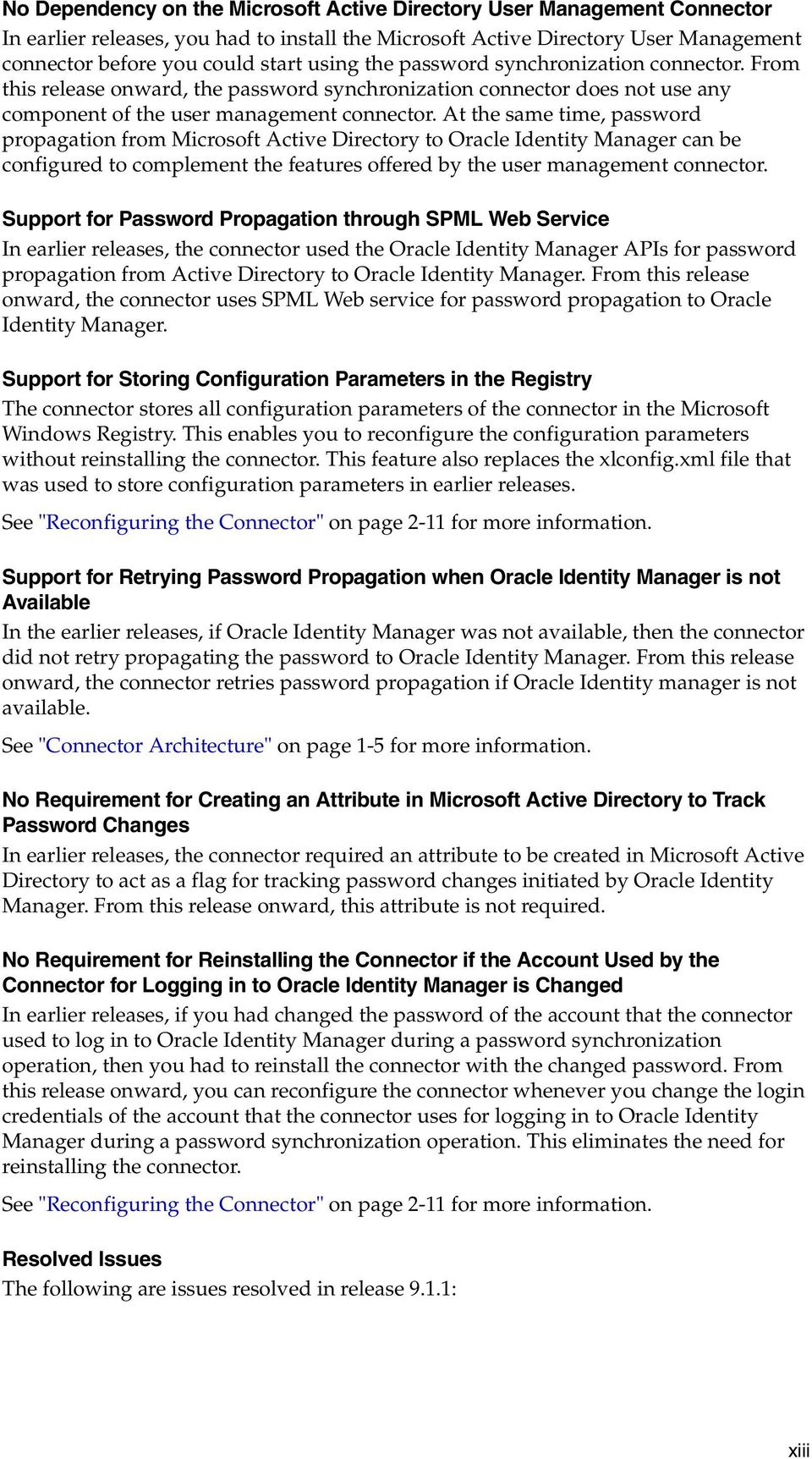
13 No Dependency on the Microsoft Active Directory User Management Connector In earlier releases, you had to install the Microsoft Active Directory User Management connector before you could start using the password synchronization connector. From this release onward, the password synchronization connector does not use any component of the user management connector. At the same time, password propagation from Microsoft Active Directory to Oracle Identity Manager can be configured to complement the features offered by the user management connector. Support for Password Propagation through SPML Web Service In earlier releases, the connector used the Oracle Identity Manager APIs for password propagation from Active Directory to Oracle Identity Manager. From this release onward, the connector uses SPML Web service for password propagation to Oracle Identity Manager. Support for Storing Configuration Parameters in the Registry The connector stores all configuration parameters of the connector in the Microsoft Windows Registry. This enables you to reconfigure the configuration parameters without reinstalling the connector. This feature also replaces the xlconfig.xml file that was used to store configuration parameters in earlier releases. See "Reconfiguring the Connector" on page 2-11 for more information. Support for Retrying Password Propagation when Oracle Identity Manager is not Available In the earlier releases, if Oracle Identity Manager was not available, then the connector did not retry propagating the password to Oracle Identity Manager. From this release onward, the connector retries password propagation if Oracle Identity manager is not available. See "Connector Architecture" on page 1-5 for more information. No Requirement for Creating an Attribute in Microsoft Active Directory to Track Password Changes In earlier releases, the connector required an attribute to be created in Microsoft Active Directory to act as a flag for tracking password changes initiated by Oracle Identity Manager. From this release onward, this attribute is not required. No Requirement for Reinstalling the Connector if the Account Used by the Connector for Logging in to Oracle Identity Manager is Changed In earlier releases, if you had changed the password of the account that the connector used to log in to Oracle Identity Manager during a password synchronization operation, then you had to reinstall the connector with the changed password. From this release onward, you can reconfigure the connector whenever you change the login credentials of the account that the connector uses for logging in to Oracle Identity Manager during a password synchronization operation. This eliminates the need for reinstalling the connector. See "Reconfiguring the Connector" on page 2-11 for more information. Resolved Issues The following are issues resolved in release 9.1.1: xiii
14 Bug Number Issue Resolution IT resource name in the adsynch.log file was not localized and After you installed the connector, logging was automatically enabled. You could not disable it. In addition, you could not specify or change or the log level. This issue does not apply for this release of the connector. In this release, the IT resource name is not recorded in the log file. This issue has now been resolved. You can now enable and disable logging for the password synchronization connector. See "Enabling and Disabling Logging" on page 2-15 for more information. Additions to the List of Known Issues In the "Known Issues" on page 5-1 chapter, the following items has been added: Bug Information about events that occur during connector installation are recorded in the oimpwdsync.log file, which is located in the %TEMP% directory. The oimpwdsync.log file is not deleted when you reinstall or reconfigure the password synchronization connector. Software Updates in Release The following is a software update in release : Single Installer for Both 32-Bit and 64-Bit Microsoft Windows Single Installer for Both 32-Bit and 64-Bit Microsoft Windows A single installer has been developed for Microsoft Active Directory running on 32-bit and 64-bit Microsoft Windows. Corresponding changes have been made in this release of the guide. Software Updates in Release The following are software updates in release 9.1.0: Support for 32-Bit and 64-Bit Microsoft Windows Oracle Identity Manager Flag Field for Tracking Password Changes Is Automatically Created Support for Signature-Based Authentication Support for 32-Bit and 64-Bit Microsoft Windows The password synchronization connector has separate installers for Microsoft Active Directory running on 32-bit and 64-bit Microsoft Windows. Oracle Identity Manager Flag Field for Tracking Password Changes Is Automatically Created An Oracle Identity Manager flag field is used to track password changes propagated by the connector. In earlier releases, you had to manually create this field in Oracle Identity Manager. From this release onward, the field is automatically created in Oracle Identity Manager when you install the Microsoft Active Directory User Management connector. xiv

15 Support for Signature-Based Authentication The password synchronization connector supports signature-based authentication. This is an alternative to password-based authentication for connecting to Oracle Identity Manager during password synchronization operations. Information specific to signature-based authentication has been provided at various places in this guide. Documentation-Specific Updates The following sections discuss documentation-specific updates: Documentation-Specific Updates in Release Documentation-Specific Updates in Release Documentation-Specific Updates in Release Documentation-Specific Updates in Release The following are documentation-specific updates in revision "15" of this guide: An issue related to InstallShield has been added to Table 4 1, " Troubleshooting the Connector". Section 2.1.3, "Determining the Release Number of the Connector" has been added. The reference information in Appendix A, "Special Characters Supported for Passwords" has been modified. The "Other software" row of Table 1 2, " Certified Components" has been updated. The "Oracle Identity Manager" row of Table 1 2, " Certified Components" has been updated. A "Note" regarding special characters that are not supported has been added to Appendix A, "Special Characters Supported for Passwords." The following are documentation-specific updates in revision "14" of this guide: The "Target systems and target system host platforms" row has been renamed to "Target systems" in Table 1 2, " Certified Components". The "Target systems" and "Other software" rows of Table 1 2, " Certified Components" have been updated. The following are documentation-specific updates in earlier revisions of this guide: In Section 2.2.1, "Installing the Connector," step number 12 has been updated for time interval after which password synchronization happens with OIM (in Seconds). A "Note" has been added to Section 2.3.2, "Configuring the IT Resource for the Target System" and Section , "Specifying a Value for the Allow Password Provisioning Parameter." Information has been added to step 15 in Section 2.2.1, "Installing the Connector." Information has been added to step 7 in Section , "Configuring Custom Identity Keystore in Oracle WebLogic Server." Information has been added to the "Description" column in the "OIM User Attribute" row, in Table 2 2, " Oracle Identity Manager Configuration Parameters". xv

16 In Section , "Signing the Certificate," information about importing the self-signed certificate as a trusted entry in the Java standard store has been added. Chapter 4, "Troubleshooting the Connector" has been added. Instructions specific to Oracle Identity Manger release x have been added throughout the guide, wherever applicable. The "Verifying Deployment Requirements" section has been removed. However, the contents of that section have been moved to Section 1.2, "Certified Components." The "Target systems and target system host platforms" row of Table 1 2, " Certified Components" has been modified. Documentation-Specific Updates in Release The following are documentation-specific updates in release : Section 2.1.1, "Verifying Deployment Requirements" has been updated. An attribute has been added in Table 2 1, " Microsoft Active Directory Configuration Parameters". Appendix B, "PrepAD.ldif" has been added to provide information about the PrepAD.ldif file. Documentation-Specific Updates in Release The following are documentation-specific updates in release : In the Deploying the Connector chapter, the "Determining the Release Number of the Connector" section has been removed. In the Known Issues chapter: Bug has been removed as the bug had been resolved in release of the connector. Known issue has been added. In the "Verifying Deployment Requirements" section, changes have been made in the "Target systems and target system host platforms" row. xvi

17 1 1About the Connector Oracle Identity Manager automates access rights management, security, and provisioning of IT resources. Oracle Identity Manager connectors are used to integrate Oracle Identity Manager with external, identity-aware applications. Oracle Identity Manager Connector for Microsoft Active Directory Password Synchronization captures passwords changed on the target system and propagates them to Oracle Identity Manager. This guide discusses the password synchronization connector. Note: In this guide: Oracle Identity Manager Connector for Microsoft Active Directory Password Synchronization is also referred to as the connector or password synchronization connector. The Microsoft Active Directory User Management connector is also referred to as the user management connector. Microsoft Active Directory is also referred to as the target system. This chapter contains the following sections: Connectors for Microsoft Active Directory Certified Components Guidelines on Using the Connector Connector Architecture Roadmap for Deploying and Using the Connector 1.1 Connectors for Microsoft Active Directory Oracle Identity Manager provides the following connectors for integration with Microsoft Active Directory: The user management connector can be configured to run in either the identity reconciliation (trusted source) mode or the account management (target resource) mode. In the identity reconciliation mode, Microsoft Active Directory is used as the trusted source and users are directly created and modified on it. During reconciliation from the trusted source, the user management connector fetches About the Connector 1-1
18 Connectors for Microsoft Active Directory data about these target system users into Oracle Identity Manager. This data is used to create or update the corresponding OIM Users. In the account management mode, Microsoft Active Directory is used as a target resource. During reconciliation from the target resource, the user management connector fetches into Oracle Identity Manager data about users created or modified directly on the target system. This data is used to add or modify resources allocated to OIM Users. In addition, the connector enables provisioning operations through which user data changes are propagated from Oracle Identity Manager to Microsoft Active Directory. The password synchronization connector propagates password changes from Microsoft Active Directory to Oracle Identity Manager. Depending on your business requirements, you can deploy one or both of these connectors to integrate Oracle Identity Manager with Microsoft Active Directory. Table 1 1 describes the functionality of the user management and password synchronization connectors. See Also: Oracle Identity Manager Connector Guide for Microsoft Active Directory User Management 1-2 Oracle Identity Manager Connector Guide for Microsoft Active Directory Password Synchronization

19 Certified Components Table 1 1 Event Trusted source reconciliation from Active Directory Target resource reconciliation from Active Directory OIM User's password changed Password changed on Active Directory Functionality of the User Management and Password Synchronization Connectors 1.2 Certified Components Action Performed by the Connector Only user management connector installed: User data from Active Directory is matched with OIM Users Only password synchronization connector installed: NA Both user management and password synchronization connectors installed: The user management connector propagates user data changes (except for password changes) from Active Directory to the corresponding OIM Users. The password synchronization connector propagates password changes from Active Directory to the corresponding OIM Users. Only user management connector installed: User data from Active Directory is matched with the Active Directory resource assigned to OIM Users Only password synchronization connector installed: NA Both user management and password synchronization connectors installed: The user management connector propagates user data changes (except for password changes) from Active Directory to the Active Directory resource assigned to OIM Users. The password synchronization connector propagates password changes from Active Directory to the corresponding OIM Users. Only user management connector installed and configured for the target resource mode: Depending upon the value of the Allow Password Provisioning IT resource parameter, the user management connector propagates to Active Directory and other resources allocated to the OIM User, password changes made to OIM Users. The Allow Password Provisioning parameter is an IT resource parameter for the user management connector. If you set this parameter to yes, then Oracle Identity Manager propagates the password change to all of the resources allocated (provisioned) to the OIM User. If you set this parameter to no, then Oracle Identity Manager does not propagate the password change to all of the resources allocated (provisioned) to the OIM User. Note: This applies only if pre-populate adapters have been configured to propagate passwords from OIM Users to the resources. Note: This does not apply to release x of the connector. Only password synchronization connector installed: NA Both user management (configured for target resource mode) and password synchronization connectors installed: Same as what happens when the user management connector is installed and configured for the target resource mode. The password synchronization connector is not used here as this is a provisioning operation. Only user management connector installed: Passwords changed on Active directory are not propagated to Oracle Identity Manager Only password synchronization connector installed: Passwords changed on Active directory are propagated to Oracle Identity Manager Both user management and password synchronization connectors installed: Passwords changed on Active directory are propagated to Oracle Identity Manager Table 1 2 lists the certified components for this connector. About the Connector 1-3

20 Guidelines on Using the Connector Table 1 2 Item Oracle Identity Manager Certified Components Requirement You can use one of the following releases of Oracle Identity Manager: Oracle Identity Manager release and any later BP in this release track Note: In this guide, Oracle Identity Manager release x has been used to denote Oracle Identity Manager release and future releases in the x series that the connector supports. Oracle Identity Manager 11g release 1 ( ) and any later BP in this release track Note: In this guide, Oracle Identity Manager release has been used to denote Oracle Identity Manager 11g Release 1 (11.1.1). Oracle Identity Manager 11g release 1 PS1 ( ) and any later BP in this release track Oracle Identity Manager 11g release 1 PS2 ( ) and any later BP in this release track Oracle Identity Manager 11g release 2 BP02 ( ) and any later BP in this release track Note: In this guide, Oracle Identity Manager release x has been used to denote all releases in the Release 2 track listed here, and future releases in the x series that the connector supports. Oracle Identity Manager 11g release 2 PS1 ( ) and any later BP in this release track Oracle Identity Manager 11g release 2 PS2 ( ) and any later BP in this release track Oracle Identity Manager 11g Release 2 PS3 ( ) Target systems Other software Other consideration The target system can be any one of the following: Microsoft Active Directory 2003 (x86 or x64) Microsoft Active Directory 2008 (x86 or x64) Microsoft Active Directory 2012 (x64) The following is the software that the computer hosting the Microsoft Active Directory domain controller on which you want to install the connector must be able to access: For Oracle Identity Manager release x: SPML Web Service For Oracle Identity Manager release or x: SPML-DSML Service To avoid issues related to Active Directory failing, apply Microsoft Active Directory Password Synchronization connector patch (in other words, a cumulative one-off patch release ) by downloading it from My Oracle Support: The target system host computer must be able to ping the application server host using both IP address and host name. 1.3 Guidelines on Using the Connector The following are the guidelines on using the connector: If Microsoft Active Directory is the only authoritative source for passwords in your operating environment, then it is recommended not to propagate passwords from Oracle Identity Manager to Microsoft Active Directory. 1-4 Oracle Identity Manager Connector Guide for Microsoft Active Directory Password Synchronization

21 Connector Architecture If Oracle Identity Manager is the only authoritative source for passwords in your operating environment, then do not install the password synchronization connector. If both Oracle Identity Manager and Microsoft Active Directory can function as authoritative sources for passwords in your operating environment, then the password policies set on Oracle Identity Manager and Microsoft Active Directory must be consistent. 1.4 Connector Architecture The architecture of the connector is the blueprint for the functionality of the connector. Figure 1 1 shows the architecture of the password synchronization connector. Figure 1 1 Architecture of the Password Synchronization Connector Microsoft Active Directory Host Computer Oracle Identity Manager oimadpwdsync10.dll Microsoft Active Directory LSA Component Password In-Memory Queue Persistent Queue Password Update Thread SPML Request to Identify the OIM User SPML Request for Password Change SPML Request 2 Rejected SPML Request 1 Rejected SPML Web Service Change Password OIM User This section discusses the following topics: Password Synchronization Process Password Synchronization Connector in a Multi-Domain Controller Environment Password Synchronization Process Figure 1 2 shows the sequence of events that occur when the password is propagated from the target system to Oracle Identity Manager. About the Connector 1-5
22 Connector Architecture Figure 1 2 Sequence of Events That Occur During Password Synchronization Password Change Detected Password Change Record Submitted to In-Memory Queue Password Change Record Picked Up by the Password Update Thread Yes Maximum Retries Performed? No Executed SOAP Request to OIM SPML Gateway Logged Error Message Retry Saved Password in the Persistent Queue Fail Password Updated in OIM? Success Complete The following is the sequence of events that take place during password synchronization: 1. A user changes the user's password on Microsoft Active Directory. The user can change the password in one of the following ways: Using Microsoft Management Console Pressing Ctrl+Alt+Del and then using the Change Password option on one of the client computers for the Microsoft Active Directory server Using a third-party application or custom utility for changing passwords on Microsoft Active Directory The password change is successful on Microsoft Active Directory only when the password clears all the password checks on Microsoft Active Directory. 2. The local security authority (LSA) component of Microsoft Windows intercepts the password change on Microsoft Active Directory and passes the password (in plain-text format) and required user information to the password filter (oimadpwdsync10.dll file). The oimadpwdsync10.dll file is one of the files copied to the target system when you install the password synchronization connector. 3. The password filter encrypts the password and user information in a password change record and stores this record in the password change record queue. This queue consists of password change records corresponding to each password change on Microsoft Active Directory. The password change record queue is held in memory, and it is also known as the in-memory queue. 4. The password update thread is created when the password filter is initialized. This thread performs the following tasks: a. Picks up a password change record from the in-memory queue or persistent queue. 1-6 Oracle Identity Manager Connector Guide for Microsoft Active Directory Password Synchronization
23 Connector Architecture Note: The persistent queue is explained later in this section. b. Decrypts the password change record. c. Creates and sends an SPML request to Oracle Identity Manager in the form of a SOAP packet. This SPML request contains the samaccountname of the target system user whose password must be updated on Oracle Identity Manager. On Oracle Identity Manager, the samaccountname value is compared with the OIM User attribute that you specify while installing the connector. See Also: The "SPML Web Service" chapter in Oracle Identity Manager Tools Reference for detailed information about the SPML Web Service The following sections discuss the processes associated with each event that may occur when the SPML request is sent: Note: The update of a password on the target system does not depend on acceptance of the password by Oracle Identity Manager or the availability of Oracle Identity Manager. First SPML Request Rejected First SPML Request Accepted Oracle Identity Manager Is Not Available First SPML Request Rejected Oracle Identity Manager rejects the first SPML request if the corresponding OIM User matching the samaccountname of the target system user does not exist. If this event occurs, then the following error message is written to the Application log in the Microsoft Windows Event Log: Unable to update samaccountname, the user does not exist in OIM In addition, the following error message is written to the TIME_STAMPOIMMain.log file: The user does not exist in OIM See "Enabling and Disabling Logging" on page 2-15 for information about the connector log files First SPML Request Accepted Oracle Identity Manager accepts the first SPML request if an OIM User matching the samaccountname of the target system user is found. After the OIM User is found: 1. The SPML Web service sends a success response to the password update thread. 2. The password update thread sends a second SPML request to the SPML Web service in Oracle Identity Manager. This request contains the password of the OIM User. About the Connector 1-7
24 Connector Architecture The following sections discuss processes associated with each event that may occur when the second SPML request is sent: Second SPML Request Rejected Second SPML Request Accepted Oracle Identity Manager Is Not Available Second SPML Request Rejected Oracle Identity Manager rejects the second SPML request for one of the following reasons: The password does not meet password policies set on Oracle Identity Manager Note: Password policies set on the target system may not be consistent with password policies set on Oracle Identity Manager. The password contains special characters that are not supported by Oracle Identity Manager. The user ID of an OIM User contains characters in the non-native encoding of the Microsoft Active Directory system. If Oracle Identity Manager rejects the second SPML request, then: 1. In both scenario, the following error message is written to the Application log in the Microsoft Windows Event Log: Unable to update USER_NAME_OF_THE_OIM_USER. The OIM server rejected the setpasswordrequest. Please check the OIM server log for more details. This error message is also recorded in the TIME_STAMPOIMMain.log file. In addition, the exception stack trace is recorded in the debug log file of Oracle Identity Manager. The stack trace provides details about the reason for the password change rejection. See "Enabling and Disabling Logging" on page 2-15 for information about the connector log files. 2. The SPML Web Service sends an SPML response indicating that the password update operation has failed. 3. The password change record (contains the password along with the user information in encrypted format) is stored in the persistent queue. This queue is located in the ou=oimpwdsyncdomain_name,base_dn container of Microsoft Active Directory. 4. The password update thread increments the retry count for the password change record by one and resends SPML requests to Oracle Identity Manager. Note: A value for the retry count is specified during connector installation. 5. If Oracle Identity Manager accepts the password change, then the password change record is removed from the persistent queue. The rest of the steps mentioned in this section are not performed. 6. If Oracle Identity Manager rejects the password change, then the password update thread keeps resending SPML requests until the retry count reaches the maximum number of retries. 1-8 Oracle Identity Manager Connector Guide for Microsoft Active Directory Password Synchronization
25 Connector Architecture If Oracle Identity Manager becomes unavailable after it rejects the password and before the maximum number of retries for a rejected password is reached, then: The password along with user information is stored in the persistent queue in encrypted format. The password update thread attempts to update the password of the corresponding OIM User without incrementing the retry count. When Oracle Identity Manager becomes available, this retry attempt continues and the retry count resumes incrementing from this point onward. 7. When the retry count reaches the maximum number of retries: The password change record is deleted from the persistent queue. The following error message is written to the Application log in the Microsoft Windows Event Log: Unable to update USER_NAME_OF_THE_OIM_USER. The OIM server rejected the setpasswordrequest. Please check the OIM server log for more details. This error message is also recorded in the TIME_STAMPOIMMain.log file. In addition, the exception stack trace is recorded in the debug log file of Oracle Identity Manager. The stack trace provides details about the reason for the password change rejection. See "Enabling and Disabling Logging" on page 2-15 for information about the connector log file. Second SPML Request Accepted If Oracle Identity Manager accepts the second SPML request (containing the password change), then the password of the OIM User is updated successfully. The process ends here. Oracle Identity Manager Is Not Available See "Oracle Identity Manager Is Not Available" on page 1-9 for information about events that occur if Oracle Identity Manager is not available after the response to the first SPML request is received and before the second SPML request is sent Oracle Identity Manager Is Not Available If Oracle Identity Manager is not available at the start of the password synchronization operation, then: 1. The following error message is written to the Application log in the Microsoft Windows Event Log: Unable to update samaccountname. The OIM SPML Web Service is unreachable. Please verify the availability of the web service or the configuration parameters. This error message is also recorded in the TIME_STAMPOIMMain.log file. 2. The password along with the user information is encrypted and stored in the persistent queue. 3. The password update thread picks up the password change record from the persistent queue and resends SPML requests to Oracle Identity Manager (without incrementing the retry count). 4. As long as Oracle Identity Manager is not available, Steps 2 and 3 are repeated until the first SPML request is sent to Oracle Identity Manager. About the Connector 1-9
26 Roadmap for Deploying and Using the Connector 5. When Oracle Identity Manager becomes available, the first SPML request is sent. The next set of steps depends on which of the following events takes place: First SPML Request Rejected First SPML Request Accepted Password Synchronization Connector in a Multi-Domain Controller Environment In a multi-domain controller environment, if one of the domain controllers is unavailable and if a Password Change request is sent to it, then the Password Change request is re-routed to a domain controller that is available. The domain controller that is available then sends the password to the OIM User. Note: The Password Change request that is stored in the memory queue of a domain controller is lost if that domain controller crashes. If this happens, then the Password Change request cannot be retrieved. The following example illustrates how the connector works in a multi-domain controller environment: Suppose the operating environment consists of two domain controllers, DC1 and DC2. If DC1 becomes unavailable and a user for example, John Doe, changes his password on the target system, then the connector on DC2 propagates the new password to the corresponding OIM User. 1.5 Roadmap for Deploying and Using the Connector The following is the organization of information in the rest of this guide: Chapter 2, "Deploying the Connector" describes procedures that you must perform on Oracle Identity Manager and the target system during each stage of connector deployment. Chapter 3, "Removing the Connector" describes the procedure to uninstall the connector. Chapter 5, "Known Issues" lists known issues associated with this release of the connector. Appendix A, "Special Characters Supported for Passwords" provides information about special characters that you can use in the Password field on the target system and Oracle Identity Manager. Appendix B, "PrepAD.ldif" provides information about the PrepAD.ldif file Oracle Identity Manager Connector Guide for Microsoft Active Directory Password Synchronization
27 2 2Deploying the Connector 2.1 Preinstallation The procedure to deploy the connector can be divided into the following stages: Preinstallation Installation Postinstallation Preinstallation for the connector involves performing the procedures described in the following sections: Deploying the SPML-DSML Service Testing the SPML Web Service and SPML-DSML Service Determining the Release Number of the Connector Deploying the SPML-DSML Service Note: Perform the procedure described in this section only if you are using Oracle Identity Manager release or x. If you are using Oracle Identity Manager release x, then skip this section and deploy the SPML Web Service. See Oracle Identity Manager Tools Reference for detailed information. Before you deploy the connector, deploy the SPML-DSML Service on the Oracle WebLogic Application Server on which Oracle Identity Manager is running: 1. Log in to the Oracle WebLogic Server Administration Console. 2. In the Change Center region, click Lock & Edit to enable modification to the settings on the page. 3. In the Domain Structure region, click Deployments. 4. On the right pane, click Install. 5. On the Locate deployment to install and prepare for deployment page, in the Path field, enter OIM_HOME\server\apps. For example, D:\my_install\middleware\Oracle_IDM1\server\apps. 6. In the region following the Current Location field, select spml-dsml.ear and then click Next. Deploying the Connector 2-1
28 Preinstallation 7. On the Choose targeting style page, click Next to accept the default selection and proceed with installation. 8. On the Select deployment targets page, in the Available targets for spml-dsml region, select oim_server1 if Oracle Identity Manager is installed in a nonclustered environment. Otherwise, select oim_cluster. 9. Click Next. 10. On the Optional Settings page, in the Source accessibility region, select I will make the deployment accessible from the following location, and then click Next. 11. On the Review your choices and click Finish page, verify the data that you have provided, and then click Finish. 12. On the Settings for spml-dsml page, review the configuration information of the deployed SPML-DSML Service, and then click Save. 13. In the Change Center region, click Activate Changes for the changes to take effect. 14. On the left pane, in the Domain Structure region, click Deployments. 15. On the right pane, in the Deployments table, select spml-dsml, and then from the Start list, select Servicing all requests. The SPML-DSML Service is started Testing the SPML Web Service and SPML-DSML Service Note: You can use the information in this section to test the SPML Web Service on Oracle Identity Manager release x, or the SPML-DSML Service on Oracle Identity Manager release or x. To test whether the SPML Web service is deployed successfully on Oracle Identity Manager, navigate to the following URL: For IBM WebSphere Application Server: ADDRESS:PORT NUMBER/spmlws/HttpSoap11 ADDRESS:SSL PORT NUMBER/spmlws/HttpSoap11 For JBoss Application Server: ADDRESS:PORT NUMBER/spmlws/services/HttpSoap11 ADDRESS:SSL PORT NUMBER/spmlws/services/HttpSoap11 For Oracle Application Server: ADDRESS:PORT NUMBER/spmlws/HttpSoap11 ADDRESS:SSL PORT NUMBER/spmlws/HttpSoap11 For Oracle WebLogic Server: ADDRESS:NON-SSL PORT NUMBER/spmlws/OIMProvisioning ADDRESS:SSL PORT NUMBER/spmlws/OIMProvisioning 2-2 Oracle Identity Manager Connector Guide for Microsoft Active Directory Password Synchronization
29 Installation Determining the Release Number of the Connector Note: Perform the procedure described in this section only if you are using Oracle Identity Manager Microsoft Active Directory Password Synchronization Connector release (patch ) or later. The following procedure is not applicable to prior releases of the connector. 2.2 Installation You might have a deployment of an earlier release of the connector. While deploying the latest release, you might want to know the release number of the earlier release. To determine the release number of the connector that has already been deployed, perform the following procedure: 1. Open the Windows System Registry (regedit.exe). 2. Navigate to the registry key at the following location: HKEY_LOCAL_MACHINE\SYSTEM\CurrentControlSet\Control\Lsa\oimpwds ync\install 3. In the registry key, the release number of the connector is displayed in the string data as the value of the InstallID property. Sample value: This section discusses the following topics: Installing the Connector Installing the Connector Reconfiguring the Connector To install the connector: 1. On the Microsoft Active Directory host computer, run the installer as follows: a. Copy the contents of the installation media to a temporary directory. b. In the temporary directory, run the setup.exe file to start the installer. 2. On the Welcome page, click Next. 3. On the next page, click Next. 4. On the Installation Directory page, you can either accept the default installation directory or use the Browse button to specify the directory in which you to want install the connector. Figure 2 1 shows the Installation Directory page. Deploying the Connector 2-3
30 Installation Figure 2 1 Installation Directory Page (Installation) 5. Click Next. If the installation directory that you specify (in the preceding step) exists, then the installer confirms if you want to overwrite the directory. Otherwise, the installer creates the installation directory. 6. On the Active Directory Configuration Parameters page, which displays the configuration parameters for Microsoft Active Directory, verify the values displayed in all fields. If the values displayed on this page do not match the values for your current installation of Microsoft Active Directory, then change these values accordingly. Otherwise, you can proceed to the next step. Figure 2 2 shows the Active Directory Configuration Parameters page on which sample values have been specified. 2-4 Oracle Identity Manager Connector Guide for Microsoft Active Directory Password Synchronization
31 Installation Figure 2 2 Active Directory Configuration Parameters Page (Installation) Table 2 1 Parameter Domain BaseDN Port Host Persistent Store Table 2 1 describes each configuration parameter of Microsoft Active Directory. Microsoft Active Directory Configuration Parameters Description Enter the domain name for the Microsoft Active Directory domain controller on which the connector is being installed. This value is typically the DNS domain name. Sample value: example.com Enter the base DN of Microsoft Active Directory. This is the container where the connector searches for entries with changed passwords. The persistent queue, which is an organizationunit, will be created within this container. Therefore, the base DN that you specify must be capable of holding organizationalunit objects. Sample value: DC=example,DC=com Enter the port number at which LDAP for Microsoft Active Directory host computer is enabled. Default value: 389 Enter the IP address (not the host name) of the Microsoft Active Directory host computer. Sample value: Enter the Distinguished Name of the Organizational Unit where the Persistent Store Container has to be created. Sample value: ou=org 7. Click Next. Deploying the Connector 2-5
32 Installation 8. On the second Active Directory Configuration Parameters page, enter values for the following fields: User: Enter the user name of an account that belongs to the Administrators group. You can use any one of the following formats to enter the user name: cn=user_login,cn=users,dc=domain,dc=com Sample values: cn=admin,cn=users,dc=example,dc=com User Password: Enter the password of the account that you entered in the User field. Log File Path: Enter the path to the directory where the log files must be generated. Default value: INSTALLATION_DIRECTORY\Logs INSTALLATION_DIRECTORY is the directory that you specify in Step 4. See "Enabling and Disabling Logging" on page 2-15 for information about logging. Figure 2 3 shows the Microsoft Active Directory Information page on which sample values have been specified. Figure 2 3 Second Active Directory Configuration Parameters Page (Installation) 9. Click Next to proceed with installation. 10. On the Oracle Identity Manager Configuration Parameters page, specify values for the configuration parameters of Oracle Identity Manager. Figure 2 4 displays the Oracle Identity Manager Configuration Parameters page on which sample values have been specified. 2-6 Oracle Identity Manager Connector Guide for Microsoft Active Directory Password Synchronization
33 Installation Figure 2 4 Oracle Identity Manager Configuration Parameters Page (Installation) Table 2 2 Parameter Host Port Administrator Login Administrator Password Table 2 2 describes each configuration parameter of Oracle Identity Manager. Oracle Identity Manager Configuration Parameters Description Enter the host name (not the IP address) of the computer hosting Oracle Identity Manager. Note: The host name must be accessible from the Microsoft Active Directory host computer. Sample value: oimhost Enter the number of the port at which the Oracle Identity Manager SPML Web service is listening. Sample value: 8080 Enter the user name of the account that will be used by the connector to login to Oracle Identity Manager during a password synchronization operation. This account must have the permissions required to change the password of OIM Users. Enter the password of the account that will be used by the connector to login to Oracle Identity Manager during a password synchronization operation. Deploying the Connector 2-7
34 Installation Table 2 2 Parameter OIM User Attribute OIM Application Server Type Use SSL Client Certificate Subject Name (Cont.) Oracle Identity Manager Configuration Parameters Description Enter the Metadata Column Code of the column in the USR table that you want to use to match OIM Users with users in the target system. Note that the corresponding column in the USR table on the Oracle Identity Manager Database must be unique. During password synchronization, the samaccountname value of the user whose password is changed is compared against values in this column. Sample value (for predefined OIMUser fields): Users.User ID For user-defined OIMUser fields, you can use the USR_UDF_FIELD_NAME format. Sample Value: USR_UDF_USERNAME See the "Metadata Column Codes" appendix in Oracle Identity Manager API Usage Guide for information about the mapping between the physical column names and metadata column codes. Select the name of the application server that hosts Oracle Identity Manager. Sample value: JBoss Select Yes, if you are going to configure SSL communication between Microsoft Active Directory and Oracle Identity Manager. Otherwise, select No. Default value: Yes Note: It is recommended that you configure SSL to secure the transfer of SOAP messages from the target system to Oracle Identity Manager. See "Configuring SSL" on page 2-19 for information about enabling SSL. Enter a value for this parameter only if Use SSL parameter has been set to Yes and client authentication is required by the application server. Enter a string that identifies the client certificate that must be used for SSL. Sample value: TQL17 Here, TQL17 is the Issued To value in the certificate. 11. Click Next. 12. On the Configuration Parameter Information page, enter values for the following fields: Time interval after which password synchronization happens with OIM (in Seconds): Enter an integer value in this field. This value represents the number of seconds the connector sleeps between processing password change events. The connector goes into the sleep mode after processing all the change events from the in-memory and persistent queues. Default value: 1 No. of maximum retries to synchronize passwords from AD to OIM: Enter an integer value. This value represents the number of times the connector tries to propagate the password before removing the password change record from the persistent queue. Default value: 5 Figure 2 5 is a screenshot of the Connector Configuration Parameters page on which sample values have been specified. 2-8 Oracle Identity Manager Connector Guide for Microsoft Active Directory Password Synchronization
35 Installation Figure 2 5 Configuration Parameters Page (Installation) 13. Click Next. 14. On the Summary Page, verify that the installation directory for the connector is displayed correctly and then click Next to install the connector. Note: If you are installing the connector on a 64-bit Microsoft Windows operating system, then before you proceed to the next step, copy the oimadpwdsync10.dll and orclmessages.dll files from the Windows\SysWOW64 directory to the WINDOWS\system32 directory. If you want to change the installation directory, then click Back until you reach the Installation Directory page, make the required changes, and then proceed through the installation sequence again. Figure 2 6 shows the Summary page. Deploying the Connector 2-9
36 Installation Figure 2 6 Summary Page (Installation) 15. On the next page, click Next to restart your computer. Figure 2 7 Restart Page (Installation) Clicking Next will force a restart. The restart is required to initialize the oimadpwdsync10.dll file. If the oimadpwdsync10.dll file is not initialized, then the connector is not ready for propagating passwords changes from target system to Oracle Identity Manager. Ensuring that the Connector is Ready for Propagating Passwords In order to ensure that the connector is ready for propagating password changes from target system to Oracle Identity Manager, you must check if the oimadpwdsync10.dll file has been initialized. To verify whether the oimadpwdsync10.dll file is initialized: 2-10 Oracle Identity Manager Connector Guide for Microsoft Active Directory Password Synchronization
37 Installation 1. Enable logging for the TIME_STAMPOIMMain.log file by performing the procedure described in "Enabling and Disabling Logging" on page Check if the TIME_STAMPOIMMain.log file is generated in the path specified in the Log File Path field while performing Step 8 of "Installing the Connector" on page 2-3. If the TIME_STAMPOIMMain.log file is generated, then the oimadpwdsync10.dll file is initialized. Otherwise, you must reinstall the connector Reconfiguring the Connector During connector installation, you specify a set of values for the configuration parameters of Microsoft Active Directory, Oracle Identity Manager, and the connector. After connector installation, if you want to change the values for any of the configuration parameters, then you must perform the procedure described in this section. To reconfigure the connector: 1. On the Microsoft Active Directory host computer, run the setup.exe file located in the temp directory. 2. On the Welcome page, click Next. 3. On the Active Directory Configuration Parameters page, if required, modify values for any or all of the following parameters: Domain BaseDN Port Host Figure 2 8 shows the Active Directory Configuration Parameters page on which sample values have been specified. Deploying the Connector 2-11
38 Installation Figure 2 8 Active Directory Configuration Parameters (Reconfiguration) 4. Click Next. 5. On the Oracle Identity Manager Configuration Parameters page, if required, modify values for any or all of the following parameters: Host Port OIM User Attribute OIM Application Server Type Use SSL Client Configuration Subject Name Figure 2 9 displays the Oracle Identity Manager Configuration Parameters page on which sample values have been specified Oracle Identity Manager Connector Guide for Microsoft Active Directory Password Synchronization
39 Installation Figure 2 9 Oracle Identity Manager Configuration Parameters Page (Reconfiguration) 6. Click Next. 7. On the Configuration Parameter Information page, if required, modify values for any or all of the following fields: Time interval after which password synchronization happens with OIM (in minutes)* No. of Maximum retries to synchronize Passwords from AD to OIM* Figure 2 10 is a screenshot of the Configuration Parameters page on which sample values have been specified. Figure 2 10 Configuration Parameters Page (Reconfiguration) Deploying the Connector 2-13
40 Postinstallation 8. Click Next to continue with reconfiguring the connector. 9. On the second Active Directory Configuration Parameters page, if you want to modify the value of any field, then you must enter values for all fields displayed on that page. Otherwise, leave all the fields blank and proceed to the next step. The following fields are displayed on the Second Active Directory Configuration Parameters page: Active Directory User Active Directory User Password Oracle Identity Manager User Oracle Identity Manager User Password Figure 2 11 is a screenshot of the second Active Directory Configuration Parameters page on which sample values have been specified. Figure 2 11 Second Active Directory Configuration Parameters Page (Reconfiguration) 2.3 Postinstallation 10. On the Second Active Directory Configuration Parameters page, click Next. 11. On the next page, click Finish to complete the procedure for reconfiguring the connector. The following steps must be performed after the connector is installed: Enabling and Disabling Logging Configuring the IT Resource for the Target System Enabling the Strong Password Authentication (Password Complexity) Feature of Microsoft Active Directory 2-14 Oracle Identity Manager Connector Guide for Microsoft Active Directory Password Synchronization
41 Postinstallation Configuring SSL Configuring SSL Enabling and Disabling Logging Log files contain information about events that occur during password synchronization. You can use the log files to determine the cause of any errors that may occur during password synchronization events. This connector provides three log files. Each log file name is prefixed with TIME_STAMP, which represents the time at which the log file was created. The following is the list of log files for this connector and their description: Note: You cannot rename the log files. In addition, you cannot specify or change the log level for log files. The default log level is DEBUG. TIME_STAMP_PasswordChange.log This file stores information about whether the connector is enabled. In the TIME_STAMP_PasswordChange.log file name, TIME_STAMP represents the time at which the log file was created in the YearMonthDayHourMinuteSecondMillisecond format. Sample value: _PasswordChange.log The TIME_STAMP_PasswordChange.log file is generated every time the oimadpwdsync10.dll file is initialized. The oimadpwdsync10.dll file is initialized when you restart the computer hosting the connector. TIME_STAMPOIMMain.log This file stores information about events that occur while the password change records stored in the in-memory queue and persistent queue are being processed. In the TIME_STAMPOIMMain.log file name, TIME_STAMP represents the time at which the log file was created in the YearMonthDay format. Sample value: OIMMain.log The TIME_STAMPOIMMain.log file is generated every time the password update thread is created. TIME_STAMP_adsi_debug.log This file stores information about the events that occur from the time the password is changed in Microsoft Active Directory till the time the password change is saved to the in-memory queue. In the TIME_STAMP_adsi_debug.log file name, TIME_STAMP represents the time at which the log file was created in the YearMonthDayHourMinuteSecondMillisecond format. Sample value: _adsi_debug.log The TIME_STAMP_adsi_debug.log file is generated every time a password change event occurs. To enable or disable logging: By default, logging is disabled for the password synchronization connector. After connector installation, if you want to enable logging, or disable logging after it has been enabled, then perform the procedure described in this section. Deploying the Connector 2-15
42 Postinstallation Note: The procedure described in this section must be performed on the target system host computer. 1. From the Start menu, click Run. 2. In the Run dialog box, type regedit. 3. In the Registry Editor window, on the left navigation pane: If you want to enable or disable logging of events to the TIME_STAMP_PasswordChange.log file, then: b. On the right pane, double-click the Log value. If you want to enable or disable logging of events to the TIME_STAMPOIMMain.log file, then: b. On the right pane, double-click the OIMLog value. If you want to enable or disable logging of events to the TIME_STAMP_adsi_debug.log file, then: a. Navigate to the following key: HKEY_LOCAL_MACHINE\SYSTEM\CurrentControlSet\Control\Lsa\oimpwdsync\ADConfig a. Navigate to the following key: HKEY_LOCAL_MACHINE\SYSTEM\CurrentControlSet\Control\Lsa\oimpwdsync\OIMConfig a. Navigate to the following key: HKEY_LOCAL_MACHINE\SYSTEM\CurrentControlSet\Control\Lsa\oimpwdsync\ADConfig b. On the right pane, double-click the Log value. 4. In the Edit String dialog box: If you want to disable logging, then in the Value data field, enter N. If you want to enable logging, then in the Value data field, enter Y. 5. Click OK. 6. If you have enabled or disabled logging of events to the TIME_STAMP_PasswordChange.log file, then restart the computer for the changes to take effect Configuring the IT Resource for the Target System Note: If you have installed a user management connector release that is earlier than release (for example, release 9.1.0), then you must set the value of the AD Sync installed parameter to no. The ADITResource IT resource is created in Oracle Identity Manager when you install the user management connector. The Allow Password Provisioning parameter is a parameter of the user management connector Oracle Identity Manager Connector Guide for Microsoft Active Directory Password Synchronization
43 Postinstallation Note: This procedure is not applicable if you are using release x of the Microsoft Active Directory User Management connector. If you want to use the target system as the trusted source for passwords, then set the Allow Password Provisioning parameter to no. When you set the value of this parameter to no, the user management connector does not propagate password changes from Oracle Identity Manager to the target system. If you set the Allow Password Provisioning parameter to yes, then: When a Microsoft Active Directory resource is provisioned to an OIM User: 1. An account is created on Microsoft Active Directory. 2. The password of the account is detected by the connector and sent to Oracle Identity Manager. 3. On Oracle Identity Manager, the password is compared with the current password of the Active Directory resource. Because both passwords are the same, no further action is taken. 4. If password history policy is set, then an exception for the SPML request (sent by the password synchronization connector) is encountered. You can ignore this exception. When the password of the Microsoft Active Directory resource is changed on Oracle Identity Manager: 1. The password is sent to Microsoft Active Directory by the user management connector. 2. The updated password is detected by the connector and sent to Oracle Identity Manager. 3. On Oracle Identity Manager, the password is compared with the current password of the Active Directory resource. Because both passwords are the same, no further action is taken. 4. If password history policy is set, then an exception for the SPML request (sent by the password synchronization connector) is encountered. You can ignore this exception. When the password is changed on Microsoft Active Directory: 1. The updated password is detected by the connector and sent to Oracle Identity Manager. 2. On Oracle Identity Manager, the password is compared with the current password of the Active Directory resource. Because both passwords are different, the password of the Microsoft Active resource on Oracle Identity Manager is updated. 3. The updated password is detected by the user management connector and sent to Microsoft Active Directory. 4. The password of the Microsoft Active Directory is modified, even though this is the same password that was set by the user. 5. The password of the account is detected by the password synchronization connector and sent to Oracle Identity Manager. Deploying the Connector 2-17
44 Postinstallation 6. On Oracle Identity Manager, the password is compared with the current password of the Active Directory resource. Because both passwords are the same, no further action is taken. 7. If password history policy is set on Oracle Identity Manager, then an exception for the SPML request (sent by the password synchronization connector) is encountered. You can ignore this exception Specifying a Value for the Allow Password Provisioning Parameter Note: Perform the procedure described in this section only if the user management connector is installed. This procedure is not applicable if you are using release x of the Microsoft Active Directory User Management connector. You can specify a value for the Allow Password Provisioning parameter as follows: 1. Depending on the Oracle Identity Manager release you are using, perform one of the following steps: For Oracle Identity Manager release x: a. Log in to the Administrative and User Console. b. Expand Resource Management, and then click Manage IT Resource. For Oracle Identity Manager release : a. Log in to the Administrative and User Console. b. On the Welcome to Oracle Identity Manager Self Service page, click Advanced in the upper-right corner of the page. c. On the Welcome to Oracle Identity Manager Advanced Administration page, in the Configuration region, click Manage IT Resource. For Oracle Identity Manager release x: a. Log in to Oracle Identity System Administration. b. In the left pane, under Configuration, click IT Resource. 2. In the IT Resource Name field on the Manage IT Resource page, enter ADITResource and then click Search. 3. Click the edit icon for the IT resource. 4. From the list at the top of the page, select Details and Parameters. 5. Depending on how you want the user management connector and password synchronization connector to function, enter a value of either yes, or no for the Allow Password Provisioning parameter. 6. If you have installed a user management connector release that is earlier than release 9.1.1, then you must set the value of the AD Sync installed parameter to no Oracle Identity Manager Connector Guide for Microsoft Active Directory Password Synchronization
45 Postinstallation Enabling the Strong Password Authentication (Password Complexity) Feature of Microsoft Active Directory Note: You must use an administrator account to perform the procedures described in this section Configuring SSL Microsoft Active Directory provides the Strong Password Authentication feature through the implementation of a password filter. To use this password filter along with the connector, follow the instructions for enabling the "Passwords must meet complexity requirements" policy setting by visiting the Microsoft Web site at After you enable this policy setting, password changes in Microsoft Active Directory are checked against the Strong Password Authentication requirements before they are passed on to the connector. Note: It is strongly recommended that you configure SSL communication between the connector and Oracle Identity Manager in your production environment. However, the configuration of secure client operation (using SSL at the server) affects all clients. This means that if you use SSL to secure Oracle Identity Manager communication with the connector, then the Oracle Identity Manager Design Console and any other custom clients must also communicate with Oracle Identity Manager using SSL. To secure the propagation of passwords from Microsoft Active Directory to Oracle Identity Manager, you must configure SSL. The procedure that you must follow depends on the application server on which Oracle Identity Manager is running: See Also: The "Configuring SSL" section of Oracle Identity Manager Connector Guide for Microsoft Active Directory User Management for information about configuring SSL to secure data transfer from Oracle Identity Manager to Microsoft Active Directory Configuring SSL on IBM WebSphere Application Server Configuring SSL on JBoss Application Server Configuring SSL on Oracle Application Server Configuring SSL on Oracle WebLogic Server Configuring SSL on IBM WebSphere Application Server The following sections provide information about enabling SSL communication when Oracle Identity Manager is running on IBM WebSphere Application Server: Exporting the Certificate Importing the Certificate Additional Configuration Steps Deploying the Connector 2-19
46 Postinstallation Exporting the Certificate Note: The procedure described in this section must be performed on the IBM WebSphere Application Server host computer. To export the IBM WebSphere Application Server certificate: 1. In a terminal window, change to the WEBSPHERE_HOME\AppServer\java\jre\bin directory. 2. Run the following command: keytool -export -alias default -file CERT_FILE_NAME -keypass DEFAULT_TRUST_STORE_PASSWORD -keystore DEFAULT_IDENTITY_STORE -storepass DEFAULT_IDENTITY_STORE_PASSWORD -storetype pkcs12 -provider com.ibm.crypto.provider.ibmjce In this command: CERT_FILE_NAME is the complete path and name of the certificate file. DEFAULT_TRUST_STORE_PASSWORD is the password of the default trust store trust.p12. DEFAULT_IDENTITY_STORE is the complete path and name of the default identity store key.p12. DEFAULT_IDENTITY_STORE_PASSWORD is the password of the default identity store key.p12. The following is a sample command: keytool -export -alias default -file C:\mycertificates\websp.cer -keypass WebAS -keystore C:\Program Files\IBM\WebSphere\AppServer\profiles\AppSrv06\etc\key.p12 -storepass WebAS -storetype pkcs12 -provider com.ibm.crypto.provider.ibmjce When you run the command, the application server certificate is generated in the WEBSPHERE_HOME\AppServer\java\jre\bin directory Importing the Certificate Note: The procedure described in this section must be performed on the Microsoft Active Directory host computer. To import the application server certificate: 1. Copy the certificate (exported in "Exporting the Certificate" on page 2-20) to any directory on the Microsoft Active Directory host computer. 2. Click Start and then click Run. 3. Enter the following command, and then click OK: mmc The Microsoft Management Console is displayed. 4. From the File menu, select Add/Remove Snap-in. 5. In the Add/Remove Snap-in dialog box, click Add Oracle Identity Manager Connector Guide for Microsoft Active Directory Password Synchronization
47 Postinstallation 6. In the Add Standalone Snap-in dialog box, select Certificates, and then click Add. 7. In the certificates snap-in dialog box, select Computer account, and then click Next. 8. In the Select Computer dialog box, accept the defaults, and then click Finish. 9. In the Add Standalone Snap-in dialog box, click Close. 10. In the Add/Remove Snap-in dialog box, click OK. 11. In the Console Root window, on the left pane, expand Certificates (Local Computer) under the Console Root folder. 12. Expand Trusted Root Certification Authorities, right-click Certificates, select All Tasks, and then click Import. The Certificate Import Wizard is displayed. 13. On the Welcome to the Certificate Import Wizard page, click Next. 14. On the File to Import page, you can either specify the path to the directory in which you copied the exported certificate, or use the Browse button to specify the directory in which you copied the exported certificate. 15. Click Next. 16. On the Certificate Store page, select Place all certificates in the following store, and click Next. 17. On the Completing the Certificate Import Wizard, click Finish. A message indicating that the import was successful is displayed. 18. Click OK to close the Certificate Import Wizard dialog box Additional Configuration Steps Note: The procedure described in this section must be performed on the IBM WebSphere Client host computer. You must extract and copy the xldataobjectbeans.jar file located in the OIM_DC_HOME\xlclient\ext directory to the WEBSPHERE_HOME\profiles\PROFILE_NAME\installedApps\NODE_NAME\OIM -xell-ws.ear\spmlws.war\web-inf\lib directory. Here: OIM_DC_HOME is the directory in which you install the Oracle Identity Manager Design Console WEBSPHERE_HOME is the home directory of WebSphere PROFILE_NAME is the name of the application server profile being used NODE_NAME is the name of the node which the application server profile uses Configuring SSL on JBoss Application Server The following sections provide information about enabling SSL communication when Oracle Identity Manager is running on JBoss application server: Generating Keys Signing the Certificate Deploying the Connector 2-21
48 Postinstallation Exporting the Certificate Note: The procedure described in the preceding sections must be performed on the JBoss Application Server host computer. Importing the Certificate Note: The procedure described in the preceding section must be performed on the Microsoft Active Directory host computer. Configuring the server.xml File Note: The procedure described in the preceding sections must be performed on the JBoss Application Server host computer Generating Keys Generate keys by using the keytool command. The following keytool command generates an identity keystore. jbossserver.jks: keytool -genkey -alias PRIVATE_KEY_ALIAS -keyalg RSA -keysize dname DN_VALUE -keypass PRIVATE_KEY_PASSWORD -keystore IDENTITY_STORE_FILE -storepass IDENTITY_STORE_FILE_PASSWORD -storetype jks In this command: PRIVATE_KEY_ALIAS is the alias that you want to use for the private key. PRIVATE_KEY_PASSWORD is the password that you want to use for the private key. DN_VALUE is the distinguished name (DN) for your organization. The common name (CN) value in the DN must be the host name of the Oracle Identity Manager server. IDENTITY_STORE_FILE is the identity store that you want to use. IDENTITY_STORE_FILE_PASSWORD is the password of the identity store that you want to use. The following is a sample command: keytool -genkey -alias serverjboss -keyalg RSA -keysize dname "CN=myhost" -keypass welcome -keystore E:\jboss-4.0.3SP1\server\jbossserver.jks -storepass welcome -storetype jks Signing the Certificate Use the following keytool command to sign the certificate that you created: keytool -selfcert -alias PRIVATE_KEY_ALIAS -sigalg MD5withRSA -validity keypass PRIVATE_KEY_PASSWORD -keystore IDENTITY_STORE_FILE -storepass IDENITTY_STORE_FILE_PASSWORD 2-22 Oracle Identity Manager Connector Guide for Microsoft Active Directory Password Synchronization
49 Postinstallation Note: It is recommended that you use trusted certificate authorities, for example, VeriSign or Thawte, for signing certificates. The following is a sample command: keytool -selfcert -alias serverjboss -sigalg MD5withRSA -validity keypass welcome -keystore E:\jboss-4.0.3SP1\server\jbossserver.jks -storepass welcome Exporting the Certificate Use the following keytool command to export the certificate from the identity keystore to a file: keytool -export -alias PRIVATE_KEY_ALIAS -file CERT_FILE_NAME -keypass PRIVATE_KEY_PASSWORD -keystore IDENITTY_STORE_FILE -storepass IDENTITY_STORE_FILE_PASSWORD -storetype jks -provider sun.security.provider.sun In this command, replace CERT_FILE_NAME with the name that you want to use for the certificate file. The following is a sample command: keytool -export -alias serverjboss -file E:\jboss-4.0.3SP1\server\jbossserver.cert -keypass welcome -keystore E:\jboss-4.0.3SP1\server\jbossserver.jks -storepass welcome -storetype jks -provider sun.security.provider.sun Importing the Certificate To import the application server certificate: 1. Copy the certificate (exported in "Exporting the Certificate" on page 2-23) to any directory on the Microsoft Active Directory host computer. 2. Click Start and then click Run. 3. Enter the following command, and then click OK: mmc The Microsoft Management Console is displayed. 4. From the File menu, select Add/Remove Snap-in. 5. In the Add/Remove Snap-in dialog box, click Add. 6. In the Add Standalone Snap-in dialog box, select Certificates, and then click Add. 7. In the certificates snap-in dialog box, select Computer account, and then click Next. 8. In the Select Computer dialog box, accept the defaults, and then click Finish. 9. In the Add Standalone Snap-in dialog box, click Close. 10. In the Add/Remove Snap-in dialog box, click OK. 11. In the Console Root window, on the left pane, expand Certificates (Local Computer) under the Console Root folder. 12. Expand Trusted Root Certification Authorities, right-click Certificates, select All Tasks, and then click Import. The Certificate Import Wizard is displayed. Deploying the Connector 2-23
50 Postinstallation 13. On the Welcome to the Certificate Import Wizard page, click Next. 14. On the File to Import page, you can either specify the path to the directory in which you copied the exported certificate, or use the Browse button to specify the directory in which you copied the exported certificate. 15. Click Next. 16. On the Certificate Store page, select Place all certificates in the following store, and click Next. 17. On the Completing the Certificate Import Wizard, click Finish. A message indicating that the import was successful is displayed. 18. Click OK to close the Certificate Import Wizard dialog box Configuring the server.xml File Copy the following entry to the server.xml file located in the OIM_HOME\jboss-4.0.3SP1\server\default\deploy\jbossweb-tomcat55.sar directory: <Connector port="8443" address="${jboss.bind.address}" maxthreads="100" strategy="ms" maxhttpheadersize="8192" emptysessionpath="true" scheme="https" secure="true" clientauth="false" sslprotocol="tls" keystorefile="e:\jboss-4.0.3sp1\server\jbossserver.jks" keystorepass="welcome" truststorefile="e:\jboss-4.0.3sp1\server\jbossserver.jks" truststorepass="welcome"/> After you have performed the preceding steps, restart the server for the changes to take effect Configuring SSL on Oracle Application Server The following sections provide information about enabling SSL communication when Oracle Identity Manager is running on Oracle Application Server. Enabling SSL for HTTP Communication to Oracle HTTP Server Exporting the Certificate Importing the Certificate Enabling SSL for HTTP Communication to Oracle HTTP Server By default, the Oracle HTTP Server is configured with SSL and the SSL certificate store is located at ORACLE_HOME\Apache\Apache\conf\ssl.wlt\default\. The listen parameter in the ORACLE_HOME\Apache\Apache\conf\ssl.conf file points to the SSL port being used by the Oracle HTTP Server. A custom wallet and certificate should be created for the Oracle HTTP Server. Creating Custom Wallet and Certificate for Oracle HTTP Server Perform the following steps to create a custom wallet and certificate for Oracle HTTP Server: 1. To create a custom wallet, run the following command: orapki wallet create -wallet WALLET_LOCATION -auto_login 2-24 Oracle Identity Manager Connector Guide for Microsoft Active Directory Password Synchronization
51 Postinstallation In this command, WALLET_LOCATION is the path to the directory where the wallet is created. 2. To add a self-signed certificate to the wallet, run the following command: orapki wallet add -wallet WALLET_LOCATION -dn CN=HOSt_NAME -keysize self_signed -validity 3650 When prompted, enter the Wallet password. This creates a self-signed certificate with a validity of 3650 days. The distinguished name of the subject is CN=HOST_NAME. Here HOST_NAME is the host name of the machine. The key size for the certificate is 2048 bits. Note: Ensure that you obtain the certificate from an appropriate Certificate Authority. 3. To export the self-signed certificate, run the following command: orapki wallet export -wallet WALLET_LOCATION -dn 'CN=HOST_NAME' -cert WALLET_LOCATION/b64certificate.txt In this command, the value of HOST_NAME must be same as the value of HOST_NAME specified in Step Edit the ssl.conf file located in the ORACLE_HOME/Apache/Apache/conf/ as follows: a. In a text editor, open the ssl.conf file and find the following entry: SSLWallet file: b. Enter WALLET_LOCATION (specified in Step 1) as the value of the SSLWallet file: entry. The following is a sample value of the SSLWallet file: entry: SSLWallet file:/home/testoc4j/oim9102/product/ /oracleas_1/apache/apache/conf/ ssl.wlt/default c. Save and close the updated ssl.conf file. 5. Restart Oracle Application Server Exporting the Certificate To export the application server certificate from the WALLET_LOCATION directory that you specified in Step 1 of "Creating Custom Wallet and Certificate for Oracle HTTP Server" on page 2-24, perform the following steps after you have started Oracle Wallet Manager: Note: The default Oracle wallet directory is ORACLE_HOME\Apache\Apache\conf\ssl.wlt\default\ewallet.p12 1. Depending on the operating system used, perform one of the following steps to start Oracle Wallet Manager: For Microsoft Windows, click Start, Programs, ORACLE-HOME_NAME, Integrated Management Tools, and Wallet Manager. Deploying the Connector 2-25
52 Postinstallation For UNIX, in a terminal window, change to the ORACLE_HOME/bin directory and then enter the owm command. 2. Open the WALLET_LOCATION directory by using Oracle Wallet Manager. 3. Enter the wallet password (that you specified in Step 2 of "Creating Custom Wallet and Certificate for Oracle HTTP Server" on page 2-24) as the store password when prompted. 4. Right-click Certificate (Ready) and click Export User Certificate. 5. Enter server.cert as the file name and save the file. The connector uses this certificate to trust Oracle Application Server. See Also: The "Secure Sockets Layer" section in Oracle Application Server Administrator's Guide for more information about Oracle Wallet Manager Importing the Certificate To import the application server certificate: 1. Copy the certificate (exported in Step 3 of "Creating Custom Wallet and Certificate for Oracle HTTP Server" on page 2-24) to any directory on the Microsoft Active Directory host computer. 2. Click Start and then click Run. 3. Enter the following command, and then click OK: mmc The Microsoft Management Console is displayed. 4. From the File menu, select Add/Remove Snap-in. 5. In the Add/Remove Snap-in dialog box, click Add. 6. In the Add Standalone Snap-in dialog box, select Certificates, and then click Add. 7. In the certificates snap-in dialog box, select Computer account, and then click Next. 8. In the Select Computer dialog box, accept the defaults, and then click Finish. 9. In the Add Standalone Snap-in dialog box, click Close. 10. In the Add/Remove Snap-in dialog box, click OK. 11. In the Console Root window, on the left pane, expand Certificates (Local Computer) under the Console Root folder. 12. Expand Trusted Root Certification Authorities, right-click Certificates, select All Tasks, and then click Import. The Certificate Import Wizard is displayed. 13. On the Welcome to the Certificate Import Wizard page, click Next. 14. On the File to Import page, you can either specify the path to the directory in which you copied the exported certificate, or use the Browse button to specify the directory in which you copied the exported certificate. 15. Click Next. 16. On the Certificate Store page, select Place all certificates in the following store, and click Next Oracle Identity Manager Connector Guide for Microsoft Active Directory Password Synchronization
53 Postinstallation 17. On the Completing the Certificate Import Wizard, click Finish. A message indicating that the import was successful is displayed. 18. Click OK to close the Certificate Import Wizard dialog box Configuring SSL on Oracle WebLogic Server The following sections provide information about enabling SSL communication when Oracle Identity Manager is running on Oracle WebLogic Server: Generating Keys Signing the Certificate Exporting the Certificate Configuring Custom Identity Keystore in Oracle WebLogic Server Note: The procedure described in the preceding sections must be performed on the Oracle WebLogic Server host computer. Importing the Certificate Note: The procedure described in the preceding section must be performed on the Microsoft Active Directory host computer Generating Keys Generate private/public certificate pairs by using the keytool command provided. The following command creates an identity keystore: keytool genkey -alias PRIVATE_KEY_ALIAS -keyalg RSA -keysize dname DN_VALUE -keypass PRIVATE_KEY_PASSWORD -keystore IDENTITY_STORE_FILE -storepass IDENTITY_STORE_FILE_PASSWORD -storetype jks In this command: PRIVATE_KEY_ALIAS is the alias that you want to use for the private key. PRIVATE_KEY_PASSWORD is the password that you want to use for the private key. DN_VALUE is the distinguished name (DN) for your organization. The common name (CN) value in the DN must be the host name of the Oracle Identity Manager server. IDENTITY_STORE_FILE is the identity store that you want to use. IDENTITY_STORE_FILE_PASSWORD is the password of the identity store that you want to use. The following is a sample command that creates an identity key store (support.jks): keytool genkey -alias support -keyalg RSA -keysize dname "CN=oimserver" -keypass weblogic -keystore C:\bea\user_projects\domains\oim\support.jks -storepass support -storetype jks Signing the Certificate Deploying the Connector 2-27
54 Postinstallation The procedure to sign a certificate and import the self-signed certificate as a trusted entry in the Java standard store is as follows: 1. Use the following command to sign a certificate: keytool -selfcert -alias PRIVATE_KEY_ALIAS -sigalg MD5withRSA -validity keypass PRIVATE_KEY_PASSWORD -keystore IDENTITY_STORE_FILE -storepass IDENITTY_STORE_FILE_PASSWORD -storetype jks Note: It is recommended that you use trusted certificate authorities, for example, VeriSign or Thawte, for signing certificates. The following is a sample command: keytool -selfcert -alias support -sigalg MD5withRSA -validity keypass weblogic -keystore C:\bea\user_projects\domains\oim\support.jks -storepass support -storetype jks 2. Use the following command to import the certificate (signed in Step 1) as trusted entry in the Java standard store: keytool -importcert -trustcacerts -alias PRIVATE_KEY_ALIAS -file CERT_FILE_NAME -keystore JAVA_STANDARD_TRUST -storepass JAVA_STANDARD_STORE_FILE_PASSWORD The following is a sample command: keytool -importcert -trustcacerts -alias support -file C:\bea\user_projects\domains\oim\supportcert.pem -keystore c:\jdk-6u25\jre\lib\security\cacerts -storepass changeit Exporting the Certificate Use the following command to export the certificate from the identity keystore to a file: keytool -export -alias PRIVATE_KEY_ALIAS -file CERT_FILE_NAME -keypass PRIVATE_KEY_PASSWORD -keystore IDENITTY_STORE_FILE -storepass IDENTITY_STORE_FILE_PASSWORD -storetype jks -provider sun.security.provider.sun In this command, replace CERT_FILE_NAME with the complete path and name of the certificate file. The following is a sample command: keytool -export -alias support -file C:\bea\user_projects\domains\oim\supportcert.pem -keypass weblogic -keystore C:\bea\user_projects\domains\oim\support.jks -storepass support -storetype jks -provider sun.security.provider.sun Configuring Custom Identity Keystore in Oracle WebLogic Server To configure the custom identity keystore: 1. In the WebLogic Server Administration Console, click Servers, Configuration, and then click General. 2. Select SSL listen port enabled. The default port is Oracle Identity Manager Connector Guide for Microsoft Active Directory Password Synchronization
55 Postinstallation Note: If Oracle WebLogic Server is deployed on Oracle Identity Manager release or x, then the default port is In the Administrative Console, click Servers. 4. On the Configuration tab, click the server name in the Name column of the table. 5. On the Keystores tab: a. In the Change Center region, click Lock & Edit to enable modification to the settings on the page. b. From the Keystores box, perform one of the following steps: If Oracle WebLogic Server is deployed on Oracle Identity Manager release x, then select Custom Identity and Custom Trust, and then click Continue. If Oracle WebLogic Server is deployed on Oracle Identity Manager release or x, then select Custom Identity and Custom Trust or Custom Identity and Java Standard Trust, and then click Continue. c. In the Custom Identity Keystore and Custom Trust Keystore fields, enter C:\bea\user_projects\domains\oim\support.jks as the custom identity keystore file name. d. In the Custom Identity Keystore Type field, enter JKS. e. In the Custom Identity Keystore Passphrase and Confirm Custom Identity Keystore Passphrase fields, enter the password of the custom identity keystore. 6. On the SSL tab: a. In the Change Center region, click Lock & Edit to enable modification to the settings on the page. b. From the Identity and Trust Location box, select Keystores. c. In the Private Key Alias field, enter support as the private key alias. d. In the Private Key Passphrase and Confirm Private Key Passphrase fields, enter the password, for example, support. 7. Click the Advanced Properties tab, and select Two Way Client Cert Behavior from the dropdown list, and save the changes. 8. Restart the server for the changes to take effect. Note: For a clustered installation, repeat all the steps on each node of the cluster. Then, restart each node Importing the Certificate To import the application server certificate: 1. Copy the certificate (exported in "Exporting the Certificate" on page 2-28) to any directory on the Microsoft Active Directory host computer. 2. Click Start and then click Run. 3. Enter the following command, and then click OK: Deploying the Connector 2-29
56 Postinstallation mmc The Microsoft Management Console is displayed. 4. From the File menu, select Add/Remove Snap-in. 5. In the Add/Remove Snap-in dialog box, click Add. 6. In the Add Standalone Snap-in dialog box, select Certificates, and then click Add. 7. In the certificates snap-in dialog box, select Computer account, and then click Next. 8. In the Select Computer dialog box, accept the defaults, and then click Finish. 9. In the Add Standalone Snap-in dialog box, click Close. 10. In the Add/Remove Snap-in dialog box, click OK. 11. In the Console Root window, on the left pane, expand Certificates (Local Computer) under the Console Root folder. 12. Expand Trusted Root Certification Authorities, right-click Certificates, select All Tasks, and then click Import. The Certificate Import Wizard is displayed. 13. On the Welcome to the Certificate Import Wizard page, click Next. 14. On the File to Import page, you can either specify the path to the directory in which you copied the exported certificate, or use the Browse button to specify the directory in which you copied the exported certificate. 15. Click Next. 16. On the Certificate Store page, select Place all certificates in the following store, and click Next. 17. On the Completing the Certificate Import Wizard, click Finish. A message indicating that the import was successful is displayed. 18. Click OK to close the Certificate Import Wizard dialog box Oracle Identity Manager Connector Guide for Microsoft Active Directory Password Synchronization
57 3 3Removing the Connector This chapter describes the procedure to remove the connector installation for release and x. This chapter discusses the following topics: Removing an Existing Installation of Release Removing an Existing Installation of Release x 3.1 Removing an Existing Installation of Release To remove an existing installation of the release connector: 1. Delete the connector-related registry keys by performing the following steps: a. Run regedit.exe. This file is usually located in the Microsoft Windows registry b. Navigate to the following key: HKEY_LOCAL_MACHINE\System\CurrentControlSet\Control\Lsa c. Double-click the Notification Packages key. d. In the Edit Binary Value dialog box, delete adsync from the list of values, and then click OK. For example, suppose the original data string displayed in the Data column on the right pane of the Registry Editor application window is as follows: FPNWCLNT RASSFM KDCSVC scecli adsync After you delete adsync from the list of values, the data string would appear as follows: FPNWCLNT RASSFM KDCSVC scecli e. Navigate to the following key: HKEY_LOCAL_MACHINE\SYSTEM\CurrentControlSet\Control\Lsa\adsync f. Delete this key along with all of its properties. 2. Delete the Adsync.dll file from the Windows\system32 directory. 3. If you have installed the connector on a 64-bit Microsoft Windows operating system, then delete the Adsync.dll file from the Windows\SysWOW64 directory. 4. Delete the ADSYNC_HOME directory. 5. Restart the computer. Removing the Connector 3-1
58 Removing an Existing Installation of Release x 3.2 Removing an Existing Installation of Release x To remove an existing installation of the release x connector: 1. Delete the persistent queue container from Active Directory. You can find the location of the persistent queue container in the prepad.ldif file as a value of the dn entry. Note: See Appendix B, "PrepAD.ldif," for more information about the prepad.ldif file. The prepad.ldif file is located in the connector installation directory 2. From the Start menu, select Settings, and then click Control Panel. 3. From Control Panel window, double-click Add or Remove Programs. 4. In the Add or Remove Programs windows, select Oracle Identity Manager Connector for Microsoft Active Directory Password Synchronization from the list of currently installed programs, and then click Change/Remove. 5. On the Welcome page, click Next. 6. On the Summary page, verify that the location from where the connector will be removed is displayed correctly and then click Next to remove the connector. Note: If you want to cancel the process of removing the connector, then click Cancel. Figure 3 1 shows the Summary page for removing the connector. Figure 3 1 Summary Page for Removing the Connector 7. On the next page, click Next. 8. On the subsequent page, click Next. This will restart your computer. 9. If you have installed the connector on a 64-bit Microsoft Windows operating system, then delete the oimadpwdsync10.dll and orclmessages.dll files from the Windows\system32 directory. 3-2 Oracle Identity Manager Connector Guide for Microsoft Active Directory Password Synchronization
59 4 4Troubleshooting the Connector This chapter discusses the solutions to the common problems that you might encounter. Table 4 1 lists the solutions to issues associated with the connector. Table 4 1 Problem Troubleshooting the Connector The following issue is encountered while configuring SSL on Oracle WebLogic Application Server: Oracle Identity Manager becomes unavailable. The InstallShield Preparing Java step fails and prevents the connector from being installed. Solution The certificate creation procedure that is performed using the keytool command, must contain dname="cn=oimhost" which must be exactly the same as the OIMHost parameter in the password configuration. The password configuration can be viewed by using the Registry Editor in the following location: HKEY_LOCAL_MACHINE\SYSTEM\CurrentControlSet\Cont rol\lsa\oimpwdsync\oimconfig Install the Windows Enhanced Mitigation Experience Toolkit (EMET) on the host and run the connector installer once again. Troubleshooting the Connector 4-1
60 4-2 Oracle Identity Manager Connector Guide for Microsoft Active Directory Password Synchronization
61 5 5Known Issues The following is a known issue associated with this release of the connector: Bug Information about events that occur during connector installation are recorded in the oimpwdsync.log file, which is located in the %TEMP% directory. The oimpwdsync.log file is not deleted when you reinstall or reconfigure the password synchronization connector. Known Issues 5-1
62 5-2 Oracle Identity Manager Connector Guide for Microsoft Active Directory Password Synchronization
63 A ASpecial Characters Supported for Passwords There are some restrictions on the special characters that you can use in the Password field on both Oracle Identity Manager and Microsoft Active Directory. Note: Special characters "<" (Lesser than) and ">" (Greater than) are not supported due to Oracle Identity Manager server side limitation. For more information about supported special characters, refer to the "Special Character Restrictions in Oracle Identity Manager Attributes" section of the Oracle Fusion Middleware Developer's Guide for Oracle Identity Manager. Special Characters Supported for Passwords A-1
64 A-2 Oracle Identity Manager Connector Guide for Microsoft Active Directory Password Synchronization
65 B BPrepAD.ldif This file is generated in the installation directory when the connector is installed. It creates the Persistent Store in the Active Directory where the user data (User ID and Password) is stored, if the Password Reset fails in Active Directory. It uses LDAP Data Interchange Format (LDIF) commands to create the organizational unit in Active Directory. For example: dn: CN=John Doe, OU=Training, DC=domain, DC=com changetype: add cn: John Doe objectclass: user samaccountname: John givenname: John sn: Doe PrepAD.ldif B-1
66 B-2 Oracle Identity Manager Connector Guide for Microsoft Active Directory Password Synchronization
67 Index A account management mode See target resource reconciliation Allow Password Provisioning parameter, 1-3, 2-16 architecture of the connector, 1-5 C certified components, 1-3 changing log levels, 2-15 complex passwords, 2-19 configuring SSL, 2-19 IBM WebSphere Application Server, 2-19 additional configuration steps, 2-21 exporting certificate, 2-20 importing certificate, 2-20 JBoss Application Server, 2-21 configuring the server.xml file, 2-24 exporting certificate, 2-23 generating keys, 2-22 importing certificate, 2-23 signing the certificate, 2-22 Oracle Application Server, 2-24 enabling SSL for HTTP communication, 2-24 exporting certificate, 2-25 importing certificate, 2-26 Oracle WebLogic Server, 2-27 exporting certificate, 2-28 generating keys, 2-27 importing certificate, 2-29 signing the certificate, 2-27 connector architecture, 1-5 D deinstalling See removing deploying, 2-1 deployment requirements, 1-3 deployment steps, 2-3 deployment use case, supported, 1-2 disabling logging, 2-15 E enabling logging, 2-15 enabling strong password authentication, 2-19 exporting IBM WebSphere Application Server certificate, 2-20 JBoss Application Server certificate, 2-23 Oracle Application Server certificate, 2-25 Oracle WebLogic Server certificate, 2-28 H handling special characters, A-1 I IBM WebSphere Application Server, 2-19 identity reconciliation mode See trusted source reconciliation importing IBM WebSphere Application Server certificate, 2-20 Oracle WebLogic Server certificate, 2-29 installation steps, 2-3 installing connector, 2-3 issues, 5-1 J JBoss Application Server, 2-21 K known issues, 5-1 L limitations, 5-1 log files, connector, 2-15 logging, 2-15 O operating systems supported, 1-4 Oracle Application Server, 2-24 Oracle WebLogic Server, 2-27 Index-1
68 P Password Complexity feature, 2-19 password synchronization process, 1-5 password synchronization process in a multi-domain controller environment, 1-10 postdeployment steps, 2-14 postinstallation steps, 2-14 predeployment steps, 2-1 preinstallation steps, 2-1 prerequisites for connector deployment, 1-3 problems, 5-1 R reconfiguring connector, 2-11 removing, 3-1, 3-2 removing the release installation, 3-1 removing the release x installation, 3-2 requirements for connector deployment, 1-3 S sequence of events, 1-6 first SPML request accepted, 1-7 Oracle Identity Manager is not available, 1-9 second SPML request accepted, 1-9 second SPML request rejected, 1-8 first SPML request rejected, 1-7 Oracle Identity Manager is not available, 1-9 special characters, handling, A-1 specifying the IT resource parameter value, 2-18 SSL configuring See configuring SSL stages of connector deployment installation installing connector, 2-3 postinstallation, 2-14 preinstallation, 2-1 strong password authentication feature, 2-19 supported connector deployment use cases, 1-2 operating systems, 1-4 releases of Oracle Identity Manager, 1-4 target systems, 1-4 T target resource reconciliation, 1-2, 1-3 target systems supported, 1-4 trusted source reconciliation, 1-1, 1-3 U user management connector modes account management, 1-2, 1-3 identity reconciliation, 1-1, 1-3 Index-2
Connector Guide for Microsoft Exchange Release 9.1.1
 [1]Oracle Identity Manager Connector Guide for Microsoft Exchange Release 9.1.1 E11198-17 October 2015 Oracle Identity Manager Connector Guide for Microsoft Exchange, Release 9.1.1 E11198-17 Copyright
Oracle Cloud. Creating a Business Intelligence Cloud Extract 11.1.1.10.1 E59934 01
 Oracle Cloud Creating a Business Intelligence Cloud Extract 11.1.1.10.1 E59934 01 June 2015 Oracle Cloud Creating a Business Intelligence Cloud Extract, 11.1.1.10.1 E59934 01 Copyright 2014, 2015, Oracle
Oracle Cloud E66330-01
 Oracle Cloud Known Issues for Oracle Data Visualization Cloud Service E66330-01 November 2015 Describes information about known software issues and their workarounds for this release of Oracle Data Visualization
Oracle Enterprise Manager
 Oracle Enterprise Manager System Monitoring Plug-in Installation Guide for Microsoft Active Directory Release 12.1.0.1.0 E28548-04 February 2014 Microsoft Active Directory, which is included with Microsoft
IBM WebSphere Portal Reference Guide Release 9.2
 [1]JD Edwards EnterpriseOne IBM WebSphere Portal Reference Guide Release 9.2 E53620-03 March 2016 Describes how to use this guide to supplement the use of the IBM WebSphere Portal with Oracle JD Edwards
Application Interface Services Server for Mobile Enterprise Applications Configuration Guide Tools Release 9.2
 [1]JD Edwards EnterpriseOne Application Interface Services Server for Mobile Enterprise Applications Configuration Guide Tools Release 9.2 E61545-01 October 2015 Describes the configuration of the Application
Pre-Installation Instructions
 Agile Product Lifecycle Management PLM Mobile Release Notes Release 2.0 E49504-02 October 2014 These Release Notes provide technical information about Oracle Product Lifecycle Management (PLM) Mobile 2.0.
Oracle Cloud E37404-05
 Oracle Cloud Known Issues for Oracle Business Intelligence Cloud Service E37404-05 November 2015 Describes information about known software issues and their workarounds for this release of Oracle Business
Oracle Enterprise Manager
 Oracle Enterprise Manager System Monitoring Plug-in Installation Guide for Microsoft Internet Information Services Release 12.1.0.2.0 E28547-05 February 2014 This document provides a brief description
Siebel Installation Guide for Microsoft Windows. Siebel Innovation Pack 2013 Version 8.1/8.2, Rev. A April 2014
 Siebel Installation Guide for Microsoft Windows Siebel Innovation Pack 2013 Version 8.1/8.2, Rev. A April 2014 Copyright 2005, 2014 Oracle and/or its affiliates. All rights reserved. This software and
NetFlow Collection and Processing Cartridge Pack User Guide Release 6.0
 [1]Oracle Communications Offline Mediation Controller NetFlow Collection and Processing Cartridge Pack User Guide Release 6.0 E39478-01 June 2015 Oracle Communications Offline Mediation Controller NetFlow
Oracle Fusion Middleware. 1 Oracle Identity Management Templates
 Oracle Fusion Middleware Domain Reference for Oracle Identity and Access Management 11g Release 2 (11.1.2) E35961-01 July 2012 This chapter describes the WebLogic domain and extension templates that are
Oracle Fusion Middleware
 Oracle Fusion Middleware Installation Guide for Oracle Business Intelligence 11g Release 1 (11.1.1) E10539-04 April 2012 Explains how to install and deinstall Oracle Business Intelligence products (including
Siebel Installation Guide for UNIX. Siebel Innovation Pack 2013 Version 8.1/8.2, Rev. A April 2014
 Siebel Installation Guide for UNIX Siebel Innovation Pack 2013 Version 8.1/8.2, Rev. A April 2014 Copyright 2005, 2014 Oracle and/or its affiliates. All rights reserved. This software and related documentation
Oracle Fusion Middleware
 Oracle Fusion Middleware Installation Guide for Oracle Business Intelligence 11g Release 1 (11.1.1) E10539-05 February 2013 Explains how to install and deinstall Oracle Business Intelligence products (including
Oracle Virtual Desktop Client for Android. Release Notes for Release 1.2
 Oracle Virtual Desktop Client for Android Release Notes for Release 1.2 E35974-01 February 2013 Oracle Virtual Desktop Client for Android: Release Notes for Release 1.2 Copyright 2013, Oracle and/or its
Oracle Virtual Desktop Client. Release Notes for Release 3.2
 Oracle Virtual Desktop Client Release s for Release 3.2 E36350-03 January 2013 Oracle Virtual Desktop Client: Release s for Release 3.2 Copyright 2013, Oracle and/or its affiliates. All rights reserved.
StorageTek Library Attach for Window Servers
 StorageTek Library Attach for Window Servers Release Notes Version 1.4.3 Part Number: 316138001 May 2010, Revision AA Submit comments about this document by clicking the Feedback [+] link at: http://docs.sun.com
Oracle Enterprise Manager
 Oracle Enterprise Manager System Monitoring Plug-in Installation Guide for Apache Tomcat Release 12.1.0.1.0 E28545-04 February 2014 This document provides installation instructions and configuration information
Oracle Virtual Desktop Client for ipad. User Guide for Version 1.0
 Oracle Virtual Desktop Client for ipad User Guide for Version 1.0 Oracle Virtual Desktop Client for ipad: User Guide for Version 1.0 Published June 2011 Abstract Part Number: E23350-01 This manual describes
Oracle Cloud E66791-05
 Oracle Cloud Using Oracle Managed File Transfer Cloud Service 16.2.5 E66791-05 June 2016 Oracle Managed File Transfer (MFT) is a standards-based, endto-end managed file gateway. Security is maintained
Oracle Cloud E54561-04
 Oracle Cloud Known Issues for Trial and Paid Subscriptions Release 15.3 E54561-04 August 2015 Documentation for Oracle Cloud administrators that lists the known issues related to subscription of Oracle
Introduction to Virtual Datacenter
 Oracle Enterprise Manager Ops Center Configuring a Virtual Datacenter 12c Release 1 (12.1.1.0.0) E27347-01 June 2012 This guide provides an end-to-end example for how to use Oracle Enterprise Manager Ops
Connector Guide for Microsoft Active Directory User Management Release 11.1.1
 [1]Oracle Identity Manager Connector Guide for Microsoft Active Directory User Management Release 11.1.1 E20347-15 August 2015 Oracle Identity Manager Connector Guide for Microsoft Active Directory User
Oracle Fusion Middleware. 1 Oracle Team Productivity Center Server System Requirements. 2 Installing the Oracle Team Productivity Center Server
 Oracle Fusion Middleware Installation Guide for Oracle Team Productivity Center Server 11g Release 2 (11.1.2.1.0) E17075-02 September 2011 This document provides information on: Section 1, "Oracle Team
Oracle Retail MICROS Stores2 Functional Document Tax Free - Manual Receipt Number Assignment Release 1.35. September 2015
 Oracle Retail MICROS Stores2 Functional Document Tax Free - Manual Receipt Number Assignment Release 1.35 September 2015 Oracle Retail MICROS Stores2 Functional Document Tax Free - Manual Receipt Number
Oracle WebCenter Content Service for Microsoft Exchange
 Oracle WebCenter Content Service for Microsoft Exchange Installation and Upgrade Guide 10g Release 3 (10.3) November 2008 Oracle WebCenter Content Service for Microsoft Exchange Installation and Upgrade
Oracle Order to Activate Integration Pack for Siebel CRM and Oracle Communications Order and Service Management
 Oracle Order to Activate Integration Pack for Siebel CRM and Oracle Communications Order and Service Management 2.5: Installation Guide Addendum Release 2.5 E18738-03 January 2012 Oracle Order to Activate
Oracle Retail MICROS Stores2 Functional Document Sales - Reasons Release 1.34. September 2015
 Oracle Retail MICROS Stores2 Functional Document Sales - Reasons Release 1.34 September 2015 Oracle Retail MICROS Stores2 Functional Document, Sales - Reasons, Release 1.34 Copyright 2015, Oracle and/or
Oracle Enterprise Manager. Introduction to the Oracle Virtual Networking Plug-in. Requirements. Supported Versions
 Oracle Enterprise Manager System Monitoring Plug-in Installation Guide for Oracle Virtual Networking Release 12.1.0.2.0 E40873-02 October 2013 This document describes how to install and use the System
Oracle Communications Network Charging and Control. Release: 4.4
 Oracle Communications Network Charging and Control SMS Email Interface Release: 4.4 June 2011 Copyright Copyright 2011, Oracle and/or its affiliates. All rights reserved. This software and related documentation
Reference Process Models User's Guide for Oracle Application Integration Architecture Foundation Pack 11g Release 1 (11.1.1.9.0)
 [1]Oracle Fusion Middleware Reference Process Models User's Guide for Oracle Application Integration Architecture Foundation Pack 11g Release 1 (11.1.1.9.0) E17368-09 December 2014 Describes the modeling
Integrating Oracle Sales Cloud, Release 9 with JD Edwards EnterpriseOne release 9.1 Implementation Guide
 December 2014 Integrating Oracle Sales Cloud, Release 9 with JD Edwards EnterpriseOne release 9.1 Implementation Guide Doc version 1.0 Copyright 2005, 2014 Oracle and/or its affiliates. All rights reserved.
Siebel Correspondence, Proposals, and Presentations Guide. Siebel Innovation Pack 2013 Version 8.1/8.2 September 2013
 Siebel Correspondence, Proposals, and Presentations Guide Siebel Innovation Pack 2013 Version 8.1/8.2 September 2013 Copyright 2005, 2013 Oracle and/or its affiliates. All rights reserved. This software
Siebel Application Deployment Manager Guide. Siebel Innovation Pack 2013 Version 8.1/8.2 September 2013
 Siebel Application Deployment Manager Guide Siebel Innovation Pack 2013 Version 8.1/8.2 September 2013 Copyright 2005, 2013 Oracle and/or its affiliates. All rights reserved. This software and related
Oracle Virtual Desktop Client. Release Notes for Version 3.0
 Oracle Virtual Desktop Client Release s for Version 3.0 Oracle Virtual Desktop Client: Release s for Version 3.0 Published August 2011 Abstract Part Number: E23537-01 This manual provides information about
JD Edwards EnterpriseOne Tools. 1 Understanding JD Edwards EnterpriseOne Business Intelligence Integration. 1.1 Oracle Business Intelligence
 JD Edwards EnterpriseOne Tools Embedded Business Intelligence for JD Edwards EnterpriseOne Release 8.98 Update 4 E21426-02 March 2011 This document provides instructions for using Form Design Aid to create
Oracle WebCenter Sites. Backup and Recovery Guide 11g Release 1 (11.1.1)
 Oracle WebCenter Sites Backup and Recovery Guide 11g Release 1 (11.1.1) April 2012 Oracle WebCenter Sites Backup and Recovery Guide, 11g Release 1 (11.1.1) Copyright 2012 Oracle and/or its affiliates.
Oracle Beehive. Using iphone or ipad with Oracle Beehive Release 2 (2.0.1.6)
 Oracle Beehive Using iphone or ipad with Oracle Beehive Release 2 (2.0.1.6) November 2011 Document updated November 4, 2011 This page contains instructions on how to access Oracle Beehive from your iphone
[1]Oracle Communications Billing and Revenue Management Web Services Manager Release 7.5 E16724-11
![[1]Oracle Communications Billing and Revenue Management Web Services Manager Release 7.5 E16724-11](/thumbs/35/17199989.jpg "[1]Oracle Communications Billing and Revenue Management Web Services Manager Release 7.5 E16724-11") [1]Oracle Communications Billing and Revenue Management Web Services Manager Release 7.5 E16724-11 December 2015 Oracle Communications Billing and Revenue Management Web Services Manager, Release 7.5 E16724-11
[1]Oracle Communications Billing and Revenue Management Web Services Manager Release 7.5 E16724-11 December 2015 Oracle Communications Billing and Revenue Management Web Services Manager, Release 7.5 E16724-11
Oracle Fusion Middleware
 Oracle Fusion Middleware Getting Started with Oracle Stream Explorer 12c Release (12.1.3) E58912-05 October 2015 Describes the prerequisites and how to install Oracle Stream Explorer on top of the existing
Oracle Retail Clearance Optimization Engine. Overview. About Patch Releases. Release Notes Release 14.0.1
 Oracle Retail Clearance Optimization Engine Release Notes Release 14.0.1 E53504-01 May 2014 Oracle Retail Clearance Optimization Engine (COE) Release 14.0.1 is a patch release for COE 14.0. COE 14.0.1
Note : It may be possible to run Test or Development instances on 32-bit systems with less memory.
 Oracle Enterprise Data Quality Customer Data Services Pack Installation Guide Release 11g R1 (11.1.1.7) E40736-01 October 2013 1 Installation This guide explains how to install Oracle Enterprise Data Quality
Version 15.5. Using Oracle Commerce Cloud Service Agent Console
 Version 15.5 Using Oracle Commerce Cloud Service Agent Console Using Oracle Commerce Cloud Service Agent Console Product version: 15.5 Release date: 10-28-15 Document identifier: UsingCCAgent1511110401
PeopleSoft Enterprise Campus Solutions 9.0 Enrollment Web Services
 PeopleSoft Enterprise Campus Solutions 9.0 Enrollment Web Services DEVELOPER'S GUIDE July 2011 ORACLE PROPRIETARY AND C ONFIDENTIAL P AGE 1 OF 26 Enrollment Web Services Developer s Guide for PeopleSoft
Oracle Enterprise Manager Ops Center. Introduction. Tuning Monitoring Rules and Policies 12c Release 1 (12.1.1.0.0)
 Oracle Enterprise Manager Ops Center Tuning Monitoring Rules and Policies 12c Release 1 (12.1.1.0.0) E27340-01 August 2012 This guide provides an end-to-end example for how to use Oracle Enterprise Manager
Oracle Hospitality OPERA Cloud Services Security Guide Release 1.20 Part Number: E69079-01. April 2016
 Oracle Hospitality OPERA Cloud Services Security Guide Release 1.20 Part Number: E69079-01 April 2016 Copyright 2016, Oracle and/or its affiliates. All rights reserved. This software and related documentation
Oracle Retail MICROS Stores2 Functional Document General - License Control Release 1.37.1. September 2015
 Oracle Retail MICROS Stores2 Functional Document General - License Control Release 1.37.1 September 2015 Oracle Retail MICROS Stores2 Functional Document General - License Control, Release 1.37.1 Copyright
Oracle CRM On Demand Connected Mobile Sales Administration Guide. Version 1.0.3 March 2012
 Oracle CRM On Demand Connected Mobile Sales Administration Guide March 2012 Copyright 2005, 2012 Oracle and/or its affiliates. All rights reserved. This software and related documentation are provided
Review Employee Leave Balances
 COPYRIGHT & TRADEMARKS Copyright 1998, 2009, Oracle and/or its affiliates. All rights reserved. Oracle is a registered trademark of Oracle Corporation and/or its affiliates. Other names may be trademarks
Third Party System Management Integration Solution
 Third Party System Management Integration Solution Oracle Hardware Management Connector Update Catalog 1.1 for Microsoft System Center Configuration Manager 2007 A complete list of currently supported
JD Edwards World. Database Audit Manager Release A9.3 E21957-02
 JD Edwards World Database Audit Manager Release A9.3 E21957-02 April 2013 JD Edwards World Database Audit Manager, Release A9.3 E21957-02 Copyright 2013, Oracle and/or its affiliates. All rights reserved.
Oracle Banking Digital Experience
 Oracle Banking Digital Experience Merchant Payments User Manual Release 16.1.0.0.0 Part No. E71761-01 March 2016 Merchant Payments User Manual March 2016 Oracle Financial Services Software Limited Oracle
Oracle VM. Paravirtual Drivers Installation Guide for Microsoft Windows for Release 3.1.1. E27311-02 May 2012
 Paravirtual Drivers Installation Guide for Microsoft Windows for Release 3.1.1 E27311-02 May 2012 Copyright 2011, 2012, Oracle and/or its affiliates. All rights reserved. Oracle and Java are registered
About Contract Management
 Contract Management System Architecture Data Sheet June 2015 About Contract Management Oracle Primavera Contract Management is a multi-user, multi-project Web-based application that manages all aspects
Oracle Retail Customer Engagement Cloud Service (Relate) Release Notes Release 11.4. March 2015
 Oracle Retail Customer Engagement Cloud Service (Relate) Release Notes Release 11.4 March 2015 Oracle Retail Customer Engagement Cloud Service (Relate), Release Notes, Release 11.4 Copyright 2015, Oracle
Oracle Utilities Meter Data Management Business Intelligence
 Oracle Utilities Meter Data Management Business Intelligence Metric Reference Guide Release 2.3.2 E22567-01 May 2011 Oracle Utilities Meter Data Management Business Intelligence Metric Reference Guide
http://support.oracle.com/
 Contract Management System Architecture Data Sheet October 2012 Legal Notices Copyright 1997, 2012, Oracle and/or its affiliates. All rights reserved. Oracle and Java are registered trademarks of Oracle
Oracle Audit Vault Administrator s Guide Oracle Audit Vault Auditor s Guide Oracle Enterprise Manager Cloud Control Administrator s Guide
 Oracle Enterprise Manager System Monitoring Plug-in Installation Guide for Oracle Audit Vault Release 12.1 (12.1.0.2.0) E26595-02 September 2012 Oracle Audit Vault is used to transparently collect and
Oracle Fusion Middleware
 Oracle Fusion Middleware Getting Started with Oracle Business Intelligence Publisher 11g Release 1 (11.1.1) E28374-02 September 2013 Welcome to Getting Started with Oracle Business Intelligence Publisher.
1 Review Information About this Guide
 Oracle Database Client Quick Installation Guide 11g Release 2 (11.2) for Microsoft Windows x64 (64-Bit) E49700-03 December 2014 This guide describes how to quickly install the Oracle Database Client product
PeopleSoft Customer Relationship Management 9.1 Hardware and Software Requirements Guide
 PeopleSoft Customer Relationship Management 9.1 Hardware and Software Requirements Guide June 2012 PeopleSoft Customer Relationship Management 9.1 Hardware and Software Requirements Guide SKU crm91hwsw
Introduction. Document Conventions. Administration. In This Section
 MS Project Integration Guide March 2014 Contents Introduction... 5 Document Conventions... 5 Administration... 5 MS Project Template... 6 MS Project Template Usage... 6 Project Metadata... 6 Project WBS/Assignments...
Oracle Enterprise Manager
 Oracle Enterprise Manager System Monitoring Plug-in Installation Guide for EMC Symmetrix DMX System Release 12.1.0.2.0 E27543-03 February 2014 This document provides installation and configuration instructions
Oracle Fusion Middleware
 Oracle Fusion Middleware Release Notes for Oracle HTTP Server 11g Release 1 (11.1.1) E55728-01 April 2015 This document describes issues and release-specific user information associated with Oracle HTTP
Reviewing Employee History
 COPYRIGHT & TRADEMARKS Copyright 1998, 2009, Oracle and/or its affiliates. All rights reserved. Oracle is a registered trademark of Oracle Corporation and/or its affiliates. Other names may be trademarks
Oracle Hospitality Payment Gateway Services Release Notes Release 6.0.2 Part Number: E70291-01. January 2016
 Oracle Hospitality Payment Gateway Services Release Notes Release 6.0.2 Part Number: E70291-01 January 2016 Copyright 2006, 2016, Oracle and/or its affiliates. All rights reserved. This software and related
Oracle Enterprise Manager. Description. Versions Supported
 Oracle Enterprise Manager System Monitoring Plug-in Installation Guide for Microsoft SQL Server Release 10 (4.0.3.1.0) E14811-03 June 2009 This document provides a brief description about the Oracle System
2 Software requirements and installation
 Oracle Enterprise Manager for Oracle TimesTen In-Memory Database Release Notes Release 12.1.0.3.0 E58956-03 October 2015 This document provides late-breaking information and information that is not yet
Oracle Field Service Cloud SmartCollaboration Administration Panel. Release 4.5
 Oracle Field Service Cloud SmartCollaboration Administration Panel Release 4.5 Copyright 2015 Oracle and/or its affiliates. All rights reserved. Part Number E62377-02. This software and related documentation
Oracle Agile Product Lifecycle Management for Process
 Oracle Agile Product Lifecycle Management for Process Document Reference Library User Guide Release 6.1.0.1 E27854-01 March 2012 Oracle Agile Product Lifecycle Management for Process Document Reference
Oracle Human Capital Management Cloud Securing Oracle HCM Cloud. Release 10
 Oracle Human Capital Management Cloud Release 10 Oracle Human Capital Management Cloud Part Number E61339-03 Copyright 2011-2015, Oracle and/or its affiliates. All rights reserved. Authors: Suzanne Kinkead,
Oracle Enterprise Manager. Description. Versions Supported
 Oracle Enterprise Manager System Monitoring Plug-in Installation Guide for Microsoft Active Directory 10g Release 2 (10.2.0.2) B28044-02 June 2006 This document provides a brief description about the Oracle
Oracle Enterprise Manager. Description. Versions Supported
 Oracle Enterprise Manager System Monitoring Plug-in Installation Guide for Microsoft SQL Server Release 12 (4.1.3.2.0) E18740-01 November 2010 This document provides a brief description about the Oracle
PeopleSoft Enterprise FSCM 9.1 Mobile Inventory Management Hardware and Software Requirements
 PeopleSoft Enterprise FSCM 9.1 Mobile Inventory Management Hardware and Software Requirements FEBRUARY 2011 PeopleSoft Enterprise FSCM 9.1 Mobile Inventory Hardware and Software Requirements SKU ifscm91hwsw_021011
Revenue/Expenses Balance by Fund
 COPYRIGHT & TRADEMARKS Copyright 1998, 2009, Oracle and/or its affiliates. All rights reserved. Oracle is a registered trademark of Oracle Corporation and/or its affiliates. Other names may be trademarks
Oracle Sales Cloud Reporting and Analytics Overview. Release 13.2 Part Number E51666-02 January 2014
 Oracle Sales Cloud Reporting and Analytics Overview Release 13.2 Part Number E51666-02 January 2014 Copyright 2005, 2014 Oracle and/or its affiliates. All rights reserved. This software and related documentation
Oracle Cloud. What s New for Oracle Compute Cloud Service (IaaS) Topics. July 2016. What's New for Oracle Compute Cloud Service (IaaS) Release 16.
 Oracle Cloud What's New for Oracle Compute Cloud Service (IaaS) Release 16.3 E71882-05 July 2016 What s New for Oracle Compute Cloud Service (IaaS) Learn about the new and changed features of Oracle Compute
New Features in Primavera Contract Management 14.1
 New Features in Primavera Contract Management 14.1 July 2014 COPYRIGHT & TRADEMARKS Copyright 2014 Oracle and/or its affiliates. All rights reserved. Oracle is a registered trademark of Oracle Corporation
Oracle WebLogic Server
 Oracle WebLogic Server Creating Templates and Domains Using the pack and unpack Commands 10g Release 3 (10.3) November 2008 Oracle WebLogic Server Oracle Workshop for WebLogic Oracle WebLogic Portal Oracle
MySQL Installer Guide
 MySQL Installer Guide Abstract This document describes MySQL Installer, an application that simplifies the installation and updating process for a wide range of MySQL products, including MySQL Notifier,
How To Customize An Orgsync App On Anorus Mobile Security Suite On A Microsoft Ipad Oracle 2.5 (Ios) On A Pc Orca 2.2 (Iphone) On An Android Orca2 (Ip
 Oracle Fusion Middleware Customization and Branding Guide for Oracle Mobile Security Suite Release 3.0 E51967-01 February 2014 Oracle Mobile Security Suite enhances employee productivity by allowing secure
MySQL and Virtualization Guide
 MySQL and Virtualization Guide Abstract This is the MySQL and Virtualization extract from the MySQL Reference Manual. For legal information, see the Legal Notices. For help with using MySQL, please visit
Functional Enhancements
 Oracle Retail Brand Compliance Management Cloud Service Release Notes Release 1.10 E64138-01 November 2015 Note: The rebranding for the latest version of this documentation set is in development as part
ORACLE USER PRODUCTIVITY KIT USAGE TRACKING ADMINISTRATION & REPORTING RELEASE 3.6 PART NO. E17087-01
 ORACLE USER PRODUCTIVITY KIT USAGE TRACKING ADMINISTRATION & REPORTING RELEASE 3.6 PART NO. E17087-01 FEBRUARY 2010 COPYRIGHT Copyright 1998, 2009, Oracle and/or its affiliates. All rights reserved. Part
Copyright http://support.oracle.com/
 Primavera Portfolio Management 9.0 Security Guide July 2012 Copyright Oracle Primavera Primavera Portfolio Management 9.0 Security Guide Copyright 1997, 2012, Oracle and/or its affiliates. All rights reserved.
Oracle Banking Current Accounts and Savings Accounts
 Oracle Banking Current Accounts and Savings Accounts Functional Overview Release 2.2.0.0.0 E51323-01 December 2013 Oracle Banking Current Accounts and Savings Accounts Functional Overview, Release 2.2.0.0.0
Oracle Business Intelligence Publisher. 1 Oracle Business Intelligence Publisher Certification. Certification Information 10g Release 3 (10.1.3.4.
 Oracle Business Intelligence Publisher Certification Information 10g Release 3 (10.1.3.4.2) E12692-08 September 2011 This document outlines the certified hardware and software configurations for Oracle
Configuring Secure Network Communications for SAP
 Configuring Secure Network Communications for SAP Part No: 821 2598 March 2011 Copyright 2008, 2011, Oracle and/or its affiliates. All rights reserved. License Restrictions Warranty/Consequential Damages
Connector Guide for Microsoft Exchange Release 11.1.1
 [1]Oracle Identity Manager Connector Guide for Microsoft Exchange Release 11.1.1 E27258-19 November 2015 Oracle Identity Manager Connector Guide for Microsoft Exchange, Release 11.1.1 E27258-19 Copyright
1 What Are Web Services?
 Oracle Fusion Middleware Introducing Web Services 11g Release 1 (11.1.1.6) E14294-06 November 2011 This document provides an overview of Web services in Oracle Fusion Middleware 11g. Sections include:
Siebel Social Media Guide. Siebel Innovation Pack 2013 Version 8.1/8.2 September 2013
 Siebel Social Media Guide Siebel Innovation Pack 2013 Version 8.1/8.2 September 2013 Copyright 2005, 2013 Oracle and/or its affiliates. All rights reserved. This software and related documentation are
1 Changes in this release
 Oracle SQL Developer Oracle TimesTen In-Memory Database Support Release Notes Release 4.0 E39883-01 June 2013 This document provides late-breaking information as well as information that is not yet part
P R O V I S I O N I N G O R A C L E H Y P E R I O N F I N A N C I A L M A N A G E M E N T
 O R A C L E H Y P E R I O N F I N A N C I A L M A N A G E M E N T, F U S I O N E D I T I O N R E L E A S E 1 1. 1. 1.x P R O V I S I O N I N G O R A C L E H Y P E R I O N F I N A N C I A L M A N A G E
Oracle Java Micro Edition Software Development Kit
 Oracle Java Micro Edition Software Development Kit Release Notes Release 3.0.5 for Windows E25309-04 April 2012 Contents Release Highlights Prerequisites Installation Installation and Runtime Security
Oracle FLEXCUBE Direct Banking Release 12.0.1.0.0 Help Desk User Manual. Part No. E52306-01
 Oracle FLEXCUBE Direct Banking Release 12.0.1.0.0 Help Desk User Manual Part No. E52306-01 Help Desk User Manual Table of Contents 1. Transaction Host Integration Matrix... 3 2. Introduction... 4 3. Advance
Oracle Retail MICROS Stores2 Functional Document Customers - Online Centralized Customer Management Release 1.34.1. September 2015
 Oracle Retail MICROS Stores2 Functional Document Customers - Online Centralized Customer Management Release 1.34.1 September 2015 Oracle Retail MICROS Stores2 Functional Document, Customers - Online Centralized
Universal Content Management Version 10gR3. Security Providers Component Administration Guide
 Universal Content Management Version 10gR3 Security Providers Component Administration Guide Copyright 2008 Oracle. All rights reserved. The Programs (which include both the software and documentation)
SSL Configuration on WebSphere Oracle FLEXCUBE Universal Banking Release 12.0.2.0.0 [September] [2013] Part No. E49740-01
![SSL Configuration on WebSphere Oracle FLEXCUBE Universal Banking Release 12.0.2.0.0 [September] [2013] Part No. E49740-01](/thumbs/27/10153664.jpg "SSL Configuration on WebSphere Oracle FLEXCUBE Universal Banking Release 12.0.2.0.0 [September] [2013] Part No. E49740-01") SSL Configuration on WebSphere Oracle FLEXCUBE Universal Banking Release 12.0.2.0.0 [September] [2013] Part No. E49740-01 Table of Contents 1. CONFIGURING SSL ON WEBSPHERE... 1-1 1.1 INTRODUCTION... 1-1
SSL Configuration on WebSphere Oracle FLEXCUBE Universal Banking Release 12.0.2.0.0 [September] [2013] Part No. E49740-01 Table of Contents 1. CONFIGURING SSL ON WEBSPHERE... 1-1 1.1 INTRODUCTION... 1-1
Vendor Performance Summary Report
 COPYRIGHT & TRADEMARKS Copyright 1998, 2009, Oracle and/or its affiliates. All rights reserved. Oracle is a registered trademark of Oracle Corporation and/or its affiliates. Other names may be trademarks