
Implementing the J1850 Protocol
|
|
|
- Samantha Wilson
- 9 years ago
- Views:
Transcription
1 Implementing the J1850 Protocol D. John Oliver Intel Corporation INTRODUCTION This paper introduces the SAE J1850 Communications Standard utilized in Onand Off-Road Land-Based Vehicles. Attributes of the J1850 protocol include an open architecture, low cost, master-less, single-level bus topology. The SAE J1850 Standard supports two main alternatives, a 41.6 Kb/s PWM approach, and a 10.4Kb/s VPW approach. To keep a reasonable depth of subject matter within the confines of this paper, the focus will be on the 10.4Kb/s VPW approach. This paper will explore the positioning of the J1850 Standard, VPW modulation, J1850 arbitration, J1850 message frames, J1850 symbol definitions, In-Frame Responses, the J1850 physical layer, and supporting J1850 documentation. The SAE J1850 Standard had been a recommended practice for seven years before being officially adopted by the Society of Automotive Engineers, (SAE), as the standard protocol for Class B in-vehicle networks on February 1, of Today, J1850 is implemented in a variety of production vehicles for diagnostics and data sharing purposes. This wide spread integration of low cost J1850 in-vehicle networks can be found in engine, transmission, ABS, and instrumentation applications. SAE CLASSIFICATIONS SAE has defined three distinct protocol Classifications, Class A, Class B, and Class C. Class A is the first SAE classification and maintains the lowest data rate, a rate that peaks as high as 10Kb/s. Class A devices typically support convenience operations like actuators and smart sensors. The implementation of Class A has significantly reduced the bulk of automotive wiring harnesses. At the time of this printing, the concerned implementor could assume an approximate cost of $4.00 per node. The second SAE classification is the Class B protocol. Class B supports data rates as high as 100Kb/s and typically supports intermodule, non-real time control and communications. The utilization of Class B can eliminate redundant sensors and other system elements by providing a means to transfer data (e.g. parametric data values) between nodes. At the time of this printing, one could expect Class B nodes to cost about $5.00 per node. The SAE J1850 Standard is a Class B protocol. Current industry developers are realistically working to drive J1850 implementation costs to as low as $2.00 per node by the end of this decade.

2 Class C is the last of these three classifications. Performance as high as 1Mb/s is readily supported under the guise of Class C. Because of this level of performance Class C is typically used for critical, real-time control. Class C facilitates distributed control via high data rate signals typically associated with real-time control systems. Typical expectations of Class C utilization at the time of this printing should run in the $10.00 per node range. However, the upper end to Class C utilization invites expensive media, like fiber optics, that can push node costs much higher than estimated. The most predominant in-vehicle networking standard for Class C is CAN, (Controller Area Network). Higher performance communication classifications from 1Mb/s to 10Mb/s are expected in the future. Classifications like Class D can be expected as bandwidth and performance needs push forward. SAE J1850 CLASS B The utilization of the Class B J1850 protocol can be drawn from two different alternatives. One is a high speed, 41.6 Kb/s Pulse Width Modulation, (PWM), two wire differential approach. The other J1850 alternative is the 10.4 Kb/s Variable Pulse Width, (VPW), single wire approach. The 10.4Kb/s VPW protocol supports both General Motors, (GM), and Chrysler versions of J1850. A preliferia of solutions are available on the street for the 10.4 Kb/s VPW approach. This paper will focus on the 10.4 Kb/s VPW alternative. J1850 is an intermodule data communication network for the sharing of parametric information passed in frames (messages) between all vehicle electronic modules connected to the Class B bus. Digital signals between electronic components can be communicated utilizing the concept of multiplexing. Two multiplexing types exist. Frequency division multiplexing and time division multiplexing. Frequency division multiplexing simultaneously transmits two or more messages on a single channel. Time division multiplexing interleaves two or more signals on the same channel for either a fixed or a variable length of time. Our 10.4Kb/s VPW approach utilizes variable time length and time division multiplexing. VARIABLE PULSE WIDTH MODULATION VPW is the encoding scheme of choice for all 10.4Kb/s J1850 implementations. Automotive environments place hard demands for low radiated emissions. VPW offers one of the lowest radiated emissions encoding schemes possible due to the minimization of bus transitions per data bit. Some of the key attributes of VPW are its ability to compensate for clock mismatch and ground offsets, fixed transition and sample points, the low number of transitions per bit, and the fact that it is well suited for arbitration. However, VPW does not offer fixed data rates and initially can be a bit confusing.

3 VPW communicates via time dependent symbols. For example, a one bit is not necessarily a high potential on the bus. With VPW, a one bit is a symbol denoted by a transition on the bus that lasts for some fixed amount of time, say 64µs. The bus can transition from a low potential to a high potential, or visa-versa; but it is the amount of time that the bus stays in its high or low potential that determines what a particular bus symbol is. In this case, if the bus remains in its high potential for 64µs, then we would consider the symbol to be a one bit. VPW J1850 protocol defines a high potential bus driven for 64µs as a dominant one bit. The reason it is dominant is due to the J1850 bus drive circuitry. PASSIVE VERSUS DOMINANT SYMBOLS The VPW J1850 bus is weakly pulled low, and driven high by a strong pull-up transistor at each node. This means that when no activity is present on the J1850 bus, it is weakly drawn to ground. Whenever a node wants to talk on the J1850 bus, it can either let the weakly drawn bus settle to its low potential at ground, or it can drive the bus to a high potential of approximately 7.5 Volts with its strong pull-up transistor. According to the J1850 VPW standard, a high potential can be anything from 4.25 Volts to 20 Volts. A low potential can be anything from a noisy ground to 3.5 Volts. With this given hardware configuration, any node driving the J1850 bus to a high potential will over-drive any other node wishing to allow the J1850 bus to settle down to a low potential or ground. For this reason, any symbols present on the J1850 bus utilizing a low potential state are considered passive. And conversely, any symbols present on the J1850 bus in the high potential state are considered dominant. ARBITRATION The SAE J1850 Standard gives network allocation to each user node based upon the concept of arbitration. Arbitration is a process of determining which of two or more nodes can continue to transmit when both or all network nodes begin transmission simultaneously. The J1850 bus is an asynchronous, master-less, peer-to-peer protocol that offers equal network access for every node. An important attribute of the J1850 bus is that a transmitting node broadcasts its message. This means that not only do all other nodes receive the transmitted message, but the transmitting node sees its own message echoed back as well. All J1850 messages are asynchronous by nature. Being asynchronous forces any message sending devices to determine when a message transmission can begin, and to do so with no pre-defined timing between messages. J1850 BUS S O F Header Field Data Field CRC E O F Message Frame

4 Figure 1. SAE J1850 Message The J1850 protocol supports CSMA/CR arbitration. CSMA/CR arbitration is a non-colliding scheme that supports master-less links. Before any node attempts a transmission, it first listens to the J1850 bus for a pre-set amount of time. If the J1850 bus is busy, then the listening node waits until the current message is complete before trying again. This process of listening before transmitting is called Carrier Sense (CS). Because the J1850 protocol is peer-to-peer, offering equal network access to every node, Multiple Access (MA) capability is supported. Multiple Access means more than one node may begin transmission at the same time. Collision Resolution (CR) allows multiple transmitting nodes to all talk at the same time, and resolves the issue of who ultimately controls the bus through the utilization of message prioritization. Message prioritization is accomplished by allowing an active symbol to win over a passive symbol. When a transmitting node(s) transmits a passive symbol but sees an active symbol, the transmitting node(s) knows that some other node of higher prioritization is transmitting too, (the node driving the active symbol). Any node that transmits a passive symbol on the J1850 bus but sees an active symbol has lost arbitration. Once arbitration is lost, the losing node(s) then stops transmitting and continues to function as a receiver. The node(s) that won arbitration continue to transmit... checking each bit of the current message and dropping out when necessary until just one node is left. Checking is done for every bit and we refer to this process as bit-by-bit arbitration. Sending Node A Sending Node B Contention detected by Node A Active Passive Active Passive Sending Node C J1850 Bus Contention detected by Node C SOF Active Passive Active Passive Node C Looses Arbitration Nodes A & B Overdrive J1850 Bus Node A Looses Arbitration Node B Overdrives J1850 Bus Figure 2. Bit-by-bit Arbitration

5 Because the lone surviving node has always overdriven the bus with active symbols, when all other loosing nodes transmitted passive symbols, message integrity of the last surviving node remains intact. All of the nodes that lost arbitration for this message can try transmission again after the current message is done... again, arbitrating for control of the bus. Higher priority messages are those messages with more active symbols in the beginning of their message content than passive symbols. An inherent issue with CSMA/CR is that it is not possible to have fixed latencies between differing message frames. None the less, this method of non-corruption collision resolution, or CSMA/CR, lies at the heart of the J1850 protocol. Normalization Bit (NB) J1850 BUS S O F Header Field Data Field CRC E O D Optional IFR Data Field Optional CRC E O F IFS Message Frame IFS Figure 3. SAE J1850 Message with IFR START OF FRAME (SOF) Recall that an idle J1850 bus is weakly pulled to ground. The beginning of any message frame begins with the pre-defined period called a Start Of Frame (SOF). The SOF period is crucial for carrier sense and arbitration purposes. A SOF symbol is defined as a high potential J1850 bus for a nominal period of 200µs. After the SOF symbol, bit symbols representing data bytes are transmitted. Anywhere from one byte to eleven bytes can be transmitted. HEADER FIELD The first byte is designated as the header field. However, the header field can be modified to be either one or three bytes in length. The header field contains crucial information about what a receiving node should expect in the proceeding message frame. For example, how many bytes make up the header field and how many data bytes the particular message frame contains. The data bytes are referred to as the data field. The dynamic VPW J1850 message frame can contain one to eleven bytes of data. Both the header field and the data field must be contained within the one to eleven byte limit of a VPW J1850 message frame. Bit 7 Bit 6 Bit 5 Bit 4 Bit 3 Bit 2 Bit 1 Bit 0 P2 P1 P0 H-bit K-bit Y-bit Z1 Z0 Figure 4. SAE J1850 Header Byte

6 Bit Meaning Value Meaning PPP Message Priority Highest Priority Lowest Priority H Header Type 0 1 Three Byte Header Single Byte Header K In-Frame Response (IFR) 0 1 IFR Required IFR Not Allowed Y Addressing Mode 0 1 Functional Addressing Physical Addressing ZZ Specific Message Type The meaning for these values are dependent on K & Y above. Refer to SAE J2178/1 document for more details. Table 1. Header Byte Bit Definition The entire byte is utilized as a message identifier with a single byte header field. The first three most significant bits of the header field are priority bits. These three bits are capable of designating eight levels of priority with a binary 000 being highest and a binary 111 being the lowest in priority. These first three bits readily serve the arbitration process without having to influence any other header bit designations. Following the priority bits is the header bit, or H-bit. This bit conveys whether or not this particular message is going to have a single byte header, or a three byte header. If the H-bit is set to zero, then a three byte header should be expected. If the H-bit is set to a one, then only a single byte header should be expected. The next header bit designates whether an In-Frame Response, (IFR), is requested or not. This bit is known as the K-bit. If the K-bit is set to zero, then an IFR is requested. If the K-bit is set to a one, then no IFR is requested. There will be more on IFRs in a moment. Following the K-bit is a bit utilized to designate an addressing type. This bit is called the Y-bit. Two types of addressing are accommodated with this J1850 protocol. One is a functional type of addressing, the other is a physical type of addressing. How the rest of the message is interpreted is dependent upon how this bit is set. If the Y-bit is set to zero, then functional addressing is to be used. If the Y-bit is set to a one, then physical addressing is to be used. Functional addressing has a higher priority than does physical addressing, providing all preceding bits are the same. Functional addressing is an addressing scheme that labels messages based upon their operation code or content. Physical addressing is an addressing scheme that labels messages based upon the physical address location of their source and/or destination(s).

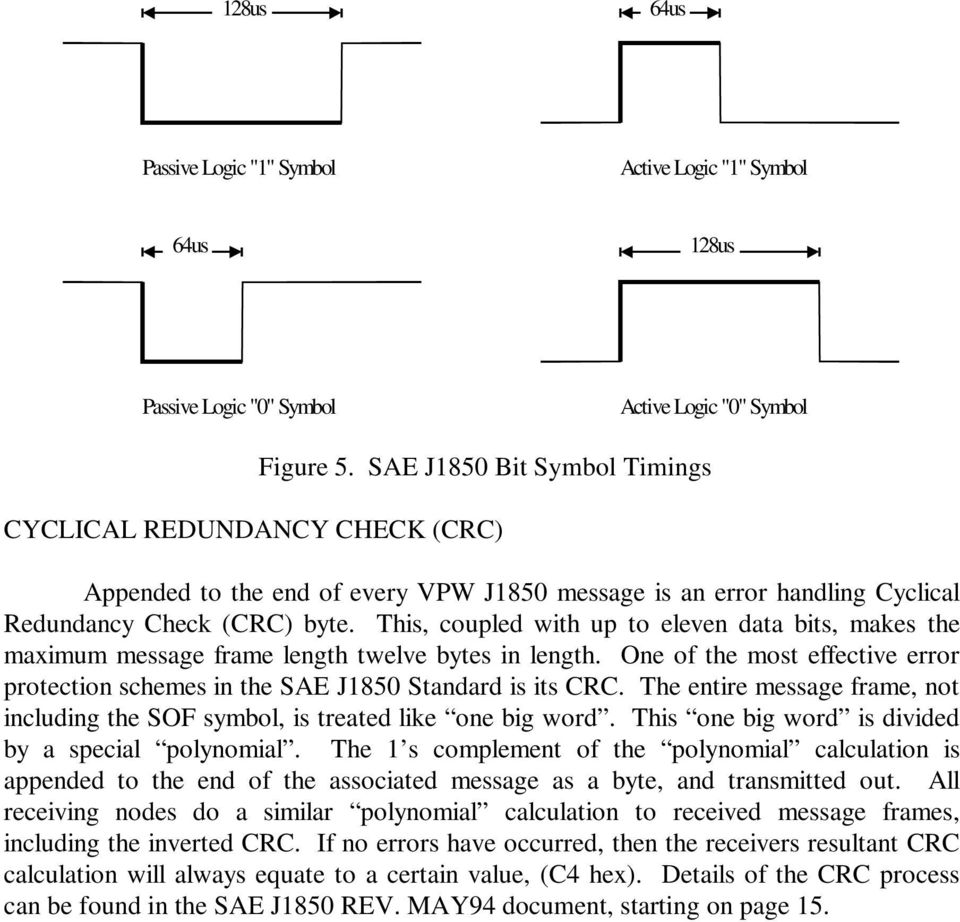
7 Physical addressing is independent upon the geographic location, connector pin, and/or wire identification assignments. More details on Functional/Physical addressing can be found with the SAE J2178, Step 1 through 4 documents. The last two bits of the single byte header are the message type bits, or ZZ-bits. These two bits tell any receiving node(s) what format the rest of the message is going to take. These two bits, combined with the Y-bit and the K-bit, offer up to sixteen different message types that can be transmitted via the single byte header. The Z1-bit helps to designate whether or not this message uses extended addressing. If the Z1-bit is set to a one, then a receiving node(s) knows that the fifth byte of this message is the extended address of this function. The Z0-bit indicates whether or not data is contained in this message. If the Z0-bit is set to a zero, then data should be expected with this message. If the Z0-bit is set to a one, then no data is contained within this message. A three byte header is fairly the same. With a three byte header, the H-bit is set to a zero to indicate that this is a three byte header. All other bits within the first byte operate pretty much the same. The second byte of a three byte header contains a target address. The target address can be either functionally addressed or physically addressed. The third and last byte of a three byte header contains the physical address of the source of this message. Because the source address must always be unique, arbitration is always resolved by the end of the third byte whenever three byte headers are utilized. DATA BITS The data bits that make up the header and data fields consist of ones and zeros represented by symbols. A passive one bit symbol is a 128µs long low potential on the J1850 bus. A dominant one bit symbol is a 64µs long high potential on the J1850 bus. Conversely, a passive zero bit symbol is a 64µs long low potential on the J1850 bus and a dominant zero is a 128µs long high potential on the J1850 bus. These symbols require only one transition per bit, and one can mix the combinations indefinitely.

8 128us 64us Passive Logic "1" Symbol Active Logic "1" Symbol 64us 128us Passive Logic "0" Symbol Active Logic "0" Symbol Figure 5. SAE J1850 Bit Symbol Timings CYCLICAL REDUNDANCY CHECK (CRC) Appended to the end of every VPW J1850 message is an error handling Cyclical Redundancy Check (CRC) byte. This, coupled with up to eleven data bits, makes the maximum message frame length twelve bytes in length. One of the most effective error protection schemes in the SAE J1850 Standard is its CRC. The entire message frame, not including the SOF symbol, is treated like one big word. This one big word is divided by a special polynomial. The 1 s complement of the polynomial calculation is appended to the end of the associated message as a byte, and transmitted out. All receiving nodes do a similar polynomial calculation to received message frames, including the inverted CRC. If no errors have occurred, then the receivers resultant CRC calculation will always equate to a certain value, (C4 hex). Details of the CRC process can be found in the SAE J1850 REV. MAY94 document, starting on page 15.
9 END OF DATA (EOD) Immediately after the CRC byte has been transmitted, an End Of Data (EOD) symbol is transmitted. The EOD symbol consists of a 200µs long low potential on the J1850 bus. Directly after the EOD symbol, receiving node(s) can opt to immediately respond to the message. This response is called an In-Frame Response (IFR) and contributes to the suite of error handling options that the J1850 protocol supports. If, however, no IFR is desired, then the EOD symbol is allowed to elapse into an End Of Frame (EOF) symbol. EOF symbols are nothing more than EOD symbols that have elapsed from 200µs to 280µs in length. The EOF symbol denotes the end of this particular message frame. 80us, IFR response time J1850 Bus Active Passive 200us, EOD 280us, EOF 300us, IFS Figure 6. End Of Data Symbol versus an End Of Frame Symbol IN-FRAME RESPONSE (IFR) An IFR provides a platform for remote receiving nodes to actively acknowledge a transmission. Receiving node(s) append a reply to the end of the transmitting nodes original message frame. IFRs allow for increased efficiency in transmitting messages since a receiving node may respond within the same message frame that the request originated. A transmitting node request for an IFR is denoted by the K-bit in the transmitting nodes header field. All receiving nodes are required to check the K-bit and respond accordingly. This response must come within the elapse time between an EOD symbol and an EOF symbol, which is approximately 80µs.

10 Last Bit of Data Field IFR Data Field J1850 Bus EOD Active Normalization Bit First Passive IFR Bit Figure 7. In-Frame Response and Normalization Bit Symbol The beginning of an IFR response is denoted by the receiving node(s) transmission of a Normalization Bit (NB). The NB provides an active separation between the passive EOD symbol and the first data bit of the IFR response. The NB can take one of two forms. Each form denotes whether or not the IFR includes its own CRC. The interpretation of the NB is dependent upon what industry standard you want to accommodate. For GM compliance, a dominant zero NB symbol denotes that the IFR does not include a CRC. A dominant one NB symbol denotes that the IFR includes a CRC. However, it is believed that GM will not require IFRs for any J1850 implementations. Chrysler compliance is exactly the opposite of GM, and is the configuration of choice for most systems utilizing IFR. GM (NB=1) Chrysler NB=0) IFR does not include CRC active long NB active short NB IFR includes CRC active short NB active long NB Table 2. Normalization Bit Configurations In-Frame Responses can take on one of four distinct forms labeled as Type 0, Type 1, Type 2, and Type 3 IFRs. A Type 0 IFR is defined as requiring no response at all. A Type 1 IFR consists of a single byte response from a single responder. Type 2 IFRs are single byte responses from multiple responders. Each responder s arbitrating for its chance to respond. The IFR is not completed until all applicable responders have had a chance to respond. A Type 3 IFR is a response that contains multiple bytes from a single responder, and a CRC is appended to the end. After the EOF symbol, a grace period of idle bus time is given before other nodes can begin new transmissions. This time is called an Inter Frame Separation (IFS) and is denoted as a low potential time of 300µs following an EOF symbol. And, an IFS can be drawn out indefinitely in time so long as the J1850 bus is idle. One other symbol of interest is the Break (BRK) symbol. The BRK symbol is denoted by a high potential on the J1850 bus lasting at least 768µs in length. The

11 maximum length of a BRK symbol is approximately 5ms. The BRK symbol can be immediately transmitted onto the J1850 bus at any time. The BRK symbols causes any or all other transmitting node(s) to loose arbitration and cease transmission. Completion of the BRK symbol leaves all other nodes in a ready-to-receive state. The BRK symbol is usually reserved for diagnostic and scan tools. 768us Active BREAK Symbol Figure 8. SAE J1850 Break Symbol The goal of the SAE J1850 Standard is fault tolerance. Any glitch or disturbance less than 8µs in length is digitally filtered out as unwanted noise. Though 8µs digital filtering forces a fixed delay to all incoming data, a large portion of noise is eliminated from the J1850 network. PHYSICAL LAYER The 10.4Kb/s VPW physical layer consists of a single, voltage driven wire randomly laid with no routing restrictions. Refer to SAE J1211 for help on specifying your multiplexing system, and SAE J1879 for help on specifying components. The on-vehicle network length is 35 meters. An off-vehicle network length can only be 5 meters long. This means that the total vehicle network length is 40 meters. The maximum number of standard unit loads, including off-vehicle equipment, is 32 nodes. This is assuming that a node averages out to be one unit load. A unit load consists of 10.6 KΩs and 470 pf. Off-vehicle load measurements are measured on the SAE J1962 diagnostic connector. The minimum off-vehicle load resistance is 10.6 KΩs. The offvehicle capacitance should not exceed 500 pf. The capacitance reading is between the bus wire to signal or chassis ground. The J1850 application layer requires that a zero bit symbol always dominates over a one bit symbol. Adherence to the VPW J Kb/s symbol definitions ensures that this happens. As stated earlier, the maximum number of message bytes, (excluding the frame delimiters SOF, EOD, EOF, and IFS), is 12. The VPW timing requirements given below are drawn from the SAE J1850 REV MAY94 document, page 35. Included are the VPW DC parameters as well.

12 Symbol T x Min T x nom T x max R x min R x max units Passive 0 > < 79 > 34 < 96 µs Active 1 Passive 1 > < 145 > 96 < 163 µs Active 0 Active SOF > < 218 > 163 < 239 µs Passive EOD > < 218 > 163 < 239 µs Passive EOF > N/A > 239 N/A µs Passive IFS > N/A > 280 N/A µs Active BREAK > 280µs 300µs < 5ms > 239µs < 1.0 s N/A Table 3. VPW Pulse Width Times (µs) Parameter Symbol Min Typ Max Units Input High Voltage Vih Volts Input Low Voltage Vil 3.5 Volts Output High Voltage Voh Volts Output Low Voltage Vol Volts Absolute Ground Offset Voltage Vgo Volts Network Resistance Rload 315 1,575 ohms Network Capacitance Cload 2,470 16,544 pf Network Time Constant Tload 5.2 µs Signal Transition Time Tt 18.0 µs Node Resistance (unit load) Rul 10,600 ohms Node Capacitance (unit load) Cul 470 pf Node Leakage Current Ileak 10 µa Table 4. VPW DC Parameters The 10.4Kb/s VPW physical description is robust enough to survive several catastrophic system faults, and do so damage free with the ability to recover to normal operation automatically upon fault removal. Fault tolerance for open circuits, direct shorts to ground, direct shorts to power, or direct shorts to any other voltage between ground and power, are all survivable and automatically recoverable. Interference to communication is not hindered in any way if any one node fails while on the J1850 network.

13 All pulses on the 10.4Kb/s J1850 network are wave shaped. Wave shaping rounds off the sharp corners of bus transitions, removing unwanted high frequency signal components. Transmitted pulse widths are affected by individual node oscillator tolerances, and variations in the transmission delay through a nodes source driver as well as the bus medium. These things must be taken into consideration when designing a J1850 node. Voh,min Active Vin,min Vil,max Vt Vol,maz Passive Tt,max Figure 9. SAE J1850 VPW Waveform Value Voh,min Vih,min Vt Vil,max Vol,max Tt,max Value Description Minimum output high voltage. This is the highest trip point with 2V receiver noise. Minimum input high voltage. This is the highest trip point with no offset noise. Ideal receiver trip point. Maximum input high voltage. This is the lowest trip point with no offset noise. Maximum output low voltage. This is the highest trip point with 2V source noise. Maximum signal transition time. Table 5. SAE J1850 VPW Voltage Levels and Trip Points FORWARD There are several sources to turn to for further consideration of the SAE J1850 Standard. Given are several documents provided by the Society of Automotive Engineers (S.A.E.). SAE is an industry group that provides a wide range of specifications. They provide guidelines for standards and recommended practices for the automotive world. Some guidelines and standard examples include things like lubrication, corrosion, fasteners, electronics and emissions. Referring to these documents should aid with further SAE J1850 Standard exploration. S.A.E. 400 Commonwealth Drive Warrendale, PA U.S.A. (412) FAX (412)

14 SAE J1850 documents of interest: SAE J1850: Specifies requirements for a vehicle data communications network. Compliance committee recently formed (J1699) SAE J2178: Specifies non-diagnostic messages. Part 1 - Message header formats and physical node addresses Part 2 - Message parametric data Part 3 - Message assignments for the single byte header format Part 4 - Message assignments for the three byte header format SAE J1962: Diagnostic Connector (under dash). New 16-pin standard. SAE J2012: Diagnostic Codes SAE J2190: Specifies diagnostic and malfunction messages (to fix vehicles) SAE J2008: Recommended Organization of Vehicle Service Information SAE J1978: OBD - II Scan Tool (On Board Diagnostics) SAE J2205: Expanded Diagnostic Protocol for OBD-II Scan Tools SAE J2300: Conformance Test Procedures for OBD-II Scan Tools SAE J1979: Specifies CARB/EPA functions and messages. SAE J1699: Compliance Tests and Test Methods for SAE J1850 SAE J1113: Electromagnetic Susceptibility Measurement Procedures for Vehicle Components SAE J1547: Electromagnetic Susceptibility Measurement Procedures for Common Mode Injection SAE J1211: Electronic Equipment Design Recommended Procedure SAE J1879: General Qualification and Production Acceptance Criteria for Integrated Circuits in Automotive Applications SAE J1930: Electrical/Electronic Systems Diagnostic Terms, Definitions, Abbreviation, and Acronyms SAE J1213: Glossary of terms for vehicle networks CONCLUSION The SAE J Kb/s standard fulfills mid-range Class B classification protocol requirements. Variable Pulse Width modulation is utilized to facilitate a single wire transmitting medium for harsh automotive environments. Arbitration, CRC, and acknowledgment capability all contribute to a low cost, master-less, efficient network that can be utilized in a multitude of applications.

15 REFERENCES [1] SAE Vehicle Network for Multiplexing and Data Communications Standards Committee, SAE J1850 Standard, Class B Data Communications Network Interface Rev MAY94 [2] SAE Vehicle Network for Multiplexing and Data Communications Standards Committee, SAE J2178/1, Class B Data Communication Network Messages: Detailed Header Formats and Physical Address Assignments, Issued [3] SAE Vehicle Network for Multiplexing and Data Communications Standards Committee, SAE J2178/2, Class B Data Communication Network Messages: Data Parameter Definitions, Issued [4] SAE Vehicle Network for Multiplexing and Data Communications Standards Committee, SAE J2178/3, Class B Data Communication Network Messages: Frame IDs for Single Byte Forms of Headers, Issued [5] SAE Vehicle Network for Multiplexing and Data Communications Standards Committee, SAE J2178/4, Class B Data Communication Network Messages: Message Definitions for Three Byte Headers, Issued [6] International Congress & Exposition, February 27-March 2, 1995, SAE SP-1070, Automotive Multiplexing Technology, ISBN [7] Intel Corporation, 8XC196LB Target Specification, October 18,1995 [8] Delco Electronics, XDE-3160, General Motors Class 2 Communications Requirements, Original Release, Release: May 1, 1993 [9] Christopher A. Lupini, Introduction to Vehicle Multiplexing, University Consortium for Continuing Education (UCCE), November 1-3, 1995 Training Program
![SAE Vehicle Network for Multiplexing and Data Communications Standards Committee, SAE J2178/2, Class B Data Communication Network Messages: Data Parameter Definitions, Issued 1993-06-29 [4] SAE](/docs-images/48/18417489/images/page_15.jpg "Vehicle Network for Multiplexing and Data Communications Standards Committee, SAE J2178/3, Class B Data Communication Network Messages: Frame IDs for Single Byte Forms of Headers, Issued 1993-09-07")
SafeSPI - Serial Peripheral Interface for Automotive Safety
 Page 1 / 16 SafeSPI - Serial Peripheral Interface for Automotive Safety Technical SafeSPI_specification_v0.15_published.doc 30 July 2015 Page 2 / 16 1 INTRODUCTION 3 1.1 Requirement specification types
LIN (Local Interconnect Network):
 LIN (Local Interconnect Network): History: LIN (Local Interconnect Network) was developed as cost-effective alternate to CAN protocol. In 1998 a group of companies including Volvo, Motorola, Audi, BMW,
Welcome to the Introduction to Controller Area Network web seminar My name is William Stuart, and I am a Applications Engineer for the Automotive
 Welcome to the Introduction to Controller Area Network web seminar My name is William Stuart, and I am a Applications Engineer for the Automotive Products Group within Microchip. This web seminar today
Vehicle data acquisition using CAN By Henning Olsson, OptimumG [email protected]
 Vehicle data acquisition using By Henning Olsson, OptimumG [email protected] Introduction: Data acquisition is one of the best tools to increase the understanding of vehicle behavior. One can
Ring Local Area Network. Ring LANs
 Ring Local Area Network Ring interface (1-bit buffer) Ring interface To station From station Ring LANs The ring is a series of bit repeaters, each connected by a unidirectional transmission link All arriving
Local Interconnect Network Training. Local Interconnect Network Training. Overview
 Overview Local Interconnect Network Training History and introduction Technical features The ISO/OSI reference model and LIN Frames Message Frames Communication concept of LIN Command Frames and Extended
In-Vehicle Networking
 In-Vehicle Networking SAE Network classification Class A networks Low Speed (
Road Vehicles - Diagnostic Systems
 SSF 14230 Road Vehicles - Diagnostic Systems Keyword Protocol 2000 - Part 1 - Physical Layer Swedish Implementation Standard Document: SSF 14230-1 Status: Issue 3 Date: October 22, 1997 This document is
DS1621 Digital Thermometer and Thermostat
 Digital Thermometer and Thermostat www.dalsemi.com FEATURES Temperature measurements require no external components Measures temperatures from 55 C to +125 C in 0.5 C increments. Fahrenheit equivalent
2.1 CAN Bit Structure The Nominal Bit Rate of the network is uniform throughout the network and is given by:
 Order this document by /D CAN Bit Timing Requirements by Stuart Robb East Kilbride, Scotland. 1 Introduction 2 CAN Bit Timing Overview The Controller Area Network (CAN) is a serial, asynchronous, multi-master
Nexus Technology Review -- Exhibit A
 Nexus Technology Review -- Exhibit A Background A. Types of DSL Lines DSL comes in many flavors: ADSL, ADSL2, ADSL2+, VDSL and VDSL2. Each DSL variant respectively operates up a higher frequency level.
LOCAL INTERCONNECT NETWORK (LIN)
 54B-1 GROUP 54B LOCAL INTERCONNECT NETWORK (LIN) CONTENTS GENERAL INFORMATION........ 54B-2............ 54B-3 STRUCTURE................... 54B-2 54B-2 LIN refers to "Local Interconnect Network," which
Distributed Real-Time Systems (TI-DRTS) Track 2. CAN-BUS Introduction. Version 9.11.2009 Ref. VECTOR application note & Motorola note
 Distributed Real-Time Systems (TI-DRTS) Track 2 CAN-BUS Introduction Version 9.11.2009 Ref. VECTOR application note & Motorola note What is CAN? Controller Area Network (CAN) is a common, small area network
The SAE J1939 Communications Network
 The SAE J939 Communications Network An overview of the J939 family of standards and how they are used An SAE White Paper Since its publication more than a decade ago, SAE J939 has become widely accepted
NTE2053 Integrated Circuit 8 Bit MPU Compatible A/D Converter
 NTE2053 Integrated Circuit 8 Bit MPU Compatible A/D Converter Description: The NTE2053 is a CMOS 8 bit successive approximation Analog to Digital converter in a 20 Lead DIP type package which uses a differential
2.0 System Description
 2.0 System Description The wireless alarm system consists of two or more alarm units within a specified range of one another. Each alarm unit employs a radio transceiver, allowing it to communicate with
Tutorial Introduction
 Tutorial Introduction PURPOSE: This tutorial describes concepts related to communication busses, including attributes, functions, and the different types of bus systems. The intent is to provide a baseline
Understanding SAE J1939. by Simma Software, Inc.
 Understanding SAE J1939 by Simma Software, Inc. Contact E-mail: jrsimma at simmasoftware dot com Phone: 888-256-3828 For J1939 source code, see J1939 Software Starting Notes Ask questions anytime. This
Comparison of FlexRay and CAN-bus for Real-Time Communication
 Comparison of FlexRay and CAN-bus for Real-Time Communication Andreas Forsberg Mälardalen University Högskoleplan 1 721 23 Västerås +46 768011236 [email protected] Johan Hedberg Mälardalen University
CAN Specification 2.0, Part B page 1 PART B. CAN in Automation, Am Weichselgarten 26, D-91058 Erlangen
 CAN Specification 2.0, Part B page 1 PART B CAN Specification 2.0, Part B page 2 1 INTRODUCTION...3 2 BASIC CONCEPTS...5 3 MESSAGE TRANSFER...11 3.1 Frame Formats...11 3.2 Frame Types...11 3.2.1 DATA FRAME...11
Computer Network. Interconnected collection of autonomous computers that are able to exchange information
 Introduction Computer Network. Interconnected collection of autonomous computers that are able to exchange information No master/slave relationship between the computers in the network Data Communications.
Process Control and Automation using Modbus Protocol
 Process Control and Automation using Modbus Protocol Modbus is the fundamental network protocol used in most industrial applications today. It is universal, open and an easy to use protocol. Modbus has
DS1721 2-Wire Digital Thermometer and Thermostat
 www.dalsemi.com FEATURES Temperature measurements require no external components with ±1 C accuracy Measures temperatures from -55 C to +125 C; Fahrenheit equivalent is -67 F to +257 F Temperature resolution
Elettronica dei Sistemi Digitali Costantino Giaconia SERIAL I/O COMMON PROTOCOLS
 SERIAL I/O COMMON PROTOCOLS RS-232 Fundamentals What is RS-232 RS-232 is a popular communications interface for connecting modems and data acquisition devices (i.e. GPS receivers, electronic balances,
Bluetooth in Automotive Applications Lars-Berno Fredriksson, KVASER AB
 Bluetooth in Automotive Applications Lars-Berno Fredriksson, KVASER AB ABSTRACT There is a potential for 50-400 million per year Bluetooth nodes within the car market if Bluetooth can be integrated into
Introduction to. LIN (Local Interconnect Network)
 Introduction to LIN (Local Interconnect Network) Stéphane REY Revision 1.0 - ay 13 th, 2003 Table of content 1 INTRODUCTION...3 1.1 PURPOSE OF THE DOCUENT...3 1.2 ACRONYOUS...3 1.3 RELATED DOCUENTS...3
DeviceNet Communication Manual
 DeviceNet Communication Manual Soft-Starter Series: SSW-07/SSW-08 Language: English Document: 10000046963 / 00 03/2008 Summary ABOUT THIS MANUAL... 5 ABBREVIATIONS AND DEFINITIONS... 5 NUMERICAL REPRESENTATION...
FEATURES DESCRIPTION APPLICATIONS BLOCK DIAGRAM. PT2272 Remote Control Decoder
 Remote Control Decoder DESCRIPTION PT2272 is a remote control decoder paired with PT2262 utilizing CMOS Technology. It has 12-bit of tri-state address pins providing a maximum of 531,441 (or 312) address
K-line Communication Description
 K-line Communication Description Introduction There are two primary ISO documents that describe how to perform OBD communications on K- line between a tester and a vehicle. There are actually several ISO
DM9368 7-Segment Decoder/Driver/Latch with Constant Current Source Outputs
 DM9368 7-Segment Decoder/Driver/Latch with Constant Current Source Outputs General Description The DM9368 is a 7-segment decoder driver incorporating input latches and constant current output circuits
DS18B20 Programmable Resolution 1-Wire Digital Thermometer
 www.dalsemi.com FEATURES Unique 1-Wire interface requires only one port pin for communication Multidrop capability simplifies distributed temperature sensing applications Requires no external components
DS1307ZN. 64 x 8 Serial Real-Time Clock
 DS137 64 x 8 Serial Real-Time Clock www.maxim-ic.com FEATURES Real-time clock (RTC) counts seconds, minutes, hours, date of the month, month, day of the week, and year with leap-year compensation valid
Vorlesung Kommunikationsnetze Fieldbus Systems
 Vorlesung Kommunikationsnetze Fieldbus Systems Prof. Dr. H. P. Großmann mit B. Wiegel sowie A. Schmeiser und M. Rabel Sommersemester 2009 Institut für Organisation und Management von Informationssystemen
CAN: Controller Area Network Introduction and Primer by Robert Boys [email protected]
 CAN: Controller Area Network Introduction and Primer by Robert Boys [email protected] Introduction CAN was developed for the automotive market to reduce the weight and cost of wiring harnesses and add additional
Allen-Bradley/Rockwell
 MANUFACTURER DATA SHEET High Speed Counter Manufacturer: Allen-radley/Rockwell Model Number: 1746-HSCE See www.geomartin.com for additional PDF datasheets Martin Part Number: E-014901-03 VendorPartNumber:
DigiPoints Volume 1. Student Workbook. Module 4 Bandwidth Management
 Bandwidth Management Page 4.1 DigiPoints Volume 1 Module 4 Bandwidth Management Summary This module will cover Time Division Multiplexing (TDM). TDM technology allows many users to access a particular
Harmonics and Noise in Photovoltaic (PV) Inverter and the Mitigation Strategies
 Soonwook Hong, Ph. D. Michael Zuercher Martinson Harmonics and Noise in Photovoltaic (PV) Inverter and the Mitigation Strategies 1. Introduction PV inverters use semiconductor devices to transform the
An Automated Model Based Design Flow for the Design of Robust FlexRay Networks
 SAE TECHNICAL PAPER SERIES 2008-01-1031 An Automated Model Based Design Flow for the Design of Robust FlexRay Networks Thorsten Gerke Synopsys GmbH David Bollati C&S Group/University of Applied Science
PIN CONFIGURATION FEATURES ORDERING INFORMATION ABSOLUTE MAXIMUM RATINGS. D, F, N Packages
 DESCRIPTION The µa71 is a high performance operational amplifier with high open-loop gain, internal compensation, high common mode range and exceptional temperature stability. The µa71 is short-circuit-protected
ABB Drives. User s Manual. Pulse Encoder Interface Module RTAC-01
 ABB Drives User s Manual Pulse Encoder Interface Module RTAC-0 Pulse Encoder Interface Module RTAC-0 User s Manual 3AFE 64486853 REV A EN EFFECTIVE:.5.00 00 ABB Oy. All Rights Reserved. Safety instructions
DS1621 Digital Thermometer and Thermostat
 www.maxim-ic.com FEATURES Temperature measurements require no external components Measures temperatures from -55 C to +125 C in 0.5 C increments. Fahrenheit equivalent is -67 F to 257 F in 0.9 F increments
Digital to Analog Converter. Raghu Tumati
 Digital to Analog Converter Raghu Tumati May 11, 2006 Contents 1) Introduction............................... 3 2) DAC types................................... 4 3) DAC Presented.............................
LOW POWER SPREAD SPECTRUM OSCILLATOR
 LOW POWER SPREAD SPECTRUM OSCILLATOR SERIES LPSSO WITH SPREAD-OFF FUNCTION 1.0 110.0 MHz FEATURES + 100% pin-to-pin drop-in replacement to quartz and MEMS based XO + Low Power Spread Spectrum Oscillator
Local Area Networks transmission system private speedy and secure kilometres shared transmission medium hardware & software
 Local Area What s a LAN? A transmission system, usually private owned, very speedy and secure, covering a geographical area in the range of kilometres, comprising a shared transmission medium and a set
FlexRay A Communications Network for Automotive Control Systems
 FlexRay A Communications Network for Automotive Control Systems WFCS 2006 Rainer Makowitz Automotive Systems Engineering, EMEA Freescale and the Freescale logo are trademarks of Freescale Semiconductor,
ABB Drives. User s Manual HTL Encoder Interface FEN-31
 ABB Drives User s Manual HTL Encoder Interface FEN-31 HTL Encoder Interface FEN-31 User s Manual 3AUA0000031044 Rev B EN EFFECTIVE: 2010-04-06 2010 ABB Oy. All Rights Reserved. 5 Safety instructions
FURTHER READING: As a preview for further reading, the following reference has been provided from the pages of the book below:
 FURTHER READING: As a preview for further reading, the following reference has been provided from the pages of the book below: Title: Broadband Telecommunications Handbook Author: Regis J. Bud Bates Publisher:
PowerAmp Design. PowerAmp Design PAD135 COMPACT HIGH VOLATGE OP AMP
 PowerAmp Design COMPACT HIGH VOLTAGE OP AMP Rev G KEY FEATURES LOW COST SMALL SIZE 40mm SQUARE HIGH VOLTAGE 200 VOLTS HIGH OUTPUT CURRENT 10A PEAK 40 WATT DISSIPATION CAPABILITY 200V/µS SLEW RATE APPLICATIONS
Application Note 83 Fundamentals of RS 232 Serial Communications
 Application Note 83 Fundamentals of Serial Communications Due to it s relative simplicity and low hardware overhead (as compared to parallel interfacing), serial communications is used extensively within
8.5Gb/s SFP+ Fibre Channel Optical Transceiver
 8.5Gb/s SFP+ Fibre Channel Optical Transceiver Features Up to 8.5Gb/s bi-directional data links Hot Pluggable SFP+ footprint Built-in digital diagnostic functions 1310nm FP laser transmitter Duplex LC
Communication Networks. MAP-TELE 2011/12 José Ruela
 Communication Networks MAP-TELE 2011/12 José Ruela Network basic mechanisms Introduction to Communications Networks Communications networks Communications networks are used to transport information (data)
Cold-Junction-Compensated K-Thermocoupleto-Digital Converter (0 C to +1024 C)
 19-2235; Rev 1; 3/02 Cold-Junction-Compensated K-Thermocoupleto-Digital General Description The performs cold-junction compensation and digitizes the signal from a type-k thermocouple. The data is output
MILE Encoder for EC 90 flat
 MILE Encoders Edition October 2014 MILE Encoder for EC 90 flat Encoders Document ID: 1 495 818-06 ag Brünigstrasse 220 P.O.Box 263 CH-6072 Sachseln Phone +41 41 666 15 00 Fax +41 41 666 16 50 www.maxonmotor.com
SFP-TX 1000BASE-T SFP Transceiver 10/100/1000M SFP Transceiver
 Product Features Up to 1.25Gb/s bi-directional data links SFP form with compact RJ-45 connector +3.3V single power supply 0 to 70 o C operating case temperature Intelligent Auto-Negotiation support for
PACKAGE OUTLINE DALLAS DS2434 DS2434 GND. PR 35 PACKAGE See Mech. Drawings Section
 PRELIMINARY DS2434 Battery Identification Chip FEATURES Provides unique ID number to battery packs PACKAGE OUTLINE Eliminates thermistors by sensing battery temperature on chip DALLAS DS2434 1 2 3 256
Light scene push button 8gang comfort flush-mounted 751688xx
 751688xx Documentation Product name: Light scene push button 8gang comfort Design: flush-mounting type (Up) ETS search path: Push button / Push button general / Light scene push button 8gang comfort Functional
Real-Time (Paradigms) (51)
 Real-Time (Paradigms) (51) 5. Real-Time Communication Data flow (communication) in embedded systems : Sensor --> Controller Controller --> Actor Controller --> Display Controller Controller Major
www.imprezer.tk Introduction to www.union88.tk RACE FUELS Hans-Christian von der Wense Munich, Germany
 Introduction to Hans-Christian von der Wense Munich, Germany Overview Progress in Automotive Electronics and it s Impacts on Networking LIN Consortium LIN Concept Physical Layer Data Link Layer LIN Network
Computer Systems Structure Input/Output
 Computer Systems Structure Input/Output Peripherals Computer Central Processing Unit Main Memory Computer Systems Interconnection Communication lines Input Output Ward 1 Ward 2 Examples of I/O Devices
Fiber Distributed Data Interface
 CHPTER 8 Chapter Goals Provide background information about FDDI technology. Explain how FDDI works. Describe the differences between FDDI and Copper Distributed Data Interface (CDDI). Describe how CDDI
A DNP3 Protocol Primer
 A Protocol Primer Introduction This is a primer for people who want a quick understanding of without having to comb through the tedious details of a complex specification. The writing style is meant to
CAN Bus Transceivers Operate from 3.3V or 5V and Withstand ±60V Faults
 CAN Bus Transceivers Operate from 3.3V or 5V and Withstand ±6 Faults Ciaran Brennan design features The LTC2875 is a robust CAN bus transceiver that features ±6 overvoltage and ±25kV ESD tolerance to reduce
Sampling Theorem Notes. Recall: That a time sampled signal is like taking a snap shot or picture of signal periodically.
 Sampling Theorem We will show that a band limited signal can be reconstructed exactly from its discrete time samples. Recall: That a time sampled signal is like taking a snap shot or picture of signal
6ES7313-5BF03-0AB0. Supply voltages Rated value 24 V DC Yes permissible range, upper limit (DC) circuit breaker type B, min. 4 A
 6ES7313-5BF03-0AB0 Page 1 Product data sheet 6ES7313-5BF03-0AB0 SIMATIC S7-300, CPU 313C, COMPACT CPU WITH MPI, 24 DI/16 DO, 4AI, 2AO 1 PT100, 3 FAST COUNTERS (30 KHZ), INTEGRATED 24V DC POWER SUPPLY,
PS323. Precision, Single-Supply SPST Analog Switch. Features. Description. Block Diagram, Pin Configuration, and Truth Table. Applications PS323 PS323
 Features ÎÎLow On-Resistance (33-ohm typ.) Minimizes Distortion and Error Voltages ÎÎLow Glitching Reduces Step Errors in Sample-and-Holds. Charge Injection, 2pC typ. ÎÎSingle-Supply Operation (+2.5V to
INTRODUCTION TO COMMUNICATION SYSTEMS AND TRANSMISSION MEDIA
 COMM.ENG INTRODUCTION TO COMMUNICATION SYSTEMS AND TRANSMISSION MEDIA 9/6/2014 LECTURES 1 Objectives To give a background on Communication system components and channels (media) A distinction between analogue
Introduction. In this Self-study Programme we will explain to you the design and function of the CAN data bus. SSP 186/01
 Introduction The requirements relating to driving safety, driving comfort, exhaust emissions and fuel economy are are becoming ever more stringent. This entails more intensive information exchange between
SN54HC191, SN74HC191 4-BIT SYNCHRONOUS UP/DOWN BINARY COUNTERS
 Single Down/Up Count-Control Line Look-Ahead Circuitry Enhances Speed of Cascaded Counters Fully Synchronous in Count Modes Asynchronously Presettable With Load Control Package Options Include Plastic
CSE331: Introduction to Networks and Security. Lecture 6 Fall 2006
 CSE331: Introduction to Networks and Security Lecture 6 Fall 2006 Open Systems Interconnection (OSI) End Host Application Reference model not actual implementation. Transmits messages (e.g. FTP or HTTP)
FM Radio Transmitter & Receiver Modules
 FM Radio Transmitter & Receiver Modules T5 / R5 Features MINIATURE SIL PACKAGE FULLY SHIELDED DATA RATES UP TO 128KBITS/S RANGE UPTO 300 METRES SINGLE SUPPLY VOLTAGE INDUSTRY PIN COMPATIBLE QFMT5-434 TEMP
CHAPTER 11: Flip Flops
 CHAPTER 11: Flip Flops In this chapter, you will be building the part of the circuit that controls the command sequencing. The required circuit must operate the counter and the memory chip. When the teach
Reading: HH Sections 4.11 4.13, 4.19 4.20 (pgs. 189-212, 222 224)
 6 OP AMPS II 6 Op Amps II In the previous lab, you explored several applications of op amps. In this exercise, you will look at some of their limitations. You will also examine the op amp integrator and
Tutorial. www.ccontrols.com
 Tutorial 1 Tutorial CONTROLLER AREA NETWORK CAN was designed by Bosch and is currently described by ISO 11898 1. In terms of the Open Systems Interconnection model (OSI), CAN partially defines the services
Data Exchange On The CAN Bus I
 Service. Self-Study Programme 238 Data Exchange On The CAN Bus I Basics The CAN bus system in a car interlinks the control units to form a network. This produces new functions in the car and in diagnostics
Objectives. Lecture 4. How do computers communicate? How do computers communicate? Local asynchronous communication. How do computers communicate?
 Lecture 4 Continuation of transmission basics Chapter 3, pages 75-96 Dave Novak School of Business University of Vermont Objectives Line coding Modulation AM, FM, Phase Shift Multiplexing FDM, TDM, WDM
The quadrature signals and the index pulse are accessed through five 0.025 inch square pins located on 0.1 inch centers.
 Quick Assembly Two and Three Channel Optical Encoders Technical Data HEDM-550x/560x HEDS-550x/554x HEDS-560x/564x Features Two Channel Quadrature Output with Optional Index Pulse Quick and Easy Assembly
LONGLINE 10Gbps 10km SFP+ Optical Transceiver
 LONGLINE 10Gbps 10km SFP+ Optical Transceiver Features Optical interface compliant to IEEE 802.3ae 10GBASE-LR Electrical interface compliant to SFF-8431 Hot Pluggable 1310nm DFB transmitter, PIN photo-detector
Serial Communications
 April 2014 7 Serial Communications Objectives - To be familiar with the USART (RS-232) protocol. - To be able to transfer data from PIC-PC, PC-PIC and PIC-PIC. - To test serial communications with virtual
TOTALLY SOLID STATE NON-DIRECTIONAL RADIO BEACONS 190-535 khz
 TOTALLY SOLID STATE NON-DIRECTIONAL RADIO S 190-535 khz This family of radio transmitters has been developed as extremely efficient, highly reliable Non Directional Beacons. ND2000A/4000A» MODULAR CONSTRUCTION»
CS263: Wireless Communications and Sensor Networks
 CS263: Wireless Communications and Sensor Networks Matt Welsh Lecture 4: Medium Access Control October 5, 2004 2004 Matt Welsh Harvard University 1 Today's Lecture Medium Access Control Schemes: FDMA TDMA
Current Probes. User Manual
 Current Probes User Manual ETS-Lindgren L.P. reserves the right to make changes to any product described herein in order to improve function, design, or for any other reason. Nothing contained herein shall
ACT4077 Driver for MACAIR A3818, A5690, A5232, A4905 & MIL-STD-1553
 ACT4077 Driver for MACAIR A3818, A5690, A5232, A4905 & MIL-STD-1553 Features CIRCUIT TECHNOLOGY www.aeroflex.com ACT4077 Driver meets MIL-STD-1553A & B, Macair A3818, A4905, A5232 and A5690 specs Bipolar
CD4013BC Dual D-Type Flip-Flop
 CD4013BC Dual D-Type Flip-Flop General Description The CD4013B dual D-type flip-flop is a monolithic complementary MOS (CMOS) integrated circuit constructed with N- and P-channel enhancement mode transistors.
EnOcean Radio Protocol 2. September 26, 2013 SPECIFICATION V1.0. Subject to modifications EnOcean Radio Protocol 2 V1.0 Page 1/19
 SPECIFICATION V1.0 EnOcean Radio Protocol 2 September 26, 2013 EnOcean GmbH Kolpingring 18a 82041 Oberhaching Germany Phone +49.89.67 34 689-0 Fax +49.89.67 34 689-50 [email protected] www.enocean.com Subject
74LS193 Synchronous 4-Bit Binary Counter with Dual Clock
 74LS193 Synchronous 4-Bit Binary Counter with Dual Clock General Description The DM74LS193 circuit is a synchronous up/down 4-bit binary counter. Synchronous operation is provided by having all flip-flops
Application Note 58 Crystal Considerations with Dallas Real Time Clocks
 www.dalsemi.com Application Note 58 Crystal Considerations with Dallas Real Time Clocks Dallas Semiconductor offers a variety of real time clocks (RTCs). The majority of these are available either as integrated
NETWORKS Controller Area Network (CAN)
 SEC TION 2 : DOMEST I C GMLAN Overview GMLAN is the General Motors variation of the CAN Bus. Although it is CAN based, there are enough proprietary features and functions to make this a unique protocol.
How To Use A Power Supply On A Powerline 2.2 (Ai)
 KNX/EIB Product documentation Issue: 05.08.2010 629x1220 Push button sensor 3 comfort 1-gang Push button sensor 3 comfort 2-gang (1+1) Push button sensor 3 comfort 3-gang Push button sensor 3 comfort 4-gang
Description. Dimensions. Features. www.pwb-encoders.com. precision works better
 Description The MEC22 is a high resolution optical hollow shaft encoder that can be fixed quickly and easily on different sizes of motor shafts. The encoder provides two square wave outputs in quadrature
Demystifying Wireless for Real-World Measurement Applications
 Proceedings of the IMAC-XXVIII February 1 4, 2010, Jacksonville, Florida USA 2010 Society for Experimental Mechanics Inc. Demystifying Wireless for Real-World Measurement Applications Kurt Veggeberg, Business,
EMERGING DISPLAY CUSTOMER ACCEPTANCE SPECIFICATIONS 20400 (LED TYPES) EXAMINED BY : FILE NO. CAS-10184 ISSUE : DEC.01,1999 TOTAL PAGE : 7 APPROVED BY:
 EXAMINED BY : FILE NO. CAS-10184 APPROVED BY: EMERGING DISPLAY TECHNOLOGIES CORPORATION ISSUE : DEC.01,1999 TOTAL PAGE : 7 VERSION : 2 CUSTOMER ACCEPTANCE SPECIFICATIONS MODEL NO. : 20400 (LED TYPES) FOR
Microcomputer Protocol Implementation at Local Interconnect Network Georgi Krastev
 Microcomputer Protocol Implementation at Local Interconnect Network Georgi Krastev Abstract: The paper discusses the issues of microcomputer protocol implementation at local interconnect network for automobile
Ethernet. Ethernet Frame Structure. Ethernet Frame Structure (more) Ethernet: uses CSMA/CD
 Ethernet dominant LAN technology: cheap -- $20 for 100Mbs! first widely used LAN technology Simpler, cheaper than token rings and ATM Kept up with speed race: 10, 100, 1000 Mbps Metcalfe s Etheret sketch
Product Datasheet P1110 915 MHz RF Powerharvester Receiver
 DESCRIPTION The Powercast P1110 Powerharvester receiver is an RF energy harvesting device that converts RF to DC. Housed in a compact SMD package, the P1110 receiver provides RF energy harvesting and power
EECC694 - Shaaban. Transmission Channel
 The Physical Layer: Data Transmission Basics Encode data as energy at the data (information) source and transmit the encoded energy using transmitter hardware: Possible Energy Forms: Electrical, light,
INTERNATIONAL TELECOMMUNICATION UNION
 INTERNATIONAL TELECOMMUNICATION UNION )454 6 TELECOMMUNICATION STANDARDIZATION SECTOR OF ITU $!4! #/--5.)#!4)/. /6%2 4(% 4%,%0(/.%.%47/2+ ")43 0%2 3%#/.$ $50,%8 -/$%- 34!.$!2$):%$ &/2 53% ). 4(% '%.%2!,
X8 Option 2 - Technology
 moog AC DC AC 4 to 450 A 4 to 210 A Compact MSD Servo Drive TTL in out Specification X8 Option 2 - Technology TTL Encoder Simulation / TTL Master Encoder moog Specification Option 2 - Technology TTL encoder
Process modules Digital input PMI for 24 V DC inputs for 120 V AC inputs
 E031026 000823 Process modules Digital input PMI for inputs for 120 V AC inputs PMI Input E4, E5, GND L- PMI 120 V AC Input E4, E5, Common C E6, E7, GND L- E6, E7, Common C LEDs for the inputs operation
1 pc Charge Injection, 100 pa Leakage CMOS 5 V/5 V/3 V 4-Channel Multiplexer ADG604
 a FEATURES 1 pc Charge Injection (Over the Full Signal Range) 2.7 V to 5.5 V ual Supply 2.7 V to 5.5 ingle Supply Automotive Temperature Range: 4 C to +125 C 1 pa Max @ 25 C Leakage Currents 85 Typ On
Computer Networks and Internets, 5e Chapter 6 Information Sources and Signals. Introduction
 Computer Networks and Internets, 5e Chapter 6 Information Sources and Signals Modified from the lecture slides of Lami Kaya ([email protected]) for use CECS 474, Fall 2008. 2009 Pearson Education Inc., Upper