
Structured Product Labeling (SPL) Implementation Guide with Validation Procedures
|
|
|
- Martin Franklin King
- 9 years ago
- Views:
Transcription
1 Structured Product Labeling (SPL) Implementation Guide with Validation Procedures Technical Specifications Document This Document is incorporated by reference into the following Guidance Document(s): Guidance for Industry Electronic Submission of Lot Distribution Reports Guidance to industry - Providing Regulatory Submissions in Electronic Format Content of Labeling Guidance for Industry - Providing Regulatory Submissions in Electronic Format Drug Establishment Registration and Drug Listing Guidance for Industry - SPL Standard for Content of Labeling Technical Questions and Answers Guidance for Industry - Indexing Structured Product Labeling (Final) Guidance for Industry: Self-Identification of Generic Drug Facilities, Sites, and Organizations Guidance for Industry - Electronic Drug Product Reporting for Human Drug Compounding Outsourcing Facilities Under Section 503B of the Federal Food, Drug, and Cosmetic Act Guidance for Industry - Registration of Human Drug Compounding Outsourcing Facilities Under Section 503B of the FD&C Act Guidance for Industry - DSCSA Implementation: Annual Reporting by Prescription Drug Wholesale Distributors and Third-Party Logistics For questions regarding this technical specifications document, contact [email protected]. U.S. Department of Health and Human Services Food and Drug Administration Center for Biologics Evaluation and Research (CBER) Center for Drug Evaluation and Research (CDER) Center for Veterinary Medicine (CVM) January 2016
2 SPL Implementation Guide with v1 Structured Product Labeling (SPL) Implementation Guide with Version 1 Revision Introduction Organization SPL Documents in General SPL Header General XML references Document information Author Information Identified Organizations Address Telecommunication Addresses Contact Party AsNamedEntity Core Document Reference Predecessor Document SPL Body Sections and subsections Text Images Highlights Product Data Elements Section Product Data Elements Product in General Equivalence to other Products, Product Source Additional Identifiers for this Product Ingredient Packaging Kits, Parts, Components and Accessories Marketing Category and Application Number Marketing status Characteristics Combination Product Type Production Amount Drug, Dietary Supplement and Medical Food Products Code and Name Product source Active ingredient Active moiety Reference Ingredient for Strength Inactive ingredient Packaging

3 2 1 Introduction Parts Marketing Category Marketing Status and Date DEA schedule Solid Oral Drug Product characteristics Color Shape Size Scoring Imprint code Flavor Image Route of administration Device Product Item Code and Name Additional Device Identifiers Device Ingredient Device Parts Part of Assembly Regulatory Identifiers Marketing status and date Device Characteristics Reusability Sterile Use Cosmetic Product Item Code and Name Cosmetic Ingredient Cosmetic Parts Marketing status and date Summary of Product Data Elements Drug Labeling, Listing, and other Drug Product Submissions Header Document Type Labeler information Registrant information Establishment information Business Operation Product Body Required Sections Reporting Period (for certain submissions) NDC/NHRIC Labeler Code Request Header Document type Labeler information Labeler Detail Information Labeler US Agent Labeler Operation... 92

4 SPL Implementation Guide with v FDA Initiated Labeler Code Inactivation Body - Empty Establishment registration Header Document type Registrant information Establishment Information Establishment US agent Import business Establishment operation Business Operation Qualifier Body - Empty Out of Business Notification Header Document type Body - Empty Pharmacologic Class Indexing Header Document type Author information Body Pharmacologic Class Indexing Section Pharmacologic Class Indexing Pharmacologic Class Definition Dietary Supplement Labeling Header Document Type Labeler information Registrant information Body Required Sections Medical Food Labeling Header Document Type Labeler information Registrant information Establishment information Body Required Sections Medical Device Labeling Header Document Type Labeler information Body Required Sections Billing Unit Indexing Header
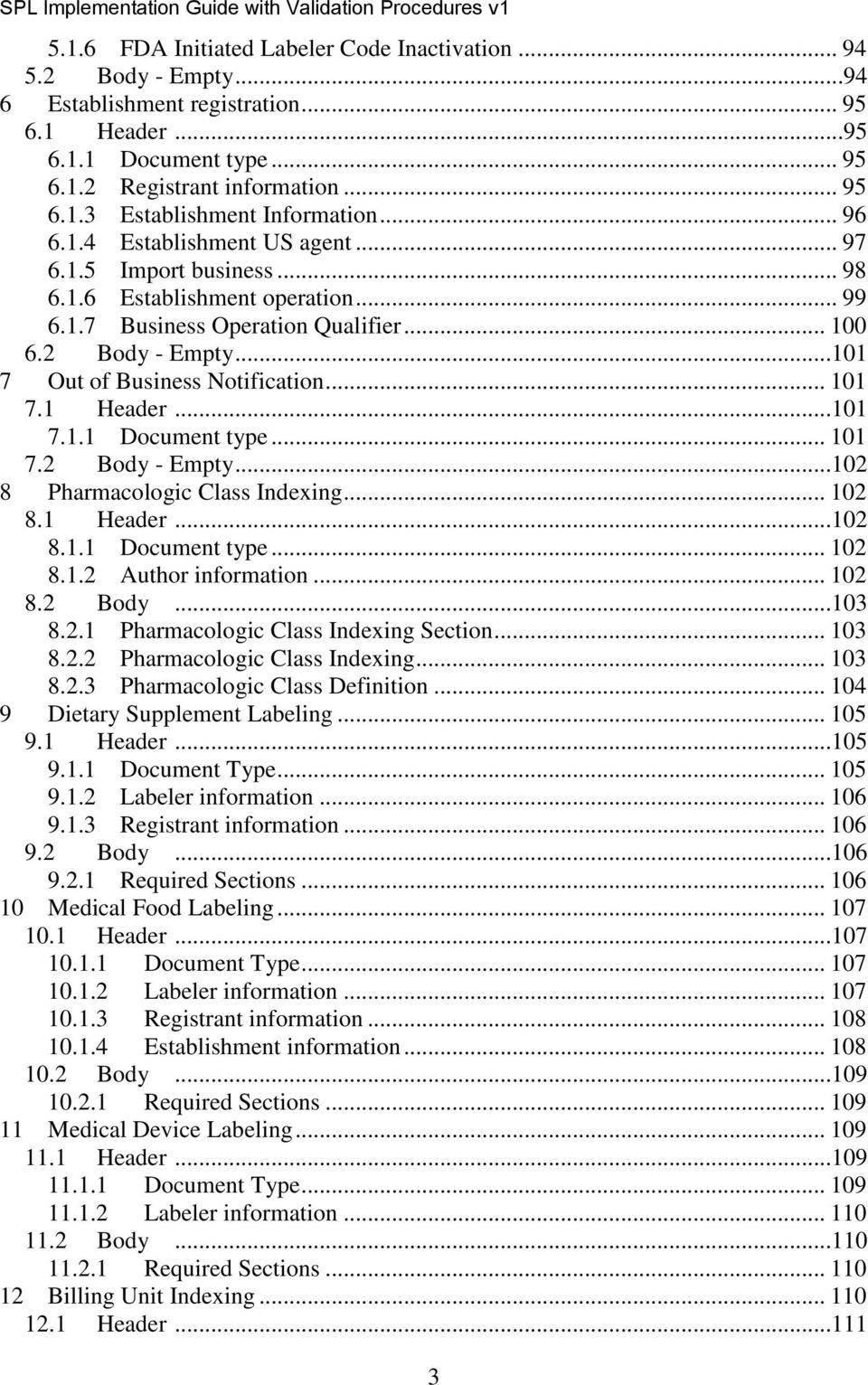
5 4 1 Introduction Document Type Author Body Indexing Section NDC Billing Unit Generic User Fee Facility Self-Identification Header Document type Registrant information Facility Information Facility operation Business Operation Qualifier Body - Empty Substance Indexing Header Document type Author information Body Substance Indexing Section Substance Indexing Substance Identification Substance Name Detail Substance Code Mappings Equivalence Structural Unit Chemical Structure Stereochemistry structure Optical Activity Irregular Amino Acids for Substitutions Amino Acid Substitutions Authority Citation for Organisms Indexing - Product Concept Header Document type Author information Reference Labeling Body Product Concept Indexing Section Abstract Product/Part Concept Ingredient Abstract Product Concept Code Specification Abstract Kit Concept Code Specification Application Product/Kit Concept Marketing Category and Application Number Application Product/Kit Concept Code Specification Lot Distribution Report SPL Header Document type

6 SPL Implementation Guide with v Author information Bulk-Lot Manufacturers SPL Body Data Elements Section Product Data Single Licensed Product Dosing Specification Fill Lot Bulk Lot(s) Label Lot(s) (Final Container Lot) Container Data Elements Containers Distributed Containers Returned Data Product Data Kit with Multiple Licensed Products Wholesale Drug Distributor/Third-Party Logistics Facility Report Header Document type Reporter information Facility Information Facility operation License Business Operation Qualifier Approval Disciplinary Action Body - Empty Indexing - Biologic or Drug Substance Header Document Type Author Related Document Body Index Data Element Section(s) in General New (or only) Index Data Element Section Old Index Data Element Section Biologic/Drug Product Information Specified Substance Indexing - Warning Letter Alert Header Document Type Author Reference Labeling Body Indexing Section Warning Letter Alert Data Element Warning Letter Date Element

7 1 Introduction 1 Introduction Structured Product Labeling (SPL) is a Health Level Seven (HL7) standard based on Clinical Document Architecture and HL7 Reference Information Model (RIM) accredited by the American National Standards Institute (ANSI) for the exchange of product information. Structured Product Labeling documents include a header and body. The header includes information about the document such as the type of product, author and versioning. The body of the document includes product information in both structured text and data element formats. The United States Food and Drug Administration (FDA) uses SPL documents to exchange information covering a growing number of product related topics. This document provides technical conformance criteria for SPL documents used by FDA. This combines the information previously covered in separate implementation guide and validation procedures documents. 1 A link to the latest SPL schema and controlled terminology used in SPL and other technical documents may be found on the FDA Data Standards Council web site at: Organization This document is divided into three parts. The first part of this document describes the technical conformance criteria that are applicable to header and body of the SPL document independent of the information being exchanged. The second part of the document describes product related technical conformance criteria. The third part describes the technical conformance criteria applicable to the type of information being exchanged. 1.2 Detailed validation procedures are presented at the end of most sub-sections and are clearly marked with the heading. These procedures can be used by humans as check-lists to verify if their submission is correct. The validation procedures are written specific and operational so that they may be checked by systems processing SPL documents. Each validation procedure has a unique paragraph number. These paragraph numbers are generally stable over time, but they may change between versions of the document when rarely a validation procedure is inserted between existing ones; normally, however, new validation procedures are appended to the end of their respective sub-sections. 1 Instead of 2 documents that both contain details on the structure of SPL files for various purposes with examples, explanations and conformance criteria at varying degree of detailing, the combined document is a systematic compilation of all such technical information in a new topical organization. As SPL is used for an increasing number of different types of products or aspects about products, the old organization became difficult to read and to maintain consistently. The new unified implementation guide with topical organization combines the discussion of consideration and detailed technical conformance rules for each aspect or use of SPL in one place. 6

8 SPL Implementation Guide with v1 2 SPL Documents in General 2.1 SPL Header General XML is well formed and valid against the schema There are no data elements and attributes in addition to those described in this document There are no spaces in codes Codes do not have a codesystemname attribute Display names are case insensitive There are no spaces in id extensions Letters in Globally Unique Identifiers (GUID) are lower case There are no empty or incomplete elements except, in certain circumstances, code, title, text, and time (an id has a root, a code has a code system) Characteristics have a class code of OBS or no class code at all There is no confidentiality code on anything but inactive ingredients, registrant, and assigned establishments outside establishment registrations If there is a confidentiality code, then the code is B and the codesystem is XML references This information includes the location of the current stylesheet for the FDA view of the SPL and the location of the current schema. The start of the SPL file is the same for every SPL document and is as follows: <?xml version="1.0" encoding="utf-8"?> <?xml-stylesheet href=" type="text/xsl"?> 7
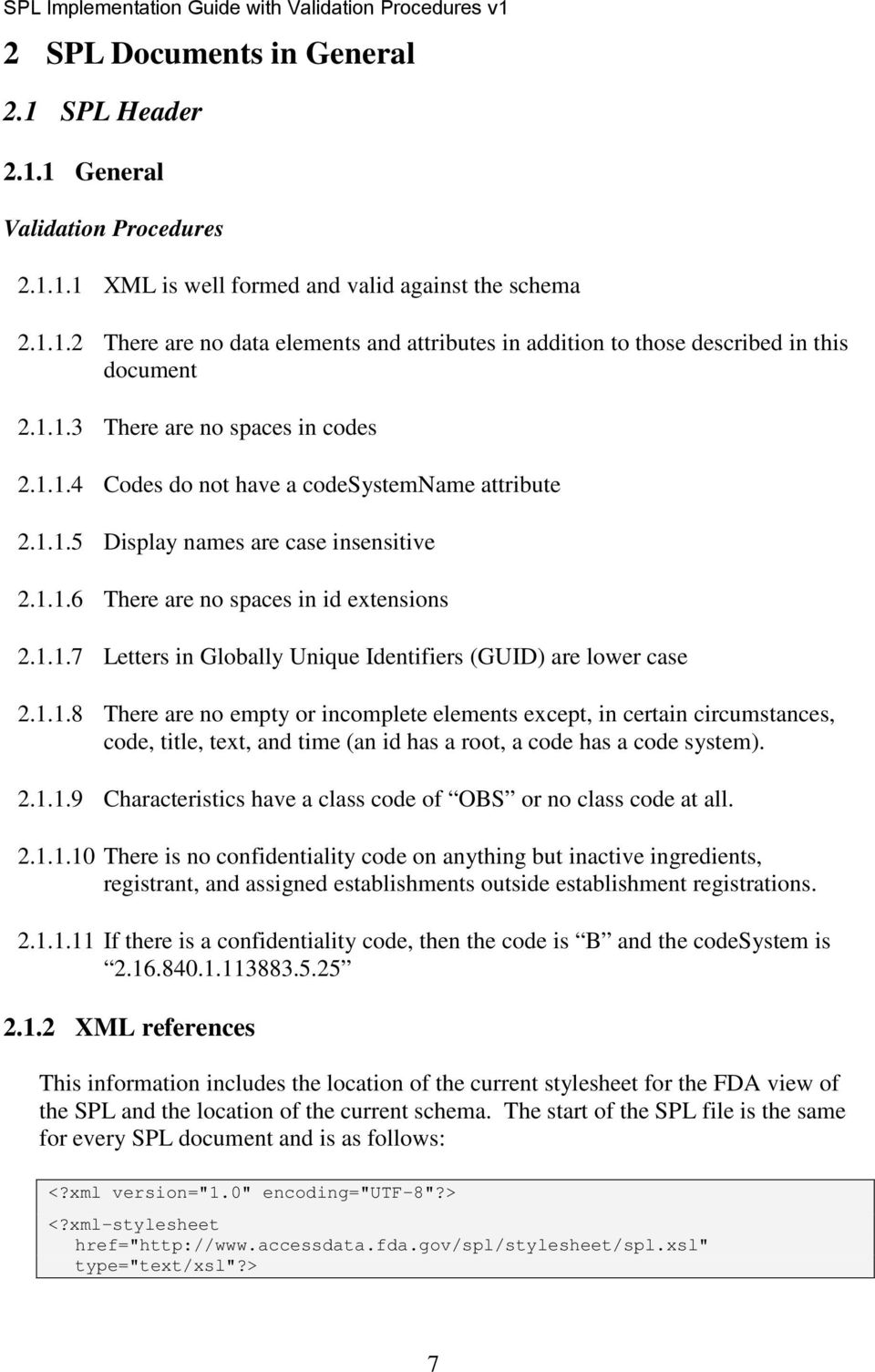
9 <document xmlns="urn:hl7-org:v3" xmlns:xsi=" xsi:schemalocation="urn:hl7-org:v3 2 SPL Documents in General XML reference is for version 1.0 and encoding UTF There is an xml-stylesheet reference to The schemalocation of the urn:hl7-org:v3 namespace is provided as There are no processing instructions other than the xml and xml-stylesheet declarations There are no comments SPL file name is the document id followed by.xml A submission contains only the SPL file whose name ends in.xml and,if appropriate, associated image files whose names end in '.jpg' All image files associated with the SPL document are actually referenced from that SPL document Document information This provides basic information for the identity of the particular document, its type, title, date and versioning as a member of a document set. Terminology: The SPL document types are from LOINC. This code provides information about the subject matter of the document e.g., prescription animal drug. <document> <id root=" e5d-465c-b4e0-0f5a19eb41d4"/> <code code=" " codesystem=" " displayname="establishment registration"/> <title>establishment Registration</title> <effectivetime value=" "/> <setid root="a30accef-f c-9ed4ada5fcf8"/> <versionnumber value= 1 /> The <id root> is a Globally Unique Identifier (GUID) and is unique for each version of the document. Letters used in a GUID are lower case. 8

10 SPL Implementation Guide with v1 The <code> is the LOINC code which provides information on the document type. The <title> data element is used for the title for the document, if necessary. Images are not included in the title. Multiple lines may be used in the title with each line separated by the line break <br/> tag. (note: all titles can also be as follows: <title mediatype="text/x-hl7-title+xml">). The <effectivetime> provides a date reference to the SPL version including the year, month and day as yyyymmdd. The <setid> is a GUID and is a unique identifier for the document that remains constant through all versions/revisions of the document. The <versionnumber> is an integer greater than zero that provides a sequence to the versions of the document There is a document id id root is a Globally Unique Identifier (GUID) id does not have an extension id does not match any other id in the document id (document id) is unique across all documents, sections and any other ids There is a code Code system is Code comes from the Document type list Display name matches the code There are no figures in the title There is an effective time with at least the precision of day in the format YYYYMMDD There is a set id set id is a GUID 9

11 There is a version number 2 SPL Documents in General Value of version number is a whole number > Value of version number is greater than the value of any previously submitted version for the same set id Author Information The author information is represented as follows: <document> <author> <assignedentity> <representedorganization> Many times the author information is used to represent details on the businesses responsible for the products. This includes the labeler and registrant and establishments involved in manufacturing: <author> <assignedentity> <representedorganization><!-- labeler --> <assignedentity> <assignedorganization> <!-- registrant --> <assignedentity> <assignedorganization> <!-- establishment --> <assignedentity> <assignedorganization><!-- US agent and importers --> The following is a representative coding of the common structures in the header: <document> <author> <time/> <assignedentity> <representedorganization><!-- labeler --> <id extension="duns Number" root=" "/> <id extension="ndc Labeler Code" root= /> <name>business name</name> <contactparty> <addr> <streetaddressline>address</streetaddressline> <city>city</city> <state>state</state> <postalcode>postal code</postalcode> <country code="country code" codesystem=" ">country name</country> </addr> <telecom value="tel:telephone number"/> <telecom value="mailto: address"/> <contactperson> <name>contact person name for labeler</name> </contactperson> </contactparty> 10

12 SPL Implementation Guide with v1 <assignedentity> <assignedorganization><!-- registrant --> <id extension="duns number root=" "/> <name>business name</name> <contactparty><!-- same structure as above --></contactparty> <assignedentity> <assignedorganization><!-- establishment --> <id extension="duns number" root=" "/> <id extension="fda establishment identifier" root= /> <name>establishment name</name> <addr><!-- as above --></addr> <contactparty><!-- as above --></contactparty> <assignedentity> <assignedorganization><!-- U.S. agent --> <id extension="duns Number" root=" "/> <name>business name</name> <telecom value="tel: telephone number"/> <telecom value="mailto: address"/> </assignedorganization> <performance> <actdefinition> <code code="c73330" codesystem=" " displayname="display name"/> </actdefinition> </performance> </assignedentity> </assignedorganization> <performance> <actdefinition> <code code="establishment business operation code" codesystem=" " displayname="display name"/> </actdefinition> </performance> </assignedentity> </assignedorganization> </assignedentity> </representedorganization> </assignedentity> </author> </document> Identified Organizations Most organizations are identified using Dun and Bradstreet identifiers (DUNS numbers). These are identifiers with the root and an extension. <representedorganization> <id extension="duns Number" root=" "/> The only reason for an organization not being identified is if the organization remains anonymous but has sub-organizations (e.g., a listing file may not contain any registrant information) 11
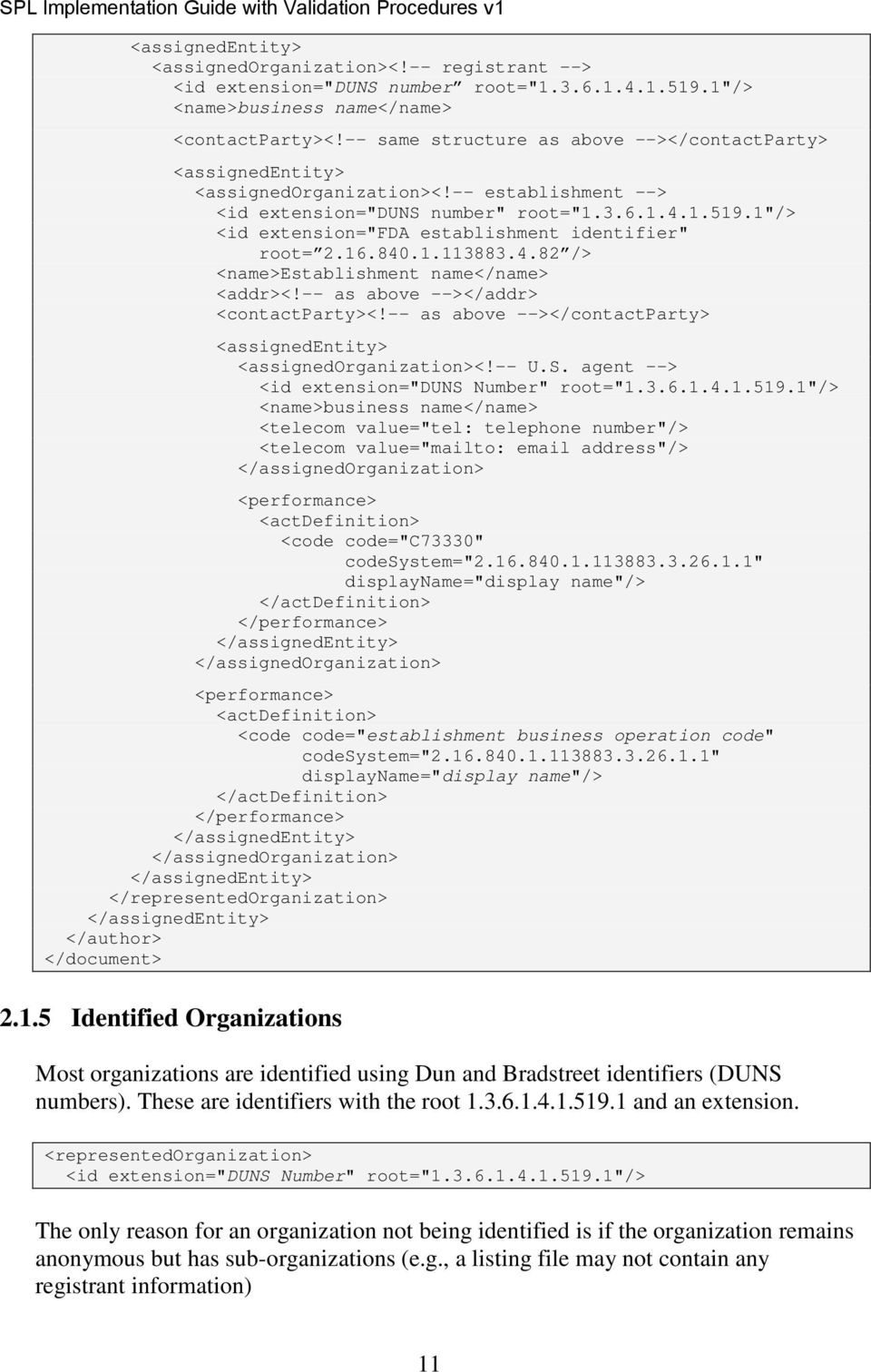
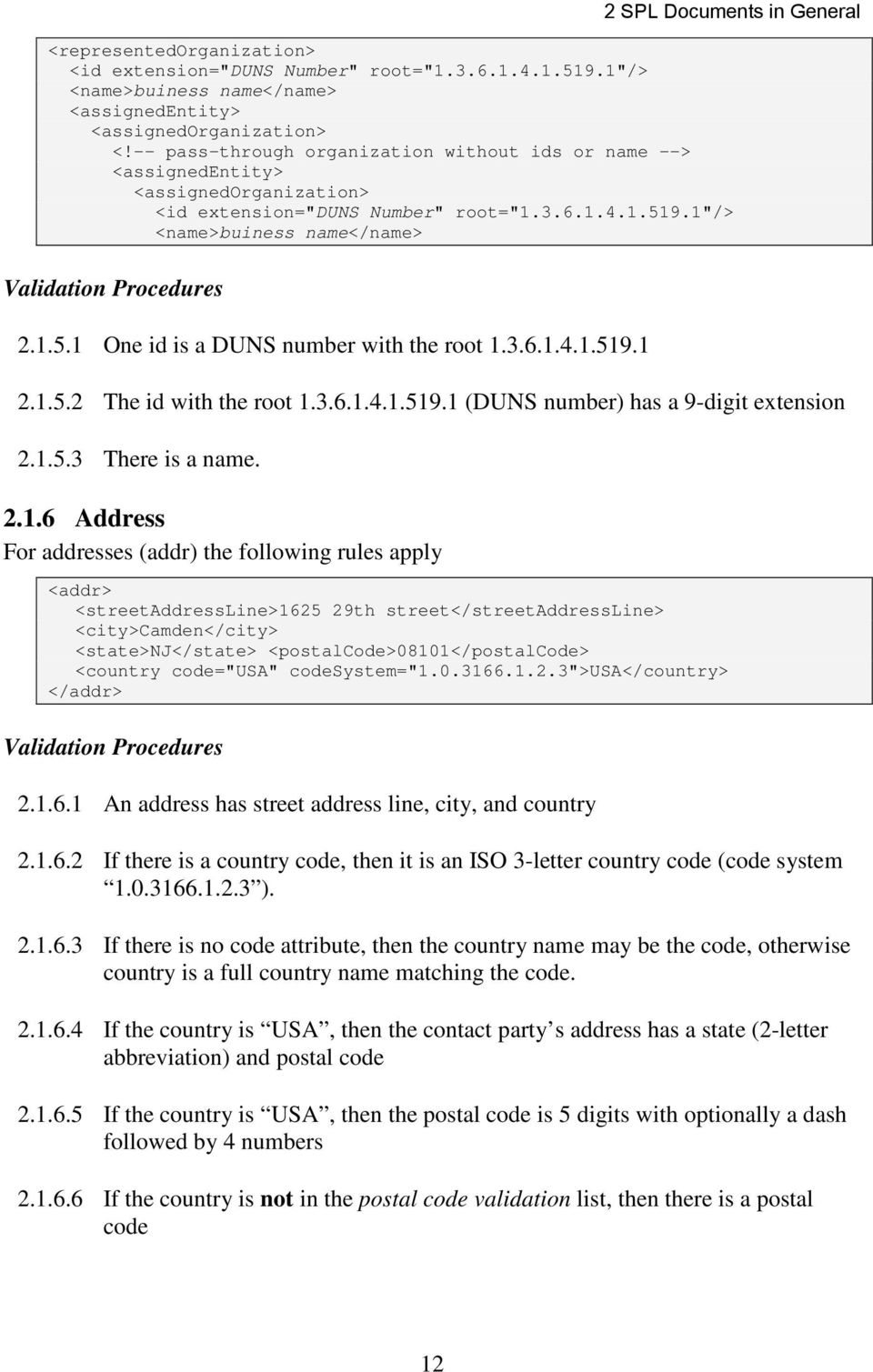
13 2 SPL Documents in General <representedorganization> <id extension="duns Number" root=" "/> <name>buiness name</name> <assignedentity> <assignedorganization> <!-- pass-through organization without ids or name --> <assignedentity> <assignedorganization> <id extension="duns Number" root=" "/> <name>buiness name</name> One id is a DUNS number with the root The id with the root (DUNS number) has a 9-digit extension There is a name Address For addresses (addr) the following rules apply <addr> <streetaddressline> th street</streetaddressline> <city>camden</city> <state>nj</state> <postalcode>08101</postalcode> <country code="usa" codesystem=" ">usa</country> </addr> An address has street address line, city, and country If there is a country code, then it is an ISO 3-letter country code (code system ) If there is no code attribute, then the country name may be the code, otherwise country is a full country name matching the code If the country is USA, then the contact party s address has a state (2-letter abbreviation) and postal code If the country is USA, then the postal code is 5 digits with optionally a dash followed by 4 numbers If the country is not in the postal code validation list, then there is a postal code 12
14 SPL Implementation Guide with v Telecommunication Addresses Some elements may have telecommunication addresses. If an element has telecommunication addresses it usually allows for a telephone number and an address. <contactparty> <telecom value="tel: ;ext=112"/> <telecom value="mailto:[email protected]"/> </contactparty> There are two <telecom> elements, except if the document is a lot distribution data( ) there is one telecom or generic drug facility identification ( or ) there may be a third one One telecom value begins with tel: and is a telephone number For telephone numbers, the following general rules apply: telephone numbers are global telephone numbers; telephone numbers contain no letters or spaces; telephone numbers begin with + ; include hyphens to separate the country code, area codes and subscriber number; have any extensions separated by ;ext= (see Uniform Resource Identifier (URI) for Telephone Numbers RFC 3966) If there is a semicolon, then it is followed by ext One telecom value begins with mailto: and encodes an address an address is of the simple form <username>@<dns-name> If there is a third telecom element, then its value begins with fax: and its format is the same as for a telephone number Contact Party For most organizations, a contact party may be specified with a contact party as in the following example: 13

15 <contactparty> 2 SPL Documents in General <addr> <streetaddressline> th street</streetaddressline> <city>camden</city> <state>nj</state> <postalcode>08101</postalcode> <country code="usa" codesystem=" ">usa</country> </addr> <telecom value="tel: ;ext=112"/> <telecom value="mailto:[email protected]"/> <contactperson> <name>bob Jones</name> </contactperson> </contactparty> The contactparty has an addr, except if the document is a lot distribution data ( ) or Wholesale Drug Distributors and Third-Party Logistics Facility Report ( ) The contactparty has telephone number and addresses There is one contact person name AsNamedEntity There is no asnamedentity element, except if the document is a WDD/3PL Core Document Reference For some SPL documents it is permitted to specify a core document reference. A document with a core document reference inherits all the sections from the referenced core document and may override certain top-level sections with its own sections. A core document reference is specified as follows: <document>... <author.../> <relateddocument typecode="apnd"> <relateddocument> <setid root="20d9b74e-e3d df9-cec fc"/> <versionnumber value="1"/> </relateddocument> </relateddocument> <component.../> </document> 14

16 SPL Implementation Guide with v1 The reference contains the setid of the referenced core-document. The document and the core-document can develop independently. The core-document may be updated, but the reference remains to the latest core-document with the same setid. The version number in the reference may be provided to indicate which version of the coredocument was used when at the time the referencing document was created or modified There is no document id There is a set id Set id is a GUID Document set id is the set id of a core-document If there is a version number, then it is a whole number > If there is a version number, then it is less or equal than the version of the current core document with that set id Predecessor Document Other documents may be merged into this document by providing a reference to the other predecessor documents that are replaced by this document. Do not provide a reference to the predecessor document under the same set id as the document being submitted, as this is implicitly given by the set id and incremented version number of this document. Only provide references to documents of different set ids. The reference contains only the id of the other predecessor document, the setid and the version number. All these ids must match the ids of the other documents that had previously been submitted. <document>... <author.../> <relateddocument typecode="rplc"> <relateddocument> <id root="464239de-45c7-4d2f-a89a-45d303f428bd"/> <setid root= 9ea75e1e-84ef ff-dd08a4c94f40 /> <versionnumber value= 3 /> </relateddocument> </relateddocument> <component.../> </document> 15

17 2 SPL Documents in General There is an id (document id) id (document id) is a GUID There is a set id Set id is a GUID Set id is different from the present document s set id There is a version number, which is a whole number > Document id and versionnumber match the latest document previously submitted under that set id Document type matches the latest document type previously submitted under that set id. 2.2 SPL Body The body of the SPL document includes structured text such as product labeling and specific data elements such as ingredients. <document> <!-- SPL header material --> <component> <structuredbody> <!-- SPL bodyt material --> <component> <section> Sections and subsections <component> <section> <id root="62abedf9-6bde-4787-beb0-abd "/> <code code=" " codesystem=" " displayname="indications and Usage"/> <title>indications and Usage</title> <text>labeling text</text> <effectivetime value=" "/> <component/> Sections and subsections have id, title, and code. LOINC codes are used for sections and subsections codes. 16
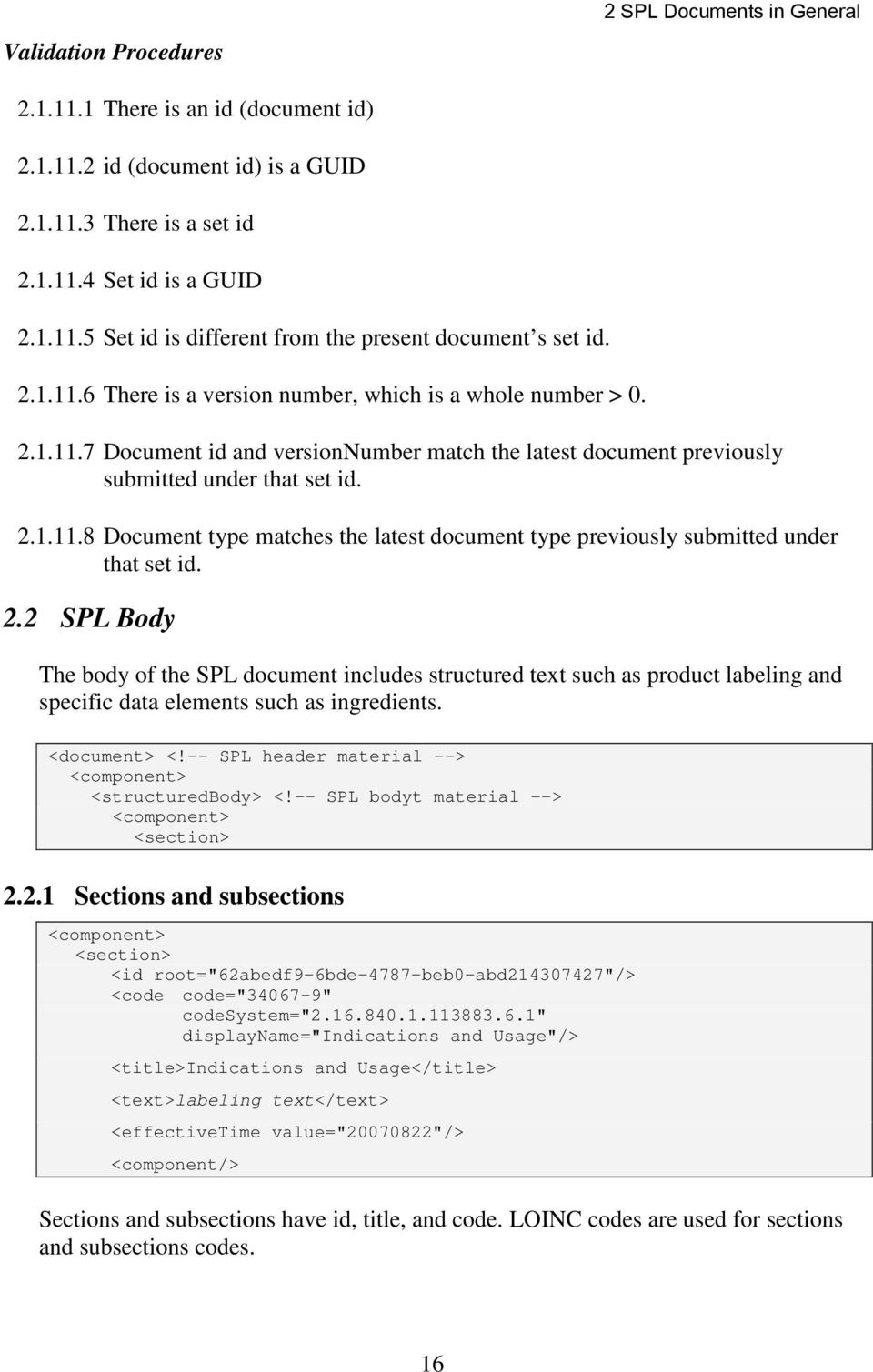
18 SPL Implementation Guide with v1 The <title>, if necessary, of the sections and subsections and order of the sections and subsections in the SPL are used to render the labeling contents. The numbering for the sections and subsections are included in the <title> text. In the SPL schema, the <structuredbody> element contains multiple <component>s, and each <component> contains a <section>. Sections are used to aggregate paragraphs into logical groupings. The order in which sections appear in an SPL document is the order the sections will appear when displayed (rendered) using the standard stylesheet. Major sections defined by the appropriate labeling regulations (e.g., 21 CRF and 57 for human prescription drugs and for human over the counter drugs) such as Indications and Usage are assigned LOINC codes. Sections that have not been assigned a LOINC code are assigned the LOINC code for SPL Unclassified Section. Major sections may also be defined by parts of a container or carton label (e.g., Principal Display panel). <section> <!-- this section s id, codes --> <text> <!-- actual text content in narrative block markup --> </text> Each section has a unique identifier (<id>), an <effectivetime>, and a LOINC code (i.e., the <code> element). A section may or may not contain a <title>. The human readable content of labeling is contained within the <text> element in the <section>. The <section> can be nested to form sub-sections. The schema for subsections in SPL requires that the nested <section> tag first be nested inside a <component> tag. Use nested sections to relate paragraphs. The section tag applies to all of the nested sections. By nesting sections, computer systems can use the section tags in SPL to display information useful for the care of patients. If information is not associated with the tag, it will not be displayed. <section> <!-- this section s id, codes --> <text> <!-- actual text content in narrative block markup --> </text> <component> <section> <!-- subsection content --> </section> </component> <component> <section> <!-- subsection content --> </section> </component> </section> 17

19 2 SPL Documents in General Using the following principles for markup of text information improves access to information in labeling: Capture the section heading using the <title> element rather than placing the text of the title within the <text> element. This allows computer systems to use and display this information properly. Capture the section heading even when the printed label does not include a heading. For example, tagging a pregnancy statement as a section in a label that does not have a heading for pregnancy is useful. Computer systems will be able to use the tag to capture the pregnancy use statement. Omitting the <title> would prevent the heading from appearing when the SPL is rendered. Link different parts of the labeling using the ID attribute to the <section> element. For example, <section ID="Clin_Pharm_Section > serves as the target of a <linkhtml> element. Linking to the ID attribute of a section allows the link to 'reference' the section entirely, e.g., for retrieval of a whole section in a non-browser interface. For container or carton labels, when capturing text and figures outside the Drug Facts or equivalent sections, separate the text and figures for each concept using <paragraph> tags. The order of the placement of information is the content of the package insert, the content of the patient information and the carton and container labels with images Each section has zero to many subsections Each section and subsection has an id root and no extension id root is a GUID id does not match any other id in the document id does not match any other id across all sections, documents, or any id other than the id of the same section previously submitted Each section and subsection has a code Code system is Display name matches the code 18

20 SPL Implementation Guide with v Each section has an effective time with at least the precision of day in the format YYYYMMDD, except the Product Data Elements section ( ) of Lot Distribution Data ( ) Human Compounded Drug Reporting ( ) and Animal Compounded Drug Label ( ) documents, and the Indexing Data Elements section ( ) of Indexing - Biologic or Drug Substance ( ) There are no figures in the title for a section or subsection Section for Medication Guide ( ) and Patient Package Insert ( ) is not a subsection Text <section> <text> <paragraph>lorem ipsum dolor sit amet, consectetur adipisicing elit, sed do eiusmod tempor incididunt ut labore et dolore magna aliqua. Ut enim ad minim veniam, quis nostrud exercitation ullamco laboris nisi ut aliquip ex ea commodo consequat. Duis aute irure dolor in reprehenderit in voluptate velit esse cillum dolore eu fugiat nulla pariatur. Excepteur sint occaecat cupidatat non proident, sunt in culpa qui officia deserunt mollit anim id est laborum.</paragraph> <paragraph>at vero eos et accusamus et iusto odio dignissimos ducimus qui blanditiis praesentium voluptatum deleniti atque corrupti quos dolores et quas molestias excepturi sint occaecati cupiditate non provident, similique sunt in culpa qui officia deserunt mollitia animi, id est laborum et dolorum fuga.</paragraph> </text> </section> The human readable text content of SPL documents is contained within the <text> element. The actual content is contained within a <paragraph>, <table>, and/or <list>. If a section consists only of nested sections, the <text> tag is not included. Elements that can be used within the <text> element to capture the human readable content of SPL include paragraphs (<paragraph>), lists (<list>), tables (<table>) and images (<rendermultimedia>). Elements permitted as children of the <text> element, used as children of the <paragraph> element or within <table> and <list> include superscripts (<sup>), subscripts (<sub>), links (<linkhtml>), line breaks (<br>), footnotes (<footnote>), footnote references (<footnoteref>). Images may be included in the content of labeling using the <rendermultimedia> tag. This tag may be used as a direct child of <text> for block images or as a child of <paragraph> for inline images Font effects 19

21 2 SPL Documents in General There are certain aspects of the rendering of SPL that must be specified in the SPL source to insure that the content of labeling is formatted correctly when rendered. For example: <text> <paragraph>the next snippet <content stylecode="bold italics">will appear as bold italics</content> in the rendering.</paragraph> Will be rendered as: The next snippet will appear as bold italics in the rendering. The <content stylecode= > can also be nested, for example: <text> <paragraph> <content stylecode="bold italics"> will appear as bold italics</content> Can also be represented as: <text> <paragraph> <content stylecode="bold ><content stylecode="italics > will appear as bold italics.</content></content> The values for <stylecode> for font effect are bold, italics and underline. To assist people who are visually impaired, the <stylecode= emphasis > is used to prompt computer screen reader programs to emphasize text such as text in a box warning. The bold, italics and underline font effects may be used together with each other and the emphasis stylecode. For example, <content stylecode= bold ><content stylecode= emphasis > </content></content> will appear as bold and will be emphasized by the screen reader programs. A special stylecode is used for recent major changes (see below) Symbols and special characters Special characters can be included in the text. Superscripts and subscripts are accomplished using the <sup> and <sub> tags. Because the SPL encoding is UTF-8, any Unicode character can be included as is. Unicode references may also be inserted as either &#dddd; where dddd is the Unicode value in decimal notation or � where dddd is the Unicode value in hexadecimal notation. The font used in the standard stylesheet is a Unicode font assuring that most Unicode characters will be rendered correctly if viewed by a browser supporting this font. The only prohibited characters in XML that can not be directly used are less-than < (because SPL XML tags begin with it) and ampersand & (because XML entity references begin with it). Use of these two symbols must be replaced by the XML entity references <. and & respectively. For example, <paragraph>the mean for group 1 was <
22 SPL Implementation Guide with v1 </paragraph> will render as The mean for group 1 was <13. and D&C Yellow #10 will render as D&C Yellow # Footnotes The SPL schema includes a specific footnote element <footnote>. Footnotes are rendered automatically by the standard SPL stylesheet. <footnoteref> is used to refer to another (usually earlier) footnote. For example, <footnote ID= testnote >This is the footnote content</footnote> will generate the following footnote at the appropriate end of a section. 6 This is footnote content The <footnoteref> element with the appropriate IDREF attribute, e.g., <footnoteref IDREF= testnote /> will display the footnote reference in the text corresponding to the footnote with the same ID, e.g., in this example footnote 6. Footnotes are rendered by the default stylesheet using Arabic numbers (e.g., 1,2 3,). Within tables, footnotes are rendered using footnote marks in the series: * #, effectively separating numbered footnotes within general text and footnotes within tables. Footnotes within tables are rendered at the bottom of the table Lists All lists are marked up using the <list> tag, and each item in a list is marked with an <item> tag. The listtype attribute identifies the list as ordered (numbered) or unordered (bulleted). The default numbering and bulleting are controlled by the stylesheet. <text> <paragraph>lorem ipsum dolor sit amet, consectetur adipisicing elit, sed do eiusmod tempor incididunt ut labore et...</paragraph> <list listtype="ordered" stylecode="bigroman"> <item>lorem ipsum dolor sit amet,</item> <item>consectetur adipisicing slit</item> </list> <paragraph>at vero eos et accusamus et iusto...</paragraph> </text> Lists featuring a standard set of specialized markers (standard specialized lists) can be created using the stylecode attribute with the <list> element. Options available for ordered lists are: Arabic (List is ordered using Arabic numerals: 1, 2, 3) LittleRoman (List is ordered using little Roman numerals: i, ii, iii) BigRoman (List is ordered using big Roman numerals: I, II, III) LittleAlpha (List is order using little alpha characters: a, b, c) 21
23 BigAlpha (List is ordered using big alpha characters: A, B, C) For example: <list listtype="ordered" stylecode="littleroman"> For unordered lists the following options exist: Disc (List bullets are simple solid discs: ) Circle (List bullets are hollow discs: ) Square (List bullets are solid squares: ) For example: <list listtype= unordered stylecode= Disc > 2 SPL Documents in General In addition to the standard specialized lists, user-defined characters are also permitted as markers by nesting <caption> within the <item> tag. Note that any character, XML entity, or Unicode symbol, may be used in the <caption>, and that the <caption> for each <item> are not restricted to the same character. For example: <item><caption>*</caption> the asterisk is used as item marker here.<item> Tables Tables can be created with the full structure (header (e.g., for column names), body (e.g. for the rows of the table) and footer e.g. for table footnotes)). The element <tbody> is required for an SPL table while the elements <thead> and <tfoot> are optional in the SPL schema. The structure will display a standard typographical table with rules between the caption (table title) and head, the head and body, and the body and <tfoot>. If a <tfoot> element is included and footnotes are present in a table, then footnotes are rendered after the existing content of the <tfoot> element. It is recommended to always start with a standard table (i.e., <thead> and <tbody> elements) and test to see whether the rendering is unambiguous and interpretable. It is important that the table communicate labeling content not that it duplicates the presentation in word processed or typeset versions of the package insert. In the unusual situation where additional formatting is needed, the rule stylecode specified or certain attributes may be used to modify the table. The rule codes are as follows (note that the control names are case sensitive). Rule on left side of cell is Lrule Rule on right side of cell is Rrule Rule on top of cell is Toprule 22
24 SPL Implementation Guide with v1 Rule on bottom of cell is Botrule Note: More than one rule control may be used in a cell, e.g., <td stylecode code= Botrule Lrule >Cell content </td>. Rule control codes should be used only when necessary for the interpretability of the table. Use of these codes may result in overriding the default rules for tables. Rather than setting the rule for each cell, table rules may also be controlled according to entire rows or columns by use of the stylecode attributes with <col>, <colgroup>, <thead>, <tfoot>, <tbody> and <tr> elements. To make rowgroups appear with horizontal rules, use the stylecode attribute "Botrule" with the appropriate <tr> element. The Botrule value is rarely needed on the <td> element. The preferred method for using vertical rules is to define colgroup with stylecode="lrule or Rrule" (or both). Only if this does not yield the desired vertical rule should the Lrule or Rrule code value with stylecode attributes on the <td> or <th> element itself be used. Note: In general, vertical rules should not be used. Good typography for tables means using few vertical rules. To merge cells vertically and horizontally, the rowspan and colspan attributes should be used on the <td>element. To determine the width of a table, the width attribute may be used on the <table> element and to determine the width of a table column, the width attribute may be used on the <col> and <colgroup> elements. For horizontal alignment, the preferred method for aligning cell content within the margins is to use <col align=.. /> in the <colgroup> element, though this can be used in the <colgroup> element as well. Valid values for align are left, center, right, justify (for full justification of contents within the cells), and char (for character alignment within the cells). Using the <col align=.. /> markup ensures that the contents for all cells in the column share the same alignment. For vertical alignment, the valign attribute can be used within cells. For cases in which the cell alignment must be different from other cells in the column, align is also available as an attribute on the other table elements, including <td>. Markup for table footnote is rendered in the <tfoot> tag. This element does not need to be included in SPL; the standard stylesheet will include a <tfoot> tag if a <footnote> element is present within either the <thead> or <tbody> sections. A <tfoot> section should be included in SPL only if there is additional information other than footnotes that needs to be rendered in this section. For table text spacing, in some instances, the use of a tab or text indentation is desirable in a given table cell. In an SPL document, this effect is achieved by using 23
25 2 SPL Documents in General the nonbreaking space ( ) as if it were a tab space. As the following snippet of XML shows, two nonbreaking spaces were used to offset the word Male from the margin: <td> Male</td>. The nonbreaking space can also be used to keep text in a table from breaking inappropriately due to browser resizing Hypertext links SPL offers hypertext linking capabilities generally similar to those found in the HTML specification. Links are specified by the <linkhtml> construct, where the value for the href attribute of <linkhtml> (the target of the link) is the ID attribute value of a <section>, <paragraph>, <table>, <list>, <content>,<rendermultimedia> element. The stylesheet does not support the stylecode attribute of the <linkhtml> element; if a stylecode is needed for a link, this should be coded via the <content> element within the link as with other text Recent major changes in labeling text SPL offers a notation to identify recent major changes in the labeling text including table elements <table> and table data <td>. The recent major text is tagged using the <content stylecode= xmchange >. For example, <text>this is an example of text that is not changed.<content stylecode= xmchange >This is an example of text that is a recent major change</content>this is an example of changed text that is not considered a recent major change</text> Text is enclosed under <paragraph>, <list>, or <table> elements Images The SPL schema uses <observationmedia> elements to identify graphic files to be rendered at the locations where they are referenced by <rendermultimedia> elements in the <section>. In other words, an image in an SPL will be rendered wherever it is referenced by the rendermultimedia markup, no matter where the observationmedia markup appears. The referencedobject attribute of the rendermultimedia element identifies the corresponding observationmedia instance by means of its ID identifier such as <rendermultimedia referencedobject="mm1"/> <section> <text> <paragraph>...</paragraph> <rendermultimedia referencedobject="mm1"/> <paragraph>...</paragraph> </text> 24
26 SPL Implementation Guide with v1 <component> <observationmedia ID="MM1"> <text>descriptive text</text> <value xsi:type="ed" mediatype="image/jpeg"> <reference value="drug-01.jpg"/> </value> </observationmedia> </component> </section> The <observationmedia> element does not contain the graphics file, but instead points at the file. The <reference> value is the file name. The file name should not include spaces. The observationmedia identifies the graphic media type (i.e., JPEG). In addition, the observationmedia element includes the text description of the image used by screen reader software for visually impaired users. This is included in the <text> child of <observationmedia>. Note also that observationmedia is always contained within a <component> element as illustrated. For image placement, if an image is a block image (i.e., should appear in its own space), insert the rendermultimedia tag between <paragraph> elements. If an image is inline (i.e., should appear alongside text), insert the rendermultimedia tag in the text of a <paragraph> as appropriate. Inline images are expected to be uncommon and basically represent symbols that cannot be represented by Unicode characters. In addition, <caption> are not applicable for inline images since these are not offset from the surrounding text. The SPL stylesheet does not perform any resizing graphics or changing the resolution of graphics files. Thus, all images are rendered in the browser as-is, with all characteristics of the actual graphic file itself. To ensure that a graphic will appear as desired, it is very important that the graphic file is edited to a dimension appropriate for its presentation within the browser. If this is not done, the appearance of the graphic may not be consistent with the narrative content reducing the readability of the file. JPEG image file type using appropriate pixels per inch for images for viewing in a browser using the standard stylesheet There is text Value xsi:type is as above Media type is image/jpeg Reference value is the file name for a valid image Size of image file is less than 1 MB File is a JPEG image and the name has the extension.jpg 25
27 2 SPL Documents in General Image components are referenced at least once in the text of any section Image reference in text has an image observationmedia element with a matching ID in the same document Highlights The actual Highlights of a rendered SPL are constructed from four sources: boilerplate text rendered directly from the stylesheet, information from data elements inserted into the boilerplate text, <title> in the header which includes the drug names, dosage form, route of administration, controlled substance symbol and year of initial US approval, and text blocks corresponding to each major highlights part (Highlights text). Highlights section titles are derived from the FPI section LOINC codes. The Highlights text is captured for the following sections: Microbiology, Boxed Warning, Recent Major Changes, Indications and Usage, Dosage and Administration, Dosage Forms and Strengths, Contraindications, Warnings and Precautions, Adverse Reactions, Drug Interactions and Use in Specific Populations. The text blocks for Highlights are coded with the <excerpt> <highlight> elements of the major section of labeling in which they are contained. <section> <excerpt> <highlight> <text>...</text> For example, the Highlights for Indications and Usage are located with the Indications and Usage section of the labeling. The Highlights text is placed under the main section and not under subsections. The following is an example: <component> <section> <id root="47ef84cd c3-8ee2-bdff3087f83f"/> <code code=" " codesystem=" " displayname="warnings and precautions section"/> <title>5 WARNINGS AND PRECAUTIONS</title> <excerpt> <highlight> <text> <list listtype="unordered"> <item>aplastic anemia has been observed in 8% of recipients and is irreversible in the majority of patients who experience this. (<linkhtml href= #Section_5.1 >5.1</linkHtml>)</item> <item>monitor for hematological adverse reactions every 2 weeks through the second month of treatment (<linkhtml href= #Section_5.2 >5.2</linkHtml>)</item> </list> </text> </highlight> </excerpt> 26
28 SPL Implementation Guide with v1 <component> <section ID="Section_5.1"> <id root="a857689e c0-a244-8a6d5a25966a"/> <title>5.1 Aplastic anemia</title> <text> <paragraph>aplastic anemia has been observed in..</paragraph> </text> </section> </component> </section> </component> This example illustrates the following principles: a. The <text> block for the Highlights is included as the <excerpt> <highlight> <text> children of the respective section. In the example above, the text block rendered in the highlights section is the child of the Warnings and Precautions section. b. The coding of the highlights text block is not in a subsection. c. The text block is rendered similar to any other text block, although in a location separate from its actual position in the rendered SPL document. d. Links to the section or subsection where the primary content exists are explicitly entered in the Highlights text block. e. Section numbering is included in the title of sections and subsections (e.g., 5 and 5.1, above). Highlights and labeling boilerplate items include: Statement - Highlights of Prescribing Information Highlights section titles Patient counseling statement with information taken from FPI section LOINC codes for patient information sections, specifically information for patient section ( ), SPL Medguide section ( ), SPL patient package insert section ( ) and SPL supplemental patient material ( ) Revision date is taken from the effective time Full Prescribing Information: Contents Statement Full Prescribing Information There may be excerpts. 27
29 2 SPL Documents in General Excerpts occur only in sections with the following codes: (Boxed Warning), (Recent Major Changes), (Indications and Usage), (Dosage and Administration), (Dosage Forms and Strengths), (Contraindications), (Warnings and Precautions), (Adverse Reactions), (Drug Interactions), (Use in Specific Populations), (Microbiology) If there is an excerpt, then it only has highlight text An excerpt in the adverse reactions section ( ) includes the statement: "to report suspected adverse reactions" and " " (different telephone number for documents of type Vaccine Label ) If there are highlights excerpts, then the title for the SPL file includes the text string (without the quotation marks): These highlights do not include all the information needed to use see full prescribing information for and Initial U.S. Approval Product Data Elements Section Currently most of the time the product data elements are in a separate section of their own followed by the content of labeling sections that contain only text and no data elements. Product data element section and other special data elements sections are described in Section 3 below; this section describes the features used from the free text (so called narrative ) part of the SPL documents. <document> <!-- SPL header material here --> <component> <structuredbody><!-- SPL body material here --> <component> <section> <!-- Product data element section --> <code code=" " codesystem=" " displayname="spl product data elements section"/> <subject> <manufacturedproduct> <!-- product data elements --> </manufacturedproduct> </subject> </section> </component> <component> <! > <!-- Other content of labeling material --> The beginning of the product data elements is as follows 28
30 SPL Implementation Guide with v1 <component> <section> <id root="e13a985b-f706-a5c8-e8ef-73891eb1c697"/> <code code=" " codesystem=" " displayname="spl product data elements section"/> <effectivetime value=" "/> <subject> <manufacturedproduct> Code, code system and display name are as above There is one or more product, except in Human Compounded Drug Reporting ( ) and Animal Compounded Drug Label ( ) documents There is an effective time with at least the precision of day in the format YYYYMMDD 3 Product Data Elements This section describes with examples in general the capabilities of the product data elements that are currently implemented in the scope of this Implementation Guide. More specific sections follow with more detail and more specific guidelines and validation procedures. These subsequent sections may constrain and detail what is described here, but may also introduce details not described here in general. In case of discrepancies, the later specific ruling preempts the general description given here. Terminology: FDA terminology is used for the proprietary, non proprietary and ingredient name. National Drug Codes (NDC) System is used for o NDC Labeler Code (4 or 5 digit code (e.g., 0001 or 11111)), to register the labeler prefix, o NDC Product Code (8 or 9 characters beginning with the NDC Labeler Code separated by a hyphen from the product segment of the code (e.g., or or )) for products independent of packaging, and o NDC Package Code (10 characters beginning with the NDC Product Code separated by a hyphen from the package segment of the code (e.g., , or )) for packaged products. NDC System is also used for identifiers for the National Health Related Item Code (NHRIC) o NHRIC Labeler Code (4 or 5 digit code), 29
31 30 3 Product Data Elements o NHRIC Product Code (8, 9 or 10 digits beginning with the NHRIC Labeler Code separated by a hyphen from the product segment of the code and o NHRIC Package Code (10 digits beginning with the NDC Product Code separated by a hyphen from the package segment of the code). ISBT-128 site and product codes are for licensed minimally manipulated cell products. GS1 GTIN and HIBCC codes are used for device item codes. FDA Substance Registration System (SRS) is used for the ingredient and active moiety Unique Ingredient Identifier (UNII). The FDA submission tracking system is used for application numbers. Codes derived from section references to the Code of Federal Regulations are used for monograph citations. The National Cancer Institute Thesaurus (NCIt) is used for dosage form, product characteristics, DEA schedule, unit of presentation, route of administration and equivalent codes. The Unified Codes for Units of Measure (UCUM) is used for the unit of measure. HL7 confidentiality code B is for business confidential information. FDA Product Classification codes are for device and cosmetic products. 3.1 Product in General Among the product data elements that are always used are item code and name. These are children of <manufacturedproduct>. Item Code is a unique identification of this product description whether or not the item code is printed on the product itself. Item codes must conform to the ISO system of codes. National Drug Code (NDC), National Health Related Item Code (NHRIC), GS1 GTIN, HIBCC all conform to ISO All these have in common that they are composed of a company prefix (e.g. NDC labeler segment) followed by the item reference that is assigned by the owner of the company prefix to create a unique item code. As long as the item code is unique, the digits (and letters) in it need not convey any other information. Names: When specific manufactured or marketed products are described, the name is the proprietary name as it appears on the label divided between <name> and <suffix>. The <name> is the initial portion of the proprietary name describing the ingredients without any other descriptors including trademarks and dosage forms. If necessary, <suffix> is used for descriptors such as extended release. When using the <suffix>, a space after the proprietary name is added as necessary. Non-proprietary or generic names of drugs are found in the <genericmedicine><name> element. Device type codes and descriptions use <asspecializedkind>. A brief description is added in the <desc> element that states succinctly the kind of device. This text should be brief to be able to list it in short summary listings. While
32 SPL Implementation Guide with v1 the text can be up to 512 characters in length, it should normally be much shorter so that it will be useful for listing in tables. A device also has a device-nomenclature code in the <asspecializedkind> element. This code comes from the FDA Product Classification terminology. Marketing category and product type: The type of product is indicated by the Marketing Category. Code Type Display Name C73583 Drug C73584 Drug C73585 Drug C73588 Drug C73590 Drug C73593 Drug C73594 Drug C73603 Drug C73604 Drug C73605 Drug C73613 Drug C73614 Drug C73627 Drug C73626 Drug C75302 Drug C80438 Device C80440 Device C80441 Device C80442 Device Table 1: Marketing Category and Product Type ANADA ANDA BLA Conditional NADA Export only NADA NDA OTC monograph final OTC monograph not final NDA authorized generic unapproved medical gas unapproved homeopathic unapproved drug other bulk ingredient IND Exempt device Humanitarian Device Exemption Premarket Application Premarket Notification C86964 Medical Food Medical Food C86952 Dietary Supplement C86965 Cosmetic C92556 Drug C94795 Drug C95600 Drug C95601 Drug C95602 Drug C96793 Drug C98252 Drug C Drug Dietary Supplement Cosmetic Legally Marketed Unapproved New Animal Drugs for Minor Species Drug for Further Processing Approved drug product manufactured exclusively for private label distributor OTC monograph drug product manufactured exclusively for private label distributor Unapproved drug product manufactured exclusively for private label distributor Bulk Ingredient for Human Prescription Compounding Bulk Ingredient for Animal Drug Compounding unapproved drug for use in drug shortage The following is an example for a drug product: 31
33 3 Product Data Elements <subject> <manufacturedproduct> <manufacturedproduct> <code code="ndc Product Code" codesystem=" "/> <name>proprietary name <suffix>suffix to name</suffix></name> <formcode code="dose form code" codesystem=" " displayname="display name"/> <asentitywithgeneric> <genericmedicine> <name>non proprietary name</name> </genericmedicine> </asentitywithgeneric> </manufacturedproduct> <subjectof> <approval> <!-- possibly approval number --> <code code="c73594" displayname="nda" codesystem=" " /> <!-- possibly other attributes in the marketing category --> </approval> </subjectof> </manufacturedproduct> </subject> The following is an example for a device: <subject> <manufacturedproduct> <manufacturedproduct> <code code="device Item Code" codesystem="item Code System"/> <name>proprietary name <suffix>suffix to name</suffix></name> <desc>brief description of product (up to 512 characters)</desc> <asspecializedkind> <generalizedmaterialkind> <code code="product classification code" codesystem=" " displayname="display name"/> </generalizedmaterialkind> </asspecializedkind> </manufacturedproduct> <subjectof> <approval> <!-- possibly approval number --> <code code="c80441" displayname="premarket Application" codesystem=" " /> <!-- possibly other attributes in the marketing category --> </approval> </subjectof> </manufacturedproduct> </subject> There is an Item Code, except for part products not requiring an Item Code or if the document type is Human Compounded Drug Reporting ( ), 32
34 SPL Implementation Guide with v1 Animal Compounded Drug Label ( ) or Indexing - Biologic or Drug Substance ( ) General rules about the Item Code are: Code system is (NDC, NHRIC), (GS1), (HIBCC), or (ISBT 128) Code is compliant with the code system s allocation rules There is a name, i.e., proprietary name of the product as used in product labeling or in the catalog If the document type is Human Compounded Drug Label ( ) then there may be an item code Equivalence to other Products, Product Source The following is for referencing information already submitted for a source drug: <subject> <manufacturedproduct> <manufacturedproduct> <code code="ndc Product Code" codesystem=" "/> <name>proprietary name <suffix>suffix to name</suffix></name> <asequivalententity classcode="equiv"> <code code="c64637" codesystem=" "/> <definingmaterialkind> <code code="source NDC Product Code" codesystem=" "/> </definingmaterialkind> </asequivalententity> This is a special case of referencing other products for various purposes. Another purpose is for products that are updated with improvement, where it may be useful to indicate a succession to a previous version of the product identified by the item code of the predecessor product. This can be done using the equivalence relationship with <asequivalententity> with a different Role code as in Table 2: <manufacturedproduct> <manufacturedproduct>... <asequivalententity classcode="equiv"> <code code="c?????" codesystem=" "/> <definingmaterialkind> <code code=" " codesystem=" "/> The following equivalence codes are defined: Table 2:Equivalence Codes 33
35 3 Product Data Elements Equivalence Same Predecessor Product Code C64637 pending Product source may be specified under a product <subject> <manufacturedproduct> <manufacturedproduct> <asequivalententity> or under parts <part> <partproduct> <asequivalententity> As equivalent entity class code is as above If there is a classcode, it is EQUIV Code and code system are as above Defining material kind code (source NDC product code) matches an Item Code in an SPL file with a different set id Equivalent Item Code is not the same as the Item Code for the product Equivalent Item Code is not the same as the Item Code for another equivalence stated for this product If the NDC product source (equivalent product) is present, then the active ingredient UNII and active ingredient strength are the same as that of product source If the NDC product source (equivalent product) is present, then the product characteristics of size are the same as that of product source If the NDC product source (equivalent product) is present, then the product characteristics of shape is the same as that of product source If the NDC product source (equivalent product) is present, then the product characteristics of color are the same as that of product source. 34
36 SPL Implementation Guide with v If the NDC product source (equivalent product) is present, then the product characteristics of imprint code are the same as that of product source There is only one product source per product If the document type is Human Compounded Drug Label ( ) or Animal Compounded Drug Label ( ) then there is no product source Additional Identifiers for this Product A multitude of other identifiers may be assigned to some products by various parties, manufacturers, distributors, wholesalers, regulators. These identifiers are of a varying quality in terms of control for uniqueness and meaning. They may be unique item codes from other ISO item code systems, or they may be less well defined codes such as model number or catalog number etc. While those model numbers or catalog numbers are often not safe for referencing, such identifiers are customer facing and may encode minor product variants, which would be recognized by customers and hence listing such identifier cross references can aid in finding the correct item code. <manufacturedproduct> <manufacturedproduct>... <asidentifiedentity classcode="ident"> <id extension="other identifier" root="other identifier root"/> <code code="other identifier type code" codesystem=" " displayname="model number"/> HL7 requires any identifier to be made globally unique, therefore submitters must acquire an OID of their own through any of several sources (e.g. HL7 provides a free OID assignment service). Submitters must not allow conflicting assignments of model numbers among their own products. Submitters can still create unique identifiers from these model numbers by giving different root OIDs for each kind of identifiers that may be in conflict. Once a company has acquired a root OID this root OID can be freely sub-divided. For example, ACME Fine Devices Inc. may have acquired the OID from the HL7 registry. ACME then decided to use a sub-branch.2 under their OID to manage model numbers for the models from models release before 2007 and sub-branch.5 for models released after There is no specific rule that must be obeyed when sub-dividing OIDs as long as it results in the concatenation of model number code and codesystem OID to be a unique identifier. Different types of such identifications may be assigned different codes from the NCI Thesaurus for Model Number, Catalog Number and possibly other types of numbers: Table 3:Miscellaneous Identifier Types 35
37 3 Product Data Elements Identifier Type Code Description Model Number C99286 the exact model number found on the device label or accompanying packaging. Catalog Number C99285 the exact number as it appears in the manufacturer's catalog, device labeling, or accompanying packaging Reference Number C99287 any secondary product identifier Ingredient Ingredients may be specified for products <subject> <manufacturedproduct> <manufacturedproduct> <ingredient/> and parts. <part> <partproduct> <ingredient/> Ingredient information includes the class code specifying the type of ingredient (e.g., active, inactive), code, name, and strength, and possibly active moiety name(s) and identifier and a reference ingredient name and identifier. <ingredient classcode= class code including basis of strength > <quantity> <numerator value="value" unit="ucum code"/> <denominator value="value" unit=" UCUM code"/> </quantity> <ingredientsubstance> <code code="unii" codesystem=" "/> <name>active ingredient name</name> <activemoiety> <activemoiety> <code code="unii" codesystem=" "/> <name>active moiety name</name> </activemoiety> </activemoiety> <asequivalentsubstance> <definingsubstance> <code code="unii" codesystem=" "/> <name>reference substance name</name> </definingsubstance> </asequivalentsubstance> </ingredientsubstance> </ingredient> Devices too may have active ingredients as discussed above (device with embedded ingredient.) 36
38 SPL Implementation Guide with v1 The ingredient element is also used to specify that a product may contain a certain substance (e.g., latex, milk, nuts) or that it does not contain such substances (e.g., wheat gluten). May contain is expressed by specifying the ingredient using the class code CNTM without any quantity; e.g., product may contains latex: <ingredient classcode="cntm"> <ingredientsubstance> <code code="2lq0uuw8in" codesystem=" "/> <name>natural LATEX RUBBER</name> Does not contain is expressed by specifying the ingredient using the class code CNTM without a quantity with numerator 0 (zero); e.g. product is gluten free: <ingredient classcode="cntm"> <quantity> <numerator value="0" unit="1"/> <denominator value="1" unit="1"/> </quantity> <ingredientsubstance> <code code="1534k8653j" codesystem=" "/> <name>wheat GLUTEN</name> If the ingredient comes from a product (such as in Human Compounded Drug Labels, ) one can specify the product item code for the ingredient as a source product, or, when the product item code is an NDC, called simply the ingredient s source NDC. <ingredient classcode= ingredient class code e.g., ACTI(M/B/R) >... <ingredientsubstance.../> <subjectof> <substancespecification> <code code= Soure NDC codesystem= /> </substancespecification> </subjectof> </ingredient> There is a class code There may be a strength with a numerator and denominator Numerator and denominator have a value greater than zero and a unit, except the numerator when the ingredient class code is CNTM Unit comes from the UCUM units of measures list 37
39 3 Product Data Elements For percentages numerator unit is not 1, instead use a volume unit for volume fractions and a mass unit for mass fractions The denominators values and units for all ingredients in this product are the same There is an ingredient code with code and code system Code system is The same ingredient substance code (UNII) is not used more than once per product There is an ingredient name Name matches the code (UNII) If the document type is Human Compounded Drug Label ( ) or Animal Compounded Drug Label ( ) then active ingredients have an ingredient source product item code (ingredient source NDC) If the document type is not Human Compounded Drug Label ( ) or Animal Compounded Drug Label ( ) then there is no ingredient source product item code (ingredient source NDC) Ingredient source product item code (source NDC) has been previously submitted (i.e. is a known listed product) The source of the active ingredient (bulk or finished drug(s)) identified by the item code (source NDC product code) has that same active ingredient as the compounded drug product The source of the active ingredient (bulk or finished drug(s)) identified by the item code (source NDC product code) can consist of more than one active ingredient, and in that case all the source's active ingredients must be mentioned in the compounded drug product Packaging The packaging includes the quantity of product in the package and the package type and Package Item Code (such as NDC Package Code or other Item Code for the package). Packaging may be specified for the product, 38
40 SPL Implementation Guide with v1 <manufacturedproduct> <manufacturedproduct> <ascontent/> for parts, <part> <partproduct> <ascontent/> and for packages. <ascontent> <containerpackagedproduct> <ascontent/> The format for packaging specification is: For example, <ascontent> <quantity> <numerator value="value" unit="ucum code"/> <denominator value="1"/> </quantity> <containerpackagedproduct> <code code="package Item Code" codesystem=" "/> <formcode code="value" codesystem=" " displayname="display name"/> </containerpackagedproduct> </ascontent> A product may have an as content (package information) element (optional for parts) Quantity (for package information) includes a numerator and denominator Numerator (for package amount) has a value greater than zero and a unit If the product has parts, then the initial numerator value and unit is Unit of the numerator (for package amount) of the initial package is the same as the units for the denominators of all the ingredient quantities (strengths) Unit of the numerator (for package amount) of an outer package is the same as the unit for the denominator of the quantity of the inner package Denominator has value 1 and either no unit or unit 1 39
41 3 Product Data Elements If the document type is not for bulk ingredient ( ), Drug for Further Processing ( ), OTC animal drug ( ), OTC type A ( ), OTC type B ( ), OTC type C ( ), prescription animal drug ( ), VFD type A ( ), VFD type B ( ), VFD type C ( ), Cosmetic ( ), Dietary Supplement ( ), Medical food ( ), Human compounded drug ( ), Animal Compounded Drug Label ( ), Lot Distribution Data ( ), Licensed Vaccine Bulk Intermediate ( ), or Recombinant Deoxyribonucleic Acid Construct Label ( ), then a combination product type characteristic is on the inner-most packaging There is a form code and display name Code system for form code is Display name matches form code There is a Package Item Code with code and code system for outermost package, except for parts or if the document type is Human Compounded Drug Label ( ) or Animal Compounded Drug Label ( ) If document type is (Cellular Therapy), (Plasma Derivative), (Vaccine Label), then there is a package item code with code and code system for the inner, unit of use package, except if the inner package is wrapped into a pouch (C43200) the item code may be on the pouch level If the document type is Human Compounded Drug Label ( ) or Animal Compounded Drug Label ( ) and if there is a product NDC, then there should be an outer package NDC If the Package Item Code has been previously submitted, then the package form code and quantity value and unit are the same as in the most recent submission for this item code If the Package Item Code is mentioned elsewhere in the document, then the package form code and quantity value and unit are the same and the content of both packages have an Item Code that is the same Package Item Code does not match any other Package Item Code in the same package hierarchy If the package item code is an NDC/NHRIC (i.e., if the root is ), then the following procedures apply: NDC/NHRIC package item code is 10 digits (excluding any hyphens). 40
42 SPL Implementation Guide with v NDC/NHRIC package item code contains three segments divided by hyphens The first two segments of the NDC/NHRIC package item code matches the NDC/NHRIC product/item code The third segment of the NDC/NHRIC package item code is numeric If the package item code is an ISBT 128 code (i.e., if the root is ), then the following procedures apply: ISBT 128 package item code has three segments divided by hyphens The first two segments of the ISBT 128 package item code matches the ISBT 128 Product Item Code The third segment contains two digits Kits, Parts, Components and Accessories Products may be combined in various ways such as: Drug kit with a device part Device kit with a drug part Device with an embedded drug Drug in a delivery device Products sold separately but meant to be used together Kits and Parts: When products have more than one part, each part is described under <partproduct>. The total amount of the part in the product is included as follows: <part> <quantity> <numerator value="total amount of part in product" unit="ucum code"/> <denominator value="1"/> </quantity> <partproduct> <!-- same as above for drug or device. --> Currently, when a drug product has parts, it is considered a Kit indicated by the formcode for KIT: <manufacturedproduct> <manufacturedproduct> <code code=" " codesystem=" "/> <name>easy-go PreciFuse PorterPump Kit</name> <formcode code=" C47916" displayname="kit" codesystem=" "/> <part><! > 41
43 3 Product Data Elements Device products may also be kits (in this case a device with FDA product classification code but also with formcode specifying KIT. However, devices themselves may also be specified with parts, such as distinguishing component options or field replaceable parts, in this case the top-level device need not have a formcode for KIT: <manufacturedproduct> <manufacturedproduct> <code code="item code of device" codesystem="code system OID"/> <name>name of device</name> <desc>brief description of device</desc> <asspecializedkind... product classification for device... /> <part> <quantity> <numerator value="1"/> <denominator value="1"/> </quantity> <partproduct> <code code="item code of part" codesystem="code system OID"/> <name>name of part</name> <desc>brief description of device part</desc> Drug Kit with a Device Part: This sort of kit has been known from SPL R4 as well, examples being drugs sold as a kit with an applicator device. <manufacturedproduct> <manufacturedproduct> <code code="ndc code of kit" codesystem=" "/> <name>name of kit</name> <formcode code="c47916" displayname="kit" codesystem=" "/> <asentitywithgeneric.../> <part> <quantity> <numerator value="amount of this part s content in one kit" unit="unit for amount"/> <denominator value="1"/> </quantity> <partproduct> <code code="ndc code of drug part" codesystem=" "/> <name>name of drug part</name> <formcode code="form code of drug part" displayname="form name of drug part" codesystem=" "/> <ingredient... /> <ascontent> <quantity> <numerator value="amount of this part in its package" unit="unit of amount"/> <denominator value="1"/> </quantity> 42
44 SPL Implementation Guide with v1 <containerpackagedproduct> <code code="ndc code of part s package" codesystem=" "/> <formcode code="package type" displayname="package type name" codesystem=" "/> </containerpackagedproduct> </ascontent> </partproduct> </part> <part> <quantity> <numerator value="amount of this device part in one kit"/> <denominator value="1"/> </quantity> <partproduct> <code code="item code of this device part" codesystem="item code system OID"/> <name>name of device part</name> <desc>description of device part</desc> <asspecializedkind> <generalizedmaterialkind> <code code="product classification code of device part" codesystem=" " displayname="display name of device part"/> </generalizedmaterialkind> </asspecializedkind> </partproduct> </part> Device Kit with a Drug Part: <manufacturedproduct> <manufacturedproduct> <code code="item code of device kit" codesystem="item code system OID"/> <name>name of kit</name> <desc>brief description of kit</desc> <formcode code="c47916" displayname="kit" codesystem=" "/> <asspecializedkind> <generalizedmaterialkind> <code code="product classification code of kit" displayname="display name of kit" codesystem=" "/> </generalizedmaterialkind> </asspecializedkind> <part> same as device part above </part> <part> same as drug part above </part> Device with an embedded drug: For example, a drug eluting stent with an embedded active ingredient. Notice that such products do not involve kits and parts: 43
45 <manufacturedproduct> <manufacturedproduct> <code code="device item code" codesystem="device item code system OID"/> <name>device name</name> <desc>brief description</desc> <asspecializedkind> <generalizedmaterialkind> <code code="product classification code of device" displayname="display name of device" codesystem=" "/> </generalizedmaterialkind> </asspecializedkind> <ingredient classcode="actib"> <quantity.../> <ingredientsubstance> <code code="unii code of active ingredient" codesystem=" "/> <name>paclitaxel</name> 3 Product Data Elements Drug in a delivery device: For example, drug in pre-filled syringe. Note that the syringe filled with the drug is a different product than the empty syringe. Hence it would not be correct to put the item code for the empty syringe on the one filled with the drug. In fact, since the pre-filled syringe already has (or should have) an NDC code, there is no need for another item code for it. However, one may want to refer to the item code for the empty syringe as a generalization of the filled syringe: <manufacturedproduct> <manufacturedproduct> <code code="ndc code drug" codesystem=" "/> <name>name of drug</name> <formcode code="form code of drug" displayname="form display name of drug" codesystem=" "/> <ingredient classcode="actib"> <!-- active ingredient --> </ingredient> <ascontent> <quantity> <numerator value="amount of drug in prefilled device" unit="unit of amount"/> <denominator value="1"/> </quantity> <containerpackagedproduct> <code code="ndc code for prefilled device" codesystem=" "/> <formcode code="form code of prefilled device" displayname="form display name of prefilled device" codesystem=" "/> <asspecializedkind> <generalizedmaterialkind> <code code="item code of empty device" codesystem="item code system of empty device"/> <desc>brief description of empty device</desc> 44
46 SPL Implementation Guide with v1 <asspecializedkind> <generalizedmaterialkind> <code code="product classification code of device" displayname="display name of device" codesystem=" "/> </generalizedmaterialkind> </asspecializedkind> Products sold separately but meant to be used together: when products are used together but packaged separately, the data element <aspartofassembly> is used to identify the other product. The products could be drugs or devices. <manufacturedproduct> <manufacturedproduct> <code code="item code of device" codesystem="code system OID"/> <name>name of device</name> <desc>brief description of device</desc> <asspecializedkind... product classification for device.../> <aspartofassembly> <quantity> <numerator value="1"/> <denominator value="1"/> </quantity> <wholeproduct><!-- this is the assembly, but has no identifier --> <part> <quantity> <numerator value="1"/> <denominator value="1"/> </quantity> <partproduct> <code code="item code of accessory component" codesystem="code system OID"/> <name>name of accessory component</name> <desc>brief description of accessory component</desc> <asspecializedkind... product classification for device.../> Parts may be specified for the product, <manufacturedproduct> <manufacturedproduct> <part/> and for part products. <part> <partproduct> <part/> If the product form code is C47916 (KIT), then there is one or more parts Each part has an overall quantity 45
47 3 Product Data Elements If there is an as content (package information) data element in the part, then the numerator unit is the same as the numerator unit for the as content data element If there is no as content (package information) data element in the part, then the numerator unit is If there is a code, then the general rules for product code apply (see ff) There is a name Procedures for source, ingredients, characteristics and packaging are the same as for products without parts Marketing Category and Application Number The approval structure specifies in the <code> the marketing category under which the product is approved for marketing. Products marketed under an approved application have an application number in the <id extension> and application tracking system under <id root>. Products marketed under a monograph provide the regulatory citation for the monograph <id extension> and the Code of Federal Regulations under <id root>. If there is no application number or monograph citation, the id element is omitted. <subjectof> <approval> <id extension="application or monograph number" root="fda document tracking system OID or CFR OID"/> <code code="code for marketing category" codesystem=" " displayname="display name"/> <author> <territorialauthority> <territory> <code code="usa" codesystem=" "/> </territory> </territorialauthority> </author> </approval> </subjectof> Marketing category is connected through the <subjectof> element which may appear on the main product: <subject> <manufacturedproduct> <manufacturedproduct/> <subjectof/> or on parts: 46
48 SPL Implementation Guide with v1 <part> <partproduct/> <subjectof/> Example: <subjectof> <approval> <id extension="nda123456" root=" "/> <code code="c73594" codesystem=" " displayname="nda"/> <author> <territorialauthority> <territory> <code code="usa" codesystem=" "/> There is one marketing category for every product and product part There is a marketing category code Code comes from the Marketing category list Display name matches the code Code system is Territorial authority is as above Marketing Category vs. Application Number The following are validation procedures relating marketing category to application numbers: If the code is C73583 (ANADA), C73584 (ANDA), C73585 (BLA), C73588 (conditional NADA), C73593 (NADA), C73594 (NDA), C73605 (NDA authorized generic), C75302 (IND), C80438 (Exempt device), C80440 (Humanitarian Device Exemption), C80441 (Premarket Application), or C80442 (Premarket Notification) or C92556 (Legally Marketed Unapproved New Animal Drugs for Minor Species), then the id root is (FDA application tracking system) If the code is C73603 (OTC monograph final) or C73604 (OTC monograph not final), then the id root is (Code of Federal Regulations) 47
49 48 3 Product Data Elements If the code is C73583 (ANADA), then the id extension has the prefix ANADA followed by 6 digits If the code is C73584 (ANDA), then the id extension has the prefix ANDA or BA followed by 6 digits If the code is C73585 (BLA), then the id extension has the prefix BLA followed by 6 digits If the code is C73593 (NADA) or C73588 (Conditional NADA), then the id extension has the prefix NADA followed by 6 digits If the code is C73594 (NDA) or C73605 NDA authorized generic), then the id extension has the prefix NDA or BN followed by 6 digits If the code is C75302 (IND), then the id extension has the prefix IND followed by 6 digits If the code is C73604 (OTC monograph not final), then at least one active ingredient code (if any) matches an entry in the OTC validation-not final list (see FDA SPL web page for list ault.htm) for that monograph citation (id extension) If the code is C73603 (OTC monograph final), then at least one active ingredient code (if any) matches an entry in the OTC validation-final list (see FDA SPL web page for list ault.htm) for that monograph citation (id extension) If the code is C73603 (OTC monograph final), then all active ingredient codes (if any) match an entry in the OTC validation-final-all list for that monograph citation (id extension) If the code is C92556 (Legally Marketed Unapproved New Animal Drugs for Minor Species), then the id extension has the prefix MIF followed by 6 digits If the code is C80438 (Exempt device), then the id extension consists of 3 letters If the code is C80440 (Humanitarian Device Exemption), then the id extension has a prefix H followed by 6 digits If the code is C80441 (Premarket Application), then the id extension has a prefix P or BP followed by 6 digits
50 SPL Implementation Guide with v If the code is C80442 (Premarket Notification), then the id extension has a prefix K or BK followed by 6 digits If the code is not C73583 (ANADA), C73584 (ANDA), C73585 (BLA), C73588 (Conditional NADA), C73593 (NADA), C73594 (NDA), C73603 (OTC monograph final), C73604 (OTC monograph not final), C73605 (NDA authorized generic), C75302 (IND), C80438 (Exempt device), C80440 (Humanitarian Device Exemption), C80441 (Premarket Application), C80442 (Premarket Notification), C95600 (Approved drug product manufactured exclusively for private label distributor), or C92556 (Legally Marketed Unapproved New Animal Drugs for Minor Species), then there is no id (application number or regulatory citation) If the marketing category is C95600 (Approved drug product manufactured exclusively for private label distributor), then there is an id (application number or regulatory citation) If the marketing category is C95600 (Approved drug product manufactured exclusively for private label distributor), then the id extension has the prefix NDA, ANDA, or BLA followed by 6 digits Application Number Consistency If the code is C73584 (ANDA), C73585 (BLA), or C73594 (NDA) and the SPL document type is not Lot Distribution Data ( ) or Vaccine ( ) and the application number was already submitted, then the active ingredient UNIIs are the same as in any previous submission of a product with the same application number Marketing status The marketing status provides information on when the product is on or off the market. <subject> <manufacturedproduct>...</manufacturedproduct> <subjectof> <marketingact> <code code="c53292" codesystem=" "/> <statuscode code="active"/> <effectivetime> <low value=" "/> The <code> indicates the activity of marketing. The status of the product is described in the <statuscode> as either active for being on the market or completed when marketing is done the product is no longer going to be available on the market. The date when the product is on or off the market is included in the 49
51 3 Product Data Elements <effectivetime>. The date when the product is on the market is characterized by the <low value>. Example of a currently marketed product: <subjectof> <marketingact> <code code="c53292" codesystem=" "/> <statuscode code="active"/> <effectivetime> <low value="date when on the market"/> </effectivetime> </marketingact> </subjectof> The date off the market such as the expiration date of the last lot released to the market is characterized by the <high value>. Example of a product that is off the market: <subjectof> <marketingact> <code code= C53292 codesystem= /> <statuscode code="completed"/> <effectivetime> <low value="date when the product is on the market"/> <high value="date when the product is going to be off the market"/> </effectivetime> </marketingact> </subjectof> For some types of products, a marketing status may be provided on the package level: <ascontent> <containerpackagedproduct>...</containerpackagedproduct> <subjectof> <marketingact> <code code="c53292" codesystem=" "/> <statuscode code="active"/> <effectivetime> <low value=" "/> There is one marketing status for each top-level product (part products do not need this) except in Animal Compounded Drug ( ), and Human Compounded Drug ( ) SPL documents There is not more than one marketing status on any one item Code is C53292 and code system is Marketing status code is active or completed 50
52 SPL Implementation Guide with v If the status code is active, then there is a low value (marketing start date) and no high value (marketing end date) If the marketing status code is completed, then there is a low and high value The effective time low (marketing start date) and high boundary (marketing end date) have at least the precision of day in the format YYYYMMDD If there is a high value (marketing start date), then it is not less than the low value (marketing end date) A marketing status can not be on an inner package A marketing status can not be on a package for a part of a kit If the marketing start or end date is on a package, then the start date is not before the marketing start date of the product and the end date not after the end date of the product If any of the products in the document has the application number prefix BA or BN, then there is no package marketing status A marketing status can only be on a package in documents of types Human Prescription Drug Label ( ), Human OTC Drug Label ( ), Drug for Further Processing ( ), or Bulk Ingredient ( ) If the document type is Human Compounded Drug Label ( ) or Animal Compounded Drug Label ( ) then there is no marketing status Characteristics Many characteristics may be specified for products as specified later for specific product types. In general, the characteristic structure allows specifying any properties of the product in a code-value pair, the code saying which property is being specified, the value saying what the property is for the given product. The characteristics structure connects to the product Role through the subjectof element. <manufacturedproduct> <manufacturedproduct>... </manufacturedproduct> <subjectof> <characteristic> <code code="characteristic code" codesystem="characteristic code system"/> <value xsi:type="characteristic value type"...> Some characteristics may be specified for packaged products: 51
53 <manufacturedproduct> <manufacturedproduct>... <ascontent> <containerpackagedproduct>... </containerpackagedproduct> <subjectof> <characteristic> <code code="characteristic code" codesystem="characteristic code system"/> <value xsi:type="characteristic value type"...> 3 Product Data Elements Characteristics listed in Table 7 use one of a number of different data types. Each data type uses slightly different XML elements and attributes as shown in the templates below: Characteristic of type physical quantity (PQ): <subjectof> <characteristic> <code code="characteristic code" codesystem="characteristic code system"/> <value xsi:type="pq" value="quantity value" unit="quantity unit"> Characteristic of type number (REAL): <subjectof> <characteristic> <code code="characteristic code" codesystem="characteristic code system"/> <value xsi:type="real" value="quantity value"/> Characteristic of type integer number (INT): <subjectof> <characteristic> <code code="characteristic code" codesystem="characteristic code system"/> <value xsi:type="int" value="quantity value"/> Characteristic of coded type (CV): <subjectof> <characteristic> <code code="characteristic code" codesystem="characteristic code system"/> <value xsi:type="cv" code="value code" codesystem="value code system OID" displayname="value code display name"> Characteristic of type character string (ST): 52
54 SPL Implementation Guide with v1 <subjectof> <characteristic> <code code="characteristic code" codesystem="characteristic code system"/> <value xsi:type="st">value string</value> Characteristic of type interval of physical quantity (IVL<PQ>): <subjectof> <characteristic> <code code="characteristic code" codesystem="characteristic code system"/> <value xsi:type="ivl_pq"> <low value="quantity value low boundary" unit="quantity unit"/> <high value="quantity value high boundary" unit="quantity unit"/> </value> Characteristic of type Boolean (true/false value) <subjectof> <characteristic> <code code="characteristic code" codesystem="characteristic code system"/> <value xsi:type="bl" value="true or false"/> Table 4: Characteristic codes and code systems. Name Code System OID / Code Data Type SPL Characteristics Description Used early on with Existing SPL for drugs characteristics codes that are possibly applicable for devices: SPLSIZE PQ Greatest dimension in millimeter SPLCOLOR CV color code from NCI Thesaurus SPLIMAGE ED Photographic image of the product for the purpose of identification, taken under standardized conditions. LOINC Used for metrologically well defined properties. NCI Thesaurus Used rarely (if at all) for characteristic codes There is a characteristic property code with code and code system Characteristic property code system is , , or There is a characteristic value with specified type appropriate for the characteristic property. 53
55 Value type is PQ, INT, IVL_PQ, CV, CE, ST, ED, or BL Combination Product Type Combination products are defined in 21 CFR 3.2(e). 3 Product Data Elements To mark products as combination products, the nearest combining package should bear the combination product type characteristic: <manufacturedproduct> <manufacturedproduct>... <ascontent>... <subjectof> <characteristic> <code code="splcmbprdtp" codesystem=" "/> <value code="c102835" codesystem=" " xsi:type="cv" displayname="type 2: Prefilled Drug Delivery Device/System"> Code and code system are as above Value code system is Value comes from the Combination Product Type list Display name matches the value code If the document type is for bulk ingredient ( ), OTC animal drug ( ), OTC type A ( ), OTC type B ( ), OTC type C ( ), prescription animal drug ( ), VFD type A ( ), VFD type B ( ), VFD type C ( ), Cosmetic ( ), Dietary Supplement ( ), Medical food ( ), Human compounded drug ( ), Licensed Vaccine Bulk Intermediate ( ), Drug for Further Processing ( ) or Animal Compounded Drug Label ( ) then there is no combination product type characteristic on any package Production Amount The production amount for a package is specified as: 54
56 SPL Implementation Guide with v1 <manufacturedproduct> <manufacturedproduct>... <ascontent>... <subjectof> <characteristic> <code code="splproductionamount" codesystem=" "/> <value xsi:type="int" value="10000"/> Unlimited production amounts are specified as: <value xsi:type="int" nullflavor="pinf"/> Code and code system are as above The value is an integer number or null flavor PINF to indicate unlimited. 3.2 Drug, Dietary Supplement and Medical Food Products The drug, dietary supplement and medical food product data elements includes the product codes, proprietary and non proprietary name, dosage form, ingredient and active moiety name, ingredient identifier, ingredient strength, package quantity, type and code, marketing category, marketing status, dosage form appearance, DEA schedule, and route of administration. Drug products are those products with the appropriate marketing categories listed in Table 1. Dietary supplement are those products that are associated with the dietary supplement (C86952) marketing category. Medical foods are associated with the medical food marketing category (C86964). The drug product consists of a product item code (NDC for drugs and NHRIC for dietary supplements or medical foods), proprietary and non proprietary name, and dosage form. These are children of <manufacturedproduct>. The proprietary name is the name as it appears on the label divided between <name> and <suffix>. The <name> is the initial portion of the proprietary name describing the ingredients without any other descriptors including trademarks and dosage forms. If necessary, <suffix> is used for descriptors such as extended release. When using the <suffix>, a space after the proprietary name is added as necessary. If there is no proprietary name, the non proprietary name is used without any descriptors. The dosage form is described in <formcode>. The <genericmedicine><name> is the non proprietary name of the product. 55
57 3.2.1 Code and Name 3 Product Data Elements <section> <subject> <manufacturedproduct> <manufacturedproduct> <code code=" " codesystem=" "/> <name>tazmin <suffix>xr</suffix></name> <formcode code="c42998" codesystem=" " displayname="tablet"/> <asentitywithgeneric> <genericmedicine> <name>tazminate hydrochloride</name> </genericmedicine> If the product item code is an NDC/NHRIC (i.e., if the root is ), then the following procedures apply: Code (NDC/NHRIC product code) has two segments separated by a hyphen The first segment (NDC/NHRIC labeler code) is numeric Segments (NDC/NHRIC product codes) follow the pattern of 4-4, 5-4 or The second segment (middle segment of three-segment NDC) is alpha-numeric (letters must be upper-case) If the product item code is an ISBT 128 code (i.e., if the root is ), then the following procedures apply: Code contains two segments separated by a hyphen The first segment contains the ISBT 128 Facility Identification Number (FIN) beginning with a capital letter A-N, P-Z (i.e., all 26 letters except O) followed by 2 alphanumerics A-N, P-Z, 0-9, and 2 digits The second segment contains the ISBT 128 Product Code beginning with a capital letter (A-Z) followed by 4 digits (0-9) and optionally followed by 3 alphanumeric characters First segment (NDC/NHRIC labeler code) matches a Labeler Code associated with the Labeler id (labeler s DUNS Number) in a previously submitted NDC/NHRIC Labeler Code or NDC Labeler Code Animal Drug SPL document, except for parts. 56
58 SPL Implementation Guide with v Code (NDC product code) has the same labeler segment as the NDC product/item code of all top-level products in this document, except under parts Code (NDC product code) has the same length as all other NDC product/item codes with the same labeler segment in this document (i.e., all NDC product/item codes from one labeler have the same consistent length and hence all package item codes have the same consistent configuration.) Code (NDC product code) has the same length as any other NDC product/item codes of the same labeler (i.e., all NDC product/item codes by the same labeler have the same consistent length and hence all package item codes have the same consistent configuration.) There is only one product data elements section for each NDC product/item code, i.e., the same product is not described more than once except under parts If the NDC product/item code is mentioned elsewhere in the document, then the product and generic name, dosage form, UNII and strength of all ingredients are the same There is a name Name contains no special symbols (e.g., no or etc) and no USP or dosage forms There is a form code (dosage form) Form code (dosage form) has the code system If the product has parts, then the form code is C47916 (for KIT) Display name matches the code There is a generic medicine (non-proprietary) name Generic medicine (non-proprietary) name contains no special symbols (e.g., no or etc) and no USP or dosage forms Generic medicine (non-proprietary) name contains no suffix Generic medicine (non-proprietary) name contains no more than 512 characters. 57
59 3 Product Data Elements If the NDC product/item code was previously submitted, then the product name is same as in the most recent submission for this NDC product/item code If the NDC product/item code was previously submitted, then the generic name is same as in the most recent submission for this NDC product/item code If the NDC product/item code was previously submitted, then the active ingredient UNII and active ingredient strength are the same as in the most recent submission for this NDC product/item code If the NDC product/item code was previously submitted, then the product dosage form is same as in the most recent submission for this NDC product/item code If the NDC product/item code was previously submitted, then the product characteristics of size are the same as in the most recent submission for this NDC product/item code If the NDC product/item code was previously submitted, then the product characteristics of shape are the same as in the most recent submission for this NDC product/item code If the NDC product/item code was previously submitted, then the product characteristics of color are same as in the most recent submission for this NDC product/item code If the NDC product/item code was previously submitted, then the product characteristics of imprintcode are the same as in the most recent submission for this NDC product/item code If the NDC product/item code was previously submitted, then the application number is the same as in the most recent submission for this NDC product/item code The dosage form code cannot be not applicable (C48624), for document types other than recombinant deoxyribonucleic acid construct ( ) Product source <asequivalententity classcode= EQUIV > <code code= C64637 codesystem= /> <definingmaterialkind> <code code= source product item code codesystem= /> 58
60 SPL Implementation Guide with v As equivalent entity class code, code and code system are as above If there is a classcode, it is EQUIV Defining material kind code (source NDC product code) matches a NDC product/item code in a SPL file with a different set id NDC product/item code for the source is not the same as the NDC product/item code for the product Active ingredient Active ingredients are specified as follows: <ingredient classcode="actim, ACTIB, or ACTIR"> <quantity> <numerator value="10" unit="mg"/> <denominator value="1" unit="1"/> </quantity> <ingredientsubstance> <code code=" " codesystem=" "/> <name>tazminate malate</name> The class code for active ingredient is dependent on the basis of the strength. If the basis of strength is the active ingredient, the class code is ACTIB. If the basis of strength is the active moiety, the class code is ACTIM. If the basis of strength is a reference drug, the class code is ACTIR. The strength is represented as a numerator and denominator. The UCUM code is used for the unit of measure. The UCUM code for a unit that is an each is 1 Examples of each is in the table below. In most cases, the strength used is that for a single dose following the conventions in Table 5. In the table, an example of mass is milligrams, an example of volume is milliliter, an example of time is hour, and an example of each is tablet. Table 5: Conventions for expressing strength Product Numerator unit Denominator unit Oral solid Mass Each Oral liquid Mass Volume Oral powder for reconstitution with a known volume Mass Volume Oral powder for reconstitution with a variable volume Mass Each Suppository Mass Each Injection liquid Mass Volume Injection powder for reconstitution with a known volume Mass Volume Injection powder for reconstitution with a variable volume Mass Each Inhaler powder Mass Each 59
61 3 Product Data Elements Inhaler liquid Volume Each Inhaler blister Mass Each Topical cream or ointment Mass Mass Topical gel or lotion Mass Volume Transdermal patch Mass Time Bulk liquid Mass Volume Bulk solid Mass Mass Class code for active ingredients are ACTIB, ACTIM or ACTIR If the document type is for bulk ingredient ( ) with a marketing category of bulk ingredient (C73626), then there is one and only one active ingredient If the product has no parts and is not a part, then there are one or more active ingredients If the product has parts, then the active ingredients are under parts There is a strength with a numerator and denominator If the document type is for bulk ingredient ( ) with a marketing category of bulk ingredient (C73626), then numerator and denominator (representing strength amount) are the same The strength numerator is based on mass (e.g., mg or g) and not volume (e.g. ml or L), except for ingredients such as water, alcohol, and gases Active moiety <ingredient classcode="actir"> <ingredientsubstance> <activemoiety> <activemoiety> <code code=" " codesystem=" "/> <name>tazminic acid</name> There are one or two active moieties There is an active moiety code (UNII) Code system is
62 SPL Implementation Guide with v There is an active moiety name for each active moiety If the active ingredient is in the active-ingredient-active-moiety-validation-list (see FDA SPL web page for list ault.htm), then the active moiety and basis of strength is the corresponding active moiety and basis of strength respectively in this list, except if the document type is for bulk ingredient ( ) and Drug for Further Processing ( ) If the active ingredient is not in the active-ingredient-active-moiety-validationlist (see FDA SPL web page for list ault.htm), then the active moiety name does not include any of the names in the active moiety validation (counter ion) list (see FDA SPL web page for list ault.htm), except if the word appears by itself optionally followed by (ester), cation or anion or ion Active moiety name matches the code (UNII) Reference Ingredient for Strength <ingredient classcode= ACTIR > <ingredientsubstance> <asequivalentsubstance> <definingsubstance> <code code="a " codesystem=" "/> <name>tazemate formate</name> If the class code is ACTIR, then there is an asequivalentsubstance element with a defining substance If the class code is not ACTIR, then there is no asequivalentsubstance element There is a reference ingredient code Code system is There is a name (preferred substance name) The name matches the code (UNII) If the document type code is (Vaccine Label) and if there is any active ingredient under the main product or under its first part, then at least one active ingredient code is on the list of active ingredients approved for vaccines. 61
63 3.2.6 Inactive ingredient 3 Product Data Elements The inactive ingredient includes the inactive ingredient class code, ingredient name, identifier, and strength. The element <ingredient> is a child of <manufacturedproduct>. The class code for inactive ingredient is IACT. The strength, if needed, is represented as a numerator and denominator and is described using UCUM units of measure. If the inactive ingredient is confidential, the element<ingredient> includes <confidentialitycode code="b" codesystem=" "/>. <ingredient classcode="iact"> <confidentialitycode code="b" codesystem=" "/> <quantity> <numerator value="value" unit="ucum code"/> <denominator value="value" unit="ucum code"/> </quantity> <ingredientsubstance> <code code="unii" codesystem=" "/> <name>inactive ingredient name</name> </ingredientsubstance> </ingredient> There are zero to many inactive ingredients If the document type is human OTC drug label ( ), then there is at least one inactive ingredient Class code is IACT If the product has parts, then the inactive ingredients are under parts If the document type is human OTC drug label ( ), then there is no confidentiality code There is no ingredient other than active ingredient (having class code ACTIM, ACTIR, ACTIB), inactive ingredient (having class code IACT), adjuvant (having class code ADJV), and those having class code CNTM Packaging The format for packaging specification is: <ascontent> <quantity> <numerator value="100" unit="1"/> <denominator value="1"/> </quantity> 62
64 SPL Implementation Guide with v1 <containerpackagedproduct> <code code=" " codesystem=" "/> <formcode code="c43169" codesystem=" " displayname="bottle"/> Every top-level product has an as content (package information) element (optional for parts) If outer package description has a production quantity characteristic, then document type is Human Compounded Drug ( ) or Animal Compounded Drug Label ( ) and the marketing category is C73627 (unapproved drug other) If the document type is Human Compounded Drug Label ( ) or Animal Compounded Drug Label ( ) then each outer package description has a production quantity characteristic The outer package item code is not associated with another set id except under parts If the package item code has been previously submitted, then the package form code (package type) and quantity value and unit are the same as in the most recent submission for this package item code There are no drug package characteristics other than the ones mentioned in this document The package type code cannot be not applicable (C123723), for document types other than recombinant deoxyribonucleic acid construct ( ) Parts Products with one or more parts <part> <quantity> <numerator value="1" unit="1"/> <denominator value="1"/> </quantity> <partproduct> <code code=" " codesystem=" "/> <name>tazmin <suffix>xr</suffix></name> <formcode code="c42916" codesystem=" " displayname="capsule, extended release"/> 63
65 3 Product Data Elements <asentitywithgeneric> <genericmedicine> <name>tazminate hydrochloride</name> If the product form code is C47916 (KIT), then there is one or more parts If the product has parts, then at least one part has one or more active ingredients Procedures for code, name, dosage form code, source, ingredients, characteristics and packaging are the same as for the main products (see 0ff) Marketing Category Example: <subjectof> <approval> <id extension="nda123456" root=" "/> <code code="c73594" codesystem=" " displayname="nda"/> <author> <territorialauthority> <territory> <code code="usa" codesystem=" "/> If the code is C80438 (Exempt device), C80440 (Humanitarian Device Exemption), C80441 (Premarket Application), or C80442 (Premarket Notification), then there is at least one part If the document type code is: (OTC animal drug), (OTC type A), (OTC type B), (OTC type C), (prescription animal drug), (VFD type A), (VFD type B) or (VFD type C), then the marketing category is: C73583 (ANADA), C73588 (Conditional NADA), C73593 (NADA), C92556 (legally marketed unapproved new animal drugs for minor species), C73614 (unapproved homeopathic), C73613 (unapproved medical gas) or C73627 (unapproved drug other) If the marketing category is C73583 (ANADA), C73588 (Conditional NADA), C73593 (NADA), then the document type code is: (OTC animal drug), (OTC type A), (OTC type B), (OTC type C), (prescription animal drug), (VFD type A), (VFD 64
66 SPL Implementation Guide with v1 type B), (VFD type C), or (Recombinant Deoxyribonucleic Acid Construct Label) If the marketing category is C73626 (bulk ingredient), C96793 (bulk ingredient for human prescription compounding), or C98252 (bulk ingredient for animal drug compounding), then the document type is (bulk ingredient) or Drug for Further Processing ( ) If the document type is (bulk ingredient) or Drug for Further Processing ( ), then the marketing category is C73626 (bulk ingredient), C94795 (drug for further processing), C96793 (bulk ingredient for human prescription compounding), C98252 (bulk ingredient for animal drug compounding), or C73590 (export only) If the code is C73584 (ANDA), C73585 (BLA), or C73594 (NDA), then there exists a record of an application for the application number If the code is C73584 (ANDA), C73585 (BLA), or C73594 (NDA) and the marketing is active with a start date on or before the current date, then there exists a record of an approved application for the application number If the code is C73584 (ANDA), C73585 (BLA), or C73594 (NDA) and the marketing status is completed, then there exists a record of an approved or withdrawn application for the application number If the marketing category is C95600 (Approved drug product manufactured exclusively for private label distributor), C95601 (OTC monograph drug product manufactured exclusively for private label distributor), C95602 (Unapproved drug product manufactured exclusively for private label distributor), then the document type is (Human prescription drug label) or (Human OTC drug label) If the marketing category is C86964 (Medical Food), then the document type is (Medical Food), except under parts If the document type is (Medical Food), then the marketing category is C86964 (Medical Food) If the marketing category is C86952 (Dietary Supplement), then the document type is (Dietary Supplement), except under parts If the document type is (Dietary Supplement), then the marketing category is C86952 (Dietary Supplement) If the document type is Human prescription drug label ( ), then the marketing category is not OTC Monograph Final (C73603), OTC Monograph 65
67 3 Product Data Elements Not Final (C73604), or OTC Monograph Drug Product Manufactured Exclusively for Private Label Distributor (C95601), except under parts If the document type is Drug for Further Processing ( ), then the marketing category is Drug for further processing (C94795.) Marketing Status and Date The procedures for marketing status and date (if any) are the same for all products and described in Section Error! Reference source not found There is one marketing status code for each top-level product (part products do not need this) DEA schedule The DEA schedule, when applicable, is described under <policy> which is a child of <subjectof> which is a child of <manufacturedproduct> as illustrated in the following example of a drug that is schedule II. <subjectof> <policy classcode="deadrugschedule"> <code code="c48675" codesystem=" " displayname="cii"/> If the product item code (NDC) is on the DEA Exempt Products List, then there is no DEA schedule If there is a DEA schedule, then the code system is Display name matches the code The policy element has a class code of DEADrugSchedule If the product item code (NDC) is not on the DEA Exempt Products List, then the DEA Schedule matches the one in the Controlled Substance Table where all supplied constraints match Solid Oral Drug Product characteristics Product characteristics include dosage form appearance. Dosage form characteristics are used to describe the appearance of the drug product and include the color, score, 66
68 SPL Implementation Guide with v1 shape, size, imprint code and image. These are all under <subjectof> which is a child of <manufacturedproduct>. Product characteristics also include product flavor and what the product contains. <subjectof> <characteristic classcode="obs"> <code code="splcolor" codesystem=" "/> <value code="code for color" codesystem=" " displayname="display name for color" xsi:type="ce"> <originaltext>optional original color description text</originaltext> </value> </characteristic> </subjectof> <subjectof> <characteristic classcode="obs"> <code code="splscore" codesystem=" "/> <value value="value for score" xsi:type="int"/> </characteristic> </subjectof> <subjectof> <characteristic classcode="obs"> <code code="splshape" codesystem=" "/> <value code="code for shape" codesystem=" " displayname="display name for shape" xsi:type="ce"> <originaltext>optional original shape description text</originaltext> </value> </characteristic> </subjectof> <subjectof> <characteristic classcode="obs"> <code code="splsize" codesystem=" "/> <value unit="mm" value="value for size in mm" xsi:type="pq"/> </characteristic> </subjectof> <subjectof> <characteristic classcode="obs"> <code code="splimprint" codesystem=" "/> <value xsi:type="st">imprint separated by semicolon</value> </characteristic> </subjectof> <subjectof> <characteristic classcode="obs"> <code code="splflavor" codesystem=" "/> <value code="code for flavor" codesystem=" " displayname="display name for flavor" xsi:type="ce"> <originaltext>optional flavor description text</originaltext> </value> </characteristic> </subjectof> <subjectof> <characteristic classcode="obs"> <code code="splimage" codesystem=" "/> <value xsi:type="ed" mediatype="image/jpeg"> <reference value="file name.jpg"/> </value> </characteristic> </subjectof> 67
69 Color <subjectof> <characteristic> 3 Product Data Elements <code code="splcolor" codesystem=" "/> <value code="c48333" codesystem=" " displayname="blue" xsi:type="ce"> <originaltext>light BLUE</originalText> If the dosage form is on the solid oral dosage form list (see FDA SPL web page for list ault.htm), then there is a color Code and code system is as above (for SPLCOLOR) Value code system is Display name matches the value code Shape <subjectof> <characteristic> <code code="splshape" codesystem=" "/> <value code="c48336" codesystem=" " displayname="capsule" xsi:type="ce"/> <originaltext>capsule like</originaltext> If the dosage form is on the solid oral dosage form list (see FDA SPL web page for list ault.htm), then there is a shape Code and code system is as above (for SPLSHAPE) Value code system is Display name matches the value code There is only one shape element 68
70 SPL Implementation Guide with v Size <subjectof> <characteristic> <code code="splsize" codesystem=" "/> <value unit="mm" value="18" xsi:type="pq"/> If the dosage form is on the solid oral dosage form list (see FDA SPL web page for list ault.htm), then there is a size Code and code system is as above (for SPLSIZE) There is a unit and value for size element Value units is mm for size element Value is a whole number greater than zero for size element There is only one size element Scoring <subjectof> <characteristic> <code code="splscore" codesystem=" "/> <value value="1" xsi:type="int"/> If the dosage form is on the solid oral dosage form list (see FDA SPL web page for list ault.htm), then there is scoring Code and code system is as above (for SPLSCORE) The value is 1, 2, 3, 4 or nullflavor= OTH (for SPLSCORE) <characteristic> <code code="splscore" codesystem=" "/> <value nullflavor= OTH xsi:type="int"/> There is only one score element 69
71 Imprint code 70 3 Product Data Elements <subjectof> <characteristic> <code code="splimprint" codesystem=" "/> <value xsi:type="st">05</value> Code and code system is as above (for SPLIMPRINT) Value has only letters and numbers separated by semicolon without spaces (for SPLIMPRINT) There is only one imprint code element Flavor <subjectof> <characteristic> <code code="splflavor" codesystem=" "/> <value code="c73391" codesystem=" " displayname="grape" xsi:type="ce"> <originaltext>wild grape</originaltext> If there is a flavor, then code and code system is as above Value code system is Display name matches the value code Image <subjectof> <characteristic> <code code="splimage" codesystem=" "/> <value xsi:type="ed" mediatype="image/jpeg"> <reference value="8837a c1f-8035-e313fdd11ef2.jpg"/> If there is SPL image, then code and code system are as above Value xsi:type is as above mediatype is image/jpeg Reference value is the file name for a valid image
72 SPL Implementation Guide with v The image file is submitted together with the SPL file There are no product characteristics other than the ones mentioned above Route of administration Route of administration may be specified for products <subject> <manufacturedproduct> <consumedin/> and their parts: <part> <consumedin/> Route of administration is specified as follows: <consumedin> <substanceadministration> <routecode code="c38288" codesystem=" " displayname="oral"/> If the document type is not for bulk ingredient ( ), licensed vaccine bulk intermediate ( ) or drug for further processing ( ) and product is not a top-level product whose form code is C47916, then there is one or more consumed in (route of administration) substance administration with route code Route code system is There is a display name that matches the code If the document type is for bulk ingredient ( ), licensed vaccine bulk intermediate ( ) or drug for further processing ( ) then route code is not applicable or not present at all. <routecode nullflavor="na"/> The route (of administration) code cannot be not applicable (C48623) for document types other than bulk ingredient ( ), licensed vaccine bulk intermediate ( ), recombinant deoxyribonucleic acid construct label ( ), or drug for further processing ( ). 71
73 3.3 Device Product <manufacturedproduct> <code code=" " codesystem=" "/> <name>supertape 2000</name> <desc>adhesive tape for orthopedic use.</desc> <asspecializedkind classcode="gen"> <generalizedmaterialkind> <code code="mca" displayname="tape, Surgical, Internal" codesystem=" "/> </generalizedmaterialkind> </asspecializedkind> 3 Product Data Elements Device products are those products with the appropriate marketing categories listed in Table Item Code and Name There may be an NDC product/item code If there is a NDC product/item code, the following general procedures apply: Code system is (NHRIC), (GS1), or (HIBCC) Code is compliant with the code system s allocation rules There is a name, i.e., the trade or proprietary name of the medical device as hused in product labeling or in the catalog Markings such as, or should not be included There is a device type (asspecializedkind element) with a code code system is for FDA Product Classification System there is a valid medical device product classification code there is a displayname which matches the code 72
74 SPL Implementation Guide with v Additional Device Identifiers <document> <section> <subject> <manufacturedproduct> <manufacturedproduct> <asidentifiedentity classcode="ident"> <id extension="st2000/a" root=" "/> <code code="c99286" displayname="model number" codesystem=" "/> </asidentifiedentity> These additional identifiers may also appear under device parts: <part> <partproduct> <asidentifiedentity> There may be one or more additional identifiers, including model number (C99286), catalog number (C99285), and reference number (C99287) There is a code with code system Code is from the identifier type list Table 6:Additional Identifier Types Identifier Type Code Description Model Number C99286 the exact model number found on the device label or accompanying packaging. Catalog Number C99285 the exact number as it appears in the manufacturer's catalog, device labeling, or accompanying packaging Reference Number C99287 any secondary product identifier There is one id Id has a root OID The actual identifier is in the extension There is at most one Model Number reference (C99286) The id root can be any root OID over which the labeler has authority. If the labeler has no such root OID of its own, then the root is constructed by concatenating the DUNS number (without leading zeroes) to the fixed string There is at most one Catalog Number (C99285) 73
75 3 Product Data Elements The id root can be any root OID over which the labeler has authority. If the labeler has no such root OID of its own, then the root is constructed by concatenating the DUNS number (without leading zeroes) to the fixed string The product may have multiple reference numbers (i.e., secondary identifiers, C99287) The id root is (NHRIC), (GS1), (HIBCC), or may be constructed by concatenating the DUNS number (without leading zeroes) to the fixed string Id extension is compliant with the code system s allocation rules Device Ingredient Ingredients included in devices that are not identified as active ingredients include the ingredient class code, ingredient name, identifier, and strength. The element <ingredient> is a child of <manufacturedproduct>. The class code for ingredient is INGR. The strength, if needed, is represented as a numerator and denominator and is described using UCUM units of measure. <ingredient classcode="ingr"> <quantity> <numerator value="value" unit="ucum code"/> <denominator value="value" unit="ucum code"/> </quantity> <ingredientsubstance> <code code="unii" codesystem=" "/> <name>ingredient name</name> </ingredientsubstance> </ingredient> This structure is also used to indicate that a product contains latex (UNII code for latex). Note that devices may have active ingredients as well, such as in a medicated stent, i.e., where the device serves in part the function of releasing a built-in drug. This is to be distinguished from devices such as syringes which are delivery devices for a drug product that they contain Device Parts Device parts may be specified for the product in the same way as for other product kits (see Section Kits, Parts, Components and Accessories above), <partproduct> <code code=" " codesystem=" "/> 74
76 SPL Implementation Guide with v1 <name>supertape 2000</name> <asspecializedkind classcode="gen"> <generalizedmaterialkind> <code code="mca" codesystem=" "/> </generalizedmaterialkind> </asspecializedkind> There is a name, i.e., the trade or proprietary name of the medical device as used in product labeling or in the catalog Markings such as, or should not be included Part of Assembly When products are used together but packaged separately, the data element <aspartofassembly> is used to identify the other product. The products could be drugs or devices. <aspartofassembly> <wholeproduct><!-- this is the assembly, but has no identifier --> <part> <partproduct> <code code="item code of accessory component" codesystem="code system OID"/> Regulatory Identifiers Regulatory identifiers, marketing status and characteristics are all connected through the <subjectof> element which may appear on the main product: <subject> <manufacturedproduct> <manufacturedproduct/> <subjectof/> The regulatory identifier: <subjectof> <approval> <id extension="k123456" root=" "/> <code code="c80442" codesystem=" " displayname="premarket Notification"/> <author> <territorialauthority> <territory> <code code="usa" codesystem=" "/> 75
77 3 Product Data Elements There is one regulatory identifier for each product Code comes from Table 1 for product type device Display name matches the code Code system is If the code is PMA (C80441), 510(k) (C80442), Exempt device (C80438), or Humanitarian Device Exemption (C80440), then the id root is If the code is C80441 (Premarket Application), then the id extension has a prefix P or BP followed by 6 digits If the code is C80442 (Premarket Notification), then the id extension has a prefix K or BK followed by 6 digits If the code is C80438 (Exempt device), then the id extension consists of 3 letters If the code is C80440 (Humanitarian Device Exemption), then the id extension has a prefix H followed by 6 digits Territorial authority is as above Marketing status and date The procedures for marketing status and date (if any) are the same for all products and described in Section Error! Reference source not found There is one marketing status code for each top-level product (part products do not need this) Device Characteristics Many characteristics exist for devices and are listed here in tabular form. The characteristic structure allows specifying any properties of the product in a codevalue pair, the code saying which property is being specified, the value saying what the property is for the given product. The characteristics structure connects to the product Role through the subjectof element. 76
78 SPL Implementation Guide with v1 <manufacturedproduct> <manufacturedproduct>... </manufacturedproduct> <subjectof> <characteristic> <code code="characteristic code" codesystem="characteristic code system"/> <value xsi:type="characteristic value type"...> CharacteristicsError! Reference source not found.. Table 7: Characteristic codes and code systems. Name Code / Code System OID Data Type Number of times useable. Sterile Use MRI Safety SPLUSE SPLSTERILEUSE SPLMRISAFE INT BL BL Description Specifies how often a product may be reused. While a number could be specified, the common distinction is between single disposable and multiple use products. A product that has unlimited reuses uses the <value nullflavor= PINF xsi:type= INT />. Specifies whether the device is intended or not intended to be used where sterile conditions are necessary (e.g., pens). Yes (MRI Safe), No (MRI unsafe) There are no device characteristics other than the ones mentioned in this document Reusability <subjectof> <characteristic> <code code="spluse" codesystem=" "/> <value value="1" xsi:type="int"/> Unlimited reusability is represented as follows: <subjectof> <characteristic> <code code="spluse" codesystem=" "/> <value nullflavor= PINF xsi:type= INT /> Code and code system is as above The value is an integer number greater or equal 1 (1 meaning single use, and number greater than 1 meaning reusable up to this many times) or there is nullflavor PINF and no value. 77
79 There is only one reusability element 3 Product Data Elements Sterile Use <subjectof> <characteristic> <code code="splsterileuse" codesystem=" "/> <value xsi:type= BL value="true"/> Code and code system are as above Value type is BL (Boolean) Value is true or false 3.4 Cosmetic Product <manufacturedproduct> <code code=" " codesystem=" "/> <name>juvenia Soft</name> <asspecializedkind classcode="gen"> <generalizedmaterialkind> <code code="01b" displayname="lotions, oils, powders, and creams" codesystem=" "/> </generalizedmaterialkind> </asspecializedkind> Cosmetic products are those products with marketing category C86965 (cosmetic) Item Code and Name There is a name, i.e., the trade or proprietary name of the cosmeti as used in product labeling or in the catalog Markings such as, or should not be included There is a cosmetic type (asspecializedkind element) with a code code system is for FDA Product Classification System there is a valid cosmetic product classification code there is a displayname which matches the code 78
80 SPL Implementation Guide with v Cosmetic Ingredient Cosmetic ingredients use the class code INGR. The ingredients are included in decending order of predominant weight as in the label. <ingredient classcode="ingr"> <ingredientsubstance> <code code="unii" codesystem=" "/> <name>ingredient name</name> </ingredientsubstance> </ingredient> Class code for cosmetic ingredients is INGR If the product has no parts and is not a part, then there are one or more ingredients If the product has parts, then the ingredients are under parts Cosmetic Parts Cosmetic parts may be specified for the product in the same way as for other product kits (see Section Kits, Parts, Components and Accessories above), <partproduct> <code code=" " codesystem=" "/> <name>juvenia Soft</name> <asspecializedkind classcode="gen"> <generalizedmaterialkind> <code code="mca" codesystem=" "/> </generalizedmaterialkind> </asspecializedkind> There is a name, i.e., the trade or proprietary name of the cosmetic as used in product labeling or in the catalog Markings such as, or should not be included Marketing status and date The procedures for marketing status and date (if any) are the same for all products and described in Section Error! Reference source not found.. 79
81 4 Drug Labeling, Listing, and other Drug Product Submissions There is one marketing status code for each top-level product (part products do not need this) 3.5 Summary of Product Data Elements This concludes the specific data elements recognized about various types of products. The following sections describe specific business processes which may or may not contain the above product data element structures. 4 Drug Labeling, Listing, and other Drug Product Submissions Drug labeling provides a description of the product and information for its use. Drug listing links registered establishments to specific products. 4.1 Header Document Type Document types for labeling and listing are in the following Table 8. Some validation procedures vary by what FDA Center has authority over the types of products submitted with the respective document. Table 8: Document Types for Labeling, Listing, and other Product Submissions Code Display Name FDA Center BULK INGREDIENT CDER CELLULAR THERAPY CBER HUMAN OTC DRUG LABEL CDER HUMAN PRESCRIPTION DRUG LABEL CDER Human Compounded Drug Label CDER LICENSE BLOOD INTERMEDIATES/PASTE LABEL CBER LICENSED MINIMALLY MANIPULATED CELLS LABEL CBER LICENSED VACCINE BULK INTERMEDIATE LABEL CBER MEDICAL DEVICE CDRH MEDICAL FOOD< CFSAN NON-STANDARDIZED ALLERGENIC LABEL CBER OTC ANIMAL DRUG LABEL CVM OTC MEDICAL DEVICE LABEL CDRH OTC TYPE A MEDICATED ARTICLE ANIMAL DRUG LABEL CVM OTC TYPE B MEDICATED FEED ANIMAL DRUG LABEL CVM OTC TYPE C MEDICATED FEED ANIMAL DRUG LABEL CVM PLASMA DERIVATIVE CBER PRESCRIPTION ANIMAL DRUG LABEL CVM PRESCRIPTION MEDICAL DEVICE LABEL CDRH STANDARDIZED ALLERGENIC CBER 80
82 SPL Implementation Guide with v VACCINE LABEL CBER VFD TYPE A MEDICATED ARTICLE ANIMAL DRUG LABEL CVM VFD TYPE B MEDICATED FEED ANIMAL DRUG LABEL CVM VFD TYPE C MEDICATED FEED ANIMAL DRUG LABEL CVM Recombinant Deoxyribonucleic Acid Construct CVM Animal Compounded Drug CVM Drug for Further Processing CDER If a document with the same set id has been previously submitted, then it is of the same type, except if the previous document type was Bulk Ingredient ( ) and the present document type is Drug for Further Processing ( ) If active ingredient code is on the list of active ingredients approved for vaccines, then the document type code is (Vaccine Label) or licensed vaccine bulk intermediate ( ) If the product type changes from Human Prescription Drug ( ) to Human OTC Drug ( ), then submit a new listing file with new NDC codes for the OTC drug Labeler information <document> <code code="..." codesystem=" " displayname="..."/> <author> <assignedentity> <representedorganization> <id extension=" " root=" "/> <name>acme drug company</name> There is one labeler There is one id, the labeler s DUNS number, and name is as in Section The set id is not associated with any top level product with a different NDC Labeler Prefix There is no other element besides id (the labeler s DUNS Number), name and registrant. 81
83 4.1.3 Registrant information <document> <author> <assignedentity> <representedorganization> 4 Drug Labeling, Listing, and other Drug Product Submissions <assignedentity> <confidentialitycode code="b" codesystem=" "/> <assignedorganization> <id extension=" " root=" "/> <name>acme drug company</name> There may be registrant information If there is a registrant, then there is one id, (the registrants DUNS number) and a name as in Section There is no other element besides registrant s id, registrant s name and establishments There is not more than one registrant element Establishment information <document> <author> <assignedentity> <representedorganization> <!-- Labeler --> <assignedentity> <assignedorganization> <!-- Registrant --> <assignedentity> <confidentialitycode code="b" codesystem=" "/> <assignedorganization> <!-- Establishment --> <id extension=" " root=" "/> <name>middleton Manufacturing company</name> </assignedorganization> <performance> <actdefinition> <code code="c43360" codesystem=" " displayname="manufacture"/> If the marketing status code for any of the products that is or includes a drug is not completed, then there are one or more establishments There is one id (the DUNS number) and name is as in Section id is not used for other establishments in the file 82
84 SPL Implementation Guide with v Establishment ( assignedorganization ) has no other element besides id (the DUNS Number) and name The establishment id matches an establishment with same id (the DUNS Number) submitted in documents of type establishment registration in the same or previous calendar year There are one or more business operations Act definition display business operation name matches corresponding business operation code The code comes from the business operations list except for import (C73599) and united states agent (C73330) and distributes drug products under own private label (C73608) Act definition code (business operation code) matches business operation code for an establishment with same id previously submitted in documents of type establishment registration in the same or previous calendar year If any of the products without a marketing completion date in a Prescription Animal Drug ( ), OTC Animal Drug ( ) or Animal Medicated Article or Medicated Feed ( , , , , , ) listing has establishments with operations of manufacture (C43360) and also relabel (C73607), or repack (C73606), then there is no product source If the document type is Human Compounded Drug Label ( ), then the establishment s business operation is Human drug compounding outsourcing facility (C112113) If the document type is Animal Compounded Drug Label ( ), then the establishment s business operation is Outsourcing Animal Drug Compounding (C122061) If the product has a reference source, then one of the operations is Repack (C73606) or Relabel (C73607) If in a Bulk Ingredient ( ) listing there is a product with marketing category Bulk Ingredient (C73626) and without a marketing completion date, then one or more establishments with operation of API manufacture (C82401) are included If there is any product that is or includes a drug and has no marketing completion date and no product source, then at least one establishment with a manufacture operation is included such as API manufacture (C82401), 83
85 4 Drug Labeling, Listing, and other Drug Product Submissions manufacture (C43360), or positron emission tomography drug production (C91403) If in a Prescription Animal Drug ( ), OTC Animal Drug ( ) or Animal Medicated Article or Medicated Feed ( , , , , , ) listing there is a product without a marketing completion date, with an active ingredient other than those in the designated medical gas validation list, and without product source, then one or more establishments with operation of API manufacture (C82401) are included Compounded Drug Report has only one Establishment DUNS number is not associated with any other set id for Compounded Drug report Business Operation Product The following example shows how the business operations are specified for particular products. It is done by replicating the business operation (actdefinition) elements, and connecting each with one product as shown below: <document> <author> <assignedentity><representedorganization> <!-- Labeler --> <assignedentity><assignedorganization> <!-- Registrant --> <assignedentity><assignedorganization/> <!-- Establishment --> <performance><actdefinition> <code code="c43360" codesystem=" " displayname="manufacture"/> <product><manufacturedproduct classcode= MANU ><manufacturedmaterialkind> <code code=" " codesystem=" "/> </manufacturedmaterialkind></manufacturedproduct></product> </actdefinition></performance> <performance><actdefinition> <code code="c43360" codesystem=" " displayname="manufacture"/> <product><manufacturedproduct classcode= MANU ><manufacturedmaterialkind> <code code=" " codesystem=" "/> If the document type is under CDER authority, then an establishment operation listed is linked to at least one listed product or part product, except for Human Compounded Drug Label ( ) If the document type is under CDER authority, then each listed product having an active marketing status is linked from at least one establishment operation, except for Human Compounded Drug Label ( ). 84
86 SPL Implementation Guide with v If the document type is under CDRH, CFSAN, or CVM authority or if it is Human Compounded Drug Label ( ) or Animal Compounded Drug Label ( ), then there is no operation-product link. (NDC product codeto-establishment-business operation data relationship) If the document type is under CBER authority, then the operation-product link is optional. (NDC product code-to-establishment-business-operation data relationship) 4.2 Body Required Sections The document body contains one or more sections One section contains the product data elements With the exception of inner components of kits, for each product there is a representative sample image of a carton/container label in a major SPL section with section heading "Package.Label Principal Display Panel ( ), except for Positron Emission Tomography drug products (files with only one establishment and this establishment having business operation C91403 ) and Non-Standardized Allergenic Extracts, Animal Compounded Drug ( ), and Human Compounded Drug ( ) If the document type is Non-Standardized Allergenic, there is at least one carton/container label in a major SPL section with section heading "Package.Label Principal Display Panel" ( ) in the SPL file If the document type is Human Prescription Drug Label ( ) or Prescription Animal Drug Label ( ), then there is at least one other content of labeling section besides those with the codes and , except if there is no marketing category code other than C73626 (bulk ingredient), C94795 (drug for further processing), C73613 (unapproved medical gas), C95600 (approved drug product manufactured exclusively for private label distributor), C95601 (OTC monograph drug product manufactured exclusively for private label distributor), C95602 (unapproved drug product manufactured exclusively for private label distributor), C96793 (bulk ingredient for human prescription compounding), C98252 (bulk ingredient for animal drug compounding) or C73590 (export only), or there is no active ingredient other than those in the designated medical gas validation list. 85
87 4 Drug Labeling, Listing, and other Drug Product Submissions If the approval number is in the medication guide validation list and the marketing category is not C95600 (Approved drug product manufactured exclusively for private label distributor), then there is such a Medication Guide section ( ) If the document type is (Human OTC drug label) and the marketing category code is not C95600 (approved drug product manufactured exclusively for private label distributor), C95601 (OTC monograph drug product manufactured exclusively for private label distributor), C95602 (Unapproved drug product manufactured exclusively for a private label distributor) or C73590 (export only) and the citation is not part352 (sunscreens), then there is an OTC- active ingredient section ( ) If the document type is (Human OTC drug label) and the marketing category code is not C95600 (approved drug product manufactured exclusively for private label distributor), C95601 (OTC monograph drug product manufactured exclusively for private label distributor), C95602 (Unapproved drug product manufactured exclusively for a private label distributor) or C73590 (export only) and the citation is not part352 (sunscreens), then there is an OTC Purpose section ( ) If the document type is (Human OTC drug label) and the marketing category code is not C95600 (approved drug product manufactured exclusively for private label distributor), C95601 (OTC monograph drug product manufactured exclusively for private label distributor), C95602 (Unapproved drug product manufactured exclusively for a private label distributor) or C73590 (export only) and the citation is not part352 (sunscreens), then there is an OTC keep out of reach of children section ( ) If the document type is (Human OTC drug label) and the marketing category code is not C95600 (approved drug product manufactured exclusively for private label distributor), C95601 (OTC monograph drug product manufactured exclusively for private label distributor), C95602 (Unapproved drug product manufactured exclusively for a private label distributor) or C73590 (export only) and the citation is not part352 (sunscreens), then there is an Indications & usage section ( ) If the document type is (Human OTC drug label) and the marketing category code is not C95600 (approved drug product manufactured exclusively for private label distributor), C95601 (OTC monograph drug product manufactured exclusively for private label distributor), C95602 (Unapproved drug product manufactured exclusively for a private label distributor) or C73590 (export only) and the citation is not part352 (sunscreens), then there is a Warnings section ( ) If the document type is (Human OTC drug label) and the marketing category code is not C95600 (approved drug product manufactured exclusively 86
88 SPL Implementation Guide with v1 for private label distributor), C95601 (OTC monograph drug product manufactured exclusively for private label distributor), C95602 (Unapproved drug product manufactured exclusively for a private label distributor) or C73590 (export only) and the citation is not part352 (sunscreens), then there is a Dosage & administration section ( ) If the document type is (Human OTC drug label) and the marketing category code is not C95600 (approved drug product manufactured exclusively for private label distributor), C95601 (OTC monograph drug product manufactured exclusively for private label distributor), C95602 (Unapproved drug product manufactured exclusively for a private label distributor) or C73590 (export only) and the citation is not part352 (sunscreens), then there is an Inactive ingredient section ( ) If the marketing category is unapproved drug for use in drug shortage (C101533), the Health Care Provider Letter Section ( ) is present Carton/container label section(s) ( ) are the last section(s) in the document Reporting Period (for certain submissions) For certain drug product submission files (currently Human Compounded Drug Label), a reporting period is provided as follows: <component> <section> <id root="e13a985b-f706-a5c8-e8ef-73891eb1c697"/> <code code=" " codesystem=" " displayname="spl product data elements section"/> <effectivetime> <low value=" "/> <high value=" " closed="false"/> </effectivetime> If the document type is Human Compounded Drug Label ( ) or Animal Compounded Drug Label ( ), then the product data element section s effective time contains the reporting period If the document type is Human Compounded Drug Label ( ) or Animal Compounded Drug Label ( ), then reporting period (effective time) has low and high boundaries for reporting period start and end date respectively If the document type is Human Compounded Drug Label ( ) or Animal Compounded Drug Label ( ), then reporting start date has at least the precision of day in the format YYYYMMDD 87
89 4 Drug Labeling, Listing, and other Drug Product Submissions If the document type is Human Compounded Drug Label ( ) or Animal Compounded Drug Label ( ), then reporting end date has at least the precision of day in the format YYYYMMDD If the document type is Human Compounded Drug Label ( ) or Animal Compounded Drug Label ( ), then reporting start date is before reporting end date If the document type is Human Compounded Drug Label ( ) or Animal Compounded Drug Label ( ), then reporting period start date (low value) is any day of any year between 2014 to current year If the document type is Human Compounded Drug Label ( ) or Animal Compounded Drug Label ( ) and the reporting period start date (low value) is December 1, then the end date (high value) is May 31 of the following year If the document type is Human Compounded Drug Label ( ) or Animal Compounded Drug Label ( ) and the reporting period start date (low value) is June 1, then the end date (high value) is November 30 of the same year If the document type is Human Compounded Drug Label ( ) or Animal Compounded Drug Label ( ) and the reporting period start date (low value) is not Dec 1 or Jun 1, then the reporting period end date (high value) is 6 month from the start date. <section> <id root="..."/> <code code=" " codesystem=" " displayname="spl product data elements section"/> <title/> <text> <paragraph>no Products to Report.</paragraph> </text> If no products are reported in the product data element section of a Human Compounded Drug Label ( ) or Animal Compounded Drug Label ( ), i.e., the product data elements section contains no subject element, then the product data elements section contains section text with the single paragraph No Products to Report and the only section is the product data elements section If the document type is Human Compounded Drug Label ( ) or Animal Compounded Drug Label ( ) and the text section is included in the product data elements section, then there is no subject element. 88
90 SPL Implementation Guide with v If the document type is Human Compounded Drug Label ( ) or Animal Compounded Drug Label ( ) and no products are reported, then none of the facilities can be associated with any compounded drug in this period If the document type is Human Compounded Drug Label ( ) or Animal Compounded Drug Label ( ) with products reported in this period, then none of the establishments can be associated with another Human Compounded Drug Label that states No Products to Report for this period. 5 NDC/NHRIC Labeler Code Request 5.1 Header Document type <document> <code code=" " codesystem=" " displayname="ndc/nhric Labeler Code request"/> Document code is NDC/NHRIC Labeler Code Request ( ), NDC Labeler Code Request - Animal Drug ( ), or NDC Labeler Code Inactivation ( ) There is no title If a document with the same set id has been previously submitted, then it is an NDC/NHRIC Labeler Code Request ( ) or NDC Labeler Code Request - Animal Drug ( ), or NDC Labeler Code Inactivation ( ) If the document is an NDC Labeler Code Inactivation ( ), then an NDC/NHRIC Labeler Code Request ( ) or NDC Labeler Code Request - Animal Drug ( ) document with the same set id has been previously submitted If the document is an NDC Labeler Code Inactivation ( ), then there is no labeler information If the document is an NDC Labeler Code Inactivation ( ), then all NDCs with the NDC Labeler Code linked to the NDC Labeler Code Inactivation file's set ID is associated with a product with a marketing end date. 89
91 5.1.2 Labeler information 5 NDC/NHRIC Labeler Code Request <document> <author> <time/> <assignedentity> <representedorganization> <id extension=" " root=" "/> <id extension= 0001 root= /> <name>mann's drug Store</name> <contactparty> If the document is an NDC/NHRIC Labeler Code Request ( ) or NDC Labeler Code Request - Animal Drug ( ), then there is a labeler organization There are two ids (NDC/NHRIC labeler code and DUNS Number) (except for an initial labeler code request, which should be submitted with only one id (DUNS Number.)) One id, the DUNS number, and name are as in Section One id has the root and an extension (except for an initial labeler code request, which should be submitted without this id (NDC/NHRIC labeler code.)) There is no id root besides and If no document with the same set id has been previously submitted, then the NDC labeler code has not been associated previously with a different setid (regardless of version) The set id is not associated with any other id(ndc/nhric labeler code) with root The id extension(ndc/nhric labeler code) with the root has 4 or 5 digits The id extension(ndc/nhric labeler code) with the root with 5 digits does not have a leading zero The labeler code (id extension with the root ) is not (0)0000, (0)0001, (0)1500, (0)1800 or (0) There is one contact party 90
92 SPL Implementation Guide with v Labeler Detail Information To describe details of a labeler such as physical address, US agent, and business operations the following structure is added <document> <author> <assignedentity> <representedorganization> <id extension=" " root=" "/> <id extension= 0001 root= /> <name>mann's drug Store</name> <contactparty>...</contactparty> <assignedentity> <assignedorganization> <assignedentity><!-- Labeler Details --> <assignedorganization> <id extension=" " root=" "/> <name>mann's drug Store</name> <addr>...</addr> The format is similar to the Establishment description. The only difference is that there is only one such Establishment with the same DUNS number and name as the Labeler If the document is not a NDC/NHRIC Labeler Code Request ( ), then there is no labeler detail information Labeler detail information has no registrant information and exactly one Establishment Labeler detail information has exactly one Establishment There is one id Id (DUNS Number) has the root Id (DUNS Number) is the same as the id of the labeler organization Name is the same as the name of the labeler organization Labeler detail information has an address as in Section There are no further elements besides the id, name, addr, and Labeler US Agent on this level. 91
93 5.1.4 Labeler US Agent 5 NDC/NHRIC Labeler Code Request <document> <author> <assignedentity> <representedorganization> <id extension=" " root=" "/> <id extension="0001" root= /> <name>mann's drug Store</name> <contactparty>...</contactparty> <assignedentity> <assignedorganization> <assignedentity> <assignedorganization> <id extension=" " root=" "/> <assignedentity> <assignedorganization> <!-- labeler US agent --> <id extension=" " root=" "/> <name>simmons Reps Company</name> <telecom value="tel: "/> <telecom value="mailto:[email protected]"/> </assignedorganization> <performance> <actdefinition> <code code="c73330" displayname="united States agent" codesystem=" "/> If the country for the labeler is not USA, then there is one US agent US agent is as defined in Section Labeler Operation To describe the activity of a labeler with business operations the following structure is added. <document> <author> <assignedentity> <representedorganization> <id extension=" " root=" "/> <id extension="0001" root= /> <name>mann's drug Store</name> <contactparty>...</contactparty> 92
94 SPL Implementation Guide with v1 <assignedentity> <assignedorganization> <assignedentity> <assignedorganization> <id extension=" " root=" "/> <assignedorganization> <performance> <actdefinition> <code code="c43360" displayname="manufacture" codesystem=" "/> <subjectof> <approval> <code code="c106643" displayname="manufactures human prescription drug products" codesystem=" "/> </approval> </subjectof> </actdefinition> There are one or more labeler operation details (performance act definitions) Each performance act definition (business operation) has one code Code system is Display name matches the code The code comes from the business operations list except for import (C73599) and united states agent (C73330) Each business operation code is mentioned only once There is one or more business operation qualifier except when business operation is analysis (C25391) or API manufacture (C82401) Business operation qualifier has one code Code system is Display name matches the code If the business operation is manufacture (C43360), then the business operation qualifier is manufactures human prescription drug products (C106643) and/or manufactures human over-the-counter drug products (C106645) If the business operation is distributes drug products under own private label (C73608), then the business operation qualifier is distributes human prescription drug products (C111077) and/or distributes human over-thecounter drug products (C ) 93
95 5 NDC/NHRIC Labeler Code Request If the qualifiers Intent to compound 506e (drug shortage) drugs (C112087), No intent to compound 506e (drug shortage) drugs (C112091), Compounding from bulk ingredients (C112092), Not compounding from bulk ingredients (C112093), Compounding sterile products (C112094), or Not compounding sterile products (C112095), then the operation is Human drug compounding outsourcing facility (C112113) FDA Initiated Labeler Code Inactivation <document> <legalauthenticator> <assignedentity> <representedorganization> If the document is an FDA-initiated NDC Labeler Code Inactivation ( ) or an FDA initiated NDC Labeler Code Re-Activation, then the proper legalauthenticator element is included One id is a DUNS number with the root The id with the root (DUNS number) has a 9-digit extension The proper FDA id is provided The proper FDA name is provided If the most recent document of this setid was an NDC Labeler Code Inactivation ( ), then an FDA-Initiated NDC Labeler Code ( ) SPL file with <legalauthenticator> element has been submitted before NDC Labeler Code ( ) SPL file can be submitted by the labeler. 5.2 Body - Empty Use an empty document body: <document> <component> <structuredbody/> or <document> <component> <nonxmlbody> <text/> The document body is empty 94
96 SPL Implementation Guide with v1 6 Establishment registration Establishment registrations have only header information with a single registrant organization and one or more registered establishments. Aside from the proper Establishment Registration document type, two other document types can be used for establishment registration submissions, i.e., the No Change Notification, the Establishment Deregistration and Out of Business Notification. 6.1 Header Document type <document> <code code=" " codesystem=" " displayname="establishment registration"/> Document type is Establishment registration ( ), Establishment De- Registration ( ), No change notification ( ), or Out of Business Notification ( ) The effective time year matches the current year There is no title For a No change notification ( ), or Establishment De-Registration ( ) the set ID in this document should be the same set id included in a previously submitted Establishment Registration ( ), No change notification ( ) or Establishment De-Registration ( ), with information about your establishment(s) If a document with the same set id as the one in this file has been previously submitted, then the document type in this file is Establishment Registration ( ), Establishment De-Registration ( ), or No change notification ( ) Registrant information <document> <author> <assignedentity> <representedorganization> <!-- manufacturer, may be pass-through --> <assignedentity> <assignedorganization> <!-- registrant --> <id extension=" " root=" "/> <name>acme drug company</name> <contactparty> 95
97 6 Establishment registration If the document type is No change notification or Establishment De- Registration, then there is no registrant information If the document type is Establishment registration, then there is registrant information There is one id, the DUNS number and name are as in Section id (registrant s DUNS Number) is not associated with any other set id of document type Establishment registration set id is not associated with any other registrant id(duns Number) There is one contact party as in Establishment registration has no labeler information (no validation rules defined for it) Establishment Information <document> <author> <assignedentity> <representedorganization> <!-- manufacturer, may be pass-through --> <assignedentity> <assignedorganization> <!-- registrant --> <assignedentity> <assignedorganization> <!-- establishment --> <id extension=" " root=" "/> <id extension="123456" root= /> <name>middleton Manufacturing company</name> <addr> <streetaddressline>123 Burl Road</streetAddressLine> <city>dublin</city> <country code="irl" codesystem=" ">ireland</country> </addr> <contactparty> If the document type is establishment registration, then there are one or more establishments If the document type is No change notification ( ) or Establishment De- Registration ( ), then there is no establishment information. 96
98 SPL Implementation Guide with v Establishment has one or two id elements, one id, the DUNS number, and name are as in Section DUNS number is not associated with another establishment in the same SPL file DUNS number is not associated with any other set id for document type Establishment registration The DUNS number along with the establishment name and address information match the DUNS number record in the Dun and Bradstreet database If there is a second id then its root is and the extension (FEI number) is 7 or 10 digits Each establishment has an address as in Section There is one contact party as in Section There is no assigned entity other than for US Agent or Import business Establishment US agent <document> <author> <assignedentity> <representedorganization> <!-- manufacturer, may be pass-through --> <assignedentity> <assignedorganization> <!-- registrant --> <assignedentity> <assignedorganization> <!-- establishment --> <addr> <country code="irl" codesystem=" ">ireland</country> </addr> <assignedentity> <assignedorganization> <!-- establishment US agent --> <id extension=" " root=" "/> <name>simmons Reps Company</name> <telecom value="tel: "/> <telecom value="mailto:[email protected]"/> </assignedorganization> <performance> <actdefinition> <code code="c73330" codesystem=" " displayname="united States agent"/> 97
99 6 Establishment registration If the country for the establishment is not USA, then there is one US agent US agent element has code, code system and display name are as above If the country for the establishment is USA, then there is no US agent There is one id, (the DUNS number), and name are as in Section There is a telephone number and address The US agent s DUNS number matches the DUNS number record in the Dun and Bradstreet database and show a USA location Import business <document> <author> <assignedentity> <representedorganization> <!-- manufacturer, may be pass-through --> <assignedentity> <assignedorganization> <assignedentity> <!-- registrant --> <assignedorganization> <!-- establishment --> <addr> <country code="irl" codesystem=" ">ireland</country> </addr> <assignedentity> <assignedorganization> <!-- establishment s importer --> <id extension=" " root=" "/> <name>waytogo importers</name> <telecom value="tel: "/> <telecom value="mailto:[email protected]"/> </assignedorganization> <performance> <actdefinition> <code code="c73599" codesystem=" " displayname="import"/> If the country code for the establishment is not USA, then there may be one or more import businesses Each business has code, code system and display name are as above If the country code for the establishment is USA, then there are no import businesses 98
100 SPL Implementation Guide with v There is one id, the DUNS number and name are as in Section There is telephone number and address Establishment operation <document> <author> <assignedentity> <representedorganization> <!-- manufacturer, may be pass-through --> <assignedentity> <assignedorganization> <!-- registrant --> <assignedentity> <assignedorganization> <!-- establishment --> </assignedorganization> <performance> <actdefinition> <code code="c43360" codesystem=" " displayname="manufacture"/> There are one or more establishment operation details (performance act definitions) Each performance act definition has one code Code system is Display name matches the code The code comes from the business operations list except for import (C73599), united states agent (C73330), distributes drug products under own private label (C73608), api/fdf analytical testing(c101509), clinical bioequivalence or bioavailability study(c101511), fdf manufacture(c101510) and in vitro bioequivalence or bioanalytical testing(c101512) Each business operation code is mentioned only once per establishment There is no product reference. 99
101 6.1.7 Business Operation Qualifier Establishment registration <performance> <actdefinition>... <subjectof> <approval> <code code="qualifier Code" codesystem=" " displayname="qualifier Display Name"/> </approval> </subjectof> If the business operation is Human drug compounding outsourcing facility (C112113), then there are 2 or 3 operation qualifiers Business operation qualifier has one code Code system is Display name matches the code One of the qualifiers is Intent to compound 506e (drug shortage) drugs (C112087) or No intent to compound 506e (drug shortage) drugs (C112091) Qualifiers Intent to compound 506e (drug shortage) drugs (C112087) and No intent to compound 506e (drug shortage) drugs (C112091), both should not be present at a time One of the qualifiers is Compounding from bulk ingredients (C112092) or Not compounding from bulk ingredients (C112093) If one of the business operation qualifiers is compounding from bulk ingredients (C112092), then one of the following business operation qualifiers should be included: Compounding sterile products (C112094), and Not compounding sterile products (C112095) If one of the business operation qualifiers is Not compounding from bulk ingredients (C112093), then the following business operation qualifiers should not be included: Compounding sterile products (C112094), and Not compounding sterile products (C112095) If the qualifiers Intent to compound 506e (drug shortage) drugs (C112087), No intent to compound 506e (drug shortage) drugs (C112091), Compounding from bulk ingredients (C112092), Not compounding from bulk ingredients (C112093), Compounding sterile products (C112094), or Not compounding sterile products (C112095), then the operation is Human drug compounding outsourcing facility (C112113).
102 SPL Implementation Guide with v1 6.2 Body - Empty Use an empty document body: <document> <component> <structuredbody/> or <document> <component> <nonxmlbody> <text/> The document body is empty 7 Out of Business Notification The Out of Business Notification allows de-listing of all the establishments of an Establishment registration. 7.1 Header Document type <document> <code code=" " codesystem=" " displayname="out of business notification"/> Document type is Out of business notification ( ) The effective time year matches the current year There is no title An Establishment Registration ( ), Establishment De-Registration ( ), No change notification ( ), Identification of CBER-regulated generic drug facility ( ), Wholesale Drug Distributors and Third-Party Logistics Facility Report ( ) or Withdrawal of Wholesale Drug Distributors and Third-Party Logistics Facility Report ( ) with the same set id has been previously submitted If a document with the same set id has been previously submitted, then it is an Establishment Registration ( ), Establishment De-Registration ( ), No change notification ( ), Identification of CBER-regulated 101
103 8 Pharmacologic Class Indexing generic drug facility ( ), Wholesale Drug Distributors and Third-Party Logistics Facility Report ( ) or Withdrawal of Wholesale Drug Distributors and Third-Party Logistics Facility Report ( ) There is no labeler, registrant, or establishment information. 7.2 Body - Empty Use an empty document body: <document> <component> <structuredbody/> or <document> <component> <nonxmlbody> <text/> The document body is empty 8 Pharmacologic Class Indexing 8.1 Header Document type <document> <code code=" " codesystem=" " displayname="indexing - Pharmacologic Class"/> Document code is as above If a document with the same set id has been previously submitted, then it is of the same type Author information Pharmacologic class indexing is maintained by FDA: <author> <time/> <assignedentity> <representedorganization> <id root=" " extension=" "/> <name>food and Drug Administration</name> 102
104 SPL Implementation Guide with v1 Pharmacologic classes and their hierarchy are maintained by NDF-RT: <author> <time/> <assignedentity> <representedorganization> <id root=" " extension=" "/> <name>department of Veterans Affairs</name> Author information for pharmacologic class indexing is as one of the above 8.2 Body <section> <id root="ffabedf9-6bde-4787-beb0-abd "/> <code code=" " codesystem=" " displayname="spl Indexing Data Elements Section"/> <title/> <text/> <effectivetime value=" "/> <subject> Pharmacologic Class Indexing Section If the document type is , then the document contains one SPL Indexing Data Elements section as above Value of effective time is same as value of effective time in document information Pharmacologic Class Indexing <section> <subject> <identifiedsubstance> <id root=" " extension=" "/> <identifiedsubstance> <code code=" " codesystem=" "/> <name>tazminic acid</name> <asspecializedkind> There is one active moiety There is one active moiety code Code system is Code and code system are the same as the parent element id s extension and root respectively. 103
105 There is one active moiety name 8 Pharmacologic Class Indexing Active moiety name matches code The same active moiety is not described in a pharmacologic class indexing document with a different set id There is no document with the same set id but a different active moiety There are one or more pharmacologic class components <asspecializedkind> <generalizedmaterialkind> <code code="n " codesystem=" " displayname="melhoridizing tazminate [EPC]"/> <name>melhoridizing tazminate (MTZ)</name> Under each pharmacologic class component, there is a code Code starts with a uppercase N, followed by 10 digits Code system is This is one display name Display name matches code and is the formal NDF-RT name with the bracket indicating the kind of concept [EPC, MoA, PE, Chemical/Ingredient] If the concept is an External Pharmacologic Class [EPC], there is a name with the preferred FDA name Pharmacologic Class Definition <section> <subject> <identifiedsubstance> <id root="n " extension=" "/> <identifiedsubstance> <code code="n " codesystem=" " displayname="melhoridizing tazminate [EPC]"/> <name use="l">melhoridizing tazminate (MTZ)</name> <name use="a">melhoridizing tazminate [EPC]</name> <name use="a">tazminic melhoridizer</name> <asspecializedkind> There are one or more pharmacologic classes There is one code. 104
106 SPL Implementation Guide with v The rules for the pharmacologic class code, code system and displayname are as in the respective procedures ff Code and code system are the same as the parent element id s extension and root respectively There are one or more names One name has the use attribute L indicating the preferred name If the concept is not an External Pharmacologic Class [EPC], then the name with the use attribute L is the same as the displayname There are zero, one or more defining super-classes <asspecializedkind> <generalizedmaterialkind> <code code="n " codesystem=" " displayname="melhoridizing tazminate [EPC]"/> Under each defining super-class there is a code The rules for the defining super-class code, code system and displayname are as in the respective procedures ff There is no other name element. 9 Dietary Supplement Labeling Dietary supplement labeling provides a description of the product. 9.1 Header Document Type Document types for dietary supplement labeling is FDA product label Dietary supplement If a document with the same set id has been previously submitted, then it is of the same type If the product type changes from Drug ( , ) to Dietary Supplement, then submit a new listing file with new NDC codes for the OTC drug The set id is not associated with any top level product with a different Labeler Prefix 105
107 9.1.2 Labeler information <document> <code code=" " codesystem=" " displayname="dietary Supplement"/> <author> <assignedentity> <representedorganization> <id extension=" " root=" "/> <name>acme drug company</name> There is one labeler Dietary Supplement Labeling There is one id, the DUNS number, and name is as in Section There is no other element besides id, name and registrant Registrant information <document> <author> <assignedentity> <representedorganization> <assignedentity> <confidentialitycode code="b" codesystem=" "/> <assignedorganization> <id extension=" " root=" "/> <name>acme drug company</name> There may be registrant information If there is a registrant, then there is one id, (the DUNS number) and a name as in Section There is no other element besides id, name and establishments. 9.2 Body Required Sections The document body contains three or more sections One section contains the product data elements
108 SPL Implementation Guide with v There is a section with the code (principal display panel) with an image of the carton/container label including the Supplement Facts There is one section with the code (Statement of Identity section) Aside from product data elements ( ), principal display panel ( ) and Statement of Identity ( ) sections, there are only sections with the code (Health Claim section), (Warning section) for the warning statement, (Precaution section) for the notice statement, (Safe Handling Warning Section) for the safe handling statement and (Dosage & Administration section). 10 Medical Food Labeling Medical Food labeling provides a description of the product Header Document Type Document types for Medical Food labeling is FDA product label Medical Food If a document with the same set id has been previously submitted, then it is of the same type Labeler information <document> <code code=" " codesystem=" " displayname="medical Food"/> <author> <assignedentity> <representedorganization> <id extension=" " root=" "/> <name>acme drug company</name> There is one labeler There is one id, the DUNS number, and name is as in Section The set id is not associated with any top level product with a different Labeler Prefix There is no other element besides id, name and registrant. 107
109 Registrant information <document> <author> <assignedentity> <representedorganization> 10 Medical Food Labeling <assignedentity> <confidentialitycode code="b" codesystem=" "/> <assignedorganization> <id extension=" " root=" "/> <name>acme drug company</name> There may be registrant information If there is a registrant, then there is one id, (the DUNS number) and a name as in Section There is no other element besides id, name and establishments Establishment information <document> <author> <assignedentity> <representedorganization> <!-- Labeler --> <assignedentity> <assignedorganization> <!-- Registrant --> <assignedentity> <confidentialitycode code="b" codesystem=" "/> <assignedorganization> <!-- Establishment --> <id extension=" " root=" "/> <name>middleton Manufacturing company</name> </assignedorganization> <performance> <actdefinition> <code code="c43360" codesystem=" " displayname="manufacture"/> If the marketing status code for any of the products is not completed, then there are one or more establishments There is one id (the DUNS number) and name is as in Section id is not used for other establishments in the file 108
110 SPL Implementation Guide with v The establishment id matches an establishment with same id submitted in documents of type establishment registration in the same or previous calendar year Establishment ( assignedorganization ) has no other element besides id and name There are one or more business operations Act definition display name matches code The code comes from the business operations list except for import (C73599), united states agent (C73330) and distributes drug products under own private label (C73608) Act definition code matches code for an establishment with same id previously submitted in documents of type establishment registration 10.2 Body Required Sections The document body contains two or more sections One section contains the product data elements There is a section with the code (principal display panel) with an image of the carton/container label. 11 Medical Device Labeling 11.1 Header Document Type Document types are FDA product label OTC Medical Device or FDA product label Prescription Medical Device If a document with the same set id has been previously submitted, then it is of the same type. 109
111 Labeler information <document> <code code="..." codesystem=" " displayname="..."/> <author> <assignedentity> <representedorganization> <id extension=" " root=" "/> <name>acme drug company</name> 12 Billing Unit Indexing <contactparty> <addr> <streetaddressline> th street</streetaddressline> <city>camden</city> <state>nj</state> <postalcode>08101</postalcode> <country code="usa" codesystem=" ">usa</country> </addr> <telecom value="tel: ;ext=112"/> <telecom <contactperson> <name>bob Jones</name> </contactperson> </contactparty> There is one labeler There is one DUNS number and name There are no other elements Body Required Sections The document body contains three or more sections One section contains the product data elements There is a section with the code (principal display panel) with an image of the carton/container label. 12 Billing Unit Indexing This document links the NDC for a marketed drug product with the National Council for Prescription Drug Programs (NCPDP) standard billing unit. 110
112 SPL Implementation Guide with v Header Document Type <document...> <code code=" " codesystem=" " displayname="indexing - Billing Unit" /> The code for the document type is (Indexing Billing Unit) If a document with the same set id has been previously submitted, then it is of the same type Author <author> <assignedentity> <representedorganization> <id root=" " extension=" "/> <name>national Council for Prescription Drug Programs</name> The author is the National Council for Prescription Drug Programs The DUNS Number for the author is There are no other author elements than id and name Body Indexing Section <section> <id root="ffabedf9-6bde-4787-beb0-abd "/> <code code=" " codesystem=" " displayname="spl indexing data elements section" /> <title/> <text/> <effectivetime value=" "/> <subject> If the document type is , then the document contains one SPL Indexing Data Elements section as above Value of effective time is same as value of effective time in document information. 111
113 NDC <section> <subject> <manufacturedproduct> <manufacturedproduct> <ascontent> <containerpackagedproduct> <code code="ndc Package Code" codesystem=" "/> 12 Billing Unit Indexing There is an NDC package code inside an otherwise empty container element inside an otherwise empty manufactured product element NDC contains three segments divided by hyphens Code system for NDC is The NDC matches an NDC contained in a listing / labeling document previously submitted The NDC is not associated with another set id with the document type Indexing - Billing Unit Billing Unit <section> <subject> <manufacturedproduct> <manufacturedproduct> <ascontent> <containerpackagedproduct> <code code="ndc Package Code" codesystem=" "/> </containerpackagedproduct> <subjectof> <characteristic> <code code="ncpdpbillingunit" codesystem=" "/> <value xsi:type="cv" code="billing Unit Code" codesystem=" " xsi:type="ce"/> There is one billing unit code value Billing unit value is GM, ML or EA Code system for billing unit is
114 SPL Implementation Guide with v There are no other package data elements There are no other product data elements. 13 Generic User Fee Facility Self-Identification Generic user fee facility self-identification has only header information with a single registrant organization and one or more self-identified facilitys Header Document type <document> <code code=" " codesystem=" " displayname="identification of CBER-regulated generic drug facility"/> Document type is Identification of CBER-regulated generic drug facility ( ) or Generic Drug Facility Identification Submission ( ) The effective time year matches the current year There is no title If a document with the same set id has been previously submitted, then it is of the same type Documents of type Generic Drug Facility Identification Submission ( ) are not submitted via the OC submission folder or the listed errors below need be corrected. (Contact [email protected] for any questions.) Registrant information <document> <author> <assignedentity> <representedorganization> <!-- manufacturer, may be pass-through --> <assignedentity> 113
115 13 Generic User Fee Facility Self-Identification <assignedorganization> <!-- registrant --> <id extension=" " root=" "/> <name>green Clover Fine Drugs</name> <contactparty> <addr> <streetaddressline> th street</streetaddressline> <city>dublin</city> <country code="irl" codesystem=" ">ireland</country> </addr> <telecom value="tel: "/> <telecom <telecom value="fax: "/> <contactperson> <name>julie McFadden</name> </contactperson> </contactparty> There is registrant information There is one id, the DUNS number and name are as in Section id (document id) is not associated with any other set id of the same document type set id is not associated with any other registrant id of the same document type There is one contact party as in GDUFA facility identification submission has no labeler information Facility Information <document> <author> <assignedentity> <representedorganization> <!-- manufacturer, may be pass-through --> <assignedentity> <assignedorganization> <!-- registrant --> <assignedentity> <assignedorganization> <!-- facility --> <id extension=" " root=" "/> <id extension="123456" root= /> <name>middleton Manufacturing company</name> <addr> <streetaddressline>123 Burl Road</streetAddressLine> <city>dublin</city> <country code="irl" codesystem=" ">ireland</country> </addr> 114
116 SPL Implementation Guide with v1 <contactparty> <addr> <streetaddressline> th street</streetaddressline> <city>dublin</city> <country code="irl" codesystem=" ">ireland</country> </addr> <telecom value="tel: "/> <telecom <telecom value="fax: "/> <contactperson> <name>patrick McDonald</name> </contactperson> </contactparty> There are one or more facilities: Facilities have two id elements, one id, the DUNS number, and name are as in Section DUNS number is not associated with another facility in the same SPL file DUNS number is not associated with any other set id of the same document type The DUNS number along with the facility name and address information match the DUNS number record in the Dun and Bradstreet database There is a second id, the FEI with root and 7 or 10 digit extension Each facility has an address as in Section There is one contact party as in Section There is no further assigned entity Facility operation <document> <author> <assignedentity> <representedorganization> <!-- manufacturer, may be pass-through --> <assignedentity> <assignedorganization> <!-- registrant --> <assignedentity> <assignedorganization> <!-- facility --> </assignedorganization> 115
117 13 Generic User Fee Facility Self-Identification <performance> <actdefinition> <code code="c43360" codesystem=" " displayname="manufacture"/> There are one or more facility operation details (performance act definitions) Each performance act definition has one code Code system is Display name matches the code The code comes from the business operations list The business operation code is one of the following: API Manufacture (C82401), FDF Manufacture (C101510), Positron Emission Tomography Drug Production (C91403), Clinical Bioequivalence or Bioavailability Study (C101511), In Vitro Bioequivalence or Bioanalytical Testing (C101512), API/FDF Analytical Testing (C101509), Pack (C84731), and Repack (C73606) Each business operation code and qualifier is mentioned only once per facility Business Operation Qualifier All facilities submitted in an Identification of CBER-regulated generic drug facility submission are implicitly engaged in the production of generic drugs. A nongeneric qualifier can be used to mark these facilities as also engaged in the production of non-generic (brand, innovator) drugs: <performance> <actdefinition>... <subjectof> <approval> <code code="c101886" codesystem=" " displayname="manufactures non-generics"/> </approval> </subjectof> There is zero or one business operation qualifier or application number Qualifier has one code Code system is
118 SPL Implementation Guide with v Display name matches the code The code is Manufactures Non-Generics (C101886) 13.2 Body - Empty Use an empty document body: <document> <component> <structuredbody/> or <document> <component> <nonxmlbody> <text/> The document body is empty 14 Substance Indexing 14.1 Header Document type <document> <code code=" " codesystem=" " displayname="indexing - Substance"/> Document code is as above If a document with the same set id has been previously submitted, then it is of the same type There is an author Author information Substance indexing is maintained by 2 authorized FDA staff members, the primary author who prepares the document (revision) and a second verifier who reviews it prior to becoming publishable. <document...> <! > 117
119 <author> <time/> <assignedentity> <representedorganization> <id root=" " extension=" "/> <name>food and Drug Administration</name> 14 Substance Indexing Author organization is FDA 14.2 Body <section> <id root="ffabedf9-6bde-4787-beb0-abd "/> <code code=" " codesystem=" " displayname="spl Indexing Data Elements Section"/> <title/> <text/> <effectivetime value=" "/> <subject> Substance Indexing Section If the document type is , then the document contains one SPL Indexing Data Elements section as above Value of effective time is same as value of effective time in document information Substance Indexing Substance Identification <section> <subject> <identifiedsubstance> <id extension="p88xt4is4d" root=" "/> <identifiedsubstance> <code code="p88xt4is4d" codesystem=" "/> <name>paclitaxel</name> There is one or more substance, the first being the main substance to be defined in this document, the following substances being locally defined and used for the definition of the main one There is one substance code If this substance is the main to be defined substance, then code system is
120 SPL Implementation Guide with v If this substance is the not the main to be defined substance, then code system is equal to the document id Code and code system are the same as the parent element id s extension and root respectively There may be one substance name If a substance indexing file with the same code has previously been submitted, then the name is not different The same substance is not described in a substance indexing document with a different set id There is no document with the same set id but a different substance Substance Name Detail Every name, including the primary name, is described in detail in the substance name detail structure: <identifiedsubstance> <identifiedsubstance> <asnamedentity> <code code="c43707" displayname="primary name" codesystem=" "/> <name>alizapride</name> If there is a name, then there is one or more name detail elements ( asnamedentity ) Name detail has a code with code system and code specifying the type of name as either primary name (C43707) or display name (C43682, sometimes called an alternative listing name ) Name detail has a name element with the name Substance Code Mappings Equivalence Equivalence mappings declare that the substance is considered equivalent with another description of the substance in a different system. <identifiedsubstance> <identifiedsubstance> 119
121 <asequivalentsubstance> <definingsubstance> <code code=" e-5938-b544-afa5-b6aadafe2ad0" codesystem=" "/> </definingsubstance> 14 Substance Indexing There is one or more equivalent substance references Reference has a code and code system One of the equivalent substance references is the definition hash code with code system Code consists of 32 hexadecimal digits in lower case grouped in digits separated by hyphens Definition hash code is not associated with a different substance indexing set id If a prior version of this set id exists, the definition hash code is the same Structural Unit The structure is associated with one moiety, where in HL7 the notion of moiety is used as defined by the IUPAC Gold Book, which is the authority of international chemical nomenclature, and can be paraphrased as any sub-structure of the compound. We may also paraphrase moiety for the purpose presented here as structural unit. As a matter of convention, every structural unit shall be presented in one moiety. <identifiedsubstance> <! > <identifiedsubstance> <! > <moiety> <code code="c103243" displayname="mixture component" codesystem=" "/> <quantity> <numerator value="1" unit="1"/> <denominator value="1" unit="1"/> </quantity> <partmoiety> <code code="abc123xyz9" codesystem=" "/> </partmoiety> <subjectof> <characteristic> <code code="c103240" codesystem=" " displayname="chemical Structure"/> 120
122 SPL Implementation Guide with v1 In simple chemicals that are defined based on a simple structure in a single structural unit, there would be no need to insert a <moiety> element to represent that structural unit separate from the substance itself. However, the advantage of this convention is that it leads to a uniformity of representation. All structurally defined substances have one or more structural units (moieties.) The partmoiety element is often empty <identifiedsubstance> <! > <identifiedsubstance> <! > <moiety> <code code="c103243" displayname="mixture component" codesystem=" "/> <quantity> <numerator value="2" unit="1"/> <denominator value="1" unit="1"/> </quantity> <partmoiety/> except if the moiety itself is also defined as a substance of its own, which occurs if there is only one moiety which is then in fact the same thing as the entire identified substance: <identifiedsubstance> <id extension="p88xt4is4d" root=" "/> <identifiedsubstance> <code code="p88xt4is4d" codesystem=" "/> <name>paclitaxel</name> <moiety> <quantity> <numerator value="1" unit="1"/> <denominator value="1" unit="1"/> </quantity> <partmoiety> <code code="p88xt4is4d" codesystem=" "/> </partmoiety> Also note that in this case of only one structural unit, there is no moiety code mixture component. Moieties may also occur nested in other moieties <moiety> <partmoiety> <moiety> Moieties have a quantity, with numerator and denominator specifying how much of the part moiety is in the substance. 121
123 14 Substance Indexing <moiety> <quantity> <numerator value="1" unit="1"/> <denominator value="1" unit="1"/> </quantity> <partmoiety> The moiety quantity can be by number of parts (unit="1"), or amount of substance (unit="mol"), or sometimes by mass (unit="g"). The numerator may be an uncertain range: <moiety> <quantity> <numerator xsi:type="urg_pq"> <low value="1.25" unit="g" inclusive="false" /> <high value="1.75" unit="g" /> </numerator> <denominator value="1" unit="1"/> </quantity> <partmoiety> There may be one or more moieties If this is a nested moiety, then there is a code Code system is Code comes from the moiety role code list There is a quantity with numerator and denominator, except if the moiety role code is Structural Modification (C118425) Numerator and denominator have the same units Unit is one of 1, mol, or g If the moiety role code is Protein Subunit (C118424), then the unit is 1 or mol, but not g If the denominator unit is 1, then the denominator value is There is a partmoiety element: If there is an id for document internal references, then the root is equal to the document id root. 122
124 SPL Implementation Guide with v If there is a code and any modifying properties (e.g. bonds), then there is an id differentiating this moiety from its kind specified by the code If this is the only moiety of the main substance, then there is a UNII code (code system ) that is the same as that substance: There can be a code referencing a auxiliary substance, locally defined in this document. <partmoiety> <id extension="su1" root="document Id" /> <code code="kappa-chain" codesystem="document Id" /> Code system of locally defined codes is the document id root Locally defined code is defined as the id of an auxiliary substance in this document There is no name Structural units have no other characteristics than Chemical Structure (C103240) and.stereochemistry (C18188) Chemical Structure Chemical structure is described as a characteristic of the structural unit and represented as MOLFILE and InChi, or alternatively Amino Acid Sequence (Error! Reference source not found.). <identifiedsubstance> <identifiedsubstance> <moiety> <partmoiety><!-- Moiety Details --></partmoiety> <subjectof> <characteristic> <code code="c103240" displayname="chemical Structure" codesystem=" "/> <value xsi:type="ed" mediatype="structural Representation Type"> <!-- Structural Representation --> </value> Known structural representation types are: Table 9: Structural Represnentation Type Type InCHI MOLFILE SMILES CHIME Amino Acid Letter Sequence MIME Media Type application/x-inchi application/x-mdl-molfile application/x-smiles application/x-mdl-chime application/x-aa-seq 123
125 14 Substance Indexing DNA Sequence RNA Sequence application/x-dna-seq application/x-rna-seq For example, MOLFILE data is conveyed as follows: <moiety> <partmoiety><!-- Moiety Details --></partmoiety> <subjectof> <characteristic> <code code="c103240" displayname="chemical Structure" codesystem=" "/> <value xsi:type="ed" mediatype="application/x-mdl-molfile"> V O O O N C C C M END</value> InChi representation is conveyed as: <moiety> <partmoiety><!-- Moiety Details --></partmoiety> <subjectof> <characteristic> <code code="c103240" displayname="chemical Structure" codesystem=" "/> <value xsi:type="ed" mediatype="application/x-inchi"> </value> and InChi Key: <moiety> <partmoiety><!-- Moiety Details --></partmoiety> <subjectof>j <characteristic> <code code="c103240" displayname="chemical Structure" codesystem=" "/> <value xsi:type="ed"</value> An alternative, more compact way of describing chemical structure, where appropriate, is the Amino Acid Sequence. 124
126 SPL Implementation Guide with v1 <identifiedsubstance> <identifiedsubstance> <moiety> <code code="c118424" codesystem=" " displayname="protein SUBUNIT"/> <partmoiety><!-- Moiety Details --></partmoiety> <subjectof> <characteristic> <code code="c13187" codesystem=" " displayname="amino ACID SEQUENCE"/> <value xsi:type="ed" mediatype="application/x-aa-seq"> </value> There are one or more structure representations or sub-moieties Code for structure representation is C and code system is There is a value is of type ED with media type Media type is in application/x-mdl-molfile, application/x-smiles, application/x-inchi or application/x-inchi-key or application/x-aa-seq Value contains text formatted according to the declared structure representation If value media type is application/x-aa-seq, then the value consists of the amino acid letters (capitals for the L-configuration and lower case for the D- configuration), including the letter X for a wildcard, and any whitespace character for visual grouping. Table 10: Amino Acid Letter Codes Code Amino acid Code Amino acid A alanine I isoleucine R arginine L leucine N asparagine K lysine D aspartic acid M methionine B asparagine or aspartic acid F phenylalanine C cysteine P proline E glutamic acid S serine Q glutamine T threonine Z glutamine or glutamic acid W tryptophan G glycine Y tyrosine H histidine V valine X (placeholder) 125
127 Stereochemistry structure <moiety> <partmoiety><!-- Moiety Details --></partmoiety> <subjectof> <characteristic> <code code="" displayname="stereochemistry Type" codesystem=" "/> <value xsi:type="cv" code="c103211" displayname="square PLANAR 1" codesystem=" "/> 14 Substance Indexing Code for stereochemistry structure is C18188 and code system is There is a coded value (type CV) Value code system is Value comes from the Stereochemistry Type Code list There is no more than one stereochemistry specification per moiety If Stereochemistry specification characteristic is present, then the moiety must have characteristic "Chemical Structure" If Stereochemistry specification characteristic is present, then the moiety does not have nested moieties Optical Activity When stereochemistry can not be specified specifically in the Chemical Structure, the Optical Activity may be specified for the overall substance as follows: <identifiedsubstance> <identifiedsubstance>... </identifiedsubstance> <subjectof> <characteristic> <code code="c103201" displayname="optical Activity" codesystem=" "/> <value xsi:type="cv" code="c103202" displayname="plus" codesystem=" "/> Code for optical activity is C and code system is
128 SPL Implementation Guide with v There is a coded value (type CV) Value code system is Value code is C (plus), C (minus), or C (plus/minus) Irregular Amino Acids for Substitutions All post translational modifications and other variances from the closest amino acid sequence are specified by means of amino acid substitutions. In an amino acid substitution one regular amino acid is replaced by an irregular amino acid, or any molecule that fits into the amino acid chain. Such a molecule must be defined by a chemical structure and amino acid connection points. This means, usually, one amino-group must be marked to substitute the amino group of the original amino acid, and one carboxyl group must be defined to substitute the carboxyl group of the original amino acid. However other configurations are possible. Terminal substitutions may only need one amino acid connection point, a carboxyl group for N-terminal and an amino group for C-terminal substitutions. There may be more than two amino acid connection points to provide for cross-links between chains or sections of one chain. Most importantly the disulfide bridge, wherein two cystein (C) amino acids are replaced by one shared cystin integrated in both chains. The cystin, for example, would bedefined as an auxiliary locally defined substance with amino acid connection points as follows: <subject> <identifiedsubstance> <id extension="cys-cys" root="document Id"/> <identifiedsubstance> <id extension="cys-cys" root="document Id"/> <code code="48tcx9a1vt" codesystem=" "/> <moiety> <quantity> <numerator value="1" unit="mol" /> <denominator value="1" unit="mol" /> </quantity> <partmoiety> <code code="48tcx9a1vt" codesystem=" "/> </partmoiety> <subjectof> <characteristic> <code code="c103240" codesystem=" " displayname="chemical Structure"/> <value></value> </characteristic> </subjectof> 127
129 14 Substance Indexing <subjectof> <characteristic> <code code="c103240" codesystem=" " displayname="chemical Structure InChI"/> <value></value> </characteristic> </subjectof> <subjectof> <characteristic> <code code="c103240" codesystem=" " displayname="chemical Structure InChIKey"/> <value></value> </characteristic> </subjectof> This represents the following molecule, which after InChi normalization has the atoms sufficiently uniquely numbered: Based on these canonical InChi atom numbers, we can define the amino acid connection points the carboxyl group at C 5 with the amino group at N 7, and the carboxyl group at C 6 with the amino agroup and N 8: <moiety> <code code="c118427" codesystem=" " displayname="amino ACID CONNECTION POINTS"/> <positionnumber value="7"/> <positionnumber value="5"/> <partmoiety> <id extension="cys-cys1" root="document Id"/> </partmoiety> </moiety> <moiety> <code code="c118427" codesystem=" " displayname="amino ACID CONNECTION POINTS"/> <positionnumber value="8"/> <positionnumber value="6"/> <partmoiety> <id extension="cys-cys1" root="document Id"/> </partmoiety> </moiety> This completes the definition of a cystin disulfide bridge, which now can be re-used many times to indicate various disulfide bridges. 128
130 SPL Implementation Guide with v1 The amino acid connection points must be sorted by ascending first position number, and, if the first position number is not applicable, the second position number Code for amino acid connection point moiety is C and code system is There is a preceding moiety which is the structural unit There are two position number elements referencing InChi canonicalized atom numbers, the first stands for the amino group, the second for the carboxyl group At least one of the two position number elements has an integer number value, i.e., at least either an amino group or a carboxyl group is specified If the structure is not intended to have an amino group or a carboxyl group, the respective position number has no value but a nullflavor attribute set to NA (i.e., not applicable) The first position number is greater than the first position number of the preceding amino acid connection point moiety, if any If the first position number is not applicable, then the first position number of the preceding amino acid connection point moiety, if any, is also not applicable If the first position number is not applicable, then the first position number of the preceding amino acid connection point moiety, if any, is also not applicable, and the second position number is greater than the preceding one s The InChI formula has at least one amino group (N), except if the first position number does not have a number value The InChI formula at least one carboxyl group (C), except if the second position number does not have a number value The first position number references an amino group (N) The second position number references a carboxyl group (C) Amino Acid Substitutions All post translational modifications and other variances from the closest amino acid sequence are specified by means of amino acid substitutions.in an amino acid 129
131 14 Substance Indexing substitution one regular amino acid is replaced by an irregular amino acid, or any molecule that fits into the amino acid chain. When such a molecule is defined as an auxiliary substance identified locally in this document, it can be referenced by actual amino acid substitutions. Amino acid substitutions are specified as moieties of code structural modification (C118425). The moiety subatnce (partmoiety) is referenced by the code element (e.g., cys-cys in the example below) which must cite an auxillary substance locally defined in the document (see Section ), with the appropriately matching amino acid connection point moieties specified. All amino acid substitutions must also have their own unique id (e.g. here BR1 in the example below). <moiety> <code code="c118425" codesystem=" " displayname="structural MODIFICATION" /> <partmoiety> <id extension="br1" root="document Id"/> <code code="cys-cys" codesystem="document Id" displayname="cysteine disulfide"/> <bond> <code code="c118426" codesystem=" " displayname="amino ACID SUBSTITUTION POINT"/> <positionnumber value="1"/> <positionnumber value="53"/> <distalmoiety> <id extension="su1" root="00da913b-e2fd-454b-9dd2-c2d8b2e719af" /> </distalmoiety> </bond> <bond> <code code="c118426" codesystem=" " displayname="amino ACID SUBSTITUTION POINT"/> <positionnumber value="2" /> <positionnumber value="62" /> <distalmoiety> <id extension="su1" root="00da913b-e2fd-454b-9dd2-c2d8b2e719af"/> </distalmoiety> </bond> The bond element connect the irregular amino acid to the correct position on the specified protein subunit (e.g., SU1 in above example). Each substitution is specified with one bond. In the case of bridges between two chains (or two regions of the same chain), there are two bond elements, one for each side of the bridge Code for amino acid substitution moiety is C and code system is There is a part moiety element, representing the irregular amino acid There is an id with root being the document id. 130
132 SPL Implementation Guide with v Id is unique in the entire document There is a code referencing an auxiliary substance defined locally in this document There are two position number elements First position number references an amino acid connection point of the auxiliary substance There is a distal moiety element with an id locally defined in the document, i.e., the id root is the document it Distal moiety id references a protein subunit by its identifier locally defined in a preceding moiety Second position number references an amino acid position on the referenced protein subunit There is one or more amino acid substitution bond element Authority Citation for Organisms If the substance is an organism, e.g., a botanical, microorganism, animal, or virus, such organism is defined by its authority citation. <identifiedsubstance> <id extension="3r2ad49r6t" root=" " /> <identifiedsubstance> <code code="3r2ad49r6t" codesystem=" " />... </identifiedsubstance> <subjectof> <document> <bibliographicdesignationtext>drimia indica (Roxb.) Jessop</bibliographicDesignationText> </document> </subjectof> </identifiedsubstance> There is one bibliographic designation text: Bibliographic designation text is a simple string There are no other elements besides bibliographic designation text 131
133 15 Indexing - Product Concept 15 Indexing - Product Concept 15.1 Header Document type <document> <code code=" " codesystem=" " displayname="indexing - Product Concept"/> Document code is as above If a document with the same set id has been previously submitted, then it is of the same type Author information Product concept indexing is maintained by FDA: <author> <time/> <assignedentity> <representedorganization> <id root=" " extension=" "/> <name>food and Drug Administration</name> Author information for Product Concept indexing is as one of the above Reference Labeling The information about a product concept is derived from Reference Labeling. The Reference Labeling is found in the SPL document submitted by the innovator, or, if the innovator has stopped marketing the product, by a designated generic manufacturer. The SPL document containing the Reference Labeling is specified using its setid as follows: <document>... <author.../> <relateddocument typecode="driv"> <relateddocument> <setid root="20d9b74e-e3d df9-cec fc"/> </relateddocument> </relateddocument> <component.../> </document> 132
134 SPL Implementation Guide with v There is reference labeling specified Type code attribute is as above There is no document id There is a set id Set id is a GUID Reference labeling set id is the set id of a drug listing document If a product concept indexing file for the same reference labeling set id has been previously submitted, then it is a prior version of this indexing document with the same set id If a document with the same set id has been previously submitted, then it is associated with the same reference labeling set id Body <section> <id root="ffabedf9-6bde-4787-beb0-abd "/> <code code=" " codesystem=" " displayname="spl Indexing Data Elements Section"/> <title/> <text/> <effectivetime value=" "/> <subject> Product Concept Indexing Section If the document type is , Indexing - Product Concept", then the document contains one SPL Indexing Data Elements section as above There is one or more product Abstract Product/Part Concept The Abstract Product Concept is based on the level 4 Pharmaceutical Product Identifier defined as a dose form with its active ingredients and strengths. <section> <subject> <manufacturedproduct> <manufacturedproduct> <code code="ba328d9b-c64c-fca9-2ee7-9882d2ac3f32" codesystem=" " /> 133
135 15 Indexing - Product Concept <formcode code="c42916" codesystem=" " displayname="capsule, EXTENDED RELEASE" /> There is a product concept code with code system Code has the format of hexadecimal digits where letter digits are lower case Code value matches the specified properties according to the Abstract Product Concept Code Specification (See ) There is a form code and it comes from the Product Concept Dosage Form List Ingredient <ingredient classcode="actim, ACTIB, or ACTIR"> <quantity> <numerator value="10" unit="mg"/> <denominator value="1" unit="1"/> </quantity> <ingredientsubstance> <code code=" " codesystem=" "/> <name>tazminate malate</name> <activemoiety> <activemoiety> <code code="76i7g6d29c" codesystem=" " /> <name>morphine</name> </activemoiety> </activemoiety> </ingredientsubstance> </ingredient> If the ingredient s basis of strength is the active moiety (class code is ACTIM ), then one (and only one) active moiety, the actual basis of strength, is stated Active moiety has an active moiety UNII code If the ingredient s basis of strength is a reference substance (class code is ACTIR ), then that reference substance is specified If the ingredient has a basis of strength other then the reference substance, then there is no reference substance Abstract product concept code should not match with any other abstract or equivalent product concept code. 134
136 SPL Implementation Guide with v Reference substance has an ingredient UNII code Abstract Product Concept Code Specification The product concept code is created by computing the MD5 digest over a data structure describing the concept code unambiguously and uniquely, i.e., the same product concept is described by this and only this descriptor, and hence, by this and only this hash code. MD5 hash codes are 128 bit (16 byte) number which, in hexadecimal presentation, is 32 digits long. The hexadecimal digits are formatted in groups of digits separated by hyphens. The data structure which is the input of the MD5 digest is a pipe-delimited sequence of form code (dose form) by NCI thesaurus code only, followed by the active ingredients separated by the pipe delimiter ( ) in alphabetic order of their UNII code. Each active ingredient is represented by the active ingredient code and the strength. The dosage form code may be more generalized than the dosage form used in the SPL Listing documents. For example, powder for solution the code is generalized to for solution. Some of these more abstract dosage form codes may not be included in the dosage form table that can be chosen for drug listing submissions. For instance, POWDER, FOR SUSPENSION (C42975) is generalized to FOR SUSPENSION (C42972). The mapping between the dosage forms can be found in the Product Concept Dosage Form list on the FDA web page. When the basis of strength is the active moiety (ingredient/@classcodde = ACTIM ) and the active moiety UNII is different from the active ingredient UNII, then the active moiety UNII is appended to the active ingredient UNII with a separating tilde ( ~ ) character. Likewise, if the basis of strength is a reference substance, (ingredient/@classcodde = ACTIR ), then the active moiety UNII is appended to the active ingredient UNII with a separating tilde ( ~ ) character. The strength expression must be normalized to account for the fact that 10 mg in 5 ml are the same as 2 mg in 1 ml, and 1 g is the same as 1000 mg and appended with a pipe delimiter. Example 1: Cefutoxime Axetil (Z49QDT0J8Z) powder for suspension (C42975) 125 mg of Cefutoxime (moiety, O1R9FJ93ED) in 5 ml is put together as C42972 Z49QDT0J8Z~O1R9FJ93ED 2.500e1 mg/ml, for which the MD5 digest is 7fead b b40a2cd6b. Exmaple 2: Trimetoprim (AN164J8Y0X) 160 mg and Sulfametoxazole (JE42381TNV) 800 mg tablet (C42998). is put together as: C42998 AN164J8Y0X 160e-3 g JE42381TNV 8.000e2 mg, for which the MD5 digest is 8663a93b d-fd794b7d268a. 135
137 Indexing - Product Concept The normalized strength is computed by (1) normalizing the units by scaling the numbers, (2) dividing the normalized strength numerator by the normalized denominator, and (3) writing out the normalized strength number and the combined unit. The normalized unit for both numerator and denominator, and their factor is determined by the following 3 step algorithm: (1) if the unit is 1 the factor is 1 and the normalized unit symbol is the empty string; or (2) find the unit in the Table 11: Normalized Units; or (3) if the unit is entirely embraced in square brackets [...], the factor is 1 and the normalized unit is unchanged. Table 11: Normalized Units Unit Kind of Quantity Factor Normalized Unit mmol amount of substance 1 mmol nmol amount of substance 10-3 mmol meq amount of valence 1 meq cm2 Area 1 cm2 d elapsed time s h elapsed time 3600 s min elapsed time 60 s U katalytic activity 1 U g Mass 10 3 mg kg Mass 10 6 mg mg Mass 1 mg ng Mass 10-6 mg ug Mass 10-3 mg Ci Radioactivity MBq mci Radioactivity 37 MBq L Volume 10 3 ml ml Volume 1 ml ul Volume 10-3 ml All units which are entirely enclosed in in brackets are represented as is with the trivial conversion factor 1. With this the normalized strength value is computed as: (normalized strength number) = (strength numerator number) (conversion factor of numerator unit) (strength denominator number) (conversion factor of denominator unit) In this example 125 mg in 5 ml, this is trivial because the conversion factors are 1. (strength numberator number) = 125 (conversion factor of numerator unit mg) = 1 (strength denominator number) = 5 (conversion factor of denominator unit ml) = 1
138 SPL Implementation Guide with v1 (normalized strength number) = = 25. If the strength had been written as 125 g in 5 L, the calculation would be: (strength numberator number) = 125 (conversion factor of numerator unit g) = 1000 (strength denominator number) = 5 (conversion factor of denominator unit L) = 1000 (normalized strength number) = = 25 Finally, the combined normalized strength unit is written in the scientific notation in the format e-9, where means the 4 digits with an optional negative sign and the decimal point always in the same position, e (lower case) is the exponent marker, verbatim as a lower case e, and -9 is the exponent to base 10, with the optional negative sign followed by however many digits are required, but no zero padding. Examples 25 is formatted as 2.500e1, as 3.767e-1, and as 2.500e12. The normalized formatted strength number is followed by a space and then the normalized numerator unit, followed by a solidus (or forward slash, / ) and the normalized denominator unit. For example, mg in ml becomes mg/ml ). If the normalized denominator unit symbol is the empty string (i.e., the denominator unit was 1 ), no solidus is appended (e.g., mg and the empty string becomes mg, not mg/ nor mg/1 ). No attempt at canceling numerator and denominator units is made (e.g., mg/mg stays unchanged and is not reduced to 1.) Abstract Kit Concept Code Specification The product kit concept code is created by computing the MD5 digest over a data structure describing the concept code unambiguously and uniquely. The format of kit concept code is same as that of product concept code expalined in section If the form code is "kit" (C47916), the input of the MD5 digest is a pipe-delimited sequence of form code (kit) followed by the product concept code and quantity of the part in alphabetic order of the code. The quantity of the part must be normalized to account for the fact that 1 g is the same as 1000 mg. Here the denominator value for part quantity will be always 1 hence the normalized unit for numerator, and its factor is determined as expalined in above section Exmaple: "C47916 a46c150b-8203-ac62-31ef-adb5c0aca5a e1 ml bdce178d- 00b2-6beb-4d96-259f444aee1d 9.000e2 mg" 137
139 MD5 digest is a76b62f9-257b e-4db706c928f Application Product/Kit Concept 15 Indexing - Product Concept The Application Product Concept includes the marketing application identifier in addition to the dose form with its active ingredients and strengths. <subject> <manufacturedproduct> <manufacturedproduct> <code code="d5ecf7af-bb fe-b " codesystem=" "/> <asequivalententity classcode="equiv"> <code code="a" codesystem=" "/> <definingmaterialkind> <code code="41b5afb1-84d4-83c3-f b06994a0" codesystem=" "/> </definingmaterialkind> </asequivalententity> There is an product/kit concept code with code system Code has the format of hexadecimal digits where letter digits are lower case Code value matches the specified properties according to the Application Product Concept Code Specification (See ) There is no form code There is an equivalent product reference There is an equivalence code with code system Equivalence code is A, B, OTC, or N Equivalent product/kit concept code should not match with any other abstract or equivalent product/kit concept code There is a product/kit concept reference with code and code system same as another product/kit concept code of an Abstract or Application Product Concept in the same document Marketing Category and Application Number <subject> <manufacturedproduct> 138
140 SPL Implementation Guide with v1 <manufacturedproduct> <asequivalententity>... </asequivalententity> </manufacturedproduct> <subjectof> <approval> <id extension="nda021223" root=" " /> <code code="c73594" codesystem=" " displayname="nda" /> <author> <territorialauthority> <territory> <code code="usa" codesystem=" " /> </territory> </territorialauthority> </author> </approval> </subjectof> </manufacturedproduct> </subject> There is one marketing category for every Product Equivalence The marketing authorization should only be ANDA, BLA or NDA Application Product/Kit Concept Code Specification The Application Product Concept code is created by computing the MD5 digest over a data structure describing the Application Product concept code unambiguously and uniquely, i.e., the same equivalent product concept is described by this and only this descriptor, and hence, by this and only this hash code. MD5 hash codes are 128 bit (16 byte) number which, in hexadecimal presentation, is 32 digits long. The hexadecimal digits are formatted in in groups of digits separated by hyphens. The data structure which is the input of the MD5 digest is a pipe-delimited sequence of abstract product concept code and the application number separated by the pipe delimiter ( ). Example 1: Cefutoxime Axetil (Z49QDT0J8Z) powder for suspension (C42975) 125 mg of Cefutoxime (moiety, O1R9FJ93ED) in 5 ml is put together as C42972 Z49QDT0J8Z~O1R9FJ93ED 2.500e1 mg/ml, for which the MD5 digest is 7fead b b40a2cd6b. That is the abstract product concept. Example 1a: GlaxoSmithKline s CEFTIM powder for suspension for 125 mg in 5 ml has the application number NDA050672, so its Applicaiton Product Concept is the MD5 hash of 7fead b b40a2cd6b NDA which is 3b35d65f-9dc2-104c-e6be-8df3d2dfb11d. 139
141 16 Lot Distribution Report Example 1b: Cefutoxime Axetil by Choice Pharma LLC for suspension for 125 mg in 5 ml may have the application number ANDA987654, so its Application Product Concept is the MD5 hash of 7fead b b40a2cd6b ANDA which is 08007c2a-e9e ea61-4d8197b2ef24. Below is the example for Application Kit concept code. Exmaple 2: For abstrct product kit concept, MD5 digest is sequence of form code (kit) followed by the product concept code and quantity of the part in alphabetic order of the code. So MD5 digest of "C47916 a46c150b-8203-ac62-31ef-adb5c0aca5a e1 ml bdce178d-00b2-6beb-4d96-259f444aee1d 9.000e2 mg" is a76b62f9-257b e-4db706c928f8, which is the abstract product kit concept code. Example 2a: For application number BLA456789, Applicaiton Product Kit Concept is the MD5 hash of a76b62f9-257b e-4db706c928f8 BLA which is a071563f-e74e-a06c-33c2-2c4aeec1b950. Note: the concept hash code for an Application Product Concept is always formed from the Abstract Product Concept and the application number despite the fact that the ANDA equivalent product references the referenced product as its equivalent. The Application Product Concept however is independent of the choice of equivalence product only dependent on the Abstract Product Concept and the application number. 16 Lot Distribution Report 16.1 SPL Header Document type <document> <id root=" e5d-465c-b4e0-0f5a19eb41d4"/> <code code=" " codesystem=" " displayname="lot Distribution Data"/> <effectivetime value=" "/> <setid root="a30accef-f c-9ed4ada5fcf8"/> <versionnumber value= 1 /> Document code is as above If a document with the same set id has been previously submitted, then it is of the same type. 140
142 SPL Implementation Guide with v Author information <author> <representedorganization> <id extension="duns Number" root=" "/> <id extension="manufacturer License Number" root=" "/> <name>zwerg Pharma, Inc.</name> <contactparty> <telecom <contactperson> <name/> </contactperson> </contactparty> There is one author (labeler) There are two ids One id is the DUNS number with the root with a 9-digit extension One id is the manufacturer license number with the root with a 4-digit extension There may be one contact party (see the Procedures for contact party above) Contact party has an address specified Bulk-Lot Manufacturers The manufacturing establishments which will be referred to in the bulk lot suppliers are listed here. <document> <author> <assignedentity> <representedorganization> <!-- Labeler --> <assignedentity> <assignedorganization> <!-- Registrant --> <assignedentity><!-- Bulk-Lot Manufacturer 1 --> <confidentialitycode code="b" codesystem=" "/> <assignedorganization> <!-- Establishment --> <id extension=" " root=" "/> <name>middleton Manufacturing company</name> </assignedorganization> </assignedentity> <assignedentity><!-- Bulk-Lot Manufacturer 2 -->
143 16 Lot Distribution Report There are one or more bulk lot manufacturers There is no registrant information Bulk-lot manufacturer has one id (the DUNS number) and a name as in Section Each bulk-lot manufacturer appears only once Bulk-lot manufacturer ( assignedorganization ) has no other element besides id (the DUNS Number) and name The bulk-lot manufacturer id matches an establishment with same id (the DUNS Number) submitted in documents of type establishment registration in the same or previous calendar year 16.2 SPL Body <component> <section> <id root="e13a985b-f706-a5c8-e8ef-73891eb1c697"/> <code code=" " codesystem=" " displayname="spl product data elements section"/> <effectivetime> <low value=" "/> <high value=" " closed="false"/> </effectivetime> There is a document body Data Elements Section There is an SPL Data Elements section Effective time has low and high boundaries indicating the reporting period of the lot distribution data (reporting start date, reporting end date) Reporting start date has at least the precision of day in the format YYYYMMDD Reporting end date has at least the precision of day in the format YYYYMMDD Reporting start date is before reporting end date. 142
144 SPL Implementation Guide with v Reporting end date is the same as value of effective time in document information Product Data Single Licensed Product <section> <subject> <manufacturedproduct> <manufacturedproduct> <code code=" " codesystem=" "/> <name>multivax</name> <formcode code="c42973" codesystem=" " displayname="powder, FOR SOLUTION"/> <ingredient classcode="actib"> <ingredientsubstance > <code code="kz3l01d2pc" codesystem=" "/> <name>human VIRUS ANTIGEN</name> </ingredientsubstance> </ingredient> <instanceofkind> <!-- DISTRIBUTION DATA, SEE BELOW --> </instanceofkind> </manufacturedproduct> <subjectof> <approval> <id extension="bla123456" root=" "/> <code code="c73585" codesystem=" " displayname="bla"/> </approval> </subjectof> <consumedin><!-- DOSING SPECIFICATION --></consumedin> </manufacturedproduct> </subject> </section> There is one or more subject manufactured products: There is an NDC product code The general rules about the product item code apply as per ff There is a trade name Name contains no special symbols (e.g., no or etc) and no USP or dosage forms Name matches the NDC code submitted in drug listings Dose form and active ingredients are specified, under parts if applicable There are no other product data elements, such as generic name, product source, inactive ingredients, etc. 143
145 16 Lot Distribution Report The same product is not described in a lot distribution report with a different set id There is no lot distribution report with the same set id but a different product Dosing Specification The dosing specification is used to compute the number of doses in any lot, or container, such as to comply with the number of doses in fill lot/label lot requirement specified by the regulation. <section> <subject> <manufacturedproduct> <manufacturedproduct><!-- NDC AND NAME --></manufacturedproduct> <consumedin> <substanceadministration1 classcode= SBADM moodcode= DEF > <routecode code="c38288" displayname="oral" codesystem=" "/> <dosequantity value="1" unit="ml"/> </substanceadministration1> </consumedin> There is a dosing specification element There is a route code, and the rules for route of administration code apply ( f) There is a dose quantity specification with a single value and unit, except for variable dose, which do not have the dose quantity element Value is a number Unit comes from the UCUM units of measures list Fill Lot The fill lot is the lot of product which conforms to the specification of the product regardless of packaging, i.e., it has the form and the strength specified by the listing data for the package-independent NDC of the product. As such the fill lot is an instance of the product regardless of packaging. <manufacturedproduct> <instanceofkind> <productinstance><!-- FILL LOT --> <id root="{fill Lot ID root OID}" extension="{fill Lot ID}"/> 144
146 SPL Implementation Guide with v There is a fill lot element The lot has an id with the following general rules for lot numbers: There is an id extension with the reported alphanumeric lot number string Lot number string can contain digits, upper case letters and the characters - and / There is a globally unique root OID If the product item code is an NDC, then the globally unique root OID is formed by using the fixed prefix followed by the NDC product item code without dashes and without leading zeroes If the product item code is an ISBT 128 code, then the globally unique root OID is formed by using the fixed prefix followed by a decimal number value for the ISBT 128 facility identification number followed by a period. and a decimal number value for the ISBT 128 product code, both interpreted as a base 36 number with the digits 0-9 and A-Z, with the letter digits having the value of 9 added to the ordinal letter position (A: = 10, B = = 11,..., Z = = 35); e.g., ISBT 128 product item code W0123-E0404 with facility identification number W0123 interpreted in base 36: W = = ) 36) + 1) ) = , and ISBT 128 product code E0404 interpreted in base 36: E = = ) ) ) = , resulting in Bulk Lot(s) Bulk lot is the instance of raw material that goes into one or more fill lots at possibly different strengths. As such the bulk lot represents one or more ingredient instances. <manufacturedproduct> <instanceofkind> <productinstance><!-- FILL LOT --> <ingredient><!-- BULK LOT(S) --> <ingredientproductinstance> <id root="{bulk Lot ID root OID}" extension="{bulk Lot ID}"/> <asinstanceofkind> <kindofmaterialkind> <code code="xyz123abc" codesystem=" "/> <name>mucinella Bobadis Antigen</name> </kindofmaterialkind> </asinstanceofkind> </ingredientproductinstance> 145
147 16 Lot Distribution Report <subjectof> <productevent> <code code="c43360" displayname="manufacture" codesystem=" /> <performer> <assignedentity> <representedorganization> <id root=" " extension="duns number"/> There is one or more bulk lot elements The lot has an id, and the general rules for lot numbers apply If the product item code is an NDC, then the globally unique root OID is formed by using the fixed prefix followed by the NDC Labeler Code without leading zeroes If the product item code is an ISBT 128 code, then the globally unique root OID is formed by using the fixed prefix followed by a decimal number value for the ISBT 128 facility identification number interpreted as a base 36 number with the digits 0-9 and A-Z, with the letter digits having the value of 9 added to the ordinal letter position (A: = 10, B = = 11,..., Z = = 35); e.g., ISBT 128 facility identification number W0123 interpreted in base 36: W = = ) 36) + 1) ) = , resulting in The bulk lot references an active ingredient Code system is There is one ingredient name Ingredient name matches the code The ingredient is actually listed as an ingredient of the product The bulk lot references one manufacturer (C43360) There is one id id is the DUNS number of the bulk lot manufacturing establishment with the root and a 9-digit extension Bulk-lot manufacturer ( representedorganization ) has no other element besides id. 146
148 SPL Implementation Guide with v The bulk-lot manufacturer id is one of those listed in the bulk-lot manufacturers in the header The establishment id matches an establishment with same id submitted in documents of type establishment registration in the same or previous calendar year with business operation manufacture (C43360) or API manufacture (C82401) The bulk lot references no other product activity Label Lot(s) (Final Container Lot) The label lot, or final container lot is the instance of the product, a portion of the fill lot that is portioned out into individual containers. <manufacturedproduct> <instanceofkind> <productinstance><!-- FILL LOT --> <ingredient><!-- BULK LOT(S) --></ingredient> <member><!-- LABEL LOT --> <memberproductinstance> <id root="{label Lot ID root OID}" extension="{label Lot ID}"/> <expirationtime> <high value=" "/> </expirationtime> There is one or more label lot elements The lot has an id, and the general rules for lot numbers apply If the product item code is an NDC, then the globally unique root OID is formed by using the fixed prefix followed by the full 10-digit NDC code without dashes or leading zeroes If the product item code is an ISBT 128 code, then the globally unique root OID is formed by using the fixed prefix followed by a decimal number value for the ISBT 128 facility identification number followed by a period. and a decimal number value for the ISBT 128 product code, both interpreted as a base 36 number with the digits 0-9 and A-Z, with the letter digits having the value of 9 added to the ordinal letter position (A: = 10, B = = 11,..., Z = = 35), and ending with a period. and the 3 rd segment of the ISBT 128 package item code without leading zeroes; e.g., ISBT 128 product item code W0123-E with facility identification number W0123 interpreted in base 36: W = = ) 36) + 1) ) = , and ISBT 128 product code E0404 interpreted in base 36: E = = ) ) ) 147
149 16 Lot Distribution Report = , and 3 rd segment 03 without zeroes, resulting in There is an expiration time with a high boundary Expiration time has at least the precision of month in the format YYYYMM Container Data Elements <manufacturedproduct> <instanceofkind> <productinstance><!-- FILL LOT --> <ingredient><!-- BULK LOT(S) --></ingredient> <member><!-- LABEL LOT --> <memberproductinstance> <ascontent> <quantity> <numerator value="2" unit="ml"/> <denominator value="1" unit="1"/> </quantity> <container> <code code=" " codesystem=" "/> <formcode code="c43169" displayname="bottle" codesystem=" "/> </container> There is a container reference There is a quantity with a numerator and denominator Numerator has a value greater than zero and a unit Numerator unit matches the dosing specification unit Denominator has value 1 and either no unit or unit Quantity is the same as the package quantity of the product as described in the listing for the package NDC There is a container packaged product code Container packaged product item code is an NDC or based on ISBT There is a form code and display name Code system for form code is Display name matches form code 148
150 SPL Implementation Guide with v The container form code matches the form code specified for the container in the listing data Containers Distributed <manufacturedproduct> <instanceofkind> <productinstance><!-- FILL LOT --> <ingredient><!-- BULK LOT(S) --></ingredient> <member><!-- LABEL LOT --> <memberproductinstance> <ascontent> <container><!-- container reference --></container> <subjectof> <quantity value="1000" unit="1"/> <productevent> <code code="c106325" displayname="distributed per reporting interval" codesystem=" "/> <effectivetime> <low value=" "/> </effectivetime> </productevent> </subjectof> There are one or more product events There is one quantity (Final Containers Distributed) Quantity value is the integer number of final containers distributed Quantity unit is 1 or there is no unit There is a product event code Code system is The code is from the LDD Distribution Codes list and display name matches the code There is one distribution product event Container distribution event has an effective time with low boundary specifying the Initial Distribution Date Initial distribution date has at least the precision of day in the format YYYYMMDD 149
151 Containers Returned Data <manufacturedproduct> <instanceofkind> <productinstance><!-- FILL LOT --> <ingredient><!-- BULK LOT(S) --></ingredient> <member><!-- LABEL LOT --> <memberproductinstance> <ascontent> <container><!-- container reference --></container> <subjectof> <quantity value="1000" unit="1"/> <productevent> <code code="c106328" displayname="returned" codesystem=" "/> </productevent> </subjectof> There is one returned product event Returned product event has no effective time There is no other product event Product Data Kit with Multiple Licensed Products 16 Lot Distribution Report When the licensed product is only part of a kit, but the kit itself is not tracked as a package lot, the lot data is specified under the appropriate part of the kit, and all the validation procedures specified for fill lot, bulk lot and label lot apply as above. <subject> <manufacturedproduct> <manufacturedproduct> <code code=" " codesystem=" "/> <name p:de="trade Name">Multivax (MixKit)</name> <part> <partproduct> <instanceofkind> <productinstance> If in addition the kit itself is tracked as a package lot, then the package lot data is specified for the entire kit as follows: 150
152 SPL Implementation Guide with v1 <subject> <manufacturedproduct> <manufacturedproduct> <code code=" " codesystem=" "/> <name p:de="trade Name">Multivax (MixKit)</name> <instanceofkind> <productinstance><!-- PACKAGE LOT --> <id root="{package Lot root OID}" extension="{package Lot ID}"/> <part><!-- LABEL LOT --> <partproductinstance> <id root="{label Lot root OID}" extension="{label Lot ID}"/> </partproductinstance> </part> </productinstance> <subjectof><!-- product events --></subjectof> </instanceofkind> The rules for product code and name are as for simple products There is one or more parts, referencing label lots of these parts There is a product event code There is a label lot specified elsewhere in the lot distribution report There are one or more product events There is one distribution product event There may be one returned product event There is no other product event 17 Wholesale Drug Distributor/Third-Party Logistics Facility Report Wholesale Drug Distribution submissions have only header information with data for one or more reported facilities Header Document type <document> <code code=" " codesystem=" " displayname="wholesale drug distributor/third-party logistics facility reporter"/> 151
153 17 Wholesale Drug Distributor/Third-Party Logistics Facility Report Document type is Wholesale Drug Distributor/Third-Party Logistics Facility Report ( ) The effective time year matches the current year There is no title If a document with the same set id has been previously submitted, then it is a Wholesale Drug Distributor/Third-Party Logistics Facility Report ( ) For Withdrawal of Wholesale Drug Distributors and Third-Party Logistics Facility Report ( ) the set ID in this document should be the same set id included in a previously submitted Wholesale Drug Distributors and Third- Party Logistics Facility Report ( ), with information about your establishment(s) Reporter information <document> <author> <assignedentity> <representedorganization> <!-- facility, may be pass-through --> <assignedentity> <assignedorganization> <!-- reporter --> <id extension=" " root=" "/> <name>acme Drug Logistics, Inc.</name> <contactparty> If the document type is Wholesale Drug Distributor/Third-Party Logistics Facility Report ( ), then there is reporter information There is one id (the DUNS Number) and name as in Section id (reporter s DUNS Number) is not associated with any other set id of document type Wholesale Drug Distributor/Third-Party Logistics Facility Report The set id is not associated with any other reporter id (DUNS Number) There is one contact party as in Section Facility submission has no labeler information (no validation rules defined for it.) 152
154 SPL Implementation Guide with v Facility Information <document> <author> <assignedentity> <representedorganization> <assignedentity> <assignedorganization> <!-- registrant --> <assignedentity> <confidentialitycode code="b" codesystem=" "/> <assignedorganization> <!-- facility --> <id root=" " extension=" "/> <name>acme, LLC</name> <addr> <streetaddressline>325 Good Hope Avenue</streetAddressLine> <city>milwaukee</city> <state>wi</state> <postalcode>53014</postalcode> <country code="usa" codesystem=" ">usa</country> </addr> <asnamedentity> <!-- other doing business as name --> <code code="c117113" displayname="doing business as" codesystem=" "/> <name>a.c.m.e. Logistic</name> </asnamedentity> <contactparty.../> The confidentiality code B may be used at the facility level to indicate that the street address of this facility should be suppressed in public data releases If the document type is Wholesale Drug Distributor/Third-Party Logistics Facility Report ( ), then there are one or more facilities Facility has a name and optionally one id (the DUNS Number,) as in Section DUNS number, if present, is not associated with another facility in the same SPL file DUNS number, if present, is not associated with any other set id for document type Wholesale Drug Distributor/Third-Party Logistics Facility Report ( ) DUNS number, if present, along with the facility name and address information match the DUNS number record in the Dun and Bradstreet database Each facility has an address as in Section
155 There is one contact party as in Section There is no further assigned entity under the facility. 17 Wholesale Drug Distributor/Third-Party Logistics Facility Report There may be zero or more doing business as names (DBA names) DBA names has code C and code system DBA name has one name element There may be a suffix beginning with space, and the abbreviation WDD or 3PL in square brackets If the suffix is [WDD], then one business operation for this facility is Wholesale Drug Distributor (C118411) If the suffix is [3PL], then one business operation for this facility is Third- Party Logistics Provider (C118412) If the facility has the same doing business as (DBA) name regardless of business operation, then no suffix is specified The facility should not have the same doing business as (DBA) name with the same business operation Facility operation <document> <author> <assignedentity> <representedorganization> <!-- manufacturer, may be pass-through --> <assignedentity> <assignedorganization> <!-- reporter --> <assignedentity> <assignedorganization> <!-- facility --> </assignedorganization> <performance> <actdefinition> <code code="c118411" displayname="wholesale drug distribution" codesystem=" "/> There are one or two facility operation details (performance act definitions). 154
156 SPL Implementation Guide with v Act definition code is C (Wholesale Drug Distributor) or C Third-Party Logistics Provider) and code system is Act definition display business operation name matches corresponding business operation code Each business operation code is mentioned only once per facility There is no product reference License <performance> <actdefinition> <code code="c118411" displayname="wholesale drug distribution" codesystem=" "/> <subjectof> <approval> <id extension="license number" root="state license authority OID (see text)"/> <code code="c118779" codesystem=" " displayname="wholesale drug distributor third party logistics license"/> <statuscode code="completed"/> <effectivetime> <high value=" "/> </effectivetime> Example: <author> <territorialauthority> <territory> <code code="state code from ISO , e.g. US-MD" codesystem=" "/> </territory> </territorialauthority> </author> <performance> <actdefinition> <code code="c118411" displayname="wholesale drug distribution" codesystem=" "/> <subjectof> <approval> <id extension="2013-wl " root=" "/> <code code="c118779" codesystem=" " displayname="wholesale drug distribution license"/> <statuscode code="completed"/> <effectivetime> <high value=" "/> </effectivetime> 155
157 <author> <territorialauthority> <territory> <code code="us-md" codesystem=" "/> </territory> </territorialauthority> </author> 17 Wholesale Drug Distributor/Third-Party Logistics Facility Report There may be zero or more licenses License Code is from the License Type Code list Display name matches the code Code system is Territorial authority indicates the state issuing the license using the ISO state codes with code system License has an id (license number) id has an extension, the license number id has a root beginning with followed by a period. and ending in a decimal number equal to the value of the 2-letter ISO U.S. state code interpreted as a base 36 number with the digits 0-9 and A-Z, with the letter digits having the value of 9 added to the ordinal letter position (A: = 10, B = = 11,..., Z = = 35); e.g., Arizona, having the ISO US-AZ, i.e., the 2-letter state code AZ with (A =) (1 + 9) 36 + (Z =) (26 + 9) = = 395, resulting in License has a status code with values active, suspended, aborted (meaning revoked ), or completed (meaning expired ) License has an effective time high value (expiration date) License has no effective time low value (license issue date not reported) The effective time high boundary has at least the precision of day in the format YYYYMMDD If the status code is completed, then the current date is later than the effective time high value. 156
158 SPL Implementation Guide with v If the current date is later than the effective time high value, then the status code is not active Business Operation Qualifier <performance> <actdefinition> <code code="c118412" displayname="third-party logistics provider" codesystem=" "/> <subjectof> <approval> <code code="c123274" codesystem=" " displayname="warehouses human prescription drug products"/> There may be one business operation qualifier if the business operation is third-party logistics provider (C118412) There is no id Business operation qualifier is warehouses human prescription drug products (C123274) Display name matches the code Code system is Business operation is third-party logistics provider (C118412) Approval Disciplinary Action <approval> <subjectof> <action> <code code="disciplinary action code" codesystem=" " displayname=" disciplinary action name"/> <effectivetime value= disciplinary action effective time /> <subjectof> <document> <text mediatype="application/pdf"> <reference value="suspension01.pdf"/> </text> </document> </subjectof> When action is other a brief text description of the nature of the action should be included: 157
159 17 Wholesale Drug Distributor/Third-Party Logistics Facility Report <approval> <subjectof> <action> <code code="c118472" codesystem=" " displayname="other"/> <text xsi:type= ST >brief description of nature of action</text> <effectivetime value= disciplinary action effective time /> <subjectof> <document> <text mediatype="application/pdf"> <reference value="suspension01.pdf"/> </text> </document> </subjectof> There is a disciplinary action code Code comes from the Approval action list Display name matches the code Code system is If action is other (C118472), then there is a text element containing a brief description of the nature of the action: Text must be of xsi:type ST (plain text string) Disciplinary action has an effective time The effective time value has at least the precision of day in the format YYYYMMDD Disciplinary actions are in chronological order, i.e., most recent action last If the last disciplinary action is a suspension (C118406), then the license status code is suspended or completed If the last disciplinary action is a revocation (C118407), then the license status code is aborted If the last disciplinary action is (re-)activation (C118408), then the license status code is active If the last disciplinary action is a resolution (C118471), then the license status code is active or completed. 158
160 SPL Implementation Guide with v If the last disciplinary action is other (C118472), then the license status code is active, completed, suspended or aborted There may be one or more disciplinary action document references Document reference has a text element with mediatype and reference Reference value is the file name for a valid document attachment Size of document attachment is less than 1 MB File name extension matches the media type.pdf All pdf files associated with the document must be actually referenced from that Wholesale Drug Distributor/Third-Party Logistics Facility Report ( ) document Body - Empty Use an empty document body: <document> <component> <structuredbody/> or <document> <component> <nonxmlbody> <text/> 159
161 0 18 Indexing - Biologic or Drug Substance This document communicates the FDA-preferred non-proprietary name (specified substance name) for the drug or biologic product associated with the application number included in this indexing SPL document Header Document Type <document> <code code=" " codesystem=" " displayname="indexing - Biologic or Drug Substance"/> The code for the document type is Indexing - Biologic or Drug Substance ( ) If a document with the same set id has been previously submitted then it is of the same type Author The drug/biologic substance indexing is maintained by FDA: <document...> <author> <assignedentity> <representedorganization> <id root=" " extension=" "/> <name>food and Drug Administration</name> Author information for drug/biologic substance indexing is as one of the above The author is Food and Drug Administration (FDA) There are no other author elements than id and name Related Document The information in the drug/biologic substance indexing SPL file may be automatically linked to the SPL document submitted by the biologic or drug product s 160
162 SPL Implementation Guide with v1 distributor or manufacturer using the related document element which contains the set ID of the biologic or drug product s SPL document. The related document SPL is specified using its setid as follows: <document>... <author.../> <relateddocument typecode="xcrpt > <relateddocument> <setid root="fe a0ae-41b5-a744-28c41889fce8"/> </relateddocument> </relateddocument> There is a specified related document Type code attribute is as above There is no document id There is a set id Set id is a GUID Related document s set id is the set id of a drug listing document If a drug/biologic substance indexing file for the same related document s set id has been previously submitted, then it is a prior version of this indexing document with the same set id If a document with the same set id has been previously submitted, then it is associated with the same related document s set id Body <document> <component> <structuredbody> <component><!-- old data element section --> <section> <id.../> <code code=" " codesystem=" " displayname="spl indexing data elements section"/> <effectivetime> <low value="old data effective start date"/> <high value="old data effective end date"/> </effectivetime> <subject... old data... /> </section> </component> 161
163 18 Indexing - Biologic or Drug Substance <component><!-- new data element section --> <section> <id.../> <code code=" " codesystem=" " displayname="spl indexing data elements section"/> <effectivetime> <low value="new data effective star date"/> </effectivetime> <subject... new data... /> </section> There is a document body Document body contains one or two sections of type SPL Indexing Data Elements Index Data Element Section(s) in General <document> <component> <structuredbody> <component> <section> <id.../> <code code=" " codesystem=" " displayname="spl indexing data elements section"/> <effectivetime> <low value="old data effective start date"/> <high value="old data effective end date"/> </effectivetime> <subject... old data... /> </section> </component> Effective time has a low boundary indicating the period for the use of the specified substance name (FDA-preferred non-proprietary name) (data effective start date) Data Elements section start date has at least the precision of day in the format YYYYMMDD Data Elements section end date has at least the precision of day in the format YYYYMMDD Data Elements section start date is before data elements section end date Data elements section contains information for a drug or biologic product. 162
164 SPL Implementation Guide with v New (or only) Index Data Element Section <document> <component> <structuredbody> <component... old data element section, if any... /> <component><!-- new or only data element section --> <section> <id.../> <code code=" " codesystem=" " displayname="spl indexing data elements section"/> <effectivetime> <low value="new data effective star date"/> </effectivetime> <subject... new data... /> </section> Data effective start date is same as the effective time in document information Old Index Data Element Section <document> <component> <structuredbody> <component><!-- old data element section --> <section> <id.../> <code code=" " codesystem=" " displayname="spl indexing data elements section"/> <effectivetime> <low value="old data effective start date"/> <high value="old data effective end date"/> </effectivetime> <subject... old data... /> </section> </component> <component... new data element section... /> Old data elements section contains effective time high boundary (old data effective end date) Old data element section comes before the new data element section Old SPL indexing data elements section has been submitted in the previous version of the document New SPL indexing data elements section data should not match exactly to the old SPL indexing data elements section. 163
165 Indexing - Biologic or Drug Substance The end date of old data elements section is equal to the start date of new data elements section Biologic/Drug Product Information <section>... <subject> <manufacturedproduct> <manufacturedproduct> <code code= codesystem= /> <name>zarxio</name> <ingredient classcode= ACTIB /> <ingredientsubstance> <code code="pvi5m0m1gw" codesystem=" "/> <name>filgrastim-sndz</name> </ingredientsubstance> <subjectof... substance specification.../> </ingredient> </manufacturedproduct> <subjectof> <approval> <id extension="bla125553" root=" "/> <code code="c73585" codesystem=" " displayname="bla"/> <author> <territorialauthority> <territory> <code code="usa" codesystem=" "/> There is a name, i.e., proprietary name of the product as used in product labeling (see subsection ff) There is one active ingredient according to subsection The strength is not specified for the active ingredient The active moiety is not specified for the active ingredient Active ingredient is actually in the product, with the same basis of strength (classcode) There is a marketing category and application number as per subsection Specified Substance <ingredient classcode= ACTIB /> <ingredientsubstance.../> <subjectof> <substancespecification> <code code=" PVI5M0M1GW-SNDZ-1" codesystem=" " displayname="filgrastim-sndz"/>
166 SPL Implementation Guide with v There is a specified substance code with code and code system Code system is There is a specified substance code display name Display name matches the specified substance code. 19 Indexing - Warning Letter Alert This document is to be used to connect the content of an FDA warning letter to the product SPL document of the product(s) described in the warning letter Header Document Type <document> <code code=" " codesystem=" " displayname="indexing - Warning Letter Alert "/> The code for the document type is Indexing - Warning Letter Alert ( ) If a document with the same set id has been previously submitted then it is of the same type Author The Indexing Warning Letter Alert file is maintained by FDA: <document...> <author> <assignedentity> <representedorganization> <id root=" " extension=" "/> <name>food and Drug Administration</name> Author information for Indexing - Warning Letter is as one of the above The DUNS Number for the author is There are no other author elements than id and name. 165
167 Reference Labeling 19 Indexing - Warning Letter Alert The information in the warning letter alert indexing SPL file may be automatically linked to the SPL document submitted by the biologic or drug product s distributor or manufacturer using the related document element which contains the set ID of the biologic or drug product s SPL document. The SPL document containing the Reference Labeling is specified using its setid as follows: <document>... <author.../> <relateddocument typecode="xcrpt > <relateddocument> <!-- <id root="2608fb41-083b-402b-94a0-0629fa484bb7"/> --> <setid root="5dd66ebe-31b ff2-c37baaa138e6"/> </relateddocument> </relateddocument> There is related document specified Type code attribute is as above There is no document id There is a set id Set id is a GUID Related document set id is the set id of a drug listing document If a warning letter alert indexing file for the same related document set id has been previously submitted, then it is a prior version of this indexing document with the same set id If a document with the same set id has been previously submitted, then it is associated with the same related document set id. 166
168 SPL Implementation Guide with v Body <document> <!-- SPL header material here --> <component> <structuredbody><!-- SPL body material here --> <component> <section> <!-- Product data element section --> <code code=" " codesystem=" " displayname="spl product data elements section"/> <subject> <manufacturedproduct> <!-- product data elements --> </manufacturedproduct> </subject> </section> </component> <!-- Other content of labeling material --> <component> <! > Indexing Section : If the document type is Indexing Warning Letter Alert ( ,) then the document contains one or more SPL Indexing Data Elements section as above Value of effective time is same as value of effective time in document information Warning Letter Alert Data Element <subject> <manufacturedproduct> <manufacturedproduct> <name>proprietary name <suffix>suffix to name</suffix></name> <formcode code="c42998" codesystem=" " displayname="tablet"/> <asentitywithgeneric> <genericmedicine> <name>non-proprietary name</name> </genericmedicine> : There is a name, i.e., proprietary name of the product as used in product labeling SPL There is a generic medicine name as used in product labeling SPL There is a form code (dosage form) Form code (dosage form) has the code system
169 19 Indexing - Warning Letter Alert There are one or more strength amounts with a numerator and denominator for the active ingredient There is no ingredient name There is one or more product item codes If the product item code is an NDC/NHRIC (i.e., if the root is ), then the following procedures apply: Code (NDC/NHRIC product code) has two segments separated by a hyphen The first segment (NDC/NHRIC labeler code) is numeric Segments (NDC/NHRIC product codes) follow the pattern of 4-4, 5-4 or Warning Letter Date Element If the issue described in the warning letter has been resolved, there are date elements which can automatically inform the receiving system that the matter has been closed Effective time has low and high boundaries indicating that the date the alert was issued as well as, if applicable, when the issue described in the letter has been resolved Warning letter alert date has at least the precision of day in the format YYYYMMDD Warning letter alert closure date has at least the precision of day in the format YYYYMMDD Warning letter alert date is before reporting end date. 168
Thesis Format Guidelines. Department of Curriculum and Instruction Purdue University
 Thesis Format Guidelines Department of Curriculum and Instruction Purdue University 2 Overview All theses must be prepared according to both departmental format requirements and University format requirements,
CONTENTS. 03 BRAND IDENTITY 04 Logo 06 Wordmark 07 Graphic Element 08 Logo Usage 13 Logo Elements
 GRAPHIC STANDARDS 1 CONTENTS 2 03 BRAND IDENTITY 04 Logo 06 Wordmark 07 Graphic Element 08 Logo Usage 13 Logo Elements 14 SUPPORTING ELEMENTS 15 Color Specifications 16 Typography 17 Layout & Photography
franchise applications
 using this style guide business card stationery PowerPoint RFP cover fax coversheet e-mail signature grammar style building signage trucks boxes yellow pages marketing materials web sites 1 business card
Responsive Email Design
 Responsive Email Design For the Hospitality Industry By Arek Klauza, Linda Tran & Carrie Messmore February 2013 Responsive Email Design There has been a lot of chatter in recent months in regards to Responsive
How to Extend your Identity Management Systems to use OAuth
 How to Extend your Identity Management Systems to use OAuth THE LEADER IN API AND CLOUD GATEWAY TECHNOLOGY How to extend your Identity Management Systems to use OAuth OAuth Overview The basic model of
Practicing Law with a Virtual Law Office
 Practicing Law with a Virtual Law Office presented by Stephanie Kimbro, MA, JD Attorney, Kimbro Legal Services Technology Consultant, Total Attorneys Greensboro Bar March 29, 2011 Overview Part One: Introduction
www.xad.com Creative GUIDELINES
 www.xad.com Creative GUIDELINES General Guidelines Required Assets For best results, please provide fully editable assets. FILES Design Files - Layered PSD (Photoshop) / Layered PNG (Fireworks) Fonts -
Establishment Registration SPL Technical Errors Training ebook
 Technical Errors Training ebook Interpretations & s for Technical Errors in Establishment Registration SPL Documents Submitted to FDA Version 1.0 Purpose: This SPL training ebook is to be utilized by SPL
Cincinnati State Admissions UX Design 06.02.14
 Cincinnati State Admissions UX Design 06.0.4 About This Document This documents seeks to establish high level requirements for functionality and UI. It suggests content and ways to accommodate content.
Identity Guidelines. by SMARTBEAR
 Identity Guidelines version 1.0 nov 2 2012 Conteents SmartBear Corporate Identity Guide Contents 3...Introduction 4... Brand Architecture 5... The SmartBear Brand 6-7... Sub-Brand Family 8... Why and How
University at Albany Graphic Identity Manual
 University at Albany Identity Guidelines 1 University at Albany Graphic Identity Manual Version 4.0 (Updated 01/11) University at Albany Graphic Identity Manual 1 Contents 1 Introduction 1.1 The World
Disclosure Obligations of Issuers of Municipal Securities
 Disclosure Obligations of Issuers of Municipal Securities brooke d. abola and stephen a. spitz About the Authors Brooke D. Abola, a senior associate in the San Francisco office of Orrick, Herrington &
SA-1 SMOKE ALARM installation & user guide
 SA-1 SMOKE ALARM installation & user guide SA-1 Smoke Alarm A smoke alarm is an excellent safety device and with the IT Watchdogs SA-1, not only will you have the usual audible alarm signal if something
Branding Guidelines CONEXPO Latin America, Inc. 2013 10-1657 (Rev-1) 08.2010 1
 Branding Guidelines CONEXPO Latin America, Inc. 2013 10-1657 (Rev-1) 08.2010 1 UNDERSTANDING THE BRAND CONEXPO Latin America AEM sets the global standard in the organization and operation of high quality
Content of Labeling/Product Data Elements SPL Technical Errors Training ebook
 Content of Labeling/Product Data Elements SPL Technical s Training ebook Interpretations & s for Technical s in Content of Labeling/Product Data Elements SPL Documents Submitted to FDA Version 1.0 Purpose:
Introduction to XHTML. 2010, Robert K. Moniot 1
 Chapter 4 Introduction to XHTML 2010, Robert K. Moniot 1 OBJECTIVES In this chapter, you will learn: Characteristics of XHTML vs. older HTML. How to write XHTML to create web pages: Controlling document
Web Development. Owen Sacco. ICS2205/ICS2230 Web Intelligence
 Web Development Owen Sacco ICS2205/ICS2230 Web Intelligence Introduction Client-Side scripting involves using programming technologies to build web pages and applications that are run on the client (i.e.
English. Italiano. Français
 Annex 2b - UN Visual Identity Manual - updated 31.07.2014 UN-EXPO MILANO 2015 LOGO BOOK English Italiano Français LOGO BOOK Annex 2b - UN Visual Identity Manual - updated 31.07.2014 UN-EXPO MILANO 2015
Desktop Publishing (DTP)
 Desktop Publishing (DTP) ICHS Graphic Communication What is it? Desktop Publishing is what graphic designers would use to produce work which requires organization of text, images and style. Desktop Publishing
Email Creator Coding Guidelines Toolbox
 Email Creator Coding Guidelines Toolbox The following information is needed when coding your own template from html to be imported into the Email Creator. You will need basic html and css knowledge for
Selected Requirements of Prescribing Information
 The Selected Requirements of Prescribing Information (SRPI) is a checklist of 42 important format prescribing information (PI) items based on labeling regulations [21 CFR 201.56(d) and 201.57] and guidances.
Preparing Electronic Drug Establishment Registration Submissions in SPL Format Medicated Animal Feed Mills. Version 1.0
 Preparing Electronic Drug Establishment Registration Submissions in SPL Format Medicated Animal Feed Mills Version 1.0 Preface This document provides basic instructions for using Structured Product Labeling
Bold Future 2007 Building our Company with the needs of future generations in mind Activity Report 2007
 Bold Future 2007 Building our Company with the needs of future generations in mind Activity Report 2007 Key Figures ArcelorMittal is the largest and the most integrated steel company in the world, with
New Perspectives on Creating Web Pages with HTML. Considerations for Text and Graphical Tables. A Graphical Table. Using Fixed-Width Fonts
 A Text Table New Perspectives on Creating Web Pages with HTML This figure shows a text table. Tutorial 4: Designing a Web Page with Tables 1 2 A Graphical Table Considerations for Text and Graphical Tables
Guidance for Industry
 Guidance for Industry Providing Regulatory Submissions in Electronic Format Drug Establishment Registration and Drug Listing U.S. Department of Health and Human Services Food and Drug Administration Office
EVENT PLANNING MYTHBUSTER. Building Pre-event Engagement: How to Make an Email Invite
 EVENT PLANNING MYTHBUSTER Building Pre-event Engagement: How to Make an Email Invite YOUR STEP BY STEP GUIDE In reality, most events begin months before the doors open on the first day. The internet is
KNOWLEDGE TRANSFER, CONTINUITY, AND DOCUMENTATION
 S O L A R C A R C O N F E R E N C E M A R C H 2 0-2 2, 2 0 1 5 U N I V E R S I T Y O F M I C H I G A N KNOWLEDGE TRANSFER, CONTINUITY, AND DOCUMENTATION Aaron Frantz Operations Director, University of
Introduction to Web Design Curriculum Sample
 Introduction to Web Design Curriculum Sample Thank you for evaluating our curriculum pack for your school! We have assembled what we believe to be the finest collection of materials anywhere to teach basic
DevOps: Extending Agile Development Disciplines to Deployment. 2009 IBM Corporation
 DevOps: Extending Agile Development Disciplines to Deployment Please note IBM Corporation 2012 The information contained in this presentation is provided for informational purposes only. While efforts
CSE 3. Marking Up with HTML. Tags for Bold, Italic, and underline. Structuring Documents. An HTML Web Page File
 CSE 3 Comics Updates Shortcut(s)/Tip(s) of the Day Google Earth/Google Maps ssh Anti-Spyware Chapter 4: Marking Up With HTML: A Hypertext Markup Language Primer Fluency with Information Technology Third
HTML Tables. IT 3203 Introduction to Web Development
 IT 3203 Introduction to Web Development Tables and Forms September 3 HTML Tables Tables are your friend: Data in rows and columns Positioning of information (But you should use style sheets for this) Slicing
The Future of Ticketing: Solutions for Museums of All Sizes
 The Future of Ticketing: Solutions for Museums of All Sizes May 21, 2014 Lord Cultural Resources Creating Cultural Capital STRATEGIC QUESTIONS Should museums have queues? How could a strategic approach
The views expressed in this publication are those of the authors and do not necessarily represent those of Lumina Foundation, the Bill and Melinda
 The views expressed in this publication are those of the authors and do not necessarily represent those of Lumina Foundation, the Bill and Melinda Gates Foundation, or the U.S. Department of Education,
F9D7 04 (ESKWP2): Word Processing Software 2
 F9D7 04 (ESKWP2): Word Processing Software 2 4 SCQF credit points at SCQF level 5 Description: This is the ability to use a software application designed for the creation, editing and production of largely
Website Style Guide 2014
 Website Style Guide 2014 Contents 3 Color / Pallette 29-30 Images / Tablet & Mobile Icons 4 Page Templates / List 31 Images / What Not to Do 5 Typography / Fonts 32 Portal / Image Specifications 6-7 Typography
Advanced Drupal Features and Techniques
 Advanced Drupal Features and Techniques Mount Holyoke College Office of Communications and Marketing 04/2/15 This MHC Drupal Manual contains proprietary information. It is the express property of Mount
MS Word 2007 practical notes
 MS Word 2007 practical notes Contents Opening Microsoft Word 2007 in the practical room... 4 Screen Layout... 4 The Microsoft Office Button... 4 The Ribbon... 5 Quick Access Toolbar... 5 Moving in the
Word processing software
 Unit 244 Word processing software UAN: Level: 2 Credit value: 4 GLH: 30 Assessment type: Relationship to NOS: Assessment requirements specified by a sector or regulatory body: Aim: R/502/4628 Portfolio
Guidance for Industry
 Guidance for Industry Providing Regulatory Submissions in Electronic Format Content of Labeling U.S. Department of Health and Human Services Food and Drug Administration Center for Drug Evaluation and
Web Design Basics. Cindy Royal, Ph.D. Associate Professor Texas State University
 Web Design Basics Cindy Royal, Ph.D. Associate Professor Texas State University HTML and CSS HTML stands for Hypertext Markup Language. It is the main language of the Web. While there are other languages
A Step by Step Guide to Creating an App. by Carter Thomas, Bluecloud LLC
 A Step by Step Guide to Creating an App by Carter Thomas, Bluecloud LLC Disclaimer No part of this publication may be reproduced or transmitted in any form or by any means, mechanical or electronic, including
I WORK FOR UX PORTFOLIO GUIDANCE
 I WORK FOR UX PORTFOLIO GUIDANCE CONTENTS INTRODUCTION 3 THE DESIGN OF YOUR PORTFOLIO 4 UX DELIVERABLES CLIENTS WANT TO SEE 8 TIPS 14 ABOUT ZEBRA PEOPLE 15 INTRODUCTION Viewing, sending and receiving feedback
We automatically generate the HTML for this as seen below. Provide the above components for the teaser.txt file.
 Creative Specs Gmail Sponsored Promotions Overview The GSP creative asset will be a ZIP folder, containing four components: 1. Teaser text file 2. Teaser logo image 3. HTML file with the fully expanded
Web Development I & II*
 Web Development I & II* Career Cluster Information Technology Course Code 10161 Prerequisite(s) Computer Applications Introduction to Information Technology (recommended) Computer Information Technology
CHAPTER 10. When you complete this chapter, you will be able to:
 Data Tables CHAPTER 10 When you complete this chapter, you will be able to: Use table elements Use table headers and footers Group columns Style table borders Apply padding, margins, and fl oats to tables
Guidance for Industry
 Guidance for Industry Labeling for Human Prescription Drug and Biological Products Implementing the PLR Content and Format Requirements U.S. Department of Health and Human Services Food and Drug Administration
No Frills Magento Layout. Alan Storm
 No Frills Magento Layout Alan Storm April 2011 Contents 0 No Frills Magento Layout: Introduction 5 0.1 Who this Book is For........................ 6 0.2 No Frills................................ 6 0.3
Email marketing Best practice guide
 Email marketing Best practice guide March 2012 Campaignmaster UK Email Marketing - Best Practice Guide Congress House 4th Floor 14 Lyon Road Harrow London, HA1 2EN Notice of Rights No part of this guide
Modern Web Apps with HTML5 Web Components, Polymer, and Java EE MVC 1.0. Kito Mann (@kito99), Virtua, Inc.
 Modern Web Apps with HTML5 Web Components, Polymer, and Java EE MVC 1.0 Kito Mann (@kito99), Virtua, Inc. Kito D. Mann (@kito99) Principal Consultant at Virtua (http://www.virtua.com) Training, consulting,
Garfield Public Schools Fine & Practical Arts Curriculum Web Design
 Garfield Public Schools Fine & Practical Arts Curriculum Web Design (Half-Year) 2.5 Credits Course Description This course provides students with basic knowledge of HTML and CSS to create websites and
About XML in InDesign
 1 Adobe InDesign 2.0 Extensible Markup Language (XML) is a text file format that lets you reuse content text, table data, and graphics in a variety of applications and media. One advantage of using XML
Using Adobe Dreamweaver CS4 (10.0)
 Getting Started Before you begin create a folder on your desktop called DreamweaverTraining This is where you will save your pages. Inside of the DreamweaverTraining folder, create another folder called
Sample Table. Columns. Column 1 Column 2 Column 3 Row 1 Cell 1 Cell 2 Cell 3 Row 2 Cell 4 Cell 5 Cell 6 Row 3 Cell 7 Cell 8 Cell 9.
 Working with Tables in Microsoft Word The purpose of this document is to lead you through the steps of creating, editing and deleting tables and parts of tables. This document follows a tutorial format
Chapter 19: XML. Working with XML. About XML
 504 Chapter 19: XML Adobe InDesign CS3 is one of many applications that can produce and use XML. After you tag content in an InDesign file, you save and export the file as XML so that it can be repurposed
Basic Website Maintenance Tutorial*
 Basic Website Maintenance Tutorial* Introduction You finally have your business online! This tutorial will teach you the basics you need to know to keep your site updated and working properly. It is important
ECDL / ICDL Word Processing Syllabus Version 5.0
 ECDL / ICDL Word Processing Syllabus Version 5.0 Purpose This document details the syllabus for ECDL / ICDL Word Processing. The syllabus describes, through learning outcomes, the knowledge and skills
Website Planning Checklist
 Website Planning Checklist The following checklist will help clarify your needs and goals when creating a website you ll be surprised at how many decisions must be made before any production begins! Even
customer community Getting started Visual Editor Guide! www.pure360community.co.uk
 Getting started! 1 Contents Introduction... 3 Visual Editor Options... 3-5 Advanced Tips... 6-7 Do s and Don ts... 7-9 Testing Messages... 10 2 Welcome The Visual Editor tool is the ideal resource for
Formatting Text in Microsoft Word
 Formatting Text - 1 of 44 Formatting Text in Microsoft Word Page Setup 2 Centering Text 3 Line Spacing 4 Paragraph Spacing 4 Indenting a Paragraph s First Line 5 Hanging Indentation 5 Indenting an Entire
<Insert Picture Here>
 Designing the Oracle Store with Oracle Application Express Marc Sewtz Software Development Manager Oracle Application Express Oracle USA Inc. 540 Madison Avenue,
Web Ambassador Training on the CMS
 Web Ambassador Training on the CMS Learning Objectives Upon completion of this training, participants will be able to: Describe what is a CMS and how to login Upload files and images Organize content Create
IE Class Web Design Curriculum
 Course Outline Web Technologies 130.279 IE Class Web Design Curriculum Unit 1: Foundations s The Foundation lessons will provide students with a general understanding of computers, how the internet works,
Fairsail PDF Template Generator: A Complete Guide
 Fairsail PDF Template Generator: A Complete Guide Version 12 FS-HCM-PTG-COMP-201506--R012.00 Fairsail 2015. All rights reserved. This document contains information proprietary to Fairsail and may not be
Help on Icons and Drop-down Options in Document Editor
 Page 1 of 5 Exact Synergy Enterprise Help on Icons and Drop-down Options in Document Editor Introduction The following table provides descriptions on the icons and drop-down options that are available
Data Tool Platform SQL Development Tools
 Data Tool Platform SQL Development Tools ekapner Contents Setting SQL Development Preferences...5 Execution Plan View Options Preferences...5 General Preferences...5 Label Decorations Preferences...6
Grandstream XML Application Guide Three XML Applications
 Grandstream XML Application Guide Three XML Applications PART A Application Explanations PART B XML Syntax, Technical Detail, File Examples Grandstream XML Application Guide - PART A Three XML Applications
Cut-to-the-Chase Series Web Foundations. HTML 101 - Assignment. By Eric Matthews 2001. Visit us at: www.anglesanddangles.com
 Cut-to-the-Chase Series Web Foundations HTML 101 - Assignment By Eric Matthews 2001 Visit us at: www.anglesanddangles.com General Requirements All of your work should conform to the general requirements.
SAPScript. A Standard Text is a like our normal documents. In Standard Text, you can create standard documents like letters, articles etc
 SAPScript There are three components in SAPScript 1. Standard Text 2. Layout Set 3. ABAP/4 program SAPScript is the Word processing tool of SAP It has high level of integration with all SAP modules STANDARD
BASICS OF WEB DESIGN CHAPTER 2 HTML BASICS KEY CONCEPTS COPYRIGHT 2013 TERRY ANN MORRIS, ED.D
 BASICS OF WEB DESIGN CHAPTER 2 HTML BASICS KEY CONCEPTS COPYRIGHT 2013 TERRY ANN MORRIS, ED.D 1 LEARNING OUTCOMES Describe the anatomy of a web page Format the body of a web page with block-level elements
Table of Contents. Government of Newfoundland and Labrador Graphic Standards Manual. Graphic Standards
 Graphic Standards Table of Contents Graphic Standards Four Colour Brand Signature Master Artwork... 1 The Brand Signature ~ Overview... 2 Department Logos... 4 Special Brand Signatures... 6 Measurement
Enhanced Formatting and Document Management. Word 2010. Unit 3 Module 3. Diocese of St. Petersburg Office of Training Training@dosp.
 Enhanced Formatting and Document Management Word 2010 Unit 3 Module 3 Diocese of St. Petersburg Office of Training [email protected] This Page Left Intentionally Blank Diocese of St. Petersburg 9/5/2014
Home Use Medical Device Electronic Labeling - Structured Product Labeling
 Home Use Medical Device Electronic Labeling - Structured Product Labeling Device Labeling Public Workshop - April 2013 Lonnie Smith Policy Analyst U.S. FDA Data Standards Council Overview Home Use Medical
WCAG 2.0 Checklist. Perceivable Web content is made available to the senses - sight, hearing, and/or touch. Recommendations
 WCAG 2.0 Checklist Perceivable Web content is made available to the senses - sight, hearing, and/or touch Guideline 1.1 Text Alternatives: Provide text alternatives for any non-text content Success Criteria
AMERICAN SOCIETY OF CIVIL ENGINEERS. Standards Writing Manual for ASCE Standards Committees. Prepared by ASCE Codes and Standards Committee
 AMERICAN SOCIETY OF CIVIL ENGINEERS Standards Writing Manual for ASCE Standards Committees Prepared by ASCE Codes and Standards Committee Revised August 20, 2010 Contents Section Page 1.0 Scope, purpose,
Web Developer Jr - Newbie Course
 Web Developer Jr - Newbie Course Session Course Outline Remarks 1 Introduction to web concepts & view samples of good websites. Understand the characteristics of good website Understand the importance
Corporate Identity Standards. Protecting Our Corporate Image
 Corporate Identity Standards Protecting Our Corporate Image Corporate Identity Standards Table of Contents SECTION ONE: Introduction 1.1 About This Manual 1.2 The Importance of Our Corporate Identity 1.3
Participant Guide RP301: Ad Hoc Business Intelligence Reporting
 RP301: Ad Hoc Business Intelligence Reporting State of Kansas As of April 28, 2010 Final TABLE OF CONTENTS Course Overview... 4 Course Objectives... 4 Agenda... 4 Lesson 1: Reviewing the Data Warehouse...
CHECKLIST FOR THE DEGREE PROJECT REPORT
 Kerstin Frenckner, [email protected] Copyright CSC 25 mars 2009 CHECKLIST FOR THE DEGREE PROJECT REPORT This checklist has been written to help you check that your report matches the demands that are
Mass Email. General Use
 Mass Email The Q Mass Email application allows users to compose and mass email students and/or their contacts. The application will mass send emails based on the selected Sender and creation of a Recipients
Pepperdine University Graduate School of Education and Psychology Dissertation Format Requirements Manual. APA 6 th edition format
 Pepperdine University Graduate School of Education and Psychology Dissertation Format Requirements Manual APA 6 th edition format Version 10/29/2010 Table of Contents A. PEPPERDINE UNIVERSITY FORMAT...
FACULTY OF COMMERCE, OSMANIA UNIVERSITY
 Commerce Lab - Practical Question Bank FACULTY OF COMMERCE, OSMANIA UNIVERSITY -------------------------------------------------------------------------------------- B.Com (Computers and Computer Applications)
BLACKBOARD 9.1: Text Editor
 BLACKBOARD 9.1: Text Editor The text editor in Blackboard is a feature that appears in many different areas, but generally has the same look and feel no matter where it appears. The text editor has changed
Risk Evaluation and Mitigation Strategies: Modifications and Revisions Guidance for Industry
 Risk Evaluation and Mitigation Strategies: Modifications and Revisions Guidance for Industry The portion of this guidance document setting forth the submission procedures for risk evaluation and mitigation
IHE Pharmacy Technical Framework Supplement. Pharmacy Medication List (PML) Trial Implementation
 Integrating the Healthcare Enterprise 5 IHE Pharmacy Technical Framework Supplement 10 Pharmacy Medication List (PML) 15 Trial Implementation 20 Date: September 29, 2014 Author: IHE Pharmacy Technical