
Disclosure Obligations of Issuers of Municipal Securities
|
|
|
- Arthur McCarthy
- 10 years ago
- Views:
Transcription
1 Disclosure Obligations of Issuers of Municipal Securities brooke d. abola and stephen a. spitz
2 About the Authors Brooke D. Abola, a senior associate in the San Francisco office of Orrick, Herrington & Sutcliffe LLP, is a member of the Public Finance Department. Ms. Abola s practice includes disclosure counsel or underwriters counsel work in connection with transportation, water and higher education financings, as well as other nonprofit, infrastructure and general governmental financings. She also has substantial bond counsel experience in both California and Guam. Stephen A. Spitz, a partner in the San Francisco office of Orrick, Herrington & Sutcliffe LLP, is a member of the Public Finance Department. Mr. Spitz serves as underwriters counsel or disclosure counsel for a wide variety of bond issuances, including water, wastewater, public power and housing financings as well as general governmental credits. He also has substantial bond counsel experience and expertise in interest rate swaps and swap based products in the municipal market. DISCLAIMER: NOTHING IN THIS BOOKLET SHOULD BE CONSTRUED OR RELIED UPON AS LEGAL ADVICE. INSTEAD, THIS BOOKLET IS INTENDED TO SERVE AS A GENERAL INTRODUCTION TO THE SUBJECT OF DISCLOSURE OBLIGATIONS OF ISSUERS OF MUNICIPAL SECURITIES. Published by: Orrick, Herrington & Sutcliffe LLP All rights reserved. Copyright 2011 by Orrick, Herrington & Sutcliffe LLP No part of this book may be reproduced or transmitted in any form or by any means, electronic or mechanical, including photocopying, recording, or any information storage and retrieval system, without permission in writing from the publisher.
3 Disclosure Obligations of Issuers of Municipal Securities brooke d. abola and stephen a. spitz

4

5 Table of Contents chapter 1 Introduction 1 chapter 2 Federal Securities Law 2 Antifraud Rules 2 Liability for Fraud 3 Indirect Regulation of Issuers 4 The SEC s Evolving Role 5 chapter 3 The Official Statement 7 The Preliminary Official Statement 7 Purpose of the Official Statement 8 Contents of the Official Statement 8 Disclosure Guidance 11 Securities with Credit or Liquidity Support 11 Conduit Obligations 12 chapter 4 Preparing an Official Statement 13 Determine the Team and Define Roles and Responsibilities 13 Establish a Process for Ensuring the Accuracy and Completeness of the Official Statement 15 Prepare and Review the Official Statement 16 Due Diligence 17 Governing Board Approval 18 Publication 19 Other Marketing Activities and Other Public Statements 19 chapter 5 Post-Issuance Disclosure 21 Contents of the Annual Report 22 Material Event Notices 22 Filing Post-Issuance Disclosure 24 Exceptions to Post-Issuance Disclosure Rules 24 Incentives for Compliance 24 Informal Statements by Issuers 25 Questions from Investors 25 chapter 6 Disclosure in the Information Age 26 Risks of Electronic Disclosure 26 Controlling Investor Access to Electronic Disclosure 27 Contacts Inside Back Cover
6

7 chapter one Introduction Municipal bonds, notes, certificates of participation and other municipal securities, while generally exempt from the registration requirements of federal and state securities laws, are subject to securities law disclosure rules generally referred to as antifraud rules. Municipal issuers must ensure that, in connection with the issuance and sale of municipal securities to the public, prospective purchasers are provided the information they need to make an informed investment decision, and municipal issuers can face suit or even civil or criminal penalties if the disclosure provided has material misstatements or omissions. In recent years, the United States Securities and Exchange Commission (the SEC ), has made numerous public pronouncements, created an enforcement group targeted specifically at municipal securities and launched a series of high-profile investigations, all indicating its increasing interest in perceived shortcomings in municipal disclosure practices. The benefit of good municipal disclosure has been further enhanced by the recent decline in the use of bond insurance and in confidence in bond ratings as a complete measure of credit quality. Investors now, to a greater extent than ever, need and desire to make their own credit evaluation, and an informed evaluation requires comprehensive and adequate disclosure. Municipal issuers who tell their story in a clear and complete way and develop a reputation for good disclosure can derive a financial benefit in the price paid for their bonds. The purpose of this pamphlet is: to provide an overview of municipal issuers disclosure requirements under federal securities laws and the manner in which municipal issuers can satisfy these requirements, and to help municipal issuers capture the benefits of good disclosure through the preparation and delivery of Official Statements in connection with the initial offering of municipal securities and through ongoing disclosure to the market. Orrick has been ranked first in the country as disclosure counsel and as bond counsel for most of the last two decades. As disclosure counsel from 2005 to 2010, Orrick closed over 512 issues aggregating more than $115.5 billion in principal amount. Disclosure Obligations of Issuers of Municipal Securities 1

8 chapter two Federal Securities Law Municipal securities are subject to the federal securities laws administered by the SEC. Unlike corporate securities, municipal securities generally are exempt from the registration requirements of the Securities Act of Although this exemption from registration creates a key distinction between corporate and municipal offerings, many principles of law and policy applicable to corporate offerings are relevant, directly or by analogy, to municipal securities. Antifraud Rules Statements by municipal issuers to investors, or potential investors, and even statements to the public generally, if likely to be heard and relied upon by the securities market, are subject to regulation by the SEC under two key antifraud provisions of federal law Section 17(a) of the Securities Act of 1933 and Rule 10b-5 promulgated by the SEC pursuant to Section 10 of the Securities Exchange Act of These laws and regulations are designed to ensure that parties buying or selling securities have access to the information necessary to make an informed investment decision. In order to comply with these laws for a public offering of municipal securities, issuers generally prepare a document analogous to a corporate prospectus, called an Official Statement, that includes all of the information an investor would need to decide whether to purchase the offered securities. Various state laws also impose liability for inadequate disclosure, and securities sales are also subject to general statutory and common law rules such as those prohibiting fraud. Underwriters of municipal securities typically require municipal issuers to provide certifications regarding their compliance with securities laws in connection with the purchase and sale by the underwriters of the securities. 2 Orrick, Herrington & Sutcliffe LLP
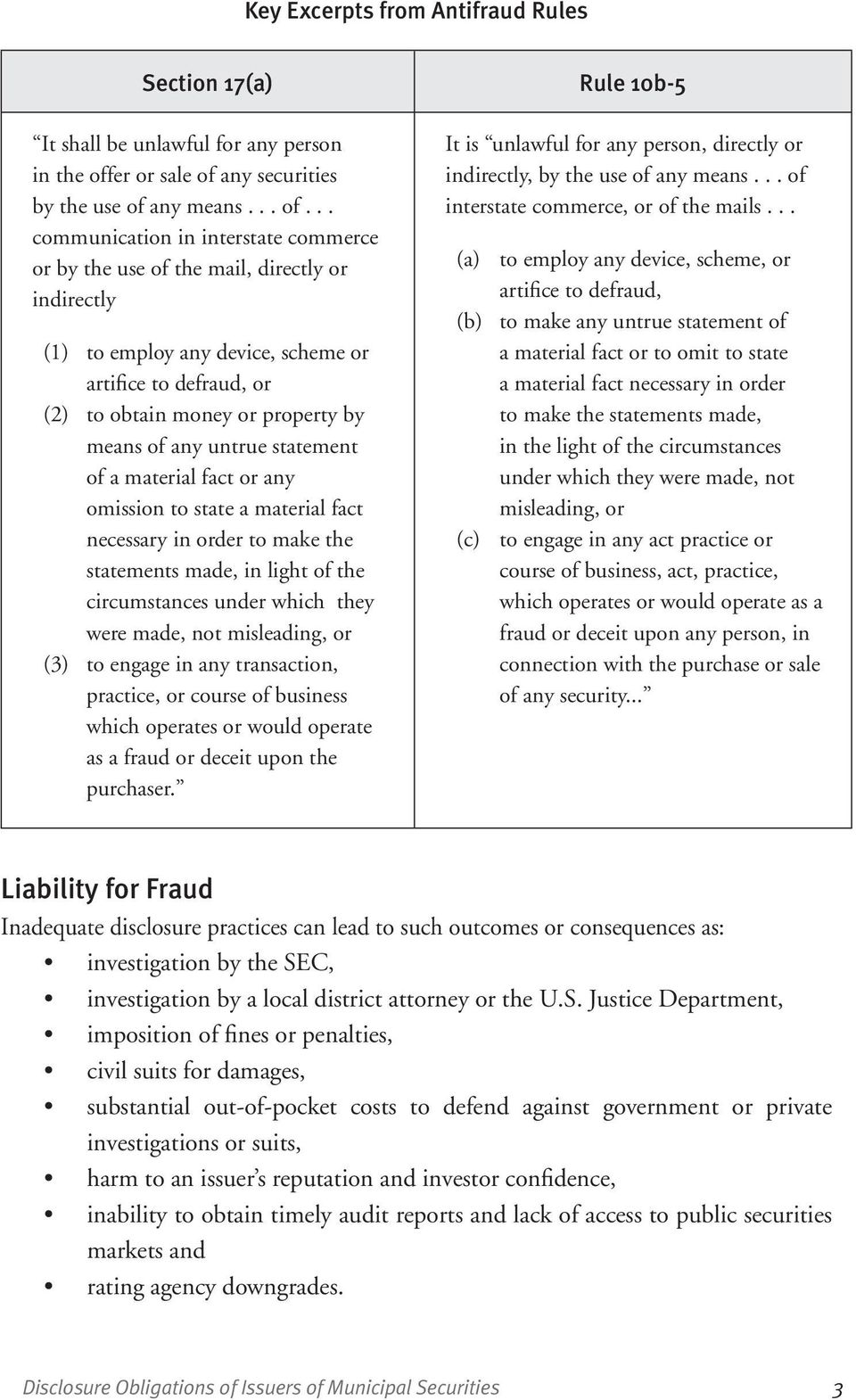
9 Key Excerpts from Antifraud Rules Section 17(a) Rule 10b-5 It shall be unlawful for any person in the offer or sale of any securities by the use of any means... of... communication in interstate commerce or by the use of the mail, directly or indirectly (1) to employ any device, scheme or artifice to defraud, or (2) to obtain money or property by means of any untrue statement of a material fact or any omission to state a material fact necessary in order to make the statements made, in light of the circumstances under which they were made, not misleading, or (3) to engage in any transaction, practice, or course of business which operates or would operate as a fraud or deceit upon the purchaser. It is unlawful for any person, directly or indirectly, by the use of any means... of interstate commerce, or of the mails... (a) to employ any device, scheme, or artifice to defraud, (b) to make any untrue statement of a material fact or to omit to state a material fact necessary in order to make the statements made, in the light of the circumstances under which they were made, not misleading, or (c) to engage in any act practice or course of business, act, practice, which operates or would operate as a fraud or deceit upon any person, in connection with the purchase or sale of any security... Liability for Fraud Inadequate disclosure practices can lead to such outcomes or consequences as: investigation by the SEC, investigation by a local district attorney or the U.S. Justice Department, imposition of fines or penalties, civil suits for damages, substantial out-of-pocket costs to defend against government or private investigations or suits, harm to an issuer s reputation and investor confidence, inability to obtain timely audit reports and lack of access to public securities markets and rating agency downgrades. Disclosure Obligations of Issuers of Municipal Securities 3
10 Liability for false, misleading, incomplete or fraudulent statements under the antifraud laws attaches to directors, governing board members, officers and staff of issuers. Individual officials or members of the staff found to have violated the law may be subjected to penalties, fines, injunctions or, in extreme cases, incarceration, and there is no official immunity from these consequences. To prove a violation of Rule 10b-5, the SEC must prove, among other elements, that the issuer intended to commit manipulation or deception, or knew it was manipulating or deceiving, or recklessly disregarded a manipulation or deception, in connection with the purchase or sale of securities. However, mere negligence, such as a negligent failure to be informed about the issuer s financial condition, is sufficient to find a Section 17(a) violation. Either the SEC or private entities can file a claim of violation of Rule 10b-5, but private entities must show not only that an issuer made a material mistatement or omission but also that they in fact purchased or sold the securities in reliance on such statement or omission and suffered a loss and damages as a result of that reliance. For more information, see the Orrick publication SEC Investigations and Enforcement Actions: A Practical Handbook for Municipal Securities Issuers. Issuers and their directors, governing board members, officers and staff may rely on the advice of professionals, including attorneys, financial advisors, engineers, feasibility consultants or accountants, in determining what information to disclose, but reliance on professionals must be reasonable, and issuers and their boards must exercise independent judgment in approving securities disclosure. Further, while reliance on advice of professionals can be helpful in defending against certain claims, it will not help deflect all potential claims. Issuers and their principals are ultimately responsible for the accuracy of statements of fact about the issuer. Public entities that issue securities are primarily liable for the content of their disclosure documents and are subject to proscriptions under the federal securities laws against false and misleading information in their disclosure documents. Report of Investigation in the Matter of County of Orange, California as it Relates to the Conduct of the Members of the Board of Supervisors, Exchange Act Release No (January 24, 1996). 4 Orrick, Herrington & Sutcliffe LLP

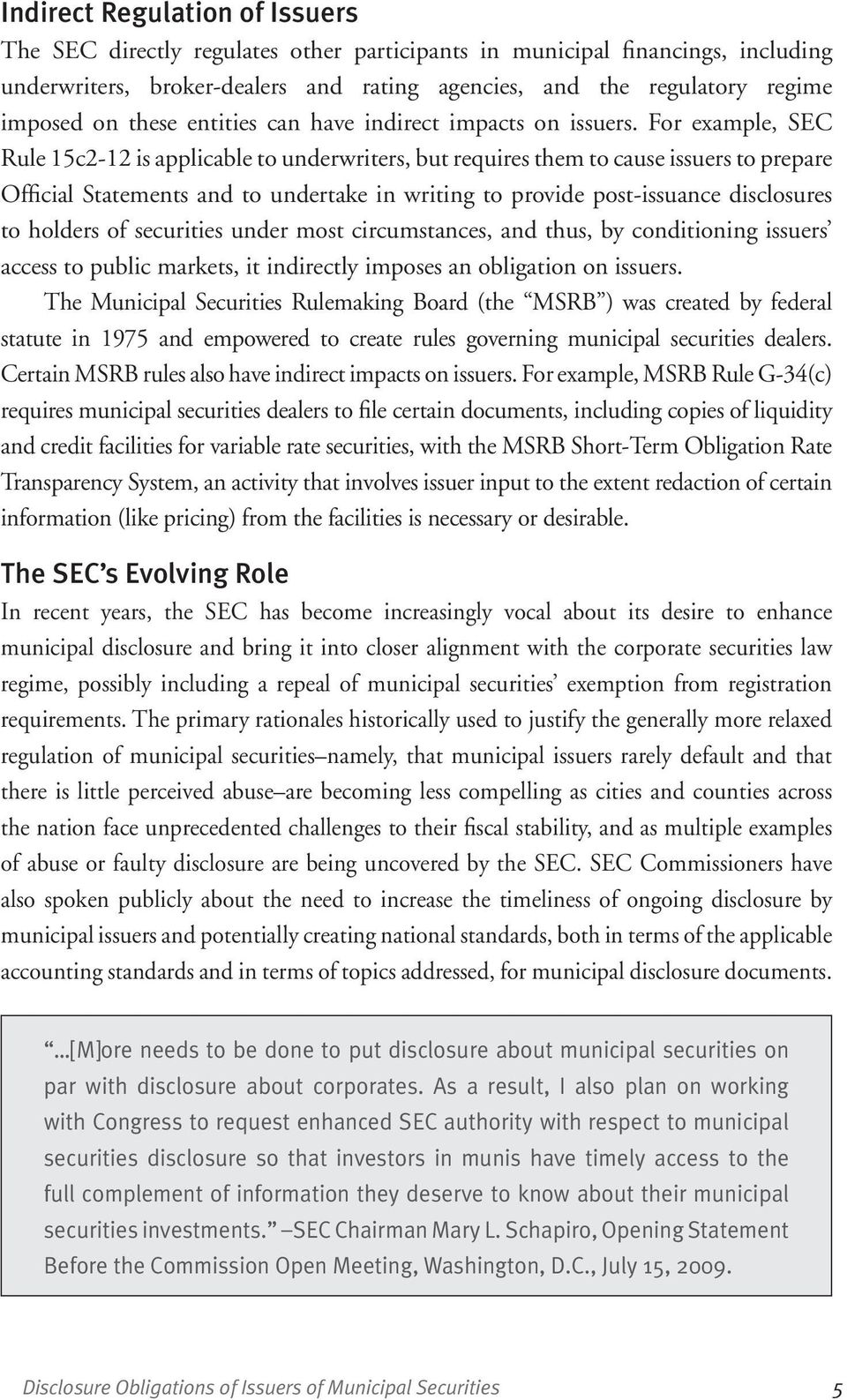
11 Indirect Regulation of Issuers The SEC directly regulates other participants in municipal financings, including underwriters, broker-dealers and rating agencies, and the regulatory regime imposed on these entities can have indirect impacts on issuers. For example, SEC Rule 15c2-12 is applicable to underwriters, but requires them to cause issuers to prepare Official Statements and to undertake in writing to provide post-issuance disclosures to holders of securities under most circumstances, and thus, by conditioning issuers access to public markets, it indirectly imposes an obligation on issuers. The Municipal Securities Rulemaking Board (the MSRB ) was created by federal statute in 1975 and empowered to create rules governing municipal securities dealers. Certain MSRB rules also have indirect impacts on issuers. For example, MSRB Rule G-34(c) requires municipal securities dealers to file certain documents, including copies of liquidity and credit facilities for variable rate securities, with the MSRB Short-Term Obligation Rate Transparency System, an activity that involves issuer input to the extent redaction of certain information (like pricing) from the facilities is necessary or desirable. The SEC s Evolving Role In recent years, the SEC has become increasingly vocal about its desire to enhance municipal disclosure and bring it into closer alignment with the corporate securities law regime, possibly including a repeal of municipal securities exemption from registration requirements. The primary rationales historically used to justify the generally more relaxed regulation of municipal securities namely, that municipal issuers rarely default and that there is little perceived abuse are becoming less compelling as cities and counties across the nation face unprecedented challenges to their fiscal stability, and as multiple examples of abuse or faulty disclosure are being uncovered by the SEC. SEC Commissioners have also spoken publicly about the need to increase the timeliness of ongoing disclosure by municipal issuers and potentially creating national standards, both in terms of the applicable accounting standards and in terms of topics addressed, for municipal disclosure documents. [M]ore needs to be done to put disclosure about municipal securities on par with disclosure about corporates. As a result, I also plan on working with Congress to request enhanced SEC authority with respect to municipal securities disclosure so that investors in munis have timely access to the full complement of information they deserve to know about their municipal securities investments. SEC Chairman Mary L. Schapiro, Opening Statement Before the Commission Open Meeting, Washington, D.C., July 15, Disclosure Obligations of Issuers of Municipal Securities 5
12 The Dodd-Frank Wall Street Reform and Consumer Protection Act of 2010 provides some evidence of a move at the federal level to strengthen SEC oversight over municipal securities along the lines requested by the SEC. The Dodd-Frank Act establishes a stand-alone municipal securities office at the SEC (providing the SEC with the capacity to increase its investigations and prosecutions) and requires the Government Accounting Office to compare municipal and corporate disclosure regimes and evaluate the costs and benefits of increasing regulation of municipal disclosure, including the potential repeal of municipal securities exemption from registration, with a report due in July of The dialogue among the SEC, issuers, investors and broker-dealers regarding the future of municipal securities disclosure and its regulation by the SEC is expected to continue. [M]unicipalities are populated by taxpayers who also are frequently investors in our national markets, perhaps even in the securities issued by those same municipalities. Indeed, the concerns of a citizen qua taxpayer and the same citizen qua investor have something very important in common. Just as an investor wants to understand the true financial health of an entity whose debt it purchases, a taxpayer has an interest in understanding the true fiscal health of the state or local municipality in which he or she lives. So the call for greater federal regulation of the municipal securities market could have benefits for both taxpayers and investors alike. SEC Commissioner Elisse B. Walter, Regulation of the Municipal Securities Market: Investors Are Not Second-Class Citizens, New York, NY, October 28, Orrick, Herrington & Sutcliffe LLP

13 chapter three The Official Statement The offering document in a public offering of municipal securities is usually called the Official Statement. If the securities are being offered on a more limited basis, the offering document might be called an offering circular, an offering memorandum, a private placement memorandum or a limited offering memorandum. The Official Statement in a public offering of municipal securities is analogous to the prospectus in a registered public offering and typically takes the form of a single soft cover book or electronic file. The Official Statement contains the issuer s official statements; that is, the statements about itself upon which it intends others to rely, including statements about its financial condition, the securities, the project or program to be financed with the securities and the sources of repayment of the securities. Its purpose is to tell potential investors what they need to know in order to decide whether or not to buy the securities. The Official Statement can presuppose general knowledge, but, unlike a private placement memorandum or term sheet provided to a purchaser actively engaged in the transaction, it must be complete in the sense that the investor should not be expected to conduct any investigation beyond reading the document and any publicly available materials incorporated by reference. The Preliminary Official Statement The Official Statement must be filed with the MSRB and must be provided to all purchasers. Because in many transactions the Official Statement cannot describe the securities completely until after they have been sold, a Preliminary Official Statement is made available and distributed in advance of the offering. SEC Rule 15c2-12 requires the Preliminary Official Statement to be final except for pricing and information dependent upon or determined as part of the pricing. The Preliminary Official Statement is used by the underwriters to solicit interest in the securities. Depending upon the complexity and novelty of the transaction, the Preliminary Official Statement is generally distributed, by electronic posting or by the mailing of printed copies, between a few days and a couple Disclosure Obligations of Issuers of Municipal Securities 7
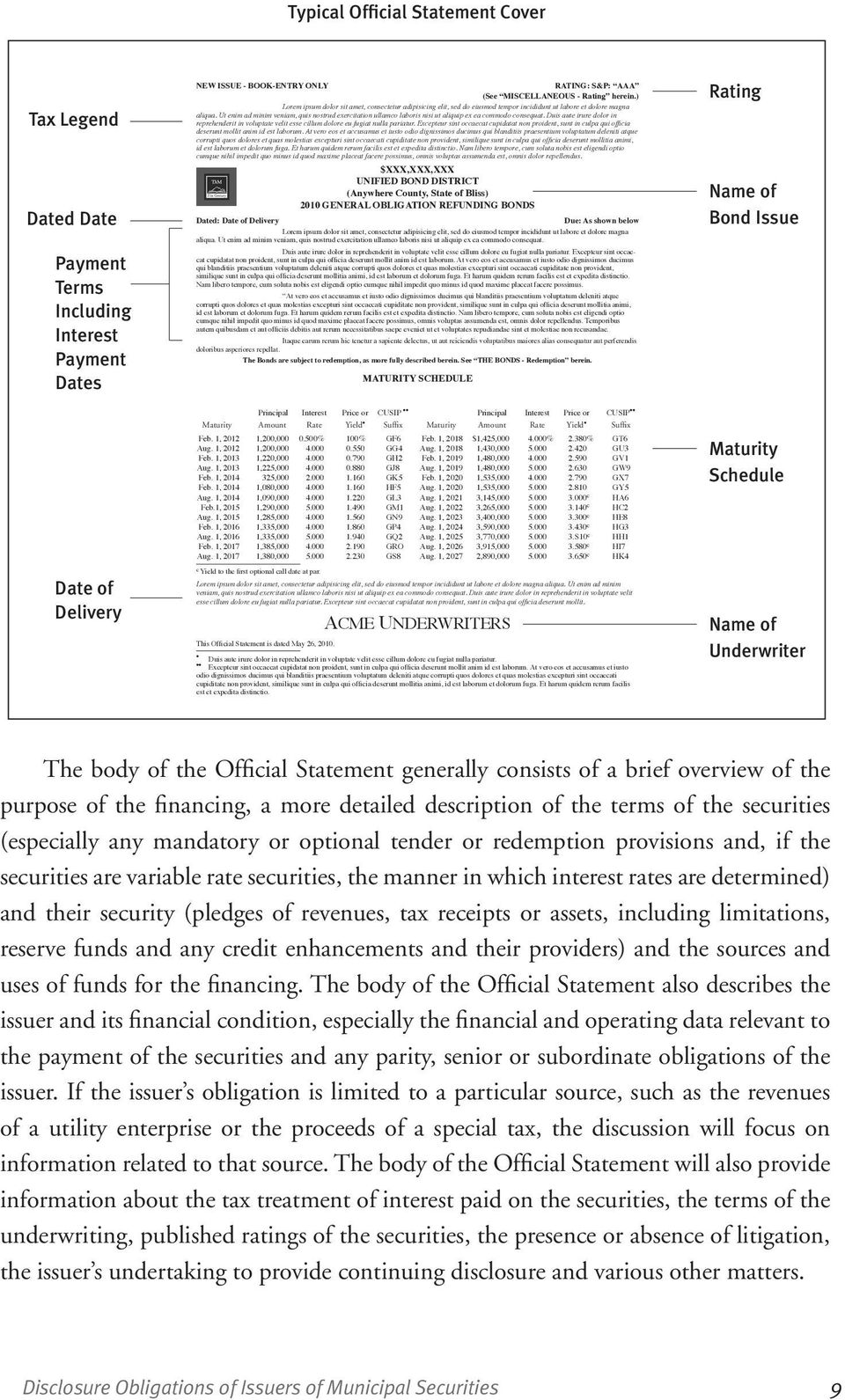
14 of weeks before the expected sale date. The issuer can also voluntarily file the Preliminary Official Statement on the MSRB s Electronic Muncipal Market Access (EMMA) website, which helps to assure that investors in the primary market receive material information at the time an investment decision is made. If material developments occur or material information comes to light after the Preliminary Official Statement has been distributed, the Preliminary Official Statement must be supplemented prior to the sale date. It may not be enough to correct or update the information in the final Official Statement post-sale, as the SEC is increasingly focused on the state of disclosure at the time the purchaser s investment decision is made. Purpose of the Official Statement The Official Statement serves three basic functions: (1) it provides a description of the securities offered and the transaction, (2) it assists with marketing the securities and (3) it discloses risks and other material information associated with investment in the securities. Marketing, an invitation to invest in the issuer through the purchase of the offered securities, is viewed as positive, and risk disclosure, including disclosure of bad facts, is often viewed as negative a necessary evil to avoid the serious adverse consequences of failure to comply with securities laws. To be sure, a properly prepared Official Statement functions as the issuer s primary defense against claims that its securities were sold on the basis of incomplete or misleading information in violation of the antifraud provisions of federal or state securities laws. Risk disclosure can, however, also be viewed as a positive because it demonstrates that the issuer has a full understanding of its business and its financial condition and provides an opportunity to explain how risks are being addressed. Contents of the Official Statement The specific content varies, of course, based on the type of securities offered, but Official Statements generally follow a simple basic format. The Official Statement cover identifies information such as the amount, maturities, interest rates and payment information for the securities being offered, a brief description of their source of repayment, their tax status, the expected delivery date and ratings. 8 Orrick, Herrington & Sutcliffe LLP
15 Typical Official Statement Cover Tax Legend Dated Date Payment Terms Including Interest Payment Dates Date of Delivery NEW ISSUE - BOOK-ENTRY ONLY Dated: Date of Delivery c Yield to the first optional call date at par. Lorem ipsum dolor sit amet, consectetur adipisicing elit, sed do eiusmod tempor incididunt ut labore et dolore magna aliqua. Ut enim ad minim veniam, quis nostrud exercitation ullamco laboris nisi ut aliquip ex ea commodo consequat. Duis aute irure dolor in reprehenderit in voluptate velit esse cillum dolore eu fugiat nulla pariatur. Excepteur sint occaecat cupidatat non proident, sunt in culpa qui officia deserunt mollit. This Official Statement is dated May 26, ACME UNDERWRITERS RATING: S&P: AAA (See MISCELLANEOUS - Rating herein.) Lorem ipsum dolor sit amet, consectetur adipisicing elit, sed do eiusmod tempor incididunt ut labore et dolore magna aliqua. Ut enim ad minim veniam, quis nostrud exercitation ullamco laboris nisi ut aliquip ex ea commodo consequat. Duis aute irure dolor in reprehenderit in voluptate velit esse cillum dolore eu fugiat nulla pariatur. Excepteur sint occaecat cupidatat non proident, sunt in culpa qui officia deserunt mollit anim id est laborum. At vero eos et accusamus et iusto odio dignissimos ducimus qui blanditiis praesentium voluptatum deleniti atque corrupti quos dolores et quas molestias excepturi sint occaecati cupiditate non provident, similique sunt in culpa qui officia deserunt mollitia animi, id est laborum et dolorum fuga. Et harum quidem rerum facilis est et expedita distinctio. Nam libero tempore, cum soluta nobis est eligendi optio cumque nihil impedit quo minus id quod maxime placeat facere possimus, omnis voluptas assumenda est, omnis dolor repellendus. $XXX,XXX,XXX UNIFIED BOND DISTRICT (Anywhere County, State of Bliss) 2010 GENERAL OBLIGATION REFUNDING BONDS Due: As shown below Lorem ipsum dolor sit amet, consectetur adipisicing elit, sed do eiusmod tempor incididunt ut labore et dolore magna aliqua. Ut enim ad minim veniam, quis nostrud exercitation ullamco laboris nisi ut aliquip ex ea commodo consequat. Duis aute irure dolor in reprehenderit in voluptate velit esse cillum dolore eu fugiat nulla pariatur. Excepteur sint occaecat cupidatat non proident, sunt in culpa qui officia deserunt mollit anim id est laborum. At vero eos et accusamus et iusto odio dignissimos ducimus qui blanditiis praesentium voluptatum deleniti atque corrupti quos dolores et quas molestias excepturi sint occaecati cupiditate non provident, similique sunt in culpa qui officia deserunt mollitia animi, id est laborum et dolorum fuga. Et harum quidem rerum facilis est et expedita distinctio. Nam libero tempore, cum soluta nobis est eligendi optio cumque nihil impedit quo minus id quod maxime placeat facere possimus. At vero eos et accusamus et iusto odio dignissimos ducimus qui blanditiis praesentium voluptatum deleniti atque corrupti quos dolores et quas molestias excepturi sint occaecati cupiditate non provident, similique sunt in culpa qui officia deserunt mollitia animi, id est laborum et dolorum fuga. Et harum quidem rerum facilis est et expedita distinctio. Nam libero tempore, cum soluta nobis est eligendi optio cumque nihil impedit quo minus id quod maxime placeat facere possimus, omnis voluptas assumenda est, omnis dolor repellendus. Temporibus autem quibusdam et aut officiis debitis aut rerum necessitatibus saepe eveniet ut et voluptates repudiandae sint et molestiae non recusandae. doloribus asperiores repellat. Itaque earum rerum hic tenetur a sapiente delectus, ut aut reiciendis voluptatibus maiores alias consequatur aut perferendis The Bonds are subject to redemption, as more fully described berein. See THE BONDS - Redemption berein. MATURITY SCHEDULE Principal Interest Price or CUSIP Principal Interest Price or CUSIP Maturity Amount Rate Yield Suffix Maturity Amount Rate Yield Suffix Feb. 1, ,200, % 100% GF6 Feb. 1, 2018 $1,425, % 2.380% GT6 Aug. 1, ,200, GG4 Aug. 1, ,430, GU3 Feb. 1, ,220, GH2 Feb. 1, ,480, GV1 Aug. 1, ,225, GJ8 Aug. 1, ,480, GW9 Feb. 1, , GK5 Feb. 1, ,535, GX7 Feb. 1, ,080, HF5 Aug. 1, ,535, GY5 Aug. 1, ,090, GL3 Aug. 1, ,145, c HA6 Feb.1, ,290, GM1 Aug. 1, ,265, c HC2 Aug. 1, ,285, GN9 Aug. 1, ,400, c HE8 Feb. 1, ,335, GP4 Aug. 1, ,590, c HG3 Aug. 1, ,335, GQ2 Aug. 1, ,770, S10 c HH1 Feb. 1, ,385, GRO Aug. 1, ,915, c HI7 Aug. 1, ,380, GS8 Aug. 1, ,890, c HK4 Duis aute irure dolor in reprehenderit in voluptate velit esse cillum dolore eu fugiat nulla pariatur. Excepteur sint occaecat cupidatat non proident, sunt in culpa qui officia deserunt mollit anim id est laborum. At vero eos et accusamus et iusto odio dignissimos ducimus qui blanditiis praesentium voluptatum deleniti atque corrupti quos dolores et quas molestias excepturi sint occaecati cupiditate non provident, similique sunt in culpa qui officia deserunt mollitia animi, id est laborum et dolorum fuga. Et harum quidem rerum facilis est et expedita distinctio. Rating Name of Bond Issue Maturity Schedule Name of Underwriter The body of the Official Statement generally consists of a brief overview of the purpose of the financing, a more detailed description of the terms of the securities (especially any mandatory or optional tender or redemption provisions and, if the securities are variable rate securities, the manner in which interest rates are determined) and their security (pledges of revenues, tax receipts or assets, including limitations, reserve funds and any credit enhancements and their providers) and the sources and uses of funds for the financing. The body of the Official Statement also describes the issuer and its financial condition, especially the financial and operating data relevant to the payment of the securities and any parity, senior or subordinate obligations of the issuer. If the issuer s obligation is limited to a particular source, such as the revenues of a utility enterprise or the proceeds of a special tax, the discussion will focus on information related to that source. The body of the Official Statement will also provide information about the tax treatment of interest paid on the securities, the terms of the underwriting, published ratings of the securities, the presence or absence of litigation, the issuer s undertaking to provide continuing disclosure and various other matters. Disclosure Obligations of Issuers of Municipal Securities 9
16 The body of the Official Statement may also include a separate risk factors section. This section can be used to highlight special risks or to disclose risks a description of which cannot easily be worked into the general discussion. It is critical to be clear, however, that because a risk factors section cannot address all risks and even described risks cannot be fully comprehended apart from context, an investor must read the entire Official Statement for a full understanding of the risks associated with the offered security. A thorough discussion of risk factors is not only useful to potential investors, but can ward off claims by the SEC and private litigants in the event that disclosed risks materialize. The Official Statement generally includes, as appendices, various items that, while part of the Official Statement, would interfere with the flow if included in the body of the Official Statement. Typical appendices include: the issuer s audited financial statements, expert consultant reports or feasibility studies, if any, in whole or in summary form, information of only indirect importance such as general demographic and economic information, summaries of legal documents (to the extent not described in the body of the Official Statement), a description of the Depository Trust Company s book-entry procedures and the form of the opinion to be delivered by bond counsel. The information in an Official Statement should be primarily historical, verifiable information. Projections of future SRT receipts, operating revenues, expenses or debt service are, however, often important and included. In such cases, it is essential to clearly identify the information as projected and state clearly the assumptions on which the projections are based, that forward looking statements are about the future and are based on assumptions and qualified, and that the achievement of expected results is subject to uncertainties, including the occurrence (or nonoccurrence) of future events. Likewise, although it is preferable that the historical financial information included be audited data, unaudited or stub period financial data is often included, depending on timing of the publication of the Official Statement relative to timing of release of the audited financial statements and the quarter-over-quarter or year-over-year volatility of the revenues or other financial results being described in the Official Statement. In such cases, it is important to clearly distinguish between audited and unaudited data. 10 Orrick, Herrington & Sutcliffe LLP

17 Disclosure Guidance Guidance as to what ought to be contained in an Official Statement is available from a variety of sources. A review of the Official Statements prepared by the issuer for other offerings or Official Statements prepared by other issuers for the offering of similar securities can provide useful templates and can serve as checklists. Further, investor and analyst groups publish guidelines. The Government Finance Officers Association has produced comprehensive guidelines for disclosure in municipal offerings entitled Disclosure Guidelines for State and Local Government Securities (the GFOA Guidelines ). The GFOA Guidelines are not legally binding, but do establish a standard for disclosure that can be referred to by issuers of municipal securities. The Disclosure Handbook for Municipal Securities published by the National Federation of Municipal Analysts contains specific disclosure recommendations for various types of debt financing techniques. While helpful to provide readers with relevant and customary information in a format they are familiar with, templates, guidelines and checklists cannot substitute for judgment. Each municipal offering has its own story and a mere update to a model disclosure document without careful reflection about the current transaction (What is new? What is different? What could go wrong? What do purchasers of these particular securities need to know, and is that being told clearly?) does not suffice. The issuer and its financing professionals must carefully consider the issuer s situation and the terms of the debt and security and source of funds for its repayment and form an independent judgment as to what information must or should be included to assure that the Official Statement contains the information needed for a potential investor to make an informed investment decision and does not contain material misstatements or omissions. A sense of balance and perspective is also essential. Important information should be presented clearly and prominently and not be crowded out by less important discussion. Securities With Credit or Liquidity Support If credit for the securities is enhanced by a bond insurance policy, a letter of credit or another credit facility, or if a third party is providing liquidity support, a separate security is being offered and the description of the terms of such credit or liquidity support and disclosure regarding the credit or liquidity provider must be included in the Official Statement. A form of any bond insurance policy or letter of credit securing the securities is generally included as an appendix to the Official Statement. For fixed rate municipal securities secured by bond insurance or other credit support, the financial condition of the issuer is nonetheless material because, no matter the financial strength of the credit provider, an issuer financial failure could lead to an Disclosure Obligations of Issuers of Municipal Securities 11
18 early par redemption when interest rates would otherwise result in the securities being valued at a premium. The financial condition of the issuer is also material for variable rate securities with liquidity but not credit support because the issuer s financial failure could excuse the liquidity provider from performance. In both of these cases, an Official Statement with full disclosure of the issuer s financial position (plus disclosure concerning the credit or liquidity provider) is necessary. There is a range of market-accepted approaches to disclosure for variable rate debt with both credit and liquidity support (e.g., variable rate demand bonds secured by a letter of credit or by a standby purchase commitment and bond insurance) because, so long as the credit and liquidity providers are financially sound, the securities, as variable rate obligations, will never be worth materially more or less than par and the holder can receive par, upon seven days or similar notice, even if the issuer fails. On the one hand, sometimes full financial disclosure respecting the issuer or other obligor is included in the Official Statement for such securities, and it should be noted that representatives of the SEC have expressed a preference for full financial disclosure, regardless of the credit or liquidity support provided. On the other hand, sometimes virtually no financial information about the issuer is included, in which case the investor should, and is explicitly instructed to, make its investment decision on the basis of the credit and liquidity support and not on the basis of the condition or circumstances of the issuer. Conduit Obligations In most conduit offerings of municipal securities, debt service on the securities is payable solely from amounts received by the governmental conduit issuer from the conduit borrower. Therefore, in such transactions, information on the financial condition of the conduit issuer is not necessary (and could be misleading) and should not be included in the Official Statement. The Official Statement should, moreover, make clear that the conduit issuer is assuming responsibility only for the limited material included in the Official Statement that has been provided by the issuer, generally only a brief description of the issuer and a statement that there is no pending litigation against the issuer challenging the financing. 12 Orrick, Herrington & Sutcliffe LLP

19 chapter four Preparing an Official Statement Under federal and state securities laws, the issuer of municipal securities is responsible for the completeness and accuracy of the Official Statement used to offer its securities. Therefore, it is critical that the issuer prepare an Official Statement that tells prospective investors what a reasonable investor should know in order to make an informed investment decision, without material misstatements or omissions. Although underwriters and other parties may have securities law responsibilities of their own, the issuer may not transfer its primary responsibility (and potential liability) for disclosure to such parties. To protect its interests and ensure a quality product, the issuer must maintain ownership of the Official Statement, both of its content and of the process of its preparation, and the issuer should expect that a commitment of staff time and governing board oversight will be required. From the standpoint of the issuer of municipal securities, the following are the steps to be taken in preparing an Official Statement: Determine the Team and Define Roles and Responsibilities Early on, the issuer should determine which financing team member will coordinate the preparation of the Official Statement. Counsel generally takes on this role, although the document, or pieces of it, can be prepared by the issuer s financial advisor or issuer staff. Counsel preparing the Official Statement typically provides the underwriter with a statement that, based on limited procedures, and subject to a variety of qualifications and exclusions, nothing came to the attention of such counsel that caused it to believe that the Official Statement contained any untrue statement of a material fact or omitted any material fact necessary in order to make the statements in the Official Statement, in the light of the circumstances under which they were made, not misleading, often referred to as the 10b-5 opinion. The 10b-5 opinion is not really an opinion, but a statement of what counsel did not find in the limited procedures it followed and excludes substantial portions of the Official Statement, like audited financial statements and other financial information. Rendering this opinion is not the primary value that such counsel brings. Rather, its value is the comfort Disclosure Obligations of Issuers of Municipal Securities 13

20 that can be derived from knowing what that counsel must do in order to render that opinion, provided it is a counsel with knowledge, skill and experience in securities disclosure. Historically, in a negotiated sale of municipal securities, the firm serving as counsel to the underwriters prepared the Official Statement, while bond counsel prepared the Official Statement in a competitive sale. In recent years, however, some issuers have preferred to engage their own counsel to be responsible for disclosure matters, including preparation of the issuer s Official Statements, so that such issuers can have an attorney-client relationship with such counsel. Such counsel is usually referred to as disclosure counsel. In some cases, disclosure counsel is the same firm as bond counsel. If a separate disclosure counsel or underwriters counsel takes the lead on disclosure, bond counsel s role with respect to the Official Statement is typically limited to ensuring the accuracy of the descriptions of the securities and the documents relating to their issuance. In any event, the counsel preparing the Official Statement should have ample experience and reputation in disclosure matters for similar types of financings or credits. It is also helpful that such firm have experience with SEC investigations and securities enforcement actions (in case there are any) and adequate insurance coverage. In preparing an Official Statement, the issuer can, of course, benefit from the assistance of underwriters, financial advisors, feasibility consultants, accountants and attorneys so long as such professionals will be given access to the information necessary to properly discharge their responsibilities and the issuer has a reasonable basis to believe that they have experience and skill relevant to their role in securities disclosure. Issuers should insist that any professionals retained to assist in the preparation of their disclosure documents have a professional understanding of the disclosure requirements under the federal securities laws. Exchange Act Release No (June 28, 1989). However, involving qualified professionals does not relieve the issuer of its responsibilities with respect to the Official Statement, which is ultimately the issuer s disclosure document. Much of the information in the Official Statement is about, or obtained from, the issuer. The issuer is therefore in the best position to know if the disclosure contained in the Official Statement is inaccurate or misleading, and the professionals on which the issuer is relying are in turn relying on the accuracy and completeness of the information received from the issuer and the issuer s review of the information about it in the Official Statement. Therefore, while issuers may rely on the advice of such professionals to an important extent, issuers cannot ever completely rely on or delegate to professionals. 14 Orrick, Herrington & Sutcliffe LLP
21 Establish a Process for Ensuring the Accuracy and Completeness of the Official Statement The SEC has recommended that issuers establish formal, written procedures to be followed for the preparation of Official Statements. Such procedures might include establishment of a disclosure review committee, a detailed process for compiling information for inclusion in the Official Statement and for issuer staff review and formal sign-off on disclosure documents, and systematic training of staff and board members in the discharge of disclosure responsibilities. Although formal procedures can be useful if followed, they are difficult to develop in the abstract, and an issuer may be exposed to greater liability if it has express procedures it does not follow fully and consistently. Of greater importance is to establish, at the commencement of a financing, a plan for the preparation of the Official Statement and a schedule that allows sufficient time for the completion of all required work, including appropriate review and participation by members of the financing team and knowledgeable issuer staff. A particular officer of the issuer should be responsible for managing the Official Statement preparation process, and such officer should be empowered to obtain the assistance of other necessary or appropriate participants within the issuer s organization. Issuers of municipal securities have an obligation to ensure that financial information contained in their disclosure documents is not materially misleading. Proper disclosure allows investors to understand and evaluate the financial health of the state or local municipality in which they invest... The State [of New Jersey] was aware of the under funding of [its pension systems] and the potential effects of the under funding. However, due to a lack of disclosure training and inadequate procedures relating to the drafting and review of bond disclosure documents, the State made material [mis]representations and failed to disclose material information regarding [its pension systems] in bond offering documents. In the Matter of the State of New Jersey, Order Instituting Cease-and-Desist Proceedings Pursuant to Section 8A of the Securities Act of 1933, Making Findings and Imposing a Cease-and-Desist Order, Securities Act of 1933 Release No (August 18, 2010). Disclosure Obligations of Issuers of Municipal Securities 15
22 Prepare and Review the Official Statement Preparation of an Official Statement should begin with a thoughtful consideration of the big picture. For example, What are the important or unusual features of the issue s structure? What is the credit, the source of payment and the security for the securities? The issuer s general fund? Particular tax revenues? Revenues of an enterprise? Contractual payments to be received from other governmental entities or from private parties? Assets (property? funds?) of the issuer? What are the limitations, practical as well as legal, on bondholder remedies? What is the plan for payment of the principal of and interest on the securities? What could happen that could fundamentally alter the situation? What could go wrong in the short, intermediate and long term? If the unexpected happens, where would that leave holders of the securities? The answers to all of these and similar questions will depend, of course, on the terms of the debt, the issuer s financial strength, and the security and source of payment for the debt. The next step is to begin drafting the Official Statement, starting with the selection of a template or templates to use as a starting point. This will generally be a combination of a prior Official Statement of the issuer, if any, and Official Statements describing securities with comparable structures or credit concerns. Although merely updating or following an example, no matter how similar, will not suffice, a good template or collection of templates can serve as a checklist to help ensure that important items are not overlooked. Then follows a combination of information gathering, document drafting and diligence (to confirm that the information to be presented in the Official Statement is accurate and that additional disclosure is not required). The drafting process generally involves several drafts that may be heavily revised (the number depending upon the complexity of the credit and the relevance of available templates), followed by revisions for smaller changes or to fill in blanks. Drafting follows information and the results of diligence, of course, but the drafting process in turn suggests additional matters that bear consideration and research. The content of the Official Statement may also be shaped by the type of information that investors are presently focused on in their own internal review of issuer credits, such as unfunded liability in pension and other post-employment benefit systems, potential hedge termination payment liability, issuer investment policies, issuer liquidity and cash position, and bankruptcy risk. 16 Orrick, Herrington & Sutcliffe LLP
23 Due Diligence Under the Securities Act of 1933, underwriters of municipal securities have an affirmative responsibility to perform a reasonable investigation or take reasonable care that the Official Statement for such securities does not contain any material misstatements or omissions, and may assert a due diligence defense to legal claims that they did not discharge this responsibility adequately. Thus, the term due diligence is used to describe both the reasonable investigation and care by the underwriters to avoid liability in connection with municipal disclosures. In addition, although a due diligence defense is not available to the issuer of securities, the issuer may have its own due diligence responsibility in the sense that it must ensure the accuracy and completeness of the information presented in the Official Statement, as described above. The due diligence process varies from transaction to transaction depending on the security and source of payment of the securities, risk factors and the frequency with which the issuer offers securities in the market and works with a particular underwriting team or underwriters counsel. The issuer s assembling information for inclusion in the Official Statement, as described above, and its participation in conference calls and meetings to review the contents of the Official Statement, as well as providing thorough responses to questions and requests for further information by members of the working group, are the key elements of the due diligence process and typically occur in the regular process of drafting the Official Statement and other financing documents. Due diligence activity may also involve consultation with, and the review of relevant portions of drafts by, the issuer s internal staff, including representatives from finance, public works or engineering, and general counsel, extracting material from financial, feasibility and other reports, reviewing material contracts, litigation, permits or licenses, and reading governing board minutes. General topics of investigation include financial and industry trends and issuer-specific news and developments. Specific matters can include budget issues, financial results, regulatory compliance, analysis of pending or threatened litigation, legislation or other developments that could affect revenues, and approval or construction status or other concerns respecting the source of revenue or projects to be financed. Sometimes counsel preparing the Official Statement will conduct a site visit or prepare a formal, written list of questions for the issuer to answer and a written list of documents for the issuer to produce for review. Key issuer officials may also be interviewed, sometimes at a formal due diligence meeting. Such interviews are important less to uncover hidden details than to confirm that the financing team s understanding of the big picture is consistent with management s and to assure that the discussions of the issuer and its operations and financial condition, the challenges it faces and its expectations in the Official Statement are consistent with how the issuer is articulating such matters for other audiences in other contexts. Disclosure Obligations of Issuers of Municipal Securities 17
24 Governing Board Approval As a general matter, issuers bring a full, near-final draft of the Official Statement to the governing board for approval prior to publication. The issuer s governing board has a legal responsibility to ensure that the issuer complies with all applicable securities laws, and governing board members may be subject to personal civil and criminal penalties for failure to discharge such responsibility. As described above, internal procedures, either formal or informal, can be developed and used by staff to provide board members with comfort that disclosure has been vetted by the individuals most knowledgeable about various matters. Governing board members should, in particular, ensure that in connection with the preparation of the Official Statement that the professionals (bond counsel, disclosure counsel or underwriters counsel) responsible for disclosure matters be qualified, that staff has followed reasonable internal review procedures and that any material concerns they have about the issuer or the securities have been adequately covered in the Official Statement. Board members should also consider the big picture when reviewing disclosure documents What are the basic economic drivers for the issuer or enterprise supporting debt repayment? What are its biggest challenges? What is it concerned about? What could go wrong or cause a default? To do this effectively, of course, governing board members must have an adequate understanding of the proposed transaction. A public official who approves the issuance of securities and related disclosure documents may not authorize disclosure that the public official knows to be materially false or misleading; nor may the public official authorize disclosure while recklessly disregarding facts that indicate that there is a risk that the disclosure may be misleading. When, for example, a public official has knowledge of facts bringing into question the issuer s ability to repay the securities, it is reckless for that official to approve disclosure to investors without taking steps appropriate under the circumstances to prevent the dissemination of materially false or misleading information regarding those facts. Report of Investigation in the Matter of County of Orange, California as it Relates to the Conduct of the Members of the Board of Supervisors, Exchange Act Release No (January 24, 1996). 18 Orrick, Herrington & Sutcliffe LLP
25 Publication Preliminary Official Statements and Official Statements are released to the public through website posting or delivery of printed books to prospective investors (in the case of the Preliminary Official Statement) or purchasers of the securities (in the case of the Official Statement). The Preliminary Official Statement and Official Statement should not be made available to investors until each member of the working group is satisfied that all significant issues have been vetted and is comfortable that the information it is responsible for is accurate and complete and that no information known to be untrue or misleading is included. Other Marketing Activities and Other Public Statements In offering its securities, an issuer s discussion of matters relating to its credit are often not confined to the Official Statement. Issuers also make formal presentations to rating agencies or prospective credit enhancers (generally prior to publication of the Preliminary Official Statement), and often make presentations to groups of prospective major investors (bond funds or other institutional purchasers) during the period of time between the publication of the Preliminary Official Statement and the pricing of the securities, each of which must conform with the antifraud standards discussed in Chapter 2. These communications, while important to a successful issuance, pose risk because they can form the basis for securities claims, yet the speakers often approach them with less formality than statements made in Official Statements. Issuers should ensure that communications with rating agencies, credit enhancers and potential investors are carefully prepared and reviewed in advance. Information provided to rating agencies and credit enhancers can go beyond that provided to investors by including greater detail, technical analysis and conjectural or other soft information not appropriate for a disclosure document. In providing such information, though, the issuer should consider whether such information is consistent with the Official Statement or should be included in the Official Statement to avoid misleading investors, and whether such information is accurate and not misleading for the particular purposes for which presented. Public information offered by the issuer, including statements by officials and information posted on the issuer s website that are intended or can be expected to reach and affect the market for municipal securities, can also be viewed as statements about the issuer s securities. Although the making of such statements cannot and should not be prevented, it is important that care be taken and that the accuracy and completeness of such statements be considered, in the light of the circumstances under which they are being made. Disclosure Obligations of Issuers of Municipal Securities 19
26 A municipal issuer may not be subject to the mandated continuous reporting requirements of the Exchange Act, but when it releases information in the public that is reasonably expected to reach investors and the trading markets, those disclosures are subject to the antifraud provisions. The fact that they are not published for purposes of informing the securities markets does not alter the mandate that they not violate antifraud proscriptions. Statement of the Commission Regarding Disclosure Obligations of Municipal Securities Issuers and Others, Securities Act of 1933 Release No (March 9, 1994). 20 Orrick, Herrington & Sutcliffe LLP
27 chapter five Post-Issuance Disclosure Issuers are not obligated to make any disclosures unless required to do so by law or agreement. Section 17(a) and Rule 10b-5 require full and complete disclosure in connection with the initial offering of the securities, and Section 14(e) of the Securities Exchange Act of 1934 requires disclosure in connection with a tender offer to purchase outstanding securities. Otherwise, there is generally no obligation to provide postissuance disclosure except to the extent the issuer has agreed to do so. Of course, if an issuer is making statements it should expect to reach the securities market, it has an obligation to make sure those statements are not misleading to investors. The legal basis for a formal ongoing disclosure obligation is Securities and Exchange Commission Rule 15c2-12 (the Rule ), which requires the underwriter of an issue of municipal securities to obtain a commitment (also known as an undertaking ) by the issuer of the securities to provide this ongoing disclosure. This undertaking generally takes the form of a Continuing Disclosure Certificate or Continuing Disclosure Agreement executed by the issuer of the securities, or other obligor, at closing. In keeping with the Rule, the continuing disclosure undertaking typically requires issuers or obligated persons to provide two types of ongoing disclosure an annual report, and notices of material events, if and when any occur. Excerpt from Rule 15c2-12 A Participating Underwriter shall not purchase or sell municipal securities in connection with an Offering unless the Participating Underwriter has reasonably determined that an issuer of municipal securities, or an obligated person for whom financial or operating data is presented in the final official statement has undertaken... in a written agreement or contract for the benefit of holders of such securities, to provide [annual reports and material event notices]... either directly or indirectly through an indenture trustee or a designated agent. Disclosure Obligations of Issuers of Municipal Securities 21
28 Contents of the Annual Report The annual report is required to contain annual financial information and operating data for the issuer of the type contained in the final official statement, as specified in the continuing disclosure undertaking. The annual report is also required to contain the issuer s most recent financial statements. Most issuers agree to provide the annual report for a given fiscal year within six to nine months of the fiscal year close, taking care to allow sufficient time for preparation and receipt by the governing board of the audited financial statements. The issuer should carefully review the section of the Continuing Disclosure Agreement describing the contents of the annual report. The description of non-audit information to be provided should be specific (as opposed to a general statement requiring the issuer to provide information of the type included in the Official Statement ), and the issuer may want to limit the requirement to information that the issuer already updates each year and plans to continue to update. It is also important to be consistent so that the annual reporting requirements do not vary from one issue of securities to the next. Because the audited financial statements are always a component of the annual report, many issuers find it to be a helpful practice to work with their auditors to include in the audited financials any updates to tables or other financial and operating data required to be included in the annual report. This has the dual benefit of obtaining auditor review of the updated disclosure and simplifying the process of preparing and submitting the annual report. Issuers should carefully review the continuing disclosure undertaking s description of the annual report to be sure that all required updates are included in each annual report. Material Event Notices The continuing disclosure undertaking also requires the issuer to provide notice in a timely manner not in excess of ten business days after the occurrence of certain types of events that are likely to be material to bondholders or potential investors. The Rule was amended, effective December 1, 2010, to expand this list of events. 22 Orrick, Herrington & Sutcliffe LLP
29 Material Events Events that Always Require Notification Events that Require Notification if Material Principal and interest payment delinquencies; Unscheduled draws on debt service reserves reflecting financial difficulties; Unscheduled draws on credit enhancements reflecting financial difficulties; Substitution of credit or liquidity providers, or their failure to perform; Issuance by the Internal Revenue Service of proposed or final determination of taxability or of a Notice of Proposed Issue (IRS Form 5701 TEB); Tender offers; Defeasances; Rating changes; or Bankruptcy, insolvency, receivership or similar event of the obligated person. Unless described in the left-hand column, adverse tax opinions or other material notices or determinations by the Internal Revenue Service with respect to the tax status of the securities or other material events affecting the tax status of the securities; Modifications to rights of holders of the securities; Optional, unscheduled or contingent Bond calls; Release, substitution or sale of property securing repayment of the securities; Non-payment related defaults; The consummation of a merger, consolidation or acquisition involving an obligated person or the sale of all or substantially all of the assets of the obligated person, other than in the ordinary course of business, the entry into a definitive agreement to undertake such an action or the termination of a definitive agreement relating to any such actions, other than pursuant to its terms; or Appointment of a successor or additional trustee or the change of name of a trustee. Disclosure Obligations of Issuers of Municipal Securities 23
30 Filing Post-Issuance Disclosure Both the annual report and any event notices are required to be filed in searchable PDF format with the MSRB s EMMA website. Many issuers filings are handled by finance or other staff, while others engage the trustee, financial advisor or other outside consultant as a dissemination agent, to remind the issuer of the required filings and assist with their preparation and submission to EMMA. Exceptions to Post-Issuance Disclosure Rules There are some exceptions to the Rule or to the general principles outlined above. Securities maturing in 270 days or less (typically, commercial paper notes) are exempt from the ongoing disclosure requirements of the Rule, as are privately placed securities. Although the Rule was amended effective December 1, 2010 to include new issues of variable rate demand bonds, such bonds that were outstanding as of November 30, 2010 can be remarketed or reoffered without a continuing disclosure undertaking so long as the bonds continuously maintain a $100,000 minimum denomination and tender rights of nine months or less. Certain short-term securities (with maturities of 18 months or less) are subject to lesser ongoing disclosure requirements. Finally, if the issuer of the securities is a conduit issuer or otherwise is not the only party responsible for repaying the securities, the ultimate obligor or obligors are required to execute the undertaking and provide the ongoing disclosure. Incentives for Compliance As further incentive to issuers, the Rule requires any instances of material noncompliance with continuing disclosure undertakings to be disclosed in each of the issuer s official statements for a period of five years following the noncompliance, even if the noncompliance has been cured. Beyond mere legal compliance, careful and diligent attention to each continuing disclosure undertaking can improve an issuer s relations with investors for future financings. Providing updated and accurate information on a timely basis is of great value to investors and confirms that the issuer is managing its affairs well. Further, with the increased diligence regarding issuers that investors are conducting themselves, there has generally been increased attention to continuing disclosure compliance by investors and a call by investors and the SEC to increase the frequency, timeliness and scope of municipal continuing disclosure undertakings. 24 Orrick, Herrington & Sutcliffe LLP
31 Informal Statements by Issuers Informal statements by issuers can also be considered disclosure to the market. Public statements, press releases, website postings and statements to the press and governing board proceedings are all widely and publicly available, and are often monitored by rating agencies, investor analysts and other market participants. Many issuers deliberately make such informal statements by publishing press releases or voluntary disclosure statements to EMMA or the issuer s own investor relations website. Even in connection with such informal statements, the issuer should always consider whether other material information also must be disclosed to avoid being misleading. Care should be taken by officials and officers of issuers not to make unconsidered public statements that may provide only a partial story or distort investors perception of the issuer s financial strength. Questions From Investors Investors may contact issuers directly from time to time with questions regarding their finances or operations. Fielding questions from investors is not prohibited, but it is a best practice for issuers to identify a single point person for responding to such inquiries to maintain consistency, and to respond to inquiries with information that is already available to the general public to the extent possible. Circumstances may arise in which issuers may want to provide an investor with helpful information that is not yet publicly available; in that case, the issuer may want to consider making that information more broadly available to the public or to the market. Disclosure Obligations of Issuers of Municipal Securities 25
32 chapter six Disclosure in the Information Age A unique challenge for today s issuer of municipal securities is taking advantage of the efficiency, convenience and flexibility of digital media while limiting exposure to the concomitant risks. Disclosure regarding new offerings and continuing disclosure are now required to be made in electronic format. Generally, offering documents for securities are made available in electronic form via weblink to a PDF file. Final offering documents for municipal securities are also required to be posted on EMMA. Continuing disclosure has also been required to be made via EMMA since July 1, 2009, and issuers annual reports and material event notices remain available there for viewing by the general public, with the ultimate goal of increased market transparency. Digital marketing strategies include net roadshows in which issuers pre-record a presentation about an offering of municipal securities that is made available to investors via weblink along with a link to the preliminary offering document. Risks of Electronic Disclosure While the use of electronic media for disclosure is inevitable, issuers should take care to reduce associated risk of three types. First, there is the ongoing and continuous availability of stale or outdated information about the issuer between the continuous availability of formal postings via EMMA and caching of websites by search engines, even information that is no longer online may be accessible. Second, there is the potential for the simultaneous availability of inconsistent information. Third is routine publication of vast amounts of information that is available to the investing public and that has not been reviewed from the perspective of the issuer s compliance with securities laws. Because investors are evaluating municipal securities from their computers, it becomes much easier for them to take the logical step of visiting an issuer s website or other websites referenced in the offering document. Therefore, it is important to use weblinks very carefully in offering documents. Although citing the issuer s public website or links to information about large capital projects being funded 26 Orrick, Herrington & Sutcliffe LLP
33 by the securities offered may be helpful for investors who want to learn more, it is generally not advisable to incorporate those websites by reference into the offering document. The risk is threefold. First, the website may change or evolve after the date of the offering document, and there is no way to clearly define the website that is incorporated by reference as of the date of the offering document. Second, the website incorporated may link to other websites, and the issuer should take care not to inadvertently incorporate extraneous or incorrect information by such a reference. Third, the information available at a particular weblink is generally not reviewed with an eye toward compliance with Rule 10b-5 in the same way an issuer s Official Statement should be. If it is absolutely necessary to affirmatively incorporate a weblink by reference, risk can be reduced by the issuer s creation of a dedicated webpage without extraneous links, preceded by an acknowledgment and disclaimer by the viewer that must be accepted before the website can be viewed. Controlling Investor Access to Electronic Disclosure One helpful strategy for taking control of investors access to digital information about an issuer is to use EMMA to post voluntary disclosure to the market that does not fit in one of the traditional required disclosure categories of offering document, annual report or material event notice. Issuers have used this option to disclose of approval of potential refunding transactions, anticipated tender offers or updates on significant developments that do not fit one of the listed events from Rule 15c2-12. Another is to create and maintain an investor relations website, a central repository for the issuer s statements to the market and other information investors or potential investors frequently seek out. The site would be available to members of the general public who read and accept an appropriate disclosure and disclaimer before accessing the site, including a statement that no content contained in or accessible by link from the issuer s website is intended to be relied upon in connection with the purchase or sale of the issuer s securities. The use of such a web portal can be a convenience for investors that also helps the issuer control and designate its statements to the market, but the issuer must carefully control, maintain and update the content of the website. Disclosures to the market should be dated, clearly state that the disclosure speaks only as of its date, and state that the issuer has not undertaken to update or correct the information based on events occurring after that date. Ultimately, each issuer will need to balance the benefits with the costs of these options and determine what is workable given its information technology and investor relations management resources. Disclosure Obligations of Issuers of Municipal Securities 27
34
35 Contacts For further information about any of the topics discussed in this book, please contact one of the Orrick lawyers listed below. Authors Telephone Brooke D. Abola Stephen A. Spitz San Francisco Telephone Roger L. Davis Robert P. Feyer New York Telephone Robert A. Fippinger Eileen B. Heitzler Los Angeles Telephone Eugene J. Carron Pacific Northwest Telephone Susan L. Barry Douglas Goe Sacramento Telephone Jenna Magan Washington, D.C. Telephone Pauline Schneider
36 orrick, herrington & sutcliffe llp asia europe north america beijing berlin düsseldorf frankfurt hong kong london los angeles milan moscow munich new york orange county paris portland rome sacramento san francisco seattle shanghai silicon valley taipei tokyo washington dc
Thesis Format Guidelines. Department of Curriculum and Instruction Purdue University
 Thesis Format Guidelines Department of Curriculum and Instruction Purdue University 2 Overview All theses must be prepared according to both departmental format requirements and University format requirements,
How to Extend your Identity Management Systems to use OAuth
 How to Extend your Identity Management Systems to use OAuth THE LEADER IN API AND CLOUD GATEWAY TECHNOLOGY How to extend your Identity Management Systems to use OAuth OAuth Overview The basic model of
CONTENTS. 03 BRAND IDENTITY 04 Logo 06 Wordmark 07 Graphic Element 08 Logo Usage 13 Logo Elements
 GRAPHIC STANDARDS 1 CONTENTS 2 03 BRAND IDENTITY 04 Logo 06 Wordmark 07 Graphic Element 08 Logo Usage 13 Logo Elements 14 SUPPORTING ELEMENTS 15 Color Specifications 16 Typography 17 Layout & Photography
Practicing Law with a Virtual Law Office
 Practicing Law with a Virtual Law Office presented by Stephanie Kimbro, MA, JD Attorney, Kimbro Legal Services Technology Consultant, Total Attorneys Greensboro Bar March 29, 2011 Overview Part One: Introduction
Corporate Identity Standards. Protecting Our Corporate Image
 Corporate Identity Standards Protecting Our Corporate Image Corporate Identity Standards Table of Contents SECTION ONE: Introduction 1.1 About This Manual 1.2 The Importance of Our Corporate Identity 1.3
franchise applications
 using this style guide business card stationery PowerPoint RFP cover fax coversheet e-mail signature grammar style building signage trucks boxes yellow pages marketing materials web sites 1 business card
Responsive Email Design
 Responsive Email Design For the Hospitality Industry By Arek Klauza, Linda Tran & Carrie Messmore February 2013 Responsive Email Design There has been a lot of chatter in recent months in regards to Responsive
Cincinnati State Admissions UX Design 06.02.14
 Cincinnati State Admissions UX Design 06.0.4 About This Document This documents seeks to establish high level requirements for functionality and UI. It suggests content and ways to accommodate content.
www.xad.com Creative GUIDELINES
 www.xad.com Creative GUIDELINES General Guidelines Required Assets For best results, please provide fully editable assets. FILES Design Files - Layered PSD (Photoshop) / Layered PNG (Fireworks) Fonts -
University at Albany Graphic Identity Manual
 University at Albany Identity Guidelines 1 University at Albany Graphic Identity Manual Version 4.0 (Updated 01/11) University at Albany Graphic Identity Manual 1 Contents 1 Introduction 1.1 The World
Branding Guidelines CONEXPO Latin America, Inc. 2013 10-1657 (Rev-1) 08.2010 1
 Branding Guidelines CONEXPO Latin America, Inc. 2013 10-1657 (Rev-1) 08.2010 1 UNDERSTANDING THE BRAND CONEXPO Latin America AEM sets the global standard in the organization and operation of high quality
Identity Guidelines. by SMARTBEAR
 Identity Guidelines version 1.0 nov 2 2012 Conteents SmartBear Corporate Identity Guide Contents 3...Introduction 4... Brand Architecture 5... The SmartBear Brand 6-7... Sub-Brand Family 8... Why and How
Debt Management Policies & Guidelines
 Debt Management Policies & Guidelines January, 2004 PREPARED BY: ANDREW E. MEISNER, COUNTY TREASURER PATRICK M. DOHANY, COUNTY TREASURER I. COUNTY'S DEBT POLICY A. Purpose The County recognizes the foundation
Section I. Introduction
 Section I. Introduction Purpose and Overview In its publication entitled Best Practice Debt Management Policy, the Government Finance Officers Association (GFOA) states that Debt management policies are
FINRA-Broker Dealer Investment Banking Due Diligence
 FINRA-Broker Dealer Investment Banking Due Diligence On April 20, 2010, the Financial Industry Regulatory Authority ( FINRA ) issued Regulatory Notice 10-22 (the Notice ) reminding broker-dealers of their
Bold Future 2007 Building our Company with the needs of future generations in mind Activity Report 2007
 Bold Future 2007 Building our Company with the needs of future generations in mind Activity Report 2007 Key Figures ArcelorMittal is the largest and the most integrated steel company in the world, with
SA-1 SMOKE ALARM installation & user guide
 SA-1 SMOKE ALARM installation & user guide SA-1 Smoke Alarm A smoke alarm is an excellent safety device and with the IT Watchdogs SA-1, not only will you have the usual audible alarm signal if something
Negative Assurance in Securities Offerings (2008 Revision)
 Negative Assurance in Securities Offerings (2008 Revision) Report of the Subcommittee on Securities Law Opinions, Committee on Federal Regulation of Securities, ABA Section of Business Law INTRODUCTION
CROWDFUNDING WHAT IS CROWDFUNDING?
 CROWDFUNDING PBI Business Lawyers Institute 5 November 2015 G. Philip Rutledge, Partner Bybel Rutledge LLP, Lemoyne, PA 17043 [email protected] WHAT IS CROWDFUNDING? Much over used term to describe
TITLE III CROWDFUNDING
 H. R. 3606 10 have any person associated with that person subject to such a statutory disqualification. (3) For the purposes of this subsection, the term ancillary services means (A) the provision of due
Structured Product Labeling (SPL) Implementation Guide with Validation Procedures
 Structured Product Labeling (SPL) Implementation Guide with Validation Procedures Technical Specifications Document This Document is incorporated by reference into the following Guidance Document(s): Guidance
M E M O R A N D U M. The Policy provides for blackout periods during which you are prohibited from buying or selling Company securities.
 M E M O R A N D U M TO: FROM: All Directors, Officers and Covered Persons of Power Solutions International, Inc. and its Subsidiaries Catherine Andrews General Counsel and Insider Trading Compliance Officer
FINRA Issues Regulatory Notice Reminding Broker-Dealers of their Obligation to Conduct Reasonable Investigations in Regulation D Offerings
 News Bulletin May 2010 FINRA Issues Regulatory Notice Reminding Broker-Dealers of their Obligation to Conduct Reasonable Investigations in Regulation D Offerings On April 20, 2010, the Financial Industry
PRELIMINARY OFFICIAL STATEMENT DATED MARCH 28, 2013 Ratings: Fitch: Moodys: S&P:
 This is a Preliminary Official Statement and the information contained herein is subject to completion and amendment in a final Official Statement. Under no circumstances shall this Preliminary Official
DevOps: Extending Agile Development Disciplines to Deployment. 2009 IBM Corporation
 DevOps: Extending Agile Development Disciplines to Deployment Please note IBM Corporation 2012 The information contained in this presentation is provided for informational purposes only. While efforts
UNITED STATES DISTRICT COURT NORTHERN DISTRICT OF GEORGIA ATLANTA DIVISION. Plaintiff, Civil Action No. v. Defendants.
 Case 1:13-cv-01817-WSD Document 1 Filed 05/30/13 Page 1 of 18 UNITED STATES DISTRICT COURT NORTHERN DISTRICT OF GEORGIA ATLANTA DIVISION SECURITIES AND EXCHANGE COMMISSION, Plaintiff, Civil Action No.
CREDIT REPAIR ORGANIZATIONS ACT 15 U.S.C. 1679 et. seq.
 CREDIT REPAIR ORGANIZATIONS ACT 15 U.S.C. 1679 et. seq. Please note that the information contained herein should not be construed as legal advice and is intended for informational purposes only. In addition,
UNITED STATES DISTRICT COURT DISTRICT OF MINNESOTA Criminal No.:
 UNITED STATES DISTRICT COURT DISTRICT OF MINNESOTA Criminal No.: UNITED STATES OF AMERICA, ) ) Plaintiff, ) DEFERRED PROSECUTION ) AGREEMENT v. ) ) BIXBY ENERGY SYSTEMS, INC., ) ) Defendant. ) The United
FINRA Regulation of Broker-Dealer Due Diligence in Regulation D Offerings
 FINRA Regulation of Broker-Dealer Due Diligence in Regulation D Offerings EDWARD G. ROSENBLATT, MCGUIREWOODS LLP, WITH PRACTICAL LAW CORPORATE & SECURITIES This Note discusses broker-dealers' affirmative
INSTRUCTIONS FOR COMPLETING THIS APPLICATION
 MAIN FORM APPLICATION FOR PRIVATE COMPANY DIRECTORS AND OFFICERS AND CORPORATE LIABILITY INCLUDING EMPLOYMENT PRACTICES LIABILITY INSURANCE ( PRIVATE PLUS ) Name of Insurance Company to which this Application
MODEL DEBT MANAGEMENT POLICY
 MODEL DEBT MANAGEMENT POLICY Use this model policy as a template in writing a Governmental Entity s policy. This policy is not all-inclusive, but addresses the basic areas and provides guidance concerning
Letters for Underwriters and Certain Other Requesting Parties
 Letters for Underwriters 2341 AU Section 634 Letters for Underwriters and Certain Other Requesting Parties (Supersedes SAS No. 49.) Source: SAS No. 72; SAS No. 76; SAS No. 86. See section 9634 for interpretations
Clearing Up the Confusion Over a Retirement Plan Advisor s Fiduciary Status
 Clearing Up the Confusion Over a Retirement Plan Advisor s Fiduciary Status Chuck Rolph, J.D. Director, Advanced Consulting Group Nationwide Financial Introduction This paper is directed to financial advisors
LONG ISLAND POWER AUTHORITY UTILITY DEBT SECURITIZATION AUTHORITY Debt Management Policy (as amended on March 26, 2015)
 LONG ISLAND POWER AUTHORITY UTILITY DEBT SECURITIZATION AUTHORITY Debt Management Policy (as amended on March 26, 2015) I. Purpose of Debt Management Policy The debt management policy sets forth the parameters
How To Finance School District Debt Financing
 of the california school district debt financing Third Edition Greg Harrington John Hartenstein Donald Field the of california school district debt financing Third Edition the of california school district
UNITED STATES DISTRICT COURT DISTRICT OF OREGON
 ROBERT L. MITCHELL (Admitted in California) [email protected] LLOYD A. FARNHAM (Admitted in California) [email protected] HELANE L. MORRISON (Admitted in California) 44 Montgomery Street, Suite 2600 San
$9,490,000 MISSISSIPPI DEVELOPMENT BANK SPECIAL OBLIGATION BONDS, SERIES 2009A (HARRISON COUNTY, MISSISSIPPI HIGHWAY CONSTRUCTION PROJECT)
 TWO NEW ISSUES - BOOK-ENTRY ONLY OFFICIAL STATEMENT RATINGS: Moody s: A1 S&P: AA- (See RATINGS herein) In the opinion of Butler, Snow, O Mara, Stevens & Cannada, PLLC, Jackson, Mississippi, Bond Counsel,
$40,694,000* IOWA STUDENT LOAN LIQUIDITY CORPORATION
 This Preliminary Official Statement and the information contained herein are subject to completion or amendment. Under no circumstances shall this Preliminary Official Statement constitute an offer to
Articles. SEC Adopts Rules to Allow Crowdfunding Beginning May 16, 2016. Alan Bickerstaff, Jeff C. Dodd and Ted Gilman December 2, 2015
 SEC Adopts Rules to Allow Crowdfunding Beginning May 16, 2016 Alan Bickerstaff, Jeff C. Dodd and Ted Gilman December 2, 2015 Over two years after proposing rules, the Securities and Exchange Commission
The Final Municipal Advisor Rule: Navigating the Minefield
 Latham & Watkins Financial Institutions Regulatory Practice Number 1614 November 22, 2013 The Final Municipal Advisor Rule: Navigating the Minefield While the final rule narrows the scope and reach of
KNOWLEDGE TRANSFER, CONTINUITY, AND DOCUMENTATION
 S O L A R C A R C O N F E R E N C E M A R C H 2 0-2 2, 2 0 1 5 U N I V E R S I T Y O F M I C H I G A N KNOWLEDGE TRANSFER, CONTINUITY, AND DOCUMENTATION Aaron Frantz Operations Director, University of
Code of Ethics. I. Definitions
 Code of Ethics Old North State Trust, LLC (the Company ) has adopted this Code of Ethics in recognition of the principle that all Supervised Persons (as defined below) of the Company have a fiduciary duty
ARCH CAPITAL ADVISORS
 ARCH CAPITAL ADVISORS TERM SHEET Mezzanine Debt This term sheet does not constitute an offer and is solely for discussion purposes. This term sheet shall not be construed as creating any obligations on
WEST BASIN MUNICIPAL WATER DISTRICT Debt Management Policy Administrative Code Exhibit G January 2015
 1.0 Purpose The purpose of this Debt Management Policy ( Policy ) is to establish parameters and provide guidance as to the issuance, management, continuing evaluation of and reporting on all debt obligations.
LAKE COUNTY BOARD OF DD/DEEPWOOD BOARD POLICY I. SUBJECT: FALSE CLAIMS PREVENTION AND WHISTLEBLOWER PROTECTION
 File: E-11 LAKE COUNTY BOARD OF DD/DEEPWOOD BOARD POLICY Reviewed and Adopted by the Board: Date: February 28, 2011 Signature on file Elfriede Roman, Superintendent I. SUBJECT: FALSE CLAIMS PREVENTION
CHAMPAIGN COUNTY NURSING HOME SUMMARY OF ANTI-FRAUD AND ABUSE POLICIES
 1. PURPOSE CHAMPAIGN COUNTY NURSING HOME SUMMARY OF ANTI-FRAUD AND ABUSE POLICIES Champaign County Nursing Home ( CCNH ) has established anti-fraud and abuse policies to prevent fraud, waste, and abuse
MEMORANDUM. 2. Public Health Solutions responds to questions and reports of fraud, waste, and abuse quickly.
 MEMORANDUM To: Public Health Solutions staff providing Medicaid reimbursable services From: Jane Levine, Vice-President/General Counsel Re: Preventing Medicaid Fraud Summary of Public Health Solutions
UNITED STATES OF AMERICA Before the SECURITIES AND EXCHANGE COMMISSION
 SECURITIES ACT OF 1933 Release No. 8750 / November 8, 2006 UNITED STATES OF AMERICA Before the SECURITIES AND EXCHANGE COMMISSION SECURITIES EXCHANGE ACT OF 1934 Release No. 54720 / November 8, 2006 INVESTMENT
I WORK FOR UX PORTFOLIO GUIDANCE
 I WORK FOR UX PORTFOLIO GUIDANCE CONTENTS INTRODUCTION 3 THE DESIGN OF YOUR PORTFOLIO 4 UX DELIVERABLES CLIENTS WANT TO SEE 8 TIPS 14 ABOUT ZEBRA PEOPLE 15 INTRODUCTION Viewing, sending and receiving feedback
NEW YORK CITY FALSE CLAIMS ACT Administrative Code 7-801 through 7-810 *
 NEW YORK CITY FALSE CLAIMS ACT Administrative Code 7-801 through 7-810 * 7-801. Short title. This chapter shall be known as the "New York city false claims act." 7-802. Definitions. For purposes of this
AN ACT IN THE COUNCIL OF THE DISTRICT OF COLUMBIA
 AN ACT IN THE COUNCIL OF THE DISTRICT OF COLUMBIA To amend the District of Columbia Procurement Practices Act of 1985 to make the District s false claims act consistent with federal law and thereby qualify
A Guide to Crowdfunding for Companies Seeking to Raise Capital
 A Guide to Crowdfunding for Companies Seeking to Raise Capital A publication of the Securities Law Practice mefiifmp=kfwbo LLP June 2012 On April 5, 2012, President Obama signed into law the Jumpstart
VNSNY CORPORATE. DRA Policy
 VNSNY CORPORATE DRA Policy TITLE: FEDERAL DEFICIT REDUCTION ACT OF 2005: POLICY REGARDING THE DETECTION & PREVENTION OF FRAUD, WASTE AND ABUSE AND APPLICABLE FEDERAL AND STATE LAWS APPLIES TO: VNSNY ENTITIES
Chapter 673 1999 EDITION. Accountants; Tax Consultants and Preparers
 Chapter 673 1999 EDITION Accountants; Tax Consultants and Preparers ACCOUNTANTS (Generally) 673.010 Definitions for ORS 673.010 to 673.457 673.015 Statement of public interest in regulating practice of
English. Italiano. Français
 Annex 2b - UN Visual Identity Manual - updated 31.07.2014 UN-EXPO MILANO 2015 LOGO BOOK English Italiano Français LOGO BOOK Annex 2b - UN Visual Identity Manual - updated 31.07.2014 UN-EXPO MILANO 2015
Debt Policy Certification Program
 Washington Municipal Treasurers Association Debt Policy Certification Program Sample Debt Policy [ISSUER NAME] [EMBLEM OF ISSUER] DEBT POLICY (SAMPLE) ADOPTED [DATE] (DRAFT 7/28/2003) TABLE OF CONTENTS
THE OFFERING MEMORANDUM UNDER ONTARIO SECURITIES LAW By: Daniel A. Coderre Soloway Wright LLP
 THE OFFERING MEMORANDUM UNDER ONTARIO SECURITIES LAW By: Daniel A. Coderre Soloway Wright LLP Many companies raise capital by offering shares in their capital stock for sale at one time or another. When
A Primer on U.S. Due Diligence and Disclosure Standards Applied in Rule 144A Offerings
 A Primer on U.S. Due Diligence and Disclosure Standards Applied in Rule 144A Offerings With the welcome increase of IPO activity in the United Kingdom over the past few months, combined with the renewed
NATIONAL ASSOCIATION OF BOND LAWYERS TELECONFERENCE ON MUNICIPAL ADVISOR RULES. June 25, 2014
 NATIONAL ASSOCIATION OF BOND LAWYERS TELECONFERENCE ON MUNICIPAL ADVISOR RULES June 25, 2014 Following is a brief outline of the certain provisions of Rule 15Ba1-1 (the Rule ) adopted by the U.S. Securities
Nonprofit Organizations Committee Legal Quick Hit:
 Nonprofit Organizations Committee Legal Quick Hit: Tax-Exempt Financing for Tax-Exempt Organizations: Is Your Nonprofit Eligible, and Do the Benefits Outweigh the Costs? MODERATOR: JEFFREY S. TENENBAUM,
DEBT MANAGEMENT POLICY
 Page 1 of 5 DEBT LIMITS Credit Ratings The school district seeks to maintain the highest possible credit ratings for all categories of short- and long-term debt that can be achieved without compromising
NOYES HEALTH ADMINISTRATION POLICY/PROCEDURE
 NOYES HEALTH ADMINISTRATION POLICY/PROCEDURE SUBJECT: DETECTION AND PREVENTION OF POLICY: 200.161 FRAUD, WASTE, AND ABUSE EFFECTIVE DATE: June, 2012 ISSUED BY: Administration TJC REF: None PAGE: 1 OF 5
Raising Money, Issuing Shares and Distributing Assets
 SECTION 7 Raising Money, Issuing Shares and Distributing Assets A. Financing the Corporation One of the most important roles of the board of directors is to authorize financing of the corporation to meet
FEDERAL & NEW YORK STATUTES RELATING TO FILING FALSE CLAIMS. 1) Federal False Claims Act (31 USC 3729-3733)
 FEDERAL & NEW YORK STATUTES RELATING TO FILING FALSE CLAIMS I. FEDERAL LAWS 1) Federal False Claims Act (31 USC 3729-3733) II. NEW YORK STATE LAWS A. CIVIL AND ADMINISTRATIVE LAWS 1) New York False Claims
HP0868, LD 1187, item 1, 123rd Maine State Legislature An Act To Recoup Health Care Funds through the Maine False Claims Act
 PLEASE NOTE: Legislative Information cannot perform research, provide legal advice, or interpret Maine law. For legal assistance, please contact a qualified attorney. Be it enacted by the People of the
This title may be cited as the Capital Raising Online While Deterring Fraud and Unethical Non-Disclosure Act of 2012 or the CROWDFUND Act of 2012.
 TITLE III--CROWDFUNDING SEC. 301. SHORT TITLE. This title may be cited as the Capital Raising Online While Deterring Fraud and Unethical Non-Disclosure Act of 2012 or the CROWDFUND Act of 2012. SEC. 302.
COUNTY OF ORANGE. False Claims Act and Whistleblower Provisions Policy and Procedures
 COUNTY OF ORANGE False Claims Act and Whistleblower Provisions Policy and Procedures COUNTY OF ORANGE FALSE CLAIMS ACT AND WHISTLEBLOWER PROVISIONS POLICY AND PROCEDURES I. Purpose. The County of Orange
Case 3:15-cv-03620-D Document 1 Filed 11/10/15 Page 1 of 9 PageID 1 UNITED STATES DISTRICT COURT FOR THE NORTHERN DISTRICT OF TEXAS DALLAS DIVISION
 Case 3:15-cv-03620-D Document 1 Filed 11/10/15 Page 1 of 9 PageID 1 UNITED STATES DISTRICT COURT FOR THE NORTHERN DISTRICT OF TEXAS DALLAS DIVISION SECURITIES AND EXCHANGE COMMISSION, v. Plaintiff, Case
Case 2:13-cv-14048-XXXX Document 1 Entered on FLSD Docket 02/04/2013 Page 1 of 14 UNITED STATES DISTRICT COURT FOR THE SOUTHERN DISTRICT OF FLORIDA
 Case 2:13-cv-14048-XXXX Document 1 Entered on FLSD Docket 02/04/2013 Page 1 of 14 UNITED STATES DISTRICT COURT FOR THE SOUTHERN DISTRICT OF FLORIDA Case No. -Civ SECURITIES AND EXCHANGE COMMISSION, v.
IC 24-4.5-7 Chapter 7. Small Loans
 IC 24-4.5-7 Chapter 7. Small Loans IC 24-4.5-7-101 Citation Sec. 101. This chapter shall be known and may be cited as Uniform Consumer Credit Code Small Loans. As added by P.L.38-2002, SEC.1. IC 24-4.5-7-102
POLICY ON THE FALSE CLAIMS ACTS
 EAST ORANGE GENERAL HOSPITAL COMPLIANCE POLICY Title: Policy on The False Claims Acts Code No.: Section: Corporate Compliance Effective Date: March 1, 2015 Approved by: Compliance Officer Publication Status:
CREDIT REPAIR SERVICES (California Civil Code 1789.10 et seq.; 15 U.S.C.A. 1679 et seq.)
 Legal Affairs 1625 North Market Blvd., Suite S 309, Sacramento, CA 95834 www.dca.ca.gov Legal Guide CR-9 CREDIT REPAIR SERVICES (California Civil Code 1789.10 et seq.; 15 U.S.C.A. 1679 et seq.) January
NOTICE OF SALE ALABAMA PUBLIC SCHOOL AND COLLEGE AUTHORITY
 NOTICE OF SALE ALABAMA PUBLIC SCHOOL AND COLLEGE AUTHORITY $554,520,000 * Capital Improvement Refunding Bonds, Series 2014-B Dated the Date of Initial Delivery ALABAMA PUBLIC SCHOOL AND COLLEGE AUTHORITY