
Web Tech are manufacturers and designers of :-
|
|
|
- Giles Morris
- 9 years ago
- Views:
Transcription
1 BRISBANE SYDNEY

2 Web page WEB TECH BRISBANE (Head Office) 11 Electronics Street Eight Mile Plains, QLD 4113, Australia. Tel Fax [email protected] Web Tech are manufacturers and designers of :- SYDNEY OFFICE Tel Fax [email protected] MELBOURNE OFFICE Tel Fax [email protected] Weigh belt feeders Conveyor belt scales Loss in Weight screw feeders Volumetric screw feeders Loss in Weight vibratory feeders Gain in Weight vibratory feeders Company Profile Web-Tech is a wholly owned Australian company, which specialise in the design and manufacture of continuous and static weighing systems for all facets of industry. Web Tech have 15 years experience in the field of continuous weighing. Web-Tech's Head office and manufacturing works are located in Brisbane, with a sales and service office in Sydney and Melbourne. We have a standard range of designs for equipment. Where a customer has a special requirement we will, where possible, modify our design. or design a new device to meet the application requirements. Our feeders are currently in use with most of the major companies in Australia and our electronic systems are widely used in the U.S.A., South America and Europe. Web-Tech is proud to include companies such as BHP Steel, BHP Minerals, BHP Temco, BHP Australia Coal, CSR Sugar & Plaster Board, Monier, Queensland Cement & Lime, Tomago Aluminium Company, Boyne Smelters Limited, Blue Circle Southern Cement, Swan, Cement, Boral, Comalco Aluminium, Incitec, Mt. Isa Mines Limited, Port Waratah Coal Services, Simplot, Uncle Bens, Kellogg ( Australia &, Malaysia ), and SPC amongst our users.

3 WEB-TECH AUSTRALIA PTY LTD TABLE OF CONTENTS 1. BELT SCALE FUNCTIONS 2. THEORY OF OPERATION 3. BELT SCALE COMPONENTS 4. CONVEYOR DESIGN 5. WHICH MODEL BELT SCALE? 6. ONGOING MAINTENANCE The information contained in this document remains the property of Web-Tech Australia Pty Ltd and should not be reproduced or disclosed without their permission.

4 The following guide has been produced as an aid in the correct selection and installation of Conveyor Belt Scales. This publication does not cover the operation of Nuclear Belt Scales 1. BELT SCALE FUNCTIONS The requirement of a Belt Scale may be for a variety of reasons. Most applications require a Belt Scale to accurately weigh the "total" amount of material that has been conveyed from one location to another. However some applications only require the Belt Scale to accurately measure the "rate" that the material is being conveyed at, and the "total" figure is only of a secondary interest. Other applications place great emphasis on both the "total" and "rate" results. An example of a "total" application could be a shiploading operation, where it is critical to know the actual "total" tonnes that have been loaded into each section of the ship. The ship holds can be relatively easily "topped up" to the required weight, however it is difficult to take excess tonnes back off the ship. A Belt Scale can be installed on the ship loading conveyor to continually record the "total" tonnes that have been transferred onto the ship, and thereby not have to wait for draft surveys to be carried out. An example of a "rate" application could be a long drift conveyor transporting coal from underground to the surface. It is important not to overload the conveyor, as this may cause the conveyor to "trip" due to the excessive load. This will then require the conveyor to be shovelled off so that the conveyor can restart. A Belt Scale can be installed on the drift conveyor to measure the "rate" passing over it, which can then be used to control the rate of feed onto the conveyor. An example of an application where both the "total" and "rate" are equally important could be a feed conveyor into a coal preparation plant. The "rate" is important as the coal feed into the plant must be maintained at a predetermined setpoint. The "total" input into the plant is important as this determines the yield or quality of the coal when compared to the amount of saleable coal that comes out of the plant. A Belt Scale can be installed on the feed conveyor to accomplish both functions All modern Belt Scales calculate both "total" and "rate" figures which can be used for whatever purpose. Some also have additional features and options such as in-built controllers, batching facilities and rate alarms which can be used as an adjunct to the primary function. It is important when discussing the requirements of a new installation with the Belt Scale supplier, to advise him of the intended function of the system to ensure that all the necessary facilities and hardware are available. It is also important to discuss what the technical requirements may be for the interface of the Belt Scale with other equipment, such as a PLC or controller.

5 (CONT'D) 2. THEORY OF OPERATION Belt Scales enable material to be weighed on a conveyor whilst in motion. A Belt Scale differs from a static weighing system, such as a bin weighing system, in that the Belt Scale is required to measure two variables. The first variable is the actual weight on the conveyor belt, and the second variable is the actual belt speed or belt travel. The weight of material on the conveyor belt is obtained by measuring the load on one or more idlers. This load can then be expressed in terms of kg/metre (W) of belt. The belt speed or belt travel is measured by using a device which gives an output proportional to the belt speed (S) or belt travel (T). The flow "rate" of material passing over the Belt Scale can be expressed as: Rate = W x S WEIGHT (Weighframe) BELT SPEED X = FLOW RATE (Belt Speed Sensor) The "total" weight of material that has passed over the Belt Scale can be expressed as : Total = W x T WEIGHT BELT TRAVEL (Weighframe) X (Belt Travel Sensor) = TOTAL WEIGHT Belt Scale manufacturers use either the belt speed or belt travel methods depending on their design philosophy. Those that use the belt travel method generally use a low frequency device, which delivers a number of pulses per unit of belt length. The integration primarily calculates the "total" weight, from which the flow "rate" is then derived. The second method is to use a high frequency device (up to 1 khz), the output of which is proportional to the belt speed. The integration primarily calculates the "rate" passing over the Belt Scale, from which the "total" is then derived. Due to the availability of high-speed processors, most modern Belt Scales use the "rate" method as the basis for their electronic design. Whilst the mathematics used by the Belt Scale electronics may appear to be relatively simple, the tasks required of the electronics are more complex. Not only must the electronics be capable of receiving and processing the signals from the weighing mechanism and belt speed / travel device, it must also be capable of the following: Display Rate and Total readings

6 (CONT'D) Provide stable power supplies to the weighing and belt speed / travel elements Provide analogue and digital outputs for remote equipment Provide Automatic Zero and Span calibration facilities Provide serial communications for remote computers Carry out "AutoZero" routines when the belt is empty Provide alarm functions Provide control functions Interface with the operator The measurement of the weight on the conveyor belt and the belt speed / travel also present some physical problems which must be overcome. The accuracy of the weight measurement is dependant on a number of factors such as belt tension, belt construction, weighframe location, troughing angle and material loading. The degree of accuracy, and ways of improving the accuracy are discussed in further detail in the following sections. 3. BELT SCALE COMPONENTS Basically Belt Scales consist of four main components. The main components are : i) Weighframe and associated weigh idlers ii) Belt speed / travel sensor iii) Electronic Integrator iv) Calibration device i) Weighframe and Weigh Idlers The function of the weighframe is to support the weigh idler(s) and conveyor belt, and to convert the weight of the material within the weigh span to an electrical signal, which can be processed by the electronics. Weighframes are varied in design, however the majority of the designs incorporate one or more transducers, most typically strain gauge loadcells.the weighframe is usually self contained, low profile, and designed to be installed within the limits of the conveyor structure. The number of idlers used is dependant upon the accuracy required, and the conveyor parameters. Various weighframe designs exist, each with their own perceived advantages. Most Belt Scale manufacturers use either a "pivoted" design or a "fully floating" design. With a "pivoted" design, one or more idlers are mounted on a frame, which is pivoted at one end by some form of fulcrum point. The fulcrum point is designed to be both maintenance free and as close to frictionless as possible. Early pivot designs included knife edges and bearings or ball bearings, however due to the perceived maintenance problems, and the advent of transducers with very small amounts of movement, these were replaced with components such as torque tubes, flexures or rubber trunnions.

7 (CONT'D) The "fully floating" design comprises one or more idlers mounted on a frame, which is in turn supported at each corner by a transducer. Horizontal and transverse restrainers limit the movement of the weighframe in any direction, except that perpendicular to the belt line. The advantages of both types of design are as follows: PIVOTED TYPE FULLY FLOATING TYPE * Less Expensive * Same design as used in high accuracy static weighing systems * Require less transducers * Do not use pivots, which could influence measurements * Can be counterweighted which allows * Forces acting on weigh idlers act "deadweight" of belt and idlers to be directly on tranducers removed. Better sensitivity from the * Calibration weights represent the transducers same weight regardless of where *Less calibration weights required placed on weighframe Generally speaking, "fully floating" multi idler weighframes are normally used for high accuracy weighing applications, and "pivoted" single or multi idler weighframes are used for general purpose weighing applications. However similar performance can be achieved by installing two "pivoted" weighframes in series. Weigh Idlers The weighframe supports the belt by means of "Weigh Quality" idlers. The differences between these idlers and standard conveyor idlers are: The idler rolls are "in-line" rather than "offset" The idler rolls are machined concentric to provide 0.13 mm Total Indicated Runout The idler rolls are balanced within Nm The idler roll height can be adjusted "Weigh Quality" idlers are also supplied for the two approach and two retreat idlers to the weighframe. Idler roll height is adjustable to allow for accurate alignment of the idlers within the weigh area. "Weigh Quality" idlers are available from most idler manufacturers The following design aspects should be confirmed when considering a proposed weighframe: Self contained and preassembled for easy installation Rigidity, with great emphasis placed on eliminating deflection Provide minimal surface area for material build-up Provide equal loading on all transducers

8 (CONT'D) Provide maintenance free and frictionless pivot points Be provided with mechanical "tare" facility for lightly loaded conveyors Reduce the effects of material off centre loading ii) Belt Speed / Travel Sensor As previously discussed, a sensor is supplied to provide a signal to the electronic integrator as to the actual belt speed or belt travel. Belt Speed Sensor Belt speed sensors can be supplied in several arrangements. The most common method is for a "rotary" type sensor to mounted in an enclosure to be connected to a "live" shaft pulley, usually the tail pulley. As the pulley rotates, the speed sensor shaft is also rotated, which in turn produces a pulse output. The frequency of the pulse output is proportional to the rotational speed of the pulley. Typical frequencies fall within the range of Hz. Belt speed sensors should not be connected to the drive pulley, as any slippage between the drive pulley and conveyor belt will not be measured. A second type of belt speed sensor involves mounting a sprocket at the end of a conveyor roll, and sensing it's rotational speed with the use of a "Magnetic Pick-up". The Magnetic Pick-up counts the number of sprocket teeth that pass by a sensing element, and therefore produces a frequency proportional to the speed. This system is not normally used on applications where the conveyor rolls are subject to material build-up, as this will change the diameter of the roll and therefore the indicated belt speed. However on some applications where the idler rolls appear to be carrying build-up, closer inspection will show that the area of idler roll in contact with the belt remains clean. The advantages of using the idler roll / sprocket type of sensor is that they are relatively simple and robust, and can be situated close to the weighframe. When installed close to the weighframe, the belt speed being measured is the actual belt speed at the weighframe. A third type of system still popular with some manufacturers / customers is the use of a pivoted "trailing" arm with a wheel in contact with the return belt. The wheel is attached to a rotary sensor similar to that used with the tail pulley method. The disadvantages of this method are: The wheel is prone to bounce when a disturbance in the belt surface such as a splice passes under it. This will cause a variation in frequency output, and therefore the measured belt speed. The wheel is usually mounted on the return belt adjacent to the weighframe. This can be a long distance away from the weighframe (by belt travel), and therefore the belt speed measured may not be the same belt speed at the weighframe.

9 (CONT'D) Belt Travel Sensor A belt travel sensor usually consists of one or more "flags" welded to a pulley, usually the tail pulley, and a proximity probe. As the flags pass by the proximity probe they are counted, and this relates to the amount of conveyor belt that has passed around the pulley. The advantage of this type of system is that it is relatively simple and robust, however the disadvantage is that it is low frequency in output, and therefore the resolution can be coarse iii) Electronic Integrator The electronic integrator is designed to carry out the following basic functions: Provide supply voltages to weighframe transducers and belt speed / travel sensors Measure and integrate the instantaneous weight on weighframe and instantaneous belt speed / travel which calculates the "Mass Rate" and "Mass Total" passing over the conveyor Provide analogue and pulse outputs for remote equipment Provide facilities for calibration The electronic integrator may also provide the following options: Provide P.I.D. control output Provide serial communications for remote computers Provide Rate alarm outputs Provide batching facilities Most modern integrators are microprocessor based with computing power similar to a personal computer. Each manufacturer engineers their own software, which incorporates their own design philosophies. Whilst all integrators may look similar at first glance, the methods used by the various manufacturers to achieve the end-result, can vary significantly. The current "state of the art" integrators are designed to make operation / calibration easier for site personnel, and great emphasis should be placed on the ease of use. Many sites will prefer the Belt Scale supplier to carry out routine maintenance and calibration, however in an emergency-situation, there is nothing worse than having to wade through a manual, attempting to understand what a displayed code means. Integrator Location The electronic integrator does not have to be located adjacent to the weighframe. Some customers may wish to mount the integrator in a nearby motor control centre or in a control room. Whilst this is possible the following points should be considered when selecting the location: The weighframe transducers produce very low voltage levels and therefore if long cables are used voltage drops may occur The longer the cable run, the greater the chance of picking up electrical noise on the cables

10 (CONT'D) Long distances between weighframe and integrator increases the time required when carrying out calibrations Is the proposed area classified as Dust Ignition Proof or Hazardous? It is Web-Tech's belief that the best location for the integrator is adjacent to the weighframe where possible. The output signals can be used to provide information to remote equipment. The integrator should be mounted so that it is free from vibration, not subject to direct sunlight and rain. If installed outdoors it is suggested that rain / sun hoods are used. When selecting a Belt Scale system, the following integrator features should be investigated Are the operation/calibration functions displayed / entered in plain English or in code form? Is the circuit design truly digital or does it require potentiometer adjustments in it's setup? Are service and fault finding functions available? Does the integrator maintain it's accuracy over a wide temperature range, typically 0 to 40º C Are the analogue and pulse outputs "isolated"? Is the integrator enclosure suitable for the environment? Does the system provide Automatic zero and calibration facilities? Are the integrator outputs compatible with remote equipment? Is the integrator supplied with filters on the mains input? Can the integrator be easily serviced? iv) Calibration Device There are basically four methods that can be used to calibrate a Belt Scale system. Material Test Calibration Chain / Train Static Calibration Weights Electronic Simulation Material Test A material test is the best form of test that can be done. The test involves collecting an amount of material that has passed over the Belt Scale, and weighing it on an accurate static weighing system such as a weighbridge or bin weighing system. Other methods of testing simulate material loading, however only a material test duplicates the actual operating conditions of the conveyor. With regard to the amount of material required for a test, a general rule of thumb is a test of 10 minutes duration. When considering the installation of a Belt Scale system, a method of diverting material from the process should be investigated. It is essential when carrying out a material test that it can be guaranteed that all of the material that has passed over the Belt Scale has been collected.

11 CONT'D Calibration Chain / Train Test A calibration chain / train is a device that sits on the conveyor belt above the weighframe and approach and retreat idlers, is restrained in position whilst the conveyor is run, and simulates material loading. A calibration chain consists of a series of interconnected steel rolls, which is manufactured to represent approximately 80 % of the maximum belt loading. A calibration train is similar to a chain, except that it consists of a series of interconnected carriages, which can be loaded with weights to simulate various belt loadings. The disadvantages of calibration chains / trains are as follows: They are generally expensive, sometimes more expensive than the Belt Scale they are testing They require additional personnel to set up They have to be stored above the conveyor and therefore a storage structure has to be built They require maintenance Static Weight Test Static weight tests are the most common form of testing carried out on Belt Scales. All Belt Scale manufacturers offer calibration weights as an option with the system, the weight and quantity sized to approximate % of maximum belt loading. The calibration weights are applied directly to the weighframe, the belt is run, and material loading is simulated. The advantages of this method are as follows: They are generally the cheapest method They can be applied by one person, and for high belt loadings, permanent weights that can be jacked on / off the weighframe can be installed If a material test can be initially carried out, they can be referenced to the material test results Repeatability tests are easy to carry out The disadvantages of static calibration weights are as follows: They cannot exactly duplicate the running conditions of the conveyor They sit directly on the weighframe, and therefore do not duplicate the belt effects They tend to be lost Electronic Simulation Test Electronic Simulation tests are carried out without the use of weights, material or chains. When the test is initiated, a "shunt" resistor is applied across the transducer input, which creates an offset. The value of the resistor is usually calculated to represent approximately % of maximum belt loading. A test value is initially established at the time of commissioning, which can then be used to check the repeatability of the system.

12 (CONT'D) This method of testing does not obviously take into account the belt effects or conveyor running conditions. Web-Tech provides this method of testing as a standard feature, however we do not place great emphasis on it's use. 4. CONVEYOR DESIGN Conveyors are designed to transport material from one location to another, and not specifically for the benefit of a Belt Scale. A Belt Scale is often an after thought, and therefore the conveyor design may be less than ideal for accurate and repeatable results. The following is a summary of recommended conveyor design. Weighframe Location The weighframe should be located in a position where the belt tension and belt tension variations are minimal. Generally speaking this location is at the tail end of the conveyor at the loading point. However sufficient distance from the loading point should be provided to allow the material to be settled, and be travelling at the same velocity as the belt. Typically for most products, this is approximately 5 idler spacings or 6 metres. Conveyor Inclination Ideally the conveyor would be horizontal to provide for more consistent belt tensions, however this is not generally practical. The conveyor inclination angle should not be so great as to allow the product to roll back. This will cause a positive error from the Belt Scale Concave and Convex Curves Concave curves should be avoided where possible. The weighframe should be located as far away as possible from the tangent point of the curve, and no closer than 20 metres. Convex curves are less of a problem, however the weighframe should be located no closer than 6 metres from the tangent point of the curve. Conveyor Take-up The conveyor should preferably be fitted with gravity take-up on the return belt. Gravity takeups located on the tail pulley are acceptable, however less desirable. Screw take-ups on short conveyors (less than 15 metres) may be acceptable, however not preferred. Belt Loading Belt loading should be uniform and consistent. Belts should be sized so that they are volumetrically % full.

13 (CONT'D) Belt Type The selected belt type should use the minimum number of plies possible. Additional plies add to the stiffness of the belt and therefore reduce the achievable accuracy. Steel cored belts are the least desirable due to the stiffness of these belts. Conveyor belts should be uniform in weight, with a minimum of splices. Metal clip fasteners should not be used. Belt Tracking Belt tracking should be central to the idlers regardless of belt loading. Training idlers should not be used any closer than 5 idler spacings from the weighframe. Conveyor Idlers It is more desirable to use idlers with shallow troughing angles. Idlers with 20º angle are better than 30º angle, and 30º is better than 35º. Idlers with 45º troughing angle can be used, however errors due to belt tension changes are more significant. The steepness of the troughing angle determines the planar moment of inertia of the belt, which determines how susceptible the Belt Scale is to belt tension variations and misalignment. Idlers on the weighframe, two approach and two retreat idlers should be: In-Line "Weigh Quality" Rolls should be machined concentric to provide 0.13 mm Total Indicated Runout Rolls to be balanced within Nm Rolls to be fitted with some form of height adjustment On some low accuracy applications, some of the above requirements may not be required. Idler Alignment The mechanical alignment of the weigh, approach and retreat idlers is critical. The height misalignment in this area should be no greater than 0.4 mm. Mechanical misalignment of these idlers will cause the accuracy of the system to vary depending on belt tension variations. It is advisable to have the Belt Scale supplier assist in the mechanical installation Conveyor Stringers The conveyor stringers should be rigid, free from vibration and capable of supporting the load without deflection. Weighframes and approach / retreat idlers should not be installed where joins in the stringers exist If this is not possible, stringers should be welded together using "fish" plates. The stringers should be suitably supported in the area of the weighframe / approach / retreat idlers so that the total deflection within the weigh area does not exceed 0.25 mm.

14 (CONT'D) Environmental Protection Where the conveyor is exposed to the elements, errors may be induced by external influences such as wind. Errors equivalent to 30 tonnes per hour have been measured on large conveyors subject to high wind velocities. These errors can be minimised by installing guards, which protect the weighframe and 5 metres of conveyor in each direction. Where possible, supply the Belt Scale manufacturer with a detailed arrangement drawing of the proposed installation with as many parameters as known.

15

16

17

18

19

20

21 (CONT'D) 5. WHICH MODEL BELT SCALE? Most Belt Scale manufacturers can supply a number of different model weighframes and electronics. Some models may appear to duplicate each other in regard to accuracy specifications and general features. For example, two different model weighframes may be specified at an accuracy of +/- 0.5 %. However one model may be designed for medium duties with relatively light belt loadings and the other for heavy-duty applications with high belt loadings. When you examine the construction of the weighframe, will it stand up to the duty? The accuracy of the system will be determined by the weighframe type, as the same model electronics will normally be used regardless of the accuracy requirements. More than one model electronics may be available, however this is generally because they offer various options. When specifying a desired accuracy for the Belt Scale system, the application should be investigated thoroughly. Like most equipment, the higher the accuracy specified the more expensive the system will be. Belt Scale accuracy depends on a number of factors such as belt tension, belt type, location and belt loadings. However they are usually categorised into one of three groups. SINGLE IDLER General purpose process scales, with typical accuracies in the order of 1 % to 3 %. DUAL IDLER Inventory purpose scales with typical accuracy of 0.5 %. MULTI IDLER High precision systems such as shiploaders and scales for payment purposes. Accuracy typically 0.25 %. However in some applications it may be necessary to use a four idler weighframe to achieve 1% accuracy. On other applications, a single idler weighframe may achieve 0.5% accuracies The Belt Scale supplier will require certain information regarding the application, which should be detailed on their "Application Data" sheets. It may be preferable to allow the supplier to review the data and advise what options are available in regard to the possible accuracy versus the costs, rather than specifying the accuracy.
22 (CONT'D) 6. ONGOING MAINTENANCE Many Belt Scale installations are ignored until a problem exists. Like all equipment a minimum of maintenance will assist in providing long-term reliability. For multiple installations at the one site it may be worth contracting the Belt Scale supplier to carry out the maintenance and regular calibrations. These visits can also be used to provide basic training for the site personnel in the event of an emergency breakdown situation. These site visits are normally scheduled at three monthly intervals. The following work should be carried out on a regular basis: Clean down of build-up on weighframe and removal of spillage Inspection and cleaning of idler rolls Zero calibrations Inspect belt tracking Inspect belt wear The following work can be carried out less frequently: Span calibrations Check mechanical alignment Balance transducers (where necessary) Check cabling and junction boxes Apart from the general housekeeping of the installation, the other important aspect that should be addressed is the record keeping for each installation. Most modern Belt Scale electronics store all data in battery backed or non-volatile memory, however in the case of catastrophic failure this data will probably be lost or not accessible. At these times it is essential that accurate records be available for reprogramming purposes. Accurate records also allow review of the Belt Scale performance and possible problems that may require attention. Belt Scale suppliers will usually be able to provide proper data record sheets that can be used in conjunction with the maintenance program.
Precision Miniature Load Cell. Models 8431, 8432 with Overload Protection
 w Technical Product Information Precision Miniature Load Cell with Overload Protection 1. Introduction The load cells in the model 8431 and 8432 series are primarily designed for the measurement of force
Subminiature Load Cell Model 8417
 w Technical Product Information Subminiature Load Cell 1. Introduction... 2 2. Preparing for use... 2 2.1 Unpacking... 2 2.2 Using the instrument for the first time... 2 2.3 Grounding and potential connection...
THE MECHANICS OF TENSION CONTROL By Jeff Damour CONVERTER ACCESSORY COPORATION Wind Gap, PA USA
 THE MECHANICS OF TENSION CONTROL By Jeff Damour CONVERTER ACCESSORY COPORATION Wind Gap, PA USA Introduction This presentation is a basic tutorial in the mechanics of web tension control. We will discuss:
Practical Alignment Tools and Techniques
 Practical Alignment Tools and Techniques Bruce Lehmann Sr. Engineer, Thin Kerf Technologies Inc Accurate sawing requires attention to proper alignment and maintenance. Alignment is critical to modem sawmills
1300 MAXTRAK SPECIFICATION
 CONE CRUSHER Crusher type: Liners: Standard concave: Lubrication: Adjustment: Control: Concave options: 1300 Automax Crusher. Manganese steel alloy mantle and concave. Medium Coarse. Pumped system having
Series 6000 Torque measured metal bellow coupling
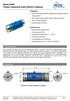 Properties Free of float metal bellow coupling with integrated torque measurement Non-contact measurement system, high robustness High torsional stiffness Limited torque of inertia Performance Measurement
2015 EPO No. 14. Examination Procedure Outline for. Belt-Conveyor Scale Systems
 2015 EPO No. 14 Examination Procedure Outline for Belt-Conveyor Scale Systems Introduction It is recommended that this outline be followed as minimum criteria for examining belt-conveyor scale systems.
Pump Skid Fabrication for Magnetic Coupling. Rick Soltis Chief Mechanic City of Bedford
 Pump Skid Fabrication for Magnetic Coupling Rick Soltis Chief Mechanic City of Bedford Contents Magnetic Couplings What They Are, How They Work, Where They re Used Fabrication and Manufacturing of Pump
Interactive Computer Based Courses
 These SKF Self-Learning Tools (SLT) are a onestop interactive solution for students at various levels including the students of mechanical and other engineering streams. They eliminate the need to take
A Member of the Constructor Group STORAGE SOLUTIONS. Clever Thinking Inside the Box
 A Member of the Constructor Group STORAGE SOLUTIONS Clever Thinking Inside the Box Dexion Storage Solutions Thinking Inside the Box Cutting Costs, Reducing Inventory, Saving Space and Saving Time 2 Increasing
Simple Machines. What are simple machines?
 Definitions to know: Simple Machines Work done when an applied force causes an object to move in the direction of the force Energy ability to cause change; can change the speed, direction, shape, or temperature
Manual piston sampler...m 11
 SAMPLING Manual piston sampler...m 11 Screw sampler...prec 22...PREC 100 Slide sampler...pr 55 Rotative screw sampler...prv Piston sampler...p 11 Sampler on belt conveyor...pba Rotating cup sampler...pgr
A. The top cover quality is not adequate for the system/material being conveyed. Upgrade to a heavier top cover. Upgrade to a better cover compound.
 Conveyor Belt common problem trouble shooting guide 1. Excessive top cover wear over entire top surface or in load carrying area. A. The top cover quality is not adequate for the system/material being
Description. Dimensions. Features. www.pwb-encoders.com. precision works better
 Description The MEC22 is a high resolution optical hollow shaft encoder that can be fixed quickly and easily on different sizes of motor shafts. The encoder provides two square wave outputs in quadrature
In-situ Load Testing to Evaluate New Repair Techniques
 In-situ Load Testing to Evaluate New Repair Techniques W.J. Gold 1 and A. Nanni 2 1 Assistant Research Engineer, Univ. of Missouri Rolla, Dept. of Civil Engineering 2 V&M Jones Professor, Univ. of Missouri
Advantages of Auto-tuning for Servo-motors
 Advantages of for Servo-motors Executive summary The same way that 2 years ago computer science introduced plug and play, where devices would selfadjust to existing system hardware, industrial motion control
Belt Drives and Chain Drives. Power Train. Power Train
 Belt Drives and Chain Drives Material comes for Mott, 2002 and Kurtz, 1999 Power Train A power train transmits power from an engine or motor to the load. Some of the most common power trains include: Flexible
Operating instructions
 Operating instructions Torque transducer type AE with replaceable strain gauge measuring element Model TQ 505 Operating instructions no. 1079 Torque Transducer TQ 505 Page 1 / 16 1. Contents 1. List of
Series 7500 Torque Sensor
 Properties PTO (Power Take-Off) shaft with integrated torque and angle measurement Non-contact measurement system, high robustness Plug & Play solution, no additional electronics required Performance Measurement
Architectural Specifications MODEL HDXL 9. 200 Fairview Road, Unit #2, Barrie, Ontario L4N 8Z8
 MODEL HDXL 9 200 Fairview Road, Unit #2, Barrie, Ontario L4N 8Z8 Tel: 866-792-9968 or 705-792-9968 Fax: 705-735-9564 www.tnrdoors.com email: [email protected] Model HDXL 9 Tech Specs September 4, 2012
Weight Measurement Technology
 Kistler-Morse (KM) introduced bolt-on weight measuring systems three decades ago. These devices featured Walter Kistler s invention, the Microcell. Over the years, many improvements were made to the Microcell
Various Technics of Liquids and Solids Level Measurements. (Part 3)
 (Part 3) In part one of this series of articles, level measurement using a floating system was discusses and the instruments were recommended for each application. In the second part of these articles,
Field Application Note
 Field Application Note Reverse Dial Indicator Alignment RDIA Mis-alignment can be the most usual cause for unacceptable operation and high vibration levels. New facilities or new equipment installations
Configured Linear Motion Assemblies Reduce Engineering and Assembly Costs and Leadtime
 Configured Linear Motion Assemblies Reduce Engineering and Assembly Costs and Leadtime Kyle Thompson, Associate Product Line Manager Thomson Industries, Inc. www.thomsonlinear.com www.linearmotioneering.com
INSTRUMENTATION AND CONTROL TUTORIAL 3 SIGNAL PROCESSORS AND RECEIVERS
 INSTRUMENTATION AND CONTROL TUTORIAL 3 SIGNAL PROCESSORS AND RECEIVERS This tutorial provides an overview of signal processing and conditioning for use in instrumentation and automatic control systems.
Alternative Linear Motion Systems. Iron Core Linear Motors
 Alternative Linear Motion Systems ME EN 7960 Precision Machine Design Topic 5 ME EN 7960 Precision Machine Design Alternative Linear Motion Systems 5-1 Iron Core Linear Motors Provide actuation forces
testing equipment for quality management Programme summary. METROLOGY Tensile and Pressure Testing Machines Measuring Devices Display Devices
 testing equipment for quality management Programme summary. METROLOGY Sheet metal testing Surface testing Corrosion testing Tensile and Pressure Testing Machines Measuring Devices Display Devices The physical
Sense it! Connect it! Bus it! Solve it! EncoderS
 Sense it! Connect it! Bus it! Solve it! EncoderS Incremental encoders Incremental encoders use electrical pulses to measure rotation speed or position. The dual-channel incremental encoders of the Ri series,
OPERATOR S MANUAL SUPPORTED TORQUE CALIBRATION BEAM. Part Number 34320 Issue 4 Original Instructions (English)
 OPERATOR S MANUAL SUPPORTED TORQUE CALIBRATION BEAM Part Number 34320 Issue 4 Original Instructions (English) CONTENTS Part Numbers Covered by This Manual 2 Safety 2 Introduction 2 Parts Included 2 Accessories
Procon Engineering. Technical Document PELR 1002. TERMS and DEFINITIONS
 Procon Engineering Technical Document PELR 1002 TERMS and DEFINITIONS The following terms are widely used in the weighing industry. Informal comment on terms is in italics and is not part of the formal
The quadrature signals and the index pulse are accessed through five 0.025 inch square pins located on 0.1 inch centers.
 Quick Assembly Two and Three Channel Optical Encoders Technical Data HEDM-550x/560x HEDS-550x/554x HEDS-560x/564x Features Two Channel Quadrature Output with Optional Index Pulse Quick and Easy Assembly
Chapter 3. Track and Wheel Load Testing
 Chapter 3 Track and Wheel Load Testing This chapter describes the track, truck, and testing equipment that were used by the Transportation Technology Center, Inc. (TTCI) for collecting the data that was
AUTOMATED, FULL LOAD MOTOR TESTING AT PRODUCTION SPEEDS
 AUTOMATED, FULL LOAD MOTOR TESTING AT PRODUCTION SPEEDS Abstract: Revolutionary test method coupled with innovative automation yields superior motor performance measurement data without sacrifice of production
Competence gives security. A competitive edge in rotary axes through experience, simulation, calculation, testing
 Competence gives security A competitive edge in rotary axes through experience, simulation, calculation, testing Bearings for rotary axes Competence gives security Figure 1: Axial/radial bearing YRTSM
Calibration and Use of a Strain-Gage-Instrumented Beam: Density Determination and Weight-Flow-Rate Measurement
 Chapter 2 Calibration and Use of a Strain-Gage-Instrumented Beam: Density Determination and Weight-Flow-Rate Measurement 2.1 Introduction and Objectives This laboratory exercise involves the static calibration
Active Vibration Isolation of an Unbalanced Machine Spindle
 UCRL-CONF-206108 Active Vibration Isolation of an Unbalanced Machine Spindle D. J. Hopkins, P. Geraghty August 18, 2004 American Society of Precision Engineering Annual Conference Orlando, FL, United States
User checks and maintenance of laboratory balances
 Technical Note 13 March 2014 Issued: July 1995 Amended and reissued: July 2005, July 2007, October 2007, May 2010, March 2013, March 2014 User checks and maintenance of laboratory balances Copyright National
BAGGAGE HANDLING SYSTEMS. Trastecnica S.p.A. Handling Baggage Systems Edition 2002 - Rev. 00-1 -
 BAGGAGE HANDLING SYSTEMS Trastecnica S.p.A. Handling Baggage Systems Edition 2002 - Rev. 00-1 - TECHNICAL SPECIFICS INDEX Check-in with one conveyor 4 Scales 6 Belt Conveyors 8 Take away 9 Feeder and Belt
UNIT II Robots Drive Systems and End Effectors Part-A Questions
 UNIT II Robots Drive Systems and End Effectors Part-A Questions 1. Define End effector. End effector is a device that is attached to the end of the wrist arm to perform specific task. 2. Give some examples
On-line Machine Condition Monitoring [The CMS System]
![On-line Machine Condition Monitoring [The CMS System]](/thumbs/33/16391803.jpg "On-line Machine Condition Monitoring [The CMS System]") On-line Machine Condition Monitoring [The CMS System] Strategic monitoring control your costs Avoid unplanned downtime Monitor your plant stoppers Early warning maintains profit Efficient and profitable
On-line Machine Condition Monitoring [The CMS System] Strategic monitoring control your costs Avoid unplanned downtime Monitor your plant stoppers Early warning maintains profit Efficient and profitable
Daily Operator Checks. Monthly Maintenance
 CUSTOMER DATE OF INSPECTION SERIAL # RSF # UI Rev # PLC Project # SERVICE REPRESENTATIVE Daily Operator Checks Verify that all safety guards are in place. Verify that all safety signs are in proper location
Fluid Power and Fluid Control Solutions For Tire Manufacturing
 Fluid Power and Fluid Control Solutions For Tire Manufacturing PRESSURE FLOW FORCE TENSION POSITION TORQUE VACUUM TIRE UNIFORMITY TESTING A strict set of measurement standards and test conditions are performed
Mounting instructions. Acceleration Transducer B12. B 26.B12.10 en
 Mounting instructions Acceleration Transducer B12 B 26.B12.10 en B12 3 Contents Page Safety instructions.............................................. 4 1 Scope of supply..............................................
Easy drop down menu allows quick set up, the clear large display offers a choice of menus and the interface echo can be constantly seen if needed.
 Sludge Finder 2 Sludge Finder 2 Is a proven effective sludge blanket interface monitor in both waste water and industrial applications. Sludge Finder 2 provides a continuous level indication and 4 20 ma
A Comparison of Trapped Acoustic Technology and Standard Piezo Switching Elements By: Donald Sweeney
 A Comparison of Trapped Acoustic Technology and Standard Piezo Switching Elements By: Donald Sweeney Buffalo Grove, IL. - Experts in switch design have developed the next generation in switches and sensors,
THERMAL ANEMOMETRY ELECTRONICS, SOFTWARE AND ACCESSORIES
 TSI and TSI logo are registered trademarks of TSI Incorporated. SmartTune is a trademark of TSI Incorporated. THERMAL ANEMOMETRY ELECTRONICS, SOFTWARE AND ACCESSORIES IFA 300 Constant Temperature Anemometry
Using angular speed measurement with Hall effect sensors to observe grinding operation with flexible robot.
 Using angular speed measurement with Hall effect sensors to observe grinding operation with flexible robot. François Girardin 1, Farzad Rafieian 1, Zhaoheng Liu 1, Marc Thomas 1 and Bruce Hazel 2 1 Laboratoire
T1-40 T1-40BF T1-40V T1-38 T1-38BF T1-38V
 Transducers T1-40 T1-40BF T1-40V T1-38 T1-38BF T1-38V Velocity transducers B A L A N C I N G M A C H I N E S B A L A N C I N G M A C H I N E S Principle of operation A voltage proportional to the velocity
Digital inductive conductivity transmitter
 Digital inductive conductivity transmitter Optimal solution for conductivity measurements in difficult fluids (polluted, dirty,...) PEEK/PPA version for CIP applications Large range of process connections
Servo Info and Centering
 Info and Centering A servo is a mechanical motorized device that can be instructed to move the output shaft attached to a servo wheel or arm to a specified position. Inside the servo box is a DC motor
Winding Applications. Winding Applications. An overview to winder applications along with Mitsubishi Electric solutions
 Winding Applications An overview to winder applications along with Mitsubishi Electric solutions Applications - Paper winding - Label Winding - Wire Drawing - Pi Printing industry - Plastic sheet winding
Roll Handling By Jeff Damour CONVERTER ACCESSORY CORPORATION Wind Gap, PA USA
 Roll Handling By Jeff Damour CONVERTER ACCESSORY CORPORATION Wind Gap, PA USA Introduction This presentation is a basic tutorial in the mechanics of roll handling. We will discuss: 1) What is roll handling?
O C M III. Open Channel Flow Monitor
 O C M III Open Channel Flow Monitor Part 1. General 1.1 Scope A. This section describes the requirements for an ultrasonic flow transmitter with sensor and temperature compensation probe. B. Under this
BEUMER solutions for the
 BEUMER solutions for the building materials industry Efficient. Safe. conveying & loading BEUMER solutions for the building materials industry 2 3 Family values, sustainable products, true pioneering spirit
BLUE RIBBON CORP. BC001 Birdcage Installation Manual
 Product Overview: This manual is applicable for the BC001 Birdcage Submersible Level Transmitters. If the product you have has a different prefix part number than listed above please contact the factory
Electric Motors and Drives
 EML 2322L MAE Design and Manufacturing Laboratory Electric Motors and Drives To calculate the peak power and torque produced by an electric motor, you will need to know the following: Motor supply voltage,
VIROSAF POSISAF. Rotators and positioners for manual and automatic welding applications.
 VIROSAF POSISAF Rotators and positioners for manual and automatic welding applications. Rotators and positioners: improved handling means improved welding. SAF positioning equipment adapts to the welding
Vision Engravers and Routers PRE-Installation Guide. 2015 Vision Engraving & Routing Systems
 Vision Engravers and Routers PRE-Installation Guide Revised: 8/19/2015 Vision Engravers and Routers PRE-Installation Guide All rights reserved. No parts of this work may be reproduced in any form or by
Procurement Specification for a High Security Lift Arm Barrier (HSLAB) EB950 CR Armstrong High Security Lift Arm Barrier
 Procurement Specification for a High Security Lift Arm Barrier (HSLAB) EB950 CR Armstrong High Security Lift Arm Barrier A. Requirement This document is to be used to specify the physical and operational
Unit 24: Applications of Pneumatics and Hydraulics
 Unit 24: Applications of Pneumatics and Hydraulics Unit code: J/601/1496 QCF level: 4 Credit value: 15 OUTCOME 2 TUTORIAL 2 HYDRAULIC AND PNEUMATIC CYLINDERS The material needed for outcome 2 is very extensive
Shaft- Mounted Speed Reducers
 Torque Arm Design Considerations for Todd R. Bobak has worked in the gear industry for 15 years. He has held positions in technical service, design and development, and quality assurance. He is a product
1x90 TONS TENSIONERS TECHNICAL PROPOSAL. 1 X 90 Tons 30 m/min Tensioners TECHNICAL PROPOSAL JOB 08/059. 0 19/02/2008 Basic proposal PP GM SB
 Pagina N.: 1 of 19 1 X 90 Tons 30 m/min Tensioners JOB 08/059 0 19/02/2008 Basic proposal PP GM SB Rev N Date Issue Description Prepared by Checked by Approved by Pagina N.: 2 of 19 TABLE OF CONTENTS:
Mounting Instructions. Torque Transducer. A0329 3.2 en
 Mounting Instructions Torque Transducer T5 T5 Contents 3 Page Safety instructions.............................................. 4 1 Measuring characteristics..................................... 7 2 Mounting.....................................................
mk Conveyor Technology
 mk Conveyor Technology One construction kit many options Base Technology Profile Technology Conveyor Technology Factory Equipment Linear Motion Advantages of the mk modular system Everything comes from
Load Cell Troubleshooting
 VPG TRANSDUCERS Load Cells and Weigh Modules Technical Note VPGT-08 Scope Load cells are designed to sense force or weight under a wide range of adverse conditions; they are not only the most essential
Simple Machines. Figure 2: Basic design for a mousetrap vehicle
 Mousetrap Vehicles Figure 1: This sample mousetrap-powered vehicle has a large drive wheel and a small axle. The vehicle will move slowly and travel a long distance for each turn of the wheel. 1 People
Tennessee State University
 Tennessee State University Dept. of Physics & Mathematics PHYS 2010 CF SU 2009 Name 30% Time is 2 hours. Cheating will give you an F-grade. Other instructions will be given in the Hall. MULTIPLE CHOICE.
Technical Description. Transistor D.C. Chopper Controller Type GS 24 S
 Technical Description Transistor D.C. Chopper Controller Type GS 24 S Table of contents 1. Getting started guide 2. General information 2.1. Characteristics 2.2. Accessories 3. Information about the Machine
Instruction Manual FL
 3. Operation Overview The most common used features (such as displaying force, peak hold, zero and changing of displayed units) can all be done by pressing a single dedicated key identified on the front
OHIO University Mechanical Engineering Summary Report: Human Power System for Small Appliances and Machinery
 OHIO University Mechanical Engineering Summary Report: Human Power System for Small Appliances and Machinery Appalachian Human Power Brad Bundy Ben Chovan Zach Fetchu Ed Passarrelli Ryan Tedford Will Zaylor
CLASSIFICATION NOTES
 CLASSIFICATION NOTES Type Approval, Installation and Testing of Water Level Detectors on Bulk Carriers and Single Hold Cargo Ships other than Bulk Carriers General Information This edition of the classification
Machine Tool Inspection & Analyzer solutions
 Machine Tool Inspection & Analyzer solutions Introduction IBS Precision Engineering machine tool inspection series offers a range of products to provide peace of mind and control to machine operators by
SECTION 23 81 03 - PACKAGED ROOFTOP AIR CONDITIONING UNITS NON-CUSTOM
 SECTION 23 81 03 - PACKAGED ROOFTOP AIR CONDITIONING UNITS NON-CUSTOM PART 1 - GENERAL 1.1 SUMMARY A. Section Includes: 1. Packaged rooftop air conditioning unit (5 tons and smaller). 2. Roof curb. 1.2
Profile rail guides LLR
 Profile rail guides LLR Content The SKF brand now stands for more than ever before, and means more to you as a valued customer. While SKF maintains its leadership as the hallmark of quality bearings throughout
Force Measurement Systems. Force Measurement Systems
 Force Measurement Systems Force Measurement Systems Force Measurement Systems from IMS Your Guarantee of Quality Modern production equipment is designed for high productivity and quality. To achieve these
Micrio WS1 Replacement Wind Speed Sensor and WC1 Replacement Wind Compass Sensor for Raymarine ST50 and ST60 Wind Instruments. Rev 4.
 Micrio WS1 Replacement Wind Speed Sensor and WC1 Replacement Wind Compass Sensor for Raymarine ST50 and ST60 Wind Instruments. Rev 4.1 The Micrio WS1 Wind Speed Sensor and WC1 Compass Sensor are direct
The Do s and Don ts of Pressure Transducers
 The Do s and Don ts of Pressure Transducers ABSTRACT When specifying a pressure transducer for a process measurement, a number of items have to be considered. Some of the more important ones are discussed
SECTION G2: CABLE PROCESSOR MODULE MAINTENANCE
 SECTION G2: CABLE PROCESSOR MODULE MAINTENANCE Cable Processor Module overview WARNING! When tipping the Cable Processor Module back, (after removing the toggle arm pin), use extreme caution not to drop
330505 Low Frequency Velocity Sensor
 330505 Low Frequency Velocity Sensor Bently Nevada* Asset Condition Monitoring Description The Bently Nevada Low Frequency Velocity Sensor is designed to measure absolute (relative to free space) bearing
Digital Single Axis Controller
 Digital Single Axis Controller The concept of intelligent hydraulic drive a vision? DSAC (Digital Single Axis Controller) Do you need hydraulic servo drive for your machine/system? What would it be like
PID Control. Proportional Integral Derivative (PID) Control. Matrix Multimedia 2011 MX009 - PID Control. by Ben Rowland, April 2011
 PID Control by Ben Rowland, April 2011 Abstract PID control is used extensively in industry to control machinery and maintain working environments etc. The fundamentals of PID control are fairly straightforward
3 LEVELLING & SURVEYING
 3 LEVELLING & SURVEYING 3.1 General The primary reference at water-level recording stations is a set of stable bench-marks, installed in locations where their level should not change. Upon initial set-up
The Technical Legacy of the CEMA Engineering Conference
 The CEMA Engineering Conference meets each June. Its purpose is to develop, and keep relevant, the technical documents that support the needs of the Conveying Industry. It has been doing so since 1934.
Force measurement. Forces VECTORIAL ISSUES ACTION ET RÉACTION ISOSTATISM
 Force measurement Forces VECTORIAL ISSUES In classical mechanics, a force is defined as "an action capable of modifying the quantity of movement of a material point". Therefore, a force has the attributes
SELECTING THE ELECTRIC VIBRATOR
 SELECTING THE ELECTRIC VIBRATOR Vibration systems and methods The systems that use the vibration technique can be divided into the following categories: freely oscillating systems, which will be described
OPL BASIC. Dosing System for Professional Laundry machines. Contents
 OPL BASIC Dosing System for Professional Laundry machines Contents 1 Getting Started. Page 2 2 Installation. Page 4 3 Set Up & Operation. Page 8 4 Maintenance & Accessories. Page 10 5 Troubleshooting Page
Arm2. Arm Arm22. Articulated Arm. machines MEASURING. tridimensional measuring FRATELLI ROTONDI
 Arm Arm22 2 Arm2 tridimensional measuring Articulated Arm MEASURING machines FRATELLI ROTONDI Arm2 MEASURING Arm2Arm2 SOFTWARE Software in WINDOWS environment: sura tridimesio - elements with definite
PowerLine Magnetic-Laser Sheave Alignment System Instructions
 PowerLine Magnetic-Laser Sheave Alignment System Instructions The PowerLine Magnetic-Laser Sheave Alignment System laser aligns belts, pulleys, sheaves, sprockets, gear trains, rollers, platforms, conveyors,
Roller Chain Coupling
 Roller Chain Coupling Features 1. Simple structure A roller chain coupling consists of one duplex roller chain and two sprockets for a simplex chain. Handling is very simple as both the shafts (driving
Single Channel Loop Detector
 Single Channel Loop Detector Model - LD100 Series The LD100 is a single channel inductive loop detector designed for parking and access control applications. The detector is connected to an inductive loop
Continuous Thermal Monitoring to Minimise Slag Carry-Over in Steel Production. Slag Detection System
 Continuous Thermal Monitoring to Minimise Slag Carry-Over in Steel Production Slag Detection System When liquid steel is tapped from a basic oxygen or electric arc furnace, it is essential to minimise
Product Brochure. Controlled start transmission
 Product Brochure Controlled start transmission What CST does The Dodge CST (Controlled Start Transmission) is a 2 in 1 gearbox which combines a planetary gear reducer with an integral wet clutch system.
Bulk Flow Meter LB 442 P R O C E S S C O N T R O L
 Bulk Flow Meter LB 442 P R O C E S S C O N T R O L Mass flow determination using the LB 442 Versatile uses Contactless mass flow determination of solid matter on continuous conveyor systems Conveyor belts
The Design of a Low-Cost and Robust Linkage Position Sensor
 The Design of a Low-Cost and Robust Linkage Position Sensor Project Proposal By: Leann Vernon and Phillip Latka Advisor: Dr. Jose Sanchez December 16th, 2013 Table of Contents Introduction 2 Project Description..
vacon ac drives for mining & minerals
 vacon ac drives for mining & minerals 1 strong experience in mining & minerals Vacon AC drives are robust to handle your most demanding requirements from simple ventilation to the most complex load sharing
WINDER SYSTEMS GE Industrial Control Systems
 WINDER SYSTEMS Systems Concepts Terminology GE Industrial Control Systems APPLICATION TECHNIQUES With a smooth metal surface material, a paper liner is sometimes wound with a coil. The paper is lightweight
Perimeter Security System
 TM Perimeter Security System The Next Generation Perimeter Security System ICRONET combines patented Southwest Microwave technology with microprocessor power and laptop computer convenience. It is a sophisticated
An overview of Computerised Numeric Control (C.N.C.) and Programmable Logic Control (P.L.C.) in machine automation
 An overview of Computerised Numeric Control (C.N.C.) and Programmable Logic Control (P.L.C.) in machine automation By Pradeep Chatterjee, Engine Division Maintenance, TELCO, Jamshedpur 831010 E-mail: [email protected]
SUPER 600. Tracked Paver SUPER 600. Pave Widths 0.5m 2.7m. Maximum Laydown Rate 200 tonnes/h. Clearance Width 1.2m
 SUPER 600 Tracked Paver SUPER 600 Pave Widths 0.5m 2.7m Maximum Laydown Rate 200 tonnes/h Clearance Width 1.2m Mini Paver for Maximum Efficiency on Minor Job Sites T hanks to its compact size, variable