
Lumbar Spinal Conditions
|
|
|
- Agatha Holmes
- 9 years ago
- Views:
Transcription
1 11 C H A P T E R Lumbar Spinal Conditions STUDENT OUTCOMES 1. Locate and explain the functional significance of the bony and soft-tissue structures of the lumbar spine. 2. Describe the motion capabilities of the lumbar spine. 3. Identify the factors that contribute to mechanical loading on the spine. 4. Describe specific strategies in activities of daily living to reduce spinal stress in the lumbar region. 5. Identify anatomical variations that can predispose individuals to lumbar spine injuries. 6. Explain the measures used to prevent injury to the lumbar spinal region. 7. Describe the common injuries and conditions of the lumbar spine and low back area in physically active individuals. 8. Describe a thorough assessment of the lumbar spine. 9. Identify rehabilitative exercises for the lumbar region. 306

2 CHAPTER 11 Lumbar Spinal Conditions 307 ROLE DELINEATION COMPETENCIES The following Performance Domains and Tasks defined in the National Athletic Trainers Association Board of Certification Role Delineation Study, 5th Edition are addressed in this chapter: BOC COMPETENCIES II. Clinical Evaluation and Diagnosis A. Obtain a history through observation, interview, and/or review of relevant records to assess current or potential injury, illness, or condition. B. Inspect the involved area(s) visually to assess the injury, illness, or health-related condition. C. Palpate the involved area(s) using standard techniques to assess the injury, illness, or health-related condition. D. Perform specific tests in accordance with accepted procedures to assess the injury, illness, or healthrelated condition. E. Formulate a clinical impression by interpreting the signs, symptoms, and predisposing factors of the injury, illness, or condition to determine the appropriate course of action. III. IV. Immediate Care A. Employ life-saving techniques through the use of standard emergency procedures in order to reduce morbidity and the incidence of mortality. B. Prevent exacerbation of non life threatening condition(s) through the use of standard procedures in order to reduce morbidity. C. Facilitate the timely transfer of care for conditions beyond the scope of practice of the athletic trainer by implementing appropriate referral strategies to stabilize and/or prevent exacerbation of the condition(s). Treatment, Rehabilitation, and Reconditioning E. Reassess the status of injuries, illnesses, and/or conditions using standard techniques and documentation strategies in order to determine appropriate treatment, rehabilitation, and/or reconditioning and to evaluate readiness to return to a desired level of activity. F. Educate the appropriate individual(s) in the treatment, rehabilitation, and reconditioning of injuries, illnesses, and/or conditions using applicable methods and materials to facilitate recovery, function, and/or performance. Low back pain is a widespread problem that affects both the athletic and nonathletic populations. Nearly 30% of children have experienced low back pain at some time, with the incidence increasing with age until approximately 16 years, when the adult incidence of 75 to 80% is reached (1). Low back pain is more common in boys than in girls, and it is associated with increased physical activity and stronger back flexor muscles (2,3). Although the main causes of low back pain in athletes are musculotendinous strains and ligamentous sprains, chronic or recurring pain often is a symptom of lumbar disk degeneration or stress injuries to the bony articulations of the lumbar spine (4). Pain emanating from the lumbar disks most commonly affects the low back, buttocks, and hips and may result from progressive damage to the annular fibers, particularly the pain fibers that reside in the outer third of the annulus (5). Low back problems are especially common in equestrian sports, weight lifting, ice hockey, gymnastics, diving, football, wrestling, and aerobics. This chapter begins with a review of the anatomical structures in the lumbar spine, followed by a discussion of the kinematics and kinetics of the region. Identification of anatomical variations that may predispose individuals to lumbar spinal conditions leads into strategies used to prevent injury. Information regarding common injuries sustained within the lumbar spine during participation in sport and physical activity is followed by a presentation of lumbar spinal injury assessment. Finally, examples of general rehabilitation exercises are provided.

3 308 Foundations of Athletic Training ANATOMY OF THE LUMBAR SPINE As mentioned in Chapter 10,[AU/ED: Please confirm chapter x-ref.] the lumbar and sacral regions of the spine are anatomically and functionally unique. Normal lumbar curvature is concave, and sacral curvature is convex, from the posterior perspective. Lower Spinal Column The lower spinal column, which forms a convex curve anteriorly, includes five lumbar, five fused sacral, and four small, fused coccygeal vertebrae (Fig. 11.1). The sacrum articulates with the ilium to form the sacroiliac (SI) joint. Supporting the weight of the head, trunk, and upper extremities, the lumbar vertebral bodies have larger articulating surface areas and greater depth than those of any other spinal region. In addition, the orientation of the facet joints varies in comparison to the cervical and thoracic spines Spinous process Lamina Vertebral foramen Superior articular facet Pedicle Body A. Lumbar spine, sacrum, and pelvis B. Lumbar vertebrae Superior articular processes Promontory Ala Ala Lamina Sacral canal Body Transverse process Pelvic sacral foramen Transverse line site of fusion between vertebral bodies Auricular surface Inferior lateral angle Lateral sacral crest Median sacral crest and spinous tubercles First coccygeal vertebra Fused second to fourth coccygeal vertebrae C. Sacrum anteriolateral view D. Sacrum posterior view Intermediate sacral crest and articular tubercles Transverse process of coccyx FIGURE 11.1 Bones of the lumbar region. A, Lumbar spine, sacrum, and pelvis. B, Superior view of lumbar vertebra. C, Anterolateral view of sacrum and coccyx. D, Posterior view of sacrum and coccyx.

4 CHAPTER 11 Lumbar Spinal Conditions 309 (see Fig. 10.4). Information concerning the general structures of the spinal vertebrae and intervertebral disks is presented in Chapter 10. Ligaments of the Lumbar Spine and Trunk General information regarding the spinal ligaments is presented in Chapter 10. Specific to the lumbar spine, several ligaments, including the iliolumbar ligaments, posterior SI ligaments, sacrospinous ligament, and the sacrotuberous ligament, are responsible for maintaining its articulation with the sacrum (Fig. 11.2). Muscles of the Lumbar Spine and Trunk The muscles of the trunk are paired, with one on the left side and one on the right side of the body (Fig. 11.3). These muscles produce lateral flexion and/or rotation of the trunk when acting unilaterally and trunk flexion or extension when acting bilaterally. Collectively, the primary movers for back extension are called the erector spinae muscles. See Muscles of the Lumbar Spine, available on the companion web site at thepoint, for the attachments, actions, and innervations of the major muscles of the lumbar region. Spinal Cord and Spinal Nerves The lumbar plexus and sacral plexus are prominent in the lower trunk. The distal end of the spinal cord, at approximately L 1 L 2, includes a bundle of spinal nerves that extends downward through the vertebral canal and is known collectively as the cauda equina, after its resemblance to a horse s tail. The Lumbar Plexus Supplying the anterior and medial muscles of the thigh region is the lumbar plexus, formed by the T 12 L 5 nerve roots (Fig. 11.4). The posterior branches of the L 2 L 4 nerve roots form the femoral Intertransverse ligament Ligamentum flavum Posterior longitudinal ligament Facet capsulary ligament Anterior longitudinal ligament Interspinous ligament Supraspinous ligament FIGURE 11.2 Ligaments of the lumbar spine.

5 310 Foundations of Athletic Training Latissimus dorsi (cut and reflected) Erector spinae (cut) Erector spinae External oblique External oblique Transversus abdominus Quadratus lumborum Internal oblique Thoraco-lumbar fascia FIGURE 11.3 Muscles of the low back. nerve, innervating the quadriceps, whereas the anterior branches form the obturator nerve, innervating most of the adductor muscle group. The Sacral Plexus A portion of the lumbar plexus (L 4 L 5 ) forms the lumbosacral trunk and courses downward to form the upper portion of the sacral plexus (Fig. 11.5). This plexus supplies the muscles of the buttock region and, through the sciatic nerve, the muscles of the posterior thigh and entire lower leg. The sciatic nerve is composed of two distinct nerves, the tibial nerve and the common peroneal nerve. The tibial nerve, formed by the anterior branches of the upper five nerve roots, innervates all the muscles on the posterior leg with the exception of the short head of the biceps femoris. The common peroneal nerve, formed by the posterior branches of the upper four nerve roots, innervates the short head of the biceps femoris, then divides in the vicinity of the head of the fibula into the deep peroneal nerve and the superficial peroneal nerve. These nerves innervate the anterior compartment of the lower leg and lateral compartments of the lower leg, respectively. KINEMATICS AND MAJOR MUSCLE ACTIONS OF THE LUMBAR SPINE The vertebral joints enable motion in all planes of movement as well as circumduction. Because the motion allowed between any two adjacent vertebrae is small, spinal movements always involve a number of motion segments. The ROM allowed at each motion segment is governed by anatomical constraints that vary through the lumbar region of the spine. Flexion, Extension, and Hyperextension The flexion-extension capability of the motion segments ranges from 12 to 20 in the lumbar region (6). It is important to avoid confusing spinal flexion with hip flexion or with forward pelvic tilt, although all three motions occur during an activity such as touching the toes. Hip flexion consists of anteriorly directed, sagittal plane rotation of the femur with respect to the pelvic girdle (or vice versa), and forward pelvic tilt is anteriorly directed movement of the anterior superior iliac spine (ASIS) with respect to the pubic symphysis. When the spine is extended backward past anatomical position in the sagittal plane, the motion is termed hyperextension. The ROM for spinal hyperextension is considerable in the lumbar region,

6 CHAPTER 11 Lumbar Spinal Conditions 311 L1 Iliohypogastric nerve Ilioinguinal nerve L2 L3 Genitofemoral nerve Lateral femoral cutaneous nerve L4 L5 Femoral nerve Roots Saphenous nerve Obturator nerve Lumbosacral trunk Anterior division Posterior division FIGURE 11.4 Lumbar plexus. The lumbar plexus is formed by the segmental nerves T 12 L 5. The lower portion of Lumbosacral trunk L5 Superior gluteal nerve Inferior gluteal nerve Common fibular nerve Tibial nerve Sciatic nerve Roots Posterior cutaneous femoral nerve Anterior division Posterior division Pudendal nerve S1 S2 S3 S4 S5 Co1 FIGURE 11.5 Sacral plexus. The sacral plexus is formed by the segmental nerves L 4 S 5. This plexus innervates the lower leg, ankle, and foot via the tibial and common peroneal nerves.

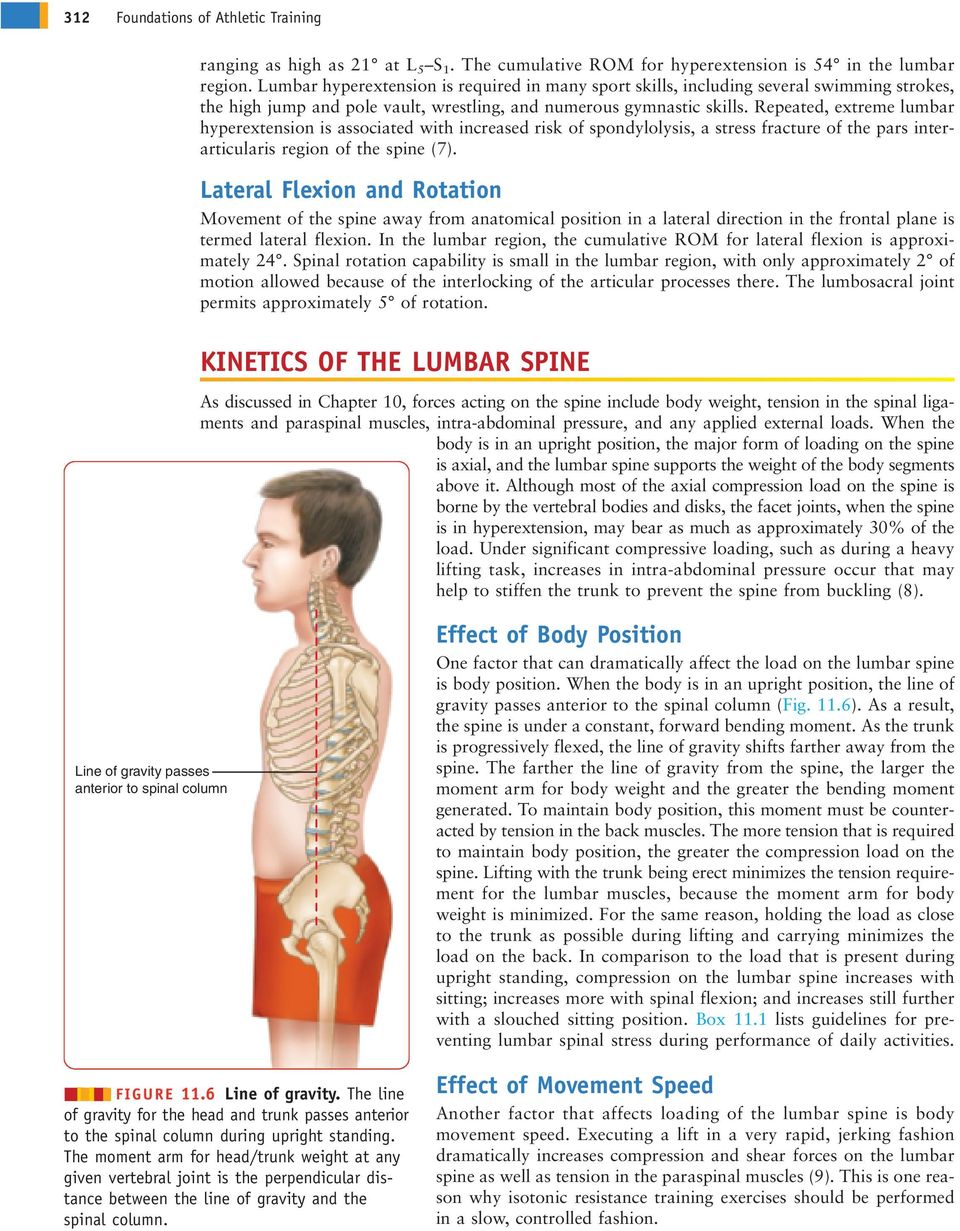
7 312 Foundations of Athletic Training ranging as high as 21 at L 5 S 1. The cumulative ROM for hyperextension is 54 in the lumbar region. Lumbar hyperextension is required in many sport skills, including several swimming strokes, the high jump and pole vault, wrestling, and numerous gymnastic skills. Repeated, extreme lumbar hyperextension is associated with increased risk of spondylolysis, a stress fracture of the pars interarticularis region of the spine (7). Lateral Flexion and Rotation Movement of the spine away from anatomical position in a lateral direction in the frontal plane is termed lateral flexion. In the lumbar region, the cumulative ROM for lateral flexion is approximately 24. Spinal rotation capability is small in the lumbar region, with only approximately 2 of motion allowed because of the interlocking of the articular processes there. The lumbosacral joint permits approximately 5 of rotation. KINETICS OF THE LUMBAR SPINE As discussed in Chapter 10, forces acting on the spine include body weight, tension in the spinal ligaments and paraspinal muscles, intra-abdominal pressure, and any applied external loads. When the body is in an upright position, the major form of loading on the spine is axial, and the lumbar spine supports the weight of the body segments above it. Although most of the axial compression load on the spine is borne by the vertebral bodies and disks, the facet joints, when the spine is in hyperextension, may bear as much as approximately 30% of the load. Under significant compressive loading, such as during a heavy lifting task, increases in intra-abdominal pressure occur that may help to stiffen the trunk to prevent the spine from buckling (8). Line of gravity passes anterior to spinal column FIGURE 11.6 Line of gravity. The line of gravity for the head and trunk passes anterior to the spinal column during upright standing. The moment arm for head/trunk weight at any given vertebral joint is the perpendicular distance between the line of gravity and the spinal column. Effect of Body Position One factor that can dramatically affect the load on the lumbar spine is body position. When the body is in an upright position, the line of gravity passes anterior to the spinal column (Fig. 11.6). As a result, the spine is under a constant, forward bending moment. As the trunk is progressively flexed, the line of gravity shifts farther away from the spine. The farther the line of gravity from the spine, the larger the moment arm for body weight and the greater the bending moment generated. To maintain body position, this moment must be counteracted by tension in the back muscles. The more tension that is required to maintain body position, the greater the compression load on the spine. Lifting with the trunk being erect minimizes the tension requirement for the lumbar muscles, because the moment arm for body weight is minimized. For the same reason, holding the load as close to the trunk as possible during lifting and carrying minimizes the load on the back. In comparison to the load that is present during upright standing, compression on the lumbar spine increases with sitting; increases more with spinal flexion; and increases still further with a slouched sitting position. Box 11.1 lists guidelines for preventing lumbar spinal stress during performance of daily activities. Effect of Movement Speed Another factor that affects loading of the lumbar spine is body movement speed. Executing a lift in a very rapid, jerking fashion dramatically increases compression and shear forces on the lumbar spine as well as tension in the paraspinal muscles (9). This is one reason why isotonic resistance training exercises should be performed in a slow, controlled fashion.
8 CHAPTER 11 Lumbar Spinal Conditions 313 Box 11.1 Preventing Low Back Injuries in Activities of Daily Living Sitting Sit on a firm, straight-backed chair. Place the buttocks as far back into the chair as possible to avoid slouching. Sit with the feet flat on the floor, not extended and raised on a stool. Avoid sitting for long periods of time, particularly with the knees fully extended. Driving Place the seat forward so that the knees are level with the hips and you do not have to reach for the pedals. If the left foot is not working the pedals, place it flat on the floor. Keep the back of the seat in a nearly upright position to avoid slouching. Standing If you must stand in one area for an extended time: Shift body weight from one foot to the other. Elevate one foot on a piece of furniture to keep the knees flexed. Perform toe flexion and extension inside the shoes. Hold the chin up, keep the shoulders back, and relax the knees. Avoid arching the back Lifting and Carrying Use a lumbosacral belt or have assistance when lifting heavy objects. To lift an object: Place the object close to the body. Bend at the knees, not the waist, and keep the back erect. Tighten the abdominal muscles and inhale before lifting the object. Exhale during the lift. Do not twist while lifting. To carry a heavy object: Hold the object close to the body at waist level. Carry the object in the middle of the body, not to one side. Sleeping Sleep on a firm mattress. If needed, place a sheet of 3/4-inch plywood under the mattress. Sleep on the side, and place pillows between the legs. When sleeping supine, place pillows under the knees. Avoid sleeping in the prone position. Avoid sleeping with the arms extended overhead. ANATOMICAL VARIATIONS PREDISPOSING INDIVIDUALS TO SPINAL CONDITIONS Mechanical stress derived from lateral spinal muscle imbalances or from sustaining repeated impact forces can cause back pain and/or injury. Excessive spinal curvatures can be congenital or acquired through weight training or sport participation. Defects in the pars interarticularis of the neural arch can be caused by mechanical stress, also placing an individual at risk for serious spinal injury. Lordosis Abnormal exaggeration of the lumbar curve, or lordosis, often is associated with weakened abdominal muscles in combination with tight muscles, especially the hip flexors, tensor fasciae latae, and deep

9 314 Foundations of Athletic Training lumbar extensors. Normally, the pelvic angle is approximately 30. With excessive lordosis, this angle can increase to 40 and be accompanied by a mobile spine and anterior pelvic tilt (Fig. 11.7A). Other causes of lordosis include congenital spinal deformity, such as bilateral congenital hip dislocation, spondylolisthesis, compensatory action resulting from another deformity (e.g., kyphosis), hip flexion contractures, poor postural habits, and overtraining in sports requiring repeated lumbar hyperextension (e.g., gymnastics, figure skating, football linemen, javelin throwing, or swimming the butterfly stroke). Because lordosis places added compressive stress on the posterior elements of the spine, low back pain is a common symptom predisposing many individuals to low back injuries. Sway Back An individual with a sway back deformity presents with an increased lordotic curve and kyphosis (Fig. 11.7B). This condition often results from weakness in the lower abdominals, lower thoracic extensors, hip flexors, compensatory tight hip extensors, lower lumbar extensors, and upper abdominals. The deformity results as the spine bends back sharply at the lumbosacral angle. Subsequently, the entire pelvis shifts anteriorly, causing the hips to move into extension. For the center of gravity to remain in its normal position, the thoracic spine flexes on the lumbar spine, increasing the lumbar and thoracic curves. Flat Back Syndrome The term flat back refers to a relative decrease in lumbar lordosis (20 ), which shifts the center of gravity anterior to the lumbar spine and hips (Fig. 11.7C). The condition may result from the use of Harrington rods in the treatment of scoliosis, degenerative disk disease involving multiple levels of the spine, ankylosing spondylitis, and postlaminectomy syndrome compression fractures, most commonly caused by osteoporosis. The most common clinical sign is the tendency to lean forward when walking or standing. In an effort to bring the body into better alignment, the low back, buttock, and posterior thigh muscles are recruited to tilt the pelvis. This action causes these muscles to fatigue more quickly, leading to aching and pain. The body also may compensate by exhibiting increased hip and knee flexion. If hip flexion is accentuated, however, a hip flexion contracture may occur. Treatment involves strengthening the gluteal, low back, abdominal, and hamstring musculature. A. Exaggerated lordosis B. Swayback C. Flat back FIGURE 11.7 Lumbar anomalies. A, Lordosis. B, Sway back. C, Flat back. Pars Interarticularis Fractures The pars interarticularis is the weakest bony portion of the vertebral neural arch, the region between the superior and inferior articular facets. Fracture in this region are termed spondylolysis and spondylolisthesis (Fig. 11.8). Although some pars defects may be congenital, they also may be caused by mechanical stress from axial loading of the lumbar spine during repeated weight-loading in flexion, hyperextension (i.e., backarching), and rotation. These repetitive movements cause a shearing stress to the vertebrae, resulting in a stress fracture.

10 CHAPTER 11 Lumbar Spinal Conditions 315 Fractures of the pars interarticularis may range from hairline to complete separation of the bone. A bony defect in spondylolysis tends to occur at an earlier age, typically before 8 years of age, yet often does not produce symptoms until 10 to 15 years of age. The fracture may heal with less periosteal callus and tends to form a fibrous union more often than fractures at other sites. A bilateral separation in the pars interarticularis, called spondylolisthesis, results in the anterior displacement of a vertebra with respect to the vertebra below it (Fig. 11.9). The most common site for this injury is the lumbosacral joint (L 5 S 1 ), with 90% of the slips occurring at this level. Spondylolisthesis often is diagnosed in children between the ages of 10 and 15 years and is more common in boys than in girls. Highdegree slips, however, are seen more commonly in females than in males. (10). Unlike most stress fractures, spondylolysis and spondylolisthesis do not typically heal with time but, rather, tend to persist, particularly in cases with no interruption in participation in sport and physical activity. Those who are particularly susceptible to this condition include female gymnasts, interior football linemen, weight lifters, volleyball players, pole vaulters, wrestlers, and rowers. Superior articular process Pedicle Transverse process Pars interarticularis Isthmus Inferior articular process A. B. Although most spondylitic conditions are asymptomatic, low back pain and associated neurologic symptoms, when the underlying cause is repeated mechanical stress, are likely to occur. The individual may complain of unilateral, dull backache aggravated by activity, usually hyperextension and rotation. Standing on one leg and hyperextending the back aggravates the condition. Superior articular process Inferior articular process FIGURE 11.8 Spondylolysis and Spondylolisthesis. A, Spondylolysis is a stress fracture of the pars interarticularis. B, Spondylolisthesis is a bilateral fracture of the pars interarticularis accompanied by anterior slippage of the involved vertebra. Superior articular process Pedicle Transverse process S1 L5 Isthmus Spinous process and lamina Inferior articular process FIGURE 11.9 Spondylolisthesis. This magnetic resonance imaging scan of spondylolisthesis demonstrates an anterior shift of the L 5 vertebra.

11 316 Foundations of Athletic Training Demonstrable muscle spasm occurs in the erector spinae muscles or hamstrings, leading to flattening of the lumbosacral curve, but no sciatic nerve symptoms usually are present. Pain may radiate into the buttock region or down the sciatic nerve if the L 5 nerve root is compressed. This individual should be referred to a physician. Slippage is measured by dividing the distance the superior vertebral body has displaced forward onto the inferior by the anteroposterior dimensions of the inferior vertebral body. In mild cases (i.e., slippage of 0 25%), modifications in training and technique can permit the individual to continue to participate in physical activity. In moderate cases (i.e., slippage from 25 50%), however, most physicians do not begin active rehabilitation until the individual has been asymptomatic for 4 weeks. Following that period, the focus of rehabilitation is the development of flexibility in the hamstrings and gluteal muscles, combined with strengthening the abdomen and back extensors. If the slip is greater than 50%, the individual presents with flat buttocks, tight hamstrings, and alterations in gait, and a palpable step-off deformity may be present at the level of the defect. This individual should be excluded from participation in contact sports unless the condition is asymptomatic and absence of continued slippage has been documented. PREVENTION OF SPINAL CONDITIONS Although most of the load on the spine is borne by the vertebral bodies and disks, the facet joints assist with some load bearing. Protective equipment can prevent some injuries to the spinal region; however, physical conditioning plays a more important role in preventing injuries to this area. In addition, because the low back is subjected to a variety of stresses as part of normal daily activities, an awareness of proper posture is essential in minimizing the risk of injury. Protective Equipment Weight-training belts, abdominal binders, and other similar lumbar/sacral supportive devices support the abdominal contents, stabilize the trunk, and potentially, can assist in preventing spinal deformity and damage. These devices place the low back in a more vertical lifting posture, decrease lumbar lordosis, limit pelvic torsion, and lessen axial loading on the spine by increasing intraabdominal pressure, which in turn reduces compressive forces in the vertebral bodies. Many of these protective devices are discussed in Chapter 3. Physical Conditioning Strengthening of the back muscles is imperative to stabilize the spinal column. Exercises to strengthen the low back area should involve back extension, lateral flexion, and rotation. In addition, it is important to strengthen the abdominal muscles to maintain appropriate postural alignment. Normal range of motion (ROM) also is essential in stabilizing the spine and preventing injury. If warranted, stretching exercises should be used to promote and maintain normal ROM. In particular, it is advantageous to ensure maximal motion in lateral flexion, forward flexion, and rotation. Proper Skill Technique Poor posture during walking, sitting, standing, lying down, and running may lead to chronic low back strain or sprains. Cases of postural deformity should be assessed to determine the cause, and an appropriate exercise program should be developed to address the deficits. Lifting technique also can affect spinal loading. Executing a lift in a very rapid, jerking fashion dramatically increases compression and shear forces on the spine as well as tension in the paraspinal muscles. For this reason, isotonic resistance exercises should always be performed in a slow, controlled fashion. Breathing technique should be emphasized as well. Specifically, it is desirable to inhale deeply as a lift is initiated and exhale forcefully and smoothly at the end of the lift. Use of a supportive weight-training belt and a spotter also can potentially reduce the chance of injury to the lumbar region during heavy weight lifting.

12 CONDITIONS OF THE LUMBAR SPINE CHAPTER 11 Lumbar Spinal Conditions 317 What criteria should be used to determine whether an individual who reports low back pain should be referred to a physician? The lumbar spine must support the weight of the head, trunk, and arms as well as any load held in the hands. In addition, the two lower lumbar motion segments (i.e., L 4 L 5 and L 5 S 1 ) provide a large ROM in flexion-extension. As such, it is not surprising that mechanical abuse often results in episodes of low back pain or that the lower lumbar disks are injured more frequently than any others in the spine. Lumbar Contusions, Strains, and Sprains An estimated 75 to 80% of the population experiences low back pain stemming from mechanical injury to muscles, ligaments, or connective tissue (Box 11.2). Although low back pain typically strikes adults, nearly 30% of children experience low back pain up to the age of 16 years (1). Several known pathologies may cause low back pain, but reduced spinal flexibility, repeated stress, and activities that require maximal extension of the lumbar spine are most associated with chronic low back pain. Muscle strains may result from a sudden extension action with trunk rotation on an overtaxed, unprepared, or underdeveloped spine. Chronic strains may stem from improper posture, excessive lumbar lordosis, flat back, or scoliosis. Signs and Symptoms Pain and discomfort can range from diffuse to localized. Pain does not radiate into the buttocks or posterior thigh, and no signs of neural involvement, such as muscle weakness, sensory changes, or reflex inhibition, are seen. If a muscle strain is present, pain will increase with passive flexion and with active or resisted extension. Management Acute protocol is followed to control pain and hemorrhage. Following cold treatment, passive stretching of the low back can help to relieve muscle spasm. A corset-type brace can be worn to compress the area (see Fig. 3.5). Following the acute stage, a graduated stretching and strengthening program can be initiated. In moderate to severe cases, the individual should be referred to a physician. Prescription muscle relaxants or nonsteroidal anti-inflammatory drugs (NSAIDs) may be appropriate. Low Back Pain in Runners Many runners develop muscle tightness in the hip flexors and hamstrings. Tight hip flexors tend to produce a forward body lean, which leads to anterior pelvic tilt and hyperlordosis of the lumbar spine. Because the lumbar muscles develop tension to counteract the forward bending moment of the entire trunk when the trunk is in flexion, these muscles are particularly susceptible to strain. Coupled with tight hamstrings, a shorter stride often emerges. Box 11.2 Causes of Low Back Pain Muscle strains and sprains Sciatica Protruded or herniated disk Pathologic fracture Disk space infections Spinal infections (e.g., tuberculosis) Neoplastic tumor (i.e., primary or metastatic) Ankylosing spondylitis (arthritis of the spine) Benign space-occupying lesions Abdominal aortic aneurysm

13 318 Foundations of Athletic Training Box 11.3 Reducing Low Back Pain in Runners Wear properly fitted shoes that control heel motion and provide maximum shock absorption. Increase flexibility at the hip, knee, ankle plantar flexors, and trunk extensors. Increase strength in the abdominal and trunk extensor muscles. Avoid excessive body weight. Warm up before and after running. Run with an upright stance rather than with a forward lean. Avoid excessive side-to-side sway. Run on even terrain, and limit hill work. Avoid running on concrete. Avoid overstriding to increase speed, because this increases leg shock. Gradually increase distance, intensity, and duration. Do not increase any parameter more than 10% in 1 week. If orthotics are worn and pain persists, check for wear and rigidity. Consider alternatives to running, such as cycling, rowing, or swimming. Signs and Symptoms Symptoms include localized pain that increases with active and resisted back extension, but radiating pain and neurologic deficits are not present. Anterior pelvic tilt and hyperlordosis of the lumbar spine also may be present. Management Treatment focuses on avoiding excessive flexion activities and a sedentary posture (Box 11.3). Flexion causes the mobile nucleus pulposus to shift posteriorly and press against the annulus fibrosus at its thinnest, least-buttressed place. In most cases, this just leads to pain, but in others, it may lead to a herniated disk. In addition, physical activity is necessary to pump fluid through the spinal disks to keep them properly hydrated; by interfering with this process, immobility can prolong pain. Ice, NSAIDs, muscle relaxants, transcutaneous electrical nerve stimulation (TENS), and electrical muscle stimulation may be used to reduce pain and inflammation. Lumbar stabilization exercises can be combined with extension exercises, progressive activity, and early mobilization. Aerobic exercise, such as walking, swimming, or biking, should be included in all programs. If symptoms do not improve within a week, the individual should be referred to a physician to rule out a more serious underlying condition. In an effort to decrease the incidence of low back pain, training techniques should allow adequate progression of distance and intensity and include extensive flexibility exercises for the hip and thigh region. Myofascial Pain Myofascial pain is referred pain that emanates from a myofascial trigger point, a hypersensitive, localized nodule within a taut band of muscle tissue and its surrounding fascia. When compressed or palpated, pain is produced in a predictable distribution of referred pain. In the lumbar area, the piriformis muscle and quadratus lumborum are common trigger point sites associated with extended sitting, standing, running and walking activities. The piriformis in particular can impact the sciatic nerve as it courses through, above, or below the muscle on its path into the posterior leg. Individuals who slip unexpectedly and catch themselves also can irritate the trigger points. Signs and Symptoms Aggravation of the piriformis can lead to referred pain in the SI area, posterior hip, and upper twothirds of the posterior thigh. Aching and deep pain increases with activity or with prolonged sitting with the hip adducted, flexed, and internally rotated. If the sciatic nerve is impinged, pain and possible changes in sensation may extend into the leg.

14 CHAPTER 11 Lumbar Spinal Conditions 319 Referred pain from the quadratus lumborum often gives a false sign of a disk syndrome and often is overlooked as a source of low back pain. The superficial fibers can refer a sharp, aching pain to the low back, iliac crest, or greater trochanter or can extend it to the abdominal wall. The deep fibers may refer pain to the SI joint or lower buttock region. Pain increases during lateral bending toward the involved side, while standing for long periods of time, and during coughing or sneezing. Management Trigger point treatment involves stretching the involved muscle back to its normal resting length as a way to relieve the irritation that led to the initial pain. The patient should be placed in a comfortable position on the uninvolved side if the piriformis is involved or prone if the quadratus lumborum is involved. Three potential techniques can be used. One technique involves application of pressure slowly and progressively over the trigger point. Pressure is maintained until the tenderness is gone. Another technique involves ice massage applied over the length of the muscle and then over the referred pain pattern. The ice is applied in longitudinal, parallel strokes in only one direction while a passive stretch is applied progressively to the involved muscle. The third technique involves a deep-stroking massage over the length of the muscle, moving in a distal to proximal direction. As the massage continues, the taut band should relax, the tender nodules soften, and the pain ease. Facet Joint Pathology Throughout the longitudinal axis of the spine, three distinct anatomical columns can be defined at any spinal motion segment namely, the anterior, middle, and posterior columns. The posterior column contains the pars interarticularis, facet joints, and spinous processes and is supported by the ligamentum flavum and interspinous ligaments. The facet joint is a synovial joint richly innervated via the medial branch of the posterior primary rami of at least two adjacent spinal nerves. The facet joint capsules act as passive restraints against excessive lumbar rotation and flexion and serve as a protective mechanism for the intervertebral disk. Lumbar facet pathology may involve subluxation or dislocation of the facet, facet joint syndrome (i.e., inflammation), or degeneration of the facet itself (i.e., arthritis). The exact pathophysiology is unclear. Theories include possible mechanical irritation of the nearby nerve root, chemical irritation arising from the inflammatory process (e.g., capsular and synovial inflammation), meniscoid entrapment, synovial impingement, joint subluxation, chondromalacia facette, mechanical injury to the joint s capsule, and restriction to normal articular motion from soft or articular causes. Signs and Symptoms Signs and symptoms can include nonspecific low back, hip, and buttock pain with a deep and achy quality. The pain may radiate into the posterior thigh, but it does not radiate below the knee. Some patients describe their pain as being worse in the morning, aggravated by rest and hyperextension, and relieved by repeated motion. Flattening of lumbar lordosis may be visible. Point tenderness may be elicited to a unilateral or bilateral paravertebral area. Pain often is exacerbated by trunk rotation, stretching into full extension, lateral bending toward the involved side, and with torsion. Sensory alternations usually are absent unless the nerve root is secondarily involved. Limited flexibility of the pelvic musculature can directly impact the mechanics of the lumbosacral spine. If facet joint pathology is present, an abnormal pelvic tilt and rotation of the hip secondary to tight hamstrings, hip rotators, and quadratus may be evident. Typically, manual muscle testing is normal; however, a subtle weakness in the erector spinae and hamstring muscles may contribute to pelvic tilt abnormalities. This subtle weakness may be appreciated with trunk, pelvic, and lower extremity extension asymmetry. If facet hypertrophy narrows the neural foramen, causing nerve root impingement, a straight leg raising test may elicit a positive response. Typically, this maneuver is normal. Management A definitive diagnosis is made using radiographs or magnetic resonance imaging or by a physician injecting the facet with an anesthetic and noting any change in the symptoms. Initial treatment

15 320 Foundations of Athletic Training should focus on education, relative rest, pain relief, and maintenance of positions that provide comfort, exercises, and some modalities. Therapeutic exercises should include instruction regarding proper posture and body mechanics in activities of daily living that protect the injured joints, reduce symptoms, and prevent further injury. Positions that cause pain should be avoided. Modalities such as superficial heat and cryotherapy may help to relax the muscles and reduce pain. In addition, medications such as NSAIDs can be advantageous. Spinal manipulation and mobilization also can be used to reduce pain. Once the painful symptoms are controlled during the acute phase of treatment, stretching and strengthening exercises of the lumbar spine and associated muscles can be initiated. Sciatica Sciatica, an inflammatory condition of the sciatic nerve, is classified in terms of four levels of severity, each with its own management strategy (Box 11.4). The condition can be caused by a herniated disk, annular tear, myogenic or muscle-related disease, spinal stenosis, facet joint arthropathy, or compression of the nerve between the piriformis muscle. Signs and Symptoms If related to a herniated disk, radiating leg pain is greater than back pain and increases with sitting and leaning forward, coughing, sneezing, and straining. Pain is reproduced during an ipsilateral straight leg raising test (see Fig ). In an annular tear, back pain is more prevalent and is exacerbated with straight leg raising. Morning pain and muscular stiffness that worsens if chilled or when the weather changes (arthriticlike symptoms) are characteristic of myogenic or muscle-related disease. Pain typically radiates into the buttock and thigh region. See Signs and Symptoms of Sciatic, available on the companion website at thepoint, for the common signs and symptoms that accompany the various etiologies of sciatica. If lumbar spinal stenosis is present, back and leg pain develop after the individual walks a limited distance and concomitantly increase as the distance increases. Pain is not reproduced with a straight leg raising test, but it can be reproduced with prolonged spine extension, which is relieved with spine flexion. If a facet joint is involved, pain is localized over the joint on spinal extension and is exacerbated with ipsilateral lateral flexion. If the sciatic nerve is compressed by the piriformis muscle, pain increases during internal rotation of the thigh. Management Referral to a physician is necessary to check for a potentially serious underlying condition. Under normal circumstances, bed rest usually is not indicated, although side-lying with the knees flexed may relieve symptoms. Lifting, bending, twisting, and prolonged sitting and standing aggravate the condition and, therefore, should be avoided. When asymptomatic, abdominal and extensor muscle strengthening exercises can begin, with gradual return to activity. If symptoms resume, however, activity should cease, and the individual should be referred back to the physician. Occasionally, Box 11.4 Classification and Management of Sciatica Sciatica only: No sensory or muscle weakness. Modify activity appropriately, and develop rehabilitation and prevention program. Any increased pain requires immediate re-evaluation. Sciatica with soft signs: Some sensory changes, mild or no reflex change, normal muscle strength, and normal bowel and bladder function. Remove from sport participation for 6 to 12 weeks. Sciatica with hard signs: Sensory and reflex changes, and muscle weakness caused by repeated, chronic, or acute condition. Normal bowel and bladder function. Remove from participation for 12 to 24 weeks. Sciatica with severe signs: Sensory and reflex changes, muscle weakness, and altered bladder function. Consider immediate surgical decompression.

16 CHAPTER 11 Lumbar Spinal Conditions 321 extended rest is needed for symptoms to resolve totally, and if a significant disk protrusion is present, surgery may be indicated. Conditions of the Lumbar Disk Prolonged mechanical loading of the spine can lead to microruptures in the annulus fibrosus, resulting in degeneration of the disk (Fig ). Bulging or protruded disks refer to some eccentric accumulation of the nucleus with slight deformity of the annulus. When the eccentric nucleus produces a definite deformity as it works its way through the fibers of the annulus, it is called a prolapsed disk. It is called an extruded disk when the material moves into the spinal canal, where it runs the risk of impinging on adjacent nerve roots. Finally, with a sequestrated disk, the nuclear material has separated from the disk itself and, potentially, can migrate. The most commonly herniated disks are the lower two lumbar disks at L 4 -L 5 and L 5 -S 1, followed by the two lower cervical disks. Most ruptures move in a posterior or posterolateral direction as a result of torsion and compression, not just compression. Bulging Nucleus Annulus A. B. Extruded C. D. Prolapsed Sequestrated Signs and Symptoms Because the intervertebral disks are not innervated, the sensation of pain does not occur until the surrounding soft-tissue structures are impinged. When compression is placed on a spinal nerve of the sciatic nerve complex (L 4 S 3 ), sensory and motor deficits are reflected in the myotome and dermatome patterns associated with the FIGURE Herniated disks. Herniated disks are categorized by severity as an eccentrically loaded nucleus progressively moves from (A) protruded through, (B) prolapsed, and (C) extruded, culminating in (D) sequestrated when the nuclear material moves into the canal to impinge on the adjacent spinal nerves. nerve root (Fig ). In addition, alteration in tendon reflexes is apparent. A disk need not be completely herniated to give symptoms, which include sharp pain and muscle spasms at the site of herniation that often shoot down the sciatic nerve into the lower extremity. The individual may walk in a slightly crouched position, leaning away from the side of the lesion. Forward trunk L4 L4 Lumbar root L5 L5 L5 S1 A. B. C. FIGURE Possible effects on the spinal cord and spinal nerves according to the level of herniation. A, Herniation between L 4 and L 5 compresses the L 5 nerve root. B, Herniation between L 5 and S 1 can compress the nerve root crossing the disk (S 1 ) and the nerve root emerging through the intervertebral foramina (L 5 ). C, A posterior herniation at the L 4 L 5 level can compress the dura mater of the entire cauda equina, leading to bowel and bladder paralysis.

17 322 Foundations of Athletic Training TABLE 11.1 Physical Findings Associated with a Herniated Disk SIGNS AND SYMPTOMS L 3 L 4 (L 4 ROOT) L 4 L 5 (L 5 ROOT) L 5 S 1 (S 1 ROOT) Pain Lumbar region and buttocks Lumbar region, groin, Lumbar region, groin, and and sacroiliac area sacroiliac area Dermatome and sensory loss Anterior midthigh over patella Lateral thigh, anterior leg, Posterior lateral thigh and and medial lower leg to top of foot, and middle lower leg to lateral foot great toe three toes and fifth toe Myotome weakness Ankle dorsiflexion Toe extension (extensor Ankle plantar flexion hallux) (gastrocnemius) Reduced deep tendon reflex Quadriceps Medial hamstrings Achilles tendon Straight leg raising test Normal Reduced Reduced flexion or a straight leg raising test (see Fig ) may exacerbate pain and increase distal symptoms. Significant signs indicating the need for immediate referral to a physician include muscle weakness, sensory changes, diminished reflexes in the lower extremity, and abnormal bladder or bowel function. Table 11.1 outlines physical findings associated with disk herniation in the low back region. Management In mild cases, treatment consists of minimizing load on the spine by avoiding activities that involve impact, lifting, bending, twisting, and prolonged sitting and standing. Painful muscle spasms can be eliminated with ice and/or heat, administration of prescribed NSAIDs and/or muscle relaxants, ultrasound, TENS, passive exercise, and gentle stretching. Following resolution of spasm and acute pain, rehabilitation should include spine and hamstring flexibility, spinal strength and stabilization exercises, and functional stabilization control in sport and daily activities. Lumbar Fractures and Dislocations Transverse or spinous process fractures are caused by extreme tension from the attached muscles or from a direct blow to the low back during participation in contact sports, such as football, rugby, soccer, basketball, hockey, and lacrosse. These fractures often lead to additional injury of surrounding soft tissues but are not as serious as compression fractures. Compression fractures more commonly involve the L 1 vertebra at the thoracolumbar junction. Hyperflexion, or jack-knifing of the trunk, crushes the anterior aspect of the vertebral body. The primary danger with this injury is the possibility of bony fragments moving into the spinal canal and damaging the spinal cord or spinal nerves. Because of the facet joint orientation in the lumbar region, dislocations occur only when a fracture is present. Fracture-dislocations resulting from sport participation are rare. Signs and Symptoms Symptoms include localized, palpable pain that may radiate down the nerve root if a bony fragment compresses a spinal nerve. Because the spinal cord ends at approximately the L 1 or L 2 level, fractures of the lumbar vertebrae below this point do not pose a serious threat but, rather, should be handled with care to minimize potential nerve damage to the cauda equina. Confirmation of a possible fracture is made with a radiograph or computed tomographic scan. If a fracture or dislocation is suspected, the emergency plan, including summoning emergency medical services (EMS) for transport to the nearest medical facility, should be activated. Management Conservative treatment consists of initial bed rest, cryotherapy, and minimizing mechanical loads on the low back until symptoms subside, which may take 3 to 6 weeks.

18 CHAPTER 11 Lumbar Spinal Conditions 323 If assessment of a low back injury reveals signs of nerve root involvement (i.e., sensory or motor deficits and diminished reflexes) or disk injury, physician referral is warranted. SACRUM AND COCCYX CONDITIONS A 40-year-old man initiated a training program to improve his cardiovascular fitness. His workout for the past month has consisted of running on a treadmill. Over the past week, he began to develop pain in the sacral region during his workout. The pain has now become so persistent and chronic that it hurts to sit for an extended period of time. What injury may be present, and what recommendations can be made to this person relative to caring for the injury? Because the sacrum and coccyx are essentially immobile, the potential for mechanical injury to these regions is dramatically reduced. In many cases, injuries result from direct blows and stress on the SI joint. Sacroiliac Joint Sprain Sprains of the SI joint may result from a single traumatic episode that involves bending and/or twisting, repetitive stress from lifting, a fall on the buttocks, excessive side-to-side or up-and-down motion during running and jogging, running on uneven terrain, suddenly slipping or stumbling forward, or wearing new shoes or orthoses. The injury may irritate or stretch the sacrotuberous or sacrospinous ligament, or it may lead to an anterior or posterior rotation of one side of the pelvis relative to the other. Hypermobility results from rotation of the pelvis. During healing, the joint on the injured side may become hypermobile, allowing the joint to subluxate in either an anterior- or posterior-rotated position. Signs and Symptoms Symptoms may involve unilateral, dull pain in the sacral area that extends into the buttock and posterior thigh. On observation, the ASIS or posterior superior iliac spine (PSIS) may appear to be asymmetrical when compared bilaterally. A leg-length discrepancy may be present, but muscle spasm is not often seen. Standing on one leg and climbing stairs may increase the pain. Forward bending reveals a block to normal movement, with the PSIS on the injured side moving sooner than on the uninjured side. Lateral flexion toward the injured side increases pain, as do straight leg raises beyond 45. Management Treatment for SI sprains includes cryotherapy, prescribed NSAIDs, and gentle stretching to alleviate stiffness. As the conditions improves, flexibility, pelvic stabilization exercises, mobilization of the affected joint, and strengthening exercises for the low back should be initiated. Coccygeal Conditions Direct blows to the region can produce contusions and fractures of the coccyx. Pain resulting from a fracture may last for several months. Prolonged or chronic pain in the region also may result from irritation of the coccygeal nerve plexus. This condition is termed coccygodynia. Treatment for coccygeal pain includes analgesics, use of padding for protection, and a ring seat to alleviate compression during sitting. This individual has probably irritated the SI joint from repeated stress while running on the treadmill. This individual should ice the region to control inflammation and pain and should stretch the low back and buttock region. A detailed assessment (including a gait analysis while running) should be performed to determine the potential cause of the injury so that a proper rehabilitation program and, subsequently, an appropriate cardiovascular conditioning regimen can be developed.

19 324 Foundations of Athletic Training ASSESSMENT OF SPINAL CONDITIONS A 17-year-old cheerleader reports to the athletic training room complaining of aching pain during trunk flexion and aggravated with resisted hyperextension that produces sharp, shooting pains into the low back and down the posterior leg. How should the assessment of this injury progress to determine the extent and severity of injury? Injury assessment of the lumbar spine is difficult and complex. In the event of an acute injury with possible nerve involvement, immobilization and immediate transportation to the nearest medical facility is warranted, regardless of whether a total assessment is completed. Box 11.5 identifies several Red Flags that warrant immobilization and immediate referral to a physician. When the individual walks into the examination room and complains of low back pain, it is relatively safe to assume that a serious spinal injury is not present. Most of the examination will involve differentiating symptoms, including distinguishing the presence of radicular symptoms into See Field Strategy: Lumbar Spinal Injury Evaluation, available on the companion website at thepoint, for a summary of the assessment procedure. the leg from a space-occupying lesion or herniated disk, from other conditions, such as a strain, sprain, or facet problem more likely to cause localized low back pain. Even after a detailed and methodical assessment, a definitive determination of the source of pain may not be obvious. As such, referral to a physician for advanced testing and assessment may be necessary. The assessments that follows focuses on a lumbar assessment for a conscious individual. Specific information related to an acute injury is included where appropriate. HISTORY The injury assessment of the cheerleader should begin with a history. What questions need to be asked to identify the cause and extent of injury? A history of the injury should include information regarding the primary complaint, mechanism of injury, characteristics of the symptoms, disability resulting from the injury, previous injuries to the area, and family history that may have some bearing on this specific condition. In See Field Strategy: Developing a History for a Spinal Injury, available on the companion website at thepoint, for general questions related to a lumbar spinal injury. cases of lumbar spinal injury, questions should be asked about the location of pain (i.e., localized or radiating), type of pain (i.e., dull, aching, sharp, burning, or radiating), presence of sensory changes (i.e., numbness, tingling, or absence of sensation), and possible muscle weakness or paralysis. It also is important to determine the length of time the problem has been present. Acute back pain usually lasts 3 to 4 days. Subacute back pain lasts up to 12 weeks, however, and chronic back pain can extend longer than 3 months. Box 11.5 Red Flags That Warrant Immobilization and Immediate Referral to a Physician Severe pain, point tenderness, or deformity along the vertebral column Loss or change in sensation anywhere in the body Paralysis or inability to move a body part Diminished or absent reflexes Muscle weakness in a myotome Pain radiating into the extremities Trunk or abdominal pain that may be referred from the visceral organs Any injury in which uncertainty exists regarding the severity or nature

20 CHAPTER 11 Lumbar Spinal Conditions 325 The cheerleader should be asked questions that would assist in determining the cause and extent of injury. Questions should address the primary complaint (i.e., what, when, and how questions), mechanism of injury, location of pain (i.e., localized or radiating), type of pain (i.e., dull, aching, sharp, burning, or radiating), presence of sensory changes (i.e., numbness, tingling, or absence of sensation) and possible muscle weakness, unusual sensations (i.e., sound or feelings), onset of symptoms, related medical history, and past injuries/treatment. OBSERVATION AND INSPECTION The 17-year-old cheerleader has been participating in cheerleading for 5 years. The primary complaint is an aching pain during trunk flexion and aggravated with resisted hyperextension that produces sharp shooting pains into the low back and down the posterior aspect of the right leg. The cheerleader reports the condition has been present for 2 weeks, and she cannot recall a traumatic episode that may have caused the condition. Would it be appropriate to do a scan examination to rule out other painful areas, and what specific factors should be observed to identify the injury? The observation component of an assessment should be initiated as soon as the examiner sees the patient. Body language can signal pain, disability, and muscle weakness. It is important to note the individual s willingness or ability to move, general posture, ease in motion, and general attitude. Clothing and protective equipment may prevent visual observation of abnormalities in the spinal alignment. As such, the individual should be suitably dressed so that the back is as exposed as possible; for girls and women, a bra, halter top, or swimsuit can be worn. Observation should begin with a postural assessment, progress through a scan examination and gait analysis, and end with an inspection of the injury site. Posture Posture assessment can detect congenital or functional problems that may contribute to the injury. A patient with acute back pain usually exhibits some degree of antalgic (painful) posturing. This may present as a decrease in lumbar lordosis with a concomitant lateral shift or scoliosis because of muscle spasm. The individual should be observed from an anterior, lateral, and posterior view, paying particular attention to pelvic tilt. It is important to determine if the pelvis is maintained in a neutral position (i.e., normal lordotic curve with ASIS slightly lower than the PSIS). The head and neck posture should be observed as well. In particular, it is important to determine: If the nose is in alignment with the manubrium, sternum, and umbilicus If any abnormal spinal curvatures are present If the shoulders and clavicles are level (although the dominant side may be slightly lower) If the individual leans to one side and, if so, if it appears to be caused by muscle spasm, scoliosis, or leg length discrepancy If the height and position of the ASIS, iliac crests, patella, and malleoli are the same bilaterally The individual should be instructed to lean forward and touch the toes while keeping the knees straight (Adam s position). The vertebrae and contour of the back should be observed (see Fig ). The presence of a hump or raised scapula on one side (convex side of curve) and of a hollow (concave side of curve) on the other indicates scoliosis. From the side, the presence of flexed posturing at the hips from tight hip flexors should be noted; this results in a compensatory increase in the lumbar and cervical lordoses. It also is appropriate to determine if the trunk is rotated so that one shoulder is forward. Finally, the presence of prominent ribs on one side should be noted. From a posterior view, the level of the shoulders, inferior angles of the scapula, and waist angles should be assessed. The PSIS should be level. The gluteal folds and knee joints should be at the same height. The presence of any dark areas of skin See Field Strategy: Postural Assessment of the Low Back Region, available on the companion website at thepoint, for specific postural factors to observe in the head and spinal region.

21 326 Foundations of Athletic Training Bump pigmentation, such as café-au-lait spots, should be noted, because this could indicate a possible collagen disease or abnormal growth of neural tissues (neurofibromatosis). The lower lumbar spine and sacrum should be observed for tufts of hair (Faun s beard), indicating possible spina bifida occulta. Bump A. B. FIGURE Step deformity in the lumbar spine. A step deformity occurs when the spinous process of one vertebra is more prominent than the vertebra below or above it. A, Spondylitis. B, Spondylolisthesis. Gait Assessment The individual should be asked to walk several yards while the examiner observes normal body movement. The examiner should stand behind, in front of, and to the side of the individual to observe from all angles. Subtle posture abnormalities, such as kyphosis, scoliosis, lordosis, or pelvic tilt, should be noted. A low back injury may produce a forward lean, a lean to one side, or a noticeable limp. Inspection of the Injury Site Local inspection of the injury site should include observation for deformity, swelling, discoloration, muscle spasm, atrophy, hypertrophy, scars that might indicate previous surgery, and general skin condition. A step deformity in the lumbar spine may indicate a spondylolisthesis (Fig ). Gross Neuromuscular Assessment During an acute on-site injury assessment, a posture and scan may not be possible. It is beneficial, however, to perform a neuromuscular assessment prior to palpation to detect any motor and/or sensory deficits. This can be done without moving the individual by having the person perform a submaximal, bilateral hand-squeeze and ankle dorsiflexion. These two actions assess the cervical and lumbar spinal nerves, respectively. Muscle weakness and/or diminished sensation over the hands and feet indicate a serious injury. If any deficits are noted, the emergency care plan, including summoning EMS, should be activated. If no deficits are noted, it does not rule out possible neurologic involvement or fracture. Therefore, palpation should be done with the individual maintained in the position found. What specific factors should be observed and inspected in the on-going assessment of the cheerleader? Is it appropriate to perform a scan examination? PALPATION During a scan examination, trunk flexion and extension produced a dull pain in the low back. Lateral flexion to the right caused sharp pain to radiate into the right buttock and posterior leg. Gait analysis showed a shortened stride on the right side. Visual inspection showed no abnormalities. The injury is confined to the low back region. What specific structures need to be palpated to determine if the injury is of bony or soft-tissue origin, and can neural involvement be ruled out during palpation? Bony and soft-tissue structures are palpated to detect temperature, swelling, point tenderness, deformity, crepitus, muscle spasm, and cutaneous sensation. In injuries that do not involve neural damage, fracture, or dislocation, palpation can proceed with the patient in a supine position. The umbilicus lies at the level of the L 3 L 4 disk space and is the center point for the intersection of the abdominal quadrants. Using careful deep palpation, the examiner may be able to palpate the anterior aspects of the L 4, L 5, and S 1 vertebrae, disks, and accompanying anterior longitudinal ligament. The abdomen also should be palpated for pain and muscle spasm that may be responsible for referred pain into the lumbar region from internal organs. The inguinal area, iliac crest, and symphysis pubis also can be palpated for signs of infection (e.g., enlarged lymph nodes), hip pointers, apophysitis, or osteitis pubis.
22 CHAPTER 11 Lumbar Spinal Conditions 327 When moving into the prone position, a pillow or blanket should be placed under the hip region to tilt the pelvis back and relax the lumbar curvature. Muscle spasm in the lower erector spinae, lower trapezius, serratus posterior, quadratus lumborum, latissimus dorsi, or gluteus maximus can indicate dysfunction of the thoracic or lumbar spine. The following surface landmarks in the lumbar region can facilitate palpation: L4 top of iliac crest L5 demarcated by bilateral dimples S2 level of PSIS In palpating the spinous processes of the lumbar spine, particular attention should be noted at the L 4, L 5, and S 1 level. A visible or palpable dip or protrusion can indicate spondylolisthesis. If the fingers are moved laterally 2 to 3 cm ( inches), the facet joints can be palpated for signs of pathology. Because of their depth, it may be difficult to palpate the joints; however, spasm in the overlying paraspinal muscles can be palpated. The spinous processes of the sacrum also can be palpated. Because no interposing soft-tissue spaces are between them, they may be harder to distinguish. The S 2 spinous process is at the level of a line drawn between the two PSIS ( posterior dimples ). In moving to the PSIS, the examiner can palpate the iliac crest for signs of injury and then palpate the gluteal muscles for pain, spasm, or possible nodules. Having the patient flex the hip at 90 allows easier palpation of the ischial tuberosity, greater trochanter, and sciatic nerve, which is located midway between the ischial tuberosity and greater trochanter. Finally, the piriformis muscle should be palpated deep to the gluteal muscles for pathology. The following structures should be palpated: Anterior Aspect 1. Umbilicus and abdominal area. Note any abnormal tenderness or masses indicating internal pathology that is referring pain to the spinal region. 2. Inguinal area. Palpate for possible hernia, infection (enlarged lymph nodes), or other pathology. 3. Iliac crest, ASIS, and symphysis pubis. Palpate for pain, tenderness, or defect indicating pathology (e.g., avulsion fracture, hip pointer, apophysitis, or osteitis pubis). Posterior Aspect 1. Spinous processes of the lumbar vertebrae. Note any tenderness, crepitus, or presence of a step-off deformity (i.e., one vertebra is more anterior than the one below it). This indicates spondylolisthesis, which most commonly is seen between the L 4 and L 5 or the L 5 and S 1 vertebrae. Pain and tenderness without positive findings on muscle movement may indicate that the problem is not musculoskeletal in origin. 2. Facet joints. The facet articulations are approximately a thumb s breadth to either side of the spinous process. Point tenderness at these sites, especially with extension and rotation to the same side, suggests facet joint pain. 3. Interspinous and supraspinous ligaments, paraspinal muscles, and quadratus lumborum. Trigger points within specific muscles may refer pain to a more distal area. Tender points that increase with muscular contraction indicate a localized muscle strain. An area that is tender to palpation but is not painful during muscle contraction may indicate referred pain from another area. 4. Iliac crest, PSIS, and sacrum. The interspace between L 4 and L 5 lies at the same level as the top of the iliac crest. The S 2 spinous process lies in the middle of a line drawn between the PSIS. Palpate for pain, tenderness, and other pathology (e.g., hip pointer or apophysitis). 5. Ischial tuberosity, sciatic nerve, and greater trochanter. Flex the hip to 90 for easier palpation of these structures. The sciatic nerve is located midway between the ischial tuberosity and greater trochanter (Fig ). FIGURE Sciatic nerve. To palpate the sciatic nerve, flex the hip, and locate the ischial tuberosity and greater trochanter. The sciatic nerve may be palpated at the midpoint. It is designated here by the white dot.
23 328 Foundations of Athletic Training The palpation component of the assessment of the cheerleader should include bony and soft tissues of the lumbar region (i.e., spinous processes of the lumbar vertebrae; facet joints; interspinous and supraspinous ligaments, paraspinal muscles, and quadratus lumborum; iliac crest, PSIS, and sacrum; and ischial tuberosity, sciatic nerve, and greater trochanter). Palpation also should include anterior structures (i.e., umbilicus and abdominal area, iliac crest, and ASIS). Because the cheerleader is younger than 18 years, palpation can only be performed with permission from the parent or guardian. It also is important to recognize that the cheerleader may feel uncomfortable being touched by a health care provider of the opposite gender. If a samegender clinician is not available, the evaluation should be observed by a third party (e.g., another clinician, parent, or guardian). PHYSICAL EXAMINATION TESTS In the palpation component of the assessment of the cheerleader, point tenderness was elicited in the low back region between the L 3 and S 1 vertebrae, with increased pain in the L 4 L 5 region. Muscle spasm was present on either side of the lumbar region. Pain also was elicited with palpation midway between the ischial tuberosity and greater trochanter. Based on the information obtained through the history, observation, and palpation, what tests should be performed to determine nerve root impingement, and what tests should be conducted as part of a neurologic assessment of the cheerleader s condition. It is imperative to work slowly through the tests that are used to assess low back conditions, because injuries to the lumbar region can be very complex. If, at any time, movement leads to increased acute pain or change in sensation, or if the individual resists moving the spine, a significant injury should be assumed and the emergency plan activated. Functional Tests Goniometry measurements of the spine are not typically taken because of the difficulty of measuring individual regional motions. Completion of gross movement patterns in a standing position is adequate to determine normal ROM. Further assessment can be conducted if motion is limited or the patient is unwilling to do the movements. Active Movement If active movement of the spine was conducted during the scan examination, it need not be repeated. The individual s willingness to perform the movement should be noted. It is important to note if movement is fluid and complete or if pain, spasm, or stiffness block the full ROM. The presence of a painful arc, particularly a lightning-like pain, present during forward flexion and extension should be noted as well. This often indicates a space-occupying lesion (e.g., herniated disk), but it also may be caused by instability. Movements to the left and right should be compared bilaterally. The ROM listed usually is the summation of the entire lumbar spine, not just that at one level, along with hip movement. Basic active movements of the lumbar spine (Fig ) include: 1. Forward trunk flexion (40 60 ) 2. Trunk extension (20 35 ) 3. Lateral trunk flexion (left and right; ) 4. Trunk rotation done in a standing and sitting position (3 18 ). Because spinal injuries seldom occur during a single motion, combined motions of the spine should be included in the examination. These movements include lateral flexion in flexion, lateral flexion in extension, flexion and rotation, and extension and rotation (Fig ). These movements may lead to signs and symptoms different from the basic motions and are indicated if these motions reproduce the patient s symptoms. For example, extension and rotation are more likely to reproduce symptoms in a facet syndrome compared with only extension or only rotation.
24 CHAPTER 11 Lumbar Spinal Conditions 329 A B C D E F G FIGURE Active movements of the lumbar spine. A and B, Measuring forward flexion with a tape measure. C, Extension. D and E, Lateral flexion. F, Rotation (standing). G, Rotation (sitting).
25 330 Foundations of Athletic Training A B C D FIGURE Combined active movements. A, Lateral flexion in flexion. B, Lateral flexion in extension. C, Rotation and flexion. D, Rotation and extension. Passive Range of Motion Passive movements are difficult to perform in the lumbar region. If active movements are full and pain-free, gentle overpressure may be applied as the patient reaches the full range of active motion. Extreme care must be exercised in applying the overpressure, because the upper body weight is already being applied to the lumbar joints by virtue of gravity (i.e., compressive forces) and their position (i.e., shear forces). While sustaining the position at the end of the ROM for 10 to 20 seconds, the patient should be asked if their symptoms increase. Likewise, if symptoms increased during the active combined movements, these movements should be repeated, but only after the patient has completed the basic movements. The normal end feels for the lumbar movements are tissue stretch. Resisted Muscle Testing Resisted movement is initially performed in a neutral position with the patient seated to stabilize the hip. The individual is instructed to not allow the examiner to move the body part being tested by applying a maximal isometric contraction in flexion, extension, lateral flexion, and rotation. By
26 CHAPTER 11 Lumbar Spinal Conditions 331 A B FIGURE Resisted isometric movements of the lumbar spine. A, Flexion, extension, and lateral flexion. B, Rotation to the right. repetitively loading the patient s resisting muscle with rapid, consecutive impulses, more subtle weakness can be detected. Lumbar movements to be tested are shown in Fig Stress and Functional Tests Several stress tests can be used in spinal assessment. Only those deemed to be relevant should be performed. Because many of these tests are designed to put stress on neurologic tissue, they often cause pain or discomfort, which may be bilateral. For a test to be positive, however, the patient s symptoms must be reproduced; otherwise, the test is considered to be negative. Tests are grouped on the basis of patient position. Lumbar Tests in a Seated Position SLUMP TEST. This test is designed to assess potential lumbar nerve root compression. While in a seated position on an examining table, the patient is instructed to slump so that the spine flexes and the shoulders sag forward. Initially, the examiner maintains the position of the patient s head in a neutral position (Fig A). The presence of any symptoms that are produced by the slump should be noted. If no symptoms are present, the patient flexes the neck, and the examiner places pressure on the shoulders of the patient (Fig B). If no symptoms are produced, slight overpressure of neck flexion is applied by the examiner (Fig C). If no symptoms are elicited, one of the patient s knees is passively extended, and the foot of the same leg is passively dorsiflexed, to see if any symptoms occur (Fig D). If no symptoms are reported, the patient is asked to extend the neck, and the presence or lack of symptoms should be noted (Fig E). This process is repeated with the opposite leg. A test is positive if symptoms of sciatic pain are reproduced, indicating impingement of the dura and spinal cord or nerve roots. The pain usually is produced at the site of the lesion. Lumbar Tests in a Supine Position STRAIGHT LEG RAISING TEST. Also known as Laségue s test, this examination is used to assess SI joint pain, irritation of the sciatic nerve, or tight hamstrings. The individual is placed in a relaxed, supine position with the hip medially rotated and the knee extended. The examiner should grasp the individual s heel with one hand and place the other on top of the patella to prevent the knee from flexing. The leg is slowly raised until the individual complains of pain or tightness. The leg is then
27 332 Foundations of Athletic Training A B C D E FIGURE Slump test. The test is performed in several stages. A, While sitting on a table, the examiner asks the person to slump so that the spine flexes and the shoulders sag forward while the examiner holds the head in a neutral position. B, If no symptoms are present, the examiner applies light pressure, pushing down on the shoulders while the patient holds the head in a neutral position. C, If no symptoms are produced, overpressure is applied to the cervical spine. D, If no symptoms occur, the examiner passively extends one of the patient s knees and dorsiflexes the ankle of the same leg. E, The patient is instructed to extend the head. The test is considered to be positive if symptoms of sciatic pain are reproduced, indicating impingement of the dura and spinal cord or nerve roots. lowered until the pain is relieved. Next, the individual is asked to flex the neck onto the chest, to dorsiflex the foot, or to do both actions simultaneously (Fig ). The neck flexion movement is called Hyndman s sign or Brudzinski s sign. Pain that increases with neck flexion or dorsiflexion indicates stretching of the dura mater of the spinal cord. Pain that does not increase with neck flexion or dorsiflexion indicates tight hamstrings. The sciatic nerve is fully stretched at approximately 70 of flexion. As such, pain after 70 usually indicates pain from the lumbar area (facet joints) or SI joints. Pain that occurs opposite the leg that is lifted indicates a space-occupying lesion (e.g., herniated disk).
28 CHAPTER 11 Lumbar Spinal Conditions 333 FIGURE Straight leg raising test. The examiner passively flexes the individual s hip while keeping the knee extended until pain or tension is felt in the hamstrings. Next, the leg is lowered slowly until the pain or tension disappears. Next, the examiner dorsiflexes the ankle, has the individual flex the neck, or perform both simultaneously. If pain does not increase with dorsiflexion of the ankle or flexion of the neck, it indicates tight hamstrings. WELL STRAIGHT LEG RAISING TEST. The well straight leg raising test differs from the previous test in that the unaffected leg is raised. A positive sign is pain on the side opposite the leg being raised, indicating a space-occupying lesion (e.g., a herniated intervertebral disk.) BOWSTRING TEST (TENSION OR POPLITEAL PRESSURE SIGN). A positive straight leg raising test can then be followed by the tension, or bowstring, test. This test is designed to assess tension or pressure on the sciatic nerve and is a modification of the straight leg raising test. The examiner maintains the leg in the same position, then flexes the knee slightly (20 ), reducing the symptoms. Thumb or finger pressure is then exerted over the tibial portion of the sciatic nerve as it passes through the popliteal space to re-establish the painful radiating symptoms (Fig ). An alternative method is to flex both the hip and the knee at 90. The examiner then slowly extends the knee as far as possible while applying pressure in the popliteal space. Replication of tenderness or radiating pain is a positive sign for sciatic nerve irritation. BRUDZINSKI S TEST. This test is similar to the straight leg raising test, but the movements are actively performed by the patient. The individual is supine, with the hands cupped behind the head (Fig A). The test is positive if the individual complains of neck and low back discomfort and attempts to relieve the meningeal irritation by involuntarily flexing the knees and hips. KERNIG S TEST. This test can aid in identifying the presence of a bulging disk, nerve root impingement, inflammation of the dural sheath, or irritation of the meninges. In Kernig s position, the individual lies supine, with the hip flexed and the knee extended (Fig B). Pain in the head, neck, or lower back suggests meningeal irritation. If the pain is relieved when the individual flexes the knee, it is considered to be a positive test, indicating meningeal irritation, nerve root involvement, or dural irritation. The Brudzinski s and Kernig s tests may be done either separately or together. BILATERAL STRAIGHT LEG RAISING TEST. This test is used to assess the presence of lesions at the SI joint and in the lumbar spine. The examiner can test both legs simultaneously (bilateral straight leg raising). This must be performed carefully, because the examiner is lifting the weight of both lower limbs, thereby placing a large stress on their own lumbar spine. If the test causes pain before 70 of hip flexion, the lesion is probably in the SI joints; if it causes pain after 70 of hip flexion, the lesion is probably in the lumbar spine. VALSALVA S TEST. Valsalva s maneuver is used to determine the presence of space-occupying lesions (e.g., herniated disk, tumor, or osteophytes). While FIGURE Bowstring test. After pain results in a straight leg raising test, the clinician flexes the knee slightly (20 ) to reduce the symptoms. Thumb pressure is then exerted in the popliteal area to reproduce the painful radicular symptoms.
29 334 Foundations of Athletic Training Involuntary flexion of knee A. Flexion relieves pain B. Head and neck Lower back FIGURE Brudzinski s and Kernig s tests. A, In Brudzinski s test, the individual lays supine and dorsiflexes the neck. B, In Kernig s test, the individual actively flexes the hip, with the knee extended. The test is considered to be positive if knee extension leads to head, neck, or low back pain that is relieved with knee flexion. supine, the individual is asked to take a deep breath and hold it while bearing down, as if moving the bowels. It is important for the examiner to exercise caution with this test, because the maneuver increases intrathecal pressure, which can slow the pulse, decrease venous return, and increase venous pressure, each of which actions may cause fainting. A positive test is indicated by increased pain. FIGURE Milgram test. The patient is instructed to raise both legs 2 to 6 inches and hold the position for 30 seconds. The test is considered to be positive if the affected limb or limbs cannot be held for 30 seconds or if symptoms are reproduced in the affected limb. MILGRAM TEST. This test attempts to increase intrathecal pressure, resulting in an increased bulge of the nucleus pulposus, primarily in the lumbar spine. The individual lies supine, simultaneously lifts both legs off the table by 2 to 6 inches, and holds this position for 30 seconds (Fig ). The test is considered to be positive if the affected limb or limbs cannot be held for 30 seconds or if symptoms are reproduced in the affected limb. This test should be performed with caution, because it places a high stress load on the lumbar spine.
30 CHAPTER 11 Lumbar Spinal Conditions 335 FIGURE Piriformis muscle stretch test. With the knees crossed and the involved extremity on top of the involved extremity, the patient pulls the top knee toward the chest in the direction of the opposite shoulder. FIGURE Prone knee bending test. With the patient prone, the examiner passively flexes the knee as far as possible toward the buttocks. Unilateral pain in the lumbar area, buttock, and/or posterior thigh may indicate an L 2 or L 3 nerve root lesion. PIRIFORMIS MUSCLE STRETCH TEST. This test stretches the piriformis muscle and lateral rotators, a common source of low back pain. The patient lies supine, with the knees flexed and the feet flat on the table. The affected leg is crossed on top of the other, and both knees are brought to the chest. The patient grasps the uninvolved knee and pulls both knees to the chest (Fig ). The uninvolved knee should be directed toward the opposite shoulder as the knees are brought toward the chest. The test is positive if symptoms are reproduced. This test also can be used to stretch the muscle during rehabilitative exercises. Lumbar Tests in a Prone Position PRONE KNEE BENDING TEST. This test can be used to assess nerve root lesion. The individual is placed prone, and the knee is passively flexed until the foot rests against the buttock, making sure the hip is not rotated. This position is maintained for 45 to 60 seconds (Fig ). If the knee cannot be flexed beyond 90 because of a pathologic condition, passive extension of the hip, with the knee flexed as much as possible, is performed. Unilateral pain in the lumbar region indicates an L 2 or L 3 nerve root lesion. Pain in the anterior thigh indicates tight quadriceps or stretching of the femoral nerve. SPRING TEST FOR FACET JOINT MOBILITY. Hypomobility of the vertebrae, especially at the facet joint, may be assessed with the spring test (Fig ). With the patient prone, the examiner stands over the patient with the thumbs placed over the spinous process to be tested. The examiner carefully pushes the spinous process anteriorly, feeling for a springing of the vertebrae. The test is considered to be positive if pain is elicited or the vertebra does not move ( spring ). FARFAN TORSION TEST. This test stresses the facet joints, joint capsule, supraspinous and interspinous ligaments, neural arch, longitudinal ligaments, and lumbar disks. With the patient prone, the clinician stabilizes the ribs and spine with one hand at approximately T 12 and places the other hand under the anterior aspect of the ilium. The ilium is then pulled backward, causing rotation of the spine on the opposite side to produce torque on the opposite side (Fig ). The test is considered to be positive if some or all of the patient s symptoms are reproduced. TRUNK EXTENSION TEST (PRESS-UPS). This test compresses the lumbar vertebrae. In a prone position, the patient is asked to extend the trunk FIGURE Facet joint spring test. While placing the thumbs directly over the spinous process, the examiner carefully pushes the spinous process anteriorly, feeling for the springing of the vertebrae. If pain is elicited or the vertebra is hypomobile, facet joint pathology is present.
31 336 Foundations of Athletic Training FIGURE Farfan torsion test. The examiner stabilizes the patient s ribs and spine at approximately T 12 with one hand. The other hand lifts the anterior aspect of the ilium backward, causing the spine to rotate to the opposite side. The test is positive if symptoms are reproduced. FIGURE Trunk extension test. The patient extends the spine by pressing up onto the elbows. If pain radiates into the buttocks or thigh, it may indicate a space-occupying lesion (e.g., herniated disk). (press-up) and rest the body weight on the elbows (Fig ). If pain is localized, it may indicate a herniated disk. Generalized lumbar pain may indicate a more serious condition. Lumbar Tests in a Side-Lying Position FEMORAL NERVE TRACTION TEST. In applying a stretch to the femoral nerve, the patient is instructed to lie on the unaffected side, with the neck slightly flexed and the unaffected limb flexed at the hip and knee (Fig ). It is important to make certain that the patient s back is straight and not hyperextended. Next, the examiner grasps the affected limb and slowly extends the knee while gently extending the hip approximately 15. The patient s knee is then flexed on the affected side to further stretch the femoral nerve. The test is considered to be positive if pain radiates down the anterior thigh. QUADRATUS LUMBORUM STRETCH TEST. In applying a stretch to the quadratus lumborum, the patient lies on the uninvolved side at the edge of the table, and a pillow is placed under their waist to facilitate slight lateral bending of the lumbar spine. The patient drops the involved leg off the table while the clinician adds a slight overpressure to the distal thigh (Fig ). The test is considered to be positive if symptoms, such as pain, discomfort, or tightness, are reproduced. FIGURE Femoral nerve traction test. The examiner extends the knee while extending the hip approximately 15. The knee is then flexed to further stretch the femoral nerve. FIGURE Quadratus lumborum stretch test. While lying on the unaffected side, the patient slowly drops the affected leg off the table. The test is considered to be positive if pain or tightness is evident.
32 CHAPTER 11 Lumbar Spinal Conditions 337 Lumbar Tests in a Standing Position SINGLE-LEG STANCE TEST. This test can aid in the assessment of spondylolysis, spondylolisthesis, and SI joint irritation. The individual stands on one leg and extends the spine while balancing on the single leg (stork position) (Fig ). The test is then repeated with the opposite leg. If pain is elicited when the opposite leg is lifted, a unilateral lesion to the pars interarticularis should be suspected; if pain is elicited when either leg is lifted, a bilateral pars interarticularis fracture should be suspected. If rotation is combined with extension and pain results, possible facet joint pathology is indicated on the side to which rotation occurs. QUADRANT TEST. This test can be used to assess dural irritation, facet joint compression, and SI joint dysfunction. The examiner stands behind the patient. The patient extends the spine while the examiner controls the movement by stabilizing the patient s shoulders. If needed, the examiner may use his or her shoulder to support the weight of the patient s head. Overpressure is applied in extension while the patient laterally flexes and rotates toward the painful side. This movement pattern causes maximum narrowing of the intervertebral foramen and stresses the facet joints on the side where rotation occurs. The presence of radicular pain suggests impingement of the lumbar nerve roots. In comparison, localized pain is indicative of facet joint pathology; SI joint dysfunction would be suggested if pain is specific to the area of the PSIS (Fig ). FIGURE Single-leg stance test. The examiner needs to stand behind the patient to support the shoulder region as the patient balances on one leg and then hyperextends the spine. A test is positive when pain is evoked in the back when the opposite leg is raised, indicating a pars interarticularis stress fracture. Bilateral pars fractures result in pain when either leg is lifted. FIGURE Quadrant test. The patient extends the spine while the clinician controls the movement by holding the shoulders. The examiner applies overpressure in extension while the patient laterally flexes and rotates toward the painful side. This movement is continued until symptoms are reproduced or the end of the range of motion is reached.
33 338 Foundations of Athletic Training A B FIGURE Hoover test. A, Under normal conditions, when an individual tries to elevate one leg, the action is accompanied by downward pressure on the opposite leg. B, When the individual attempts to elevate the weak leg but the opposite (asymptomatic) leg does not help, at least some of the weakness probably is feigned. Lumbar Tests for Malingering HOOVER TEST. Because the assessment of lumbopelvic disorders is difficult to perform objectively, the Hoover test is used to determine if the patient is a malingerer. The examiner s hands cup each heel of the supine patient while the legs remain relaxed on the examining table (Fig ). The individual is then asked to lift one leg off the table while keeping the knees straight, as in an active straight leg raising test. If the individual does not lift the leg or the examiner does not feel pressure under the opposite heel, the patient may not be trying to lift the leg or may be a malingerer. Pressure under the normal heel increases, however, if the lifted limb is weaker because of the increased effort to lift the weak leg. A bilateral comparison then is made to determine any differences. BURNS TEST. This test also can be used to assess malingering. The patient is asked to kneel on a chair and then bend forward, touching the floor with the fingers (Fig ). If the patient overbalances or is unable to perform this test, the result is considered to be positive for malingering. Sacroiliac Dysfunction A variety of tests can be used to assess SI pathology. In an effort to improve reliability, it is essential that the examiner incorporate the results of several tests in making decisions regarding to injury status. SACROILIAC COMPRESSION (TRANSVERSE ANTERIOR STRESS) AND DISTRAC- TION TEST. The examiner applies a cross-arm pressure both downward and outward to the ASIS of the patient who is lying supine (Fig ). This action is repeated, with pressure applied downward through the anterior portion of the ilium, spreading the SI joint. Unilateral gluteal or posterior leg pain may indicate a sprain to the anterior SI ligaments. Sharp pain elsewhere along the pelvic ring with outward pressure, or with bilateral compression of the iliac crests, may indicate a pelvic fracture. FIGURE Burns test. While kneeling on a chair, the patient is asked to bend forward and touch the floor with his or her fingers. Inability to perform the action suggests malingering. APPROXIMATION (TRANSVERSE POSTERIOR STRESS) TEST. With the patient in a side-lying position, a downward force is applied over the iliac crest (Fig ). The movement causes forward pressure on the sacrum. A positive test produces pain or a feeling of pressure on the SI joints, indicating a sprain of the posterior SI ligaments, a SI lesion, or both. Sharp pain along the pelvic ring may indicate a fracture.
34 CHAPTER 11 Lumbar Spinal Conditions 339 FIGURE Sacroiliac compression and distraction test. The examiner applies a cross-arm pressure both downward and outward to the anterior superior iliac spines. Pressure may then be applied down through the anterior portion of the ilium, spreading the sacroiliac (SI) joint. Unilateral pain or posterior leg pain may indicate a sprain to the anterior SI ligaments. Sharp pain elsewhere may indicate a pelvic fracture. FIGURE Approximation test. The examiner applies a downward force over the iliac crest of the side-lying patient. Increased pain or a feeling of pressure on the sacroiliac (SI) joints indicates a possible joint sprain. Pain or pressure in the SI joints indicates a possible SI lesion, sprain of the posterior SI ligaments, or both. Sharp pain may indicate a possible pelvic fracture. SQUISH TEST. The examiner applies pressure both downward and inward at a 45 angle to both of the ASIS of the supine patient. This action stresses the posterior SI ligaments and is considered to be positive if pain is present. FABER (PATRICK OR FIGURE-FOUR) TEST. In a supine position, the foot and ankle of the involved leg are rested on the contralateral knee. The examiner places one hand on the opposite ASIS and the other on the medial aspect of the flexed knee. The flexed leg is allowed to rest into full external rotation, followed by the examiner applying overpressure at the knee and ASIS (Fig ). The final position of flexion, abduction, and external rotation (Faber) at the hip should place the involved leg on the table or at least near a horizontal position with the opposite leg. Overpressure on the knee of the involved leg and the contralateral iliac crest may produce pain in the SI joint on the side of the involved leg, denoting possible SI pathology. GAENSLEN S TEST. Gaenslen s test is used to place a rotatory stress on the SI joint by forcing one hip into hyperextension. The patient is positioned so that the hip extends beyond the edge of the table. Both legs are drawn onto the chest, and then one leg is slowly lowered into extension (Fig ). While stabilizing the patient, the examiner applies overpressure to the near leg, forcing it into hyperextension. The other leg is tested in a similar fashion for comparison. A positive test is indicated with pain in the SI joints. An alternative position is with the patient in a side-lying position, FIGURE Patrick s (Faber) test. Also called the figure-four test, the foot and ankle of the involved leg are rested on the contralateral knee. The examiner applies an overpressure on the knee of the involved leg and the contralateral iliac crest. A positive test produces pain in the sacroiliac joint on the side of the involved leg, indicating pathology.
35 340 Foundations of Athletic Training A B FIGURE Gaenslen s sign. A, The patient is positioned so that the involved hip extends beyond the edge of the table. B, Both legs are drawn onto the chest, and then one is slowly lowered into extension. Increased pain signals an ipsilateral sacroiliac joint lesion, hip pathology, or an L 4 nerve root lesion. with the upper leg (test leg) hyperextended at the hip. The lower leg is flexed against the chest. The pelvis is stabilized while extending the hip of the uppermost leg. Increased pain may be caused by an ipsilateral SI joint lesion, hip pathology, or a L 4 nerve root lesion. LONG SITTING TEST. The patient is asked to lie supine, with the legs straight. The examiner places the thumbs over the medial malleoli, ensuring that the malleoli are level. The patient is then asked to sit up while the examiner observes whether one leg moves from a long to a short position (moves proximally). If one leg moves up farther than the other, a functional leg length difference exists, resulting from pelvic dysfunction caused, in turn, by pelvic torsion or rotation. For example, if the right leg moves proximally, it indicates anterior rotation of the right ilium on the sacrum. If the reverse occurs (i.e., the right leg moves from a short position to a longer position), it indicates posterior rotation of the right ilium on the sacrum. Neurologic Tests Injury to the lumbar region and spinal cord can be reflected in hyperreflexia, muscle weakness, loss of sensation, and ataxia. Several tests should be performed to assess lower motor neuron lesions. Lowerquarter neurologic screening tests the L 1 S 2 nerve roots. Neurologic integrity can be assessed through special tests, myotomes, reflexes, segmental dermatomes, and peripheral nerve cutaneous patterns. Babinski Test The individual should be supine with the eyes closed and the leg held in a slightly elevated and flexed position. A pointed object is stroked along the plantar aspect of the foot (see Fig. 9.11). A normal sign is for the toes to curl downward in flexion and adduction. A positive sign suggests an upper motor neuron lesion and is demonstrated by extension of the big toe and abduction (splaying) of the other toes. Oppenheim Test The individual should be supine. Using the edge of their fingernail, the examiner strokes the crest of the anteromedial tibia (see Fig ). A positive sign suggests an upper motor neuron lesion
36 CHAPTER 11 Lumbar Spinal Conditions 341 TABLE 11.2 Myotomes Used to Test Selected Nerves NERVE ROOT SEGMENT L 1 L 2 L 3 L 4 L 5 S 1 S 2 ACTION TESTED Hip flexion Knee extension Ankle dorsiflexion Toe extension Plantar flexion of the ankle, foot eversion, and hip extension Knee flexion and is demonstrated by extension of the big toe and abduction (splaying) of the other toes or hypersensitivity to the test. Myotomes Isometric muscle testing is performed in the upper and lower extremities to test specific myotomes (Table 11.2). These were originally discussed in Chapter 5. The ankle movements should be performed with the knee flexed approximately 30, especially if the patient is complaining of sciatic pain, because full dorsiflexion is considered to be a provocative maneuver for stretching neurologic tissue. Similarly, a fully extended knee increases the stretch on the sciatic nerve and may result in false signs, such as weakness that results from pain rather than from pressure on the nerve root. Reflexes Repetitive tapping of the reflexes may show a gradual decline in the reflex response not otherwise noted in a singe tap. Absent or decreased reflexes are not necessarily pathologic, especially in individuals who have well-developed muscles. Upper limb reflexes can be increased by having the individual perform an isometric contraction, such as squeezing the knees together during the test. In the lower extremity, the two major reflexes are the patella (L 3 L 4 ) and Achilles tendon (S 1 ) (Table 11.3). Asymmetry between sides should raise suspicion of an abnormality. Cutaneous Patterns The wide variation of dermatomal innervation and the subjectivity of the test make it less useful than motor or reflex testing. The segmental nerve dermatome patterns and peripheral nerve cutaneous patterns are demonstrated in Figure 5.8. Testing should be performed bilaterally. Referred Pain Pain can be referred to the thoracic spine from various abdominal organs. Figure 5.1 demonstrates the area that the pain is commonly referred to the torso. TABLE 11.3 Deep Tendon Reflexes In The Lower Extremity REFLEX SEGMENTAL LEVELS Patellar L 2, L 3, and L 4 Posterior tibial L 4 and L 5 Medial hamstring L 5 and S 1 Lateral hamstring S 1 and S 2 Achilles S 1 and S 2
37 342 Foundations of Athletic Training Activity-Specific Functional Testing Before return to play, the individual must have a normal neurologic exam, with pain-free ROM and normal bilateral muscle strength, cutaneous sensation, and reflexes. If pain is present, the individual should not return to competition. Sport-specific functional tests that should be performed include walking, bending, lifting, jogging, running, figure-eight running, karioka running, and sport-specific skills. All must be performed pain-free and with unlimited movement. In assessing the cheerleader, the special tests that are used to determine nerve root impingement should include Valsalva s test, Milgram test, Hoover test, slump test, straight leg raising test, well straight leg raising test, bilateral straight leg raising test, Brudzinski s test, Kernig s test, tension (bowstring) test, femoral nerve stretch test, and single-leg stance test. Neurologic testing for the cheerleader should include Babinski, Oppenheim, myotomes, reflexes, and dermatomes. REHABILITATION The findings from the special tests and neurologic testing revealed increased pain in the right lumbar region on resisted trunk extension, lateral flexion, and rotation to the right; diminished quadriceps reflex on the right side; muscle weakness apparent with knee extension and ankle dorsiflexion; and pain elicited down the right leg during a straight leg raising test. These signs and symptoms suggest the possibility of sciatica resulting from an extruded disk at the L 4 level. The cheerleader was seen by a physician who prescribed NSAIDs, muscle relaxants, and rest until the symptoms subside. When the individual begins rehabilitation, what exercises should be included in the general program? Rehabilitation programs must be developed on an individual basis and address the specific needs of the patient. Exercises to relieve pain related to postural problems may not address sciatic pain. Therefore, a variety of exercises are listed in this section to allow selection of those that are appropriate for the patient. The program should relieve pain and muscle tension; restore motion and balance; develop strength, endurance, and power; and maintain cardiovascular fitness. Patient education also is critical in teaching the skills and techniques that are needed to prevent recurrence. Relief of Pain and Muscle Tension Maintaining a prolonged posture can lead to discomfort. This can be avoided by doing active ROM exercises to relieve stress on supporting structures, promote circulation, and maintain flexibility. For example, in the lower thoracic and lumbar region, exercises such as back extension, side bending in each direction, spinal flexion (avoiding hip flexion), trunk rotation, and walking a short distance may relieve discomfort in the lumbar region. With nerve root compression injuries, however, extension exercises may increase discomfort and may be contraindicated. In some cases, conscious relaxation training can relax an individual who generally is tense or release tension in specific muscle groups. In addition, grade I and II mobilization exercises can be initiated early in the program to relieve pain and stretch tight structures to restore accessory movements to the joints. Restoration of Motion Once pain and muscle guarding are relieved, grade III and IV mobilization exercises can begin. In addition to mobilization exercises, flexibility and ROM exercises also can be initiated. Flexion exercises stretch the lumbar fascia and back extensors, open the intervertebral foramen and facet joints to reduce nerve compression, relieve tension on lumbar vertebrae caused by tight hip flexors,
38 CHAPTER 11 Lumbar Spinal Conditions 343 and increase intra-abdominal pressure by strengthening the abdominals. Examples of flexion exercises (Field Strategy 11.1) include the single- and double-knee to the chest stretches, hamstring stretch, hip flexor stretch, lateral rotator stretch, crunch curl-ups, and diagonal crunch curl-ups. Exercises to stretch the upper thoracic and pectoral region, trunk rotators and lateral flexors, and hip adductors, abductors, extensors, and medial and lateral rotators also should be added to improve flexibility. Other exercises include bringing both knees to the chest and gently rocking back and forth in a cranial/caudal direction and, in a standing position, shifting the hips from one side to another, lateral trunk flexion, and rotation exercises. Flexion-based exercises should be avoided if hypermobility or instability is suspected or if the maneuvers increase low back pain. Extension exercises improve spinal mobility, reduce load on the intervertebral disks, strengthen the back extensors, and allow self-mobilization of the motion segments. Back extension exercises described in Field Strategy 11.1 include prone extension exercises, beginning with raising to the elbows and then to the hands, the alternate arm and leg lift, double-arm and -leg lift, and alternate arm and leg extension on all fours. Other extension exercises may include prone single-leg hip extension and double-leg hip extension while holding onto a table, beginning with the knee or knees flexed and then with the knee or knees extended. Pelvic and abdominal stabilizing exercises are used to teach an individual to place the hip in a neutral position to maintain the spine in the most comfortable position and control the forces that are exerted during repetitive microtrauma. During each exercise, the individual concentrates on maintaining the hip in a neutral position by contracting and relaxing the abdominal muscles. During functional activities, the individual can initiate stabilization contractions before starting any movement. This presets the posture and can reduce stress on the back. Many of these exercises are demonstrated in Field Strategy Pelvic tilt maneuvers can help to reduce the degree of lumbar lordosis and, initially, can be performed with bent-knees standing, straight leg standing, and sitting. Restoration of Proprioception and Balance Proprioception and balance are regained through lower extremity closed chain exercises. For example, squats, leg presses, lunges, or exercises on a StairMaster, Pro-Fitter, or slide board can restore proprioception and balance in the hip and lower extremity. Stabilization exercises on all fours and use of surgical tubing through functional patterns also can restore proprioception and balance. These exercises should be performed in front of a mirror or videotaped, if possible, so that the individual can observe proper posture and mechanics. In addition, constant verbal reinforcement from the supervising clinician can maximize feedback. Muscular Strength, Endurance, and Power Abdominal strengthening exercises, such as those described in Field Strategy 11.2, should begin with pelvic tilts and progress to crunch curl-ups and diagonal crunch curl-ups to reduce functional lordosis. Progressive prone extension exercises and resisted back extension exercises can increase strength in the erector spinae. Cardiovascular Fitness Aquatic exercises are very beneficial, because buoyancy can relieve load on sensitive structures. Deep water allows the individual to exercise all muscle groups through a full ROM without the pain associated with gravity. Performing sport-specific skills against water resistance can apply an equal and uniform force to the muscles, similar to that in isokinetic strengthening. With low back pain, an upper body ergometer, stationary bicycle, StairMaster, or slide board may be incorporated as tolerated. Jogging can begin after all symptoms have subsided. As acute symptoms subside, pain and muscle tension should be relieved. The following exercises should be included in the rehabilitation program for the cheerleader: Stretching of the piriformis, gluteals, and hamstrings, which should be combined with extension exercises
39 344 Foundations of Athletic Training 11.1 Flexibility and Strength Exercises for the Lumbar Region Flexibility Exercises 1. Sacroiliac angle knee-to-chest stretch. In a supine position, pull one knee toward the chest with the hands. Keep the back flat. Switch to the opposite leg and repeat. 5. Lateral rotator stretch, seated position. Cross one leg over the thigh, and place the elbow on the outside of the knee. Gently stretch the buttock muscles by pushing the bent knee across the body while keeping the pelvis on the floor. 2. Double-knee-to-chest stretch. In a supine position, pull both knees to the chest with the hands. Keep the back flat. 3. Hamstring stretch, seated position. Place the leg to be stretched straight out, with the opposite foot tucked toward the groin. Reach toward the toes until a stretch is felt. 6. Lower trunk rotation stretch. In a supine position, rotate the flexed knees to one side, keeping the back flat and the feet together. 4. Hip flexor stretch (lunge). Extend the leg to be stretched behind you. Place the contralateral leg in front of you. While keeping the back straight, shift your body weight forward. 7. Angry cat stretch (posterior pelvic tilt). Kneel on all fours, with the knees a hip-width apart. Tighten the buttocks, and arch the back upward while lowering the chin and tilting the pelvis backward. Relax the buttocks, and allow the pelvis to drop downward and forward.
40 CHAPTER 11 Lumbar Spinal Conditions 345 Strengthening Exercises 1. Crunch curl-up. In a supine position with the knees flexed, flatten the back, and curl up to elevate the head and shoulders from the floor. Alternate exercises include diagonal crunch curl-ups and hip crunches. 4. Double-arm and -leg lift. In a fully extended prone position, lift both arms and legs off the surface at least 3 inches. Hold and return to starting position. 5. Alternate arm and leg extension on all fours. Kneel on all fours; raise one leg behind the body while raising the opposite arm in front of the body. Ankle and wrist weights may be added for additional resistance. 2. Prone extension. In a prone position, rise up on the elbows. Progress to rising up onto the hands. 3. Alternate arm and leg lift. In a fully extended prone position, lift one arm and the opposite leg off the surface at least 3 inches. Repeat with the opposite arm and leg. 6. Back extension. Use a back extension machine, or have another individual stabilize the feet and legs. Raise the trunk into a slightly hyperextended position.
41 346 Foundations of Athletic Training 11.2 Pelvic Stabilization and Abdominal Strengthening Exercises 1. Stabilization in a neutral position. With the back in a neutral position, slowly shift forward over the arms, adjusting pelvic position as you move. A tendency exists to sag the back; therefore, progressively tighten and relax the abdominal muscles during forward movement and backward movement, respectively. 4. Half-knee to stand (lunges). Move to a standing position while maintaining a neutral hip position. Push evenly with both legs. Repeat several times, and then switch the forward leg. 2. Stabilization in two point position. Balance on the right leg and left arm. Slowly move forward and back without losing a neutral position. Switch to the opposite arm and leg. 5. Pelvic tilt. With the hips and knees bent and the feet on the floor, do an isometric contraction of the abdominal muscles (posterior pelvic tilt) and hold. Using the phrase tuck the stomach in may convey the correct motion. Then, arch the back by doing an anterior pelvic tilt. Alternate between the two motions until the individual can control pelvic motion. 3. Leg exercise. Without arching the back, lift one leg out behind you. Do not lift the foot more than a few inches from the floor. A variation is to move a flexed knee sideways, away from the body, and then back to the original position. 6. Bridging. Keeping the back in a neutral position, and raise the hips and back off the floor (contract the abdominal muscles to hold the position). Hold for 5 to 10 seconds, drop down, and relax. Repeat. Variations include adding pelvic tilt exercises, lifting one leg off the floor (keeping the back in neutral position), and combining pelvic tilts and one-leg lift with bridging.
42 CHAPTER 11 Lumbar Spinal Conditions 347 to strengthen the back extensors, stretch the abdominals, and reduce pressure on the intervertebral disks; and stabilization exercises, abdominal strengthening, and strengthening of the medial rotators of the hip through proprioceptive neuromuscular facilitation and Thera-Band exercises. As strength is regained, functional activities can be incorporated, with gradual return to full activity. SUMMARY 1. Anatomical variations in the low back region that can predispose an individual to spinal injuries include lordosis, sway back, flat back, and par interarticularis fractures, which can lead to spondylolysis or spondylolisthesis. 2. Runners are particularly prone to low back pain resulting from tight hip flexors and hamstrings. Symptoms include localized pain that increases with active and resisted back extension, but radiating pain and neurologic deficits are not present. Anterior pelvic tilt and hyperlordosis of the lumbar spine also may be present. 3. Sciatica may be caused by a herniated disk, annular tear, myogenic or muscle-related disease, spinal stenosis, facet joint arthropathy, or compression of the nerve between the piriformis muscle. 4. The most commonly herniated disks are the lower two lumbar disks at L 4 L 5 and L 5 S 1, followed by the two lower cervical disks. Most ruptures move in a posterior or posterolateral direction as a result of torsion and compression. 5. The assessment of a spinal injury should begin with a thorough history of the injury and include neurologic tests to determine possible nerve involvement. The severity of pain and the presence or absence of neurologic symptoms, spasm, and tenderness can indicate when a backboard and stabilization are needed. 6. If, at any time, an individual complains of acute pain in the spine, change in sensation anywhere on the body, or resists moving the spine, a significant injury should be assumed and EMS summoned. 7. A rehabilitation program should focus on reduction of pain and spasm; restoration of motion and balance; development of strength, endurance, and power; and maintenance of cardiovascular fitness. REFERENCES 1. Duggleby T, Kumar S. Epidemiology of juvenile low back pain: a review. Disabil Rehabil 1997;19(12): Burton AK. Low back pain in children and adolescents: to treat or not? Bull Hosp Joint Dis 1996;55(3): Newcomer K, Sinaki M. Low back pain and its relationship to back strength and physical activity in children. Acta Paediatr 1996;85(12): Bono CM. Low-back pain in athletes. J Bone Joint Surg Am 2004;86: Anderson MW. Lumbar discography: an update. Semin Roentgenol 2004;39: Nordin M, Weiner SS. Biomechanics of the lumbar spine. In: Nordin M, Frankel VH, eds. Basic Biomechanics of the Musculoskeletal System, 3rd Ed. Philadelphia: Lippincott Williams & Wilkins, Soler T, Calderon C. The prevalence of spondylolysis in the Spanish elite athlete. Am J Sports Med 2000;28(1): Cholewicki J, Juluru K, McGill SM. Intra-abdominal pressure mechanism for stabilizing the lumbar spine. J Biomech 1999;32: Hall SJ, Evans GG. Biomechanics. In: Mohnsen B, ed. Comprehensive Physical Education: What Every Student Needs to Know, 2nd Ed. Reston, VA: NASPE, Wilhite JM. Thoracic and lumbosacral spine. In: Mellion MB, Walsh WM, Madden C, Putukian M, Shelton GL, eds. The Team Physician s Handbook. Philadelphia: Hanley & Belfus, 2002.
.org. Herniated Disk in the Lower Back. Anatomy. Description
 Herniated Disk in the Lower Back Page ( 1 ) Sometimes called a slipped or ruptured disk, a herniated disk most often occurs in your lower back. It is one of the most common causes of low back pain, as
How to Get and Keep a Healthy Back. Amy Eisenson, B.S. Exercise Physiologist
 How to Get and Keep a Healthy Back Amy Eisenson, B.S. Exercise Physiologist Lesson Objectives Statistics of Back Pain Anatomy of the Spine Causes of Back Pain Four Work Factors Core Muscles Connection
Sciatica Yuliya Mutsa PTA 236
 Sciatica Yuliya Mutsa PTA 236 Sciatica is a common type of pain affecting the sciatic nerve, which extends from the lower back all the way through the back of the thigh and down through the leg. Depending
Information on the Chiropractic Care of Lower Back Pain
 Chiropractic Care of Lower Back Pain Lower back pain is probably the most common condition seen the the Chiropractic office. Each month it is estimated that up to one third of persons experience some type
SPINE. Postural Malalignments 4/9/2015. Cervical Spine Evaluation. Thoracic Spine Evaluation. Observations. Assess position of head and neck
 SPINE Observations Body type Postural alignments and asymmetries should be observed from all views Assess height differences between anatomical landmarks Figure 25-9 Figure 25-10 Figure 25-11 & 12 Postural
Temple Physical Therapy
 Temple Physical Therapy A General Overview of Common Neck Injuries For current information on Temple Physical Therapy related news and for a healthy and safe return to work, sport and recreation Like Us
Low Back Injury in the Industrial Athlete: An Anatomic Approach
 Low Back Injury in the Industrial Athlete: An Anatomic Approach Earl J. Craig, M.D. Assistant Professor Indiana University School of Medicine Department of Physical Medicine and Rehabilitation Epidemiology
The Essential Lower Back Exam
 STFM National Convention 2011 New Orleans The Essential Lower Back Exam Judith A. Furlong, M.D., Cathee McGonigle, D.O. & Rob Rutherford, MD Objectives Brief review of the anatomy of the back, (hip and
Lumbar Disc Herniation/Bulge Protocol
 Lumbar Disc Herniation/Bulge Protocol Anatomy and Biomechanics The lumbar spine is made up of 5 load transferring bones called vertebrae. They are stacked in a column with an intervertebral disc sandwiched
What are Core Muscles?... 2. A Healthy Lumbar Spine...3. What is Low Back Pain?...4. Rehabilitation...6. Stages of Rehabilitation...
 Table of Contents What are Core Muscles?... 2 A Healthy Lumbar Spine...3 What is Low Back Pain?...4 Rehabilitation...6 Stages of Rehabilitation...7 Pain Management....................... 8 Heat/Ice What
Herniated Disk in the Lower Back
 Nader M. Hebela, MD Fellow of the American Academy of Orthopaedic Surgeons http://orthodoc.aaos.org/hebela Cleveland Clinic Abu Dhabi Cleveland Clinic Abu Dhabi Neurological Institute Al Maryah Island
Orthopaedic Approach to Back Pain. Seth Cheatham, MD
 Orthopaedic Approach to Back Pain Seth Cheatham, MD 262 Seth A. Cheatham, MD VCU Sports Medicine I have no financial disclosures. Focus on clinical situations where a referral to an orthopaedic surgeon
THE LUMBAR SPINE (BACK)
 THE LUMBAR SPINE (BACK) At a glance Chronic back pain, especially in the area of the lumbar spine (lower back), is a widespread condition. It can be assumed that 75 % of all people have it sometimes or
Anatomy and Terminology of the Spine. Bones of the Spine (Vertebrae)
 Anatomy and Terminology of the Spine The spine, also called the spinal column, vertebral column or backbone, consists of bones, intervertebral discs, ligaments, and joints. In addition, the spine serves
Anatomy of the Spine. Figure 1. (left) The spine has three natural curves that form an S-shape; strong muscles keep our spine in alignment.
 1 2 Anatomy of the Spine Overview The spine is made of 33 individual bony vertebrae stacked one on top of the other. This spinal column provides the main support for your body, allowing you to stand upright,
Herniated Disk. This reference summary explains herniated disks. It discusses symptoms and causes of the condition, as well as treatment options.
 Herniated Disk Introduction Your backbone, or spine, has 24 moveable vertebrae made of bone. Between the bones are soft disks filled with a jelly-like substance. These disks cushion the vertebrae and keep
BACK PAIN: WHAT YOU SHOULD KNOW
 BACK PAIN: WHAT YOU SHOULD KNOW Diane Metzer LOWER BACK PAIN Nearly everyone at some point has back pain that interferes with work, recreation and routine daily activities. Four out of five adults experience
There are four main regions of the back; the cervical (C), thoracic (T), lumbar (L), and sacral (S) regions
 Low Back Pain Overview Low back pain is one of the most common disorders in the United States. About 80 percent of people have at least one episode of low back pain during their lifetime. Factors that
Lower Back Pain An Educational Guide
 Lower Back Pain An Educational Guide A publication from the Center of Pain Medicine and Physiatric Rehabilitation 2002 Medical Parkway Ste 150 1630 Main St Ste 215 Annapolis, MD 21401 Chester, MD 21619
Pilates for the Rehabilitation of Iliopsoas Tendonitis and Low Back Pain
 Pilates for the Rehabilitation of Iliopsoas Tendonitis and Low Back Pain Bruce Manuel November 30, 2015 CAP Standard 2015 Pilates Denver Greenwood Village, CO Abstract Iliopsoas Tendonitis is irritation
Human Anatomy & Physiology
 PowerPoint Lecture Slides prepared by Barbara Heard, Atlantic Cape Community College Ninth Edition Human Anatomy & Physiology C H A P T E R 7 The Skeleton: Part B Annie Leibovitz/Contact Press Images Vertebral
THE BENJAMIN INSTITUTE PRESENTS. Excerpt from Listen To Your Pain. Assessment & Treatment of. Low Back Pain. Ben E. Benjamin, Ph.D.
 THE BENJAMIN INSTITUTE PRESENTS Excerpt from Listen To Your Pain Assessment & Treatment of Low Back Pain A B E N J A M I N I N S T I T U T E E B O O K Ben E. Benjamin, Ph.D. 2 THERAPIST/CLIENT MANUAL The
NETWORK FITNESS FACTS THE HIP
 NETWORK FITNESS FACTS THE HIP The Hip Joint ANATOMY OF THE HIP The hip bones are divided into 5 areas, which are: Image: www.health.com/health/static/hw/media/medical/hw/ hwkb17_042.jpg The hip joint is
Pathophysiology of Acute and Chronic Low Back Pain
 Pathophysiology of Acute and Chronic Low Back Pain Mary Beth Partyka MSN APN Adult Nurse Practitioner Adult Pain Service Advocate Christ Medical Center Presentation Objectives Review the incidence of acute
CHAPTER 3: BACK & ABDOMINAL STRETCHES. Standing Quad Stretch Athletic Edge - www.athleticedge.biz - (650) 815-6552
 CHAPTER : BACK & ABDOMINAL STRETCHES Standing Quad Stretch ) Stand and grasp right ankle with same hand, use a wall or chair to Lower maintain Back balance with left hand. Maintain an upright Stretches
Lumbar Spinal Stenosis
 Copyright 2009 American Academy of Orthopaedic Surgeons Lumbar Spinal Stenosis Almost everyone will experience low back pain at some point in their lives. A common cause of low back pain is lumbar spinal
Return to same game if sx s resolve within 15 minutes. Return to next game if sx s resolve within one week Return to Competition
 Assessment Skills of the Spine on the Field and in the Clinic Ron Burke, MD Cervical Spine Injuries Sprains and strains Stingers Transient quadriparesis Cervical Spine Injuries Result in critical loss
 Low Back Pain Mansour Dib MD Physical Medicine and Rehabilitation Pain generators Disc Posterior elements Sacro-iliac joint Education - Spine Positioning Neutral Extension Flexion Disc disease Discogenic
PERFORMANCE RUNNING. Piriformis Syndrome
 Piriformis Syndrome Have you started to experience pain in your hip or down your leg while beginning or advancing your fitness program? This pain may be stemming from the piriformis muscle in your hip.
ENTITLEMENT ELIGIBILITY GUIDELINES SPONDYLOLISTHESIS AND SPONDYLOLYSIS
 ENTITLEMENT ELIGIBILITY GUIDELINES SPONDYLOLISTHESIS AND SPONDYLOLYSIS MPC 01414 ICD-9 756.12; 738.41; 756.11 DEFINITION Spondylolisthesis is generally defined as an anterior or posterior slipping or displacement
Injury Prevention for the Back and Neck
 Injury Prevention for the Back and Neck www.csmr.org We have created this brochure to provide you with information regarding: Common Causes of Back and Neck Injuries and Pain Tips for Avoiding Neck and
MD 2016. Back Muscles & Movements Applied Anatomy. A/Prof Chris Briggs Anatomy & Neuroscience
 MD 2016 Back Muscles & Movements Applied Anatomy A/Prof Chris Briggs Anatomy & Neuroscience WARNING This material has been provided to you pursuant to section 49 of the Copyright Act 1968 (the Act) for
A Syndrome (Pattern) Approach to Low Back Pain. History
 A Syndrome (Pattern) Approach to Low Back Pain Hamilton Hall MD FRCSC Professor, Department of Surgery, University of Toronto Medical Director, CBI Health Group Executive Director, Canadian Spine Society
L5 S1 Extruded Disc Relieved with Cox Technic Decompression Spinal Adjusting
 1 L5 S1 Extruded Disc Relieved with Cox Technic Decompression Spinal Adjusting submitted by Joseph d'angiolillo DC 11 Clyde Road, Suite 103 Somerset, NJ 08873 (732) 873 2222 This is a case study of a patient
Patient Guide. Sacroiliac Joint Pain
 Patient Guide Sacroiliac Joint Pain Anatomy Where is the Sacroiliac Joint? The sacroiliac joint (SIJ) is located at the bottom end of your spine, where the "tailbone" (sacrum) joins the pelvis (ilium).
by Ellen Saltonstall and Dr. Loren Fishman
 10 Yoga Poses for Low Back Pain Prevention by Ellen Saltonstall and Dr. Loren Fishman Introduction This series of poses is designed to prevent future back pain and also to relieve back pain that you may
Lumbar Back Pain in Young Athletes
 Lumbar Back Pain in Young Athletes MS CAQ in Sports Medicine Blair Orthopedics Altoona, PA OMED 2012 San Diego CA AOASM Tuesday October 9 th 1:00pm Lumbar Back Pain in Learning ObjecKves Epidemiology Anatomy
Spine Evaluation. Copyright 2004, Yoshiyuki Shiratori. All right reserved.
 Spine Evaluation 1. History Chief Complaint: A. What happened? B. Is it a sharp or dull pain? C. How long have you had the pain? D. Can you pinpoint the pain? E. Do you have any numbness or tingling? Mechanism:
Clients w/ Orthopedic, Injury and Rehabilitation Concerns. Chapter 21
 Clients w/ Orthopedic, Injury and Rehabilitation Concerns Chapter 21 Terminology Macrotrauma A specific, sudden episode of overload injury to a given tissue, resulting in disrupted tissue integrity (Acute)
Herniated Lumbar Disc
 Herniated Lumbar Disc North American Spine Society Public Education Series What Is a Herniated Disc? The spine is made up of a series of connected bones called vertebrae. The disc is a combination of strong
If you or a loved one have suffered because of a negligent error during spinal surgery, you will be going through a difficult time.
 If you or a loved one have suffered because of a negligent error during spinal surgery, you will be going through a difficult time. You may be worried about your future, both in respect of finances and
Integrated Manual Therapy & Orthopedic Massage For Low Back Pain, Hip Pain, and Sciatica
 Integrated Manual Therapy & Orthopedic Massage For Low Back Pain, Hip Pain, and Sciatica Assessment Protocols Treatment Protocols Treatment Protocols Corrective Exercises By Author & International Lecturer
Lumbar Spine Anatomy. eorthopod.com 228 West Main St., Suite D Missoula, MT 59802-4345 Phone: 406-721-3072 Fax: 406-721-2619 info@eorthopod.
 A Patient s Guide to Lumbar Spine Anatomy 228 West Main St., Suite D Missoula, MT 59802-4345 Phone: 406-721-3072 Fax: 406-721-2619 [email protected] DISCLAIMER: The information in this booklet is compiled
Spine Biomechanics, Intervertebral Disc &LBP
 Spine Biomechanics, Intervertebral Disc &LBP Spine Cervical Spine Seven vertebrae C 1-71 More flexible Supports the head Wide range of motion Rotation to left and right Flexion Up and down Peripheral
Structure and Function of the Hip
 Structure and Function of the Hip Objectives Identify the bones and bony landmarks of the hip and pelvis Identify and describe the supporting structures of the hip joint Describe the kinematics of the
ILIOTIBIAL BAND SYNDROME
 ILIOTIBIAL BAND SYNDROME Description The iliotibial band is the tendon attachment of hip muscles into the upper leg (tibia) just below the knee to the outer side of the front of the leg. Where the tendon
Chapter 9 The Hip Joint and Pelvic Girdle
 Copyright The McGraw-Hill Companies, Inc. Reprinted by permission. The Hip Joint and Pelvic Girdle Chapter 9 The Hip Joint and Pelvic Girdle Structural Kinesiology R.T. Floyd, Ed.D, ATC, CSCS Hip joint
Spinal Surgery 2. Teaching Aims. Common Spinal Pathologies. Disc Degeneration. Disc Degeneration. Causes of LBP 8/2/13. Common Spinal Conditions
 Teaching Aims Spinal Surgery 2 Mr Mushtaque A. Ishaque BSc(Hons) BChir(Cantab) DM FRCS FRCS(Ed) FRCS(Orth) Hunterian Professor at The Royal College of Surgeons of England Consultant Orthopaedic Spinal
SPINE ANATOMY AND PROCEDURES. Tulsa Spine & Specialty Hospital 6901 S. Olympia Avenue Tulsa, Oklahoma 74132
 SPINE ANATOMY AND PROCEDURES Tulsa Spine & Specialty Hospital 6901 S. Olympia Avenue Tulsa, Oklahoma 74132 SPINE ANATOMY The spine consists of 33 bones called vertebrae. The top 7 are cervical, or neck
Pre - Operative Rehabilitation Program for Anterior Cruciate Ligament Reconstruction
 Pre - Operative Rehabilitation Program for Anterior Cruciate Ligament Reconstruction This protocol is designed to assist you with your preparation for surgery and should be followed under the direction
Runner's Injury Prevention
 JEN DAVIS DPT Runner's Injury Prevention Jen Davis DPT Orthopedic Physical Therapy Foot Traffic 7718 SE 13th Ave Portland, OR 97202 (503) 482-7232 [email protected] www.runfastpt.com!1 THE AMAZING RUNNER
Spinal Anatomy. * MedX research contends that the lumbar region really starts at T-11, based upon the attributes of the vertebra.
 Spinal Anatomy Overview Neck and back pain, especially pain in the lower back, is one of the most common health problems in adults. Fortunately, most back and neck pain is temporary, resulting from short-term
Screening Examination of the Lower Extremities BUY THIS BOOK! Lower Extremity Screening Exam
 Screening Examination of the Lower Extremities Melvyn Harrington, MD Department of Orthopaedic Surgery & Rehabilitation Loyola University Medical Center BUY THIS BOOK! Essentials of Musculoskeletal Care
OVERVIEW. NEUROSURGICAL ASSESSMENT CERVICAL PROBLEMS Dirk G. Franzen, M.D. WHAT IS THE MOST IMPORTANT PART OF THE PHYSICAL EXAM?
 NEUROSURGICAL ASSESSMENT CERVICAL PROBLEMS Dirk G. Franzen, M.D. Neurological Surgery Bluegrass Orthopaedics and Hand Care OVERVIEW SCOPE OF THE PROBLEM PREVALENCE PATHOLOGY ANATOMIC CONSIDERATIONS ASSESSMENT
Spine Injury and Back Pain in Sports
 Spine Injury and Back Pain in Sports DAVID W. GRAY, MD 1 Back Pain Increases with Age Girls>Boys in Teenage years Anywhere from 15 to 80% of children and adolescents have back pain depending on the studies
Neck Injuries and Disorders
 Neck Injuries and Disorders Introduction Any part of your neck can be affected by neck problems. These affect the muscles, bones, joints, tendons, ligaments or nerves in the neck. There are many common
What is the function of the spinal column?
 What is the function of the spinal column? Stability The function of the human spinal column is above all to stabilise the head, the upper body, and walking upright. Primarily responsible for this are
Acute Low Back Pain. North American Spine Society Public Education Series
 Acute Low Back Pain North American Spine Society Public Education Series What Is Acute Low Back Pain? Acute low back pain (LBP) is defined as low back pain present for up to six weeks. It may be experienced
Lower Back Pain HealthshareHull Information for Guided Patient Management
 HealthshareHull Information for Guided Patient Management Index Introduction 2 Lumbar spine anatomy 2 What is lower back pain? 3 Conditions that may be causing your back pain 3 When should I see my doctor?
HELPFUL HINTS FOR A HEALTHY BACK
 HELPFUL HINTS FOR A HEALTHY BACK 1. Standing and Walking For correct posture, balance your head above your shoulders, eyes straight ahead, everything else falls into place. Try to point toes straight ahead
How To Understand The Anatomy Of A Lumbar Spine
 Sciatica: Low back and Leg Pain Diagnosis and Treatment Options Presented by Devesh Ramnath, MD Orthopaedic Associates Of Dallas Baylor Spine Center Sciatica Compression of the spinal nerves in the back
Info. from the nurses of the Medical Service. LOWER BACK PAIN Exercise guide
 Info. from the nurses of the Medical Service LOWER BACK PAIN Exercise guide GS/ME 03/2009 EXERCISE GUIDE One of the core messages for people suffering with lower back pain is to REMAIN ACTIVE. This leaflet
Introduction: Anatomy of the spine and lower back:
 Castleknock GAA club member and Chartered Physiotherapist, James Sherry MISCP, has prepared an informative article on the common causes of back pain and how best it can be treated. To book a physiotherapy
LOW BACK PAIN EXAMINATION
 LOW BACK PAIN EXAMINATION John Petty, M.D. Medical Director Department of Physical Medicine & Rehabilitation Kettering Medical Center February 8, 2014 PRE-TEST QUESTION What part of the low back physical
A Patient s Guide to Diffuse Idiopathic Skeletal Hyperostosis (DISH)
 A Patient s Guide to Diffuse Idiopathic Skeletal Hyperostosis (DISH) Introduction Diffuse Idiopathic Skeletal Hyperostosis (DISH) is a phenomenon that more commonly affects older males. It is associated
Information for the Patient About Surgical
 Information for the Patient About Surgical Decompression and Stabilization of the Spine Aging and the Spine Daily wear and tear, along with disc degeneration due to aging and injury, are common causes
COMMON ROWING INJURIES
 COMMON ROWING INJURIES Prevention and Treatment Jo A. Hannafin, MD, PhD Professor of Orthopaedic Surgery Hospital for Special Surgery, Cornell University Medical College Team Physician, US Rowing FISA
DIFFERENTIAL DIAGNOSIS OF LOW BACK PAIN. Arnold J. Weil, M.D., M.B.A. Non-Surgical Orthopaedics, P.C. Atlanta, GA
 DIFFERENTIAL DIAGNOSIS OF LOW BACK PAIN Arnold J. Weil, M.D., M.B.A. Non-Surgical Orthopaedics, P.C. Atlanta, GA MEDICAL ALGORITHM OF REALITY LOWER BACK PAIN Yes Patient will never get better until case
Anatomy and Pathomechanics of the Sacrum and Pelvis. Charles R. Thompson Head Athletic Trainer Princeton University
 Anatomy and Pathomechanics of the Sacrum and Pelvis Charles R. Thompson Head Athletic Trainer Princeton University Simplify Everything There are actually only three bones: Two innominates, one sacrum.
Back Owner s Manual A Guide to the Care of the Low Back
 Back Owner s Manual A Guide to the Care of the Low Back A Healthy Back Keeps You Moving Forward If back pain has you feeling down, you re not alone. Low back pain affects many of us. That s because we
Psoas Syndrome. The pain is worse from continued standing and from twisting at the waist without moving the feet.
 Psoas Syndrome The iliopsoas muscle is a major body mover but seldom considered as a source of pain. Chronic lower back pain involving the hips, legs, or thoracic regions can often be traced to an iliopsoas
Self-Myofascial Release Foam Roller Massage
 How it works. Self-Myofascial Release Foam Roller Massage Traditional stretching techniques simply cause increases in muscle length and can actually increase your chances of injury. Self-myofascial release
HYPERLORDOSIS & PILATES TREATMENT
 HYPERLORDOSIS & PILATES TREATMENT Grace Tiangco 3/18/15 2012-2013 Abstract Sacramento/Mountain View Lordosis or Hyperlordosis is defined as a postural type in which the natural curves of the spine are
The Pilates Studio of Los Angeles / PilatesCertificationOnline.com
 Anatomy Review Part I Anatomical Terminology and Review Questions (through pg. 80) Define the following: 1. Sagittal Plane 2. Frontal or Coronal Plane 3. Horizontal Plane 4. Superior 5. Inferior 6. Anterior
July 2012 Exercise Away Your Knee Pain It seems counterintuitive, but when it hurts to move
 Exercise Away Your Knee Pain It seems counterintuitive, but when it hurts to move your knee, the best thing you can do is move your knee. A 2009 study in the British Medical Journal found that supervised
Avoid The Dreaded Back Injury by Proper Lifting Techniques
 Avoid The Dreaded Back Injury by Proper Lifting Techniques If you ve ever strained your back while lifting something, you ll know the importance of lifting safely. Agenda Introduction About the Back The
1 REVISOR 5223.0070. (4) Pain associated with rigidity (loss of motion or postural abnormality) or
 1 REVISOR 5223.0070 5223.0070 MUSCULOSKELETAL SCHEDULE; BACK. Subpart 1. Lumbar spine. The spine rating is inclusive of leg symptoms except for gross motor weakness, bladder or bowel dysfunction, or sexual
Pilates for Kyphosis A BASI Pilates program designed to help correct thoracic kyphosis
 Pilates for Kyphosis A BASI Pilates program designed to help correct thoracic kyphosis 1 Lucy Penrose 19/01/2014 Wimbledon UK, April 2013 Abstract Kyphosis refers to an exaggerated curve in the thoracic
UPPER LUMBAR DISC HERNIATION WITH CENTRAL AND FAR LATERAL STENOTIC CHANGES RESULTING IN ANTERIOR THIGH PAIN
 Cox Technic Case Report #60 sent 5/13/08 1 UPPER LUMBAR DISC HERNIATION WITH CENTRAL AND FAR LATERAL STENOTIC CHANGES RESULTING IN ANTERIOR THIGH PAIN History, Examination & Imaging Review: A 53-year-old
CLINICAL PRACTICE GUIDELINES FOR MANAGEMENT OF LOW BACK PAIN
 CLINICAL PRACTICE GUIDELINES FOR MANAGEMENT OF LOW BACK PAIN Low back pain is very common, up to 90+% of people are affected by back pain at some time in their lives. Most often back pain is benign and
LOW BACK PAIN. common of these conditions include: muscle strain ( pulled muscle ), weak core muscles
 LOW BACK PAIN Most episodes of low back pain are caused by relatively harmless conditions. The most common of these conditions include: muscle strain ( pulled muscle ), weak core muscles (abdominal and
PATHOLOGIC GAIT -- MUSCULOSKELETAL. Focal Weakness. Ankle Dorsiflexion Weakness COMMON GAIT ABNORMALITIES
 Pathological Gait I: Musculoskeletal - 1 PATHOLOGIC GAIT -- MUSCULOSKELETAL Normal walking is the standard against which pathology is measured Efficiency is often reduced in pathology COMMON GAIT ABNORMALITIES
Pain Management Top Diagnosis Codes (Crosswalk)
 Pain Management Top s (Crosswalk) 274.00 Gout arthropathy, M1000 Idiopathic gout, unspecified site unspecified M10011 Idiopathic gout, right shoulder M10012 Idiopathic gout, left shoulder M10019 Idiopathic
.org. Fractures of the Thoracic and Lumbar Spine. Cause. Description
 Fractures of the Thoracic and Lumbar Spine Page ( 1 ) Spinal fractures can vary widely in severity. While some fractures are very serious injuries that require emergency treatment, other fractures can
Self Management Program. Ankle Sprains. Improving Care. Improving Business.
 Ankle Sprains Improving Care. Improving Business. What is an ankle sprain? Ligaments attach to the ankle bones and allow for normal movement and help prevent too much motion within the joint. Ankle sprains
INFORMATION FOR YOU. Lower Back Pain
 INFORMATION FOR YOU Lower Back Pain WHAT IS ACUTE LOWER BACK PAIN? Acute lower back pain is defined as low back pain present for up to six weeks. It may be experienced as aching, burning, stabbing, sharp
Treatment of Young Athletes with Spine Injuries
 Treatment of Young Athletes with Spine Injuries North American Spine Society Public Education Series Treatment of the Young Athlete Although not common, low back injuries can occur in young athletes who
By Agnes Tan (PT) I-Sports Rehab Centre Island Hospital
 By Agnes Tan (PT) I-Sports Rehab Centre Island Hospital Physiotherapy Provides aids to people Deals with abrasion and dysfunction (muscles, joints, bones) To control and repair maximum movement potentials
PLANTAR FASCITIS (Heel Spur Syndrome)
 PLANTAR FASCITIS (Heel Spur Syndrome) R. Amadeus Mason MD Description Plantar fascitis is characterized by stiffness and inflammation of the main fascia (fibrous connective [ligament-like] tissue) on the
Understanding back pain 1 The anatomy & physiology of back pain
 Understanding back pain 1 The anatomy & physiology of back pain Dr James Tang, MBA, BDS, LDS RCS General Dental Practitioner, Level 3 Personal Trainer (REP registration no R1045463), Sports Nutritionist
Fact sheet Exercises for older adults undergoing rehabilitation
 Fact sheet Exercises for older adults undergoing rehabilitation Flexibility refers to the amount of movement possible around a joint and is necessary for normal activities of daily living such as stretching,
Orthopaedic Spine Center. Anterior Cervical Discectomy and Fusion (ACDF) Normal Discs
 Orthopaedic Spine Center Graham Calvert MD James Woodall MD PhD Anterior Cervical Discectomy and Fusion (ACDF) Normal Discs The cervical spine consists of the bony vertebrae, discs, nerves and other structures.
.org. Plantar Fasciitis and Bone Spurs. Anatomy. Cause
 Plantar Fasciitis and Bone Spurs Page ( 1 ) Plantar fasciitis (fashee-eye-tiss) is the most common cause of pain on the bottom of the heel. Approximately 2 million patients are treated for this condition
COMMON OVERUSE INJURIES ATTRIBUTED TO CYCLING, AND WAYS TO MINIMIZE THESE INJURIES
 COMMON OVERUSE INJURIES ATTRIBUTED TO CYCLING, AND WAYS TO MINIMIZE THESE INJURIES Listed are a few of the most common overuse injuries associated with cycling long distances. 1. Cervical and upper back
Breakout 2 - OMT for the Lumbar Spine and Sacrum Gretta A. Gross, DO
 Breakout 2 - OMT for the Lumbar Spine and Sacrum Gretta A. Gross, DO Osteopathic Diagnosis and Treatment of the Lumbar Spine and Sacrum Gretta A. Gross, DO, MMedEd, FACOFP DOME/PD Houston Healthcare Family
Rule of Thumb: think do I need to stabilise, strengthen or mobilise?
 Remedial/Rehabilitation - Spine General advice Do not work with any condition that you do not feel comfortable with - if in doubt, refer to a specialist and work under their guidance Work out susceptibility/what
Lectures of Human Anatomy
 Lectures of Human Anatomy Vertebral Column-I By DR. ABDEL-MONEM AWAD HEGAZY M.B. with honor 1983, Dipl."Gynecology and Obstetrics "1989, Master "Anatomy and Embryology" 1994, M.D. "Anatomy and Embryology"
Spine Conditioning Program Purpose of Program
 Prepared for: Prepared by: OrthoInfo Purpose of Program After an injury or surgery, an exercise conditioning program will help you return to daily activities and enjoy a more active, healthy lifestyle.