
CHAPTER 3: BACK & ABDOMINAL STRETCHES. Standing Quad Stretch Athletic Edge (650)
|
|
|
- Louise Ray
- 10 years ago
- Views:
Transcription
1 CHAPTER : BACK & ABDOMINAL STRETCHES Standing Quad Stretch ) Stand and grasp right ankle with same hand, use a wall or chair to Lower maintain Back balance with left hand. Maintain an upright Stretches position in the torso with chest out, soft knee and relaxed shoulders. ) Explore varying the stretch in a few ways. First, try pulling heel up and back Always move slowly when doing stretches. feeling the stretch closer to the You should never feel pain! knee. Hip stretches often help relieve lower back pain. Abdomina/core strengthening can be helpful as well. your lower back. Then, actively push your knee down and back as you pull your heel toward To stretch the inside of the quads, slightly rotate your Breathe: Take deep breaths while relaxing into each exhale as you stretch a little further. Reverse: Reverse and BOULDER THERAPEUTICS, INC
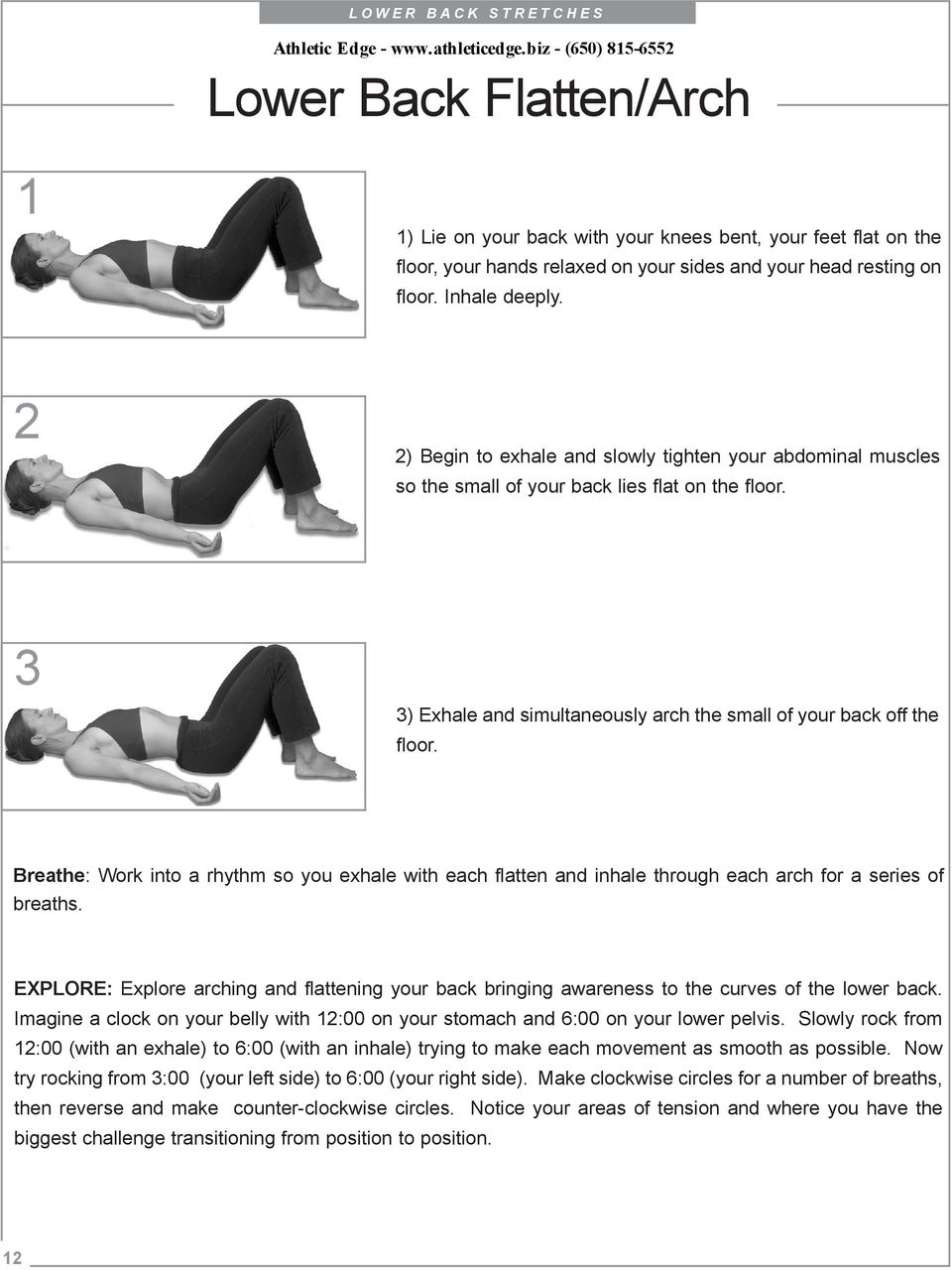
2 Lower Back Flatten/Arch ) Lie on your back with your knees bent, your feet flat on the floor, your hands relaxed on your sides and your head resting on floor. Inhale deeply. ) Begin to exhale and slowly tighten your abdominal muscles so the small of your back lies flat on the floor. ) Exhale and simultaneously arch the small of your back off the floor. Breathe: Work into a rhythm so you exhale with each flatten and inhale through each arch for a series of breaths. EXPLORE: Explore arching and flattening your back bringing awareness to the curves of the lower back. Imagine a clock on your belly with :00 on your stomach and 6:00 on your lower pelvis. Slowly rock from :00 (with an exhale) to 6:00 (with an inhale) trying to make each movement as smooth as possible. Now try rocking from :00 (your left side) to 6:00 (your right side). Make clockwise circles for a number of breaths, then reverse and make counter-clockwise circles. Notice your areas of tension and where you have the biggest challenge transitioning from position to position. BOULDER THERAPEUTICS, INC
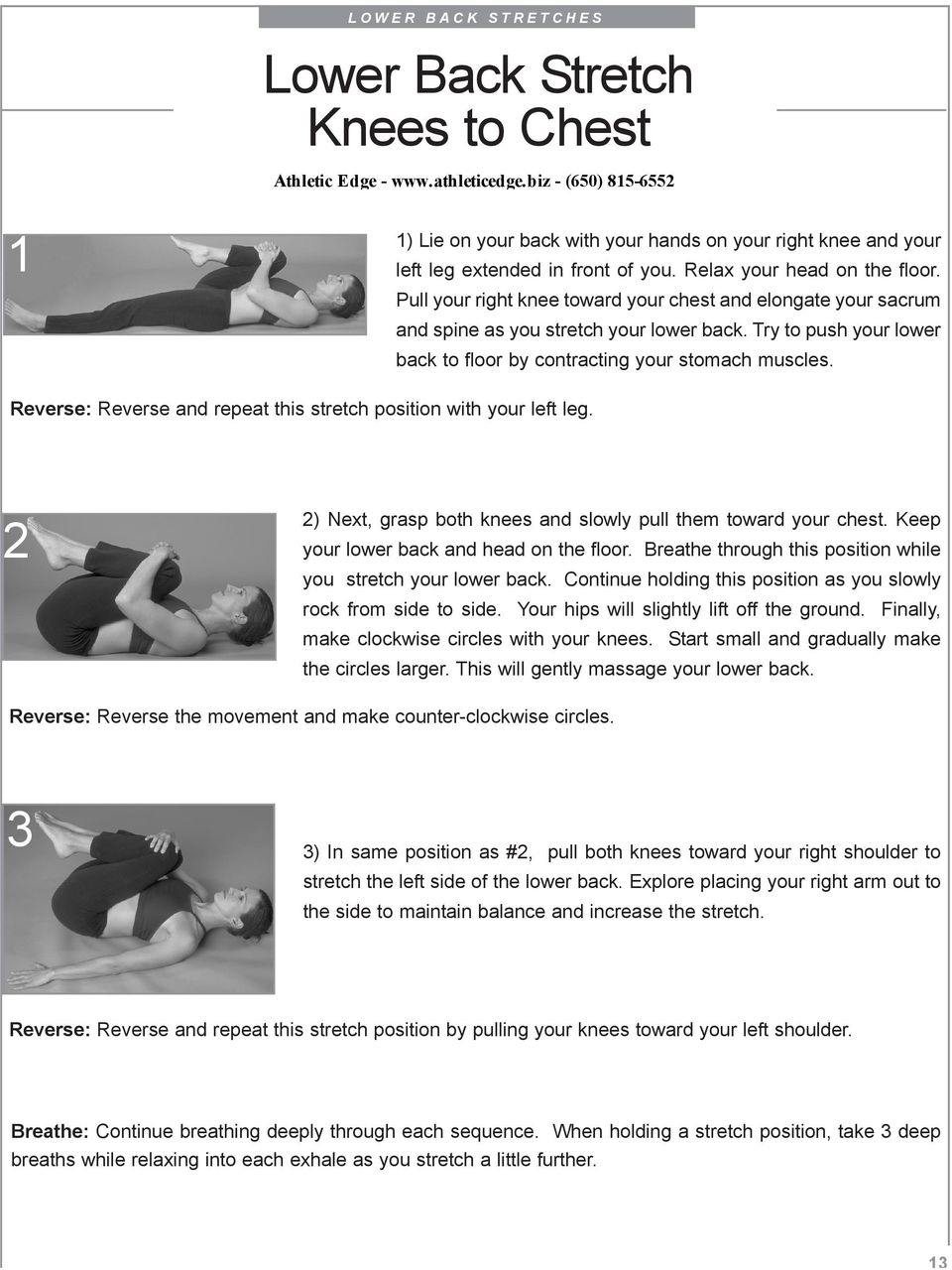
3 Lower Back Stretch Knees to Chest ) Lie on your back with your hands on your right knee and your left leg extended in front of you. Relax your head on the floor. Pull your right knee toward your chest and elongate your sacrum and spine as you stretch your lower back. Try to push your lower back to floor by contracting your stomach muscles. Reverse: Reverse and repeat this stretch position with your left leg. ) Next, grasp both knees and slowly pull them toward your chest. Keep your lower back and head on the floor. Breathe through this position while you stretch your lower back. Continue holding this position as you slowly rock from side to side. Your hips will slightly lift off the ground. Finally, make clockwise circles with your knees. Start small and gradually make the circles larger. This will gently massage your lower back. Reverse: Reverse the movement and make counter-clockwise circles. ) In same position as #, pull both knees toward your right shoulder to stretch the left side of the lower back. Explore placing your right arm out to the side to maintain balance and increase the stretch. Reverse: Reverse and repeat this stretch position by pulling your knees toward your left shoulder. Breathe: Continue breathing deeply through each sequence. When holding a stretch position, take deep breaths while relaxing into each exhale as you stretch a little further. BOULDER THERAPEUTICS, INC
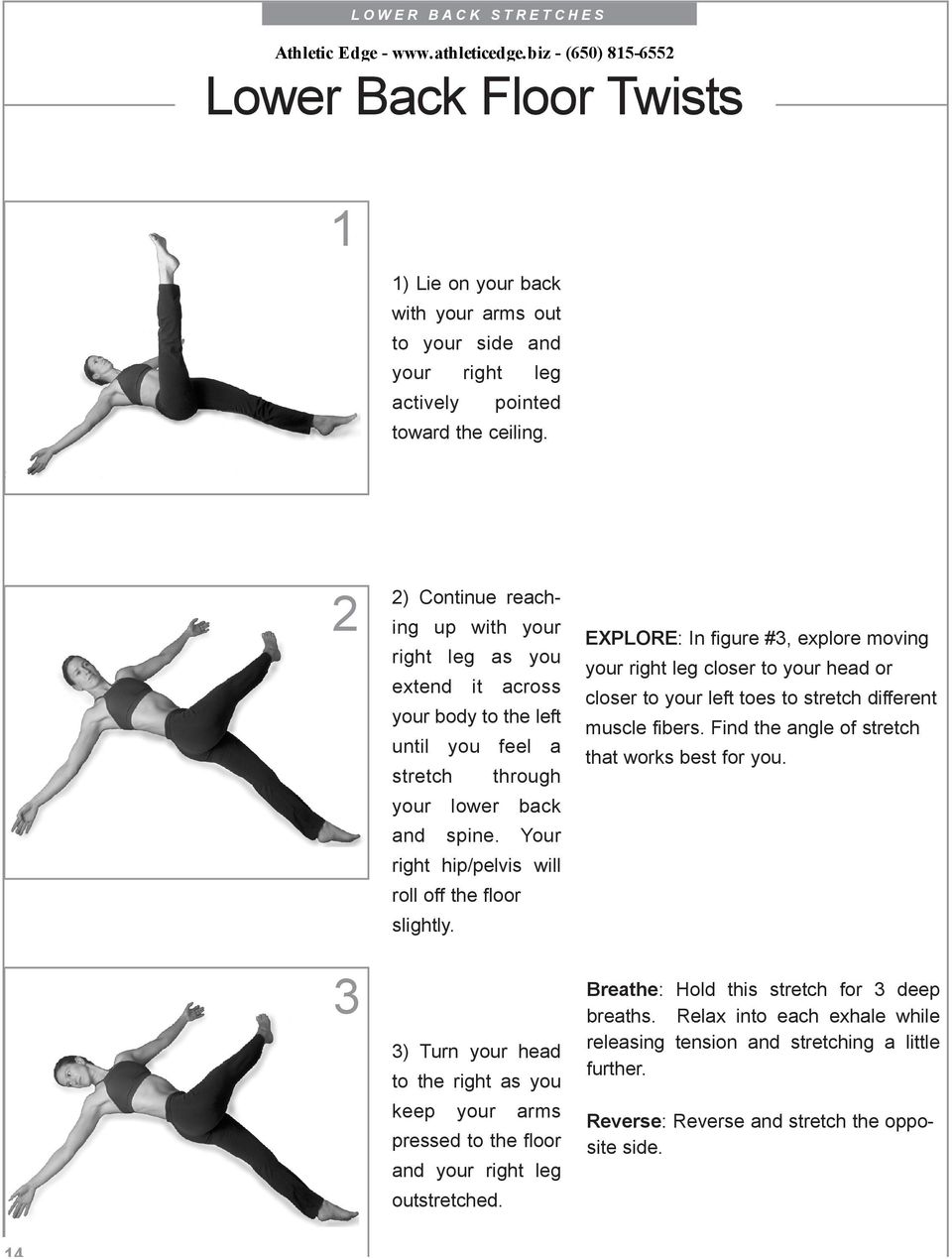
4 Lower Back Floor Twists ) Lie on your back with your arms out to your side and your right leg actively pointed toward the ceiling. ) Continue reaching up with your right leg as you extend it across your body to the left until you feel a stretch through your lower back and spine. Your right hip/pelvis will roll off the floor slightly. ) Turn your head to the right as you keep your arms pressed to the floor and your right leg outstretched. EXPLORE: In figure #, explore moving your right leg closer to your head or closer to your left toes to stretch different muscle fibers. Find the angle of stretch that works best for you. Breathe: Hold this stretch for deep breaths. Relax into each exhale while releasing tension and stretching a little further. Reverse: Reverse and stretch the opposite side. 4 BOULDER THERAPEUTICS, INC
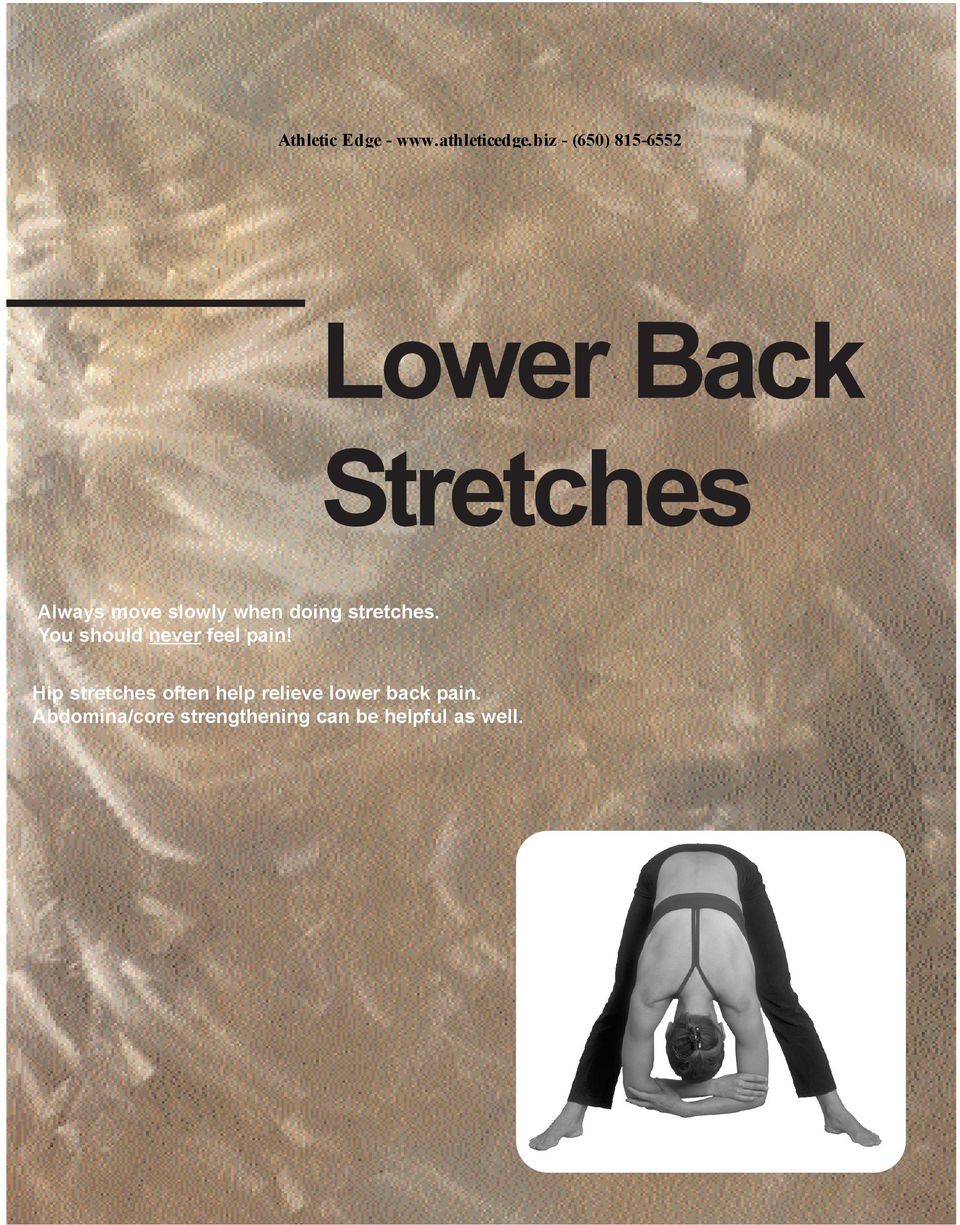
5 Standing Lower Back Stretch & Arch Lower Back Stretch ) Stand with your legs twice shoulder width apart and out-toe slightly. Slowly bend your torso forward with a straight back and elongate your spine by reaching through the crown of your head. When you bend as far as you can with a straight back, release your back and bend between your legs. It may help to widen your stance slightly. Forward Bends reorganize thoughts and calm the mind. For your hand placement, either reach behind and through your legs or grasp your ankles with your hands or cross your arms in front of you (as shown) and allow their weight to stretch you further. Lower Back Arch ) Place your hands on your hips and slowly raise your torso by curling from your lower back, lifting one vertebrae at a time as you rise to a standing position. Slightly arch backward with your chest and head and focus on elongating the front of your spine. Relax your glutes (buttocks) while arching backward. Back Bends increase energy and help relieve stress & fatigue. Muscles Stretched: Opens and elongates the spine and all anterior and posterior torso muscles. This is a great warm-up for your back! Breathe: Hold this stretch for deep breaths. Relax into each exhale while releasing tension and stretching a little further. CAUTION!!! Transition cautiously and slowly while bending and rising. If dizziness, pain or discomfort occurs, discontinue the stretch. To avoid slipping, wear shoes or use a yoga mat. BOULDER THERAPEUTICS, INC

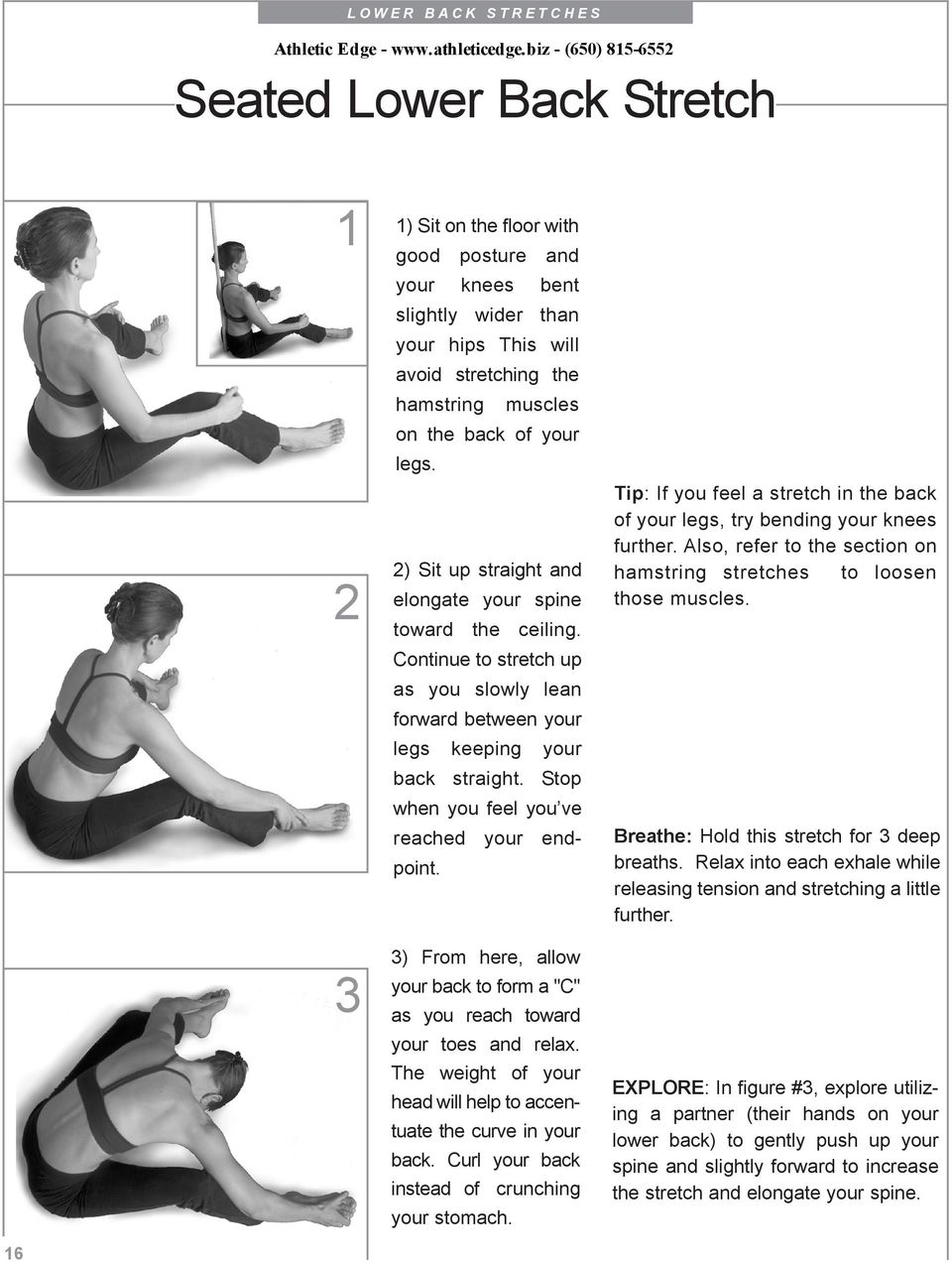
6 Seated Lower Back Stretch ) Sit on the floor with good posture and your knees bent slightly wider than your hips This will avoid stretching the hamstring muscles on the back of your legs. ) Sit up straight and elongate your spine toward the ceiling. Continue to stretch up as you slowly lean forward between your legs keeping your back straight. Stop when you feel you ve reached your endpoint. ) From here, allow your back to form a "C" as you reach toward your toes and relax. The weight of your head will help to accentuate the curve in your back. Curl your back instead of crunching your stomach. Tip: If you feel a stretch in the back of your legs, try bending your knees further. Also, refer to the section on hamstring stretches to loosen those muscles. Breathe: Hold this stretch for deep breaths. Relax into each exhale while releasing tension and stretching a little further. EXPLORE: In figure #, explore utilizing a partner (their hands on your lower back) to gently push up your spine and slightly forward to increase the stretch and elongate your spine. 6 BOULDER THERAPEUTICS, INC
7 LOWER BACK STRETCHES Seated Lower Back PNF Stretch PNF Stretch: (stretch-resist-stretch) To increase muscle length, follow these steps: ) First stretch your back as shown on the previous page. Then reach for your feet without straining and grab your feet with your hands. Hold on and pull back as you begin to sit upright out of the stretch until your arms are straight. Continue to resist against your stratightened arms and hold for 6-0 seconds maintaining a relaxed breath. Be sure to hold this position without any movement once you begin resisting. ) After holding the stretch, relax for seconds and then stretch between your legs. Be sure to sit up straight and elongate your spine before bending forward between your legs (as described on the previous page). Do you notice that you can stretch further than before? Muscles Stretched: Opens and elongates the spine and all back muscles, especially the erector spinae group. Ribs Erector Spinae Muscle Group 7 BOULDER THERAPEUTICS, INC

8 Lower Back Waves spine in neutral position ) Kneel on your hands and knees. Stack your knees under your hips and your wrists under your shoulders. Keep your shoulders relaxed throughout the stretch. Use a towel under your knees if you have discomfort. If this position still causes knee pain, discontinue and utilize a different sequence. spine in neutral position Ilium, bone of the pelvis Sacroiliac (SI) joint Sacrum & Coccyx, extensions of the spine back of spine elongates ) Simultaneously lower your head and hunch your back curling your tailbone toward the floor. Straighten your arms to increase the stretch in your back. Pretend you re a cat on Halloween as you exhale. back of spine elongates and opens Sacrum drops front of spine elongates and opens ) Now let your lower back slowly sag toward the floor as you rotate your tailbone and head upward. Feel the movement in your spine, lower back and sacrum with each wave as you inhale. Are your shoulders relaxed? Sacrum rises front of spine elongates and opens 8 Breathe: Work into a rhythm so you exhale with each hunch and inhale through each sag for a series of breaths. BOULDER THERAPEUTICS, INC

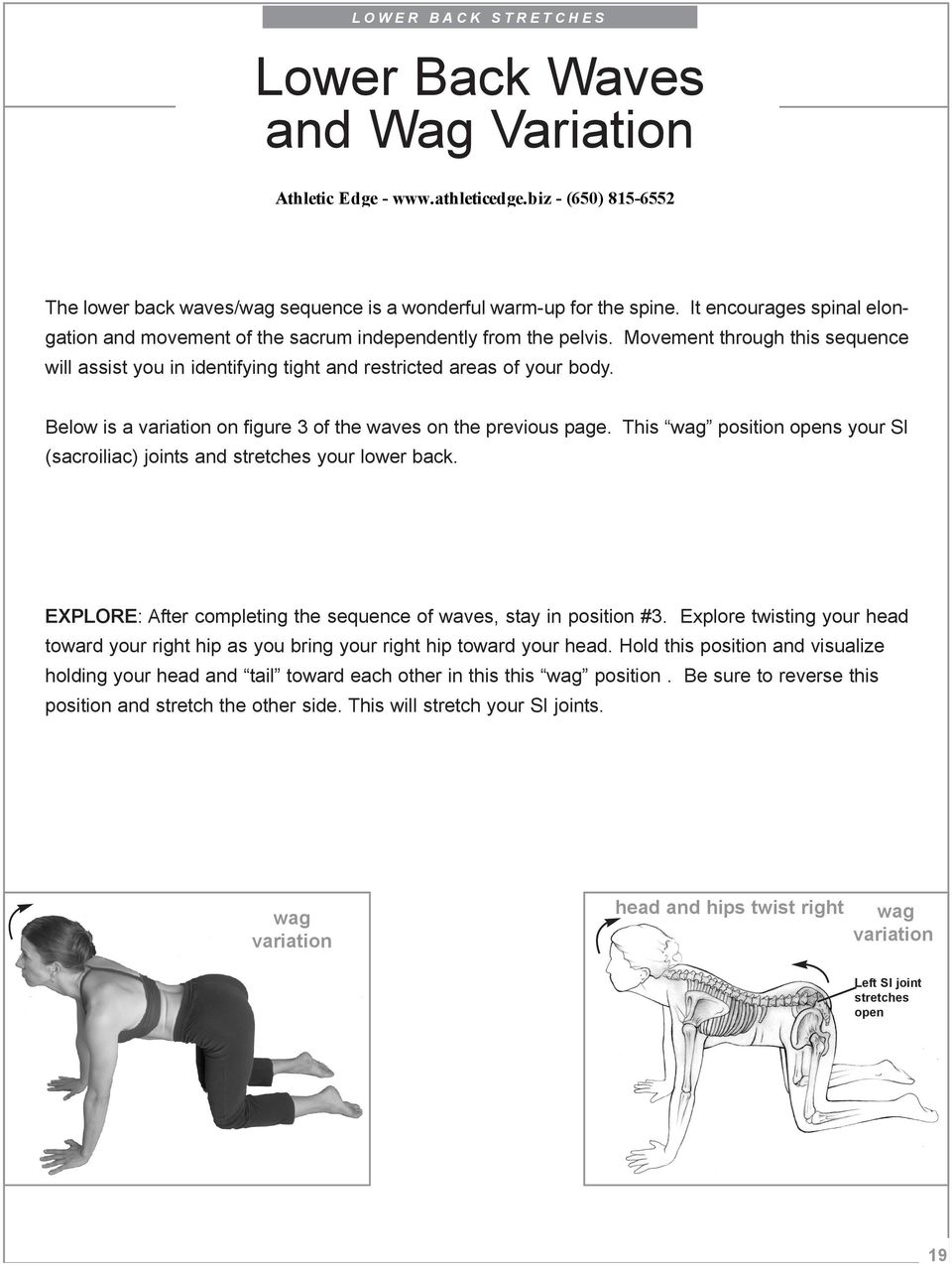
9 Lower Back Waves and Wag Variation The lower back waves/wag sequence is a wonderful warm-up for the spine. It encourages spinal elongation and movement of the sacrum independently from the pelvis. Movement through this sequence will assist you in identifying tight and restricted areas of your body. Below is a variation on figure of the waves on the previous page. This wag position opens your SI (sacroiliac) joints and stretches your lower back. EXPLORE: After completing the sequence of waves, stay in position #. Explore twisting your head toward your right hip as you bring your right hip toward your head. Hold this position and visualize holding your head and tail toward each other in this this wag position. Be sure to reverse this position and stretch the other side. This will stretch your SI joints. wag variation head and hips twist right wag variation Left SI joint stretches open BOULDER THERAPEUTICS, INC
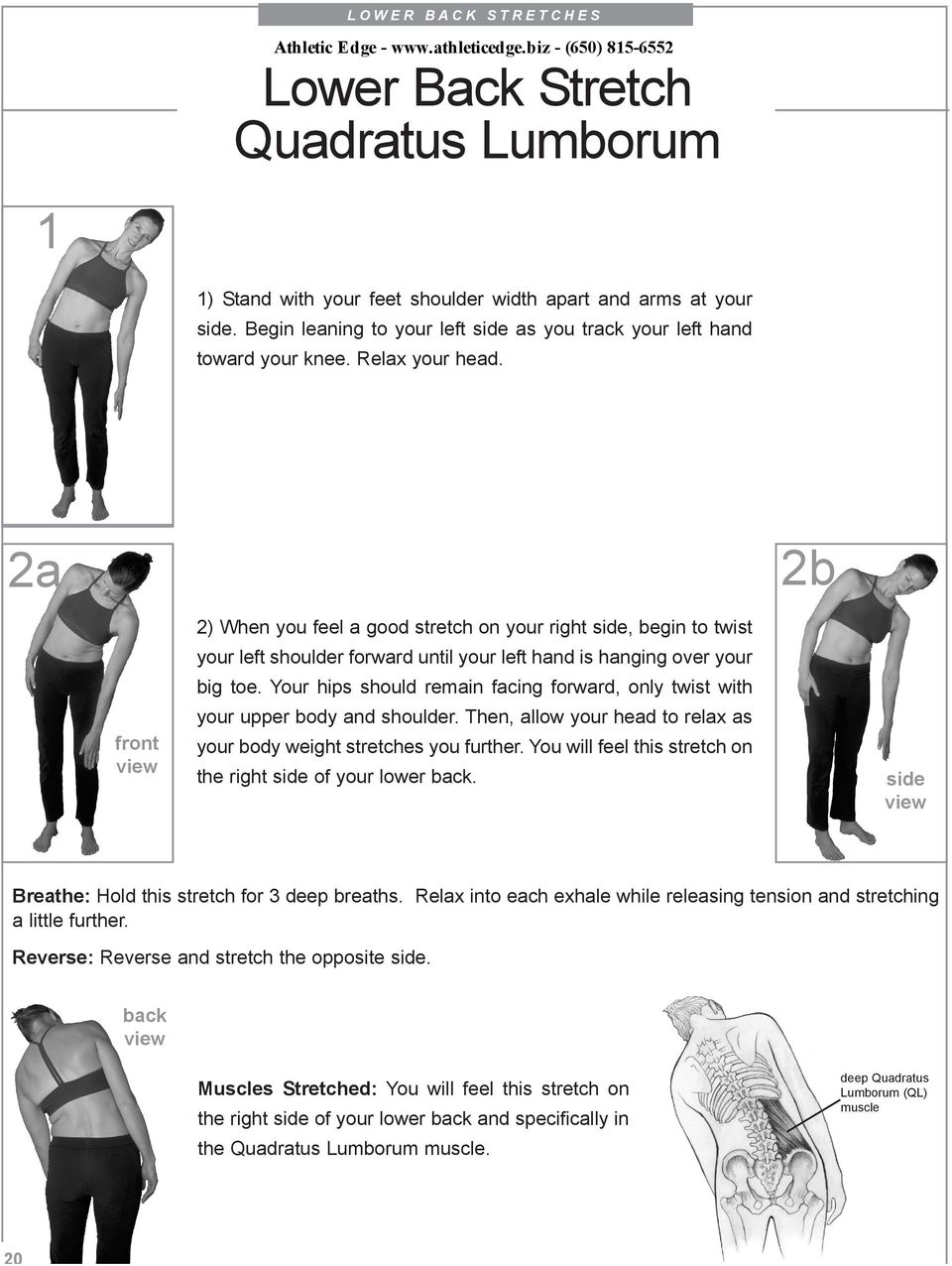
10 Lower Back Stretch Quadratus Lumborum ) Stand with your feet shoulder width apart and arms at your side. Begin leaning to your left side as you track your left hand toward your knee. Relax your head. a b front view ) When you feel a good stretch on your right side, begin to twist your left shoulder forward until your left hand is hanging over your big toe. Your hips should remain facing forward, only twist with your upper body and shoulder. Then, allow your head to relax as your body weight stretches you further. You will feel this stretch on the right side of your lower back. side view Breathe: Hold this stretch for deep breaths. Relax into each exhale while releasing tension and stretching a little further. Reverse: Reverse and stretch the opposite side. back view Muscles Stretched: You will feel this stretch on the right side of your lower back and specifically in the Quadratus Lumborum muscle. deep Quadratus Lumborum (QL) muscle 0 BOULDER THERAPEUTICS, INC
Exercise 1: Knee to Chest. Exercise 2: Pelvic Tilt. Exercise 3: Hip Rolling. Starting Position: Lie on your back on a table or firm surface.
 Exercise 1: Knee to Chest Starting Position: Lie on your back on a table or firm surface. Action: Clasp your hands behind the thigh and pull it towards your chest. Keep the opposite leg flat on the surface
EGOSCUE CLINIC PAIN/POSTURE STRETCHES 1. Standing Arm Circles: Helps Restore Upper Body Strength
 EGOSCUE CLINIC PAIN/POSTURE STRETCHES 1. Standing Arm Circles: Helps Restore Upper Body Strength Two sets of 40 repetitions each. Stand with your feet pointed straight and hip-width apart. Place your fingertips
Fact sheet Exercises for older adults undergoing rehabilitation
 Fact sheet Exercises for older adults undergoing rehabilitation Flexibility refers to the amount of movement possible around a joint and is necessary for normal activities of daily living such as stretching,
Spine Conditioning Program Purpose of Program
 Prepared for: Prepared by: OrthoInfo Purpose of Program After an injury or surgery, an exercise conditioning program will help you return to daily activities and enjoy a more active, healthy lifestyle.
General Guidelines. Neck Stretch: Side. Neck Stretch: Forward. Shoulder Rolls. Side Stretch
 Stretching Exercises General Guidelines Perform stretching exercises at least 2 3 days per week and preferably more Hold each stretch for 15 20 seconds Relax and breathe normally Stretching is most effective
by Ellen Saltonstall and Dr. Loren Fishman
 10 Yoga Poses for Low Back Pain Prevention by Ellen Saltonstall and Dr. Loren Fishman Introduction This series of poses is designed to prevent future back pain and also to relieve back pain that you may
How To Stretch Your Body
 Exercise Module A New Leaf Choices for Healthy Living University of North Carolina at Chapel Hill 2007 Center for Health Promotion and Disease Prevention Physical Activity Exercises for Keeping Active
SHOULDER PULL DOWNS. To learn efficient use of the shoulder blades and arms while maintaining a neutral spine position.
 SHOULDER INTRODUCT ION Welcome to your shoulder exercise program The exercises in the program are designed to improve your shoulder mobility, posture and the control of the muscles in your neck and shoulder
Info. from the nurses of the Medical Service. LOWER BACK PAIN Exercise guide
 Info. from the nurses of the Medical Service LOWER BACK PAIN Exercise guide GS/ME 03/2009 EXERCISE GUIDE One of the core messages for people suffering with lower back pain is to REMAIN ACTIVE. This leaflet
HELPFUL HINTS FOR A HEALTHY BACK
 HELPFUL HINTS FOR A HEALTHY BACK 1. Standing and Walking For correct posture, balance your head above your shoulders, eyes straight ahead, everything else falls into place. Try to point toes straight ahead
Stretching in the Office
 Stretching in the Office Legs: Quads, Hamstrings, IT band, Hip flexors, Gluts, Calves Quads: Standing @ desk maintaining upright posture, grab one leg @ a time by foot or ankle and bring it towards backside
Lumbar/Core Strength and Stability Exercises
 Athletic Medicine Lumbar/Core Strength and Stability Exercises Introduction Low back pain can be the result of many different things. Pain can be triggered by some combination of overuse, muscle strain,
Exercises for older people
 Exercise for older people Exercises for older people Sitting Getting started If you ve not done much physical activity for a while, you may want to get the all-clear from a GP before starting. For the
Cardiac Rehab Program: Stretching Exercises
 Cardiac Rehab Program: Stretching Exercises Walk around the room, step side to side, ride a bike or walk on a treadmill for at least 5 minutes to warm up before doing these stretches. Stretch warm muscles
Sheet 1A. Treating short/tight muscles using MET. Pectorals. Upper trapezius. Levator scapula
 Sheet 1A Treating short/tight muscles using MET Pectorals Once daily lie at edge of bed holding a half-kilo can, arm out sideways. Raise arm and hold for 10 seconds, then allow arm to hang down, stretching
Self-mobilization methods
 Self-mobilization methods 5 Muscle energy techniques, as outlined in previous chapters, provide us with an excellent series of methods for relaxation and stretching of specific tight, shortened, contracted
try Elise s toning exercise plan
 try Elise s toning exercise plan Whether you want to start things off slow and gradually build up your fi tness, or begin with a challenge, Elise s toning exercise programme is designed for all levels.
Range of Motion. A guide for you after spinal cord injury. Spinal Cord Injury Rehabilitation Program
 Range of Motion A guide for you after spinal cord injury Spinal Cord Injury Rehabilitation Program This booklet has been written by the health care providers who provide care to people who have a spinal
Care at its Best! Foam Roller Exercise Program
 Foam Roller Exercise Program Foam rollers are a popular new addition the gym, physical therapy clinics or homes. Foam rollers are made of lightweight polyethyline foam. Cylindrical in shape, foam rollers
Myofit Massage Therapy Stretches for Cycling
 Guidelines for Stretching Always assume the stretch start position and comfortably apply the stretch as directed. Think Yoga - gently and slowly, no ballistic actions or bouncing at joint end range. Once
SAMPLE WORKOUT Full Body
 SAMPLE WORKOUT Full Body Perform each exercise: 30 secs each x 2 rounds or 2-3 sets of 8-12 reps Monday & Wednesday or Tuesday & Thursday Standing Squat Muscles: glutes (butt), quadriceps (thigh) Stand
Basic Stretch Programme 3. Exercise Circuit 4
 Basic Stretch Programme 3 Exercise Circuit 4 2 1 Calves Stand approximately 1 metre away from wall with legs straight and heels on floor. Step and lean forward and slowly push hips towards wall. Should
Don t. Hamstrings. Calf Muscles. both legs 2-3 times. stretch is felt in the back of the calf. Repeat with both legs 2-3 times.
 Remember to: Warm-up your muscles first before stretching (e.g. stretch after walking). Stretch until you feel mild discomfort, not pain. Never bounce or force a stretch. Hold the stretch for 10-30 seconds
Low Back Pain Exercises Interactive Video Series Transcript July 2013
 Introduction Low Back Pain Exercises Interactive Video Series Transcript July 2013 ** Note: If an exercise causes an increase in your pain, stop the exercise.** [Music introduction; Dr. John Sheehan onscreen]
Exercises for Low Back Injury Prevention
 DIVISION OF AGRICULTURE RESEARCH & EXTENSION University of Arkansas System Family and Consumer Sciences Increasing Physical Activity as We Age Exercises for Low Back Injury Prevention FSFCS38 Lisa Washburn,
Knee Conditioning Program. Purpose of Program
 Prepared for: Prepared by: OrthoInfo Purpose of Program After an injury or surgery, an exercise conditioning program will help you return to daily activities and enjoy a more active, healthy lifestyle.
Low Back Pain: Exercises
 Low Back Pain: Exercises Your Kaiser Permanente Care Instructions Here are some examples of typical rehabilitation exercises for your condition. Start each exercise slowly. Ease off the exercise if you
EXERCISE INSTRUCTIONS 1
 EXERCISE INSTRUCTIONS 1 Contents ANKLE TOUCHES... 4 BACK EXTENSIONS... 4 BACK REVERSE FLYES... 4 BALL ROLL... 4 BASKETBALL SQUATS... 4 BEAR CRAWL... 4 BICEP CURL (Resistance Band)... 4 BOXING JABS... 5
Standing with legs slightly apart, inhale and expand chest and shoulders; exhale and draw in chest and shoulders.
 ILLUSTRATED EXERCISE #4 PAGE 1 2012 Bringing the Body to the Stage and Screen and Beyond by Annette Lust 1 Standing with legs slightly apart, inhale and expand chest and shoulders; exhale and draw in chest
CORRECTIVE CHIROPRACTIC EXERCISES
 CORRECTIVE CHIROPRACTIC EXERCISES J O W E T T & M O U L T O N C h i r o p r a c t o r s introduction This booklet, presented by Jowett and Moulton Chiropractors, is designed to provide you with a general
EXERCISE DESCRIPTIONS PHASE I Routine #1
 EXERCISE DESCRIPTIONS PHASE I Routine #1 Hip Mobility Exercise: Forward Out-In Movement: Raise leg out to the side, and rotate around to the front. Keep shin/thigh angle at 90 degrees. Exercise: Backward
Injury Prevention for the Back and Neck
 Injury Prevention for the Back and Neck www.csmr.org We have created this brochure to provide you with information regarding: Common Causes of Back and Neck Injuries and Pain Tips for Avoiding Neck and
Shoulders (free weights)
 Dumbbell Shoulder Raise Dumbbell Shoulder Raise 1) Lie back onto an incline bench (45 or less) with a DB in each hand. (You may rest each DB on the corresponding thigh.) 2) Start position: Bring the DB
Do s and Don ts with Low Back Pain
 Do s and Don ts with Low Back Pain Sitting Sit as little as possible and then only for short periods. Place a supportive towel roll at the belt line of the back especially when sitting in a car. When getting
A proper warm-up is important before any athletic performance with the goal of preparing the athlete both mentally and physically for exercise and
 A proper warm-up is important before any athletic performance with the goal of preparing the athlete both mentally and physically for exercise and competition. A warm-up is designed to prepare an athlete
KNEE EXERCISE PROGRAM
 KNEE PROGRAM INTRODUCT ION Welcome to your knee exercise program. The exercises in the program are designed to improve your knee stability and strength of the muscles around your knee and hip. The strength
Lower Body Exercise One: Glute Bridge
 Lower Body Exercise One: Glute Bridge Lying on your back hands by your side, head on the floor. Position your feet shoulder width apart close to your glutes, feet facing forwards. Place a theraband/mini
BRUGGER'S POSTURAL RELIEF EXERCISE
 BRUGGER'S POSTURAL RELIEF EXERCISE Brugger's Postural Relief Exercise strengthens your muscles. lt promotes stability and relaxes tight muscles that tighten due to postural stress (see Figure 2). Check
Ensure that the chair you use is sturdy and stable. Wear comfortable clothes and supportive footwear.
 Page 1 Safety Ensure that the chair you use is sturdy and stable. Wear comfortable clothes and supportive footwear. Prepare a space and have your exercise band and a glass of water (for afterwards) ready
Exercises for Growing Taller
 1 Exercises for Growing Taller A Mini-Guide By Rodney Williams Copyright and Legal Notice 2 Published by: Copyright 2011. All Rights Reserved. No part of this publication may be reproduced or transmitted
Flexibility Assessment and Improvement Compiled and Adapted by Josh Thompson
 Flexibility Assessment and Improvement Compiled and Adapted by Josh Thompson Muscles must have a full and normal range of motion in order for joints and skeletal structure to function properly. Flexibility
Carpal Tunnel Pain. STRETCH YOUR: 1) Wrist Flexors 2) Wrist Extensors 3) Wrist Decompression 4) Neck (see other chapters for more examples)
 Carpal Tunnel Pain STRETCH YOUR: 1) Wrist Flexors 2) Wrist Extensors 3) Wrist Decompression 4) Neck (see other chapters for more examples) wrist flexors wrist extensors carpal tunnel Athletic Edge - www.athleticedge.biz
McMaster Spikeyball Therapy Drills
 BODY BLOCKS In sequencing Breathing and Tempo Flexibility / Mobility and Proprioception (feel) Upper body segment Middle body segment Lower body segment Extension / Static Posture Office / Computer Travel
Exercises for the Hip
 Exercises for the Hip Gluteal Sets: Lie on your back, tighten buttocks and hold for 3-5 seconds. Repeat 20 times. Supine Hip ER/IR: Lie on your back with legs straight. Gently rotate knees out and in limited
How To Improve Drainage
 Rehabilitation Home Program Edema Exercises To Improve Drainage You will improve your lymph flow by doing a few exercises each day. These exercises are an important part of your home program. They may
Kennedy s Disease Smart Exercise Guide. Part II Physical Therapist Recommendations
 Kennedy s Disease Smart Exercise Guide Part II Physical Therapist Recommendations Updated January 22, 2009 TABLE OF CONTENTS The Concept Exercise and Kennedy s Disease...3 Instructions...3 Do No Harm...3
Hip Conditioning Program. Purpose of Program
 Prepared for: Prepared by: OrthoInfo Purpose of Program After an injury or surgery, an exercise conditioning program will help you return to daily activities and enjoy a more active, healthy lifestyle.
FUNCTIONAL STRENGTHENING
 FUNCTIONAL STRENGTHENING *This group of exercises are designed to increase leg and core endurance and stability as related to bipedal functional activities. *Perform this program for 4-6 weeks. It is ideal
Physical & Occupational Therapy
 In this section you will find our recommendations for exercises and everyday activities around your home. We hope that by following our guidelines your healing process will go faster and there will be
Strengthening Exercises - Below Knee Amputation
 Strengthening Exercises - Below Knee Amputation These exercises will help you strengthen your muscles to best use your prosthetic leg. Do these exercises as directed by your therapist or doctor. Do the
Wellness Workbook. Journaling your way to a healthier life! By Tamiko Arbuckle http://myfoggybrain.com
 Wellness Workbook Journaling your way to a healthier life! By Tamiko Arbuckle http://myfoggybrain.com Please send any questions/ feedback to [email protected] Here s to your Wellness! Welcome and
Otago Exercise Program
 Otago Exercise Program Edited Version Exercise Booklet Created by: Genesee County Coalition Supported by a grant from the Health Foundation for Western and Central New York Otago Exercise Program to Prevent
Qigong. Ba Duan Jin. The Eight Pieces of Brocade
 Qigong Ba Duan Jin The Eight Pieces of Brocade by Col and g Hamilton Yiheyuan Martial Arts Contents Page Introduction 2 Preparation 2 1. Hold up the Sky 3 2. The Archer 4 3. Join Heaven and Earth 5 4a.
stretches and exercises
 stretches and exercises The enclosed sheets contain stretches and exercises which can be used to delay and minimise the development of contractures and deformities occurring in children with Duchenne muscular
The Lose-the-Last-1o-Pounds Workout
 Printable Workout: www.myfitstation.com The Lose-the-Last-1o-Pounds Workout From The Women s Health Big Book of Exercises Phase 1) Week 1-4 It s time to finish off that fat for good! This 8-week plan from
Preventing Falls. Strength and balance exercises for healthy ageing
 Preventing Falls Strength and balance exercises for healthy ageing Exercise should be comfortable and fun. To get the most out of your home exercise book, join a class for older people to check your exercises
Trunk Strengthening and Muscle and Coordination Exercises for Lower Limb Amputees
 Trunk Strengthening and Muscle and Coordination Exercises for Lower Limb Amputees Part One: Trunk Strengthening Trunk Extension Needed: Sturdy chair or stool, Theraband, and a Theraball if necessary. Sit
Coccydynia. (Coccyx Pain) Information for patients. Outpatients Physiotherapy Tel: 01473 703312
 Information for patients Coccydynia (Coccyx Pain) Outpatients Physiotherapy Tel: 01473 703312 DPS ref: 4508-12(RP) Issue 1: February 2013 Review date: January 2016 The Ipswich Hospital NHS Trust, 2013.
back stabilization and core strengthening
 back stabilization and core strengthening EXERCISE OOKLET back stabilization and core strengthening TLE OF CONTENTS Introduction 1 Hook-lying Stabilization Progression Neutral position 2 Hook-lying with
Otago Exercise Program Activity Booklet
 Head Movements Stand up tall and look ahead. Slowly turn your head as far as you can to the right. Slowly turn your head as far as you can to the left. Repeat five times to each side. 44 Neck Movements
No Equipment Agility/Core/Strength Program for Full Body No Equip Trainer: Rick Coe
 No Equipment Agility/Core/Strength Program for Full Body No Equip Trainer: Rick Coe Introduction Program designed to be performed in a circuit. Perform exercises in sequence without rest 2-3 times. Increase
Prasara Yoga Lesson: Iguana Asana for Leg Swoops
 Prasara Yoga Lesson: Iguana Asana for Leg Swoops About the author: Jason Erickson, CST, ACE-PT, NCTMB has been teaching Circular Strength Training since 2004. A personal trainer, yoga instructor, and massage
Operating Instructions
 Operating Instructions Table of Contents IMPORTANT INFORMATION 1-2 1 The backrack TM 3-6 Introduction 3 What does it do? 4 How do I use it? 5 How often should I use it? 6 2 Getting On 7-10 3 Basic Exercises
Lower Body Strength/Balance Exercises
 Compliments of (Medical Group Name & Phone # to be inserted here) Lower Body Strength/Balance Exercises Hip Flexion Strengthens thigh and hip muscles. Use ankle weights, if you are ready to. Stand to the
PERFORMANCE RUNNING. Piriformis Syndrome
 Piriformis Syndrome Have you started to experience pain in your hip or down your leg while beginning or advancing your fitness program? This pain may be stemming from the piriformis muscle in your hip.
During the breathing exercises, it is important not to use your neck or shoulder muscles. Generally, ten breath cycles per session is adequate.
 Cool-Down Breathing Exercises Overview Breathing exercises help make use of the entire lung and keep the chest muscles active. They allow for more oxygen with each breath and to breathe with less effort.
Rehabilitation Exercises for Shoulder Injuries Pendulum Exercise: Wal Walk: Back Scratcher:
 Rehabilitation Exercises for Shoulder Injuries Begin these exercises when your pain has decreased about 25% from the time when your injury was most painful. Pendulum Exercise: Lean over with your uninjured
Physical Capability Strength Test: One Component of the Selection Process
 Physical Capability Strength Test: One Component of the Selection Process One aspect of the Power Systems Institute selection process is to successfully complete and achieve a passing score on a physical
D: Date Sunday Monday Tuesday Wednesday Thursday Friday Saturday Week 1 D: D: D: D: D: D: D:
 Physical Therapy and Home Exercise Program for Patients in the Exercise Group (Treatment Sessions 1-8) and the Manipulation + Exercise Group (Treatment Sessions 3-8) This exercise handout contains descriptions
THE BENJAMIN INSTITUTE PRESENTS. Excerpt from Listen To Your Pain. Assessment & Treatment of. Low Back Pain. Ben E. Benjamin, Ph.D.
 THE BENJAMIN INSTITUTE PRESENTS Excerpt from Listen To Your Pain Assessment & Treatment of Low Back Pain A B E N J A M I N I N S T I T U T E E B O O K Ben E. Benjamin, Ph.D. 2 THERAPIST/CLIENT MANUAL The
Physical Therapy after Hip Arthroscopy Therapy Phases 1 and 2
 Physical Therapy after Hip Arthroscopy Therapy Phases 1 and 2 patienteducation.osumc.edu Table of Contents Physical Therapy after Hip Surgery... 3 OSU Sports Medicine Locations... 4 Hip Therapy Goals...
total hip replacement
 total hip replacement EXCERCISE BOOKLET patient s name: date of surgery: physical therapist: www.jointpain.md Get Up and Go Joint Program Philosophy: With the development of newer and more sophisticated
COMMON OVERUSE INJURIES ATTRIBUTED TO CYCLING, AND WAYS TO MINIMIZE THESE INJURIES
 COMMON OVERUSE INJURIES ATTRIBUTED TO CYCLING, AND WAYS TO MINIMIZE THESE INJURIES Listed are a few of the most common overuse injuries associated with cycling long distances. 1. Cervical and upper back
Living Room Bodyweight Workout Week 1 March or jog in place for 1 min to increase heart rate and lubricate joints.
 Warm Up- Living Room Bodyweight Workout Week 1 March or jog in place for 1 min to increase heart rate and lubricate joints. Protocol- All exercises will be done for 2 sets of 10 repetitions. After the
BEACH VOLLEYBALL TRAINING PROGRAM
 2008 ELITE PERFORMANCE ATHLETE CONDITIONING BEACH VOLLEYBALL TRAINING PROGRAM Team BC 2008 Steve Van Schubert, CAT(C), CSCS Training Schedule General Outline Phase 1 2 Weeks Phase 2 3 Weeks Phase 3 3 Weeks
Day #1: Dynamic Warm-Up, Cool-Down, and Stretching
 Day #1: Dynamic Warm-Up, Cool-Down, and Stretching After completing the PRT, the students will return to the gym to begin the Dynamic Warm-up gym session. Prior to initiating exercise, the CFL Instructor
X-Plain Neck Exercises Reference Summary
 X-Plain Neck Exercises Reference Summary Introduction Exercising your neck can make it stronger, more flexible and reduce neck pain that is caused by stress and fatigue. This reference summary describes
MINDING OUR BODIES. Healthy Eating and Physical Activity for Mental Health
 MINDING OUR BODIES Healthy Eating and Physical Activity for Mental Health Facilitators Guide: Background Information (note: tell participants to consult with their doctor before starting to exercise) What
ACL Reconstruction Rehabilitation
 ACL Reconstruction Rehabilitation The following exercises are commonly used for rehabilitation following ACL reconstruction surgery. However, each knee surgery is unique and each person s condition is
Keep fit at the workplace! A simple training programme for more exercise at the workplace.
 Keep fit at the workplace! A simple training programme for more exercise at the workplace. INTRODUCTION Dear Readers, Keeping your body in one position, such as sitting or standing for a long time, results
MELT Mini Map For Motorcyclists
 MELT Mini Map For Motorcyclists The MELT Self-Treatment Tools needed for this monthʼs Mini Map can be found online at store.meltmethod.com. Depending on which tools you have on hand, you can start with
MOON SHOULDER GROUP. Rotator Cuff Home Exercise Program. MOON Shoulder Group
 MOON Shoulder Group For information regarding the MOON Shoulder Group, talk to your doctor or contact: Rosemary Sanders 1215 21 st Avenue South 6100 Medical Center East Vanderbilt University Medical Center
Leg Strengthening Exercises
 Leg Strengthening Exercises This exercise program has been designed for you by your physical therapist. Do only the exercises marked. Do them slowly and smoothly on a firm surface. Never hold your breath
Chair Exercises For Older Adults
 Chair Exercises For Older Adults Many of these exercises were adapted from these sources: National Institute on Aging, Exercise: A Guide from the National Institute on Aging, 2001, http://www.nia.nih.gov/healthinformation/publications/exerciseguide/.
Rotator Cuff Home Exercise Program MOON SHOULDER GROUP
 Rotator Cuff Home Exercise Program MOON SHOULDER GROUP Introduction The MOON Shoulder group is a Multi-center Orthopaedic Outcomes Network. In other words, it is a group of doctors from around the country
Australian Centre for Agricultural Health and Safety. Farming with Back Pain
 Australian Centre for Agricultural Health and Safety Farming with Back Pain 2008 Australian Centre for Agricultural Health and Safety All rights reserved Title: Farming with Back Pain Authors: Boughton
A Stretch-Break Program for Your Workplace! www.healthyworkplaceweek.ca
 www.healthyworkplaceweek.ca A Stretch-Break Program for Your Workplace! Why is stretching at work important? Sitting at a desk or computer; or standing at your work station for extended periods of time
Low Back Pain Exercise Guide
 Nader M. Hebela, MD Fellow of the American Academy of Orthopaedic Surgeons http://orthodoc.aaos.org/hebela Cleveland Clinic Abu Dhabi Cleveland Clinic Abu Dhabi Neurological Institute Al Maryah Island
Basic Training Exercise Book
 Basic Training Exercise Book Basic Training Exercise Book Instructions The exercises are designed to challenge the major muscles groups every day, approximately every 2 to 3 hours., for a total of 6 times
TRE TM Template for Level I Trainees June 2013
 TRE TM Template for Level I Trainees June 2013 THIS DOCUMENT IS TO BE PROVIDED TO TRE LEVEL I TRAINEES WHO ARE: ENROLLED IN THE TRE ENROLLMENT WEBSITE AND WORKING WITH A LEVEL III TRAINER WITHIN THE TRE
TOTAL KNEE REPLACEMENT
 PENN ORTHOPAEDICS TOTAL KNEE REPLACEMENT Home Exercise Program PENN ORTHOPAEDICS TOTAL KNEE REPLACEMENT HOME EXERCISE PROGRAM To get the best results from your surgery, it is important that you do your
ISOMETRIC EXERCISE HELPS REVERSE JOINT STIFFNESS, BUILDS MUSCLE, AND BOOSTS OVERALL FITNESS.
 ISOMETRIC EXERCISE HELPS REVERSE JOINT STIFFNESS, BUILDS MUSCLE, AND BOOSTS OVERALL FITNESS. By Askari A. Kazmi KazmisBioscienceLabs exercise helps reverse joint stiffness, builds muscle, and boosts overall
12 Week Do-it-Yourself Fitness Program
 12 Week Do-it-Yourself Fitness Program Created by Brad Awalt, MS, ACSM Assistant Manager, Health Plus [email protected] January 2011 Do you have a goal to begin an exercise routine, but not sure
Spinal Exercise Program/Core Stabilization Program Adapted from The Spine in Sports: Robert G. Watkins
 Spinal Exercise Program/Core Stabilization Program Adapted from The Spine in Sports: Robert G. Watkins Below is a description of a Core Stability Program, designed to improve the strength and coordination
Do you sit at a desk all day? Does your 9 to 5 leave no time for structured exercise..?
 Do you sit at a desk all day? Does your 9 to 5 leave no time for structured exercise..? Staying healthy at work is easier than you might think: Try building the following desk based exercises into your
Meniscus Tear: Exercises
 Meniscus Tear: Exercises Your Kaiser Permanente Care Instructions Here are some examples of typical rehabilitation exercises for your condition. Start each exercise slowly. Ease off the exercise if you
Lower Back Pain An Educational Guide
 Lower Back Pain An Educational Guide A publication from the Center of Pain Medicine and Physiatric Rehabilitation 2002 Medical Parkway Ste 150 1630 Main St Ste 215 Annapolis, MD 21401 Chester, MD 21619
Why Back Safety is Important
 Back Safety Why Back Safety is Important Back injuries are considered by OSHA (the Occupational Safety and Health Administration) as the nation's #1 workplace safety problem. Back Injuries are often: Very
Lower Back Pain www.spireperform.com 01283 576333
 Lower Back Pain www.spireperform.com 01283 576333 Low back pain can be caused through deficiencies in movement, posture and your lower limbs or pelvis. The advice in this booklet aims to help with relieving
Yoga Teacher Training Home Study Course. Part 4. Teaching and Practicing Standing, Kneeling and Balance Postures
 Yoga Teacher Training Home Study Course Part 4 Teaching and Practicing Standing, Kneeling and Balance Postures Introduction This section will explain methods for teaching numerous standing, kneeling and