
THE IMPORTANCE OF NATURAL ENEMIES IN IPM SYSTEMS
|
|
|
- Audrey Sandra Turner
- 9 years ago
- Views:
Transcription
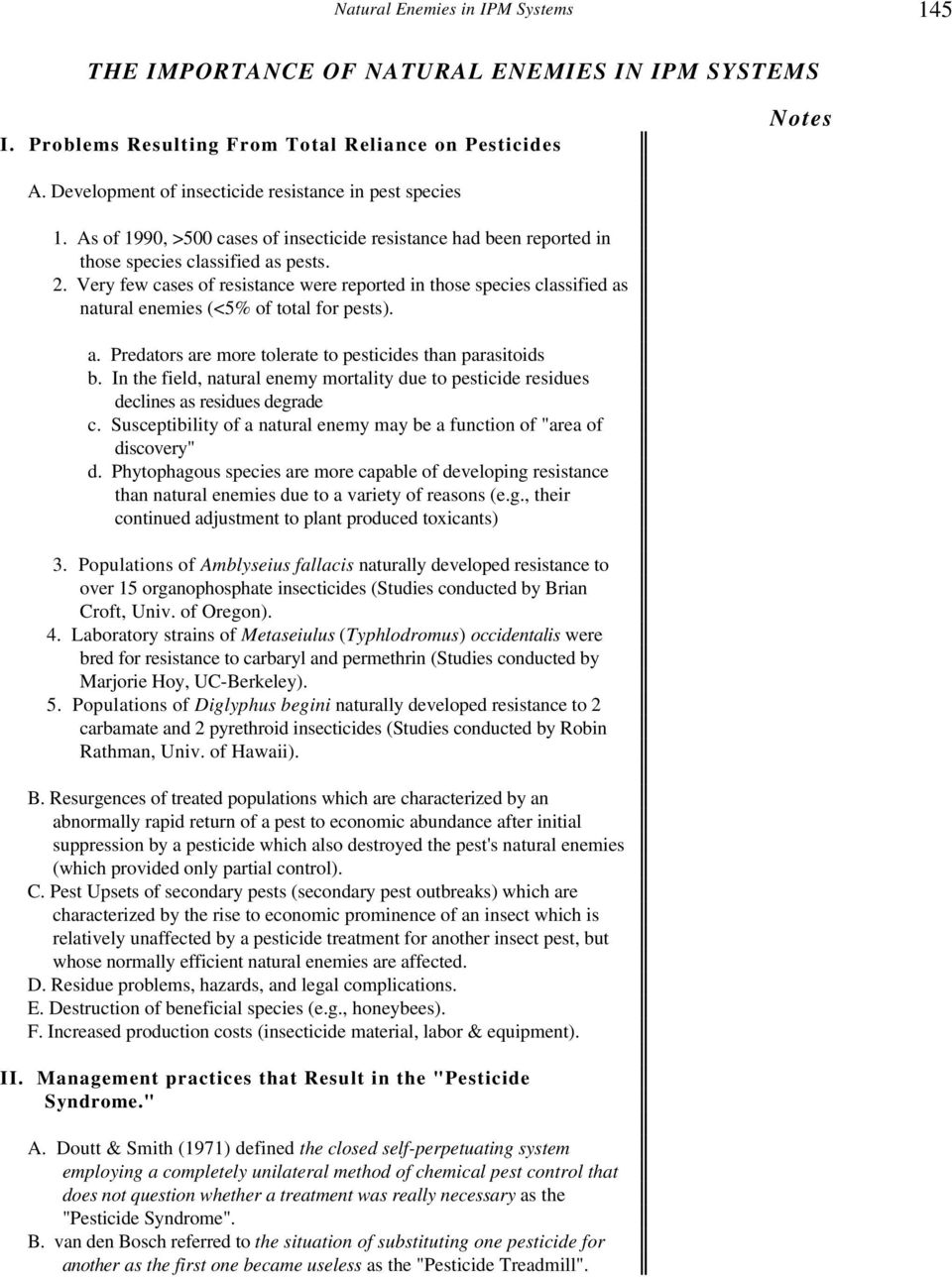
1 Natural Enemies in IPM Systems 145 THE IMPORTANCE OF NATURAL ENEMIES IN IPM SYSTEMS I. Problems Resulting From Total Reliance on Pesticides A. Development of insecticide resistance in pest species 1. As of 1990, >500 cases of insecticide resistance had been reported in those species classified as pests. 2. Very few cases of resistance were reported in those species classified as natural enemies (<5% of total for pests). a. Predators are more tolerate to pesticides than parasitoids b. In the field, natural enemy mortality due to pesticide residues declines as residues degrade c. Susceptibility of a natural enemy may be a function of "area of discovery" d. Phytophagous species are more capable of developing resistance than natural enemies due to a variety of reasons (e.g., their continued adjustment to plant produced toxicants) 3. Populations of Amblyseius fallacis naturally developed resistance to over 15 organophosphate insecticides (Studies conducted by Brian Croft, Univ. of Oregon). 4. Laboratory strains of Metaseiulus (Typhlodromus) occidentalis were bred for resistance to carbaryl and permethrin (Studies conducted by Marjorie Hoy, UC-Berkeley). 5. Populations of Diglyphus begini naturally developed resistance to 2 carbamate and 2 pyrethroid insecticides (Studies conducted by Robin Rathman, Univ. of Hawaii). B. Resurgences of treated populations which are characterized by an abnormally rapid return of a pest to economic abundance after initial suppression by a pesticide which also destroyed the pest's natural enemies (which provided only partial control). C. Pest Upsets of secondary pests (secondary pest outbreaks) which are characterized by the rise to economic prominence of an insect which is relatively unaffected by a pesticide treatment for another insect pest, but whose normally efficient natural enemies are affected. D. Residue problems, hazards, and legal complications. E. Destruction of beneficial species (e.g., honeybees). F. Increased production costs (insecticide material, labor & equipment). II. Management practices that Result in the "Pesticide Syndrome." A. Doutt & Smith (1971) defined the closed self-perpetuating system employing a completely unilateral method of chemical pest control that does not question whether a treatment was really necessary as the "Pesticide Syndrome". B. van den Bosch referred to the situation of substituting one pesticide for another as the first one became useless as the "Pesticide Treadmill".
2 Natural Enemies in IPM Systems 146 C. The pesticide syndrome consists of many stages. The best known example of the pesticide syndrome is from the Canete Valley of Peru ( ) which is an intensively farmed area. 1. Exploitation phase. Crop protection measures introduced to protect large valuable crops. Attempts are made to maximize yields by the use of scheduled insecticide treatments. This results in high numbers of pesticide applications. From 1943 to 1949, there were 3 main pests of cotton in the Canete Valley. These were the tobacco budworm, a weevil (Anthonomus vestitus), and a leafworm (Anomis texana). Mostly arsenicals and nicotine sulphate were used for control along with some organic insecticides. Yields increased initially, but dropped in Severe outbreaks of the budworm and aphids occurred in Crisis phase. More frequent pesticide applications are needed to obtain effective control. Pest populations resurge rapidly after treatments to higher levels. Pest populations develop resistance to pesticides in use. Additional pesticides become useless more rapidly than the original pesticides used. Pest upsets begin to occur. From 1949 to 1955, the growers in the Canete Valley would not return to their old cultural methods nor insecticides. It was suggested that growers only grow one year old ratoon crops. However, they would not comply. Reliance was placed on newly available organic insecticides at that time such as DDT, BHC, Toxaphene, etc. Cultural practices were modified to increase yields. New, highly productive strains of cotton were introduced and efficient irrigation practices were initiated. These new measures resulted in: a. Doubling of yields b. The philosophy that more pesticides meant higher yields c. The valley being blanketed with insecticides d. Most beneficial insect species being eliminated e. The number of insecticide treatments increased f. Loss of several pesticides g. Secondary pest outbreaks and insecticide resistance development h. Alternate insecticides used more frequently i. Six new pest species appeared 3. Disaster phase: At this point, heavy pesticide usage increases production costs to a point where the crop can no longer be grown. Initially only growers on marginal land are effected. Eventually, all the growers are wiped out. From 1955 to 1956, economic disaster hit the Canete Valley. Millions of bales of cotton were lost to insect damage and yields dropped to the lowest level ever recorded. 4. Recovery phase (introduction of IPM). Crop protection system is employed which comprises a variety of control procedures rather than pesticides alone. Attempts are made to modify the environmental factors that permit the insects to achieve a pest status. Fullest use is made of biological control.

3 Natural Enemies in IPM Systems 147 Post 1956 in the Canete Valley, growers approached their Experiment Station for assistance. Many changes were introduced which included: a. Cotton production was forbidden on marginal land b. Ratoon cotton was prohibited c. The valley was repopulated with natural enemies from neighboring valleys d. Cultural practices which aided insect control were re-established such as uniform planting dates and cotton-free periods e. Use of synthetic organic insecticides was prohibited except by approval of a special commission f. Return to using arsenicals and nicotine sulphate insecticides These changes resulted in a rapid and striking reduction in the severity of the cotton pest problems: a. Secondary pests subsided b. Problems with key pests were reduced c. Overall reduction of indirect pest control costs d. Cotton yields surpassed those previously recorded and were maintained at that level III. Integrated Pest Management A. Bartlett (1956) proposed "Integrated Control" 1. Integrated control denoted applied control that combined or integrated biological control and chemical control methods into a single unified pest control program. 2. Chemical control was used when and where necessary in a manner least disruptive to parasitoids, predators, and pathogens. B. Around the 1960's, suggestions were made to broaden integrated control to include other control measures which evolved into the term "pest management" or "integrated pest management" (IPM). C. Several definitions exist for IPM. Two examples are: 1. All practices, procedures and techniques relating to crop protection in a single unified program aimed at holding pests at sub-economic levels 2. The reduction of pest problems by actions selected after the life systems of the pests are understood and the ecological as well as the economic consequences of these actions have been predicted, as accurately as possible, to be in the best interest of mankind. IV. General Considerations for Use of BC in IPM A. Advantages of biological control in IPM systems 1. It is a safe approach provided the proper preliminary research is conducted prior to natural enemy introductions. 2. It is a relatively pernament control method given no pesticidal interference.

4 Natural Enemies in IPM Systems It is relatively economical after efficient natural enemies are established. B. Limitations of biological control in IPM systems 1. Severely limited on crops with extremely low economic thresholds or where insects are vectors of plant diseases. 2. Effectiveness is generally inversely proportional to the time required for crop production. 3. It does not work well with all insect species. 4. It does not integrate well with insecticide programs unless selective insecticides or selective application methods are employed. 5. A significant time factor is involved in control of pests as opposed to almost instantaneous control with effective insecticides. V. Examples of Natural Enemies in IPM Programs. A. Citrus in Ventura County, CA. Presently there are ca. 10 pests of citrus under management in the area. Ca. 70 years ago, the major pest problem on citrus was black scale, Saissetia oleae (Olivier). 1. The scale was commonly treated with insecticides and by fumigation. 2. Importation of Metaphycus helvolus resulted in substantial control of the pest. 3. Currently, less than 5% of the citrus groves are treated for this pest. With control of black scale, parasitoids (Aphytis spp.) are released on an inundative basis to control California red scale, yellow scale, and others. Pests such as the citrus red mite, citrus aphid and navel orangeworm are partially controlled by native (or indigenous) natural enemies, but sometimes require spot treatments when densities become high. The use of highly toxic broad spectrum insecticides such as parathion, malathion and carbaryl (Sevin) is discouraged due to the potential problems of pest upsets. B. Apples in Michigan. Several pests are found on apples including the codling moth, Laspeyresia pomonella. It is not unusual to have up to 15 insecticidal treatments per season. Reduction of pesticide applications are achieved by monitoring the populations of the European red mite, two-spotted spidermite, and apple rust mite along with the predatory mite Amblyseius fallacis. Croft developed a system to determine whether insecticide treatments were needed in an orchard. Decisions to treat for mites were based upon the ratio of predatory mites to the spidermites (see Fig on following page). C. Watermelon in Hawaii. Several indirect pests are found on watermelon including agromyzid leafminers, thrips, aphids, whiteflies and spidermites. In 1978, growers predominantly controlled leafminers by insecticide treatments which resulted in leafminer resurgences and the development of insecticide resistance in the leafminers. In 1984, an IPM program was implemented based on biological control of leafminers by conservation. Significant reductions in pesticide usage were achieved with increases in the biological control of leafminers and aphids.

5 Natural Enemies in IPM Systems 149 Predator Mites per Leaf Plant Tolerant of these Mite Densities Spider Mites per Leaf PHASE PLOT Fig, The above graphic demonstrates how Croft's decision-making index works with respect to the population dynamics of the predator/prey system. Changes in the ratio of predators to spider mites are based on changes in time. Probabilities for control of spider mites by predatory mite are: very low in region 1; equal to or less than than 10% in region 2; greater than 10% and less than 50% in region 3; approximately 50% in region 4; greater than 50% and less than 90% in region 5; and approximately 100% in region 6. Figure modified from Croft (1975). QUESTIONS 1. What problems might a grower expect if he / she unwisely uses broad spectrum pesticides? 2. What are the "pesticide syndrome" and the "pesticide treadmill? 3. What are the "pros" and "cons" of using biological control in IPM systems? 4. Discuss the use of natural enemies in the apple crop system in Michigan. REFERENCES Barbossa, Pedro Conservation biological control. Academic Press, San Diego, CA.396 pp. Bergman, P. W. & D. P. Sanders Implementing practical pest management strategies. Proc. Natl. Extension Insect Pest Management Workshop, Purdue University, West Lafayette, Indiana. March 14 16, pp. Croft, B. A Integrated control of apple mites. Michigan State Univ. Coop. Extension Service Bull. E Hoy, M. A. & D. C. Herzog Biological control in agricultural systems. Academic Press, Inc., Orlando. 589 pp. Huffaker, C. B New technology of pest control. John Wiley and Sons, New York. 500 pp.

6 Natural Enemies in IPM Systems 150 Huffaker, C. B. & P. S. Messenger Theory and practice of biological control. Academic Press, New York. 788 pp. Johnson, M. W Parasitization of Liriomyza spp. (Diptera: Agromyzidae) infesting commercial watermelon plantings in Hawaii. J. Econ. Entomol. 80: Johnson, M. W Integrated pest management: an integral component of sustainable agriculture in the Pacific Basin. pp In International Conference on Agriculture for the 21st Century: Toward a sustainable agriculture for the Pacific Rim Nations. Presentations. MOA Foundation, New York. 112 pp. Johnson, M. W., R. F. L. Mau, A. P. Martinez & S. Fukuda Foliar pests of watermelon in Hawaii. Trop. Pest Manage. 35: Metcalf, R. L. & W. Luckman Introduction to insect pest management. John Wiley and Sons, New York. 587 pp. Pickett, C. H. & R. L. Bugg Enhancing biological control.: Habitat management to promote natural enemies of agricultural pests. University of California Press, Berkeley. Rabb, R. L. & F. E. Guthrie Concepts of pest management. Proc. Conference N. C. State Univ., Raleigh, North Carolina. 242 pp. Rathman, R., M. W. Johnson, J. A. Rosenheim & B. E. Tabashnik Carbamate and pyrethroid resistance in the leafminer parasitoid Diglyphus begini (Hymenoptera: Eulophidae). J. Econ. Entomol. 83: van den Bosch, P. S. Messenger & A. P. Gutierrez An introduction to biological control. Plenum Press, New York. 247 pp. Van Driesche, R. G. and T. S. Bellows, Jr Biological control. Chapman and Hall, New York. 539 pp. READING ASSIGNMENT: Chapter 7: pp ; Chapter 14: pp ; Chapter 20: pp ; Van Driesche, R. G. and T. S. Bellows, Jr Biological control. Chapman and Hall, New York. 539 pp.

NATURE AND SCOPE OF BIOLOGICAL CONTROL
 Biological Control of Pests, ENTO 675, UH-Manoa, Fall 2000, M. W. Johnson 1 NATURE AND SCOPE OF BIOLOGICAL CONTROL I. DEFINITIONS A. H. S. Smith (1919) first used term "biological control" to signify the
Introduction to Integrated Pest Management. John C. Wise, Ph.D. Michigan State University MSU Trevor Nichols Research Complex
 Introduction to Integrated Pest Management John C. Wise, Ph.D. Michigan State University MSU Trevor Nichols Research Complex What is Integrated Pest Management? Integrated Pest Management (IPM) New concept;
Introduction to the concepts of IPM
 DEPARTMENT OF PRIMARY INDUSTRY AND FISHERIES Principles of Integrated Pest Management Deanna Chin and Brian Thistleton, Entomology, Diagnostic Services What is a pest? Principles of IPM Introduction to
Upscaling of locally proven IPM technologies for control of pest of economic importance i
 Technology Fact Sheet for Adaptation Upscaling of locally proven IPM technologies for control of pest of economic importance i Technology: Upscaling of locally proven IPM technologies for control of pest
What is a pest? How Insects Become Pests. How do insects become pests? Problems with Pesticides. What is most commonly used to control insect pests?
 What is a pest? How Insects Become Pests How do insects become pests? Introduction outside of native range Becomes disease vector Plant or animal (inclu. human) disease vector Host shift in native insect
PEST IDENTIFICATION. PMA 4570/6228 Lab 1 July 3 2014
 PEST IDENTIFICATION PMA 4570/6228 Lab 1 July 3 2014 Steps towards a successful IPM program 1. Correct identification 2. Monitoring 3. Economic thresholds 4. Choice of optimum pest control option Pests
Integrated Pest Management
 Chapter 2 Integrated Pest Management In This Chapter Keywords After learning the information in this chapter, you will be able to: 1. Define Integrated Pest Management (IPM). 2. List and describe the 5
Resources: Arthropod Pest Management
 8a. Arthropod Pest Management Resources 1 Resources: Arthropod Pest Management Suggested Readings for Students (see Print Resources for annotations and URLs) Benbrook, Charles M. 1996. Chapter 7: Bio-intensive
BENEFITS OF USING IPM
 Edward J. Bechinski and William H. Bohl Potato growers who use IPM consider all available pest control tools. Alternatives to conventional pesticides are the foundation of every IPM plan. Pesticides play
Pest Management - Holistic Pest Control?
 Pest Management - Holistic Pest Control? 2. Modern control tactics and the birth of IPM The action of parasites, predators, and pathogens in maintaining another organism s density at a lower average than
COTTON RESEARCH AND DEVELOPMENT CORPORATION
 '\,. COTTON RESEARCH AND DEVELOPMENT CORPORATION Project title: Assessing the effectiveness of Helicoverpa predators Project Number: UNE13C Research Organisation: University of New England Principal researcher:
BIOS 3010: Ecology Lecture 16: Manipulating abundance: 2. Manipulating abundance: 3. Pest and weed control:
 BIOS 3010: Ecology Lecture 16: Manipulating abundance: Lecture summary: Manipulating abundance: Pest control. Pesticides:» Benefits.» Problems. Biological control. Cultural control. Integrated pest management.
Integrated Pest Management
 Integrated Pest Management Ecology and Human Impact R. Bruce Chapman Insect Science Ltd Pest organisms When do organisms become pests? When an organism s population exceeds a threshold level, and control
IPM: from Integrated Pest Management to Intelligent Pest Management
 IPM: from Integrated Pest Management to Intelligent Pest Management About the author: Joe Boggs Assistant Professor The Ohio State University Extension and OSU Department of Entomology E-mail: [email protected]
Pesticides for use on Mangoes
 Pesticides for use on Mangoes Brian Thistleton, DPIFM and Scott Spencer, Landmark Talk Outline Insecticide issues Types Registration Labels Off label use Withholding periods Problems with insecticides
Ch. 10 - Pest Control. Outline
 Ch. 10 - Pest Control 1 Outline Pests Pesticides Types Benefits Problems Alternatives Reducing Exposure Regulating Use Organic Farming 2 16 July 2011 1 Pests and Pesticides Biological Pests - organisms
Outline. What is IPM Principles of IPM Methods of Pest Management Economic Principles The Place of Pesticides in IPM
 Improving Control Systems in Thailand for Plant and Plants Products Intended for Export to the European Union co-funded by the European Union and Thai Department of Agriculture Preharvest Use of Pesticides
Integrated Pest Management
 Integrated Pest Management Andrea Veres Junior Technical Officer FAO REU [email protected] Yerevan, Armenia 2013 Why develop IPM? Agriculture was: not sustainable optimized inputs for maximum profit
PesticiDe use trends. by JiM Wells. in california Agriculture. environmental solutions GrouP
 PesticiDe use trends in california Agriculture by JiM Wells environmental solutions GrouP summary Farmers are successfully transitioning to safer, more environmentally friendly compounds to combat pests
Chapter 1: Integrated Pest Management (IPM)
 Chapter 1: Integrated Pest Management (IPM) Introduction Pests are an inevitable problem faced by nursery growers. For the purposes of this document, the term pest refers to insects, diseases, weeds, slugs,
Biological Control. Biological Control. Biological Control. Biological Control
 Presentation Overview How To Use Biological Controls Effectively Raymond Cloyd Agents Basics of How To Successfully Use Summary Will Agents Eat Each Other? Yes!! Program For Western Flower Thrips Intra-Guild
B. Reduce the use of broad spectrum pesticides when feasible. C. Create awareness among City staff of less-toxic pest management techniques.
 City of Newark MAINTENANCE POLICY: INTEGRATED PEST MANAGEMENT POLICY ORIGINAL DATE: January 11, 2010; revised May 24, 2012 PURPOSE: The purpose of the City of Newark s Integrated Pest Management (IPM)
University of Hawaii at Manoa, College of Tropical Agriculture and Human Resources
 University of Hawaii at Manoa, College of Tropical Agriculture and Human Resources J. Sugano, J. Uyeda, S. Fukuda, K. Wang, M. Kawate, C. Tamaru, B. Fox, and T. Radovich College of Tropical Agriculture
Genetically modified crops in Integrated Pest Management
 Federal Department of Economic Affairs, Education and Research EAER Agroscope Genetically modified crops in Integrated Pest Management Franz Bigler, Michael Meissle and Jörg Romeis Agroscope ART Zürich,
Total Course Hours. Semester Degree code. ID Course Name Professor Course Content Summary. 90 1 st 11070
 LEA0170 Invertebrate Zoology I Italo Delalibera Junior Characterization and importance of the Porifera, Cnidaria, Platyhelminthes, Nemata, Mollusca, Annelida, Echinodermata phyla and smaller invertebrate
99-1355 Aiea Heights Drive Aiea, Hawaii 96701 USA. 1975-1990 Sumida Farm, Inc. Aiea, Hawaii Farm Manager! Watercress farmer
 99-1355 Aiea Heights Drive Aiea, Hawaii 96701 USA John J. McHugh, Jr. Phone (808) 487-1391 Fax (808) 488-5827 E-mail [email protected] Education 1969-1975 University of Hawaii at Manoa Honolulu,
Tree Integrated Pest Management. Dan Nortman Virginia Cooperative Extension, York County
 Tree Integrated Pest Management Dan Nortman Virginia Cooperative Extension, York County IPM Refresher Definition: The use of a combination of appropriate pest control tactics to reduce pest population
Organic Control Methods of Almond Insect Pest
 Big Tree Organic Field Day Turlock, CA, April 2nd, 2009 Organic Control Methods of Almond Insect Pest David Doll Farm Advisor UCCE Merced County Overview Organic Control Methods of Control of common pests
Insect Pests of Pecan. Will Hudson Extension Entomologist
 Insect Pests of Pecan Will Hudson Extension Entomologist How important is nut drop to production? Pecan trees typically lose 75% of the pecans between nut set and shell hardening even when protected from
Management of Citrus. Beth Grafton-Cardwell. stationed at the Kearney Ag Center Director: Lindcove Research and Extension Center
 Integrated Pest Management of Citrus Beth Grafton-Cardwell 60% Extension & 40% Research Entomologist: UC Riverside, stationed at the Kearney Ag Center Director: Lindcove Research and Extension Center California
Recommended Resources: The following resources may be useful in teaching
 Unit D: Controlling Pests and Diseases in the Orchard Lesson 1: Managing and Controlling Pests of Fruit and Nut Crops Student Learning Objectives: Instruction in this lesson should result in students achieving
ECONOMIC INJURY LEVEL (EIL) AND ECONOMIC THRESHOLD (ET) CONCEPTS IN PEST MANAGEMENT. David G. Riley University of Georgia Tifton, Georgia, USA
 ECONOMIC INJURY LEVEL (EIL) AND ECONOMIC THRESHOLD (ET) CONCEPTS IN PEST MANAGEMENT David G. Riley University of Georgia Tifton, Georgia, USA One of the fundamental concepts of integrated pest management
BARRIERS TO WIDESPREAD CONVERSION FROM CHEMICAL PEST CONTROL TO NON-CHEMICAL METHODS IN U.S. AGRICULTURE
 BARRIERS TO WIDESPREAD CONVERSION FROM CHEMICAL PEST CONTROL TO NON-CHEMICAL METHODS IN U.S. AGRICULTURE 1 Leonard Gianessi and 2 Nathan Reigner CropLife Foundation, Crop Protection Research Institute,
Integrated Pest Management
 Integrated Pest Management Science and Language Arts Brief Description: This lesson will focus all of the information the students have learned about pests in the other insect lessons in a decision-making
Entomology 101 Integrated Pest Management IPM. Terminology Related to Pests. Types of damage. Strategies of Pest Control or Management
 Entomology 101 Integrated Pest Management IPM David J. Shetlar, Ph.D. The BugDoc The Ohio State University, OARDC & OSU Extension Columbus, OH November, 2009, D.J. Shetlar, all rights reserved The evolution
Integrated Mosquito Management. Rosmarie Kelly Public Health Entomologist Georgia Dept of Public Health
 Integrated Mosquito Management Rosmarie Kelly Public Health Entomologist Georgia Dept of Public Health Topics of discussion: Integrated pest management (IPM) History of pest management Definition of IPM
Chapter I. Historical Perspective on Crop Protection
 Chapter I Historical Perspective on Crop Protection Chapter I Historical Perspective on Crop Protection Since recorded history, the impact of pests on food crops has been important. Many practices of traditional
Hop Pest Control. H. E. Morrison. jpf^vrsiolnrru; - «ibntoj."' «- '',orto JUN 6 I-JJ3
 Hop Pest Control H. E. Morrison its of jpf^vrsiolnrru; - «th ' s ibntoj."' «- '',orto JUN 6 I-JJ3 Agricultural Experiment Station Oregon State College Corvallis Circular of Information 589 May 1958 Hop
Integrated Pest Management: Principles & Practice. Dr. Ana Legrand Connecticut IPM Program University of Connecticut
 Integrated Pest Management: Principles & Practice Dr. Ana Legrand Connecticut IPM Program University of Connecticut Integrated Pest Management IPM is the selection, integration and implementation of pest
PREDATION OF CITRUS RED MITE (PANONYCHUS CITRI) BY STETHORUS SP. AND AGISTEMUS LONGISETUS
 PREDATION OF CITRUS RED MITE (PANONYCHUS CITRI) BY STETHORUS SP. AND AGISTEMUS LONGISETUS The Horticulture and Food Research Institute of New Zealand Limited, Private Bag 92169, Auckland, New Zealand Corresponding
Integrated Pest Management (IPM) Learning Objectives. What is Integrated Pest Management (IPM)? After studying this section, you should be able to:
 General Knowledge: Integrated Pest Management (IPM) Integrated Pest Management (IPM) Learning Objectives After studying this section, you should be able to: Define the concept of Integrated Pest Management
How can we make Biological Control more economical?
 How can we make Biological Control more economical? Economy of Chemical Control Synthetic Pesticides = Responsive Control Preventative control is difficult Not a problem if pesticides are effective Potential
Fungal Entomopathogens: An Enigmatic Pest Control Alternative
 Fungal Entomopathogens: An Enigmatic Pest Control Alternative Nicole Rusconi $ and Cerruti R 2 Hooks! $ Student Research Assistant and 1 Associate Professor and Extension Specialist, University of Maryland
INTEGRATED PEST CONTROL
 19 TOPIC 3 INTEGRATED PEST CONTROL Scope Chemical pesticides are now the traditional solution to pest problems, and they have saved lives and crops. Their use, however, has created significant problems,
Chemical versus Biological Control of Sugarcane. By Abid Hussain Matiari Sugar Mills Ltd.
 Chemical versus Biological Control of Sugarcane By Abid Hussain Matiari Sugar Mills Ltd. Sugarcane It is an important cash crop, Pakistan is the fifth largest cane producing country. However, its yield
Integrated Pest Management At Boise State University
 Integrated Pest Management At Boise State University Purpose The purpose of this document is to provide an overview of Boise State University Landscape Service department s philosophy regarding plant health
CHECKLIST INTEGRATED PEST MANAGEMENT
 CHECKLIST INTEGRATED PEST MANAGEMENT Before introducing a crop into a greenhouse remove weeds, algae, pet plants, and any plant and growing medium debris located throughout the greenhouse. Repair any drainage
A Perspective of Research on HLB and its Vector in the United States David G. Hall, Tim R. Gottwald and Calvin E. Arnold
 A Perspective of Research on HLB and its Vector in the United States David G. Hall, Tim R. Gottwald and Calvin E. Arnold US Horticultural Research Laboratory, USDA-ARS, Ft Pierce, FL ACP Asian citrus psyllid
Wooly Whiteflies (Aleurothrixus floccosus)
 Cooperative Extension Wooly Whiteflies (Aleurothrixus floccosus) The University of Arizona $ College of Agriculture $ Tucson, Arizona 85721 (part of the publication Citrus Arthropod Pest Management in
SECTION 1 : INTRODUCTORY. Chapter 1 Introduction. Pest status and economic damage
 SECTION 1 : INTRODUCTORY Chapter 1 Introduction Cotton production systems The cotton pest situation Cotton bollworm (Helicoverpa armigera) Pest status and economic damage COTTON BOLLWORM CONTROL species,
PEST MANAGEMENT (CSP Enhancements) January 2006 Enhancement Activity Task Sheet
 Reduced risks to ground and surface water quality Lower costs by limiting chemical applications to only when necessary To learn more about Integrated Pest Management go to the following website: http://extension.usu.edu/files/gardpubs/ipm01.pdf
2:00 p.m. Select Taste of Michigan Promotion for Apples. Melinda Curtis, Melinda Curtis & Assoc. Tom Kalchik, Michigan State University
 Great Lakes Fruit, Vegetable & Farm Market Expo DeVos Place Convention Center Grand Rapids,k MI December 9-11, 2003 2:00 p.m. Select Taste of Michigan Promotion for Apples Melinda Curtis, Melinda Curtis
Pests, Diseases and Weeds
 Pests, Diseases and Weeds Level 3 Copyright P.O. Box 461, Hillcrest, 3650 (031) 313-3364 Title: Monitor Pests, Diseases and Weeds on Crops Applied Title: Monitor Pests, Diseases and Weeds on Field: Agriculture
IPM Definitions 1990-1998
 IPM Definitions 1990-1998 1998 1. "Integrated pest management, or IPM is a systematic approach to crop protection that uses increased information and improved decision-making paradigms to reduce purchased
Don t Bug Me An Integrated Pest management Activity by
 http://www.life.umd.edu/grad/mlfsc/ Don t Bug Me An Integrated Pest management Activity by Suzanne Avtges Jessica Matthews John Gorrell Kim Vogt Don t Bug Me - A Teaching Unit on Integrated Pest Management
A REVIEW OF PEST CONTROL IN AVOCADOS
 California Avocado Society 1979 Yearbook 63: 58-65 A REVIEW OF PEST CONTROL IN AVOCADOS C. Don Gustafson Farm Advisor, Cooperative Extension Service, University of California, San Diego County. Introduction
Development of Lygus Management Strategies for Texas Cotton
 Development of Lygus Management Strategies for Texas Cotton Ram Shrestha, Megha Parajulee, and Stanley Carroll Texas A&M AgriLife Research and Extension Center Lubbock, Texas 3 rd International Lygus Symposium,
3. Which relationship can correctly be inferred from the data presented in the graphs below?
 1. Recent evidence indicates that lakes in large areas of New York State are being affected by acid rain. The major effect of acid rain in the lakes is (1) an increase in game fish population levels (3)
ALTERNATIVES TO CHLORPYRIFOS AND DIAZINON DORMANT SPRAYS
 ALTERNATIVES TO CHLORPYRIFOS AND DIAZINON DORMANT SPRAYS FRANK G. ZALOM, MICHAEL N. OLIVER, AND DAVID E. HINTON STATEWIDE IPM PROJECT, WATER RESOURCES CENTER, AND ECOTOXICOLOGY PROGRAM UNIVERSITY OF CALIFORNIA,
#1: Threshold and Injury Calculations the Theory. #2: Putting Economic Injury Levels and Action Thresholds to Use. Related Topics
 Module #4 What is a Threshold? p. 1 www.nysaes.cornell.edu/ipmnet/ne.ipm.region What is a Threshold? By James VanKirk Overview Concept Activity Handouts The Economic Injury Level and the Action Threshold
Lecture 11: PEST - DEFINITION, CATEGORIES, CAUSES FOR OUTBREAK, LOSSES CAUSED BY PESTS
 Lecture 11: PEST - DEFINITION, CATEGORIES, CAUSES FOR OUTBREAK, LOSSES CAUSED BY PESTS PEST - Derived from French word Peste and Latin term Pestis meaning plague or contagious disease - Pest is any animal
Implementation of a Pest Monitoring Network For Vegetable Growers In Yuma County
 Implementation of a Pest Monitoring Network For Vegetable Growers In Yuma County John Palumbo, David Kerns, Clay Mullis, and Francisco Reyes Abstract A n insect pest monitoring network spanning e major
TOWN OF WOODSIDE RESOLUTION ADOPTING AN UPDATED INTEGRATED PEST MANAGEMENT POLICY
 TOWN OF WOODSIDE Report to Town Council Agenda Item 3 Prepared by: Kevin Bryant, Assistant Town Manager September 27, 2011 Approved by: Susan George, Town Manager SUBJECT: RESOLUTION ADOPTING AN UPDATED
Integrated Pest Management Plan
 Integrated Pest Management Plan ENVIRONMENTAL HEALTH & SAFETY Version 1.2 October 21, 2015 Table of Contents A. Introduction...1 B. Scope...1 C. Responsibilities...2 1. Department...2 2. Supervisor...3
Mushroom Integrated Pest Management
 P E N N S Y L V A N I A Mushroom Integrated Pest Management H andbook The PA IPM Program is a collaboration between the Pennsylvania Department of Agriculture and The Pennsylvania State University aimed
Integrated Pest Management (IPM)
 Integrated Pest Management (IPM) in crops and pastures Integrated Pest Management (IPM) means using a combination of biological, cultural and chemical control methods to manage pest problems. The term
What is Integrated Pest Management?
 SLIDE 1: This is Steve Johnson, University of Maine Cooperative Extension, bringing you information on Integrated Pest Management. It is possible to receive a Maine Board of Pesticides Control recertification
Spider Mite Management in Strawberries
 Spider Mite Management in Strawberries Richard S. Cowles, Associate Scientist, Connecticut Agricultural Experiment Station Valley Laboratory, PO Box 248, Windsor, CT 06095-0248 Spider Mite Biology The
Pests and Pest Control
 Pests and Pest Control The need for pest control Philosophies of control Development of Chemical Pesticides Promises and problems of the chemical approach Some of the more commonly used icides Alternative
INTEGRATED PEST MANAGEMENT
 C 1 H A P TE R INTEGRATED PEST MANAGEMENT LEARNING OBJECTIVES After completely studying this chapter, you should: Be able to define integrated pest management. Understand the importance of an economic
Comparison of Production Costs and Resource Use for Organic and Conventional Production Systems
 Comparison of Production Costs and Resource Use for Organic and Conventional Production Systems KAREN KLONSKY The USDA established the National Organic Program (NOP) to develop national standards for organically
12. INSECT PEST AND DISEASE MANAGEMENT
 12. INSECT PEST AND DISEASE MANAGEMENT Conservation farming promotes a diversity of insect life, influences pest populations and also favours many beneficial insects. The beneficial insects which act as
Biocontrol Solutions for Greenhouses and Nurseries
 Biocontrol Solutions for Greenhouses and Nurseries PO Box 1555, Ventura, CA 93002 800-248-2847 * 805-643-5407 * fax 805-643-6267 questions [email protected] orders [email protected] web
Cotton Pest Control in Australia Before and After Bt cotton: Economic, Ecologic and Social Aspects
 Cotton Pest Control in Australia Before and After Bt cotton: Economic, Ecologic and Social Aspects David Murray, Department of Primary Industries and Fisheries, PO Box 102, Toowoomba 4350 Australia Summary
Checking the Effectiveness of Pest Control Measures
 Checking the Effectiveness of Pest Control Measures Chris Hayes, PhD (Tampa) SE Technical Sales Manager & Mexico [email protected] Cell: 585-820-6807 6/15/2015 1 Thanks Cultivate 15 Thanks to YOU,
Grasshopper and Bean Leaf Beetle
 FS 905 Economic Thresholds in Soybeans Grasshopper and Bean Leaf Beetle Michael A. Catangui, Ph.D. Extension entomologist & assistant professor Plant Science Department South Dakota State University Economic
BLUE ALFALFA APHID: OLD PEST WITH NEW MANAGEMENT CHALLENGES. Eric Natwick 1 and Martin Lopez 2 ABSTRACT
 BLUE ALFALFA APHID: OLD PEST WITH NEW MANAGEMENT CHALLENGES Eric Natwick 1 and Martin Lopez 2 ABSTRACT During the spring of 1975, Imperial County, CA alfalfa growers reported less than adequate insecticidal
Adoption of GE Crops by U.S. Farmers Increases Steadily
 Adoption of GE Crops by U.S. Farmers Increases Steadily Farmers are more likely to adopt new practices and technologies if they expect to benefit from them. Benefits are usually thought of in monetary
Biological and cultural controls Nonpesticide alternatives can suppress crop pests
 REVIEW ARTICLE t Biological and cultural controls Nonpesticide alternatives can suppress crop pests Nicholas J. Mills Kent M. Daane t Biological controls (the use of natural enemies) and cultural controls
Integrated Pest Management Policy for City-Owned Facilities
 Page 1 of 6 ARTICLE XII Integrated Pest Management Policy for City-Owned Facilities Section 1 Background The City s National Pollutant Discharge Elimination System (NPDES) permit from the California Regional
Application of ecological models in entomology: a view from Brazil
 Application of ecological models in entomology: a view from Brazil Wesley A. C. Godoy University of São Paulo "Luiz de Queiroz" College of Agriculture Piracicaba, São Paulo, Brazil - [email protected] Working
The Alfalfa Weevil in Utah
 Page 1 of 5 The Alfalfa Weevil in Utah Fact Sheet No. 58 January 1989 Edward W. Evans Extension Entomologist Introduction The alfalfa weevil is a major pest throughout Utah. It is a beetle with one generation
BIOLOGICAL CONTROL. Edited by. Springer Science+Business Media, LLC
 BIOLOGICAL CONTROL BIOLOGICAL CONTROL Edited by c. S. HUffAKER Professor of Entomology and Entomologist in the Experiment Station Division of Biological Control Department of Entomology and Parasitology
TOBACCO INSECT CONTROL Francis P. F. Reay-Jones, Extension Entomologist
 TOBACCO CONTROL Francis P. F. Reay-Jones, Extension Entomologist Integrated pest management (IPM) is the ecological approach to pest control. It uses ALL suitable techniques to reduce pests below economic
COMPARISON OF NEW INSECTICIDES FOR CONTROL OF HELIOTHINE SPECIES IN COTTON
 COMPARISON OF NEW INSECTICIDES FOR CONTROL OF HELIOTHINE SPECIES IN COTTON Donald R. Johnson, Gus M. Lorenz, John D. Hopkins, and Larry M. Page 1 RESEARCH PROBLEM The tobacco budworm, Heliothis virescens,
AP ENVIRONMENTAL SCIENCE 2012 SCORING GUIDELINES
 AP ENVIRONMENTAL SCIENCE 2012 SCORING GUIDELINES Question 3 The active ingredients in many pesticides are chemical compounds that kill organisms such as insects, molds, and weeds. Proponents claim that
INTEGRATED PEST MANAGEMENT SYSTEM FOR KENNESAW STATE UNIVERSITY
 INTEGRATED PEST MANAGEMENT SYSTEM FOR KENNESAW STATE UNIVERSITY KENNESAW, GEORGIA PREPARED JANUARY 1997 REVISED NOVEMBER 2006 TABLE OF CONTENTS Introduction and Principles of Integrated Pest Management
POWERFUL INSECT CONTROL IN GRAPES
 POWERFUL INSECT CONTROL IN GRAPES Powerful Insect Control in Grapes As temperatures warm, damaging insects are on the move. Dow AgroSciences has four insecticides Intrepid, Delegate, Success and Entrust
The Soil Food Web and Pest Management
 The Soil Food Web and Pest Management Mary Barbercheck, Department of Entomology, 501 ASI Building, Penn State University, University Park, PA, 16802 Tel. (814)863-2982 [email protected] New England Vegetable