
Alessi, Stephen & Trollip, Standley (2001). Multimedia for Learning: Methods and Development (3rd Edition). Boston: Allyn & Bacon.
|
|
|
- Marjorie Morgan
- 9 years ago
- Views:
Transcription
1 Course Title: Instructional Systems Design Course Number: Y Instructor: Holly Henry Online Office Hours: Wednesday 9:15pm-10:15pm and by appointment Course Overview: This course presents an integrated approach for analyzing and designing instructional systems. Students will be introduced to a variety of distance learning technologies, including learning management and content management systems. In this course students will learn the systems development life cycle for creating instructional systems and the relevant documentation for the analysis, design, and development phases of the life cycle. Key topics include requirements gathering, information architecture, usability, and evaluating distance-learning alternatives. At the end of the course students will produce a professional quality functional specification of a learning management system. Course Objectives: Students who successfully complete this course will be able to: Discuss the appropriate uses of the various technologies used in distance education Learn and apply the systems analysis and design methodology Read and create authentic functional and technical documentation Analyze performance needs Design, prototype, and propose an instructional system solution Required Readings: Alessi, Stephen & Trollip, Standley (2001). Multimedia for Learning: Methods and Development (3rd Edition). Boston: Allyn & Bacon. Other online reading materials may be assigned during the semester. Recommended Readings: Various recommended reading materials may be made available to students online during the semester. Course Prerequisites: There are no prerequisites for this course. Course Requirements and Assignments: In order to incorporate best practices into this class, student work will be central to the class discussions and lectures. 1. Participation: Students are required to participate in the in-class and synchronous class sessions and the asynchronous discussion board. The participation grade is based upon attendance in all class sessions and contributions to class discussions and discussion board postings in the Virtual College. 2. Instructional System Design Project: Students will analyze a performance need of their choosing,

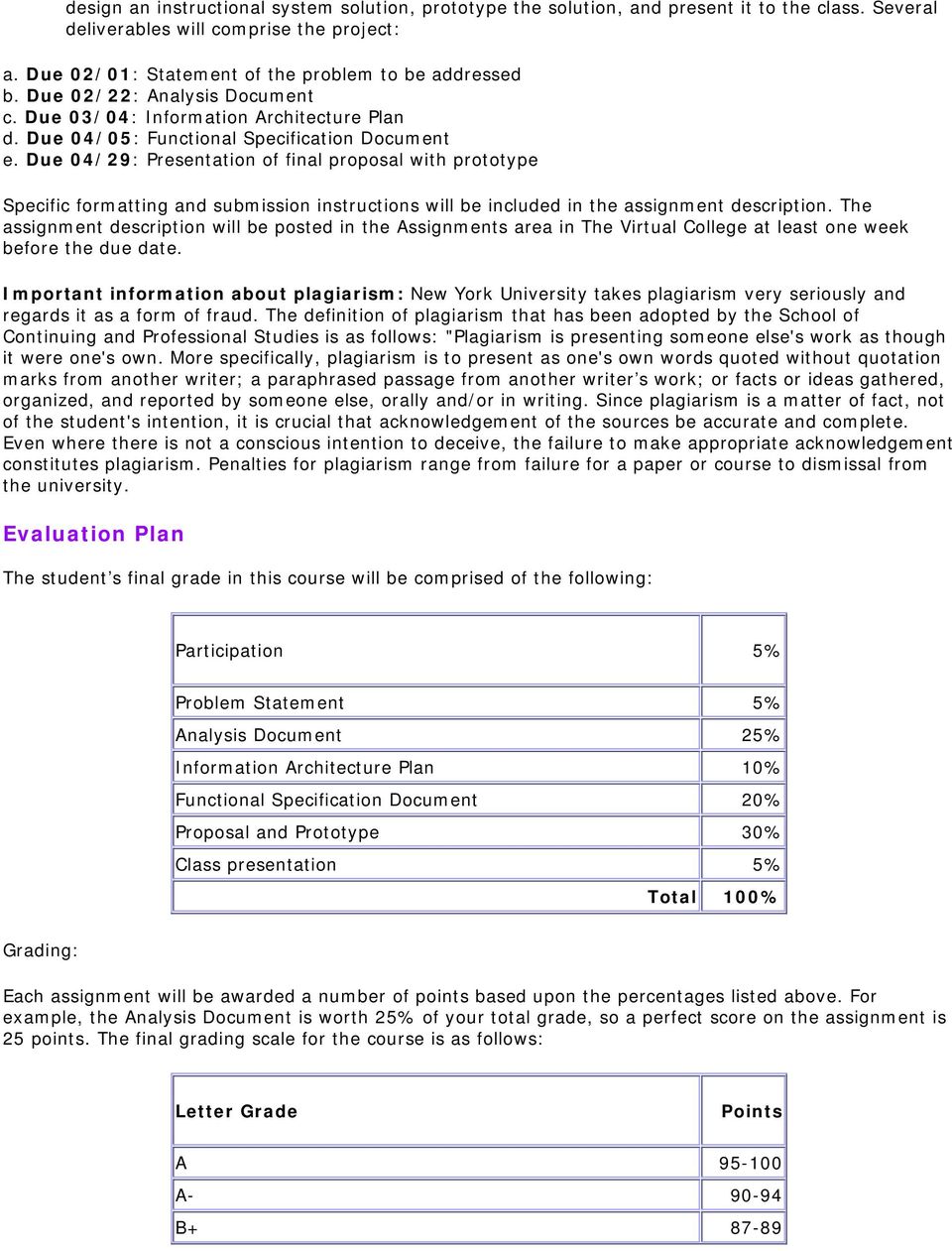
2 design an instructional system solution, prototype the solution, and present it to the class. Several deliverables will comprise the project: a. Due 02/01: Statement of the problem to be addressed b. Due 02/22: Analysis Document c. Due 03/04: Information Architecture Plan d. Due 04/05: Functional Specification Document e. Due 04/29: Presentation of final proposal with prototype Specific formatting and submission instructions will be included in the assignment description. The assignment description will be posted in the Assignments area in The Virtual College at least one week before the due date. Important information about plagiarism: New York University takes plagiarism very seriously and regards it as a form of fraud. The definition of plagiarism that has been adopted by the School of Continuing and Professional Studies is as follows: "Plagiarism is presenting someone else's work as though it were one's own. More specifically, plagiarism is to present as one's own words quoted without quotation marks from another writer; a paraphrased passage from another writer s work; or facts or ideas gathered, organized, and reported by someone else, orally and/or in writing. Since plagiarism is a matter of fact, not of the student's intention, it is crucial that acknowledgement of the sources be accurate and complete. Even where there is not a conscious intention to deceive, the failure to make appropriate acknowledgement constitutes plagiarism. Penalties for plagiarism range from failure for a paper or course to dismissal from the university. Evaluation Plan The student s final grade in this course will be comprised of the following: Participation 5% Problem Statement 5% Analysis Document 25% Information Architecture Plan 10% Functional Specification Document 20% Proposal and Prototype 30% Class presentation 5% Total 100% Grading: Each assignment will be awarded a number of points based upon the percentages listed above. For example, the Analysis Document is worth 25% of your total grade, so a perfect score on the assignment is 25 points. The final grading scale for the course is as follows: Letter Grade Points A A B
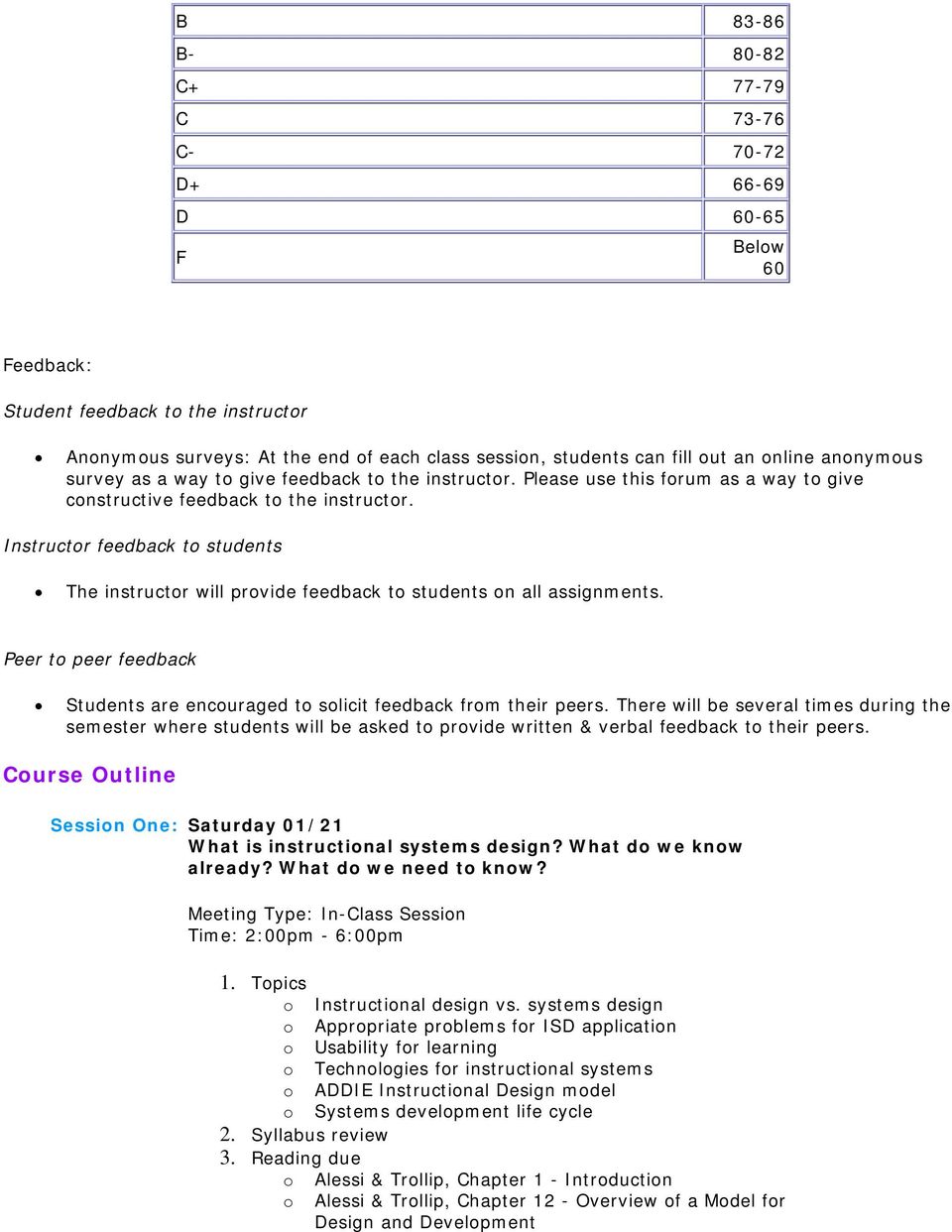
3 B B C C C D D F Below 60 Feedback: Student feedback to the instructor Anonymous surveys: At the end of each class session, students can fill out an online anonymous survey as a way to give feedback to the instructor. Please use this forum as a way to give constructive feedback to the instructor. Instructor feedback to students The instructor will provide feedback to students on all assignments. Peer to peer feedback Students are encouraged to solicit feedback from their peers. There will be several times during the semester where students will be asked to provide written & verbal feedback to their peers. Course Outline Session One: Saturday 01/21 What is instructional systems design? What do we know already? What do we need to know? Meeting Type: In-Class Session Time: 2:00pm - 6:00pm o Instructional design vs. systems design o Appropriate problems for ISD application o Usability for learning o Technologies for instructional systems o ADDIE Instructional Design model o Systems development life cycle 2. Syllabus review 3. Reading due o Alessi & Trollip, Chapter 1 - Introduction o Alessi & Trollip, Chapter 12 - Overview of a Model for Design and Development
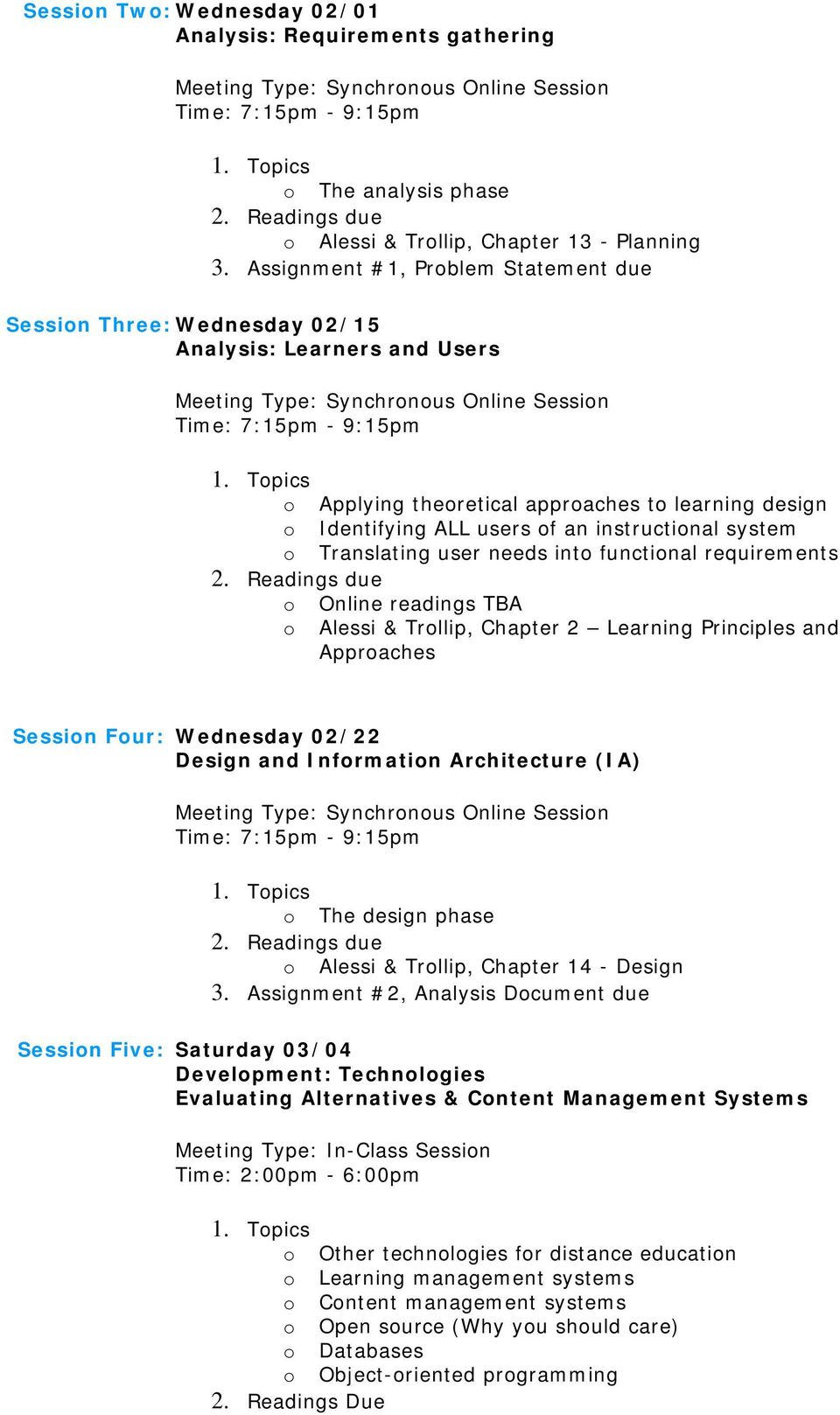
4 Session Two: Wednesday 02/01 Analysis: Requirements gathering o The analysis phase 2. Readings due o Alessi & Trollip, Chapter 13 - Planning 3. Assignment #1, Problem Statement due Session Three: Wednesday 02/15 Analysis: Learners and Users o Applying theoretical approaches to learning design o Identifying ALL users of an instructional system o Translating user needs into functional requirements 2. Readings due o Online readings TBA o Alessi & Trollip, Chapter 2 Learning Principles and Approaches Session Four: Wednesday 02/22 Design and Information Architecture (IA) o The design phase 2. Readings due o Alessi & Trollip, Chapter 14 - Design 3. Assignment #2, Analysis Document due Session Five: Saturday 03/04 Development: Technologies Evaluating Alternatives & Content Management Systems Meeting Type: In-Class Session Time: 2:00pm - 6:00pm o Other technologies for distance education o Learning management systems o Content management systems o Open source (Why you should care) o Databases o Object-oriented programming 2. Readings Due
5 o Alessi & Trollip, Chapters 4-9* o Siemens, G. (2004). Learning Management Systems: The wrong place to start learning. o Avgeriou, P., Papasalouros, A., Retalis, S., & Skordalakis, M. (2003). Towards a Pattern Language for Learning Management Systems. Educational Technology & Society, 6(2), Assignment #3, Information Architecture Plan due * We will divide responsibility for these chapters among the class. Each student will present one chapter s material to the rest of the class. All students should at least skim the chapters not specifically assigned to them. Session Six: Wednesday 03/22 Testing, assessment, and collaboration tools o Collaboration tools o Online testing and quizzing tools o Web-based learning 2. Readings o Alessi & Trollip, Chapter 10 Tests o Alessi & Trollip, Chapter 11 Web-based Learning o Online readings TBA 3. Discussion of requirements for assignment #4, Functional Specification Document, due 04/05 Session Seven: Wednesday 03/29 Usability & Social Interfaces o Navigation o Text size o Layout o Social Interfaces 2. Readings Due o Spolsky, J. (2004). It's Not Just Usability rticles/notjustusability.html o The Best of Eyetrack III: What We Saw When We Looked Through Their Eyes o Other online readings TBA Session Eight: Wednesday 04/05 Strategies for picking tools and technologies

6 o Picking and evaluating products for online learning 2. Readings Due o Alessi & Trollip, Chapter 3 - General features of software for learning 3. Assignment #4, Functional Specification Document due Session Nine: Satuday 04/29 Functional specification presentations Meeting Type: In-Class Session Time: 2:00pm - 6:00pm o In-class presentations of proposal and prototype o Class conclusion. 2. Assignment #5, Final proposal, prototype, and presentation due Course Communication Strategy: Students will be given every opportunity to exchange ideas and express concerns with their instructor as well as with classmates. Consequently, communication will be achieved as follows: Students will receive individual, group, and broadcast (all class participants) from the instructor. Students will have the ability to the instructor and any other class participant individually. The instructor will respond to student s within 24 hours. Students will be required to respond within two business days to instructor s that request a response. Virtual office hours: In addition to responding to , the instructor will be available to meet with individuals or groups of students during regularly scheduled synchronous office hours through the Centra program. (To attend or review instructor contact information, click the office hours icon on the "My Courses" page). Forums: The class Forum will be used to focus students on essential topics within the course, to discuss ideas related to the primary course focus, and to post certain assignments for group review or critique. The instructor and students will also use discussion board postings to share information throughout the duration of the course. Both the instructor and the students will be able to post questions, comments, files, and general information, to the class forum. However, students are asked to limit their postings to topics of interest to the entire class and of relevance to the topic of assessment in online education. Virtual classroom. Six virtual classroom events will be scheduled as the primary discussion of the session content. Effort will be made to schedule these events at a time convenient for all class participants and to record and archive all sessions. In the event that a suitable time for all participants cannot be scheduled, an asynchronous alternative will be developed. Text-based chat. Although text-based chat will not be used as a primary course-delivery vehicle, students may choose to schedule online text discussion for a particular topic with other participants,

7 for example, in discussing team projects. During the synchronous online sessions and office hours, the instructor and students will communicate via live chat and voice-over IP.

Http://Troy.bncollege.com
 TROY UNIVERSITY Criminology SYLLABUS T1 2015 August 10, 2015 to October 9, 2015 For course syllabus posted prior to the beginning of the term, the instructor reserves the right to make minor changes prior
FNST 140: TRADITIONAL KNOWLEDGE
 SCHOOL OF LIBERAL ARTS FNST 140 3 Credit Course Winter Semester, 2014 FNST 140: TRADITIONAL KNOWLEDGE INSTRUCTOR: OFFICE HOURS: OFFICE LOCATION: Mark Nelson, MA By appointment TBA TELEPHONE/E-MAIL: [email protected];
COURSE TEXTBOOK [Insert required course text academic format for book listing with ISBN# and edition]
![COURSE TEXTBOOK [Insert required course text academic format for book listing with ISBN# and edition]](/thumbs/25/6009919.jpg "COURSE TEXTBOOK [Insert required course text academic format for book listing with ISBN# and edition]") New York University Tisch School of the Arts [COURSE TITLE] Course Syllabus [COURSE NUMBER] / [NUMBER OF CREDITS] Office of Special Programs [DATE] Instructor Name: COURSE DESCRIPTION [The description
New York University Tisch School of the Arts [COURSE TITLE] Course Syllabus [COURSE NUMBER] / [NUMBER OF CREDITS] Office of Special Programs [DATE] Instructor Name: COURSE DESCRIPTION [The description
College of Education Graduate Departmental Course Syllabus Summer 2014. as of 5/6/2014
 College of Education Graduate Departmental Course Syllabus Summer 2014 as of 5/6/2014 The College of Education is dedicated to the ideals of Collaboration, Academic Excellence, Research, and Ethics/Diversity
BUS 205-002, 205-004 Management Communication
 BUS 205-002, 205-004 Management Communication SEMESTER: 201530 CLASSROOM: ED 558 Tuesday, Thursday 14:30 15:45 pm 16:00 pm 17:15 pm INSTRUCTOR: Paul Sinclair OFFICE HOURS: Office ED 524.11 Monday & Wednesday
Temple University Fox School of Business MS Information Technology And Cyber Security MIS5201 SYLLABUS
 Fall 2014 Wednesdays, 5:30-8:00 Location: Alter Hall 745 Revision: 1.0 Instructor Michael Romeu-Lugo, CISA Adjunct Instructor, MIS Office Speakman Hall 209J Cell Phone: 215-872-7009 Regular Office Hours:
Teaching Guidelines for Hybrid (Blended or Mix-Modal) course and fully online course at Trinity Western University (Suggested)
 Teaching Guidelines for Hybrid (Blended or Mix-Modal) course and fully online course at Trinity Western University (Suggested) Category 1- getting ready for teaching online: Welcome message in the course
Department of Psychology PSYC 3560H-W: Family Development Winter 2014 WEB
 Department of Psychology PSYC 3560H-W: Family Development Winter 2014 WEB Instructor: Jesiqua Rapley Teaching Assistant: Jessica Curran Trent email: [email protected] Email: [email protected]
CS 649 Database Management Systems. Fall 2011
 SCHOOL OF BUSINESS, PUBLIC ADMINISTRATION AND INFORMATION SCIENCES LONG ISLAND UNIVERSITY, BROOKLYN CAMPUS DEPARTMENT OF COMPUTER SCIENCE CS 649 Database Management Systems Fall 2011 Course Schedule: Thursday
1. Instructional Design Elements a. Support & Resources Essential Criteria: 1. Students are provided information as to where to get technical help.
 File Name Format (example): Course Review Course ID Instructor name your initials Faculty Name: Course: Semester: Reviewer: Date: This evaluation is a framework for addressing how a quality course should
Online Teaching and Learning
 Teaching online requires faculty members to shift their roles from instructor to facilitator or coach. Content shifts to customized materials and learning includes many active components. Simonson, Smaldino,
Introduction to Organizational Behavior (Business 260)
 Introduction to Organizational Behavior (Business 260) Faculty of Business Administration University of Regina Professor Dr. Sandeep Mishra Faculty of Business Administration E-mail: [email protected] Office
EDF 3214: Human Development and Learning Section 901 Meeting Time: Mondays from 5-9 Room: CPR 256
 EDF 3214: Human Development and Learning Section 901 Meeting Time: Mondays from 5-9 Room: CPR 256 Instructor: Amanda Prive, M.A. Office Hours: By appointment only E-Mail: [email protected] Mailbox: EDU
AMBERTON UNIVERSITY e-course SYLLABUS
 AMBERTON UNIVERSITY e-course SYLLABUS MGT6154.E1 PROJECT MANAGEMENT APPLICATIONS FALL 2015 PROFESSOR INFORMATION: Name: Ron C. Darnell, MBA, PMP, PMI-ACP, CSM Phone Number: 972/279-6511 ext. 152 Email
Research Methods in Advertising and Public Relations COMM 420 Spring 2012 120 Earth & Eng. Sci. W/F 12:20 PM to 2:15 PM
 Research Methods in Advertising and Public Relations COMM 420 Spring 2012 120 Earth & Eng. Sci. W/F 12:20 PM to 2:15 PM The Pennsylvania State University Department of Advertising and Public Relations
Psychology 235-621: Course Outline and Syllabus Instructor: Debbie Bjelica Email: [email protected] Office Hours: By appointment only
 Psychology 235-621: Course Outline and Syllabus Instructor: Debbie Bjelica Email: [email protected] Office Hours: By appointment only Course Title and Number: PSY 235 601; Human Growth and Development
UNIVERSITY OF DAYTON MANAGEMENT AND MARKETING DEPARTMENT MKT 315: RETAIL MARKETING Course Syllabus Winter 2008, Section 01
 UNIVERSITY OF DAYTON MANAGEMENT AND MARKETING DEPARTMENT MKT 315: RETAIL MARKETING Course Syllabus Winter 2008, Section 01 INSTRUCTOR: Serdar S. Durmuşoğlu, Ph.D. OFFICE LOCATION: Miriam Hall 703 PHONE:
Siena Heights University at Kellogg Community College MGT 360: Human Resources Management (HRM)
 Siena Heights University at Kellogg Community College MGT 360: Human Resources Management (HRM) Faculty Name: Office Hours: Phone Numbers: Jeanne Doonan (pronounced do none ) By appointment Office: (269)
[CONVERTING YOUR COURSE TO A BLENDED FORMAT]
![[CONVERTING YOUR COURSE TO A BLENDED FORMAT]](/thumbs/25/5194247.jpg "[CONVERTING YOUR COURSE TO A BLENDED FORMAT]") Instructor Guide Prepared by Dalia Hanna, Manager, Learning and Teaching, Ryerson University 2012. Table of Contents Introduction and objectives 3 Unit 1: Communication 3 Unit 2: Pre-Planning Strategies
Instructor Guide Prepared by Dalia Hanna, Manager, Learning and Teaching, Ryerson University 2012. Table of Contents Introduction and objectives 3 Unit 1: Communication 3 Unit 2: Pre-Planning Strategies
AMBERTON UNIVERSITY e-course SYLLABUS
 MGT5193.E1 Negotiation Skills for Managers SUMMER 2016 PROFESSOR INFORMATION: Name: Dr. Kimanya Ards Phone Number: 972-279-6511 ext. 159 Email Address: [email protected] AMBERTON UNIVERSITY e-course SYLLABUS
What you must do to succeed in this class:
 1 Foundations of Criminal Justice 1101/W02 Summer Semester, 2012 Instructor: Tanja Link (Office SO 5093) Office Hours: by Appointment Phone: (770) 423-6490 Fax: (770) 499-3423 E-mail: You must use email
AMBERTON UNIVERSITY e-course SYLLABUS
 MGT5380.E1 Management SPRING AMBERTON UNIVERSITY e-course SYLLABUS PROFESSOR INFORMATION: Name: Dr. Di Ann Sanchez, SPHR, SHRM-SCP Phone Number: 972-279-6511 ext. 163 Email Address: [email protected]
Advanced General Psychology (PSYC 4000) (CRN: 32452) Spring 2015 Weber State University- Ogden Campus
 Advanced General Psychology (PSYC 4000) (CRN: 32452) Spring 2015 Weber State University- Ogden Campus Instructor Information Dr. Melinda Russell-Stamp Office: Rm. 354 Phone: 626-6247 E-mail: [email protected]
LIBR 535 Instructional Role of the Librarian Course Syllabus (3)
 LIBR 535 Instructional Role of the Librarian Course Syllabus (3) Program: Master of Library and Information Studies Year: 2015-2015, Winter Session, term 2 Course Schedule: Wednesdays, 8:00-10:50 a.m.
COURSE OUTLINE ENGLISH 100 ACADEMIC WRITING AND CRITICAL THINKING 45 HOURS 3 CREDITS
 APPLIED ARTS DIVISION School of Liberal Arts Fall Semester, 2015 COURSE OUTLINE ENGLISH 100 ACADEMIC WRITING AND CRITICAL THINKING 45 HOURS 3 CREDITS PREPARED BY: Kevin Kennedy DATE: June 26, 2015 APPROVED
CJ 4480 Digital Forensics II Syllabus - Term 2 2015
 CJ 4480 Digital Forensics II Syllabus - Term 2 2015 For course syllabus posted prior to the beginning of the term, the instructor reserves the right to make minor changes prior to or during the term. The
Syllabus -- Spring 2016 (revised Feb 8, 2016) The syllabus and schedule are subject to change
 1 DEPARTMENT OF MUSIC AND PERFORMING ARTS PROFESSIONS Music Business Program Syllabus -- Spring 2016 (revised Feb 8, 2016) The syllabus and schedule are subject to change Course name: Global Music Trend
Social Psychology Syllabus
 Social Psychology Syllabus PSYC 307/001 Spring 2014 Lecture: MWF 12:00-12:50 p.m. in Wham 105 Instructor: Rebecca Kietlinski. M.A. Office Location: Life Science II Rm. 275F Office Hours: 10:00 a.m. to
TEXT: DeVito, Joseph A. The Interpersonal Communication Book. Boston: Allyn and Bacon, 2009, 12th ed. Print.
 Harford Community College Interpersonal Communication/CMST 105/Online/Interactive Syllabus Note: You, the student, are responsible for everything on this syllabus. Linda Heil INSTRUCTOR: OFFICE: 401 Thomas
SOUTHEAST MISSOURI STATE UNIVERSITY COURSE SYLLABUS. AB 604: Advanced Professional and Ethical Conduct of Behavior Analysts I OFFERED ONLINE
 SOUTHEAST MISSOURI STATE UNIVERSITY COURSE SYLLABUS AB 604: Advanced Professional and Ethical Conduct of Behavior Analysts I OFFERED ONLINE Instructor: Dr. Jamie Severtson Phone: 573 986 6982 Office: Scully
How To Learn Distance Learning
 Global Outreach & Extended Education [email protected] ph: 480.965.1740 Ira A. Fulton Schools of Engineering Distance Learning Student Manual Welcome to the office of Global Outreach and Extended Education
SYLLABUS Human Resource Management MGMT 3241 Section 001 Spring 2006, MW 3:00-4:20 Friday 9
 SYLLABUS Human Resource Management MGMT 3241 Section 001 Spring 2006, MW 3:00-4:20 Friday 9 Instructor: Dr. Chris Henle Office: Friday 351-C Telephone: (704) 687-3199 Email: [email protected] Web
Contact Information: Email addresses: [email protected] (best way to contact) [email protected]
 Community College of Philadelphia English 098, Fundamentals of Writing, (CRN 11116), Section 278 English 108 Academic Reading Across the Disciplines, (CRN 11488), Section 278 Spring 2014 Instructor: Jim
Lighting for Motion Pictures - CMS 3410
 Lighting for Motion Pictures - CMS 3410 The mood created by the light outside is there. It is up to the photographer to find it. There are different types of...light, each with a different mood." -John
SLN Course Quality Rubric for Formal Course Review of New Online Faculty/Courses
 SLN Course Quality Rubric for Formal Course Review of New Online Faculty/Courses Use this rubric produce formal written course reviews for new online faculty and their courses. ALEANDRA M. PICKETT Associate
Managerial Accounting - ACG 2071. Syllabus. Florida Keys Community College. Course Prefix/Number/Course: ACG 2071 Managerial Accounting
 Managerial Accounting - ACG 2071 Syllabus Florida Keys Community College I. Course Information Course Prefix/Number/Course: ACG 2071 Managerial Accounting Credit Hours/Contact Hours: 3 Prerequisites for
Accounting 3310-901: Accounting Information Systems and Controls. Fall 2015 COLLEGE OF BUSINESS AND INNOVATION
 EXAMPLE FOR INFORMATION ONLY Accounting 3310-901: Accounting Information Systems and Controls Fall 2015 COLLEGE OF BUSINESS AND INNOVATION Meeting Time: N/A Classroom: Virtual Instructor: Dr. Anthony Holder,
Distance Education Learning Resources Unit Document Title: Online Course Review Checklist Last Updated: July 17, 2013 by the DE Office Draft Final
 Distance Education Learning Resources Unit Document Title: Online Course Review Checklist Last Updated: July 17, 2013 by the DE Office Draft Final Section 1: Course Overview and Introduction Addresses
HIT 240 HEALTHCARE QUALITY PERFORMANCE IMPROVEMENT AND MANAGEMENT SYLLABUS
 HIT 240 HEALTHCARE QUALITY PERFORMANCE IMPROVEMENT AND MANAGEMENT SYLLABUS Instructor Information and Availability Donna Thompson, RHIT has been an instructor for the SBCC HIT program and the Workforce
CLASS PARTICIPATION: MORE THAN JUST RAISING YOUR HAND
 STUDENT LEARNING SUPPORT TUTORIAL PRODUCED BY THE CENTER FOR TEACHING AND FACULTY DEVELOPMENT CLASS PARTICIPATION: MORE THAN JUST RAISING YOUR HAND CHAPTER 1: LEARNING THROUGH CLASS PARTICIPATION CLASS
WILLIAM PATERSON UNIVERSITY COLLEGE OF SCIENCE AND HEALTH DEPARTMENT OF NURSING COURSE SYLLABUS
 WILLIAM PATERSON UNIVERSITY COLLEGE OF SCIENCE AND HEALTH DEPARTMENT OF NURSING COURSE SYLLABUS 1. TITLE OF COURSE AND COURSE NUMBER: Clinical Teaching Strategies NUR 706 3 credits 2. DEPARTMENT AND SECRETARY/ES
AMBERTON UNIVERSITY e-course SYLLABUS
 AMBERTON UNIVERSITY e-course SYLLABUS ECO2132.E1 Principles of Microeconomics SPRING 2016 PROFESSOR INFORMATION: Dr. Jerry G. King Phone Number: 972/279-6511 ext. 225 Email Address: [email protected]
WELCOME TO PSYCHOLOGY 205 DISTANCE EDUCATION INTRODUCTION TO ABNORMAL PSYCHOLOGY
 WELCOME TO PSYCHOLOGY 205 DISTANCE EDUCATION INTRODUCTION TO ABNORMAL PSYCHOLOGY Welcome to Psychology 205 Abnormal Psychology INFORMATION ABOUT YOUR INSTRUCTOR: David S. Berg, Ph.D. Psychology, Education,
Psychological Testing (PSYCH 149) Syllabus
 Psychological Testing (PSYCH 149) Syllabus Psychological Testing (PSYCH 149) is held on Mondays, Wednesdays, and Fridays from 11:45 a.m. 12:50 p.m., in Science 2, Room 107. This 4-unit course is designed
Psychology 41 Life-Span Psychology from infancy to old age - Development Emily Bill for Winter 2016 Reviewed 10-5-15 and 10-6-15
 Psychology 41 Life-Span Psychology from infancy to old age - Development Emily Bill for Winter 2016 Reviewed 10-5-15 and 10-6-15 Los Angeles Mission College Distance Education Technical Review Rubric of
Online Course Rubrics, Appendix A in DE Handbook
 Online Course Rubrics, Appendix A in DE Hbook Distance Education Course sites must meet Effective Level scores to meet Distance Education Criteria. Distance Education Course Sites will be reviewed a semester
Gordon College ECB 362 Cost Accounting Online Summer 2015. Flexibility with Responsibility
 Time: Monday, May 18, 2015 through Friday, June 28, 2015 Location: Online Professor: Andrew P. Moore, M.S. Management, M.S. Counseling, C.P.A. Office: Frost 305 Telephone: 978-867-4392 Email: [email protected]
CSC-570 Introduction to Database Management Systems
 The American University College of Arts and Sciences Department of Computer Science CSC-570 Introduction to Database Management Systems Semester: Fall 2011 Section: 001 Meeting Time(s): Wednesday 5:30
Bishop s University Graduate School of Education. GSE 501: Psychology of Teaching and Learning Winter 2014
 GSE 501 Winter 2014 C. Haigh 1 Bishop s University Graduate School of Education GSE 501: Psychology of Teaching and Learning Winter 2014 1. CALENDAR DESCRIPTION Reproduced from the Bishop s calendar, the
AMBERTON UNIVERSITY e-course SYLLABUS
 MGT6152.E1 PROJECT EXECUTION & CLOSING FALL 2015 AMBERTON UNIVERSITY e-course SYLLABUS PROFESSOR INFORMATION: Name: Ron C. Darnell, MBA, PMP, PMI-ACP, CSM Phone Number: 972/279-6511 ext. 152 Email Address:
HCC ONLINE COURSE REVIEW RUBRIC
 HCC ONLINE COURSE REVIEW RUBRIC Adapted from Maryland Online FIPSE Project and Lake Superior College I. COURSE OVERVIEW AND INTRODUCTION General Review Standard: The overall design of the course, navigational
Microeconomic Principles
 Microeconomic Principles Instructor Information Dr. José J. Vázquez-Cognet University of Illinois at Urbana-Champaign E-mail: [email protected] Virtual Office Hours: By appointment Course Description
etroy Course Syllabus BUS 3382 XTIA Business Communication Term 1, 2015 August 10 October 11, 2015
 etroy Course Syllabus XTIA Business Communication Term 1, 2015 August 10 October 11, 2015 For course syllabus posted prior to the beginning of the term, the instructor reserves the right to make minor
EDU 295 633 Fall 2010 Course Syllabus Instructional Design for Online Learning Instructor: Faculty Bio button Contact Policy:
 EDU 295 633 Fall 2010 Course Syllabus Instructional Design for Online Learning Instructor: Kristin Machac The Faculty Bio button in Blackboard also contains your instructor s contact information, office
University Of North Florida Jacksonville, Florida SPC 4064 Sec.82427 Public Speaking for Professional August 26 th to Dec 9th BLDG 14 Rm 1016
 University Of North Florida Jacksonville, Florida SPC 4064 Sec.82427 Public Speaking for Professional August 26 th to Dec 9th BLDG 14 Rm 1016 Instructor: Professor James Price Email: [email protected]
English 103: Composition and Critical Thinking Fall 2013 Section 1019 (Tuesday/Thursday, 9:35 11 a.m. in GC 160)
 English 103: Composition and Critical Thinking Fall 2013 Section 1019 (Tuesday/Thursday, 9:35 11 a.m. in GC 160) Dr. Kimberly Manner Email: [email protected] Office Phone: (310) 287-4551 Student Drop-In
SI649 Information Visualization. Learning Objectives. Tentative Schedule. Preliminary Syllabus, Fall 2012
 Preliminary Syllabus, Fall 2012 SI649 Information Visualization Fall 2012 Instructor: Eytan Adar, Office hours: Thursday 10 AM-noon, NQ4368 Monday, 1:00-4:00PM, North Quad 1255 Learning Objectives The
TMGT 352.01W Principles of Cost Engineering Course Syllabus: Spring 2013 Online ecollege Course
 TMGT 352.01W Principles of Cost Engineering Course Syllabus: Spring 2013 Online ecollege Course Instructor: Wen-Hsing Liu, Ph.D. Ad-Interim Assistant Professor Department of Engineering & Technology Office
Online Course Syllabus SPCH 1321 Business and Professional Speech
 Online Course Syllabus SPCH 1321 Business and Professional Speech Department: Communication Department Discipline: Speech Communication Credit: 3 hours lecture This course satisfies a core curriculum requirement
POFT 1309 Administrative Office Procedures I COURSE SYLLABUS
 POFT 1309 Administrative Office Procedures I COURSE SYLLABUS COURSE NUMBER AND TITLE: POFT 1309 Administrative Office Procedures I (Online Lecture Course) COURSE (CATALOG) DESCRIPTION: Study of current
Instructional Design Tips
 Instructional Design Tips Category 1 Learner Support and Resources Information about being an online/hybrid learner Tips for being an online/hybrid student Quiz to self-assess readiness to be an online/hybrid
Course Syllabus for English 3100: Business Writing
 Course Syllabus for English 3100: Business Writing Instructor Information Instructor: Lori Beth De Hertogh Office Hours: Mon 12:30-1:30 & by appointment Virtual Hours: I typically respond to emails within
Psychology Course # PSYC300 Course Name: Research Methods in Psychology Credit Hours: 3 Length of Course: 8 Weeks Prerequisite(s):
 Psychology Course # PSYC300 Course Name: Methods in Psychology Credit Hours: 3 Length of Course: 8 Weeks Prerequisite(s): Instructor Information Course Description Course Scope Course Objectives Course
PSYCH 3510: Introduction to Clinical Psychology Fall 2013 MWF 2:00pm-2:50pm Geology 108
 PSYCH 3510: Introduction to Clinical Psychology Fall 2013 MWF 2:00pm-2:50pm Geology 108 Instructor: Alex R. Dopp, M.A. Email: [email protected] Office: Psychology Building 221 Office hours: by appointment
HIST 2112 U.S. History Survey 1865 to the Present Kennesaw State University Summer 2013
 HIST 2112 U.S. History Survey 1865 to the Present Kennesaw State University Summer 2013 Instructor: Dr. Joel McMahon Office: Social Sciences Building Department of History and Philosophy Phone: 678-612-7009
Syracuse University School of Information Studies. IST553 - Information Architecture for Internet Services. Tentative Syllabus - Spring 2015
 Syracuse University School of Information Studies IST553 - Information Architecture for Internet Services Tentative Syllabus - Spring 2015 Instructor: Patrick W. Fitzgibbons, Ph.D. e-mail: [email protected]
Summer 2015 Social Psychology Psy 265
 Summer 2015 Social Psychology Psy 265 Nancy Karlin, Ph.D. [email protected] Purpose: Social psychology is the scientific field that seeks to understand the nature and causes of individual behavior
COURSE OUTLINE Business 2257: Accounting and Business Analysis
 COURSE OUTLINE Business 2257: Accounting and Business Analysis This course presumes no prior knowledge of business administration. It is required by other faculties for some of their programs and is the
Technological Tools to Learn and Teach Mathematics and Statistics
 IMACST: VOLUME 3 NUMBER 1 FEBRUARY 212 61 Technological Tools to Learn and Teach Mathematics and Statistics Abstract: Mujo Mesanovic American University of Sharjah, [email protected] The blended learning
CSC-310 Introduction to Geographic Information Systems
 The American University College of Arts and Sciences Department of Computer Science CSC-310 Introduction to Geographic Information Systems Semester: Fall 2011 Section: 001 Meeting Time(s): Monday 5:30
INSC 102 Technologies for Information Retrieval FALL 2014 SECTION 002 Delivered online via Asynchronous Distance Education (ADE)
 INSC 102 Technologies for Information Retrieval FALL 2014 SECTION 002 Delivered online via Asynchronous Distance Education (ADE) Instructor: Rebecca Davis Email: [email protected] Office: 103 Communications
AMBERTON UNIVERSITY e-course SYLLABUS
 AMBERTON UNIVERSITY e-course SYLLABUS CSL6730.E1 FAMILY LIFE MINISTRY WINTER 2015 PROFESSOR INFORMATION: Name: Dr. Lee Paul Phone Number: 972-279-6511 ext. 144 Email Address: [email protected]
TITLE: Elementary Algebra and Geometry OFFICE LOCATION: M-106 COURSE REFERENCE NUMBER: see Website PHONE NUMBER: (619) 388-3252
 SDCCD ONLINE COURSE: MATH 95 PROFESSOR: David Kater TITLE: Elementary Algebra and Geometry OFFICE LOCATION: M-106 COURSE REFERENCE NUMBER: see Website PHONE NUMBER: (619) 388-3252 OFFICE HOURS: Online.
AMBERTON UNIVERSITY e-course SYLLABUS
 MGT4495.E1 Project Management Foundations WINTER 2016 AMBERTON UNIVERSITY e-course SYLLABUS PROFESSOR INFORMATION: Name: Jim Stafford Phone Number: 972-279-6511 ext. 211 Email Address: [email protected]
Dr. Jennifer Pfeifer [email protected] Office Hours: 329 LISB, Tuesday/Thursday 10:15am-11:15am or by appointment
 1 PSYCHOLOGY 478/578 SOCIAL DEVELOPMENT SPRING 2014 Dr. Jennifer Pfeifer [email protected] Office Hours: 329 LISB, Tuesday/Thursday 10:15am-11:15am or by appointment T.A.: Melissa Yockelson [email protected]
COM 1010, Basic Web Design
 Revised: April 2015 Nashville State Community College Business & Applied Arts Division (Visual Communications) Master Course Syllabus COM 1010, Basic Web Design 3 Credits 3 Class Hours Course Description:
Midland College Syllabus ENGL 2311 Technical Writing
 Midland College Syllabus ENGL 2311 Technical Writing Course Description: A course designed to enable students to organize and prepare basic technical materials in the following areas: abstracts; proposals;
Management 352: Human Resource Management Spring 2015 Syllabus
 Management 352: Human Resource Management Spring 2015 Syllabus Instructor: Professor Tanya Hertz, Department of Management E-mail: [email protected] (Subject line should read MGT 352-A1) Office Phone
CALIFORNIA STATE UNIVERSITY, FULLERTON College of Education Department of Special Education Sped 520: Assessment in Special Education Spring 2015
 CALIFORNIA STATE UNIVERSITY, FULLERTON College of Education Department of Special Education Sped 520: Assessment in Special Education Spring 2015 Location: CP125 Day and Time: Tuesday 9-11:45; Thursday
Course Syllabus for EDIT 5317 Instructional Design Foundations Summer I, 2011
 Course Syllabus for EDIT 5317 Instructional Design Foundations Summer I, 2011 INSTRUCTOR: Steven Crooks OFFICE/PHONE: ED 264, 742-1997 ext. 297 OFFICE HOURS: T&TH2:00-4:30 p.m., and by appointment COURSE
How To Pass A Customer Service Course At Tstc
 MRKG 1301 Customer Relationship Management COURSE SYLLABUS COURSE NUMBER AND TITLE: MRKG 1301 Customer Relationship Management (Online Lecture Class) COURSE (CATALOG) DESCRIPTION: Study of general principles
2. Describe any content or skill requirements which differ from the traditional version of the course: No content or skill requirement differences.
 PROPOSAL FOR DISTANCE LEARNING/NON-TRADITIONAL COURSE DELIVERY Course Number LIN 1670 Title Writing and Grammar Existing Course New Course, if so, attach completed Course Syllabus Form 1. Delivery Method
Online and Hybrid Course Development Guidelines
 Online and Hybrid Course Development Guidelines February 10, 2011 The following is intended to serve as a guide to the development of online and hybrid courses at Cedar Crest College. Substantively, the
HIST 2111 U.S. History Survey From the Beginning to 1890 Kennesaw State University Fall 2013
 HIST 2111 U.S. History Survey From the Beginning to 1890 Kennesaw State University Fall 2013 Instructor: Dr. Joel McMahon Office: Social Sciences Building Department of History and Philosophy Phone: 678-612-7009
Clinical Psychology Syllabus 1
 Key Information about this Class Clinical Psychology Syllabus 1 (400:166) Fall 2008 Classroom Location: 315 Baker Hours: 3 hours Time: Tues, Thurs 12:30 1:45 p.m. University of Northern Iowa Instructor
EME6055: Current Trends in Instructional Technology
 EME60: Current trends in IT (Fall 2014) 1 University of South Florida Department of Secondary Education EME60: Current Trends in Instructional Technology COURSE SYLLABUS Fall 2014 / Online Professor :
CMST 2010 Section 4 Spring 2014 Interpersonal Communication ONLINE ONLY Instructor Office Hours:
 CMST 2010 Section 4 Spring 2014 Interpersonal Communication ONLINE ONLY Instructor ReRe Pride Shaw 132 Coates Hall 578-2120 [email protected] Office Hours: Tuesday/Thursday - 12:00am-1:20pm and by appointment
General Procedures for Developing an Online Course
 General Procedures for Developing an Online Course General Procedures for Developing an Online Course Questions to Ask before you Begin Analysis 1. What is your learner audience? Is the course for beginners
Completed/Your Grade. Weekly Work 25% Discussion Board 15% Document Paper 15% Midterm Exam 1 15% Midterm Exam 2 15% Final Exam 15%
 History 1301: United States History to 1865 Sections: D10 and D20 Prof. Christine M. Lamberson Office: 210C Telephone: 325-942-2227 Email: [email protected] Office Hours: Tuesday, 11:00-12:00, Wednesday
CALIFORNIA STATE UNIVERSITY CHANNEL ISLANDS PSY494 POSITIVE PSYCHOLOGY RESEARCH FALL 2015 SYLLABUS DR. CHRISTY TERANISHI MARTINEZ
 Ψ CALIFORNIA STATE UNIVERSITY CHANNEL ISLANDS PSY494 POSITIVE PSYCHOLOGY RESEARCH FALL 2015 SYLLABUS DR. CHRISTY TERANISHI MARTINEZ PSY494 Meetings: Thursdays 3 4:30 p.m. OFFICE: Madera 2723 PHONE: (805)437-3311
City Tech Instructional Technology & Media Services. Blackboard Tutorial for Students
 City Tech Instructional Technology & Media Services Blackboard Tutorial for Students How to find your courses After you log-in to Blackboard by visiting CUNY website at http://www.cuny.edu=>portal Login/Blackboard/eSIMS=>Blackboard
Instructional Design for Online Educators
 Instructional Design for Online Educators Course Description Instructional Design for Online Educators focuses on the principles and best practices of successful online course design. Participants practice