
N824 Overview Introduction... 1 Feature Highlights... 1 N824 Front Panel... 2 N824 Rear Panel Installation... 4
|
|
|
- Myra Warren
- 9 years ago
- Views:
Transcription
1

2 Contents N824 Overview... 1 Introduction... 1 Feature Highlights... 1 N824 Front Panel... 2 N824 Rear Panel... 3 Installation... 4 N824 Packing List... 4 Specifications and Operating Environment... 4 Placement Instructions... 5 Connect Your N Connection of Ethernet Ports... 5 Connection of FXO Ports... 5 Power Connection... 5 Application Overview... 7 Getting Started... 8 Accessing Web GUI... 8 Web Configuration Panel... 9 User Management... 9 Making and Receiving Calls System Settings Network Settings Security Center Security Center Firewall Rules IP Blacklist AMI Settings Certificates Alert Settings Password Settings Date and Time Extensions FXS Extensions VoIP Extensions Trunks CO Lines VoIP Trunks i

3 Call Control Outgoing Rules Outbound Route Seize a Line Incoming Rules PIN Settings Blacklist IVR Ring Group Queue Conference Configure a Conference Room Join a Conference Room Manage the Conference Managing Voice on N System Prompt Custom Prompt Music on Hold Voic Voic Settings Voic to How to Check Voic ? How to Change Voic Greetings? Business Calling Features Feature Code Call Transfer Blind Transfer Attended Transfer Call Pickup Group Call Pickup Direct Call Pick Intercom Spy Call Parking Speed Dialing Auto Recording Auto Recording Settings SD Card Management Store Recordings to Network Disk ii

4 Share Recordings PBX Basic Settings General Preferences Business Hours Business Days Holidays SIP Settings General NAT Codecs QoS Status and Call Reports Extension Status Trunk Status Network Status System Info Call Logs Record Logs System Maintenance Firmware Upgrade Automatic Updates Upgrade through HTTP Upgrade through TFTP Backup and Restore Reset and Reboot System Logs Packet Tool iii

5 N824 Overview This chapter provides the following sections: Introduction Feature Highlights N824 Front Panel N824 Rear Panel Introduction Yeastar N824 is a fully-fledged PBX that delivers advanced communications features of a large system to small office. Yeastar N824 maximizes cost-effectiveness with 8 CO lines, 24 analog extensions, 8 SIP extensions, 4 SIP trunks, and the ability to handle calls with your mobile phone. It provides all the features you need in a plug-and-play box, perfectly future proofing your telecom investment. Feature Highlights Hybrid System Pre-configured with 8 CO lines, 24 analog extensions, 8 SIP extensions, and 4 SIP trunks. Small Size, Large Capacity Small size (440*250*44 mm), 1GHz ARM A8 application processor, large memory (256MB DDR RAM, 256NAND Flash), external SD card, and high performance C64X DSP for perfect voice quality. Plug and Play Ready to play out of the box with plug-and-play facility. User-friendly Configuration Manage the system via user-friendly Web interface without complicate operations. Personalize Your Extension in Your Way Various features for extensions: distinctive ring tone, wake-up call, busy camp-on, voic , and user accounts to log in N824 Web GUI, etc. Embedded Recording Capability Record calls to monitor the conversation for various purposes required by your business. Advanced Call Handling Flexible call routing, effective call queuing and distribution handle incoming calls automatically. Work Anytime Anywhere Connect to the office telephone system with Linkus Mobile Client and stay 1

6 connected. Work on the move anytime, anywhere! Cloud Service Detect the new firmware from cloud server and upgrade automatically. Learn more about N824 here: N824 Front Panel Figure 1-1 N824 Front Panel Table 1-1 N824 Front Panel - LED Description LED LED Status Description FXS Ports Status CO Ports Status Solid Green The port is idle. Blinking Green There is an ongoing call on the port. Solid Red The port is being used. Blinking Red The port is idle. Table 1-2 N824 Front Panels Port Description Port FXS Ports (1-24) Co Ports (1-8) Description For connection of analog phones/fax machines. For connection of CO lines. 2

7 N824 Rear Panel Figure 1-2 N824 Rear Panel Table 1-3 N824 Rear Panels Port Description Port RJ21 CO Ports RJ21 FXS Ports SD Card Slot LAN Port Console Port Reset Button Power Switch Power Inlet Description For connection of CO lines with an RJ21 to RJ11 cable. For connection of analog phones/fax machines with an RJ21 to RJ11 cable. Insert the SD card and restore the recording files. 10/100 Base-TX, connect one end of an RJ-45 Ethernet cable into the LAN port. Used for service and maintenance. Press the reset button to restore the factory defaults. Please make sure that you want to reset, because once reset the previous configurations would be erased automatically. For connection of power supply. Table 1-4 N824 Rear Panel LED Description LED LED Status Description POWER On The power is switched on. Off The power is switched off. RUN Blinking N824 is running properly. Not Blinking/Off N824 goes wrong. 3

8 Installation Before getting started with N824, you need to know how to install the device properly. This chapter gives detailed installation instructions. N824 Packing List Specifications and Operating Environment Placement Instructions Connect Your N824 N824 Packing List Upon receiving Yeastar N824 gift box, please open the package and check if all the items are supplied as N824 Packing List. If there is any problem, please contact your provider. Table 2-1 N824 Packing List Item Unit QTY Description N824 PC 1 N824 device unit Power cord PC 1 For the input of 220V AC power Network cable PC 1 Mounting ears PC 2 Screws PC 8 8 screws (φ3.0*6 mm) for mounting ears Grounding stud & nut Pair 1 Rubber feet PC 4 Warranty card PC 1 With Serial Number printed for Repair & Return Specifications and Operating Environment Table 2-2 Specifications and Operating Environment N824 Size (L W H) Power Supply 440 mm 250 mm 44 mm AC V 50/60Hz Description Operating Temperature 0 C to 40 C, 32 F to 104 F Storage Temperature -20 C to 65 C, 4 F to 149 F Humidity 10% to 90% (non-condensing) 4

9 Placement Instructions To avoid unexpected accident, personal injury or device damage, please read the following instructions before installing the Gateway. 1. Ambient Temperature: to avoid overheating, please do not run N824 in the place where the ambient temperature is above 104 F (40 C). 2. Ventilation: please make sure that the device has good ventilation around. 3. Anti-jamming: there may be some sources of interference that might affect the normal running of the Gateway. It s highly recommended that the device Should be placed away from high-power radio, radar transmitters and high frequency, and high-current devices. Is using independent power junction box and effective anti-grid interference measures have been taken. 4. Mechanical load: Please make sure that the device is placed steadily to avoid any accident that might cause damage. If placed on the desktop, please ensure it is horizontally placed. Connect Your N824 Connection of Ethernet Ports N824 provides one 10/100M adaptive RJ45 Ethernet LAN port. Connect one end of a network cable to the LAN port of the N824, and the other end to any port of company s LAN switch/router. If the LAN port is connected to PC directly (not via a switch), please use cross-over cable. Connection of FXO Ports N824 supports 8 FXO ports. Connect the FXO interfaces to the Public Telephone Network (PSTN). Power Connection Connect the power cable to the N824 s power port, and then plug the power socket into an electrical outlet. Press the On switch to power on the N824. The device will start booting. In the meantime, users would see that the POWER and RUN indicator lights turn on. 5

10 Please switch off the power before plugging or unplugging the cables. Connection Diagram Figure 2-1 N824 Front Panel Connection Diagram Figure 2-2 N824 Rear Panel Connection Diagram 6

11 Application Overview With N824, in addition to use the functions as traditional PBX, you could expand the communication flexibly with 4 SIP trunks, 8 SIP extensions. You will enjoy the N824 as its easy management that you had never experienced on a traditional PBX. Yeastar has developed an App called Linkus for you to access your N824 wherever you are with your smart phones, which significantly increase the flexibility and mobility of your communication. Figure 3-1 N824 Application Overview 7

12 Getting Started In this chapter, we guide you through the basic steps to start with a new N824: Accessing Web GUI Web Configuration Panel User Management Making and Receiving Calls Accessing Web GUI N824 provides web-based configuration interface for administrator and account user. The user can manage the device by logging in the Web interface. Check the factory defaults below: IP address: User Name: admin Default Password: password 1. Start the browser on PC. In the address bar, enter the IP address, click Enter button and then you can see the Web Configuration Panel login page. 2. Enter the Admin User Name and Password to log in. Figure 4-1 N824 Web Configuration Panel Login Page Note: It is highly recommended that you change the default password on first login. 8

13 Web Configuration Panel There are 4 main sections on the Web Configuration Panel for users to check the N824 s status and configure it. Status: check System Status, Extension Status, Trunk Status, Network Status and CDR. System: configure Network Settings, Security related Settings, System Date and Time, Password, Backup and Restore, Storage Management, Recording Settings etc. PBX: configure extensions, PSTN trunks, Call Routing, Call Features, Audio Settings, Voic Settings, SIP Settings etc. Logout: log out N824. Note: After saving the changes, remember to click the Apply changes button on the upper right of the Web GUI to make the changes take effect. User Management N824 supports two user types with different privileges. User Privileges Administrator has the highest privilege. The administrator can access all pages on N824 Web and make all the configurations on the system. Username: admin Default Password: password Extension User has the privilege to check voic s, one-touch recordings, auto recordings and CDR. The user can also configure settings and wake-up call for his own extension. Username: Extension number (i.e.601) Default Password: pass+ Extension number (i.e. pass601) Enable Extension User To log in N824 Web GUI using Extension User, you need to enable User Web Interface option for the extension. Login N824, go to PBX Extensions and Trunks Extensions, choose an extension and click edit, check the User Web Interface options on Account tab. 9

14 Figure 4-2 Enable Extension User Set the privileges of CDR check and Auto Recording check on Management Settings tab. Figure 4-3 Management Settings 10

15 Making and Receiving Calls N824 is ready to play out of the box with plug-and-play facility. Power on the device and connect analog phones and CO lines, you can make internal calls, outbound calls and inbound calls with N824. Note: To custom the configurations according to your situation, you have to connect the network cable to N824, then log in the web user interface to change the settings. Internal calls between extensions Connect analog phones to FXS ports on N824, users could make calls between extensions just by dialing the other s extension number. If IP terminals have registered to N824 successfully, users could also make internal calls using SIP extensions. Default FXS extension number: Outbound calls Firstly, please connect CO lines to CO ports on N824. Then the default extensions are able to seize an available CO line to make outbound calls. Users could dial digit 9 to seize a CO line first, and dial the external number after hearing a dial tone. Users could also use the default outgoing rule to make outbound calls. The dial pattern of the default outbound route is 8. and strip 1 digit, users should dial digit 8 before the number. Inbound calls When the user calls the trunk number of the CO lines, N824 would route the call to the analog phone which is connected to the port EXT1. 11

16 System Settings This chapter explains system settings on N824. Click the main menu on the top of the Web GUI to check the system settings. Network Settings Security Center Date and Time Password Settings Network Settings After successfully logging in the N824 Web GUI for the first time with the factory IP address, users could go System Network Preferences LAN Settings to configure the network for N824. Figure 5-1 LAN Settings Items DHCP Enable SSH Enable FTP Table 5-1 LAN Settings Description If this option is set as yes, N824 will act as DHCP client to get an available IP address from your local network. We don t recommend enabling this, as without the right IP address you cannot access N824. By using SSH, you can log in to N824 and run commands. It s disabled by default. We don t recommend enabling it if not needed. Default Port: Users could log in N824 via FTP if this option is enabled. Users could access FTP resource on N824 via Windows explorer or Web browser. 12

17 FTP default user: root, password: ys Default Port: 21. Hostname Set the host name for N824. IP Address Set the IP Address for N824. Subnet Mask Set the subnet mask for N824. Gateway Set the gateway for N824. Primary DNS Set the primary DNS for N824. Secondary DNS Set the secondary DNS for N824. IP Address2 Set the second IP Address for N824. Subnet Mask2 Set the second subnet mask for N824. Security Center Users are strongly recommended to configure firewall and other security options on N824 to prevent the attack fraud and the system failure or calls loss. Security Center All the security settings including Firewall, Service, Port Settings in N824 are displayed in Security Center. Users could rapidly check and configure the relevant security settings here. Firewall In the Firewall tab, users could check firewall configuration and alert settings. By clicking the relevant button, you can enter the configuration page directly. Figure 5-2 Security Center Firewall Service In Service tab, you can check AMI/SSH status. For AMI/SSH, you can enter the according page by clicking the button in Setting column. 13

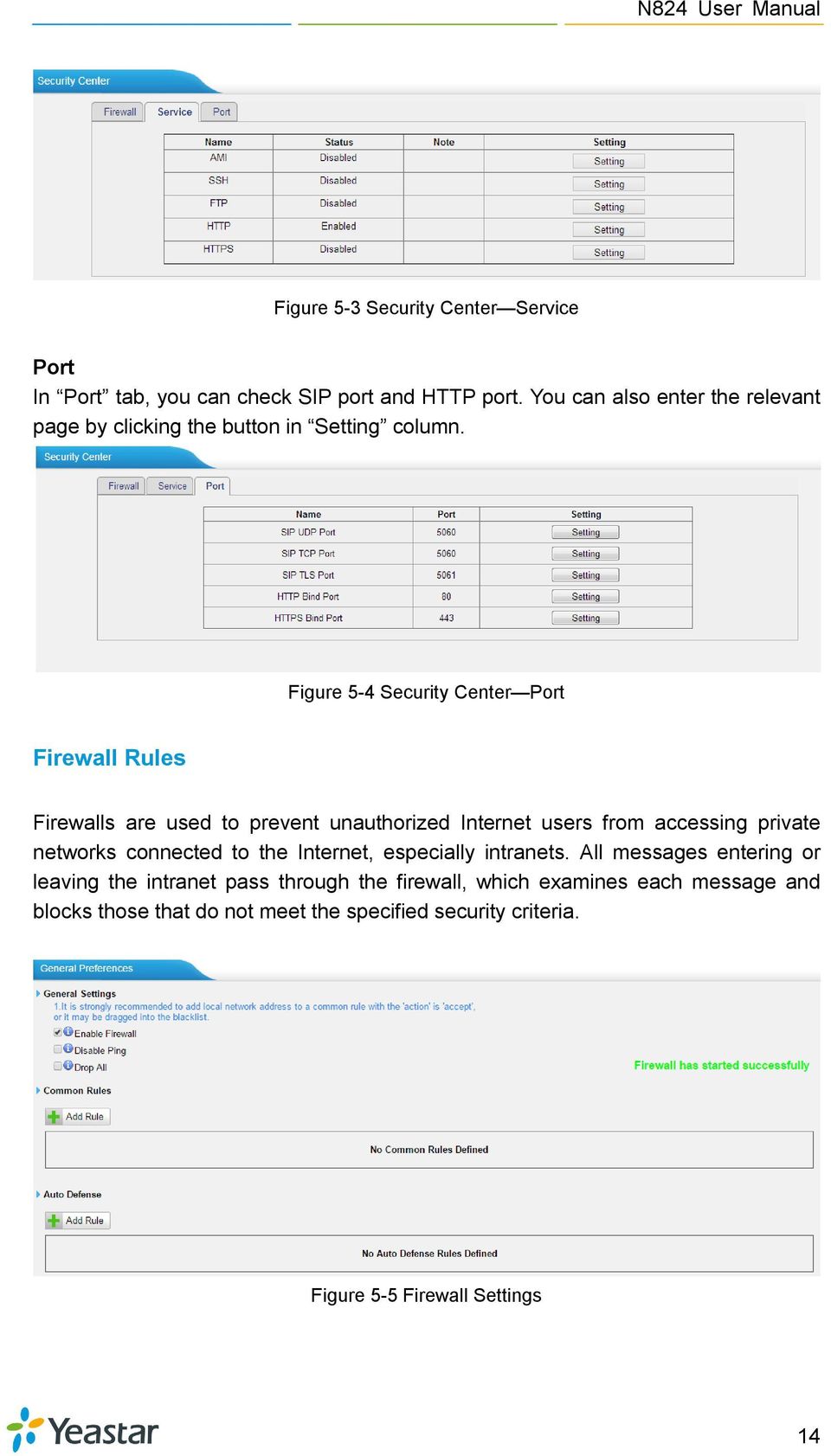
18 Figure 5-3 Security Center Service Port In Port tab, you can check SIP port and HTTP port. You can also enter the relevant page by clicking the button in Setting column. Figure 5-4 Security Center Port Firewall Rules Firewalls are used to prevent unauthorized Internet users from accessing private networks connected to the Internet, especially intranets. All messages entering or leaving the intranet pass through the firewall, which examines each message and blocks those that do not meet the specified security criteria. Figure 5-5 Firewall Settings 14
19 1) General Settings Items Enable Firewall Disable Ping Drop All Table 5-2 Description of Firewall General Settings Description Enable the firewall to protect the device. You should reboot the device to make the firewall run. Enable this item to drop net ping from remote hosts. When you enable Drop All feature, the system will drop all packets or connection from other hosts if there are no other rules defined. To avoid locking the devices, at least one TCP accept common rule must be created for port used for SSH access, port used for HTTP access and port sued for CGI access. 2) Common Rules There is no default rule; you can create one as required. Figure 5-6 Common Rules Items Name Description Protocol Port IP MAC Address Table 5-3 Description of Common Rules Description A name for this rule, e.g. HTTP. Simple description for this rule. E.g. accept the specific host to access the Web interface for configuration. The protocols for this rule. Initial port should be on the left and end port should be on the right. The end port must be equal to or greater than start port. The IP address for this rule. The format of IP address is: IP/mask E.g / for IP E.g / for IP from to The format of MAC Address is XX:XX:XX:XX:XX:XX, X means 0~9 or A~F in hex, the A~F are not case sensitive. 15

20 Action Accept: Accept the access from remote hosts. Drop: Drop the access from remote hosts. Ignore: Ignore the access. Note: the MAC address will be changed when it s a remote device, so it will not be working to filter using MAC for remote devices. IP Blacklist You can set some packets accept speed rules here. When an IP address, which hasn t been accepted in common rules, sends packets faster than the allowed speed, it will be set as a black IP address and be blocked automatically. Figure 5-7 IP Blacklist Settings Page 1) Blacklist rules We can add the rules for IP blacklist rate as demanded. Figure 5-8 Add Blacklist Rule Items Port Protocol IP Packets Time interval Table 5-4 Description of Auto Blacklist Rules Description Auto defense port Auto defense protocol. TCP or UDP. Allowed IP packets number in the specific time interval. The time interval to receive IP packets. For example, IP packets 90, time interval 60 means 90 IP packets are allowed in 60 seconds. 2) IP blacklist 16

21 The blocked IP address will display here, you can edit or delete it as you wish. AMI Settings The Asterisk Manager Interface (AMI) is a system monitoring and management interface provided by Asterisk. It allows live monitoring of events that occur in the system, as well enabling you to request that Asterisk perform some action. The actions that are available are wide-ranging and include things such as returning status information and originating new calls. Many interesting applications have been developed on top of Asterisk that take advantage of the AMI as their primary interface to Asterisk. There are two main types of messages on the Asterisk Manager Interface: manager events and manager actions. The 3 rd party software can work with N824 using AMI interface. It is disabled by default. If necessary, you can enable it. Figure 5-9 AMI Settings Username & password After enabling AMI, you can use this username and password to log in N824 AMI. IP Restriction You can set which IP is allowed to log in N824 AMI interface. Certificates N824 supports TLS SIP extension and VoIP trunk. Before you register TLS extension/trunk to N824, please upload certificates first. 17
22 Figure 5-10 Certificates Trusted Certificate This certificate is a CA certificate. When selecting TLS Verify Client as Yes, you should upload a CA. The relevant IPPBX/SIP phone should also have this certificate. Gateway Certificate This certificate is server certificate. No matter selecting TLS Verify Client as Yes or NO, you should upload this certificate to N824. If IPPBX/SIP phone enables TLS Verify server, you should also upload this certificate on IPPBX/SIP phone. Alert Settings After enabling this feature, phone notification or notification will be sent to users if the system has been attacked via IP or Web. Figure 5-11 Alert Settings IPATTACK When the system is attacked by IP address, the firewall will add the IP to auto IP Blacklist and notify the user if it match the protection rule. WEBLOGIN Web Login Alert Notification: enter the incorrect password consecutively for five times will be considered as an attack, the system will limit the IP login within 10 minutes and notify the user. 1) Phone Notification Settings Items Number Table 5-5 Description of Phone Notification Settings Description The numbers could be set for alert notification; users can setup 18
23 Attempts Interval Prompt multiple extension and outbound phone numbers. Please separate them by ;. Example: 500;9911, if the extension has configured Follow Me Settings, the call would go to the forwarded number directly. The attempts to dial a phone number when there is no answer. The interval between each attempt to dial the phone number. Must be greater than 3 seconds, the default value is 10 seconds. Users will hear the prompt while receiving the phone notification. 2) Notification Settings Please ensure that all voic settings are properly configured on the PBX Basic Settings Voic Settings page before using this feature. Table 5-6 Description of Notification Settings Items Description The recipients for the alert notification, and multiple addresses are allowed, please separate them by ;. Recipient s Name Example:[email protected];[email protected], [email protected]. Subject The subject of the alert . Text content supports predefined variables. Variable names and corresponding instructions are as follows: Content $(HOSTNAME) Host name $(LOCALIP) Local IP address $(SOURCEIP) Attack source IP address $(DATETIME) Occurred $(USERNAME) User name (WEBLOGIN effective) $(DESTMAC) Attacks destination MAC (IPATTACK effective) $(DESTPORT) Attacks destination Port number (IPATTACK effective) $(PROTOCOL) Protocol type (IPATTACK effective) $(INTERFACE) Network interface name (IPATTACK effective) Password Settings It is highly recommended to change the system s password after first login. Go to System System Preferences Password Settings to change the password. 19
24 Figure 5-12 Change Password 1. Enter the old password first. 2. Enter a new password and retype the new password to confirm. The password complexity will be detected, which will help users to set a strong password and make N824 safer. A strong password is comprised of letters, numbers and characters. 3. Save the changes, the user will be automatically logged out. 4. Log in N824 using the new password. Date and Time Please adjust the time of N824 (including the time zone) consistent with your local time. Go to System System Preferences Date and Time to configure the system date and time. Figure 5-13 Configuring Date & Time Time Zone Select your current and correct time zone on N824. Daylight Saving Time The option is disabled by default. Enable it when necessary. Automatically Synchronize with an Internet Time Server N824 will adjust its internal clock to a central network server. Please note then824 should be able to access to the Internet if you choose this method. Set Date & Time Manually Enter the time using the numbers on your keyboard. Note: You have to reboot the system to make the changes take effect. 20
25 Extensions This chapter explains how to create and configure extensions on N824. It supports SIP extensions and FXS extensions, go to PBX Extensions and Trunks Extensions page to configure the extensions. FXS Extensions VoIP Extensions FXS Extensions There are 24 FXS extensions on N824. Users could click extension. to edit each FXS FXS Extension Configuration The extension settings are divided into Account, General Settings, Advanced Settings, Management Settings and Timer Settings. 1) Account On this page, users could fill in the user information, including Name, Telephone number, Job, Wechat ID and address. If an image of the account was uploaded via the Linkus App, you could see the account s image here. Figure 6-1 Account Information Configure Linkus Mobile Client Settings if you want to register this extension to the Linkus App. Figure 6-2 Linkus Mobile Client Settings 21
26 Table 6-1 FXS Extension Linkus Mobile Client Settings Items Enable Calling Capability in Mobile Client Ring Strategy Connecting Route Password for Linkus and Web User Web Interface Description Allow the user to make and receive calls with Links Mobile Client. Please make sure that the corresponding App has been installed on your phone. Set ring strategy between the FXS extension and mobile extension. FXS Extension First Mobile Client Extension First The route is used to connect Linkus and the PBX, so N824 will always use this route to dial Linkus. The password to register mobile extensions and log in the user Web interface. Check this option to allow the user to login to the N824 User Web interface, which can be used to check voic and extension recordings. 2) General Settings Table 6-2 FXS Extension Configuration- General Settings Items Extension Caller ID Voic Mail Settings Hotline Flash Description The numbered extension, which will be associated with this particular User/Phone. The Caller ID will be used when this user calls another internal extension. Enable Voic Enable voic for the user. Voic Access PIN The voic password (digits only) for the user to access the voic box. Enable Send Voic Once enabled, the voic will be sent toaconfigured address. Address address used to receive the voic or Fax. Note: please ensure that the section SMTP Settings For Voic (in the Voic Settings ) has been properly configured before using this feature. Enable Hotline: whether to use hotline. Hotline Number: set a hotline number. Delay Dial: define how long to make Hotline call after you pick up the call. Sets the amount of time, in milliseconds, that must pass since 22
27 Pickup Group Max Call Duration the last hook-flash event received by N824 before it will recognize a second event. If a second event occurs in less time than defined by Hook Flash Detection, then N824 will ignore the event. The default value of Flash is 1000 ms. If this extension belongs to a pickup group, any calls that ring this extension can be picked up by other extensions in the same pickup group by dialing the Call Pickup feature code (the default is *4). Note: *4 is the default setting, it can be changed under Feature Codes General Call Pickup. Setup the max cull duration for every call of this extension, but it s only valid for outbound calls. Enter 0 or leave this blank empty, the value would be equal to the max call duration configured in the Option Settings page. Note: this setting will not be valid for internal calls. 3) Advanced Settings Table 6-3 FXS Extension Configuration- Advanced Settings Items Call Waiting DND Enable Busy Camp-on Ring Out Follow me Volume Settings Description Check this option if the extension should have Call Waiting capability. If this option is checked, the When busy follow me options will not be available. The call waiting function of IP phone has higher priority than N824 s call waiting function. Don t Disturb. When DND is enabled for an extension, the extension will not be available. If a dialled extension or a desired line is busy, with this feature, when the extension or line becomes idle, your telephone will ring automatically, so you can pick up to speak with the extension or seize the line and dial an external number. Check this option if you want to customize the ring time. Ring tone will stop over the time defined. Call forwarding for an extension can be configured here. The administrator can configure Follow Me option for this extension. If you want to transfer the call to an outbound number, please follow the dial pattern of outbound route filled in the outbound number. For example: transferring to your mobile phone number , the dial pattern of outbound route is 9., you should fill in here. Rxgain The Volume sent to FXS extension. Txgain The Volume sent out by the FXS extension. 23
28 Caller ID Type Spy Settings Normally, you choose the default option except for using N824 in Japan, in which case you should choose Japan. There are 4 spy modes available: General spy You have the permission to use the following 3 modes. Normal spy You can only hear the call, but can't talk Whisper spy You can hear the call, and can talk with the monitored extension Barge spy You can hear the call and talk with them both Example: If 500 want to monitor extension 501, we need to enable the allow being spied for 501, and choose the spy mode for extension 500. Then pick up 500 and dial feature codes to start monitoring when 501 is in a call. If 500 choose normal spy, it should dial *90501 to start monitoring. If 500 choose whisper spy, it should dial *91501 to start monitoring. If 500 choose barge spy, it should dial *92501 to start monitoring. If 500 choose general spy, it can dial *90501, *91501 or *92501 to start monitoring. 4) Management Settings Once you enable User Web Interface for the extension, you need to also configure the Management settings to set the access permissions. By default, extension users could check voic , one-touch Recordings, and configure settings of their own extensions when logging in User Web Interface. If the user wants to manage the CDR and Auto Recordings, you have to set the access permissions here. CDR View Permission: the permission to view CDR. Delete Permission: the permission to delete CDR. Download Permission: the permission to download CDR. Allowed Extension for CDR: choose which extensions CDR is allowed to be checked/deleted/downloaded by the user. 24
29 Figure 6-3 CDR Permissions for FXS Extensions Auto Recordings View Permission: the permission to check auto recordings. Delete Permission: the permission to delete recording files. Download Permission: the permission to download auto recording files. Allowed Extension for Recordings: choose which extensions auto recording files are allowed to be checked/deleted/downloaded by the user. Figure 6-4 Auto Recordings Permissions for FXS Extensions 5) Timer Settings Want the phone to wake you? Click Timer Settings Section, set your wake-up time and other options, and give the alarm a name (like Good morning ). 25
30 Figure 6-5 Timer Settings for FXS Extensions Batch Edit FXS Extensions Users could batch edit the selected FXS extensions number, timer settings and other settings. Modify the Number of the Selected Extensions Click to modify the selected extensions. Define the extension number starting from a number. Figure 6-6 Modify Number of the Selected Ports Edit the Selected Extensions Click, you can edit the selected extensions General Settings, Voic , Volume, Hotline, Follow me and Group Settings. Edit the Selected Timers Click to set alarms for the selected extensions. Delete the Selected Extensions Click to delete the selected extensions. 26
31 VoIP Extensions Users could extend VoIP extension by clicking to add on VoIP extension. N824 supports up to 8 VoIP extensions. VoIP Extension Configuration The extension settings are divided into Account, General Settings, Advanced Settings, Management Settings and Timer Settings. 1) Account On this page, users could fill in the user information, including Name, Telephone number, Job, Wechat ID and address. If an image of the account was uploaded via the Linkus App, you could see the account s image here. Figure 6-7 Account Information Configure Linkus Mobile Client Settings if you want to register this extension to the Linkus App. Figure 6-8 SIP Extension Client Settings Table 6-4 SIP Extension Linkus Mobile Client Settings Items Enable Calling Capability in Mobile Client Ring Strategy Description Allow the user to make and receive calls with Linkus Mobile Client. Please make sure that the corresponding APP has been installed on your phone. Set ring strategy between the SIP extension and mobile 27
32 Connecting Route Password for Linkus and Web User Web Interface extension. SIP Extension First Mobile Client Extension First The route is used to connect Linkus and the PBX, so N824 will always use this route to dial Linkus. The password to register mobile extensions and log in the user web interface. Check this option to allow the user to login to the N824 User Web interface, which can be used to check voic and extension recordings. 2) General Items Extension Password Caller ID Enable Voic Voic Access PIN Enable Send Voic Address Pickup Group Max Call Duration NAT Table 6-5 VoIP Extension Configuration- General Description The numbered extension, which will be associated with this particular User/Phone. The password for this extension. The Caller ID will be used when this user calls another internal extension. Enablevoic for the user. The voic password (digits only) for the user to access the voic box. Once enabled, the voic will be sent to a configured address. address used to receive the voic or Fax. Note: please ensure that the section SMTP Settings For Voic (in the Voic Settings ) have been properly configured before using this feature. If this extension belongs to a pickup group, any calls that ring this extension can be picked up by other extensions in the same pickup group by dialing the Call Pickup feature code (the default is *4). Note: *4 is the default setting, it can be changed under Feature Codes General Call Pickup. Setup the max cull duration for every call of this extension, but it s only valid for outbound calls. Enter 0 or leave this blank empty, the value would be equal to the max call duration configured in the Option Settings page. Note: this setting will not be valid for internal calls. This setting should be used when the system is using a public IP address to communicate with devices hidden behind a NAT device (such as a broadband router). If you have one-way audio problems, you usually have problems with your NAT 28
33 configuration or your firewall's support of SIP and/or RTP ports. Qualify Enable SRTP Transport DTMF Mode Remote Register Send check alive packets to IP phones. Enable extension for SRTP (RTP Encryption). This will be the transport method used by the extension. The options are UDP (default) or TCP or TLS. RFC4733, Info, Inband, Auto. Allow to register remote extensions. If you enable Remote Register, the extension password must include uppercase letters, lowercase letters, and digits. 3) Advanced Settings Table 6-6 VoIP Extension Configuration Advanced Settings Items Call Waiting DND Enable Busy Campon Ring Out Follow me IP Restriction Description Check this option if the extension should have Call Waiting capability. If this option is checked, the When busy follow me options will not be available. The call waiting function of IP phone has higher priority than N824 s call waiting function. Don t Disturb. When DND is enabled for an extension, the extension will not be available. If a dialled extension or a desired line is busy, with this feature, when the extension or line becomes idle, your telephone will ring automatically, so you can pick up to speak with the extension or seize the line and dial an external number. Check this option if you want to customize the ring time. Ring tone will stop over the time defined. Call forwarding for an extension can be configured here. The administrator can configure Follow Me option for this extension. If you want to transfer the call to an outbound number, please follow the dial pattern of outbound route filled in the outbound number. For example: transferring to your mobile phone number , the dial pattern of outbound route is 9., you should fill in here. Enable IP Restriction Check this option to enhance the VoIP security for MyPBX. If this option is enabled, only the permitted IP/Subnet mask will be able to register this extension number. In this way, the VoIP security will be enhanced. Permitted IP address/subnet mask The input format should be IP address + / + Subnet mask. E.g." / " means only the 29
34 Spy Settings device whose IP address is is allowed to register this extension number. E.g." / " means only the device whose IP address is XXX is allowed to register this extension number. There are 4 spy modes available: General spy You have the permission to use the following 3 modes. Normal spy You can only hear the call, but can't talk. Whisper spy You can hear the call, and can talk with the monitored extension. Barge spy You can hear the call and talk with them both. Example: If 500 want to monitor extension 501, we need to enable the allow being spied for 501, and choose the spy mode for extension 500. Then pick up 500 and dial feature codes to start monitoring when 501 is in a call. If 500 choose normal spy, it should dial *90501 to start monitoring. If 500 choose whisper spy, it should dial *91501 to start monitoring. If 500 choose barge spy, it should dial *92501 to start monitoring. If 500 choose general spy, it can dial *90501, *91501 or *92501 to start monitoring. 4) Management Settings Once you enable User Web Interface for the extension, you need to also configure the Management settings to set the access permissions. By default, extension users could check voic , one-touch Recordings, and configure settings of their own extensions when logging in User Web Interface. If the user wants to manage the CDR and Auto Recordings, you have to set the access permissions here. CDR View Permission: the permission to check CDR. Delete Permission: the permission to delete CDR. Download Permission: the permission to download CDR. Allowed Extension for CDR: choose which extensions CDR is allowed to be checked/deleted/downloaded by the user. 30
35 Figure 6-9 CDR Permissions Auto Recordings View Permission: the permission to check auto recordings. Delete Permission: the permission to delete recording files. Download Permission: the permission to download auto recording files. Allowed Extension for Recordings: choose which extensions auto recording files are allowed to be checked/deleted/downloaded by the user. Figure 6-10 Auto Recording Permissions 5) Timer Settings Want the phone to wake you? Click Timer Settings Section, set your wake-up time and other options, and give the alarm a name (like Good morning ). 31
36 Figure 6-11 Timer Settings 32
37 Trunks External calls can be made through CO lines or via VoIP trunks on N824. In this chapter, we give a simplified guide to the N824 users in setting up trunks. We describe CO lines configurations and how to configure N824 to work with VoIP Providers. CO Lines VoIP Trunks CO Lines CO lines also known as PSTN trunks. The public switched telephone network (PSTN) is the network of the world's public circuit-switched telephone networks. Go to PBX Extensions and Trunks Trunks CO lines to edit the CO lines. Before configuring a CO line, please make sure that the CO line is connected to N824 CO port. Click to edit the CO line. CO Line Configuration Please check the CO line configuration parameters below. 1) General Settings Table 7-1 CO Line-General Settings General Settings Trunk Name A unique label used to identify this trunk. Volume Setting Set the volume for this trunk. The default is 40%. 2) Hangup Detection Hangup detection settings help the system to detect if a call is hung up. If you find the PSTN call could not be disconnected, these settings need to be configured. Hang up Detection Table 7-2 CO Line-Hangup Detection Hangup Type Busy Detection Choose the Hangup type. Default Busy Tone Polarity Busy Detection is used to detect far end hang-up or for detecting a busy signal. Select Yes to turn this feature on. 33
38 Busy Count Busy Interval Busy Pattern Frequency Detection Busy Frequency Hangup Polarity Detection Silence Timeout If Busy Detection is enabled, it is also possible to specify how many busy tones to wait for before disconnecting the call. The default is 4, but better results can be achieved if set to 6 or even 8. Remember, the higher the number, the more time will be required to release a channel. A higher setting lowers the probability that you will encounter random hang-ups. The busy detection interval. If Busy Detection is enabled, it is also possible to specify the cadence of your busy signal. In many Countries, it is 500msec on, 500msec off. Without Busy Pattern specified, N824 will accept any regular sound-silence pattern that repeats <Busy Count> times as a busy signal. If you specify Busy Pattern, then N824 will further check the length of the tone and silence, which will further reduce the chance of a false positive disconnection. Used for Frequency Detection (Enable detecting the busy signal frequency or not). If the Frequency Detection is enabled, you must specify the local frequency. The call will be considered as hang up on a polarity reversal. Define the ring out value (in seconds) for this trunk. 3) Answer Detection Answer Detection" will help the system to accurately bill your calls. If the CO line could send polarity reversal signal after a call is established, you could choose "Polarity Detection" in this field. If not, you could choose "Ring Detection" and configure the rest of the settings accordingly. Answer Detection Table 7-3 CO Line-Answer Detection Answer Detection Select which type to detect the call as answered. Default: N824 will start to charge once you grab the CO line to call out, whether the call is answered or not. Polarity Detection: if the CO line supports polarity, you can choose "Polarity detection". When the callee answers the call, the provider will send a polarity signal, and then N824 starts to bill. Ring Detection: if you choose this option, N824 will charge the call according to CO line ring back tone detection. When the "ring duration" or the "ring interval duration" detected on N824 is larger than the standard 34
39 Custom Ring Tone Max Ring Duration Max Ring Interval Duration Min Ring Detection Min Ring Duration Min Ring Interval Duration parameters or custom parameters, the call is detected as ANSWERED. *Standard parameters: when you configure the "Tone Zone Settings" under PBX Basic Settings General Preferences you can get the country's standard tone parameters. Enable or disable Custom Ring Tone. If the custom ring tone is enabled, you need to configure the following settings according to the ringback signal. Max duration of the ring tone. Max pause between the two ring tones. Enable Min Ring Detection, which is useful for complex situations, like when jitter or noise occurs on the PSTN line. Generally it is disabled. Min duration of the received tone. Min pause between the two received tones. 4) Caller ID Settings Caller ID Settings will help the system to detect Caller ID. If an incoming PSTN call does not display Caller ID, you need to confirm with your service provider if the line has enabled Caller ID feature. If this line does support Caller ID, configure these settings to solve this problem. Caller ID Settings Table 7-4 CO Line-Caller ID Settings Caller ID Detection Caller ID Start Caller ID Signaling Enable/Disable the Caller ID detection. This option allows you to define the start of a Caller ID signal. Ring: start when a ring is received (Caller ID Signaling: Bell_USA, DTMF). Polarity: start when a polarity reversal is started (Caller ID Signaling: V23_UK, V23_JP, DTMF). Before Ring: start before a ring is received (Caller ID Signaling: DTMF). This option defines the type of Caller ID signaling to use. It can be set to one of the following: Bell: bell202 as used in the United States v23_uk: suitable in the UK v23_japan: suitable in Japan v23-japan pure: suitable in Japan DTMF: suitable in Denmark, Sweden, and Holland 35
40 5) DNIS Settings DNIS (Dialed Number Identification Service) is a telephone service that identifies for the receiver of a call the number that the caller dialed. DNIS Settings Table 7-5 CO Line-DNIS Settings Enable DNIS DNIS Name Tick to enable DNIS for this trunk. Define the DINS name. 6) Other Settings Table 7-6 CO Line-Other Settings Other Settings Ring Detect Timeout FXO (FXS signalled) devices must have a timeout to determine if there was a hangup before the line was answered. Rang from 1000 to Default:
41 VoIP Trunks N824 supports up to 4 VoIP trunks, which helps you to expand VoIP service on the device. Go to PBX Extensions and Trunks VoIP Trunks to edit the VoIP trunks. Click to add one VoIP trunk. Click to delete the selected VoIP trunks. Click to edit the VoIP trunk. Click to delete the VoIP trunk. VoIP Trunk Configuration Please check the VoIP trunk configuration parameters below. 1) General Settings General Settings Enable/Disable Provider Name Hostname/IP Domain User Name Authorization Name Password From User Online Number Maximum Channels Table 7-7 VoIP Trunk-General Settings Enable or Disable this VoIP trunk. A unique label to help you identify this trunk. Service provider s hostname or IP address. Default port: 5060.Don t change this part if it is not required. VoIP provider s server domain name. If no domain name for the provider. Fill in the IP address instead. The user name to register to the trunk from the VoIP provider. Used for SIP authentication. The password to register to the trunk from the VoIP provider. All outgoing calls from this SIP Trunk will use the From User (In this case the account name for SIP Registration) in From Header of the SIP Invite package. Keep this field blank if not needed. Define the online number that expected by Skype Connect and some other SIP service providers. Leave this field blank if not needed. Control the maximum number of outbound channels (simultaneous calls) that can be used on this trunk. Inbound calls are not counted against the maximum. Set as 0 to specify no maximum. 37
42 Caller ID Realm Authenticating Incoming Enable Outbound Proxy Server Codecs Transport Enable SRTP Qualify DTMF Mode Specify the caller ID to use when making outbound calls over this trunk. The caller ID set in the Extension page will override the caller ID set in the VOIP trunk page. Please note that not all the service providers support this feature. Contact your service provider for more information. Realm is a string to be displayed to users so they know which username and password to use. Yes: when an incoming call reaches N824 and sends INVITE packet to N824, N824 responds 401, but the Realm info in 401 Response does not match the Realm set on VoIP trunk, the provider will refuse to authenticate. No: N824 will not reply a 401 Response to the provider to authenticate the incoming call. A proxy that receives requests from a client. Even though it may not be the server resolved by the Request-URI. Define the codec for this sip trunk and its priority This will be the transport method used by the SIP Trunk. This method is given by the SIP trunk provider. The options are UDP (default) or TCP or TLS. Define if SRTP is enabled for this trunk. Send check alive packets to the sip provider. Set default mode for sending DTMF of this trunk. Default setting: rfc ) DNIS Settings DNIS Settings Enable DNIS DNIS Name DID Number Table 7-8 VoIP Trunk-DNIS Settings Tick to enable DNIS for this trunk. Define the DINS name. Set the DID Number for this trunk. 3) DOD Settings DOD (Direct Outward Dialing) means the caller ID displayed when dialing out. Before configuring this, please make sure the provider supports this feature. Associated Extension The extension making call out via SIP Trunk will display the associated DOD. Add DOD Add DOD for one associated extension. Add Bulk DOD 38
43 Figure 7-1 VoIP Trunk DOD Settings Add bulk DOD for bulk extensions in ascending sequence with the Begin DOD you fill in. For example, if the Associated Extensions are 100, 101, 102, 103, 104, 105 with Begin DOD as , the corresponding DOD will be , , , , , and
44 Call Control This chapter shows you how to control outbound calls and incoming calls with outbound routes and inbound routes. Outgoing Rules Incoming Rules PIN Settings Blacklist Outgoing Rules Outbound Route An outbound route works like a traffic cop giving directions to road users to use a predefined route to reach a predefined destination. Outbound routes are used to specify what numbers are allowed to go out a particular route. When a call is placed, the actual number dialed by the user is compared with the dial patterns in each route (from highest to lowest priority) until a match is found. If no match is found, the call fails. If the number dialed matches a pattern in more than one route, only the rules with the highest priority in the route are used. Note: N824 compares the number with the pattern that you have defined in your route 1. If matches, it will initiate the call using the selected trunks. If it does not, it will compare the number with the pattern you have defined with route 2 and so on. The outbound route which is in a higher position will be matched firstly. Adjust the outbound route sequence by clicking these buttons. Go to PBX Outbound Call Control Outgoing Rules to edit outbound routes. Please check the outbound route configuration parameters below. 1) General Settings Table 8-1 Outbound Route-General Settings Options Route Name Password Description Used to identify the route. The name is usually descriptive, i.e. "local" or "international". OPTIONAL. Select a PIN list from PIN Settings to set password for the outbound route. A route can prompt users for a password 40
45 T.38 Support Rrmemory Hunt Office Hours before allowing calls to process. Leave this field blank if you don't want to restrict this outbound route. Enable or disable T.38 FAX on this outbound route. Only for SIP Trunk. Round Robin with memory. If it is enabled, N824 will remember which trunk was used last time, and then use the next available trunk to call out. This is an option to limit when the outbound route is available to use. Usually we can select an office hours that is same as your working hours, and the outbound route would be unavailable after work. 2) Dial Patterns A dial pattern is a unique set of digits that will select this route and send the call to the designated trunks. Multiple Dial Patterns can be added on one outbound route by clicking button. Table 8-2 Outbound Route-Dial Patterns Patterns X Refers to any digit between 0 and 9 Z Refers to any digit between 1 and 9 N Refers to any digit between 2 and 9 Refers to any digit in the brackets, example [123] is 1 or 2 or 3. Note that multiple numbers can be separated by commas and [###] ranges of numbers can be specified with a dash ([ ]) would match the numbers 1, 3, 6, 7 and 8.. (dot) Wildcard. Match any number of anything. Used to initiate call processing as soon as it can be determined! that no other matches are possible. Strip Allow the users to specify the number of digits that will be stripped from the front of the phone number before the call is placed. For example, if users must press 0 before dialing a phone number, one digit should be stripped from the dial string before the call is placed. Prepend Digits to prepend to a successful match. If the dialed number matches the patterns, then this will be prepended before sending to the trunks. For example if a trunk requires 10-digit dialing, but users are more comfortable with 7-digit dialing, this field could be used to prepend a 3-digit area code to all 7-digit phone numbers before the calls are placed. When using analog trunks, a w character may also be prepended to provide a slight delay before dialing. 41
46 3) Member Extensions Move the extensions could call through this outbound route to "Selected" Box. Figure 8-1 Outbound Route-Member Extensions 4) Member Trunks Move the trunks that would be used on this outbound route to "Selected" Box. Figure 8-2 Outbound Route-Member Trunks Seize a Line On a traditional PBX, users have to seize a CO Line before dialing outside number. To adapt to these users habits, we retain this feature. Users could seize an available CO Line by dialing a pre-configured number (default: 9), then get a dial tone and dial the external number to call out. Figure 8-3 Seize a Line 42
47 Incoming Rules When a call comes into N824 from the outside, N824 needs to know where to direct it. It can be directed to an extension, a ring group, a queue or a digital Receptionist (IVR) etc. Go to PBX Inbound Call Control Incoming Rules to edit incoming rules. Please check the inbound route configuration parameters below. 1) General Settings Table 8-3 Inbound Route-General Settings Options Route Name DID Number Caller ID Number Description Used to identify the route. Routing calls based on the trunk on which the call is coming in. In the DID field, you will define the expected DID Number if your trunk passes DID on incoming calls. Leave this blank to match calls with any or no DID info. The DID number entered must match the format of the provider sending the DID. You can also use a pattern match to match a range of numbers. Routing calls based on the caller ID number of the person that is calling. Define the caller ID number to be matched on incoming calls. Leave this field blank to match any or no CID info. 2) Trunk Members Select which trunks will be member trunks for this route. To make a trunk a member of this route, please move it to the Selected box. Figure 8-4 Inbound Route-Member Trunks 3) Business Days Define where the calls will be routed during Business Days. 43
48 Figure 8-5 Inbound Route-Business Days Office Hours Select one defined business days office hours. Office Hours Destination Configure where to route the incoming calls during office hours. Non-office Hours Destination Configure where to route the incoming calls during non-office hours. Table 8-4 Inbound Route-Business Days Destination End Call Extension Voic IVR Ring Group Conference Room DISA Queues Faxes Description Route the incoming calls to end calls, the system will auto hang up the call. Route the incoming calls to a specific extension. Route the incoming calls to an extension s voic . Route the incoming calls to a specific IVR. Route the incoming calls to a specific Ring Group. Used to initiate call processing as soon as it can be determined that no other matches are possible. Route the incoming calls to a specific DISA. Route the incoming calls to a specific Queue. Route the incoming faxes to a specific extension s mail address. Note: this function only supports T.38 faxes. 4) During Holidays Define where the calls will be routed during Holidays. Figure 8-6 Inbound Route-During Holidays Holiday Select which defined Holiday to use. When a time is defined in both Business Days and Holidays, it will be treated as Holidays. Destination 44
49 Configure where to route the incoming calls during holidays. 5) Fax Detection Enable or disable the "Fax Detection" functionality on this route. Figure 8-7 Inbound Route-Fax Detection No Detect No attempts are made to auto-determine the call type. All calls are sent to the defined destination. Custom Customize an address to receive the faxes. You should first configure the Voic Settings->SMTP Settings for Voic correctly before you use this option. Faxes Send faxes to an extension. If choosing a FXS extension here, the fax will be sent to the FXS port selected, you should connect a fax machine to this FXS port. If choosing a VoIP extension, the fax will be sent to the extension s voic as an attachment. Note: If you want to receive faxes with custom address, the SMTP Settings should be configured successfully in advance. If you want to receive faxes with address configured in VoIP extension voic , you should first make sure the tested to your address works fine. PIN Settings Go to PBX Advanced Settings PIN Settings to create a PIN list. The PIN lists can be selected to access restricted features. The PIN can also be added to the CDR record s Account Code field. PIN list can be applied to Outbound Route. Figure 8-8 PIN Settings 45
50 Blacklist Blacklist is used to block an incoming/outgoing call. If the number of incoming/outgoing call is registered in the number blacklist, the caller will hear the following prompt: The number you have dialed is not in service. Please check the number and try again. The system will then disconnect the call. Go to PBX Advanced Settings Blacklist to add numbers to the blacklist. You can choose to block the number for inbound, outbound or both. If the type is inbound, then this number can t be called. If the type is outbound, then the extensions in N824 can t call this number. Figure 8-9 Number Blacklist 46
51 IVR Like most organizations, where possible, we would like to route incoming calls an Auto Attendant. You can create one or more IVR (Auto Attendant) on N824 to achieve it. When calls are routed to an IVR, N824 will play a recording prompting them what options the callers can enter such as Welcome to XX, press 1 for Sales and press 2 for Technical Support. Configure IVR Go to PBX Inbound Call Control IVR to configure IVR. Click to add a new IVR. Click to delete the selected IVR. Click to edit one IVR. Click to delete one IVR. Please check the IVR configuration parameters below. Table 9-1 IVR Configuration Parameters-General Settings General Settings Number Name Prompt Repeat Count Key Timeout Enable Direct Dial N824 treats IVR as an extension; you can dial this extension number to reach the IVR from internal extensions. Set a name for the IVR. Choose which recording to be played to the caller when they reach the IVR. You can choose the default prompt on N824 or choose a Custom Prompt which is uploaded or created on N824. The number of times that the selected IVR prompt will be played. How long (in seconds) we wait for the caller to enter an option on their phone keypad before we consider it timed out and it follows the Timeout Destination as defined below. Tick this option to enable Direct Dial. If Direct Dial is enabled, the callers can enter a user's extension number when entering the IVR to go direct to the users. 47
52 Key Press Events Key Press Event # * Timeout Invalid Select the destination for each key pressing: digits 0-9, #, *, Timeout and Invalid. When the callers press the corresponding key, the call will be routed to: Extension Voic Ring Group IVR Conference Room DISA Queues Faxes Dial by Name Hangup 48
53 Ring Group A ring group helps you to ring a group of extensions in a variety of ring strategies. For example, you could define all the technical support guys' extensions in a ring group and ring the support guys one by one. Configure Ring Group Go to PBX Inbound Call Control Ring Group to configure ring group. Click to add a new Ring Group. Click to delete the selected ring groups. Click to edit one Ring Group. Click to delete one Ring Group. Please check the Ring Group configuration parameters below. 1) General Settings Table 10-1 Ring Group Configuration Parameters-General Settings General Settings Ring Group Name Ring Group Number Strategy Seconds to ring each member Used to identify the ring group. This option defines the numbered extension that can be dialed to reach this group. Select an appropriate ring strategy for this ring group. Ring All Simultaneously: ring all the available extensions simultaneously. Ring Sequentially: ring each extension in the group one at a time. Specify how long (in second) to ring each extension or all the extensions. If the strategy is Ring All Simultaneously, it means the number of seconds to ring this group before routing the call according to the Destination if No Answer settings. If the strategy is Ring Sequentially, it means the number of seconds to ring a single extension before moving on to the next one. 49
54 2) Ring Group Member Specify the extensions to be part of this ring group. Move the desired ring group members to the "Selected" Box. Figure 10-1 Ring Group Member 3) Destination if No Answer When all members on this group fail to answer the call, system will handle the call according to the selected destination. Figure 10-2 Destination if No Answer 50
55 Queue Queues are designed to receiving calls in a call center. A queue is like a virtual waiting room, in which callers wait in line to talk with the available agent. Once the caller called in N824 and reached the queue, he/she will hear hold music and prompts, while the queue sends out the call to the logged-in and available agents. A number of configuration options on the queue help you to control how the incoming calls are routed to the agents and what callers hear and do while waiting in the line. Configure a Queue Go to PBX Inbound Call Control Queues to configure queues. Click to add a new Queue. Click to delete the selected queues. Click to edit one queue. Click to delete one queue. Please check the Queue configuration parameters below. 1) General Settings Table 11-1 Queue Configuration Parameters-General Settings General Settings Name A name for the Queue. The name is used for identification purpose throughout the user interface. Number Use this number to dial into the queue, or transfer callers to this number to put them into the queue. Queue Password You can require agents to enter a password before they can login to this queue. Queue Agent Timeout The number of seconds an agent's phone can ring before we consider it a timeout. Queue Max Wait Time The maximum number of seconds a caller can wait in a queue before being pulled out. (0 for unlimited). Multiple strategies are available for the queue. RingAll: ring all available agents simultaneously until one Queue Ring answers. Strategy LeastRecent: ring the agent which was least recently called. FewestCalls: ring the agent with the fewest completed 51
56 calls. Randoml: ring a random Agent. RRmemory: Round Robin with Memory, remembers where it left off in the last ring pass. 2) Agents This selection shows all users. Selecting a user here makes them a dynamic agent of the current queue. The dynamic agent is allowed to log in and log out the queue at any time. The agents dial "Queue number" + "*" to log in or "Queue number" + "**" to log out the queue. For example, if the queue number is "681", then the dynamic agent can dial "681*" to log in or "681**" to log out. Figure 11-1 Agents 3) Caller Position Announcement Figure 11-2 Caller Position Announcement Table 11-2 Caller Position Announcement Caller Position Announcement Announce Position Announce Hold Time Frequency Whether to announce position of call in the queue or not. Enabling this option causes N824 to announce the hold time to the caller periodically based on the frequency timer. The hold time will not be announced if the time is less than 1 minute no matter this option is set to yes or no. How often to announce the queue position and estimated hold time. 4) Periodic Announcements The periodic announcement is played periodically when the caller is waiting on the 52
57 line. Figure 11-3 Periodic Announcements 5) Events Once the events settings are configured, the callers are able to press the key to enter the destination you set. Usually, a prompt should be set on Periodic Announcements to guide the callers to press the key. Figure 11-4 Events 6) Failover Destination Define the failover action. A failover occurs after the user reach the Queue max wait time. 7) Others Figure 11-5 Failover Destination Figure 11-6 Queue Others Settings Table 11-5 Queue Others Settings Others Music on Hold Leave When Empty Select the "Music on Hold" Prompt for this queue. This option controls whether callers already on hold are forced out of the queue that has no agents. 53
58 Join Empty Ring in Use Agent Announcement Join Announcement Retry Wrap-up Time Yes: callers are forced out of a queue when no agents are logged in. No: callers will remain in the queue without any agent. This option controls whether callers can join a call queue that has no agents. Yes: callers can join a call queue with no agents or only unavailable agents No: callers cannot join a queue with no agents The default setting is "No". If set to "No", the queue will avoid sending calls to members whose devices are known to be "in use". Announcement played to the agent prior to bringing in the caller. Announcement played to callers once prior to joining the queue. The amount of seconds the queue waits after calling all available agents before calling them again. The amount of seconds the queue waits for passing another queue call to an agent who has completed a call (0 for no delay). 54
59 Conference Conference Calls increase employee efficiency and productivity, and provide a more cost-effective way to hold meetings. Conference agents can dial * to access to the settings options and the admin can kick the last user out and can lock the conference room. Configure a Conference Room Join a Conference Room Manage the Conference Configure a Conference Room Go to PBX Inbound Call Control Conferences to configure conferences. Click to add a new Conference Room. Click to delete the selected conference rooms. Click to edit one Conference Room. Click to delete one Conference Room. Please check the Conference configuration parameters below. Table 12-1 Conference Configuration Parameters Options Extension Admin PIN# Description Use this number to dial into the conference room. Admin can kick a user out and can lock the conference room. You can require callers to enter a password before they can enter this conference. This setting is optional. Join a Conference Room Users on N824 could dial the conference extension to join the conference room. If a password is set for the conference, users would be prompted to enter a PIN. How to join a N824 conference room, if I am calling from outside (i.e. calling from my mobile phone)? In this case, an inbound route for conferences should be set on N824. A trunk should 55
60 be selected in the inbound route and destination should be set to a conference room. When the outside users dial in the trunk number, the call will be routed to the conference room. Manage the Conference During the conference call, the users could manage the conference by pressing * key on their phones to access IVR menu for conference room. Please check the options for conference IVR below. Table 12-2 Conference IVR Menu Conference Administrator IVR Menu 1 Mute/ un-mute yourself. 2 Lock /unlock the conference. 3 Eject the last user. 4 Decrease the conference volume. 5 Extend the conference. 6 Increase the conference volume. 7 Decrease your volume. 8 Exit the IVR menu. 9 Increase your volume. Conference Users IVR Menu 1 Mute/ un-mute yourself. 4 Decrease the conference volume. 6 Increase the conference volume. 7 Decrease your volume. 8 Exit the IVR menu. 9 Increase your volume. 56
61 Managing Voice on N824 In this chapter, we introduce how to manage voice on N824, including the following sections: System Prompt Custom Prompt Music on Hold System Prompt N824 ships with a US English prompt set by default. The system supports multiple languages. Users could update the system prompt in different ways. Go to PBX Audio Settings System Prompts Settings to update the system prompt. HTTP/Auto Mode (Recommended) Please make sure your N824 can access the internet before you update system prompt with this method. Users could choose the desired prompts and click download to update directly without reboot. Figure 13-1 Update System Prompts- Auto Detection Another way is choose Download Mode as "HTTP" and fill in the URL to download system prompt and update it. Figure 13-2 Update System Prompts- HTTP Download 57
62 Download link of system prompt is as below: America Arabic Australia British Chinese Danish Deutschland Dutch Finnish French French Canada Greek Hungarian Italian Korean Norwegian Persian Polish Portuguese Portuguese Brazil Russian Spanish Spanish Latin Spanish Mexico Swedish Thai Turkish TFTP Method If N824 cannot access the internet, please update the system prompts via TFTP. Step1. Download the system prompt to your local PC. Step2. Enable TFTP Server (For example, tftpd on Windows) 1) Install tftpd32 software on computer. 58
63 Download link: 2) Configure tftpd32 For the option Current Directory, click Browse button, choose the system prompt file of N824, such as D:\fr.tar.gz. Figure 13-3 Configure Tftpd32 Step3. Update via TFTP 1) TFTP Server: fill in IP address of tftpd32 server, such as ) File Name: Enter the name of voice prompt tar file name, such as "fr.tar.gz". 3) 3) Click to download the system prompt and update. Figure 13-4 Update System Prompts- TFTP Download Custom Prompt The default voice prompts and announcements in N824 are suitable for almost every situation. However, you may want to use your own voice prompt to make it more meaningful and suitable for your case. In this case, you need to upload a custom 59
64 prompt to N824 and apply it to the place you want to change. Upload a custom prompt via PBX Audio Settings Custom Prompts. 1) Click the button. 2) Click to choose the desired prompt. Figure 13-5 Upload Custom Prompt 3) Click to upload the selected prompt. Note: The file size must not be larger than 8 MB, and the file must be WAV format: GSM khz, Mono, 1 Kb/s Alaw/Ulaw 8 khz, Mono, 1 Kb/s PCM 8 khz, Mono, 16 Kb/s Music on Hold Music on hold (MOH) is the business practice of playing recorded music to fill the silence that would be heard by callers who have been placed on hold. There are 3 default MOH files built in N824, you can also upload the one you want to N824. Upload a Music on Hold Prompt Upload a custom prompt via PBX Audio Settings Music on Hold Prompts. 1) Click the button. 2) Click to choose the desired prompt. 60
65 Figure 13-6 Upload Music on Hold File 3) Click to upload the selected prompt. Note: The file size must not be larger than 8 MB, and the file must be WAV format: GSM khz, Mono, 1 Kb/s Alaw/Ulaw 8 khz, Mono, 1 Kb/s PCM 8 khz, Mono, 16 Kb/s Play a Music on Hold Prompt Choose a Music on Hold file via PBX Audio Settings Music on Hold Prompts and click to play the prompt. Choose one extension to play the prompt. Once clicked the button listen to the music., the selected extension will ring. Pick up the phone and Figure 13-7 Play a Music on Hold Prompt 61
66 Voic In this chapter, we introduce how to manage voic system on N824, including the following sections: Voic Settings Voic to How to Check Voic ? How to Change Voic Greetings? Voic Settings Users could configure voic settings, including general voic settings and SMTP settings (which is used for Voic to ) via PBX Basic Settings Voic Settings. 1) General Settings Figure 14-1 Voic - General Settings General Voic Settings Set the maximum number of messages that can be Max Message per Folder stored in a single voic box. Set the maximum length of a single voic Max Message Time message. Set the minimum length of a single voic Min Message Time message. Messages below this threshold will be automatically deleted. If this option is set, the caller will be prompted to press Ask Caller to Dial 5 5 before leaving a message. After notification, the voic is deleted from the Delete Voic server. If this option is set, the caller can jump out of the Operator Breakout from voic and go to the destination you set by dialing Voic 0. Destination The caller will go to the destination by dialing 0. 2) SMTP Settings Please ensure the SMTP settings are configured correctly to make Voic to work properly. After finishing the configuration, you can click on the button to check whether the setup is OK. If the test is successful, you can use the safely. 62
67 If the test failed, please check if the above information is input correctly or if the network is OK. Figure 14-1 Voic -SMTP Settings Address The Address that N824 will use to send voic . Password The password for the address used above. SMTP Server The IP address or hostname of an SMTP server that the N824 will connect in order to send voic messages via . Port SMTP Port: the default value is 25. Use SSL/TLS to send secure message to server If the sending server needs to authenticate the sender, you need to select the check box. Note: SSL/TLS must be selected if you use Gmail or Exchange Server. Voic to Voic is enabled for each extension on N824 by default. If there is no answer for an extension, the call will be forwarded to the extension's voic . notification of voic s are supported on N824, simply enable this feature on the desired extension edit page. Enter your address in the Address field, the received voic s will be sent to your . 63
68 Figure 14-2 Enable Voic to Note: Please ensure that the section of "SMTP Settings for Voic " (in the "Voic Settings") has been properly configured before using this feature. How to Check Voic ? There are multiple ways to check voic on N824. You can check the voic by pressing voic feature code on your phone or log in N824 by Extension account to check voic s. In addition, you can check voic via if Voic to is enabled. 1) Check Voic by Phones The default feature code to check a specific extension's voic is *2. Dial *2 on your phone, and enter the voic PIN code to access your voic . The default voic PIN number is the same as your extension number. The password can be changed on the extension edit page. You can also check other extension's voic on your own handset by using feature code *02. Dial *02 on your phone to enter the voic main menu. Entering the desired extension number and followed by the extension's voic PIN, you will be able to check the extension's voic . 2) Check Voic on Web Another way to check voic is logging in N824 by Extension User Account. Before logging in N824 Web using the extension User account, you should 64
69 enable User Web Interface for the extension. Figure 14-3 Enable User Interface User Name: Extension Number Password: Web Password for the extension Figure 14-4 Login N824 via Extension Account After login, you can check voic on "Voic " page. 3) Check Voic via If you have enabled "Voic to " feature, you can check voic on your . 65
70 How to Change Voic Greetings? The default Voic greeting on N82 is fine but it is rather bland and quite boring. You can customize your own voic greetings. 1. Dial *2 to enter voic on your handset. 2. Enter the access password. 3. Press 0 for Mailbox Options. You will then be given the choice what type of message you want to record. 4. Press 1 to record your Unavailable Message. 5. Press 2 to record your Busy Message. 6. Press 3 to record your name. 7. Press 4 to record your Temporary Message. 8. Choose the message that you want to record, press # to finish the record. 9. Press 1 to accept your message. 10. Press 2 to listen to your message. 11. Press 3 to re-record your message if you don't like the previous message. 66
71 Business Calling Features This chapter shows various call features on N824: Feature Code Call Transfer Call Pickup Intercom Spy Call Parking Speed Dialing Feature Code Feature Codes are used to enable and disable certain features available in N824. N824 local users can dial feature codes on their phones to use a particular feature. The default feature codes can be checked and changed on PBX Basic Settings Feature Codes page. 1) General General Table15-1 Feature Code-General Default Code: *1. One Touch Record A user may initiate or stop call recording by dialing the code during a call. Check Extension Default Code: *2. Voic Users could check their own voic s by this code. Default Code: #. Users can leave a voic to other extensions by dialing # on their phone or the incoming call could be forwarded to an Voic for Extension extension s voic directly. (# is the default setting). For example, extension 500 want to leave a message for extension 501, users can use 500 dial #501 to enter the voic of 501. Voic Main Menu Default Code: *02. Default Code: *3. Attended Transfer Attended Transfer Timeout: The timeout value of transferring a call. Blind Transfer Default Code: *03. Call Pickup Default Code: *4. 67
72 Default Code: *04. Extension Pickup Users may pick up a specific extension s incoming call by dialing *04+extension number on their phone. Intercom Default Code: *5. Default Code: *90. Normal Spy In this mode, you can only listen to the extension being spied. Default Code: *91. Whisper Spy In this mode you can listen/whisper to the extension being spied. Default Code: *92. Barge Spy In this mode, you can barge in both extensions involved in the call. Default: 4000ms. Input Digit Timeout The timeout to input the next digit. 2) Call Parking Preferences Table 15-2 Call Parking Preferences Call Parking Preferences Call Parking Default Code: *6. Extension range used to park calls Number of seconds a call can be parked for Default: User may park an incoming call on a designated extension at first and then pick up the call again on any other extensions. Default: 60s. Define the time (in seconds) that a call can be parked before it is recalled to the station that parked it. 3) Call Forwarding Preferences Table 15-3Call Forwarding Preferences Call Forwarding Preferences Default Code: *70. The call forwarding settings will be configured as follows: Reset to Defaults Always forward: Disabled Busy forward to Voic Enabled No answer forward to Voic Enabled Do not disturb: Disabled Enable Forward All Calls Default Code: *71. Disable Forward All Calls Default Code: *071. Enable Forward When Busy Default Code: *72. Disable Forward When Busy Default Code: *
73 Enable Forward No Answer Default Code: *73. Disable Forward No Answer Default Code: *073. Forward to Number Default Code: *74. Forward to Voic Default Code: *074. Enable Do Not Disturb Default Code: *75. Disable Do Not Disturb Default Code: *075. Call Transfer There are 2 types of call transfers available on N824: Blind Transfer and Attended Transfer. Users can achieve call transfer by pressing the feature code during the call. Blind Transfer Default feature code: *03 1. Dial "*03" during the call; 2. Dial the called number after hearing a prompt "transfer"; 3. The call will be transferred after the number is dialed. Attended Transfer Default feature code: *3 1. Dial "*3" during the call; 2. Dial the called number after hearing a prompt "transfer"; 3. Talk to the transfer recipient; 4. The call will be transferred after hanging up. On PBX Basic Settings General Preferences page, you can set the Attended Transfer Caller ID. The default display is the Caller ID of the initiator. For example, if extension 500 makes a call to extension 501. After 501 picks up the call, user501 makes an attended transfer to extension 502. If selecting Transferer, 502 will display the Caller ID as 500; if selecting Transferee, 502 will display the Caller ID as 501. Call Pickup Call Pickup is a feature that allows one to answer someone else's call. The feature is accessed by pressing call pickup feature code on N824. If a colleague's phone set is ringing, one can answer that call by picking up one's own set and then using the call 69
74 pick-up feature, instead of walking to the colleague s desk. Group Call Pickup The default call pickup for Group Call Pickup is *4. It allows you to pick up a call from a ringing phone which is in the same group as you. Pickup group can be set on extension edit page. Extensions that are in the same group can pick up each other's call by feature code *4. Figure 15-1 Group Extensions Direct Call Pick The default Direct Call Pickup (Extension Pick up) feature code is *04. It allows you to pick up a call that is made to a specific extension. If you know whose phone is ringing and what is the extension number is, you can pick up the call by pressing *04+ extension number. 70
75 For example, if a call reaches the Sales Department Manager's phone (extension number 888), but he is in a meeting, you can pick up the call by pressing *04888 on your own phone to answer the call. Intercom Intercom is a feature that allows you to make an announcement to one extension via a phone speaker. The called party does not need to pick up the handset. It can be achieved by pressing the feature code on your phone and it is a two-way audio call. The default Intercom feature code is *5. To make an announcement to a specific extension, you need to dial *5+ extension number on your phone. For example, make an announcement to extension 500, you need to dial *5500, then the extension 500 will be automatically picked up. Spy N824 allows extension to monitor/barge in other conversation. Once this feature is enabled, the extension has the ability to monitor/barge in other calls using the feature codes for each spy mode. Spy Modes General spy: you have the permission to use the following 3 modes. Normal spy: you can only hear the call, but can't talk. Feature code: *90. Whisper spy: you can hear the call, and can talk with the monitored extension. Feature code: *91. Barge spy: you can hear the call and talk with them both. Feature code: *92. Steps to Use Spy Feature Example: Use Extension 100 to monitor the calls of Extension Enable "Allow Being Spied" in extension 101. In this case, extension 101 is allowed to be spied by other extensions. 2. Choose the "Spy Modes" for extension 100. In this case, extension 100 has the right to use the feature code to monitor extension If 100 choose normal spy, it should dial *90301 to start monitoring; If 100 choose whisper spy, it should dial *91301 to start monitoring; If 100 choose barge spy, it should dial *92301 to start monitor; If 100 choose general spy, it can dial *90301, *91301 or *92301 to start monitor. 71
76 Call Parking Call Parking is a feature that allows the user to put a call on hold at one phone and continue the conversation from any other phone. Call parking is activated by feature code. For example, extension 8010 is in a call, but the person needs to go to another place to find the answer for a question. He can dial Call Parking feature code on the phone, and system will prompt that the call is parked at an extension, i.e. 690.Then this person can hang up the call and leave. When he finds the information, he can pick up any phone nearby and dial 690 to resume the conversation. Uses of Call Parking Call parking is often useful in buildings with many offices or with more than one floor, and with most of the areas having access to one or more telephone sets. If the desired called party is not the person who picked up the call, and the desired called party is at an unknown location, the person who picked up the call may park the call and then use the public address system to page the desired called party to pick up the call. During a conversation, a person may need to go to another office for some reason (for example, to retrieve an important file); parking the call allows this person to continue the conversation after arriving at the other office. Speed Dialing Sometimes you may just need to call someone quickly without having to look up his/her phone number. You can by simply define a shortcut number. Speed Dial feature is available on N824 that allowing you to place a call by pressing a reduced number of keys. Add a Speed Dial 1. Go to PBX Outbound Call Control Speed DialSettings, you can see the default Speed Dial Prefix is *99. Please avoid conflict with other feature codes if you want to change the prefix. 2. Click to add one Speed Dial. 3. Fill in the Source Number and Destination Number. Source Number for speed dialing number. Destination Number for the number you want to call. Note: Do not forget to add the outbound dial prefix if you would like to dial the speed dial 72
77 number through trunk. Figure 15-2 Speed Dial To make a speed dial, e.g. you want to call , simply dial *991. The *99 tells N824 that you want to use the Speed Dial and the 1 is the Speed Dial Code for destination number (Check the Speed Dial Setting for on the screen above.) 73
78 Auto Recording This chapter explains how to configure auto recording on N824 and how to manage the recording files. Auto Recording Settings SD Card Management Store Recordings to Network Disk Share Recordings Auto Recording Settings N824 supports auto recording for an established call. Go to System Auto Recording Settings Recording Settings to configure auto recording settings. Note: before enabling call recording, please make sure that the SD card or the Net Disk performs well. Table 16-1 Auto Recording Configurations General Preferences Enable Call Recording Storage Location Record Inbound Prompt Record Outbound Prompt Enable or Disable Auto Recording feature. You can choose: Record Inbound calls Record Outbound calls Record Internal calls After enabling Call recording, you can choose where to store the recordings, in the Network Disk or in the SD card. Status: shows if the SD card or Network Disk is successfully mounted to N824. If Call Recording is enabled, the caller will hear the preconfigured prompt when the inbound calls go through trunks. Written to the Recording file: If enabled, the prompt will be recorded. If Call Recording is enabled, the callee will hear the preconfigured prompt when the outbound calls go through trunks. Written to the Recording file: If enabled, the prompt will be recorded. Apply To Record Trunks When ticked, all calls through the selected trunks will be recorded. 74
79 Record Extensions Record Conferences When ticked, all calls made by the selected extensions will be recorded. When ticked, all conversations through the selected conferences will be recorded. SD Card Management Insert a SD Card to N824, then manage and check the SD check status under System Storage Management SD Card Management. You can format or clean up the SD card on this page. Note: You should power off your machine when you put in or pull out your SD card. If you want to clear up the SD card, please check if you need to back up the files in it. Figure 16-1 SD Card Management Store Recordings to Network Disk The Network Disk feature is used to extend storage space. If Storage Location is set to Network Disk, the call recording files created will be moved to the Net Disk. Configure the Network Disk under System Storage Management Network Disk Settings. Note: The shared folder must be based on Windows Operation System. And if it's windows Vista/2008/7, please add Everyone into the shared account list. After that you should ensure that the permission of Everyone is checked. 75
80 Figure 16-2 Add Everyone Figure 16-3 Share the File Before network disk can be properly configured, an SMB share folder accessible from N824 must be set up on a Windows based machine. Once that has been set up, please follow the steps below. 1. Choose a window-based computer that is always in service 2. Create a folder 3. Share this folder 76
81 4. Input the Net-Disk information in Connect to Network Disk tab. Figure 16-4 Connect to Network Disk Network Disk Settings Table 16-2 Network Disk Settings Running Status Shows if the Net-Disk is successfully mounted to N824. Enable Net-Disk Host/IP Net-Disk Share Name Net-Disk Access User Name Net-Disk Access Password Yes: Enable Network Disk No: Disable Network Disk Set the IP address where the recordings will be stored. The shared folder name where the recordings will be stored. The User name used to log in the Network share. Leave this blank if it is not required. In general, you use the administrator account on PC as a user name here. The password used to log into the network share. Leave this blank if it is not required. If the configuration is correct, you will see the Network Disk information. Figure 16-5 Network Disk Status Share Recordings Users could share recordings on the network. This setting is only applied to the Call Recording folder in the SD Card. Go to System Storage Management Network Disk Settings to configure the sharing settings. 77
82 Figure 16-6 Share Recordings Table 16-3 Sharing Settings Sharing Settings Share Name The name of the folder showed on the network. User Name The user name to access the files. Password The password for the user name. Check Shared Recordings Open a file folder on your PC, and type N824 IP address (\\IP Address ) to check the shared recordings. Example: \\ Figure 16-6 Check Shared Recordings How to check the Network User? 1. Start-> Run ->cmd 2. Execute the command net use * /del (there is a space behind *) 3. Visit the device again with the new password 78
83 For WIN 7/Win8 Users Please modify the registry before checking the shared file. 1. Start->Run->regedit 2. Modify the value of HKEY_LOCAL_MACHINE\SYSTEM\CurrentControlSet\Control\Lsa\ LmCompatibilityLevelto 1 If LmCompatibilityLevel doesn t exit, create a Dword value LmCompatibilityLevel= 1. 79
84 PBX Basic Settings This chapter explains PBX basic settings, which can be applied globally to N824. The basic settings can be configured under PBX Basic Settings. General Preferences Business Hours General Preferences 1) General Settings General Settings Max Duration Maximum Concurrent Calls Music On Hold Tone Region Dsp Fax FXO Mode Attended Transfer Caller ID Follow Me Prompt Music on hold for Follow Me Invalid Phone Number Prompt Busy Line Prompt Table 17-1 General Preferences-General The absolute maximum amount of time permitted for a call. A setting of 0 disables the timeout. The default value is 6000s. Maximum concurrent calls limits. The default value 0 means no limit. Used to set hold music for the system. Select country to set the default tones (dial tone, busy tone, ring tone and etc.) to be sent from FXS port. The default setting is United States/North America. Enable Dsp to optimize Fax reception. Select country to set the On Hook Speed, Ringer Impedance, Ringer Threshold, Current Limiting, TIP/RING voltage adjustment, Minimum Operational Loop Current, and AC Impedance as predefined for your country's analog line characteristics. The default setting is FCC for USA. When transferring an incoming call using the attended transfer feature code or the transfer key of IP phone, the Caller ID of transferee or transferer displayed on the screen of the callee. The default display is the Caller ID of the initiator. If Enable Follow Me Prompt choosing yes, there will be prompt before transferring the call. Otherwise, the call will be transferred directly without any prompt. Default: Yes. Configure whether to play a prompt please hold while I try to locate the person you are calling when transfer a call by follow me settings. Configure the prompt when the dialed phone number is invalid. Configure the prompt when the dialed phone number is busy. 80
85 Dial Failure Prompt Enable Last Caller Routing Keep Time Internal Ring Type Inbound Ring Type Configure the prompt when dial failed due to conjunction no-available channel. Whether to enable the feature Last Caller Routing. When an extension is making an outbound call, the system will automatically record the information, and when the dialed number make an inbound call using the same line, this number will directly reach the corresponding internal extension. How long you want to keep the Last Caller Routing records. Select the Ring tone type for internal calls. Select the ring tone type for inbound calls. 2) Web Server N824 supports web server responds to HTTP and HTTPS. By default, users could access the Web GUI via HTTP (default port: 80). You can also access web via HTTPS if HTTPS is enabled. Figure 17-1 Web Sever 3) Extension Preferences You can change extension preferences on this Section. There are 5 types of extension range, including User Extensions, Ring Group Extensions, Conference Extensions, IVR Extensions, and Queue Extensions. Assign a specific range for each type will help to distinguish and manage those different extensions. You could change the default range or redefine it to meet your requirements. The extension number should have at least 2 digits and at most 7 digits. Figure 17-2 Extension Preferences 81
86 Business Hours On Business Hours page, you can create a list of times (Office Hours, Other Office Hours and Holiday) in which incoming or outgoing calls are checked. The rules specify a time range, by the hour and/or date. Business Hours typically are associated with time conditions, which match destinations for calls based on the time. Outbound routes can also be assigned an Office Hours, making that route only available during times defined in an Office Hours. Go to PBX Basic Settings Business Hours to find Business Hours settings. Figure 17-3 Business Hours Enable Business Hours Enable Office Closed Timing By dialing *81 (*81 is the default code) on an extension will force the office time closed for the device whatever the general setting is. Enable Office Timing By dialing *82 (*82 is the default code) on an extension will force the office time to take effect for the device whatever the general setting is. Disable Office closed timing By dialing *081 (*081 is the default code) on an extension will disable the Office Closed Timing. Business Days Generally, we add office hours according to your working time and set different destinations for Office Hours and Non-office Hours. Define the Office Hours or Other Office Hours name and set the time as the following picture shows. 82
87 Figure 17-4 Business Days Holidays You can set up the holidays here. If a time period is configured as both Holidays and office hours, it will be treated as Holidays. 83
88 Figure 17-5 Holidays 84
89 SIP Settings SIP settings can be configured on PBX Advanced Settings SIP Settings page. It is wise to leave the default setting as provided on this page. However, for a few fields, you need to change them to suit your situation. General NAT Codecs QoS General General Settings Table 18-1 SIP Settings-General UDP Port Port used for SIP registrations. The default is TCP Port Port used for SIP registrations. The default is TLS Port Port used for SIP registrations. The default is TLS Verify Server TLS Ignore Common Name TLS Client Method DTMF Mode Min Registration/ Subscription Time When using N824 as a TLS client, whether or not to verify server s certificate. It is No by default. Set this parameter as No, then common name must be the same with IP or domain name. When using N824 as TLS client, specify the protocol for outbound TLS connections. You can select it as tlsv1, sslv2 or sslv3. Set default mode for sending DTMF. Default setting: rfc2833 Minimum duration (in seconds) of a SIP registration. The default is 60 seconds. NAT Configuration of this section is only required when you use remote extensions. NAT Settings External IP Address External Host Table 18-2 SIP Settings- NAT The IP address that will be associated with outbound SIP messages if the system is in a NAT environment. Alternatively you can specify an external host, and the system will perform DNS queries periodically. This setting is only required when your public IP address is not 85
90 External Refresh Interval Local Network Identification NAT Mode Allow RTP Re-invite static. It is recommended that a static public IP address be used with this system. Please contact your ISP for more information. If an external host has been supplied, you may specify how often the system will perform a DNS query on this host. This value is specified in seconds. Used to identify the local network using a network number/subnet mask pair when the system is behind a NAT or firewall. Some examples of this are as follows: / : all RFC 1918 addresses are local networks; / : also RFC1918; /12 : another RFC1918 with CIDR notation; / : zero conf local network. Please refer to RFC1918 for more information. Global NAT configuration for the system; the options for this setting are as follows: Yes = Use NAT. Ignore address information in the SIP/SDP headers and reply to the sender's IP address/port. No = Use NAT mode only according to RFC3581. Never = Never attempt NAT mode or RFC3581 support. Route = Use NAT but do not include rport in headers. By default, the system will route media steams from SIP endpoints through itself. Enabling this option causes the system to attempt to negotiate the endpoints to route packets to each other directly, bypassing the system. It is not always possible for the system to negotiate endpoint-to-endpoint media routing. Codecs A codec is a compression or decompression algorithm that used in the transmission of voice packets over a network or the Internet. N824 supports G711 a-law, u-law, GSM, SPEEX, G722, G726, and G729A/B. Note: If you would like to use G.729, please enter your license. Our device have embedded the G729, you can test it directly without purchasing license. But for copyright protection, we suggest you to buy it after testing it successfully. After you buy the license from DIGIUM, you should enter G729 license at the "G729 License Key". 86
91 Figure 18-1 SIP Settings-Codecs QoS QoS (Quality of Service) is a major issue in VoIP implementations. The issue is how to guarantee that packet traffic for a voice or other media connection will not be delayed or dropped due interference from other lower priority traffic. When the network capacity is insufficient, QoS could provide priority to users by setting the value. 87
92 Status and Call Reports Users could check the system status on Status System Status, where Extension Status, Trunk Status, Network Status and System Info can be checked. CDR and Call Recordings can be checked under Status Reports. Extension Status Trunk Status Network Status System Info Call Logs Record Logs Extension Status Users could view all the extension status on this page. Figure 19-1 Extension Status Table 19-1 Extension Status Up/Down Registered IP Name Extension Status for FXS Extensions: Up: the FXS module works well. Down: the FXS module is broken. Status for SIP Extensions: Unregistered: The SIP extension is not registered. [IP]:[Port]: The SIP is successfully registered with the IP. Example: :50113 Description: The extension is registered on IP Display the extension name. Display the extension number. Monitor the extension s call status in real time. Status Extension is unavailable Extension is idle 88
93 Extension is ringing Extension is on hold Voic Display message status of the extension. Format: New/Old Example: 1/3 Description: There are 1 new voice message, and 3 old messages. Trunk Status Users could check all the PSTN trunks status and VoIP trunk status if VoIP trunk is created. Figure 19-2 Trunk Status Domain Name/IP Provider Name (VoIP) Status Table 19-2 VoIP Trunk Status Display the domain name/ip for the VoIP trunk. Unregistered: the SIP extension is not registered. [IP]:[Port]: the SIP is successfully registered with the IP. Example: :5060 Description: the extension is registered on IP Display the trunk name. VoIP trunk status: Rejected: trunk registration failed. Registered: successful registration, trunk is ready for use. Request Send: registering. Waiting: waiting for authentication. Up/Down Trunk Name (FXO) Status Table 19-3 PSTN Trunk Status Status for CO lines: Up: the CO line works well. Down: the CO line is broken. Display the trunk name. PSTN trunk status: Idle: the port is idle. 89
94 Busy: the port is in use. Disconnected: there is no line connected to the port. Network Status Users could check the network status under Status SystemStatus Network Status. Figure 19-3 Network Status System Info The system info: product type, hardware version, firmware version, disk usage and memory usage can be viewed under Status SystemStatus System Info. Figure 19-4 System Info 90
95 Call Logs The call Log captures all call details, including call time, caller number, callee number, call type, call duration, etc. An administrator can search and filter call data by filter the call logs by call date, caller/callee, trunk, duration, billing duration, status, communication type. Figure 19-5 Call Log List Search The administrator can search and filter call data by specifying the call date, caller/callee, trunk, duration, billing duration, status, communication type. Delete Click to delete the chosen record. Download Searched Results Click to export the filtered records to a.csv file. Delete Searched Results Click to delete the filtered records. Record Logs Under Status System Status Reports Record Logs, users could check all the auto recording logs. Record logs are composed of Call time, caller, callee, trunk, Duration and Communication Type. 91
96 Figure 19-6 Record Logs Search The administrator can search and filter record data by specifying the call date, caller/callee, trunk, duration, and communication type. Play Click to play the recording file. Download Click to download the chosen recording file. Delete Click to delete the chosen record. Download the Selected Recordings Click files. Delete the Selected Recordings Click to download the selected recording to delete the selected recording files. 92
97 System Maintenance This chapter describes system maintenance settings including the followings: Firmware Upgrade Backup and Restore Reset and Reboot System Logs Packet Tool Firmware Upgrade N824 provides automatic updates, new firmware file will be checked via a cloud server. In addition, firmware upgrade can be done via HTTP and TFTP manually on N824. Please go to System System Preferences Firmware Update to do upgrade. Note: 1. If Reset configuration to Factory Defaults is enabled, the system will restore to factory default settings. 2. When update the firmware, please don t turn off the power. Or the system will get damaged. 3. If you are trying to upgrade through HTTP, please make sure that your N824 is able to visit external network, or it cannot access Yeastar website to get the firmware file, causing the upgrade fail. Automatic Updates Figure 20-1 Automatic Updates Never Check Updates: never check updates from the cloud server. 93
98 Check for Updates and let me choose whether to update: 1) Set when to do check the updates automatically from the cloud server. 2) Click behind the new firmware version to view what is new for the new firmware. 3) Click to update the firmware to the new one now. 4) Click to ignore the new firmware. Check for updates and automatically install: automatically downloads and installs firmware updates without even asking. A notification will be send via a pre-configured address for the send and third items of Automatic Updates. Figure Notification for Automatic Updates Upgrade through HTTP On the Firmware Upgrade page, choose HTTP URL. Step1. Enter the update image file download link. Note: the HTTP URL should be a BIN file download link. Step2. Click Start to upgrade. Figure 20-3 Upgrade through HTTP Upgrade through TFTP Step1. Download firmware file from Yeastar website. 94
99 Step2. Create a tftp Server (For example, tftpd on Windows). 1) Install tftpd32 software on computer. Download link: 2) Configure tftpd32. On option Current Directory, click Browse button, choose the firmware file (BIN file) upgraded patch. Figure 20-4 Configure Tftpd32 Step3. Logon the N824 s Web page and go to System System Preferences Firmware Update, choose TFTP Server. 1) TFTP Server: fill in IP address of tftpd32 server (your PC s IP address). 2) File Name: enter the name of firmware update. It should be a BIN file name. 3) Click Start to upgrade. Figure 20-5 Upgrade through HTTP 95
100 Backup and Restore N824 provides Backup and Restore feature, which allows you to create a complete backup of N824 configurations to a file. Notes: 1. The backup file only covers the configurations but not the CDR, voic and call recordings. 2. When you have updated the firmware version, it s not recommended to restore using old package. 3. Backup from an earlier version cannot be restored on N824 of a later version. Create a New Backup Click Upload a Backup Click Restore to create a new backup. to upload a backup. To restore N824 configuration data, upload the backup file to N824 and click. Reboot the system to take effect. Please note the current configurations will be OVERWRITTEN with the backup data. Figure 20-6 Restore Backup Reset and Reboot Users could reset and reboot the system under System System Preferences Reset and Reboot. 96
101 Figure 20-7 Reset and Reboot System Logs The N824 supports to monitor important system logs, including hardware log, web log and debug log. Go to Status Reports System Logs to check the system logs. Figure 20-8 System Logs Enable Hardware Log Save the information of hardware; (up to 4 log files) Enable Web Log Save the history of web operations (up to 2 log files) Enable Debug Log Save debug information (up to 2 log files) Tick the option, the following picture shows. Set the debug level and which IP address to monitor to capture the debug logs. Figure 20-9 Debug Preferences 97
102 Packet Tool This feature is used to capture packets for technician. Integrate packet capture tool Wireshark in N824. The Packet Tool can be found under Status Reports Packet Tool. Users could specify the destination IP address and port to get the packets. Figure Packet Tool [The End] 98
NeoGate TA Series Quick Installation Guide
 NeoGate TA Series Quick Installation Guide Version: V1.1 Yeastar Technology Co., Ltd. Date: November 18, 2014 http://www.yeastar.com 1/15 Contents NeoGate TA Series Quick Installation Guide 1. Preparation
NeoGate TA Series Installation Guide
 NeoGate TA Series Installation Guide Version 1.2 Date: April 1, 2015 Yeastar Information Technology Co. Ltd Contents 1. Preparation before Installation... 3 2. Hardware Specifications... 5 2.1 Overview...
MyPBX U100 & U200 Installation Guide
 MyPBX U100 & U200 Installation Guide Version: V1.0 Yeastar Technology Co., Ltd Date: 25 th February, 2013 http://www.yeastar.com 1/14 Contents MyPBX U100 & U200 Installation Guide 1. PREPARATION BEFORE
NeoGate TG Series Installation Guide
 NeoGate TG Series Installation Guide Version: V1.1 Yeastar Technology Co., Ltd. Date: Sept. 2, 2014 http://www.yeastar.com 1/14 Contents NeoGate TG Series Installation Guide 1. Preparation before Installation...
MyPBX U510 Installation Guide
 MyPBX U510 Installation Guide Version 1.1 Date: 9th, Aug, 2013 Yeastar Information Technology Co. Ltd Contents 1. PREPARATION BEFORE INSTALLATION... 4 2. HARDWARE SPECIFICATIONS... 5 2.1 Overview... 5
Yeastar Technology Co., Ltd.
 Standard V6/V7 Administrator's Guide Version 20.19.0.23 Yeastar Technology Co., Ltd. Table of Contents MyPBX Standard V6/V7 Administrator's Guide 1. Introduction... 5 1.1 Features... 5 1.2 Hardware Specifications...
IP PBX. SD Card Slot. FXO Ports. PBX WAN port. FXO Ports LED, RED means online
 1 IP PBX SD Card Slot FXO Ports PBX LAN port PBX WAN port FXO Ports LED, RED means online 2 Connect the IP PBX to Your LAN Internet PSTN Router Ethernet Switch FXO Ports 3 Access the PBX s WEB GUI The
GW400 VoIP Gateway. User s Guide
 GW400 VoIP Gateway User s Guide P/N: 956YD30001 Copyright 2006. All Rights Reserved. Document Version: 1.0 All trademarks and trade names are the properties of their respective owners. i Table of Contents
Standard User Manual. Version 1.0.2.1. Yeastar Technology Co., Ltd
 Standard User Manual Version 1.0.2.1 Yeastar Technology Co., Ltd Table of Contents 1. Introduction... 4 1.1 IP PBX Features... 4 1.2 Hardware Specifications... 4 1.2.1 Exterior Appearance... 4 1.3 Package
EZLoop IP-PBX Enterprise SIP Server
 EZLoop IP-PBX Enterprise SIP Server Copyright 2007 Teletronics International, Inc. 2 Choke Cherry Road, Rockville, MD 20850 [email protected] www.teletronics.com CH1. Overview...4 1.1 Specifications...4
TG200 User Manual. Version 5.10.0.87
 TG200 User Manual Version 5.10.0.87 Table of Contents 1. Introduction... 3 1.1 Features... 3 1.2 Hardware Specification... 3 1.2.1 Exterior Appearance... 3 2. System set up... 6 2.1 SIM Card Placement...
Welcome. Unleash Your Phone
 User Manual Welcome Unleash Your Phone For assistance with installation or troubleshooting common problems, please refer to this User Manual or Quick Installation Guide. Please visit www.vonage.com/vta
SOHO User Manual. Version 1.0.1.1. Yeastar Technology Co., Ltd
 SOHO User Manual Version 1.0.1.1 Yeastar Technology Co., Ltd Table of Contents 1. Introduction... 4 1.1 Features... 4 1.2 Hardware Specification... 4 1.2.1 Exterior Appearance... 4 1.3 Package Contents...
Broadband Phone Gateway BPG510 Technical Users Guide
 Broadband Phone Gateway BPG510 Technical Users Guide (Firmware version 0.14.1 and later) Revision 1.0 2006, 8x8 Inc. Table of Contents About your Broadband Phone Gateway (BPG510)... 4 Opening the BPG510's
SOHO User Manual. Version 7.17.0.32. Yeastar Technology Co., Ltd.
 SOHO User Manual Version 7.17.0.32 Yeastar Technology Co., Ltd. Table of Contents 1. Introduction... 5 1.1 Features... 5 1.2 Hardware Specifications... 6 1.2.1 Exterior Appearance... 6 2. System set up...
MyPBX Security Configuration Guide
 MyPBX Security Configuration Guide Version: V1.4 Date: March 25 th, 2013 Yeastar Technology Co., Ltd. http://www.yeastar.com 1/16 Contents 1. Security Configuration for Web GUI..3 1.1 Change the default
VoIP Router TA G81022MS User Guide
 VoIP Router TA G81022MS User Guide V. 1.0 TABLE OF CONTENTS TABLE OF CONTENTS...2 1.0 INTRODUCTION...1 2.0 PACKAGE CONTENT...1 3.0 SUMMARY OF LED & CONNECTOR DESCRIPTION...2 3.1 THE FRONT LEDS...2 3.2
V101 SIP VoIP Telephone Adaptor User Manual V1.1m
 V101 SIP VoIP Telephone Adaptor User Manual V1.1m Quick Guide Step 1: Broadband (ADSL/Cable Modem) Connections for V101 A. Connect V101 LAN port to ADSL NAT Router as the following connection. B. Connect
Quick Installation and Configuration Guide OX10
 Quick Installation and Configuration Guide OX10 Hybrid Office Business Telephone System with Built-In Analog Phone Ports, CO Line Ports and SIP Adaptors Table of Contents 1. INTRODUCTION... 3 2. GETTING
ZyXEL IP PBX Support Note. ZyXEL IP PBX (X2002) VoIP. Support Notes
 ZyXEL IP PBX (X2002) VoIP Support Notes Version 1.00 October 2008 1 Contents Overview ZyXEL IP PBX Support Note 1. How to manage and maintain your IPPBX?...3 1.1 Firmware Upgrade..3 1.2 Backing up your
SIP Proxy Server. Administrator Installation and Configuration Guide. V2.31b. 09SIPXM.SY2.31b.EN3
 SIP Proxy Server Administrator Installation and Configuration Guide V2.31b 09SIPXM.SY2.31b.EN3 DSG, DSG logo, InterPBX, InterServer, Blaze Series, VG5000, VG7000, IP590, IP580, IP500, IP510, InterConsole,
Note: these functions are available if service provider supports them.
 Key Feature New Feature Remote Maintenance: phone can be diagnosed and configured by remote. Zero Config: automated provisioning and software upgrading even through firewall/nat. Centralized Management:
Provisioning and configuring the SIP Spider
 Provisioning and configuring the SIP Spider Administrator Guide Table of Contents 1. Introduction... 3 2. Manual Provisioning... 4 3. Automatic Provisioning... 5 3.1 Concept... 5 3.2 Preparing the configuration
1. OVERVIEW...4. 1.1 SPECIFICATIONS...4 1.2 HARDWARE OVERVIEW...6 1.2.1 Front Panel and LED Indication...6 1.2.2 Back Panel...7
 epbx-100 User s Manual V.1.1 1. OVERVIEW...4 1.1 SPECIFICATIONS...4 1.2 HARDWARE OVERVIEW...6 1.2.1 Front Panel and LED Indication...6 1.2.2 Back Panel...7 2. START TO CONFIGURE EPBX-100...8 2.1 STEP 1...8
Phone Adapter. with 2 Ports for Voice-over-IP. Installation and Troubleshooting Guide. Model No. PAP2 Ver. 2. Voice
 Phone Adapter with 2 Ports for Voice-over-IP Voice Installation and Troubleshooting Guide Model No. PAP2 Ver. 2 Copyright and Trademarks Specifications are subject to change without notice. Linksys is
Grandstream Networks, Inc. UCM6100 Security Manual
 Grandstream Networks, Inc. UCM6100 Security Manual Index Table of Contents OVERVIEW... 3 WEB UI ACCESS... 4 UCM6100 HTTP SERVER ACCESS... 4 PROTOCOL TYPE... 4 USER LOGIN... 4 LOGIN TIMEOUT... 5 TWO-LEVEL
6.40A AudioCodes Mediant 800 MSBG
 AudioCodes Mediant 800 MSBG Page 1 of 66 6.40A AudioCodes Mediant 800 MSBG 1. Important Notes Check the SIP 3 rd Party Validation Website for current validation status. The SIP 3 rd party Validation Website
TB400 User Manual. Version 6.11.43.14
 TB400 User Manual Version 6.11.43.14 Table of Contents 1. INTRODUCTION... 4 1.1 Hardware Specification... 4 1.1.1 Exterior Appearance... 4 2. SYSTEM SET UP... 5 2.1 Installation of BRI Module.... 5 2.2
MyPBX SOHO Administrator Guide
 MyPBX SOHO Administrator Guide Version 70.19.0.23 Yeastar Information Technology Co. Ltd Contents 1. Introduction... 5 1.1 Features... 5 1.2 Hardware Specifications... 6 2. System Setup... 8 2.1 Connection
VOI-7000 VOI-7100 SIP IP Telephone
 VOI-7000 VOI-7100 SIP IP Telephone User Manual 1 Ver 2.01-0609 Table of Contents 1. INTRODUCTIONS... 1 1.1. FEATURES... 1 1.2. PACKING CONTENTS... 2 1.3. LCD DISPLAY AND KEYPADS... 2 2. INSTALLATIONS &
NetComm V90 VoIP Phone Quick Start Guide Draft Release 0.1
 NetComm V90 VoIP Phone Quick Start Guide Draft Release 0.1 Copyright NetComm Ltd Overview NetComm V90 SIP VoIP Phone User Guide Table of Contents Overview... 3 V90 VoIP Phone Specification...4 Shipping
SOHO User Manual. Version 1.0.0.1. Yeastar Technology Co., Ltd
 SOHO User Manual Version 1.0.0.1 Yeastar Technology Co., Ltd Table of Contents 0 1. Introduction... 4 1.1 Features... 4 1.2 Hardware Specification... 4 1.2.1 Exterior Appearance... 4 1.3 Package Contents...
Release Notes for NeoGate TA410/TA810 41.18.0.X
 Release Notes for NeoGate TA410/TA810 41.18.0.X ===Firmware Version: V41.18.0.11==== Applicable Model: NeoGate TA410/TA810 Release Date: January 15th, 2015 http://www.yeastar.com1/6 1. New Features 1.
CPEi 800/825 Series. User Manual. * Please see the Introduction Section
 CPEi 800/825 Series User Manual * Please see the Introduction Section Contents Introduction...iii Chapter 1: CPEi 800/825 User Guide Overview... 1-1 Powerful Features in a Single Unit... 1-2 Front of the
IPPBX FAQ. For Firmware Version: V2.0/V3.0 2013-12-11
 For Firmware Version: V2.0/V3.0 2013-12-11 Contents 1. IPPBX Access... 3 1.1 How to access IPPBX via SSH?... 3 1.2 How to access IPPBX if I forget the IP of WAN?... 4 1.3 How to retrieve WEB password via
VOIP-211RS/210RS/220RS/440S. SIP VoIP Router. User s Guide
 VOIP-211RS/210RS/220RS/440S SIP VoIP Router User s Guide Trademarks Contents are subject to revise without prior notice. All trademarks belong to their respective owners. FCC Warning This equipment has
Mediatrix 4404 Step by Step Configuration Guide June 22, 2011
 Mediatrix 4404 Step by Step Configuration Guide June 22, 2011 Proprietary 2011 Media5 Corporation Table of Contents First Steps... 3 Identifying your MAC Address... 3 Identifying your Dynamic IP Address...
What you need today is Essence IPBX for tomorrow s. productivity
 What you need today is Essence IPBX for tomorrow s productivity Energize your business with effective Essence IPBX system which comes with easy setup and administrator-friendly designs. Essence IPBX system
Quick Start Guide v1.0
 Quick Start Guide v1.0 Table of contents : 01. Quick Start Guide...03 O2. Configuring your VoIPOffice appliance...14 03. Adding a VoIPtalk trunk...21 04. Configuring UADs for use with VoIPOffice...25 05.
IPPBX IP08 User Manual
 For Firmware Version: V2.0 2013-08-23 Contents Contents... 1 1. Introduction... 4 2. Connection and Change IP Address of IPPBX... 5 2.1 Connection... 5 2.2 WAN Settings... 6 2.3 LAN Settings... 7 2.4 DHCP
P160S SIP Phone Quick User Guide
 P160S SIP Phone Quick User Guide Version 2.2 TABLE OF CONTENTS 1.0 INTRODUCTION... 1 2.0 PACKAGE CONTENT... 1 3.0 LIST OF FIGURES... 2 4.0 SUMMARY OF KEY FUNCTIONS... 3 5.0 CONNECTING THE IP PHONE... 4
Yeastar Technology Co., Ltd.
 TA FXS Gateway User Manual Version 40.18.0.1 Yeastar Technology Co., Ltd. http://www.yeastar.com 1/52 Table of Contents Introduction... 4 Part I. Configuration Guide... 5 1. Login... 5 2. Status... 7 2.1
MEGAPBX. User Manual
 Allo.com MEGAPBX ( IP Only ) User Manual Version 2.0 2 Table of Contents 1. Introduction... 6 1.1 Typical setup of MegaPBX... 7 2. Getting Started With the MegaPBX... 8 2.1 Hardware Setup... 8 2.2 Access
Yeastar Technology Co., Ltd.
 U100&U200 Administrator's Guide Version 15.16.0.104 Yeastar Technology Co., Ltd. Table of Contents MyPBX U100&U200 Administrator's Guide 1. Introduction... 5 1.1 Features... 5 1.2 Hardware Specifications...
MAX Communication Server Release 7.5
 MAX Communication Server Release 7.5 Polycom IP Phone Configuration Guide Intended audience: AltiGen Authorized Partners September 30, 2014 Contents Introduction... 3 Prerequisites... 3 Supported Polycom
Broadband Router ESG-103. User s Guide
 Broadband Router ESG-103 User s Guide FCC Warning This equipment has been tested and found to comply with the limits for Class A & Class B digital device, pursuant to Part 15 of the FCC rules. These limits
FortiVoice. Version 7.00 User Guide
 FortiVoice Version 7.00 User Guide FortiVoice Version 7.00 User Guide Revision 2 28 October 2011 Copyright 2011 Fortinet, Inc. All rights reserved. Contents and terms are subject to change by Fortinet
ICE 008 IP PBX. 1. Product Information. 1.1. New Mini PBX. 1.2. Features 1.2.1. System Features
 1. Product Information 1.1. New Mini PBX ICE 008 IP PBX ICE008 is new generation office communication equipment that delivers traditional PBX (private branch exchange) functions and more with advanced
IP Telephony. User Guide. System SPA9000. Model No. Voice
 IP Telephony System User Guide Voice Model No. SPA9000 Copyright and Trademarks Specifications are subject to change without notice. Linksys is a registered trademark or trademark of Cisco Systems, Inc.
IPPBX IP2G4A User Manual
 For Firmware Version: V3.0 2013-12-11 Contents Contents... 1 1. Introduction... 5 2. Connection and Change IP Address of IPPBX... 6 2.1 Connection... 6 2.2 WAN Settings... 8 2.3 LAN Settings... 8 2.4 DHCP
VoIP Telephone Adapter User s Manual
 VoIP Telephone Adapter User s Manual Last Update: 2008/10/10 1 Introduction...3 1.1 Product Overview (Single Phone Port Model)...3 1.2 Product Overview (Dual Phone Port Model)...4 2 IVR Interface for TA...6
FWS KWV-4310 Specification V 1.1
 FWS KWV-4310 Specification V 1.1 What you need today is FWS IPBX for tomorrow s productivity Energize your business with effective FWS IPBX system which comes with easy setup and administrator-friendly
DPH-140S SIP Phone Quick User Guide
 DPH-140S SIP Phone Quick User Guide Version 1.0 TABLE OF CONTENTS 1.0 INTRODUCTION... 1 2.0 PACKAGE CONTENT... 1 3.0 LIST OF FIGURES... 2 4.0 SUMMARY OF KEY FUNCTIONS... 3 5.0 CONNECTING THE IP PHONE...
SIP Trunking using Optimum Business Sip Trunk Adaptor and the Zultys MX250 IP PBX
 SIP Trunking using Optimum Business Sip Trunk Adaptor and the Zultys MX250 IP PBX Table of Contents Goal 3 Prerequisites 3 Zultys MX250 Configuration 4 Network Settings 4 Phone Registration and Assignment
User Manual. SIP Analog Telephone Adaptor SIP-GW2. Sedna Advanced Electronics Ltd. www.sednacomputer.com
 User Manual SIP-GW2 SIP Analog Telephone Adaptor Sedna Advanced Electronics Ltd. www.sednacomputer.com Table of Contents 1. WELCOME... 3 2. INSTALLATION... 3 3. WHAT IS INCLUDED IN THE PACKAGE... 5 3.1
NeoGate TA400/800 User Manual
 NeoGate TA400/800 User Manual Version 41.18.0.8 Yeastar Information Technology Co. Ltd Table of Contents Introduction... 4 Part I. Configuration Guide... 5 1. Login... 5 2. Status... 7 2.1 System Status...
Version: SIPPBXUM.101
 SIPPBX 6200A User s Manual Version: SIPPBXUM.101 CH1. Overview... - 5-1.1 Specifications... - 5-1.2 Hardware Overview... - 8-1.2.1 The Front Panel... - 8-1.2.2 The Back Panel... - 8 - CH2. Start to configure
CRA 210 Analog Telephone Adapter 3 Ethernet Port + 2 VoIP Line + 1 PSTN Line
 CRA 210 Analog Telephone Adapter 3 Ethernet Port + 2 VoIP Line + 1 PSTN Line Getting Started Guide Page: 1 of 30 Table of Contents 1. WELCOME - - - - - - - - - - - - - - - - - - - - - - - - - - - - - -
Business VoIP Solution Training 04/2009
 Business VoIP Solution Training 04/2009 IP Phone Deployment Scenario 1 Company LAN All the IP Phones and PBX are within the same local area network, no firewall and NAT traversal issues IP PBX 2 IP Phone
Link Gate SIP. (Firmware version 1.20)
 Link Gate SIP (Firmware version 1.20) User guide v1.0 1 Content 2 1. Technical parameters - Dimensions 133 x 233 x 60 mm - Weight 850 g - Operating position various - Operating condition temperature: +5
How To Program A Talkswitch Phone On A Cell Phone On An Ip Phone On Your Ip Phone (For A Sim Sim) On A Pc Or Ip Phone For A Sim Phone On Iphone Or Ipro (For An Ipro) On
 TALKSWITCH DOCUMENTATION ADDING IP PHONES TO TALKSWITCH RELEASE 6.50 CT.TS005.008104 ANSWERS WITH INTELLIGENCE COPYRIGHT INFORMATION Copyright 2011 Fortinet, Inc. All rights reserved. Fortinet, FortiGate,
Technical Configuration Notes
 MITEL SIPCoE Technical Configuration Notes Configure Inn-Phone SIP Phone for use with MCD SIP CoE NOTICE The information contained in this document is believed to be accurate in all respects but is not
Quick Installation Guide
 Quick Installation Guide PRI Gateway Version 2.4 Table of Contents Hardware Setup... 1 Accessing the WEB GUI... 2 Notification LEDs (On the Front Panel of the Gateway)... 3 Creating SIP Trunks... 4 Creating
WEB CONFIGURATION. Configuring and monitoring your VIP-101T from web browser. PLANET VIP-101T Web Configuration Guide
 WEB CONFIGURATION Configuring and monitoring your VIP-101T from web browser The VIP-101T integrates a web-based graphical user interface that can cover most configurations and machine status monitoring.
UTG7100-IP Series. SIP VoIP Telephone. User Manual. V1.1t
 UTG7100-IP Series SIP VoIP Telephone User Manual V1.1t 1 Table of Content 1. Introductions...3 2. Features...3 3. Standard Compliances...4 4. Packing Contents...4 5. LED Indicators...4 6. Installations
IPPBX IP08 User Manual
 For Firmware Version: V3.0 2013-12-11 Contents Contents... 1 1. Introduction... 5 2. Connection and Change IP Address of IPPBX... 6 2.1 Connection... 6 2.2 WAN Settings... 7 2.3 LAN Settings... 8 2.4 DHCP
Grandstream Networks, Inc. UCM6510 Basic Configuration Guide
 Grandstream Networks, Inc. UCM6510 Basic Configuration Guide Index Table of Contents OVERVIEW... 4 SETUP ENVIRONMENT... 5 QUICK INSTALLATION... 6 CONNECT UCM6510... 6 ACCESS UCM6510 WEB INTERFACE... 6
GSM VOIP GATEWAY LEVEL. User Guide. GB 400 010 with GSM module Two-way converter between VoIP and GSM
 GSM VOIP GATEWAY GB 400 010 with GSM module Two-way converter between VoIP and GSM User Guide LEVEL 2 Dear customers, Congratulations on purchasing our product - GSM Gateway GB 400 010. You have acquired
User Manual 821121-ATA-PAK
 User Manual 821121-ATA-PAK IMPORTANT SAFETY INSTRUCTIONS When using your telephone equipment, basic safety precautions should always be followed to reduce the risk of fire, electric shock and injury to
Voice Gateway with Router
 Voice User Guide Model No. SPA3102 Copyright and Trademarks Specifications are subject to change without notice. Linksys is a registered trademark or trademark of Cisco Systems, Inc. and/or its affiliates
PLANET is a registered trademark of PLANET Technology Corp. All other trademarks belong to their respective owners.
 Trademarks Copyright PLANET Technology Corp. 2004 Contents subject to revise without prior notice. PLANET is a registered trademark of PLANET Technology Corp. All other trademarks belong to their respective
H.323 / SIP VoIP Gateway VIP GW. Quick Installation Guide
 H.323 / SIP VoIP Gateway VIP GW Quick Installation Guide Overview This quick installation guide describes the objectives; organization and basic installation of the PLANET VIP-281/VIP-480/VIP-880/VIP-1680/VIP-2480
AudioCodes Mediant 1000 Configuration Guide
 AudioCodes Mediant 1000 Configuration Guide 2010 FaxBack, Inc. All Rights Reserved. NET SatisFAXtion and other FaxBack products, brands and trademarks are property of FaxBack, Inc. Other products, brands
VP301 SIP. VoIP Phone. User Manual. V1.1p
 VP301 SIP VoIP Phone User Manual V1.1p Quick Guide Step 1: Broadband (ADSL/Cable Modem) Connections for VP301 A. Connect VP301 RJ45 WAN port to ADSL NAT Router as the following connection. B. Connect VP301
Quick Installation Guide
 Quick Installation Guide MegaPBX Version 2.1 Quick Installation Guide v2.1 www.allo.com 2 Table of Contents Initial Setup of MegaPBX... 4 Notification LEDs (On the Front Panel of the Gateway)... 5 Create
Chapter 2 Connecting the FVX538 to the Internet
 Chapter 2 Connecting the FVX538 to the Internet Typically, six steps are required to complete the basic connection of your firewall. Setting up VPN tunnels are covered in Chapter 5, Virtual Private Networking.
System Admin Module User Guide. Schmooze Com Inc.
 Schmooze Com Inc. Chapters Overview Using the Module DDNS DNS Email Setup FTP Server Intrusion Detection License Network Settings Notification Settings Port Management Power Options Storage Time Zone Updates
Small & Medium Office Business IP PBX UTT-500 series Quick Details
 Small & Medium Office Business IP PBX UTT-500 series Quick Details Place of Origin: Guangdong, China (Mainland) Brand Name: Ultrative or OEM Model Number: UTT-500 series Type: VoIP PBX Processor: DualCore
Application Note Configuring the Synapse SB67070 SIP Gateway for Broadvox GO! SIP Trunking
 Configuring the Synapse SB67070 SIP Gateway for Broadvox GO! SIP Trunking 2012 Advanced American Telephones. All Rights Reserved. AT&T and the AT&T logo are trademarks of AT&T Intellectual Property licensed
Grandstream Networks, Inc.
 Grandstream Networks, Inc. UCM6100 Basic Configuration Guide Grandstream Networks, Inc. www.grandstream.com TABLE OF CONTENTS OVERIEW... 4 SETUP GUIDE SCENARIO... 4 QUICK INSTALLATION... 5 Connecting the
Chapter 8 Router and Network Management
 Chapter 8 Router and Network Management This chapter describes how to use the network management features of your ProSafe Dual WAN Gigabit Firewall with SSL & IPsec VPN. These features can be found by
Installation and setup guide V 1.0
 V o I P G S M G A T E BlueGate SIP 1 Installation and setup guide V 1.0 1. General description 1.1 Technical parametres Dimensions 100 x 130 x 37 mm Weight 850 g Operating position various Operating condition
Yeastar Technology Co., Ltd.
 TE100 Administrator's Guide Version 16.17.0.32 Yeastar Technology Co., Ltd. www.yeastar.com Page 1 Table of Contents 1. Introduction... 4 1.1 Features... 4 1.2 Hardware Specification... 5 1.2.1 Exterior
Configuration Notes 290
 Configuring Mediatrix 41xx FXS Gateway with the Asterisk IP PBX System June 22, 2011 Proprietary 2011 Media5 Corporation Table of Contents Introduction... 3 About Mediatrix 41xx Series FXS Gateways...
SIP Trunking Quick Reference Document
 SIP Trunking Quick Reference Document Publication Information SAMSUNG TELECOMMUNICATIONS AMERICA reserves the right without prior notice to revise information in this publication for any reason. SAMSUNG
UIP1868P User Interface Guide
 UIP1868P User Interface Guide (Firmware version 0.13.4 and later) V1.1 Monday, July 8, 2005 Table of Contents Opening the UIP1868P's Configuration Utility... 3 Connecting to Your Broadband Modem... 4 Setting
Digital Phone Installation & User Guide
 Digital Phone Installation & User Guide Telephone #1 Voicemail PIN Telephone #2 Voicemail PIN skybeam high speed internet digital phone We would like you to verify that the 911 address we have for you
KE1020A INSTALL GUIDE
 KE1020A INSTALL GUIDE Table of Contents 1 Check for Required Items...2 2 Installation Steps...2 2.1 Installation View... 2 2.2 Connection Chart to Determine Cable Types... 2 3 Ready to Use...3 3.1 Changing
Getting Started KX-TDA5480
 4-Channel VoIP Gateway Card Getting Started KX-TDA5480 Model KX-TDA0484 Thank you for purchasing the Panasonic 4-Channel VoIP Gateway Card, KX-TDA5480/KX-TDA0484. Please read this manual carefully before
Fonality. Optimum Business Trunking and the Fonality Trixbox Pro IP PBX Standard Edition V4.1.2- p13 Configuration Guide
 Fonality Optimum Business Trunking and the Fonality Trixbox Pro IP PBX Standard Edition V4.1.2- p13 Configuration Guide Fonality Table of Contents 1. Overview 2. SIP Trunk Adaptor Set-up Instructions 3.
Configuring Shared Line Appearances over Analog Trunks
 61200796L1-29.1G March 2013 Configuration Guide Configuring Shared Line Appearances over Analog Trunks This configuration guide explains how to configure shared line appearances (SLAs) on AOS voice products
VoIP ATA series (ATA171plus, ATA172plus, ATA-171, ATA-172, ATA-171M, ATA-171P)
 ATA Web User Guide VoIP ATA series (ATA171plus, ATA172plus, ATA-171, ATA-172, ATA-171M, ATA-171P) User Guide Released Date : January-2012 Firmware Version : V.300 1. Introduction... 4 2. Hardware Overview...
3CX PHONE SYSTEM CUSTOMER CONFIGURATION ADVICE. Configuring for Integra Telecom SIP Solutions
 3CX PHONE SYSTEM CUSTOMER CONFIGURATION ADVICE Configuring for Integra Telecom SIP Solutions BACKGROUND This document provides guidance for configuring the 3CX Phone System to properly interface to and
FortiVoice. Version 7.00 VoIP Configuration Guide
 FortiVoice Version 7.00 VoIP Configuration Guide FortiVoice Version 7.00 VoIP Configuration Guide Revision 2 14 October 2011 Copyright 2011 Fortinet, Inc. All rights reserved. Contents and terms are subject
Barracuda Link Balancer Administrator s Guide
 Barracuda Link Balancer Administrator s Guide Version 1.0 Barracuda Networks Inc. 3175 S. Winchester Blvd. Campbell, CA 95008 http://www.barracuda.com Copyright Notice Copyright 2008, Barracuda Networks
BroadCloud Adtran Total Access Quick Start Guide
 BroadCloud Adtran Total Access Quick Start Guide Specification Document Version 2.0 1009 Pruitt Road The Woodlands, TX 77380 Tel +1 281.465.3320 WWW.BROADSOFT.COM BroadCloud Adtran NetVanta QSG Copyright
TA410/810 FXO Gateway User Manual
 TA410/810 FXO Gateway User Manual Version 41.19.0.17 Yeastar Information Technology Co. Ltd Contents Introduction... 4 Application... 5 Configuration Guide... 9 1. Login... 9 2. Status... 11 2.1 System
VoIP H.323 Series. VoIP Gatways: VoIP 422/404/440/800 VoIP Routers: VoIP 404R/440R/200R/110R. Quick Setup Guide
 VoIP H.323 Series VoIP Gatways: VoIP 422/404/440/800 VoIP Routers: VoIP 404R/440R/200R/110R Quick Setup Guide Important Information In this guide, you will learn how to setup our VoIP gateway and Routers
Sipura SPA-3102 Simplified Users Guide Version 1.1a In Progress :)
 Sipura SPA-3102 Simplified Users Guide Version 1.1a In Progress :) A Step by Step Introduction Written by Jason from JMG Technology http://www.jmgtechnology.com.au Section 1 Getting Started When you receive
Positron G-320 Business Phone System Setup Guide
 Positron G-320 Business Phone System Setup Guide 5101 Buchan Street, Suite 200 Montreal, Quebec H4P 2R9 Phone: (514)-345-2220 Support: (514)-664-4719 July 2011 Steps Once your Positron G-320 unit hardware