
Completion of the Accounting Cycle
|
|
|
- Eric Chase
- 9 years ago
- Views:
Transcription
1 8961dch04.qxd 10/9/03 8:17 AM Page 133 mac76 mac76:385_reb: Completion of the Accounting Cycle Chapter 4 THE NAVIGATOR Understand Concepts for Review Read Feature Story Scan Study Objectives Read Preview Read text and answer Before You Go On p. 141 p. 151 p. 158 Work Demonstration Problem Review Summary of Study Objectives Answer Self-Study Questions Complete Assignments CONCEPTS FOR REVIEW Before studying this chapter, you should know or, if necessary, review: How to apply the revenue recognition and matching principles. (Ch. 3, pp ) How to make adjusting entries. (Ch. 3, pp ) How to prepare an adjusted trial balance. (Ch. 3, p. 107) How to prepare a balance sheet, income statement, and owner s equity statement. (Ch. 3, pp ) THE NAVIGATOR 133
2 8961d_ch04_134 10/14/03 12:37 PM Page 134 mac76 mac76:385_reb: F E AT U R E S T O RY Everyone Likes to Win When Ted Castle was a hockey coach at the University of Vermont, his players were self-motivated by their desire to win. Hockey was a game you either won or lost. But at Rhino Foods, Inc., a specialty-bakery-foods company he founded in Burlington, Vermont, he discovered that manufacturing-line workers were not so self-motivated. Ted thought, what if he turned the food-making business into a game, with rules, strategies, and trophies? Ted knew that in a game knowing the score is allimportant. He felt that only if the employees know the score know exactly how the business is doing daily, weekly, monthly could he turn food-making into a game. But Rhino is a closely held, family-owned business, and its financial statements and profits were confidential. Should Ted open Rhino s books to the employees? A consultant he was working with put Ted s concerns in perspective. The consultant said, Imagine you re playing touch football. You play for an hour or two, and the whole time I m sitting there with a book, keeping score. All of a sudden I blow the whistle, and I say, OK, that s it. Everybody go home. I close my book and walk away. How would you feel? Ted opened his books and revealed the financial statements to his employees. The next step was to teach employees the rules and strategies of how to win at making food. The first lesson: Your opponent at Rhino is expenses. You must cut and control expenses. Ted and his staff distilled those lessons into daily scorecards (production reports and income statements) that keep Rhino s employees up-to-date on the game. At noon each day, Ted posts the previous day s results at the entrance to the production room. Everyone checks whether they made or lost money on what they produced the day before. And it s not just an academic exercise; there s a bonus check for each employee at the end of every four-week game that meets profitability guidelines. Everyone can be a winner! Rhino has flourished since the first game. Employment has increased from 20 THE to 130 people, while both revenues and profits have grown dramatically. NAVIGATOR STUDY OBJECTIVES After studying this chapter, you should be able to: Prepare a work sheet. Explain the process of closing the books. Describe the content and purpose of a post-closing trial balance. State the required steps in the accounting cycle. Explain the approaches to preparing correcting entries. Identify the sections of a classified balance sheet. THE NAVIGATOR
3 8961dch04.qxd 10/9/03 8:17 AM Page 135 mac76 mac76:385_reb: PREVIEW P R E V I OF E W CHAPTER O F C H 4 A P T E R 1 5 As was true at Rhino Foods, Inc., financial statements can help employees understand what is happening in the business. In Chapter 3, we prepared financial statements directly from the adjusted trial balance. However, with so many details involved in the end-of-period accounting procedures, it is easy to make errors. Locating and correcting errors can cost much time and effort. One way to minimize errors in the records and to simplify the end-of-period procedures is to use a work sheet. In this chapter we will explain the role of the work sheet in accounting as well as the remaining steps in the accounting cycle, especially the closing process, again using Pioneer Advertising Agency as an example. Then we will consider (1) correcting entries and (2) classified balance sheets. The content and organization of Chapter 4 are as follows. COMPLETION OF THE ACCOUNTING CYCLE Using a Work Sheet Closing the Books Summary of Accounting Cycle Classified Balance Sheet Steps in preparation Preparing financial statements Preparing adjusting entries Preparing closing entries Posting closing entries Preparing a post-closing trial balance Reversing entries An optional step Correcting entries An avoidable step Standard classifications Balance sheet illustration THE NAVIGATOR Using a Work Sheet A work sheet is a multiple-column form that may be used in the adjustment process and in preparing financial statements. As its name suggests, the work sheet is a working tool. A work sheet is not a permanent accounting record; it is neither a journal nor a part of the general ledger. The work sheet is merely a device used to make it easier to prepare adjusting entries and the financial statements. In small companies with relatively few accounts and adjustments, a work sheet may not be needed. In large companies with numerous accounts and many adjustments, it is almost indispensable. The basic form of a work sheet and the procedure (five steps) for preparing it are shown in Illustration 4-1 (page 136). Each step must be performed in the prescribed sequence. STUDY OBJECTIVE 1 Prepare a work sheet. 135

4 8961dch04.qxd 11/10/03 9:37 AM Page 136 Mac113 mac113:122_edl: 136 CHAPTER 4 Completion of the Accounting Cycle Illustration 4-1 Form and procedure for a work sheet Account Titles Work Sheet Trial Adjusted Adjustments Income Balance Balance Trial Balance Statement Sheet Dr. Cr. Dr. Cr. Dr. Cr. Dr. Cr. Dr. Cr. 1 3 Enter adjustment data Prepare a trial balance on the work sheet 2 4 Enter adjusted balances Extend adjusted balances to appropriate statement columns 5 Total the statement columns, compute net income (or net loss), and complete work sheet The use of a work sheet is optional. When one is used, financial statements are prepared from the work sheet. The adjustments are entered in the work sheet columns and are then journalized and posted after the financial statements have been prepared. Thus, management and other interested parties can receive the financial statements at an earlier date when a work sheet is used. Steps in Preparing a Work Sheet We will use the October 31 trial balance and adjustment data of Pioneer Advertising in Chapter 3 to illustrate the preparation of a work sheet. Each step of the process is described below and demonstrated in Illustrations 4-2 and 4-3A, B, C, and D following page 137. TEACHING HELP Point out that a trial balance is not prepared separately and then copied onto the work sheet. Step 1. Prepare a Trial Balance on the Work Sheet All ledger accounts with balances are entered in the account titles space. Debit and credit amounts from the ledger are entered in the trial balance columns. The work sheet trial balance for Pioneer Advertising Agency is shown in Illustration 4-2 on page 138. Step 2. Enter the Adjustments in the Adjustments Columns Turn over the first transparency, Illustration 4-3A. When a work sheet is used, all adjustments are entered in the adjustments columns. In entering the adjustments, applicable trial balance accounts should be used. If additional accounts are needed, they are inserted on the lines immediately below the trial balance totals. Each adjustment is indexed and keyed; this practice facilitates the journalizing of the adjusting entry in the general journal. The adjustments are not journalized until after the work sheet is completed and the financial statements have been prepared.
5 8961dch04.qxd 10/9/03 8:17 AM Page 141 mac76 mac76:385_reb: additional investments of capital by the owner during the period, this amount is the balance at the beginning of the period. Using a work sheet, financial statements can be prepared before adjusting entries are journalized and posted. However, the completed work sheet is not a substitute for formal financial statements. Data in the financial statement columns of the work sheet are not properly arranged for statement purposes. Also, as noted above, the financial statement presentation for some accounts differs from their statement columns on the work sheet. A work sheet is essentially a working tool of the accountant; it is not distributed to management and other parties. Preparing Adjusting Entries from a Work Sheet A work sheet is not a journal, and it cannot be used as a basis for posting to ledger accounts. To adjust the accounts, it is necessary to journalize the adjustments and post them to the ledger. The adjusting entries are prepared from the adjustments columns of the work sheet. The reference letters in the adjustments columns and the explanations of the adjustments at the bottom of the work sheet help identify the adjusting entries. However, writing the explanation to the adjustments at the bottom of the work sheet is not required. As indicated previously, the journalizing and posting of adjusting entries follows the preparation of financial statements when a work sheet is used. The adjusting entries on October 31 for Pioneer Advertising Agency are the same as those shown in Illustration 3-19 (page 105). Using a Work Sheet 141 BEFORE YOU GO ON... Review It 1. What are the five steps in preparing a work sheet? 2. How is net income or net loss shown in a work sheet? 3. How does a work sheet relate to preparing financial statements and adjusting entries? Do It Susan Elbe is preparing a work sheet. Explain to Susan how the following adjusted trial balance accounts should be extended to the financial statement columns of the work sheet: Cash; Accumulated Depreciation; Accounts Payable; Julie Kerr, Drawing; Service Revenue; and Salaries Expense. ACTION PLAN Extend asset balances to the balance sheet debit column. Extend liability balances to the balance sheet credit column. Extend accumulated depreciation to the balance sheet credit column. Extend the drawing account to the balance sheet debit column. Extend expenses to the income statement debit column. Extend revenue accounts to the income statement credit column. SOLUTION Income statement debit column Salaries Expense Income statement credit column Service Revenue Balance sheet debit column Cash; Julie Kerr, Drawing Balance sheet credit column Accumulated Depreciation; Accounts Payable As indicated in the e-business box on page 139, the work sheet is an ideal application for electronic spreadsheet software like Microsoft Excel and LOTUS Related exercise material: BE4-1, BE4-2, BE4-3, E4-1, E4-2, E4-4, and E4-5. THE NAVIGATOR
6 8961dch04.qxd 10/9/03 8:17 AM Page 142 mac76 mac76:385_reb: 142 CHAPTER 4 Completion of the Accounting Cycle Closing the Books STUDY OBJECTIVE 2 Explain the process of closing the books. At the end of the accounting period, the accounts are made ready for the next period. This is called closing the books. In closing the books, it is necessary to distinguish between temporary and permanent accounts. Temporary or nominal accounts relate only to a given accounting period. They include all income statement accounts and owner s drawing. All temporary accounts are closed. In contrast, permanent or real accounts relate to one or more future accounting periods. They consist of all balance sheet accounts, including owner s capital. Permanent accounts are not closed. Instead, their balances are carried forward into the next accounting period. Illustration 4-5 identifies the accounts in each category. Illustration 4-5 Temporary versus permanent accounts TEMPORARY (NOMINAL) These accounts are closed PERMANENT (REAL) These accounts are not closed HELPFUL HINT A contra asset account, such as accumulated depreciation, is a permanent account also. All revenue accounts All expense accounts Owner s drawing account All asset accounts All liability accounts Owner s capital account Preparing Closing Entries At the end of the accounting period, the temporary account balances are transferred to the permanent owner s equity account, owner s capital, through the preparation of closing entries. 1 Closing entries formally recognize in the ledger the transfer of net income (or net loss) and owner s drawing to owner s capital. The results of these entries are shown in the owner s equity statement. These entries also produce a zero balance in each temporary account. These accounts are then ready to accumulate data in the next accounting period separate from the data of prior periods. Permanent accounts are not closed. Journalizing and posting closing entries is a required step in the accounting cycle. (See Illustration 4-12 on page 149.) This step is performed after financial statements have been prepared. In contrast to the steps in the cycle that you have already studied, closing entries are generally journalized and posted only at the end of a company s annual accounting period. This practice facilitates the preparation of annual financial statements because all temporary accounts will contain data for the entire year. In preparing closing entries, each income statement account could be closed directly to owner s capital. However, to do so would result in excessive detail in the permanent owner s capital account. Instead, the revenue and expense accounts are closed to another temporary account, Income Summary; only the net income or net loss is transferred from this account to owner s capital. Closing entries are journalized in the general journal. A center caption entitled Closing Entries, inserted in the journal between the last adjusting entry and the first closing entry, identifies these entries. Then the closing entries are posted to the ledger accounts. 1 Closing entries for a partnership and for a corporation are explained in Chapters 13 and 14, respectively.

7 8961dch04.qxd 10/9/03 8:17 AM Page 143 mac76 mac76:385_reb: Closing the Books 143 Closing entries may be prepared directly from the adjusted balances in the ledger, from the income statement and balance sheet columns of the work sheet, or from the income and owner s equity statements. Separate closing entries could be prepared for each nominal account, but the following four entries accomplish the desired result more efficiently: 1. Debit each revenue account for its balance, and credit Income Summary for total revenues. 2. Debit Income Summary for total expenses, and credit each expense account for its balance. 3. Debit Income Summary and credit Owner s Capital for the amount of net income. 4. Debit Owner s Capital for the balance in the Owner s Drawing account, and credit Owner s Drawing for the same amount. The four entries are referenced in the diagram of the closing process shown in Illustration 4-6 and in the journal entries in Illustration 4-7 (page 144). The posting of closing entries is shown in Illustration 4-8 (page 145). HELPFUL HINT Owner s Drawing is closed directly to Capital and not to Income Summary because Owner s Drawing is not an expense. Illustration 4-6 Diagram of closing process proprietorship (Individual) Expenses (Individual) Revenues 2 1 Income Summary 3 Owner s Capital Owner s Capital is a permanent account; all other accounts are temporary accounts. 4 Key: 1 Close Revenues to Income Summary. 2 Close Expenses to Income Summary. 3 Close Income Summary to Owner s Capital. 4 Close Owner s Drawing to Owner s Capital. Owner s Drawing If there were a net loss because expenses exceeded revenues, entry 3 in Illustration 4-6 would be reversed: Credit Income Summary and debit Owner s Capital.

8 8961dch04.qxd 10/9/03 8:17 AM Page 144 mac76 mac76:385_reb: 144 CHAPTER 4 Completion of the Accounting Cycle Closing Entries Illustrated In practice, closing entries are generally prepared only at the end of the annual accounting period. However, to illustrate the journalizing and posting of closing entries, we will assume that Pioneer Advertising Agency closes its books monthly. The closing entries at October 31 are shown in Illustration 4-7. Illustration 4-7 Closing entries journalized TEACHING HELP Illustrate entry No. 3 for a net loss by using assumed data such as only $7,600 of Service Revenue. Therefore, the net loss is $140. GENERAL JOURNAL Date Account Titles and Explanation Ref. Debit Credit Closing Entries (1) 2005 Oct. 31 Service Revenue ,600 Income Summary ,600 (To close revenue account) (2) 31 Income Summary 350 7,740 Advertising Supplies Expense 631 1,500 Depreciation Expense Insurance Expense Salaries Expense 726 5,200 Rent Expense Interest Expense (To close expense accounts) (3) 31 Income Summary 350 2,860 C. R. Byrd, Capital 301 2,860 (To close net income to capital) (4) 31 C. R. Byrd, Capital C. R. Byrd, Drawing (To close drawings to capital) J3 Note that the amounts for Income Summary in entries (1) and (2) are the totals of the income statement credit and debit columns, respectively, in the work sheet. A couple of cautions in preparing closing entries: (1) Avoid unintentionally doubling the revenue and expense balances rather than zeroing them. (2) Do not close owner s drawing through the Income Summary account. Owner s drawing is not an expense, and it is not a factor in determining net income. HELPFUL HINT The balance in Income Summary before it is closed must equal the net income or net loss for the period. Posting Closing Entries The posting of the closing entries and the ruling of the accounts are shown in Illustration 4-8. Note that all temporary accounts have zero balances after posting the closing entries. In addition, you should realize that the balance in owner s capital (C. R. Byrd, Capital) represents the total equity of the owner at the end of the accounting period. This balance is shown on the balance sheet and is the ending capital reported on the owner s equity statement, as shown in Illustration 4-4 on page 140. The Income Summary account is used only in closing. No entries are journalized and posted to this account during the year. As part of the closing process, the temporary accounts (revenues, expenses, and owner s drawing) in T-account form are totaled, balanced, and double-ruled as shown in Illustration 4-8. The permanent accounts (assets, liabilities, and owner s capital) are not closed: A single rule is drawn beneath the current period entries, and the ac-
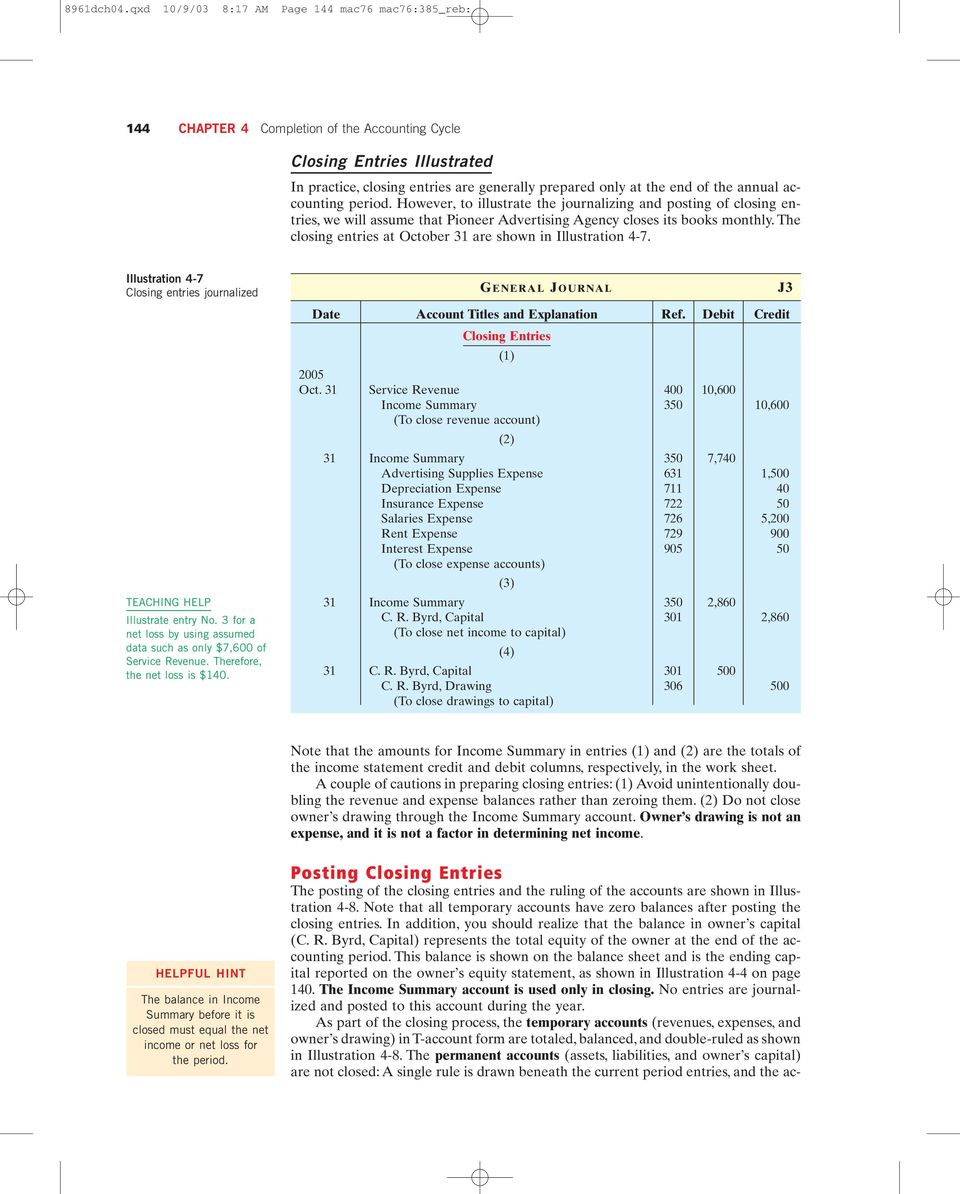
9 8961dch04.qxd 10/9/03 8:17 AM Page 145 mac76 mac76:385_reb: 145 Closing the Books count balance carried forward to the next period is entered below the single rule. (For example, see C. R. Byrd, Capital.) Advertising Supplies Expense 1,500 (2) Depreciation Expense 40 (2) Service Revenue 631 (1) 1, ,000 1,200 (2) 5, (2) (3) (2) 7,740 2,860 (1) 10,600 10, ,600 10, ,600 10, ,200 C. R. Byrd, Capital 5,200 Rent Expense 10, Insurance Expense Salaries Expense Income Summary (2) Illustration 4-8 Posting of closing entries (4) (3) 10,000 2,860 Bal. 12, Interest Expense 905 C. R. Byrd, Drawing (2) ACCOUNTING IN ACTION (4) Business Insight Technology has dramatically changed the accounting process. When Larry Carter became chief financial officer of Cisco Systems, closing the quarterly accounts would take up to ten days. Within four years he got it down to two days and halved the cost of finance, to 1 percent of sales. Now he is aiming to be able to do a virtual close closing within a day on any day in the quarter. This is not just showing off. Knowing exactly where you are all of the time, says Mr. Carter, allows you to respond faster than your competitors. But it also means that the 600 people who used to spend 10 days a quarter tracking transactions can now be more usefully employed on things such as mining data for business intelligence. Source: Excerpted from Business and the Internet, The Economist, June 26, 1999, p. 12.
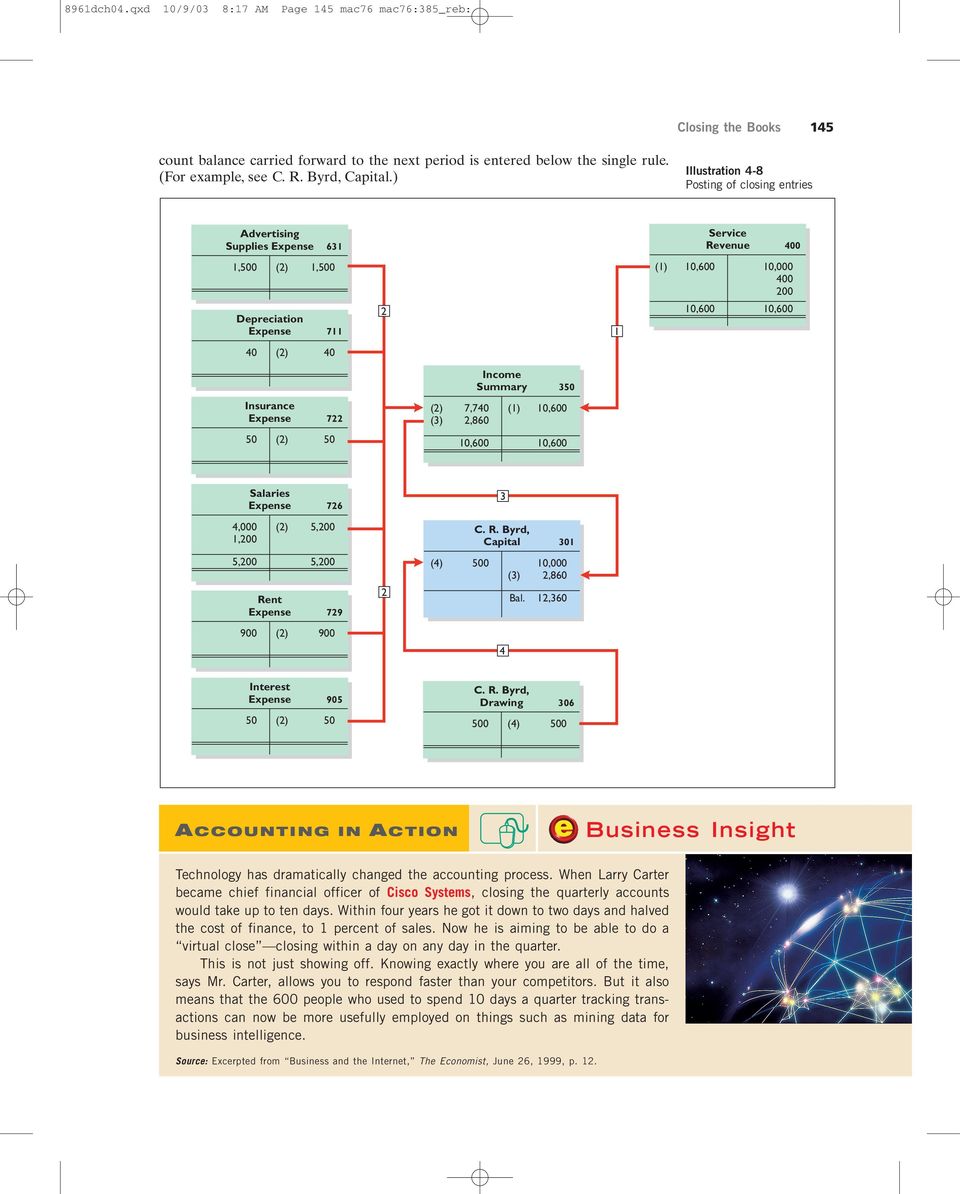
10 8961dch04.qxd 10/9/03 8:17 AM Page 146 mac76 mac76:385_reb: 146 CHAPTER 4 Completion of the Accounting Cycle STUDY OBJECTIVE 3 Describe the content and purpose of a post-closing trial balance. Preparing a Post-Closing Trial Balance After all closing entries have been journalized and posted, another trial balance, called a post-closing trial balance, is prepared from the ledger. The post-closing trial balance lists permanent accounts and their balances after closing entries have been journalized and posted. The purpose of this trial balance is to prove the equality of the permanent account balances that are carried forward into the next accounting period. Since all temporary accounts will have zero balances, the post-closing trial balance will contain only permanent balance sheet accounts. The procedure for preparing a post-closing trial balance again consists entirely of listing the accounts and their balances. The post-closing trial balance for Pioneer Advertising Agency is shown in Illustration 4-9. These balances are the same as those reported in the company s balance sheet in Illustration 4-4. Illustration 4-9 Post-closing trial balance PIONEER ADVERTISING AGENCY Post-Closing Trial Balance October 31, 2005 Debit Credit Cash $15,200 Accounts Receivable 200 Advertising Supplies 1,000 Prepaid Insurance 550 Office Equipment 5,000 Accumulated Depreciation Office Equipment $ 40 Notes Payable 5,000 Accounts Payable 2,500 Unearned Revenue 800 Salaries Payable 1,200 Interest Payable 50 C. R. Byrd, Capital 12,360 $21,950 $21,950 The post-closing trial balance is prepared from the permanent accounts in the ledger. The permanent accounts of Pioneer Advertising are shown in the general ledger in Illustration 4-10 on page 147. Remember that the balance of each permanent account is computed after every posting. Therefore, no additional work on these accounts is needed as part of the closing process. A post-closing trial balance provides evidence that the journalizing and posting of closing entries have been properly completed. It also shows that the accounting equation is in balance at the end of the accounting period. However, like the trial balance, it does not prove that all transactions have been recorded or that the ledger is correct. For example, the post-closing trial balance will balance if a transaction is not journalized and posted or if a transaction is journalized and posted twice. The remaining accounts in the general ledger are temporary accounts (shown in Illustration 4-11 on page 148). After the closing entries are correctly posted, each temporary account has a zero balance. These accounts are double-ruled to finalize the closing process.
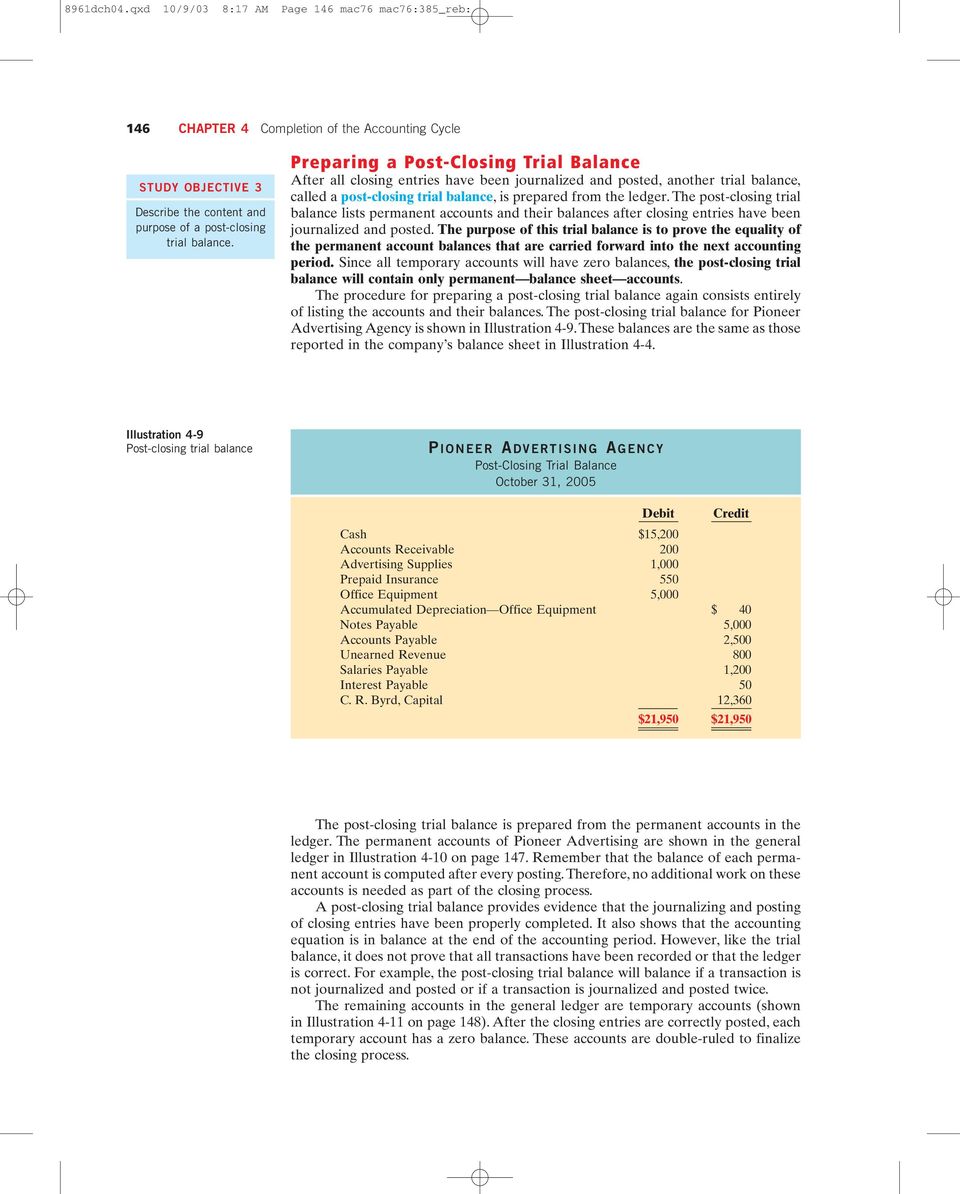
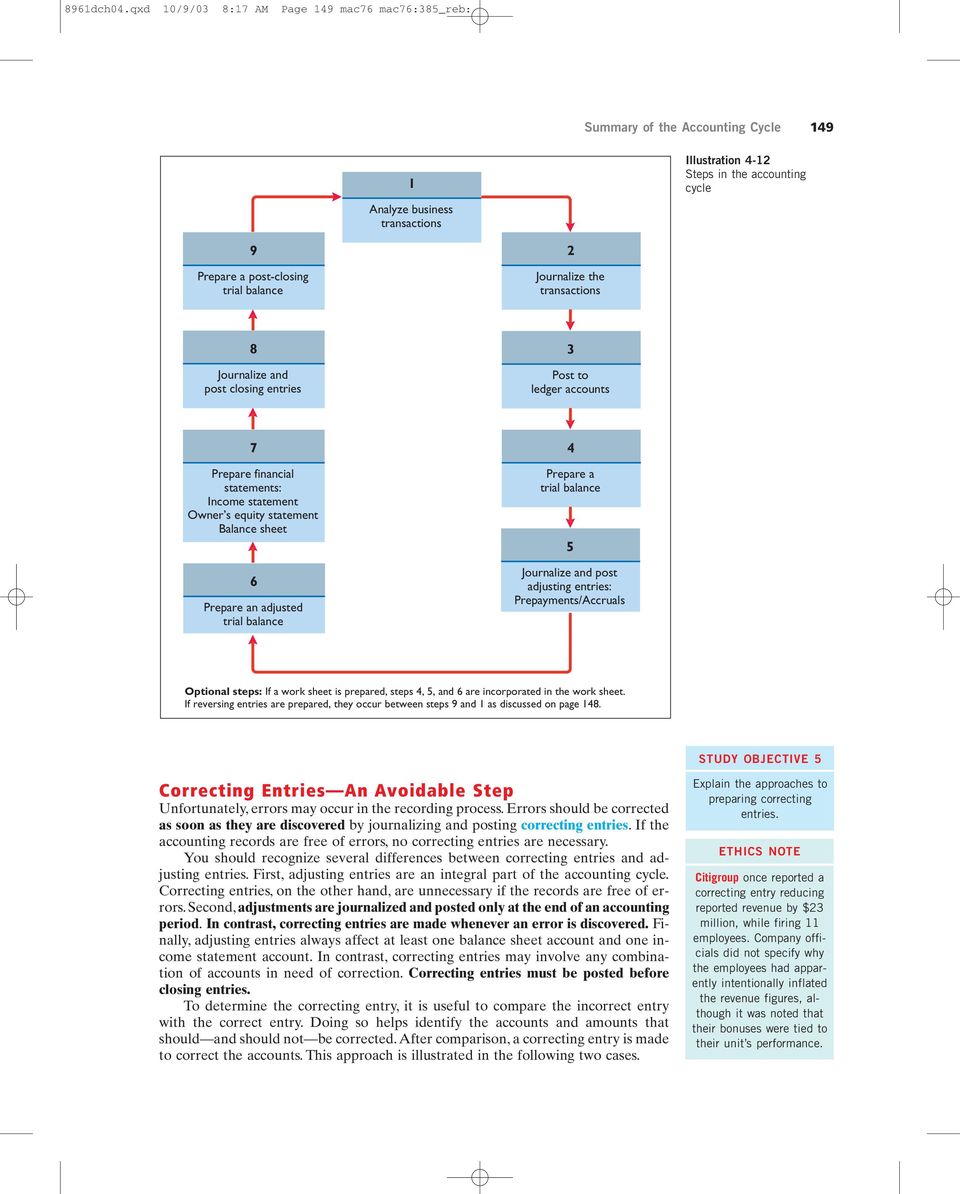
11 8961dch04.qxd 10/9/03 8:17 AM Page 147 mac76 mac76:385_reb: Summary of the Accounting Cycle 147 (Permanent Accounts Only) Illustration 4-10 General ledger, permanent accounts GENERAL LEDGER Cash No. 101 Date Explanation Ref. Debit Credit Balance 2005 Oct. 1 J1 10,000 10,000 2 J1 1,200 11,200 3 J ,300 4 J , J , J1 4,000 5, J1 10,000 15,200 Accounts Receivable No. 112 Date Explanation Ref. Debit Credit Balance 2005 Oct. 31 Adj. entry J Advertising Supplies No. 126 Date Explanation Ref. Debit Credit Balance 2005 Oct. 5 J1 2,500 2, Adj. entry J2 1,500 1,000 Prepaid Insurance No. 130 Date Explanation Ref. Debit Credit Balance 2005 Oct. 4 J Adj. entry J Office Equipment No. 157 Date Explanation Ref. Debit Credit Balance 2005 Oct. 1 J1 5,000 5,000 Accumulated Depreciation Office Equipment No. 158 Date Explanation Ref. Debit Credit Balance 2005 Oct. 31 Adj. entry J Notes Payable No. 200 Date Explanation Ref. Debit Credit Balance 2005 Oct. 1 J1 5,000 5,000 Accounts Payable No. 201 Date Explanation Ref. Debit Credit Balance 2005 Oct. 5 J1 2,500 2,500 Unearned Revenue No. 209 Date Explanation Ref. Debit Credit Balance 2005 Oct. 2 J1 1,200 1, Adj. entry J Salaries Payable No. 212 Date Explanation Ref. Debit Credit Balance 2005 Oct. 31 Adj. entry J2 1,200 1,200 Interest Payable No. 230 Date Explanation Ref. Debit Credit Balance 2005 Oct. 31 Adj. entry J C. R. Byrd, Capital No. 301 Date Explanation Ref. Debit Credit Balance 2005 Oct. 1 J1 10,000 10, Closing entry J3 2,860 12, Closing entry J ,360 Note: The permanent accounts for Pioneer Advertising Agency are shown here; the temporary accounts are shown in Illustration Both permanent and temporary accounts are part of the general ledger; they are segregated here to aid in learning. Summary of the Accounting Cycle The steps in the accounting cycle are shown in Illustration 4-12 on page 149. From the graphic you can see that the cycle begins with the analysis of business transactions and ends with the preparation of a post-closing trial balance. The steps in the cycle are performed in sequence and are repeated in each accounting period. STUDY OBJECTIVE 4 State the required steps in the accounting cycle.
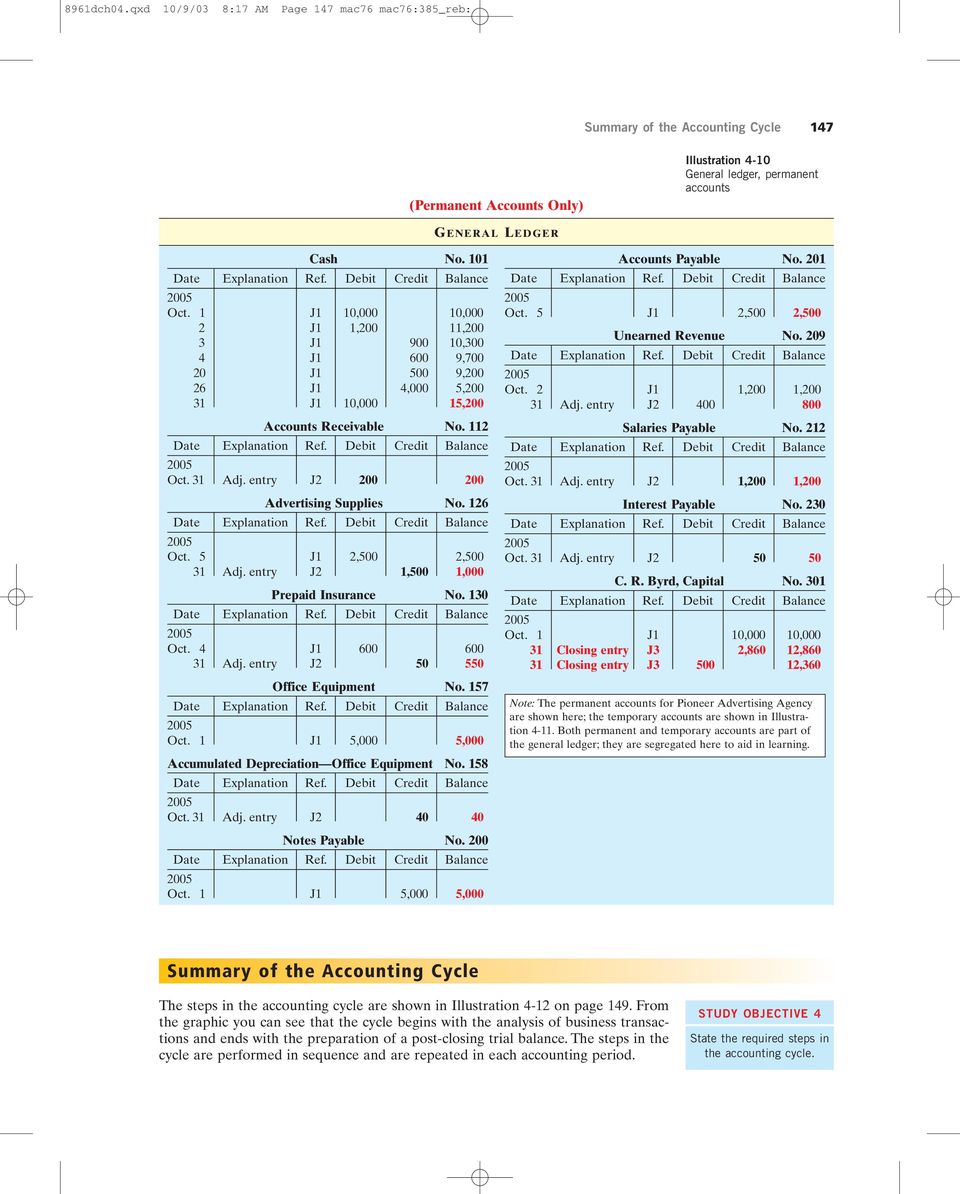
12 8961dch04.qxd 10/9/03 8:17 AM Page 148 mac76 mac76:385_reb: 148 CHAPTER 4 Completion of the Accounting Cycle Illustration 4-11 General ledger, temporary accounts (Temporary Accounts Only) GENERAL LEDGER C. R. Byrd, Drawing No. 306 Date Explanation Ref. Debit Credit Balance 2005 Oct. 20 J Closing entry J Income Summary No. 350 Date Explanation Ref. Debit Credit Balance 2005 Oct. 31 Closing entry J3 10,600 10, Closing entry J3 7,740 2, Closing entry J3 2,860 0 Service Revenue No. 400 Date Explanation Ref. Debit Credit Balance 2005 Oct. 31 J1 10,000 10, Adj. entry J , Adj. entry J , Closing entry J3 10,600 0 Advertising Supplies Expense No. 631 Date Explanation Ref. Debit Credit Balance 2005 Oct. 31 Adj. entry J2 1,500 1, Closing entry J3 1,500 0 Depreciation Expense No. 711 Date Explanation Ref. Debit Credit Balance 2005 Oct. 31 Adj. entry J Closing entry J Insurance Expense No. 722 Date Explanation Ref. Debit Credit Balance 2005 Oct. 31 Adj. entry J Closing entry J Salaries Expense No. 726 Date Explanation Ref. Debit Credit Balance 2005 Oct. 26 J1 4,000 4, Adj. entry J2 1,200 5, Closing entry J3 5,200 0 Rent Expense No. 729 Date Explanation Ref. Debit Credit Balance 2005 Oct. 3 J Closing entry J Interest Expense No. 905 Date Explanation Ref. Debit Credit Balance 2005 Oct. 31 Adj. entry J Closing entry J Note: The temporary accounts for Pioneer Advertising Agency are shown here; the permanent accounts are shown in Illustration Both permanent and temporary accounts are part of the general ledger; they are segregated here to aid in learning. Steps 1 3 may occur daily during the accounting period, as explained in Chapter 2. Steps 4 7 are performed on a periodic basis, such as monthly, quarterly, or annually. Steps 8 and 9, closing entries, and a post-closing trial balance, are usually prepared only at the end of a company s annual accounting period. There are also two optional steps in the accounting cycle. As you have seen, a work sheet may be used in preparing adjusting entries and financial statements. In addition, reversing entries may be used as explained below. TEACHING HELP Stress that reversing entries are a bookkeeping matter and not an accounting principle or assumption. Reversing Entries An Optional Step Some accountants prefer to reverse certain adjusting entries at the beginning of a new accounting period. A reversing entry is made at the beginning of the next accounting period. It is the exact opposite of the adjusting entry made in the previous period. The preparation of reversing entries is an optional bookkeeping procedure that is not a required step in the accounting cycle. Accordingly, we have chosen to cover this topic in an appendix at the end of the chapter.

13 8961dch04.qxd 10/9/03 8:17 AM Page 149 mac76 mac76:385_reb: Summary of the Accounting Cycle Analyze business transactions Illustration 4-12 Steps in the accounting cycle 9 Prepare a post-closing trial balance 2 Journalize the transactions 8 Journalize and post closing entries 3 Post to ledger accounts 7 Prepare financial statements: Income statement Owner s equity statement Balance sheet 6 Prepare an adjusted trial balance 4 Prepare a trial balance 5 Journalize and post adjusting entries: Prepayments/Accruals Optional steps: If a work sheet is prepared, steps 4, 5, and 6 are incorporated in the work sheet. If reversing entries are prepared, they occur between steps 9 and 1 as discussed on page 148. STUDY OBJECTIVE 5 Correcting Entries An Avoidable Step Unfortunately, errors may occur in the recording process. Errors should be corrected as soon as they are discovered by journalizing and posting correcting entries. If the accounting records are free of errors, no correcting entries are necessary. You should recognize several differences between correcting entries and adjusting entries. First, adjusting entries are an integral part of the accounting cycle. Correcting entries, on the other hand, are unnecessary if the records are free of errors. Second, adjustments are journalized and posted only at the end of an accounting period. In contrast, correcting entries are made whenever an error is discovered. Finally, adjusting entries always affect at least one balance sheet account and one income statement account. In contrast, correcting entries may involve any combination of accounts in need of correction. Correcting entries must be posted before closing entries. To determine the correcting entry, it is useful to compare the incorrect entry with the correct entry. Doing so helps identify the accounts and amounts that should and should not be corrected. After comparison, a correcting entry is made to correct the accounts. This approach is illustrated in the following two cases. Explain the approaches to preparing correcting entries. ETHICS NOTE Citigroup once reported a correcting entry reducing reported revenue by $23 million, while firing 11 employees. Company officials did not specify why the employees had apparently intentionally inflated the revenue figures, although it was noted that their bonuses were tied to their unit s performance.
14 8961dch04.qxd 10/9/03 8:17 AM Page 150 mac76 mac76:385_reb: 150 CHAPTER 4 Completion of the Accounting Cycle Case 1 On May 10, a $50 cash collection on account from a customer is journalized and posted as a debit to Cash $50 and a credit to Service Revenue $50. The error is discovered on May 20, when the customer pays the remaining balance in full. Illustration 4-13 Comparison of entries Incorrect Entry (May 10) Correct Entry (May 10) Cash 50 Cash 50 Service Revenue 50 Accounts Receivable 50 A comparison of the incorrect entry with the correct entry reveals that the debit to Cash $50 is correct. However, the $50 credit to Service Revenue should have been credited to Accounts Receivable. As a result, both Service Revenue and Accounts Receivable are overstated in the ledger. The following correcting entry is required. Illustration 4-14 Correcting entry A L OE Rev Cash Flows no effect Correcting Entry May 20 Service Revenue 50 Accounts Receivable 50 (To correct entry of May 10) Case 2 On May 18, office equipment costing $450 is purchased on account. The transaction is journalized and posted as a debit to Delivery Equipment $45 and a credit to Accounts Payable $45. The error is discovered on June 3, when the monthly statement for May is received from the creditor. Illustration 4-15 Comparison of entries Incorrect Entry (May 18) Correct Entry (May 18) Delivery Equipment 45 Office Equipment 450 Accounts Payable 45 Accounts Payable 450 A comparison of the two entries shows that three accounts are incorrect. Delivery Equipment is overstated $45; Office Equipment is understated $450; and Accounts Payable is understated $405. The correcting entry is: Illustration 4-16 Correcting entry A L OE Cash Flows no effect Correcting Entry June 3 Office Equipment 450 Delivery Equipment 45 Accounts Payable 405 (To correct entry of May 18) Instead of preparing a correcting entry, it is possible to reverse the incorrect entry and then prepare the correct entry. This approach will result in more entries and postings than a correcting entry, but it will accomplish the desired result.

15 8961dch04.qxd 10/9/03 8:17 AM Page 151 mac76 mac76:385_reb: Summary of the Accounting Cycle 151 A CCOUNTING IN A CTION Business Insight Yale Express, a short-haul trucking firm, turned over much of its cargo to local truckers for delivery completion. Yale collected the entire delivery charge and, when billed by the local trucker, sent payment for the final phase to the local trucker. Yale used a cutoff period of 20 days into the next accounting period in making its adjusting entries for accrued liabilities. That is, it waited 20 days to receive the local truckers bills to determine the amount of the unpaid but incurred delivery charges as of the balance sheet date. On the other hand, Republic Carloading, a nationwide, long-distance freight forwarder, frequently did not receive transportation bills from truckers to whom it passed on cargo until months after the year-end. In making its year-end adjusting entries, Republic waited for months in order to include all of these outstanding transportation bills. When Yale Express merged with Republic Carloading, Yale s vice president employed the 20-day cutoff procedure for both firms. As a result, millions of dollars of Republic s accrued transportation bills went unrecorded. When the erroneous procedure was detected and correcting entries were made, these and other errors changed a reported profit of $1.14 million into a loss of $1.88 million! BEFORE YOU GO ON... Review It 1. How do permanent accounts differ from temporary accounts? 2. What four different types of entries are required in closing the books? 3. What are the content and purpose of a post-closing trial balance? 4. What are the required and optional steps in the accounting cycle? Do It The work sheet for Hancock Company shows the following in the financial statement columns: R. Hancock, Drawing $15,000, R. Hancock, Capital $42,000, and net income $18,000. Prepare the closing entries at December 31 that affect owner s capital. ACTION PLAN Remember to make closing entries in the correct sequence. Make the first two entries to close revenues and expenses. Make the third entry to close net income to owner s capital. Make the final entry to close owner s drawing to owner s capital. SOLUTION Dec. 31 Income Summary 18,000 R. Hancock, Capital 18,000 (To close net income to capital) Dec. 31 R. Hancock, Capital 15,000 R. Hancock, Drawing 15,000 (To close drawings to capital) Related exercise material: BE4-4, BE4-5, BE4-6, BE4-8, E4-3, E4-6, E4-8, and E4-9. THE NAVIGATOR
16 8961dch04.qxd 10/9/03 8:17 AM Page 152 mac76 mac76:385_reb: 152 CHAPTER 4 Completion of the Accounting Cycle Classified Balance Sheet STUDY OBJECTIVE 6 Identify the sections of a classified balance sheet. The financial statements illustrated up to this point were purposely kept simple. We classified items as assets, liabilities, and owner s equity in the balance sheet, and as revenues and expenses in the income statement. Financial statements, however, become more useful to management, creditors, and potential investors when the elements are classified into significant subgroups. In the remainder of this chapter, we will introduce you to the primary balance sheet classifications. The classified income statement will be presented in Chapter 5. The classified financial statements are what Ted Castle, owner of Rhino Foods, Inc., gave to his employees to understand what was happening in the business. Standard Classifications A classified balance sheet usually contains these standard classifications: Illustration 4-17 Standard balance sheet classifications Assets Current assets Long-term investments Property, plant, and equipment Intangible assets Liabilities and Owner s Equity Current liabilities Long-term liabilities Owner s (Stockholders ) equity TEACHING HELP Use PepsiCo s statement to illustrate a classified balance sheet and show the balance sheets of 2 3 other well-known companies on transparencies. These sections help the financial statement user determine such matters as (1) the availability of assets to meet debts as they come due and (2) the claims of short- and long-term creditors on total assets. A classified balance sheet also makes it easier to compare companies in the same industry, such as GM, Ford,and DaimlerChrysler in the automobile industry. Each of the sections is explained next. A complete set of specimen financial statements for PepsiCo, Inc. is shown in Appendix A at the back of the book. Current Assets Current assets are cash and other resources that are reasonably expected to be realized in cash or sold or consumed in the business within one year of the balance sheet date or the company s operating cycle, whichever is longer. For example, accounts receivable are current assets because they will be realized in cash through collection within one year. A prepayment such as supplies is a current asset because of its expected use or consumption in the business within one year. The operating cycle of a company is the average time that is required to go from cash to cash in producing revenues. The term cycle suggests a circular flow, which in this case, starts and ends with cash. For example, in municipal transit companies, the operating cycle would tend to be short since services are provided entirely on a cash basis. On the other hand, the operating cycle in manufacturing companies is longer: they purchase goods and materials, manufacture and sell products, bill customers, and collect cash. This is a cash to cash cycle that may extend for several months. Most companies have operating cycles of less than one year. More will be said about operating cycles in later chapters. In a service enterprise, it is customary to recognize four types of current assets: (1) cash, (2) short-term investments such as U.S. government bonds, (3) receivables
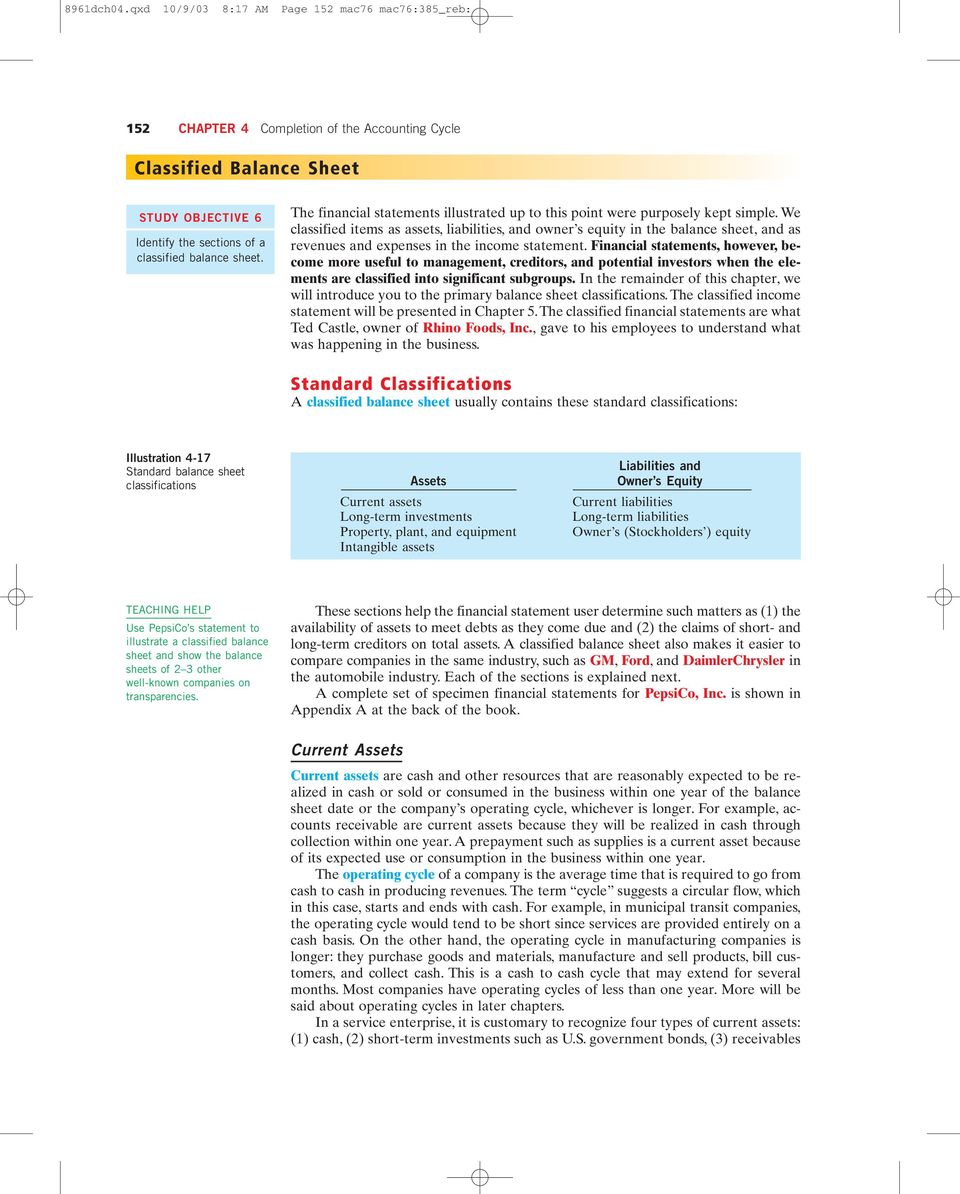
17 8961dch04.qxd 11/10/03 9:37 AM Page 153 Mac113 mac113:122_edl: (notes receivable, accounts receivable, and interest receivable), and (4) prepaid expenses (insurance and supplies). These items are listed in the order of liquidity. That is, they are listed in the order in which they are expected to be converted into cash.this arrangement is illustrated below in the presentation of UAL, Inc. (United Airlines). Classified Balance Sheet 153 UAL, INC, (UNITED AIRLINES) Balance Sheet (partial) (in millions) Illustration 4-18 Current assets section Current assets Cash $1,348 Short-term investments 388 Receivables 788 Aircraft fuel, spare parts, and supplies 310 Prepaid expenses 219 Other current assets 326 Total current assets $3,379 A company s current assets are important in assessing the company s short-term debt-paying ability, as explained later in the chapter. Long-Term Investments Like current assets, long-term investments are resources that can be realized in cash. However, the conversion into cash is not expected within one year or the operating cycle, whichever is longer. In addition, long-term investments are not intended for use or consumption within the business. This category, often just called investments, normally includes stocks and bonds of other corporations. Yahoo! Inc. reported the following in its balance sheet. HELPFUL HINT Long-term investments are investments made by the business not investments by the owner in the business. Investments by the owner in the business are reported as part of owner s (stockholders ) equity (see p. 156). YAHOO! INC. Balance Sheet (partial) Illustration 4-19 Long-term investments section Long-term investments Long-term investments in marketable securities $763,408 Property, Plant, and Equipment Property, plant, and equipment are tangible resources of a relatively permanent nature that are used in the business and not intended for sale. This category includes land, buildings, machinery and equipment, delivery equipment, and furniture and fixtures. Assets subject to depreciation should be reported at cost less accumulated ALTERNATIVE TERMINOLOGY Property, plant, and equipment are sometimes referred to as plant assets or fixed assets.
18 8961d_ch04_154 10/14/03 12:42 PM Page 154 mac76 mac76:385_reb: 154 CHAPTER 4 Completion of the Accounting Cycle depreciation. This practice is illustrated in the following presentation of Delta Air Lines. TEACHING HELP Remind students that the $16,524 million is not the market value of Delta s property, plant, and equipment. Illustration 4-20 Property, plant, and equipment section DELTA AIR LINES, INC. Balance Sheet (partial) (in millions) Property, plant, and equipment Flight equipment $20,295 Less: Accumulated depreciation 6,109 $14,186 Ground property and equipment 4,841 Less: Accumulated depreciation 2,503 2,338 $16,524 Intangible Assets Intangible assets are noncurrent resources that do not have physical substance. They are recorded at cost, and this cost is expensed over the useful life of the intangible asset. Intangible assets include patents, copyrights, and trademarks or trade names that give the holder exclusive right of use for a specified period of time. Their value to a company is generally derived from the rights or privileges granted by governmental authority. In its balance sheet, The Walt Disney Company reported the following. THE WALT DISNEY COMPANY Balance Sheet (partial) (in millions) Illustration 4-21 Intangible assets section Intangible assets Patents, trademarks, and other intangibles $ 2,776 Goodwill 17,083 19,859 TEACHING HELP An account payable is still current if it is expected to be paid by issuing a short-term note payable. Current Liabilities Listed first in the liabilities and owner s equity section of the balance sheet are current liabilities. Current liabilities are obligations that are reasonably expected to be paid from existing current assets or through the creation of other current liabilities. As in the case of current assets, the time period for payment is one year or the operating cycle, whichever is longer. Current liabilities include (1) debts related to the operating cycle, such as accounts payable and wages and salaries payable, and (2) other short-term debts, such as bank loans payable, interest payable, taxes payable, and current maturities of long-term obligations (payments to be made within the next year on long-term obligations). The arrangement of items within the current liabilities section has evolved through custom rather than from a prescribed rule. Notes payable is usually listed first, followed by accounts payable. Other items are then listed in any order. The current liabilities section adapted from the balance sheet of Deckers Outdoor Corporation is as follows.
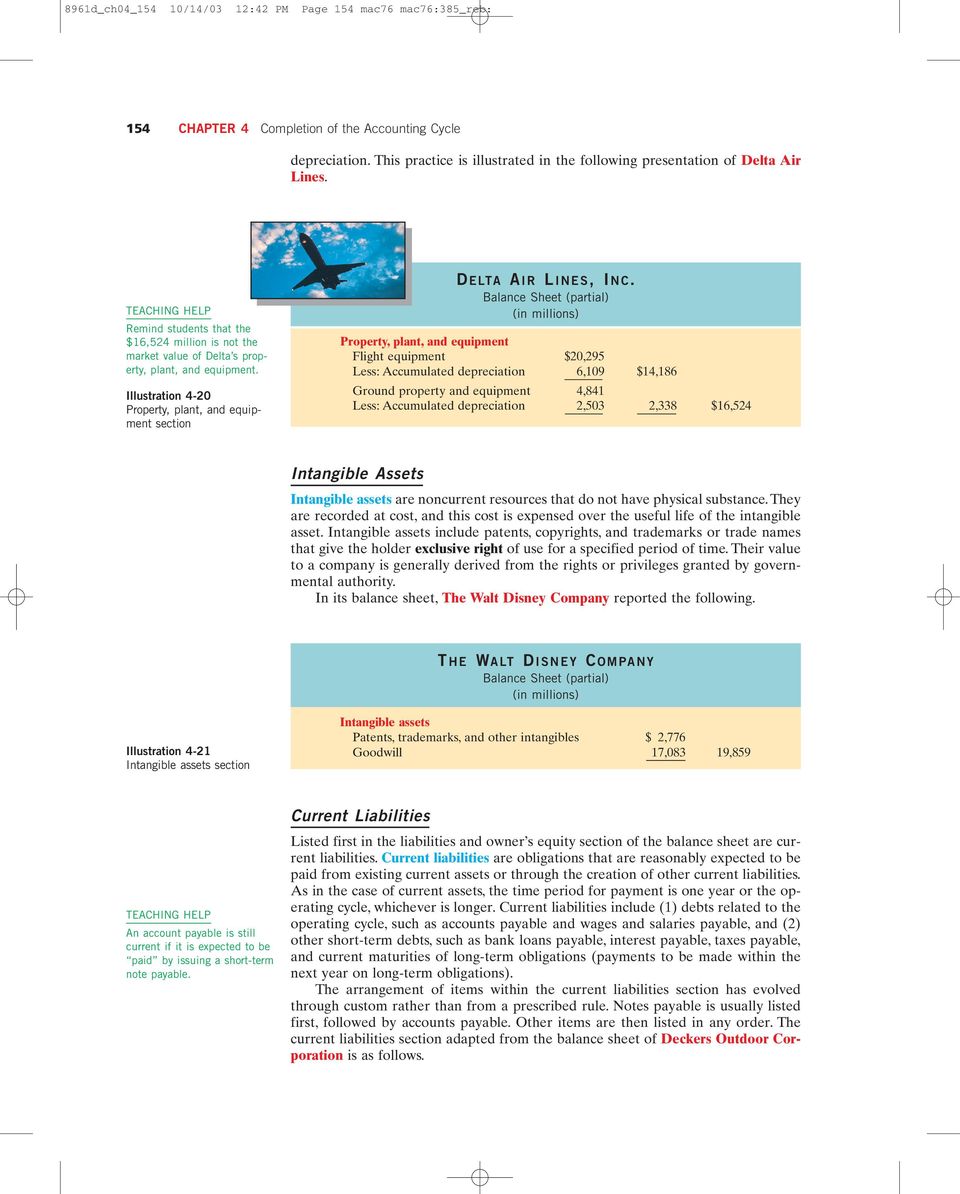
19 8961dch04.qxd 10/9/03 8:17 AM Page 155 mac76 mac76:385_reb: Classified Balance Sheet 155 DECKERS OUTDOOR CORPORATION Balance Sheet (partial) (in thousands) Current liabilities Notes payable $ 3,951,000 Accounts payable 12,916,000 Allowance for returns 1,255,000 Salaries and commissions payable 2,342,000 Taxes payable 732,000 Other current liabilities 912,000 Total current liabilities $22,108,000 Illustration 4-22 Current liabilities section S.S. Ongoing Liquidity Users of financial statements look closely at the relationship between current assets and current liabilities. This relationship is important in evaluating a company s liquidity its ability to pay obligations that are expected to become due within the next year or operating cycle. When current assets exceed current liabilities at the balance sheet date, the likelihood for paying the liabilities is favorable. When the reverse is true, short-term creditors may not be paid, and the company may ultimately be forced into bankruptcy. S.S. Out of Business Illiquidity Long-Term Liabilities Obligations expected to be paid after one year or an operating cycle, whichever is longer, are classified as long-term liabilities. Liabilities in this category include bonds payable, mortgages payable, long-term notes payable, lease liabilities, and obligations under employee pension plans. Many companies report long-term debt maturing after one year as a single amount in the balance sheet. They then show the details of the debt in the notes that accompany the financial statements. Others list the various sources of long-term liabilities. In its balance sheet, Brunswick Corporation reported the following. ALTERNATIVE TERMINOLOGY Long-term liabilities are also called long-term debt or noncurrent liabilities. BRUNSWICK CORPORATION Balance Sheet (partial) (in thousands) Illustration 4-23 Long-term liabilities section Long-term liabilities Notes payable $437.2 Bonds payable Guaranteed debt 15.5 Other long-term debt 12.4 Total long-term liabilities $589.5 Owner s Equity The content of the owner s equity section varies with the form of business organization. In a proprietorship, there is one capital account. In a partnership, there is a capital account for each partner. For a corporation, owners equity is divided into two accounts Capital Stock and Retained Earnings. Investments of assets in the

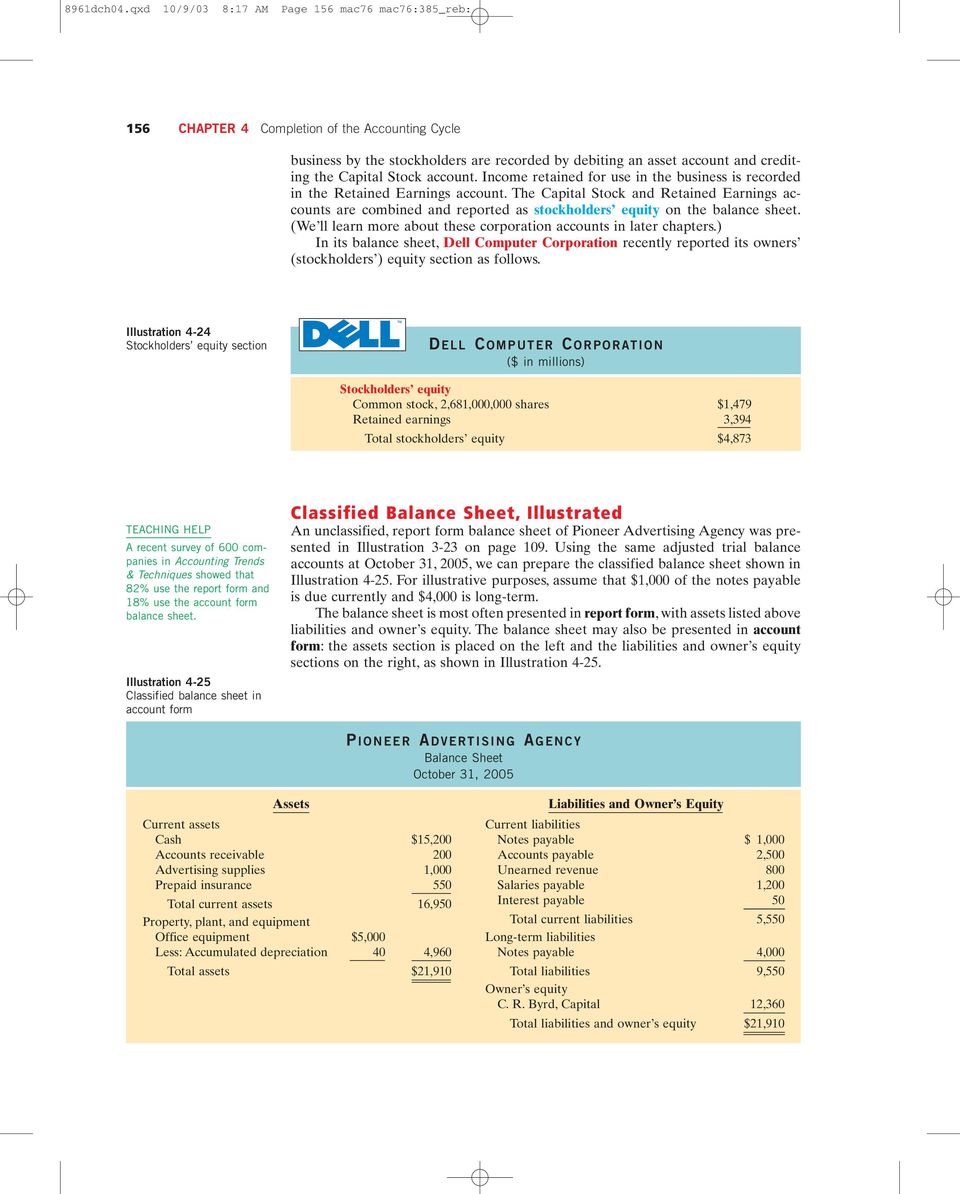
20 8961dch04.qxd 10/9/03 8:17 AM Page 156 mac76 mac76:385_reb: 156 CHAPTER 4 Completion of the Accounting Cycle business by the stockholders are recorded by debiting an asset account and crediting the Capital Stock account. Income retained for use in the business is recorded in the Retained Earnings account. The Capital Stock and Retained Earnings accounts are combined and reported as stockholders equity on the balance sheet. (We ll learn more about these corporation accounts in later chapters.) In its balance sheet, Dell Computer Corporation recently reported its owners (stockholders ) equity section as follows. Illustration 4-24 Stockholders equity section DELL COMPUTER CORPORATION ($ in millions) Stockholders equity Common stock, 2,681,000,000 shares $1,479 Retained earnings 3,394 Total stockholders equity $4,873 TEACHING HELP A recent survey of 600 companies in Accounting Trends & Techniques showed that 82% use the report form and 18% use the account form balance sheet. Illustration 4-25 Classified balance sheet in account form Classified Balance Sheet, Illustrated An unclassified, report form balance sheet of Pioneer Advertising Agency was presented in Illustration 3-23 on page 109. Using the same adjusted trial balance accounts at October 31, 2005, we can prepare the classified balance sheet shown in Illustration For illustrative purposes, assume that $1,000 of the notes payable is due currently and $4,000 is long-term. The balance sheet is most often presented in report form, with assets listed above liabilities and owner s equity. The balance sheet may also be presented in account form: the assets section is placed on the left and the liabilities and owner s equity sections on the right, as shown in Illustration PIONEER ADVERTISING AGENCY Balance Sheet October 31, 2005 Assets Current assets Cash $15,200 Accounts receivable 200 Advertising supplies 1,000 Prepaid insurance 550 Total current assets 16,950 Property, plant, and equipment Office equipment $5,000 Less: Accumulated depreciation 40 4,960 Total assets $21,910 Liabilities and Owner s Equity Current liabilities Notes payable $ 1,000 Accounts payable 2,500 Unearned revenue 800 Salaries payable 1,200 Interest payable 50 Total current liabilities 5,550 Long-term liabilities Notes payable 4,000 Total liabilities 9,550 Owner s equity C. R. Byrd, Capital 12,360 Total liabilities and owner s equity $21,910
21 8961dch04.qxd 10/9/03 8:17 AM Page 157 mac76 mac76:385_reb: Another, more complete example of a classified balance sheet is presented in report form in Illustration Classified Balance Sheet 157 FRANKLIN CORPORATION Balance Sheet October 31, 2005 Illustration 4-26 Classified balance sheet in report form Assets Current assets Cash $ 6,600 Short-term investments 2,000 Accounts receivable 7,000 Inventories 4,000 Supplies 2,100 Prepaid insurance 400 Total current assets $22,100 Long-term investments Investment in stock of Walters Corp. 5,200 Investment in real estate 2,000 7,200 Property, plant, and equipment Land 10,000 Office equipment $ 24,000 Less: Accumulated depreciation 5,000 19,000 29,000 Intangible assets Patents 3,100 Total assets $61,400 Liabilities and Owner s Equity Current liabilities Notes payable $11,000 Accounts payable 2,100 Salaries payable 1,600 Unearned revenue 900 Interest payable 450 Total current liabilities $16,050 Long-term liabilities Notes payable 1,300 Mortgage payable 10,000 Total long-term liabilities 11,300 Total liabilities 27,350 Owner s equity B. Franklin, Capital 34,050 Total liabilities and owner s equity $61,400
22 8961dch04.qxd 11/10/03 9:38 AM Page 158 Mac113 mac113:122_edl: 158 CHAPTER 4 Completion of the Accounting Cycle BEFORE YOU GO ON... Review It 1. What are the major sections in a classified balance sheet? 2. Using the PepsiCo, Inc. annual report, determine its current liabilities at December 28, 2002, and December 29, Were current liabilities higher or lower than current assets in these two years? The answer to this question is provided on page What is the difference between the report form and the account form of the classified balance sheet? THE NAVIGATOR DEMONSTRATION PROBLEM At the end of its first month of operations, Watson Answering Service has the following unadjusted trial balance. WATSON ANSWERING SERVICE August 31, 2005 Trial Balance ACTION PLAN In completing the work sheet, be sure to (a) key the adjustments, (b) start at the top of the adjusted trial balance columns and extend adjusted balances to the correct statement columns, and (c) enter net income (or net loss) in the proper columns. In preparing a classified balance sheet, know the contents of each of the sections. In journalizing closing entries, remember that there are only four entries and that owner s drawing is closed to owner s capital. Debit Credit Cash $ 5,400 Accounts Receivable 2,800 Prepaid Insurance 2,400 Supplies 1,300 Equipment 60,000 Notes Payable $40,000 Accounts Payable 2,400 Ray Watson, Capital 30,000 Ray Watson, Drawing 1,000 Service Revenue 4,900 Salaries Expense 3,200 Utilities Expense 800 Advertising Expense 400 $77,300 $77,300 Other data consist of the following: 1. Insurance expires at the rate of $200 per month. 2. There are $1,000 of supplies on hand at August Monthly depreciation on the equipment is $ Interest of $500 on the notes payable has accrued during August. (a) Prepare a work sheet. (b) Prepare a classified balance sheet assuming $35,000 of the notes payable are long-term. (c) Journalize the closing entries.
23 8961dch04.qxd 10/9/03 8:17 AM Page 159 mac76 mac76:385_reb: Demonstration Problem 159 SOLUTION TO DEMONSTRATION PROBLEM (a) WATSON ANSWERING SERVICE Work Sheet For the Month Ended August 31, 2005 Adjusted Trial Income Trial Balance Adjustments Balance Statement Balance Sheet Account Titles Dr. Cr. Dr. Cr. Dr. Cr. Dr. Cr. Dr. Cr. Cash 5,400 5,400 5,400 Accounts Receivable 2,800 2,800 2,800 Prepaid Insurance 2,400 (a) 200 2,200 2,200 Supplies 1,300 (b) 300 1,000 1,000 Equipment 60,000 60,000 60,000 Notes Payable 40,000 40,000 40,000 Accounts Payable 2,400 2,400 2,400 Ray Watson, Capital 30,000 30,000 30,000 Ray Watson, Drawing 1,000 1,000 1,000 Service Revenue 4,900 4,900 4,900 Salaries Expense 3,200 3,200 3,200 Utilities Expense Advertising Expense Totals 77,300 77,300 Insurance Expense (a) Supplies Expense (b) Depreciation Expense (c) Accumulated Depreciation Equipment (c) Interest Expense (d) Interest Payable (d) Totals 1,900 1,900 78,700 78,700 6,300 4,900 72,400 73,800 Net Loss 1,400 1,400 Totals 6,300 6,300 73,800 73,800 Explanation: (a) Insurance expired, (b) Supplies used, (c) Depreciation expensed, (d) Interest accrued. (b) WATSON ANSWERING SERVICE Balance Sheet August 31, 2005 Assets Current assets Cash $ 5,400 Accounts receivable 2,800 Prepaid insurance 2,200 Supplies 1,000 Total current assets 11,400 Property, plant, and equipment Equipment $60,000 Less: Accumulated depreciation equipment ,100 Total assets $70,500
24 8961dch04.qxd 10/9/03 8:17 AM Page 160 mac76 mac76:385_reb: 160 CHAPTER 4 Completion of the Accounting Cycle Liabilities and Owner s Equity Current liabilities Notes payable $ 5,000 Accounts payable 2,400 Interest payable 500 Total current liabilities 7,900 Long-term liabilities Notes payable 35,000 Total liabilities 42,900 Owner s equity Ray Watson, Capital 27,600* Total liabilities and owner s equity $70,500 *Ray Watson, Capital, $30,000 less drawings $1,000 and net loss $1,400. (c) Aug. 31 Service Revenue 4,900 Income Summary 4,900 (To close revenue account) 31 Income Summary 6,300 Salaries Expense 3,200 Depreciation Expense 900 Utilities Expense 800 Interest Expense 500 Advertising Expense 400 Supplies Expense 300 Insurance Expense 200 (To close expense accounts) 31 Ray Watson, Capital 1,400 Income Summary 1,400 (To close net loss to capital) 31 Ray Watson, Capital 1,000 Ray Watson, Drawing 1,000 (To close drawings to capital) THE NAVIGATOR SUMMARY OF STUDY OBJECTIVES 1. Prepare a work sheet. The steps in preparing a work sheet are: (a) prepare a trial balance on the work sheet, (b) enter the adjustments in the adjustments columns, (c) enter adjusted balances in the adjusted trial balance columns, (d) extend adjusted trial balance amounts to appropriate financial statement columns, and (e) total the statement columns, compute net income (or net loss), and complete the work sheet. 2. Explain the process of closing the books. Closing the books occurs at the end of an accounting period. The process is to journalize and post closing entries and then rule and balance all accounts. In closing the books, separate entries are made to close revenues and expenses to Income Summary, Income Summary to Owner s Capital, and Owner s Drawings to Owner s Capital. Only temporary accounts are closed. 3. Describe the content and purpose of a post-closing trial balance. A post-closing trial balance contains the balances in permanent accounts that are carried forward to the next accounting period. The purpose of this trial balance is to prove the equality of these balances. 4. State the required steps in the accounting cycle. The required steps in the accounting cycle are: (a) analyze business transactions, (b) journalize the transactions, (c) post to ledger accounts, (d) prepare a trial balance, (e) journalize and post adjusting entries, (f) prepare an adjusted trial balance, (g) prepare financial statements, (h) journalize and post closing entries, and (i) prepare a post-closing trial balance. 5. Explain the approaches to preparing correcting entries. One approach for determining the correcting entry is to
25 8961dch04.qxd 11/10/03 9:38 AM Page 161 Mac113 mac113:122_edl: Appendix Reversing Entries 161 compare the incorrect entry with the correct entry. After comparison, a correcting entry is made to correct the accounts. An alternative to a correcting entry is to reverse the incorrect entry and then prepare the correct entry. 6. Identify the sections of a classified balance sheet. In a classified balance sheet, assets are classified as current assets; long-term investments; property, plant, and equipment; and intangibles. Liabilities are classified as either current or long-term. There is also an owner s equity section, which varies with the form of business organization. THE NAVIGATOR GLOSSARY Classified balance sheet A balance sheet that contains a number of standard classifications or sections. (p. 152). Closing entries Entries made at the end of an accounting period to transfer the balances of temporary accounts to a permanent owner s equity account, Owner s Capital. (p. 142). Correcting entries Entries to correct errors made in recording transactions. (p. 149). Current assets Cash and other resources that are reasonably expected to be realized in cash or sold or consumed in the business within one year or the operating cycle, whichever is longer. (p. 152). Current liabilities Obligations reasonably expected to be paid from existing current assets or through the creation of other current liabilities within the next year or operating cycle, whichever is longer. (p. 154). Income Summary A temporary account used in closing revenue and expense accounts. (p. 142). Intangible assets Noncurrent resources that do not have physical substance. (p. 154). Liquidity The ability of a company to pay obligations that are expected to become due within the next year or operating cycle. (p. 155). Long-term investments Resources not expected to be realized in cash within the next year or operating cycle. (p. 153). Long-term liabilities Obligations expected to be paid after one year. (p. 155). Operating cycle The average time required to go from cash to cash in producing revenues. (p. 152). Permanent (real) accounts Balance sheet accounts whose balances are carried forward to the next accounting period. (p. 142). Post-closing trial balance A list of permanent accounts and their balances after closing entries have been journalized and posted. (p. 146). Property, plant, and equipment Assets of a relatively permanent nature that are being used in the business and not intended for sale. (p. 153). Reversing entry An entry made at the beginning of the next accounting period that is the exact opposite of the adjusting entry made in the previous period. (p. 148). Stockholders equity The ownership claim of shareholders on total assets. It is to a corporation what owner s equity is to a proprietorship. (p. 156). Temporary (nominal) accounts Revenue, expense, and drawing accounts whose balances are transferred to owner s capital at the end of an accounting period. (p. 142). Work sheet A multiple-column form that may be used in the adjustment process and in preparing financial statements. (p. 135). APPENDIX REVERSING ENTRIES After the financial statements are prepared and the books are closed, it is often helpful to reverse some of the adjusting entries before recording the regular transactions of the next period. Such entries are called reversing entries. A reversing entry is made at the beginning of the next accounting period and is the exact opposite of the adjusting entry made in the previous period. The recording of reversing entries is an optional step in the accounting cycle. The purpose of reversing entries is to simplify the recording of a subsequent transaction related to an adjusting entry. In Chapter 3, you may recall, the payment of salaries after an adjusting entry resulted in two debits: one to Salaries Payable and the other to Salaries Expense. With reversing entries, the entire subsequent payment can be debited to Salaries Expense. The use of reversing entries does not change the amounts reported in the financial statements. What it does is simplify the recording of subsequent transactions. STUDY OBJECTIVE 7 Prepare reversing entries.
26 8961dch04.qxd 10/9/03 8:17 AM Page 162 mac76 mac76:385_reb: 162 CHAPTER 4 Completion of the Accounting Cycle Illustration of Reversing Entries Reversing entries are most often used to reverse two types of adjusting entries: accrued revenues and accrued expenses. They are seldom made for prepaid expenses and unearned revenues. To illustrate the optional use of reversing entries for accrued expenses, we will use the salaries expense transactions for Pioneer Advertising Agency. The transaction and adjustment data are as follows. 1. October 26 (initial salary entry): $4,000 of salaries earned between October 15 and October 26 are paid. 2. October 31 (adjusting entry): Salaries earned between October 29 and October 31 are $1,200. These will be paid in the November 9 payroll. 3. November 9 (subsequent salary entry): Salaries paid are $4,000. Of this amount, $1,200 applied to accrued wages payable and $2,800 was earned between November 1 and November 9. Illustration 4A-1 Comparative entries not reversing vs. reversing The comparative entries with and without reversing entries are shown in Illustration 4A-1. When Reversing Entries Are Not Used (per chapter) Initial Salary Entry Oct. 26 Salaries Expense 4,000 Cash 4,000 Adjusting Entry Oct. 31 Salaries Expense 1,200 Salaries Payable 1,200 Closing Entry Oct. 31 Income Summary 5,200 Salaries Expense 5,200 Nov. 1 Reversing Entry No reversing entry is made. Subsequent Salary Entry Nov. 9 Salaries Payable 1,200 Salaries Expense 2,800 Cash 4,000 When Reversing Entries Are Used (per appendix) Initial Salary Entry Oct. 26 Salaries Expense 4,000 Cash 4,000 Adjusting Entry Oct. 31 Salaries Expense 1,200 Salaries Payable 1,200 Closing Entry Oct. 31 Income Summary 5,200 Salaries Expense 5,200 Reversing Entry Nov. 1 Salaries Payable 1,200 Salaries Expense 1,200 Subsequent Salary Entry Nov. 9 Salaries Expense 4,000 Cash 4,000 TEACHING HELP Stress the differences between reversing entries and other entries: 1. Reversing entry at beginning of next period. 2. Abnormal balance in an expense (or revenue) account after posting. 3. Debiting the expense account when payment is made. The first three entries are the same whether or not reversing entries are used. The last two entries are different. The November 1 reversing entry eliminates the $1,200 balance in Salaries Payable that was created by the October 31 adjusting entry. The reversing entry also creates a $1,200 credit balance in the Salaries Expense account. As you know, it is unusual for an expense account to have a credit balance. The balance is correct in this instance, though, because it anticipates that the entire amount of the first salary payment in the new accounting period will be debited to Salaries Expense. This debit will eliminate the credit balance, and the resulting debit balance in the expense account will equal the salaries expense incurred in the new accounting period ($2,800 in this example).
27 8961dch04.qxd 11/10/03 9:38 AM Page 163 Mac113 mac113:122_edl: Self-Study Questions 163 When reversing entries are made, all cash payments of expenses can be debited to the expense account. This means that on November 9 (and every payday) Salaries Expense can be debited for the amount paid without regard to any accrued salaries payable. Being able to make the same entry each time simplifies the recording process: Subsequent transactions can be recorded as if the related adjusting entry had never been made. The posting of the entries with reversing entries is shown in Illustration 4A-2. Illustration 4A-2 Postings with reversing entries Salaries Expense 10/26 Paid 4,000 10/31 Closing 5, Adjusting 1,200 5,200 5,200 11/9 Paid 4,000 11/1 Reversing 1,200 Salaries Payable 11/1 Reversing 1,200 10/31 Adjusting 1,200 Reversing entries may also be made for accrued revenue adjusting entries. For Pioneer Advertising, the adjusting entry was: Accounts Receivable (Dr.) $200 and Service Revenue (Cr.) $200. Thus, the reversing entry on November 1 is: Nov. 1 Service Revenue 200 Accounts Receivable 200 (To reverse October 31 adjusting entry) When the accrued fees are collected, Cash is debited and Service Revenue is credited. A L OE Rev Cash Flows no effect SUMMARY OF STUDY OBJECTIVE FOR APPENDIX 7. Prepare reversing entries. Reversing entries are the opposite of the adjusting entries made in the preceding period. They are made at the beginning of a new accounting period to simplify the recording of later transactions related to the adjusting entries. In most cases, only accrued adjusting entries are reversed. *Note: All asterisked Questions, Exercises, and Problems relate to material in the appendix to the chapter. SELF-STUDY QUESTIONS Self-Study/Self-Test (SO 1) Answers are at the end of the chapter. 1. Which of the following statements is incorrect concerning the work sheet? a. The work sheet is essentially a working tool of the accountant. b. The work sheet is distributed to management and other interested parties. c. The work sheet cannot be used as a basis for posting to ledger accounts. d. Financial statements can be prepared directly from the work sheet before journalizing and posting the adjusting entries. 2. In a work sheet, net income is entered in the following columns: a. income statement (Dr) and balance sheet (Dr). b. income statement (Cr) and balance sheet (Dr). c. income statement (Dr) and balance sheet (Cr). d. income statement (Cr) and balance sheet (Cr). 3. An account that will have a zero balance after closing entries have been journalized and posted is: a. Service Revenue. b. Advertising Supplies. c. Prepaid Insurance. d. Accumulated Depreciation. (SO 1) (SO 2)
28 8961dch04.qxd 10/9/03 8:17 AM Page 164 mac76 mac76:385_reb: (SO 2) (SO 2) (SO 3) (SO 4) (SO 5) 164 CHAPTER 4 Completion of the Accounting Cycle 4. When a net loss has occurred, Income Summary is: a. debited and Owner s Capital is credited. b. credited and Owner s Capital is debited. c. debited and Owner s Drawing is credited. d. credited and Owner s Drawing is debited. 5. The closing process involves separate entries to close (1) expenses, (2) drawings, (3) revenues, and (4) income summary. The correct sequencing of the entries is: a. (4), (3), (2), (1) b. (1), (2), (3), (4) c. (3), (1), (4), (2) d. (3), (2), (1), (4) 6. Which types of accounts will appear in the post-closing trial balance? a. Permanent (real) accounts. b. Temporary (nominal) accounts. c. Accounts shown in the income statement columns of a work sheet. d. None of the above. 7. All of the following are required steps in the accounting cycle except: a. journalizing and posting closing entries. b. preparing financial statements. c. journalizing the transactions. d. preparing a work sheet. 8. Cash of $100 received at the time the service was provided was journalized and posted as a debit to Cash $100 and a credit to Accounts Receivable $100. Assuming the incorrect entry is not reversed, the correcting entry is: a. debit Service Revenue $100 and credit Accounts Receivable $100. b. debit Accounts Receivable $100 and credit Service Revenue $100. c. debit Cash $100 and credit Service Revenue $100. d. debit Accounts Receivable $100 and credit Cash $ In a classified balance sheet, assets are usually classified using the following categories: a. current assets; long-term assets; property, plant, and equipment; and intangible assets. b. current assets; long-term investments; property, plant, and equipment; and other assets. c. current assets; long-term investments; tangible assets; and intangible assets. d. current assets; long-term investments; property, plant, and equipment; and intangible assets. 10. Current assets are listed: a. by liquidity. b. by importance. c. by longevity. d. alphabetically. *11. On December 31, Frank Voris Company correctly made an adjusting entry to recognize $2,000 of accrued salaries payable. On January 8 of the next year, total salaries of $3,400 were paid. Assuming the correct reversing entry was made on January 1, the entry on January 8 will result in a credit to Cash $3,400 and the following debit(s): a. Salaries Payable $1,400, and Salaries Expense $2,000. b. Salaries Payable $2,000 and Salaries Expense $1,400. c. Salaries Expense $3,400. d. Salaries Payable $3,400. THE NAVIGATOR (SO 6) (SO 6) (SO 7) QUESTIONS C C C C C K C 1. A work sheet is a permanent accounting record and its use is required in the accounting cycle. Do you agree? Explain. 2. Explain the purpose of the work sheet. 3. What is the relationship, if any, between the amount shown in the adjusted trial balance column for an account and that account s ledger balance? 4. If a company s revenues are $125,000 and its expenses are $113,000, in which financial statement columns of the work sheet will the net income of $12,000 appear? When expenses exceed revenues, in which columns will the difference appear? 5. Why is it necessary to prepare formal financial statements if all of the data are in the statement columns of the work sheet? 6. Identify the account(s) debited and credited in each of the four closing entries, assuming the company has net income for the year. 7. Describe the nature of the Income Summary account and identify the types of summary data that may be posted to this account. 8. What are the content and purpose of a post-closing trial balance? 9. Which of the following accounts would not appear in the post-closing trial balance? Interest Payable; Equipment; Depreciation Expense; Elizabeth Sherrick, Drawing; Unearned Revenue; Accumulated Depreciation Equipment; and Service Revenue. 10. Distinguish between a reversing entry and an adjusting entry. Are reversing entries required? 11. Indicate, in the sequence in which they are made, the three required steps in the accounting cycle that involve journalizing. 12. Identify, in the sequence in which they are prepared, the three trial balances that are often used to report financial information about a company. 13. How do correcting entries differ from adjusting entries? 14. What standard classifications are used in preparing a classified balance sheet? 15. What is meant by the term operating cycle? 16. Define current assets. What basis is used for arranging individual items within the current assets section? C C C K K C K K K
29 8961dch04.qxd 10/9/03 8:17 AM Page 165 mac76 mac76:385_reb: Brief Exercises 165 C C C C 17. Distinguish between long-term investments and property, plant, and equipment. 18. How do current liabilities differ from long-term liabilities? 19. (a) What is the term used to describe the owner s equity section of a corporation? (b) Identify the two owner s equity accounts in a corporation and indicate the purpose of each. 20. How does a report form balance sheet differ from an account form balance sheet? *21. Sang Nam Company prepares reversing entries. If the adjusting entry for interest payable is reversed, what type of an account balance, if any, will there be in Interest Payable and Interest Expense after the reversing entry is posted? *22. At December 31, accrued salaries payable totaled $4,500. On January 10, total salaries of $8,000 are paid. (a) Assume that reversing entries are made at January 1. Give the January 10 entry, and indicate the Salaries Expense account balance after the entry is posted. (b) Repeat part (a) assuming reversing entries are not made. C AN BRIEF EXERCISES BE4-1 The steps in using a work sheet are presented in random order below. List the steps in the proper order by placing numbers 1 5 in the blank spaces. (a) Prepare a trial balance on the work sheet. (b) Enter adjusted balances. (c) Extend adjusted balances to appropriate statement columns. (d) Total the statement columns, compute net income (loss), and complete the work sheet. (e) Enter adjustment data. BE4-2 The ledger of Keo Company includes the following unadjusted balances: Prepaid Insurance $4,000, Service Revenue $58,000, and Salaries Expense $25,000. Adjusting entries are required for (a) expired insurance $1,200; (b) services provided $1,100, but unbilled and uncollected; and (c) accrued salaries payable $800. Enter the unadjusted balances and adjustments into a work sheet and complete the work sheet for all accounts. Note: You will need to add the following accounts: Accounts Receivable, Salaries Payable, and Insurance Expense. BE4-3 The following selected accounts appear in the adjusted trial balance columns of the work sheet for Cesar Company: Accumulated Depreciation; Depreciation Expense; N. Cesar, Capital; N. Cesar, Drawing; Service Revenue; Supplies; and Accounts Payable. Indicate the financial statement column (income statement Dr., balance sheet Cr., etc.) to which each balance should be extended. BE4-4 The ledger of Rowen Company contains the following balances: D. Rowen, Capital $30,000; D. Rowen, Drawing $2,000; Service Revenue $50,000; Salaries Expense $23,000; and Supplies Expense $4,000. Prepare the closing entries at December 31. BE4-5 Using the data in BE4-4, enter the balances in T accounts, post the closing entries, and rule and balance the accounts. BE4-6 The income statement for Mosquera Golf Club for the month ending July 31 shows Green Fee Revenue $14,600, Salaries Expense $8,200, Maintenance Expense $2,500, and Net Income $3,900. Prepare the entries to close the revenue and expense accounts. Post the entries to the revenue and expense accounts, and complete the closing process for these accounts using the three-column form of account. BE4-7 Using the data in BE4-3, identify the accounts that would be included in a post-closing trial balance. BE4-8 The steps in the accounting cycle are listed in random order below. List the steps in proper sequence, assuming no work sheet is prepared, by placing numbers 1 9 in the blank spaces. (a) Prepare a trial balance. (b) Journalize the transactions. (c) Journalize and post closing entries. (d) Prepare financial statements. (e) Journalize and post adjusting entries. (f) Post to ledger accounts. (g) Prepare a post-closing trial balance. (h) Prepare an adjusted trial balance. (i) Analyze business transactions. List the steps in preparing a work sheet. (SO 1), K Prepare partial work sheet. (SO 1), AN Identify work sheet columns for selected accounts. (SO 1), C Prepare closing entries from ledger balances. (SO 2), AP Post closing entries; rule and balance T accounts. (SO 2), AP Journalize and post closing entries using the three-column form of account. (SO 2), AP Identify post-closing trial balance accounts. (SO 3), C List the required steps in the accounting cycle in sequence. (SO 4), K
30 8961dch04.qxd 10/9/03 8:17 AM Page 166 mac76 mac76:385_reb: 166 CHAPTER 4 Completion of the Accounting Cycle Prepare correcting entries. (SO 5), AN Prepare the current assets section of a balance sheet. (SO 6), AP Total current assets $46,400 Prepare reversing entries. (SO 7), AN BE4-9 At Rafeul Huda Company, the following errors were discovered after the transactions had been journalized and posted. Prepare the correcting entries. 1. A collection on account from a customer for $780 was recorded as a debit to Cash $780 and a credit to Service Revenue $ The purchase of store supplies on account for $1,580 was recorded as a debit to Store Supplies $1,850 and a credit to Accounts Payable $1,850. BE4-10 The balance sheet debit column of the work sheet for Kren Company includes the following accounts: Accounts Receivable $12,500; Prepaid Insurance $3,600; Cash $18,400; Supplies $5,200, and Short-term Investments $6,700. Prepare the current assets section of the balance sheet, listing the accounts in proper sequence. *BE4-11 At October 31, Prasad Company made an accrued expense adjusting entry of $1,200 for salaries. Prepare the reversing entry on November 1, and indicate the balances in Salaries Payable and Salaries Expense after posting the reversing entry. EXERCISES Complete work sheet (SO 1), AP Balance sheet column totals $51,572 Prepare financial statements from work sheet. (SO 1, 6), AP Net income $ 1,262 Total assets $43,001 Journalize and post closing entries and prepare a postclosing trial balance (SO 2, 3), AP Post-closing trial balance $47,922 E4-1 The adjusted trial balance columns of the work sheet for Cajon Company are as follows. CAJON COMPANY Work Sheet (partial) For the Month Ended April 30, 2005 Adjusted Trial Income Balance Statement Balance Sheet Account Titles Dr. Cr. Dr. Cr. Dr. Cr. Cash 14,752 Accounts Receivable 7,840 Prepaid Rent 2,280 Equipment 23,050 Accumulated Depreciation 4,921 Notes Payable 5,700 Accounts Payable 5,672 P. Cajon, Capital 33,960 P. Cajon, Drawing 3,650 Service Revenue 12,590 Salaries Expense 9,840 Rent Expense 760 Depreciation Expense 671 Interest Expense 57 Interest Payable 57 Totals 62,900 62,900 Complete the work sheet. E4-2 Work sheet data for Cajon Company are presented in E4-1. The owner did not make any additional investments in the business in April. Prepare an income statement, an owner s equity statement, and a classified balance sheet. E4-3 Work sheet data for Cajon Company are presented in E4-1. (a) Journalize the closing entries at April 30. (b) Post the closing entries to Income Summary and P. Cajon, Capital. Use T accounts. (c) Prepare a post-closing trial balance at April 30.
31 8961dch04.qxd 10/9/03 8:17 AM Page 167 mac76 mac76:385_reb: Exercises 167 E4-4 The adjustments columns of the work sheet for Munoz Company are shown below. Adjustments Account Titles Debit Credit Accounts Receivable 600 Prepaid Insurance 400 Accumulated Depreciation 900 Salaries Payable 500 Service Revenue 600 Salaries Expense 500 Insurance Expense 400 Depreciation Expense 900 2,400 2,400 Prepare adjusting entries from a work sheet and extend balance to work sheet columns. (SO 1), AN (a) Prepare the adjusting entries. (b) Assuming the adjusted trial balance amount for each account is normal, indicate the financial statement column to which each balance should be extended. E4-5 Selected work sheet data for Jane Freeman Company are presented below. Adjusted Account Titles Trial Balance Trial Balance Dr. Cr. Dr. Cr. Accounts Receivable? 34,000 Prepaid Insurance 26,000 18,000 Supplies 7,000? Accumulated Depreciation 12,000? Salaries Payable? 5,000 Service Revenue 88,000 95,000 Insurance Expense? Depreciation Expense 10,000 Supplies Expense 4,000 Salaries Expense? 49,000 (a) Fill in the missing amounts. (b) Prepare the adjusting entries that were made. E4-6 The adjusted trial balance of Lanza Company at the end of its fiscal year is: LANZA COMPANY Adjusted Trial Balance July 31, 2005 No. Account Titles Debits Credits 101 Cash $ 14, Accounts Receivable 8, Equipment 15, Accumulated Depreciation $ 5, Accounts Payable 4, Unearned Rent Revenue 1, C. J. Lanza, Capital 45, C. J. Lanza, Drawing 16, Commission Revenue 67, Rent Revenue 6, Depreciation Expense 4, Salaries Expense 55, Utilities Expense 14,900 $130,120 $130,120 Derive adjusting entries from work sheet data. (SO 1), AN (a) Accounts Receivable $27,000 Journalize and post closing entries and prepare a postclosing trial balance. (SO 2, 3), AP
32 8961dch04.qxd 10/9/03 8:17 AM Page 168 mac76 mac76:385_reb: 168 CHAPTER 4 Completion of the Accounting Cycle (c) Post-closing trial balance $39,520 Prepare financial statements. (SO 6), AP (a) Net loss $1,100 (b) Total assets $34,120 Prepare closing entries and an owner s equity statement. (SO 2), AP (a) Prepare the closing entries using page J15. (b) Post to C. J. Lanza, Capital and No. 350 Income Summary accounts. (Use the three-column form.) (c) Prepare a post-closing trial balance at July 31. E4-7 The adjusted trial balance for Lanza Company is presented in E4-6. (a) Prepare an income statement and an owner s equity statement for the year. Lanza did not make any capital investments during the year. (b) Prepare a classified balance sheet at July 31. E4-8 Selected accounts for Roth Salon are presented below. All June 30 postings are from closing entries. Salaries Expense 6/10 3,200 6/30 8,800 6/28 5,600 Supplies Expense 6/ /30 1,300 6/ Service Revenue 6/30 16,100 6/15 7,700 6/24 8,400 Rent Expense 6/1 3,000 6/30 3,000 Jamie Roth, Capital 6/30 2,500 6/1 12,000 6/30 3,000 Bal. 12,500 Jamie Roth, Drawing 6/13 1,000 6/30 2,500 6/25 1,500 (b) Net income $3,000 Prepare correcting entries. (SO 5), AN (a) Prepare the closing entries that were made. (b) Post the closing entries to Income Summary. E4-9 Kogan Company has an inexperienced accountant. During the first 2 weeks on the job, the accountant made the following errors in journalizing transactions. All entries were posted as made. 1. A payment on account of $830 to a creditor was debited to Accounts Payable $380 and credited to Cash $ The purchase of supplies on account for $560 was debited to Equipment $56 and credited to Accounts Payable $ A $400 withdrawal of cash for M. Kogan s personal use was debited to Salaries Expense $400 and credited to Cash $400. Prepare the correcting entries. Prepare a classified balance sheet. (SO 6), AP E4-10 The adjusted trial balance for Rego Bowling Alley at December 31, 2005, contains the following accounts. Debits Credits Building $128,800 Ann Rego, Capital $115,000 Accounts Receivable 14,520 Accumulated Depreciation Building 45,600 Prepaid Insurance 4,680 Accounts Payable 12,300 Cash 18,040 Mortgage Payable 94,780 Equipment 62,400 Accumulated Depreciation Equipment 18,720 Land 64,000 Interest Payable 2,600 Insurance Expense 780 Bowling Revenues 14,180 Depreciation Expense 7,360 $303,180 Interest Expense 2,600 $303,180
33 8961dch04.qxd 10/9/03 8:17 AM Page 169 mac76 mac76:385_reb: Problems: Set A 169 (a) Prepare a classified balance sheet; assume that $13,600 of the mortgage payable will be paid in (b) Comment on the liquidity of the company. *E4-11 On December 31, the adjusted trial balance of Garg Employment Agency shows the following selected data. Accounts Receivable $24,000 Commission Revenue $92,000 Interest Expense 7,800 Interest Payable 1,500 Analysis shows that adjusting entries were made to (1) accrue $4,200 of commission revenue and (2) accrue $1,500 interest expense. (a) Prepare the closing entries for the temporary accounts at December 31. (b) Prepare the reversing entries on January 1. (c) Post the entries in (a) and (b). Rule and balance the accounts. (Use T accounts.) (d) Prepare the entries to record (1) the collection of the accrued commissions on January 10 and (2) the payment of all interest due ($2,700) on January 15. (e) Post the entries in (d) to the temporary accounts. (a) Total assets $ 228,120 Prepare closing and reversing entries. (SO 2, 4, 7), AN (e) Interest expense balance $1,200 PROBLEMS: SET A P4-1A The trial balance columns of the work sheet for Undercover Roofing at March 31, 2005, are as follows. UNDERCOVER ROOFING Work Sheet For the Month Ended March 31, 2005 Trial Balance Account Titles Dr. Cr. Cash 2,500 Accounts Receivable 1,800 Roofing Supplies 1,100 Equipment 6,000 Accumulated Depreciation Equipment 1,200 Accounts Payable 1,400 Unearned Revenue 300 I. Spy, Capital 7,000 I. Spy, Drawing 600 Service Revenue 3,000 Salaries Expense 700 Miscellaneous Expense ,900 12,900 Other data: 1. A physical count reveals only $140 of roofing supplies on hand. 2. Depreciation for March is $ Unearned revenue amounted to $130 after adjustment on March Accrued salaries are $350. (a) Enter the trial balance on a work sheet and complete the work sheet. (b) Prepare an income statement and owner s equity statement for the month of March and a classified balance sheet at March 31. I. Spy did not make any additional investments in the business in March. (c) Journalize the adjusting entries from the adjustments columns of the work sheet. (d) Journalize the closing entries from the financial statement columns of the work sheet. Prepare a work sheet, financial statements, and adjusting and closing entries. (SO 1, 2, 3, 6), AN The check figures you see next to Problems are also shown in the students text. (a) Adjusted trial balance $13,450 (b) Net income $9,760 Total assets $9,040
34 8961d_ch04_170 10/14/03 12:38 PM Page 170 mac76 mac76:385_reb: 170 CHAPTER 4 Completion of the Accounting Cycle Complete work sheet; prepare financial statements, closing entries, and post-closing trial balance. (SO 1, 2, 3, 6), AP (a) Net income $14,500 (b) Current assets $33,800; Current liabilities $20,300 (e) Post-closing trial balance $67,800 Prepare financial statements, closing entries, and postclosing trial balance. (SO 1, 2, 3, 6), AP P4-2A The adjusted trial balance columns of the work sheet for Eagle Company, owned by Alfred Eagle, are as follows. EAGLE COMPANY Work Sheet For the Year Ended December 31, 2005 Adjusted Account Trial Balance No. Account Titles Dr. Cr. 101 Cash 13, Accounts Receivable 15, Supplies 2, Prepaid Insurance 2, Office Equipment 34, Accumulated Depreciation Office Equipment 8, Notes Payable 20, Accounts Payable 6, Salaries Payable 3, Interest Payable A. Eagle, Capital 25, A. Eagle, Drawing 10, Service Revenue 88, Advertising Expense 12, Supplies Expense 5, Depreciation Expense 8, Insurance Expense 5, Salaries Expense 42, Interest Expense 800 Totals 151, ,300 (a) Complete the work sheet by extending the balances to the financial statement columns. (b) Prepare an income statement, owner s equity statement, and a classified balance sheet. (Note: $10,000 of the notes payable become due in 2006.) Alfred Eagle did not make any additional investments in the business during the year. (c) Prepare the closing entries. Use J14 for the journal page. (d) Post the closing entries. Use the three-column form of account. Income Summary is No (e) Prepare a post-closing trial balance. P4-3A The completed financial statement columns of the work sheet for Lathrop Company are shown below and on the next page. LATHROP COMPANY Work Sheet For the Year Ended December 31, 2005 Account Income Statement Balance Sheet No. Account Titles Dr. Cr. Dr. Cr. 101 Cash 17, Accounts Receivable 13, Prepaid Insurance 3, Equipment 26, Accumulated Depreciation 5, Accounts Payable 11, Salaries Payable 3, Sue Lathrop, Capital 36, Sue Lathrop, Drawing 14, Service Revenue 64, Repair Expense 2, Depreciation Expense 2, Insurance Expense 2,200
35 8961dch04.qxd 10/9/03 8:17 AM Page 171 mac76 mac76:385_reb: Problems: Set A 171 Account Income Statement Balance Sheet No. Account Titles Dr. Cr. Dr. Cr. 726 Salaries Expense 37, Utilities Expense 1,700 Totals 45,500 64,000 74,400 55,900 Net Income 18,500 18,500 64,000 64,000 74,400 74,400 (a) Prepare an income statement, owner s equity statement, and a classified balance sheet. (b) Prepare the closing entries. Sue did not make any additional investments during the year. (c) Post the closing entries and rule and balance the accounts. Use T accounts. Income Summary is account No (d) Prepare a post-closing trial balance. P4-4A Nish Kumar Management Services began business on January 1, 2005, with a capital investment of $120,000. The company manages condominiums for owners (Service Revenue) and rents space in its own office building (Rent Revenue). The trial balance and adjusted trial balance columns of the work sheet at the end of the first year are as follows. (a) Ending capital $40,500; Total current assets $34,400 (d) Post-closing trial balance $60,400 Complete work sheet; prepare classified balance sheet, entries, and post-closing trial balance. (SO 1, 2, 3, 6), AN NISH KUMAR MANAGEMENT SERVICES Work Sheet For the Year Ended December 31, 2005 Adjusted Trial Balance Trial Balance Account Titles Dr. Cr. Dr. Cr. Cash 14,500 14,500 Accounts Receivable 23,600 23,600 Prepaid Insurance 3,100 1,400 Land 56,000 56,000 Building 106, ,000 Equipment 49,000 49,000 Accounts Payable 10,400 10,400 Unearned Rent Revenue 5,000 2,800 Mortgage Payable 100, ,000 N. Kumar, Capital 120, ,000 N. Kumar, Drawing 20,000 20,000 Service Revenue 75,600 75,600 Rent Revenue 24,000 26,200 Salaries Expense 30,000 30,000 Advertising Expense 17,000 17,000 Utilities Expense 15,800 15,800 Totals 335, ,000 Insurance Expense 1,700 Depreciation Expense Building 2,500 Accumulated Depreciation Building 2,500 Depreciation Expense Equipment 3,900 Accumulated Depreciation Equipment 3,900 Interest Expense 9,000 Interest Payable 9,000 Totals 350, ,400 (a) Prepare a complete work sheet. (b) Prepare a classified balance sheet. (Note: $10,000 of the mortgage payable is due for payment next year.) (c) Journalize the adjusting entries. (d) Journalize the closing entries. (e) Prepare a post-closing trial balance. (a) Net income $21,900 (b) Total current assets $39,500 (e) Post-closing trial balance $250,500
36 8961dch04.qxd 10/9/03 8:17 AM Page 172 mac76 mac76:385_reb: 172 CHAPTER 4 Completion of the Accounting Cycle Complete all steps in accounting cycle. (SO 1, 2, 3, 4, 6), AN (b) Trial balance $20,000 (c) Adjusted trial balance $22,300 (d) Net income $4,000; Total assets $18,200 (g) Post-closing trial balance $18,400 Analyze errors and prepare correcting entries and trial balance. (SO 5), AN P4-5A Eve Tsai opened Tsai s Window Washing on July 1, During July the following transactions were completed. July 1 Tsai invested $12,000 cash in the business. 1 Purchased used truck for $6,000, paying $3,000 cash and the balance on account. 3 Purchased cleaning supplies for $1,300 on account. 5 Paid $1,200 cash on one-year insurance policy effective July Billed customers $2,500 for cleaning services. 18 Paid $1,000 cash on amount owed on truck and $800 on amount owed on cleaning supplies. 20 Paid $1,200 cash for employee salaries. 21 Collected $1,400 cash from customers billed on July Billed customers $3,000 for cleaning services. 31 Paid gas and oil for month on truck $ Withdrew $900 cash for personal use. The chart of accounts for Tsai s Window Washing contains the following accounts: No. 101 Cash, No. 112 Accounts Receivable, No. 128 Cleaning Supplies, No. 130 Prepaid Insurance, No. 157 Equipment, No. 158 Accumulated Depreciation Equipment, No. 201 Accounts Payable, No. 212 Salaries Payable, No. 301 Eve Tsai, Capital, No. 306 Eve Tsai, Drawing, No. 350 Income Summary, No. 400 Service Revenue, No. 633 Gas & Oil Expense, No. 634 Cleaning Supplies Expense, No. 711 Depreciation Expense, No. 722 Insurance Expense, and No. 726 Salaries Expense. (a) Journalize and post the July transactions. Use page J1 for the journal and the three-column form of account. (b) Prepare a trial balance at July 31 on a work sheet. (c) Enter the following adjustments on the work sheet and complete the work sheet. (1) Services provided but unbilled and uncollected at July 31 were $1,500. (2) Depreciation on equipment for the month was $200. (3) One-twelfth of the insurance expired. (4) An inventory count shows $600 of cleaning supplies on hand at July 31. (5) Accrued but unpaid employee salaries were $600. (d) Prepare the income statement and owner s equity statement for July and a classified balance sheet at July 31. (e) Journalize and post adjusting entries. Use page J2 for the journal. (f) Journalize and post closing entries and complete the closing process. Use page J3 for the journal. (g) Prepare a post-closing trial balance at July 31. P4-6A Tom Brennan, CPA, was retained by 24/7 Cable to prepare financial statements for April Brennan accumulated all the ledger balances per 24/7 s records and found the following. 24/7 CABLE Trial Balance April 30, 2005 Debit Credit Cash $ 4,100 Accounts Receivable 3,200 Supplies 800 Equipment 10,600 Accumulated Depreciation $ 1,350 Accounts Payable 2,100 Salaries Payable 500 Unearned Revenue 890 A. Manion, Capital 12,900 Service Revenue 5,450 Salaries Expense 3,300 Advertising Expense 400 Miscellaneous Expense 290 Depreciation Expense 500 $23,190 $23,190
37 8961dch04.qxd 10/9/03 8:17 AM Page 173 mac76 mac76:385_reb: Problems: Set B 173 Tom Brennan reviewed the records and found the following errors. 1. Cash received from a customer on account was recorded as $870 instead of $ A payment of $65 for advertising expense was entered as a debit to Miscellaneous Expense $65 and a credit to Cash $ The first salary payment this month was for $1,900, which included $500 of salaries payable on March 31. The payment was recorded as a debit to Salaries Expense $1,900 and a credit to Cash $1,900. (No reversing entries were made on April 1.) 4. The purchase on account of a printer costing $290 was recorded as a debit to Supplies and a credit to Accounts Payable for $ A cash payment of repair expense on equipment for $95 was recorded as a debit to Equipment $59 and a credit to Cash $59. (a) Prepare an analysis of each error showing (1) the incorrect entry, (2) the correct entry, and (3) the correcting entry. Items 4 and 5 occurred on April 30, (b) Prepare a correct trial balance. Trial balance $22,690 PROBLEMS: SET B P4-1B Sherlock Holmes began operations as a private investigator on January 1, The trial balance columns of the work sheet for Sherlock Holmes P.I. at March 31 are as follows. SHERLOCK HOLMES P.I. Work Sheet For the Quarter Ended March 31, 2005 Trial Balance Account Titles Dr. Cr. Cash 11,400 Accounts Receivable 5,620 Supplies 1,050 Prepaid Insurance 2,400 Equipment 30,000 Notes Payable 10,000 Accounts Payable 12,350 S. Holmes, Capital 20,000 S. Holmes, Drawing 600 Service Revenue 13,620 Salaries Expense 2,200 Travel Expense 1,300 Rent Expense 1,200 Miscellaneous Expense ,970 55,970 Other data: 1. Supplies on hand total $ Depreciation is $1,000 per quarter. 3. Interest accrued on 6-month note payable, issued January 1, $ Insurance expires at the rate of $200 per month. 5. Services provided but unbilled at March 31 total $830. (a) Enter the trial balance on a work sheet and complete the work sheet. (b) Prepare an income statement and owner s equity statement for the quarter and a classified balance sheet at March 31. S. Holmes did not make any additional investments in the business during the quarter ended March 31, (c) Journalize the adjusting entries from the adjustments columns of the work sheet. (d) Journalize the closing entries from the financial statement columns of the work sheet. Prepare work sheet, financial statements, and adjusting and closing entries. (SO 1, 2, 3, 6), AN (a) Adjusted trial balance $58,100 (b) Net income $47,280 Total assets $49,330
38 8961dch04.qxd 10/9/03 8:17 AM Page 174 mac76 mac76:385_reb: 174 CHAPTER 4 Completion of the Accounting Cycle Complete work sheet; prepare financial statements, closing entries, and post-closing trial balance. (SO 1, 2, 3, 6), AP P4-2B The adjusted trial balance columns of the work sheet for Mr. Watson Company is as follows. MR. WATSON COMPANY Work Sheet For the Year Ended December 31, 2005 Adjusted Account Trial Balance No. Account Titles Dr. Cr. 101 Cash 20, Accounts Receivable 16, Supplies 2, Prepaid Insurance 4, Office Equipment 44, Accumulated Depreciation Office Equipment 18, Notes Payable 20, Accounts Payable 8, Salaries Payable 2, Interest Payable 1, M. Watson, Capital 36, M. Watson, Drawing 12, Service Revenue 79, Advertising Expense 12, Supplies Expense 3, Depreciation Expense 6, Insurance Expense 4, Salaries Expense 39, Interest Expense 1,000 Totals 165, ,400 (a) Net income $14,100 (b) Current assets $43,700 Current liabilities $21,600 (e) Post-closing trial balance $87,700 Prepare financial statements, closing entries, and postclosing trial balance. (SO 1, 2, 3, 6), AP (a) Complete the work sheet by extending the balances to the financial statement columns. (b) Prepare an income statement, owner s equity statement, and a classified balance sheet. $10,000 of the notes payable become due in M. Watson did not make any additional investments in the business during (c) Prepare the closing entries. Use J14 for the journal page. (d) Post the closing entries. Use the three-column form of account. Income Summary is account No (e) Prepare a post-closing trial balance. P4-3B The completed financial statement columns of the work sheet for Hubbs Company are shown below and on page 175. HUBBS COMPANY Work Sheet For the Year Ended December 31, 2005 Account Income Statement Balance Sheet No. Account Titles Dr. Cr. Dr. Cr. 101 Cash 10, Accounts Receivable 7, Prepaid Insurance 1, Equipment 28, Accumulated Depreciation 8, Accounts Payable 11, Salaries Payable 3, D. Hubbs, Capital 34, D. Hubbs, Drawing 7,200
39 8961dch04.qxd 10/9/03 8:17 AM Page 175 mac76 mac76:385_reb: Problems: Set B 175 Account Income Statement Balance Sheet No. Account Titles Dr. Cr. Dr. Cr. 400 Service Revenue 44, Repair Expense 3, Depreciation Expense 2, Insurance Expense 1, Salaries Expense 35, Utilities Expense 4,000 Totals 46,600 44,000 54,700 57,300 Net Loss 2,600 2,600 46,600 46,600 57,300 57,300 (a) Prepare an income statement, owner s equity statement, and a classified balance sheet. D. Hubbs made an additional investment in the business of $4,000 during (b) Prepare the closing entries. (c) Post the closing entries and rule and balance the accounts. Use T accounts. Income Summary is account No (d) Prepare a post-closing trial balance. P4-4B London Amusement Park has a fiscal year ending on September 30. Selected data from the September 30 work sheet are presented below. LONDON AMUSEMENT PARK Work Sheet For the Year Ended September 30, 2005 Adjusted Trial Balance Trial Balance Dr. Cr. Dr. Cr. Cash 41,400 41,400 Supplies 18,600 1,200 Prepaid Insurance 31,900 3,900 Land 80,000 80,000 Equipment 120, ,000 Accumulated Depreciation 36,200 42,200 Accounts Payable 14,600 14,600 Unearned Admissions Revenue 3,700 1,000 Mortgage Payable 50,000 50,000 J. London, Capital 109, ,700 J. London, Drawing 14,000 14,000 Admissions Revenue 277, ,200 Salaries Expense 105, ,000 Repair Expense 30,500 30,500 Advertising Expense 9,400 9,400 Utilities Expense 16,900 16,900 Property Taxes Expense 18,000 21,000 Interest Expense 6,000 10,000 Totals 491, ,700 Insurance Expense 28,000 Supplies Expense 17,400 Interest Payable 4,000 Depreciation Expense 6,000 Property Taxes Payable 3,000 Totals 504, ,700 (a) Net loss $2,600 Ending capital $24,200 Total assets $38,900 (d) Post-closing trial balance $47,500 Complete work sheet; prepare classified balance sheet, entries, and post-closing trial balance. (SO 1, 2, 3, 6), AN
40 8961dch04.qxd 11/10/03 9:38 AM Page 176 Mac113 mac113:122_edl: 176 CHAPTER 4 Completion of the Accounting Cycle (a) Net income $36,000 (b) Total current assets $46,500 (e) Post-closing trial balance $246,500 (a) Prepare a complete work sheet. (b) Prepare a classified balance sheet. (Note: $10,000 of the mortgage payable is due for payment in the next fiscal year.) (c) Journalize the adjusting entries using the work sheet as a basis. (d) Journalize the closing entries using the work sheet as a basis. (e) Prepare a post-closing trial balance. Complete all steps in accounting cycle. (SO 1, 2, 3, 4, 6), AN P4-5B Mike Young opened Young s Carpet Cleaners on March 1. During March, the following transactions were completed. Mar. 1 Invested $10,000 cash in the business. 1 Purchased used truck for $6,000, paying $3,000 cash and the balance on account. 3 Purchased cleaning supplies for $1,200 on account. 5 Paid $1,800 cash on one-year insurance policy effective March Billed customers $2,800 for cleaning services. 18 Paid $1,500 cash on amount owed on truck and $500 on amount owed on cleaning supplies. 20 Paid $1,800 cash for employee salaries. 21 Collected $1,400 cash from customers billed on March Billed customers $2,500 for cleaning services. 31 Paid gas and oil for month on truck $ Withdrew $700 cash for personal use. The chart of accounts for Young s Carpet Cleaners contains the following accounts: No. 101 Cash, No. 112 Accounts Receivable, No. 128 Cleaning Supplies, No. 130 Prepaid Insurance, No. 157 Equipment, No. 158 Accumulated Depreciation Equipment, No. 201 Accounts Payable, No. 212 Salaries Payable, No. 301 M. Young, Capital, No. 306, M. Young, Drawing, No. 350 Income Summary, No. 400 Service Revenue, No. 633 Gas & Oil Expense, No. 634 Cleaning Supplies Expense, No. 711 Depreciation Expense, No. 722 Insurance Expense, and No. 726 Salaries Expense. (b) Trial balance $17,500 (c) Adjusted trial balance $18,950 (d) Net income $2,500 Total assets $14,500 (g) Post-closing trial balance $14,750 (a) Journalize and post the March transactions. Use page J1 for the journal and the threecolumn form of account. (b) Prepare a trial balance at March 31 on a work sheet. (c) Enter the following adjustments on the work sheet and complete the work sheet. (1) Earned but unbilled revenue at March 31 was $700. (2) Depreciation on equipment for the month was $250. (3) One-twelfth of the insurance expired. (4) An inventory count shows $600 of cleaning supplies on hand at March 31. (5) Accrued but unpaid employee salaries were $500. (d) Prepare the income statement and owner s equity statement for March and a classified balance sheet at March 31. (e) Journalize and post adjusting entries. Use page J2 for the journal. (f) Journalize and post closing entries and complete the closing process. Use page J3 for the journal. (g) Prepare a post-closing trial balance at March 31. COMPREHENSIVE PROBLEM: CHAPTERS 2 TO 4 Mary Coleman opened Mary s Maids Cleaning Service on July 1, During July, the following transactions were completed. July 1 Invested $14,000 cash in the business. 1 Purchased a used truck for $10,000, paying $3,000 cash and the balance on account. 3 Purchased cleaning supplies for $800 on account. 5 Paid $2,400 on a one-year insurance policy, effective July 1.
41 8961d_ch04_177 10/14/03 12:38 PM Page 177 mac76 mac76:385_reb: 12 Billed customers $3,800 for cleaning services. 18 Paid $1,000 of amount owed on truck, and $400 of amount owed on cleaning supplies. 20 Paid $1,600 for employee salaries. 21 Collected $1,400 from customers billed on July Billed customers $2,500 for cleaning services. 31 Paid gas and oil for the month on the truck, $ Withdrew $600 cash for personal use. The chart of accounts for Mary s Maids Cleaning Service contains the following accounts: No. 101 Cash, No. 112 Accounts Receivable, No. 128 Cleaning Supplies, No. 130 Prepaid Insurance, No. 157 Equipment, No. 158 Accumulated Depreciation Equipment, No. 201 Accounts Payable, No. 212 Salaries Payable, No. 301, Mary Coleman, Capital, No. 306 Mary Coleman, Drawing, No. 350 Income Summary, No. 400 Service Revenue, No. 633 Gas & Oil Expense, No. 634 Cleaning Supplies Expense, No. 711 Depreciation Expense, No. 722 Insurance Expense, and No. 726 Salaries Expense. Broadening Your Perspective 177 (a) Journalize and post the July transactions. Use page J1 for the journal. (b) Prepare a trial balance at July 31 on a work sheet. (c) Enter the following adjustments on the work sheet, and complete the work sheet. (1) Earned but unbilled fees at July 31 were $1,300. (2) Depreciation on equipment for the month was $200. (3) One-twelfth of the insurance expired. (4) An inventory count shows $300 of cleaning supplies on hand at July 31. (5) Accrued but unpaid employee salaries were $500. (d) Prepare the income statement and statement of owner s equity for July, and a classified balance sheet at July 31, (e) Journalize and post the adjusting entries. Use page J2 for the journal. (f) Journalize and post the closing entries, and complete the closing process. Use page J3 for the journal. (g) Prepare a post-closing trial balance at July 31. (b) Trial balance totals $26,700 (d) Net income $4,200 Total assets $24,500 (g) Trial balance totals $24,700 BROADENING YOUR PERSPECTIVE Financial Reporting and Analysis FINANCIAL REPORTING PROBLEM: PepsiCo BYP4-1 The financial statements of PepsiCo, Inc. are presented in Appendix A at the end of this textbook. Answer the following questions using the Consolidated Balance Sheet and the Notes to Consolidated Financial Statements section. (a) What were PepsiCo s total current assets at December 28, 2002 and December 29, 2001? (b) Are assets that PepsiCo included under current assets listed in proper order? Explain. (c) How are PepsiCo s assets classified? (d) What are cash equivalents? (e) What were PepsiCo s total current liabilities at December 28, 2002 and December 29, 2001? AN (a) 2002, $6,413 M (e) 2002, $6,052 M COMPARATIVE ANALYSIS PROBLEM: PepsiCo vs. Coca-Cola BYP4-2 PepsiCo s financial statements are presented in Appendix A. Coca-Cola s financial statements are presented in Appendix B. AN
42 8961d_ch04_178 10/14/03 12:39 PM Page 178 mac76 mac76:385_reb: 178 CHAPTER 4 Completion of the Accounting Cycle PepsiCo: (a) (1) $6,413 M (2) $7,390 M (3) $6,052 M (4) $9,298 M (a) Based on the information contained in these financial statements, determine each of the following for PepsiCo at December 28, 2002, and for Coca-Cola at December 31, (1) Total current assets. (2) Net amount of property, plant, and equipment (land, buildings, and equipment). (3) Total current liabilities. (4) Total stockholders (shareholders ) equity. (b) What conclusions concerning the companies respective financial positions can be drawn? S INTERPRETING FINANCIAL STATEMENTS: A Global Focus BYP4-3 Lign Multiwood is a Swedish forest products company. Its statements conform with the standards of the Swedish Standards Board. Its financial statements are presented to have minimal difference in methods with member countries of the European Union. The balance sheet presented on page 179 is from its 2000 annual report. List all differences that you notice between Lign Multiwood s balance sheet presentation (format and terminology) and the presentation of U.S. companies shown in the chapter: For differences in terminology, list the corresponding terminology used by U.S. companies. E EXPLORING THE WEB BYP4-4 Numerous companies have established home pages on the Internet, e.g., Boston Beer Company ( and Kodak ( Examine the home pages of any two companies and answer the following questions. (a) What type of information is available? (b) Is any accounting-related information presented? (c) Would you describe the home page as informative, promotional, or both? Why? Critical Thinking AN GROUP DECISION CASE BYP4-5 Everclean Janitorial Service was started 2 years ago by Laurie Merar. Because business has been exceptionally good, Laurie decided on July 1, 2005, to expand operations by acquiring an additional truck and hiring two more assistants. To finance the expansion, Laurie obtained on July 1, 2005, a $25,000, 10% bank loan, payable $10,000 on July 1, 2006, and the balance on July 1, The terms of the loan require the borrower to have $10,000 more current assets than current liabilities at December 31, If these terms are not met, the bank loan will be refinanced at 15% interest. At December 31, 2005, the accountant for Everclean Janitorial Service Inc. prepared the balance sheet shown at the top of page 180. Laurie presented the balance sheet to the bank s loan officer on January 2, 2006, confident that the company had met the terms of the loan. The loan officer was not impressed. She said, We need financial statements audited by a CPA. A CPA was hired and immediately realized that the balance sheet had been prepared from a trial balance and not from an adjusted trial balance. The adjustment data at the balance sheet date consisted of the following. (1) Earned but unbilled janitorial services were $5,700. (2) Janitorial supplies on hand were $2,800. (3) Prepaid insurance was a 3-year policy dated January 1, (4) December expenses incurred but unpaid at December 31, $700. (5) Interest on the bank loan was not recorded. (6) The amounts for property, plant, and equipment presented in the balance sheet were reported net of accumulated depreciation (cost less accumulated depreciation). These amounts were $4,000 for cleaning equipment and $5,000 for delivery trucks as of January 1, Depreciation for 2005 was $2,000 for cleaning equipment and $5,000 for delivery trucks.
43 8961dch04.qxd 10/9/03 8:17 AM Page 179 mac76 mac76:385_reb: LIGN MULTIWOOD Balance Sheet at December 31 (Swedish kronor) ASSETS Fixed assets Intangible fixed assets Balanced expenses for development work Licence rights Material fixed assets Machinery and other technical plant Fittings & fixtures, tools and installations Financial fixed assets Other long-term securities holdings Deferred tax claim Total fixed assets Current assets Stocks held, etc. Stocks of test materials Short-term receivables Customer receivables Other receivables Prepaid costs and accrued income Cash in hand and on deposit Total current assets TOTAL ASSETS EQUITY CAPITAL AND LIABILITIES Equity capital Tied equity capital Share capital Tied reserves Accumulated loss Balanced loss Year s profit/loss Minority interest Long-term liabilities Other liabilities Short-term liabilities Accounts payable Other liabilities Accrued costs and prepaid income TOTAL EQUITY CAPITAL AND LIABILITIES
44 8961d_ch04_180 10/14/03 12:39 PM Page 180 mac76 mac76:385_reb: 180 CHAPTER 4 Completion of the Accounting Cycle Assets Current assets Cash $ 6,500 Accounts receivable 9,000 Janitorial supplies 5,200 Prepaid insurance 4,800 Total current assets 25,500 Property, plant, and equipment Cleaning equipment (net) 22,000 Delivery trucks (net) 34,000 Total property, plant, and equipment 56,000 Total assets $81,500 EVERCLEAN JANITORIAL SERVICE Balance Sheet December 31, 2005 Liabilities and Owner s Equity Current liabilities Notes payable $10,000 Accounts payable 2,500 Total current liabilities 12,500 Long-term liability Notes payable 15,000 Total liabilities 27,500 Owner s equity Laurie Merar, Capital 54,000 Total liabilities and owner s equity $81,500 (a) Total assets $76,200 With the class divided into groups, answer the following. (a) Prepare a correct balance sheet. (b) Were the terms of the bank loan met? Explain. C COMMUNICATION ACTIVITY BYP4-6 The accounting cycle is important in understanding the accounting process. Write a memo to your instructor that lists the steps of the accounting cycle in the order they should be completed. End with a paragraph that explains the optional steps in the cycle. E ETHICS CASE BYP4-7 As the controller of Take No Prisoners Perfume Company, you discover a misstatement that overstated net income in the prior year s financial statements. The misleading financial statements appear in the company s annual report which was issued to banks and other creditors less than a month ago. After much thought about the consequences of telling the president, Rocky Balboa, about this misstatement, you gather your courage to inform him. Rocky says, Hey! What they don t know won t hurt them. But, just so we set the record straight, we ll adjust this year s financial statements for last year s misstatement. We can absorb that misstatement better in this year than in last year anyway! Just don t make such a mistake again. (a) Who are the stakeholders in this situation? (b) What are the ethical issues in this situation? (c) What would you do as a controller in this situation? Answers to Self-Study Questions 1. b 2. c 3. a 4. b 5. c 6. a 7. d 8. b 9. d 10. a 11. c Answers to PepsiCo Review It Question 2, p. 158 PepsiCo s current liabilities in 2002 were $6,052,000. Current liabilities in 2001 were $4,998,000. In both 2002 and 2001, current liabilities were less than current assets. REMEMBER to go back to the Navigator box on the chapter-opening page and check off your completed work.
Completing the Accounting Cycle
 Chapter 4 Completing the Accounting Cycle STUDY OBJECTIVES The Navigator After studying this chapter, you should be Scan Study Objectives able to: Read Feature Story 1 Prepare a worksheet. Read Preview
CHAPTER 4 COMPLETING THE ACCOUNTING CYCLE SUMMARY OF QUESTIONS BY STUDY OBJECTIVES AND BLOOM S TAXONOMY. True-False Statements
 CHAPTER 4 COMPLETING THE ACCOUNTING CYCLE SUMMARY OF QUESTIONS BY STUDY OBJECTIVES AND BLOOM S TAXONOMY Item SO BT Item SO BT Item SO BT Item SO BT Item SO BT True-False Statements 1. 1 K 9. 2 K 17. 4
Chapter 4. Completing the accounting cycle
 1 Chapter 4 Completing the accounting cycle 2 Learning objectives 1. Prepare an accounting worksheet and describe its purpose 2. Prepare a classified balance sheet and explain the major headings 3. Explain
Accumulated Depreciation Equipment
 Chapter 4 Completing the Accounting Cycle > DO IT! Worksheet Balance sheet: Extend assets to debit column. Extend liabilities to credit column. Extend contra assets to credit column. Extend drawings account
CHAPTER 3: PREPARING FINANCIAL STATEMENTS
 CHAPTER 3: PREPARING FINANCIAL STATEMENTS I. TIMING AND REPORTING A. The Accounting Period Time period assumption an organization s activities can be divided into specific time periods. Examples: a month,
The worksheet for Hancock Company shows the following in the financial statement
 Chapter 4 Do it! Susan Elbe is preparing a worksheet. Explain to Susan how she should extend the following adjusted trial balance accounts to the financial statement columns of the worksheet. Cash Accumulated
Module 3: Adjusting the accounts, preparing the statements, and completing the accounting cycle
 Page 1 of 27 Module 3: Adjusting the accounts, preparing the statements, and completing the accounting cycle Overview In Module 2 you studied the fundamental steps in recording accounting information by
THE ACCOUNTING INFORMATION SYSTEM
 CHAPTER 3 THE ACCOUNTING INFORMATION SYSTEM OVERVIEW Accounting information must be accumulated and summarized before it can be communicated and analysed. In this chapter, we will discuss the steps involved
COMPLETION OF THE ACCOUNTING CYCLE - Closing Entries -
 COMPLETION OF THE ACCOUNTING CYCLE - Closing Entries - Worksheet Overview Trial Balance Adjustments Adjusted Trial Balance Income Statement Balance Sheet Account Titles Debit Credit Debit Credit Debit
1. If the assets owned by a business total $100,000 and liabilities total $70,000, stockholders' equity totals $30,000.
 Rallis Page 1 Name: _ Date: 1. If the assets owned by a business total $100,000 and liabilities total $70,000, stockholders' equity totals $30,000. A) True B) False 2. If total liabilities decreased by
Completing the Accounting Cycle
 C H A P T E R 4 Completing the Accounting Cycle Financial Accounting 14e Warren Reeve Duchac human/istock/360/getty Images Flow of Accounting Information (slide 1 of 5) End-of-Period Spreadsheet (Work
Chapter 13 Financial Statements and Closing Procedures
 Chapter 13 - Financial Statements and Closing Procedures Chapter 13 Financial Statements and Closing Procedures TEACHING OBJECTIVES 13-1) Prepare a classified income statement from the worksheet. 13-2)
The Work Sheet and the Closing Process
 C H A P T E R 4 The Work Sheet and the Closing Process A systematic approach is essential for efficient and accurate processing of large amounts of information. Whether work sheets are on paper or computerized,
How To Calculate A Trial Balance For A Company
 THE BASIC MODEL The accounting information system is designed to collect and organize data into information that is useful for stakeholders. The Accounting Equation The basic accounting equation is what
PART 1. BASIC CONCEPTS AND ACCOUNTING MODEL
 CHAPTER 1 PART 1. BASIC CONCEPTS AND ACCOUNTING MODEL OBJECTIVES The objectives of this part are: To introduce a definition of accounting, the need for accounting information, and the various accounting
CHAPTER 2 REVIEW OF THE ACCOUNTING PROCESS. Lecture Outline
 CHAPTER 2 REVIEW OF THE ACCOUNTING PROCESS Overview Chapter 1 explained that the primary means of conveying financial information to investors, creditors, and other external users is through financial
Information System. CHAPTER The Accounting. eeded: A Reliable Information System LEARNING OBJECTIVES
 8658d_c03.qxd 11/4/02 11:11 AM Page 61 mac62 mac62:1st Shift: 3 CHAPTER The Accounting Information System eeded: A Reliable Information System N Maintaining a set of accounting records is not optional.
CHAPTER 5 THE ACCOUNTING CYCLE: REPORTING FINANCIAL RESULTS
 CHAPTER 5 THE ACCOUNTING CYCLE: REPORTING FINANCIAL RESULTS OVERVIEW OF BRIEF EXERCISES, EXERCISES, PROBLEMS AND CRITICAL THINKING CASES Brief Exercises Topic Learning Objectives Skills B. Ex. 5.1 B. Ex.
Time Period Assumption
 ILLUSTRATION 3-1 GUIDELINES TO REPORT REVENUE AND EXPENSES Time Period Assumption Economic life of business can be divided into artificial time periods Revenue Recognition Principle Revenue recognized
Accounting 300A-10A The Operating Cycle: Worksheet/Closing Entries Page 1
 Accounting 3A-1A The Operating Cycle: Worksheet/Closing Entries Page 1 THE WORKSHEET and CLOSING ENTRIES I. Review of Key Concepts and Terms: A. The purpose of the worksheet 1. To show that the accounts
The Matching Concept and the Adjusting Process
 The Matching Concept and the Adjusting Process o b j e c t i v e s After studying this chapter, you should be able to: 4 Explain how the matching concept relates to the accrual basis of accounting. Explain
COMPLETING THE ACCOUNTING CYCLE
 4 COMPLETING THE ACCOUNTING CYCLE objectives After studying this chapter, you should be able to: Review the seven basic steps of the accounting cycle. Prepare a work sheet. Prepare financial statements
Chapter 4 Adjustments, Financial Statements, and the Quality of Earnings
 Chapter 4 Adjustments, Financial Statements, and the Quality of Earnings ANSWERS TO QUESTIONS 1. Adjusting entries are made at the end of the accounting period to record all revenues and expenses that
Module 3: Adjusting the accounts, preparing the statements, and completing the accounting cycle
 Course Schedule Course Modules Review and Practice Exam Preparation Resources Module 3: Adjusting the accounts, preparing the statements, and completing the accounting cycle Overview In Module 2 you studied
Exam 1 chapters 1-4 Needles 10ed
 Exam 1 chapters 1-4 Needles 10ed Multiple Choice Identify the choice that best completes the statement or answers the question. 1. Which of the following is the most appropriate definition of accounting?
Periodicity Assumption... Time Period Assumption... Chapter 4 Accrual Accounting Concepts
 Financial Accounting: Tools for Business Decision Making, 4th Ed. CHAPTER 4 Kimmel, Weygandt, Kieso Chapter 4 Accrual Accounting Concepts KEY THINGS WE LL DO: Refresh and expand Ch.3 concepts. Differentiate
CHAPTER 3 ADJUSTING THE ACCOUNTS
 CHAPTER 3 ADJUSTING THE ACCOUNTS TIME PERIOD ASSUMPTION The time period (or periodicity) assumption assumes that the economic life of a business can be divided into artificial time periods generally a
Adjusting the Accounts
 2794T_c03_094-143.qxd 6/5/08 5:54 PM Page 94 TEAM-B 108:JWCL039:Ch03: Chapter 3 Adjusting the Accounts STUDY OBJECTIVES The Navigator After studying this chapter, you should be Scan Study Objectives able
ACCT1115. Review Package - Midterm SOLUTION Fall 2013
 ACCT1115 Review Package - Midterm SOLUTION Fall 2013 Part I Multiple Choice 1) How should you record the purchase of an expensive automobile? a) Decrease cash, increase assets b) Decrease cash, increase
Accrual accounting ACCRUAL VERSUS CASH BASIS OF ACCOUNTING. ACCRUAL VERSUS CASH BASIS OF ACCOUNTING continued. Chapter 3
 Chapter 3 Accrual accounting concepts PowerPoint presentation by Anne Abraham University of Wollongong 2009 John Wiley & Sons Australia, Ltd ACCRUAL VERSUS CASH BASIS OF ACCOUNTING Accrual-based accounting
PROFESSOR S NAME ACC 255 FALL 2011 COVER SHEET FOR COMPREHENSIVE PROBLEM 2 (CHAPTERS 2, 5-8)
 COMPREHENSIVE PROBLEM 2 (CHAPTERS 2, 5-8) Page 137 NAME ANSWER KEY PROFESSOR S NAME SECTION SCORE ACC 255 FALL 2011 COVER SHEET FOR COMPREHENSIVE PROBLEM 2 (CHAPTERS 2, 5-8) INSTRUCTIONS: COMPLETE ALL
Accounting for Accruals and Deferrals
 CHAPTER 2 Accounting for Accruals and Deferrals LEARNING OBJECTIVES After you have mastered the material in this chapter, you will be able to: SECTION 1: SHOW HOW ACCRUALS AFFECT FINANCIAL STATEMENTS LO
CHAPTER 4. Adjusting the accounts and preparing financial statements CONTENTS
 CHAPTER 4 Adjusting the accounts and preparing financial statements CONTENTS Demonstration problem 4.1 Adjusting entries and corrections 4.2 Adjusting centries and effect on financial statements 4.3 Adjusting
Accounting Cycle. Matching Principle
 CHAPTER 3 Accounting Cycle Analyze and record the transactions Post the transactions and prepare trial balance Adjust the accounts and prepare trial balance Prepare the financial statements Close the accounts
The Adjusting Process
 Chapter 03.qxd 5/21/08 7:07 PM Page 99 C H A P T E R 3 AP Photo/Jeff Kravitz Fo r Sa le The Adjusting Process M A R V E L D E N T E R T A I N M E N T, N ot o you subscribe to any magazines? Most of us
In the event of a tie, the score on the last ten questions will be used as a tie-breaker.
 NEW YORK STATE ASSOCIATION FUTURE BUSINESS LEADERS OF AMERICA SPRING DISTRICT MEETING ACCOUNTING II 2010 TEST DIRECTIONS 1. Complete the information requested on the answer sheet. PRINT your name on the
SOLUTIONS. Learning Goal 16
 Learning Goal 16: Prepare Closing Entries S1 Learning Goal 16 Multiple Choice 1. d 2. a 3. b 4. d Because drawing is closed directly into the capital account, not into income summary. 5. c 6. b This a
SMART TOUCH LEARNING Balance Sheet May 31, 2013 $ 4,800. $ 48,700 Accounts receivable 2,600. 900 Inventory 30,500. 100 Supplies.
 3 The Adjusting Process Are these balances correctly showing everything the company OWNS? SMART TOUCH LEARNING ance Sheet May 31, 2013 Are these balances correctly showing everything the company OWES?
Chapter 21 The Statement of Cash Flows Revisited
 Chapter 21 The Statement of Cash Flows Revisited AACSB assurance of learning standards in accounting and business education require documentation of outcomes assessment. Although schools, departments,
Chapter 5 Accrual Adjustments and Financial Statement Preparation. Revenue recognition Matching expenses to revenues Expenses related to periods
 Chapter 5 Accrual Adjustments and Financial Statement Preparation Revenue recognition Matching expenses to revenues Expenses related to periods 1 The Measurement of Income major function of accounting
How To Balance Sheet
 Page 1 of 6 Balance Sheet Accounts The Chart of Accounts is normally arranged or grouped by the Major Types of Accounts. The Balance Sheet Accounts (Assets, Liabilities, & Equity) are presented first,
B Exercises 4-1. (d) Intangible assets. (i) Paid-in capital in excess of par.
 B Exercises E4-1B (Balance Sheet Classifications) Presented below are a number of balance sheet accounts of Castillo Inc. (a) Trading Securities. (h) Warehouse in Process of Construction. (b) Work in Process.
Chapter 1. Introduction to Accounting and Business
 1 Chapter 1 Introduction to Accounting and Business Learning Objective 1 Describe the nature of a business, the role of accounting, and ethics in business. Nature of Business and Accounting A business
SOLUTIONS TO BRIEF EXERCISES
 SOLUTIONS TO BRIEF EXERCISES B. Ex. 2.1 Walters Company's assets (machinery) will increase by $20,000. The company's liabilities will also increase by $20,000 to include the new obligation the company
Chapter 4: Accounting Records
 Chapter 4: Accounting Records Structure and terminology of Double Entry Bookkeeping The T account records the effect of transactions under one accounting aspect two opposite effects possible, e.g. inflows
CHAPTER 3 THE ADJUSTING PROCESS
 1. a. Under cash-basis accounting, revenues are reported in the period in which cash is received and expenses are reported in the period in which cash is paid. b. Under accrual-basis accounting, revenues
Reeve Warren Duchac. James M. Reeve. Professor Emeritus of Accounting University of Tennessee, Knoxville
 Reeve Warren Duchac 10e James M. Reeve Professor Emeritus of Accounting University of Tennessee, Knoxville Carl S. Warren Professor Emeritus of Accounting University of Georgia, Athens Jonathan E. Duchac
Review of Accounting Principles
 Appendix A Review of Accounting Principles Appendix A is a review of basic accounting principles and procedures. Standard accounting procedures are based on the double-entry system. This means that each
Supplement to CHAPTER 3 CLOSING ENTRIES AND THE WORK SHEET
 Supplement to CHAPTER 3 CLOSING ENTRIES AND THE WORK SHEET Answers to Review Questions 1. No, the work sheet cannot be used as a substitute for the financial statements. It is a tool used in preparing
CHAPTER 3 Solutions MEASURING BUSINESS INCOME
 CHAPTER 3 Solutions MEASURING BUSINESS INCOME Chapter 3, SE 1. 1. 2. 3. 4. c b d a Chapter 3, SE 2. Dec. 31 Insurance Expense 800 Prepaid Insurance To record insurance expired during the year $460 + $1,040
STATEMENT OF CASH FLOWS AND WORKING CAPITAL ANALYSIS
 C H A P T E R 1 0 STATEMENT OF CASH FLOWS AND WORKING CAPITAL ANALYSIS I N T R O D U C T I O N Historically, profit-oriented businesses have used the accrual basis of accounting in which the income statement,
Most economic transactions involve two unrelated entities, although
 139-210.ch04rev.qxd 12/2/03 2:57 PM Page 139 CHAPTER4 INTERCOMPANY TRANSACTIONS LEARNING OBJECTIVES After reading this chapter, you should be able to: Understand the different types of intercompany transactions
EXERCISES. Does not normally require adjustment. Normally requires adjustment (AE).
 EXERCISES Ex. 3 1 1. Prepaid expense 2. Accrued revenue 3. Unearned revenue 4. Accrued expense 5. Unearned revenue 6. Prepaid expense 7. Accrued expense 8. Accrued expense Ex. 3 2 Account Accounts Receivable...
Financial Statements Tutorial
 Financial Statement Review: Financial Statements Tutorial There are four major financial statements used to communicate information to external users (creditors, investors, suppliers, etc.) - 1. Balance
RAPID REVIEW Chapter Content
 RAPID REVIEW BASIC ACCOUNTING EQUATION (Chapter 2) INVENTORY (Chapters 5 and 6) Basic Equation Assets Owner s Equity Expanded Owner s Owner s Assets Equation = Liabilities Capital Drawing Revenues Debit
E2-2: Identifying Financing, Investing and Operating Transactions?
 E2-2: Identifying Financing, Investing and Operating Transactions? Listed below are eight transactions. In each case, identify whether the transaction is an example of financing, investing or operating
Chapter 4. Completing the accounting cycle. Appendix 4A: Reversing entries
 1 Chapter 4 Completing the accounting cycle Appendix 4A: Reversing entries 2 Learning objective 1. Prepare reversing entries and describe their purpose 3 Reversing entries Reversing entries are optional
'i*,; V' Your answer is correct! Match the Item on the left wlth the definition on the rtght.
 Match the Item on the left wlth the definition on the rtght. V' Your answer is correct! ~ Income statement """' ~ Reports a business's revenues and expenses for a period of time. ~ Balance sheet 1rt1 ~
SOLUTIONS. Learning Goal 15
 Learning Goal 15: Prepare a Classified S1 Learning Goal 15 Multiple Choice 1. b 2. c 3. a 4. b 5. d 6. a 7. c Their importance in paying current liabilities is the main reason current assets are shown
a. $ 65,000. b. $ 80,000. c. $130,000. d. $145,000.
 注 意 1. 本 試 題 卷 共 50 題, 總 分 100 分 第 01-15 題, 每 題 1.75 分, 合 計 26.25 分 ; 第 16-35 題, 每 題 2 分, 合 計 40 分 ; 第 36-50 題, 每 題 2.25 分, 合 計 33.75 答 錯 不 倒 扣 2. 請 將 答 案 按 試 題 題 號, 依 序 填 入 答 案 卡 1.FastForward had cash
Equity The remainder is the shareholders claim on the assets-equity. It is often referred to as residual equity.
 ACT 1600 Fundamental of Financial Accounting Chapter 1 The Basic Accounting Equation Asset = Liabilities + Equity Asset Assets are resources a business owns. The common characteristic possessed by all
3 Accrual Accounting & Income
 29366_10_ch3_p125-196 12/12/07 5:50 PM Page 125 3 Accrual Accounting & Income SPOTLIGHT STARBUCKS CORPORATION Starbucks has changed coffee from a breakfast drink to an experience. The corporation began
CASH FLOW STATEMENT & BALANCE SHEET GUIDE
 CASH FLOW STATEMENT & BALANCE SHEET GUIDE The Agriculture Development Council requires the submission of a cash flow statement and balance sheet that provide annual financial projections for the business
Accounting Basics. Prepared for First Year MBA
 Accounting Basics Prepared for First Year MBA Overview S No Particulars 01 Introduction to Accounting 02 Accounting Equation 03 Types of Transactions 04 Purchase and Sales 05 Types of Accounts 06 Golden
Trading Profit and Loss Account
 Trading Profit and Loss Account Trading Account The trading account shows the income from sales and the direct costs of making those sales. It includes the balance of stocks at the start and end of the
ASSETS. Are cash and other Assets expected to be converted into cash, either in One Year or in the operating cycle, which ever is longer.
 ASSETS Current Assets: Are cash and other Assets expected to be converted into cash, either in One Year or in the operating cycle, which ever is longer. sold, or consumed funds. : It is the money on deposit
Accounting, CPT Chapter 6 CA PRATHAP SS
 Accounting, CPT Chapter 6 CA PRATHAP SS INTRODUCTION Preparation of Final Accounts is the last phase of the Accounting Process. INTRODUCTION The process of accounting starts from Transaction then entered
Financial Statements
 Financial Statements The financial information forms the basis of financial planning, analysis & decision making for an organization or an individual. Financial information is needed to predict, compare
Chapter 3: Double-Entry Bookkeeping
 Chapter 3: Double-Entry Bookkeeping Double-entry bookkeeping underpins accounting A way of systematically recording the financial transactions of a company so that each transaction is recorded twice. Basic
Accrual Accounting Process
 Accrual Accounting Process 15.501 Accounting Spring 2004 Professor S. Roychowdhury Sloan School of Management Massachusetts Institute of Technology Feb 17/18, 2004 1 An accountant s functions include Classifying
Dr. M. D. Chase BA 201 Examination 1J
 Dr. M. D. Chase BA 201 Examination 1J Instructions: 1. Place your Name, Code Number of the Examination and the Examination Number on your Scantron form. Failure to follow these instructions will result
Reporting and Analyzing Cash Flows QUESTIONS
 Chapter 12 Reporting and Analyzing Cash Flows QUESTIONS 1. The purpose of the cash flow statement is to report all major cash receipts (inflows) and cash payments (outflows) during a period. It helps users
Chapter 1 Accounting in action
 Chapter 1 Accounting in action What is Accounting Accounting is the financial information system that consists of three basic activities-it identifies, records, and communicates the economic events of
Financial Accounting. (Exam)
 Financial Accounting (Exam) Your AccountingCoach PRO membership includes lifetime access to all of our materials Take a quick tour by visiting wwwaccountingcoachcom/quicktour Table of Contents (click to
Accounting 500 4A Balance Sheet Page 1
 Accounting 500 4A Balance Sheet Page 1 I. PURPOSE A. The Balance Sheet shows the financial position of the company at a specific point in time (a date) 1. This differs from the Income Statement which measures
FINANCIAL STATEMENTS-I
 14 FINANCIAL STATEMENTS-I You have learnt the meaning of the financial statements and the need to prepare these for the business organisations. You have also learnt the format of these statements and the
2 Transaction Analysis
 29366_06_ch2_p053-110 12/12/07 5:50 PM Page 53 2 Transaction Analysis SPOTLIGHT A P P L E C O M P U T E R, I N C. How do you manage your music library? You may use Apple Computer s itunes, which along
Vol. 1, Chapter 3 - Accounting Adjustments
 Vol. 1, Chapter 3 - Accounting Adjustments Problem 1 1. ($20,000 2,000) 48 = $375 per month 2. Jan. 31 Depreciation Expense $375 Accumulated Depreciation Van $375 To record depreciation expense for January
Accrual Accounting and the Financial Statements
 Accrual Accounting and the Financial Statements 3 LEARNING OBJECTIVES SPOTLIGHT Le Château has been selling fashion apparel, footwear, and accessories in Canada for over 50 years. What started as a single,
b. Do not recognize revenue until steel is shipped. c. Do not recognize revenue until next year after the games are played.
 CHAPTER FOUR SE4-2 Revenue recognition a. Recognize revenue from car sales for 12,000. Notes receivable $12,000 Sales revenue $12,000 b. Do not recognize revenue until steel is shipped. c. Do not recognize
Accg100 Accounting 1A. Lecture Notes
 Accg100 Accounting 1A Lecture Notes Semester 2, 2012 1 Table of Contents Lecture Notes Page Week 1: Introduction to Accounting, Ethics, 3 Business Entities, Financial Statements Week 2: Accounting for
ACCRUAL ACCOUNTING CONCEPTS
 c04accrualaccountingconcepts.qxd 8/3/10 1:50 PM Page 162 chapter 4 ACCRUAL ACCOUNTING CONCEPTS 162 the navigator Scan Study Objectives Read Feature Story Scan Preview Read Text and Answer Do it! p. 175
Answer on Question #41857, Management, Other
 Answer on Question #41857, Management, Other Distinguish between Revenue Expenditure and capital expenditure. How are they treated while preparing the final accounts? If by mistake the accountant of a
CHAPTER 4. Final Accounts
 CHAPTER 4 Final Accounts Meaning Preparation of final account is the last stage of the accounting cycle. The basic objective of every concern maintaining the book of accounts is to find out the profit
Chapter 2. Analyzing transactions
 1 Chapter 2 Analyzing transactions 2 Learning objectives 1. Explain the steps in the accounting cycle and each step s supporting documentation 2. Explain the purpose of source documents 3. Describe an
Transaction Analysis SPOTLIGHT. 2 Chapter 40878 Page 53 09/25/07 jhr APPLE COMPUTER, INC.
 2 Chapter 40878 9/25/07 3:18 PM Page 53 2 Transaction Analysis 2 Chapter 40878 Page 53 09/25/07 jhr SPOTLIGHT APPLE COMPUTER, INC. How do you manage your music library? You may use Apple Computer s itunes,
How To Account For Revenue Under Accrual Accounting
 BAT 4M: Chapter 3 ANSWERS TO QUESTIONS 01. (a) Under the time period assumption, an accountant is required to determine the relevance of each business transaction to specific accounting periods, and its
CHAPTER 4 Accrual Accounting Concepts Study Objectives
 CHAPTER 4 Accrual Accounting Concepts Study Objectives Explain the revenue recognition principle and the matching principle. Differentiate between the cash basis and the accrual basis of accounting. Explain
Accounting Skills Assessment Practice Exam Page 1 of 10
 NAU ACCOUNTING SKILLS ASSESSMENT PRACTICE EXAM & KEY 1. A company received cash and issued common stock. What was the effect on the accounting equation? Assets Liabilities Stockholders Equity A. + NE +
(a) (i) Marking Scheme: 1 mark for definition and 1 mark for example.
 T A S M A N I A N Accounting C E R T I F I C A T E Subject Code ACC5C O F E D U C A T I O N Question 1 T A S M A N I A N Q U A L I F I C A T I O N S A U T H O R I T Y (a) (i) Marking Scheme: 1 mark for
CHAE Review. Capital Leases & Forms of Business
 CHAE Review Financial Statements, Capital Leases & Forms of Business This is a complete review of the two volume text book, Certified Hospitality Accountant Executive Study Guide, as published by The Educational
Advanced Accounting. Chapter 4: Financial Reporting for a Departmentalized Business
 Advanced Accounting Chapter 4: Financial Reporting for a Departmentalized Business Financial statements are used to summarize financial info and then are used to evaluate the financial position and progress
3,000 3,000 2,910 2,910 3,000 3,000 2,940 2,940
 1. David Company uses the gross method to record its credit purchases, and it uses the periodic inventory system. On July 21, 20D, the company purchased goods that had an invoice price of $ with terms
Introduction to Accounts
 Introduction to Accounts Copyright statement Sage (UK) Limited, 2012. All rights reserved We have written this guide to help you to use the software it relates to. We hope it will be read by and helpful
The Accounting Process
 GAAP LITERATURE The Accounting Process Chapter 3 TRADITIONAL: Original pronouncements, issued by the FASB. SEPT. 2009 CHANGE: Codification issued by the FASB. DIFFERENCE: Codification is listed by topic
PRINCIPLES OF ACCOUNTING REVISION
 PRINCIPLES OF ACCOUNTING REVISION Exam format open book 2 hours No multiple choice question. Question 1 FIFO, LIFO stock valuation (20 marks) Question 2 Depreciation (20 marks) Question 3 Bank reconciliation