
Accg100 Accounting 1A. Lecture Notes
|
|
|
- Adela Holland
- 10 years ago
- Views:
Transcription
1 Accg100 Accounting 1A Lecture Notes Semester 2,

2 Table of Contents Lecture Notes Page Week 1: Introduction to Accounting, Ethics, 3 Business Entities, Financial Statements Week 2: Accounting for Transactions Part 1 14 Week 3: Accounting for Transactions Part 2 27 Week 4: Accounting for Adjustments- Part 1 42 Week 5: Accounting for Adjustments- Part 2 53 Week 6: Completion of Accounting Cycle Accounting Systems Revision Chapters Week 8: Accounting for Retailers 86 Week 9: Accounting for Inventories 97 Week 10: Non-Current Assets 111 Week 11: Cash Management and Control 123 Week 12: Accounting for Receivables 134 Week 13: Revision 149 Tutorial Exercises 150 Terminology 168 2

3 Lecture Notes Week 1 Introduction to Accounting, Ethics, Business Entities, Financial Statements Required Readings: HEM: Chapters 1 and 2 All required readings must be completed before attending class 3

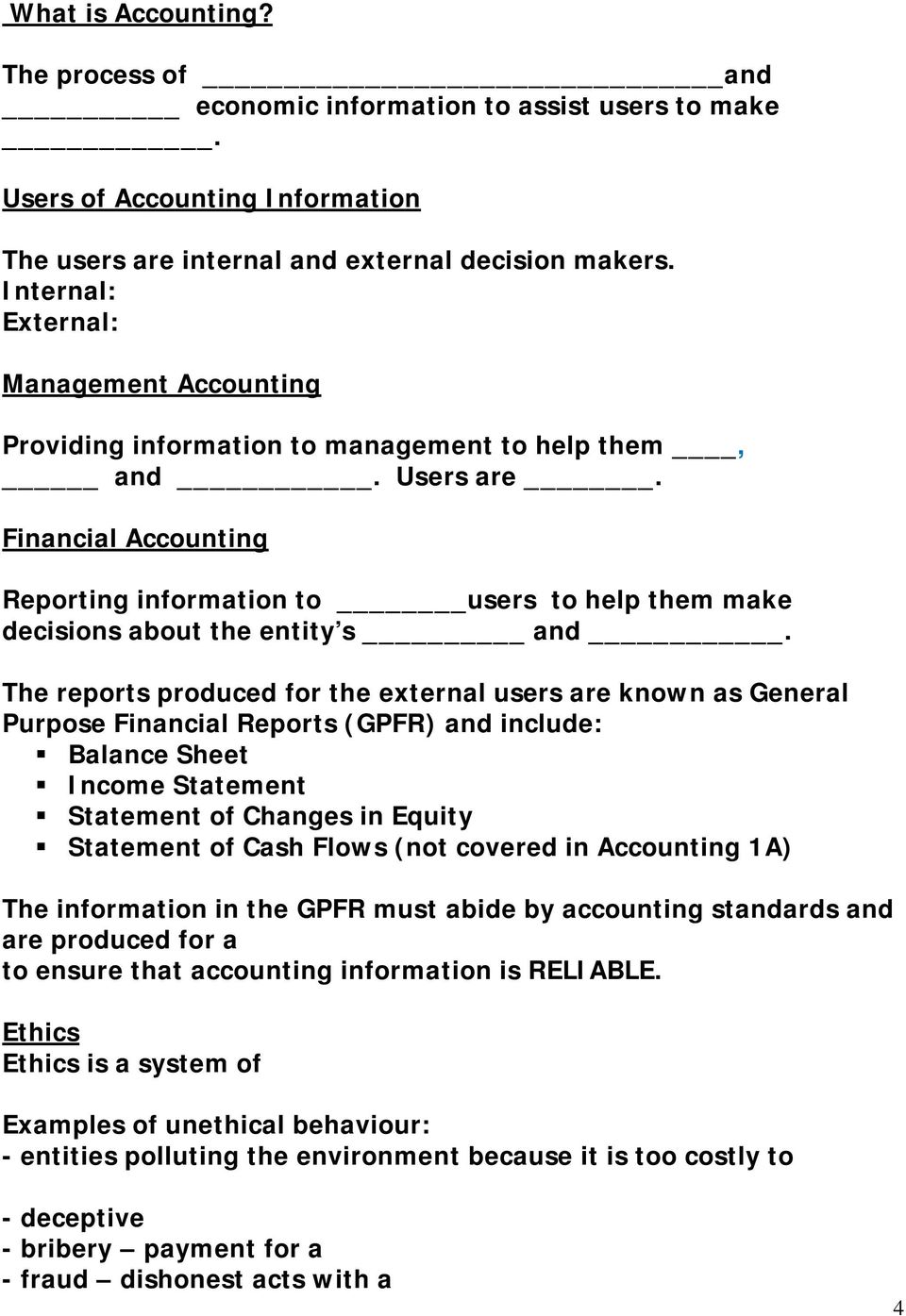
4 What is Accounting? The process of and economic information to assist users to make. Users of Accounting Information The users are internal and external decision makers. Internal: External: Management Accounting Providing information to management to help them, and. Users are. Financial Accounting Reporting information to users to help them make decisions about the entity s and. The reports produced for the external users are known as General Purpose Financial Reports (GPFR) and include: Balance Sheet Income Statement Statement of Changes in Equity Statement of Cash Flows (not covered in Accounting 1A) The information in the GPFR must abide by accounting standards and are produced for a to ensure that accounting information is RELIABLE. Ethics Ethics is a system of Examples of unethical behaviour: - entities polluting the environment because it is too costly to - deceptive - bribery payment for a - fraud dishonest acts with a 4
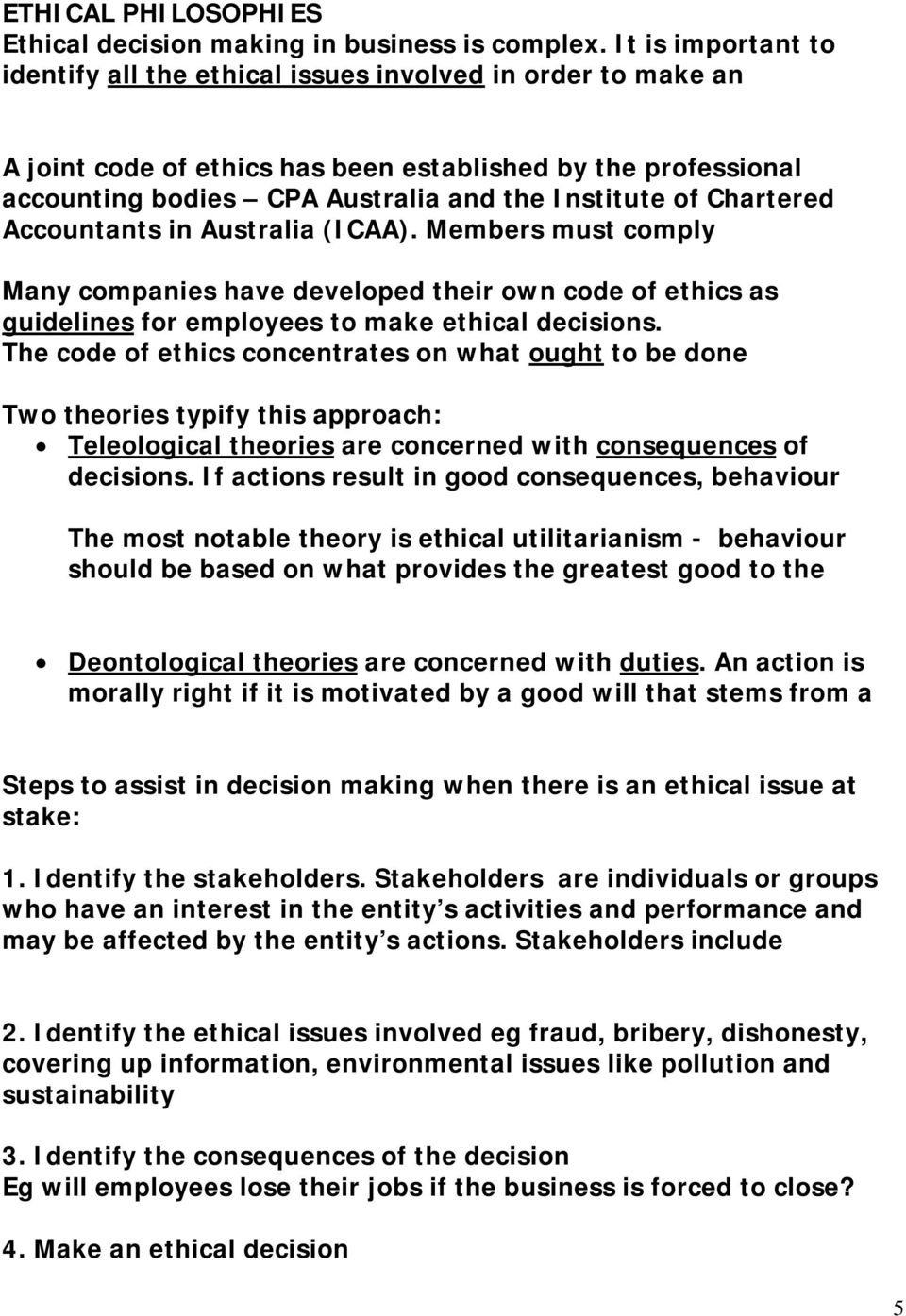
5 ETHICAL PHILOSOPHIES Ethical decision making in business is complex. It is important to identify all the ethical issues involved in order to make an A joint code of ethics has been established by the professional accounting bodies CPA Australia and the Institute of Chartered Accountants in Australia (ICAA). Members must comply Many companies have developed their own code of ethics as guidelines for employees to make ethical decisions. The code of ethics concentrates on what ought to be done Two theories typify this approach: Teleological theories are concerned with consequences of decisions. If actions result in good consequences, behaviour The most notable theory is ethical utilitarianism - behaviour should be based on what provides the greatest good to the Deontological theories are concerned with duties. An action is morally right if it is motivated by a good will that stems from a Steps to assist in decision making when there is an ethical issue at stake: 1. Identify the stakeholders. Stakeholders are individuals or groups who have an interest in the entity s activities and performance and may be affected by the entity s actions. Stakeholders include 2. Identify the ethical issues involved eg fraud, bribery, dishonesty, covering up information, environmental issues like pollution and sustainability 3. Identify the consequences of the decision Eg will employees lose their jobs if the business is forced to close? 4. Make an ethical decision 5
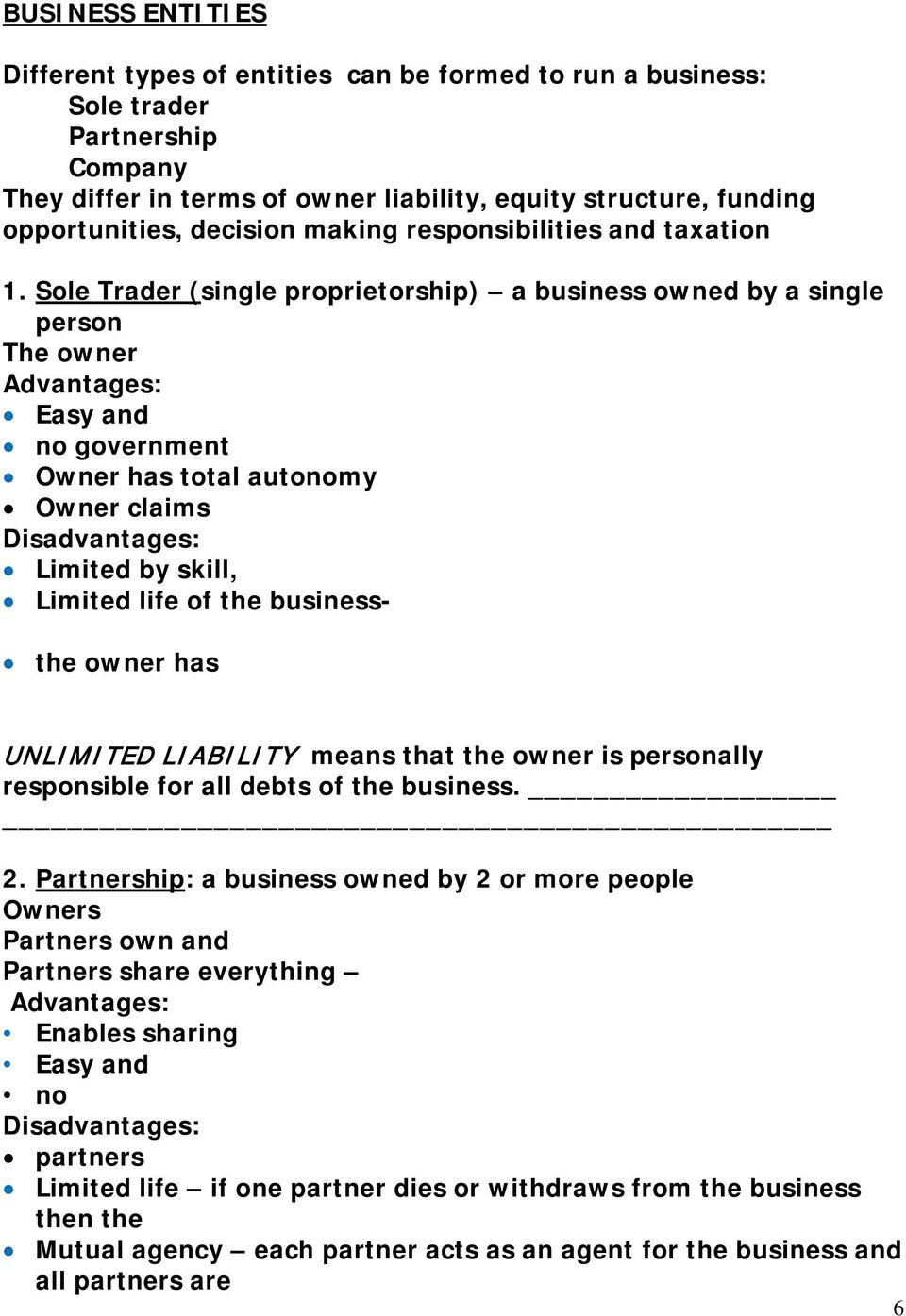
6 BUSINESS ENTITIES Different types of entities can be formed to run a business: Sole trader Partnership Company They differ in terms of owner liability, equity structure, funding opportunities, decision making responsibilities and taxation 1. Sole Trader (single proprietorship) a business owned by a single person The owner Advantages: Easy and no government Owner has total autonomy Owner claims Disadvantages: Limited by skill, Limited life of the business- the owner has UNLIMITED LIABILITY means that the owner is personally responsible for all debts of the business. 2. Partnership: a business owned by 2 or more people Owners Partners own and Partners share everything Advantages: Enables sharing Easy and no Disadvantages: partners Limited life if one partner dies or withdraws from the business then the Mutual agency each partner acts as an agent for the business and all partners are 6
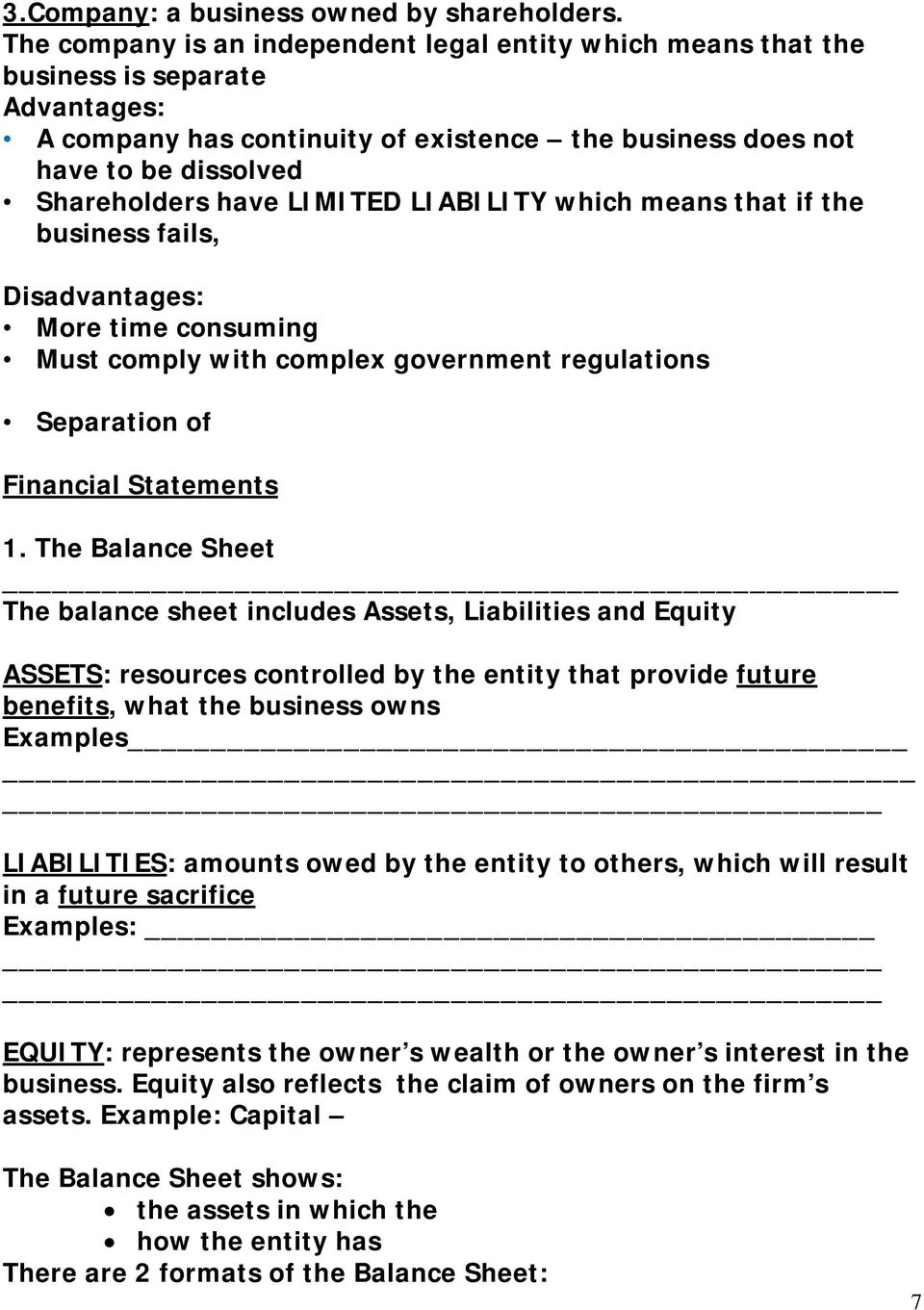
7 3.Company: a business owned by shareholders. The company is an independent legal entity which means that the business is separate Advantages: A company has continuity of existence the business does not have to be dissolved Shareholders have LIMITED LIABILITY which means that if the business fails, Disadvantages: More time consuming Must comply with complex government regulations Separation of Financial Statements 1. The Balance Sheet The balance sheet includes Assets, Liabilities and Equity ASSETS: resources controlled by the entity that provide future benefits, what the business owns Examples LIABILITIES: amounts owed by the entity to others, which will result in a future sacrifice Examples: EQUITY: represents the owner s wealth or the owner s interest in the business. Equity also reflects the claim of owners on the firm s assets. Example: Capital The Balance Sheet shows: the assets in which the how the entity has There are 2 formats of the Balance Sheet: 7
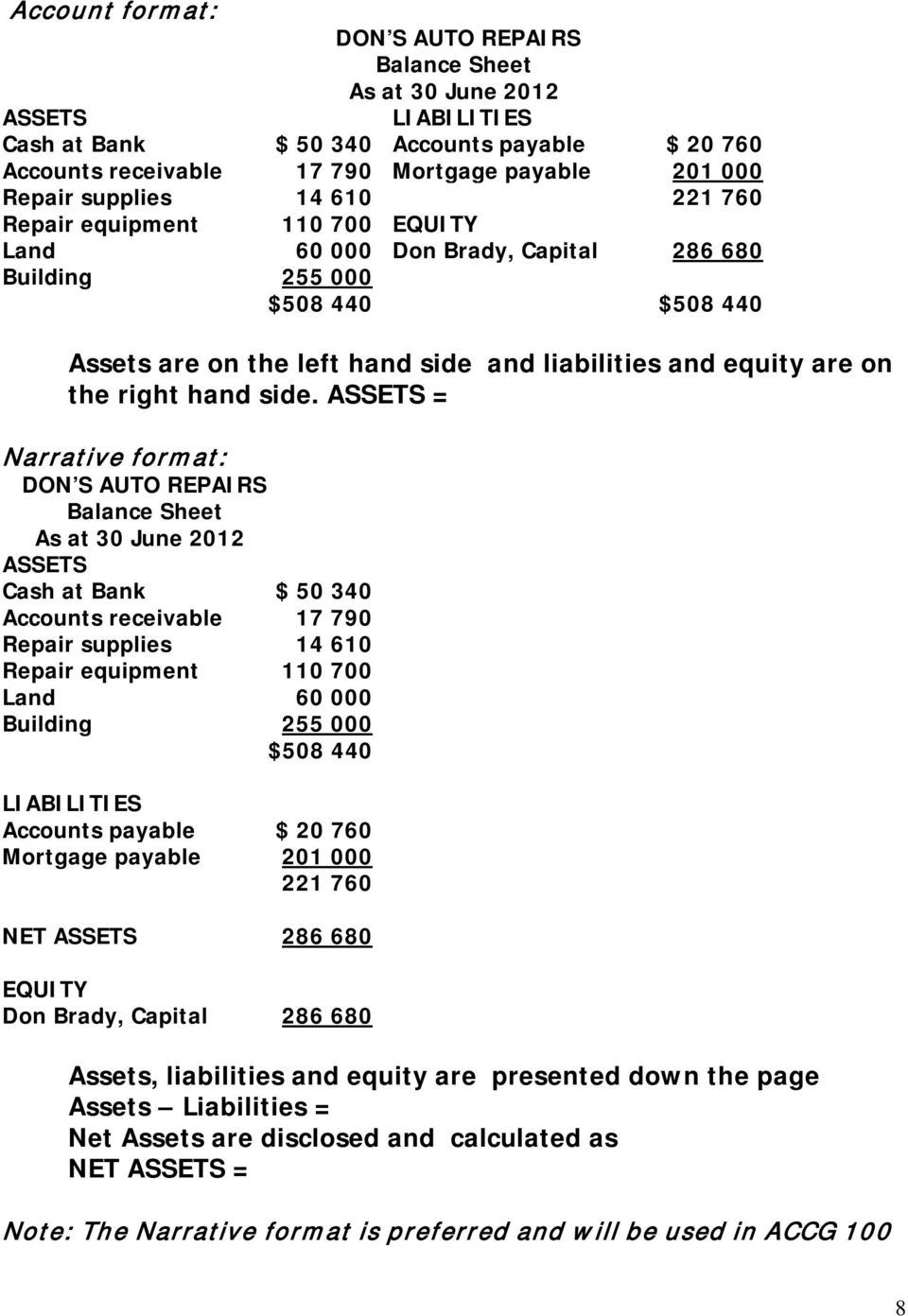
8 Account format: DON S AUTO REPAIRS Balance Sheet As at 30 June 2012 ASSETS LIABILITIES Cash at Bank $ Accounts payable $ Accounts receivable Mortgage payable Repair supplies Repair equipment EQUITY Land Don Brady, Capital Building $ $ Assets are on the left hand side and liabilities and equity are on the right hand side. ASSETS = Narrative format: DON S AUTO REPAIRS Balance Sheet As at 30 June 2012 ASSETS Cash at Bank $ Accounts receivable Repair supplies Repair equipment Land Building $ LIABILITIES Accounts payable $ Mortgage payable NET ASSETS EQUITY Don Brady, Capital Assets, liabilities and equity are presented down the page Assets Liabilities = Net Assets are disclosed and calculated as NET ASSETS = Note: The Narrative format is preferred and will be used in ACCG 100 8
9 2. The Income Statement DON S AUTO REPAIRS Income Statement For the year ended 30 June 2012 INCOME Repair revenue $ EXPENSES Advertising expense $ Repair supplies expense Salaries and wages expense Rent expense Telephone expense Light and Power expense PROFIT $ The Income Statement includes Income and Expenses INCOME / REVENUE: what the business earns, represents an increase in the wealth of the owners. Examples: sales revenue service revenue EXPENSES: costs incurred by the entity to earn income, represents a decrease in the wealth of the owners Examples: Income Expenses = If expenses > income, the business has made a 3. Statement of Changes in Equity explains the change in the balance of equity during the period ie it shows how the owner s wealth has changed DON S AUTO REPAIRS Statement of Changes in Equity For the year ended 30 June 2012 Don Brady, Capital - 1 July 2011 $ Net profit for the year Less: Drawings Don Brady, Capital - 30 June 2012 $

10 There are 4 factors which can affect Equity: i. Capital Contributions ii. Drawings iii. Profit iv. Loss FINANCIAL STATEMENT HEADINGS All financial statements must have a heading or title which contains the following information: Name of the business Name of the financial statement eg Balance Sheet, Income Statement or Statement of Changes in Equity Date or time period covered by the report Balance Sheet Income Statement Statement of Changes in Equity ACCOUNTING ASSUMPTIONS ( ) *Accounting entity assumption: for accounting purposes the business is considered to be a This means that the financial activities of the entity need to be separated Without this separation, it is not possible to assess the performance or financial position *Accrual basis accounting: transactions are recorded when they happen *Accounting period assumption: the life of the business is broken into equal time periods. Profit for the period is determined by recognising *Going concern assumption the entity will continue 10

11 Lecture Problem: The following is a list of financial statement balances for Hip Hop Dance Studios at 30 June Account Name $ Asset, Liability, Equity, Revenue, Expense Accounts payable Accounts receivable Advertising Expense Cash at bank Electricity expense Equipment Hip Hop, Capital? Hip Hop, Drawings Loan Payable Rent expense Services revenue Unearned revenue 800 Wages expense Financial Statement Required: A. For each of the items listed above, 1. classify the item as an asset, liability, equity, revenue or expense and 2. indicate whether the item should appear on the balance sheet, income statement or statement of change in equity B. Prepare an Income Statement, Balance Sheet and a Statement of Changes in Equity for Hip Hop Dance Studios for the year ended 30 June

12 HIP HOP DANCE STUDIOS Income Statement for the year ended 30 June 2012 HIP HOP DANCE STUDIOS Balance Sheet as at 30 June 2012 HIP HOP DANCE STUDIOS Statement of Changes in Equity for the year ended 30 June

13 This page was intentionally left blank 13

14 Lecture Notes Week 2 Accounting for Transactions Fundamentals Part 1 Required Readings: HEM: Chapter 3 Pages All required readings must be completed before attending class 14

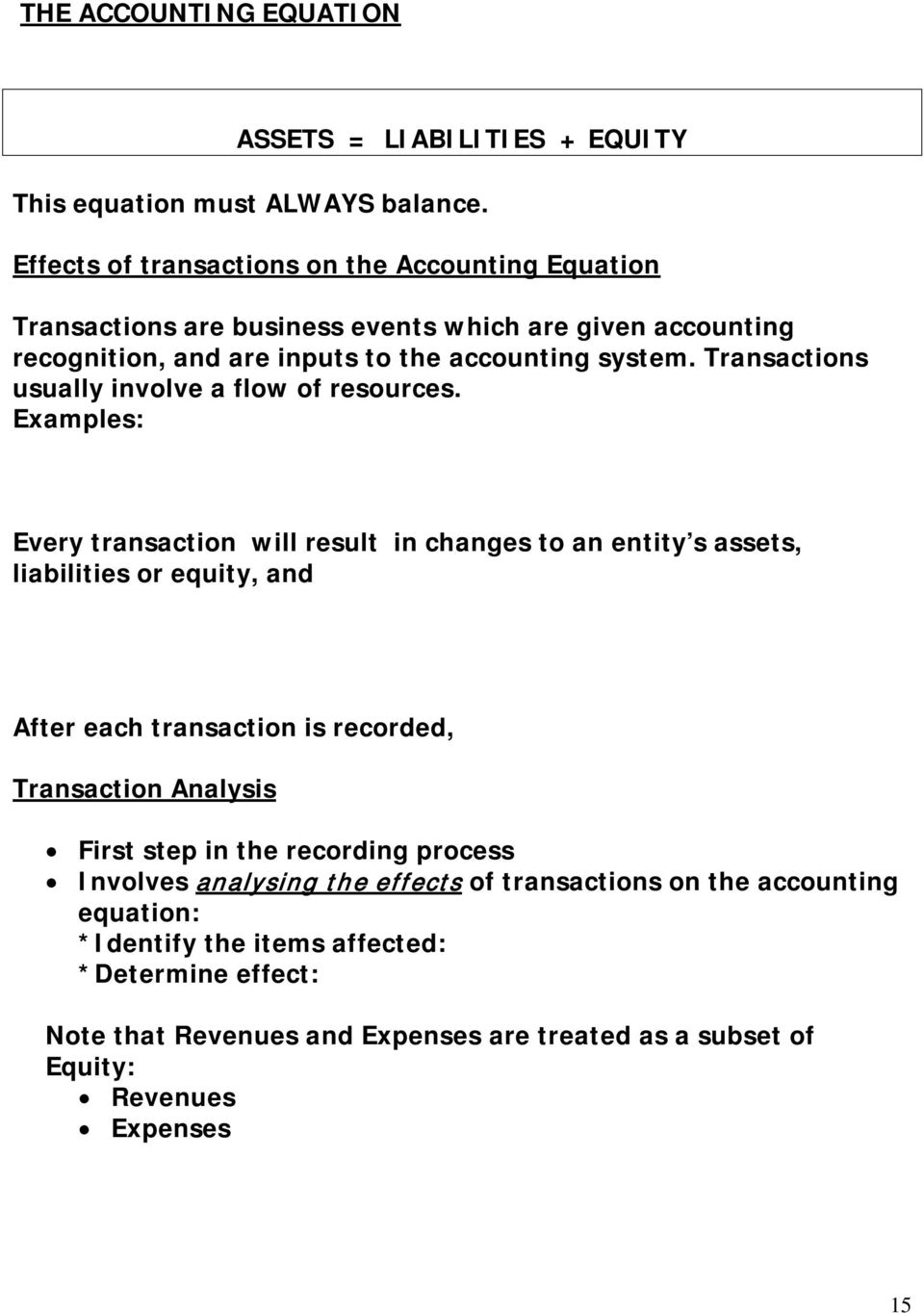
15 THE ACCOUNTING EQUATION ASSETS = LIABILITIES + EQUITY This equation must ALWAYS balance. Effects of transactions on the Accounting Equation Transactions are business events which are given accounting recognition, and are inputs to the accounting system. Transactions usually involve a flow of resources. Examples: Every transaction will result in changes to an entity s assets, liabilities or equity, and After each transaction is recorded, Transaction Analysis First step in the recording process Involves analysing the effects of transactions on the accounting equation: *Identify the items affected: *Determine effect: Note that Revenues and Expenses are treated as a subset of Equity: Revenues Expenses 15
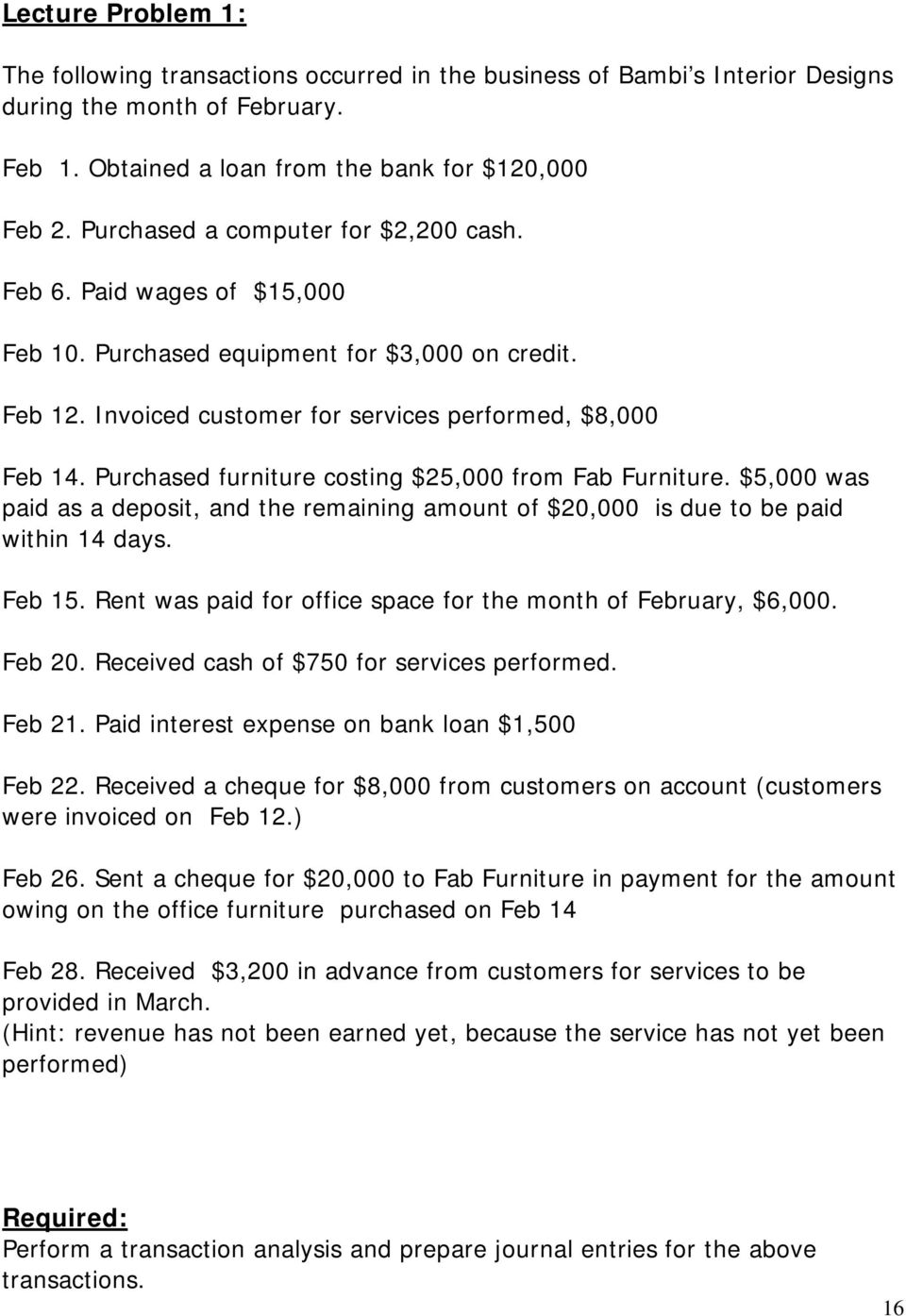
16 Lecture Problem 1: The following transactions occurred in the business of Bambi s Interior Designs during the month of February. Feb 1. Obtained a loan from the bank for $120,000 Feb 2. Purchased a computer for $2,200 cash. Feb 6. Paid wages of $15,000 Feb 10. Purchased equipment for $3,000 on credit. Feb 12. Invoiced customer for services performed, $8,000 Feb 14. Purchased furniture costing $25,000 from Fab Furniture. $5,000 was paid as a deposit, and the remaining amount of $20,000 is due to be paid within 14 days. Feb 15. Rent was paid for office space for the month of February, $6,000. Feb 20. Received cash of $750 for services performed. Feb 21. Paid interest expense on bank loan $1,500 Feb 22. Received a cheque for $8,000 from customers on account (customers were invoiced on Feb 12.) Feb 26. Sent a cheque for $20,000 to Fab Furniture in payment for the amount owing on the office furniture purchased on Feb 14 Feb 28. Received $3,200 in advance from customers for services to be provided in March. (Hint: revenue has not been earned yet, because the service has not yet been performed) Required: Perform a transaction analysis and prepare journal entries for the above transactions. 16
17 LECTURE PROBLEM 1: TRANSACTION ANALYSIS ASSETS = LIABILITIES + EQUITY 17

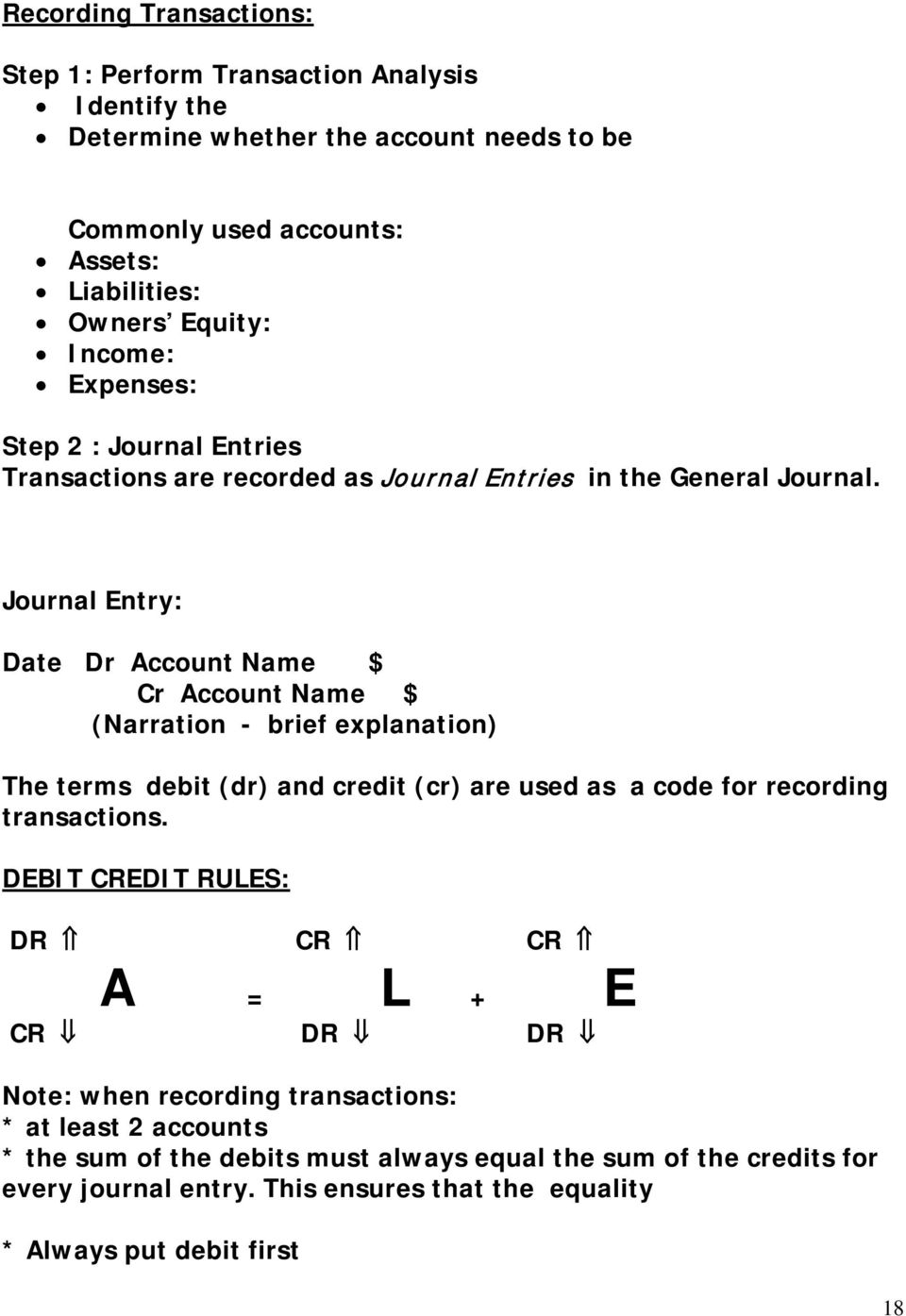
18 Recording Transactions: Step 1: Perform Transaction Analysis Identify the Determine whether the account needs to be Commonly used accounts: Assets: Liabilities: Owners Equity: Income: Expenses: Step 2 : Journal Entries Transactions are recorded as Journal Entries in the General Journal. Journal Entry: Date Dr Account Name $ Cr Account Name $ (Narration - brief explanation) The terms debit (dr) and credit (cr) are used as a code for recording transactions. DEBIT CREDIT RULES: DR CR CR A = L + E CR DR DR Note: when recording transactions: * at least 2 accounts * the sum of the debits must always equal the sum of the credits for every journal entry. This ensures that the equality * Always put debit first 18
19 Lecture Problem 1: General Journal Date Details Debit Credit 19
20 Lecture Problem 2: Abbey s Advertising Agency began operations on 1 January. The following transactions occurred during the month: Jan 1. The owner contributed cash of $65,000 to start the business Jan 3. Rent was paid for office space for January, $1,500. Jan 5. Office furniture was purchased on credit for $4,000 Jan 6. Office equipment was purchased for $1,200 cash Jan 10. Cash of $500 was received for services performed Jan 14. Office supplies were purchased on credit for $350 Jan 18. Billed customers for services provided, $2,500 Jan 20. Paid wages of $2,000 Jan 25. Received cash of $2,500 from customers on account for the services billed on Jan 18. Jan 27. Paid for internet and phone expenses $360 Jan 28. Services performed for a customer amounted to $1,950. Received cash of $450 and invoiced customer for the balance owing of $1,500. Jan 31. Office supplies used $200 Required: Perform a transaction analysis and prepare journal entries for the above transactions. 20
21 LECTURE PROBLEM 2: TRANSACTION ANALYSIS ASSETS = LIABILITIES + EQUITY 21
22 Lecture Problem 2: General Journal Date Details Debit Credit 22
23 Lecture Problem 3: The following transactions occurred in the business of Rosie s Couriers during August Aug 1.Paid advertising expense for the month of August by cheque, $6,000 Aug 2. Paid 6 months rent in advance, $7,200 Aug 4. Purchased a motor vehicle costing $50,000. $10,000 was paid in cash and a loan was obtained from the bank for the remaining $40,000. Aug 6. Received $9,000 from clients for services provided in July. (Hint: revenue would have been recorded in July when the service was performed and the amount owing from the customers would have been recorded as Accounts Receivable) Aug 12. Received cash of $640 for services performed Aug 15. A motor bike was purchased on credit, $16,000 Aug 17. Invoiced clients for services performed on account, $3,200 Aug 20. The owner withdrew $1,000 in cash from the business to pay personal expenses Aug 21. Paid interest expense of $400 on the bank loan Aug 24. Paid wages of $2,000 Aug 27. Received $3,200 from clients for services provided on August 17 Aug 31. Paid supplier for the motor bike purchased on August 15 Required: Perform a transaction analysis and prepare journal entries for the above transactions. 23
24 LECTURE PROBLEM 3: TRANSACTION ANALYSIS ASSETS = LIABILITIES + EQUITY 24
25 Lecture Problem 3: General Journal Date Details Debit Credit 25
26 This page was intentionally left blank 26
27 Lecture Notes Week 3 Accounting for Transactions Fundamentals Part 2 Required Readings: HEM: Chapter 3 Pages All required readings must be completed before attending class 27
28 Goods and Services Tax: GST This is a 10% tax on the supply of most goods and services. GST exempt items: Businesses that are registered for GST will collect GST from customers for a sale and pay GST on their purchases from suppliers. There are 2 accounts used for GST: 1. GST Collections: GST that the business collects from its customers on sales / services. The business has collected it on behalf of the Tax Office, so the amount is OWED to the Tax Office, therefore, Example: Received cash of $200 plus GST for services performed A = L + E Date Dr Cr Cr (received cash for services performed) 2. GST Outlays / GST Outlaid: GST paid to other businesses on the purchase of assets and expenses. The business will receive a REFUND from the Tax Office for the GST paid, therefore, Example: Purchased supplies costing $400 plus GST on credit. A = L + E Date Dr Dr Cr (purchased supplies on credit) 28
29 Lecture Problem 1: The following transactions occurred in the business of FYI News for March May 1. Paid rent for the month, $6,000 plus GST May 4. Purchased office furniture on credit for $7,000 plus GST May 6. Received cash from customers of $500 plus GST for services performed May 7. Purchased printing equipment costing $60,000 plus GST. $5,000 was paid in cash and the balance is to be paid within 30 days. May 9. Paid wages expense of $5,000 May 16. Paid for the office furniture purchased on May 4. May 21. Invoiced customers $3,000 plus GST for services performed May 23. Paid $900 plus GST for a 1 year insurance policy May 24. Paid internet expense of $330 including GST May 28. Received cash of $3,300 from customers on account. (The customers had been invoiced on May 21.) May 31. The owner withdrew cash of $1,500 for personal expenses Required: Perform a transaction analysis and prepare journal entries for the above transactions. 29
30 LECTURE PROBLEM 1: TRANSACTION ANALYSIS ASSETS = LIABILITIES + EQUITY 30
31 Lecture Problem 1: General Journal Date Details Debit Credit 31
32 The Accounting Cycle 1. Recognise & record transactions 2. Journalise transaction Source documents General journal 3. Post to ledger accounts General ledger 4. Prepare trial balance Trial balance 5. Prepare financial statements Financial statements After journal entries have been prepared in the General Journal, the information is transferred to the The General Ledger is a collection of organised in the order that they appear in the balance sheet and income statement. Account (also called General Ledger Account) The place to record increases and decreases for each item in the financial statements The General ledger The general ledger can be maintained using either of 2 formats: We will be using T-accounts in ACCG
33 Account title Date Explanation Amount Date Explanation Amount Debit (Dr) Credit (Cr) A general ledger T- account has 3 parts: Title - A place to record A place to record Debit = Dr Credit = Cr Chart of Accounts A listing of all accounts and the number assigned to each account See example page 75 Posting from the General Journal to the Ledger Transferring amounts from the general journal to the general ledger is called The steps in the posting process: 1. locate the account to be 2. enter the date as per 3. enter in the explanation / details column the name of the OTHER ACCOUNT 4. enter the debit amount in the Repeat steps 1 4 for credit entries. 33
34 Example: Post the following Journal Entries to the General Ledger 1 July Dr Cash at Bank 5,000 Cr Capital 5,000 (To record investment by owner) 3 July Dr Cash at Bank 770 Cr Service revenue 700 Cr GST collections 70 (To record services provided for cash) GENERAL LEDGER Cash at Bank Date Explanation $ Date Explanation $ GST Collections Date Explanation $ Date Explanation $ Capital Date Explanation $ Date Explanation $ Service Revenue Date Explanation $ Date Explanation $ 34
35 Balancing a T-account 1. Identify the larger side. 2. Record the same total 3. Determine the difference between the total of the larger side and total of smaller side. This difference is the BALANCE of the account. 4. Put balance on larger side below total. Example: Balance the following T-accounts Cash at Bank 1 Aug Capital 20,000 6 Aug Wages expense 3,000 9 Aug Rent expense 5,000 Accounts Payable 10 Aug Cash at Bank 5,000 7 Aug Office Supplies 2,000 8 Aug Equipment 7,000 35
36 Trial Balance A trial balance See example page 100. Checks whether total debits equal total credits (remember debits should always equal credits when recording general journals). If debits do NOT equal credits in the trial balance: 1. Add the debit and credit columns again. 2. Calculate the difference between the totals. *Divide the difference by 2 is this the balance of any ledger account? This could indicate that you have put a debit balance in the credit column, or a credit balance in the debit column by mistake. (refer to Normal balances below) 3. Compare the account balances with each ledger account again Trial Balance does not guarantee Errors could have occurred, for example, posting to the wrong ledger account, and the Normal Balances Account Assets Liabilities Equity Capital Drawings Income/ Revenues Expenses Normal balance 36
37 Lecture Problem 2: Titanic Travel opened for business on 1 July The following transactions occurred during the first month of operations: 2 July. The owner contributed $22,000 cash to the business. 4 July. Paid cash for Office Furniture purchased at a cost of $8,000 plus GST 15 July. Rent for July was paid by cheque, $4,000 plus GST 16 July. Billed customers $2,000 plus GST for services performed. 24 July. Cash of $500 plus GST was received for services performed. Required: 1. Perform a transaction analysis 2. Record the transactions in the General Journal 3. Post the journal entries to the General Ledger 4. Prepare a Trial Balance LECTURE PROBLEM 2: TRANSACTION ANALYSIS ASSETS = LIABILITIES + EQUITY 37
38 Lecture Problem 2: General Journal Date Details Debit Credit 38
39 Lecture Problem 2: General ledger Cash at bank Date Explanation Amount Date Explanation Amount Accounts Receivable Date Explanation Amount Date Explanation Amount Office Furniture Date Explanation Amount Date Explanation Amount GST Outlays Date Explanation Amount Date Explanation Amount GST Collections Date Explanation Amount Date Explanation Amount Capital Date Explanation Amount Date Explanation Amount 39
40 Service Revenue Date Explanation Amount Date Explanation Amount Rent expense Date Explanation Amount Date Explanation Amount Titanic Travel Trial Balance as at 31 July 2012 Debits Credits 40
41 This page was intentionally left blank 41
42 Lecture Notes Week 4 Accounting for Adjustments Part 1 Required Readings: HEM: Chapter 4 Pages All required readings must be completed before attending class 42
43 The Accounting Cycle 1. Recognise and record transactions 2. Journalise transactions Source documents General journal 3. Post to ledger accounts 4. Prepare unadjusted trial balance of GL General ledger Trial balance (unadjusted) 5. Determine adjusting entries and/or 6. Post adjusting entries to general ledger General ledger (accounts adjusted) 7. Prepare adjusted trial balance of GL (adjusted) Trial balance (adjusted) 8. Prepare financial statements work sheet t Financial statements Measurement of Profit Profit/(loss) = Income and expenses may be recorded on a cash basis or accrual basis. Cash Basis Incomes are recorded when Expenses are recorded when Accrual Basis Timing of cash receipts and cash payments ignored. Income recorded 43
44 CASH vs ACCRUAL BASIS Accrual basis is preferred because At the end of the accounting period, ADJUSTING ENTRIES (also known as balance day adjustments) are required under the Accrual Basis This is known as the MATCHING CONCEPT / MATCHING PRINCIPLE and it is derived from the Accounting Period Assumption which states: Some transactions may affect the entity s profit or financial position for more than 1 accounting period. Example: As a result, some accounts need to be ADJUSTED on the last day of the accounting period Adjusting entries are recorded in the general journal, then posted to ledger accounts. 2 IMPORTANT RULES: Types of Adjusting Entries: Prepayments, Supplies, Accrued Expenses, Accrued Income, Depreciation, Unearned Revenue 1. PREPAYMENTS Item paid for in advance. Recorded as an ASSET at time of payment (future benefit). Examples: Over time, the future benefits are lost / used up / consumed. The asset needs to be 44
45 Eg 1 June, paid 1 year s insurance $1200 plus GST. This was recorded by debiting Prepaid Insurance: 1 June Dr Prepaid Insurance 1200 Dr GST Outlays 120 Cr Cash 1320 (to record prepaid insurance) At the end of the month, an adjusting entry is required to record the benefits : 30 June Dr Cr (adjusting entry to record expired insurance) Balance of Prepaid Insurance at June 30 (after adjusting entry) is $ This represents Adjusting entry required at end of every month No GST adjustment is required in the adjusting entry as there is no tax effect. Supplies /Office supplies are recorded as an ASSET when purchased (future benefit). Adjusting entry required to No GST adjustment required in the adjusting entry as there is no tax effect. Eg supplies purchased during period $200. At end of period $80 supplies remain in stock / on hand 30 June Dr Cr (adjusting entry to record supplies used) 45
46 2. Accrued Expenses Accrued Expenses (or unrecorded expenses) are expenses that have been INCURRED in period, Adjusting entry is required to record GST adjustment is necessary. Eg accrued rent at year end $2000 plus GST: 30 June Dr Dr Cr (adjusting entry to record accrued rent) eg wages owing at year end $600: 30 June Dr Cr (adjusting entry to record wages owing) GST has not been recorded here eg interest accrued on bank loan, $1, June Dr Cr (adjusting entry to record interest owing on bank loan) GST has not been recorded here eg tax invoice received for telephone $120 plus GST: 30 June Dr Dr Cr (adjusting entry to record accrued telephone expense) Note that when the LIABILITY account is created, we do NOT credit Accounts Payable. Accounts Payable is used for the purchase of goods on credit. 46
47 3. Accrued Income Accrued income (or unrecorded income) is income that has been EARNED in period, Adjusting entry is required to record GST adjustment is necessary. eg services performed $900 plus GST but cash not yet received and not yet recorded: 30 June Dr Cr Cr (adjusting entry to record accrued services income) eg interest earned on investment but not yet received or recorded $150: 30 June Dr Cr (adjusting entry to record accrued interest income) GST has not been recorded here because 47
48 4. Depreciation Certain assets (eg motor vehicles, equipment, buildings) have future benefits which will be used up over many accounting periods. An adjusting entry is required to allocate part of the cost of the asset to expense each period over the life of the asset. This allocates Depreciation is a Cost Allocation process NOT a Valuation process. No GST adjustment is required. Eg Helicopter cost $5m. Expected useful life 3 years, estimated scrap value $2m. Useful Life Scrap Value Depreciation expense=cost - Scrap value Useful life 30 June Dr Cr (adjusting entry to record depreciation on helicopter) ACCUMULATED DEPRECIATION is a CONTRA ASSET CONTRA ASSETS Eg Balance Sheet: ASSETS Helicopter $5m Less: Accum Dep Helicopter ( $1m) $4m 48
49 5. Unearned Income Unearned Income arises when the business receives cash in advance from a customer before the service is performed. Examples: These amounts CANNOT be recorded as income until earned (when the service has been performed). When cash is received, record as a LIABILITY, When the service is subsequently performed, an adjusting entry is required Eg 1 April received $600 plus GST for 6 months gym membership recorded by crediting Unearned Income: 1 April Dr Cash 660 Cr Unearned Income 600 Cr GST Collections 60 (to record cash received in advance) At the end of the month, an adjusting entry is required to record income earned in the accounting period: 30 April Dr Cr (adjusting entry to record income earned) Balance of Unearned Income at April 30 (after adjusting entry ) is $ This represents the Adjusting entry required at end of every month No GST adjustment required in the adjusting entry as there is no tax effect. 49
50 Summary: 2 major categories of adjusting entries: 1. Deferrals Examples: 2. Accruals Examples: Adjusting entries requiring GST: Effect on Financial Statement items if adjusting entries are not performed: Financial Statement items will not be correctly stated if adjusting entries are not performed. Some items will be OVERSTATED, which means the account balance being reported is Some items will be UNDERSTATED, which means the account balance being reported is Adjusting Entry Effect on account if no adjustment Prepayments Accrued Expenses Accrued Income Depreciation Unearned Revenue 50
51 Lecture Problem: The following information relates to Fareeza s Basketball Camps for the year ended 30 June Prepare the necessary adjusting entries in the general journal. 1. Prepaid rent expired during the year, $6, Depreciation on Sports Equipment was $3,000 for the year. 3. Electricity expenses of $550 including GST were unpaid and unrecorded at year end 4. Supplies purchased during the year totaled $800. At year end, only $150 of supplies remained on hand. 5. Interest of $320 had been earned on an investment, but cash has not yet been received. 6. Unpaid Wages at year end amounted to $5, Cash of $8,000 had been received in advance for Basketball Camps to be held in the future. This was recorded as Unearned Revenue. By year end all the revenue had been earned. Date Details Debit Credit 51
52 This page was intentionally left blank 52
53 Lecture Notes Week 5 Accounting for Adjustments Part 2 Required Readings: HEM: Chapter 4 Pages All required readings must be completed before attending class 53
54 The Accounting Cycle 1. Recognise and record transactions 2. Journalise transactions Source documents General journal 3. Post to ledger accounts General ledger 4. Prepare unadjusted trial balance of GL Trial balance (unadjusted) 5. Determine adjusting entries and/or 6. Post adjusting entries to general ledger General ledger (accounts adjusted) 7. Prepare adjusted trial balance of GL (adjusted) Trial balance (adjusted) 8. Prepare financial statements work sheet t Financial statements 54
55 Adjusted Trial Balance After adjusting entries are recorded in the general journal, they need to be posted to the ledger accounts so that an Financial statements are prepared from the adjusted trial balance. In practice we only record and post adjusting entries at the end of the year, we would not enter journals and post them every single month. The Worksheet If financial statements are required during the year (eg. monthly) a worksheet is used.the worksheet The worksheet is NOT a financial statement. See example of worksheet: page 151. Worksheet - Steps 1. Enter the ledger account titles and balances in the account title and unadjusted trial balance columns 2. Enter the adjusting entries in the 3. Prepare an Adjusted Trial Balance 4. Extend every account balance listed in the Adjusted Trial Balance to its financial statement column (Income Statement or Balance Sheet) 5. Determine 55
56 Classified Financial Statements When preparing a Balance Sheet, assets and liabilities can be classified as either These classifications provide more useful information to users for decision making. Current Assets Current Assets: assets that are cash, or are expected to be sold, converted to cash or consumed within the operating cycle or 12 months from balance sheet date. Operating cycle: the time it takes to acquire inventory, sell inventory to customers and then collect the cash from customers Examples: Current assets should be listed in order of their liquidity Non-Current Assets Non-Current Assets: assets that are not current assets, assets that are expected to last longer than 12 months Examples: Current Liabilities Current Liabilities: obligations that are expected to be settled in the entity s operating cycle or within 12 months of balance sheet date. Examples: Non-Current Liabilities Non-Current Liabilities: all liabilities that are not current. Examples: NOTE: Balance Sheet only acceptable format for Final Exam is CLASSIFIED NARRATIVE FORMAT see page
57 Lecture Problem: Required: a. Enter the adjustments below into the worksheet, and complete the worksheet for Asha s Orchid Shows. (Ignore GST) b. Prepare a fully classified Balance Sheet in the narrative format for Asha s Orchid Shows as at 30 June 2012 and a Statement of Changes in Equity for the year ending 30 June Accrued service revenue $3, Depreciation on Motor Vehicle $5, Wages owing to staff but unpaid as at 30 June $2, Prepaid advertising expired $1, Supplies on hand at 30 June $2,780. The beginning balance of supplies was $6, Cash of $12,000 had been received in advance and was recorded correctly as Unearned Revenue. By 30 June, 50% has been earned. 57
58 Asha s Orchid Shows Work Sheet For the year ended 30 June 2012 UNADJUSTED ADJUSTMENTS ADJUSTED TRIAL INCOME BALANCE SHEET TRIAL BALANCE BALANCE STATEMENT ACCOUNT TITLE DEBIT CREDIT DEBIT CREDIT DEBIT CREDIT DEBIT CREDIT DEBIT CREDIT Cash at bank Accounts Receivable 6880 GST Outlays 200 Prepaid Advertising 2400 Supplies 6780 Land Motor Vehicle Accum deprec. MV 5680 Accounts payable 6200 Wages payable 1000 GST Collections 500 Unearned service revenue Mortgage Payable Asha, Capital Asha, Drawings 6000 Service revenue Depreciation exp MV Wages expense 3200 Telephone expense 400 Advertising expense 600 Supplies expense , ,040 Net profit/(loss) 58
59 Asha s Orchid Shows Balance Sheet As at 30 June
60 Asha s Orchid Shows Statement of Changes in Equity For the year ended 30 June
61 ADJUSTING (CORRECTING) ENTRIES Prepayments: If, at the time of payment, a prepayment is INCORRECTLY recorded as an expense instead of an asset, then the adjusting entry has to correct the situation by: *creating a prepayment (asset) (unexpired portion) *reducing the expense recorded Example: 1 June paid 1 year s insurance $1200 plus GST. This was recorded by debiting insurance expense 1 June Dr Insurance Expense 1200 Dr GST Outlays 120 Cr Cash 1320 (to record payment of insurance) At the end of the month, an adjusting entry is required to correct the situation: 30 June Dr Cr (Adjusting entry to correct prepayment) The effect of the correcting entry is to 61
62 ADJUSTING (CORRECTING) ENTRIES (continued) Unearned Income /Unearned Revenue: If, at the time cash received in advance is INCORRECTLY recorded as revenue instead of a liability, then the adjusting entry has to correct the situation by *reducing the revenue recorded * creating a liability unearned revenue Example : 1 April received $600 plus GST for 6 months gym membership. This was recorded by crediting income. 1 April Dr Cash 660 Cr Gym Income 600 Cr GST Collections 60 (to record cash received ) At the end of the month, an adjusting entry is required to correct the situation: 30 April Dr Cr (Adjusting entry to correct Unearned Revenue) The effect of the correcting entry is to 62
63 This page was intentionally left blank 63
64 Lecture Notes Week 6 Completion of Accounting Cycle Required Reading: HEM: Chapter 5 pages Accounting Systems Required Reading: HEM: Chapter 7 Pages
65 COMPLETION of ACCOUNTING CYCLE (Chapter 5) The Closing Process The closing process occurs after adjusting entries have been prepared and posted to the ledger. This involves closing temporary accounts at the end of the accounting period to Temporary accounts include and a special temporary account called Close means These accounts then begin the next accounting period with a Steps in the Closing Process 1. Close Income accounts to P&L Summary: - the normal balance of income accounts is to close (make zero) an income account we need to 30 June DR DR CR (to close revenue accounts) 2. Close Expense accounts to P&L Summary: - the normal balance of expense accounts is - to close (make zero) an expense account we need to 30 June DR CR CR (to close expense accounts) 65
66 3. Close the P&L Summary account to Capital: Firstly, calculate the Balance in the P & L Summary account. - if the business made a Profit, the balance of the P&L Summary account is - to close (make zero) if profit: 30 June DR CR (to close P & L summary to capital) This will INCREASE the owner s capital balance What if the business made a loss? - if the business made a Loss, the balance of the P&L Summary account is - to close (make zero) if there is a loss: 30 June DR CR (to close P & L summary (loss) to capital) This will DECREASE the owner s capital balance 4. Close the Drawings account to Capital: - the normal balance of Drawings is to close (make zero) the Drawings account we need to 30 June DR CR (to close drawings to capital) This will DECREASE the owner s capital balance After the Closing Process All income, expense and drawings accounts The capital account has been increased/decreased 66
67 Post Closing Trial Balance After the closing entries have been recorded in the general journal and posted to the ledger accounts, a post-closing trial balance can be prepared. The post-closing trial balance will include only permanent accounts: * * * Note that the capital balance Summary of the Closing Process: The steps in the closing process: 1. Close income accounts to P&L Summary account 2. Close expense accounts to P&L Summary account 3. Close P&L Summary account to Capital account 4. Close Drawings account to Capital account Lecture Problem: Nandini s Jazz Club Adjusted Trial Balance As at 30 June 2012 Debits Credits Cash at bank 16,000 Accounts Receivable 15,400 Prepaid Rent 3,600 Furniture 82,400 Accum Depreciation Furniture 18,000 Accounts payable 26,000 Wages Payable 2,280 Capital 86,600 Drawings 12,000 Service revenue 67,000 Advertising expense 22,280 Rent expense 17,400 Wages expense 12,800 Depreciation expense Furniture 18, , ,880 67
68 Required: Using the adjusted trial balance above, prepare the closing entries for Nandini s Jazz Club, a post-closing trial balance at 30 June 2012 and a Statement of Changes in Equity. Closing Entries: Date Details Debit Credit 68
69 Nandini s Jazz Club Post-Closing Trial Balance As at 30 June 2012 Nandini s Jazz Club Statement of Changes in Equity For the year ended 30 June
70 Special Journals ACCOUNTING SYSTEMS (Chapter 7) The general journal is Posting to the ledger line by line from the general journal Solution Sales Journal Purchases Journal Cash Receipts Journal Cash Payments Journal Special Journals are used for The General Journal is used to record all transactions that are not recorded in the special journals Sales Journal Records only credit sales of inventory Note: cash sales See example page 287. Purchases Journal Records only credit purchases If purchase was paid for by cash or cheque, See example page 289. Cash Receipts Journal Records all receipts of cash, regardless of source Examples: See example page
71 Cash Payments Journal Records all payments of cash. Examples: See example page 295. Use of Special Journals: Frequent transactions are recorded in the appropriate special journal as they If the transaction affects a related subsidiary ledger, eg Accounts Receivable or Accounts payable, update the relevant subsidiary ledger At month end, total the special journals and post the Note: when using Special Journals, individual transactions do not have to be posted to the General Ledger Special Journals Advantages Use of the General Journal The General Journal is inefficient and is used for: Infrequent transactions like Control Accounts and Subsidiary Ledgers The General ledger is a collection of accounts. Some accounts in the General Ledger require detailed information which the General Ledger cannot provide. For example: Accounts Receivable The balance in the General Ledger represents the TOTAL amount owing from ALL customers, 71
72 This enables management to Bad debts arise when an accounts receivable customer The business needs to establish a separate Receivable account for every customer. This cannot be done in the general ledger as the general ledger would be Instead, these individual accounts will be established in a separate ledger known as a Note: the Subsidiary Ledger is NOT part of the When a subsidiary ledger is used, the corresponding General Ledger account is known as a CONTROL account, because it summarises the information The total of the balances of the individual accounts in the subsidiary ledger MUST EQUAL the balance in the corresponding General Ledger control account. See example page 298. Accounts that Subsidiary Ledgers are commonly used for include: The Accounts Receivable Subsidiary Ledger (ARSL) contains the accounts of individual credit customers and is updated when a transaction occurs with an accounts receivable customer, so that an up-to-date balance is available for each customer. Examples: The Accounts Payable Subsidiary Ledger (APSL) contains the accounts of individual credit suppliers and is updated when a transaction occurs with an accounts payable supplier. Examples: Subsidiary ledgers for Inventory and Fixed Assets will NOT be covered in ACCG
73 Transaction Type Journal Subsidiary Ledger Credit sale Cash Sale Credit purchase Cash purchase Receipt of cash from Accounts Receivable Customer Payment of cash to Accounts Payable Supplier Cash payment of expense Steps for using Special Journals and Subsidiary Ledgers: 1. Record the transaction in the appropriate special journal SJ, PJ, CRJ or CPJ 2. Update the related subsidiary ledger: Accounts Receivable (from SJ or CRJ) or Accounts Payable (from PJ or CPJ) 3. Add up special journals and post TOTALS to the General Ledger at the end of the accounting period. 4. Prepare listing of the individual accounts from the subsidiary ledgers and ensure that the total equals the balance in the relevant General Ledger account. 73
74 Lecture Problem : Aquatastic buys and sells aquariums and aquarium supplies. The business uses a Sales Journal, Purchases Journal, Cash Receipts Journal and Cash Payments Journal. Accounts Receivable and Accounts Payable Subsidiary Ledgers are also maintained. Transactions for the month of March are as follows: (Ignore GST) 1 March. The owner contributed cash of $30,000 2 March. Purchased inventory on credit from Aqua Nova, $6,000 3 March. Sold inventory on account to Nemo s Aquariums, $8, March. Cash sales to customers $1, March. Paid Aqua Nova for the purchase on 2 March, $6, March. Purchased inventory on credit from Coral Cove, $3, March. Paid rent for the month, $5, March. Sold inventory on account to Neptuneworld, $4, March. Received cash on account of $8,000 from Nemo s Aquariums for the sale on 3 March 22 March. Cash purchases of $2,000 were made 24 March. Sold inventory on account to Triton s Treasures, $6, March. Purchased inventory on credit from Marinescape, $1, March. Received cash on account from Neptuneworld of $4, March. Sold inventory on account to Triton s Treasures, $1,200 Required: A. Record the above transactions in the Special Journals and update the relevant subsidiary ledgers where appropriate. B. Post the totals from the Special Journals to the General ledger C. Prepare listings of the individual accounts from the subsidiary ledgers and ensure that the total equals the balance in the relevant General Ledger account. 74
75 Purchases Journal Date Account Post Ref. Purchases Sales Journal Date Account Post Ref. Sales Cash Receipts Journal Date Account Post. Ref. Cash at Bank Cash Sales Accts. Receivable Other Cash Payments Journal Date Account Post. Ref. Cash Purchases Accts. Payable Other Cash at Bank 75
76 ACCOUNTS RECEIVABLE SUBSIDIARY LEDGER Date Nemo s Aquariums Post Debit Credit Balance Ref Date Post Ref Neptuneworld Debit Credit Balance Date Triton s Treasures Post Debit Credit Balance Ref ACCOUNTS PAYABLE SUBSIDIARY LEDGER Date Post Ref Aqua Nova Debit Credit Balance Date Post Ref Coral Cove Debit Credit Balance Date Post Ref Marinescape Debit Credit Balance 76
77 GENERAL LEDGER Cash at bank Date Explanation Amount Date Explanation Amount 31/3 Capital - CRJ 31/3 Purchases - CPJ 31/3 Sales - CRJ 31/3 Ac Pay - CPJ 31/3 Ac Rec - CRJ 31/3 Rent expense Bal c/d Bal b/d Accounts Receivable Control Date Explanation Amount Date Explanation Amount 31/3 Sales - SJ 31/3 Cash - CRJ 31/3 Bal c/d Bal b/d Accounts Payable Control Date Explanation Amount Date Explanation Amount 31/3 Cash - CPJ 31/3 Purchases - PJ 31/3 Bal c/d Bal b/d Sales Revenue Date Explanation Amount Date Explanation Amount 31/3 Ac Rec - SJ 31/3 Cash - CRJ Purchases Date Explanation Amount Date Explanation Amount 31/3 Ac Pay - PJ 31/3 Cash - CPJ 77
78 Capital Date Explanation Amount Date Explanation Amount 31/3 Cash - CRJ Rent Expense Date Explanation Amount Date Explanation Amount 31/3 Cash - CPJ C. Listing of balances in subsidiary ledgers: Accounts Receivable: Nemo s Aquariums Neptuneworld Triton s Treasures Accounts Payable: Aqua Nova Coral Cove Marinescape 78
79 This page was intentionally left blank 79
80 REVISION: Chapters 1 4 The mid-semester test will be held during lectures in week 7. Complete the following as part of your exam preparation. Time Allowed 30 MINUTES 1. A stakeholder is a (an): a. investor. b. employee. c. customer. d. special interest group. e. all of the above 2. Theories concerned with the consequences of decisions are known as: a. relativity theories b. deontological theories c. teleological theories d. all of the above e. none of the above 3. An advantage of a company is: a. mutual agency b. unlimited liability c. limited liability d. all of the above e. none of the above 4. A business started the year with total assets of $60000 and total liabilities of $ During the year the business earned $ in income and incurred $55000 in expenses. Drawings were $ Equity at the end of the period was: a. $ b. $ c. $ d. $ e. None of the above 80
81 5. If total liabilities decreased by $14000 and equity increased by $6000 over a period, then total assets must have changed by? a. $ increase b. $ increase c. $8000 decrease d. $8000 increase e. None of the above 6. Double-entry accounting requires that when recording a transaction: a. The accounting equation should stay in balance b. Total debits should equal total credits c. At least one account should be debited and one account credited d. All of the above e. None of the above 7. A business has the following assets and liabilities: $ Cash at bank Bank overdraft Trade creditors Inventory Trade debtors Office furniture Loan Payable Motor vehicles Equity is: a. $1150 b. $ c. $-200 d. $7150 e. $ If a transaction causes an asset account to increase, which of the following effects of equal amount may also occur? a. A decrease in a liability account b. An increase in another asset account c. A decrease in an equity account d. An increase in a liability account e. None of the above 81
82 9. Some of ABC's transactions for the month of October are as follows. Which transaction, if any, is an expense for the month of October? a. Purchased $50 worth of petrol on credit, to be paid for in November b. Paid $1000 off a loan obtained during July c. Paid a mechanic $250 for repair work carried out in September d. Purchased a photocopier for $ e. None of the above 10. The account Unearned Revenue is a(n): a. income account. b. expense account. c. asset account. d. liability account. e. equity account. 11. A machine is purchased for $ It is estimated that it has a useful life of 8 years and will then be sold for $ Using the straight-line method calculate the amount of depreciation to be charged for each year of useful life. a. $1625 b. $10000 c. $16250 d. $15000 e. $0 12. An adjusting entry needs to be recorded for $35 of interest on a bank loan that has accrued at 30 June. The adjusting entry would be: a. Debit Interest Expense $35, Credit Cash at bank $35 b. Debit Interest Payable $35, Credit Interest Expense $35 c. Debit Interest Payable $35, Credit Cash at bank $35 d. Debit Interest Expense $35, Credit Interest Payable $35 e. Debit Interest Expense $35, Credit Unearned Interest $35 82
83 13. Adjusting entries are needed: a. To ensure all assets and liabilities are correct b. To ensure all income and expenses are correctly recognised c. With cash basis accounting d. All of the above are correct e. Both A and B 14. In preparing its adjusting entries, a business neglected to adjust the Prepaid Insurance (asset) account for the amount of insurance used up during the year. As a result of this mistake: a. Net profit is overstated, the balance in equity is overstated, and assets are overstated b. Net profit is understated, the balance in equity is understated, and assets are understated c. Net profit is overstated, the balance in equity is overstated, and assets are correctly stated d. Liabilities are understated e. None of the above 15. The correct classification for these ledger accounts is: 1. GST Outlays 2. GST Collections 3. Mortgage Payable 4. Unearned Service Fees a. 1 Liability 2 Asset 3 Liability 4 Income b. 1 Asset 2 Liability 3 Equity 4 Liability c. 1 Asset 2 Liability 3 Liability 4 Liability d. 1 Asset 2 Liability 3 Liability 4 Asset e. 1 Asset 2 Asset 3 Income 4 Liability 16. Which of the following assumptions is the basis upon which the personal assets of the owner are excluded from the businesses balance sheet? a. Going concern b. Accounting entity c. Limited liability d. Accounting period e. Accrual basis 83
84 17. A business reports the following balance sheet information for 2010: 1 January December 2010 Assets $ $ Liabilities $ $ Assuming the capital contribution made by the owners during 2010 was $6000 and withdrawals were $24 000, net profit for 2010 was: a. $ b. $ c. $ d. $ e. $ During the month of June, a business received $220 including GST from a customer for services to be performed during July. The transaction is recorded as: a. Debit Accounts Receivable $220; credit Services Revenue $220 b. Debit Cash at bank $220; credit Unearned Services Revenue $220 c. Debit Cash at bank $200 and debit GST Outlays $20; credit Unearned Services Revenue $220 d. Debit Cash at bank $220; credit GST Collections $20 and credit Unearned Services Revenue $200 e. Debit Cash at Bank $242; credit GST Collections $22 and credit Unearned Services Revenue $ For a business that is registered for GST, how is the payment of $440 to an account payable recorded in the general journal? $ $ DR CR a. Accounts Payable 400 GST Outlays 40 Cash at bank 440 b. Accounts Payable 440 Cash at bank 440 c. Cash at bank 440 Accounts receivable 440 d. Cash at bank 440 GST Collections 40 Cash at bank 400 e. None of the above 84
85 20. A business collects rents from several properties. Prior to recording adjusting entries, assume the Rent Revenue account has a credit balance of $ Two adjustments are to be made at the end of the financial year (1) an accrual for accrued rent revenue of $1200 is to be recorded (2) the Unearned Rent Revenue account is to be decreased by $400. After processing these adjusting entries the Rent Revenue account has a balance of: a. $17600 b. $16800 c. $15200 d. $14400 e. None of the above 85
86 Lecture Notes Week 8 Accounting for Retailing Required Readings: HEM: Chapter 6 Pages All required readings must be completed before attending class 86
87 Retailer versus Service Provider A service provider earns revenue by A retailer earns revenue by Inventory -Goods or property held for sale by the business -Also referred to as -Classified as a Current Asset because Retailer Income Statement - Format: Business Name Income Statement For the year ended 30 June 201_ Sales $ Less: sales returns ($) Net sales revenue $ Less: COGS + Freight inwards ($) Gross profit $ Add: other income E.g. discount received, interest revenue $ Less expenses: Selling and distribution $ Administrative $ Financial $ ($) Net profit $ Income referred to as Sales Revenue is calculated as: Sales Returns occur when goods previously sold are returned by a customer. A credit note is issued which acts like a negative invoice and will Cost of sales (Cost of Goods Sold or COGS) shows the total cost of inventory sold during the period, calculated as: Freight Inwards - the cost of having inventory delivered to the business. Sales COGS = Gross Profit. Gross profit is the profit derived from 87
88 Expenses - classified according to type: SELLING EXPENSES Result from efforts to sell inventory examples include: ADMINISTRATIVE EXPENSES Associated with operating the business examples include: FINANCIAL EXPENSES Result from financing the business examples include: Cash Discounts Cash (settlement) discounts are used to for sales or purchases on credit. There are 2 types of cash discount: Discount Allowed: allowing the accounts receivable customers to pay less than the amount on the invoice for early settlement. This is a Discount Received: the business is entitled to pay less than the invoice amount to their supplier for early payment of accounts payable. This is a Example 1: the business sells goods to a customer on 1 March on credit for $5000, terms 2/10, n/30. The customer pays on 10 March. 1 March: DR Accounts Receivable 5,000 CR Sales 5,000 (to record credit sales) 10 March: DR DR CR (to record cash receipt within discount period) 88
89 Example 2: the business purchases inventory on 12 March on credit for $2000, terms 3/12, n/30. The business pays its supplier on 24 March. 12 March: DR Inventory 2,000 CR Accounts Payable 2,000 (to record credit purchase of inventory) 24 March: DR CR CR (to record payment within discount period) NOTE: You are NOT required to do GST adjustments for discounts in ACCG 100 Accounting for Inventory There are 2 methods of accounting for inventory: 1. Perpetual inventory 2. Periodic inventory Perpetual Inventory This method is suitable for Example: Maintains a running (continuous) The Inventory balance is constantly updated and shows the amount of keeps a record of helps to determine if any inventory is by comparing the physical inventory with inventory records. Buying inventory, selling inventory and inventory returns to suppliers (purchase returns) or from customers (sales returns) are recorded in the Inventory account: Increases (debits) INVENTORY Decreases (credits) 89
90 Periodic Inventory This method is suitable for Examples: does not keep a inventory purchases are debited to the Purchases account it is necessary to do a physical stock take at the end of the period to determine cannot identify because inventory records have not been maintained does not keep a Cost of Goods Sold expense account. COGS must be calculated Periodic Inventory determining COGS expense: Beginning inventory balance +net Purchases (purchases purchase returns +freight inwards) =cost of goods available for sale -ending inventory balance (from stocktake) =COGS STOCKTAKES A stocktake is when the inventory is physically Stocktakes are required in both perpetual and periodic systems. Perpetual System purpose of stocktake is to Periodic System purpose of stocktake is to 90
91 Recording Transactions: PERIODIC: Purchases of Inventory Dr Purchases Dr GST outlays Cr Ac payable Purchase returns Dr Ac payable Cr Purchase returns Cr GST outlays Sale of Inventory Dr Ac receivable Cr Sales Revenue Cr GST collections no entry required Sales Returns Dr Sales returns Dr GST collections Cr Ac receivable no entry required PERPETUAL: Dr Inventory Dr GST outlays Cr Ac payable Dr Ac payable Cr Inventory Cr GST outlays Dr Ac receivable Cr Sales Revenue Cr GST collections Dr COGS Cr Inventory Dr Sales returns Dr GST collections Cr Ac receivable Dr Inventory Cr COGS 91
92 Lecture Problem: Journal Entries Ollie s Olympic Mascots buys Souvenirs for $10 each plus GST, and sells them for $33 each including GST. Record the following transactions under both perpetual and periodic inventory systems: 1 July Buys 100 Souvenirs on credit, terms 3/10, n/30 2 July 2 Souvenirs are returned to the supplier for a credit note 5 July Sold 12 Souvenirs on credit, terms 1/7 6 July Customer returns 1 Souvenir 9 July Paid balance owing on 1 July purchase 12 July Received cash from customer for balance of 5 July sale 15 July A stocktake was performed, and it was discovered that 5 Souvenirs were missing Periodic Perpetual 92
93 Periodic Perpetual 93
94 Lecture Problem: Perpetual Income Statement The following information relates to Mandeville s Mascots: Sales 500,000 Sales returns 15,000 Financial expenses 21,980 Discount received 1,510 Cost of goods sold 233,460 Freight inwards 3,820 Selling and distribution expenses 75,075 Administrative expenses 61,470 Using the information above, prepare the income statement for the year ending 30 June 2012 for Mandeville s Mascots. 94
95 Lecture Problem: Periodic Income Statement The following information relates to Mandeville s Medals Inventory 1 July ,400 Sales 500,000 Sales returns 15,000 Financial expenses 21,980 Purchases 236,280 Purchase returns 1,720 Discount received 1,510 Freight inwards 3,820 Selling and distribution expenses 75,075 Administrative expenses 61,470 Inventory 30 June ,500 Using the information above, prepare the income statement for the year ending 30 June 2012 for Mandeville s Medals 95
96 This page was intentionally left blank 96
97 Lecture Notes Week 9 Accounting for Inventories Required Reading: HEM: Chapter 19 Pages All required readings must be completed before attending class 97
98 PERPETUAL and PERIODIC INVENTORY SYSTEMS REVISION The following are comments regarding inventory systems. You are required to identify the relevant system (perpetual or periodic) referred to in each statement. Inventory records constantly updated COGS must be calculated in income statement A purchase is recorded as Dr Inventory A purchase is recorded as Dr Purchases Inventory balance not updated A stocktake is required to determine ending inventory balance COGS recorded at time of sale Stolen / missing/ lost inventory can be identified by comparing inventory records with stocktake Suitable for high value inventory Only 1 entry required to record sale or sales return at selling price Additional entry required at time of sale to record COGS and update inventory balance at cost price Inventory balance can be determined at any time 98
99 The Need For Cost Flow Assumptions Inventory is purchased at different times during the period and often at different prices. This makes it difficult to determine Both perpetual and periodic inventory systems require the allocation of the total inventory cost Ending Inventory = Note : The Ending Inventory is the It is an Cost of Sales = Cost of Sales or COGS or Cost of Goods Sold is an For most inventory items it is difficult to determine which inventory units Specific Identification is a costing method which can only be used when an inventory item can be specifically identified eg Example: Flashy Cars sells motor vehicles and uses the Specific Identification costing method. Details of purchases for the month of June are as follows: Numberplate Cost ABC-001 $48,000 BTW-990 $52,000 EZY-123 $55,000 FYI-234 $60,000 LOL-456 $49,500 OMG-789 $62,000 99
100 During the month, the following cars were sold: ABC-001, EZY-123, FYI-234 and OMG-789. Required: Calculate COGS for June and determine the ending inventory balance at 30 June for Flashy Cars. COGS : Ending Inventory : Other inventory items which cannot be specifically identified need to base their cost allocations on some assumptions as to Example: Cuckoo s Clocks sells alarm clocks. Details of inventory transactions for the month of July are as follows: Quantity Cost Beginning Inventory 1 July 20 $10 Purchase 10 July 20 $11 Purchase 20 July 20 $12 During July, 20 alarm clocks were sold. Problem: The alarm clocks are identical which means it is not possible to determine which clocks have been sold and which clocks have not been sold. Solution: The total inventory cost 100
101 Cost Flow Assumptions: 1. FIFO : 2. LIFO : 3. Average Cost 1.FIFO : First In First Out The FIFO method assumes that the Therefore, the ending inventory is assumed to be In periods of rising prices, FIFO yields a balance and therefore a Example: Cuckoo s Clocks: Quantity Cost Beginning Inventory 1 July 20 $10 Purchase 10 July 20 $11 Purchase 20 July 20 $12 During July, 20 alarm clocks were sold. Required: Calculate COGS and Ending Inventory using FIFO. COGS: Ending Inventory: 2.LIFO : Last In First Out The LIFO method assumes that the Therefore, the ending inventory is assumed to be In periods of rising prices, LIFO yields a balance and therefore a 101
102 Example: Cuckoo s Clocks Quantity Cost Beginning Inventory 1 July 20 $10 Purchase 10 July 20 $11 Purchase 20 July 20 $12 During July, 20 alarm clocks were sold. Required: Calculate COGS and Ending Inventory using LIFO. COGS: Ending Inventory: NOTE: LIFO cannot be used in Australia for taxation purposes. 3. Average Cost Average cost is called This method assumes that all units of inventory have the same unit cost and an In periods of rising prices, using average cost Example: Cuckoo s Clocks: Quantity Cost Beginning Inventory 1 July 20 $10 Purchase 10 July 20 $11 Purchase 20 July 20 $12 During July, 20 alarm clocks were sold. Required: Calculate COGS and Ending Inventory using Average Cost. 102
103 Quantity Cost Total Beginning Inventory 1 July 20 $10 $200 Purchase 10 July 20 $11 $220 Purchase 20 July 20 $12 $240 Total Available for Sale 60 $660 Average Cost = COGS: Ending Inventory: Note: These three methods are cost flow assumptions not physical flow assumptions. Application of Cost Flow assumptions to Perpetual and Periodic Inventory Systems Perpetual: In a Perpetual Inventory system, an inventory card or inventory record is maintained for each item of inventory. This inventory record will be updated for all inventory transactions ie purchases, purchase returns, sales and sales returns. Periodic: In a Periodic Inventory system, inventory records are not maintained and the inventory balance is not updated. The ending inventory balance is determined by stocktake - The total inventory cost can be allocated between COGS and ending inventory as follows: Calculate the cost of goods available for sale Calculate the Ending Inventory balance Calculate COGS by 103
104 Lecture Problem: Inventory cost flow methods perpetual system Greg s Games buys and sells electronic games. The inventory on 1 August consisted of 15 units that cost $120 each. Greg sells these games for $250 each. Transactions during August include: August 5 Purchased 10 units for $125 each August 16 Sold 18 $250 each August 25 Purchased 9 units for $127 each Required: A. Complete the following perpetual inventory records. (Ignore GST) FIFO Purchases Cost of Goods Sold Inventory on Hand Date Quantity Unit cost Total cost Quantity Unit cost Total cost Quantity Unit cost Total cost Aug 1 LIFO Purchases Cost of Goods Sold Inventory on Hand Date Quantity Unit cost Total cost Quantity Unit cost Total cost Quantity Unit cost Total cost Aug 1 MOVING AVERAGE COST Purchases Cost of Goods Sold Inventory on Hand Date Quantity Unit cost Total cost Quantity Unit cost Total cost Quantity Unit cost Total cost Aug 1 104
105 Required: B. Prepare journal entries to record the inventory transactions for August for Greg s Games using FIFO. Date Details Debit Credit 105
106 Lecture Problem : Inventory cost flow methods periodic system Ken s Sports Store sells cricket bats for $75 each. Total sales for the year were 2,500 units. The inventory balance determined by stocktake at year end was 1,200 units. The inventory was purchased as follows: (Ignore GST). Inventory, 1 July 600 units $32 each Purchases: 15 Oct. 950 $ Dec $ Apr. 650 $33.00 Ken uses a periodic inventory system. Required: A Prepare a schedule to calculate the number of units and cost of goods available for sale during the year. B. Determine the cost of the ending inventory and COGS using each of the following costing methods: 1. FIFO 2. LIFO 3. weighted average. C. Prepare a partial income statement showing sales, COGS and Gross Profit for the year for each of the costing methods. Solution: A. 1 July 15 Oct. 5 Dec. 1 Apr. TOTAL # of units Cost per unit $ 106
107 B. FIFO: LIFO: WEIGHTED AVERAGE: 107
108 C. Income Statement: Sales Less COGS: Beginning Inventory Plus Purchases Cost of Goods available for sale Less Ending Inventory Cost of Goods Sold Gross Profit FIFO LIFO Weighted Average 108
109 Lower of Cost and Net Realisable Value (NRV) Inventory is usually shown at cost on the balance sheet. However, in some circumstances the price of inventory may fall as a result of The accounting standard requires that inventory cost should be compared with NRV - net realisable value. NRV is defined as the If the NRV falls below Cost, an adjusting entry is required to write inventory down to NRV and If Inventory is NOT written down to NRV, the inventory balance on the Balance sheet will be Example: Nokoff sells mobile phones. The inventory contains the following items at 30 June: Model Quantity $ Cost $ NRV Required: Determine the Ending Inventory value at 30 June Model Quantity $ Cost $ NRV Ending Inventory TOTAL Required: Calculate the inventory LOSS to be recorded 109
110 This page was intentionally left blank 110
111 Lecture Notes Week 10 Accounting for Non-Current Assets Required Readings: HEM: Chapter 20 pages All required readings must be completed before attending class 111
112 Property, Plant and Equipment P,P&E P,P&E are also known as These assets are used by the entity to provide economic benefits over Examples include: Cost of Acquisition- P,P&E Non-current assets should initially be recorded at the cost of acquisition. Cost of acquisition = Purchase consideration = Fair Value is the amount for which the asset can be exchanged between knowledgeable willing parties in an arm s length transaction Directly Attributable Costs = any costs necessarily incurred in getting the asset to a location and condition ready for its intended use. Examples include: NOTE: GST is NOT included in the cost, it is recorded separately in GST Outlays as it is a recoverable amount - this means the business will Eg : Date Dr Non-current Asset $ Dr GST Outlays Cr Cash at bank / Loan payable (to record purchase of non-current asset) 112
113 Example: A new machine is purchased on 1 Jan for $60,000 cash. $2,000 is paid for delivery, $1,000 for installation and $500 for stamp duty. GST paid $6,350 Cost of = purchase directly acquisition consideration + attributable costs Date Details Debits Credits Costs that are not necessary or do not increase the future economic benefits of the asset should be excluded from the acquisition cost. For example, These costs should be expensed not included in the cost of acquisition of the asset. Eg: Date Dr Repairs expense Dr GST Outlays Cr Cash at bank (to record cost of repairs to non-current asset) Example: New equipment is purchased on 1 July 2010 with cash, and all the associated costs are paid with cash. Determine which of the following items should be included in the cost of acquisition of the equipment: Item Amount Include in Cost? Yes/No Purchase price paid for equipment 120,000 Installation of equipment 6,000 GST paid 12,950 Insurance on equipment while in transit 2,000 Repairs for damage caused due to 650 carelessness while installing equipment Testing equipment to make sure it works properly 1,
114 Cost of acquisition = = Date Details Debits Credits Cost of Acquisition Land The cost of land is the purchase price plus other fees including real estate agent s commission and stamp duty related to the purchase plus any expenditure for Land Improvements Land is a non-current asset which has an unlimited life. As such, land is NOT depreciated. Any improvements made to land have limited useful lives and need to be depreciated. These improvements need to be accounted for separately. Do NOT include in cost of land. Examples: Lump Sum Acquisitions: occurs when several items of property, plant and equipment are acquired by a the total cost must be apportioned to the costs are allocated based on their fair values using the following formula: Fair value of specific asset x total cost = cost allocated to specific asset Total fair value Example: On 1 April, Al Greasy purchased a freezer, oven and dishwasher for his restaurant for a lump sum payment of $12,000 plus GST. The fair values of these items were determined to be $7000, $5000 and $3000 respectively. 114
115 Required: Calculate the cost of the individual assets acquired and record the purchase in the General Journal. ASSET FAIR VALUE PROPORTION COST ALLOCATED 1 April Dr Dr Dr Dr Cr (to record purchase of assets) Depreciation A non-current asset is said to be a store of future economic benefits that an entity intends to With the exception of land, non-current assets have limited lives. The future economic benefits are lost or used up over time due to: Wear and tear eg. Obsolescence - * * Age This decrease in economic benefits is recorded periodically as depreciation expense by the following adjusting entry: DR CR 115
116 The purpose of recording depreciation is to allocate part of the cost of the asset where Thus, depreciation is a Accumulated depreciation is a CONTRA ASSET. it has a it is shown on the balance sheet with the non-current asset being depreciated. the accumulated depreciation Example: Business Name Balance Sheet (extract) as at 30 June 2012 NON-CURRENT ASSETS Land 100,000 Machinery 85,000 Less: Accumulated depreciation (20,000) 65,000 Equipment 30,000 Less: Accumulated depreciation (5,000) 25, ,000 Note that on the balance sheet, non-current assets are shown at COST less accumulated depreciation ie To measure depreciation we need to know: 1. The of the asset 2. Estimate the useful life of the asset - 3. Estimate the scrap value / residual value - the amount that is expected to 4. the intended pattern of use over the life of the asset to determine the most appropriate 116
117 Depreciation Methods There are 4 frequently used methods to calculate depreciation. Straight Line: Depreciation expense = cost scrap value Useful life in years Note: this formula gives the ANNUAL expense. If the asset has not been owned for an entire year, the expense will need to be pro-rated. Diminishing Balance: also known as Reducing Balance Method Depreciation expense = depreciation rate % x carrying amount from end of previous year Carrying amount = cost accumulated depreciation Depreciation rate = n 1- scrap / cost Note: In the Final Exam the Depreciation Rate for Diminishing Balance method will be given 117
118 Units of Production Depreciation Cost per unit = (cost residual) useful life in units Depreciation expense = depreciation cost per unit x units produced Sum-of-years-digits - This method is no longer accepted under the accounting standard, hence, it will NOT be covered in ACCG 100 Comparison of depreciation methods Different depreciation methods will result in different Regardless of the method chosen, the total depreciation expense over the life of the asset 118
119 Lecture Problem 1 Shanta s Book Club purchased new printing equipment on 1 July 2011 at a cost of $180,000. Shanta estimates the residual value to be $40,000. The equipment is expected to be used for 400,000 hours during its 4 year life. Calculate depreciation expense and carrying amount for the years ended 30 June 2012, 2013, 2014 and 2015 using: 1. The straight-line method 2. The diminishing balance method. Depreciation rate : 40% 3. The units of production method assuming machine usage was as follows: year ended 30 June ,000 hours year ended 30 June ,000 hours year ended 30 June ,000 hours year ended 30 June ,000 hours 1. Straight line: Year end 30 June 2012 Depreciation expense Accumulated depreciation Carrying amount at end of year
120 2. Diminishing Balance: Year end 30 June Carrying amount at beg of year Depreciation expense Accumulated depreciation Carrying amount at end of year 3. Units of Production: Year end 30 June 2012 Hours used Depn Cost per hour Depreciation expense Accumulated depreciation Carrying amount at end of year
121 Lecture Problem 2: Rosie s Roses purchases new equipment on 1 July 2011 and incurs the following expenditure to acquire the equipment: Purchase price of equipment 85,000 Stamp duty on purchase of 5,500 equipment Delivery of equipment 3,000 Cost to repair equipment that was damaged during installation 3,200 Installation of new equipment 2,500 GST paid 9,600 The equipment will have a useful life of 4 years and a scrap value of $20,000. Required: 1. Calculate the cost of acquisition 2. Calculate the annual depreciation expense and carrying amount for the years ended 30 June 2012, 2013, 2014 and 2015 using the Reducing Balance method. Note: the depreciation rate is 30%. 1. Cost of acquisition = 2. Diminishing Balance: Year end 30 June 2012 Carrying amount at beg of year Depreciation expense Accumulated depreciation Carrying amount at end of year
122 This page was intentionally left blank 122
123 Lecture Notes Week 11 Cash Management and Control Required Readings: HEM: Chapter 10 pages All required readings must be completed before attending class 123
124 What is Cash? Cash is a Current Asset on the balance sheet, but what should we include in this item? Cash includes: Internal Controls Internal controls are policies and procedures that are used to Internal controls can take many different forms including: physical controls to protect assets Examples: electronic controls to ensure accuracy of information Examples: Control of Cash Cash is the asset that is most often It is important to set up good internal controls for handling cash and recording cash transactions. 3 very important principles of internal control for CASH are: 1. separation of responsibility for handling cash and record keeping for cash 2. banking each day s receipts intact 3. make all payments by cheque or electronic transfer The types of internal controls adopted will vary depending on the size and type of business. 124
125 Bank Accounts and Reconciliation The business keeps a record of all cash received and paid in its cash receipts and cash payments journals (internal record). The bank keeps a record of all cash received and paid by the business in the form of a bank statement (external record). The bank statement is prepared If the entity has money in the bank, a credit balance is shown on the bank statement, this is because (the money belongs to the business NOT to the bank). A debit balance on the bank statement See example of bank statement p425. Entries in the credit column are commonly Entries in the debit column are normally The bank statement and Cash at Bank ledger account usually have different balances on the same date. A Bank Reconciliation Statement is prepared to explain the differences between the Reconciling items (differences) Differences between the bank statement balance and Cash at Bank account (business) balance are usually a result of timing differences and include: 1. Items recorded by the business but not yet recorded by the bank. *unpresented cheques * outstanding deposits - 125
126 2. Items recorded by the bank but not yet recorded by the business. Examples: A cheque will be dishonoured if the person writing the cheque does not have 3. Errors made by the bank, or by the business. How are these reconciling items treated? 1. Items recorded by business but not by bank: 2. Items recorded by bank but not yet by business: 3. Errors: The Reconciliation Process 1. Go through last month s bank reconciliation statement, ticking off any amounts that were outstanding last month but appear on this month s bank statement. Any unticked items 2. Go through the bank statement again and tick off items that appear both in the bank statement and the cash journals (tick items off in both places). Unticked items 3. If errors are discovered 126
127 4. Record in the cash journals items that are not ticked on the bank statement eg Everything on the bank statement should now be ticked off. 5. Post the totals from the cash journals to the Cash at Bank ledger account 6. Prepare a bank reconciliation statement Business Name Bank Reconciliation Statement as at 30 June 201_ Balance as per bank statement Cr (or Dr) Add (or deduct) outstanding deposits Deduct (or add) unpresented cheques XX XX XX XXX Balance as per Cash at Bank account (Dr or Cr) $ XXX $ XXX XXX XXX See example page 429 Cr balance per bank statement means business has money in the bank ADD outstanding deposits because when processed by bank, DEDUCT unpresented cheques because when processed by bank, Dr balance per bank statement means business has negative cash at bank there is a liability TO the bank, also known as DEDUCT outstanding deposits because when bank processes, ADD unpresented cheques because when bank processes, 127
128 Lecture Problem 1: The following information relates to Murphy s Law Firm: Murphy s Law Firm Bank Reconciliation Statement As at 31 March 2012 Balance per bank statement $ cr Less: Unpresented cheques # # # # , Balance per Cash at Bank $2, dr Cash Receipts Journal Cash Payments Journal Date Amount Chq Amount Date # April April April April April April April April April April April April ,592 April April April April April ,
129 The bank statement for Murphy s Law Firm is as follows: Which Bank Limited Murphy s Law Firm Account Date 30 th April 2012 Date Particulars Dr Cr Balance Mar 31 Balance 3657Cr April 1 Deposit Cr April 3 Chq Cr April 4 Chq Cr April 8 Deposit Cr Chq Cr April 9 Direct Deposit Cr April 10 Chq Cr April 11 Chq Cr April 14 Chq Cr April 15 Deposit Cr April 16 Chq Cr April 20 Chq Cr April 22 Deposit Cr Chq Cr April 25 Chq Cr April 27 Chq Cr April 29 Deposit Cr April 30 Chq Cr Interest Cr Bank charges Cr Dishonoured chq Cr Other information: Cheque number 573 was recorded correctly by the bank as $ The General ledger balance for Cash at Bank at 31 March is $2,594dr. Required: Prepare a Bank Reconciliation Statement as at 30 April 2012 for Murphy s Law Firm. 129
130 Cash at Bank Date Details Amount Date Details Amount 130
131 Lecture Problem 2: Using the information below, prepare a bank reconciliation statement for Sandy s Ski Hire as at 30 November There was a deposit of $1,660 that had been recorded in the cash receipts journal but did not appear on the bank statement The following cheque payments had been recorded in the cash payments journal but did not appear on the bank statement: o #612 $32.00 o #620 $ o #624 $ o #626 $66.00 The balance on the bank statement at the 30 th November was $8,880cr. The balance in the cash at bank ledger account at the 30 th November was? 131
132 Lecture Problem 3: Using the information below, prepare a bank reconciliation statement for Sandy s Ski Hire as at 30 November There was a deposit of $1,660 that had been recorded in the cash receipts journal but did not appear on the bank statement The following cheque payments had been recorded in the cash payments journal but did not appear on the bank statement: o #612 $32.00 o #620 $ o #624 $ o #626 $66.00 The balance on the bank statement at the 30 th November was $8,880dr. (Hint : Dr balance per bank means OVERDRAWN) The balance in the cash at bank ledger account at the 30 th November was? 132
133 This page was intentionally left blank 133
134 Lecture Notes Week 12 Accounting for Receivables Required Readings: HEM: Chapter 18 pages All required readings must be completed before attending class 134
135 Definition Receivables are Receivables are highly liquid, which means it is expected that they will be converted into cash quickly, and are classified as Types of Receivables Accounts Receivable: Also called Trade Debtors. Bills Receivable: are legal instruments and include Interest is charged on the bill receivable and it usually gives the customer more time to pay than accounts receivable. Other Receivables: for example Accounts Receivable Recognition of accounts receivable Usually recorded when The provides evidence of the sale Valuation of accounts receivable This is an important issue as usually not all accounts receivable are collected The accounts that cannot be collected are called The amount shown on the Balance Sheet as receivables should be the amount that is This requires the business to estimate the amount of receivables that will become 135
136 Bad and Doubtful Debts When a business sells on credit there are usually some customers who do not pay their account. The customer may not pay their account due to: These uncollectable accounts are called bad debts and are an unavoidable risk when selling on credit. Bad Debts are classified as a There are 2 methods that can be used to account for bad debts: 1. The Direct Write-off Method 2. The Allowance Method 1. The Direct Write-off Method Under this method the bad debt is recorded as an expense at the time that it is determined to be uncollectable. This can happen at any time during the accounting period. The entry to record the bad debts expense is: Date Details Debit Credit XXX XX XXX Under this method bad debts are This method is not recommended as it does not show the receivables on the Balance Sheet at the amount that is estimated to be collected. This method is only suitable 136
137 2. The Allowance Method Under this method bad debts are at the end of the period. The receivables amount on the Balance Sheet is the amount that is estimated to be collected. This method is recommended as it on the Balance Sheet. Example: Business Name Balance Sheet (extract) As at 30 June 201X Current Assets $ Cash at bank 50,000 Accounts receivable 200,000 Less: allowance for doubtful debts (8,000) 192,000 Inventory 85,000 Total current assets 327,000 NOTE: $192,000 is the Net Realisable Value of Accounts Receivable (amount estimated to be collected) The Allowance for Doubtful debts is a from Accounts Receivable on the Balance Sheet. It is subtracted The Allowance Method : Estimating Bad Debts At the end of the period the business must make an estimate of bad debts (the uncollectable accounts receivable). This estimate is usually based on past experience. The adjusting entry to record the estimate of bad debts at the end of the period is: Date Details Debit Credit 30 June XX XX There are 2 methods that can be used to estimate bad debts under the allowance method. 137
138 1. Percentage of net credit sales: using this approach the business estimates a percentage of their (excluding GST) that will become uncollectable. This amount is recorded in the journal entry Example: ABC Ltd estimates at 30 June that 3% of the net credit sales in 2011 will be uncollectable. From the Income Statement, net credit sales in 2011 totalled $450,000. The estimate The journal entry to record the estimate of bad debts is: Date Details Debit Credit 2. Ageing of accounts receivable: using this approach the business estimates a percentage of their (excluding GST) that will become uncollectable. The estimate is based on the length of time the account is overdue, eg older accounts are more likely to be bad. This amount is the closing balance (Balance c/d and b/d) required From the t-account the estimate of bad debts is determined. 138
139 Example: XYZ Ltd Ageing Analysis (ignore GST). Ageing of Accounts Receivable Accounts Receivable Balance % Estimated Uncollectable Estimated Bad Debts $ Not yet due % 1-30 days % days % days % days % Over 180 days % $ The balance in the Allowance for Doubtful Debts account was $300 credit on 30 June before the estimate of bad debts was recorded. Allowance for Doubtful Debts 1/7 Balance b/d /6 This is the estimate of bad debts at 30 June 2010 that needs to be recorded in the journal. Date Details Debit Credit 139
140 Writing off bad debts At any time during the period the business may determine that an account is bad (it is uncollectable). This could be due to the customer The balance owing from the customer must be removed from accounts receivable. This is known as The entry to write-off a bad debt at any time is: Date Details Debit Credit XXX XX XXX Recovery of an account written-off In some cases, after an account has been written-off as a bad debt, it is collected (in part or in full) at a later date. The entry to reinstate the account receivable that was previously written-off is: Date Details Debit Credit XXX XXX XXX Bad Debts Recovered is an The entry to record the receipt of the cash is: Date Details Debit Credit XXX XXX 140
141 Disposal of Accounts Receivable As many businesses sell on credit, accounts receivable can often be a large asset. The problems with having a large accounts receivable balance are: The business may need cash The cost of managing accounts receivable There is the risk Many businesses sell their accounts receivable, which is called The advantages of factoring include: Example: Desperado factors $300,000 of receivables to a finance company on 1 May There is a service charge of 2% of the receivables being sold. The journal entry for Desperado to record the sale of the receivables is: Date Details Debit Credit 141
142 Accounting for Credit Cards When a customer uses a credit card to purchases goods or services the business does not have to collect the cash from the customer, this responsibility is transferred to the issuer of the credit card. The accounting for the use of credit cards depends on the issuer of the credit card. Credit Cards Issued by a Bank When the credit card is issued by a bank, the sale to a customer is treated The business will receive the cash from the bank the same day. The bank will charge the business a fee which is called a Example: sold goods to a customer on 10 June for $1,000 plus $100 GST. The customer paid with a credit card issued by ANZ bank. The merchant fee is 2%. The business would record this transaction as follows: Date Details Debit Credit 142
143 Credit Cards Issued by Non-Bank Financial Institutions When the credit card is issued by another financial institution for example American Express, the sale to a customer is treated The business will not receive the cash on the same day; it will receive the cash days or weeks later. The financial institution will charge the business a merchant fee. Example: sold goods to a customer on 25 June for $2,000 plus $200 GST. The customer paid with a credit card issued by American Express (Amex). The merchant fee is 4%. The business received the cash from Amex on 2 July. The business would record this transaction as follows: Date Details Debit Credit 143
144 Lecture Problem 1 Dodgem Driving School uses the allowance method to account for bad debts. The business is registered for GST. The following transactions took place during the month of June 2012: 6 June: wrote off Shonky s account for $990 including GST 14 June: received $660 including GST from Speedy, which had been previously written off as a bad debt 20 June: wrote off Miserly s account for $330 including GST 30 June: estimated bad debts to be 3% of net credit sales of $300,000 (excluding GST) The balance in the Allowance for Doubtful Debts account at 1 June was $1,000 credit. The balance in Accounts Receivable at 30 June 2012 was $125,000. Required: 1. Record the transactions for the month of June in the general journal. 2. Prepare the T-account for the Allowance for Doubtful Debts at 30 June Determine the net realisable value that would be shown on the Balance Sheet for Accounts Receivable at 30 June
145 Date Details Debit Credit Allowance for Doubtful Debts
146 Lecture Problem 2 Nokoff uses the allowance method to account for bad debts. An aged analysis of accounts receivable at 31 December 2011 has been provided below: Accounts receivable balance % Estimated uncollectable Accounts not yet due $65, % Accounts overdue: days $35,000 2% days $29,500 10% days $22,000 25% 121 days and over $8,600 55% $160,100 Required: 1. Prepare the general journal entry to record the estimate of bad debts at 31 December The balance in the Allowance for Doubtful Debts account is $500 credit. 2. Determine the net realisable value that would be shown on the Balance Sheet for Accounts Receivable at 31 December Prepare the general journal entry to record the estimate of bad debts at 31 December 2011 if the balance in the Allowance for Doubtful Debts account is $200 debit. 146
147 1. Accounts receivable balance % Estimated uncollectable Accounts not yet due $65, % Accounts overdue: days $35,000 2% days $29,500 10% days $22,000 25% 121 days and over $8,600 55% $160,100 Estimated bad debts amount Allowance for Doubtful Debts Date Details Debit Credit
148 3. Allowance for Doubtful Debts Date Details Debit Credit 148
149 Week 13 REVISION Week 13 lectures will provide an opportunity for students to do practical revision problems in class. The revision problems will be released on the portal at the end of week 12. Please print the problems and bring to lectures and tutorials in week
150 TUTORIAL EXERCISES These exercises are to be completed DURING tutorials. Your tutor may randomly mark your answers to these tutorial exercises. Satisfactory completion of these tutorial exercises will contribute to your tutorial mark. 150
151 Week 1 Tutorial Exercise: Ethical Case 1 Greg Goody is the accountant at Dodgy Investments. Greg discovered a misstatement that significantly overstated profit in this year s financial statements. The misleading financial statements are included in the company s annual report, which is going to be issued to shareholders, banks and other creditors. After much thought about the consequences of informing his superiors about the misstatement, Greg gathered the courage to tell them in a meeting. Present at the meeting were his boss, the chief financial officer, David Deville, and the managing director, Sam Shonky. When informed of the overstated profit in the financial statements, both David and Sam said they were aware of the misstatement and intended to adjust next year s financial statements for this year s misstatement. Required: a. Who are the stakeholders in this situation? (Hint: Stakeholders are individuals or groups who have an interest in the entity s activities and performance and may be affected by the entity s actions. Stakeholders include shareholders, employees, creditors, suppliers, governments, unions, environmental groups etc b. What are the ethical issues? c. What would you do if you were Greg? 151
152 Week 1 Tutorial Exercise (continued) Ethical Case 2 Kevin Shady owns and manages a busy café. Kevin employs 6 full-time employees and 12 part-time employees. The full-time employee wages are calculated by Angela, the accountant, and are paid via electronic transfer into their bank accounts. Kevin pays all the part-time employees in cash from the cash register. Angela has repeatedly urged Kevin to pay the part-time employees by electronic transfer rather than cash. However, Kevin has refused to comply with Angela s requests. When asked for his reasons, Kevin stated that by paying the employees cash, he does not have to withhold or pay any taxes or superannuation on those wages. a. Who are the stakeholders in this situation? b. What are the ethical issues? c. What would you do if you were Angela? 152
153 Week 2 Tutorial Exercise Part A: Short Answer Theory Questions 1. Compare and contrast the characteristics, advantages and disadvantages of a sole trader, partnership and company. 2. Who are stakeholders? Provide examples of stakeholders and give reasons as to why they would have an interest in a business. Part B Classify each of the accounts below as Asset (A), Liability (L), Owner s Equity (OE), Income (I) or Expense (E). Capital Wages Expense Equipment Mortgage Accounts Receivable Supplies Bank Overdraft Service revenue Prepaid rent Interest expense Land Inventory Accounts Payable Interest Income Bank Loan Drawings Rent Expense Motor Vehicle Unearned Revenue Cash at Bank 153
154 Week 3 Tutorial Exercise Part A: Short Answer Theory Questions 1. Explain why it is important to do a transaction analysis before performing journal entries. 2. Explain why the total assets do not change when a business receives cash from an accounts receivable customer. Part B: For the following transactions, perform a Transaction Analysis and record transactions in the general journal.(ignore GST). April 1 Purchased a computer on credit for $2000. April 4 Invoiced a customer for services provided $3400. April 11 Received $1600 from clients for services provided and invoiced last month April 20 Paid for the computer purchased on April 1. Transaction Analysis: ASSETS = LIABILITIES + EQUITY 154
155 General Journal: Date Details Debit Credit Reminder: Diagnostic Tests will be held during TUTORIALS in week
156 Week 5 Tutorial Exercise Part A: Short Answer Theory Questions 1. Explain why Unearned Revenue is classified as a liability. 2. Compare the differences between the cash basis of accounting and the accrual basis of accounting. Part B 1. The following journal entries relate to transactions for the month of April 2012 for LOL Amusements. Required: Post the journal entries to the General Ledger. Date Details Debit Credit 1 April Equipment 5,000 Accounts payable 5,000 Purchased equipment on credit 4 April Cash 12,000 Services revenue 12,000 Received cash for services 11 April Rent Expense 4,000 Cash 4,000 Paid April Rent 20 April Accounts payable 5,000 Cash 5,000 Paid accounts payable 28 April Accounts Receivable 6,000 Services revenue 6,000 Billed customer for services 2. Prepare a Trial Balance 156
157 Cash at bank Date Explanation Amount Date Explanation Amount Accounts Receivable Date Explanation Amount Date Explanation Amount Equipment Date Explanation Amount Date Explanation Amount Accounts Payable Date Explanation Amount Date Explanation Amount Service Revenue Date Explanation Amount Date Explanation Amount Rent expense Date Explanation Amount Date Explanation Amount LOL Amusements Trial Balance as at 30 April
158 Week 6 Tutorial Exercise Part A Using the information below, prepare any necessary adjusting entries in the general journal. The accounting period ends on 30 June. The telephone tax invoice was received for $330 including GST, it is unrecorded and unpaid. The balance in the Unearned Service Revenue account was $10,000 at the beginning of the year. By the end of the year 30% of the services have been provided to the customer. Prepaid Advertising expired to the value of $6,000 Date Details Debit Credit 158
159 Week 6 Tutorial Exercise (continued) Part B: Short Answer Theory Questions 1. Why are adjusting entries necessary? 2. Explain the effect on the financial statements if the adjusting entry for the accrued telephone expense in part A had not been recorded. 3. Explain the effect on the financial statements if the adjusting entry in relation to the unearned revenue account in part A had not been performed. 4. Explain the effect on the financial statements if the adjusting entry for the expired prepaid advertising in part A had not been recorded. 159
160 Week 7 Tutorial Exercise Part A Using the information below, prepare any necessary adjusting entries in the general journal. The accounting period ends on 30 June. When insurance of $6000 for 12 months was prepaid on 1 April it was recorded by debiting Insurance Expense. Rent has been earned but not yet received or recorded of $990 including GST. Office supplies purchased during the year totalled $800. At 30 June only $60 of office supplies remained. Date Details Debit Credit 160
161 Week 7 Tutorial Exercise (continued) Part B: Short Answer Theory Questions 1. Explain the effect on the financial statements if the adjusting entry for the expired insurance in part A had not been recorded. 2. Explain the effect on the financial statements if the adjusting entry for the accrued rent revenue in part A had not been recorded. 3. Explain the effect on the financial statements if the adjusting entry for the consumed supplies in part A had not been recorded. 4. Define Current Assets and give examples. What basis is used for arranging the order of the individual items in the Current Assets section on the balance sheet? 161
162 Week 8 Tutorial Exercise Part A: Short Answer Theory Questions 1. What is the purpose of closing entries? 2. Identify the four special journals. Provide examples of the transactions that would be recorded in each special journal. Part B: Multiple Choice Questions 1. In which order do these steps in the accounting cycle occur? 1. Prepare closing entries 2. Post to the ledger 3. Enter business transactions in the journal 4. Prepare adjusting entries 5. Prepare financial statements a. 1, 2, 3, 4, 5 b. 5, 4, 3, 1, 2 c. 4, 2, 1, 5, 3 d. 3, 2, 4, 1, 5 2. Closing the accounts refers to: a. Establishing zero balances in the balance sheet accounts b. Establishing a zero balance in the cash at bank account c. Establishing zero balances in all ledger accounts d. Transferring income and expense account balances to the profit and loss summary account, which is then closed to the equity account 162
163 3. The balance in the Profit and Loss Summary account before it is closed represents: a. Total income b. Total expense c. Profit (or loss) d. Profit (or loss) less cash drawings 4. A business uses a subsidiary ledger for its accounts receivable. At the end of the accounting period a listing of customers' accounts is prepared from the subsidiary ledger. The purpose of this listing is to: a. Provide the amount that should be posted to the accounts receivable control account b. Determine whether the debits equal the credits in the subsidiary ledger c. Prove that the subsidiary ledger agrees with the control account d. Provide information necessary for trial balance preparation 5. Details of amounts owed to individual suppliers are found in the: a. Accounts payable subsidiary ledger b. Accounts payable control account c. Accounts receivable subsidiary ledger account d. General ledger 6. Which of the following accounts should be included in the post-closing trial balance? a. Interest payable, Interest expense, Buildings, Accumulated Depreciation Buildings, b. Interest payable, Buildings, Accumulated Depreciation Buildings, depreciation Expense, Service Revenue, Drawings c. Interest payable, Buildings, Accumulated Depreciation Buildings, depreciation Expense, Drawings d. Interest payable, Buildings, Accumulated Depreciation Buildings, Accounts payable Reminder: Group Presentations will be held during tutorials in weeks 9, 10 and
164 Week 12 Tutorial Exercise Revision Chapters 6, 19, 20 Part A: Short Answer Theory Questions 1. Compare the characteristics of the Perpetual Inventory system with the Periodic Inventory System. 2. Explain the purpose of a stocktake. 3. Discuss the reasons why businesses need to use inventory cost flow assumptions. Part B: Multiple Choice Questions 1. Sales Returns and Allowances is what type of account? a. Contra to sales revenue b. Liability c. Contra to an asset d. Expense 2. The primary purpose of (cash) settlement discounts is to: a. Convince the customer to buy the goods on credit b. Facilitate the quoting of prices to different customer groups c. Reduce the invoice price of the goods d. Encourage the customer to settle their account early 164
165 3. The entry to record the return of goods to a supplier under the perpetual inventory system, including GST, is: a. Debit Inventory, credit Purchases Returns, credit GST outlays b. Debit Accounts Payable, credit Purchases, credit GST outlays c. Debit Inventory, debit GST outlays, credit Accounts Payable d. Debit Accounts Payable, credit Inventory, credit GST outlays 4. In the financial statements prepared at the end of the accounting period the item Accumulated Depreciation appears: a. On the income statement as an expense b. On the balance sheet as a liability c. On the balance sheet as a deduction from the related asset d. On both the balance sheet and the income statement 5. On 31 December 2009 a new motor vehicle with a life of five years and an estimated residual value of $3000 was purchased by a business at a cost of $23 000, net of GST. The straight-line depreciation method is employed. What is the carrying amount of the motor vehicle at 31 December 2012 (after charging depreciation for that year)? a. $ b. $ c. $ d. $ A business uses the specific identification method of cost assignment. Date Units Unit Cost $ Beginning Inventory July Purchase Purchase On 25 July 500 units from beginning inventory and 1500 units from the 10 July purchase were sold. What was the value of ending inventory at 31 July? a. $ b. $ c. $ d. $ The lower of cost or net realisable value procedure is used with: a. Weighted average b. FIFO c. The perpetual method d. All methods of inventory valuation or recording 165
166 Week 13 Tutorial Exercise Revision Chapters 10, 18 Part A: Short Answer Theory Questions 1. What are the objectives of internal controls? 2. Provide examples of physical and electronic controls. 3. Explain why current assets on the balance sheet would be overstated if a business did not have an allowance for doubtful debts. 4. Explain why the Allowance Method of accounting for doubtful debts is preferred to the Direct Write-off method. Part B: Multiple Choice 1. Dishonoured cheques: a. Must be listed in the bank reconciliation b. Are cheques from debtors that were deposited into the firm's bank account but were not paid due to lack of funds c. Appear as credits on the bank statement d. Can be adjusted by making a negative entry in the cash payments journal 2. Assuming the account is not in overdraft, when reconciling the ledger with the bank statement an outstanding deposit should be: a. Subtracted from the general ledger bank balance b. Added to the general ledger bank balance c. Subtracted form the bank statement balance in the reconciliation d. Added to the bank statement balance in the reconciliation 166
167 3. The bank statement of a business shows an overdraft of $ at 31 March. In reconciling the account at that date indicate the treatment you would give to Cheque No. 461 for $30 that was drawn on 25 March but had not yet been presented for payment. a. Record in the cash receipts journal b. Record in the cash payments journal c. Add to the bank statement balance in the bank reconciliation d. Subtract from the bank statement balance in the bank reconciliation 4. A business received its monthly bank statement showing a balance of $ Cr at 31 January. On this date cash received from customers and not yet processed by bank totalled $857 and outstanding cheques were $4321. The amount to appear as cash at bank on the 31 January balance sheet is: a. $ b. $ c. $ d. $ The account called Bad Debts Recovered is shown as: a. an income account on the income statement b. an expense account on the income statement c. a contra asset on the balance sheet d. a liability on the balance sheet 6. The Allowance for Doubtful Debts account: a. is a contra asset b. should be deducted from Accounts Receivable on the Balance Sheet c. A and B d. none of the above 7. The entry to write- off an Account Receivable as bad is: a. Dr Accounts Receivable, Cr Allowance for Doubtful Debts b. Dr Bad Debts Expense, Cr Allowance for Doubtful Debts c. Dr Allowance for Doubtful Debts, Cr Accounts Receivable d. Dr Allowance for Doubtful Debts, Cr Bad Debts Expense 167
168 TERMINOLOGY Terminology Invoice Sent Invoice Forwarded invoice Invoiced, billed, charged Sold on account, sold on credit Recorded revenue on account services performed services rendered Performed service on account Cheque Collected Cash Received cheque Received payment on account, Received on account Purchased on account, purchased on credit Received Invoice Sent payment Forwarded cheque Forwarded payment Issued cheque Due date Overdue, Past due Borrowed, Obtained a loan, Signed a loan agreement Repaid Leased, lease on premises Insurance, Insurance policy Insurance premium Definition This is an itemised statement listing amounts of money owed for goods shipped or services performed / rendered This happens when a business sells goods or provides a service to customers and the business is asking the customer for payment. Invoice is sent to the customer asking for payment This is where the business prepares and sends out a request for payment from the customer for the provision of goods or services When the business sells goods on credit - they have sold the goods but have not yet received any money This is when income is recorded but the business has not received cash from the customer yet. Providing services to clients When the business performs services on credit - they have provided the service but have not yet received any money A written authority to the bank directing the bank to pay a nominated person money out of the bank account. TREAT AS CASH A business has received money from their customers The business has received money from the customer. Remember : treat cheques as cash The business has received cash from the customer for goods or services previously provided on credit. Note revenue has been recorded at the time of service When the business buys goods or services on credit - they have received the goods or service but have not paid yet This happens when the business buys goods or services and is being asked for payment from the supplier. Payment has been sent to the supplier of the goods When the business sends a cheque as payment to another party who has provided goods or services Remember : treat cheques as cash Payment has been sent to the supplier of the goods and services When the business sends a cheque as payment to another party who has provided goods or services Date that payment is required Means that payment has NOT been made by the due date To take money from a bank or financial organisation and pay it back over a period of time. To pay back money borrowed This is when a business rents instead of buying assets. An agreement in which an insurance company agrees to cover you for specified events eg fire and will pay your costs if the specified event eg fire occurs and your property is damaged An amount of money paid to obtain insurance 168
169 This page was intentionally left blank 169
CHAPTER 4. Adjusting the accounts and preparing financial statements CONTENTS
 CHAPTER 4 Adjusting the accounts and preparing financial statements CONTENTS Demonstration problem 4.1 Adjusting entries and corrections 4.2 Adjusting centries and effect on financial statements 4.3 Adjusting
ACCOUNTING 1 (ACN101- M)
 1 ACCOUNTING 1 (ACN101- M) STUDY UNIT 1: THE NATURE AND FUNCTION OF ACCOUNTING DEFINITION: Accounting can be defined as the orderly & systematic recording of the monetary values of financial transactions
ACCT1115. Review Package - Midterm SOLUTION Fall 2013
 ACCT1115 Review Package - Midterm SOLUTION Fall 2013 Part I Multiple Choice 1) How should you record the purchase of an expensive automobile? a) Decrease cash, increase assets b) Decrease cash, increase
Time Period Assumption
 ILLUSTRATION 3-1 GUIDELINES TO REPORT REVENUE AND EXPENSES Time Period Assumption Economic life of business can be divided into artificial time periods Revenue Recognition Principle Revenue recognized
Module 3: Adjusting the accounts, preparing the statements, and completing the accounting cycle
 Page 1 of 27 Module 3: Adjusting the accounts, preparing the statements, and completing the accounting cycle Overview In Module 2 you studied the fundamental steps in recording accounting information by
CHAPTER 2 REVIEW OF THE ACCOUNTING PROCESS. Lecture Outline
 CHAPTER 2 REVIEW OF THE ACCOUNTING PROCESS Overview Chapter 1 explained that the primary means of conveying financial information to investors, creditors, and other external users is through financial
How To Calculate A Trial Balance For A Company
 THE BASIC MODEL The accounting information system is designed to collect and organize data into information that is useful for stakeholders. The Accounting Equation The basic accounting equation is what
Chapter 4. Completing the accounting cycle
 1 Chapter 4 Completing the accounting cycle 2 Learning objectives 1. Prepare an accounting worksheet and describe its purpose 2. Prepare a classified balance sheet and explain the major headings 3. Explain
SOLUTIONS. Learning Goal 16
 Learning Goal 16: Prepare Closing Entries S1 Learning Goal 16 Multiple Choice 1. d 2. a 3. b 4. d Because drawing is closed directly into the capital account, not into income summary. 5. c 6. b This a
(a) (i) Marking Scheme: 1 mark for definition and 1 mark for example.
 T A S M A N I A N Accounting C E R T I F I C A T E Subject Code ACC5C O F E D U C A T I O N Question 1 T A S M A N I A N Q U A L I F I C A T I O N S A U T H O R I T Y (a) (i) Marking Scheme: 1 mark for
THE ACCOUNTING INFORMATION SYSTEM
 CHAPTER 3 THE ACCOUNTING INFORMATION SYSTEM OVERVIEW Accounting information must be accumulated and summarized before it can be communicated and analysed. In this chapter, we will discuss the steps involved
Vol. 1, Chapter 3 - Accounting Adjustments
 Vol. 1, Chapter 3 - Accounting Adjustments Problem 1 1. ($20,000 2,000) 48 = $375 per month 2. Jan. 31 Depreciation Expense $375 Accumulated Depreciation Van $375 To record depreciation expense for January
Basic Accounting Principles
 Basic Accounting Principles Basic Accounting Model The basic accounting model represents the relationship between assets (what the company owns), liabilities (what the company owes), and owner s equity
Assessment Schedule 2013 Accounting: Prepare financial information for an entity that operates accounting subsystems (91176)
 NCEA Level 2 Accounting (91176) 2013 Page 1 of 7 Assessment Schedule 2013 Accounting: Prepare financial information for an entity that operates accounting subsystems (91176) Evidence Part A Question One
Glossary of Accounting Terms Peter Baskerville
 Glossary of Accounting Terms Peter Baskerville Account for or 'bring to account': An accounting phrase used to describe the recording of a financial transaction that is required under the generally accepted
Process Accounts Payable and Receivable
 Process Accounts Payable and Receivable UNIT PURPOSE On successful completion of this unit the learner will be able to maintain financial records of a business using both manual accounting processes and
Module 3: Adjusting the accounts, preparing the statements, and completing the accounting cycle
 Course Schedule Course Modules Review and Practice Exam Preparation Resources Module 3: Adjusting the accounts, preparing the statements, and completing the accounting cycle Overview In Module 2 you studied
Grade 10 Accounting Notes SET 2: Basics Cash Retail Business Cash Transactions. Name: JCansfield Page 1 of 27
 Grade 10 Accounting Notes SET 2: Basics Cash Retail Business Cash Transactions Name: JCansfield Page 1 of 27 Accounting Cycle The Accounting cycle takes place over 12 months. We refer to this as the Financial
CHAPTER 3: PREPARING FINANCIAL STATEMENTS
 CHAPTER 3: PREPARING FINANCIAL STATEMENTS I. TIMING AND REPORTING A. The Accounting Period Time period assumption an organization s activities can be divided into specific time periods. Examples: a month,
Introduction. What is a business?
 1 Introduction to accounting By the end of this chapter you should be able to: define and classify businesses define accounting as a business activity state the main purpose of accounting list the qualities
PART 1. BASIC CONCEPTS AND ACCOUNTING MODEL
 CHAPTER 1 PART 1. BASIC CONCEPTS AND ACCOUNTING MODEL OBJECTIVES The objectives of this part are: To introduce a definition of accounting, the need for accounting information, and the various accounting
1. If the assets owned by a business total $100,000 and liabilities total $70,000, stockholders' equity totals $30,000.
 Rallis Page 1 Name: _ Date: 1. If the assets owned by a business total $100,000 and liabilities total $70,000, stockholders' equity totals $30,000. A) True B) False 2. If total liabilities decreased by
Chapter 1 Accounting in action
 Chapter 1 Accounting in action What is Accounting Accounting is the financial information system that consists of three basic activities-it identifies, records, and communicates the economic events of
8 posting to general ledger accounts Learning outcomes
 PART ONE: TRIAL BALANCES chapter 8 posting to general ledger accounts Learning outcomes The learning outcomes for this chapter are to post journal entries for a double entry system to the general ledger
SMART TOUCH LEARNING Balance Sheet May 31, 2013 $ 4,800. $ 48,700 Accounts receivable 2,600. 900 Inventory 30,500. 100 Supplies.
 3 The Adjusting Process Are these balances correctly showing everything the company OWNS? SMART TOUCH LEARNING ance Sheet May 31, 2013 Are these balances correctly showing everything the company OWES?
Cash budget Predict the movements of cash received and paid for over a period of time. Financial statements
 Achievement Standard 90976 Demonstrate understanding of accounting concepts for small entities ACCOUNTING. Externally assessed 3 credits Accounting 90976 (Accounting.) involves the recognition, definition
Accrual accounting ACCRUAL VERSUS CASH BASIS OF ACCOUNTING. ACCRUAL VERSUS CASH BASIS OF ACCOUNTING continued. Chapter 3
 Chapter 3 Accrual accounting concepts PowerPoint presentation by Anne Abraham University of Wollongong 2009 John Wiley & Sons Australia, Ltd ACCRUAL VERSUS CASH BASIS OF ACCOUNTING Accrual-based accounting
ACS-1803 Introduction to Information Systems. Functional Area Systems. Lecture 4
 ACS-1803 Introduction to Information Systems Instructor: David Tenjo Functional Area Systems Lecture 4 1 Overview Overview of Functional Areas in the organization Functional Area: Accounting Accounting
Adjusting the Accounts
 HOSP 1210 (Financial Acct) Learning Centre Adjusting the Accounts Anytime we prepare financial statements or reach the end of an accounting period, there are account adjustments that need to be made to
EasyPC Training. Accounting Basics
 EasyPC Training Accounting Basics Contents Accounting Basics... 3 The Accounting Equation... 3 Assets... 3 Liabilities... 3 Owner s Equity... 3 The Balance Sheet... 5 Double Entry Bookkeeping... 6 Ledger
Trading Profit and Loss Account
 Trading Profit and Loss Account Trading Account The trading account shows the income from sales and the direct costs of making those sales. It includes the balance of stocks at the start and end of the
Mustafa Khuwaja - CAT Finalist
 1 Run through the Flashcards as often as you can during your final revision period. The day before the exam, try to go through the Flashcards again. You will be well on your way to passing your exams.
How To Account For Revenue Under Accrual Accounting
 BAT 4M: Chapter 3 ANSWERS TO QUESTIONS 01. (a) Under the time period assumption, an accountant is required to determine the relevance of each business transaction to specific accounting periods, and its
Accounting Cycle. Matching Principle
 CHAPTER 3 Accounting Cycle Analyze and record the transactions Post the transactions and prepare trial balance Adjust the accounts and prepare trial balance Prepare the financial statements Close the accounts
FINANCIAL ACCOUNTING
 FINANCIAL ACCOUNTING FORMATION 2 EXAMINATION - AUGUST 2012 NOTES: You are required to answer Question 1. You are also required to answer any three out of Questions 2 to 5. (If you provide answers to all
Review of Accounting Principles
 Appendix A Review of Accounting Principles Appendix A is a review of basic accounting principles and procedures. Standard accounting procedures are based on the double-entry system. This means that each
CHAPTER 10 Financial Statements NOTE
 NOTE In practice, accruals accounts and prepayments accounts are implied rather than drawn up. It is common for expense accounts to show simply a balance c/d and a balance b/d. The accrual or prepayment
C02-Fundamentals of financial accounting
 Sample Exam Paper Question 1 The difference between an income statement and an income and expenditure account is that: A. An income and expenditure account is an international term for an Income statement.
Accruals and prepayments
 5 Accruals and prepayments this chapter covers... In the last chapter we have looked at the preparation of financial statements or final accounts using the extended trial balance, or spreadsheet, approach.
Accrual vs Deferral Accrual vs Cash Basis
 1 - Accrual vs Deferral Accrual vs Cash Basis - understanding debits and credits a transaction either increases or decreases the balance of accounts. increases and decreases in accounts are based on the
Accounting II Second Semester Final
 Name: Class: Date: Accounting II Second Semester Final Multiple Choice Identify the letter of the choice that best completes the statement or answers the question. 1. Profit is the difference between:
Accumulated Depreciation Equipment
 Chapter 4 Completing the Accounting Cycle > DO IT! Worksheet Balance sheet: Extend assets to debit column. Extend liabilities to credit column. Extend contra assets to credit column. Extend drawings account
Financial Accounting. (Exam)
 Financial Accounting (Exam) Your AccountingCoach PRO membership includes lifetime access to all of our materials Take a quick tour by visiting wwwaccountingcoachcom/quicktour Table of Contents (click to
PREPARING FINAL ACCOUNTS. part
 15_1312MH_CH09 27/1/05 8:38 am Page 87 PREPARING part 3 FINAL ACCOUNTS 9 The final accounts of sole traders 10 Accounting principles, concepts and policies 11 Depreciation and fixed assets 12 Bad debts
Chapter 1. Introduction to Accounting and Business
 1 Chapter 1 Introduction to Accounting and Business Learning Objective 1 Describe the nature of a business, the role of accounting, and ethics in business. Nature of Business and Accounting A business
Completing the Accounting Cycle
 C H A P T E R 4 Completing the Accounting Cycle Financial Accounting 14e Warren Reeve Duchac human/istock/360/getty Images Flow of Accounting Information (slide 1 of 5) End-of-Period Spreadsheet (Work
Exam 1 chapters 1-4 Needles 10ed
 Exam 1 chapters 1-4 Needles 10ed Multiple Choice Identify the choice that best completes the statement or answers the question. 1. Which of the following is the most appropriate definition of accounting?
Accounting 300A-10A The Operating Cycle: Worksheet/Closing Entries Page 1
 Accounting 3A-1A The Operating Cycle: Worksheet/Closing Entries Page 1 THE WORKSHEET and CLOSING ENTRIES I. Review of Key Concepts and Terms: A. The purpose of the worksheet 1. To show that the accounts
How To Balance Sheet
 Page 1 of 6 Balance Sheet Accounts The Chart of Accounts is normally arranged or grouped by the Major Types of Accounts. The Balance Sheet Accounts (Assets, Liabilities, & Equity) are presented first,
Chapter 4. Completing the accounting cycle. Appendix 4A: Reversing entries
 1 Chapter 4 Completing the accounting cycle Appendix 4A: Reversing entries 2 Learning objective 1. Prepare reversing entries and describe their purpose 3 Reversing entries Reversing entries are optional
CHAPTER 4 COMPLETING THE ACCOUNTING CYCLE SUMMARY OF QUESTIONS BY STUDY OBJECTIVES AND BLOOM S TAXONOMY. True-False Statements
 CHAPTER 4 COMPLETING THE ACCOUNTING CYCLE SUMMARY OF QUESTIONS BY STUDY OBJECTIVES AND BLOOM S TAXONOMY Item SO BT Item SO BT Item SO BT Item SO BT Item SO BT True-False Statements 1. 1 K 9. 2 K 17. 4
Chapter 2. Analyzing transactions
 1 Chapter 2 Analyzing transactions 2 Learning objectives 1. Explain the steps in the accounting cycle and each step s supporting documentation 2. Explain the purpose of source documents 3. Describe an
Assessment Schedule 2010 Accounting: Prepare financial statements and related accounting entries for sole proprietors (90224)
 NCEA Level 2 Accounting (90224) 2010 page 1 of 7 Assessment Schedule 2010 Accounting: Prepare financial statements and related accounting entries for sole proprietors (90224) Evidence Statement ONE Part
Paper 2 Accounting (Syllabus 2008)
 Section A- FINANCIAL ACCOUNTING 1. Which of the following is not a Fixed Asset? (a) Building (b) Bank balance (c) Plant (d) Goodwill [Hints: (b) Fixed asset is an asset held with the intention of being
Engage Education Foundation
 2015 End of Year Seminar Exam Engage Education Foundation Units 3 and 4 Accounting Practice Exam Solutions Stop! Don t look at these solutions until you have attempted the exam. Any questions? Check the
Accrual Accounting and the Financial Statements
 Accrual Accounting and the Financial Statements 3 LEARNING OBJECTIVES SPOTLIGHT Le Château has been selling fashion apparel, footwear, and accessories in Canada for over 50 years. What started as a single,
The Matching Concept and the Adjusting Process
 The Matching Concept and the Adjusting Process o b j e c t i v e s After studying this chapter, you should be able to: 4 Explain how the matching concept relates to the accrual basis of accounting. Explain
Basic Accounting. Supplement for Using Simply Accounting Version 8.0 for Windows by. M. Purbhoo and D. Purbhoo
 Basic Accounting Supplement for Using Simply Accounting Version 8.0 for Windows by M. Purbhoo and D. Purbhoo Basic Accounting Contents: Accounting Theory 3 Basic Accounting 3 Balance Sheet 3 Income Statement
Information System. CHAPTER The Accounting. eeded: A Reliable Information System LEARNING OBJECTIVES
 8658d_c03.qxd 11/4/02 11:11 AM Page 61 mac62 mac62:1st Shift: 3 CHAPTER The Accounting Information System eeded: A Reliable Information System N Maintaining a set of accounting records is not optional.
CHAPTER 3 ADJUSTING THE ACCOUNTS
 CHAPTER 3 ADJUSTING THE ACCOUNTS TIME PERIOD ASSUMPTION The time period (or periodicity) assumption assumes that the economic life of a business can be divided into artificial time periods generally a
The worksheet for Hancock Company shows the following in the financial statement
 Chapter 4 Do it! Susan Elbe is preparing a worksheet. Explain to Susan how she should extend the following adjusted trial balance accounts to the financial statement columns of the worksheet. Cash Accumulated
COMPLETION OF THE ACCOUNTING CYCLE - Closing Entries -
 COMPLETION OF THE ACCOUNTING CYCLE - Closing Entries - Worksheet Overview Trial Balance Adjustments Adjusted Trial Balance Income Statement Balance Sheet Account Titles Debit Credit Debit Credit Debit
SOLE TRADER FINAL ACCOUNTS
 6 SOLE TRADER FINAL ACCOUNTS CASE STUDY Starting out in business Olivia Boulton used to work as a buyer of kitchen and cookware goods for a large department store in central London. She was good at her
Introductory Financial Accounting Course Outline
 Aboriginal Financial Officers Association of Alberta Introductory Financial Accounting Course Outline ACCT 210: INTRODUCTORY FINANCIAL ACCOUNTING I... 1 ACCT 240: INTRODUCTORY FINANCIAL ACCOUNTING II...
The Adjusting Process
 Chapter 03.qxd 5/21/08 7:07 PM Page 99 C H A P T E R 3 AP Photo/Jeff Kravitz Fo r Sa le The Adjusting Process M A R V E L D E N T E R T A I N M E N T, N ot o you subscribe to any magazines? Most of us
Accounting 101 you don t have to be an accountant to run MYOB Your Daily Lives Cash vs. Accrual Accounting
 MYOB US, Inc. April 2002 Accounting 101 Like all small business owners, you went into business with a dream: to sell your unique product or services and make a living for you, your family, and your employees.
CASH FLOW STATEMENT. MODULE - 6A Analysis of Financial Statements. Cash Flow Statement. Notes
 MODULE - 6A Cash Flow Statement 30 CASH FLOW STATEMENT In the previous lesson, you have learnt various types of analysis of financial statements and its tools such as comparative statements, common size
For More Course Tutorials Visit www.uoptutorial.com
 ACC 205 WEEK 2 EXERCISE ASSIGNMENT REVENUE AND EXPENSES(NEW) Click Here to Buy the Tutorial http://www.uoptutorial.com/index.php?route=product/p roduct&path=641&product_id=9760 For More Course Tutorials
ANSWERS TO QUESTIONS FOR GROUP LEARNING
 Accounting for a 5 Merchandising Business ANSWERS TO QUESTIONS FOR GROUP LEARNING Q5-1 A merchandising business has a major revenue reduction called cost of goods sold. The computation of cost of goods
Chapter 5 Accrual Adjustments and Financial Statement Preparation. Revenue recognition Matching expenses to revenues Expenses related to periods
 Chapter 5 Accrual Adjustments and Financial Statement Preparation Revenue recognition Matching expenses to revenues Expenses related to periods 1 The Measurement of Income major function of accounting
FINANCIAL STATEMENTS-II
 MODULE - 3 15 FINANCIAL STATEMENTS-II You have learnt that Income Statement i.e. Trading & Profit and Loss Account and Position Statement i.e., Balance Sheet are two financial statements, which are prepared
In the event of a tie, the score on the last ten questions will be used as a tie-breaker.
 NEW YORK STATE ASSOCIATION FUTURE BUSINESS LEADERS OF AMERICA SPRING DISTRICT MEETING ACCOUNTING I 2010 TEST DIRECTIONS 1. Complete the information requested on the answer sheet. PRINT your name on the
Bookkeeping Proficiency
 Bookkeeping Proficiency (Exam) Your AccountingCoach PRO membership includes lifetime access to all of our materials. Take a quick tour by visiting www.accountingcoach.com/quicktour. Table of Contents (click
Periodicity Assumption... Time Period Assumption... Chapter 4 Accrual Accounting Concepts
 Financial Accounting: Tools for Business Decision Making, 4th Ed. CHAPTER 4 Kimmel, Weygandt, Kieso Chapter 4 Accrual Accounting Concepts KEY THINGS WE LL DO: Refresh and expand Ch.3 concepts. Differentiate
Baseline Assessment. Date Accounting 1
 Name Baseline Assessment Date Accounting 1 Part 1: Instructions: Place a check mark under the column for each account to determine which Financial the accounts belongs on. Financial Information 1. Cash
Chapter 4: Transactions to General Ledger Chapter Review Solutions
 Introductory Accounting - Accounting to Trial Balance Chapter 4: Transactions to General Ledger Chapter Review Solutions 2. Invoice: A bill charging a customer for goods supplied or service provided on
Bookkeeping Tips & T Accounts Prepared by Accomp Services (www.accompservices.ca)
 Bookkeeping Tips & T Accounts Prepared by Accomp Services (www.accompservices.ca) Further valuable accounting and bookkeeping website resources are listed at the end of this document. A business is one
Financial Statements Tutorial
 Financial Statement Review: Financial Statements Tutorial There are four major financial statements used to communicate information to external users (creditors, investors, suppliers, etc.) - 1. Balance
Accrual Accounting Process
 Accrual Accounting Process 15.501 Accounting Spring 2004 Professor S. Roychowdhury Sloan School of Management Massachusetts Institute of Technology Feb 17/18, 2004 1 An accountant s functions include Classifying
CHAPTER 3. BE3-2 Advertising. Dec. 31 Advertising Supplies Expense 7200 Advertising Supplies 7200 to adjust. BE3-3 Bere Co.
 CHAPTER 3 BE3-2 Advertising Advertising Supplies Supplies Expense 8700 7200 7200 1500 7200 Dec. Advertising Supplies Expense 7200 Advertising Supplies 7200 BE3-3 Bere Co. Prepaid Insurance Insurance Expense
The Accounting Process
 GAAP LITERATURE The Accounting Process Chapter 3 TRADITIONAL: Original pronouncements, issued by the FASB. SEPT. 2009 CHANGE: Codification issued by the FASB. DIFFERENCE: Codification is listed by topic
INTERNATIONAL ACCOUNTING STANDARDS. CIE Guidance for teachers of. 7110 Principles of Accounts and. 0452 Accounting
 www.xtremepapers.com INTERNATIONAL ACCOUNTING STANDARDS CIE Guidance for teachers of 7110 Principles of Accounts and 0452 Accounting 1 CONTENTS Introduction...3 Use of this document... 3 Users of financial
> DO IT! Chapter 3 Adjusting the Accounts. Timing Concepts. Adjusting Entries for Deferrals D-12. Solution
 Chapter 3 Adjusting the Accounts Timing Concepts Review the glossary terms. Study carefully the revenue recognition principle, the expense recognition principle, and the time period assumption. Several
ACCOUNTING FOR BUSINESS TRANSACTIONS
 MODULE - 1 4 ACCOUNTING FOR BUSINESS TRANSACTIONS You visit the shop of a person known to you and observe the activities he/ she is doing. He/she is selling goods for cash and on credit, collecting payments,
NCEA Level 2 Accounting (91176) 2012 page 1 of 8. Sales 990 000 P. Cost of goods sold 586 000 P. Gross profit 404 000 S* Rent (received) 24 000 V
 Assessment Schedule 2012 NCEA Level 2 Accounting (91176) 2012 page 1 of 8 Accounting: Prepare financial information for an entity that operates accounting subsystems (91176) Evidence Statement Question
CHAPTER 5 THE ACCOUNTING CYCLE: REPORTING FINANCIAL RESULTS
 CHAPTER 5 THE ACCOUNTING CYCLE: REPORTING FINANCIAL RESULTS OVERVIEW OF BRIEF EXERCISES, EXERCISES, PROBLEMS AND CRITICAL THINKING CASES Brief Exercises Topic Learning Objectives Skills B. Ex. 5.1 B. Ex.
Closing Entries and the Postclosing Trial Balance
 6-1 McGraw-Hill 2009 The McGraw-Hill Companies, Inc. All rights reserved. Chapter Closing Entries and the Postclosing Trial Balance 6 Section 1: Closing Entries Section Objectives 1. Journalize and post
Accrual Accounting Process: Part II
 Accrual Accounting Process: Part II 15.511 Corporate Accounting Summer 2003 Professor S.P. Kothari Sloan School of Management Massachusetts Institute of Technology June 14, 2003 1 Agenda for Today Continue
Fundamentals of Financial Accounting
 Fundamentals of Financial Accounting CHAPTER I Accounting in action. What is accounting? Accounting is the recording of financial transactions plus storing, sorting, retrieving, summarizing, and presenting
The Work Sheet and the Closing Process
 C H A P T E R 4 The Work Sheet and the Closing Process A systematic approach is essential for efficient and accurate processing of large amounts of information. Whether work sheets are on paper or computerized,
Learner Note: Ensure that you know and understand all the adjustments completed in Grade 10.
 SOLE TRADER ACCOUNTS Learner Note: Ensure that you know and understand all the adjustments completed in Grade 10. SECTION A: TYPICAL EXAM QUESTIONS HINTS Always identify the two accounts involved Classify
The Profit & Loss Account Accounting for Revenue & Expenses
 The Profit & Loss Account Accounting for Revenue & Expenses Chapter 3 Luby & O Donoghue (2005) Profit & Loss Account The main reason why people set up in business is to make a profit. The profit and loss
CASH FLOW STATEMENT & BALANCE SHEET GUIDE
 CASH FLOW STATEMENT & BALANCE SHEET GUIDE The Agriculture Development Council requires the submission of a cash flow statement and balance sheet that provide annual financial projections for the business
CHAE Review. Capital Leases & Forms of Business
 CHAE Review Financial Statements, Capital Leases & Forms of Business This is a complete review of the two volume text book, Certified Hospitality Accountant Executive Study Guide, as published by The Educational
Paper F3. Financial Accounting. Specimen Exam applicable from June 2014. Fundamentals Level Knowledge Module
 Fundamentals Level Knowledge Module Financial Accounting Specimen Exam applicable from June 2014 Time allowed: 2 hours This paper is divided into two sections: Section A ALL 35 questions are compulsory
PRINCIPLES OF ACCOUNTING REVISION
 PRINCIPLES OF ACCOUNTING REVISION Exam format open book 2 hours No multiple choice question. Question 1 FIFO, LIFO stock valuation (20 marks) Question 2 Depreciation (20 marks) Question 3 Bank reconciliation
STATEMENT OF CASH FLOWS AND WORKING CAPITAL ANALYSIS
 C H A P T E R 1 0 STATEMENT OF CASH FLOWS AND WORKING CAPITAL ANALYSIS I N T R O D U C T I O N Historically, profit-oriented businesses have used the accrual basis of accounting in which the income statement,
Chapter 13 Financial Statements and Closing Procedures
 Chapter 13 - Financial Statements and Closing Procedures Chapter 13 Financial Statements and Closing Procedures TEACHING OBJECTIVES 13-1) Prepare a classified income statement from the worksheet. 13-2)
Chapter 5: Adjustments and the Worksheet
 Chapter 5: Adjustments and the Worksheet Chapter Opener: Thinking Critically Students should suggest that accountants estimate the amount of wear and tear on the equipment. This expense should be charged