
Storm Drain System Operation and Maintenance
|
|
|
- Gary Hutchinson
- 9 years ago
- Views:
Transcription
1 Santa Clara Valley Urban Runoff Pollution Prevention Program PUBLIC AGENCY ACTIVITIES Performance Standard and Supporting Documents for Storm Drain System Operation and Maintenance December 19, 1996 March 1, 1999 Participating Agencies: Campbell, Cupertino, Los Altos Hills, Los Gatos, Milpitas, Monte Sereno, Mountain View, Palo Alto, San Jose, Santa Clara, Saratoga, Sunnyvale, County of Santa Clara and the Santa Clara Valley Water District.

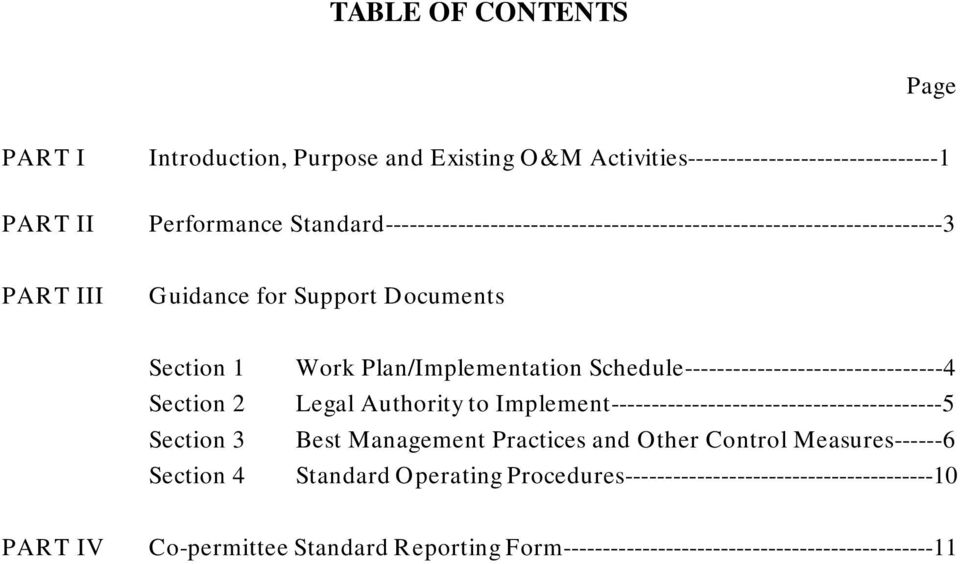
2 TABLE OF CONTENTS Page PART I PART II Introduction, Purpose and Existing O&M Activities Performance Standard PART III Guidance for Support Documents Section 1 Section 2 Section 3 Section 4 Work Plan/Implementation Schedule Legal Authority to Implement Best Management Practices and Other Control Measures Standard Operating Procedures PART IV Co-permittee Standard Reporting Form
3 PART I Introduction, Definitions, and Existing O&M Activities

4 SANTA CLARA VALLEY URBAN RUNOFF POLLUTION PREVENTION PROGRAM PUBLIC AGENCY ACTIVITIES CONTROL MEASURES I. Introduction Performance Standard and Supporting Documents for Storm Drain System Operation and Maintenance Final Draft - December 19, 1996 Performance Standards define control measures or levels of achievement for particular tasks carried out by all Santa Clara Valley Urban Runoff Pollution Prevention Program (Program) co-permittees. Control measures are described in the Program s Storm Water Management Plan, which is the basis for the NPDES municipal storm water permit (Permit) period. The development and implementation of Performance Standards is an integral part of the Program during the five-year Permit period. II. Purpose The purpose of the performance standard for co-permittee-owned storm drain system operation and maintenance (O&M) is to identify maintenance activity implementation levels to optimize control of pollutants in storm water. Storms drain system O&M activities generally involve routine inspection and cleaning of inlets, catch basins, SD lines, drainage ditches, and pump stations to maintain capacity. This performance standard identifies the level of implementation for O&M activities, which co-permittees will adopt in order to control pollutants in storm water to the maximum extent practicable. The performance standard is based on current and proposed practices that municipal agencies are and/or will be implementing to minimize water quality impacts, and practices that are accepted by the State and Regional Board as being effective in controlling these impacts. The performance standard is also consistent with the goals and objectives of the Storm Water Management Plan. 1

5 Performance Standard and Supporting Documents for Storm Drain System Operation and Maintenance III. Existing Storm Drain O&M Activities Existing Storm Drain O&M activities covered by this performance standard include the following: Storm Drain Inlet Inspection and Cleaning - Cleaning timing and frequency and identify known problem areas: Storm Drain Line Inspection and Cleaning - Cleaning timing and frequency and identify known problem areas: Storm Drain Manhole Inspection and Cleaning - Cleaning timing and frequency: Management of Storm Drain System Solid Waste - Management of material removed by storm drain operation and maintenance activities, including debris capture systems, containment storage and disposal: Debris Basin Inspection and Cleaning: Pump Station Inspection and Cleaning: Drainage Ditches Cleaning: Emergency Operations: 1. Sewage Overflow 2. Plugged Line 3. Illegal Dumping F:\SC26\SC26-25\WebsiteProducts\URMP temp folder\sdom_parti.doc 2 Final Draft December 19, 1996

6 PART II Performance Standard

7 Santa Clara Valley Urban Runoff Pollution Prevention Program Performance Standard and Supporting Documents for Storm Drain System Operation and Maintenance MODEL PERFORMANCE STANDARD (Revised March 1, 1999) 1. Each municipal agency will implement best management practices (BMPs) for the storm drain system operation and maintenance (O&M) activities that it is responsible for conducting. in order to reduce pollutants in storm water to the maximum extent practicable. Specific BMPs for each type of O&M activity will be those listed in the agency s Work Plan BMPs and Control Measures (Section 3). 2. Each municipal agency will develop and implement a process for tracking hot spots and ensuring that appropriate BMPs and SOPs will be implemented for storm drain operation and maintenance activities. 3. Each municipal agency will develop and implement a process for ensuring that any contractor that it employs to conduct storm drain system O&M activities uses the appropriate BMPs adopted by the agency. 4. Each municipal agency will provide training on an annual basis to its municipal staff in the use of appropriate BMPs. The agency will also provide a mechanism for obtaining feedback from its municipal staff on the implementation and effectiveness of the BMPs. 5. As part of the annual reporting process. each co-permittee will review and evaluate the effectiveness of its BMPs in achieving the goals of reducing pollutants in storm water to the maximum extent practicable. The review and evaluation will include input from municipal maintenance staff that implement the BMPs. The evaluation process will include consideration for storm drain structural retrofit. 6. Each municipal agency will develop a process to advise the IC/ID inspectors when hot spots or unusual contaminants are encountered during routine storm drain cleaning/maintenance activities to allow IC/ID inspectors to track the illicit connections or illegal dumping incidents on the Incident Type annual summary form. 3 Revised March 1, 1999

8 PART III Guidance for Support Documents

9 Section 1 Work Plan Implementation

10 Santa Clara Valley Urban Runoff Pollution Prevention Program Performance Standard and Supporting Documents for Storm Drain System Operation and Maintenance Section 1 WORK PLAN IMPLEMENTATION This section contains the plan or activities to be taken to enable the co-permittee to achieve the performance standard, along with an implementation schedule. The work plan will be developed by each co-permittee based on its responsibility to conduct storm drain operation and maintenance activities within its jurisdiction. Example Contents of the Work Plan The work plan will describe actions to be taken by the co-permittee to meet the performance standard and adopt and implement the model (or equivalent) BMPs. The work plan for the first year should include: Steps needed to incorporate the implementation of the performance standard and BMPs into standard operating procedures; Development of a process to ensure that contractors use appropriate BMPs; Development of a referral and follow-up process between storm drain operation and maintenance activities and illicit connection and illegal dumping activities; Development of an annual training program for municipal maintenance staff, including a mechanism for feedback on implementation and effectiveness of BMPs; Development of a record keeping system in order to track: 1. cleaning activities 2. hot spots 3. spill and illegal dumping incidents; A plan for annually reviewing and evaluating the effectiveness of BMPs, with input from municipal maintenance staff; A process for evaluating consideration for storm drain structural retrofitting; A schedule for implementation. 4 Final Draft - December 19, 1996

11 Storm Drain System Operation and Maintenance Performance Standard Example Contents of Work Plan (Revised March 1, 1999) Steps needed to incorporate the implementation of the performance standard and BMPs into standard operating procedures. Development of a process to ensure that contractors use appropriate BMPs. Development of a referral and follow-up process between storm drain operation and maintenance activities and illicit connection and illegal dumping activities. Development of an annual training program for municipal maintenance staff, including a mechanism for feedback on implementation and effectiveness of BMPs. Develop and describe a record keeping system in order to track: 1. cleaning activities 2. hot spots 3. spill and illegal dumping incidents A plan for annually reviewing and evaluating the effectiveness of BMPs, with input from municipal maintenance staff. A process for evaluating consideration for storm drain structural retrofitting. A schedule for implementation. Revised March 1, 1999

12 Section 2 Legal Authority to Implement

13 Santa Clara Valley Urban Runoff Pollution Prevention Program Performance Standard and Supporting Documents for Storm Drain System Operation and Maintenance Section 2 LEGAL AUTHORITY TO IMPLEMENT This section demonstrates that the co-permittee has the legal authority to implement the performance standard or provides a time schedule for developing and obtaining additional authority. The co-permittee should provide references to municipal codes or ordinances that demonstrate adequate legal authority to require municipal staff and contractors to conduct storm drain system operation and maintenance activities in a manner that eliminates or reduces water quality impacts. These include: Storm drain discharge ordinance. Other ordinance or sections of municipal code that apply to maintenance activities. Standard contract language. Model Standard Contract Language 1 Storm water runoff flows directly to creeks and San Francisco Bay without treatment. Allowing pollutants to directly or indirectly enter the storm drain system is prohibited by federal, state and local regulations. The operation and maintenance of storm drain systems can cause storm water pollution in numerous ways. For example, trash, leaves, sediments, oil and grease from parking lots, streets and industrial areas are frequently collected in the storm drain system. These pollutants can either enter storm drains directly or be transported by storm water runoff. The Contractor shall take all measures necessary to prevent pollutants from entering storm drains or water courses. For the purpose of eliminating storm water pollution, the contractor shall implement effective Best Management Practices (BMPs). BMPs include general good housekeeping practices, appropriate scheduling of activities, operational practices, maintenance procedures and other measures to prevent the discharge of pollutants directly or indirectly to the storm drain system. These BMPs shall be maintained for the duration of the Contractor s work. The Contractor shall also be responsible for proper disposal of all waste materials, including 1 Based on language in Modifications to the Standard Specifications for Public Works Construction, 1994, City of Oakland, Pollution Prevention Language for Construction Contractors, 1995, City of Palo Alto, and Supplemental General Provisions, 1994, City of Sunnyvale. 6 Final Draft - December 19, 1996

14 Santa Clara Valley Urban Runoff Pollution Prevention Program wastes generated by the implementation of BMPs. The following BMPs shall be implemented to prevent storm water pollution: (add appropriate BMPs from Section 3 here). 7 Final Draft - December 19, 1996

15 Section 3 Work Plan BMPs and Control Measures

16 Santa Clara Valley Urban Runoff Pollution Prevention Program Performance Standard and Supporting Documents for Storm Drain System Operation and Maintenance Section 3 WORK PLAN BMPs AND CONTROL MEASURES This section contains the list of Best Management Practices to be used as guidance for compliance in the implementation of the performance standard. The model BMPs are grouped by activity. Component I of the performance standard is broken down into tiers to fit individual agencies. Depending on individual characteristics and resources, some co-permittees will implement Tier 1, while others will implement Tier 2. In the table below, the co-permittee should indicate whether or not each group of BMPs applies to the activities for which it is responsible. If a group of BMPs does apply, the co-permittee may either agree to implement the model BMPs or propose modifications or alternatives, as long as the co-permittee justifies why modifications are effective in reducing pollutants in storm water to the maximum extent practicable. BMP Applicability Summary Table for (Agency Name) Storm Drain O&M Activities BMPs do apply BMPs do not apply If BMPs do not apply, explain: Routine Inspection and Cleaning (select Tier 1 or Tier 2) Tier 1 Inlets/Catch Basin Cleaning Storm Drain Line Cleaning Pump Stations, Detention and Debris Basins Known Problem Areas Tier 2 Inlets/Catch Basin Cleaning Storm Drain Line Cleaning Pump Stations, Detention and Debris Basins Known Problem Areas 8 Final Draft - December 19, 1996

17 Santa Clara Valley Urban Runoff Pollution Prevention Program Performance Standard and Supporting Documents for Storm Drain System Operation and Maintenance BMP Applicability Summary Table (continued) Activities BMPs do apply BMPs do not apply If BMPs do not apply, explain: Solid Waste Best Management Practices Debris Removal Debris Capture Systems Containment and Storage Waste Dewatering Staff/Contractor Training and Coordination Referral and Follow-up Processes Staff Training Contract Specifications Record Keeping and Evaluation Record Tracking Maintenance Effectiveness Evaluation Operational Improvement, Structural Retrofit and Design Changes Annual Review Capitol Improvement Projects Maintenance Provisions References Alameda Countywide Clean Water Program, 1993/94, Municipal Government Maintenance Best Management Practices. 9 Final Draft - December 19, 1996

18 Santa Clara Valley Urban Runoff Pollution Prevention Program Performance Standard and Supporting Documents for Storm Drain System Operation and Maintenance Model BMPs I. Routine Inspection and Cleaning (Co-permittees should implement Tier 1 or Tier 2) Tier 1 1. Inspect and clean as needed, all inlets/catch basins at least once every other year (at least 50% of entire system inspected and cleaned each year). 2. Inspect and clean as needed, all inlets/catch basins in known problem areas at least once a year. 3. Inspect and clean as needed, all storm drain lines in known problem areas at least once a year. 4. Inspect and clean as needed, sumps and debris racks at pump stations, detention basins, drainage ditches and debris basins throughout the year. 5. Cleaning activities may occur on a year round basis; however, known problem areas shall be targeted prior to the rainy season. 6. Inspect and clean as needed, all storm drain facilities that have been affected by emergency response activities. Tier 2 1. Inspect and clean as needed, all inlets/catch basins at least once a year. 2. Inspect and clean as needed, all inlets/catch basins in known problem areas more than once a year. 3. Inspect and clean as needed, all storm drain lines in known problem areas more than once a year. 4. Inspect and clean as needed, sumps and debris racks at pump stations, detention basins, drainage ditches and debris basins throughout the year. 5. Cleaning activities may occur on a year round basis; however, known problem areas shall be targeted prior to the rainy season. 6. Inspect and clean as needed, all storm drain facilities that have been affected by emergency response activities. II. Solid Waste Best Management Practices 1. As much debris, silt, trash and sediment as possible shall be removed from the storm drain system when cleaning. Debris capture systems shall be used to prevent material from washing into streams or channels. 10 Final Draft - December 19, 1996

19 Santa Clara Valley Urban Runoff Pollution Prevention Program 2. Provide proper containment for the temporary storage of removed debris during cleaning. Surface types of temporary storage sites shall be of concrete, asphalt or other type of impermeable material. 3. Waste collected from storm drain systems shall be dewatered as necessary for proper disposal to the landfill. Dewatering sites should not drain to storm drains or creeks. III. Staff/Contractor Training and Coordination 1. Provide a referral and follow-up process between storm drain operation and maintenance and illicit connection and illegal dumping investigation staff for problems found. 2. Provide staff training for storm drain operation and maintenance personnel at least once a year with emphasis on controlling storm water pollution through storm drain operation and maintenance. 3. Include provisions for storm water pollution prevention in contract specifications for conducting storm drain operation and maintenance. IV. Record Keeping and Evaluation 1. Maintain records tracking all cleaning activities. The records shall show when and which facilities have been inspected and cleaned. Spill and illegal dumping incidents and responses to both incidents shall also be documented and tracked. 2. Document any unusual flows observed during inspection (particularly dry weather flows) and the follow-up actions/referrals. 3. Review the records annually to critique the effectiveness of storm drain operation and maintenance activities. Modifications, if necessary, to co-permittees storm drain operation and maintenance activities shall be identified in the annual individual work plans. V. Operational Improvement, Structural Retrofit and Design Changes 1. Review the storm drain operation and maintenance program annually and if needed, identify operational improvements, opportunities for structural retrofit and design changes. 2. Operation and maintenance provisions shall be included in planning and design phases of Capitol Improvement Projects to ensure that storm water quality issues are considered in the design of storm drain systems. Individual Co-permittee Modifications to Storm Drain System Operation and Maintenance BMPs Performance Standard and Supporting Documents for 11 Final Draft - December 19, 1996

20 Section 4 Standard Operating Procedures

21 Santa Clara Valley Urban Runoff Pollution Prevention Program Storm Drain System Operation and Maintenance Section 4 STANDARD OPERATING PROCEDURES This sections contains the co-permittee s standard operating procedures (SOPs) for implementation of the performance standard. When generating documents such as these, it may helpful to conduct this test. If a statement tells you how to do something and it is something you are already doing, it is an SOP. If a statement sounds like what you should be doing or are going to do, it is a work plan item. Example SOPs Staff and/or contractor training. Documentation and/or record keeping methods and procedures. Referral procedures between storm drain maintenance activities and illicit connection and illegal discharge procedures. Follow the BMPs. Standard procedures for ensuring contractors employ appropriate BMPs adopted by the agency. 12 Final Draft - December 19, 1996
22 PART IV Co-permittee Standard Reporting Form
23 Santa Clara Valley Urban Runoff Pollution Prevention Program Performance Standard and Supporting Documents for Storm Drain System Operation and Maintenance Co-permittee Reporting Form 1. Are you implementing best management practices (BMPs) for storm drain system operation and maintenance (O&M) activities that you are responsible for conducting, in order to reduce pollutants in storm water to the maximum extent practicable? yes no If no, explain: 2. Have you developed and implemented a process for tracking hot spots, and have you implemented appropriate BMPs and SOPs? yes no If no, explain: 3. Have you developed and implemented a process for ensuring that any contractor that you employ to conduct storm drain system O&M activities uses the appropriate BMPs adopted by the agency? yes no If no, explain: 4. Have you provided training on an annual basis to your municipal staff in the use of appropriate BMPs? yes no If no, explain: Have you provided a mechanism for obtaining feedback from your municipal staff on the implementation and effectiveness of the BMPs? yes no If no, explain: 5. Have you reviewed and evaluated the effectiveness of BMPs in achieving the goals of reducing pollutants in storm water to the maximum extent practicable? yes no If no, explain: Did your evaluation include input from municipal maintenance staff that implement the BMPs? yes no If no, explain: Did your evaluation include consideration for storm drain structural retrofit? yes no If no, explain: 13 Final Draft - December 19, 1996
1. Water Line Maintenance 2. Sanitary Sewer Maintenance 3. Spill/Leak/Overflow Control, Response, and Containment
 WATER AND SEWER UTILITY OPERATION AND MAINTENANCE Although sewage systems the operation and maintenance of public utilities are not considered themselves are not a chronic sources of stormwater pollution,
Spill Prevention, Control & Cleanup SC-11
 Objectives Cover Contain Educate Reduce/Minimize Product Substitution Description Spills and leaks, if not properly controlled, can adversely impact the storm drain system and receiving waters. Due to
STORM DRAIN PIPE MAINTENANCE. a. Develop standard operating procedures for maintaining storm drain pipes.
 STORM DRAIN PIPE MAINTENANCE a. Develop standard operating procedures for maintaining storm drain pipes. 2. PROCESS Storm drain pipes are to be maintained per the Storm Water System Maintenance Plan schedule.
Outdoor Storage of Raw Materials SC-33
 Objectives Cover Contain Educate Reduce/Minimize Description Raw materials, by-products, finished products, containers, and material storage areas exposed to rain and/or runoff can pollute stormwater.
Water & Sewer Utility Maintenance SC-76
 Water & Sewer Utility Maintenance SC-76 Objectives Contain Educate Reduce/Minimize Description Although the operation and maintenance of public utilities are not considered chronic sources of stormwater
Best Management Practices (BMPs) Ideas for School Districts. Presented by: Donald Lussier
 Best Management Practices (BMPs) Ideas for School Districts Presented by: Donald Lussier What Will We Learn? What are BMPs? Why we need them? What to consider when selecting them? What should your BMP
DRAFT Public Outreach Document for What s an SSMP?
 DRAFT Public Outreach Document for What s an SSMP? This easy to read document is developed and provided to interested parties to assist in educating cities, agencies, their management, elected officials
Standard Operating Procedures Storm Drain System Maintenance
 s Storm Drain System Maintenance SECTIONS 1. Storm Drain System Inspections 2. Storm Drain System Cleaning 3. Storm Drain System Repairs 4. Proper Disposal of Material Storm Sewer System Cleaning Directive
Be a part of the Team! Keep the Bay CLEAN!
 Be a part of the Team! Keep the Bay CLEAN! Water Quality Protection Guidelines for Food Handling Facilities Regional Water Quality Control Plant Operated by the City of Palo Alto for the communities of
COMBINED SEWER OVERFLOW OPERATIONAL AND MAINTENANCE PLAN SUMMARY
 COMBINED SEWER OVERFLOW OPERATIONAL AND MAINTENANCE PLAN SUMMARY Revised: April 2014 Village of Wilmette, Illinois NPDES CSO Permit No. ILM580012 Chapter 1 Introduction This Operational and Maintenance
Prevent Blockages in the Sanitary Sewer System
 FATS, OILS & GREASE - BMPs The following Best Management Practices (BMPs) tables are listed below: Prevent blockages in the Sanitary Sewer System Properly Maintain Grease Traps and Interceptors to Prevent
Florida Department of Environmental Protection
 Florida Department of Environmental Protection Background Mobile vehicle and equipment washing involves washing at a location where vehicles are based (such as a trucking company, warehouse, bus station,
NPDES Industrial Stormwater Inspection Worksheet
 NPDES Industrial Stormwater Inspection Worksheet General Information Inspection Type 1200-Z DEQ Inspector Name Mark Riedel, Bob Schwarz DEQ Permit No. 106959 Entry Time 10:00 AM Inspection Date 1/8/15
City of San Diego Urban Runoff Management Program. Appendix XI. Minimum BMPs for Mobile Businesses
 City of San Diego Urban Runoff Management Program This Page Left Intentionally Blank. Minimum Best Management Practices (BMPs) for Mobile Businesses No. BMP Title Description and Examples Justification
III. Relying on another Governmental Entity
 I. Permittee Information Permittee Name Cowlitz County Contact Name Patrick Harbison Permittee Coverage Number WAR4-524 Phone Number 36-577-33 Mailing Address 16 13th Ave. S City State Zip + 4 Kelso WA
Chapter 2 Stormwater Pollution Prevention Plan (SWPPP) for Park Operations
 SWPPP for Park Operations 2 Chapter 2 Stormwater Pollution Prevention Plan (SWPPP) for Park Operations Bordered by Lake Washington & Lake Sammamish, the City of Bellevue has more than 60 miles of streams,
POLLUTION PREVENTION FACT SHEET: AUTOMOBILE MAINTENANCE
 POLLUTION PREVENTION FACT SHEET: AUTOMOBILE MAINTENANCE Description This pollution prevention measure involves creating a program of targeted outreach and training for businesses involved in automobile
Improper storage of fuel on construction sites will increase the risk of water pollution that may occur as a result of leaks or spills.
 WQ-10 Best Management Practice (BMP) Water Quality Protection Guideline Secondary Containment Design Standards Fuel Storage on Construction Sites According to the EPA, the majority of water pollution in
COLORADO DEPARTMENT OF TRANSPORTATION STORMWATER FIELD INSPECTION REPORT - ACTIVE CONSTRUCTION
 COLORADO DEPARTMENT OF TRANSPORTATION STORMWATER FIELD INSPECTION REPORT - ACTIVE CONSTRUCTION (1) Project Name: (2) Project Contractor: (3) Erosion Control Supervisor/SWMP Administrator: (4) CDOT Project
Storm Water Management Requirements for Construction Projects Less than One Acre
 Storm Water Management Requirements for Construction Projects Less than One Acre Purpose: UC Irvine s Phase II Small MS4 Storm Water Permit requires construction projects less than one acre in size to
City of Paso Robles Community Development Department Construction Site Storm Water Quality Requirements
 City of Paso Robles Community Development Department Construction Site Storm Water Quality Requirements Overview of the City s Construction Storm Water Program The City of Paso Robles is committed to protecting
NPDES Phase II Small MS4 Permit Program
 NPDES Phase II Small MS4 Permit Program Annual Reports Summary Year 9: April 2011-March 2012 New Hampshire Traditional MS4s 97% of Municipalities Reporting Year 9 Annual Reports Summary Review of reports
Preventing Storm Water Pollution: What We Can Do
 Preventing Storm Water Pollution: What We Can Do ~Employee Training Series~ Streets and Drainage Maintenance PREPARED IN COOPERATION WITH THE Texas Commission on Environmental Quality AND U.S. ENVIRONMENTAL
4X BMPs for Food Service Facilities
 4X BMPs for Food Service Facilities APPENDIX 4X BEST MANAGEMENT PRACTICES 4X-1 Food Service Facilities Focus of Document This guidance presents BMPs to address the discharge of pollutants to the storm
Chapter 6 INFRASTRUCTURE ELEMENT 6.1 INTRODUCTION 6.2 AUTHORITY FOR THE ELEMENT 6.3 KEY THEMES AND VISION FOR GENERAL PLAN
 Chapter 6 INFRASTRUCTURE ELEMENT 6.1 INTRODUCTION Public infrastructure is an important support network for the City. Well-designed and maintained infrastructure systems are critical to the community s
Appendix C3: Response Plan for Investigations of Illegal Discharges, 2016
 Appendix C3: Response Plan for Investigations of Illegal Discharges, 2016 Response Plan for Investigations For the City and County of Honolulu Municipal Separate Storm Sewer System National Pollutant Discharge
City of Bakersfield Public Works Department Sewer System Management Plan December 2014
 City of Bakersfield Public Works Department Sewer System Management Plan December 2014 C:\Users\hmayberry\Desktop\SEWER SYSTEM MANAGEMENT PLAN 2014.doc 1 Sewer System Management Plan Index: Section 1 Goals
SITE-SPECIFIC BEST MANAGEMENT PRACTICES (SSBMP) PLAN/STORM WATER POLLUTION PREVENTION PLAN (SWPPP) REVIEW CHECKLIST
 This checklist may be used by applicants for encroachment permits, and contractors in development of Site Specific Best Management Practice (SSBMP) Plans or Storm Water Pollution Prevention Plans (SWPPP)
IC24. DISPOSAL OF WASTEWATER GENERATED BY MOBILE BUSINESSES AND OUTDOOR ACTIVITIES
 IC24. DISPOSAL OF WASTEWATER GENERATED BY MOBILE BUSINESSES AND OUTDOOR ACTIVITIES BEST MANAGEMENT PRACTICES (BMP) A BMP is a technique, measure, or structural control that is used for a given set of conditions
STORMWATER POLLUTION PREVENTION PLAN TEMPLATE. 1.0 SITE DESCRIPTION 1.1 Project Name and Location Date
 STORMWATER POLLUTION PREVENTION PLAN TEMPLATE Disclaimer: This template was developed for guidance purposes only in an effort to assist Construction Storm Water permit applicants in meeting state and local
DRAFT Guidelines for Manually Diverting Outdoor Wastewater to the Sanitary Sewer
 Only RAIN down the Storm Drain... DRAFT Guidelines for Manually Diverting Outdoor Wastewater to the Sanitary Sewer This publication applies to you if: You generate wastewater outdoors, and The wastewater
Best Management Practices
 for The City of Paso Robles is required to implement a Phase II Municipal Water Program in order to reduce or eliminate the pollutants that enter our waterways from both storm water and non-storm water
 Appendix I: BMP Inspection Form CASQA SWPPP Template 91 January2011 BMP INSPECTION REPORT Date and Time of Inspection: Date Report Written: Inspection Type: (Circle one) Weekly Complete Parts I,II,III
STORMWATER ENFORCEMENT AND DISTRICT ATTORNEY CASE STUDIES
 STORMWATER ENFORCEMENT AND DISTRICT ATTORNEY CASE STUDIES DISTRICT ATTORNEY OPTIONS CRIMINAL (State law violations and one provision of CCC Ordinance Code) CIVIL NO FORMAL ACTION Case Study A.G. (an individual)
BEST MANAGEMENT PRACTICES (BMPs)... What are They? GOOD HOUSEKEEPING PRACTICES Your Business Should Employ
 BEST MANAGEMENT PRACTICES (BMPs)... What are They? CLEAN STREETS MEAN CLEAN STREAMS Inexpensive to implement and easy to use, BMPs help you to do your share to protect the environment. The term Best Management
FOOD SERVICE FACILITIES Best Management Practices Stormwater Management Program City of Bluff City P.O. Box 70, Bluff City, TN 37618 423-538-7144
 FOOD SERVICE FACILITIES Best Management Practices Stormwater Management Program City of Bluff City P.O. Box 70, Bluff City, TN 37618 423-538-7144 This document may be printed and used for reference by
Manual contents includes:
 Fats, Oil, and Grease (FOG) Best Management Practices (BMP) For Food Service Facilities Information, Pollution Prevention, and Compliance Information (2/07/06) Fats, oil and grease (FOG) can have negative
GUIDELINE FOR MUNICIPAL MANAGEMENT PRACTICES FOR STREET SWEEPINGS & CATCH BASIN CLEANINGS
 GUIDELINE FOR MUNICIPAL MANAGEMENT PRACTICES FOR STREET SWEEPINGS & CATCH BASIN CLEANINGS STATE OF CONNECTICUT August 2007 DEPARTMENT OF ENVIRONMENTAL PROTECTION 79 Elm Street, Hartford, CT 06106-5127
Clear Water Projects in Cooksville Creek Watershed
 Clear Water Projects in Cooksville Creek Watershed Armstrong Manufacturing Inc. What is a Watershed? No matter where you are, you are in a watershed. A watershed is the area of land that catches rain and
Waste Handling & Disposal
 Objectives Cover Contain Educate Reduce/Minimize Product Substitution Description Improper storage and handling of solid wastes can allow toxic compounds, oils and greases, heavy metals, nutrients, suspended
Source Water Protection Practices Bulletin Managing Sanitary Sewer Overflows and Combined Sewer Overflows to Prevent Contamination of Drinking Water
 United States Office of Water EPA 916-F-01-032 Environmental Protection (4606) July 2001 Agency Source Water Protection Practices Bulletin Managing Sanitary Sewer Overflows and Combined Sewer Overflows
BUSINESS INSPECTION PROGRAM
 RESOURCES FOR ENVIRONMENTAL HELP BUSINESS INSPECTION PROGRAM How can I help keep our waters clean and healthy? Educate your staff about common surface water pollution sources (spills, leaky containers
Fats, Oil and Grease. Best Management Practices Manual. Information, Pollution Prevention, and Compliance Information For Food Service Facilities
 Fats, Oil and Grease Best Management Practices Manual Information, Pollution Prevention, and Compliance Information For Food Service Facilities Pinellas County Utilities Water Quality Management Division
STANDARD INSPECTION FORM GENERAL PERMIT FOR STORMWATER ASSOCIATED WITH CONSTRUCTION ACTIVITY
 STANDARD INSPECTION FORM GENERAL PERMIT FOR STORMWATER ASSOCIATED WITH CONSTRUCTION ACTIVITY Project Name Permittee NOI # Start Time Inspector s Name(s) Green Card Certification # Inspector s Contact Information
Operation & Maintenance Document Templates
 Appendix G Operation & Maintenance Document Templates The following templates are provided to assist project applicants in preparing stormwater treatment measure maintenance plans, which municipalities
VEHICLE SERVICE FACILITIES. Best Management Practices
 VEHICLE SERVICE FACILITIES Best Management Practices Chapter 1 of the Best Management Practices Manual for the City s Storm Water Management Program Public Works Department 809 Center Street, Santa Cruz,
SE-10 STORM DRAIN INLET PROTECTION. Objectives
 STORM DRAIN INLET PROTECTION SE-10 Objectives Erosion Control - EC Sediment Control - SE Tracking Control - TC Wind Erosion Control - WE Non-Storm Water Management - NS Waste and Materials Management -
Good Housekeeping Practices for DPW/Fleet Maintenance Facilities
 Good Housekeeping Practices for DPW/Fleet Maintenance Facilities Kevin P. Walker C&S Engineers, Inc. Best Management Practices Best Management Practices (BMPs) are measures and/or controls used to prevent
Element 4: FATS, OILS, AND GREASE (FOG) CONTROL PROGRAM
 Element 4: FATS, OILS, AND GREASE (FOG) CONTROL PROGRAM This section of the SSMP discusses the City s FOG control measures, including identification of problem areas, focused cleaning, and source control.
Pollution From Surface Cleaning. Flat work Sidewalks Plazas Building exteriors Parking areas Drive-throughs
 Pollution From Surface Cleaning Flat work Sidewalks Plazas Building exteriors Parking areas Drive-throughs Pollution From Surface Cleaning It harms the environment... In most parts of the San Francisco
Concrete Waste Management
 Categories EC SE TC WE NS WM Erosion Control Sediment Control Tracking Control Wind Erosion Control Non-Stormwater Management Control Waste Management and Materials Pollution Control Legend: Primary Category
Fats, Oil, and Grease (FOG) Best Management Practices (BMP) For Food Service Facilities. Guidance Manual
 Fats, Oil, and Grease (FOG) Best Management Practices (BMP) For Food Service Facilities Guidance Manual Boise Public Works Department May 2007 Table of Contents SECTION...PAGE A. INTRODUCTION...1 B. PURPOSE
CONSTRUCTION PERMIT SUBMITTAL CHECKLIST
 LAS VEGAS VALLEY STORMWATER QUALITY MANAGEMENT PROGRAM CONSTRUCTION PERMIT SUBMITTAL CHECKLIST (Applies to all Grading Site Development Building and Encroachment Permits and plans including Final Parcel
STATEMENT OF ACKNOWLEDGMENT
 General Permit for the Discharge of Stormwater and Dewatering Wastewaters from Construction Activities, issued 8/21/13, effective 10/1/13 Stormwater Monitoring Report SITE INFORMATION Permittee: BNE Energy
YOUR GUIDE TO PRACTICAL METHODS THAT PROTECT
 POLLUTION PREVENTION PRACTICES FOR SURFACE CLEANING YOUR GUIDE TO PRACTICAL METHODS THAT PROTECT OUR LOCAL CREEKS, RIVERS, LAKES, AND THE SAN FRANCISCO BAY. DECEMBER 2004 CREATED BY THE NAPA-SOLANO-SONOMA
How To Prevent Over Water Activities
 Objectives Cover Contain Educate Reduce/Minimize Product Substitution Description Over-water activities occur at boat and ship repair yards, marinas, and yacht clubs. The discharge of pollutants to receiving
ORDINANCE NO. 15 BE IT ORDAINED BY THE COUNCIL OF KANSAS CITY:
 ORDINANCE NO. 15 Amending Chapter 60 of the Code of Ordinances of Kansas City, Missouri, entitled Sewers and Sewage Disposal by adding Sections 60-349 through 60-360; and establishing an effective date.
City of Los Angeles Bureau of Sanitation Business Development Services
 City of Los Angeles Bureau of Sanitation Business Development Services OUR MISSION IS TO PROTECT PUBLIC HEALTH AND THE ENVIRONMENT TABLE OF CONTENTS BUSINESS DEVELOPMENT SERVICES...2-5 EFFORTS TO FACILITATE
ELIMINATE STORM WATER FROM ENTERING SANITARY SEWER SYSTEMS
 (408) 761 5882 http://www.sewerlock.net ELIMINATE STORM WATER FROM ENTERING SANITARY SEWER SYSTEMS 1. `The United States and various State Environmental Protection Agency regulations require elimination
Food Service Facilities
 Food Service Facilities Selecting and installing a grease removal device Regional Water Quality Control Plant Operated by the City of Palo Alto for the East Palo Alto Sanitary District, Los Altos, Los
Activity Yes No N/A Notes
 CE 2020 (Rev. 12/11) Page 1 of 5 PROJECT NAME AND SITE ADDRESS: CONTRACT NUMBER: ORACLE NUMBER: WDID NUMBER: CONTRACTOR NAME AND ADDRESS: PROJECT SITE RISK LEVEL: Risk Level 1 Risk Level 2 Risk Level 3
Proposed General Plan Update Goals, Policies, and Implementation Actions
 Proposed General Plan Update Goals, Policies, and Implementation Actions The construction and maintenance of infrastructure is necessary to support existing and planned land uses and to achieve Environmental
Low Impact Development Checklist
 New Jersey Stormwater Best Management Practices Manual February 2004 A P P E N D I X A Low Impact Development Checklist A checklist for identifying nonstructural stormwater management strategies incorporated
Sanitary District No.5 of Marin County SSMP
 2014 Sanitary District No.5 of Marin County SSMP Tony Rubio Sanitary District No.5 of Marin County 6/1/2014 INTRODUCTION...7 SSMP Requirement Background...7 Document Organization...7 District Service Area
Almonte Sanitary District Sewer System Management Plan Adopted by the ALMONTE Board of Directors on_08/28/06
 Almonte Sanitary District Sewer System Management Plan Adopted by the ALMONTE Board of Directors on_08/28/06 1. Goals The goal of this SSMP is to provide a plan and schedule to properly manage, operate,
Laws Requiring Pollution Prevention Practices
 Laws Requiring Pollution Prevention Practices Stormwater/urban runoff is being addressed as a result of the 1987 amendments to the Federal Clean Water Act [Section 402(p)], which established requirements
How Your Business Can Prevent Stormwater Pollution
 Tips for a Cleaner Bay How Your Business Can Prevent Stormwater Pollution alameda county You Can Prevent Water Pollution! Storm drains flow directly into creeks and the Bay without any treatment. Because
Food Handling Facilities, Waste Reduction & Water Quality Protection Guidelines
 Food Handling Facilities, Waste Reduction & Water Quality Protection Guidelines Food handling facilities such as restaurants, institutional cafeterias, grocery stores, bakeries, and delis, can contribute
PRIVATE TREATMENT CONTROL BMP OPERATION AND MAINTENANCE VERIFICATION FORM BIORETENTION FACILITIES, VEGETATED SWALES & HIGHER RATE BIOFILTERS
 BIORETENTION FACILITIES, VEGETATED SWALES & HIGHER RATE BIOFILTERS Check here for Address or phone number change the fiscal year (July 1 June 30), and date(s) maintenance was performed. Under Inspection,
How Your Vehicle Service Facility Can Prevent Stormwater Pollution
 TIPS FOR A CLEANER BAY How Your Vehicle Service Facility Can Prevent Stormwater Pollution alameda county YOU CAN PREVENT WATER POLLUTION! Storm drains flow directly into creeks and the Bay without any
Draft Photo Documentation Update for Proposition 13 Grant Agreement No. San Diego Region McClellan-Palomar Airport Water Quality Treatment Facility
 Draft Photo Documentation Update for Proposition 13 Grant Agreement No. San Diego Region McClellan-Palomar Airport Water Quality Treatment Facility Prepared For: County of San Diego DPW 555 South Overland
Landscape Maintenance
 Landscape Maintenance SC-73 Objectives Contain Educate Reduce/Minimize Product Substitution Description Landscape maintenance activities include vegetation removal; herbicide and insecticide application;
Storm Drain Inlet Protection
 Objectives EC Erosion Control SE Sediment Control TR Tracking Control WE Wind Erosion Control Non-Stormwater NS Management Control Waste Management and WM Materials Pollution Control Legend: Primary Objective
BEST ENVIRONMENTAL MANGEMENT PRACTICES
 Learn how to prevent pollution, maintain a grease interceptor, minimize waste, and protect your sewer lateral by following these. BEST ENVIRONMENTAL MANGEMENT PRACTICES For FOOD SERVICE FACILITIES This
DESCRIPTION OF STORMWATER STRUCTURAL CONTROLS IN MS4 PERMITS
 DESCRIPTION OF STORMWATER STRUCTURAL CONTROLS IN MS4 PERMITS Phase I MS4 permits require continuous updating of the stormwater system inventory owned and operated by the MS4. They also include inspection
SITE-SPECIFIC BEST MANAGEMENT PRACTICES (BMP) PLAN REVIEW CHECKLIST
 This checklist may be used by applicants for encroachment permits, and contractors in development of Site- Specific BMP Plans for projects. plan reviewers will use this checklist to review the Site-Specific
5. Environmental Analysis
 5.11 The potential for adverse impacts on utilities and service systems was evaluated based on information concerning current service levels and the ability of the service providers to accommodate the
Sewer System Management Plan (SSMP) 2009. Eastern Municipal Water District
 Sewer System Management Plan (SSMP) 2009 Eastern Municipal Water District Table of Contents 1.0 SSMP Goals... 3 Goal 1A:... 3 Goal 1B:... 3 2.0 Organizational Structure... 3 3.0 Legal Authority... 4 4.0
CHAPTER 15 MUNICIPAL SEPARATE STORM SEWER SYSTEM PROGRAM REQUIREMENTS
 CHAPTER 15 MUNICIPAL SEPARATE STORM SEWER SYSTEM PROGRAM REQUIREMENTS 15.1 INTRODUCTION In accordance with Section 402 (p) of the Clean Water Act, the National Pollutant Discharge Elimination System (NPDES)
City of Green Bay Department of Public Works Engineering Department
 City of Green Bay Department of Public Works Engineering Department The Difference Between Sanitary & Storm Sewers Contact Information: Department of Public Works City Hall 100 North Jefferson Street,
12/3/2015 MUNICIPAL STORMWATER RESPONSIBILITIES YOU NEED TO KNOW WHAT IS STORMWATER? WHY?
 MUNICIPAL STORMWATER RESPONSIBILITIES YOU NEED TO KNOW WHAT IS STORMWATER? Stormwater occurs when precipitation from rain or snowmelt flows over the ground WHY? 1 DEP/EPA AUDITING It is happening! Here
DID YOU KNOW... THE IMPACT OF ON-SITE SEWAGE SYSTEMS AND ILLICIT DISCHARGES ON THE ROUGE RIVER
 DID YOU KNOW... THE IMPAT OF ON-SITE SEWAGE SYSTEMS AND ILLIIT DISHARGES ON THE ROUGE RIVER by Barry Johnson, P.E., M.S., amp Dresser & McKee and Dean Tuomari, Wayne ounty Department of Environment The
City of Los Altos Sewer System Management Plan
 City of Los Altos Sewer System Management Plan February 2015 This page intentionally left blank. LIST OF REVISIONS Revision No. 2 3 4 Description of Revision Revision of telephone numbers and text issues,
MICHIGAN DEPARTMENT OF TRANSPORTATION PHASE I STORM WATER MANAGEMENT PLAN
 MICHIGAN DEPARTMENT OF TRANSPORTATION PHASE I STORM WATER MANAGEMENT PLAN Ann Arbor Permit No. MI0053911 Flint Permit No. MI0053929 Grand Rapids Permit No. MI0053937 Sterling Heights Permit No. MI0053953
Outdoor Liquid Container Storage
 Outdoor Liquid Container Storage SC-31 Objectives Cover Contain Educate Reduce/Minimize Description Accidental releases of materials from above ground liquid storage tanks, drums, and dumpsters present
Blueprint for a Clean Bay
 Blueprint for a Clean Bay Best Management Practices to Prevent Stormwater Pollution from Construction-Related Activities The Bay Area Stormwater Management Agencies Association (BASMAA), a consortium of
Greater Los Angeles County Region
 Attachment 6 Greater Los Angeles County Region IRWM Implementation Grant Proposal Monitoring, Assessment, and Attachment 6 consists of the following items: Monitoring, Assessment, and. The purpose of this
How To Keep Grease Out Of The Sewer
 FOG Program Fats, Oils & Grease Proper disposal of fats, oils and grease protects your business, public health and the environment. It s the law, and it s the right thing to do. Wherever there s water,
How do I clean my grease trap? Refer to Grease Trap and Interceptor Maintenance.
 Fats, Oil, and Grease Best Management Practices Manual Information, Pollution Prevention, and Compliance Information for Publicly-Owned Treatment Plants Fats, oil and grease - - also called FOG in the