
QUALIFICATION HANDBOOK
|
|
|
- Roy Stanley
- 10 years ago
- Views:
Transcription

1 QUALIFICATION HANDBOOK Level 3 NVQ Diploma in Engineering Technical Support (Computer Control Programming) ( ) September 2011 Version 1.0
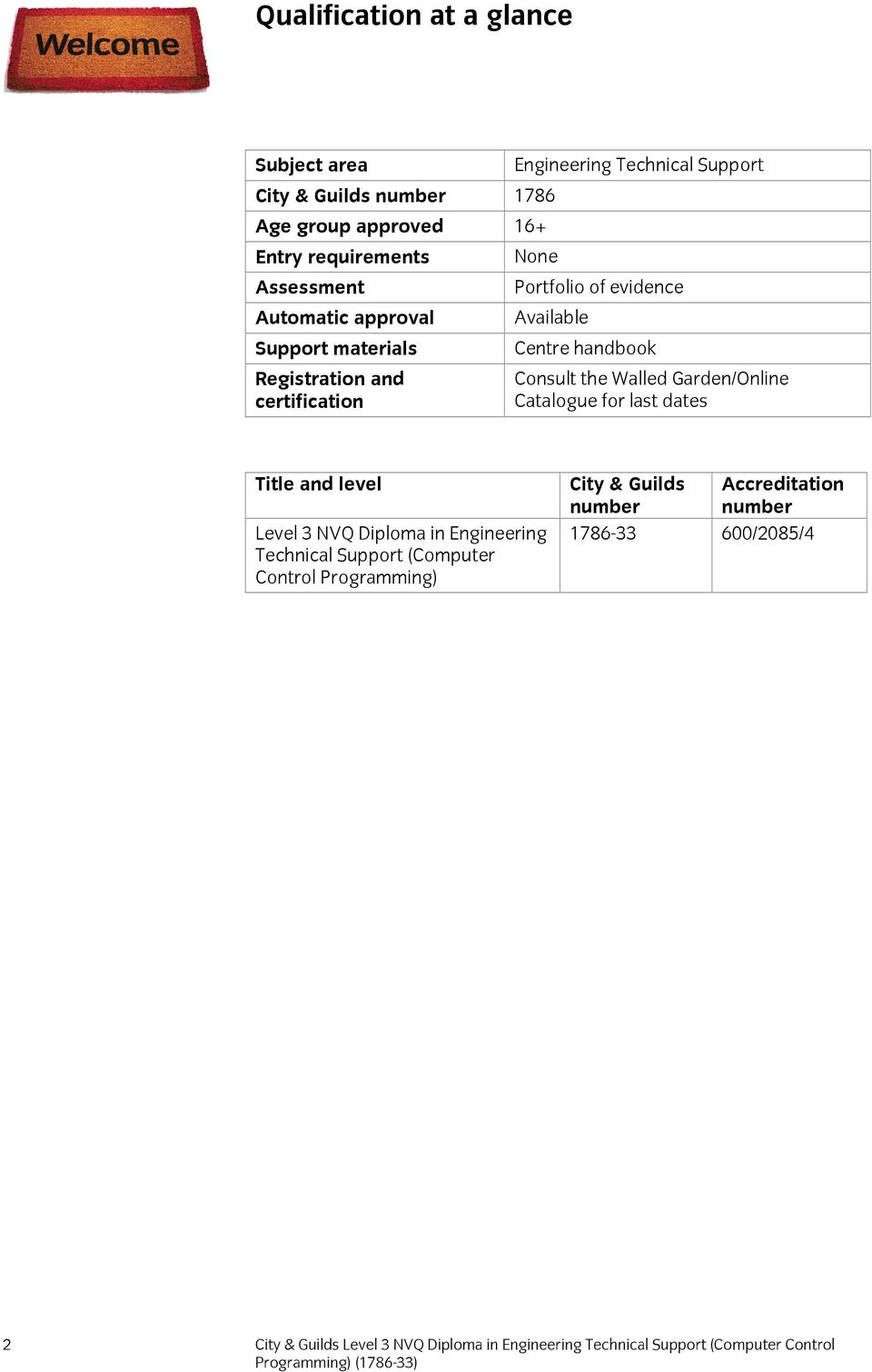
2 Qualification at a glance Subject area City & Guilds number 1786 Age group approved 16+ Entry requirements Assessment Automatic approval Support materials Registration and certification Engineering Technical Support None Portfolio of evidence Available Centre handbook Consult the Walled Garden/Online Catalogue for last dates Title and level Level 3 NVQ Diploma in Engineering Technical Support (Computer Control Programming) City & Guilds Accreditation number number /2085/4 2 City & Guilds Level 3 NVQ Diploma in Engineering Technical Support (Computer Control Programming) ( )
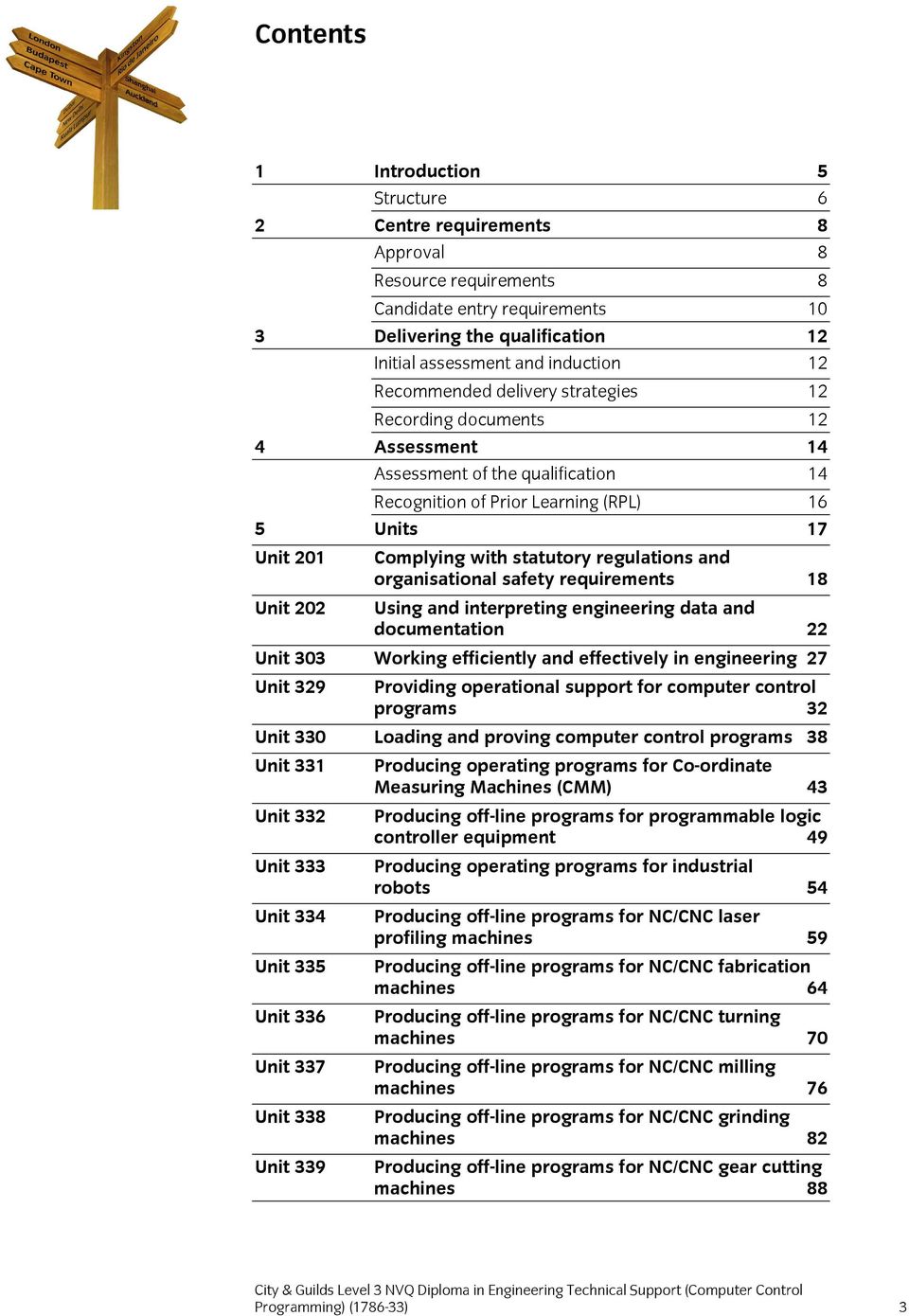
3 Contents 1 Introduction 5 Structure 6 2 Centre requirements 8 Approval 8 Resource requirements 8 Candidate entry requirements 10 3 Delivering the qualification 12 Initial assessment and induction 12 Recommended delivery strategies 12 Recording documents 12 4 Assessment 14 Assessment of the qualification 14 Recognition of Prior Learning (RPL) 16 5 Units 17 Unit 201 Unit 202 Complying with statutory regulations and organisational safety requirements 18 Using and interpreting engineering data and documentation 22 Unit 303 Working efficiently and effectively in engineering 27 Unit 329 Providing operational support for computer control programs 32 Unit 330 Loading and proving computer control programs 38 Unit 331 Unit 332 Unit 333 Unit 334 Unit 335 Unit 336 Unit 337 Unit 338 Unit 339 Producing operating programs for Co-ordinate Measuring Machines (CMM) 43 Producing off-line programs for programmable logic controller equipment 49 Producing operating programs for industrial robots 54 Producing off-line programs for NC/CNC laser profiling machines 59 Producing off-line programs for NC/CNC fabrication machines 64 Producing off-line programs for NC/CNC turning machines 70 Producing off-line programs for NC/CNC milling machines 76 Producing off-line programs for NC/CNC grinding machines 82 Producing off-line programs for NC/CNC gear cutting machines 88 City & Guilds Level 3 NVQ Diploma in Engineering Technical Support (Computer Control Programming) ( ) 3
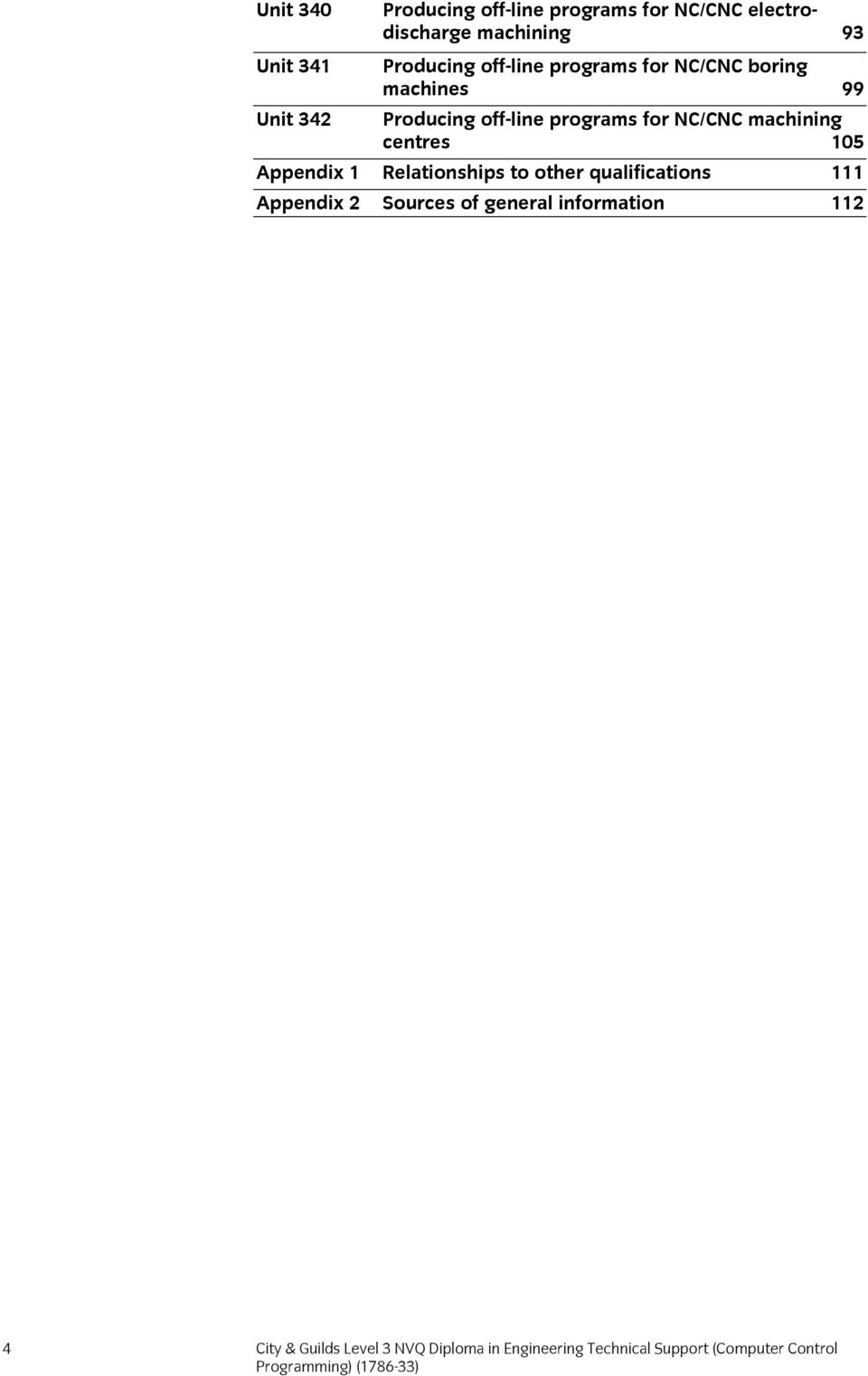
4 Unit 340 Producing off-line programs for NC/CNC electrodischarge machining 93 Unit 341 Producing off-line programs for NC/CNC boring machines 99 Unit 342 Producing off-line programs for NC/CNC machining centres 105 Appendix 1 Relationships to other qualifications 111 Appendix 2 Sources of general information City & Guilds Level 3 NVQ Diploma in Engineering Technical Support (Computer Control Programming) ( )
5 1 Introduction This document tells you what you need to do to deliver the qualification: Area Who is the qualification for? What does the qualification cover? Is the qualification part of a framework or initiative? What opportunities for progression are there? Description It is for candidates who work or want to work in engineering technical support - computer control programming in the engineering sector. It allows candidates to learn, develop and practise the skills required for employment and/or career progression in the engineering technical support sector. It serves as a competence qualification, in the Engineering Apprenticeship framework. It allow candidates to progress into employment or to the following City & Guilds qualifications: Level 3 NVQ Extended Diploma in Engineering Technical Support City & Guilds Level 3 NVQ Diploma in Engineering Technical Support (Computer Control Programming) ( ) 5

6 Structure To achieve the Level 3 NVQ Diploma in Engineering Technical Support (Computer Control Programming), learners must achieve 15 credits from the mandatory units, a minimum of 24 credits from units in optional group 1, and a minimum of 84 credits from units in optional group 2. Unit accreditation number Mandatory City & Guilds unit number Unit title A/601/ Complying with statutory regulations and organisational safety requirements Y/601/ Using and interpreting engineering data and documentation K/601/ Working efficiently and effectively in engineering Optional group 1 M/600/ Providing operational support for computer control programs A/600/ Loading and proving computer control programs Optional group 2 Credit value H/600/ Producing operating programs 84 for Co-ordinate Measuring Machines (CMM) K/600/ Producing off-line programs for 84 programmable logic controller equipment Y/600/ Producing operating programs 84 for industrial robots Y/600/ Producing off-line programs for 84 NC/CNC laser profiling machines A/600/ Producing off-line programs for 84 NC/CNC fabrication machines A/600/ Producing off-line programs for 84 NC/CNC turning machines Y/600/ Producing off-line programs for 84 NC/CNC milling machines H/600/ Producing off-line programs for 84 NC/CNC grinding machines H/600/ Producing off-line programs for 84 NC/CNC gear cutting machines T/600/ Producing off-line programs for City & Guilds Level 3 NVQ Diploma in Engineering Technical Support (Computer Control Programming) ( )

7 NC/CNC electro-discharge machining L/600/ Producing off-line programs for NC/CNC boring machines L/600/ Producing off-line programs for NC/CNC machining centres City & Guilds Level 3 NVQ Diploma in Engineering Technical Support (Computer Control Programming) ( ) 7

8 2 Centre requirements Approval Centres currently offering the City & Guilds Level 3 NVQ in Engineering Technical Support (1686) will be automatically approved to run this new qualification. To offer this qualification new centres will need to gain both centre and qualification approval. Please refer to the Centre Manual - Supporting Customer Excellence for further information. Centre staff should familiarise themselves with the structure, content and assessment requirements of the qualification before designing a course programme. Resource requirements Centre staffing Staff delivering this qualification must be able to demonstrate that they meet the following occupational expertise requirements. They should: be occupationally competent or technically knowledgeable in the areas for which they are delivering training and/or have experience of providing training; this knowledge must be to the same level as the training being delivered have recent relevant experience in the specific area they will be assessing have credible experience of providing training. Centre staff may undertake more than one role, e.g. tutor and assessor or internal verifier, but cannot internally verify their own assessments. Assessors and internal verifier Assessor Requirements to Demonstrate Effective Assessment Practice Assessment must be carried out by competent assessors that as a minimum must hold the QCF Level 3 Award in Assessing Competence in the Work Environment. Current and operational assessors that hold units D32 and/or D33 or A1 and/or A2 as appropriate for the assessment requirements set out in this Unit Assessment Strategy. However, they will be expected to regularly review their skills, knowledge and understanding and where applicable undertake continuing professional development to ensure that they are carrying out workplace assessment to the most up to date National Occupational Standards (NOS). Assessor Technical Requirements Assessors must be able to demonstrate that they have verifiable, relevant and sufficient technical competence to evaluate and judge performance 8 City & Guilds Level 3 NVQ Diploma in Engineering Technical Support (Computer Control Programming) ( )

9 and knowledge evidence requirements as set out in the relevant QCF unit learning outcomes and associated assessment criteria. This will be demonstrated either by holding a relevant technical qualification or by proven industrial experience of the technical areas to be assessed. The assessor s competence must, at the very least, be at the same level as that required of the learner(s) in the units being assessed. Assessors must also be fully conversant with the awarding organisation s assessment recording documentation used for the QCF NVQ units against which the assessments and verification are to be carried out, other relevant documentation and system and procedures to support the QA process. Verifier Requirements (internal and external) Internal quality assurance (Internal Verification) must be carried out by competent Verifiers that as a minimum must hold the QCF Level 4 Award in the Internal Quality Assurance of Assessment Processes and Practices. Current and operational Internal Verifiers that hold internal verification units V1 or D34 will not be required to achieve the QCF Level 4 Award as they are still appropriate for the verification requirements set out in this Unit Assessment Strategy. Verifiers must be familiar with, and preferably hold, either the nationally recognised assessor units D32 and/or D33 or A1 and/or A2 or the QCF Level 3 Award in Assessing Competence in the Work Environment. External quality assurance (External Verification) must be carried out by competent External Verifiers that as a minimum must hold the QCF Level 4 Award in the External Quality Assurance of Assessment Processes and Practices. Current and operational External Verifiers that hold external verification units V2 or D35 will not be required to achieve the QCF Level 4 Award as they are still appropriate for the verification requirements set out in this Unit Assessment Strategy. Verifiers must be familiar with, and preferably hold, either the nationally recognised Assessor units D32 and/or D33 or A1 and/or A2 or the QCF Level 3 Award in Assessing Competence in the Work Environment. External and Internal Verifiers will be expected to regularly review their skills, knowledge and understanding and where applicable undertake continuing professional development to ensure that they are carrying out workplace Quality Assurance (verification) of Assessment Processes and Practices to the most up to date National Occupational Standards (NOS) Verifiers, both Internal and External, will also be expected to be fully conversant with the terminology used in the QCF NVQ units against which the assessments and verification are to be carried out, the appropriate Regulatory Body s systems and procedures and the relevant Awarding Organisation s documentation. Continuing Professional Development (CPD) Centres must support their staff to ensure that they have current knowledge of the occupational area, that delivery, mentoring, training, assessment and verification is in line with best practice, and that it takes account of any national or legislative developments. City & Guilds Level 3 NVQ Diploma in Engineering Technical Support (Computer Control Programming) ( ) 9

10 Candidate entry requirements City & Guilds does not set entry requirements for this qualification. However, centres must ensure that candidates have the potential and opportunity to gain the qualification successfully so should have the opportunity to gather work based evidence. The SEMTA Engineering Manufacture apprenticeship framework suggests that employers would be interested in candidates that: Are keen and motivated to work in an engineering environment Are willing to undertake a course of training both on-the-job and offthe-job and apply this learning in the workplace Have previous work experience or employment in the sector Have completed a 14 to 19 Diploma in Engineering or Manufacturing Have completed a Young Apprenticeship in Engineering or other related area Have GCSEs in English, Maths and Science Have completed tests in basic numeracy, literacy and communication skills and have spatial awareness. As a guide, the Engineering Manufacturing framework is suitable for applicants who have five GCSEs grades D to E in English, Maths and Science. The selection process on behalf of employers may include initial assessment where applicants will be asked if they have any qualifications or experience that can be accredited against the requirements of the apprenticeship. They may also be required to take tests in basic numeracy and literacy, communications skills and spatial awareness. There may also be an interview to ensure applicants have selected the right occupational sector and are motivated to become an apprentice, as undertaking an apprenticeship is a major commitment for both the individual and the employer. Assessment Environment (extract from SEMTA QCF Unit Assessment Strategy 1 January 2011) The evidence put forward for this qualification can only be regarded valid, reliable, sufficient and authentic if achieved and obtained in the working environment and be clearly attributable to the learner. However, in certain circumstances, simulation/replication of work activities may be acceptable. The use of high quality, realistic simulations/replication, which impose pressures which are consistent with workplace expectations, should only be used in relation to the assessment of the following: rare or dangerous occurrences, such as those associated with health, safety and the environment issues, emergency scenarios and rare operations at work; the response to faults and problems for which no opportunity has presented for the use of naturally occurring workplace evidence of learners competence; aspects of working relationships and communications for which no opportunity has presented for the use of naturally occurring workplace evidence of learners competence. Simulations/replications will require prior approval from centres City & Guilds external verifier/qualification consultant and should be designed in relation to the following parameters: 10 City & Guilds Level 3 NVQ Diploma in Engineering Technical Support (Computer Control Programming) ( )

11 the environment in which simulations take place must be designed to match the characteristics of the working environment competencies achieved via simulation/replication must be transferable to the working environment simulations which are designed to assess competence in dealing with emergencies, accidents and incidents must be verified as complying with relevant health, safety and environmental legislation by a competent health and safety/environmental control officer before being used simulated activities should place learners under the same pressures of time, access to resources and access to information as would be expected if the activity was real simulated activities should require learners to demonstrate their competence using plant and/or equipment used in the working environment simulated activities which require interaction with colleagues and contacts should require the learner to use the communication media that would be expected at the workplace for health and safety reason simulations need not involve the use of genuine substances/materials. Any simulations which require the learner to handle or otherwise deal with materials substances/should ensure that the substitute takes the same form as in the workplace. Age restrictions City & Guilds cannot accept any registrations for candidates under 16 as this qualification is not approved for under 16s. Legal restrictions apply to candidates under the age of 18 working unsupervised with children. Centres and candidates should be fully aware of minimum age requirements in their home nation and any implications for completing assessments. City & Guilds Level 3 NVQ Diploma in Engineering Technical Support (Computer Control Programming) ( ) 11

12 3 Delivering the qualification Initial assessment and induction An initial assessment of each candidate should be made before the start of their programme to identify: if the candidate has any specific training needs support and guidance they may need when working towards their qualification any units they have already completed, or credit they have accumulated which is relevant to the qualification the appropriate type and level of qualification. We recommend that centres provide an induction programme so the candidate fully understands the requirements of the qualification, their responsibilities as a candidate, and the responsibilities of the centre. This information can be recorded on a learning contract. Recommended delivery strategies Centre staff should familiarise themselves with the structure, content and assessment requirements of the qualifications before designing a course programme. Centres may design course programmes of study in any way which: best meets the needs and capabilities of their candidates satisfies the requirements of the qualifications. When designing and delivering the course programme, centres might wish to incorporate other teaching and learning that is not assessed as part of the qualifications. This might include the following: literacy, language and/or numeracy personal learning and thinking personal and social development employability. Where applicable, this could involve enabling the candidate to access relevant qualifications covering these skills. Recording documents Candidates and centres may decide to use a paper-based or electronic method of recording evidence. City & Guilds endorses several eportfolio systems. Further details are available at: 12 City & Guilds Level 3 NVQ Diploma in Engineering Technical Support (Computer Control Programming) ( )

13 City & Guilds has developed a set of Recording forms including examples of completed forms, for new and existing centres to use as appropriate. Recording forms are available on the City & Guilds website. Although new centres are expected to use these forms, centres may devise or customise alternative forms, which must be approved for use by the external verifier, before they are used by candidates and assessors at the centre. Amendable (MS Word) versions of the forms are available on the City & Guilds website. City & Guilds Level 3 NVQ Diploma in Engineering Technical Support (Computer Control Programming) ( ) 13

14 4 Assessment Assessment of the qualification Candidates must have a completed portfolio of evidence for each unit chosen. Evidence requirements Carrying Out Assessments The NVQ units were specifically developed to cover a wide range of activities. The evidence produced for the units will, therefore, depend on the learners choice of bulleted items listed in the unit assessment criteria. Where the assessment criteria gives a choice of bulleted items (for example any three from five ), assessors should note that learners do not need to provide evidence of the other items to complete the unit (in this example, two) items, particularly where these additional items may relate to other activities or methods that are not part of the learners normal workplace activity or area of expertise. Minimum Performance Evidence Requirements Performance evidence must be the main form of evidence gathered. In order to demonstrate consistent, competent performance for a unit, a minimum of three different examples of performance must be provided, and must be sufficient to show that the assessment criteria have been achieved to the prescribed standards. It is possible that some of the bulleted items in the assessment criteria may be covered more than once. The assessor and learner need to devise an assessment plan to ensure that performance evidence is sufficient to cover all the specified assessment criteria and which maximises the opportunities to gather evidence. Where applicable, performance evidence may be used for more than one unit. The most effective way of assessing competence, is through direct observation of the learner. Assessors must make sure that the evidence provided reflects the learner s competence and not just the achievement of a training programme. Evidence that has been produced from team activities, for example, maintenance or installation activities is only valid when it clearly relates to the learners specific and individual contribution to the activity, and not to the general outcome(s). Each example of performance evidence will often contain features that apply to more than one unit, and can be used as evidence in any unit where appropriate. Performance evidence must be a combination of: outputs of the learner s work, such as items that have been manufactured, installed, maintained, designed, planned or quality assured, and documents produced as part of a work activity 14 City & Guilds Level 3 NVQ Diploma in Engineering Technical Support (Computer Control Programming) ( )
15 evidence of the way the learner carried out the activities such as witness testimonies, assessor observations or authenticated learner reports, records or photographs of the work/activity carried out, etc. Competent performance is more than just carrying out a series of individual set tasks. Many of the units contain statements that require the learner to provide evidence that proves they are capable of combining the various features and techniques. Where this is the case, separate fragments of evidence would not provide this combination of features and techniques and will not, therefore, be acceptable as demonstrating competent performance. If there is any doubt as to what constitutes valid, authentic and reliable evidence, the internal and/or external verifier (qualifications consultant) should be consulted. Assessing knowledge and understanding Knowledge and understanding are key components of competent performance, but it is unlikely that performance evidence alone will provide enough evidence in this area. Where the learner s knowledge and understanding (and the handling of contingency situations) is not apparent from performance evidence, it must be assessed by other means and be supported by suitable evidence. Knowledge and understanding can be demonstrated in a number of different ways. Semta (the Sector Skills Council) expects oral questioning and practical demonstrations to be used, as these are considered the most appropriate for these units. Assessors should ask enough questions to make sure that the learner has an appropriate level of knowledge and understanding, as required by the unit. Evidence of knowledge and understanding will not be required for those bulleted items in the assessment criteria that have not been selected by the learner. The achievement of the specific knowledge and understanding requirements of the units cannot simply be inferred by the results of tests or assignments from other units, qualifications or training programmes. Where evidence is submitted from these sources, the assessor must, as with any assessment, make sure the evidence is valid, reliable, authentic, directly attributable to the learner, and meets the full knowledge and understanding requirements of the unit. Where oral questioning is used the assessor must retain a record of the questions asked, together with the learner s answers. Witness testimony Where observation is used to obtain performance evidence, this must be carried out against the unit assessment criteria. Best practice would require that such observation is carried out by a qualified assessor. If this is not practicable, then alternative sources of evidence may be used. For example, the observation may be carried out against the assessment criteria by someone else that is in close contact with the learner. This could be a team leader, supervisor, mentor or line manager who may be regarded as a suitable witness to the learner s competency. However, the witness must be technically competent in the process or skills that they are providing testimony for, to at least the same level of expertise as that City & Guilds Level 3 NVQ Diploma in Engineering Technical Support (Computer Control Programming) ( ) 15

16 required of the learner. It will be the responsibility of the assessor to make sure that any witness testimonies accepted as evidence of the learner s competency are reliable, auditable and technically valid. Recognition of Prior Learning (RPL) Recognition of prior learning means using a person s previous experience or qualifications which have already been achieved to contribute to a new qualification. RPL is allowed and is also sector specific. 16 City & Guilds Level 3 NVQ Diploma in Engineering Technical Support (Computer Control Programming) ( )

17 5 Units Availability of units The following units can also be obtained from The Register of Regulated Qualifications: Structure of units These units each have the following: City & Guilds unit number Title Unit Accreditation Number (UAN) Level Credit value Recommended Guided Learning Hours (GLH) Relationship to National Occupational Standards (NOS), other qualifications and frameworks Endorsement by a sector or other appropriate body Unit aim(s) Learning outcomes which are comprised of a number of assessment criteria. City & Guilds Level 3 NVQ Diploma in Engineering Technical Support (Computer Control Programming) ( ) 17

18 Unit 201 Complying with statutory regulations and organisational safety requirements UAN: A/601/5013 Level: 2 Credit value: 5 GLH: 35 Relationship to NOS: This unit has been derived from national occupational standard: Complying with statutory regulations and organisational safety requirements (Suite 2). Endorsement by a sector or other appropriate body: Aim: This unit is endorsed by Semta, the Sector Skills Council for Science, Engineering and Manufacturing Technologies. This unit covers the skills and knowledge needed to prove the competences required to deal with statutory regulations and organisational safety requirements. It does not deal with specific safety regulations or detailed requirements, it does, however, cover the more general health and safety requirements that apply to working in an industrial environment. The learner will be expected to comply with all relevant regulations that apply to their area of work, as well as their general responsibilities as defined in the Health and Safety at Work Act. The learner will need to be able to identify the relevant qualified first aiders and know the location of the first aid facilities. The learner will have a knowledge and understanding of the procedures to be adopted in the case of accidents involving injury and in situations where there are dangerous occurrences or hazardous malfunctions of equipment, processes or machinery. The learner will also need to be fully conversant with their organisation s procedures for fire alerts and the evacuation of premises. The learner will also be required to identify the hazards and risks that are 18 City & Guilds Level 3 NVQ Diploma in Engineering Technical Support (Computer Control Programming) ( )

19 associated with their job. Typically, these will focus on their working environment, the tools and equipment that they use, the materials and substances that they use, any working practices that do not follow laid-down procedures, and manual lifting and carrying techniques. The learner s responsibilities will require them to comply with all relevant statutory and organisational policy and procedures for health and safety in the workplace. The learner must act in a responsible and safe manner at all times, and present themselves in the workplace suitably prepared for the activities to be undertaken. The learner will be expected to report any problems with health and safety issues, to the relevant authority. The learner s knowledge will provide a good understanding of the relevant statutory regulations and organisational requirements associated with their work, and will provide an informed approach to the procedures used. The learner will need to understand their organisation s health and safety requirements and their application, in adequate depth to provide a sound basis for carrying out their activities in a safe and competent manner. Learning outcome The learner will: 1. comply with statutory regulations and organisational safety requirements Assessment criteria The learner can: 1.1 comply with their duties and obligations as defined in the Health and Safety at Work Act 1.2 demonstrate their understanding of their duties and obligations to health and safety by: applying in principle their duties and responsibilities as an individual under the Health and Safety at Work Act identifying, within their organisation, appropriate sources of information and guidance on health and safety issues, such as: o eye protection and Personal Protective Equipment (PPE) o COSHH regulations o risk assessments identifying the warning signs and labels of the main groups of hazardous or dangerous substances complying with the appropriate statutory regulations at all City & Guilds Level 3 NVQ Diploma in Engineering Technical Support (Computer Control Programming) ( ) 19

20 times 1.3 present themselves in the workplace suitably prepared for the activities to be undertaken 1.4 follow organisational accident and emergency procedures 1.5 comply with emergency requirements, to include: identifying the appropriate qualified first aiders and the location of first aid facilities identifying the procedures to be followed in the event of injury to themselves or others following organisational procedures in the event of fire and the evacuation of premises identifying the procedures to be followed in the event of dangerous occurrences or hazardous malfunctions of equipment 1.6 recognise and control hazards in the workplace 1.7 identify the hazards and risks that are associated with the following: their working environment the equipment that they use materials and substances (where appropriate) that they use working practices that do not follow laid-down procedures 1.8 use correct manual lifting and carrying techniques 1.9 demonstrate one of the following methods of manual lifting and carrying: lifting alone with assistance of others with mechanical assistance 1.10 apply safe working practices and procedures to include: maintaining a tidy workplace, with exits and gangways free from obstruction using equipment safely and only for the purpose intended observing organisational safety rules, signs and hazard warnings taking measures to protect others from any harm resulting from the work that they are carrying out. Learning outcome The learner will: 2. know how to comply with statutory regulations and organisational safety requirements Assessment criteria The learner can: 2.1 describe the roles and responsibilities of themselves and others under the Health and Safety at Work Act, and other current legislation (such as the Management of Health and Safety at Work regulations, Workplace Health and Safety and Welfare regulations, Personal Protective Equipment at work regulations, Manual Handling Operations regulations, Provision and Use of Work Equipment regulations, Display Screen at Work regulations, Reporting of Injuries, Diseases and Dangerous Occurrences regulations) 20 City & Guilds Level 3 NVQ Diploma in Engineering Technical Support (Computer Control Programming) ( )

21 2.2 describe the specific regulations and safe working practices and procedures that apply to their work activities 2.3 describe the warning signs for the seven main groups of hazardous substances defined by Classification, Packaging and Labelling of Dangerous Substances regulations 2.4 explain how to locate relevant health and safety information for their tasks, and the sources of expert assistance when help is needed 2.5 explain what constitutes a hazard in the workplace (such as moving parts of machinery, electricity, slippery and uneven surfaces, poorly placed equipment, dust and fumes, handling and transporting, contaminants and irritants, material ejection, fire, working at height, environment, pressure/stored energy systems, volatile, flammable or toxic materials, unshielded processes, working in confined spaces) 2.6 describe their responsibilities for identifying and dealing with hazards and reducing risks in the workplace 2.7 describe the risks associated with their working environment (such as the tools, materials and equipment that they use, spillages of oil, chemicals and other substances, not reporting accidental breakages of tools or equipment and not following laid-down working practices and procedures) 2.8 describe the processes and procedures that are used to identify and rate the level of risk (such as safety inspections, the use of hazard checklists, carrying out risk assessments, COSHH assessments) 2.9 describe the first aid facilities that exist within their work area and within the organisation in general; the procedures to be followed in the case of accidents involving injury 2.10 explain what constitute dangerous occurrences and hazardous malfunctions, and why these must be reported even if no-one is injured 2.11 describe the procedures for sounding the emergency alarms, evacuation procedures and escape routes to be used, and the need to report their presence at the appropriate assembly point 2.12 describe the organisational policy with regard to fire fighting procedures; the common causes of fire and what they can do to help prevent them 2.13 describe the protective clothing and equipment that is available for their areas of activity 2.14 explain how to safely lift and carry loads, and the manual and mechanical aids available 2.15 explain how to prepare and maintain safe working areas; the standards and procedures to ensure good housekeeping 2.16 describe the importance of safe storage of tools, equipment, materials and products 2.17 describe the extent of their own authority, and to whom they should report in the event of problems that they cannot resolve. City & Guilds Level 3 NVQ Diploma in Engineering Technical Support (Computer Control Programming) ( ) 21
22 Unit 202 Using and interpreting engineering data and documentation UAN: Y/601/5102 Level: 2 Credit value: 5 GLH: 25 Relationship to NOS: This unit has been derived from national occupational standard: Using and interpreting engineering data and documentation (Suite 2). Endorsement by a sector or other appropriate body: Aim: This unit is endorsed by Semta, the Sector Skills Council for Science, Engineering and Manufacturing Technologies. This unit covers the skills and knowledge needed to prove the competences required to make effective use of text, numeric and graphical information, by interpreting and using technical information extracted from documents such as engineering drawings, technical manuals, reference tables, specifications, technical sales/marketing documentation, charts or electronic displays, in accordance with approved procedures. The learner will be required to extract the necessary information from the various documents, in order to establish and carry out the work requirements, and to make valid decisions about the work activities based on the information extracted. The learner s responsibilities will require them to comply with organisational policy and procedures for obtaining and using the documentation applicable to the activity. They will be expected to report any problems with the use and interpretation of the documents that they cannot personally resolve, or are outside their permitted authority, to the relevant people. They will be expected to work to instructions if necessary, with an appropriate level of supervision or as a member of a team, and take personal responsibility for their own actions and for the quality and accuracy of 22 City & Guilds Level 3 NVQ Diploma in Engineering Technical Support (Computer Control Programming) ( )
23 the work that they carry out. The learner s underpinning knowledge will provide a good understanding of the types of documentation used, and will provide an informed approach to applying instructions and procedures. They will be able to read and interpret the documentation used and will know about the conventions, symbols and abbreviations, in adequate depth to provide a sound basis for carrying out the activities to the required specification. Learning outcome The learner will: 1. use and interpret engineering data and documentation Assessment criteria The learner can: 1.1 use the approved source to obtain the required data and documentation 1.2 use the data and documentation and carry out all of the following: check the currency and validity of the data and documentation used exercise care and control over the documents at all times correctly extract all necessary data in order to carry out the required tasks seek out additional information where there are gaps or deficiencies in the information obtained deal with or report any problems found with the data and documentation make valid decisions based on the evaluation of the engineering information extracted from the documents return all documents to the approved location on completion of the work complete all necessary work related documentation such as production documentation, installation documentation, maintenance documentation, planning documentation 1.3 correctly identify, interpret and extract the required information 1.4 extract information that includes three of the following: materials or components required dimensions tolerances build quality installation requirements customer requirements time scales financial information operating parameters surface texture requirements City & Guilds Level 3 NVQ Diploma in Engineering Technical Support (Computer Control Programming) ( ) 23
24 location/orientation of parts process or treatments required dismantling/assembly sequence inspection/testing requirements number/volumes required repair/service methods method of manufacture weld type and size operations required connections to be made surface finish required shape or profiles fault finding procedures safety/risk factors environmental controls specific data (such as component data, maintenance data, electrical data, fluid data) resources (such as tools, equipment, personnel) utility supply details (such as electricity, water, gas, air) location of services, including standby and emergency backup systems circuit characteristics (such as pressure, flow, current, voltage, speed) protective arrangements and equipment (such as containment, environmental controls, warning and evacuation systems and equipment) other specific related information 1.5 use the information obtained to ensure that work output meets the specification 1.6 use information extracted from documents to include one from the following: drawings (such as component drawings, assembly drawings, modification drawings, repair drawings, welding/fabrication drawings, distribution and installation drawings) diagrams (such as schematic, fluid power diagrams, piping, wiring/circuit diagrams) manufacturers manuals/drawings approved sketches technical illustrations photographic representations visual display screen information technical sales/marketing documentation contractual documentation other specific drawings/documents 1.7 use information extracted from related documentation, to include two from the following: instructions (such as job instructions, drawing instructions, manufacturers instructions) 24 City & Guilds Level 3 NVQ Diploma in Engineering Technical Support (Computer Control Programming) ( )
25 specifications (such as material, finish, process, contractual, calibration) reference materials (such as manuals, tables, charts, guides, notes) schedules operation sheets service/test information planning documentation quality control documents company specific technical instructions national, international and organisational standards health and safety standards relating to the activity (such as COSHH) other specific related documentation 1.8 deal promptly and effectively with any problems within their control and report those which cannot be solved 1.9 report any inaccuracies or discrepancies in documentation and specifications. Learning outcome The learner will: 2. know how to use and interpret engineering data and documentation Assessment criteria The learner can: 2.1 explain what information sources are used for the data and documentation that they use in their work activities 2.2 explain how documents are obtained, and how to check that they are current and valid 2.3 explain the basic principles of confidentiality (including what information should be available and to whom) 2.4 describe the different ways/formats that data and documentation can be presented (such as such as drawings, job instructions product data sheets, manufacturers manuals, financial spreadsheets, production schedules, inspection and calibration requirements, customer information) 2.5 explain how to use other sources of information to support the data (such as electronic component pin configuration specifications, reference charts, standards, bend allowances required for material thickness, electrical conditions required for specific welding rods, mixing ratios for bonding and finishing materials, metal specifications and inspection requirements, health and safety documentation) 2.6 describe the importance of differentiating fact from opinion when reviewing data and documentation 2.7 describe the importance of analysing all available data and documentation before decisions are made 2.8 describe the different ways of storing and organising data and documentation to ensure easy access 2.9 describe the procedures for reporting discrepancies in the data or documentation, and for reporting lost or damaged documents 2.10 describe the importance of keeping all data and documentation up City & Guilds Level 3 NVQ Diploma in Engineering Technical Support (Computer Control Programming) ( ) 25
26 to date during the work activity, and the implications of this not being done 2.11 explain the care and control procedures for the documents, and how damage or graffiti on documents can lead to scrapped work 2.12 explain the importance of returning documents to the designated location on completion of the work activities 2.13 explain what basic drawing conventions are used and why there needs to be different types of drawings (such as isometric and orthographic, first and third angle, assembly drawings, circuit and wiring diagrams, block and schematic diagrams 2.14 explain what types of documentation are used and how they interrelate (such as production drawings, assembly drawings, circuit and wiring diagrams, block and schematic diagrams) 2.15 explain the imperial and metric systems of measurement; tolerancing and fixed reference points 2.16 describe the meaning of the different symbols and abbreviations found on the documents that they use (such as surface finish, electronic components, weld symbols, linear and geometric tolerances, pressure and flow characteristics) 2.17 describe the extent of their own responsibility, when to act on their own initiative to find, clarify and evaluate information, and to whom they should report if they have problems that they cannot resolve. 26 City & Guilds Level 3 NVQ Diploma in Engineering Technical Support (Computer Control Programming) ( )
27 Unit 303 Working efficiently and effectively in engineering UAN: Level: 3 Credit value: 5 GLH: 25 Relationship to NOS: Endorsement by a sector or other appropriate body: Aim: K/601/5055 This unit is linked to This unit has been derived from national occupational standard: Working efficiently and effectively in engineering (Suite 3). This unit is endorsed by Semta, the Sector Skills Council for Science, Engineering and Manufacturing Technologies. This unit covers the skills and knowledge needed to prove the competences required to work efficiently and effectively in the workplace, in accordance with approved procedures and practices. Prior to undertaking the engineering activity, the learner will be required to carry out all necessary preparations within the scope of their responsibility. This may include preparing the work area and ensuring that it is in a safe condition to carry out the intended activities, ensuring they have the appropriate job specifications and instructions and that any tools, equipment, materials and other resources required are available and in a safe and usable condition. On completion of the engineering activity, the learner will be required to return their immediate work area to an acceptable condition before recommencing further work requirements. This may involve placing completed work in the correct location, returning and/or storing any tools and equipment in the correct area, identifying any waste and/or scrapped materials and arranging for their disposal, and reporting any defects or damage to tools and equipment used. In order to be efficient and effective in the workplace, the learner will also be required to demonstrate that they can create and maintain effective working relationships with City & Guilds Level 3 NVQ Diploma in Engineering Technical Support (Computer Control Programming) ( ) 27
28 colleagues and line management. The learner will also be expected to review objectives and targets for their personal development and make recommendations to, and communicate any opportunities for, improvements that could be made to working practices and procedures. The learner s responsibilities will require them to comply with organisational policy and procedures for the engineering activities undertaken, and to report any problems with the activities, or the tools and equipment that are used that they cannot personally resolve, or are outside their permitted authority, to the relevant people. The learner will be expected to take personal responsibility for their own actions and for the quality and accuracy of the work that they carry out. The learner s knowledge will provide a good understanding of their work, and will provide an informed approach to working efficiently and effectively in an engineering environment. The learner will understand the need to work efficiently and effectively, and will know about the areas they need to consider when preparing and tidying up the work area, how to contribute to improvements, deal with problems, maintain effective working relationships and agree their development objectives and targets, in adequate depth to provide a sound basis for carrying out the activities safely and correctly. The learner will understand the safety precautions required when carrying out engineering activities. The learner will be required to demonstrate safe working practices throughout, and will understand the responsibility they owe to themselves and others in the workplace. Learning outcome The learner will: 1. work efficiently and effectively in engineering Assessment criteria The learner can: 1.1 work safely at all times, complying with health and safety and other relevant regulations and guidelines 1.2 prepare the work area to carry out the engineering activity 1.3 prepare to carry out the engineering activity, taking into 28 City & Guilds Level 3 NVQ Diploma in Engineering Technical Support (Computer Control Programming) ( )
29 consideration all of the following, as applicable to the work to be undertaken: the work area is free from hazards and is suitably prepared for the activities to be undertaken any required safety procedures are implemented any necessary personal protection equipment is obtained and is in a usable condition tools and equipment required are obtained and checked that they are in a safe and useable condition all necessary drawings, specifications and associated documentation is obtained job instructions are obtained and understood the correct materials or components are obtained storage arrangements for work are appropriate appropriate authorisation to carry out the work is obtained 1.4 check that there are sufficient supplies of materials and/or consumables and that they meet work requirements 1.5 ensure that completed products or resources are stored in the appropriate location on completion of the activities 1.6 complete work activities, to include all of the following: completing all necessary documentation accurately and legibly returning tools and equipment returning drawings and work instructions identifying, where appropriate, any unusable tools, equipment or components arranging for disposal of waste materials 1.7 tidy up the work area on completion of the engineering activity 1.8 deal promptly and effectively with problems within their control and report those that cannot be resolved 1.9 deal with problems affecting the engineering process, to include two of the following: materials tools and equipment drawings job specification quality people timescales safety activities or procedures 1.10 contribute to and communicate opportunities for improvement to working practices and procedures 1.11 make recommendations for improving to two of the following: working practices working methods quality safety tools and equipment City & Guilds Level 3 NVQ Diploma in Engineering Technical Support (Computer Control Programming) ( ) 29
30 supplier relationships internal communication customer service training and development teamwork other 1.12 maintain effective working relationships with colleagues to include two of the following: colleagues within own working group colleagues outside normal working group line management external contacts 1.13 review personal training and development as appropriate to the job role 1.14 review personal development objectives and targets to include one of the following: dual or multi-skilling training on new equipment / technology increased responsibility understanding of company working practices, procedures, plans and policies other specific requirements. Learning outcome The learner will: 2. Know how to work efficiently and effectively in engineering Assessment criteria The learner can: 2.1 describe the safe working practices and procedures to be followed whilst preparing and tidying up their work area 2.2 describe the correct use of any equipment used to protect the health and safety of themselves and their colleagues 2.3 describe the procedure for ensuring that all documentation relating to the work being carried out is available and current, prior to starting the activity 2.4 describe the action that should be taken if documentation received is incomplete and/or incorrect 2.5 describe the procedure for ensuring that all tools and equipment are available prior to undertaking the activity 2.6 describe the checks to be carried out to ensure that tools and equipment are in full working order, prior to undertaking the activity 2.7 describe the action that should be taken if tools and equipment are not in full working order 2.8 describe the checks to be carried out to ensure that all materials required are correct and complete, prior to undertaking the activity 2.9 describe the action that should be taken if materials do not meet the requirements of the activity 2.10 explain whom to inform when the work activity has been completed 30 City & Guilds Level 3 NVQ Diploma in Engineering Technical Support (Computer Control Programming) ( )
31 2.11 describe the information and/or documentation required to confirm that the activity has been completed 2.12 explain what materials, equipment and tools can be reused 2.13 explain how any waste materials and/or products are transferred, stored and disposed of 2.14 explain where tools and equipment should be stored and located 2.15 describe the importance of making recommendations for improving working practices 2.16 describe the procedure and format for making suggestions for improvements 2.17 describe the benefits to organisations if improvements can be identified 2.18 describe the importance of maintaining effective working relationships within the workplace 2.19 describe the procedures to deal with and report any problems that can affect working relationships 2.20 describe the difficulties that can occur in working relationships 2.21 describe the regulations that affect how they should be treated at work (such as Equal Opportunities Act, Race and Sex Discrimination, Working Time Directive) 2.22 describe the benefits of continuous personal development 2.23 describe the training opportunities that are available in the workplace 2.24 describe the importance of reviewing their training and development 2.25 explain with whom to discuss training and development issues 2.26 describe the extent of their own responsibility and to whom they should report if they have any problems that they cannot resolve. City & Guilds Level 3 NVQ Diploma in Engineering Technical Support (Computer Control Programming) ( ) 31
32 Unit 329 Providing operational support for computer control programs UAN: M/600/5692 Level: 3 Credit value: 54 GLH: 106 Relationship to NOS: This unit has been derived from National Occupational Standard engineering technical support Unit No 29: Providing operational support for computer control programs (Suite 3). Endorsement by a sector or other appropriate body: Aim: This unit is endorsed by Semta, the Sector Skills Council for Science, Engineering and Manufacturing Technologies. This unit covers the skills and knowledge needed to prove the competences required to provide direct operational support to users of computer control programs, in accordance with approved procedures. The support the learner provides will relate to Numerical Control and/or Computer Numerical Control (NC/CNC) machine tool programs, robotic applications and Programmable Logic Control (PLC) software programs. This will require the learner to liaise with a range of people, such as other machine tool/equipment programmers, machine tool setters, machine operators, maintenance personnel, drawing and design engineers, external customers and planning, production and quality control engineers. The learner will be required to respond and provide operational support, within agreed timescales, whilst ensuring that the activities within their control conform to organisational and, where appropriate, legal requirements. The learner s responsibilities will require them to comply with organisational policy and procedures for the provision of the operational support. The learner will report any problems that they cannot personally resolve, or that are outside their permitted authority, to the relevant people. The learner will be expected to work with a minimum of 32 City & Guilds Level 3 NVQ Diploma in Engineering Technical Support (Computer Control Programming) ( )
33 supervision, taking personal responsibility for their own actions and for the quality and accuracy of the work that they carry out. The learner s knowledge will provide a good understanding of their work, and will provide an informed approach to providing operational support to users of computer control programs. The learner will understand the engineering processes being carried out, the equipment used, programming methods and problem solving principles and procedures, in adequate depth to provide a sound basis for providing the support and for carrying out their activities to the required standard. The learner will understand their organisation s methods of operation, in sufficient detail to enable them to make informed decisions as to the level and extent of the operational support required. The learner will be aware of any health, safety and environmental requirements applicable to their area of responsibility. The learner will be required to demonstrate safe working practices throughout, and will understand the responsibility they owe to themselves and others in the workplace. Learning outcome The learner will: 1. provide operational support for computer control programs Assessment criteria The learner can: 1.1 work safely in accordance with the regulations for their work environment 1.2 provide operational support within agreed timescales and working arrangements 1.3 provide operational support for one of the following: NC/CNC machine tool programs PLC programs robotic applications co-ordinate measuring applications 1.4 provide operational support to two of the following: machine tool setters machine tool operators maintenance personnel process setters process operators design department City & Guilds Level 3 NVQ Diploma in Engineering Technical Support (Computer Control Programming) ( ) 33
34 quality assurance/inspection personnel production supervisor/management personnel other machine tool/equipment programmers staff contracted in by their organisation external customers or recent purchasers of products/services 1.5 provide operational support for nine of the following: accessing/downloading data from engineering/computer equipment loading programs into computer controlled equipment the operation/formatting of the computer program interpretation of specifications understanding of operating procedures implementing and achieving work schedules resource requirements workholding/jigging/fixture arrangements safety factors (such as collision avoidance) program efficiency program errors machine/equipment capabilities tooling capabilities operation of the equipment equipment operator skill gaps developing standard operating procedures work/process quality the application of specific engineering tools, methods, processes or procedures interpretation of reports/data (such as in inspection/process reports) 1.6 provide operational/programming support, covering issues regarding the following: either six of the following: o suitability of specified datum point o systems of measurement (such as absolute and incremental, metric or imperial) o material/component parameters o tooling type (such as milling cutters, turning tools, electrodes, wire, laser nozzles, inspection probes) o tooling data/settings (such as number, type, diameter, lengths and offsets, compensation, laser power/focus) o reference/program codes o positional information o cutting/eroding parameters (such as depth of cut, direction, feed in/out) o measuring parameters (such as direction, feed in/out) o preparatory commands and machine management/auxiliary functions o use of repetitive programs (sub-routines, canned cycles, labels, macros) 34 City & Guilds Level 3 NVQ Diploma in Engineering Technical Support (Computer Control Programming) ( )
35 o tooling path order and sequence o tooling change positions o work-shift position or six of the following: o use of programming devices (such as terminals, hand-held programmers and personal computers) o use ladder logic, statement lists, or system flowcharts o the forcing of contacts on and off o editing, and removing contacts from lines of logic o changing counter and timer settings o using on- and off-line programming o loading, reading and saving programs o producing back-ups of completed programs o computer based authoring of programs (to include subroutines) o single step mode of operation 1.7 make sure that operational support is appropriate and based on accurate and current information 1.8 carry out all of the following when providing the operational support: check that all essential information and data needed to support the user of the computer control program is available check that all information and data to be used is current and up to date ensure that health and safety regulations and safe working practices are taken into account ensure that the influence of working conditions on technical performance is taken into account record and store details of the support provided in the correct formats and in the appropriate company system 1.9 obtain feedback on the support provided 1.10 produce and maintain records in accordance with organisational requirements 1.11 maintain records, using two of the following methods: written or typed report electronic mail computer record verbal report specific company form 1.12 deal promptly and effectively with problems relating to the provision of operational support. Learning outcome The learner will: 2. know how to provide operational support for computer control programs Assessment criteria The learner can: 2.1 describe the specific safety precautions to be taken when working with programming systems and equipment (to include safety City & Guilds Level 3 NVQ Diploma in Engineering Technical Support (Computer Control Programming) ( ) 35
36 guidance relating to the use of Visual Display Unit (VDU), equipment and work station environment (such as lighting, seating, positioning of equipment), Repetitive Strain Injury (RSI); the dangers of trailing leads and cables; how to spot faulty or dangerous electrical leads, plugs and connections) 2.2 describe the specific safety precautions to be taken when working with computer controlled machines and equipment 2.3 describe the importance of wearing the protective clothing and equipment when working in hazardous environments (such as engineering workshops and production lines) 2.4 describe the good housekeeping arrangements (such as cleaning down work surfaces; putting disks/cds, manuals and unwanted items of equipment into safe storage; leaving the work area in a safe and tidy condition) 2.5 describe the set-up and operation of the programming system, and any peripheral devices that are used during the supporting activity (to include ensuring that peripheral devices are connected correctly) 2.6 explain how to power up, log on, log off and activate the computer system and programming software correctly 2.7 explain how to access the specific programming software, and the use of manuals and related documents, in order to provide effective programming support and to solve operational problems 2.8 describe the importance of protecting the programming system from bugs/viruses, and the implications if the correct procedure is not followed 2.9 explain how to create and structure directories and files correctly (such as importing, copying, transferring, exporting deleting, backing up and saving files) 2.10 describe the different types of storage media that can be used to save program files 2.11 describe the range of areas where they could be required to provide operational support 2.12 describe the actions to be taken to resolve program and/or operational issues 2.13 describe the factors that will have an impact on the effectiveness of the support provided 2.14 describe the basic operating principles of the equipment using the program 2.15 describe the different departments and/or personnel that may require operational support 2.16 explain how to determine the nature, level and extent of the operational support required 2.17 describe the importance of providing accurate, current, sufficient and timely operational support 2.18 describe the importance of obtaining all essential information and data, in order to provide effective operational support 2.19 describe the different methods of providing operational support to users of computer controlled programs 2.20 explain how to ensure that the operational support provided is understood and implemented 2.21 describe the procedure for obtaining feedback on the effectiveness of the support provided 2.22 describe the importance of informing all relevant parties of any 36 City & Guilds Level 3 NVQ Diploma in Engineering Technical Support (Computer Control Programming) ( )
37 changes in the set-up and operation of the equipment or program 2.23 describe the documentation to be completed, following the supporting activity 2.24 describe the typical problems that can occur when providing operational support 2.25 describe the extent of their own responsibility and to whom they should report if they have any problems that they cannot resolve. City & Guilds Level 3 NVQ Diploma in Engineering Technical Support (Computer Control Programming) ( ) 37
38 Unit 330 Loading and proving computer control programs UAN: Level: 3 Credit value: 24 GLH: 91 Relationship to NOS: Endorsement by a sector or other appropriate body: Aim: A/600/5694 This unit has been derived from National Occupational Standard engineering technical support Unit No 30: loading and proving computer control programs (Suite 3). This unit is endorsed by Semta, the Sector Skills Council for Science, Engineering and Manufacturing Technologies. This unit covers the skills and knowledge needed to prove the competences required to load and prove computer control programs, such as Numerically Controlled (NC) or Computer Numerically Controlled (CNC) machine tools, Co-ordinate Measuring Machines (CMM), Programmable Logic Control (PLC), and robotic applications, in accordance with approved procedures. The learner will be required to obtain the correct component program, which may be on tape, disk or downloaded from a remote computer. The learner will need to check the program for currency, and load it correctly into the machine controller, checking for faults or error messages and dealing with these, as appropriate to their level of responsibility. The learner will also be required to adjust the equipment and program, following proving/editing procedures, to achieve the specification. The learner must ensure that any edited programs are saved and backed up, safely and correctly. The learner s responsibilities will require them to comply with organisational policy and procedures for obtaining, loading and proving the programs, and to report any problems with these activities that they cannot personally resolve, or that are outside their permitted authority, to the relevant people. The learner will be expected to work with a minimum of supervision, 38 City & Guilds Level 3 NVQ Diploma in Engineering Technical Support (Computer Control Programming) ( )
39 taking personal responsibility for their own actions and for the quality and accuracy of the work that they carry out. The learner s knowledge will provide a good understanding of their work, and will provide an informed approach to applying computer control program loading and proving techniques and procedures. The learner will understand the computer control equipment used in the process, and its application, and will know about the programming, editing and proving process, in adequate depth to provide a sound basis for carrying out the activities, correcting faults and ensuring that the machine controller is set up to carry out its activities to the required specification. The learner will understand the safety precautions required when working on the computer equipment and its associated accessories/equipment. The learner will be required to demonstrate safe working practices throughout, and will understand the responsibility they owe to themselves and others in the workplace. Learning outcome The learner will: 1. load and prove computer control programs Assessment criteria The learner can: 1.1 work safely at all times, complying with health and safety and other relevant regulations and guidelines 1.2 use the correct control program and ensure it is correctly loaded into the machine controller 1.3 ensure that they apply all of the following checks and practices during the programming activities: the correct operating program is obtained and checked for currency and validity the machine controller is prepared, ready to accept the operating program the program is loaded into the controller, safely and correctly program media is stored safely and correctly, away from contaminants or electromagnetic sources 1.4 follow the correct procedures for calling up the program and dealing with any error messages or faults 1.5 confirm program integrity 1.6 adjust the equipment and program operating parameters to optimise the outcomes to be achieved 1.7 load and correctly set-up all associated equipment 1.8 load and prove programs for one of the following types of computer City & Guilds Level 3 NVQ Diploma in Engineering Technical Support (Computer Control Programming) ( ) 39
40 control equipment: NC/CNC machine tools co-ordinate measuring machines industrial robots PLC equipment 1.9 obtain and load programs stored on one of the following mediums: remote computer terminal personal computers handheld programmers machine controller tape (such as punched or magnetic) disk 1.10 operate the controller using six of the following, as applicable to the equipment type: use single step/single block run mode of operation graphic displays full dry run search facilities program save/store facilities edit facilities program override controls (speed, feed, tool data) data input facilities data output peripherals (such as printers) speed and acceleration parameters 1.11 check that all safety mechanisms are in place and that the equipment is set correctly for the required operations 1.12 confirm that the equipment and program operates safely and correctly by carrying out the following, as applicable to the type of equipment used: either carry out all of the following: o check that datums for each axis are set in relation to the equipment/component and tooling used o ensure that start-up positions are safe and correctly set o ensure that tooling information is correctly entered into the machine controller (such as type, number, position) o check that tooling change positions are safe and clear of the workpiece and other devices (such as clamps, jigs and fixtures) o ensure that the correct tooling is selected at the appropriate points in the program o check that tooling/operational paths are executed safely and correctly o ensure that all operations are carried out to the program co-ordinates o save edited programs o produce back-up copies of completed programs o ensure that any alterations to programs are communicated fully to the appropriate personnel Or carry out all of the following: 40 City & Guilds Level 3 NVQ Diploma in Engineering Technical Support (Computer Control Programming) ( )
41 o force contacts on and off and check for correct operation of peripherals o edit, enter and remove contacts from lines of logic, where appropriate o check counter and timer settings o save edited programs o produce back-ups of completed programs o ensure that any alterations to programs are communicated fully to the appropriate personnel Or carry out all of the following: o confirm that the robot operates within the defined operating environment/envelope/cell layout o ensure that start-up positions are safe and correctly set o check that intrusion monitoring systems are operating correctly (where appropriate) o check that robot operations are executed safely and correctly o monitor and review cycle times o ensure that all operations are carried out to program coordinates o save edited programs o produce back-ups of completed programs o ensure that any alterations to programs are communicated fully to the appropriate personnel 1.13 deal promptly and effectively with problems within their control and report those that cannot be solved 1.14 maintain appropriate records of program proving activities, using two of the following methods: written or typed report electronic mail computer record verbal report specific company form. Learning outcome The learner will: 2. know how to load and prove computer control programs Assessment criteria The learner can: 2.1 describe the specific safety precautions to be taken when loading and proving computer control operating programs 2.2 explain how to start and stop the equipment in normal and emergency situations 2.3 describe the importance of wearing the appropriate protective clothing and equipment, and of keeping the work area clean and tidy 2.4 explain how to handle and store program tapes and disks, safely and correctly, away from contaminants and electromagnetic sources 2.5 describe the computer coding language used in operating programs 2.6 describe the function keys and operating system of the computer City & Guilds Level 3 NVQ Diploma in Engineering Technical Support (Computer Control Programming) ( ) 41
42 control system being operated 2.7 explain how to load, execute, edit and exit programs correctly 2.8 explain how to set machine datums for each machine axis being used 2.9 explain how to deal with error messages and faults on the program or computer controlled equipment 2.10 explain how to place the controller into the correct operating mode, and access the program edit facility, in order to enter data (such as tool datums, positions, lengths, offsets and radius compensation) 2.11 describe the use of tooling magazines and carousels, and how to identify the tooling in relationship to the operating program 2.12 explain how to conduct trial runs (using single block run, dry run and override controls) 2.13 describe the things that they need to check before allowing the equipment to operate in full program run mode 2.14 describe the application/output of the program being proved 2.15 describe the numbering system and codes used for identification of control input and outputs 2.16 explain how to search the program within the controller for specific elements 2.17 describe the programming techniques and codes used (interlocking, timers, counters, sub-routines, etc) 2.18 explain how to force contacts on and off to check if peripherals are operating correctly 2.19 describe the techniques involved in editing, entering and removing contacts from lines of logic and, where applicable, the procedure to be followed for on- and off-line programming 2.20 explain how to use and extract information from engineering drawings and related specifications (to include symbols and conventions to appropriate BS or ISO standards) in relation to work undertaken 2.21 explain how to interpret first and third angle drawings, imperial and metric systems of measurement, workpiece reference points and system of tolerancing 2.22 describe the factors which affect the feeds and speeds that can be used, and why they may need to be adjusted from the program setting (such as condition of material, workholding method, tooling used, tolerance and finish to be achieved) 2.23 describe the typical problems that can occur with the loading and editing of the operating program, and what to do if they occur 2.24 describe the extent of their own responsibility and to whom they should report if they have any problems that they cannot resolve. 42 City & Guilds Level 3 NVQ Diploma in Engineering Technical Support (Computer Control Programming) ( )
43 Unit 331 Producing operating programs for Co-ordinate Measuring Machines (CMM) UAN: H/600/5706 Level: 3 Credit value: 84 GLH: 231 Relationship to NOS: This unit has been derived from National Occupational Standard engineering technical support Unit No 31: Producing operating programs for co-ordinate measuring machines (CMM) (Suite 3). Endorsement by a sector or other appropriate body: Aim: This unit is endorsed by Semta, the Sector Skills Council for Science, Engineering and Manufacturing Technologies. This unit covers the skills and knowledge needed to prove the competences required to produce programs for Co-ordinate Measuring Machines (CMM), in accordance with approved procedures. The learner will be required to set up and activate the programming software, to produce the component program, and to check that the system is operating correctly. The learner must ensure that they have been provided with accurate, current, complete data and information, in order to produce the program. The learner will be required to produce efficient and effective programs, which combine a range of different operations. The programs will be formatted to avoid unnecessary measurements and probe movements, and will use the correct reference codes and preparatory commands for the machine management and auxiliary functions. On completion of the programming activities, the learner will be required to save the program in the correct format and location. The learner s responsibilities will require them to comply with organisational policy and procedures for producing the coordinate measuring machine programs, and to report any problems with these activities that they cannot personally resolve, or that are outside their permitted authority, to the City & Guilds Level 3 NVQ Diploma in Engineering Technical Support (Computer Control Programming) ( ) 43
44 relevant people. The learner will be expected to work with a minimum of supervision, taking personal responsibility for their own actions and for the quality and accuracy of the work that they carry out. The learner s knowledge will provide a good understanding of their work, and will provide an informed approach to applying programming techniques and procedures for co-ordinate measuring machines. The learner will understand the co-ordinate measuring machine capabilities, the various types of probes used in the measuring process, and their application. The learner will also know about the programming methods and codes, in adequate depth to provide a sound basis for carrying out the activities, correcting faults and ensuring that the program produced will check the components to the required specification in the most efficient way. The learner will understand the safety precautions required when working on a computer system and with its associated equipment. The learner will be required to demonstrate safe working practices throughout, and will understand the responsibility they owe to themselves and others in the workplace. Learning outcome The learner will: 1. produce operating programs for Co-ordinate Measuring Machines (CMM) Assessment criteria The learner can: 1.1 work safely at all times, complying with health and safety and other relevant regulations and guidelines 1.2 carry out all of the following, in preparation for the programming activity: check that all the equipment is correctly connected, and is in a safe and usable condition (such as cables undamaged, correctly connected, safely routed) power up the equipment and activate the programming software set up the computer system to be able to produce the program ensure that they have the necessary component data and information to produce the program identify and deal with problems (such as information based and/or technical) 44 City & Guilds Level 3 NVQ Diploma in Engineering Technical Support (Computer Control Programming) ( )
45 1.3 produce computer control programs that contain all the relevant and necessary data for the engineering activity to be carried out 1.4 produce co-ordinate measuring machine programs, using one of the following sources of information: computer aided design data digitized data component/model scanned data engineering drawings other specific method 1.5 carry out all of the following, as applicable to the programming method selected: import Computer Aided Design (CAD) component data file position the reference/master component on the co-ordinate measuring machine select a suitable or specified datum/alignment point select absolute and/or incremental system of measurement select imperial or metric system of measurement input the safe start position input probe information (such as number, type, diameter, radius correction, head configuration) input/check measuring parameters, to avoid collisions (such as direction, feed in/out) input preparatory commands and machine management/auxiliary functions use repetitive programs (sub-routines, canned cycles, labels, macros) select and input probe change positions input any additional information to convert the program into the correct format (post processing) 1.6 produce co-ordinate measuring machine programs that will measure ten of the following: diameters internal diameters/bores tapered diameters tapered bores shoulders and steps linear dimensions (lengths) depths threads eccentric features angular faces internal profiles/forms/surfaces external profiles/forms/surfaces grooves/undercuts recesses slots holes or slots on linear/angular pitch City & Guilds Level 3 NVQ Diploma in Engineering Technical Support (Computer Control Programming) ( ) 45
46 holes or slots on pitched circles counterbored/countersunk holes special forms (such as gear, spline, serrations) 1.7 produce programs to check four of the following geometric features: flatness alignment squareness ovality/lobing position/location orientation concentricity parallelism geometry surface finish 1.8 produce the control programs in the appropriate formats 1.9 make sure that codes and other references used in the programs are applicable to the type of controller used 1.10 pass on the programs to the appropriate people, within agreed timescales 1.11 save and back up the program detail, and store securely in accordance with organisational requirements 1.12 carry out all of the following, on completion of the programming activity: check and review the program format and content edit the program using the correct procedure (where appropriate) check that the program is correctly titled and referenced ensure that programs are stored safely and correctly, in the correct format and location ensure that the program has been checked and approved before forwarding to the end user create a separate back-up copy of the program, in case of file corruption 1.13 undertake changes to program details, within agreed control procedures. Learning outcome The learner will: 2. know how to produce operating programs for Co-ordinate Measuring Machines (CMM) Assessment criteria The learner can: 2.1 describe the specific safety precautions to be taken when working with computer systems (to include safety guidance relating to the use of Visual Display Unit (VDU), equipment and workstation environment (such as lighting, seating, positioning of equipment), Repetitive Strain Injury (RSI); the dangers of trailing leads and cables; how to spot faulty or dangerous electrical leads, plugs and connections) 46 City & Guilds Level 3 NVQ Diploma in Engineering Technical Support (Computer Control Programming) ( )
47 2.2 describe the god housekeeping arrangements (such as cleaning down work surfaces; putting disks, manuals and unwanted items of equipment into safe storage; leaving the work area in a safe and tidy condition) 2.3 describe the basic set-up and operation of the computer system, and any peripheral devices that are used 2.4 describe the correct start-up and shutdown procedures to be used for the computer system 2.5 explain how to access the specific programming software, and the use of manuals and related documents to solve problems and aid the efficient programming of co-ordinate measuring machines 2.6 describe the importance of protecting the computer system from viruses, and the implications if the correct procedure is not followed 2.7 explain how to power up, log on and activate the computer system and programming software correctly 2.8 explain how to deal with system problems (such as error messages received, peripherals which do not respond as expected) 2.9 describe the checks to be carried out to ensure that peripheral devices are connected correctly 2.10 describe the correct procedure to shut down the operating and programming system 2.11 explain how to create and structure directories and files correctly (such as importing, copying, transferring, exporting, deleting, backing up and saving files) 2.12 describe the different types of storage media that can be used to save program files 2.13 describe the source data used to produce co-ordinate measuring machine programs (such as Computer Aided Design (CAD) data, components and models) 2.14 describe the different codes/references used to identify factors such as measuring axes, positional information, probe identification and selection, probe paths, machine management and auxiliary functions 2.15 describe the main machine controllers that are available, and the importance of understanding that a different machine controller may use a completely different codes for similar functions 2.16 describe the information and data required in order to produce complete and accurate co-ordinate measuring machine programs 2.17 explain how to extract and interpret general and technical data and information from different sources (such as drawings, computer models, symbols and conventions, BS or ISO standards) in order to produce the co-ordinate measuring machine program 2.18 describe the factors to be taken into account when producing coordinate measuring machine programs (including, the type of machine and its machining capabilities, the measuring probes available, safety, workholding equipment and component tolerances) 2.19 explain how to produce effective and efficient programs, to avoid unnecessary measuring operations and probe movements 2.20 describe the methods and procedures used to check that the completed program will measure the component safely, accurately and efficiently 2.21 explain how to save the completed programs in the appropriate format, and the need to store programs safely and correctly, away City & Guilds Level 3 NVQ Diploma in Engineering Technical Support (Computer Control Programming) ( ) 47
48 from contaminants and electromagnetic sources 2.22 explain how to back up completed or edited programs, and the implications if this is not carried out effectively 2.23 describe the problems that can occur with the downloading and running of the program, and how these can be overcome 2.24 describe the correct procedure to be followed before the program is released to the end user 2.25 describe the extent of their own responsibility and to whom they should report if they have any problems that they cannot resolve. 48 City & Guilds Level 3 NVQ Diploma in Engineering Technical Support (Computer Control Programming) ( )
49 Unit 332 Producing off-line programs for programmable logic controller equipment UAN: K/600/5710 Level: 3 Credit value: 84 GLH: 231 Relationship to NOS: This unit has been derived from National Occupational Standard engineering technical support Unit No 32: Producing off-line programs for programmable logic controller equipment (Suite 3). Endorsement by a sector or other appropriate body: Aim: This unit is endorsed by Semta, the Sector Skills Council for Science, Engineering and Manufacturing Technologies. This unit covers the skills and knowledge needed to prove the competences required to produce, load and prove programs on Programmable Logic Controller (PLC) equipment, in accordance with approved procedures. The learner will be required to produce the control programs using a remote computer, saving the prepared program on computer disc, or downloading it into the PLC from the computer. The learner will need to check the program using single block run and program edit facilities. The learner will also be required to adjust the PLC program, following proving/editing procedures to achieve the control specification. The learner must ensure that any edited programs are saved, safely and correctly. The learner s responsibilities will require them to comply with organisational policy and procedures for producing, loading and proving PLC programs, and to report any problems with these activities that they cannot personally resolve, or that are outside their permitted authority, to the relevant people. The learner will be expected to work with a minimum of supervision, taking personal responsibility for their own actions and for the quality and accuracy of the work that they carry out. City & Guilds Level 3 NVQ Diploma in Engineering Technical Support (Computer Control Programming) ( ) 49
50 The learner s knowledge will provide a good understanding of their work, and will provide an informed approach to applying programming techniques and procedures to PLC control equipment. The learner will understand the PLC sensors and actuators used in the process, and their application, and will know about the programming, editing and proving process, in adequate depth to provide a sound basis for carrying out the activities, correcting faults and ensuring that the PLC is set up and performing to the required specification. The learner will understand the safety precautions required when working on the PLC and associated equipment. The learner will be required to demonstrate safe working practices throughout, and will understand the responsibility they owe to themselves and others in the workplace. Learning outcome The learner will: 1. produce off-line programs for programmable logic controller equipment Assessment criteria The learner can: 1.1 work safely at all times, complying with health and safety and other relevant regulations and guidelines 1.2 produce computer control programs that contain all the relevant and necessary data for the engineering activity to be carried out 1.3 ensure that they apply all of the following checks and practices during the PLC programming activities: check that all the computer equipment is correctly connected, and is in a safe and usable condition (such as cables undamaged, correctly connected, safely routed) power up the equipment and activate the programming software set up the computer system to produce programs ensure that the correct process input/output and control data to produce programs is obtained and checked for currency and validity identify and deal with problems (such as information based and/or technical) 1.4 produce control programs for a PLC with inputs/outputs from six of the following: proximity sensors barcode scanners optical sensors colour sensors 50 City & Guilds Level 3 NVQ Diploma in Engineering Technical Support (Computer Control Programming) ( )
51 counters hydraulic actuators safety devices limit switches timer switches temperature sensors footswitches pneumatic actuators optical guard curtains pressure switches liquid flow switches air flow switches liquid level sensors other actuator 1.5 prove the programmable logic controller program, using six of the following: single block run program save/store facilities search facilities program override controls edit facilities data input facilities full dry run graphic displays 1.6 produce the control programs in the appropriate formats 1.7 prepare, load and prove programs for one of the following types of programmable logic controller: fixed IO modular rack mount 1.8 make sure that codes and other references used in the programs are applicable to the type of controller used 1.9 develop programs which use nine of the following, as applicable to the type of controller: ladder and logic diagrams function diagrams statement lists communication protocols (such as RS232, IEE 488, RS 422, 20mA) advanced functions (such as less than, greater than, binary to BCD, calculations, PID control) high level language (such as BASIC, C ) Boolean algebra graphical programming language networking methods and standards appropriate letter address codes all necessary positional information City & Guilds Level 3 NVQ Diploma in Engineering Technical Support (Computer Control Programming) ( ) 51
52 preparatory commands and process management/auxiliary functions repetitive programs (sub-routines, canned cycles, labels) switch/actuator positions sensor information failsafe positions (where appropriate) 1.10 pass on the programs to the appropriate people, within agreed timescales 1.11 save and back up the program detail, and store securely in accordance with organisational requirements 1.12 carry out all of the following on completion of the programming activity: check and review program formats and content edit programs using the correct procedure (where appropriate) check that programs are correctly titled and referenced ensure that programs are saved and stored safely and correctly, in the correct format ensure that programs have been checked and approved before forwarding to the end user create a separate back-up copy of the program, in case of file corruption 1.13 undertake changes to program details, within agreed control procedures. Learning outcome The learner will: 2. know how to produce off-line programs for programmable logic controller equipment Assessment criteria The learner can: 2.1 describe the specific safety precautions to be taken when working with computer systems (to include safety guidance relating to the use of Visual Display Unit (VDU), equipment and workstation environment (such as lighting, seating, positioning of equipment), Repetitive Strain Injury (RSI); the dangers of trailing leads and cables; how to spot faulty or dangerous electrical leads, plugs and connections) 2.2 describe the good housekeeping arrangements (such as cleaning down work surfaces; putting disks, manuals and unwanted items of equipment into safe storage; leaving the work area in a safe and tidy condition) 2.3 describe the basic set-up and operation of the computer system, and any peripheral devices that are used 2.4 describe the correct start-up and shutdown procedures to be used for the computer system 2.5 explain how to access the specific programming software, and the use of manuals and related documents to solve problems and aid the efficient programming of PLCs 2.6 describe the importance of protecting the computer system from viruses, and the implications if the correct procedure is not 52 City & Guilds Level 3 NVQ Diploma in Engineering Technical Support (Computer Control Programming) ( )
53 followed 2.7 explain how to power up, log on and activate the computer system and programming software correctly 2.8 explain how to deal with system problems (such as error messages received, peripherals which do not respond as expected) 2.9 describe the checks to be carried out to ensure that peripheral devices are connected correctly 2.10 describe the correct procedure to shut down the operating and programming system 2.11 explain how to create and structure directories and files correctly (such as importing, copying, transferring, exporting, deleting, backing up and saving files) 2.12 describe the different types of storage media that can be used to save program files 2.13 describe the offline programming methods used in PLCs (such as linear, structured, ladder, statement lists, logic function blocks) 2.14 describe the common PLC numbering systems (such as binary, octal, decimal, hexadecimal, Binary Coded Decimal (BCD)) 2.15 describe the different programming codes used to identify factors (such as safety interlocks/guards and sensor inputs, actuator and other outputs, process management and auxiliary functions) 2.16 describe the main PLC types that are available, and the importance of understanding that a different PLC may use completely different codes for similar functions 2.17 describe the information and data required in order to produce complete and accurate PLC programs 2.18 explain how to extract and interpret general and technical data and information from different sources (such as drawings, computer models, symbols and conventions, BS or ISO standards) in order to produce the PLC program for process control 2.19 describe the factors to be taken into account when producing PLC programs (including, the type of PLC (fixed I/O, modular, rack mounted) and its control capabilities, safety, the product/environment being controlled by the process) 2.20 explain how to produce effective and efficient programmes to avoid unnecessary operations (including the use of macro programs and canned cycles, to reduce program size) 2.21 describe the methods and procedures used to check that the completed program will control the required parameters safely, accurately and efficiently 2.22 explain how to save the completed programs in the appropriate format, and the need to store programs safely and correctly, away from contaminants and electromagnetic sources 2.23 explain how to back up completed or edited programs, and the implications if this is not carried out effectively 2.24 describe the problems that can occur with the downloading and running of the PLC program, and how these can be overcome 2.25 describe the correct procedure to be followed before the program is released to the end user 2.26 describe the extent of their own responsibility and to whom they should report if they have any problems that they cannot resolve. City & Guilds Level 3 NVQ Diploma in Engineering Technical Support (Computer Control Programming) ( ) 53
54 Unit 333 Producing operating programs for industrial robots UAN: Level: 3 Credit value: 84 GLH: 231 Relationship to NOS: Endorsement by a sector or other appropriate body: Aim: Y/600/5718 This unit has been derived from National Occupational Standard engineering technical support Unit No 33: Producing operating programs for Industrial robots (Suite 3). This unit is endorsed by Semta, the Sector Skills Council for Science, Engineering and Manufacturing Technologies. This unit covers the skills and knowledge needed to prove the competences required to produce, load and prove programs for industrial robot controllers, in accordance with approved procedures. The learner will be required to produce the control programs using a teach pendant, and by producing and downloading programs from a computer. The learner will check/prove the program using single block run and program edit facilities. The learner will also be required to adjust the robot program, following proving/editing procedures, to achieve the control specification. The learner must ensure that any edited programs are saved and backed up, safely and correctly. The learner s responsibilities will require them to comply with organisational policy and procedures for producing, loading and proving robot programs, and to report any problems with these activities that they cannot personally resolve, or that are outside their permitted authority, to the relevant people. The learner will be expected to work with a minimum of supervision, taking personal responsibility for their own actions and for the quality and accuracy of the work that they carry out. The learner s knowledge will provide a good understanding of their work, and will provide an informed approach to applying the appropriate robot programming techniques 54 City & Guilds Level 3 NVQ Diploma in Engineering Technical Support (Computer Control Programming) ( )
55 and procedures. The learner will understand the sensors and actuators used in the process, and their application, and will know about the programming, editing and proving process, in adequate depth to provide a sound basis for carrying out the activities, correcting faults and ensuring that the process, equipment and robot are set up and performing to the required specification. The learner will understand the safety precautions required when working on the robot and associated process equipment. The learner will be required to demonstrate safe working practices throughout, and will understand the responsibility they owe to themselves and others in the workplace. The learner will be able to demonstrate the correct, safe working practice for any robotic cell they are working on. Learning outcome The learner will: 1. produce operating programs for industrial robots Assessment criteria The learner can: 1.1 work safely at all times, complying with health and safety and other relevant regulations and guidelines 1.2 produce computer control programs that contain all the relevant and necessary data for the engineering activity to be carried out 1.3 ensure that they apply all of the following checks and practices during the robot programming activities: check that all the teach pendant/computer equipment is correctly connected, and is in a safe and usable condition (such as cable(s) undamaged, safely routed) power up the equipment and activate the programming software set up the computer system to produce the program ensure that the correct process input/output and control data to produce the program is obtained and checked for currency and validity identify and deal with problems (such as information based and/or technical) 1.4 produce operating programs for one of the following engineering applications: welding surface coating gluing/sealing machine loading/unloading assembly City & Guilds Level 3 NVQ Diploma in Engineering Technical Support (Computer Control Programming) ( ) 55
56 logistics movement/control packaging other specific activity 1.5 produce process control programs, for robots with digital and analogue inputs/outputs from four of the following: proximity sensors barcode scanners optical sensors colour sensors counters hydraulic actuators limit switches timer switches temperature sensors pneumatic actuators pressure switches liquid flow switches air flow switches liquid level sensors other actuator 1.6 prove the robot program using, four of the following: single block run search facilities program override controls all modes (such as auto, T1, T2 and remote) full dry run edit facilities data input facilities 1.7 produce the control programs in the appropriate formats 1.8 prepare, load and prove programs for one of the following types of robot controller: SCARA jointed arm parallel 1.9 make sure that codes and other references used in the programs are applicable to the type of controller used 1.10 develop programs which contain all of the following, as applicable to the robot type: safe start and stop positions all necessary positional information type of motion (such as joint interpolated, linear, circular) preparatory commands and process management/auxiliary functions repetitive programs (sub-routines, canned cycles, labels) part programs downloaded from a computer (such as patch programmes) speed/acceleration parameters 56 City & Guilds Level 3 NVQ Diploma in Engineering Technical Support (Computer Control Programming) ( )
57 use of workframes (such as tool, global, joint, user) sensor information 1.11 pass on the programs to the appropriate people, within agreed timescales 1.12 save and back up the program detail, and store securely in accordance with organisational requirements 1.13 carry out all of the following on completion of the programming activity: check and review program formats and content edit programs using the correct procedure (where appropriate) check that programs are correctly titled and referenced ensure that programs are saved and stored safely and correctly, in the correct format ensure that programs have been checked and approved before forwarding to the end user create a separate back-up copy of the program, in case of file corruption 1.14 undertake changes to program details, within agreed control procedures. Learning outcome The learner will: 2. know how to produce operating programs for industrial robots Assessment criteria The learner can: 2.1 describe the safe working practice and operation of robots 2.2 describe the specific safety precautions to be taken when working with computer systems (to include safety guidance relating to the use of Visual Display Unit (VDU), equipment and workstation environment (such as lighting, seating, positioning of equipment), Repetitive Strain Injury (RSI); the dangers of trailing leads and cables; how to spot faulty or dangerous electrical leads, plugs and connections) 2.3 describe the good housekeeping arrangements (such as cleaning down work surfaces; putting disks, manuals and unwanted items of equipment into safe storage; leaving the work area in a safe and tidy condition) 2.4 describe the basic set-up and operation of the computer systems, and any peripheral devices that are used 2.5 describe the correct start-up and shutdown procedures to be used for the computer systems 2.6 explain how to access the specific programming software, and the use of manuals and related documents to solve problems and aid the efficient programming of robots 2.7 explain how to drive the robot in each type of coordinate frame (such as tool, global, joint, user) 2.8 explain how to drive the robot at different speeds (including jog mode) 2.9 explain how to operate the robot in all available modes (including auto and teach) City & Guilds Level 3 NVQ Diploma in Engineering Technical Support (Computer Control Programming) ( ) 57
58 2.10 describe the importance of protecting the computer system from viruses, and the implications if the correct procedure is not followed 2.11 explain how to power up, log on and activate the computer system and programming software correctly 2.12 explain how to deal with system problems (such as error messages received, peripherals which do not respond as expected) 2.13 describe the checks that need to be carried out to ensure that peripheral devices are connected correctly 2.14 describe the correct procedure to shut down the operating and programming system 2.15 explain how to create and structure directories and files correctly (such as importing, copying, transferring, exporting, deleting, backing up and saving files) 2.16 describe the different types of storage media that can be used to save program files 2.17 describe the main robot types that are available, and the importance of understanding that a different robot may use a completely different syntax for similar functions 2.18 describe the information and data required in order to produce complete and accurate robot programs 2.19 explain how to extract and interpret general and technical data and information from different sources (such as drawings, computer models, symbols and conventions, BS or ISO standards) in order to produce the robot control program 2.20 describe the factors to be taken into account when producing robot programs (including the type of robot (SCARA, jointed-arm, parallel) and its control capabilities, safety, the product/environment being controlled) 2.21 explain how to produce effective and efficient programs to avoid unnecessary operations (including the use of macro programs and canned cycles, to reduce program size) 2.22 describe the methods and procedures used to check that the completed program will perform safely, accurately and efficiently 2.23 explain how to save the completed programs in the appropriate format, and the need to store programs safely and correctly, away from contaminants and electromagnetic sources 2.24 explain how to back up completed or edited programs, and the implications if this is not carried out effectively 2.25 describe the problems that can occur with the downloading and running of the robot program, and how these can be overcome 2.26 describe the correct procedure to be followed before the program is released to the end user 2.27 describe the extent of their own responsibility and to whom they should report if they have any problems that they cannot resolve. 58 City & Guilds Level 3 NVQ Diploma in Engineering Technical Support (Computer Control Programming) ( )
59 Unit 334 Producing off-line programs for NC/CNC laser profiling machines UAN: Y/600/5721 Level: 3 Credit value: 84 GLH: 231 Relationship to NOS: This unit has been derived from National Occupational Standard engineering technical support Unit No 34: Producing off-line programs for NC/CNC laser profiling machines (Suite 3). Endorsement by a sector or other appropriate body: Aim: This unit is endorsed by Semta, the Sector Skills Council for Science, Engineering and Manufacturing Technologies. This unit covers the skills and knowledge needed to prove the competences required to produce computer/numerically controlled (NC/CNC) laser profiling programs off-line, in accordance with approved procedures. The learner will be required to set up and activate the programming software, to produce the program, and to check the system is operating correctly. The learner must ensure that they have been provided with accurate, current, complete data and information, in order to produce the program. The learner will be required to produce efficient and effective programs, combining a range of different operations. The program format will avoid unnecessary operations and laser beam movements, by using appropriate commands, such as repeat programs/sub-routines, correct reference codes, and preparatory commands for the machine management and auxiliary functions. On completion of the programming activities, the learner will be required to save and/or convert the program in the correct format and to save it in the correct location. The learner s responsibilities will require them to comply with organisational policy and procedures for producing the NC/CNC laser profiling programs, and to report any problems with these activities that they City & Guilds Level 3 NVQ Diploma in Engineering Technical Support (Computer Control Programming) ( ) 59
60 cannot personally resolve, or that are outside their permitted authority, to the relevant people. The learner will be expected to work with a minimum of supervision, taking personal responsibility for their own actions and for the quality and accuracy of the work that they carry out. The learner s knowledge will provide a good understanding of their work, and will provide an informed approach to applying the NC/CNC laser profiling programming methods and procedures. The learner will understand the NC/CNC laser profiling machining capabilities, laser beam power and focusing, the materials being machined and the effect this has on cutting speeds and feeds and surface finish. The learner will know about the NC/CNC programming codes, in adequate depth to provide a sound basis for carrying out the activities, correcting faults and ensuring that the program produced will manufacture the components to the required specification in the most efficient way. The learner will understand the safety precautions required when working on computer systems and associated equipment. The learner will be required to demonstrate safe working practices throughout, and will understand the responsibility they owe to themselves and others in the workplace. Learning outcome The learner will: 1. produce off-line programs for NC/CNC laser profiling machines Assessment criteria The learner can: 1.1 work safely at all times, complying with health and safety and other relevant regulations and guidelines 1.2 produce computer control programs that contain all the relevant and necessary data for the engineering activity to be carried out 1.3 carry out all of the following in preparation for the NC/CNC programming: check that all the equipment is correctly connected, and is in a safe and usable condition (such as cables undamaged, correctly connected, safely routed) power up the equipment and activate the programming software set up the computer system to be able to produce the program 60 City & Guilds Level 3 NVQ Diploma in Engineering Technical Support (Computer Control Programming) ( )
61 ensure that they have the necessary component data and information to produce the program identify and deal with problems (such as information based and/or technical) 1.4 carry out all of the following, as applicable to the programming method selected: import the component data file, and/or produce the shape/geometry of the component select a suitable or specified datum point select absolute and/or incremental system of measurement select imperial or metric system of measurement input the safe start position input material parameters select appropriate reference codes input required positional information input cutting parameters (such as beam intensity, direction, feed in/out) input preparatory commands and machine management/auxiliary functions use repetitive programs (sub-routines, canned cycles, labels, macros) determine the cutting path order and sequence input any additional information (such as a work-shift position) convert the program into the correct format (post processing) 1.5 produce laser cutting/profiling programs, combining different operations that will produce seven of the following features: square/rectangular profiles angular profiles curved profiles circles ellipses holes linearly positioned holes radially positioned slots and apertures other features 1.6 produce the control programs in the appropriate formats 1.7 make sure that codes and other references used in the programs are applicable to the type of controller used 1.8 produce programs using one of the following methods: Computer Aided Machining (CAM) G code conversational code other specific method (such as macros) 1.9 pass on the programs to the appropriate people, within agreed timescales 1.10 save and back up the program detail, and store securely in accordance with organisational requirements 1.11 carry out all of the following on completion of the programming City & Guilds Level 3 NVQ Diploma in Engineering Technical Support (Computer Control Programming) ( ) 61
62 activity: check and review the program format and content edit the program using the correct procedure (where appropriate) check that the program is correctly titled and referenced ensure that programs are stored safely and correctly, in the correct format and location ensure that the program has been checked and approved before forwarding to the end user send the approved program to the correct location for the end user create a separate back-up copy of the program, in case of file corruption 1.12 undertake changes to program details, within agreed control procedures. Learning outcome The learner will: 2. know how to produce off-line programs for NC/CNC laser profiling machines Assessment criteria The learner can: 2.1 describe the specific safety precautions to be taken when working with computer systems (to include safety guidance relating to the use of Visual Display Unit (VDU), equipment and workstation environment (such as lighting, seating, positioning of equipment), Repetitive Strain Injury (RSI); the dangers of trailing leads and cables; how to spot faulty or dangerous electrical leads, plugs and connections) 2.2 describe the good housekeeping arrangements (such as cleaning down work surfaces; putting disks, manuals and unwanted items of equipment into safe storage; leaving the work area in a safe and tidy condition) 2.3 describe the basic set-up and operation of the computer system, and any peripheral devices that are used 2.4 describe the correct start-up and shutdown procedures to be used for the computer system 2.5 explain how to access the specific programming software, and the use of manuals and related documents to solve problems and aid the efficient programming of NC/CNC laser profiling machines 2.6 describe the importance of protecting the computer system from viruses, and the implications if the correct procedure is not followed 2.7 explain how to power up, log on and activate the computer system and programming software correctly 2.8 explain how to deal with system problems (such as error messages received, peripherals which do not respond as expected) 2.9 describe the checks to be carried out to ensure peripheral devices are connected correctly 2.10 describe the correct procedure to shut down the operating and programming system 2.11 explain how to create and structure directories and files correctly 62 City & Guilds Level 3 NVQ Diploma in Engineering Technical Support (Computer Control Programming) ( )
63 (such as importing, copying, transferring, exporting, deleting, backing up and saving files) 2.12 describe the different types of storage media that can be used to save program files 2.13 describe the off-line programming methods used in NC/CNC laser profiling (such as Computer Aided Machining (CAM), G code and conversational code) 2.14 describe the different programming codes used to identify factors such as machine axes, positional information, laser beam cutting direction, cutting feeds, machine management and auxiliary functions 2.15 describe the main machine controllers that are available, and the importance of understanding that a different machine controller may use completely different codes for similar functions 2.16 describe the information and data required in order to produce complete and accurate NC/CNC laser profiling programs 2.17 explain how to extract and interpret general and technical data and information from different sources (such as drawings, computer models, symbols and conventions, BS or ISO standards), in order to produce the NC/CNC laser profiling program 2.18 describe the factors to be taken into account when producing NC/CNC programs (including the type of laser profiling machine and its cutting capabilities, laser power, safety, the material being cut, component tolerances and surface finish required) 2.19 explain how to produce effective and efficient programs to avoid unnecessary operations, laser beam movements (including the use of macro programs and canned cycles, to reduce program size) 2.20 describe the methods and procedures used to check that the completed program will produce the required component safely, accurately and efficiently 2.21 explain how to save the completed programs in the appropriate format, and the need to store programs safely and correctly, away from contaminants and electromagnetic sources 2.22 explain how to back up completed or edited programs, and the implications if this is not carried out effectively 2.23 describe the problems that can occur with the downloading and running of the NC/CNC laser profiling program, and how these can be overcome 2.24 describe the correct procedure to be followed before the program is released to the end user 2.25 describe the extent of their own responsibility and to whom they should report if they have any problems that they cannot resolve. City & Guilds Level 3 NVQ Diploma in Engineering Technical Support (Computer Control Programming) ( ) 63
64 Unit 335 Producing off-line programs for NC/CNC fabrication machines UAN: A/600/5727 Level: 3 Credit value: 84 GLH: 231 Relationship to NOS: This unit has been derived from National Occupational Standard engineering technical support Unit No 35: Producing off-line programs for NC/CNC fabrication machines (Suite 3). Endorsement by a sector or other appropriate body: Aim: This unit is endorsed by Semta, the Sector Skills Council for Science, Engineering and Manufacturing Technologies. This unit covers the skills and knowledge needed to prove the competences required to produce computer/numerically controlled (NC/CNC) fabrication programs off-line, in accordance with approved procedures. The learner will be required to set up and activate the programming software, to produce the program, and to check that the system is operating correctly. The learner must ensure that they have been provided with accurate, current, complete data and information, in order to produce the program. The learner will be required to produce efficient and effective programs, combining a range of different operations. Program formats will avoid unnecessary operations and tool movements by using appropriate commands, such as repeat programs/sub-routines, correct reference codes and preparatory commands for the machine management and auxiliary functions. On completion of the programming activities, the learner will be required to save and/or convert the program in the correct format and save it in the correct location. The learner s responsibilities will require them to comply with organisational policy and procedures for producing the NC/CNC fabrication programs, and to report any problems with these activities that they 64 City & Guilds Level 3 NVQ Diploma in Engineering Technical Support (Computer Control Programming) ( )
65 cannot personally resolve, or that are outside their permitted authority, to the relevant people. The learner will be expected to work with a minimum of supervision, taking personal responsibility for their own actions and for the quality and accuracy of the work that they carry out. The learner s knowledge will provide a good understanding of their work, and will provide an informed approach to applying appropriate programming methods and procedures for NC/CNC fabrication machines. The learner will understand the NC/CNC fabrication machining capabilities, the tools used in the process, and their application. The learner will know about the NC/CNC programming methods and codes used, in adequate depth to provide a sound basis for carrying out the activities, correcting faults and ensuring that the program produced will manufacture the components to the required specification in the most efficient way. The learner will understand the safety precautions required when working on computer systems and associated equipment. The learner will be required to demonstrate safe working practices throughout, and will understand the responsibility they owe to themselves and others in the workplace. Learning outcome The learner will: 1. produce off-line programs for NC/CNC fabrication machines Assessment criteria The learner can: 1.1 work safely at all times, complying with health and safety and other relevant regulations and guidelines 1.2 produce computer control programs that contain all the relevant and necessary data for the engineering activity to be carried out 1.3 carry out all of the following, in preparation for the NC/CNC programming: check that all the equipment is correctly connected, and is in a safe and usable condition (such as cables undamaged, correctly connected, safely routed) power up the equipment and activate the programming software set up the computer system to be able to produce the program ensure that they have the necessary component data and City & Guilds Level 3 NVQ Diploma in Engineering Technical Support (Computer Control Programming) ( ) 65
66 information to produce the program identify and deal with problems (such as information based and/or technical) 1.4 carry out all of the following, as applicable to the programming method selected: import the component data file and/or produce the shape/geometry of the component select a suitable or specified datum point select absolute and/or incremental system of measurement select imperial or metric system of measurement input the safe start position input material parameters select or create tool/cutter information (such as number, type, lengths and offsets, radius compensation) select appropriate reference codes input the required positional information input cutting/bending parameters (such as angle of bend, cutting direction, feed in/out) input preparatory commands and machine management/auxiliary functions use repetitive programs (sub-routines, canned cycles, labels, macros) determine tool/cutter path order and sequence select and input tool/cutter change positions input any additional information (such as a work-shift position) convert the program into the correct format (post processing) 1.5 produce fabrication programs, combining different operations that will produce five of the following features: straight cuts square/rectangular profiles curved profiles internal profiles holes linearly pitched holes radially pitched louvres swages bends at 90 bends of various angles multi-bend platework curved plates other specific operations 1.6 produce the control programs in the appropriate formats 1.7 produce programs for one of the following NC/CNC fabrication machines: shearing machine forming machine punching machine bending machine 66 City & Guilds Level 3 NVQ Diploma in Engineering Technical Support (Computer Control Programming) ( )
67 gas cutting plasma cutting 1.8 make sure that codes and other references used in the programs are applicable to the type of controller used 1.9 produce programs, using one of the following methods: Computer Aided Machining (CAM) G code conversational code other specific method (such as macros) 1.10 pass on the programs to the appropriate people, within agreed timescales 1.11 save and back up the program detail, and store securely in accordance with organisational requirements 1.12 carry out all of the following on completion of the programming activity: check and review the program format and content edit the program using the correct procedure (where appropriate) produce tooling sheets (to include information such as bending tool identification, cutting nozzles to be used, methods of setting up, where appropriate) check that the program is correctly titled and referenced ensure that programs are stored safely and correctly, in the correct format and location ensure that the program has been checked and approved before forwarding to the end user send the approved program to the correct location for the end user create a separate back-up copy of the program, in case of file corruption 1.13 undertake changes to program details, within agreed control procedures. Learning outcome The learner will: 2. know how to produce off-line programs for NC/CNC fabrication machines Assessment criteria The learner can: 2.1 describe the specific safety precautions to be taken when working with computer systems (to include safety guidance relating to the use of Visual Display Unit (VDU), equipment and workstation environment (such as lighting, seating, positioning of equipment), Repetitive Strain Injury (RSI); the dangers of trailing leads and cables; how to spot faulty or dangerous electrical leads, plugs and connections) 2.2 describe the good housekeeping arrangements (such as cleaning down work surfaces; putting disks, manuals and unwanted items of equipment into safe storage; leaving the work area in a safe and tidy condition) 2.3 describe the basic set-up and operation of the computer system, and City & Guilds Level 3 NVQ Diploma in Engineering Technical Support (Computer Control Programming) ( ) 67
68 any peripheral devices that are used 2.4 describe the correct start-up and shutdown procedures to be used for the computer system 2.5 explain how to access the specific programming software, and the use of manuals and related documents to solve problems and aid the efficient programming of NC/CNC fabrication machines 2.6 describe the importance of protecting the computer system from viruses, and the implications if the correct procedure is not followed 2.7 explain how to power up, log on and activate the computer system and programming software correctly 2.8 explain how to deal with system problems (such as error messages received, peripherals which do not respond as expected) 2.9 describe the checks to be carried out to ensure that peripheral devices are connected correctly 2.10 describe the correct procedure to shut down the operating and programming system 2.11 explain how to create and structure directories and files correctly (such as importing, copying, transferring, exporting, deleting, backing up and saving files) 2.12 describe the different types of storage media that can be used to save program files 2.13 describe the off-line programming methods used in NC/CNC fabrication (such as Computer Aided Machining (CAM), G code and conversational code) 2.14 describe the different programming codes used to identify factors such as machine axes, positional information, tooling identification and selection, tool/cutter direction, cutting feeds, machine management and auxiliary functions 2.15 describe the main machine controllers that are available, and the importance of understanding that a different machine controller may use completely different codes for similar functions 2.16 describe the information and data required in order to produce complete and accurate NC/CNC fabrication programs 2.17 explain how to extract and interpret general and technical data and information from different sources (such as drawings, computer models, symbols and conventions, BS or ISO standards), in order to produce the NC/CNC fabrication program 2.18 describe the factors to be taken into account when producing NC/CNC programs (including the type of CNC fabrication machine and its machining capabilities, the tooling available, safety, workholding equipment, the material being machined, component tolerances and surface finish required) 2.19 describe the different methods used to set tooling (such as manual methods, probing and setting arms) 2.20 explain how to produce effective and efficient programmes to avoid unnecessary operations, tool movements and tool changes (including the use of macro programs and canned cycles, to reduce program size) 2.21 describe the methods and procedures used to check that the completed program will produce the required component safely, accurately and efficiently 2.22 explain how to save the completed programs in the appropriate format, and the need to store programs safely and correctly, away from contaminants and electromagnetic sources 68 City & Guilds Level 3 NVQ Diploma in Engineering Technical Support (Computer Control Programming) ( )
69 2.23 describe the problems that can occur with the downloading and running of the NC/CNC fabrication program, and how these can be overcome 2.24 explain how to back up completed or edited programs, and the implications if this is not carried out effectively 2.25 describe the correct procedure to be followed before the program is released to the end user 2.26 describe the extent of their own responsibility and to whom they should report if they have any problems that they cannot resolve. City & Guilds Level 3 NVQ Diploma in Engineering Technical Support (Computer Control Programming) ( ) 69
70 Unit 336 Producing off-line programs for NC/CNC turning machines UAN: Level: 3 Credit value: 84 GLH: 231 Relationship to NOS: Endorsement by a sector or other appropriate body: Aim: A/600/5730 This unit has been derived from National Occupational Standard engineering technical support Unit No 36: Producing off-line programs for NC/CNC turning machines (Suite 3). This unit is endorsed by Semta, the Sector Skills Council for Science, Engineering and Manufacturing Technologies. This unit covers the skills and knowledge needed to prove the competences required to produce computer/numerically controlled (NC/CNC) turning programs off-line, in accordance with approved procedures. The learner will be required to set up and activate the programming software, to produce the program, and to check that the system is operating correctly. The learner must ensure that they have been provided with accurate, current, complete data and information in order to produce the program. The learner will be required to produce efficient and effective programs, combining a range of different operations. The program format will avoid unnecessary operations and tool movements, by using appropriate commands such as repeat programs/sub-routines, correct reference codes, and preparatory commands for the machine management and auxiliary functions. On completion of the programming activities, the learner will be required to save and/or convert the program in the correct format and save it in the correct location. The learner s responsibilities will require them to comply with organisational policy and procedures for producing the NC/CNC turning programs, and to report any problems with these activities that they cannot personally resolve, or that are 70 City & Guilds Level 3 NVQ Diploma in Engineering Technical Support (Computer Control Programming) ( )
71 outside their permitted authority, to the relevant people. The learner will be expected to work with a minimum of supervision, taking personal responsibility for their own actions and for the quality and accuracy of the work that they carry out. The learner s knowledge will provide a good understanding of their work, and will provide an informed approach to applying the NC/CNC turning programming methods and procedures. The learner will understand the NC/CNC machining capabilities, tools used in the process, and their application, the materials being machined and the effect this has on material removal rates, speeds and feeds and surface finish. The learner will know about the NC/CNC programming codes, in adequate depth to provide a sound basis for carrying out the activities, correcting faults and ensuring that the program produced will manufacture the components to the required specification in the most efficient way. The learner will understand the safety precautions required when working on computer systems and associated equipment. The learner will be required to demonstrate safe working practices throughout, and will understand the responsibility they owe to themselves and others in the workplace. Learning outcome The learner will: 1. produce off-line programs for NC/CNC turning machines Assessment criteria The learner can: 1.1 work safely at all times, complying with health and safety and other relevant regulations and guidelines 1.2 produce computer control programs that contain all the relevant and necessary data for the engineering activity to be carried out 1.3 carry out all of the following, in preparation for the NC/CNC programming: check that all the equipment is correctly connected, and is in a safe and usable condition (such as cables undamaged, correctly connected, safely routed) power up the equipment and activate the programming software set up the computer system to be able to produce the program ensure that they have the necessary component data and City & Guilds Level 3 NVQ Diploma in Engineering Technical Support (Computer Control Programming) ( ) 71
72 information to produce the program identify and deal with problems (such as information based and/or technical) 1.4 carry out all of the following, as applicable to the programming method selected: import the component data file and/or produce the shape/geometry of the component select a suitable or specified datum point select absolute and/or incremental system of measurement select imperial or metric system of measurement input the safe start position input material parameters select or create tool/cutter information (such as number, type, lengths and offsets, radius compensation) select appropriate reference codes input the required positional information input cutting parameters (such as depth of cut, direction, feed in/out) input preparatory commands and machine management/auxiliary functions use repetitive programs (sub-routines, canned cycles, labels, macros) determine tool/cutter path order and sequence select and input tool change positions input any additional information (such as work-shift position) convert the program into the correct format (post processing) 1.5 produce turning programs, combining different operations that will produce twelve of the following features: parallel diameters stepped diameters tapered diameters flat faces angled faces internal undercuts external undercuts internal profiles external profiles reamed holes tapped holes drilled holes parting-off eccentric features external screw threads internal screw threads chamfers and radii bored holes grooves 72 City & Guilds Level 3 NVQ Diploma in Engineering Technical Support (Computer Control Programming) ( )
73 special finishes (such as knurls) 1.6 produce the control programs in the appropriate formats 1.7 make sure that codes and other references used in the programs are applicable to the type of controller used 1.8 produce programs, using one of the following methods: Computer Aided Machining (CAM) G code conversational code other specific method (such as macros) 1.9 pass on the programs to the appropriate people, within agreed timescales 1.10 save and back up the program detail, and store securely in accordance with organisational requirements 1.11 carry out all of the following on completion of the programming activity: check and review the program format and content edit the program using the correct procedure (where appropriate) produce tooling sheets (to include information such as tool identification, type of tips, fixtures and methods of setting up, where appropriate) check that the program is correctly titled and referenced ensure that programs are stored safely and correctly, in the correct format and location ensure that the program has been checked and approved before forwarding to the end user send a copy of the approved program to the correct location for the end user create a separate back-up copy of the program, in case of file corruption 1.12 undertake changes to program details, within agreed control procedures. Learning outcome The learner will: 2. know how to produce off-line programs for NC/CNC turning machines Assessment criteria The learner can: 2.1 describe the specific safety precautions to be taken when working with computer systems (to include safety guidance relating to the use of Visual Display Unit (VDU), equipment and workstation environment (such as lighting, seating, positioning of equipment), Repetitive Strain Injury (RSI); the dangers of trailing leads and cables; how to spot faulty or dangerous electrical leads, plugs and connections) 2.2 describe the good housekeeping arrangements (such as cleaning down work surfaces; putting disks, manuals and unwanted items of equipment into safe storage; leaving the work area in a safe and tidy condition) 2.3 describe the basic set-up and operation of the computer system, and City & Guilds Level 3 NVQ Diploma in Engineering Technical Support (Computer Control Programming) ( ) 73
74 any peripheral devices that are used 2.4 describe the correct start-up and shutdown procedures to be used for the computer system 2.5 explain how to access the specific programming software, and the use of manuals and related documents to solve problems and aid the efficient programming of NC/CNC turning machines 2.6 describe the importance of protecting the computer system from viruses, and the implications if the correct procedure is not followed 2.7 explain how to power up, log on and activate the computer system and programming software correctly 2.8 explain how to deal with system problems (such as error messages received, peripherals which do not respond as expected) 2.9 describe the checks to be carried out to ensure that peripheral devices are connected correctly 2.10 describe the correct procedure to shut down the operating and programming system 2.11 explain how to create and structure directories and files correctly (such as importing, copying, transferring, exporting, deleting, backing up and saving files) 2.12 describe the different types of storage media that can be used to save program files 2.13 describe the offline programming methods used in NC/CNC turning (such as Computer Aided Machining (CAM), G code and conversational code) 2.14 describe the different programming codes used to identify factors such as machine axes, positional information, tooling identification and selection, tool/cutter direction, material removal, speeds and feeds, machine management and auxiliary functions 2.15 describe the main machine controllers that are available, and the importance of understanding that a different machine controller may use completely different codes for similar functions 2.16 describe the information and data required in order to produce complete and accurate NC/CNC turning programs 2.17 explain how to extract and interpret general and technical data and information form different sources (such as drawings, computer models, symbols and conventions, BS or ISO standards), in order to produce the NC/CNC turning program 2.18 describe the factors to be taken into account when producing NC/CNC programs (including the type of CNC turning machine and its machining capabilities, the tooling available, safety, workholding equipment, the material being machined, component tolerances and surface finish required) 2.19 describe the different methods used to set tooling (such as manual methods, probing and tool setting arms) 2.20 explain how to produce effective and efficient programs to avoid unnecessary operations, tool movements and tool changes (including the use of macro programs and canned cycles, to reduce program size) 2.21 describe the methods and procedures used to check that the completed program will produce the required component safely, accurately and efficiently 2.22 explain how to save the completed programs in the appropriate format, and the need to store programs safely and correctly, away from contaminants and electromagnetic sources 74 City & Guilds Level 3 NVQ Diploma in Engineering Technical Support (Computer Control Programming) ( )
75 2.23 explain how to back up completed or edited programs, and the implications if this is not carried out effectively 2.24 describe the problems that can occur with the downloading and running of the NC/CNC turning program, and how these can be overcome 2.25 describe the correct procedure to be followed before the program is released to the end user 2.26 describe the extent of their own responsibility and to whom they should report if they have any problems that they cannot resolve. City & Guilds Level 3 NVQ Diploma in Engineering Technical Support (Computer Control Programming) ( ) 75
76 Unit 337 Producing off-line programs for NC/CNC milling machines UAN: Level: 3 Credit value: 84 GLH: 231 Relationship to NOS: Endorsement by a sector or other appropriate body: Aim: Y/600/5735 This unit has been derived from National Occupational Standard engineering technical support Unit No 37: Producing off-line programs for NC/CNC milling machines (Suite 3). This unit is endorsed by Semta, the Sector Skills Council for Science, Engineering and Manufacturing Technologies. This unit covers the skills and knowledge needed to prove the competences required to produce computer/numerically controlled (NC/CNC) milling programs off-line, in accordance with approved procedures. The learner will be required to set up and activate the programming software, to produce the program, and to check that the system is operating correctly. The learner must ensure that they have been provided with accurate, current, complete data and information in-order to produce the program. The learner will be required to produce efficient and effective programs, combining a range of different operations. The program format will avoid unnecessary operations and tool movements by using appropriate commands, such as repeat programs/sub-routines, correct reference codes and preparatory commands for the machine management and auxiliary functions. On completion of the programming activities, the learner will be required to save and/or convert the program in the correct format and save it in the correct location. The learner s responsibilities will require them to comply with organisational policy and procedures for producing the NC/CNC milling programs, and to report any problems with these activities that they cannot personally resolve, or that are 76 City & Guilds Level 3 NVQ Diploma in Engineering Technical Support (Computer Control Programming) ( )
77 outside their permitted authority, to the relevant people. The learner will be expected to work with a minimum of supervision, taking personal responsibility for their own actions and for the quality and accuracy of the work that they carry out. The learner s knowledge will provide a good understanding of their work, and will provide an informed approach to applying the NC/CNC milling programming methods and procedures. The learner will understand the NC/CNC machining capabilities, tools used in the process, and their application, the materials being machined and the effect this has on material removal rates, speeds and feeds and surface finish. The learner will know about the NC/CNC programming codes, in adequate depth to provide a sound basis for carrying out the activities, correcting faults and ensuring that the program produced will manufacture the components to the required specification in the most efficient way. The learner will understand the safety precautions required when working on computer systems and associated equipment. The learner will be required to demonstrate safe working practices throughout, and will understand the responsibility they owe to themselves and others in the workplace. Learning outcome The learner will: 1. produce off-line programs for NC/CNC milling machines Assessment criteria The learner can: 1.1 work safely at all times, complying with health and safety and other relevant regulations and guidelines 1.2 produce computer control programs that contain all the relevant and necessary data for the engineering activity to be carried out 1.3 carry out all of the following, in preparation for the NC/CNC programming: check that all the equipment is correctly connected, and is in a safe and usable condition (such as cables undamaged, correctly connected, safely routed) power up the equipment and activate the programming software set up the computer system to be able to produce the program ensure that they have the necessary component data and City & Guilds Level 3 NVQ Diploma in Engineering Technical Support (Computer Control Programming) ( ) 77
78 information to produce the program identify and deal with problems (such as information based and/or technical) 1.4 carry out all of the following, as applicable to the programming method selected: import the component data file and/or produce the shape/geometry of the component select a suitable or specified datum point select absolute and/or incremental system of measurement select imperial or metric system of measurement input material parameters input the safe start position select or create tool/cutter information (such as number, type, lengths and offsets, radius compensation) select appropriate reference codes input the required positional information input cutting parameters (such as depth of cut, direction, feed in/out) input preparatory commands and machine management/auxiliary functions use repetitive programs (sub-routines, canned cycles, labels, macros) determine tool/cutter path order and sequence select and input tool change positions input any additional information (such as a work-shift position) convert the program into the correct format (post processing) 1.5 produce milling programs, combining different operations that will produce ten of the following features: flat faces parallel faces faces square to each other angular faces steps/shoulders open ended slots enclosed slots/recesses diameters/bosses drilled/finished holes linearly pitched drilled/finished holes on pitch circles reamed holes bored holes counterbored holes countersunk holes indexed forms (such as slots) special forms (concave, convex) external profiles internal profiles circular/curved profiles 78 City & Guilds Level 3 NVQ Diploma in Engineering Technical Support (Computer Control Programming) ( )
79 tapped holes machining (numbers, letters, symbols) special surface finishes/features 1.6 produce the control programs in the appropriate formats 1.7 make sure that codes and other references used in the programs are applicable to the type of controller used 1.8 produce programs, using one of the following methods: Computer Aided Machining (CAM) G code conversational code other specific method (such as macros) 1.9 pass on the programs to the appropriate people, within agreed timescales 1.10 save and back up the program detail, and store securely in accordance with organisational requirements 1.11 carry out all of the following on completion of the programming activity: check and review the program format and content edit the program using the correct procedure (where appropriate) produce tooling sheets (to include information such as tool identification, type of tips, fixtures and methods of setting up, where appropriate) check that the program is correctly titled and referenced ensure that programs are stored safely and correctly, in the correct format and location ensure that the program has been checked and approved before forwarding to the end user send the approved program to the correct location for the end user create a separate back-up copy of the program, in case of file corruption 1.12 undertake changes to program details, within agreed control procedures. Learning outcome The learner will: 2. know how to produce off-line programs for NC/CNC milling machines Assessment criteria The learner can: 2.1 describe the specific safety precautions to be taken when working with computer systems (to include safety guidance relating to the use of Visual Display Unit (VDU), equipment and workstation environment (such as lighting, seating, positioning of equipment), Repetitive Strain Injury (RSI); the dangers of trailing leads and cables; how to spot faulty or dangerous electrical leads, plugs and connections) 2.2 describe the good housekeeping arrangements (such as cleaning down work surfaces; putting disks, manuals and unwanted items of equipment into safe storage; leaving the work area in a safe and City & Guilds Level 3 NVQ Diploma in Engineering Technical Support (Computer Control Programming) ( ) 79
80 tidy condition) 2.3 describe the basic set-up and operation of the computer system, and any peripheral devices that are used 2.4 describe the correct start-up and shutdown procedures to be used for the computer system 2.5 explain how to access the specific programming software, and the use of manuals and related documents to solve problems and aid the efficient programming of NC/CNC milling machines 2.6 describe the importance of protecting the computer system from viruses, and the implications if the correct procedure is not followed 2.7 explain how to power up, log on and activate the computer system and programming software correctly 2.8 explain how to deal with system problems (such as error messages received, peripherals which do not respond as expected) 2.9 describe the checks to be carried out to ensure that peripheral devices are connected correctly 2.10 describe the correct procedure to shut down the operating and programming system 2.11 explain how to create and structure directories and files correctly (such as importing, copying, transferring, exporting, deleting, backing up and saving files) 2.12 describe the different types of storage media that can be used to save program files 2.13 describe the offline programming methods used in NC/CNC milling (such as Computer Aided Machining (CAM), G code and conversational code) 2.14 describe the different programming codes used to identify factors such as machine axes, positional information, tooling identification and selection, tool/cutter direction, material removal, speeds and feeds, machine management and auxiliary functions 2.15 describe the main machine controllers that are available, and the importance of understanding that a different machine controller may use completely different codes for similar functions 2.16 describe the information and data required in order to produce complete and accurate NC/CNC milling programs 2.17 explain how to extract and interpret general and technical data and information from different sources (such as drawings, computer models, symbols and conventions, BS or ISO standards), in order to produce the NC/CNC milling program 2.18 describe the factors to be taken into account when producing NC/CNC programs (including the type of CNC milling machine and its machining capabilities, the tooling available, safety, workholding equipment, the material being machined, component tolerances and surface finish required) 2.19 describe the different methods used to set tooling (such as manual methods, probing and tool setting arms) 2.20 explain how to produce effective and efficient programmes to avoid unnecessary operations, tool movements and tool changes (including the use of macro programs and canned cycles, to reduce program size) 2.21 describe the methods and procedures used to check that the completed program will produce the required component safely, accurately and efficiently 2.22 explain how to save the completed programs in the appropriate 80 City & Guilds Level 3 NVQ Diploma in Engineering Technical Support (Computer Control Programming) ( )
81 format, and the need to store programs safely and correctly, away from contaminants and electromagnetic sources 2.23 explain how to back up completed or edited programs, and the implications if this is not carried out effectively 2.24 describe the problems that can occur with the downloading and running of the NC/CNC milling program, and how these can be overcome 2.25 describe the correct procedure to be followed before the program is released to the end user 2.26 describe the extent of their own responsibility and to whom they should report if they have any problems that they cannot resolve. City & Guilds Level 3 NVQ Diploma in Engineering Technical Support (Computer Control Programming) ( ) 81
82 Unit 338 Producing off-line programs for NC/CNC grinding machines UAN: Level: 3 Credit value: 84 GLH: 231 Relationship to NOS: Endorsement by a sector or other appropriate body: Aim: H/600/5737 This unit has been derived from National Occupational Standard engineering technical support Unit No 38: Producing off-line programs for NC/CNC grinding machines (Suite 3). This unit is endorsed by Semta, the Sector Skills Council for Science, Engineering and Manufacturing Technologies. This unit covers the skills and knowledge needed to prove the competences required to produce computer/numerically controlled (NC/CNC) grinding programs off-line, in accordance with approved procedures. The learner will be required to set up and activate the programming software, to produce the program, and to check that the system is operating correctly. The learner must ensure that they have been provided with accurate, current, complete data and information, in order to produce the program. The learner will be required to produce efficient and effective programs, combining a range of different operations. The program format will avoid unnecessary operations and tool movements, by using appropriate commands such as repeat programs/sub-routines, correct reference codes, and preparatory commands for the machine management and auxiliary functions. On completion of the programming activities, the learner will be required to save and/or convert the program in the correct format and save it in the correct location. The learner s responsibilities will require them to comply with organisational policy and procedures for producing the NC/CNC grinding programs, and to report any problems with these activities that they cannot personally resolve, or that are 82 City & Guilds Level 3 NVQ Diploma in Engineering Technical Support (Computer Control Programming) ( )
83 outside their permitted authority, to the relevant people. The learner will be expected to work with a minimum of supervision, taking personal responsibility for their own actions and for the quality and accuracy of the work that they carry out. The learner s knowledge will provide a good understanding of their work, and will provide an informed approach to applying the NC/CNC grinding programming methods and procedures. The learner will understand the NC/CNC machining capabilities, tools used in the process, and their application, the materials being machined and the effect this has on material removal rates, speeds and feeds and surface finish. The learner will know about the NC/CNC programming codes, in adequate depth to provide a sound basis for carrying out the activities, correcting faults and ensuring that the program produced will manufacture the components to the required specification in the most efficient way. The learner will understand the safety precautions required when working on computer systems and associated equipment. The learner will be required to demonstrate safe working practices throughout, and will understand the responsibility they owe to themselves and others in the workplace. Learning outcome The learner will: 1. produce off-line programs for NC/CNC grinding machines Assessment criteria The learner can: 1.1 work safely at all times, complying with health and safety and other relevant regulations and guidelines 1.2 produce computer control programs that contain all the relevant and necessary data for the engineering activity to be carried out 1.3 carry out all of the following, in preparation for the NC/CNC programming: check that all the equipment is correctly connected, and is in a safe and usable condition (such as cables undamaged, correctly connected, safely routed) power up the equipment and activate the programming software set up the computer system to be able to produce the program ensure that they have the necessary component data and City & Guilds Level 3 NVQ Diploma in Engineering Technical Support (Computer Control Programming) ( ) 83
84 information to produce the program identify and deal with problems (such as information based and/or technical) 1.4 carry out all of the following, as applicable to the programming method selected: import the component data file and/or produce the shape/geometry of the component select a suitable or specified datum point select absolute and/or incremental system of measurement select imperial or metric system of measurement input material parameters input the safe start position select or create grinding wheel information (such as number, type, offsets, compensation) select appropriate reference codes input the required positional information input grinding parameters (such as depth of cut, direction, feed in/out) input preparatory commands and machine management/auxiliary functions use repetitive programs (sub-routines, canned cycles, labels, macros) determine grinding wheel path order and sequence select and input grinding wheel change positions (where appropriate) input any additional information (such as a work-shift position) convert program into the correct format (post processing) 1.5 produce grinding programs, combining different operations that will produce ten of the following features, as appropriate to the equipment used: flat faces faces and shoulders vertical faces parallel faces faces square to each other slots angles external profiles/forms internal profiles/forms radii/chamfers plain diameters stepped diameters tapered diameters counterbores parallel bores eccentric diameters tapered bores internal grooves/undercuts 84 City & Guilds Level 3 NVQ Diploma in Engineering Technical Support (Computer Control Programming) ( )
85 external grooves/undercuts external screw threads internal screw threads vee threads buttress threads square threads single start threads multi-start threads external spur gears internal spur gears external helical gears internal helical gears straight splines involute splines serrations bevel gears racks other specific features (such as spherical forms) 1.6 produce the control programs in the appropriate formats 1.7 make sure that codes and other references used in the programs are applicable to the type of controller used 1.8 produce programs, using one of the following methods: Computer Aided Machining (CAM) G code conversational code other specific method (such as macros) 1.9 pass on the programs to the appropriate people, within agreed timescales 1.10 save and back up the program detail, and store securely in accordance with organisational requirements 1.11 carry out all of the following on completion of the programming activity: check and review the program format and content edit the program, using the correct procedure (where appropriate) check that the program is correctly titled and referenced produce tooling sheets (to include information such as grinding wheel identification, grade and grit of wheel, fixtures and methods of setting up, where appropriate) ensure that programs are stored safely and correctly, in the correct format and location ensure that the program has been checked and approved before forwarding to the end user send the approved program to the correct location for the end user create a separate back-up copy of the program, in case of file corruption 1.12 undertake changes to program details, within agreed control City & Guilds Level 3 NVQ Diploma in Engineering Technical Support (Computer Control Programming) ( ) 85
86 procedures. Learning outcome The learner will: 2. know how to produce off-line programs for NC/CNC grinding machines Assessment criteria The learner can: 2.1 describe the specific safety precautions to be taken when working with computer systems (to include safety guidance relating to the use of Visual Display Unit (VDU), equipment and workstation environment (such as lighting, seating, positioning of equipment), Repetitive Strain Injury (RSI); the dangers of trailing leads and cables; how to spot faulty or dangerous electrical leads, plugs and connections) 2.2 describe the good housekeeping arrangements (such as cleaning down work surfaces; putting disks, manuals and unwanted items of equipment into safe storage; leaving the work area in a safe and tidy condition) 2.3 describe the basic set-up and operation of the computer system, and any peripheral devices that are used 2.4 describe the correct start-up and shutdown procedures to be used for the computer system 2.5 explain how to access the specific programming software, and the use of manuals and related documents to solve problems and aid the efficient programming of NC/CNC grinding machines 2.6 describe the importance of protecting the computer system from viruses, and the implications if the correct procedure is not followed 2.7 explain how to power up, log on and activate the computer system and programming software correctly 2.8 explain how to deal with system problems (such as error messages received, peripherals which do not respond as expected) 2.9 describe the checks to be carried out to ensure that peripheral devices are connected correctly 2.10 describe the correct procedure to shut down the operating and programming system 2.11 explain how to create and structure directories and files correctly (such as importing, copying, transferring, exporting, deleting, backing up and saving files) 2.12 describe the different types of storage media that can be used to save program files 2.13 describe the off-line programming methods used in NC/CNC grinding (such as Computer Aided Machining (CAM), G code and conversational code) 2.14 describe the different programming codes used to identify factors such as machine axes, positional information, grinding wheel identification and selection, grinding direction, material removal, speeds and feeds, machine management and auxiliary functions 2.15 describe the main machine controllers that are available, and the importance of understanding that a different machine controller may use completely different codes for similar functions 2.16 describe the information and data required in order to produce 86 City & Guilds Level 3 NVQ Diploma in Engineering Technical Support (Computer Control Programming) ( )
87 complete and accurate NC/CNC grinding programs 2.17 explain how to extract and interpret general and technical data and information from different sources (such as drawings, computer models, symbols and conventions, BS or ISO standards), in order to produce the NC/CNC grinding program 2.18 describe the factors to be taken into account when producing NC/CNC programs (including, the type of CNC grinding machine and its machining capabilities, the grinding wheels available, safety, workholding equipment, the material being ground, component tolerances and surface finish required) 2.19 describe the different methods used to set tooling (such as manual methods, probing and setting arms) 2.20 explain how to produce effective and efficient programmes to avoid unnecessary operations and grinding wheel movements (including the use of macro programs and canned cycles, to reduce program size) 2.21 describe the methods and procedures used to check that the completed program will produce the required component safely, accurately and efficiently 2.22 explain how to save the completed programs in the appropriate format, and the need to store programs safely and correctly, away from contaminants and electromagnetic sources 2.23 explain how to back up completed or edited programs, and the implications if this is not carried out effectively 2.24 describe the problems that can occur with the downloading and running of the NC/CNC grinding program, and how these can be overcome 2.25 describe the correct procedure to be followed before the program is released to the end user 2.26 describe the extent of their own responsibility and to whom they should report if they have any problems that they cannot resolve. City & Guilds Level 3 NVQ Diploma in Engineering Technical Support (Computer Control Programming) ( ) 87
88 Unit 339 Producing off-line programs for NC/CNC gear cutting machines UAN: H/600/5740 Level: 3 Credit value: 84 GLH: 231 Relationship to NOS: This unit has been derived from National Occupational Standard engineering technical support Unit No 39: Producing off-line programs for NC/CNC gear cutting machines (Suite 3). Endorsement by a sector or other appropriate body: Aim: This unit is endorsed by Semta, the Sector Skills Council for Science, Engineering and Manufacturing Technologies. This unit covers the skills and knowledge needed to prove the competences required to produce computer/numerically/controlled (NC/CNC) gear cutting programs off-line, in accordance with approved procedures. The learner will be required to set up and activate the programming software, to produce the program, and to check the system is operating correctly. The learner must ensure that they have been provided with accurate, current, complete data and information, in order to produce the program. The learner will be required to produce efficient and effective programs, combining a range of different operations. The program format will avoid unnecessary operations and tool movements, by using appropriate commands such as repeat programs/sub-routines, correct reference codes, and preparatory commands for the machine management and auxiliary functions. On completion of the programming activities, the learner will be required to save and/or convert the program in the correct format and save it in the correct location. The learner s responsibilities will require them to comply with organisational policy and procedures for producing the NC/CNC gear cutting programs, and to report any problems with these activities that they 88 City & Guilds Level 3 NVQ Diploma in Engineering Technical Support (Computer Control Programming) ( )
89 cannot personally resolve, or that are outside their permitted authority, to the relevant people. The learner will be expected to work with a minimum of supervision, taking personal responsibility for their own actions and for the quality and accuracy of the work that they carry out. The learner s knowledge will provide a good understanding of their work, and will provide an informed approach to applying the NC/CNC gear cutting programming methods and procedures. The learner will understand the NC/CNC machining capabilities, tools used in the process, and their application, the materials being machined and the effect this has on material removal rates, speeds and feeds and surface finish. The learner will know about the NC/CNC programming codes, in adequate depth to provide a sound basis for carrying out the activities, correcting faults and ensuring that the program produced will manufacture the components to the required specification in the most efficient way. The learner will understand the safety precautions required when working on computer systems and associated equipment. The learner will be required to demonstrate safe working practices throughout, and will understand the responsibility they owe to themselves and others in the workplace. Learning outcome The learner will: 1. produce off-line programs for NC/CNC gear cutting machines Assessment criteria The learner can: 1.1 work safely at all times, complying with health and safety and other relevant regulations and guidelines 1.2 produce computer control programs that contain all the relevant and necessary data for the engineering activity to be carried out 1.3 carry out all of the following, in preparation for the NC/CNC programming: check that all the equipment is correctly connected, and is in a safe and usable condition (such as cables undamaged, correctly connected, safely routed) power up the equipment and activate the programming software set up the computer system to be able to produce the program City & Guilds Level 3 NVQ Diploma in Engineering Technical Support (Computer Control Programming) ( ) 89
90 ensure that they have the necessary component data and information to produce the program identify and deal with problems (such as information based and/or technical) 1.4 carry out all of the following, as applicable to the programming method selected: import the component data file and/or produce the shape/geometry of the component select a suitable or specified datum point select absolute and/or incremental system of measurement select imperial or metric system of measurement input material parameters input the safe start position select or create tool/cutter information (such as number, type, lengths and offsets, radius compensation) select appropriate reference codes input the required positional information input cutting parameters (such as depth of cut, direction, feed in/out) input preparatory commands and machine management/auxiliary functions use repetitive programs (sub-routines, canned cycles, labels, macros) determine tool/cutter path order and sequence select and input tool change positions input any additional information (such as a work-shift position) convert the program into the correct format (post processing) 1.5 produce gear cutting programs, combining different operations that will produce five of the following: external spur gears internal spur gears external helical gears internal helical gears straight splines involute splines serrations bevel gears racks 1.6 produce the control programs in the appropriate formats 1.7 make sure that codes and other references used in the programs are applicable to the type of controller used 1.8 produce programs, using one of the following methods: Computer Aided Machining (CAM) G code conversational code other specific method (such as macros) 1.9 pass on the programs to the appropriate people, within agreed timescales 90 City & Guilds Level 3 NVQ Diploma in Engineering Technical Support (Computer Control Programming) ( )
91 1.10 save and back up the program detail, and store securely in accordance with organisational requirements 1.11 carry out all of the following on completion of the programming activity: check and review the program format and content edit the program using the correct procedure (where appropriate) produce tooling sheets (to include information such as tool identification, tips, fixtures and methods of setting up, where appropriate) check that the program is correctly titled and referenced ensure that programs are stored safely and correctly, in the correct format and location ensure that the program has been checked and approved before forwarding to the end user send the approved program to the correct location for the end user create a separate back-up copy of the program, in case of file corruption 1.12 undertake changes to program details, within agreed control procedures. Learning outcome The learner will: 2. know how to produce off-line programs for NC/CNC gear cutting machines Assessment criteria The learner can: 2.1 describe the specific safety precautions to be taken when working with computer systems (to include safety guidance relating to the use of Visual Display Unit (VDU), equipment and workstation environment(such as lighting, seating, positioning of equipment), Repetitive Strain Injury (RSI); the dangers of trailing leads and cables; how to spot faulty or dangerous electrical leads, plugs and connections) 2.2 describe the good housekeeping arrangements (such as cleaning down work surfaces; putting disks, manuals and unwanted items of equipment into safe storage; leaving the work area in a safe and tidy condition) 2.3 describe the basic set-up and operation of the computer system, and any peripheral devices that are used 2.4 describe the correct start-up and shutdown procedures to be used for the computer system 2.5 explain how to access the specific programming software, and the use of manuals and related documents to solve problems and aid the efficient programming of NC/CNC gear cutting machines 2.6 describe the importance of protecting the computer system from viruses, and the implications if the correct procedure is not followed 2.7 explain how to power up, log on and activate the computer system and programming software correctly 2.8 explain how to deal with system problems (such as error messages City & Guilds Level 3 NVQ Diploma in Engineering Technical Support (Computer Control Programming) ( ) 91
92 received, peripherals which do not respond as expected) 2.9 describe the checks to be carried out to ensure that peripheral devices are connected correctly 2.10 describe the correct procedure to shut down the operating and programming system 2.11 explain how to create and structure directories and files correctly (such as importing, copying, transferring, exporting, deleting, backing up and saving files) 2.12 describe the different types of storage media that can be used to save program files 2.13 describe the off-line programming methods used in NC/CNC gear cutting (such as Computer Aided Machining (CAM), G code and conversational code) 2.14 describe the different programming codes used to identify factors such as machine axes, positional information, tooling identification and selection, tool/cutter direction, material removal, speeds and feeds, machine management and auxiliary functions 2.15 describe the main machine controllers that are available, and the importance of understanding that a different machine controller may use completely different codes for similar functions 2.16 describe the information and data required in order to produce complete and accurate NC/CNC gear cutting programs 2.17 explain how to extract and interpret general and technical data and information from different sources (such as drawings, computer models, symbols and conventions,bs or ISO standards), in order to produce the NC/CNC gear cutting program 2.18 describe the factors to be taken into account when producing NC/CNC programs (including the type of CNC gear cutting machine and its machining capabilities, the tooling available, safety, workholding equipment, the material being machined, component tolerances and surface finish required) 2.19 describe the different methods used to set tooling, such as manual methods, probing and setting arms 2.20 explain how to produce effective and efficient programmes to avoid unnecessary operations, tool movements and tool changes (including the use of macro programs and canned cycles, to reduce program size) 2.21 describe the methods and procedures used to check that the completed program will produce the required component safely, accurately and efficiently 2.22 explain how to save the completed programs in the appropriate format, and the need to store programs safely and correctly, away from contaminants and electromagnetic sources 2.23 explain how to back up completed or edited programs, and the implications if this is not carried out effectively 2.24 describe the problems that can occur with the downloading and running of the NC/CNC gear cutting program, and how these can be overcome 2.25 describe the correct procedure to be followed before the program is released to the end user 2.26 describe the extent of their own responsibility and to whom they should report if they have any problems that they cannot resolve. 92 City & Guilds Level 3 NVQ Diploma in Engineering Technical Support (Computer Control Programming) ( )
93 Unit 340 Producing off-line programs for NC/CNC electro-discharge machining UAN: T/600/5743 level: level 3 Credit value: 84 GLH: 231 Relationship to NOS: This unit has been derived from National Occupational Standard engineering technical support Unit No 40: Producing off-line programs for NC/CNC electro-discharge machines (Suite 3). Endorsement by a sector or other appropriate body: Aim: This unit is endorsed by Semta, the Sector Skills Council for Science, Engineering and Manufacturing Technologies. This unit covers the skills and knowledge needed to prove the competences required to produce computer/numerically controlled (NC/CNC) electro-discharge machining programs off-line, in accordance with approved procedures. The learner will be required to set up and activate the programming software, to produce the program, and to check the system is operating correctly. The learner must ensure that they have been provided with accurate, current, complete data and information, in order to produce the program. The learner will be required to produce efficient and effective programs, combining a range of different operations. The program format will avoid unnecessary operations and tool movements, by using appropriate commands such as repeat programs/subroutines, correct reference codes, and preparatory commands for the machine management and auxiliary functions. On completion of the programming activities, the learner will be required to save and/or convert the program in the correct format and save it in the correct location. The learner s responsibilities will require them to comply with organisational policy and procedures for producing the NC/CNC electro-discharge machining programs, and to report any problems with these activities City & Guilds Level 3 NVQ Diploma in Engineering Technical Support (Computer Control Programming) ( ) 93
94 that they cannot personally resolve, or that are outside their permitted authority, to the relevant people. The learner will be expected to work with a minimum of supervision, taking personal responsibility for their own actions and for the quality and accuracy of the work that they carry out. The learner s knowledge will provide a good understanding of their work, and will provide an informed approach to applying the NC/CNC electro-discharge machining programming methods and procedures. The learner will understand the NC/CNC machining capabilities, tools used in the process, and their application, the materials being machined and the effect this has on material removal rates, speeds and feeds and surface finish. The learner will know about the NC/CNC programming codes, in adequate depth to provide a sound basis for carrying out the activities, correcting faults and ensuring that the program produced will manufacture the components to the required specification in the most efficient way. The learner will understand the safety precautions required when working on computer systems and associated equipment. The learner will be required to demonstrate safe working practices throughout, and will understand the responsibility they owe to themselves and others in the workplace. Learning outcome The learner will: 1. produce off-line programs for NC/CNC electro-discharge machines Assessment criteria The learner can: 1.1 work safely at all times, complying with health and safety and other relevant regulations and guidelines 1.2 produce computer control programs that contain all the relevant and necessary data for the engineering activity to be carried out 1.3 carry out all of the following, in preparation for the NC/CNC programming: check that all the equipment is correctly connected, and is in a safe and usable condition (such as cables undamaged, correctly connected, safely routed) power up the equipment and activate the programming software set up the computer system to be able to produce the program 94 City & Guilds Level 3 NVQ Diploma in Engineering Technical Support (Computer Control Programming) ( )
95 ensure that they have the necessary component data and information to produce the program identify and deal with problems (such as information based and/or technical) 1.4 carry out all of the following, as applicable to the programming method selected: import the component data file and/or produce the shape/geometry of the component select a suitable or specified datum point select absolute and/or incremental system of measurement select imperial or metric system of measurement input material parameters input the safe start position select or create wire/electrode information (such as number, diameter, lengths and offsets, compensation) select appropriate reference codes input the required positional information input cutting parameters (such as depth of cut, direction, feed in/out) input preparatory commands and machine management/auxiliary functions use repetitive programs (sub-routines, canned cycles, labels, macros) input any additional information (such as work-shift position) convert the program into the correct format (post processing) 1.5 produce electro-discharge machining programs, combining different operations that will produce ten of the following features: flat faces angular faces tapered faces parallel faces faces square to each other threads external profiles/forms internal profiles/forms enclosed slots/recesses open ended slots/recesses tapered holes holes on pitch circles linear holes (rows, angles) numbers, letters or symbols special surface finishes/features other specific features 1.6 produce the control programs in the appropriate formats 1.7 make sure that codes and other references used in the programs are applicable to the type of controller used 1.8 produce programs, using one of the following methods: Computer Aided Machining (CAM) City & Guilds Level 3 NVQ Diploma in Engineering Technical Support (Computer Control Programming) ( ) 95
96 G code conversational code other specific method (such as macros) 1.9 pass on the programs to the appropriate people, within agreed timescales 1.10 save and back up the program detail, and store securely in accordance with organisational requirements 1.11 carry out all of the following on completion of the programming activity: check and review the program format and content edit the program using the correct procedure (where appropriate) produce electrode tooling sheets (to include information such as electrode identification, type and size of wire, fixtures and methods of setting up, where appropriate) check that the program is correctly titled and referenced ensure that programs are stored safely and correctly, in the correct format and location ensure that the program has been checked and approved before forwarding to the end user send the approved program to the correct location for the end user create a separate back-up copy of the program, in case of file corruption 1.12 undertake changes to program details, within agreed control procedures. Learning outcome The learner will: 2. know how to produce off-line programs for NC/CNC electro-discharge machines Assessment criteria The learner can: 2.1 describe the specific safety precautions to be taken when working with computer systems (to include safety guidance relating to the use of Visual Display Unit (VDU), equipment and workstation environment (such as lighting, seating, positioning of equipment), Repetitive Strain Injury (RSI); the dangers of trailing leads and cables; how to spot faulty or dangerous electrical leads, plugs and connections) 2.2 describe the good housekeeping arrangements (such as cleaning down work surfaces; putting disks, manuals and unwanted items of equipment into safe storage; leaving the work area in a safe and tidy condition) 2.3 describe the basic set-up and operation of the computer system, and any peripheral devices that are used 2.4 describe the correct start-up and shutdown procedures to be used for the computer system 2.5 explain how to access the specific programming software, and the use of manuals and related documents to solve problems and aid the efficient programming of NC/CNC electro-discharge machines 96 City & Guilds Level 3 NVQ Diploma in Engineering Technical Support (Computer Control Programming) ( )
97 2.6 describe the importance of protecting the computer system from viruses, and the implications if the correct procedure is not followed 2.7 explain how to power up, log on and activate the computer system and programming software correctly 2.8 explain how to deal with system problems (such as error messages received, peripherals which do not respond as expected) 2.9 describe the checks to be carried out to ensure that peripheral devices are connected correctly 2.10 describe the correct procedure to shut down the operating and programming system 2.11 explain how to create and structure directories and files correctly (such as importing, copying, transferring, exporting, deleting, backing up and saving files) 2.12 describe the different types of storage media that can be used to save program files 2.13 describe the offline programming methods used in NC/CNC electrodischarge machines (such as Computer Aided Machining (CAM), G code and conversational code) 2.14 describe the different programming codes used to identify factors such as machine axes, positional information, electrode/wire identification and selection, eroding direction, material removal, speeds and feeds, machine management and auxiliary functions 2.15 describe the main machine controllers that are available, and the importance of understanding that a different machine controller may use completely different codes for similar functions 2.16 describe the information and data required in order to produce complete and accurate NC/CNC electro-discharge machining programs 2.17 explain how to extract and interpret general and technical data and information from different sources (such as drawings, computer models, symbols and conventions, BS or ISO standards), in order to produce the NC/CNC electro-discharge machining program 2.18 describe the factors to be taken into account when producing NC/CNC programs (including the type of CNC electro-discharge machine and its capabilities, the wire/electrodes available, safety, workholding equipment, the material being eroded, component tolerances and surface finish required) 2.19 describe the different methods used to set electrodes (such as manual methods, probing and setting arms, where appropriate) 2.20 explain how to produce effective and efficient programmes to avoid unnecessary operations and wire/electrode movements (including the use of macro programs and canned cycles, to reduce program size) 2.21 describe the methods and procedures used to check that the completed program will produce the required component safely, accurately and efficiently 2.22 explain how to save the completed programs in the appropriate format, and the need to store programs safely and correctly, away from contaminants and electromagnetic sources 2.23 explain how to back up completed or edited programs, and the implications if this is not carried out effectively 2.24 describe the problems that can occur with the downloading and running of the NC/CNC electro-discharge machining program, and how these can be overcome City & Guilds Level 3 NVQ Diploma in Engineering Technical Support (Computer Control Programming) ( ) 97
98 2.25 describe the correct procedure to be followed before the program is released to the end user 2.26 describe the extent of their own responsibility and to whom they should report if they have any problems that they cannot resolve. 98 City & Guilds Level 3 NVQ Diploma in Engineering Technical Support (Computer Control Programming) ( )
99 Unit 341 Producing off-line programs for NC/CNC boring machines UAN: Level: 3 Credit value: 84 GLH: 231 Relationship to NOS: Endorsement by a sector or other appropriate body: Aim: L/600/5747 This unit has been derived from National Occupational Standard engineering technical support Unit No 41: Producing off-line programs for NC/CNC boring machines (Suite 3). This unit is endorsed by Semta, the Sector Skills Council for Science, Engineering and Manufacturing Technologies. This unit covers the skills and knowledge needed to prove the competences required to produce computer/numerically controlled (NC/CNC) boring programs off-line, in accordance with approved procedures. The learner will be required to set up and activate the programming software, to produce the program, and to check that the system is operating correctly. The learner must ensure that they have been provided with accurate, current, complete data and information, in order to produce the program. The learner will be required to produce efficient and effective programs, combining a range of different operations. The program format will avoid unnecessary operations and tool movements, by using appropriate commands such as repeat programs/sub-routines, correct reference codes, and preparatory commands for the machine management and auxiliary functions. On completion of the programming activities, the learner will be required to save and/or convert the program in the correct format and save it in the correct location. The learner s responsibilities will require them to comply with organisational policy and procedures for producing the NC/CNC boring programs, and to report any problems with these activities that they cannot personally resolve, or that are City & Guilds Level 3 NVQ Diploma in Engineering Technical Support (Computer Control Programming) ( ) 99
100 outside their permitted authority, to the relevant people. The learner will be expected to work with a minimum of supervision, taking personal responsibility for their own actions and for the quality and accuracy of the work that they carry out. The learner s knowledge will provide a good understanding of their work, and will provide an informed approach to applying the NC/CNC boring programming methods and procedures. The learner will understand the NC/CNC machining capabilities, tools used in the process, and their application, the materials being machined and the effect this has on material removal rates, speeds and feeds and surface finish. The learner will know about the NC/CNC programming codes, in adequate depth to provide a sound basis for carrying out the activities, correcting faults and ensuring that the program produced will manufacture the components to the required specification in the most efficient way. The learner will understand the safety precautions required when working on computer systems and associated equipment. The learner will be required to demonstrate safe working practices throughout, and will understand the responsibility they owe to themselves and others in the workplace. Learning outcome The learner will: 1. produce off-line programs for NC/CNC boring machines Assessment criteria The learner can: 1.1 work safely at all times, complying with health and safety and other relevant regulations and guidelines 1.2 produce computer control programs that contain all the relevant and necessary data for the engineering activity to be carried out 1.3 carry out all of the following, in preparation for the NC/CNC programming: check that all the equipment is correctly connected, and is in a safe and usable condition (such as cables undamaged, correctly connected, safely routed) power up the equipment and activate the programming software set up the computer system to be able to produce the program ensure that they have the necessary component data and 100 City & Guilds Level 3 NVQ Diploma in Engineering Technical Support (Computer Control Programming) ( )
101 information to produce the program identify and deal with problems (such as information based and/or technical) 1.4 carry out all of the following, as applicable to the programming method selected: import the component data file and/or produce the shape/geometry of the component select a suitable or specified datum point select absolute and/or incremental system of measurement select imperial or metric system of measurement input material parameters input the safe start positions select or create tool/cutter information (such as number, type, lengths and offsets, radius compensation) select appropriate reference codes input the required positional information input cutting parameters (such as depth of cut, direction, feed in/out) input preparatory commands and machine management/auxiliary functions use repetitive programs (sub-routines, canned cycles, labels, macros) determine tool/cutter path order and sequence select and input tool change positions input any additional information (such as a work-shift position) convert the program into the correct format (post processing) 1.5 produce NC/CNC boring programs, combining different operations that will produce twelve of the following features: bored holes through the workpiece bored holes to a depth tapered bores stepped diameters external diameters eccentric diameters flat faces square and parallel faces angular faces slots indexed or rotated forms grooves/undercuts internal profiles/forms external profiles/forms machined screw threads drilled holes reamed holes tapped holes radii City & Guilds Level 3 NVQ Diploma in Engineering Technical Support (Computer Control Programming) ( ) 101
102 1.6 produce the control programs in the appropriate formats 1.7 make sure that codes and other references used in the programs are applicable to the type of controller used 1.8 produce programs, using one of the following methods: Computer Aided Machining (CAM) G code conversational code other specific method (such as macros) 1.9 pass on the programs to the appropriate people, within agreed timescales 1.10 save and back up the program detail, and store securely in accordance with organisational requirements 1.11 carry out all of the following on completion of the programming activity: check and review the program format and content edit the program, using the correct procedure (where appropriate) produce tooling sheets (to include information such as tool identification, tips, fixtures and methods of setting up, where appropriate) check that the program is correctly titled and referenced ensure that programs are stored safely and correctly, in the correct format and location ensure that the program has been checked and approved before forwarding to the end user send the approved program to the correct location for the end user create a separate back-up copy of the program, in case of file corruption 1.12 undertake changes to program details, within agreed control procedures. Learning outcome The learner will: 2. know how to produce off-line programs for NC/CNC boring machines Assessment criteria The learner can: 2.1 describe the specific safety precautions to be taken when working with computer systems (to include safety guidance relating to the use of Visual Display Unit (VDU), equipment and workstation environment (such as lighting, seating, positioning of equipment), Repetitive Strain Injury (RSI); the dangers of trailing leads and cables; how to spot faulty or dangerous electrical leads, plugs and connections) 2.2 describe the good housekeeping arrangements (such as cleaning down work surfaces; putting disks, manuals and unwanted items of equipment into safe storage; leaving the work area in a safe and tidy condition) 2.3 describe the basic set-up and operation of the computer system, and any peripheral devices that are used 2.4 describe the correct start-up and shutdown procedures to be used 102 City & Guilds Level 3 NVQ Diploma in Engineering Technical Support (Computer Control Programming) ( )
103 for the computer system 2.5 explain how to access the specific programming software, and the use of manuals and related documents to solve problems and aid the efficient programming of NC/CNC boring machines 2.6 describe the importance of protecting the computer system from viruses, and the implications if the correct procedure is not followed 2.7 explain how to power up, log on and activate the computer system and programming software correctly 2.8 explain how to deal with system problems (such as error messages received, peripherals which do not respond as expected) 2.9 describe the checks to be carried out to ensure that peripheral devices are connected correctly 2.10 describe the correct procedure to shut down the operating and programming system 2.11 explain how to create and structure directories and files correctly (such as importing, copying, transferring, exporting, deleting, backing up and saving files) 2.12 describe the different types of storage media that can be used to save program files 2.13 describe the off-line programming methods used in NC/CNC boring (such as Computer Aided Machining (CAM), G code and conversational code) 2.14 describe the different programming codes used to identify factors such as machine axes, positional information, tooling identification and selection, tool/cutter direction, material removal, speeds and feeds, machine management and auxiliary functions 2.15 describe the main machine controllers that are available, and the importance of understanding that a different machine controller may use completely different codes for similar functions 2.16 describe the information and data required in order to produce complete and accurate NC/CNC boring programs 2.17 explain how to extract and interpret general and technical data and information from different sources (such as drawings, computer models, symbols and conventions, BS or ISO standards) in order to produce the NC/CNC boring program 2.18 describe the factors to be taken into account when producing NC/CNC programs (including the type of boring machine and its machining capabilities, the tooling available, safety, working holding equipment, the material being machined, component tolerances and surface finish required) 2.19 describe the different methods used to set tooling (such as manual methods, probing and setting arms) 2.20 explain how to produce effective and efficient programmes to avoid unnecessary operations, tool movements and tool changes (including the use of macro programs and canned cycles, to reduce program size) 2.21 describe the methods and procedures used to check that the completed program will produce the required component safely, accurately and efficiently 2.22 explain how to save the completed programs in the appropriate format, and the need to store programs safely and correctly, away from contaminants and electromagnetic sources 2.23 explain how to back up completed or edited programs, and the implications if this is not carried out effectively City & Guilds Level 3 NVQ Diploma in Engineering Technical Support (Computer Control Programming) ( ) 103
104 2.24 describe the problems that can occur with the downloading and running of the NC/CNC boring program, and how these can be overcome 2.25 describe the correct procedure to be followed before the program is released to the end user 2.26 describe the extent of their own responsibility and to whom they should report if they have any problems that they cannot resolve. 104 City & Guilds Level 3 NVQ Diploma in Engineering Technical Support (Computer Control Programming) ( )
105 Unit 342 Producing off-line programs for NC/CNC machining centres UAN: Level: 3 Credit value: 84 GLH: 231 Relationship to NOS: Endorsement by a sector or other appropriate body: Aim: L/600/5750 This unit has been derived from National Occupational Standard engineering technical support Unit No 42: Producing off-line programs for NC/CNC machining centres (Suite 3). This unit is endorsed by Semta, the Sector Skills Council for Science, Engineering and Manufacturing Technologies. This unit covers the skills and knowledge needed to prove the competences required to produce computer/numerically controlled (NC/CNC) machining centre programs offline, in accordance with approved procedures. The learner will be required to set up and activate the programming software, to produce the program, and to check that the system is operating correctly. The learner must ensure that they have been provided with accurate, current, complete data and information, in order to produce the program. The learner will be required to produce efficient and effective programs, combining a range of different operations. The program format will avoid unnecessary operations and tool movements, by using appropriate commands such as repeat programs/sub-routines, correct reference codes and preparatory commands for the machine management and auxiliary functions. On completion of the programming activities, the learner will be required to save and/or convert the program in the correct format and save it in the correct location. The learner s responsibilities will require them to comply with organisational policy and procedures for producing the NC/CNC machining centre programs, and to report any problems with these activities that they cannot personally resolve, or that are City & Guilds Level 3 NVQ Diploma in Engineering Technical Support (Computer Control Programming) ( ) 105
106 outside their permitted authority, to the relevant people. The learner will be expected to work with a minimum of supervision, taking personal responsibility for their own actions and for the quality and accuracy of the work that they carry out. The learner s knowledge will provide a good understanding of their work, and will provide an informed approach to applying the NC/CNC machining centre programming methods and procedures. The learner will understand the NC/CNC machining capabilities, tools used in the process, and their application, the materials being machined and the effect this has on material removal rates, speeds and feeds and surface finish. The learner will know about the NC/CNC programming codes, in adequate depth to provide a sound basis for carrying out the activities, correcting faults and ensuring that the program produced will manufacture the components to the required specification in the most efficient way. The learner will understand the safety precautions required when working on computer systems and associated equipment. The learner will be required to demonstrate safe working practices throughout, and will understand the responsibility they owe to themselves and others in the workplace. Learning outcome The learner will: 1. produce off-line programs for NC/CNC machining centres Assessment criteria The learner can: 1.1 work safely at all times, complying with health and safety and other relevant regulations and guidelines 1.2 produce computer control programs that contain all the relevant and necessary data for the engineering activity to be carried out 1.3 carry out all of the following, in preparation for the NC/CNC programming: check that all the equipment is correctly connected, and is in a safe and usable condition (such as cables undamaged, correctly connected, safely routed) power up the equipment and activate the programming software set up the computer system to be able to produce the program 106 City & Guilds Level 3 NVQ Diploma in Engineering Technical Support (Computer Control Programming) ( )
107 ensure that they have the necessary component data and information to produce the program identify and deal with problems (such as information based and/or technical) 1.4 carry out all of the following, as applicable to the programming method selected: import the component data file and/or produce the shape/geometry of the component select a suitable or specified datum point select absolute and/or incremental system of measurement select imperial or metric system of measurement input material parameters input the safe start position select or create tool/cutter information (such as number, type, lengths and offsets, radius compensation) select appropriate reference codes input the required positional information input cutting parameters (such as depth of cut, direction, feed in/out) input preparatory commands and machine management/auxiliary functions use repetitive programs (sub-routines, canned cycles, labels, macros) determine tool/cutter path order and sequence select and input tool change positions input any additional information (such as a work-shift position) convert the program into the correct format (post processing) 1.5 produce programs combining different operations that will produce twelve of the following features: external diameters tapered diameters shoulders and steps bored holes counterbored holes tapered holes/bores flat faces tapped holes radii square and parallel faces angular faces slots pockets indexed or rotated forms internal profiles external profiles machined internal threads machined external threads City & Guilds Level 3 NVQ Diploma in Engineering Technical Support (Computer Control Programming) ( ) 107
108 grooves undercuts drilled holes reamed holes engraving (numbers, letters, symbols) special surface finishes/features 1.6 produce the control programs in the appropriate formats 1.7 make sure that codes and other references used in the programs are applicable to the type of controller used 1.8 produce programs, using one of the following methods: Computer Aided Machining (CAM) G code conversational code other specific method (such as macros) 1.9 pass on the programs to the appropriate people, within agreed timescales 1.10 save and back up the program detail, and store securely in accordance with organisational requirements 1.11 carry out all of the following on completion of the programming activity: check and review the program format and content edit the program, using the correct procedure (where appropriate) produce tooling sheets (to include information such as tool identification, tips, fixtures and methods of setting up, where appropriate) check that the program is correctly titled and referenced ensure that programs are stored safely and correctly, in the correct format and location ensure that the program has been checked and approved before forwarding to the end user send the approved program to the correct location for the end user create a separate back-up copy of the program, in case of file corruption 1.12 undertake changes to program details, within agreed control procedures. Learning outcome The learner will: 2. know how to produce off-line programs for NC/CNC machining centres Assessment criteria The learner can: 2.1 describe the specific safety precautions to be taken when working with computer systems (to include safety guidance relating to the use of Visual Display Unit (VDU), equipment and workstation environment (such as lighting, seating, positioning of equipment), Repetitive Strain Injury (RSI); the dangers of trailing leads and cables; how to spot faulty or dangerous electrical leads, plugs and 108 City & Guilds Level 3 NVQ Diploma in Engineering Technical Support (Computer Control Programming) ( )
109 connections) 2.2 describe the good housekeeping arrangements (such as cleaning down work surfaces; putting disks, manuals and unwanted items of equipment into safe storage; leaving the work area in a safe and tidy condition) 2.3 describe the basic set-up and operation of the computer system, and any peripheral devices that are used 2.4 describe the correct start-up and shutdown procedures to be used for the computer system 2.5 explain how to access the specific programming software, and the use of manuals and related documents to solve problems and aid the efficient programming of NC/CNC machining centres 2.6 describe the importance of protecting the computer system from viruses, and the implications if the correct procedure is not followed 2.7 explain how to power up, log on and activate the computer system and programming software correctly 2.8 explain how to deal with system problems (such as error messages received, peripherals which do not respond as expected) 2.9 describe the checks to be carried out to ensure that peripheral devices are connected correctly 2.10 describe the correct procedure to shut down the operating and programming system 2.11 explain how to create and structure directories and files correctly (such as importing, copying, transferring, exporting, deleting, backing up and saving files) 2.12 describe the different types of storage media that can be used to save program files 2.13 describe the offline programming methods used for NC/CNC machining centres (such as Computer Aided Machining (CAM), G code and conversational code) 2.14 describe the different programming codes used to identify factors such as machine axes, positional information, tooling identification and selection, tool/cutter direction, material removal, speeds and feeds, machine management and auxiliary functions 2.15 describe the main machine controllers that are available, and the importance of understanding that a different machine controller may use completely different codes for similar functions 2.16 describe the information and data required in order to produce complete and accurate NC/CNC machining centre programs 2.17 explain how to extract and interpret general and technical data and information from different sources (such as drawings, computer models, symbols and conventions, BS or ISO standards), in order to produce the NC/CNC machining centre program 2.18 describe the factors to be taken into account when producing NC/CNC programs (including the type of machining centre and its machining capabilities, the tooling available, safety, workholding equipment, the material being machined, component tolerances and surface finish required) 2.19 describe the different methods used to set tooling (such as manual methods, probing and setting arms) 2.20 explain how to produce effective and efficient programmes to avoid unnecessary operations, tool movements and tool changes (including the use of macro programs and canned cycles, to reduce program size) City & Guilds Level 3 NVQ Diploma in Engineering Technical Support (Computer Control Programming) ( ) 109
110 2.21 describe the methods and procedures used to check that the completed program will produce the required component safely, accurately and efficiently 2.22 explain how to save the completed programs in the appropriate format, and the need to store programs safely and correctly, away from contaminants and electromagnetic sources 2.23 vow to back up completed or edited programs, and the implications if this is not carried out effectively 2.24 describe the problems that can occur with the downloading and running of the NC/CNC machining centre program, and how these can be overcome 2.25 describe the correct procedure to be followed before the program is released to the end user 2.26 describe the extent of their own responsibility and to whom they should report if they have any problems that they cannot resolve. 110 City & Guilds Level 3 NVQ Diploma in Engineering Technical Support (Computer Control Programming) ( )
111 Appendix 1 Relationships to other qualifications Links to other qualifications Mapping is provided as guidance and suggests areas of commonality between the qualifications. It does not imply that candidates completing units in one qualification have automatically covered all of the content of another. Centres are responsible for checking the different requirements of all qualifications they are delivering and ensuring that candidates meet requirements of all units/qualifications. This qualification has connections to the Level 3 NVQ in Engineering Technical Support (1686). Literacy, language, numeracy and ICT skills development This qualification can develop skills that can be used in the following qualifications: Functional Skills (England) see Essential Skills (Northern Ireland) see Essential Skills Wales see City & Guilds Level 3 NVQ Diploma in Engineering Technical Support (Computer Control Programming) ( ) 111
112 Appendix 2 Sources of general information The following documents contain essential information for centres delivering City & Guilds qualifications. They should be referred to in conjunction with this handbook. To download the documents and to find other useful documents, go to the Centres and Training Providers homepage on Centre Manual - Supporting Customer Excellence contains detailed information about the processes which must be followed and requirements which must be met for a centre to achieve approved centre status, or to offer a particular qualification, as well as updates and good practice exemplars for City & Guilds assessment and policy issues. Specifically, the document includes sections on: The centre and qualification approval process Assessment, internal quality assurance and examination roles at the centre Registration and certification of candidates Non-compliance Complaints and appeals Equal opportunities Data protection Management systems Maintaining records Assessment Internal quality assurance External quality assurance Our Quality Assurance Requirements encompasses all of the relevant requirements of key regulatory documents such as: Regulatory Arrangements for the Qualifications and Credit Framework (2008) SQA Awarding Body Criteria (2007) NVQ Code of Practice (2006) and sets out the criteria that centres should adhere to pre and post centre and qualification approval. Access to Assessment & Qualifications provides full details of the arrangements that may be made to facilitate access to assessments and qualifications for candidates who are eligible for adjustments in assessment. The centre homepage section of the City & Guilds website also contains useful information such on such things as: 112 City & Guilds Level 3 NVQ Diploma in Engineering Technical Support (Computer Control Programming) ( )
113 Walled Garden: how to register and certificate candidates on line Qualifications and Credit Framework (QCF): general guidance about the QCF and how qualifications will change, as well as information on the IT systems needed and FAQs Events: dates and information on the latest Centre events Online assessment: how to register for e-assessments City & Guilds Level 3 NVQ Diploma in Engineering Technical Support (Computer Control Programming) ( ) 113
114 City & Guilds Believe you can
115 Useful contacts UK learners General qualification information International learners General qualification information Centres Exam entries, Certificates, Registrations/enrolment, Invoices, Missing or late exam materials, Nominal roll reports, Results Single subject qualifications Exam entries, Results, Certification, Missing or late exam materials, Incorrect exam papers, Forms request (BB, results entry), Exam date and time change International awards Results, Entries, Enrolments, Invoices, Missing or late exam materials, Nominal roll reports Walled Garden Re-issue of password or username, Technical problems, Entries, Results, e-assessment, Navigation, User/menu option, Problems Employer Employer solutions, Mapping, Accreditation, Development Skills, Consultancy Publications Logbooks, Centre documents, Forms, Free literature T: +44 (0) E: T: +44 (0) F: +44 (0) E: T: +44 (0) F: +44 (0) E: T: +44 (0) F: +44 (0) F: +44 (0) (BB forms) E: T: +44 (0) F: +44 (0) E: T: +44 (0) F: +44 (0) E: T: +44 (0) E: T: +44 (0) F: +44 (0) Every effort has been made to ensure that the information contained in this publication is true and correct at the time of going to press. However, City & Guilds products and services are subject to continuous development and improvement and the right is reserved to change products and services from time to time. City & Guilds cannot accept liability for loss or damage arising from the use of information in this publication. If you have a complaint, or any suggestions for improvement about any of the services that we provide, [email protected]
116 About City & Guilds As the UK s leading vocational education organisation, City & Guilds is leading the talent revolution by inspiring people to unlock their potential and develop their skills. We offer over 500 qualifications across 28 industries through 8500 centres worldwide and award around two million certificates every year. City & Guilds is recognised and respected by employers across the world as a sign of quality and exceptional training. City & Guilds Group The City & Guilds Group operates from three major hubs: London (servicing Europe, the Caribbean and Americas), Johannesburg (servicing Africa), and Singapore (servicing Asia, Australia and New Zealand). The Group also includes the Institute of Leadership & Management (management and leadership qualifications), City & Guilds Land Based Services (land-based qualifications), the Centre for Skills Development (CSD works to improve the policy and practice of vocational education and training worldwide) and Learning Assistant (an online e-portfolio). Copyright The content of this document is, unless otherwise indicated, The City and Guilds of London Institute and may not be copied, reproduced or distributed without prior written consent. However, approved City & Guilds centres and candidates studying for City & Guilds qualifications may photocopy this document free of charge and/or include a PDF version of it on centre intranets on the following conditions: centre staff may copy the material only for the purpose of teaching candidates working towards a City & Guilds qualification, or for internal administration purposes candidates may copy the material only for their own use when working towards a City & Guilds qualification. The Standard Copying Conditions (see the City & Guilds website) also apply. Please note: National Occupational Standards are not The City and Guilds of London Institute. Please check the conditions upon which they may be copied with the relevant Sector Skills Council. Published by City & Guilds, a registered charity established to promote education and training. City & Guilds 1 Giltspur Street London EC1A 9DD T +44 (0) F +44 (0) WW
QUALIFICATION HANDBOOK
 QUALIFICATION HANDBOOK Level 3 NVQ Diploma in Engineering Technical Support (Engineering Software Development) (1786-35) September 2011 Version 1.0 Qualification at a glance Subject area City & Guilds
QUALIFICATION HANDBOOK
 QUALIFICATION HANDBOOK Level 3 NVQ Diploma in Mechanical Manufacturing Engineering (CNC Machining) (1712-31) September 2011 Version 1.0 Qualification at a glance Subject area City & Guilds number 1712-31
QUALIFICATION HANDBOOK
 QUALIFICATION HANDBOOK Level 3 NVQ Diploma in Mechanical Manufacturing Engineering (Composite Manufacture Engineering) (1712-35) August 2011 Version 1.0 Qualification at a glance Subject area City & Guilds
QUALIFICATION HANDBOOK
 QUALIFICATION HANDBOOK Level 2 and 3 NVQ Certificate in Rail Engineering Traction and Rolling Stock (7597-05/10) September 2011 Version 1.1 (September 2011) Qualification at a glance Subject area Rail
QUALIFICATION HANDBOOK
 QUALIFICATION HANDBOOK Level 3 NVQ Extended Diploma in Engineering Maintenance (1788-80) August 2013 Version 1.0 Revised version for registrations from August 1 st 2013 Qualification at a glance Subject
QUALIFICATION HANDBOOK
 QUALIFICATION HANDBOOK Level 3 NVQ Extended Diploma in Engineering Maintenance (1788) May 2014 Version 3.0 Qualification at a glance Subject area City & Guilds number 1788 Age group approved 18+, 19+ Entry
Level 2 Certificate in International Trade and Logistics Operations (3293-01)
 Level 2 Certificate in International Trade and Logistics Operations (3293-01) Qualification handbook 501/1989/8 www.cityandguilds.com April 2011 Version 1.1 (June 2011) About City & Guilds As the UK s
Level 2 NVQ Diploma in Trowel Occupations (Construction) (6570-02) May 2014 Version 2.0
 QUALIFICATION HANDBOOK Level 2 NVQ Diploma in Trowel Occupations (Construction) (6570-02) May 2014 Version 2.0 Qualification at a glance Subject area City & Guilds number 6570 Age group approved 16-18,19+
QUALIFICATION HANDBOOK
 QUALIFICATION HANDBOOK Level 2 Extended Certificate in Health Informatics (7450-12) February 2012 Version 1.0 Qualification at a glance Subject area City & Guilds number 7450 Health Informatics Age group
Level 2 Certificate in Warehousing and Storage Skills (QCF)
 Level 2 Certificate in Warehousing and Storage Skills (QCF) Qualification Handbook www.cityandguilds.com September 2010 Version 1.1 Level 2 Certificate 1016-02 QAN 501/1082/2 About City & Guilds City &
Levels 1 & 2 in Cleaning and Support Services Skills (QCF)
 Levels 1 & 2 in Cleaning and Support Services Skills (QCF) Qualification Handbook Level 1 Award/Certificate 7648-01 Award 500/9760/X Certificate 500/9209/1 www.cityandguilds.com May 2011 Version 1.1 Level
ETCAL Level 3 NVQ Diploma in Engineering Technical Support (QCF) Qualification No 600/2285/1 Credit Value 80 GLH 311. Qualification Structure
 ETCAL Level 3 NVQ Diploma in Engineering Technical Support (QCF) Qualification No 600/2285/1 Credit Value 80 GLH 311 Qualification Structure Unit Number Unit Title Unit Credit Value/GLH QCF Unit Number
Level 3 Diploma in Dental Nursing (5234-01/91) January 2014 Version 1.1 (February 2015)
 Level 3 Diploma in Dental Nursing (5234-01/91) QUALIFICATION HANDBOOK January 2014 Version 1.1 (February 2015) Qualification at a glance Subject area City & Guilds number 5234 Age group approved 16+ Assessment
Level 1 Certificate in Network Construction Operations - Gas (6028-10)
 Level 1 Certificate in Network Construction Operations - Gas (6028-10) Learner logbook www.cityandguilds.com January 2013 Version 2.0 Qualification title Number QAN Level 1 Certificate in Network Construction
Level 2 NVQ in Warehousing and Storage (1009)
 Level 2 NVQ in Warehousing and Storage (1009) Candidate logbook QCA number - 500/4022/4 www.cityandguilds.com June 2008 Version 1.0 About City & Guilds City & Guilds is the UK s leading provider of vocational
QCF. Residential childcare. Centre Handbook
 QCF Residential childcare Centre Handbook OCR Level 3 Diploma for Residential Childcare (England) Entry code 10405 OCR Level 5 Diploma in Leadership and Management for Residential Childcare (England) Entry
Specification. Edexcel NVQ qualification. Edexcel Level 3 NVQ Certificate in Management (QCF)
 Specification Edexcel NVQ qualification Edexcel Level 3 NVQ Certificate in Management (QCF) For first registration August 2010 Edexcel, a Pearson company, is the UK s largest awarding organisation offering
Level 3 Certificate in Printing and Graphic Communications (5261)
 Level 3 Certificate in Printing and Graphic Communications (5261) Scheme handbook www.city-and-guilds.co.uk Publications and enquiries City & Guilds publications are available from Publications Sales City
Assessment Strategy for. Audit Practice, Tax Practice, Management Consulting Practice and Business Accounting Practice.
 Assessment Strategy for Audit Practice, Tax Practice, Management Consulting Practice and Business Accounting Practice December 2013 Introduction This Assessment Strategy has been designed to apply to qualifications
VTCT Level 3 NVQ Diploma in Hospitality Supervision and Leadership (QCF)
 VTCT Level 3 NVQ Diploma in Hospitality Supervision and Leadership (QCF) Operational start date: 1 March 2012 Credit value: 37 Guided learning hours (GLH): 206-276 Qualification number: 600/4532/2 Statement
Level 2 NVQ Certificate in Pharmacy Service Skills (QCF) (5355-02)
 Level 2 NVQ Certificate in Pharmacy Service Skills (QCF) (5355-02) Qualification handbook for centres 500/9234/0 www.cityandguilds.com September 2010 Version 3.0 (May 2013) About City & Guilds City & Guilds
SEMME3012 Installing marine lighting, alarm, detection and monitoring equipment and systems
 Installing marine lighting, alarm, detection and monitoring equipment and Overview This standard identifies the competences you need to install marine lighting, alarm, detection and monitoring, in accordance
QUALIFICATION HANDBOOK
 QUALIFICATION HANDBOOK Level 2 Certificate and Diploma in Light Vehicle Maintenance & Repair Principles (4290-12/17) March 2011 Version 2.3 (September 2011) Qualification at a glance Subject area City
QUALIFICATION HANDBOOK
 QUALIFICATION HANDBOOK Level 2 Certificate in Assisting and Moving Individuals for Social Care Settings (0402-01) Level 3 Award in Inducting others in the Assisting and Moving of Individuals in Social
Develop and implement health and safety emergency response systems and procedures
 Unit Title: OCR unit number 8 Unit accreditation number Develop and implement health and safety emergency response systems and procedures R/602/2243 Level: 5 Credit value: 12 Guided learning hours: 41
Level 2 Certificate in Accounting (7437-02)
 Level 2 Certificate in Accounting (7437-02) Qualification handbook for centres 501/0004/X www.cityandguilds.com October 2010 Version 1.0 About City & Guilds City & Guilds is the UK s leading provider of
Unit Title: Unit purpose and aim
 Unit Title: Preparing and Operating Telescopic Handlers to Lift and Transfer Loads in the Workplace Level: 2 Credit value: 25 Guided learning hours: 83 Unit expiry date: 31/10/2014 Unit purpose and aim
Unit Title: Unit purpose and aim
 Unit Title: Preparing and Operating Sideloader Forklifts to Lift and Transfer Loads in the Workplace Level: 2 Credit value: 16 Guided learning hours: 53 Unit expiry date: 31/10/2014 Unit purpose and aim
Level 3 NVQ Certificate/Diploma in Business and Administration (4428-03/93)
 Level 3 NVQ Certificate/Diploma in Business and Administration (4428-03/93) Qualification handbook for centres www.cityandguilds.com August 2011 ersion 1.3 (Aug 2011) Level 3 NVQ Certificate in Business
Qualification Specification. Level 1 Award in Health and Safety for Catering
 www.highfieldabc.com Qualification Specification Level 1 Award in Health and Safety for Catering Highfield House Heavens Walk Lakeside Doncaster South Yorkshire DN4 5HZ United Kingdom Tel +44 08452260350
Level 2 NVQ Award/Certificate/Diploma in Business and Administration (4428-02/92)
 Level 2 NVQ Award/Certificate/Diploma in Business and Administration (4428-02/92) Qualification handbook for centres www.cityandguilds.com November 2012 Version 1.4 (Nov 2012) Level 2 NVQ Award in Business
Employee Health and Safety Induction Training Record
 COMPANY NAME Employee Health and Safety Induction Training Record Employee name Job Title Department Start Date - PBS 2010/2 Employee Health & Safety Induction Training Record Page 1 of 6 INDUCTION TRAINING
Level 2 Certificate in Understanding the Safe Handling of Medicines (QCF)
 Skillsfirst Awards Handbook Level 2 Certificate in Understanding the Safe Handling of Medicines (QCF) SHMC2 Suite 215 Fort Dunlop Fort Parkway Birmingham B24 9FD www.skillsfirst.co.uk Contents Page Section
QUALIFICATION HANDBOOK
 Level 2 Award in Biohazard Cleaning (2045-02) QUALIFICATION HANDBOOK November 2013 Version 1.1 Qualification at a glance Subject area City & Guilds number 2045-02 Age group approved 16-18, 19+ Entry requirements
Pearson Edexcel Level 3 Certificate in Hospitality Retail Outlet Management (QCF) Specification
 Pearson Edexcel Level 3 Certificate in Hospitality Retail Outlet Management (QCF) Specification NVQ/Competence-based qualification First registration January 2014 Pearson Education Limited is one of the
Health and Safety in the Engineering Workplace
 Unit 1: Health and Safety in the Engineering Workplace Unit code: QCF Level 3: Credit value: 10 Guided learning hours: 60 Aim and purpose T/600/0249 BTEC National This unit will give learners an understanding
Level 3 Diploma for Children s Care, Learning and Development (4227-06) (Wales and Northern Ireland)
 Level 3 Diploma for Children s Care, Learning and Development (4227-06) (Wales and Northern Ireland) Qualification handbook for centres 501/1410/4 Group A units (Mandatory) www.cityandguilds.com December
EDI Level 3 Assessing Qualifications. EDI Level 4 Internal Quality Assurance Qualifications. EDI Level 4 External Quality Assurance Qualifications
 Vocational Qualifications EDI Level 3 Assessing Qualifications EDI Level 4 Internal Quality Assurance Qualifications EDI Level 4 External Quality Assurance Qualifications Candidate Pack Effective from:
QUALIFICATION HANDBOOK
 QUALIFICATION HANDBOOK Level 4 Award in the Design and Verification of Electrical Installations (2396-01) November 2011 Version 1.0 Qualification at a glance Subject area City & Guilds number 2396 Age
Arrangements for: SQA Level 2 Certificate in Plant Operations General Construction (Construction) (QCF) SQA Code: GD3R 54 Ofqual Code: 600/2724/1
 Arrangements for: SQA Level 2 Certificate in Plant Operations General Construction (Construction) (QCF) SQA Code: GD3R 54 Ofqual Code: 600/2724/1 Operational start date: 1 September 2011 Date of original
OIL AND GAS INDUSTRY COMPETENCE ASSESSMENT AND VERIFICATION GUIDELINES
 OIL AND GAS INDUSTRY COMPETENCE ASSESSMENT AND VERIFICATION GUIDELINES September 2013 AMENDMENT Revision 0 released September 2013 PAGES CHANGES MADE BY: CHECKED BY: H Sanderson APPROVED BY: P Lammiman
QCF. Business Administration. Centre Handbook. OCR Level 2 Diploma in Business Administration Entry code 10383. Oxford Cambridge and RSA
 Oxford Cambridge and RSA QCF Business Administration Centre Handbook OCR Level 2 Diploma in Business Administration Entry code 10383 OCR 2014 September 2014 OCR Level 2 Diploma in Business Administration
SEMMME2-20 - SQA Unit Code H2AB 04 Operating CNC Milling Machines
 Overview This unit identifies the competences you need to operate Computer Numerical Control (CNC) three-axis or multi-axis machines, or CNC machining centres, in accordance with approved procedures. You
Level 3 Diploma in Hospitality Supervision and Leadership (NVQ) (7250) Logbook
 Level 3 Diploma in Hospitality Supervision and Leadership (NVQ) (7250) Logbook www.cityandguilds.com December 2009 Version 1.6 2 About the qualification 2.2 The structure of the Level 3 Diploma in Hospitality
Qualification Specification HABC Level 1 Award in Principles of Health and Safety in the Workplace (QCF)
 www.highfieldabc.com Qualification Specification HABC Level 1 Award in Principles of Health and Safety in the Workplace (QCF) Qualification Number: 600/6789/5 Highfield House Heavens Walk Lakeside Doncaster
Assessment Guidance for Mentors Expert Witness Advisors (EWA) Assessors and Internal Verifiers
 UPSTREAM OIL & GAS INDUSTRY TECHNICIAN TRAINING PROGRAMME (UOGITTP) Assessment Guidance for Mentors Expert Witness Advisors (EWA) Assessors and Internal Verifiers A.G. Revision D October 2013 Page Page
CPP30411 Certificate III Security Operations Recognition of Prior Learning & Current Competency Kit. Evidence Matrix and Collation Report
 CPP30411 Certificate III Security Operations Recognition of Prior Learning & Current Competency Kit Evidence Matrix and Collation Report Applicant Name Date of Application Personal &Organisational details
Level 2 and 3 Award/Certificate/Diploma in Business Administration/Support (4475-02/03/12/13/22/23)
 Level 2 and 3 Award/Certificate/Diploma in Business Administration/Support (4475-02/03/12/13/22/23) Qualification handbook for centres 600/1648/6 600/1646/2 501/0159/6 501/0093/2 600/8254/9 600/8120/X
Qualification Information Booklet Level 2 Certificate in Lifting and Positioning Engineering Construction Loads
 Qualification Information Booklet Level 2 Certificate in Lifting and Positioning Engineering Construction Loads CONTENTS INTRODUCTION...3 1. WHAT IS AN ECITB QCF QUALIFICATION?...4 1.1 What is the process
SEMAE3221 Machining aircraft components using CNC milling machines
 Machining aircraft components using CNC milling machines Overview This standard identifies the competences you need to operate Computer Numerical Control (CNC) three axis or five axis machines or CNC machining
32 PROMOTE, MONITOR AND MAINTAIN HEALTH, SAFETY AND SECURITY IN THE WORKING ENVIRONMENT
 Unit overview Elements of competence 32a 32b 32c Monitor and maintain the safety and security of the working environment Promote health and safety in the working environment Minimise risks arising from
Safety Systems Review Facilities Management Guidance and specification Version 1 2014
 Safety Systems Review Facilities Management Guidance and specification Version 1 2014 Membership Training Qualifications Audit and Consultancy Policy and Opinion Awards Contents Page Safety Systems Review
Level 3 Certificate in Community Justice (7499-01)
 Level 3 Certificate in Community Justice (7499-01) Qualification handbook QCA Number 500/1868/1 www.cityandguilds.com February 2008 Version 1.0 About City & Guilds City & Guilds is the UK s leading provider
Release: 1. AURE219431A Install, test and repair electrical security systems/components
 Release: 1 AURE219431A Install, test and repair electrical security systems/components AURE219431A Install, test and repair electrical security systems/components Modification History Not Applicable Unit
5528-02/03/04 Level 2/3/4 Diploma in Business Administration. August 2014 Version 1.4 (August 2015)
 QUALIFICATION HANDBOOK 5528-02/03/04 Level 2/3/4 Diploma in Business Administration August 2014 Version 1.4 (August 2015) Qualification at a glance Subject area Business and Administration City & Guilds
CITY & GUILDS LEVEL 2 PRINCIPLES OF SAFE HANDLING AND APPLICATION OF PESTICIDES (PA1)
 CITY & GUILDS LEVEL 2 PRINCIPLES OF SAFE HANDLING AND APPLICATION OF PESTICIDES (PA1) PA1 GUIDANCE Assessed via E-volve Essential Information Not to be used by the Candidate during Assessment Qualification
IAM Level 2. NVQ Certificate in Business and Administration. Qualification handbook. 2012 edition
 IAM Level 2 NVQ Certificate in Business and Administration Qualification handbook 2012 edition Published by the IAM IAM 2012 Registered charity number 254807 Published 2012 All rights reserved. This publication
SEMETS3-70 Performing engineering software safety assessments
 Performing engineering software safety assessments Overview This unit identifies the competences you need to perform a software safety assessment as part of the product definition activity, in accordance
Unit Title: Deal with Accidents and Emergencies
 Unit Credit Value: 2 Unit Level: Two Unit Guided Learning Hours: 14 Ofqual Unit Reference Number: D/501/5138 Unit Review Date: 31/10/2016 Unit Sector: 8.1 Sport, Leisure and Recreation Unit Summary This
FPICOT2221A Trim and cross cut felled trees
 FPICOT2221A Trim and cross cut felled trees Release: 1 FPICOT2221A Trim and cross cut felled trees Modification History Not applicable. Unit Descriptor This unit specifies the outcomes required to trim
Level 4 Diploma in Hospitality Management (7148-41)
 Level 4 Diploma in Hospitality Management (7148-41) Candidate logbook 600/6626/X www.cityandguilds.com June 2013 Version 1.0 About City & Guilds As the UK s leading vocational education organisation, City
Managing Physical Resources in a Business Environment
 Unit 20: Managing Physical Resources in a Business Environment Unit code: QCF Level 3: Credit value: 10 Guided learning hours: 60 Aim and purpose A/502/5451 BTEC National The aim of this unit is to introduce
Release: 1. AURT322666A Repair/retrofit air conditioning systems
 Release: 1 AURT322666A Repair/retrofit air conditioning systems AURT322666A Repair/retrofit air conditioning systems Modification History Not Applicable Unit Descriptor Unit descriptor This unit covers
Digital Industries Apprenticeship: Assessment Plan. Cyber Security Technologist. April 2016
 Digital Industries Apprenticeship: Assessment Plan Cyber Security Technologist April 2016 1 Digital Industries Apprenticeships: Assessment Plan 1. General Introduction and Overview The apprenticeship Standard
Level 2 Certificate in Pharmaceutical Science (5356-02)
 Level 2 Certificate in Pharmaceutical Science (5356-02) Qualification handbook for centres 500/9575/4 www.cityandguilds.com September 2010 Version 1.0 About City & Guilds City & Guilds is the UK s leading
datasheet QCF Contact Centre Operations What is an NVQ?
 QCF Contact Centre Operations Contact Centre Operations Level 2 Certificate (10265) Contact Centre Operations Level 3 Diploma (10268) Contact Centre Operations Level 4 Diploma (10269) OCR s qualifications
School or service safety advisor (SSA) role
 School or service safety advisor (SSA) role Document control information Published document name: ssa-role-gn Date issued: January 2012 Version: 1.0 School or service safety advisor (SSA) role Previous
Cleaning and Support Services / Cleaning Services Supervision National Occupational Standards
 Cleaning and Support Services / Cleaning Services Supervision National Occupational Standards Contents C1 02 Maintain Personal Hygiene Standards when Cleaning... 3 C1 03 Do your job in a customer friendly
SEMFWE232 SQA Unit Code H2BN 04 Cutting plate and sections using shearing machines
 Overview This standard identifies the competencies you need for cutting and shaping metal plate and sections (3 mm thickness and above) for fabrications using guillotines and section cropping machines,
Digital Industries Apprenticeship: Assessment Plan. Infrastructure Technician. March 2016
 Digital Industries Apprenticeship: Assessment Plan Infrastructure Technician March 2016 1 2 Digital Industries Apprenticeships: Infrastructure Technician Assessment Plan 1. General Introduction and Overview
POLICY ON HEALTH AND SAFETY (GENERAL)
 POLICY ON HEALTH AND SAFETY (GENERAL) General Statement It is the policy of Serenity Homecare Limited to ensure, so far as is reasonably practicable, the health, safety and welfare of its employees and
School of Engineering University of Glasgow
 School of Engineering University of Glasgow Electronics Workshops Rankine Building 319A (2 Technicians) 510 (1 Technician) 712A (4 Technicians, 1 Modern Apprentice) James Watt South 619 (2 Technicians)
OHS Training Guidelines
 1. Introduction... 2 2. Legislative Requirements... 2 3. Definitions... 2 4. Responsibilities... 2 4.1. Senior Executive, Deans and Directors... 2 4.2. Management of Academic/Administrative Units... 3
TRAINER S & ASSESSOR S GUIDE
 TRAINER S & ASSESSOR S GUIDE WELL RESOURCE FOR CPCCOHS1001A WORK SAFELY IN THE CONSTRUCTION INDUSTRY OHS Commonwealth of Australia 2007 1 Commonwealth of of Australia 2007 Commonwealth Government 2007
UEENEEH054B Program and commission commercial security alarm systems
 UEENEEH054B Program and commission commercial security alarm systems Release: 1 UEENEEH054B Program and commission commercial security alarm systems Modification History Not Applicable Unit Descriptor
LMFFDT4012A Produce ideation drawings
 LMFFDT4012A Produce ideation drawings Revision Number: 1 LMFFDT4012A Produce ideation drawings Modification History Not applicable. Unit Descriptor Unit descriptor This unit specifies the outcomes required
AURC465349B Prepare a vehicle repair quotation
 AURC465349B Prepare a vehicle repair quotation Release: 1 AURC465349B Prepare a vehicle repair quotation Modification History Not Applicable Unit Descriptor Unit descriptor This unit of competency describes
Benchmark OHS Consulting Pty Ltd Self Assessment WHS Audit Tool
 Benchmark OHS Consulting Pty Ltd Self Assessment WHS Audit Tool This WHS Auditing System Tool is to be used as a self-assessment of YOUR COMPANY compliance with AS 4801 and the Work Health and Safety Act
CPP40707 Certificate IV in Security and Risk Management
 CPP40707 Certificate IV in Security and Risk Management Qualification requirements Packaging Rules To achieve recognition at the Certificate IV level, the candidate must demonstrate competency in the eleven
CPCPMS3017A Install and test split system air conditioning
 CPCPMS3017A Install and test split system air conditioning Release: 1 CPCPMS3017A Install and test split system air conditioning Modification History Not Applicable Unit Descriptor Unit descriptor This
SEMETS3-68 Performing engineering software configuration management
 Performing engineering software configuration management Overview This unit identifies the competences you need to perform software configuration management activities, from initial product definition
Utilities Engineering Technician Trailblazer Assessment Plan ASSESSMENT PLAN. Utilities Engineering Technician
 Utilities Engineering Technician Trailblazer Assessment Plan ASSESSMENT PLAN Utilities Engineering Technician Jan Newberry, Training Manager, South West Water Chair of Trailblazer Project Team 18/08/2015
CPCPFS4005A Commission fire alarm and detection systems
 CPCPFS4005A Commission fire alarm and detection systems Release: 1 CPCPFS4005A Commission fire alarm and detection systems Modification History Not Applicable Unit Descriptor Unit descriptor This unit
EDI Level 1-2 NVQ Award in Business and Administration. EDI Level 1-4 NVQ Certificate in Business and Administration
 Vocational Qualifications EDI Level 1-2 NVQ Award in Business and Administration EDI Level 1-4 NVQ Certificate in Business and Administration EDI Level 2-4 NVQ Diploma in Business and Administration Specification
UAL Lighting Technicians Level 3 & 4 Diploma Handbook
 UAL Lighting Technicians Level 3 & 4 Diploma Handbook UAL Lighting Technicians Level 3 & 4 Diploma Handbook 1 Frame of Reference 1 1.1 Definition and characteristics 1 1.2 Objectives 1 1.3 Qualification
National 4 Automotive Skills: Skills for Work Course Specification
 National 4 Automotive Skills: Skills for Work Course Specification Valid from August 2013 This edition: August 2013, version 2.0 This specification may be reproduced in whole or in part for educational
Level 3 Certificate, Subsidiary Diploma, 90-Credit Diploma, Diploma, Extended Diploma in Countryside Management (0076-03)
 Level 3 Certificate, Subsidiary Diploma, 90-Credit Diploma, Diploma, Extended Diploma in Countryside Management (0076-03) Qualification handbook for centres 500/8559/1 500/8560/8 600/6113/3 500/8561/X
Level 3 Certificate in assessing candidates using a range of methods (7317)
 Level 3 Certificate in assessing candidates using a range of methods (7317) Candidate guide A1 Assess candidates using a range of methods www.cityandguilds.com November 2004 About City & Guilds City &
National 5 Engineering Skills: Skills for Work Course Specification
 National 5 Engineering Skills: Skills for Work Course Specification Valid from August 2013 This edition: October 2013, version 2.0 This specification may be reproduced in whole or in part for educational
Release: 1. CPCCWP3004A Apply waterproofing remedial processes
 Release: 1 CPCCWP3004A Apply waterproofing remedial processes CPCCWP3004A Apply waterproofing remedial processes Modification History Not Applicable Unit Descriptor Unit descriptor This unit of competency
Training Package assessment materials kit
 Training Package assessment materials kit The Training Package Assessment Materials Project is an initiative of the Australian National Training Authority with funding provided by the Department of Employment,
Health and Safety at Work Policy
 Health and Safety at Work Policy Introduction Management of health and safety issues is an integral part of our business and is given the highest priority. Compliance with Health and Safety legislation
Edexcel Level 3 Awards and Certificate in Assessing the Quality of Assessment (QCF)
 Edexcel Level 3 Awards and Certificate in Assessing the Quality of Assessment (QCF) Specification Edexcel specialist qualification First teaching September 2010 Issue 2 Pearson Education Ltd is one of
INDEX 1.0 HEALTH, SAFETY & ENVIRONMENT 1.1 INTRODUCTION 1.2 OBJECTIVES 1.3 HEALTH, SAFETY & ENVIRONMENT STATEMENT 1.4 ENVIRONMENTAL STATEMENT
 INDEX 1.0 HEALTH, SAFETY & ENVIRONMENT 1.1 INTRODUCTION 1.2 OBJECTIVES 1.3 HEALTH, SAFETY & ENVIRONMENT STATEMENT 1.4 ENVIRONMENTAL STATEMENT 2.0 HEALTH, SAFETY & ENVIRONMENT MANUAL 2.1 HAZARD MANAGEMENT
LMTCL4002A Assemble and fit commercially tailored or bespoke garments
 LMTCL4002A Assemble and fit commercially tailored or bespoke garments Revision Number: 1 LMTCL4002A Assemble and fit commercially tailored or bespoke garments Modification History Not applicable. Unit