
Chapter 12. Unemployment and Inflation Pearson Addison-Wesley. All rights reserved
|
|
|
- Susanna Cobb
- 9 years ago
- Views:
Transcription
1 Chapter 12 Unemployment and Inflation

2 Chapter Outline Unemployment and Inflation: Is There a Trade-Off? The Problem of Unemployment The Problem of Inflation 12-2
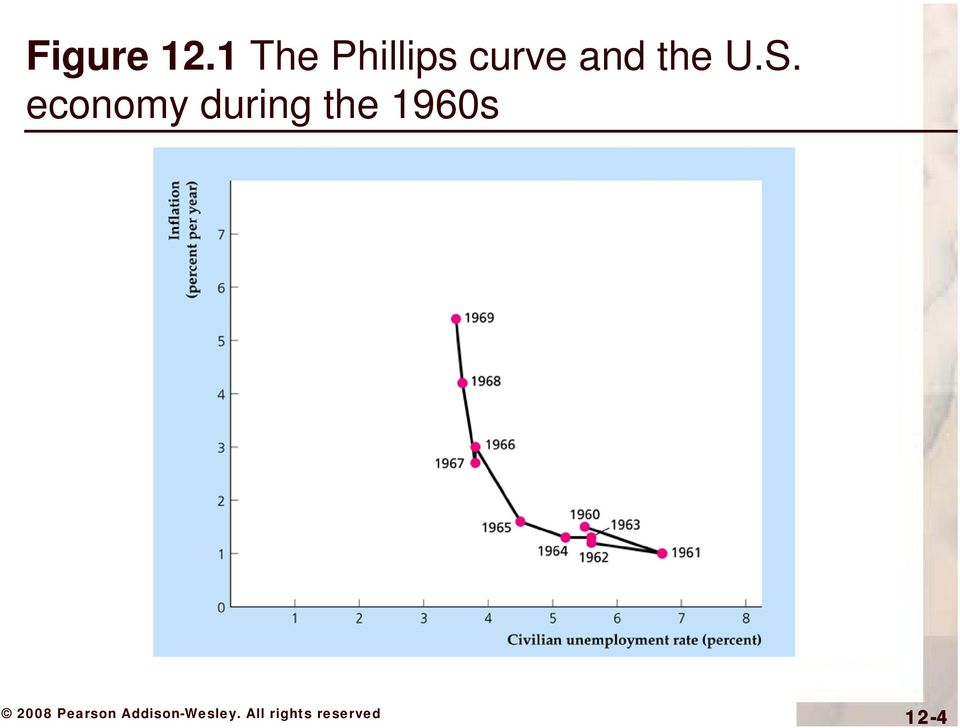
3 Unemployment and Inflation: Is There a Trade-off? Many people think there is a trade-off between inflation and unemployment The idea originated in 1958 when A.W. Phillips showed a negative relationship between unemployment and nominal wage growth in Britain Since then economists have looked at the relationship between unemployment and inflation In the 1950s and 1960s many nations seemed to have a negative relationship between the two variables The United States appears to be on one Phillips curve in the 1960s (Fig. 12.1) 12-3

4 Figure 12.1 The Phillips curve and the U.S. economy during the 1960s 12-4
5 Unemployment and Inflation: Is There a Trade-off? Many people think there is a trade-off between inflation and unemployment This suggested that policymakers could choose the combination of unemployment and inflation they most desired But the relationship fell apart in the following three decades (Fig. 12.2) The 1970s were a particularly bad period, with both high inflation and high unemployment, inconsistent with the Phillips curve 12-5
6 Figure 12.2 Inflation and unemployment in the United States,

7 Unemployment and Inflation: Is There a Trade-off? The expectations-augmented Phillips curve Friedman and Phelps: The cyclical unemployment rate (the difference between actual and natural unemployment rates) depends only on unanticipated inflation (the difference between actual and expected inflation) This theory was made before the Phillips curve began breaking down in the 1970s It suggests that the relationship between inflation and the unemployment rate isn t stable 12-7
8 Unemployment and Inflation: Is There a Trade-off? The expectations-augmented Phillips curve How does this work in the extended classical model? First case: anticipated increase in money supply (Fig. 12.3) AD shifts up and SRAS shifts up, with no misperceptions Result: P rises, Y unchanged Inflation rises with no change in unemployment 12-8

9 Figure 12.3 Ongoing inflation in the extended classical model 12-9

10 Unemployment and Inflation: Is There a Trade-off? The expectations-augmented Phillips curve How does this work in the extended classical model? Second case: unanticipated increase in money supply (Fig. 12.4) AD expected to shift up to AD 2,old (money supply expected to rise 10%), but unexpectedly money supply rises 15%, so AD shifts further up to AD 2,new SRAS shifts up based on expected 10% rise in money supply Result: P rises and Y rises as misperceptions occur So higher inflation occurs with lower unemployment Long run: P rises further, Y declines to full-employment level 12-10
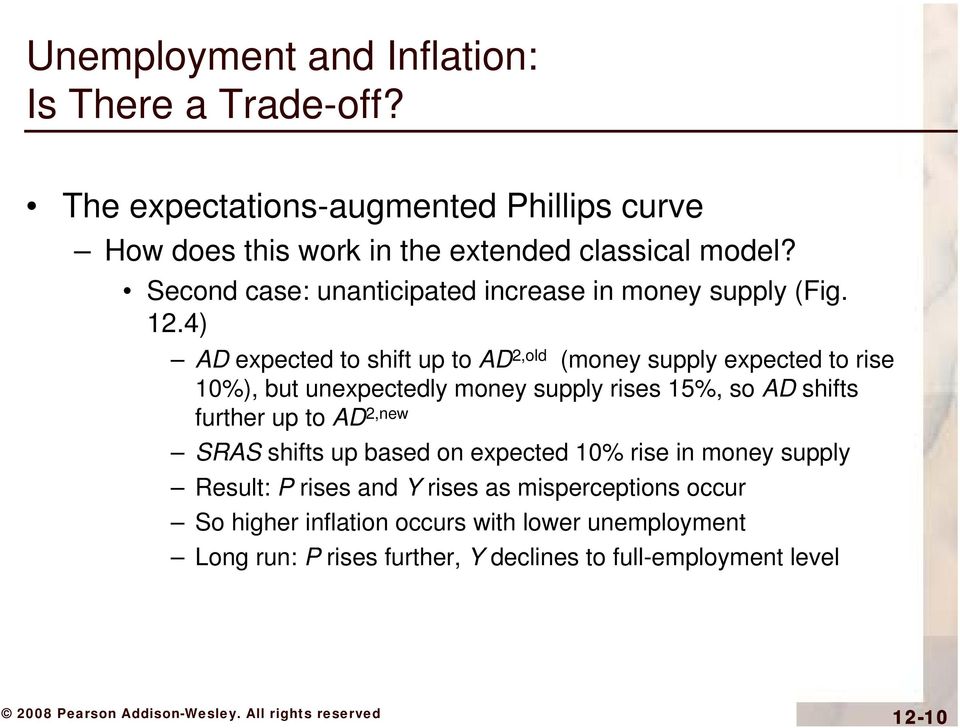
11 Figure 12.4 Unanticipated inflation in the extended classical model 12-11
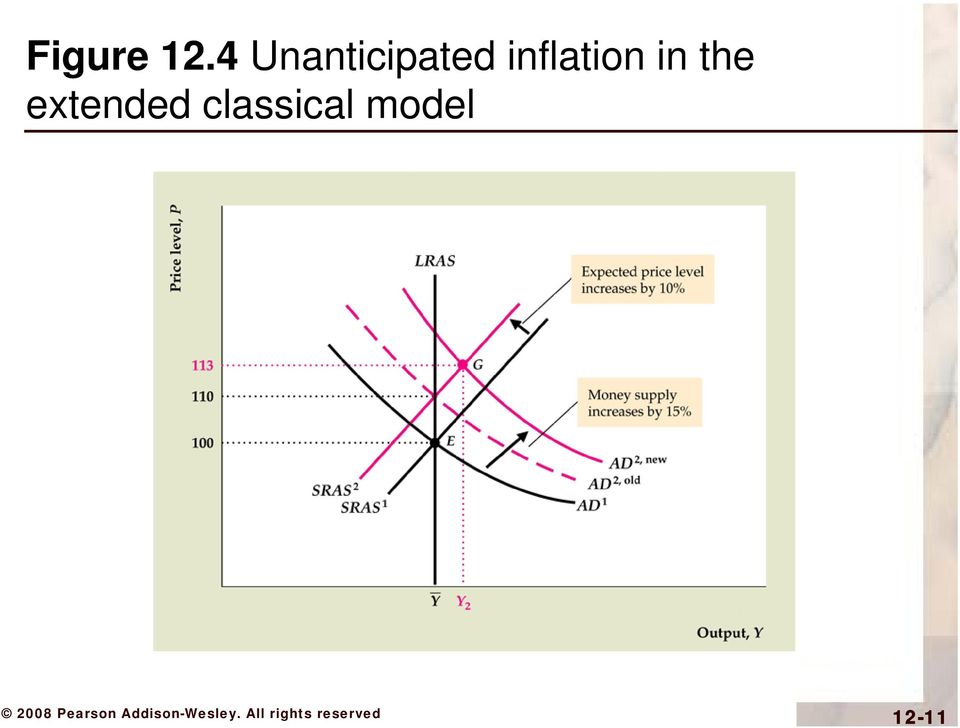
12 Unemployment and Inflation: Is There a Trade-off? The expectations-augmented Phillips curve e π = π hu ( u) (12.1) When π = π e, u = When π < π e, u > u u When π > π e, u < u 12-12
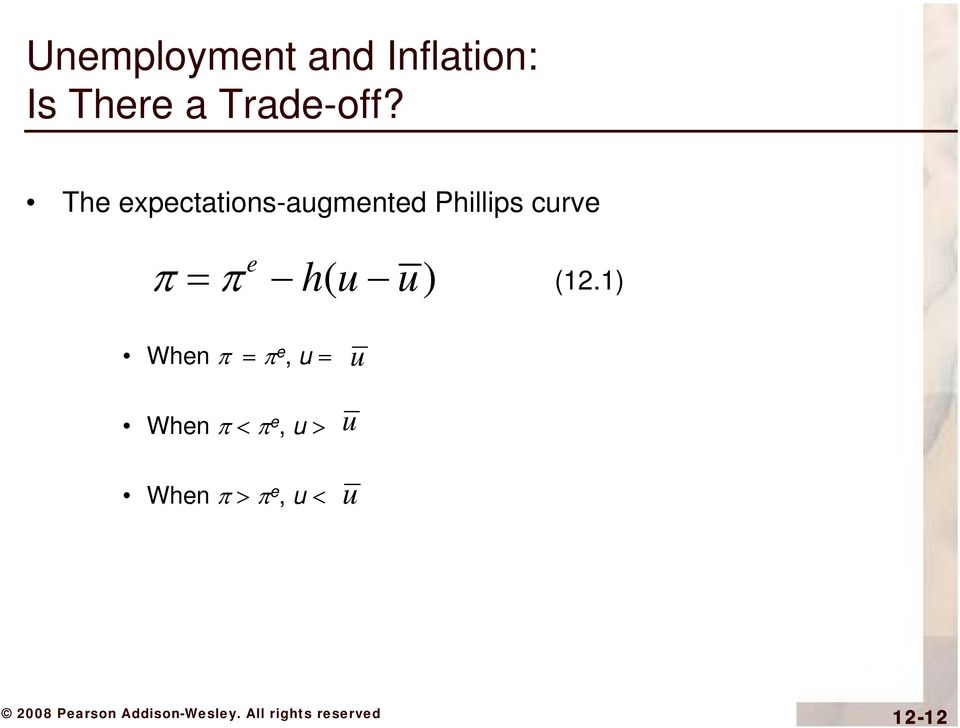
13 Unemployment and Inflation: Is There a Trade-off? The shifting Phillips curve The Phillips curve shows the relationship between unemployment and inflation for a given expected rate of inflation and natural rate of unemployment Changes in the expected rate of inflation (Fig. 12.5) 12-13

14 Figure 12.5 The shifting Phillips curve: an increase in expected inflation 12-14
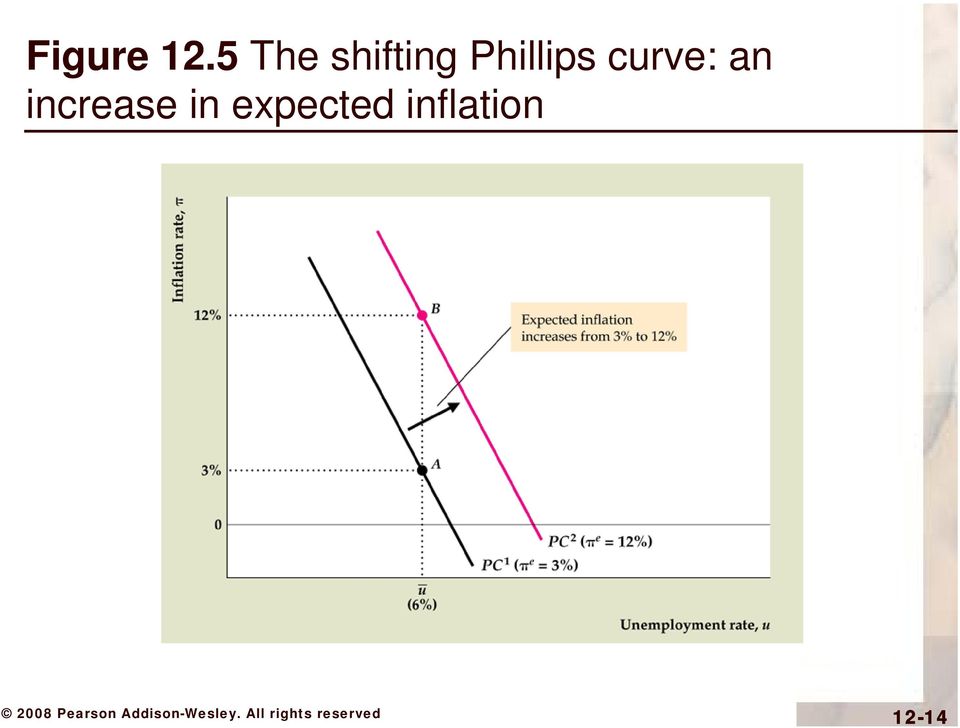
15 Unemployment and Inflation: Is There a Trade-off? The shifting Phillips curve Changes in the expected rate of inflation (Fig. 12.5) For a given expected rate of inflation, the Phillips curve shows the trade-off between cyclical unemployment and actual inflation The Phillips curve is drawn such that π = π e when u = Higher expected inflation implies a higher Phillips curve u 12-15

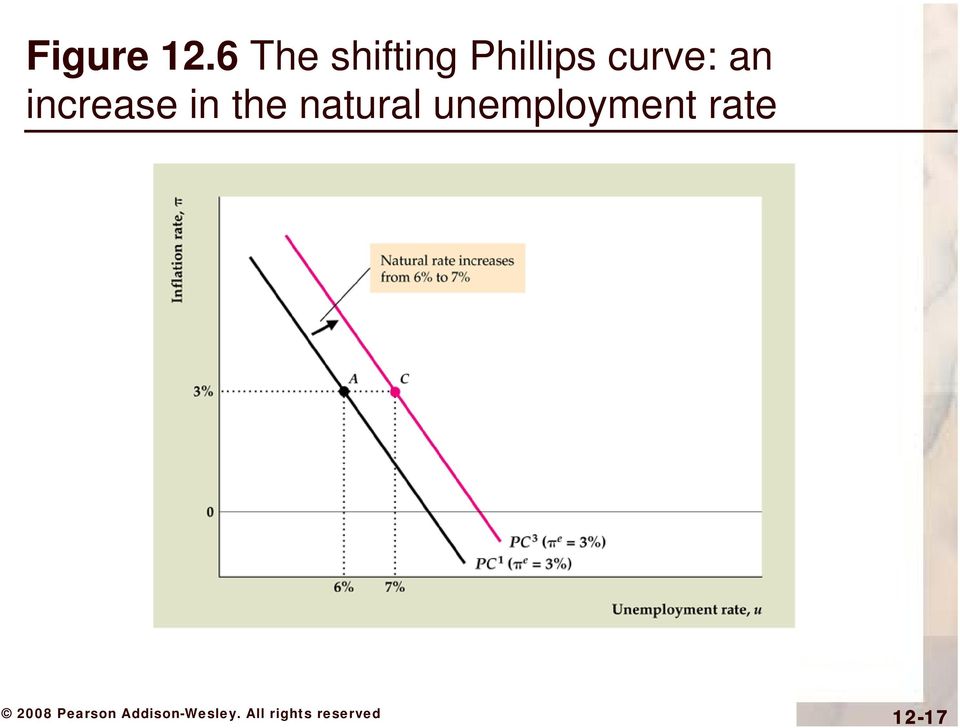
16 Unemployment and Inflation: Is There a Trade-off? The shifting Phillips curve Changes in the natural rate of unemployment (Fig. 12.6) For a given natural rate of unemployment, the Phillips curve shows the trade-off between unemployment and unanticipated inflation A higher natural rate of unemployment shifts the Phillips curve to the right 12-16
17 Figure 12.6 The shifting Phillips curve: an increase in the natural unemployment rate 12-17
18 Unemployment and Inflation: Is There a Trade-off? Supply shocks and the Phillips curve A supply shock increases both expected inflation and the natural rate of unemployment A supply shock in the classical model increases the natural rate of unemployment, because it increases the mismatch between firms and workers A supply shock in the Keynesian model reduces the marginal product of labor and thus reduces labor demand at the fixed real wage, so the natural unemployment rate rises 12-18
19 Unemployment and Inflation: Is There a Trade-off? Supply shocks and the Phillips curve So an adverse supply shock shifts the Phillips curve up and to the right The Phillips curve will be unstable in periods with many supply shocks 12-19
20 Unemployment and Inflation: Is There a Trade-off? The shifting Phillips curve in practice Why did the original Phillips curve relationship apply to many historical cases? The original relationship between inflation and unemployment holds up as long as expected inflation and the natural rate of unemployment are approximately constant This was true in the United States in the 1960s, so the Phillips curve appeared to be stable 12-20

21 Unemployment and Inflation: Is There a Trade-off? The shifting Phillips curve in practice Why did the U.S. Phillips curve disappear after 1970? Both the expected inflation rate and the natural rate of unemployment varied considerably more in the 1970s than they did in the 1960s Especially important were the oil price shocks of and Also, the composition of the labor force changed in the 1970s and there were other structural changes in the economy as well, raising the natural rate of unemployment 12-21
22 Unemployment and Inflation: Is There a Trade-off? The shifting Phillips curve in practice Why did the U.S. Phillips curve disappear after 1970? Monetary policy was expansionary in the 1970s, leading to high and volatile inflation Plotting unanticipated inflation against cyclical unemployment shows a fairly stable relationship since 1970 (Fig. 12.7) 12-22
23 Figure 12.7 The expectations-augmented Phillips curve in the United States,
24 Unemployment and Inflation: Is There a Trade-off? Macroeconomic policy and the Phillips curve Can the Phillips curve be exploited by policymakers? Can they choose the optimal combination of unemployment and inflation? Classical model: NO Keynesian model: YES, temporarily 12-24
25 Unemployment and Inflation: Is There a Trade-off? Can the Phillips curve be exploited by policymakers? Classical model: NO The unemployment rate returns to its natural level quickly, as people s expectations adjust So unemployment can change from its natural level only for a very brief time Also, people catch on to policy games; they have rational expectations and try to anticipate policy changes, so there is no way to fool people systematically 12-25
26 Unemployment and Inflation: Is There a Trade-off? Can the Phillips curve be exploited by policymakers? Keynesian model: YES, temporarily The expected rate of inflation in the Phillips curve is the forecast of inflation at the time the oldest sticky prices were set It takes time for prices and expected prices to adjust, so unemployment may differ from the natural rate for some time 12-26
27 Unemployment and Inflation: Is There a Trade-off? Box 12.1: The Lucas critique When the rules of the game change, behavior changes For example, if batters in baseball were called out after two strikes instead of three, they d swing more often when they have one strike than they do now Lucas applied this idea to macroeconomics, arguing that historical relationships between variables won t hold up if there s been a major policy change 12-27
28 Unemployment and Inflation: Is There a Trade-off? Box 12.1: The Lucas critique The Phillips curve is a good example it fell apart as soon as policymakers tried to exploit it Evaluating policy requires an understanding of how behavior will change under the new policy, so both economic theory and empirical analysis are necessary 12-28
29 Unemployment and Inflation: Is There a Trade-off? The long-run Phillips curve Long run: the u = for both Keynesians and classicals u The long-run Phillips curve is vertical, since when π = π e, u = (Figure 12.8) u 12-29
30 Figure 12.8 The long-run Phillips curve 12-30
31 Unemployment and Inflation: Is There a Trade-off? The long-run Phillips curve Changes in the level of money supply have no long-run real effects; changes in the growth rate of money supply have no long-run real effects, either Even though expansionary policy may reduce unemployment only temporarily, policymakers may want to do so if, for example, timing economic booms right before elections helps them (or their political allies) get reelected 12-31
32 The Problem of Unemployment The costs of unemployment Loss in output from idle resources Workers lose income Society pays for unemployment benefits and makes up lost tax revenue Using Okun s Law (each percentage point of cyclical unemployment is associated with a loss equal to 2% of fullemployment output), if full-employment output is $10 trillion, each percentage point of unemployment sustained for one year costs $200 billion 12-32
33 The Problem of Unemployment The costs of unemployment Personal or psychological cost to workers and their families Especially important for those with long spells of unemployment There are some offsetting factors Unemployment leads to increased job search and acquiring new skills, which may lead to increased future output Unemployed workers have increased leisure time, though most wouldn t feel that the increased leisure compensated them for being unemployed 12-33
34 The Problem of Unemployment The long-term behavior of the unemployment rate The changing natural rate How do we calculate the natural rate of unemployment? CBO s estimates: 5% to 5½% today, similar to 1950s and 1960s; over 6% in 1970s and 1980s Why did the natural rate rise from the 1950s to the late 1970s? Partly demographics; more teenagers and women with higher unemployment rates 12-34
35 The Problem of Unemployment The long-term behavior of the unemployment rate The changing natural rate Since 1980, demographic forces have reduced the natural rate of unemployment (Fig. 12.9) The proportion of the labor force aged years fell from 25% in 1980 to 16% in 1998 Research by Shimer showed this is the main reason for the fall in the natural rate of unemployment 12-35
36 Figure 12.9 Actual and natural unemployment rates in the United States,
37 The Problem of Unemployment The long-term behavior of the unemployment rate The changing natural rate Some economists think the natural rate of unemployment is 4.5% or even lower The labor market has become more efficient at matching workers and jobs, reducing frictional and structural unemployment Temporary help agencies have become prominent, helping the matching process and reducing the natural rate of unemployment 12-37
38 The Problem of Unemployment The long-term behavior of the unemployment rate The changing natural rate Increased labor productivity may increase the natural rate of unemployment If increases in real wages lag changes in productivity, firms hire more workers and the natural rate of unemployment will decline temporarily Ball and Mankiw found evidence supporting this hypothesis in the 1990s 12-38
39 The Problem of Unemployment The long-term behavior of the unemployment rate Measuring the natural rate of unemployment Policymakers need a measure of the natural rate of unemployment to use the unemployment rate for setting policy Economists disagree about how to measure the natural rate of unemployment and the CBO has often revised its measure 12-39
40 The Problem of Unemployment The long-term behavior of the unemployment rate Measuring the natural rate of unemployment Staiger, Stock, and Watson found that the natural rate cannot be measured precisely with econometric methods, as the confidence interval is very large 12-40
41 The Problem of Unemployment The long-term behavior of the unemployment rate Measuring the natural rate of unemployment What should policymakers do in response to uncertainty about the natural rate of unemployment? They may wish to be less aggressive with policy than they would be if they knew the natural rate more precisely Research (Orphanides-Williams) suggests that the rise of inflation in the 1970s can be blamed on bad estimates of the natural rate 12-41
42 The Problem of Inflation The costs of inflation Perfectly anticipated inflation No effects if all prices and wages keep up with inflation Even returns on assets may rise exactly with inflation Shoe-leather costs: People spend resources to economize on currency holdings; the estimated cost of 10% inflation is 0.3% of GNP Menu costs: the costs of changing prices (but technology may mitigate this somewhat) 12-42
43 The Problem of Inflation The costs of inflation Unanticipated inflation (π π e ) Realized real returns differ from expected real returns Expected r = i π e Actual r = i π Actual r differs from expected r by π e π Numerical example: i = 6%, π e = 4%, so expected r = 2%; if π = 6%, actual r = 0%; if π = 2%, actual r = 4% 12-43
44 The Problem of Inflation The costs of inflation Unanticipated inflation (π π e ) Similar effect on wages and salaries Result: transfer of wealth From lenders to borrowers when π > π e From borrowers to lenders when π < π e So people want to avoid risk of unanticipated inflation They spend resources to forecast inflation 12-44
45 The Problem of Inflation The costs of inflation Unanticipated inflation (π π e ) Loss of valuable signals provided by prices Confusion over changes in aggregate prices vs. changes in relative prices People expend resources to extract correct signals from prices 12-45
46 The Problem of Inflation Box 12.2: Indexed contracts People could use indexed contracts to avoid the risk of transferring wealth because of unanticipated inflation Most U.S. financial contracts are not indexed, with the exception of some long-term contracts like adjustable-rate mortgages and inflation-indexed bonds issued by the U.S. Treasury beginning in 1997 Many U.S. labor contracts are indexed by COLAs (cost-ofliving adjustments) Indexed contracts are more prevalent in countries with high inflation 12-46
47 The Problem of Inflation The costs of inflation The costs of hyperinflation Hyperinflation is a very high, sustained inflation (for example, 50% or more per month) Hungary in August 1945 had inflation of 19,800% per month Bolivia had annual rates of inflation of 1281% in 1984, 11,750% in 1985, 276% in
48 The Problem of Inflation The costs of inflation The costs of hyperinflation There are large shoe-leather costs, as people minimize cash balances People spend many resources getting rid of money as fast as possible Tax collections fall, as people pay taxes with money whose value has declined sharply Prices become worthless as signals, so markets become inefficient 12-48
49 The Problem of Inflation Fighting inflation: The role of inflationary expectations If rapid money growth causes inflation, why do central banks allow the money supply to grow rapidly? Developing or war-torn countries may not be able to raise taxes or borrow, so they print money to finance spending Industrialized countries may try to use expansionary monetary policy to fight recessions, then not tighten monetary policy enough later 12-49
50 The Problem of Inflation Fighting inflation: The role of inflationary expectations Disinflation is a reduction in the rate of inflation But disinflations may lead to recessions An unexpected reduction in inflation leads to a rise in unemployment along the Phillips curve The costs of disinflation could be reduced if expected inflation fell at the same time actual inflation fell 12-50
51 The Problem of Inflation Fighting inflation: The role of inflationary expectations Rapid versus gradual disinflation The classical prescription for disinflation is cold turkey a rapid and decisive reduction in money growth Proponents argue that the economy will adjust fairly quickly, with low costs of adjustment, if the policy is announced well in advance 12-51
52 The Problem of Inflation Fighting inflation: The role of inflationary expectations Keynesians disagree with rapid disinflation Price stickiness due to menu costs and wage stickiness due to labor contracts make adjustment slow Cold turkey disinflation would cause a major recession The strategy might fail to alter inflation expectations, because if the costs of the policy are high (because the economy goes into recession), the government will reverse the policy 12-52
53 The Problem of Inflation Fighting inflation: The role of inflationary expectations The Keynesian prescription for disinflation is gradualism A gradual approach gives prices and wages time to adjust to the disinflation Such a strategy will be politically sustainable because the costs are low 12-53
54 The Problem of Inflation Box 12.3: The sacrifice ratio When unanticipated tight monetary and fiscal policies are used to reduce inflation, they reduce output and employment for a time, a cost that must be weighed against the benefits of lower inflation 12-54
55 The Problem of Inflation Box 12.3: The sacrifice ratio Economists use the sacrifice ratio as a measure of the costs The sacrifice ratio is the number of percentage points of output lost in reducing inflation by one percentage point Ball s study: U.S. inflation fell by 8.83 percentage points in the early 1980s, with a loss in output of percent of the nation s potential output Sacrifice ratio = 16.18/8.83 =
56 The Problem of Inflation Box 12.3: The sacrifice ratio Ball studied the sacrifice ratios for many different disinflations around the world in the 1960s, 1970s, and 1980s The sacrifice ratios varied substantially across countries, from less than 1 to almost 3 One factor affecting the sacrifice ratio is the flexibility of the labor market Countries with slow wage adjustment (for example, because of heavy government regulation of the labor market) have higher sacrifice ratios Ball also found a lower sacrifice ratio from cold turkey disinflation than from gradualism 12-56
57 The Problem of Inflation Box 12.3: The sacrifice ratio Ball s results should be interpreted with caution, since it isn t easy to calculate the loss of output and because supply shocks can distort the calculation of the sacrifice ratio 12-57
58 The Problem of Inflation Wage and price controls Pro: Controls would hold down inflation, thus lowering expected inflation and reducing the costs of disinflation Con: Controls lead to shortages and inefficiency; once controls are lifted, prices will rise again 12-58
59 The Problem of Inflation Wage and price controls The outcome of wage and price controls may depend on what happens with fiscal and monetary policy If policies remain expansionary, people will expect renewed inflation when the controls are lifted If tight policies are pursued, expected inflation may decline The Nixon wage-price controls from August 1971 to April 1974 led to shortages in many products; the controls reduced inflation when they were in effect, but prices returned to where they would have been soon after the controls were lifted 12-59
60 The Problem of Inflation Credibility and reputation Key determinant of the costs of disinflation: how quickly expected inflation adjusts This depends on credibility of disinflation policy; if people believe the government and if the government carries through with its policy, expected inflation should drop rapidly Credibility can be enhanced if the government gets a reputation for carrying out its promises Also, having a strong and independent central bank that is committed to low inflation provides credibility 12-60
61 The Problem of Inflation The U.S. disinflation of the 1980s and 1990s Fed chairmen Volcker and Greenspan gradually reduced the inflation rate in the 1980s and 1990s They sought to eliminate inflation as a source of economic instability They wanted people to be confident that inflation would never be very high again 12-61
62 The Problem of Inflation The U.S. disinflation of the 1980s and 1990s To judge the Fed s success, we look at inflation expectations (Fig ) Inflation expectations were erratic before 1990 Inflation expectations fell gradually from 1990 to 1998 and have been stable since then 12-62
63 Figure Expected inflation rate, 1971 to
64 The Problem of Inflation The U.S. disinflation of the 1980s and 1990s Inflation expectations were slow to decline initially (in the late 1970s and early 1980s) because Volcker and the Fed lacked credibility But as inflation continued to fall, the Fed s credibility increased, and inflation expectations declined gradually 12-64
Chapter 12 Unemployment and Inflation
 Chapter 12 Unemployment and Inflation Multiple Choice Questions 1. The origin of the idea of a trade-off between inflation and unemployment was a 1958 article by (a) A.W. Phillips. (b) Edmund Phelps. (c)
Inflation and Unemployment CHAPTER 22 THE SHORT-RUN TRADE-OFF 0
 22 The Short-Run Trade-off Between Inflation and Unemployment CHAPTER 22 THE SHORT-RUN TRADE-OFF 0 In this chapter, look for the answers to these questions: How are inflation and unemployment related in
Chapter 11. Keynesianism: The Macroeconomics of Wage and Price Rigidity. 2008 Pearson Addison-Wesley. All rights reserved
 Chapter 11 Keynesianism: The Macroeconomics of Wage and Price Rigidity Chapter Outline Real-Wage Rigidity Price Stickiness Monetary and Fiscal Policy in the Keynesian Model The Keynesian Theory of Business
Chapter 12: Aggregate Supply and Phillips Curve
 Chapter 12: Aggregate Supply and Phillips Curve In this chapter we explain the position and slope of the short run aggregate supply (SRAS) curve. SRAS curve can also be relabeled as Phillips curve. A basic
12.1 Introduction. 12.2 The MP Curve: Monetary Policy and the Interest Rates 1/24/2013. Monetary Policy and the Phillips Curve
 Chapter 12 Monetary Policy and the Phillips Curve By Charles I. Jones Media Slides Created By Dave Brown Penn State University The short-run model summary: Through the MP curve the nominal interest rate
Econ 303: Intermediate Macroeconomics I Dr. Sauer Sample Questions for Exam #3
 Econ 303: Intermediate Macroeconomics I Dr. Sauer Sample Questions for Exam #3 1. When firms experience unplanned inventory accumulation, they typically: A) build new plants. B) lay off workers and reduce
MULTIPLE CHOICE. Choose the one alternative that best completes the statement or answers the question.
 Suvey of Macroeconomics, MBA 641 Fall 2006, Final Exam Name MULTIPLE CHOICE. Choose the one alternative that best completes the statement or answers the question. 1) Modern macroeconomics emerged from
Using Policy to Stabilize the Economy
 Using Policy to Stabilize the Economy Since the Employment ct of 1946, economic stabilization has been a goal of U.S. policy. Economists debate how active a role the govt should take to stabilize the economy.
Economics 101 Multiple Choice Questions for Final Examination Miller
 Economics 101 Multiple Choice Questions for Final Examination Miller PLEASE DO NOT WRITE ON THIS EXAMINATION FORM. 1. Which of the following statements is correct? a. Real GDP is the total market value
Ch.6 Aggregate Supply, Wages, Prices, and Unemployment
 1 Econ 302 Intermediate Macroeconomics Chul-Woo Kwon Ch.6 Aggregate Supply, Wages, rices, and Unemployment I. Introduction A. The dynamic changes of and the price adjustment B. Link between the price change
Chapter 9. The IS-LM/AD-AS Model: A General Framework for Macroeconomic Analysis. 2008 Pearson Addison-Wesley. All rights reserved
 Chapter 9 The IS-LM/AD-AS Model: A General Framework for Macroeconomic Analysis Chapter Outline The FE Line: Equilibrium in the Labor Market The IS Curve: Equilibrium in the Goods Market The LM Curve:
ECON 3312 Macroeconomics Exam 3 Fall 2014. Name MULTIPLE CHOICE. Choose the one alternative that best completes the statement or answers the question.
 ECON 3312 Macroeconomics Exam 3 Fall 2014 Name MULTIPLE CHOICE. Choose the one alternative that best completes the statement or answers the question. 1) Everything else held constant, an increase in net
MACROECONOMICS II INFLATION, UNEMPLOYMENT AND THE PHILLIPS CURVE
 MACROECONOMICS II INFLATION, UNEMPLOYMENT AND THE 1 Earlier we noted that the goal of macroeconomic policy is to achieve low inflation and low unemployment. This is because having high levels of either,
Tutor2u Economics Essay Plans Summer 2002
 Macroeconomics Revision Essay Plan (2): Inflation and Unemployment and Economic Policy (a) Explain why it is considered important to control inflation (20 marks) (b) Discuss how a government s commitment
Labor Market and Unemployment Ing. Mansoor Maitah Ph.D.
 Labor Market and Unemployment Ing. Mansoor Maitah Ph.D. Product and Factor Markets Demand for Goods and Services Market of Goods and Services S D Supply of Goods and Services Households Firms Supply of
Session 12. Aggregate Supply: The Phillips curve. Credibility
 Session 12. Aggregate Supply: The Phillips curve. Credibility v Potential Output and v Okun s law v The Role of Expectations and the Phillips Curve v Oil Prices and v US Monetary Policy and World Real
Agenda. Business Cycles. What Is a Business Cycle? What Is a Business Cycle? What is a Business Cycle? Business Cycle Facts.
 Agenda What is a Business Cycle? Business Cycles.. 11-1 11-2 Business cycles are the short-run fluctuations in aggregate economic activity around its long-run growth path. Y Time 11-3 11-4 1 Components
Chapter 13. Aggregate Demand and Aggregate Supply Analysis
 Chapter 13. Aggregate Demand and Aggregate Supply Analysis Instructor: JINKOOK LEE Department of Economics / Texas A&M University ECON 203 502 Principles of Macroeconomics In the short run, real GDP and
Answers. Event: a tax cut 1. affects C, AD curve 2. shifts AD right 3. SR eq m at point B. P and Y higher, unemp lower 4.
 A C T I V E L E A R N I N G 2: Answers Event: a tax cut 1. affects C, AD curve 2. shifts AD right 3. SR eq m at point B. P and Y higher, unemp lower 4. Over time, P E rises, SRAS shifts left, until LR
Chapter Outline. Chapter 11. Real-Wage Rigidity. Real-Wage Rigidity
 Chapter 11 Keynesianism: The Macroeconomics of Wage and Price Rigidity Chapter Outline Real-Wage Rigidity Price Stickiness Monetary and Fiscal Policy in the Keynesian 2008 Pearson Addison-Wesley. All rights
AGGREGATE DEMAND AND AGGREGATE SUPPLY The Influence of Monetary and Fiscal Policy on Aggregate Demand
 AGGREGATE DEMAND AND AGGREGATE SUPPLY The Influence of Monetary and Fiscal Policy on Aggregate Demand Suppose that the economy is undergoing a recession because of a fall in aggregate demand. a. Using
4 Macroeconomics LESSON 6
 4 Macroeconomics LESSON 6 Interest Rates and Monetary Policy in the Short Run and the Long Run Introduction and Description This lesson explores the relationship between the nominal interest rate and the
The Fiscal Policy and The Monetary Policy. Ing. Mansoor Maitah Ph.D.
 The Fiscal Policy and The Monetary Policy Ing. Mansoor Maitah Ph.D. Government in the Economy The Government and Fiscal Policy Fiscal Policy changes in taxes and spending that affect the level of GDP to
CHAPTER 7: AGGREGATE DEMAND AND AGGREGATE SUPPLY
 CHAPTER 7: AGGREGATE DEMAND AND AGGREGATE SUPPLY Learning goals of this chapter: What forces bring persistent and rapid expansion of real GDP? What causes inflation? Why do we have business cycles? How
7 AGGREGATE SUPPLY AND AGGREGATE DEMAND* Chapter. Key Concepts
 Chapter 7 AGGREGATE SUPPLY AND AGGREGATE DEMAND* Key Concepts Aggregate Supply The aggregate production function shows that the quantity of real GDP (Y ) supplied depends on the quantity of labor (L ),
Long run v.s. short run. Introduction. Aggregate Demand and Aggregate Supply. In this chapter, look for the answers to these questions:
 33 Aggregate Demand and Aggregate Supply R I N C I L E S O F ECONOMICS FOURTH EDITION N. GREGOR MANKIW Long run v.s. short run Long run growth: what determines long-run output (and the related employment
chapter: Aggregate Demand and Aggregate Supply Krugman/Wells 2009 Worth Publishers 1 of 58
 chapter: 12 >> Aggregate Demand and Aggregate Supply Krugman/Wells 2009 Worth Publishers 1 of 58 WHAT YOU WILL LEARN IN THIS CHAPTER How the aggregate demand curve illustrates the relationship between
Agenda. The IS-LM/AD-AS Model: A General Framework for Macroeconomic Analysis, Part 3. Disequilibrium in the AD-AS model
 Agenda The IS-LM/AD-AS Model: A General Framework for Macroeconomic Analysis, art 3 rice Adjustment and the Attainment of General Equilibrium 13-1 13-2 General equilibrium in the AD-AS model Disequilibrium
Aggregate Demand and Aggregate Supply Ing. Mansoor Maitah Ph.D. et Ph.D.
 Aggregate Demand and Aggregate Supply Ing. Mansoor Maitah Ph.D. et Ph.D. Aggregate Demand and Aggregate Supply Economic fluctuations, also called business cycles, are movements of GDP away from potential
10/7/2013. Chapter 9: Introduction to Economic Fluctuations. Facts about the business cycle. Unemployment. Okun s Law Y Y
 Facts about the business cycle Chapter 9: GD growth averages 3 3.5 percent per year over the long run with large fluctuations in the short run. Consumption and investment fluctuate with GD, but consumption
Unemployment and Inflation
 Unemployment and Inflation Unemployment Inflation Costs of Unemployment Personal Cost Loss of income Loss of self-esteem Increase in stress related psychological problems Increase in incidence of crime,
Answers to Text Questions and Problems in Chapter 11
 Answers to Text Questions and Problems in Chapter 11 Answers to Review Questions 1. The aggregate demand curve relates aggregate demand (equal to short-run equilibrium output) to inflation. As inflation
Supplemental Unit 5: Fiscal Policy and Budget Deficits
 1 Supplemental Unit 5: Fiscal Policy and Budget Deficits Fiscal and monetary policies are the two major tools available to policy makers to alter total demand, output, and employment. This feature will
Use the following to answer question 15: Exhibit: Short-run Phillips Curve. Page 3
 Chapter 13 1. According to the sticky-price model: A) all firms announce their prices in advance. B) all firms set their prices in accord with observed prices and output. C) some firms set their prices
2.If actual investment is greater than planned investment, inventories increase more than planned. TRUE.
 Macro final exam study guide True/False questions - Solutions Case, Fair, Oster Chapter 8 Aggregate Expenditure and Equilibrium Output 1.Firms react to unplanned inventory investment by reducing output.
Chapter 11. Market-Clearing Models of the Business Cycle
 Chapter 11 Market-Clearing Models of the Business Cycle Goal of This Chapter In this chapter, we study three models of business cycle, which were each developed as explicit equilibrium (market-clearing)
LECTURE NOTES ON MACROECONOMIC PRINCIPLES
 LECTURE NOTES ON MACROECONOMIC PRINCIPLES Peter Ireland Department of Economics Boston College [email protected] http://www2.bc.edu/peter-ireland/ec132.html Copyright (c) 2013 by Peter Ireland. Redistribution
CHAPTER 11. AN OVEVIEW OF THE BANK OF ENGLAND QUARTERLY MODEL OF THE (BEQM)
 1 CHAPTER 11. AN OVEVIEW OF THE BANK OF ENGLAND QUARTERLY MODEL OF THE (BEQM) This model is the main tool in the suite of models employed by the staff and the Monetary Policy Committee (MPC) in the construction
INTRODUCTION AGGREGATE DEMAND MACRO EQUILIBRIUM MACRO EQUILIBRIUM THE DESIRED ADJUSTMENT THE DESIRED ADJUSTMENT
 Chapter 9 AGGREGATE DEMAND INTRODUCTION The Great Depression was a springboard for the Keynesian approach to economic policy. Keynes asked: What are the components of aggregate demand? What determines
Practiced Questions. Chapter 20
 Practiced Questions Chapter 20 1. The model of aggregate demand and aggregate supply a. is different from the model of supply and demand for a particular market, in that we cannot focus on the substitution
chapter: Solution Fiscal Policy
 Fiscal Policy chapter: 28 13 ECONOMICS MACROECONOMICS 1. The accompanying diagram shows the current macroeconomic situation for the economy of Albernia. You have been hired as an economic consultant to
THREE KEY FACTS ABOUT ECONOMIC FLUCTUATIONS
 15 In this chapter, look for the answers to these questions: What are economic fluctuations? What are their characteristics? How does the model of demand and explain economic fluctuations? Why does the
CH 10 - REVIEW QUESTIONS
 CH 10 - REVIEW QUESTIONS 1. The short-run aggregate supply curve is horizontal at: A) a level of output determined by aggregate demand. B) the natural level of output. C) the level of output at which the
Effects of Inflation Unanticipated Inflation in the Labor Market
 Effects of Inflation Unanticipated Inflation in the Labor Market Unanticipated inflation has two main consequences in the labor market: Redistribution of income Departure from full employment Effects of
Chapter 11 Money and Monetary Policy Macroeconomics In Context (Goodwin, et al.)
 Chapter 11 Money and Monetary Policy Macroeconomics In Context (Goodwin, et al.) Chapter Overview In this chapter, you will be introduced to a standard treatment of the banking system and monetary policy.
Pre-Test Chapter 15 ed17
 Pre-Test Chapter 15 ed17 Multiple Choice Questions 1. The extended AD-AS model: A. distinguishes between short-run and long-run aggregate demand. B. explains inflation but not recession. C. includes G
Homework #6 - Answers. Uses of Macro Policy Due April 20
 Page 1 of 8 Uses of Macro Policy ue April 20 Answer all questions on these sheets, adding extra sheets where necessary. 1. Suppose that the government were to increase its purchases of goods and services
LECTURE 18: Should Policy Makers be restrained?
 Dr. Odile Poulsen Aarhus Business School Department of Economics MACROECONOMICS LECTURE 18: Should Policy Makers be restrained? Read: Blanchard Ch.25. Topics: 1.Uncertainty and Policy. 2. Expectations
Edmonds Community College Macroeconomic Principles ECON 202C - Winter 2011 Online Course Instructor: Andy Williams
 Edmonds Community College Macroeconomic Principles ECON 202C - Winter 2011 Online Course Instructor: Andy Williams Textbooks: Economics: Principles, Problems and Policies, 18th Edition, by McConnell, Brue,
EC2105, Professor Laury EXAM 2, FORM A (3/13/02)
 EC2105, Professor Laury EXAM 2, FORM A (3/13/02) Print Your Name: ID Number: Multiple Choice (32 questions, 2.5 points each; 80 points total). Clearly indicate (by circling) the ONE BEST response to each
Instructions: Please answer all of the following questions. You are encouraged to work with one another (at your discretion).
 Instructions: Please answer all of the following questions. You are encouraged to work with one another (at your discretion). 1. What are the similarities and differences between the characteristics of
HW 2 Macroeconomics 102 Due on 06/12
 HW 2 Macroeconomics 102 Due on 06/12 1.What are the three important macroeconomic goals about which most economists, and society at large, agree? a. economic growth, full employment, and low interest rates
Practice Problems on Money and Monetary Policy
 Practice Problems on Money and Monetary Policy 1- Define money. How does the economist s use of this term differ from its everyday meaning? Money is the economist s term for assets that can be used in
MONEY, INTEREST, REAL GDP, AND THE PRICE LEVEL*
 Chapter 11 MONEY, INTEREST, REAL GDP, AND THE PRICE LEVEL* Key Concepts The Demand for Money Four factors influence the demand for money: The price level An increase in the price level increases the nominal
A decline in the stock market, which makes consumers poorer, would cause the aggregate demand curve to shift to the left.
 Economics 304 Final Exam Fall 2000 PART I: TRUE/FALSE. Write 'T' if the statement is true and 'F' if the statement is false. (1.5 pts. each) A decline in the stock market, which makes consumers poorer,
2.5 Monetary policy: Interest rates
 2.5 Monetary policy: Interest rates Learning Outcomes Describe the role of central banks as regulators of commercial banks and bankers to governments. Explain that central banks are usually made responsible
The Real Business Cycle School
 Major Currents in Contemporary Economics The Real Business Cycle School Mariusz Próchniak Department of Economics II Warsaw School of Economics 1 Background During 1972-82,the dominant new classical theory
Econ 116 Mid-Term Exam
 Econ 116 Mid-Term Exam Part 1 1. True. Large holdings of excess capital and labor are indeed bad news for future investment and employment demand. This is because if firms increase their output, they will
Unemployment. AS Economics Presentation 2005
 Unemployment AS Economics Presentation 2005 Key Issues The meaning of unemployment Different types of unemployment Consequences of unemployment Unemployment and economic growth Recent trends in UK unemployment
Problem Set #4: Aggregate Supply and Aggregate Demand Econ 100B: Intermediate Macroeconomics
 roblem Set #4: Aggregate Supply and Aggregate Demand Econ 100B: Intermediate Macroeconomics 1) Explain the differences between demand-pull inflation and cost-push inflation. Demand-pull inflation results
Chapter 18. MODERN PRINCIPLES OF ECONOMICS Third Edition
 Chapter 18 MODERN PRINCIPLES OF ECONOMICS Third Edition Fiscal Policy Outline Fiscal Policy: The Best Case The Limits to Fiscal Policy When Fiscal Policy Might Make Matters Worse So When Is Fiscal Policy
International Economic Relations
 nswers to Problem Set #5 International conomic Relations Prof. Murphy Chapter 5 Krugman and Obstfeld. Relative PPP predicts that inflation differentials are matched by changes in the exchange rate. Under
MACROECONOMIC AND INDUSTRY ANALYSIS VALUATION PROCESS
 MACROECONOMIC AND INDUSTRY ANALYSIS VALUATION PROCESS BUSINESS ANALYSIS INTRODUCTION To determine a proper price for a firm s stock, security analyst must forecast the dividend & earnings that can be expected
MULTIPLE CHOICE. Choose the one alternative that best completes the statement or answers the question.
 Econ 111 Summer 2007 Final Exam Name MULTIPLE CHOICE. Choose the one alternative that best completes the statement or answers the question. 1) The classical dichotomy allows us to explore economic growth
Chapter 3 Productivity, Output, and Employment
 Chapter 3 Productivity, Output, and Employment Multiple Choice Questions 1. A mathematical expression relating the amount of output produced to quantities of capital and labor utilized is the (a) real
Effects on pensioners from leaving the EU
 Effects on pensioners from leaving the EU Summary 1.1 HM Treasury s short-term document presented two scenarios for the immediate impact of leaving the EU on the UK economy: the shock scenario and severe
ON THE DEATH OF THE PHILLIPS CURVE William A. Niskanen
 ON THE DEATH OF THE PHILLIPS CURVE William A. Niskanen There is no evidence of a Phillips curve showing a tradeoff between unemployment and inflation. The function for estimating the nonaccelerating inflation
Econ 202 H01 Final Exam Spring 2005
 Econ202Final Spring 2005 1 Econ 202 H01 Final Exam Spring 2005 1. Which of the following tends to reduce the size of a shift in aggregate demand? a. the multiplier effect b. the crowding-out effect c.
Answer: C Learning Objective: Money supply Level of Learning: Knowledge Type: Word Problem Source: Unique
 1.The aggregate demand curve shows the relationship between inflation and: A) the nominal interest rate. D) the exchange rate. B) the real interest rate. E) short-run equilibrium output. C) the unemployment
How To Understand The Unemployment Rate
 13.1 Unemployment Objectives Distinguish among four types of unemployment. Discuss the unemployment rate, and describe how it differs over time and across groups. Explain who is eligible for unemployment
] 100 where P 1. is the current price level and P 0
![] 100 where P 1. is the current price level and P 0](/thumbs/40/21606110.jpg "] 100 where P 1. is the current price level and P 0") C h a p t e r 12 INFLATION Chapter Key Ideas Outline From Rome to Rio de Janeiro A. Inflation is a very old problem and some countries even in recent times have experienced rates as high as 40 percent
C h a p t e r 12 INFLATION Chapter Key Ideas Outline From Rome to Rio de Janeiro A. Inflation is a very old problem and some countries even in recent times have experienced rates as high as 40 percent
CHAPTER 7 THE ANATOMY OF INFLATION AND UNEMPLOYMENT
 CHAPTER 7 THE ANATOMY OF INFLATION AND UNEMPLOYMENT Chapter Outline: The sacrifice ratio and Okun's law Variations in unemployment across groups Duration and frequency of unemployment The natural rate
SRAS. is less than Y P
 KrugmanMacro_SM_Ch12.qxp 11/15/05 3:18 PM Page 141 Fiscal Policy 1. The accompanying diagram shows the current macroeconomic situation for the economy of Albernia. You have been hired as an economic consultant
Using an appropriately labeled money market graph, show the effects of an open market purchase of government securities by the FED on :
 Using an appropriately labeled money market graph, show the effects of an open market purchase of government securities by the FED on : The money supply Interest rates Nominal Interest rates i1 i2 Sm1
Chapter 9. Unemployment and Stagflation. These slides supplement the textbook, but should not replace reading the textbook
 Chapter 9 Unemployment and Stagflation These slides supplement the textbook, but should not replace reading the textbook What is the labor force? All non-institutionalized individuals 16 years of age and
Chapter 14. Money, Interest Rates, and Exchange Rates. Slides prepared by Thomas Bishop
 Chapter 14 Money, Interest Rates, and Exchange Rates Slides prepared by Thomas Bishop Preview What is money? Control of the supply of money The demand for money A model of real money balances and interest
The Case for a Tax Cut
 The Case for a Tax Cut Alan C. Stockman University of Rochester, and NBER Shadow Open Market Committee April 29-30, 2001 1. Tax Increases Have Created the Surplus Any discussion of tax policy should begin
Learning objectives. The Theory of Real Business Cycles
 Learning objectives This chapter presents an overview of recent work in two areas: Real Business Cycle theory New Keynesian economics Advances in Business Cycle Theory slide 1 The Theory of Real Business
S.Y.B.COM. (SEM-III) ECONOMICS
 Fill in the Blanks. Module 1 S.Y.B.COM. (SEM-III) ECONOMICS 1. The continuous flow of money and goods and services between firms and households is called the Circular Flow. 2. Saving constitute a leakage
Production and Unemployment. Great Depression. Prices and Wages. World Depression. Stock Market Crash. Recession or Depression?
 Production and Unemployment The The was by far the most severe economic downturn in the history of the United States. It began in 1929 and ended in 1940, with the trough in 1933. 1 From the peak to the
Chapter 12. Unemployment. covered in the final exam) 12-1 History of Unemployment in the New Zealand. discouraged and underemployed workers.
 Chapter 12 13-1 Unemployment (Note: Chapter 12 will not be covered in the final exam) 12-1 History of Unemployment in the New Zealand 13-2 Unemployment rate over time. Recap of definition & issue of discouraged
MONEY, INTEREST, REAL GDP, AND THE PRICE LEVEL*
 Chapter 11 MONEY, INTEREST, REAL GDP, AND THE PRICE LEVEL* The Demand for Topic: Influences on Holding 1) The quantity of money that people choose to hold depends on which of the following? I. The price
The Federal Reserve System. The Structure of the Fed. The Fed s Goals and Targets. Economics 202 Principles Of Macroeconomics
 Economics 202 Principles Of Macroeconomics Professor Yamin Ahmad The Federal Reserve System The Federal Reserve System, or the Fed, is the central bank of the United States. Supplemental Notes to Monetary
Chapter 12. Aggregate Expenditure and Output in the Short Run
 Chapter 12. Aggregate Expenditure and Output in the Short Run Instructor: JINKOOK LEE Department of Economics / Texas A&M University ECON 203 502 Principles of Macroeconomics Aggregate Expenditure (AE)
Fundamental Economic Factors
 Classical Model Real business cycle theory seeks to explain business cycles via the classical model. There is general equilibrium: demand equals supply in every market. An ideological conviction underlies
Note: This feature provides supplementary analysis for the material in Part 3 of Common Sense Economics.
 1 Module C: Fiscal Policy and Budget Deficits Note: This feature provides supplementary analysis for the material in Part 3 of Common Sense Economics. Fiscal and monetary policies are the two major tools
BADM 527, Fall 2013. Midterm Exam 2. Multiple Choice: 3 points each. Answer the questions on the separate bubble sheet. NAME
 BADM 527, Fall 2013 Name: Midterm Exam 2 November 7, 2013 Multiple Choice: 3 points each. Answer the questions on the separate bubble sheet. NAME 1. According to classical theory, national income (Real
Inflation Target Of The Lunda Krona
 Inflation Targeting The Swedish Experience Lars Heikensten We in Sweden owe a great debt of thanks to the Bank of Canada for all the help we have received in recent years. We have greatly benefited from
Aggregate Supply and Aggregate Demand
 26 Aggregate Supply and Aggregate Demand Learning Objectives Explain what determines aggregate supply Explain what determines aggregate demand Explain what determines real GDP and the price level and how
THE U.S. HOUSEHOLD SAVINGS RATE AND CONSUMPTION 3 March 2009, additions 4 March see http://www.closemountain.com/publications.
 THE U.S. HOUSEHOLD SAVINGS RATE AND CONSUMPTION 3 March 2009, additions 4 March see http://www.closemountain.com/publications.html for updates T. S. Coleman PhD Close Mountain Advisors www.closemountain.com
The Real Business Cycle model
 The Real Business Cycle model Spring 2013 1 Historical introduction Modern business cycle theory really got started with Great Depression Keynes: The General Theory of Employment, Interest and Money Keynesian
7 AGGREGATE SUPPLY AND AGGREGATE DEMAND* * Chapter Key Ideas. Outline
 C h a p t e r 7 AGGREGATE SUPPLY AND AGGREGATE DEMAND* * Chapter Key Ideas Outline Production and Prices A. What forces bring persistent and rapid expansion of real GDP? B. What leads to inflation? C.
The Liquidity Trap and U.S. Interest Rates in the 1930s
 The Liquidity Trap and U.S. Interest Rates in the 1930s SHORT SUMMARY Christopher Hanes Department of Economics School of Business University of Mississippi University, MS 38677 (662) 915-5829 [email protected]
THE POTENTIAL MACROECONOMIC EFFECT OF DEBT CEILING BRINKMANSHIP
 OCTOBER 2013 THE POTENTIAL MACROECONOMIC EFFECT OF DEBT CEILING BRINKMANSHIP Introduction The United States has never defaulted on its obligations, and the U. S. dollar and Treasury securities are at the
The Aggregate Demand- Aggregate Supply (AD-AS) Model
 The AD-AS Model The Aggregate Demand- Aggregate Supply (AD-AS) Model Chapter 9 The AD-AS Model addresses two deficiencies of the AE Model: No explicit modeling of aggregate supply. Fixed price level. 2
FISCAL POLICY* Chapter. Key Concepts
 Chapter 11 FISCAL POLICY* Key Concepts The Federal Budget The federal budget is an annual statement of the government s expenditures and tax revenues. Using the federal budget to achieve macroeconomic