
Learning objectives. The Theory of Real Business Cycles
|
|
|
- Joleen Gray
- 9 years ago
- Views:
Transcription
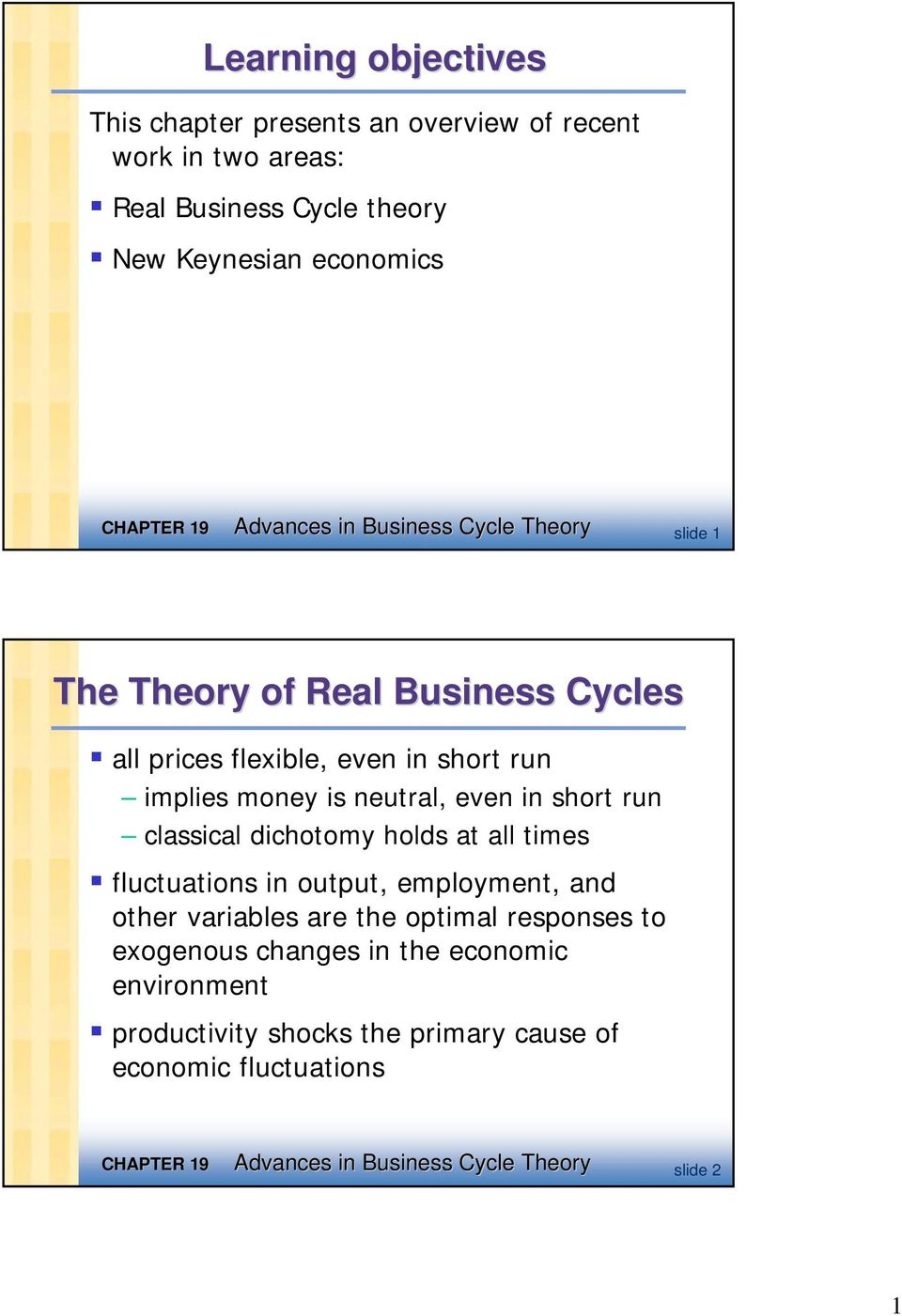
1 Learning objectives This chapter presents an overview of recent work in two areas: Real Business Cycle theory New Keynesian economics Advances in Business Cycle Theory slide 1 The Theory of Real Business Cycles all prices flexible, even in short run implies money is neutral, even in short run classical dichotomy holds at all times fluctuations in output, employment, and other variables are the optimal responses to exogenous changes in the economic environment productivity shocks the primary cause of economic fluctuations Advances in Business Cycle Theory slide 2 1
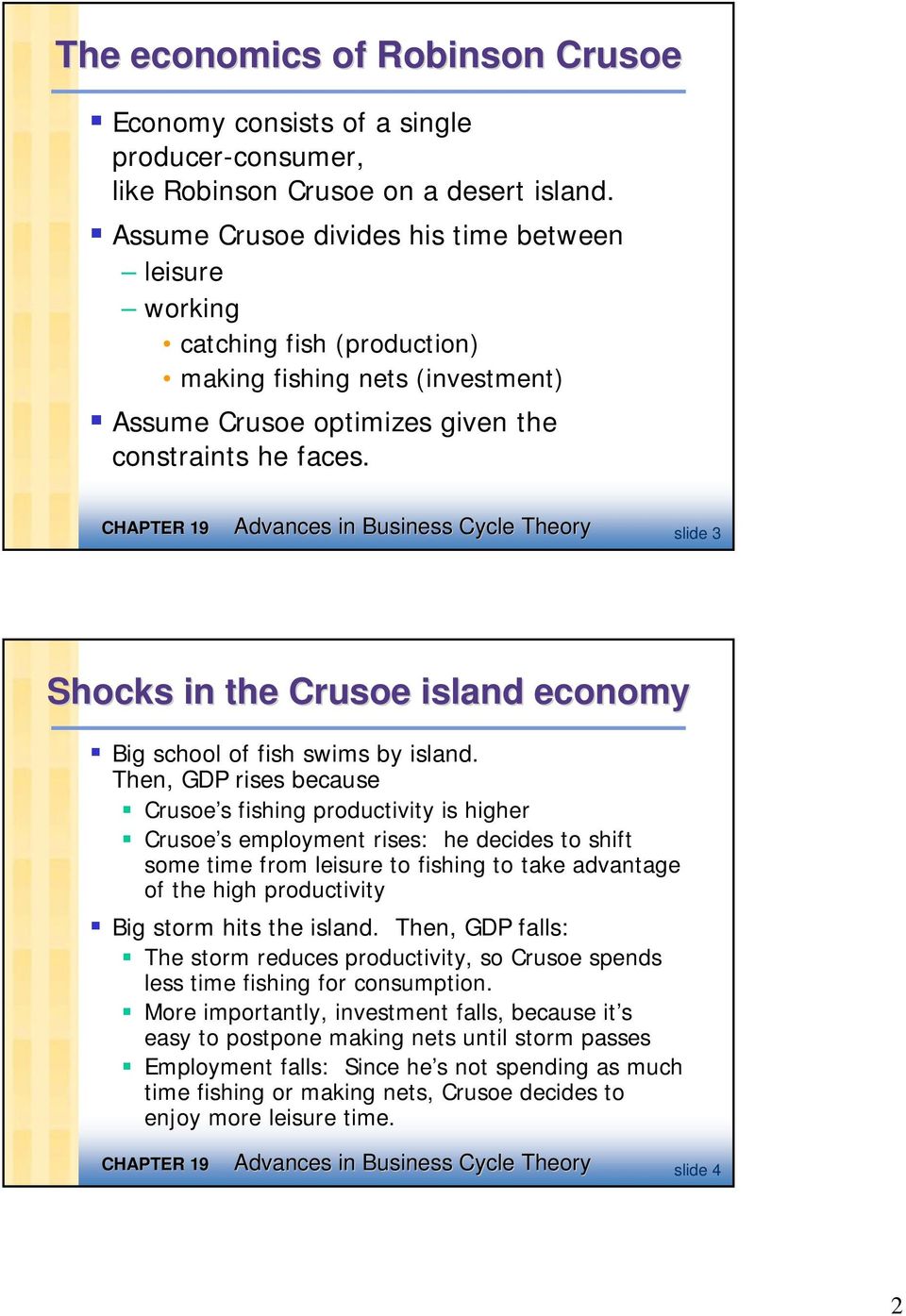
2 The economics of Robinson Crusoe Economy consists of a single producer-consumer, like Robinson Crusoe on a desert island. Assume Crusoe divides his time between leisure working catching fish (production) making fishing nets (investment) Assume Crusoe optimizes given the constraints he faces. Advances in Business Cycle Theory slide 3 Shocks in the Crusoe island economy Big school of fish swims by island. Then, GDP rises because Crusoe s fishing productivity is higher Crusoe s employment rises: he decides to shift some time from leisure to fishing to take advantage of the high productivity Big storm hits the island. Then, GDP falls: The storm reduces productivity, so Crusoe spends less time fishing for consumption. More importantly, investment falls, because it s easy to postpone making nets until storm passes Employment falls: Since he s not spending as much time fishing or making nets, Crusoe decides to enjoy more leisure time. Advances in Business Cycle Theory slide 4 2
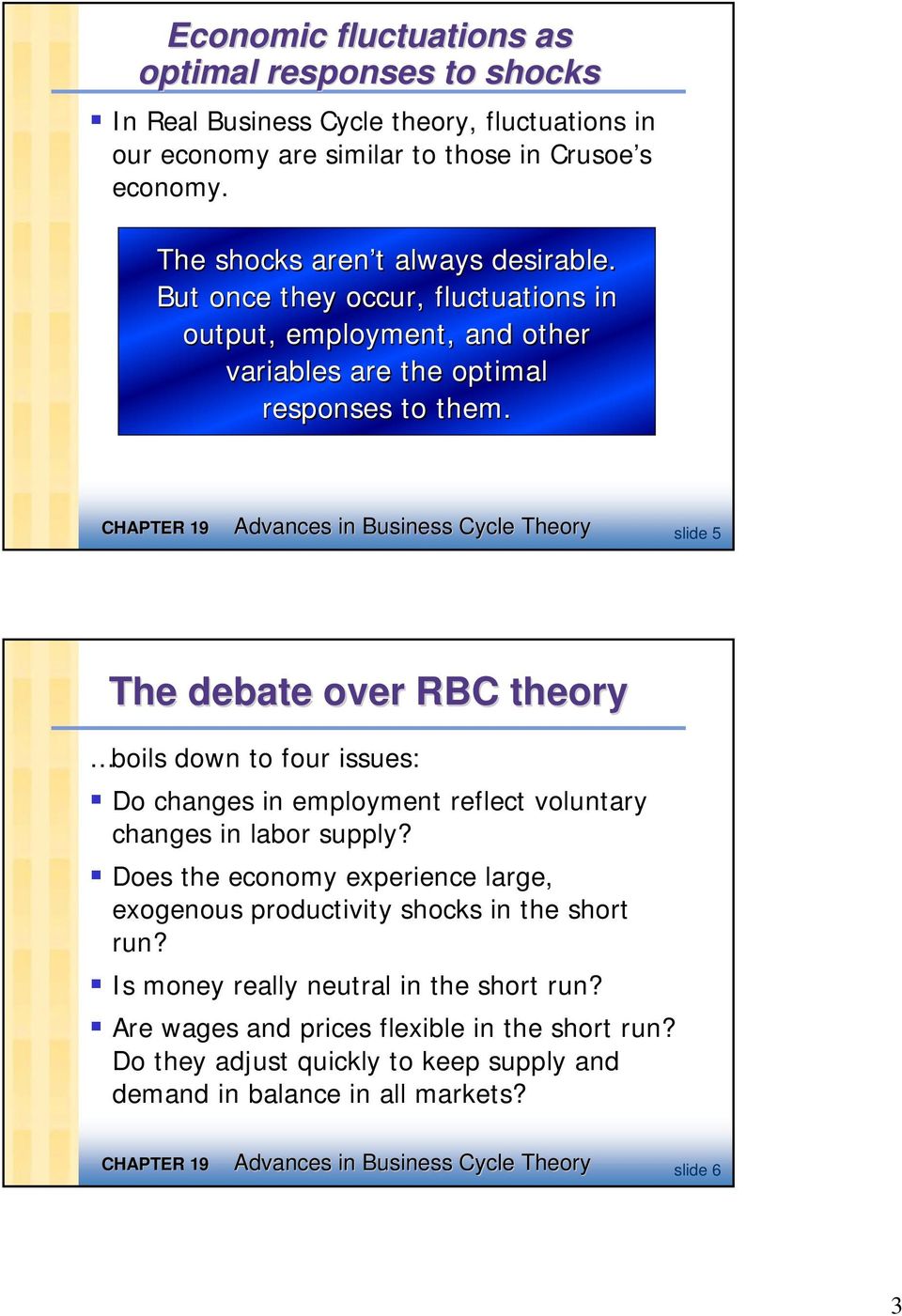
3 Economic fluctuations as optimal responses to shocks In Real Business Cycle theory, fluctuations in our economy are similar to those in Crusoe s economy. The shocks aren t always desirable. But once they occur, fluctuations in output, employment, and other variables are the optimal responses to them. Advances in Business Cycle Theory slide 5 The debate over RBC theory boils down to four issues: Do changes in employment reflect voluntary changes in labor supply? Does the economy experience large, exogenous productivity shocks in the short run? Is money really neutral in the short run? Are wages and prices flexible in the short run? Do they adjust quickly to keep supply and demand in balance in all markets? Advances in Business Cycle Theory slide 6 3
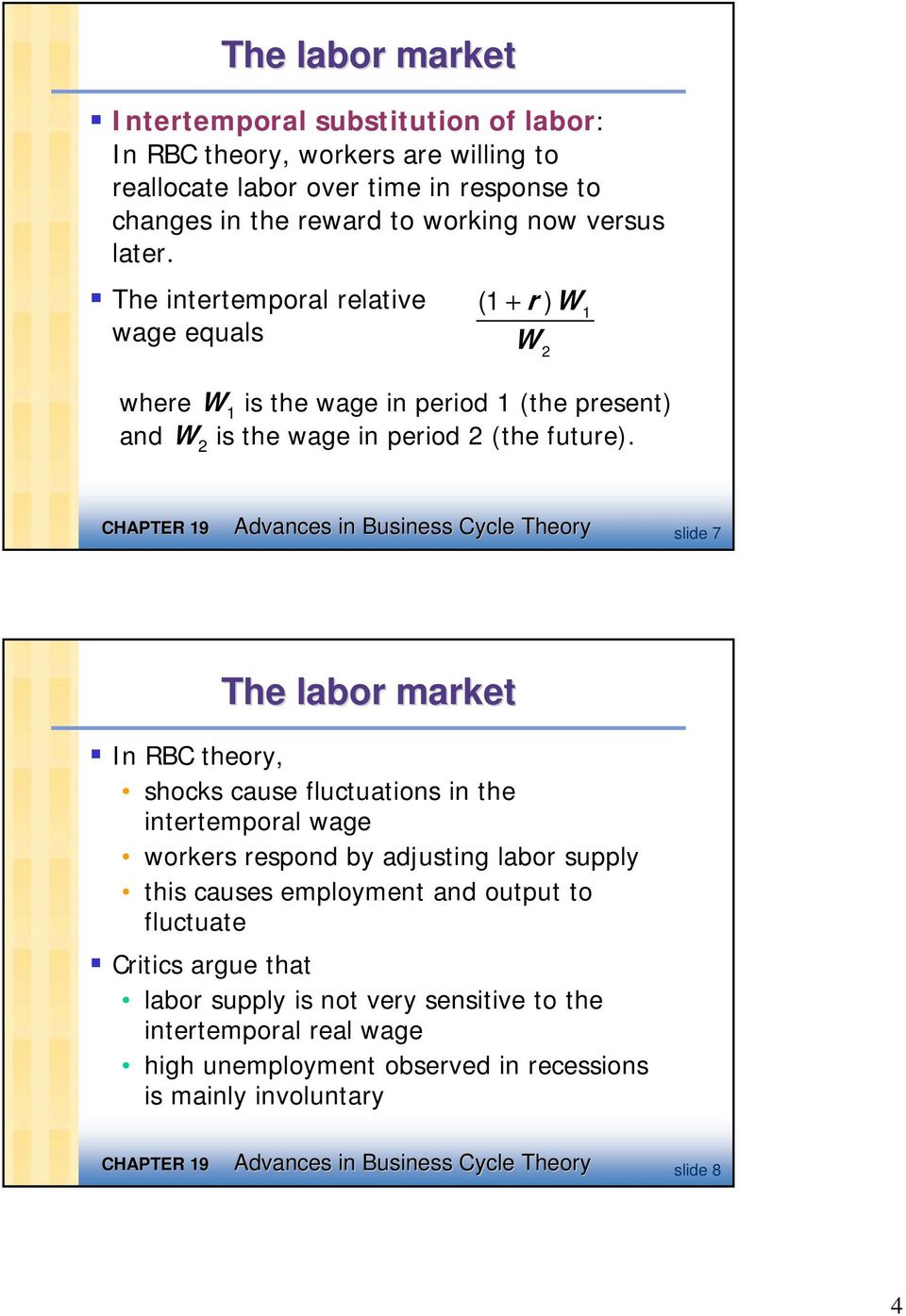
4 The labor market Intertemporal substitution of labor: In RBC theory, workers are willing to reallocate labor over time in response to changes in the reward to working now versus later. The intertemporal relative wage equals (1 + r) W W 2 1 where W 1 is the wage in period 1 (the present) and W 2 is the wage in period 2 (the future). Advances in Business Cycle Theory slide 7 The labor market In RBC theory, shocks cause fluctuations in the intertemporal wage workers respond by adjusting labor supply this causes employment and output to fluctuate Critics argue that labor supply is not very sensitive to the intertemporal real wage high unemployment observed in recessions is mainly involuntary Advances in Business Cycle Theory slide 8 4
5 Technology shocks In RBC theory, economic fluctuations are caused by productivity shocks. The Solow residual is a measure of productivity shocks: it shows the change in output that cannot be explained by changes in capital and labor. RBC theory implies that the Solow residual should be highly correlated with output. Is it? Advances in Business Cycle Theory slide 9 Percent 10 per year 8 The Solow residual and growth in output Output growth Solow residual Year Advances in Business Cycle Theory slide 10 5

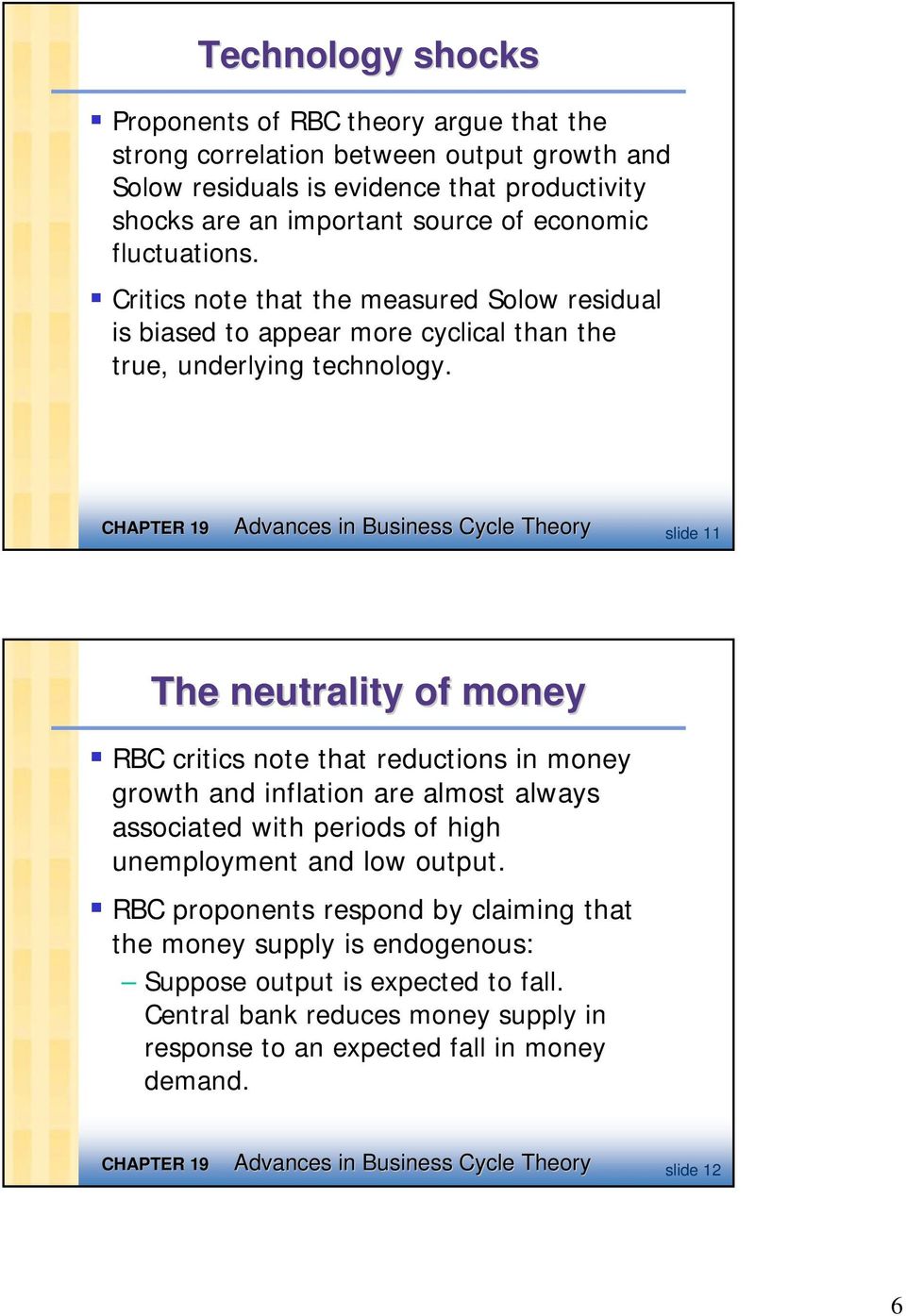
6 Technology shocks Proponents of RBC theory argue that the strong correlation between output growth and Solow residuals is evidence that productivity shocks are an important source of economic fluctuations. Critics note that the measured Solow residual is biased to appear more cyclical than the true, underlying technology. Advances in Business Cycle Theory slide 11 The neutrality of money RBC critics note that reductions in money growth and inflation are almost always associated with periods of high unemployment and low output. RBC proponents respond by claiming that the money supply is endogenous: Suppose output is expected to fall. Central bank reduces money supply in response to an expected fall in money demand. Advances in Business Cycle Theory slide 12 6
7 The flexibility of wages and prices RBC theory assumes that wages and prices are completely flexible, so markets always clear. RBC proponents argue that the extent to which wages or prices may be sticky in the real world is not important for understanding economic fluctuations. They also prefer to assume flexible prices to be consistent with microeconomic theory. Critics believe that wage and price stickiness explains involuntary unemployment and the non-neutrality of money. Advances in Business Cycle Theory slide 13 New Keynesian Economics Most economists believe that short-run fluctuations in output and employment represent deviations from the natural rate, and that these deviations occur because wages and prices are sticky. New Keynesian research attempts to explain the stickiness of wages and prices by examining the microeconomics of price adjustment. Advances in Business Cycle Theory slide 14 7

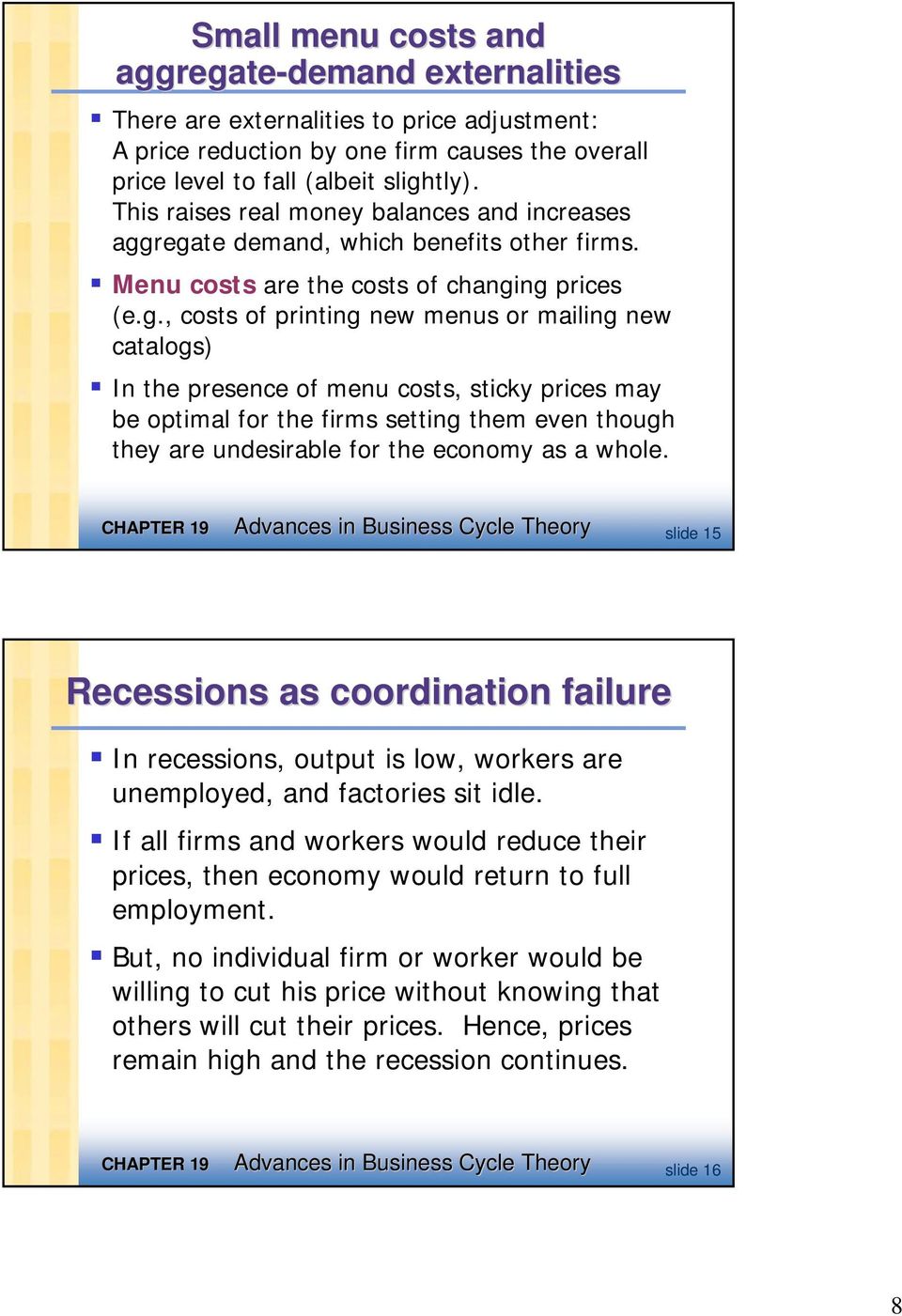
8 Small menu costs and aggregate-demand externalities There are externalities to price adjustment: A price reduction by one firm causes the overall price level to fall (albeit slightly). This raises real money balances and increases aggregate demand, which benefits other firms. Menu costs are the costs of changing prices (e.g., costs of printing new menus or mailing new catalogs) In the presence of menu costs, sticky prices may be optimal for the firms setting them even though they are undesirable for the economy as a whole. Advances in Business Cycle Theory slide 15 Recessions as coordination failure In recessions, output is low, workers are unemployed, and factories sit idle. If all firms and workers would reduce their prices, then economy would return to full employment. But, no individual firm or worker would be willing to cut his price without knowing that others will cut their prices. Hence, prices remain high and the recession continues. Advances in Business Cycle Theory slide 16 8
9 Top reasons for sticky prices: results from surveys of managers 1. Coordination failure: firms hold back on price changes, waiting for others to go first 2. Firms delay raising prices until costs rise 3. Firms prefer to vary other product attributes, such as quality, service, or delivery lags 4. Implicit contracts: firms tacitly agree to stabilize prices, perhaps out of fairness to customers 5. Explicit contracts that fix nominal prices 6. Menu costs Advances in Business Cycle Theory slide 18 Conclusion: the frontiers of research This chapter has explored two distinct approaches to the study of business cycles: Real Business Cycle theory and New Keynesian Theory. Not all economists fall entirely into one camp or the other. An increasing amount of research incorporates insights from both schools of thought to advance our study of economic fluctuations. Advances in Business Cycle Theory slide 19 9

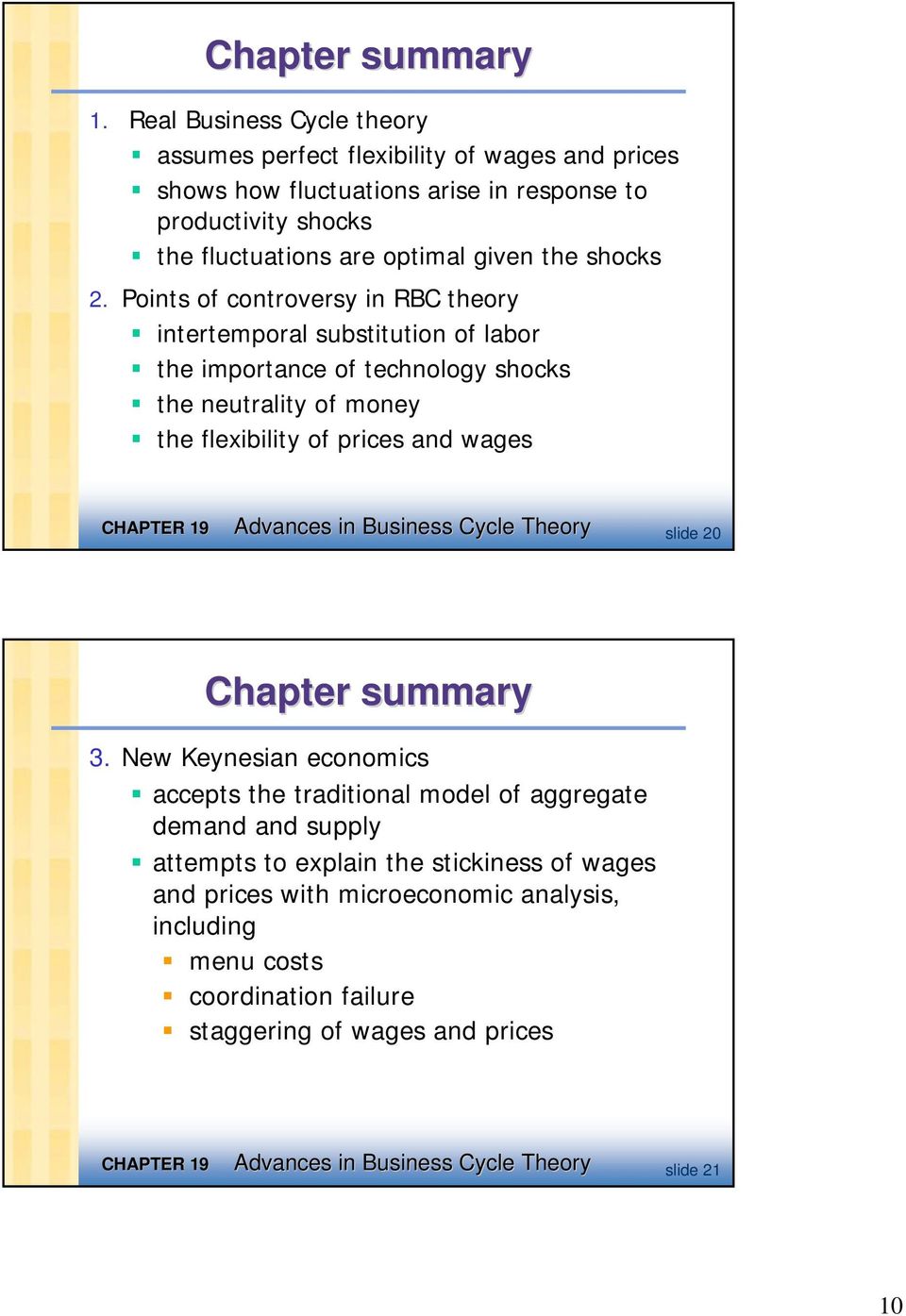
10 Chapter summary 1. Real Business Cycle theory assumes perfect flexibility of wages and prices shows how fluctuations arise in response to productivity shocks the fluctuations are optimal given the shocks 2. Points of controversy in RBC theory intertemporal substitution of labor the importance of technology shocks the neutrality of money the flexibility of prices and wages Advances in Business Cycle Theory slide 20 Chapter summary 3. New Keynesian economics accepts the traditional model of aggregate demand and supply attempts to explain the stickiness of wages and prices with microeconomic analysis, including menu costs coordination failure staggering of wages and prices Advances in Business Cycle Theory slide 21 10
11 Advances in Business Cycle Theory slide 22 11
A Review of the Literature of Real Business Cycle theory. By Student E XXXXXXX
 A Review of the Literature of Real Business Cycle theory By Student E XXXXXXX Abstract: The following paper reviews five articles concerning Real Business Cycle theory. First, the review compares the various
Fundamental Economic Factors
 Classical Model Real business cycle theory seeks to explain business cycles via the classical model. There is general equilibrium: demand equals supply in every market. An ideological conviction underlies
Chapter 11. Market-Clearing Models of the Business Cycle
 Chapter 11 Market-Clearing Models of the Business Cycle Goal of This Chapter In this chapter, we study three models of business cycle, which were each developed as explicit equilibrium (market-clearing)
New Keynesian Theory. Graduate Macroeconomics I ECON 309 Cunningham
 New Keynesian Theory Graduate Macroeconomics I ECON 309 Cunningham New Classical View of Keynesian Economics Failure on a grand scale. Made up of ad hoc assumptions, not built on a strong foundation of
Chapter 11. Keynesianism: The Macroeconomics of Wage and Price Rigidity. 2008 Pearson Addison-Wesley. All rights reserved
 Chapter 11 Keynesianism: The Macroeconomics of Wage and Price Rigidity Chapter Outline Real-Wage Rigidity Price Stickiness Monetary and Fiscal Policy in the Keynesian Model The Keynesian Theory of Business
CH 10 - REVIEW QUESTIONS
 CH 10 - REVIEW QUESTIONS 1. The short-run aggregate supply curve is horizontal at: A) a level of output determined by aggregate demand. B) the natural level of output. C) the level of output at which the
The Real Business Cycle School
 Major Currents in Contemporary Economics The Real Business Cycle School Mariusz Próchniak Department of Economics II Warsaw School of Economics 1 Background During 1972-82,the dominant new classical theory
The Real Business Cycle model
 The Real Business Cycle model Spring 2013 1 Historical introduction Modern business cycle theory really got started with Great Depression Keynes: The General Theory of Employment, Interest and Money Keynesian
Intermediate Macroeconomics: The Real Business Cycle Model
 Intermediate Macroeconomics: The Real Business Cycle Model Eric Sims University of Notre Dame Fall 2012 1 Introduction Having developed an operational model of the economy, we want to ask ourselves the
The RBC methodology also comes down to two principles:
 Chapter 5 Real business cycles 5.1 Real business cycles The most well known paper in the Real Business Cycles (RBC) literature is Kydland and Prescott (1982). That paper introduces both a specific theory
Long run v.s. short run. Introduction. Aggregate Demand and Aggregate Supply. In this chapter, look for the answers to these questions:
 33 Aggregate Demand and Aggregate Supply R I N C I L E S O F ECONOMICS FOURTH EDITION N. GREGOR MANKIW Long run v.s. short run Long run growth: what determines long-run output (and the related employment
Chapter 12. Unemployment. covered in the final exam) 12-1 History of Unemployment in the New Zealand. discouraged and underemployed workers.
 Chapter 12 13-1 Unemployment (Note: Chapter 12 will not be covered in the final exam) 12-1 History of Unemployment in the New Zealand 13-2 Unemployment rate over time. Recap of definition & issue of discouraged
Answers. Event: a tax cut 1. affects C, AD curve 2. shifts AD right 3. SR eq m at point B. P and Y higher, unemp lower 4.
 A C T I V E L E A R N I N G 2: Answers Event: a tax cut 1. affects C, AD curve 2. shifts AD right 3. SR eq m at point B. P and Y higher, unemp lower 4. Over time, P E rises, SRAS shifts left, until LR
Using Policy to Stabilize the Economy
 Using Policy to Stabilize the Economy Since the Employment ct of 1946, economic stabilization has been a goal of U.S. policy. Economists debate how active a role the govt should take to stabilize the economy.
Agenda. Business Cycles. What Is a Business Cycle? What Is a Business Cycle? What is a Business Cycle? Business Cycle Facts.
 Agenda What is a Business Cycle? Business Cycles.. 11-1 11-2 Business cycles are the short-run fluctuations in aggregate economic activity around its long-run growth path. Y Time 11-3 11-4 1 Components
Technology and Economic Growth
 Technology and Economic Growth Chapter 5 slide 0 Outline The Growth Accounting Formula Endogenous Growth Theory Policies to Stimulate Growth The Neoclassical Growth Revival Real wages and Labor Productivity
Chapter Outline. Chapter 11. Real-Wage Rigidity. Real-Wage Rigidity
 Chapter 11 Keynesianism: The Macroeconomics of Wage and Price Rigidity Chapter Outline Real-Wage Rigidity Price Stickiness Monetary and Fiscal Policy in the Keynesian 2008 Pearson Addison-Wesley. All rights
Chapter 12 Unemployment and Inflation
 Chapter 12 Unemployment and Inflation Multiple Choice Questions 1. The origin of the idea of a trade-off between inflation and unemployment was a 1958 article by (a) A.W. Phillips. (b) Edmund Phelps. (c)
Lecture 9: Keynesian Models
 Lecture 9: Keynesian Models Professor Eric Sims University of Notre Dame Fall 2009 Sims (Notre Dame) Keynesian Fall 2009 1 / 23 Keynesian Models The de ning features of RBC models are: Markets clear Money
The Real Business Cycle Model
 The Real Business Cycle Model Ester Faia Goethe University Frankfurt Nov 2015 Ester Faia (Goethe University Frankfurt) RBC Nov 2015 1 / 27 Introduction The RBC model explains the co-movements in the uctuations
Chapter 13 Real Business Cycle Theory
 Chapter 13 Real Business Cycle Theory Real Business Cycle (RBC) Theory is the other dominant strand of thought in modern macroeconomics. For the most part, RBC theory has held much less sway amongst policy-makers
BADM 527, Fall 2013. Midterm Exam 2. Multiple Choice: 3 points each. Answer the questions on the separate bubble sheet. NAME
 BADM 527, Fall 2013 Name: Midterm Exam 2 November 7, 2013 Multiple Choice: 3 points each. Answer the questions on the separate bubble sheet. NAME 1. According to classical theory, national income (Real
Agenda. The IS-LM/AD-AS Model: A General Framework for Macroeconomic Analysis, Part 3. Disequilibrium in the AD-AS model
 Agenda The IS-LM/AD-AS Model: A General Framework for Macroeconomic Analysis, art 3 rice Adjustment and the Attainment of General Equilibrium 13-1 13-2 General equilibrium in the AD-AS model Disequilibrium
ECONOMIC QUESTIONS FOR THE MASTER'S EXAM
 ECONOMIC QUESTIONS FOR THE MASTER'S EXAM Introduction 1. What is economics? Discuss the purpose and method of work of economists. Consider observation, induction, deduction and scientific criticism. 2.
Chapter 12: Aggregate Supply and Phillips Curve
 Chapter 12: Aggregate Supply and Phillips Curve In this chapter we explain the position and slope of the short run aggregate supply (SRAS) curve. SRAS curve can also be relabeled as Phillips curve. A basic
THREE KEY FACTS ABOUT ECONOMIC FLUCTUATIONS
 15 In this chapter, look for the answers to these questions: What are economic fluctuations? What are their characteristics? How does the model of demand and explain economic fluctuations? Why does the
Fourth Edition. University of California, Berkeley
 Fourth Edition University of California, Berkeley Introduction Chapter 1 Chapter 2 Chapter 3 Chapter 4 Chapter 5 Chapter 6 Chapter 7 Chapter 8 Chapter 9 Chapter 10 Chapter 11 Chapter 12 Epilogue References
LECTURE NOTES ON MACROECONOMIC PRINCIPLES
 LECTURE NOTES ON MACROECONOMIC PRINCIPLES Peter Ireland Department of Economics Boston College [email protected] http://www2.bc.edu/peter-ireland/ec132.html Copyright (c) 2013 by Peter Ireland. Redistribution
Real Business Cycle Theory
 Real Business Cycle Theory Guido Ascari University of Pavia () Real Business Cycle Theory 1 / 50 Outline Introduction: Lucas methodological proposal The application to the analysis of business cycle uctuations:
Labor Market and Unemployment Ing. Mansoor Maitah Ph.D.
 Labor Market and Unemployment Ing. Mansoor Maitah Ph.D. Product and Factor Markets Demand for Goods and Services Market of Goods and Services S D Supply of Goods and Services Households Firms Supply of
CHAPTER 7: AGGREGATE DEMAND AND AGGREGATE SUPPLY
 CHAPTER 7: AGGREGATE DEMAND AND AGGREGATE SUPPLY Learning goals of this chapter: What forces bring persistent and rapid expansion of real GDP? What causes inflation? Why do we have business cycles? How
2. Real Business Cycle Theory (June 25, 2013)
 Prof. Dr. Thomas Steger Advanced Macroeconomics II Lecture SS 13 2. Real Business Cycle Theory (June 25, 2013) Introduction Simplistic RBC Model Simple stochastic growth model Baseline RBC model Introduction
Lecture 14 More on Real Business Cycles. Noah Williams
 Lecture 14 More on Real Business Cycles Noah Williams University of Wisconsin - Madison Economics 312 Optimality Conditions Euler equation under uncertainty: u C (C t, 1 N t) = βe t [u C (C t+1, 1 N t+1)
The Aggregate Demand- Aggregate Supply (AD-AS) Model
 The AD-AS Model The Aggregate Demand- Aggregate Supply (AD-AS) Model Chapter 9 The AD-AS Model addresses two deficiencies of the AE Model: No explicit modeling of aggregate supply. Fixed price level. 2
Econ 202 Section 2 Final Exam
 Douglas, Fall 2009 December 17, 2009 A: Special Code 0000 PLEDGE: I have neither given nor received unauthorized help on this exam. SIGNED: PRINT NAME: Econ 202 Section 2 Final Exam 1. The present value
Economics 202 (Section 05) Macroeconomic Theory 1. Syllabus Professor Sanjay Chugh Fall 2013
 Department of Economics Boston College Economics 202 (Section 05) Macroeconomic Theory Syllabus Professor Sanjay Chugh Meetings: Tuesdays and Thursdays, 1:30pm-2:45pm, Gasson Hall 209 Email address: [email protected]
Cosumnes River College Principles of Macroeconomics Problem Set 11 Will Not Be Collected
 Name: Solutions Cosumnes River College Principles of Macroeconomics Problem Set 11 Will Not Be Collected Fall 2015 Prof. Dowell Instructions: This problem set will not be collected. You should still work
Real Business Cycle Theory
 Chapter 4 Real Business Cycle Theory This section of the textbook focuses on explaining the behavior of the business cycle. The terms business cycle, short-run macroeconomics, and economic fluctuations
Chapter 13. Aggregate Demand and Aggregate Supply Analysis
 Chapter 13. Aggregate Demand and Aggregate Supply Analysis Instructor: JINKOOK LEE Department of Economics / Texas A&M University ECON 203 502 Principles of Macroeconomics In the short run, real GDP and
Final. 1. (2 pts) What is the expected effect on the real demand for money of an increase in the nominal interest rate? How to explain this effect?
 Name: Number: Nova School of Business and Economics Macroeconomics, 1103-1st Semester 2013-2014 Prof. André C. Silva TAs: João Vaz, Paulo Fagandini, and Pedro Freitas Final Maximum points: 20. Time: 2h.
Assignment #3. ECON 410.502 Macroeconomic Theory Spring 2010 Instructor: Guangyi Ma. Notice:
 ECON 410.502 Macroeconomic Theory Spring 2010 Instructor: Guangyi Ma Assignment #3 Notice: (1) There are 25 multiple-choice problems and 2 analytic (short-answer) problems. This assignment is due on March
Chapter 12. Unemployment and Inflation. 2008 Pearson Addison-Wesley. All rights reserved
 Chapter 12 Unemployment and Inflation Chapter Outline Unemployment and Inflation: Is There a Trade-Off? The Problem of Unemployment The Problem of Inflation 12-2 Unemployment and Inflation: Is There a
Inflation and Unemployment CHAPTER 22 THE SHORT-RUN TRADE-OFF 0
 22 The Short-Run Trade-off Between Inflation and Unemployment CHAPTER 22 THE SHORT-RUN TRADE-OFF 0 In this chapter, look for the answers to these questions: How are inflation and unemployment related in
Aggregate Demand and Aggregate Supply Ing. Mansoor Maitah Ph.D. et Ph.D.
 Aggregate Demand and Aggregate Supply Ing. Mansoor Maitah Ph.D. et Ph.D. Aggregate Demand and Aggregate Supply Economic fluctuations, also called business cycles, are movements of GDP away from potential
CONCEPT OF MACROECONOMICS
 CONCEPT OF MACROECONOMICS Macroeconomics is the branch of economics that studies economic aggregates (grand totals):e.g. the overall level of prices, output and employment in the economy. If you want to
MULTIPLE CHOICE. Choose the one alternative that best completes the statement or answers the question.
 Econ 111 Summer 2007 Final Exam Name MULTIPLE CHOICE. Choose the one alternative that best completes the statement or answers the question. 1) The classical dichotomy allows us to explore economic growth
Real Business Cycle Models
 Real Business Cycle Models Lecture 2 Nicola Viegi April 2015 Basic RBC Model Claim: Stochastic General Equlibrium Model Is Enough to Explain The Business cycle Behaviour of the Economy Money is of little
ECON20310 LECTURE SYNOPSIS REAL BUSINESS CYCLE
 ECON20310 LECTURE SYNOPSIS REAL BUSINESS CYCLE YUAN TIAN This synopsis is designed merely for keep a record of the materials covered in lectures. Please refer to your own lecture notes for all proofs.
Answers to Text Questions and Problems. Chapter 22. Answers to Review Questions
 Answers to Text Questions and Problems Chapter 22 Answers to Review Questions 3. In general, producers of durable goods are affected most by recessions while producers of nondurables (like food) and services
CHAPTER 11. AN OVEVIEW OF THE BANK OF ENGLAND QUARTERLY MODEL OF THE (BEQM)
 1 CHAPTER 11. AN OVEVIEW OF THE BANK OF ENGLAND QUARTERLY MODEL OF THE (BEQM) This model is the main tool in the suite of models employed by the staff and the Monetary Policy Committee (MPC) in the construction
AGGREGATE DEMAND AND AGGREGATE SUPPLY The Influence of Monetary and Fiscal Policy on Aggregate Demand
 AGGREGATE DEMAND AND AGGREGATE SUPPLY The Influence of Monetary and Fiscal Policy on Aggregate Demand Suppose that the economy is undergoing a recession because of a fall in aggregate demand. a. Using
REAL BUSINESS CYCLE THEORY METHODOLOGY AND TOOLS
 Jakub Gazda 42 Jakub Gazda, Real Business Cycle Theory Methodology and Tools, Economics & Sociology, Vol. 3, No 1, 2010, pp. 42-48. Jakub Gazda Department of Microeconomics Poznan University of Economics
MULTIPLE CHOICE. Choose the one alternative that best completes the statement or answers the question.
 Suvey of Macroeconomics, MBA 641 Fall 2006, Final Exam Name MULTIPLE CHOICE. Choose the one alternative that best completes the statement or answers the question. 1) Modern macroeconomics emerged from
MACROECONOMICS II INFLATION, UNEMPLOYMENT AND THE PHILLIPS CURVE
 MACROECONOMICS II INFLATION, UNEMPLOYMENT AND THE 1 Earlier we noted that the goal of macroeconomic policy is to achieve low inflation and low unemployment. This is because having high levels of either,
EC2105, Professor Laury EXAM 2, FORM A (3/13/02)
 EC2105, Professor Laury EXAM 2, FORM A (3/13/02) Print Your Name: ID Number: Multiple Choice (32 questions, 2.5 points each; 80 points total). Clearly indicate (by circling) the ONE BEST response to each
Further Discussion of Temporary Payroll Tax Cut During Recession(s) Mark Bils and Pete Klenow, December 12, 2008
 Further Discussion of Temporary Payroll Tax Cut During Recession(s) Mark Bils and Pete Klenow, December 12, 2008 We focus on three aspects of a cut in payroll taxes as a stabilizer in a recession: (1)
7 AGGREGATE SUPPLY AND AGGREGATE DEMAND* Chapter. Key Concepts
 Chapter 7 AGGREGATE SUPPLY AND AGGREGATE DEMAND* Key Concepts Aggregate Supply The aggregate production function shows that the quantity of real GDP (Y ) supplied depends on the quantity of labor (L ),
Aggregate Supply and Aggregate Demand
 26 Aggregate Supply and Aggregate Demand Learning Objectives Explain what determines aggregate supply Explain what determines aggregate demand Explain what determines real GDP and the price level and how
1. Fill in the blanks for the following sentence: A rise in taxes on households will shift AD to the, this will push.
 Homework 16 1. Fill in the blanks for the following sentence: A rise in taxes on households will shift AD to the, this will push. A. right; down B. left; down C. left; up D. right; up 2. During a recession,
Chapter 9. The IS-LM/AD-AS Model: A General Framework for Macroeconomic Analysis. 2008 Pearson Addison-Wesley. All rights reserved
 Chapter 9 The IS-LM/AD-AS Model: A General Framework for Macroeconomic Analysis Chapter Outline The FE Line: Equilibrium in the Labor Market The IS Curve: Equilibrium in the Goods Market The LM Curve:
welfare costs of business cycles
 welfare costs of business cycles Ayse Imrohoroglu From The New Palgrave Dictionary of Economics, Second Edition, 2008 Edited by Steven N. Durlauf and Lawrence E. Blume Abstract The welfare cost of business
Manfred Gartner. University of St Gallen, Switzerland. An imprint of Pearson Education
 Manfred Gartner University of St Gallen, Switzerland An imprint of Pearson Education Harlow, England London New York Reading, Massachusetts San Francisco Toronto Don Mills, Ontario Sydney Tokyo Singapore
http://angel.bfwpub.com/section/content/default.asp?wci=pgt...
 Hmwk 10 1. Which of the following people are counted as unemployed? A. a person who wants to work but stopped searching six months ago B. a person out of work but actively searching for work C. a person
chapter: Aggregate Demand and Aggregate Supply Krugman/Wells 2009 Worth Publishers 1 of 58
 chapter: 12 >> Aggregate Demand and Aggregate Supply Krugman/Wells 2009 Worth Publishers 1 of 58 WHAT YOU WILL LEARN IN THIS CHAPTER How the aggregate demand curve illustrates the relationship between
Practiced Questions. Chapter 20
 Practiced Questions Chapter 20 1. The model of aggregate demand and aggregate supply a. is different from the model of supply and demand for a particular market, in that we cannot focus on the substitution
Answers to Text Questions and Problems in Chapter 11
 Answers to Text Questions and Problems in Chapter 11 Answers to Review Questions 1. The aggregate demand curve relates aggregate demand (equal to short-run equilibrium output) to inflation. As inflation
10/7/2013. Chapter 9: Introduction to Economic Fluctuations. Facts about the business cycle. Unemployment. Okun s Law Y Y
 Facts about the business cycle Chapter 9: GD growth averages 3 3.5 percent per year over the long run with large fluctuations in the short run. Consumption and investment fluctuate with GD, but consumption
Advanced Macroeconomics (2)
 Advanced Macroeconomics (2) Real-Business-Cycle Theory Alessio Moneta Institute of Economics Scuola Superiore Sant Anna, Pisa [email protected] March-April 2015 LM in Economics Scuola Superiore Sant Anna
Use the following to answer question 15: Exhibit: Short-run Phillips Curve. Page 3
 Chapter 13 1. According to the sticky-price model: A) all firms announce their prices in advance. B) all firms set their prices in accord with observed prices and output. C) some firms set their prices
ECON 3312 Macroeconomics Exam 3 Fall 2014. Name MULTIPLE CHOICE. Choose the one alternative that best completes the statement or answers the question.
 ECON 3312 Macroeconomics Exam 3 Fall 2014 Name MULTIPLE CHOICE. Choose the one alternative that best completes the statement or answers the question. 1) Everything else held constant, an increase in net
In this chapter we learn the potential causes of fluctuations in national income. We focus on demand shocks other than supply shocks.
 Chapter 11: Applying IS-LM Model In this chapter we learn the potential causes of fluctuations in national income. We focus on demand shocks other than supply shocks. We also learn how the IS-LM model
Chapter 18. MODERN PRINCIPLES OF ECONOMICS Third Edition
 Chapter 18 MODERN PRINCIPLES OF ECONOMICS Third Edition Fiscal Policy Outline Fiscal Policy: The Best Case The Limits to Fiscal Policy When Fiscal Policy Might Make Matters Worse So When Is Fiscal Policy
Preparation course MSc Business & Econonomics- Macroeconomics: Introduction & Concepts
 Preparation course MSc Business & Econonomics- Macroeconomics: Introduction & Concepts Tom-Reiel Heggedal Economics Department 2014 TRH (Institute) Intro&Concepts 2014 1 / 20 General Information Me: Tom-Reiel
Use the following to answer question 9: Exhibit: Keynesian Cross
 1. Leading economic indicators are: A) the most popular economic statistics. B) data that are used to construct the consumer price index and the unemployment rate. C) variables that tend to fluctuate in
Graduate Macroeconomics 2
 Graduate Macroeconomics 2 Lecture 1 - Introduction to Real Business Cycles Zsófia L. Bárány Sciences Po 2014 January About the course I. 2-hour lecture every week, Tuesdays from 10:15-12:15 2 big topics
Charles I. Jones Maroeconomics Economic Crisis Update (2010 års upplaga) Kurs 407 Makroekonomi och ekonomisk- politisk analys
 HHS Kurs 407 Makroekonomi och ekonomisk- politisk analys VT2011 Charles I. Jones Maroeconomics Economic Crisis Update Sebastian Krakowski Kurs 407 Makroekonomi och ekonomisk- politisk analys Contents Overview...
Econ 202 Section 4 Final Exam
 Douglas, Fall 2009 December 15, 2009 A: Special Code 00004 PLEDGE: I have neither given nor received unauthorized help on this exam. SIGNED: PRINT NAME: Econ 202 Section 4 Final Exam 1. Oceania buys $40
Answers to Text Questions and Problems in Chapter 8
 Answers to Text Questions and Problems in Chapter 8 Answers to Review Questions 1. The key assumption is that, in the short run, firms meet demand at pre-set prices. The fact that firms produce to meet
Ch.6 Aggregate Supply, Wages, Prices, and Unemployment
 1 Econ 302 Intermediate Macroeconomics Chul-Woo Kwon Ch.6 Aggregate Supply, Wages, rices, and Unemployment I. Introduction A. The dynamic changes of and the price adjustment B. Link between the price change
MONEY, INTEREST, REAL GDP, AND THE PRICE LEVEL*
 Chapter 11 MONEY, INTEREST, REAL GDP, AND THE PRICE LEVEL* Key Concepts The Demand for Money Four factors influence the demand for money: The price level An increase in the price level increases the nominal
12.1 Introduction. 12.2 The MP Curve: Monetary Policy and the Interest Rates 1/24/2013. Monetary Policy and the Phillips Curve
 Chapter 12 Monetary Policy and the Phillips Curve By Charles I. Jones Media Slides Created By Dave Brown Penn State University The short-run model summary: Through the MP curve the nominal interest rate
4 Macroeconomics LESSON 6
 4 Macroeconomics LESSON 6 Interest Rates and Monetary Policy in the Short Run and the Long Run Introduction and Description This lesson explores the relationship between the nominal interest rate and the
As you discovered in Chapter 10, unemployment and inflation impose costs
 Keynes and the Classical Economists: The Early Debate on Policy Activism LEARNING OBJECTIVES 1. Discuss why the classical economists believed that a market economy would automatically tend toward full
The Case for a Tax Cut
 The Case for a Tax Cut Alan C. Stockman University of Rochester, and NBER Shadow Open Market Committee April 29-30, 2001 1. Tax Increases Have Created the Surplus Any discussion of tax policy should begin
Real Business Cycle Theory. Marco Di Pietro Advanced () Monetary Economics and Policy 1 / 35
 Real Business Cycle Theory Marco Di Pietro Advanced () Monetary Economics and Policy 1 / 35 Introduction to DSGE models Dynamic Stochastic General Equilibrium (DSGE) models have become the main tool for
Inflation. Chapter 8. 8.1 Money Supply and Demand
 Chapter 8 Inflation This chapter examines the causes and consequences of inflation. Sections 8.1 and 8.2 relate inflation to money supply and demand. Although the presentation differs somewhat from that
Problem Set #3 Answer Key
 Problem Set #3 Answer Key Economics 305: Macroeconomic Theory Spring 2007 1 Chapter 4, Problem #2 a) To specify an indifference curve, we hold utility constant at ū. Next, rearrange in the form: C = ū
VI. Real Business Cycles Models
 VI. Real Business Cycles Models Introduction Business cycle research studies the causes and consequences of the recurrent expansions and contractions in aggregate economic activity that occur in most industrialized
A decline in the stock market, which makes consumers poorer, would cause the aggregate demand curve to shift to the left.
 Economics 304 Final Exam Fall 2000 PART I: TRUE/FALSE. Write 'T' if the statement is true and 'F' if the statement is false. (1.5 pts. each) A decline in the stock market, which makes consumers poorer,
Keynesian Macroeconomic Theory
 2 Keynesian Macroeconomic Theory 2.1. The Keynesian Consumption Function 2.2. The Complete Keynesian Model 2.3. The Keynesian-Cross Model 2.4. The IS-LM Model 2.5. The Keynesian AD-AS Model 2.6. Conclusion
0 100 200 300 Real income (Y)
 Lecture 11-1 6.1 The open economy, the multiplier, and the IS curve Assume that the economy is either closed (no foreign trade) or open. Assume that the exchange rates are either fixed or flexible. Assume
I. Introduction to Aggregate Demand/Aggregate Supply Model
 University of California-Davis Economics 1B-Intro to Macro Handout 8 TA: Jason Lee Email: [email protected] I. Introduction to Aggregate Demand/Aggregate Supply Model In this chapter we develop a model
Thinkwell s Homeschool Economics Course Lesson Plan: 36 weeks
 Thinkwell s Homeschool Economics Course Lesson Plan: 36 weeks Welcome to Thinkwell s Homeschool Economics! We re thrilled that you ve decided to make us part of your homeschool curriculum. This lesson
Keynesian Economics I. The Keynesian System (I): The Role of Aggregate Demand
 Keynesian Economics I The Keynesian System (I): The Role of Aggregate Demand Labor Market Excess supply and excess demand are not equally strong forces in the labor market. The supply of workers is such
Comments on \Do We Really Know that Oil Caused the Great Stag ation? A Monetary Alternative", by Robert Barsky and Lutz Kilian
 Comments on \Do We Really Know that Oil Caused the Great Stag ation? A Monetary Alternative", by Robert Barsky and Lutz Kilian Olivier Blanchard July 2001 Revisionist history is always fun. But it is not
Econ 303: Intermediate Macroeconomics I Dr. Sauer Sample Questions for Exam #3
 Econ 303: Intermediate Macroeconomics I Dr. Sauer Sample Questions for Exam #3 1. When firms experience unplanned inventory accumulation, they typically: A) build new plants. B) lay off workers and reduce